EP2766304B1 - Aerogels, calcined and crystalline articles and methods of making the same - Google Patents
Aerogels, calcined and crystalline articles and methods of making the same Download PDFInfo
- Publication number
- EP2766304B1 EP2766304B1 EP12762691.9A EP12762691A EP2766304B1 EP 2766304 B1 EP2766304 B1 EP 2766304B1 EP 12762691 A EP12762691 A EP 12762691A EP 2766304 B1 EP2766304 B1 EP 2766304B1
- Authority
- EP
- European Patent Office
- Prior art keywords
- metal oxide
- crystalline metal
- crack
- free
- zro
- Prior art date
- Legal status (The legal status is an assumption and is not a legal conclusion. Google has not performed a legal analysis and makes no representation as to the accuracy of the status listed.)
- Active
Links
Images

Classifications
-
- C—CHEMISTRY; METALLURGY
- C01—INORGANIC CHEMISTRY
- C01G—COMPOUNDS CONTAINING METALS NOT COVERED BY SUBCLASSES C01D OR C01F
- C01G25/00—Compounds of zirconium
-
- A—HUMAN NECESSITIES
- A61—MEDICAL OR VETERINARY SCIENCE; HYGIENE
- A61C—DENTISTRY; APPARATUS OR METHODS FOR ORAL OR DENTAL HYGIENE
- A61C13/00—Dental prostheses; Making same
- A61C13/0003—Making bridge-work, inlays, implants or the like
- A61C13/0006—Production methods
-
- A—HUMAN NECESSITIES
- A61—MEDICAL OR VETERINARY SCIENCE; HYGIENE
- A61C—DENTISTRY; APPARATUS OR METHODS FOR ORAL OR DENTAL HYGIENE
- A61C13/00—Dental prostheses; Making same
- A61C13/0003—Making bridge-work, inlays, implants or the like
- A61C13/0022—Blanks or green, unfinished dental restoration parts
-
- A—HUMAN NECESSITIES
- A61—MEDICAL OR VETERINARY SCIENCE; HYGIENE
- A61C—DENTISTRY; APPARATUS OR METHODS FOR ORAL OR DENTAL HYGIENE
- A61C13/00—Dental prostheses; Making same
- A61C13/08—Artificial teeth; Making same
- A61C13/082—Cosmetic aspects, e.g. inlays; Determination of the colour
-
- A—HUMAN NECESSITIES
- A61—MEDICAL OR VETERINARY SCIENCE; HYGIENE
- A61C—DENTISTRY; APPARATUS OR METHODS FOR ORAL OR DENTAL HYGIENE
- A61C5/00—Filling or capping teeth
- A61C5/20—Repairing attrition damage, e.g. facets
-
- A—HUMAN NECESSITIES
- A61—MEDICAL OR VETERINARY SCIENCE; HYGIENE
- A61C—DENTISTRY; APPARATUS OR METHODS FOR ORAL OR DENTAL HYGIENE
- A61C5/00—Filling or capping teeth
- A61C5/70—Tooth crowns; Making thereof
- A61C5/77—Methods or devices for making crowns
-
- A—HUMAN NECESSITIES
- A61—MEDICAL OR VETERINARY SCIENCE; HYGIENE
- A61C—DENTISTRY; APPARATUS OR METHODS FOR ORAL OR DENTAL HYGIENE
- A61C7/00—Orthodontics, i.e. obtaining or maintaining the desired position of teeth, e.g. by straightening, evening, regulating, separating, or by correcting malocclusions
- A61C7/12—Brackets; Arch wires; Combinations thereof; Accessories therefor
- A61C7/28—Securing arch wire to bracket
- A61C7/282—Buccal tubes
-
- A—HUMAN NECESSITIES
- A61—MEDICAL OR VETERINARY SCIENCE; HYGIENE
- A61C—DENTISTRY; APPARATUS OR METHODS FOR ORAL OR DENTAL HYGIENE
- A61C8/00—Means to be fixed to the jaw-bone for consolidating natural teeth or for fixing dental prostheses thereon; Dental implants; Implanting tools
- A61C8/0001—Impression means for implants, e.g. impression coping
-
- A—HUMAN NECESSITIES
- A61—MEDICAL OR VETERINARY SCIENCE; HYGIENE
- A61C—DENTISTRY; APPARATUS OR METHODS FOR ORAL OR DENTAL HYGIENE
- A61C8/00—Means to be fixed to the jaw-bone for consolidating natural teeth or for fixing dental prostheses thereon; Dental implants; Implanting tools
- A61C8/0012—Means to be fixed to the jaw-bone for consolidating natural teeth or for fixing dental prostheses thereon; Dental implants; Implanting tools characterised by the material or composition, e.g. ceramics, surface layer, metal alloy
-
- A—HUMAN NECESSITIES
- A61—MEDICAL OR VETERINARY SCIENCE; HYGIENE
- A61C—DENTISTRY; APPARATUS OR METHODS FOR ORAL OR DENTAL HYGIENE
- A61C8/00—Means to be fixed to the jaw-bone for consolidating natural teeth or for fixing dental prostheses thereon; Dental implants; Implanting tools
- A61C8/0048—Connecting the upper structure to the implant, e.g. bridging bars
-
- A—HUMAN NECESSITIES
- A61—MEDICAL OR VETERINARY SCIENCE; HYGIENE
- A61K—PREPARATIONS FOR MEDICAL, DENTAL OR TOILETRY PURPOSES
- A61K6/00—Preparations for dentistry
- A61K6/15—Compositions characterised by their physical properties
-
- A—HUMAN NECESSITIES
- A61—MEDICAL OR VETERINARY SCIENCE; HYGIENE
- A61K—PREPARATIONS FOR MEDICAL, DENTAL OR TOILETRY PURPOSES
- A61K6/00—Preparations for dentistry
- A61K6/15—Compositions characterised by their physical properties
- A61K6/17—Particle size
-
- A—HUMAN NECESSITIES
- A61—MEDICAL OR VETERINARY SCIENCE; HYGIENE
- A61K—PREPARATIONS FOR MEDICAL, DENTAL OR TOILETRY PURPOSES
- A61K6/00—Preparations for dentistry
- A61K6/80—Preparations for artificial teeth, for filling teeth or for capping teeth
- A61K6/802—Preparations for artificial teeth, for filling teeth or for capping teeth comprising ceramics
- A61K6/818—Preparations for artificial teeth, for filling teeth or for capping teeth comprising ceramics comprising zirconium oxide
-
- A—HUMAN NECESSITIES
- A61—MEDICAL OR VETERINARY SCIENCE; HYGIENE
- A61K—PREPARATIONS FOR MEDICAL, DENTAL OR TOILETRY PURPOSES
- A61K6/00—Preparations for dentistry
- A61K6/80—Preparations for artificial teeth, for filling teeth or for capping teeth
- A61K6/802—Preparations for artificial teeth, for filling teeth or for capping teeth comprising ceramics
- A61K6/822—Preparations for artificial teeth, for filling teeth or for capping teeth comprising ceramics comprising rare earth metal oxides
-
- A—HUMAN NECESSITIES
- A61—MEDICAL OR VETERINARY SCIENCE; HYGIENE
- A61K—PREPARATIONS FOR MEDICAL, DENTAL OR TOILETRY PURPOSES
- A61K6/00—Preparations for dentistry
- A61K6/80—Preparations for artificial teeth, for filling teeth or for capping teeth
- A61K6/802—Preparations for artificial teeth, for filling teeth or for capping teeth comprising ceramics
- A61K6/824—Preparations for artificial teeth, for filling teeth or for capping teeth comprising ceramics comprising transition metal oxides
-
- A—HUMAN NECESSITIES
- A61—MEDICAL OR VETERINARY SCIENCE; HYGIENE
- A61K—PREPARATIONS FOR MEDICAL, DENTAL OR TOILETRY PURPOSES
- A61K6/00—Preparations for dentistry
- A61K6/80—Preparations for artificial teeth, for filling teeth or for capping teeth
- A61K6/884—Preparations for artificial teeth, for filling teeth or for capping teeth comprising natural or synthetic resins
- A61K6/887—Compounds obtained by reactions only involving carbon-to-carbon unsaturated bonds
-
- B—PERFORMING OPERATIONS; TRANSPORTING
- B82—NANOTECHNOLOGY
- B82Y—SPECIFIC USES OR APPLICATIONS OF NANOSTRUCTURES; MEASUREMENT OR ANALYSIS OF NANOSTRUCTURES; MANUFACTURE OR TREATMENT OF NANOSTRUCTURES
- B82Y30/00—Nanotechnology for materials or surface science, e.g. nanocomposites
-
- C—CHEMISTRY; METALLURGY
- C01—INORGANIC CHEMISTRY
- C01G—COMPOUNDS CONTAINING METALS NOT COVERED BY SUBCLASSES C01D OR C01F
- C01G25/00—Compounds of zirconium
- C01G25/006—Compounds containing zirconium, with or without oxygen or hydrogen, and containing two or more other elements
-
- C—CHEMISTRY; METALLURGY
- C01—INORGANIC CHEMISTRY
- C01G—COMPOUNDS CONTAINING METALS NOT COVERED BY SUBCLASSES C01D OR C01F
- C01G25/00—Compounds of zirconium
- C01G25/02—Oxides
-
- C—CHEMISTRY; METALLURGY
- C04—CEMENTS; CONCRETE; ARTIFICIAL STONE; CERAMICS; REFRACTORIES
- C04B—LIME, MAGNESIA; SLAG; CEMENTS; COMPOSITIONS THEREOF, e.g. MORTARS, CONCRETE OR LIKE BUILDING MATERIALS; ARTIFICIAL STONE; CERAMICS; REFRACTORIES; TREATMENT OF NATURAL STONE
- C04B35/00—Shaped ceramic products characterised by their composition; Ceramics compositions; Processing powders of inorganic compounds preparatory to the manufacturing of ceramic products
- C04B35/01—Shaped ceramic products characterised by their composition; Ceramics compositions; Processing powders of inorganic compounds preparatory to the manufacturing of ceramic products based on oxide ceramics
- C04B35/48—Shaped ceramic products characterised by their composition; Ceramics compositions; Processing powders of inorganic compounds preparatory to the manufacturing of ceramic products based on oxide ceramics based on zirconium or hafnium oxides, zirconates, zircon or hafnates
- C04B35/486—Fine ceramics
-
- C—CHEMISTRY; METALLURGY
- C04—CEMENTS; CONCRETE; ARTIFICIAL STONE; CERAMICS; REFRACTORIES
- C04B—LIME, MAGNESIA; SLAG; CEMENTS; COMPOSITIONS THEREOF, e.g. MORTARS, CONCRETE OR LIKE BUILDING MATERIALS; ARTIFICIAL STONE; CERAMICS; REFRACTORIES; TREATMENT OF NATURAL STONE
- C04B35/00—Shaped ceramic products characterised by their composition; Ceramics compositions; Processing powders of inorganic compounds preparatory to the manufacturing of ceramic products
- C04B35/01—Shaped ceramic products characterised by their composition; Ceramics compositions; Processing powders of inorganic compounds preparatory to the manufacturing of ceramic products based on oxide ceramics
- C04B35/48—Shaped ceramic products characterised by their composition; Ceramics compositions; Processing powders of inorganic compounds preparatory to the manufacturing of ceramic products based on oxide ceramics based on zirconium or hafnium oxides, zirconates, zircon or hafnates
- C04B35/486—Fine ceramics
- C04B35/488—Composites
-
- C—CHEMISTRY; METALLURGY
- C04—CEMENTS; CONCRETE; ARTIFICIAL STONE; CERAMICS; REFRACTORIES
- C04B—LIME, MAGNESIA; SLAG; CEMENTS; COMPOSITIONS THEREOF, e.g. MORTARS, CONCRETE OR LIKE BUILDING MATERIALS; ARTIFICIAL STONE; CERAMICS; REFRACTORIES; TREATMENT OF NATURAL STONE
- C04B35/00—Shaped ceramic products characterised by their composition; Ceramics compositions; Processing powders of inorganic compounds preparatory to the manufacturing of ceramic products
- C04B35/622—Forming processes; Processing powders of inorganic compounds preparatory to the manufacturing of ceramic products
- C04B35/624—Sol-gel processing
-
- C—CHEMISTRY; METALLURGY
- C04—CEMENTS; CONCRETE; ARTIFICIAL STONE; CERAMICS; REFRACTORIES
- C04B—LIME, MAGNESIA; SLAG; CEMENTS; COMPOSITIONS THEREOF, e.g. MORTARS, CONCRETE OR LIKE BUILDING MATERIALS; ARTIFICIAL STONE; CERAMICS; REFRACTORIES; TREATMENT OF NATURAL STONE
- C04B35/00—Shaped ceramic products characterised by their composition; Ceramics compositions; Processing powders of inorganic compounds preparatory to the manufacturing of ceramic products
- C04B35/622—Forming processes; Processing powders of inorganic compounds preparatory to the manufacturing of ceramic products
- C04B35/64—Burning or sintering processes
-
- C—CHEMISTRY; METALLURGY
- C04—CEMENTS; CONCRETE; ARTIFICIAL STONE; CERAMICS; REFRACTORIES
- C04B—LIME, MAGNESIA; SLAG; CEMENTS; COMPOSITIONS THEREOF, e.g. MORTARS, CONCRETE OR LIKE BUILDING MATERIALS; ARTIFICIAL STONE; CERAMICS; REFRACTORIES; TREATMENT OF NATURAL STONE
- C04B38/00—Porous mortars, concrete, artificial stone or ceramic ware; Preparation thereof
-
- C—CHEMISTRY; METALLURGY
- C04—CEMENTS; CONCRETE; ARTIFICIAL STONE; CERAMICS; REFRACTORIES
- C04B—LIME, MAGNESIA; SLAG; CEMENTS; COMPOSITIONS THEREOF, e.g. MORTARS, CONCRETE OR LIKE BUILDING MATERIALS; ARTIFICIAL STONE; CERAMICS; REFRACTORIES; TREATMENT OF NATURAL STONE
- C04B38/00—Porous mortars, concrete, artificial stone or ceramic ware; Preparation thereof
- C04B38/0045—Porous mortars, concrete, artificial stone or ceramic ware; Preparation thereof by a process involving the formation of a sol or a gel, e.g. sol-gel or precipitation processes
-
- C—CHEMISTRY; METALLURGY
- C08—ORGANIC MACROMOLECULAR COMPOUNDS; THEIR PREPARATION OR CHEMICAL WORKING-UP; COMPOSITIONS BASED THEREON
- C08J—WORKING-UP; GENERAL PROCESSES OF COMPOUNDING; AFTER-TREATMENT NOT COVERED BY SUBCLASSES C08B, C08C, C08F, C08G or C08H
- C08J9/00—Working-up of macromolecular substances to porous or cellular articles or materials; After-treatment thereof
- C08J9/0066—Use of inorganic compounding ingredients
- C08J9/0071—Nanosized fillers, i.e. having at least one dimension below 100 nanometers
- C08J9/008—Nanoparticles
-
- C—CHEMISTRY; METALLURGY
- C08—ORGANIC MACROMOLECULAR COMPOUNDS; THEIR PREPARATION OR CHEMICAL WORKING-UP; COMPOSITIONS BASED THEREON
- C08J—WORKING-UP; GENERAL PROCESSES OF COMPOUNDING; AFTER-TREATMENT NOT COVERED BY SUBCLASSES C08B, C08C, C08F, C08G or C08H
- C08J9/00—Working-up of macromolecular substances to porous or cellular articles or materials; After-treatment thereof
- C08J9/28—Working-up of macromolecular substances to porous or cellular articles or materials; After-treatment thereof by elimination of a liquid phase from a macromolecular composition or article, e.g. drying of coagulum
-
- C—CHEMISTRY; METALLURGY
- C01—INORGANIC CHEMISTRY
- C01P—INDEXING SCHEME RELATING TO STRUCTURAL AND PHYSICAL ASPECTS OF SOLID INORGANIC COMPOUNDS
- C01P2002/00—Crystal-structural characteristics
- C01P2002/50—Solid solutions
-
- C—CHEMISTRY; METALLURGY
- C01—INORGANIC CHEMISTRY
- C01P—INDEXING SCHEME RELATING TO STRUCTURAL AND PHYSICAL ASPECTS OF SOLID INORGANIC COMPOUNDS
- C01P2002/00—Crystal-structural characteristics
- C01P2002/50—Solid solutions
- C01P2002/52—Solid solutions containing elements as dopants
-
- C—CHEMISTRY; METALLURGY
- C01—INORGANIC CHEMISTRY
- C01P—INDEXING SCHEME RELATING TO STRUCTURAL AND PHYSICAL ASPECTS OF SOLID INORGANIC COMPOUNDS
- C01P2002/00—Crystal-structural characteristics
- C01P2002/60—Compounds characterised by their crystallite size
-
- C—CHEMISTRY; METALLURGY
- C01—INORGANIC CHEMISTRY
- C01P—INDEXING SCHEME RELATING TO STRUCTURAL AND PHYSICAL ASPECTS OF SOLID INORGANIC COMPOUNDS
- C01P2002/00—Crystal-structural characteristics
- C01P2002/80—Crystal-structural characteristics defined by measured data other than those specified in group C01P2002/70
- C01P2002/84—Crystal-structural characteristics defined by measured data other than those specified in group C01P2002/70 by UV- or VIS- data
-
- C—CHEMISTRY; METALLURGY
- C01—INORGANIC CHEMISTRY
- C01P—INDEXING SCHEME RELATING TO STRUCTURAL AND PHYSICAL ASPECTS OF SOLID INORGANIC COMPOUNDS
- C01P2004/00—Particle morphology
- C01P2004/60—Particles characterised by their size
- C01P2004/62—Submicrometer sized, i.e. from 0.1-1 micrometer
-
- C—CHEMISTRY; METALLURGY
- C01—INORGANIC CHEMISTRY
- C01P—INDEXING SCHEME RELATING TO STRUCTURAL AND PHYSICAL ASPECTS OF SOLID INORGANIC COMPOUNDS
- C01P2004/00—Particle morphology
- C01P2004/60—Particles characterised by their size
- C01P2004/64—Nanometer sized, i.e. from 1-100 nanometer
-
- C—CHEMISTRY; METALLURGY
- C01—INORGANIC CHEMISTRY
- C01P—INDEXING SCHEME RELATING TO STRUCTURAL AND PHYSICAL ASPECTS OF SOLID INORGANIC COMPOUNDS
- C01P2006/00—Physical properties of inorganic compounds
- C01P2006/10—Solid density
-
- C—CHEMISTRY; METALLURGY
- C04—CEMENTS; CONCRETE; ARTIFICIAL STONE; CERAMICS; REFRACTORIES
- C04B—LIME, MAGNESIA; SLAG; CEMENTS; COMPOSITIONS THEREOF, e.g. MORTARS, CONCRETE OR LIKE BUILDING MATERIALS; ARTIFICIAL STONE; CERAMICS; REFRACTORIES; TREATMENT OF NATURAL STONE
- C04B2111/00—Mortars, concrete or artificial stone or mixtures to prepare them, characterised by specific function, property or use
- C04B2111/00474—Uses not provided for elsewhere in C04B2111/00
- C04B2111/00836—Uses not provided for elsewhere in C04B2111/00 for medical or dental applications
-
- C—CHEMISTRY; METALLURGY
- C04—CEMENTS; CONCRETE; ARTIFICIAL STONE; CERAMICS; REFRACTORIES
- C04B—LIME, MAGNESIA; SLAG; CEMENTS; COMPOSITIONS THEREOF, e.g. MORTARS, CONCRETE OR LIKE BUILDING MATERIALS; ARTIFICIAL STONE; CERAMICS; REFRACTORIES; TREATMENT OF NATURAL STONE
- C04B2235/00—Aspects relating to ceramic starting mixtures or sintered ceramic products
- C04B2235/02—Composition of constituents of the starting material or of secondary phases of the final product
- C04B2235/30—Constituents and secondary phases not being of a fibrous nature
- C04B2235/32—Metal oxides, mixed metal oxides, or oxide-forming salts thereof, e.g. carbonates, nitrates, (oxy)hydroxides, chlorides
- C04B2235/3217—Aluminum oxide or oxide forming salts thereof, e.g. bauxite, alpha-alumina
-
- C—CHEMISTRY; METALLURGY
- C04—CEMENTS; CONCRETE; ARTIFICIAL STONE; CERAMICS; REFRACTORIES
- C04B—LIME, MAGNESIA; SLAG; CEMENTS; COMPOSITIONS THEREOF, e.g. MORTARS, CONCRETE OR LIKE BUILDING MATERIALS; ARTIFICIAL STONE; CERAMICS; REFRACTORIES; TREATMENT OF NATURAL STONE
- C04B2235/00—Aspects relating to ceramic starting mixtures or sintered ceramic products
- C04B2235/02—Composition of constituents of the starting material or of secondary phases of the final product
- C04B2235/30—Constituents and secondary phases not being of a fibrous nature
- C04B2235/32—Metal oxides, mixed metal oxides, or oxide-forming salts thereof, e.g. carbonates, nitrates, (oxy)hydroxides, chlorides
- C04B2235/3224—Rare earth oxide or oxide forming salts thereof, e.g. scandium oxide
- C04B2235/3225—Yttrium oxide or oxide-forming salts thereof
-
- C—CHEMISTRY; METALLURGY
- C04—CEMENTS; CONCRETE; ARTIFICIAL STONE; CERAMICS; REFRACTORIES
- C04B—LIME, MAGNESIA; SLAG; CEMENTS; COMPOSITIONS THEREOF, e.g. MORTARS, CONCRETE OR LIKE BUILDING MATERIALS; ARTIFICIAL STONE; CERAMICS; REFRACTORIES; TREATMENT OF NATURAL STONE
- C04B2235/00—Aspects relating to ceramic starting mixtures or sintered ceramic products
- C04B2235/02—Composition of constituents of the starting material or of secondary phases of the final product
- C04B2235/30—Constituents and secondary phases not being of a fibrous nature
- C04B2235/32—Metal oxides, mixed metal oxides, or oxide-forming salts thereof, e.g. carbonates, nitrates, (oxy)hydroxides, chlorides
- C04B2235/3224—Rare earth oxide or oxide forming salts thereof, e.g. scandium oxide
- C04B2235/3227—Lanthanum oxide or oxide-forming salts thereof
-
- C—CHEMISTRY; METALLURGY
- C04—CEMENTS; CONCRETE; ARTIFICIAL STONE; CERAMICS; REFRACTORIES
- C04B—LIME, MAGNESIA; SLAG; CEMENTS; COMPOSITIONS THEREOF, e.g. MORTARS, CONCRETE OR LIKE BUILDING MATERIALS; ARTIFICIAL STONE; CERAMICS; REFRACTORIES; TREATMENT OF NATURAL STONE
- C04B2235/00—Aspects relating to ceramic starting mixtures or sintered ceramic products
- C04B2235/02—Composition of constituents of the starting material or of secondary phases of the final product
- C04B2235/30—Constituents and secondary phases not being of a fibrous nature
- C04B2235/32—Metal oxides, mixed metal oxides, or oxide-forming salts thereof, e.g. carbonates, nitrates, (oxy)hydroxides, chlorides
- C04B2235/3231—Refractory metal oxides, their mixed metal oxides, or oxide-forming salts thereof
- C04B2235/3244—Zirconium oxides, zirconates, hafnium oxides, hafnates, or oxide-forming salts thereof
-
- C—CHEMISTRY; METALLURGY
- C04—CEMENTS; CONCRETE; ARTIFICIAL STONE; CERAMICS; REFRACTORIES
- C04B—LIME, MAGNESIA; SLAG; CEMENTS; COMPOSITIONS THEREOF, e.g. MORTARS, CONCRETE OR LIKE BUILDING MATERIALS; ARTIFICIAL STONE; CERAMICS; REFRACTORIES; TREATMENT OF NATURAL STONE
- C04B2235/00—Aspects relating to ceramic starting mixtures or sintered ceramic products
- C04B2235/02—Composition of constituents of the starting material or of secondary phases of the final product
- C04B2235/50—Constituents or additives of the starting mixture chosen for their shape or used because of their shape or their physical appearance
- C04B2235/54—Particle size related information
- C04B2235/549—Particle size related information the particle size being expressed by crystallite size or primary particle size
-
- C—CHEMISTRY; METALLURGY
- C04—CEMENTS; CONCRETE; ARTIFICIAL STONE; CERAMICS; REFRACTORIES
- C04B—LIME, MAGNESIA; SLAG; CEMENTS; COMPOSITIONS THEREOF, e.g. MORTARS, CONCRETE OR LIKE BUILDING MATERIALS; ARTIFICIAL STONE; CERAMICS; REFRACTORIES; TREATMENT OF NATURAL STONE
- C04B2235/00—Aspects relating to ceramic starting mixtures or sintered ceramic products
- C04B2235/65—Aspects relating to heat treatments of ceramic bodies such as green ceramics or pre-sintered ceramics, e.g. burning, sintering or melting processes
- C04B2235/656—Aspects relating to heat treatments of ceramic bodies such as green ceramics or pre-sintered ceramics, e.g. burning, sintering or melting processes characterised by specific heating conditions during heat treatment
- C04B2235/6562—Heating rate
-
- C—CHEMISTRY; METALLURGY
- C04—CEMENTS; CONCRETE; ARTIFICIAL STONE; CERAMICS; REFRACTORIES
- C04B—LIME, MAGNESIA; SLAG; CEMENTS; COMPOSITIONS THEREOF, e.g. MORTARS, CONCRETE OR LIKE BUILDING MATERIALS; ARTIFICIAL STONE; CERAMICS; REFRACTORIES; TREATMENT OF NATURAL STONE
- C04B2235/00—Aspects relating to ceramic starting mixtures or sintered ceramic products
- C04B2235/65—Aspects relating to heat treatments of ceramic bodies such as green ceramics or pre-sintered ceramics, e.g. burning, sintering or melting processes
- C04B2235/656—Aspects relating to heat treatments of ceramic bodies such as green ceramics or pre-sintered ceramics, e.g. burning, sintering or melting processes characterised by specific heating conditions during heat treatment
- C04B2235/6565—Cooling rate
-
- C—CHEMISTRY; METALLURGY
- C04—CEMENTS; CONCRETE; ARTIFICIAL STONE; CERAMICS; REFRACTORIES
- C04B—LIME, MAGNESIA; SLAG; CEMENTS; COMPOSITIONS THEREOF, e.g. MORTARS, CONCRETE OR LIKE BUILDING MATERIALS; ARTIFICIAL STONE; CERAMICS; REFRACTORIES; TREATMENT OF NATURAL STONE
- C04B2235/00—Aspects relating to ceramic starting mixtures or sintered ceramic products
- C04B2235/65—Aspects relating to heat treatments of ceramic bodies such as green ceramics or pre-sintered ceramics, e.g. burning, sintering or melting processes
- C04B2235/656—Aspects relating to heat treatments of ceramic bodies such as green ceramics or pre-sintered ceramics, e.g. burning, sintering or melting processes characterised by specific heating conditions during heat treatment
- C04B2235/6567—Treatment time
-
- C—CHEMISTRY; METALLURGY
- C04—CEMENTS; CONCRETE; ARTIFICIAL STONE; CERAMICS; REFRACTORIES
- C04B—LIME, MAGNESIA; SLAG; CEMENTS; COMPOSITIONS THEREOF, e.g. MORTARS, CONCRETE OR LIKE BUILDING MATERIALS; ARTIFICIAL STONE; CERAMICS; REFRACTORIES; TREATMENT OF NATURAL STONE
- C04B2235/00—Aspects relating to ceramic starting mixtures or sintered ceramic products
- C04B2235/65—Aspects relating to heat treatments of ceramic bodies such as green ceramics or pre-sintered ceramics, e.g. burning, sintering or melting processes
- C04B2235/66—Specific sintering techniques, e.g. centrifugal sintering
- C04B2235/661—Multi-step sintering
-
- C—CHEMISTRY; METALLURGY
- C04—CEMENTS; CONCRETE; ARTIFICIAL STONE; CERAMICS; REFRACTORIES
- C04B—LIME, MAGNESIA; SLAG; CEMENTS; COMPOSITIONS THEREOF, e.g. MORTARS, CONCRETE OR LIKE BUILDING MATERIALS; ARTIFICIAL STONE; CERAMICS; REFRACTORIES; TREATMENT OF NATURAL STONE
- C04B2235/00—Aspects relating to ceramic starting mixtures or sintered ceramic products
- C04B2235/70—Aspects relating to sintered or melt-casted ceramic products
- C04B2235/74—Physical characteristics
- C04B2235/77—Density
-
- C—CHEMISTRY; METALLURGY
- C04—CEMENTS; CONCRETE; ARTIFICIAL STONE; CERAMICS; REFRACTORIES
- C04B—LIME, MAGNESIA; SLAG; CEMENTS; COMPOSITIONS THEREOF, e.g. MORTARS, CONCRETE OR LIKE BUILDING MATERIALS; ARTIFICIAL STONE; CERAMICS; REFRACTORIES; TREATMENT OF NATURAL STONE
- C04B2235/00—Aspects relating to ceramic starting mixtures or sintered ceramic products
- C04B2235/70—Aspects relating to sintered or melt-casted ceramic products
- C04B2235/74—Physical characteristics
- C04B2235/78—Grain sizes and shapes, product microstructures, e.g. acicular grains, equiaxed grains, platelet-structures
- C04B2235/781—Nanograined materials, i.e. having grain sizes below 100 nm
-
- C—CHEMISTRY; METALLURGY
- C04—CEMENTS; CONCRETE; ARTIFICIAL STONE; CERAMICS; REFRACTORIES
- C04B—LIME, MAGNESIA; SLAG; CEMENTS; COMPOSITIONS THEREOF, e.g. MORTARS, CONCRETE OR LIKE BUILDING MATERIALS; ARTIFICIAL STONE; CERAMICS; REFRACTORIES; TREATMENT OF NATURAL STONE
- C04B2235/00—Aspects relating to ceramic starting mixtures or sintered ceramic products
- C04B2235/70—Aspects relating to sintered or melt-casted ceramic products
- C04B2235/74—Physical characteristics
- C04B2235/78—Grain sizes and shapes, product microstructures, e.g. acicular grains, equiaxed grains, platelet-structures
- C04B2235/785—Submicron sized grains, i.e. from 0,1 to 1 micron
-
- C—CHEMISTRY; METALLURGY
- C04—CEMENTS; CONCRETE; ARTIFICIAL STONE; CERAMICS; REFRACTORIES
- C04B—LIME, MAGNESIA; SLAG; CEMENTS; COMPOSITIONS THEREOF, e.g. MORTARS, CONCRETE OR LIKE BUILDING MATERIALS; ARTIFICIAL STONE; CERAMICS; REFRACTORIES; TREATMENT OF NATURAL STONE
- C04B2235/00—Aspects relating to ceramic starting mixtures or sintered ceramic products
- C04B2235/70—Aspects relating to sintered or melt-casted ceramic products
- C04B2235/80—Phases present in the sintered or melt-cast ceramic products other than the main phase
-
- C—CHEMISTRY; METALLURGY
- C04—CEMENTS; CONCRETE; ARTIFICIAL STONE; CERAMICS; REFRACTORIES
- C04B—LIME, MAGNESIA; SLAG; CEMENTS; COMPOSITIONS THEREOF, e.g. MORTARS, CONCRETE OR LIKE BUILDING MATERIALS; ARTIFICIAL STONE; CERAMICS; REFRACTORIES; TREATMENT OF NATURAL STONE
- C04B2235/00—Aspects relating to ceramic starting mixtures or sintered ceramic products
- C04B2235/70—Aspects relating to sintered or melt-casted ceramic products
- C04B2235/96—Properties of ceramic products, e.g. mechanical properties such as strength, toughness, wear resistance
-
- C—CHEMISTRY; METALLURGY
- C04—CEMENTS; CONCRETE; ARTIFICIAL STONE; CERAMICS; REFRACTORIES
- C04B—LIME, MAGNESIA; SLAG; CEMENTS; COMPOSITIONS THEREOF, e.g. MORTARS, CONCRETE OR LIKE BUILDING MATERIALS; ARTIFICIAL STONE; CERAMICS; REFRACTORIES; TREATMENT OF NATURAL STONE
- C04B2235/00—Aspects relating to ceramic starting mixtures or sintered ceramic products
- C04B2235/70—Aspects relating to sintered or melt-casted ceramic products
- C04B2235/96—Properties of ceramic products, e.g. mechanical properties such as strength, toughness, wear resistance
- C04B2235/9646—Optical properties
-
- C—CHEMISTRY; METALLURGY
- C04—CEMENTS; CONCRETE; ARTIFICIAL STONE; CERAMICS; REFRACTORIES
- C04B—LIME, MAGNESIA; SLAG; CEMENTS; COMPOSITIONS THEREOF, e.g. MORTARS, CONCRETE OR LIKE BUILDING MATERIALS; ARTIFICIAL STONE; CERAMICS; REFRACTORIES; TREATMENT OF NATURAL STONE
- C04B2235/00—Aspects relating to ceramic starting mixtures or sintered ceramic products
- C04B2235/70—Aspects relating to sintered or melt-casted ceramic products
- C04B2235/96—Properties of ceramic products, e.g. mechanical properties such as strength, toughness, wear resistance
- C04B2235/9646—Optical properties
- C04B2235/9661—Colour
-
- C—CHEMISTRY; METALLURGY
- C08—ORGANIC MACROMOLECULAR COMPOUNDS; THEIR PREPARATION OR CHEMICAL WORKING-UP; COMPOSITIONS BASED THEREON
- C08J—WORKING-UP; GENERAL PROCESSES OF COMPOUNDING; AFTER-TREATMENT NOT COVERED BY SUBCLASSES C08B, C08C, C08F, C08G or C08H
- C08J2201/00—Foams characterised by the foaming process
- C08J2201/02—Foams characterised by the foaming process characterised by mechanical pre- or post-treatments
- C08J2201/038—Use of an inorganic compound to impregnate, bind or coat a foam, e.g. waterglass
-
- C—CHEMISTRY; METALLURGY
- C08—ORGANIC MACROMOLECULAR COMPOUNDS; THEIR PREPARATION OR CHEMICAL WORKING-UP; COMPOSITIONS BASED THEREON
- C08J—WORKING-UP; GENERAL PROCESSES OF COMPOUNDING; AFTER-TREATMENT NOT COVERED BY SUBCLASSES C08B, C08C, C08F, C08G or C08H
- C08J2201/00—Foams characterised by the foaming process
- C08J2201/04—Foams characterised by the foaming process characterised by the elimination of a liquid or solid component, e.g. precipitation, leaching out, evaporation
-
- C—CHEMISTRY; METALLURGY
- C08—ORGANIC MACROMOLECULAR COMPOUNDS; THEIR PREPARATION OR CHEMICAL WORKING-UP; COMPOSITIONS BASED THEREON
- C08J—WORKING-UP; GENERAL PROCESSES OF COMPOUNDING; AFTER-TREATMENT NOT COVERED BY SUBCLASSES C08B, C08C, C08F, C08G or C08H
- C08J2201/00—Foams characterised by the foaming process
- C08J2201/04—Foams characterised by the foaming process characterised by the elimination of a liquid or solid component, e.g. precipitation, leaching out, evaporation
- C08J2201/05—Elimination by evaporation or heat degradation of a liquid phase
- C08J2201/0502—Elimination by evaporation or heat degradation of a liquid phase the liquid phase being organic
-
- C—CHEMISTRY; METALLURGY
- C08—ORGANIC MACROMOLECULAR COMPOUNDS; THEIR PREPARATION OR CHEMICAL WORKING-UP; COMPOSITIONS BASED THEREON
- C08J—WORKING-UP; GENERAL PROCESSES OF COMPOUNDING; AFTER-TREATMENT NOT COVERED BY SUBCLASSES C08B, C08C, C08F, C08G or C08H
- C08J2203/00—Foams characterized by the expanding agent
- C08J2203/08—Supercritical fluid
-
- C—CHEMISTRY; METALLURGY
- C08—ORGANIC MACROMOLECULAR COMPOUNDS; THEIR PREPARATION OR CHEMICAL WORKING-UP; COMPOSITIONS BASED THEREON
- C08J—WORKING-UP; GENERAL PROCESSES OF COMPOUNDING; AFTER-TREATMENT NOT COVERED BY SUBCLASSES C08B, C08C, C08F, C08G or C08H
- C08J2205/00—Foams characterised by their properties
- C08J2205/02—Foams characterised by their properties the finished foam itself being a gel or a gel being temporarily formed when processing the foamable composition
- C08J2205/026—Aerogel, i.e. a supercritically dried gel
-
- C—CHEMISTRY; METALLURGY
- C08—ORGANIC MACROMOLECULAR COMPOUNDS; THEIR PREPARATION OR CHEMICAL WORKING-UP; COMPOSITIONS BASED THEREON
- C08J—WORKING-UP; GENERAL PROCESSES OF COMPOUNDING; AFTER-TREATMENT NOT COVERED BY SUBCLASSES C08B, C08C, C08F, C08G or C08H
- C08J2205/00—Foams characterised by their properties
- C08J2205/04—Foams characterised by their properties characterised by the foam pores
- C08J2205/042—Nanopores, i.e. the average diameter being smaller than 0,1 micrometer
-
- C—CHEMISTRY; METALLURGY
- C08—ORGANIC MACROMOLECULAR COMPOUNDS; THEIR PREPARATION OR CHEMICAL WORKING-UP; COMPOSITIONS BASED THEREON
- C08J—WORKING-UP; GENERAL PROCESSES OF COMPOUNDING; AFTER-TREATMENT NOT COVERED BY SUBCLASSES C08B, C08C, C08F, C08G or C08H
- C08J2207/00—Foams characterised by their intended use
- C08J2207/10—Medical applications, e.g. biocompatible scaffolds
-
- C—CHEMISTRY; METALLURGY
- C08—ORGANIC MACROMOLECULAR COMPOUNDS; THEIR PREPARATION OR CHEMICAL WORKING-UP; COMPOSITIONS BASED THEREON
- C08J—WORKING-UP; GENERAL PROCESSES OF COMPOUNDING; AFTER-TREATMENT NOT COVERED BY SUBCLASSES C08B, C08C, C08F, C08G or C08H
- C08J2333/00—Characterised by the use of homopolymers or copolymers of compounds having one or more unsaturated aliphatic radicals, each having only one carbon-to-carbon double bond, and only one being terminated by only one carboxyl radical, or of salts, anhydrides, esters, amides, imides, or nitriles thereof; Derivatives of such polymers
- C08J2333/02—Homopolymers or copolymers of acids; Metal or ammonium salts thereof
-
- C—CHEMISTRY; METALLURGY
- C08—ORGANIC MACROMOLECULAR COMPOUNDS; THEIR PREPARATION OR CHEMICAL WORKING-UP; COMPOSITIONS BASED THEREON
- C08J—WORKING-UP; GENERAL PROCESSES OF COMPOUNDING; AFTER-TREATMENT NOT COVERED BY SUBCLASSES C08B, C08C, C08F, C08G or C08H
- C08J2333/00—Characterised by the use of homopolymers or copolymers of compounds having one or more unsaturated aliphatic radicals, each having only one carbon-to-carbon double bond, and only one being terminated by only one carboxyl radical, or of salts, anhydrides, esters, amides, imides, or nitriles thereof; Derivatives of such polymers
- C08J2333/04—Characterised by the use of homopolymers or copolymers of compounds having one or more unsaturated aliphatic radicals, each having only one carbon-to-carbon double bond, and only one being terminated by only one carboxyl radical, or of salts, anhydrides, esters, amides, imides, or nitriles thereof; Derivatives of such polymers esters
- C08J2333/06—Characterised by the use of homopolymers or copolymers of compounds having one or more unsaturated aliphatic radicals, each having only one carbon-to-carbon double bond, and only one being terminated by only one carboxyl radical, or of salts, anhydrides, esters, amides, imides, or nitriles thereof; Derivatives of such polymers esters of esters containing only carbon, hydrogen, and oxygen, the oxygen atom being present only as part of the carboxyl radical
- C08J2333/10—Homopolymers or copolymers of methacrylic acid esters
-
- C—CHEMISTRY; METALLURGY
- C08—ORGANIC MACROMOLECULAR COMPOUNDS; THEIR PREPARATION OR CHEMICAL WORKING-UP; COMPOSITIONS BASED THEREON
- C08J—WORKING-UP; GENERAL PROCESSES OF COMPOUNDING; AFTER-TREATMENT NOT COVERED BY SUBCLASSES C08B, C08C, C08F, C08G or C08H
- C08J2333/00—Characterised by the use of homopolymers or copolymers of compounds having one or more unsaturated aliphatic radicals, each having only one carbon-to-carbon double bond, and only one being terminated by only one carboxyl radical, or of salts, anhydrides, esters, amides, imides, or nitriles thereof; Derivatives of such polymers
- C08J2333/04—Characterised by the use of homopolymers or copolymers of compounds having one or more unsaturated aliphatic radicals, each having only one carbon-to-carbon double bond, and only one being terminated by only one carboxyl radical, or of salts, anhydrides, esters, amides, imides, or nitriles thereof; Derivatives of such polymers esters
- C08J2333/14—Characterised by the use of homopolymers or copolymers of compounds having one or more unsaturated aliphatic radicals, each having only one carbon-to-carbon double bond, and only one being terminated by only one carboxyl radical, or of salts, anhydrides, esters, amides, imides, or nitriles thereof; Derivatives of such polymers esters of esters containing halogen, nitrogen, sulfur, or oxygen atoms in addition to the carboxy oxygen
-
- Y—GENERAL TAGGING OF NEW TECHNOLOGICAL DEVELOPMENTS; GENERAL TAGGING OF CROSS-SECTIONAL TECHNOLOGIES SPANNING OVER SEVERAL SECTIONS OF THE IPC; TECHNICAL SUBJECTS COVERED BY FORMER USPC CROSS-REFERENCE ART COLLECTIONS [XRACs] AND DIGESTS
- Y02—TECHNOLOGIES OR APPLICATIONS FOR MITIGATION OR ADAPTATION AGAINST CLIMATE CHANGE
- Y02P—CLIMATE CHANGE MITIGATION TECHNOLOGIES IN THE PRODUCTION OR PROCESSING OF GOODS
- Y02P20/00—Technologies relating to chemical industry
- Y02P20/50—Improvements relating to the production of bulk chemicals
- Y02P20/54—Improvements relating to the production of bulk chemicals using solvents, e.g. supercritical solvents or ionic liquids
Definitions
- Dental restorations such as crowns and bridges are commonly made by what is known as the porcelain fused to metal process.
- a metal coping or support structure is covered with layers of glass having different levels of translucency. Opaque layers cover the metal to hide its color followed by more translucent layers to improve the aesthetic appearance.
- metal copings which provide the structural support for crowns and bridges are being replaced by high strength ceramics. These materials have color and translucency characteristics which better match the natural tooth and produce a more aesthetic appearance.
- Zirconia is a preferred material for this application because of its high strength and toughness. Pure zirconia exists in three crystalline forms; monoclinic, tetragonal, and cubic. Monoclinic is stable from room temperature up to about 950-1200°C, tetragonal is the stable form from 1200°C to about 2370°C, and cubic is stable above 2370°C. Sintering zirconia to high density generally requires temperatures above 1 100°C. The monoclinic phase typically transforms to tetragonal during sintering, but then transforms back to monoclinic on cooling. Unfortunately, this transformation is accompanied by a volume expansion which causes the ceramic to crack and usually break apart.
- Stabilizing agents such as yttria can be added to zirconia to avoid this destructive transformation.
- the tetragonal phase can be retained as a metastable phase during cooling.
- the cubic phase forms at sintering temperatures and is retained during cooling. Between these levels of yttria a mixture of the tetragonal and cubic phases are formed during sintering and usually retained during cooling. Under rapid cooling conditions the cubic phase may be distorted to form another tetragonal phase known as tetragonal prime.
- Zirconia stabilized with 2-3 mole percent of yttria is especially attractive as a structural ceramic because it can exhibit a large degree of transformation toughening.
- the material consists largely of metastable tetragonal crystals with the balance being cubic or tetragonal prime.
- a crack passes through the material it triggers transformation of the tetragonal crystals near the crack tip to the monoclinic form along with the associated volume expansion. This localized expansion resists the extension of the crack acting as a toughening mechanism.
- the amount of toughening is dependent on the grain size, yttria content, and the matrix constraint. As the grain size is reduced the tetragonal form becomes more stable. Optimum toughening is obtained when the grain size is just below the critical grain size where the tetragonal phase is metastable. If the grain size exceeds the critical size the tetragonal phase can convert spontaneously to the monoclinic form throughout the bulk of the material causing widespread cracking. If the grain size is too far below the critical size than the tetragonal crystals are so stable that they will not revert to monoclinic in the stress field of a crack tip. As the amount of yttria stabilizer in the tetragonal form is reduced the tetragonal form becomes thermodynamically less stable and the critical grain size is reduced.
- Matrix constraint is the resistance adjacent crystals exert on a tetragonal crystal as it tries to transform (expand) against its surroundings. In a fully dense material the adjacent grains provide a high degree of matrix restraint. A porous material provides room for local expansion and therefore less matrix restraint.
- optimum toughening and strength are expected when the grain size is just below the critical grain size for a given yttria content, the material is fully dense, and contains a high fraction of the tetragonal phase. Improvements in optical translucency achieved by grain size reduction must be balanced against the loss in toughness expected at grain sizes below 100 nm, and especially below 75 nm. Improvements in optical transmission which might be expected with higher cubic content must also be balanced by the loss in toughness expected with fewer tetragonal grains.
- the high strength and toughness of zirconia makes milling of intricate shapes from fully dense material very difficult.
- the milling operation is slow and tool wear is high.
- the zirconia may be milled to shape using a partially densified (calcined) body, referred to as a mill block.
- the mill block is typically 50% dense. It has sufficient strength for handling and is readily milled with minimal tool wear.
- the shaped restoration can then be heated (sintered) to form a fully dense article which is strong and somewhat translucent.
- the material shrinks roughly 20% in linear dimensions as it becomes denser. This shrinkage can be accounted for by using optical scanners and computer design to obtain a three-dimensional image of the restoration.
- This image file can be expanded to compensate for the sintering shrinkage, then transferred to a computer controlled milling machine to produce the restoration. Sintering at high temperature produces the final densified restoration.
- zirconia has a limited amount of translucency, higher translucency is desired to achieve even better appearance for dental applications. Ceramics are often opaque in appearance due to the scattering of light by pores in the ceramic. In order to achieve even a limited level of translucency, the density of the ceramic is typically greater than 99% of theoretical. Higher clarity can require levels above 99.9% or even 99.99%.
- Two methods known in the art for achieving very high densities in ceramic materials are hot isostatic pressing and spark plasma sintering. However the equipment required for these methods is relatively expensive and is not well suited for use in most dental restoration laboratories. Also, protective atmospheres and/or graphite dies used in this equipment can lead to discoloration of the zirconia by chemical reduction (loss of oxygen from the zirconia).
- Another factor which can limit the translucency of ceramics is the presence of two or more solid phases having a different refractive index. In such cases to improve transparency, it is necessary to reduce the size of these phases well below the wavelength of visible light to avoid excessive scattering. Even in single phase materials scattering can occur if the material exhibits birefringence (i.e., has a different refractive index in different crystal directions). Light is then refracted arid reflected (scattered) as it crosses grain boundaries from one crystal to another having a different orientation. In this case the crystallite size needs also to be less than the wavelength of visible light to achieve high levels of translucency. For these reasons highly translucent ceramics are often fabricated from single phase, cubic materials which exhibit no birefringence. In the case of zirconia ceramics, however, strength is compromised as the cubic form of zirconia is not transformation toughened.
- Sintering of nanoparticles (10-100 nm) is one way to produce small grains in ceramics.
- the small size increases the driving force for densification (i.e., the reduction in surface area).
- nanoparticles tend to form strong agglomerates which do not easily break down during pressing operations.
- the particles within an agglomerate are generally packed more densely than the surrounding particles leading to a non-uniform pore structure in the final sintered body. Obtaining fully dense, highly translucent articles, without the use of high pressure techniques has proven difficult.
- Sol-gel processing of nanometer sized particles is one way of avoiding agglomeration and achieving the high density and small grain size desired for both strength and translucency.
- the difficulty with this processing approach is that it does not lend itself to the production of relatively large articles. It has been successfully applied to the manufacture of fibers, beads, and abrasive grit, but it is not well suited to the production of bulk articles greater than about 1 mm in size. The problem has been in drying the gel where capillary forces lead to high shrinkage and cracking unless relatively lengthy drying techniques are used.
- nanoparticle sols having organic stabilizing agents to keep the particles well dispersed it can be difficult to remove these organics during heating without crack formation.
- the dense packing of nanoparticles in the dry bodies means the open pore channels needed to remove volatiles are relatively small leading to pressure build-up within the body. Also, if the organics separate the individual particles of the dry body, shrinkage will occur as the organics are removed. Since organic is most easily volatilized near the surface, non-uniform shrinkage is likely.
- Aerogels can have pore volumes of 90% or more. The more open structure of an aerogel would be expected to aid in uniform volatilization of any organics present.
- the low relative density of an aerogel typically ⁇ 10% of theoretical presents a problem as it is generally known that high packing densities of the particles are desirable for densification during sintering. While silica aerogels have been successfully sintered to full density, it has not been considered possible to sinter crystalline aerogels to full density.
- US 2006/0148950 A1 discloses zirconia particles, methods of making zirconia particles, composite materials that contain the zirconia particles, methods of making the composite materials, and zirconia sols that contain the zirconia particles.
- the zirconia particles are substantially non-associated and have an average size no greater than 50 nanometers and may contain yttrium.
- the zirconia particles are prepared by a method that includes two separate hydrothermal treatments. In " Drying of silica gels with supercritical carbon dioxide" in Journal of Materials Science 29 (1994) 943-948 by M. J. van Bommel and A. B.
- WO 2005/091972 A2 discloses methods of preparing a continuous, porous metal oxide monolith in a container. The method involves providing a reaction mixture containing a metal salt or metal alkoxide compound, a solvent, and a porogenic reagent. Next, an epoxide is added to the reaction mixture under conditions effective to initiate condensation and polymerization of the reaction mixture. Then, a container is filled with the reaction mixture after epoxide addition to obtain a continuous, porous metal oxide monolith in the container.
- the present invention also discloses columns including a tubular container and a continuous, porous Group IV metal oxide monolith in contact with the inner walls of the tubular container, where the Group IV metal oxide monolith is free of any support or matrix material, and other articles including a continuous, porous Group IV metal oxide monolith, where the metal oxide monolith is free of any support or matrix material.
- WO 2010/045105 A1 discloses fillers containing silica-zirconia nanoclusters.
- the fillers may be prepared by mixing a sol of silica nanoparticles with a sol of preformed, crystalline nanozirconia particles.
- the fillers provide desirable optical properties, such as opalescence, and are useful in dental compositions.
- EP 2 045 222 A1 discloses a process for producing a zirconia sintered body which comprises subjecting a primary sintered body obtained by molding an yttria-containing zirconia powder and sintering the molding without pressurization to a treatment with a hot isostatic press (HIP) at a high temperature and a high pressure, wherein the primary sintered body to be used has a relative density of 95% or higher and is treated at a temperature of 1,200-1,600°C and a pressure of 50 MPa or higher.
- the primary sintered body may have a grain size of 0.3 ⁇ m or smaller.
- the present disclosure describes an aerogel (in some embodiments, a monolithic aerogel (i.e., having x, y, and z dimensions of at least 1 mm (in some embodiments, at least 1.5 mm, 2 mm, 3 mm, 4mm, 5 mm, 6 mm, 7 mm, 8 mm, 9 mm, or even at least 10 mm)) comprising organic material and crystalline metal oxide particles, wherein the crystalline metal oxide particles are in a range from 3 to 20 volume percent, based on the total volume of the aerogel, wherein at least 70 (in some embodiments, at least 75, 80, 85, 90, 95, 96, 97, 98, or even at least 99; in a range from 70 to 99, 75 to 99, 80 to 99, or even 85 to 99) mole percent of the crystalline metal oxide is ZrO 2 .
- An advantage of embodiments of aerogels described herein is that they can be sintered to a fully dense material despite the fact that they have low relative density and are
- the present disclosure provides a method of making aerogels described herein, the method comprising:
- the present disclosure provides a crack-free, calcined metal oxide article (e.g., having x, y, and z dimensions of at least 5 mm) a density in a range from 30 to 95 percent of theoretical density, and an average connected pore size in a range from 10 nm to 100 nm, wherein at least 70 mole percent of the metal oxide is crystalline ZrO 2 , and wherein the crystalline ZrO 2 has an average grain size less than 100 nm.
- a crack-free, calcined metal oxide article e.g., having x, y, and z dimensions of at least 5 mm
- a density in a range from 30 to 95 percent of theoretical density and an average connected pore size in a range from 10 nm to 100 nm, wherein at least 70 mole percent of the metal oxide is crystalline ZrO 2 , and wherein the crystalline ZrO 2 has an average grain size less than 100 nm.
- the present disclosure provides a method of making crack-free, calcined metal oxide articles described herein, the method comprising heating aerogels described herein for a time and at at least one temperature sufficient to provide the crack-free, calcined metal oxide articles.
- the present invention provides a crack-free, crystalline metal oxide article having x, y, and z dimensions of at least 3 mm and a density of at least 98.5 (in some embodiments, 99, 99.5, 99.9, or even at least 99.99) percent of theoretical density, wherein at least 70 mole percent of the crystalline metal oxide is ZrO 2 , wherein from 1 to 15 mole percent (in some embodiments 1 to 9 mole percent) of the crystalline metal oxide is Y 2 O 3 , and wherein the ZrO 2 has an average grain size in a range from 75 nanometers to 400 nanometers.
- the present disclosure provides a method of making a crack-free, crystalline metal oxide article having x, y, and z dimensions of at least 3 mm and a density of at least 98.5 (in some embodiments, 99, 99.5, 99.9, or even at least 99.99) percent of theoretical density, wherein at least 70 mole percent of the metal oxide is crystalline ZrO 2 , wherein from 1 to 5 mole percent (in some embodiments 3.5 to 4.5 mole percent) of the crystalline metal oxide is Y 2 O 3 , and wherein the crystalline ZrO 2 has an average grain size in a range from 75 nanometers to 175 nanometers, the method comprising heating a crack-free, calcined metal oxide article described herein for a time and at at least one temperature sufficient to provide the crack-free, crystalline metal oxide article.
- the present invention provides a crack-free, crystalline metal oxide article having x, y, and z dimensions of at least 3 mm and a density of at least 98.5 (in some embodiments, 99, 99.5, 99.9, or even at least 99.99) percent of theoretical density, wherein at least 70 mole percent of the crystalline metal oxide is ZrO 2 , wherein from 1 to 5 mole percent (in some embodiments, 3.5 to 4.5 mole percent) of the crystalline metal oxide is Y 2 O 3 , and wherein the ZrO 2 has an average grain size in a range from 75 nanometers to 175 nanometers (in some embodiments, in a range from 100 nanometers to 165 nanometers).
- the present disclosure provides a method of making a crack-free, crystalline metal oxide article having x, y, and z dimensions of at least 3 mm and a density of at least 98.5 (in some embodiments, 99, 99.5, 99.9, or even at least 99.99) percent of theoretical density, wherein at least 70 mole percent of the metal oxide is crystalline ZrO 2 , wherein from 1 to 15 mole percent (in some embodiments 1 to 9 mole percent) of the crystalline metal oxide is Y 2 O 3 , and wherein the crystalline ZrO 2 has an average grain size in a range from 75 nanometers to 400 nanometers, the method comprising heating a crack-free, calcined metal oxide article described herein for a time and at at least one temperature sufficient to provide the crack-free, crystalline metal oxide article.
- the present invention provides a crack-free, crystalline metal oxide article having x, y, and z dimensions of at least 3 mm and a density of at least 98.5 (in some embodiments, 99, 99.5, 99.9, or even at least 99.99) percent of theoretical density, wherein at least 70 mole percent of the crystalline metal oxide is ZrO 2 , wherein in range from 6 to 9 mole percent (in some embodiments 7 to 8 mole percent) of the crystalline metal oxide is Y 2 O 3 , and wherein the ZrO 2 has an average grain size in a range from 100 nanometers to 400 nanometers (in some embodiments, in a range from 200 nanometers to 300 nanometers).
- the present disclosure provides a method of making a crack-free, crystalline metal oxide article having x, y, and z dimensions of at least 3 mm and a density of at least 98.5 (in some embodiments, 99, 99.5, 99.9, or even at least 99.99) percent of theoretical density, wherein at least 70 mole percent of the crystalline metal oxide is ZrO 2 , wherein in range from 6 to 9 mole percent (in some embodiments 7 to 8 mole percent) of the crystalline metal oxide is Y 2 O 3 , and wherein the ZrO 2 has an average grain size in a range from 100 nanometers to 400 nanometers, the method comprising heating a crack-free, calcined metal oxide article described herein for a time and at at least one temperature sufficient to provide the crack-free, crystalline metal oxide article.
- the present disclosure provides a method of making a crack-free, crystalline metal oxide article having x, y, and z dimensions of at least 3 mm and a density of at least 98.5 (in some embodiments, 99, 99.5, 99.9, or even at least 99.99) percent of theoretical density, wherein at least 70 mole percent of the crystalline metal oxide is ZrO 2 , and wherein the ZrO 2 has an average grain size less than 300 nanometers, the method comprising pressureless heating in air a crack-free, calcined metal oxide article having x, y, and z dimensions of at least 3 mm, a density in a range from 30 to 95 percent of theoretical density, wherein at least 70 mole percent of the metal oxide is crystalline ZrO 2 , and wherein the crystalline ZrO 2 has an average grain size less than 100 nm for a time and at at least one temperature sufficient to provide the crack-free, crystalline metal oxide article, wherein the method is conducted at no greater than 1400°C (
- dental articles include crowns (including monolithic crowns), bridges, inlays, onlays, veneers, facings, copings, crown and bridged framework, implants, abutments, orthodontic appliances (e.g. brackets, buccal tubes, cleats and buttons) and parts thereof.
- the surface of a tooth is considered not to be a dental article.
- hydrophilmal refers to a method of heating an aqueous medium to a temperature above the normal boiling point of the aqueous medium at a pressure that is equal to or greater than the pressure required to prevent boiling of the aqueous medium.
- in the range includes the endpoints of the range and all numbers between the endpoints.
- in the range from 1 to 10 includes the numbers 1 and 10 as well as all numbers between 1 and 10.
- organic matrix refers to any organic compound or mixture of such compounds.
- the organic matrix often includes one or more organic solvents, one or more monomers, one or more oligomers, one or more polymeric materials, or a combination thereof.
- the organic matrix is an organic solvent and a polymerizable composition, or a polymerized composition.
- primary particle size refers to the size of a non-associated single crystal zirconia particle.
- X-ray Diffraction XRD is typically used to measure the primary particle size using the techniques described herein.
- sol refers to a continuous liquid phase containing discrete particles having sizes in a range from 1 nm to 100 nm.
- stable in reference to a sol means that no more than 5 weight percent of the particles within the sol precipitate when the sol is stored for at least one week at room temperature (e.g., 20°C to 25°C). For example, less than 5 weight percent, less than 4 weight percent, less than 3 weight percent, less than 2 weight percent, less than 1 weight percent, or less than 0.5 weight percent of the particles within the sol precipitate under these storage conditions.
- diafiltration is a technique that uses ultrafiltration membranes to completely remove, replace, or lower the concentration of salts or solvents from solutions containing organic molecules.
- the process selectively utilizes permeable (porous) membrane filters to separate the components of solutions and suspensions based on their molecular size.
- embodiments of crack-free, crystalline metal oxide articles described herein have good hydrolytic stability and pass the Hydrolytic Stability Test in the Examples section, below, even in some embodiments when crack-free, crystalline metal oxide articles described herein are subjected to the 5 hour exposure to saturated steam at 135°C under a pressure of 0.2 MPa, one, two, three, four, or even at least five additional times.
- Exemplary uses of crack-free, crystalline metal oxide articles described herein include optical windows, implants (e.g. tooth implants, artificial hip, and knee joints), and dental articles, especially dental ceramic articles (e.g., restoratives, replacements, inlays, onlays, veneers, full and partial crowns, bridges, implants, implant abutments, copings, anterior fillings, posterior fillings, and cavity liner, and bridge frameworks), and orthodontic appliances (e.g., brackets, buccal tubes, cleats, and buttons).
- Other applications may include where a combinations of high strength, translucency, high temperature stability, low to no hydrothermal degradation, high refractive index and/or low sintering temperatures are desirable.
- the zirconia sols are dispersions of zirconia based ceramic particles.
- the zirconia in the zirconia-based ceramic particles is crystalline, and has been observed to be cubic, tetragonal, monoclinic, or a combination thereof. Because the cubic and tetragonal phases are difficult to differentiate using x-ray diffraction techniques, these two phases are typically combined for quantitative purposes and are referred to as the cubic/tetragonal phase.
- "Cubic/tetragonal" or "C/T” is used interchangeably to refer to the cubic plus the tetragonal crystalline phases.
- the percent cubic/tetragonal phase can be determined, for example, by measuring the peak area of the x-ray diffraction peaks for each phase and using Equation (I).
- C/T refers to the peak area of the diffraction peak for the cubic/tetragonal phase
- M refers to the peak area of the diffraction peak for the monoclinic phase
- %C/T refers to the weight percent cubic/tetragonal crystalline phase.
- At least 50 (in some embodiments, at least 55, 60, 65, 70, 75, 80, 85, 90, or at least 95) weight percent of the zirconia-based particles are present in the cubic or tetragonal crystal structure (i.e., cubic crystal structure, tetragonal crystal structure, or a combination thereof).
- a greater content of the cubic/tetragonal phase is often desired.
- the zirconia particles have an average primary particle size is up to 50 nm (in some embodiments, up to 40 nm, 30 nm, 25 nm, 20 nm, or even up to 15 nm), although larger sizes may also be useful.
- the average primary particle size which refers to the non-associated particle size of the zirconia particles, can be determined by x-ray diffraction as described in the Example section.
- Zirconia sols described herein typically have primary particle size in a range of from 2 nm to 50 nm (in some embodiments, 5 nm to 50 nm, 2 nm to 25 nm, 5 nm to 25 nm, 2 nm to 15 nm, or even 5 nm to 15 nm).
- the particles in the sol are non-associated.
- the particles are aggregated or agglomerated to a size up to 500 nm.
- the extent of association between the primary particles can be determined from the volume-average particle size.
- the volume-average particle size can be measured using Photon Correlation Spectroscopy as described in more detail in the Examples section below. Briefly, the volume distribution (percentage of the total volume corresponding to a given size range) of the particles is measured.
- the volume of a particle is proportional to the third power of the diameter.
- the volume-average size is the size of a particle that corresponds to the mean of the volume distribution.
- the volume-average particle size provides a measure of the size of the aggregates and/or agglomerates of primary particles. If the particles of zirconia are non-associated, the volume-average particle size provides a measure of the size of the primary particles.
- the zirconia-based particles typically have a volume-average size of up to 100 nm (in some embodiments, up to 90 nm, 80 nm, 75 nm, 70 nm, 60 nm, 50 nm, 40 nm, 30 nm, 25 nm, 20 nm, or even up to 15 nm).
- a quantitative measure of the degree of association between the primary particles in the zirconia sol is the dispersion index.
- the "dispersion index" is defined as the volume-average particle size divided by the primary particle size.
- the primary particle size e.g., the weighted average crystallite size
- the volume-average particle size is determined using Photon Correlation Spectroscopy.
- the zirconia-based particles typically have a dispersion index in a range of from 1 to 7 (in some embodiments, 1 to 5, 1 to 4, 1 to 3, 1 to 2.5, or even 1 to 2).
- Photon Correlation Spectroscopy also can be used to calculate the Z-average primary particle size.
- the Z-average size is calculated from the fluctuations in the intensity of scattered light using a cumulative analysis and is proportional to the sixth power of the particle diameter.
- the volume-average size will typically be a smaller value than the Z-average size.
- the zirconia particles tend to have a Z-average size that is up to 100 nanometers (in some embodiments, up to 90 nm, 80 nm, 70 nm, 60 nm, 50 nm, 40 nm, 35 nm, or even up to 30 nm).
- the particles may contain at least some organic material in addition to the inorganic oxides.
- the particles may be prepared using a hydrothermal approach, there may be some organic material attached to the surface of the zirconia-based particles.
- organic material originates from the carboxylate species (anion, acid, or both) included in the feedstock or formed as a byproduct of the hydrolysis and condensation reactions (i.e., organic material is often absorbed on the surface of the zirconia-based particles).
- the zirconia-based particles contain up to 15 (in some embodiments, up to 12, 10, 8, or even up to 6) weight percent organic material, based on the weight of the particles.
- the zirconia-based particles are prepared using hydrothermal technology.
- the zirconia-based sols are prepared by hydrothermal treatment of aqueous metal salt (e.g., a zirconium salt, an yttrium salt, and an optional lanthanide element salt or aluminum salt) solutions, suspensions or a combination of them.
- aqueous metal salt e.g., a zirconium salt, an yttrium salt, and an optional lanthanide element salt or aluminum salt
- the aqueous metal salts which are selected to be soluble in water, are typically dissolved in the aqueous medium.
- the aqueous medium can be water or a mixture of water with other water soluble or water miscible materials.
- the aqueous metal salts and other water soluble or water miscible materials which may be present are typically selected to be removable during subsequent processing steps and to be non-corrosive.
- At least a majority of the dissolved salts in the feedstock are usually carboxylate salts rather than halide salts, oxyhalide salts, nitrate salts, or oxynitrate salts.
- carboxylate salts rather than halide salts, oxyhalide salts, nitrate salts, or oxynitrate salts.
- halide and nitrate anions in the feedstock tend to result in the formation of zirconia-based particles that are predominately of a monoclinic phase rather than the more desirable tetragonal or cubic phases.
- carboxylates and/or acids thereof tend to be more compatible with an organic matrix material compared to halides and nitrates.
- the carboxylate anion often has no greater than 4 carbon atoms (e.g., formate, acetate, propionate, butyrate, or a combination thereof).
- the dissolved salts are often acetate salts.
- the feedstock can further include, for example, the corresponding carboxylic acid of the carboxylate anion.
- feedstocks prepared from acetate salts often contain acetic acid.
- zirconium acetate salt represented by a formula such as ZrO ((4-n)/2) n+ (CH 3 COO - ) n , where n is in the range from 1 to 2.
- the zirconium ion may be present in a variety of structures depending, for example, on the pH of the feedstock. Methods of making zirconium acetate are described, for example, in W. B. Blumenthal, "The Chemical Behavior of Zirconium,” pp. 311-338, D. Van Nostrand Company, Princeton, NJ (1958 ).
- Suitable aqueous solutions of zirconium acetate are commercially available, for example, from Magnesium Elektron, Inc., Flemington, NJ, that contain, for example, up to 17 weight percent zirconium, up to 18 weight percent zirconium, up to 20 weight percent zirconium, up to 22 weight percent, up to 24 weight percent, up to 26 weight percent, and up to 28 weight percent zirconium, based on the total weight of the solution.
- exemplary yttrium salts, lanthanide element salts, and aluminum salts often have a carboxylate anion, and are commercially available. Because these salts are typically used at much lower concentration levels than the zirconium salt, however, salts other than carboxylate salts (e.g., acetate salts) may also be useful (e.g., nitrate salts).
- the total amount of the various salts dissolved in the feedstock can be readily determined based on the total percent solids selected for the feedstock.
- the relative amounts of the various salts can be calculated to provide the selected composition for the zirconia-based particles.
- the pH of the feedstock is acidic.
- the pH is usually less than 6, less than 5, or even less than 4 (in some embodiments, in a range from 3 to 4).
- the liquid phase of the feedstock is typically predominantly water (i.e., the liquid phase is an aqueous based medium).
- the water is deionized to minimize the introduction of alkali metal ions, alkaline earth ions, or both into the feedstock.
- water-miscible organic co-solvents are included in the liquid phase in amounts, for example, up 20 weight percent, based on the weight of the liquid phase. Suitable co-solvents include 1-methoxy-2-propanol, ethanol, isopropanol, ethylene glycol, N,N-dimethylacetamide, and N-methyl pyrrolidone.
- the feedstock typically is a solution and does not contain dispersed or suspended solids (e.g., seed particles usually are not present in the feedstock), the feedstock often contains greater than 5 (in some embodiments, greater than 10, 11, 12, 13, 14, 15, or up tol9, 20, 21, 22, 23, 24, or 25; in some embodiments, in a range from 10 to 25, 12 to 22, 14 to 20 weight percent, or even 15 to 19) weight percent solids and these solids are typically dissolved.
- the "weight percent solids" is calculated by drying a sample at 120°C, and refers the portion of the feedstock that is not water, a water-miscible co-solvent, or another compound that can be vaporized at temperatures up to 120°C. The weight percent solids is equal to 100 dry weight ⁇ wet weight .
- wet weight refers to the weight of a feedstock sample before drying and the term “dry weight” refers to the weight of the sample after drying, for example, at 120°C for at least 30 minutes.
- the various dissolved salts in the feedstock undergo hydrolysis and condensation reactions to form the zirconia-based particles. These reactions are often accompanied with the release of an acidic byproduct. That is, the byproduct is often one or more carboxylic acids corresponding to the zirconium carboxylate salt plus any other carboxylate salt in the feedstock. For example, if the salts are acetate salts, acetic acid is formed as a byproduct of the hydrothermal reaction.
- Any suitable hydrothermal reactor can be used for the preparation of the zirconia-based particles.
- the reactor can be a batch or continuous reactor.
- the heating times are typically shorter and the temperatures are typically higher in a continuous hydrothermal reactor compared to a batch hydrothermal reactor.
- the time of the hydrothermal treatments can be varied depending, for example, on the type of reactor, the temperature of the reactor, and the concentration of the feedstock.
- the pressure in the reactor can be autogeneous (i.e., the vapor pressure of water at the temperature of the reactor), can be hydraulic (i.e., the pressure caused by the pumping of a fluid against a restriction), or can result from the addition of an inert gas such as nitrogen or argon.
- Suitable batch hydrothermal reactors are available, for example, from Parr Instruments Co., Moline, IL. Some suitable continuous hydrothermal reactors are described, for example, in U.S. Pat. Nos. 5,453,262 (Dawson et al. ) and 5,652,192 (Matson et al. ); Adschiri et al., J. Am. Ceram. Soc., 75, 1019-1022 (1992 ); and Dawson, Ceramic Bulletin, 67 (10), 1673-1678 (1988 ).
- the temperature is often in a range from 160°C to 275°C (in some embodiments, 160°C to 250°C, 170°C to 250°C, 175°C to 250°C, 200°C to 250°C, 175°C to 225°C, 180°C to 220°C, 180°C to 215°C, or even, for example, 190°C to 210°C).
- the feedstock is typically placed in the batch reactor at room temperature.
- the feedstock within the batch reactor is heated to the designated temperature and held at that temperature for at least 30 minutes (in some embodiments, at least 1 hour, at least 2 hours, or even at least 4 hours), and up to 24 hours), (in some embodiments, up to 20 hours, up to 16 hours, or up to 8 hours).
- the temperature can be held in the range from 0.5 to 24 hours (in some embodiments, in the range from 1 to 18 hours, 1 to 12 hours, or even 1 to 8 hours).
- the volume of the batch reactor can be in a range from several milliliters to several liters or more.
- the feedstock is passed through a continuous hydrothermal reactor.
- continuous with reference to the hydrothermal reactor system means that the feedstock is continuously introduced and an effluent is continuously removed from the heated zone.
- the introduction of feedstock and the removal of the effluent typically occur at different locations of the reactor.
- the continuous introduction and removal can be constant or pulsed.
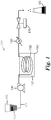
- Feedstock 110 is contained within feedstock tank 115.
- Feedstock tank 115 is connected with tubing or piping 117 to pump 120. Similar tubing or piping can be used to connect other components of the tubular reactor system.
- Tubing or piping 117 can be constructed of any suitable material such as metal, glass, ceramic, or polymer.
- Tubing or piping 117 can be, for example, polyethylene tubing or polypropylene tubing in the portions of continuous hydrothermal reactor system 100 that are not heated and that are not under high pressure. Any tubing that is heated or under pressure is often made of metal (e.g., stainless steel, carbon steel, titanium, nickel, or the like) or has a metal outer housing.
- Pump 120 is used to introduce feedstock 110 into tubular reactor 130. That is, pump 120 is connected to the inlet of tubular reactor 130. Any type of pump 120 can be used that is capable of pumping against the pressure within tubular reactor 130. The pump can provide a constant or pulsed flow of the feedstock solution into tubular reactor 130.
- tubular reactor refers to the portion of the continuous hydrothermal reactor system that is heated (i.e., the heated zone).
- tubular reactor 130 is shown in FIG. 1 as a coil of tubing, the tubular reactor can be in any suitable shape. The shape of the tubular reactor is often selected based on the desired length of the tubular reactor and the method used to heat the tubular reactor.
- the tubular reactor can be straight, U-shaped, or coiled.
- the interior potion of the tubular reactor can be empty or can contain baffles, balls, or other known mixing techniques.
- Heating medium 140 can be, for example, an oil, sand, salt, or the like, that can be heated to a temperature above the hydrolysis and condensation temperatures of the zirconium.
- Suitable oils include plant oils (e.g., peanut oil and canola oil). Some plant oils are preferably kept under nitrogen when heated to prevent or minimize oxidation of the oils.
- Other suitable oils include polydimethylsiloxanes such as those commercially available from Duratherm Extended Fluids, Lewiston, NY, under the trade designation "DURATHERM S".
- Suitable salts include, for example, sodium nitrate, sodium nitrite, potassium nitrate, or mixtures thereof.
- Heating medium vessel 150 can be any suitable container that can hold the heating medium and that can withstand the heating temperatures used for tubular reactor 130. Heating medium vessel 150 can be heated using any suitable means. In many embodiments, heating medium vessel 150 is positioned inside an electrically heated coil. Other types of heaters that can be used in place of heating vessel 150 and/or heating medium 140 include induction heaters, microwave heaters, fuel-fired heaters, heating tape, and steam coils.
- Tubular reactor 130 can be made of any material capable of withstanding the temperatures and pressures used to prepare zirconia particles.
- Tubular reactor 130 preferably is constructed of a material that can resist dissolution in an acidic environment.
- carboxylic acids can be present in the feedstock or can be produced as a reaction byproduct within the continuous hydrothermal reactor system.
- the tubular reactor is made of stainless steel, nickel, titanium, or carbon-based steel.
- an interior surface of the tubular reactor contains a fluorinated polymeric material.
- This fluorinated polymeric material can include a fluorinated polyolefin.
- the polymeric material is polytetrafluoroethylene (PTFE) such as that available under the trade designation "TEFLON" from DuPont, Wilmington, DE.
- PTFE polytetrafluoroethylene
- Some tubular reactors have a PTFE hose within a metal housing such as a braided stainless steel housing. These carboxylic acids can leach metals from some known hydrothermal reactors such as those constructed of stainless steel.
- cooling device 160 is a heat exchanger that includes a section of tubing or piping that has an outer jacket filled with a cooling medium such as cool water.
- cooling device 160 includes a coiled section of tubing or piping that is placed in a vessel that contains cooling water.
- the tubular reactor effluent is passed through the section of tubing and is cooled from the tubular reactor temperature to a temperature no greater than 100°C (in some embodiments, no greater than 80°C, 60°C, or even no greater than 40°C).
- Other cooling devices that contain dry ice or refrigeration coils can also be used.
- the reactor effluent can be discharged into product collection vessel 180.
- the reactor effluent is preferably not cooled below the freezing point prior to being discharged into product collection vessel 180.
- the pressure inside the tubular reactor can be at least partially controlled with backpressure valve 170, which is generally positioned between cooling device 160 and sample collection vessel 180.
- Backpressure valve 170 controls the pressure at the exit of continuous hydrothermal reactor system 100 and helps to control the pressure within tubular reactor 130.
- the backpressure is often at least 100 pounds per square inch (0.7 MPa) (in some embodiments, at least 200 pounds per square inch (1.4 MPa), 300 pounds per square inch (2.1 MPa), 400 pounds per square inch (2.8 MPa), 500 pounds per square inch (3.5 MPa), 600 pounds per square inch (4.2 MPa), or even at least 700 pounds per square inch (4.9 MPa).
- the backpressure should be high enough to prevent boiling within the tubular reactor.
- tubular reactor 130 can be varied and, in conjunction with the flow rate of the feedstock, can be selected to provide suitable residence times for the reactants within the tubular reactor. Any suitable length tubular reactor can be used provided that the residence time and temperature are sufficient to convert the zirconium in the feedstock to zirconia-based particles.
- the tubular reactor often has a length of at least 0.5 meter (in some embodiments, at least 1 meter, 2 meters, 5 meters, 10 meters, 15 meters, 20 meters, 30 meters, 40 meters, or even at least 50 meters).
- the length of the tubular reactor in some embodiments is less than 500 meters (in some embodiments, less than 400 meters, 300 meters, 200 meters, 100 meters, 80 meters, 60 meters, 40 meters, or even less than 20 meters).
- Tubular reactors with a relatively small inner diameter are typically preferred.
- tubular reactors having an inner diameter no greater than about 3 centimeters are often used because of the fast rate of heating of the feedstock that can be achieved with these reactors.
- the temperature gradient across the tubular reactor is less for reactors with a smaller inner diameter compared to those with a larger inner diameter. The larger the inner diameter of the tubular reactor, the more this reactor resembles a batch reactor.
- the inner diameter of the tubular reactor is too small, there is an increased likelihood of the reactor becoming plugged or partially plugged during operation resulting from deposition of material on the walls of the reactor.
- the inner diameter of the tubular reactor is often at least 0.1 cm (in some embodiments, at least 0.15 cm, 0.2 cm, 0.3 cm, 0.4 cm, 0.5 cm, or even at least 0.6 cm). In some embodiments, the diameter of the tubular reactor is no greater than 3 cm (in some embodiments, no greater than 2.5 cm, 2 cm, 1.5 cm, or even greater than 1 centimeter; in some embodiments, in a range from 0.1 to 2.5 cm, 0.2 cm to 2.5 cm, 0.3 cm to 2 cm, 0.3 cm to 1.5 cm, or even 0.3 cm to 1 cm).
- the temperature and the residence time are typically selected in conjunction with the tubular reactor dimensions to convert at least 90 mole percent of the zirconium in the feedstock to zirconia-based particles using a single hydrothermal treatment. That is, at least 90 mole percent of the dissolved zirconium in the feedstock is converted to zirconia-based particles within a single pass through the continuous hydrothermal reactor system.
- a multiple step hydrothermal process can be used.
- the feedstock can be subjected to a first hydrothermal treatment to form a zirconium-containing intermediate and a by-product such as a carboxylic acid.
- a second feedstock can be formed by removing at least a portion of the by-product of the first hydrothermal treatment from the zirconium-containing intermediate.
- the second feedstock can then be subjected to a second hydrothermal treatment to form a sol containing the zirconia-based particles. Further details on this process are described, for example, in U.S. Pat. No. 7,241,437 (Davidson et al. ).
- the percent conversion of the zirconium-containing intermediate is typically in a range from 40 to 75 mole percent.
- the conditions used in the first hydrothermal treatment can be adjusted to provide conversion within this range. Any suitable method can be used to remove at least part of the by-product of the first hydrothermal treatment.
- carboxylic acids such as acetic acid can be removed by a variety of methods such as vaporization, dialysis, ion exchange, precipitation, and filtration.
- the term “residence time” means the average length of time that the feedstock is within the heated portion of the continuous hydrothermal reactor system.
- the residence time is the average time the feedstock is within tubular reactor 130 and is equal to the volume of the tubular reactor divided by the flow rate of the feedstock through the tubular reactor.
- the residence time in the tubular reactor can be varied by altering the length or diameter of the tubular reactor as well as by altering the flow rate of the feedstock.
- the residence time is at least 1 minute (in some embodiments, at least 2 minutes, 4 minutes, 6 minutes, 8 minutes, or even at least 10 minutes), is typically no greater than 240 minutes (in some embodiments, no greater than 180 minutes, 120 minutes, 90 minutes, 60 minutes, 45 minutes, or even no greater than 30 minutes. In some embodiments, the residence time is in the range from 1 to 240 minutes, 1 to 180 minutes, 1 to 120 minutes, 1 to 90 minutes, 1 to 60 minutes, 10 to 90 minutes, 10 to 60 minutes, 20 to 60 minutes, or even 30 to 60 minutes.
- any suitable flow rate of the feedstock through the tubular reactor can be used as long as the residence time is sufficiently long to convert the dissolved zirconium to zirconia-based particles. That is, the flow rate is often selected based on the residence time needed to convert the zirconium in the feedstock to zirconia-based particles. Higher flow rates are desirable for increasing throughput and for minimizing the deposition of materials on the walls of the tubular reactor. A higher flow rate can often be used when the length of the reactor is increased or when both the length and diameter of the reactor are increased.
- the flow through the tubular reactor can be either laminar or turbulent.
- the reactor temperature is in the range from 170°C to 275°C, 170°C to 250°C, 170°C to 225°C, 180°C to 225°C, 190°C to 225°C, 200°C to 225°C, or even 200°C to 220°C. If the temperature is greater than about 275°C, the pressure may be unacceptably high for some hydrothermal reactors systems. However, if the temperature is less than about 170°C, the conversion of the zirconium in the feedstock to zirconia-based particles may be less than 90 weight percent using typical residence times.
- the effluent of the hydrothermal treatment is a zirconia-based sol.
- the sol contains at least 3 weight percent zirconia-based particles dispersed, suspended, or a combination thereof in an aqueous medium.
- the zirconia-based particles can contain (a) 0 to 5 mole percent of a lanthanide element oxide, based on total moles of inorganic oxide in the zirconia-based particles, and (b) 1 to 15 mole percent yttrium oxide, based on total moles of inorganic oxide in the zirconia-based particles.
- the zirconia-based particles are crystalline and have an average primary particle size no greater than 50 nanometers.
- cerium oxide, magnesium oxide, ytterbium oxide, and/or calcium oxide may be used with or in place of the yttria.
- the sol effluent of the hydrothermal treatment usually contains non-associated zirconia-based particles.
- the effluent is typically clear or slightly cloudy.
- zirconia-based sols that contain agglomerated or aggregated particles usually tend to have a milky or cloudy appearance.
- the zirconia-based sols often have a high optical transmission due to the small size and non-associated form of the primary zirconia particles in the sol.
- High optical transmission of the sol can be desirable in the preparation of transparent or translucent composite materials.
- optical transmission refers to the amount of light that passes through a sample (e.g., a zirconia-based sol) divided by the total amount of light incident upon the sample.
- the percent optical transmission may be calculated using the equation 100 I / I O where 1 is the light intensity passing though the sample and I o is the light intensity incident on the sample.
- the optical transmission may be determined using an ultraviolet/visible spectrophotometer set at a wavelength of 600 nanometers with a 1 centimeter path length.
- the optical transmission is a function of the amount of zirconia in a sol.
- zirconia-based sols having about 1 weight percent zirconia the optical transmission is typically at least 70 percent (in some embodiments, at least 80 percent, even or at least 90 percent).
- zirconia-based sols having about 10 weight percent zirconia the optical transmission is typically at least 20 percent (in some embodiments, at least 50 percent, or even at least 70 percent).
- the aqueous-based medium is removed from the zirconia-based sol. Any known means for removing the aqueous-based medium can be used.
- This aqueous-based medium contains water and often contains dissolved carboxylic acids and/or anions thereof that are present in the feedstock or that are byproducts of the reactions that occur within the hydrothermal reactor.
- carboxylic acids and/or anions thereof refers to carboxylic acids, carboxylate anions of these carboxylic acids, or mixtures thereof.
- the removal of at least a portion of these dissolved carboxylic acids and/or anions thereof from the zirconia-based sol may be desirable in some embodiments.
- the zirconia-based sol can be subjected, for example, to at least one of vaporization, drying, ion exchange, solvent exchange, diafiltration, or dialysis, for example, for concentrating, removal of impurities or to compatibilize with other components present in the sol.
- the zirconia sol (prepared from hydrothermal process or other processes) is concentrated. Along with removing at least a portion of the water present in the effluent, the concentration or drying process often results in the vaporization of at least a portion of the dissolved carboxylic acids.
- the zirconia based sol can be subjected to dialysis or diafiltration. Dialysis and diafiltration both tend to remove at least a portion of the dissolved carboxylic acids and/or anions thereof.
- a sample of the effluent can be positioned within a membrane bag that is closed and then placed within a water bath.
- the carboxylic acid and/or carboxylate anions diffuse out of the sample within the membrane bag. That is, these species will diffuse out of the effluent through the membrane bag into the water bath to equalize the concentration within the membrane bag to the concentration in the water bath.
- the water in the bath is typically replaced several times to lower the concentration of species within the bag.
- a membrane bag is typically selected that allows diffusion of the carboxylic acids and/or anions thereof but does not allow diffusion of the zirconia-based particles out of the membrane bag.
- a permeable membrane is used to filter the sample.
- the zirconia particles can be retained by the filter if the pore size of the filter is appropriately chosen.
- the dissolved carboxylic acids and/or anions thereof pass through the filter. Any liquid that passes through the filter is replaced with fresh water.
- the sample is often diluted to a pre-determined volume and then concentrated back to the original volume by ultrafiltration. The dilution and concentration steps are repeated one or more times until the carboxylic acid and/or anions thereof are removed or lowered to an acceptable concentration level.
- fresh water is added at the same rate that liquid is removed through filtration.
- the dissolved carboxylic acid and/or anions thereof are in the liquid that is removed.
- yttrium and lanthanum are incorporated into the crystalline zirconia particles there is a fraction of these metals that can be removed during the diafiltration or dialysis process.
- the actual composition of a sol after diafiltration may be different than that before dialysis. For example, a sol produced with a 97.5:2.3:2 ZrO 2 :Y 2 O3:La 2 O 3 composition was observed to result in a sol with the composition 96.6:2.2: 1.3 ZrO 2 :Y 2 O 3 :La 2 O 3 after the dialysis.
- a sol prepared with a 88:12 ZrO 2 /Y 2 O 3 composition was observed to result in a sol with the composition 90.7:9.3 ZrO 2 /Y 2 O 3 after the dialysis.
- the actual composition of the final sol and composites made from these can be calculated from these data and rule of mixtures.
- a zirconia based sol comprises zirconia-based particles dispersed and/or suspended (i.e., dispersed, suspended, or a combination thereof) in an aqueous/organic matrix.
- the zirconia-based particles can be dispersed and/or suspended in the organic matrix without any further surface modification.
- the organic matrix can be added directly to zirconia based sol.
- the organic matrix can be added to the zirconia based sol after treatment to remove at least some of the water, after treatment to remove at least some of the carboxylic acids and/or anions thereof, or after both treatments.
- the organic matrix that is added is often contains a polymerizable composition that is subsequently polymerized and/or crosslinked to form a gel.
- the zirconia based sol can be subjected to a solvent exchange process.
- An organic solvent having a higher boiling point than water can be added to the effluent.
- organic solvents that are suitable for use in a solvent exchange method include 1-methoxy-2-propanol and N-methyl pyrrolidone.
- the water then can be removed by a method such as distillation, rotary evaporation, or oven drying. Depending on the conditions used for removing the water, at least a portion of the dissolved carboxylic acid and/or anion thereof can also be removed.
- Other organic matrix material can be added to the treated effluent (i.e., other organic matrix material can be added to the zirconia-based particle suspended in the organic solvent used in the solvent exchange process).
- the zirconia-based sols are treated with a surface modification agent to improve compatibility with the organic matrix material.
- Surface modification agents may be represented by the formula A-B, where the A group is capable of attaching to the surface of a zirconia-based particle and B is a compatibility group.
- Group A can be attached to the surface by adsorption, formation of an ionic bond, formation of a covalent bond, or a combination thereof.
- Group B can be reactive or nonreactive and often tends to impart characteristics to the zirconia-based particles that are compatible (i.e., miscible) with an organic solvent, with another organic matrix material (e.g., monomer, oligomers, or polymeric material), or both.
- group B is typically selected to be non-polar as well.
- Suitable B groups include linear or branched hydrocarbons that are aromatic, aliphatic, or both aromatic and aliphatic.
- the surface modifying agents include carboxylic acids and/or anions thereof, sulfonic acids and/or anions thereof, phosphoric acids and/or anions thereof, phosphonic acids and/or anions thereof, silanes, amines, and alcohols. Suitable surface modification agents are further described, for example, in PCT Application Publication WO 2009/085926 (Kolb et al. ).
- a surface modification agent can be added to the zirconia-based particles using conventional techniques.
- the surface modification agent can be added before or after any removal of at least a portion of the carboxylic acids and/or anions thereof from the zirconia-based sol.
- the surface modification agent can be added before or after removal of the water from the zirconia-based sol.
- the organic matrix can be added before or after surface modification or simultaneously with surface modification.
- Various methods of adding the surface modification agent are further described, for example, in WO 2009/085926 (Kolb et al. ).
- the surface modification reactions can occur at room temperature (e.g., 20°C to 25°C) or at an elevated temperature (e.g., up to about 95°C).
- the surface modification agents are acids such as carboxylic acids
- the zirconia-based particles typically can be surface-modified at room temperature.
- the surface modification agents are silanes
- the zirconia-based particles are typically surface modified at elevated temperatures.
- the organic matrix typically includes a polymeric material or a precursor to a polymeric material such as a monomer or an oligomer having a polymerizable group and a solvent.
- the zirconia-based particles can be combined with the organic matrix using conventional techniques. For example, if the organic matrix is a precursor to a polymeric material, the zirconia-based particles can be added prior to the polymerization reaction.
- the composite material containing a precursor of a polymeric material is often shaped before polymerization.
- Representative examples of monomers include (meth)acrylate-based monomers, styrene-based monomers, and epoxy-based monomers.
- Representative examples of reactive oligomers include, polyesters having (meth)acrylate groups, polyurethanes having (meth)acrylate groups, polyethers having (meth)acrylate groups, or acrylics.
- Representative examples of polymeric material include polyurethanes, poly(meth)acrylates, and polystyrenes.
- the zirconia based sols are typically solidified by gelation.
- the gelation process allows large gels to be formed without cracks and gels that can be further processed without inducing cracks.
- the gelation process leads to a gel having a structure that will not collapse when the solvent is removed.
- the gel structure is compatible with and stable in a variety of solvents and conditions that may be necessary for supercritical extraction.
- the gel structure needs to be compatible with supercritical extraction fluids (e.g., supercritical CO 2 ).
- the gels should be stable and strong enough to withstand drying, so as to produce stable gels and give materials that can be heated to burn out the organics, pre-sintered, and densified without inducing cracks.
- the resulting gels have relatively small and uniform pore size to aid in sintering them to high density at low sintering temperatures.
- the pores of the gels are large enough to allow product gases of organic burnout escape without leading to cracking of the gel.
- the gelation step allows control of the density of the resulting gels aids in the subsequent processing of the gel such as supercritical extraction, organic burnout, and sintering. It is preferable that the gel contain the minimum amount of organic material or polymer modifiers.
- the gels described herein contain zirconia-based particles.
- the gels contain at least two types of zirconia-based particles varying in crystalline phases, composition, or particle size.
- particulate based gels can lead to less shrinkage compared to gels produced form alkoxides which undergo significant and complicated condensation and crystallization reactions during further processing.
- the crystalline nature allows combinations of different crystal phases on a nanoscale.
- Applicants have observed that formation of a gel thru polymerization of these reactive particles yield strong, resilient gels.
- the use of mixtures of sols with crystalline particles can allow formation of stronger and more resilient gels for further processing. For example, Applicants observed that a gel comprising a mixture of cubic and tetragonal zirconia particles was less susceptible to cracking during supercritical extraction and organic burnout steps.
- the gels comprise organic material and crystalline metal oxide particles, wherein the crystalline metal oxide particles are present in a range from 3 to 20 volume percent, based on the total volume of the gel, wherein at least 70 (in some embodiments, at least 75, 80, 85, 90, 95, 96, 97, 98, or even at least 99; in a range from 70 to 99, 75 to 99, 80 to 99, or even 85 to 99) mole percent of the crystalline metal oxide is ZrO 2 .
- the gels may also include amorphous non-crystalline oxide sources.
- the crystalline metal oxide particles have an average primary particle size in a range from 5 nanometers to 50 nanometers (in some embodiments, in a range from 5 nanometers to 25 nanometers, 5 nanometers to 15 nanometers, or even from 5 nanometers to 10 nanometers).
- the average primary particle size is measured by using the X-Ray Diffraction technique.
- the particles are not agglomerated but, it is possible that particles with some degree of aggregation may also be useful.
- Exemplary sources of the ZrO 2 , Y 2 O 3 , La 2 O 3 , and Al 2 O 3 include crystalline zirconia based sols prepared by any suitable means. The sols described above are particularly well suited.
- the Y 2 O 3 , La 2 O 3 , and Al 2 O 3 can be present in the zirconia based particles, and/or present as separate colloidal particles or soluble salts.
- the crystalline metal oxide particles comprise a first plurality of particles, and a second, different plurality of particles (i.e., is distinguishable by average composition, phase(s), microstructure, and/or size).
- gels described herein have an organic content that is at least 3 (in some embodiments, at least 4, 5, 10, 15, or even at least 20) percent by weight, based on the total weight of the gel. In some embodiments, gels described herein have an organic content in a range from 3 to 30, 10 to 30, or even 10 to 20, percent by weight, based on the total weight of the gel.
- gels described herein comprise at least one of Y 2 O 3 (e.g., in a range from 1 to 15, 1 to 9, 1 to 5, 6 to 9, 3.5 to 4.5, or even 7 to 8 mole percent of the crystalline metal oxide is Y 2 O 3 ), La 2 O 3 (e.g., up to 5 mole percent La 2 O 3 ), or Al 2 O 3 (e.g., up to 0.5 mole percent Al 2 O 3 ).
- the crystalline metal oxide comprises in a range from 1 to 5 mole percent Y 2 O 3 , and in a range from 0 to 2 mole percent La 2 O 3 and in a range from 93 to 97 mole percent ZrO 2 .
- the crystalline metal oxide comprises in a range from 6 to 9 mole percent Y 2 O 3 , and in a range from 0 to 2 mole percent La 2 O 3 , and in a range from 89 to 94 mole percent ZrO 2 .
- the crystalline metal oxide comprises in a range from 3.5 to 4.5 mole percent Y 2 O 3 , and in a range from 0 to 2 mole percent La 2 O 3 , and in a range from 93.5 to 96.5 mole percent ZrO 2 .
- the crystalline metal oxide comprises in a range from 7 to 8 mole percent Y 2 O 3 , and in a range from 0 to 2 mole percent La 2 O 3 , and in a range from 90 to 93 mole percent ZrO 2 .
- Other optional oxides that may be present in gels described herein include at least one of CeO 2 , Pr 2 O 3 .
- Additives that may add desired coloring to the resulting crack free crystalline metal oxide articles include at least one of Fe 2 O 3 , MnO 2 , Co 2 O 3 , Cr 2 O 3 , NiO, CuO, Bi 2 O 3 , Ga 2 O 3 , Er 2 O 3 , Pr 2 O 3 , Eu 2 O 3 , Dy 2 O 3 , Sm 2 O 3 , V 2 O 5 , W 2 O 5 or CeO 2 .
- the amount of optional oxide(s) is in an amount in a range from about 10 ppm to 20,000 ppm. In some embodiments, it is desirable to have sufficient oxides present to so the crack free crystalline metal oxide articles has coloring of a tooth.
- One exemplary method for making gels described herein comprises providing a first zirconia sol comprising crystalline metal oxide particles having an average primary particle size of not greater than 15 nanometers (in some embodiments, in a range from 5 nanometers to 15 nanometers), wherein at least 70 (in some embodiments, at least 75, 80, 85, 90, 95,96, 97, 98, or even at least 99; in a range from 70 to 99, 75 to 99, 80 to 99, or even 85 to 99) mole percent of the crystalline metal oxide is ZrO 2 .
- the sol is optionally concentrated to provide a concentrated zirconia sol.
- a co-solvent, surface modifiers and optional monomers are added while stirring to obtain a well dispersed sol.
- a radical initiator e.g., ultraviolet (UV) or thermal initiator
- UV ultraviolet
- thermal initiator e.g., thermal initiator
- the resulting sol is optionally purged with N 2 gas to remove oxygen.
- the resulting sol can be gelled by radiating with actinic or heating at at least one temperature for a time sufficient to polymerize the radically surface-modified zirconia sol comprising the radical initiator to form a gel.
- the resulting gel is a strong, translucent gel.
- the sols for making aerogels described herein comprise zirconia based particles that are surface modified with a radically polymerizable surface treatment agent/modifier.
- the sol can be gelled, for example, by radical (thermal initiation or light initiation) polymerization.
- exemplary radically polymerizable surface modifiers include acrylic acid, methacrylic acid, beta-carboxyethyl acrylate, and mono-2- (methacryloxyethyl)succinate.
- An exemplary modification agent for imparting both polar character and reactivity to the zirconia-containing nanoparticles is mono(methacryloxypolyethyleneglycol) succinate.
- Exemplary polymerizable surface modifiers can be can reaction products of hydroxyl containing polymerizable monomers with cyclic anhydrides such as succinic anhydride, maleic anhydride and pthalic anhydride.
- Exemplary polymerization hydroxyl containing monomers include hyroxyethyl acrylate, hydroxyethyl methacrylate, hydoxypropyl acrylate, hydoxyproyl methacrylate, hydroxyl butyl acrylate, and hydroxybutyl methacrylate.
- Acyloxy and methacryloxy fuctional polyethylene oxide, and polypropylene oxide may also be used as the polymerizable hydroxyl containing monomers.
- Exemplary polymerizable silanes include alkyltrialkoxysilanes methacryloxyalkyltrialkoxysilanes or acryloxyalkyltrialkoxysilanes (e.g., 3-methacryloxypropyltrimethoxysilane, 3- acryloxypropyltrimethoxysilane, and 3-(methacryloxy)propyltriethoxysilane; as 3- (methacryloxy)propylmethyldimethoxysilane, and 3-(acryloxypropyl)methyldimethoxysilane); methacryloxyalkyldialkylalkoxysilanes or acyrloxyalkyldialkylalkoxysilanes (e.g., 3 -(methacryloxy)propyldimethylethoxysilane); mercaptoalkyltrialkoxylsilanes (e.g., 3-mercaptopropyltrimethoxysilane); aryltrialkoxys
- sols for making aerogels described herein comprise zirconia-based particles that are surface modified with nonreactive surface modifiers which can impart additional compatibility toward organic matrix.
- nonreactive surface modifiers include 2-[2-(2-methoxyethoxy)ethoxy] acetic acid (MEEAA) and 2-(2-methoxyethoxy)acetic acid (MEAA).
- nonreactive surface modifiers include the reaction product of an aliphatic or aromatic anhydride and a polyalkylene oxide mono-ether (e.g., succinic acid mono- [2-(2-methoxy-ethoxy)-ethyl] ester, maleic acid mono-[2-(2-methoxy-ethoxy)-ethyl] ester, and glutaric acid mono-[2-(2-methoxy-ethoxy)-ethyl] ester).
- the surface modification agent is a carboxylic acid and/or anion thereof and the compatibility group imparts a non-polar character to the zirconia-containing nanoparticles.
- the surface modification agent can be a carboxylic acid and/or anion thereof having a linear or branched aromatic group or aliphatic hydrocarbon group.
- exemplary non-polar surface modifiers include octanoic acid, dodecanoic acid, stearic acid, oleic acid, and combinations thereof.
- exemplary silane surface modifiers include such as N-(3- triethoxysilylpropyl)methoxyethoxyethoxyethyl carbamate, N-(3- triethoxysilylpropyl) methoxyethoxyethoxyethyl carbamate (available under the trade designation "SILQUEST A-1230" from Momentive Specialty Chemicals.
- the surface modification agent can be added, for example, before or after any removal of at least a portion of the carboxylic acids and/or anions thereof from the zirconia-containing sol.
- the surface modification agent can be added, for example, before or after removal of the water from the zirconia-containing sol.
- the organic matrix can be added, for example, after surface modification or simultaneously with surface modification.
- a radically reactive co-monomer can be incorporated into the sol to be copolymerized into the gel.
- the monomers can be mono-functional, difunctional or multifunctional.
- the monomers can have methacrylate, acrylate or styrenic functionality.
- the type of monomer used may depend on solvent system used.
- the monomers can be stiff or flexible. Exemplary monomers include hydroxyethyl methacrylate, acrylamide, 1-vinyl-2-pyrrolidione, hydroxyethyl acrylate, and butyl acrylate.
- exemplary monomers include di and multifunctional acrylates and methacrylates (e.g., pentaerythritol tetraacrylate and pentaerythritol triacrylate (available, for example, under the trade designations "SARTOMER SR444" and “SARTOMER SR295" from Sartomer Corporation), ethoxylated pentaerythritol tetraacrylate (available, for example, under the trade designation "SARTOMER SR494" from Sartomer Corporation), polyethylene glycol (400) dimethacrylate (available, for example, under the trade designation "SARTOMER SR603" from Sartomer Corporation), ethoxylated (3) trimethylolpropane triacrylate (available, for example, under the trade designation "SARTOMER SR454" from Sartomer Corporation), ethoxylated (9) trimethylolpropane triacrylate (available, for example, under the trade designation "SARTOMER 502" from Sartomer Corporation
- the gel is formed by radical polymerization of the surface modified particles and optional monomers.
- the polymerization can be initiated by any suitable means such as thermally or actinic radiation or UV initiators.
- thermal initiators include (2,2'-azobis(2-methylbutyronitrile) (available, for example, under the trade designation "VAZO 67" from E. I. du Pont de Nemours and Company, Wilmington, DE), azobisisobututyronitrile (available, for example, under the trade designation "VAZO 64" from E. 1. du Pont de Nemours and Company), 2,2'-azodi-(2,4-Dimethylvaleronitrile (available, for example, under the trade designation "VAZO 52" from E. I.
- du Pont de Nemours and Company du Pont de Nemours and Company
- 1,1-azobis(cyclohexanecabonitrile) available, for example, under the trade designation "VAZO 88" from E. I. du Pont de Nemours and Company
- Peroxides and hydroperoxides e.g., benzoyl peroxide and lauryl peroxide
- the initiator selection may be influenced, for example, by solvent choice, solubility and desired polymerization temperature.
- a preferred initiator is the 2,2'-azobis(2-methylbutyronitrile) available from E. I. du Pont de Nemours and Company under the trade designation "VAZO 67").
- Exemplary UV initiators include 1-hydroxycyclohexylbenzophenone (available, for example, under the trade designation "IRGACURE 184" from Ciba Specialty Chemicals Corp., Tarrytown, NY), 4-(2-hydroxyethoxy)phenyl-(2-hydroxy-2-propyl) ketone (available, for example, under the trade designation "IRGACURE 2529” from Ciba Specialty Chemicals Corp.), 2-hydroxy-2-methylpropiophenone (available, for example, under the trade designation "DAROCURE D111” from Ciba Specialty Chemicals Corp. and bis(2,4,6-trimethylbenzoyl)-phenylposphineoxide (available, for example, under the trade designation "IRGACURE 819" from Ciba Specialty Chemicals Corp.).
- IRGACURE 184" from Ciba Specialty Chemicals Corp., Tarrytown, NY
- 4-(2-hydroxyethoxy)phenyl-(2-hydroxy-2-propyl) ketone available, for example
- dissolved.oxygen is removed from the zirconia-based sols before forming the zirconia based gels. This can be accomplished, for example, by techniques known in the art, such as vacuum degassing or nitrogen gas purging.
- the zirconia-based sol may be gelled by purging with nitrogen gas before heating.
- the zirconia-based sol to be gelled can be placed in a mold and sealed from the atmosphere before further processing.
- Liquid in the gel can be exchanged with a second liquid, for example, by soaking the gel in the second liquid for a time sufficient to allow an exchange to occur.
- a second liquid for example, by soaking the gel in the second liquid for a time sufficient to allow an exchange to occur.
- water present in a gel can be removed by soaking the gel in a dry solvent (e.g., 200 proof ethanol).
- gels are soaked in ethanol in an amount 10 times that of the water present in the gel for 24 hours. The alcohol is then replaced with fresh dry solvent, and the process repeated four times. The times the gels are exposed to air should be minimized as ambient drying of the gels tends to cause cracking.
- the gels typically have x, y, z dimensions of at least 1 mm (in some embodiments, at least 3 mm, at least 5 mm, 10 mm, 15 mm, 20 mm, or even at least 25 mm), although the specific size may depend on the intended use of the resulting ceramic. For example, for some dental applications, the gels have x, y, z dimensions of greater than 1 mm, 5, mm, or even greater than 10 mm. The maximum size of the gels is limited by the practicality of subsequent processing steps such as organic burnout and extraction.
- Aerogels described herein are formed by removing solvent from zirconia gels described herein without excessive shrinkage (e.g., not greater than 10%). Any suitable gel can be used. The gels described here a particularly well suited. The gel structure must be strong enough to withstand at least some shrinkage and cracking during the drying (solvent removal). The structure of the aerogel is essentially homogeneous.
- the aerogels can be prepared by drying gels via super critical extraction. In some embodiments, the aerogels are prepared by drying gels under supercritical conditions of the solvent used in preparing the gel.
- the crystalline metal oxide particles have an average primary particle size in a range from 2 nm to 50 nm (in some embodiments, 5 nm to 50 nm, 2 nm to 25 nm, 5 nm to 25 nm, 2 nm to 15 nm, or even 5 nm to 15 nm).
- the average primary particle size is measured by using the X-Ray Diffraction technique.
- aerogels described herein the crystalline metal oxide particles comprise a first plurality of particles, and a second, different plurality of particles (i.e., is distinguishable by average composition, phase(s), microstructure, and/or size).
- aerogels described herein have an organic content that is at least 3 (in some embodiments, at least 4, 5, 10, 15, or even at least 20) percent by weight, based on the total weight of the aerogel. In some embodiments, aerogels described herein have an organic content in a range from 3 to 30, 10 to 30, or even 10 to 20 percent by weight, based on the total weight of the aerogel.
- Exemplary organic materials for. making aerogel described herein include acetic acid, acrylic acid, 2-hydroxyethyl methaacrylate, acrylamide 1-vinyl-2-pyrrolidione, trimethylolpropane triacrylate and ethoxylated.
- Other exemplary organics are ethoxylated pentaerythritol tetraacrylate (available, for example, under the trade designations "SR351,” “SR350,” and “SR454" from Sartomer Corporation), pentaerythritol triacrylate, teteraacrylate and ethoxylated versions such as those available under the trade designations "SR295,” “SR444,” “SR494" from Sartomer Corporation.
- aerogels described herein comprise at least one of Y 2 O 3 (e.g., in a range from 1 to 15, 1 to 9, 1 to 5, 6 to 9, 3.5 to 4.5, or even 7 to 8) mole percent of the crystalline metal oxide is Y 2 O 3 ), La 2 O 3 (e.g., up to 5 mole percent La 2 O 3 ), Al 2 O 3 (e.g., up to 0.5 mole percent Al 2 O 3 ).
- Y 2 O 3 e.g., in a range from 1 to 15, 1 to 9, 1 to 5, 6 to 9, 3.5 to 4.5, or even 7 to 8
- mole percent of the crystalline metal oxide is Y 2 O 3
- La 2 O 3 e.g., up to 5 mole percent La 2 O 3
- Al 2 O 3 e.g., up to 0.5 mole percent Al 2 O 3
- One exemplary aerogel comprises in a range from 1 to 5 mole percent of the crystalline metal oxide is Y 2 O 3 , and in a range from 0 to 2 mole percent of the crystalline metal oxide is La 2 O 3 , and in a range from 93 to 99 mole percent of the crystalline metal oxide is ZrO 2 .
- Another exemplary aerogel comprises in a range from 6 to 9 mole percent of the crystalline metal oxide is Y 2 O 3 , and in a range from 0 to 2 mole percent of the crystalline metal oxide is La 2 O 3 , and in a range from 89 to 94 mole percent of the crystalline metal oxide is ZrO 2 .
- the crystalline metal oxide comprises in a range from 3.5 to 4.5 mole percent Y 2 O 3 , and in a range from 0 to 2 mole percent of the crystalline metal oxide is La 2 O 3 , and in a range from 93.5 to 96.5 mole percent ZrO 2 .
- the crystalline metal oxide comprises in a range from 7 to 8 mole percent Y 2 O 3 , and in a range from 0 to 2 mole percent of the crystalline metal oxide is La 2 O 3 , and in a range from 90 to 93 mole percent ZrO 2 .
- optional oxides that may be present in aerogels described herein include at least one of CeO 2 , Pr 2 O 3 Nd 2 O 3 , Pm 2 O 3 , Sm 2 O 3 , Eu 2 O 3 , Gd 2 O 3 , Tb 2 O 3 , Dy 2 O 3 , Ho 2 O 3 , Er 2 O 3 , Tm 2 O 3 , Yb 2 O 3 , Fe 2 O 3 , MnO 2 , Co 2 O 3 , Cr 2 O 3 , NiO, CuO, Bi 2 O 3 , Ga 2 O 3 , or Lu 2 O 3 .
- Additives that may add desired coloring to the resulting crack free crystalline metal oxide articles include at least one of Fe 2 O 3 , MnO 2 , Co 2 O 3 , Cr 2 O 3 , NiO, CuO, Bi 2 O 3 , Ga 2 O 3 , Er 2 O 3 , Pr 2 O 3 , Eu 2 O 3 , Dy 2 O 3 , Sm 2 O 3 , or CeO 2 .
- the amount of optional oxide(s) is in an amount in a range from about 10 ppm to 20,000 ppm. In some embodiments, it is desirable to have sufficient oxides present to so the crack free crystalline metal oxide articles has coloring of a tooth.
- Aerogels described herein typically have a volume percent of oxide in a range of 3 to 20 (in some embodiments, 3 to 15, 3 to 14, or even 8 to 14) percent. Aerogels with lower volume percents of oxide tend to be very fragile and crack during supercritical drying or subsequent processing. Aerogels with higher oxide contents tend to crack during organic burnout because it is more difficult for volatile by-products to escape from the denser structure.
- aerogels described herein have a surface area (e.g. a BET surface area) in the range of 100 m 2 /g to 300 m 2 /g (in some embodiments, 150 m 2 /g to 250 m 2 /g), and a continuous pore channel size (also referred to as "average connected pore size") in a range of 10 nm to 20 nm.
- the structure of aerogels described herein is a composite of oxide particles, 3 nm to 10 nm (in some embodiments, 4 nm to 8 nm) in size and organics composed of acetate groups and polymerized monomers. The amount of organic is typically 10 to 20 weight percent of the aerogel.
- Aerogels described herein can be made, for example, by providing a first zirconia sol comprising crystalline metal oxide particles having an average primary particle size of up to 50 nm (in some embodiments, 2 nm to 50 nm, 5 nm to 25 nm, 2 nm to 15 nm, or even 5 nm to 15 nm), wherein at least 70 (in some embodiments, at least 75, 80, 85, 90, 95, 96, 97, 98, or even at least 99; in a range from 70 to 99, 75 to 99, 80 to 99, or even 85 to 99) mole percent of the crystalline metal oxide is ZrO 2 .
- the first zirconia sol is then optionally concentrated to provide a concentrated zirconia sol.
- a co-solvent, surface modifiers and optional monomers are added while stirring to obtain a well dispersed sol, wherein the cosolvent is optional).
- a radical initiator e.g., ultraviolent (UV) or thermal initiator
- UV ultraviolent
- thermal initiator is added to the radically polymerizable surface-modified zirconia sol.
- the resulting sol is purged with N 2 gas to remove oxygen.
- the resulting sol is then gelled by radiating with actinic or heating at at least one temperature for a time sufficient to polymerize the radically surface-modified zirconia sol comprising the radical initiator to form a gel.
- the resulting gel is a strong, translucent gel.
- the water, if present, is then removed from the gel via alcohol exchange to provide an at least partially de-watered gel.
- the gel is then converted to an aerogel by removing the alcohol, if present, from the partially de-watered gel via super critical extraction to provide the aerogel.
- removing the liquid solvent comprises placing the wet, at least partially de-watered gel in an autoclave, heating the autoclave above the critical temperature of the liquid solvent, pressurizing the autoclave above the critical pressure of the liquid solvent, then slowly removing the liquid solvent by releasing the pressure in the autoclave to about 1 bar at that temperature (i.e., the applicable critical temperature) to provide the monolithic aerogel.
- removing the first liquid solvent from the at least partially de-watered gel comprises replacing the first liquid solvent with a second liquid solvent, then slowly increasing the temperature and pressure of the at least partially de-watered gels until supercritical conditions for the second solvent are obtained, then slowly releasing the pressure to about 1 bar to provide the monolithic aerogel.
- the complete exchange of the first liquid solvent with the second solvent is carried out under supercritical conditions.
- the second solvent is carbon dioxide.
- exemplary first liquid solvents include methanol, ethanol, isopropanol, ⁇ -methoxyethanol, ⁇ - ethoxyethanol, methoxypropanol, t -butyl alcohol, sec-butyl alcohol, t -amyl alcohol, hexanol, cyclohexanol, cyclohexane, heptane, dodecane, formic acid, acetic acid, hexanoic cid, isohexanoic acid, octanoic acid, acetal, acetaldehyde, acetic anhydride, acetone, acetonitrile, acetophenone, acetyl chloride, acrolein, acetonitrile, benzene, benzaldehyde, benzonitrile, benzoyl chloride, 2-butanone, n -butyl ether, camphor, carbon
- the aerogel can be characterized by at least one of the following features: a) comprising crystalline zirconia particles having an average primary particle size in a range from 10 nm to 50 nm; b) content of crystalline zirconia particles: at least about 85 mol.-%;c) having a BET surface area in the range of 100 m 2 /g to 300 m 2 /g; d) having an organic content of at least 3 wt.-%; e) x, y, z dimension: at least about 5 mm; f) showing a hysteresis loop (especially in a p/p 0 range of 0.70 to 0.95) when the N 2 adsorption/desorption behaviour is analysed; g) showing a type H1 hysteresis loop (according to IUPAC classification); h) showing a N 2 adsorption of isotherm type IV (according to IU.PAC classification).
- Crack-free, calcined metal oxide articles can have x, y, and z dimensions of at least 3 mm (in some embodiments, at least 5 mm, 10 mm, 15 mm, 20 mm, or even at least 25 mm) and a density of at least 30 (in some embodiments, at least 35, 40, 50, 95; in a range from 30 to 95) percent of theoretical density, and an average connected pore size in a range from 10 nm to 100 nm (in some embodiments, from 10 nm to 60 nm, 10 nm to 50 nm, 10 nm to 40 nm, or even from 10 nm to 30 nm), wherein at least 70 (in some embodiments, at least 75, 80, 85, 90, 95, 96, 97, 98, or even at least 99; in a range from 70 to 99, 75 to 99, 80 to 99, or even 85 to 99) mole percent of the metal oxide is crystalline ZrO 2 , and wherein the crystalline Z
- crack-free calcined metal oxide articles described herein comprise at least one of Y 2 O 3 (e.g., in a range from 1 to 15, 1 to 5, 6 to 9, 3.5 to 4.5 or even 7 to 8) mole percent of the crystalline metal oxide is Y 2 O 3 ), La 2 O 3 (e.g., up to 5 mole percent La 2 O 3 ), Al 2 O 3 (e.g., up to 0.5 mole percent Al 2 O 3 ).
- One exemplary crack-free calcined metal oxide article comprises in a range from 1 to 5 mole percent of the crystalline metal oxide is Y 2 O 3 , and in a range from 0 to 2 mole percent crystalline metal oxide is La 2 O 3 , and in a range from 93 to 99 mole percent of the crystalline metal oxide is ZrO 2 .
- Another exemplary crack-free calcined metal oxide article comprises in a range from 6 to 9 mole percent of the crystalline metal oxide is Y 2 O 3 , and in a range from 0 to 2 mole percent crystalline metal oxide is La 2 O 3 , and in a range from 89 to 94 mole percent of the crystalline metal oxide is ZrO 2 .
- Another exemplary crack-free calcined metal oxide article comprises in a range from 3.5 to 4.5 mole percent Y 2 O 3 , and in a range from 0 to 2 mole percent crystalline metal oxide is La 2 O 3 , and in a range from 93.3 to 96.5 mole percent ZrO 2 .
- Another exemplary crack-free calcined metal oxide article comprises in a range from 7 to 8 mole percent Y 2 O 3 , and in a range from 0 to 2 mole percent crystalline metal oxide is La 2 O 3 , and in a range from 90 to 93 mole percent ZrO 2 .
- the crack-free, calcined metal oxide article has a sulfate equivalent less than 5 ppm and/or a chloride equivalent less than 5 ppm.
- the raw material used to prepare the zirconia sol often contains chloride and sulfate impurities. Several thousand ppm by weight of these ions can be present in the calcined metal oxide article. If not removed these impurities can volatilize at the temperatures used for sintering and become entrapped in the sintered body as pores.
- the chloride and sulfate impurities can be removed prior to sintering, for example, by infiltrating the calcined body with a solution of ammonia in water, allowing it to sand overnight, then exchanging the ammonia solution with water several times. During this treatment ammonia reacts with the chloride and sulfate impurities to form soluble ammonia salts. These are removed by diffusion into the water. It is also possible to remove these impurities by adjusting the heating profile so that sufficient volatilization occurs in the thermal treatment used to form the calcined article.
- Crack-free, calcined metal oxide articles described herein can be made by a method comprising heating an aerogel described herein for a time and at at least one temperature sufficient to provide the crack-free, calcined metal oxide article.
- the aerogel is slowly heated at rates in the range from 5°C/hr to 20°C/hr to 600°C to remove organics. Slow heating below 600°C is typically necessary to volatize the organics without cracking the body, for example, because of nonuniform shrinkage or internal pressure of the volatile products.
- Thermogravimetric analysis and dilatometry can be used to track the weight loss and shrinkage which occurs at different heating rates.
- the heating rates in different temperature ranges can then be adjusted to maintain a slow and near constant rate of weight loss and shrinkage until the organics are removed. Careful control of the organic removal is critical to obtain crack-free bodies.
- the temperature can be raised at a faster rate (e.g., 100°C/hr to 600°C/hr) to a temperature in the range from 800°C to 1100°C and held at that temperature up to 5 hours. At these temperatures the strength of the material increases by additional sintering, but an open pore structure is retained.
- the temperature and time used for heating the calcined body is such that it is strong enough to resist the capillary forces associated with infiltration of an ammonia solution. Typically this requires a relative density above 40% of theoretical (preferably above 45%). For articles that are to be milled, having the temperature too high and/or time too long can make milling difficult. In some cases it may be convenient to conduct the organic burnout separately; however, in that case care may be necessary to prevent absorption of moisture from the atmosphere prior to the higher temperature treatment.
- the aerogel can be quite fragile after heating to just 600°C, and nonuniform absorption of moisture can result in cracking.
- Useful embodiments of crack-free, calcined metal oxide articles described herein include mill blocks, including dental mill blocks.
- Crack-free, crystalline metal oxide articles described herein have an x, y, and z dimensions of at least 3 mm (in some embodiments, at least 5 mm, 10 mm, 15 mm, 20 mm, or even 25 mm) and a density of at least 98.5 (in some embodiments, 99, 99.5, 99.9, or even at least 99.99) percent of theoretical density, wherein at least 70 mole percent of the crystalline metal oxide is ZrO 2 , and wherein the ZrO 2 has an average grain size less than 400 nanometers (in some embodiments, less than 300 nanometers, 200 nanometers, 150 nanometers, 100 nanometers, or even less than 80 nanometers).
- crack-free, crystalline metal oxide articles described herein comprise at least one of Y 2 O 3 (e.g., in a range from 1 to 15, 1 to 5, 6 to 9, 3.5 to 4.5 or even 7 to 8) mole percent of the crystalline metal oxide is Y 2 O 3 ), La 2 O 3 (e.g., up to 5 mole percent La 2 O 3 ), Al 2 O 3 (e.g., up to 0.5 mole percent Al 2 O 3 ).
- One exemplary crack-free, crystalline metal oxide article comprises in a range from 1 to 5 mole percent of the crystalline metal oxide is Y 2 O 3 , 0 to 2 mole percent of the crystalline metal oxide is La 2 O 3 and in a range from 93 to 97 mole percent of the crystalline metal oxide is ZrO 2 .
- This general composition has been observed to yield a combination of high biaxial flexure strength and good optical transmittance.
- Another exemplary crack-free; crystalline metal oxide article comprises in a range from 6 to 9 mole percent of the crystalline metal oxide is Y 2 O 3 , 0 to 2 mole percent of the crystalline metal oxide is La 2 O 3 , and in a range from 89 to 94 mole percent of the crystalline metal oxide is ZrO 2 .
- This general composition range has been observed to yield a combination of good biaxial flexure strength and high optical transmittance.
- Another exemplary crack-free, crystalline metal oxide article comprises in a range from 3.5 to 4.5 mole percent Y 2 O 3 , 0-2 mole percent of the crystalline metal oxide is La 2 O 3 . and in a range from 93.5 to 96.5 mole percent ZrO 2 .
- This general composition has been observed to yield a combination of especially high biaxial flexure strength and good optical transmittance.
- Another exemplary crack-free, crystalline metal oxide article comprises in a range from 7 to 8 mole percent Y 2 O 3 , 0 to 2 mole percent of the crystalline metal oxide is La 2 O 3. and in a range from 90 to 93 mole percent ZrO 2 .
- This general composition range has been observed a combination of good biaxial flexure strength and especially high optical transmittance.
- the lower yttria compositions are therefore believed to be more desirable where high strength is required and moderate optical transmittance is sufficient.
- the higher yttria compositions are therefore believed to be more desirable where high optical transmittance is required and moderate strength is sufficient.
- the present disclosure provides a method of making crack-free, crystalline metal oxide articles described herein, the method comprising heating a crack-free, calcined metal oxide article described herein for a time and at at least one temperature sufficient to provide the crack-free, crystalline metal oxide article.
- the heating is conducted at at least one temperature in a range from 1000°C to 1400°C (in some embodiments, from 1000°C to 1400°C, 1000°C to 1350°C, or even 1200°C to 1300°C).
- all the heating at or above 1000°C is conducted in less than 24 hours; typically in a range from about 2 to about 24 hours.
- all the heating at or above 1000°C is conducted at less than 1.25 atm. of pressure.
- the heating rate to temperature is in a range from 50°C/hr. to 600°C/hr. Heating can be conducted in conventional furnaces, preferably those with programmable heating capabilities.
- the material to be heated can be placed, for example, in an alumina crucible.
- the ZrO 2 is all cubic ZrO 2 . In some embodiments, the ZrO 2 is all tetragonal. In some embodiments, the zirconia is a mixture of tetragonal and cubic. Although not wanting to be bound by theory, based on the equilibrium phase diagram for ZrO 2 and Y 2 O 3 , mixtures of the cubic and tetragonal phases would be expected when the Y 2 O 3 content is in the range from 2 to 8 mole percent and the material is sintered in the range from about 1200°C to about 1250°C.
- Embodiments with about 3.5 to 4.5 mole percent Y 2 O 3 with a mixture of tetragonal and some cubic structure exhibit an exceptional combination of strength and optical transmittance.
- the average grain size in one instance was 156 nm.
- the tetragonal crystal structure was observed even though a mixture of tetragonal and cubic crystals would be expected in this composition range.
- these materials were held at the sintering temperature for a prolonged time the grain size increased to 168 nm, a mixture of tetragonal and cubic crystalline phases was formed, and the good transmittance of the material was substantially reduced.
- the crack-free, crystalline metal oxide article has a total transmittance of at least 65% at a thickness of 1 mm as determined by the procedure under the heading "Total Transmittance, Diffuse Transmittance, Haze" in the Example section below.
- the crack-free, crystalline metal oxide article is colorless in visual appearance.
- the crack-free, crystalline metal oxide article is opalescent in visual appearance.
- the crack-free, crystalline metal oxide article has an average biaxial flexural strength of at least 300 MPa (in some embodiments, at least 500 MPa, 750 MPa, 1000 MPa, or even at least 1300 MPa).
- Exemplary uses of crack-free, crystalline metal oxide articles described herein include optical windows, implants (e.g. tooth implants, artificial hip, and knee joints), and dental articles (e.g., restoratives (see, for example, FIG. 4 showing crown 400 with veneer 404 and coping 404, wither of which or both can comprising crack-free, crystalline metal oxide described herein), replacements, inlays, onlays, veneers, full and partial crowns, bridges, implants, implant abutments, copings, anterior fillings, posterior fillings, and cavity liner, and bridge frameworks) and orthodontic appliances (e.g., brackets, buccal tubes, cleats, and buttons).
- implants e.g. tooth implants, artificial hip, and knee joints
- dental articles e.g., restoratives (see, for example, FIG. 4 showing crown 400 with veneer 404 and coping 404, wither of which or both can comprising crack-free, crystalline metal oxide described herein), replacements, inlays, onlays, veneers
- the crystalline metal oxide article can be obtained by a process comprising the steps of
- the crystalline metal oxide article can be obtained by a process comprising the steps of:
- Reflection geometry data were collected in the form of a survey scan by use of a diffractometer (obtained under the trade designation "BRUKER D8 ADVANCE DIFFRACTOMETER” from Bruker Corporation, Madison, WI) with copper K ⁇ radiation, and detector registry of the scattered radiation.
- the diffractometer was fitted with variable incident beam slits and fixed diffracted beam slits.
- the survey scan was conducted in the coupled continuous mode from 10 to 80 degrees (2 ⁇ ) using a 0.015 degree step size and 2 second dwell time.
- the x-ray generator settings of 40 kilovolts and 40 milliamps were employed.
- the observed diffraction peaks were identified by comparison to the reference diffraction patterns contained within the International Center for Diffraction Data (ICDD) powder diffraction database (sets 1-47, ICDD, Newton Square, PA) and attributed to cubic (C), tetragonal (T), or monoclinic (M) phases of zirconia.
- the (111) peak was used for the cubic phase
- the (101) peak was used for the tetragonal phase
- the (-111) and (111) peaks were used for the monoclinic phase. Because of the small crystalline size of the particles as prepared in the sol, the (111) peak for the cubic phase and the (101) peak for the tetragonal phase could not be separated.
- the phases are reported together as the C (111)/T (101) peak.
- each zirconia phase was evaluated on a relative basis and the form of zirconia having the most intense diffraction peak was assigned the relative intensity value of 100.
- the strongest line of the remaining crystalline zirconia phase was scaled relative to the most intense line and given a value between 1 and 100.
- Peak widths for the observed diffraction maxima due to corundum were measured by profile fitting. The relationship between mean corundum peak widths and corundum peak position (2 ⁇ ) was determined by fitting a polynomial to these data to produce a continuous function used to evaluate the instrumental breadth at any peak position within the corundum testing range. Peak widths for the observed diffraction maxima due to zirconia were measured by profile fitting the observed diffraction peaks.
- K is the form factor (here 0.9)
- ⁇ is the wavelength (1.540598 ⁇ )
- ⁇ is the calculated peak width after correction for instrumental broadening (in radians)
- ⁇ equals half the peak position (scattering angle).
- ⁇ is equal to [calculated peak FWHM - instrumental breadth] (converted to radians) where FWHM is full width at half maximum.
- %C/T equals the percent crystallinity contributed by the cubic and tetragonal crystallite content of the ZrO 2 particles
- C/T size equals the size of the cubic and tetragonal crystallites
- % M equals the percent crystallinity contributed by the monoclinic crystallite content of the ZrO 2 particles
- M size equals the size of the monoclinic crystallites.
- ICP Inductively Coupled Plasma Atomic Emission Spectroscopy
- Inductively Coupled Plasma Atomic Emission Spectroscopy was used to analyze the zirconia-based sol samples for the lanthanide and yttrium element concentration. Liquid samples were aspirated into a high temperature argon plasma where desolvation, dissociation, atomization, and excitation occur. Each element has a well established and characteristic wavelengths associated with emission from an excited state. The intensity of the emission is typically proportional to the concentration of the element. The concentration of the element can be calculated by comparing the intensity of the emission with that of standards of known concentration.
- the zirconia-based sols (0.2 to 0.3 gram) were accurately weighed into a centrifuge tube.
- Deionized water 40 ml
- hydrochloric acid (2 ml concentrated hydrochloric acid (37-38 percent; obtained from EMD Chemicals, Gibbstown, NJ under trade designation EMD OMNITRACE)
- the solutions were then diluted to a total of 50 grams with deionized water. Duplicates of each sample were prepared. Two blanks containing just the hydrochloric acid and water were also prepared. Further dilutions were prepared as necessary to bring the concentration of the samples within the calibration range.
- the samples and blanks were analyzed on an Inductively Coupled Plasma optical emission spectrometer (obtained under the trade designation "PERKIN ELMER OPTIMA 4300" from Perkin Elmer, Shelton, CT).
- the instrument was calibrated using multi-element standards.
- the standards which were obtained from solutions that are available from High Purity Standards, Charleston, SC, had concentrations of 0.2 ppm, 0.5 ppm, and 1.5 ppm (microgram per milliliter). The results were normalized to the amount of zirconia in the starting zirconia-based sol.
- PCS Photon Correlation Spectroscopy
- Particle size measurements were made using a light scattering particle sizer equipped with a red laser having a 633 nm wavelength of light (obtained under the trade designation "ZETA SIZER - NANO SERIES, MODEL ZEN3600” from Malvern Instruments Inc., Westborough, MA).
- Each sample was analyzed in a one centimeter square polystyrene sample cuvette.
- the sample cuvette was filled with about 1 gram of deionized water, and then a few drops (about 0.1 gram) of the zirconia-based sol were added.
- the composition (e.g., sample) within each sample cuvette was mixed by drawing the composition into a clean pipette and discharging the composition back into the sample cuvette several times.
- the sample cuvette was then placed in the instrument and equilibrated at 25°C.
- the instrument parameters were set as follows: dispersant refractive index 1.330, dispersant viscosity 1.0019 MPa-second, material refractive index 2.10, and material absorption value 0.10 units.
- the automatic size-measurement procedure was then run. The instrument automatically adjusted the laser-beam position and attenuator setting to obtain the best measurement of particle.size.
- the light scattering particle sizer illuminated the sample with a laser and analyzed the intensity fluctuations of the light scattered from the particles at an angle of 173 degrees.
- the method of Photon Correlation Spectroscopy (PCS) was used by the instrument to calculate the particle size.
- PCS uses the fluctuating light intensity to measure Brownian motion of the particles in the liquid.
- the particle size is then calculated to be the diameter of sphere that moves at the measured speed.
- the intensity of the light scattered by the particle is proportional to the sixth power of the particle diameter.
- the Z-average size or cumulant mean is a mean calculated from the intensity distribution and the calculation is based on assumptions that the particles are mono-modal, monodisperse, and spherical. Related functions calculated from the fluctuating light intensity are the Intensity Distribution and its mean. The mean of the Intensity Distribution is calculated based on the assumption that the particles are spherical. Both the Z-average size and the Intensity Distribution mean are more sensitive to larger particles than smaller ones.
- the Volume Distribution gives the percentage of the total volume of particles corresponding to particles in a given size range.
- the volume-average size is the size of a particle that corresponds to the mean of the Volume Distribution. Since the volume of a particle is proportional to the third power of the diameter, this distribution is less sensitive to larger particles than the Z-average size. Thus, the volume-average will typically be a smaller value than the Z-average size.
- Samples were prepared by depositing a thin layer of Au-Pd to make the samples conductive.
- the microscope used was a field emission scanning electron microscope obtained under the trade designation "HITACHI S-4700” from Hitachi Ltd., Maidenhead, UK. Images (i.e., electron micrographs) were obtained while operating at 3.0 or 5.0 kilovolts and with a magnification of 30,000 or 70,000 times.
- FESEM micrographs with 70,000 times magnification were used for grain size measurement. Three or four micrographs taken from different areas of the sintered body were used for each sample. Ten horizontal lines, which were spaced at roughly equal intervals across the height of each micrograph, were drawn. The number of grain boundary intercepts observed on each line were counted and used to calculate the average distance between intercepts. The average distance for each line was multiplied by 1.56 to determine the grain size and this value was averaged over all the lines for all micrographs of each sample.
- the samples were run on either on a QUANTACHROME AUTOSORB-I BET Analyzer" (Quantachrome Instruments, Boynton Beach, FL) or a BELSORP-mini instrument (BEL Japan Inc., Osaka, Japan).
- the samples were weighed and outgassed at 200°C for two days then subjected to a N2 sorption process with an appropriate number and distribution of measurement points, e.g. 55 adsorb points and 20 desorb points from a P/P o range 1x10 6 to 1 and back to 0.05 giving full isotherms.
- the specific surface area S was calculated by the BET method (Details regarding calculation see Autosorb-1 Operating Manual Ver. 1.51 IV. Theory and Discussion, Quantachrome Instruments, Inc.).
- the total pore volume V liq is derived from the amount of vapor adsorbed at a relative pressure close to unity (P/P o closest to 1), by assuming that the pores are then filled with liquid adsorbate (Details regarding calculation see Autosorb-1 Operating Manual Ver. 1.51 IV. Theory and Discussion, Quantachrome Instruments, Inc.).
- the weight percent solids were determined by drying a sample weighing 3-6 grams at 120°C for 30 minutes.
- the percent solids can be calculated from the weight of the wet sample (i.e., weight before drying, weight wet ) and the weight of the dry sample (i.e., weight after drying, weight dry ) using the following equation.
- Wt ⁇ % solids 100 weight dry / weight wet
- the oxide content of a sol sample is determined by measuring the percent solids content as described in the "Method for Measuring Weight Percent Solids" then measuring the oxide content of those solids as described in this section.
- the oxide content of a solid was measured via thermal gravimetric analysis (obtained under the trade designation "TGA Q500”from TA Instruments, New Castle, DE).
- the solids (about 50 mg) were loaded into the TGA and the temperature was taken to 900°C.
- the oxide content of the solid is equal to the residual weight after heating to 900°C.
- the strength of various zirconia bodies was measured using the biaxial flexure strength.
- Samples were circular sintered wafers, roughly 12 mm in diameter and 1.5 mm thick.
- the wafers were ground to different thickness on a polishing wheel using a 45 micrometer metal bonded diamond disc (identified as Part No: 156145 from Buehler, Lake Bluff, IL), followed by 30 micrometer and 9 micrometer diamond lapping film (obtained under the trade designation "3M DIAMOND LAPPING FILM 668X” from 3M Company, St. Paul, MN) and finally 3 micrometer diamond suspension (obtained under the trade designation "METADI DIAMOND SUSPENSION” from Buehler) on a polishing cloth (obtained under the trade designation "TEXMET POLISHING CLOTH” from Buehler).
- a minimum of 4 samples were measured to determine the average strength.
- each wafer was centered on a support consisting of three steel balls, 3 mm diameter, spaced at 120° intervals, on a circle with a diameter of 8 mm.
- the support and wafer were placed in a fixture with a vertical punch that rested on the center of the upper, unpolished side of the wafer.
- the punch diameter in contact with the wafer was 1.8 mm.
- the fixture was loaded in a universal test machine (identified as "Series 1101" from Applied Test Systems, Inc., Butler, PA). The punch was pushed into the wafer at a rate of 0.2 mm per min. until the wafer fractured. The load at fracture was recorded.
- the volume percent of oxide present in an aerogel or a calcined metal oxide was determined by back-calculation using shrinkage data and assuming that the final sintered body was a 1 cm cube, 100% dense.
- the percent metal oxide (Vol%) (1/V t )100.
- the samples were measured using a spectrophotometer (obtained under the trade designation "PERKIN ELMER LAMBDA 1050" from Perkin Elmer Corporation, Waltham, MA) fitted with a integrating sphere accessory.
- This sphere was 150 mm (6 inches) in diameter and complied with ASTM methods E903, D1003, E308, et al. as published in "ASTM Standards on Color and Appearance Measurement", Third Edition, ASTM, 1991.
- TLT Total
- DLT Diffuse
- CIE Commission Internationale de L'Eclairage
- % Haze (%DLTs / %TLTs) * 100 , where TLTs is the TLT of the sample, DLTs is the DLT of the sample.
- test parameters were as follows:
- sintered samples were placed in an autoclave and exposed to saturated steam at 135°C under a pressure of 0.2 MPa for 5 hours.
- the crystal phases of the sample surface were measured with x-ray diffraction equipment with a Bragg-Brentano geometry (obtained under the trade designation "BRUKER D8 DISCOVER” from Bruker AXS GmbH, Düsseldorf, Germany) with quantitative phase analysis based on the Rietveld method (software obtained under the trade designation "BRUKER TOPAS” from Bruker AXS GmbH, Düsseldorf, Germany) to determine the amount of monoclinic phase.
- aqueous solution was exposed to an ion exchange resin (obtained under the trade designation "AMBERLYTE IR 120" from Rohm and Haas Company, Philadelphia, PA) before use (oxide content 21.85 wt.%) DI water De-ionized water Yttrium acetate Yttrium (III) acetate tetrahydrate obtained from AMR Technologies Inc., Toronto, Canada (oxide content 33.4 wt.%) 1-Methoxy-2-propanol An alcohol obtained from Aldrich Chemical Company 2-Hydroxyethyl methacrylate (HEMA) An acrylate monomer obtained from Aldrich Chemical Company Triethylamine A base obtained from Aldrich Chemical Company Lanthanum Acetate Lathanum (III) acetate hydrate obtained from Alfa Aesar, Ward Hill, MA (oxide content 45.5 wt.%) Acrylamide Acrylamide obtained from Alfa Aesar 1-vinyl-2-pyrrolidione 1-vinyl-2-pyrrolidione obtained from Alfa
- Sol compositions are reported in mole percent inorganic oxide. The following hydrothermal reactor was used for preparing Sol T1 and all other sols in this application.
- the hydrothermal reactor was prepared from 15 meters of stainless steel braided smooth tube hose (0.64 cm inside diameter, 0.17 cm thick wall; obtained under the trade designation "DUPONT T62 CHEMFLUOR PTFE” from Saint-Gobain Performance Plastics, Beaverton, M1). This tube was immersed in a bath of peanut oil heated to the desired temperature.
- a precursor solution was prepared by combining the zirconium acetate solution (2,000 grams) with DI water (1000 grams). Yttrium acetate (57.6 grams) was added while mixing until full dissolution. Lanthanum acetate (53.1 grams) and D.I water (600 grams) were added and mixed until fully dissolved. The solids content of the resulting solutions was measured gravimetrically (120°C/hr. forced air oven) to be 21.9 wt.%. D.I. water(567 grams) was added to adjust the final concentration to 19 wt.%. This procedure was repeated four times of give a total of about 17,100 grams of precursor material. The resulting solution was pumped at a rate of 11.48 ml/min. through the hydrothermal reactor. The temperature was 225°C and the average residence time was 42 minutes. A clear and stable zirconia sol was obtained.
- a precursor solution was prepared by combining the zirconium acetate solution (2,000 grams) with DI water (2000 grams). Yttrium acetate (326.8 grams) was added while mixing. The solids content of the resulting solutions was measured gravimetrically (120°C/hr. forced air oven) to be 22.2 wt.%. D.I. water (728 grams) was added to adjust the final concentration to 19 wt.%. This procedure was repeated three times to produce a total of about 15,100 grams of precursor solution. The resulting solution was pumped at a rate of 11.48 ml/min. through the hydrothermal reactor. The temperature was 225°C and the average residence time was 42 minutes. A clear and stable zirconia sol was obtained.
- Table 2 (below) is a summary of the compositions and the process conditions used for other sols produced in a similar manner to Sol T1.
- Table 2 Sol ZrO 2 , mol % Y 2 O 3 , mol % La 2 O 3 , mol % Residence time, min.
- the resulting sols were concentrated (20-35 wt.% solids) first via ultrafiltration using a membrane cartridge (obtained under the trade designation "M21S-100-01P" from Spectrum Laboratories Inc., Collinso Dominguez, CA), and then via constant volume diafiltration using the same membrane cartridge. The resulting sol was then further concentrated via rotary evaporation.
- the diafiltration process resulted in some loss of yttrium and lanthanum from the zirconia sol. ICP was used to determine the following data.
- a sol prepared at 97.5/2.3/2 ZrO 2 :Y 2 O 3 :La 2 O 3 resulted in a sol with the following composition 96.6/2.2/1.3 ZrO 2 :Y 2 O 3 :La 2 O 3 .
- a sol prepared with an 88/12 ZrO 2 /Y 2 O 3 composition resulted in a sol with the following composition 90.7/9.3 ZrO 2 :Y 2 O 3 .
- a sol prepared with a 97.7/2.3 ZrO 2 /Y 2 O 3 composition resulted in a sol with the following composition 97.7/2.3 ZrO 2 :Y 2 O 3 .
- a sol prepared with a 95/5 ZrO 2 /Y 2 O 3 composition resulted in a sol with the following composition 95.6/4.4 ZrO 2 :Y 2 O 3 .
- a partially sintered zirtonia-based material 60 mm zirconia block; obtained under the trade designation "LAVA” 3M ESPE, St. Paul, MN) was removed from a 3-unit frame (obtained under the trade designation "LAVA” from 3M ESPE).
- the cylindrical block was diced into wafers 1-2 millimeter in thickness with a low speed diamond saw using de-ionized water as a lubricant.
- the wafers were dried at 60°C and then sintered in a rapid temperature furnace (obtained from CM Furnaces Inc., Bloomfield, NJ) by heating at a rate of 7.5°C/minute to 1500°C; holding at 1500°C for 2 hours; and cooling at 10°C/minute to 20°C.
- Sintered wafers were ground to different thicknesses on a polishing wheel using a 45 micrometer metal bonded diamond disc (obtained as Part No: 156145 from Buehler), followed by 30 micrometer and 9 micrometer diamond lapping film ("3M DIAMOND LAPPING FILM 668X”) and finally 3 micrometer diamond suspension ("METADI DIAMOND SUSPENSION”) on a polishing cloth ("TEXMET POLISHING CLOTH”).
- a lapping fixture obtained as Model 150 from South Bay Technology, Inc., Temple City, CA
- Wafers were bonded to the lapping fixture using a hot-melt adhesive (obtained under trade designation "QUICKSTICK 135" from South Bay Technology, Inc., Temple City, CA). One side of each wafer was ground and polished, then the wafer was remounted and the other side was ground and polished. Polishing to finer finishes had negligible impact on the measured transmission. Wafers with the following thickness values in millimeters were prepared; 1.00, 0.85, 0.60, 0.50, 0.45, and 0.38.
- the optical density (OD) of each wafer was measured on a densitometer (obtained under the trade designation "TD504" from Macbeth, Newburgh, NY).
- This equation was used to calculate the Lava reference transmission at any desired thickness in the range.
- Example wafers were ground and polished and the total transmission measured following the same procedures used for the Lava wafers.
- the ratio of this value to the Lava value (T/T L ) calculated for the same thickness was used for comparative purposes.
- a partially sintered zirconia-based material (block 60 mm; "LAVA") was removed from a 3-unit frame (“LAVA").
- LAVA 3-unit frame
- a wafer 2 mm thick was diced from the block with a low speed diamond saw using de-ionized water as a lubricant. The wafer was dried at 90-125°C.
- the wafer was set on a bed of zirconia beads in an alumina crucible, covered with alumina fiberboard then sintered in air according to the following schedule in a rapid temperature furnace (obtained from CM Furnaces Inc..): i - heat from 20°C to 1500°C at 450°C/hr. rate; ii - hold at 1500°C for 2 hours; and iii- cool down from 1500°C to 20°C at 600°C/hr. rate.
- a rapid temperature furnace obtained from CM Furnaces Inc..
- the sintered wafer was polished on both faces using polishing equipment comprised of an electrically driven head obtained under the trade designation ("VECTOR POWER HEAD” from Buehler) and a grinder-polisher (obtained under the trade designation "BETA GRINDER-POLISHER” from Buehler).
- VECTOR POWER HEAD obtained under the trade designation
- BETA GRINDER-POLISHER obtained under the trade designation "BETA GRINDER-POLISHER” from Buehler.
- 3M DIAMOND LAPPING FILM 668X was used until the majority of the 45 micrometer scratches were removed.
- 9 micrometer diamond lapping film (“3M DIAMOND LAPPING FILM 668X”) was used until the majority of the 30 micrometer scratches were removed.
- the sample was polished using 3 micrometer diamond suspension (“METADI DIAMOND SUSPENSION”) on a polishing cloth (“TEXMET POLISHING CLOTH”) until the majority of the 9 micrometer scratches were removed.
- the sample was polished using 0.25 micrometer diamond suspension (“METADI DIAMOND SUSPENSION”) on a polishing cloth (“TEXMET POLISHING CLOTH”) until the majority of the 3 micrometer scratches were removed.
- the wafer was mounted in a lapping fixture (Model 150, South Bay Technology, Inc.) during grinding and polishing to maintain flat and parallel faces. The wafer was bonded to the lapping fixture using a hot-melt adhesive ("QUICKSTICK 135"). One side of the wafer was ground and polished, then the wafer was remounted and the other side was ground and polished.
- the total transmittance was 27.9%, the diffuse transmittance was 27.7%, and the haze was 99.4%, measured using the spectrophotometer procedure described earlier.
- the TLT and DLT spectra are designated in FIGS. 2 and 3 as 1000 and 1100, respectively.
- the sample thickness was 0.99 mm.
- a partially sintered zirconia-based material (block 60 mm; "LAVA") was removed from a 3-unit frame (“LAVA").
- LAVA 3-unit frame
- the diameter of the cylindrical block was ground down to a diameter of 18 mm using a 45 micrometer metal bonded diamond disc (identified as Part No: 156145 from Buehler).
- the reduced block was diced into wafers 1.1 mm in thickness with a low speed diamond saw using de-ionized water as a lubricant.
- the wafers were dried at 60°C.
- the wafers were set on a bed of zirconia beads in an alumina crucible, covered with alumina fiberboard then sintered in air according to the following schedule in a rapid temperature furnace (CM Furnaces Inc.): i - heat from 20°C to 1500°C at 450°C/hr. rate; ii- hold at 1500°C for 2 hours; and iii- cool down from 1500°C to 20°C at 600°C/hr. rate.
- CM Furnaces Inc. a rapid temperature furnace
- the wafers were polished on one face using a 12 open face lapping machine (obtained under the trade designation "LAPMASTER” from Lapmaster International Limited, Mt. Prospect, IL) for all but the final polishing step.
- the samples were all adhered to a sample plate and were then ground flat using 20 micrometer diamond tile (obtained under the trade designation "3M TRIZACT DIAMOND TILE” from 3M Company) at a speed of 30 rpm.
- the abrasive was then switched to 9 micrometer diamond tile (obtained under the trade designation "3M TRIZACT DIAMOND TILE” from 3M Company) and grinding continued at 30 rpm until the majority of the 20 micrometer scratches were removed.
- the abrasive was then switched to 3 micrometer diamond tile (obtained under the trade designation "3M TRIZACT DIAMOND TILE” from 3M Company) and grinding continued at 30 rpm until the majority of the 9 micrometer scratches were removed.
- the final polish was done using polishing equipment comprised of an electrically driven head (“VECTOR POWER HEAD”) and a grinder-polisher (“BETA GRINDER-POLISHER”) and 3 micrometer diamond suspension (“METADI DIAMOND SUSPENSION”) on a polishing cloth (“TEXMET POLISHING CLOTH”) until the majority of the scratches were removed.
- the biaxial flexure strength of 15 wafers was measured using the procedure described earlier.
- the average value was 1101 MPa.
- Example 1 Sol S1 was diafiltered and concentrated as described above for Sol T1.
- the resulting sol was 55.4 wt.% ZrO 2 /Y 2 O 3 and 5.65 wt % acetic acid.
- the sol 200 grams was charged to a 500 ml round bottom (RB) flask.
- Ethanol (60.6 grams), acrylic acid (11.5 grams), and HEMA (5.9 grams) were added to the flask.
- 2,2'-azobis(2-methylbutyronitrile) (“VAZO 67") (0.6 gram) was added and the contents stirred for 4 hours.
- the contents of the flask were then purged with N 2 gas for 6 minutes.
- the sample translucent and low viscosity was charged to cylindrical containers (29 mm diameter).
- Each container was about 18 mlin volume and each was sealed on both ends (very little air gap was left between the top and liquid).
- the samples were allowed to stand about 1 hour then placed in an oven to cure (50°C, 4hours). This results in a clear translucent blue gel.
- the gel was removed from the container and placed in a 473 mlwide mouth jar. The jar was filled with ethanol (denatured). The sample was soaked for 24 hr then the ethanol was replaced with fresh ethanol. The sample was soaked for 24 hr then the ethanol was replaced with a third batch of fresh ethanol. The sample was allowed to soak until the supercritical extraction was done. The above manipulations were done minimizing the amount of time the gel was exposed to the air.
- Example 2 Sol S2 was diafiltered and concentrated as described above for Sol T1.
- the resulting sol was 55.8 wt % ZrO 2 /Y 2 O 3 and about 5.5 wt % acetic acid.
- the sol (195.6 grams) was charged to a 500 ml RB flask.
- Ethanol (60.6 grams), acrylic acid (11.5 grams) and HEMA (5.9 grams) were added to the flask.
- 2,2'-azobis(2-methylbutyronitrile) ("VAZO 67") (0.60 gram) was added and the contents stirred for 4 hours.
- the contents of the flask were then purged with N 2 gas for 12.5 minutes).
- the sample translucent and low viscosity was charged to cylindrical containers (29 mm diameter).
- Each container was about 18 ml in volume and each was sealed on both ends (very little air gap was left between the top and liquid).
- the samples were allowed to stand about 1 hour then placed in an oven to cure (50°C, 4hours). This results in a clear translucent blue gel.
- the gel was removed from the container and placed in a 473 ml wide mouth jar. The jar was filled with ethanol (denatured). The sample was soaked for 24 hours then the ethanol was replaced with fresh ethanol. The sample was soaked for 24 hours then the ethanol was replaced with a third batch of fresh ethanol. The sample was allowed to soak until the supercritical extraction was done. The above manipulations were done minimizing the amount of time the gel was exposed to the air.
- Example 1 The wet ZrO 2 -based gels of Examples 1 and 2 were removed separately from the ethanol bath, weighed, placed individually inside small canvas pouches, and then stored briefly in another ethanol bath.
- the wet weight of Example 1 was 19.9 grams.
- the wet weight of Example 2 was 23 grams.
- About 790 ml of 200-proof ethanol was added to the 10-1 extractor of a laboratory-scale supercritical fluid extractor unit designed by and obtained from Thar Process, Inc., Pittsburgh, PA.
- the canvas bags containing the wet zirconia-based gels were transferred from the ethanol bath into the 10-1 extractor so that the wet gels were completely immersed in the liquid ethanol inside the jacketed extractor vessel, which was heated and maintained at 60°C.
- liquid carbon dioxide was pumped by a chilled piston pump (setpoint: 12.5°C) through a heat exchanger to heat the CO 2 to 60°C and into the 10-L extractor vessel until an internal pressure of 13.3 MPa was reached. At these conditions, carbon dioxide is supercritical.
- a needle valve regulated the pressure inside the extractor vessel by opening and closing to allow the extractor effluent to pass through a porous 316L stainless steel frit (obtained from Mott Corporation, New England, CT, as Model # 1100S-5.480 DIA-.062-10-A), then through a heat exchanger to cool the effluent to 30°C, and finally into a 5-L cyclone separator vessel that was maintained at room temperature and pressure less than 5.5 MPa, where the extracted ethanol and gas-phase CO 2 were separated and collected throughout the extraction cycle for recycling and reuse.
- the extracted aerogel sample of Examples 1 from above was removed from its closed container and its weight, diameter and height were measured.
- the sample was set on a bed of zirconia beads in an unglazed porcelain crucible, covered with an alumina fiberboard then fired in air according to the following schedule in a high temperature furnace (obtained under the trade designation "THERMOLYNE TYPE 46200" from Thermo Fischer Scientific, Inc., Waltham, MA): i - heat from 20°C to 225°C at 18°C/hr. rate; ii- hold at 225°C for 24 hours; iii- heat from 225°C to 400°C at 6°C/hr. rate; iv - heat from 400°C to 600°C at 18°C/hr. rate; and v - cool down from 600°C to 20°C at 600°C/hr. rate.
- the sample was set on an alumina fiberboard contained in an alumina crucible, covered with an alumina crucible then fired in air according to the following schedule in a crucible furnace (Model 56724; "LINDBERG/BLUE M 1700°C” from Thermo Fischer Scientific, Inc.): i - heat from 20°C to 665°C at 600°C/hr. rate; ii- heat from 665°C to 800°C at 120°C/hr rate; and iii- cool down from 800°C to 20°C at 600°C/hr. rate.
- a crucible furnace Model 56724; "LINDBERG/BLUE M 1700°C” from Thermo Fischer Scientific, Inc.
- the sample was then set on a bed of zirconia beads in an alumina crucible, covered with an alumina fiberboard then fired in air according to the following schedule in a crucible furnace (Model 56724; LINDBERG/BLUE M 1700°C): i - heat from 20°C to 665°C at 600°C/hr. rate; ii- heat from 665°C to 950°C at 120°C/hr. rate; iii- hold at 950°C for 2 hours; and iv - cool down from 950°C to 20°C at 600°C/hr. rate.
- the extracted aerogel of Example 2 and pre-sintered aerogel of Example 1 samples were analyzed to determine the BET surface area, pore size and porosity.
- the extracted aerogel of Example 2 (which was crack free) had a surface area of 198 m 2 /g, total pore volume of 0.806 cm 3 /g and an average pore diameter of 163 Angstroms (A).
- the pre-sintered sample of Example 1 had a surface area of 35 m 2 /g, total pore volume of 0.285 cm 3 /g and an average pore diameter of 329 A.
- the contents of the flask were then purged with N 2 gas for4 minutes.
- the sample (translucent and low viscosity) was charged to cylindrical containers (29 mm diameter). Each container was about 18 ml in volume and each was sealed on both ends (very little air gap was left between the top and liquid).
- the samples were allowed to stand for about 1 hour then placed in an oven to cure (50°C, 4hours). This results in a clear translucent blue gel.
- the gel was removed from the container and placed in a 473 ml wide mouth jar.
- the jar was filled with ethanol (denatured).
- the sample was soaked for 24hr then the ethanol was replaced with fresh ethanol.
- the sample was soaked for 24 hours then the ethanol was replaced with a third batch of fresh ethanol.
- the sample was allowed to soak until the supercritical extraction was done. The above manipulations were done minimizing the amount of time the gel was exposed to the air.
- Example 3 The wet ZrO 2 -based gels of Example 3 were removed separately from the ethanol bath, weighed, placed inside an individual, small canvas pouch, and then stored briefly in another ethanol bath before being loaded into the 10-L extractor vessel.
- the wet weight of Example 3A was 20.3 grams.
- the wet weight of Example 3B was 21.5 grams.
- the wet weight of Example 3C was 15.5 grams.
- the wet weight of Example 3D was 18.8 grams.
- about 800 ml of 200-proof ethanol was added to the 10-L extractor of a laboratory-scale supercritical fluid extractor unit.
- the canvas bags containing the wet zirconia-based gels were transferred from the ethanol bath into the 10-L extractor so that the wet gels were completely immersed in the liquid ethanol inside the jacketed extractor vessel, which was heated and maintained at 60°C.
- the Example 3A-3D samples were subjected to the same extraction process as described above for Examples 1 and 2. Afterwards, the dry aerogels were removed from their canvas pouches, weighed, and transferred into individual 237 ml glass jars packed with tissue paper for storage. The dry Example 3A aerogel was semi-translucent with a bluish tint and weighed 10.8 grams, corresponding to an overall weight loss during the supercritical extraction process of 46.8%.
- the dry Example 3B aerogel was semi-translucent with a bluish tint and weighed 11.3 grams, corresponding to an overall weight loss during the supercritical extraction process of 47.4%.
- the dry Example 3C aerogel was semi-translucent with a bluish tint and weighed 8.2 grams, corresponding to an overall weight loss during the supercritical extraction process of 47.1%.
- the dry Example 3D aerogel was semi-translucent with a bluish tint and weighed 9.9 grams, corresponding to an overall weight loss during the supercritical extraction process of 47.3%.
- the extracted aerogel samples of Examples 3A-3D from above were removed from their closed containers and the weight, diameter and height were measured.
- the samples were set on alumina fiberboard supports in an unglazed porcelain crucible, covered with an alumina fiberboard then fired in a high temperature furnace ("THERMOLYNE TYPE 46200") in air according to the following schedule: i- heat from 20°C to 225°C at 18°C/hr. rate; ii- hold at 225°C for 24 hours; iii- heat from 225°C to 400°C at 6°C/hr. rate; iv - heat from 400°C to 600°C at 18°C/hr. rate; and v - cool down from 600°C to 20°C at 600°C/hr. rate.
- the samples were crack free.
- the cylinders were diced into about 1 mm thick wafers or about 1.5 mm thick wafers.
- the wafers were ion exchanged by first placing them in a 118 ml glass jar containing distilled water at a depth of about 2.5 cm and then vacuum infiltrating. The water was replaced with about a 2.5 cm depth of 1.0N NH 4 OH and the wafers were soaked overnight for at least 16 hours. The NH 4 OH was then poured off and the jar was filled with distilled water. The wafers were soaked in the distilled water for 1 hour. The water was then replaced with fresh distilled water. This step was repeated until the pH of the soak water was equal to that of fresh distilled water.
- Example 3A had 12.2 volume % of oxides while the pre-sintered (at 1090°C) aerogel of Example 3A had 41.7 volume % of oxides.
- the Volume percent oxide values were calculated using the method described above.
- the pre-sintered wafers from above were set on an alumina fiberboard in an alumina crucible, covered with an alumina fiberboard then sintered in air according to the following schedule in a crucible furnace (Model 56724: "LINDBERG/BLUE M 1700°C”): i - heat from 20°C to 1090°C at 600°C/hr. rate; ii - heat from 1090°C to 1210°C at 120°C/hr. rate; iii- hold at 1210°C for 12 hours; and iv - cool down from 1210°C to 20°C at 600°C/hr. rate.
- the appearance of the sintered wafers was similar to that of Comparative Example A (“LAVA”).
- the wafers that were diced to a thickness of 1 mm were polished on both faces.
- the samples were polished using polishing equipment comprised of an electrically driven head (“VECTOR POWER HEAD”) and a grinder-polisher ("BETA GRINDER-POLISHER”).
- the samples were ground flat on both sides using 30 micrometer diamond lapping film (“3M DIAMOND LAPPING FILM 668X”).
- 3M DIAMOND LAPPING FILM 668X was used on both sides until the majority of the 30 micrometer scratches were removed.
- the sample was polished on both sides using 6 micrometers diamond suspension (“METADI DIAMOND SUSPENSION”) on a polishing cloth (“TEXMET POLISHING CLOTH”) until the majority of the 9 micrometer scratches were removed.
- the sample was polished on both sides using 3 micrometer diamond suspension (“METADI DIAMOND SUSPENSION”) on a polishing cloth (“TEXMET POLISHING CLOTH”) until the majority of the 6 micrometer scratches were removed.
- the polished samples were then characterized for their T/T L (measured using the process described above for Comparative Example A), Archimedes' density, and phase composition, as determined by XRD, using the methods described above.
- CM Furnaces Inc. The sample was then set on a bed of zirconia beads in an alumina crucible and thermally etched in air in a rapid temperature furnace (CM Furnaces Inc.), as follows: i - heat from 20°C to 1160°C at 450°C/hr. rate; ii - hold at 1160°C for 1 hour; and iii- cool from 1160°C to 20°C at 600°C/hr. rate.
- CM Furnaces Inc. rapid temperature furnace
- FESEM was done on the thermally etched sample as described in the test method described above.
- the grain size was determined using the line intercept method described above.
- the wafers that were diced to a thickness of 1.5 mm were polished on one face in preparation for biaxial flexural strength testing according to the test method above.
- the samples were polished using a 12 open face lapping machine "LAPMASTER”) for all but the final polishing step.
- the samples were all adhered to a sample plate and were then ground flat using 20 micrometer diamond tile ("3M TRIZACT DIAMOND TILE”) at a speed of 30 rpm.
- the abrasive was then switched to 9 micrometer diamond tile (“3M TRIZACT DIAMOND TILE”) and grinding continued at 30 rpm until the majority of the 20 micrometer scratches were removed.
- the abrasive was then switched to 3 micrometer diamond tile ("3M TRIZACT DIAMOND TILE") and grinding continued at 30 rpm until the majority of the 9 micrometer scratches were removed.
- the final polish was done using Buehler polishing equipment comprised of an electrically driven head (“VECTOR POWER HEAD”) and a grinder-polisher (“BETA GRINDER POLISHER”) and 3 micrometer METADI diamond suspension (“DIAMOND SUSPENSION”) on a polishing cloth (“TEXMET POLISHING CLOTH”) until the majority of the scratches were removed.
- VECTOR POWER HEAD an electrically driven head
- BETA GRINDER POLISHER grinder-polisher
- DIAMOND SUSPENSION 3 micrometer METADI diamond suspension
- the properties of the sintered wafers are given in Table 3, below.
- the contents of the flask were then purged with N 2 gas for 3 minutes).
- the sample (translucent and low viscosity) was charged to cylindrical containers (29 mm diameter). Each container was about 18 ml in volume and each was sealed on both ends (very little air gap was left between the top and liquid).
- the samples were allowed to stand for about 1 hour then placed in an oven to cure (50°C, 4 hours). This results in a clear translucent blue gel.
- the gel was removed from the container and placed in a 473 ml wide mouth jar.
- the jar was filled with ethanol (denatured).
- the sample was soaked for 24 hours then the ethanol was replaced with fresh ethanol.
- the sample was soaked for 24 hours then the ethanol was replaced with a third batch of fresh ethanol.
- the sample was allowed to soak until the supercritical extraction was done. The above manipulations were done minimizing the amount of time the gel was exposed to the air.
- Example 4 The wet ZrO 2 -based gel of Example 4 was removed from the ethanol bath, weighed, placed inside a small canvas pouch, and then stored briefly in another ethanol bath before being loaded into the 10-L extractor vessel. The wet weight of Example 4 was 17.9 grams. About 850 ml of 200-proof ethanol was added to the 10-L extractor of a laboratory-scale supercritical fluid extractor unit. The canvas bag containing the wet zirconia-based gel was transferred from the ethanol bath into the 10-L extractor so that the wet gel was completely immersed in the liquid ethanol inside the jacketed extractor vessel, which was heated and maintained at 60°C. The Example 4 sample was subjected to the same extraction process as described above for Examples 1 and 2 samples.
- the dry aerogel was removed from its canvas pouch, weighed, and transferred into a 237 ml glass jar packed with tissue paper for storage.
- the dry Example 4 aerogel was semi-translucent with a bluish tint and weighed 9.6 grains, corresponding to an overall weight loss during the supercritical extraction process of 46.4%.
- Example 4 The extracted aerogel sample of Example 4 from above was removed from its closed container and immediately set on a bed of zirconia beads in an unglazed porcelain crucible, covered with alumina fiberboard then fired in air according to the following schedule in a high temperature furnace ("THERMOLYNE TYPE 46200"): i - heat from 20°C to 225°C at 18°C/hr. rate; ii- hold at 225°C for 24 hours; iii- heat from 225°C to 400°C at 6°C/hr. rate; iv - heat from 400°C to 600°C at 18°C/hr. rate; v - heat from 600°C to 1090°C at 120°C/hr. rate; and vi - cool down from 1090°C to 20°C at 600°C/hr. rate.
- THERMOLYNE TYPE 46200 i - heat from 20°C to 225°C at 18°C/hr. rate; ii- hold at 225
- the cylinder was diced into about 2 mm thick wafers.
- the wafers were ion exchanged by first placing them in a 118 ml glass jar containing distilled water at a depth of about 2.5 cm and then vacuum infiltrating. The water was replaced with about a 2.5 cm depth of 1.0N NH 4 OH and the wafers were soaked overnight for 16 hours or longer. The NH 4 OH was then poured off and the jar was filled with distilled water. The wafers were soaked in the distilled water for 1 hour. The water was then replaced with fresh distilled water. This step was repeated until the pH of the soak water was equal to that of fresh distilled water.
- the wafers were then dried at 90-125°C for a minimum of 1 hour.
- the pre-sintered at 1090°C aerogel of Example 4 had 50.4 volume % of oxides. as determined by dividing the geometric density of the pre-sintered wafer by the Archimedes density of the sintered wafer and then multiplying by 100.
- Example 4 A wafer of Example 4 prepared as described above was set on a bed of zirconia beads in an alumina crucible, covered with alumina fiberboard then sintered in air according to the following schedule in a crucible furnace (Model 56724; "LINDBERG/BLUE M 1700°C”) : i - heat from 20°C to 1090°C at 600°C/hr. rate; ii- heat from 1090°C to 1250°C at 120°C/hr. rate; iii- hold at 1250°C for 2 hours: and iv - cool down from 1250°C to 20°C at 600°C/hr. rate.
- a crucible furnace Model 56724; "LINDBERG/BLUE M 1700°C”
- the wafer was polished on both faces using polishing equipment comprised of an electrically driven head ("VECTOR POWER HEAD”) and a grinder-polisher (“BETA GRINDER-POLISHER).
- the sample was ground flat on both sides using 30 micrometer diamond lapping film ("3M DIAMOND LAPPING FILM 668X”).
- 3M DIAMOND LAPPING FILM 668X 9 micrometer diamond lapping film
- the sample was polished on both sides using 3 micrometer diamond suspension (“METADI DIAMOND SUSPENSION”) on a polishing cloth (“TEXMET POLISHING CLOTH”), until the majority of the 6 micrometer scratches were removed.
- the polished sample was translucent and lines were distinct when the sample was placed directly on top of them and at a distance. The sample appeared reddish in color in transmitted light and appeared bluish in color in reflected light.
- the Archimedes density and T/T L were measured as described in the test methods described above.
- the sample was then set on a bed of zirconia beads in an alumina crucible and thermally etched in air in a Rapid Temperature Furnace as follows: i - heat from 20°C to 1200°C at 450°C/hr. rate; ii- hold at 1200°C for 0.5 hour; and iii- cool from 1200°C to 20°C at 600°C/hr. rate.
- FESEM was done on the thermally etched sample as described in the test method described above.
- the grain size was determined using the line intercept method described in the test method above.
- the sintered Example 4 samples had an Archimedes density of 6.06 g/cm 3 , a polished T/T L of 1.6 at a polished thickness of 1.2 mm, and an average grain size of 195 nm.
- VAZO 67 2,2'-azobis(2-methylbutyronitrile)
- the sample was soaked for 24 hours then the ethanol was replaced with fresh ethanol.
- the sample was soaked for 24 hours then the ethanol was replaced with a third batch of fresh ethanol.
- the sample was allowed to soak until the supercritical extraction was done. The above manipulations were done minimizing the amount of time the gel was exposed to the air.
- Example 5 The wet ZrO 2 -based gels of Example 5 were removed separately from the ethanol bath, weighed, placed individually inside small canvas pouches, and then stored briefly in another ethanol bath before being loaded into the 10-L extractor vessel.
- the wet weight of Example 5A was 20.5 grams.
- the wet weight of Example 5B and Example 5C were 19.6 grams and 21.6 grams, respectively.
- about 850- 875 ml of 200-proof ethanol was added to the 10-L extractor of a laboratory-scale supercritical fluid extractor unit.
- the canvas bags containing the wet zirconia-based gels were transferred from the ethanol bath into the 10-L extractor so that the wet gels were completely immersed in the liquid ethanol inside the jacketed extractor vessel, which was heated and maintained at 60°C.
- liquid carbon dioxide was pumped by a chilled piston pump (setpoint: -12.5°C) through a heat exchanger to heat the CO 2 to 60°C and into the 10-L extractor vessel until an internal pressure of 11 MPa was reached. At these conditions, carbon dioxide is supercritical.
- a PID-controlled needle valve regulated the pressure inside the extractor vessel by opening and closing to allow the extractor effluent to pass through a porous 316L stainless steel frit (obtained from Mott Corporation as Model # 1100S-5.480 DIA-.062-10-A), then through a heat exchanger to cool the effluent to 30°C, and finally into a 5-L cyclone separator vessel that was maintained at room temperature and pressure less than 5.5 MPa, where the extracted ethanol and gas-phase CO 2 were separated and collected throughout the extraction cycle for recycling and reuse.
- the dry Example 5B aerogel was semi-translucent with a bluish tint and weighed 10.2 grams corresponding to an overall weight loss during the supercritical extraction process of 48%.
- the dry Example 5C aerogel was semi-translucent with a bluish tint and weighed 11.3 grams corresponding to an overall weight loss during the supercritical extraction process of 47.7%.
- Example 5 aerogel samples from above were removed from their closed container and the weight, diameter and height were measured prior to being set on a bed of zirconia beads in an unglazed porcelain crucible, covered with alumina fiberboard then fired in air according to the following schedule in a high temperature furnace ("THERMOLYNE TYPE 46200"): i - heat from 20°C to 225°C at 18°C/hr. rate; ii- hold at 225°C for 24 hour; iii- heat from 225°C to 400°C at 6°C/hr. rate; iv - heat from 400°C to 600°C at 18°C/hr. rate; v - heat from 600°C to 1090°C at 120°C/hr. rate; and vi - cool down from 1090°C to 20°C at 600°C/hr. rate.
- THERMOLYNE TYPE 46200 i - heat from 20°C to 225°C at 18°C/hr. rate; ii
- Example 5 After firing the samples were crack free.
- the samples of Example 5 were diced into about 2.5 mm thick wafers.
- the wafers were ion exchanged by first placing them in a 118 ml glass jar containing distilled water at a depth of about 2.5 cm and then vacuum infiltrating. The water was replaced with about a 2.5 cm depth of 1.0N NH 4 OH and the wafers were soaked overnight for 16 hours or longer. The NH 4 OH was then poured off and the jar was filled with distilled water. The wafers were soaked in the distilled water for 1 hour. The water was then replaced with fresh distilled water. This step was repeated until the pH of the soak water was equal to that of fresh distilled water.
- the wafers were then dried at 125°C for a minimum of 1 hour.
- the aerogel of Example 5A had 11.8 volume % of oxides while the pre-sintered (at 1090°C) aerogel of Example 5A had 50.4 volume % of oxides.
- the aerogel of Example 5B had 12 volume % of oxides while the pre-sintered (at 1090°C) aerogel of Example 5B had 49.8 volume % of oxides.
- the aerogel of Example 5C had 11.9 volume % of oxides while the pre-sintered (at 1090°C) aerogel of Example 5C had 49.7 volume % of oxides.
- the volume percent oxide values were calculated using the method described above.
- the wafers prepared as described above were set on a bed of zirconia beads in an alumina crucible, covered with alumina fiberboard then sintered in air according to the following schedule in a crucible furnace (Model 56724; ("LINDBERG/BLUE M 1700°C”): i - heat from 20°C to 1090°C at 600°C/hr. rate; ii - heat from 1090°C to 1250°C at 120°C/hr. rate; iii- hold at 1250°C for 2 hours; and iv - cool down from 1250°C to 20°C at 600°C/hr. rate.
- Example 5A sample wafer was polished on both faces using Buehler polishing equipment comprised of an electrically driven head (“VECTOR POWER HEAD”) and a grinder-polisher ("BETA GRINDER-POLISHER").
- VECTOR POWER HEAD electrically driven head
- BETA GRINDER-POLISHER grinder-polisher
- the sample was ground flat on both sides using 30 micrometer diamond lapping film (“3M DIAMOND LAPPING FILM 668X”).
- 9 micrometer diamond lapping film (“3M DIAMOND LAPPING FILM 668X”) was used on both sides until the majority of the 30 micrometer scratches were removed.
- the sample was polished on both sides using 6 micrometer diamond suspension (“METADI DIAMOND SUSPENSION”) on a polishing cloth (“TEXMET POLISHING CLOTH”) until the majority of the 9 micrometer scratches were removed. Finally, the sample was polished on both sides using 3 micrometer diamond suspension (“METADI DIAMOND SUSPENSION”) on a polishing cloth (“TEXMET POLISHING CLOTH”) until the majority of the 6 micrometer scratches were removed.
- the polished sample was translucent and lines were distinct when the sample was placed directly on top of them and at a distance. The sample appeared reddish in color in transmitted light and appeared bluish in color in reflected light. The Archimedes density and T/T L were measured as determined by the method described above.
- the sintered Example 5A sample had an Archimedes density of 6.07 g/cm 3 , and a polished T/T L of 1.1 at a polished thickness of 0.63 mm.
- LAPMASTER 12 open face lapping machine
- the samples were all adhered to a sample plate and were then ground flat using 20 micrometer diamond tile ("3M TRIZACT DIAMOND TILE”) at a speed of 30 rpm.
- the abrasive was then switched to 9 micrometer diamond tile (“3M TRIZACT DIAMOND TILE”) and grinding continued at 30 rpm until the majority of the 20 micrometer scratches were removed.
- the abrasive was then switched to 3 micrometer diamond tile ("3M TRIZACT DIAMOND TILE") and grinding continued at 30 rpm until the majority of the 9 micrometer scratches were removed.
- the final polish was done using polishing equipment comprised of an electrically driven head (“VECTOR POWER HEAD”) and a grinder-polisher (“BETA GRINDER-POLISHER”) and 3 micrometer diamond suspension (“METADI DIAMOND SUSPENSION”) on a polishing cloth (“TEXMET POLISHING CLOTH”) until the majority of the scratches were removed.
- VECTOR POWER HEAD an electrically driven head
- BETA GRINDER-POLISHER grinder-polisher
- METADI DIAMOND SUSPENSION 3 micrometer diamond suspension
- the average biaxial flexural strength was measured to be 1305 MPa using the test method described above.
- a 39 gram sample of Sol C4 (prepared and diafiltered and concentrated as described above, 27.9 wt.% oxide and 3 wt.% acetic acid) and 184.9 grams of Sol T2 (prepared and diafiltered and concentrated as described above, 23.6 wt.% oxide and 2.3 wt.% acetic acid) was charged in to a 500 ml RB flask. Water (123.9 grams) was removed via rotary evaporation resulting in viscous somewhat dry material. Ethanol (30.3 grams), acrylic acid (5.8 grams), HEMA (3 grams) were added to the flask. The contents were stirred overnight resulting is a fluid translucent sol.
- VAZO 67 2,2'-azobis(2-methylbutyronitrile)
- the sample was soaked for 24 hours then the ethanol was replaced with fresh ethanol.
- the sample was soaked for 24 hours then the ethanol was replaced with a third batch of fresh ethanol.
- the sample was allowed to soak until the supercritical extraction was done. The above manipulations were done minimizing the amount of time the gel was exposed to the air.
- the wet ZrO 2 -based gels of Example 6 were removed separately from the ethanol bath, weighed, placed individually inside small canvas pouches, and then stored briefly in another ethanol bath before being loaded into the 10-L extractor vessel.
- the wet weight of sample Example 6A was 19.5 grams.
- the wet weight of sample Example 6B was 19.3 grams.
- the wet weight of sample Example 6C was 19.5 grams.
- the canvas bags containing the wet zirconia-based gels were transferred from the ethanol bath into the 10-L extractor so that the wet gels were completely immersed in the liquid ethanol inside the jacketed extractor vessel, which was heated and maintained at 60°C.
- the Example 6 samples were subjected to the same extraction process as described above for the Example 5 samples. Afterwards, the dry aerogels were removed from their canvas pouches, weighed, and transferred into 237 ml glass jar packed with tissue paper for storage.
- the dry Example 6A aerogel was semi-translucent with a bluish tint and weighed 10.4 grams, corresponding to an overall weight loss during the supercritical extraction process of 46.7%.
- the dry Example 6B aerogel was semi-translucent with a bluish tint and weighed 10.2 grams corresponding to an overall weight loss during the supercritical extraction process of 47.2%.
- the dry Example 6C aerogel was semi-translucent with a bluish tint and weighed 10.3 grams corresponding to an overall weight loss during the supercritical extraction process of 47.2%.
- Example 6 aerogel samples from above were removed from their closed container and the weight, diameter and height were measured prior to being set on a bed of zirconia beads in an unglazed porcelain crucible, covered with alumina fiberboard then fired in air according to the following schedule in a high temperature furnace ("THERMOLYNE TYPE 46200"): i - heat from 20°C to 225°C at 18°C/hr. rate; ii - hold at 225°C for 24 hours; iii- heat from 225°C to 400°C at 6°C/hr. rate; iv - heat from 400°C to 600°C at 18°C/hr. rate; v - heat from 600°C to 1090°C at 120°C/hr. rate; and vi - cool down from 1090°C to 20°C at 600°C/hr. rate.
- THERMOLYNE TYPE 46200 i - heat from 20°C to 225°C at 18°C/hr. rate
- Example 6 After firing, the samples were crack free.
- the samples of Example 6 were diced into about 1 mm or 2.5 mm thick wafers.
- the wafers were ion exchanged by first placing them in a 118 ml glass jar containing distilled water at a depth of about 2.5 cm and then vacuum infiltrating. The water was replaced with about a 2.5 cm depth of 1.0N NH 4 OH and the wafers were soaked overnight for 16 hours or longer. The NH 4 OH was then poured off and the jar was filled with distilled water. The wafers were soaked in the distilled water for 1 hour. The water was then replaced with fresh distilled water. This step was repeated until the pH of the soak water was equal to that of fresh distilled water.
- the wafers were then dried (90°C to 125°C) for a minimum of 1 hour.
- the aerogel of Example 6A had 12.2 volume % of oxides while the pre-sintered at 1090°C aerogel of Example 6A had 51.4 volume % of oxides.
- the aerogel of Example 6B had 12.4 volume % of oxides while the pre-sintered (at 1090°C) aerogel of Example 6B had 50.4 volume % of oxides.
- the aerogel of Example 6C had 12.35 volume % of oxides while the pre-sintered (at 1090°C) aerogel of Example 6C had 49.8 volume % of oxides.
- the volume percent oxide values were calculated using the method described above.
- the wafers prepared above were set on a bed of zirconia beads in an alumina crucible, covered with alumina fiberboard then sintered in air according to the following schedule in a crucible furnace (Model 56724; "LINDBERG/BLUE M 1700°C”): i - heat from 20°C to 1090°C at 600°C/hr. rate; ii- heat from 1090°C to 1250°C at 120°C/hr. rate; iii- hold at 1250°C for 2 hours; and iv - cool down from 1250°C to 20°C at 600°C/hr. rate.
- Example 6A wafer was polished on both faces using Buehler polishing equipment comprised of an electrically driven head (“VECTOR POWER HEAD”) and a grinder-polisher (“BETA GRINDER-POLISHER”).
- VECTOR POWER HEAD electrically driven head
- BETA GRINDER-POLISHER grinder-polisher
- the sample was ground flat on both sides using 30 micrometer diamond lapping film (“3M DIAMOND LAPPING FILM 668X”).
- 9 micrometer diamond lapping film (“3M DIAMOND LAPPING FILM 668X”) was used on both sides until the majority of the 30 micrometer scratches were removed.
- the polished sample was translucent and lines were distinct when the sample was placed directly on top of them and at a distance. The sample appeared reddish in color in transmitted light and appeared bluish in color in reflected light. The Archimedes density and T/T L were measured as described above.
- the sintered Example 6A sample had an Archimedes density of 6.05 g/cm 3 , and a polished T/T L of 1.15 at a polished thickness of 0.65 mm.
- LAPMASTER 12 open face lapping machine
- the samples were all adhered to a sample plate and were then ground flat using 20 micrometer diamond tile ("3M TRIZACT DIAMOND TILE”) at a speed of 30 rpm.
- the abrasive was then switched to 9 micrometer diamond tile (“3M TRIZACT DIAMOND TILE”) and grinding continued at 30 rpm until the majority of the 20 micrometer scratches were removed.
- the abrasive was then switched to 3 micrometer diamond tile ("3M TRIZACT DIAMOND TILE") and grinding continued at 30 rpm until the majority of the 9 micrometer scratches were removed.
- the final polish was done using Buehler polishing equipment comprised of an electrically driven head (“VECTOR POWER HEAD”) and a grinder-polisher (“BETA GRINDER POLISHER”) and 3 micrometer METADI diamond suspension (“DIAMOND SUSPENSION”) on a polishing cloth (“TEXMET POLISHING CLOTH”) until the majority of the scratches were removed.
- VECTOR POWER HEAD an electrically driven head
- BETA GRINDER POLISHER grinder-polisher
- DIAMOND SUSPENSION 3 micrometer METADI diamond suspension
- the average biaxial flexural strength was measured to be 1202 MPa using the test method described above.
- Example 7 a 23.3 gram sample of Sol C3 (prepared and diafiltered and concentrated as described above, 29.5 wt.% oxide and 3.1 wt.% acetic acid) and 32.4 grams of Sol T2 (prepared and diafiltered and concentrated as described above, 54.7 wt.% oxide and about 5.5 wt.% acetic acid) was charged in to a 500 ml RB flask. Water (7.9 grams) was removed via rotary evaporation resulting in a viscous somewhat dry material. Ethanol (18.2 grams), acrylic acid (2.9 grams) and HEMA (1.46 gram) were added to the flask. The contents were stirred overnight resulting in a fluid translucent sol.
- VAZO 67 2,2'-azobis(2-methylbutyronitrile) (0.15 gram) was added and stirred until dissolved. The contents of the flask were then purged with N 2 gas for 3 minutes. The sample (translucent and low viscosity) was charged to cylindrical containers (29 mm diameter). Each container was about 18 ml in volume and each was sealed on both ends (very little air gap was left between the top and liquid). The samples were allowed to stand for about 1 hour then placed in an oven to cure (50°C, 4hours). This results in a clear translucent blue gel. The gel was removed from the container and placed in a 473 ml wide mouth jar. The jar was filled with ethanol (denatured).
- the sample was soaked for 24 hours then the ethanol was replaced with fresh ethanol.
- the sample was soaked for 24 hours then the ethanol was replaced with a third batch of fresh ethanol.
- the sample was allowed to soak until the supercritical extraction was done. The above manipulations were done minimizing the amount of time the gel was exposed to the air.
- Example 8 For Example 8, a 48.78 gram sample of Sol C4 (prepared and diafiltered and concentrated as described above, 27.9 wt.% oxide and 3 wt.% acetic acid) and 153.2 grams of Sol T2 (prepared and diafiltered and concentrated as described above, 26.6 wt.% oxide and 2.55 wt.% acetic acid) was charged in to a 500 ml RB flask. Water (102.7 grams) was removed via rotary evaporation resulting in a viscous somewhat dry material. Ethanol (30.3 grams), acrylic acid (5.8 grams) HEMA (2.9 grams) and DI water (0.7 gram) were added to the flask. The contents were stirred overnight resulting is a fluid translucent sol.
- VAZO 67 2,2'-azobis(2-methylbutyronitrile)
- the sample was soaked for 24 hours then the ethanol was replaced with fresh ethanol.
- the sample was soaked for 24 hours then the ethanol was replaced with a third batch of fresh ethanol.
- the sample was allowed to soak until the supercritical extraction was done. The above manipulations were done minimizing the amount of time the gel was exposed to the air.
- the wet ZrO 2 -based gels of Examples 7 and 8 were removed separately from the ethanol bath, weighed, placed individually inside small canvas pouches, and then stored briefly in another ethanol bath before being loaded into the 10-L extractor vessel.
- the wet weight of sample Example 7A was 21.5 grams.
- the wet weight of sample Example 7B was 20.5 grams.
- the wet weight of sample Example 7C was 19.9 gram.
- the wet weight of sample Example 8 was 20.2 grams.
- about 800 ml of 200-proof ethanol was added to the 10-L extractor of a laboratory-scale supercritical fluid extractor.
- the canvas bags containing the wet zirconia-based gels were transferred from the ethanol bath into the 10-L extractor so that the wet gels were completely immersed in the liquid ethanol inside the jacketed extractor vessel, which was heated and maintained at 60°C.
- the Example 7A, 7B, 7C, and Example 8 samples were subjected to the same extraction process as described above for Examples 1 and 2 samples. Afterwards, the dry aerogels were removed from their canvas pouches, weighed, and transferred into individual 237 ml glass jars packed with tissue paper for storage.
- the dry Example 7A aerogel was semi-translucent with a bluish tint and weighed 11.5 grams, corresponding to an overall weight loss during the supercritical extraction process of 46.5%.
- the dry Example 7B aerogel was semi-translucent with a bluish tint and weighed 11.1 grams, corresponding to an overall weight loss during the supercritical extraction process of 45.9%.
- the dry Example 7C aerogel was semi-translucent with a bluish tint and weighed 10.7 grams, corresponding to an overall weight loss during the supercritical extraction process of 46.2%.
- the dry Example 8 aerogel was semi-translucent with a bluish tint and weighed 11.1 grams, corresponding to an overall weight loss during the supercritical extraction process of 45%.
- Example 7A and 7B aerogel samples prepared above were removed from their closed containers and dried for 1 hour in open air prior to being set on a bed of zirconia beads in an unglazed porcelain crucible, covered with alumina fiberboard then fired in air according to the following schedule in a high temperature furnace ("THERMOLYNE TYPE 46200"): i - heat from 20°C to 225°C at 18°C/hr. rate; ii - hold at 225°C for 24 hours; iii- heat from 225°C to 400°C at 6°C/hr. rate; iv - heat from 400°C to 600°C at 18°C/hr. rate; v - heat from 600°C to 1090°C at 120°C/hr. rate; and vi - cool down from 1090°C to 20°C at 600°C/hr. rate.
- THERMOLYNE TYPE 46200 i - heat from 20°C to 225°C at 18°C/hr. rate
- the samples were crack free.
- the cylinders were diced into about 1 mm or 2.5 mm thick wafers.
- the samples of Examples 7A and 7B wafers were ion exchanged by first placing them in a 118 ml glass jar containing distilled water at a depth of about 2.5 cm and then vacuum infiltrating. The water was replaced with about a 2.5 cm depth of 1.0N NH 4 OH and the wafers were soaked overnight for 16 hours or longer. The NH 4 OH was then poured off and the jar was filled with distilled water. The wafers were soaked in the distilled water for 1 hour. The water was then replaced with fresh distilled water. This step was repeated until the pH of the soak water was equal to that of fresh distilled water. The wafers were then dried at 90-125°C for a minimum of 1 hour.
- the extracted aerogel sample of Example 7C prepared above was analyzed to determine the BET surface area, pore size and porosity.
- the aerogel of Example 7C had a 222 m 2 /g of surface area MBET, 0.826 cm 3 /g of total pore volume and 149 Angstrom of average pore diameter.
- Example 8 samples had the same organic burnout and pre-sinter conditions as Examples 7A and 7B except it was not dried in open air prior to organic burnout and pre-sinter. Also, half of the Example 8 wafers were ion exchanged as described for Examples 7A and 7B and the other half were not.
- the pre-sintered at 1090°C aerogels of Examples 7A, 7B and Example 8A (ion-exchanged) and Example 8B (not ion-exchanged) had 45.2, 47, 44.6, and 44.5 volume % of oxides, respectively, as determined by dividing the geometric density of the pre-sintered wafer by the Archimedes density of the sintered wafer and then multiplying by 100.
- Wafers were set on a bed of zirconia beads in an alumina crucible, covered with alumina fiberboard then sintered in air according to the following schedule in a crucible furnace (Model 56724; "LINDBERG/BLUE M 1700°C”): i - heat from 20°C to 1090°C at 600°C/hr. rate; ii - heat from 1090°C to 1250°C at 120°C/hr. rate; iii- hold at 1250°C for 2 hours; and iv- cool down from 1250°C to 20°C at 600°C/hr. rate.
- a crucible furnace Model 56724; "LINDBERG/BLUE M 1700°C”
- the abrasive was then switched to a 3 micrometer diamond tile ("3M TRIZACT DIAMOND TILE") and grinding continued at 30 rpm until the majority of the 9 micrometer scratches were removed.
- the final polish was done using polishing equipment comprised of an electrically driven head (“VECTOR POWER HEAD”) and a grinder-polisher (“BETA GRINDER-POLISHER”) and 3 micrometer diamond suspension (“METADI DIAMOND SUSPENSION”) on a polishing cloth (“TEXMET POLISHING CLOTH”) until the majority of the scratches were removed.
- VECTOR POWER HEAD an electrically driven head
- BETA GRINDER-POLISHER grinder-polisher
- METADI DIAMOND SUSPENSION 3 micrometer diamond suspension
- the samples polished on both faces were translucent and lines were distinct when the samples were placed directly on top of them and at a distance. The samples appeared reddish in color in transmitted light and appeared bluish in color in reflected light.
- Example 8B sample that was not ion exchanged exhibited a slight tan color that was not seen in the sample that was ion exchanged.
- the Archimedes density and T/T L were measured as described above.
- a piece of sintered Example 7B was set on a bed of zirconia beads in an alumina crucible and thermally etched in air in a rapid temperature furnace (CM Furnaces Inc.) as follows: i - heat from 20°C to 1200°C at 450°C/hr. rate; ii - hold at 1200°C for 0.5 hour; and iii- cool from 1200°C to 20°C at 600°C/hr. rate.
- FESEM was done on the thermally etched sample as described in the test method described above.
- the grain size was determined using the line intercept method described in the test method above.
- Example 7A, 7B, Example 8A (ion-exchanged) and Example 8B (not ion-exchanged) are given in Table 4, below.
- Example 9 a 68.25 gram sample of Sol C4 (prepared, diafiltered and concentrated as described above, 27.9 wt.% oxide and 3 wt.% acetic acid) and 150.4 gram of Sol T2 (prepared and diafiltered and concentrated as described above, 23.55 wt.% oxide and 2.3 wt.% acetic acid) was charged in to a 500 ml RB flask. Water (118.6 grams) was removed via rotary evaporation resulting in a viscous somewhat dry material. Ethanol (30.3 grams), acrylic acid (5.8 grams) HEMA (2.9 grams) and DI water (0.7 gram) were added to the flask. The contents were stirred overnight resulting in a fluid translucent sol.
- VAZO 67 2,2'-azobis(2-methylbutyronitrile)
- the sample was soaked for 24 hours then the ethanol was replaced with fresh ethanol.
- the sample was soaked for 24 hours then the ethanol was replaced with a third batch of fresh ethanol.
- the sample was allowed to soak until the supercritical extraction was done. The above manipulations were done minimizing the amount of time the gel was exposed to the air.
- Example 9 The wet ZrO 2 based gels of Example 9 were removed separately from the ethanol bath, weighed, placed individually inside small canvas pouches, and then stored briefly in another ethanol bath before being loaded into the 10-L extractor vessel.
- the wet weight of Example 9A was 20.4 grams.
- the wet weight of Example 9B was 21.3 grams.
- the wet weight of Example 9C was 21.1 grams.
- about 850-875 ml of 200-proof ethanol was added to the 10-L extractor of a laboratory-scale supercritical fluid extractor unit.
- the canvas bags containing the wet zirconia-based gels were transferred from the ethanol bath into the 10-L extractor so that the wet gels were completely immersed in the liquid ethanol inside the jacketed extractor vessel, which was heated and maintained at 60°C.
- the Example 9 samples were subjected to the same extraction process as described above for the Example 5 sample. Afterwards, the dry aerogels were removed from their canvas pouches, weighed, and transferred into a 237 ml glass jar packed with tissue paper for storage.
- the dry Example 9A aerogel was semi-translucent with a bluish tint and weighed 10.9 grams, corresponding to an overall weight loss during the supercritical extraction process of 46.6%.
- the dry Example 9B aerogel was semi-translucent with a bluish tint and weighed 11.3 grams corresponding to an overall weight loss during the supercritical extraction process of 47%.
- the dry Example 9C aerogel was semi-translucent with a bluish tint and weighed 11.2 grams corresponding to an overall weight loss during the supercritical extraction process of 46.9%.
- Example 9 aerogel samples from above were removed from their closed containers and the weight, diameter and height were measured prior to being set on a bed of zirconia beads in an unglazed porcelain crucible, covered with alumina fiberboard then fired in air according to the following schedule in a high temperature furnace ("THERMOLYNE TYPE 46200"): i - heat from 20°C to 225°C at 18°C/hr. rate; ii - hold at 225°C for 24 hours; iii- heat from 225°C to 400°C at 6°C/hr. rate; iv - heat from 400°C to 600°C at 18°C/hr. rate; v - heat from 600°C to 1090°C at 120°C/hr. rate; and vi - cool down from 1090°C to 20°C at 600°C/hr. rate.
- THERMOLYNE TYPE 46200 i - heat from 20°C to 225°C at 18°C/hr. rate
- Example 9 After firing the samples were crack free.
- the samples of Example 9 were diced into about 1 mm or 2.5 mm thick wafers.
- the wafers were ion exchanged by first placing them in a 118 ml glass jar containing distilled water at a depth of about 2.5 cm and then vacuum infiltrating. The water was replaced with about a 2.5 cm depth of 1.0N NH 4 OH and the wafers were soaked overnight for 16 hours or longer. The NH 4 OH was then poured off and the jar was filled with distilled water. The wafers were soaked in the distilled water for 1 hour. The water was then replaced with fresh distilled water. This step was repeated until the pH of the soak water was equal to that of fresh distilled water.
- the wafers were then dried (at 90°C to 125°C) for a minimum of 1 hour.
- the aerogel of Example 9A had 12 volume % of oxides while the pre-sintered (at 1090°C) aerogel of Example 9A had 49.3 volume % of oxides.
- the aerogel of Example 9B had 12.1 volume % of oxides while the pre-sintered (at 1090°C) aerogel of Example 9B had 47.9 volume % of oxides.
- the aerogel of Example 9C had 12 volume % of oxides while the pre-sintered (at 1090°C) aerogel of Example 9C had 47.8 volume % of oxides.
- the volume percent oxide values were calculated using the method described above.
- the wafers prepared as described above were set on a bed of zirconia beads in an alumina crucible, covered with alumina fiberboard then sintered in air according to the following schedule in a crucible furnace (Model 56724; "LINDBERG/BLUE M 1700°C”): i - heat from 20°C to 1090°C at 600°C/hr. rate; ii - heat from 1090°C to 1250°C at 120°C/hr. rate; iii- hold at 1250°C for 2 hours; and iv - cool down from 1250°C to 20°C at 600°C/hr. rate.
- Example 9A wafer was polished on both faces using polishing equipment comprised of an electrically driven head ("VECTOR POWER HEAD”) and a grinder-polisher ("BETA GRINDER-POLISHER").
- VECTOR POWER HEAD an electrically driven head
- BETA GRINDER-POLISHER a grinder-polisher
- the sample was ground flat on both sides using 30 micrometer diamond lapping film (“3M DIAMOND LAPPING FILM 668X”).
- 9 micrometer diamond lapping film (“3M DIAMOND LAPPING FILM 668X”) was used on both sides until the majority of the 30 micrometer scratches were removed.
- the sample was polished on both sides using 6 micrometer diamond suspension (“METADI DIAMOND SUSPENSION”) on a polishing cloth (“TEXMET POLISHING CLOTH”) until the majority of the 9 micrometer scratches were removed.
- Example 9A samples had an Archimedes density of 6.03 g/cm 3 , a polished T/T L of 1.5 at a polished thickness of 0.66 mm.
- Example 9B and Example 9C samples 2.5 mm wafers were polished on one face using a 12 open face lapping machine "LAPMASTER") for all but the final polishing step.
- the biaxial flexural strength was measured on the 2.5 mm samples after polishing using the test method above.
- the samples were all adhered to a sample plate and were then ground flat using 20 micrometer diamond tile ("3M TRIZACT DIAMOND TILE”) at a speed of 30 rpm.
- the abrasive was then switched to 9 micrometer diamond tile (“3M TRIZACT DIAMOND TILE”) and grinding continued at 30 rpm until the majority of the 20 micrometer scratches were removed.
- the abrasive was then switched to 3 micrometer diamond tile ("3M TRIZACT DIAMOND TILE") and grinding continued at 30 rpm until the majority of the 9 micrometer scratches were removed.
- the final polish was done using Buehler polishing equipment comprised of an electrically driven head (“VECTOR POWER HEAD”) and a grinder-polisher (“BETA GRINDER POLISHER”) and 3 micrometer METADI diamond suspension (“DIAMOND SUSPENSION”) on a polishing cloth (“TEXMET POLISHING CLOTH”) until the majority of the scratches were removed.
- VECTOR POWER HEAD an electrically driven head
- BETA GRINDER POLISHER grinder-polisher
- DIAMOND SUSPENSION 3 micrometer METADI diamond suspension
- the average biaxial flexural strength was measured to be 757 MPa using the test method described above.
- VAZO 67 2,2'-azobis(2-methylbutyronitrile) (0.15 gram) was added and stirred until dissolved. The contents of the flask were then purged with N 2 gas for 3 minutes. The sample (translucent and low viscosity) was charged to cylindrical containers (29 mm diameter). Each container was about 18 ml in volume and each was sealed on both ends (very little air gap was left between the top and liquid). The samples were allowed to stand for about 1 hr then placed in an oven to cure (50°C, 4 hours). This results in a clear translucent blue gel. The gel was removed from the container and placed in a 473 ml wide mouth jar. The jar was filled with ethanol (denatured).
- the sample was soaked for 24 hours then the ethanol was replaced with fresh ethanol.
- the sample was soaked for 24 hours then the ethanol was replaced with a third batch of fresh ethanol.
- the sample was allowed to soak until the supercritical extraction was done. The above manipulations were done minimizing the amount of time the gel was exposed to the air.
- Example 10A and l0B The wet ZrO 2 -based gels of Example 10A and l0B were removed separately from the ethanol bath, weighed, placed individually inside small canvas pouches, and then stored briefly in another ethanol bath before being loaded into the 10-L extractor vessel.
- the wet weight of Example 10A was 19.4 grams.
- the wet weight of sample Example 10B was 21.6 grams.
- about 800 ml of 200-proof ethanol was added to the 10-L extractor of a laboratory-scale supercritical fluid extractor unit.
- the canvas bags containing the wet zirconia-based gels were transferred from the ethanol bath into the 10-L extractor so that the wet gels were completely immersed in the liquid ethanol inside the jacketed extractor vessel, which was heated and maintained at 60°C.
- the Example 10A and 10B samples were subjected to the same extraction process as described above for Examples I and 2 samples. Afterwards, the dry aerogels were removed from their canvas pouches, weighed, and transferred into individual 237 ml glass jars packed with tissue paper for storage.
- the dry Example 10A aerogel was semi-translucent with a bluish tint and weighed 10.3 grams, corresponding to an overall weight loss during the supercritical extraction process of 46.9%.
- the dry Example 10B aerogel was semi-translucent with a bluish tint and weighed 11.5 grams, corresponding to an overall weight loss during the supercritical extraction process of 46.8%.
- Example 10A and 10B aerogel samples from above were removed from their closed containers and dried for 1 hour in open air prior to being set on a bed of zirconia beads in an unglazed porcelain crucible, covered with alumina fiberboard then fired in air according to the following schedule in a high temperature furnace ("THERMOLYNE TYPE 46200"): i - heat from 20°C to 225°C at 18°C/hr. rate; ii- hold at 225°C for 24 hours; iii- heat from 225°C to 400°C at 6°C/hr. rate; iv - heat from 400°C to 600°C at 18°C/hr. rate; v - heat from 600°C to 1090°C at 120°C/hr. rate; and vi - cool down from 1090°C to 20°C at 600°C/hr. rate.
- THERMOLYNE TYPE 46200 i - heat from 20°C to 225°C at 18°C/hr. rate;
- Example 10A and 10B wafers were ion exchanged by first placing them in a 118 ml glass jar containing distilled water at a depth of about 2.5 cm and then vacuum infiltrating. The water was replaced with about a 2.5 cm depth of 1.0N NH 4 OH and the wafers were soaked overnight for 16 hours or longer. The NH 4 OH was then poured off and the jar was filled with distilled water. The wafers were soaked in the distilled water for 1 hour. The water was then replaced with fresh distilled water. This step was repeated until the pH of the soak water was equal to that of fresh distilled water.
- the wafers were then dried at 90-125°C for a minimum of 1 hour.
- the pre-sintered at 1090°C aerogels of Example 10A and 10B had 45.6 and 46.2 volume % of oxides, respectively as determined by dividing the geometric density of the pre-sintered wafer by the Archimedes density of the sintered wafer and then multiplying by 100.
- Wafers were set on a bed of zirconia beads in an alumina crucible, covered with alumina fiberboard then sintered in air according to the following schedule in a crucible furnace (Model 56724; "LINDBERG/BLUE M 1700°C”): i - heat from 20°C to 1090°C at 600°C/hr. rate; ii - heat from 1090°C to 1250°C at 120°C/hr. rate; iii- hold at 1250°C for 2 hours; and iv - cool down from 1250°C to 20°C at 600°C/hr. rate.
- a crucible furnace Model 56724; "LINDBERG/BLUE M 1700°C”
- Example 10A as-fired wafer was analyzed using XRD.
- the 1 mm wafers were polished on both faces and the 2.5 mm wafers were polished on one face using a 12 open face lapping machine ("LAPMASTER”) for all but the final polishing step.
- the biaxial flexural strength was measured on the 2.5 mm samples after polishing using the test method above.
- the samples were all adhered to a sample plate and were then ground flat using 20 micrometer diamond tile ("3M TRIZACT DIAMOND TILE”) at a speed of 30 rpm.
- the abrasive was then switched to 9 micrometer diamond tile (“3M TRIZACT DIAMOND TILE”) and grinding continued at 30 rpm until the majority of the 20 micrometer scratches were removed.
- the abrasive was then switched to 3 micrometer diamond tile ("3M TRIZACT DIAMOND TILE") and grinding continued at 30 rpm until the majority of the 9 micrometer scratches were removed.
- the final polish was done using Buehler polishing equipment comprised of an electrically driven head (“VECTOR POWER HEAD”) and a grinder-polisher (“BETA GRINDER-POLISHER”) and 3 micrometer diamond suspension (“METADI DIAMOND SUSPENSION”) on a polishing cloth (“TEXMET POLISHING CLOTH”) until the majority of the scratches were removed.
- VECTOR POWER HEAD an electrically driven head
- BETA GRINDER-POLISHER grinder-polisher
- METADI DIAMOND SUSPENSION 3 micrometer diamond suspension
- the samples polished on both faces were translucent and lines were distinct when the samples were placed directly on top of them and at a distance.
- Example 10B After strength testing a piece of aerogel of Example 10B was set on a bed of zirconia beads in an alumina crucible and thermally etched in air in a rapid temperature furnace (CM Furnaces Inc.) as follows: i - heat from 20°C to 1200°C at 450°C/hr. rate; ii - hold at 1200°C for 0.5 hour; and iii- cool from 1200°C to 20°C at 600°C/hr. rate.
- CM Furnaces Inc. rapid temperature furnace
- FESEM was done on the thermally etched sample as described in the test method described above.
- the grain size was determined using the line intercept method described in the test methods above.
- VAZO 67 2,2'-azobis(2-methylbutyronitrile) (0.15 gram) was added and stirred until dissolved.
- the contents of the flask were then purged with N 2 gas for 3 minutes.
- the sample (translucent and low viscosity) was charged to cylindrical containers (29 mm diameter). Each container was about 18 ml in volume and each was sealed on both ends (very little air gap was left between the top and liquid).
- the samples were allowed to stand for about 1 hour then placed in an oven to cure (50°C, 4 hours). This resulted in a clear translucent blue gel.
- the gel was removed from the container and placed in a 473 ml wide mouth jar.
- the jar was filled with ethanol (denatured). The sample was soaked for 24 hours then the ethanol was replaced with fresh ethanol. The sample was soaked for 24 hours then the ethanol was replaced with a third batch of fresh ethanol. The sample was allowed to soak until the supercritical extraction was done. The above manipulations were done minimizing the amount of time the gel was exposed to the air.
- Example 11A and 11B The wet ZrO 2 -based gels of Examples 11A and 11B were removed separately from the ethanol bath, weighed, placed individually inside small canvas pouches, and then stored briefly in another ethanol bath before being loaded into the 10-L extractor vessel.
- the wet weight of Example 11A was 18.7 gram.
- the wet weight of Example 11B was 19.9 grams.
- About 850 ml of 200-proof ethanol was added to the 10-L extractor of a laboratory-scale supercritical fluid extractor unit.
- the canvas bags containing the wet zirconia-based gels were transferred from the ethanol bath into the 10-L extractor so that the wet gels were completely immersed in the liquid ethanol inside the jacketed extractor vessel, which was heated and maintained at 60°C.
- Example 11A and 11B samples were subjected to the same extraction process as described above for Examples 1 and 2 samples. Afterwards, the dry aerogels were removed from their canvas pouches, weighed, and transferred into individual 237 ml glass jars packed with tissue paper for storage. The dry Example 11A aerogel was semi-translucent with a bluish tint and weighed 10.4 grams, corresponding to an overall weight loss during the supercritical extraction process of 44.4%. The dry Example 11B aerogel was semi-translucent with a bluish tint and weighed 11.2 grams, corresponding to an overall weight loss during the supercritical extraction process of 43.7%.
- Example 11A and 11B aerogel samples from above were removed from their closed containers and immediately set on a bed of zirconia beads in an unglazed porcelain crucible. covered with alumina fiberboard then fired in air according to the following schedule in a high temperature furnace ("THERMOLYNE TYPE 46200"): i - heat from 20°C to 225°C at 18°C/hr. rate; ii- hold at 225°C for 24 hours; iii- heat from 225°C to 400°C at 6°C/hr. rate; iv - heat from 400°C to 600°C at 18°C/hr. rate; v - heat from 600°C to 1090°C at 120°C/hr. rate; and vi - cool down from 1090°C to 20°C at 600°C/hr. rate.
- the Example 11A cylinder was diced into about 1 mm or 2 mm thick wafers.
- the Example 11A wafers were ion exchanged by first placing them in a 118 ml glass jar containing distilled water at a depth of about 2.5 cm and then vacuum infiltrating. The water was replaced with about a 2.5 cm depth of 1.0N NH 4 OH and the wafers were soaked overnight for 16 hours or longer. The NH 4 OH was then poured off and the jar was filled with distilled water. The wafers were soaked in the distilled water for 1 hour. The water was then replaced with fresh distilled water. This step was repeated until the pH of the soak water was equal to that of fresh distilled water.
- the wafers were then dried at 90-125°C for a minimum of 1 hour.
- the pre-sintered at 1090°C aerogel of Example 11A had 47.8 volume % of oxides, as determined by dividing the geometric density of the pre-sintered wafer by the Archimedes density of the sintered wafer and then multiplying by 100.
- Example 11A 2 mm wafers of Example 11A were set on a bed of zirconia beads in an alumina crucible, covered with alumina fiberboard then sintered in air according to the following schedule in a crucible furnace (Model 56724; "LINDBERG/BLUE M 1700°C”): i - heat from 20°C to 1090°C at 600°C/hr. rate; ii - heat from 1090°C to 1250°C at 120°C/hr. rate; iii- hold at 1250°C for 2 hours; and iv- cool down from 1250°C to 20°C at 600°C/hr. rate.
- a crucible furnace Model 56724; "LINDBERG/BLUE M 1700°C”
- a wafer was polished on both faces using Buehler polishing equipment comprised of an electrically driven head (“VECTOR POWER HEAD”) and a grinder-polisher (“BETA GRINDER-POLISHER”).
- VECTOR POWER HEAD an electrically driven head
- BETA GRINDER-POLISHER a grinder-polisher
- the sample was ground flat on both sides using 30 micrometer diamond lapping film (“3M DIAMOND LAPPING FILM 668X”).
- 9 micrometer diamond lapping film (“3M DIAMOND LAPPING FILM 668X”) was used on both sides until the majority of the 30 micrometer scratches were removed.
- the sample was polished on both sides using 6 micrometer diamond suspension (“METADI DIAMOND SUSPENSION”) on a polishing cloth (“TEXMET POLISHING CLOTH”) until the majority of the 9 micrometer scratches were removed.
- the sample was polished on both sides using 3 micrometer diamond suspension (“METADI DIAMOND SUSPENSION”) on a polishing cloth (“TEXMET POLISHING CLOTH”) until the majority of the 6 micrometer scratches were removed.
- the sample was translucent and lines were distinct when the sample was placed directly on top of them and at a distance. The sample appeared reddish in color in transmitted light and appeared bluish in color in reflected light.
- the Archimedes density and T/T L were measured as described above.
- the sample was set on a bed of zirconia beads in an alumina crucible and thermally etched in air in a rapid temperature furnace (CM Furnaces Inc.) as follows: i - heat from 20°C to 1200°C at 450°C/hr. rate; ii - hold at 1200°C for 0.5 hour; and iii- cool from 1200°C to 20°C at 600°C/hr. rate.
- FESEM was done on the thermally etched sample as described in the test method described above.
- the grain size was determined using the line intercept method described in the test method above.
- the sintered Example 11A sample had an Archimedes density of 6.02 g/cm 3 , a polished T/T L of 2 at a polished thickness of 1.1 mm, and an average grain size of 202 nm.
- VAZO 67 2,2'-azobis(2-methylbutyronitrile) (0.15 gram) was added and stirred until dissolved. The contents of the flask were then purged with N 2 gas for 3 minutes. The sample (translucent and low viscosity) was charged to cylindrical containers (29 mm diameter). Each container was about 18 ml in volume and each was sealed on both ends (very little air gap was left between.the top and liquid). The samples were allowed to stand for about 1 hour then placed in an oven to cure (50°C, 4 hours). This results in clear translucent blue gels. The gels were removed from the container and placed in a 473 ml wide mouth jar. The jar was filled with ethanol (denatured).
- the samples were soaked for 24hr then the ethanol was replaced with fresh ethanol.
- the samples were soaked for 24hr then the ethanol was replaced with a third batch of fresh ethanol.
- the samples were allowed to soak until the supercritical extraction was done. The above manipulations were done minimizing the amount of time the gels were exposed to the air.
- Example 13 a 73.1 gram sample of Sol C4 (prepared and diafiltered and concentrated as described above, 27.9 wt.% oxide and 3 wt.% acetic acid) and 25.5 grams of Sol T2 (prepared and diafiltered and concentrated as described above, 26.6 wt.% oxide and 2.9 wt.% acetic acid) was charged in to a 500 ml RB flask. Water (49.2 grams) was removed via rotary evaporation resulting in a viscous somewhat dry material. Ethanol (15.15 grams), acrylic acid (2.9 grams), HEMA (1.5 gram) and DI water (0.55 gram) were added to the flask. The contents were stirred overnight resulting is a fluid translucent sol.
- VAZO 67 2,2'-azobis(2-methylbutyronitrile) (0.15 gram) was added and stirred until dissolved. The contents of the flask were then purged with N 3 gas for 3 minutes. The sample (translucent and low viscosity) was charged to cylindrical containers (29 mm diameter). Each container was about 18 ml in volume and each was sealed on both ends (very little air gap was left between the top and liquid). The samples were allowed to stand for about 1 hour then placed in an oven to cure (50°C, 4 hours). This resulted in a clear translucent blue gel. The gel was removed from the container and placed in a 473 ml wide mouth jar. The jar was filled with ethanol (denatured).
- the sample was soaked for 24 hours then the ethanol was replaced with fresh ethanol.
- the sample was soaked for 24 hour then the ethanol was replaced with a third batch of fresh ethanol.
- the sample was allowed to soak until the supercritical extraction was done. The above manipulations were done minimizing the amount of time the gel was exposed to the air.
- the wet ZrO 2 -based gels of Examples 12A, 12B and 13 were removed separately from the ethanol bath, weighed, placed individually inside small canvas pouches, and then stored briefly in another ethanol bath before being loaded into the 10-L extractor vessel.
- the wet weight of sample of Example 12A was 21.7 grams.
- the wet weight of sample of Example 12B was 16.6 grams.
- the wet weight of sample of Example 13 was 20.9 grams.
- about 800 ml of 200-proof ethanol was added to the 10-L extractor of a laboratory-scale supercritical fluid extractor.
- the canvas bags containing the wet zirconia-based gels were transferred from the ethanol bath into the 10-L extractor so that the wet gels were completely immersed in the liquid ethanol inside the jacketed extractor vessel, which was heated and maintained at 60°C.
- the Example 12A, 12B and 13 samples were subjected to the same extraction process as described above for Examples 1 and 2 samples. Afterwards, the dry aerogels were removed from their canvas pouches, weighed, and transferred into individual 237 ml glass jars packed with tissue paper for storage.
- the dry Example 12A aerogel was semi-translucent with a bluish tint and weighed 11.9 grams, corresponding to an overall weight loss during the supercritical extraction process of 45.2%.
- the dry Example 12B aerogel was semi-translucent with a bluish tint and weighed 9.2 grams, corresponding to an overall weight loss during the supercritical extraction process of 44.6%.
- the dry Example 13 aerogel was semi-translucent with a bluish tint and weighed 11.5 grams, corresponding to an overall weight loss during the supercritical extraction process of 45%.
- Example 12A, 12B, and 13 aerogel samples from above were removed from their closed containers and dried for 1 hour in open air prior to being set on a bed of zirconia beads in an unglazed porcelain crucible, covered with alumina fiberboard then fired in air according to the following schedule in a high temperature furnace ("THERMOLYNE TYPE 46200"): i- heat from 20°C to 225°C at 18°C/hr. rate; ii- hold at 225°C for 24 hours; iii- heat from 225°C to 400°C at 6°C/hr. rate; iv- heat from 400°C to 600°C at 18°C/hr. rate; v- heat from 600°C to 1090°C at 120°C/hr. rate; and vi- cool down from 1090°C to 20°C at 600°C/hr. rate.
- THERMOLYNE TYPE 46200 i- heat from 20°C to 225°C at 18°C/hr. rate; i
- Example 12B and 13 After firing the samples of Examples 12B and 13 were crack free.
- the samples of Example 12A, 12B and 13 were diced into about 1 mm or 2.5 mm thick wafers.
- the wafers were ion exchanged by first placing them in a 118 ml glass jar containing distilled water at a depth of about 2.5 cm and then vacuum infiltrating. The water was replaced with about a 2.5 cm depth of 1.0N NH 4 OH and the wafers were soaked overnight for 16 hours or longer. The NH 4 OH was then poured off and the jar was filled with distilled water. The wafers were soaked in the distilled water for 1 hour. The water was then replaced with fresh distilled water.
- the pre-sintered at 1090°C aerogels of Example 12B and 13 had 48.1 and 46.4 volume % of oxides, respectively. as determined by dividing the geometric density of the pre-sintered wafer by the Archimedes density of the sintered wafer and then multiplying by 100.
- Wafers were set on a bed of zirconia beads in an alumina crucible, covered with alumina fiberboard then sintered in air according to the following schedule in a crucible furnace (Model 56724; "LINDBERG/BLUE M 1700°C”): i - heat from 20°C to 1090°C at 600°C/hr. rate; ii - heat from 1090°C to 1250°C at 120°C/hr. rate; iii- hold at 1250°C for 2 hours; and iv - cool down from 1250°C to 20°C at 600°C/hr. rate.
- a crucible furnace Model 56724; "LINDBERG/BLUE M 1700°C”
- Example 12A One of the sintered wafers of Example 12A was analyzed using XRD.
- the Example 12B and 13,1 mm wafers were polished on both faces and the 2.5 mm wafers were polished on one face using a 12 open face lapping machine ("LAPMASTER”) for all but the final polishing step.
- LAPMASTER 12 open face lapping machine
- the biaxial flexural strength was measured on the 2.5 mm samples after polishing using the test method above.
- the samples were all adhered to a sample plate and were then ground flat using 20 micrometer diamond tile ("3M TRIZACT DIAMOND TILE”) at a speed of 30 rpm.
- the abrasive was then switched to 9 micrometer diamond tile (“3M TRIZACT DIAMOND TILE”) and grinding continued at 30 rpm until the majority of the 20 micrometer scratches were removed.
- the abrasive was then switched to 3 micrometer diamond tile ("3M TRIZACT DIAMOND TILE") and grinding continued at 30 rpm until the majority of the 9 micrometer scratches were removed.
- the final polish was done using Buehler polishing equipment comprised of an electrically driven head (“VECTOR POWER HEAD”) and a grinder-polisher (“BETA GRINDER-POLISHER”) and 3 micrometer diamond suspension (“METADI DIAMOND SUSPENSION”) on a polishing cloth (“TEXMET POLISHING CLOTH”) until the majority of the scratches were removed.
- VECTOR POWER HEAD an electrically driven head
- BETA GRINDER-POLISHER grinder-polisher
- METADI DIAMOND SUSPENSION 3 micrometer diamond suspension
- the samples polished on both faces were translucent and lines were distinct when the samples were placed directly on top of them and at a distance.
- Example 13 After strength testing a piece of aerogel of Example 13 was set on a bed of zirconia beads in an alumina crucible and thermally etched in air in a rapid temperature furnace (CM Furnaces Inc.,) as follows: i - heat from 20°C to 1200°C at 450°C/hr. rate; ii - hold at 1200°C for 0.5 hour; and iii - cool from 1200°C to 20°C at 600°C/hr. rate.
- CM Furnaces Inc. CM Furnaces Inc.
- FESEM was done on the thermally etched sample of Example 13 as described in the test method described above.
- the grain size was determined using the line intercept method described in the test method above.
- Example 14A and 14B 63.85 gram sample of Sol C4 (prepared and diafiltered and concentrated as described above, 27.9 wt.% oxide and 3 wt.% acetic acid) and 26.25 grams of Sol B I (prepared and diafiltered and concentrated as described above, 35.8 wt.% oxide and 3.2 wt.% acetic acid) was charged in to a 500 ml RB flask. Water (41.6 grams) was removed via rotary evaporation resulting in a viscous somewhat dry material. Ethanol (15.1 grams), acrylic acid (2.9 grams), HEMA (1.5 gram) and D1 water (1.5 gram) were added to the flask. The contents were stirred overnight resulting is a fluid translucent sol.
- VAZO 67 2,2'-azobis(2-methylbutyronitrile), (0.15 gram) was added and stirred until dissolved.
- the contents of the flask were then purged with N 2 gas for 3 minutes.
- the sample (translucent and low viscosity) was charged to cylindrical containers (29 mm diameter). Each container was about 18 ml in volume and each was sealed on both ends (very little air gap was left between the top and liquid).
- the samples were allowed to stand for about 1 hour then placed in an oven to cure (50°C, 4 hours). This resulted in a clear translucent blue gel.
- the gel was removed from the container and placed in a 473 ml wide mouth jar. The jar was filled with ethanol (denatured).
- the sample was soaked for 24 hours then the ethanol was replaced with fresh ethanol.
- the sample was soaked for 24 hours then the ethanol was replaced with a third batch of fresh ethanol.
- the sample was allowed to soak until the supercritical extraction was done. The above manipulations were done minimizing the amount of time the gel was exposed to the air.
- Example 14 The wet ZrO 2 -based gels of Example 14 were removed separately from the ethanol bath, weighed, placed individually inside small canvas pouches, and then stored briefly in another ethanol bath before being loaded into the 10-L extractor vessel.
- the wet weight of Example 14A sample was 20.7 grams.
- the wet weight of Example 14B sample was 16.9 grams.
- About 850 ml of 200-proof ethanol was added to the 10-L extractor of a laboratory-scale supercritical fluid extractor.
- the canvas bags containing the wet zirconia-based gels of Examples 14A and 14B were transferred from the ethanol bath into the 10-L extractor so that the wet gels were completely immersed in the liquid ethanol inside the jacketed extractor vessel, which was heated and maintained at 60°C.
- Example 14A and 14B samples were subjected to the same extraction process as described above for Examples 1 and 2 samples. Afterwards, the dry aerogels were removed from their canvas pouches, weighed, and transferred into individual 237 ml glass jars packed with tissue paper for storage. The dry Example 14A aerogel was semi-translucent with a bluish tint and weighed 11.5 grams, corresponding to an overall weight loss during the supercritical extraction process of 44.4%. The dry Example 14B aerogel was semi-translucent with a bluish tint and weighed 9.5 grams, corresponding to an overall weight loss during the supercritical extraction process of 43.8%.
- Example 14A and 14B aerogel samples from above were removed from their closed containers and immediately set on a bed of zirconia beads in an unglazed porcelain crucible, covered with alumina fiberboard then fired in air according to the following schedule in a THERMOLYNE Type 46200 high temperature furnace: i- heat from 20°C to 225°C at 18°C/hr. rate; ii-hold at 225°C for 24 hours; iii- heat from 225°C to 400°C at 6°C/hr. rate; iv- heat from 400°C to 600°C at 18°C/hr. rate; v- heat from 600°C to 1090°C at 120°C/hr. rate; and vi- cool down from 1090°C to 20°C at 600°C/hr. rate.
- Example 14A cylinder was diced into about 1 mm or 2 mm thick wafers.
- the sample wafers were ion exchanged by first placing them in a 118 ml glass jar containing distilled water at a depth of about 2.5 cm and then vacuum infiltrating. The water was replaced with about a 2.5 cm depth of 1.0N NH 4 OH and the wafers were soaked overnight for 16 hours or longer. The NH 4 OH was then poured off and the jar was filled with distilled water. The wafers were soaked in the distilled water for 1 hour. The water was then replaced with fresh distilled water. This step was repeated until the pH of the soak water was equal to that of fresh distilled water.
- the wafers were then dried at 90-125°C for a minimum of 1 hour.
- the pre-sintered (at 1090°C) aerogel of Example 14A had 44.3 volume % of oxides, as determined by dividing the geometric density of the pre-sintered wafer by the Archimedes density of the sintered wafer and then multiplying by 100.
- a 2 mm wafer was set on a bed of zirconia beads in an alumina crucible, covered with alumina fiberboard then sintered in air according to the following schedule in a LINDBERG/BLUE M 1700°C crucible furnace model 56724: i - heat from 20°C to 1090°C at 600°C/hr. rate; ii - heat from 1090°C to 1250°C at 120°C/hr. rate; iii- hold at 1250°C for 2 hours; and iv- cool down from 1250°C to 20°C at 600°C/hr. rate.
- the wafer was polished on both faces using Buehler polishing equipment comprised of an electrically driven head (“VECTOR POWER HEAD”) and a grinder-polisher (“BETA GRINDER-POLISHER”).
- VECTOR POWER HEAD an electrically driven head
- BETA GRINDER-POLISHER a grinder-polisher
- the sample was ground flat on both sides using 30 micrometer diamond lapping film (“3M DIAMOND LAPPING FILM 668X”).
- 9 micrometer diamond lapping film (“3M DIAMOND LAPPING FILM 668X”) was used on both sides until the majority of the 30 micrometer scratches were removed.
- the sample was polished on both sides using 6 micrometer diamond suspension (“METADI DIAMOND SUSPENSION”) on a polishing cloth (“TEXMET POLISHING CLOTH”), until the majority of the 9 micrometer scratches were removed.
- the sample was polished on both sides using 3 micrometer diamond suspension (“METADI DIAMOND SUSPENSION”) on a polishing cloth (“TEXMET POLISHING CLOTH”), until the majority of the 6 micrometer scratches were removed.
- the sample was translucent and lines were distinct when the sample was placed directly on top of them and at a distance. The sample appeared reddish in color in transmitted light and appeared bluish in color in reflected light.
- the Archimedes density and T/T L were measured as described above.
- the samples were set on a bed of zirconia beads in an alumina crucible and thermally etched in air in a rapid temperature furnace (CM Furnaces Inc.) as follows: i - heat from 20°C to 1200°C at 450°C/hr. rate; ii - hold at 1200°C for 0.5 hour; and iii- cool from 1200°C to 20°C at 600°C/hr. rate.
- FESEM was done on the thermally etched sample as described in the test method described above.
- the grain size was determined using the line intercept method described in the test method above.
- the sintered Example 14A sample had an Archimedes density of 6.01 g/cm 3 , a polished T/T L of 2.4 at a polished thickness of 1 mm, and an average grain size of 336 nm.
- Example 15 38.2 grams of diafiltered and concentrated Sol C1 (35.6 wt.% oxide and about 3.7 wt.% acetic acid) and MEEAA (0.4 gram) were charged to a 500 ml RB flask and mixed. Methoxypropanol (25 grams), acrylic acid (1.4 gram) and HEMA (0.73 gram) were added to the flask. Water and methoxypropanol (32.6 grams) were removed via rotary evaporation. 2,2'-azobis(2-methylbutyronitrile), (“VAZO 67”) (0.07 gram) was added and stirred until dissolved. The contents of the flask were then purged with N 2 gas for 3 minutes.
- the sample (translucent and low viscosity) was charged to cylindrical containers (29 mm diameter). Each container was about 18 ml in volume and each was sealed on both ends (very little air gap was left between the top and liquid). The samples were allowed to stand for about 1 hour then placed in an oven to cure (50°C, 4 hours). This resulted in a clear translucent blue gel.
- the gel was removed from the container and placed in a 473 ml wide mouth jar. The jar was filled with ethanol (denatured). The sample was soaked for 24 hours then the ethanol was replaced with fresh ethanol. The sample was soaked for 24 hours then the ethanol was replaced with a third batch of fresh ethanol. The sample was allowed to soak until the supercritical extraction was done. The above manipulations were done minimizing the amount of time the gel was exposed to the air.
- Example 16 117.85 grams of diafiltered and concentrated Sol C2 (23.1 wt.% oxide and 2.4 wt.% acetic acid) was charged to a 500 ml RB flask. Water (67.85 grams) was removed via rotary evaporation resulting in a viscous somewhat dry material. Ethanol (15.15 grams), acrylic acid (2.9 grams), acrylamide (0.9 gram) and DI water (1.2 gram) were added to the flask. The contents were stirred overnight resulting is a fluid translucent sol. 2,2'-azobis(2-methylbutyronitrile), (“VAZO 67”) (0.15 gram) was added and stirred until dissolved. The contents of the flask were then purged with N 2 gas for 3 minutes.
- VAZO 67 2,2'-azobis(2-methylbutyronitrile
- the sample (translucent and low viscosity) was charged to cylindrical containers (29 mm diameter). Each container was about 18 ml in volume and each was sealed on both ends (very little air gap was left between the top and liquid). The samples were allowed to stand for about 1 hour then placed in an oven to cure (50°C, 4 hours). This results in a clear translucent blue gel.
- the gel was removed from the container and placed in a 473 ml wide mouth jar. The jar was filled with ethanol (denatured). The sample was soaked for 24 hours then the ethanol was replaced with fresh ethanol. The sample was soaked for 24 hours then the ethanol was replaced with a third batch of fresh ethanol. The sample was allowed to soak until the supercritical extraction was done. The above manipulations were done minimizing the amount of time the gel was exposed to the air.
- the contents of the flask were then purged with N 2 gas for3 minutes).
- the sample (translucent and low viscosity) was charged to cylindrical containers (29 mm diameter). Each container was about 18 ml in volume and each was sealed on both ends (very little air gap was left between the top and liquid).
- the samples were allowed to stand for about 1 hour then placed in an oven to cure (50°C, 4 hours). This results in a clear translucent blue gel.
- the gel was removed from the container and placed in a 473 ml wide mouth jar.
- the jar was filled with ethanol (denatured).
- the sample was soaked for 24 hours then the ethanol was replaced with fresh ethanol.
- the sample was soaked for 24 hours then the ethanol was replaced with a third batch of fresh ethanol.
- the sample was allowed to soak until the supercritical extraction was done. The above manipulations were done minimizing the amount of time the gel was exposed to the air.
- Example 15 The wet ZrO 2 -based gel of Example 15 was removed from the methoxypropanol bath, weighed, placed inside a small canvas pouch, and then stored briefly in another methoxypropanol bath. The wet weight of Example 15 sample was 25.1 grams. About 735 ml of methoxypropanol was added to the 10-L extractor of a laboratory-scale supercritical fluid extractor unit designed by and obtained from Thar Process, Inc., Pittsburgh, PA. The canvas bag containing the wet zirconia-based gel was transferred from the methoxypropanol bath into the 10-L extractor so that the wet gels were completely immersed in the liquid methoxypropanol inside the jacketed extractor vessel, which was heated and maintained at 60°C.
- liquid carbon dioxide was pumped by a chilled piston pump (setpoint: 12.5°C) through a heat exchanger to heat the CO 2 to 60°C and into the 10-L extractor vessel until an internal pressure of 13.3 MPa was reached. At these conditions, carbon dioxide is supercritical.
- a PID-controlled needle valve regulated the pressure inside the extractor vessel by opening and closing to allow the extractor effluent to pass through a porous 316L stainless steel frit (obtained from Mott Corporation, New England, CT, under model # 1100S-5.480 DIA-062-10-A), then through a heat exchanger to cool the effluent to 30°C, and finally into a 5-L cyclone separator vessel that was maintained at room temperature and pressure less than 5.5 MPa, where the extracted methoxypropanol and gas-phase CO 2 were separated and collected throughout the extraction cycle for recycling and reuse.
- Example 16 and 17 The wet ZrO 2 -based gels of Examples 16 and 17 were removed separately from the ethanol bath, weighed, placed individually inside small canvas pouches, and then stored briefly in another ethanol bath before being loaded into the 10-L extractor vessel.
- the wet weight of Example 16 sample was 21.4 grams.
- the wet weight of Example 17A sample was 19 grams.
- the wet weight of Example 17B sample was 21.2 grams.
- about 800 ml of 200-proof ethanol was added to the 10-L extractor of a laboratory-scale supercritical fluid extractor.
- the canvas bags containing the wet zirconia-based gels were transferred from the ethanol bath into the 10-L extractor so that the wet gels were completely immersed in the liquid ethanol inside the jacketed extractor vessel, which was heated and maintained at 60°C.
- the Example 16 and 17 samples were subjected to the same extraction process as described above for Examples 1 and 2 samples. Afterwards, the dry aerogels were removed from their canvas pouches, weighed, and transferred into individual 237 ml glass jars packed with tissue paper for storage. The dry Example 16 aerogel was semi-translucent with a bluish tint and weighed 11.6 grams, corresponding to an overall weight loss during the supercritical extraction process of 45.8%.
- the dry Example 17A aerogel was semi-translucent with a bluish tint and weighed 10.4 grams, corresponding to an overall weight loss during the supercritical extraction process of 45.3%.
- the dry Example 17B aerogel was semi-translucent with a bluish tint.
- Example 15 sample was set on alumina fiberboard supports in an unglazed porcelain crucible, covered with an alumina fiberboard then fired in air according to the following schedule in a THERMOLYNE Type 46200 high temperature furnace: i - heat from 20°C to 225°C at 18°C/hr. rate; ii - hold at 225°C for 24 hours; iii- heat from 225°C to 400°C at 6°C/hr. rate; iv - heat from 400°C to 600°C at 18°C/hr. rate; and v - cool down from 600°C to 20°C at 600°C/hr. rate.
- a piece of the sample was set on an alumina fiberboard support in an alumina crucible, covered with an alumina fiberboard then fired in air according to the following schedule in a crucible furnace (Model 56724; "LINDBERG/BLUE M 1700°C”): i - heat from 20°C to 665°C at 600°C/hr. rate; ii - heat from 665°C to 1090°C at 120°C/hr. rate; and iii- cool down from 1090°C to 20°C at 600°C/hr. rate.
- the fired sample was diced into about 1 mm thick wafers.
- the wafers were ion exchanged by first placing them in a 118 ml glass jar containing distilled water at a depth of about 2.5 cm and then vacuum infiltrating. The water was replaced with about a 2.5 cm depth of 1.0N NH 4 OH and the wafers were soaked overnight for 16 hours or longer. The NH 4 OH was then poured off and the jar was filled with distilled water. The wafers were soaked in the distilled water for I hour. The water was then replaced with fresh distilled water. This step was repeated until the pH of the soak water was equal to that of fresh distilled water. The wafers were then dried at 90-125°C for a minimum of 1 hour.
- Example 16 sample from above was placed in a 118 ml glass jar with a lid.
- the lid had a 6.35 mm diameter hole in the top in order to achieve slow drying of the sample.
- the sample was dried in this way for 402 hours and had a weight loss of 2 %.
- the sample was set on a bed of zirconia beads in an unglazed porcelain crucible, covered with an alumina fiberboard then fired in air according to following schedule in a high temperature furnace ("THERMOLYNE TYPE 46200): i - heat from 20°C to 225°C at 18°C/hr. rate; ii - hold at 225°C for 24 hours; iii- heat from 225°C to 400°C at 6°C/hr.
- THERMOLYNE TYPE 46200 i - heat from 20°C to 225°C at 18°C/hr. rate; ii - hold at 225°C for 24 hours; iii- heat from 225
- the cylinder was diced into about 1mm thick wafers.
- the wafers were ion exchanged by first placing them in a 118 ml glass jar containing distilled water at a depth of about 2.5 cm and then vacuum infiltrating. The water was replaced with about a 2.5 cm depth of 1.0N NH 4 OH and the wafers were soaked overnight for about 17 hours. The NH 4 OH was then poured off and the jar was filled with distilled water. The wafers were soaked in the distilled water for 1 hour. The water was then replaced with fresh distilled water. This step was repeated until the pH of the soak water was equal to that of fresh distilled water. The wafers were then dried at 90-125°C for a minimum of 1 hour.
- Example 17A aerogel sample from above was analyzed to determine the BET surface area, pore size and porosity.
- the aerogel of Example 17A had 274 M 2 /g of surface area MBET, 0.820 cm 3 /g of total pore volume and 120 A of average pore diameter.
- Example 17B aerogel sample from above was removed from its closed container and placed in a 118 ml glass jar with a lid.
- the lid had a 6.35 mm diameter hole in the top in order to achieve slow drying of the sample.
- the sample was dried in this way for 1 hours prior to being set on a bed of zirconia beads in an unglazed porcelain crucible, covered with alumina fiberboard then fired in air according to the following schedule in a high temperature furnace ("THERMOLYNE Type 46200”): i - heat from 20°C to 225°C at 18°C/hr. rate; ii- hold at 225°C for 24 hours; iii- heat from 225°C to 400°C at 6°C/hr.
- THERMOLYNE Type 46200 i - heat from 20°C to 225°C at 18°C/hr. rate; ii- hold at 225°C for 24 hours; iii- heat from 225°C to 400°C at 6°C/
- the Example 17B sample wafers were ion exchanged by first placing them in a 118 ml glass jar containing distilled water at a depth of about 2.5 cm and then vacuum infiltrating. The water was replaced with about a 2.5 cm depth of 1.0N NH 4 OH and the wafers were soaked overnight for 16 hours or longer. The NH 4 OH was then poured off and the jar was filled with distilled water. The wafers were soaked in the distilled water for 1 hour. The water was then replaced with fresh distilled water. This step was repeated until the pH of the soak water was equal to that of fresh distilled water.
- the wafers were then dried at 90°C for a minimum of 1 hour.
- the aerogel of Example 16 had 11.65 volume % of oxides while the pre-sintered at 1090°C aerogel of Example 16 had 53.1 volume % of oxides.
- the volume percent oxide values were calculated using the method described above.
- the pre-sintered at 1090°C aerogel of Example 17B had 47.9 volume % of oxides, as determined by dividing the geometric density of the pre-sintered wafer by the Archimedes density of the sintered wafer and then multiplying by 100.
- Example 15 sample wafer was set on a bed of zirconia beads in an alumina crucible, covered with alumina fiberboard then sintered in air according to the following schedule in a crucible furnace (Model 56724; "LINDBERG/BLUE M 1700°C”): i - heat from 20°C to 1090°C at 600°C/hr. rate; ii - heat from 1090°C to 1210°C at 120°C/hr. rate; iii- hold at 1210°C for 2 hours; and iv - cool down from 1210°C to 20°C at 600°C/hr. rate.
- a crucible furnace Model 56724; "LINDBERG/BLUE M 1700°C”
- the sample had a yellowish brown color.
- the as fired wafer was analyzed by XRD.
- One face of the wafer was polished using polishing equipment comprised of an electrically driven head ("VECTOR POWER HEAD”) and a grinder-polisher ("BETA GRINDER-POLISHER").
- the sample was ground flat using 30 micrometer diamond lapping film (“3M DIAMOND LAPPING FILM 668X”).
- 9 micrometer diamond lapping film (“3M DIAMOND LAPPING FILM 668X”) was used until the majority of the 30 micrometer scratches were removed.
- the polished wafer was set on a bed of zirconia beads in an alumina crucible and thermally etched in air in a rapid temperature furnace (CM Furnaces Inc.) as follows: i - heat from 20°C to 1160°C at 450°C/hr. rate; ii- hold at 1160°C for 0.5 hour; and iii - cool from 1160°C to 20°C at 600°C/hr. rate.
- FESEM was done on the thermally etched sample as described in the test method described above.
- the grain size was determined using the line intercept method described in the test methods above.
- Example 16 wafers was set on a bed of zirconia beads in an alumina crucible, covered with an alumina fiberboard then sintered in air according to following schedule in a LINDBERG/BLUE M 1700°C Crucible Furnace model 56724 obtained from Thermo Fischer Scientific, Waltham, MA: i - heat from 20°C to 1090°C at 600°C/hr. rate, ii - heat from 1090°C to 1250°C at 120°C/hr. rate, iii- hold at 1250°C for 2 hours. iv - cool down from 1250°C to 20°C at 600°C/hr. rate.
- the fired sample was transparent and colorless.
- the sample was polished using Buehler polishing equipment comprised of an electrically driven head ("VECTOR POWER HEAD” and a grinder-polisher ("BETA GRINDER-POLISHER”).
- the sample was ground flat on both sides using 30 micrometer diamond lapping film ("3M DIAMOND LAPPING FILM 668X”).
- 9 micrometer diamond lapping film (“3M DIAMOND LAPPING FILM 668X”) was used on both sides until the majority of the 30 micrometer scratches were removed.
- the sample was polished on both sides using 6 micrometer diamond suspension (“METADI DIAMOND SUSPENSION”) on a polishing cloth (“TEXMET POLISHING CLOTH”) until the majority of the 9 micrometer scratches were removed.
- Wafers of the Example 17B sample were set on a bed of zirconia beads in an alumina crucible, covered with alumina fiberboard then sintered in air according to the following schedule in a crucible furnace (Model 56724; "LINDBERG/BLUE M 1700°C”): i - heat from 20°C to 1090°C at 600°C/hr. rate; ii - heat from 1090°C to 1250°C at 120°C/hr. rate; iii- hold at 1250°C for 2 hours; and iv - cool down from 1250°C to 20°C at 600°C/hr. rate.
- a crucible furnace Model 56724; "LINDBERG/BLUE M 1700°C”
- the 2.5 mm wafers were polished on one face using a 12 open face lapping machine ("LAPMASTER ”) for all but the final polishing step.
- LAPMASTER 12 open face lapping machine
- the biaxial flexural strength was measured on the 2.5 mm samples after polishing using the test method above.
- the samples were all adhered to a sample plate and were then ground flat using a 20 micrometer diamond tile ("3M TRIZACT DIAMOND TILE”) at a speed of 30 rpm.
- the abrasive was then switched to a 9 micrometer diamond tile (“3M TRIZACT DIAMOND TILE”) and grinding continued at 30 rpm until the majority of the 20 micrometer scratches were removed.
- the abrasive was then switched to a 3 micrometer diamond tile ("3M TRIZACT DIAMOND TILE") and grinding continued at 30 rpm until the majority of the 9 micrometer scratches were removed.
- the final polish was done using Buehler polishing equipment comprised of an electrically driven head (“VECTOR POWER HEAD”) and a grinder-polisher (“BETA GRINDER-POLISHER”) and 3 micrometer diamond suspension (“METADI DIAMOND SUSPENSION”) on a polishing cloth (“TEXMET POLISHING CLOTH”) until the majority of the scratches were removed.
- Example 17B After strength testing a piece of aerogel Example 17B was set on a bed of zirconia beads in an alumina crucible and thermally etched in air in a rapid temperature furnace (CM Furnaces Inc.) as follows: i - heat from 20°C to 1200°C at 450°C/hr. rate; ii - hold at 1200°C for 0.5 hour; and iii - cool from 1200°C to 20°C at 600°C/hr. rate.
- CM Furnaces Inc. rapid temperature furnace
- FESEM was done on the thermally etched sample as described in the test method described above.
- the grain size was determined using the line intercept method described in the test methods above.
- Example 17B biaxial flexural strength sample fragments was submitted for XRD analysis.
- Example 18 83.1 grams of diafiltered and concentrated Sol C3 (29.5 wt.% oxide and 3.15 wt.% Acetic acid) was charged to 500 ml RB flask. Water (42.45 grams) was removed via rotary evaporation resulting in a viscous somewhat dry material. Ethanol (15.2 grams), acrylic acid (2.9 grams), HEMA (1.5 gram) were added to the flask. The contents were stirred overnight resulting in a fluid translucent sol. 2,2'-azobis(2-methylbutyronitrile), ("VAZO 67”) (0.15 gram) was added and stirred until dissolved. The contents of the flask were then purged with N 2 gas for 3 minutes.
- the sample (translucent and low viscosity) was charged to cylindrical containers (29 mm diameter). Each container was about 18 ml in volume and each was sealed on both ends (very little air gap was left between the top and liquid). The samples were allowed to stand for about I hour then placed in an oven to cure (50°C, 4 hours). This results in a clear translucent blue gel.
- the gel was removed from the container and placed in a 473 ml wide mouth jar. The jar was filled with ethanol (denatured). The sample was soaked for 24 hours then the ethanol was replaced with fresh ethanol. The sample was soaked for 24 hours then the ethanol was replaced with a third batch of fresh ethanol. The sample was allowed to soak until the supercritical extraction was done. The above manipulations were done minimizing the amount of time the gel was exposed to the air.
- Example 18 The wet ZrO 2 -based gel of Example 18 was removed from the ethanol bath, weighed, placed inside a small canvas pouch, and then stored briefly in another ethanol bath before being loaded into the 10-L extractor vessel.
- the wet weight of Example 18 was 11.6 grams.
- About 765 ml of 200-proof ethanol was added to the 10-L extractor of a laboratory-scale supercritical fluid extractor unit.
- the canvas bag containing the wet zirconia-based gel was transferred from the ethanol bath into the 10-L extractor so that the wet gel was completely immersed in the liquid ethanol inside the jacketed extractor vessel, which was heated and maintained at 60°C.
- the Example 18 sample was subjected to the same extraction process as described above for Examples 1 and 2 samples.
- the dry aerogel was removed from its canvas pouch, weighed, and transferred into a 237 ml glass jar packed with tissue paper for storage.
- the dry Example 18 aerogel was semi-translucent with a bluish tint and weighed 6.6 g, corresponding to an overall weight loss during the supercritical extraction process of 43.1%.
- Example 18 aerogel sample from above was removed from its closed container and dried for 1 hour in open air prior to being set on a bed of zirconia beads in an unglazed porcelain crucible, covered with alumina fiberboard then fired in air according to the following schedule in a high temperature furnace ("THERMOLYNE TYPE 46200"): i - heat from 20°C to 225°C at 18°C/hr. rate; ii - hold at 225°C for 24 hours; iii- heat from 225°C to 400°C at 6°C/hr. rate; iv - heat from 400°C to 600°C at 18°C/hr. rate; v - heat from 600°C to 1090°C at 120°C/hr. rate; and vi - cool down from 1090°C to 20°C at 600°C/hr. rate.
- THERMOLYNE TYPE 46200 i - heat from 20°C to 225°C at 18°C/hr. rate
- the cylinder was diced into about 2 mm thick wafers.
- the wafers were ion exchanged by first placing them in a 118 ml glass jar containing distilled water at a depth of about 2.5 cm and then vacuum infiltrating. The water was replaced with about a 2.5 cm depth of 1.0N NH 4 OH and the wafers were soaked overnight for 16 hours or longer. The NH 4 OH was then poured off and the jar was filled with distilled water. The wafers were soaked in the distilled water for 1 hour. The water was then replaced with fresh distilled water. This step was repeated until the pH of the soak water was equal to that of fresh distilled water.
- the wafers were then dried at 90-125°C for a minimum of 1 hour.
- the pre-sintered (at 1090°C) aerogel of Example 18 had 47.9 volume % of oxides, as determined by dividing the geometric density of the pre-sintered wafer by the Archimedes density of the sintered wafer and then multiplying by 100.
- the wafer was set on a bed of zirconia beads in an alumina crucible, covered with alumina fiberboard then sintered in air according to the following schedule in a crucible furnace (Model 56724; "LINDBERG/BLUE M 1700°C”): i - heat from 20°C to 1090°C at 600°C/hr. rate; ii - heat from 1090°C to 1250°C at 120°C/hr. rate; iii- hold at 1250°C for 2 hours; and iv - cool down from 1250°C to 20°C at 600°C/hr. rate.
- the Archimedes density was measured to be 6 g/cm 3 as described in the above procedure.
- Example 18 The sintered wafer of Example 18 was polished on both faces using Buehler polishing equipment comprised of an electrically driven head (“VECTOR POWER HEAD”) and a grinder-polisher (“BETA GRINDER-POLISHER").
- VECTOR POWER HEAD an electrically driven head
- BETA GRINDER-POLISHER a grinder-polisher
- 30 micrometer diamond lapping film (“3M DIAMOND LAPPING FILM 668X”) was used until the majority of the 45 micrometer scratches were removed.
- 9 micrometer diamond lapping film 3M DIAMOND LAPPING FILM 668X” was used until the majority of the 30 micrometer scratches were removed.
- the total transmittance was 61.5%, the diffuse transmittance was 11.8%, and the haze was 19.1%, measured using the spectrophotometer procedure described earlier.
- the TLT and DLT spectra are designated in FIGS. 2 and 3 as 1018 and 1118, respectively.
- the sample thickness was 1.01 mm.
- Example 19A, 19B, and 19C a 24.4 gram sample of Sol C4 (prepared and diafiltered and concentrated as described above, 27.9 wt.% oxide and 3 wt.% acetic acid) and 76.6grams of Sol T2 (prepared and diafiltered and concentrated as described above, 26.6 wt.% oxide and 2.9 wt.% acetic acid) was charged in to a 500 mL RB flask. Water (52.5 gram) was removed via rotary evaporation resulting in a viscous somewhat dry material. Ethanol (15.1 gram), acrylic acid (2.9 gram), HEMA (1.5 gram) and DI water (1.5 gram) were added to the flask.
- the jar was filled with ethanol (denatured). The samples were soaked for 24 hours then the ethanol was replaced with fresh ethanol. The samples were soaked for 24 hours then the ethanol was replaced with a third batch of fresh ethanol. The samples were allowed to soak until the supercritical extraction was done. The above manipulations were done minimizing the amount of time the gels were exposed to the air.
- Example 19A, 19B, and 19C The wet ZrO 2 -based gels of Example 19A, 19B, and 19C were removed from the ethanol bath, weighed, placed inside small canvas pouches, and then stored briefly in another ethanol bath before being loaded into the 10-L extractor vessel.
- the wet weight of Example 19A was 20.8 grams.
- the wet weight of Example 19B was 19.5 grams.
- the wet weight of Example 19C was 20.3 grams.
- About 735 mL of 200-proof ethanol was added to the 10-L extractor of a laboratory-scale supercritical fluid extractor unit.
- the canvas bags containing the wet zirconia-based gels were transferred from the ethanol bath into the 10-L extractor so that the wet gels were completely immersed in the liquid ethanol inside the jacketed extractor vessel, which was heated and maintained at 60°C.
- the Example 19 samples were subjected to the same extraction process as described above for Examples 1 and 2 samples. Afterwards, the dry aerogels were removed from their canvas pouches, weighed, and transferred into a 237 mL glass jar packed with tissue paper for storage.
- the dry Example 19A aerogel was semi-translucent with a bluish tint and weighed 11.2 grams, corresponding to an overall weight loss during the supercritical extraction process of 46.2%.
- the dry Example 19B aerogel was semi-translucent with a bluish tint and weighed 10.3 grams, corresponding to an overall weight loss during the supercritical extraction process of 47.2%.
- the dry Example 19C aerogel was semi-translucent with a bluish tint and weighed 10.9 grams, corresponding to an overall weight loss during the supercritical extraction process of 46.3%.
- Example 19A, 19B, and 19C aerogel samples from above were removed from their closed containers and dried for 1 hour in open air prior to being set on a bed of zirconia beads in an unglazed porcelain crucible, covered with alumina fiberboard then fired in air according to the following schedule in a high temperature furnace ("THERMOLYNE TYPE 46200"): i - heat from 20°C to 225°C at 18°C/hr rate; ii - hold at 225°C for 24 hours; iii- heat from 225°C to 400°C at 6°C/hr. rate; iv - heat from 400°C to 600°C at 18°C/hr. rate; v - heat from 600°C to 1090°C at 120°C/hr. rate; and vi - cool down from 1090°C to 20°C at 600°C/hr. rate.
- THERMOLYNE TYPE 46200 i - heat from 20°C to 225°C at 18°C/h
- the cylinder was diced into about 2 mm thick wafers.
- the wafers were ion exchanged by first placing them in a 118 mL glass jar containing distilled water at a depth of about 2.5 cm and then vacuum infiltrating. The water was replaced with about a 2.5 cm depth of 1.0N NH 4 OH and the wafers were soaked overnight for 16 hours or longer. The NH 4 OH was then poured off and the jar was filled with distilled water. The wafers were soaked in the distilled water for 1 hour. The water was then replaced with fresh distilled water. This step was repeated until the pH of the soak water was equal to that of fresh distilled water.
- the wafers were then dried at 90-125°C for a minimum of 1 hour.
- the pre-sintered at 1090°C aerogels of Example 19A, 19B and 19C had 46.4 volume % of oxides, as determined by dividing the geometric density of the pre-sintered wafer by the Archimedes density of the sintered wafer and then multiplying by 100.
- the wafers were set on a bed of zirconia beads in an alumina crucible, covered with alumina fiberboard then sintered in air according to the following schedule in a crucible furnace (Model 56724; "LINDBERG/BLUE M 1700°C”): i - heat from 20°C to 1090°C at 600°C/hr. rate; ii- heat from 1090°C to 1250°C at 120°C/hr. rate; iii- hold at 1250°C for 2 hours; and iv - cool down from 1250°C to 20°C at 600°C/hr. rate.
- the Archimedes density was measured to be 6.1 g/cm 3 as described in the above procedure.
- a sintered wafer of Example 19C was polished on both faces using Buehler polishing equipment comprised of an electrically driven head ("VECTOR POWER HEAD”) and a grinder-polisher (“BETA GRINDER-POLISHER").
- VECTOR POWER HEAD an electrically driven head
- BETA GRINDER-POLISHER a grinder-polisher
- 30 micrometer diamond lapping film (“3M DIAMOND LAPPING FILM 668X”) was used until the majority of the 45 micrometer scratches were removed.
- 9 micrometer diamond lapping film (“3M DIAMOND LAPPING FILM 668X”) was used until the majority of the 30 micrometer scratches were removed.
- the sample was polished using 3 micrometer diamond suspension (“METADI DIAMOND SUSPENSION”) on a polishing cloth (“TEXMET POLISHING CLOTH”) until the majority of the 9 micrometer scratches were removed.
- the sample was polished using 0.25 micrometer diamond suspension (“METADI DIAMOND SUSPENSION”) on a polishing cloth (“TEXMET POLISHING CLOTH”) until the majority of the 3 micrometer scratches were removed.
- the wafer was mounted in a lapping fixture (Model 150, South Bay Technology, Inc.) during grinding and polishing to maintain flat and parallel faces. The wafer was bonded to the lapping fixture using a hot-melt adhesive ("QUICKSTICK 135"). One side of the wafer was ground and polished, then the wafer was remounted and the other side was ground and polished.
- the total transmittance was 44.2%, the diffuse transmittance was 29.3%, and the haze was 66.2%, measured using the spectrophotometer procedure described earlier.
- the TLT and DLT spectra are designated in FIGS. 2 and3 as 1019 and 1119, respectively.
- the sample thickness was 0.97 mm.
- Wafers of Examples 19A and 19B were subject to the Hydrolytic Stability Test and passed.
- the wafers of Examples 19A and 19B were subjected to the 5 hour exposure to saturated steam at 135°C under a pressure of 0.2 MPa for up to five additional times. No phase transformation was observed during these hydrolytic stability tests at each of 5, 10, 15, and 30 hours of exposure.
- VAZO 67 2,2'-azobis(2-methylbutyronitrile)
- the jar was filled with ethanol (denatured). The samples were soaked for 24 hours then the ethanol was replaced with fresh ethanol. The samples were soaked for 24 hours then the ethanol was replaced with a third batch of fresh ethanol. The samples were allowed to soak until the supercritical extraction was done. The above manipulations were done minimizing the amount of time the gels were exposed to the air.
- Example 20A, 20B, 20C, 20D, 20E, and 20F were removed from the ethanol bath, weighed, placed inside small canvas pouches, and then stored briefly in another ethanol bath before being loaded into the 10-L extractor vessel.
- the wet weight of Example 20A was 21 grams.
- the wet weight of Example 20B was 19.8 grams.
- the wet weight of Example 20C was 20.2 grams.
- the wet weight of Example 20D was 19 grams.
- the wet weight of Example 20E was 18.1 grams.
- the wet weight of Example 20F was 21 grams.
- About 855 mL of 200-proof ethanol was added to the 10-L extractor of a laboratory-scale supercritical fluid extractor unit.
- the canvas bags containing the wet zirconia-based gels were transferred from the ethanol bath into the 10-L extractor so that the wet gels were completely immersed in the liquid ethanol inside the jacketed extractor vessel, which was heated and maintained at 60°C.
- the Example 20A, 20B, 20C, 20D, 20E, and 20F samples were subjected to the same extraction process as described above for Examples 1 and 2 samples. Afterwards, the dry aerogels were removed from their canvas pouches, weighed, and transferred into a 237 mL glass jar packed with tissue paper for storage.
- the dry Example 20A aerogel was semi-translucent with a bluish tint and weighed 11.4 grams, corresponding to an overall weight loss during the supercritical extraction process of 45.7%.
- the dry Example 20B aerogel was semi-translucent with a bluish tint and weighed 11 grams, corresponding to an overall weight loss during the supercritical extraction process of 44.4%.
- the dry Example 20C aerogel was semi-translucent with a bluish tint and weighed 11.1 grams, corresponding to an overall weight loss during the supercritical extraction process of 45.1%.
- the dry Example 20D aerogel was semi-translucent with a bluish tint and weighed 10.6 grams, corresponding to an overall weight loss during the supercritical extraction process of 44.2%.
- the dry Example 20E aerogel was semi-translucent with a bluish tint and weighed 10 grams, corresponding to an overall weight loss during the supercritical extraction process of 44.8%.
- the dry Example 20F aerogel was semi-translucent with a bluish tint and weighed 11.6 grams, corresponding to an overall weight loss during the supercritical extraction process of 44.8%.
- Example 20A, 20B, 20C, 20D, 20E, and 20F aerogel samples from above were removed from their closed containers.
- the Example 20C, 20E, and 20F samples were cracked.
- the Example 20A, 20B & 20C aerogel samples were crack free and were set on a bed of zirconia beads in an unglazed porcelain crucible, covered with alumina fiberboard then fired in air according to the following schedule in a high temperature furnace ("THERMOLYNE TYPE 46200”): i - heat from 20°C to 225°C at 18°C/hr. rate; ii - hold at 225°C for 24 hours; iii- heat from 225°C to 400°C at 6°C/hr.
- Example 20B and 20D samples were crack free.
- the Example 20A sample was cracked.
- the Example 20B and 20D samples were diced into about 2 mm thick wafers.
- the wafers were ion exchanged by first placing them in a 118 mL glass jar containing distilled water at a depth of about 2.5 cm and then vacuum infiltrating. The water was replaced with about a 2.5 cm depth of 1.0N NH 4 OH and the wafers were soaked overnight for 16 hours or longer. The NH 4 OH was then poured off and the jar was filled with distilled water. The wafers were soaked in the distilled water for 1 hour. The water was then replaced with fresh distilled water.
- the pre-sintered at 1090°C aerogels of Example 20B and 20D had 44.4 volume % of oxides, as determined by dividing the geometric density of the pre-sintered wafer by the Archimedes density of the sintered wafer and then multiplying by 100.
- the wafers were set on a bed of zirconia beads in an alumina crucible, covered with alumina fiberboard then sintered in air according to the following schedule in a crucible furnace (Model 56724; "LINDBERG/BLUE M 1700°C”): i - heat from 20°C to 1090°C at 600°C/hr. rate; ii- heat from 1090°C to 1250°C at 120°C/hr. rate; iii- hold at 1250°C for 2 hours; and iv - cool down from 1250°C to 20°C at 600°C/hr. rate.
- the Archimedes density was measured to be 6.04 g/cm 3 as described in the above procedure.
- a sintered wafer of Example 20D was polished on both faces using Buehler polishing equipment comprised of an electrically driven head ("VECTOR POWER HEAD”) and a grinder-polisher (“BETA GRINDER-POLISHER").
- VECTOR POWER HEAD an electrically driven head
- BETA GRINDER-POLISHER a grinder-polisher
- 30 micrometer diamond lapping film (“3M DIAMOND LAPPING FILM 668X”) was used until the majority of the 45 micrometer scratches were removed.
- 9 micrometer diamond lapping film (“3M DIAMOND LAPPING FILM 668X”) was used until the majority of the 30 micrometer scratches were removed.
- the sample was polished using 3 micrometer diamond suspension (“METADI DIAMOND SUSPENSION”) on a polishing cloth (“TEXMET POLISHING CLOTH”) until the majority of the 9 micrometer scratches were removed.
- the sample was polished using 0.25 micrometer diamond suspension (“METADI DIAMOND SUSPENSION”) on a polishing cloth (“TEXMET POLISHING CLOTH”) until the majority of the 3 micrometer scratches were removed.
- the wafer was mounted in a lapping fixture during grinding and polishing to maintain flat and parallel faces. The wafer was bonded to the lapping fixture using hot-melt adhesive ("QUICKSTICK 135"). One side of the wafer was ground and polished, then the wafer was remounted and the other side was ground and polished.
- the total transmittance was 58.3%, the diffuse transmittance was 14.2%, and the haze was 24.3%, measured using the spectrophotometer procedure described earlier.
- the TLT and DLT spectra are designated in FIGS. 2 and3 as 1020 and 1120, respectively.
- the sample thickness was 1.01 mm.
- a wafer of Examples 20B was subject to the Hydrolytic Stability Test and passed.
- the wafer of Example 20B was subjected to the 5 hour exposure to saturated steam at 135°C under a pressure of 0.2 MPa for up to five additional times. No phase transformation was observed during these hydrolytic stability tests at each of 5, 10, 15, and 30 hours of exposure.
- Example 21A, 21B, 21C, 21D, 21E, and 21F a 146.1 gram sample of Sol C4 (prepared and diafiltered and concentrated as described above, 27.9 wt.% oxide and 3 wt.% acetic acid) and 51.1 grams of Sol T2 (prepared and diafiltered and concentrated as described above, 26.6 wt.% oxide and 2.9 wt.% acetic acid) was charged in to a 500 mL RB flask. Water (100.2 grams) was removed via rotary evaporation resulting in a viscous somewhat dry material. Ethanol (30.3 grams), acrylic acid (5.8 grams), HEMA (2.95 grams) and DI water (3 grams) were added to the flask.
- the jar was filled with ethanol (denatured). The samples were soaked for 24 hours then the ethanol was replaced with fresh ethanol. The samples were soaked for 24 hours then the ethanol was replaced with a third batch of fresh ethanol. The samples were allowed to soak until the supercritical extraction was done. The above manipulations were done minimizing the amount of time the gels were exposed to the air.
- Example 21A, 21B, 21C, 21D, 21E, and 21F were removed from the ethanol bath, weighed, placed inside small canvas pouches, and then stored briefly in another ethanol bath before being loaded into the 10-L extractor vessel.
- the wet weight of Example 21A was 21.8 grams.
- the wet weight of Example 21B was 20.4 grams.
- the wet weight of Example 21C was 20.9 grams.
- the wet weight of Example 21D was 20.9 grams.
- the wet weight of Example 21E was 21.2 grams.
- the wet weight of Example 21F was 14 grams.
- About 735 mL of 200-proof ethanol was added to the 10-L extractor of a laboratory-scale supercritical fluid extractor unit.
- the canvas bags containing the wet zirconia-based gels were transferred from the ethanol bath into the 10-L extractor so that the wet gels were completely immersed in the liquid ethanol inside the jacketed extractor vessel, which was heated and maintained at 60°C.
- the Example 21A, 21B, 21C, 21D, 21E, and 21F samples were subjected to the same extraction process as described above for Examples 1 and 2 samples. Afterwards, the dry aerogels were removed from their canvas pouches, weighed, and transferred into a 237 mL glass jar packed with tissue paper for storage.
- the dry Example 21A aerogel was semi-translucent with a bluish tint and weighed 11.9 grams, corresponding to an overall weight loss during the supercritical extraction process of 45.4%.
- the dry Example 21B aerogel was semi-translucent with a bluish tint and weighed 11.1 grams, corresponding to an overall weight loss during the supercritical extraction process of 45.6%.
- the dry Example 21C aerogel was semi-translucent with a bluish tint and weighed 11.3 grams, corresponding to an overall weight loss during the supercritical extraction process of 45.9%.
- the dry Example 21D aerogel was opaque and cracked and weighed 12.7 grams, corresponding to an overall weight loss during the supercritical extraction process of 39.2%.
- the dry Example 21E aerogel was opaque and cracked and weighed 12.7 grams, corresponding to an overall weight loss during the supercritical extraction process of 40.1%.
- the dry Example 21F aerogel was opaque and cracked and weighed 8.5 grams, corresponding to an overall weight loss during the supercritical extraction process of 39.3%.
- Example 21A, 21B, and 21C aerogel samples from above were removed from their closed container and set on a bed of zirconia beads in an unglazed porcelain crucible, covered with alumina fiberboard then fired in air according to the following schedule in a high temperature furnace ("THERMOLYNE TYPE 46200"): i - heat from 20°C to 225°C at 18°C/hr. rate; ii - hold at 225°C for 24 hours; iii - heat from 225°C to 400°C at 6°C/hr. rate; iv - heat from 400°C to 600°C at 18°C/hr. rate; v - heat from 600°C to 1090°C at 120°C/hr. rate; and vi - cool down from 1090°C to 20°C at 600°C/hr. rate.
- THERMOLYNE TYPE 46200 i - heat from 20°C to 225°C at 18°C/hr. rate
- the cylinders were diced into about 2 mm thick wafers.
- the wafers were ion exchanged by first placing them in a 118 mL glass jar containing distilled water at a depth of about 2.5 cm and then vacuum infiltrating. The water was replaced with about a 2.5 cm depth of 1.0N NH 4 OH and the wafers were soaked overnight for 16 hours or longer. The NH 4 OH was then poured off and the jar was filled with distilled water. The wafers were soaked in the distilled water for 1 hour. The water was then replaced with fresh distilled water. This step was repeated until the pH of the soak water was equal to that of fresh distilled water.
- the wafers were then dried at 90-125°C for a minimum of 1 hour.
- the pre-sintered at 1090°C aerogels of Example 21A, 21B, and 21C had 46.6 volume % of oxides, as determined by dividing the geometric density of the pre-sintered wafer by the Archimedes density of the sintered wafer and then multiplying by 100.
- Example 21A, 21B, and 21C wafers were set on a bed of zirconia beads in an alumina crucible, covered with alumina fiberboard then sintered in air according to the following schedule in a crucible furnace (Model 56724; "LINDBERG/BLUE M 1700°C”): i - heat from 20°C to 1090°C at 600°C/hr. rate; ii - heat from 1090°C to 1250°C at 120°C/hr. rate; iii- hold at 1250°C for 2 hours; and iv - cool down from 1250°C to 20°C at 600°C/hr. rate.
- the Archimedes density was measured to be 6 g/cm 3 as described in the above procedure.
- a sintered wafer of Example 21C was polished on both faces using Buehler polishing equipment comprised of an electrically driven head ("VECTOR POWER HEAD”) and a grinder-polisher (“BETA GRINDER-POLISHER").
- VECTOR POWER HEAD an electrically driven head
- BETA GRINDER-POLISHER a grinder-polisher
- 30 micrometer diamond lapping film (“3M DIAMOND LAPPING FILM 668X”) was used until the majority of the 45 micrometer scratches were removed.
- 9 micrometer diamond lapping film (“3M DIAMOND LAPPING FILM 668X”) was used until the majority of the 30 micrometer scratches were removed.
- the sample was polished using 3 micrometer diamond suspension (“METADI DIAMOND SUSPENSION”) on a polishing cloth (“TEXMET POLISHING CLOTH”) until the majority of the 9 micrometer scratches were removed.
- the sample was polished using 0.25 micrometer diamond suspension (“METADI DIAMOND SUSPENSION”) on a polishing cloth (“TEXMET POLISHING CLOTH”) until the majority of the 3 micrometer scratches were removed.
- the wafer was mounted in a lapping fixture during grinding and polishing to maintain flat and parallel faces. The wafer was bonded to the lapping fixture using hot-melt adhesive ("QUICKSTICK 135"). One side of the wafer was ground and polished, then the wafer was remounted and the other side was ground and polished.
- the total transmittance was 65.2%, the diffuse transmittance was 8.9%, and the haze was 13.7%, measured using the spectrophotometer procedure described earlier.
- the TLT and DLT spectra are designated in FIGS. 2 and 3 as 1021 and 1121, respectively.
- the sample thickness was 1.00 mm.
- Wafers of Examples 21A and 21C were subject to the Hydrolytic Stability Test and passed.
- the wafers of Examples 21A and 21C were subjected to the 5 hour exposure to saturated steam at 135°C under a pressure of 0.2 MPa for up to five additional times. No phase transformation was observed during these hydrolytic stability tests at each of 5, 10, 15, and 30 hours of exposure.
- Example 22 108.2 grams of diafiltered and concentrated Sol A1 (25.6 wt.% oxide and 2.3 wt.% acetic acid) was charged to 500 ml RB flask. Water (58.2 grams) was removed via rotary evaporation resulting in a viscous somewhat dry material. Ethanol (15.2 grams), acrylic acid (2.9 grams), and HEMA (1.5 gram) were added to the flask. The contents were stirred overnight resulting in a fluid translucent sol. 2,2'-azobis(2-methylbutyronitrile) (“VAZO 67”) (0.15 gram) was added and stirred until dissolved. The contents of the flask were then purged with N 2 gas for 3 minutes.
- VAZO 67 2,2'-azobis(2-methylbutyronitrile)
- the sample (translucent and low viscosity) was charged to cylindrical containers (29 mm diameter). Each container was about 18 ml in volume and each was sealed on both ends (very little air gap was left between the top and liquid). The samples were allowed to stand for about 1 hour then placed in an oven to cure (50°C, 4 hours). This results in a clear translucent blue gel.
- the gel was removed from the container and placed in a 473 ml wide mouth jar. The jar was filled with ethanol (denatured). The sample was soaked for 24 hours then the ethanol was replaced with fresh ethanol. The sample was soaked for 24 hours then the ethanol was replaced with a third batch of fresh ethanol. The sample was allowed to soak until the supercritical extraction was done. The above manipulations were done minimizing the amount of time the gel was exposed to the air.
- Example 22 The wet ZrO 2 -based gel of Example 22 was removed from the ethanol bath, weighed, placed inside a small canvas pouch, and then stored briefly in another ethanol bath before being loaded into the 10-L extractor vessel.
- the wet weight of Example 22 was 22.1 grams.
- About 785 ml of 200-proof ethanol was added to the 10-L extractor of a laboratory-scale supercritical fluid extractor unit.
- the canvas bag containing the wet zirconia-based gel was transferred from the ethanol bath into the 10-L extractor so that the wet gel was completely immersed in the liquid ethanol inside the jacketed extractor vessel, which was heated and maintained at 60°C.
- the Example 22 sample was subjected to the same extraction process as described above for Examples 1 and 2 samples.
- the dry aerogel was removed from its canvas pouch, weighed, and transferred into a 237 ml glass jar packed with tissue paper for storage.
- the dry Example 22 aerogel was semi-translucent with a bluish tint and weighed 12.1 grams, corresponding to an overall weight loss during the supercritical extraction process of 45.7%.
- Example 22 aerogel sample from above was removed from its closed container and set on a bed of zirconia beads in an alumina crucible, covered with alumina then fired in air according to the following schedule in a crucible furnace (Model 56724; "LINDBERG/BLUE M 1700°C”): i - heat from 20°C to 600°C at 10°C/hr. rate; ii - heat from 600°C to 1090°C at 120°C/hr. rate; iii- hold at 1090°C for 1 hour; and iv - cool down from 1090°C to 20°C at 600°C/hr. rate.
- the cylinder was diced into about 1.8 mm thick wafers.
- the wafers were ion exchanged by first placing them in a 118 ml glass jar containing distilled water at a depth of about 2.5 cm and then vacuum infiltrating. The water was replaced with about a 2.5 cm depth of 1.0N NH 4 OH and the wafers were soaked overnight for 16 hours or longer. The NH 4 OH was then poured off and the jar was filled with distilled water. The wafers were soaked in the distilled water for 1 hour. The water was then replaced with fresh distilled water. This step was repeated until the pH of the soak water was equal to that of fresh distilled water. The wafers were then dried at 40°C.
- the wafer was set on a bed of zirconia beads in an alumina crucible, covered with alumina fiberboard then sintered in air according to the following schedule in a crucible furnace (Model 56724; "LINDBERG/BLUE M 1700°C”): i - heat from 20°C to 1090°C at 600°C/hr. rate; ii - heat from 1090°C to 1250°C at 120°C/hr. rate; iii- hold at 1250°C for 2 hours; and iv- cool down from 1250°C to 20°C at 600°C/hr. rate.
- a crucible furnace Model 56724; "LINDBERG/BLUE M 1700°C”
- the sintered wafer of Example 22 was polished on both faces using Buehler polishing equipment comprised of an electrically driven head (“VECTOR POWER HEAD”) and a grinder-polisher (“BETA GRINDER-POLISHER").
- VECTOR POWER HEAD electrically driven head
- BETA GRINDER-POLISHER grinder-polisher
- 30 micrometer diamond lapping film (“3M DIAMOND LAPPING FILM 668X”) was used until the majority of the 45 micrometer scratches were removed.
- 9 micrometer diamond lapping film (“3M DIAMOND LAPPING FILM 668X”) was used until the majority of the 30 micrometer scratches were removed.
- the sample was polished using 3 micrometer diamond suspension (“METADI DIAMOND SUSPENSION”) on a polishing cloth (“TEXMET POLISHING CLOTH”) until the majority of the 9 micrometer scratches were removed.
- the sample was polished using 0.25 micrometer diamond suspension (“METADI DIAMOND SUSPENSION”) on a polishing cloth (“TEXMET POLISHING CLOTH”) until the majority of the 3 micrometer scratches were removed.
- the wafer was mounted in a lapping fixture during grinding and polishing to maintain flat and parallel faces. The wafer was bonded to the lapping fixture using hot-melt adhesive ("QUICKSTICK 135"). One side of the wafer was ground and polished, then the wafer was remounted and the other side was ground and polished.
- the total transmittance was 34.7%, the diffuse transmittance was 31.8%, and the haze was 95.3%, measured using the spectrophotometer procedure described earlier.
- the TLT and DLT spectra are designated in FIGS. 2 and 3 as 1022 and 1122, respectively.
- the sample thickness was 1.01 mm.
- Example 23 Sol S4 was diafiltered and concentrated as described above for Sol T1.
- the resulting sol was 54.9 wt.% ZrO 2 /Y 2 O 3 and about 5.5 wt.% acetic acid.
- the sol (100.24 grams) was charged to a 500 ml round bottom (RB) flask.
- 2,2'-azobis(2-methylbutyronitrile), (“VAZO 67”) (0.4 gram) was added and the contents stirred for 4 hours. The contents of the flask were then purged with N 2 gas for 6 minutes).
- the sample (translucent and low viscosity) was charged to cylindrical containers (29 mm diameter). Each container was about 18 ml in volume and each was sealed on both ends (very little air gap was left between the top and liquid). The samples were allowed to stand about 1 hour then placed in an oven to cure (50°C, 4 hours). This results in a clear translucent blue gel.
- the gel was removed from the container and placed in a 473 ml wide mouth jar. The jar was filled with ethanol (denatured). The sample was soaked for 24 hour then the ethanol was replaced with fresh ethanol. The sample was soaked for 24 hours then the ethanol was replaced with a third batch of fresh ethanol. The sample was allowed to soak until the supercritical extraction was done. The above manipulations were done minimizing the amount of time the gel was exposed to the air.
- Example 23 The wet ZrO 2 -based gel of Example 23 was removed from the ethanol bath, weighed, placed inside a small canvas pouch, and then stored briefly in another ethanol bath before being loaded into the 10-L extractor vessel.
- the wet weight of Example 23 was 19.6 grams.
- About 700 ml of 200-proof ethanol was added to the 10-L extractor of a laboratory-scale supercritical fluid extractor unit.
- the canvas bag containing the wet zirconia-based gel was transferred from the ethanol bath into the 10-L extractor so that the wet gel was completely immersed in the liquid ethanol inside the jacketed extractor vessel, which was heated and maintained at 60°C.
- the Example 23 sample was subjected to the same extraction process as described above for Examples 1 and 2 samples.
- the dry aerogel was removed from its canvas pouch, weighed, and transferred into a 237 ml glass jar packed with tissue paper for storage.
- the dry Example 23 aerogel was semi-translucent with a bluish tint and weighed 9.9 grams, corresponding to an overall weight loss during the supercritical extraction process of about 50%.
- Example 23 aerogel sample from above was removed from its closed container and set on a bed of zirconia beads in an alumina crucible, covered with alumina then fired in air according to the following schedule in a crucible furnace (Model 56724; "LINDBERG/BLUE M 1700°C”): i - heat from 20°C to 600°C at 10°C/hr. rate ii - heat from 600°C to 1000°C at 120°C/hr. rate; iii- hold at 1000°C for 1 hour; and iv- cool down from 1000°C to 20°C at 600°C/hr. rate.
- the cylinder was ion exchanged by first placing it in a 118 ml glass jar containing distilled water at a depth of about 2.5 cm and then vacuum infiltrating. The water was replaced with about a 2.5 cm depth of 1.0N NH 4 OH and the cylinder was soaked overnight for 16 hours or longer. The NH 4 OH was then poured off and the jar was filled with distilled water. The cylinder was soaked in the distilled water for 1 hour. The water was then replaced with fresh distilled water. This step was repeated until the pH of the soak water was equal to that of fresh distilled water. The cylinder was then dried at 60°C overnight.
- the cylinder was diced into about 1.8 mm thick wafers.
- the wafers were dried at 90-125°C.
- the wafer was set on a bed of zirconia beads in an alumina crucible, covered with alumina fiberboard then sintered in air according to the following schedule in a crucible furnace (Model 56724; "LINDBERG/BLUE M 1700°C”): i - heat from 20°C to 1000°C at 600°C/hr. rate; ii - heat from 1000°C to 1225°C at 120°C/hr. rate; iii- hold at 1225°C for 2 hours; iv - cool down from 1225°C to 20°C at 600°C/hr. rate.
- Example 23 The sintered wafer of Example 23 was polished on both faces using Buehler polishing equipment comprised of an electrically driven head (“VECTOR POWER HEAD”) and a grinder-polisher (“BETA GRINDER-POLISHER").
- VECTOR POWER HEAD an electrically driven head
- BETA GRINDER-POLISHER a grinder-polisher
- 30 micrometer diamond lapping film (“3M DIAMOND LAPPING FILM 668X”) was used until the majority of the 45 micrometer scratches were removed.
- 9 micrometer diamond lapping film (“3M DIAMOND LAPPING FILM 668X”) was used until the majority of the 30 micrometer scratches were removed.
- the sample was polished using 3 micrometer diamond suspension (“METADI DIAMOND SUSPENSION”) on a polishing cloth (“TEXMET POLISHING CLOTH”) until the majority of the 9 micrometer scratches were removed.
- the final wafers were about 13 mm in diameter and 0.9 mm thick.
- the T/T L was measured to be 0.96 as described above.
- the average biaxial flexural strength was measured to be 1163 MPa using the test method described above.
- the grain size was measured to be 192 nm by FESEM examination of the fracture surface and using the line intercept method according to the methods described above.
- Example 24 a 48.8 gram sample of Sol C4 (prepared and diafiltered and concentrated as described above, 27.9 wt.% oxide and 3 wt.% acetic acid) and 153.2 grams of Sol T2 (prepared and diafiltered and concentrated as described above, 26.6 wt.% oxide and 2.55 wt.% acetic acid) was charged in to a 500 ml RB flask. Water (102.7 grams) was removed via rotary evaporation resulting in a viscous somewhat dry material. Ethanol (30.3 grams), acrylic acid (5.8 grams), HEMA (2.9 grams), and DI water (0.7 gram) were added to the flask. The contents were stirred overnight resulting in a fluid translucent sol.
- VAZO 67 2,2'-azobis(2-methylbutyronitrile)
- the sample was soaked for 24 hours then the ethanol was replaced with fresh ethanol.
- the sample was soaked for 24 hours then the ethanol was replaced with a third batch of fresh ethanol.
- the sample was allowed to soak until the supercritical extraction was done. The above manipulations were done minimizing the amount of time the gel was exposed to the air.
- Example 24 The wet ZrO 2 -based gel of Example 24 was removed from the ethanol bath, weighed, placed inside a small canvas pouch, and then stored briefly in another ethanol bath before being loaded into the 10-L extractor vessel.
- the wet weight of Example 24 was 20.2 grams.
- About 835 ml of 200-proof ethanol was added to the 10-L extractor of a laboratory-scale supercritical fluid extractor unit.
- the canvas bag containing the wet zirconia-based gel was transferred from the ethanol bath into the 10-L extractor so that the wet gel was completely immersed in the liquid ethanol inside the jacketed extractor vessel, which was heated and maintained at 60°C.
- the Example 24 sample was subjected to the same extraction process as described above for Examples 1 and 2 samples.
- the dry aerogel was removed from its canvas pouch, weighed, and transferred into a 237 ml glass jar packed with tissue paper for storage.
- the dry Example 24 aerogel was semi-translucent with a bluish tint and weighed 11.1 grams, corresponding to an overall weight loss during the supercritical extraction process of 45%.
- Example 24 aerogel sample prepared above was removed from its closed container and set on a bed of zirconia beads in an unglazed porcelain crucible, covered with alumina fiberboard then fired in air according to the following schedule in a high temperature furnace ("THERMOLYNE Type 46200"): i - heat from 20°C to 225°C at 18°C/hr. rate; ii - hold at 225°C for 24 hours; iii- heat from 225°C to 400°C at 6°C/hr. rate; iv - heat from 400°C to 600°C at 18°C/hr. rate v - heat from 600°C to 1090°C at 120°C/hr rate; and vi - cool down from 1090°C to 20°C at 600°C/hr. rate.
- the cylinder was diced into about 1 mm thick wafers.
- the Example 24 wafers were ion exchanged by first placing them in a 118 ml glass jar containing distilled water at a depth of about 2.5 cm and then vacuum infiltrating. The water was replaced with about a 2.5 cm depth of 1.0N NH 4 OH and the wafers were soaked overnight for 16 hours or longer. The NH 4 OH was then poured off and the jar was filled with distilled water. The wafers were soaked in the distilled water for 1 hour. The water was then replaced with fresh distilled water. This step was repeated until the pH of the soak water was equal to that of fresh distilled water. The wafers were then dried at 90-125°C for a minimum of 1 hour.
- the pre-sintered at 1090°C aerogel of Example 24 had 46.5 volume % of oxides, as determined by dividing the geometric density of the pre-sintered wafer by the Archimedes density of the sintered wafer and then multiplying by 100.
- a wafer was set on a bed of zirconia beads in an alumina crucible, covered with alumina fiberboard then sintered in air according to the following schedule in a crucible furnace (Model 56724; "LINDBERG/BLUE M 1700°C”): i - heat from 20°C to 1090°C at 600°C/hr. rate; ii - heat from 1090°C to 1250°C at 120°C/hr. rate; iii- hold at 1250°C for 2 hours; and iv - Cool down from 1250°C to 20°C at 600°C/hr. rate. This same wafer was sintered again as above but with a hold at 1250°C for 20 hours.
- the sintered wafer was polished on both faces using Buehler polishing equipment comprised of an electrically driven head (“VECTOR POWER HEAD”) and a grinder-polisher (“BETA GRINDER-POLISHER”).
- VECTOR POWER HEAD an electrically driven head
- BETA GRINDER-POLISHER a grinder-polisher
- the sample was ground flat on both sides using 30 micrometer diamond lapping film (“3M DIAMOND LAPPING FILM 668X”).
- 9 micrometer diamond lapping film (“3M DIAMOND LAPPING FILM 668X”) was used on both sides until the majority of the 30 micrometer scratches were removed.
- the sample was polished on both sides using 6 micrometer diamond suspension (“METADI DIAMOND SUSPENSION”) on a polishing cloth (“TEXMET POLISHING CLOTH”), until the majority of the 9 micrometer scratches were removed.
- CM Furnaces Inc. CM Furnaces Inc.
- FESEM was done on the thermally etched sample as described in the test method described above.
- the grain size was determined using the line intercept method described in the test method above.
- Example 25 a 48.8 gram sample of Sol C4 (prepared and diafiltered and concentrated as described above, 27.9 wt.% oxide and 3 wt.% acetic acid) and 153.2 grams of Sol T2 (prepared and diafiltered and concentrated as described above, 26.6 wt.% oxide and 2.55 wt.% acetic acid) was charged in to a 500 ml RB flask. Water (102.7 grams) was removed via rotary evaporation resulting in a viscous somewhat dry material. Ethanol (30.3 grams), acrylic acid (5.8 grams), HEMA (2.9 grams) and DI water (0.7 gram) were added to the flask. The contents were stirred overnight resulting in a fluid translucent sol.
- VAZO 67 2,2'-azobis(2-methylbutyronitrile)
- the sample was soaked for 24 hours then the ethanol was replaced with fresh ethanol.
- the sample was soaked for 24 hours then the ethanol was replaced with a third batch of fresh ethanol.
- the sample was allowed to soak until the supercritical extraction was done. The above manipulations were done minimizing the amount of time the gel was exposed to the air.
- Example 25 The wet ZrO 2 -based gel of Example 25 was removed from the ethanol bath, weighed, placed inside a small canvas pouch, and then stored briefly in another ethanol bath before being loaded into the 10-L extractor vessel.
- the wet weight of Example 25 was 20.2 grams.
- About 835 ml of 200-proof ethanol was added to the 10-L extractor of a laboratory-scale supercritical fluid extractor unit.
- the canvas bag containing the wet zirconia-based gel was transferred from the ethanol bath into the 10-L extractor so that the wet gel was completely immersed in the liquid ethanol inside the jacketed extractor vessel, which was heated and maintained at 60°C.
- the Example 25 sample was subjected to the same extraction process as described above for Examples 1 and 2 samples.
- the dry aerogel was removed from its canvas pouch, weighed, and transferred into a 237 ml glass jar packed with tissue paper for storage.
- the dry Example 25 aerogel was semi-translucent with a bluish tint and weighed 11.1 grams, corresponding to an overall weight loss during the supercritical extraction process of 45%.
- Example 25 aerogel sample prepared above was removed from its closed container and set on a bed of zirconia beads in an unglazed porcelain crucible, covered with alumina fiberboard then fired in air according to the following schedule in a high temperature furnace ("THERMOLYNE Type 46200"): i - heat from 20°C to 225°C at 18°C/hr. rate; ii - hold at 225°C for 24 hours; iii - heat from 225°C to 400°C at 6°C/hr. rate; iv - heat from 400°C to 600°C at 18°C/hr. rate; v - heat from 600°C to 1090°C at 120°C/hr. rate; and vi - cool down from 1090°C to 20°C at 600°C/hr. rate.
- the cylinder was diced into about 1 mm thick wafers.
- the Example 25 wafers were ion exchanged by first placing them in a 118 ml glass jar containing distilled water at a depth of about 2.5 cm and then vacuum infiltrating. The water was replaced with about a 2.5 cm depth of 1.0N NH 4 OH and the wafers were soaked overnight for 16 hours or longer. The NH 4 OH was then poured off and the jar was filled with distilled water. The wafers were soaked in the distilled water for 1 hour. The water was then replaced with fresh distilled water. This step was repeated until the pH of the soak water was equal to that of fresh distilled water. The wafers were then dried at 90-125°C for a minimum of 1 hour.
- the pre-sintered at 1090°C aerogel of Example 25 had 46.6 volume % of oxides, as determined by dividing the geometric density of the pre-sintered wafer by the Archimedes density of the sintered wafer and then multiplying by 100.
- a wafer was set on a bed of zirconia beads in an alumina crucible, covered with alumina fiberboard then sintered in air according to the following schedule in a crucible furnace (Model 56724; "LINDBERG/BLUE M 1700°C”): i - heat from 20°C to 1090°C at 600°C/hr. rate; ii - heat from 1090°C to 1500°C at 120°C/hr. rate; iii- hold at 1500°C for 2 hours; and iv - Cool down from 1500°C to 20°C at 600°C/hr. rate.
- the sintered wafer was polished on both faces using Buehler polishing equipment comprised of an electrically driven head (“VECTOR POWER HEAD”) and a grinder-polisher (“BETA GRINDER-POLISHER”).
- VECTOR POWER HEAD an electrically driven head
- BETA GRINDER-POLISHER a grinder-polisher
- the sample was ground flat on both sides using 30 micrometer diamond lapping film (“3M DIAMOND LAPPING FILM 668X”).
- 9 micrometer diamond lapping film (“3M DIAMOND LAPPING FILM 668X”) was used on both sides until the majority of the 30 micrometer scratches were removed.
- the sample was polished on both sides using 6 micrometer diamond suspension (“METADI DIAMOND SUSPENSION”) on a polishing cloth (“TEXMET POLISHING CLOTH”), until the majority of the 9 micrometer scratches were removed.
- CM Furnaces Inc. CM Furnaces Inc.
- FESEM was done on the thermally etched sample as described in the test method described above.
- the grain size was determined using the line intercept method described in the test method above.
- Example 26 Sol S3 was diafiltered and concentrated as described above for Sol T1. The resulting sol was 54.3 wt.% ZrO 2 /Y 2 O 3 and 5.6 wt.% acetic acid. The sol (50 grams) was charged to a 500 ml RB flask. Ethanol (15.15 grams), acrylic acid (2.9 gram) and ethoxylated pentaerythritol tetraacrylate (“SR454") (1.5 gram) were added to the flask.
- SR454" ethoxylated pentaerythritol tetraacrylate
- VAZO 67 2,2'-azobis(2-methylbutyronitrile) (0.15 gram) was added and the contents stirred to dissolve the 2,2'-azobis(2-methylbutyronitrile) ("VAZO 67").
- the contents of the flask were then purged with N 2 gas for 3 minutes.
- the sample (translucent and low viscosity) was charged to cylindrical containers (29 mm diameter). Each container was about 18 ml in volume and each was sealed on both ends (very little air gap was left between the top and liquid).
- the samples were allowed to stand about 12 hours then placed in an oven to cure (50°C, 4 hours). This results in a clear translucent blue gel.
- the gel was removed from the container and placed in a 473 ml wide mouth jar.
- the jar was filled with ethanol (denatured). The sample was soaked for 24 hours then the ethanol was replaced with fresh ethanol. The sample was soaked for 24 hours then the ethanol was replaced with a third batch of fresh ethanol. The sample was allowed to soak until the supercritical extraction was done. The above manipulations were done minimizing the amount of time the gel was exposed to the air.
- Example 26 The wet ZrO 2 -based gel of Example 26 was removed from the ethanol bath, weighed, placed inside a small canvas pouch, and then stored briefly in another ethanol bath before being loaded into the 10-L extractor vessel.
- the wet weight of Example 26 was 21.4 grams.
- About 805 ml of 200-proof ethanol was added to the 10-L extractor of a laboratory-scale supercritical fluid extractor unit.
- the canvas bag containing the wet zirconia-based gel was transferred from the ethanol bath into the 10-L extractor so that the wet gel was completely immersed in the liquid ethanol inside the jacketed extractor vessel, which was heated and maintained at 60°C.
- the Example 26 sample was subjected to the same extraction process as described above for Examples 1 and 2 samples.
- the dry aerogel was removed from its canvas pouch, weighed, and transferred into a 237 ml glass jar packed with tissue paper for storage.
- the dry Example 26 aerogel was semi-translucent with a bluish tint and weighed 11.2 grams, corresponding to an overall weight loss during the supercritical extraction process of 47.7%.
- Example 27 Sol S3 was diafiltered and concentrated as described above for Sol T1.
- the resulting sol was 54.2 wt.% ZrO 2 -/Y 2 O 3 and 5.6 wt.% acetic acid.
- the sol 50 grams was charged to a 500 ml RB flask.
- Ethanol (15.1 grams), acrylic acid (2.9 gram) and polyethylene glycol (400) dimethacrylate (“SR603”) (1.5 gram) were added to the flask.
- 2,2'-azobis(2-methylbutyronitrile) (“VAZO 67") (0.15 gram) was added and the contents stirred to dissolve the 2,2'-azobis(2-methylbutyronitrile) (“VAZO 67").
- the contents of the flask were then purged with N 2 gas for 3 minutes.
- the sample (translucent and low viscosity) was charged to cylindrical containers (29 mm diameter). Each container was about 18 ml in volume and each was sealed on both ends (very little air gap was left between the top and liquid).
- the samples were allowed to stand about 12 hours then placed in an oven to cure (50°C, 4 hours). This results in a clear translucent blue gel.
- the gel was removed from the container and placed in a 473 ml wide mouth jar.
- the jar was filled with ethanol (denatured).
- the sample was soaked for 24 hours then the ethanol was replaced with fresh ethanol.
- the sample was soaked for 24 hours then the ethanol was replaced with a third batch of fresh ethanol.
- the sample was allowed to soak until the supercritical extraction was done. The above manipulations were done minimizing the amount of time the gel was exposed to the air.
- Example 27 The wet ZrO 2 -based gel of Example 27 was removed from the ethanol bath, weighed, placed inside a small canvas pouch, and then stored briefly in another ethanol bath before being loaded into the 10-L extractor vessel. The wet weight of Example 27 was 19.9 grams. About 765 ml of 200-proof ethanol was added to the 10-L extractor of a laboratory-scale supercritical fluid extractor unit. The canvas bag containing the wet zirconia-based gel was transferred from the ethanol bath into the 10-L extractor so that the wet gel was completely immersed in the liquid ethanol inside the jacketed extractor vessel, which was heated and maintained at 60°C. The Example 27 sample was subjected to the same extraction process as described above for Examples 1 and 2 samples.
- the dry aerogel was removed from its canvas pouch, weighed, and transferred into a 237 ml glass jar packed with tissue paper for storage.
- the dry Example 27 aerogel was semi-translucent with a bluish tint and weighed 11.1 grams, corresponding to an overall weight loss during the supercritical extraction process of 44.2%.
- Example 28 Sol S3 was diafiltered and concentrated as described above for Sol T1.
- the resulting sol was 54.2 wt.% ZrO 2 /Y 2 O 3 and 5.6 wt.% acetic acid.
- the sol 50 grams was charged to 500 ml RB flask.
- Ethanol (15.1 grams), acrylic acid (2.9 grams) and ethoxylated pentaerythritol tetraacrylate ("SR494") (1.5 gram) were added to the flask.
- 2,2'-azobis(2-methylbutyronitrile) (“VAZO 67") (0.15 gram) was added and the contents stirred to dissolve the 2,2'-azobis(2-methylbutyronitrile) (“VAZO 67").
- the contents of the flask were then purged with N 2 gas for 3 minutes.
- the sample (translucent and low viscosity) was charged to cylindrical containers (29 mm diameter). Each container was about 18 ml in volume and each was sealed on both ends (very little air gap was left between the top and liquid).
- the samples were allowed to stand about 12 hours then placed in an oven to cure (50°C, 4 hours). This results in a clear translucent blue gel.
- the gel was removed from the container and placed in a 473 ml wide mouth jar.
- the jar was filled with ethanol (denatured).
- the sample was soaked for 24 hours then the ethanol was replaced with fresh ethanol.
- the sample was soaked for 24 hours then the ethanol was replaced with a third batch of fresh ethanol.
- the sample was allowed to soak until the supercritical extraction was done. The above manipulations were done minimizing the amount of time the gel was exposed to the air.
- Example 28 The wet ZrO 2 -based gel of Example 28 was removed from the ethanol bath, weighed, placed inside a small canvas pouch, and then stored briefly in another ethanol bath before being loaded into the 10-L extractor vessel.
- the wet weight of Example 28 was 22.2 grams.
- About 765 ml of 200-proof ethanol was added to the 10-L extractor of a laboratory-scale supercritical fluid extractor unit.
- the canvas bag containing the wet zirconia-based gel was transferred from the ethanol bath into the 10-L extractor so that the wet gel was completely immersed in the liquid ethanol inside the jacketed extractor vessel, which was heated and maintained at 60°C.
- the Example 28 sample was subjected to the same extraction process as described above for Examples 1 and 2 samples.
- the dry aerogel was removed from its canvas pouch, weighed, and transferred into a 237 ml glass jar packed with tissue paper for storage.
- the dry Example 28 aerogel was semi-translucent with a bluish tint and weighed 11.4 grams, corresponding to an overall weight loss during the supercritical extraction process of 48.6%.
- Example 29 Sol S3 was diafiltered and concentrated as described above for Sol T1.
- the resulting sol was 54.2 wt.% ZrO 2 /Y 2 O 3 ) and 5.6 wt.% acetic acid.
- the sol 50 grams was charged to 500 ml RB flask.
- Ethanol (15.3 grams), acrylic acid (2.9 grams) and ethoxylated (9) trimethylolpropane triacrylate ("SR502”) (1.5 gram) were added to the flask.
- 2,2'-azobis(2-methylbutyronitrile), (“VAZO 67”) (0.15 gram) was added and the contents stirred to dissolve the 2,2'-azobis(2-methylbutyronitrile), (“VAZO 67").
- the contents of the flask were then purged with N 2 gas for 3 minutes.
- the sample (translucent and low viscosity) was charged to cylindrical containers (29 mm diameter). Each container was about 18 ml in volume and each was sealed on both ends (very little air gap was left between the top and liquid).
- the samples were allowed to stand about 12 hr then placed in an oven to cure (50°C, 4 hours). This results in a clear translucent blue gel.
- the gel was removed from the container and placed in a 473 ml wide mouth jar.
- the jar was filled with ethanol (denatured).
- the sample was soaked for 24 hours then the ethanol was replaced with fresh ethanol.
- the sample was soaked for 24 hours then the ethanol was replaced with a third batch of fresh ethanol.
- the sample was allowed to soak until the supercritical extraction was done. The above manipulations were done minimizing the amount of time the gel was exposed to the air.
- Example 29 The wet ZrO 2 -based gel of Example 29 was removed from the ethanol bath, weighed, placed inside a small canvas pouch, and then stored briefly in another ethanol bath before being loaded into the 10-L extractor vessel.
- the wet weight of Example 29 was 22.5 grams.
- About 765 ml of 200-proof ethanol was added to the 10-L extractor of a laboratory-scale supercritical fluid extractor unit.
- the canvas bag containing the wet zirconia-based gel was transferred from the ethanol bath into the 10-L extractor so that the wet gel was completely immersed in the liquid ethanol inside the jacketed extractor vessel, which was heated and maintained at 60°C.
- the Example 29 sample was subjected to the same extraction process as described above for Examples 1 and 2 samples.
- the dry aerogel was removed from its canvas pouch, weighed, and transferred into a 237 ml glass jar packed with tissue paper for storage.
- the dry Example 29 aerogel was semi-translucent with a bluish tint and weighed 11.9 grams, corresponding to an overall weight loss during the supercritical extraction process of 47.1%.
- Example 30 Sol S3 was diafiltered and concentrated as described above for Sol T1.
- the resulting sol was 54.2 wt.% ZrO 2 /Y 2 O 3 and 5.6 wt.% acetic acid.
- the sol 50 grams was charged to 500 ml RB flask: Ethanol (15.15 grams), acrylic acid (2.9 grams) and ethoxylated (15) trimethylolpropane triacrylate ("SR9035”) (1.5 gram) were added to the flask.
- SR9035 ethoxylated (15) trimethylolpropane triacrylate
- VAZO 67 2,2'-azobis(2-methylbutyronitrile) (0.15 gram) was added and the contents stirred to dissolve the 2,2'-azobis(2-methylbutyronitrile), (“VAZO 67").
- the contents of the flask were then purged with N 2 gas for 3 minutes.
- the sample (translucent and low viscosity) was charged to cylindrical containers (29 mm diameter). Each container was about 18 ml in volume and each was sealed on both ends (very little air gap was left between the top and liquid).
- the samples were allowed to stand about 12 hours then placed in an oven to cure (50°C, 4 hours). This results in a clear translucent blue gel.
- the gel was removed from the container and placed in a 473 ml wide mouth jar.
- the jar was filled with ethanol (denatured).
- the sample was soaked for 24 hours then the ethanol was replaced with fresh ethanol.
- the sample was soaked for 24 hours then the ethanol was replaced with a third batch of fresh ethanol.
- the sample was allowed to soak until the supercritical extraction was done. The above manipulations were done minimizing the amount of time the gel was exposed to the air.
- Example 30 The wet ZrO 2 -based gel of Example 30 was removed from the ethanol bath, weighed, placed inside a small canvas pouch, and then stored briefly in another ethanol bath before being loaded into the 10-L extractor vessel.
- the wet weight of Example 30 was 22.1 grams.
- About 765 ml of 200-proof ethanol was added to the 10-L extractor of a laboratory-scale supercritical fluid extractor unit.
- the canvas bag containing the wet zirconia-based gel was transferred from the ethanol bath into the 10-L extractor so that the wet gel was completely immersed in the liquid ethanol inside the jacketed extractor vessel, which was heated and maintained at 60°C.
- the Example 30 sample was subjected to the same extraction process as described above for Examples 1 and 2 samples.
- the dry aerogel was removed from its canvas pouch, weighed, and transferred into a 237 ml glass jar packed with tissue paper for storage.
- the dry Example 30 aerogel was semi-translucent with a bluish tint and weighed 11.9 grams, corresponding to an overall weight loss during the supercritical extraction process of 46.2%.
- Example 31 92.36 grams of diafiltered and concentrated Sol C3 (29.5 wt.% oxide and 3.1 wt.% acetic acid) was charged to 500 ml RB flask. Water (42.4 grams) was removed via rotary evaporation resulting in a viscous somewhat dry material. Ethanol (15.2 grams), acrylic acid (2.9 grams), ethoxylated pentaerythritol tetraacrylate ("SR454") (1.5 gram) were added to the flask. The contents were stirred about 2 days resulting in a fluid translucent sol. 2,2'-azobis(2-methylbutyronitrile), (“VAZO 67”) (0.15 gram) was added and stirred until dissolved.
- VAZO 67 2,2'-azobis(2-methylbutyronitrile
- the contents of the flask were then purged with N 2 gas for 3 minutes.
- the sample (translucent and low viscosity) was charged to cylindrical containers (29 mm diameter). Each container was about 18 ml in volume and each was sealed on both ends (very little air gap was left between the top and liquid).
- the samples were allowed to stand for about 1 hour then placed in an oven to cure (50°C, 4 hours). This results in a clear translucent blue gel.
- the gel was removed from the container and placed in a 473 ml wide mouth jar.
- the jar was filled with ethanol (denatured).
- the sample was soaked for 24 hours then the ethanol was replaced with fresh ethanol.
- the sample was soaked for 24 hours then the ethanol was replaced with a third batch of fresh ethanol.
- the sample was allowed to soak until the supercritical extraction was done. The above manipulations were done minimizing the amount of time the gel was exposed to the air.
- Example 31 The wet ZrO 2 -based gel of Example 31 was removed from the ethanol bath, weighed, placed inside a small canvas pouch, and then stored briefly in another ethanol bath before being loaded into the 10-L extractor vessel. The wet weight of Example 31 was 21.7 grams. About 790 ml of 200-proof ethanol was added to the 10-L extractor of a laboratory-scale supercritical fluid extractor unit. The canvas bag containing the wet zirconia-based gel was transferred from the ethanol bath into the 10-L extractor so that the wet gel was completely immersed in the liquid ethanol inside the jacketed extractor vessel, which was heated and maintained at 60°C. The Example 31 sample was subjected to the same extraction process as described above for Examples 1 and 2 samples. Afterwards, the dry aerogel was removed from its canvas pouch, weighed, and transferred into a 237 ml glass jar packed with tissue paper for storage. The dry Example 31 aerogel was semi-translucent with a bluish tint.
- Example 32 92.4 grams of diafiltered and concentrated Sol C3 (29.5 wt.% oxide and 3.1 wt.% acetic acid) was charged to a 500 ml RB flask. Water (42.3 grams) was removed via rotary evaporation resulting in a viscous somewhat dry material. Ethanol (15.2 grams), acrylic acid (2.9 grams), ethoxylated (15) trimethylolpropane triacrylate (“SR9035”) (1.5 gram) were added to the flask. The contents were stirred about 2 days resulting in a fluid translucent sol. 2,2'-azobis(2-methylbutyronitrile), (VAZO 67”) (0.15 gram) was added and stirred until dissolved.
- SR9035 ethoxylated (15) trimethylolpropane triacrylate
- the contents of the flask were then purged with N 2 gas for 3 minutes.
- the sample (translucent and low viscosity) was charged to cylindrical containers (29 mm diameter). Each container was about 18 ml in volume and each was sealed on both ends (very little air gap was left between the top and liquid).
- the samples were allowed to stand for about 1 hour then placed in an oven to cure (50°C, 4 hours). This results in a clear translucent blue gel.
- the gel was removed from the container and placed in a 473 ml wide mouth jar.
- the jar was filled with ethanol (denatured).
- the sample was soaked for 24 hours then the ethanol was replaced with fresh ethanol.
- the sample was soaked for 24 hours then the ethanol was replaced with a third batch of fresh ethanol.
- the sample was allowed to soak until the supercritical extraction was done. The above manipulations were done minimizing the amount of time the gel was exposed to the air.
- Example 32 The wet ZrO 2 -based gel of Example 32 was removed from the ethanol bath, weighed, placed inside a small canvas pouch, and then stored briefly in another ethanol bath before being loaded into the 10-L extractor vessel.
- the wet weight of Example 32 was 20.4 grams.
- About 790 ml of 200-proof ethanol was added to the 10-L extractor of a laboratory-scale supercritical fluid extractor unit.
- the canvas bag containing the wet zirconia-based gel was transferred from the ethanol bath into the 10-L extractor so that the wet gel was completely immersed in the liquid ethanol inside the jacketed extractor vessel, which was heated and maintained at 60°C.
- the Example 32 sample was subjected to the same extraction process as described above for Examples 1 and 2 samples. Afterwards, the dry aerogel was removed from its canvas pouch, weighed, and transferred into a 237 ml glass jar packed with tissue paper for storage. The dry Example 32 aerogel was semi-translucent with a bluish tint.
- Example 33 83.1 grams of diafiltered and concentrated Sol C3 (29.5 wt.% oxide and 3.1 wt.% acetic acid) was charged to a 500 ml RB flask. Water (42.5 grams) was removed via rotary evaporation resulting in a viscous somewhat dry material. Ethanol (15.15 grams), acrylic acid (2.9 grams), butylacrylate (1.5 gram) were added to the flask. The contents were stirred overnight resulting in a fluid translucent sol. 2,2'-azobis(2-methylbutyronitrile), (“VAZO 67”) (0.15 gram) was added and stirred until dissolved. The contents of the flask were then purged with N 2 gas for3 minutes.
- VAZO 67 2,2'-azobis(2-methylbutyronitrile
- the sample (translucent and low viscosity) was charged to cylindrical containers (29 mm diameter). Each container was about 18 ml in volume and each was sealed on both ends (very little air gap was left between the top and liquid). The samples were allowed to stand for about 1 hour then placed in an oven to cure (50°C, 4 hours). This results in a clear translucent blue gel.
- the gel was removed from the container and placed in a 473 ml wide mouth jar. The jar was filled with ethanol (denatured). The sample was soaked for 24 hours then the ethanol was replaced with fresh ethanol. The sample was soaked for 24 hours then the ethanol was replaced with a third batch of fresh ethanol. The sample was allowed to soak until the supercritical extraction was done. The above manipulations were done minimizing the amount of time the gel was exposed to the air.
- Example 33 The wet ZrO 2 -based gel of Example 33 was removed from the ethanol bath, weighed, placed inside a small canvas pouch, and then stored briefly in another ethanol bath before being loaded into the 10-L extractor vessel.
- the wet weight of Example 33 was 21.2 grams.
- About 765 ml of 200-proof ethanol was added to the 10-L extractor of a laboratory-scale supercritical fluid extractor unit.
- the canvas bag containing the wet zirconia-based gel was transferred from the ethanol bath into the 10-L extractor so that the wet gel was completely immersed in the liquid ethanol inside the jacketed extractor vessel, which was heated and maintained at 60°C.
- the Example 33 sample was subjected to the same extraction process as described above for Examples 1 and 2 samples.
- the dry aerogel was removed from its canvas pouch, weighed, and transferred into a 237 ml glass jar packed with tissue paper for storage.
- the dry Example 33 aerogel was semi-translucent with a bluish tint and weighed 11.9 grams, corresponding to an overall weight loss during the supercritical extraction process of 43.9%.
- Example 34 117.9 grams of diafiltered and concentrated Sol C2 (23.1 wt.% oxide and 2.4 wt.% acetic acid) was charged to a 500 ml RB flask. Water (67.9 grams) was removed via rotary evaporation resulting in a viscous somewhat dry material. Ethanol (15.2 grams), acrylic acid (4.6 grams), HEMA (2.4 grams) and DI water (1.8 gram) were added to the flask. The contents were stirred overnight resulting in a fluid translucent sol. 2,2'-azobis(2-methylbutyronitrile), (“VAZO 67”) (0.15 gram) was added and stirred until dissolved. The contents of the flask were then purged with N 2 gas for 3 minutes.
- VAZO 67 2,2'-azobis(2-methylbutyronitrile
- the sample (translucent and low viscosity) was charged to cylindrical containers (29 mm diameter). Each container was about 18 ml in volume and each was sealed on both ends (very little air gap was left between the top and liquid). The samples were allowed to stand for about 1 hour then placed in an oven to cure (50°C, 4 hours). This results in a clear translucent blue gel.
- the gel was removed from the container and placed in a 473 ml wide mouth jar. The jar was filled with ethanol (denatured). The sample was soaked for 24 hours then the ethanol was replaced with fresh ethanol. The sample was soaked for 24 hours then the ethanol was replaced with a third batch of fresh ethanol. The sample was allowed to soak until the supercritical extraction was done. The above manipulations were done minimizing the amount of time the gel was exposed to the air.
- Example 34 The wet ZrO 2 -based gel of Example 34 was removed from the ethanol bath, weighed, placed inside a small canvas pouch, and then stored briefly in another ethanol bath before being loaded into the 10-L extractor vessel.
- the wet weight of Example 34 was 20.6 grams.
- About 820 ml of 200-proof ethanol was added to the 10-L extractor of a laboratory-scale supercritical fluid extractor unit.
- the canvas bag containing the wet zirconia-based gel was transferred from the ethanol bath into the 10-L extractor so that the wet gel was completely immersed in the liquid ethanol inside the jacketed extractor vessel, which was heated and maintained at 60°C.
- the Example 34 sample was subjected to the same extraction process as described above for Examples 1 and 2 samples.
- the dry aerogel was removed from its canvas pouch, weighed, and transferred into a 237 ml glass jar packed with tissue paper for storage.
- the dry Example 34 aerogel was semi-translucent with a bluish tint and weighed 11.5 grams, corresponding to an overall weight loss during the supercritical extraction process of 44.2%.
Landscapes
- Chemical & Material Sciences (AREA)
- Health & Medical Sciences (AREA)
- Engineering & Computer Science (AREA)
- Ceramic Engineering (AREA)
- Oral & Maxillofacial Surgery (AREA)
- Organic Chemistry (AREA)
- Epidemiology (AREA)
- Life Sciences & Earth Sciences (AREA)
- Animal Behavior & Ethology (AREA)
- General Health & Medical Sciences (AREA)
- Public Health (AREA)
- Veterinary Medicine (AREA)
- Materials Engineering (AREA)
- Inorganic Chemistry (AREA)
- Dentistry (AREA)
- Manufacturing & Machinery (AREA)
- Structural Engineering (AREA)
- Plastic & Reconstructive Surgery (AREA)
- Nanotechnology (AREA)
- Composite Materials (AREA)
- Dispersion Chemistry (AREA)
- Crystallography & Structural Chemistry (AREA)
- Orthopedic Medicine & Surgery (AREA)
- Polymers & Plastics (AREA)
- Chemical Kinetics & Catalysis (AREA)
- Medicinal Chemistry (AREA)
- General Physics & Mathematics (AREA)
- Condensed Matter Physics & Semiconductors (AREA)
- Physics & Mathematics (AREA)
- Inorganic Compounds Of Heavy Metals (AREA)
- Compositions Of Oxide Ceramics (AREA)
- Prostheses (AREA)
- Materials For Medical Uses (AREA)
- Orthopedics, Nursing, And Contraception (AREA)
- Dental Preparations (AREA)
Priority Applications (1)
| Application Number | Priority Date | Filing Date | Title |
|---|---|---|---|
| EP17190809.8A EP3284724B1 (en) | 2011-10-10 | 2012-08-03 | Aerogels, calcined and crystalline articles and methods of making the same |
Applications Claiming Priority (2)
| Application Number | Priority Date | Filing Date | Title |
|---|---|---|---|
| US201161545243P | 2011-10-10 | 2011-10-10 | |
| PCT/US2012/049505 WO2013055432A1 (en) | 2011-10-10 | 2012-08-03 | Aerogels, calcined and crystalline articles and methods of making the same |
Related Child Applications (2)
| Application Number | Title | Priority Date | Filing Date |
|---|---|---|---|
| EP17190809.8A Division-Into EP3284724B1 (en) | 2011-10-10 | 2012-08-03 | Aerogels, calcined and crystalline articles and methods of making the same |
| EP17190809.8A Division EP3284724B1 (en) | 2011-10-10 | 2012-08-03 | Aerogels, calcined and crystalline articles and methods of making the same |
Publications (2)
| Publication Number | Publication Date |
|---|---|
| EP2766304A1 EP2766304A1 (en) | 2014-08-20 |
| EP2766304B1 true EP2766304B1 (en) | 2018-12-05 |
Family
ID=46924515
Family Applications (2)
| Application Number | Title | Priority Date | Filing Date |
|---|---|---|---|
| EP12762691.9A Active EP2766304B1 (en) | 2011-10-10 | 2012-08-03 | Aerogels, calcined and crystalline articles and methods of making the same |
| EP17190809.8A Active EP3284724B1 (en) | 2011-10-10 | 2012-08-03 | Aerogels, calcined and crystalline articles and methods of making the same |
Family Applications After (1)
| Application Number | Title | Priority Date | Filing Date |
|---|---|---|---|
| EP17190809.8A Active EP3284724B1 (en) | 2011-10-10 | 2012-08-03 | Aerogels, calcined and crystalline articles and methods of making the same |
Country Status (7)
| Country | Link |
|---|---|
| US (3) | US9657152B2 (enExample) |
| EP (2) | EP2766304B1 (enExample) |
| JP (1) | JP6181655B2 (enExample) |
| CN (1) | CN103857625B (enExample) |
| BR (1) | BR112014008606A2 (enExample) |
| RU (1) | RU2571151C2 (enExample) |
| WO (1) | WO2013055432A1 (enExample) |
Families Citing this family (51)
| Publication number | Priority date | Publication date | Assignee | Title |
|---|---|---|---|---|
| WO2013055432A1 (en) | 2011-10-10 | 2013-04-18 | 3M Innovative Properties Company | Aerogels, calcined and crystalline articles and methods of making the same |
| EP2776381B1 (en) | 2011-11-07 | 2016-06-01 | 3M Innovative Properties Company | Method for selectively treating the surface of dental ceramic |
| US8936848B2 (en) * | 2012-02-23 | 2015-01-20 | B&D Dental Corp | Non-pre-colored multi-layer zirconia dental blank that has a gradual change in translucency through a thickness after sintering |
| EP2692311B1 (en) * | 2012-08-03 | 2016-06-22 | 3M Innovative Properties Company | Dental blank comprising a pre-sintered porous zirconia material , process of its production and dental article formed from said dental blank |
| RU2607847C2 (ru) * | 2012-09-20 | 2017-01-20 | 3М Инновейтив Пропертиз Компани | Окрашивание керамики на основе диоксида циркония |
| US10028809B2 (en) | 2012-10-17 | 2018-07-24 | 3M Innovative Properties Company | Multi sectional dental zirconia milling block, process of production and use thereof |
| WO2014093329A1 (en) | 2012-12-12 | 2014-06-19 | 3M Innovative Properties Company | Whitening composition for treating the surface of dental ceramic and related methods |
| CN105338948B (zh) | 2013-06-27 | 2019-02-01 | 义获嘉伟瓦登特股份有限公司 | 纳米晶体氧化锆及其加工方法 |
| US9878954B2 (en) | 2013-09-13 | 2018-01-30 | 3M Innovative Properties Company | Vacuum glazing pillars for insulated glass units |
| TWI565681B (zh) * | 2013-10-15 | 2017-01-11 | 中原大學 | 多孔二氧化矽氣凝膠複合薄膜及其製造方法以及二氧化碳吸收裝置 |
| EP3076894B1 (en) * | 2013-12-04 | 2017-11-22 | 3M Innovative Properties Company | Dental mill blank, process for production and use thereof |
| WO2015148215A1 (en) | 2014-03-25 | 2015-10-01 | 3M Innovative Properties Company | Process for selectively treating the surface of dental ceramic |
| US10273191B2 (en) * | 2015-01-15 | 2019-04-30 | Tosoh Corporation | Translucent zirconia sintered body, method for manufacturing same, and use thereof |
| US20180044245A1 (en) * | 2015-03-03 | 2018-02-15 | 3M Innovative Properties Company | Gel compositions, shaped gel articles and a method of making a sintered article |
| US10199202B2 (en) * | 2015-04-09 | 2019-02-05 | Oral 28 Inc. | Plasma irradiation apparatus and plasma irradiation method |
| DE102015207944A1 (de) * | 2015-04-29 | 2016-11-03 | Wacker Chemie Ag | Verfahren zur Herstellung organisch modifizierter Aerogele |
| EP3303254B1 (en) * | 2015-05-28 | 2022-06-29 | 3M Innovative Properties Company | Use of a sol containing nano zirconia particles in an additive manufacturing process and a process |
| WO2016191162A1 (en) | 2015-05-28 | 2016-12-01 | 3M Innovative Properties Company | Additive manufacturing process for producing ceramic articles using a sol containing nano-sized particles |
| EP3178463A1 (de) | 2015-12-07 | 2017-06-14 | WDT-Wolz-Dental-Technik GmbH | Verfahren zur herstellung eines keramischen körpers, insbesondere eines dentalkeramikrohlings, mit räumlich gezielt einstellbaren ausprägungsgraden physikalischer eigenschaften |
| KR101776738B1 (ko) * | 2015-12-15 | 2017-09-08 | 현대자동차 주식회사 | 다공성 세라믹 복합입자 및 그 제조방법 |
| DE102015122864A1 (de) | 2015-12-28 | 2017-06-29 | Degudent Gmbh | Verfahren zur Herstellung eines Rohlings sowie dentale Restauration |
| DE102016106370A1 (de) | 2016-03-23 | 2017-09-28 | Degudent Gmbh | Verfahren zur Herstellung eines eingefärbten Rohlings sowie Rohling |
| US9822039B1 (en) | 2016-08-18 | 2017-11-21 | Ivoclar Vivadent Ag | Metal oxide ceramic nanomaterials and methods of making and using same |
| US11884550B2 (en) | 2016-09-02 | 2024-01-30 | 3M Innovative Properties Company | Shaped gel articles and sintered articles prepared therefrom |
| JP6962657B2 (ja) | 2016-11-07 | 2021-11-05 | 株式会社松風 | 高い相対密度を有する多層の歯科用ジルコニアブランク |
| US11660172B2 (en) | 2016-11-07 | 2023-05-30 | Shofu Inc. | Dental zirconia blank having high relative density |
| KR20190087593A (ko) * | 2016-11-30 | 2019-07-24 | 케어스트림 덴탈 테크놀로지 톱코 리미티드 | 치열 메시로부터 브레이스 제거를 위한 방법 및 시스템 |
| US11180417B2 (en) | 2017-02-15 | 2021-11-23 | 3M Innovative Properties Company | Zirconia article with high alumina content, process of production and use thereof |
| JP2020513049A (ja) * | 2017-04-13 | 2020-04-30 | ビーエーエスエフ ソシエタス・ヨーロピアBasf Se | 多孔質材料を製造する方法 |
| WO2019075274A1 (en) * | 2017-10-11 | 2019-04-18 | University Of Utah Research Foundation | METHODS OF MANUFACTURING PERMEABLE AEROGELS |
| RU2675391C1 (ru) * | 2017-11-03 | 2018-12-19 | Федеральное государственное бюджетное учреждение науки Институт металлургии и материаловедения им. А.А. Байкова Российской академии наук (ИМЕТ РАН) | Керамический материал с низкой температурой спекания на основе диоксида циркония тетрагональной модификации |
| CN111670019B (zh) | 2018-02-02 | 2022-01-18 | 3M创新有限公司 | 具有高唇牵拉强度的陶瓷自锁托槽 |
| CN108721205B (zh) * | 2018-07-16 | 2021-07-23 | 浙江工业大学 | 一种缓释多层牙用植入剂及其制备方法和评价方法 |
| CN109160533B (zh) * | 2018-10-25 | 2021-04-20 | 南京工业大学 | 一种块状SrTiO3气凝胶的制备方法 |
| US10995191B2 (en) | 2018-12-20 | 2021-05-04 | Palo Alto Research Center Incoporated | High optical transparency polymer aerogels using low refractive index monomers |
| JP7579058B2 (ja) * | 2019-01-21 | 2024-11-07 | 株式会社松風 | 高速焼結対応高透過ジルコニアブランク |
| US12233599B2 (en) | 2019-03-29 | 2025-02-25 | Solventum Intellectual Properties Company | Build platform for use in an additive manufacturing device |
| US20220380260A1 (en) | 2019-08-06 | 2022-12-01 | 3M Innovative Properties Company | Continuous Additive Manufacturing Method for Making Ceramic Articles, and Ceramic Articles |
| FR3103190B1 (fr) * | 2019-11-14 | 2021-12-03 | Saint Gobain Ct Recherches | Article dentaire, poudre pour article dentaire et procede de fabrication d’un tel article |
| US12468138B2 (en) | 2019-12-05 | 2025-11-11 | 3M Innovative Properties Company | Multiphoton imaging methods in a scattering and/or absorbing medium, and articles |
| US11731312B2 (en) | 2020-01-29 | 2023-08-22 | James R. Glidewell Dental Ceramics, Inc. | Casting apparatus, cast zirconia ceramic bodies and methods for making the same |
| RU2744546C1 (ru) * | 2020-08-06 | 2021-03-11 | Федеральное государственное бюджетное учреждение науки Институт металлургии и материаловедения им. А.А. Байкова Российской академии наук (ИМЕТ РАН) | Керамический материал и способ его получения |
| CN112588250B (zh) * | 2020-11-04 | 2022-03-25 | 四川大学 | 一种利用硫酸钛液生产双效晶种的管壳式晶种设备及制造方法 |
| CN112320833B (zh) * | 2020-11-06 | 2022-08-02 | 湖南荣岚智能科技有限公司 | 耐高温SiO2-Gd2O3复合气凝胶及其制备方法 |
| US20240300139A1 (en) | 2020-12-23 | 2024-09-12 | 3M Innovative Properties Company | Methods of making articles including inkjet printing sols containing metal oxide nanoparticles |
| TWI747694B (zh) * | 2020-12-31 | 2021-11-21 | 遠東科技大學 | 以水系膠鑄成型製作氧化鋯陶瓷之方法 |
| EP4488232A1 (en) | 2022-02-28 | 2025-01-08 | Tosoh Corporation | Sintered body, method for manufacturing sintered body, powder, and pre-sintered body |
| CN114853470B (zh) * | 2022-05-30 | 2022-12-09 | 天津城建大学 | 一种增强隔热二氧化锆复合陶瓷气凝胶及其制备方法 |
| CN120857914A (zh) | 2023-03-01 | 2025-10-28 | 舒万诺知识产权公司 | 陶瓷贴面和用于制作陶瓷贴面的连续增材制造方法 |
| CN116474735A (zh) * | 2023-04-26 | 2023-07-25 | 陕西科技大学 | 一种高吸附和光热蒸发的纤维素基气凝胶及其制备方法 |
| WO2024231752A1 (en) | 2023-05-10 | 2024-11-14 | Solventum Intellectual Properties Company | Process for producing a zirconia dental article |
Citations (1)
| Publication number | Priority date | Publication date | Assignee | Title |
|---|---|---|---|---|
| EP2045222A1 (en) * | 2006-07-25 | 2009-04-08 | Tosoh Corporation | Sintered zirconia having high light transmission and high strength, use of the same and process for production thereof |
Family Cites Families (21)
| Publication number | Priority date | Publication date | Assignee | Title |
|---|---|---|---|---|
| US5453262A (en) | 1988-12-09 | 1995-09-26 | Battelle Memorial Institute | Continuous process for production of ceramic powders with controlled morphology |
| JPH0679965B2 (ja) | 1991-04-12 | 1994-10-12 | 株式会社コロイドリサーチ | ジルコニアゾルの製造方法およびジルコニア成形体の製造方法 |
| US5652192A (en) | 1992-07-10 | 1997-07-29 | Battelle Memorial Institute | Catalyst material and method of making |
| DE4430642A1 (de) * | 1994-08-29 | 1996-03-07 | Hoechst Ag | Aerogel- und Xerogelverbundstoffe, Verfahren zu ihrer Herstellung sowie ihre Verwendung |
| DE19506141A1 (de) | 1995-02-22 | 1996-08-29 | Hoechst Ag | Verwendung von Aerogelen in der Pharmazie, in der Kosmetik und im Pflanzenschutz |
| US5989698A (en) | 1997-02-10 | 1999-11-23 | 3M Innovative Properties Company | Coated porous materials |
| JP2003192452A (ja) | 2001-10-16 | 2003-07-09 | Toray Ind Inc | ジルコニア粉末およびその焼結体 |
| US20100140154A1 (en) | 2004-03-09 | 2010-06-10 | The Research Foundation Of State University Of New York | Group iv metal oxide monolithic columns |
| US7241437B2 (en) * | 2004-12-30 | 2007-07-10 | 3M Innovative Properties Company | Zirconia particles |
| WO2006135882A2 (en) * | 2005-06-11 | 2006-12-21 | Aspen Aerogels Inc. | Microporous polyisocyanate based hybrid materials |
| WO2007013567A1 (ja) | 2005-07-27 | 2007-02-01 | Nippon Shokubai Co., Ltd. | 固体電解質シートの製造方法および固体電解質シート |
| WO2008083282A2 (en) | 2006-12-29 | 2008-07-10 | 3M Innovative Properties Company | Zirconia body and methods |
| JP5018142B2 (ja) | 2007-03-07 | 2012-09-05 | 東ソー株式会社 | 透光性ジルコニア焼結体及びその製造方法 |
| US8734931B2 (en) | 2007-07-23 | 2014-05-27 | 3M Innovative Properties Company | Aerogel composites |
| EP2620413B1 (en) | 2007-12-28 | 2020-07-01 | 3M Innovative Properties Company | Continuous hydrothermal reactor system comprising a fluorinated polymer tubular reactor |
| CN101456569B (zh) * | 2008-07-22 | 2012-09-12 | 绍兴纳诺气凝胶新材料研发中心有限公司 | 一种水热合成低成本快速制备气凝胶的方法 |
| WO2010045105A1 (en) | 2008-10-15 | 2010-04-22 | 3M Innovative Properties Company | Fillers and composite materials with zirconia and silica nanoparticles |
| JP5814937B2 (ja) * | 2009-12-29 | 2015-11-17 | スリーエム イノベイティブ プロパティズ カンパニー | ランタニド元素をドープしたジルコニア系粒子 |
| US8598058B2 (en) | 2009-12-29 | 2013-12-03 | 3M Innovative Properties Company | Zirconia-based material doped with yttrium and lanthanum |
| WO2013055432A1 (en) | 2011-10-10 | 2013-04-18 | 3M Innovative Properties Company | Aerogels, calcined and crystalline articles and methods of making the same |
| CN105338948B (zh) | 2013-06-27 | 2019-02-01 | 义获嘉伟瓦登特股份有限公司 | 纳米晶体氧化锆及其加工方法 |
-
2012
- 2012-08-03 WO PCT/US2012/049505 patent/WO2013055432A1/en not_active Ceased
- 2012-08-03 US US14/347,382 patent/US9657152B2/en active Active
- 2012-08-03 EP EP12762691.9A patent/EP2766304B1/en active Active
- 2012-08-03 EP EP17190809.8A patent/EP3284724B1/en active Active
- 2012-08-03 JP JP2014535715A patent/JP6181655B2/ja active Active
- 2012-08-03 BR BR112014008606A patent/BR112014008606A2/pt not_active Application Discontinuation
- 2012-08-03 RU RU2014112777/05A patent/RU2571151C2/ru active
- 2012-08-03 CN CN201280049605.9A patent/CN103857625B/zh active Active
-
2017
- 2017-04-13 US US15/486,579 patent/US9925126B2/en active Active
-
2018
- 2018-02-13 US US15/895,459 patent/US10052266B2/en active Active
Patent Citations (1)
| Publication number | Priority date | Publication date | Assignee | Title |
|---|---|---|---|---|
| EP2045222A1 (en) * | 2006-07-25 | 2009-04-08 | Tosoh Corporation | Sintered zirconia having high light transmission and high strength, use of the same and process for production thereof |
Also Published As
| Publication number | Publication date |
|---|---|
| US20150203650A1 (en) | 2015-07-23 |
| EP3284724B1 (en) | 2019-10-30 |
| US20180168937A1 (en) | 2018-06-21 |
| US20170216153A1 (en) | 2017-08-03 |
| BR112014008606A2 (pt) | 2017-04-18 |
| US9925126B2 (en) | 2018-03-27 |
| EP2766304A1 (en) | 2014-08-20 |
| RU2571151C2 (ru) | 2015-12-20 |
| CN103857625B (zh) | 2015-11-25 |
| WO2013055432A1 (en) | 2013-04-18 |
| US9657152B2 (en) | 2017-05-23 |
| EP3284724A1 (en) | 2018-02-21 |
| RU2014112777A (ru) | 2015-11-20 |
| US10052266B2 (en) | 2018-08-21 |
| JP6181655B2 (ja) | 2017-08-16 |
| JP2015502309A (ja) | 2015-01-22 |
| CN103857625A (zh) | 2014-06-11 |
Similar Documents
| Publication | Publication Date | Title |
|---|---|---|
| EP2766304B1 (en) | Aerogels, calcined and crystalline articles and methods of making the same | |
| US9592105B2 (en) | Dental blank comprising a pre-sintered porous zirconia material, process of its production and dental article formed from said dental blank | |
| EP3583083B1 (en) | Zirconia article with high alumina content, process of production and use thereof | |
| US20220226084A1 (en) | Dental Mill Blank, Process for Production and Use Thereof | |
| US20210163362A1 (en) | Gel compositions, shaped gel articles and a method of making a sintered article | |
| EP2620413B1 (en) | Continuous hydrothermal reactor system comprising a fluorinated polymer tubular reactor | |
| US8969227B2 (en) | Zirconia-based material doped with yttrium and lanthanum | |
| JP7763859B2 (ja) | ジルコニア組成物、ジルコニア仮焼体及びジルコニア焼結体並びにこれらの製造方法 | |
| Inserra | 3D printing of composites in the Alumina-Zirconia system: from an engineering approach for the development of slurries to sintered samples with high microstructural properties |
Legal Events
| Date | Code | Title | Description |
|---|---|---|---|
| PUAI | Public reference made under article 153(3) epc to a published international application that has entered the european phase |
Free format text: ORIGINAL CODE: 0009012 |
|
| 17P | Request for examination filed |
Effective date: 20140409 |
|
| AK | Designated contracting states |
Kind code of ref document: A1 Designated state(s): AL AT BE BG CH CY CZ DE DK EE ES FI FR GB GR HR HU IE IS IT LI LT LU LV MC MK MT NL NO PL PT RO RS SE SI SK SM TR |
|
| DAX | Request for extension of the european patent (deleted) | ||
| 17Q | First examination report despatched |
Effective date: 20160727 |
|
| STAA | Information on the status of an ep patent application or granted ep patent |
Free format text: STATUS: EXAMINATION IS IN PROGRESS |
|
| TPAC | Observations filed by third parties |
Free format text: ORIGINAL CODE: EPIDOSNTIPA |
|
| RIC1 | Information provided on ipc code assigned before grant |
Ipc: A61K 6/083 20060101ALI20180517BHEP Ipc: A61C 13/00 20060101ALI20180517BHEP Ipc: C04B 35/488 20060101ALI20180517BHEP Ipc: C04B 35/486 20060101ALI20180517BHEP Ipc: A61C 5/77 20170101ALI20180517BHEP Ipc: A61C 5/20 20170101ALI20180517BHEP Ipc: C08J 9/28 20060101ALI20180517BHEP Ipc: C01G 25/02 20060101ALI20180517BHEP Ipc: C01G 25/00 20060101AFI20180517BHEP Ipc: A61K 6/02 20060101ALI20180517BHEP Ipc: A61K 6/00 20060101ALI20180517BHEP Ipc: A61C 8/00 20060101ALI20180517BHEP Ipc: A61C 13/08 20060101ALI20180517BHEP Ipc: A61C 7/28 20060101ALI20180517BHEP Ipc: C08J 9/00 20060101ALI20180517BHEP Ipc: C04B 35/64 20060101ALI20180517BHEP Ipc: C04B 35/624 20060101ALI20180517BHEP |
|
| GRAP | Despatch of communication of intention to grant a patent |
Free format text: ORIGINAL CODE: EPIDOSNIGR1 |
|
| STAA | Information on the status of an ep patent application or granted ep patent |
Free format text: STATUS: GRANT OF PATENT IS INTENDED |
|
| INTG | Intention to grant announced |
Effective date: 20180625 |
|
| GRAS | Grant fee paid |
Free format text: ORIGINAL CODE: EPIDOSNIGR3 |
|
| GRAA | (expected) grant |
Free format text: ORIGINAL CODE: 0009210 |
|
| GRAA | (expected) grant |
Free format text: ORIGINAL CODE: 0009210 |
|
| STAA | Information on the status of an ep patent application or granted ep patent |
Free format text: STATUS: THE PATENT HAS BEEN GRANTED |
|
| AK | Designated contracting states |
Kind code of ref document: B1 Designated state(s): AL AT BE BG CH CY CZ DE DK EE ES FI FR GB GR HR HU IE IS IT LI LT LU LV MC MK MT NL NO PL PT RO RS SE SI SK SM TR |
|
| REG | Reference to a national code |
Ref country code: GB Ref legal event code: FG4D |
|
| REG | Reference to a national code |
Ref country code: CH Ref legal event code: EP |
|
| REG | Reference to a national code |
Ref country code: AT Ref legal event code: REF Ref document number: 1072817 Country of ref document: AT Kind code of ref document: T Effective date: 20181215 |
|
| REG | Reference to a national code |
Ref country code: IE Ref legal event code: FG4D |
|
| REG | Reference to a national code |
Ref country code: DE Ref legal event code: R096 Ref document number: 602012054353 Country of ref document: DE |
|
| REG | Reference to a national code |
Ref country code: NL Ref legal event code: MP Effective date: 20181205 |
|
| REG | Reference to a national code |
Ref country code: AT Ref legal event code: MK05 Ref document number: 1072817 Country of ref document: AT Kind code of ref document: T Effective date: 20181205 |
|
| REG | Reference to a national code |
Ref country code: LT Ref legal event code: MG4D |
|
| PG25 | Lapsed in a contracting state [announced via postgrant information from national office to epo] |
Ref country code: ES Free format text: LAPSE BECAUSE OF FAILURE TO SUBMIT A TRANSLATION OF THE DESCRIPTION OR TO PAY THE FEE WITHIN THE PRESCRIBED TIME-LIMIT Effective date: 20181205 Ref country code: AT Free format text: LAPSE BECAUSE OF FAILURE TO SUBMIT A TRANSLATION OF THE DESCRIPTION OR TO PAY THE FEE WITHIN THE PRESCRIBED TIME-LIMIT Effective date: 20181205 Ref country code: NO Free format text: LAPSE BECAUSE OF FAILURE TO SUBMIT A TRANSLATION OF THE DESCRIPTION OR TO PAY THE FEE WITHIN THE PRESCRIBED TIME-LIMIT Effective date: 20190305 Ref country code: BG Free format text: LAPSE BECAUSE OF FAILURE TO SUBMIT A TRANSLATION OF THE DESCRIPTION OR TO PAY THE FEE WITHIN THE PRESCRIBED TIME-LIMIT Effective date: 20190305 Ref country code: LT Free format text: LAPSE BECAUSE OF FAILURE TO SUBMIT A TRANSLATION OF THE DESCRIPTION OR TO PAY THE FEE WITHIN THE PRESCRIBED TIME-LIMIT Effective date: 20181205 Ref country code: FI Free format text: LAPSE BECAUSE OF FAILURE TO SUBMIT A TRANSLATION OF THE DESCRIPTION OR TO PAY THE FEE WITHIN THE PRESCRIBED TIME-LIMIT Effective date: 20181205 Ref country code: LV Free format text: LAPSE BECAUSE OF FAILURE TO SUBMIT A TRANSLATION OF THE DESCRIPTION OR TO PAY THE FEE WITHIN THE PRESCRIBED TIME-LIMIT Effective date: 20181205 Ref country code: HR Free format text: LAPSE BECAUSE OF FAILURE TO SUBMIT A TRANSLATION OF THE DESCRIPTION OR TO PAY THE FEE WITHIN THE PRESCRIBED TIME-LIMIT Effective date: 20181205 |
|
| PG25 | Lapsed in a contracting state [announced via postgrant information from national office to epo] |
Ref country code: SE Free format text: LAPSE BECAUSE OF FAILURE TO SUBMIT A TRANSLATION OF THE DESCRIPTION OR TO PAY THE FEE WITHIN THE PRESCRIBED TIME-LIMIT Effective date: 20181205 Ref country code: RS Free format text: LAPSE BECAUSE OF FAILURE TO SUBMIT A TRANSLATION OF THE DESCRIPTION OR TO PAY THE FEE WITHIN THE PRESCRIBED TIME-LIMIT Effective date: 20181205 Ref country code: AL Free format text: LAPSE BECAUSE OF FAILURE TO SUBMIT A TRANSLATION OF THE DESCRIPTION OR TO PAY THE FEE WITHIN THE PRESCRIBED TIME-LIMIT Effective date: 20181205 Ref country code: GR Free format text: LAPSE BECAUSE OF FAILURE TO SUBMIT A TRANSLATION OF THE DESCRIPTION OR TO PAY THE FEE WITHIN THE PRESCRIBED TIME-LIMIT Effective date: 20190306 |
|
| PG25 | Lapsed in a contracting state [announced via postgrant information from national office to epo] |
Ref country code: NL Free format text: LAPSE BECAUSE OF FAILURE TO SUBMIT A TRANSLATION OF THE DESCRIPTION OR TO PAY THE FEE WITHIN THE PRESCRIBED TIME-LIMIT Effective date: 20181205 |
|
| PG25 | Lapsed in a contracting state [announced via postgrant information from national office to epo] |
Ref country code: PT Free format text: LAPSE BECAUSE OF FAILURE TO SUBMIT A TRANSLATION OF THE DESCRIPTION OR TO PAY THE FEE WITHIN THE PRESCRIBED TIME-LIMIT Effective date: 20190405 Ref country code: PL Free format text: LAPSE BECAUSE OF FAILURE TO SUBMIT A TRANSLATION OF THE DESCRIPTION OR TO PAY THE FEE WITHIN THE PRESCRIBED TIME-LIMIT Effective date: 20181205 Ref country code: CZ Free format text: LAPSE BECAUSE OF FAILURE TO SUBMIT A TRANSLATION OF THE DESCRIPTION OR TO PAY THE FEE WITHIN THE PRESCRIBED TIME-LIMIT Effective date: 20181205 Ref country code: IT Free format text: LAPSE BECAUSE OF FAILURE TO SUBMIT A TRANSLATION OF THE DESCRIPTION OR TO PAY THE FEE WITHIN THE PRESCRIBED TIME-LIMIT Effective date: 20181205 |
|
| PG25 | Lapsed in a contracting state [announced via postgrant information from national office to epo] |
Ref country code: IS Free format text: LAPSE BECAUSE OF FAILURE TO SUBMIT A TRANSLATION OF THE DESCRIPTION OR TO PAY THE FEE WITHIN THE PRESCRIBED TIME-LIMIT Effective date: 20190405 Ref country code: SK Free format text: LAPSE BECAUSE OF FAILURE TO SUBMIT A TRANSLATION OF THE DESCRIPTION OR TO PAY THE FEE WITHIN THE PRESCRIBED TIME-LIMIT Effective date: 20181205 Ref country code: RO Free format text: LAPSE BECAUSE OF FAILURE TO SUBMIT A TRANSLATION OF THE DESCRIPTION OR TO PAY THE FEE WITHIN THE PRESCRIBED TIME-LIMIT Effective date: 20181205 Ref country code: EE Free format text: LAPSE BECAUSE OF FAILURE TO SUBMIT A TRANSLATION OF THE DESCRIPTION OR TO PAY THE FEE WITHIN THE PRESCRIBED TIME-LIMIT Effective date: 20181205 Ref country code: SM Free format text: LAPSE BECAUSE OF FAILURE TO SUBMIT A TRANSLATION OF THE DESCRIPTION OR TO PAY THE FEE WITHIN THE PRESCRIBED TIME-LIMIT Effective date: 20181205 |
|
| REG | Reference to a national code |
Ref country code: DE Ref legal event code: R097 Ref document number: 602012054353 Country of ref document: DE |
|
| PLBE | No opposition filed within time limit |
Free format text: ORIGINAL CODE: 0009261 |
|
| STAA | Information on the status of an ep patent application or granted ep patent |
Free format text: STATUS: NO OPPOSITION FILED WITHIN TIME LIMIT |
|
| PG25 | Lapsed in a contracting state [announced via postgrant information from national office to epo] |
Ref country code: DK Free format text: LAPSE BECAUSE OF FAILURE TO SUBMIT A TRANSLATION OF THE DESCRIPTION OR TO PAY THE FEE WITHIN THE PRESCRIBED TIME-LIMIT Effective date: 20181205 Ref country code: SI Free format text: LAPSE BECAUSE OF FAILURE TO SUBMIT A TRANSLATION OF THE DESCRIPTION OR TO PAY THE FEE WITHIN THE PRESCRIBED TIME-LIMIT Effective date: 20181205 |
|
| 26N | No opposition filed |
Effective date: 20190906 |
|
| PG25 | Lapsed in a contracting state [announced via postgrant information from national office to epo] |
Ref country code: TR Free format text: LAPSE BECAUSE OF FAILURE TO SUBMIT A TRANSLATION OF THE DESCRIPTION OR TO PAY THE FEE WITHIN THE PRESCRIBED TIME-LIMIT Effective date: 20181205 |
|
| GBPC | Gb: european patent ceased through non-payment of renewal fee |
Effective date: 20190803 |
|
| PG25 | Lapsed in a contracting state [announced via postgrant information from national office to epo] |
Ref country code: LI Free format text: LAPSE BECAUSE OF NON-PAYMENT OF DUE FEES Effective date: 20190831 Ref country code: CH Free format text: LAPSE BECAUSE OF NON-PAYMENT OF DUE FEES Effective date: 20190831 Ref country code: MC Free format text: LAPSE BECAUSE OF FAILURE TO SUBMIT A TRANSLATION OF THE DESCRIPTION OR TO PAY THE FEE WITHIN THE PRESCRIBED TIME-LIMIT Effective date: 20181205 Ref country code: LU Free format text: LAPSE BECAUSE OF NON-PAYMENT OF DUE FEES Effective date: 20190803 |
|
| REG | Reference to a national code |
Ref country code: BE Ref legal event code: MM Effective date: 20190831 |
|
| PG25 | Lapsed in a contracting state [announced via postgrant information from national office to epo] |
Ref country code: FR Free format text: LAPSE BECAUSE OF NON-PAYMENT OF DUE FEES Effective date: 20190831 Ref country code: IE Free format text: LAPSE BECAUSE OF NON-PAYMENT OF DUE FEES Effective date: 20190803 |
|
| PG25 | Lapsed in a contracting state [announced via postgrant information from national office to epo] |
Ref country code: BE Free format text: LAPSE BECAUSE OF NON-PAYMENT OF DUE FEES Effective date: 20190831 Ref country code: GB Free format text: LAPSE BECAUSE OF NON-PAYMENT OF DUE FEES Effective date: 20190803 |
|
| PG25 | Lapsed in a contracting state [announced via postgrant information from national office to epo] |
Ref country code: CY Free format text: LAPSE BECAUSE OF FAILURE TO SUBMIT A TRANSLATION OF THE DESCRIPTION OR TO PAY THE FEE WITHIN THE PRESCRIBED TIME-LIMIT Effective date: 20181205 |
|
| PG25 | Lapsed in a contracting state [announced via postgrant information from national office to epo] |
Ref country code: MT Free format text: LAPSE BECAUSE OF FAILURE TO SUBMIT A TRANSLATION OF THE DESCRIPTION OR TO PAY THE FEE WITHIN THE PRESCRIBED TIME-LIMIT Effective date: 20181205 Ref country code: HU Free format text: LAPSE BECAUSE OF FAILURE TO SUBMIT A TRANSLATION OF THE DESCRIPTION OR TO PAY THE FEE WITHIN THE PRESCRIBED TIME-LIMIT; INVALID AB INITIO Effective date: 20120803 |
|
| PG25 | Lapsed in a contracting state [announced via postgrant information from national office to epo] |
Ref country code: MK Free format text: LAPSE BECAUSE OF FAILURE TO SUBMIT A TRANSLATION OF THE DESCRIPTION OR TO PAY THE FEE WITHIN THE PRESCRIBED TIME-LIMIT Effective date: 20181205 |
|
| P01 | Opt-out of the competence of the unified patent court (upc) registered |
Effective date: 20230530 |
|
| PGFP | Annual fee paid to national office [announced via postgrant information from national office to epo] |
Ref country code: DE Payment date: 20250724 Year of fee payment: 14 |