EP2739674B1 - Barrier coatings for films and structures - Google Patents
Barrier coatings for films and structures Download PDFInfo
- Publication number
- EP2739674B1 EP2739674B1 EP12747957.4A EP12747957A EP2739674B1 EP 2739674 B1 EP2739674 B1 EP 2739674B1 EP 12747957 A EP12747957 A EP 12747957A EP 2739674 B1 EP2739674 B1 EP 2739674B1
- Authority
- EP
- European Patent Office
- Prior art keywords
- lithium
- coating
- film
- vermiculite
- ammonium
- Prior art date
- Legal status (The legal status is an assumption and is not a legal conclusion. Google has not performed a legal analysis and makes no representation as to the accuracy of the status listed.)
- Active
Links
Images
Classifications
-
- C—CHEMISTRY; METALLURGY
- C08—ORGANIC MACROMOLECULAR COMPOUNDS; THEIR PREPARATION OR CHEMICAL WORKING-UP; COMPOSITIONS BASED THEREON
- C08J—WORKING-UP; GENERAL PROCESSES OF COMPOUNDING; AFTER-TREATMENT NOT COVERED BY SUBCLASSES C08B, C08C, C08F, C08G or C08H
- C08J7/00—Chemical treatment or coating of shaped articles made of macromolecular substances
- C08J7/04—Coating
- C08J7/048—Forming gas barrier coatings
-
- C—CHEMISTRY; METALLURGY
- C08—ORGANIC MACROMOLECULAR COMPOUNDS; THEIR PREPARATION OR CHEMICAL WORKING-UP; COMPOSITIONS BASED THEREON
- C08J—WORKING-UP; GENERAL PROCESSES OF COMPOUNDING; AFTER-TREATMENT NOT COVERED BY SUBCLASSES C08B, C08C, C08F, C08G or C08H
- C08J7/00—Chemical treatment or coating of shaped articles made of macromolecular substances
- C08J7/04—Coating
- C08J7/042—Coating with two or more layers, where at least one layer of a composition contains a polymer binder
- C08J7/0423—Coating with two or more layers, where at least one layer of a composition contains a polymer binder with at least one layer of inorganic material and at least one layer of a composition containing a polymer binder
-
- C—CHEMISTRY; METALLURGY
- C08—ORGANIC MACROMOLECULAR COMPOUNDS; THEIR PREPARATION OR CHEMICAL WORKING-UP; COMPOSITIONS BASED THEREON
- C08J—WORKING-UP; GENERAL PROCESSES OF COMPOUNDING; AFTER-TREATMENT NOT COVERED BY SUBCLASSES C08B, C08C, C08F, C08G or C08H
- C08J7/00—Chemical treatment or coating of shaped articles made of macromolecular substances
- C08J7/04—Coating
- C08J7/043—Improving the adhesiveness of the coatings per se, e.g. forming primers
-
- C—CHEMISTRY; METALLURGY
- C08—ORGANIC MACROMOLECULAR COMPOUNDS; THEIR PREPARATION OR CHEMICAL WORKING-UP; COMPOSITIONS BASED THEREON
- C08K—Use of inorganic or non-macromolecular organic substances as compounding ingredients
- C08K3/00—Use of inorganic substances as compounding ingredients
- C08K3/18—Oxygen-containing compounds, e.g. metal carbonyls
- C08K3/20—Oxides; Hydroxides
- C08K3/22—Oxides; Hydroxides of metals
-
- C—CHEMISTRY; METALLURGY
- C08—ORGANIC MACROMOLECULAR COMPOUNDS; THEIR PREPARATION OR CHEMICAL WORKING-UP; COMPOSITIONS BASED THEREON
- C08K—Use of inorganic or non-macromolecular organic substances as compounding ingredients
- C08K3/00—Use of inorganic substances as compounding ingredients
- C08K3/28—Nitrogen-containing compounds
-
- C—CHEMISTRY; METALLURGY
- C08—ORGANIC MACROMOLECULAR COMPOUNDS; THEIR PREPARATION OR CHEMICAL WORKING-UP; COMPOSITIONS BASED THEREON
- C08K—Use of inorganic or non-macromolecular organic substances as compounding ingredients
- C08K3/00—Use of inorganic substances as compounding ingredients
- C08K3/34—Silicon-containing compounds
-
- C—CHEMISTRY; METALLURGY
- C08—ORGANIC MACROMOLECULAR COMPOUNDS; THEIR PREPARATION OR CHEMICAL WORKING-UP; COMPOSITIONS BASED THEREON
- C08K—Use of inorganic or non-macromolecular organic substances as compounding ingredients
- C08K5/00—Use of organic ingredients
- C08K5/0008—Organic ingredients according to more than one of the "one dot" groups of C08K5/01 - C08K5/59
- C08K5/0025—Crosslinking or vulcanising agents; including accelerators
-
- C—CHEMISTRY; METALLURGY
- C08—ORGANIC MACROMOLECULAR COMPOUNDS; THEIR PREPARATION OR CHEMICAL WORKING-UP; COMPOSITIONS BASED THEREON
- C08K—Use of inorganic or non-macromolecular organic substances as compounding ingredients
- C08K5/00—Use of organic ingredients
- C08K5/0008—Organic ingredients according to more than one of the "one dot" groups of C08K5/01 - C08K5/59
- C08K5/0033—Additives activating the degradation of the macromolecular compound
-
- C—CHEMISTRY; METALLURGY
- C08—ORGANIC MACROMOLECULAR COMPOUNDS; THEIR PREPARATION OR CHEMICAL WORKING-UP; COMPOSITIONS BASED THEREON
- C08K—Use of inorganic or non-macromolecular organic substances as compounding ingredients
- C08K5/00—Use of organic ingredients
- C08K5/04—Oxygen-containing compounds
- C08K5/05—Alcohols; Metal alcoholates
-
- C—CHEMISTRY; METALLURGY
- C09—DYES; PAINTS; POLISHES; NATURAL RESINS; ADHESIVES; COMPOSITIONS NOT OTHERWISE PROVIDED FOR; APPLICATIONS OF MATERIALS NOT OTHERWISE PROVIDED FOR
- C09D—COATING COMPOSITIONS, e.g. PAINTS, VARNISHES OR LACQUERS; FILLING PASTES; CHEMICAL PAINT OR INK REMOVERS; INKS; CORRECTING FLUIDS; WOODSTAINS; PASTES OR SOLIDS FOR COLOURING OR PRINTING; USE OF MATERIALS THEREFOR
- C09D129/00—Coating compositions based on homopolymers or copolymers of compounds having one or more unsaturated aliphatic radicals, each having only one carbon-to-carbon double bond, and at least one being terminated by an alcohol, ether, aldehydo, ketonic, acetal, or ketal radical; Coating compositions based on hydrolysed polymers of esters of unsaturated alcohols with saturated carboxylic acids; Coating compositions based on derivatives of such polymers
- C09D129/02—Homopolymers or copolymers of unsaturated alcohols
- C09D129/04—Polyvinyl alcohol; Partially hydrolysed homopolymers or copolymers of esters of unsaturated alcohols with saturated carboxylic acids
-
- C—CHEMISTRY; METALLURGY
- C09—DYES; PAINTS; POLISHES; NATURAL RESINS; ADHESIVES; COMPOSITIONS NOT OTHERWISE PROVIDED FOR; APPLICATIONS OF MATERIALS NOT OTHERWISE PROVIDED FOR
- C09D—COATING COMPOSITIONS, e.g. PAINTS, VARNISHES OR LACQUERS; FILLING PASTES; CHEMICAL PAINT OR INK REMOVERS; INKS; CORRECTING FLUIDS; WOODSTAINS; PASTES OR SOLIDS FOR COLOURING OR PRINTING; USE OF MATERIALS THEREFOR
- C09D7/00—Features of coating compositions, not provided for in group C09D5/00; Processes for incorporating ingredients in coating compositions
- C09D7/40—Additives
- C09D7/60—Additives non-macromolecular
- C09D7/61—Additives non-macromolecular inorganic
-
- C—CHEMISTRY; METALLURGY
- C09—DYES; PAINTS; POLISHES; NATURAL RESINS; ADHESIVES; COMPOSITIONS NOT OTHERWISE PROVIDED FOR; APPLICATIONS OF MATERIALS NOT OTHERWISE PROVIDED FOR
- C09D—COATING COMPOSITIONS, e.g. PAINTS, VARNISHES OR LACQUERS; FILLING PASTES; CHEMICAL PAINT OR INK REMOVERS; INKS; CORRECTING FLUIDS; WOODSTAINS; PASTES OR SOLIDS FOR COLOURING OR PRINTING; USE OF MATERIALS THEREFOR
- C09D7/00—Features of coating compositions, not provided for in group C09D5/00; Processes for incorporating ingredients in coating compositions
- C09D7/40—Additives
- C09D7/60—Additives non-macromolecular
- C09D7/63—Additives non-macromolecular organic
-
- C—CHEMISTRY; METALLURGY
- C08—ORGANIC MACROMOLECULAR COMPOUNDS; THEIR PREPARATION OR CHEMICAL WORKING-UP; COMPOSITIONS BASED THEREON
- C08J—WORKING-UP; GENERAL PROCESSES OF COMPOUNDING; AFTER-TREATMENT NOT COVERED BY SUBCLASSES C08B, C08C, C08F, C08G or C08H
- C08J2367/00—Characterised by the use of polyesters obtained by reactions forming a carboxylic ester link in the main chain; Derivatives of such polymers
- C08J2367/02—Polyesters derived from dicarboxylic acids and dihydroxy compounds
-
- C—CHEMISTRY; METALLURGY
- C08—ORGANIC MACROMOLECULAR COMPOUNDS; THEIR PREPARATION OR CHEMICAL WORKING-UP; COMPOSITIONS BASED THEREON
- C08J—WORKING-UP; GENERAL PROCESSES OF COMPOUNDING; AFTER-TREATMENT NOT COVERED BY SUBCLASSES C08B, C08C, C08F, C08G or C08H
- C08J2377/00—Characterised by the use of polyamides obtained by reactions forming a carboxylic amide link in the main chain; Derivatives of such polymers
-
- C—CHEMISTRY; METALLURGY
- C08—ORGANIC MACROMOLECULAR COMPOUNDS; THEIR PREPARATION OR CHEMICAL WORKING-UP; COMPOSITIONS BASED THEREON
- C08J—WORKING-UP; GENERAL PROCESSES OF COMPOUNDING; AFTER-TREATMENT NOT COVERED BY SUBCLASSES C08B, C08C, C08F, C08G or C08H
- C08J2429/00—Characterised by the use of homopolymers or copolymers of compounds having one or more unsaturated aliphatic radicals, each having only one carbon-to-carbon double bond, and at least one being terminated by an alcohol, ether, aldehydo, ketonic, acetal, or ketal radical; Hydrolysed polymers of esters of unsaturated alcohols with saturated carboxylic acids; Derivatives of such polymer
- C08J2429/02—Homopolymers or copolymers of unsaturated alcohols
- C08J2429/04—Polyvinyl alcohol; Partially hydrolysed homopolymers or copolymers of esters of unsaturated alcohols with saturated carboxylic acids
-
- C—CHEMISTRY; METALLURGY
- C08—ORGANIC MACROMOLECULAR COMPOUNDS; THEIR PREPARATION OR CHEMICAL WORKING-UP; COMPOSITIONS BASED THEREON
- C08K—Use of inorganic or non-macromolecular organic substances as compounding ingredients
- C08K3/00—Use of inorganic substances as compounding ingredients
- C08K3/18—Oxygen-containing compounds, e.g. metal carbonyls
- C08K3/20—Oxides; Hydroxides
- C08K3/22—Oxides; Hydroxides of metals
- C08K2003/2203—Oxides; Hydroxides of metals of lithium
-
- C—CHEMISTRY; METALLURGY
- C08—ORGANIC MACROMOLECULAR COMPOUNDS; THEIR PREPARATION OR CHEMICAL WORKING-UP; COMPOSITIONS BASED THEREON
- C08K—Use of inorganic or non-macromolecular organic substances as compounding ingredients
- C08K5/00—Use of organic ingredients
- C08K5/04—Oxygen-containing compounds
- C08K5/09—Carboxylic acids; Metal salts thereof; Anhydrides thereof
- C08K5/098—Metal salts of carboxylic acids
-
- C—CHEMISTRY; METALLURGY
- C08—ORGANIC MACROMOLECULAR COMPOUNDS; THEIR PREPARATION OR CHEMICAL WORKING-UP; COMPOSITIONS BASED THEREON
- C08K—Use of inorganic or non-macromolecular organic substances as compounding ingredients
- C08K5/00—Use of organic ingredients
- C08K5/16—Nitrogen-containing compounds
- C08K5/17—Amines; Quaternary ammonium compounds
-
- C—CHEMISTRY; METALLURGY
- C08—ORGANIC MACROMOLECULAR COMPOUNDS; THEIR PREPARATION OR CHEMICAL WORKING-UP; COMPOSITIONS BASED THEREON
- C08K—Use of inorganic or non-macromolecular organic substances as compounding ingredients
- C08K5/00—Use of organic ingredients
- C08K5/16—Nitrogen-containing compounds
- C08K5/34—Heterocyclic compounds having nitrogen in the ring
- C08K5/35—Heterocyclic compounds having nitrogen in the ring having also oxygen in the ring
- C08K5/357—Six-membered rings
-
- Y—GENERAL TAGGING OF NEW TECHNOLOGICAL DEVELOPMENTS; GENERAL TAGGING OF CROSS-SECTIONAL TECHNOLOGIES SPANNING OVER SEVERAL SECTIONS OF THE IPC; TECHNICAL SUBJECTS COVERED BY FORMER USPC CROSS-REFERENCE ART COLLECTIONS [XRACs] AND DIGESTS
- Y10—TECHNICAL SUBJECTS COVERED BY FORMER USPC
- Y10T—TECHNICAL SUBJECTS COVERED BY FORMER US CLASSIFICATION
- Y10T428/00—Stock material or miscellaneous articles
- Y10T428/26—Web or sheet containing structurally defined element or component, the element or component having a specified physical dimension
- Y10T428/263—Coating layer not in excess of 5 mils thick or equivalent
- Y10T428/264—Up to 3 mils
- Y10T428/265—1 mil or less
Definitions
- Barrier coatings can also serve to (a) keep a gas inside a package - e.g., a gas used in modified atmosphere packaging, or helium kept inside balloons; (b) keep moisture inside a package so that the contents do not dehydrate; (c) keep a perfume or a flavor inside a package, where perfumes and flavors can be expensive components; or (d) keep undesirable off-odors and flavors from escaping the package.
- the barrier is maintaining the quality or characteristics of the packaged contents, or preventing contamination of products stored adjacent to or in the vicinity of the packaged product.
- Barrier properties arise from both the structure and the composition of the material.
- the order of the structure i.e., the crystallinity or the amorphous nature of the material, the existence of layers or coatings can affect barrier properties.
- the barrier property of many materials can be increased by using liquid crystal or self-ordering molecular technology, by axially orienting materials such as an ethylene vinyl alcohol film, or by biaxially orienting nylon films and by using other useful structures.
- Internal polymeric structure can be crystallized or ordered in a way to increase the resistance to permeation of a permeant.
- a material may be selected for a plastic or paper packaging coating that prevents absorption of a permeant onto the barrier surface, and a material may be selected to prevent the transport of the permeant through the barrier.
- permeation is concentration and temperature dependent. Permeability is also a function of pressure, where a gradient exists between atmospheric pressure and the structure surrounded by a coated film, etc., e.g., balloons (positive pressure) and vacuum packaging (negative pressure).
- Diffusion and solubility are important measurements of barrier coating performance. Transfer of vapors through packaging films may occur by capillary flow or activated diffusion. Capillary flow involves small molecules permeating through pinholes or microscopic channels of porous media, which is generally an undesirable feature of a barrier coating. Activated diffusion entails solubilization of a permeant into an effectively nonporous medium, diffusion through the film under a concentration gradient, and release from a transverse surface at a lower concentration. Several factors determine the ability of a permeant molecule to permeate through a barrier coating, including size, shape, and chemical nature of the permeant, physical and chemical properties of the polymer, and interactions between the permeant and the polymer.
- WO 2007/30417 A2 provides coated substrates comprising a substrate; and a coating on at least one surface of the substrate comprising vermiculite, polymer capable of forming a film, dispersion agent for the vermiculite in the polymer, said dispersion agent bearing a negative charge, and cross-linking agent.
- EP 0 498 569 A2 discloses a polymeric film comprising a substrate layer of polymeric material having on at least one surface thereof a coating layer comprising vermiculite platelets wherein 50 to 100% by number of the platelets have a particle size in the range 0.5 to 5.0 ⁇ m.
- the invention concerns films comprising:
- the invention also concerns a suspension according to claim 7 and a method according to claim 10.
- the base film comprises one or more of polyethylene terephthalate, glycolised polyester (PET-G), nylon, biaxially oriented polypropylene, oriented polypropylene, cast polypropylene, polystyrene, polyethylene, polyvinyl chloride, polylactic acid (PLA), polyhydroxyalkanoate (PHA), biaxially oriented PET, biaxially oriented PETG, biaxially oriented nylon, biaxially oriented polyethylene, biaxially oriented PLA, biaxially oriented PHA and paper.
- PET-G glycolised polyester
- nylon biaxially oriented polypropylene
- oriented polypropylene cast polypropylene
- polystyrene polyethylene
- polyvinyl chloride polylactic acid (PLA), polyhydroxyalkanoate (PHA)
- PHA polyhydroxyalkanoate
- coated films of the invention can also include additional layers.
- additional layers include one or more of (i) a sealant film contacting the coating and (ii) a primer layer between the base film and the coating.
- the coating comprises more than one layer.
- the coating layer may contain additional components, These components include one or more of wetting agents, surface tension modifiers, defoamers, antioxidants, antiblock agents, and slip agents.
- the coated film may contain a moisture barrier, or moisture resistant coating or moisture barrier and moisture resistant coating. Any suitable barrier or coating material can be utilized. Suitable coatings include polyvinylidene chloride, acrylic based, urethane based and urethane/acrylic blends and co-polymers. Said coatings may be applied by methods known in the art.
- the components of the coated film are FDA approved or FDA approvable for direct and/or indirect contact with food.
- the cross-linking agent comprises ethanedial, cyclic urea glyoxal condensate, or blends thereof. In some embodiments, the cross-linking agent is present in an amount of 0.1 to 50 weight percent of the weight of the polymer capable of forming a film.
- Some preferred coated films have an oxygen transmission rate of less than 5.0 cc/100 in 2 per 24 hours at 1 atmosphere pressure and 23°C. Certain coated films have an oxygen transmission rate of less than 1.0 cc/100 in 2 per 24 hours at 1 atmosphere pressure and 23°C.
- the invention concerns methods of forming a coated film comprising
- the coating is applied using a flexographic, direct rotogravure, reverse rotogravure or slot die process.
- suspensions comprising: (a) vermiculite, (b) polymer capable of forming a film, (c) cross-linking agent, (d) a chemical stabilizing agent selected from
- the invention concerns methods for preventing transmission of aroma comprising placing a composition which produces the aroma in a container, the container being substantially composed of a composite film comprising:
- the compound capable of producing the aroma is an oil, eugenol, chocolate, menthol, d-limonene, or cuminaldehyde, coffee, or garbage.
- at least one compound capable of producing the aroma is enclosed in a container, and the container comprises a coated film described herein.
- the invention concerns articles comprising a container and at least one compound in need of protection from at least one of oxygen and moisture, the compound being enclosed in the container, and the container comprising a coated film as described herein.
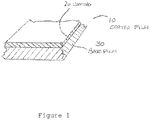
- Figure 1 depicts one example of a coated film (10) where a coating (20) resides on a base film (30).
- the invention concerns coated films and articles, compositions for such coatings, and methods of coating a substrate where the coating comprises vermiculite; polymer capable of forming a film; chemical stabilizing agent(s) for the vermiculite in the polymer; and cross-linking agent(s). It should be noted that, in some embodiments, a majority of the cross-linking agent is reacted with the polymer capable of forming a film.
- the coatings of the invention are between 0.05 ⁇ and 1.0 ⁇ , preferably 0.15 ⁇ to 0.60 ⁇ thick.
- Suitable chemical stabilizing agents include materials that contain cationic functionality including lithium, alkyl C 2 -C 6 ammonium, allyl ammonium, heterocylclic ammonium, morpholonium, and amino C 3 -C 6 alkyl carboxylic acids. Suitable chemical stabilizing agents may also be selected from materials that include C 2 -C 6 amines, allyl amines, heterocyclic amines, morphine and ammonia.
- Suitable chemical stabilizing agents include materials that contain cationic functionality including lithium, alkyl C 2 -C 6 ammonium, allyl ammonium, heterocylclic ammonium, morpholonium, ammonium and amino C 3 -C 6 alkyl carboxylic acids in combination with anionic counter ions.
- Suitable chemical stabilizing agents also include lithium cations in combination with anions selected from carboxylic, phosphoric, phosphonic, sulfonic and fatty acids, lithium chelating agents, and lithium salts.
- the carboxylic acids contain at least 12 carbon atoms (lauric acid, myristic acid, palmitic acid, stearic acid, behenic acid, and lanolin fatty acid, for example).
- preferred lithium salts of carboxylic acids include lithium citrate, lithium erythorbate, and lithium stearate. These may be used alone or in combination of two or more.
- Suitable chemical stabilizing agents include alkyl C 2 -C 6 ammonium cations as linear and branched ammonium cations. In combination with anions selected from fatty acids and alkyl C 2 -C 6 ammonium salts.
- preferred ammonium cations are primary ammonium cations.
- Linear primary ammonium cations include n-propyl ammonium, n-butyl ammonium, n-pentyl ammonium, and n-hexyl ammonium.
- the ammonium cation is a branched C 2 -C 6 ammonium cation.
- Such branched ammonium cations include 2-propanammonium, 2-butylammonium, 2-pentanammonium, 3-pentanammonium, 2-hexanammonium, and 3-hexaneammonium.
- the preferred alkyl C 2 -C 6 ammonium cation is n-butyl ammonium.
- Suitable chemical stabilizing agents include ammonia.
- Such agents can be readily obtained from commercial sources and used as is or purified by means known to those skilled in the art.
- Vermiculite has aspect ratio of at least 5,000 and is predominantly chemically, thermally or mechanically exfoliated.
- the vermiculite has a particle size of 5 to 60 microns in breadth and, in some preferred embodiments, with the majority of particles falling in the range of 10 to 30 microns.
- the vermiculite particles are one to three nanometers thick.
- these dispersion agents are used at a weight ratio of dispersion agent to vermiculite ranges from about 0.02 to about 3.0, preferably about 0.1 to about 2.5 or, in some embodiments, about 0.04 to about 1.0.
- the rate ratio of the chemical stabilizing agent to vermiculite platelets (dry basis) is at least 0.0036, 0.012, 0.0061, or 0.4.
- the barriers have an oxygen transmission rate (OTR) of less than 0.7 cc/100 square inches per 24 hours at 1 atmosphere and 23°C, and preferably less than 0.4 cc/100 square inches per 24 hours at 1 atmosphere and 23°C. OTR is determined using ASTM D1434.
- the substrate is a base film.
- the invention is applicable to numerous base films.
- a barrier coating composition of the invention can be applied to various blown, cast, extruded, etc. films or articles manufactured from polymeric materials selected from polyethylene terephthalate (“PET”); biaxially-oriented polypropylene (“BOPP”) and oriented polypropylene (“OPP”); cast polypropylene, polyethylene (“PE”), including high density polyethylene (“HDPE”), low density polyethylene (“LDPE”), and linear low density polyethylene (“LLDPE”); polyvinyl chloride (“PVC”), polystyrene (“PS”), biaxially oriented polystyrene, and expanded polystyrene (“EPS”); polyethylene terephthalate glycol (“PET-G”); ethylene vinyl acetate (“EVA”); ethylene vinyl alcohol (“EVOH”); polyhydroxyalkanoate (“PHA”), polylactic acid (“PLA”); and others, such as poly(acrylonitrile- co -
- PE
- the base film may be used as a structural film, or if it can be sealed to itself such as is the case with some polypropylene films, as a sealant film on the inside of a laminated package. Also, if the coated film is a sealant film, it can be laminated to any number of different types of substrates, including but not limited to another coated film, another uncoated film, paper, etc.
- the base film may also act simultaneously as both a structural film and sealant film, where the coating is applied to a single side, that side facing to the side opposite to the sealant side. Such monoweb structures are common, but not limited to use in packaging baked goods and confectionaries.
- Sealant layers may be created by coextrusion, extrusion coating, coating or adhesive lamination.
- a film is a flat unsupported section of a polymeric (e.g., plastic) resin whose thickness is much smaller than its width or length. Films are generally regarded as being 0.25 millimeters or less, typically 0.01 to 0.20 mm thick. A sheet may range from about 0.20 mm to several cm, typically 0.3 to 3 mm in thickness. Films and sheets can be used alone or in combination with other sheet, fabric or structural units through lamination, coextrusion or coating.
- a polymeric (e.g., plastic) resin whose thickness is much smaller than its width or length. Films are generally regarded as being 0.25 millimeters or less, typically 0.01 to 0.20 mm thick. A sheet may range from about 0.20 mm to several cm, typically 0.3 to 3 mm in thickness. Films and sheets can be used alone or in combination with other sheet, fabric or structural units through lamination, coextrusion or coating.
- Important properties include tensile strength, elongation, stiffness, tear strength and resistance; optical properties including haze, transparency; chemical resistance such as water absorption and transmission of a variety of permeant materials including water vapor and other permeants; electrical properties such as dielectric constant; and permanence properties including shrinkage, cracking, weatherability, etc.
- Polymer materials can be formed into a film using a variety of processes including blown polymer extrusion, linear biaxially oriented film extrusion (a process referred in the film industry as tentering) and by casting from molten polymer resin, monomer or polymer (aqueous or organic solvent) dispersion. These methods are well known manufacturing procedures.
- Skilled artisans can tailor the polymer for a particular end use by controlling molecular weight (the melt index has been selected by the polymer industry as a measure of molecular weight--melt index is inversely proportional to molecular weight, density and crystallinity).
- Films may be transparent, white, opaque, metalized, coated, extrusion coated, coextruded. Films may consist of one or more layers. Films may contain coating before or after, may an optional primer coating. Films may contain one or more moisture resistant or moisture barrier coatings. Films may be metalized by vacuum deposition of aluminum. Barrier coated films of the present invention may be metalized by vacuum deposition of aluminum.
- a barrier coating composition of the invention may also be applied to a cast article, or an article made my injection molding or blow molding (such as bottles and other closures), thermoforming (e.g., trays), or stamping (e.g., trays).
- molten polymer resin or monomer dispersion are typically produced from polyethylene or polypropylene. Occasionally, nylon, polyester and PVC are cast.
- dispersions are polymerized to an optimum crystallinity and molecular weight before coating.
- the coating composition of the invention may also be applied to bottles and trays, which are commonly made with PET, polypropylene and polystyrene.
- a film can be used as a film closure on a rigid plastic container.
- Such containers can have a rectangular, circular, square, or other shaped cross-section, a flat bottom and an open top.
- the invention may be used in the formation of blister pack packaging, clam shell type enclosures, tubs, trays, lidding and similar articles of containment. Examples of use include, but are not limited to, bottles, trays, caps, corks, gloves, and condoms.
- a barrier coating composition can be coated on a film to produce a coated film which is then thermoformed or stamped to produce an article.
- articles include, but are not limited to, cups and trays such as shallow cups and trays useful in packaging food.
- two or more polymer materials are joined in a coextrusion process to produce tailored film or sheet products adapted to a particular end use.
- One or more polymer types in two or more layers of melt are melted in separate extruders and joined together in a single coextrusion die layering single extrudates together in a single film to have a finished film with versatile properties derived from the individual layers.
- Layers of the different polymers or resins can be combined by parallel extrusion of the different polymers.
- the film can be processed conventionally and may be oriented after cooling. Films can contain a variety of additives such as antioxidants, heat stabilizers, UV stabilizers, slip agents, fillers, and anti-block agents.
- Another film process puts layers together by lamination.
- Still other structures might be a combination of an extrusion on top of a solid film and a coextrusion on top of a solid film.
- the barrier coating composition of the invention may also be applied to an article of paper, fabric, fiber, or other material of manufacture.
- a barrier coating may be applied to a variety of packaging formats to package a variety of items.
- items may be packaged entirely in a pouch or bag of paper, fabric or other material of manufacture that is coated with a barrier coating of the invention.
- Paper products include any article of manufacture, at least a portion of which comprises paper coated in accordance with the invention.
- the coated paper product may be made totally of paper or partially of paper.
- the invention encompasses paper products made of either single or multiple layers, e.g., a paper laminate or plastic/paper laminate.
- plastic coatings are commonly extruded onto paper; clays are usually slurries that are applied to paper with a knife coater (blade on top of paper with a certain gap and pressure).
- the coating may be applied on one or both sides.
- Paper products that are designed to receive food would typically be arranged such that the coatings are not in contact with food. In this instance, a sealant layer is placed between the food and the coating layer.
- the invention is especially advantageously applied to protect a product from contamination from permeant sources outside a packaging material.
- Food items are protected from contamination by aromatic and aliphatic hydrocarbons, fluorocarbons, ink, and packaging residue, exhaust from transportation equivalent and other internal combustion engines, etc.
- the invention can advantageously be applied to prevent the escape of certain perfumes from the package (especially expensive perfumes) commonly used in a variety of consumer products such as scented paper products, bar soap, scented bath products, cleaners, fabric softeners, detergents, dry bleaches and disinfectants.
- the invention can also be applied to packaging of seasonings, spices, coffee, and the like.
- Food items are the most common material requiring protection from outside contamination. Further, a variety of materials must be packaged in barrier materials preventing the odor of the material from exiting the package, resulting in the substantial loss of important fragrance notes from packaged materials reducing product value. Further, food odors may readily be transmitted by a variety of packaging materials, attracting insect and rodent pests.
- Important odors requiring substantial barriers include odors derived from coffee, ready to eat cereal, frozen pizza, cocoa or other chocolate products, dry mix gravies and soups, snack foods (such as potato or corn chips, pretzels, crackers, and popcorn), baked foods, butter or butter-flavor notes, meat products, in particular butter or butter-flavor notes used in the manufacture of microwave popcorn in microwaveable paper containers, fruits and nuts, and so on.
- Dry pet food (such as dog and cat food, etc.) can also benefit from the invention as it is often important to prevent obnoxious odor from escaping into the environment - in the store and at home.
- a particular gas within an article of manufacture such as helium within a balloon, or an inert atmosphere such as nitrogen or argon within a package (including thermo-pane windows).
- Materials that are readily oxidized, such as reactive chemicals may be packaged in a container in which ambient atmosphere has been replaced with an inert atmosphere, and the invention serves to exclude oxygen and to preserve the contents of the package (including the inert atmosphere).
- the coating layer thickness may be varied depending upon the kind of substrate and the desired barrier properties, and, in some embodiments, it is preferably about 10 ⁇ m or less, more preferably about 1 ⁇ m or less, when dry. There is no lower limit, however, and, in some embodiments, the thickness is preferably 10 nm or more-- 50 nm, 100 nm, 200 nm, 500 nm, or more, in order to obtain effective gas barrier properties in certain embodiments. In some embodiments, the coating is performed on a continuous application line at a speed of at least 10 meters per minute (30 feet per minute), preferably at least 300 meters per minute (900 feet per minute), or more for better economic efficiency.
- the barrier coating composition may contain various additives such as ultraviolet absorbers/blockers, coloring agents, antioxidants, anti-microbials, flame retardants and the like.
- these additives have average particle sizes in the nanometer range or smaller (e.g. colloidal antimony flame retardant; colloidal silver; nano-sized titanium dioxide and zinc oxide UV barrier).
- UV absorbing material any suitable UV absorbing material can be used. These materials include the oxides of titanium, zirconium, cerium and tin-doped iridium oxides (such as, titanium dioxide, zirconium dioxide, cerium dioxide, indium tin oxide), and the like.
- the invention includes articles of manufacture wherein either the coating or films are subsequently laminated with an additional sealant film or extrusion coated with sealant polymers.
- the sealant may be applied by any means known in the art.
- the sealant may be one layer or it may be multiple layers.
- the sealant is preferably selected from the group consisting of polyethylene (including linear low density polyethylene, high density polyethylene, etc.), polypropylene, and ethylene-vinyl acetate copolymer (EV acetate), poly(lactic acid) (“PLA”), polyhydroxyalkanoate (“PHA”) or blends thereof.
- the coated film may contain a moisture resistant barrier or moisture resistant coating.
- Any suitable barrier or coating material can be utilized.
- One suitable coating is an acrylic based coating.
- use of such a barrier or coating can protect the coating layer of the invention from humidity and extend the life of the oxygen barrier. This may be particularly valuable when the structural film has relatively poor moisture barrier (PET and PLA, for example).
- PET and PLA moisture barrier
- the barrier or layer can be applied to protect the coated layer from moisture that is found outside of a package utilizing a barrier coating of the invention or to protect the coated layer from moisture from moist or wet contents of the package.
- the moisture resistant barrier can be place such that is it is on the "outside" and/or "inside" of the coating layer.
- the moisture resistant barrier or coating has a structure that is a monoweb of sealable resin that can function as both the base (structural) and sealant web in one film.
- Materials that are commercially in use today include BOPP, PE and PLA - all available with a sealable face. With these films, a coating of the instant invention can be used on the outside of the package, and is therefore readily exposed to high humidity environmental conditions. Under high humidity, not only can the oxygen barrier of coating degrade, the base carrier resin of the coating (polyvinyl alcohol) can sometimes become tacky. The moisture resistant coating can maintain the integrity of the oxygen barrier and the structural integrity of the coating as well.
- arrangement of layers include (from the outside of the package to the inside of the package), include but are not limited to:
- Vermiculite is preferred over other clays because of its planar nature and high aspect ratio.
- vermiculite that has been modified into a form with a high percentage of singular platelets is preferred.
- These vermiculite platelets preferably are 10 to 5,000 angstroms thick and have a surface dimension (length and/or width) of 10 to 50 microns and aspect ratios greater than 5,000.
- High aspect ratios of vermiculite single platelet length/width to thickness allow numerous platelets to be held in place parallel or nearly parallel to the plane of the coating and for numerous platelets to be closely layered within thin layers of coating, while having sufficient breadth to form a tortuous path to traversing molecules, such as of oxygen. This layered, planar alignment of vermiculite platelets, dispersed within the polymeric coating solution will be maintained during the coating application process and the coating drying process.
- Vermiculite platelets are produced through a process of separation or exfoliation. Vermiculite exfoliation to highly singular platelets is known in the art and can be accomplished by mechanical, thermal or chemical means as disclosed in U.S. Patent Nos. 3,325,340 ; 4,885,330 ; 5,102,464 ; and 5,326,500 .
- Chemically dispersed vermiculite products are available from Specialty Vermiculite Corporation (formally Grace) as Microlite Vermiculite and Microlite Dispersions. Microlite Dispersions are an aqueous dispersion of chemically exfoliated vermiculite.
- One preferred embodiment of the invention uses Microlite 963 vermiculite.
- the coatings of the invention contain 1 to 65 weight percent vermiculite and the viscosity of the dispersions vary by no more than 20% when subjected to processing conditions on a gravure coater or flexographic printer (conditions), as measured with a standard #2 Zhan cup or Brookfield viscometer.
- Suitable polymers used in the compositions include those capable of forming films. Films can be formed by rolling out or laying out the polymer (or solution or suspension of polymer) on a surface and allowing it to form the film. Such films can be formed with or without the application of heat. The films can be formed with or without the presence of a solvent for the polymer.
- the polymers used to make the coatings e.g. PVOH, etc. range in viscosity from 1 to 200 centipoise, preferably between 3 and 65 centipoise.
- the polymers of the invention can be delivered to the coating composition either neat or in solution.
- the solution is an aqueous solution.
- a non-aqueous solvent may be used.
- Non-aqueous solvents include alcohols (such as methanol, ethanol and isopropanol), dimethylsulfoxide, acetone, methyl ethyl ketone (MEK), and hydrocarbons.
- the polymers can be delivered in the form of an emulsion in some embodiments.
- Urethane polymer is one such example.
- Another example of a useful emulsion that is based on polyvinylidene chloride (PVDC).
- PVDC polyvinylidene chloride
- many of the rubbers noted throughout the application can also be delivered in the form of emulsions - e.g. butyl, nitrile, SBR, epichlorohydrin, chloroprene, acrylic rubbers, and the like.
- the range of solids is from low percentages (commonly several percent) to more commonly high percentages of as high as 55-60 weight percent.
- PVDC is at 55-60 weight percent and urethane is at 30+ weight percent. In each of these cases, the solutions may be diluted (down to 5-10 weight percent, in some cases) to permit optimal handling and application of the coating.
- Any polymer that forms a film of desired properties can be used with the invention.
- Some preferred polymers include polyhydroxylic polymer, urethanes, and rubbers. Suitable polyhydroxylic polymers include polyvinyl alcohol (PVOH) and ethylene-vinyl alcohol copolymer (EVOH) and blends thereof.
- PVOH polyvinyl alcohol
- EVOH ethylene-vinyl alcohol copolymer
- One preferred PVOH is a higher hydrolyzed PVOH which is more crystalline in nature than lower hydrolyzed PVOH. Higher hydrolyzed PVOH is more crystalline and hence has better integrity (defined as better resistance to gas transmission) at higher levels of relative humidity.
- PVOH is typically produced by hydrolyzing poly(vinyl acetate). In this reaction, acetate groups of poly(vinyl acetate) are replaced with alcohol groups through a hydrolysis reaction. The more acetate groups that are replaced, the greater the hydrolysis of the PVOH resin. For example, in a 95% hydrolyzed PVOH resin approximately 5% of the acetate groups remain unchanged. Similarly, in a 99% hydrolyzed PVOH resin, approximately 1% of the acetate groups remain unchanged. In the instant invention, PVOH of various degrees of hydrolysis can be used. In some cases, the degree of hydrolysis is greater than or equal to 90%, 95%, or 99%.
- Any natural or synthetic rubber that gives desired properties can be used. Suitable rubbers include polychloroprene, butyl rubber, acrylic rubber, and nitrile rubber. Other synthetic rubbers include those derived from isoprene, butadiene, SBR (styrene/butadiene rubber), isobutene/isoprene, and EPDM (ethylene/propylene/butadiene).
- Urethane polymers are well known to those skilled in the art. Suitable urethane polymers include those amenable to forming aqueous dispersions.
- Urethane-containing polymers include polyurethanes made by techniques known in the art.
- a polyisocyanate compound aromatic and aliphatic
- the isocyanate is a diisocyanate.
- tri-functional or higher isocyanates can be utilized alone or in mixtures with diisocyanates.
- aliphatic isocyanates are preferred.
- Suitable compounds with reactive terminal hydrogens include polyols such as poly(ethylene glycol), poly(propylene glycol), or polyester polyol. These compounds can be reacted with the isocyanate compound either in the presence or absence of catalysts.
- the urethanes can have polar sites attached thereto to promote water compatibility.
- sites include, carboxylic acid, ether, sulfonic, sulfonium, sulfhydryl, and ammonium groups. See, for example, PCT Patent Application No. WO98/03860 .
- the polymer can be formed in situ.
- a urethane for example, can be made by reacting a polyisocyanate with suitable compounds to form urethane linkages.
- Such compositions might be useful in various end uses such as adhesives (a two component adhesive, for example).
- Polyester polymers are well known to those skilled in the art. Suitable polyester polymers include those amenable to forming aqueous dispersions. Polyester-containing polymers include polyester polymers made by techniques known in the art. In some embodiments, the polyesters can have polar sites attached thereto to promote water compatibility. Such sites include, carboxylic acid, ether, sulfonic, sulfonium, and sulfhydryl groups.
- the polymers can be cross-linked. Any suitable cross-linking agent that provides desirable properties can be used. Examples of cross-linking agents include ethanedial (Glyoxal 40L from Clariant Corporation, for example), cyclic urea glyoxal condensate (SunRez 700, for example). In some embodiments, the amount of cross-linker is 0.1 to 50 percent based on weight of the polymer capable of forming a film. See U.S. Patent Nos. 5,496,649 and 6,444,750 .
- the coating composition comprises an aqueous dispersion.
- the weight percent of solids is 0.5-10%. In other embodiments, the weight percent of solids is 3-8% or 4-6%.
- SWIRL TEST - DEFINITION The test methodology described herein will be referred to as the "swirl test", or simply “the test".
- the apparatus needed for the test is a 10 ounce plastic cup with tapered walls.
- the cup measures approximately 2 inches in diameter at the bottom, 3 inches in diameter at the top, and approximately 4 inches in height.
- Liquid coating is placed into the cup and swirled vigorously for 10 minutes, with fingertips placed at the top of the cup.
- the speed of rotation is 120 revolutions per minute.
- the amount of liquid placed in the cup measures between 50 and 75 grams.
- the vermiculite platelets When the liquid in the plastic cup is rotated vigorously, the vermiculite platelets are in their singularized format. Thin, light-weight platelets are caught in the rotating pattern of the liquid and their surfaces line up parallel to the rotating liquid. Since the platelets are quite broad in their length and breadth at 10 to 30 microns, they are large enough to reflect light and appear to shine. The sheen or shiny reflection visually defines the swirling pattern of the liquid.
- the liquid becomes viscous, similar to pudding. In the worst case, the liquid appears to flocculate and has nodules much the same as applesauce. The shiny swirling pattern ceases.
- the contents of the prepared solution were placed into a coating pan used on a PSi SC1000, 64-inch wide direct rotogravure press.
- This coating was then applied to a 48-gauge PET flexible film at a thickness of 0.25 microns dry. During this application process, the coating in the pan had a sheen, as described in the definition of the swirl test above.
- a batch of 9.565 percent concentration of PVOH was prepared by dissolving 100 pounds of Celvol® 107 (Celvol is a trademark of Celanese Corporation) in 900 pounds of de-ionized water at 190 to 205°F. Methylparaben was added to the mixture at 0.1 percent of the weight of Celvol, or 0.1 pound to prevent formation of microbes. The solution was heated for 45 minutes before all the PVOH and methylparaben were dissolved. The solution was subsequently cooled and filtered through a 80-mesh screen to remove solid impurities. Concentration was checked using a hand-held refractometer and adjusted to account for the water evaporated during the solubilizing step.
- a coating masterbatch was prepared by mixing 6437 grams of the 9.565 percent PVOH solution with 9603 grams of de-ionized water. To this mixture was added 239 grams of a wax containing morpholine. The mixture was gently stirred for 20 seconds. To this mixture was further added 797 grams of Glyoxal 40 from Clariant Corporation (Glyoxal 40 L is the product designation used by Clariant for ethanedial). This mixture was gently stirred for 20 seconds.
- This masterbatch was placed into a 5-gallon container and transported to a production facility together with a separate container containing 1 gallon of Microlite® 963 (Microlite is the trademark of W.R. Grace & Co. - Conn., and Microlite 963 is a 7.5 percent by weight suspension of vermiculite in water).
- the 5-gallon container of the masterbatch and 1992.5 grams of clay platelets were mixed together and placed into a reservoir next to a Dri-Tec waterbased coater laminater, with a machine width of 57 inches.
- Coating in the reservoir was pumped using a diaphragm pump to a pan in which a 140 line analox cylinder was partially submerged into the coating.
- a doctor blade applied to the cylinder maintained the correct amount of coating on the cylinder for transfer to a 37-inch wide 48 gauge PET film treated with a corona treater to 50+ dyne-cm.
- the coating was applied to the PET film at a machine speed of 450 feet per minute.
- the coated PET film was then laminated to a 1.6 mil cast polypropylene (CPP) sealant film using a Nordmechanica Super Simplex solventless laminator.
- the adhesive used was Tycel 7668/7276, a two-part solventless urethane from Liofol. (Liofol is a division of Henkel Corporation.)
- the finished laminated barrier film was subsequently formed into bags 6 inches by 6 inches using an impulse sealer.
- a barrier coating formulation was manufactured as follows. Into a 55-gallon plastic drum was placed 49.3 kilograms of de-ionized water. Additionally, the following components and weights were added to the de-ionized water with vigorous mechanical agitation following the addition of each component: 47.9 grams of DeeFo PI40 anti-foaming agent; 8.6 kilograms of isopropyl alcohol; and 450 grams of lithium hydroxide monohydrate stabilizing agent. The mixture was stirred for 1 hour until the lithium hydroxide monohydrate stabilizing agent was dissolved. Next, 115.9 pounds of 10.25% solids solution of Elvanol 90-50 stabilized with 3 percent by weight of the Elvanol was slowly added to the de-ionized water/IPA/etc.
Landscapes
- Chemical & Material Sciences (AREA)
- Organic Chemistry (AREA)
- Health & Medical Sciences (AREA)
- Chemical Kinetics & Catalysis (AREA)
- Medicinal Chemistry (AREA)
- Polymers & Plastics (AREA)
- Life Sciences & Earth Sciences (AREA)
- Engineering & Computer Science (AREA)
- Materials Engineering (AREA)
- Wood Science & Technology (AREA)
- Inorganic Chemistry (AREA)
- Laminated Bodies (AREA)
- Coating Of Shaped Articles Made Of Macromolecular Substances (AREA)
- Wrappers (AREA)
- Paints Or Removers (AREA)
Applications Claiming Priority (2)
| Application Number | Priority Date | Filing Date | Title |
|---|---|---|---|
| US201161513853P | 2011-08-01 | 2011-08-01 | |
| PCT/US2012/049109 WO2013019833A1 (en) | 2011-08-01 | 2012-08-01 | Barrier coatings for films and structures |
Publications (2)
| Publication Number | Publication Date |
|---|---|
| EP2739674A1 EP2739674A1 (en) | 2014-06-11 |
| EP2739674B1 true EP2739674B1 (en) | 2019-02-13 |
Family
ID=46679294
Family Applications (1)
| Application Number | Title | Priority Date | Filing Date |
|---|---|---|---|
| EP12747957.4A Active EP2739674B1 (en) | 2011-08-01 | 2012-08-01 | Barrier coatings for films and structures |
Country Status (8)
| Country | Link |
|---|---|
| US (1) | US10851259B2 (enExample) |
| EP (1) | EP2739674B1 (enExample) |
| JP (1) | JP6360647B2 (enExample) |
| CN (1) | CN103717650B (enExample) |
| BR (1) | BR112014002447A2 (enExample) |
| CA (1) | CA2843762C (enExample) |
| RU (1) | RU2014107901A (enExample) |
| WO (1) | WO2013019833A1 (enExample) |
Cited By (2)
| Publication number | Priority date | Publication date | Assignee | Title |
|---|---|---|---|---|
| WO2023219706A1 (en) * | 2022-05-11 | 2023-11-16 | Sonoco Development, Inc. | Barrier coating with high aspect ratio particles |
| WO2024086222A1 (en) | 2022-10-18 | 2024-04-25 | Braskem S.A. | High-barrier multilayer film and packaging container made therefrom |
Families Citing this family (21)
| Publication number | Priority date | Publication date | Assignee | Title |
|---|---|---|---|---|
| CN103717650B (zh) | 2011-08-01 | 2017-09-26 | 纳米包装公司 | 用于薄膜和结构的屏障涂层 |
| SG11201401159XA (en) | 2011-10-06 | 2014-04-28 | Agency Science Tech & Res | A layered silicate/polymer composite and a method of forming the same |
| CN105431591B (zh) | 2013-07-22 | 2019-05-10 | 爱适瑞运营法国公司 | 包含活性剂的纤维素纤维料幅和用于制造包含活性剂的纤维素纤维料幅的方法 |
| GB2502241B (en) * | 2013-09-19 | 2014-04-30 | Rockwell Solutions Ltd | Packaging material and methods for manufacturing the same |
| WO2015164093A1 (en) * | 2014-04-21 | 2015-10-29 | Nanopack, Inc. | Vermiculite-containing adhesive compositions |
| EP3020652A1 (de) * | 2014-11-14 | 2016-05-18 | Reno de Medici S.p.A. | Verpackungsmaterial |
| AU2015369929B2 (en) | 2014-12-22 | 2020-08-20 | Nutrition & Biosciences USA 4, Inc. | Polymeric blend containing poly alpha-1,3-glucan |
| KR102745257B1 (ko) | 2015-10-26 | 2024-12-23 | 뉴트리션 앤드 바이오사이언시스 유에스에이 4, 인크. | 종이용 다당류 코팅 |
| KR102746152B1 (ko) | 2015-10-26 | 2024-12-26 | 뉴트리션 앤드 바이오사이언시스 유에스에이 4, 인크. | 수불용성 알파-(1,3-글루칸) 조성물 |
| KR101742708B1 (ko) * | 2016-08-23 | 2017-06-01 | (주)에버켐텍 | 천연물을 이용한 식품포장재용 코팅 조성물 및 이의 제조방법 |
| US20180079556A1 (en) * | 2016-09-22 | 2018-03-22 | Tia Bodington | Reusable labeled coffee bean bag and method of operation |
| US11814229B2 (en) * | 2017-03-31 | 2023-11-14 | Amcor Flexibles North America, Inc. | Packaging and packaging film having differential barrier properties |
| TWI701198B (zh) * | 2018-05-04 | 2020-08-11 | 黃廖全 | 一種防潮單元之製造方法及其用於生化感測試片容器防潮結構 |
| DE102020114527B4 (de) * | 2020-05-29 | 2023-11-30 | Infineon Technologies Ag | Chipgehäuse und verfahren zum bilden eines chipgehäuses |
| ES2955784T3 (es) * | 2020-10-14 | 2023-12-07 | Hannes Bichsel | Granos biogranulados espumados |
| CN116376081B (zh) * | 2021-12-23 | 2025-09-09 | 江阴纳力新材料科技有限公司 | 改性聚合物膜及其制备方法、金属化聚合物膜与应用 |
| US20230356517A1 (en) * | 2022-05-06 | 2023-11-09 | Meredian, Inc. | Pha-based retort food pouch |
| CN120265844A (zh) * | 2022-12-08 | 2025-07-04 | 菲利普莫里斯生产公司 | 不含金属层的内衬片材材料 |
| EP4411064A1 (en) | 2023-02-06 | 2024-08-07 | Huhtamäki Oyj | A process of forming an open container for dairy, plant-based food and/or frozen food |
| KR102718263B1 (ko) * | 2023-06-26 | 2024-10-17 | 에이치비페이퍼 주식회사 | 산소차단 및 투습방지와 해리성이 개선된 적층 코팅지 및 이의 제조방법 |
| CN116922902B (zh) * | 2023-07-21 | 2025-12-09 | 长虹美菱股份有限公司 | 压缩机防护盖、冰箱及制备方法 |
Family Cites Families (21)
| Publication number | Priority date | Publication date | Assignee | Title |
|---|---|---|---|---|
| GB1016385A (en) | 1961-12-22 | 1966-01-12 | Commw Scient Ind Res Org | Suspension of silicate layer minerals and products made therefrom |
| GB8312992D0 (en) | 1983-05-11 | 1983-06-15 | Ici Plc | Poly(aryl ethers) |
| US5102464A (en) | 1985-08-12 | 1992-04-07 | W. R. Grace & Co.-Conn. | Vermiculite dispersions and method of preparing same |
| US4801403A (en) | 1987-07-17 | 1989-01-31 | Hercules Incorporated | Aqueous mineral dispersions |
| US4885330A (en) | 1987-11-20 | 1989-12-05 | Hercules Incorporated | Non-dispersible vermiculite products |
| GB9102374D0 (en) * | 1991-02-04 | 1991-03-20 | Ici Plc | Polymeric film |
| GB9112827D0 (en) * | 1991-06-14 | 1991-07-31 | Ici Plc | Polymeric film |
| US5326500A (en) | 1993-06-14 | 1994-07-05 | W.R. Grace & Co.-Conn. | Vermiculite composition with improved chemical exfoliation |
| US5496649A (en) | 1994-07-21 | 1996-03-05 | Mobil Oil Corp. | Cross-linked PVOH coatings having enhanced barrier characteristics |
| US6444750B1 (en) | 1995-03-06 | 2002-09-03 | Exxonmobil Oil Corp. | PVOH-based coating solutions |
| DE19631530C2 (de) | 1996-07-23 | 2000-03-09 | Inst Chemo Biosensorik | Ionenselektiver Sensor |
| US6232389B1 (en) * | 1997-06-09 | 2001-05-15 | Inmat, Llc | Barrier coating of an elastomer and a dispersed layered filler in a liquid carrier and coated articles |
| JP4775921B2 (ja) | 1997-06-09 | 2011-09-21 | インマット・インコーポレーテツド | 液状担体中に分散している層状充填材と弾性重合体から作られたバリヤーコーティングおよび被覆された構成物、特にタイヤ |
| JP3726569B2 (ja) | 1999-07-26 | 2005-12-14 | セイコーエプソン株式会社 | 半透過反射型及び反射型液晶装置並びにこれらを用いた電子機器 |
| US8063119B2 (en) * | 2003-08-29 | 2011-11-22 | Inmat Inc. | Barrier coating of a non-elastomeric polymer and a dispersed layered filler in a liquid carrier and coated articles |
| JP2005126301A (ja) | 2003-10-27 | 2005-05-19 | Hojun:Kk | ゲル状粘土及びゲル状粘土の製造方法並びにゲル状粘土で生成されてなる極性有機溶剤及び極性有機溶剤中で分散し増粘させてなるゲル状粘土組成物 |
| US7119138B1 (en) * | 2003-12-19 | 2006-10-10 | Inmat Inc. | Barrier coating of a mixture of cured and uncured elastomeric polymers and a dispersed layered filler in a liquid carrier and coated articles |
| DE602007006179D1 (de) * | 2006-05-01 | 2010-06-10 | Nanopack Inc | Barriereschichten für filme und strukturen |
| US20090098395A1 (en) * | 2007-10-15 | 2009-04-16 | Pang Chia Lu | Barrier coating for thermoplastic films |
| WO2010117900A1 (en) | 2009-04-08 | 2010-10-14 | Nanopack, Inc. | Aroma barrier films and structures |
| CN103717650B (zh) | 2011-08-01 | 2017-09-26 | 纳米包装公司 | 用于薄膜和结构的屏障涂层 |
-
2012
- 2012-08-01 CN CN201280038704.7A patent/CN103717650B/zh active Active
- 2012-08-01 EP EP12747957.4A patent/EP2739674B1/en active Active
- 2012-08-01 RU RU2014107901/05A patent/RU2014107901A/ru not_active Application Discontinuation
- 2012-08-01 JP JP2014524041A patent/JP6360647B2/ja active Active
- 2012-08-01 WO PCT/US2012/049109 patent/WO2013019833A1/en not_active Ceased
- 2012-08-01 CA CA2843762A patent/CA2843762C/en active Active
- 2012-08-01 US US14/236,170 patent/US10851259B2/en active Active - Reinstated
- 2012-08-01 BR BR112014002447A patent/BR112014002447A2/pt not_active IP Right Cessation
Non-Patent Citations (1)
| Title |
|---|
| None * |
Cited By (2)
| Publication number | Priority date | Publication date | Assignee | Title |
|---|---|---|---|---|
| WO2023219706A1 (en) * | 2022-05-11 | 2023-11-16 | Sonoco Development, Inc. | Barrier coating with high aspect ratio particles |
| WO2024086222A1 (en) | 2022-10-18 | 2024-04-25 | Braskem S.A. | High-barrier multilayer film and packaging container made therefrom |
Also Published As
| Publication number | Publication date |
|---|---|
| US20140377545A1 (en) | 2014-12-25 |
| BR112014002447A2 (pt) | 2017-02-21 |
| US10851259B2 (en) | 2020-12-01 |
| EP2739674A1 (en) | 2014-06-11 |
| CN103717650A (zh) | 2014-04-09 |
| CA2843762A1 (en) | 2013-02-07 |
| JP6360647B2 (ja) | 2018-07-18 |
| CN103717650B (zh) | 2017-09-26 |
| CA2843762C (en) | 2019-12-24 |
| JP2014524489A (ja) | 2014-09-22 |
| RU2014107901A (ru) | 2015-09-10 |
| WO2013019833A1 (en) | 2013-02-07 |
Similar Documents
| Publication | Publication Date | Title |
|---|---|---|
| EP2739674B1 (en) | Barrier coatings for films and structures | |
| EP2019852B1 (en) | Barrier coatings for films and structures | |
| EP2014730B1 (en) | Coating liquid, gas barrier film, gas barrier laminate and gas barrier multilayer film each using the coating liquid, and their production methods | |
| Youssef | Polymer nanocomposites as a new trend for packaging applications | |
| KR20160067191A (ko) | 산소 포집 필름 | |
| WO2014134110A1 (en) | Polyvinyl alcohol and ethylene vinyl alcohol copolymer barrier coatings | |
| JP7235775B2 (ja) | 水性エチレン-ビニルアルコールコポリマー分散体及び前記分散体でコーティングされた酸素バリア多層フィルム | |
| KR20120024263A (ko) | 기체 차단성 투명 고분자 필름 | |
| AU2003262243B2 (en) | Inorganic layered compound dispersion, process for producing the same, and use thereof | |
| WO2015164093A1 (en) | Vermiculite-containing adhesive compositions | |
| Farris et al. | Emerging coating technologies for food and beverage packaging materials | |
| US7892615B2 (en) | Coating material composition with gas-barrier property, process for producing the same, and gas-barrier packaging container obtained therefrom | |
| WO2010117900A1 (en) | Aroma barrier films and structures | |
| EP2014733A1 (en) | Coating liquid, gas barrier film using same, gas barrier laminate, gas barrier multilayer film, and their production methods | |
| JP2013159074A (ja) | ガスバリア積層体およびそれを用いた包装体 | |
| TW202515733A (zh) | 氣體障壁性積層體及其製造方法 | |
| WO2025063266A1 (ja) | 組成物、溶融成形用材料、多層構造体、多層容器、組成物および多層構造体の製造方法 |
Legal Events
| Date | Code | Title | Description |
|---|---|---|---|
| PUAI | Public reference made under article 153(3) epc to a published international application that has entered the european phase |
Free format text: ORIGINAL CODE: 0009012 |
|
| 17P | Request for examination filed |
Effective date: 20140211 |
|
| AK | Designated contracting states |
Kind code of ref document: A1 Designated state(s): AL AT BE BG CH CY CZ DE DK EE ES FI FR GB GR HR HU IE IS IT LI LT LU LV MC MK MT NL NO PL PT RO RS SE SI SK SM TR |
|
| DAX | Request for extension of the european patent (deleted) | ||
| STAA | Information on the status of an ep patent application or granted ep patent |
Free format text: STATUS: EXAMINATION IS IN PROGRESS |
|
| 17Q | First examination report despatched |
Effective date: 20170321 |
|
| GRAP | Despatch of communication of intention to grant a patent |
Free format text: ORIGINAL CODE: EPIDOSNIGR1 |
|
| STAA | Information on the status of an ep patent application or granted ep patent |
Free format text: STATUS: GRANT OF PATENT IS INTENDED |
|
| RIC1 | Information provided on ipc code assigned before grant |
Ipc: C08K 3/34 20060101ALI20180621BHEP Ipc: C08J 5/12 20060101AFI20180621BHEP |
|
| INTG | Intention to grant announced |
Effective date: 20180716 |
|
| GRAS | Grant fee paid |
Free format text: ORIGINAL CODE: EPIDOSNIGR3 |
|
| GRAJ | Information related to disapproval of communication of intention to grant by the applicant or resumption of examination proceedings by the epo deleted |
Free format text: ORIGINAL CODE: EPIDOSDIGR1 |
|
| GRAL | Information related to payment of fee for publishing/printing deleted |
Free format text: ORIGINAL CODE: EPIDOSDIGR3 |
|
| STAA | Information on the status of an ep patent application or granted ep patent |
Free format text: STATUS: EXAMINATION IS IN PROGRESS |
|
| INTC | Intention to grant announced (deleted) | ||
| GRAR | Information related to intention to grant a patent recorded |
Free format text: ORIGINAL CODE: EPIDOSNIGR71 |
|
| STAA | Information on the status of an ep patent application or granted ep patent |
Free format text: STATUS: GRANT OF PATENT IS INTENDED |
|
| GRAA | (expected) grant |
Free format text: ORIGINAL CODE: 0009210 |
|
| STAA | Information on the status of an ep patent application or granted ep patent |
Free format text: STATUS: THE PATENT HAS BEEN GRANTED |
|
| INTG | Intention to grant announced |
Effective date: 20190103 |
|
| AK | Designated contracting states |
Kind code of ref document: B1 Designated state(s): AL AT BE BG CH CY CZ DE DK EE ES FI FR GB GR HR HU IE IS IT LI LT LU LV MC MK MT NL NO PL PT RO RS SE SI SK SM TR |
|
| REG | Reference to a national code |
Ref country code: GB Ref legal event code: FG4D |
|
| REG | Reference to a national code |
Ref country code: CH Ref legal event code: EP Ref country code: AT Ref legal event code: REF Ref document number: 1096183 Country of ref document: AT Kind code of ref document: T Effective date: 20190215 |
|
| REG | Reference to a national code |
Ref country code: IE Ref legal event code: FG4D |
|
| REG | Reference to a national code |
Ref country code: DE Ref legal event code: R096 Ref document number: 602012056639 Country of ref document: DE |
|
| REG | Reference to a national code |
Ref country code: LT Ref legal event code: MG4D |
|
| REG | Reference to a national code |
Ref country code: NL Ref legal event code: MP Effective date: 20190213 |
|
| PG25 | Lapsed in a contracting state [announced via postgrant information from national office to epo] |
Ref country code: FI Free format text: LAPSE BECAUSE OF FAILURE TO SUBMIT A TRANSLATION OF THE DESCRIPTION OR TO PAY THE FEE WITHIN THE PRESCRIBED TIME-LIMIT Effective date: 20190213 Ref country code: PT Free format text: LAPSE BECAUSE OF FAILURE TO SUBMIT A TRANSLATION OF THE DESCRIPTION OR TO PAY THE FEE WITHIN THE PRESCRIBED TIME-LIMIT Effective date: 20190613 Ref country code: NO Free format text: LAPSE BECAUSE OF FAILURE TO SUBMIT A TRANSLATION OF THE DESCRIPTION OR TO PAY THE FEE WITHIN THE PRESCRIBED TIME-LIMIT Effective date: 20190513 Ref country code: SE Free format text: LAPSE BECAUSE OF FAILURE TO SUBMIT A TRANSLATION OF THE DESCRIPTION OR TO PAY THE FEE WITHIN THE PRESCRIBED TIME-LIMIT Effective date: 20190213 Ref country code: LT Free format text: LAPSE BECAUSE OF FAILURE TO SUBMIT A TRANSLATION OF THE DESCRIPTION OR TO PAY THE FEE WITHIN THE PRESCRIBED TIME-LIMIT Effective date: 20190213 Ref country code: NL Free format text: LAPSE BECAUSE OF FAILURE TO SUBMIT A TRANSLATION OF THE DESCRIPTION OR TO PAY THE FEE WITHIN THE PRESCRIBED TIME-LIMIT Effective date: 20190213 |
|
| PG25 | Lapsed in a contracting state [announced via postgrant information from national office to epo] |
Ref country code: RS Free format text: LAPSE BECAUSE OF FAILURE TO SUBMIT A TRANSLATION OF THE DESCRIPTION OR TO PAY THE FEE WITHIN THE PRESCRIBED TIME-LIMIT Effective date: 20190213 Ref country code: LV Free format text: LAPSE BECAUSE OF FAILURE TO SUBMIT A TRANSLATION OF THE DESCRIPTION OR TO PAY THE FEE WITHIN THE PRESCRIBED TIME-LIMIT Effective date: 20190213 Ref country code: HR Free format text: LAPSE BECAUSE OF FAILURE TO SUBMIT A TRANSLATION OF THE DESCRIPTION OR TO PAY THE FEE WITHIN THE PRESCRIBED TIME-LIMIT Effective date: 20190213 Ref country code: IS Free format text: LAPSE BECAUSE OF FAILURE TO SUBMIT A TRANSLATION OF THE DESCRIPTION OR TO PAY THE FEE WITHIN THE PRESCRIBED TIME-LIMIT Effective date: 20190613 Ref country code: GR Free format text: LAPSE BECAUSE OF FAILURE TO SUBMIT A TRANSLATION OF THE DESCRIPTION OR TO PAY THE FEE WITHIN THE PRESCRIBED TIME-LIMIT Effective date: 20190514 Ref country code: BG Free format text: LAPSE BECAUSE OF FAILURE TO SUBMIT A TRANSLATION OF THE DESCRIPTION OR TO PAY THE FEE WITHIN THE PRESCRIBED TIME-LIMIT Effective date: 20190513 |
|
| REG | Reference to a national code |
Ref country code: AT Ref legal event code: MK05 Ref document number: 1096183 Country of ref document: AT Kind code of ref document: T Effective date: 20190213 |
|
| PG25 | Lapsed in a contracting state [announced via postgrant information from national office to epo] |
Ref country code: EE Free format text: LAPSE BECAUSE OF FAILURE TO SUBMIT A TRANSLATION OF THE DESCRIPTION OR TO PAY THE FEE WITHIN THE PRESCRIBED TIME-LIMIT Effective date: 20190213 Ref country code: DK Free format text: LAPSE BECAUSE OF FAILURE TO SUBMIT A TRANSLATION OF THE DESCRIPTION OR TO PAY THE FEE WITHIN THE PRESCRIBED TIME-LIMIT Effective date: 20190213 Ref country code: AL Free format text: LAPSE BECAUSE OF FAILURE TO SUBMIT A TRANSLATION OF THE DESCRIPTION OR TO PAY THE FEE WITHIN THE PRESCRIBED TIME-LIMIT Effective date: 20190213 Ref country code: RO Free format text: LAPSE BECAUSE OF FAILURE TO SUBMIT A TRANSLATION OF THE DESCRIPTION OR TO PAY THE FEE WITHIN THE PRESCRIBED TIME-LIMIT Effective date: 20190213 Ref country code: CZ Free format text: LAPSE BECAUSE OF FAILURE TO SUBMIT A TRANSLATION OF THE DESCRIPTION OR TO PAY THE FEE WITHIN THE PRESCRIBED TIME-LIMIT Effective date: 20190213 Ref country code: SK Free format text: LAPSE BECAUSE OF FAILURE TO SUBMIT A TRANSLATION OF THE DESCRIPTION OR TO PAY THE FEE WITHIN THE PRESCRIBED TIME-LIMIT Effective date: 20190213 Ref country code: ES Free format text: LAPSE BECAUSE OF FAILURE TO SUBMIT A TRANSLATION OF THE DESCRIPTION OR TO PAY THE FEE WITHIN THE PRESCRIBED TIME-LIMIT Effective date: 20190213 |
|
| REG | Reference to a national code |
Ref country code: DE Ref legal event code: R097 Ref document number: 602012056639 Country of ref document: DE |
|
| PG25 | Lapsed in a contracting state [announced via postgrant information from national office to epo] |
Ref country code: SM Free format text: LAPSE BECAUSE OF FAILURE TO SUBMIT A TRANSLATION OF THE DESCRIPTION OR TO PAY THE FEE WITHIN THE PRESCRIBED TIME-LIMIT Effective date: 20190213 Ref country code: PL Free format text: LAPSE BECAUSE OF FAILURE TO SUBMIT A TRANSLATION OF THE DESCRIPTION OR TO PAY THE FEE WITHIN THE PRESCRIBED TIME-LIMIT Effective date: 20190213 |
|
| PLBE | No opposition filed within time limit |
Free format text: ORIGINAL CODE: 0009261 |
|
| STAA | Information on the status of an ep patent application or granted ep patent |
Free format text: STATUS: NO OPPOSITION FILED WITHIN TIME LIMIT |
|
| PG25 | Lapsed in a contracting state [announced via postgrant information from national office to epo] |
Ref country code: AT Free format text: LAPSE BECAUSE OF FAILURE TO SUBMIT A TRANSLATION OF THE DESCRIPTION OR TO PAY THE FEE WITHIN THE PRESCRIBED TIME-LIMIT Effective date: 20190213 |
|
| 26N | No opposition filed |
Effective date: 20191114 |
|
| PG25 | Lapsed in a contracting state [announced via postgrant information from national office to epo] |
Ref country code: SI Free format text: LAPSE BECAUSE OF FAILURE TO SUBMIT A TRANSLATION OF THE DESCRIPTION OR TO PAY THE FEE WITHIN THE PRESCRIBED TIME-LIMIT Effective date: 20190213 |
|
| PG25 | Lapsed in a contracting state [announced via postgrant information from national office to epo] |
Ref country code: TR Free format text: LAPSE BECAUSE OF FAILURE TO SUBMIT A TRANSLATION OF THE DESCRIPTION OR TO PAY THE FEE WITHIN THE PRESCRIBED TIME-LIMIT Effective date: 20190213 |
|
| PG25 | Lapsed in a contracting state [announced via postgrant information from national office to epo] |
Ref country code: CH Free format text: LAPSE BECAUSE OF NON-PAYMENT OF DUE FEES Effective date: 20190831 Ref country code: MC Free format text: LAPSE BECAUSE OF FAILURE TO SUBMIT A TRANSLATION OF THE DESCRIPTION OR TO PAY THE FEE WITHIN THE PRESCRIBED TIME-LIMIT Effective date: 20190213 Ref country code: LU Free format text: LAPSE BECAUSE OF NON-PAYMENT OF DUE FEES Effective date: 20190801 Ref country code: LI Free format text: LAPSE BECAUSE OF NON-PAYMENT OF DUE FEES Effective date: 20190831 |
|
| REG | Reference to a national code |
Ref country code: BE Ref legal event code: MM Effective date: 20190831 |
|
| PG25 | Lapsed in a contracting state [announced via postgrant information from national office to epo] |
Ref country code: IE Free format text: LAPSE BECAUSE OF NON-PAYMENT OF DUE FEES Effective date: 20190801 |
|
| PG25 | Lapsed in a contracting state [announced via postgrant information from national office to epo] |
Ref country code: BE Free format text: LAPSE BECAUSE OF NON-PAYMENT OF DUE FEES Effective date: 20190831 |
|
| PG25 | Lapsed in a contracting state [announced via postgrant information from national office to epo] |
Ref country code: CY Free format text: LAPSE BECAUSE OF FAILURE TO SUBMIT A TRANSLATION OF THE DESCRIPTION OR TO PAY THE FEE WITHIN THE PRESCRIBED TIME-LIMIT Effective date: 20190213 |
|
| PG25 | Lapsed in a contracting state [announced via postgrant information from national office to epo] |
Ref country code: MT Free format text: LAPSE BECAUSE OF FAILURE TO SUBMIT A TRANSLATION OF THE DESCRIPTION OR TO PAY THE FEE WITHIN THE PRESCRIBED TIME-LIMIT Effective date: 20190213 Ref country code: HU Free format text: LAPSE BECAUSE OF FAILURE TO SUBMIT A TRANSLATION OF THE DESCRIPTION OR TO PAY THE FEE WITHIN THE PRESCRIBED TIME-LIMIT; INVALID AB INITIO Effective date: 20120801 |
|
| PG25 | Lapsed in a contracting state [announced via postgrant information from national office to epo] |
Ref country code: MK Free format text: LAPSE BECAUSE OF FAILURE TO SUBMIT A TRANSLATION OF THE DESCRIPTION OR TO PAY THE FEE WITHIN THE PRESCRIBED TIME-LIMIT Effective date: 20190213 |
|
| PGFP | Annual fee paid to national office [announced via postgrant information from national office to epo] |
Ref country code: GB Payment date: 20250612 Year of fee payment: 14 |
|
| PGFP | Annual fee paid to national office [announced via postgrant information from national office to epo] |
Ref country code: FR Payment date: 20250610 Year of fee payment: 14 |
|
| PGFP | Annual fee paid to national office [announced via postgrant information from national office to epo] |
Ref country code: DE Payment date: 20250604 Year of fee payment: 14 |
|
| PGFP | Annual fee paid to national office [announced via postgrant information from national office to epo] |
Ref country code: IT Payment date: 20250722 Year of fee payment: 14 |