EP2723721B1 - Polyphenylene host compounds - Google Patents
Polyphenylene host compounds Download PDFInfo
- Publication number
- EP2723721B1 EP2723721B1 EP12731873.1A EP12731873A EP2723721B1 EP 2723721 B1 EP2723721 B1 EP 2723721B1 EP 12731873 A EP12731873 A EP 12731873A EP 2723721 B1 EP2723721 B1 EP 2723721B1
- Authority
- EP
- European Patent Office
- Prior art keywords
- compound
- phenyl
- bis
- light
- ethyl
- Prior art date
- Legal status (The legal status is an assumption and is not a legal conclusion. Google has not performed a legal analysis and makes no representation as to the accuracy of the status listed.)
- Not-in-force
Links
- 0 C*c1c(*)c(C)c(*C)c(*C)c1C Chemical compound C*c1c(*)c(C)c(*C)c(*C)c1C 0.000 description 4
- VFUDMQLBKNMONU-UHFFFAOYSA-N c(cc1)cc(c2ccccc22)c1[n]2-c(cc1)ccc1-c(cc1)ccc1-[n]1c(cccc2)c2c2ccccc12 Chemical compound c(cc1)cc(c2ccccc22)c1[n]2-c(cc1)ccc1-c(cc1)ccc1-[n]1c(cccc2)c2c2ccccc12 VFUDMQLBKNMONU-UHFFFAOYSA-N 0.000 description 1
Images
Classifications
-
- H—ELECTRICITY
- H10—SEMICONDUCTOR DEVICES; ELECTRIC SOLID-STATE DEVICES NOT OTHERWISE PROVIDED FOR
- H10K—ORGANIC ELECTRIC SOLID-STATE DEVICES
- H10K85/00—Organic materials used in the body or electrodes of devices covered by this subclass
- H10K85/60—Organic compounds having low molecular weight
- H10K85/631—Amine compounds having at least two aryl rest on at least one amine-nitrogen atom, e.g. triphenylamine
- H10K85/636—Amine compounds having at least two aryl rest on at least one amine-nitrogen atom, e.g. triphenylamine comprising heteroaromatic hydrocarbons as substituents on the nitrogen atom
-
- C—CHEMISTRY; METALLURGY
- C07—ORGANIC CHEMISTRY
- C07D—HETEROCYCLIC COMPOUNDS
- C07D235/00—Heterocyclic compounds containing 1,3-diazole or hydrogenated 1,3-diazole rings, condensed with other rings
- C07D235/02—Heterocyclic compounds containing 1,3-diazole or hydrogenated 1,3-diazole rings, condensed with other rings condensed with carbocyclic rings or ring systems
- C07D235/04—Benzimidazoles; Hydrogenated benzimidazoles
- C07D235/18—Benzimidazoles; Hydrogenated benzimidazoles with aryl radicals directly attached in position 2
-
- C—CHEMISTRY; METALLURGY
- C07—ORGANIC CHEMISTRY
- C07D—HETEROCYCLIC COMPOUNDS
- C07D403/00—Heterocyclic compounds containing two or more hetero rings, having nitrogen atoms as the only ring hetero atoms, not provided for by group C07D401/00
- C07D403/02—Heterocyclic compounds containing two or more hetero rings, having nitrogen atoms as the only ring hetero atoms, not provided for by group C07D401/00 containing two hetero rings
- C07D403/10—Heterocyclic compounds containing two or more hetero rings, having nitrogen atoms as the only ring hetero atoms, not provided for by group C07D401/00 containing two hetero rings linked by a carbon chain containing aromatic rings
-
- C—CHEMISTRY; METALLURGY
- C07—ORGANIC CHEMISTRY
- C07D—HETEROCYCLIC COMPOUNDS
- C07D409/00—Heterocyclic compounds containing two or more hetero rings, at least one ring having sulfur atoms as the only ring hetero atoms
- C07D409/02—Heterocyclic compounds containing two or more hetero rings, at least one ring having sulfur atoms as the only ring hetero atoms containing two hetero rings
- C07D409/04—Heterocyclic compounds containing two or more hetero rings, at least one ring having sulfur atoms as the only ring hetero atoms containing two hetero rings directly linked by a ring-member-to-ring-member bond
-
- C—CHEMISTRY; METALLURGY
- C07—ORGANIC CHEMISTRY
- C07F—ACYCLIC, CARBOCYCLIC OR HETEROCYCLIC COMPOUNDS CONTAINING ELEMENTS OTHER THAN CARBON, HYDROGEN, HALOGEN, OXYGEN, NITROGEN, SULFUR, SELENIUM OR TELLURIUM
- C07F3/00—Compounds containing elements of Groups 2 or 12 of the Periodic Table
-
- H—ELECTRICITY
- H10—SEMICONDUCTOR DEVICES; ELECTRIC SOLID-STATE DEVICES NOT OTHERWISE PROVIDED FOR
- H10K—ORGANIC ELECTRIC SOLID-STATE DEVICES
- H10K50/00—Organic light-emitting devices
-
- H—ELECTRICITY
- H10—SEMICONDUCTOR DEVICES; ELECTRIC SOLID-STATE DEVICES NOT OTHERWISE PROVIDED FOR
- H10K—ORGANIC ELECTRIC SOLID-STATE DEVICES
- H10K85/00—Organic materials used in the body or electrodes of devices covered by this subclass
- H10K85/60—Organic compounds having low molecular weight
- H10K85/615—Polycyclic condensed aromatic hydrocarbons, e.g. anthracene
-
- H—ELECTRICITY
- H10—SEMICONDUCTOR DEVICES; ELECTRIC SOLID-STATE DEVICES NOT OTHERWISE PROVIDED FOR
- H10K—ORGANIC ELECTRIC SOLID-STATE DEVICES
- H10K85/00—Organic materials used in the body or electrodes of devices covered by this subclass
- H10K85/60—Organic compounds having low molecular weight
- H10K85/631—Amine compounds having at least two aryl rest on at least one amine-nitrogen atom, e.g. triphenylamine
-
- H—ELECTRICITY
- H10—SEMICONDUCTOR DEVICES; ELECTRIC SOLID-STATE DEVICES NOT OTHERWISE PROVIDED FOR
- H10K—ORGANIC ELECTRIC SOLID-STATE DEVICES
- H10K85/00—Organic materials used in the body or electrodes of devices covered by this subclass
- H10K85/60—Organic compounds having low molecular weight
- H10K85/631—Amine compounds having at least two aryl rest on at least one amine-nitrogen atom, e.g. triphenylamine
- H10K85/633—Amine compounds having at least two aryl rest on at least one amine-nitrogen atom, e.g. triphenylamine comprising polycyclic condensed aromatic hydrocarbons as substituents on the nitrogen atom
-
- H—ELECTRICITY
- H10—SEMICONDUCTOR DEVICES; ELECTRIC SOLID-STATE DEVICES NOT OTHERWISE PROVIDED FOR
- H10K—ORGANIC ELECTRIC SOLID-STATE DEVICES
- H10K85/00—Organic materials used in the body or electrodes of devices covered by this subclass
- H10K85/60—Organic compounds having low molecular weight
- H10K85/649—Aromatic compounds comprising a hetero atom
- H10K85/657—Polycyclic condensed heteroaromatic hydrocarbons
- H10K85/6572—Polycyclic condensed heteroaromatic hydrocarbons comprising only nitrogen in the heteroaromatic polycondensed ring system, e.g. phenanthroline or carbazole
-
- H—ELECTRICITY
- H10—SEMICONDUCTOR DEVICES; ELECTRIC SOLID-STATE DEVICES NOT OTHERWISE PROVIDED FOR
- H10K—ORGANIC ELECTRIC SOLID-STATE DEVICES
- H10K2101/00—Properties of the organic materials covered by group H10K85/00
- H10K2101/10—Triplet emission
-
- H—ELECTRICITY
- H10—SEMICONDUCTOR DEVICES; ELECTRIC SOLID-STATE DEVICES NOT OTHERWISE PROVIDED FOR
- H10K—ORGANIC ELECTRIC SOLID-STATE DEVICES
- H10K50/00—Organic light-emitting devices
- H10K50/10—OLEDs or polymer light-emitting diodes [PLED]
- H10K50/11—OLEDs or polymer light-emitting diodes [PLED] characterised by the electroluminescent [EL] layers
-
- H—ELECTRICITY
- H10—SEMICONDUCTOR DEVICES; ELECTRIC SOLID-STATE DEVICES NOT OTHERWISE PROVIDED FOR
- H10K—ORGANIC ELECTRIC SOLID-STATE DEVICES
- H10K50/00—Organic light-emitting devices
- H10K50/10—OLEDs or polymer light-emitting diodes [PLED]
- H10K50/11—OLEDs or polymer light-emitting diodes [PLED] characterised by the electroluminescent [EL] layers
- H10K50/12—OLEDs or polymer light-emitting diodes [PLED] characterised by the electroluminescent [EL] layers comprising dopants
-
- H—ELECTRICITY
- H10—SEMICONDUCTOR DEVICES; ELECTRIC SOLID-STATE DEVICES NOT OTHERWISE PROVIDED FOR
- H10K—ORGANIC ELECTRIC SOLID-STATE DEVICES
- H10K85/00—Organic materials used in the body or electrodes of devices covered by this subclass
- H10K85/10—Organic polymers or oligomers
- H10K85/111—Organic polymers or oligomers comprising aromatic, heteroaromatic, or aryl chains, e.g. polyaniline, polyphenylene or polyphenylene vinylene
- H10K85/113—Heteroaromatic compounds comprising sulfur or selene, e.g. polythiophene
- H10K85/1135—Polyethylene dioxythiophene [PEDOT]; Derivatives thereof
-
- H—ELECTRICITY
- H10—SEMICONDUCTOR DEVICES; ELECTRIC SOLID-STATE DEVICES NOT OTHERWISE PROVIDED FOR
- H10K—ORGANIC ELECTRIC SOLID-STATE DEVICES
- H10K85/00—Organic materials used in the body or electrodes of devices covered by this subclass
- H10K85/30—Coordination compounds
- H10K85/341—Transition metal complexes, e.g. Ru(II)polypyridine complexes
- H10K85/342—Transition metal complexes, e.g. Ru(II)polypyridine complexes comprising iridium
Definitions
- the embodiments relate to host compounds for light-emitting layers in devices.
- OLEDs Organic light-emitting devices
- OLEDs may include an emissive or light-emitting layer that includes a host material and a light-emitting component dispersed within the host material.
- Host materials in OLEDs may have problems with low stability, a high charge-injection barrier, and imbalanced charge injection and mobility. These potential deficiencies with host materials may contribute to low efficiency and short lifetime of the devices comprising the host materials.
- Luminescent diphenylamino end-capped oligophenylenes are disclosed in Journal of Organic Chemistry 2004,69,921-927 .
- a first aspect of the invention provides a compound according to appended claims 1-13.
- Cy 1 , Cy 2 , Cy 3 , Cy 4 , and Cy 5 is p -phenylene independently substituted with H, F, methyl, ethyl, propyl, or isopropyl;
- Cy 6 is phenyl optionally substituted with H, F, methyl, ethyl, propyl, or isopropyl;
- Cy 7 is phenyl or naphthalenyl optionally substituted with H, F, methyl, ethyl, propyl, or isopropyl, wherein Cy 6 and Cy 7 optionally link together to form a fused tricyclic ring system comprising the N to which they are attached;
- Cy 8 is 1-phenyl-1H-benzo[d]imidazol-2-yl optionally substituted with H, F, methyl, ethyl, propyl, or isopropyl.
- Another aspect of the invention provides a light-emitting device according to appended claims 14 and 15.
- Structures associated with some of the chemical names referred to herein are depicted below. These structures may be unsubstituted, as shown below, or a substituent may independently be in any position normally occupied by a hydrogen atom when the structure is unsubstituted.
- alkyl has the ordinary meaning generally understood in the art, and may include a moiety composed of carbon and hydrogen containing no double or triple bonds.
- Alkyl may be linear alkyl, branched alkyl, cycloalkyl, or a combination thereof, and in some embodiments, may contain from one to thirty-five carbon atoms.
- alkyl may include C 1-10 linear alkyl, such as methyl (-CH 3 ), ethyl (-CH 2 CH 3 ), n-propyl (-CH 2 CH 2 CH 3 ), n-butyl (-CH 2 CH 2 CH 2 CH 3 ), n-pentyl (-CH 2 CH 2 CH 2 CH 2 CH 3 ), n-hexyl (-CH 2 CH 2 CH 2 CH 2 CH 3 ), etc.; C 3-10 branched alkyl, such as C 3 H 7 (e.g. iso-propyl), C 4 H 9 (e.g. branched butyl isomers), C 5 H 11 (e.g.
- branched pentyl isomers C 6 H 13 (e.g. branched hexyl isomers), C 7 H 15 (e.g. heptyl isomers), etc.; C 3-10 cycloalkyl, such as C 3 H 5 (e.g. cyclopropyl), C 4 H 7 (e.g. cyclobutyl isomers such as cyclobutyl, methylcyclopropyl, etc.), C 5 H 9 (e.g. cyclopentyl isomers such as cyclopentyl, methylcyclobutyl, dimethylcyclopropyl, etc.) C 6 H 11 (e.g.
- alkyl may be a linking group that is attached to two or more structural features, e.g., alkyl may be a linking substituent so that Cy 1 , Cy 2 , and the linking substituent form a fused tricyclic ring system as described in greater detail below.
- alkoxy includes -O-alkyl, such as -OCH 3 , - OC 2 H 5 , -OC 3 H 7 (e.g. propoxy isomers such as isopropoxy, n-propoxy, etc.), -OC 4 H 9 (e.g. butyoxy isomers), -OC 5 H 11 (e.g. pentoxy isomers), -OC 6 H 13 (e.g. hexoxy isomers), -OC 7 H 15 (e.g. heptoxy isomers), etc.
- -OCH 3 e.g. propoxy isomers such as isopropoxy, n-propoxy, etc.
- -OC 4 H 9 e.g. butyoxy isomers
- -OC 5 H 11 e.g. pentoxy isomers
- -OC 6 H 13 e.g. hexoxy isomers
- -OC 7 H 15 e.g. heptoxy isomers
- Formula 1 includes compounds such as those depicted by Formulas 2-24.
- Cy1, Cy2, Cy3, Cy4, and Cy5 may independently be p-phenylene independently substituted with H, F, methyl, ethyl, propyl or isopropyl;
- Cy 1 may be:
- Cy 1 is unsubstituted.
- Cy 2 may be:
- Cy 2 is unsubstituted.
- Cy 1 and Cy 2 may share a linking substituent so that Cy 1 , Cy 2 , and the linking substituent form a fused tricyclic ring system.
- -Cy 1 -Cy 2 - may be:
- X 1 may be any substituent that links Cy 1 to Cy 2 .
- the substituent that that links Cy 1 to Cy 2 may have: from 0 to 15 carbon atoms and from 0 to 10 heteroatoms independently selected from: O, N, S, F, Cl, Br, and I; and/or a molecular weight of 15 g/mol to 500 g/mol.
- X 1 may be: -O-, or -S-.
- X 1 may be:
- Cy 3 may be:
- Cy 3 is unsubstitued.
- Cy 2 and Cy 3 may share a linking substituent so that Cy 2 , Cy 3 , and the linking substituent form a fused tricyclic ring system.
- -Cy 2 -Cy 3 - may be:
- X 2 may be any substituent that links Cy 2 to Cy 3 .
- the substituent that that links Cy 2 to Cy 3 may have: from 0 to 15 carbon atoms and from 0 to 10 heteroatoms independently selected from: O, N, S, F, Cl, Br, and I; and/or a molecular weight of 15 g/mol to 500 g/mol.
- X 2 may be: -O-, or -S-.
- X 2 may be:
- Cy 3 and Cy 4 may share a linking substituent so that Cy 3 , Cy 4 , and the linking substituent form a fused tricyclic ring system.
- -Cy 3 -Cy 4 - may be:
- X 3 may be any substituent that links Cy 3 to Cy 4 .
- the substituent that that links Cy 3 to Cy 4 may have: from 0 to 15 carbon atoms and from 0 to 10 heteroatoms independently selected from: O, N, S, F, Cl, Br, and I; and/or a molecular weight of 15 g/mol to 500 g/mol.
- X 3 may be: -O-, or -S-.
- X 3 may be:
- Cy 4 and Cy 5 may share a linking substituent so that Cy 4 , Cy 5 , and the linking substituent form a fused tricyclic ring system.
- -Cy 4 -Cy 5 - may be:
- X 4 may be any substituent that links Cy 4 to Cy 5 .
- the substituent that that links Cy 4 to Cy 5 may have: from 0 to 15 carbon atoms and from 0 to 10 heteroatoms independently selected from: O, N, S, F, Cl, Br, and I; and/or a molecular weight of 15 g/mol to 500 g/mol.
- X 4 may be: -O-, or -S-.
- X 4 may be:
- Cy 6 may be optionally substituted phenyl.
- the phenyl if the phenyl is substituted, it may have 1, 2, 3, 4, or 5 substituents. Any substituent may be included on the phenyl.
- some or all of the substituents on the phenyl may have: from 0 to 15 carbon atoms and from 0 to 10 heteroatoms independently selected from: O, N, S, F, Cl, Br, and I; and/or a molecular weight of 15 g/mol to 500 g/mol.
- the substituents may be C 1-10 alkyl, such as CH 3 , C 2 H 5 , C 3 H 7 , cyclic C 3 H 5 , C 4 H 9 , cyclic C 4 H 7 , C 5 H 11 , cyclic C 5 H 9 , C 6 H 13 , cyclic C 6 H 11 , etc.; C 1-10 alkoxy; halo, such as F, Cl, Br, I; OH; CN; NO 2 ; C 1-6 fluoroalkyl, such as CF 3 , CF 2 H, C 2 F 5 , etc.; a C 1-10 ester such as -O 2 CCH 3 , -CO 2 CH 3 , -O 2 CC 2 H 5 , -CO 2 C 2 H 5 , -O 2 C-phenyl, -CO 2 -phenyl, etc.; a C 1-10 ketone such as -COCH 3 , -COC 2 H 5 , -COC 3 H
- Cy 6 may be
- Cy 7 may be optionally substituted phenyl or optionally substituted naphthalenyl, wherein Cy 6 and Cy 7 may optionally link together to form a fused tricyclic ring system comprising N.
- the phenyl if the phenyl is substituted, it may have 1, 2, 3, 4, or 5 substituents.
- if the naphthalenyl is substituted it may have 1, 2, 3, 4, 5, 6, or 7 substituents. Any substituent may be included on the phenyl or the naphthalenyl.
- some or all of the substituents on the phenyl or the naphthalenyl may have: from 0 to 15 carbon atoms and from 0 to 10 heteroatoms independently selected from: O, N, S, F, Cl, Br, and I; and/or a molecular weight of 15 g/mol to 500 g/mol.
- the substituents may be C 1-10 alkyl, such as CH 3 , C 2 H 5 , C 3 H 7 , cyclic C 3 H 5 , C 4 H 9 , cyclic C 4 H 7 , C 5 H 11 , cyclic C 5 H 9 , C 6 H 13 , cyclic C 6 H 11 , etc.; C 1-10 alkoxy; halo, such as F, Cl, Br, I; OH; CN; NO 2 ; C 1-6 fluoroalkyl, such as CF 3 , CF 2 H, C 2 F 5 , etc.; a C 1-10 ester such as -O 2 CCH 3 , -CO 2 CH 3 , -O 2 CC 2 H 5 , -CO 2 C 2 H 5 , -O 2 C-phenyl, -CO 2 -phenyl etc.; a C 1-10 ketone such as -COCH 3 , -COC 2 H 5 , -COC 3 H 7
- Cy 7 may be:
- Cy 6 and Cy 7 are unsubstituted.
- Cy 8 is unsubstituted.
- Cy 8 may be:
- R 1 , R 2 , R 3 , R 4 , R 5 , R 6 , R 7 , R 8 , R 9 , R 10 , R 11 , R 12 , R 13 , R 14 , R 15 , R 16 , R 17 , R 18 , R 19 , R 20 , R 21 , R 22 , R 23 , R 24 , R 25 , R 26 , R 27 , R 28 , R 29 , R 30 , R 31 , R 32 , R 33 , R 34 , R 35 , R 36 , R 37 , R 38 , R 39 , and R 41 (“R 1-41 ”) may independently be H, F, methyl, ethyl, propyl, or isopropyl.
- R 1 , R 2 , R 3 , R 4 , and R 5 are independently H, F, methyl, ethyl, propyl, or isopropyl. In some embodiments R 1 , R 2 , R 3 , R 4 , and R 5 are H.
- R 1 , R 2 , R 4 , and R 5 are independently H, F, methyl, ethyl, propyl, or isopropyl. In some embodiments R 1 , R 2 , R 4 , and R 5 are H.
- R 6 , R 7 , R 8 , R 9 , R 10 , R 11 , and R 12 are independently H, F, methyl, ethyl, propyl, or isopropyl. In some embodiments R 6 , R 7 , R 8 , R 9 , R 10 , R 11 , and R 12 are H.
- R 1 , R 2 , R 3 , R 4 , R 5 , R 6 , R 7 , R 8 , R 9 , R 10 , R 11 , and R 12 are independently H, F, methyl, ethyl, propyl, or isopropyl.
- R 1 , R 2 , R 3 , R 4 , R 5 , R 6 , R 7 , R 8 , R 9 , R 10 , R 11 , and R 12 are H.
- R 1 , R 2 , R 3 , R 4 , R 6 , R 7 , R 8 , R 9 , and R 10 are independently H, F, methyl, ethyl, propyl, or isopropyl. In some embodiments R 1 , R 2 , R 3 , R 4 , R 6 , R 7 , R 8 , R 9 , and R 10 are H.
- R 13 , R 14 , R 15 , and R 16 are independently H, F, methyl, ethyl, propyl, or isopropyl. In some embodiments R 13 , R 14 , R 15 , and R 16 are H
- R 17 , R 18 , R 19 , and R 20 are independently H, F, methyl, ethyl, propyl, or isopropyl. In some embodiments R 17 , R 18 , R 19 , and R 20 are H
- R 21 , R 22 , R 23 , and R 24 are independently H, F, methyl, ethyl, propyl, or isopropyl. In some embodiments R 21 , R 22 , R 23 , and R 24 are H.
- R 25 , R 26 , R 27 , and R 28 are independently H, F, methyl, ethyl, propyl, or isopropyl. In some embodiments R 25 , R 26 , R 27 , and R 28 are H.
- R 29 , R 30 , R 31 , and R 32 are independently H, F, methyl, ethyl, propyl, or isopropyl. In some embodiments R 29 , R 30 , R 31 , and R 32 are H.
- R 33 , R 34 , R 35 , R 36 , R 37 , R 38 , R 39 , R 40 , and R 41 are independently H, F, methyl, ethyl, propyl, or isopropyl.
- R 33 , R 34 , R 35 , R 36 , R 37 , R 38 , R 39 , R 40 and R 41 are H.
- compositions comprising a compound of any one of Formulas 1-11,13,19-24 or any specific compound depicted or named herein (hereinafter referred to as "a subject compound").
- a composition comprising a subject compound may further comprise a fluorescent compound or a phosphorescent compound, and may be useful for light emission in devices such as organic light-emitting devices.
- an organic light-emitting device comprises a subject compound.
- light-emitting layer comprising a subject compound may is disposed between an anode and a cathode.
- the device is configured so that electrons can be transferred from the cathode to the light-emitting layer and holes can be transferred from the anode to the light-emitting layer.
- the subject compounds may have high photostability and thermal stability in organic light-emitting devices.
- the subject compounds may also have well balanced hole and electron injection rates and mobilities. This may provide OLED devices with high efficiencies and/or long lifetimes.
- the subject compounds may also form amorphous solids, which may make the compounds easy to form into films.
- the anode may be a layer comprising a conventional material such as a metal, mixed metal, alloy, metal oxide or mixed-metal oxide, conductive polymer, and/or an inorganic material such as carbon nanotube (CNT).
- suitable metals include the Group 1 metals, the metals in Groups 4, 5, 6, and the Group 8-10 transition metals. If the anode layer is to be light-transmitting, metals in Group 10 and 11, such as Au, Pt, and Ag, or alloys thereof; or mixed-metal oxides of Group 12, 13, and 14 metals, such as indium-tin-oxide (ITO), indium-zinc-oxide (IZO), and the like, may be used.
- ITO indium-tin-oxide
- IZO indium-zinc-oxide
- the anode layer may be an organic material such as polyaniline.
- polyaniline is described in " Flexible light-emitting diodes made from soluble conducting polymer," Nature, vol. 357, pp. 477-479 (11 June 1992 ).
- the anode layer can have a thickness in the range of about 1 nm to about 1000 nm.
- a cathode may be a layer including a material having a lower work function than the anode layer.
- suitable materials for the cathode layer include those selected from alkali metals of Group 1, Group 2 metals, Group 12 metals including rare earth elements, lanthanides and actinides, materials such as aluminum, indium, calcium, barium, samarium and magnesium, and combinations thereof.
- Li-containing organometallic compounds, LiF, and Li 2 O may also be deposited between the organic layer and the cathode layer to lower the operating voltage.
- Suitable low work function metals include but are not limited to Al, Ag, Mg, Ca, Cu, Mg/Ag, LiF/Al, CsF, CsF/A1 or alloys thereof.
- the cathode layer can have a thickness in the range of about 1 nm to about 1000 nm.
- a light-emitting layer may comprise a light-emitting component and a subject compound as a host.
- the amount of the host in a light-emitting layer may vary. In one embodiment, the amount of a host in a light-emitting layer is in the range of from about 1% to about 99.9% by weight of the light-emitting layer. In another embodiment, the amount of a host in a light-emitting layer is in the range of from about 90% to about 99% by weight of the light-emitting layer. In another embodiment, the amount of a host in a light-emitting layer is about 97% by weight of the light-emitting layer.
- the mass of the light-emitting component is about 0.1% to about 10%, about 1% to about 5%, or about 3% of the mass of the light-emitting layer.
- the light-emitting component may be a fluorescent and/or a phosphorescent compound.
- a light-emitting component may comprise an iridium coordination compound such as: bis- ⁇ 2-[3,5-bis(trifluoromethyl)phenyl]pyridinato-N,C2' ⁇ iridium(III)-picolinate; bis(2-[4,6-difluorophenyl]pyridinato-N,C2')iridium (III) picolinate; bis(2-[4,6-difluorophenyl]pyridinato-N,C2')iridium(acetylacetonate); Iridium (III) bis(4,6-difluorophenylpyridinato)-3-(trifluoromethyl)-5-(pyridine-2-yl)-1,2,4-triazolate; Iridium (III) bis(4,6-difluorophenylpyridinato)-5-(pyridine-2-yl)-1H-tetrazolate; bis[2-(4,6-difluorophenyl)pyr
- a light-emitting layer may vary. In one embodiment, a light-emitting layer has a thickness in the range of from about 1 nm to about 150 nm or about 200 nm.
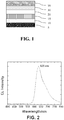
- Some embodiments may have a structure as represented schematically by FIG. 1 .
- a light-emitting layer 20 is disposed between an anode 5 and cathode 35.
- An optional electron-transport layer 30 may be disposed between the light-emitting layer 20 and the cathode 35.
- An optional hole-injection layer 10 may be disposed between the light-emitting layer 20 and the anode 5, and an optional hole-transport layer 15 may be disposed between the hole-injecting layer 10 and the light-emitting layer 20.
- a hole-transport layer may comprise at least one hole-transport material.
- Hole-transport materials may include, but are not limited to, an aromatic-substituted amine, a carbazole, a polyvinylcarbazole (PVK), e.g.
- a hole-injecting layer may comprise any suitable hole-injecting material.
- suitable hole-injecting material(s) include, but are not limited to, an optionally substituted compound selected from the following: molybdenum oxide (MoO 3 ), a polythiophene derivative such as poly(3,4-ethylenedioxythiophene (PEDOT)/polystyrene sulphonic acid (PSS), a benzidine derivative such as N, N, N', N'-tetraphenylbenzidine, poly(N,N'-bis(4-butylphenyl)-N,N'-bis(phenyl)benzidine), a triphenyl amine or phenylenediamine derivative such as N,N'-bis(4-methylphenyl)-N,N'-bis(phenyl)-1,4-phenylenediamine, 4,4',4"-tris(N-(naphthalen-2-yl)-N-phenylamino)triphen
- An electron-transport layer may comprise at least one electron-transport material.
- electron-transport materials may include, but are not limited to, 2-(4-biphenylyl)-5-(4- tert -butylphenyl)-1,3,4-oxadiazole (PBD); 1,3-bis(N,N-t-butyl-phenyl)-1,3,4-oxadiazole (OXD-7), 1,3-bis[2-(2,2'-bipyridine-6-yl)-1,3,4-oxadiazo-5-yl]benzene; 3-phenyl-4-(1'-naphthalenyl)-5-phenyl-1,2,4-triazole (TAZ); 2,9-dimethyl-4,7-diphenyl-phenanthroline (bathocuproine or BCP); aluminum tris(8-hydroxyquinolate) (Alq3); and 1,3,5-tris(2-N-phenylbenzimidazolyl)benzene; 1,3-bis
- the electron-transport layer is aluminum quinolate (Alq 3 ), 2-(4-biphenylyl)-5-(4- tert -butylphenyl)-1,3,4-oxadiazole (PBD), phenanthroline, quinoxaline, 1,3,5-tris[N-phenylbenzimidazol-z-yl] benzene (TPBI), or a derivative or a combination thereof.
- Alq 3 aluminum quinolate
- PBD 2-(4-biphenylyl)-5-(4- tert -butylphenyl)-1,3,4-oxadiazole
- TPBI 1,3,5-tris[N-phenylbenzimidazol-z-yl] benzene
- additional layers may be included in the light-emitting device. These additional layers may include an electron injecting layer (EIL) between the cathode and the light-emitting layer, a hole-blocking layer (HBL) between the anode and the light-emitting layer, and/or an exciton-blocking layer (EBL) between the light-emitting layer and the anode and/or the cathode.
- EIL electron injecting layer
- HBL hole-blocking layer
- EBL exciton-blocking layer
- the light-emitting device can include an electron-injecting layer between the cathode layer and the light-emitting layer.
- suitable material(s) that can be included in the electron injecting layer include but are not limited to, an optionally substituted compound selected from the following: lithium fluoride (LiF), aluminum quinolate (Alq 3 ), 2-(4-biphenylyl)-5-(4- tert -butylphenyl)-1,3,4-oxadiazole (PBD), phenanthroline, quinoxaline, 1,3,5-tris[N-phenylbenzimidazol-z-yl] benzene (TPBI) a triazine, a metal chelate of 8-hydroxyquinoline such as tris(8-hydroxyquinoliate) aluminum, and a metal thioxinoid compound such as bis(8-quinolinethiolato) zinc.
- LiF lithium fluoride
- Alq 3 aluminum quinolate
- PBD 2-(4-
- the electron injecting layer is aluminum quinolate (Alq 3 ), 2-(4-biphenylyl)-5-(4- tert -butylphenyl)-1,3,4-oxadiazole (PBD), phenanthroline, quinoxaline, 1,3,5-tris[N-phenylbenzimidazol-z-yl] benzene (TPBI), or a derivative or a combination thereof.
- Alq 3 aluminum quinolate
- PBD 2-(4-biphenylyl)-5-(4- tert -butylphenyl)-1,3,4-oxadiazole
- TPBI 1,3,5-tris[N-phenylbenzimidazol-z-yl] benzene
- the device can include a hole-blocking layer, e.g., between the cathode and the light-emitting layer.
- a hole-blocking layer e.g., between the cathode and the light-emitting layer.
- Various suitable hole-blocking materials that can be included in the hole-blocking layer are known to those skilled in the art.
- Suitable hole-blocking material(s) include but are not limited to, an optionally substituted compound selected from the following: bathocuproine (BCP), 3,4,5-triphenyl-1,2,4-triazole, 3,5-bis(4- tert -butylphenyl)-4-phenyl-[1,2,4] triazole, 2,9-dimethyl-4,7-diphenyl-1,10-phenanthroline, and 1,1-bis(4-bis(4-methylphenyl)aminophenyl)-cyclohexane.
- BCP bathocuproine
- BCP bathocuproine
- 3,4,5-triphenyl-1,2,4-triazole 3,5-bis(4- tert -butylphenyl)-4-phenyl-[1,2,4] triazole
- 2,9-dimethyl-4,7-diphenyl-1,10-phenanthroline 2,9-dimethyl-4,7-diphenyl-1,10-phenanthroline
- the light-emitting device can include an exciton-blocking layer, e.g., between the light-emitting layer and the anode.
- the band gap of the material(s) that comprise exciton-blocking layer is large enough to substantially prevent the diffusion of excitons.
- suitable exciton-blocking materials that can be included in the exciton-blocking layer are known to those skilled in the art.
- Examples of material(s) that can compose an exciton-blocking layer include an optionally substituted compound selected from the following: aluminum quinolate (Alq 3 ), 4,4'-bis[N-(naphthalenyl)-N-phenyl-amino]biphenyl ( ⁇ -NPD), 4,4'-N,N'-dicarbazole-biphenyl (CBP), and bathocuproine (BCP), and any other material(s) that have a large enough band gap to substantially prevent the diffusion of excitons.
- Alq 3 aluminum quinolate
- ⁇ -NPD 4,4'-bis[N-(naphthalenyl)-N-phenyl-amino]biphenyl
- CBP 4,4'-N,N'-dicarbazole-biphenyl
- BCP bathocuproine
- Light-emitting devices comprising a subject compound can be fabricated using techniques known in the art, as informed by the guidance provided herein.
- a glass substrate can be coated with a high work functioning metal such as ITO which can act as an anode.
- a light-emitting layer comprising a light-emitting component, can be deposited on the anode.
- additional optional layers such as a hole-transport layer, a hole-injecting layer, and/or an exciton-blocking layer may be deposited between the light-emitting layer and the anode, by methods such as vapor deposition, sputtering, or spin coating.
- the cathode layer comprising a low work functioning metal (e.g., Mg:Ag), can then be deposited on the light-emitting layer, e.g., by vapor deposition, sputtering, or spin coating.
- additional optional layers such as an electron-transport layer, an electron-injection layer, and/or an exciton-blocking layer, can be added to the device using suitable techniques such as vapor deposition, sputtering, or spin coating.
- a device comprising the subject compounds can provide a significantly increased device lifetime compared with commercially available compounds.
- the devices can provide a T50(h) @ 10000 nit lifetime of at least about 125 hours, 150 hours, 175 hours, 185 hours, and/or 200 hours.
- the desired lifetime can be determined by examining the luminescent/emissive decay of the device by measuring the luminescent, e.g., in cd/m 2 , after applying a constant current of a 106 mA to device (corresponding to about 10000 cd/m 2 ) for a device having an active emissive surface area of about 13.2 mm 2 .
- N-(4'-bromo-[1,1'-biphenyl]-4-yl)-N-phenylnaphthalen-1-amine (6) A mixture of N-phenylnaphthalen-1-amine (4.41g, 20 mmol), 4,4'-dibromo-1,1'-biphenyl (15g, 48 mmol), sodium tert-butoxide (4.8g, 50 mmol) and Pd(dppf)Cl 2 (0.44 g, 0.6 mmol) in anhydrous toluene (100 ml) was degassed and heated at 80° C for 10 hours.
- N-(4"-bromo-[1,1':4',1"-terphenyl]-4-yl)-N-phenylnaphthalen-1-amine (8) A mixture of compound 7 (4.5 g, 9.0 mmol), 1-bromo-4-iodobenzene (5.12g, 18 mmol), Pd(PPh 3 ) 4 (0.52 g, 0.45 mmol) and potassium carbonate (4.436 g, 32 mmol) in dioxane/water (150 ml/30 ml) was degassed and heated at 95° C overnight.
- Host-1 A mixture of compound 8 (1.50 g, 2.47 mmol), compound 5 (1.11g, 2.35 mmol), Pd(PPh 3 ) 4 (0.16g, 0.14 mmol) and potassium carbonate (1.38 g, 10 mmol) in dioxane/water (60 ml/10 ml) was degassed and heated at 85° C for 18 hours. After being cooled to RT, the mixture was filtered. The solid and the filtrate were collected separately.
- a device (Device A) was fabricated in a manner similar to the following.
- the ITO substrates having sheet resistance of about 14 ohm (14 ohm/sq) were cleaned ultrasonically and sequentially in detergent, water, acetone, and then isopropyl alcohol (IPA); and then dried in an oven at 80 °C for about 30 min under an ambient environment.
- Substrates were then baked at about 200 °C for about 1 hour in an ambient environment, then under UV-ozone treatment for about 30 minutes.
- PEDOT:PSS hole-injection material
- the coated layer was then baked at about 100 °C for 30 min in an ambient environment, followed by baking at 200 °C for 30 min inside a glove box (N 2 environment).
- the substrate was then transferred into a vacuum chamber, where 4,4'-bis[N-(naphthalenyl)-N-phenyl-amino]biphenyl (NPB) was vacuum deposited at a rate of about 0.1 nm/s rate under a base pressure of about 2.7 x 10 -5 Pa (2 x 10 -7 torr).
- TPBI 1,3,5-Tris(1-phenyl-1H-benzimidazol-)2-yl)benzene
- TPBI 1,3,5-Tris(1-phenyl-1H-benzimidazol-)2-yl)benzene
- LiF lithium fluoride
- Al Aluminium
- the representative device structure was: ITO(about 150 nm thick)/PEDOT:PSS(about 30 nm thick)/NPB (about 40 nm thick) /Host-1: Ir(piq) 2 acac (about 30 nm thick)/TPBI(about 30nm thick)/LiF(about 0.5 nm thick)/Al(about 120 nm thick).
- the device was then encapsulated with a getter attached glass cap to cover the light-emitting area of the OLED device in order to protect from moisture, oxidation or mechanical damage.
- Each individual device had an area of about 13.2 mm 2 .
- the turn-on voltage for the device was about 2.5 volts and the luminance was about 8,000 cd/m 2 with 13.2 mm 2 area device at about 6V.
- Compound Host - 1 has demonstrated its effectiveness as a host material in organic light emitting devices.
- Device A a light emitting device comprising Host - 1: Ir(piq)2acac, and fabricated in accordance with Example 2.1, was tested to determine the lifetime of the devices (T 50 (h) at 10,000 nit).
- Other devices Comparative Device X [Bebq2], and Comparative Device Y [CBP]
- Comparative Compound X Bis(10-hydroxybenzo[h]quinolinato)beryllium (Bebq 2 (94%), and Bis(1-phenylisoquinoline)(acetylacetonate)iridium (III) ("Ir(piq) 2 acac") (6%), and Comparative Compound Y, 4,4'-bis(carbazol-9-yl)biphenylCBP(94%), and Bis(1-phenylisoquinoline)(acetylacetonate)iridium (III) ("Ir(piq) 2 acac") (6%), and Comparative Compound Y, 4,4
- Host-1 has demonstrated its effectiveness as a long lasting compound in light emitting organic light emitting devices.
Landscapes
- Chemical & Material Sciences (AREA)
- Organic Chemistry (AREA)
- Physics & Mathematics (AREA)
- Spectroscopy & Molecular Physics (AREA)
- Engineering & Computer Science (AREA)
- Materials Engineering (AREA)
- Optics & Photonics (AREA)
- Electroluminescent Light Sources (AREA)
- Plural Heterocyclic Compounds (AREA)
Applications Claiming Priority (2)
| Application Number | Priority Date | Filing Date | Title |
|---|---|---|---|
| US13/166,246 US8933243B2 (en) | 2011-06-22 | 2011-06-22 | Polyphenylene host compounds |
| PCT/US2012/043595 WO2012177914A1 (en) | 2011-06-22 | 2012-06-21 | Polyphenylene host compounds |
Publications (2)
| Publication Number | Publication Date |
|---|---|
| EP2723721A1 EP2723721A1 (en) | 2014-04-30 |
| EP2723721B1 true EP2723721B1 (en) | 2017-08-09 |
Family
ID=44761411
Family Applications (1)
| Application Number | Title | Priority Date | Filing Date |
|---|---|---|---|
| EP12731873.1A Not-in-force EP2723721B1 (en) | 2011-06-22 | 2012-06-21 | Polyphenylene host compounds |
Country Status (6)
| Country | Link |
|---|---|
| US (2) | US8933243B2 (enExample) |
| EP (1) | EP2723721B1 (enExample) |
| JP (3) | JP6143748B2 (enExample) |
| KR (1) | KR20140057500A (enExample) |
| CN (1) | CN103635464B (enExample) |
| WO (1) | WO2012177914A1 (enExample) |
Families Citing this family (13)
| Publication number | Priority date | Publication date | Assignee | Title |
|---|---|---|---|---|
| US8426040B2 (en) * | 2010-12-22 | 2013-04-23 | Nitto Denko Corporation | Compounds for use in light-emitting devices |
| EP2668247B1 (en) | 2011-01-27 | 2016-12-28 | Nitto Denko Corporation | Phototherapy devices and methods comprising optionally substituted terphenyl and quaterphenyl compounds |
| US8933243B2 (en) | 2011-06-22 | 2015-01-13 | Nitto Denko Corporation | Polyphenylene host compounds |
| US20130103123A1 (en) * | 2011-10-14 | 2013-04-25 | Sazzadur Rahman Khan | Light-Emitting Devices for Wound Healing |
| KR20150007310A (ko) * | 2012-04-13 | 2015-01-20 | 닛토덴코 가부시키가이샤 | 임의로 치환된 퀸퀴에스페닐 화합물을 포함하는 광요법 디바이스 및 방법 |
| KR20150052013A (ko) * | 2012-08-31 | 2015-05-13 | 고쿠리쓰다이가쿠호진 규슈다이가쿠 | 유기 발광 재료, 유기 발광 재료의 제조 방법, 및 유기 발광 소자 |
| US9263681B2 (en) | 2012-12-10 | 2016-02-16 | Nitto Denko Corporation | Organic light emitting host materials |
| US9112159B2 (en) | 2012-12-10 | 2015-08-18 | Nitto Denko Corporation | Bipolar hosts for light emitting devices |
| WO2014099864A2 (en) | 2012-12-17 | 2014-06-26 | Nitto Denko Corporation | Light-emitting devices comprising emissive layer |
| US20160301015A1 (en) | 2013-10-30 | 2016-10-13 | Nitto Denko Corporation | Light-emitting compounds for light-emitting devices |
| WO2015195837A1 (en) | 2014-06-17 | 2015-12-23 | Nitto Denko Corporation | Emissive material for organic emitting diodes |
| US11258017B2 (en) * | 2016-04-27 | 2022-02-22 | Wuhan Xinqu Chuangrou Optoelectronics Technology Co., Ltd | Semiconducting compositions comprising semiconducting polymers |
| CN111875586B (zh) * | 2019-09-24 | 2021-09-28 | 广东聚华印刷显示技术有限公司 | 有机化合物及其制备方法、包含其的有机发光二极管 |
Family Cites Families (33)
| Publication number | Priority date | Publication date | Assignee | Title |
|---|---|---|---|---|
| JPS5975257A (ja) | 1982-10-23 | 1984-04-27 | Ricoh Co Ltd | 電子写真用感光体 |
| JPS649959A (en) | 1987-07-03 | 1989-01-13 | Nippon Telegraph & Telephone | Optically active compound and liquid crystal composition thereof |
| JP2941971B2 (ja) | 1991-02-13 | 1999-08-30 | キヤノン株式会社 | 液晶組成物、それを有する液晶素子、それ等を用いた表示方法及び表示装置 |
| JPH0776542A (ja) | 1993-09-06 | 1995-03-20 | Canon Inc | 液晶性化合物、これを含む液晶組成物、それを有する液晶素子、それらを用いた表示方法および表示装置 |
| JPH07207169A (ja) | 1994-01-12 | 1995-08-08 | Mitsui Toatsu Chem Inc | 偏光フィルム用アゾ系色素及びこれを用いた偏光フィルム |
| JPH109959A (ja) | 1996-06-25 | 1998-01-16 | Matsushita Electric Works Ltd | 温度検出装置 |
| JP2002514635A (ja) | 1998-05-12 | 2002-05-21 | アメリカン・ホーム・プロダクツ・コーポレイション | インスリン耐性および高血糖の処置に有用なビフェニルオキソ−酢酸 |
| US6232322B1 (en) | 1998-05-12 | 2001-05-15 | American Home Products Corporation | Biphenyl oxo-acetic acids useful in the treatment of insulin resistance and hyperglycemia |
| JP4120059B2 (ja) | 1998-09-24 | 2008-07-16 | コニカミノルタホールディングス株式会社 | 新規ベンゾイミダゾール化合物、その製造法および用途 |
| JP2001023777A (ja) | 1999-07-08 | 2001-01-26 | Toray Ind Inc | 発光素子 |
| JP4105358B2 (ja) | 2000-03-07 | 2008-06-25 | 富士フイルム株式会社 | ベンズイミダゾール誘導体、発光素子材料及び発光素子 |
| US6620529B1 (en) | 1999-10-27 | 2003-09-16 | Fuji Photo Film Co., Ltd. | Materials for light emitting devices and light emitting devices using the same |
| US20010048982A1 (en) | 2000-04-28 | 2001-12-06 | Tohoku Pioneer Corporation | Organic electroluminescent display device and chemical compounds for liquid crystals |
| JP4718025B2 (ja) | 2001-03-16 | 2011-07-06 | 保土谷化学工業株式会社 | ベンゾイミダゾール誘導体および有機電界発光素子 |
| US6835469B2 (en) | 2001-10-17 | 2004-12-28 | The University Of Southern California | Phosphorescent compounds and devices comprising the same |
| WO2004010996A1 (ja) | 2002-07-29 | 2004-02-05 | Shizuoka Coffein Co., Ltd. | 1,3アゾール誘導体及び同誘導体を含む血栓症治療のための医薬組成物 |
| JP3902993B2 (ja) * | 2002-08-27 | 2007-04-11 | キヤノン株式会社 | フルオレン化合物及びそれを用いた有機発光素子 |
| JP4164317B2 (ja) | 2002-08-28 | 2008-10-15 | キヤノン株式会社 | 有機発光素子 |
| US7368880B2 (en) | 2004-07-19 | 2008-05-06 | Intersil Americas Inc. | Phase shift modulation-based control of amplitude of AC voltage output produced by double-ended DC-AC converter circuitry for powering high voltage load such as cold cathode fluorescent lamp |
| CN101473464B (zh) | 2006-06-22 | 2014-04-23 | 出光兴产株式会社 | 应用含有杂环的芳胺衍生物的有机电致发光元件 |
| TWI394746B (zh) | 2007-11-16 | 2013-05-01 | Academia Sinica | 有機電激發光裝置及其材料 |
| KR100959189B1 (ko) | 2007-12-31 | 2010-05-24 | 제일모직주식회사 | 저분자 유기화합물, 및 이를 포함하는 유기광전소자 |
| WO2009123968A1 (en) * | 2008-04-02 | 2009-10-08 | Nitto Denko Corporation | Lyotropic liquid crystal systems based on bisacenaphthopyrazinoquinoxaline derivatives and methods of making |
| KR101460365B1 (ko) | 2008-04-29 | 2014-11-10 | 주식회사 엘지화학 | 신규한 이미다졸 유도체 및 이를 이용한 유기전자소자 |
| JP5479759B2 (ja) | 2008-09-05 | 2014-04-23 | 株式会社半導体エネルギー研究所 | ベンゾオキサゾール誘導体、発光素子用材料、発光素子、発光装置及び電子機器 |
| TWI530493B (zh) | 2008-10-14 | 2016-04-21 | 第一毛織股份有限公司 | 苯并咪唑化合物及具有該化合物之有機光電裝置 |
| KR101257695B1 (ko) | 2008-12-24 | 2013-04-24 | 제일모직주식회사 | 신규한 유기광전소자용 화합물 및 이를 포함하는 유기광전소자 |
| JP2010278390A (ja) | 2009-06-01 | 2010-12-09 | Fujifilm Corp | 有機電界発光素子 |
| US8420235B2 (en) | 2009-06-04 | 2013-04-16 | Nitto Denko Corporation | Emissive diaryl acetylenes |
| JP5773585B2 (ja) | 2009-06-29 | 2015-09-02 | 日東電工株式会社 | 発光性トリアリール |
| WO2011008560A1 (en) | 2009-06-29 | 2011-01-20 | Nitto Denko Corporation | Emissive aryl-heteroaryl compounds |
| US8426040B2 (en) | 2010-12-22 | 2013-04-23 | Nitto Denko Corporation | Compounds for use in light-emitting devices |
| US8933243B2 (en) | 2011-06-22 | 2015-01-13 | Nitto Denko Corporation | Polyphenylene host compounds |
-
2011
- 2011-06-22 US US13/166,246 patent/US8933243B2/en not_active Expired - Fee Related
-
2012
- 2012-06-21 EP EP12731873.1A patent/EP2723721B1/en not_active Not-in-force
- 2012-06-21 KR KR20137034890A patent/KR20140057500A/ko not_active Ceased
- 2012-06-21 JP JP2014517179A patent/JP6143748B2/ja not_active Expired - Fee Related
- 2012-06-21 WO PCT/US2012/043595 patent/WO2012177914A1/en not_active Ceased
- 2012-06-21 CN CN201280031055.8A patent/CN103635464B/zh not_active Expired - Fee Related
-
2014
- 2014-12-12 US US14/569,333 patent/US9548458B2/en not_active Expired - Fee Related
-
2016
- 2016-02-16 JP JP2016026856A patent/JP2016166177A/ja active Pending
-
2017
- 2017-05-23 JP JP2017101839A patent/JP2017197548A/ja active Pending
Non-Patent Citations (1)
| Title |
|---|
| None * |
Also Published As
| Publication number | Publication date |
|---|---|
| JP2016166177A (ja) | 2016-09-15 |
| US8933243B2 (en) | 2015-01-13 |
| EP2723721A1 (en) | 2014-04-30 |
| CN103635464A (zh) | 2014-03-12 |
| US20150099890A1 (en) | 2015-04-09 |
| US20110251401A1 (en) | 2011-10-13 |
| US9548458B2 (en) | 2017-01-17 |
| JP2017197548A (ja) | 2017-11-02 |
| WO2012177914A1 (en) | 2012-12-27 |
| CN103635464B (zh) | 2016-09-07 |
| JP2014524909A (ja) | 2014-09-25 |
| JP6143748B2 (ja) | 2017-06-07 |
| KR20140057500A (ko) | 2014-05-13 |
Similar Documents
| Publication | Publication Date | Title |
|---|---|---|
| EP2723721B1 (en) | Polyphenylene host compounds | |
| EP2655338B1 (en) | Benzoimidazole derivatives for use in light-emitting devices | |
| US8927121B2 (en) | Emissive aryl-heteroaryl compounds | |
| TWI610477B (zh) | 混成複合材料發光結構及使用其的發光元件 | |
| EP2477979B1 (en) | Compounds for organic light emitting diode emissive layers | |
| CN110010781A (zh) | 有机发光二极管 | |
| CN106574179A (zh) | 有机光电装置和显示装置 | |
| WO2015066354A1 (en) | Light-emitting compounds for light-emitting devices | |
| US9328094B2 (en) | Substituted biaryl compounds for light-emitting devices | |
| KR20120033711A (ko) | 유기발광화합물 및 이를 구비한 유기발광소자 | |
| WO2012119099A1 (en) | Compounds for porous films in light-emitting devices | |
| US9425408B2 (en) | Organic light emitting host materials | |
| US20140284584A1 (en) | Organic light emitting bipolar host materials | |
| US8895157B2 (en) | Host material for lighting devices | |
| US9263681B2 (en) | Organic light emitting host materials | |
| WO2013138365A1 (en) | 3,5-bis(10-naphthalenyl-anthracen-9-yl)pyridine compounds as hosts for light-emitting devices |
Legal Events
| Date | Code | Title | Description |
|---|---|---|---|
| PUAI | Public reference made under article 153(3) epc to a published international application that has entered the european phase |
Free format text: ORIGINAL CODE: 0009012 |
|
| 17P | Request for examination filed |
Effective date: 20140120 |
|
| AK | Designated contracting states |
Kind code of ref document: A1 Designated state(s): AL AT BE BG CH CY CZ DE DK EE ES FI FR GB GR HR HU IE IS IT LI LT LU LV MC MK MT NL NO PL PT RO RS SE SI SK SM TR |
|
| DAX | Request for extension of the european patent (deleted) | ||
| STAA | Information on the status of an ep patent application or granted ep patent |
Free format text: STATUS: EXAMINATION IS IN PROGRESS |
|
| 17Q | First examination report despatched |
Effective date: 20161103 |
|
| GRAJ | Information related to disapproval of communication of intention to grant by the applicant or resumption of examination proceedings by the epo deleted |
Free format text: ORIGINAL CODE: EPIDOSDIGR1 |
|
| GRAP | Despatch of communication of intention to grant a patent |
Free format text: ORIGINAL CODE: EPIDOSNIGR1 |
|
| GRAP | Despatch of communication of intention to grant a patent |
Free format text: ORIGINAL CODE: EPIDOSNIGR1 |
|
| STAA | Information on the status of an ep patent application or granted ep patent |
Free format text: STATUS: GRANT OF PATENT IS INTENDED |
|
| INTG | Intention to grant announced |
Effective date: 20170308 |
|
| GRAS | Grant fee paid |
Free format text: ORIGINAL CODE: EPIDOSNIGR3 |
|
| GRAA | (expected) grant |
Free format text: ORIGINAL CODE: 0009210 |
|
| STAA | Information on the status of an ep patent application or granted ep patent |
Free format text: STATUS: THE PATENT HAS BEEN GRANTED |
|
| AK | Designated contracting states |
Kind code of ref document: B1 Designated state(s): AL AT BE BG CH CY CZ DE DK EE ES FI FR GB GR HR HU IE IS IT LI LT LU LV MC MK MT NL NO PL PT RO RS SE SI SK SM TR |
|
| REG | Reference to a national code |
Ref country code: GB Ref legal event code: FG4D |
|
| REG | Reference to a national code |
Ref country code: CH Ref legal event code: EP Ref country code: AT Ref legal event code: REF Ref document number: 916649 Country of ref document: AT Kind code of ref document: T Effective date: 20170815 |
|
| REG | Reference to a national code |
Ref country code: IE Ref legal event code: FG4D |
|
| REG | Reference to a national code |
Ref country code: DE Ref legal event code: R096 Ref document number: 602012035644 Country of ref document: DE |
|
| REG | Reference to a national code |
Ref country code: NL Ref legal event code: MP Effective date: 20170809 |
|
| REG | Reference to a national code |
Ref country code: LT Ref legal event code: MG4D |
|
| REG | Reference to a national code |
Ref country code: AT Ref legal event code: MK05 Ref document number: 916649 Country of ref document: AT Kind code of ref document: T Effective date: 20170809 |
|
| PG25 | Lapsed in a contracting state [announced via postgrant information from national office to epo] |
Ref country code: LT Free format text: LAPSE BECAUSE OF FAILURE TO SUBMIT A TRANSLATION OF THE DESCRIPTION OR TO PAY THE FEE WITHIN THE PRESCRIBED TIME-LIMIT Effective date: 20170809 Ref country code: FI Free format text: LAPSE BECAUSE OF FAILURE TO SUBMIT A TRANSLATION OF THE DESCRIPTION OR TO PAY THE FEE WITHIN THE PRESCRIBED TIME-LIMIT Effective date: 20170809 Ref country code: HR Free format text: LAPSE BECAUSE OF FAILURE TO SUBMIT A TRANSLATION OF THE DESCRIPTION OR TO PAY THE FEE WITHIN THE PRESCRIBED TIME-LIMIT Effective date: 20170809 Ref country code: NO Free format text: LAPSE BECAUSE OF FAILURE TO SUBMIT A TRANSLATION OF THE DESCRIPTION OR TO PAY THE FEE WITHIN THE PRESCRIBED TIME-LIMIT Effective date: 20171109 Ref country code: SE Free format text: LAPSE BECAUSE OF FAILURE TO SUBMIT A TRANSLATION OF THE DESCRIPTION OR TO PAY THE FEE WITHIN THE PRESCRIBED TIME-LIMIT Effective date: 20170809 Ref country code: NL Free format text: LAPSE BECAUSE OF FAILURE TO SUBMIT A TRANSLATION OF THE DESCRIPTION OR TO PAY THE FEE WITHIN THE PRESCRIBED TIME-LIMIT Effective date: 20170809 Ref country code: AT Free format text: LAPSE BECAUSE OF FAILURE TO SUBMIT A TRANSLATION OF THE DESCRIPTION OR TO PAY THE FEE WITHIN THE PRESCRIBED TIME-LIMIT Effective date: 20170809 |
|
| PG25 | Lapsed in a contracting state [announced via postgrant information from national office to epo] |
Ref country code: PL Free format text: LAPSE BECAUSE OF FAILURE TO SUBMIT A TRANSLATION OF THE DESCRIPTION OR TO PAY THE FEE WITHIN THE PRESCRIBED TIME-LIMIT Effective date: 20170809 Ref country code: IS Free format text: LAPSE BECAUSE OF FAILURE TO SUBMIT A TRANSLATION OF THE DESCRIPTION OR TO PAY THE FEE WITHIN THE PRESCRIBED TIME-LIMIT Effective date: 20171209 Ref country code: RS Free format text: LAPSE BECAUSE OF FAILURE TO SUBMIT A TRANSLATION OF THE DESCRIPTION OR TO PAY THE FEE WITHIN THE PRESCRIBED TIME-LIMIT Effective date: 20170809 Ref country code: GR Free format text: LAPSE BECAUSE OF FAILURE TO SUBMIT A TRANSLATION OF THE DESCRIPTION OR TO PAY THE FEE WITHIN THE PRESCRIBED TIME-LIMIT Effective date: 20171110 Ref country code: ES Free format text: LAPSE BECAUSE OF FAILURE TO SUBMIT A TRANSLATION OF THE DESCRIPTION OR TO PAY THE FEE WITHIN THE PRESCRIBED TIME-LIMIT Effective date: 20170809 Ref country code: LV Free format text: LAPSE BECAUSE OF FAILURE TO SUBMIT A TRANSLATION OF THE DESCRIPTION OR TO PAY THE FEE WITHIN THE PRESCRIBED TIME-LIMIT Effective date: 20170809 Ref country code: BG Free format text: LAPSE BECAUSE OF FAILURE TO SUBMIT A TRANSLATION OF THE DESCRIPTION OR TO PAY THE FEE WITHIN THE PRESCRIBED TIME-LIMIT Effective date: 20171109 |
|
| PG25 | Lapsed in a contracting state [announced via postgrant information from national office to epo] |
Ref country code: RO Free format text: LAPSE BECAUSE OF FAILURE TO SUBMIT A TRANSLATION OF THE DESCRIPTION OR TO PAY THE FEE WITHIN THE PRESCRIBED TIME-LIMIT Effective date: 20170809 Ref country code: CZ Free format text: LAPSE BECAUSE OF FAILURE TO SUBMIT A TRANSLATION OF THE DESCRIPTION OR TO PAY THE FEE WITHIN THE PRESCRIBED TIME-LIMIT Effective date: 20170809 Ref country code: DK Free format text: LAPSE BECAUSE OF FAILURE TO SUBMIT A TRANSLATION OF THE DESCRIPTION OR TO PAY THE FEE WITHIN THE PRESCRIBED TIME-LIMIT Effective date: 20170809 |
|
| REG | Reference to a national code |
Ref country code: DE Ref legal event code: R097 Ref document number: 602012035644 Country of ref document: DE |
|
| PG25 | Lapsed in a contracting state [announced via postgrant information from national office to epo] |
Ref country code: EE Free format text: LAPSE BECAUSE OF FAILURE TO SUBMIT A TRANSLATION OF THE DESCRIPTION OR TO PAY THE FEE WITHIN THE PRESCRIBED TIME-LIMIT Effective date: 20170809 Ref country code: IT Free format text: LAPSE BECAUSE OF FAILURE TO SUBMIT A TRANSLATION OF THE DESCRIPTION OR TO PAY THE FEE WITHIN THE PRESCRIBED TIME-LIMIT Effective date: 20170809 Ref country code: SM Free format text: LAPSE BECAUSE OF FAILURE TO SUBMIT A TRANSLATION OF THE DESCRIPTION OR TO PAY THE FEE WITHIN THE PRESCRIBED TIME-LIMIT Effective date: 20170809 Ref country code: SK Free format text: LAPSE BECAUSE OF FAILURE TO SUBMIT A TRANSLATION OF THE DESCRIPTION OR TO PAY THE FEE WITHIN THE PRESCRIBED TIME-LIMIT Effective date: 20170809 |
|
| PLBE | No opposition filed within time limit |
Free format text: ORIGINAL CODE: 0009261 |
|
| STAA | Information on the status of an ep patent application or granted ep patent |
Free format text: STATUS: NO OPPOSITION FILED WITHIN TIME LIMIT |
|
| 26N | No opposition filed |
Effective date: 20180511 |
|
| PGFP | Annual fee paid to national office [announced via postgrant information from national office to epo] |
Ref country code: DE Payment date: 20180605 Year of fee payment: 7 |
|
| PG25 | Lapsed in a contracting state [announced via postgrant information from national office to epo] |
Ref country code: SI Free format text: LAPSE BECAUSE OF FAILURE TO SUBMIT A TRANSLATION OF THE DESCRIPTION OR TO PAY THE FEE WITHIN THE PRESCRIBED TIME-LIMIT Effective date: 20170809 |
|
| REG | Reference to a national code |
Ref country code: CH Ref legal event code: PL |
|
| GBPC | Gb: european patent ceased through non-payment of renewal fee |
Effective date: 20180621 |
|
| REG | Reference to a national code |
Ref country code: BE Ref legal event code: MM Effective date: 20180630 |
|
| REG | Reference to a national code |
Ref country code: IE Ref legal event code: MM4A |
|
| PG25 | Lapsed in a contracting state [announced via postgrant information from national office to epo] |
Ref country code: MC Free format text: LAPSE BECAUSE OF FAILURE TO SUBMIT A TRANSLATION OF THE DESCRIPTION OR TO PAY THE FEE WITHIN THE PRESCRIBED TIME-LIMIT Effective date: 20170809 Ref country code: LU Free format text: LAPSE BECAUSE OF NON-PAYMENT OF DUE FEES Effective date: 20180621 |
|
| PG25 | Lapsed in a contracting state [announced via postgrant information from national office to epo] |
Ref country code: FR Free format text: LAPSE BECAUSE OF NON-PAYMENT OF DUE FEES Effective date: 20180630 Ref country code: LI Free format text: LAPSE BECAUSE OF NON-PAYMENT OF DUE FEES Effective date: 20180630 Ref country code: IE Free format text: LAPSE BECAUSE OF NON-PAYMENT OF DUE FEES Effective date: 20180621 Ref country code: GB Free format text: LAPSE BECAUSE OF NON-PAYMENT OF DUE FEES Effective date: 20180621 Ref country code: CH Free format text: LAPSE BECAUSE OF NON-PAYMENT OF DUE FEES Effective date: 20180630 |
|
| PG25 | Lapsed in a contracting state [announced via postgrant information from national office to epo] |
Ref country code: BE Free format text: LAPSE BECAUSE OF NON-PAYMENT OF DUE FEES Effective date: 20180630 |
|
| REG | Reference to a national code |
Ref country code: DE Ref legal event code: R119 Ref document number: 602012035644 Country of ref document: DE |
|
| PG25 | Lapsed in a contracting state [announced via postgrant information from national office to epo] |
Ref country code: MT Free format text: LAPSE BECAUSE OF NON-PAYMENT OF DUE FEES Effective date: 20180621 |
|
| PG25 | Lapsed in a contracting state [announced via postgrant information from national office to epo] |
Ref country code: TR Free format text: LAPSE BECAUSE OF FAILURE TO SUBMIT A TRANSLATION OF THE DESCRIPTION OR TO PAY THE FEE WITHIN THE PRESCRIBED TIME-LIMIT Effective date: 20170809 |
|
| PG25 | Lapsed in a contracting state [announced via postgrant information from national office to epo] |
Ref country code: DE Free format text: LAPSE BECAUSE OF NON-PAYMENT OF DUE FEES Effective date: 20200101 |
|
| PG25 | Lapsed in a contracting state [announced via postgrant information from national office to epo] |
Ref country code: HU Free format text: LAPSE BECAUSE OF FAILURE TO SUBMIT A TRANSLATION OF THE DESCRIPTION OR TO PAY THE FEE WITHIN THE PRESCRIBED TIME-LIMIT; INVALID AB INITIO Effective date: 20120621 Ref country code: PT Free format text: LAPSE BECAUSE OF FAILURE TO SUBMIT A TRANSLATION OF THE DESCRIPTION OR TO PAY THE FEE WITHIN THE PRESCRIBED TIME-LIMIT Effective date: 20170809 |
|
| PG25 | Lapsed in a contracting state [announced via postgrant information from national office to epo] |
Ref country code: CY Free format text: LAPSE BECAUSE OF FAILURE TO SUBMIT A TRANSLATION OF THE DESCRIPTION OR TO PAY THE FEE WITHIN THE PRESCRIBED TIME-LIMIT Effective date: 20170809 Ref country code: MK Free format text: LAPSE BECAUSE OF NON-PAYMENT OF DUE FEES Effective date: 20170809 |
|
| PG25 | Lapsed in a contracting state [announced via postgrant information from national office to epo] |
Ref country code: AL Free format text: LAPSE BECAUSE OF FAILURE TO SUBMIT A TRANSLATION OF THE DESCRIPTION OR TO PAY THE FEE WITHIN THE PRESCRIBED TIME-LIMIT Effective date: 20170809 |