EP2721087B1 - Regioregular pyridal[2,1,3]thiadiazole pi-conjugated copolymers for organic semiconductors - Google Patents
Regioregular pyridal[2,1,3]thiadiazole pi-conjugated copolymers for organic semiconductors Download PDFInfo
- Publication number
- EP2721087B1 EP2721087B1 EP12801086.5A EP12801086A EP2721087B1 EP 2721087 B1 EP2721087 B1 EP 2721087B1 EP 12801086 A EP12801086 A EP 12801086A EP 2721087 B1 EP2721087 B1 EP 2721087B1
- Authority
- EP
- European Patent Office
- Prior art keywords
- substituted
- integer
- dithiophene
- monomer
- regioregular
- Prior art date
- Legal status (The legal status is an assumption and is not a legal conclusion. Google has not performed a legal analysis and makes no representation as to the accuracy of the status listed.)
- Active
Links
- 0 CC(*)=C[C@@]1*CCC1 Chemical compound CC(*)=C[C@@]1*CCC1 0.000 description 7
- OZBIHQANVLVZBE-UHFFFAOYSA-O Cc1cc([sH+]c2c3[s]c(C)c2)c3[s]1 Chemical compound Cc1cc([sH+]c2c3[s]c(C)c2)c3[s]1 OZBIHQANVLVZBE-UHFFFAOYSA-O 0.000 description 1
Images









Classifications
-
- H—ELECTRICITY
- H10—SEMICONDUCTOR DEVICES; ELECTRIC SOLID-STATE DEVICES NOT OTHERWISE PROVIDED FOR
- H10K—ORGANIC ELECTRIC SOLID-STATE DEVICES
- H10K85/00—Organic materials used in the body or electrodes of devices covered by this subclass
- H10K85/10—Organic polymers or oligomers
- H10K85/111—Organic polymers or oligomers comprising aromatic, heteroaromatic, or aryl chains, e.g. polyaniline, polyphenylene or polyphenylene vinylene
- H10K85/113—Heteroaromatic compounds comprising sulfur or selene, e.g. polythiophene
-
- C—CHEMISTRY; METALLURGY
- C08—ORGANIC MACROMOLECULAR COMPOUNDS; THEIR PREPARATION OR CHEMICAL WORKING-UP; COMPOSITIONS BASED THEREON
- C08G—MACROMOLECULAR COMPOUNDS OBTAINED OTHERWISE THAN BY REACTIONS ONLY INVOLVING UNSATURATED CARBON-TO-CARBON BONDS
- C08G61/00—Macromolecular compounds obtained by reactions forming a carbon-to-carbon link in the main chain of the macromolecule
- C08G61/12—Macromolecular compounds containing atoms other than carbon in the main chain of the macromolecule
- C08G61/122—Macromolecular compounds containing atoms other than carbon in the main chain of the macromolecule derived from five- or six-membered heterocyclic compounds, other than imides
-
- C—CHEMISTRY; METALLURGY
- C08—ORGANIC MACROMOLECULAR COMPOUNDS; THEIR PREPARATION OR CHEMICAL WORKING-UP; COMPOSITIONS BASED THEREON
- C08G—MACROMOLECULAR COMPOUNDS OBTAINED OTHERWISE THAN BY REACTIONS ONLY INVOLVING UNSATURATED CARBON-TO-CARBON BONDS
- C08G61/00—Macromolecular compounds obtained by reactions forming a carbon-to-carbon link in the main chain of the macromolecule
- C08G61/12—Macromolecular compounds containing atoms other than carbon in the main chain of the macromolecule
- C08G61/122—Macromolecular compounds containing atoms other than carbon in the main chain of the macromolecule derived from five- or six-membered heterocyclic compounds, other than imides
- C08G61/123—Macromolecular compounds containing atoms other than carbon in the main chain of the macromolecule derived from five- or six-membered heterocyclic compounds, other than imides derived from five-membered heterocyclic compounds
-
- C—CHEMISTRY; METALLURGY
- C08—ORGANIC MACROMOLECULAR COMPOUNDS; THEIR PREPARATION OR CHEMICAL WORKING-UP; COMPOSITIONS BASED THEREON
- C08G—MACROMOLECULAR COMPOUNDS OBTAINED OTHERWISE THAN BY REACTIONS ONLY INVOLVING UNSATURATED CARBON-TO-CARBON BONDS
- C08G61/00—Macromolecular compounds obtained by reactions forming a carbon-to-carbon link in the main chain of the macromolecule
- C08G61/12—Macromolecular compounds containing atoms other than carbon in the main chain of the macromolecule
- C08G61/122—Macromolecular compounds containing atoms other than carbon in the main chain of the macromolecule derived from five- or six-membered heterocyclic compounds, other than imides
- C08G61/123—Macromolecular compounds containing atoms other than carbon in the main chain of the macromolecule derived from five- or six-membered heterocyclic compounds, other than imides derived from five-membered heterocyclic compounds
- C08G61/126—Macromolecular compounds containing atoms other than carbon in the main chain of the macromolecule derived from five- or six-membered heterocyclic compounds, other than imides derived from five-membered heterocyclic compounds with a five-membered ring containing one sulfur atom in the ring
-
- H—ELECTRICITY
- H10—SEMICONDUCTOR DEVICES; ELECTRIC SOLID-STATE DEVICES NOT OTHERWISE PROVIDED FOR
- H10K—ORGANIC ELECTRIC SOLID-STATE DEVICES
- H10K85/00—Organic materials used in the body or electrodes of devices covered by this subclass
- H10K85/10—Organic polymers or oligomers
- H10K85/151—Copolymers
-
- C—CHEMISTRY; METALLURGY
- C08—ORGANIC MACROMOLECULAR COMPOUNDS; THEIR PREPARATION OR CHEMICAL WORKING-UP; COMPOSITIONS BASED THEREON
- C08G—MACROMOLECULAR COMPOUNDS OBTAINED OTHERWISE THAN BY REACTIONS ONLY INVOLVING UNSATURATED CARBON-TO-CARBON BONDS
- C08G2261/00—Macromolecular compounds obtained by reactions forming a carbon-to-carbon link in the main chain of the macromolecule
- C08G2261/10—Definition of the polymer structure
- C08G2261/12—Copolymers
- C08G2261/124—Copolymers alternating
-
- C—CHEMISTRY; METALLURGY
- C08—ORGANIC MACROMOLECULAR COMPOUNDS; THEIR PREPARATION OR CHEMICAL WORKING-UP; COMPOSITIONS BASED THEREON
- C08G—MACROMOLECULAR COMPOUNDS OBTAINED OTHERWISE THAN BY REACTIONS ONLY INVOLVING UNSATURATED CARBON-TO-CARBON BONDS
- C08G2261/00—Macromolecular compounds obtained by reactions forming a carbon-to-carbon link in the main chain of the macromolecule
- C08G2261/10—Definition of the polymer structure
- C08G2261/14—Side-groups
- C08G2261/141—Side-chains having aliphatic units
- C08G2261/1412—Saturated aliphatic units
-
- C—CHEMISTRY; METALLURGY
- C08—ORGANIC MACROMOLECULAR COMPOUNDS; THEIR PREPARATION OR CHEMICAL WORKING-UP; COMPOSITIONS BASED THEREON
- C08G—MACROMOLECULAR COMPOUNDS OBTAINED OTHERWISE THAN BY REACTIONS ONLY INVOLVING UNSATURATED CARBON-TO-CARBON BONDS
- C08G2261/00—Macromolecular compounds obtained by reactions forming a carbon-to-carbon link in the main chain of the macromolecule
- C08G2261/10—Definition of the polymer structure
- C08G2261/14—Side-groups
- C08G2261/148—Side-chains having aromatic units
-
- C—CHEMISTRY; METALLURGY
- C08—ORGANIC MACROMOLECULAR COMPOUNDS; THEIR PREPARATION OR CHEMICAL WORKING-UP; COMPOSITIONS BASED THEREON
- C08G—MACROMOLECULAR COMPOUNDS OBTAINED OTHERWISE THAN BY REACTIONS ONLY INVOLVING UNSATURATED CARBON-TO-CARBON BONDS
- C08G2261/00—Macromolecular compounds obtained by reactions forming a carbon-to-carbon link in the main chain of the macromolecule
- C08G2261/10—Definition of the polymer structure
- C08G2261/16—End groups
- C08G2261/164—End groups comprising organic end groups
- C08G2261/1646—End groups comprising organic end groups comprising aromatic or heteroaromatic end groups
-
- C—CHEMISTRY; METALLURGY
- C08—ORGANIC MACROMOLECULAR COMPOUNDS; THEIR PREPARATION OR CHEMICAL WORKING-UP; COMPOSITIONS BASED THEREON
- C08G—MACROMOLECULAR COMPOUNDS OBTAINED OTHERWISE THAN BY REACTIONS ONLY INVOLVING UNSATURATED CARBON-TO-CARBON BONDS
- C08G2261/00—Macromolecular compounds obtained by reactions forming a carbon-to-carbon link in the main chain of the macromolecule
- C08G2261/10—Definition of the polymer structure
- C08G2261/21—Stereochemical aspects
- C08G2261/212—Regioregularity
-
- C—CHEMISTRY; METALLURGY
- C08—ORGANIC MACROMOLECULAR COMPOUNDS; THEIR PREPARATION OR CHEMICAL WORKING-UP; COMPOSITIONS BASED THEREON
- C08G—MACROMOLECULAR COMPOUNDS OBTAINED OTHERWISE THAN BY REACTIONS ONLY INVOLVING UNSATURATED CARBON-TO-CARBON BONDS
- C08G2261/00—Macromolecular compounds obtained by reactions forming a carbon-to-carbon link in the main chain of the macromolecule
- C08G2261/30—Monomer units or repeat units incorporating structural elements in the main chain
- C08G2261/32—Monomer units or repeat units incorporating structural elements in the main chain incorporating heteroaromatic structural elements in the main chain
- C08G2261/324—Monomer units or repeat units incorporating structural elements in the main chain incorporating heteroaromatic structural elements in the main chain condensed
- C08G2261/3241—Monomer units or repeat units incorporating structural elements in the main chain incorporating heteroaromatic structural elements in the main chain condensed containing one or more nitrogen atoms as the only heteroatom, e.g. carbazole
-
- C—CHEMISTRY; METALLURGY
- C08—ORGANIC MACROMOLECULAR COMPOUNDS; THEIR PREPARATION OR CHEMICAL WORKING-UP; COMPOSITIONS BASED THEREON
- C08G—MACROMOLECULAR COMPOUNDS OBTAINED OTHERWISE THAN BY REACTIONS ONLY INVOLVING UNSATURATED CARBON-TO-CARBON BONDS
- C08G2261/00—Macromolecular compounds obtained by reactions forming a carbon-to-carbon link in the main chain of the macromolecule
- C08G2261/30—Monomer units or repeat units incorporating structural elements in the main chain
- C08G2261/32—Monomer units or repeat units incorporating structural elements in the main chain incorporating heteroaromatic structural elements in the main chain
- C08G2261/324—Monomer units or repeat units incorporating structural elements in the main chain incorporating heteroaromatic structural elements in the main chain condensed
- C08G2261/3246—Monomer units or repeat units incorporating structural elements in the main chain incorporating heteroaromatic structural elements in the main chain condensed containing nitrogen and sulfur as heteroatoms
-
- C—CHEMISTRY; METALLURGY
- C08—ORGANIC MACROMOLECULAR COMPOUNDS; THEIR PREPARATION OR CHEMICAL WORKING-UP; COMPOSITIONS BASED THEREON
- C08G—MACROMOLECULAR COMPOUNDS OBTAINED OTHERWISE THAN BY REACTIONS ONLY INVOLVING UNSATURATED CARBON-TO-CARBON BONDS
- C08G2261/00—Macromolecular compounds obtained by reactions forming a carbon-to-carbon link in the main chain of the macromolecule
- C08G2261/30—Monomer units or repeat units incorporating structural elements in the main chain
- C08G2261/34—Monomer units or repeat units incorporating structural elements in the main chain incorporating partially-aromatic structural elements in the main chain
- C08G2261/344—Monomer units or repeat units incorporating structural elements in the main chain incorporating partially-aromatic structural elements in the main chain containing heteroatoms
-
- C—CHEMISTRY; METALLURGY
- C08—ORGANIC MACROMOLECULAR COMPOUNDS; THEIR PREPARATION OR CHEMICAL WORKING-UP; COMPOSITIONS BASED THEREON
- C08G—MACROMOLECULAR COMPOUNDS OBTAINED OTHERWISE THAN BY REACTIONS ONLY INVOLVING UNSATURATED CARBON-TO-CARBON BONDS
- C08G2261/00—Macromolecular compounds obtained by reactions forming a carbon-to-carbon link in the main chain of the macromolecule
- C08G2261/40—Polymerisation processes
- C08G2261/41—Organometallic coupling reactions
- C08G2261/414—Stille reactions
-
- C—CHEMISTRY; METALLURGY
- C08—ORGANIC MACROMOLECULAR COMPOUNDS; THEIR PREPARATION OR CHEMICAL WORKING-UP; COMPOSITIONS BASED THEREON
- C08G—MACROMOLECULAR COMPOUNDS OBTAINED OTHERWISE THAN BY REACTIONS ONLY INVOLVING UNSATURATED CARBON-TO-CARBON BONDS
- C08G2261/00—Macromolecular compounds obtained by reactions forming a carbon-to-carbon link in the main chain of the macromolecule
- C08G2261/90—Applications
- C08G2261/91—Photovoltaic applications
-
- C—CHEMISTRY; METALLURGY
- C08—ORGANIC MACROMOLECULAR COMPOUNDS; THEIR PREPARATION OR CHEMICAL WORKING-UP; COMPOSITIONS BASED THEREON
- C08G—MACROMOLECULAR COMPOUNDS OBTAINED OTHERWISE THAN BY REACTIONS ONLY INVOLVING UNSATURATED CARBON-TO-CARBON BONDS
- C08G2261/00—Macromolecular compounds obtained by reactions forming a carbon-to-carbon link in the main chain of the macromolecule
- C08G2261/90—Applications
- C08G2261/92—TFT applications
-
- H—ELECTRICITY
- H10—SEMICONDUCTOR DEVICES; ELECTRIC SOLID-STATE DEVICES NOT OTHERWISE PROVIDED FOR
- H10K—ORGANIC ELECTRIC SOLID-STATE DEVICES
- H10K10/00—Organic devices specially adapted for rectifying, amplifying, oscillating or switching; Organic capacitors or resistors having potential barriers
- H10K10/40—Organic transistors
- H10K10/46—Field-effect transistors, e.g. organic thin-film transistors [OTFT]
- H10K10/462—Insulated gate field-effect transistors [IGFETs]
- H10K10/466—Lateral bottom-gate IGFETs comprising only a single gate
-
- H—ELECTRICITY
- H10—SEMICONDUCTOR DEVICES; ELECTRIC SOLID-STATE DEVICES NOT OTHERWISE PROVIDED FOR
- H10K—ORGANIC ELECTRIC SOLID-STATE DEVICES
- H10K10/00—Organic devices specially adapted for rectifying, amplifying, oscillating or switching; Organic capacitors or resistors having potential barriers
- H10K10/40—Organic transistors
- H10K10/46—Field-effect transistors, e.g. organic thin-film transistors [OTFT]
- H10K10/462—Insulated gate field-effect transistors [IGFETs]
- H10K10/468—Insulated gate field-effect transistors [IGFETs] characterised by the gate dielectrics
- H10K10/474—Insulated gate field-effect transistors [IGFETs] characterised by the gate dielectrics the gate dielectric comprising a multilayered structure
- H10K10/476—Insulated gate field-effect transistors [IGFETs] characterised by the gate dielectrics the gate dielectric comprising a multilayered structure comprising at least one organic layer and at least one inorganic layer
-
- H—ELECTRICITY
- H10—SEMICONDUCTOR DEVICES; ELECTRIC SOLID-STATE DEVICES NOT OTHERWISE PROVIDED FOR
- H10K—ORGANIC ELECTRIC SOLID-STATE DEVICES
- H10K85/00—Organic materials used in the body or electrodes of devices covered by this subclass
- H10K85/40—Organosilicon compounds, e.g. TIPS pentacene
-
- Y—GENERAL TAGGING OF NEW TECHNOLOGICAL DEVELOPMENTS; GENERAL TAGGING OF CROSS-SECTIONAL TECHNOLOGIES SPANNING OVER SEVERAL SECTIONS OF THE IPC; TECHNICAL SUBJECTS COVERED BY FORMER USPC CROSS-REFERENCE ART COLLECTIONS [XRACs] AND DIGESTS
- Y02—TECHNOLOGIES OR APPLICATIONS FOR MITIGATION OR ADAPTATION AGAINST CLIMATE CHANGE
- Y02E—REDUCTION OF GREENHOUSE GAS [GHG] EMISSIONS, RELATED TO ENERGY GENERATION, TRANSMISSION OR DISTRIBUTION
- Y02E10/00—Energy generation through renewable energy sources
- Y02E10/50—Photovoltaic [PV] energy
- Y02E10/549—Organic PV cells
Definitions
- the invention relates to conjugated polymers and methods of making the same.
- Organic ⁇ -conjugated polymers are attractive materials for use in the active layer, as they combine good absorption and emission characteristics with efficient charge carrier mobility and have the ability to be solution processed onto flexible substrates.
- OFET organic field effect transistors
- OCV organic photovoltaic
- regioregularity can have a great impact on the properties of polymers [7].
- enhanced regioregularity of poly(3-alkylthiophene) can impart to polymers a higher crystallinity, red-shifted optical absorption, higher conductivity, and smaller band-gap [8].
- the inventors have surmised that for a polymer based on an asymmetric PT unit, a regioregular backbone structure with more effective electron localization can result in a higher charge carrier mobility and enhanced photovoltaic performance.
- a regioregular donor-acceptor copolymer comprising a regioregular conjugated main chain section, said regioregular conjugated main chain section having a repeat unit that comprises a pyridine of the structure wherein Ar is a substituted or non-substituted aromatic functional group; and the pyridine is regioregularly arranged along the conjugated main chain section; and wherein the repeat unit further comprises a dithiophene of the structure wherein each Ar is independently a substituted or non-substituted aromatic functional group, or each Ar is independently nothing and the valence of its respective thiophene ring is completed with hydrogen; each R is independently hydrogen or a substituted or non-substituted alkyl, aryl or alkoxy chain; and X is C, Si, Ge, N or P.
- a method of preparing the regioregular donor-acceptor copolymer of the invention comprising: regioselectively preparing a monomer; and reacting the monomer to produce said donor-acceptor copolymer, wherein the regioselectivity of preparing the monomer is 95% or greater.
- an electronic device that includes the regioregular polymer.
- the regioregular polymer includes a regioregular conjugated main chain section having a repeat unit that includes a pyridine of the structure where a) Ar is a substituted or non-substituted aromatic functional group, and b) the pyridine is regioregularly arranged along the conjugated main chain section.
- the regioregularity of the main chain section can be 95% or greater, and the charge carrier mobility of the regioregular polymer can be greater than the charge carrier mobility of a regiorandom polymer of similar composition.
- the repeat unit of the regioregular polymer further includes a dithiophene of the structure where a) each Ar is independently a substituted or non-substituted aromatic functional group, or each Ar is independently nothing and the valence of its respective thiophene ring is completed with hydrogen, b) each R is independently hydrogen or a substituted or non-substituted alkyl, aryl or alkoxy chain, and c) X is C, Si, Ge, N or P.
- each substituted or non-substituted aromatic functional group of the pyridine and the dithiophene independently includes one or more alkyl or aryl chains.
- X of the dithiophene can be C or Si.
- the pyridine is a pyridine unit of Table 1 (which is described below).
- the repeat unit further includes a dithiophene unit of Table 2 (which is described below).
- the pyridine unit is and the dithiophene unit is wherein each R is independently hydrogen or a substituted or non-substituted alkyl, aryl or alkoxy chain.
- the repeat unit includes or where each R is independently hydrogen or a substituted or non-substituted alkyl, aryl or alkoxy chain, and X is C, Si, Ge, N or P.
- a device including any regioregular polymer described herein is provided.
- the device can be, but is not limited to, a field effect transistor, organic photovoltaic device, polymer light emitting diode, organic light emitting diode, organic photodetector, or biosensor.
- the regioregular polymer can form an active semiconducting layer.
- regioregular in relation to a polymer or a section of a polymer means the non-random orientation or arrangement of the pyridal-N along the polymer backbone.
- the nitrogen atom of the pyridine faces in the same direction in all or a majority of the repeat units of the polymer or polymer section.
- the pyridal nitrogen atom of the PT unit faces the CDT unit.
- all or a majority of the PT units in the copolymers of Scheme 1 adopted a head-to-tail arrangement next to each other.
- all or a majority of the repeat units of the polymer or polymer section have two pyridine units, with the nitrogen atoms of the pyridine units oriented toward each other.
- the pyridal nitrogen atom of one PT unit is oriented towards the pyridal nitrogen atom of the other PT unit, which is a head-to-head connection through the CDT unit.
- a monomer is regioselectively prepared.
- the monomer is prepared by reacting halogen-functionalized PT with organotin-functionalized cyclopenta[2,1- b :3,4- b ']dithiophene.
- the reaction can be carried out at a temperature in the range of about 50 °C to about 150 °C.
- the monomer is prepared by reacting halogen-functionalized PT with organotin-functionalized indaceno[1,2- b :5,6- b ']dithiophene (IDT), where the reaction can be carried out at a temperature in the range of about 50 °C to about 150 °C.
- IDT organotin-functionalized indaceno[1,2- b :5,6- b ']dithiophene
- the monomer is prepared by reacting halogen-functionalized PT with organoboron-functionalized cyclopenta[2,1- b :3,4- b ']dithiophene or organboron-functionalized indaceno[1,2- b :5,6- b ']dithiophene (IDT), where the reaction can be carried out at a temperature in the range of about 50 °C to about 150 °C.
- the monomer is prepared by reacting halogen-functionalized PT with cyclopenta[2,1- b :3,4- b ']dithiophene or indaceno[1,2- b :5,6- b ']dithiophene (IDT) by direct arylation polyerization, in which direct arylation allows the formation of carbon-carbon bonds between aromatic units having activated hydrogen atoms without the use of organometallic intermediates, where the reaction can be carried out at a temperature in the range of about 50 °C to about 150 °C.
- the halogen-functionalized PT can have the following structure: where X 1 and X 2 are each independently a halogen, and in particular embodiments can be I, Br, Cl, or CF 3 SO 3 .
- the organotin-functionalized cyclopenta[2,1- b :3,4- b ']dithiophene can have the following structure: or the organotin-functionalized indaceno[1,2- b :5,6- b ']dithiophene can have the following structure: where each R is independently hydrogen or a substituted or non-substituted alkyl, aryl or alkoxy chain, each R 2 is independently methyl or n-butyl, and X is C, Si, Ge, N or P.
- the R groups can be the same and the R 2 groups can be the same.
- alkyl refers to a branched or unbranched saturated hydrocarbyl group such as methyl, ethyl, n-propyl, isopropyl, n-butyl, isobutyl, t-butyl, octyl, decyl and the like.
- aryl refers to an aromatic hydrocarbyl group containing a single aromatic ring or multiple aromatic rings that are fused together, linked covalently, or linked to a common group such as a methylene or ethylene moiety.
- alkoxy refers to an alkyl group bound through a single, terminal ether linkage.
- substituted refers to a hydrocarbyl group in which one or more bonds to a hydrogen atom contained within the group is replaced by a bond to a non-hydrogen atom of a substituent group.
- non-hydrogen atoms include, but are not limited to, carbon, oxygen, nitrogen, phosphorus, and sulfur.
- substituent groups include, but are not limited to, halo, hydroxy, amino, alkoxy, aryloxy, nitro, ester, amide, silane, siloxy, and hydrocarbyl groups.
- the substituent can be a functional group such as hydroxyl, alkoxy, thio, phosphino, amino, or halo.
- the halogen-functionalized PT and/or the organotin-functionalized cyclopenta[2,1- b :3,4- b ']dithiophene are compounds of Scheme 1 or 2.
- the halogen-functionalized PT and/or the organotin-functionalized indaceno[1,2- b :5,6- b ']dithiophene are compounds of Scheme 4.
- the regioselectively prepared monomer can have the following structure: or where each R is independently hydrogen or a substituted or non-substituted alkyl, aryl or alkoxy chain, each R 2 is independently methyl or n-butyl, X is C, Si, Ge, N or P, and X 2 is a halogen. In particular embodiments, X 2 can be I, Br, Cl, or CF 3 SO 3 .
- the monomer has the following structure: or In these embodiments, each R or R 1 is independently hydrogen or a substituted or non-substituted alkyl, aryl or alkoxy chain, and each R 2 is independently methyl or n-butyl.
- the monomer is regioselectively prepared, then the monomer is reacted or polymerized to form a regioregular polymer having a regioregular conjugated main chain section.
- the monomer can be reacted to itself, or reacted to another monomer containing a cyclopenta[2,1- b :3,4- b ']dithiophene unit.
- the monomer is a PT-IDT-PT monomer
- the monomer can be reacted to another monomer containing an IDT-PT unit.
- the polymerization reaction can take place at a temperature in the range of about 80 °C to about 200 °C when the monomer is a CDT-PT monomer, and can take place at a temperature in the range of about 80 °C to about 200 °C when the monomer is a PT-IDT-PT monomer.
- the regioregular conjugated main chain section can comprise 5-100, or more, contiguous repeat units. In some embodiments, the number of repeat units is in the range of 10-40 repeats. The regioregularity of the conjugated main chain section can be 95% or greater.
- the regioregular polymer has a main chain section that includes a repeat unit containing a pyridine of the structure and a dithiophene of the structure where, each Ar, in the pyridine, is a substituted or non-substituted aromatic functional group and, in the dithiophene, is independently nothing or a substituted or non-substituted aromatic functional group, each R is independently hydrogen or a substituted or non-substituted alkyl, aryl or alkoxy chain, and X is C, Si, Ge, N or P.
- Ar is nothing, the valence of the thiophene ring is completed with hydrogen.
- the R groups can be the same.
- the regioregular polymer comprises a regioregular conjugated main chain having a repeat unit of the following structure: or where each R is independently hydrogen or a substituted or non-substituted alkyl, aryl or alkoxy chain, and X is C, Si, Ge, N or P.
- the repeat unit has the following structure: or where each R 1 is independently hydrogen or a substituted or non-substituted alkyl, aryl or alkoxy chain.
- the R groups can be the same, and the R 1 groups can be the same.
- the charge carrier mobility of the regioregular polymer can be greater than the charge carrier mobility of a regiorandom polymer of similar composition.
- Embodiments of the polymer may be incorporated in electronic devices.
- electronic devices include, but are not limited to, field effect transistors, organic photovoltaic devices, polymer light emitting diodes, organic light emitting diodes, organic photodetectors and biosensors.
- the electronic devices can be solution coated, where the solution coating process can be, but is not limited to, the following: spin coating, ink jet printing, blade coating, dip coating, spraying coating, slot coating, gravure coating or bar coating.
- DA functionalized donor-acceptor
- CDT functionalized donor-acceptor
- Scheme 1 An optimized Stille cross-coupling procedure (Scheme 1) was conducted in comparatively mild reaction condition as low as 70 °C, which would allow for the regioselectively more preferred reaction at the C4-position of Br 2 PT to form DA monomers 2a and 2b since more forcing conditions were needed for the C7-position. It was found that higher temperatures result in relatively complex mixtures that require tedious separation procedures.
- Microwave assisted Stille polymerization of 3a and 3b with distannylated CDT monomer 4a and 4b yielded regiosymmetric polymers with high molecular weights of 27.1 kDa and 55.9 kDA for P2a and P2b, respectively.
- the regiorandom copolymers P3a and P3b (Scheme 3), in which the pyridal-N atom in the PT unit is randomly aligned along the polymer backbone, were synthesized via a one-pot polymerization of PTBr 2 with distannyl CDT 4a or 4b.
- the obtained P3a and P3b have molecular weights of 20.0kDa and 40.2kDA, respectively.
- ambipolar OFETs based on these polymers were investigated as shown in Figure 3 .
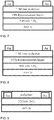
- Bottom gate, top contact FETs with structure of Si/SiO 2 /passivation layer/polymer (P1a, P2a or P3a )/Ag were fabricated by spin-coating from polymer solution on a highly n-doped silicon wafer with 200 nm of thermally-grown SiO 2 gate dielectrics passivated by PPCB or OTS-8. ( Figures 7 and 8 ). Distinct ambipolar characteristics were found at various thermal annealing temperatures.
- the hole and electron mobility passivated by PPCB amounts to 2.2 ⁇ 10 -2 and 1,2 ⁇ 10 -1 cm 2 V -1 s -1 , respectively, which is much higher than that from as-cast films (Table 6).
- the device also shows evident ambipolar behavior, exhibiting a hole and electron mobility of 9.4 ⁇ 10 -2 and 3.1 ⁇ 10 -3 cm 2 V -1 s -1 upon PPCB passivation, which is also much higher than that of the random P3a (Table 7).
- the distinct improvement of charge carrier mobility might be attributed to a more uniform orientation of the polymer chains in the solid-state.
- OTS-8 passivation hole mobility/electron mobility (cm 2 V -1 s -1 ) Polymer 25 °C 90 °C 110 °C 130 °C 150 °C P1a 4.8 ⁇ 10 -2 /2.4 ⁇ 10 -3 4.9 ⁇ 10 -2 /1.2 ⁇ 10 -3 4.5 ⁇ 10 -2 /2.0 ⁇ 10 -3 3.5 ⁇ 10 -2 /1.6 ⁇ 10 -3 4.5 ⁇ 10 -2 /1.6 ⁇ 10 -3 P2a 6.4 ⁇ 10 -2 /2.0 ⁇ 10 -2 6.3 ⁇ 10 -2 /5.3 ⁇ 10 -3 6.2 ⁇ 10 -2 /1.4 ⁇ 10 -3 9.4 ⁇ 10 -2 /3.1 ⁇ 10 -3 8.8 ⁇ 10 -2 /1.1 ⁇ 10 -3 P3a 6.3 ⁇ 10 -5 /2.1 ⁇ 10 -4 4.7 ⁇ 10 -5 /4.4 ⁇ 10 -5 3.2 ⁇ 10 -5 /3.7 ⁇ 10 -5 4.5 ⁇ 10 -5 /3.8 ⁇ 10 -6 7.1 ⁇ 10 -5 /3.3 ⁇ 10 -6
- the on/off ratio of the top contact device with silver electrode is approximately 500.
- gold with a deeper work function was selected as electrode and moreover, bottom gate, and bottom contact FETs were fabricated based on polymers with C16 side chain ( Figure 9 ). It was found that after thermal annealing at 110 °C for 10 min, the hole mobility reached 0.15 and 0.14 cm 2 V -1 s -1 for P1b and P2b, respectively, which are much higher than the 0.025 cm 2 V -1 s -1 obtained by random copolymer P3b. The current on/off ratios for all FETs are improved to ⁇ 10 4 for all devices (Table 8). Table 8.
- CDT and PT based narrow band-gap polymers with well-ordered main chain were prepared by precisely controlled regioselective chemistry.
- the resulted copolymers with regioregular structures show much longer conjugation length and better charge localization along the polymer backbone.
- the low-lying LUMO energy levels were realized for all polymers with the strong electron PT as acceptor, which resulted in the emergence of ambipolar properties for OFET devices. It was found that the regioregular polymers show much higher mobilities than the random copolymers under different OFET device configurations.
- Nuclear magnetic resonance (NMR) spectra were obtained on Bruker Avance DMX500 MHz spectrometer. Microwave assisted polymerizations were performed in a Biotage Initiator TM microwave reactor. Gel permeation chromatography (135 °C in 1,2,4-trichlorobenzene) was performed on a Polymer Laboratories PL220 Chromatograph. Differential scanning calorimetry (DSC) was determined by a TA Instruments DSC (Model Q-20) with about 5 mg polymers samples at a rate of 10 °C / min in the temperature range of -20 to 300 °C. UV-Vis absorption spectra were recorded on a Shimadzu UV-2401 PC dual beam spectrometer.
- Cyclic voltammetry (CVs) measurements were conducted using a standard three-electrode configuration under an argon atmosphere.
- a three-electrode cell equipped with a glassy carbon working electrode, a Ag wire reference electrode, and a Pt wire counterelectrode was employed.
- the measurements were performed in absolute acetonitrile with tetrabutylammonium hexafluorophosphate (0.1 M) as the supporting electrolyte at a scan rate of 50-100 mV/s.
- Polymer films were drop-cast onto the glassy carbon working electrode from a 2 mg/ml chloroform solution.
- CDT 4H -Cyclopenta[2,1- b :3,4- b ']dithiophene
- a dry three-neck round bottom flask was equipped with a Schlenk adapter, dropping funnel, and rubber septum. Under nitrogen, 4,4-didodecyl-4 H- cyclopenta[1,2- b :5,4- b ']dithiophene (0.51 g, 1 mmol) was dissolved in dry THF (12 ml) and cooled -78 °C using a dry ice/acetone cold bath. Under nitrogen, a solution of t -butyllithium (1.7 M in pentane, 1.25 ml, 2.1 mmol) was added dropwise over 15 minutes to the reaction vessel. The reaction was stirred at -78 °C under nitrogen for one hour and at 25 °C for 5 hours.
- tributyltin chloride (0.81 g, 2.5 mmol) was added dropwise over 5 minutes to the reaction vessel via syringe at -78 °C.
- the reaction was stirred at -78 °C under nitrogen for 1 hour and subsequently warmed to room temperature and stirred overnight.
- the mixture was then poured into deionized water (3 ⁇ 100 ml) and the organic phase was extracted with hexanes (3 ⁇ 100 ml).
- the organic phases were collected and washed with deionized water (5 ⁇ 100 ml), dried over sodium sulphate, filtered, and concentrated.
- a dry three-neck round bottom flask was equipped with a Schlenk adapter, dropping funnel, and rubber septum. Under nitrogen, 4,4-didodecyl-4 H -cyclopenta[1,2- b :5,4- b ']dithiophene (0.63 g, 1 mmol) was dissolved in dry THF (12 ml) and cooled -78 °C using a dry ice/acetone cold bath. Under nitrogen, a solution of t -butyllithium (1.7 M in pentane, 1.25 ml, 2.1 mmol) was added dropwise over 15 minutes to the reaction vessel. The reaction was stirred at -78 °C under nitrogen for one hour and at 25 °C for 5 hours.
- tributyltin chloride (0.81 g, 2.5 mmol) was added dropwise over 5 minutes to the reaction vessel via syringe at -78 °C.
- the reaction was stirred at -78 °C under nitrogen for 1 hour and subsequently warmed to room temperature and stirred overnight.
- the mixture was then poured into deionized water (3 ⁇ 100 ml) and the organic phase was extracted with hexanes (3 ⁇ 100 ml).
- the organic phases were collected and washed with deionized water (5 ⁇ 100 ml), dried over sodium sulphate, filtered, and concentrated.
- a dry three-neck round bottom flask was equipped with a Schlenk adapter, dropping funnel, and rubber septum. Under nitrogen, 4,4-didodecyl-4 H- cyclopenta[1,2- b :5,4- b ']dithiophene (0.51 g, 1 mmol) was dissolved in dry THF (12 ml) and cooled -78 °C using a dry ice/acetone cold bath. Under nitrogen, a solution of t -butyllithium (1.7 M in pentane, 2.35 ml, 4 mmol) was added dropwise over 15 minutes to the reaction vessel. The reaction was stirred at -78 °C under nitrogen for one hour and stirred at room temperature for 3 hours.
- a dry three-neck round bottom flask was equipped with a Schlenk adapter, dropping funnel, and rubber septum. Under nitrogen, 4,4-didodecyl-4 H- cyclopenta[1,2-b:5,4- b ']dithiophene (0.63 g, 1 mmol) was dissolved in dry THF (12 ml) and cooled -78 °C using a dry ice/acetone cold bath. Under nitrogen, a solution of t -butyllithium (1.7 M in pentane, 2.35 ml, 4 mmol) was added dropwise over 15 minutes to the reaction vessel. The reaction was stirred at -78 °C under nitrogen for one hour and stirred at room temperature for 3 hours.
- Monomer 2a (0.16 g, 0.16 mmol) was carefully weighed and added to a 2-5 mL microwave tube. The tube was transferred into a glovebox, and then Pd(PPh 3 ) 4 (4.4 mg, 0.005 mmol), and 3.2 mL of xylenes were added into the microwave tube. The tube was sealed, removed from the glovebox and subjected to the following reaction conditions in a microwave reactor: 80 °C for 2 min, 120 °C for 2 min, 160 °C for 2 min and 200 °C for 40 min. The reaction was allowed to cool leaving a viscous liquid containing some solid material.
- the mixture was precipitated in methanol, the resulted dark green fibers were collected and was re-dissolved in hot 1,2-dichlorobenzene. Then re-precipitated in methanol and collected via centrifugation.
- the collected solid fibers were loaded into a cellulose extraction thimble and washed successively with methanol (6 hours), acetone (6 hours), hexanes (12 hours) and chloroform (24 hours).
- the solid residue in the thimble was collected and dried followed by re-dissolved in hot 1,2-dichlorobenzene, filtrated and re-precipitated in methanol.
- the polymer was prepared following a previously reported microwave assisted polymerization technique. Two monomers 3a (0.18 g, 0.19 mmol) and 4a (0.17 g, 0.20 mmol) were carefully weighed and added to a 2-5 mL microwave tube. The tube was transferred into a glovebox, and then Pd(PPh 3 ) 4 (9 mg, 0.008 mmol) and 3 mL of Xylenes were added into the microwave tube. The tube was sealed, removed from the glovebox and subjected to the following reaction conditions in a microwave reactor: 80 °C for 2 min, 120 °C for 2 min, 160 °C for 2 min and 200 °C for 40 min. The reaction was allowed to cool leaving a viscous liquid containing some solid material.
- the reaction was allowed to cool to room temperature, then tributyl(thiophen-2-yl)stannane (20 ⁇ l) was added and the reaction was subjected to the following reaction conditions in a microwave reactor: 80 °C for 2 min, 130 °C for 2 min, 170 °C for 2 min and 200 °C for 20 min. After the reaction was cooled to room temperature, 2-bromothiophene (20 ⁇ l) was added and the end-capping procedure was repeated once again. The mixture was precipitated in methanol, collected via centrifugation.
- indacene-PT based copolymers due to (1) the broad narrow-bandgap absorption, (2) the two thiophene rings rigidified together with a central phenyl ring, which can provide strong intermolecular interactions for ordered packing to improve the charge carrier mobility, and (3) the low-lying HOMO level of the copolymer will provide high open-circuit voltage (V oc ) (see Jen et al. [11])
- the reference polymer ( PIPT-RA ) was synthesized based on microwave assisted step-growth Stille copolymerization of M1 and 4,7-dibromo-pyridal[2,1,3]thiadiazole (PTBr 2 ), thus providing the polymer with the N-atom in the PT units randomly distributed along the polymer main chain. Both copolymers were purified by Soxhlet extraction using methanol, acetone, hexane and finally collected by chloroform. The polymer structures are shown in Scheme 5.
- GPC in 1,2,4-trichlorobenze (1,2,4-TCB) as eluent at 150 °C gave 46 kDa and 42 kDa for PIPT-RG and PIPT-RA, with a polydispersity of 2.3 and 2.8, respectively.
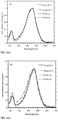
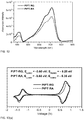
- UV-Vis absorption profiles of PIPT-RG and PIPT-RA in thin films are shown in Figure 12 .
- the absorption profile shapes are essentially the same for both copolymers.
- the short wavelength absorption bas ( ⁇ 417 nm) is assigned to a delocalized excitonic ⁇ - ⁇ * transition and the long wavelength absorption band (-715 nm) is ascribed to intramolecular charge transfer (ICT) interactions between the donor and acceptor moieties.
- ICT intramolecular charge transfer
- the absorption intensity of PIPT-RG is much stronger than that of PIPT-RA, indicating a much higher molar absorption coefficient of PIPT-RG.
- the optical band gaps (Eg) calculated from the absorption onset are determined to be 1.60 eV for PIPT-RG, which is slightly lower than that of 1.62 eV for PIPT-RA.
- E ox of PIPT-RA to that of PIPT-RG might be attributed to the more disordered vector of the PT unit along the polymer main chain, which would disturb the ⁇ -conjugated electron distribution along the polymer backbone leading to a slightly raised E ox .
- the highest occupied molecular orbital energy level (E HOMO ) and the lowest unoccupied molecular orbital energy level (E LUMO ) were calculated from the E ox and E red , on the basis of the assumption that E HOMO of ferrocene/ferrocenium (Fc/Fc + ) is at 4.8 eV relative to vacuum.
- the calculated E HOMO are -5.25 eV and -5.35 eV for PIPT-RG and PIPT-RA, respectively, and the E LUMO are both at -3.60 eV.
- the LUMO is mainly located in the acceptor and the HOMO is well-delocalized along the conjugated backbone, thus the two copolymers exhibited nearly identical E LUMO while slightly different E HOMO .
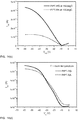
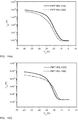
- the field-effect hole mobilities of PIPT-RG and PIPT-RA were extracted from the transfer characteristics ( Figure 14 ) of field-effect transistors (FETs) fabricated with bottom contact, bottom gate geometry using Au electrodes. It was noted that the calculated mobilities for PIPT-RG at room temperature of 0.13 cm 2 /Vs improved to 0.18 and 0.20 cm 2 /Vs after thermal annealing at 100 °C and 150 °C for 10 min, respectively. These are higher than for devices prepared under the same conditions with a PIPT-RA copolymer film of 0.04 cm 2 /Vs at room temperature, and 0.09 and 0.04 cm 2 /Vs attained after thermal annealing at 100 °C and 150 °C for 10 min, respectively.
- the microstructures of two copolymer films were investigated by grazing incident X-ray diffraction (XRD).
- the samples were prepared on the top of (n-decyl)trichlorosilane (DTS) treated silicon substrate according to the same procedure of FET devices.
- the films were thermally annealed at 100 °C for 10 min.
- the scattering features with two distinct peaks centered at q values of 0.42 ⁇ -1 (spacing of 14.9 ⁇ ) and 1.42 ⁇ -1 (spacing of 4.4 ⁇ ) were realized for both copolymers.
- copolymers were used as donor materials for bulk heterojunction solar cells, the contact of active layer with following deposited metal is of particular importance.
- the surface morphologies of copolymer:PC 71 BM (1:4 in wt:wt) films were studies by tapping-mode atomic force microscopy (AFM), and the films were spin-casted from copolymer:PC 71 BM solution on the top of ITO/MoOx layer and followed the optimized conditions for solar cell devices.
- AFM tapping-mode atomic force microscopy
- NMR nuclear magnetic resonance
- spectra were obtained on Bruker Avance DMX500 MHz spectrometer.
- Gel permeation chromatography 150 °C in 1,2,4-trichlorobenzene was performed on a Polymer Laboratories PL220 Chromatograph.
- GPC with chloroform as eluent was performed in chloroform (with 0.25 v/v% triethylamine) on a Waters system, and the molecular weight of polymers were estimated relative to linear PS standards.
- Differential scanning calorimetry (DSC) was determined by a TA Instruments DSC (Model Q-20) with about 5 mg polymers samples at a rate of 10 °C / min in the temperature range of -20 to 300 °C.
- UV-Vis absorption spectra were recorded on a Shimadzu UV-2401 PC dual beam spectrometer.
- Cyclic voltammetry (CV) measurements were conducted using a standard three-electrode configuration under an argon atmosphere. A three-electrode cell equipped with a glassy carbon working electrode, a Ag wire reference electrode, and a Pt wire counterelectrode was employed. The measurements were performed in absolute acetonitrile with tetrabutylammonium hexafluorophosphate (0.1 M) as the supporting electrolyte at a scan rate of 50-100 mV/s. Polymer films for CV test were drop-casted onto the glassy carbon working electrode from a 2 mg/mL chloroform solution.
- Grazing incident X-ray diffraction was performed on Rigaku Smart instrument.
- Atomic force microscopy (AFM) was recorded on Asylum MFP3D instrument. All the samples were prepared identical to optimized device structure and conditions prior to electrode deposition.
- Transmission Electron Microscope (TEM) was performed on FEI Tecnai G2 Sphera Microscope instrument. The samples were prepared by spin-casting on the top of glass substrate and floated in water, following by put on the top of copper grid.
- the reaction was stirred at -78 °C under nitrogen for one hour. Then trimethyltin chloride (0.60 g, 3.0 mmol) was added dropwise over 5 minutes to the reaction vessel via syringe at -78 °C. The reaction was stirred at -78 °C under nitrogen for 1 hour and subsequently warmed to room temperature and stirred overnight. The mixture was then poured into deionized water (3 ⁇ 100 mL) and the organic phase was extracted with hexanes (3 ⁇ 100 mL). The organic phases were collected and washed with deionized water (5 ⁇ 100 mL), dried over sodium sulphate, filtered, and concentrated.
- the reaction was allowed to cool to room temperature, then freshly distilled xylenes (2 mL) and tributyl(thiophen-2-yl)stannane (20 ⁇ l) was added and the reaction was subjected to the following reaction conditions in a microwave reactor: 80 °C for 2 min, 130 °C for 2 min, 170 °C for 2 min and 200 °C for 20 min.
- 2-bromothiophene (20 ⁇ l) was added and the reaction was subjected to the following reaction conditions in a microwave reactor: 80 °C for 2 min, 130 °C for 2 min, 170 °C for 2 min and 200 °C for 20 min.
- the mixture was precipitated in methanol, collected via centrifugation, then re-dissolved in hot 1,2-dichlorobenzene and re-precipitated in methanol and collected via centrifugation.
- the collected solid fibers were loaded into a cellulose extraction thimble and washed successively with methanol (12 hours), acetone (12 hours) and hexanes (12 hours), and then chloroform (2 hours) to collected the copolymer.
- the solid residue in the thimble was collected and dried followed by re-dissolved in hot 1,2-dichlorobenzene, filtrated and re-precipitated in methanol.
- the polymerization was performed following the procedure for PIPT-RG in microwave reactor.
- the monomer M1 246.6 mg, 0.2 mmol
- monomer M2 4,7-dibromo-pyridal[2,1,3]thiadiazole (59.0 mg, 0.2 mmol)
- Pd(PPh 3 ) 4 (11.5 mg, 0.01mmol
- xylenes 3 mL
- the resulted dark-green solid was dried over high vacuum line to give 168.5 mg of polymer, yield 81 %.
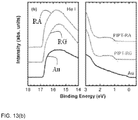
- the UPS analysis chamber was equipped with a hemispherical electron-energy analyzer (Kratos Ultra spectrometer), and was maintained at 1.33 ⁇ 10 -7 Pa.
- PSCs Polymer solar cells with conventional device architecture of ITO/MoO X / polymer:PCBM/Al were fabricated according to the following procedure.
- the ITO-coated glass substrates were firstly cleaned by ultrasonic treatment in detergent, deionized water, acetone and isopropyl alcohol for 30 minutes each, and subsequently dried in an oven overnight.
- MoO X film was deposited onto ITO substrates by thermal evaporation in a vacuum of about 1 ⁇ 10 -6 Torr. The evaporation rate was 0.1 ⁇ /s.
- PSCs Characterization The thickness of the multilayer was measured with a profilometer and Atomic Force Microscope (AFM), respectively. Current density-voltage ( J-V ) characteristics were measured using a Keithley 2602 Source measure Unit, under solar simulation conditions of 100 mW/cm 2 AM 1.5 G using a 300 W Xe arc lamp with an AM 1.5 global filter. The illumination intensity of the solar simulator was measured using a standard silicon photovoltaic with a protective KG1 filter calibrated by the National renewable Energy Laboratory.
- AFM Atomic Force Microscope
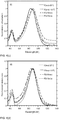
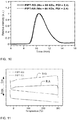
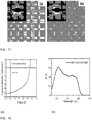
- Figure 18 (a) illustrates the J - V characteristics of the optimized BHJ solar cell using PIPT-RG as donor materials.
- the optimized blend ratio of PIPT and fullerene is 1:4. Detailed comparisons of different blend ratio are not shown here.
- PIPT-RG as donor materials shows a PCE of 5.5%.
- the IPCE spectrum shown in Figure 12 18 (b) is in good agreement with the J-V values.
- the aqueous MoO x solution was prepared by hydration method according to the procedure reported by Liu et al ( Fengmin Liu, Zhiyuan Xie, et al. Solar Energy Materials & Solar Cells. 2010, 94, 94842-845 ).
- Ammonium molybdate ((NH 4 ) 6 Mo 7 O 24 ) was dissolved in water to form 0.01 mol/L solution, marked as solution A.
- 2 mol/L hydrochloric acid (HCl) water solution was marked as solution B.
- Solution B was dropped into solution A until the pH value of the mixed solution was adjusted between 1.5 and 2.0. This mixed solution was marked as solution C, which is the aqueous MoO x solution.
- PSCs Pre-thermal annealing
- Polymer solar cells with conventional device architecture of ITO/MoO 3 / polymer: PCBM//A1 were fabricated according to the following procedure.
- the ITO-coated glass substrates were firstly cleaned by ultrasonic treatment in detergent, deionized water, acetone and isopropyl alcohol for 30 minutes each, and subsequently dried in an oven overnight.
- MoO x (filtered at 0.45 ⁇ m) was spin-coated from aqueous solution at 5000 rpm for 40 s to form a film of ⁇ 8 nm thickness.
- the substrates were then baked at 160°C for 25 min in air, and moved into a glovebox for spin-casting the active layer.
- Two solutions containing a mixture of PIPT-RA:PC 71 BM and PIPT-RG:PC 71 BM with different blend ratios in o-DCB with a concentration of 10 mg/ml were spin-casted on top of MoO x layer, respectively.
- the film thickness of ⁇ 90 nm was optimized by controlling the spin-casting speed.
- the BHJ films were annealed at 100°C for 10 min.
- the cathode (Al, ⁇ 100 nm) was deposited through a shadow mask by thermal evaporation in a vacuum of about 3 x 10 -6 Torr.
- the active area of the devices was 0.106 cm 2 .
- PSCs Post-thermal annealing: Polymer solar cells with conventional device architecture of ITO/MoO 3 / polymer:PCBM//A1 were fabricated according to the following procedure. The ITO-coated glass substrates were firstly cleaned by ultrasonic treatment in detergent, deionized water, acetone and isopropyl alcohol for 30 minutes each, and subsequently dried in an oven overnight. After treated with UV/ozone for 20 min, MoO x (filtered at 0.45 ⁇ m) was spin-coated from aqueous solution at 5000 rpm for 40 s to form a film of ⁇ 8 nm thickness.
- the substrates were then barked at 160°C for 25 min in air, and moved into a glovebox for spin-casting the active layer.
- Two solutions containing a mixture of PIPT-RA:PC 71 BM and PIPT-RG:PC 71 BM with different blend ratio in o-DCB with a concentration of 10 mg/ml were spin-casted on top of MoO x layer, respectively.
- the film thickness of ⁇ 90 nm was optimized by controlling the spin-casting speed.
- the cathode Al, ⁇ 100 nm
- the devices were annealing at 100°C for 10 min.
- the active area of device was 0.106 cm 2 .
- PSCs Polymer solar cells with conventional device architecture of ITO/MoO 3 / polymer:PCBM/A1 were fabricated according to the following procedure.
- the ITO-coated glass substrates were firstly cleaned by ultrasonic treatment in detergent, deionized water, acetone and isopropyl alcohol for 30 minutes each, and subsequently dried in an oven overnight. After treated with UV/ozone for 20 min, MoO x (filtered at 0.45 ⁇ m) was spin-coated from aqueous solution at 5000 rpm for 40 s to form a film of ⁇ 8 nm thickness.
- the substrates were then barked at 160°C for 25 min in air, and moved into a glovebox for spin-casting the active layer.
- CPE Polymer solar cells with conventional device architecture of ITO/MoO 3 / polymer:PCBM/Al were fabricated according to the following procedure.
- the ITO-coated glass substrates were firstly cleaned by ultrasonic treatment in detergent, deionized water, acetone and isopropyl alcohol for 30 minutes each, and subsequently dried in an oven overnight. After treated with UV/ozone for 20 min, MoO x (filtered at 0.45 ⁇ m) was spin-coated from aqueous solution at 5000 rpm for 40 s to form a film of ⁇ 8 nm thickness.
- the substrates were then barked at 160°C for 25 min in air, and moved into a glovebox for spin-casting the active layer.
- PSCs Characterization The thickness of the multilayer was measured with a profilometer and Atomic Force Microscope (AFM), respectively. Current density-voltage ( J-V ) characteristics were measured using a Keithley 2602 Source measure Unit, under solar simulation conditions of 100 mW/cm 2 AM 1.5 G using a 300 W Xe arc lamp with an AM 1.5 global filter. The illumination intensity of the solar simulator was measured using a standard silicon photovoltaic with a protective KG1 filter calibrated by the National renewable Energy Laboratory.
- AFM Atomic Force Microscope
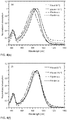
- Figure 19(a) illustrates the J - V characteristics of the optimized BHJ solar cell based on PIPT-RA and PIPT-RG as donor materials, respectively. Detailed comparisons of different blend ratio are summarized in Table 11. It could be seen that the performance of PIPT-RG devices is much better than that of PIPT-RA devices, corresponding to PCE increases of from 3.4% to 5.1%. From Figure 19(b) we could see that the IPCE spectrum of PIPT -RG based devices is more broadened than that of PIPT -RA based devices, which is in good agreement with the increased J SC . Table 11.
- post-thermal annealing annealing devices after evaporation cathode
- DIO additive
- spin-casting CPE as interfacial layer between the active layer and cathode
- ZnO precursor Preparation of the ZnO Precursor : The ZnO precursor was prepared by dissolving zinc acetate dihydrate (Zn(CH 3 COO) 2 ⁇ 2H 2 O, Aldrich, 99.9%, 1 g) and ethanolamine (NH 2 CH 2 CH 2 OH, Aldrich, 99.5%, 0.28 g in 2-methoxyethanol (CH 3 OCH 2 CH 2 OH, Aldrich, 99.8%, 10 mL) under vigorous stirring for 12 h for the hydrolysis reaction in air.
- ZnO precursor was prepared by dissolving zinc acetate dihydrate (Zn(CH 3 COO) 2 ⁇ 2H 2 O, Aldrich, 99.9%, 1 g) and ethanolamine (NH 2 CH 2 CH 2 OH, Aldrich, 99.5%, 0.28 g in 2-methoxyethanol (CH 3 OCH 2 CH 2 OH, Aldrich, 99.8%, 10 mL) under vigorous stirring for 12 h for the hydrolysis reaction in air.
- Inverted solar cells were fabricated on ITO-coated glass substrates.
- the ITO-coated glass substrates were first cleaned with detergent, ultrasonicated in water, actone and isopropyl alcohol, and subsequently dried overnight in an oven.
- the ZnO precursor solution was spin-cast on top of the ITO-glass substrate.
- the films were annealed at 150 °C for 1 h in air.
- the ZnO film thickness was approximately 30 nm, as determined by a profilometer.
- the ZnO-coated substrates were transferred into a glove box.
- a solution containing a mixture of PIPT -RG:PC 7 ,BM (1:4) in o-DCB with a concentration of 10 mg/ml was spin-casted on top of a ZnO film with thickness of approximately 80 nm, respectively.
- the BHJ film was heated at 100 °C for 10 min.
- a thin layer of MoO x film ( ⁇ 6 nm) was evaporated on top of the BHJ layer.
- the anode (Ag, ⁇ 60 nm) was deposited through a shadow mask by thermal evaporation in a vacuum of about 3 ⁇ 10 -6 Torr.
- the active area of device was 0.05 cm 2 .
- PSCs Characterization The thickness of multilayers was measured with a profilometer and Atomic Force Microscope (AFM), respectively. Current density-voltage ( J-V ) characteristics were measured using a Keithley 2602 Source measure Unit, under solar simulation conditions of 100 mW/cm 2 AM 1.5 G using a 300 W Xe arc lamp with an AM 1.5 global filter. The illumination intensity of the solar simulator was measured using a standard silicon photovoltaic with a protective KG1 filter calibrated by the National renewable Energy Laboratory.
- AFM Atomic Force Microscope
- Figure 21 (a) illustrates the J - V characteristics of the optimized BHJ solar cell based on PIPT-RG as donor material.
- the device shows a nice open circle voltage of 0.88 V and short circle current of 14.1 mA/cm 2 .
- the FF is relatively low
- the PCE is up to 6.2 %, which is very comparable to our conventional devices. This consistent value indicated that even when using different device structures, region-regular PIDTPT polymer can distinctly improved OPV devices.
- the inventors realize that replacement of the carbon bridge in CDT unit by a silicon bridge, with the new donor of silolo[3,2- b :4,5- b' ]dithiophene (SDT), might decrease the highest occupied molecular orbital (HOMO) energy level, and that OPVs incorporating SDT-PT-based conjugated copolymers might show higher Voc values than that of CDT-PT copolymers.
- SDT-PT-based regioregular copolymers as the active layer can achieve improved J SC and PCE in OPVs.
- the tube was sealed and subjected to the following reaction conditions in a microwave reactor: 80 °C for 2 min, 130 °C for 2 min, 170 °C for 2 min and 200 °C for 40 min.
- the reaction was allowed to cool to room temperature, then tributyl(thiophen-2-yl)stannane (20 ⁇ l) was added and the reaction was subjected to the following reaction conditions in a microwave reactor: 80 °C for 2 min, 130 °C for 2 min, 170 °C for 2 min and 200 °C for 20 min.
- 2-bromothiophene (20 ⁇ l) was added and the end-capping procedure was repeated once again.
- the mixture was precipitated in methanol, collected via centrifugation.
- the tube was sealed and subjected to the following reaction conditions in a microwave reactor: 80 °C for 2 min, 130 °C for 2 min, 170 °C for 2 min and 200 °C for 40 min.
- the reaction was allowed to cool to room temperature, then tributyl(thiophen-2-yl)stannane (20 ⁇ l) was added and the reaction was subjected to the following reaction conditions in a microwave reactor: 80 °C for 2 min, 130 °C for 2 min, 170 °C for 2 min and 200 °C for 20 min.
- 2-bromothiophene (20 ⁇ l) was added and the end-capping procedure was repeated once again.
- the mixture was precipitated in methanol, collected via centrifugation.
- PC 71 BM (99.5%) was purchased from Nano-C. Chlorobenzene (CB, anhydrous, 99%) was supplied by Sigma-Aldrich Company. All materials were used as received.
- PSCs Polymer solar cells with conventional device architecture of ITO/PEDOT:PSS/PSDTPT:PCBM/Al were fabricated according to the following procedure.
- the ITO-coated glass substrates were firstly cleaned by ultrasonic treatment in detergent, deionized water, acetone and isopropyl alcohol for 30 minutes each, and subsequently dried in an oven overnight. After treated with UV/ozone for 20 min, PEDOT:PSS (Baytron P VP AI 4083, filtered at 0.45 ⁇ m) was spin-coated from aqueous solution at 4000 rpm for 40 s to form a film of ⁇ 40 nm thickness.
- the substrates were barked at 140°C for 10 min in air, and then moved into a glovebox for spin-casting the active layer.
- Two solution containing with PSDTPT2-EH:PC 71 BM (1:1, w/w) and PSDTPTR-EH:PC 71 BM (1:1, w/w) in CB with a concentration of 10 mg/ml were then spin-casted on top of PEDOT:PSS layer, which were marked as device I and device II, respectively.
- the film thickness of ⁇ 80 nm was controlled by adjusting the spin-casting speed.
- the BHJ films were dried at 70°C for 10 min. After that, the cathode (Al, ⁇ 100 nm) was deposited through a shadow mask by thermal evaporation in a vacuum of about 3 ⁇ 10 -6 Torr.
- the active area of device was 0.106 cm 2 .
- PSCs Characterization The thickness of the active layer and PEDOT:PSS was measured with a profilometer. Current density-voltage ( J-V ) characteristics were measured using a Keithley 2602 Source measure Unit, under solar simulation conditions of 100 mW/cm 2 AM 1.5 G using a 300 W Xe arc lamp with an AM 1.5 global filter. The illumination intensity of the solar simulator was measured using a standard silicon photovoltaic with a protective KG1 filter calibrated by the National renewable Energy Laboratory.
- Figure 22 illustrates the J - V characteristics of the two devices, and the detailed comparisons are summarized in Table 12.
- the short circuit current density ( J SC ) of device II increases as much as four times (from 2.41 to 9.03 mA/cm 2 ) compared with that of device I using the regionrandom copolymers.
- the J SC is not only determined by the number of absorbed photons, but also heavily influenced by the component morphology in the active layer. Therefore, a remarkable increase in J SC for the device II implies that the morphology of the active layer has been substantially improved.
- High mobility lies in the heart of practical applications for organic electronics. High mobility enables low operating voltage and less energy consumption in organic thin film transistors (OTFTs). Recently, narrow bandgap donor-acceptor (DA) copolymers are attracting researchers' attention. The combination of DA moieties on polymer chain can induce preferred charge transfer between DA units with different electron affinities. Therefore, delocalization, improved transport and higher mobility are expected.
- DA narrow bandgap donor-acceptor
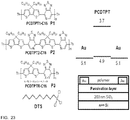
- Molecular structures of the three polymers, device architecture, and work functions are shown in Figure 23 .
- larger molecular weight and films with improved structural order are required.
- low polydispersity index (PDI) is important as well as molecular weight.
- the high mobility, over 2 cm 2 /Vs, after annealing could be correlated to the higher degree of structural order in films of high molecular weight rr-P2.
- To push mobility even higher than 2.5 cm 2 /Vs inducing higher molecular weight and more ordering in polymer film are promising.
- To further increase the molecular weight by GPC is impractical because of the required collecting time and the quantity of the fractionated solution.
- FIG. 24(a) and 24(b) The transfer and output characteristics of the OTFTs made of rr-P2 are shown in Figure 24(a) and 24(b) .
- the polymer film was drop cast on a prepatterned substrate with bottom contact (BC) architecture made of gold.
- the SiO 2 gate dielectric was passivated by decyl(trichloro)silane (DTS).
- DTS decyl(trichloro)silane
- Figure 24(a) shows clear transistor behavior with linear and saturation regimes and on-off ration 6 ⁇ 10 6 .
- the positive shift of threshold voltage from negative V G to V G 20 V elucidates the existence of hole traps on the interface of gold and polymer.
- Table 13 is a mobility table showing drop casted films prepared from different concentration solutions after different annealing temperatures. The highest mobility value 2.5 cm 2 /Vs, was achieved from the film prepared by 0.025 wt% solution and annealed at 350 °C. Even though the mobility values continuously increase with annealing temperature, the numbers saturate after 200 °C, mainly varying from 1.8 to 2.3 cm 2 /Vs.
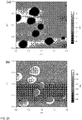
- the dark spots in the image are actually holes in the film.
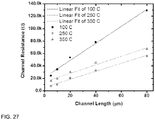
- R c contact resistance
- PCDTPT2 (P2) was originally synthesized with 55 kDa and PDI> 4.
- GPC gel permeated chromatography
- the high molecular weight P2 was dissolved in chlorobenzene with 0.1, 0.075, 0.05, and 0.025 wt% for drop casting on bottom contact substrates passivated by decyl(trichloro)silane.
- the casted substrates were kept in a glovebox with oxygen level less than 2 ppm, drying for 6 hours. All devices were tested in a nitrogen environment and data were collected by Keithley 4200.
Landscapes
- Chemical & Material Sciences (AREA)
- Health & Medical Sciences (AREA)
- Chemical Kinetics & Catalysis (AREA)
- Medicinal Chemistry (AREA)
- Polymers & Plastics (AREA)
- Organic Chemistry (AREA)
- Engineering & Computer Science (AREA)
- Materials Engineering (AREA)
- Polyoxymethylene Polymers And Polymers With Carbon-To-Carbon Bonds (AREA)
- Thin Film Transistor (AREA)
- Photovoltaic Devices (AREA)
Applications Claiming Priority (3)
| Application Number | Priority Date | Filing Date | Title |
|---|---|---|---|
| US201161498390P | 2011-06-17 | 2011-06-17 | |
| US201261645970P | 2012-05-11 | 2012-05-11 | |
| PCT/US2012/043004 WO2012174561A2 (en) | 2011-06-17 | 2012-06-18 | REGIOREGULAR PYRIDAL[2,1,3]THIADIAZOLE π-CONJUGATED COPOLYMERS FOR ORGANIC SEMICONDUCTORS |
Publications (3)
| Publication Number | Publication Date |
|---|---|
| EP2721087A2 EP2721087A2 (en) | 2014-04-23 |
| EP2721087A4 EP2721087A4 (en) | 2014-11-12 |
| EP2721087B1 true EP2721087B1 (en) | 2018-03-07 |
Family
ID=47354196
Family Applications (1)
| Application Number | Title | Priority Date | Filing Date |
|---|---|---|---|
| EP12801086.5A Active EP2721087B1 (en) | 2011-06-17 | 2012-06-18 | Regioregular pyridal[2,1,3]thiadiazole pi-conjugated copolymers for organic semiconductors |
Country Status (4)
| Country | Link |
|---|---|
| US (2) | US9293708B2 (enExample) |
| EP (1) | EP2721087B1 (enExample) |
| JP (1) | JP6141577B2 (enExample) |
| WO (1) | WO2012174561A2 (enExample) |
Families Citing this family (41)
| Publication number | Priority date | Publication date | Assignee | Title |
|---|---|---|---|---|
| US9000423B2 (en) * | 2007-10-31 | 2015-04-07 | The Regents Of The University Of California | Processing additive for single-component solution processed organic field-effect transistors |
| WO2012074853A1 (en) * | 2010-11-22 | 2012-06-07 | The Regents Of The University Of California | Organic small molecule semiconducting chromophores for use in organic electronic devices |
| US9573158B2 (en) * | 2014-01-03 | 2017-02-21 | The Regents Of The University Of California | High mobility polymer thin-film transistors with capillarity-mediated self-assembly |
| US10186661B2 (en) | 2015-03-02 | 2019-01-22 | The Regents Of The University Of California | Blade coating on nanogrooved substrates yielding aligned thin films of high mobility semiconducting polymers |
| US9505876B2 (en) * | 2011-10-20 | 2016-11-29 | Universite Laval | Preparation of high molecular weight polymers by direct arylation and heteroarylation |
| JP2013237813A (ja) * | 2012-05-16 | 2013-11-28 | Kuraray Co Ltd | π電子共役重合体及びそれを用いた有機半導体デバイス |
| US9559306B2 (en) | 2012-09-07 | 2017-01-31 | The Regents Of The University Of California | Field-effect transistors based on macroscopically oriented polymers with high saturation mobility |
| US10128441B2 (en) | 2012-09-07 | 2018-11-13 | The Regents Of The University Of California | Field-effect transistors based on macroscopically oriented polymers |
| CN103848960A (zh) * | 2012-11-28 | 2014-06-11 | 海洋王照明科技股份有限公司 | 含噻吩-苯-噻吩单元的聚合物及其制备方法和太阳能电池器件 |
| US9796811B2 (en) | 2013-08-23 | 2017-10-24 | Sumitomo Chemical Company, Limited | Polymer compound and organic semiconductor device using the same |
| EP3149107B1 (en) | 2014-05-26 | 2020-07-29 | Flexenable Limited | Tetra-aryl indacenodithiophene-based polycyclic polymers and their use |
| CN106536528B (zh) | 2014-07-29 | 2022-02-01 | 默克专利股份有限公司 | 基于四-杂芳基引达省并二噻吩的多环聚合物和它们的用途 |
| CN104637823B (zh) * | 2015-02-06 | 2019-07-16 | 京东方科技集团股份有限公司 | 薄膜晶体管的制备方法及薄膜晶体管、阵列基板 |
| JP6104973B2 (ja) | 2015-03-30 | 2017-03-29 | 株式会社東芝 | 光電変換素子およびその製造方法 |
| EP3294795B1 (en) * | 2015-05-12 | 2020-11-25 | Flexenable Limited | Thiadiazolopyridine polymers, their synthesis and their use |
| JP6463475B2 (ja) | 2015-07-07 | 2019-02-06 | 富士フイルム株式会社 | 有機半導体素子、化合物、有機半導体組成物、および、有機半導体膜の製造方法 |
| WO2017086320A1 (ja) | 2015-11-20 | 2017-05-26 | 富士フイルム株式会社 | 有機半導体組成物、有機半導体膜、有機薄膜トランジスタおよび有機薄膜トランジスタの製造方法 |
| KR20180097671A (ko) * | 2015-12-18 | 2018-08-31 | 메르크 파텐트 게엠베하 | 티아디아졸로피리딘 중합체, 그것의 합성 및 그것의 용도 |
| CN108780844B (zh) | 2016-03-16 | 2022-04-29 | 富士胶片株式会社 | 有机半导体组合物、有机薄膜晶体管的制造方法及有机薄膜晶体管 |
| WO2017170279A1 (ja) | 2016-04-01 | 2017-10-05 | 富士フイルム株式会社 | 有機半導体素子、重合体、有機半導体組成物及び有機半導体膜 |
| JP6574052B2 (ja) | 2016-04-01 | 2019-09-11 | 富士フイルム株式会社 | 有機半導体素子、重合体、有機半導体組成物及び有機半導体膜 |
| EP3605630B1 (en) | 2017-03-31 | 2020-12-23 | FUJIFILM Corporation | Organic semiconductor element, organic semiconductor composition, method of manufacturing organic semiconductor film, organic semiconductor film, and compound and polymer using for use therein |
| WO2018181056A1 (ja) | 2017-03-31 | 2018-10-04 | 富士フイルム株式会社 | 有機半導体素子、有機半導体組成物、有機半導体膜の製造方法、有機半導体膜、並びに、これらに用いる化合物及びポリマー |
| JP6814448B2 (ja) | 2017-03-31 | 2021-01-20 | 富士フイルム株式会社 | 有機半導体素子、有機半導体組成物、有機半導体膜の製造方法、有機半導体膜、並びに、これらに用いる化合物及びポリマー |
| KR102795781B1 (ko) | 2017-06-16 | 2025-04-15 | 듀크 유니버시티 | 개선된 라벨 검출, 계산, 분석물 감지, 및 조정 가능한 난수 생성을 위한 공진기 네트워크 |
| CN107573489B (zh) * | 2017-08-03 | 2019-12-27 | 湘潭大学 | 一种含双吡啶二唑衍生物受体的聚合物半导体及其制备方法与应用 |
| US20190181348A1 (en) * | 2017-09-27 | 2019-06-13 | The Regents Of The University Of California | Branch point effect on structure and electronic properties of conjugated polymers |
| US11233207B2 (en) * | 2017-11-02 | 2022-01-25 | The Regents Of The University Of California | Narrow bandgap non-fullerene acceptors and devices including narrow bandgap non-fullerene acceptors |
| CN111542939A (zh) | 2018-01-23 | 2020-08-14 | 富士胶片株式会社 | 有机半导体元件、有机半导体组合物、有机半导体膜、有机半导体膜的制造方法及用于这些的聚合物 |
| KR101947055B1 (ko) * | 2018-02-08 | 2019-05-02 | 울산과학기술원 | Pbdttt 기반 고분자의 제조방법 |
| WO2020072100A1 (en) | 2018-05-05 | 2020-04-09 | Azoulay Jason D | Open-shell conjugated polymer conductors, composites, and compositions |
| KR102441144B1 (ko) * | 2018-05-17 | 2022-09-06 | 주식회사 엘지화학 | 헤테로환 화합물 및 이를 포함하는 유기 전자 소자 |
| CN110655639B (zh) * | 2018-06-29 | 2022-07-26 | 华南理工大学 | 一类含吡啶杂环单元的嵌段共聚物及其制备方法与应用 |
| CN110655653B (zh) * | 2018-06-29 | 2022-04-22 | 华南理工大学 | 一类主链含金属元素的a-d-a型聚合物及制备方法与其应用 |
| CN110655637A (zh) * | 2018-06-29 | 2020-01-07 | 华南理工大学 | 一类含吡啶杂环单元的规整型聚合物其及制备方法与应用 |
| WO2020106361A2 (en) | 2018-09-21 | 2020-05-28 | Joshua Tropp | Thiol-based post-modification of conjugated polymers |
| US11781986B2 (en) | 2019-12-31 | 2023-10-10 | University Of Southern Mississippi | Methods for detecting analytes using conjugated polymers and the inner filter effect |
| CN111233898B (zh) * | 2020-03-09 | 2021-05-11 | 湘潭大学 | 一种含等规双吡啶噻二唑受体的有机小分子共轭材料及其制备方法与应用 |
| KR102509090B1 (ko) * | 2020-04-10 | 2023-03-10 | 한양대학교 산학협력단 | 탄소나노튜브의 분산 방법, 공액고분자-탄소나노튜브 복합체를 포함하는 전도성 필름 및 이를 포함하는 열전소자 |
| CN113461713B (zh) * | 2021-07-14 | 2022-07-22 | 南京邮电大学 | 一种cpdt基梯形格分子及其制备方法和应用 |
| KR102855934B1 (ko) * | 2021-11-30 | 2025-09-04 | 한국화학연구원 | P형 유기 반도체 화합물, 이의 제조방법 및 이를 함유하는 반투명 유기 태양전지 |
Citations (1)
| Publication number | Priority date | Publication date | Assignee | Title |
|---|---|---|---|---|
| WO2014039049A1 (en) * | 2012-09-07 | 2014-03-13 | Empire Technology Development Llc | Regioregular copolymers and methods for making same |
Family Cites Families (11)
| Publication number | Priority date | Publication date | Assignee | Title |
|---|---|---|---|---|
| US7144950B2 (en) | 2003-09-17 | 2006-12-05 | The Regents Of The University Of California | Conformationally flexible cationic conjugated polymers |
| US7781673B2 (en) | 2005-07-14 | 2010-08-24 | Konarka Technologies, Inc. | Polymers with low band gaps and high charge mobility |
| US7772485B2 (en) * | 2005-07-14 | 2010-08-10 | Konarka Technologies, Inc. | Polymers with low band gaps and high charge mobility |
| US20080275212A1 (en) | 2005-11-24 | 2008-11-06 | Martin Heeney | Process of Preparing Regioregular Polymers |
| EP2144949A2 (en) | 2007-05-15 | 2010-01-20 | Plextronics, Inc. | Mixed halogen polymerization |
| WO2009056497A1 (en) | 2007-10-31 | 2009-05-07 | Basf Se | Reverse addition process for preparation of regioregular conducting polymers |
| WO2009152165A2 (en) * | 2008-06-09 | 2009-12-17 | Plextronics, Inc. | Sulfonated polythiophenes comprising fused ring repeat units |
| US8343382B2 (en) * | 2009-05-22 | 2013-01-01 | The Regents Of The University Of California | Band gap control in conjugated oligomers and polymers via Lewis acids |
| WO2011003076A2 (en) | 2009-07-02 | 2011-01-06 | University Of Florida Research Foundation, Inc. | Soluble alternating donor-acceptor conjugated polymer electrochromes |
| US8729221B2 (en) * | 2012-04-25 | 2014-05-20 | The Regents Of The University Of California | Conjugated copolymers chiral side chain for organic thin film transistors |
| US9559306B2 (en) * | 2012-09-07 | 2017-01-31 | The Regents Of The University Of California | Field-effect transistors based on macroscopically oriented polymers with high saturation mobility |
-
2012
- 2012-06-18 EP EP12801086.5A patent/EP2721087B1/en active Active
- 2012-06-18 JP JP2014516086A patent/JP6141577B2/ja active Active
- 2012-06-18 US US13/526,371 patent/US9293708B2/en active Active
- 2012-06-18 WO PCT/US2012/043004 patent/WO2012174561A2/en not_active Ceased
-
2013
- 2013-11-22 US US14/087,702 patent/US10396286B2/en active Active
Patent Citations (1)
| Publication number | Priority date | Publication date | Assignee | Title |
|---|---|---|---|---|
| WO2014039049A1 (en) * | 2012-09-07 | 2014-03-13 | Empire Technology Development Llc | Regioregular copolymers and methods for making same |
Non-Patent Citations (2)
| Title |
|---|
| ADAM A. POLLIT ET AL: "Evidence for the Chain-Growth Synthesis of Statistical [pi]-Conjugated Donor-Acceptor Copolymers", MACROMOLECULAR RAPID COMMUNICATIONS, vol. 36, no. 1, 12 November 2014 (2014-11-12), DE, pages 65 - 70, XP055399401, ISSN: 1022-1336, DOI: 10.1002/marc.201400482 * |
| SOLENN BERSON ET AL: "Effect of carbonitrile and hexyloxy substituents on alternated copolymer of polythiophene-Performances in photovoltaic cells", SOLAR ENERGY MATERIALS AND SOLAR CELLS., vol. 94, no. 5, 22 January 2010 (2010-01-22), NL, pages 699 - 708, XP055399408, ISSN: 0927-0248, DOI: 10.1016/j.solmat.2009.12.028 * |
Also Published As
| Publication number | Publication date |
|---|---|
| US20120322966A1 (en) | 2012-12-20 |
| JP2014520186A (ja) | 2014-08-21 |
| US20140080986A1 (en) | 2014-03-20 |
| WO2012174561A3 (en) | 2013-06-20 |
| US10396286B2 (en) | 2019-08-27 |
| EP2721087A2 (en) | 2014-04-23 |
| US9293708B2 (en) | 2016-03-22 |
| JP6141577B2 (ja) | 2017-06-07 |
| EP2721087A4 (en) | 2014-11-12 |
| WO2012174561A2 (en) | 2012-12-20 |
Similar Documents
| Publication | Publication Date | Title |
|---|---|---|
| US10396286B2 (en) | Regioregular pyridal[2,1,3]thiadiazole π-conjugated copolymers for organic semiconductors | |
| EP2315793B1 (en) | Indacenodithiophene and indacenodiselenophene polymers and their use as organic semiconductors | |
| US8871884B2 (en) | Copolymer semiconductors comprising thiazolothiazole or benzobisthiazole, or benzobisoxazole electron acceptor subunits, and electron donor subunits, and their uses in transistors and solar cells | |
| Yuan et al. | Design of benzodithiophene-diketopyrrolopyrrole based donor–acceptor copolymers for efficient organic field effect transistors and polymer solar cells | |
| RU2513643C2 (ru) | Полимеры, производные бензобис(силолотиофена), и их применение в качестве органических полупроводников | |
| Kim et al. | Benzotriazole-based donor–acceptor type semiconducting polymers with different alkyl side chains for photovoltaic devices | |
| AU2010281942A1 (en) | Phenanthro[1,10,9,8-c,d,e,f,g]carbazole polymers and their use as organic semiconductors | |
| Chakravarthi et al. | New alkylselenyl substituted benzodithiophene-based solution-processable 2D π-conjugated polymers for bulk heterojunction polymer solar cell applications | |
| Kim et al. | D–A copolymer with high ambipolar mobilities based on dithienothiophene and diketopyrrolopyrrole for polymer solar cells and organic field-effect transistors | |
| Kim et al. | Tunable light harvesting properties of a highly crystalline alternating terpolymer for high-performing solar cells | |
| Atlı et al. | Synthesis and characterization of optical, electrochemical and photovoltaic properties of selenophene bearing benzodithiophene based alternating polymers | |
| Demadrille et al. | Conjugated alternating copolymer of dialkylquaterthiophene and fluorenone: synthesis, characterisation and photovoltaic properties | |
| Kim et al. | Photovoltaic properties of a new quinoxaline-based copolymer with Thieno [3, 2-b] thiophene side chain for organic photovoltaic cell applications | |
| EP3173436A1 (en) | Polymeric compound and organic semiconductor device including same | |
| Cui et al. | Metallated conjugation in small-sized-molecular donors for solution-processed organic solar cells | |
| Hong et al. | Synthesis and characterization of a series of low-bandgap copolymers based on cyclopenta [2, 1-b: 3, 4-b′] dithiophene and thienopyrroledione for photovoltaic applications | |
| Kim et al. | High open-circuit voltage organic photovoltaic cells fabricated using semiconducting copolymers consisting of bithiophene and fluorinated quinoxaline or triazole derivatives | |
| Song et al. | Open circuit voltage increase by substituted spacer and thieno [3, 4-c] pyrrole-4, 6-dione for polymer solar cells | |
| Kim et al. | New naphthalene diimide-based n-type copolymers: The effects of conjugated side chains | |
| WO2013102035A1 (en) | Thienothiadiazole based polymer semiconductors and uses in electronics and optoelectronics | |
| US10487173B2 (en) | Fluorine substitution influence on benzo[2,1,3]thiodiazole based polymers for field-effect transistor applications | |
| Bathula et al. | Facile synthesis and optoelectronic exploration of silylthiophene substituted benzodithiophene polymer for organic field effect transistors | |
| Piyakulawat et al. | Effect of thiophene donor units on the optical and photovoltaic behavior of fluorene-based copolymers | |
| Liu et al. | A polythiophene derivative with octyl diphenylamine-vinylene side chains: synthesis and its applications in field-effect transistors and solar cells | |
| Yan et al. | Metallopolyyne polymers containing naphthalene diimide-oligothiophene moieties and their applications in organic field-effect transistors |
Legal Events
| Date | Code | Title | Description |
|---|---|---|---|
| PUAI | Public reference made under article 153(3) epc to a published international application that has entered the european phase |
Free format text: ORIGINAL CODE: 0009012 |
|
| 17P | Request for examination filed |
Effective date: 20131218 |
|
| AK | Designated contracting states |
Kind code of ref document: A2 Designated state(s): AL AT BE BG CH CY CZ DE DK EE ES FI FR GB GR HR HU IE IS IT LI LT LU LV MC MK MT NL NO PL PT RO RS SE SI SK SM TR |
|
| DAX | Request for extension of the european patent (deleted) | ||
| REG | Reference to a national code |
Ref country code: DE Ref legal event code: R079 Ref document number: 602012043798 Country of ref document: DE Free format text: PREVIOUS MAIN CLASS: C08G0061120000 Ipc: H01L0051440000 |
|
| A4 | Supplementary search report drawn up and despatched |
Effective date: 20141010 |
|
| RIC1 | Information provided on ipc code assigned before grant |
Ipc: C08G 73/06 20060101ALI20141006BHEP Ipc: C08G 61/12 20060101ALI20141006BHEP Ipc: H01L 51/44 20060101AFI20141006BHEP |
|
| 17Q | First examination report despatched |
Effective date: 20160624 |
|
| STAA | Information on the status of an ep patent application or granted ep patent |
Free format text: STATUS: EXAMINATION IS IN PROGRESS |
|
| GRAP | Despatch of communication of intention to grant a patent |
Free format text: ORIGINAL CODE: EPIDOSNIGR1 |
|
| STAA | Information on the status of an ep patent application or granted ep patent |
Free format text: STATUS: GRANT OF PATENT IS INTENDED |
|
| INTG | Intention to grant announced |
Effective date: 20170928 |
|
| GRAS | Grant fee paid |
Free format text: ORIGINAL CODE: EPIDOSNIGR3 |
|
| GRAA | (expected) grant |
Free format text: ORIGINAL CODE: 0009210 |
|
| STAA | Information on the status of an ep patent application or granted ep patent |
Free format text: STATUS: THE PATENT HAS BEEN GRANTED |
|
| AK | Designated contracting states |
Kind code of ref document: B1 Designated state(s): AL AT BE BG CH CY CZ DE DK EE ES FI FR GB GR HR HU IE IS IT LI LT LU LV MC MK MT NL NO PL PT RO RS SE SI SK SM TR |
|
| REG | Reference to a national code |
Ref country code: GB Ref legal event code: FG4D |
|
| REG | Reference to a national code |
Ref country code: AT Ref legal event code: REF Ref document number: 977444 Country of ref document: AT Kind code of ref document: T Effective date: 20180315 Ref country code: CH Ref legal event code: EP |
|
| REG | Reference to a national code |
Ref country code: IE Ref legal event code: FG4D |
|
| REG | Reference to a national code |
Ref country code: DE Ref legal event code: R096 Ref document number: 602012043798 Country of ref document: DE |
|
| REG | Reference to a national code |
Ref country code: NL Ref legal event code: MP Effective date: 20180307 |
|
| REG | Reference to a national code |
Ref country code: LT Ref legal event code: MG4D |
|
| PG25 | Lapsed in a contracting state [announced via postgrant information from national office to epo] |
Ref country code: NO Free format text: LAPSE BECAUSE OF FAILURE TO SUBMIT A TRANSLATION OF THE DESCRIPTION OR TO PAY THE FEE WITHIN THE PRESCRIBED TIME-LIMIT Effective date: 20180607 Ref country code: HR Free format text: LAPSE BECAUSE OF FAILURE TO SUBMIT A TRANSLATION OF THE DESCRIPTION OR TO PAY THE FEE WITHIN THE PRESCRIBED TIME-LIMIT Effective date: 20180307 Ref country code: ES Free format text: LAPSE BECAUSE OF FAILURE TO SUBMIT A TRANSLATION OF THE DESCRIPTION OR TO PAY THE FEE WITHIN THE PRESCRIBED TIME-LIMIT Effective date: 20180307 Ref country code: LT Free format text: LAPSE BECAUSE OF FAILURE TO SUBMIT A TRANSLATION OF THE DESCRIPTION OR TO PAY THE FEE WITHIN THE PRESCRIBED TIME-LIMIT Effective date: 20180307 Ref country code: CY Free format text: LAPSE BECAUSE OF FAILURE TO SUBMIT A TRANSLATION OF THE DESCRIPTION OR TO PAY THE FEE WITHIN THE PRESCRIBED TIME-LIMIT Effective date: 20180307 Ref country code: FI Free format text: LAPSE BECAUSE OF FAILURE TO SUBMIT A TRANSLATION OF THE DESCRIPTION OR TO PAY THE FEE WITHIN THE PRESCRIBED TIME-LIMIT Effective date: 20180307 |
|
| REG | Reference to a national code |
Ref country code: AT Ref legal event code: MK05 Ref document number: 977444 Country of ref document: AT Kind code of ref document: T Effective date: 20180307 |
|
| PG25 | Lapsed in a contracting state [announced via postgrant information from national office to epo] |
Ref country code: LV Free format text: LAPSE BECAUSE OF FAILURE TO SUBMIT A TRANSLATION OF THE DESCRIPTION OR TO PAY THE FEE WITHIN THE PRESCRIBED TIME-LIMIT Effective date: 20180307 Ref country code: SE Free format text: LAPSE BECAUSE OF FAILURE TO SUBMIT A TRANSLATION OF THE DESCRIPTION OR TO PAY THE FEE WITHIN THE PRESCRIBED TIME-LIMIT Effective date: 20180307 Ref country code: BG Free format text: LAPSE BECAUSE OF FAILURE TO SUBMIT A TRANSLATION OF THE DESCRIPTION OR TO PAY THE FEE WITHIN THE PRESCRIBED TIME-LIMIT Effective date: 20180607 Ref country code: RS Free format text: LAPSE BECAUSE OF FAILURE TO SUBMIT A TRANSLATION OF THE DESCRIPTION OR TO PAY THE FEE WITHIN THE PRESCRIBED TIME-LIMIT Effective date: 20180307 Ref country code: GR Free format text: LAPSE BECAUSE OF FAILURE TO SUBMIT A TRANSLATION OF THE DESCRIPTION OR TO PAY THE FEE WITHIN THE PRESCRIBED TIME-LIMIT Effective date: 20180608 |
|
| PG25 | Lapsed in a contracting state [announced via postgrant information from national office to epo] |
Ref country code: IT Free format text: LAPSE BECAUSE OF FAILURE TO SUBMIT A TRANSLATION OF THE DESCRIPTION OR TO PAY THE FEE WITHIN THE PRESCRIBED TIME-LIMIT Effective date: 20180307 Ref country code: AL Free format text: LAPSE BECAUSE OF FAILURE TO SUBMIT A TRANSLATION OF THE DESCRIPTION OR TO PAY THE FEE WITHIN THE PRESCRIBED TIME-LIMIT Effective date: 20180307 Ref country code: RO Free format text: LAPSE BECAUSE OF FAILURE TO SUBMIT A TRANSLATION OF THE DESCRIPTION OR TO PAY THE FEE WITHIN THE PRESCRIBED TIME-LIMIT Effective date: 20180307 Ref country code: EE Free format text: LAPSE BECAUSE OF FAILURE TO SUBMIT A TRANSLATION OF THE DESCRIPTION OR TO PAY THE FEE WITHIN THE PRESCRIBED TIME-LIMIT Effective date: 20180307 Ref country code: NL Free format text: LAPSE BECAUSE OF FAILURE TO SUBMIT A TRANSLATION OF THE DESCRIPTION OR TO PAY THE FEE WITHIN THE PRESCRIBED TIME-LIMIT Effective date: 20180307 Ref country code: PL Free format text: LAPSE BECAUSE OF FAILURE TO SUBMIT A TRANSLATION OF THE DESCRIPTION OR TO PAY THE FEE WITHIN THE PRESCRIBED TIME-LIMIT Effective date: 20180307 |
|
| PG25 | Lapsed in a contracting state [announced via postgrant information from national office to epo] |
Ref country code: SK Free format text: LAPSE BECAUSE OF FAILURE TO SUBMIT A TRANSLATION OF THE DESCRIPTION OR TO PAY THE FEE WITHIN THE PRESCRIBED TIME-LIMIT Effective date: 20180307 Ref country code: SM Free format text: LAPSE BECAUSE OF FAILURE TO SUBMIT A TRANSLATION OF THE DESCRIPTION OR TO PAY THE FEE WITHIN THE PRESCRIBED TIME-LIMIT Effective date: 20180307 Ref country code: AT Free format text: LAPSE BECAUSE OF FAILURE TO SUBMIT A TRANSLATION OF THE DESCRIPTION OR TO PAY THE FEE WITHIN THE PRESCRIBED TIME-LIMIT Effective date: 20180307 Ref country code: CZ Free format text: LAPSE BECAUSE OF FAILURE TO SUBMIT A TRANSLATION OF THE DESCRIPTION OR TO PAY THE FEE WITHIN THE PRESCRIBED TIME-LIMIT Effective date: 20180307 |
|
| REG | Reference to a national code |
Ref country code: DE Ref legal event code: R097 Ref document number: 602012043798 Country of ref document: DE |
|
| PG25 | Lapsed in a contracting state [announced via postgrant information from national office to epo] |
Ref country code: PT Free format text: LAPSE BECAUSE OF FAILURE TO SUBMIT A TRANSLATION OF THE DESCRIPTION OR TO PAY THE FEE WITHIN THE PRESCRIBED TIME-LIMIT Effective date: 20180709 |
|
| PLBE | No opposition filed within time limit |
Free format text: ORIGINAL CODE: 0009261 |
|
| STAA | Information on the status of an ep patent application or granted ep patent |
Free format text: STATUS: NO OPPOSITION FILED WITHIN TIME LIMIT |
|
| PG25 | Lapsed in a contracting state [announced via postgrant information from national office to epo] |
Ref country code: DK Free format text: LAPSE BECAUSE OF FAILURE TO SUBMIT A TRANSLATION OF THE DESCRIPTION OR TO PAY THE FEE WITHIN THE PRESCRIBED TIME-LIMIT Effective date: 20180307 |
|
| REG | Reference to a national code |
Ref country code: CH Ref legal event code: PL |
|
| 26N | No opposition filed |
Effective date: 20181210 |
|
| GBPC | Gb: european patent ceased through non-payment of renewal fee |
Effective date: 20180618 |
|
| PG25 | Lapsed in a contracting state [announced via postgrant information from national office to epo] |
Ref country code: SI Free format text: LAPSE BECAUSE OF FAILURE TO SUBMIT A TRANSLATION OF THE DESCRIPTION OR TO PAY THE FEE WITHIN THE PRESCRIBED TIME-LIMIT Effective date: 20180307 |
|
| REG | Reference to a national code |
Ref country code: BE Ref legal event code: MM Effective date: 20180630 |
|
| REG | Reference to a national code |
Ref country code: IE Ref legal event code: MM4A |
|
| PG25 | Lapsed in a contracting state [announced via postgrant information from national office to epo] |
Ref country code: MC Free format text: LAPSE BECAUSE OF FAILURE TO SUBMIT A TRANSLATION OF THE DESCRIPTION OR TO PAY THE FEE WITHIN THE PRESCRIBED TIME-LIMIT Effective date: 20180307 Ref country code: LU Free format text: LAPSE BECAUSE OF NON-PAYMENT OF DUE FEES Effective date: 20180618 |
|
| PG25 | Lapsed in a contracting state [announced via postgrant information from national office to epo] |
Ref country code: FR Free format text: LAPSE BECAUSE OF NON-PAYMENT OF DUE FEES Effective date: 20180630 Ref country code: CH Free format text: LAPSE BECAUSE OF NON-PAYMENT OF DUE FEES Effective date: 20180630 Ref country code: LI Free format text: LAPSE BECAUSE OF NON-PAYMENT OF DUE FEES Effective date: 20180630 Ref country code: GB Free format text: LAPSE BECAUSE OF NON-PAYMENT OF DUE FEES Effective date: 20180618 Ref country code: IE Free format text: LAPSE BECAUSE OF NON-PAYMENT OF DUE FEES Effective date: 20180618 |
|
| PG25 | Lapsed in a contracting state [announced via postgrant information from national office to epo] |
Ref country code: BE Free format text: LAPSE BECAUSE OF NON-PAYMENT OF DUE FEES Effective date: 20180630 |
|
| PG25 | Lapsed in a contracting state [announced via postgrant information from national office to epo] |
Ref country code: MT Free format text: LAPSE BECAUSE OF NON-PAYMENT OF DUE FEES Effective date: 20180618 |
|
| PG25 | Lapsed in a contracting state [announced via postgrant information from national office to epo] |
Ref country code: TR Free format text: LAPSE BECAUSE OF FAILURE TO SUBMIT A TRANSLATION OF THE DESCRIPTION OR TO PAY THE FEE WITHIN THE PRESCRIBED TIME-LIMIT Effective date: 20180307 |
|
| PG25 | Lapsed in a contracting state [announced via postgrant information from national office to epo] |
Ref country code: HU Free format text: LAPSE BECAUSE OF FAILURE TO SUBMIT A TRANSLATION OF THE DESCRIPTION OR TO PAY THE FEE WITHIN THE PRESCRIBED TIME-LIMIT; INVALID AB INITIO Effective date: 20120618 |
|
| PG25 | Lapsed in a contracting state [announced via postgrant information from national office to epo] |
Ref country code: MK Free format text: LAPSE BECAUSE OF NON-PAYMENT OF DUE FEES Effective date: 20180307 |
|
| PG25 | Lapsed in a contracting state [announced via postgrant information from national office to epo] |
Ref country code: IS Free format text: LAPSE BECAUSE OF FAILURE TO SUBMIT A TRANSLATION OF THE DESCRIPTION OR TO PAY THE FEE WITHIN THE PRESCRIBED TIME-LIMIT Effective date: 20180707 |
|
| REG | Reference to a national code |
Ref country code: DE Ref legal event code: R079 Ref document number: 602012043798 Country of ref document: DE Free format text: PREVIOUS MAIN CLASS: H01L0051440000 Ipc: H10K0030800000 |
|
| PGFP | Annual fee paid to national office [announced via postgrant information from national office to epo] |
Ref country code: DE Payment date: 20260629 Year of fee payment: 15 |