EP2714902B1 - Expressionsvektoren zur verbesserten proteinsekretion - Google Patents
Expressionsvektoren zur verbesserten proteinsekretion Download PDFInfo
- Publication number
- EP2714902B1 EP2714902B1 EP12723512.5A EP12723512A EP2714902B1 EP 2714902 B1 EP2714902 B1 EP 2714902B1 EP 12723512 A EP12723512 A EP 12723512A EP 2714902 B1 EP2714902 B1 EP 2714902B1
- Authority
- EP
- European Patent Office
- Prior art keywords
- acid sequence
- amino acid
- seq
- protein
- bacillus
- Prior art date
- Legal status (The legal status is an assumption and is not a legal conclusion. Google has not performed a legal analysis and makes no representation as to the accuracy of the status listed.)
- Not-in-force
Links
- 108090000623 proteins and genes Proteins 0.000 title claims description 131
- 102000004169 proteins and genes Human genes 0.000 title claims description 114
- 239000013604 expression vector Substances 0.000 title claims description 42
- 230000028327 secretion Effects 0.000 title description 13
- 235000018102 proteins Nutrition 0.000 claims description 108
- 108091005804 Peptidases Proteins 0.000 claims description 63
- 239000004365 Protease Substances 0.000 claims description 62
- 150000007523 nucleic acids Chemical group 0.000 claims description 59
- 108010076504 Protein Sorting Signals Proteins 0.000 claims description 55
- 108091028043 Nucleic acid sequence Proteins 0.000 claims description 43
- 150000001413 amino acids Chemical group 0.000 claims description 32
- 235000001014 amino acid Nutrition 0.000 claims description 26
- 229940024606 amino acid Drugs 0.000 claims description 25
- WHUUTDBJXJRKMK-UHFFFAOYSA-N Glutamic acid Natural products OC(=O)C(N)CCC(O)=O WHUUTDBJXJRKMK-UHFFFAOYSA-N 0.000 claims description 20
- 238000000034 method Methods 0.000 claims description 16
- 241000194108 Bacillus licheniformis Species 0.000 claims description 15
- 241000894006 Bacteria Species 0.000 claims description 15
- 235000013922 glutamic acid Nutrition 0.000 claims description 14
- 239000004220 glutamic acid Substances 0.000 claims description 14
- DHMQDGOQFOQNFH-UHFFFAOYSA-N Glycine Chemical group NCC(O)=O DHMQDGOQFOQNFH-UHFFFAOYSA-N 0.000 claims description 10
- AYFVYJQAPQTCCC-GBXIJSLDSA-N L-threonine Chemical group C[C@@H](O)[C@H](N)C(O)=O AYFVYJQAPQTCCC-GBXIJSLDSA-N 0.000 claims description 10
- ONIBWKKTOPOVIA-UHFFFAOYSA-N Proline Natural products OC(=O)C1CCCN1 ONIBWKKTOPOVIA-UHFFFAOYSA-N 0.000 claims description 10
- 244000063299 Bacillus subtilis Species 0.000 claims description 9
- 235000014469 Bacillus subtilis Nutrition 0.000 claims description 9
- CKLJMWTZIZZHCS-REOHCLBHSA-N L-aspartic acid Chemical compound OC(=O)[C@@H](N)CC(O)=O CKLJMWTZIZZHCS-REOHCLBHSA-N 0.000 claims description 9
- 235000003704 aspartic acid Nutrition 0.000 claims description 9
- OQFSQFPPLPISGP-UHFFFAOYSA-N beta-carboxyaspartic acid Natural products OC(=O)C(N)C(C(O)=O)C(O)=O OQFSQFPPLPISGP-UHFFFAOYSA-N 0.000 claims description 9
- 241000193422 Bacillus lentus Species 0.000 claims description 8
- AYFVYJQAPQTCCC-UHFFFAOYSA-N Threonine Natural products CC(O)C(N)C(O)=O AYFVYJQAPQTCCC-UHFFFAOYSA-N 0.000 claims description 8
- 239000004473 Threonine Substances 0.000 claims description 8
- 229960000310 isoleucine Drugs 0.000 claims description 8
- AGPKZVBTJJNPAG-UHFFFAOYSA-N isoleucine Natural products CCC(C)C(N)C(O)=O AGPKZVBTJJNPAG-UHFFFAOYSA-N 0.000 claims description 8
- 125000000741 isoleucyl group Chemical group [H]N([H])C(C(C([H])([H])[H])C([H])([H])C([H])([H])[H])C(=O)O* 0.000 claims description 8
- 229930182817 methionine Natural products 0.000 claims description 8
- 241000193830 Bacillus <bacterium> Species 0.000 claims description 7
- ODKSFYDXXFIFQN-UHFFFAOYSA-N arginine Chemical group OC(=O)C(N)CCCNC(N)=N ODKSFYDXXFIFQN-UHFFFAOYSA-N 0.000 claims description 7
- QNAYBMKLOCPYGJ-REOHCLBHSA-N L-alanine Chemical group C[C@H](N)C(O)=O QNAYBMKLOCPYGJ-REOHCLBHSA-N 0.000 claims description 6
- 235000004279 alanine Nutrition 0.000 claims description 6
- WHUUTDBJXJRKMK-VKHMYHEASA-N L-glutamic acid Chemical group OC(=O)[C@@H](N)CCC(O)=O WHUUTDBJXJRKMK-VKHMYHEASA-N 0.000 claims description 5
- 125000000291 glutamic acid group Chemical group N[C@@H](CCC(O)=O)C(=O)* 0.000 claims description 5
- 239000004475 Arginine Chemical group 0.000 claims description 4
- 241001328119 Bacillus gibsonii Species 0.000 claims description 4
- CKLJMWTZIZZHCS-UWTATZPHSA-N D-aspartic acid Chemical group OC(=O)[C@H](N)CC(O)=O CKLJMWTZIZZHCS-UWTATZPHSA-N 0.000 claims description 4
- 241000588724 Escherichia coli Species 0.000 claims description 4
- 239000004471 Glycine Chemical group 0.000 claims description 4
- 125000000637 arginyl group Chemical group N[C@@H](CCCNC(N)=N)C(=O)* 0.000 claims description 4
- 238000012258 culturing Methods 0.000 claims description 4
- 125000003630 glycyl group Chemical group [H]N([H])C([H])([H])C(*)=O 0.000 claims description 4
- 125000001360 methionine group Chemical group N[C@@H](CCSC)C(=O)* 0.000 claims description 4
- 125000001500 prolyl group Chemical group [H]N1C([H])(C(=O)[*])C([H])([H])C([H])([H])C1([H])[H] 0.000 claims description 4
- 125000000341 threoninyl group Chemical group [H]OC([H])(C([H])([H])[H])C([H])(N([H])[H])C(*)=O 0.000 claims description 4
- 241000193744 Bacillus amyloliquefaciens Species 0.000 claims description 3
- 241000194103 Bacillus pumilus Species 0.000 claims description 3
- 241000186063 Arthrobacter Species 0.000 claims description 2
- 241000193375 Bacillus alcalophilus Species 0.000 claims description 2
- 241001328122 Bacillus clausii Species 0.000 claims description 2
- 241000006382 Bacillus halodurans Species 0.000 claims description 2
- 241000186216 Corynebacterium Species 0.000 claims description 2
- 241000186226 Corynebacterium glutamicum Species 0.000 claims description 2
- 241000588722 Escherichia Species 0.000 claims description 2
- 241000588748 Klebsiella Species 0.000 claims description 2
- 241000185994 Pseudarthrobacter oxydans Species 0.000 claims description 2
- 241000589516 Pseudomonas Species 0.000 claims description 2
- 241000588746 Raoultella planticola Species 0.000 claims description 2
- 241000191940 Staphylococcus Species 0.000 claims description 2
- 241000191965 Staphylococcus carnosus Species 0.000 claims description 2
- 241000122971 Stenotrophomonas Species 0.000 claims description 2
- 241000122973 Stenotrophomonas maltophilia Species 0.000 claims description 2
- 241000187747 Streptomyces Species 0.000 claims description 2
- 241000187432 Streptomyces coelicolor Species 0.000 claims description 2
- 241000187398 Streptomyces lividans Species 0.000 claims description 2
- 239000001963 growth medium Substances 0.000 claims description 2
- 102100037486 Reverse transcriptase/ribonuclease H Human genes 0.000 claims 3
- 125000003275 alpha amino acid group Chemical group 0.000 description 88
- 210000004027 cell Anatomy 0.000 description 74
- 102000035195 Peptidases Human genes 0.000 description 60
- 235000019419 proteases Nutrition 0.000 description 45
- 108020004414 DNA Proteins 0.000 description 31
- 102000053602 DNA Human genes 0.000 description 31
- 102000004190 Enzymes Human genes 0.000 description 27
- 108090000790 Enzymes Proteins 0.000 description 27
- 229940088598 enzyme Drugs 0.000 description 27
- 239000000047 product Substances 0.000 description 26
- 238000000855 fermentation Methods 0.000 description 23
- 230000004151 fermentation Effects 0.000 description 23
- 239000013612 plasmid Substances 0.000 description 22
- 230000014509 gene expression Effects 0.000 description 20
- 239000013598 vector Substances 0.000 description 20
- 244000005700 microbiome Species 0.000 description 18
- 102000039446 nucleic acids Human genes 0.000 description 17
- 108020004707 nucleic acids Proteins 0.000 description 17
- 238000004519 manufacturing process Methods 0.000 description 16
- 229920001184 polypeptide Polymers 0.000 description 13
- 108090000765 processed proteins & peptides Proteins 0.000 description 13
- 102000004196 processed proteins & peptides Human genes 0.000 description 13
- 108010056079 Subtilisins Proteins 0.000 description 12
- 102000005158 Subtilisins Human genes 0.000 description 12
- 229960002898 threonine Drugs 0.000 description 12
- 108010059892 Cellulase Proteins 0.000 description 11
- 239000002609 medium Substances 0.000 description 11
- 230000000694 effects Effects 0.000 description 10
- 108010084185 Cellulases Proteins 0.000 description 9
- 102000005575 Cellulases Human genes 0.000 description 9
- 108090001060 Lipase Proteins 0.000 description 8
- 102000004882 Lipase Human genes 0.000 description 8
- 239000004367 Lipase Substances 0.000 description 8
- 239000012634 fragment Substances 0.000 description 8
- 235000019421 lipase Nutrition 0.000 description 8
- 230000014616 translation Effects 0.000 description 8
- 108090000637 alpha-Amylases Proteins 0.000 description 7
- 239000012228 culture supernatant Substances 0.000 description 7
- 230000002068 genetic effect Effects 0.000 description 7
- 238000013518 transcription Methods 0.000 description 7
- 230000035897 transcription Effects 0.000 description 7
- 238000011144 upstream manufacturing Methods 0.000 description 7
- 108010065511 Amylases Proteins 0.000 description 6
- 102000013142 Amylases Human genes 0.000 description 6
- AGPKZVBTJJNPAG-WHFBIAKZSA-N L-isoleucine Chemical compound CC[C@H](C)[C@H](N)C(O)=O AGPKZVBTJJNPAG-WHFBIAKZSA-N 0.000 description 6
- 102000004139 alpha-Amylases Human genes 0.000 description 6
- 235000019418 amylase Nutrition 0.000 description 6
- 239000002773 nucleotide Substances 0.000 description 6
- 125000003729 nucleotide group Chemical group 0.000 description 6
- -1 xanthanase Proteins 0.000 description 6
- 230000027455 binding Effects 0.000 description 5
- 230000015572 biosynthetic process Effects 0.000 description 5
- 230000008859 change Effects 0.000 description 5
- 150000001875 compounds Chemical class 0.000 description 5
- 238000002360 preparation method Methods 0.000 description 5
- 230000001105 regulatory effect Effects 0.000 description 5
- 229920002477 rna polymer Polymers 0.000 description 5
- TYMLOMAKGOJONV-UHFFFAOYSA-N 4-nitroaniline Chemical compound NC1=CC=C([N+]([O-])=O)C=C1 TYMLOMAKGOJONV-UHFFFAOYSA-N 0.000 description 4
- 102000004316 Oxidoreductases Human genes 0.000 description 4
- 108090000854 Oxidoreductases Proteins 0.000 description 4
- 101100271190 Plasmodium falciparum (isolate 3D7) ATAT gene Proteins 0.000 description 4
- 229940024171 alpha-amylase Drugs 0.000 description 4
- 229940025131 amylases Drugs 0.000 description 4
- 230000001580 bacterial effect Effects 0.000 description 4
- 229940106157 cellulase Drugs 0.000 description 4
- 238000010367 cloning Methods 0.000 description 4
- 108010005400 cutinase Proteins 0.000 description 4
- 238000011161 development Methods 0.000 description 4
- 230000018109 developmental process Effects 0.000 description 4
- 108010093305 exopolygalacturonase Proteins 0.000 description 4
- 230000003993 interaction Effects 0.000 description 4
- 238000012986 modification Methods 0.000 description 4
- 230000004048 modification Effects 0.000 description 4
- 235000015097 nutrients Nutrition 0.000 description 4
- 239000001814 pectin Substances 0.000 description 4
- 229920001277 pectin Polymers 0.000 description 4
- 235000010987 pectin Nutrition 0.000 description 4
- 108020004410 pectinesterase Proteins 0.000 description 4
- 230000002797 proteolythic effect Effects 0.000 description 4
- 238000013519 translation Methods 0.000 description 4
- QNAYBMKLOCPYGJ-UHFFFAOYSA-N Alanine Chemical compound CC([NH3+])C([O-])=O QNAYBMKLOCPYGJ-UHFFFAOYSA-N 0.000 description 3
- 241000194110 Bacillus sp. (in: Bacteria) Species 0.000 description 3
- 108091005658 Basic proteases Proteins 0.000 description 3
- 102100032487 Beta-mannosidase Human genes 0.000 description 3
- 108700010070 Codon Usage Proteins 0.000 description 3
- 241000192125 Firmicutes Species 0.000 description 3
- 102000004157 Hydrolases Human genes 0.000 description 3
- 108090000604 Hydrolases Proteins 0.000 description 3
- XUYPXLNMDZIRQH-LURJTMIESA-N N-acetyl-L-methionine Chemical compound CSCC[C@@H](C(O)=O)NC(C)=O XUYPXLNMDZIRQH-LURJTMIESA-N 0.000 description 3
- 108010059820 Polygalacturonase Proteins 0.000 description 3
- 101710135785 Subtilisin-like protease Proteins 0.000 description 3
- 108091023040 Transcription factor Proteins 0.000 description 3
- 102000040945 Transcription factor Human genes 0.000 description 3
- 108010055059 beta-Mannosidase Proteins 0.000 description 3
- 238000010790 dilution Methods 0.000 description 3
- 239000012895 dilution Substances 0.000 description 3
- 210000003527 eukaryotic cell Anatomy 0.000 description 3
- 108010002430 hemicellulase Proteins 0.000 description 3
- 239000012528 membrane Substances 0.000 description 3
- 230000008569 process Effects 0.000 description 3
- 230000003248 secreting effect Effects 0.000 description 3
- 239000000758 substrate Substances 0.000 description 3
- 238000003786 synthesis reaction Methods 0.000 description 3
- 230000009466 transformation Effects 0.000 description 3
- 230000005945 translocation Effects 0.000 description 3
- 241000186361 Actinobacteria <class> Species 0.000 description 2
- 229920001817 Agar Polymers 0.000 description 2
- 239000004382 Amylase Substances 0.000 description 2
- 108020004705 Codon Proteins 0.000 description 2
- 108010025880 Cyclomaltodextrin glucanotransferase Proteins 0.000 description 2
- 102000004163 DNA-directed RNA polymerases Human genes 0.000 description 2
- 108090000626 DNA-directed RNA polymerases Proteins 0.000 description 2
- 101710121765 Endo-1,4-beta-xylanase Proteins 0.000 description 2
- 241000233866 Fungi Species 0.000 description 2
- 241000193385 Geobacillus stearothermophilus Species 0.000 description 2
- 241001480714 Humicola insolens Species 0.000 description 2
- 241000183011 Melanocarpus Species 0.000 description 2
- 108010008281 Recombinant Fusion Proteins Proteins 0.000 description 2
- 102000007056 Recombinant Fusion Proteins Human genes 0.000 description 2
- 241000223258 Thermomyces lanuginosus Species 0.000 description 2
- 108700019146 Transgenes Proteins 0.000 description 2
- 239000012190 activator Substances 0.000 description 2
- 239000008272 agar Substances 0.000 description 2
- 210000003855 cell nucleus Anatomy 0.000 description 2
- 239000013611 chromosomal DNA Substances 0.000 description 2
- 238000004590 computer program Methods 0.000 description 2
- 239000000470 constituent Substances 0.000 description 2
- 230000008878 coupling Effects 0.000 description 2
- 238000010168 coupling process Methods 0.000 description 2
- 238000005859 coupling reaction Methods 0.000 description 2
- 239000003599 detergent Substances 0.000 description 2
- 230000002538 fungal effect Effects 0.000 description 2
- 238000011081 inoculation Methods 0.000 description 2
- BPHPUYQFMNQIOC-NXRLNHOXSA-N isopropyl beta-D-thiogalactopyranoside Chemical compound CC(C)S[C@@H]1O[C@H](CO)[C@H](O)[C@H](O)[C@H]1O BPHPUYQFMNQIOC-NXRLNHOXSA-N 0.000 description 2
- 230000002503 metabolic effect Effects 0.000 description 2
- 238000010369 molecular cloning Methods 0.000 description 2
- 238000002887 multiple sequence alignment Methods 0.000 description 2
- 230000035772 mutation Effects 0.000 description 2
- 229920001542 oligosaccharide Polymers 0.000 description 2
- 150000002482 oligosaccharides Chemical class 0.000 description 2
- 210000001322 periplasm Anatomy 0.000 description 2
- 238000003752 polymerase chain reaction Methods 0.000 description 2
- 210000001236 prokaryotic cell Anatomy 0.000 description 2
- 238000001243 protein synthesis Methods 0.000 description 2
- 125000006850 spacer group Chemical group 0.000 description 2
- 238000010561 standard procedure Methods 0.000 description 2
- 239000000126 substance Substances 0.000 description 2
- 108010075550 termamyl Proteins 0.000 description 2
- 230000001131 transforming effect Effects 0.000 description 2
- 108010083879 xyloglucan endo(1-4)-beta-D-glucanase Proteins 0.000 description 2
- GOJUJUVQIVIZAV-UHFFFAOYSA-N 2-amino-4,6-dichloropyrimidine-5-carbaldehyde Chemical group NC1=NC(Cl)=C(C=O)C(Cl)=N1 GOJUJUVQIVIZAV-UHFFFAOYSA-N 0.000 description 1
- LKDMKWNDBAVNQZ-WJNSRDFLSA-N 4-[[(2s)-1-[[(2s)-1-[(2s)-2-[[(2s)-1-(4-nitroanilino)-1-oxo-3-phenylpropan-2-yl]carbamoyl]pyrrolidin-1-yl]-1-oxopropan-2-yl]amino]-1-oxopropan-2-yl]amino]-4-oxobutanoic acid Chemical compound OC(=O)CCC(=O)N[C@@H](C)C(=O)N[C@@H](C)C(=O)N1CCC[C@H]1C(=O)N[C@H](C(=O)NC=1C=CC(=CC=1)[N+]([O-])=O)CC1=CC=CC=C1 LKDMKWNDBAVNQZ-WJNSRDFLSA-N 0.000 description 1
- UHPMCKVQTMMPCG-UHFFFAOYSA-N 5,8-dihydroxy-2-methoxy-6-methyl-7-(2-oxopropyl)naphthalene-1,4-dione Chemical compound CC1=C(CC(C)=O)C(O)=C2C(=O)C(OC)=CC(=O)C2=C1O UHPMCKVQTMMPCG-UHFFFAOYSA-N 0.000 description 1
- 241000203809 Actinomycetales Species 0.000 description 1
- 241000228245 Aspergillus niger Species 0.000 description 1
- 240000006439 Aspergillus oryzae Species 0.000 description 1
- 241000304886 Bacilli Species 0.000 description 1
- 101000775727 Bacillus amyloliquefaciens Alpha-amylase Proteins 0.000 description 1
- 101000740449 Bacillus subtilis (strain 168) Biotin/lipoyl attachment protein Proteins 0.000 description 1
- 101710130006 Beta-glucanase Proteins 0.000 description 1
- 108700038091 Beta-glucanases Proteins 0.000 description 1
- 108010073997 Bromide peroxidase Proteins 0.000 description 1
- 108010053835 Catalase Proteins 0.000 description 1
- 102000016938 Catalase Human genes 0.000 description 1
- 108010031396 Catechol oxidase Proteins 0.000 description 1
- 102000030523 Catechol oxidase Human genes 0.000 description 1
- 108010035722 Chloride peroxidase Proteins 0.000 description 1
- 108091026890 Coding region Proteins 0.000 description 1
- 108091033380 Coding strand Proteins 0.000 description 1
- 102000052510 DNA-Binding Proteins Human genes 0.000 description 1
- 101710096438 DNA-binding protein Proteins 0.000 description 1
- 102000016680 Dioxygenases Human genes 0.000 description 1
- 108010028143 Dioxygenases Proteins 0.000 description 1
- 108010083608 Durazym Proteins 0.000 description 1
- 108010067770 Endopeptidase K Proteins 0.000 description 1
- 241000223218 Fusarium Species 0.000 description 1
- 241000427940 Fusarium solani Species 0.000 description 1
- 102220644676 Galectin-related protein_D96L_mutation Human genes 0.000 description 1
- 108700028146 Genetic Enhancer Elements Proteins 0.000 description 1
- WQZGKKKJIJFFOK-GASJEMHNSA-N Glucose Natural products OC[C@H]1OC(O)[C@H](O)[C@@H](O)[C@@H]1O WQZGKKKJIJFFOK-GASJEMHNSA-N 0.000 description 1
- 241000235649 Kluyveromyces Species 0.000 description 1
- FFEARJCKVFRZRR-BYPYZUCNSA-N L-methionine Chemical compound CSCC[C@H](N)C(O)=O FFEARJCKVFRZRR-BYPYZUCNSA-N 0.000 description 1
- COLNVLDHVKWLRT-QMMMGPOBSA-N L-phenylalanine Chemical compound OC(=O)[C@@H](N)CC1=CC=CC=C1 COLNVLDHVKWLRT-QMMMGPOBSA-N 0.000 description 1
- 108010029541 Laccase Proteins 0.000 description 1
- GUBGYTABKSRVRQ-QKKXKWKRSA-N Lactose Natural products OC[C@H]1O[C@@H](O[C@H]2[C@H](O)[C@@H](O)C(O)O[C@@H]2CO)[C@H](O)[C@@H](O)[C@H]1O GUBGYTABKSRVRQ-QKKXKWKRSA-N 0.000 description 1
- 108010054320 Lignin peroxidase Proteins 0.000 description 1
- 108010048733 Lipozyme Proteins 0.000 description 1
- 239000006142 Luria-Bertani Agar Substances 0.000 description 1
- 108010059896 Manganese peroxidase Proteins 0.000 description 1
- 241001184659 Melanocarpus albomyces Species 0.000 description 1
- 108091092724 Noncoding DNA Proteins 0.000 description 1
- 101710163270 Nuclease Proteins 0.000 description 1
- 108091034117 Oligonucleotide Proteins 0.000 description 1
- 102000004020 Oxygenases Human genes 0.000 description 1
- 108090000417 Oxygenases Proteins 0.000 description 1
- 108700020962 Peroxidase Proteins 0.000 description 1
- 102000003992 Peroxidases Human genes 0.000 description 1
- 241000589755 Pseudomonas mendocina Species 0.000 description 1
- 101710087866 Replication protein RepB Proteins 0.000 description 1
- 241000235070 Saccharomyces Species 0.000 description 1
- 240000004808 Saccharomyces cerevisiae Species 0.000 description 1
- 241001292348 Salipaludibacillus agaradhaerens Species 0.000 description 1
- 108091081024 Start codon Proteins 0.000 description 1
- 108090000787 Subtilisin Proteins 0.000 description 1
- 241001495429 Thielavia terrestris Species 0.000 description 1
- 108020004566 Transfer RNA Proteins 0.000 description 1
- 241000499912 Trichoderma reesei Species 0.000 description 1
- 102000003425 Tyrosinase Human genes 0.000 description 1
- 108060008724 Tyrosinase Proteins 0.000 description 1
- 241000700605 Viruses Species 0.000 description 1
- JLCPHMBAVCMARE-UHFFFAOYSA-N [3-[[3-[[3-[[3-[[3-[[3-[[3-[[3-[[3-[[3-[[3-[[5-(2-amino-6-oxo-1H-purin-9-yl)-3-[[3-[[3-[[3-[[3-[[3-[[5-(2-amino-6-oxo-1H-purin-9-yl)-3-[[5-(2-amino-6-oxo-1H-purin-9-yl)-3-hydroxyoxolan-2-yl]methoxy-hydroxyphosphoryl]oxyoxolan-2-yl]methoxy-hydroxyphosphoryl]oxy-5-(5-methyl-2,4-dioxopyrimidin-1-yl)oxolan-2-yl]methoxy-hydroxyphosphoryl]oxy-5-(6-aminopurin-9-yl)oxolan-2-yl]methoxy-hydroxyphosphoryl]oxy-5-(6-aminopurin-9-yl)oxolan-2-yl]methoxy-hydroxyphosphoryl]oxy-5-(6-aminopurin-9-yl)oxolan-2-yl]methoxy-hydroxyphosphoryl]oxy-5-(6-aminopurin-9-yl)oxolan-2-yl]methoxy-hydroxyphosphoryl]oxyoxolan-2-yl]methoxy-hydroxyphosphoryl]oxy-5-(5-methyl-2,4-dioxopyrimidin-1-yl)oxolan-2-yl]methoxy-hydroxyphosphoryl]oxy-5-(4-amino-2-oxopyrimidin-1-yl)oxolan-2-yl]methoxy-hydroxyphosphoryl]oxy-5-(5-methyl-2,4-dioxopyrimidin-1-yl)oxolan-2-yl]methoxy-hydroxyphosphoryl]oxy-5-(5-methyl-2,4-dioxopyrimidin-1-yl)oxolan-2-yl]methoxy-hydroxyphosphoryl]oxy-5-(6-aminopurin-9-yl)oxolan-2-yl]methoxy-hydroxyphosphoryl]oxy-5-(6-aminopurin-9-yl)oxolan-2-yl]methoxy-hydroxyphosphoryl]oxy-5-(4-amino-2-oxopyrimidin-1-yl)oxolan-2-yl]methoxy-hydroxyphosphoryl]oxy-5-(4-amino-2-oxopyrimidin-1-yl)oxolan-2-yl]methoxy-hydroxyphosphoryl]oxy-5-(4-amino-2-oxopyrimidin-1-yl)oxolan-2-yl]methoxy-hydroxyphosphoryl]oxy-5-(6-aminopurin-9-yl)oxolan-2-yl]methoxy-hydroxyphosphoryl]oxy-5-(4-amino-2-oxopyrimidin-1-yl)oxolan-2-yl]methyl [5-(6-aminopurin-9-yl)-2-(hydroxymethyl)oxolan-3-yl] hydrogen phosphate Polymers Cc1cn(C2CC(OP(O)(=O)OCC3OC(CC3OP(O)(=O)OCC3OC(CC3O)n3cnc4c3nc(N)[nH]c4=O)n3cnc4c3nc(N)[nH]c4=O)C(COP(O)(=O)OC3CC(OC3COP(O)(=O)OC3CC(OC3COP(O)(=O)OC3CC(OC3COP(O)(=O)OC3CC(OC3COP(O)(=O)OC3CC(OC3COP(O)(=O)OC3CC(OC3COP(O)(=O)OC3CC(OC3COP(O)(=O)OC3CC(OC3COP(O)(=O)OC3CC(OC3COP(O)(=O)OC3CC(OC3COP(O)(=O)OC3CC(OC3COP(O)(=O)OC3CC(OC3COP(O)(=O)OC3CC(OC3COP(O)(=O)OC3CC(OC3COP(O)(=O)OC3CC(OC3COP(O)(=O)OC3CC(OC3COP(O)(=O)OC3CC(OC3CO)n3cnc4c(N)ncnc34)n3ccc(N)nc3=O)n3cnc4c(N)ncnc34)n3ccc(N)nc3=O)n3ccc(N)nc3=O)n3ccc(N)nc3=O)n3cnc4c(N)ncnc34)n3cnc4c(N)ncnc34)n3cc(C)c(=O)[nH]c3=O)n3cc(C)c(=O)[nH]c3=O)n3ccc(N)nc3=O)n3cc(C)c(=O)[nH]c3=O)n3cnc4c3nc(N)[nH]c4=O)n3cnc4c(N)ncnc34)n3cnc4c(N)ncnc34)n3cnc4c(N)ncnc34)n3cnc4c(N)ncnc34)O2)c(=O)[nH]c1=O JLCPHMBAVCMARE-UHFFFAOYSA-N 0.000 description 1
- 238000002835 absorbance Methods 0.000 description 1
- 230000006978 adaptation Effects 0.000 description 1
- AEMOLEFTQBMNLQ-BKBMJHBISA-N alpha-D-galacturonic acid Chemical compound O[C@H]1O[C@H](C(O)=O)[C@H](O)[C@H](O)[C@H]1O AEMOLEFTQBMNLQ-BKBMJHBISA-N 0.000 description 1
- 125000000539 amino acid group Chemical group 0.000 description 1
- QVGXLLKOCUKJST-UHFFFAOYSA-N atomic oxygen Chemical compound [O] QVGXLLKOCUKJST-UHFFFAOYSA-N 0.000 description 1
- 238000002869 basic local alignment search tool Methods 0.000 description 1
- WQZGKKKJIJFFOK-VFUOTHLCSA-N beta-D-glucose Chemical compound OC[C@H]1O[C@@H](O)[C@H](O)[C@@H](O)[C@@H]1O WQZGKKKJIJFFOK-VFUOTHLCSA-N 0.000 description 1
- 108010047754 beta-Glucosidase Proteins 0.000 description 1
- 102000006995 beta-Glucosidase Human genes 0.000 description 1
- 230000003115 biocidal effect Effects 0.000 description 1
- 238000013452 biotechnological production Methods 0.000 description 1
- 238000005119 centrifugation Methods 0.000 description 1
- 210000000349 chromosome Anatomy 0.000 description 1
- 238000003776 cleavage reaction Methods 0.000 description 1
- 239000013078 crystal Substances 0.000 description 1
- 230000001419 dependent effect Effects 0.000 description 1
- RXKJFZQQPQGTFL-UHFFFAOYSA-N dihydroxyacetone Chemical compound OCC(=O)CO RXKJFZQQPQGTFL-UHFFFAOYSA-N 0.000 description 1
- 239000003814 drug Substances 0.000 description 1
- 238000005516 engineering process Methods 0.000 description 1
- 230000002255 enzymatic effect Effects 0.000 description 1
- 108010092086 exo-poly-alpha-galacturonosidase Proteins 0.000 description 1
- 238000012262 fermentative production Methods 0.000 description 1
- 230000004927 fusion Effects 0.000 description 1
- 150000002256 galaktoses Chemical class 0.000 description 1
- 238000010353 genetic engineering Methods 0.000 description 1
- 108010061330 glucan 1,4-alpha-maltohydrolase Proteins 0.000 description 1
- 239000008103 glucose Substances 0.000 description 1
- 108010046301 glucose peroxidase Proteins 0.000 description 1
- 125000001475 halogen functional group Chemical group 0.000 description 1
- 229940059442 hemicellulase Drugs 0.000 description 1
- 230000003301 hydrolyzing effect Effects 0.000 description 1
- 238000009776 industrial production Methods 0.000 description 1
- 230000000977 initiatory effect Effects 0.000 description 1
- 230000003834 intracellular effect Effects 0.000 description 1
- 238000002955 isolation Methods 0.000 description 1
- 229930027917 kanamycin Natural products 0.000 description 1
- SBUJHOSQTJFQJX-NOAMYHISSA-N kanamycin Chemical compound O[C@@H]1[C@@H](O)[C@H](O)[C@@H](CN)O[C@@H]1O[C@H]1[C@H](O)[C@@H](O[C@@H]2[C@@H]([C@@H](N)[C@H](O)[C@@H](CO)O2)O)[C@H](N)C[C@@H]1N SBUJHOSQTJFQJX-NOAMYHISSA-N 0.000 description 1
- 229960000318 kanamycin Drugs 0.000 description 1
- 229930182823 kanamycin A Natural products 0.000 description 1
- 239000008101 lactose Substances 0.000 description 1
- 238000011031 large-scale manufacturing process Methods 0.000 description 1
- 229920005610 lignin Polymers 0.000 description 1
- FCCDDURTIIUXBY-UHFFFAOYSA-N lipoamide Chemical compound NC(=O)CCCCC1CCSS1 FCCDDURTIIUXBY-UHFFFAOYSA-N 0.000 description 1
- 239000012092 media component Substances 0.000 description 1
- 239000013028 medium composition Substances 0.000 description 1
- 108010003855 mesentericopeptidase Proteins 0.000 description 1
- 230000000813 microbial effect Effects 0.000 description 1
- 108010020132 microbial serine proteinases Proteins 0.000 description 1
- 230000002906 microbiologic effect Effects 0.000 description 1
- 229910052760 oxygen Inorganic materials 0.000 description 1
- 239000001301 oxygen Substances 0.000 description 1
- 108010087558 pectate lyase Proteins 0.000 description 1
- COLNVLDHVKWLRT-UHFFFAOYSA-N phenylalanine Natural products OC(=O)C(N)CC1=CC=CC=C1 COLNVLDHVKWLRT-UHFFFAOYSA-N 0.000 description 1
- 235000008729 phenylalanine Nutrition 0.000 description 1
- 235000019833 protease Nutrition 0.000 description 1
- 238000000746 purification Methods 0.000 description 1
- 238000011160 research Methods 0.000 description 1
- 108091008146 restriction endonucleases Proteins 0.000 description 1
- 230000007017 scission Effects 0.000 description 1
- 238000012216 screening Methods 0.000 description 1
- RYMZZMVNJRMUDD-HGQWONQESA-N simvastatin Chemical compound C([C@H]1[C@@H](C)C=CC2=C[C@H](C)C[C@@H]([C@H]12)OC(=O)C(C)(C)CC)C[C@@H]1C[C@@H](O)CC(=O)O1 RYMZZMVNJRMUDD-HGQWONQESA-N 0.000 description 1
- 239000002002 slurry Substances 0.000 description 1
- 150000003384 small molecules Chemical class 0.000 description 1
- 241000894007 species Species 0.000 description 1
- 230000003595 spectral effect Effects 0.000 description 1
- 238000006467 substitution reaction Methods 0.000 description 1
- 108010038851 tannase Proteins 0.000 description 1
- 108010031354 thermitase Proteins 0.000 description 1
- 230000009261 transgenic effect Effects 0.000 description 1
- 241001515965 unidentified phage Species 0.000 description 1
- 108010068608 xanthan lyase Proteins 0.000 description 1
Images


Classifications
-
- C—CHEMISTRY; METALLURGY
- C12—BIOCHEMISTRY; BEER; SPIRITS; WINE; VINEGAR; MICROBIOLOGY; ENZYMOLOGY; MUTATION OR GENETIC ENGINEERING
- C12N—MICROORGANISMS OR ENZYMES; COMPOSITIONS THEREOF; PROPAGATING, PRESERVING, OR MAINTAINING MICROORGANISMS; MUTATION OR GENETIC ENGINEERING; CULTURE MEDIA
- C12N9/00—Enzymes; Proenzymes; Compositions thereof; Processes for preparing, activating, inhibiting, separating or purifying enzymes
- C12N9/14—Hydrolases (3)
- C12N9/48—Hydrolases (3) acting on peptide bonds (3.4)
- C12N9/50—Proteinases, e.g. Endopeptidases (3.4.21-3.4.25)
-
- C—CHEMISTRY; METALLURGY
- C12—BIOCHEMISTRY; BEER; SPIRITS; WINE; VINEGAR; MICROBIOLOGY; ENZYMOLOGY; MUTATION OR GENETIC ENGINEERING
- C12N—MICROORGANISMS OR ENZYMES; COMPOSITIONS THEREOF; PROPAGATING, PRESERVING, OR MAINTAINING MICROORGANISMS; MUTATION OR GENETIC ENGINEERING; CULTURE MEDIA
- C12N15/00—Mutation or genetic engineering; DNA or RNA concerning genetic engineering, vectors, e.g. plasmids, or their isolation, preparation or purification; Use of hosts therefor
- C12N15/09—Recombinant DNA-technology
- C12N15/11—DNA or RNA fragments; Modified forms thereof; Non-coding nucleic acids having a biological activity
- C12N15/62—DNA sequences coding for fusion proteins
- C12N15/625—DNA sequences coding for fusion proteins containing a sequence coding for a signal sequence
-
- C—CHEMISTRY; METALLURGY
- C12—BIOCHEMISTRY; BEER; SPIRITS; WINE; VINEGAR; MICROBIOLOGY; ENZYMOLOGY; MUTATION OR GENETIC ENGINEERING
- C12N—MICROORGANISMS OR ENZYMES; COMPOSITIONS THEREOF; PROPAGATING, PRESERVING, OR MAINTAINING MICROORGANISMS; MUTATION OR GENETIC ENGINEERING; CULTURE MEDIA
- C12N15/00—Mutation or genetic engineering; DNA or RNA concerning genetic engineering, vectors, e.g. plasmids, or their isolation, preparation or purification; Use of hosts therefor
- C12N15/09—Recombinant DNA-technology
- C12N15/11—DNA or RNA fragments; Modified forms thereof; Non-coding nucleic acids having a biological activity
- C12N15/62—DNA sequences coding for fusion proteins
-
- C—CHEMISTRY; METALLURGY
- C12—BIOCHEMISTRY; BEER; SPIRITS; WINE; VINEGAR; MICROBIOLOGY; ENZYMOLOGY; MUTATION OR GENETIC ENGINEERING
- C12N—MICROORGANISMS OR ENZYMES; COMPOSITIONS THEREOF; PROPAGATING, PRESERVING, OR MAINTAINING MICROORGANISMS; MUTATION OR GENETIC ENGINEERING; CULTURE MEDIA
- C12N15/00—Mutation or genetic engineering; DNA or RNA concerning genetic engineering, vectors, e.g. plasmids, or their isolation, preparation or purification; Use of hosts therefor
- C12N15/09—Recombinant DNA-technology
- C12N15/63—Introduction of foreign genetic material using vectors; Vectors; Use of hosts therefor; Regulation of expression
-
- C—CHEMISTRY; METALLURGY
- C12—BIOCHEMISTRY; BEER; SPIRITS; WINE; VINEGAR; MICROBIOLOGY; ENZYMOLOGY; MUTATION OR GENETIC ENGINEERING
- C12N—MICROORGANISMS OR ENZYMES; COMPOSITIONS THEREOF; PROPAGATING, PRESERVING, OR MAINTAINING MICROORGANISMS; MUTATION OR GENETIC ENGINEERING; CULTURE MEDIA
- C12N15/00—Mutation or genetic engineering; DNA or RNA concerning genetic engineering, vectors, e.g. plasmids, or their isolation, preparation or purification; Use of hosts therefor
- C12N15/09—Recombinant DNA-technology
- C12N15/63—Introduction of foreign genetic material using vectors; Vectors; Use of hosts therefor; Regulation of expression
- C12N15/70—Vectors or expression systems specially adapted for E. coli
-
- C—CHEMISTRY; METALLURGY
- C12—BIOCHEMISTRY; BEER; SPIRITS; WINE; VINEGAR; MICROBIOLOGY; ENZYMOLOGY; MUTATION OR GENETIC ENGINEERING
- C12N—MICROORGANISMS OR ENZYMES; COMPOSITIONS THEREOF; PROPAGATING, PRESERVING, OR MAINTAINING MICROORGANISMS; MUTATION OR GENETIC ENGINEERING; CULTURE MEDIA
- C12N15/00—Mutation or genetic engineering; DNA or RNA concerning genetic engineering, vectors, e.g. plasmids, or their isolation, preparation or purification; Use of hosts therefor
- C12N15/09—Recombinant DNA-technology
- C12N15/63—Introduction of foreign genetic material using vectors; Vectors; Use of hosts therefor; Regulation of expression
- C12N15/74—Vectors or expression systems specially adapted for prokaryotic hosts other than E. coli, e.g. Lactobacillus, Micromonospora
-
- C—CHEMISTRY; METALLURGY
- C12—BIOCHEMISTRY; BEER; SPIRITS; WINE; VINEGAR; MICROBIOLOGY; ENZYMOLOGY; MUTATION OR GENETIC ENGINEERING
- C12N—MICROORGANISMS OR ENZYMES; COMPOSITIONS THEREOF; PROPAGATING, PRESERVING, OR MAINTAINING MICROORGANISMS; MUTATION OR GENETIC ENGINEERING; CULTURE MEDIA
- C12N15/00—Mutation or genetic engineering; DNA or RNA concerning genetic engineering, vectors, e.g. plasmids, or their isolation, preparation or purification; Use of hosts therefor
- C12N15/09—Recombinant DNA-technology
- C12N15/63—Introduction of foreign genetic material using vectors; Vectors; Use of hosts therefor; Regulation of expression
- C12N15/74—Vectors or expression systems specially adapted for prokaryotic hosts other than E. coli, e.g. Lactobacillus, Micromonospora
- C12N15/75—Vectors or expression systems specially adapted for prokaryotic hosts other than E. coli, e.g. Lactobacillus, Micromonospora for Bacillus
Definitions
- the invention is in the field of biotechnology, in particular microbial protein synthesis. More particularly, the invention relates to expression vectors for the production of proteins and further proposes host cells containing such expression vectors. The invention further relates to methods and uses of such expression vectors and host cells for protein production.
- host cells in particular microorganisms, can be used which express the genes of the proteins of interest.
- the gene of a protein of interest (transgene) is usually introduced into the host cells in such a way that it is expressed by them. Often, it is on a so-called expression vector along with one or more promoter sequences (promoters), thereby enabling gene expression.
- the respective host cells are cultured in fermenters that are designed according to the metabolic properties of the cells.
- the host cells metabolize the substrate provided and form the desired product which, after completion of the fermentation, is usually separated from the production organisms and purified and / or concentrated from the fermenter slurry and / or the fermentation medium.
- the product yield is dependent on several factors, for example, in addition to the actually desired product, the host cells usually form a multiplicity of further substances, which are generally of no interest. Furthermore, the expression of a transgene and thus the product yield depend essentially on the expression system used.
- the international patent application discloses WO 91/02792 the improved fermentative production of an alkaline protease from Bacillus lentus in an optimized Bacillus licheniformis strain under the control of gene regulatory sequences from Bacillus licheniformis, in particular the Bacillus licheniformis promoter.
- the host cells which are capable of secreting large amounts of the protein into the culture supernatant, which obviates the need for expensive cell disruption, which is necessary in intracellular production.
- host cells For example, Bacillus species are used which can be cultured with inexpensive nutrient media in efficient high cell density fermentations and capable of secreting several grams per liter of the target protein into the culture supernatant.
- the protein to be secreted is expressed by expression vectors which have been introduced into the host cell and encode the protein to be secreted.
- the expressed protein usually comprises a signal peptide (signal sequence) which effects its export from the host cell.
- the signal peptide is usually part of the polypeptide chain translated in the host cell, but it can be cleaved post-translationally by the protein, either inside or outside the host cell.
- WO 2011/015327 A1 discloses a process for the preparation of nucleases.
- WO 03/054185 A1 discloses new subtilisin-type wild-type proteases.
- DE 10 2007 049 830 A1 discloses the production of proteases by circular permutation.
- the object of the invention is therefore to improve the secretion of a protein from a host cell and thereby increase the product yield of protein in a fermentation, wherein the protein is a protease.
- An expression vector is a nucleic acid sequence that causes the protein to be expressed in a host cell, particularly a microorganism. It comprises the genetic information, ie the nucleic acid sequence (gene) b) which codes for the protein.
- RNA ribonucleic acid
- proteins proteins
- expression refers to the biosynthesis of ribonucleic acid (RNA) and proteins from the genetic information.
- the expression comprises the transcription, ie the synthesis of messenger ribonucleic acid (mRNA) on the basis of the DNA (deoxyribonucleic acid) sequence of the gene and its translation into the corresponding polypeptide chain, which may be post-translationally modified can.
- mRNA messenger ribonucleic acid
- the expression of a protein thus describes its biosynthesis from the genetic information provided on the expression vector according to the invention.
- Vectors are genetic elements consisting of nucleic acids, preferably deoxyribonucleic acid (DNA), and are known to those skilled in the art of biotechnology. Especially when used in bacteria, they are special plasmids, ie circular genetic elements.
- the vectors may include, for example, those derived from bacterial plasmids, viruses or bacteriophages, or predominantly synthetic vectors or plasmids with elements of various origins.
- vectors are able to establish themselves as stable units in host cells into which they have preferably been introduced by transformation over several generations. It is irrelevant in the context of the invention whether they establish themselves as extrachomosomal units or integrate into a chromosome or chromosomal DNA. Which of the numerous systems is chosen depends on the individual case. Decisive factors may be, for example, the achievable copy number, the selection systems available, in particular the antibiotic resistances, or the cultivability of the host cells capable of accepting the vectors.
- Expression vectors may also be regulatable by changes in culture conditions, such as cell density or the addition of certain compounds.
- An example of such a compound is the galactose derivative isopropyl- ⁇ -D-thiogalactopyranoside (IPTG), which is used as the activator of the bacterial lactose operon (lac operon).
- An expression vector further comprises at least one nucleic acid sequence, preferably DNA, with a control function for the expression of the coding for the protein Nucleic acid sequence b) (a so-called gene regulatory sequence).
- a gene regulatory sequence here is any nucleic acid sequence whose presence in the respective host cell influences, preferably increases, the transcription frequency of the nucleic acid sequence b) which codes for the protein. Preferably, it is a promoter sequence, since such a sequence is essential for the expression of the nucleic acid sequence b).
- an expression vector according to the invention may also comprise further gene regulatory sequences, for example one or more enhancer sequences.
- An expression vector in the context of the invention therefore comprises at least one functional unit from the nucleic acid sequence b) and a promoter (expression cassette).
- the promoter causes the expression of the nucleic acid sequence b) in the host cell.
- an expression vector may also be restricted to the pure expression cassette of promoter and nucleic acid sequence b), which expression protein cassette may be present in an extrachromosomal or chromosomally integrated manner.
- Such embodiments of expression vectors according to the invention each represent a separate embodiment of the invention.
- a promoter is understood as meaning a DNA sequence which enables the regulated expression of a gene.
- a promoter sequence is part of a gene and is often at its 5 'end, and thus before the RNA coding region.
- the promoter sequence in an expression vector according to the invention is preferably 5'-downstream of the nucleic acid sequence b) coding for the protein.
- the most important property of a promoter is the specific interaction with at least one DNA-binding protein or polypeptide, which mediates the start of transcription of the gene by an RNA polymerase and is referred to as a transcription factor.
- a promoter is therefore preferably a DNA sequence with promoter activity, i. a DNA sequence to which at least one transcription factor binds, at least transiently, to initiate transcription of a gene.
- the strength of a promoter is measurable via the transcription frequency of the expressed gene, ie via the number of RNA molecules generated per unit time, in particular mRNA molecules.
- the promoter sequence (a) and the nucleic acid sequence (b) are preferably present one after the other on the expression vector. More preferably, the promoter sequence (a) is located in front of the nucleic acid sequence (b) on the nucleic acid molecule (in 5 ' ⁇ 3' orientation). Likewise preferably, there are no nucleic acid sequences between the two nucleic acid sequences (a) and (b) which reduce the transcription frequency of the nucleic acid sequence (b) coding for the protein. All information above refers to those DNA strand containing the nucleic acid sequence encoding the protein (b) (the coding strand) and not the associated codogenic DNA strand. Therefore, starting from the nucleic acid sequence (b) coding for the protein, the promoter sequence (a) is preferably located further upstream, ie in the 5 'direction, on this DNA strand.
- the nucleic acid sequence b) codes for the protein to be secreted. This is the protein which is to be produced with the aid of an expression vector according to the invention (target protein).
- the protein encoded by the nucleic acid sequence b) comprises a signal peptide having an amino acid sequence which corresponds to the amino acid sequence shown in SEQ ID NO. 2 is at least 80% identical or identical to the amino acid sequence shown in SEQ ID NO. 4 amino acid sequence is at least 80% identical or to the in SEQ ID NO. 6 identical amino acid sequence is at least 80% identical. It has been found that such signal peptides cause efficient secretion of the protein containing them, in particular recombinant protein. More preferably, the signal peptide comprises an amino acid sequence corresponding to that shown in SEQ ID NO.
- the signal peptide particularly preferably has an amino acid sequence which corresponds to the amino acid sequence shown in SEQ ID NO. At least 80%, 81%, 82%, 83%, 84%, 85%, 86%, 87%, 88%, 89%, 90%, 91%, 92%, 93%, 94% Is 95%, 96%, 97%, 98%, 99% and most preferably 100% identical, or to the in SEQ ID NO.
- a structurally homologous sequence is understood as meaning an amino acid sequence whose amino acid sequence has a comparable spatial convolution as a signal peptide having the amino acid sequence according to SEQ ID NO. 2, SEQ ID NO. 4 or SEQ ID NO. 6.
- This spatial folding causes it to be recognized by the host cell as a secretory signal sequence and consequently the protein containing the structural homologous signal sequence to be secreted from the host cell.
- the structural homologous amino acid sequence therefore preferably binds directly or indirectly to at least one component of the translocation system of the host cell.
- direct binding is meant a direct interaction
- indirect binding means that the interaction can occur via one or more further components, in particular proteins or other molecules, which act as adapters and accordingly have a bridging function between the structurally homologous amino acid sequence and a component the translocation system of the host cell.
- nucleic acid or amino acid sequences is determined by a sequence comparison. Such a comparison is made by assigning similar sequences in the nucleotide sequences or amino acid sequences to each other. This sequence comparison is preferably carried out based on the BLAST algorithm established and commonly used in the prior art (cf., for example, US Pat Altschul, SF, Gish, W., Miller, W., Myers, EW & Lipman, DJ (1990) "Basic local alignment search tool.” J. Mol. Biol. 215: 403-410 , and Altschul, Stephan F., Thomas L. Madden, Alejandro A. Schaffer, Jinghui Zhang, Hheng Zhang, Webb Miller, and David J.
- T-Coffee cf., for example Notredame et al. (2000): T-Coffee: A novel method for multiple sequence alignments. J. Mol. Biol. 302, 205-217 ) or programs based on these programs or algorithms.
- Sequence comparisons and alignments are preferably created using the Vector NTI® Suite 10.3 computer program (Invitrogen Corporation, 1600 Faraday Avenue, Carlsbad, California, USA) with default default parameters.
- nucleic acid or amino acid sequence can be small and comprise only a few nucleotides or amino acids. Often, such small regions exert essential functions for the overall activity of the protein. It may therefore be useful to relate sequence matches only to individual, possibly small areas. Unless stated otherwise, identity or homology information in the present application, however, refers to the total length of the respectively indicated nucleic acid or amino acid sequence.
- the protein encoded by the nucleic acid sequence b) further comprises a further amino acid sequence. Consequently, this amino acid sequence is the actual amino acid sequence of the protein without signal peptide. Preferably, it is the amino acid sequence of a mature protein.
- a mature protein is understood to mean its completely processed form, since it is possible for an immature form to be encoded by an associated gene which, after translation, is still processed into a mature form.
- immature forms of the protein may include signal and / or propeptides or elongations at the N-terminus and / or C-terminus that are no longer present in the mature form.
- immature forms of proteases include a signal peptide and propeptide that are no longer present in the mature (mature) form of the protease.
- the further amino acid sequence is the amino acid sequence of an immature protein comprising a propeptide.
- Such a configuration is particularly suitable for proteases, in particular subtilases and especially subtilisins thereof.
- the further amino acid sequence does not comprise any further signal peptide. at
- only the signal peptide according to the invention causes the secretion of the protein from a host cell.
- the further amino acid sequence of the protein comprises the amino acid sequence of a protease.
- amino acid sequences of the protein in which the amino acid sequence is an amylase, cellulase, hemicellulase, mannanase, tannase, xylanase, xanthanase, xyloglucanase, ⁇ -glucosidase, a pectin-splitting enzyme, carrageenase , Perhydrolase, oxidase, oxidoreductase or lipase.
- the further amino acid sequence of the protein comprises the amino acid sequence of a subtilisin.
- one of the enzymes mentioned below can be prepared advantageously with an expression vector according to the invention.
- subtilisins are preferred. Examples thereof are the subtilisins BPN 'and Carlsberg, the protease PB92, the subtilisins 147 and 309, the alkaline protease from Bacillus lentus, subtilisin DY and the enzymes thermitase, proteinase K and the subtilases, but not the subtilisins in the narrower sense Proteases TW3 and TW7.
- Subtilisin Carlsberg is available in a further developed form under the trade name Alcalase® from Novozymes A / S, Bagsvaerd, Denmark.
- subtilisins 147 and 309 are sold under the trade names Esperase®, and Savinase® by the company Novozymes. From the protease from Bacillus lentus DSM 5483 derived under the name BLAP® protease variants derived. Further preferred proteases are, for example, the enzymes known as PUR.
- proteases include those under the trade names Durazym®, Relase®, Everlase®, Nafizym®, Natalase®, Kannase® and Ovozyme® from Novozymes under the trade names, Purafect®, Purafect® OxP, Purafect® Prime, Excellase ® and Properase® from Genencor, sold under the trade name Protosol® by Advanced Biochemicals Ltd., Thane, India, under the trade name Wuxi® by Wuxi Snyder Bioproducts Ltd., China, under the trade names Proleather® and Protease P® from Amano Pharmaceuticals Ltd., Nagoya, Japan, and the enzyme available under the name Proteinase K-16 from Kao Corp., Tokyo, Japan. Also preferred are the proteases from Bacillus gibsonii and Bacillus pumilus, which are disclosed in the international patent applications WO2008 / 086916 and WO2007 / 131656 ,
- amylases are the ⁇ -amylases from Bacillus licheniformis, from Bacillus amyloliquefaciens or from Bacillus stearothermophilus and, in particular, also their improved developments for use in detergents or cleaners.
- the enzyme out Bacillus licheniformis is available from the company Novozymes under the name Termamyl® and from the company Danisco / Genencor under the name Purastar®ST.
- this ⁇ -amylase is available from the company Novozymes under the trade names Duramyl® and Termamyl® ultra, from the company Danisco / Genencor under the name Purastar®OxAm and from the company Daiwa Seiko Inc., Tokyo, Japan, as Keistase®.
- the Bacillus amyloliquefaciens ⁇ -amylase is sold by the company Novozymes under the name BAN®, and variants derived from the Bacillus stearothermophilus ⁇ -amylase under the names BSG® and Novamyl®, also from the company Novozymes.
- the ⁇ -amylase from Bacillus sp.
- a 7-7 (DSM 12368) and cyclodextrin glucanotransferase (CGTase) from Bacillus agaradherens (DSM 9948).
- CCTase cyclodextrin glucanotransferase
- fusion products of all the molecules mentioned can be used.
- the further developments of the ⁇ -amylase from Aspergillus niger and A. oryzae available under the trade name Fungamyl® from the company Novozymes are suitable.
- Further advantageous commercial products are, for example, the Amylase Powerase® from the company Danisco / Genencor and the amylases Amylase-LT®, Stainzyme® and Stainzyme Plus®, the latter from the company Novozymes.
- amylases are disclosed in International Publications WO 00/60060 .
- WO 03/002711 WO 03/054177 and WO07 / 079938 , whose disclosure is therefore expressly referred to, or whose disclosure in this regard is therefore expressly incorporated into the present patent application.
- Amylases are also preferably ⁇ -amylases.
- lipases or cutinases are the lipases which were originally obtainable from Humicola lanuginosa (Thermomyces lanuginosus) or further developed, in particular those with the amino acid exchange D96L. They are sold for example by the company Novozymes under the trade names Lipolase®, Lipolase®Ultra, LipoPrime®, Lipozyme® and Lipex®. Furthermore, for example, the cutinases can be produced, which were originally isolated from Fusarium solani pisi and Humicola insolens.
- the lipases or cutinases can be produced, the initial enzymes were originally isolated from Pseudomonas mendocina and Fusarium solanii. Further important commercial products are the preparations M1 Lipase® and Lipomax® which were originally sold by Gist-Brocades (now Danisco / Genencor) and those from Meito Sangyo KK, Japan, under the name Lipase MY-30®, Lipase OF® and Lipase PL® distributed enzymes, also the product Lumafast® from Danisco / Genencor.
- cellulases examples include sequences of the fungal, endoglucanase (EG) -rich cellulase preparation or their further developments, which is offered by the company Novozymes under the trade name Celluzyme®. Endolase® and Carezyme®, also available from Novozymes, are based on the 50 kD EG or 43 kD EG from Humicola insolens DSM 1800. Further manufacturable commercial products of this company are Cellusoft®, Renozyme® and Celluclean®.
- Also manufacturable are, for example, cellulases available from AB Enzymes, Finland, under the tradenames Ecostone® and Biotouch®, which are based, at least in part, on the 20 kD EG of melanocarpus.
- Other cellulases from AB Enzymes are Econase® and Ecopulp®.
- Other suitable cellulases are from Bacillus sp. CBS 670.93 and CBS 669.93, those derived from Bacillus sp. CBS 670.93 is available from the company Danisco / Genencor under the trade name Puradax®.
- Other manufacturable commercial products of the company Danisco / Genencor are "Genencor detergent cellulase L" and IndiAge®Neutra.
- cellulases are Thielavia terrestris cellulase variants described in International Publication WO 98/12307 Cellulases from Melanocarpus, in particular Melanocarpus albomyces, disclosed in the international publication WO 97/14804 Cellulases of the EGIII type from Trichoderma reesei disclosed in the European patent application EP 1 305 432 and variations obtainable therefrom, in particular those disclosed in the European patent applications EP 1240525 and EP 1305432 , as well as cellulases, which are disclosed in international publications WO 1992006165 . WO 96/29397 and WO 02/099091 , The respective disclosure is therefore expressly referred to, or the disclosure content of which in this respect is therefore expressly included in the present patent application.
- hemicellulases include, for example, mannanases, xanthan lyases, xanthanases, xyloglucanases, xylanases, pullulanases, pectin-splitting enzymes and ⁇ -glucanases.
- the ⁇ -glucanase obtained from Bacillus subtilis is available under the name Cereflo® from Novozymes.
- Particularly preferred hemicellulases are mannanases, which are sold, for example, under the trade names Mannaway® by the company Novozymes or Purabrite® by the company Genencor.
- pectin-destroying enzymes also include enzymes called pectinase, pectate lyase, pectin esterase, pectin methoxylase, pectin methoxylase, pectin methyl esterase, pectase, pectin methyl esterase, pectin esterase, pectin-pectyl hydrolase, pectin polymerase, endopolygalacturonase, pectolase, Pectin hydrolase, pectin-polygalacturonase, endo-polygalacturonase, poly- ⁇ -1,4-galacturonide glycanohydrolase, endogalacturonase, endo-D-galacturonase, galacturan 1,4- ⁇ -galacturonidase, exopolygalacturonase, poly (galacturonate) hydrolase, exo-D Galacturonase, exo-
- enzymes suitable for this purpose are, for example, under the name Gamanase®, Pektinex AR®, X-Pect® or Pectaway® from the company Novozymes, under the name Rohapect UF®, Rohapect TPL®, Rohapect PTE100®, Rohapect MPE®, Rohapect MA plus HC, Rohapect DA12L®, Rohapect 10L®, Rohapect B1L® from AB Enzymes and available under the name Pyrolase® from Diversa Corp., San Diego, CA, USA.
- oxidoreductases for example oxidases, oxygenases, catalases, peroxidases, such as halo-, chloro-, bromo-, lignin, glucose or manganese peroxidases, dioxygenases or laccases (phenol oxidases, polyphenol oxidases) can also be prepared.
- Suitable commercial products are Denilite® 1 and 2 from Novozymes.
- Other enzymes are in international patent applications WO 98/45398 .
- WO 2005/056782 WO 2004/058961 such as WO 2005/124012 disclosed.
- the further amino acid sequence is not naturally present together with the signal peptide in a polypeptide chain in a microorganism.
- the protein encoded by nucleic acid sequence b) is a recombinant protein. Not naturally present therefore means that the two amino acid sequences are not components of a microorganism's own protein.
- a protein comprising the signal peptide and the further amino acid sequence can not be expressed in the microorganism by a nucleic acid sequence which is part of the chromosomal DNA of the microorganism in its wild-type form.
- Such a protein and / or the respective nucleic acid sequence coding therefor is therefore not present in the wild-type form of the microorganism and / or can not be isolated from the wild-type form of the microorganism.
- Both sequences - signal peptide and further amino acid sequence - must therefore be assigned in a wild-type form of a microorganism two different polypeptide chains, if they are both present in the wild-type form of a microorganism or can be.
- signal peptide and further amino acid sequence or the nucleic acids coding for them have therefore been recombined with the aid of genetic engineering, and this combination of signal peptide and further amino acid sequence does not exist in nature.
- signal peptide and further amino acid sequence can each be of natural origin, but their combination does not exist in nature.
- signal peptide and further amino acid sequence itself can originate from the same microorganism or also from different microorganisms.
- a nucleic acid according to the invention is characterized in that it is a non-natural nucleic acid.
- a nucleic acid of the invention can not be isolated from a naturally occurring organism in its wild-type form.
- a nucleic acid according to the invention is therefore not a bacterial nucleic acid.
- the sequences (a) and (b) are preferably not derived from the same or the same organism, in particular bacteria, but are derived from different organisms, in particular bacteria. For example, different bacteria are bacteria belonging to different strains or species or genera.
- the expression vector is characterized in that the signal peptide is arranged N-terminally of the further amino acid sequence in the protein encoded by the nucleic acid sequence b).
- the protein encoded by the nucleic acid sequence b) therefore has the following structure: N-terminus - signal peptide - (optional additional amino acid sequence) - further amino acid sequence - C terminus.
- Such a structure of the protein to be expressed has proven to be particularly advantageous.
- the expression vector is characterized in that the protein encoded by the nucleic acid sequence b) further comprises a linking sequence which is arranged between the signal peptide and the further amino acid sequence of the protein.
- the protein encoded by the nucleic acid sequence b) therefore has the following structure: N-terminus signal peptide-connecting sequence (also referred to as "coupling” or "spacer") - further amino acid sequence C-terminus.
- N-terminus signal peptide-connecting sequence also referred to as "coupling" or "spacer”
- the compound sequence has a length between 1 and 50 amino acids, between 2 and 25 amino acids, between 2 and 15 amino acids, between 3 and 10 amino acids, and most preferably between 3 and 5 amino acids.
- An example of a particularly preferred compound sequence is the amino acid sequence alanine, glutamic acid and phenylalanine (from the N to the C terminus).
- the expression vector is characterized in that the further amino acid sequence of the protein comprises the amino acid sequence of a protease, wherein the amino acid sequence of the protease at least 80% identical to SEQ ID NO. 7 is.
- the amino acid sequence of the protease is at least 81%, 82%, 83%, 84%, 85%, 86%, 87%, 88%, 89%, 90%, 91%, 92%, 93%, 94%, 95%, 96%, 97%, 98%, 99% and most preferably 100% identical to SEQ ID NO. 7th
- the further amino acid sequence of the protein comprises the amino acid sequence of a protease which is at least 80% identical to SEQ ID NO. 8 is.
- the amino acid sequence of the protease is at least 81%, 82%, 83%, 84%, 85%, 86%, 87%, 88%, 89%, 90%, 91%, 92%, 93%, 94%, 95%, 96%, 97%, 98%, 99% and most preferably 100% identical to SEQ ID NO. 8th.
- the further amino acid sequence of the protein comprises the amino acid sequence of a protease which is at least 80% identical to SEQ ID NO. 9 is.
- the amino acid sequence of the protease is at least 81%, 82%, 83%, 84%, 85%, 86%, 87%, 88%, 89%, 90%, 91%, 92%, 93%, 94%, 95%, 96%, 97%, 98%, 99% and most preferably 100% identical to SEQ ID NO. 9th
- the further amino acid sequence of the protein comprises the amino acid sequence of a protease which is at least 80% identical to SEQ ID NO. 10 and at position 99 in the count according to SEQ ID NO. 10 has the amino acid glutamic acid (E) or aspartic acid (D).
- the amino acid sequence of the protease is at least 81%, 82%, 83%, 84%, 85%, 86%, 87%, 88%, 89%, 90%, 91%, 92%, 93%, 94%, 95%, 96%, 97%, 98%, 99% and most preferably identical to SEQ ID NO. 10 in positions 1 to 98 and 100 to 269 in the count according to SEQ ID NO. 10th
- proteases can be produced particularly advantageously with expression vectors according to the invention.
- Embodiments of the invention have been found that can be achieved with such combinations of signal peptides and subtilisins particularly good product yields in a fermentation.
- the amino acid sequences of the mature proteases, ie the finished processed products, are indicated in this regard.
- further sequences of the immature protease in particular, for example, propeptides, can also be included in this regard.
- the further amino acid sequence of the protein comprises the amino acid sequence of the protease and the propeptide.
- a further embodiment of the invention is therefore characterized in that the further amino acid sequence of the protein comprises the amino acid sequence of a protease, in particular a protease as described above, together with one or their propeptide.
- the further amino acid sequence of the protein need not only comprise the amino acid sequence of a mature protein; rather, additional amino acid sequences such as propeptides of this amino acid sequence may be included. This applies not only to proteases, but to all proteins, especially all other types of enzymes.
- Nucleic acids and expression vectors according to the invention can be generated by methods known per se for the modification of nucleic acids. Such are for example in relevant manuals like that of Fritsch, Sambrook and Maniatis, "Molecular cloning: a laboratory manual", Cold Spring Harbor Laboratory Press, New York, 1989 , illustrated and familiar to those skilled in the field of biotechnology. Examples of such methods are the chemical synthesis or the polymerase chain reaction (PCR), optionally in conjunction with other molecular biological and / or chemical or biochemical standard methods.
- PCR polymerase chain reaction
- non-human host cells containing vectors of the invention manufacturing methods in which corresponding host cells are used and uses of corresponding vectors or host cells connected. Therefore, the above statements relate to these subjects of the invention accordingly.
- Another object of the invention is a non-human host cell that includes an expression vector according to the invention.
- An expression vector according to the invention is preferably introduced into the host cell by its transformation. According to the invention, this is preferably carried out by transforming into a microorganism a vector according to the invention, which then represents a host cell according to the invention.
- individual components, ie nucleic acid fragments or fragments, for example the components (a) and / or (b) of a vector according to the invention can be introduced into a host cell such that the resulting host cell contains a vector according to the invention. This procedure is particularly suitable if the host cell already contains one or more constituents of a vector according to the invention and the other constituents are then supplemented accordingly.
- Methods of transforming cells are well established in the art and well known to those skilled in the art.
- all cells that is to say prokaryotic or eukaryotic cells, are suitable as host cells.
- host cells Preference is given to those host cells which can be genetically advantageously handled, for example, the transformation with the vector and its stable establishment, for example, unicellular fungi or bacteria.
- preferred host cells are characterized by good microbiological and biotechnological handling. This concerns, for example, easy culturing, high growth rates, low demands on fermentation media and good production and secretion rates for foreign proteins.
- the optimal expression systems for the individual case must be determined experimentally from the abundance of different systems available in the prior art.
- Further preferred embodiments are those host cells which are regulatable in their activity due to genetic regulatory elements which are provided, for example, on the vector, but may also be present in these cells from the outset. For example, by controlled addition of chemical compounds that serve as activators, by changing the culture conditions or when reaching a specific cell density, these can be excited for expression. This enables an economical production of the proteins.
- Preferred host cells are prokaryotic or bacterial cells. Bacteria are characterized by short generation times and low demands on cultivation conditions. As a result, inexpensive methods can be established. In addition, the expert has a wealth of experience in bacteria in fermentation technology. For a specific production, gram-negative or gram-positive bacteria may be suitable for a wide variety of reasons to be determined experimentally in individual cases, such as nutrient sources, product formation rate, time requirement, etc.
- Gram-negative bacteria such as Escherichia coli
- a large number of polypeptides are secreted into the periplasmic space, that is, into the compartment between the two membranes enclosing the cells. This can be advantageous for special applications.
- Gram-negative bacteria can also be designed in such a way that they eject the expressed polypeptides not only into the periplasmic space but into the medium surrounding the bacterium.
- gram-positive bacteria such as Bacilli or Actinomycetes or other representatives of Actinomycetales have no outer membrane, so that secreted proteins readily into the medium surrounding the bacteria in the Usually the nutrient medium, are released, from which can be purified the expressed polypeptides.
- Gram-positive bacteria are related or identical to most of the organisms of origin for technically important enzymes and usually form even comparable enzymes, so they have a similar codon Usage and their protein synthesizer is naturally aligned accordingly.
- Codon usage is understood to mean the translation of the genetic code into amino acids, i. which nucleotide sequence (triplet or base triplet) for which amino acid or for which function, for example the beginning and end of the region to be translated, binding sites for various proteins, etc., encoded.
- nucleotide sequence triplet or base triplet
- codon usage is understood to mean the translation of the genetic code into amino acids, i. which nucleotide sequence (triplet or base triplet) for which amino acid or for which function, for example the beginning and end of the region to be translated, binding sites for various proteins, etc., encoded.
- every organism, in particular every production strain has a certain codon usage.
- Bottlenecks in protein biosynthesis can occur if the codons lying on the transgenic nucleic acid in the host cell are confronted with a comparatively small number of loaded tRNAs.
- Synonymous codons encode the same amino acids and can be better translated depending on the host. This possibly necessary rewriting thus depends on the choice
- the present invention is applicable in principle to all microorganisms, in particular to all fermentable microorganisms, particularly preferably to those of the genus Bacillus, and leads to the fact that can be realized by the use of such microorganisms as production organisms an increased product yield in a fermentation.
- Such microorganisms represent preferred host cells in the context of the invention.
- the host cell is therefore characterized as being a bacterium, preferably one selected from the genera of Escherichia, Klebsiella, Bacillus, Staphylococcus, Corynebacterium, Arthrobacter, Streptomyces, Stenotrophomonas and Pseudomonas preferably one selected from the group of Escherichia coli, Klebsiella planticola, Bacillus licheniformis, Bacillus lentus, Bacillus amyloliquefaciens, Bacillus subtilis, Bacillus alcalophilus, Bacillus globigii, Bacillus gibsonii, Bacillus clausii, Bacillus halodurans, Bacillus pumilus, Staphylococcus carnosus, Corynebacterium glutamicum, Arthrobacter oxidans, Streptomyces lividans, Streptomyces coelicolor and Stenotrophomona
- a bacterium
- the host cell may also be a eukaryotic cell, which is characterized in that it has a cell nucleus.
- a further subject of the invention therefore represents a host cell, which is characterized in that it has a cell nucleus.
- eukaryotic cells are capable of post-translationally modifying the protein formed.
- fungi such as Actinomycetes or yeasts such as Saccharomyces or Kluyveromyces.
- yeasts such as Saccharomyces or Kluyveromyces.
- Modifications that eukaryotic systems perform, especially in connection with protein synthesis include, for example, the binding of low molecular weight compounds such as membrane anchors or oligosaccharides.
- oligosaccharide modifications may be desirable, for example, to lower the allergenicity of an expressed protein.
- coexpression with the enzymes naturally produced by such cells, such as cellulases may be advantageous.
- thermophilic fungal expression systems may be particularly suitable for the expression of temperature-resistant variants.
- proteins are considered which are encoded by the nucleic acid sequence (b), in particular those as described above. These are proteases and most preferably subtilisins.
- the host cells may also be altered in their requirements of culture conditions, have different or additional selection markers, or express other or additional proteins.
- it may be those host cells that express multiple proteins or enzymes. Preferably, they secrete them into the medium surrounding the host cells.
- the host cells according to the invention are cultured and fermented in a manner known per se, for example in discontinuous or continuous systems.
- a suitable nutrient medium is inoculated with the host cells and the product is harvested from the medium after an experimentally determined period of time.
- Continuous fermentations are characterized by achieving a flow equilibrium in which over a relatively long period of time cells partly die off but also regrow and at the same time product can be removed from the medium.
- This subject invention preferably comprises fermentation processes. Fermentation processes are known per se from the prior art and represent the actual large-scale production step, usually followed by a suitable purification method of the product produced, for example of the protein. All fermentation processes based on a corresponding process for the preparation of a protease represent embodiments of this subject matter of the invention.
- the respectively optimal conditions for the production processes in particular the optimal culture conditions for the host cells used, must be experimentally determined according to the knowledge of the skilled person, for example with regard to fermentation volume and / or media composition and / or oxygen supply and / or stirrer speed.
- Fermentation processes which are characterized in that the fermentation is carried out via a feed strategy, come in particular into consideration.
- the media components consumed by the ongoing cultivation are fed;
- considerable increases in both the cell density and in the cell mass or dry matter and / or above all the activity of the protein of interest, preferably enzyme, can be achieved.
- the fermentation can also be designed so that undesired metabolic products are filtered out or neutralized by the addition of buffer or suitable counterions.
- the produced protein can be harvested from the fermentation medium.
- Such a fermentation process is contrary to isolation of the polypeptide from the host cell, i. a product preparation from the cell mass (dry matter) advantageous.
- suitable secretion markers are provided with the signal peptides in this regard.
- Another object of the invention is the use of an expression vector according to the invention or a host cell according to the invention for the production of a protease.
- the plasmid pBSMuL3 (Brockmeier et al., 2006) was shortened by Sacl restriction and subsequent religation by the E. coli content.
- the resulting plasmid, pBSMuL5 (cf. FIG. 1 ) served as a vector for the cloning of proteases including propeptide in the interfaces EcoRI and BamHI.
- the genes of the protease according to SEQ ID NO. 8 with the primers according to SEQ ID NO. 11 and SEQ ID NO. 12, and the alkaline protease according to SEQ ID NO. 9 with the primers according to SEQ ID NO. 13 and SEQ ID NO. 14 amplified.
- the resulting plasmids served as vectors for cloning the signal peptides into the HindIII and EcoRI sites.
- the DNA fragment of the control signal peptide SubC ( B. licheniformis, NCBI ("National Center for Biotechnology Information") accession number: X91260.1) as a "benchmark" was determined using the primers according to SEQ ID NO. 15 and SEQ ID NO. 16 amplified and each cloned into the HindIII and EcoRI cleavage sites of the plasmids, so that plasmids with a nucleic acid sequence b) were obtained which for a protein with the signal peptide SubC in conjunction with a protease according to SEQ ID NO.
- the DNA fragment of the signal peptide according to SEQ ID NO. 2 was determined using the primers according to SEQ ID NO. 19 and SEQ ID NO. 20, the DNA fragment of the signal peptide according to SEQ ID NO. 4 with the primers according to SEQ ID NO. 17 and SEQ ID NO. 18, and the DNA fragment of the signal peptide according to SEQ ID NO. 6 with the primers according to SEQ ID NO. 21 and SEQ ID NO. 22 amplified. While the DNA fragments of the signal peptides according to SEQ ID NO.
- oligonucleotides used as primers are listed in Table 1 below: ⁇ u> Table 1: ⁇ / u> description Nucleotide sequence (in 5 ' ⁇ 3' orientation, the underlines indicate the restriction site) interface SEQ ID NO. 11 ATAT GAATTCGC TGAGGAAGCAAAAGAAAA EcoRI SEQ ID NO. 12 ATAT GGATCCTTAGC GTGTTGCCGCTTCTGC Bam SEQ ID NO. 13 ATAT GAATTC GCTGAGGAAGCAAAAGAAAA EcoRI SEQ ID NO. 14 ATAT GGATCC TTAGCGCGTTGCTGCATCTGC Bam SEQ ID NO. 15 Hind SEQ ID NO.
- a Bacillus licheniformis strain was transformed with plasmids 1 to 5 to obtain the various protease production strains.
- For the inoculation of cultures single colonies of agar plates were used, which were incubated overnight (overnight).
- the single colonies were transferred directly from the agar plates into deepwell MTP (microtiter plate, 96 wells each with 1 ml of selective LB medium). Each individual colony was transferred in parallel into at least two wells in order to obtain a double or triple determination by the multiple cultivation of the respective clone.
- deepwell MTP microtiter plate, 96 wells each with 1 ml of selective LB medium.
- Each individual colony was transferred in parallel into at least two wells in order to obtain a double or triple determination by the multiple cultivation of the respective clone.
- For inoculation of the deepwell MTP only clones were used which were incubated overnight at 37 ° C. After cultivation for 20 h at 37 ° C. in a micro
- the proteolytic activity in the culture supernatants or dilutions via the release of the chromophore para-nitroaniline (pNA) from the substrate suc-L-Ala-L-Ala-L-Pro-L-Phe-p-nitroanilide (suc-AAPF -pNA).
- the protease cleaves the substrate and releases pNA.
- the release of the pNA causes an increase in absorbance at 410 nm, the time course of which is a measure of the enzymatic activity (cf. Del Mar et al., Anal. Biochem., 99: 316-320, 1979 ).
- an internal control construct plasmid 1 or plasmid 2) was used in each MTP culture.
- the proteolytic activity of the strain with the control construct determined in the culture supernatant was defined as 100%.
- the strains with the plasmids 3 and 4 according to the invention achieved compared to the control containing the plasmid 1, a 194% +/- 48 and 230% +/- 38 increased protease activity (see. FIG. 2 ).
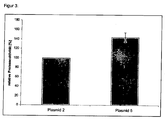
- the strain with the inventive plasmid 5 reached a 44% +/- 10 increased protease activity compared to the control containing the plasmid 2 (cf. FIG. 3 ).
Landscapes
- Health & Medical Sciences (AREA)
- Genetics & Genomics (AREA)
- Life Sciences & Earth Sciences (AREA)
- Engineering & Computer Science (AREA)
- Chemical & Material Sciences (AREA)
- Biomedical Technology (AREA)
- Wood Science & Technology (AREA)
- Organic Chemistry (AREA)
- Zoology (AREA)
- Bioinformatics & Cheminformatics (AREA)
- Biotechnology (AREA)
- General Engineering & Computer Science (AREA)
- Molecular Biology (AREA)
- Microbiology (AREA)
- Biochemistry (AREA)
- General Health & Medical Sciences (AREA)
- Plant Pathology (AREA)
- Biophysics (AREA)
- Physics & Mathematics (AREA)
- Medicinal Chemistry (AREA)
- Micro-Organisms Or Cultivation Processes Thereof (AREA)
- Preparation Of Compounds By Using Micro-Organisms (AREA)
- Enzymes And Modification Thereof (AREA)
Priority Applications (3)
| Application Number | Priority Date | Filing Date | Title |
|---|---|---|---|
| DK16178440.0T DK3118310T3 (da) | 2011-05-31 | 2012-05-25 | Ekspressionsvektorer til forbedret proteinsekretion |
| EP16178440.0A EP3118310B1 (de) | 2011-05-31 | 2012-05-25 | Expressionsvektoren zur verbesserten proteinsekretion |
| EP18212311.7A EP3527661B1 (de) | 2011-05-31 | 2012-05-25 | Expressionsvektoren zur verbesserten proteinsekretion |
Applications Claiming Priority (2)
| Application Number | Priority Date | Filing Date | Title |
|---|---|---|---|
| DE102011118032A DE102011118032A1 (de) | 2011-05-31 | 2011-05-31 | Expressionsvektoren zur verbesserten Proteinsekretion |
| PCT/EP2012/059901 WO2012163855A1 (de) | 2011-05-31 | 2012-05-25 | Expressionsvektoren zur verbesserten proteinsekretion |
Related Child Applications (3)
| Application Number | Title | Priority Date | Filing Date |
|---|---|---|---|
| EP16178440.0A Division-Into EP3118310B1 (de) | 2011-05-31 | 2012-05-25 | Expressionsvektoren zur verbesserten proteinsekretion |
| EP16178440.0A Division EP3118310B1 (de) | 2011-05-31 | 2012-05-25 | Expressionsvektoren zur verbesserten proteinsekretion |
| EP18212311.7A Division EP3527661B1 (de) | 2011-05-31 | 2012-05-25 | Expressionsvektoren zur verbesserten proteinsekretion |
Publications (2)
| Publication Number | Publication Date |
|---|---|
| EP2714902A1 EP2714902A1 (de) | 2014-04-09 |
| EP2714902B1 true EP2714902B1 (de) | 2016-09-14 |
Family
ID=46149497
Family Applications (3)
| Application Number | Title | Priority Date | Filing Date |
|---|---|---|---|
| EP12723512.5A Not-in-force EP2714902B1 (de) | 2011-05-31 | 2012-05-25 | Expressionsvektoren zur verbesserten proteinsekretion |
| EP18212311.7A Active EP3527661B1 (de) | 2011-05-31 | 2012-05-25 | Expressionsvektoren zur verbesserten proteinsekretion |
| EP16178440.0A Active EP3118310B1 (de) | 2011-05-31 | 2012-05-25 | Expressionsvektoren zur verbesserten proteinsekretion |
Family Applications After (2)
| Application Number | Title | Priority Date | Filing Date |
|---|---|---|---|
| EP18212311.7A Active EP3527661B1 (de) | 2011-05-31 | 2012-05-25 | Expressionsvektoren zur verbesserten proteinsekretion |
| EP16178440.0A Active EP3118310B1 (de) | 2011-05-31 | 2012-05-25 | Expressionsvektoren zur verbesserten proteinsekretion |
Country Status (14)
| Country | Link |
|---|---|
| US (3) | US9803183B2 (pl) |
| EP (3) | EP2714902B1 (pl) |
| JP (2) | JP6324309B2 (pl) |
| KR (1) | KR101956142B1 (pl) |
| CN (2) | CN103649310A (pl) |
| BR (1) | BR112013030846A2 (pl) |
| CA (1) | CA2835746A1 (pl) |
| DE (1) | DE102011118032A1 (pl) |
| DK (3) | DK3527661T3 (pl) |
| ES (2) | ES2763577T3 (pl) |
| MX (3) | MX363519B (pl) |
| PL (1) | PL2714902T3 (pl) |
| RU (1) | RU2661790C2 (pl) |
| WO (1) | WO2012163855A1 (pl) |
Families Citing this family (11)
| Publication number | Priority date | Publication date | Assignee | Title |
|---|---|---|---|---|
| DE102011118032A1 (de) * | 2011-05-31 | 2012-12-06 | Henkel Ag & Co. Kgaa | Expressionsvektoren zur verbesserten Proteinsekretion |
| CN108291179B (zh) | 2015-11-25 | 2020-07-07 | 荷兰联合利华有限公司 | 液体洗涤剂组合物 |
| RU2018124771A (ru) | 2015-12-09 | 2020-01-13 | Басф Се | Способ очистки белка от ферментационных твердых веществ при десорбирующих условиях |
| MX2019000621A (es) | 2016-07-14 | 2019-08-01 | Basf Se | Medio de fermentacion que comprende agente quelante. |
| EP3707255A1 (en) | 2017-11-09 | 2020-09-16 | Basf Se | Coatings of enzyme particles comprising organic white pigments |
| EP3717643A1 (en) | 2017-11-29 | 2020-10-07 | Danisco US Inc. | Subtilisin variants having improved stability |
| US12509672B2 (en) | 2018-11-28 | 2025-12-30 | Danisco Us Inc. | Subtilisin variants having improved stability |
| EP3770241A1 (de) * | 2019-07-22 | 2021-01-27 | Henkel AG & Co. KGaA | Reinigungsmittel mit protease zur automatischen dosierung |
| RU2747627C1 (ru) * | 2020-05-18 | 2021-05-11 | федеральное государственное бюджетное образовательное учреждение высшего образования "Алтайский государственный университет" | Рекомбинантная плазмида pUSB2-AmQ, обеспечивающая синтез белка альфа-амилазы Bacillus amyloliquefaciens, и штамм Bacillus subtilis/pUSB2-AmQ - продуцент белка альфа-амилазы Bacillus amyloliquefaciens |
| EP4624572A1 (en) * | 2024-03-27 | 2025-10-01 | Basf Se | Polypeptides having protease activity for use in detergent compositions |
| WO2025202372A1 (en) * | 2024-03-27 | 2025-10-02 | Basf Se | Polypeptides having protease activity for use in detergent compositions |
Family Cites Families (33)
| Publication number | Priority date | Publication date | Assignee | Title |
|---|---|---|---|---|
| ATE187490T1 (de) | 1989-08-25 | 1999-12-15 | Henkel Research Corp | Alkalisches proteolytisches enzym und verfahren zur herstellung |
| US5340735A (en) * | 1991-05-29 | 1994-08-23 | Cognis, Inc. | Bacillus lentus alkaline protease variants with increased stability |
| EP0877077B1 (en) | 1991-06-11 | 2010-05-26 | Genencor International, Inc. | Detergent composition containing cellulase compositions deficient in CBH I type components |
| DK82893D0 (da) * | 1993-07-08 | 1993-07-08 | Novo Nordisk As | Peptid |
| WO1996029397A1 (en) | 1995-03-17 | 1996-09-26 | Novo Nordisk A/S | Novel endoglucanases |
| ES2525677T3 (es) | 1995-10-17 | 2014-12-29 | Ab Enzymes Oy | Celulasas, genes que las codifican y usos de las mismas |
| CN100362100C (zh) | 1996-09-17 | 2008-01-16 | 诺沃奇梅兹有限公司 | 纤维素酶变体 |
| DE19713852A1 (de) | 1997-04-04 | 1998-10-08 | Henkel Kgaa | Aktivatoren für Persauerstoffverbindungen in Wasch- und Reinigungsmitteln |
| ES2532606T3 (es) | 1999-03-31 | 2015-03-30 | Novozymes A/S | Polipéptidos con actividad de alfa-amilasa alcalina y ácidos nucleicos que los codifican |
| AR027073A1 (es) | 1999-12-23 | 2003-03-12 | Upjohn Co | Ensayos y metodos de diagnostico y tratamiento basados en el uso de canales de sodio como objetivos de amiloide beta o de sus agregados |
| ATE481492T1 (de) | 2000-08-04 | 2010-10-15 | Genencor Int | Mutierte trichoderma reesei egiii cellulasen, dafür kodierende dna und verfahren zu deren herstellung |
| US20030049619A1 (en) * | 2001-03-21 | 2003-03-13 | Simon Delagrave | Methods for the synthesis of polynucleotides and combinatorial libraries of polynucleotides |
| JP4242761B2 (ja) | 2001-06-06 | 2009-03-25 | ノボザイムス アクティーゼルスカブ | エンド−β−1,4−グルカナーゼ |
| DE10131441A1 (de) | 2001-06-29 | 2003-01-30 | Henkel Kgaa | Eine neue Gruppe von alpha-Amylasen sowie ein Verfahren zur Identifizierung und Gewinnung neuer alpha-Amylasen |
| DE10162727A1 (de) | 2001-12-20 | 2003-07-10 | Henkel Kgaa | Neue Alkalische Protease aus Bacillus gibsonii (DSM 14391) und Wasch-und Reinigungsmittel enthaltend diese neue Alkalische Protease |
| DE10163748A1 (de) | 2001-12-21 | 2003-07-17 | Henkel Kgaa | Neue Glykosylhydrolasen |
| DE10260903A1 (de) | 2002-12-20 | 2004-07-08 | Henkel Kgaa | Neue Perhydrolasen |
| WO2004111224A1 (en) * | 2003-06-19 | 2004-12-23 | Novozymes A/S | Improved proteases and methods for producing them |
| CN103333870A (zh) | 2003-12-03 | 2013-10-02 | 丹尼斯科美国公司 | 过水解酶 |
| CN1926431A (zh) * | 2004-01-09 | 2007-03-07 | 诺维信股份有限公司 | 地衣芽孢杆菌染色体 |
| EP2216640A1 (en) * | 2004-01-09 | 2010-08-11 | Novozymes, Inc. | Bacillus licheniformis chromosome |
| DE102004029475A1 (de) | 2004-06-18 | 2006-01-26 | Henkel Kgaa | Neues enzymatisches Bleichsystem |
| DE102006038448A1 (de) | 2005-12-28 | 2008-02-21 | Henkel Kgaa | Enzym-haltiges Reinigungsmittel |
| WO2007122175A1 (en) * | 2006-04-20 | 2007-11-01 | Novozymes A/S | Savinase variants having an improved wash performance on egg stains |
| DE102006022224A1 (de) | 2006-05-11 | 2007-11-15 | Henkel Kgaa | Subtilisin aus Bacillus pumilus und Wasch- und Reinigungsmittel enthaltend dieses neue Subtilisin |
| EP2099818A2 (en) * | 2006-11-29 | 2009-09-16 | Novozymes Inc. | Bacillus licheniformis chromosome |
| DE102007003143A1 (de) | 2007-01-16 | 2008-07-17 | Henkel Kgaa | Neue Alkalische Protease aus Bacillus gibsonii und Wasch- und Reinigungsmittel enthaltend diese neue Alkalische Protease |
| DE102007049830A1 (de) * | 2007-10-16 | 2009-04-23 | Henkel Ag & Co. Kgaa | Neue Proteinvarianten durch zirkulare Permutation |
| DK2462224T3 (en) * | 2009-08-03 | 2017-09-04 | C-Lecta Gmbh | PROCEDURE FOR MANUFACTURING NUCLEASES OF A GRAM NEGATIVE BACTERY WHEN USING A GRAM POSITIVE EXPRESSION HOST |
| DE102009029513A1 (de) * | 2009-09-16 | 2011-03-24 | Henkel Ag & Co. Kgaa | Lagerstabiles flüssiges Wasch- oder Reinigungsmittel enthaltend Proteasen |
| DE102011007313A1 (de) | 2011-04-13 | 2012-10-18 | Henkel Ag & Co. Kgaa | Expressionsverfahren |
| DE102011118032A1 (de) * | 2011-05-31 | 2012-12-06 | Henkel Ag & Co. Kgaa | Expressionsvektoren zur verbesserten Proteinsekretion |
| DE102012201297A1 (de) | 2012-01-31 | 2013-08-01 | Basf Se | Expressionsverfahren |
-
2011
- 2011-05-31 DE DE102011118032A patent/DE102011118032A1/de not_active Withdrawn
-
2012
- 2012-05-25 PL PL12723512T patent/PL2714902T3/pl unknown
- 2012-05-25 DK DK18212311.7T patent/DK3527661T3/da active
- 2012-05-25 MX MX2016008931A patent/MX363519B/es unknown
- 2012-05-25 EP EP12723512.5A patent/EP2714902B1/de not_active Not-in-force
- 2012-05-25 WO PCT/EP2012/059901 patent/WO2012163855A1/de not_active Ceased
- 2012-05-25 MX MX2019003360A patent/MX376466B/es active IP Right Grant
- 2012-05-25 RU RU2013158458A patent/RU2661790C2/ru not_active IP Right Cessation
- 2012-05-25 EP EP18212311.7A patent/EP3527661B1/de active Active
- 2012-05-25 DK DK12723512.5T patent/DK2714902T3/en active
- 2012-05-25 KR KR1020137034520A patent/KR101956142B1/ko not_active Expired - Fee Related
- 2012-05-25 CA CA2835746A patent/CA2835746A1/en not_active Abandoned
- 2012-05-25 US US14/122,562 patent/US9803183B2/en not_active Expired - Fee Related
- 2012-05-25 ES ES16178440T patent/ES2763577T3/es active Active
- 2012-05-25 EP EP16178440.0A patent/EP3118310B1/de active Active
- 2012-05-25 CN CN201280026365.0A patent/CN103649310A/zh active Pending
- 2012-05-25 DK DK16178440.0T patent/DK3118310T3/da active
- 2012-05-25 BR BR112013030846A patent/BR112013030846A2/pt not_active Application Discontinuation
- 2012-05-25 ES ES12723512.5T patent/ES2606553T3/es active Active
- 2012-05-25 MX MX2013013616A patent/MX340485B/es active IP Right Grant
- 2012-05-25 CN CN201710933102.2A patent/CN107574177B/zh active Active
- 2012-05-25 JP JP2014513143A patent/JP6324309B2/ja active Active
-
2017
- 2017-03-17 JP JP2017052565A patent/JP6522030B2/ja not_active Expired - Fee Related
- 2017-09-22 US US15/712,652 patent/US10494622B2/en active Active
-
2019
- 2019-12-02 US US16/700,322 patent/US11046961B2/en not_active Expired - Fee Related
Also Published As
Similar Documents
| Publication | Publication Date | Title |
|---|---|---|
| EP2714902B1 (de) | Expressionsvektoren zur verbesserten proteinsekretion | |
| EP2809816B9 (de) | Expressionsverfahren | |
| EP2697376B1 (de) | Expressionsverfahren mit einer hilfsprotease | |
| EP2340306B1 (de) | Expressionsverstärkte nukleinsäuren | |
| DE102017215015A1 (de) | Verfahren zur verbesserten Expression von Enzymen |
Legal Events
| Date | Code | Title | Description |
|---|---|---|---|
| PUAI | Public reference made under article 153(3) epc to a published international application that has entered the european phase |
Free format text: ORIGINAL CODE: 0009012 |
|
| 17P | Request for examination filed |
Effective date: 20140102 |
|
| AK | Designated contracting states |
Kind code of ref document: A1 Designated state(s): AL AT BE BG CH CY CZ DE DK EE ES FI FR GB GR HR HU IE IS IT LI LT LU LV MC MK MT NL NO PL PT RO RS SE SI SK SM TR |
|
| DAX | Request for extension of the european patent (deleted) | ||
| 17Q | First examination report despatched |
Effective date: 20141104 |
|
| GRAP | Despatch of communication of intention to grant a patent |
Free format text: ORIGINAL CODE: EPIDOSNIGR1 |
|
| GRAJ | Information related to disapproval of communication of intention to grant by the applicant or resumption of examination proceedings by the epo deleted |
Free format text: ORIGINAL CODE: EPIDOSDIGR1 |
|
| GRAP | Despatch of communication of intention to grant a patent |
Free format text: ORIGINAL CODE: EPIDOSNIGR1 |
|
| INTG | Intention to grant announced |
Effective date: 20160422 |
|
| INTG | Intention to grant announced |
Effective date: 20160512 |
|
| GRAS | Grant fee paid |
Free format text: ORIGINAL CODE: EPIDOSNIGR3 |
|
| GRAA | (expected) grant |
Free format text: ORIGINAL CODE: 0009210 |
|
| AK | Designated contracting states |
Kind code of ref document: B1 Designated state(s): AL AT BE BG CH CY CZ DE DK EE ES FI FR GB GR HR HU IE IS IT LI LT LU LV MC MK MT NL NO PL PT RO RS SE SI SK SM TR |
|
| REG | Reference to a national code |
Ref country code: GB Ref legal event code: FG4D Free format text: NOT ENGLISH |
|
| REG | Reference to a national code |
Ref country code: CH Ref legal event code: EP |
|
| REG | Reference to a national code |
Ref country code: IE Ref legal event code: FG4D Free format text: LANGUAGE OF EP DOCUMENT: GERMAN |
|
| REG | Reference to a national code |
Ref country code: AT Ref legal event code: REF Ref document number: 829016 Country of ref document: AT Kind code of ref document: T Effective date: 20161015 |
|
| REG | Reference to a national code |
Ref country code: DE Ref legal event code: R096 Ref document number: 502012008246 Country of ref document: DE |
|
| REG | Reference to a national code |
Ref country code: NL Ref legal event code: FP |
|
| REG | Reference to a national code |
Ref country code: DK Ref legal event code: T3 Effective date: 20170103 |
|
| REG | Reference to a national code |
Ref country code: LT Ref legal event code: MG4D |
|
| PG25 | Lapsed in a contracting state [announced via postgrant information from national office to epo] |
Ref country code: RS Free format text: LAPSE BECAUSE OF FAILURE TO SUBMIT A TRANSLATION OF THE DESCRIPTION OR TO PAY THE FEE WITHIN THE PRESCRIBED TIME-LIMIT Effective date: 20160914 Ref country code: LT Free format text: LAPSE BECAUSE OF FAILURE TO SUBMIT A TRANSLATION OF THE DESCRIPTION OR TO PAY THE FEE WITHIN THE PRESCRIBED TIME-LIMIT Effective date: 20160914 Ref country code: NO Free format text: LAPSE BECAUSE OF FAILURE TO SUBMIT A TRANSLATION OF THE DESCRIPTION OR TO PAY THE FEE WITHIN THE PRESCRIBED TIME-LIMIT Effective date: 20161214 Ref country code: HR Free format text: LAPSE BECAUSE OF FAILURE TO SUBMIT A TRANSLATION OF THE DESCRIPTION OR TO PAY THE FEE WITHIN THE PRESCRIBED TIME-LIMIT Effective date: 20160914 |
|
| PG25 | Lapsed in a contracting state [announced via postgrant information from national office to epo] |
Ref country code: SE Free format text: LAPSE BECAUSE OF FAILURE TO SUBMIT A TRANSLATION OF THE DESCRIPTION OR TO PAY THE FEE WITHIN THE PRESCRIBED TIME-LIMIT Effective date: 20160914 Ref country code: GR Free format text: LAPSE BECAUSE OF FAILURE TO SUBMIT A TRANSLATION OF THE DESCRIPTION OR TO PAY THE FEE WITHIN THE PRESCRIBED TIME-LIMIT Effective date: 20161215 Ref country code: LV Free format text: LAPSE BECAUSE OF FAILURE TO SUBMIT A TRANSLATION OF THE DESCRIPTION OR TO PAY THE FEE WITHIN THE PRESCRIBED TIME-LIMIT Effective date: 20160914 |
|
| PG25 | Lapsed in a contracting state [announced via postgrant information from national office to epo] |
Ref country code: EE Free format text: LAPSE BECAUSE OF FAILURE TO SUBMIT A TRANSLATION OF THE DESCRIPTION OR TO PAY THE FEE WITHIN THE PRESCRIBED TIME-LIMIT Effective date: 20160914 Ref country code: RO Free format text: LAPSE BECAUSE OF FAILURE TO SUBMIT A TRANSLATION OF THE DESCRIPTION OR TO PAY THE FEE WITHIN THE PRESCRIBED TIME-LIMIT Effective date: 20160914 |
|
| REG | Reference to a national code |
Ref country code: FR Ref legal event code: PLFP Year of fee payment: 6 |
|
| PG25 | Lapsed in a contracting state [announced via postgrant information from national office to epo] |
Ref country code: CZ Free format text: LAPSE BECAUSE OF FAILURE TO SUBMIT A TRANSLATION OF THE DESCRIPTION OR TO PAY THE FEE WITHIN THE PRESCRIBED TIME-LIMIT Effective date: 20160914 Ref country code: PT Free format text: LAPSE BECAUSE OF FAILURE TO SUBMIT A TRANSLATION OF THE DESCRIPTION OR TO PAY THE FEE WITHIN THE PRESCRIBED TIME-LIMIT Effective date: 20170116 Ref country code: SK Free format text: LAPSE BECAUSE OF FAILURE TO SUBMIT A TRANSLATION OF THE DESCRIPTION OR TO PAY THE FEE WITHIN THE PRESCRIBED TIME-LIMIT Effective date: 20160914 Ref country code: IS Free format text: LAPSE BECAUSE OF FAILURE TO SUBMIT A TRANSLATION OF THE DESCRIPTION OR TO PAY THE FEE WITHIN THE PRESCRIBED TIME-LIMIT Effective date: 20170114 Ref country code: SM Free format text: LAPSE BECAUSE OF FAILURE TO SUBMIT A TRANSLATION OF THE DESCRIPTION OR TO PAY THE FEE WITHIN THE PRESCRIBED TIME-LIMIT Effective date: 20160914 Ref country code: BG Free format text: LAPSE BECAUSE OF FAILURE TO SUBMIT A TRANSLATION OF THE DESCRIPTION OR TO PAY THE FEE WITHIN THE PRESCRIBED TIME-LIMIT Effective date: 20161214 |
|
| REG | Reference to a national code |
Ref country code: DE Ref legal event code: R097 Ref document number: 502012008246 Country of ref document: DE |
|
| PLBE | No opposition filed within time limit |
Free format text: ORIGINAL CODE: 0009261 |
|
| STAA | Information on the status of an ep patent application or granted ep patent |
Free format text: STATUS: NO OPPOSITION FILED WITHIN TIME LIMIT |
|
| 26N | No opposition filed |
Effective date: 20170615 |
|
| PG25 | Lapsed in a contracting state [announced via postgrant information from national office to epo] |
Ref country code: LU Free format text: LAPSE BECAUSE OF NON-PAYMENT OF DUE FEES Effective date: 20170531 |
|
| PG25 | Lapsed in a contracting state [announced via postgrant information from national office to epo] |
Ref country code: SI Free format text: LAPSE BECAUSE OF FAILURE TO SUBMIT A TRANSLATION OF THE DESCRIPTION OR TO PAY THE FEE WITHIN THE PRESCRIBED TIME-LIMIT Effective date: 20160914 |
|
| REG | Reference to a national code |
Ref country code: CH Ref legal event code: PL |
|
| PG25 | Lapsed in a contracting state [announced via postgrant information from national office to epo] |
Ref country code: MC Free format text: LAPSE BECAUSE OF FAILURE TO SUBMIT A TRANSLATION OF THE DESCRIPTION OR TO PAY THE FEE WITHIN THE PRESCRIBED TIME-LIMIT Effective date: 20160914 |
|
| REG | Reference to a national code |
Ref country code: IE Ref legal event code: MM4A |
|
| PG25 | Lapsed in a contracting state [announced via postgrant information from national office to epo] |
Ref country code: CH Free format text: LAPSE BECAUSE OF NON-PAYMENT OF DUE FEES Effective date: 20170531 Ref country code: LI Free format text: LAPSE BECAUSE OF NON-PAYMENT OF DUE FEES Effective date: 20170531 |
|
| PG25 | Lapsed in a contracting state [announced via postgrant information from national office to epo] |
Ref country code: LU Free format text: LAPSE BECAUSE OF NON-PAYMENT OF DUE FEES Effective date: 20170525 |
|
| PG25 | Lapsed in a contracting state [announced via postgrant information from national office to epo] |
Ref country code: IE Free format text: LAPSE BECAUSE OF NON-PAYMENT OF DUE FEES Effective date: 20170525 |
|
| REG | Reference to a national code |
Ref country code: FR Ref legal event code: PLFP Year of fee payment: 7 |
|
| REG | Reference to a national code |
Ref country code: AT Ref legal event code: MM01 Ref document number: 829016 Country of ref document: AT Kind code of ref document: T Effective date: 20170525 |
|
| PG25 | Lapsed in a contracting state [announced via postgrant information from national office to epo] |
Ref country code: AT Free format text: LAPSE BECAUSE OF NON-PAYMENT OF DUE FEES Effective date: 20170525 |
|
| PG25 | Lapsed in a contracting state [announced via postgrant information from national office to epo] |
Ref country code: MT Free format text: LAPSE BECAUSE OF FAILURE TO SUBMIT A TRANSLATION OF THE DESCRIPTION OR TO PAY THE FEE WITHIN THE PRESCRIBED TIME-LIMIT Effective date: 20160914 |
|
| PG25 | Lapsed in a contracting state [announced via postgrant information from national office to epo] |
Ref country code: AL Free format text: LAPSE BECAUSE OF FAILURE TO SUBMIT A TRANSLATION OF THE DESCRIPTION OR TO PAY THE FEE WITHIN THE PRESCRIBED TIME-LIMIT Effective date: 20160914 |
|
| PG25 | Lapsed in a contracting state [announced via postgrant information from national office to epo] |
Ref country code: HU Free format text: LAPSE BECAUSE OF FAILURE TO SUBMIT A TRANSLATION OF THE DESCRIPTION OR TO PAY THE FEE WITHIN THE PRESCRIBED TIME-LIMIT; INVALID AB INITIO Effective date: 20120525 |
|
| PGFP | Annual fee paid to national office [announced via postgrant information from national office to epo] |
Ref country code: TR Payment date: 20190515 Year of fee payment: 8 |
|
| PG25 | Lapsed in a contracting state [announced via postgrant information from national office to epo] |
Ref country code: CY Free format text: LAPSE BECAUSE OF NON-PAYMENT OF DUE FEES Effective date: 20160914 |
|
| PG25 | Lapsed in a contracting state [announced via postgrant information from national office to epo] |
Ref country code: MK Free format text: LAPSE BECAUSE OF FAILURE TO SUBMIT A TRANSLATION OF THE DESCRIPTION OR TO PAY THE FEE WITHIN THE PRESCRIBED TIME-LIMIT Effective date: 20160914 |
|
| PGFP | Annual fee paid to national office [announced via postgrant information from national office to epo] |
Ref country code: ES Payment date: 20200609 Year of fee payment: 9 |
|
| PGFP | Annual fee paid to national office [announced via postgrant information from national office to epo] |
Ref country code: GB Payment date: 20200528 Year of fee payment: 9 Ref country code: BE Payment date: 20200527 Year of fee payment: 9 |
|
| PGFP | Annual fee paid to national office [announced via postgrant information from national office to epo] |
Ref country code: DE Payment date: 20210527 Year of fee payment: 10 Ref country code: IT Payment date: 20210520 Year of fee payment: 10 Ref country code: NL Payment date: 20210526 Year of fee payment: 10 Ref country code: FI Payment date: 20210519 Year of fee payment: 10 Ref country code: FR Payment date: 20210526 Year of fee payment: 10 |
|
| PGFP | Annual fee paid to national office [announced via postgrant information from national office to epo] |
Ref country code: DK Payment date: 20210521 Year of fee payment: 10 |
|
| GBPC | Gb: european patent ceased through non-payment of renewal fee |
Effective date: 20210525 |
|
| REG | Reference to a national code |
Ref country code: BE Ref legal event code: MM Effective date: 20210531 |
|
| PG25 | Lapsed in a contracting state [announced via postgrant information from national office to epo] |
Ref country code: GB Free format text: LAPSE BECAUSE OF NON-PAYMENT OF DUE FEES Effective date: 20210525 |
|
| PG25 | Lapsed in a contracting state [announced via postgrant information from national office to epo] |
Ref country code: TR Free format text: LAPSE BECAUSE OF NON-PAYMENT OF DUE FEES Effective date: 20200525 |
|
| PG25 | Lapsed in a contracting state [announced via postgrant information from national office to epo] |
Ref country code: BE Free format text: LAPSE BECAUSE OF NON-PAYMENT OF DUE FEES Effective date: 20210531 |
|
| REG | Reference to a national code |
Ref country code: ES Ref legal event code: FD2A Effective date: 20220805 |
|
| PG25 | Lapsed in a contracting state [announced via postgrant information from national office to epo] |
Ref country code: PL Free format text: LAPSE BECAUSE OF NON-PAYMENT OF DUE FEES Effective date: 20200525 |
|
| PG25 | Lapsed in a contracting state [announced via postgrant information from national office to epo] |
Ref country code: ES Free format text: LAPSE BECAUSE OF NON-PAYMENT OF DUE FEES Effective date: 20210526 |
|
| REG | Reference to a national code |
Ref country code: DE Ref legal event code: R119 Ref document number: 502012008246 Country of ref document: DE |
|
| REG | Reference to a national code |
Ref country code: DK Ref legal event code: EBP Effective date: 20220531 |
|
| REG | Reference to a national code |
Ref country code: NL Ref legal event code: MM Effective date: 20220601 |
|
| PG25 | Lapsed in a contracting state [announced via postgrant information from national office to epo] |
Ref country code: FI Free format text: LAPSE BECAUSE OF NON-PAYMENT OF DUE FEES Effective date: 20220525 |
|
| PG25 | Lapsed in a contracting state [announced via postgrant information from national office to epo] |
Ref country code: FR Free format text: LAPSE BECAUSE OF NON-PAYMENT OF DUE FEES Effective date: 20220531 Ref country code: DK Free format text: LAPSE BECAUSE OF NON-PAYMENT OF DUE FEES Effective date: 20220531 |
|
| PG25 | Lapsed in a contracting state [announced via postgrant information from national office to epo] |
Ref country code: DE Free format text: LAPSE BECAUSE OF NON-PAYMENT OF DUE FEES Effective date: 20221201 |
|
| PG25 | Lapsed in a contracting state [announced via postgrant information from national office to epo] |
Ref country code: NL Free format text: LAPSE BECAUSE OF NON-PAYMENT OF DUE FEES Effective date: 20220601 |
|
| PG25 | Lapsed in a contracting state [announced via postgrant information from national office to epo] |
Ref country code: IT Free format text: LAPSE BECAUSE OF NON-PAYMENT OF DUE FEES Effective date: 20220525 |