EP2711575B1 - Rotation transmitting apparatus, vehicle steering system, and intermediate shaft - Google Patents
Rotation transmitting apparatus, vehicle steering system, and intermediate shaft Download PDFInfo
- Publication number
- EP2711575B1 EP2711575B1 EP13184681.8A EP13184681A EP2711575B1 EP 2711575 B1 EP2711575 B1 EP 2711575B1 EP 13184681 A EP13184681 A EP 13184681A EP 2711575 B1 EP2711575 B1 EP 2711575B1
- Authority
- EP
- European Patent Office
- Prior art keywords
- shaft
- tooth
- rotary shaft
- protrusion
- external
- Prior art date
- Legal status (The legal status is an assumption and is not a legal conclusion. Google has not performed a legal analysis and makes no representation as to the accuracy of the status listed.)
- Not-in-force
Links
- 239000011347 resin Substances 0.000 claims description 17
- 229920005989 resin Polymers 0.000 claims description 17
- 230000006835 compression Effects 0.000 claims description 3
- 238000007906 compression Methods 0.000 claims description 3
- 230000003247 decreasing effect Effects 0.000 claims description 3
- 230000005489 elastic deformation Effects 0.000 description 13
- 239000011248 coating agent Substances 0.000 description 12
- 238000000576 coating method Methods 0.000 description 12
- 238000010586 diagram Methods 0.000 description 8
- 238000007493 shaping process Methods 0.000 description 5
- CWYNVVGOOAEACU-UHFFFAOYSA-N Fe2+ Chemical compound [Fe+2] CWYNVVGOOAEACU-UHFFFAOYSA-N 0.000 description 2
- 239000000463 material Substances 0.000 description 2
- 238000000034 method Methods 0.000 description 2
- 230000007935 neutral effect Effects 0.000 description 2
- 230000005540 biological transmission Effects 0.000 description 1
- 230000000694 effects Effects 0.000 description 1
- 239000012943 hotmelt Substances 0.000 description 1
- 238000005096 rolling process Methods 0.000 description 1
Images



Classifications
-
- F—MECHANICAL ENGINEERING; LIGHTING; HEATING; WEAPONS; BLASTING
- F16—ENGINEERING ELEMENTS AND UNITS; GENERAL MEASURES FOR PRODUCING AND MAINTAINING EFFECTIVE FUNCTIONING OF MACHINES OR INSTALLATIONS; THERMAL INSULATION IN GENERAL
- F16D—COUPLINGS FOR TRANSMITTING ROTATION; CLUTCHES; BRAKES
- F16D1/00—Couplings for rigidly connecting two coaxial shafts or other movable machine elements
- F16D1/10—Quick-acting couplings in which the parts are connected by simply bringing them together axially
- F16D1/108—Quick-acting couplings in which the parts are connected by simply bringing them together axially having retaining means rotating with the coupling and acting by interengaging parts, i.e. positive coupling
-
- F—MECHANICAL ENGINEERING; LIGHTING; HEATING; WEAPONS; BLASTING
- F16—ENGINEERING ELEMENTS AND UNITS; GENERAL MEASURES FOR PRODUCING AND MAINTAINING EFFECTIVE FUNCTIONING OF MACHINES OR INSTALLATIONS; THERMAL INSULATION IN GENERAL
- F16D—COUPLINGS FOR TRANSMITTING ROTATION; CLUTCHES; BRAKES
- F16D3/00—Yielding couplings, i.e. with means permitting movement between the connected parts during the drive
- F16D3/02—Yielding couplings, i.e. with means permitting movement between the connected parts during the drive adapted to specific functions
- F16D3/06—Yielding couplings, i.e. with means permitting movement between the connected parts during the drive adapted to specific functions specially adapted to allow axial displacement
-
- B—PERFORMING OPERATIONS; TRANSPORTING
- B62—LAND VEHICLES FOR TRAVELLING OTHERWISE THAN ON RAILS
- B62D—MOTOR VEHICLES; TRAILERS
- B62D1/00—Steering controls, i.e. means for initiating a change of direction of the vehicle
- B62D1/02—Steering controls, i.e. means for initiating a change of direction of the vehicle vehicle-mounted
- B62D1/16—Steering columns
- B62D1/18—Steering columns yieldable or adjustable, e.g. tiltable
- B62D1/185—Steering columns yieldable or adjustable, e.g. tiltable adjustable by axial displacement, e.g. telescopically
-
- F—MECHANICAL ENGINEERING; LIGHTING; HEATING; WEAPONS; BLASTING
- F16—ENGINEERING ELEMENTS AND UNITS; GENERAL MEASURES FOR PRODUCING AND MAINTAINING EFFECTIVE FUNCTIONING OF MACHINES OR INSTALLATIONS; THERMAL INSULATION IN GENERAL
- F16C—SHAFTS; FLEXIBLE SHAFTS; ELEMENTS OR CRANKSHAFT MECHANISMS; ROTARY BODIES OTHER THAN GEARING ELEMENTS; BEARINGS
- F16C3/00—Shafts; Axles; Cranks; Eccentrics
- F16C3/02—Shafts; Axles
- F16C3/03—Shafts; Axles telescopic
- F16C3/035—Shafts; Axles telescopic with built-in bearings
-
- F—MECHANICAL ENGINEERING; LIGHTING; HEATING; WEAPONS; BLASTING
- F16—ENGINEERING ELEMENTS AND UNITS; GENERAL MEASURES FOR PRODUCING AND MAINTAINING EFFECTIVE FUNCTIONING OF MACHINES OR INSTALLATIONS; THERMAL INSULATION IN GENERAL
- F16C—SHAFTS; FLEXIBLE SHAFTS; ELEMENTS OR CRANKSHAFT MECHANISMS; ROTARY BODIES OTHER THAN GEARING ELEMENTS; BEARINGS
- F16C2326/00—Articles relating to transporting
- F16C2326/20—Land vehicles
- F16C2326/24—Steering systems, e.g. steering rods or columns
-
- F—MECHANICAL ENGINEERING; LIGHTING; HEATING; WEAPONS; BLASTING
- F16—ENGINEERING ELEMENTS AND UNITS; GENERAL MEASURES FOR PRODUCING AND MAINTAINING EFFECTIVE FUNCTIONING OF MACHINES OR INSTALLATIONS; THERMAL INSULATION IN GENERAL
- F16D—COUPLINGS FOR TRANSMITTING ROTATION; CLUTCHES; BRAKES
- F16D1/00—Couplings for rigidly connecting two coaxial shafts or other movable machine elements
- F16D1/10—Quick-acting couplings in which the parts are connected by simply bringing them together axially
- F16D2001/103—Quick-acting couplings in which the parts are connected by simply bringing them together axially the torque is transmitted via splined connections
-
- Y—GENERAL TAGGING OF NEW TECHNOLOGICAL DEVELOPMENTS; GENERAL TAGGING OF CROSS-SECTIONAL TECHNOLOGIES SPANNING OVER SEVERAL SECTIONS OF THE IPC; TECHNICAL SUBJECTS COVERED BY FORMER USPC CROSS-REFERENCE ART COLLECTIONS [XRACs] AND DIGESTS
- Y10—TECHNICAL SUBJECTS COVERED BY FORMER USPC
- Y10T—TECHNICAL SUBJECTS COVERED BY FORMER US CLASSIFICATION
- Y10T403/00—Joints and connections
- Y10T403/70—Interfitted members
- Y10T403/7026—Longitudinally splined or fluted rod
- Y10T403/7035—Specific angle or shape of rib, key, groove, or shoulder
Definitions
- the invention relates to a rotation transmitting apparatus having two rotary shafts that are fitted together so as to be slidable relative to each other in the axial direction and so as to be engageable with each other in the rotational direction, a vehicle steering system, and an intermediate shaft.
- JP 2009-168144 A describes a rotation transmitting apparatus in which a spline shaft is fitted to a spline sleeve so as to be slidable relative to the spline sleeve in the axial direction and so as to be engageable with the spline sleeve in the rotational direction.
- JP 2009-168144 A describes a driving force transmission apparatus having protrusions 6PR formed at radially outer ends of ridges so as to extend in the axial direction, and protrusions 6RB formed at axially opposite ends of the ridges so as to extend continuously in the circumferential direction.
- the protrusions 6PR and the protrusions 6RB have the effect of decreasing a radial backlash between the spline sleeve and the spline shaft, thereby allowing the spline shaft to smoothly slide relative to the spline sleeve.
- the protrusions 6PR have the function of decreasing the radial backlash, but do not have the function of absorbing a backlash in the rotational direction. Therefore, it is not possible to smoothly transmit the rotation of the spline sleeve to the spline shaft. Further, the protrusions 6RB do not have the function of absorbing the backlash in the rotational direction. Therefore, it is not possible to smoothly transmit the rotation of the spline shaft to the spline sleeve.
- a rotation transmitting apparatus having the features of the preamble of claim 1 is known for example from WO 2012/066904 A1
- the invention provides a rotation transmitting apparatus configured such that rotation is smoothly transmitted between a first rotary shaft and a second rotary shaft, a vehicle steering system including the rotation transmitting apparatus, and an intermediate shaft provided with the rotation transmitting apparatus.
- a rotation transmitting apparatus including a first rotary shaft on which multiple external teeth projected radially outward and extending in an axial direction are formed so as to be arranged in a circumferential direction, and a second rotary shaft in which multiple internal teeth projected radially inward and extending in the axial direction are formed so as to be arranged in the circumferential direction, the second rotary shaft being fitted to the first rotary shaft so as to be slidable relative to the first rotary shaft in the axial direction and so as to be engageable with the first rotary shaft in a rotational direction through the use of the external teeth and the internal teeth, in which: the external teeth and the internal teeth have tooth flanks that are engaged with each other in the rotational direction; a protrusion is formed on the tooth flank of one of the external tooth and the internal tooth, the protrusion being projected toward the corresponding tooth flank of the other of the external tooth and the internal tooth and extending in the axial direction; and the protrusion is made
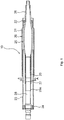
- FIG. 1 is a longitudinal sectional view of the vehicle steering system 10.
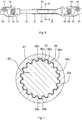
- FIG. 2 is a sectional view taken along the line A-A in FIG. 1 .
- FIG. 3 is a partially enlarged sectional view of FIG. 2 .
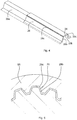
- FIG. 4 is an enlarged perspective view illustrating part of an inner shaft.
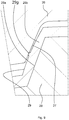
- FIG. 5 is a sectional view for describing a shaping process performed with the use of dies.
- the vehicle steering system 10 includes a steering tube 20 and a steering shaft 25 that are rotatably supported by the steering tube 20 via bearings 22, 24.
- the vehicle steering system 10 is secured to a vehicle body via a bracket (not shown).
- a steering wheel (not shown) is rotatably coupled to one end of the steering shaft 25, and an intermediate shaft (not shown) is rotatably coupled to the other end of the steering shaft 25.
- the steering tube 20 is formed of a cylindrical outer tube 21 and a cylindrical inner tube 23.
- the inner tube 23 is fitted to the outer tube 21 with a clearance.
- the bracket (not shown) is secured to the outer tube 21, and an outer shaft 26, which will be described later, is rotatably supported by the outer tube 21 via the bearing 22.
- the steering shaft 25 is formed of the cylindrical outer shaft 26 and the columnar inner shaft 28.
- the inner shaft 28 is fitted to the outer shaft 26 so as to be slidable relative to the outer shaft 26 in the axial direction and so as to be engageable with the outer shaft 26 in the rotational direction.
- the steering wheel (not shown) is coupled to one end of the outer shaft 26, and the intermediate shaft (not shown) is coupled to an end of the inner shaft 28, which is on the opposite side of the inner shaft 28 from the outer shaft 26. Further, the intermediate shaft is coupled to wheels via a pinion shaft and a rack shaft, which are not shown.
- splines are formed on the inner periphery of the outer shaft 26 and the outer periphery of the inner shaft 28.
- the splines of the outer shaft 26 have internal teeth 27 projected radially inward and each having a trapezoidal sectional shape
- the splines of the inner shaft 28 have external teeth 29 projected radially outward and each having a trapezoidal sectional shape.
- the internal teeth 27 are formed on the inner periphery of the outer shaft 26 at equal intervals in the circumferential direction, and extend in the axial direction.
- the external teeth 29 are formed on the outer periphery of the inner shaft 28 at equal intervals in the circumferential direction, and extend in the axial direction.
- the internal teeth 27 and the external teeth 29 have tooth flanks that are engaged with each other in the rotational direction.
- the section of the tooth flank of each of the internal teeth 27 has a straight line
- the section of the tooth flank of each of the external teeth 29 has an involute curve.
- the external teeth 29 are manufactured by forming base external teeth 29a each having a trapezoidal sectional shape through, for example, form rolling of ferrous material, then forming a resin coating 29b having a predetermined thickness on the base external teeth 29a, and finally shaping the outer periphery of the resin coating 29b with the use of, for example, dies ( FIG. 5 ).
- a protrusion 29c having a semicircular sectional shape is formed on each of the right and left tooth flanks of the external tooth 29.
- the protrusion 29c is projected to such a position as to contact the corresponding tooth flank of the internal tooth 27, and extends in parallel with the axis of the inner shaft 28.
- a portion of each spline of the inner shaft 28, the portion extending from one end of the spline to an intermediate portion thereof, is formed of the external tooth 29 having the resin coating 29b, and the remaining portion of the spline, the remaining portion extending from the intermediate portion to the other end of the spline, is formed of a portion of the base external tooth 29a having no resin coating 29b. It is not necessary to form the protrusions 29c on all the external teeth 29.
- no protrusions 29c are formed on the external teeth 29 that are adjacent to the external tooth 29 on which the protrusions 29c are formed.
- the area of contact between the protrusions 29c and the tooth flanks of the internal teeth 27 is smaller than the area of contact between the tooth flanks of the internal teeth 27 and the tooth flanks of the external teeth 29. Therefore, the protrusions 29c are easily deformed elastically.
- the base external teeth 29a each having a trapezoidal sectional shape are formed on the outer periphery of the inner shaft 28 at equal intervals in the circumferential direction.
- the resin coating 29b is formed on the portion of each base external tooth 29a, which extends from the one end of the base external tooth 29a to the intermediate portion thereof. After the resin coating 29b is cured, the resin coating 29b is subjected to the shaping process performed with the use of dies 95.
- the dies 95 include a rough cutting die and a finishing die.
- the resin coating 29b is roughly cut by the rough cutting die, and then the resin coating 29b is cut by the finishing die so as to be finished.
- the tooth flanks and the protrusions 29c are simultaneously formed.
- the portion of each spline of the inner shaft 28, which extends from one end of the spline to the intermediate portion thereof, is formed of the external tooth 29, and the remaining portion of the spline is formed of the base external teeth 29a.
- the resin coating 29b is made of a hot-melt resin. In another example, a two-component curable resin may be used.
- the inner shaft 28 is spline-fitted to the outer shaft 26. Because the protrusions 29c are softer than the tooth flanks, the inner shaft 28 is smoothly fitted to the outer shaft 26 and slid in the axial direction with no radial backlash.
- the bearing 22 is fitted to the outer tube 21, and the bearing 22 is secured to the outer tube 21 by clinching part of the outer tube 21.
- the bearing 24 is fitted to the inner tube 23, and the bearing 24 is secured to the inner tube 23 by clinching part of the inner tube 23.
- the bearing 22 is fitted to the steering shaft 25 and a snap ring is fitted to the steering shaft 25 to prevent the bearing 22 from being removed from the steering shaft 25.
- the bearing 24 is fitted to the steering shaft 25 and a snap ring is fitted to the steering shaft 25 to prevent the bearing 24 from being removed from the steering shaft 25.
- the steering shaft 25 is rotatably assembled to the steering tube 20.
- the outer tube 21 is moved in the longitudinal direction relative to the inner tube 23, and, at the same time, the outer shaft 26 is moved in the longitudinal direction relative to the inner shaft 28.
- the outer shaft 26 is smoothly slid relative to the inner shaft 28. Because the protrusions 29c extend over a predetermined length so as to be in parallel with the axis of the inner shaft 28, it is possible to restrain the outer shaft 26 from being tilted with respect to the inner shaft 28, and accordingly, the inner shaft 28 and the outer shaft 26 are easily assembled together.
- FIG. 6 is a front view illustrating the intermediate shaft.
- FIG. 7 is a sectional view taken along the line B-B in FIG. 6 .
- FIG. 8 is a partially enlarged sectional view of FIG. 7 .
- the intermediate shaft 50 is formed of an upper shaft 51, a lower shaft 55 that is telescopically and rotatably coupled to the upper shaft 51, a first universal joint 60 provided at an end of the upper shaft 51, which is on the opposite side of the upper shaft 51 from the lower shaft 55.
- the first universal joint 60 is formed of a first yoke 61, a first cruciform member (not shown), and a second yoke 65.
- the first yoke 61 and the first cruciform member are coupled to each other so as to be rotatable relative to each other, and the first cruciform member and the second yoke 65 are coupled to each other so as to be rotatable relative to each other.
- the axis of rotation of the first yoke 61 with respect to the first cruciform member is orthogonal to the axis of rotation of the second yoke 65 with respect to the first cruciform member.
- a steering shaft 80 of a vehicle steering system is coupled to the first yoke 61, and the upper shaft 51 is formed integrally with the second yoke 65.
- a threaded hole 62 is formed in the first yoke 61. The threaded hole 62 is used to fixedly fasten the steering shaft 80 to the first yoke 61.
- the second universal joint 70 is formed of a third yoke 71, a second cruciform member (not shown), and a fourth yoke 75.
- the third yoke 71 and the second cruciform member are coupled to each other so as to be rotatable relative to each other, and the second cruciform member and the fourth yoke 75 are coupled to each other so as to be rotatable relative to each other.
- the axis of rotation of the third yoke 71 with respect to the second cruciform member is orthogonal to the axis of rotation of the fourth yoke 75 with respect to the second cruciform member.
- a pinion shaft 85 is coupled to the third yoke 71, and the lower shaft 55 is formed integrally with the fourth yoke 75.
- a threaded hole 72 is formed in the third yoke 71. The threaded hole 72 is used fixedly fasten the pinion shaft 85 to the third yoke 71.
- splines are formed on the inner periphery of the upper shaft 51 and on the outer periphery of the lower shaft 55.
- the splines of the upper shaft 51 have internal teeth 52 projected radially inward and each having a trapezoidal sectional shape.
- the splines of the lower shaft 55 have external teeth 56 projected radially outward and each having a trapezoidal sectional shape.
- the internal teeth 52 are formed on the inner periphery of the upper shaft 51 at equal intervals in the circumferential direction, and extend in the axial direction.
- the external teeth 56 are formed on the outer periphery of the lower shaft 55 at equal intervals in the circumferential direction, and extend in the axial direction.
- the internal teeth 52 and the external teeth 56 have tooth flanks that are engaged with each other.
- the section of the tooth flank of each of the internal teeth 52 has an involute curve
- the section of the tooth flank of each of the external teeth 56 has an involute curve.
- the external teeth 56 are manufactured by forming base external teeth 56a each having a trapezoidal sectional shape from ferrous material, then forming a resin coating 56b having a predetermined thickness on the base external teeth 56a, and finally shaping the outer periphery of the resin coating 56b with the use of, for example, dies.
- a protrusion 56c having a semicircular sectional shape is formed on each of the right and left tooth flanks of each external tooth 56.
- the protrusion 56c is projected to such a position that a clearance 56d is formed between the protrusion 56c and the tooth flank of the internal tooth 52, and extends in parallel with the axis of the lower shaft 55. It is not necessary to form the protrusions 56c on all the external teeth 56. In the embodiment described above, no protrusions 56c are formed on the external teeth 56 that are adjacent to the external tooth 56 on which the protrusions 56c are formed.
- the rotation of the steering shaft 80 is transmitted to the pinion shaft 85 via the first universal joint 60, the upper shaft 51, the lower shaft 55, and the second universal joint 70. Because the protrusions 56c of the external teeth 56 of the lower shaft 55 come into contact with the tooth flanks of the internal teeth 52 of the upper shaft 51, the protrusions 56c extend over a predetermined length so as to be in parallel with the axis of the lower shaft 55, and the protrusions 56c have an elastic force large enough to transmit torque, the rotation of the upper shaft 51 is smoothly transmitted to the lower shaft 55.
- the clearance 56d is made as small as possible because the protrusions 56c have elasticity that is lower than the elasticity of the tooth flanks of the external teeth 56. Therefore, the rotation of the upper shaft 51 is immediately transmitted to the lower shaft 55.
- the positions and the configuration of protrusions are made different from those in the vehicle steering system in the first embodiment so that the amount of elastic deformation of the protrusions is controlled. Because the components and the parts other than the protrusions are substantially the same as those in the first embodiment, like reference numerals are used to denote these components and the parts, and descriptions thereof are omitted.
- FIG. 10 is a partially enlarged sectional view corresponding to FIG. 3 , and illustrating, as a state diagram, the amount of relative rotation between the outer shaft and the inner shaft.
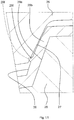
- FIG. 11 is a partially enlarged view of FIG. 10 illustrating, as a state diagram, the amount of elastic deformation of the protrusion before the relative rotation.
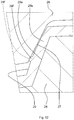
- FIG. 12 is a partially enlarged view of FIG. 10 illustrating, as a state diagram, the amount of elastic deformation of the protrusion after the relative rotation.
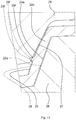
- FIG.13 is a partially enlarged view of FIG. 10 illustrating, as a state diagram, the amount of elastic deformation of the protrusion during the relative rotation.
- a protrusion 29f having a trapezoidal sectional shape is formed on each of the right and left tooth flanks of each external tooth 29.
- the protrusion 29f is projected to such a position as to contact the corresponding tooth flank of the internal tooth 27, and extends in parallel with the axis of the inner shaft 28.
- Each protrusion 29f is formed at a position that is in an intermediate region in the tooth depth direction of the external tooth 29 and that is close to the tooth tip of the internal tooth 27. It is not necessary to form the protrusions 29f on all the external teeth 29. In the embodiment described above, no protrusions 29f are formed on the external teeth 29 that are adjacent to the external tooth 29 on which the protrusions 29f are formed.
- Each of the protrusions 29f has a trapezoidal sectional shape having a high height as indicated by a dashed line shown in FIG. 11 , before the inner shaft 28 is spline-fitted to the outer shaft 26.
- the protrusion 29f has a trapezoidal sectional shape that is bulged like a barrel and that has a lower height and a wider crest, as indicated by a continuous line shown in FIG. 11 , after the inner shaft 28 is spline-fitted to the outer shaft 26. In this state, if the outer shaft 26 is removed from the inner shaft 28, the protrusion 29f substantially restores its original trapezoidal shape having a high height, as indicated by the dashed line.
- the external teeth 29 of the inner shaft 28 are rotated clockwise and counterclockwise relative to the internal teeth 27 of the outer shaft 26 until the protrusions 29f reach positions indicated by two-dot chain lines shown in FIG. 10 and FIG. 13 .
- the trapezoidal shape having a high height indicated by the dashed line shown in FIG. 13 is shifted to a position indicated by a dotted line due to the relative rotation.
- the protrusions 29f are compressed more greatly because the protrusions 29f are compressed due to not only the spline-fitting but also the relative rotation.
- each protrusion 29f is brought into a trapezoidal sectional shape having a low height and a wide crest as indicated by the dashed line shown in FIG. 12 . That is, each protrusion 29f is plastically deformed into the trapezoidal sectional shape having a low height and a wide crest as indicated by the dashed line shown in FIG. 12 , from the trapezoidal sectional shape having a high height as indicated by the dashed line shown in FIG. 11 .
- the sectional shape of the protrusion 29f is brought into a trapezoidal shape that is bulged like a barrel and that has a lower height and a wider crest as indicated by the continuous line shown in FIG. 12 . Because the elastic force of the protrusion 29f having a small elastic deformation amount and having a large elastic modulus as shown in FIG. 12 , is smaller than the elastic force of the protrusion 29f having a large elastic deformation amount and having a small elastic modulus as shown in FIG.
- the outer shaft 26 is smoothly slid with a small sliding resistance, relative to the inner shaft 28. Because the method of forming the splines of the inner shaft 28 in the fourth embodiment is the same as that in the first embodiment, the description thereof is omitted.
- the inner shaft 28 is spline-fitted to the outer shaft 26.
- the protrusion 29f is elastically deformed from the trapezoidal shape having a high height as indicated by the dashed line shown in FIG. 11 , into the trapezoidal shape that has a lower height and a wider crest and that is bulged like a barrel, as indicated by the continuous line shown in FIG. 11 .
- the external teeth 29 of the inner shaft 28 are rotated clockwise and counterclockwise relative to the internal teeth 27 of the outer shaft 26 until the protrusions 29f reach the positions indicated by two-dot chain lines shown in FIG. 10 and FIG. 13 .
- the protrusion 29f is plastically deformed from the trapezoidal shape having a high height indicated by the dashed line shown in FIG. 13 , into the trapezoidal shape having a low height and a wide crest indicated by the dashed line in FIG. 12 . Due to the spline-fitting, each protrusion 29f is elastically deformed from the trapezoidal shape having a low height and a wide crest as indicated by the dashed line in FIG. 12 , into the trapezoidal shape having a lower height and a wider crest and bulged like a barrel as indicated by the continuous line shown in FIG. 12 .
- the elastic deformation amount of the protrusion 29f shown in FIG. 12 after the plastic deformation is smaller than the elastic deformation amount of the protrusion 29f shown in FIG. 11 before the plastic deformation. Therefore, the elastic force of the protrusion 29f shown in FIG. 12 after the plastic deformation is smaller than the elastic force of the protrusion 29f shown in FIG. 11 before the plastic deformation. As a result, by the protrusions 29f after the plastic deformation, the rotation of the outer shaft 26 is smoothly transmitted to the inner shaft 28 with no radial backlash. Thus, the outer shaft 26 is allowed to slide relative to the inner shaft 28 even under low load.
- the bearing 22 is secured to the outer tube 21 by fitting the bearing 22 to the outer tube 21 and clinching part of the outer tube 21.
- the bearing 24 is secured to the inner tube 23 by fitting the bearing 24 to the inner tube 23 and clinching part of the inner tube 23.
- the bearing 22 is fitted to the steering shaft 25, and the snap ring is fitted to the steering shaft 25 to prevent the bearing 22 from being removed from the steering shaft 25.
- the bearing 24 is fitted to the steering shaft 25, and the snap ring is fitted to the steering shaft 25 to prevent the bearing 24 from being removed from the steering shaft 25.
- the steering shaft 25 is rotatably assembled within the steering tube 20.
- the outer tube 21 is moved relative to the inner tube 23 in the longitudinal direction, and, at the same time, the outer shaft 26 is moved relative to the inner shaft 28 in the longitudinal direction.
- the outer shaft 26 is smoothly slid relative to the inner shaft 28 under low load. Because the protrusions 29f extend over a predetermined length so as to be in parallel with the axis of the inner shaft 28, it is possible restrain the outer shaft 26 from being tilted with respect to the inner shaft 28. Therefore, the inner shaft 28 and the outer shaft 26 are easily assembled together.
- the operation for rotating the steering wheel will be described.
- the rotation of the steering wheel is transmitted to the intermediate shaft via the outer shaft 26 and the inner shaft 28.
- the protrusions 29f of the external teeth 29 of the inner shaft 28 come into contact with the tooth flanks of the internal teeth 27 of the outer shaft 26, the protrusions 29f extend over a predetermined length so as to be in parallel with the axis of the inner shaft 28, the protrusions 29f have an elastic force large enough to transmit torque, and the elastic force of the protrusions 29f is reduced by the plastic deformation, the rotation of the outer shaft 26 is smoothly transmitted by the inner shaft 28.
- each protrusion 29c is projected to such a position as to contact the corresponding tooth flank of the internal tooth 27 as shown in FIG. 3 .
- each protrusion 29g may be projected to such a position that the protrusion 29g is pressed against the corresponding tooth flank of the internal tooth 27, as shown in FIG. 9.
- FIG. 9 shows a state in which the inner shaft 28 is in a neutral state with respect to the outer shaft 26.
- the protrusion 29g before compression is indicated by a two-dot chain line, and the protrusion 29g after the compression is indicated by a continuous line.
- the protrusion 29g that is compressed in the neutral state has the elasticity with which the protrusion 29g can be further compressed. Because the protrusions 29g are compressed between the tooth flanks of the internal teeth 27 and the tooth flanks of the external teeth 29, it is possible to eliminate a backlash between the outer shaft 26 and the inner shaft 28.
- the protrusions 29c that come into contact with the tooth flanks of the internal teeth 27 of the outer shaft 26 are formed on the tooth flanks of the external teeth 29 of the inner shaft 28.
- protrusions that come into contact with the tooth flanks of the external teeth 29 of the inner shaft 28 may be formed on the tooth flanks of the internal teeth 27 of the outer shaft 26.
- the protrusions 29c each having a semicircular sectional shape are formed on the right and left tooth flanks of each of the external teeth 29.
- protrusions 29c each having a sectional shape in which opposite sides of a circular arc are connected by a straight line may be formed on the right and left tooth flanks of each of the external teeth 29.
- the protrusions 29c each having a semicircular sectional shape are formed on the right and left tooth flanks of each external tooth 29.
- the protrusion 29c having a semicircular sectional shape may be formed on the left tooth flank of one of adjacent external teeth 29, and the protrusion 29c having a semicircular sectional shape may be formed on the right tooth flank of the other one of the adjacent external teeth 29.
- the protrusions 29c are formed on six external teeth 29 among the eighteen external teeth 29.
- the invention should not be limited to this, and the total number of the external teeth 29 and the number of the external teeth 29 on which the protrusions 29c are formed may be set as appropriate.
Landscapes
- Engineering & Computer Science (AREA)
- General Engineering & Computer Science (AREA)
- Mechanical Engineering (AREA)
- Ocean & Marine Engineering (AREA)
- Chemical & Material Sciences (AREA)
- Combustion & Propulsion (AREA)
- Transportation (AREA)
- Steering Controls (AREA)
Applications Claiming Priority (2)
| Application Number | Priority Date | Filing Date | Title |
|---|---|---|---|
| JP2012205716 | 2012-09-19 | ||
| JP2013062252A JP6205778B2 (ja) | 2012-09-19 | 2013-03-25 | 回転伝達装置、車両用ステアリング装置およびインターミディエイトシャフト |
Publications (2)
| Publication Number | Publication Date |
|---|---|
| EP2711575A1 EP2711575A1 (en) | 2014-03-26 |
| EP2711575B1 true EP2711575B1 (en) | 2017-10-25 |
Family
ID=49223592
Family Applications (1)
| Application Number | Title | Priority Date | Filing Date |
|---|---|---|---|
| EP13184681.8A Not-in-force EP2711575B1 (en) | 2012-09-19 | 2013-09-17 | Rotation transmitting apparatus, vehicle steering system, and intermediate shaft |
Country Status (4)
| Country | Link |
|---|---|
| US (1) | US9005038B2 (enExample) |
| EP (1) | EP2711575B1 (enExample) |
| JP (1) | JP6205778B2 (enExample) |
| CN (1) | CN103671590B (enExample) |
Families Citing this family (14)
| Publication number | Priority date | Publication date | Assignee | Title |
|---|---|---|---|---|
| DE102014105822B4 (de) | 2014-04-25 | 2016-03-03 | Thyssenkrupp Presta Ag | Lenkwelle für ein Kraftfahrzeug |
| JP6236381B2 (ja) * | 2014-12-25 | 2017-11-22 | 株式会社ファルテック | 車両用グリルシャッタ、車両用フラップ部材及びアクチュエータ |
| EP3002145B1 (en) * | 2014-09-30 | 2017-10-18 | Faltec Company Limited | Vehicle grill shutter, vehicle flap member, and actuator |
| US20170058940A1 (en) * | 2015-08-26 | 2017-03-02 | Neapco Drivelines, Llc | Radial pilot for slip-in-tube driveshaft |
| US9956985B2 (en) * | 2016-02-16 | 2018-05-01 | Steering Solutions Ip Holding Corporation | Steering shaft assembly |
| DE102016221451B4 (de) * | 2016-06-17 | 2019-04-25 | Thyssenkrupp Ag | Teleskopierbare Lenkwelle mit Auszugssicherung |
| US10680549B2 (en) | 2016-09-27 | 2020-06-09 | Neapco Intellectual Property Holdings, Llc | Solar tracker drive shaft |
| DE102016014768A1 (de) * | 2016-12-10 | 2018-06-14 | Daimler Ag | Nockenwelle für eine Verbrennungskraftmaschine |
| US10882070B2 (en) | 2017-03-28 | 2021-01-05 | Steering Solutions Ip Holding Corporation | Method of manufacturing a steering shaft assembly |
| KR102196925B1 (ko) * | 2017-10-31 | 2020-12-30 | 이래에이엠에스 주식회사 | 컬랩서블 스티어링 칼럼 어셈블리 |
| US11052937B2 (en) * | 2018-01-19 | 2021-07-06 | Steering Solutions Ip Holding Corporation | Splined component assembly and method |
| JP2020183769A (ja) * | 2019-04-26 | 2020-11-12 | トヨタ自動車株式会社 | 動力伝達装置 |
| JP7327835B2 (ja) * | 2019-10-23 | 2023-08-16 | 住友電工焼結合金株式会社 | 歯車部材 |
| JP2021173307A (ja) * | 2020-04-22 | 2021-11-01 | 株式会社ジェイテクト | 伸縮軸 |
Family Cites Families (10)
| Publication number | Priority date | Publication date | Assignee | Title |
|---|---|---|---|---|
| US2166931A (en) * | 1935-10-17 | 1939-07-25 | Hamill William Wilson | Shock-absorbing steering wheel for automobiles |
| DE1267480B (de) * | 1962-03-26 | 1968-05-02 | Theo Burdelski | Elastische Zahnkupplung |
| JP2956334B2 (ja) * | 1991-12-04 | 1999-10-04 | トヨタ自動車株式会社 | スプラインの構造 |
| US5460574A (en) | 1993-08-31 | 1995-10-24 | Trw Inc. | Variable length shaft assembly with a lash bushing |
| US6283867B1 (en) | 1999-12-07 | 2001-09-04 | Koyo Seiko Co., Ltd. | Elastic shaft joint |
| JP2008261424A (ja) * | 2007-04-12 | 2008-10-30 | Nsk Ltd | 伸縮軸 |
| JP2009168144A (ja) * | 2008-01-16 | 2009-07-30 | Nissan Motor Co Ltd | スプライン構造及びこれを備える駆動力伝達装置 |
| JP2011038560A (ja) * | 2009-08-07 | 2011-02-24 | Jtekt Corp | スプライン伸縮軸及びその製造方法並びに車両用操舵装置 |
| JP5453012B2 (ja) * | 2009-08-07 | 2014-03-26 | 株式会社ジェイテクト | スプライン伸縮軸の製造方法 |
| JP5549658B2 (ja) | 2010-11-18 | 2014-07-16 | 日本精工株式会社 | 伸縮軸の製造方法、及び、この製造方法によって製造した伸縮軸 |
-
2013
- 2013-03-25 JP JP2013062252A patent/JP6205778B2/ja not_active Expired - Fee Related
- 2013-09-12 US US14/025,136 patent/US9005038B2/en not_active Expired - Fee Related
- 2013-09-16 CN CN201310421354.9A patent/CN103671590B/zh not_active Expired - Fee Related
- 2013-09-17 EP EP13184681.8A patent/EP2711575B1/en not_active Not-in-force
Non-Patent Citations (1)
| Title |
|---|
| None * |
Also Published As
| Publication number | Publication date |
|---|---|
| US9005038B2 (en) | 2015-04-14 |
| EP2711575A1 (en) | 2014-03-26 |
| US20140080614A1 (en) | 2014-03-20 |
| CN103671590A (zh) | 2014-03-26 |
| CN103671590B (zh) | 2018-08-10 |
| JP6205778B2 (ja) | 2017-10-04 |
| JP2014077537A (ja) | 2014-05-01 |
Similar Documents
| Publication | Publication Date | Title |
|---|---|---|
| US9005038B2 (en) | Rotation transmitting apparatus, vehicle steering system, and intermediate shaft | |
| EP2787236B1 (en) | Telescopic shaft | |
| EP3001060B1 (en) | Torque transmission shaft with yoke for universal joint and manufacturing method therefor | |
| EP3263937B1 (en) | Joint for torque transmission and worm reduction gear | |
| US9951806B2 (en) | Telescopic shaft | |
| US10661824B2 (en) | Steering system | |
| EP3453906B1 (en) | Joint for torque transmission and electric power steering device | |
| JP6996626B2 (ja) | 樹脂製歯車及び樹脂製歯車の製造方法 | |
| EP2565051B1 (en) | Wheel supporting device | |
| US20150298721A1 (en) | Rack shaft and method for manufacturing rack shaft | |
| EP3208480B1 (en) | Torque transmission coupling and electric power steering device | |
| JP2018024366A (ja) | ステアリング装置 | |
| JP2017214956A (ja) | ボールねじ装置およびステアリング装置 | |
| US11052937B2 (en) | Splined component assembly and method | |
| US11891112B2 (en) | Intermediate shaft axial retention device | |
| KR101526548B1 (ko) | 자동차용 유니버설 조인트의 샤프트조인트 | |
| JP5077360B2 (ja) | 伸縮軸の製造方法 | |
| JP7107369B2 (ja) | 樹脂製歯車 | |
| US11614150B2 (en) | Ball screw nut and method for producing a ball screw nut | |
| JP6318930B2 (ja) | 電動式パワーステアリング装置 | |
| JPWO2017082339A1 (ja) | 電動式パワーステアリング装置及びその製造方法 | |
| JP2006143024A (ja) | 伝達比可変操舵装置 | |
| JP2011226615A (ja) | 動力伝達部材の製造方法 | |
| JP2007076648A (ja) | 衝撃吸収式ステアリングシャフト |
Legal Events
| Date | Code | Title | Description |
|---|---|---|---|
| PUAI | Public reference made under article 153(3) epc to a published international application that has entered the european phase |
Free format text: ORIGINAL CODE: 0009012 |
|
| AK | Designated contracting states |
Kind code of ref document: A1 Designated state(s): AL AT BE BG CH CY CZ DE DK EE ES FI FR GB GR HR HU IE IS IT LI LT LU LV MC MK MT NL NO PL PT RO RS SE SI SK SM TR |
|
| AX | Request for extension of the european patent |
Extension state: BA ME |
|
| 17P | Request for examination filed |
Effective date: 20140924 |
|
| RBV | Designated contracting states (corrected) |
Designated state(s): AL AT BE BG CH CY CZ DE DK EE ES FI FR GB GR HR HU IE IS IT LI LT LU LV MC MK MT NL NO PL PT RO RS SE SI SK SM TR |
|
| GRAP | Despatch of communication of intention to grant a patent |
Free format text: ORIGINAL CODE: EPIDOSNIGR1 |
|
| RIC1 | Information provided on ipc code assigned before grant |
Ipc: F16D 3/06 20060101AFI20170331BHEP Ipc: F16D 1/10 20060101ALI20170331BHEP Ipc: B62D 1/16 20060101ALI20170331BHEP |
|
| INTG | Intention to grant announced |
Effective date: 20170428 |
|
| GRAS | Grant fee paid |
Free format text: ORIGINAL CODE: EPIDOSNIGR3 |
|
| GRAA | (expected) grant |
Free format text: ORIGINAL CODE: 0009210 |
|
| AK | Designated contracting states |
Kind code of ref document: B1 Designated state(s): AL AT BE BG CH CY CZ DE DK EE ES FI FR GB GR HR HU IE IS IT LI LT LU LV MC MK MT NL NO PL PT RO RS SE SI SK SM TR |
|
| REG | Reference to a national code |
Ref country code: GB Ref legal event code: FG4D |
|
| REG | Reference to a national code |
Ref country code: CH Ref legal event code: EP |
|
| REG | Reference to a national code |
Ref country code: AT Ref legal event code: REF Ref document number: 940243 Country of ref document: AT Kind code of ref document: T Effective date: 20171115 |
|
| REG | Reference to a national code |
Ref country code: IE Ref legal event code: FG4D |
|
| REG | Reference to a national code |
Ref country code: DE Ref legal event code: R096 Ref document number: 602013028327 Country of ref document: DE |
|
| REG | Reference to a national code |
Ref country code: NL Ref legal event code: MP Effective date: 20171025 |
|
| REG | Reference to a national code |
Ref country code: LT Ref legal event code: MG4D |
|
| REG | Reference to a national code |
Ref country code: AT Ref legal event code: MK05 Ref document number: 940243 Country of ref document: AT Kind code of ref document: T Effective date: 20171025 |
|
| PG25 | Lapsed in a contracting state [announced via postgrant information from national office to epo] |
Ref country code: NL Free format text: LAPSE BECAUSE OF FAILURE TO SUBMIT A TRANSLATION OF THE DESCRIPTION OR TO PAY THE FEE WITHIN THE PRESCRIBED TIME-LIMIT Effective date: 20171025 |
|
| PG25 | Lapsed in a contracting state [announced via postgrant information from national office to epo] |
Ref country code: SE Free format text: LAPSE BECAUSE OF FAILURE TO SUBMIT A TRANSLATION OF THE DESCRIPTION OR TO PAY THE FEE WITHIN THE PRESCRIBED TIME-LIMIT Effective date: 20171025 Ref country code: LT Free format text: LAPSE BECAUSE OF FAILURE TO SUBMIT A TRANSLATION OF THE DESCRIPTION OR TO PAY THE FEE WITHIN THE PRESCRIBED TIME-LIMIT Effective date: 20171025 Ref country code: FI Free format text: LAPSE BECAUSE OF FAILURE TO SUBMIT A TRANSLATION OF THE DESCRIPTION OR TO PAY THE FEE WITHIN THE PRESCRIBED TIME-LIMIT Effective date: 20171025 Ref country code: NO Free format text: LAPSE BECAUSE OF FAILURE TO SUBMIT A TRANSLATION OF THE DESCRIPTION OR TO PAY THE FEE WITHIN THE PRESCRIBED TIME-LIMIT Effective date: 20180125 Ref country code: ES Free format text: LAPSE BECAUSE OF FAILURE TO SUBMIT A TRANSLATION OF THE DESCRIPTION OR TO PAY THE FEE WITHIN THE PRESCRIBED TIME-LIMIT Effective date: 20171025 |
|
| PG25 | Lapsed in a contracting state [announced via postgrant information from national office to epo] |
Ref country code: AT Free format text: LAPSE BECAUSE OF FAILURE TO SUBMIT A TRANSLATION OF THE DESCRIPTION OR TO PAY THE FEE WITHIN THE PRESCRIBED TIME-LIMIT Effective date: 20171025 Ref country code: BG Free format text: LAPSE BECAUSE OF FAILURE TO SUBMIT A TRANSLATION OF THE DESCRIPTION OR TO PAY THE FEE WITHIN THE PRESCRIBED TIME-LIMIT Effective date: 20180125 Ref country code: RS Free format text: LAPSE BECAUSE OF FAILURE TO SUBMIT A TRANSLATION OF THE DESCRIPTION OR TO PAY THE FEE WITHIN THE PRESCRIBED TIME-LIMIT Effective date: 20171025 Ref country code: GR Free format text: LAPSE BECAUSE OF FAILURE TO SUBMIT A TRANSLATION OF THE DESCRIPTION OR TO PAY THE FEE WITHIN THE PRESCRIBED TIME-LIMIT Effective date: 20180126 Ref country code: IS Free format text: LAPSE BECAUSE OF FAILURE TO SUBMIT A TRANSLATION OF THE DESCRIPTION OR TO PAY THE FEE WITHIN THE PRESCRIBED TIME-LIMIT Effective date: 20180225 Ref country code: LV Free format text: LAPSE BECAUSE OF FAILURE TO SUBMIT A TRANSLATION OF THE DESCRIPTION OR TO PAY THE FEE WITHIN THE PRESCRIBED TIME-LIMIT Effective date: 20171025 Ref country code: HR Free format text: LAPSE BECAUSE OF FAILURE TO SUBMIT A TRANSLATION OF THE DESCRIPTION OR TO PAY THE FEE WITHIN THE PRESCRIBED TIME-LIMIT Effective date: 20171025 |
|
| REG | Reference to a national code |
Ref country code: DE Ref legal event code: R097 Ref document number: 602013028327 Country of ref document: DE |
|
| PG25 | Lapsed in a contracting state [announced via postgrant information from national office to epo] |
Ref country code: SK Free format text: LAPSE BECAUSE OF FAILURE TO SUBMIT A TRANSLATION OF THE DESCRIPTION OR TO PAY THE FEE WITHIN THE PRESCRIBED TIME-LIMIT Effective date: 20171025 Ref country code: CZ Free format text: LAPSE BECAUSE OF FAILURE TO SUBMIT A TRANSLATION OF THE DESCRIPTION OR TO PAY THE FEE WITHIN THE PRESCRIBED TIME-LIMIT Effective date: 20171025 Ref country code: DK Free format text: LAPSE BECAUSE OF FAILURE TO SUBMIT A TRANSLATION OF THE DESCRIPTION OR TO PAY THE FEE WITHIN THE PRESCRIBED TIME-LIMIT Effective date: 20171025 Ref country code: CY Free format text: LAPSE BECAUSE OF FAILURE TO SUBMIT A TRANSLATION OF THE DESCRIPTION OR TO PAY THE FEE WITHIN THE PRESCRIBED TIME-LIMIT Effective date: 20171025 Ref country code: EE Free format text: LAPSE BECAUSE OF FAILURE TO SUBMIT A TRANSLATION OF THE DESCRIPTION OR TO PAY THE FEE WITHIN THE PRESCRIBED TIME-LIMIT Effective date: 20171025 |
|
| REG | Reference to a national code |
Ref country code: FR Ref legal event code: PLFP Year of fee payment: 6 |
|
| PG25 | Lapsed in a contracting state [announced via postgrant information from national office to epo] |
Ref country code: IT Free format text: LAPSE BECAUSE OF FAILURE TO SUBMIT A TRANSLATION OF THE DESCRIPTION OR TO PAY THE FEE WITHIN THE PRESCRIBED TIME-LIMIT Effective date: 20171025 Ref country code: RO Free format text: LAPSE BECAUSE OF FAILURE TO SUBMIT A TRANSLATION OF THE DESCRIPTION OR TO PAY THE FEE WITHIN THE PRESCRIBED TIME-LIMIT Effective date: 20171025 Ref country code: PL Free format text: LAPSE BECAUSE OF FAILURE TO SUBMIT A TRANSLATION OF THE DESCRIPTION OR TO PAY THE FEE WITHIN THE PRESCRIBED TIME-LIMIT Effective date: 20171025 Ref country code: SM Free format text: LAPSE BECAUSE OF FAILURE TO SUBMIT A TRANSLATION OF THE DESCRIPTION OR TO PAY THE FEE WITHIN THE PRESCRIBED TIME-LIMIT Effective date: 20171025 |
|
| PLBE | No opposition filed within time limit |
Free format text: ORIGINAL CODE: 0009261 |
|
| STAA | Information on the status of an ep patent application or granted ep patent |
Free format text: STATUS: NO OPPOSITION FILED WITHIN TIME LIMIT |
|
| 26N | No opposition filed |
Effective date: 20180726 |
|
| PG25 | Lapsed in a contracting state [announced via postgrant information from national office to epo] |
Ref country code: SI Free format text: LAPSE BECAUSE OF FAILURE TO SUBMIT A TRANSLATION OF THE DESCRIPTION OR TO PAY THE FEE WITHIN THE PRESCRIBED TIME-LIMIT Effective date: 20171025 |
|
| PG25 | Lapsed in a contracting state [announced via postgrant information from national office to epo] |
Ref country code: MC Free format text: LAPSE BECAUSE OF FAILURE TO SUBMIT A TRANSLATION OF THE DESCRIPTION OR TO PAY THE FEE WITHIN THE PRESCRIBED TIME-LIMIT Effective date: 20171025 |
|
| REG | Reference to a national code |
Ref country code: CH Ref legal event code: PL |
|
| GBPC | Gb: european patent ceased through non-payment of renewal fee |
Effective date: 20180917 |
|
| REG | Reference to a national code |
Ref country code: BE Ref legal event code: MM Effective date: 20180930 |
|
| REG | Reference to a national code |
Ref country code: IE Ref legal event code: MM4A |
|
| PG25 | Lapsed in a contracting state [announced via postgrant information from national office to epo] |
Ref country code: LU Free format text: LAPSE BECAUSE OF NON-PAYMENT OF DUE FEES Effective date: 20180917 |
|
| PG25 | Lapsed in a contracting state [announced via postgrant information from national office to epo] |
Ref country code: IE Free format text: LAPSE BECAUSE OF NON-PAYMENT OF DUE FEES Effective date: 20180917 |
|
| PG25 | Lapsed in a contracting state [announced via postgrant information from national office to epo] |
Ref country code: CH Free format text: LAPSE BECAUSE OF NON-PAYMENT OF DUE FEES Effective date: 20180930 Ref country code: BE Free format text: LAPSE BECAUSE OF NON-PAYMENT OF DUE FEES Effective date: 20180930 Ref country code: LI Free format text: LAPSE BECAUSE OF NON-PAYMENT OF DUE FEES Effective date: 20180930 |
|
| PG25 | Lapsed in a contracting state [announced via postgrant information from national office to epo] |
Ref country code: GB Free format text: LAPSE BECAUSE OF NON-PAYMENT OF DUE FEES Effective date: 20180917 |
|
| PGFP | Annual fee paid to national office [announced via postgrant information from national office to epo] |
Ref country code: DE Payment date: 20190903 Year of fee payment: 7 Ref country code: FR Payment date: 20190815 Year of fee payment: 7 |
|
| PG25 | Lapsed in a contracting state [announced via postgrant information from national office to epo] |
Ref country code: MT Free format text: LAPSE BECAUSE OF NON-PAYMENT OF DUE FEES Effective date: 20180917 |
|
| PG25 | Lapsed in a contracting state [announced via postgrant information from national office to epo] |
Ref country code: TR Free format text: LAPSE BECAUSE OF FAILURE TO SUBMIT A TRANSLATION OF THE DESCRIPTION OR TO PAY THE FEE WITHIN THE PRESCRIBED TIME-LIMIT Effective date: 20171025 |
|
| PG25 | Lapsed in a contracting state [announced via postgrant information from national office to epo] |
Ref country code: PT Free format text: LAPSE BECAUSE OF FAILURE TO SUBMIT A TRANSLATION OF THE DESCRIPTION OR TO PAY THE FEE WITHIN THE PRESCRIBED TIME-LIMIT Effective date: 20171025 Ref country code: HU Free format text: LAPSE BECAUSE OF FAILURE TO SUBMIT A TRANSLATION OF THE DESCRIPTION OR TO PAY THE FEE WITHIN THE PRESCRIBED TIME-LIMIT; INVALID AB INITIO Effective date: 20130917 |
|
| PG25 | Lapsed in a contracting state [announced via postgrant information from national office to epo] |
Ref country code: MK Free format text: LAPSE BECAUSE OF NON-PAYMENT OF DUE FEES Effective date: 20171025 |
|
| PG25 | Lapsed in a contracting state [announced via postgrant information from national office to epo] |
Ref country code: AL Free format text: LAPSE BECAUSE OF FAILURE TO SUBMIT A TRANSLATION OF THE DESCRIPTION OR TO PAY THE FEE WITHIN THE PRESCRIBED TIME-LIMIT Effective date: 20171025 |
|
| REG | Reference to a national code |
Ref country code: DE Ref legal event code: R119 Ref document number: 602013028327 Country of ref document: DE |
|
| PG25 | Lapsed in a contracting state [announced via postgrant information from national office to epo] |
Ref country code: DE Free format text: LAPSE BECAUSE OF NON-PAYMENT OF DUE FEES Effective date: 20210401 Ref country code: FR Free format text: LAPSE BECAUSE OF NON-PAYMENT OF DUE FEES Effective date: 20200930 |