EP2693222A1 - Handheld devices, systems, and methods for measuring parameters - Google Patents
Handheld devices, systems, and methods for measuring parameters Download PDFInfo
- Publication number
- EP2693222A1 EP2693222A1 EP13178568.5A EP13178568A EP2693222A1 EP 2693222 A1 EP2693222 A1 EP 2693222A1 EP 13178568 A EP13178568 A EP 13178568A EP 2693222 A1 EP2693222 A1 EP 2693222A1
- Authority
- EP
- European Patent Office
- Prior art keywords
- measurement
- host
- handheld
- host device
- primary
- Prior art date
- Legal status (The legal status is an assumption and is not a legal conclusion. Google has not performed a legal analysis and makes no representation as to the accuracy of the status listed.)
- Withdrawn
Links
- 238000000034 method Methods 0.000 title claims abstract description 33
- 238000005259 measurement Methods 0.000 claims description 216
- 238000004891 communication Methods 0.000 claims description 82
- 230000003213 activating effect Effects 0.000 claims description 15
- 230000004044 response Effects 0.000 claims description 3
- 238000011326 mechanical measurement Methods 0.000 abstract description 3
- 238000000053 physical method Methods 0.000 abstract description 3
- 238000010586 diagram Methods 0.000 description 7
- 238000012360 testing method Methods 0.000 description 7
- 230000008569 process Effects 0.000 description 6
- 230000000737 periodic effect Effects 0.000 description 4
- 238000012545 processing Methods 0.000 description 4
- 230000000007 visual effect Effects 0.000 description 4
- 230000008901 benefit Effects 0.000 description 3
- 230000005540 biological transmission Effects 0.000 description 3
- 230000006870 function Effects 0.000 description 3
- 238000013024 troubleshooting Methods 0.000 description 3
- 238000005516 engineering process Methods 0.000 description 2
- 231100001261 hazardous Toxicity 0.000 description 2
- 239000000463 material Substances 0.000 description 2
- 238000003825 pressing Methods 0.000 description 2
- 239000000523 sample Substances 0.000 description 2
- 230000004913 activation Effects 0.000 description 1
- 230000001413 cellular effect Effects 0.000 description 1
- 230000001419 dependent effect Effects 0.000 description 1
- 230000000881 depressing effect Effects 0.000 description 1
- 238000003745 diagnosis Methods 0.000 description 1
- 230000003993 interaction Effects 0.000 description 1
- 238000007726 management method Methods 0.000 description 1
- 238000012544 monitoring process Methods 0.000 description 1
- 239000007787 solid Substances 0.000 description 1
- 238000012546 transfer Methods 0.000 description 1
Images


Classifications
-
- G—PHYSICS
- G01—MEASURING; TESTING
- G01R—MEASURING ELECTRIC VARIABLES; MEASURING MAGNETIC VARIABLES
- G01R1/00—Details of instruments or arrangements of the types included in groups G01R5/00 - G01R13/00 and G01R31/00
- G01R1/02—General constructional details
- G01R1/06—Measuring leads; Measuring probes
- G01R1/067—Measuring probes
- G01R1/06788—Hand-held or hand-manipulated probes, e.g. for oscilloscopes or for portable test instruments
-
- G—PHYSICS
- G01—MEASURING; TESTING
- G01R—MEASURING ELECTRIC VARIABLES; MEASURING MAGNETIC VARIABLES
- G01R1/00—Details of instruments or arrangements of the types included in groups G01R5/00 - G01R13/00 and G01R31/00
- G01R1/02—General constructional details
- G01R1/04—Housings; Supporting members; Arrangements of terminals
-
- G—PHYSICS
- G01—MEASURING; TESTING
- G01R—MEASURING ELECTRIC VARIABLES; MEASURING MAGNETIC VARIABLES
- G01R15/00—Details of measuring arrangements of the types provided for in groups G01R17/00 - G01R29/00, G01R33/00 - G01R33/26 or G01R35/00
- G01R15/12—Circuits for multi-testers, i.e. multimeters, e.g. for measuring voltage, current, or impedance at will
- G01R15/125—Circuits for multi-testers, i.e. multimeters, e.g. for measuring voltage, current, or impedance at will for digital multimeters
-
- H—ELECTRICITY
- H04—ELECTRIC COMMUNICATION TECHNIQUE
- H04Q—SELECTING
- H04Q9/00—Arrangements in telecontrol or telemetry systems for selectively calling a substation from a main station, in which substation desired apparatus is selected for applying a control signal thereto or for obtaining measured values therefrom
-
- G—PHYSICS
- G01—MEASURING; TESTING
- G01R—MEASURING ELECTRIC VARIABLES; MEASURING MAGNETIC VARIABLES
- G01R1/00—Details of instruments or arrangements of the types included in groups G01R5/00 - G01R13/00 and G01R31/00
- G01R1/02—General constructional details
- G01R1/025—General constructional details concerning dedicated user interfaces, e.g. GUI, or dedicated keyboards
-
- H—ELECTRICITY
- H04—ELECTRIC COMMUNICATION TECHNIQUE
- H04Q—SELECTING
- H04Q2209/00—Arrangements in telecontrol or telemetry systems
- H04Q2209/40—Arrangements in telecontrol or telemetry systems using a wireless architecture
-
- H—ELECTRICITY
- H04—ELECTRIC COMMUNICATION TECHNIQUE
- H04Q—SELECTING
- H04Q2209/00—Arrangements in telecontrol or telemetry systems
- H04Q2209/80—Arrangements in the sub-station, i.e. sensing device
- H04Q2209/84—Measuring functions
Definitions
- the locations of the individual measurements may be in difficult-to-reach locations, for example, in the back of the machine or behind a panel that has an interlock in place.
- a technician is required to defeat the interlock to make a measurement, it may lead to a potentially hazardous situation for the technician or for others.
- the technician needs to connect measurement equipment in the back of the machine, he often either needs assistance from another person or must continually move from back to front to both operate the machine and read measurements.
- a system is needed that allows a technician to reduce the amount of time spent connecting and reconnecting instrumentation. Such a system would allow the technician to safely power down equipment and connect the proper instrumentation, then secure any opened panels or interlocks before making measurements. Moreover, a system is needed that allows simultaneous or near simultaneous multiple measurements for troubleshooting intermittent problems.
- a host handheld measurement device In accordance with at least one embodiment of the present disclosure, a host handheld measurement device is provided.
- the device generally includes a measuring system for measuring a first parameter and determining a first measurement value.
- the first parameter may be, for example, an electrical parameter.
- the device further includes a receiving system for receiving at least a second measurement value from a separate measurement device.
- a method of measuring parameters using a host handheld measurement device is provided. The method generally includes measuring a first parameter using the host device, and receiving from a separate measurement device a second measurement value determined by the separate measurement device.
- a handheld module device In accordance with another embodiment of the present disclosure, a handheld module device is provided.
- the device generally includes a measuring system for measuring a first parameter and determining a first measurement value, and a communication system for communicating the first measurement value to a separate host measurement device, wherein a communication link between the host measurement device and the communication system is automatically established by activating only the host device.
- a method of measuring parameters using a handheld module device generally includes activating a communication link between the module device and a separate host measurement device by activating a separate host measurement device.
- the method further includes measuring a first parameter using the handheld module device and determining a first measurement value, and communicating the first measurement value to the host device for display with a second measurement value determined by the host device.
- a handheld system for measuring parameters generally includes a primary device capable of taking a first measurement.
- the first measurement may be an electrical, mechanical, or physical parameter.
- the system further includes a secondary device capable of taking a second measurement and transmitting the second measurement to the primary device.
- a method of measuring parameters using a handheld system generally includes taking a first measurement using a primary handheld device, wherein the first measurement is an electrical, mechanical, or physical parameter, taking a second measurement using a secondary handheld device, transmitting the second measurement to the primary handheld device, and displaying both the first and second measurements on a display of the primary handheld device.
- a method of measuring parameters using a handheld system generally includes binding a secondary device to a primary device by activating only the primary device to automatically establish a link between the primary and secondary devices, taking a first measurement using the primary device, taking a second measurement using the secondary device, and transmitting the second measurement to the primary device.
- a gateway device for a measurement system generally includes a first communication system configured to receive at least one signal containing data according to a first protocol, wherein the at least one signal includes at least one measurement value from at least one handheld measurement device, a data translator configured to translate the signal containing the data to a translated signal containing the data according to a second protocol different from the first protocol, and a data memory system configured to collect the data.
- a method of collecting measurement data from a handheld measurement device generally includes in a first communication system of a gateway device receiving at least one signal containing data according to a first protocol, wherein the at least one signal includes at least one measurement value from at least one handheld measurement device, translating the signal containing the data to a translated signal containing the data according to a second protocol different from the first protocol, and storing the data in a data memory system on the gateway device.
- Embodiments of the present disclosure are generally directed to handheld systems, individual components, and methods of using such systems and components for measuring parameters, such as electrical, mechanical, and physical measurement parameters.
- the embodiments described herein are useful for testing or monitoring a plurality of measurement parameters, which may be in multiple different locations, some even behind closed panels or interlocks.
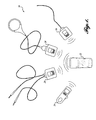
- an embodiment of the present disclosure is directed to a system 20 for taking and displaying measurement parameters.
- the system 20 includes a plurality of handheld or portable measurement devices.
- the system 20 includes a primary device 22 and at least one secondary device 24.
- the primary device 22 is capable of taking a first measurement
- the secondary device 24 is capable of taking a second measurement and transmitting the second measurement to the primary device 22.
- One advantage of the embodiments described herein is that a user can operate the systems of the present disclosure to make measurements in remote or hard-to-reach areas, such as behind machinery or interlocks.
- at least one secondary device 24 may be positioned remotely from the primary device 22 to test or monitor at least a second parameter. Therefore, the primary device 22 can not only test or monitor a first parameter and display the resulting data for the user, but the primary device 22 can also receive data from the secondary device 24 and display that data on the primary device 22 for the user. Therefore, the system 20 described herein simplifies the work of the user by not requiring the user to go to the location of the secondary device 24 to read the data.
- the system 20 is shown and described as including primary and secondary devices 22 and 24, it should be appreciated that there may be any number of devices in the system 20 for taking measurements and transmitting the measurements to the primary device 22.
- the system 20 may include up to ten discrete devices.
- the system 20 may include up to twenty discrete devices.
- the system 20 may include any number of discrete devices.
- the system 20 is configured in a one-to-many (or a "star") communication configuration with the primary device 22.
- a handheld system or device as described herein includes one or more, devices generally configured to be holdable in a user's hand while taking a measurement.
- the system or device need not be held in a user's hand and may be positioned by a user to not be held, for example, by affixing or hanging the system or device from a support or from a machine.
- the handheld system 20 is generally configured to measure at least one parameter, such as an electrical, mechanical, or physical parameter.
- one or more devices in the system 20 may be configured to measure at least one parameter including, but not limited to, voltage, current, vibration, resistance, capacitance, inductance, frequency, and any calculated value derived from a primary electrical, mechanical, or physical measurement.
- One or more devices in the system 20 may be configured to measure non-electrical or non-mechanical parameters, including, but not limited to, temperature, relative humidity, decibels, magnetic field, flow velocity, moisture, rotational speed, pressure, distance, light, contact infrared, as well as calculated values derived from a primary measurement, such as wattage, power quality, crest factor, and duty cycle.
- the primary device 22 may be a host device.
- the primary device 22 may be configured to collect data received from various devices in the system 20, for example, from the secondary device 24 (or from a plurality of module devices).
- the primary device 22 may be a test instrument for independently taking one or more measurements and collecting the data from such measurements.
- the primary device 22 may further include a display 30 for displaying data, whether the data is collected from other devices in the system 20 or measured by the primary device 22.
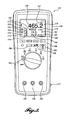
- the primary device 22 is a multimeter, such as a handheld digital multimeter, as can be seen in the illustrated embodiment of FIGURE 3 .
- the primary device 22 may be an electronic measuring instrument that combines one or more measurement functions in one unit.
- the primary device 22 may be capable of taking multiple measures, such as DC voltage, AC voltage, resistance, continuity, and current, as indicated by the plurality of rotary switch 182 positions in the exemplary embodiment of FIGURE 3 .
- the secondary device 24 may be a module device that communicates with the primary device 22.
- the secondary device 24 may be constructed the same or different from the primary device 22.
- secondary device 24 is a handheld digital multimeter.
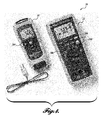
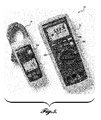
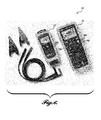
- the secondary device 24 may be, for example, a temperature module (see FIGURE 4 ), a clamp meter (see FIGURES 5 and 6 ), or a flexible current probe meter (see FIGURE 7 ).
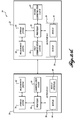
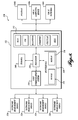
- the primary device 22 may include various components including an input/output (I/O) interface 28 (including, for example, a display 30 and an input interface 36 for user input), a measurement system 32 for taking measurements, a first communication system 34 for receiving and/or transmitting information, a central processing unit (CPU) or processor 38, and a storage system 40 for storing information.
- the primary device 22 may further include an optional second communication system 42.
- the storage system 40 may include system memory in the form of volatile or nonvolatile memory, such as read only memory (“ROM”), random access memory (“RAM”), EEPROM, flash memory, or other memory technology.
- system memory typically stores data and/or program modules that are immediately accessible to and/or currently being operated on by the processor 38.
- the processor 38 serves as a computational center of the primary device 22 by supporting the execution of program instructions.
- the memory may also include storage memory.
- the storage memory may be any volatile or nonvolatile, removable or non-removable memory, implemented using any technology capable of storing information. Examples of storage memory include, but are not limited to, a hard drive, solid state drive, CD ROM, DVD, or other disk storage, magnetic cassettes, magnetic tape, magnetic disk storage, and the like.
- the information stored in the storage memory may include, but is not limited to, program modules and data to be accessed by the processor 38.
- program modules may include routines, applications, objects, components, data structures, etc., that perform particular tasks or implement particular abstract data types. It will be appreciated that system memory and storage memory described herein are merely examples of various computer-readable storage media.
- the storage system 40 may also be configured to store information received from the measurement system 32 of the primary device 22 and from measurement systems in secondary devices 24 received through the communication system 34.
- the processor 38 may be configured to execute instructions to directly display the information received from the measurement system 32 or from the first communication system 34 on the display 30.
- the I/O interface 28 may include a variety of components that enable the processor 38 to obtain inputs from and provide outputs to a user and/or other components in the system 20.
- the I/O interface 28 may include, but is not limited to, a display, such as an LCD, an LPD, OLED display, etc., a keypad, hard or soft keyboards, a touchpad, controls, physical buttons, scroll wheels, a digital pen, trackballs, a joystick, etc.
- the display 30, may be configured as an I/O interface, such as a touch screen, without requiring a separate keypad 36.
- the I/O interface 28 may also receive input from and in some embodiments may provide output to one or more secondary devices 24.
- the first communication system 34 includes one or more components for communicating with one or more discrete secondary devices 24 (as can be seen in FIGURE 1 ) using a suitable wired or wireless communication protocol for transmitting and/or receiving information, including, but not limited to, USB, WiFi, or BLUETOOTH.
- a suitable wired or wireless communication protocol for transmitting and/or receiving information, including, but not limited to, USB, WiFi, or BLUETOOTH.
- the information is communicated in the system 20, for example, from the secondary device 24 to the primary device 22, by a radio signal using a proprietary communication protocol.
- the primary device 22 may include additional communication circuitry, such as a second communication system 42, for communicating with a separate computing device, for example, a mobile computing device, such as a tablet or a smart phone, a personal computing device, a laptop computing device, a personal digital assistant, and the like.
- the communication circuitry may include modems, transmitter/receiver, and/or transceiver circuitry, for performing communications over one or more networks.
- the communication circuitry of either the first or second systems 34 or 42 may include one or more suitable antennas (not shown).
- FIGURE 2A does not depict analog-to-digital converters, digital-to-analog converters, amplifiers, device controllers, etc., which will typically be included with the communication circuitry. However, because these and other components that may be included with the communication circuitry are known in the art, they will not be described in detail herein.
- the primary device 22 can be configured for communicating with a computing device, and to include a communication device that can be coupled via near field protocols, infrared protocols, BLUETOOTH protocols, IEEE 802 protocols, wired connections, such as a USB, Ethernet, or RS232 connection, etc.
- the I/O interface 28 allows the primary device 22 to be wirelessly bound or coupled to a secondary device 24 when the primary device 22 is placed in proximity with the secondary device 24, as will be described in greater detail below.
- the secondary device 24 also includes a communication system 64, including a transmitter, a transceiver, and/or the like, configured to couple with the primary device 22 and to transmit signals thereto.
- the first communication system 34 may perform discovery and binding processes so that the primary device 22 is capable of receiving one or more signals from the secondary device 24, thereby associating the primary device 22 with the secondary device 24.
- the discovery and binding processes can be automatic or user initiated via a switch, a graphical user interface element, or the like.
- the primary device 22 and the secondary device 24 are configured to be paired via a proprietary radio signal.
- the primary device 22 may be configured, by way of I/O interface 28, to receive measurement data from the secondary device 24.
- the measurement data may be provided from the secondary device 24 to the primary device 22 via wireless communication or over another communication network.
- the secondary device 24 is configured to provide measurement data or other data generated by the secondary device 24 to the primary device 22.
- a display 130 is configured to display measurements from both the primary device 122 and a secondary device (not shown in FIGURE 3 ).
- the display 130 includes a first measurement value 150 and a first measurement type indication 152 (reading, respectively, "465.2" and “V AC").
- the measurement type indication 152 corresponds to the measurement type selected on the rotary switch 182.
- the display 130 includes a second measurement value 154 and second measurement type indication 156 that corresponds to a measurement from a secondary device (reading, respectively, "466.5” and "V AC”).
- the second measurement value 154 is identified by an identifier 158, shown as a "1" in bold print.
- the display 130 on the primary device 122 further includes a third measurement value 160 and a third measurement type indication 162 (reading, respectively, “74.3” and “°F"), and a fourth measurement value 164 and a fourth measurement type indication 166 (reading, respectively, “25.6” and “A AC").
- the third and fourth measurement values 160 and 164 are identified by identifiers 168 and 170, shown respectively as a "2" and a "3" in bold print, and are received from additional secondary devices that are bound or coupled to the primary device 122.
- the display 130 on the primary device 122 may be configured to display measurement information from any number of different secondary devices.
- the identifiers 158, 168, and 170 for the multiple secondary devices are custom-configurable for each of the secondary devices for simplified user identification.
- the identifiers 158, 168, and 170 may include any number of characters or symbols.
- the display 130 may also be configured to display other information about the system 120 besides measurement information, for example, hazardous voltage being measured 172, risk of danger 174, data transmission status 176, and battery status 178 of the primary device 122.
- the display 130 may also be configured to include other information, such as the specific location (e.g., determined by GPS) of the primary device 122 or of any secondary devices, battery status of any secondary devices, name or identification information for any secondary devices, or any other information or measurement parameter from the secondary devices.
- Information shown on the display 130 may include, but is not limited to, primary device battery status, secondary device battery status, secondary device data logging status, secondary device data transmission status, primary device identification, secondary device identification, GPS location of the primary device, GPS location of the secondary device, primary device data, secondary device data, etc.
- the I/O interface 128 includes a keypad 180 for inputting information, a rotary switch 182, and a measurement system 132.
- the keypad 180 includes various buttons for various different functions, including standard digital multimeter buttons, such as "HOLD,” “MINMAX,” “RANGE,” and “SHIFT,” and non-standard wireless function buttons 184, 186, and 188.
- radio button 184 can be pressed to set the primary device 22 to turn on the communication circuitry 34 and start the module discovery process to look for secondary devices 24, as described in greater detail below.
- the user can use the "SELECT" button 186 to bind (or unbind) the secondary device 24 with the primary device 22.
- Scroll button 188 can be used to scroll between various "discovered” secondary devices 24.
- the rotary switch 182 includes exemplary selections for measuring DC voltage, AC voltage, resistance, continuity, and current, as indicated by the plurality of rotary switch positions in FIGURE 3 .
- the rotary switch 182 may be used to select any type of measurement parameters.
- the rotary switch 182 also includes an "OFF" position to stop taking measurements and turn the device off.
- the measurement interface 132 for connecting measurement equipment includes various terminals to connect equipment to take measurements.
- the terminals include a first terminal 190, which may be an input for current measurements and current frequency, a second terminal 192, which may be a return terminal for all instruments, and a third terminal 194, which may be an input for voltage, resistance, diode, capacitance, and voltage frequency measurements.
- the secondary device 24 may be substantially similar to the primary device 22, or may be different from the primary device 22.
- the secondary device 24 may be the same digital multimeter shown in FIGURE 3 , or the secondary device may be another test instrument, for example, a temperature module (see FIGURE 4 ), a clamp meter (see FIGURES 5 and 6 ), or a flexible current probe meter (see FIGURE 7 ).
- the measurement made by the secondary device 24 may be an electrical, mechanical, physical, or another parameter, including, but not limited to, voltage, current, vibration, resistance, capacitance, inductance, frequency, temperature, relative humidity, magnetic field, flow velocity, moisture, rotations per minute, pressure, distance, light, contact infrared, decibels, and a calculated value derived from a primary measurement, such as wattage, power quality, crest factor, and duty cycle.
- the secondary device 24 includes various components including an input/output (I/O) interface 58 (including, for example, an optional display 60 and an input interface 66 for user input), a measurement system 62 for taking measurements, a communication system 64 for receiving and/or transmitting information, a central processing unit (CPU) or processor 68, and a storage system 70 for storing information.
- I/O input/output
- the secondary device 24 does not require a display 60, but may include one.
- the components are substantially similar to components described above with reference to the primary device 22, and therefore, will not be described again, except where there are differences.
- the secondary device 24 may be controlled by the primary device 22 or may be independently controlled. In that regard, the user may activate the secondary device 24 for testing, or the user may use the primary device 22 to activate the secondary device 24. Moreover, the secondary device 24 may be set up for specific test parameters using the controls of the secondary device 24 or using the controls of the primary device 22.
- the secondary device 24 includes a communication button 284 (see FIGURES 4-7 ) to turn the communication system 64 on and start the module discovery process so that the primary device 22 can "discover" or identify the availability of communication with the secondary device 24. Depressing the same button 284 turns the communication system 64 off.
- the term “discovery” refers to a procedure in which the primary device 22 looks for compatible radio signals from secondary devices 24. After discovery, the secondary device 24 and the primary device 22 can be "bound" to each other, meaning that a wireless connection has been made.
- a communication button 284 it should be appreciated that the secondary device 24 may also be configured to automatically communicate when powered on, without requiring the activation of a communication button.
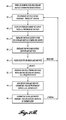
- the user may activate the communication buttons 184 and 284 on each of the respective primary and secondary devices 22 and 24. See, for example, blocks 80 and 84 in the flowchart diagram of FIGURE 2B .
- the transmission status identifier 176 may be displayed on the primary device during the discovery process.
- the primary device 22 listens for signals (see, for example, block 86 in the flowchart diagram of FIGURE 2B ) sent from secondary devices 24 that send signals periodically, for example, once every five seconds.
- the signal sent by the secondary devices 24 may be a data signal, a present signal, or another signal (see, for example, block 82 in the flowchart diagram of FIGURE 2B ).
- an indicator may appear on the primary device 22.
- a module number of the secondary device 24 may appear in the display 30 of the primary device 22.
- the primary device 22 may be configured to bind with the secondary device 24.
- the secondary device 24 may automatically bind with the primary device 24.
- the user may press a "SELECT" button 186 to bind the secondary device 24 with the primary device 22.
- the user may press the "SELECT" button 186 again to deselect the secondary device 24 (see, for example, block 90 in the flowchart diagram of FIGURE 2B ) and thereby unbind or release the secondary device 24 from communication with the primary device 22. If multiple secondary devices 24 have been discovered, the user may use a scroll button 188 to scroll between the different secondary devices 24.
- the binding process may wake up the secondary device 24 (for example, if it is in a sleep mode) and establish communication such that information from the secondary device 24 is periodically transmitted to the primary device 22.
- the primary device 22 may request information, such as measurement data from the secondary device 24, and the secondary device 24 may transmit the information to the primary device 22 (see, for example, blocks 92 and 94 in the flowchart diagram of FIGURE 2B ).
- the secondary device 24 is configured to take a measurement once every 20 seconds, then such measurement data can be transmitted to the primary device 22 as it is generated.
- Such information may also be shown in the display on the primary device 22, for example, the identification 158 of the secondary device 24, the data received 154, and the data type 156.
- the radio of either the primary device 22 or the secondary devices 24 may be turned off.
- the primary device 22 may be configured to simply unbind the secondary device 24, or the primary device 22 may simply go out of communication range with the secondary device 24. If the primary device 22 unbinds a secondary device 24, but the secondary device 24 radio is left on for communicating and measuring data, the secondary device 24 may continue to take measurements and store the data in its storage system 240. When re-bound, the secondary device 24 may be configured to transfer all of the stored data to the primary device 22 to which it is bound.
- the system 20 includes a single-ended binding procedure, such that the secondary device 24 is configured to communicate with the primary device 22, wherein the primary device 22 and the secondary device 24 are automatically bound by activating only the primary device.
- a secondary device 24 may be set up in place with its discovery feature already activated, such that the secondary device 24 transmits a signal periodically, for example, once every five seconds.
- a user hours or days later, can enter the area with a primary device 22 and can activate the discovery button 284 on the primary device. If the primary device 22 discovers the secondary device 24, the primary device can unilaterally select the secondary device 24 for binding and thereby establish a communication link with the secondary device 24. No pre-pairing is required between specific primary and secondary devices 22 and 24. The user may only have physical access to the primary device 22 and not to the secondary device 24. After binding, the user can then take measurements using the primary device 22 and also receive data from the secondary device 22.
- secondary devices 24 of the system 20 described herein may be configured for open binding, wherein multiple primary devices 22 can bind with the same secondary devices 24. Therefore, a first technician can use his primary device 22 to take and read measurements from one or more secondary devices 24, and a second technician having his own primary device 22 can also take and read measurements from the secondary devices 24, for example, after the first device 22 has become unbound from the secondary devices 24. This configuration is particularly helpful when primary devices 22 are lost or damaged and must be replaced or when different technicians having different primary device equipment are visiting the location of the system 20. In addition, because the system 20 is modular, secondary devices 24 for additional measurements can always be added or replaced in the original system 20 if needed.
- the system 20 may be configured such that a secondary device 24 is capable of binding with only one primary device 22 at a time. When released from binding, the secondary device 24 may bind with another primary device 22. With this configuration, the potential for user confusion or misreading secondary devices is greatly reduced.
- the system 20 may generate a signal when the primary and secondary devices 22 and 24 are communicating with one another via a communication link.
- the secondary device 24 may generate a visual, vibrating, or auditory signal when it is communicating with the primary device 22.
- the primary device 22 may also generate a signal to indicate the secondary device 24 with which it is communicating. For example, referring to FIGURE 3 , when the primary device 22 is communicating with secondary device 24 identified as "1," the identification indicator 158 in the display 130 may be highlighted or may start to blink.
- the system 20 may be set up in a one-to-many communication network, such that the primary device 22 communicates directly with each of the secondary devices 24.
- the communication network of the system 20 is more limited in its scope of coverage, but requires significantly less power than a mesh communication network.
- the radius of communication between primary and secondary devices 22 and 24 is less than about 100 meters. In another embodiment of the present disclosure, the radius of communication between primary and secondary devices 22 and 24 is less than about 20 meters.
- the primary and secondary devices 22 and 24 may operate on battery power that lasts at least 100 hours.
- battery life is dependent on the type of batteries used, the types of measurements being made with the system, the number of batteries in the system, and the operational configuration of the devices in the system.
- the life expectancy for each device in the system may vary, for example, a primary device may have a different life expectancy than a secondary device.
- Other power management features of the system include sleep (non-communicating) modes for devices and periodic communication (for example, in the secondary devices, every five seconds).
- a user sets up the system 20 by selecting one or more appropriate types of secondary devices 24, placing them in an appropriate location with respect to the machinery to be tested, and setting them up to take measurements.
- the secondary devices 24 are turned on, set for measurements, and set in communication mode, for example, by pressing discovery button 284 (see FIGURES 4-7 ).
- the secondary devices 24 transmit a periodic signal that can be received (or discovered) by a primary device 22.
- the primary device 22 locates one or more secondary devices 24 the user binds one or more of the secondary devices 24 to the primary device 22 and begins to receive periodic data from the one or more secondary devices 24. Such data can be viewed in the display 30 of the primary device 22.
- FIGURES 8-11 another embodiment of the present disclosure will be described with regard to a system that includes a gateway device.
- components of the gateway system embodiment of FIGURES 8-11 are substantially similar in materials and operation to many components of the previously described embodiments of FIGURES 1-7 , except for differences regarding communication and measurement features, as will be described in more detail below.
- reference numerals of like elements of the system 20 described in the embodiments of FIGURES 1-7 are used to describe the system 320 of FIGURES 8-11 , except using numbers in a 300 series of numbers.
- a schematic for a system 320 including a gateway device 322 is provided.
- the gateway system 320 may be substantially similar to the system 20 described above.
- the gateway 322 may be substantially similar in materials and operation to the primary device 22 described above, except that the gateway 322 may not be a measuring device configured to make measurements.
- the components of the gateway device 322 may include various components including an input/output (I/O) interface 328 (including, for example, an optional display 330 and an input interface 336 for user input), a first communication system 334 for receiving and/or transmitting information from a secondary device 324, a central processing unit (CPU) or processor 338, a storage system 340 for storing information, and a second communication system 342 for receiving and/or transmitting information to a local computing device 344a, or to remote computing devices via the Internet 344b or local networks 344c.
- the gateway device 322 may not take a measurement.
- the first communication system 334 may be a suitable wired or wireless communication protocol for transmitting and/or receiving information.
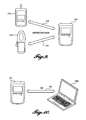
- the information is communicated in the system 320, for example, from the secondary device 324 to the gateway device 322, by a radio signal using a proprietary protocol (see, e.g., FIGURE 9 ). Therefore, the gateway device 322 is configured to receive at least one communication signal, for example, at least one radio signal, containing at least one measurement value directly from at least one measurement device 324.
- the gateway device 322 includes a signal translator that translates the radio signal containing data to a translated signal containing the data using a different protocol. For example, the gateway device 322 receives the data in a radio signal that uses a first proprietary protocol, then translates the signal into a signal using a second protocol that can be transmitted to a computing device 344a, to the Internet 344b, or to local networks 344c.
- the various second communication systems 342 for receiving and/or transmitting information to a computing device 344a, to the Internet 344b, or to local networks 344c may include, but is not limited to, USB (see e.g., FIGURE 10 ), Wi-Fi (see e.g., FIGURE 11 ), BLUETOOTH, Ethernet, Cellular, and RS232 communication.
- the gateway device 322 further includes a data memory system for collecting the data.
- the data may include a plurality of measurement values from at least one secondary device 324 or a plurality of measurement values from a plurality of secondary devices 324. Therefore, the first communication system 334 is configured to receive a plurality of periodic radio signals.
- the system 320 may include multiple secondary devices 324, as shown in the illustrated embodiment of FIGURE 8 .
- the gateway device 322 may be configured to receive more than two, more than seven, or more than ten radio signals, which may be received either simultaneously or close in time to one another, from multiple secondary devices 324.
- a BLUETOOTH system for example, is configured to communicate with only seven discrete components.
- the gateway device 322 may also be configured to have a single-binding system.
- a secondary device 324 may be configured to communicate with the gateway device 322 by activating binding between the gateway device 322 and the secondary device 24 using only the gateway device 322. To unbind, the gateway device 322 may be activated to release the secondary device 324, or the gateway device 322 or any bound secondary devices 324 may simply be powered down.
- the gateway device 322 may include a display or may be without a display. The feature of not including a display is believed to reduce instrument complexity and to reduce the threat of theft of the device 322.
- the gateway device 322 is a handheld device. In another embodiment of the present disclosure, the gateway device 322 may be placed or affixed to a certain location, for example, at or near the control panel of the machine for ease of use.
- the gateway device 322 may further include a data manipulation system with capabilities for manipulating data collected in the data memory system.
- the data manipulation system may be configured to calculate values, compare values, indicate trends, or prepare graphs or other visual presentations of the data.
- a host handheld measurement device generally includes:
- the host device may include a display on the host device for displaying at least the first and second measurement values.
- the host device may be a digital multimeter.
- the first parameter may be selected from the group consisting of voltage, current, vibration, resistance, capacitance, inductance, and frequency.
- the second parameter may be selected from the group consisting of voltage, current, vibration, resistance, capacitance, inductance, frequency, temperature, relative humidity, decibels, magnetic field, flow velocity, moisture, rotational speed, pressure, distance, light, and contact infrared.
- the host device may be configured to establish a communication link with the separate measurement device using a single-ended binding procedure, such that the separate measurement device is configured to communicate with the host device, wherein the host device and the separate device are automatically bound by activating only the host device.
- the host device may be configured to control the separate measurement device.
- the host device may not be configured to control the separate measurement device.
- a communication field between the host device and the separate measurement device may have a radius selected from the group consisting of less than about 100 meters and less than about 20 meters.
- the host device may be configured to generate a signal to a user in response to a communication link between the host device and the separate measurement device being established.
- a display of measurement values determined by the host device and/or the separate measurement device may be configurable for custom identification to a user of the host device.
- the receiving system may be configured to receive measurement values from a plurality of separate measurement devices capable of taking a plurality of measurements and transmitting the plurality of measurement values to the host device.
- the receiving system may be configured to communicate in a one-to-many network.
- a method of measuring parameters using a host handheld measurement device generally includes measuring a first parameter by the host handheld measurement device and determining a first measurement value;
- the host device may be configured for displaying both the first and second measurement values on the host device.
- a handheld module device generally includes:
- the communication system of the module device may be configured to periodically transmit a signal to the host measurement device.
- the module device may include a display on the module device for displaying at least the first measurement value.
- the module device may include no display.
- the module device may be a digital multimeter.
- the first parameter may be selected from the group consisting of voltage, current, vibration, resistance, capacitance, inductance, frequency, temperature, relative humidity, decibels, magnetic field, flow velocity, moisture, rotational speed, pressure, distance, light, and contact infrared.
- the module device may be controlled by the host measurement device.
- the module device may be independently controlled.
- a communication field between the host measurement device and the module device may have a radius selected from the group consisting of less than about 100 meters and less than about 20 meters.
- the module device may be configured to generate a signal that communicates information to a user, wherein the signal is a visual signal, a vibrating signal, or an auditory signal.
- the module device may be configurable for custom identification to the host measurement device.
- the module device may include a second measuring system for measuring a second parameter and determining a second measurement value, wherein the communication system is further configured to communicate the second measurement value to the host measurement device.
- a method of measuring parameters using a handheld module device generally includes:
- a handheld system for measuring parameters generally includes:
- the primary handheld device may be a digital multimeter.
- the first parameter may be selected from the group consisting of voltage, current, vibration, resistance, capacitance, inductance, and frequency.
- the second parameter may be selected from the group consisting of voltage, current, vibration, resistance, capacitance, inductance, frequency, temperature, relative humidity, decibels, magnetic field, flow velocity, moisture, rotational speed, pressure, distance, light, and contact infrared.
- the primary handheld device may further include a display for displaying at least the first and second measurement values.
- the secondary handheld device may include a display.
- the secondary handheld device may not include a display.
- the primary handheld device may be configured to establish a communication link with the secondary handheld device using a single-ended binding procedure, such that the secondary handheld device is configured to communicate with the primary handheld device, wherein the primary handheld device and the secondary handheld device are automatically bound by activating only the primary handheld device.
- the primary handheld device may be configured to control the secondary handheld device.
- the secondary handheld device may control itself.
- a communication field between the primary and secondary handheld devices may have a radius selected from the group consisting of less than about 100 meters and less than about 20 meters.
- the secondary device may be configured to generate a signal that communicates information to the user, wherein the signal is a visual signal, a vibrating signal, or an auditory signal.
- the primary handheld device may be configured to generate a signal to a user in response to a communication link between the primary and secondary handheld devices being established.
- a display of measurement values determined by the primary handheld device and/or the secondary handheld device may be configurable for custom identification to a user of the primary handheld device.
- system may further include an additional secondary handheld device configured to measure a third parameter and determine a third measurement value, wherein the additional secondary handheld device is further configured to transmit the third measurement value to the primary handheld device.
- the primary handheld device may be configured to communicate with the secondary handheld devices in a one-to-many network.
- a handheld system for measuring parameters generally includes:
- a method of measuring parameters using a handheld system generally includes:
- a method of measuring parameters using a handheld system generally includes:
Landscapes
- Physics & Mathematics (AREA)
- General Physics & Mathematics (AREA)
- Engineering & Computer Science (AREA)
- Computer Networks & Wireless Communication (AREA)
- Arrangements For Transmission Of Measured Signals (AREA)
- Measurement Of Current Or Voltage (AREA)
Applications Claiming Priority (3)
| Application Number | Priority Date | Filing Date | Title |
|---|---|---|---|
| US201261679652P | 2012-08-03 | 2012-08-03 | |
| US201261707804P | 2012-09-28 | 2012-09-28 | |
| US13/830,556 US20140035607A1 (en) | 2012-08-03 | 2013-03-14 | Handheld Devices, Systems, and Methods for Measuring Parameters |
Publications (1)
| Publication Number | Publication Date |
|---|---|
| EP2693222A1 true EP2693222A1 (en) | 2014-02-05 |
Family
ID=48948238
Family Applications (1)
| Application Number | Title | Priority Date | Filing Date |
|---|---|---|---|
| EP13178568.5A Withdrawn EP2693222A1 (en) | 2012-08-03 | 2013-07-30 | Handheld devices, systems, and methods for measuring parameters |
Country Status (4)
| Country | Link |
|---|---|
| US (1) | US20140035607A1 (enExample) |
| EP (1) | EP2693222A1 (enExample) |
| JP (1) | JP2014032677A (enExample) |
| CN (1) | CN103575329A (enExample) |
Cited By (5)
| Publication number | Priority date | Publication date | Assignee | Title |
|---|---|---|---|---|
| EP2924449A1 (fr) * | 2014-03-25 | 2015-09-30 | Société Anonyme des Ets. CATU | Appareil de mesure et de contrôle électriques |
| EP3015871A1 (en) * | 2014-10-27 | 2016-05-04 | Fluke Corporation | Flexible current sensor |
| EP3139185A1 (en) * | 2015-09-06 | 2017-03-08 | Fluke Corporation | Measurement device and method |
| EP3139180A1 (en) | 2015-09-07 | 2017-03-08 | Ikalogic S.A.S. | Wireless probe for measuring electrical signals |
| EP3879291A1 (fr) * | 2020-03-13 | 2021-09-15 | Hervé Sallin | Dispositif de contrôle d'installations électriques |
Families Citing this family (27)
| Publication number | Priority date | Publication date | Assignee | Title |
|---|---|---|---|---|
| CN204214925U (zh) * | 2012-03-16 | 2015-03-18 | 菲力尔系统公司 | 电传感器和电传感器标签 |
| US10095659B2 (en) | 2012-08-03 | 2018-10-09 | Fluke Corporation | Handheld devices, systems, and methods for measuring parameters |
| US9377485B2 (en) * | 2013-03-15 | 2016-06-28 | Fluke Corporation | Handheld measurement system with selectable options |
| CN105432064B (zh) | 2013-03-15 | 2019-05-10 | 弗兰克公司 | 使用单独无线移动设备的红外图像的可见视听注释 |
| US9766270B2 (en) | 2013-12-30 | 2017-09-19 | Fluke Corporation | Wireless test measurement |
| DE202014007077U1 (de) * | 2014-09-04 | 2015-12-08 | EurA Consult AG | Strommesszange |
| CN107077354B (zh) | 2014-09-10 | 2021-07-20 | 乐高公司 | 建立输入功能与输出功能之间的功能关系的方法 |
| DK3192283T3 (en) * | 2014-09-10 | 2018-10-01 | Lego As | PROCEDURE FOR ESTABLISHING A WIRELESS CONNECTION BETWEEN ELECTRONIC DEVICES |
| JP6094562B2 (ja) * | 2014-11-06 | 2017-03-15 | 横河電機株式会社 | 記録計 |
| US10119998B2 (en) | 2016-11-07 | 2018-11-06 | Fluke Corporation | Variable capacitance non-contact AC voltage measurement system |
| US10591515B2 (en) | 2016-11-11 | 2020-03-17 | Fluke Corporation | Non-contact current measurement system |
| US10281503B2 (en) | 2016-11-11 | 2019-05-07 | Fluke Corporation | Non-contact voltage measurement system using multiple capacitors |
| US10352967B2 (en) | 2016-11-11 | 2019-07-16 | Fluke Corporation | Non-contact electrical parameter measurement systems |
| US10139435B2 (en) | 2016-11-11 | 2018-11-27 | Fluke Corporation | Non-contact voltage measurement system using reference signal |
| JP6202461B1 (ja) * | 2017-03-06 | 2017-09-27 | 株式会社シーブイエンジニアリング | 電流測定装置 |
| US10120021B1 (en) | 2017-06-16 | 2018-11-06 | Fluke Corporation | Thermal non-contact voltage and non-contact current devices |
| US10509063B2 (en) | 2017-11-28 | 2019-12-17 | Fluke Corporation | Electrical signal measurement device using reference signal |
| US10551416B2 (en) | 2018-05-09 | 2020-02-04 | Fluke Corporation | Multi-sensor configuration for non-contact voltage measurement devices |
| US10746767B2 (en) | 2018-05-09 | 2020-08-18 | Fluke Corporation | Adjustable length Rogowski coil measurement device with non-contact voltage measurement |
| US10557875B2 (en) | 2018-05-09 | 2020-02-11 | Fluke Corporation | Multi-sensor scanner configuration for non-contact voltage measurement devices |
| US10677876B2 (en) | 2018-05-09 | 2020-06-09 | Fluke Corporation | Position dependent non-contact voltage and current measurement |
| US10775409B2 (en) * | 2018-05-09 | 2020-09-15 | Fluke Corporation | Clamp probe for non-contact electrical parameter measurement |
| US10802072B2 (en) | 2018-05-11 | 2020-10-13 | Fluke Corporation | Non-contact DC voltage measurement device with oscillating sensor |
| US10908188B2 (en) | 2018-05-11 | 2021-02-02 | Fluke Corporation | Flexible jaw probe for non-contact electrical parameter measurement |
| CN112485476B (zh) * | 2020-11-19 | 2023-10-20 | 国网四川省电力公司广元供电公司 | 一种多功能钳形表装置及系统 |
| US11881902B2 (en) * | 2021-01-08 | 2024-01-23 | Schneider Electric Systems Usa, Inc. | Acoustic node for configuring remote device |
| CN114113711A (zh) * | 2021-11-30 | 2022-03-01 | 武汉天喻信息产业股份有限公司 | 一种多接口并行测试的方法和系统 |
Citations (9)
| Publication number | Priority date | Publication date | Assignee | Title |
|---|---|---|---|---|
| US20040028023A1 (en) * | 2002-04-18 | 2004-02-12 | Sarnoff Corporation | Method and apparatus for providing ad-hoc networked sensors and protocols |
| US20050065743A1 (en) * | 2003-03-31 | 2005-03-24 | Cumming Daniel A. | Methods and apparatus for retrieving energy readings from an energy monitoring device |
| US20080042641A1 (en) * | 2006-08-21 | 2008-02-21 | American Radionic Company, Inc. | Capacitance measurement device |
| US20080077336A1 (en) * | 2006-09-25 | 2008-03-27 | Roosevelt Fernandes | Power line universal monitor |
| US20080161957A1 (en) * | 2006-09-28 | 2008-07-03 | Rice Thomas A | Transaction Interface for Standardizing Transactions with a Measurement Instrument |
| US20090315725A1 (en) * | 2006-10-24 | 2009-12-24 | Hollander Milton B | Universal wireless transceiver |
| US20100244868A1 (en) * | 2009-03-26 | 2010-09-30 | Tektronix, Inc. | Wireless Clamp-on Current Probe |
| US20110012587A1 (en) * | 2009-07-17 | 2011-01-20 | Fluke Corporation | Clamp-on multimeters including a rogowski coil for measuring alternating current in a conductor |
| US20120007588A1 (en) * | 2010-07-06 | 2012-01-12 | Brymen Technology Corporation. | Clamp meter for measuring voltage and current simultaneously and method for the same |
Family Cites Families (26)
| Publication number | Priority date | Publication date | Assignee | Title |
|---|---|---|---|---|
| US5983100A (en) * | 1996-03-14 | 1999-11-09 | Telefonaktiebolaget Lm Ericsson | Circuit assembly for effectuating communication between a first and a second locally-positioned communication device |
| US6985819B2 (en) * | 2001-08-15 | 2006-01-10 | Spx Corporation | DMM module for portable electronic device |
| JP3647826B2 (ja) * | 2002-08-09 | 2005-05-18 | 共立電気計器株式會社 | クランプ電流計付デジタルマルチメータ |
| JP2004133632A (ja) * | 2002-10-09 | 2004-04-30 | Arkray Inc | データ中継装置およびこれを用いたデータ管理システム |
| US20040253997A1 (en) * | 2003-06-16 | 2004-12-16 | Spx Corporation | Wireless test data transmission apparatus and method |
| US7310583B2 (en) * | 2004-03-10 | 2007-12-18 | Conecta S.A. | System and method of measurement and processing of electrical variables |
| US7616110B2 (en) * | 2005-03-11 | 2009-11-10 | Aframe Digital, Inc. | Mobile wireless customizable health and condition monitor |
| US7280097B2 (en) * | 2005-10-11 | 2007-10-09 | Zeetoo, Inc. | Human interface input acceleration system |
| US7541941B2 (en) * | 2007-03-16 | 2009-06-02 | Greenbox Technology Inc. | System and method for monitoring and estimating energy resource consumption |
| US8456152B2 (en) * | 2007-08-14 | 2013-06-04 | Fluke Corporation | Digital multimeter with context-sensitive explanatory information |
| US7626375B2 (en) * | 2007-08-14 | 2009-12-01 | Fluke Corporation | System and method for configuring a display for a digital multimeter |
| US7738320B2 (en) * | 2007-12-03 | 2010-06-15 | General Electric Co. | Method and system for enhanced display of temporal data on portable devices |
| US7960965B2 (en) * | 2008-04-04 | 2011-06-14 | Fluke Corporation | Multimeter having communications via measurement terminals and communication system for same |
| TWI334931B (en) * | 2008-07-17 | 2010-12-21 | Cyrustek Co | Intelligent multi-meter with automatic function selection |
| EP2399246A4 (en) * | 2009-02-23 | 2014-05-28 | Baruch Bouzaglo | MULTIPOINT MEASUREMENT OF ELECTRICAL CONSUMPTION |
| US20110087461A1 (en) * | 2009-10-10 | 2011-04-14 | Hollander Milton B | Wireless data logging device |
| US8538269B2 (en) * | 2010-08-17 | 2013-09-17 | Dearborn Group, Inc. | DMM wireless adapter |
| US8754779B2 (en) * | 2010-08-18 | 2014-06-17 | Snap-On Incorporated | System and method for displaying input data on a remote display device |
| TWM407384U (en) * | 2010-11-17 | 2011-07-11 | Middleland Sensing Technology Inc | Digitalized sensor system |
| US8976039B2 (en) * | 2010-12-20 | 2015-03-10 | Redfish Instruments, Inc. | Remote operation and monitoring of measurement systems and remote measurement data processing |
| US20120245878A1 (en) * | 2011-03-25 | 2012-09-27 | Universal Enterprises, Incorporated | Handheld hvac/r test and measurement instrument |
| CN202351298U (zh) * | 2011-11-16 | 2012-07-25 | 深圳市业海科技发展有限公司 | 一种多功能过程校验设备 |
| US9076275B2 (en) * | 2013-03-13 | 2015-07-07 | Bosch Automotive Service Solutions Inc. | Vehicle measurement apparatus having a system-on-a-chip device and a sensor |
| US9377485B2 (en) * | 2013-03-15 | 2016-06-28 | Fluke Corporation | Handheld measurement system with selectable options |
| US9739801B2 (en) * | 2013-07-16 | 2017-08-22 | Fluke Corporation | Analytical gateway device for measurement devices |
| US9766270B2 (en) * | 2013-12-30 | 2017-09-19 | Fluke Corporation | Wireless test measurement |
-
2013
- 2013-03-14 US US13/830,556 patent/US20140035607A1/en not_active Abandoned
- 2013-07-30 EP EP13178568.5A patent/EP2693222A1/en not_active Withdrawn
- 2013-08-02 CN CN201310334993.1A patent/CN103575329A/zh active Pending
- 2013-08-05 JP JP2013162775A patent/JP2014032677A/ja active Pending
Patent Citations (9)
| Publication number | Priority date | Publication date | Assignee | Title |
|---|---|---|---|---|
| US20040028023A1 (en) * | 2002-04-18 | 2004-02-12 | Sarnoff Corporation | Method and apparatus for providing ad-hoc networked sensors and protocols |
| US20050065743A1 (en) * | 2003-03-31 | 2005-03-24 | Cumming Daniel A. | Methods and apparatus for retrieving energy readings from an energy monitoring device |
| US20080042641A1 (en) * | 2006-08-21 | 2008-02-21 | American Radionic Company, Inc. | Capacitance measurement device |
| US20080077336A1 (en) * | 2006-09-25 | 2008-03-27 | Roosevelt Fernandes | Power line universal monitor |
| US20080161957A1 (en) * | 2006-09-28 | 2008-07-03 | Rice Thomas A | Transaction Interface for Standardizing Transactions with a Measurement Instrument |
| US20090315725A1 (en) * | 2006-10-24 | 2009-12-24 | Hollander Milton B | Universal wireless transceiver |
| US20100244868A1 (en) * | 2009-03-26 | 2010-09-30 | Tektronix, Inc. | Wireless Clamp-on Current Probe |
| US20110012587A1 (en) * | 2009-07-17 | 2011-01-20 | Fluke Corporation | Clamp-on multimeters including a rogowski coil for measuring alternating current in a conductor |
| US20120007588A1 (en) * | 2010-07-06 | 2012-01-12 | Brymen Technology Corporation. | Clamp meter for measuring voltage and current simultaneously and method for the same |
Non-Patent Citations (1)
| Title |
|---|
| BICELLI S ET AL: "From the Traditional Multimeter to the Wireless Multimeter Networking", IEEE INSTRUMENTATION AND MEASUREMENT TECHNOLOGY CONFERENCE (IEEE CAT. NO. 06CH37714C)IMTC, IEEE, 1 April 2006 (2006-04-01), pages 1581 - 1586, XP031056962, ISBN: 978-0-7803-9359-2 * |
Cited By (8)
| Publication number | Priority date | Publication date | Assignee | Title |
|---|---|---|---|---|
| EP2924449A1 (fr) * | 2014-03-25 | 2015-09-30 | Société Anonyme des Ets. CATU | Appareil de mesure et de contrôle électriques |
| FR3019301A1 (fr) * | 2014-03-25 | 2015-10-02 | Catu Ets | Appareil de mesure et de controle electriques |
| EP3015871A1 (en) * | 2014-10-27 | 2016-05-04 | Fluke Corporation | Flexible current sensor |
| US9541581B2 (en) | 2014-10-27 | 2017-01-10 | Fluke Corporation | Flexible current sensor |
| EP3139185A1 (en) * | 2015-09-06 | 2017-03-08 | Fluke Corporation | Measurement device and method |
| US10497226B2 (en) | 2015-09-06 | 2019-12-03 | Fluke Corporation | Measurement device and method |
| EP3139180A1 (en) | 2015-09-07 | 2017-03-08 | Ikalogic S.A.S. | Wireless probe for measuring electrical signals |
| EP3879291A1 (fr) * | 2020-03-13 | 2021-09-15 | Hervé Sallin | Dispositif de contrôle d'installations électriques |
Also Published As
| Publication number | Publication date |
|---|---|
| US20140035607A1 (en) | 2014-02-06 |
| JP2014032677A (ja) | 2014-02-20 |
| CN103575329A (zh) | 2014-02-12 |
Similar Documents
| Publication | Publication Date | Title |
|---|---|---|
| US10095659B2 (en) | Handheld devices, systems, and methods for measuring parameters | |
| EP2693222A1 (en) | Handheld devices, systems, and methods for measuring parameters | |
| JP6576021B2 (ja) | サーバ装置、制御システムおよび制御方法 | |
| JP4740232B2 (ja) | サーキット・ブレーカのための電子的保護デバイス及び対応するプログラミング方法 | |
| US20140278255A1 (en) | Storage Modes for Measurement Values and Contextual Information | |
| JP2015005856A5 (enExample) | ||
| JPWO2004104964A1 (ja) | インターネット経由データ転送装置 | |
| CN106254193B (zh) | 用于检测自动化设备运行状态的现场总线装置 | |
| JP5993598B2 (ja) | ハンディ無線検針システムの一斉検針方法 | |
| CN107465998B (zh) | 多数据采集系统 | |
| WO2012096240A1 (ja) | 測定装置および測定システム | |
| KR101506701B1 (ko) | 복수의 콘센트 입력구를 구비한 전력절감장치 및 이를 제어하기 위한 사용자 기기 | |
| JP2017062619A (ja) | 蓄電池システム、蓄電池監視システム及び蓄電池情報収集方法 | |
| CN101498765A (zh) | 分离式电池状态警报器及其小型电池状态检知器 | |
| JP2014055798A (ja) | 表示装置、方法、およびプログラム | |
| CN109900308B (zh) | 一种多类型传感器的人工比测系统及其方法 | |
| CN212007491U (zh) | 一种智能人体秤 | |
| KR200424678Y1 (ko) | 전력 제어 장치 | |
| CN111130580B (zh) | 一种多功能手持仪 | |
| JP2016072733A (ja) | 通信装置および通信方法 | |
| JP2008028613A (ja) | 自動検針無線システム及びハンディターミナル | |
| Shinde et al. | Wi-Fi based monitoring and controlling of embedded system | |
| JP5735737B2 (ja) | 電力計測装置 | |
| KR100768893B1 (ko) | 전력 제어 시스템 | |
| CA3091970A1 (en) | Wireless multi-port meter programming and testing device |
Legal Events
| Date | Code | Title | Description |
|---|---|---|---|
| AK | Designated contracting states |
Kind code of ref document: A1 Designated state(s): AL AT BE BG CH CY CZ DE DK EE ES FI FR GB GR HR HU IE IS IT LI LT LU LV MC MK MT NL NO PL PT RO RS SE SI SK SM TR |
|
| AX | Request for extension of the european patent |
Extension state: BA ME |
|
| PUAI | Public reference made under article 153(3) epc to a published international application that has entered the european phase |
Free format text: ORIGINAL CODE: 0009012 |
|
| 17P | Request for examination filed |
Effective date: 20140805 |
|
| RBV | Designated contracting states (corrected) |
Designated state(s): AL AT BE BG CH CY CZ DE DK EE ES FI FR GB GR HR HU IE IS IT LI LT LU LV MC MK MT NL NO PL PT RO RS SE SI SK SM TR |
|
| RAP1 | Party data changed (applicant data changed or rights of an application transferred) |
Owner name: FLUKE CORPORATION |
|
| 17Q | First examination report despatched |
Effective date: 20180517 |
|
| STAA | Information on the status of an ep patent application or granted ep patent |
Free format text: STATUS: THE APPLICATION IS DEEMED TO BE WITHDRAWN |
|
| 18D | Application deemed to be withdrawn |
Effective date: 20180928 |