EP2690495A1 - Lithographic printing plate precursor and plate making method thereof - Google Patents
Lithographic printing plate precursor and plate making method thereof Download PDFInfo
- Publication number
- EP2690495A1 EP2690495A1 EP13177390.5A EP13177390A EP2690495A1 EP 2690495 A1 EP2690495 A1 EP 2690495A1 EP 13177390 A EP13177390 A EP 13177390A EP 2690495 A1 EP2690495 A1 EP 2690495A1
- Authority
- EP
- European Patent Office
- Prior art keywords
- group
- compound
- lithographic printing
- printing plate
- image
- Prior art date
- Legal status (The legal status is an assumption and is not a legal conclusion. Google has not performed a legal analysis and makes no representation as to the accuracy of the status listed.)
- Withdrawn
Links
- 238000007639 printing Methods 0.000 title claims abstract description 213
- 239000002243 precursor Substances 0.000 title claims abstract description 115
- 238000000034 method Methods 0.000 title claims description 35
- VYPSYNLAJGMNEJ-UHFFFAOYSA-N Silicium dioxide Chemical compound O=[Si]=O VYPSYNLAJGMNEJ-UHFFFAOYSA-N 0.000 claims abstract description 273
- 150000001875 compounds Chemical class 0.000 claims abstract description 259
- 239000000377 silicon dioxide Substances 0.000 claims abstract description 134
- XLYOFNOQVPJJNP-UHFFFAOYSA-N water Substances O XLYOFNOQVPJJNP-UHFFFAOYSA-N 0.000 claims abstract description 47
- 239000006096 absorbing agent Substances 0.000 claims abstract description 18
- -1 borate compound Chemical class 0.000 claims description 197
- 239000010410 layer Substances 0.000 claims description 137
- 125000004432 carbon atom Chemical group C* 0.000 claims description 86
- 125000003118 aryl group Chemical group 0.000 claims description 69
- XMBWDFGMSWQBCA-UHFFFAOYSA-N hydrogen iodide Chemical group I XMBWDFGMSWQBCA-UHFFFAOYSA-N 0.000 claims description 44
- 125000000217 alkyl group Chemical group 0.000 claims description 43
- 125000000623 heterocyclic group Chemical group 0.000 claims description 36
- 125000001183 hydrocarbyl group Chemical group 0.000 claims description 31
- 150000003839 salts Chemical class 0.000 claims description 30
- 230000008859 change Effects 0.000 claims description 28
- 229910052717 sulfur Inorganic materials 0.000 claims description 26
- 125000004435 hydrogen atom Chemical group [H]* 0.000 claims description 24
- 239000011241 protective layer Substances 0.000 claims description 23
- 125000003342 alkenyl group Chemical group 0.000 claims description 22
- 125000000304 alkynyl group Chemical group 0.000 claims description 20
- 125000005843 halogen group Chemical group 0.000 claims description 19
- 239000002253 acid Substances 0.000 claims description 17
- 229910052757 nitrogen Inorganic materials 0.000 claims description 15
- 125000004434 sulfur atom Chemical group 0.000 claims description 14
- 150000001450 anions Chemical class 0.000 claims description 13
- 229910052760 oxygen Inorganic materials 0.000 claims description 13
- 125000001072 heteroaryl group Chemical group 0.000 claims description 12
- 125000004430 oxygen atom Chemical group O* 0.000 claims description 12
- RWSOTUBLDIXVET-UHFFFAOYSA-N Dihydrogen sulfide Chemical class S RWSOTUBLDIXVET-UHFFFAOYSA-N 0.000 claims description 11
- 125000005842 heteroatom Chemical group 0.000 claims description 11
- BTBUEUYNUDRHOZ-UHFFFAOYSA-N Borate Chemical compound [O-]B([O-])[O-] BTBUEUYNUDRHOZ-UHFFFAOYSA-N 0.000 claims description 10
- 125000004433 nitrogen atom Chemical group N* 0.000 claims description 9
- 125000003710 aryl alkyl group Chemical group 0.000 claims description 7
- 125000002029 aromatic hydrocarbon group Chemical group 0.000 claims description 3
- ANRHNWWPFJCPAZ-UHFFFAOYSA-M thionine Chemical group [Cl-].C1=CC(N)=CC2=[S+]C3=CC(N)=CC=C3N=C21 ANRHNWWPFJCPAZ-UHFFFAOYSA-M 0.000 claims 6
- 125000001424 substituent group Chemical group 0.000 description 89
- 239000000243 solution Substances 0.000 description 69
- 229920000642 polymer Polymers 0.000 description 66
- 239000000975 dye Substances 0.000 description 63
- 238000011161 development Methods 0.000 description 59
- 239000002245 particle Substances 0.000 description 59
- 229940126062 Compound A Drugs 0.000 description 44
- NLDMNSXOCDLTTB-UHFFFAOYSA-N Heterophylliin A Natural products O1C2COC(=O)C3=CC(O)=C(O)C(O)=C3C3=C(O)C(O)=C(O)C=C3C(=O)OC2C(OC(=O)C=2C=C(O)C(O)=C(O)C=2)C(O)C1OC(=O)C1=CC(O)=C(O)C(O)=C1 NLDMNSXOCDLTTB-UHFFFAOYSA-N 0.000 description 44
- 239000011248 coating agent Substances 0.000 description 43
- 238000000576 coating method Methods 0.000 description 43
- 239000011148 porous material Substances 0.000 description 40
- 239000000049 pigment Substances 0.000 description 39
- 238000007689 inspection Methods 0.000 description 31
- 238000003756 stirring Methods 0.000 description 31
- QGKMIGUHVLGJBR-UHFFFAOYSA-M (4z)-1-(3-methylbutyl)-4-[[1-(3-methylbutyl)quinolin-1-ium-4-yl]methylidene]quinoline;iodide Chemical compound [I-].C12=CC=CC=C2N(CCC(C)C)C=CC1=CC1=CC=[N+](CCC(C)C)C2=CC=CC=C12 QGKMIGUHVLGJBR-UHFFFAOYSA-M 0.000 description 30
- 239000010419 fine particle Substances 0.000 description 29
- 238000002360 preparation method Methods 0.000 description 24
- 239000003795 chemical substances by application Substances 0.000 description 23
- 239000000203 mixture Substances 0.000 description 21
- 239000004094 surface-active agent Substances 0.000 description 21
- 239000007787 solid Substances 0.000 description 20
- 239000011230 binding agent Substances 0.000 description 19
- 150000003254 radicals Chemical class 0.000 description 19
- 229920002451 polyvinyl alcohol Polymers 0.000 description 18
- 235000019422 polyvinyl alcohol Nutrition 0.000 description 18
- 150000003384 small molecules Chemical class 0.000 description 18
- 125000003545 alkoxy group Chemical group 0.000 description 17
- 125000003277 amino group Chemical group 0.000 description 17
- 238000006243 chemical reaction Methods 0.000 description 17
- LFQSCWFLJHTTHZ-UHFFFAOYSA-N Ethanol Chemical compound CCO LFQSCWFLJHTTHZ-UHFFFAOYSA-N 0.000 description 16
- 239000004372 Polyvinyl alcohol Substances 0.000 description 16
- 229920001577 copolymer Polymers 0.000 description 14
- 239000007788 liquid Substances 0.000 description 14
- 229910052782 aluminium Inorganic materials 0.000 description 13
- 239000006185 dispersion Substances 0.000 description 13
- 239000002904 solvent Substances 0.000 description 13
- WEVYAHXRMPXWCK-UHFFFAOYSA-N Acetonitrile Chemical compound CC#N WEVYAHXRMPXWCK-UHFFFAOYSA-N 0.000 description 12
- 230000000052 comparative effect Effects 0.000 description 12
- 125000000524 functional group Chemical group 0.000 description 12
- 238000012545 processing Methods 0.000 description 12
- IJGRMHOSHXDMSA-UHFFFAOYSA-N Atomic nitrogen Chemical compound N#N IJGRMHOSHXDMSA-UHFFFAOYSA-N 0.000 description 11
- 125000003178 carboxy group Chemical group [H]OC(*)=O 0.000 description 11
- QGZKDVFQNNGYKY-UHFFFAOYSA-O ammonium group Chemical group [NH4+] QGZKDVFQNNGYKY-UHFFFAOYSA-O 0.000 description 10
- 230000002209 hydrophobic effect Effects 0.000 description 10
- 239000003921 oil Substances 0.000 description 10
- 125000001997 phenyl group Chemical group [H]C1=C([H])C([H])=C(*)C([H])=C1[H] 0.000 description 10
- 238000006116 polymerization reaction Methods 0.000 description 10
- 239000000126 substance Substances 0.000 description 10
- 238000005406 washing Methods 0.000 description 10
- RTZKZFJDLAIYFH-UHFFFAOYSA-N Diethyl ether Chemical compound CCOCC RTZKZFJDLAIYFH-UHFFFAOYSA-N 0.000 description 9
- XEKOWRVHYACXOJ-UHFFFAOYSA-N Ethyl acetate Chemical compound CCOC(C)=O XEKOWRVHYACXOJ-UHFFFAOYSA-N 0.000 description 9
- OKKJLVBELUTLKV-UHFFFAOYSA-N Methanol Chemical compound OC OKKJLVBELUTLKV-UHFFFAOYSA-N 0.000 description 9
- QAOWNCQODCNURD-UHFFFAOYSA-N Sulfuric acid Chemical compound OS(O)(=O)=O QAOWNCQODCNURD-UHFFFAOYSA-N 0.000 description 9
- XAGFODPZIPBFFR-UHFFFAOYSA-N aluminium Chemical compound [Al] XAGFODPZIPBFFR-UHFFFAOYSA-N 0.000 description 9
- 238000001035 drying Methods 0.000 description 9
- 125000002887 hydroxy group Chemical group [H]O* 0.000 description 9
- 239000003094 microcapsule Substances 0.000 description 9
- 125000000020 sulfo group Chemical group O=S(=O)([*])O[H] 0.000 description 9
- LZZYPRNAOMGNLH-UHFFFAOYSA-M Cetrimonium bromide Chemical compound [Br-].CCCCCCCCCCCCCCCC[N+](C)(C)C LZZYPRNAOMGNLH-UHFFFAOYSA-M 0.000 description 8
- LYCAIKOWRPUZTN-UHFFFAOYSA-N Ethylene glycol Chemical compound OCCO LYCAIKOWRPUZTN-UHFFFAOYSA-N 0.000 description 8
- VEXZGXHMUGYJMC-UHFFFAOYSA-N Hydrochloric acid Chemical compound Cl VEXZGXHMUGYJMC-UHFFFAOYSA-N 0.000 description 8
- 230000007423 decrease Effects 0.000 description 8
- 239000000463 material Substances 0.000 description 8
- 125000001624 naphthyl group Chemical group 0.000 description 8
- NTHWMYGWWRZVTN-UHFFFAOYSA-N sodium silicate Chemical compound [Na+].[Na+].[O-][Si]([O-])=O NTHWMYGWWRZVTN-UHFFFAOYSA-N 0.000 description 8
- 125000004104 aryloxy group Chemical group 0.000 description 7
- 239000002131 composite material Substances 0.000 description 7
- 239000012153 distilled water Substances 0.000 description 7
- 238000005516 engineering process Methods 0.000 description 7
- 239000000178 monomer Substances 0.000 description 7
- OZAIFHULBGXAKX-UHFFFAOYSA-N 2-(2-cyanopropan-2-yldiazenyl)-2-methylpropanenitrile Chemical compound N#CC(C)(C)N=NC(C)(C)C#N OZAIFHULBGXAKX-UHFFFAOYSA-N 0.000 description 6
- NLHHRLWOUZZQLW-UHFFFAOYSA-N Acrylonitrile Chemical compound C=CC#N NLHHRLWOUZZQLW-UHFFFAOYSA-N 0.000 description 6
- 229920003171 Poly (ethylene oxide) Polymers 0.000 description 6
- PPBRXRYQALVLMV-UHFFFAOYSA-N Styrene Chemical compound C=CC1=CC=CC=C1 PPBRXRYQALVLMV-UHFFFAOYSA-N 0.000 description 6
- 230000015572 biosynthetic process Effects 0.000 description 6
- 238000007385 chemical modification Methods 0.000 description 6
- 239000007822 coupling agent Substances 0.000 description 6
- 238000011156 evaluation Methods 0.000 description 6
- 238000001914 filtration Methods 0.000 description 6
- 229910052731 fluorine Inorganic materials 0.000 description 6
- KWIUHFFTVRNATP-UHFFFAOYSA-N glycine betaine Chemical compound C[N+](C)(C)CC([O-])=O KWIUHFFTVRNATP-UHFFFAOYSA-N 0.000 description 6
- JXDYKVIHCLTXOP-UHFFFAOYSA-N isatin Chemical compound C1=CC=C2C(=O)C(=O)NC2=C1 JXDYKVIHCLTXOP-UHFFFAOYSA-N 0.000 description 6
- BDERNNFJNOPAEC-UHFFFAOYSA-N propan-1-ol Chemical compound CCCO BDERNNFJNOPAEC-UHFFFAOYSA-N 0.000 description 6
- LVTJOONKWUXEFR-FZRMHRINSA-N protoneodioscin Natural products O(C[C@@H](CC[C@]1(O)[C@H](C)[C@@H]2[C@]3(C)[C@H]([C@H]4[C@@H]([C@]5(C)C(=CC4)C[C@@H](O[C@@H]4[C@H](O[C@H]6[C@@H](O)[C@@H](O)[C@@H](O)[C@H](C)O6)[C@@H](O)[C@H](O[C@H]6[C@@H](O)[C@@H](O)[C@@H](O)[C@H](C)O6)[C@H](CO)O4)CC5)CC3)C[C@@H]2O1)C)[C@H]1[C@H](O)[C@H](O)[C@H](O)[C@@H](CO)O1 LVTJOONKWUXEFR-FZRMHRINSA-N 0.000 description 6
- 125000003808 silyl group Chemical group [H][Si]([H])([H])[*] 0.000 description 6
- 229910052708 sodium Inorganic materials 0.000 description 6
- 239000011734 sodium Substances 0.000 description 6
- ZWEHNKRNPOVVGH-UHFFFAOYSA-N 2-Butanone Chemical compound CCC(C)=O ZWEHNKRNPOVVGH-UHFFFAOYSA-N 0.000 description 5
- PVTXJGJDOHYFOX-UHFFFAOYSA-N 2h-1,4-benzoxazine Chemical compound C1=CC=C2N=CCOC2=C1 PVTXJGJDOHYFOX-UHFFFAOYSA-N 0.000 description 5
- YCKRFDGAMUMZLT-UHFFFAOYSA-N Fluorine atom Chemical compound [F] YCKRFDGAMUMZLT-UHFFFAOYSA-N 0.000 description 5
- PEDCQBHIVMGVHV-UHFFFAOYSA-N Glycerine Chemical compound OCC(O)CO PEDCQBHIVMGVHV-UHFFFAOYSA-N 0.000 description 5
- 239000004115 Sodium Silicate Substances 0.000 description 5
- 150000004945 aromatic hydrocarbons Chemical group 0.000 description 5
- 125000004429 atom Chemical group 0.000 description 5
- 125000002915 carbonyl group Chemical group [*:2]C([*:1])=O 0.000 description 5
- 239000008151 electrolyte solution Substances 0.000 description 5
- 150000002148 esters Chemical class 0.000 description 5
- 239000011737 fluorine Substances 0.000 description 5
- 230000006872 improvement Effects 0.000 description 5
- 239000008213 purified water Substances 0.000 description 5
- 125000000714 pyrimidinyl group Chemical group 0.000 description 5
- 229910052911 sodium silicate Inorganic materials 0.000 description 5
- 238000001179 sorption measurement Methods 0.000 description 5
- 238000004381 surface treatment Methods 0.000 description 5
- 125000000391 vinyl group Chemical group [H]C([*])=C([H])[H] 0.000 description 5
- ARXJGSRGQADJSQ-UHFFFAOYSA-N 1-methoxypropan-2-ol Chemical compound COCC(C)O ARXJGSRGQADJSQ-UHFFFAOYSA-N 0.000 description 4
- 125000003903 2-propenyl group Chemical group [H]C([*])([H])C([H])=C([H])[H] 0.000 description 4
- PAYRUJLWNCNPSJ-UHFFFAOYSA-N Aniline Chemical group NC1=CC=CC=C1 PAYRUJLWNCNPSJ-UHFFFAOYSA-N 0.000 description 4
- 238000004438 BET method Methods 0.000 description 4
- 235000011960 Brassica ruvo Nutrition 0.000 description 4
- GRYLNZFGIOXLOG-UHFFFAOYSA-N Nitric acid Chemical compound O[N+]([O-])=O GRYLNZFGIOXLOG-UHFFFAOYSA-N 0.000 description 4
- JUJWROOIHBZHMG-UHFFFAOYSA-N Pyridine Chemical compound C1=CC=NC=C1 JUJWROOIHBZHMG-UHFFFAOYSA-N 0.000 description 4
- 239000006087 Silane Coupling Agent Substances 0.000 description 4
- BOTDANWDWHJENH-UHFFFAOYSA-N Tetraethyl orthosilicate Chemical compound CCO[Si](OCC)(OCC)OCC BOTDANWDWHJENH-UHFFFAOYSA-N 0.000 description 4
- 125000005235 azinium group Chemical group 0.000 description 4
- 229940063013 borate ion Drugs 0.000 description 4
- 230000000694 effects Effects 0.000 description 4
- 230000005611 electricity Effects 0.000 description 4
- 125000002541 furyl group Chemical group 0.000 description 4
- ZFSLODLOARCGLH-UHFFFAOYSA-N isocyanuric acid Chemical group OC1=NC(O)=NC(O)=N1 ZFSLODLOARCGLH-UHFFFAOYSA-N 0.000 description 4
- 239000011259 mixed solution Substances 0.000 description 4
- 238000002156 mixing Methods 0.000 description 4
- 229910017604 nitric acid Inorganic materials 0.000 description 4
- 239000002736 nonionic surfactant Substances 0.000 description 4
- VLTRZXGMWDSKGL-UHFFFAOYSA-M perchlorate Chemical compound [O-]Cl(=O)(=O)=O VLTRZXGMWDSKGL-UHFFFAOYSA-M 0.000 description 4
- 229920003229 poly(methyl methacrylate) Polymers 0.000 description 4
- WVIICGIFSIBFOG-UHFFFAOYSA-N pyrylium Chemical class C1=CC=[O+]C=C1 WVIICGIFSIBFOG-UHFFFAOYSA-N 0.000 description 4
- 238000007788 roughening Methods 0.000 description 4
- 230000035945 sensitivity Effects 0.000 description 4
- 229920001169 thermoplastic Polymers 0.000 description 4
- 125000001544 thienyl group Chemical group 0.000 description 4
- BPXVHIRIPLPOPT-UHFFFAOYSA-N 1,3,5-tris(2-hydroxyethyl)-1,3,5-triazinane-2,4,6-trione Chemical compound OCCN1C(=O)N(CCO)C(=O)N(CCO)C1=O BPXVHIRIPLPOPT-UHFFFAOYSA-N 0.000 description 3
- 125000004172 4-methoxyphenyl group Chemical group [H]C1=C([H])C(OC([H])([H])[H])=C([H])C([H])=C1* 0.000 description 3
- QTBSBXVTEAMEQO-UHFFFAOYSA-N Acetic acid Chemical compound CC(O)=O QTBSBXVTEAMEQO-UHFFFAOYSA-N 0.000 description 3
- CSCPPACGZOOCGX-UHFFFAOYSA-N Acetone Chemical compound CC(C)=O CSCPPACGZOOCGX-UHFFFAOYSA-N 0.000 description 3
- VHUUQVKOLVNVRT-UHFFFAOYSA-N Ammonium hydroxide Chemical compound [NH4+].[OH-] VHUUQVKOLVNVRT-UHFFFAOYSA-N 0.000 description 3
- YMWUJEATGCHHMB-UHFFFAOYSA-N Dichloromethane Chemical compound ClCCl YMWUJEATGCHHMB-UHFFFAOYSA-N 0.000 description 3
- IAYPIBMASNFSPL-UHFFFAOYSA-N Ethylene oxide Chemical group C1CO1 IAYPIBMASNFSPL-UHFFFAOYSA-N 0.000 description 3
- DGAQECJNVWCQMB-PUAWFVPOSA-M Ilexoside XXIX Chemical compound C[C@@H]1CC[C@@]2(CC[C@@]3(C(=CC[C@H]4[C@]3(CC[C@@H]5[C@@]4(CC[C@@H](C5(C)C)OS(=O)(=O)[O-])C)C)[C@@H]2[C@]1(C)O)C)C(=O)O[C@H]6[C@@H]([C@H]([C@@H]([C@H](O6)CO)O)O)O.[Na+] DGAQECJNVWCQMB-PUAWFVPOSA-M 0.000 description 3
- MUBZPKHOEPUJKR-UHFFFAOYSA-N Oxalic acid Chemical compound OC(=O)C(O)=O MUBZPKHOEPUJKR-UHFFFAOYSA-N 0.000 description 3
- 229920002057 Pluronic® P 103 Polymers 0.000 description 3
- 239000004793 Polystyrene Substances 0.000 description 3
- DNIAPMSPPWPWGF-UHFFFAOYSA-N Propylene glycol Chemical class CC(O)CO DNIAPMSPPWPWGF-UHFFFAOYSA-N 0.000 description 3
- HEMHJVSKTPXQMS-UHFFFAOYSA-M Sodium hydroxide Chemical compound [OH-].[Na+] HEMHJVSKTPXQMS-UHFFFAOYSA-M 0.000 description 3
- 239000007983 Tris buffer Substances 0.000 description 3
- 125000004442 acylamino group Chemical group 0.000 description 3
- 125000004466 alkoxycarbonylamino group Chemical group 0.000 description 3
- 125000002947 alkylene group Chemical group 0.000 description 3
- QGZKDVFQNNGYKY-UHFFFAOYSA-N ammonia Natural products N QGZKDVFQNNGYKY-UHFFFAOYSA-N 0.000 description 3
- 239000007864 aqueous solution Substances 0.000 description 3
- 125000005162 aryl oxy carbonyl amino group Chemical group 0.000 description 3
- 239000000987 azo dye Substances 0.000 description 3
- JFDZBHWFFUWGJE-UHFFFAOYSA-N benzonitrile Chemical compound N#CC1=CC=CC=C1 JFDZBHWFFUWGJE-UHFFFAOYSA-N 0.000 description 3
- 229960003237 betaine Drugs 0.000 description 3
- 150000001732 carboxylic acid derivatives Chemical class 0.000 description 3
- 230000015556 catabolic process Effects 0.000 description 3
- 150000001768 cations Chemical class 0.000 description 3
- KRKNYBCHXYNGOX-UHFFFAOYSA-N citric acid Chemical compound OC(=O)CC(O)(C(O)=O)CC(O)=O KRKNYBCHXYNGOX-UHFFFAOYSA-N 0.000 description 3
- 125000004093 cyano group Chemical group *C#N 0.000 description 3
- 230000003247 decreasing effect Effects 0.000 description 3
- 238000006731 degradation reaction Methods 0.000 description 3
- 230000006866 deterioration Effects 0.000 description 3
- MTHSVFCYNBDYFN-UHFFFAOYSA-N diethylene glycol Chemical compound OCCOCCO MTHSVFCYNBDYFN-UHFFFAOYSA-N 0.000 description 3
- 238000009792 diffusion process Methods 0.000 description 3
- OZLBDYMWFAHSOQ-UHFFFAOYSA-N diphenyliodanium Chemical class C=1C=CC=CC=1[I+]C1=CC=CC=C1 OZLBDYMWFAHSOQ-UHFFFAOYSA-N 0.000 description 3
- 125000003700 epoxy group Chemical group 0.000 description 3
- 125000001495 ethyl group Chemical group [H]C([H])([H])C([H])([H])* 0.000 description 3
- 150000004820 halides Chemical class 0.000 description 3
- 230000005660 hydrophilic surface Effects 0.000 description 3
- 238000007654 immersion Methods 0.000 description 3
- 239000012948 isocyanate Substances 0.000 description 3
- 150000002513 isocyanates Chemical class 0.000 description 3
- 229910052751 metal Inorganic materials 0.000 description 3
- 239000002184 metal Substances 0.000 description 3
- 125000001434 methanylylidene group Chemical group [H]C#[*] 0.000 description 3
- 125000002496 methyl group Chemical group [H]C([H])([H])* 0.000 description 3
- 125000000962 organic group Chemical group 0.000 description 3
- 150000004028 organic sulfates Chemical class 0.000 description 3
- 125000001820 oxy group Chemical group [*:1]O[*:2] 0.000 description 3
- 150000004714 phosphonium salts Chemical class 0.000 description 3
- 229920000233 poly(alkylene oxides) Polymers 0.000 description 3
- 229920002635 polyurethane Polymers 0.000 description 3
- 239000004814 polyurethane Substances 0.000 description 3
- 235000019353 potassium silicate Nutrition 0.000 description 3
- 239000000843 powder Substances 0.000 description 3
- 239000011347 resin Substances 0.000 description 3
- 229920005989 resin Polymers 0.000 description 3
- 239000004065 semiconductor Substances 0.000 description 3
- 150000003413 spiro compounds Chemical class 0.000 description 3
- 125000000999 tert-butyl group Chemical group [H]C([H])([H])C(*)(C([H])([H])[H])C([H])([H])[H] 0.000 description 3
- 125000004149 thio group Chemical group *S* 0.000 description 3
- WXGXOWWOUHDUOH-UHFFFAOYSA-N (4-octoxyphenyl)-(2,4,6-trimethoxyphenyl)iodanium Chemical compound C1=CC(OCCCCCCCC)=CC=C1[I+]C1=C(OC)C=C(OC)C=C1OC WXGXOWWOUHDUOH-UHFFFAOYSA-N 0.000 description 2
- JGTNAGYHADQMCM-UHFFFAOYSA-M 1,1,2,2,3,3,4,4,4-nonafluorobutane-1-sulfonate Chemical compound [O-]S(=O)(=O)C(F)(F)C(F)(F)C(F)(F)C(F)(F)F JGTNAGYHADQMCM-UHFFFAOYSA-M 0.000 description 2
- DHKHKXVYLBGOIT-UHFFFAOYSA-N 1,1-Diethoxyethane Chemical compound CCOC(C)OCC DHKHKXVYLBGOIT-UHFFFAOYSA-N 0.000 description 2
- FYGHSUNMUKGBRK-UHFFFAOYSA-N 1,2,3-trimethylbenzene Chemical compound CC1=CC=CC(C)=C1C FYGHSUNMUKGBRK-UHFFFAOYSA-N 0.000 description 2
- GJZXWSSKVOMLIP-UHFFFAOYSA-N 1-(2-ethylhexoxy)-4-phenylpyridin-1-ium Chemical compound C1=C[N+](OCC(CC)CCCC)=CC=C1C1=CC=CC=C1 GJZXWSSKVOMLIP-UHFFFAOYSA-N 0.000 description 2
- GCVYEEXGPVPHDM-UHFFFAOYSA-M 1-(2-ethylhexoxy)-4-phenylpyridin-1-ium;4-methylbenzenesulfonate Chemical compound CC1=CC=C(S([O-])(=O)=O)C=C1.C1=C[N+](OCC(CC)CCCC)=CC=C1C1=CC=CC=C1 GCVYEEXGPVPHDM-UHFFFAOYSA-M 0.000 description 2
- VSHUSIUSXPJQHJ-UHFFFAOYSA-M 1-(2-ethylhexoxy)-4-phenylpyridin-1-ium;bromide Chemical compound [Br-].C1=C[N+](OCC(CC)CCCC)=CC=C1C1=CC=CC=C1 VSHUSIUSXPJQHJ-UHFFFAOYSA-M 0.000 description 2
- IANQTJSKSUMEQM-UHFFFAOYSA-N 1-benzofuran Chemical group C1=CC=C2OC=CC2=C1 IANQTJSKSUMEQM-UHFFFAOYSA-N 0.000 description 2
- FCEHBMOGCRZNNI-UHFFFAOYSA-N 1-benzothiophene Chemical group C1=CC=C2SC=CC2=C1 FCEHBMOGCRZNNI-UHFFFAOYSA-N 0.000 description 2
- QZKSZQBYKQPELR-UHFFFAOYSA-M 2-oxo-2-phenylacetate;triphenylsulfanium Chemical compound [O-]C(=O)C(=O)C1=CC=CC=C1.C1=CC=CC=C1[S+](C=1C=CC=CC=1)C1=CC=CC=C1 QZKSZQBYKQPELR-UHFFFAOYSA-M 0.000 description 2
- 125000001494 2-propynyl group Chemical group [H]C#CC([H])([H])* 0.000 description 2
- ZVJACUIFSAHGLZ-UHFFFAOYSA-M 3,5-bis(methoxycarbonyl)benzenesulfonate;tris(4-chlorophenyl)sulfanium Chemical compound COC(=O)C1=CC(C(=O)OC)=CC(S([O-])(=O)=O)=C1.C1=CC(Cl)=CC=C1[S+](C=1C=CC(Cl)=CC=1)C1=CC=C(Cl)C=C1 ZVJACUIFSAHGLZ-UHFFFAOYSA-M 0.000 description 2
- NIXOWILDQLNWCW-UHFFFAOYSA-M Acrylate Chemical compound [O-]C(=O)C=C NIXOWILDQLNWCW-UHFFFAOYSA-M 0.000 description 2
- JUQPZRLQQYSMEQ-UHFFFAOYSA-N CI Basic red 9 Chemical compound [Cl-].C1=CC(N)=CC=C1C(C=1C=CC(N)=CC=1)=C1C=CC(=[NH2+])C=C1 JUQPZRLQQYSMEQ-UHFFFAOYSA-N 0.000 description 2
- HEDRZPFGACZZDS-UHFFFAOYSA-N Chloroform Chemical compound ClC(Cl)Cl HEDRZPFGACZZDS-UHFFFAOYSA-N 0.000 description 2
- RGHNJXZEOKUKBD-SQOUGZDYSA-N D-gluconic acid Chemical compound OC[C@@H](O)[C@@H](O)[C@H](O)[C@@H](O)C(O)=O RGHNJXZEOKUKBD-SQOUGZDYSA-N 0.000 description 2
- VGGSQFUCUMXWEO-UHFFFAOYSA-N Ethene Chemical class C=C VGGSQFUCUMXWEO-UHFFFAOYSA-N 0.000 description 2
- CERQOIWHTDAKMF-UHFFFAOYSA-M Methacrylate Chemical compound CC(=C)C([O-])=O CERQOIWHTDAKMF-UHFFFAOYSA-M 0.000 description 2
- CERQOIWHTDAKMF-UHFFFAOYSA-N Methacrylic acid Chemical compound CC(=C)C(O)=O CERQOIWHTDAKMF-UHFFFAOYSA-N 0.000 description 2
- BAPJBEWLBFYGME-UHFFFAOYSA-N Methyl acrylate Chemical compound COC(=O)C=C BAPJBEWLBFYGME-UHFFFAOYSA-N 0.000 description 2
- JYXGIOKAKDAARW-UHFFFAOYSA-N N-(2-hydroxyethyl)iminodiacetic acid Chemical compound OCCN(CC(O)=O)CC(O)=O JYXGIOKAKDAARW-UHFFFAOYSA-N 0.000 description 2
- UFWIBTONFRDIAS-UHFFFAOYSA-N Naphthalene Chemical group C1=CC=CC2=CC=CC=C21 UFWIBTONFRDIAS-UHFFFAOYSA-N 0.000 description 2
- 229930192627 Naphthoquinone Natural products 0.000 description 2
- 239000004677 Nylon Substances 0.000 description 2
- ABLZXFCXXLZCGV-UHFFFAOYSA-N Phosphorous acid Chemical compound OP(O)=O ABLZXFCXXLZCGV-UHFFFAOYSA-N 0.000 description 2
- BUGBHKTXTAQXES-UHFFFAOYSA-N Selenium Chemical group [Se] BUGBHKTXTAQXES-UHFFFAOYSA-N 0.000 description 2
- MCMNRKCIXSYSNV-UHFFFAOYSA-N Zirconium dioxide Chemical compound O=[Zr]=O MCMNRKCIXSYSNV-UHFFFAOYSA-N 0.000 description 2
- RJDOZRNNYVAULJ-UHFFFAOYSA-L [O--].[O--].[O--].[O--].[O--].[O--].[O--].[O--].[O--].[O--].[F-].[F-].[Mg++].[Mg++].[Mg++].[Al+3].[Si+4].[Si+4].[Si+4].[K+] Chemical compound [O--].[O--].[O--].[O--].[O--].[O--].[O--].[O--].[O--].[O--].[F-].[F-].[Mg++].[Mg++].[Mg++].[Al+3].[Si+4].[Si+4].[Si+4].[K+] RJDOZRNNYVAULJ-UHFFFAOYSA-L 0.000 description 2
- 229920006397 acrylic thermoplastic Polymers 0.000 description 2
- 238000007259 addition reaction Methods 0.000 description 2
- 239000000654 additive Substances 0.000 description 2
- 230000000996 additive effect Effects 0.000 description 2
- 229910001413 alkali metal ion Inorganic materials 0.000 description 2
- 125000004453 alkoxycarbonyl group Chemical group 0.000 description 2
- 125000005194 alkoxycarbonyloxy group Chemical group 0.000 description 2
- 150000008052 alkyl sulfonates Chemical class 0.000 description 2
- 125000004414 alkyl thio group Chemical group 0.000 description 2
- 125000003368 amide group Chemical group 0.000 description 2
- 150000001408 amides Chemical class 0.000 description 2
- 125000006598 aminocarbonylamino group Chemical group 0.000 description 2
- 150000003863 ammonium salts Chemical class 0.000 description 2
- 238000007743 anodising Methods 0.000 description 2
- MWPLVEDNUUSJAV-UHFFFAOYSA-N anthracene Chemical group C1=CC=CC2=CC3=CC=CC=C3C=C21 MWPLVEDNUUSJAV-UHFFFAOYSA-N 0.000 description 2
- 125000005577 anthracene group Chemical group 0.000 description 2
- 125000001769 aryl amino group Chemical group 0.000 description 2
- 125000005110 aryl thio group Chemical group 0.000 description 2
- 125000005200 aryloxy carbonyloxy group Chemical group 0.000 description 2
- 239000012298 atmosphere Substances 0.000 description 2
- 239000002585 base Substances 0.000 description 2
- SHFLYPPECXRCFO-UHFFFAOYSA-N benzyl-dimethyl-octylazanium Chemical compound CCCCCCCC[N+](C)(C)CC1=CC=CC=C1 SHFLYPPECXRCFO-UHFFFAOYSA-N 0.000 description 2
- YWIIIIQKJJOXRX-UHFFFAOYSA-M bis(4-chlorophenyl)-phenylsulfanium;2-oxo-2-phenylacetate Chemical compound [O-]C(=O)C(=O)C1=CC=CC=C1.C1=CC(Cl)=CC=C1[S+](C=1C=CC(Cl)=CC=1)C1=CC=CC=C1 YWIIIIQKJJOXRX-UHFFFAOYSA-M 0.000 description 2
- 125000000484 butyl group Chemical group [H]C([*])([H])C([H])([H])C([H])([H])C([H])([H])[H] 0.000 description 2
- 229910052799 carbon Inorganic materials 0.000 description 2
- 150000001728 carbonyl compounds Chemical class 0.000 description 2
- 239000003054 catalyst Substances 0.000 description 2
- IJOOHPMOJXWVHK-UHFFFAOYSA-N chlorotrimethylsilane Chemical compound C[Si](C)(C)Cl IJOOHPMOJXWVHK-UHFFFAOYSA-N 0.000 description 2
- 238000007796 conventional method Methods 0.000 description 2
- 238000007334 copolymerization reaction Methods 0.000 description 2
- 125000004122 cyclic group Chemical group 0.000 description 2
- ARUKYTASOALXFG-UHFFFAOYSA-N cycloheptylcycloheptane Chemical group C1CCCCCC1C1CCCCCC1 ARUKYTASOALXFG-UHFFFAOYSA-N 0.000 description 2
- 125000000113 cyclohexyl group Chemical group [H]C1([H])C([H])([H])C([H])([H])C([H])(*)C([H])([H])C1([H])[H] 0.000 description 2
- 125000001511 cyclopentyl group Chemical group [H]C1([H])C([H])([H])C([H])([H])C([H])(*)C1([H])[H] 0.000 description 2
- 239000012954 diazonium Substances 0.000 description 2
- 150000001989 diazonium salts Chemical class 0.000 description 2
- YADSGOSSYOOKMP-UHFFFAOYSA-N dioxolead Chemical compound O=[Pb]=O YADSGOSSYOOKMP-UHFFFAOYSA-N 0.000 description 2
- SZXQTJUDPRGNJN-UHFFFAOYSA-N dipropylene glycol Chemical class OCCCOCCCO SZXQTJUDPRGNJN-UHFFFAOYSA-N 0.000 description 2
- 238000009826 distribution Methods 0.000 description 2
- 125000003438 dodecyl group Chemical group [H]C([H])([H])C([H])([H])C([H])([H])C([H])([H])C([H])([H])C([H])([H])C([H])([H])C([H])([H])C([H])([H])C([H])([H])C([H])([H])C([H])([H])* 0.000 description 2
- 125000006575 electron-withdrawing group Chemical group 0.000 description 2
- 238000005530 etching Methods 0.000 description 2
- 125000002534 ethynyl group Chemical group [H]C#C* 0.000 description 2
- 125000003983 fluorenyl group Chemical group C1(=CC=CC=2C3=CC=CC=C3CC12)* 0.000 description 2
- 125000002350 geranyl group Chemical group [H]C([*])([H])/C([H])=C(C([H])([H])[H])/C([H])([H])C([H])([H])C([H])=C(C([H])([H])[H])C([H])([H])[H] 0.000 description 2
- 235000011187 glycerol Nutrition 0.000 description 2
- FFUAGWLWBBFQJT-UHFFFAOYSA-N hexamethyldisilazane Chemical compound C[Si](C)(C)N[Si](C)(C)C FFUAGWLWBBFQJT-UHFFFAOYSA-N 0.000 description 2
- 230000007062 hydrolysis Effects 0.000 description 2
- 238000006460 hydrolysis reaction Methods 0.000 description 2
- 238000010348 incorporation Methods 0.000 description 2
- RKJUIXBNRJVNHR-UHFFFAOYSA-N indolenine group Chemical group N1=CCC2=CC=CC=C12 RKJUIXBNRJVNHR-UHFFFAOYSA-N 0.000 description 2
- 239000003112 inhibitor Substances 0.000 description 2
- 239000010954 inorganic particle Substances 0.000 description 2
- 238000002955 isolation Methods 0.000 description 2
- 125000001449 isopropyl group Chemical group [H]C([H])([H])C([H])(*)C([H])([H])[H] 0.000 description 2
- 150000002576 ketones Chemical class 0.000 description 2
- JVTAAEKCZFNVCJ-UHFFFAOYSA-N lactic acid Chemical compound CC(O)C(O)=O JVTAAEKCZFNVCJ-UHFFFAOYSA-N 0.000 description 2
- 150000002596 lactones Chemical class 0.000 description 2
- QDLAGTHXVHQKRE-UHFFFAOYSA-N lichenxanthone Natural products COC1=CC(O)=C2C(=O)C3=C(C)C=C(OC)C=C3OC2=C1 QDLAGTHXVHQKRE-UHFFFAOYSA-N 0.000 description 2
- 229910003002 lithium salt Inorganic materials 0.000 description 2
- 159000000002 lithium salts Chemical class 0.000 description 2
- NUJOXMJBOLGQSY-UHFFFAOYSA-N manganese dioxide Chemical compound O=[Mn]=O NUJOXMJBOLGQSY-UHFFFAOYSA-N 0.000 description 2
- 238000004519 manufacturing process Methods 0.000 description 2
- 230000007246 mechanism Effects 0.000 description 2
- 239000000693 micelle Substances 0.000 description 2
- 238000012986 modification Methods 0.000 description 2
- 230000004048 modification Effects 0.000 description 2
- 150000002791 naphthoquinones Chemical class 0.000 description 2
- 150000002825 nitriles Chemical class 0.000 description 2
- 125000000449 nitro group Chemical group [O-][N+](*)=O 0.000 description 2
- 229920001778 nylon Polymers 0.000 description 2
- 125000001117 oleyl group Chemical group [H]C([*])([H])C([H])([H])C([H])([H])C([H])([H])C([H])([H])C([H])([H])C([H])([H])C([H])([H])/C([H])=C([H])\C([H])([H])C([H])([H])C([H])([H])C([H])([H])C([H])([H])C([H])([H])C([H])([H])C([H])([H])[H] 0.000 description 2
- 150000001451 organic peroxides Chemical class 0.000 description 2
- 239000007800 oxidant agent Substances 0.000 description 2
- 230000035515 penetration Effects 0.000 description 2
- 239000012071 phase Substances 0.000 description 2
- KJFMBFZCATUALV-UHFFFAOYSA-N phenolphthalein Chemical compound C1=CC(O)=CC=C1C1(C=2C=CC(O)=CC=2)C2=CC=CC=C2C(=O)O1 KJFMBFZCATUALV-UHFFFAOYSA-N 0.000 description 2
- 239000002861 polymer material Substances 0.000 description 2
- 239000004926 polymethyl methacrylate Substances 0.000 description 2
- 229920001296 polysiloxane Polymers 0.000 description 2
- 229920000036 polyvinylpyrrolidone Polymers 0.000 description 2
- 239000001267 polyvinylpyrrolidone Substances 0.000 description 2
- 235000013855 polyvinylpyrrolidone Nutrition 0.000 description 2
- XAEFZNCEHLXOMS-UHFFFAOYSA-M potassium benzoate Chemical compound [K+].[O-]C(=O)C1=CC=CC=C1 XAEFZNCEHLXOMS-UHFFFAOYSA-M 0.000 description 2
- 125000001844 prenyl group Chemical group [H]C([*])([H])C([H])=C(C([H])([H])[H])C([H])([H])[H] 0.000 description 2
- 238000004321 preservation Methods 0.000 description 2
- 230000008569 process Effects 0.000 description 2
- 239000000047 product Substances 0.000 description 2
- 125000001436 propyl group Chemical group [H]C([*])([H])C([H])([H])C([H])([H])[H] 0.000 description 2
- WGYKZJWCGVVSQN-UHFFFAOYSA-N propylamine Chemical group CCCN WGYKZJWCGVVSQN-UHFFFAOYSA-N 0.000 description 2
- 150000003242 quaternary ammonium salts Chemical class 0.000 description 2
- 229920013730 reactive polymer Polymers 0.000 description 2
- 238000007127 saponification reaction Methods 0.000 description 2
- 229910052711 selenium Inorganic materials 0.000 description 2
- 125000005372 silanol group Chemical group 0.000 description 2
- 125000004469 siloxy group Chemical group [SiH3]O* 0.000 description 2
- 238000005507 spraying Methods 0.000 description 2
- BDHFUVZGWQCTTF-UHFFFAOYSA-M sulfonate Chemical compound [O-]S(=O)=O BDHFUVZGWQCTTF-UHFFFAOYSA-M 0.000 description 2
- 150000003462 sulfoxides Chemical class 0.000 description 2
- 239000000725 suspension Substances 0.000 description 2
- ISXSCDLOGDJUNJ-UHFFFAOYSA-N tert-butyl prop-2-enoate Chemical compound CC(C)(C)OC(=O)C=C ISXSCDLOGDJUNJ-UHFFFAOYSA-N 0.000 description 2
- UGNWTBMOAKPKBL-UHFFFAOYSA-N tetrachloro-1,4-benzoquinone Chemical compound ClC1=C(Cl)C(=O)C(Cl)=C(Cl)C1=O UGNWTBMOAKPKBL-UHFFFAOYSA-N 0.000 description 2
- LDHQCZJRKDOVOX-UHFFFAOYSA-N trans-crotonic acid Natural products CC=CC(O)=O LDHQCZJRKDOVOX-UHFFFAOYSA-N 0.000 description 2
- IMNIMPAHZVJRPE-UHFFFAOYSA-N triethylenediamine Chemical compound C1CN2CCN1CC2 IMNIMPAHZVJRPE-UHFFFAOYSA-N 0.000 description 2
- LENZDBCJOHFCAS-UHFFFAOYSA-N tris Chemical compound OCC(N)(CO)CO LENZDBCJOHFCAS-UHFFFAOYSA-N 0.000 description 2
- 229920002554 vinyl polymer Polymers 0.000 description 2
- 229920003169 water-soluble polymer Polymers 0.000 description 2
- 239000008096 xylene Substances 0.000 description 2
- MLIWQXBKMZNZNF-PWDIZTEBSA-N (2e,6e)-2,6-bis[(4-azidophenyl)methylidene]-4-methylcyclohexan-1-one Chemical compound O=C1\C(=C\C=2C=CC(=CC=2)N=[N+]=[N-])CC(C)C\C1=C/C1=CC=C(N=[N+]=[N-])C=C1 MLIWQXBKMZNZNF-PWDIZTEBSA-N 0.000 description 1
- NAWXUBYGYWOOIX-SFHVURJKSA-N (2s)-2-[[4-[2-(2,4-diaminoquinazolin-6-yl)ethyl]benzoyl]amino]-4-methylidenepentanedioic acid Chemical compound C1=CC2=NC(N)=NC(N)=C2C=C1CCC1=CC=C(C(=O)N[C@@H](CC(=C)C(O)=O)C(O)=O)C=C1 NAWXUBYGYWOOIX-SFHVURJKSA-N 0.000 description 1
- WYTZZXDRDKSJID-UHFFFAOYSA-N (3-aminopropyl)triethoxysilane Chemical compound CCO[Si](OCC)(OCC)CCCN WYTZZXDRDKSJID-UHFFFAOYSA-N 0.000 description 1
- LIZLYZVAYZQVPG-UHFFFAOYSA-N (3-bromo-2-fluorophenyl)methanol Chemical compound OCC1=CC=CC(Br)=C1F LIZLYZVAYZQVPG-UHFFFAOYSA-N 0.000 description 1
- BJEPYKJPYRNKOW-REOHCLBHSA-N (S)-malic acid Chemical compound OC(=O)[C@@H](O)CC(O)=O BJEPYKJPYRNKOW-REOHCLBHSA-N 0.000 description 1
- KKIGDGWHHNXWNM-UHFFFAOYSA-N 1,2,3-tripropylbenzene Chemical compound CCCC1=CC=CC(CCC)=C1CCC KKIGDGWHHNXWNM-UHFFFAOYSA-N 0.000 description 1
- MYWOJODOMFBVCB-UHFFFAOYSA-N 1,2,6-trimethylphenanthrene Chemical compound CC1=CC=C2C3=CC(C)=CC=C3C=CC2=C1C MYWOJODOMFBVCB-UHFFFAOYSA-N 0.000 description 1
- MDBZOIOUOSXNNF-UHFFFAOYSA-N 1,3,3-trimethylspiro[indole-2,3'-pyrido[4,3-f][1,4]benzoxazine] Chemical compound C1=NC=CC2=C(N=CC3(C(C)(C)C4=CC=CC=C4N3C)O3)C3=CC=C21 MDBZOIOUOSXNNF-UHFFFAOYSA-N 0.000 description 1
- WZEYZMKZKQPXSX-UHFFFAOYSA-N 1,3,5-trimethylbenzene Chemical compound CC1=CC(C)=CC(C)=C1.CC1=CC(C)=CC(C)=C1 WZEYZMKZKQPXSX-UHFFFAOYSA-N 0.000 description 1
- YJTKZCDBKVTVBY-UHFFFAOYSA-N 1,3-Diphenylbenzene Chemical group C1=CC=CC=C1C1=CC=CC(C=2C=CC=CC=2)=C1 YJTKZCDBKVTVBY-UHFFFAOYSA-N 0.000 description 1
- QJZZHNDRXWSQMZ-UHFFFAOYSA-N 1,3-diphenyl-2,4-dihydrotriazine Chemical compound C1C=CN(C=2C=CC=CC=2)NN1C1=CC=CC=C1 QJZZHNDRXWSQMZ-UHFFFAOYSA-N 0.000 description 1
- UOFGSWVZMUXXIY-UHFFFAOYSA-N 1,5-Diphenyl-3-thiocarbazone Chemical compound C=1C=CC=CC=1N=NC(=S)NNC1=CC=CC=C1 UOFGSWVZMUXXIY-UHFFFAOYSA-N 0.000 description 1
- CMYZTJCWFRFRIW-UHFFFAOYSA-N 1-bromo-4-(4-methoxyphenyl)benzene Chemical compound C1=CC(OC)=CC=C1C1=CC=C(Br)C=C1 CMYZTJCWFRFRIW-UHFFFAOYSA-N 0.000 description 1
- FODCFYIWOJIZQL-UHFFFAOYSA-N 1-methylsulfanyl-3,5-bis(trifluoromethyl)benzene Chemical compound CSC1=CC(C(F)(F)F)=CC(C(F)(F)F)=C1 FODCFYIWOJIZQL-UHFFFAOYSA-N 0.000 description 1
- 125000001637 1-naphthyl group Chemical group [H]C1=C([H])C([H])=C2C(*)=C([H])C([H])=C([H])C2=C1[H] 0.000 description 1
- HYZJCKYKOHLVJF-UHFFFAOYSA-N 1H-benzimidazole Chemical class C1=CC=C2NC=NC2=C1 HYZJCKYKOHLVJF-UHFFFAOYSA-N 0.000 description 1
- VFNKZQNIXUFLBC-UHFFFAOYSA-N 2',7'-dichlorofluorescein Chemical compound O1C(=O)C2=CC=CC=C2C21C1=CC(Cl)=C(O)C=C1OC1=C2C=C(Cl)C(O)=C1 VFNKZQNIXUFLBC-UHFFFAOYSA-N 0.000 description 1
- XAAILNNJDMIMON-UHFFFAOYSA-N 2'-anilino-6'-(dibutylamino)-3'-methylspiro[2-benzofuran-3,9'-xanthene]-1-one Chemical compound C=1C(N(CCCC)CCCC)=CC=C(C2(C3=CC=CC=C3C(=O)O2)C2=C3)C=1OC2=CC(C)=C3NC1=CC=CC=C1 XAAILNNJDMIMON-UHFFFAOYSA-N 0.000 description 1
- HUOKHAMXPNSWBJ-UHFFFAOYSA-N 2'-chloro-6'-(diethylamino)-3'-methylspiro[2-benzofuran-3,9'-xanthene]-1-one Chemical compound O1C(=O)C2=CC=CC=C2C21C1=CC(Cl)=C(C)C=C1OC1=CC(N(CC)CC)=CC=C21 HUOKHAMXPNSWBJ-UHFFFAOYSA-N 0.000 description 1
- 125000004201 2,4-dichlorophenyl group Chemical group [H]C1=C([H])C(*)=C(Cl)C([H])=C1Cl 0.000 description 1
- 125000004215 2,4-difluorophenyl group Chemical group [H]C1=C([H])C(*)=C(F)C([H])=C1F 0.000 description 1
- VZSRBBMJRBPUNF-UHFFFAOYSA-N 2-(2,3-dihydro-1H-inden-2-ylamino)-N-[3-oxo-3-(2,4,6,7-tetrahydrotriazolo[4,5-c]pyridin-5-yl)propyl]pyrimidine-5-carboxamide Chemical compound C1C(CC2=CC=CC=C12)NC1=NC=C(C=N1)C(=O)NCCC(N1CC2=C(CC1)NN=N2)=O VZSRBBMJRBPUNF-UHFFFAOYSA-N 0.000 description 1
- BQDBORJXHYJUIV-UHFFFAOYSA-N 2-(2-bromophenyl)-2-[2-(2-bromophenyl)-4,5-diphenylimidazol-2-yl]-4,5-diphenylimidazole Chemical compound BrC1=CC=CC=C1C1(C2(N=C(C(=N2)C=2C=CC=CC=2)C=2C=CC=CC=2)C=2C(=CC=CC=2)Br)N=C(C=2C=CC=CC=2)C(C=2C=CC=CC=2)=N1 BQDBORJXHYJUIV-UHFFFAOYSA-N 0.000 description 1
- MYSSRTPFZFYMLM-UHFFFAOYSA-N 2-(2-chlorophenyl)-2-[2-(2-chlorophenyl)-4,5-bis(3-methoxyphenyl)imidazol-2-yl]-4,5-bis(3-methoxyphenyl)imidazole Chemical compound COC1=CC=CC(C=2C(=NC(N=2)(C=2C(=CC=CC=2)Cl)C2(N=C(C(=N2)C=2C=C(OC)C=CC=2)C=2C=C(OC)C=CC=2)C=2C(=CC=CC=2)Cl)C=2C=C(OC)C=CC=2)=C1 MYSSRTPFZFYMLM-UHFFFAOYSA-N 0.000 description 1
- GBOJZXLCJZDBKO-UHFFFAOYSA-N 2-(2-chlorophenyl)-2-[2-(2-chlorophenyl)-4,5-diphenylimidazol-2-yl]-4,5-diphenylimidazole Chemical compound ClC1=CC=CC=C1C1(C2(N=C(C(=N2)C=2C=CC=CC=2)C=2C=CC=CC=2)C=2C(=CC=CC=2)Cl)N=C(C=2C=CC=CC=2)C(C=2C=CC=CC=2)=N1 GBOJZXLCJZDBKO-UHFFFAOYSA-N 0.000 description 1
- SMZOUWXMTYCWNB-UHFFFAOYSA-N 2-(2-methoxy-5-methylphenyl)ethanamine Chemical compound COC1=CC=C(C)C=C1CCN SMZOUWXMTYCWNB-UHFFFAOYSA-N 0.000 description 1
- GYQVIILSLSOFDA-UHFFFAOYSA-N 2-(2-methylphenyl)-2-[2-(2-methylphenyl)-4,5-diphenylimidazol-2-yl]-4,5-diphenylimidazole Chemical compound CC1=CC=CC=C1C1(C2(N=C(C(=N2)C=2C=CC=CC=2)C=2C=CC=CC=2)C=2C(=CC=CC=2)C)N=C(C=2C=CC=CC=2)C(C=2C=CC=CC=2)=N1 GYQVIILSLSOFDA-UHFFFAOYSA-N 0.000 description 1
- FNHQLSVILKHZNI-UHFFFAOYSA-N 2-(2-nitrophenyl)-2-[2-(2-nitrophenyl)-4,5-diphenylimidazol-2-yl]-4,5-diphenylimidazole Chemical compound [O-][N+](=O)C1=CC=CC=C1C1(C2(N=C(C(=N2)C=2C=CC=CC=2)C=2C=CC=CC=2)C=2C(=CC=CC=2)[N+]([O-])=O)N=C(C=2C=CC=CC=2)C(C=2C=CC=CC=2)=N1 FNHQLSVILKHZNI-UHFFFAOYSA-N 0.000 description 1
- JAHNSTQSQJOJLO-UHFFFAOYSA-N 2-(3-fluorophenyl)-1h-imidazole Chemical compound FC1=CC=CC(C=2NC=CN=2)=C1 JAHNSTQSQJOJLO-UHFFFAOYSA-N 0.000 description 1
- OEPOKWHJYJXUGD-UHFFFAOYSA-N 2-(3-phenylmethoxyphenyl)-1,3-thiazole-4-carbaldehyde Chemical compound O=CC1=CSC(C=2C=C(OCC=3C=CC=CC=3)C=CC=2)=N1 OEPOKWHJYJXUGD-UHFFFAOYSA-N 0.000 description 1
- HZAXFHJVJLSVMW-UHFFFAOYSA-N 2-Aminoethan-1-ol Chemical compound NCCO HZAXFHJVJLSVMW-UHFFFAOYSA-N 0.000 description 1
- XNWFRZJHXBZDAG-UHFFFAOYSA-N 2-METHOXYETHANOL Chemical compound COCCO XNWFRZJHXBZDAG-UHFFFAOYSA-N 0.000 description 1
- LBLYYCQCTBFVLH-UHFFFAOYSA-N 2-Methylbenzenesulfonic acid Chemical compound CC1=CC=CC=C1S(O)(=O)=O LBLYYCQCTBFVLH-UHFFFAOYSA-N 0.000 description 1
- NIXOWILDQLNWCW-UHFFFAOYSA-N 2-Propenoic acid Natural products OC(=O)C=C NIXOWILDQLNWCW-UHFFFAOYSA-N 0.000 description 1
- LCZVSXRMYJUNFX-UHFFFAOYSA-N 2-[2-(2-hydroxypropoxy)propoxy]propan-1-ol Chemical class CC(O)COC(C)COC(C)CO LCZVSXRMYJUNFX-UHFFFAOYSA-N 0.000 description 1
- URDCARMUOSMFFI-UHFFFAOYSA-N 2-[2-[bis(carboxymethyl)amino]ethyl-(2-hydroxyethyl)amino]acetic acid Chemical compound OCCN(CC(O)=O)CCN(CC(O)=O)CC(O)=O URDCARMUOSMFFI-UHFFFAOYSA-N 0.000 description 1
- VWVRASTUFJRTHW-UHFFFAOYSA-N 2-[3-(azetidin-3-yloxy)-4-[2-(2,3-dihydro-1H-inden-2-ylamino)pyrimidin-5-yl]pyrazol-1-yl]-1-(2,4,6,7-tetrahydrotriazolo[4,5-c]pyridin-5-yl)ethanone Chemical compound O=C(CN1C=C(C(OC2CNC2)=N1)C1=CN=C(NC2CC3=C(C2)C=CC=C3)N=C1)N1CCC2=C(C1)N=NN2 VWVRASTUFJRTHW-UHFFFAOYSA-N 0.000 description 1
- XZSHETPTCXWJQQ-UHFFFAOYSA-N 2-[4,5-diphenyl-2-[2-(trifluoromethyl)phenyl]imidazol-2-yl]-4,5-diphenyl-2-[2-(trifluoromethyl)phenyl]imidazole Chemical compound FC(F)(F)C1=CC=CC=C1C1(C2(N=C(C(=N2)C=2C=CC=CC=2)C=2C=CC=CC=2)C=2C(=CC=CC=2)C(F)(F)F)N=C(C=2C=CC=CC=2)C(C=2C=CC=CC=2)=N1 XZSHETPTCXWJQQ-UHFFFAOYSA-N 0.000 description 1
- DKBZDWDOSPZINT-UHFFFAOYSA-N 2-[4-(diethylamino)anilino]-2-oxo-n-phenylethanimidoyl cyanide Chemical compound C1=CC(N(CC)CC)=CC=C1NC(=O)C(C#N)=NC1=CC=CC=C1 DKBZDWDOSPZINT-UHFFFAOYSA-N 0.000 description 1
- LPZOCVVDSHQFST-UHFFFAOYSA-N 2-[4-[2-(2,3-dihydro-1H-inden-2-ylamino)pyrimidin-5-yl]-3-ethylpyrazol-1-yl]-1-(2,4,6,7-tetrahydrotriazolo[4,5-c]pyridin-5-yl)ethanone Chemical compound C1C(CC2=CC=CC=C12)NC1=NC=C(C=N1)C=1C(=NN(C=1)CC(=O)N1CC2=C(CC1)NN=N2)CC LPZOCVVDSHQFST-UHFFFAOYSA-N 0.000 description 1
- FDSUVTROAWLVJA-UHFFFAOYSA-N 2-[[3-hydroxy-2,2-bis(hydroxymethyl)propoxy]methyl]-2-(hydroxymethyl)propane-1,3-diol;prop-2-enoic acid Chemical compound OC(=O)C=C.OC(=O)C=C.OC(=O)C=C.OC(=O)C=C.OC(=O)C=C.OCC(CO)(CO)COCC(CO)(CO)CO FDSUVTROAWLVJA-UHFFFAOYSA-N 0.000 description 1
- 125000006276 2-bromophenyl group Chemical group [H]C1=C([H])C(Br)=C(*)C([H])=C1[H] 0.000 description 1
- 125000004182 2-chlorophenyl group Chemical group [H]C1=C([H])C(Cl)=C(*)C([H])=C1[H] 0.000 description 1
- 125000004198 2-fluorophenyl group Chemical group [H]C1=C([H])C(F)=C(*)C([H])=C1[H] 0.000 description 1
- 125000003229 2-methylhexyl group Chemical group [H]C([H])([H])C([H])([H])C([H])([H])C([H])([H])C([H])(C([H])([H])[H])C([H])([H])* 0.000 description 1
- 125000001622 2-naphthyl group Chemical group [H]C1=C([H])C([H])=C2C([H])=C(*)C([H])=C([H])C2=C1[H] 0.000 description 1
- 125000004135 2-norbornyl group Chemical group [H]C1([H])C([H])([H])C2([H])C([H])([H])C1([H])C([H])([H])C2([H])* 0.000 description 1
- 125000004105 2-pyridyl group Chemical group N1=C([*])C([H])=C([H])C([H])=C1[H] 0.000 description 1
- 125000000850 2H-chromenyl group Chemical group O1C(C=CC2=CC=CC=C12)* 0.000 description 1
- AGIJRRREJXSQJR-UHFFFAOYSA-N 2h-thiazine Chemical group N1SC=CC=C1 AGIJRRREJXSQJR-UHFFFAOYSA-N 0.000 description 1
- GRIKUIPJBHJPPN-UHFFFAOYSA-N 3',6'-dimethoxyspiro[2-benzofuran-3,9'-xanthene]-1-one Chemical compound O1C(=O)C2=CC=CC=C2C21C1=CC=C(OC)C=C1OC1=CC(OC)=CC=C21 GRIKUIPJBHJPPN-UHFFFAOYSA-N 0.000 description 1
- JZEPXWWZAJGALH-UHFFFAOYSA-N 3,3-bis(1-butyl-2-methylindol-3-yl)-2-benzofuran-1-one Chemical compound C1=CC=C2C(C3(C4=CC=CC=C4C(=O)O3)C3=C(C)N(C4=CC=CC=C43)CCCC)=C(C)N(CCCC)C2=C1 JZEPXWWZAJGALH-UHFFFAOYSA-N 0.000 description 1
- CONFUNYOPVYVDC-UHFFFAOYSA-N 3,3-bis(1-ethyl-2-methylindol-3-yl)-2-benzofuran-1-one Chemical compound C1=CC=C2C(C3(C4=CC=CC=C4C(=O)O3)C3=C(C)N(C4=CC=CC=C43)CC)=C(C)N(CC)C2=C1 CONFUNYOPVYVDC-UHFFFAOYSA-N 0.000 description 1
- ABJAMKKUHBSXDS-UHFFFAOYSA-N 3,3-bis(6-amino-1,4-dimethylcyclohexa-2,4-dien-1-yl)-2-benzofuran-1-one Chemical compound C1=CC(C)=CC(N)C1(C)C1(C2(C)C(C=C(C)C=C2)N)C2=CC=CC=C2C(=O)O1 ABJAMKKUHBSXDS-UHFFFAOYSA-N 0.000 description 1
- 125000004362 3,4,5-trichlorophenyl group Chemical group [H]C1=C(Cl)C(Cl)=C(Cl)C([H])=C1* 0.000 description 1
- 125000004361 3,4,5-trifluorophenyl group Chemical group [H]C1=C(F)C(F)=C(F)C([H])=C1* 0.000 description 1
- YLZOPXRUQYQQID-UHFFFAOYSA-N 3-(2,4,6,7-tetrahydrotriazolo[4,5-c]pyridin-5-yl)-1-[4-[2-[[3-(trifluoromethoxy)phenyl]methylamino]pyrimidin-5-yl]piperazin-1-yl]propan-1-one Chemical compound N1N=NC=2CN(CCC=21)CCC(=O)N1CCN(CC1)C=1C=NC(=NC=1)NCC1=CC(=CC=C1)OC(F)(F)F YLZOPXRUQYQQID-UHFFFAOYSA-N 0.000 description 1
- HOUWRQXIBSGOHF-UHFFFAOYSA-N 3-[4-(diethylamino)phenyl]-3-(1-ethyl-2-methylindol-3-yl)-2-benzofuran-1-one Chemical compound C1=CC(N(CC)CC)=CC=C1C1(C=2C3=CC=CC=C3N(CC)C=2C)C2=CC=CC=C2C(=O)O1 HOUWRQXIBSGOHF-UHFFFAOYSA-N 0.000 description 1
- 125000003682 3-furyl group Chemical group O1C([H])=C([*])C([H])=C1[H] 0.000 description 1
- DQYSALLXMHVJAV-UHFFFAOYSA-M 3-heptyl-2-[(3-heptyl-4-methyl-1,3-thiazol-3-ium-2-yl)methylidene]-4-methyl-1,3-thiazole;iodide Chemical compound [I-].CCCCCCCN1C(C)=CS\C1=C\C1=[N+](CCCCCCC)C(C)=CS1 DQYSALLXMHVJAV-UHFFFAOYSA-M 0.000 description 1
- CCTFMNIEFHGTDU-UHFFFAOYSA-N 3-methoxypropyl acetate Chemical compound COCCCOC(C)=O CCTFMNIEFHGTDU-UHFFFAOYSA-N 0.000 description 1
- AOAUDAYOMHDUEU-UHFFFAOYSA-N 3-silylpropane-1-thiol Chemical compound [SiH3]CCCS AOAUDAYOMHDUEU-UHFFFAOYSA-N 0.000 description 1
- SDGNNLQZAPXALR-UHFFFAOYSA-N 3-sulfophthalic acid Chemical compound OC(=O)C1=CC=CC(S(O)(=O)=O)=C1C(O)=O SDGNNLQZAPXALR-UHFFFAOYSA-N 0.000 description 1
- 125000001541 3-thienyl group Chemical group S1C([H])=C([*])C([H])=C1[H] 0.000 description 1
- LVNLBBGBASVLLI-UHFFFAOYSA-N 3-triethoxysilylpropylurea Chemical compound CCO[Si](OCC)(OCC)CCCNC(N)=O LVNLBBGBASVLLI-UHFFFAOYSA-N 0.000 description 1
- SJECZPVISLOESU-UHFFFAOYSA-N 3-trimethoxysilylpropan-1-amine Chemical compound CO[Si](OC)(OC)CCCN SJECZPVISLOESU-UHFFFAOYSA-N 0.000 description 1
- IICCLYANAQEHCI-UHFFFAOYSA-N 4,5,6,7-tetrachloro-3',6'-dihydroxy-2',4',5',7'-tetraiodospiro[2-benzofuran-3,9'-xanthene]-1-one Chemical compound O1C(=O)C(C(=C(Cl)C(Cl)=C2Cl)Cl)=C2C21C1=CC(I)=C(O)C(I)=C1OC1=C(I)C(O)=C(I)C=C21 IICCLYANAQEHCI-UHFFFAOYSA-N 0.000 description 1
- MGUKYHHAGPFJMC-UHFFFAOYSA-N 4-[3-(4-hydroxy-2,5-dimethylphenyl)-1,1-dioxo-2,1$l^{6}-benzoxathiol-3-yl]-2,5-dimethylphenol Chemical compound C1=C(O)C(C)=CC(C2(C3=CC=CC=C3S(=O)(=O)O2)C=2C(=CC(O)=C(C)C=2)C)=C1C MGUKYHHAGPFJMC-UHFFFAOYSA-N 0.000 description 1
- OLQIKGSZDTXODA-UHFFFAOYSA-N 4-[3-(4-hydroxy-2-methylphenyl)-1,1-dioxo-2,1$l^{6}-benzoxathiol-3-yl]-3-methylphenol Chemical compound CC1=CC(O)=CC=C1C1(C=2C(=CC(O)=CC=2)C)C2=CC=CC=C2S(=O)(=O)O1 OLQIKGSZDTXODA-UHFFFAOYSA-N 0.000 description 1
- WCKQPPQRFNHPRJ-UHFFFAOYSA-N 4-[[4-(dimethylamino)phenyl]diazenyl]benzoic acid Chemical compound C1=CC(N(C)C)=CC=C1N=NC1=CC=C(C(O)=O)C=C1 WCKQPPQRFNHPRJ-UHFFFAOYSA-N 0.000 description 1
- 125000004800 4-bromophenyl group Chemical group [H]C1=C([H])C(*)=C([H])C([H])=C1Br 0.000 description 1
- 125000001255 4-fluorophenyl group Chemical group [H]C1=C([H])C(*)=C([H])C([H])=C1F 0.000 description 1
- KCWJQYMVIPERDS-UHFFFAOYSA-M 4-methylbenzenesulfonate;trimethyl-[2-(2-methylprop-2-enoyloxy)ethyl]azanium Chemical compound CC1=CC=C(S([O-])(=O)=O)C=C1.CC(=C)C(=O)OCC[N+](C)(C)C KCWJQYMVIPERDS-UHFFFAOYSA-M 0.000 description 1
- CEXFEPJWNWJBDN-UHFFFAOYSA-N 4-pyridin-1-ium-1-ylbutanoate Chemical compound [O-]C(=O)CCC[N+]1=CC=CC=C1 CEXFEPJWNWJBDN-UHFFFAOYSA-N 0.000 description 1
- BUVOFMHOCUTWCD-UHFFFAOYSA-N 4-silylbutanoic acid Chemical compound OC(=O)CCC[SiH3] BUVOFMHOCUTWCD-UHFFFAOYSA-N 0.000 description 1
- 125000001819 4H-chromenyl group Chemical group O1C(=CCC2=CC=CC=C12)* 0.000 description 1
- LLQHSBBZNDXTIV-UHFFFAOYSA-N 6-[5-[[4-[2-(2,3-dihydro-1H-inden-2-ylamino)pyrimidin-5-yl]piperazin-1-yl]methyl]-4,5-dihydro-1,2-oxazol-3-yl]-3H-1,3-benzoxazol-2-one Chemical compound C1C(CC2=CC=CC=C12)NC1=NC=C(C=N1)N1CCN(CC1)CC1CC(=NO1)C1=CC2=C(NC(O2)=O)C=C1 LLQHSBBZNDXTIV-UHFFFAOYSA-N 0.000 description 1
- PQJUJGAVDBINPI-UHFFFAOYSA-N 9H-thioxanthene Chemical group C1=CC=C2CC3=CC=CC=C3SC2=C1 PQJUJGAVDBINPI-UHFFFAOYSA-N 0.000 description 1
- GJCOSYZMQJWQCA-UHFFFAOYSA-N 9H-xanthene Chemical group C1=CC=C2CC3=CC=CC=C3OC2=C1 GJCOSYZMQJWQCA-UHFFFAOYSA-N 0.000 description 1
- 239000004925 Acrylic resin Substances 0.000 description 1
- 229920000178 Acrylic resin Polymers 0.000 description 1
- LSNNMFCWUKXFEE-UHFFFAOYSA-M Bisulfite Chemical compound OS([O-])=O LSNNMFCWUKXFEE-UHFFFAOYSA-M 0.000 description 1
- FERIUCNNQQJTOY-UHFFFAOYSA-N Butyric acid Chemical group CCCC(O)=O FERIUCNNQQJTOY-UHFFFAOYSA-N 0.000 description 1
- OKTJSMMVPCPJKN-UHFFFAOYSA-N Carbon Chemical compound [C] OKTJSMMVPCPJKN-UHFFFAOYSA-N 0.000 description 1
- 239000004986 Cholesteric liquid crystals (ChLC) Substances 0.000 description 1
- VYZAMTAEIAYCRO-UHFFFAOYSA-N Chromium Chemical compound [Cr] VYZAMTAEIAYCRO-UHFFFAOYSA-N 0.000 description 1
- IPAJDLMMTVZVPP-UHFFFAOYSA-N Crystal violet lactone Chemical compound C1=CC(N(C)C)=CC=C1C1(C=2C=CC(=CC=2)N(C)C)C2=CC=C(N(C)C)C=C2C(=O)O1 IPAJDLMMTVZVPP-UHFFFAOYSA-N 0.000 description 1
- RGHNJXZEOKUKBD-UHFFFAOYSA-N D-gluconic acid Natural products OCC(O)C(O)C(O)C(O)C(O)=O RGHNJXZEOKUKBD-UHFFFAOYSA-N 0.000 description 1
- FEWJPZIEWOKRBE-JCYAYHJZSA-N Dextrotartaric acid Chemical compound OC(=O)[C@H](O)[C@@H](O)C(O)=O FEWJPZIEWOKRBE-JCYAYHJZSA-N 0.000 description 1
- IAZDPXIOMUYVGZ-UHFFFAOYSA-N Dimethylsulphoxide Chemical compound CS(C)=O IAZDPXIOMUYVGZ-UHFFFAOYSA-N 0.000 description 1
- 239000004593 Epoxy Substances 0.000 description 1
- IMROMDMJAWUWLK-UHFFFAOYSA-N Ethenol Chemical group OC=C IMROMDMJAWUWLK-UHFFFAOYSA-N 0.000 description 1
- JIGUQPWFLRLWPJ-UHFFFAOYSA-N Ethyl acrylate Chemical compound CCOC(=O)C=C JIGUQPWFLRLWPJ-UHFFFAOYSA-N 0.000 description 1
- 239000005977 Ethylene Substances 0.000 description 1
- YLQBMQCUIZJEEH-UHFFFAOYSA-N Furan Chemical group C=1C=COC=1 YLQBMQCUIZJEEH-UHFFFAOYSA-N 0.000 description 1
- 229920002153 Hydroxypropyl cellulose Polymers 0.000 description 1
- VVQNEPGJFQJSBK-UHFFFAOYSA-N Methyl methacrylate Chemical compound COC(=O)C(C)=C VVQNEPGJFQJSBK-UHFFFAOYSA-N 0.000 description 1
- WWKGVZASJYXZKN-UHFFFAOYSA-N Methyl violet 2B Chemical compound [Cl-].C1=CC(N(C)C)=CC=C1C(C=1C=CC(N)=CC=1)=C1C=CC(=[N+](C)C)C=C1 WWKGVZASJYXZKN-UHFFFAOYSA-N 0.000 description 1
- ZMXDDKWLCZADIW-UHFFFAOYSA-N N,N-Dimethylformamide Chemical compound CN(C)C=O ZMXDDKWLCZADIW-UHFFFAOYSA-N 0.000 description 1
- XCOBLONWWXQEBS-KPKJPENVSA-N N,O-bis(trimethylsilyl)trifluoroacetamide Chemical compound C[Si](C)(C)O\C(C(F)(F)F)=N\[Si](C)(C)C XCOBLONWWXQEBS-KPKJPENVSA-N 0.000 description 1
- MSPCIZMDDUQPGJ-UHFFFAOYSA-N N-methyl-N-(trimethylsilyl)trifluoroacetamide Chemical compound C[Si](C)(C)N(C)C(=O)C(F)(F)F MSPCIZMDDUQPGJ-UHFFFAOYSA-N 0.000 description 1
- YKFRUJSEPGHZFJ-UHFFFAOYSA-N N-trimethylsilylimidazole Chemical compound C[Si](C)(C)N1C=CN=C1 YKFRUJSEPGHZFJ-UHFFFAOYSA-N 0.000 description 1
- CTQNGGLPUBDAKN-UHFFFAOYSA-N O-Xylene Chemical compound CC1=CC=CC=C1C CTQNGGLPUBDAKN-UHFFFAOYSA-N 0.000 description 1
- BPQQTUXANYXVAA-UHFFFAOYSA-N Orthosilicate Chemical compound [O-][Si]([O-])([O-])[O-] BPQQTUXANYXVAA-UHFFFAOYSA-N 0.000 description 1
- QLZHNIAADXEJJP-UHFFFAOYSA-N Phenylphosphonic acid Chemical compound OP(O)(=O)C1=CC=CC=C1 QLZHNIAADXEJJP-UHFFFAOYSA-N 0.000 description 1
- NBIIXXVUZAFLBC-UHFFFAOYSA-N Phosphoric acid Chemical group OP(O)(O)=O NBIIXXVUZAFLBC-UHFFFAOYSA-N 0.000 description 1
- 239000002202 Polyethylene glycol Substances 0.000 description 1
- 239000004743 Polypropylene Substances 0.000 description 1
- OFOBLEOULBTSOW-UHFFFAOYSA-N Propanedioic acid Natural products OC(=O)CC(O)=O OFOBLEOULBTSOW-UHFFFAOYSA-N 0.000 description 1
- NRCMAYZCPIVABH-UHFFFAOYSA-N Quinacridone Chemical compound N1C2=CC=CC=C2C(=O)C2=C1C=C1C(=O)C3=CC=CC=C3NC1=C2 NRCMAYZCPIVABH-UHFFFAOYSA-N 0.000 description 1
- SMWDFEZZVXVKRB-UHFFFAOYSA-N Quinoline Chemical class N1=CC=CC2=CC=CC=C21 SMWDFEZZVXVKRB-UHFFFAOYSA-N 0.000 description 1
- 235000010842 Sarcandra glabra Nutrition 0.000 description 1
- 240000004274 Sarcandra glabra Species 0.000 description 1
- 239000002262 Schiff base Substances 0.000 description 1
- XUIMIQQOPSSXEZ-UHFFFAOYSA-N Silicon Chemical group [Si] XUIMIQQOPSSXEZ-UHFFFAOYSA-N 0.000 description 1
- 229920002125 Sokalan® Polymers 0.000 description 1
- QAOWNCQODCNURD-UHFFFAOYSA-L Sulfate Chemical compound [O-]S([O-])(=O)=O QAOWNCQODCNURD-UHFFFAOYSA-L 0.000 description 1
- FEWJPZIEWOKRBE-UHFFFAOYSA-N Tartaric acid Natural products [H+].[H+].[O-]C(=O)C(O)C(O)C([O-])=O FEWJPZIEWOKRBE-UHFFFAOYSA-N 0.000 description 1
- WYURNTSHIVDZCO-UHFFFAOYSA-N Tetrahydrofuran Chemical compound C1CCOC1 WYURNTSHIVDZCO-UHFFFAOYSA-N 0.000 description 1
- LDKDGDIWEUUXSH-UHFFFAOYSA-N Thymophthalein Chemical compound C1=C(O)C(C(C)C)=CC(C2(C3=CC=CC=C3C(=O)O2)C=2C(=CC(O)=C(C(C)C)C=2)C)=C1C LDKDGDIWEUUXSH-UHFFFAOYSA-N 0.000 description 1
- RTAQQCXQSZGOHL-UHFFFAOYSA-N Titanium Chemical compound [Ti] RTAQQCXQSZGOHL-UHFFFAOYSA-N 0.000 description 1
- GSEJCLTVZPLZKY-UHFFFAOYSA-N Triethanolamine Chemical compound OCCN(CCO)CCO GSEJCLTVZPLZKY-UHFFFAOYSA-N 0.000 description 1
- ZJCCRDAZUWHFQH-UHFFFAOYSA-N Trimethylolpropane Chemical compound CCC(CO)(CO)CO ZJCCRDAZUWHFQH-UHFFFAOYSA-N 0.000 description 1
- BZHJMEDXRYGGRV-UHFFFAOYSA-N Vinyl chloride Chemical compound ClC=C BZHJMEDXRYGGRV-UHFFFAOYSA-N 0.000 description 1
- NXHXWVQXENMPNL-UHFFFAOYSA-N [(disilanylamino)-dimethylsilyl]methane Chemical compound C[Si](C)(C)N[SiH2][SiH3] NXHXWVQXENMPNL-UHFFFAOYSA-N 0.000 description 1
- CBMCZKMIOZYAHS-NSCUHMNNSA-N [(e)-prop-1-enyl]boronic acid Chemical compound C\C=C\B(O)O CBMCZKMIOZYAHS-NSCUHMNNSA-N 0.000 description 1
- 238000010521 absorption reaction Methods 0.000 description 1
- 239000011354 acetal resin Substances 0.000 description 1
- 150000001241 acetals Chemical group 0.000 description 1
- 150000008065 acid anhydrides Chemical class 0.000 description 1
- 125000003647 acryloyl group Chemical group O=C([*])C([H])=C([H])[H] 0.000 description 1
- 125000002252 acyl group Chemical group 0.000 description 1
- 125000004423 acyloxy group Chemical group 0.000 description 1
- 239000003463 adsorbent Substances 0.000 description 1
- 125000001931 aliphatic group Chemical group 0.000 description 1
- HFVAFDPGUJEFBQ-UHFFFAOYSA-M alizarin red S Chemical compound [Na+].O=C1C2=CC=CC=C2C(=O)C2=C1C=C(S([O-])(=O)=O)C(O)=C2O HFVAFDPGUJEFBQ-UHFFFAOYSA-M 0.000 description 1
- 229910052910 alkali metal silicate Inorganic materials 0.000 description 1
- 229910001420 alkaline earth metal ion Inorganic materials 0.000 description 1
- 125000003282 alkyl amino group Chemical group 0.000 description 1
- 150000005215 alkyl ethers Chemical class 0.000 description 1
- 125000005037 alkyl phenyl group Chemical group 0.000 description 1
- 125000004644 alkyl sulfinyl group Chemical group 0.000 description 1
- 125000004390 alkyl sulfonyl group Chemical group 0.000 description 1
- 125000004656 alkyl sulfonylamino group Chemical group 0.000 description 1
- BJEPYKJPYRNKOW-UHFFFAOYSA-N alpha-hydroxysuccinic acid Natural products OC(=O)C(O)CC(O)=O BJEPYKJPYRNKOW-UHFFFAOYSA-N 0.000 description 1
- ANBBXQWFNXMHLD-UHFFFAOYSA-N aluminum;sodium;oxygen(2-) Chemical compound [O-2].[O-2].[Na+].[Al+3] ANBBXQWFNXMHLD-UHFFFAOYSA-N 0.000 description 1
- 150000001412 amines Chemical class 0.000 description 1
- 150000001413 amino acids Chemical class 0.000 description 1
- 125000004397 aminosulfonyl group Chemical group NS(=O)(=O)* 0.000 description 1
- 239000002280 amphoteric surfactant Substances 0.000 description 1
- 239000003945 anionic surfactant Substances 0.000 description 1
- PYKYMHQGRFAEBM-UHFFFAOYSA-N anthraquinone Natural products CCC(=O)c1c(O)c2C(=O)C3C(C=CC=C3O)C(=O)c2cc1CC(=O)OC PYKYMHQGRFAEBM-UHFFFAOYSA-N 0.000 description 1
- 239000001000 anthraquinone dye Substances 0.000 description 1
- 150000004056 anthraquinones Chemical class 0.000 description 1
- RJGDLRCDCYRQOQ-UHFFFAOYSA-N anthrone Chemical compound C1=CC=C2C(=O)C3=CC=CC=C3CC2=C1 RJGDLRCDCYRQOQ-UHFFFAOYSA-N 0.000 description 1
- 239000008346 aqueous phase Substances 0.000 description 1
- 239000007900 aqueous suspension Substances 0.000 description 1
- 125000001204 arachidyl group Chemical group [H]C([*])([H])C([H])([H])C([H])([H])C([H])([H])C([H])([H])C([H])([H])C([H])([H])C([H])([H])C([H])([H])C([H])([H])C([H])([H])C([H])([H])C([H])([H])C([H])([H])C([H])([H])C([H])([H])C([H])([H])C([H])([H])C([H])([H])C([H])([H])[H] 0.000 description 1
- 150000004982 aromatic amines Chemical class 0.000 description 1
- VUEDNLCYHKSELL-UHFFFAOYSA-N arsonium Chemical class [AsH4+] VUEDNLCYHKSELL-UHFFFAOYSA-N 0.000 description 1
- 125000005161 aryl oxy carbonyl group Chemical group 0.000 description 1
- 125000005135 aryl sulfinyl group Chemical group 0.000 description 1
- 125000005228 aryl sulfonate group Chemical group 0.000 description 1
- 125000004657 aryl sulfonyl amino group Chemical group 0.000 description 1
- 125000004391 aryl sulfonyl group Chemical group 0.000 description 1
- QVGXLLKOCUKJST-UHFFFAOYSA-N atomic oxygen Chemical compound [O] QVGXLLKOCUKJST-UHFFFAOYSA-N 0.000 description 1
- JPIYZTWMUGTEHX-UHFFFAOYSA-N auramine O free base Chemical compound C1=CC(N(C)C)=CC=C1C(=N)C1=CC=C(N(C)C)C=C1 JPIYZTWMUGTEHX-UHFFFAOYSA-N 0.000 description 1
- 229940052223 basic fuchsin Drugs 0.000 description 1
- XMEXYUIRYSLNKT-UHFFFAOYSA-N benzene-1,3-dicarboxylic acid;sodium Chemical compound [Na].OC(=O)C1=CC=CC(C(O)=O)=C1 XMEXYUIRYSLNKT-UHFFFAOYSA-N 0.000 description 1
- SRSXLGNVWSONIS-UHFFFAOYSA-N benzenesulfonic acid Chemical compound OS(=O)(=O)C1=CC=CC=C1 SRSXLGNVWSONIS-UHFFFAOYSA-N 0.000 description 1
- 229940092714 benzenesulfonic acid Drugs 0.000 description 1
- FAJDWNKDRFAWLS-UHFFFAOYSA-N benzyl-[9-(diethylamino)benzo[a]phenoxazin-5-ylidene]azanium;chloride Chemical compound [Cl-].O1C2=CC(N(CC)CC)=CC=C2N=C(C2=CC=CC=C22)C1=CC2=[NH+]CC1=CC=CC=C1 FAJDWNKDRFAWLS-UHFFFAOYSA-N 0.000 description 1
- 125000006267 biphenyl group Chemical group 0.000 description 1
- 125000002529 biphenylenyl group Chemical group C1(=CC=CC=2C3=CC=CC=C3C12)* 0.000 description 1
- YLZSIUVOIFJGQZ-UHFFFAOYSA-N bis[4-(dimethylamino)phenyl]methanol Chemical compound C1=CC(N(C)C)=CC=C1C(O)C1=CC=C(N(C)C)C=C1 YLZSIUVOIFJGQZ-UHFFFAOYSA-N 0.000 description 1
- 239000001055 blue pigment Substances 0.000 description 1
- DBDNZCBRIPTLJF-UHFFFAOYSA-N boron(1-) monohydride Chemical group [BH-] DBDNZCBRIPTLJF-UHFFFAOYSA-N 0.000 description 1
- 150000001642 boronic acid derivatives Chemical class 0.000 description 1
- 229960001506 brilliant green Drugs 0.000 description 1
- HXCILVUBKWANLN-UHFFFAOYSA-N brilliant green cation Chemical compound C1=CC(N(CC)CC)=CC=C1C(C=1C=CC=CC=1)=C1C=CC(=[N+](CC)CC)C=C1 HXCILVUBKWANLN-UHFFFAOYSA-N 0.000 description 1
- 239000001058 brown pigment Substances 0.000 description 1
- IKWKJIWDLVYZIY-UHFFFAOYSA-M butyl(triphenyl)phosphanium;bromide Chemical compound [Br-].C=1C=CC=CC=1[P+](C=1C=CC=CC=1)(CCCC)C1=CC=CC=C1 IKWKJIWDLVYZIY-UHFFFAOYSA-M 0.000 description 1
- KVNRLNFWIYMESJ-UHFFFAOYSA-N butyronitrile Chemical compound CCCC#N KVNRLNFWIYMESJ-UHFFFAOYSA-N 0.000 description 1
- 125000003917 carbamoyl group Chemical group [H]N([H])C(*)=O 0.000 description 1
- 150000001721 carbon Chemical group 0.000 description 1
- 239000006229 carbon black Substances 0.000 description 1
- 125000005626 carbonium group Chemical group 0.000 description 1
- 125000002843 carboxylic acid group Chemical group 0.000 description 1
- PHIQHXFUZVPYII-UHFFFAOYSA-N carnitine Chemical compound C[N+](C)(C)CC(O)CC([O-])=O PHIQHXFUZVPYII-UHFFFAOYSA-N 0.000 description 1
- 125000002091 cationic group Chemical group 0.000 description 1
- 239000001913 cellulose Substances 0.000 description 1
- 229920002678 cellulose Polymers 0.000 description 1
- 239000012986 chain transfer agent Substances 0.000 description 1
- 239000002738 chelating agent Substances 0.000 description 1
- VYXSBFYARXAAKO-WTKGSRSZSA-N chembl402140 Chemical compound Cl.C1=2C=C(C)C(NCC)=CC=2OC2=C\C(=N/CC)C(C)=CC2=C1C1=CC=CC=C1C(=O)OCC VYXSBFYARXAAKO-WTKGSRSZSA-N 0.000 description 1
- 239000003153 chemical reaction reagent Substances 0.000 description 1
- 239000003638 chemical reducing agent Substances 0.000 description 1
- QZHPTGXQGDFGEN-UHFFFAOYSA-N chromene Chemical group C1=CC=C2C=C[CH]OC2=C1 QZHPTGXQGDFGEN-UHFFFAOYSA-N 0.000 description 1
- 229910052804 chromium Inorganic materials 0.000 description 1
- 239000011651 chromium Substances 0.000 description 1
- 235000015165 citric acid Nutrition 0.000 description 1
- 229910052681 coesite Inorganic materials 0.000 description 1
- 239000000084 colloidal system Substances 0.000 description 1
- 239000003086 colorant Substances 0.000 description 1
- 238000006482 condensation reaction Methods 0.000 description 1
- IQFVPQOLBLOTPF-HKXUKFGYSA-L congo red Chemical compound [Na+].[Na+].C1=CC=CC2=C(N)C(/N=N/C3=CC=C(C=C3)C3=CC=C(C=C3)/N=N/C3=C(C4=CC=CC=C4C(=C3)S([O-])(=O)=O)N)=CC(S([O-])(=O)=O)=C21 IQFVPQOLBLOTPF-HKXUKFGYSA-L 0.000 description 1
- 238000011109 contamination Methods 0.000 description 1
- 150000004696 coordination complex Chemical class 0.000 description 1
- OBRMNDMBJQTZHV-UHFFFAOYSA-N cresol red Chemical compound C1=C(O)C(C)=CC(C2(C3=CC=CC=C3S(=O)(=O)O2)C=2C=C(C)C(O)=CC=2)=C1 OBRMNDMBJQTZHV-UHFFFAOYSA-N 0.000 description 1
- 229910052906 cristobalite Inorganic materials 0.000 description 1
- 229920006037 cross link polymer Polymers 0.000 description 1
- LDHQCZJRKDOVOX-NSCUHMNNSA-N crotonic acid Chemical compound C\C=C\C(O)=O LDHQCZJRKDOVOX-NSCUHMNNSA-N 0.000 description 1
- 239000013078 crystal Substances 0.000 description 1
- ZXJXZNDDNMQXFV-UHFFFAOYSA-M crystal violet Chemical compound [Cl-].C1=CC(N(C)C)=CC=C1[C+](C=1C=CC(=CC=1)N(C)C)C1=CC=C(N(C)C)C=C1 ZXJXZNDDNMQXFV-UHFFFAOYSA-M 0.000 description 1
- 125000000753 cycloalkyl group Chemical group 0.000 description 1
- WVIIMZNLDWSIRH-UHFFFAOYSA-N cyclohexylcyclohexane Chemical group C1CCCCC1C1CCCCC1 WVIIMZNLDWSIRH-UHFFFAOYSA-N 0.000 description 1
- 125000001559 cyclopropyl group Chemical group [H]C1([H])C([H])([H])C1([H])* 0.000 description 1
- 238000000354 decomposition reaction Methods 0.000 description 1
- 125000002704 decyl group Chemical group [H]C([H])([H])C([H])([H])C([H])([H])C([H])([H])C([H])([H])C([H])([H])C([H])([H])C([H])([H])C([H])([H])C([H])([H])* 0.000 description 1
- 238000005238 degreasing Methods 0.000 description 1
- 238000006392 deoxygenation reaction Methods 0.000 description 1
- 238000000151 deposition Methods 0.000 description 1
- 239000012973 diazabicyclooctane Substances 0.000 description 1
- 235000014113 dietary fatty acids Nutrition 0.000 description 1
- ZBCBWPMODOFKDW-UHFFFAOYSA-N diethanolamine Chemical compound OCCNCCO ZBCBWPMODOFKDW-UHFFFAOYSA-N 0.000 description 1
- 229940043237 diethanolamine Drugs 0.000 description 1
- URSLCTBXQMKCFE-UHFFFAOYSA-N dihydrogenborate Chemical compound OB(O)[O-] URSLCTBXQMKCFE-UHFFFAOYSA-N 0.000 description 1
- 239000000539 dimer Substances 0.000 description 1
- 239000004205 dimethyl polysiloxane Substances 0.000 description 1
- 235000013870 dimethyl polysiloxane Nutrition 0.000 description 1
- JXEOIWVKTZSRJT-UHFFFAOYSA-N dimethyl(propyl)azanium;acetate Chemical compound CC([O-])=O.CCC[NH+](C)C JXEOIWVKTZSRJT-UHFFFAOYSA-N 0.000 description 1
- ITVBHBPCGAINNL-UHFFFAOYSA-N dimethyl(propyl)azanium;methanesulfonate Chemical compound CS([O-])(=O)=O.CCC[NH+](C)C ITVBHBPCGAINNL-UHFFFAOYSA-N 0.000 description 1
- 229910001873 dinitrogen Inorganic materials 0.000 description 1
- PPSZHCXTGRHULJ-UHFFFAOYSA-N dioxazine Chemical compound O1ON=CC=C1 PPSZHCXTGRHULJ-UHFFFAOYSA-N 0.000 description 1
- ARZVLGVDYAMAFX-UHFFFAOYSA-L disodium 6-amino-4-hydroxy-5-[(4-nitro-2-sulfonatophenyl)diazenyl]naphthalene-2-sulfonate Chemical compound [Na+].[Na+].Nc1ccc2cc(cc(O)c2c1N=Nc1ccc(cc1S([O-])(=O)=O)[N+]([O-])=O)S([O-])(=O)=O ARZVLGVDYAMAFX-UHFFFAOYSA-L 0.000 description 1
- RAGZEDHHTPQLAI-UHFFFAOYSA-L disodium;2',4',5',7'-tetraiodo-3-oxospiro[2-benzofuran-1,9'-xanthene]-3',6'-diolate Chemical compound [Na+].[Na+].O1C(=O)C2=CC=CC=C2C21C1=CC(I)=C([O-])C(I)=C1OC1=C(I)C([O-])=C(I)C=C21 RAGZEDHHTPQLAI-UHFFFAOYSA-L 0.000 description 1
- SUXCALIDMIIJCK-UHFFFAOYSA-L disodium;4-amino-3-[[4-[4-[(1-amino-4-sulfonatonaphthalen-2-yl)diazenyl]-3-methylphenyl]-2-methylphenyl]diazenyl]naphthalene-1-sulfonate Chemical compound [Na+].[Na+].C1=CC=CC2=C(N)C(N=NC3=CC=C(C=C3C)C=3C=C(C(=CC=3)N=NC=3C(=C4C=CC=CC4=C(C=3)S([O-])(=O)=O)N)C)=CC(S([O-])(=O)=O)=C21 SUXCALIDMIIJCK-UHFFFAOYSA-L 0.000 description 1
- YGSZNSDQUQYJCY-UHFFFAOYSA-L disodium;naphthalene-1,5-disulfonate Chemical compound [Na+].[Na+].C1=CC=C2C(S(=O)(=O)[O-])=CC=CC2=C1S([O-])(=O)=O YGSZNSDQUQYJCY-UHFFFAOYSA-L 0.000 description 1
- 238000010494 dissociation reaction Methods 0.000 description 1
- 230000005593 dissociations Effects 0.000 description 1
- 238000004090 dissolution Methods 0.000 description 1
- LZHIDNDUHUIYKG-UHFFFAOYSA-M dodecyl(trimethyl)azanium;4-methylbenzenesulfonate Chemical compound CC1=CC=C(S([O-])(=O)=O)C=C1.CCCCCCCCCCCC[N+](C)(C)C LZHIDNDUHUIYKG-UHFFFAOYSA-M 0.000 description 1
- 238000005868 electrolysis reaction Methods 0.000 description 1
- 238000000635 electron micrograph Methods 0.000 description 1
- 239000000839 emulsion Substances 0.000 description 1
- 230000007613 environmental effect Effects 0.000 description 1
- YQGOJNYOYNNSMM-UHFFFAOYSA-N eosin Chemical compound [Na+].OC(=O)C1=CC=CC=C1C1=C2C=C(Br)C(=O)C(Br)=C2OC2=C(Br)C(O)=C(Br)C=C21 YQGOJNYOYNNSMM-UHFFFAOYSA-N 0.000 description 1
- SUPCQIBBMFXVTL-UHFFFAOYSA-N ethyl 2-methylprop-2-enoate Chemical compound CCOC(=O)C(C)=C SUPCQIBBMFXVTL-UHFFFAOYSA-N 0.000 description 1
- JVICFMRAVNKDOE-UHFFFAOYSA-M ethyl violet Chemical compound [Cl-].C1=CC(N(CC)CC)=CC=C1C(C=1C=CC(=CC=1)N(CC)CC)=C1C=CC(=[N+](CC)CC)C=C1 JVICFMRAVNKDOE-UHFFFAOYSA-M 0.000 description 1
- OIOCQKGUUPFASA-UHFFFAOYSA-M ethyl-dimethyl-[2-(2-methylprop-2-enoyloxy)ethyl]azanium;4-methylbenzenesulfonate Chemical compound CC1=CC=C(S([O-])(=O)=O)C=C1.CC[N+](C)(C)CCOC(=O)C(C)=C OIOCQKGUUPFASA-UHFFFAOYSA-M 0.000 description 1
- 238000005562 fading Methods 0.000 description 1
- 239000000194 fatty acid Substances 0.000 description 1
- 229930195729 fatty acid Natural products 0.000 description 1
- 150000004665 fatty acids Chemical class 0.000 description 1
- 125000001153 fluoro group Chemical group F* 0.000 description 1
- 125000003709 fluoroalkyl group Chemical group 0.000 description 1
- 239000000174 gluconic acid Substances 0.000 description 1
- 235000012208 gluconic acid Nutrition 0.000 description 1
- VOZRXNHHFUQHIL-UHFFFAOYSA-N glycidyl methacrylate Chemical compound CC(=C)C(=O)OCC1CO1 VOZRXNHHFUQHIL-UHFFFAOYSA-N 0.000 description 1
- 229920000578 graft copolymer Polymers 0.000 description 1
- 230000005484 gravity Effects 0.000 description 1
- 239000001056 green pigment Substances 0.000 description 1
- 125000003187 heptyl group Chemical group [H]C([*])([H])C([H])([H])C([H])([H])C([H])([H])C([H])([H])C([H])([H])C([H])([H])[H] 0.000 description 1
- 125000004051 hexyl group Chemical group [H]C([H])([H])C([H])([H])C([H])([H])C([H])([H])C([H])([H])C([H])([H])* 0.000 description 1
- 229920001519 homopolymer Polymers 0.000 description 1
- 229910052739 hydrogen Inorganic materials 0.000 description 1
- 239000001257 hydrogen Substances 0.000 description 1
- 230000003301 hydrolyzing effect Effects 0.000 description 1
- 229920001477 hydrophilic polymer Polymers 0.000 description 1
- WGCNASOHLSPBMP-UHFFFAOYSA-N hydroxyacetaldehyde Natural products OCC=O WGCNASOHLSPBMP-UHFFFAOYSA-N 0.000 description 1
- 239000001863 hydroxypropyl cellulose Substances 0.000 description 1
- 235000010977 hydroxypropyl cellulose Nutrition 0.000 description 1
- MTNDZQHUAFNZQY-UHFFFAOYSA-N imidazoline Chemical class C1CN=CN1 MTNDZQHUAFNZQY-UHFFFAOYSA-N 0.000 description 1
- 125000003427 indacenyl group Chemical group 0.000 description 1
- 125000001041 indolyl group Chemical group 0.000 description 1
- 239000011261 inert gas Substances 0.000 description 1
- 230000005764 inhibitory process Effects 0.000 description 1
- 239000003999 initiator Substances 0.000 description 1
- 239000001023 inorganic pigment Substances 0.000 description 1
- 230000003993 interaction Effects 0.000 description 1
- 150000002500 ions Chemical class 0.000 description 1
- 125000000959 isobutyl group Chemical group [H]C([H])([H])C([H])(C([H])([H])[H])C([H])([H])* 0.000 description 1
- LDHQCZJRKDOVOX-IHWYPQMZSA-N isocrotonic acid Chemical compound C\C=C/C(O)=O LDHQCZJRKDOVOX-IHWYPQMZSA-N 0.000 description 1
- IQPQWNKOIGAROB-UHFFFAOYSA-N isocyanate group Chemical group [N-]=C=O IQPQWNKOIGAROB-UHFFFAOYSA-N 0.000 description 1
- 125000004491 isohexyl group Chemical group C(CCC(C)C)* 0.000 description 1
- PXZQEOJJUGGUIB-UHFFFAOYSA-N isoindolin-1-one Chemical compound C1=CC=C2C(=O)NCC2=C1 PXZQEOJJUGGUIB-UHFFFAOYSA-N 0.000 description 1
- 125000001972 isopentyl group Chemical group [H]C([H])([H])C([H])(C([H])([H])[H])C([H])([H])C([H])([H])* 0.000 description 1
- DZFWNZJKBJOGFQ-UHFFFAOYSA-N julolidine Chemical group C1CCC2=CC=CC3=C2N1CCC3 DZFWNZJKBJOGFQ-UHFFFAOYSA-N 0.000 description 1
- 239000004310 lactic acid Substances 0.000 description 1
- 235000014655 lactic acid Nutrition 0.000 description 1
- 239000004973 liquid crystal related substance Substances 0.000 description 1
- SXQCTESRRZBPHJ-UHFFFAOYSA-M lissamine rhodamine Chemical compound [Na+].C=12C=CC(=[N+](CC)CC)C=C2OC2=CC(N(CC)CC)=CC=C2C=1C1=CC=C(S([O-])(=O)=O)C=C1S([O-])(=O)=O SXQCTESRRZBPHJ-UHFFFAOYSA-M 0.000 description 1
- 229910052744 lithium Inorganic materials 0.000 description 1
- 125000000040 m-tolyl group Chemical group [H]C1=C([H])C(*)=C([H])C(=C1[H])C([H])([H])[H] 0.000 description 1
- 229920002521 macromolecule Polymers 0.000 description 1
- 229940107698 malachite green Drugs 0.000 description 1
- FDZZZRQASAIRJF-UHFFFAOYSA-M malachite green Chemical compound [Cl-].C1=CC(N(C)C)=CC=C1C(C=1C=CC=CC=1)=C1C=CC(=[N+](C)C)C=C1 FDZZZRQASAIRJF-UHFFFAOYSA-M 0.000 description 1
- VZCYOOQTPOCHFL-UPHRSURJSA-N maleic acid Chemical compound OC(=O)\C=C/C(O)=O VZCYOOQTPOCHFL-UPHRSURJSA-N 0.000 description 1
- 239000011976 maleic acid Substances 0.000 description 1
- 239000001630 malic acid Substances 0.000 description 1
- 235000011090 malic acid Nutrition 0.000 description 1
- 238000005259 measurement Methods 0.000 description 1
- AUHZEENZYGFFBQ-UHFFFAOYSA-N mesitylene Substances CC1=CC(C)=CC(C)=C1 AUHZEENZYGFFBQ-UHFFFAOYSA-N 0.000 description 1
- 125000001827 mesitylenyl group Chemical group [H]C1=C(C(*)=C(C([H])=C1C([H])([H])[H])C([H])([H])[H])C([H])([H])[H] 0.000 description 1
- NYGZLYXAPMMJTE-UHFFFAOYSA-M metanil yellow Chemical compound [Na+].[O-]S(=O)(=O)C1=CC=CC(N=NC=2C=CC(NC=3C=CC=CC=3)=CC=2)=C1 NYGZLYXAPMMJTE-UHFFFAOYSA-M 0.000 description 1
- 229940051142 metanil yellow Drugs 0.000 description 1
- DWCZIOOZPIDHAB-UHFFFAOYSA-L methyl green Chemical compound [Cl-].[Cl-].C1=CC(N(C)C)=CC=C1C(C=1C=CC(=CC=1)[N+](C)(C)C)=C1C=CC(=[N+](C)C)C=C1 DWCZIOOZPIDHAB-UHFFFAOYSA-L 0.000 description 1
- STZCRXQWRGQSJD-GEEYTBSJSA-M methyl orange Chemical compound [Na+].C1=CC(N(C)C)=CC=C1\N=N\C1=CC=C(S([O-])(=O)=O)C=C1 STZCRXQWRGQSJD-GEEYTBSJSA-M 0.000 description 1
- 229940012189 methyl orange Drugs 0.000 description 1
- IHBKAGRPNRKYAO-UHFFFAOYSA-M methyl sulfate;trimethyl-[2-(2-methylprop-2-enoyloxy)ethyl]azanium Chemical compound COS([O-])(=O)=O.CC(=C)C(=O)OCC[N+](C)(C)C IHBKAGRPNRKYAO-UHFFFAOYSA-M 0.000 description 1
- LVHBHZANLOWSRM-UHFFFAOYSA-N methylenebutanedioic acid Natural products OC(=O)CC(=C)C(O)=O LVHBHZANLOWSRM-UHFFFAOYSA-N 0.000 description 1
- 238000002715 modification method Methods 0.000 description 1
- LNOPIUAQISRISI-UHFFFAOYSA-N n'-hydroxy-2-propan-2-ylsulfonylethanimidamide Chemical compound CC(C)S(=O)(=O)CC(N)=NO LNOPIUAQISRISI-UHFFFAOYSA-N 0.000 description 1
- SHXOKQKTZJXHHR-UHFFFAOYSA-N n,n-diethyl-5-iminobenzo[a]phenoxazin-9-amine;hydrochloride Chemical compound [Cl-].C1=CC=C2C3=NC4=CC=C(N(CC)CC)C=C4OC3=CC(=[NH2+])C2=C1 SHXOKQKTZJXHHR-UHFFFAOYSA-N 0.000 description 1
- GWVLAXGYZUVAGV-UHFFFAOYSA-N n,n-dimethylmethanamine;methanesulfonic acid Chemical compound C[NH+](C)C.CS([O-])(=O)=O GWVLAXGYZUVAGV-UHFFFAOYSA-N 0.000 description 1
- KBJFYLLAMSZSOG-UHFFFAOYSA-N n-(3-trimethoxysilylpropyl)aniline Chemical compound CO[Si](OC)(OC)CCCNC1=CC=CC=C1 KBJFYLLAMSZSOG-UHFFFAOYSA-N 0.000 description 1
- QHUOBLDKFGCVCG-UHFFFAOYSA-N n-methyl-n-trimethylsilylacetamide Chemical compound CC(=O)N(C)[Si](C)(C)C QHUOBLDKFGCVCG-UHFFFAOYSA-N 0.000 description 1
- KAHVZNKZQFSBFW-UHFFFAOYSA-N n-methyl-n-trimethylsilylmethanamine Chemical compound CN(C)[Si](C)(C)C KAHVZNKZQFSBFW-UHFFFAOYSA-N 0.000 description 1
- 125000004123 n-propyl group Chemical group [H]C([H])([H])C([H])([H])C([H])([H])* 0.000 description 1
- KKFHAJHLJHVUDM-UHFFFAOYSA-N n-vinylcarbazole Chemical compound C1=CC=C2N(C=C)C3=CC=CC=C3C2=C1 KKFHAJHLJHVUDM-UHFFFAOYSA-N 0.000 description 1
- JHLKTZLXKDYVQB-UHFFFAOYSA-L naphthalene-2,7-disulfonate;triphenyl(9-triphenylphosphaniumylnonyl)phosphanium Chemical compound C1=CC(S([O-])(=O)=O)=CC2=CC(S(=O)(=O)[O-])=CC=C21.C=1C=CC=CC=1[P+](C=1C=CC=CC=1)(C=1C=CC=CC=1)CCCCCCCCC[P+](C=1C=CC=CC=1)(C=1C=CC=CC=1)C1=CC=CC=C1 JHLKTZLXKDYVQB-UHFFFAOYSA-L 0.000 description 1
- 125000001971 neopentyl group Chemical group [H]C([*])([H])C(C([H])([H])[H])(C([H])([H])[H])C([H])([H])[H] 0.000 description 1
- 238000006386 neutralization reaction Methods 0.000 description 1
- 230000003472 neutralizing effect Effects 0.000 description 1
- PXHVJJICTQNCMI-UHFFFAOYSA-N nickel Substances [Ni] PXHVJJICTQNCMI-UHFFFAOYSA-N 0.000 description 1
- 229910052759 nickel Inorganic materials 0.000 description 1
- 125000000018 nitroso group Chemical group N(=O)* 0.000 description 1
- 125000001400 nonyl group Chemical group [H]C([*])([H])C([H])([H])C([H])([H])C([H])([H])C([H])([H])C([H])([H])C([H])([H])C([H])([H])C([H])([H])[H] 0.000 description 1
- 125000003261 o-tolyl group Chemical group [H]C1=C([H])C(*)=C(C([H])=C1[H])C([H])([H])[H] 0.000 description 1
- 125000002347 octyl group Chemical group [H]C([*])([H])C([H])([H])C([H])([H])C([H])([H])C([H])([H])C([H])([H])C([H])([H])C([H])([H])[H] 0.000 description 1
- 238000007645 offset printing Methods 0.000 description 1
- 239000001053 orange pigment Substances 0.000 description 1
- 150000002894 organic compounds Chemical class 0.000 description 1
- 235000006408 oxalic acid Nutrition 0.000 description 1
- 230000001590 oxidative effect Effects 0.000 description 1
- 125000006353 oxyethylene group Chemical group 0.000 description 1
- 239000001301 oxygen Substances 0.000 description 1
- 125000003854 p-chlorophenyl group Chemical group [H]C1=C([H])C(*)=C([H])C([H])=C1Cl 0.000 description 1
- 125000001037 p-tolyl group Chemical group [H]C1=C([H])C(=C([H])C([H])=C1*)C([H])([H])[H] 0.000 description 1
- 238000012856 packing Methods 0.000 description 1
- 125000000913 palmityl group Chemical group [H]C([*])([H])C([H])([H])C([H])([H])C([H])([H])C([H])([H])C([H])([H])C([H])([H])C([H])([H])C([H])([H])C([H])([H])C([H])([H])C([H])([H])C([H])([H])C([H])([H])C([H])([H])C([H])([H])[H] 0.000 description 1
- WXZMFSXDPGVJKK-UHFFFAOYSA-N pentaerythritol Chemical compound OCC(CO)(CO)CO WXZMFSXDPGVJKK-UHFFFAOYSA-N 0.000 description 1
- 125000001147 pentyl group Chemical group C(CCCC)* 0.000 description 1
- PNJWIWWMYCMZRO-UHFFFAOYSA-N pent‐4‐en‐2‐one Natural products CC(=O)CC=C PNJWIWWMYCMZRO-UHFFFAOYSA-N 0.000 description 1
- 230000035699 permeability Effects 0.000 description 1
- 125000002080 perylenyl group Chemical group C1(=CC=C2C=CC=C3C4=CC=CC5=CC=CC(C1=C23)=C45)* 0.000 description 1
- CSHWQDPOILHKBI-UHFFFAOYSA-N peryrene Natural products C1=CC(C2=CC=CC=3C2=C2C=CC=3)=C3C2=CC=CC3=C1 CSHWQDPOILHKBI-UHFFFAOYSA-N 0.000 description 1
- 125000005328 phosphinyl group Chemical group [PH2](=O)* 0.000 description 1
- 125000004437 phosphorous atom Chemical group 0.000 description 1
- 229910052698 phosphorus Inorganic materials 0.000 description 1
- 239000011941 photocatalyst Substances 0.000 description 1
- 239000003504 photosensitizing agent Substances 0.000 description 1
- IEQIEDJGQAUEQZ-UHFFFAOYSA-N phthalocyanine Chemical compound N1C(N=C2C3=CC=CC=C3C(N=C3C4=CC=CC=C4C(=N4)N3)=N2)=C(C=CC=C2)C2=C1N=C1C2=CC=CC=C2C4=N1 IEQIEDJGQAUEQZ-UHFFFAOYSA-N 0.000 description 1
- 239000001007 phthalocyanine dye Substances 0.000 description 1
- 239000004014 plasticizer Substances 0.000 description 1
- 239000002798 polar solvent Substances 0.000 description 1
- 229920000435 poly(dimethylsiloxane) Polymers 0.000 description 1
- 229920000058 polyacrylate Polymers 0.000 description 1
- 239000004584 polyacrylic acid Substances 0.000 description 1
- 229920001281 polyalkylene Polymers 0.000 description 1
- 229920001223 polyethylene glycol Polymers 0.000 description 1
- 229920001228 polyisocyanate Polymers 0.000 description 1
- 239000005056 polyisocyanate Substances 0.000 description 1
- 239000003505 polymerization initiator Substances 0.000 description 1
- 229920005862 polyol Polymers 0.000 description 1
- 150000003077 polyols Chemical class 0.000 description 1
- 229920006324 polyoxymethylene Polymers 0.000 description 1
- 229920001155 polypropylene Polymers 0.000 description 1
- 229920002223 polystyrene Polymers 0.000 description 1
- 229920000123 polythiophene Polymers 0.000 description 1
- 229920005749 polyurethane resin Polymers 0.000 description 1
- 229920002689 polyvinyl acetate Polymers 0.000 description 1
- 239000011118 polyvinyl acetate Substances 0.000 description 1
- 229910052700 potassium Inorganic materials 0.000 description 1
- 238000003672 processing method Methods 0.000 description 1
- SUVIGLJNEAMWEG-UHFFFAOYSA-N propane-1-thiol Chemical group CCCS SUVIGLJNEAMWEG-UHFFFAOYSA-N 0.000 description 1
- RUOJZAUFBMNUDX-UHFFFAOYSA-N propylene carbonate Chemical compound CC1COC(=O)O1 RUOJZAUFBMNUDX-UHFFFAOYSA-N 0.000 description 1
- 239000008262 pumice Substances 0.000 description 1
- 239000001057 purple pigment Substances 0.000 description 1
- JEXVQSWXXUJEMA-UHFFFAOYSA-N pyrazol-3-one Chemical compound O=C1C=CN=N1 JEXVQSWXXUJEMA-UHFFFAOYSA-N 0.000 description 1
- IZMJMCDDWKSTTK-UHFFFAOYSA-N quinoline yellow Chemical compound C1=CC=CC2=NC(C3C(C4=CC=CC=C4C3=O)=O)=CC=C21 IZMJMCDDWKSTTK-UHFFFAOYSA-N 0.000 description 1
- 239000001008 quinone-imine dye Substances 0.000 description 1
- 239000007870 radical polymerization initiator Substances 0.000 description 1
- 238000010526 radical polymerization reaction Methods 0.000 description 1
- 239000002994 raw material Substances 0.000 description 1
- 239000001054 red pigment Substances 0.000 description 1
- 238000010992 reflux Methods 0.000 description 1
- 238000009877 rendering Methods 0.000 description 1
- 238000011160 research Methods 0.000 description 1
- PYWVYCXTNDRMGF-UHFFFAOYSA-N rhodamine B Chemical compound [Cl-].C=12C=CC(=[N+](CC)CC)C=C2OC2=CC(N(CC)CC)=CC=C2C=1C1=CC=CC=C1C(O)=O PYWVYCXTNDRMGF-UHFFFAOYSA-N 0.000 description 1
- 229940043267 rhodamine b Drugs 0.000 description 1
- 238000007142 ring opening reaction Methods 0.000 description 1
- RAPZEAPATHNIPO-UHFFFAOYSA-N risperidone Chemical compound FC1=CC=C2C(C3CCN(CC3)CCC=3C(=O)N4CCCCC4=NC=3C)=NOC2=C1 RAPZEAPATHNIPO-UHFFFAOYSA-N 0.000 description 1
- 239000010731 rolling oil Substances 0.000 description 1
- 229940081623 rose bengal Drugs 0.000 description 1
- 229930187593 rose bengal Natural products 0.000 description 1
- STRXNPAVPKGJQR-UHFFFAOYSA-N rose bengal A Natural products O1C(=O)C(C(=CC=C2Cl)Cl)=C2C21C1=CC(I)=C(O)C(I)=C1OC1=C(I)C(O)=C(I)C=C21 STRXNPAVPKGJQR-UHFFFAOYSA-N 0.000 description 1
- 239000004576 sand Substances 0.000 description 1
- 238000000790 scattering method Methods 0.000 description 1
- 238000007789 sealing Methods 0.000 description 1
- 125000002914 sec-butyl group Chemical group [H]C([H])([H])C([H])([H])C([H])(*)C([H])([H])[H] 0.000 description 1
- 125000003548 sec-pentyl group Chemical group [H]C([H])([H])C([H])([H])C([H])([H])C([H])(*)C([H])([H])[H] 0.000 description 1
- 150000003335 secondary amines Chemical class 0.000 description 1
- SPVXKVOXSXTJOY-UHFFFAOYSA-O selenonium Chemical class [SeH3+] SPVXKVOXSXTJOY-UHFFFAOYSA-O 0.000 description 1
- 230000001235 sensitizing effect Effects 0.000 description 1
- 230000035939 shock Effects 0.000 description 1
- FZHAPNGMFPVSLP-UHFFFAOYSA-N silanamine Chemical compound [SiH3]N FZHAPNGMFPVSLP-UHFFFAOYSA-N 0.000 description 1
- 229910052710 silicon Inorganic materials 0.000 description 1
- 235000012239 silicon dioxide Nutrition 0.000 description 1
- 238000006884 silylation reaction Methods 0.000 description 1
- 239000000344 soap Substances 0.000 description 1
- 229910001388 sodium aluminate Inorganic materials 0.000 description 1
- 229940077386 sodium benzenesulfonate Drugs 0.000 description 1
- 159000000000 sodium salts Chemical group 0.000 description 1
- KNOGXLBAOQDKTG-UHFFFAOYSA-M sodium;2-ethylhexane-1-sulfonate Chemical compound [Na+].CCCCC(CC)CS([O-])(=O)=O KNOGXLBAOQDKTG-UHFFFAOYSA-M 0.000 description 1
- MLVYOYVMOZFHIU-UHFFFAOYSA-M sodium;4-[(4-anilinophenyl)diazenyl]benzenesulfonate Chemical compound [Na+].C1=CC(S(=O)(=O)[O-])=CC=C1N=NC(C=C1)=CC=C1NC1=CC=CC=C1 MLVYOYVMOZFHIU-UHFFFAOYSA-M 0.000 description 1
- KCOBZRXMFLVGLG-UHFFFAOYSA-M sodium;4-[2-(2-hexoxyethoxy)ethoxy]butane-1-sulfonate Chemical compound [Na+].CCCCCCOCCOCCOCCCCS([O-])(=O)=O KCOBZRXMFLVGLG-UHFFFAOYSA-M 0.000 description 1
- OGBAKVHUIYJANY-UHFFFAOYSA-M sodium;4-[2-[2-(2-decoxyethoxy)ethoxy]ethoxy]butane-1-sulfonate Chemical compound [Na+].CCCCCCCCCCOCCOCCOCCOCCCCS([O-])(=O)=O OGBAKVHUIYJANY-UHFFFAOYSA-M 0.000 description 1
- XIFFBGCVQCTTMX-UHFFFAOYSA-M sodium;4-[2-[2-(2-ethylhexoxy)ethoxy]ethoxy]butane-1-sulfonate Chemical compound [Na+].CCCCC(CC)COCCOCCOCCCCS([O-])(=O)=O XIFFBGCVQCTTMX-UHFFFAOYSA-M 0.000 description 1
- XFTALRAZSCGSKN-UHFFFAOYSA-M sodium;4-ethenylbenzenesulfonate Chemical compound [Na+].[O-]S(=O)(=O)C1=CC=C(C=C)C=C1 XFTALRAZSCGSKN-UHFFFAOYSA-M 0.000 description 1
- KVCGISUBCHHTDD-UHFFFAOYSA-M sodium;4-methylbenzenesulfonate Chemical compound [Na+].CC1=CC=C(S([O-])(=O)=O)C=C1 KVCGISUBCHHTDD-UHFFFAOYSA-M 0.000 description 1
- BYMHXIQVEAYSJD-UHFFFAOYSA-M sodium;4-sulfophenolate Chemical compound [Na+].OC1=CC=C(S([O-])(=O)=O)C=C1 BYMHXIQVEAYSJD-UHFFFAOYSA-M 0.000 description 1
- MZSDGDXXBZSFTG-UHFFFAOYSA-M sodium;benzenesulfonate Chemical compound [Na+].[O-]S(=O)(=O)C1=CC=CC=C1 MZSDGDXXBZSFTG-UHFFFAOYSA-M 0.000 description 1
- XQCHMGAOAWZUPI-UHFFFAOYSA-M sodium;butane-1-sulfonate Chemical compound [Na+].CCCCS([O-])(=O)=O XQCHMGAOAWZUPI-UHFFFAOYSA-M 0.000 description 1
- DIIKAKPJAGLSOD-UHFFFAOYSA-M sodium;cyclohexanesulfonate Chemical compound [Na+].[O-]S(=O)(=O)C1CCCCC1 DIIKAKPJAGLSOD-UHFFFAOYSA-M 0.000 description 1
- QWSZRRAAFHGKCH-UHFFFAOYSA-M sodium;hexane-1-sulfonate Chemical compound [Na+].CCCCCCS([O-])(=O)=O QWSZRRAAFHGKCH-UHFFFAOYSA-M 0.000 description 1
- HRQDCDQDOPSGBR-UHFFFAOYSA-M sodium;octane-1-sulfonate Chemical compound [Na+].CCCCCCCCS([O-])(=O)=O HRQDCDQDOPSGBR-UHFFFAOYSA-M 0.000 description 1
- 238000003980 solgel method Methods 0.000 description 1
- 239000012265 solid product Substances 0.000 description 1
- 230000003595 spectral effect Effects 0.000 description 1
- 239000012798 spherical particle Substances 0.000 description 1
- 125000004079 stearyl group Chemical group [H]C([*])([H])C([H])([H])C([H])([H])C([H])([H])C([H])([H])C([H])([H])C([H])([H])C([H])([H])C([H])([H])C([H])([H])C([H])([H])C([H])([H])C([H])([H])C([H])([H])C([H])([H])C([H])([H])C([H])([H])C([H])([H])[H] 0.000 description 1
- 229910052682 stishovite Inorganic materials 0.000 description 1
- 150000005846 sugar alcohols Polymers 0.000 description 1
- 125000000542 sulfonic acid group Chemical group 0.000 description 1
- 125000000472 sulfonyl group Chemical group *S(*)(=O)=O 0.000 description 1
- 238000001308 synthesis method Methods 0.000 description 1
- 238000003786 synthesis reaction Methods 0.000 description 1
- 239000008399 tap water Substances 0.000 description 1
- 235000020679 tap water Nutrition 0.000 description 1
- 239000011975 tartaric acid Substances 0.000 description 1
- 235000002906 tartaric acid Nutrition 0.000 description 1
- 150000003512 tertiary amines Chemical class 0.000 description 1
- CCIYPTIBRAUPLQ-UHFFFAOYSA-M tetrabutylphosphanium;iodide Chemical compound [I-].CCCC[P+](CCCC)(CCCC)CCCC CCIYPTIBRAUPLQ-UHFFFAOYSA-M 0.000 description 1
- BRKFQVAOMSWFDU-UHFFFAOYSA-M tetraphenylphosphanium;bromide Chemical compound [Br-].C1=CC=CC=C1[P+](C=1C=CC=CC=1)(C=1C=CC=CC=1)C1=CC=CC=C1 BRKFQVAOMSWFDU-UHFFFAOYSA-M 0.000 description 1
- 238000012719 thermal polymerization Methods 0.000 description 1
- 125000005309 thioalkoxy group Chemical group 0.000 description 1
- 125000002813 thiocarbonyl group Chemical group *C(*)=S 0.000 description 1
- JOUDBUYBGJYFFP-FOCLMDBBSA-N thioindigo Chemical compound S\1C2=CC=CC=C2C(=O)C/1=C1/C(=O)C2=CC=CC=C2S1 JOUDBUYBGJYFFP-FOCLMDBBSA-N 0.000 description 1
- 125000003396 thiol group Chemical group [H]S* 0.000 description 1
- 150000007944 thiolates Chemical class 0.000 description 1
- PRZSXZWFJHEZBJ-UHFFFAOYSA-N thymol blue Chemical compound C1=C(O)C(C(C)C)=CC(C2(C3=CC=CC=C3S(=O)(=O)O2)C=2C(=CC(O)=C(C(C)C)C=2)C)=C1C PRZSXZWFJHEZBJ-UHFFFAOYSA-N 0.000 description 1
- 239000010936 titanium Substances 0.000 description 1
- 229910052719 titanium Inorganic materials 0.000 description 1
- VZCYOOQTPOCHFL-UHFFFAOYSA-N trans-butenedioic acid Natural products OC(=O)C=CC(O)=O VZCYOOQTPOCHFL-UHFFFAOYSA-N 0.000 description 1
- 125000002889 tridecyl group Chemical group [H]C([*])([H])C([H])([H])C([H])([H])C([H])([H])C([H])([H])C([H])([H])C([H])([H])C([H])([H])C([H])([H])C([H])([H])C([H])([H])C([H])([H])C([H])([H])[H] 0.000 description 1
- 229910052905 tridymite Inorganic materials 0.000 description 1
- JXUKBNICSRJFAP-UHFFFAOYSA-N triethoxy-[3-(oxiran-2-ylmethoxy)propyl]silane Chemical compound CCO[Si](OCC)(OCC)CCCOCC1CO1 JXUKBNICSRJFAP-UHFFFAOYSA-N 0.000 description 1
- ZIBGPFATKBEMQZ-UHFFFAOYSA-N triethylene glycol Chemical compound OCCOCCOCCO ZIBGPFATKBEMQZ-UHFFFAOYSA-N 0.000 description 1
- 125000002023 trifluoromethyl group Chemical group FC(F)(F)* 0.000 description 1
- 239000013638 trimer Substances 0.000 description 1
- DQZNLOXENNXVAD-UHFFFAOYSA-N trimethoxy-[2-(7-oxabicyclo[4.1.0]heptan-4-yl)ethyl]silane Chemical compound C1C(CC[Si](OC)(OC)OC)CCC2OC21 DQZNLOXENNXVAD-UHFFFAOYSA-N 0.000 description 1
- KYWVDGFGRYJLPE-UHFFFAOYSA-N trimethylazanium;acetate Chemical compound CN(C)C.CC(O)=O KYWVDGFGRYJLPE-UHFFFAOYSA-N 0.000 description 1
- 239000005051 trimethylchlorosilane Substances 0.000 description 1
- SIOVKLKJSOKLIF-HJWRWDBZSA-N trimethylsilyl (1z)-n-trimethylsilylethanimidate Chemical compound C[Si](C)(C)OC(/C)=N\[Si](C)(C)C SIOVKLKJSOKLIF-HJWRWDBZSA-N 0.000 description 1
- FBOJXFNZDVRYQZ-UHFFFAOYSA-L triphenyl(7-triphenylphosphaniumylheptyl)phosphanium;sulfate Chemical compound [O-]S([O-])(=O)=O.C=1C=CC=CC=1[P+](C=1C=CC=CC=1)(C=1C=CC=CC=1)CCCCCCC[P+](C=1C=CC=CC=1)(C=1C=CC=CC=1)C1=CC=CC=C1 FBOJXFNZDVRYQZ-UHFFFAOYSA-L 0.000 description 1
- NJPKYOIXTSGVAN-UHFFFAOYSA-K trisodium;naphthalene-1,3,6-trisulfonate Chemical compound [Na+].[Na+].[Na+].[O-]S(=O)(=O)C1=CC(S([O-])(=O)=O)=CC2=CC(S(=O)(=O)[O-])=CC=C21 NJPKYOIXTSGVAN-UHFFFAOYSA-K 0.000 description 1
- 229960004418 trolamine Drugs 0.000 description 1
- 125000002948 undecyl group Chemical group [H]C([*])([H])C([H])([H])C([H])([H])C([H])([H])C([H])([H])C([H])([H])C([H])([H])C([H])([H])C([H])([H])C([H])([H])C([H])([H])[H] 0.000 description 1
- JOYRKODLDBILNP-UHFFFAOYSA-N urethane group Chemical group NC(=O)OCC JOYRKODLDBILNP-UHFFFAOYSA-N 0.000 description 1
- ROVRRJSRRSGUOL-UHFFFAOYSA-N victoria blue bo Chemical compound [Cl-].C12=CC=CC=C2C(NCC)=CC=C1C(C=1C=CC(=CC=1)N(CC)CC)=C1C=CC(=[N+](CC)CC)C=C1 ROVRRJSRRSGUOL-UHFFFAOYSA-N 0.000 description 1
- 230000000007 visual effect Effects 0.000 description 1
- 239000002699 waste material Substances 0.000 description 1
- 229920003176 water-insoluble polymer Polymers 0.000 description 1
- 125000005023 xylyl group Chemical group 0.000 description 1
- 239000001052 yellow pigment Substances 0.000 description 1
- 229910052727 yttrium Inorganic materials 0.000 description 1
- 229910000859 α-Fe Inorganic materials 0.000 description 1
Classifications
-
- B—PERFORMING OPERATIONS; TRANSPORTING
- B41—PRINTING; LINING MACHINES; TYPEWRITERS; STAMPS
- B41C—PROCESSES FOR THE MANUFACTURE OR REPRODUCTION OF PRINTING SURFACES
- B41C1/00—Forme preparation
- B41C1/10—Forme preparation for lithographic printing; Master sheets for transferring a lithographic image to the forme
- B41C1/1008—Forme preparation for lithographic printing; Master sheets for transferring a lithographic image to the forme by removal or destruction of lithographic material on the lithographic support, e.g. by laser or spark ablation; by the use of materials rendered soluble or insoluble by heat exposure, e.g. by heat produced from a light to heat transforming system; by on-the-press exposure or on-the-press development, e.g. by the fountain of photolithographic materials
-
- G—PHYSICS
- G03—PHOTOGRAPHY; CINEMATOGRAPHY; ANALOGOUS TECHNIQUES USING WAVES OTHER THAN OPTICAL WAVES; ELECTROGRAPHY; HOLOGRAPHY
- G03F—PHOTOMECHANICAL PRODUCTION OF TEXTURED OR PATTERNED SURFACES, e.g. FOR PRINTING, FOR PROCESSING OF SEMICONDUCTOR DEVICES; MATERIALS THEREFOR; ORIGINALS THEREFOR; APPARATUS SPECIALLY ADAPTED THEREFOR
- G03F7/00—Photomechanical, e.g. photolithographic, production of textured or patterned surfaces, e.g. printing surfaces; Materials therefor, e.g. comprising photoresists; Apparatus specially adapted therefor
- G03F7/004—Photosensitive materials
- G03F7/0047—Photosensitive materials characterised by additives for obtaining a metallic or ceramic pattern, e.g. by firing
-
- G—PHYSICS
- G03—PHOTOGRAPHY; CINEMATOGRAPHY; ANALOGOUS TECHNIQUES USING WAVES OTHER THAN OPTICAL WAVES; ELECTROGRAPHY; HOLOGRAPHY
- G03F—PHOTOMECHANICAL PRODUCTION OF TEXTURED OR PATTERNED SURFACES, e.g. FOR PRINTING, FOR PROCESSING OF SEMICONDUCTOR DEVICES; MATERIALS THEREFOR; ORIGINALS THEREFOR; APPARATUS SPECIALLY ADAPTED THEREFOR
- G03F7/00—Photomechanical, e.g. photolithographic, production of textured or patterned surfaces, e.g. printing surfaces; Materials therefor, e.g. comprising photoresists; Apparatus specially adapted therefor
- G03F7/004—Photosensitive materials
- G03F7/09—Photosensitive materials characterised by structural details, e.g. supports, auxiliary layers
- G03F7/105—Photosensitive materials characterised by structural details, e.g. supports, auxiliary layers having substances, e.g. indicators, for forming visible images
-
- G—PHYSICS
- G03—PHOTOGRAPHY; CINEMATOGRAPHY; ANALOGOUS TECHNIQUES USING WAVES OTHER THAN OPTICAL WAVES; ELECTROGRAPHY; HOLOGRAPHY
- G03F—PHOTOMECHANICAL PRODUCTION OF TEXTURED OR PATTERNED SURFACES, e.g. FOR PRINTING, FOR PROCESSING OF SEMICONDUCTOR DEVICES; MATERIALS THEREFOR; ORIGINALS THEREFOR; APPARATUS SPECIALLY ADAPTED THEREFOR
- G03F7/00—Photomechanical, e.g. photolithographic, production of textured or patterned surfaces, e.g. printing surfaces; Materials therefor, e.g. comprising photoresists; Apparatus specially adapted therefor
- G03F7/26—Processing photosensitive materials; Apparatus therefor
- G03F7/30—Imagewise removal using liquid means
- G03F7/3035—Imagewise removal using liquid means from printing plates fixed on a cylinder or on a curved surface; from printing cylinders
-
- B—PERFORMING OPERATIONS; TRANSPORTING
- B41—PRINTING; LINING MACHINES; TYPEWRITERS; STAMPS
- B41C—PROCESSES FOR THE MANUFACTURE OR REPRODUCTION OF PRINTING SURFACES
- B41C1/00—Forme preparation
- B41C1/10—Forme preparation for lithographic printing; Master sheets for transferring a lithographic image to the forme
- B41C1/1008—Forme preparation for lithographic printing; Master sheets for transferring a lithographic image to the forme by removal or destruction of lithographic material on the lithographic support, e.g. by laser or spark ablation; by the use of materials rendered soluble or insoluble by heat exposure, e.g. by heat produced from a light to heat transforming system; by on-the-press exposure or on-the-press development, e.g. by the fountain of photolithographic materials
- B41C1/1016—Forme preparation for lithographic printing; Master sheets for transferring a lithographic image to the forme by removal or destruction of lithographic material on the lithographic support, e.g. by laser or spark ablation; by the use of materials rendered soluble or insoluble by heat exposure, e.g. by heat produced from a light to heat transforming system; by on-the-press exposure or on-the-press development, e.g. by the fountain of photolithographic materials characterised by structural details, e.g. protective layers, backcoat layers or several imaging layers
-
- B—PERFORMING OPERATIONS; TRANSPORTING
- B41—PRINTING; LINING MACHINES; TYPEWRITERS; STAMPS
- B41C—PROCESSES FOR THE MANUFACTURE OR REPRODUCTION OF PRINTING SURFACES
- B41C2201/00—Location, type or constituents of the non-imaging layers in lithographic printing formes
- B41C2201/02—Cover layers; Protective layers
-
- B—PERFORMING OPERATIONS; TRANSPORTING
- B41—PRINTING; LINING MACHINES; TYPEWRITERS; STAMPS
- B41C—PROCESSES FOR THE MANUFACTURE OR REPRODUCTION OF PRINTING SURFACES
- B41C2201/00—Location, type or constituents of the non-imaging layers in lithographic printing formes
- B41C2201/04—Intermediate layers
-
- B—PERFORMING OPERATIONS; TRANSPORTING
- B41—PRINTING; LINING MACHINES; TYPEWRITERS; STAMPS
- B41C—PROCESSES FOR THE MANUFACTURE OR REPRODUCTION OF PRINTING SURFACES
- B41C2201/00—Location, type or constituents of the non-imaging layers in lithographic printing formes
- B41C2201/10—Location, type or constituents of the non-imaging layers in lithographic printing formes characterised by inorganic compounds, e.g. pigments
-
- B—PERFORMING OPERATIONS; TRANSPORTING
- B41—PRINTING; LINING MACHINES; TYPEWRITERS; STAMPS
- B41C—PROCESSES FOR THE MANUFACTURE OR REPRODUCTION OF PRINTING SURFACES
- B41C2201/00—Location, type or constituents of the non-imaging layers in lithographic printing formes
- B41C2201/12—Location, type or constituents of the non-imaging layers in lithographic printing formes characterised by non-macromolecular organic compounds
-
- B—PERFORMING OPERATIONS; TRANSPORTING
- B41—PRINTING; LINING MACHINES; TYPEWRITERS; STAMPS
- B41C—PROCESSES FOR THE MANUFACTURE OR REPRODUCTION OF PRINTING SURFACES
- B41C2201/00—Location, type or constituents of the non-imaging layers in lithographic printing formes
- B41C2201/14—Location, type or constituents of the non-imaging layers in lithographic printing formes characterised by macromolecular organic compounds, e.g. binder, adhesives
-
- B—PERFORMING OPERATIONS; TRANSPORTING
- B41—PRINTING; LINING MACHINES; TYPEWRITERS; STAMPS
- B41C—PROCESSES FOR THE MANUFACTURE OR REPRODUCTION OF PRINTING SURFACES
- B41C2210/00—Preparation or type or constituents of the imaging layers, in relation to lithographic printing forme preparation
- B41C2210/04—Negative working, i.e. the non-exposed (non-imaged) areas are removed
-
- B—PERFORMING OPERATIONS; TRANSPORTING
- B41—PRINTING; LINING MACHINES; TYPEWRITERS; STAMPS
- B41C—PROCESSES FOR THE MANUFACTURE OR REPRODUCTION OF PRINTING SURFACES
- B41C2210/00—Preparation or type or constituents of the imaging layers, in relation to lithographic printing forme preparation
- B41C2210/08—Developable by water or the fountain solution
-
- B—PERFORMING OPERATIONS; TRANSPORTING
- B41—PRINTING; LINING MACHINES; TYPEWRITERS; STAMPS
- B41C—PROCESSES FOR THE MANUFACTURE OR REPRODUCTION OF PRINTING SURFACES
- B41C2210/00—Preparation or type or constituents of the imaging layers, in relation to lithographic printing forme preparation
- B41C2210/20—Preparation or type or constituents of the imaging layers, in relation to lithographic printing forme preparation characterised by inorganic additives, e.g. pigments, salts
-
- B—PERFORMING OPERATIONS; TRANSPORTING
- B41—PRINTING; LINING MACHINES; TYPEWRITERS; STAMPS
- B41C—PROCESSES FOR THE MANUFACTURE OR REPRODUCTION OF PRINTING SURFACES
- B41C2210/00—Preparation or type or constituents of the imaging layers, in relation to lithographic printing forme preparation
- B41C2210/22—Preparation or type or constituents of the imaging layers, in relation to lithographic printing forme preparation characterised by organic non-macromolecular additives, e.g. dyes, UV-absorbers, plasticisers
-
- B—PERFORMING OPERATIONS; TRANSPORTING
- B41—PRINTING; LINING MACHINES; TYPEWRITERS; STAMPS
- B41C—PROCESSES FOR THE MANUFACTURE OR REPRODUCTION OF PRINTING SURFACES
- B41C2210/00—Preparation or type or constituents of the imaging layers, in relation to lithographic printing forme preparation
- B41C2210/24—Preparation or type or constituents of the imaging layers, in relation to lithographic printing forme preparation characterised by a macromolecular compound or binder obtained by reactions involving carbon-to-carbon unsaturated bonds, e.g. acrylics, vinyl polymers
-
- G—PHYSICS
- G03—PHOTOGRAPHY; CINEMATOGRAPHY; ANALOGOUS TECHNIQUES USING WAVES OTHER THAN OPTICAL WAVES; ELECTROGRAPHY; HOLOGRAPHY
- G03F—PHOTOMECHANICAL PRODUCTION OF TEXTURED OR PATTERNED SURFACES, e.g. FOR PRINTING, FOR PROCESSING OF SEMICONDUCTOR DEVICES; MATERIALS THEREFOR; ORIGINALS THEREFOR; APPARATUS SPECIALLY ADAPTED THEREFOR
- G03F7/00—Photomechanical, e.g. photolithographic, production of textured or patterned surfaces, e.g. printing surfaces; Materials therefor, e.g. comprising photoresists; Apparatus specially adapted therefor
- G03F7/004—Photosensitive materials
- G03F7/027—Non-macromolecular photopolymerisable compounds having carbon-to-carbon double bonds, e.g. ethylenic compounds
Definitions
- the present invention relates to a lithographic printing plate precursor and a plate making method thereof, and in particular, to a lithographic printing plate precursor which is excellent in visibility of visible image after image exposure (plate inspection property), on-press development property and printing durability and a plate making method thereof.
- a lithographic printing plate is composed of an oleophilic image area accepting ink and a hydrophilic non-image area accepting dampening water in the process of printing.
- Lithographic printing is a printing method utilizing the nature of water and oily ink to repel with each other and comprising rendering the oleophilic image area of the lithographic printing plate to an ink-receptive area and the hydrophilic non-image area thereof to a dampening water-receptive area (ink-unreceptive area), thereby making a difference in adherence of the ink on the surface of the lithographic printing plate, depositing the ink only to the image area, and then transferring the ink to a printing material, for example, paper.
- a printing material for example, paper.
- a lithographic printing plate precursor comprising a hydrophilic support having provided thereon an oleophilic photosensitive resin layer (image-forming layer, image-recording layer) is heretofore used.
- the PS plate is exposed through a mask, for example, a lith film, and then subjected to development processing, for example, with an alkaline developing solution to remove the unnecessary image-forming layer corresponding to the non-image area by dissolving while leaving the image-forming layer corresponding to the image area, thereby obtaining the lithographic printing plate.
- Simplification proceeds in the plate making operation in which a lithographic printing plate is produced from a lithographic printing plate precursor, and with respect to the image exposure, nowadays the lithographic printing plate can be obtained by a CTP (computer-to-plate) technology.
- a lithographic printing plate precursor is directly subjected to scanning exposure using laser or laser diode without using a lith film and developed to obtain the lithographic printing plate.
- an environmental problem on waste liquid discharged accompanying the wet treatment comes to the front, and simplification of the development processing or non-processing has been pursued.
- a method referred to as an "on-press development” is practiced. Specifically, according to the method after exposure of a lithographic printing plate precursor, the lithographic printing plate precursor is mounted as it is on a printing machine without conducting conventional development processing and removal of the unnecessary area of image-recording layer is performed at an early stage of usual printing process.
- a system using a lithographic printing plate precursor capable of being handled in a bright room and a light source is preferred from the standpoint of ease in operation.
- a semiconductor laser emitting an infrared ray having a wavelength of 760 to 1,200 or a solid laser, for example, YAG laser is used as the light source.
- a lithographic printing plate precursor capable of undergoing on-press development for instance, a lithographic printing plate precursor having provided on a hydrophilic support, an image-forming layer (heat-sensitive layer) containing microcapsules having a polymerizable compound encapsulated therein is described in JP-A-2001-277740 (the term "JP-A” as used herein means an "unexamined published Japanese patent application”) and JP-A-2001-277742 .
- a lithographic printing plate precursor having provided on a support, an image-forming layer (photosensitive layer) containing an infrared absorbing agent, a radical polymerization initiator and a polymerizable compound is described in JP-A-2002-287334 .
- a lithographic printing plate precursor capable of undergoing on-press development having provided on a support, an image-forming layer containing a polymerizable compound and a graft polymer having a polyethylene oxide chain in its side chain or a block polymer having a polyethylene oxide block is described in U.S. Patent Publication No. 2003/0064318 .
- an operation for inspection and discrimination of image formed on a printing plate is carried out in order to examine whether the image is recorded on the printing plate as intended, in advance of mounting the printing plate on a printing machine.
- a conventional lithographic printing plate precursor subjected to a development processing step since a color image is obtained due to the development processing by means of coloration of the image-recording layer it is easily performed to confirm the image formed before the mounting the printing plate on a printing machine.
- the image is not recognized on the printing plate in the step of mounting it on a printing machine, and thus the plate inspection can not be performed.
- a lithographic printing plate precursor is proposed wherein a compound capable of generating an acid, base or radical by means of light or heat and a compound capable of undergoing color change upon interaction with the acid, base or radical generated are used in order to form a print-out image (for example, see JP-A-11-277927 ). Also, it is proposed to utilize color change of thermally decomposable compound as the print-out agent of a direct-drawing type lithographic printing plate precursor having a heat-sensitive layer (for example, see JP-A-2000-335129 ). Further, it is proposed to use a thermally decomposable dye having a thermally decomposable temperature of 250°C or below as the print-out agent (for example, see JP-A-2003-191657 ).
- JP-A-2007-90850 a print-out image having a good visibility and a level capable of performing plate inspection is obtained by a system containing an infrared absorbing agent of cyanine dye having a 5-membered ring in its methine chain and a radical generator.
- the image-recording layer is needed to be hydrophilic.
- a compound which causes change in color is ordinarily hydrophobic, incorporation of the compound into the image-recording layer decreases the hydrophilicity of the image-recording layer and deteriorates on-press development property.
- the compound which causes change in color is present in a hydrophilic image-recording layer
- the compound is apt to decompose and a compound changed in color after exposure is also apt to decompose so that the change in color becomes small and the change in color tends to decrease with the lapse of time. Therefore, it is heretofore difficult to achieve a balance between the plate inspection property and the on-press development property.
- JP-A-2010-280512 an inorganic organic composite material formed from an inorganic substance composed of aluminum-substituted mesoporous silica and an organic substance in which an electron-donating moiety and an electron-accepting moiety are connected is employed as a photocatalyst, a photosensitizer, a dye, an oxidizing agent, a reducing agent, a battery, a dye-sensitized solar cell, an organic EL element or the like.
- An object of the present invention is to provide a lithographic printing plate precursor, particularly, a lithographic printing plate precursor of on-press development type, which is excellent in visibility of visible image after image exposure (plate inspection property), on-press development property and printing durability and a plate making method thereof.
- lithographic printing plate precursor particularly, a lithographic printing plate precursor of on-press development type, which is excellent in visibility of visible image after image exposure (plate inspection property), on-press development property and printing durability and a plate making method thereof can be provided.
- a lithographic printing plate which is excellent in both visibility of visible image after image exposure (plate inspection property), on-press development property and printing durability can be obtained by conducting plate making.
- the functional mechanism of the invention is not quite clear but it is believed that by using a mesoporous silica having a relatively hydrophilic surface and incorporating a color changing compound into the inside of pores of the mesoporous silica, the color changing compound can be isolated from the hydrophilic environment of image-recording layer while maintaining the hydrophilicity of image-recording layer. Further, it is estimated that since the color changing compound is incorporated into the pores of the mesoporous silica and isolated from other components of the image-recording layer, decomposition of the color changing compound is inhibited and the color changing reaction is accelerated.
- the lithographic printing plate precursor according to the invention comprises an image-recording layer and a support, wherein the image-recording layer contains (A) an infrared absorbing agent, (B) a radical generator, (C) a polymerizable compound, and (D) a mesoporous silica having a color changing compound incorporated therein.
- the lithographic printing plate precursor according to the invention can produce a lithographic printing plate by on-press development on a printing machine after image exposure.
- the lithographic printing plate precursor according to the invention may comprise an undercoat layer between the support and the image-recording layer, if desired. Also, the lithographic printing plate precursor according to the invention may comprise a protective layer on the image-recording layer.
- the image-recording layer according to the invention contains (A) an infrared absorbing agent, (B) a radical generator, (C) a polymerizable compound, and (D) a mesoporous silica having a color changing compound incorporated therein and is capable of being removed with at least any of printing ink and dampening water.
- the image-recording layer according to the invention may contain a component, for example, (E) a binder polymer, (F) a borate compound or (G) a polymer fine particle, in addition to the components described above, if desired. Further, the image-recording layer may contain, if desired, a known compound other than the components described above.
- An infrared absorbing agent (A) which can be used in the invention is preferably a dye or pigment having an absorption maximum in a wavelength range from 760 to 1,200 nm.
- a dye is preferred from the standpoint of increasing the print-out property.
- the dye includes azo dyes, metal complex azo dyes, pyrazolone azo dyes, naphthoquinone dyes, anthraquinone dyes, phthalocyanine dyes, carbonium dyes, quinoneimine dyes, methine dyes, cyanine dyes, squarylium dyes, pyrylium salts and metal thiolate complexes.
- Examples of preferred dye include cyanine dyes described, for example, in JP-A-58-125246 , JP-A-59-84356 and JP-A-60-78787 , methine dyes described, for example, in JP-A-58-173696 , JP-A-58-181690 and JP-A-58-194595 , naphthoquinone dyes described, for example, in JP-A-58-112793 , JP-A-58-224793 , JP-A-59-48187 , JP-A-59-73996 , JP-A-60-52940 and JP-A-60-63744 , squarylium dyes described, for example, in JP-A-58-112792 , and cyanine dyes described, for example, in British Patent 434,875 .
- near infrared absorbing sensitizers described in U.S. Patent 5,156,938 are preferably used.
- substituted arylbenzo(thio)pyrylium salts described in U.S. Patent 3,881,924 are substituted arylbenzo(thio)pyrylium salts described in U.S. Patent 3,881,924 , trimethinethiapyrylium salts described in JP-A-57-142645 (corresponding to U.S.
- Patent 4,327,169 pyrylium compounds described in JP-A-58-181051 , JP-A-58-220143 , JP-A-59-41363 , JP-A-59-84248 , JP-A-59-84249 , JP-A-59-146063 and JP-A-59-146061 , cyanine dyes described in JP-A-59-216146 , pentamethinethiopyrylium salts described in U.S.
- JP-B-5-13514 pyrylium compounds described in JP-B-5-13514 (the term "JP-B” as used herein means an "examined Japanese patent publication") and JP-B-5-19702 are also preferably used.
- Other preferred examples of the dye include near infrared absorbing dyes represented by formulae (I) and (II) in U.S. Patent 4,756,993 .
- dyes cyanine dyes, squarylium dyes, pyrylium dyes, nickel thiolate complexes and indolenine cyanine dyes are particularly preferred.
- cyanine dye a cyanine dye represented by formula (1) shown below is preferably used.
- X 1 represents a hydrogen atom, a halogen atom, -N(L 1 ) 2 , -X 2 -L 1 or a group shown below.
- X 2 represents an oxygen atom or a sulfur atom.
- L 1 represents a hydrocarbon group having from 1 to 12 carbon atoms, an aromatic ring group containing a hetero atom or a hydrocarbon group having from 1 to 12 carbon atoms and containing a hetero atom.
- the hetero atom as used herein indicates a nitrogen atom, a sulfur atom, an oxygen atom, a halogen atom or a selenium atom.
- Xa - has the same meaning as Za - defined hereinafter, and R a represents a hydrogen atom or a substituent selected from an alkyl group, an aryl group, a substituted or unsubstituted amino group and a halogen atom. From the standpoint of improvement in the visibility, X 1 is preferably -NPh 2 .
- R 1 and R 2 each independently represents a hydrocarbon group having from 1 to 12 carbon atoms. In view of the preservation stability of a coating solution for image-recording layer, it is preferred that R 1 and R 2 each represents a hydrocarbon group having two or more carbon atoms. Further, it is preferred that R 1 and R 2 are combined with each other to form a 5-membered or 6-membered ring. From the standpoint of improvement in the visibility, it is particularly preferred that R 1 and R 2 are combined with each other to form a 5-membered ring.
- Ar 1 and Ar 2 which may be the same or different, each represents an aromatic hydrocarbon group which may have a substituent.
- the aromatic hydrocarbon group include a benzene ring group and a naphthalene ring group.
- preferred examples of the substituent include a hydrocarbon group having 12 or less carbon atoms, a halogen atom and an alkoxy group having 12 or less carbon atoms. From the standpoint of improvement in the visibility, the substituent is preferably an electron donating group, and specifically, more preferably an alkoxy group having 12 or less carbon atoms or an alkyl group having 12 or less carbon atoms.
- Y 1 and Y 2 which may be the same or different, each represents a sulfur atom or a dialkylmethylene group having 12 or less carbon atoms.
- R 3 and R 4 which may be the same or different, each represents a hydrocarbon group having 20 or less carbon atoms which may have a substituent. Preferred examples of the substituent include an alkoxy group having 12 or less carbon atoms, a carboxyl group and a sulfo group.
- R 5 , R 6 , R 7 and R 8 which may be the same or different, each represents a hydrogen atom or a hydrocarbon group having 12 or less carbon atoms. In view of the availability of raw materials, a hydrogen atom is preferred.
- Za - represents a counter anion.
- Za - is not necessary when the cyanine dye represented by formula (1) has an anionic substituent in the structure thereof and neutralization of charge is not needed.
- preferred examples of the counter ion for Za - include a halide ion, a perchlorate ion, a tetrafluoroborate ion, a hexafluorophosphate ion, a sulfonate ion and an organic borate ion, for example, a tetraphenyl borate ion, and more preferred examples thereof include a perchlorate ion, a hexafluorophosphate ion, an arylsulfonate ion and an organic borate ion, for example, a tetraphenyl borate ion.
- cyanine dye As a more preferred example of the cyanine dye, a dye represented by formula (2) shown below is exemplified.
- L 1 represents a hydrogen atom, a halogen atom, -NPh 2 or -Y 3 -L 2 .
- Y 3 represents an oxygen atom, a nitrogen atom or a sulfur atom.
- L 2 represents an alkyl group, an aryl group, a heteroaromatic ring group (the hetero atom represents a nitrogen atom, a sulfur atom, an oxygen atom, a halogen atom or a selenium atom) or a hydrocarbon group having from 1 to 12 carbon atoms and containing a hetero atom.
- X 1 and X 2 each independently represents a sulfur atom, an oxygen atom or a dialkylmethylene group having 12 or less carbon atoms.
- Z 1 and Z 2 each independently represents an aromatic ring or a heteroaromatic ring.
- R 1 and R 2 each independently represents a hydrocarbon group.
- R 3 , R 4 , R 7 and R 8 each independently represents a hydrogen atom or a hydrocarbon group having 12 or less carbon atoms.
- R 5 and R 6 each independently represents a hydrocarbon group, or R 5 and R 6 may be combined with each other to form a 5-membered or 6-membered ring.
- a - represents a counter anion and has the same meaning as Za - defined in formula (1) above, and preferred examples thereof are also the same.
- Each of the substituents and ring structures described above may have a substituent, and examples of the substituent capable of being introduced include an alkyl group having from 1 to 12 carbon atoms, an aryl group having from 6 to 12 carbon atoms, a halogen atom, an alkoxy group having from 1 to 12 carbon atoms, an aryloxy group having from 6 to 12 carbon atoms, a hydroxy group, an amino group, a carbonyl group, a carboxyl group, a sulfo group and a silyl group.
- cyanine dye As a still more preferred example of the cyanine dye, a dye represented by formula (3) shown below is exemplified.
- Z 1 and Z 2 each independently represents an aromatic ring or a heteroaromatic ring.
- R 1 and R 2 each independently represents a hydrocarbon group.
- a - represents a counter anion and has the same meaning as Za - defined in formula (1) above, and preferred examples thereof are also the same.
- Each of the substituents and ring structures described above may have a substituent, and examples of the substituent capable of being introduced include an alkyl group having from 1 to 12 carbon atoms, an aryl group having from 6 to 12 carbon atoms, a halogen atom, an alkoxy group having from 1 to 12 carbon atoms, an aryloxy group having from 6 to 12 carbon atoms, a hydroxy group, an amino group, a carbonyl group, a carboxyl group, a sulfo group and a silyl group.
- Examples of the infrared absorbing pigment which can be used in the invention include commercially available pigments and pigments described in Colour Index (C.I.), Saishin Ganryo Binran (Handbook of the Newest Pigments) compiled by Pigment Technology Society of Japan (1977 ), Saishin Ganryo Oyou Gijutsu (Newest Application on Technologies for Pigments), CMC Publishing Co., Ltd. (1986 ) and Insatsu Ink Gijutsu Printing Ink Technology), CMC Publishing Co., Ltd. (1984 ).
- the pigment examples include black pigments, yellow pigments, orange pigments, brown pigments, red pigments, purple pigments, blue pigments, green pigments, fluorescent pigments, metal powder pigments and polymer-bonded dyes.
- usable pigment include insoluble azo pigments, azo lake pigments, condensed azo pigments, chelated azo pigments, phthalocyanine pigments, anthraquinone pigments, perylene and perynone pigments, thioindigo pigments, quinacridone pigments, dioxazine pigments, isoindolinone pigments, quinophthalone pigments, dying lake pigments, azine pigments, nitroso pigments, nitro pigments, natural pigments, fluorescent pigments, inorganic pigments and carbon black.
- the pigment may be used without undergoing surface treatment or may be used after the surface treatment.
- a method of coating a resin or wax on the surface of pigment a method of attaching a surfactant to the pigment surface and a method of bonding a reactive substance (for example, a silane coupling agent, an epoxy compound or polyisocyanate) to the pigment surface.
- a reactive substance for example, a silane coupling agent, an epoxy compound or polyisocyanate
- the surface treatment methods are described in Kinzoku Sekken no Seishitsu to Oyo (Properties and Applications of Metal Soap), Saiwai Shobo, Insatsu Ink Gijutsu (Printing Ink Technology), CMC Publishing Co., Ltd. (1984 ), and Saishin Ganryo Oyo Gijutsu (Newest Application on Technologies for Pigments), CMC Publishing Co., Ltd. (1986 ).
- the particle size of pigment is preferably in a range from 0.01 to 10 ⁇ m, more preferably in a range from 0.05 to 1 ⁇ m, particularly preferably in a range from 0.1 to 1 ⁇ m. In the range described above, good stability of the pigment dispersion in the coating solution for image-recording layer and good uniformity of the image-recording layer is obtained.
- dispersing the pigment For dispersing the pigment, a known dispersion technique for use in the production of ink or toner may be used.
- the dispersing machine include an ultrasonic dispersing machine, a sand mill, an attritor, a pearl mill, a super-mill, a ball mill, an impeller, a disperser, a KD mill, a colloid mill, a dynatron, a three roll mill and a pressure kneader.
- the dispersing machines are described in detail in Saishin Ganryo Oyo Gijutsu (Newest Application on Technologies for Pigments), CMC Publishing Co., Ltd. (1986 ).
- the content of the infrared absorbing agent is preferably from 0.001 to 50% by weight, more preferably from 0.005 to 30% by weight, particularly preferably from 0.01 to 10% by weight, based on the total solid content of the image-recording layer. In the range described above, high sensitivity is obtained without exerting undesirable influence on the uniformity and film strength of the image-recording layer.
- the radical generator (B) which can be used in the invention is a compound which initiates or accelerates polymerization of a polymerizable compound (C).
- the radical generator includes, for example, known thermal polymerization initiators, compounds containing a bond having small bond dissociation energy and photopolymerization initiators.
- the radical generator according to the invention include, for example, (a) an organic halide, (b) a carbonyl compound, (c) an azo compound, (d) an organic peroxide, (e) a metallocene compound, (f) an azide compound, (g) a hexaarylbiimidazole compound, (h) an organic borate compound, (i) a disulfone compound, (j) an oxime ester compound and (k) an onium salt compound.
- organic halide (a) for example, compounds described in Paragraph Nos. [0022] to [0023] of JP-A-2008-195018 are preferred.
- carbonyl compound (b) for example, compounds described in Paragraph No. [0024] of JP-A-2008-195018 are preferred.
- azo compound (c) for example, azo compounds described in JP-A-8-108621 are exemplified.
- organic peroxide (d) for example, compounds described in Paragraph No. [0025] of JP-A-2008-195018 are preferred.
- metallocene compound (e) for example, compounds described in Paragraph No. [0026] of JP-A-2008-195018 are preferred.
- azide compound (f) for example, 2,6-bis(4-azidobenzylidene)-4-methylcyclohexanone is exemplified.
- hexaarylbiimidazole compound (g) for example, compounds described in Paragraph No. [0027] of JP-A-2008-195018 are preferred.
- organic borate compound (h) for example, compounds described in Paragraph No. [0028] of JP-A-2008-195018 are preferred.
- disulfone compound (i) for example, compounds described in JP-A-6I-166544 and JP-A-2002-328465 are exemplified.
- oxime ester compound (j) for example, compounds described in Paragraph Nos. [0028] to [0030] of JP-A-2008-195018 are preferred.
- onium salts for example, diazonium salts described in S. I. Schlesinger, Photogr. Sci. Eng., 18, 387 (1974 ) and T. S. Bal et al., Polymer, 21, 423 (1980 ), ammonium salts described in U.S. Patent 4,069,055 and JP-A-4-365049 , phosphonium salts described in U.S. Patents 4,069,055 and 4,069,056 , iodonium salts described in European Patent 104,143 , U. S. Patent Publication No.
- the onium salt in particular, the iodonium salt, the sulfonium salt or the azinium salt, and the hexaarylbiimidazole compound are exemplified. Specific examples of these compounds are set forth below, but the invention should not be construed as being limited thereto.
- a diphenyliodonium salt is preferred.
- a diphenyliodonium salt substituted with an electron donating group for example, an alkyl group or an alkoxy group is preferred, and an asymmetric diphenyliodonium salt is more preferred.
- the iodonium salt include diphenyliodonium hexafluorophosphate, 4-methoxyphenyl-4-(2-methylpropyl)phenyliodonium hexafluorophosphate, 4-(2-methylpropyl)phenyl-p-tolyliodonium hexafluorophosphate, 4-hexyloxyphenyl-2,4,6-trimethoxyphenyliodonium hexafluorophosphate, 4-hexyloxyphenyl-2,4-diethoxyphenyliodonium tetrafluoroborate, 4-octyloxyphenyl-2,4,6-trimethoxyphenyliodonium 1-perfluorobutanesulfonate, 4-octyloxyphenyl-2,4,6-trimethoxyphenyliodonium hexafluorophosphate and bis(4-tert-butylphenyl)iodonium t
- sulfonium salt examples include triphenylsulfonium hexafluorophosphate, triphenylsulfonium benzoylformate, bis(4-chlorophenyl)phenylsulfonium benzoylformate, bis(4-chlorophenyl)-4-methylphenylsulfonium tetrafluoroborate and tris(4-chlorophenyl)sulfonium 3,5-bis(methoxycarbonyl)benzenesulfonate.
- Examples of the azinium salt include 1-cyclohexylmethyloxypyridinium hexafluorophosphate, 1-cyclohexyloxy-4-phenylpyridinium hexafluorophosphate, 1-ethoxy-4-phenylpyridinium hexafluorophosphate, 1-(2-ethylhexyloxy)-4-phenylpyridinium hexafluorophosphate, 4-chloro-1-cyclohexylmethyloxypyridinium hexafluorophosphate, 1-ethoxy-4-cyanopyridinium hexafluorophosphate, 3,4-dichloro-1-(2-ethylhexyloxy)pyridinium hexafluorophosphate, 1-benzyloxy-4-phenylpyridinium hexafluorophosphate, 1-phenethyloxy-4-phenylpyridinium hexafluorophosphate, 1-(2-eth
- hexaarylbiimidazole compound examples include 2,2'-bis(o-chlorophenyl)-4,4',5,5'-tetraphenylbiimidazole, 2,2'-bis(o-bromophenyl)-4,4',5,5'-tetraphenylbiimidazole, 2,2'-bis(o,p-dichlorophenyl)-4,4',5,5'-tetraphenylbiimidazole, 2,2'-bis(o-chlorophenyl)-4,4',5,5'-tetrakis(m-methoxyphenyl)biimidazole, 2,2'-bis(o,o'-dichlorophenyl)-4,4',5,5'-tetraphenylbiimidazole, 2,2'-bis(o-nitrophenyl)-4,4',5,5'-tetraphenylbiimidazole, 2,2'
- the content of the radical generator is preferably from 0.1 to 50% by weight, more preferably from 0.5 to 30% by weight, particularly preferably from 0.8 to 20% by weight, based on the total solid content of the image-recording layer. In the range described above, good sensitivity and good stain resistance in the non-image area at the time of printing are obtained.
- the polymerizable compound (C) which can be used in the invention is an addition-polymerizable compound having at least one ethylenically unsaturated double bond, and it is preferably selected from compounds having at least one, preferably two or more, terminal ethylenically unsaturated double bonds. Such compounds are widely known in the field of art and they can be used in the invention without any particular restriction.
- the polymerizable compound has a chemical form, for example, a monomer, a prepolymer, specifically, a dimer, a trimer or an oligomer, or a mixture thereof, or a (co)polymer thereof.
- polymerizable compound examples include compounds described in Paragraph Nos. [0089] to [0098] of JP-A-2008-195018 .
- Preferred examples of the polymerizable compound include esters of an aliphatic polyhydric alcohol compound with an unsaturated carboxylic acid (for example, acrylic acid, methacrylic acid, itaconic acid, crotonic acid, isocrotonic acid or maleic acid).
- Other preferred polymerizable compounds include polymerizable compounds containing an isocyanuric acid structure described in JP-A-2005-329708 .
- isocyanuric acid ethylene oxide-modified acrylates for example, tris(acryloyloxyethyl) isocyanurate or bis(acryloyloxyethyl)hydroxyethyl isocyanurate are particularly preferred, because they are excellent in balance between hydrophilicity relating to the on-press development property and polymerization ability relating to the printing durability.
- the amount of the polymerizable compound added is preferably from 5 to 80% by weight, more preferably from 15 to 75% by weight, based on the total solid content of the image-recording layer.
- the mesoporous silica having a color changing compound incorporated therein (D) which can be used in the invention is characterized by having a structure where the mesoporous silica has a color changing compound incorporated into pore thereof.
- the expression "the mesoporous silica has a color changing compound incorporated into pore thereof” means a state where the color changing compound is present in the pore of mesoporous silica. It is believed that some physical or chemical function (for example, formation of hydrogen bond or capillary force) may exist between the surface of pore of mesoporous silica and the color changing compound.
- the state where the color changing compound adsorbs on the surface of pore of mesoporous silica is one of preferred embodiments.
- the mesoporous silica is a material which is made of silicon dioxide (silica) and has uniform and regular pores (mesopores) and its use for a catalyst, an adsorbent or the like is known.
- the term "mesopore” is expression on the size of pore in the physical engineering field and means a pore having a diameter of 2 to 50 nm according to IUPAC.
- the mesoporous silica which can be used in the invention is not particularly restricted and, for example, known mesoporous silica can be appropriately used.
- the mesoporous silica may be produced according to known methods or commercially available products may be used. The methods for production thereof including methods for controlling pores are described in detail, for example, in Science, 273, No. 5276, 1996, pp. 768-771 , Supramolecular Sci., 5, No. 3-4, 1998, pp. 253-259 , JP-A-2006-248832 , JP-A-2009-107863 and Chem. Mater., 14, 2002, pp. 4721-4728 , and these methods may be appropriately employed.
- the pore can be produced by a sol gel method using a surfactant as a mold, and the size of pore, shape of pore and packing structure can be controlled by changing the kind and amount of the surfactant used.
- a surfactant for example, a micelle is utilized as the mold.
- the diameter of mold is varied to regulate the diameter of pore formed.
- a relatively hydrophobic molecule for example, trimethylbenzene or tripropylbenzene together with the surfactant, the micelle expands to make the formation of pore having a larger diameter possible.
- the mesoporous silica which can be used in the invention may be modified on the surface thereof. Surface modification methods of the mesoporous silica are described, for example, in JP-A-2009-190909 .
- the surface of mesoporous silica which can be used in the invention is inherently hydrophilic, but in order to be stably dispersed in the image-recording layer, the mesoporous silica may be subjected to surface modification with a hydrophilic group.
- the surface modification with a hydrophilic group includes a method of chemical modification of a silanol group present on the surface of mesoporous silica with a hydrophilic functional group.
- a well-known chemical modification agent for example, a silane coupling agent, a titanium coupling agent, a zirconia coupling agent, an aluminum coupling agent, a chromium coupling agent, a zirco-aluminum coupling agent or an alcohol may be used.
- a silane coupling agent and an organic silicone compound referred to as a silylation agent or the like are exemplified.
- an epoxysilane for example, ⁇ -glycidoxypropyltriethoxysilane or ⁇ -(3,4-epoxycyclohexyl)ethyltrimethoxysilane
- an aminosilane for example, aminopropyltriethoxysilane, ureidopropyltriethoxysilane or N-phenylaminopropyltrimethoxysilane, 3-carboxypropylsilane and 3-mercaptopropylsilane.
- hexamethyldisilazane, trimethylchlorosilane, N-methyl-N-trimethylsilylacetamide, N-trimethylsilyldisilanamine, N-trimethylsilyldimethylamine, N-methyl-N-trimethylsilyltrifluoroacetamide, N,O-bis(trimethylsilyl)acetamide, N,O-bis(trimethylsilyl)trifluoroacetamide, N-trimethylsilylimidazole or the like may be used.
- the chemical modification of a silanol group present on the surface of mesoporous silica with a hydrophilic functional group by a chemical modification agent may be conducted according to a conventional method ordinarily used as to each chemical modification agent.
- a solution is prepared by hydrolyzing the coupling agent by adding water, adding an alcohol and a catalyst, for example, acetic acid thereto and dissolving in a solvent, and mesoporous silica is immersed in the resulting solution thereby conducting the surface treatment.
- the pore size of the mesoporous silica which can be used in the invention is preferably from 2 to 25 nm, and more preferably from 4 to 10 nm.
- the pore size is preferably from 2 to 25 nm, and more preferably from 4 to 10 nm.
- the pore size is too small, it is difficult for the color changing compound to adsorb in a sufficient amount in the pore, whereas when the pore size is too large, it is believed that due to the increase in pore size a rate of surface area in the inside of the pore reduces thereby decreasing the adsorption amount of color changing compound.
- the mesoporous silica which can be used in the invention is preferably particulate.
- the particle size of the mesoporous silica is ordinarily from 50 to 500 nm, preferably from 50 to 300 nm, and more preferably from 100 to 300 nm.
- the particle size is too small, a number of particles per unit area relatively increases to result in deterioration of printing durability based on decrease in film strength of the image-recording layer, whereas when the particle size is too large, it is believed that dispersibility of the mesoporous silica particle decreases and as a result, the image strength in the image-recording layer decreases to result in deterioration of printing durability.
- the color changing compound which is incorporated into mesoporous silica is a compound which changes color upon a physical or chemical function. It includes, for example, a compound which changes color due to light, an acid, heat or the like.
- the color changing compound per se may be a colored compound or a colorless compound.
- Examples of the color changing compound which changes color due to light include a cyanine dye.
- the cyanine dye preferred for the photo-color changing compound includes the cyanine dye represented by formula (1) described above.
- a cyanine dye represented by formula (2) shown below is exemplified.
- L 1 represents a hydrogen atom, a halogen atom, -NPh 2 or -Y 3 -L 2 .
- Y 3 represents an oxygen atom, a nitrogen atom or a sulfur atom.
- L 2 represents an alkyl group, an aryl group, a heteroaromatic ring group or a hydrocarbon group having from 1 to 12 carbon atoms and containing a hetero atom.
- the hetero atom in the heteroaromatic ring group or hydrocarbon group having from 1 to 12 carbon atoms and containing a hetero atom represents a nitrogen atom, a sulfur atom or an oxygen atom.
- X 1 and X 2 each independently represents a sulfur atom, an oxygen atom or a dialkylmethylene group having 12 or less carbon atoms.
- Z 1 and Z 2 each independently represents an aromatic ring or a heteroaromatic ring.
- R 1 and R 2 each independently represents a hydrocarbon group.
- R 3 , R 4 , R 7 and R 8 each independently represents a hydrogen atom or a hydrocarbon group having 12 or less carbon atoms.
- R 5 and R 6 each independently represents a hydrocarbon group, or R 5 and R 6 may be combined with each other to form a 5-membered or 6-membered ring.
- a - represents a counter anion.
- Each of the substituents and ring structures described above may have a substituent, and examples of the substituent capable of being introduced include an alkyl group having from 1 to 12 carbon atoms, an aryl group having from 6 to 12 carbon atoms, a halogen atom, an alkoxy group having from 1 to 12 carbon atoms, an aryloxy group having from 6 to 12 carbon atoms, a hydroxy group, an amino group, a carbonyl group, a carboxyl group, a sulfo group and a silyl group.
- the counter anion represented by A - has the same meaning as Za- defined in formula (1) above, and preferred examples thereof are also the same.
- a cyanine dye represented by formula (3) shown below is exemplified.
- Z 1 and Z 2 each independently represents an aromatic ring or a heteroaromatic ring.
- R 1 and R 2 each independently represents a hydrocarbon group.
- a - represents a counter anion.
- Each of the substituents and ring structures described above may have a substituent, and examples of the substituent capable of being introduced include an alkyl group having from 1 to 12 carbon atoms, an aryl group having from 6 to 12 carbon atoms, a halogen atom, an alkoxy group having from 1 to 12 carbon atoms, an aryloxy group having from 6 to 12 carbon atoms, a hydroxy group, an amino group, a carbonyl group, a carboxyl group, a sulfo group and a silyl group.
- the counter anion represented by A - has the same meaning as Za- defined in formula (1) above, and preferred examples thereof are also the same.
- an onium salt may be used, if desired, as a compound which assists the color change of the cyanine dye (hereinafter, also referred to as a color changing aid for cyanine dye).
- the onium salt is preferably incorporated into the pore of mesoporous silica together with the cyanine dye.
- the onium salt used as the color changing aid for cyanine dye is preferably a compound represented by any one of formulae (4) to (6) shown below.
- a sulfonium salt represented by formulae (4) and an iodonium salt represented by formula (6) are more preferred.
- Ar 1 , Ar 2 , Ar 3 , Ar 4 and Ar 5 each independently represents a group represented by formula (7).
- R 21 , R 22 , R 23 , R 24 and R 25 each independently represents a hydrogen atom, an alkyl group, an alkoxy group, an aryl group, a cyano group or a halogen atom, or R 21 and R 22 or R 22 and R 23 may be combined with each other to form a condensed ring structure.
- R 26 represents an alkyl group or an aryl group.
- Z - represents an anion.
- R 27 represents an alkyl group, an alkoxy group or a halogen atom, and plural R 27 s may be the same or different.
- m represents an integer from 0 to 5.
- Ar 1 , Ar 2 and Ar 3 each preferably represents a group represented by formula (10) shown below.
- Ar 4 and Ar 5 each preferably represents a group represented by formula (11) shown below.
- R 30 represents a halogen atom, and plural R 30 s may be the same or different.
- R 31 represents an alkyl group or an alkoxy group, and plural R 31 s may be the same or different.
- m and m' each represents an integer from 0 to 5.
- the alkyl group represented by any of R 21 , R 22 , R 23 , R 24 , R 25 , R 26 , R 27 and R 31 is preferably an alkyl group having from 1 to 20 carbon atoms, more preferably an alkyl group having from 1 to 10 carbon atoms, and particularly preferably an alkyl group having from 1 to 4 carbon atoms.
- alkyl group examples include a methyl group, an ethyl group, a propyl group, a butyl group, a pentyl group, a hexyl group, a heptyl group, an octyl group, a nonyl group, a decyl group, an undecyl group, a dodecyl group, a tridecyl group, a hexadecyl group, an octadecyl group, an eicosyl group, an isopropyl group, an isobutyl group, a sec-butyl group, a tert-butyl group, an isopentyl group, a neopentyl group, 1-methylbutyl group, an isohexyl group, a 2-ethylhexyl group, a 2-methylhexyl group, a cyclohexyl group, a cyclopent
- alkyl groups a methyl group, an ethyl group, a propyl group, a butyl group and a tert-butyl group are particularly preferred.
- any of R 21 , R 22 , R 23 , R 24 , R 25 , R 27 and R 31 represents an alkoxy group
- a preferred embodiment of an alkyl group included in the alkoxy group is same as the preferred embodiment of the alkyl group in the case where any of R 21 , R 22 , R 23 , R 24 , R 25 , R 26 , R 27 and R 31 represents the alkyl group.
- the aryl group represented by any of R 21 , R 22 , R 23 , R 24 , R 25 and R 26 is preferably an aryl group having from 6 to 30 carbon atoms, more preferably an aryl group having from 6 to 20 carbon atoms, and particularly preferably an aryl group having from 6 to 12 carbon atoms.
- the aryl group include a phenyl group, a biphenyl group, a 1-naphthyl group, a 2-naphthyl group, a 9-fluorenyl group, a terphenyl group, an o-, m- or p-tolyl group, a xylyl group, an o-, m- or p-cumenyl group, a mesityl group, a biphenylenyl group, an indacenyl group, a fluorenyl group, a p-chlorophenyl group, a p-bromophenyl group, a p-fluorophenyl group, an o-chlorophenyl group, an o-bromophenyl group, an o-fluorophenyl group, a p-methoxyphenyl group, a m-methoxyphenyl group, a p-flu
- aryl groups a phenyl group, a p-methoxyphenyl group and a p-dimethylaminophenyl group are particularly preferred.
- the anion represented by Z - includes a halide ion, a perchlorate ion, a tetrafluoroborate ion, a hexafluorophosphate ion and a sulfonate ion, and is preferably a perchlorate ion, a hexafluorophosphate ion and an arylsulfonate ion and particularly preferably a hexafluorophosphate ion.
- Examples of the compound (sulfonium salt) represented by formula (4) include triphenylsulfonium hexafluorophosphate, triphenylsulfonium benzoylformate, bis(4-chlorophenyl)phenylsulfonium benzoylformate, bis(4-chlorophenyl)-4-methylphenylsulfonium tetrafluoroborate, tris(4-chlorophenyl)sulfonium 3,5-bis(methoxycarbonyl)benzenesulfonate, tris(4-chlorophenyl)sulfonium hexafluorophosphate, tris(2,4-dichlorophenyl)sulfonium hexafluorophosphate, bis(2,4-dichlorophenyl)phenylsulfonium hexafluorophosphate and bis(2,4-dichlorophenyl)-4-methoxypheny
- Examples of the compound (iodonium salt) represented by formula (5) include diphenyliodonium hexafluorophosphate, 4-methoxyphenyl-4-(2-methylpropyl)phenyliodonium hexafluorophosphate, 4-chlorophenyl-4-phenyliodonium hexafluorophosphate, 4-(2-methylpropyl)phenyl-p-tolyliodonium hexafluorophosphate, 4-hexyloxyphenyl-2,4,6-trimethoxyphenyliodonium hexafluorophosphate, 4-hexyloxyphenyl-2,4-diethoxyphenyliodonium tetrafluoroborate, 4-octyloxyphenyl-2,4,6-trimethoxyphenyliodonium 1-perfluorobutanesulfonate, 4-octyloxyphenyl-2,4,6-trimethoxyphenyli
- Examples of the compound (azinium salt) represented by formula (6) include 1-cyclohexylmethyloxypyridinium hexafluorophosphate, 1-cyclohexyloxy-4-phenylpyridinium hexafluorophosphate, 1-methoxypyridinium hexafluorophosphate, 1-methoxy-4-tert-butylpyridinium hexafluorophosphate, 1-methoxy-4-methoxypyridinium hexafluorophosphate, 1-ethoxy-4-phenylpyridinium hexafluorophosphate, 1-(2-ethylhexyloxy)-4-phenylpyridinium hexafluorophosphate, 4-chloro-1-cyclohexylmethyloxypyridinium hexafluorophosphate, 1-ethoxy-4-cyanopyridinium hexafluorophosphate, 3,4-dichloro-1-(2-ethylhe
- any compound which causes change in color due to an acid may be suitably used.
- the acid-color changing compound include a triarylmethane compound, a biphenylmethane compound, a xanthene compound, a thiazine compound and compounds represented by formulae (II-1) to (II-3) shown below.
- the triarylmethane compound, xanthene compound and compounds represented by formulae (II-1) to (II-3) are preferred, and the compounds represented by formula (II-3) are particularly preferred.
- X 2 represents N(R 58 ), O or S
- Y 1 represents an atomic group necessary for forming a cyclic structure together with N-C-X 2
- a 1 represents C(R 59 ) or N
- R 51 to R 59 which may be the same or different, each represents a hydrogen atom or a substituent, or R 54 , R 55 , R 56 and R 57 may be combined with each other to form a condensed ring
- B 1 represents an aryl group, a heterocyclic group, an alkenyl group, an alkynyl group, an arylamino group or a heterocyclic amino group.
- Ar 1 and Ar 2 which may be the same or different, each represents an aryl group, a heterocyclic group, an alkenyl group or an alkynyl group, R 71 represents a hydrogen atom or a substituent, Y 2 represents an aromatic hydrocarbon ring or a heterocyclic ring, X 3 represents O, S or N(R 72 ), and R 72 represents a hydrogen atom or a substituent.
- Ar 3 and Ar 4 which may be the same or different, each represents an aryl group, a heterocyclic group, an alkenyl group or an alkynyl group, and Z 1 represents an aromatic hydrocarbon ring or a heterocyclic ring.
- R 51 to R 57 each independently represents a hydrogen atom, an alkyl group (for example, a methyl group, an ethyl group, an n-propyl group, an isopropyl group, a tert-butyl group, a n-octyl group, a dodecyl group, a cyclopropyl group, a cyclopentyl group, a cyclohexyl group, a [0,1,3]bicyclohexyl group, a [1,2,2]bicycloheptyl group or a [1,1,3]bicycloheptyl group), an aryl group (for example, a phenyl group or a naphthyl group), or a heterocyclic group (for example, a furyl group, a thienyl group, a pyrimidinyl group or a bonzothiazolyl group).
- an alkyl group for example, a methyl group
- the number of carbon atoms in each of these groups is preferably from 1 to 18, and more preferably from 1 to 12.
- Each of R 51 to R 57 is preferably an alkyl group or an aryl group, and particularly preferably an aryl group.
- examples of the condensed ring include a naphthalene ring, an anthracene ring, a benzofuran ring and a benzothiophene ring.
- substituents may have a substituent and as the substituent, any substituent capable of substituting may be used.
- the preferred substituent include a halogen atom, an alkyl group, an alkenyl group, an alkynyl group, an aryl group, a heterocyclic group, a cyano group, a hydroxy group, a nitro group, a carboxyl group, an alkoxy group, an aryloxy group, a silyloxy group, a heterocyclic oxy group, an acyloxy group, a carbamoyloxy group, an alkoxycarbonyloxy group, an aryloxycarbonyloxy group, an amino group, an acylamino group, a carbamylamino group, an alkoxycarbonylamino group, an aryloxycarbonylamino group, a sulfamoylamino group, an alkylsulfonylamino group, an arylsulfonylamino
- each of R 51 and R 52 is preferably an alkyl group.
- R 58 when X 2 represents N(R 58 ) and R 58 represents a substituent, the substituent represented by R 58 includes the substituents described in the case where each of R 51 to R 57 represents the substituent.
- X 2 is particularly preferably O.
- Y 1 when Y 1 represents an atomic group necessary for forming a cyclic structure together with N-C-X 2 , Y 1 is preferably an atomic group necessary for forming a 5-membered or 6-membered ring.
- the atom constituting Y 1 necessary for forming the ring skeleton include a carbon atom, a nitrogen atom, a sulfur atom, a silicon atom and a phosphorus atom.
- These atoms may have a hydrogen atom or a substituent, if desired, and when plural substituents are present, the substituents may be the same or different or may be combined with each other to form a ring.
- a preferred embodiment of Y 1 is -[C(R 61 )(R 62 )] 2 -.
- B 1 represents an aryl group (for example, a phenyl group or a naphthyl group), a heterocyclic group (for example, a furyl group, a thienyl group, a pyrimidinyl group or a bonzothiazolyl group), an alkenyl group (for example, a vinyl group, an allyl group, a prenyl group, a geranyl group, an oleyl group or a 2-cyclopenten-1-yl group), an alkynyl group (for example, an ethynyl group, a propargyl group or a trimethylsilylethynyl group), an arylamino group or a heterocyclic amino group.
- a aryl group for example, a phenyl group or a naphthyl group
- a heterocyclic group for example, a furyl group, a thienyl group, a pyrimidinyl group or a
- B 1 is preferably an aryl group or a heterocyclic group.
- R 51 to R 57 have the same meanings as defined in formula (II-1), and D 1 represents an aryl group (for example, a phenyl group or a naphthyl group) or a heterocyclic group (for example, a furyl group, a thienyl group, a pyrimidinyl group or a bonzothiazolyl group).
- aryl group for example, a phenyl group or a naphthyl group
- a heterocyclic group for example, a furyl group, a thienyl group, a pyrimidinyl group or a bonzothiazolyl group.
- examples of the substituent include the substituents described in the case where each of R 51 to R 57 represents the substituent.
- examples of the substituent include the substituents described in the case where each of R 51 to R 57 represents the substituent.
- substituents include the substituents described in the case where each of R 51 to R 57 represents the substituent.
- substituents include the substituents described in the case where each of R 51 to R 57 represents the substituent.
- substituents include the substituents described in the case where each of R 51 to R 57 represents the substituent.
- substituents include the substituents described in the case where each of R 51 to R 57 represents the substituent.
- Ar 1 and Ar 2 which may be the same or different, each represents an aryl group (for example, a phenyl group or a naphthyl group), a heterocyclic group (for example, a furyl group, a thienyl group, a pyrimidinyl group or a bonzothiazolyl group), an alkenyl group (for example, a vinyl group, an allyl group, a prenyl group, a geranyl group, an oleyl group or a 2-cyclopenten-1-yl group) and an alkynyl group (for example, an ethynyl group, a propargyl group or a trimethylsilylethynyl group).
- These groups may have a substituent at a position capable of being substituted, and examples of the substituent include the substituents described in the case where each of R 51 to R 57 represents the substituent.
- the substituents may be connected with each other to form a condensed ring or Ar 1 and Ar 2 may be connected with each other to from a ring.
- the condensed ring formed by the substituents introduced into Ar 1 or the substituents introduced into Ar 2 include a julolidine ring, a naphthalene ring, an anthracene ring, a benzofuran ring and a benzothiophene ring.
- Examples of the ring formed by connecting Ar 1 and Ar 2 include a 9H-xanthene ring, a 10-alkyl-9,10-dihydroacridine ring, a 9H-thioxanthene ring, a 1-alkyl-4H-chromeno[2,3-C]pyrazole ring, a 11H-benzo[b]thieno[3,2-b]chromene ring, a 6-alkyl-5-oxo-5,6-dihydro-12H-chromeno[2,3-C]isoquinoline ring, a 4H-chromene ring, a 2H-chromene ring and a fluorene ring.
- Each of Ar 1 and Ar 2 is preferably an aryl group or a heterocyclic group.
- Y 2 represents an aromatic hydrocarbon ring (for example, a benzene ring, a naphthalene ring or an anthracene ring) or a heterocyclic ring (for example, a pyridine ring, a pyrimidine ring, an indole ring, a furan ring or a thiazine ring). These rings may be substituted with a substituent at a position capable of being substituted. Examples of the substituent include the substituents described in the case where each of R 51 to R 57 represents the substituent.
- Y 2 is preferably an aromatic hydrocarbon ring, and particularly preferably a benzene ring.
- R 72 represents a substituent
- the substituent represented by R 72 includes the substituents described in the case where R 71 represents the substituent.
- X 3 is preferably O or S.
- the compound represented by formula (II-2) can be synthesized, for example, by acting an acid halide or isocyanate to a triarylmethane derivative having an amino group at an ortho position synthesized from a Michler's hydrol and an arylamine, and then being oxidized using an oxidant, for example, lead dioxide, manganese dioxide or chloranil.
- an oxidant for example, lead dioxide, manganese dioxide or chloranil.
- the aryl group, heterocyclic group, alkenyl group and alkynyl group represented by any of Ar 3 and Ar 4 have the same meanings as the aryl group, heterocyclic group, alkenyl group and alkynyl group (including these groups having the substituent) represented by any of Ar 1 and Ar 2 defined in formula (II-2) described above, respectively.
- Ar 3 and Ar 4 preferably represent a combination of an aryl group and an aryl group, a combination of an aryl group and a heterocyclic group or a combination of an aryl group and an alkenyl group. These groups may have a substituent at a position capable of being substituted. The case where the aryl group having an alkylamino group as the substituent is more preferred.
- hydrocarbon ring and heterocyclic ring represented by Z 1 have the same meanings as the hydrocarbon ring and heterocyclic ring represented by Y 2 defined in formula (II-2) described above, respectively.
- the compound represented by formula (II-3) can be synthesized by the method described in JP-A-58-17036 .
- a triphenylmethanephthalide compound for example, 3,3-bis(p-dimethylaminophenyl)phthalide, 3,3-bis(p-dimethylaminophenyl)-6-dimethylaminophthalide, 4-hydroxy-4'-dimethylaminotriphenylmethane lactone, 4,4'-bisdihydroxy-3,3'-bisdiaminotriphenylmethane lactone or crystal violet lactone; an indolylphthalide compound, for example, 3-(4-diethylamino-2-ethoxyphenyl)-3-(1-ethyl-2-methylindol-3-yl)-4-azaphthali de, 3-(4-diethylaminophenyl)-3-(1-ethyl-2-methylindol-3-yl)phthalide, 3,3-bis(1-n-butyl-2-methylindol-3-yl)phthalide or 3,3-bis(1-eth
- any known compound which causes change in color due to heat may be used without particular restriction. Examples thereof are described, for example, in Kinousei Shikiso (Functional dyes), CMC publishing Co., Ltd. (1986 ), Chromic Zairyo to Oyo (Chromic Materials and applications), CMC publishing Co., Ltd. (1989 ), Photochromism, Wiley-Interscience (New York) (1971 ), and Organic Photochromic and Thermochromic Compounds, Kluwer Academic/Plenum Publishers (New York) (1999 ).
- heat-color changing compound for instance, a spiro compound, a condensed aromatic ring-substituted ethylene derivative, for example, an anthrone, a polythiophene derivative, a liquid crystal, for example, a cholesteric liquid crystal, and METHAMOCOLOR (registered trademark, produced by The Pilot Pen Co., Ltd.), which is a material causing color change upon heat based on an electron donating and accepting mechanism at a thermal equilibrium of a polar compound of electron donor and electron acceptor, may be used.
- a spiro compound a condensed aromatic ring-substituted ethylene derivative, for example, an anthrone, a polythiophene derivative, a liquid crystal, for example, a cholesteric liquid crystal, and METHAMOCOLOR (registered trademark, produced by The Pilot Pen Co., Ltd.), which is a material causing color change upon heat based on an electron donating and accepting mechanism at a thermal equilibrium of a polar
- a dye which changes color upon heat described in JP-A-6-340821 a spirooxazine compound described in JP-A-7-165762 or the like may be also used.
- the spiro compound is particularly preferred.
- X' represents NR 1 , O or S.
- R 1 represents an alkyl group having from 1 to 20 carbon atoms, which may be substituted, an alkenyl group having from 2 to 20 carbon atoms, which may be substituted, an alkynyl group having from 2 to 20 carbon atoms, which may be substituted, an aralkyl group having from 7 to 20 carbon atoms which may be substituted, or an aryl group having from 6 to 19 carbon atoms which may be substituted.
- ⁇ and ⁇ each represents an atomic group which forms a ring together with the carbon atoms connected, and specifically represents a divalent connecting group selected from a divalent connecting group formed by eliminating one hydrogen atom from the above-described alkyl group, alkenyl group, alkynyl group, aryl group or heteroaryl group, a connecting group containing a hetero atom and having a partial structure, for example, as shown below and a connecting group formed by combination of two or more of these connecting groups.
- Each of ⁇ and ⁇ is preferably an atomic group which forms an aryl ring (for example, a benzene ring or a naphthalene ring).
- Q' represents O, S or CR 2 R 3 .
- R 2 and R 3 each independently represents an alkyl group having from 1 to 20 carbon atoms, an alkenyl group having from 2 to 20 carbon atoms, an alkynyl group having from 2 to 20 carbon atoms, an aralkyl group having from 7 to 20 carbon atoms or an aryl group having from 6 to 19 carbon atoms, or R 2 and R 3 may be combined with each other to from a ring having from 3 to 20 carbon atoms.
- Y' represents N, O or S.
- Z' represents CH or N.
- Preparation of the mesoporous silica having a color changing compound incorporated therein can be performed by dissolving the color changing compound in an appropriate solvent, if desired, together with other component, for example, a color changing aid to prepare a solution of the color changing compound and immersing mesoporous silica in the solution. At the time of immersion of mesoporous silica in the solution it is preferred to stir the solution from the standpoint of accelerating the incorporation of color changing compound into pores of mesoporous silica.
- the solvent for the preparation of solution of the color changing compound is not particularly restricted as long as it can dissolve the color changing compound and is preferably a highly polar solvent from the standpoint of solubility of the color changing compound or the like.
- the solvents may be used individually or in combination of two or more thereof.
- the solvent is preferably at least one kind of solvent selected from a nitrile, a halogenated solvent, an ether, an amide, a sulfoxide, a ketone, an alcohol and water.
- the nitrile includes, for example, acetonitrile, benzonitrile and butyronitrile.
- the halogenated solvent includes, for example, chloroform and dichloromethane.
- the ether includes, for example, THF (tetrahydrofuran).
- the amide includes, for example, DMF (dimethylformamide).
- the sulfoxide includes, for example, DMSO (dimethylsulfoxide).
- the ketone includes, for example, acetone.
- the alcohol includes, for example, methanol. Of the solvents, acetonitrile is particularly preferred.
- the concentration of the color changing compound in the solution of color changing compound is ordinarily from 1.25 ⁇ 10 -5 to 1.50 ⁇ 10 -4 mol/l, preferably from 5.0 ⁇ 20 -5 to 1.50 ⁇ 10 -4 mol/l, and particularly preferably from 1.0 ⁇ 10 -4 to 1.25 ⁇ 10 -4 mol/1.
- the color changing compound is ordinarily from 2.5 ⁇ 10 -5 to 3.0 ⁇ 10 -4 mol, preferably from 1.0 ⁇ 10 -4 to 2.9 ⁇ 10 -4 mol, more preferably 2.0 ⁇ 10 -4 to 2.5 ⁇ 10 -4 mol, per g of the mesoporous silica.
- the conditions for example, temperature or time at the time of immersion of mesoporous silica in the solution of color changing compound are not particularly restricted.
- the temperature is preferably from 10 to 82°C, and more preferably from 50 to 75°C.
- the time is preferably from 0.5 to 24 hours, and more preferably from 1 to 6 hours.
- the mesoporous silica having a color changing compound incorporated therein obtained as described above may be used as it is as the dispersion or may be used after conducting isolation from the dispersion. In order to remove the excess solvent, it is preferred to use after conducting the isolation.
- a conventional method can be used for the purpose of isolating the mesoporous silica having a color changing compound incorporated therein from the dispersion. For instance, it can be performed by collecting the mesoporous silica having a color changing compound incorporated therein by filtration of the dispersion, followed by washing and drying.
- a solvent used for the washing is not particularly restricted. For example, the solvent which can be used for the immersion described above can be employed.
- the temperature for drying is also not particularly restricted.
- the atmosphere at the time of drying is also not particularly restricted.
- the drying can be conducted in the air or in an inert gas atmosphere.
- the drying may be conducted at a normal pressure but is preferably conducted under a reduced pressure from the standpoint of drying speed.
- the content of the mesoporous silica having a color changing compound incorporated therein in the image-recording layer is preferably from 10 to 50% by weight, more preferably from 20 to 40% by weight, based on the total solid content of the image-recording layer.
- the content is too small, the effect of improving the visibility of the visible image is not recognized, whereas when the content is too large, due to the degradation of image strength the printing durability may cause to be decreased.
- a binder polymer can be used for the purpose of improving film strength of the image-recording layer.
- the binder polymer which can be used in the invention can be selected from those heretofore known without restriction, and a polymer having a film-forming property is preferred. Among them, an acrylic resin, a polyvinyl acetal resin or a polyurethane resin is preferred.
- a polymer having a crosslinkable functional group for improving film strength of the image area in its main chain or side chain, preferably in its side chain, as described in JP-A-2008-195018 is exemplified. Due to the crosslinkable functional group, crosslinkage is formed between the polymer molecules to facilitate curing.
- an ethylenically unsaturated group for example, a (meth)acryl group, a vinyl group or an allyl group or an epoxy group is preferred.
- the crosslinkable functional group can be introduced into the polymer by a polymer reaction or copolymerization. For instance, a reaction between an acrylic polymer or polyurethane having a carboxyl group in its side chain and glycidyl methacrylate or a reaction between a polymer having an epoxy group and a carboxylic acid containing an ethylenically unsaturated group, for example, methacrylic acid can be utilized.
- the content of the crosslinkable group in the binder polymer is preferably from 0.1 to 10.0 mmol, more preferably from 1.0 to 7.0 mmol, most preferably from 2.0 to 5.5 mmol, based on 1 g of the binder polymer.
- the binder polymer for use in the invention further contains a hydrophilic group.
- the hydrophilic group contributes to impart the on-press development property to the image-recording layer.
- coexistence of the crosslinkable group and the hydrophilic group makes it possible to maintain compatibility between the printing durability and on-press development property.
- the hydrophilic group includes, for example, a hydroxy group, a carboxyl group, an alkylene oxide structure, an amino group, an ammonium group, an amido group, a sulfo group and a phosphoric acid group.
- an alkylene oxide structure containing from 1 to 9 alkylene oxide units having 2 or 3 carbon atoms is preferred.
- a polyethylene oxide structure containing from 2 to 8 ethylene oxide units is preferred.
- a monomer having the hydrophilic group may be copolymerized.
- an oleophilic group for example, an alkyl group, an aryl group, an aralkyl group or an alkenyl group may be introduced into the binder polymer according to the invention.
- an oleophilic group-containing monomer for example, an alkyl methacrylate may be copolymerized.
- the weight average molecular weight (Mw) of the binder polymer according to the invention is preferably 2,000 or more, more preferably 5,000 or more, and still more preferably from 10,000 to 300,000.
- a hydrophilic polymer for example, polyacrylic acid or polyvinyl alcohol described in JP-A-2008-195018 may be used, if desired. Further, an oleophilic binder polymer is used together with a hydrophilic binder polymer.
- the content of the binder polymer is ordinarily from 5 to 90% by weight, preferably from 5 to 80% by weight, more preferably from 10 to 70% by weight, based on the total solid content of the image-recording layer.
- the image-recording layer according to the invention preferably contains a borate compound.
- a borate compound By incorporating the borate compound into the image-recording layer, strength of the image-recording layer can be increased.
- the borate compound has also an effect of increasing the color changing property thereof.
- the borate compound which can be used in the invention is not particularly restricted as long as it has a boron anion structure and is preferably a borate compound having a structure represented by formula (c) shown below.
- R 1 to R 4 each independently represents a monovalent organic group
- Z n+ represents an n-valent cation
- n represents an integer from 1 to 6.
- the monovalent organic group represented by any of R 1 to R 4 includes, for example, an alkyl group, an alkenyl group, an aryl group, an alkynyl group and a cycloalkyl group, and is preferably an aryl group.
- the monovalent organic group may have a substituent and examples of the substituent capable of being introduced include an alkyl group, a halogenated alkyl group, an alkenyl group, an alkynyl group, an aryl group, a halogen atom, an alkoxy group, an alkoxycarbonyl group, an amino group, a cyano group, an amido group, a urethane group, a sulfo group, a thioalkoxy group and a carboxyl group.
- substituent capable of being introduced include an alkyl group, a halogenated alkyl group, an alkenyl group, an alkynyl group, an aryl group, a halogen atom, an alkoxy group, an alkoxycarbonyl group, an amino group, a cyano group, an amido group, a urethane group, a sulfo group, a thioalkoxy group and a carboxyl group.
- R 1 to R 4 each represents an aryl group
- the aryl group is more preferably an aryl group having an electron withdrawing group as the substituent.
- R 1 to R 4 may be the same or different from each other.
- the electron withdrawing group introduced into the aryl group is preferably a halogen atom or a fluoroalkyl group, and particularly preferably a fluorine atom or a trifluoromethyl group.
- Z n+ may be used without restriction as long as it is a cation capable of neutralizing the borate anion.
- the cation preferably used include an alkali metal ion, an alkaline earth metal ion and an onium salt, for example, a sulfonium salt, an iodonium salt, an azinium salt, an ammonium salt, a phosphonium salt or a diazonium salt.
- an alkali metal ion for example, Li, Na or K is preferred.
- borate compounds tetraphenyl borate is particularly preferred.
- the content of the borate compound in the image-recording layer according to the invention is preferably from 0.1 to 20% by weight, more preferably from 1 to 10% by weight, calculated in terms of solid content, from the standpoint of visibility.
- a polymer fine particle can be used in the image-recording layer in order to improve the on-press development property.
- a polymer fine particle having a polyalkylene oxide structure is preferred.
- a polymer fine particle having a polyalkylene oxide group in its side chain is preferred.
- the polymer fine particle according to the invention is preferably a hydrophobizing precursor capable of converting the image-recording layer to be hydrophobic when heat is applied.
- the hydrophobizing precursor polymer fine particle is preferably at least one fine particle selected from a hydrophobic thermoplastic polymer fine particle, a thermo-reactive polymer fine particle, a microcapsule having a hydrophobic compound encapsulated and a microgel (crosslinked polymer fine particle).
- a polymer fine particle having a polymerizable group and a microgel are preferred.
- the polymer fine particle preferably contains a polyalkylene oxide structure as described above.
- hydrophobic thermoplastic polymer fine particle hydrophobic thermoplastic polymer fine particles described, for example, in Research Disclosure, No. 33303, January (1992 ), JP-A-9-123387 , JP-A-9-131850 , JP-A-9-171249 , JP-A-9-171250 and European Patent 931,647 are preferably exemplified.
- the polymer constituting the polymer fine particle include a homopolymer or copolymer of a monomer, for example, ethylene, styrene, vinyl chloride, methyl acrylate, ethyl acrylate, methyl methacrylate, ethyl methacrylate, vinylidene chloride, acrylonitrile, vinyl carbazole or an acrylate or methacrylate having a polyalkylene structure and a mixture thereof.
- polystyrene, a copolymer containing styrene and acrylonitrile or polymethyl methacrylate is preferred.
- the average particle size of the hydrophobic thermoplastic polymer fine particle which can be used in the invention is preferably from 0.01 to 2.0 ⁇ m.
- thermo-reactive polymer fine particle which can be used in the invention includes a polymer fine particle having a thermo-reactive group and forms a hydrophobized region by crosslinkage due to thermal reaction and change in the functional group involved therein.
- thermo-reactive group of the polymer fine particle having a thermo-reactive group for use in the invention a functional group performing any reaction can be used as long as a chemical bond is formed.
- an ethylenically unsaturated group for example, an acryloyl group, a methacryloyl group, a vinyl group or an allyl group
- a radical polymerization reaction for example, a radical polymerization reaction
- a cationic polymerizable group for example, a vinyl group or a vinyloxy group
- an isocyanate group or a blocked form thereof an epoxy group or a vinyloxy group performing an addition reaction and a functional group having an active hydrogen atom (for example, an amino group, a hydroxy group or a carboxyl group) as the reaction partner thereof, a carboxyl group performing a condensation reaction and a hydroxy group or an amino group as the reaction partner thereof, and an acid anhydride performing a ring opening addition reaction and an amino group or a hydroxy group as the reaction partner thereof
- microcapsule having all or part of the constituting components of the image-recording layer encapsulated as described, for example, in JP-A-2001-277740 and JP-A-2001-277742 is exemplified.
- the constituting components of the image-recording layer may be present outside the microcapsule. It is a preferred embodiment of the image-recording layer containing microcapsule that hydrophobic constituting components are encapsulated in the microcapsule and hydrophilic constituting components are present outside the microcapsule.
- the image-recording layer according to the invention may be an embodiment containing a crosslinked resin particle, that is, a microgel.
- the microgel can contain a part of the constituting components of the image-recording layer at least in the inside and on the surface thereof.
- an embodiment of a reactive microgel containing the polymerizable compound on the surface thereof is preferred from the standpoint of the image-forming sensitivity and printing durability.
- the average particle size of the microcapsule or microgel is preferably from 0.01 to 3.0 ⁇ m, more preferably from 0.05 to 2.0 ⁇ m, and particularly preferably from 0.10 to 1.0 ⁇ m. In the range described above, good resolution and good time-lapse stability can be achieved.
- the content of the polymer fine particle is preferably from 5 to 90% by weight based on the total solid content of the image-recording layer.
- the image-recording layer according to the invention may contain a hydrophilic low molecular weight compound in order to improve the on-press development property without accompanying the decrease in the printing durability.
- the hydrophilic low molecular weight compound includes a water-soluble organic compound, for example, a glycol, e.g., ethylene glycol, diethylene glycol, triethylene glycol, propylene glycol, dipropylene glycol or tripropylene glycol, or an ether or ester derivative thereof, a polyhydroxy compound, e.g., glycerol, pentaerythritol or tris(2-hydroxyethyl) isocyanurate, an organic amine, e.g., triethanol amine, diethanol amine or monoethanol amine, or a salt thereof, an organic sulfonic acid, e.g., an alkyl sulfonic acid, toluene sulfonic acid or benzene sulfonic acid, or a salt thereof, an organic sulfamic acid, e.g., an alkyl sulfamic acid, or a salt thereof, an organic sulfuric acid, e.g.
- At least one compound selected from a polyol, an organic sulfate, an organic sulfonate and a betaine is incorporated.
- organic sulfonate examples include an alkylsulfonate, for example, sodium n-butylsulfonate, sodium n-hexylsulfonate, sodium 2-ethylhexylsulfonate, sodium cyclohexylsulfonate or sodium n-octylsulfonate; an alkylsulfonate containing an ethylene oxide chain, for example, sodium 5,8,11-triaxapentadecane-1-sulfonate, sodium 5,8,11-trioxaheptadecane-1-sulfonate, sodium 13-ethyl-5,8,11-trioxaheptadecane-1-sulfonate or sodium 5,8,11,14-tetraoxatetracosane-1-sulfonate; and an arylsulfonate, for example, sodium benzenesulfonate, sodium p-toluenesulfon
- the organic sulfate includes a sulfate of alkyl, alkenyl, alkynyl, aryl or heterocyclic monoether of polyethylene oxide.
- the number of ethylene oxide unit is preferably from 1 to 4.
- the salt is preferably a sodium salt, a potassium salt or a lithium salt.
- Specific examples of the organic sulfate include compounds described in Paragraph Nos. [0034] to [0038] of JP-A-2007-276454 .
- betaine a compound wherein a number of carbon atoms included in a hydrocarbon substituent on the nitrogen atom is from 1 to 5 is preferred. Specific examples thereof include trimethylammonium acetate, dimethylpropylammonium acetate, 3-hydroxy-4-trimethylammoniobutyrate, 4-(1-pyridinio)butyrate, 1-hydroxyethyl-1-imidazolioacetate, trimethylammonium methanesulfonate, dimethylpropylammonium methanesulfonate, 3-trimethylammonio-1-porpanesulfonate and 3-(1-pyridinio)-1-porpanesulfonate.
- the hydrophilic low molecular weight compound has a small structure of hydrophobic portion and almost no surface active function, degradations of the hydrophobicity and film strength in the image area due to penetration of dampening water into the exposed area (image area) of the image-recording layer are prevented and thus, the ink receptivity and printing durability of the image-recording layer can be preferably maintained.
- the amount of the hydrophilic low molecular weight compound added is preferably from 0.5 to 20% by weight, more preferably from 1 to 15% by weight, still more preferably from 2 to 10% by weight, based on the total solid content of the image-recording layer. In the range described above, good on-press development property and good printing durability are achieved.
- hydrophilic low molecular weight compounds may be used individually or as a mixture of two or more thereof.
- an oil-sensitizing agent for example, a phosphonium compound, a nitrogen-containing low molecular weight compound or an ammonium group-containing polymer may be incorporated into the image-recording layer according to the invention.
- the oil-sensitizing agent functions as a surface covering agent of the inorganic stratiform compound and prevents deterioration of the ink receptivity during printing due to the inorganic stratiform compound.
- phosphonium compounds described in JP-A-2006-297907 and JP-A-2007-50660 are exemplified.
- Specific examples of the phosphonium compound include tetrabutylphosphonium iodide, butyltriphenylphosphonium bromide, tetraphenylphosphonium bromide, 1,4-bis(triphenylphosphonio)butane di(hexafluorophosphate), 1,7-bis(triphenylphosphonio)heptane sulfate and 1,9-bis(triphenylphosphonio)nonane naphthalene-2,7-disulfonate.
- an amine salt and a quaternary ammonium salt are exemplified.
- an imidazolinium salt, a benzimidazolinium salt, a pyridinium salt and a quinolinium salt are exemplified.
- the quaternary ammonium salt and pyridinium salt are preferably used.
- the nitrogen-containing low molecular weight compound examples include tetramethylammonium hexafluorophosphate, tetrabutylammonium hexafluorophosphate, dodecyltrimethylammonium p-toluenesulfonate, benzyltriethylammonium hexafluorophosphate, benzyldimethyloctylammonium hexafluorophosphate, benzyldimethyldodecylammonium hexafluorophosphate and compounds described in Paragraph Nos. [0021] to [0037] of JP-A-2008-284858 and Paragraph Nos. [0030] to [0057] of JP-A-2009-90645 .
- the ammonium group-containing polymer may be any polymer containing an ammonium group in its structure and is preferably a polymer containing from 5 to 80% by mole of (meth)acrylate having an ammonium group in its side chain as a copolymerization component.
- Specific examples of the ammonium group-containing polymer include polymers described in Paragraph Nos. [0089] to [0105] of JP-A-2009-208458 .
- ammonium group-containing polymer Specific examples of the ammonium group-containing polymer are set forth below.
- the ammonium group-containing polymer its reduced specific viscosity value (unit: ml/g) determined according to the measuring method described in JP-2009-208458 is preferably from 5 to 120, more preferably from 10 to 110, particularly preferably from 15 to 100.
- Mw weight average molecular weight
- the content of the oil-sensitizing agent is preferably from 0.01 to 30.0% by weight, more preferably from 0.1 to 15.0% by weight, still more preferably from 1 to 10% by weight, based on the total solid content of the image-recording layer.
- a surfactant for example, a coloring agent, a print-out agent, a polymerization inhibitor, a higher fatty acid derivative, a plasticizer, a fine inorganic particle, an inorganic stratiform compound, a co-sensitizer or a chain transfer agent may further be added to the image-recording layer.
- a surfactant for example, a coloring agent, a print-out agent, a polymerization inhibitor, a higher fatty acid derivative, a plasticizer, a fine inorganic particle, an inorganic stratiform compound, a co-sensitizer or a chain transfer agent.
- a surfactant for example, compounds and amounts added thereof described, for example, in Paragraph Nos. [0114] to [0159] of JP-A-2008-284817 , Paragraph Nos. [0023] to [0027] of JP-A-2006-91479 and Paragraph No. [0060] of U.S. Patent Publication No. 2008/03
- the image-recording layer according to the invention is formed by dispersing or dissolving each of the necessary components described above in a known solvent to prepare a coating solution and coating the solution on a support by a known method, for example, bar coater coating and drying as described, for example, in Paragraph Nos. [0142] to [0143] of JP-A-2008-195018 .
- the coating amount (solid content) of the image-recording layer formed on the support after coating and drying may be varied according to the intended purpose but is in general preferably from 0.3 to 3.0 g/m 2 , more preferably from 0.5 to 2.0 g/m 2 and particularly preferably from 0.8 to 1.5 g/m 2 .
- a known support is employed.
- an aluminum plate subjected to roughening treatment and anodizing treatment according to a known method is preferred.
- an enlarging treatment or a sealing treatment of micropores of the anodized film described in JP-A-2001-253181 and JP-A-2001-322365 or a surface hydrophilizing treatment for example, with an alkali metal silicate as described in U.S. Patents 2,714,066 , 3,181,461 , 3,280,734 and 3,902,734 or polyvinyl phosphonic acid as described in U.S. Patents 3,276,868 , 4,153,461 and 4,689,272 may be appropriately selected and applied to the aluminum plate, if desired.
- the support preferably has a center line average roughness of 0.10 to 1.2 ⁇ m.
- an undercoat layer may be provided between the support and image-recording layer.
- the undercoat layer strengthens adhesion between the support and the image-recording layer in the exposed area and makes removal of the image-recording layer from the support in the unexposed area easy, thereby contributing improvement in the development property without accompanying degradation of the printing durability. Further, in the case of infrared laser exposure, since the undercoat layer acts as a heat insulating layer, decrease in sensitivity due to diffusion of heat generated upon the exposure into the support is prevented.
- the compound for use in the undercoat layer preferably includes a compound having a functional group capable of interacting with the surface of aluminum support and, in order to increase an adhesion property to the image-recording layer, a crosslinkable group, particularly a group having an ethylenically unsaturated bond.
- a compound having a hydrophilicity-imparting group for example, a sulfo group is also preferably exemplified.
- Such a compound may be a low molecular weight compound or a polymer compound. Also, such compounds may be used as a mixture of two or more thereof.
- a copolymer of a monomer having a functional group capable of interacting with the surface of aluminum support, a monomer having an ethylenically unsaturated bond in its side chain and a monomer having a hydrophilic group is preferred.
- the undercoat layer according to the invention may contain a chelating agent, a secondary or tertiary amine, a polymerization inhibitor or a compound containing an amino group or a functional group having polymerization inhibition ability and a group capable of interacting with the surface of aluminum support (for example, 1,4-diazobicyclo[2,2,2]octane (DABCO), 2,3,5,6-tetrahydroxy-p-quinone, chloranil, sulfophthalic acid, hydroxyethylethylenediaminetriacetic acid, dihydroxyethylethylenediaminediacetic acid or hydroxyethyliminodiacetic acid).
- a chelating agent for example, 1,4-diazobicyclo[2,2,2]octane (DABCO), 2,3,5,6-tetrahydroxy-p-quinone, chloranil, sulfophthalic acid, hydroxyethylethylenediaminetriacetic acid, dihydroxyeth
- the undercoat layer is coated according to a known method.
- the coating amount (solid content) of the undercoat layer is preferably from 0.1 to 100 mg/m 2 , and more preferably from 1 to 30 mg/m 2 .
- a protective layer may be preferably provided on the image-recording layer, in order to prevent diffusion and penetration of oxygen which inhibits the polymerization reaction at the time of exposure.
- any water-soluble polymer and water-insoluble polymer may be appropriately selected to use.
- the polymers may be used as a mixture of two or more thereof, if desired. Specifically, for example, polyvinyl alcohol, a modified polyvinyl alcohol, polyvinyl pyrrolidone, a water-soluble cellulose derivative and poly(meth)acrylonitrile are exemplified. Of the polymers, a water-soluble polymer relatively excellent in crystallizability is preferably used. Specifically, when polyvinyl alcohol is used as the main component, particularly preferred results are obtained in the fundamental characteristics, for example, oxygen-blocking property and removability by development.
- Polyvinyl alcohol for use in the protective layer may be partially substituted with ester, ether or acetal as long as it contains unsubstituted vinyl alcohol units for achieving the necessary oxygen-blocking property and water solubility. Also, polyvinyl alcohol may partly have other copolymer component. Polyvinyl alcohol is obtained by hydrolysis of polyvinyl acetate. As specific examples of the polyvinyl alcohol, those having a hydrolysis degree in a range from 69.0 to 100% by mole and a polymerization repeating unit number in a range from 300 to 2,400 are exemplified.
- Polyvinyl alcohols can be used individually or as a mixture.
- the content of polyvinyl alcohol in the protective layer is preferably from 20 to 95% by weight, and more preferably from 30 to 90% by weight.
- a modified polyvinyl alcohol can be preferably used.
- an acid-modified polyvinyl alcohol having a carboxylic acid group or a sulfonic acid group is preferably used.
- polyvinyl alcohols described in JP-A-2005-250216 and JP-A-2006-259137 are exemplified.
- the material mixed with polyvinyl alcohol is preferably a modified polyvinyl alcohol, polyvinyl pyrrolidone or a modified product thereof from the standpoint of the oxygen-blocking property and removability by development.
- the content thereof is preferably from 3.5 to 80% by weight, more preferably from 10 to 60% by weight, still more preferably from 15 to 30% by weight, in the protective layer.
- glycerin, dipropylene glycol or the like can be added in an amount of several % by weight of the polymer material to provide flexibility.
- an anionic surfactant for example, sodium alkylsulfate or sodium alkylsulfonate
- an amphoteric surfactant for example, alkylaminocarboxylate or alkylaminodicarboxylate
- a nonionic surfactant for example, polyoxyethylene alkyl phenyl ether
- an inorganic stratiform compound into the protective layer of the lithographic printing plate precursor according to the invention for the purpose of increasing the oxygen-blocking property and property for protecting the surface of image-recording layer.
- an inorganic stratiform compound fluorine-based swellable synthetic mica, which is a synthetic inorganic stratiform compound, is particularly preferred.
- inorganic stratiform compounds described in JP-A-2005-119273 are exemplified.
- protective layers described in U.S. Patent 3,458,311 , JP-B-55-49729 , JP-A-2008-15503 , JP-A-2008-89916 and Paragraph Nos. [0211] to [0261] of JP-A-2008-139813 are also preferably used.
- the coating amount of the protective layer is preferably from 0.05 to 10 g/m 2 in terms of the coating amount after drying.
- the coating amount is more preferably from 0.1 to 5 g/m 2 in the case where the protective layer contains the inorganic stratiform compound, and it is more preferably from 0.5 to 5 g/m 2 in the case where the protective layer does not contain the inorganic stratiform compound.
- Plate making of the lithographic printing plate precursor according to the invention is preferably performed by an on-press development method.
- the plate making according to the on-press development method includes a step in which the lithographic printing plate precursor is imagewise exposed and a printing step in which oily ink and an aqueous component are supplied to the exposed lithographic printing plate precursor without undergoing any development processing to perform printing, and it is characterized in that the unexposed area of the image-recording layer of the lithographic printing plate precursor is removed in the course of the printing step.
- the laser for use in the invention is not particularly restricted and preferably includes, for example, a solid laser or semiconductor laser emitting an infrared ray having a wavelength of 760 to 1,200 nm.
- the output is preferably 100 mW or more, the exposure time per pixel is preferably within 20 microseconds, and the irradiation energy amount is preferably from 10 to 300 mJ/cm 2 .
- the laser exposure in order to shorten the exposure time, it is preferred to use a multibeam laser device.
- the exposed lithographic printing plate precursor is mounted on a plate cylinder of a printing machine.
- the lithographic printing plate precursor is mounted on a plate cylinder of the printing machine and then subjected to the image exposure.
- the image-recording layer cured by the exposure forms the printing ink receptive area having the oleophilic surface.
- the uncured image-recording layer is removed by dissolution or dispersion with the dampening water and/or printing ink supplied to reveal the hydrophilic surface in the area.
- dampening water or printing ink may be supplied at first on the surface of lithographic printing plate precursor, it is preferred to supply the printing ink at first in view of preventing the dampening water from contamination with the component of the image-recording layer removed.
- the lithographic printing plate precursor according to the invention is subjected to the on-press development on an offset printing machine and used as it is for printing a large number of sheets.
- a molecular weight of the polymer compound means a weight average molecular weight (Mw) and a ratio of repeating units is indicated as a mole percent.
- An aluminum plate (material: JIS A 1050) having a thickness of 0.3 mm was subjected to a degreasing treatment at 50°C for 30 seconds using a 10% by weight aqueous sodium aluminate solution in order to remove rolling oil on the surface thereof and then grained the surface thereof using three nylon brushes embedded with bundles of nylon bristle having a diameter of 0.3 mm and an aqueous suspension (specific gravity: 1.1 g/cm 3 ) of pumice having a median size of 25 ⁇ m, followed by thorough washing with water.
- the plate was subjected to etching by immersing in a 25% by weight aqueous sodium hydroxide solution of 45°C for 9 seconds, washed with water, then immersed in a 20% by weight nitric acid solution at 60°C for 20 seconds, and washed with water.
- the etching amount of the grained surface was about 3 g/m 2 .
- the electrolytic solution used was a 1% by weight aqueous nitric acid solution (containing 0.5% by weight of aluminum ion) and the temperature of electrolytic solution was 50°C.
- the electrochemical roughening treatment was conducted using a rectangular alternating current having a trapezoidal waveform such that the time TP necessary for the current value to reach the peak from zero was 0.8 msec and the duty ratio was 1:1, and using a carbon electrode as a counter electrode.
- a ferrite was used as an auxiliary anode.
- the current density was 30 A/dm 2 in terms of the peak value of the electric current, and 5% of the electric current flowing from the electric source was divided to the auxiliary anode.
- the quantity of electricity in the nitric acid electrolysis was 175 C/dm 2 in terms of the quantity of electricity when the aluminum plate functioned as an anode. The plate was then washed with water by spraying.
- the plate was further subjected to an electrochemical roughening treatment in the same manner as in the nitric acid electrolytic solution above using as an electrolytic solution, a 0.5% by weight aqueous hydrochloric acid solution (containing 0.5% by weight of aluminum ion) having temperature of 50°C and under the condition that the quantity of electricity was 50 C/dm 2 in terms of the quantity of electricity when the aluminum plate functioned as an anode.
- a 0.5% by weight aqueous hydrochloric acid solution containing 0.5% by weight of aluminum ion having temperature of 50°C and under the condition that the quantity of electricity was 50 C/dm 2 in terms of the quantity of electricity when the aluminum plate functioned as an anode.
- the plate was then washed with water by spraying.
- the plate was then subjected to an anodizing treatment using as an electrolytic solution, a 15% by weight aqueous sulfuric acid solution (containing 0.5% by weight of aluminum ion) at a current density of 15 A/dm 2 to form a direct current anodized film of 2.5 g/m 2 , washed with water and dried to prepare Support (1).
- Support (1) was subjected to silicate treatment using a 2.5% by weight aqueous sodium silicate No. 3 solution at 60°C for 10 seconds and then was washed with water to obtain Support (2).
- the adhesion amount of Si was 10 mg/m 2 .
- the center line average roughness (Ra) of the support was measured using a stylus having a diameter of 2 ⁇ m and found to be 0.51 ⁇ m.
- Coating solution (1) for undercoat layer shown below was coated on Support (2) described above so as to have a dry coating amount of 20 mg/m 2 to prepare a support having an undercoat layer.
- Coating solution (A) for image-recording layer having the composition shown below was coated on the undercoat layer formed as described above by a bar and dried in an oven at 100°C for 60 seconds to form an image-recording layer having a dry coating amount of 1.0 g/m 2 .
- Coating solution (A) for image-recording layer was prepared by mixing Photosensitive liquid (1) shown below, Microgel liquid (1) shown below and the mesoporous silica having a color changing compound incorporated therein just before the coating, followed by stirring.
- Binder polymer (1) having structure shown below 0.240 g Infrared absorbing agent (1) having structure shown below 0.030 g Radical generator (1) having structure shown below 0.162 g Polymerizable compound (Tris(acryloyloxyethyl) isocyanurate (NK ESTER A-9300, produced by Shin-Nakamura Chemical Co., Ltd.)) 0.192 g Hydrophilic low molecular weight compound (1) (Tris(2-hydroxyethyl) isocyanurate) 0.062 g Hydrophilic low molecular weight compound (2) having structure shown below 0.050 g Oil-sensitizing agent (1) (Phosphonium compound (1) having structure shown below) 0.055 g Oil-sensitizing agent (2) (Benzyl dimethyl octyl ammonium PF 6 salt) 0.018 g Oil-sensitizing agent (3) (Ammonium group-containing polymer having structure shown below (reduced specific viscosity: 44 cSt/g/ml) 0.035 g
- Binder polymer (1) Infrared absorbing agent (1), Radical generator (1), Hydrophilic low molecular weight compound (2), Oil-sensitizing agent (1), Oil-sensitizing agent (3) and Fluorine-based surfactant (1) are shown below. (Mw: 70,000)
- An oil phase component was prepared by dissolving 4.46 g of polyfunctional isocyanate having the structure shown below (produced by Mitsui Chemicals Polyurethane, Inc., 75% by weight ethyl acetate solution), 0.86 g of adduct obtained by addition of trimethylolpropane (6 mol) and xylene diisocyanate (18 mol) and further addition of methyl-terminated polyoxyethylene (1 mol) (number of oxyethylene repeating unit: 90) (produced by Mitsui Chemicals Polyurethane, Inc., 50% by weight ethyl acetate solution), 1.72 g of pentaerythritol tetraacrylate (SR399E, produced by Sartomer Co.) and 0.05 g of PIONIN A-41C (produced by Takemoto Oil & Fat Co., Ltd., 70% by weight methanol solution) in 4.46 g of ethyl acetate.
- polyfunctional isocyanate having the structure shown below (produced
- the oil phase component and 17.30 g of water as an aqueous phase component were mixed and emulsified using a homogenizer at 10,000 rpm for 15 minutes.
- the resulting emulsion was stirred at 40°C for 4 hours.
- the microgel liquid thus-obtained was diluted using water so as to have the solid content concentration of 21.8% by weight, thereby preparing Microgel (1).
- the average particle size of the microgel was 0.25 ⁇ m.
- mesoporous silica particle particle size: 200 nm, pore size: 4 nm, produced by Sigma-Aldrich Co.
- mesoporous silica particle particle size: 200 nm, pore size: 4 nm, produced by Sigma-Aldrich Co.
- To the mixture was added 0.1 g of 3-aminopropyltrimethoxysilane (produced by Shin-Etsu Silicone Co., Ltd.) followed by stirring at room temperature for 24 hours, thereby conducting a hydrophilizing treatment of the surface of mesoporous silica particle.
- the resulting suspension was filtered to separate a solid and the solid was dried at 25°C for 6 hours using a vacuum line to obtain hydrophilizing surface-modified mesoporous silica particle.
- Mesoporous silica particles 1 and 4 to 6 each having a controlled pore size were prepared according to the description in JP-A-2004-277270 and JP-A-2001-261326 .
- CTAB cetyltrimethylammonium bromide
- the solid product obtained by filtration was washed with distilled water, dried in the air at room temperature, calcined at 560°C for 6 hours to remove CTAB thereby obtaining 1 g of Mesoporous silica particle 1.
- the average pore size measured by a nitrogen adsorption BET method was 2 nm.
- the resulting silica was further washed purified water until pH of the washing solution reached 5 or more, and 300 to 400 ml of ethanol was added to the silica and stirring and washing were performed 5 times. Thereafter, the silica was dried at 80°C for 24 hours to obtain Mesoporous silica particle 4 as white powder.
- the average pore size measured by a nitrogen adsorption BET method was 10 nm.
- modified mesoporous silica particles described below were employed as the mesoporous silica particle.
- Mesoporous silica 1, 2A to 2C, 4 to 8 and 10 having color changing compound incorporated therein were prepared in the same manner as in Preparation of Mesoporous silica 2 having color changing compound incorporated therein excepting for using Mesoporous silica particles 1, 2A to 2C, 4 to 8 and 10 in place of the mesoporous silica particle (particle size: 200 nm, pore size: 4 nm, produced by Sigma-Aldrich Co.) used in Preparation of Mesoporous silica 2 having color changing compound incorporated therein, respectively.
- Lithographic printing plate precursor (R1) for Comparative Example 1 was prepared in the same manner as in Lithographic printing plate precursor (1) excepting for eliminating the mesoporous silica having color changing compound incorporated therein in Coating solution (A) for image-recording layer.
- Lithographic printing plate precursor (R2) for Comparative Example 2 was prepared in the same manner as in Lithographic printing plate precursor (1) excepting for eliminating the mesoporous silica having color changing compound incorporated therein in Coating solution (A) for image-recording layer and in place thereof adding 4 ⁇ 10 -3 mol of Photo-color changing compound A and 4 ⁇ 10 -3 mol of Iodonium salt A.
- Lithographic printing plate precursor (R3) for Comparative Example 3 was prepared in the same manner as in Lithographic printing plate precursor (1) excepting for eliminating the mesoporous silica having color changing compound incorporated therein in Coating solution (A) for image-recording layer and in place thereof adding 0.25 g of Mesoporous silica particle 2 (particle size: 200 nm, pore size: 4 nm, produced by Sigma-Aldrich Co.), 4 ⁇ 10 -3 mol of Photo-color changing compound A and 4 ⁇ 10 -3 mol of Iodonium salt A.
- the lithographic printing plate precursor was exposed by TRENDSETTER 3244VX (produced by Creo Co.) equipped with a water-cooled 40 W infrared semiconductor laser under the conditions of output of 11.7 W, a rotational number of an external drum of 250 rpm and resolution of 2,400 dpi.
- the exposed image contained a solid image area and a fine line chart.
- the exposed lithographic printing plate precursor was mounted without undergoing development processing on a plate cylinder of a printing machine (LITHRONE 26, produced by Komori Corp.).
- a printing machine LITHRONE 26, produced by Komori Corp.
- FUSION-G N
- Black Ink produced by DIC Graphics Corp.
- a number of the printing papers required until the on-press development of the unexposed area of the image-recording layer on the printing machine was completed to reach a state where the ink was not transferred to the printing paper in the non-image area was measured to evaluate the on-press development property. As the number of printing papers is smaller, it is meant that the on-press development property is more excellent.
- the printing was continued.
- the image-recording layer was gradually abraded to cause decrease in the ink density on the printing paper.
- a number of the printing papers wherein a value obtained by measuring a halftone dot area rate of the 50% halftone dot of AM screen on the printing paper using a Gretag densitometer decreased by 5% from the value measured on the 100th paper of the printing was determined to evaluate the printing durability.
- the lithographic printing plate precursor containing the mesoporous silica having a color changing compound incorporated therein in the image-recording layer thereof according to the invention exhibits good on-press development property and good printing durability and is excellent in not only the plate inspection property just after the exposure but also the plate inspection property at a several hour lapse after the exposure.
- Lithographic printing plate precursors for Examples 15 to 29 were prepared in the same manner as in Example 2 excepting for changing the mesoporous silica having color changing compound incorporated therein in Coating solution (A) for image-recording layer in Example 2 to the mesoporous silica having color changing compound incorporated therein shown below, respectively.
- Mesoporous silica 11 to 25 having color changing compound incorporated therein were prepared in the same manner as in the preparation of Mesoporous silica 2 having color changing compound incorporated therein described above excepting for changing Photo-color changing compound A and Iodonium salt A to the color changing compound and onium salt shown in Table 2 below, respectively.
- the color changing compounds and onium salts used are shown below.
- Heat-color changing compound A (spirooxazine)
- Heat-color changing compound B (spirooxazine)
- Acid-color changing compound A (leuco dye)
- Acid-color changing compound B (leuco dye)
- Acid-color changing compound C (leuco dye)
- Acid-color changing compound D (leuco dye)
- Lithographic printing plate precursors (30) and (31) were prepared in the same manner as in Example 1 excepting for changing Coating solution (A) for image-recording layer to Coating solution (C) for image-recording layer shown below.
- Coating solution (C) for image-recording layer was prepared by mixing Photosensitive liquid (2) shown below, Microgel liquid (1) shown above and 0.25 g of Mesoporous silica 2 having color changing compound incorporated therein shown above just before the coating, followed by stirring.
- Binder polymer (1) having structure shown above 0.240 g Infrared absorbing agent (1) having structure shown above 0.030 g Radical generator (1) having structure shown above 0.162 g Polymerizable compound (Tris(acryloyloxyethyl) isocyanurate (NK ESTER A-9300, produced by Shin-Nakamura Chemical Co., Ltd.)) 0.192 g Hydrophilic low molecular weight compound (1) (Tris(2-hydroxyethyl) isocyanurate) 0.062 g Hydrophilic low molecular weight compound (2) having structure shown above 0.050 g Oil-sensitizing agent (1) (Phosphonium compound (1) having structure shown above) 0.055 g Oil-sensitizing agent (2) (Benzyl dimethyl octyl ammonium PF 6 salt) 0.018 g Oil-sensitizing agent (3) (Ammonium group-containing polymer having structure shown above (reduced specific viscosity: 44 cSt/g/ml) 0.035 g
- Coating solution (1) for protective layer having the composition shown below was further coated on the image-recording layer of Lithographic printing plate precursors (2), (30) and (31) by a bar and dried in an oven at 120°C for 60 seconds to form a protective layer having a dry coating amount of 0.15 g/m 2 , thereby preparing Lithographic printing plate precursors (32) to (34), respectively.
- CKS 50 polyvinyl alcohol
- PVA-405 saponification degree: 81.5 % by mole
- surfactant EMALEX 710, produced by Nihon Emulsion Co., Ltd.
- Lithographic printing plate precursor (35) was prepared in the same manner as in Lithographic printing plate precursor (2) described above excepting for using Coating solution (D) for image-recording layer shown below in place of Coating solution (A) for image-recording layer.
- Coating solution (D) for image-recording layer was prepared by mixing Photosensitive liquid (3) shown below and 0.25 g of Mesoporous silica 2 having color changing compound incorporated therein shown above just before the coating, followed by stirring.
- a stirrer, a thermometer, a dropping funnel, a nitrogen inlet tube and a reflux condenser were attached to a 1,000 ml four-neck flask and while carrying out deoxygenation by introduction of nitrogen gas, 10 g of polyethylene glycol methyl ether methacrylate (PEGMA, average repeating unit number of ethylene glycol: 50), 200 g of distilled water and 200 g of n-propanol were charged therein and heated until the internal temperature reached 70°C.
- PEGMA polyethylene glycol methyl ether methacrylate
- the particle size distribution of the polymer fine particle had the maximum value at the particle size of 150 nm.
- the particle size distribution was determined by taking an electron microphotograph of the polymer fine particle, measuring particle sizes of 5,000 fine particles in total on the photograph, and dividing a range from the largest value of the particle size measured to 0 on a logarithmic scale into 50 parts to obtain occurrence frequency of each particle size by plotting.
- a particle size of a spherical particle having a particle area equivalent to the particle area of the aspherical particle on the photograph was defined as the particle size.
- Lithographic printing plate precursors (36) and (37) were prepared in the same manner as in Lithographic printing plate precursor (35) described above excepting for using Coating solution (E) for image-recording layer shown below in place of Coating solution (D) for image-recording layer.
- Coating solution (E) for image-recording layer was prepared by mixing Photosensitive liquid (4) shown below and 0.25 g of Mesoporous silica 2 having color changing compound incorporated therein shown above just before the coating, followed by stirring.
- Coating solution (1) for protective layer shown above was further coated on the image-recording layer of Lithographic printing plate precursors (35) to (37) by a bar and dried in an oven at 120°C for 60 seconds to form a protective layer having a dry coating amount of 0.15 g/m 2 , thereby preparing Lithographic printing plate precursors (38) to (40), respectively.
- Lithographic printing plate precursor (R4) for Comparative Example 4 was prepared in the same manner as in Lithographic printing plate precursor (35) described above excepting for eliminating the mesoporous silica having color changing compound incorporated therein in Coating solution (D) for image-recording layer and in place thereof adding 4 ⁇ 10 -3 mol of Photo-color changing compound A and 4 ⁇ 10 -3 mol of Iodonium salt A.
- Lithographic printing plate precursor (R5) for Comparative Example 5 was prepared in the same manner as in Lithographic printing plate precursor (35) described above excepting for eliminating the mesoporous silica having color changing compound incorporated therein in Coating solution (A) for image-recording layer and in place thereof adding 0.25 g of Mesoporous silica particle 2 (particle size: 200 nm, pore size: 4 nm, produced by Sigma-Aldrich Co.), 4 ⁇ 10 -3 mol of Photo-color changing compound A and 4 ⁇ 10 -3 mol of Iodonium salt A.
Landscapes
- Physics & Mathematics (AREA)
- Engineering & Computer Science (AREA)
- General Physics & Mathematics (AREA)
- Thermal Sciences (AREA)
- Structural Engineering (AREA)
- Optics & Photonics (AREA)
- Architecture (AREA)
- Manufacturing & Machinery (AREA)
- Chemical & Material Sciences (AREA)
- Ceramic Engineering (AREA)
- Materials For Photolithography (AREA)
- Printing Plates And Materials Therefor (AREA)
- Photosensitive Polymer And Photoresist Processing (AREA)
- Manufacture Or Reproduction Of Printing Formes (AREA)
Abstract
Description
- The present invention relates to a lithographic printing plate precursor and a plate making method thereof, and in particular, to a lithographic printing plate precursor which is excellent in visibility of visible image after image exposure (plate inspection property), on-press development property and printing durability and a plate making method thereof.
- In general, a lithographic printing plate is composed of an oleophilic image area accepting ink and a hydrophilic non-image area accepting dampening water in the process of printing. Lithographic printing is a printing method utilizing the nature of water and oily ink to repel with each other and comprising rendering the oleophilic image area of the lithographic printing plate to an ink-receptive area and the hydrophilic non-image area thereof to a dampening water-receptive area (ink-unreceptive area), thereby making a difference in adherence of the ink on the surface of the lithographic printing plate, depositing the ink only to the image area, and then transferring the ink to a printing material, for example, paper.
- In order to produce the lithographic printing plate, a lithographic printing plate precursor (PS plate) comprising a hydrophilic support having provided thereon an oleophilic photosensitive resin layer (image-forming layer, image-recording layer) is heretofore used. Specifically, the PS plate is exposed through a mask, for example, a lith film, and then subjected to development processing, for example, with an alkaline developing solution to remove the unnecessary image-forming layer corresponding to the non-image area by dissolving while leaving the image-forming layer corresponding to the image area, thereby obtaining the lithographic printing plate.
- Simplification proceeds in the plate making operation in which a lithographic printing plate is produced from a lithographic printing plate precursor, and with respect to the image exposure, nowadays the lithographic printing plate can be obtained by a CTP (computer-to-plate) technology. Specifically, a lithographic printing plate precursor is directly subjected to scanning exposure using laser or laser diode without using a lith film and developed to obtain the lithographic printing plate.
- Further, with respect to the development processing after image exposure, an environmental problem on waste liquid discharged accompanying the wet treatment comes to the front, and simplification of the development processing or non-processing has been pursued. As one method of simple development processing method, a method referred to as an "on-press development" is practiced. Specifically, according to the method after exposure of a lithographic printing plate precursor, the lithographic printing plate precursor is mounted as it is on a printing machine without conducting conventional development processing and removal of the unnecessary area of image-recording layer is performed at an early stage of usual printing process.
- In the simplification of plate making operation as described above, a system using a lithographic printing plate precursor capable of being handled in a bright room and a light source is preferred from the standpoint of ease in operation. Thus, as the light source, a semiconductor laser emitting an infrared ray having a wavelength of 760 to 1,200 or a solid laser, for example, YAG laser, is used.
- As the lithographic printing plate precursor capable of undergoing on-press development, for instance, a lithographic printing plate precursor having provided on a hydrophilic support, an image-forming layer (heat-sensitive layer) containing microcapsules having a polymerizable compound encapsulated therein is described in
JP-A-2001-277740 JP-A-2001-277742 JP-A-2002-287334 U.S. Patent Publication No. 2003/0064318 . - In general, an operation (plate inspection) for inspection and discrimination of image formed on a printing plate is carried out in order to examine whether the image is recorded on the printing plate as intended, in advance of mounting the printing plate on a printing machine. In a conventional lithographic printing plate precursor subjected to a development processing step, since a color image is obtained due to the development processing by means of coloration of the image-recording layer it is easily performed to confirm the image formed before the mounting the printing plate on a printing machine.
- However, with respect to the lithographic printing plate precursor of the on-press development type or non-processing (non-development) type without accompanying the development processing, the image is not recognized on the printing plate in the step of mounting it on a printing machine, and thus the plate inspection can not be performed. In particular, it is vital in the printing operation to determine whether a registry guide (register mark) which acts as a landmark for the register in multicolor printing is recorded. Therefore, in the lithographic printing plate precursor of the on-press development type or non-processing (non-development) type, a means for confirming the image, that is, color change or decoloration in the exposed area to form a so-called print-out image is required at the stage of exposure.
- A lithographic printing plate precursor is proposed wherein a compound capable of generating an acid, base or radical by means of light or heat and a compound capable of undergoing color change upon interaction with the acid, base or radical generated are used in order to form a print-out image (for example, see
JP-A-11-277927 JP-A-2000-335129 JP-A-2003-191657 - Further, it is described in
JP-A-2007-90850 - According to these proposals, although the color change or decoloration occurs in the exposed area and the plate inspection property increases to some extent, it is still insufficient and further improvement in the plate inspection property is desired from the practical standpoint.
- In particular, in case of the lithographic printing plate precursor of on-press development type, since dampening water penetrates into an image-recording layer in the non-image area and the image-recording layer in the non-image area is removed with dampening water and ink, the image-recording layer is needed to be hydrophilic. On the contrary, since a compound which causes change in color is ordinarily hydrophobic, incorporation of the compound into the image-recording layer decreases the hydrophilicity of the image-recording layer and deteriorates on-press development property. Further, when the compound which causes change in color is present in a hydrophilic image-recording layer, the compound is apt to decompose and a compound changed in color after exposure is also apt to decompose so that the change in color becomes small and the change in color tends to decrease with the lapse of time. Therefore, it is heretofore difficult to achieve a balance between the plate inspection property and the on-press development property.
- On the other hand, it is described in
JP-A-2010-280512 - An object of the present invention is to provide a lithographic printing plate precursor, particularly, a lithographic printing plate precursor of on-press development type, which is excellent in visibility of visible image after image exposure (plate inspection property), on-press development property and printing durability and a plate making method thereof.
- (1) A lithographic printing plate precursor comprising a support and an image-recording layer capable of forming an image by removing an unexposed area by supplying printing ink and dampening water on a printing machine after image exposure, wherein the image-recording layer contains (A) an infrared absorbing agent, (B) a radical generator, (C) a polymerizable compound and (D) a mesoporous silica having a color changing compound incorporated therein.
- (2) The lithographic printing plate precursor as described in (1), wherein the color changing compound in the mesoporous silica having a color changing compound incorporated therein is a compound which causes change in color with light, an acid or heat.
- (3) The lithographic printing plate precursor as described in (2), wherein the color changing compound is a compound which causes change in color with light.
- (4) The lithographic printing plate precursor as described in (3), wherein the compound which causes change in color with light is a cyanine dye.
- (5) The lithographic printing plate precursor as described in (4), wherein the cyanine dye is a cyanine dye represented by formula (2) shown below.

- (6) The lithographic printing plate precursor as described in (5), wherein the cyanine dye is a cyanine dye represented by formula (3) shown below.
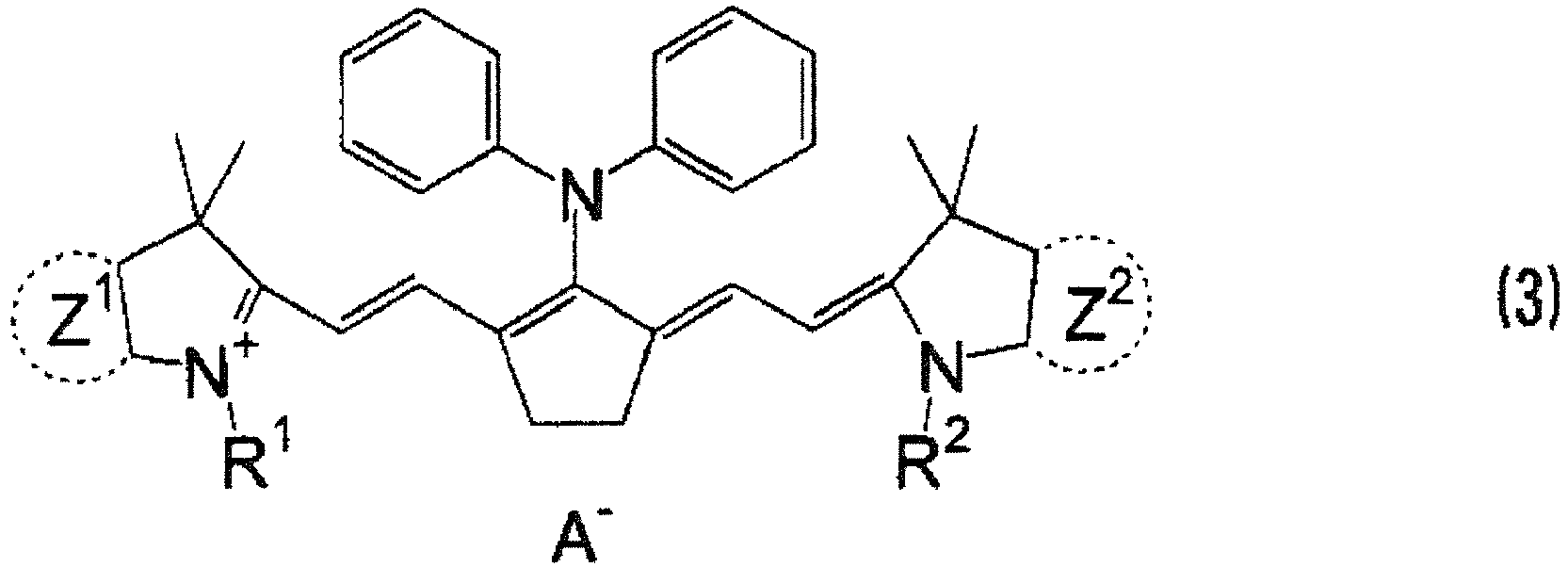
- (7) The lithographic printing plate precursor as described in any one of (4) to (6), wherein the mesoporous silica having a cyanine dye incorporated therein further contains an onium salt.
- (8) The lithographic printing plate precursor as described in (7), wherein the onium salt is an iodonium salt or a sulfonium salt.
- (9) The lithographic printing plate precursor as described in (2), wherein the color changing compound is a compound which causes change in color with an acid.
- (10) The lithographic printing plate precursor as described in (9), wherein the compound which causes change in color with an acid is a compound represented by formula (II-3) shown below.

- (11) The lithographic printing plate precursor as described in (2), wherein the color changing compound is a compound which causes change in color with heat.
- (12) The lithographic printing plate precursor as described in (11), wherein the compound which causes change in color with heat is a compound represented by formula (IB) shown below.

- (13) The lithographic printing plate precursor as described in any one of (1) to (12), wherein the image-recording layer contains (F) a borate compound.
- (14) The lithographic printing plate precursor as described in (13), wherein the borate compound is a tetraaryl borate.
- (15) The lithographic printing plate precursor as described in any one of (1) to (14), which comprises a protective layer on the image-recording layer.
- (16) A plate making method comprising imagewise exposing the lithographic printing plate precursor as described in any one of (1) to (15) with infrared laser, mounting the exposed lithographic printing plate precursor on a printing machine and supplying dampening water and ink to remove the image-recording layer in an unexposed area.
- According to the present invention, lithographic printing plate precursor, particularly, a lithographic printing plate precursor of on-press development type, which is excellent in visibility of visible image after image exposure (plate inspection property), on-press development property and printing durability and a plate making method thereof can be provided.
- According to the invention, by introducing a mesoporous silica having a color changing compound incorporated therein into an image-recording layer of a lithographic printing plate precursor, a lithographic printing plate which is excellent in both visibility of visible image after image exposure (plate inspection property), on-press development property and printing durability can be obtained by conducting plate making.
- The functional mechanism of the invention is not quite clear but it is believed that by using a mesoporous silica having a relatively hydrophilic surface and incorporating a color changing compound into the inside of pores of the mesoporous silica, the color changing compound can be isolated from the hydrophilic environment of image-recording layer while maintaining the hydrophilicity of image-recording layer. Further, it is estimated that since the color changing compound is incorporated into the pores of the mesoporous silica and isolated from other components of the image-recording layer, decomposition of the color changing compound is inhibited and the color changing reaction is accelerated. It is also estimated that since the compound is isolated from other components of the image-recording layer even after the color change, the fading reaction is prevented. Moreover, it is estimated that since the mesoporous silica cushions the shock at the time of printing, the printing durability is improved.
- The lithographic printing plate precursor according to the invention comprises an image-recording layer and a support, wherein the image-recording layer contains (A) an infrared absorbing agent, (B) a radical generator, (C) a polymerizable compound, and (D) a mesoporous silica having a color changing compound incorporated therein. The lithographic printing plate precursor according to the invention can produce a lithographic printing plate by on-press development on a printing machine after image exposure.
- The lithographic printing plate precursor according to the invention may comprise an undercoat layer between the support and the image-recording layer, if desired. Also, the lithographic printing plate precursor according to the invention may comprise a protective layer on the image-recording layer.
- The lithographic printing plate precursor according to the invention will be described below.
- The image-recording layer according to the invention contains (A) an infrared absorbing agent, (B) a radical generator, (C) a polymerizable compound, and (D) a mesoporous silica having a color changing compound incorporated therein and is capable of being removed with at least any of printing ink and dampening water.
- The image-recording layer according to the invention may contain a component, for example, (E) a binder polymer, (F) a borate compound or (G) a polymer fine particle, in addition to the components described above, if desired. Further, the image-recording layer may contain, if desired, a known compound other than the components described above.
- Respective components which can be contained in the image-recording layer will be described in order below.
- An infrared absorbing agent (A) which can be used in the invention is preferably a dye or pigment having an absorption maximum in a wavelength range from 760 to 1,200 nm. In the invention, a dye is preferred from the standpoint of increasing the print-out property.
- As the dye, commercially available dyes and known dyes described in literatures, for example, Senryo Binran (Dye Handbook) compiled by The Society of Synthetic Organic Chemistry, Japan (1970) can be utilized. Specifically, the dyes includes azo dyes, metal complex azo dyes, pyrazolone azo dyes, naphthoquinone dyes, anthraquinone dyes, phthalocyanine dyes, carbonium dyes, quinoneimine dyes, methine dyes, cyanine dyes, squarylium dyes, pyrylium salts and metal thiolate complexes.
- Examples of preferred dye include cyanine dyes described, for example, in
JP-A-58-125246 JP-A-59-84356 JP-A-60-78787 JP-A-58-173696 JP-A-58-181690 JP-A-58-194595 JP-A-58-112793 JP-A-58-224793 JP-A-59-48187 JP-A-59-73996 JP-A-60-52940 JP-A-60-63744 JP-A-58-112792 434,875 - Also, near infrared absorbing sensitizers described in
U.S. Patent 5,156,938 are preferably used. Further, substituted arylbenzo(thio)pyrylium salts described inU.S. Patent 3,881,924 , trimethinethiapyrylium salts described inJP-A-57-142645 U.S. Patent 4,327,169 ), pyrylium compounds described inJP-A-58-181051 JP-A-58-220143 JP-A-59-41363 JP-A-59-84248 JP-A-59-84249 JP-A-59-146063 JP-A-59-146061 JP-A-59-216146 U.S. Patent 4,283,475 , and pyrylium compounds described inJP-B-5-13514 JP-B-5-19702 U.S. Patent 4,756,993 . - Of the dyes, cyanine dyes, squarylium dyes, pyrylium dyes, nickel thiolate complexes and indolenine cyanine dyes are particularly preferred.
- As the cyanine dye, a cyanine dye represented by formula (1) shown below is preferably used.

- In formula (1), X1 represents a hydrogen atom, a halogen atom, -N(L1)2, -X2-L1 or a group shown below. X2 represents an oxygen atom or a sulfur atom. L1 represents a hydrocarbon group having from 1 to 12 carbon atoms, an aromatic ring group containing a hetero atom or a hydrocarbon group having from 1 to 12 carbon atoms and containing a hetero atom. The hetero atom as used herein indicates a nitrogen atom, a sulfur atom, an oxygen atom, a halogen atom or a selenium atom. In the group shown below, Xa- has the same meaning as Za- defined hereinafter, and Ra represents a hydrogen atom or a substituent selected from an alkyl group, an aryl group, a substituted or unsubstituted amino group and a halogen atom. From the standpoint of improvement in the visibility, X1 is preferably -NPh2.

- In formula (1), R1 and R2 each independently represents a hydrocarbon group having from 1 to 12 carbon atoms. In view of the preservation stability of a coating solution for image-recording layer, it is preferred that R1 and R2 each represents a hydrocarbon group having two or more carbon atoms. Further, it is preferred that R1 and R2 are combined with each other to form a 5-membered or 6-membered ring. From the standpoint of improvement in the visibility, it is particularly preferred that R1 and R2 are combined with each other to form a 5-membered ring.
- In formula (1), Ar1 and Ar2, which may be the same or different, each represents an aromatic hydrocarbon group which may have a substituent. Preferred examples of the aromatic hydrocarbon group include a benzene ring group and a naphthalene ring group. Also, preferred examples of the substituent include a hydrocarbon group having 12 or less carbon atoms, a halogen atom and an alkoxy group having 12 or less carbon atoms. From the standpoint of improvement in the visibility, the substituent is preferably an electron donating group, and specifically, more preferably an alkoxy group having 12 or less carbon atoms or an alkyl group having 12 or less carbon atoms. Y1 and Y2, which may be the same or different, each represents a sulfur atom or a dialkylmethylene group having 12 or less carbon atoms. R3 and R4, which may be the same or different, each represents a hydrocarbon group having 20 or less carbon atoms which may have a substituent. Preferred examples of the substituent include an alkoxy group having 12 or less carbon atoms, a carboxyl group and a sulfo group. R5, R6, R7 and R8, which may be the same or different, each represents a hydrogen atom or a hydrocarbon group having 12 or less carbon atoms. In view of the availability of raw materials, a hydrogen atom is preferred.
- In formula (1), Za- represents a counter anion. However, Za- is not necessary when the cyanine dye represented by formula (1) has an anionic substituent in the structure thereof and neutralization of charge is not needed. In view of the preservation stability of a coating solution for image-recording layer, preferred examples of the counter ion for Za- include a halide ion, a perchlorate ion, a tetrafluoroborate ion, a hexafluorophosphate ion, a sulfonate ion and an organic borate ion, for example, a tetraphenyl borate ion, and more preferred examples thereof include a perchlorate ion, a hexafluorophosphate ion, an arylsulfonate ion and an organic borate ion, for example, a tetraphenyl borate ion.
- As a more preferred example of the cyanine dye, a dye represented by formula (2) shown below is exemplified.

- In formula (2), L1 represents a hydrogen atom, a halogen atom, -NPh2 or -Y3-L2. Y3 represents an oxygen atom, a nitrogen atom or a sulfur atom. L2 represents an alkyl group, an aryl group, a heteroaromatic ring group (the hetero atom represents a nitrogen atom, a sulfur atom, an oxygen atom, a halogen atom or a selenium atom) or a hydrocarbon group having from 1 to 12 carbon atoms and containing a hetero atom.
- X1 and X2 each independently represents a sulfur atom, an oxygen atom or a dialkylmethylene group having 12 or less carbon atoms. Z1 and Z2 each independently represents an aromatic ring or a heteroaromatic ring.
- R1 and R2 each independently represents a hydrocarbon group. R3, R4, R7 and R8 each independently represents a hydrogen atom or a hydrocarbon group having 12 or less carbon atoms. R5 and R6 each independently represents a hydrocarbon group, or R5 and R6 may be combined with each other to form a 5-membered or 6-membered ring. A- represents a counter anion and has the same meaning as Za- defined in formula (1) above, and preferred examples thereof are also the same.
- Each of the substituents and ring structures described above may have a substituent, and examples of the substituent capable of being introduced include an alkyl group having from 1 to 12 carbon atoms, an aryl group having from 6 to 12 carbon atoms, a halogen atom, an alkoxy group having from 1 to 12 carbon atoms, an aryloxy group having from 6 to 12 carbon atoms, a hydroxy group, an amino group, a carbonyl group, a carboxyl group, a sulfo group and a silyl group.
- As a still more preferred example of the cyanine dye, a dye represented by formula (3) shown below is exemplified.

- In formula (3), Z1 and Z2 each independently represents an aromatic ring or a heteroaromatic ring. R1 and R2 each independently represents a hydrocarbon group. A- represents a counter anion and has the same meaning as Za- defined in formula (1) above, and preferred examples thereof are also the same.
- Each of the substituents and ring structures described above may have a substituent, and examples of the substituent capable of being introduced include an alkyl group having from 1 to 12 carbon atoms, an aryl group having from 6 to 12 carbon atoms, a halogen atom, an alkoxy group having from 1 to 12 carbon atoms, an aryloxy group having from 6 to 12 carbon atoms, a hydroxy group, an amino group, a carbonyl group, a carboxyl group, a sulfo group and a silyl group.
- Specific examples of the cyanine dye represented by formula (1) which can be preferably used in the invention are set forth below, but the invention should not be construed as being limited thereto.


- Examples of the infrared absorbing pigment which can be used in the invention include commercially available pigments and pigments described in Colour Index (C.I.), Saishin Ganryo Binran (Handbook of the Newest Pigments) compiled by Pigment Technology Society of Japan (1977), Saishin Ganryo Oyou Gijutsu (Newest Application on Technologies for Pigments), CMC Publishing Co., Ltd. (1986) and Insatsu Ink Gijutsu Printing Ink Technology), CMC Publishing Co., Ltd. (1984).
- Examples of the pigment include black pigments, yellow pigments, orange pigments, brown pigments, red pigments, purple pigments, blue pigments, green pigments, fluorescent pigments, metal powder pigments and polymer-bonded dyes. Specific examples of usable pigment include insoluble azo pigments, azo lake pigments, condensed azo pigments, chelated azo pigments, phthalocyanine pigments, anthraquinone pigments, perylene and perynone pigments, thioindigo pigments, quinacridone pigments, dioxazine pigments, isoindolinone pigments, quinophthalone pigments, dying lake pigments, azine pigments, nitroso pigments, nitro pigments, natural pigments, fluorescent pigments, inorganic pigments and carbon black.
- The pigment may be used without undergoing surface treatment or may be used after the surface treatment. For the surface treatment, a method of coating a resin or wax on the surface of pigment, a method of attaching a surfactant to the pigment surface and a method of bonding a reactive substance (for example, a silane coupling agent, an epoxy compound or polyisocyanate) to the pigment surface. The surface treatment methods are described in Kinzoku Sekken no Seishitsu to Oyo (Properties and Applications of Metal Soap), Saiwai Shobo, Insatsu Ink Gijutsu (Printing Ink Technology), CMC Publishing Co., Ltd. (1984), and Saishin Ganryo Oyo Gijutsu (Newest Application on Technologies for Pigments), CMC Publishing Co., Ltd. (1986).
- The particle size of pigment is preferably in a range from 0.01 to 10 µm, more preferably in a range from 0.05 to 1 µm, particularly preferably in a range from 0.1 to 1 µm. In the range described above, good stability of the pigment dispersion in the coating solution for image-recording layer and good uniformity of the image-recording layer is obtained.
- For dispersing the pigment, a known dispersion technique for use in the production of ink or toner may be used. Examples of the dispersing machine include an ultrasonic dispersing machine, a sand mill, an attritor, a pearl mill, a super-mill, a ball mill, an impeller, a disperser, a KD mill, a colloid mill, a dynatron, a three roll mill and a pressure kneader. The dispersing machines are described in detail in Saishin Ganryo Oyo Gijutsu (Newest Application on Technologies for Pigments), CMC Publishing Co., Ltd. (1986).
- The content of the infrared absorbing agent is preferably from 0.001 to 50% by weight, more preferably from 0.005 to 30% by weight, particularly preferably from 0.01 to 10% by weight, based on the total solid content of the image-recording layer. In the range described above, high sensitivity is obtained without exerting undesirable influence on the uniformity and film strength of the image-recording layer. (B) Radical generator
- The radical generator (B) which can be used in the invention is a compound which initiates or accelerates polymerization of a polymerizable compound (C). The radical generator includes, for example, known thermal polymerization initiators, compounds containing a bond having small bond dissociation energy and photopolymerization initiators.
- The radical generator according to the invention include, for example, (a) an organic halide, (b) a carbonyl compound, (c) an azo compound, (d) an organic peroxide, (e) a metallocene compound, (f) an azide compound, (g) a hexaarylbiimidazole compound, (h) an organic borate compound, (i) a disulfone compound, (j) an oxime ester compound and (k) an onium salt compound.
- As the organic halide (a), for example, compounds described in Paragraph Nos. [0022] to [0023] of
JP-A-2008-195018 - As the carbonyl compound (b), for example, compounds described in Paragraph No. [0024] of
JP-A-2008-195018 - As the azo compound (c), for example, azo compounds described in
JP-A-8-108621 - As the organic peroxide (d), for example, compounds described in Paragraph No. [0025] of
JP-A-2008-195018 - As the metallocene compound (e), for example, compounds described in Paragraph No. [0026] of
JP-A-2008-195018 - As the azide compound (f), for example, 2,6-bis(4-azidobenzylidene)-4-methylcyclohexanone is exemplified.
- As the hexaarylbiimidazole compound (g), for example, compounds described in Paragraph No. [0027] of
JP-A-2008-195018 - As the organic borate compound (h), for example, compounds described in Paragraph No. [0028] of
JP-A-2008-195018 - As the disulfone compound (i), for example, compounds described in JP-A-6I-166544 and
JP-A-2002-328465 - As the oxime ester compound (j), for example, compounds described in Paragraph Nos. [0028] to [0030] of
JP-A-2008-195018 - As the onium salt compound (k), onium salts, for example, diazonium salts described in S. I. Schlesinger, Photogr. Sci. Eng., 18, 387 (1974) and T. S. Bal et al., Polymer, 21, 423 (1980), ammonium salts described in
U.S. Patent 4,069,055 andJP-A-4-365049 U.S. Patents 4,069,055 and4,069,056 , iodonium salts described in European Patent104,143 U. S. Patent Publication No. 2008/0311520 ,JP-A-2-150848 JP-A-2008-195018 370,693 390,214 233,567 297,443 297,442 U.S. Patents 4,933,377 ,4,760,013 ,4,734,444 and2,833,827 and German Patents2,904,626 ,3,604,580 and3,604,581 , selenonium salts described in J. V. Crivello et al., Macromolecules, 10 (6), 1307 (1977) and J. V. Crivello et al., J. Polymer Sci., Polymer Chem. Ed., 17, 1047 (1979), arsonium salts described in C. S. Wen et al., Teh, Proc. Conf. Rad. Curing ASIA, p. 478, Tokyo, Oct. (1988), and azinium salts described inJP-A-2008-195018 - As preferred radical generators, the onium salt, in particular, the iodonium salt, the sulfonium salt or the azinium salt, and the hexaarylbiimidazole compound are exemplified. Specific examples of these compounds are set forth below, but the invention should not be construed as being limited thereto.
- Of the iodonium salts, a diphenyliodonium salt is preferred. In particular, a diphenyliodonium salt substituted with an electron donating group, for example, an alkyl group or an alkoxy group is preferred, and an asymmetric diphenyliodonium salt is more preferred. Specific examples of the iodonium salt include diphenyliodonium hexafluorophosphate, 4-methoxyphenyl-4-(2-methylpropyl)phenyliodonium hexafluorophosphate, 4-(2-methylpropyl)phenyl-p-tolyliodonium hexafluorophosphate, 4-hexyloxyphenyl-2,4,6-trimethoxyphenyliodonium hexafluorophosphate, 4-hexyloxyphenyl-2,4-diethoxyphenyliodonium tetrafluoroborate, 4-octyloxyphenyl-2,4,6-trimethoxyphenyliodonium 1-perfluorobutanesulfonate, 4-octyloxyphenyl-2,4,6-trimethoxyphenyliodonium hexafluorophosphate and bis(4-tert-butylphenyl)iodonium tetraphenylborate.
- Examples of the sulfonium salt include triphenylsulfonium hexafluorophosphate, triphenylsulfonium benzoylformate, bis(4-chlorophenyl)phenylsulfonium benzoylformate, bis(4-chlorophenyl)-4-methylphenylsulfonium tetrafluoroborate and tris(4-chlorophenyl)sulfonium 3,5-bis(methoxycarbonyl)benzenesulfonate.
- Examples of the azinium salt include 1-cyclohexylmethyloxypyridinium hexafluorophosphate, 1-cyclohexyloxy-4-phenylpyridinium hexafluorophosphate, 1-ethoxy-4-phenylpyridinium hexafluorophosphate, 1-(2-ethylhexyloxy)-4-phenylpyridinium hexafluorophosphate, 4-chloro-1-cyclohexylmethyloxypyridinium hexafluorophosphate, 1-ethoxy-4-cyanopyridinium hexafluorophosphate, 3,4-dichloro-1-(2-ethylhexyloxy)pyridinium hexafluorophosphate, 1-benzyloxy-4-phenylpyridinium hexafluorophosphate, 1-phenethyloxy-4-phenylpyridinium hexafluorophosphate, 1-(2-ethylhexyloxy)-4-phenylpyridinium p-toluenesulfonate, 1-(2-ethylhexyloxy)-4-phenylpyridinium perfluorobutanesulfonate, 1-(2-ethylhexyloxy)-4-phenylpyridinium bromide and 1-(2-ethylhexyloxy)-4-phenylpyridinium tetrafluoroborate.
- Examples of the hexaarylbiimidazole compound include 2,2'-bis(o-chlorophenyl)-4,4',5,5'-tetraphenylbiimidazole, 2,2'-bis(o-bromophenyl)-4,4',5,5'-tetraphenylbiimidazole, 2,2'-bis(o,p-dichlorophenyl)-4,4',5,5'-tetraphenylbiimidazole, 2,2'-bis(o-chlorophenyl)-4,4',5,5'-tetrakis(m-methoxyphenyl)biimidazole, 2,2'-bis(o,o'-dichlorophenyl)-4,4',5,5'-tetraphenylbiimidazole, 2,2'-bis(o-nitrophenyl)-4,4',5,5'-tetraphenylbiimidazole, 2,2'-bis(o-methylphenyl)-4,4',5,5'-tetraphenylbiimidazole and 2,2'-bis(o-trifluoromethylphenyl)-4,4',5,5'-tetraphenylbiimidazole.
- The content of the radical generator is preferably from 0.1 to 50% by weight, more preferably from 0.5 to 30% by weight, particularly preferably from 0.8 to 20% by weight, based on the total solid content of the image-recording layer. In the range described above, good sensitivity and good stain resistance in the non-image area at the time of printing are obtained. (C) Polymerizable compound
- The polymerizable compound (C) which can be used in the invention is an addition-polymerizable compound having at least one ethylenically unsaturated double bond, and it is preferably selected from compounds having at least one, preferably two or more, terminal ethylenically unsaturated double bonds. Such compounds are widely known in the field of art and they can be used in the invention without any particular restriction. The polymerizable compound has a chemical form, for example, a monomer, a prepolymer, specifically, a dimer, a trimer or an oligomer, or a mixture thereof, or a (co)polymer thereof.
- Specific examples of the polymerizable compound include compounds described in Paragraph Nos. [0089] to [0098] of
JP-A-2008-195018 JP-A-2005-329708 - Of the compounds described above, isocyanuric acid ethylene oxide-modified acrylates, for example, tris(acryloyloxyethyl) isocyanurate or bis(acryloyloxyethyl)hydroxyethyl isocyanurate are particularly preferred, because they are excellent in balance between hydrophilicity relating to the on-press development property and polymerization ability relating to the printing durability.
- The amount of the polymerizable compound added is preferably from 5 to 80% by weight, more preferably from 15 to 75% by weight, based on the total solid content of the image-recording layer.
- The mesoporous silica having a color changing compound incorporated therein (D) which can be used in the invention is characterized by having a structure where the mesoporous silica has a color changing compound incorporated into pore thereof. The expression "the mesoporous silica has a color changing compound incorporated into pore thereof" means a state where the color changing compound is present in the pore of mesoporous silica. It is believed that some physical or chemical function (for example, formation of hydrogen bond or capillary force) may exist between the surface of pore of mesoporous silica and the color changing compound. The state where the color changing compound adsorbs on the surface of pore of mesoporous silica is one of preferred embodiments.
- The mesoporous silica is a material which is made of silicon dioxide (silica) and has uniform and regular pores (mesopores) and its use for a catalyst, an adsorbent or the like is known. The term "mesopore" is expression on the size of pore in the physical engineering field and means a pore having a diameter of 2 to 50 nm according to IUPAC.
- The mesoporous silica which can be used in the invention is not particularly restricted and, for example, known mesoporous silica can be appropriately used. Specifically, the mesoporous silica may be produced according to known methods or commercially available products may be used. The methods for production thereof including methods for controlling pores are described in detail, for example, in Science, 273, No. 5276, 1996, pp. 768-771, Supramolecular Sci., 5, No. 3-4, 1998, pp. 253-259,
JP-A-2006-248832 JP-A-2009-107863 - The mesoporous silica which can be used in the invention may be modified on the surface thereof. Surface modification methods of the mesoporous silica are described, for example, in
JP-A-2009-190909 - The surface modification with a hydrophilic group includes a method of chemical modification of a silanol group present on the surface of mesoporous silica with a hydrophilic functional group. As a reagent for the chemical modification, a well-known chemical modification agent, for example, a silane coupling agent, a titanium coupling agent, a zirconia coupling agent, an aluminum coupling agent, a chromium coupling agent, a zirco-aluminum coupling agent or an alcohol may be used. In particular, a silane coupling agent and an organic silicone compound referred to as a silylation agent or the like are exemplified.
- Specific examples thereof include an epoxysilane, for example, γ-glycidoxypropyltriethoxysilane or β-(3,4-epoxycyclohexyl)ethyltrimethoxysilane, an aminosilane, for example, aminopropyltriethoxysilane, ureidopropyltriethoxysilane or N-phenylaminopropyltrimethoxysilane, 3-carboxypropylsilane and 3-mercaptopropylsilane.
- In addition, hexamethyldisilazane, trimethylchlorosilane, N-methyl-N-trimethylsilylacetamide, N-trimethylsilyldisilanamine, N-trimethylsilyldimethylamine, N-methyl-N-trimethylsilyltrifluoroacetamide, N,O-bis(trimethylsilyl)acetamide, N,O-bis(trimethylsilyl)trifluoroacetamide, N-trimethylsilylimidazole or the like may be used.
- The chemical modification of a silanol group present on the surface of mesoporous silica with a hydrophilic functional group by a chemical modification agent may be conducted according to a conventional method ordinarily used as to each chemical modification agent. For example, in case of a silane coupling agent, a solution is prepared by hydrolyzing the coupling agent by adding water, adding an alcohol and a catalyst, for example, acetic acid thereto and dissolving in a solvent, and mesoporous silica is immersed in the resulting solution thereby conducting the surface treatment.
- The pore size of the mesoporous silica which can be used in the invention is preferably from 2 to 25 nm, and more preferably from 4 to 10 nm. When the pore size is too small, it is difficult for the color changing compound to adsorb in a sufficient amount in the pore, whereas when the pore size is too large, it is believed that due to the increase in pore size a rate of surface area in the inside of the pore reduces thereby decreasing the adsorption amount of color changing compound.
- The mesoporous silica which can be used in the invention is preferably particulate. The particle size of the mesoporous silica is ordinarily from 50 to 500 nm, preferably from 50 to 300 nm, and more preferably from 100 to 300 nm. When the particle size is too small, a number of particles per unit area relatively increases to result in deterioration of printing durability based on decrease in film strength of the image-recording layer, whereas when the particle size is too large, it is believed that dispersibility of the mesoporous silica particle decreases and as a result, the image strength in the image-recording layer decreases to result in deterioration of printing durability.
- The color changing compound which is incorporated into mesoporous silica is a compound which changes color upon a physical or chemical function. It includes, for example, a compound which changes color due to light, an acid, heat or the like. The color changing compound per se may be a colored compound or a colorless compound.
- Examples of the color changing compound which changes color due to light (hereinafter, also referred to as a photo-color changing compound) include a cyanine dye. The cyanine dye preferred for the photo-color changing compound includes the cyanine dye represented by formula (1) described above.
- As more preferred example of the photo-color changing compound, a cyanine dye represented by formula (2) shown below is exemplified.

- In formula (2), L1 represents a hydrogen atom, a halogen atom, -NPh2 or -Y3-L2. Y3 represents an oxygen atom, a nitrogen atom or a sulfur atom. L2 represents an alkyl group, an aryl group, a heteroaromatic ring group or a hydrocarbon group having from 1 to 12 carbon atoms and containing a hetero atom. The hetero atom in the heteroaromatic ring group or hydrocarbon group having from 1 to 12 carbon atoms and containing a hetero atom represents a nitrogen atom, a sulfur atom or an oxygen atom.
- X1 and X2 each independently represents a sulfur atom, an oxygen atom or a dialkylmethylene group having 12 or less carbon atoms. Z1 and Z2 each independently represents an aromatic ring or a heteroaromatic ring.
- R1 and R2 each independently represents a hydrocarbon group. R3, R4, R7 and R8 each independently represents a hydrogen atom or a hydrocarbon group having 12 or less carbon atoms. R5 and R6 each independently represents a hydrocarbon group, or R5 and R6 may be combined with each other to form a 5-membered or 6-membered ring. A- represents a counter anion.
- Each of the substituents and ring structures described above may have a substituent, and examples of the substituent capable of being introduced include an alkyl group having from 1 to 12 carbon atoms, an aryl group having from 6 to 12 carbon atoms, a halogen atom, an alkoxy group having from 1 to 12 carbon atoms, an aryloxy group having from 6 to 12 carbon atoms, a hydroxy group, an amino group, a carbonyl group, a carboxyl group, a sulfo group and a silyl group.
- The counter anion represented by A- has the same meaning as Za- defined in formula (1) above, and preferred examples thereof are also the same.
- As a still more preferred example of the photo-color changing compound, a cyanine dye represented by formula (3) shown below is exemplified.

- In formula (3), Z1 and Z2 each independently represents an aromatic ring or a heteroaromatic ring. R1 and R2 each independently represents a hydrocarbon group. A- represents a counter anion.
- Each of the substituents and ring structures described above may have a substituent, and examples of the substituent capable of being introduced include an alkyl group having from 1 to 12 carbon atoms, an aryl group having from 6 to 12 carbon atoms, a halogen atom, an alkoxy group having from 1 to 12 carbon atoms, an aryloxy group having from 6 to 12 carbon atoms, a hydroxy group, an amino group, a carbonyl group, a carboxyl group, a sulfo group and a silyl group.
- The counter anion represented by A- has the same meaning as Za- defined in formula (1) above, and preferred examples thereof are also the same.
- In the case where the cyanine dye is used as the color changing compound, an onium salt may be used, if desired, as a compound which assists the color change of the cyanine dye (hereinafter, also referred to as a color changing aid for cyanine dye). The onium salt is preferably incorporated into the pore of mesoporous silica together with the cyanine dye.
- The onium salt used as the color changing aid for cyanine dye is preferably a compound represented by any one of formulae (4) to (6) shown below. Of the compounds represented by formula (4) to (6), a sulfonium salt represented by formulae (4) and an iodonium salt represented by formula (6) are more preferred.
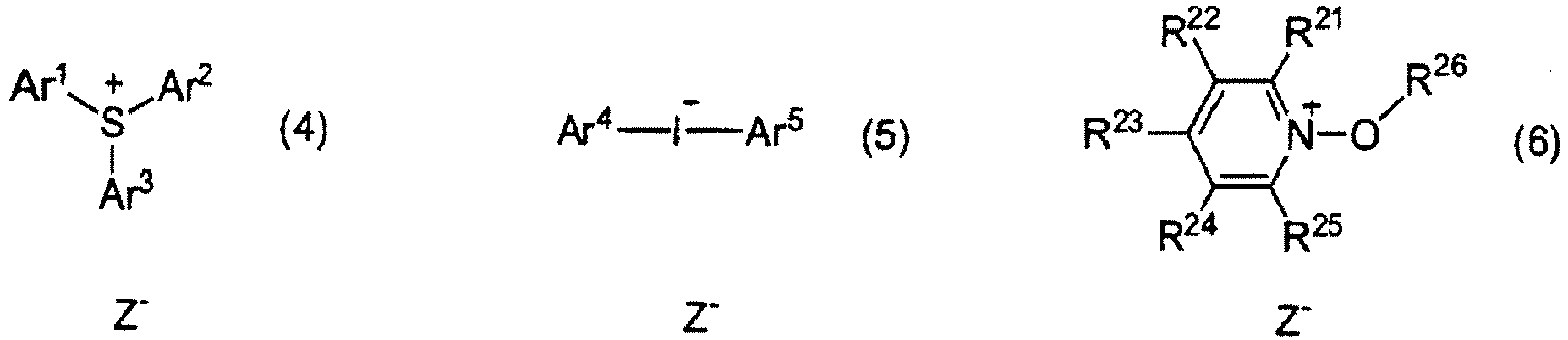

- In formulae (4) to (6), Ar1, Ar2, Ar3, Ar4 and Ar5 each independently represents a group represented by formula (7). R21, R22, R23, R24 and R25 each independently represents a hydrogen atom, an alkyl group, an alkoxy group, an aryl group, a cyano group or a halogen atom, or R21 and R22 or R22 and R23 may be combined with each other to form a condensed ring structure. R26 represents an alkyl group or an aryl group. Z- represents an anion.
- In formula (7), R27 represents an alkyl group, an alkoxy group or a halogen atom, and plural R27s may be the same or different. m represents an integer from 0 to 5.
- In formula (4), Ar1, Ar2 and Ar3 each preferably represents a group represented by formula (10) shown below. In formula (5), Ar4 and Ar5 each preferably represents a group represented by formula (11) shown below.

- In formulae (10) and (11), R30 represents a halogen atom, and plural R30s may be the same or different. R31 represents an alkyl group or an alkoxy group, and plural R31s may be the same or different. m and m' each represents an integer from 0 to 5.
- The alkyl group represented by any of R21, R22, R23, R24, R25, R26, R27 and R31 is preferably an alkyl group having from 1 to 20 carbon atoms, more preferably an alkyl group having from 1 to 10 carbon atoms, and particularly preferably an alkyl group having from 1 to 4 carbon atoms.
- Specific examples of the alkyl group include a methyl group, an ethyl group, a propyl group, a butyl group, a pentyl group, a hexyl group, a heptyl group, an octyl group, a nonyl group, a decyl group, an undecyl group, a dodecyl group, a tridecyl group, a hexadecyl group, an octadecyl group, an eicosyl group, an isopropyl group, an isobutyl group, a sec-butyl group, a tert-butyl group, an isopentyl group, a neopentyl group, 1-methylbutyl group, an isohexyl group, a 2-ethylhexyl group, a 2-methylhexyl group, a cyclohexyl group, a cyclopentyl group and a 2-norbornyl group.
- Of the alkyl groups, a methyl group, an ethyl group, a propyl group, a butyl group and a tert-butyl group are particularly preferred.
- In the case where any of R21, R22, R23, R24, R25, R27 and R31 represents an alkoxy group, a preferred embodiment of an alkyl group included in the alkoxy group is same as the preferred embodiment of the alkyl group in the case where any of R21, R22, R23, R24, R25, R26, R27 and R31 represents the alkyl group.
- The aryl group represented by any of R21, R22, R23, R24, R25 and R26 is preferably an aryl group having from 6 to 30 carbon atoms, more preferably an aryl group having from 6 to 20 carbon atoms, and particularly preferably an aryl group having from 6 to 12 carbon atoms.
- Specific examples of the aryl group include a phenyl group, a biphenyl group, a 1-naphthyl group, a 2-naphthyl group, a 9-fluorenyl group, a terphenyl group, an o-, m- or p-tolyl group, a xylyl group, an o-, m- or p-cumenyl group, a mesityl group, a biphenylenyl group, an indacenyl group, a fluorenyl group, a p-chlorophenyl group, a p-bromophenyl group, a p-fluorophenyl group, an o-chlorophenyl group, an o-bromophenyl group, an o-fluorophenyl group, a p-methoxyphenyl group, a m-methoxyphenyl group, a p-dimethylaminophenyl group, a p-methylthiophenyl group, a m-methylthiophenyl group, p-phenyltiophenyl group, a 2,3-difluorophenyl group, a 2,3-dichlorophenyl group, a 2,4-difluorophenyl group, a 2,4-dichlorophenyl group, a 2,5-difluorophenyl group, a 2,5-dichlorophenyl group, a 2,6-difluorophenyl group, a 2,6-dichlorophenyl group, a 2,4,6-trifluorophenyl group, a 2,4,6-trichlorophenyl group, a 3,4,5-trifluorophenyl group and a 3,4,5-trichlorophenyl group.
- Of the aryl groups, a phenyl group, a p-methoxyphenyl group and a p-dimethylaminophenyl group are particularly preferred.
- The anion represented by Z- includes a halide ion, a perchlorate ion, a tetrafluoroborate ion, a hexafluorophosphate ion and a sulfonate ion, and is preferably a perchlorate ion, a hexafluorophosphate ion and an arylsulfonate ion and particularly preferably a hexafluorophosphate ion.
- Specific examples of the onium salt used as the color changing aid for cyanine dye are set forth below, but the invention should not be construed as being limited thereto.
- Examples of the compound (sulfonium salt) represented by formula (4) include triphenylsulfonium hexafluorophosphate, triphenylsulfonium benzoylformate, bis(4-chlorophenyl)phenylsulfonium benzoylformate, bis(4-chlorophenyl)-4-methylphenylsulfonium tetrafluoroborate, tris(4-chlorophenyl)sulfonium 3,5-bis(methoxycarbonyl)benzenesulfonate, tris(4-chlorophenyl)sulfonium hexafluorophosphate, tris(2,4-dichlorophenyl)sulfonium hexafluorophosphate, bis(2,4-dichlorophenyl)phenylsulfonium hexafluorophosphate and bis(2,4-dichlorophenyl)-4-methoxyphenylsulfonium hexafluorophosphate.
- Examples of the compound (iodonium salt) represented by formula (5) include diphenyliodonium hexafluorophosphate, 4-methoxyphenyl-4-(2-methylpropyl)phenyliodonium hexafluorophosphate, 4-chlorophenyl-4-phenyliodonium hexafluorophosphate, 4-(2-methylpropyl)phenyl-p-tolyliodonium hexafluorophosphate, 4-hexyloxyphenyl-2,4,6-trimethoxyphenyliodonium hexafluorophosphate, 4-hexyloxyphenyl-2,4-diethoxyphenyliodonium tetrafluoroborate, 4-octyloxyphenyl-2,4,6-trimethoxyphenyliodonium 1-perfluorobutanesulfonate, 4-octyloxyphenyl-2,4,6-trimethoxyphenyliodonium hexafluorophosphate and bis(4-tert-butylphenyl)iodonium hexafluorophosphate.
- Examples of the compound (azinium salt) represented by formula (6) include 1-cyclohexylmethyloxypyridinium hexafluorophosphate, 1-cyclohexyloxy-4-phenylpyridinium hexafluorophosphate, 1-methoxypyridinium hexafluorophosphate, 1-methoxy-4-tert-butylpyridinium hexafluorophosphate, 1-methoxy-4-methoxypyridinium hexafluorophosphate, 1-ethoxy-4-phenylpyridinium hexafluorophosphate, 1-(2-ethylhexyloxy)-4-phenylpyridinium hexafluorophosphate, 4-chloro-1-cyclohexylmethyloxypyridinium hexafluorophosphate, 1-ethoxy-4-cyanopyridinium hexafluorophosphate, 3,4-dichloro-1-(2-ethylhexyloxy)pyridinium hexafluorophosphate, 1-benzyloxy-4-phenylpyridinium hexafluorophosphate, 1-phenethyloxy-4-phenylpyridinium hexafluorophosphate, 1-(2-ethylhexyloxy)-4-phenylpyridinium p-toluenesulfonate, 1-(2-ethylhexyloxy)-4-phenylpyridinium perfluorobutanesulfonate, 1-(2-ethylhexyloxy)-4-phenylpyridinium bromide and 1-(2-ethylhexyloxy)-4-phenylpyridinium tetrafluoroborate. (2) Color changing compound which changes color due to acid
- As the color changing compound which changes color due to an acid (hereinafter, also referred to as an acid-color changing compound), any compound which causes change in color due to an acid may be suitably used. Examples of the acid-color changing compound include a triarylmethane compound, a biphenylmethane compound, a xanthene compound, a thiazine compound and compounds represented by formulae (II-1) to (II-3) shown below. Of the compounds, the triarylmethane compound, xanthene compound and compounds represented by formulae (II-1) to (II-3) are preferred, and the compounds represented by formula (II-3) are particularly preferred.

- In formula (II-1), X2 represents N(R58), O or S, Y1 represents an atomic group necessary for forming a cyclic structure together with N-C-X2, A1 represents C(R59) or N, R51 to R59, which may be the same or different, each represents a hydrogen atom or a substituent, or R54, R55, R56 and R57 may be combined with each other to form a condensed ring, and B1 represents an aryl group, a heterocyclic group, an alkenyl group, an alkynyl group, an arylamino group or a heterocyclic amino group.

- In formula (II-2), Ar1 and Ar2, which may be the same or different, each represents an aryl group, a heterocyclic group, an alkenyl group or an alkynyl group, R71 represents a hydrogen atom or a substituent, Y2 represents an aromatic hydrocarbon ring or a heterocyclic ring, X3 represents O, S or N(R72), and R72 represents a hydrogen atom or a substituent.

- In formula (II-3), Ar3 and Ar4, which may be the same or different, each represents an aryl group, a heterocyclic group, an alkenyl group or an alkynyl group, and Z1 represents an aromatic hydrocarbon ring or a heterocyclic ring.
- In the leuco dye represented by formula (II-1), R51 to R57 each independently represents a hydrogen atom, an alkyl group (for example, a methyl group, an ethyl group, an n-propyl group, an isopropyl group, a tert-butyl group, a n-octyl group, a dodecyl group, a cyclopropyl group, a cyclopentyl group, a cyclohexyl group, a [0,1,3]bicyclohexyl group, a [1,2,2]bicycloheptyl group or a [1,1,3]bicycloheptyl group), an aryl group (for example, a phenyl group or a naphthyl group), or a heterocyclic group (for example, a furyl group, a thienyl group, a pyrimidinyl group or a bonzothiazolyl group). The number of carbon atoms in each of these groups is preferably from 1 to 18, and more preferably from 1 to 12. Each of R51 to R57 is preferably an alkyl group or an aryl group, and particularly preferably an aryl group. As to R54, R55, R56 and R57, in the case where the adjacent two groups thereof are connected with each other to form a condensed ring, examples of the condensed ring include a naphthalene ring, an anthracene ring, a benzofuran ring and a benzothiophene ring.
- These groups may have a substituent and as the substituent, any substituent capable of substituting may be used. Examples of the preferred substituent include a halogen atom, an alkyl group, an alkenyl group, an alkynyl group, an aryl group, a heterocyclic group, a cyano group, a hydroxy group, a nitro group, a carboxyl group, an alkoxy group, an aryloxy group, a silyloxy group, a heterocyclic oxy group, an acyloxy group, a carbamoyloxy group, an alkoxycarbonyloxy group, an aryloxycarbonyloxy group, an amino group, an acylamino group, a carbamylamino group, an alkoxycarbonylamino group, an aryloxycarbonylamino group, a sulfamoylamino group, an alkylsulfonylamino group, an arylsulfonylamino group, a mercapto group, an alkylthio group, an arylthio group, a heterocyclic thio group, a sulfamoyl group, a sulfo group, an alkylsulfinyl group, an arylsulfinyl group, an alkylsulfonyl group, an arylsulfonyl group, an acyl group, an aryloxycarbonyl group, an alkoxycarbonyl group, a carbamoyl group, an imido group, a phosphino group, a phosphinyl group, a phosphinyloxy group, a phosphinylamino group and a silyl group.
- In formula (II-1), each of R51 and R52 is preferably an alkyl group.
- In formula (II-1), when X2 represents N(R58) and R58 represents a substituent, the substituent represented by R58 includes the substituents described in the case where each of R51 to R57 represents the substituent. X2 is particularly preferably O.
- In formula (II-1), when Y1 represents an atomic group necessary for forming a cyclic structure together with N-C-X2, Y1 is preferably an atomic group necessary for forming a 5-membered or 6-membered ring. Examples of the atom constituting Y1 necessary for forming the ring skeleton include a carbon atom, a nitrogen atom, a sulfur atom, a silicon atom and a phosphorus atom. These atoms may have a hydrogen atom or a substituent, if desired, and when plural substituents are present, the substituents may be the same or different or may be combined with each other to form a ring.
- In the case where the atom constituting Y1 has a substituent, examples of the substituent include =O (forming a carbonyl group, a sulfonyl group or the like together with the skeleton atom of Y1), =S (forming a thiocarbonyl group or the like together with the skeleton atom of Y1), =N-R60 (R60 represents a hydrogen atom or a substituent, and examples of the substituent include the substituents described in the case where each of R51 to R57 represents the substituent), and the substituents described in the case where each of R51 to R57 represents the substituent.
- A preferred embodiment of Y1 is a divalent connecting group formed by connecting a divalent group represented by -C(R61)(R62)- or -C(=O)- in an appropriate combination (wherein R61 and R62, which may be the same or different, each represents a hydrogen atom or a substituent, or plural R61 and R62 present in the molecule may be combined with each other to form a ring, and examples of the substituent represented by each of R61 and R62 include the substituents described in the case where each of R51 to R57 represents the substituent). Specific examples of Y1 include -CH2CH2-, -CH2CH2CH2-, -CH(CH3)CH2-, -CH2C(=O)-, -C(=O)CH2-, -CH2CH2C(=O)-, -C(=O)CH2CH2- and -CH=CH-. A preferred embodiment of Y1 is -[C(R61)(R62)]2-.
- In formula (II-1), when A1 represents C(R59) and R59 represents a substituent, examples of the substituent include the substituents described in the case where each of R51 to R57 represents the substituent. A particularly preferred example of A1 is CH.
- B1 represents an aryl group (for example, a phenyl group or a naphthyl group), a heterocyclic group (for example, a furyl group, a thienyl group, a pyrimidinyl group or a bonzothiazolyl group), an alkenyl group (for example, a vinyl group, an allyl group, a prenyl group, a geranyl group, an oleyl group or a 2-cyclopenten-1-yl group), an alkynyl group (for example, an ethynyl group, a propargyl group or a trimethylsilylethynyl group), an arylamino group or a heterocyclic amino group. These groups may have a substituent at a position capable of being substituted, and examples of the substituent include the substituents described in the case where each of R51 to R57 represents the substituent. Also, as to the substituent, two different groups may be combined with each other to form a condensed ring or the substituent may form a ring together with R59. B1 is preferably an aryl group or a heterocyclic group.
- Of the compounds represented by formula (II-1), a compound represented by formula (II-4) shown below is preferred.

- In formula (II-4), R51 to R57 have the same meanings as defined in formula (II-1), and D1 represents an aryl group (for example, a phenyl group or a naphthyl group) or a heterocyclic group (for example, a furyl group, a thienyl group, a pyrimidinyl group or a bonzothiazolyl group).
- In the case where the aryl group or heterocyclic group represented by D1 has a substituent, examples of the substituent include the substituents described in the case where each of R51 to R57 represents the substituent.
- In the leuco dye represented by formula (II-2), when R71 represents a substituent, examples of the substituent include the substituents described in the case where each of R51 to R57 represents the substituent. Of the substituents, an alkyl group, an aryl group, a heterocyclic group, an alkoxy group, an aryloxy group, a silyloxy group, a heterocyclic oxy group, a carbamoyloxy group, an alkoxycarbonyloxy group, an aryloxycarbonyloxy group, an amino group (including an aniline group), an acylamino group, an aminocarbonylamino group, an alkoxycarbonylamino group, an aryloxycarbonylamino group, an alkylthio group, an arylthio group, a heterocyclic thio group and a silyl group are preferred, and an alkyl group, an aryl group, a heterocyclic group, an alkoxy group, an aryloxy group, a heterocyclic oxy group, an amino group (including an aniline group), an acylamino group, an aminocarbonylamino group, an alkoxycarbonylamino group and an aryloxycarbonylamino group are particularly preferred. Of the substituents, when the substituent has a hydrogen atom, the hydrogen atom is eliminated and substituted with the substituent described above.
- In formula (II-2), Ar1 and Ar2, which may be the same or different, each represents an aryl group (for example, a phenyl group or a naphthyl group), a heterocyclic group (for example, a furyl group, a thienyl group, a pyrimidinyl group or a bonzothiazolyl group), an alkenyl group (for example, a vinyl group, an allyl group, a prenyl group, a geranyl group, an oleyl group or a 2-cyclopenten-1-yl group) and an alkynyl group (for example, an ethynyl group, a propargyl group or a trimethylsilylethynyl group). These groups may have a substituent at a position capable of being substituted, and examples of the substituent include the substituents described in the case where each of R51 to R57 represents the substituent.
- When Ar1 and Ar2 have plural substituents, the substituents may be connected with each other to form a condensed ring or Ar1 and Ar2 may be connected with each other to from a ring. Examples of the condensed ring formed by the substituents introduced into Ar1 or the substituents introduced into Ar2 include a julolidine ring, a naphthalene ring, an anthracene ring, a benzofuran ring and a benzothiophene ring. Examples of the ring formed by connecting Ar1 and Ar2 include a 9H-xanthene ring, a 10-alkyl-9,10-dihydroacridine ring, a 9H-thioxanthene ring, a 1-alkyl-4H-chromeno[2,3-C]pyrazole ring, a 11H-benzo[b]thieno[3,2-b]chromene ring, a 6-alkyl-5-oxo-5,6-dihydro-12H-chromeno[2,3-C]isoquinoline ring, a 4H-chromene ring, a 2H-chromene ring and a fluorene ring.
- Each of Ar1 and Ar2 is preferably an aryl group or a heterocyclic group. The cases where at least one of Ar1 and Ar2 is an electron donating aryl group (for example, a p-dimethylaminophenyl group, a p-julolidinyl group or a p-methoxyphenyl group) or a heterocyclic group selected from a 1,2,3,4-tetrahydroquinolin-6-yl group, a 3,3-dimethylindolin-5-yl group, a 3,4-methylenedioxyphenyl group, a 1,2-dimethyl-5-benzimidazolyl group, a 10-ethylphenothiazin-3-yl group, a 9-ethylcarbazol-3-yl group, a dibenzofuran-3-yl group, a dibenzothiophen-3-yl group, a quinolin-8-yl group, a 1,2-dimethylindol-3-yl group, an ethylindazol-3-yl, a benzo[b]furan-3-yl group, a benzo[b]thiophen-3-yl group, a 1-ethylpyrrol-3-yl group, a 3-furyl group, a 3-thienyl group, a 2-thiazolyl group, a 2-benzoxazolyl group, a 2-pyridyl group and a 4-quinolyl group, and the cases where at least one of Ar1 and Ar2 has an electron donating group as the substituent and Ar1 and Ar2 are connected with each other to form the condensed ring described above are particularly preferred.
- Y2 represents an aromatic hydrocarbon ring (for example, a benzene ring, a naphthalene ring or an anthracene ring) or a heterocyclic ring (for example, a pyridine ring, a pyrimidine ring, an indole ring, a furan ring or a thiazine ring). These rings may be substituted with a substituent at a position capable of being substituted. Examples of the substituent include the substituents described in the case where each of R51 to R57 represents the substituent. Y2 is preferably an aromatic hydrocarbon ring, and particularly preferably a benzene ring.
- When X3 represents N(R72) and R72 represents a substituent, the substituent represented by R72 includes the substituents described in the case where R71 represents the substituent. X3 is preferably O or S.
- The compound represented by formula (II-2) can be synthesized, for example, by acting an acid halide or isocyanate to a triarylmethane derivative having an amino group at an ortho position synthesized from a Michler's hydrol and an arylamine, and then being oxidized using an oxidant, for example, lead dioxide, manganese dioxide or chloranil. The synthesis methods are described in detail, for example, in
JP-A-57-47697 JP-A-61-17573 JP-A-63-251278 - In the compound represented by formula (II-3), the aryl group, heterocyclic group, alkenyl group and alkynyl group represented by any of Ar3 and Ar4 have the same meanings as the aryl group, heterocyclic group, alkenyl group and alkynyl group (including these groups having the substituent) represented by any of Ar1 and Ar2 defined in formula (II-2) described above, respectively.
- In the compound represented by formula (II-3), Ar3 and Ar4 preferably represent a combination of an aryl group and an aryl group, a combination of an aryl group and a heterocyclic group or a combination of an aryl group and an alkenyl group. These groups may have a substituent at a position capable of being substituted. The case where the aryl group having an alkylamino group as the substituent is more preferred.
- The hydrocarbon ring and heterocyclic ring represented by Z1 have the same meanings as the hydrocarbon ring and heterocyclic ring represented by Y2 defined in formula (II-2) described above, respectively.
- The compound represented by formula (II-3) can be synthesized by the method described in
JP-A-58-17036 - Specific examples of the acid-color changing compound are set forth below, but the invention should not be construed as being limited thereto.
- Brilliant green, eosin, ethyl violet, erythrosine B, methyl green, crystal violet, basic fuchsin, phenolphthalein, 1,3-diphenyltriazine, alizarin red S, thymolphthalein, methyl violet 2B, quinaldine red, rose bengal, metanil yellow, thymolsulfophthalein, xylenol blue, methyl orange, orange IV, diphenylthiocarbazone, 2,7-dichlorofluorescein, paramethyl red, congo red, benzopurpurine 4B, a-naphthyl red, nile blue 2B, nile blue A, phenacetarin, methyl violet, malachite green, parafuchsin, victoria pure blue BOH, oil blue #603, oil pink #312, oil red 5B, oil scarlet #308, oil red OG, oil red RR, oil green #502, spiron red BEH special, m-cresol purple, cresol red, rhodamine B, rhodamine 6G, fast acid violet R, sulforhodamine B, auramine, 4-p-diethylaminophenyliminonaphthoquinone, 2-carboxyanilino-4-p-diethylaminophenyliminonaphthoquinone, 2-carbostearylamino-4-p-dihydroxyethylaminophenyliminonapthoquinone, p-methoxybenzoyl-p'-diethylamino-o'-methylphenyliminoacetanilide, cyano-p-diethylaminophenyliminoacetanilide, 1-phenyl-3-methyl-4-p-diethylaminophenylimino-5-pyrazolone, 1-β-napthyl-4-p-diethylaminophenylimino-5-pyrazolone, pentamethoxy red and heptamethoxy red are exemplified.
- Also, a triphenylmethanephthalide compound, for example, 3,3-bis(p-dimethylaminophenyl)phthalide, 3,3-bis(p-dimethylaminophenyl)-6-dimethylaminophthalide, 4-hydroxy-4'-dimethylaminotriphenylmethane lactone, 4,4'-bisdihydroxy-3,3'-bisdiaminotriphenylmethane lactone or crystal violet lactone; an indolylphthalide compound, for example, 3-(4-diethylamino-2-ethoxyphenyl)-3-(1-ethyl-2-methylindol-3-yl)-4-azaphthali de, 3-(4-diethylaminophenyl)-3-(1-ethyl-2-methylindol-3-yl)phthalide, 3,3-bis(1-n-butyl-2-methylindol-3-yl)phthalide or 3,3-bis(1-ethyl-2-methylindol-3-yl)phthalide; a fluoran compound, for example, 3-diethylamino-6-methyl-7-anilinofluoran, 3-dibutylamino-6-methyl-7-anilinofluoran, 3-diethylamino-6-methyl-7-xylidinofluoran, 3-dibutylamino-6-methyl-7-xylidinofluoran, 3-diethylamino-7-chloroanilinofluoran, 3-diethylamino-7,8-benzofluoran, 3,6-dimethoxyfluoran, 3-diethylamino-6-methoxy-7-aminofluoran, 3-diethylamino-7-benzylaminofluoran, 3-diethylamino-6-methylchlorofluoran, 3-dimethylamino-6-methoxyfluoran, 3,6-bis-β-methoxyethoxyfluoran, 3-diethylamino-6-methyl-7-chlorofluoran, 3,7-bisdiethylaminofluoran or 3-diethylamino-7-methoxyfluoran are exemplified.
- Further, the compounds shown below are exemplified.


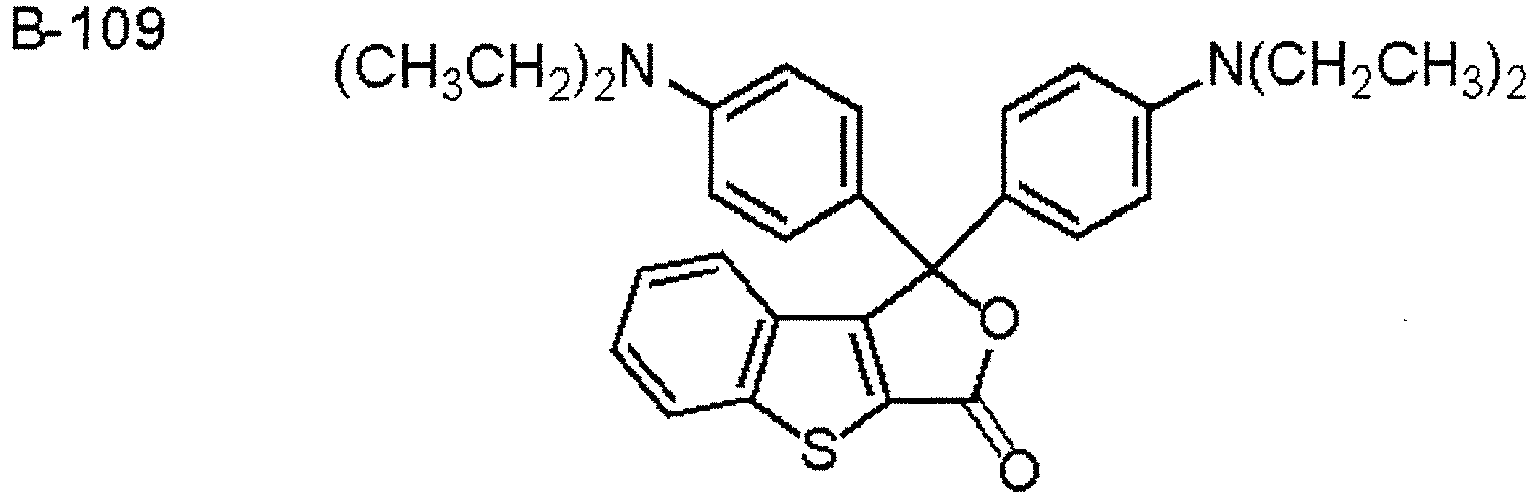


- As the color changing compound which changes color due to heat (hereinafter, also referred to as an heat-color changing compound), any known compound which causes change in color due to heat may be used without particular restriction. Examples thereof are described, for example, in Kinousei Shikiso (Functional dyes), CMC publishing Co., Ltd. (1986), Chromic Zairyo to Oyo (Chromic Materials and applications), CMC publishing Co., Ltd. (1989), Photochromism, Wiley-Interscience (New York) (1971), and Organic Photochromic and Thermochromic Compounds, Kluwer Academic/Plenum Publishers (New York) (1999).
- As the heat-color changing compound, for instance, a spiro compound, a condensed aromatic ring-substituted ethylene derivative, for example, an anthrone, a polythiophene derivative, a liquid crystal, for example, a cholesteric liquid crystal, and METHAMOCOLOR (registered trademark, produced by The Pilot Pen Co., Ltd.), which is a material causing color change upon heat based on an electron donating and accepting mechanism at a thermal equilibrium of a polar compound of electron donor and electron acceptor, may be used.
- Further, a dye which changes color upon heat described in
JP-A-6-340821 JP-A-7-165762 - The spiro compound is particularly preferred.
- Of the spiro compounds, a compound represented by formula (IB) shown below is preferred.

- In formula (IB), X' represents NR1, O or S. R1 represents an alkyl group having from 1 to 20 carbon atoms, which may be substituted, an alkenyl group having from 2 to 20 carbon atoms, which may be substituted, an alkynyl group having from 2 to 20 carbon atoms, which may be substituted, an aralkyl group having from 7 to 20 carbon atoms which may be substituted, or an aryl group having from 6 to 19 carbon atoms which may be substituted. α and β each represents an atomic group which forms a ring together with the carbon atoms connected, and specifically represents a divalent connecting group selected from a divalent connecting group formed by eliminating one hydrogen atom from the above-described alkyl group, alkenyl group, alkynyl group, aryl group or heteroaryl group, a connecting group containing a hetero atom and having a partial structure, for example, as shown below and a connecting group formed by combination of two or more of these connecting groups. Each of α and β is preferably an atomic group which forms an aryl ring (for example, a benzene ring or a naphthalene ring).
- Q' represents O, S or CR2R3. When Q' represents CR2R3, R2 and R3 each independently represents an alkyl group having from 1 to 20 carbon atoms, an alkenyl group having from 2 to 20 carbon atoms, an alkynyl group having from 2 to 20 carbon atoms, an aralkyl group having from 7 to 20 carbon atoms or an aryl group having from 6 to 19 carbon atoms, or R2 and R3 may be combined with each other to from a ring having from 3 to 20 carbon atoms.
- Y' represents N, O or S. Z' represents CH or N.


- Specific examples of the spiropyran preferably used in the invention include a benzospiropyran compound, for example, 1,3,3-trimethylindolino-8'-methoxybenzopyrilospiran, 1,3,3-trimethylindolino-6'-nitrobenzopyrilospiran, 1,3,3-trimethylindolino-6'-nitro-8'-methoxybenzopyrilospiran, 1,3,3-trimethylindolino-5-methoxy-6'-nitrobenzopyrilospiran, 1,3,3-trimethylindolino-6'-bromo-8'-nitrobenzopyrilospiran or 1,3,3-trimethylindolinobenzopyrilospiran, a naphthospiropyran compound, for example, 1,3,3-trimethylindolino-7'-nitronaphthopyrilospiran, 1,3,3-trimethylindolino-8'-nitronaphthopyrilospiran or 1,3,3-trimethylindolinonaphthopyrilospiran, and 1,3,3-trimethylindolinobenzospirothiopyran.
- Specific examples of the spirooxazine preferably used in the invention include
1,3,3-trimethylspiro[2H-indole-2,3'-[3H]pyrido[4,3-f][1,4]benzoxazine], 4-fluoro-1,3,3-trimethylspiro[2H-indole-2,3'-[3H]pyrido[4,3-f][1,4]benzoxazin e],
5-fluoro-1,3,3-trimethylspiro[2H-indole-2,3'-[3H]pyrido[4,3-f][1,4]benzoxazin e],
6-fluoro-1,3,3-trimethylspiro[2H-indole-2,3'-[3H]pyrido[4,3-f][1,4]benzoxazin e],
5-chloro-1,3,3-trimethylspiro[2H-indole-2,3'-[3H]pyrido[4,3-f][1,4]benzoxazin e],
5-bromo-1,3,3-trimethylspiro[2H-indole-2,3'-[3H]pyrido[4,3-f][1,4]benzoxazin e],
1'-methyldispiro[cyc1ohexane-1,3'-[3H]indole-2'(1'H),3"-[3H]pyrido[4,3-f][1, 4]benzoxazine],
4-fluoro-1'-methyldispiro[cyclohexane-1,3'-[3H]indole-2'(1'H),3"-[3H]pyrido[4,3-f][1,4]benzoxazine],
5-fluoro-1'-methyldispiro[cyclohexane-1,3'-[3H]indole-2'(1'H),3"-[3H]pyrido[ 4,3-f][1,4]benzoxazine],
6-fluoro-1'-methyldispiro[cyclohexane-1,3'-[3H]indole-2'(1'H),3"-[3H]pyrido[ 4,3-f][1,4]benzoxazine],
5-chloro-1'-methyldispiro[cyclohexane-1,3'-[3H]indole-2'(1'H),3"-[3H]pyrido[ 4,3-f]-[1,4]benzoxazine] and
5-bromo-1'-methyldispiro[cyclohexane-1,3'-[3H]indole-2'(1'H),3"-[3H]pyrido[4,3-f][1,4]benzoxazine]. - Specific examples of the heat-color changing compound are set forth below, but the invention should not be construed as being limited thereto.


- Preparation of the mesoporous silica having a color changing compound incorporated therein can be performed by dissolving the color changing compound in an appropriate solvent, if desired, together with other component, for example, a color changing aid to prepare a solution of the color changing compound and immersing mesoporous silica in the solution. At the time of immersion of mesoporous silica in the solution it is preferred to stir the solution from the standpoint of accelerating the incorporation of color changing compound into pores of mesoporous silica. The solvent for the preparation of solution of the color changing compound is not particularly restricted as long as it can dissolve the color changing compound and is preferably a highly polar solvent from the standpoint of solubility of the color changing compound or the like. The solvents may be used individually or in combination of two or more thereof. Specifically, the solvent, is preferably at least one kind of solvent selected from a nitrile, a halogenated solvent, an ether, an amide, a sulfoxide, a ketone, an alcohol and water. The nitrile includes, for example, acetonitrile, benzonitrile and butyronitrile. The halogenated solvent includes, for example, chloroform and dichloromethane. The ether includes, for example, THF (tetrahydrofuran). The amide includes, for example, DMF (dimethylformamide). The sulfoxide includes, for example, DMSO (dimethylsulfoxide). The ketone includes, for example, acetone. The alcohol includes, for example, methanol. Of the solvents, acetonitrile is particularly preferred.
- The concentration of the color changing compound in the solution of color changing compound is ordinarily from 1.25 × 10⁻⁵ to 1.50 × 10⁻⁴ mol/l, preferably from 5.0 × 20-5 to 1.50 × 10⁻⁴ mol/l, and particularly preferably from 1.0 × 10⁻⁴ to 1.25 × 10⁻⁴ mol/1. As to the ratio of the color changing compound and the mesoporous silica, the color changing compound is ordinarily from 2.5 × 10⁻⁵ to 3.0 × 10⁻⁴ mol, preferably from 1.0 × 10⁻⁴ to 2.9 × 10⁻⁴ mol, more preferably 2.0 × 10⁻⁴ to 2.5 × 10⁻⁴ mol, per g of the mesoporous silica.
- The conditions, for example, temperature or time at the time of immersion of mesoporous silica in the solution of color changing compound are not particularly restricted. The temperature is preferably from 10 to 82°C, and more preferably from 50 to 75°C. The time is preferably from 0.5 to 24 hours, and more preferably from 1 to 6 hours.
- The mesoporous silica having a color changing compound incorporated therein obtained as described above may be used as it is as the dispersion or may be used after conducting isolation from the dispersion. In order to remove the excess solvent, it is preferred to use after conducting the isolation. For the purpose of isolating the mesoporous silica having a color changing compound incorporated therein from the dispersion, a conventional method can be used. For instance, it can be performed by collecting the mesoporous silica having a color changing compound incorporated therein by filtration of the dispersion, followed by washing and drying. A solvent used for the washing is not particularly restricted. For example, the solvent which can be used for the immersion described above can be employed. The temperature for drying is also not particularly restricted. It is ordinarily from 15 to 60°C, preferably from 20 to 50°C, and more preferably from 25 to 40°C. The atmosphere at the time of drying is also not particularly restricted. For example, the drying can be conducted in the air or in an inert gas atmosphere. The drying may be conducted at a normal pressure but is preferably conducted under a reduced pressure from the standpoint of drying speed.
- The content of the mesoporous silica having a color changing compound incorporated therein in the image-recording layer is preferably from 10 to 50% by weight, more preferably from 20 to 40% by weight, based on the total solid content of the image-recording layer. When the content is too small, the effect of improving the visibility of the visible image is not recognized, whereas when the content is too large, due to the degradation of image strength the printing durability may cause to be decreased.
- In the image-recording layer according to the invention, a binder polymer can be used for the purpose of improving film strength of the image-recording layer. The binder polymer which can be used in the invention can be selected from those heretofore known without restriction, and a polymer having a film-forming property is preferred. Among them, an acrylic resin, a polyvinyl acetal resin or a polyurethane resin is preferred.
- As the binder polymer preferred for the invention, a polymer having a crosslinkable functional group for improving film strength of the image area in its main chain or side chain, preferably in its side chain, as described in
JP-A-2008-195018 - As the crosslinkable functional group, an ethylenically unsaturated group, for example, a (meth)acryl group, a vinyl group or an allyl group or an epoxy group is preferred. The crosslinkable functional group can be introduced into the polymer by a polymer reaction or copolymerization. For instance, a reaction between an acrylic polymer or polyurethane having a carboxyl group in its side chain and glycidyl methacrylate or a reaction between a polymer having an epoxy group and a carboxylic acid containing an ethylenically unsaturated group, for example, methacrylic acid can be utilized.
- The content of the crosslinkable group in the binder polymer is preferably from 0.1 to 10.0 mmol, more preferably from 1.0 to 7.0 mmol, most preferably from 2.0 to 5.5 mmol, based on 1 g of the binder polymer.
- It is also preferred that the binder polymer for use in the invention further contains a hydrophilic group. The hydrophilic group contributes to impart the on-press development property to the image-recording layer. In particular, coexistence of the crosslinkable group and the hydrophilic group makes it possible to maintain compatibility between the printing durability and on-press development property.
- The hydrophilic group includes, for example, a hydroxy group, a carboxyl group, an alkylene oxide structure, an amino group, an ammonium group, an amido group, a sulfo group and a phosphoric acid group. Among them, an alkylene oxide structure containing from 1 to 9 alkylene oxide units having 2 or 3 carbon atoms is preferred. In particular, a polyethylene oxide structure containing from 2 to 8 ethylene oxide units is preferred. In order to introduce a hydrophilic group into the binder polymer, a monomer having the hydrophilic group may be copolymerized.
- In order to control the ink receptivity, an oleophilic group, for example, an alkyl group, an aryl group, an aralkyl group or an alkenyl group may be introduced into the binder polymer according to the invention. Specifically, an oleophilic group-containing monomer, for example, an alkyl methacrylate may be copolymerized.
- Specific examples (1) to (11) of the binder polymer for use in the invention are set forth below, but the invention should not be construed as being limited thereto. The ratio of the repeating units is indicated as a molar ratio.


- The weight average molecular weight (Mw) of the binder polymer according to the invention is preferably 2,000 or more, more preferably 5,000 or more, and still more preferably from 10,000 to 300,000.
- According to the invention, a hydrophilic polymer, for example, polyacrylic acid or polyvinyl alcohol described in
JP-A-2008-195018 - The content of the binder polymer is ordinarily from 5 to 90% by weight, preferably from 5 to 80% by weight, more preferably from 10 to 70% by weight, based on the total solid content of the image-recording layer.
- The image-recording layer according to the invention preferably contains a borate compound. By incorporating the borate compound into the image-recording layer, strength of the image-recording layer can be increased. Also, in case of using the heat-color changing compound or acid-color changing compound as the color changing compound, the borate compound has also an effect of increasing the color changing property thereof. The borate compound which can be used in the invention is not particularly restricted as long as it has a boron anion structure and is preferably a borate compound having a structure represented by formula (c) shown below.

- In formula (c), R1 to R4 each independently represents a monovalent organic group, Zn+ represents an n-valent cation, and n represents an integer from 1 to 6.
- The monovalent organic group represented by any of R1 to R4 includes, for example, an alkyl group, an alkenyl group, an aryl group, an alkynyl group and a cycloalkyl group, and is preferably an aryl group. The monovalent organic group may have a substituent and examples of the substituent capable of being introduced include an alkyl group, a halogenated alkyl group, an alkenyl group, an alkynyl group, an aryl group, a halogen atom, an alkoxy group, an alkoxycarbonyl group, an amino group, a cyano group, an amido group, a urethane group, a sulfo group, a thioalkoxy group and a carboxyl group.
- Of the compounds, compounds wherein R1 to R4 each represents an aryl group are preferred, and the aryl group is more preferably an aryl group having an electron withdrawing group as the substituent. R1 to R4 may be the same or different from each other.
- The electron withdrawing group introduced into the aryl group is preferably a halogen atom or a fluoroalkyl group, and particularly preferably a fluorine atom or a trifluoromethyl group.
- Zn+ may be used without restriction as long as it is a cation capable of neutralizing the borate anion. Examples of the cation preferably used include an alkali metal ion, an alkaline earth metal ion and an onium salt, for example, a sulfonium salt, an iodonium salt, an azinium salt, an ammonium salt, a phosphonium salt or a diazonium salt. From the standpoint of development property, an alkali metal ion, for example, Li, Na or K is preferred.
- Specific examples of the borate compound preferably used in the invention are set forth below, but the invention should not be construed as being limited thereto.


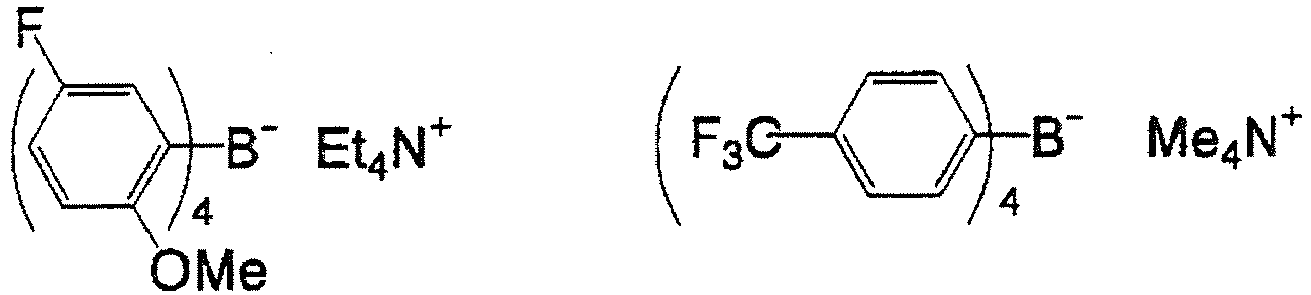


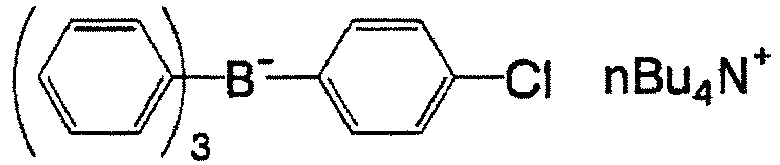


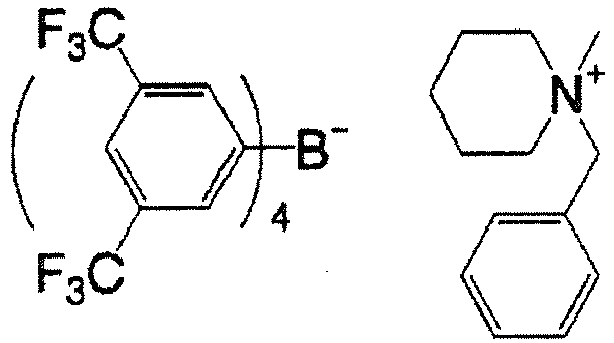


- Of the borate compounds, tetraphenyl borate is particularly preferred.
- The content of the borate compound in the image-recording layer according to the invention is preferably from 0.1 to 20% by weight, more preferably from 1 to 10% by weight, calculated in terms of solid content, from the standpoint of visibility.
- According to the invention, a polymer fine particle can be used in the image-recording layer in order to improve the on-press development property. A polymer fine particle having a polyalkylene oxide structure is preferred. In particular, a polymer fine particle having a polyalkylene oxide group in its side chain is preferred. By using the polymer fine particle, permeability of dampening water increases, thereby improving the on-press development property.
- The polymer fine particle according to the invention is preferably a hydrophobizing precursor capable of converting the image-recording layer to be hydrophobic when heat is applied. The hydrophobizing precursor polymer fine particle is preferably at least one fine particle selected from a hydrophobic thermoplastic polymer fine particle, a thermo-reactive polymer fine particle, a microcapsule having a hydrophobic compound encapsulated and a microgel (crosslinked polymer fine particle). Among them, a polymer fine particle having a polymerizable group and a microgel are preferred. In order to improve the on-press development property, the polymer fine particle preferably contains a polyalkylene oxide structure as described above.
- As the hydrophobic thermoplastic polymer fine particle, hydrophobic thermoplastic polymer fine particles described, for example, in Research Disclosure, No. 33303, January (1992),
JP-A-9-123387 JP-A-9-131850 JP-A-9-171249 JP-A-9-171250 931,647 - Specific examples of the polymer constituting the polymer fine particle include a homopolymer or copolymer of a monomer, for example, ethylene, styrene, vinyl chloride, methyl acrylate, ethyl acrylate, methyl methacrylate, ethyl methacrylate, vinylidene chloride, acrylonitrile, vinyl carbazole or an acrylate or methacrylate having a polyalkylene structure and a mixture thereof. Among them, polystyrene, a copolymer containing styrene and acrylonitrile or polymethyl methacrylate is preferred.
- The average particle size of the hydrophobic thermoplastic polymer fine particle which can be used in the invention is preferably from 0.01 to 2.0 µm.
- The thermo-reactive polymer fine particle which can be used in the invention includes a polymer fine particle having a thermo-reactive group and forms a hydrophobized region by crosslinkage due to thermal reaction and change in the functional group involved therein.
- As the thermo-reactive group of the polymer fine particle having a thermo-reactive group for use in the invention, a functional group performing any reaction can be used as long as a chemical bond is formed. For instance, an ethylenically unsaturated group (for example, an acryloyl group, a methacryloyl group, a vinyl group or an allyl group) performing a radical polymerization reaction, a cationic polymerizable group (for example, a vinyl group or a vinyloxy group), an isocyanate group or a blocked form thereof, an epoxy group or a vinyloxy group performing an addition reaction and a functional group having an active hydrogen atom (for example, an amino group, a hydroxy group or a carboxyl group) as the reaction partner thereof, a carboxyl group performing a condensation reaction and a hydroxy group or an amino group as the reaction partner thereof, and an acid anhydride performing a ring opening addition reaction and an amino group or a hydroxy group as the reaction partner thereof are preferably exemplified.
- As the microcapsule for use in the invention, microcapsule having all or part of the constituting components of the image-recording layer encapsulated as described, for example, in
JP-A-2001-277740 JP-A-2001-277742 - The image-recording layer according to the invention may be an embodiment containing a crosslinked resin particle, that is, a microgel. The microgel can contain a part of the constituting components of the image-recording layer at least in the inside and on the surface thereof. Particularly, an embodiment of a reactive microgel containing the polymerizable compound on the surface thereof is preferred from the standpoint of the image-forming sensitivity and printing durability.
- As a method of microencapsulation or microgelation of the constituting components of the image-recording layer, known methods can be used.
- The average particle size of the microcapsule or microgel is preferably from 0.01 to 3.0 µm, more preferably from 0.05 to 2.0 µm, and particularly preferably from 0.10 to 1.0 µm. In the range described above, good resolution and good time-lapse stability can be achieved.
- The content of the polymer fine particle is preferably from 5 to 90% by weight based on the total solid content of the image-recording layer.
- The image-recording layer according to the invention may contain a hydrophilic low molecular weight compound in order to improve the on-press development property without accompanying the decrease in the printing durability.
- The hydrophilic low molecular weight compound includes a water-soluble organic compound, for example, a glycol, e.g., ethylene glycol, diethylene glycol, triethylene glycol, propylene glycol, dipropylene glycol or tripropylene glycol, or an ether or ester derivative thereof, a polyhydroxy compound, e.g., glycerol, pentaerythritol or tris(2-hydroxyethyl) isocyanurate, an organic amine, e.g., triethanol amine, diethanol amine or monoethanol amine, or a salt thereof, an organic sulfonic acid, e.g., an alkyl sulfonic acid, toluene sulfonic acid or benzene sulfonic acid, or a salt thereof, an organic sulfamic acid, e.g., an alkyl sulfamic acid, or a salt thereof, an organic sulfuric acid, e.g., an alkyl sulfuric acid or an alkyl ether sulfuric acid, or a salt thereof, an organic phosphonic acid, e.g., phenyl phosphonic acid, or a salt thereof, an organic carboxylic acid, e.g., tartaric acid, oxalic acid, citric acid, malic acid, lactic acid, gluconic acid or an amino acid, or a salt thereof and a betaine.
- According to the invention, it is preferred that at least one compound selected from a polyol, an organic sulfate, an organic sulfonate and a betaine is incorporated.
- Specific examples of the organic sulfonate include an alkylsulfonate, for example, sodium n-butylsulfonate, sodium n-hexylsulfonate, sodium 2-ethylhexylsulfonate, sodium cyclohexylsulfonate or sodium n-octylsulfonate; an alkylsulfonate containing an ethylene oxide chain, for example, sodium 5,8,11-triaxapentadecane-1-sulfonate, sodium 5,8,11-trioxaheptadecane-1-sulfonate, sodium 13-ethyl-5,8,11-trioxaheptadecane-1-sulfonate or sodium 5,8,11,14-tetraoxatetracosane-1-sulfonate; and an arylsulfonate, for example, sodium benzenesulfonate, sodium p-toluenesulfonate, sodium p-hydroxybenzenesulfonate, sodium p-styrenesulfonate, sodium isophthalic acid dimethyl-5-sulfonate, sodium 1-naphtylsulfonate, sodium 4-hydroxynaphtylsulfonate, disodium 1,5-naphthalenedisulfonate or trisodium 1,3,6-naphthalenetrisulfonate; compounds described in Paragraph Nos. [0026] to [0031] of
JP-A-2007-276454 JP-A-2009-154525 - The organic sulfate includes a sulfate of alkyl, alkenyl, alkynyl, aryl or heterocyclic monoether of polyethylene oxide. The number of ethylene oxide unit is preferably from 1 to 4. The salt is preferably a sodium salt, a potassium salt or a lithium salt. Specific examples of the organic sulfate include compounds described in Paragraph Nos. [0034] to [0038] of
JP-A-2007-276454 - As the betaine, a compound wherein a number of carbon atoms included in a hydrocarbon substituent on the nitrogen atom is from 1 to 5 is preferred. Specific examples thereof include trimethylammonium acetate, dimethylpropylammonium acetate, 3-hydroxy-4-trimethylammoniobutyrate, 4-(1-pyridinio)butyrate, 1-hydroxyethyl-1-imidazolioacetate, trimethylammonium methanesulfonate, dimethylpropylammonium methanesulfonate, 3-trimethylammonio-1-porpanesulfonate and 3-(1-pyridinio)-1-porpanesulfonate.
- Since the hydrophilic low molecular weight compound has a small structure of hydrophobic portion and almost no surface active function, degradations of the hydrophobicity and film strength in the image area due to penetration of dampening water into the exposed area (image area) of the image-recording layer are prevented and thus, the ink receptivity and printing durability of the image-recording layer can be preferably maintained.
- The amount of the hydrophilic low molecular weight compound added is preferably from 0.5 to 20% by weight, more preferably from 1 to 15% by weight, still more preferably from 2 to 10% by weight, based on the total solid content of the image-recording layer. In the range described above, good on-press development property and good printing durability are achieved.
- The hydrophilic low molecular weight compounds may be used individually or as a mixture of two or more thereof.
- In order to improve the ink receptivity, an oil-sensitizing agent (so-called "sensitizing agent"), for example, a phosphonium compound, a nitrogen-containing low molecular weight compound or an ammonium group-containing polymer may be incorporated into the image-recording layer according to the invention. In particular, in the case where an inorganic stratiform compound is incorporated into a protective layer, the oil-sensitizing agent functions as a surface covering agent of the inorganic stratiform compound and prevents deterioration of the ink receptivity during printing due to the inorganic stratiform compound.
- As preferred examples of the phosphonium compound, phosphonium compounds described in
JP-A-2006-297907 JP-A-2007-50660 - As the nitrogen-containing low molecular weight compound, an amine salt and a quaternary ammonium salt are exemplified. Also, an imidazolinium salt, a benzimidazolinium salt, a pyridinium salt and a quinolinium salt are exemplified. Of the nitrogen-containing low molecular weight compounds, the quaternary ammonium salt and pyridinium salt are preferably used. Specific examples of the nitrogen-containing low molecular weight compound include tetramethylammonium hexafluorophosphate, tetrabutylammonium hexafluorophosphate, dodecyltrimethylammonium p-toluenesulfonate, benzyltriethylammonium hexafluorophosphate, benzyldimethyloctylammonium hexafluorophosphate, benzyldimethyldodecylammonium hexafluorophosphate and compounds described in Paragraph Nos. [0021] to [0037] of
JP-A-2008-284858 JP-A-2009-90645 - The ammonium group-containing polymer may be any polymer containing an ammonium group in its structure and is preferably a polymer containing from 5 to 80% by mole of (meth)acrylate having an ammonium group in its side chain as a copolymerization component. Specific examples of the ammonium group-containing polymer include polymers described in Paragraph Nos. [0089] to [0105] of
JP-A-2009-208458 - Specific examples of the ammonium group-containing polymer are set forth below.
- (1) 2-(Trimethylammonio)ethyl methacrylate p-toluenesulfonate/3,6-dioxaheptyl methacrylate copolymer (molar ratio: 10/90, Mw: 45,000)
- (2) 2-(Trimethylammonio)ethyl methacrylate hexafluorophosphate /3,6-dioxaheptyl methacrylate copolymer (molar ratio: 20/80, Mw: 60,000)
- (3) 2-(Ethyldimethylammonio)ethyl methacrylate p-toluenesulfonate/hexyl methacrylate copolymer (molar ratio: 30/70, Mw: 45,000)
- (4) 2-(Trimethylammonio)ethyl methacrylate hexafluorophosphate /2-ethylhexyl methacrylate copolymer (molar ratio: 20/80, Mw: 60,000)
- (5) 2-(Trimethylammonio)ethyl methacrylate methylsulfate/hexyl methacrylate copolymer (molar ratio: 40/60, Mw: 70,000)
- (6) 2-(Butyldimethylammonio)ethyl methacrylate
hexafluorophosphate/3,6-dioxaheptyl methacrylate copolymer (molar ratio: 25/75, Mw: 65,000) - (7) 2-(Butyldimethylammonio)ethyl acrylate
hexafluorophosphate/3,6-dioxaheptyl methacrylate copolymer (molar ratio: 20/80, Mw: 65,000) - (8) 2-(Butyldimethylammonio)ethyl methacrylate
13-methyl-5,8,11-trioxa-1-heptadecanesulfonate/3,6-dioxaheptyl methacrylate copolymer (molar ratio: 20/80, Mw: 75,000) - (9) 2-(Butyldimethylammonio)ethyl methacrylate hexafluorophosphate/3,6-dioxaheptyl
methacrylate/2-hydroxy-3-methacryloyloxypropyl methacrylate copolymer (molar ratio: 15/80/5, Mw: 65,000) - As to the ammonium group-containing polymer, its reduced specific viscosity value (unit: ml/g) determined according to the measuring method described in
JP-2009-208458 - The content of the oil-sensitizing agent is preferably from 0.01 to 30.0% by weight, more preferably from 0.1 to 15.0% by weight, still more preferably from 1 to 10% by weight, based on the total solid content of the image-recording layer.
- Other components, for example, a surfactant, a coloring agent, a print-out agent, a polymerization inhibitor, a higher fatty acid derivative, a plasticizer, a fine inorganic particle, an inorganic stratiform compound, a co-sensitizer or a chain transfer agent may further be added to the image-recording layer. Specifically, compounds and amounts added thereof described, for example, in Paragraph Nos. [0114] to [0159] of
JP-A-2008-284817 JP-A-2006-91479 U.S. Patent Publication No. 2008/0311520 are preferably used. - The image-recording layer according to the invention is formed by dispersing or dissolving each of the necessary components described above in a known solvent to prepare a coating solution and coating the solution on a support by a known method, for example, bar coater coating and drying as described, for example, in Paragraph Nos. [0142] to [0143] of
JP-A-2008-195018 - As the support which can be used in the lithographic printing plate precursor according to the invention, a known support is employed. Particularly, an aluminum plate subjected to roughening treatment and anodizing treatment according to a known method is preferred.
- Also, an enlarging treatment or a sealing treatment of micropores of the anodized film described in
JP-A-2001-253181 JP-A-2001-322365 U.S. Patents 2,714,066 ,3,181,461 ,3,280,734 and3,902,734 or polyvinyl phosphonic acid as described inU.S. Patents 3,276,868 ,4,153,461 and4,689,272 may be appropriately selected and applied to the aluminum plate, if desired. - The support preferably has a center line average roughness of 0.10 to 1.2 µm.
- In the lithographic printing plate precursor according to the invention, an undercoat layer may be provided between the support and image-recording layer. The undercoat layer strengthens adhesion between the support and the image-recording layer in the exposed area and makes removal of the image-recording layer from the support in the unexposed area easy, thereby contributing improvement in the development property without accompanying degradation of the printing durability. Further, in the case of infrared laser exposure, since the undercoat layer acts as a heat insulating layer, decrease in sensitivity due to diffusion of heat generated upon the exposure into the support is prevented.
- The compound for use in the undercoat layer preferably includes a compound having a functional group capable of interacting with the surface of aluminum support and, in order to increase an adhesion property to the image-recording layer, a crosslinkable group, particularly a group having an ethylenically unsaturated bond. Further, a compound having a hydrophilicity-imparting group, for example, a sulfo group is also preferably exemplified. Such a compound may be a low molecular weight compound or a polymer compound. Also, such compounds may be used as a mixture of two or more thereof.
- In case of using the polymer, a copolymer of a monomer having a functional group capable of interacting with the surface of aluminum support, a monomer having an ethylenically unsaturated bond in its side chain and a monomer having a hydrophilic group is preferred.
- The undercoat layer according to the invention may contain a chelating agent, a secondary or tertiary amine, a polymerization inhibitor or a compound containing an amino group or a functional group having polymerization inhibition ability and a group capable of interacting with the surface of aluminum support (for example, 1,4-diazobicyclo[2,2,2]octane (DABCO), 2,3,5,6-tetrahydroxy-p-quinone, chloranil, sulfophthalic acid, hydroxyethylethylenediaminetriacetic acid, dihydroxyethylethylenediaminediacetic acid or hydroxyethyliminodiacetic acid).
- The undercoat layer is coated according to a known method. The coating amount (solid content) of the undercoat layer is preferably from 0.1 to 100 mg/m2, and more preferably from 1 to 30 mg/m2.
- In the lithographic printing plate precursor according to the invention, a protective layer may be preferably provided on the image-recording layer, in order to prevent diffusion and penetration of oxygen which inhibits the polymerization reaction at the time of exposure. As a material which can be used in the protective layer, any water-soluble polymer and water-insoluble polymer may be appropriately selected to use. The polymers may be used as a mixture of two or more thereof, if desired. Specifically, for example, polyvinyl alcohol, a modified polyvinyl alcohol, polyvinyl pyrrolidone, a water-soluble cellulose derivative and poly(meth)acrylonitrile are exemplified. Of the polymers, a water-soluble polymer relatively excellent in crystallizability is preferably used. Specifically, when polyvinyl alcohol is used as the main component, particularly preferred results are obtained in the fundamental characteristics, for example, oxygen-blocking property and removability by development.
- Polyvinyl alcohol for use in the protective layer may be partially substituted with ester, ether or acetal as long as it contains unsubstituted vinyl alcohol units for achieving the necessary oxygen-blocking property and water solubility. Also, polyvinyl alcohol may partly have other copolymer component. Polyvinyl alcohol is obtained by hydrolysis of polyvinyl acetate. As specific examples of the polyvinyl alcohol, those having a hydrolysis degree in a range from 69.0 to 100% by mole and a polymerization repeating unit number in a range from 300 to 2,400 are exemplified. Specific examples thereof include PVA-102, PVA-103, PVA-105, PVA-110, PVA-117, PVA-117H, PVA-120, PVA-124, PVA-124H, PVA-CS, PVA-CST, PVA-HC, PVA-203, PVA-204, PVA-205, PVA-210, PVA-217, PVA-220, PVA-224, PVA-235, PVA-217EE, PVA-217E, PVA-220E, PVA-224E, PVA-403, PVA-405, PVA-420, PVA-424H, PVA-505, PVA-617, PVA-613, PVA-706 and L-8 (produced by Kuraray Co., Ltd.). Polyvinyl alcohols can be used individually or as a mixture. The content of polyvinyl alcohol in the protective layer is preferably from 20 to 95% by weight, and more preferably from 30 to 90% by weight.
- Also, a modified polyvinyl alcohol can be preferably used. Particularly, an acid-modified polyvinyl alcohol having a carboxylic acid group or a sulfonic acid group is preferably used. Specifically, polyvinyl alcohols described in
JP-A-2005-250216 JP-A-2006-259137 - In the case of using other material as a mixture with polyvinyl alcohol, the material mixed with polyvinyl alcohol is preferably a modified polyvinyl alcohol, polyvinyl pyrrolidone or a modified product thereof from the standpoint of the oxygen-blocking property and removability by development. The content thereof is preferably from 3.5 to 80% by weight, more preferably from 10 to 60% by weight, still more preferably from 15 to 30% by weight, in the protective layer.
- As other component of the protective layer, glycerin, dipropylene glycol or the like can be added in an amount of several % by weight of the polymer material to provide flexibility. Further, an anionic surfactant, for example, sodium alkylsulfate or sodium alkylsulfonate, an amphoteric surfactant, for example, alkylaminocarboxylate or alkylaminodicarboxylate, or a nonionic surfactant, for example, polyoxyethylene alkyl phenyl ether can be added in an amount of several % by weight of the polymer material.
- Further, it is also preferred to incorporate an inorganic stratiform compound into the protective layer of the lithographic printing plate precursor according to the invention for the purpose of increasing the oxygen-blocking property and property for protecting the surface of image-recording layer. Of the inorganic stratiform compounds, fluorine-based swellable synthetic mica, which is a synthetic inorganic stratiform compound, is particularly preferred. Specifically, inorganic stratiform compounds described in
JP-A-2005-119273 - Moreover, protective layers described in
U.S. Patent 3,458,311 ,JP-B-55-49729 JP-A-2008-15503 JP-A-2008-89916 JP-A-2008-139813 - The coating amount of the protective layer is preferably from 0.05 to 10 g/m2 in terms of the coating amount after drying. The coating amount is more preferably from 0.1 to 5 g/m2 in the case where the protective layer contains the inorganic stratiform compound, and it is more preferably from 0.5 to 5 g/m2 in the case where the protective layer does not contain the inorganic stratiform compound.
- Plate making of the lithographic printing plate precursor according to the invention is preferably performed by an on-press development method. The plate making according to the on-press development method includes a step in which the lithographic printing plate precursor is imagewise exposed and a printing step in which oily ink and an aqueous component are supplied to the exposed lithographic printing plate precursor without undergoing any development processing to perform printing, and it is characterized in that the unexposed area of the image-recording layer of the lithographic printing plate precursor is removed in the course of the printing step.
- As the light source used for the image exposure a laser is preferred. The laser for use in the invention is not particularly restricted and preferably includes, for example, a solid laser or semiconductor laser emitting an infrared ray having a wavelength of 760 to 1,200 nm.
- With respect to the infrared ray laser, the output is preferably 100 mW or more, the exposure time per pixel is preferably within 20 microseconds, and the irradiation energy amount is preferably from 10 to 300 mJ/cm2. With respect to the laser exposure, in order to shorten the exposure time, it is preferred to use a multibeam laser device.
- The exposed lithographic printing plate precursor is mounted on a plate cylinder of a printing machine. In case of using a printing machine equipped with a laser exposure apparatus, the lithographic printing plate precursor is mounted on a plate cylinder of the printing machine and then subjected to the image exposure.
- When dampening water and printing ink are supplied to the imagewise exposed lithographic printing plate precursor to perform printing, in the exposed area of the image-recording layer, the image-recording layer cured by the exposure forms the printing ink receptive area having the oleophilic surface. On the other hand, in the unexposed area, the uncured image-recording layer is removed by dissolution or dispersion with the dampening water and/or printing ink supplied to reveal the hydrophilic surface in the area. As a result, the dampening water adheres on the revealed hydrophilic surface and the printing ink adheres to the exposed area of the image-recording layer, whereby printing is initiated.
- While either the dampening water or printing ink may be supplied at first on the surface of lithographic printing plate precursor, it is preferred to supply the printing ink at first in view of preventing the dampening water from contamination with the component of the image-recording layer removed.
- Thus, the lithographic printing plate precursor according to the invention is subjected to the on-press development on an offset printing machine and used as it is for printing a large number of sheets.
- The present invention will be described in detail with reference to the following examples, but the invention should not be construed as being limited thereto. With respect to a polymer compound, unless otherwise specified, a molecular weight of the polymer compound means a weight average molecular weight (Mw) and a ratio of repeating units is indicated as a mole percent.
- An aluminum plate (material: JIS A 1050) having a thickness of 0.3 mm was subjected to a degreasing treatment at 50°C for 30 seconds using a 10% by weight aqueous sodium aluminate solution in order to remove rolling oil on the surface thereof and then grained the surface thereof using three nylon brushes embedded with bundles of nylon bristle having a diameter of 0.3 mm and an aqueous suspension (specific gravity: 1.1 g/cm3) of pumice having a median size of 25 µm, followed by thorough washing with water. The plate was subjected to etching by immersing in a 25% by weight aqueous sodium hydroxide solution of 45°C for 9 seconds, washed with water, then immersed in a 20% by weight nitric acid solution at 60°C for 20 seconds, and washed with water. The etching amount of the grained surface was about 3 g/m2.
- Then, using an alternating current of 60 Hz, an electrochemical roughening treatment was continuously carried out on the plate. The electrolytic solution used was a 1% by weight aqueous nitric acid solution (containing 0.5% by weight of aluminum ion) and the temperature of electrolytic solution was 50°C. The electrochemical roughening treatment was conducted using a rectangular alternating current having a trapezoidal waveform such that the time TP necessary for the current value to reach the peak from zero was 0.8 msec and the duty ratio was 1:1, and using a carbon electrode as a counter electrode. A ferrite was used as an auxiliary anode. The current density was 30 A/dm2 in terms of the peak value of the electric current, and 5% of the electric current flowing from the electric source was divided to the auxiliary anode. The quantity of electricity in the nitric acid electrolysis was 175 C/dm2 in terms of the quantity of electricity when the aluminum plate functioned as an anode. The plate was then washed with water by spraying.
- The plate was further subjected to an electrochemical roughening treatment in the same manner as in the nitric acid electrolytic solution above using as an electrolytic solution, a 0.5% by weight aqueous hydrochloric acid solution (containing 0.5% by weight of aluminum ion) having temperature of 50°C and under the condition that the quantity of electricity was 50 C/dm2 in terms of the quantity of electricity when the aluminum plate functioned as an anode. The plate was then washed with water by spraying.
- The plate was then subjected to an anodizing treatment using as an electrolytic solution, a 15% by weight aqueous sulfuric acid solution (containing 0.5% by weight of aluminum ion) at a current density of 15 A/dm2 to form a direct current anodized film of 2.5 g/m2, washed with water and dried to prepare Support (1).
- Thereafter, in order to ensure the hydrophilicity of the non-image area, Support (1) was subjected to silicate treatment using a 2.5% by weight aqueous sodium silicate No. 3 solution at 60°C for 10 seconds and then was washed with water to obtain Support (2). The adhesion amount of Si was 10 mg/m2. The center line average roughness (Ra) of the support was measured using a stylus having a diameter of 2 µm and found to be 0.51 µm.
- Coating solution (1) for undercoat layer shown below was coated on Support (2) described above so as to have a dry coating amount of 20 mg/m2 to prepare a support having an undercoat layer.
-
Compound (1) for undercoat layer having structure shown below 0.18 g Hydroxyethyliminodiacetic acid 0.10 g Methanol 55.24 g Water 6.15 g 
- Coating solution (A) for image-recording layer having the composition shown below was coated on the undercoat layer formed as described above by a bar and dried in an oven at 100°C for 60 seconds to form an image-recording layer having a dry coating amount of 1.0 g/m2.
- Coating solution (A) for image-recording layer was prepared by mixing Photosensitive liquid (1) shown below, Microgel liquid (1) shown below and the mesoporous silica having a color changing compound incorporated therein just before the coating, followed by stirring.
-
Binder polymer (1) having structure shown below 0.240 g Infrared absorbing agent (1) having structure shown below 0.030 g Radical generator (1) having structure shown below 0.162 g Polymerizable compound (Tris(acryloyloxyethyl) isocyanurate (NK ESTER A-9300, produced by Shin-Nakamura Chemical Co., Ltd.)) 0.192 g Hydrophilic low molecular weight compound (1) (Tris(2-hydroxyethyl) isocyanurate) 0.062 g Hydrophilic low molecular weight compound (2) having structure shown below 0.050 g Oil-sensitizing agent (1) (Phosphonium compound (1) having structure shown below) 0.055 g Oil-sensitizing agent (2) (Benzyl dimethyl octyl ammonium PF6 salt) 0.018 g Oil-sensitizing agent (3) (Ammonium group-containing polymer having structure shown below (reduced specific viscosity: 44 cSt/g/ml) 0.035 g Fluorine-based surfactant (1) having structure shown below 0.008 g 2-Butanone 1.091 g 1-Methoxy-2-propanol 8.609 g -
Microgel (1) shown below 2.640 g Distilled water 2.425 g -
Mesoporous silica having color changing compound incorporated therein shown in Table 1 below Amount shown in Table 1 below - The structures of Binder polymer (1), Infrared absorbing agent (1), Radical generator (1), Hydrophilic low molecular weight compound (2), Oil-sensitizing agent (1), Oil-sensitizing agent (3) and Fluorine-based surfactant (1) are shown below.
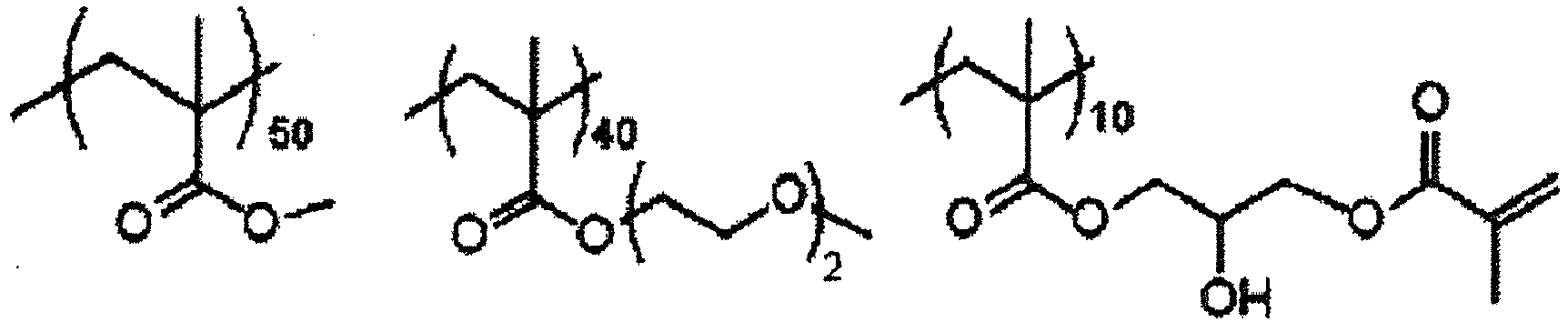
- Binder polymer (1)

- Oil-sensitizing agent (3)
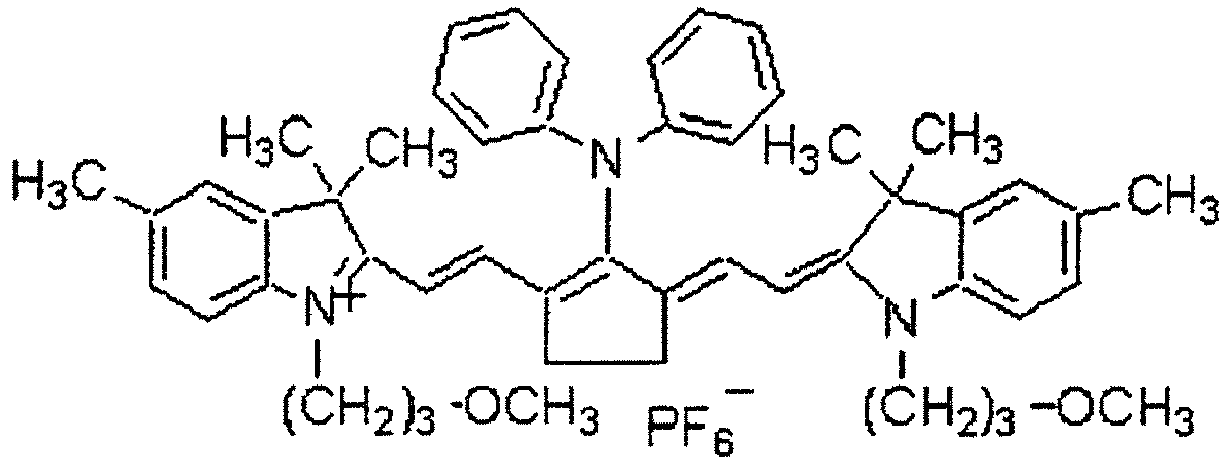
- Infrared absorbing agent (1)

- Radical generator (1)

- Fluorine-based surfactant (1)

- Hydrophilic low molecular weight compound (2)

- An oil phase component was prepared by dissolving 4.46 g of polyfunctional isocyanate having the structure shown below (produced by Mitsui Chemicals Polyurethane, Inc., 75% by weight ethyl acetate solution), 0.86 g of adduct obtained by addition of trimethylolpropane (6 mol) and xylene diisocyanate (18 mol) and further addition of methyl-terminated polyoxyethylene (1 mol) (number of oxyethylene repeating unit: 90) (produced by Mitsui Chemicals Polyurethane, Inc., 50% by weight ethyl acetate solution), 1.72 g of pentaerythritol tetraacrylate (SR399E, produced by Sartomer Co.) and 0.05 g of PIONIN A-41C (produced by Takemoto Oil & Fat Co., Ltd., 70% by weight methanol solution) in 4.46 g of ethyl acetate. The oil phase component and 17.30 g of water as an aqueous phase component were mixed and emulsified using a homogenizer at 10,000 rpm for 15 minutes. The resulting emulsion was stirred at 40°C for 4 hours. The microgel liquid thus-obtained was diluted using water so as to have the solid content concentration of 21.8% by weight, thereby preparing Microgel (1). The average particle size of the microgel was 0.25 µm.
- Polyfunctional isocyanate

- To 100 ml of acetonitrile was dispersed 1.0 g of mesoporous silica particle (particle size: 200 nm, pore size: 4 nm, produced by Sigma-Aldrich Co.) and the mixture was stirred at room temperature for 3 hours. To the mixture was added 0.1 g of 3-aminopropyltrimethoxysilane (produced by Shin-Etsu Silicone Co., Ltd.) followed by stirring at room temperature for 24 hours, thereby conducting a hydrophilizing treatment of the surface of mesoporous silica particle. The resulting suspension was filtered to separate a solid and the solid was dried at 25°C for 6 hours using a vacuum line to obtain hydrophilizing surface-modified mesoporous silica particle.
- To 25 ml of an acetonitrile solution containing 4 × 10⁻³ mol/l of Photo-color changing compound A (Infrared absorbing agent (1) shown above) and 4 × 10⁻³ mol/l of Iodonium salt A (Radical generator (1) shown above) was added 0.25 g of the hydrophilizing surface-modified mesoporous silica particle followed by stirring at room temperature for 12 hours to obtain a blue colored suspension. The mesoporous silica particle was separated by filtration and dried at 25°C for 6 hours using a vacuum line to obtain Mesoporous silica 2 having color changing compound incorporated therein.
- Mesoporous silica particles 7, 8 and 10 each having a controlled particle size were prepared according to the description in Chem. Mater., 2002, 14, pp. 4721-4728, "Synthesis of Nanoscale Mesoporous Silica Spheres with Controlled Particle Size".
- To 442 ml of distilled water was added 10.8 g of 29% by weight aqueous ammonia. The solution was heated to 50°C and 0.28 g of CTAB (cetyltrimethylammonium bromide) was added thereto under conditions of vigorous stirring. The solution was turned to room temperature and 1.4 ml of TEOS (tetraethyl orthosilicate) was added thereto under conditions of vigorous stirring. After further stirring for 2 hours, the solid was collected by filtration and calcined at 540°C for 6 hours to obtain Mesoporous silica particle 7.
- To 330 ml of distilled water was added 10.8 g of 29% by weight aqueous ammonia. The solution was heated to 50°C and 0.28 g of CTAB was added thereto under conditions of vigorous stirring. The solution was turned to room temperature and 1.4 ml of TEOS was added thereto under conditions of vigorous stirring. After further stirring for 2 hours, the solid was collected by filtration and calcined at 540°C for 6 hours to obtain Mesoporous silica particle 8.
- To 221 ml of distilled water was added 10.8 g of 29% by weight aqueous ammonia. The solution was heated to 50°C and 0.28 g of CTAB was added thereto under conditions of vigorous stirring. The solution was turned to room temperature and 1.4 ml of TEOS was added thereto under conditions of vigorous stirring. After further stirring for 2 hours, the solid was collected by filtration and calcined at 540°C for 6 hours to obtain Mesoporous silica particle 10.
- Mesoporous silica particles 1 and 4 to 6 each having a controlled pore size were prepared according to the description in
JP-A-2004-277270 JP-A-2001-261326 - To distilled water was dissolved 12.76 g (0.035 mol) of cetyltrimethylammonium bromide (CTAB) at 35°C with stirring. To the aqueous solution was added 167 ml of an aqueous solution containing 22.26 g (0.1 mol) of sodium silicate and the mixed solution was stirred for 20 minutes. The pH of the mixed solution was adjusted to 10 with diluted sulfuric acid (1M). The composition (by mole) of the mixed solution was SiO2:CTAB:H2O = 1.00:0.35:100. The mixed solution was further stirred for one hour and transferred to a polypropylene bottle, and the temperature was gradually raised in an oven to be ripened at 120°C. The solid product obtained by filtration was washed with distilled water, dried in the air at room temperature, calcined at 560°C for 6 hours to remove CTAB thereby obtaining 1 g of Mesoporous silica particle 1. The average pore size measured by a nitrogen adsorption BET method was 2 nm.
- Into a one-liter separable flask equipped with a condenser, a stirring motor and a thermometer were charged 25.0 g of a nonionic surfactant (ADEKA PLURONIC P-103, produced by Adeka Corp., hereinafter also abbreviated as P103) as Surfactant (a) and 721 g of purified water and the mixture was stirred at room temperature to be dissolved. Then, 50.0 g of a sodium silicate solution (water glass) No. 3 (produced by Kishida Chemical Co., Ltd.) was added thereto, the temperature was raised to 35°C with stirring, then 135 ml of concentrated hydrochloric acid was added thereto as an acid source, followed by stirring at reaction temperature of 35°C for 4 hours. Thereafter, the stirring was terminated, and the reaction solution was preserved at 95°C for 48 hours and then filtered to separate Silica surfactant composite (b) produced. To the resulting Silica surfactant composite (b) was added 400 ml of ethanol and the mixture was stirred using a stirring motor to remove most of P103 contained in Silica surfactant composite (b) by washing. The resulting silica was further washed purified water until pH of the washing solution reached 5 or more, and 300 to 400 ml of ethanol was added to the silica and stirring and washing were performed 5 times. Thereafter, the silica was dried at 80°C for 24 hours to obtain Mesoporous silica particle 4 as white powder. The average pore size measured by a nitrogen adsorption BET method was 10 nm.
- In the same manner as described above, 25.0 g of the nonionic surfactant (ADEKA PLURONIC P-103) as Surfactant (a) and 654 g of purified water were charged and the mixture was stirred at room temperature to be dissolved. Then, 50.0 g of a sodium silicate solution (water glass) No. 3 (produced by Kishida Chemical Co., Ltd.) and 50.0 g of mesitylene (1,3,5-trimethylbenzene) as Additive (c) were added thereto, the temperature was raised to 35°C with stirring, then 135 ml of concentrated hydrochloric acid was added thereto as an acid source, followed by stirring at reaction temperature of 35°C for 20 hours. Thereafter, the stirring was terminated, and the reaction solution was preserved at 80°C for 48 hours and then filtered to separate Silica surfactant composite (b) produced. To the resulting Silica surfactant composite (b) was added 400 ml of ethanol and the mixture was stirred using a stirring motor to remove most of P103 contained in Silica surfactant composite (b) by washing. The resulting silica was further washed purified water until pH of the washing solution reached 5 or more, and 300 to 400 ml of ethanol was added to the silica and stirring and washing were performed 5 times. Thereafter, the silica is dried at 80°C for 24 hours to obtain Mesoporous silica particle 5 as white powder. The average pore size measured by a nitrogen adsorption BET method was 25 nm.
- In the same manner as described above, 25.0 g of the nonionic surfactant (ADEKA PLURONIC P-103) as Surfactant (a) and 654 g of purified water were charged and the mixture was stirred at room temperature to be dissolved. Then, 50.1 g of a sodium silicate solution (water glass) No. 3 and 50.0 g of mesitylene as Additive (c) were added thereto, the temperature was raised to 35°C with stirring, then 135 ml of concentrated hydrochloric acid was added thereto as an acid source, followed by stirring at reaction temperature of 60°C for 4 hours. Then, the stirring was terminated, and the reaction solution was preserved at 95°C for 48 hours. Thereafter, the reaction solution was subjected to the after-treatment washing in the same manner as described above to obtain Mesoporous silica particle 6. The average pore size measured by a nitrogen adsorption BET method was 50 nm.
- Also, the modified mesoporous silica particles described below were employed as the mesoporous silica particle.
- Mesoporous silica 2A (propylamine group-modified mesoporous silica, particle size: 200 nm, pore size: 4 nm, produced by Sigma-Aldrich Co.)
- Mesoporous silica 2B (propyl carboxylic acid group-modified mesoporous silica, particle size: 200 nm, pore size: 4 nm, produced by Sigma-Aldrich Co.)
- Mesoporous silica 2C (propylthiol group-modified mesoporous silica, particle size: 200 nm, pore size: 4 nm, produced by Sigma-Aldrich Co.) 2-2) Preparation of Mesoporous silica 1, 2A to 2C, 4 to 8 and 10 having color changing compound incorporated therein
- Mesoporous silica 1, 2A to 2C, 4 to 8 and 10 having color changing compound incorporated therein were prepared in the same manner as in Preparation of Mesoporous silica 2 having color changing compound incorporated therein excepting for using Mesoporous silica particles 1, 2A to 2C, 4 to 8 and 10 in place of the mesoporous silica particle (particle size: 200 nm, pore size: 4 nm, produced by Sigma-Aldrich Co.) used in Preparation of Mesoporous silica 2 having color changing compound incorporated therein, respectively.
- Lithographic printing plate precursor (R1) for Comparative Example 1 was prepared in the same manner as in Lithographic printing plate precursor (1) excepting for eliminating the mesoporous silica having color changing compound incorporated therein in Coating solution (A) for image-recording layer.
- Lithographic printing plate precursor (R2) for Comparative Example 2 was prepared in the same manner as in Lithographic printing plate precursor (1) excepting for eliminating the mesoporous silica having color changing compound incorporated therein in Coating solution (A) for image-recording layer and in place thereof adding 4 × 10⁻³ mol of Photo-color changing compound A and 4 × 10⁻³ mol of Iodonium salt A.
- Lithographic printing plate precursor (R3) for Comparative Example 3 was prepared in the same manner as in Lithographic printing plate precursor (1) excepting for eliminating the mesoporous silica having color changing compound incorporated therein in Coating solution (A) for image-recording layer and in place thereof adding 0.25 g of Mesoporous silica particle 2 (particle size: 200 nm, pore size: 4 nm, produced by Sigma-Aldrich Co.), 4 × 10⁻³ mol of Photo-color changing compound A and 4 × 10⁻³ mol of Iodonium salt A.
- Using the lithographic printing plate precursor prepared, the exposure, on-press development and printing were performed and the plate inspection property, on-press development property and printing durability were evaluated in the manner described below. The results obtained are shown in Table 1.
- The lithographic printing plate precursor was exposed by TRENDSETTER 3244VX (produced by Creo Co.) equipped with a water-cooled 40 W infrared semiconductor laser under the conditions of output of 11.7 W, a rotational number of an external drum of 250 rpm and resolution of 2,400 dpi. The exposed image contained a solid image area and a fine line chart.
- As to ease of plate inspection (plate inspection property) of the exposed lithographic printing plate precursor, using the L value (luminance) of L*a*b* color system, a difference (ΔL) between the L value of the exposed area and the L value of the unexposed area was determined. As the value of ΔL is larger, it is meant that the plate inspection property is more excellent. The measurement was conducted according to SCE (specular competent exclude) system using a spectral colorimeter CM2600d and an operation soft CM-S100W each produced by Konica Minolta Holdings, Inc. According to the SCE system, since the specular light is excluded and only the diffusion light is measured, evaluation of color close to evaluation with visual observation is conducted and the result well correlates with the practical human plate inspection. The determinations of ΔL were conducted just after the exposure (within 30 minutes) and at 6 hour lapse after the exposure.
- The exposed lithographic printing plate precursor was mounted without undergoing development processing on a plate cylinder of a printing machine (LITHRONE 26, produced by Komori Corp.). Using dampening water (ECOLITY-2 (produced by FUJIFILM Corp.)/tap water = 2/98 (volume ratio)) and FUSION-G (N) Black Ink (produced by DIC Graphics Corp.), the dampening water and ink were supplied according to the standard automatic printing start method of LITHRONE 26 to conduct printing on 500 sheets of TOKUBISHI ART PAPER (76.5 kg) at a printing speed of 10,000 sheets per hour.
- A number of the printing papers required until the on-press development of the unexposed area of the image-recording layer on the printing machine was completed to reach a state where the ink was not transferred to the printing paper in the non-image area was measured to evaluate the on-press development property. As the number of printing papers is smaller, it is meant that the on-press development property is more excellent.
- After performing the evaluation for the on-press development property described above, the printing was continued. As the increase in a number of printing papers, the image-recording layer was gradually abraded to cause decrease in the ink density on the printing paper. A number of the printing papers wherein a value obtained by measuring a halftone dot area rate of the 50% halftone dot of AM screen on the printing paper using a Gretag densitometer decreased by 5% from the value measured on the 100th paper of the printing was determined to evaluate the printing durability.
- From the results shown in Table 1, it can be seen that the lithographic printing plate precursor containing the mesoporous silica having a color changing compound incorporated therein in the image-recording layer thereof according to the invention exhibits good on-press development property and good printing durability and is excellent in not only the plate inspection property just after the exposure but also the plate inspection property at a several hour lapse after the exposure.
TABLE 1 Mesoporous Silica Having Color Changing Compound Incorporated Therein Mesoporous Silica Color Changing Compound Onium Salt Plate Inspection Property (just after exposure) Plate Inspection Property (6 hour lapse after exposure) On-press Development Property (sheets) Printing Durability (× 104 sheets) Pore Size (nm) Particle Size (nm) Amount Added (g) Example 1 1 2 200 0.25 Photo-color Changing Compound A Iodonium Salt A 4 3 40 3.5 Example 2 2 4 200 0.25 Photo-color Changing Compound A Iodonium Salt A 5.5 4.5 40 3.5 Example 3 4 10 200 0.25 Photo-color Changing Compound A Iodonium Salt A 5.5 4.5 40 3.5 Example 4 5 25 200 0.25 Photo-color Changing Compound A Iodonium Salt A 4.5 3.5 40 3.5 Example 5 6 50 200 0.25 Photo-color Changing Compound A Iodonium Salt A 4 3 40 3.5 Example 6 7 4 70 0.25 Photo-color Changing Compound A Iodonium Salt A 5.5 4.5 40 3 Example 7 8 4 120 0.25 Photo-color Changing Compound A Iodonium Salt A 5.5 4.5 40 3.5 Example 8 10 4 400 0.25 Photo-color Changing Compound A Iodonium Salt A 5.5 4.5 30 3 Example 9 2 4 200 0.08 Photo-color Changing Compound A Iodonium Salt A 4.5 3.5 40 3.5 Example 10 2 4 200 0.17 Photo-color Changing Compound A Iodonium Salt A 5.5 4.5 40 3.5 Example 11 2 4 200 0.42 Photo-color Changing Compound A Iodonium Salt A 5.5 4.5 40 3.5 Example 12 2A 4 200 0.25 Photo-color Changing Compound A Iodonium Salt A 5.5 4.5 35 3.5 Example 13 2B 4 200 0.25 Photo-color Changing Compound A Iodonium Salt A 5.5 4.5 35 3.5 Example 14 2C 4 200 0.25 Photo-color Changing Compound A Iodonium Salt A 5.5 4.5 35 3.5 Comparative Example 1 None - - 0 None None 3.8 2 40 3 Comparative Example 2 None - - 0 Photo-color Changing Compound A Iodonium Salt A 3.8 2 80 3 Comparative Example 3 None 4 200 0.25 Photo-color Changing Compound A Iodonium Salt A 3.8 2 40 3.5 - Lithographic printing plate precursors for Examples 15 to 29 were prepared in the same manner as in Example 2 excepting for changing the mesoporous silica having color changing compound incorporated therein in Coating solution (A) for image-recording layer in Example 2 to the mesoporous silica having color changing compound incorporated therein shown below, respectively.
- Mesoporous silica 11 to 25 having color changing compound incorporated therein were prepared in the same manner as in the preparation of Mesoporous silica 2 having color changing compound incorporated therein described above excepting for changing Photo-color changing compound A and Iodonium salt A to the color changing compound and onium salt shown in Table 2 below, respectively. The color changing compounds and onium salts used are shown below.
-

-

-

-

-

-

-

-

-

-

-

-
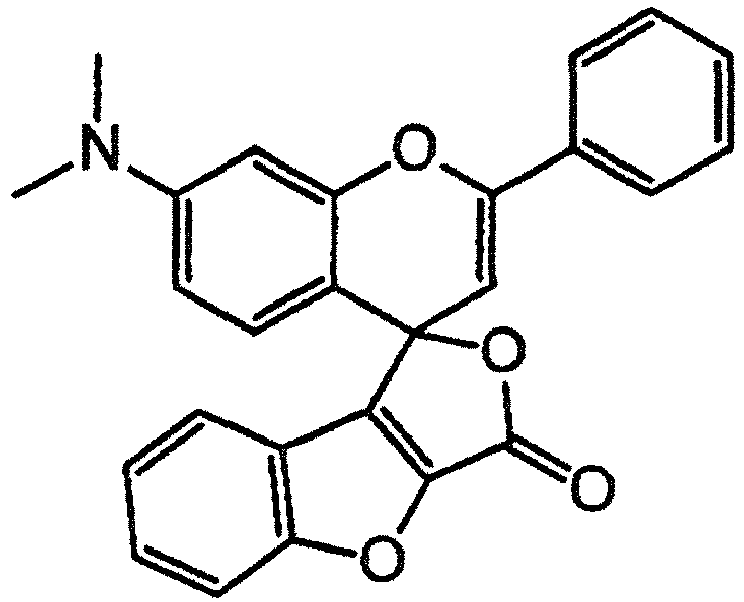
-

- Using the lithographic printing plate precursor prepared, the exposure, on-press development and printing were performed and the plate inspection property, on-press development property and printing durability were evaluated in the same manner as in Example 1. The results obtained are shown in Table 2.
- From the results shown in Table 2, it can be seen that even when the color changing compound and onium salt are variously changed in the mesoporous silica having a color changing compound incorporated therein according to the invention, the effect of the invention in that not only the plate inspection property just after the exposure but also the plate inspection property at a several hour lapse after the exposure are excellent and the on-press development property and printing durability are good can be obtained.
TABLE 2 Mesoporous Silica Having Color Changing Compound Incorporated Therein Mesoporous Silica Color Changing Compound Onium Salt Plate Inspection Property (just after exposure) Plate Inspection Property (6 hour lapse after exposure) On-press Development Property (sheets) Printing Durability (× 104 sheets) Pore Size (nm) Particle Size (nm) Amount Added (g) Example 15 11 4 200 0.25 Photo-color Changing Compound B lodonium Salt A 5.5 4.5 40 3.5 Example 16 12 4 200 0.25 Photo-color Changing Compound C Iodonium Salt A 5.5 4.5 40 3.5 Example 17 13 4 200 0.25 Photo-color Changing Compound D lodonium Salt A 5.5 4.5 40 3.5 Example 18 14 4 200 0.25 Photo-color Changing Compound A Sulfonium Salt A 5 4 40 3.5 Example 19 15 4 200 0.25 Photo-color Changing Compound B Sulfonium Salt B 5 4 40 3.5 Example 20 16 4 200 0.25 Photo-color Changing Compound A None 4 3 40 3.5 Example 21 17 4 200 0.25 Photo-color Changing Compound B None 4 3 40 3.5 Example 22 18 4 200 0.25 Heat-color Changing Compound A None 5 4 40 3.5 Example 23 19 4 200 0.25 Heat-color Changing Compound B None 5 4 40 3.5 Example 24 20 4 200 0.25 Heat-color Changing Compound C None 5 4 40 3.5 Example 25 21 4 200 0.25 Heat-color Changing Compound D None 5 4 40 3.5 Example 26 22 4 200 0.25 Acid-color Changing Compound A None 5 4 40 3.5 Example 27 23 4 200 0.25 Acid-color Changing Compound B None 5 4 40 3.5 Example 28 24 4 200 0.25 Acid-color Changing Compound C None 5 4 40 3.5 Example 29 25 4 200 0.25 Acid-color Changing Compound D None 5 4 40 3.5 - Lithographic printing plate precursors (30) and (31) were prepared in the same manner as in Example 1 excepting for changing Coating solution (A) for image-recording layer to Coating solution (C) for image-recording layer shown below.
- Coating solution (C) for image-recording layer was prepared by mixing Photosensitive liquid (2) shown below, Microgel liquid (1) shown above and 0.25 g of Mesoporous silica 2 having color changing compound incorporated therein shown above just before the coating, followed by stirring.
-
Binder polymer (1) having structure shown above 0.240 g Infrared absorbing agent (1) having structure shown above 0.030 g Radical generator (1) having structure shown above 0.162 g Polymerizable compound (Tris(acryloyloxyethyl) isocyanurate (NK ESTER A-9300, produced by Shin-Nakamura Chemical Co., Ltd.)) 0.192 g Hydrophilic low molecular weight compound (1) (Tris(2-hydroxyethyl) isocyanurate) 0.062 g Hydrophilic low molecular weight compound (2) having structure shown above 0.050 g Oil-sensitizing agent (1) (Phosphonium compound (1) having structure shown above) 0.055 g Oil-sensitizing agent (2) (Benzyl dimethyl octyl ammonium PF6 salt) 0.018 g Oil-sensitizing agent (3) (Ammonium group-containing polymer having structure shown above (reduced specific viscosity: 44 cSt/g/ml) 0.035 g Fluorine-based surfactant (1) having structure shown above 0.008 g Borate compound A or B having structure shown below 0.25 g 2-Butanone 1.091 g 1-Methoxy-2-propanol 8.609 g -

-

- Coating solution (1) for protective layer having the composition shown below was further coated on the image-recording layer of Lithographic printing plate precursors (2), (30) and (31) by a bar and dried in an oven at 120°C for 60 seconds to form a protective layer having a dry coating amount of 0.15 g/m2, thereby preparing Lithographic printing plate precursors (32) to (34), respectively.
-
Dispersion (1) of inorganic stratiform compound shown below 1.5 g Aqueous 6% by weight solution of polyvinyl alcohol (CKS 50, sulfonic acid-modified, saponification degree: 99% by mole or more, polymerization degree: 300, produced by Nippon Synthetic Chemical Industry Co., Ltd.) 0.55 g Aqueous 6% by weight solution of polyvinyl alcohol (PVA-405, saponification degree: 81.5 % by mole, polymerization degree: 500, produced by Kuraray Co., Ltd.) 0.03 g Aqueous 1% by weight solution of surfactant (EMALEX 710, produced by Nihon Emulsion Co., Ltd.) 0.86 g Ion-exchanged water 6.0 g - To 193.6 g of ion-exchanged water was added 6.4 g of synthetic mica (SOMASIF ME-100, produced by CO-OP Chemical Co., Ltd.) and the mixture was dispersed using a homogenizer until an average particle size (according to a laser scattering method) became 3 µm. The aspect ratio of the inorganic particle thus-dispersed was 100 or more.
- Lithographic printing plate precursor (35) was prepared in the same manner as in Lithographic printing plate precursor (2) described above excepting for using Coating solution (D) for image-recording layer shown below in place of Coating solution (A) for image-recording layer.
- Coating solution (D) for image-recording layer was prepared by mixing Photosensitive liquid (3) shown below and 0.25 g of Mesoporous silica 2 having color changing compound incorporated therein shown above just before the coating, followed by stirring.
-
Aqueous dispersion (1) of polymer fine particle shown below 20.0 g Infrared absorbing agent (2) having structure shown below 0.2g Radical generator (IRGACURE 250, produced by BASF) 0.5 g Polymerizable compound (SR-399, produced by Sartomer Co.) 1.50 g Mercapto-3-triazole 0.2 g BYK 336 (produced by BYK-Chemie GmbH) 0.4 g KLUCEL M (produced by Hercules Chemical Co., Inc.) 4.8 g ELVACITE 4026 (produced by Ineos Acrylics Inc.) 2.5 g n-Propanol 55.0 g 2-Butanone 17.0 g - The compounds indicated using their trade names in Photosensitive liquid (3) described above are shown below.
- IRGACURE 250: (4-Methylphenyl)[4-(2-methylpropyl)phenyl]iodonium hexafluorophosphate (75% by weight propylene carbonate solution)
- SR-399: Dipentaerythritol pentaacrylate
- BYK 336: Modified dimethylpolysiloxane copolymer (25% by weight xylene/methoxypropyl acetate solution)
- KLUCEL M: Hydroxypropyl cellulose (2% by weight aqueous solution)
- ELVACITE 4026: Highly branched polymethyl methacrylate (10% by weight 2-butanone solution)

- A stirrer, a thermometer, a dropping funnel, a nitrogen inlet tube and a reflux condenser were attached to a 1,000 ml four-neck flask and while carrying out deoxygenation by introduction of nitrogen gas, 10 g of polyethylene glycol methyl ether methacrylate (PEGMA, average repeating unit number of ethylene glycol: 50), 200 g of distilled water and 200 g of n-propanol were charged therein and heated until the internal temperature reached 70°C. Then, a mixture of 10 g of styrene (St), 80 g of acrylonitrile (AN) and 0.8 g of 2,2'-azobisisobutyronitrile previously prepared was dropwise added to the flask over a period of one hour. After the completion of the dropwise addition, the mixture was continued to react as it was for 5 hours. Then, 0.4 g of 2,2'-azobisisobutyronitrile was added and the internal temperature was raised to 80°C. Thereafter, 0.5 g of 2,2'-azobisisobutyronitrile was added over a period of 6 hours. At the stage after reacting for 20 hours in total, the polymerization proceeded to 98% or more to obtain Aqueous dispersion (1) of polymer fine particle of PEGMA/St/AN (10/10/80 in a weight ratio). The particle size distribution of the polymer fine particle had the maximum value at the particle size of 150 nm.
- The particle size distribution was determined by taking an electron microphotograph of the polymer fine particle, measuring particle sizes of 5,000 fine particles in total on the photograph, and dividing a range from the largest value of the particle size measured to 0 on a logarithmic scale into 50 parts to obtain occurrence frequency of each particle size by plotting. With respect to the aspherical particle, a particle size of a spherical particle having a particle area equivalent to the particle area of the aspherical particle on the photograph was defined as the particle size.
- Lithographic printing plate precursors (36) and (37) were prepared in the same manner as in Lithographic printing plate precursor (35) described above excepting for using Coating solution (E) for image-recording layer shown below in place of Coating solution (D) for image-recording layer.
- Coating solution (E) for image-recording layer was prepared by mixing Photosensitive liquid (4) shown below and 0.25 g of Mesoporous silica 2 having color changing compound incorporated therein shown above just before the coating, followed by stirring.
-
Aqueous dispersion (1) of polymer fine particle shown above 20.0 g Infrared absorbing agent (2) having structure shown above 0.2g Radical generator (IRGACURE 250, produced by BASF) 0.5 g Polymerizable compound (SR-399, produced by Sartomer Co.) 1.50 g Mercapto-3-triazole 0.2 g BYK 336 (produced by BYK-Chemie GmbH) 0.4 g KLUCEL M (produced by Hercules Chemical Co., Inc.) 4.8 g ELVACITE 4026 (produced by Ineos Acrylics Inc.) 2.5 g Borate compound A or B having structure shown above 0.25 g n-Propanol 55.0 g 2-Butanone 17.0 g - Coating solution (1) for protective layer shown above was further coated on the image-recording layer of Lithographic printing plate precursors (35) to (37) by a bar and dried in an oven at 120°C for 60 seconds to form a protective layer having a dry coating amount of 0.15 g/m2, thereby preparing Lithographic printing plate precursors (38) to (40), respectively.
- Lithographic printing plate precursor (R4) for Comparative Example 4 was prepared in the same manner as in Lithographic printing plate precursor (35) described above excepting for eliminating the mesoporous silica having color changing compound incorporated therein in Coating solution (D) for image-recording layer and in place thereof adding 4 × 10⁻³ mol of Photo-color changing compound A and 4 × 10⁻³ mol of Iodonium salt A.
- Lithographic printing plate precursor (R5) for Comparative Example 5 was prepared in the same manner as in Lithographic printing plate precursor (35) described above excepting for eliminating the mesoporous silica having color changing compound incorporated therein in Coating solution (A) for image-recording layer and in place thereof adding 0.25 g of Mesoporous silica particle 2 (particle size: 200 nm, pore size: 4 nm, produced by Sigma-Aldrich Co.), 4 × 10⁻³ mol of Photo-color changing compound A and 4 × 10⁻³ mol of Iodonium salt A.
- Using the lithographic printing plate precursor prepared, the exposure, on-press development and printing were performed and the plate inspection property, on-press development property and printing durability were evaluated in the same manner as in Example 1. The results obtained are shown in Table 3.
- From the results shown in Table 3, it can be seen that even when the composition of the image-recording layer is changed or even when the protective layer is provided on the image-recording layer, the effect of the invention in that not only the plate inspection property just after the exposure but also the plate inspection property at a several hour lapse after the exposure are excellent and the on-press development property and printing durability are good can be obtained.
TABLE 3 Mesoporous Silica Having Color Changing Compound Incorporated Therein Mesoporous Silica Color Changing Compound Onium Salt Borate Compound Protective Layer Plate Inspection Property (just after exposure) Plate Inspection Property (6 hour lapse after exposure) On-press Development Property (sheets) Printing Durability (× 104 sheets) Pore Size (nm) Particle Size (nm) Amount Added (g) Example 30 2 4 200 0.25 Photo-color Changing Compound A Iodonium Salt A Borate A Absence 5.5 4.5 40 5 Example 31 2 4 200 0.25 Photo-color Changing Compound A Iodonium Salt A Borate B Absence 5.5 4.5 40 5.5 Example 32 2 4 200 0.25 Photo-color Changing Compound A Iodonium Salt A None Presence 5.5 4.5 40 4.5 Example 33 2 4 200 0.25 Photo-color Changing Compound A Iodonium Salt A Borate A Presence 5.5 4.5 40 6 Example 34 2 4 200 0.25 Photo-color Changing Compound A Iodonium Salt A Borate B Presence 5.5 4.5 40 6.5 Example 35 2 4 200 0.25 Photo-color Changing Compound A Iodonium Salt A None Absence 5.5 4.5 40 3.5 Example 36 2 4 200 0.25 Photo-color Changing Compound A Iodonium Salt A Borate A Absence 5.5 4.5 40 5.5 Example 37 2 4 200 0.25 Photo-color Changing Compound A Iodonium Salt A Borate B Absence 5.5 4.5 40 6 Example 38 2 4 200 0.25 Photo-color Changing Compound A Iodonium Salt A None Presence 5.5 4.5 30 4.5 Example 39 2 4 200 0.25 Photo-color Changing Compound A Iodonium Salt A Borate A Presence 5.5 4.5 40 6 Example 40 2 4 200 0.25 Photo-color Changing Compound A Iodonium Salt A Borate B Presence 5.5 4.5 40 6.5 Comparative Example 4 None - - 0 Photo-color Changing Compound A Iodonium Salt A None Absence 3.8 2 80 3.5 Comparative Example 5 None 4 200 0.25 Photo-color Changing Compound A Iodonium Salt A None Absence 3.8 2 40 3.5
Claims (16)
- A lithographic printing plate precursor comprising a support and an image-recording layer capable of forming an image by removing an unexposed area by supplying printing ink and dampening water on a printing machine after image exposure, wherein the image-recording layer comprises (A) an infrared absorbing agent, (B) a radical generator, (C) a polymerizable compound and (D) a mesoporous silica having a color changing compound incorporated in the mesoporous silica.
- The lithographic printing plate precursor as claimed in Claim 1, wherein the color changing compound incorporated in the mesoporous silica is a compound which causes change in color with light, an acid or heat.
- The lithographic printing plate precursor as claimed in Claim 2, wherein the color changing compound is a compound which causes change in color with light.
- The lithographic printing plate precursor as claimed in Claim 3, wherein the compound which causes change in color with light is a cyanine dye.
- The lithographic printing plate precursor as claimed in Claim 4, wherein the cyanine dye is a cyanine dye represented by the following formula (2):

- The lithographic printing plate precursor as claimed in Claim 5, wherein the cyanine dye is a cyanine dye represented by the following formula (3):

- The lithographic printing plate precursor as claimed in any one Claims 4 to 6, wherein the mesoporous silica having the cyanine dye incorporated in the mesoporous silica further has an onium salt incorporated in the mesoporous silica.
- The lithographic printing plate precursor as claimed in Claim 7, wherein the onium salt is an iodonium salt or a sulfonium salt.
- The lithographic printing plate precursor as claimed in Claim 2, wherein the color changing compound is a compound which causes change in color with an acid.
- The lithographic printing plate precursor as claimed in Claim 9, wherein the compound which causes change in color with an acid is a compound represented by the following formula (II-3):

- The lithographic printing plate precursor as claimed in Claim 2, wherein the color changing compound is a compound which causes change in color with heat.
- The lithographic printing plate precursor as claimed in Claim 11, wherein the compound which causes change in color with heat is a compound represented by the following formula (IB):

- The lithographic printing plate precursor as claimed in any one of Claims 1 to 12, wherein the image-recording layer comprises (F) a borate compound.
- The lithographic printing plate precursor as claimed in Claim 13, wherein the borate compound is a tetraaryl borate.
- The lithographic printing plate precursor as claimed in any one of Claims 1 to 14, which comprises a protective layer on the image-recording layer.
- A plate making method comprising: imagewise exposing the lithographic printing plate precursor as claimed in any one of Claims 1 to 15 with infrared laser; mounting the exposed lithographic printing plate precursor on a printing machine; and supplying dampening water and ink to remove the image-recording layer in an unexposed area.
Applications Claiming Priority (1)
| Application Number | Priority Date | Filing Date | Title |
|---|---|---|---|
| JP2012167651A JP5699112B2 (en) | 2012-07-27 | 2012-07-27 | Planographic printing plate precursor and plate making method |
Publications (1)
| Publication Number | Publication Date |
|---|---|
| EP2690495A1 true EP2690495A1 (en) | 2014-01-29 |
Family
ID=48803457
Family Applications (1)
| Application Number | Title | Priority Date | Filing Date |
|---|---|---|---|
| EP13177390.5A Withdrawn EP2690495A1 (en) | 2012-07-27 | 2013-07-22 | Lithographic printing plate precursor and plate making method thereof |
Country Status (3)
| Country | Link |
|---|---|
| EP (1) | EP2690495A1 (en) |
| JP (1) | JP5699112B2 (en) |
| CN (1) | CN103568471A (en) |
Cited By (6)
| Publication number | Priority date | Publication date | Assignee | Title |
|---|---|---|---|---|
| EP3130465A1 (en) * | 2015-08-12 | 2017-02-15 | Agfa Graphics Nv | Heat-sensitive lithographic printing plate precursor |
| US10639924B2 (en) | 2017-03-31 | 2020-05-05 | Fujifilm Corporation | Lithographic printing plate precursor, method of producing same, lithographic printing plate precursor laminate, plate-making method for lithographic printing plate, and lithographic printing method |
| US11370862B2 (en) | 2016-11-16 | 2022-06-28 | Fujifilm Corporation | Radiation-sensitive composition, planographic printing plate precursor, and plate-making method for planographic printing plate |
| EP3991990A4 (en) * | 2019-06-28 | 2022-08-17 | FUJIFILM Corporation | ORIGINAL PLATE FOR LITHOGRAPHIC PRINTING PLATE OF ON-PRESS DEVELOPMENT TYPE, METHOD OF MAKING LITHOGRAPHIC PRINTING PLATE AND METHOD OF LITHOGRAPHIC PRINTING |
| US11543750B2 (en) | 2017-06-30 | 2023-01-03 | Fujifilm Corporation | Lithographic printing plate precursor and method for producing lithographic printing plate |
| WO2023148114A1 (en) * | 2022-02-07 | 2023-08-10 | Eco3 | A lithographic printing plate precursor |
Families Citing this family (3)
| Publication number | Priority date | Publication date | Assignee | Title |
|---|---|---|---|---|
| US10934480B2 (en) * | 2017-03-01 | 2021-03-02 | Younger Mfg. Co. | Optical articles comprising photochromic poly(urea-urethane) |
| WO2019219570A1 (en) * | 2018-05-14 | 2019-11-21 | Agfa Nv | A lithographic printing plate precursor |
| WO2020026810A1 (en) * | 2018-07-30 | 2020-02-06 | 富士フイルム株式会社 | On-press development type lithographic printing plate precursor, method of producing lithographic printing plate, and lithographic printing method |
Citations (106)
| Publication number | Priority date | Publication date | Assignee | Title |
|---|---|---|---|---|
| GB434875A (en) | 1933-02-08 | 1935-09-05 | Bela Gasper | An improved method of producing multi-colour photographic images on coloured and differently sensitized multi-layer photographic material |
| US2714066A (en) | 1950-12-06 | 1955-07-26 | Minnesota Mining & Mfg | Planographic printing plate |
| US2833827A (en) | 1955-01-17 | 1958-05-06 | Bayer Ag | Tri (3, 5-di lower alkyl-4-hydroxy phenyl)-sulfonium chlorides and method of preparing same |
| US3181461A (en) | 1963-05-23 | 1965-05-04 | Howard A Fromson | Photographic plate |
| US3276868A (en) | 1960-08-05 | 1966-10-04 | Azoplate Corp | Planographic printing plates |
| US3280734A (en) | 1963-10-29 | 1966-10-25 | Howard A Fromson | Photographic plate |
| US3458311A (en) | 1966-06-27 | 1969-07-29 | Du Pont | Photopolymerizable elements with solvent removable protective layers |
| US3881924A (en) | 1971-08-25 | 1975-05-06 | Matsushita Electric Industrial Co Ltd | Organic photoconductive layer sensitized with trimethine compound |
| US3902734A (en) | 1974-03-14 | 1975-09-02 | Twm Mfg Co | Frames for axle suspension systems |
| US4069056A (en) | 1974-05-02 | 1978-01-17 | General Electric Company | Photopolymerizable composition containing group Va aromatic onium salts |
| US4069055A (en) | 1974-05-02 | 1978-01-17 | General Electric Company | Photocurable epoxy compositions containing group Va onium salts |
| US4153461A (en) | 1967-12-04 | 1979-05-08 | Hoechst Aktiengesellschaft | Layer support for light-sensitive material adapted to be converted into a planographic printing plate |
| DE2904626A1 (en) | 1978-02-08 | 1979-08-09 | Minnesota Mining & Mfg | TRIARYLSULFONIUM COMPLEX SALTS, METHOD FOR THE PRODUCTION THEREOF AND PHOTOPOLYMERIZABLE MIXTURES CONTAINING THESE SALTS |
| JPS5549729B2 (en) | 1973-02-07 | 1980-12-13 | ||
| US4283475A (en) | 1979-08-21 | 1981-08-11 | Fuji Photo Film Co., Ltd. | Pentamethine thiopyrylium salts, process for production thereof, and photoconductive compositions containing said salts |
| JPS5747697A (en) | 1980-09-04 | 1982-03-18 | Pilot Ink Co Ltd | Note |
| US4327169A (en) | 1981-01-19 | 1982-04-27 | Eastman Kodak Company | Infrared sensitive photoconductive composition, elements and imaging method using trimethine thiopyrylium dye |
| JPS5817036A (en) | 1981-07-24 | 1983-02-01 | Toshiba Corp | Feeder for cards |
| JPS58112792A (en) | 1981-12-28 | 1983-07-05 | Ricoh Co Ltd | Optical information recording medium |
| JPS58112793A (en) | 1981-12-28 | 1983-07-05 | Ricoh Co Ltd | Optical information recording member |
| JPS58125246A (en) | 1982-01-22 | 1983-07-26 | Ricoh Co Ltd | Laser recording medium |
| JPS58173696A (en) | 1982-04-06 | 1983-10-12 | Canon Inc | Optical recording medium |
| JPS58181051A (en) | 1982-04-19 | 1983-10-22 | Canon Inc | Organic photoconductor |
| JPS58181690A (en) | 1982-04-19 | 1983-10-24 | Canon Inc | Optical recording medium |
| JPS58194595A (en) | 1982-05-10 | 1983-11-12 | Canon Inc | optical recording medium |
| JPS58220143A (en) | 1982-06-16 | 1983-12-21 | Canon Inc | Organic film |
| JPS58224793A (en) | 1982-06-25 | 1983-12-27 | Nec Corp | Optical recording medium |
| JPS5941363A (en) | 1982-08-31 | 1984-03-07 | Canon Inc | Pyrylium dye, thiopyrylium dye and its preparation |
| JPS5948187A (en) | 1982-09-10 | 1984-03-19 | Nec Corp | Photo recording medium |
| EP0104143A1 (en) | 1982-09-18 | 1984-03-28 | Ciba-Geigy Ag | Photopolymerizable compositions containing diaryliodosyl salts |
| JPS5973996A (en) | 1982-10-22 | 1984-04-26 | Nec Corp | Optical recording medium |
| JPS5984248A (en) | 1982-11-05 | 1984-05-15 | Canon Inc | organic film |
| JPS5984249A (en) | 1982-11-05 | 1984-05-15 | Canon Inc | organic film |
| JPS5984356A (en) | 1982-11-05 | 1984-05-16 | Ricoh Co Ltd | How to create an optical disc master |
| JPS59146061A (en) | 1983-02-09 | 1984-08-21 | Canon Inc | Organic film |
| JPS59146063A (en) | 1983-02-09 | 1984-08-21 | Canon Inc | Organic film |
| JPS59216146A (en) | 1983-05-24 | 1984-12-06 | Sony Corp | Electrophotographic sensitive material |
| JPS6052940A (en) | 1983-09-02 | 1985-03-26 | Nec Corp | Optical recording medium |
| JPS6063744A (en) | 1983-08-23 | 1985-04-12 | Nec Corp | Optical information recording medium |
| JPS6078787A (en) | 1983-10-07 | 1985-05-04 | Ricoh Co Ltd | Optical information recording medium |
| JPS6117573A (en) | 1984-06-04 | 1986-01-25 | バイエル・アクチエンゲゼルシヤフト | Chromogen 4,4-diaryl-dihydroquinazolones, manufacture and use |
| JPS61166544A (en) | 1985-01-18 | 1986-07-28 | Fuji Photo Film Co Ltd | Photosolubilizable composition |
| DE3604580A1 (en) | 1986-02-14 | 1987-08-20 | Basf Ag | CURABLE MIXTURES CONTAINING N-SULFONYLAMINOSULFONIUM SALTS AS CATIONICALLY EFFECTIVE CATALYSTS |
| DE3604581A1 (en) | 1986-02-14 | 1987-08-20 | Basf Ag | 4-Acylbenzylsulphonium salts, their preparation, and photocurable mixtures and recording materials containing these compounds |
| US4689272A (en) | 1984-02-21 | 1987-08-25 | Hoechst Aktiengesellschaft | Process for a two-stage hydrophilizing post-treatment of aluminum oxide layers with aqueous solutions and use thereof in the manufacture of supports for offset printing plates |
| US4756993A (en) | 1986-01-27 | 1988-07-12 | Fuji Photo Film Co., Ltd. | Electrophotographic photoreceptor with light scattering layer or light absorbing layer on support backside |
| US4760013A (en) | 1987-02-17 | 1988-07-26 | International Business Machines Corporation | Sulfonium salt photoinitiators |
| JPS63251278A (en) | 1987-04-07 | 1988-10-18 | Fuji Photo Film Co Ltd | Recording material |
| EP0297443A2 (en) | 1987-07-01 | 1989-01-04 | BASF Aktiengesellschaft | Light sensitive mixture for light sensitive coating materials |
| EP0297442A1 (en) | 1987-07-01 | 1989-01-04 | BASF Aktiengesellschaft | Sulfonium salts comprising groups which are labile in acid environment |
| EP0370693A2 (en) | 1988-11-21 | 1990-05-30 | Eastman Kodak Company | Novel onium salts and the use thereof as photoinitiators |
| JPH02150848A (en) | 1988-12-02 | 1990-06-11 | Hitachi Ltd | Photobleachable radiation-sensitive composition and pattern formation method using the same |
| US4933377A (en) | 1988-02-29 | 1990-06-12 | Saeva Franklin D | Novel sulfonium salts and the use thereof as photoinitiators |
| EP0390214A2 (en) | 1989-03-31 | 1990-10-03 | E.F. Johnson Company | Method and apparatus for a distributive wide area network for a land mobile transmission trunked communication system |
| US5156938A (en) | 1989-03-30 | 1992-10-20 | Graphics Technology International, Inc. | Ablation-transfer imaging/recording |
| JPH04365049A (en) | 1991-06-12 | 1992-12-17 | Fuji Photo Film Co Ltd | Photosensitive composition material |
| JPH0513514B2 (en) | 1985-09-10 | 1993-02-22 | Fuji Photo Film Co Ltd | |
| JPH0519702B2 (en) | 1985-09-05 | 1993-03-17 | Fuji Photo Film Co Ltd | |
| JPH06340821A (en) | 1993-01-21 | 1994-12-13 | Akzo Nobel Nv | Thermochromic infrared-absorbing dye |
| JPH07165762A (en) | 1993-12-08 | 1995-06-27 | Japan Carlit Co Ltd:The | Photochromic substances and materials |
| JPH08108621A (en) | 1994-10-06 | 1996-04-30 | Konica Corp | Image recording medium and image forming method using the medium |
| JPH09123387A (en) | 1995-10-24 | 1997-05-13 | Agfa Gevaert Nv | Method for producing lithographic printing plate including on-press development |
| JPH09131850A (en) | 1995-10-24 | 1997-05-20 | Agfa Gevaert Nv | Preparation of lithographic printing plate including development on press |
| JPH09171250A (en) | 1995-11-09 | 1997-06-30 | Agfa Gevaert Nv | Thermosensitive image formation element and method for manufacture of printing plate by using it |
| JPH09171249A (en) | 1995-11-09 | 1997-06-30 | Agfa Gevaert Nv | Thermosensitive image formation element and method for manufacture of printing plate by using it |
| EP0931647A1 (en) | 1998-01-23 | 1999-07-28 | Agfa-Gevaert N.V. | A heat sensitive element and a method for producing lithographic plates therewith |
| JPH11277927A (en) | 1998-03-27 | 1999-10-12 | Konica Corp | Printing plate original plate, method for making printing plate using original plate, and printing method using printing plate |
| JP2000335129A (en) | 1999-06-01 | 2000-12-05 | Toray Ind Inc | Direct-drawing lithographic printing plate precursor |
| JP2001253181A (en) | 2000-03-09 | 2001-09-18 | Fuji Photo Film Co Ltd | Original plate for positive type heat sensitive lithographic printing |
| JP2001261326A (en) | 2000-03-17 | 2001-09-26 | Asahi Kasei Corp | Method for producing mesoporous silica |
| JP2001277740A (en) | 2000-01-27 | 2001-10-10 | Fuji Photo Film Co Ltd | Original plate for lithographic printing plate |
| JP2001277742A (en) | 2000-01-27 | 2001-10-10 | Fuji Photo Film Co Ltd | Original plate for lithographic printing plate |
| JP2001322365A (en) | 2000-05-16 | 2001-11-20 | Fuji Photo Film Co Ltd | Original plate for heat-sensitive lithographic printing |
| JP2002287334A (en) | 2001-03-26 | 2002-10-03 | Fuji Photo Film Co Ltd | Original plate of planographic printing plate and planographic prirting method |
| JP2002328465A (en) | 2001-04-27 | 2002-11-15 | Fuji Photo Film Co Ltd | Original plate of planographic printing plate |
| US20030064318A1 (en) | 2001-04-04 | 2003-04-03 | Jianbing Huang | On-press developable IR sensitive printing plates using binder resins having polyethylene oxide segments |
| JP2003191657A (en) | 2001-10-03 | 2003-07-09 | Fuji Photo Film Co Ltd | Original plate for lithographic printing plate |
| JP2004262135A (en) * | 2003-03-03 | 2004-09-24 | Asahi Kasei Chemicals Corp | Laser engravable photosensitive resin composition for printing plate precursor |
| JP2004262136A (en) * | 2003-03-03 | 2004-09-24 | Asahi Kasei Chemicals Corp | Laser engraving printing plate |
| JP2004277270A (en) | 2003-03-19 | 2004-10-07 | National Institute Of Advanced Industrial & Technology | Method for producing mesoporous silica |
| JP2005119273A (en) | 2003-09-24 | 2005-05-12 | Fuji Photo Film Co Ltd | Lithographic printing original plate and lithographic printing method |
| JP2005250216A (en) | 2004-03-05 | 2005-09-15 | Fuji Photo Film Co Ltd | Original plate for negative planographic printing plate and method of manufacturing planographic printing plate |
| JP2005329708A (en) | 2004-03-19 | 2005-12-02 | Fuji Photo Film Co Ltd | Original plate of lithographic plate |
| JP2006091479A (en) | 2004-09-24 | 2006-04-06 | Fuji Photo Film Co Ltd | Photosensitive planographic printing plate |
| JP2006248832A (en) | 2005-03-10 | 2006-09-21 | Taiyo Kagaku Co Ltd | Material-supporting porous silica |
| JP2006256885A (en) * | 2005-03-16 | 2006-09-28 | National Institute Of Advanced Industrial & Technology | Photoresponsive mesoporous body and its sustained release function |
| JP2006259137A (en) | 2005-03-16 | 2006-09-28 | Fuji Photo Film Co Ltd | Negative lithographic printing forme original plate |
| JP2006297907A (en) | 2005-02-28 | 2006-11-02 | Fuji Photo Film Co Ltd | Lithographic printing plate precursor, method for producing lithographic printing plate precursor, and lithographic printing method |
| JP2007050660A (en) | 2005-08-19 | 2007-03-01 | Fujifilm Corp | Planographic printing plate precursor and planographic printing method |
| JP2007090850A (en) | 2005-08-29 | 2007-04-12 | Fujifilm Corp | Planographic printing plate precursor, lithographic printing method, and novel cyanine dye |
| JP2007276454A (en) | 2006-03-14 | 2007-10-25 | Fujifilm Corp | Planographic printing plate precursor |
| JP2008000938A (en) * | 2006-06-21 | 2008-01-10 | Asahi Kasei Chemicals Corp | Method for producing sheet-like or cylindrical printing substrate |
| JP2008015503A (en) | 2006-06-09 | 2008-01-24 | Fujifilm Corp | Planographic printing plate precursor and laminate of planographic printing plate precursor |
| JP2008089916A (en) | 2006-09-29 | 2008-04-17 | Fujifilm Corp | Planographic printing plate precursor and laminate of planographic printing plate precursor |
| JP2008139813A (en) | 2006-11-09 | 2008-06-19 | Fujifilm Corp | Planographic printing plate precursor and lithographic printing plate precursor laminate |
| JP2008195018A (en) | 2007-02-15 | 2008-08-28 | Fujifilm Corp | Planographic printing plate precursor and planographic printing method |
| JP2008284817A (en) | 2007-05-18 | 2008-11-27 | Fujifilm Corp | Planographic printing plate precursor and printing method using the same |
| JP2008284858A (en) | 2007-05-21 | 2008-11-27 | Fujifilm Corp | Planographic printing plate precursor and printing method using the same |
| US20080311520A1 (en) | 2007-06-13 | 2008-12-18 | Jianfei Yu | On-press developable negative-working imageable elements and methods of use |
| JP2009090645A (en) | 2007-09-20 | 2009-04-30 | Fujifilm Corp | Planographic printing plate precursor and printing method using the same |
| JP2009107863A (en) | 2007-10-27 | 2009-05-21 | Toyota Tsusho Corp | Surface-modified mesoporous silica, and slurry composition for resin addition, resin filler, resin composition, high frequency electronic component and high frequency circuit substrate using the same. |
| JP2009154525A (en) | 2007-10-29 | 2009-07-16 | Fujifilm Corp | Planographic printing plate precursor |
| JP2009190909A (en) | 2008-02-12 | 2009-08-27 | Toyota Tsusho Corp | Method for surface treatment of mesoporous silica, slurry composition for resin addition, filler for resin, and method for producing resin composition |
| JP2009208458A (en) | 2007-06-21 | 2009-09-17 | Fujifilm Corp | Original printing plate of lithographic printing plate and lithographic printing method |
| EP2165828A1 (en) * | 2008-09-17 | 2010-03-24 | FUJIFILM Corporation | Resin composition for laser engraving, relief printing plate precursor for laser engraving, relief printing plate and method of producing the same |
| JP2010280512A (en) | 2007-09-25 | 2010-12-16 | Osaka Univ | INORGANIC ORGANIC COMPOSITE MATERIAL, PROCESS FOR PRODUCING INORGANIC ORGANIC COMPOSITE MATERIAL, PRODUCT USING INORGANIC ORGANIC COMPOSITE |
Family Cites Families (2)
| Publication number | Priority date | Publication date | Assignee | Title |
|---|---|---|---|---|
| JP2000226572A (en) * | 1999-02-05 | 2000-08-15 | Canon Inc | Photochromic film and method of forming photochromic film |
| JP4705817B2 (en) * | 2004-07-27 | 2011-06-22 | 富士フイルム株式会社 | Planographic printing plate precursor and planographic printing method |
-
2012
- 2012-07-27 JP JP2012167651A patent/JP5699112B2/en not_active Expired - Fee Related
-
2013
- 2013-07-22 EP EP13177390.5A patent/EP2690495A1/en not_active Withdrawn
- 2013-07-23 CN CN201310311340.1A patent/CN103568471A/en active Pending
Patent Citations (109)
| Publication number | Priority date | Publication date | Assignee | Title |
|---|---|---|---|---|
| GB434875A (en) | 1933-02-08 | 1935-09-05 | Bela Gasper | An improved method of producing multi-colour photographic images on coloured and differently sensitized multi-layer photographic material |
| US2714066A (en) | 1950-12-06 | 1955-07-26 | Minnesota Mining & Mfg | Planographic printing plate |
| US2833827A (en) | 1955-01-17 | 1958-05-06 | Bayer Ag | Tri (3, 5-di lower alkyl-4-hydroxy phenyl)-sulfonium chlorides and method of preparing same |
| US3276868A (en) | 1960-08-05 | 1966-10-04 | Azoplate Corp | Planographic printing plates |
| US3181461A (en) | 1963-05-23 | 1965-05-04 | Howard A Fromson | Photographic plate |
| US3280734A (en) | 1963-10-29 | 1966-10-25 | Howard A Fromson | Photographic plate |
| US3458311A (en) | 1966-06-27 | 1969-07-29 | Du Pont | Photopolymerizable elements with solvent removable protective layers |
| US4153461A (en) | 1967-12-04 | 1979-05-08 | Hoechst Aktiengesellschaft | Layer support for light-sensitive material adapted to be converted into a planographic printing plate |
| US3881924A (en) | 1971-08-25 | 1975-05-06 | Matsushita Electric Industrial Co Ltd | Organic photoconductive layer sensitized with trimethine compound |
| JPS5549729B2 (en) | 1973-02-07 | 1980-12-13 | ||
| US3902734A (en) | 1974-03-14 | 1975-09-02 | Twm Mfg Co | Frames for axle suspension systems |
| US4069056A (en) | 1974-05-02 | 1978-01-17 | General Electric Company | Photopolymerizable composition containing group Va aromatic onium salts |
| US4069055A (en) | 1974-05-02 | 1978-01-17 | General Electric Company | Photocurable epoxy compositions containing group Va onium salts |
| DE2904626A1 (en) | 1978-02-08 | 1979-08-09 | Minnesota Mining & Mfg | TRIARYLSULFONIUM COMPLEX SALTS, METHOD FOR THE PRODUCTION THEREOF AND PHOTOPOLYMERIZABLE MIXTURES CONTAINING THESE SALTS |
| US4283475A (en) | 1979-08-21 | 1981-08-11 | Fuji Photo Film Co., Ltd. | Pentamethine thiopyrylium salts, process for production thereof, and photoconductive compositions containing said salts |
| JPS5747697A (en) | 1980-09-04 | 1982-03-18 | Pilot Ink Co Ltd | Note |
| US4327169A (en) | 1981-01-19 | 1982-04-27 | Eastman Kodak Company | Infrared sensitive photoconductive composition, elements and imaging method using trimethine thiopyrylium dye |
| JPS57142645A (en) | 1981-01-19 | 1982-09-03 | Eastman Kodak Co | Infrared sensitive photoconductive element |
| JPS5817036A (en) | 1981-07-24 | 1983-02-01 | Toshiba Corp | Feeder for cards |
| JPS58112792A (en) | 1981-12-28 | 1983-07-05 | Ricoh Co Ltd | Optical information recording medium |
| JPS58112793A (en) | 1981-12-28 | 1983-07-05 | Ricoh Co Ltd | Optical information recording member |
| JPS58125246A (en) | 1982-01-22 | 1983-07-26 | Ricoh Co Ltd | Laser recording medium |
| JPS58173696A (en) | 1982-04-06 | 1983-10-12 | Canon Inc | Optical recording medium |
| JPS58181051A (en) | 1982-04-19 | 1983-10-22 | Canon Inc | Organic photoconductor |
| JPS58181690A (en) | 1982-04-19 | 1983-10-24 | Canon Inc | Optical recording medium |
| JPS58194595A (en) | 1982-05-10 | 1983-11-12 | Canon Inc | optical recording medium |
| JPS58220143A (en) | 1982-06-16 | 1983-12-21 | Canon Inc | Organic film |
| JPS58224793A (en) | 1982-06-25 | 1983-12-27 | Nec Corp | Optical recording medium |
| JPS5941363A (en) | 1982-08-31 | 1984-03-07 | Canon Inc | Pyrylium dye, thiopyrylium dye and its preparation |
| JPS5948187A (en) | 1982-09-10 | 1984-03-19 | Nec Corp | Photo recording medium |
| EP0104143A1 (en) | 1982-09-18 | 1984-03-28 | Ciba-Geigy Ag | Photopolymerizable compositions containing diaryliodosyl salts |
| JPS5973996A (en) | 1982-10-22 | 1984-04-26 | Nec Corp | Optical recording medium |
| JPS5984248A (en) | 1982-11-05 | 1984-05-15 | Canon Inc | organic film |
| JPS5984249A (en) | 1982-11-05 | 1984-05-15 | Canon Inc | organic film |
| JPS5984356A (en) | 1982-11-05 | 1984-05-16 | Ricoh Co Ltd | How to create an optical disc master |
| JPS59146061A (en) | 1983-02-09 | 1984-08-21 | Canon Inc | Organic film |
| JPS59146063A (en) | 1983-02-09 | 1984-08-21 | Canon Inc | Organic film |
| JPS59216146A (en) | 1983-05-24 | 1984-12-06 | Sony Corp | Electrophotographic sensitive material |
| JPS6063744A (en) | 1983-08-23 | 1985-04-12 | Nec Corp | Optical information recording medium |
| JPS6052940A (en) | 1983-09-02 | 1985-03-26 | Nec Corp | Optical recording medium |
| JPS6078787A (en) | 1983-10-07 | 1985-05-04 | Ricoh Co Ltd | Optical information recording medium |
| US4689272A (en) | 1984-02-21 | 1987-08-25 | Hoechst Aktiengesellschaft | Process for a two-stage hydrophilizing post-treatment of aluminum oxide layers with aqueous solutions and use thereof in the manufacture of supports for offset printing plates |
| JPS6117573A (en) | 1984-06-04 | 1986-01-25 | バイエル・アクチエンゲゼルシヤフト | Chromogen 4,4-diaryl-dihydroquinazolones, manufacture and use |
| JPS61166544A (en) | 1985-01-18 | 1986-07-28 | Fuji Photo Film Co Ltd | Photosolubilizable composition |
| JPH0519702B2 (en) | 1985-09-05 | 1993-03-17 | Fuji Photo Film Co Ltd | |
| JPH0513514B2 (en) | 1985-09-10 | 1993-02-22 | Fuji Photo Film Co Ltd | |
| US4756993A (en) | 1986-01-27 | 1988-07-12 | Fuji Photo Film Co., Ltd. | Electrophotographic photoreceptor with light scattering layer or light absorbing layer on support backside |
| DE3604581A1 (en) | 1986-02-14 | 1987-08-20 | Basf Ag | 4-Acylbenzylsulphonium salts, their preparation, and photocurable mixtures and recording materials containing these compounds |
| EP0233567A2 (en) | 1986-02-14 | 1987-08-26 | BASF Aktiengesellschaft | Curable compositions containing N-sulfonylaminosulfonium salts as cationically active catalysts |
| US4734444A (en) | 1986-02-14 | 1988-03-29 | Basf Aktiengesellschaft | Curable mixtures containing N-sulfonylaminosulfonium salts as cationically active catalysts |
| DE3604580A1 (en) | 1986-02-14 | 1987-08-20 | Basf Ag | CURABLE MIXTURES CONTAINING N-SULFONYLAMINOSULFONIUM SALTS AS CATIONICALLY EFFECTIVE CATALYSTS |
| US4760013A (en) | 1987-02-17 | 1988-07-26 | International Business Machines Corporation | Sulfonium salt photoinitiators |
| JPS63251278A (en) | 1987-04-07 | 1988-10-18 | Fuji Photo Film Co Ltd | Recording material |
| EP0297442A1 (en) | 1987-07-01 | 1989-01-04 | BASF Aktiengesellschaft | Sulfonium salts comprising groups which are labile in acid environment |
| EP0297443A2 (en) | 1987-07-01 | 1989-01-04 | BASF Aktiengesellschaft | Light sensitive mixture for light sensitive coating materials |
| US4933377A (en) | 1988-02-29 | 1990-06-12 | Saeva Franklin D | Novel sulfonium salts and the use thereof as photoinitiators |
| EP0370693A2 (en) | 1988-11-21 | 1990-05-30 | Eastman Kodak Company | Novel onium salts and the use thereof as photoinitiators |
| JPH02150848A (en) | 1988-12-02 | 1990-06-11 | Hitachi Ltd | Photobleachable radiation-sensitive composition and pattern formation method using the same |
| US5156938A (en) | 1989-03-30 | 1992-10-20 | Graphics Technology International, Inc. | Ablation-transfer imaging/recording |
| EP0390214A2 (en) | 1989-03-31 | 1990-10-03 | E.F. Johnson Company | Method and apparatus for a distributive wide area network for a land mobile transmission trunked communication system |
| JPH04365049A (en) | 1991-06-12 | 1992-12-17 | Fuji Photo Film Co Ltd | Photosensitive composition material |
| JPH06340821A (en) | 1993-01-21 | 1994-12-13 | Akzo Nobel Nv | Thermochromic infrared-absorbing dye |
| JPH07165762A (en) | 1993-12-08 | 1995-06-27 | Japan Carlit Co Ltd:The | Photochromic substances and materials |
| JPH08108621A (en) | 1994-10-06 | 1996-04-30 | Konica Corp | Image recording medium and image forming method using the medium |
| JPH09123387A (en) | 1995-10-24 | 1997-05-13 | Agfa Gevaert Nv | Method for producing lithographic printing plate including on-press development |
| JPH09131850A (en) | 1995-10-24 | 1997-05-20 | Agfa Gevaert Nv | Preparation of lithographic printing plate including development on press |
| JPH09171250A (en) | 1995-11-09 | 1997-06-30 | Agfa Gevaert Nv | Thermosensitive image formation element and method for manufacture of printing plate by using it |
| JPH09171249A (en) | 1995-11-09 | 1997-06-30 | Agfa Gevaert Nv | Thermosensitive image formation element and method for manufacture of printing plate by using it |
| EP0931647A1 (en) | 1998-01-23 | 1999-07-28 | Agfa-Gevaert N.V. | A heat sensitive element and a method for producing lithographic plates therewith |
| JPH11277927A (en) | 1998-03-27 | 1999-10-12 | Konica Corp | Printing plate original plate, method for making printing plate using original plate, and printing method using printing plate |
| JP2000335129A (en) | 1999-06-01 | 2000-12-05 | Toray Ind Inc | Direct-drawing lithographic printing plate precursor |
| JP2001277740A (en) | 2000-01-27 | 2001-10-10 | Fuji Photo Film Co Ltd | Original plate for lithographic printing plate |
| JP2001277742A (en) | 2000-01-27 | 2001-10-10 | Fuji Photo Film Co Ltd | Original plate for lithographic printing plate |
| JP2001253181A (en) | 2000-03-09 | 2001-09-18 | Fuji Photo Film Co Ltd | Original plate for positive type heat sensitive lithographic printing |
| JP2001261326A (en) | 2000-03-17 | 2001-09-26 | Asahi Kasei Corp | Method for producing mesoporous silica |
| JP2001322365A (en) | 2000-05-16 | 2001-11-20 | Fuji Photo Film Co Ltd | Original plate for heat-sensitive lithographic printing |
| JP2002287334A (en) | 2001-03-26 | 2002-10-03 | Fuji Photo Film Co Ltd | Original plate of planographic printing plate and planographic prirting method |
| US20030064318A1 (en) | 2001-04-04 | 2003-04-03 | Jianbing Huang | On-press developable IR sensitive printing plates using binder resins having polyethylene oxide segments |
| JP2002328465A (en) | 2001-04-27 | 2002-11-15 | Fuji Photo Film Co Ltd | Original plate of planographic printing plate |
| JP2003191657A (en) | 2001-10-03 | 2003-07-09 | Fuji Photo Film Co Ltd | Original plate for lithographic printing plate |
| JP2004262135A (en) * | 2003-03-03 | 2004-09-24 | Asahi Kasei Chemicals Corp | Laser engravable photosensitive resin composition for printing plate precursor |
| JP2004262136A (en) * | 2003-03-03 | 2004-09-24 | Asahi Kasei Chemicals Corp | Laser engraving printing plate |
| JP2004277270A (en) | 2003-03-19 | 2004-10-07 | National Institute Of Advanced Industrial & Technology | Method for producing mesoporous silica |
| JP2005119273A (en) | 2003-09-24 | 2005-05-12 | Fuji Photo Film Co Ltd | Lithographic printing original plate and lithographic printing method |
| JP2005250216A (en) | 2004-03-05 | 2005-09-15 | Fuji Photo Film Co Ltd | Original plate for negative planographic printing plate and method of manufacturing planographic printing plate |
| JP2005329708A (en) | 2004-03-19 | 2005-12-02 | Fuji Photo Film Co Ltd | Original plate of lithographic plate |
| JP2006091479A (en) | 2004-09-24 | 2006-04-06 | Fuji Photo Film Co Ltd | Photosensitive planographic printing plate |
| JP2006297907A (en) | 2005-02-28 | 2006-11-02 | Fuji Photo Film Co Ltd | Lithographic printing plate precursor, method for producing lithographic printing plate precursor, and lithographic printing method |
| JP2006248832A (en) | 2005-03-10 | 2006-09-21 | Taiyo Kagaku Co Ltd | Material-supporting porous silica |
| JP2006256885A (en) * | 2005-03-16 | 2006-09-28 | National Institute Of Advanced Industrial & Technology | Photoresponsive mesoporous body and its sustained release function |
| JP2006259137A (en) | 2005-03-16 | 2006-09-28 | Fuji Photo Film Co Ltd | Negative lithographic printing forme original plate |
| JP2007050660A (en) | 2005-08-19 | 2007-03-01 | Fujifilm Corp | Planographic printing plate precursor and planographic printing method |
| JP2007090850A (en) | 2005-08-29 | 2007-04-12 | Fujifilm Corp | Planographic printing plate precursor, lithographic printing method, and novel cyanine dye |
| JP2007276454A (en) | 2006-03-14 | 2007-10-25 | Fujifilm Corp | Planographic printing plate precursor |
| JP2008015503A (en) | 2006-06-09 | 2008-01-24 | Fujifilm Corp | Planographic printing plate precursor and laminate of planographic printing plate precursor |
| JP2008000938A (en) * | 2006-06-21 | 2008-01-10 | Asahi Kasei Chemicals Corp | Method for producing sheet-like or cylindrical printing substrate |
| JP2008089916A (en) | 2006-09-29 | 2008-04-17 | Fujifilm Corp | Planographic printing plate precursor and laminate of planographic printing plate precursor |
| JP2008139813A (en) | 2006-11-09 | 2008-06-19 | Fujifilm Corp | Planographic printing plate precursor and lithographic printing plate precursor laminate |
| JP2008195018A (en) | 2007-02-15 | 2008-08-28 | Fujifilm Corp | Planographic printing plate precursor and planographic printing method |
| JP2008284817A (en) | 2007-05-18 | 2008-11-27 | Fujifilm Corp | Planographic printing plate precursor and printing method using the same |
| JP2008284858A (en) | 2007-05-21 | 2008-11-27 | Fujifilm Corp | Planographic printing plate precursor and printing method using the same |
| US20080311520A1 (en) | 2007-06-13 | 2008-12-18 | Jianfei Yu | On-press developable negative-working imageable elements and methods of use |
| JP2009208458A (en) | 2007-06-21 | 2009-09-17 | Fujifilm Corp | Original printing plate of lithographic printing plate and lithographic printing method |
| JP2009090645A (en) | 2007-09-20 | 2009-04-30 | Fujifilm Corp | Planographic printing plate precursor and printing method using the same |
| JP2010280512A (en) | 2007-09-25 | 2010-12-16 | Osaka Univ | INORGANIC ORGANIC COMPOSITE MATERIAL, PROCESS FOR PRODUCING INORGANIC ORGANIC COMPOSITE MATERIAL, PRODUCT USING INORGANIC ORGANIC COMPOSITE |
| JP2009107863A (en) | 2007-10-27 | 2009-05-21 | Toyota Tsusho Corp | Surface-modified mesoporous silica, and slurry composition for resin addition, resin filler, resin composition, high frequency electronic component and high frequency circuit substrate using the same. |
| JP2009154525A (en) | 2007-10-29 | 2009-07-16 | Fujifilm Corp | Planographic printing plate precursor |
| JP2009190909A (en) | 2008-02-12 | 2009-08-27 | Toyota Tsusho Corp | Method for surface treatment of mesoporous silica, slurry composition for resin addition, filler for resin, and method for producing resin composition |
| EP2165828A1 (en) * | 2008-09-17 | 2010-03-24 | FUJIFILM Corporation | Resin composition for laser engraving, relief printing plate precursor for laser engraving, relief printing plate and method of producing the same |
Non-Patent Citations (20)
| Title |
|---|
| "Chromic Zairyo to Oyo", 1989, CMC PUBLISHING CO., LTD. |
| "Insatsu Ink Giiutsu", 1984, CMC PUBLISHING CO., LTD. |
| "Kinousei Shikiso", 1986, CMC PUBLISHING CO., LTD. |
| "Organic Photochromic and Thermochromic Compounds", 1999, KLUWER ACADEMIC/PLENUM PUBLISHERS |
| "Photochromism", 1971, WILEY-INTERSCIENCE |
| "Saishin Ganryo Oyo Giiutsu", 1986, CMC PUBLISHING CO., LTD. |
| "Saishin Ganryo Oyou Giiutsu", 1986, CMC PUBLISHING CO., LTD. |
| "Saiwai Shobo", 1984, CMC PUBLISHING CO., LTD., article "Kinzoku Sekken no Seishitsu to Oyo" |
| "Senryo Binran (Dye Handbook)", 1970, THE SOCIETY OF SYNTHETIC ORGANIC CHEMISTRY |
| "Synthesis of Nanoscale Mesoporous Silica Spheres with Controlled Particle Size", CHEM. MATER., vol. 14, 2002, pages 4721 - 4728 |
| C. S. WEN ET AL., TEH, PROC. CONF. RAD. CURING ASIA, October 1988 (1988-10-01), pages 478 |
| CHEM. MATER., vol. 14, 2002, pages 4721 - 4728 |
| J. V. CRIVELLO ET AL., J. POLYMER SCI., POLYMER CHEM. ED., vol. 17, 1979, pages 1047 |
| J. V. CRIVELLO ET AL., MACROMOLECULES, vol. 10, no. 6, 1977, pages 1307 |
| RESEARCH DISCLOSURE, January 1992 (1992-01-01) |
| S. I. SCHLESINGER, PHOTOGR. SCI. ENG., vol. 18, 1974, pages 387 |
| SAISHIN GANRYO BINRAN: "Handbook of the Newest Pigments", 1977, PIGMENT TECHNOLOGY SOCIETY OF JAPAN |
| SCIENCE, vol. 273, no. 5276, 1996, pages 768 - 771 |
| SUPRAMOLECULAR SCI., vol. 5, no. 3-4, 1998, pages 253 - 259 |
| T. S. BAL ET AL., POLYMER, vol. 21, 1980, pages 423 |
Cited By (9)
| Publication number | Priority date | Publication date | Assignee | Title |
|---|---|---|---|---|
| EP3130465A1 (en) * | 2015-08-12 | 2017-02-15 | Agfa Graphics Nv | Heat-sensitive lithographic printing plate precursor |
| WO2017025307A1 (en) * | 2015-08-12 | 2017-02-16 | Agfa Graphics Nv | Heat-sensitive lithographic printing plate precursor |
| US11370862B2 (en) | 2016-11-16 | 2022-06-28 | Fujifilm Corporation | Radiation-sensitive composition, planographic printing plate precursor, and plate-making method for planographic printing plate |
| US10639924B2 (en) | 2017-03-31 | 2020-05-05 | Fujifilm Corporation | Lithographic printing plate precursor, method of producing same, lithographic printing plate precursor laminate, plate-making method for lithographic printing plate, and lithographic printing method |
| US11498353B2 (en) | 2017-03-31 | 2022-11-15 | Fujifilm Corporation | Lithographic printing plate precursor, method of producing same, lithographic printing plate precursor laminate, plate-making method for lithographic printing plate, and lithographic printing method |
| US11543750B2 (en) | 2017-06-30 | 2023-01-03 | Fujifilm Corporation | Lithographic printing plate precursor and method for producing lithographic printing plate |
| EP3991990A4 (en) * | 2019-06-28 | 2022-08-17 | FUJIFILM Corporation | ORIGINAL PLATE FOR LITHOGRAPHIC PRINTING PLATE OF ON-PRESS DEVELOPMENT TYPE, METHOD OF MAKING LITHOGRAPHIC PRINTING PLATE AND METHOD OF LITHOGRAPHIC PRINTING |
| US12117729B2 (en) | 2019-06-28 | 2024-10-15 | Fujifilm Corporation | On-press development type lithographic printing plate precursor, method for preparing lithographic printing plate, and lithographic printing method |
| WO2023148114A1 (en) * | 2022-02-07 | 2023-08-10 | Eco3 | A lithographic printing plate precursor |
Also Published As
| Publication number | Publication date |
|---|---|
| CN103568471A (en) | 2014-02-12 |
| JP2014024278A (en) | 2014-02-06 |
| JP5699112B2 (en) | 2015-04-08 |
Similar Documents
| Publication | Publication Date | Title |
|---|---|---|
| EP2690495A1 (en) | Lithographic printing plate precursor and plate making method thereof | |
| EP2380737B1 (en) | Lithographic printing plate precursor | |
| EP1759836B1 (en) | Lithographic printing plate precursor and lithographic printing method | |
| EP1557262B1 (en) | Lithographic printing plate precursor and lithographic printing method | |
| EP2839968B1 (en) | Original plate for lithographic printing plate, and method for printing same | |
| EP1621338B1 (en) | Lithographic printing plate precursor and lithographic printing method | |
| EP1834766B1 (en) | Lithographic printing plate precursor | |
| EP1520694A2 (en) | Lithographic printing plate precursor and lithographic printing method | |
| EP2165829B1 (en) | Lithographic printing plate precursor and plate making method thereof | |
| US8304171B2 (en) | Plate making method of lithographic printing plate precursor | |
| EP2082875B1 (en) | Lithographic printing plate precursor and plate making method using the precursor | |
| EP1767353B1 (en) | Lithographic printing method | |
| CN103826856B (en) | Plate making method of lithographic printing plate | |
| EP1621341B1 (en) | Lithographic printing plate precursor and lithographic printing method | |
| EP2006091B1 (en) | Lithographic printing plate precursor and plate making method | |
| EP1577090A2 (en) | Lithographic printing plate precursor | |
| US20080087183A1 (en) | Lithographic printing plate precursor and lithographic printing method | |
| EP1905787B1 (en) | Lithographic printing plate precursor using a polymer latex of high acrylonitrile content | |
| US20100055607A1 (en) | Lithographic printing plate precursor and plate making method thereof | |
| JP2006150630A (en) | Coating film-formable composition, hardened film employing the same and lithographic printing forme original plate | |
| WO2018199316A1 (en) | Curable composition, planographic printing master plate, method for manufacturing planographic printing plate, and salt compound |
Legal Events
| Date | Code | Title | Description |
|---|---|---|---|
| PUAI | Public reference made under article 153(3) epc to a published international application that has entered the european phase |
Free format text: ORIGINAL CODE: 0009012 |
|
| AK | Designated contracting states |
Kind code of ref document: A1 Designated state(s): AL AT BE BG CH CY CZ DE DK EE ES FI FR GB GR HR HU IE IS IT LI LT LU LV MC MK MT NL NO PL PT RO RS SE SI SK SM TR |
|
| AX | Request for extension of the european patent |
Extension state: BA ME |
|
| 17P | Request for examination filed |
Effective date: 20140604 |
|
| RBV | Designated contracting states (corrected) |
Designated state(s): AL AT BE BG CH CY CZ DE DK EE ES FI FR GB GR HR HU IE IS IT LI LT LU LV MC MK MT NL NO PL PT RO RS SE SI SK SM TR |
|
| GRAP | Despatch of communication of intention to grant a patent |
Free format text: ORIGINAL CODE: EPIDOSNIGR1 |
|
| INTG | Intention to grant announced |
Effective date: 20170112 |
|
| STAA | Information on the status of an ep patent application or granted ep patent |
Free format text: STATUS: THE APPLICATION IS DEEMED TO BE WITHDRAWN |
|
| 18D | Application deemed to be withdrawn |
Effective date: 20170523 |