EP2675823B1 - Procédé de préparation de peptides par assemblage de multiples fragments peptidiques - Google Patents
Procédé de préparation de peptides par assemblage de multiples fragments peptidiques Download PDFInfo
- Publication number
- EP2675823B1 EP2675823B1 EP12705265.2A EP12705265A EP2675823B1 EP 2675823 B1 EP2675823 B1 EP 2675823B1 EP 12705265 A EP12705265 A EP 12705265A EP 2675823 B1 EP2675823 B1 EP 2675823B1
- Authority
- EP
- European Patent Office
- Prior art keywords
- peptide
- seaoff
- fragment
- polypeptide
- formula
- Prior art date
- Legal status (The legal status is an assumption and is not a legal conclusion. Google has not performed a legal analysis and makes no representation as to the accuracy of the status listed.)
- Not-in-force
Links
- 108090000765 processed proteins & peptides Proteins 0.000 title claims description 141
- 108010033276 Peptide Fragments Proteins 0.000 title claims description 71
- 102000007079 Peptide Fragments Human genes 0.000 title claims description 71
- 102000004196 processed proteins & peptides Human genes 0.000 title claims description 66
- 238000000034 method Methods 0.000 title claims description 53
- 229920001184 polypeptide Polymers 0.000 claims description 51
- 239000012634 fragment Substances 0.000 claims description 44
- -1 bis(2-sulfanylethyl)amino Chemical group 0.000 claims description 30
- 238000006243 chemical reaction Methods 0.000 claims description 26
- 150000001413 amino acids Chemical class 0.000 claims description 21
- 238000004519 manufacturing process Methods 0.000 claims description 21
- ORXSLDYRYTVAPC-UHFFFAOYSA-N 2-(4-sulfanylphenyl)acetic acid Chemical compound OC(=O)CC1=CC=C(S)C=C1 ORXSLDYRYTVAPC-UHFFFAOYSA-N 0.000 claims description 20
- 125000000539 amino acid group Chemical group 0.000 claims description 20
- 150000003573 thiols Chemical group 0.000 claims description 19
- 239000000203 mixture Substances 0.000 claims description 18
- 238000002360 preparation method Methods 0.000 claims description 17
- 239000003638 chemical reducing agent Substances 0.000 claims description 14
- 125000004122 cyclic group Chemical group 0.000 claims description 14
- 230000009471 action Effects 0.000 claims description 8
- 238000005580 one pot reaction Methods 0.000 claims description 7
- 239000008194 pharmaceutical composition Substances 0.000 claims description 6
- 239000002671 adjuvant Substances 0.000 claims description 4
- 238000009833 condensation Methods 0.000 claims description 4
- 230000005494 condensation Effects 0.000 claims description 4
- 230000009467 reduction Effects 0.000 claims description 3
- 125000002228 disulfide group Chemical group 0.000 claims description 2
- 238000009472 formulation Methods 0.000 claims description 2
- DTQVDTLACAAQTR-UHFFFAOYSA-N Trifluoroacetic acid Chemical compound OC(=O)C(F)(F)F DTQVDTLACAAQTR-UHFFFAOYSA-N 0.000 description 120
- XLYOFNOQVPJJNP-UHFFFAOYSA-N water Substances O XLYOFNOQVPJJNP-UHFFFAOYSA-N 0.000 description 55
- 239000000872 buffer Substances 0.000 description 46
- RTZKZFJDLAIYFH-UHFFFAOYSA-N Diethyl ether Chemical compound CCOCC RTZKZFJDLAIYFH-UHFFFAOYSA-N 0.000 description 45
- YMWUJEATGCHHMB-UHFFFAOYSA-N Dichloromethane Chemical compound ClCCl YMWUJEATGCHHMB-UHFFFAOYSA-N 0.000 description 42
- ZMXDDKWLCZADIW-UHFFFAOYSA-N N,N-Dimethylformamide Chemical compound CN(C)C=O ZMXDDKWLCZADIW-UHFFFAOYSA-N 0.000 description 33
- 238000003786 synthesis reaction Methods 0.000 description 33
- 239000000243 solution Substances 0.000 description 32
- 229920005989 resin Polymers 0.000 description 31
- 239000011347 resin Substances 0.000 description 31
- 230000015572 biosynthetic process Effects 0.000 description 27
- 239000012429 reaction media Substances 0.000 description 25
- HEMHJVSKTPXQMS-UHFFFAOYSA-M Sodium hydroxide Chemical compound [OH-].[Na+] HEMHJVSKTPXQMS-UHFFFAOYSA-M 0.000 description 24
- JGFZNNIVVJXRND-UHFFFAOYSA-N N,N-Diisopropylethylamine (DIPEA) Chemical compound CCN(C(C)C)C(C)C JGFZNNIVVJXRND-UHFFFAOYSA-N 0.000 description 22
- 235000001014 amino acid Nutrition 0.000 description 22
- 229940024606 amino acid Drugs 0.000 description 22
- 238000004007 reversed phase HPLC Methods 0.000 description 19
- XKRFYHLGVUSROY-UHFFFAOYSA-N Argon Chemical compound [Ar] XKRFYHLGVUSROY-UHFFFAOYSA-N 0.000 description 18
- IMNFDUFMRHMDMM-UHFFFAOYSA-N N-Heptane Chemical compound CCCCCCC IMNFDUFMRHMDMM-UHFFFAOYSA-N 0.000 description 14
- BWGNESOTFCXPMA-UHFFFAOYSA-N Dihydrogen disulfide Chemical compound SS BWGNESOTFCXPMA-UHFFFAOYSA-N 0.000 description 13
- 230000008569 process Effects 0.000 description 13
- PZBFGYYEXUXCOF-UHFFFAOYSA-N TCEP Chemical compound OC(=O)CCP(CCC(O)=O)CCC(O)=O PZBFGYYEXUXCOF-UHFFFAOYSA-N 0.000 description 12
- DKIDEFUBRARXTE-UHFFFAOYSA-N 3-mercaptopropanoic acid Chemical compound OC(=O)CCS DKIDEFUBRARXTE-UHFFFAOYSA-N 0.000 description 11
- WEVYAHXRMPXWCK-UHFFFAOYSA-N Acetonitrile Chemical compound CC#N WEVYAHXRMPXWCK-UHFFFAOYSA-N 0.000 description 11
- 238000001840 matrix-assisted laser desorption--ionisation time-of-flight mass spectrometry Methods 0.000 description 11
- 238000000746 purification Methods 0.000 description 11
- QTBSBXVTEAMEQO-UHFFFAOYSA-N Acetic acid Chemical compound CC(O)=O QTBSBXVTEAMEQO-UHFFFAOYSA-N 0.000 description 10
- 238000004458 analytical method Methods 0.000 description 10
- 230000008878 coupling Effects 0.000 description 10
- 238000010168 coupling process Methods 0.000 description 10
- 238000005859 coupling reaction Methods 0.000 description 10
- 229910052786 argon Inorganic materials 0.000 description 9
- 239000012298 atmosphere Substances 0.000 description 8
- VHJLVAABSRFDPM-QWWZWVQMSA-N dithiothreitol Chemical compound SC[C@@H](O)[C@H](O)CS VHJLVAABSRFDPM-QWWZWVQMSA-N 0.000 description 8
- 239000008363 phosphate buffer Substances 0.000 description 8
- 210000004899 c-terminal region Anatomy 0.000 description 7
- 238000010511 deprotection reaction Methods 0.000 description 7
- 238000000605 extraction Methods 0.000 description 7
- 229930182852 proteinogenic amino acid Natural products 0.000 description 7
- 150000007970 thio esters Chemical class 0.000 description 7
- YBJHBAHKTGYVGT-ZKWXMUAHSA-N (+)-Biotin Chemical compound N1C(=O)N[C@@H]2[C@H](CCCCC(=O)O)SC[C@@H]21 YBJHBAHKTGYVGT-ZKWXMUAHSA-N 0.000 description 6
- IAZDPXIOMUYVGZ-UHFFFAOYSA-N Dimethylsulphoxide Chemical compound CS(C)=O IAZDPXIOMUYVGZ-UHFFFAOYSA-N 0.000 description 6
- PEDCQBHIVMGVHV-UHFFFAOYSA-N Glycerine Chemical compound OCC(O)CO PEDCQBHIVMGVHV-UHFFFAOYSA-N 0.000 description 6
- 229960002685 biotin Drugs 0.000 description 6
- 239000011616 biotin Substances 0.000 description 6
- 230000005587 bubbling Effects 0.000 description 6
- 238000003776 cleavage reaction Methods 0.000 description 6
- 239000003480 eluent Substances 0.000 description 6
- 235000018102 proteins Nutrition 0.000 description 6
- 108090000623 proteins and genes Proteins 0.000 description 6
- 102000004169 proteins and genes Human genes 0.000 description 6
- 230000007017 scission Effects 0.000 description 6
- RMVRSNDYEFQCLF-UHFFFAOYSA-N thiophenol Chemical compound SC1=CC=CC=C1 RMVRSNDYEFQCLF-UHFFFAOYSA-N 0.000 description 6
- PBVAJRFEEOIAGW-UHFFFAOYSA-N 3-[bis(2-carboxyethyl)phosphanyl]propanoic acid;hydrochloride Chemical compound Cl.OC(=O)CCP(CCC(O)=O)CCC(O)=O PBVAJRFEEOIAGW-UHFFFAOYSA-N 0.000 description 5
- ZRALSGWEFCBTJO-UHFFFAOYSA-N Guanidine Chemical compound NC(N)=N ZRALSGWEFCBTJO-UHFFFAOYSA-N 0.000 description 5
- 239000008346 aqueous phase Substances 0.000 description 5
- 238000003756 stirring Methods 0.000 description 5
- VZQHRKZCAZCACO-PYJNHQTQSA-N (2s)-2-[[(2s)-2-[2-[[(2s)-2-[[(2s)-2-amino-5-(diaminomethylideneamino)pentanoyl]amino]propanoyl]amino]prop-2-enoylamino]-3-methylbutanoyl]amino]propanoic acid Chemical compound OC(=O)[C@H](C)NC(=O)[C@H](C(C)C)NC(=O)C(=C)NC(=O)[C@H](C)NC(=O)[C@@H](N)CCCNC(N)=N VZQHRKZCAZCACO-PYJNHQTQSA-N 0.000 description 4
- 125000003088 (fluoren-9-ylmethoxy)carbonyl group Chemical group 0.000 description 4
- OBMZMSLWNNWEJA-XNCRXQDQSA-N C1=CC=2C(C[C@@H]3NC(=O)[C@@H](NC(=O)[C@H](NC(=O)N(CC#CCN(CCCC[C@H](NC(=O)[C@@H](CC4=CC=CC=C4)NC3=O)C(=O)N)CC=C)NC(=O)[C@@H](N)C)CC3=CNC4=C3C=CC=C4)C)=CNC=2C=C1 Chemical compound C1=CC=2C(C[C@@H]3NC(=O)[C@@H](NC(=O)[C@H](NC(=O)N(CC#CCN(CCCC[C@H](NC(=O)[C@@H](CC4=CC=CC=C4)NC3=O)C(=O)N)CC=C)NC(=O)[C@@H](N)C)CC3=CNC4=C3C=CC=C4)C)=CNC=2C=C1 OBMZMSLWNNWEJA-XNCRXQDQSA-N 0.000 description 4
- DHMQDGOQFOQNFH-UHFFFAOYSA-N Glycine Chemical compound NCC(O)=O DHMQDGOQFOQNFH-UHFFFAOYSA-N 0.000 description 4
- 101710176384 Peptide 1 Proteins 0.000 description 4
- XYFCBTPGUUZFHI-UHFFFAOYSA-N Phosphine Chemical compound P XYFCBTPGUUZFHI-UHFFFAOYSA-N 0.000 description 4
- FAPWRFPIFSIZLT-UHFFFAOYSA-M Sodium chloride Chemical compound [Na+].[Cl-] FAPWRFPIFSIZLT-UHFFFAOYSA-M 0.000 description 4
- 239000012190 activator Substances 0.000 description 4
- 230000008901 benefit Effects 0.000 description 4
- 125000003178 carboxy group Chemical group [H]OC(*)=O 0.000 description 4
- 229960004198 guanidine Drugs 0.000 description 4
- 230000004048 modification Effects 0.000 description 4
- 238000012986 modification Methods 0.000 description 4
- 239000007790 solid phase Substances 0.000 description 4
- 238000006257 total synthesis reaction Methods 0.000 description 4
- XUJNEKJLAYXESH-REOHCLBHSA-N L-Cysteine Chemical compound SC[C@H](N)C(O)=O XUJNEKJLAYXESH-REOHCLBHSA-N 0.000 description 3
- WCUXLLCKKVVCTQ-UHFFFAOYSA-M Potassium chloride Chemical compound [Cl-].[K+] WCUXLLCKKVVCTQ-UHFFFAOYSA-M 0.000 description 3
- 150000001356 alkyl thiols Chemical class 0.000 description 3
- 235000020958 biotin Nutrition 0.000 description 3
- 239000000543 intermediate Substances 0.000 description 3
- 238000004895 liquid chromatography mass spectrometry Methods 0.000 description 3
- 230000003647 oxidation Effects 0.000 description 3
- 238000007254 oxidation reaction Methods 0.000 description 3
- 239000000126 substance Substances 0.000 description 3
- HNKJADCVZUBCPG-UHFFFAOYSA-N thioanisole Chemical compound CSC1=CC=CC=C1 HNKJADCVZUBCPG-UHFFFAOYSA-N 0.000 description 3
- ZDUMTHLUTJOUML-IBGZPJMESA-N (2r)-3-(tert-butyldisulfanyl)-2-(9h-fluoren-9-ylmethoxycarbonylamino)propanoic acid Chemical compound C1=CC=C2C(COC(=O)N[C@@H](CSSC(C)(C)C)C(O)=O)C3=CC=CC=C3C2=C1 ZDUMTHLUTJOUML-IBGZPJMESA-N 0.000 description 2
- ATRRKUHOCOJYRX-UHFFFAOYSA-N Ammonium bicarbonate Chemical compound [NH4+].OC([O-])=O ATRRKUHOCOJYRX-UHFFFAOYSA-N 0.000 description 2
- 229910000013 Ammonium bicarbonate Inorganic materials 0.000 description 2
- IJGRMHOSHXDMSA-UHFFFAOYSA-N Atomic nitrogen Chemical compound N#N IJGRMHOSHXDMSA-UHFFFAOYSA-N 0.000 description 2
- 239000004471 Glycine Substances 0.000 description 2
- FFFHZYDWPBMWHY-VKHMYHEASA-N L-homocysteine Chemical compound OC(=O)[C@@H](N)CCS FFFHZYDWPBMWHY-VKHMYHEASA-N 0.000 description 2
- NQRYJNQNLNOLGT-UHFFFAOYSA-N Piperidine Chemical compound C1CCNCC1 NQRYJNQNLNOLGT-UHFFFAOYSA-N 0.000 description 2
- WDLRUFUQRNWCPK-UHFFFAOYSA-N Tetraxetan Chemical compound OC(=O)CN1CCN(CC(O)=O)CCN(CC(O)=O)CCN(CC(O)=O)CC1 WDLRUFUQRNWCPK-UHFFFAOYSA-N 0.000 description 2
- 125000000217 alkyl group Chemical group 0.000 description 2
- 125000003275 alpha amino acid group Chemical group 0.000 description 2
- 150000003862 amino acid derivatives Chemical class 0.000 description 2
- 235000012538 ammonium bicarbonate Nutrition 0.000 description 2
- 239000001099 ammonium carbonate Substances 0.000 description 2
- 239000007864 aqueous solution Substances 0.000 description 2
- 125000003118 aryl group Chemical group 0.000 description 2
- UENWRTRMUIOCKN-UHFFFAOYSA-N benzyl thiol Chemical compound SCC1=CC=CC=C1 UENWRTRMUIOCKN-UHFFFAOYSA-N 0.000 description 2
- 125000000484 butyl group Chemical group [H]C([*])([H])C([H])([H])C([H])([H])C([H])([H])[H] 0.000 description 2
- 239000003153 chemical reaction reagent Substances 0.000 description 2
- 150000001875 compounds Chemical class 0.000 description 2
- 238000006482 condensation reaction Methods 0.000 description 2
- 238000000502 dialysis Methods 0.000 description 2
- 239000003814 drug Substances 0.000 description 2
- IPCSVZSSVZVIGE-UHFFFAOYSA-N hexadecanoic acid Chemical compound CCCCCCCCCCCCCCCC(O)=O IPCSVZSSVZVIGE-UHFFFAOYSA-N 0.000 description 2
- 238000004128 high performance liquid chromatography Methods 0.000 description 2
- NPZTUJOABDZTLV-UHFFFAOYSA-N hydroxybenzotriazole Substances O=C1C=CC=C2NNN=C12 NPZTUJOABDZTLV-UHFFFAOYSA-N 0.000 description 2
- 150000004715 keto acids Chemical class 0.000 description 2
- 239000002609 medium Substances 0.000 description 2
- 108010091748 peptide A Proteins 0.000 description 2
- 238000010647 peptide synthesis reaction Methods 0.000 description 2
- 229910000073 phosphorus hydride Inorganic materials 0.000 description 2
- 229920001223 polyethylene glycol Polymers 0.000 description 2
- 239000002952 polymeric resin Substances 0.000 description 2
- 239000000047 product Substances 0.000 description 2
- 125000006239 protecting group Chemical group 0.000 description 2
- 230000004224 protection Effects 0.000 description 2
- 239000011780 sodium chloride Substances 0.000 description 2
- 238000010532 solid phase synthesis reaction Methods 0.000 description 2
- 230000007928 solubilization Effects 0.000 description 2
- 238000005063 solubilization Methods 0.000 description 2
- 239000002904 solvent Substances 0.000 description 2
- 229920003002 synthetic resin Polymers 0.000 description 2
- 230000009466 transformation Effects 0.000 description 2
- 238000005406 washing Methods 0.000 description 2
- SWZCTMTWRHEBIN-QFIPXVFZSA-N (2s)-2-(9h-fluoren-9-ylmethoxycarbonylamino)-3-(4-hydroxyphenyl)propanoic acid Chemical compound C([C@@H](C(=O)O)NC(=O)OCC1C2=CC=CC=C2C2=CC=CC=C21)C1=CC=C(O)C=C1 SWZCTMTWRHEBIN-QFIPXVFZSA-N 0.000 description 1
- BUBGAUHBELNDEW-SFHVURJKSA-N (2s)-2-(9h-fluoren-9-ylmethoxycarbonylamino)-4-methylsulfanylbutanoic acid Chemical compound C1=CC=C2C(COC(=O)N[C@@H](CCSC)C(O)=O)C3=CC=CC=C3C2=C1 BUBGAUHBELNDEW-SFHVURJKSA-N 0.000 description 1
- UMRUUWFGLGNQLI-QFIPXVFZSA-N (2s)-2-(9h-fluoren-9-ylmethoxycarbonylamino)-6-[(2-methylpropan-2-yl)oxycarbonylamino]hexanoic acid Chemical compound C1=CC=C2C(COC(=O)N[C@@H](CCCCNC(=O)OC(C)(C)C)C(O)=O)C3=CC=CC=C3C2=C1 UMRUUWFGLGNQLI-QFIPXVFZSA-N 0.000 description 1
- OFIBQNGDYNGUEZ-OBXRUURASA-N (2s)-6-[5-[(3as,4s,6ar)-2-oxo-1,3,3a,4,6,6a-hexahydrothieno[3,4-d]imidazol-4-yl]pentanoylamino]-2-(9h-fluoren-9-ylmethoxycarbonylamino)hexanoic acid Chemical compound C12=CC=CC=C2C2=CC=CC=C2C1COC(=O)N[C@H](C(=O)O)CCCCNC(=O)CCCC[C@H]1[C@H]2NC(=O)N[C@H]2CS1 OFIBQNGDYNGUEZ-OBXRUURASA-N 0.000 description 1
- ZCYVEMRRCGMTRW-UHFFFAOYSA-N 7553-56-2 Chemical compound [I] ZCYVEMRRCGMTRW-UHFFFAOYSA-N 0.000 description 1
- 238000009020 BCA Protein Assay Kit Methods 0.000 description 1
- RGEJGNNDAWHGGR-UHFFFAOYSA-N CN1CCSSCC1 Chemical compound CN1CCSSCC1 RGEJGNNDAWHGGR-UHFFFAOYSA-N 0.000 description 1
- 238000009007 Diagnostic Kit Methods 0.000 description 1
- 108010024636 Glutathione Proteins 0.000 description 1
- 108010053070 Glutathione Disulfide Proteins 0.000 description 1
- 239000007821 HATU Substances 0.000 description 1
- OAKJQQAXSVQMHS-UHFFFAOYSA-N Hydrazine Chemical compound NN OAKJQQAXSVQMHS-UHFFFAOYSA-N 0.000 description 1
- BEKWWVILNKDQHK-UHFFFAOYSA-N IN1CCSSCC1 Chemical compound IN1CCSSCC1 BEKWWVILNKDQHK-UHFFFAOYSA-N 0.000 description 1
- QNAYBMKLOCPYGJ-REOHCLBHSA-N L-alanine Chemical compound C[C@H](N)C(O)=O QNAYBMKLOCPYGJ-REOHCLBHSA-N 0.000 description 1
- FFEARJCKVFRZRR-BYPYZUCNSA-N L-methionine Chemical compound CSCC[C@H](N)C(O)=O FFEARJCKVFRZRR-BYPYZUCNSA-N 0.000 description 1
- OUYCCCASQSFEME-QMMMGPOBSA-N L-tyrosine Chemical compound OC(=O)[C@@H](N)CC1=CC=C(O)C=C1 OUYCCCASQSFEME-QMMMGPOBSA-N 0.000 description 1
- KZSNJWFQEVHDMF-BYPYZUCNSA-N L-valine Chemical compound CC(C)[C@H](N)C(O)=O KZSNJWFQEVHDMF-BYPYZUCNSA-N 0.000 description 1
- KDXKERNSBIXSRK-UHFFFAOYSA-N Lysine Natural products NCCCCC(N)C(O)=O KDXKERNSBIXSRK-UHFFFAOYSA-N 0.000 description 1
- 239000004472 Lysine Substances 0.000 description 1
- 241001465754 Metazoa Species 0.000 description 1
- CHJJGSNFBQVOTG-UHFFFAOYSA-N N-methyl-guanidine Natural products CNC(N)=N CHJJGSNFBQVOTG-UHFFFAOYSA-N 0.000 description 1
- 102000015636 Oligopeptides Human genes 0.000 description 1
- 108010038807 Oligopeptides Proteins 0.000 description 1
- 235000021314 Palmitic acid Nutrition 0.000 description 1
- 239000002202 Polyethylene glycol Chemical group 0.000 description 1
- 239000012317 TBTU Substances 0.000 description 1
- KZSNJWFQEVHDMF-UHFFFAOYSA-N Valine Natural products CC(C)C(N)C(O)=O KZSNJWFQEVHDMF-UHFFFAOYSA-N 0.000 description 1
- CLZISMQKJZCZDN-UHFFFAOYSA-N [benzotriazol-1-yloxy(dimethylamino)methylidene]-dimethylazanium Chemical compound C1=CC=C2N(OC(N(C)C)=[N+](C)C)N=NC2=C1 CLZISMQKJZCZDN-UHFFFAOYSA-N 0.000 description 1
- PBCJIPOGFJYBJE-UHFFFAOYSA-N acetonitrile;hydrate Chemical compound O.CC#N PBCJIPOGFJYBJE-UHFFFAOYSA-N 0.000 description 1
- 125000002777 acetyl group Chemical group [H]C([H])([H])C(*)=O 0.000 description 1
- 230000021736 acetylation Effects 0.000 description 1
- 238000006640 acetylation reaction Methods 0.000 description 1
- 239000002253 acid Substances 0.000 description 1
- 230000003213 activating effect Effects 0.000 description 1
- 235000004279 alanine Nutrition 0.000 description 1
- 125000003545 alkoxy group Chemical group 0.000 description 1
- 125000005262 alkoxyamine group Chemical group 0.000 description 1
- 125000004414 alkyl thio group Chemical group 0.000 description 1
- 150000004716 alpha keto acids Chemical class 0.000 description 1
- 239000012736 aqueous medium Substances 0.000 description 1
- 239000012300 argon atmosphere Substances 0.000 description 1
- 150000001540 azides Chemical class 0.000 description 1
- 125000004432 carbon atom Chemical group C* 0.000 description 1
- 125000006297 carbonyl amino group Chemical group [H]N([*:2])C([*:1])=O 0.000 description 1
- 150000001732 carboxylic acid derivatives Chemical group 0.000 description 1
- 239000002738 chelating agent Substances 0.000 description 1
- 238000001311 chemical methods and process Methods 0.000 description 1
- 239000003795 chemical substances by application Substances 0.000 description 1
- 230000001143 conditioned effect Effects 0.000 description 1
- XUJNEKJLAYXESH-UHFFFAOYSA-N cysteine Natural products SCC(N)C(O)=O XUJNEKJLAYXESH-UHFFFAOYSA-N 0.000 description 1
- 235000018417 cysteine Nutrition 0.000 description 1
- 125000000151 cysteine group Chemical group N[C@@H](CS)C(=O)* 0.000 description 1
- 238000004042 decolorization Methods 0.000 description 1
- SWSQBOPZIKWTGO-UHFFFAOYSA-N dimethylaminoamidine Natural products CN(C)C(N)=N SWSQBOPZIKWTGO-UHFFFAOYSA-N 0.000 description 1
- 230000008034 disappearance Effects 0.000 description 1
- 229940079593 drug Drugs 0.000 description 1
- 230000000694 effects Effects 0.000 description 1
- 230000008030 elimination Effects 0.000 description 1
- 238000003379 elimination reaction Methods 0.000 description 1
- 150000002148 esters Chemical group 0.000 description 1
- 239000012467 final product Substances 0.000 description 1
- ZDXPYRJPNDTMRX-UHFFFAOYSA-N glutamine Natural products OC(=O)C(N)CCC(N)=O ZDXPYRJPNDTMRX-UHFFFAOYSA-N 0.000 description 1
- 125000000404 glutamine group Chemical group N[C@@H](CCC(N)=O)C(=O)* 0.000 description 1
- RWSXRVCMGQZWBV-WDSKDSINSA-N glutathione Chemical compound OC(=O)[C@@H](N)CCC(=O)N[C@@H](CS)C(=O)NCC(O)=O RWSXRVCMGQZWBV-WDSKDSINSA-N 0.000 description 1
- YPZRWBKMTBYPTK-BJDJZHNGSA-N glutathione disulfide Chemical compound OC(=O)[C@@H](N)CCC(=O)N[C@H](C(=O)NCC(O)=O)CSSC[C@@H](C(=O)NCC(O)=O)NC(=O)CC[C@H](N)C(O)=O YPZRWBKMTBYPTK-BJDJZHNGSA-N 0.000 description 1
- 125000003827 glycol group Chemical group 0.000 description 1
- 230000013595 glycosylation Effects 0.000 description 1
- 238000006206 glycosylation reaction Methods 0.000 description 1
- 125000005843 halogen group Chemical group 0.000 description 1
- 230000007062 hydrolysis Effects 0.000 description 1
- 238000006460 hydrolysis reaction Methods 0.000 description 1
- 230000003301 hydrolyzing effect Effects 0.000 description 1
- 230000033444 hydroxylation Effects 0.000 description 1
- 238000005805 hydroxylation reaction Methods 0.000 description 1
- 238000011065 in-situ storage Methods 0.000 description 1
- 238000010348 incorporation Methods 0.000 description 1
- 229910052740 iodine Inorganic materials 0.000 description 1
- 239000011630 iodine Substances 0.000 description 1
- 230000000155 isotopic effect Effects 0.000 description 1
- 150000002632 lipids Chemical class 0.000 description 1
- 238000004811 liquid chromatography Methods 0.000 description 1
- 125000003588 lysine group Chemical group [H]N([H])C([H])([H])C([H])([H])C([H])([H])C([H])([H])C([H])(N([H])[H])C(*)=O 0.000 description 1
- 229910052751 metal Inorganic materials 0.000 description 1
- 239000002184 metal Substances 0.000 description 1
- 229930182817 methionine Natural products 0.000 description 1
- 230000011987 methylation Effects 0.000 description 1
- 238000007069 methylation reaction Methods 0.000 description 1
- WQEPLUUGTLDZJY-UHFFFAOYSA-N n-Pentadecanoic acid Natural products CCCCCCCCCCCCCCC(O)=O WQEPLUUGTLDZJY-UHFFFAOYSA-N 0.000 description 1
- 229910052757 nitrogen Inorganic materials 0.000 description 1
- 125000000962 organic group Chemical group 0.000 description 1
- YPZRWBKMTBYPTK-UHFFFAOYSA-N oxidized gamma-L-glutamyl-L-cysteinylglycine Natural products OC(=O)C(N)CCC(=O)NC(C(=O)NCC(O)=O)CSSCC(C(=O)NCC(O)=O)NC(=O)CCC(N)C(O)=O YPZRWBKMTBYPTK-UHFFFAOYSA-N 0.000 description 1
- 230000007030 peptide scission Effects 0.000 description 1
- 239000012071 phase Substances 0.000 description 1
- 125000001997 phenyl group Chemical group [H]C1=C([H])C([H])=C(*)C([H])=C1[H] 0.000 description 1
- 150000003003 phosphines Chemical class 0.000 description 1
- 230000026731 phosphorylation Effects 0.000 description 1
- 238000006366 phosphorylation reaction Methods 0.000 description 1
- 229920000642 polymer Polymers 0.000 description 1
- 230000004481 post-translational protein modification Effects 0.000 description 1
- 238000001556 precipitation Methods 0.000 description 1
- 239000002243 precursor Substances 0.000 description 1
- 230000001681 protective effect Effects 0.000 description 1
- 230000035484 reaction time Effects 0.000 description 1
- 238000013341 scale-up Methods 0.000 description 1
- 238000012216 screening Methods 0.000 description 1
- 238000007493 shaping process Methods 0.000 description 1
- 239000012064 sodium phosphate buffer Substances 0.000 description 1
- 239000007787 solid Substances 0.000 description 1
- 238000006467 substitution reaction Methods 0.000 description 1
- 230000019635 sulfation Effects 0.000 description 1
- 238000005670 sulfation reaction Methods 0.000 description 1
- 125000000999 tert-butyl group Chemical group [H]C([H])([H])C(*)(C([H])([H])[H])C([H])([H])[H] 0.000 description 1
- WGTODYJZXSJIAG-UHFFFAOYSA-N tetramethylrhodamine chloride Chemical compound [Cl-].C=12C=CC(N(C)C)=CC2=[O+]C2=CC(N(C)C)=CC=C2C=1C1=CC=CC=C1C(O)=O WGTODYJZXSJIAG-UHFFFAOYSA-N 0.000 description 1
- WROMPOXWARCANT-UHFFFAOYSA-N tfa trifluoroacetic acid Chemical compound OC(=O)C(F)(F)F.OC(=O)C(F)(F)F WROMPOXWARCANT-UHFFFAOYSA-N 0.000 description 1
- OUYCCCASQSFEME-UHFFFAOYSA-N tyrosine Natural products OC(=O)C(N)CC1=CC=C(O)C=C1 OUYCCCASQSFEME-UHFFFAOYSA-N 0.000 description 1
- 238000000108 ultra-filtration Methods 0.000 description 1
- 125000005500 uronium group Chemical group 0.000 description 1
- 229960005486 vaccine Drugs 0.000 description 1
- 239000004474 valine Substances 0.000 description 1
Classifications
-
- C—CHEMISTRY; METALLURGY
- C07—ORGANIC CHEMISTRY
- C07K—PEPTIDES
- C07K1/00—General methods for the preparation of peptides, i.e. processes for the organic chemical preparation of peptides or proteins of any length
- C07K1/02—General methods for the preparation of peptides, i.e. processes for the organic chemical preparation of peptides or proteins of any length in solution
- C07K1/026—General methods for the preparation of peptides, i.e. processes for the organic chemical preparation of peptides or proteins of any length in solution by fragment condensation in solution
-
- C—CHEMISTRY; METALLURGY
- C07—ORGANIC CHEMISTRY
- C07K—PEPTIDES
- C07K1/00—General methods for the preparation of peptides, i.e. processes for the organic chemical preparation of peptides or proteins of any length
- C07K1/003—General methods for the preparation of peptides, i.e. processes for the organic chemical preparation of peptides or proteins of any length by transforming the C-terminal amino acid to amides
Definitions
- the present invention relates to a process for preparing peptides or polypeptides by assembling multiple peptide fragments, using the native ligation of polypeptides.
- the invention also relates to the preparation of intermediates used in this process and said intermediates prepared by the process.
- the link between the polypeptides assembled by ligation is native, that is to say corresponds to the natural structure of the polypeptides.
- Staudinger ligation An alternative method is the so-called Staudinger ligation, described in international applications WO 01/68565 and WO 01/87920 . This includes reacting a phosphinothioester with an azide and hydrolyzing the combined reagents to form an amide bond. However, this method is difficult to apply on an industrial scale.
- keto acids are molecules that are difficult to make and incorporate into peptides. Also, this third method is difficult to apply in peptide synthesis laboratories that do not have the means to perform complex organic syntheses.
- a method involves an assembly of the N-terminal towards the C-terminal, which offers qualities of simplicity of realization and purity of the peptides or polypeptides obtained.
- the assembly process involves the synthesis of peptide-thioesters, their condensation reaction on a peptide (or polypeptide) bearing a bis (2-sulphanylethyl) amino function in the state of cyclic disulfide, corresponding to the general formula: in which A i represents a peptide fragment whose C-terminal bears a cyclic bis (2-sulphanylethyl) amino group hereinafter called SEAoff, and C i-1 represents an amino acid residue carrying a thiol function, as well as the native chemical ligation in a reducing medium, at the C-terminal, of the polypeptides obtained.
- a i represents a peptide fragment whose C-terminal bears a cyclic bis (2-sulphanylethyl) amino group hereinafter called SEAoff
- C i-1 represents an amino acid residue carrying a thiol function, as well as the native chemical ligation in a reducing medium, at the C-terminal, of the poly
- SEAoff means non-reactive cyclic disulfide, as opposed to the reactive disulfide of structure -N [(CH 2 ) 2 -SH] 2 hereinafter called SEAon.
- amino acid bearing a thiol function represented by C i-1 can in particular be chosen from cysteine and homocysteine, and that these amino acids carry a disulfide residue (SR ') on the thiol of the amino -acid, in carrying out the reaction with the peptide-thioester.
- SR ' disulfide residue
- the process leads to the preparation of a multiple peptide assembly comprising amino acid residues carrying a thiol function, that is to say a peptide assembly of n fragments and n-1 amino acids bearing a function thiol, represented by the formula: A 1 -C 1 -A 2 -C 2 -A 3 - ... -C i-1 -A i -.... -C n-1 -A n (I) wherein A 1 , A 2 , A 3 , ... A i ..., A n are peptide fragments, C 1 , C 2 , C 3 ... C i-1 ... C n-1 are amino acid residues carrying a thiol function, n is from 3 to 50, preferably between 3 and 20, or even more preferably between 3 and 10, and i is any integer between 2 and n.
- the process according to the invention consists in the preparation of a peptide-thioester of formula: A 1 -SR (II) in which A 1 is a peptide fragment and SR is the residue of an alkyl thioester, R possibly being an optionally substituted alkyl radical, from a bis (2-sulfanylethyl) amino peptide
- a 1 -SEAoff in which SEAoff is defined as above, by the action of an R-SH thiol, in the presence of a cyclic disulfide reducing agent, followed by condensation on a peptide fragment of structure: HC 1 (SR ') - A2-SEAoff (III) in which C 1 , A 2 and SEAoff are defined as above and (SR ') represents a disulphide residue on the thiol of the amino acid C 1 , in the presence of an ArSH aromatic thiol, then transformation of the new peptide fragment obtained, of structure: A 1 -C 1 -A 2 -
- peptides or polypeptide is meant, in the context of the present application, a linear chain of amino acid residues (in number greater than or equal to two) connected by peptide bonds. "Peptides or polypeptides” within the meaning of the present application may therefore for example be oligopeptides, peptides or proteins according to the conventional meaning of these terms.
- the amino acid residues present in the polypeptides according to the invention may be chosen from proteinogenic or non-proteinogenic amino acid residues. Preferably, they are chosen from the twenty proteinogenic amino acid residues.
- Polypeptides are scored from the N-terminus to the C-terminus.
- the amino acid residues present along the polypeptide chain are denoted according to the usual one-letter or three-letter code.
- peptide fragment is meant, in the context of the present application, a portion of polypeptide comprising at least one amino acid residue.
- a peptide fragment within the meaning of the present application, may therefore be, for example: an amino acid residue sequence (such as -AHG- or -Ala-His-Gly-) if the peptide fragment does not comprise the end N-terminally nor the C-terminus of the polypeptide; or a sequence of amino acid residues having a group at its N-terminus (such as H-AHG- or H-Ala-His-Gly-) if the peptide fragment comprises the N-terminus of the polypeptide; or a sequence of amino acid residues having a group at its C-terminus (such as -AHG-OH or -Ala-His-Gly-OH) if the peptide fragment comprises the C-terminus of the polypeptide.
- each of the peptide moieties preferably comprises only acid residues selected from the 20 protein amino acid residues.
- the peptide fragments A i in the internal position of the sequence may also comprise one or more non-proteinogenic amino acid residues, one or more of the peptide fragments A 2 ... A i ... A n-1 may carry one or more modified amino acids, the modification being implemented prior to the implementation of the method.
- the modification of the amino acids may in particular be chosen from radicals chosen from carboxylic acid residues (biotin, acetyl group, aminooxyacetic residue, a fluorophore such as tetramethylrhodamine, a metal chelating agent such as 1,4,7,10-tetraazacyclododecane-1,4,7,10-tetraacetic acid (DOTA), a lipid such as palmitic acid, a polymer such as, for example, alpha-methoxy-omega-carboxy poly (ethylene glycol) or others, or among post-translational modifications of proteinogenic amino acids known to those skilled in the art (methylation, phosphorylation, acetylation, glycosylation, sulfation, hydroxylation, carboxymethylation, bearing the appropriate protections for incorporation in the solid phase, etc.), or possibly a drug (the protein then serving as a vector).
- radicals chosen from carboxylic acid residues (biotin, acety
- the introduction of a modification can be carried out by using a non-proteinogenic amino acid, especially a proteinogenic amino acid derivative, to introduce the modification during the solid phase synthesis of the fragment under consideration.
- a non-proteinogenic amino acid especially a proteinogenic amino acid derivative
- This fragment is then engaged in the assembly in a manner identical to that which uses the proteinogenic amino acid fragments.
- a peptide fragment A i comprises between 2 and 300 amino acid residues, preferably between 5 and 100 amino acid residues, more particularly preferably between 8 and 50 residues. amino acids.
- the alkyl radical represented by R is an alkyl radical of 1 to 12 carbon atoms, linear or branched, optionally substituted by one or more groups chosen from halogen atoms (F for example), or CO 2 H radicals, SO 3 H, CONH 2 , OH, SH, alkyloxy, alkylthio, mercaptoalkylthio, the remainder of an ester or a polyethylene glycol residue, or by an optionally substituted phenyl, or other organic groups that do not interfere with the reactions implemented.
- the thiol of general formula R-SH can be for example HSCH 2 CH 2 CO2H, HSCH 2 CH 2 SO 3 H, HSCH 2 CH 2 SH, HSCH 2 CH 2 SCH 2 CH 2 SH or HSCH 2 Ph.
- the aromatic thiol is advantageously chosen from disulfide bond reducing compounds, preferably chosen from thiophenol and or derivatives obtained by substitution of the aromatic ring, for example 4-carboxymethylthiophenol, 4-mercaptophenylacetic acid, dithiothreitol or benzyl mercaptan. and mixtures thereof.
- the SEAoff reductant may be selected from cyclic disulfide reductants. It can be chosen in particular from phosphines (for example tris (2-carboxyethyl) phosphine), or any other cyclic disulfide reducing agent such as thiols (for example dithiothreitol (DTT)).
- phosphines for example tris (2-carboxyethyl) phosphine
- thiols for example dithiothreitol (DTT)
- peptide A 1 -SEAoff can be represented by the formula: in this example, the peptide fragment A 1 is H-GFGQGFGG.
- peptide fragment A n may have been prepared beforehand by a series of operations as described above, according to the method of the invention.
- the method for assembling multiple peptide fragments can be represented according to the following scheme 1:
- the set of preparation reactions of the multiple peptide assembly has the great advantage of being able to be implemented in situ, in a "one pot" reaction, particularly when the number of peptide fragments n is equal to 3, without which it is necessary to isolate the intermediates formed.
- the preparation of the thioester peptides of formula (II) is advantageously carried out by the action of an alkylthiol whose alkyl part is optionally substituted on a bis (2-sulphanylethyl) amino peptide: A 1 -SEAoff, in the presence of a reducing agent cyclic disulfides such as in particular a phosphine, for example tris (2-carboxyethyl) phosphine.
- the reaction is advantageously carried out under an inert atmosphere (under argon for example), at a pH of between 1 and 8, preferably at pH 4 and at a temperature of between 20 and 50 ° C.
- 3-mercaptopropionic acid is used.
- a cyclic disulfide reducing agent which can preferably be a phosphine (for example tris (2- carboxyethyl) phosphine (TCEP)) a thiol compound such as 4-mercaptophenylacetic acid (MPAA), dithiothreitol (DTT), thiophenol (and its derivatives), an alkyl thiol (especially benzyl mercaptan) or mixtures of several of these compounds, for example MPAA and TCEP, operating under an inert atmosphere (under argon for example), at a temperature between 20 and 60 phosphine (for example tris (2- carboxyethyl) phosphine (TCEP)) a thiol compound such as 4-mercaptophenylacetic acid (MPAA), dithiothreitol (DTT), thiophenol (and its derivatives), an alkyl thiol (especially benzyl mercaptan) or mixtures of several of these compounds
- the reaction is carried out in particular in an aqueous medium, for example in a phosphate buffer. It is preferably carried out at a pH of between 5.5 and 8.5, more preferably at a pH of between 6 and
- the reaction time is a function of the reagents used, it is followed and adjusted according to the results of a liquid chromatography analysis. It is not necessary to isolate the peptide fragment obtained (IV m ) for use in the native ligation reaction. It is understood that the reaction of the cyclic disulfide reductant can be carried out on the peptide fragment of formula (IV m ) before or simultaneously with the reaction with the peptide of formula (V n ).
- the peptide fragments of formula (IV m ) and (V n ) comprise one or more non-proteinogenic amino acid residues.
- amino acid residues of the polypeptides of formula (IV m ) and (V n ) may optionally be protected by protective groups of the side chains.
- the protection and elimination of the protective radicals can be carried out according to known methods which do not affect the rest of the molecule. More particularly according to the methods described by T. Greene and P. Wuts, Protective groups in organic synthesis, 2nd edition, John Wiley & Sons, Inc.
- a 1 -SEAoff can be carried out according to the method described by Melnyk, O. et al., Bis (2-sulfanylethyl) amino native peptide ligation., Org. Lett., 12 (22), 5238-41 (2010) ).
- the coupling of an amino acid to a polymer resin support comprises placing the polymer resin support in the presence of an amino acid halide or with an amino acid and an activating agent chosen preferably from PyBOP® (benzotriazol-1-yl-oxytripyrrolidinophosphonium hexafluorophosphate), BOP, PyBroP® (bromo-tris-pyrrolidino-phosphonium hexafluorophosphate), or else HATU (2- (1H-7-azabenzotriazol-1) -yl) -1,1,3,3-tetramethyl uronium hexafluorophosphate methanaminium) and more particularly preferably PyBroP.
- PyBOP® benzotriazol-1-yl-oxytripyrrolidinophosphonium hexafluorophosphate
- BOP PyBroP®
- HATU 2- (1H-7-azabenzotriazol-1) -yl) -1,1,3,3-tetramethyl
- N-peptides CH 2 CH 2 SH
- SEAon peptides are oxidized by air, with stirring, in a solution of 0.1M ammonium bicarbonate at room temperature.
- the polypeptide of formula (V n ) can for example be obtained by a usual peptide synthesis method, in particular a solid phase synthesis method. It can also be obtained by means of a native ligation as described in Org. Lett., 12 (22), 5238-41 (2010) ).
- a peptide assembly of 3 or 4 fragments of structures A 1 -C 1 -A 2 -C 2 -A 3 or A 1 -C 1 -A 2 -C 2 -A is prepared. 3 -C 3 -A 4 .
- the amino acids C i bearing a thiol function are cysteine residues Cys.
- a 4 a peptide assembly of structure A 1 -Cys-A 2 -Cys-A 3 or A 1 -Cys-A 2 -Cys-A 3 -Cys-is prepared.
- the preparation scheme of the peptide assembly can be represented according to the following scheme 2:
- the present invention also relates to the preparation of peptide-thioesters of formula (II) from bis (2-sulfanylethyl) amino peptide: A 1 -SEAoff according to the process described above, by the action of an R-SH thiol, in the presence of a cyclic disulfide reducing agent.
- the invention also relates to the thioester peptides thus obtained.
- polypeptides of formula (I) obtained according to the invention can be used to produce a library of polypeptides, for example for screening purposes.
- compositions can also be used for the manufacture of pharmaceutical compositions, in combination with one or more adjuvants or compatible and pharmaceutically acceptable vehicles.
- pharmaceutical compositions obtainable according to the invention, mention may be made of medicaments that can be used in humans or animals and vaccine preparations.
- the process according to the present invention is particularly interesting because it makes it possible to synthesize, in total synthesis, a peptide sequence of the desired length and nature, and comprising cysteine-type thiol amino acid units (Cys) or homocysteine, distributed in the chain.
- Cys cysteine-type thiol amino acid units
- homocysteine distributed in the chain.
- the SEA fragments allow the synthesis of proteins starting from the N-terminal to the C-terminal by successive ligation of peptide fragments.
- the assembly of the N-terminal towards the C-terminal offers a considerable advantage, compared to the reverse strategy of assembly of the C-terminal towards the N-terminal, in fact, in this case the process induces self-purification of the fragments. peptides which is considerably important in industrial synthesis.
- the process of the invention makes it possible to use proteinogenic amino acids for the synthesis of peptide fragments. Therefore, it is useless to resort to the manufacture of amino acid derivatives (such as ketoacids for example), which would considerably increase the synthesis.
- the precursor peptide H-ILKEPVHGA-SEAoff was prepared as described by Ollivier N., Dheur J., Mhidia R., Blanpain A., and Melnyk O., bis (2-sulfanylethyl) amino native peptide ligation., Org. Lett. 12 (22), 5238-41 (2010) ).
- 3-mercaptopropionic acid (MPA) (2 mL) is added to this solution.
- the pH of the solution is readjusted to 4 with 5N sodium hydroxide (about 3 mL).
- the peptide H-ILKEPVHGA-SEAoff (40.31 mg) is dissolved in the previous solution (40 ml).
- the reaction medium is placed under an inert atmosphere with 3 empty cycles / argon, and placed in a bath at 37 ° C.
- reaction medium is transferred to a separating funnel.
- a 7% aqueous solution of trifluoroacetic acid (TFA) (20 drops) is added. 4 extractions with diethyl ether are carried out. An aqueous solution of 7% TFA (10 ml) is added and 3 new extractions with diethyl ether are carried out.
- TFA trifluoroacetic acid
- RP-HPLC C18 nucleosil 120 ⁇ column, 5 ⁇ m, 100% water buffer containing 0.05% TFA, buffer B CH3CN / water 4/1 containing 0.05% TFA, gradient:
- the final deprotection and the cleavage of the peptide of the resin are carried out with TFA / TIS / DMS / H 2 O (90 / 2.5 / 2.5 / 5 / 2.5 by volume, 25 ml) for 1 h 30.
- Part of the peptide 2 is then oxidized before purification.
- fragment 2 (122.6 mg) and I 2 (222.52 mg, 10 eq) are dissolved in AcOH / water 4/1 (12.5 ml).
- the aqueous phase is frozen and lyophilized to give 94.3 mg of crude peptide.
- the ligation is followed by RP-HPLC on a C18 Xbridge BEH column (4.6x250 mm, 300 ⁇ , 5 ⁇ m) (215 nm, 1 mMmm, 30 ° C, water buffer containing 0.05% TFA, buffer B CH3CN / 4/1 water containing 0.05% TFA, 0-100% B in 30 minutes).
- a C18 Xbridge BEH column (4.6x250 mm, 300 ⁇ , 5 ⁇ m) (215 nm, 1 mMmm, 30 ° C, water buffer containing 0.05% TFA, buffer B CH3CN / 4/1 water containing 0.05% TFA, 0-100% B in 30 minutes).
- an aliquot (5 ⁇ l) of reaction medium is acidified with a solution of 10% TFA in water, extracted with diethyl ether to remove the MPAA and the MPA before the analysis.
- AT 1 -VS 1 -AT 2 -SEAoff transformed into A 1 -VS 1 -AT 2 -SEAon by reduction in the presence of TCEP (tris (2-carboxyethyl) phosphine)
- Peptide 3 (16.17 mg, 11.2 ⁇ mol) is dissolved in the previous solution (533 ⁇ L) and then added to the preceding reaction medium which is placed again at 37 ° C. under an inert atmosphere.
- reaction medium is diluted with water containing 0.05% TFA (3 mL) and a solution of 10% TFA in water (15 drops) is added.
- aqueous phase is degassed for 10 minutes by bubbling argon.
- the SEA resin (0.5 mmol, 0.175 mmol / g) is conditioned in dichloromethane (DCM).
- DCM dichloromethane
- Fmoc-Lys (Boc) -OH (2.342 g, 5 mmol) is dissolved in DCM and a few drops of dimethylformamide (DMF) to aid solubilization and then the solution is added to the resin.
- PyBrop (2.31 g, 5 mmol) is dissolved in the minimum of DCM and then added to the resin.
- Diisopropylethylamine (DIEA) (2.613 mL, 15 mmol) is then added to the resin and the coupling lasts 2 hours (total volume ⁇ 5 mL).
- the resin is then washed 3 x 2 minutes with DCM.
- the resin is then treated with 10% Ac 2 O 5% DIEA / DCM (10 mL, 2 min) and then (10 mL, 20 min).
- the resin is then washed for 5 x 2 minutes with DCM.
- Fragment 1 is assembled on a part of the preceding resin (0.25 mmol, 0.175 mmol / g) with a peptide synthesizer (EMC ⁇ Waves, Saclay, France) without using microwaves, using the Fmoc / tert strategy. butyl.
- the coupling is carried out with the amino acids (0.2 M, 4 eq), the activator HBTU (0.5 M, 3.6 eq.) And the base DIEA (2 M, 8 eq).
- the final deprotection and peptide cleavage of the resin is performed with TFA / TIS / DMS / thioanisole / H 2 O (90 / 2.5 / 2.5 / 2.5 / 2.5 by volume, 25 mL) during 2 hours 30.
- fragment 1 Part of the fragment 1 is then oxidized before purification.
- fragment 1 (95.7 mg) is dissolved in AcOH / 1/4 water (47.9 ml).
- 197 mM l 2 in DMSO (270 ⁇ L, 50 ⁇ mol, 2 eq.) Are added to the previous solution.
- 64.8 mM dithiothreitol (DTT, 823 ⁇ L, 50 ⁇ mol, 2 eq) is added to consume the remaining 2 and injected directly into RP-HPLC.
- Mercaptopropionic acid (MPA, 0.5 mL) is added.
- 5M NaOH (340 ⁇ L) is added to adjust the pH to 3.98.
- Fragment 1 K1-SEAoff (24.67 mg, 6.9 ⁇ mol) is dissolved in the previous solution (10.3 ml).
- the reaction medium is heated at 37 ° C. under an argon atmosphere.
- the progress of the reaction is monitored by RP-HPLC on a C18 Xbridge BEH column (215 nm, 1 mL / min, 30 ° C., water eluent containing 0.05% trifluoroacetic acid (TFA), eluent B CH 3 CN / 4/1 water containing 0.05% TFA, 0-100% B in 30 min).
- TFA trifluoroacetic acid
- the reaction medium is diluted with water (10 mL) and 10% aqueous TFA (5 mL) are added.
- 3 extractions with Et 2 O (3 ⁇ 15 mL) and argon bubbling for 15 min purification by RP-HPLC on a C18 Nucleosil 120 ⁇ , 5 ⁇ m column (215 nm, 6 mL / min, room temperature, water eluent containing 0.05% TFA, eluent B CH3CN / 4/1 water containing 0.05% TFA, 0-10% B in 5 min, then 10-100% B in 150 min) provides 9.7 mg of K1 (fragment 1) - pure AMP (41%).
- the SEA resin (0.5 mmol, 0.175 mmol / g) is packaged in DCM.
- Fmoc-Tyr-OH (2.288 g, 5 mmol) is dissolved in DCM ( ⁇ 5 mL) and a few drops of DMF to aid solubilization and then added to the resin.
- PyBrop (2.31 g, 5 mmol) is dissolved in the minimum of DCM and then added to the resin.
- DIEA (2.614 mL, 15 mmol) is then added to the resin and the coupling lasts for 2 hours.
- the resin is then washed 4 x 2 minutes with DCM.
- the resin is then treated with 10% Ac 2 O 5% DiEA / DCM (10 mL, 2 min) and then (10 mL, 20 min).
- the resin is then washed for 5 x 2 minutes with DCM.
- Fragment 2 is assembled on the preceding resin (0.5 mmol, 0.175 mmol / g) with a peptide synthesizer ( ⁇ Waves CEM, Saclay, France) without using microwaves, using the Fmoc / tert- butyl strategy.
- the coupling is carried out with the amino acids (0.2 M, 4 eq.), The activator HBTU (0.5 M, 3.6 eq.) And the base DIEA (2 M, 8 eq.).
- the washing solvent (DMF) and the Fmoc-Met-OH solvent contain 1% thioanisole in order to avoid the oxidation of the methionine of the sequence.
- the resin is separated at 2 after glutamine at position 2 (0.25 mmol) to couple the Fmoc-Cys (StBu) -OH manually. To do this, the resin is washed 4 x 2 minutes with DMF, weighed in DMF and divided into 2.
- HBTU (379.3 mg, 1 mmol) is dissolved in DMF (1100 ⁇ L).
- HOBt (135 mg, 1 mmol) is dissolved in DMF (500 ⁇ L) and added to HBTU.
- Fmoc-Cys (StBu) -OH 431.6 mg, 1 mmol is dissolved in DMF (500 ⁇ L) and added to the HBTU / HOBt mixture.
- DIEA (522.7 ⁇ L, 3 mmol) is then added to the mixture. It is stirred for 1 minute then the mixture is added to the resin and the coupling lasts 45 minutes. The resin is then washed 4 x 2 minutes with DMF. Deprotection of the N-terminal Fmoc is carried out by treatment with piperidine 20% in DMF (15 minutes then 5 minutes). The resin is then washed 4 x 2 minutes with DCM then 3 x 2 minutes at Et 2 O and dried.
- the final deprotection and cleavage of the peptide of the resin are carried out with TFA / TIS / DMS / Thioanisole / H 2 O (90 / 2.5 / 2.5 / 2.5 / 2.5 by volume, 25 mL) during 2 hours 30.
- fragment 2 Part of the fragment 2 is then oxidized before purification. For this, fragment 2 (67 mg) is dissolved in AcOH / 1/4 water (35 mL) and then 144 mM I 2 in DMSO (223 ⁇ L) are added. After stirring for 30 seconds, 64.8 mM DTT in AcOH / 1/4 water (503 ⁇ L) are added to consume excess I 2 .
- Fragment 3 is assembled on the Novasyn TGR resin (0.5 mmol, 0.25 mmol / g) with a peptide synthesizer (EMC ⁇ Waves, Saclay, France) without using the microwaves, using the Fmoc / tert strategy. butyl.
- the coupling is carried out with the amino acids (0.2 M, 4 eq.), The activator HBTU (0.5 M, 3.6 eq.) And the base DIEA (2 M, 8 eq.).
- the final deprotection and cleavage of the peptide of the resin are carried out with TFA / EDT / H 2 O / TIS (94 / 2.5 / 2.5 / 1 in volume, 30 ml) for 2 hours 30 minutes.
- the peptide is precipitated in a cold mixture of diethyl ether / heptane (1/1 by volume), dissolved in a minimum of water and freeze-dried.
- Tris (2-carboxyethyl) phosphine hydrochloride (TCEP, HCl, 57.59 mg, 0.2 mmol) is dissolved in this latter solution (1 mL).
- 5M NaOH is added to adjust the pH of the solution to 7.27.
- the reaction medium is placed at 4 ° C.
- reaction medium is ultracentrifuged at 8000 rcf, at 4 ° C. for 15 minutes and then at 9000 rcf, at 4 ° C. for 15 minutes in order to eliminate some aggregates.
- reaction medium (7.6 ml) is then transferred in several times in a vivaspine ultrafiltration system 2 ml with a 3000 MWCO cut-off and ultrafiltered at 12000 rcf at 12 ° C. for 3 hours 20. Once concentrated, the reaction medium is approximately 800 ⁇ L.
- K1 (125-209) folded is assayed at 562 nm by the BCA Protein Assay kit (Pierce) by realizing a standard range of BSA.
- the estimated concentration of K1 (125-209) is 137 ⁇ M.
- Fmoc-Lys (Biotin) -OH (2 ⁇ 89 mg, 2 ⁇ 0.15 mmol) is coupled twice to the chemmatrix PAL resin (0.1 mmol, 0.43 mmol / g) using TBTU (2 ⁇ 30 , 5 mg, 2 ⁇ 0.15 mmol) and DIEA (2 ⁇ 50 ⁇ L, 2 ⁇ 0.45 mmol) for 2 hours in NMP. After washing with NMP (3 x 2 min) and DM F (3 x 2 min), the 3-biotin fragment is assembled on a 2 columns of 50 ⁇ mol with a peptide synthesizer (INTAVIS) using the Fmoc / tert strategy. - butyl.
- a peptide synthesizer INTAVIS
- the couplings are made using 4 eq. of each amino acid, 3.6 eq. HBTU, and 8 eq. IDEA.
- a capping step is performed after each coupling with Ac 2 O / DIEA.
- the resin is washed with CH 2 Cl 2 , diethyl ether (2 ⁇ 2 min) and dried under vacuum.
- the final deprotection and cleavage of the peptide of the resin are carried out with TFA / EDT / H 2 O / TIS (94 / 2.5 / 2.5 / 1 by volume, 2 ⁇ 5mL) for 2 hours.
- the peptide is precipitated in a cold diethyl ether / heptane mixture (1/1 by volume), dissolved in a minimum of water and freeze-dried.
- the ligation is followed by RP-HPLC on a C18 Xbridge BEH column (4.6 x 250 mm, 300 ⁇ , 5 ⁇ m) (215 nm, 1 mL / min, 30 ° C, water buffer containing 0.05% TFA, buffer B CH 3 CN / water 4/1 containing 0.05% TFA, 0-100% B over 30 min).
- a C18 Xbridge BEH column 415 nm, 1 mL / min, 30 ° C, water buffer containing 0.05% TFA, buffer B CH 3 CN / water 4/1 containing 0.05% TFA, 0-100% B over 30 min.
- an aliquot (1 ⁇ l) of reaction medium is acidified with 10% aqueous TFA, extracted with Et 2 O to remove MPAA and MPA before the analysis.
- Tris (2-carboxyethyl) phosphine hydrochloride (TCEP, HCl, 57.80 mg, 0.2 mmol) is dissolved in this latter solution (1 mL).
- 5M NaOH is added to adjust the pH of the solution to 7.40.
- the reaction medium was diluted with water and 10% aqueous TFA.
- the aqueous phase was degassed by argon bubbling, diluted with water, filtered and purified by RP-HPLC on a C18 vydac 300 ⁇ column, 5 ⁇ m (215 nm, 20 mL / ml). min, water buffer containing 0.05% TFA, buffer B CH3CN / water 4/1 containing 0.05% TFA).
- Fragments 1 and fragment 2 K1 (fragment 1) -MPA and StBu-K1 (fragment 2) -SEA are prepared as described previously in Example 2.
- the peptide fragment (1a) is obtained from the primer support prepared with glycine.
- the peptide fragment (1b) is obtained from the primer support prepared with alanine.
- the peptide fragment (1c) is obtained from the primer support prepared with valine.
- the peptide fragment (1d) is obtained from the primer support prepared with tyrosine.
- the synthesis of the different polypeptides is carried out in solid phase using the Fmoc / tert- butyl strategy on resins (scale of 0.1 mmol) on a microwave peptide synthesizer (CEM ⁇ WAVES, Saclay, France). Coupling is performed using a 5-fold molar excess of each amino acid, the HBTU activator is used with a 4.5 fold molar excess and the DiEA base is used with a 10-fold molar excess.
- the final deprotection and the cleavage of the polypeptide of the resin are carried out with 10 ml of a TFA / TIS / DMS / H 2 O mixture (92.5 / 2.5 / 2.5 / 2.5 by volume) during 1 hour.
- the polypeptide is then obtained by precipitation in 100 ml of a diethyl ether / heptane mixture (1/1 by volume), dissolved in H 2 O and then lyophilized.
- each peptide fragment is determined by HPLC (91% for the peptide fragment (1a) with a glycine, 83% for the peptide fragment (1b), 80% for (1c), and 88% for (1d)).
- MALDI-Tof analysis of peptide fragments is consistent with the structure of the expected peptide fragment (Peptide fragment (1a) C 47 H 81 N 13 O 11 S 2 [M + H] + calculated 1068.6 Da, observed 1068.5
- Peptide fragment (1b) C 48 H 83 N 13 O 11 S 2 [M + H] + calculated 1082.6 Da, observed 1082.4
- Peptide fragment (1c) C 50 H 87 N 13 O 11 S 2 [M + H] + calculated 1110.6 Da, observed 1110, 5).
- Peptide Fragment 1 (d) C 54 H 87 N 13 O 12 S 2 [M + H] + calcd 1174.6 Da, observed 1174.6).
- the purification of the polypeptides is carried out on a C18 nucleosil column of acetonitrile-H 2 O (80-20) in TFA, with a gradient of 0 to 30% in 30 min for the peptide fragment (1a), and a gradient of 0 to 10 % in 5 min then 10 to 25% in 25 min for the peptide fragments (1b) and (1c).
- the purity determined by HPLC is 96% for the peptide fragment (1a) with an overall yield of 35%, 97% for the peptide fragment (1b) with a yield of 31%, and 99% for the peptide fragment (1c). ) with a yield of 27%.
- Each peptide fragment is cleaved from the solid support by the action of a TFA / DMS / TiS / H 2 O solution (92.5 / 2.5 / 2.5 / 2.5, v / v).
- the peptide fragment is then precipitated in a large volume of a diethyl ether / heptane mixture (1/1, v / v) and washed twice with this solution.
- the lyophilized crude peptide fragment after the cleavage step is then dissolved in a solution of 0.1M ammonium bicarbonate degassed beforehand for 10 min by bubbling with nitrogen (1 mg / ml).
- the mixture is then left at room temperature with vigorous stirring.
- the evolution of the reaction is monitored by MALDI-TOF mass spectrometry until complete disappearance of the reduced form of the polypeptide under consideration.
- the polypeptide is finally purified by RP-HPLC (eluent gradient A (H 2 O / 0.05% TFA) / eluent B (80% acetonitrile / 20% H 2 O / 0.05% TFA): 0 to 10% by weight. 10 min then 10% to 25% in 25 min) then frozen and lyophilized.
Landscapes
- Chemical & Material Sciences (AREA)
- Organic Chemistry (AREA)
- General Health & Medical Sciences (AREA)
- Life Sciences & Earth Sciences (AREA)
- Biochemistry (AREA)
- Biophysics (AREA)
- Health & Medical Sciences (AREA)
- Genetics & Genomics (AREA)
- Medicinal Chemistry (AREA)
- Molecular Biology (AREA)
- Proteomics, Peptides & Aminoacids (AREA)
- Analytical Chemistry (AREA)
- Peptides Or Proteins (AREA)
- Medicines That Contain Protein Lipid Enzymes And Other Medicines (AREA)
- Medicines Containing Antibodies Or Antigens For Use As Internal Diagnostic Agents (AREA)
Description
- La présente invention concerne un procédé de préparation de peptides ou de polypeptides par assemblage de multiples fragments peptidiques, utilisant la ligation native de polypeptides. L'invention concerne également la préparation d'intermédiaires utilisés dans ce procédé et lesdits intermédiaires préparés par le procédé.
- La synthèse de polypeptides par des méthodes conventionnelles en phase solide, acide aminé par acide aminé, est limitée par des rendements faibles lorsque les polypeptides synthétisés sont de grande taille. Afin de surmonter cette limitation, il est connu d'assembler deux polypeptides par ligation chimique afin de produire un polypeptide plus long.
- La synthèse totale de polypeptides est de plus en plus utile pour la préparation de protéines de structures bien définies. Les méthodes de ligation chimique apportent une réponse à ce besoin, cependant elles s'avèrent limitées dans leur emploi et leur application industrielle.
- De manière générale, dans ces méthodes, on souhaite que le lien entre les polypeptides assemblés par ligation soit natif, c'est-à-dire corresponde à la structure naturelle des polypeptides.
- La principale méthode de ligation native existant à ce jour est celle de Kent et Dawson, décrite par exemple dans les demandes internationales
WO 96/34878 WO 98/28434 - Une méthode alternative est la ligation dite de Staudinger, décrite dans les demandes internationales
WO 01/68565 WO 01/87920 - Une autre méthode, décrite dans la demande internationale
WO 2007/037812 , repose sur la réaction d'un α-cétoacide avec une alkoxyamine dans une réaction de condensation décarboxylative. Toutefois, les cétoacides sont des molécules qui sont difficiles à fabriquer et à incorporer dans des peptides. Aussi, cette troisième méthode est difficilement applicable dans les laboratoires de synthèse peptidique ne disposant pas des moyens de réaliser des synthèses organiques complexes. - La publication de D. Bang, B.L. Pentelute and S.B.H. Kent, Angew. Chem. Int. Ed. 2006, 45, 3985-3988 propose une voie de synthèse faisant intervenir des peptide-(thiophénylesters) avec des Cys-peptide-thioesters, et la publication de W. Hou et coll., Org Lett., (2010), 22 décembre 2010, propose la formation de peptides thioesters pour la synthèse de protéines. Cependant ces méthodes ne peuvent pas empêcher la compétition entre les réactions des différents thioesters, conduisant inévitablement à des mélanges pouvant être difficilement séparables, donc affectant la pureté du produit final obtenu, et à des pertes inévitables de rendement.
- Enfin, la publication de O. Melnyk et coil., Org. Lett., 12(22), 5238-41 (2010) décrit la ligation native de peptides au moyen de fragments peptide-bis(sulfanyléthyl)amino. Cependant cette méthode n'a jamais été utilisée, à ce jour, pour la synthèse de peptides à multiples fragments.
- La transposition à l'échelle industrielle de procédés permettant de mettre en oeuvre des synthèses peptidiques par synthèse totale est un besoin qui requiert de trouver des procédés simples, peu coûteux, produisant des produits de qualité de pureté élevée et raisonnables en matière d'hygiène industrielle.
- Pour les raisons énoncées ci-dessus, il est devenu indispensable de trouver un procédé de synthèse totale, convergente et industrialisable, permettant de synthétiser un enchaînement peptidique de la longueur et de la nature souhaitée. Particulièrement un procédé mettena en jeu un assemblage du N-terminal vers le C-terminal, qui offre des qualités de simplicité de réalisation et de pureté des peptides ou polypeptides obtenus.
- Il a été trouvé, ce qui fait l'objet de la présente invention, que l'assemblage de multiples fragments peptidiques dans une méthode one-pot mettant en jeu des méthodes simples comme la formation de peptides-thioesters et la ligation native, pouvait conduire à un procédé de synthèse totale, convergente, industrialisable et répondant aux critères de pureté requis.
- Selon l'invention, le procédé d'assemblage fait intervenir la synthèse de peptide-thioesters, leur réaction de condensation sur un peptide (ou polypeptide) portant une fonction bis(2-sulfanyléthyl)amino à l'état de disulfure cyclique, répondant à la formule générale :

Ai représente un fragment peptidique dont le C-terminal porte un groupement bis(2-sulfanyléthyl)amino cyclique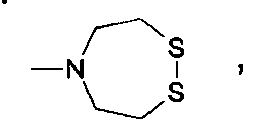
Ci-1 représente un résidu d'acide aminé portant une fonction thiol,
ainsi que la ligation chimique native en milieu réducteur, au niveau du C-terminal, des polypeptides obtenus. - Il est entendu que le terme SEAoff signifie le disulfure cyclique non réactif, par opposition au disulfure réactif de structure -N[(CH2)2-SH]2 ci-après appelé SEAon.
- Il est entendu que l'acide aminé portant une fonction thiol représenté par Ci-1 peut être notamment choisi parmi la cystéine, l'homocystéine, et que ces acides aminés portent un reste disulfure (SR') sur le thiol de l'amino-acide, dans la mise en oeuvre de la réaction avec le peptide-thioester.
- Selon l'invention, le procédé conduit à la préparation d'un assemblage peptidique multiple comportant des restes d'acides aminés portant une fonction thiol, c'est à dire un assemblage peptidique de n fragments et de n-1 acides aminés portant une fonction thiol, représenté par la formule :
A1-C1-A2-C2-A3- ... -Ci-1-Ai-.... -Cn-1-An (I)
dans laquelle A1, A2, A3, ... Ai..., An sont des fragments peptidiques, C1, C2, C3 ... Ci-1 ... Cn-1 sont des restes d'acides aminés portant une fonction thiol,
n est compris entre 3 et 50,
de préférence entre 3 et 20,
ou de manière encore préférée entre 3 et 10, et
i est un nombre entier quelconque compris entre 2 et n. - Il est entendu que, lorsque n = 3, Cn-1-An représente C2-A3 et Ci-1-Ai représente C1-A2-Dans ce cas l'assemblage peptidique de formule (I) est de structure : A1-C1-A2-C2-A3.
- Le procédé selon l'invention consiste dans la préparation d'un peptide-thioester de formule :
A1-SR (II)
dans laquelle A1 est un fragment peptidique et SR est le reste d'un thioester alkylé, R pouvant être un radical alkyle éventuellement substitué,
à partir d'un bis(2-sulfanylethyl)amino peptide A1-SEAoff dans laquelle SEAoff est défini comme précédemment,
par action d'un thiol R-SH, en présence d'un agent réducteur de disulfures cycliques,
suivie de la condensation sur un fragment peptidique de structure :
H-C1(SR')-A2-SEAoff (III)
dans laquelle C1, A2 et SEAoff sont définis comme ci-dessus et (SR') représente un reste disulfure sur le thiol de l'amino-acide C1, en présence d'un thiol aromatique ArSH,
puis transformation du nouveau fragment peptidique obtenu, de structure :
A1-C1-A2-SEAoff (IV)
dans laquelle A1, C1, A2 et SEAoff sont définis comme précédemment, en un peptide-thioester de formule :
A1-C1-A2-SR (II')
dans laquelle A1, C1, A2 et R sont définis comme précédemment, par action d'un thiol R-SH, en présence d'un agent réducteur de disulfures cycliques,
suivie de la condensation sur un fragment peptidique de structure :
H-C2(SR')-A3-SEAoff (III')
dans laquelle SEAoff et R' et C2 et A3 sont définis comme ci-dessus, en présence d'un thiol aromatique ArSH, pour donner un fragment peptidique, de structure :
A1-C1-A2-C2-A3-SEAoff (IV')
dans laquelle A1, C1, A2, C2, A3 et SEAoff sont définis comme précédemment,
puis réitération de ces 2 opérations jusqu'à n-2 fois, pour obtenir un fragment peptidique de structure :
A1-C1-A2-C2-A3- ... -Ci-1-Ai-... -Cn-2-An-1-SEAoff (IVm)
dans laquelle A1, A2, A3, ... Ai..., An-1, C1, C2, C3 ... Ci-1 ... Cn-2 et SEAoff sont définis comme précédemment, et
mise en oeuvre d'une réaction de ligation native de ce fragment peptidique (IVm) obtenu, avec un peptide de formule :
H-Cn-1-An (Vn)
dans laquelle Cn-1 et An sont définis comme précédemment, par réduction en présence d'un agent réducteur de disulfures cycliques, pour donner l'assemblage peptidique multiple de formule générale (I). - L'invention est maintenant décrite plus en détails et de façon non limitative dans la description qui suit.
- Par « peptides ou polypeptide » on entend, dans le cadre de la présente demande, une chaîne linéaire de résidus d'acides aminés (en nombre supérieur ou égal à deux) reliés par des liaisons peptidiques. Les « peptides ou polypeptides » au sens de la présente demande peuvent donc par exemple être des oligopeptides, peptides ou protéines selon l'acception conventionnelle de ces termes. Les résidus d'acides aminés présents dans les polypeptides selon l'invention peuvent être choisis parmi les résidus d'acides aminés protéinogéniques ou non. De préférence, ils sont choisis parmi les vingt résidus d'acides aminés protéinogéniques.
- La notation des polypeptides s'effectue de l'extrémité N-terminale vers l'extrémité C-terminale. Les résidus d'acides aminés présents le long de la chaîne polypeptidique sont notés selon le code usuel à une lettre ou à trois lettres. Un résidu d'acide aminé est un fragment de polypeptide de formule -NH-(CH-R)-(C=O)-, dans laquelle R représente une chaîne latérale, différente d'un acide aminé à un autre.
- Par « fragment peptidique » on entend, dans le cadre de la présente demande, une portion de polypeptide comprenant au moins un résidu d'acide aminé. Un fragment peptidique, au sens de la présente demande, peut donc être par exemple : une séquence de résidus d'acides aminés (telle que -AHG- ou -Ala-His-Gly-) si le fragment peptidique ne comprend ni l'extrémité N-terminale ni l'extrémité C-terminale du polypeptide ; ou bien une séquence de résidus d'acides aminés présentant un groupement à son extrémité N-terminale (telle que H-AHG- ou H-Ala-His-Gly-) si le fragment peptidique comprend l'extrémité N-terminale du polypeptide ; ou bien une séquence de résidus d'acides aminés présentant un groupement à son extrémité C-terminale (telle que -AHG-OH ou -Ala-His-Gly-OH) si le fragment peptidique comprend l'extrémité C-terminale du polypeptide.
- Il est entendu que chacun des fragments peptidiques comprend de préférence uniquement des résidus d'acides choisis parmi les 20 résidus d'acides aminés protéinogéniques. Toutefois, selon un mode de réalisation particulier, les fragments peptidiques Ai en position interne de la séquence peuvent aussi comprendre un ou plusieurs résidus d'acides aminés non-protéinogéniques, l'un ou plusieurs des fragments peptidiques A2 ... Ai ... An-1 pouvant porter un ou plusieurs amino acides modifiés, la modification étant mise en place préalablement à la mise en oeuvre du procédé. A titre d'exemple, non limitatif, la modification des amino acides peut être notamment choisie parmi des radicaux choisis parmi des résidus d'acides carboxyliques (biotine, groupement acétyle, résidu aminooxyacétique, un fluorophore comme la tetraméthylrhodamine, un agent de chélation des métaux comme l'acide 1,4,7,10-tétraazacyclododecane-1,4,7,10-tétraacétique (DOTA), un lipide comme l'acide palmitique, un polymère comme par exemple l'alpha-méthoxy-omega-carboxy poly(éthylène glycol) ou d'autres. Ou encore parmi des modifications post-traductionnelles d'acides aminés protéinogéniques connues de l'homme de l'art (méthylation, phosphorylation, acétylation, glycosylation, sulfatation, hydroxylation, carboxyméthylation, portant les protections appropriées pour l'incorporation en phase solide, etc...), ou éventuellement un médicament (la protéine servant alors de vecteur).
- Selon une manière simple, l'introduction d'une modification peut être effectuée en utilisant un acide aminé non-protéinogénique, notamment un dérivé d'acide aminé protéinogénique, pour introduire la modification lors de la synthèse en phase solide du fragment considéré. A titre d'exemple il est possible d'utiliser une Fmoc-L-Lys(Biotine)-OH, c'est à dire une lysine portant sur sa chaîne latérale une biotine, pour effectuer la synthèse d'un fragment. Ce fragment est ensuite engagé dans l'assemblage de manière identique à celle qui emploie les fragments d'acides aminés protéinogéniques.
- Selon un mode de réalisation de l'invention, un fragment peptidique Ai comprend entre 2 et 300 résidus d'acides aminés, de préférence entre 5 et 100 résidus d'acides aminés, de manière plus particulièrement préférée entre 8 et 50 résidus d'acides aminés.
- Le radical alkyle représenté par R est un radical alkyle de 1 à 12 atomes de carbone, linéaire ou ramifié, éventuellement substitué par un ou plusieurs groupements choisis parmi les atomes d'halogène (F par exemple), ou les radicaux CO2H, SO3H, CONH2, OH, SH, alkyloxy, alkylthio, mercaptoalkylthio, le reste d'un ester ou un reste polyéthylène glycol, ou par un phényle éventuellement substitué, ou d'autres groupements organiques qui n'interfèrent pas avec les réactions mises en oeuvre. Le thiol de formule générale R-SH peut être par exemple HSCH2CH2CO2H, HSCH2CH2SO3H, HSCH2CH2SH, HSCH2CH2SCH2CH2SH ou HSCH2Ph.
- Le thiol aromatique est avantageusement choisi parmi des composés réducteurs des liaisons disulfure, de préférence choisi parmi le thiophenol et ou les dérivés obtenus par substitution du noyau aromatique, par exemple le 4-carboxymethylthiophénol, l'acide 4-mercaptophénylacétique, le dithiothréitol, le benzylmercaptan et les mélanges de ceux-ci.
- Le réducteur de SEAoff peut être choisi parmi les réducteurs de disulfures cycliques. Il peut être notamment choisi parmi les phosphines (par exemple la tris (2-carboxyéthyl)phosphine), ou tout autre réducteur des disulfures cycliques comme les thiols (par exemple le dithiothreitol (DTT)).
- Un exemple de peptide A1-SEAoff peut être représenté par la formule :

- Il est entendu que le fragment peptidique An peut avoir été préparé préalablement par une suite d'opérations telles que décrites ci-dessus, selon le procédé de l'invention.
- Selon l'invention, on peut représenter le procédé d'assemblage de multiples fragments peptidiques selon le schéma 1 suivant :

- L'ensemble des réactions de préparation de l'assemblage peptidique multiple présente le grand avantage de pouvoir être mis en oeuvre in situ, en une réaction « one pot », particulièrement lorsque le nombre de fragments peptidiques n est égal à 3, sans qu'il soit nécessaire d'isoler les intermédiaires formés.
- La réalisation du procédé selon l'invention peut être effectuée comme décrit ci-après, et comme illustré dans les exemples qui suivent.
- La préparation des peptides thioesters de formule (II) est avantageusement mise en oeuvre par action d'un alkylthiol dont la partie alkyle est éventuellement substituée sur un bis(2-sulfanyléthyl)amino peptide : A1-SEAoff, en présence d'un réducteur de disulfures cycliques comme notamment une phosphine, par exemple la tris(2-carboxyethyl)phosphine. La réaction s'effectue avantageusement sous atmosphère inerte (sous argon par exemple), à un pH compris entre 1 et 8 de préférence à pH 4 et à une température comprise entre 20 et 50°C. On utilise avantageusement l'acide 3-mercaptopropionique.
- La condensation du thioester de formule (II) sur le fragment peptidique de formule générale (III) : H-C1(SR')-A2-SEAoff, s'effectue avantageusement en présence d'un thiol aromatique (notamment l'acide 4-mercaptophénylacétique), en opérant sous atmosphère inerte (sous argon par exemple), à une température comprise entre 20 et 60°C. Il n'est pas nécessaire d'isoler le fragment peptidique obtenu, pour le mettre en oeuvre dans la réaction suivante.
- La réaction de ligation native du fragment peptidique (IVm) (A1-C1-A2-C2-A3-..-Ci-1-Ai-..-Cn-2-An-1-SEAoff) avec le peptide (Vn) (H-Cn-1-An) est mise en oeuvre par action d'un agent réducteur de disulfures cycliques, qui peut être de préférence une phosphine (par exemple la tris(2-carboxyéthyl)phosphine (TCEP)) un composé thiol tel que l'acide 4-mercaptophénylacétique (MPAA), le dithiothréitol (DTT), le thiophénol (et ses dérivés), un alkylthiol (notamment le benzylmercaptan) ou encore des mélanges de plusieurs de ces composés, par exemple MPAA et TCEP, en opérant sous atmosphère inerte (sous argon par exemple), à une température comprise entre 20 et 60°C, de préférence à une température de 37°C. La réaction s'effectue notamment en milieu aqueux, par exemple dans un tampon phosphate., Elle est effectuée, de préférence, à un pH compris entre 5,5 et 8,5, de manière plus particulièrement préférée à un pH compris entre 6 et 8 et idéalement à un pH voisin de 7. La durée de la réaction est fonction des réactifs employés, elle est suivie et ajustée selon les résultats d'une analyse de chromatographie liquide. Il n'est pas nécessaire d'isoler le fragment peptidique obtenu (IVm), pour le mettre en oeuvre dans la réaction de ligation native. Il est entendu que la réaction du réducteur de disulfures cycliques peut être mise en oeuvre sur le fragment peptidique de formule (IVm) avant ou simultanément à la réaction avec le peptide de formule (Vn).
- Selon un mode de réalisation particulier, les fragments peptidiques de formule (IVm) et (Vn) comprennent un ou plusieurs résidus d'acides aminés non-protéinogéniques.
- Les résidus d'acides aminés des polypeptides de formule (IVm) et (Vn) peuvent éventuellement être protégés par des groupements protecteurs des chaînes latérales. La protection et l'élimination des radicaux protecteurs peut être effectuée selon les méthodes connues qui n'altèrent pas le reste de la molécule. Plus particulièrement selon les méthodes décrites par T. Greene et P. Wuts, Protective groups in organic synthesis, 2ème édition, John Wiley & Sons, Inc.
- La préparation du bis(2-sulfanyléthyl)amino peptide : A1-SEAoff peut être effectuée selon la méthode décrite par Melnyk, O. et coll., Bis(2-sulfanyléthyl)amino native peptide ligation., Org. Lett., 12(22), 5238-41(2010). Selon la réalisation de ce procédé, le couplage d'un acide aminé à un support de résine polymère comprend la mise en présence du support de résine polymère avec un halogénure d'acide aminé ou avec un acide aminé et un agent d'activation, choisi de préférence parmi le PyBOP® (benzotriazol-1-yl-oxytripyrrolidinophosphonium hexafluorophosphate), le BOP, le PyBroP® (bromo-tris-pyrrolidino-phosphonium hexafluorophosphate), ou encore l'HATU (2-(1H-7-azabenzotriazol-1-yl)-1,1,3,3-tetramethyl uronium hexafluorophosphate methanaminium) et de manière plus part iculièrement préférée le PyBroP. Cette réalisation est décrite plus en détails ci-après dans les exemples de préparation des fragments peptidiques de départ.
- Notamment, les peptides-N(CH2CH2SH)2 (peptides SEAon) correspondants sont oxydés par l'air, sous agitation, dans une solution de bicarbonate d'ammonium 0,1M, à température ambiante. Avantageusement, ils peuvent être aussi obtenus par oxydation en présence d'iode ou de diamide (CH3)2NCON=NCON(CH3)2.
- Le polypeptide de formule (Vn) peut être par exemple obtenu par une méthode de synthèse peptidique usuelle, notamment une méthode de synthèse en phase solide. Il peut également être obtenu au moyen d'une ligation native telle que décrite dans Org. Lett., 12(22), 5238-41 (2010).
- Selon des modes préférés de la présente invention, on prépare un assemblage peptidique de 3 ou 4 fragments, de structures A1-C1-A2-C2-A3 ou A1-C1-A2-C2-A3-C3-A4.
- Selon un autre mode préféré de l'invention, les amino acides Ci portant une fonction thiol sont des restes cystéine Cys.
- Dans ce cas, selon un mode préféré de réalisation de l'invention, on prépare un assemblage peptidique de structure A1-Cys-A2-Cys-A3 ou A1-Cys-A2-Cys-A3-Cys-A4.
- Selon ces modes préférés, le schéma de préparation de l'assemblage peptidique peut être représenté selon le schéma 2 suivant :
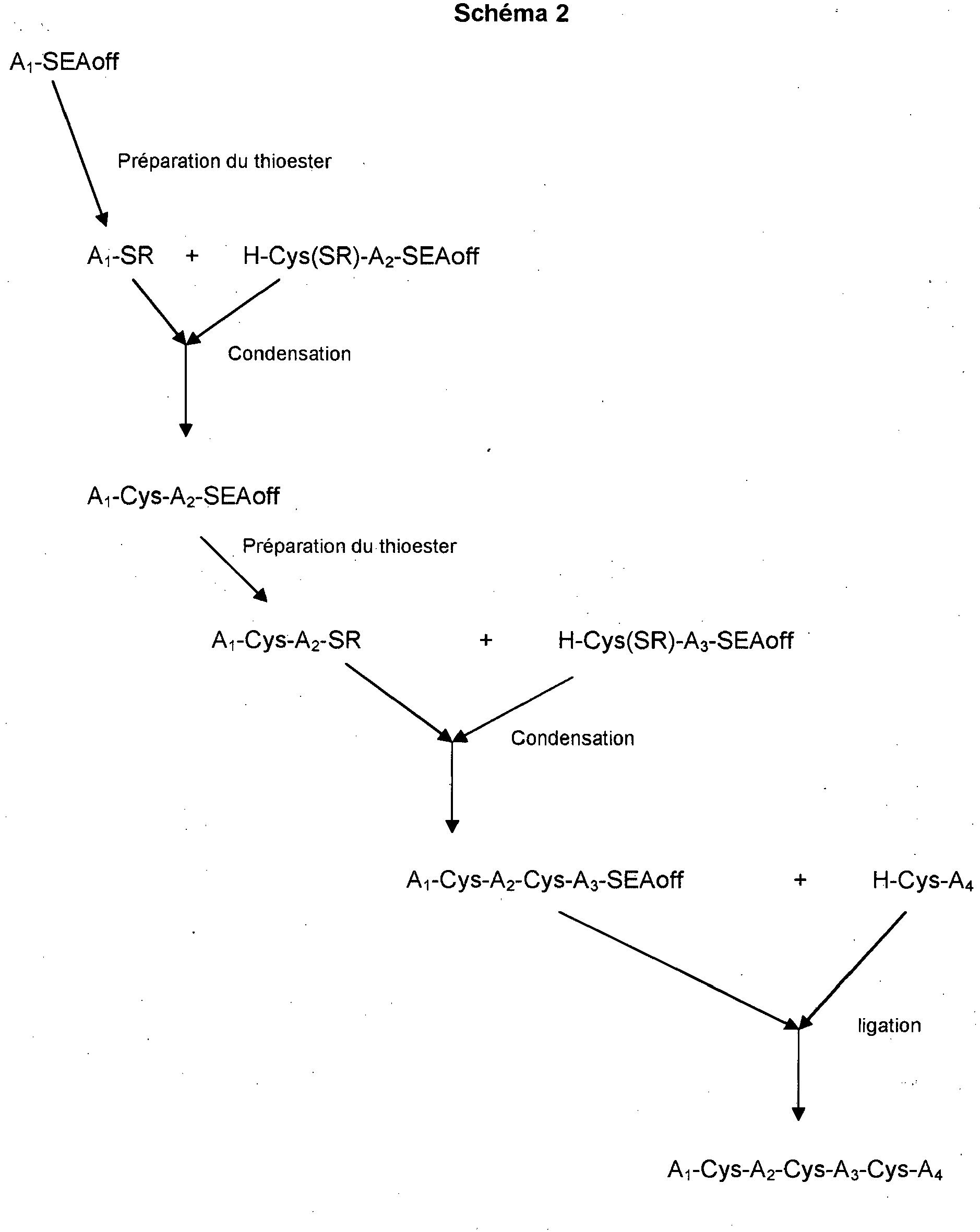
- La présente invention concerne également la préparation des peptide-thioesters de formule (II) à partir de bis(2-sulfanylethyl)amino peptide : A1-SEAoff selon le procédé décrit ci-dessus, par action d'un thiol R-SH, en présence d'un agent réducteur de disulfures cycliques. L'invention concerne également les peptides thioesters ainsi obtenus.
- Les polypeptides de formule (I) obtenus selon l'invention peuvent être utilisés pour produire une banque de polypeptides, par exemple à des fins de criblage.
- Ils peuvent également être utilisés pour la fabrication de compositions pharmaceutiques, en combinaison avec un ou plusieurs adjuvants ou véhicules compatibles et pharmaceutiquement acceptables. A titre d'exemple de compositions pharmaceutiques pouvant être obtenues selon l'invention, on peut citer les médicaments utilisables chez l'homme ou chez l'animal et les préparations vaccinales.
- Ils peuvent également être utilisés pour la réalisation de kits de diagnostic.
- Selon un autre objet de la présente invention, l'invention concerne également un procédé de fabrication d'une composition pharmaceutique comprenant :
- la fabrication d'un polypeptide ou peptide selon le procédé de fabrication d'un polypeptide de formule (I) décrit précédemment, et
- les compositions pharmaceutiques comprenant un polypeptide ou peptide ainsi préparé, à l'état pur ou en association avec un ou plusieurs adjuvants compatibles et pharmaceutiquement acceptables.
- L'invention concerne également un procédé de fabrication d'un dispositif de diagnostic comprenant :
- la fabrication d'un polypeptide ou peptide selon le procédé de fabrication d'un polypeptide de formule (I) décrit précédemment, et
- la formulation ou la mise en forme de ce polypeptide sous une forme adaptée à une utilisation pour un dispositif de diagnostic.
- Le procédé selon la présente invention est particulièrement intéressant du fait qu'il permet de synthétiser, en synthèse totale, un enchaînement peptidique de la longueur et de la nature souhaitée, et comportant des motifs amino acides à substitution thiol du type cystéine (Cys) ou homocystéine, répartis dans la chaîne.
- Il présente l'avantage d'être industrialisable, du fait de la synthèse convergente dont il s'agit, et ce type de synthèse est particulièrement recherché en matière d'industrialisation de procédés puisqu'il procure des rendements avantageux, et notamment peu de perte de rendement en produits déjà élaborés dont le coût de synthèse est déjà élevé.
- Selon la présente invention les fragments SEA permettent la synthèse de protéines en partant du N-terminal vers le C-terminal par ligation successive de fragments peptidiques.
- L'assemblage du N-terminal vers le C-terminal offre un avantage considérable, comparé à la stratégie inverse d'assemblage du C-terminal vers le N-terminal, en effet, dans ce cas le procédé induit une auto-purification des fragments peptidiques ce qui est considérablement important en synthèse industrielle.
- Selon un autre avantage le procédé de l'invention permet d'utiliser des acides aminés protéinogéniques pour la synthèse des fragments peptidiques. De ce fait, il est inutile de recourir à la fabrication de dérivés d'acides aminés (tels que des cétoacides par exemple), ce qui alourdirait considérablement la synthèse.
- Les exemples qui suivent illustrent la présente invention.
- Le peptide précurseur H-ILKEPVHGA-SEAoff a été préparé comme décrit par Ollivier N., Dheur J., Mhidia R., Blanpain A., and Melnyk O., Bis(2-sulfanylethyl)amino native peptide ligation., Org. Lett. 12(22), 5238-41 (2010).
- Le chlorhydrate de tris(2-carboxyethyl)phosphine TCEP,HCl (921,2 mg) est dissous dans 0,2 M tampon phosphate pH=7,3 (40 mL). L'acide 3-mercaptopropionique (MPA) (2 mL) est ajouté à cette solution. Le pH de la solution est réajusté à 4 avec de la soude 5 N (environ 3 mL).
- Le peptide H-ILKEPVHGA-SEAoff (40,31 mg) est dissous dans la solution précédente (40 mL). Le milieu réactionnel est placé sous atmosphère inerte par 3 cycles vide/argon, et placé dans un bain à 37°C.
- Après 22 heures, le milieu réactionnel est transféré dans une ampoule a décanter. Une solution aqueuse d'acide trifluoroacétique (TFA) à 7% (20 gouttes) est additionnée. 4 extractions à l'éther diéthylique sont réalisées. Une solution aqueuse de TFA à 7% (10 mL) est additionnée et 3 nouvelles extractions à l'éther diéthylique sont réalisées.
- La phase aqueuse est dégazée pendant 13 minutes en faisant buller de l'argon, avant d'être purifiée en RP-HPLC (colonne C18 nucléosil 120Å, 5µm, tampon A 100% eau contenant 0,05% TFA, tampon B CH3CN/eau 4/1 contenant 0,05% TFA, gradient : 0 à 10% de tampon B en 5 mn puis 10 à 100% de tampon B en 150 mn, débit 6 mL/mn, 215 nm). On obtient 18,7 mg de peptide 1 (H-ILKEPVHGA-S(CH2)2COOH) pur (R=47,4%) C47H78N12O13S1 MALDI-TOF [M+H]+ calculé (masse mono isotopique) 1051,56; observé 1051,70.
- Synthèse classique d'un peptide-SEAoff à une échelle de 0,25 mmole, selon :
- Ollivier N., Dheur J., Mhidia R., Blanpain A., and Melnyk O., Bis(2-sulfanylethyl)amino native peptide ligation., Org. Lett. 12(22), 5238-41 (2010).
- Le reste disulfure -S-t.Bu est couplé au moyen de Fmoc-Cys(St.Bu)-OH, de manière analogue à la méthode décrite dans l'exemple 2 ci-après.
- La déprotection finale et la coupure du peptide de la résine sont réalisés avec TFA/TIS/DMS/H20 (90/2,5/2,5/5/2,5 en volume, 25 mL) pendant 1h30. Le peptide est précipité dans un mélange froid éther diéthylique/heptane (1/1 en volume), dissous dans un minimum d'eau et lyophilisé. 132,6 mg de peptide brut sont obtenus (R=38%). C43H69N13O10S4 MALDI-TOF [M+H]+ calculé (masse monoisotopique) 1056,42; observé 1056,10.
- Une partie du peptide 2 est ensuite oxydée avant purification. Pour cela, le fragment 2 (122,6 mg) et I2 (222,52 mg, 10 éq.) sont dissous dans AcOH/eau 4/1 (12,5 ml). Après 10 minutes d'agitation, le milieu réactionnel dilué (Volume total =37 mL) est transféré dans une ampoule à décanter contenant de l'éther diéthylique (75 mL). 3 extractions à l'éther diéthylique sont réalisées (3 x 75 mL). La phase aqueuse est congelée et lyophilisée pour donner 94,3 mg de peptide brut.
- Après purification RP-HPLC (colonne C18 nucléosil 120Å, 5µm, 215 nm, tampon A 100% eau contenant 0,05% TFA, tampon B CH3CN/eau 4/1 contenant 0,05% TFA, gradient: 0 à 10% de tampon B en 5 mn, puis 10 à 100% de tampon B en 150 mn, débit 6 mL/min) on obtient 40,52 mg de peptide pur (R=33%) C43H67N13010S4 MALDI-TOF [M+H]+ calculé 1054,4 (masse monoisotopique); observé 1054,4.
- L'acide 4-mercaptophénylacétique (MPAA, 33,64 mg, 0,2 mmol, thiol aromatique) est dissous dans du tampon phosphate pH=7,3 0,1 M (1 mL). Une solution de soude 5 N (80 µL) est ajoutée pour ajuster le pH de la solution à 7,64. Le peptide 1 (10,40 mg, 7,5 µmol) et le peptide 2 (10,42 mg, 7,5 µmol) sont dissous ensemble dans la solution précédente (533µL). Le milieu réactionnel est placé dans un bain thermostaté à 37°C sous atmosphère inerte.
- La ligation est suivie par RP-HPLC sur une colonne C18 Xbridge BEH (4,6 x 250 mm, 300 Å, 5µm) (215 nm, 1 mUmn, 30°C, tampon A eau contenant 0,05% TFA, tampon B CH3CN/eau 4/1 contenant 0,05% TFA, 0-100% B en 30 mn). Pour cela, un aliquot (5 µL) de milieu réactionnel est acidifié avec une solution de TFA à 10% dans l'eau, extrait avec de l'éther diéthylique pour éliminer le MPAA et le MPA avant l'analyse.
- La préparation du peptide H-C2-A3 est décrite dans la publication de : Ollivier N., Dheur J., Mhidia R., Blanpain A., and Melnyk O., Bis(2-sulfanylethyl)amino native peptide ligation., Org. Lett. 12(22), 5238-41 (2010).
- Après 5h30 de réaction, la TCEP,HCl (chlorhydrate de tris(2-carboxyethyl)phosphine) (57,34 mg, 0,2 mmol) est dissoute dans un tampon phosphate pH=7,3 0,1 M (1 mL). une solution de soude 5 N (140 µL) est ajoutée pour ajuster le pH de la solution à 7,33.
A 1 -C 1 -A 2 -SEAon + (peptide 3) H-C 2 - A 3 → A 1 -C 1 -A 2 -C 2 -A 3 (peptide 4)
- Le peptide 3 (16,17 mg, 11,2 µmol) est dissous dans la solution précédente (533 µL) puis ajouté au milieu réactionnel précédent qui est placé à nouveau à 37°C sous atmosphère inerte.
- La ligation est suivie par RP-HPLC sur une colonne CI8 Xbridge BEH (4,6 x 250 mm, 300 A, 5 µm) (215 nm, 1 mL/mn, 30°C, tampon A eau contenant 0,05% TFA, tampon B CH3CN/eau 4/1 contenant 0,05% TFA, 0-100% B en 30 mn). Pour cela, un aliquot (5 µL) de milieu réactionnel est acidifié avec une solution de TFA à 10% dans l'eau, extrait avec l'éther diéthylique pour éliminer le MPAA (acide 4-mercaptophénylacétique) avant l'analyse.
- Lorsque la réaction est complète, le milieu réactionnel est dilué avec de l'eau contenant 0,05% de TFA (3 mL) et une solution de TFA à 10% dans l'eau (15 gouttes) est additionnée. Après 5 extractions avec l'éther diéthylique (5 x 8 mL), la phase aqueuse est dégazée pendant 10 minutes par bullage d'argon. Après purification par RP-HPLC sur une colonne C18 Nucléosil 120Å, 5 µm (215 nm, débit 6 mL/mn, tampon A : eau contenant 0,05% TFA, tampon B : CH3CN/eau 4/1 contenant 0,05% TFA, gradient : 0-10% de tampon B en 5 mn, puis 10-100% de tampon B en 150 mn) on obtient 16,2 mg de peptide 4 pur (59,2%).
-

- La résine SEA (0,5 mmol, 0,175 mmol/g) est conditionnée dans le dichlorométhane (DCM). Fmoc-Lys(Boc)-OH (2,342 g, 5 mmol) est dissous dans du DCM et quelques gouttes de diméthylformamide (DMF) pour aider à la solubilisation puis la solution est ajoutée sur la résine. PyBrop (2,331 g, 5 mmol) est dissous dans le minimum de DCM puis ajouté sur la résine. La diisopropyléthylamine (DIEA) (2,613 mL, 15 mmol) est ensuite additionnée sur la résine et le couplage dure 2 heures (volume total <5 mL). La résine est ensuite lavée 3 x 2 minutes avec du DCM. La résine est ensuite traitée par 10% Ac2O/5% DIEA/DCM (10 mL, 2 min) puis (10 mL, 20 min). La résine est ensuite lavée 5 x 2 minutes au DCM.
- Le fragment 1 est assemblé sur une partie de la résine précédente (0,25 mmol, 0,175 mmol/g) avec un synthétiseur de peptides (CEM µWaves, Saclay, France) sans utiliser les micro-ondes, en utilisant la stratégie Fmoc/tert-butyle. Le couplage est effectué avec les acides aminés (0,2 M, 4 éq), l'activateur HBTU (0,5 M, 3,6 éq.) et la base DIEA (2 M, 8 éq). La déprotection finale et le clivage du peptide de la résine sont réalisés avec TFA/TIS/DMS/thioanisole/H2O (90/2,5/2,5/2,5/2,5 en volume, 25 mL) pendant 2 heures 30. Le peptide est précipité dans un mélange froid éther diéthylique/heptane (1/1 en volume), dissout dans un minimum d'eau et lyophilisé. 288 mg de peptide brut sont obtenus (R=32%). C120H216N36O31S4 LC-MS [M+H]+ calculé (masse moyenne) 2788,5; observé 2788,1.
- Une partie du fragment 1 est ensuite oxydée avant purification. Pour cela, le fragment 1 (95,7 mg) est dissous dans AcOH/eau 1/4 (47,9 mL). 197 mM l2 dans DMSO (270 µL, 50 µmol, 2éq.) sont additionnées à la solution précédente. Après 30 secondes d'agitation, 64,8 mM dithiothréitol (DTT, 823 µL, 50 µmol, 2 éq) est additionné pour consommer l2 restant et injecté directement en RP-HPLC.
- Après purification RP-HPLC (colonne C18 nucléosil 120Å, 5µm, tampon A 100% eau contenant 0,05% TFA, tampon B CH3CN/eau 4/1 contenant 0,05% TFA, gradient : 0 à 20% de tampon B en 5 min, puis 20 à 40% en 40 min, débit 6 mL/min, 215 nm) on obtient 25,8 mg de peptide pur (R=27%) C120H214N36O31S4 MALDI-TOF [M+H]+ calculé (masse monoisotopique) 2784,52 ; observé 2784,6.
-

- Le Tris(2-carboxyethyl)phosphine hydrochlorure (TCEP,HCl, 229,63 mg, 0,8 mmol) est solubilisé dans le tampon 0,2 M phosphate de sodium pH=7,3 (10 mL). L'acide mercaptopropionique (MPA, 0,5 mL) est additionné. NaOH 5M (340 µL) est ajouté pour ajuster le pH à 3,98.
- Le fragment 1 K1-SEAoff (24,67 mg, 6,9 µmol) est dissous dans la solution précédente (10,3 mL). Le milieu réactionnel est chauffé à 37°C sous atmosphère d'argon. L'avancement de la réaction est suivi par RP-HPLC sur une colonne C18 Xbridge BEH (215 nm, 1 mL/min, 30°C, éluant A eau contenant 0,05% d'acide trifluoracétique (TFA), éluant B CH3CN/eau 4/1 contenant 0,05% TFA, 0-100% B en 30 min). Pour cela, des aliquots sont acidifiés avec 10 % de TFA aqueux, extraits avec Et2O afin d'éliminer le MPA en excès avant analyse.
- Après la fin de la réaction, le milieu réactionnel est dilué par de l'eau (10 mL) et 10 % de TFA aqueux (5 mL) sont additionnés. Après 3 extractions avec Et2O (3 × 15 mL) et bullage d'argon pendant 15 min, la purification par RP-HPLC sur une colonne C18 Nucleosil 120 Å, 5 µm (215 nm, 6 mL/min, température ambiante, éluant A eau contenant 0,05% TFA, éluant B CH3CN/eau 4/1 contenant 0,05% TFA, 0-10% B en 5 min, puis 10-100% B en 150 min) fournit 9,7 mg de K1(fragment 1)-MPA pur (41%).
-

- La résine SEA (0,5 mmol, 0,175 mmol/g) est conditionnée dans du DCM. Fmoc-Tyr-OH (2,298 g, 5 mmol) est dissous dans du DCM (<5 mL) et quelques gouttes de DMF pour aider à la solubilisation puis ajouté sur la résine. PyBrop (2,331 g, 5 mmol) est dissous dans le minimum de DCM puis ajouté sur la résine. DIEA (2,614 mL, 15 mmol) est ensuite additionné sur la résine et le couplage dure 2 heures. La résine est ensuite lavée 4 x 2 minutes au DCM. La résine est ensuite traitée par 10% Ac2O/5% DiEA/DCM (10 mL, 2 min) puis (10 mL, 20 min). La résine est ensuite lavée 5 x 2 minutes au DCM.
- Le fragment 2 est assemblé sur la résine précédente (0,5 mmol, 0,175 mmol/g) avec un synthétiseur de peptides (CEM µWaves, Saclay, France) sans utiliser les micro-ondes, en utilisant la stratégie Fmoc/tert-butyle. Le couplage est effectué avec les acides aminés (0,2 M, 4 éq.), l'activateur HBTU (0,5 M, 3,6 éq.) et la base DIEA (2 M, 8 éq.). Le solvant de lavage (DMF) ainsi que le solvant de Fmoc-Met-OH contiennent 1% de thioanisole afin d'éviter au maximum l'oxydation de la méthionine de la séquence.
- La résine est séparée en 2 après la glutamine en position 2 (0,25 mmol) afin de coupler la Fmoc-Cys(StBu)-OH manuellement. Pour ce faire, la résine est lavée 4 x 2 minutes au DMF, pesée en DMF et divisée en 2. HBTU (379,3 mg, 1 mmol) est dissous dans DMF (1100 µL). HOBt (135 mg, 1 mmol) est dissous dans DMF (500 µL) et additionné sur HBTU. Fmoc-Cys(StBu)-OH (431,6 mg, 1 mmol) est dissous dans DMF (500 µL) et additionné au mélange HBTU/HOBt. DIEA (522,7 µL, 3 mmol) est ensuite ajouté sur le mélange. On agite pendant 1 minute puis le mélange est additionné sur la résine et le couplage dure 45 minutes. La résine est ensuite lavée 4 x 2 minutes au DMF. On réalise la déprotection du Fmoc N-terminal par traitement à la pipéridine 20% dans le DMF (15 mn puis 5 mn). La résine est ensuite lavée 4 x 2 minutes au DCM puis 3 x 2 minutes à Et2O et séchée.
- La déprotection finale et le clivage du peptide de la résine sont réalisés avec TFA/TIS/DMS/Thioanisole/H2O (90/2,5/2,5/2,5/2,5 en volume, 25 mL) pendant 2 heures 30. Le peptide est précipité dans un mélange froid éther diéthylique/heptane (1/1 en volume), dissous dans un minimum d'eau et lyophilisé. 366,14 mg de peptide brut sont obtenus (R=35,6%). C156H231N41O44S5 MALDI-TOF [M+H]+ calculé (résolution monoisotopique) 3543,6; observé 3542,2.
- Une partie du fragment 2 est ensuite oxydée avant purification. Pour cela, le fragment 2 (67 mg) est dissous dans AcOH/eau 1/4 (35 mL) puis 144 mM I2 dans DMSO (223 µL) sont ajoutés. Après 30 secondes d'agitation, 64,8 mM DTT dans AcOH/eau 1/4 (503 µL) sont additionnés pour consommer l'I2 en excès. Après décoloration de la solution, le milieu est injecté en RP-HPLC (colonne C18 nucléosil, 120 A, 5 µm, 2 x 28 cm, 215 nm, tampon A 100% eau contenant 0,05% TFA, tampon B CH3CN/eau 4/1 contenant 0,05% TFA, gradient : 0 à 10% de tampon B en 5 min, puis 10 à 100% B en 150 min, débit 6 mL/min) on obtient 11,5 mg de peptide pur (R=17,2 %) C156H229N41O44S5 LC-MS [M+H]+ calculé (résolution monoisotopique) 3541,6 ; observé 3541,9.
-

- Le fragment 3 est assemblé sur la résine Novasyn TGR (0,5 mmol, 0,25 mmol/g) avec un synthétiseur de peptides (CEM µWaves, Saclay, France) sans utiliser les micro-ondes, en utilisant la stratégie Fmoc/tert-butyle. Le couplage est effectué avec les acides aminés (0,2 M, 4 éq.), l'activateur HBTU (0.5 M, 3.6 éq.) et la base DIEA (2 M, 8 éq.).
- La déprotection finale et le clivage du peptide de la résine sont réalisés avec TFA/EDT/H2O/TIS (94/2,5/2,5/1 en volume, 30mL) pendant 2 heures 30. Le peptide est précipité dans un mélange froid éther diéthylique/heptane (1/1 en volume), dissous dans un minimum d'eau et lyophilisé. Après purification RP-HPLC (colonne C18 vydac 50 cm x 2 cm, 280 nm, tampon A 100% eau contenant 0,05% TFA, tampon B CH3CN/eau 4/1 contenant 0.05% TFA, gradient : 0 à 20% de tampon B en 10 min puis 20 à 50% de tampon B en 60 mn, débit 30 mL/mn) on obtient 272 mg de peptide pur (R=13%) C158H239N47O52S4 MALDI-TOF [M+H]+ calculé (résolution monoisotopique) 3755,6; observé 3755,7.
- La guanidine HCl (573,24 mg, 6 mmol) est dissoute dans 0,1 M tampon phosphate pH=7,3 (1 mL). L'acide 4-mercaptophenylacétique (MPAA, 33,68 mg, 0,2 mmol) est dissous dans cette dernière solution (1 mL). NaOH 5M (150 µL) est ajouté pour ajuster le pH de la solution à 7,53.
- Le K1 (fragment 1)-MPA (9,71 mg, 2,8 µmol) et le StBu-K1(fragment 2)-SEA(10,65 mg, 2,6 µmol) sont dissous ensemble dans la solution précédente (185 µL). Le milieu réactionnel est placé dans un bain thermostaté à 37°C dans la boîte à gants.
- La ligation est suivie par RP-HPLC sur une colonne C18 Xbridge BEH (4,6 x 250 mm, 300 A, 5 µm) (215 nm, 1 mL/min, 30°C, tampon A eau contenant 0,05% TFA, tampon B CH3CN/eau 4/1 contenant 0,05% TFA, 0-100% B en 30 min). Pour cela, un aliquot (1 µL) de milieu réactionnel est acidifié avec 10% TFA aqueux, extrait avec l'Et2O pour éliminer le MPAA et MPA avant l'analyse.
- Après 20 heures de réaction, de la guanidine HCl (573,15 mg, 6 mmol) est dissoute dans du tampon phosphate 0,1 M, pH=7,3 (1 mL). Le Tris(2-carboxyéthyl) phosphine hydrochlorure (TCEP,HCl, 57,59 mg, 0,2 mmol) est dissous dans cette dernière solution (1 mL). 5M NaOH est ajouté pour ajuster le pH de la solution à 7,27.
- Le K1(fragment 3) (16,46 mg, 3,9 µmol) est dissous dans la solution précédente (185 µL) puis ajouté au milieu réactionnel précédent qui est placé à nouveau à 37°C sous atmosphère inerte.
- La ligation est suivie par RP-HPLC sur une colonne C18 Xbridge BEH (4,6 x 250 mm, 300 A, 5 µm) (215 nm, 1 mL/min, 30°C, tampon A eau contenant 0,05% TFA, tampon B CH3CN/eau 4/1 contenant 0,05% TFA, 0-100% B en 60 min). Pour cela, un aliquot (1 µL) de milieu réactionnel est acidifié avec 10% TFA aqueux, extrait avec Et2O pour éliminer le MPAA et MPA avant l'analyse.
C418H648N122O127S7 MALDI-TOF [M+H]+ (masse moyenne) calculé 9640.01, trouvé 9639. - Lorsque la réaction est complète, le milieu réactionnel est dilué avec de l'eau (4 mL) et TFA 10% aqueux (1 mL) est additionné. Après 4 extractions avec Et2O (4 x 8 mL), la phase aqueuse est dégazée pendant 10 minutes par bullage d'argon, diluée avec de l'eau (36 mL), filtrée. Le fritté est rincé par AcOH (1 mL) et rincé par de l'eau (20 mL). L'ensemble est purifié par RP-HPLC sur une colonne C18 vydac 300 Å, 5 µm (215 nm, 20 mL/min, tampon A eau contenant 0,05% TFA, tampon B CH3CN/eau 4/1 contenant 0,05% TFA, 0-20% B en 5 min, puis 20-60% B in 80 min) on obtient 11,46 mg de K1 (125-209) pur (R = 39,4%).
- K1(125-209) (3,99 mg, 0,355 µmol) est dissous dans le tampon 10 mM PBS, 138 mM NaCl, 2,7 mM KCI pH=7,4 contenant 10% en volume de glycérol, 1 mM glutathion réduit, 0,2 mM glutathion oxydé (10 mL).
- Le milieu réactionnel est placé à 4°C.
- Le folding est suivi par LC-MS sur une colonne C18 Xbridge BEH (4,6 x 250 mm, 300 A, 5 µm) (215 nm, 1 mL/min, 30°C, tampon A eau contenant 0,1 % TFA, tampon B CH3CN/eau 4/1 contenant 0,1 % TFA, 0-100% B en 60 min).
- Après 65 heures, le milieu réactionnel est ultracentrifugé à 8000 rcf, à 4°C pendant 15 minutes puis à 9000 rcf, à 4°C pendant 15 minutes afin d'éliminer quelques agrégats.
- Le milieu réactionnel (7,6 mL) est ensuite transféré en plusieurs fois dans un système d'ultrafiltration vivaspin 2mL avec un cut-off de 3000 MWCO et ultrafiltré à 12000 rcf, à 12°C pendant 3 heures 20. Une fois concentré, le milieu réactionnel est de 800 µL environ.
- Il est ensuite dialysé à 4°C dans une cassette de dialyse de cut-off 3500 MWCO avec un tampon 10 mM PBS, 138 mM NaCl, 2,7 mM KCI pH=7,4 contenant 10% en volume de glycérol (1 L) pendant 1 nuit. Le milieu réactionnel est de 1 mL environ après dialyse.
- K1 (125-209) foldé est dosé à 562 nm par le kit BCA Protein Assay (Pierce) en réalisant une gamme étalon de BSA. La concentration estimée de K1 (125-209) est de 137 µM.
-

- Fmoc-Lys(Biotine)-OH (2 × 89 mg, 2 × 0,15 mmol) est couplé 2 fois sur la résine PAL chemmatrix (0,1 mmol, 0,43 mmol/g) en utilisant TBTU (2 × 30,5 mg, 2 × 0,15 mmol) et DIEA (2 × 50 µL, 2 × 0,45 mmol) pendant 2 heures dans le NMP. Après des lavages au NMP (3 x 2 min) et DM F (3 x 2 mn), le fragment 3-biotine est assemblé sur une 2 colonnes de 50 µmol avec un synthétiseur de peptides (INTAVIS) en utilisant la stratégie Fmoc/tert-butyle.
- Les couplages sont effectués en utilisant 4 éq. de chaque acide aminé, 3,6 éq. HBTU, et 8 éq. DIEA. Une étape de capping est réalisée après chaque couplage avec Ac2O/DIEA. A la fin de la synthèse, la résine est lavée avec CH2Cl2, diéthyl éther (2 × 2 min) et séchée sous vide.
- La déprotection finale et le clivage du peptide de la résine sont réalisés avec TFA/EDT/H2O/TIS (94/2,5/2,5/1 en volume, 2 × 5mL) pendant 2h. Le peptide est précipité dans un mélange froid éther diéthylique/heptane (1/1 en volume), dissout dans un minimum d'eau et lyophilisé. Après purification RP-HPLC (colonne C18 nucléosil 50 cm x 2 cm, 215 nm, tampon A 100% eau contenant 0,05% TFA, tampon B CH3CN/eau 4/1 contenant 0,05% TFA, gradient : 0 à 15% de tampon B en 5 min puis 15 à 35% de tampon B en 60 min, débit 6 mL/min) on obtient 36,75 mg de peptide pur (Rdt=8 %)
C174H265N51O55S5 MALDI-TOF [M+H]+ calculé (masse moyenne) 4112,68; observé 4114,3. - La guanidine HCl (573,28 mg, 6 mmol) est dissoute dans 0,1 M tampon phosphate pH=7,3 (1 mL). L'acide 4-mercaptophenylacétique (MPAA, 33,59 mg, 0,2 mmol) est dissous dans cette dernière solution (1 mL). NaOH 5M (80 µL) est ajouté pour ajuster le pH de la solution à 7,40.
- Le K1(fragment 1)-MPA (2,76 mg, 0,8 µmol) et le StBu-K1(fragment 2)-SEA (3,30 mg, 0,8 µmol) sont dissous ensemble dans la solution précédente (57 µL). Le milieu réactionnel est placé dans un bain thermostaté à 37°C dans la boîte à gants.
- La ligation est suivie par RP-HPLC sur une colonne C18 Xbridge BEH (4,6 x 250 mm, 300 Å, 5µm) (215 nm, 1 mL/min, 30°C, tampon A eau contenant 0,05% TFA, tampon B CH3CN/eau 4/1 contenant 0,05% TFA, 0-100% B en 30 min). Pour cela, un aliquot (1 µL) de milieu réactionnel est acidifié avec 10% TFA aqueux, extrait avec Et2O pour éliminer MPAA et MPA avant l'analyse.
- Après 24h40 de réaction, de la guanidine,HCl (573,18 mg, 6 mmol) est dissoute dans du tampon phosphate 0,1 M, pH=7,3 (1 mL). Le Tris(2-carboxyéthyl)phosphine hydrochlorure (TCEP,HCl, 57,80 mg, 0,2 mmol) est dissous dans cette dernière solution (1 mL). NaOH 5M est ajouté pour ajuster le pH de la solution à 7,40.
- Le K1(fragment 3) (5,50 mg, 1,2 µmol) est dissous dans la solution précédente (57 µL) puis ajouté au milieu réactionnel précédent qui est placé à nouveau à 37°C sous atmosphère inerte.
- La ligation est suivie par RP-HPLC sur une colonne C18 Xbridge BEH (4,6 x 250 mm, 300 Å, 5 µm) (215 nm, 1 mL/min, 30°C, tampon A eau contenant 0,05% TFA, tampon B CH3CN/eau 4/1 contenant 0,05% TFA, 0-100% B en 60 min). Pour cela, un aliquot (1 µL) de milieu réactionnel est acidifié avec 10% TFA aqueux, extrait avec Et2O pour éliminer MPAA et MPA avant l'analyse.
C434H674N126O130S8 [M+H]+ attendu (masse moyenne) 9994,49, observé 9994,41. - A la fin de la réaction, le milieu réactionnel a été dilué avec de l'eau et du TFA 10% aqueux. Après extractions avec Et2O, la phase aqueuse a été dégazée par bullage d'argon, diluée avec de l'eau, filtrée et purifiée par RP-HPLC sur une colonne C18 vydac 300 Å, 5 µm (215 nm, 20 mL/min, tampon A eau contenant 0,05% TFA, tampon B CH3CN/eau 4/1 contenant 0,05% TFA).
- Les fragment 1 et fragment 2 : K1(fragment 1)-MPA et StBu-K1(fragment 2)-SEA sont préparés comme décrit précédemment à l'exemple 2.
-
- A) La synthèse des fragments peptidiques SEAon est effectuée selon Ollivier N., Dheur J., Mhidia R., Blanpain A., and Melnyk O., Bis(2-sulfanylethyl)amino native peptide ligation., Org. Lett. 12(22), 5238-41 (2010).
- A titre d'illustration la préparation des fragments peptidiques
- (1a) : H-ILKEPVHGG-N(CH2CH2SH)2,
- (1b) : H-ILKEPVHGA-N(CH2CH2SH)2,
- (1c) :H-ILKEPVHGV-N(CH2CH2SH)2 et
- (1d) :H-ILKEPVHGY-N(CH2CH2SH)2
- Le fragment peptidique (1a) est obtenu à partir du support amorce préparé avec la glycine.
- Le fragment peptidique (1b) est obtenu à partir du support amorce préparé avec l'alanine.
- Le fragment peptidique (1c) est obtenu à partir du support amorce préparé avec la valine.
- Le fragment peptidique (1d) est obtenu à partir du support amorce préparé avec la tyrosine.
- La synthèse des polypeptides peut être résumée comme suit:
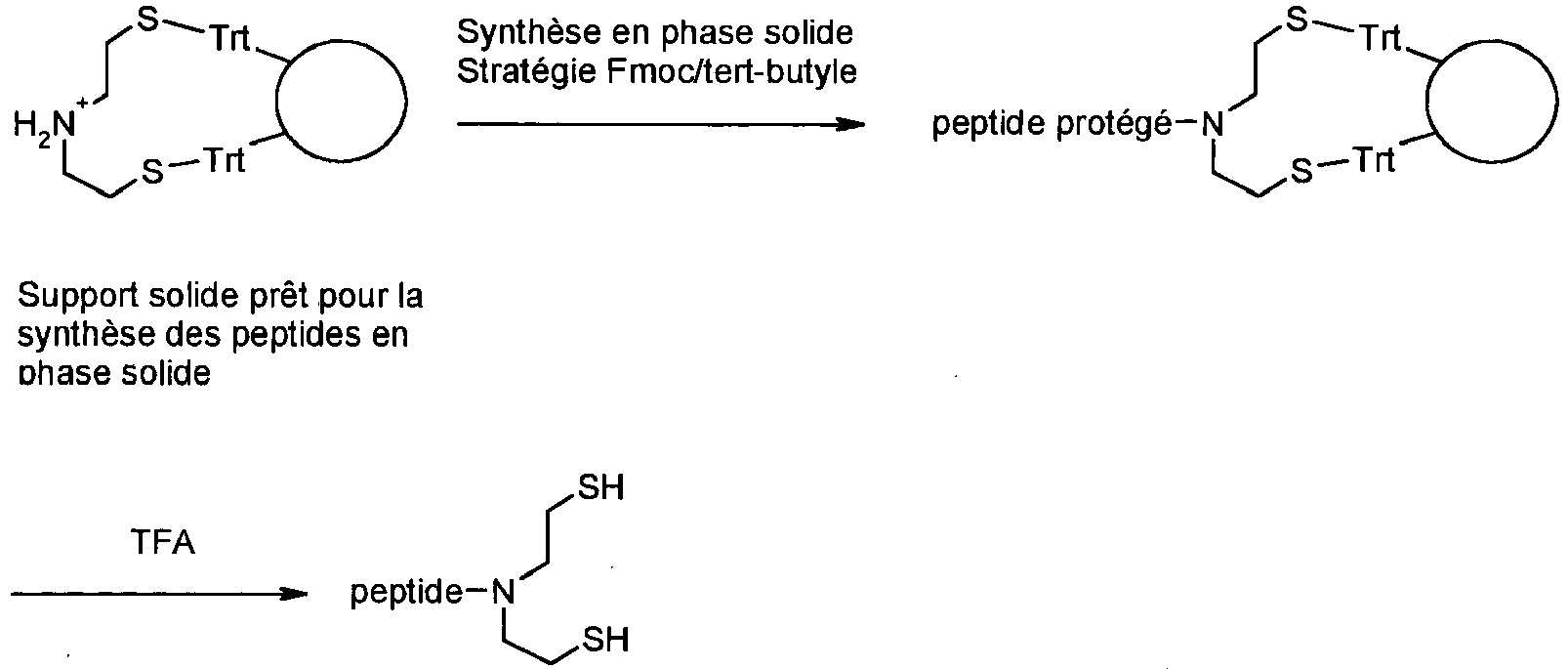
- Les fragments peptidiques ainsi obtenus ont la formule générale suivante :
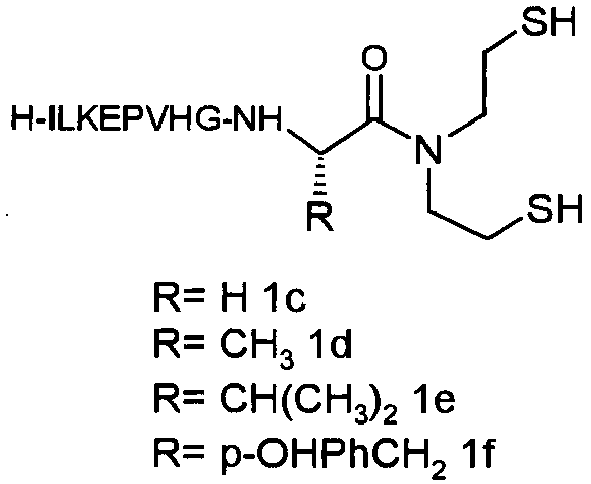
- La synthèse des différents polypeptides est effectuée en phase solide en utilisant la stratégie Fmoc/tert-butyle sur résines (échelle de 0,1 mmol) sur un synthétiseur de peptide à micro-ondes (CEM µ WAVES, Saclay, France). Le couplage est effectué en utilisant un excès 5 fois molaire de chaque acide aminé, l'activateur HBTU est utilisé avec un excès de 4,5 fois molaire et la base DiEA est utilisée avec un excès 10 fois molaire.
- La déprotection finale et le clivage du polypeptide de la résine sont réalisés avec 10 mL d'un mélange TFA/TIS/DMS/H2O (92,5/2,5/2,5/2,5 en volume) pendant 1 heure. Le polypeptide est ensuite obtenu par précipitation dans 100 mL d'un mélange éther diéthylique/heptane (1/1 en volume), dissout dans H2O puis lyophilisé.
- La pureté de chaque fragment peptidique est déterminée par HPLC (91% pour le fragment peptidique (1a) avec une glycine, 83% pour le fragment peptidique (1b), 80% pour (1c), et 88% pour (1d)). L'analyse MALDI-Tof des fragments peptidiques concorde avec la structure du fragment peptidique attendu (Fragment peptidique (1a) C47H81N13O11S2 [M+H]+ calculé 1068,6 Da, observé 1068,5. Fragment peptidique (1b) C48H83N13O11S2 [M+H]+ calculé 1082,6 Da, observé 1082,4. Fragment peptidique (1c) C50H87N13O11S2 [M+H]+ calculé 1110,6 Da, observé 1110,5). Fragment peptidique 1(d) C54H87N13O12S2 [M+H]+ calculé 1174,6 Da, observé 1174,6).
- La purification des polypeptides est réalisée sur colonne C18 nucléosil en acetonitrile-H2O (80-20) en TFA, avec un gradient de 0 à 30 % en 30 mn pour le fragment peptidique (1a), et un gradient de 0 à 10 % en 5 mn puis 10 à 25% en 25 mn pour les fragment peptidique (1b) et (1c).
- La pureté déterminée par HPLC est de 96% pour le fragment peptidique (1a) avec un rendement global de 35%, 97% pour le fragment peptidique (1b) avec un rendement de 31%, et de 99% pour le fragment peptidique (1c) avec un rendement de 27%.
- Les fragments peptidiques (1a), (1b), (1c) et (1d) sont tels qu'obtenus précédemment sont oxydés selon le schéma général suivant :

- Chaque fragment peptidique est clivé du support solide par l'action d'une solution TFA/DMS/TiS/H2O (92,5/2,5/2,5/2,5 ; v/v). Le fragment peptidique est alors précipité dans un large volume d'un mélange éther diéthylique/heptane (1/1 ; v/v) et lavé deux fois à l'aide de cette solution. Le fragment peptidique brut lyophilisé après l'étape de coupure est ensuite dissous dans une solution de bicarbonate d'ammonium à 0,1M préalablement dégazée pendant 10 min par bullage d'azote (1 mg/mL).
- Le mélange est alors laissé à température ambiante sous agitation forte. L'évolution de la réaction est suivie par spectrométrie de masse MALDI-TOF jusqu'à disparition totale de la forme réduite du polypeptide considéré. Le polypeptide est enfin purifié par RP-HPLC (gradient éluant A (H2O/0,05% TFA)/éluant B (80% Acétonitrile/20% H2O/0,05% TFA) : 0 à 10% en 10 min puis 10% à 25 % en 25 min) puis congelé et lyophilisé.
- Le tableau ci-dessous résume les résultats obtenus (analyse MALDI-TOF).
fragment peptidique m/z [M+H]+ calc. M/z [M+H]+ obs. Rendement final(%) (1a) 1066,6 1066,6 17 (1b) 1080,6 1080,6 13 (1c) 1108,6 1108,6 23 (1d) 1172,6 1172,6 20
Claims (8)
- Un procédé de préparation d'un assemblage peptidique de n fragments et de n-1 acides aminés portant une fonction thiol, représenté par la formule :
A1-C1-A2-C2-A3- ... -Ci-1-Ai-.... -Cn-1-An (I)
dans laquelle A1, A2, A3, ... Ai... , An sont des fragments peptidiques, C1, C2, C3 ... Ci-1 ... Cn-1 sont des restes d'acides aminés portant une fonction thiol,
n est compris entre 3 et 50, de préférence entre 3 et 20, ou entre 3 et 10, et
i est un nombre entier quelconque compris entre 2 et n,
caractérisé en ce que l'on met en oeuvre la préparation d'un peptide-thioester de formule :
A1-SR (II)
dans laquelle A1 est un fragment peptidique et SR est le reste d'un thioester alkylé, R pouvant être un radical alkyle éventuellement substitué,
à partir d'un bis(2-sulfanyléthyl)amino peptide : A1-SEAoff dans laquelle SEAoff est groupement bis(2-sulfanyléthyl)amino cyclique
suivie de la condensation sur un fragment peptidique de structure :
H-C1(SR')-A2-SEAoff (III)
dans laquelle C1, A2 et SEAoff sont définis comme ci-dessus et (SR') représente un reste disulfure sur le thiol de l'amino-acide C1, en présence d'un thiol aromatique ArSH,
puis transforme le nouveau fragment peptidique obtenu, de structure :
A1-C1-A2-SEAoff (IV)
dans laquelle A1, C1, A2 et SEAoff sont définis comme précédemment, en un peptide-thioester de formule :
A1-C1-A2-SR (II')
dans laquelle A1, C1, A2 et R sont définis comme précédemment, par action d'un thiol R-SH, en présence d'un agent réducteur de disulfures cycliques,
et condense sur un fragment peptidique de structure :
H-C2(SR')-A3-SEAoff (III')
dans laquelle SEAoff et R' et C2 et A3 sont définis comme ci-dessus, en présence d'un thiol aromatique ArSH, pour donner un fragment peptidique, de structure :
A1-C1-A2-C2-A3-SEAoff (IV')
dans laquelle A1, C1, A2, C2, A3 et SEAoff sont définis comme précédemment,
et réitère ces 2 opérations jusqu'à n-2 fois, pour obtenir un fragment peptidique de structure :
A1-C1-A2-C2-A3- ... -Ci-1-Ai-.... -Cn-2-An-1-SEAoff (IVm)
dans laquelle A1, A2, A3, ... Ai ..., An-1, C1, C2, C3 ... Ci-1 ... Cn-2 et SEAoff sont définis comme précédemment, puis
met en oeuvre une réaction de ligation native de ce fragment peptidique (IVm) obtenu, avec un peptide de formule :
H-Cn-1-An (Vn)
dans laquelle Cn-1 et An sont définis comme précédemment, par réduction en présence d'un agent réducteur de disulfures cycliques, pour donner l'assemblage peptidique multiple de formule générale (I). - Un procédé selon la revendication 1, caractérisé en ce que l'on prépare un assemblage peptidique de 3 ou 4 fragments, de structures A1-C1-A2-C2A3 ou A1-C1-A2-C2-A3-C3-A4.
- Un procédé selon la revendication 2, caractérisé en ce que l'on prépare un assemblage peptidique de 3 fragments en une réaction « one pot ».
- Un procédé selon l'une des revendications 1 à 3, caractérisé en ce que C1, C2, C3 ... Ci-1 ... Cn-1 représentent des restes Cys.
- Un procédé selon l'une des revendications 1 à 4, caractérisé en ce que l'un ou plusieurs des fragments peptidiques A2 ... Ai ... An-1 peuvent porter un ou plusieurs amino acides modifiés.
- Un procédé selon l'une des revendications 1 à 5, caractérisé en ce que la condensation du peptide-thioester sur un fragment peptidique de structure (III) s'effectue en présence de l'acide 4-mercaptophénylacétique.
- Procédé de fabrication d'une composition pharmaceutique caractérisé en ce qu'il comprend :- la fabrication d'un polypeptide ou peptide selon le procédé de fabrication d'un polypeptide de formule (I) selon l'une des revendications 1 à 5, et- la préparation de compositions pharmaceutiques comprenant un polypeptide ou peptide ainsi préparé, à l'état pur ou en association avec un ou plusieurs adjuvants compatibles et pharmaceutiquement acceptables.
- Un procédé de fabrication d'un dispositif de diagnostic caractérisé en ce qu'il comprend :- la fabrication d'un polypeptide ou peptide selon le procédé de fabrication d'un polypeptide de formule (I) selon l'une des revendications 1 à 5, et- la formulation ou la mise en forme de ce polypeptide sous une forme adaptée à une utilisation pour un dispositif de diagnostic.
Applications Claiming Priority (2)
| Application Number | Priority Date | Filing Date | Title |
|---|---|---|---|
| FR1151279A FR2971509B1 (fr) | 2011-02-16 | 2011-02-16 | Procede de preparation de peptides par assemblage de multiples fragments peptidiques |
| PCT/EP2012/052548 WO2012110536A1 (fr) | 2011-02-16 | 2012-02-15 | Procede de preparation de peptides par assemblage de multiples fragments peptidiques |
Publications (2)
| Publication Number | Publication Date |
|---|---|
| EP2675823A1 EP2675823A1 (fr) | 2013-12-25 |
| EP2675823B1 true EP2675823B1 (fr) | 2015-04-08 |
Family
ID=44070716
Family Applications (1)
| Application Number | Title | Priority Date | Filing Date |
|---|---|---|---|
| EP12705265.2A Not-in-force EP2675823B1 (fr) | 2011-02-16 | 2012-02-15 | Procédé de préparation de peptides par assemblage de multiples fragments peptidiques |
Country Status (10)
| Country | Link |
|---|---|
| US (1) | US10072041B2 (fr) |
| EP (1) | EP2675823B1 (fr) |
| JP (1) | JP6010052B2 (fr) |
| CN (1) | CN103517914B (fr) |
| CA (1) | CA2826877A1 (fr) |
| DK (1) | DK2675823T3 (fr) |
| ES (1) | ES2541638T3 (fr) |
| FR (1) | FR2971509B1 (fr) |
| SG (1) | SG192763A1 (fr) |
| WO (1) | WO2012110536A1 (fr) |
Families Citing this family (4)
| Publication number | Priority date | Publication date | Assignee | Title |
|---|---|---|---|---|
| FR2971509B1 (fr) * | 2011-02-16 | 2013-02-22 | Centre Nat Rech Scient | Procede de preparation de peptides par assemblage de multiples fragments peptidiques |
| CN104371003B (zh) * | 2013-08-15 | 2025-09-02 | 上海市第一人民医院 | 预防和治疗炎症的小分子多肽及其应用 |
| JP7230319B2 (ja) * | 2017-08-18 | 2023-03-01 | 国立大学法人 東京大学 | ネイティブケミカルライゲーション法による高分子の製造方法 |
| KR102705398B1 (ko) * | 2021-12-16 | 2024-09-11 | 한국에너지기술연구원 | 압력변화용 컨베이어벨트 시스템 및 그 작동방법 |
Family Cites Families (10)
| Publication number | Priority date | Publication date | Assignee | Title |
|---|---|---|---|---|
| PT832096E (pt) | 1995-05-04 | 2002-01-30 | Scripps Research Inst | Sintese de proteinas atraves de ligacao quimica nativa |
| CZ300688B6 (cs) * | 1995-09-01 | 2009-07-15 | Corixa Corporation | Polypeptid, farmaceutický prostredek a vakcína s jeho obsahem, zpusob prípravy a použití polypeptidu, molekula rekombinantní DNA a její použití, expresní vektor, hostitelská bunka, fúsní porotein a diagnostický kit |
| JP4358307B2 (ja) | 1996-12-24 | 2009-11-04 | ザ スクリップス リサーチ インスティテュート | 一般的化学結合 |
| US6570040B2 (en) | 2000-03-16 | 2003-05-27 | The Regents Of The University Of California | Chemoselective ligation |
| AU6153001A (en) | 2000-05-12 | 2001-11-26 | Wisconsin Alumni Res Found | Ligation method and reagents to form an amide bond |
| US7667076B2 (en) | 2005-09-14 | 2010-02-23 | Regents Of The University Of California | Amide forming chemical ligation |
| FR2952058B1 (fr) * | 2009-10-29 | 2013-10-04 | Centre Nat Rech Scient | Procede de ligation native de polypeptides |
| FR2971509B1 (fr) * | 2011-02-16 | 2013-02-22 | Centre Nat Rech Scient | Procede de preparation de peptides par assemblage de multiples fragments peptidiques |
| FR2981352B1 (fr) * | 2011-10-17 | 2015-07-03 | Centre Nat Rech Scient | Procede de synthese de proteines |
| FR2988392B1 (fr) * | 2012-03-21 | 2014-04-11 | Centre Nat Rech Scient | Procede de ligation native |
-
2011
- 2011-02-16 FR FR1151279A patent/FR2971509B1/fr not_active Expired - Fee Related
-
2012
- 2012-02-15 DK DK12705265.2T patent/DK2675823T3/en active
- 2012-02-15 JP JP2013553918A patent/JP6010052B2/ja not_active Expired - Fee Related
- 2012-02-15 ES ES12705265.2T patent/ES2541638T3/es active Active
- 2012-02-15 CN CN201280009075.5A patent/CN103517914B/zh not_active Expired - Fee Related
- 2012-02-15 CA CA2826877A patent/CA2826877A1/fr not_active Abandoned
- 2012-02-15 EP EP12705265.2A patent/EP2675823B1/fr not_active Not-in-force
- 2012-02-15 WO PCT/EP2012/052548 patent/WO2012110536A1/fr not_active Ceased
- 2012-02-15 SG SG2013061619A patent/SG192763A1/en unknown
- 2012-02-15 US US13/985,369 patent/US10072041B2/en not_active Expired - Fee Related
Also Published As
| Publication number | Publication date |
|---|---|
| US20130331545A1 (en) | 2013-12-12 |
| WO2012110536A1 (fr) | 2012-08-23 |
| FR2971509A1 (fr) | 2012-08-17 |
| SG192763A1 (en) | 2013-09-30 |
| US10072041B2 (en) | 2018-09-11 |
| JP6010052B2 (ja) | 2016-10-19 |
| DK2675823T3 (en) | 2015-07-06 |
| ES2541638T3 (es) | 2015-07-22 |
| EP2675823A1 (fr) | 2013-12-25 |
| CN103517914B (zh) | 2016-05-18 |
| CN103517914A (zh) | 2014-01-15 |
| JP2014508149A (ja) | 2014-04-03 |
| CA2826877A1 (fr) | 2012-08-23 |
| FR2971509B1 (fr) | 2013-02-22 |
Similar Documents
| Publication | Publication Date | Title |
|---|---|---|
| RU2724436C1 (ru) | Способ получения промежуточного соединения конъюгата антитело-лекарственное средство | |
| FR2550204A1 (fr) | Derives peptidiques de (nle8,nle1b, tyr34)-h-pth | |
| Fukuzumi et al. | Chemoselective cyclization of unprotected linear peptides by α-ketoacid–hydroxylamine amide-ligation | |
| WO2012110536A1 (fr) | Procede de preparation de peptides par assemblage de multiples fragments peptidiques | |
| EP2493909B1 (fr) | Procede de ligation native de polypeptides | |
| EP2828279B1 (fr) | Procédé de ligation native | |
| EP1315739B1 (fr) | Procede de couplage, en solution, entre un peptide et un vecteur lipophile et ses applications | |
| EP2768842B1 (fr) | Procédé de synthèse de protéines | |
| JP4738683B2 (ja) | 保護されたチオールを脱保護する方法 | |
| TWI778027B (zh) | 胺基酸聚合物之製造方法 | |
| EP1206482B1 (fr) | Procede de couplage, en solution, entre un peptide et au moins un autre compose et ses applications | |
| Besret et al. | Thiocarbamate‐linked peptides by chemoselective peptide ligation | |
| JP4016104B2 (ja) | 新規セレニルリンカー及びその用途 | |
| WO2013102723A1 (fr) | Peptides c alpha-amides, leurs procédés de préparation et leurs utilisations comme précurseurs de peptides c alpha-thioesters pour la synthèse de protéines | |
| JPWO2010041425A1 (ja) | ペプチドの製造方法 |
Legal Events
| Date | Code | Title | Description |
|---|---|---|---|
| PUAI | Public reference made under article 153(3) epc to a published international application that has entered the european phase |
Free format text: ORIGINAL CODE: 0009012 |
|
| 17P | Request for examination filed |
Effective date: 20130827 |
|
| AK | Designated contracting states |
Kind code of ref document: A1 Designated state(s): AL AT BE BG CH CY CZ DE DK EE ES FI FR GB GR HR HU IE IS IT LI LT LU LV MC MK MT NL NO PL PT RO RS SE SI SK SM TR |
|
| DAX | Request for extension of the european patent (deleted) | ||
| GRAP | Despatch of communication of intention to grant a patent |
Free format text: ORIGINAL CODE: EPIDOSNIGR1 |
|
| RIC1 | Information provided on ipc code assigned before grant |
Ipc: C07K 1/00 20060101AFI20140916BHEP Ipc: C07K 1/02 20060101ALI20140916BHEP |
|
| INTG | Intention to grant announced |
Effective date: 20141002 |
|
| GRAS | Grant fee paid |
Free format text: ORIGINAL CODE: EPIDOSNIGR3 |
|
| GRAA | (expected) grant |
Free format text: ORIGINAL CODE: 0009210 |
|
| AK | Designated contracting states |
Kind code of ref document: B1 Designated state(s): AL AT BE BG CH CY CZ DE DK EE ES FI FR GB GR HR HU IE IS IT LI LT LU LV MC MK MT NL NO PL PT RO RS SE SI SK SM TR |
|
| REG | Reference to a national code |
Ref country code: GB Ref legal event code: FG4D Free format text: NOT ENGLISH |
|
| REG | Reference to a national code |
Ref country code: CH Ref legal event code: EP |
|
| REG | Reference to a national code |
Ref country code: IE Ref legal event code: FG4D Free format text: LANGUAGE OF EP DOCUMENT: FRENCH |
|
| REG | Reference to a national code |
Ref country code: AT Ref legal event code: REF Ref document number: 720500 Country of ref document: AT Kind code of ref document: T Effective date: 20150515 |
|
| REG | Reference to a national code |
Ref country code: DE Ref legal event code: R096 Ref document number: 602012006495 Country of ref document: DE Effective date: 20150521 |
|
| REG | Reference to a national code |
Ref country code: DK Ref legal event code: T3 Effective date: 20150630 |
|
| REG | Reference to a national code |
Ref country code: CH Ref legal event code: NV Representative=s name: WEINMANN ZIMMERLI, CH Ref country code: NL Ref legal event code: T3 |
|
| REG | Reference to a national code |
Ref country code: SE Ref legal event code: TRGR |
|
| REG | Reference to a national code |
Ref country code: ES Ref legal event code: FG2A Ref document number: 2541638 Country of ref document: ES Kind code of ref document: T3 Effective date: 20150722 |
|
| REG | Reference to a national code |
Ref country code: NO Ref legal event code: T2 Effective date: 20150408 |
|
| REG | Reference to a national code |
Ref country code: LT Ref legal event code: MG4D |
|
| PG25 | Lapsed in a contracting state [announced via postgrant information from national office to epo] |
Ref country code: FI Free format text: LAPSE BECAUSE OF FAILURE TO SUBMIT A TRANSLATION OF THE DESCRIPTION OR TO PAY THE FEE WITHIN THE PRESCRIBED TIME-LIMIT Effective date: 20150408 Ref country code: HR Free format text: LAPSE BECAUSE OF FAILURE TO SUBMIT A TRANSLATION OF THE DESCRIPTION OR TO PAY THE FEE WITHIN THE PRESCRIBED TIME-LIMIT Effective date: 20150408 Ref country code: PT Free format text: LAPSE BECAUSE OF FAILURE TO SUBMIT A TRANSLATION OF THE DESCRIPTION OR TO PAY THE FEE WITHIN THE PRESCRIBED TIME-LIMIT Effective date: 20150810 Ref country code: LT Free format text: LAPSE BECAUSE OF FAILURE TO SUBMIT A TRANSLATION OF THE DESCRIPTION OR TO PAY THE FEE WITHIN THE PRESCRIBED TIME-LIMIT Effective date: 20150408 |
|
| PG25 | Lapsed in a contracting state [announced via postgrant information from national office to epo] |
Ref country code: GR Free format text: LAPSE BECAUSE OF FAILURE TO SUBMIT A TRANSLATION OF THE DESCRIPTION OR TO PAY THE FEE WITHIN THE PRESCRIBED TIME-LIMIT Effective date: 20150709 Ref country code: RS Free format text: LAPSE BECAUSE OF FAILURE TO SUBMIT A TRANSLATION OF THE DESCRIPTION OR TO PAY THE FEE WITHIN THE PRESCRIBED TIME-LIMIT Effective date: 20150408 Ref country code: IS Free format text: LAPSE BECAUSE OF FAILURE TO SUBMIT A TRANSLATION OF THE DESCRIPTION OR TO PAY THE FEE WITHIN THE PRESCRIBED TIME-LIMIT Effective date: 20150808 Ref country code: LV Free format text: LAPSE BECAUSE OF FAILURE TO SUBMIT A TRANSLATION OF THE DESCRIPTION OR TO PAY THE FEE WITHIN THE PRESCRIBED TIME-LIMIT Effective date: 20150408 |
|
| REG | Reference to a national code |
Ref country code: DE Ref legal event code: R097 Ref document number: 602012006495 Country of ref document: DE |
|
| REG | Reference to a national code |
Ref country code: FR Ref legal event code: PLFP Year of fee payment: 5 |
|
| PG25 | Lapsed in a contracting state [announced via postgrant information from national office to epo] |
Ref country code: EE Free format text: LAPSE BECAUSE OF FAILURE TO SUBMIT A TRANSLATION OF THE DESCRIPTION OR TO PAY THE FEE WITHIN THE PRESCRIBED TIME-LIMIT Effective date: 20150408 |
|
| PLBE | No opposition filed within time limit |
Free format text: ORIGINAL CODE: 0009261 |
|
| STAA | Information on the status of an ep patent application or granted ep patent |
Free format text: STATUS: NO OPPOSITION FILED WITHIN TIME LIMIT |
|
| PG25 | Lapsed in a contracting state [announced via postgrant information from national office to epo] |
Ref country code: PL Free format text: LAPSE BECAUSE OF FAILURE TO SUBMIT A TRANSLATION OF THE DESCRIPTION OR TO PAY THE FEE WITHIN THE PRESCRIBED TIME-LIMIT Effective date: 20150408 Ref country code: CZ Free format text: LAPSE BECAUSE OF FAILURE TO SUBMIT A TRANSLATION OF THE DESCRIPTION OR TO PAY THE FEE WITHIN THE PRESCRIBED TIME-LIMIT Effective date: 20150408 Ref country code: SK Free format text: LAPSE BECAUSE OF FAILURE TO SUBMIT A TRANSLATION OF THE DESCRIPTION OR TO PAY THE FEE WITHIN THE PRESCRIBED TIME-LIMIT Effective date: 20150408 Ref country code: RO Free format text: LAPSE BECAUSE OF NON-PAYMENT OF DUE FEES Effective date: 20150408 |
|
| REG | Reference to a national code |
Ref country code: NL Ref legal event code: MP Effective date: 20150408 |
|
| 26N | No opposition filed |
Effective date: 20160111 |
|
| PG25 | Lapsed in a contracting state [announced via postgrant information from national office to epo] |
Ref country code: NL Free format text: LAPSE BECAUSE OF FAILURE TO SUBMIT A TRANSLATION OF THE DESCRIPTION OR TO PAY THE FEE WITHIN THE PRESCRIBED TIME-LIMIT Effective date: 20150408 |
|
| PG25 | Lapsed in a contracting state [announced via postgrant information from national office to epo] |
Ref country code: SI Free format text: LAPSE BECAUSE OF FAILURE TO SUBMIT A TRANSLATION OF THE DESCRIPTION OR TO PAY THE FEE WITHIN THE PRESCRIBED TIME-LIMIT Effective date: 20150408 |
|
| REG | Reference to a national code |
Ref country code: FR Ref legal event code: PLFP Year of fee payment: 6 |
|
| REG | Reference to a national code |
Ref country code: NL Ref legal event code: FP |
|
| REG | Reference to a national code |
Ref country code: AT Ref legal event code: UEP Ref document number: 720500 Country of ref document: AT Kind code of ref document: T Effective date: 20150408 |
|
| PG25 | Lapsed in a contracting state [announced via postgrant information from national office to epo] |
Ref country code: MT Free format text: LAPSE BECAUSE OF FAILURE TO SUBMIT A TRANSLATION OF THE DESCRIPTION OR TO PAY THE FEE WITHIN THE PRESCRIBED TIME-LIMIT Effective date: 20150408 |
|
| REG | Reference to a national code |
Ref country code: DE Ref legal event code: R082 Ref document number: 602012006495 Country of ref document: DE |
|
| REG | Reference to a national code |
Ref country code: FR Ref legal event code: PLFP Year of fee payment: 7 |
|
| PG25 | Lapsed in a contracting state [announced via postgrant information from national office to epo] |
Ref country code: CY Free format text: LAPSE BECAUSE OF FAILURE TO SUBMIT A TRANSLATION OF THE DESCRIPTION OR TO PAY THE FEE WITHIN THE PRESCRIBED TIME-LIMIT Effective date: 20150408 Ref country code: SM Free format text: LAPSE BECAUSE OF FAILURE TO SUBMIT A TRANSLATION OF THE DESCRIPTION OR TO PAY THE FEE WITHIN THE PRESCRIBED TIME-LIMIT Effective date: 20150408 Ref country code: HU Free format text: LAPSE BECAUSE OF FAILURE TO SUBMIT A TRANSLATION OF THE DESCRIPTION OR TO PAY THE FEE WITHIN THE PRESCRIBED TIME-LIMIT; INVALID AB INITIO Effective date: 20120215 |
|
| PGFP | Annual fee paid to national office [announced via postgrant information from national office to epo] |
Ref country code: FR Payment date: 20180226 Year of fee payment: 7 |
|
| PG25 | Lapsed in a contracting state [announced via postgrant information from national office to epo] |
Ref country code: MK Free format text: LAPSE BECAUSE OF FAILURE TO SUBMIT A TRANSLATION OF THE DESCRIPTION OR TO PAY THE FEE WITHIN THE PRESCRIBED TIME-LIMIT Effective date: 20150408 Ref country code: TR Free format text: LAPSE BECAUSE OF FAILURE TO SUBMIT A TRANSLATION OF THE DESCRIPTION OR TO PAY THE FEE WITHIN THE PRESCRIBED TIME-LIMIT Effective date: 20150408 |
|
| PG25 | Lapsed in a contracting state [announced via postgrant information from national office to epo] |
Ref country code: BG Free format text: LAPSE BECAUSE OF FAILURE TO SUBMIT A TRANSLATION OF THE DESCRIPTION OR TO PAY THE FEE WITHIN THE PRESCRIBED TIME-LIMIT Effective date: 20150408 |
|
| PG25 | Lapsed in a contracting state [announced via postgrant information from national office to epo] |
Ref country code: AL Free format text: LAPSE BECAUSE OF FAILURE TO SUBMIT A TRANSLATION OF THE DESCRIPTION OR TO PAY THE FEE WITHIN THE PRESCRIBED TIME-LIMIT Effective date: 20150408 |
|
| PGFP | Annual fee paid to national office [announced via postgrant information from national office to epo] |
Ref country code: LU Payment date: 20190116 Year of fee payment: 8 |
|
| PGFP | Annual fee paid to national office [announced via postgrant information from national office to epo] |
Ref country code: MC Payment date: 20190122 Year of fee payment: 8 Ref country code: ES Payment date: 20190321 Year of fee payment: 8 Ref country code: CH Payment date: 20190218 Year of fee payment: 8 Ref country code: GB Payment date: 20190215 Year of fee payment: 8 Ref country code: DE Payment date: 20190211 Year of fee payment: 8 Ref country code: NL Payment date: 20190115 Year of fee payment: 8 Ref country code: IT Payment date: 20190208 Year of fee payment: 8 Ref country code: IE Payment date: 20190118 Year of fee payment: 8 Ref country code: NO Payment date: 20190124 Year of fee payment: 8 |
|
| PGFP | Annual fee paid to national office [announced via postgrant information from national office to epo] |
Ref country code: SE Payment date: 20190214 Year of fee payment: 8 Ref country code: DK Payment date: 20190130 Year of fee payment: 8 Ref country code: AT Payment date: 20190123 Year of fee payment: 8 Ref country code: BE Payment date: 20190222 Year of fee payment: 8 |
|
| PG25 | Lapsed in a contracting state [announced via postgrant information from national office to epo] |
Ref country code: NL Free format text: LAPSE BECAUSE OF FAILURE TO SUBMIT A TRANSLATION OF THE DESCRIPTION OR TO PAY THE FEE WITHIN THE PRESCRIBED TIME-LIMIT Effective date: 20150408 |
|
| PGRI | Patent reinstated in contracting state [announced from national office to epo] |
Ref country code: NL Effective date: 20170426 |
|
| PG25 | Lapsed in a contracting state [announced via postgrant information from national office to epo] |
Ref country code: FR Free format text: LAPSE BECAUSE OF NON-PAYMENT OF DUE FEES Effective date: 20190228 |
|
| REG | Reference to a national code |
Ref country code: DE Ref legal event code: R119 Ref document number: 602012006495 Country of ref document: DE |
|
| REG | Reference to a national code |
Ref country code: DK Ref legal event code: EBP Effective date: 20200229 |
|
| REG | Reference to a national code |
Ref country code: NO Ref legal event code: MMEP |
|
| REG | Reference to a national code |
Ref country code: SE Ref legal event code: EUG |
|
| REG | Reference to a national code |
Ref country code: CH Ref legal event code: PL |
|
| REG | Reference to a national code |
Ref country code: NL Ref legal event code: MM Effective date: 20200301 |
|
| REG | Reference to a national code |
Ref country code: AT Ref legal event code: MM01 Ref document number: 720500 Country of ref document: AT Kind code of ref document: T Effective date: 20200215 |
|
| GBPC | Gb: european patent ceased through non-payment of renewal fee |
Effective date: 20200215 |
|
| REG | Reference to a national code |
Ref country code: BE Ref legal event code: MM Effective date: 20200229 |
|
| PG25 | Lapsed in a contracting state [announced via postgrant information from national office to epo] |
Ref country code: LU Free format text: LAPSE BECAUSE OF NON-PAYMENT OF DUE FEES Effective date: 20200215 Ref country code: NO Free format text: LAPSE BECAUSE OF NON-PAYMENT OF DUE FEES Effective date: 20200229 Ref country code: MC Free format text: LAPSE BECAUSE OF NON-PAYMENT OF DUE FEES Effective date: 20200302 Ref country code: SE Free format text: LAPSE BECAUSE OF NON-PAYMENT OF DUE FEES Effective date: 20200216 |
|
| PG25 | Lapsed in a contracting state [announced via postgrant information from national office to epo] |
Ref country code: AT Free format text: LAPSE BECAUSE OF NON-PAYMENT OF DUE FEES Effective date: 20200215 Ref country code: CH Free format text: LAPSE BECAUSE OF NON-PAYMENT OF DUE FEES Effective date: 20200229 Ref country code: LI Free format text: LAPSE BECAUSE OF NON-PAYMENT OF DUE FEES Effective date: 20200229 |
|
| PG25 | Lapsed in a contracting state [announced via postgrant information from national office to epo] |
Ref country code: NL Free format text: LAPSE BECAUSE OF FAILURE TO SUBMIT A TRANSLATION OF THE DESCRIPTION OR TO PAY THE FEE WITHIN THE PRESCRIBED TIME-LIMIT Effective date: 20200301 |
|
| PG25 | Lapsed in a contracting state [announced via postgrant information from national office to epo] |
Ref country code: GB Free format text: LAPSE BECAUSE OF NON-PAYMENT OF DUE FEES Effective date: 20200215 Ref country code: DE Free format text: LAPSE BECAUSE OF NON-PAYMENT OF DUE FEES Effective date: 20200901 Ref country code: IE Free format text: LAPSE BECAUSE OF NON-PAYMENT OF DUE FEES Effective date: 20200215 Ref country code: DK Free format text: LAPSE BECAUSE OF NON-PAYMENT OF DUE FEES Effective date: 20200229 |
|
| PG25 | Lapsed in a contracting state [announced via postgrant information from national office to epo] |
Ref country code: BE Free format text: LAPSE BECAUSE OF NON-PAYMENT OF DUE FEES Effective date: 20200229 |
|
| REG | Reference to a national code |
Ref country code: ES Ref legal event code: FD2A Effective date: 20210706 |
|
| PG25 | Lapsed in a contracting state [announced via postgrant information from national office to epo] |
Ref country code: ES Free format text: LAPSE BECAUSE OF NON-PAYMENT OF DUE FEES Effective date: 20200216 |
|
| PG25 | Lapsed in a contracting state [announced via postgrant information from national office to epo] |
Ref country code: IT Free format text: LAPSE BECAUSE OF NON-PAYMENT OF DUE FEES Effective date: 20200215 |