EP2660631A1 - Birefringent lens material for stereoscopic image display device, and method of manufacturing birefringent lens for stereoscopic image display device - Google Patents
Birefringent lens material for stereoscopic image display device, and method of manufacturing birefringent lens for stereoscopic image display device Download PDFInfo
- Publication number
- EP2660631A1 EP2660631A1 EP11852367.9A EP11852367A EP2660631A1 EP 2660631 A1 EP2660631 A1 EP 2660631A1 EP 11852367 A EP11852367 A EP 11852367A EP 2660631 A1 EP2660631 A1 EP 2660631A1
- Authority
- EP
- European Patent Office
- Prior art keywords
- group
- image display
- birefringent lens
- stereoscopic image
- lens material
- Prior art date
- Legal status (The legal status is an assumption and is not a legal conclusion. Google has not performed a legal analysis and makes no representation as to the accuracy of the status listed.)
- Granted
Links
- 0 *c(cc1)ccc1N Chemical compound *c(cc1)ccc1N 0.000 description 5
- CXOZQHPXKPDQGT-UHFFFAOYSA-N CC1C=CCC1 Chemical compound CC1C=CCC1 CXOZQHPXKPDQGT-UHFFFAOYSA-N 0.000 description 1
- VVYWUQOTMZEJRJ-UHFFFAOYSA-N CNc(cc1)ccc1N Chemical compound CNc(cc1)ccc1N VVYWUQOTMZEJRJ-UHFFFAOYSA-N 0.000 description 1
Images

Classifications
-
- G—PHYSICS
- G02—OPTICS
- G02B—OPTICAL ELEMENTS, SYSTEMS OR APPARATUS
- G02B30/00—Optical systems or apparatus for producing three-dimensional [3D] effects, e.g. stereoscopic images
- G02B30/20—Optical systems or apparatus for producing three-dimensional [3D] effects, e.g. stereoscopic images by providing first and second parallax images to an observer's left and right eyes
- G02B30/26—Optical systems or apparatus for producing three-dimensional [3D] effects, e.g. stereoscopic images by providing first and second parallax images to an observer's left and right eyes of the autostereoscopic type
- G02B30/27—Optical systems or apparatus for producing three-dimensional [3D] effects, e.g. stereoscopic images by providing first and second parallax images to an observer's left and right eyes of the autostereoscopic type involving lenticular arrays
-
- B—PERFORMING OPERATIONS; TRANSPORTING
- B05—SPRAYING OR ATOMISING IN GENERAL; APPLYING FLUENT MATERIALS TO SURFACES, IN GENERAL
- B05D—PROCESSES FOR APPLYING FLUENT MATERIALS TO SURFACES, IN GENERAL
- B05D3/00—Pretreatment of surfaces to which liquids or other fluent materials are to be applied; After-treatment of applied coatings, e.g. intermediate treating of an applied coating preparatory to subsequent applications of liquids or other fluent materials
- B05D3/06—Pretreatment of surfaces to which liquids or other fluent materials are to be applied; After-treatment of applied coatings, e.g. intermediate treating of an applied coating preparatory to subsequent applications of liquids or other fluent materials by exposure to radiation
- B05D3/061—Pretreatment of surfaces to which liquids or other fluent materials are to be applied; After-treatment of applied coatings, e.g. intermediate treating of an applied coating preparatory to subsequent applications of liquids or other fluent materials by exposure to radiation using U.V.
- B05D3/065—After-treatment
- B05D3/067—Curing or cross-linking the coating
-
- B—PERFORMING OPERATIONS; TRANSPORTING
- B29—WORKING OF PLASTICS; WORKING OF SUBSTANCES IN A PLASTIC STATE IN GENERAL
- B29C—SHAPING OR JOINING OF PLASTICS; SHAPING OF MATERIAL IN A PLASTIC STATE, NOT OTHERWISE PROVIDED FOR; AFTER-TREATMENT OF THE SHAPED PRODUCTS, e.g. REPAIRING
- B29C39/00—Shaping by casting, i.e. introducing the moulding material into a mould or between confining surfaces without significant moulding pressure; Apparatus therefor
- B29C39/003—Shaping by casting, i.e. introducing the moulding material into a mould or between confining surfaces without significant moulding pressure; Apparatus therefor characterised by the choice of material
- B29C39/006—Monomers or prepolymers
-
- B—PERFORMING OPERATIONS; TRANSPORTING
- B29—WORKING OF PLASTICS; WORKING OF SUBSTANCES IN A PLASTIC STATE IN GENERAL
- B29C—SHAPING OR JOINING OF PLASTICS; SHAPING OF MATERIAL IN A PLASTIC STATE, NOT OTHERWISE PROVIDED FOR; AFTER-TREATMENT OF THE SHAPED PRODUCTS, e.g. REPAIRING
- B29C39/00—Shaping by casting, i.e. introducing the moulding material into a mould or between confining surfaces without significant moulding pressure; Apparatus therefor
- B29C39/02—Shaping by casting, i.e. introducing the moulding material into a mould or between confining surfaces without significant moulding pressure; Apparatus therefor for making articles of definite length, i.e. discrete articles
- B29C39/12—Making multilayered or multicoloured articles
- B29C39/123—Making multilayered articles
-
- B—PERFORMING OPERATIONS; TRANSPORTING
- B29—WORKING OF PLASTICS; WORKING OF SUBSTANCES IN A PLASTIC STATE IN GENERAL
- B29C—SHAPING OR JOINING OF PLASTICS; SHAPING OF MATERIAL IN A PLASTIC STATE, NOT OTHERWISE PROVIDED FOR; AFTER-TREATMENT OF THE SHAPED PRODUCTS, e.g. REPAIRING
- B29C39/00—Shaping by casting, i.e. introducing the moulding material into a mould or between confining surfaces without significant moulding pressure; Apparatus therefor
- B29C39/22—Component parts, details or accessories; Auxiliary operations
-
- B—PERFORMING OPERATIONS; TRANSPORTING
- B32—LAYERED PRODUCTS
- B32B—LAYERED PRODUCTS, i.e. PRODUCTS BUILT-UP OF STRATA OF FLAT OR NON-FLAT, e.g. CELLULAR OR HONEYCOMB, FORM
- B32B37/00—Methods or apparatus for laminating, e.g. by curing or by ultrasonic bonding
- B32B37/14—Methods or apparatus for laminating, e.g. by curing or by ultrasonic bonding characterised by the properties of the layers
- B32B37/16—Methods or apparatus for laminating, e.g. by curing or by ultrasonic bonding characterised by the properties of the layers with all layers existing as coherent layers before laminating
- B32B37/18—Methods or apparatus for laminating, e.g. by curing or by ultrasonic bonding characterised by the properties of the layers with all layers existing as coherent layers before laminating involving the assembly of discrete sheets or panels only
- B32B37/182—Methods or apparatus for laminating, e.g. by curing or by ultrasonic bonding characterised by the properties of the layers with all layers existing as coherent layers before laminating involving the assembly of discrete sheets or panels only one or more of the layers being plastic
-
- B—PERFORMING OPERATIONS; TRANSPORTING
- B32—LAYERED PRODUCTS
- B32B—LAYERED PRODUCTS, i.e. PRODUCTS BUILT-UP OF STRATA OF FLAT OR NON-FLAT, e.g. CELLULAR OR HONEYCOMB, FORM
- B32B38/00—Ancillary operations in connection with laminating processes
- B32B38/0008—Electrical discharge treatment, e.g. corona, plasma treatment; wave energy or particle radiation
-
- C—CHEMISTRY; METALLURGY
- C09—DYES; PAINTS; POLISHES; NATURAL RESINS; ADHESIVES; COMPOSITIONS NOT OTHERWISE PROVIDED FOR; APPLICATIONS OF MATERIALS NOT OTHERWISE PROVIDED FOR
- C09K—MATERIALS FOR MISCELLANEOUS APPLICATIONS, NOT PROVIDED FOR ELSEWHERE
- C09K19/00—Liquid crystal materials
- C09K19/04—Liquid crystal materials characterised by the chemical structure of the liquid crystal components, e.g. by a specific unit
-
- C—CHEMISTRY; METALLURGY
- C09—DYES; PAINTS; POLISHES; NATURAL RESINS; ADHESIVES; COMPOSITIONS NOT OTHERWISE PROVIDED FOR; APPLICATIONS OF MATERIALS NOT OTHERWISE PROVIDED FOR
- C09K—MATERIALS FOR MISCELLANEOUS APPLICATIONS, NOT PROVIDED FOR ELSEWHERE
- C09K19/00—Liquid crystal materials
- C09K19/04—Liquid crystal materials characterised by the chemical structure of the liquid crystal components, e.g. by a specific unit
- C09K19/0403—Liquid crystal materials characterised by the chemical structure of the liquid crystal components, e.g. by a specific unit the structure containing one or more specific, optionally substituted ring or ring systems
-
- G—PHYSICS
- G02—OPTICS
- G02B—OPTICAL ELEMENTS, SYSTEMS OR APPARATUS
- G02B1/00—Optical elements characterised by the material of which they are made; Optical coatings for optical elements
-
- G—PHYSICS
- G02—OPTICS
- G02B—OPTICAL ELEMENTS, SYSTEMS OR APPARATUS
- G02B1/00—Optical elements characterised by the material of which they are made; Optical coatings for optical elements
- G02B1/04—Optical elements characterised by the material of which they are made; Optical coatings for optical elements made of organic materials, e.g. plastics
-
- G—PHYSICS
- G02—OPTICS
- G02B—OPTICAL ELEMENTS, SYSTEMS OR APPARATUS
- G02B1/00—Optical elements characterised by the material of which they are made; Optical coatings for optical elements
- G02B1/04—Optical elements characterised by the material of which they are made; Optical coatings for optical elements made of organic materials, e.g. plastics
- G02B1/041—Lenses
-
- G—PHYSICS
- G02—OPTICS
- G02B—OPTICAL ELEMENTS, SYSTEMS OR APPARATUS
- G02B1/00—Optical elements characterised by the material of which they are made; Optical coatings for optical elements
- G02B1/08—Optical elements characterised by the material of which they are made; Optical coatings for optical elements made of polarising materials
-
- G—PHYSICS
- G02—OPTICS
- G02B—OPTICAL ELEMENTS, SYSTEMS OR APPARATUS
- G02B3/00—Simple or compound lenses
-
- G—PHYSICS
- G02—OPTICS
- G02B—OPTICAL ELEMENTS, SYSTEMS OR APPARATUS
- G02B3/00—Simple or compound lenses
- G02B3/02—Simple or compound lenses with non-spherical faces
- G02B3/06—Simple or compound lenses with non-spherical faces with cylindrical or toric faces
-
- G—PHYSICS
- G02—OPTICS
- G02F—OPTICAL DEVICES OR ARRANGEMENTS FOR THE CONTROL OF LIGHT BY MODIFICATION OF THE OPTICAL PROPERTIES OF THE MEDIA OF THE ELEMENTS INVOLVED THEREIN; NON-LINEAR OPTICS; FREQUENCY-CHANGING OF LIGHT; OPTICAL LOGIC ELEMENTS; OPTICAL ANALOGUE/DIGITAL CONVERTERS
- G02F1/00—Devices or arrangements for the control of the intensity, colour, phase, polarisation or direction of light arriving from an independent light source, e.g. switching, gating or modulating; Non-linear optics
- G02F1/01—Devices or arrangements for the control of the intensity, colour, phase, polarisation or direction of light arriving from an independent light source, e.g. switching, gating or modulating; Non-linear optics for the control of the intensity, phase, polarisation or colour
- G02F1/13—Devices or arrangements for the control of the intensity, colour, phase, polarisation or direction of light arriving from an independent light source, e.g. switching, gating or modulating; Non-linear optics for the control of the intensity, phase, polarisation or colour based on liquid crystals, e.g. single liquid crystal display cells
-
- G—PHYSICS
- G02—OPTICS
- G02F—OPTICAL DEVICES OR ARRANGEMENTS FOR THE CONTROL OF LIGHT BY MODIFICATION OF THE OPTICAL PROPERTIES OF THE MEDIA OF THE ELEMENTS INVOLVED THEREIN; NON-LINEAR OPTICS; FREQUENCY-CHANGING OF LIGHT; OPTICAL LOGIC ELEMENTS; OPTICAL ANALOGUE/DIGITAL CONVERTERS
- G02F1/00—Devices or arrangements for the control of the intensity, colour, phase, polarisation or direction of light arriving from an independent light source, e.g. switching, gating or modulating; Non-linear optics
- G02F1/01—Devices or arrangements for the control of the intensity, colour, phase, polarisation or direction of light arriving from an independent light source, e.g. switching, gating or modulating; Non-linear optics for the control of the intensity, phase, polarisation or colour
- G02F1/13—Devices or arrangements for the control of the intensity, colour, phase, polarisation or direction of light arriving from an independent light source, e.g. switching, gating or modulating; Non-linear optics for the control of the intensity, phase, polarisation or colour based on liquid crystals, e.g. single liquid crystal display cells
- G02F1/133—Constructional arrangements; Operation of liquid crystal cells; Circuit arrangements
- G02F1/1333—Constructional arrangements; Manufacturing methods
- G02F1/1335—Structural association of cells with optical devices, e.g. polarisers or reflectors
-
- G—PHYSICS
- G03—PHOTOGRAPHY; CINEMATOGRAPHY; ANALOGOUS TECHNIQUES USING WAVES OTHER THAN OPTICAL WAVES; ELECTROGRAPHY; HOLOGRAPHY
- G03F—PHOTOMECHANICAL PRODUCTION OF TEXTURED OR PATTERNED SURFACES, e.g. FOR PRINTING, FOR PROCESSING OF SEMICONDUCTOR DEVICES; MATERIALS THEREFOR; ORIGINALS THEREFOR; APPARATUS SPECIALLY ADAPTED THEREFOR
- G03F7/00—Photomechanical, e.g. photolithographic, production of textured or patterned surfaces, e.g. printing surfaces; Materials therefor, e.g. comprising photoresists; Apparatus specially adapted therefor
- G03F7/20—Exposure; Apparatus therefor
-
- B—PERFORMING OPERATIONS; TRANSPORTING
- B29—WORKING OF PLASTICS; WORKING OF SUBSTANCES IN A PLASTIC STATE IN GENERAL
- B29K—INDEXING SCHEME ASSOCIATED WITH SUBCLASSES B29B, B29C OR B29D, RELATING TO MOULDING MATERIALS OR TO MATERIALS FOR MOULDS, REINFORCEMENTS, FILLERS OR PREFORMED PARTS, e.g. INSERTS
- B29K2035/00—Use of polymers of unsaturated polycarboxylic acids or derivatives thereof as moulding material
-
- B—PERFORMING OPERATIONS; TRANSPORTING
- B29—WORKING OF PLASTICS; WORKING OF SUBSTANCES IN A PLASTIC STATE IN GENERAL
- B29K—INDEXING SCHEME ASSOCIATED WITH SUBCLASSES B29B, B29C OR B29D, RELATING TO MOULDING MATERIALS OR TO MATERIALS FOR MOULDS, REINFORCEMENTS, FILLERS OR PREFORMED PARTS, e.g. INSERTS
- B29K2105/00—Condition, form or state of moulded material or of the material to be shaped
- B29K2105/0002—Condition, form or state of moulded material or of the material to be shaped monomers or prepolymers
-
- B—PERFORMING OPERATIONS; TRANSPORTING
- B29—WORKING OF PLASTICS; WORKING OF SUBSTANCES IN A PLASTIC STATE IN GENERAL
- B29K—INDEXING SCHEME ASSOCIATED WITH SUBCLASSES B29B, B29C OR B29D, RELATING TO MOULDING MATERIALS OR TO MATERIALS FOR MOULDS, REINFORCEMENTS, FILLERS OR PREFORMED PARTS, e.g. INSERTS
- B29K2105/00—Condition, form or state of moulded material or of the material to be shaped
- B29K2105/0079—Liquid crystals
-
- B—PERFORMING OPERATIONS; TRANSPORTING
- B29—WORKING OF PLASTICS; WORKING OF SUBSTANCES IN A PLASTIC STATE IN GENERAL
- B29K—INDEXING SCHEME ASSOCIATED WITH SUBCLASSES B29B, B29C OR B29D, RELATING TO MOULDING MATERIALS OR TO MATERIALS FOR MOULDS, REINFORCEMENTS, FILLERS OR PREFORMED PARTS, e.g. INSERTS
- B29K2995/00—Properties of moulding materials, reinforcements, fillers, preformed parts or moulds
- B29K2995/0018—Properties of moulding materials, reinforcements, fillers, preformed parts or moulds having particular optical properties, e.g. fluorescent or phosphorescent
- B29K2995/0031—Refractive
- B29K2995/0032—Birefringent
-
- B—PERFORMING OPERATIONS; TRANSPORTING
- B29—WORKING OF PLASTICS; WORKING OF SUBSTANCES IN A PLASTIC STATE IN GENERAL
- B29L—INDEXING SCHEME ASSOCIATED WITH SUBCLASS B29C, RELATING TO PARTICULAR ARTICLES
- B29L2011/00—Optical elements, e.g. lenses, prisms
- B29L2011/0016—Lenses
-
- B—PERFORMING OPERATIONS; TRANSPORTING
- B32—LAYERED PRODUCTS
- B32B—LAYERED PRODUCTS, i.e. PRODUCTS BUILT-UP OF STRATA OF FLAT OR NON-FLAT, e.g. CELLULAR OR HONEYCOMB, FORM
- B32B2305/00—Condition, form or state of the layers or laminate
- B32B2305/55—Liquid crystals
-
- B—PERFORMING OPERATIONS; TRANSPORTING
- B32—LAYERED PRODUCTS
- B32B—LAYERED PRODUCTS, i.e. PRODUCTS BUILT-UP OF STRATA OF FLAT OR NON-FLAT, e.g. CELLULAR OR HONEYCOMB, FORM
- B32B2307/00—Properties of the layers or laminate
- B32B2307/40—Properties of the layers or laminate having particular optical properties
- B32B2307/42—Polarizing, birefringent, filtering
-
- B—PERFORMING OPERATIONS; TRANSPORTING
- B32—LAYERED PRODUCTS
- B32B—LAYERED PRODUCTS, i.e. PRODUCTS BUILT-UP OF STRATA OF FLAT OR NON-FLAT, e.g. CELLULAR OR HONEYCOMB, FORM
- B32B2310/00—Treatment by energy or chemical effects
- B32B2310/08—Treatment by energy or chemical effects by wave energy or particle radiation
- B32B2310/0806—Treatment by energy or chemical effects by wave energy or particle radiation using electromagnetic radiation
- B32B2310/0831—Treatment by energy or chemical effects by wave energy or particle radiation using electromagnetic radiation using UV radiation
-
- B—PERFORMING OPERATIONS; TRANSPORTING
- B32—LAYERED PRODUCTS
- B32B—LAYERED PRODUCTS, i.e. PRODUCTS BUILT-UP OF STRATA OF FLAT OR NON-FLAT, e.g. CELLULAR OR HONEYCOMB, FORM
- B32B2333/00—Polymers of unsaturated acids or derivatives thereof
- B32B2333/04—Polymers of esters
-
- B—PERFORMING OPERATIONS; TRANSPORTING
- B32—LAYERED PRODUCTS
- B32B—LAYERED PRODUCTS, i.e. PRODUCTS BUILT-UP OF STRATA OF FLAT OR NON-FLAT, e.g. CELLULAR OR HONEYCOMB, FORM
- B32B2551/00—Optical elements
-
- C—CHEMISTRY; METALLURGY
- C09—DYES; PAINTS; POLISHES; NATURAL RESINS; ADHESIVES; COMPOSITIONS NOT OTHERWISE PROVIDED FOR; APPLICATIONS OF MATERIALS NOT OTHERWISE PROVIDED FOR
- C09K—MATERIALS FOR MISCELLANEOUS APPLICATIONS, NOT PROVIDED FOR ELSEWHERE
- C09K19/00—Liquid crystal materials
- C09K19/04—Liquid crystal materials characterised by the chemical structure of the liquid crystal components, e.g. by a specific unit
- C09K19/0403—Liquid crystal materials characterised by the chemical structure of the liquid crystal components, e.g. by a specific unit the structure containing one or more specific, optionally substituted ring or ring systems
- C09K2019/0407—Liquid crystal materials characterised by the chemical structure of the liquid crystal components, e.g. by a specific unit the structure containing one or more specific, optionally substituted ring or ring systems containing a carbocyclic ring, e.g. dicyano-benzene, chlorofluoro-benzene or cyclohexanone
-
- C—CHEMISTRY; METALLURGY
- C09—DYES; PAINTS; POLISHES; NATURAL RESINS; ADHESIVES; COMPOSITIONS NOT OTHERWISE PROVIDED FOR; APPLICATIONS OF MATERIALS NOT OTHERWISE PROVIDED FOR
- C09K—MATERIALS FOR MISCELLANEOUS APPLICATIONS, NOT PROVIDED FOR ELSEWHERE
- C09K19/00—Liquid crystal materials
- C09K19/04—Liquid crystal materials characterised by the chemical structure of the liquid crystal components, e.g. by a specific unit
- C09K19/0403—Liquid crystal materials characterised by the chemical structure of the liquid crystal components, e.g. by a specific unit the structure containing one or more specific, optionally substituted ring or ring systems
- C09K2019/0414—Liquid crystal materials characterised by the chemical structure of the liquid crystal components, e.g. by a specific unit the structure containing one or more specific, optionally substituted ring or ring systems containing a heterocyclic ring
-
- G—PHYSICS
- G02—OPTICS
- G02B—OPTICAL ELEMENTS, SYSTEMS OR APPARATUS
- G02B30/00—Optical systems or apparatus for producing three-dimensional [3D] effects, e.g. stereoscopic images
- G02B30/20—Optical systems or apparatus for producing three-dimensional [3D] effects, e.g. stereoscopic images by providing first and second parallax images to an observer's left and right eyes
- G02B30/22—Optical systems or apparatus for producing three-dimensional [3D] effects, e.g. stereoscopic images by providing first and second parallax images to an observer's left and right eyes of the stereoscopic type
- G02B30/25—Optical systems or apparatus for producing three-dimensional [3D] effects, e.g. stereoscopic images by providing first and second parallax images to an observer's left and right eyes of the stereoscopic type using polarisation techniques
Definitions
- the present invention relates to a birefringent lens material used for a stereoscopic image display and a method for producing a birefringent lens for a stereoscopic image display.
- a stereoscopic image display provides a sense of depth by individually sending substantially two-dimensional images to the right eye and the left eye of a person, allowing the images to be integrated in the brain, and allowing the integrated image to be stereoscopically viewed. For this purpose, it is necessary to individually form images for generating a parallax in advance and to correct the images when the images are sent to the corresponding eyes, or it is necessary to separate a two-dimensional image into an image to be viewed by the right eye and an image to be viewed by the left eye.
- the method for separating a two-dimensional image it is not necessary to wear polarized glasses or the like for correcting an image and thus a stereoscopic image can be viewed by the naked eye.
- Examples of the method for separating a two-dimensional image include a method using a lenticular lens and a parallax barrier method.
- the lenticular lens is a lens that separates an image into two images by determining the width of a certain image that can be viewed by one eye using refraction by the lens.
- a birefringent lens having a shape in which semicylinders are arranged in a line is used for generating a parallax.
- a small change in the refractive index with respect to the temperature change is required in order to use the lenticular lens in a wide range of environments.
- a technique has been proposed in which a cured liquid crystal polymer is used as a material of a birefringent lens (refer to PTL 1 and NPL 1).
- An object of the present invention is to provide a birefringent lens material used for a stereoscopic image display and a birefringent lens for a stereoscopic image display, the birefringent lens material and birefringent lens having good optical characteristics, durability, and productivity, in particular, productivity.
- another object of the present invention is to provide a method for producing a birefringent lens for a stereoscopic image display, the method having good productivity.
- the inventors of the present invention conducted intensive studies on various liquid crystal monomers used in a birefringent lens. As a result, it was found that, by using a birefringent lens material in which the number of types of particular liquid crystal monomers is increased, birefringent properties of the material can be changed, sufficient durability can be obtained, and curing at room temperature can be realized. This finding resulted in the completion of the present invention.
- the present invention provides a birefringent lens material for a stereoscopic image display, the birefringent lens material containing two or more liquid crystal compounds each having at least one polymerizable functional group, and a birefringent lens for a stereoscopic image display, the birefringent lens being formed by curing the lens material.
- the present invention provides a method for producing a birefringent lens for a stereoscopic image display, the method including applying the lens material onto an alignment layer that has been subjected to an alignment treatment in a uniaxial direction; and forming the resulting coating film into a lens shape by conducting curing with ultraviolet light.
- the birefringent lens material for a stereoscopic image display of the present invention and the birefringent lens for a stereoscopic image display produced by using the lens material, good optical characteristics, good durability, and good productivity can be achieved by increasing the number of types of particular liquid crystal monomers.
- the method for producing a birefringent lens material for a stereoscopic image display using the above material can suppress the generation of alignment defects of a liquid crystal monomer and has good productivity.
- a birefringent lens material for a stereoscopic image display of the present invention contains two or more liquid crystal compounds each having at least one polymerizable functional group.
- the liquid crystal compounds each having at least one polymerizable functional group are preferably two or more liquid crystal compounds each having at least two polymerizable functional groups.
- the liquid crystal compounds each having at least two polymerizable functional groups are contained in an amount of preferably 10% to 95% by weight, and more preferably 15% to 90% by weight.
- the liquid crystal compounds having polymerizable functional groups preferably have the same mesogenic group or the same mesogenity supporting group.
- Each of the liquid crystal compounds having at least one polymerizable functional group is preferably a compound represented by general formula (1):
- P represents a polymerizable functional group
- Sp represents a spacer group having 0 to 18 carbon atoms
- m represents 0 or 1
- MG represents a mesogenic group or a mesogenity supporting group
- R 1 represents a halogen atom, a cyano group, a thiocyanate group, a hydroxy group, an NCO group, an OCN group, or an alkyl group having 1 to 18 carbon atoms
- the birefringent lens material for a stereoscopic image display of the present invention preferably has a transition temperature from a solid phase to a liquid-crystalline phase of -10°C or lower, and a transition temperature from a liquid-crystalline phase to a liquid phase of 50°C or higher.
- the transition temperature from a solid phase to a liquid-crystalline phase is preferably 0°C or lower, and the transition temperature from a liquid-crystalline phase to a liquid phase is preferably 40°C or higher.
- the birefringent lens material for a stereoscopic image display of the present invention is preferably a material that can be polymerized at a room temperature of 20°C to 30°C.
- a liquid crystal compound having one polymerizable functional group exhibits liquid crystallinity alone or in a composition containing other liquid crystal compounds.
- the liquid crystal compound is not particularly limited as long as the compound has one polymerizable functional group, and well-known, commonly used compounds can be used.
- Examples thereof include rod-shaped polymerizable liquid crystal compounds having a rigid portion which is called a "mesogen" in which a plurality of structures such as a 1,4-phenylene group and a 1,4-cyclohexylene group are connected to each other and a polymerizable functional group such as a vinyl group, an acrylic group, or a (meth)acrylic group, the rod-shaped polymerizable liquid crystal compounds being described in, for example, Handbook of Liquid Crystals (Edited by D. Demus, J. W. Goodby, G. W. Gray, H. W. Spiess, and V. Vill, published by Wiley-VCH, 1998 ), Kikan Kagaku Sosetsu (Survey of Chemistry, Quarterly) No.
- rod-shaped polymerizable liquid crystal compounds having a maleimide group the rod-shaped polymerizable liquid crystal compounds being described in Japanese Unexamined Patent Application Publication Nos. 2004-2373 and 2004-99446 .
- rod-shaped polymerizable liquid crystal compounds each having a polymerizable group are preferable from the standpoint that a material having a liquid crystal temperature range including a low temperature of about room temperature can be easily prepared.
- P represents a polymerizable functional group
- Sp represents a spacer group having 0 to 18 carbon atoms
- m represents 0 or 1
- MG represents a mesogenic group or a mesogenity supporting group
- R 1 represents a halogen atom, a cyano group, a thiocyanate group, a hydroxy group, an NCO group, an OCN group, or an alkyl group having 1 to 18 carbon atoms
- Examples of the polymerizable functional group include a vinyl group, an allyl group, a styryl group, a vinyl ether group, an allyl ether group, an acrylic group, a (meth)acrylic group, an acrylamide group, a (meth)acrylamide group, a glycidyl group, a glycidyl ether group, an oxetanyl group, an oxetanyl ether group, a cyanuric group, an isocyanuric group, a maleimide group, a maleimide carboxyl group, a thiol group, a dialkyl fumarate group, an acetylenyl group, an organosilyl group, and functional groups that can be subjected to cyclopolymerization or ring-opening polymerization.
- Each of the polymerizable functional groups may have a substituent such as a halogen atom, a methyl group, or a triflu
- the mesogenic group or the mesogenity supporting group of the compound represented by general formula (1) includes a ring structure and a group that connects the ring structure, and is represented by, for example, general formula (1-1):
- MG 1 and MG 2 each independently represent at least one ring structure
- Sp 1 , Sp 2 , and Sp 3 each independently represent a single bond or a divalent organic group, in the case where one ring structure can function as a mesogenic group or a mesogenity group, n represents 0 to 5, and in the case where two or more ring structures can function as a mesogenic group or a mesogenity group, n represents 1 to 6.
- examples of MG 1 and MG 2 each having at least one ring structure include well-known, commonly used structures, and specific examples thereof include the following:
- each structure may have, as at least one substituent, at least one selected from F, Cl, CF 3 , OCF 3 , a CN group, alkyl groups each having 1 to 8 carbon atoms, alkoxy groups each having 1 to 8 carbon atoms, alkanoyl groups each having 1 to 8 carbon atoms, alkanoyloxy groups each having 1 to 8 carbon atoms, alkenyl groups each having 2 to 8 carbon atoms, alkenyloxy groups each having 2 to 8 carbon atoms, alkenoyl groups each having 2 to 8 carbon atoms, and alkenoyloxy groups each having 2 to 8 carbon atoms.
- A1, A2, and A3 each independently represent a 1,4-phenylene group, a 1,4-cyclohexylene group, a 1,4-cyclohexenyl group, a tetrahydropyran-2,5-diyl group, a 1,3-dioxane-2,5-diyl group, a tetrahydrothiopyran-2,5-diyl group, a 1,4-bicyclo[2.2.2]octylene group, a decahydronaphthalene-2,6-diyl group, a pyridine-2,5-diyl group, a pyrimidine-2,5-diyl group, a pyrazine-2,5-diyl group, a thiophene-2,5-diyl group, a 1,2,3,4-tetrahydronaphthalene-2,6-diyl group, a 1,4-naphthylene group
- the polymerizable functional group is preferably any of an acrylic group, a (meth)acrylic group, an acrylamide group, a vinyl group, a vinyl ether group, a glycidyl group, a glycidyl ether group, an oxetanyl group, an oxetanyl ether group, a maleimide group, a maleimide carboxyl group, a thiol group, etc. represented by general formulae (P-1) to (P-18):
- a vinyl ether group an acrylic group, a (meth)acrylic group, a glycidyl group, and a glycidyl ether group are particularly preferable.
- liquid crystal compound having one polymerizable functional group is preferably a compound selected from the compound group represented by general formulae (3) and (4):
- Z 1 and Z 3 each independently represent a hydrogen atom, a halogen atom, a cyano group, or a hydrocarbon group having 1 to 18 carbon atoms
- Z 2 and Z 4 each independently represent a hydrogen atom or a methyl group
- t and u each independently represent 0, 1, or 2
- v represents an integer of 2 to 18
- W 3 represents a single bond, -O-,-COO-, or -OCO-
- A, B, C, D, E, and F each independently represent a 1,4-phenylene group, a 1,4-phenylene group in which non-adjacent CH groups are each substituted with nitrogen, a 1,4-cyclchexylene group, a 1,4-cyclohexylene group in which one or non-adjacent two CH 2 groups are each substituted with an oxygen or sulfur atom, a 1,4-cyclohexenyl group, a 1,4-bicyclo[2.2.2]octylene group, a de
- m represents an integer of 2 to 18
- n represents an integer of 0 to 18
- R represents a hydrogen atom, an alkyl group having 1 to 6 carbon atoms, an alkoxy group having 1 to 6 carbon atoms, a carboxyl group, or a cyano group.
- the group may be unsubstituted or substituted with one or two or more halogen atoms.
- a liquid crystal compound having two or more polymerizable functional groups and used in the birefringent lens material for a stereoscopic image display of the present invention exhibits liquid crystallinity alone or in a composition containing other liquid crystal compounds.
- the liquid crystal compound is not particularly limited as long as the compound has two or more polymerizable functional groups, and well-known, commonly used compounds can be used.
- Examples thereof include rod-shaped polymerizable liquid crystal compounds having a rigid portion which is called a "mesogen" in which a plurality of structures such as a 1,4-phenylene group and a 1,4-cyclohexylene group are connected to each other and polymerizable functional groups such as a vinyl group, an acrylic group, or a (meth)acrylic group, the rod-shaped polymerizable liquid crystal compounds being described in, for example, Handbook of Liquid Crystals (Edited by D. Demus, J. W. Goodby, G. W. Gray, H. W. Spiess, and V. Will, published by Wiley-VCH, 1998 ), Kikan Kagaku Sosetsu (Survey of Chemistry, Quarterly) No.
- rod-shaped polymerizable liquid crystal compounds having a maleimide group are preferable from the standpoint that a material having a liquid crystal temperature range including a low temperature of about room temperature can be easily prepared.
- R 1 (where P represents a polymerizable functional group; Sp represents a spacer group having 0 to 18 carbon atoms; m represents 0 or 1; MG represents a mesogenic group or a mesogenity supporting group; and R 1 is represented by general formula (1-a):
- Examples of the polymerizable functional group include a vinyl group, an allyl group, a styryl group, a vinyl ether group, an allyl ether group, an acrylic group, a (meth)acrylic group, an acrylamide group, a (meth)acrylamide group, a glycidyl group, a glycidyl ether group, an oxetanyl group, an oxetanyl ether group, a cyanuric group, an isocyanuric group, a maleimide group, a maleimide carboxyl group, a thiol group, a dialkyl fumarate group, an acetylenyl group, an organosilyl group, and functional groups that can be subjected to cyclopolymerization or ring-opening polymerization.
- Each of the polymerizable functional groups may have a substituent such as a halogen atom, a methyl group, or a trifluoromethyl group as long as the polymerizability is not impaired.
- the mesogenic group or the mesogenity supporting group in general formula (1) includes a ring structure and a group that connects the ring structure, and is represented by, for example, general formula (1-1):
- MG 1 and MG 2 each independently represent at least one ring structure
- Sp 1 , Sp 2 , and Sp 3 each independently represent a single bond or a divalent organic group, in the case where one ring structure can function as a mesogenic group or a mesogenity group, n represents 0 to 5, and in the case where two or more ring structures can function as a mesogenic group or a mesogenity group, n represents 1 to 6.
- examples of MG 1 and MG 2 each having at least one ring structure include well-known, commonly used structures, and specific examples thereof include the following:
- each structure may have, as at least one substituent, at least one selected from F, Cl, CF 3 , OCF 3 , a CN group, alkyl groups each having 1 to 8 carbon atoms, alkoxy groups each having 1 to 8 carbon atoms, alkanoyl groups each having 1 to 8 carbon atoms, alkanoyloxy groups each having 1 to 8 carbon atoms, alkenyl groups each having 2 to 8 carbon atoms, alkenyloxy groups each having 2 to 8 carbon atoms, alkenoyl groups each having 2 to 8 carbon atoms, alkenoyloxy groups each having 2 to 8 carbon atoms, alkenoyloxy groups each having 2 to 8 carbon atoms, and general formula (1-a):
- A1, A2, and A3 each independently represent a 1,4-phenylene group, a 1,4-cyclohexylene group, a 1,4-cyclohexenyl group, a tetrahydropyran-2,5-diyl group, a 1,3-dioxane-2,5-diyl group, a tetrahydrothiopyran-2,5-diyl group, a 1,4-bicyclo[2.2.2]octylene group, a decahydronaphthalene-2,6-diyl group, a pyridine-2,5-diyl group, a pyrimidine-2,5-diyl group, a pyrazine-2,5-diyl group, a thiophene-2,5-diyl group, a 1,2,3,4-tetrahydronaphthalene-2,6-diyl group, a 2,6-naphthylene group
- the polymerizable functional group is preferably any of an acrylic group, a (meth)acrylic group, an acrylamide group, a vinyl group, a vinyl ether group, a glycidyl group, a glycidyl ether group, an oxetanyl group, an oxetanyl ether group, a maleimide group, a maleimide carboxyl group, a thiol group, etc. represented by general formulae (P-1) to (P-18):
- the liquid crystal compound having two or more polymerizable functional groups is preferably a compound selected from the compound group represented by general formulae (2a) and (2b):
- Z 10 and Z 11 each independently represent a hydrogen atom or a methyl group; m and ml represent 0 or 1; W 1 , W 11 , W 2 , and W 12 each independently represent a single bond, -O-, -COO-, or -OCO-; Y 0 , Y 1 , Y 2 , and Y 11 each independently represent -COO- or -OCO-; r, r1, s, and s1 each independently represent an integer of 2 to 18; and a 1,4-phenylene group present in the formulae may be substituted with at least one selected from alkyl groups each having 1 to 7 carbon atoms, alkoxy groups each having 1 to 7 carbon atoms, alkanoyl groups each having 1 to 7 carbon atoms, a cyano group, and halogen atoms.
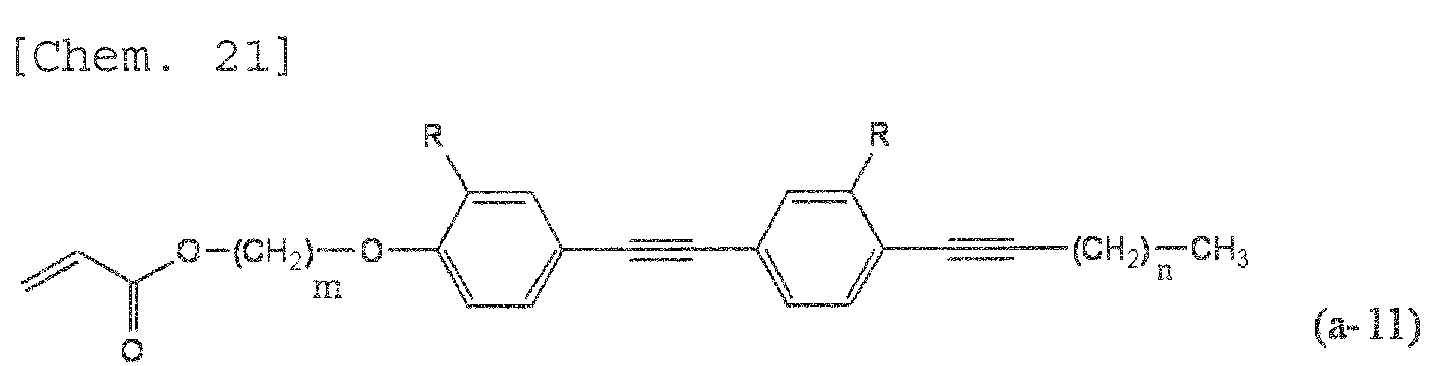
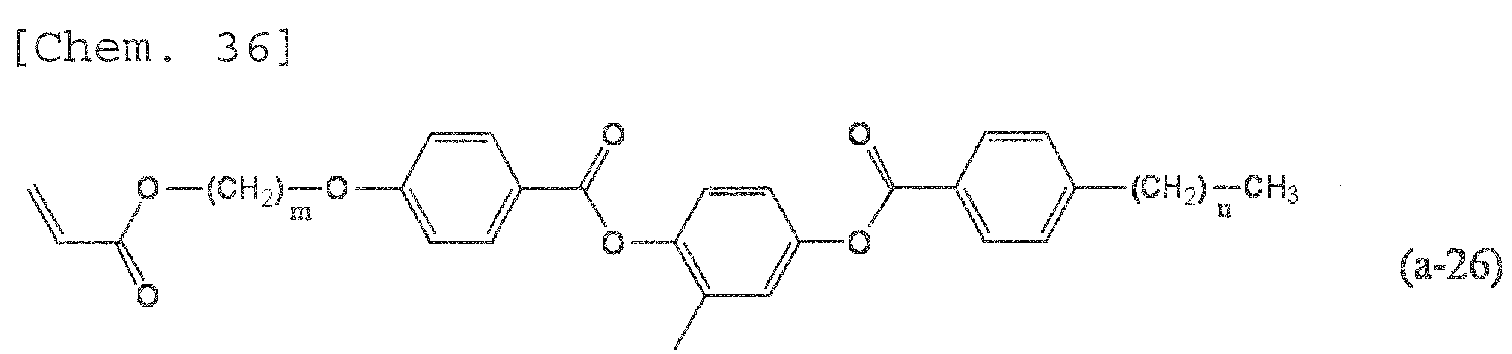
- m and n each independently represent an integer of 1 to 18; and R represents a hydrogen atom, a halogen atom, an alkyl group having 1 to 6 carbon atoms, an alkoxy group having 1 to 6 carbon atoms, or a cyano group.
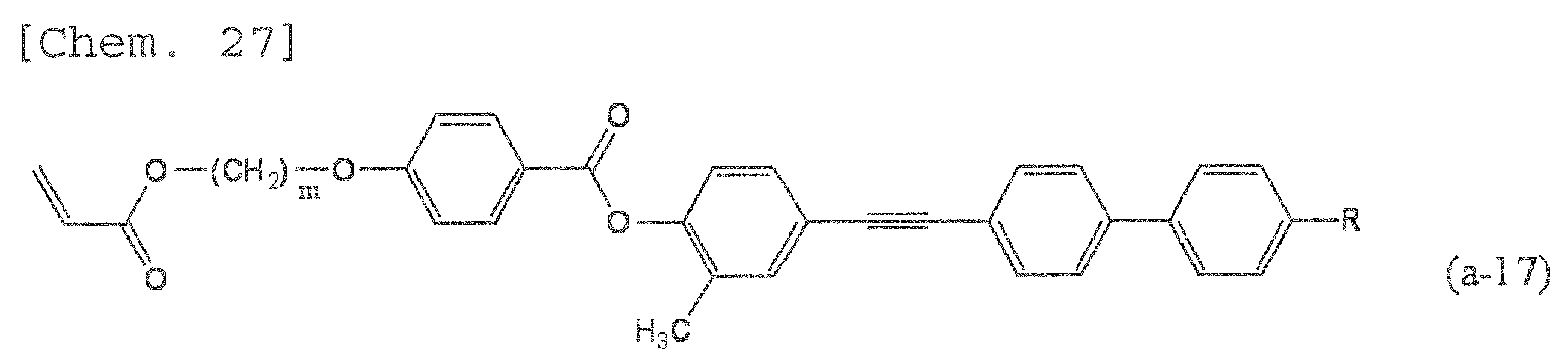
- R represents a hydrogen atom, a halogen atom, an alkyl group having 1 to 6 carbon atoms, an alkoxy group having 1 to 6 carbon atoms, or a cyano group.
- the group may be unsubstituted or substituted with one or two or more halogen atoms.
- a polymerization initiator may be used in order to polymerize a liquid crystal compound having a polymerizable functional group.
- a photopolymerization initiator used when polymerization is conducted by light irradiation well-known, commonly used photopolymerization initiators can be used.
- photopolymerization initiator examples include 2-hydroxy-2-methyl-1-phenylpropan-1-one ("DAROCUR 1173” manufactured by Merck & Co., Inc.), 1-hydroxycyclohexyl phenyl ketone (“IRGACURE 184" manufactured by BASF), 1-(4-isopropylphenyl)-2-hydroxy-2-methylpropan-1-one (“DAROCUR 1116" manufactured by Merck & Co., Inc.), 2-methyl-1-[(methylthio)phenyl]-2-morpholino propane-1 (“IRGACURE 907” manufactured by BASF), benzyl methyl ketal (“IRGACURE 651” manufactured by BASF), 2-benzyl-2-dimethylamino-1-(4-morpholinophenyl)-butanone (“IRGACURE 369” manufactured by BASF), 2-dimethylamino-2-(4-methylbenzyl)-1-(4-morpholin-4-yl-phenyl)butan-1-one ("IRGACURE
- the amount of photopolymerization initiator used is preferably 0.1% to 10% by mass, and particularly preferably 0.5% to 5% by mass relative to the birefringent lens material for a stereoscopic image display. These may be used alone or in combination of two or more photopolymerization initiators.
- thermal polymerization initiator used in the case of thermal polymerization
- thermal polymerization initiators include organic peroxides such as methyl acetoacetate peroxide, cumene hydroperoxide, benzoyl peroxide, bis(4-t-butylcyclohexyl)peroxy dicarbonate, t-butylperoxy benzoate, methyl ethyl ketone peroxide, 1,1-bis(t-hexylperoxy)3,3,5-trimethylcyclohexane, p-pentahydroperoxide, t-butyl hydroperoxide, dicumyl peroxide, isobutyl peroxide, di(3-methyl-3-methoxybutyl)peroxy dicarbonate, and 1,1-bis(t-butylperoxy)cyclohexane; azonitrile compounds such as 2,2'-azobisiso
- the amount of thermal polymerization initiator used is preferably 0.1% to 10% by mass, and particularly preferably 0.5% to 5% by mass relative to the birefringent lens material for a stereoscopic image display. These may be used alone or in combination of two or more thermal polymerization initiators. These thermal polymerization initiators may be used in combination with photopolymerization initiators.
- a polymerization inhibitor may be used in order to stably produce or stably store the birefringent lens material.
- the polymerization inhibitor include phenolic compounds, quinone compounds, amine compounds, thioether compounds, and nitroso compounds.
- phenolic compound examples include p-methoxyphenol, cresol, t-butyl catechol, 3,5-di-t-butyl-4-hydroxytoluene, 2,2'-methylenebis(4-methyl-6-t-butylphenol), 2,2'-methylenebis(4-ethyl-6-t-butylphenol), 4,4'-thiobis(3-methyl-6-t-butylphenol), 4-methoxy-1-naphthol, and 4,4'-dialkoxy-2,2'-bi-1-naphthol.
- Examples of the quinone compound include hydroquinone, methylhydroquinone, tert-butyl hydroquinone, p-benzoquinone, methyl-p-benzoquinone, tert-butyl-p-benzoquinone, 2,5-diphenylbenzoquinone, 2-hydroxy-1,4-naphthoquinone, 1,4-naphthoquinone, 2,3-dichloro-1,4-naphthoquinone, anthraquinone, and diphenoquinone.
- Examples of the amine compound include p-phenylenediamine, 4-aminodiphenylamine, N,N'-diphenyl-p-phenylenediamine, N-i-propyl-N'-phenyl-p-phenylenediamine, N-(1,3-dimethylbutyl)-N'-phenyl-p-phenylenediamine, N,N'-di-2-naphthyl-p-phenylenediamine, diphenylamine, N-phenyl- ⁇ -naphthylamine, 4,4'-dicumyl-diphenylamine, and 4,4'-dioctyl-diphenylamine.
- thioether compound examples include phenothiazine and distearyl thiodipropionate.
- nitroso compound examples include N-nitrosodiphenylamine, N-nitrosophenylnaphthylamine, N-nitrosodinaphthylamine, p-nitrosophenol, nitrosobenzene, p-nitrosodiphenylamine, ⁇ -nitroso- ⁇ -naphthol etc., N,N-dimethyl-p-nitrosoaniline, p-nitrosodiphenylamine, p-nitrosodimethylamine, p-nitroso-N,N-diethylamine, N-nitrosoethanolamine, N-nitrosodi-n-butylamine, N-nitroso-N-n-butyl-4-butanolamine, N-nitroso-diisopropanolamine, N-nitroso-N-ethyl-4-butanolamine, 5-nitroso-8-hydroxyquinoline, N-nitrosomorpholine, N-nitros
- a general-purpose stabilizer may be used for the purpose of obtaining a coating film having a uniform thickness or for any other purposes.
- additives such as a leveling agent, a thixotropic agent, a surfactant, an ultraviolet absorber, an infrared absorber, an antioxidant, and a surface treatment agent may be added to the extent that the liquid-crystal alignment capability is not significantly decreased.
- the birefringent lens material for a stereoscopic image display of the present invention no solvent is usually used.
- a solvent may be used in order to uniformly apply the birefringent lens material.
- the solvent used is not particularly limited as long as a substrate or an alignment layer formed on the substrate is not completed when the birefringent lens material is applied onto the substrate and a polymerizable liquid crystal composition of the present invention can be aligned without defects. Solvents in which the polymerizable liquid crystal compound exhibits good solubility are preferred.
- Such a solvent examples include aromatic hydrocarbons such as toluene, xylene, cumene, and mesitylene; ester solvents such as methyl acetate, ethyl acetate, propyl acetate, and butyl acetate; ketone solvents such as methyl ethyl ketone, methyl isobutyl ketone, and cyclohexanone; ether solvents such as tetrahydrofuran, 1,2-dimethoxyethane, and anisole; amide solvents such as N,N-dimethylformamide and N-methyl-2-pyrrolidone; propylene glycol monomethyl ether acetate; diethylene glycol monomethyl ether acetate; ⁇ -butyrolactone; and chlorobenzene. These may be used alone or in combination of two or more solvents.
- aromatic hydrocarbons such as toluene, xylene, cumene, and mesitylene
- ester solvents such
- a surfactant or polymer that promotes homogeneous alignment is used, as required, in the case where the state of homogeneous alignment is temporarily achieved by simply applying the birefringent lens material in a process of producing a birefringent lens for a stereoscopic image display.
- the surfactant used is not particularly limited, but preferably a surfactant having a surface tension lower than that of a liquid crystal compound having a polymerizable functional group.
- a surfactant include fluorine-containing nonionic surfactants, organosilane surfactants, and polyacrylate surfactants.
- the surfactants may have a polymerizable group so that a stronger film is formed when polymerization is conducted.
- the polymer used is not particularly limited, but preferably a polymer having a surface tension lower than that of a liquid crystal compound having a polymerizable functional group.
- Examples of such a polymer include polyethylene, polypropylene, polyisobutylene, paraffin, liquid paraffin, chlorinated polypropylene, chlorinated paraffin, chlorinated liquid paraffin, and polyvinylidene fluoride.
- the weight-average molecular weight of the polymer is preferably 200 to 1,000,000, more preferably 300 to 100,000, and particularly preferably 400 to 10,000.
- a substrate used in a birefringent lens for a stereoscopic image display of the present invention is a substrate that is usually used in liquid crystal devices, displays, optical components, and optical films, and is not particularly limited as long as the substrate has heat resistance that can withstand heating after the birefringent lens material for a stereoscopic image display of the present invention is applied or during the production of a liquid crystal device.
- the substrate include glass substrates, metal substrates, ceramic substrates, and plastic substrates.
- examples of the organic material include cellulose derivatives, polyolefins, polyesters, polyolefins, polycarbonates, polyacrylates, polyarylates, polyethersulfones, polyimides, polyphenylene sulfides, polyphenylene ethers, nylons, and polystyrenes.
- polyesters, polystyrenes, polyolefins, cellulose derivatives, polyarylates, and polycarbonates are preferable.
- the substrate is usually subjected to an alignment treatment or an alignment layer may be provided on the substrate so that the birefringent lens material for a stereoscopic image display of the present invention is aligned when the birefringent lens material for a stereoscopic image display is applied onto the substrate.
- the alignment treatment include a stretching treatment, a rubbing treatment, a polarized ultraviolet-visible light irradiation treatment, and an ion-beam treatment.
- an alignment layer is used, well-known, commonly used alignment layers are used.
- Examples of the material of the alignment layer include compounds such as polyimides, polysiloxanes, polyamides, polyvinyl alcohols, polycarbonates, polystyrenes, polyphenylene ethers, polyarylates, polyethylene terephthalates, polyethersulfones, epoxy resins, epoxy acrylate resins, acrylic resins, coumarin compounds, chalcon compounds, cinnamate compounds, fulgide compounds, anthraquinone compounds, azo compounds, and arylethene compounds.
- Compounds that are subjected to an alignment treatment by rubbing are preferably materials, the crystallization of which is accelerated by the alignment treatment or by performing a heating step after the alignment treatment.
- photo-alignment materials are preferably used.
- a coating method for obtaining a birefringent lens for a stereoscopic image display of the present invention well-known, commonly used methods such as an applicator method, a bar coating method, a spin coating method, a gravure printing method, a flexographic printing method, an ink-jet method, a die coating method, a cap coating method, and dipping can be employed.
- a birefringent lens material for a stereoscopic image display the material being diluted with a solvent, is applied, the birefringent lens material is dried after the application.
- Shaping of the birefringent lens for a stereoscopic image display of the present invention is performed by polymerizing a birefringent lens material for a stereoscopic image display in the form of a lens by using a photomask or covering a coating film of a birefringent lens material for a stereoscopic image display with a lens-shaped resin mold.
- a photomask that has a pattern designed so that when the birefringent lens material for a stereoscopic image display is polymerized, the resulting polymerized material has a desired lens shape is used.
- a resin mold a coating film of a birefringent lens material for a stereoscopic image display is covered with a concave lens-shaped resin mold having a refractive index equal to an ordinary refractive index (no) of the birefringent lens material for a stereoscopic image display of the present invention, and polymerization is conducted in this covered state.
- a resin used in the resin mold is applied onto the coating film of the birefringent lens material for a stereoscopic image display, the coating film having been taken from the resin mold, and polymerization is then conducted.
- a polymerization operation of the birefringent lens material for a stereoscopic image display of the present invention is generally performed by irradiation with light such as ultraviolet light or by heating after the birefringent lens material for a stereoscopic image display is applied and the resulting coating film is formed into a lens shape.
- the birefringent lens material is irradiated with preferably ultraviolet light having a wavelength of 390 nm or less, and most preferably light having a wavelength of 250 to 370 nm.
- the polymerizable liquid crystal composition is, for example, decomposed by ultraviolet light having a wavelength of 390 nm or less
- This light is preferably diffused light that is not polarized.
- polymerization by heating is preferably conducted at a temperature at which the birefringent lens material for a stereoscopic image display exhibits a liquid-crystalline phase or lower.
- a thermal polymerization initiator that releases radicals as a result of heating it is preferable to use a thermal polymerization initiator, the cleavage temperature of which is within the above temperature range.
- the polymerization temperature and the respective initiators are suitably selected, in addition to the consideration of the limitation of the above temperature range, so that the rates of polymerization of a photo-alignment layer and a polymerizable liquid crystal film are not significantly different from each other.
- the polymerization is preferably conducted at a temperature lower than a temperature at which heterogeneous polymerization due to heat is induced, though the heating temperature depends on the transition temperature from a liquid-crystalline phase to an isotropic phase of the polymerizable liquid crystal composition.
- the heating temperature exceeds a glass transition temperature of the substrate composed of an organic material, thermal deformation of the substrate becomes significant.
- the heating temperature is preferably in the range of room temperature to the glass transition temperature of the substrate.
- the polymerizable group is a (meth)acryloyl group
- the polymerization is preferably conducted at a temperature lower than 90°C.
- the birefringent lens for a stereoscopic image display may be heat-treated in order to stabilize solvent resistance and heat resistance of the resulting birefringent lens for a stereoscopic image display.
- heating is preferably conducted at a glass transition temperature of the birefringent lens for a stereoscopic image display or higher.
- the heating is preferably conducted within a range that does not exceed the glass transition temperature of the substrate composed of an organic material.
- a light irradiation treatment may be performed for the above purpose. In this case, it is preferable to perform the light irradiation treatment to the extent that the liquid crystal compound component in the birefringent lens for a stereoscopic image display is not subjected to photodecomposition by the light irradiation.
- the prepared birefringent lens for a stereoscopic image display may be used in integration with the substrate in the state where the substrate is left (refer to Fig. 2 ).
- the birefringent lens for a stereoscopic image display may be separated from the substrate and used in the state where the lens does not have a substrate (refer to Fig. 1 ).
- Birefringent lens materials (2) to (20) for a stereoscopic image display of the present invention were prepared as in the preparation of the birefringent lens material (1) for a stereoscopic image display of the present invention.
- Tables 1 to 5 show specific compositions of the birefringent lens materials (1) to (20) for a stereoscopic image display of the present invention.
- a polyimide solution for an alignment layer was applied onto a glass substrate having a thickness of 0.7 mm by a spin coating method.
- the polyimide solution was dried at 100°C for 10 minutes and then baked at 200°C for 60 minutes to obtain a coating film.
- the coating film was subjected to a rubbing treatment.
- the rubbing treatment was conducted using a commercially available rubbing device.
- the birefringent lens material (1) for a stereoscopic image display of the present invention was applied onto the rubbed substrate by a spin coating method in the state where the birefringent lens material (1) was heated at 70°C. Another substrate that had been subjected to a rubbing treatment was arranged on the resulting coating film so that the rubbing direction of the other substrate is antiparallel to the above-described substrate, and the resulting product was then cooled to room temperature. Subsequently, the product was irradiated with UV light at an intensity of 40 mW/cm 2 for 25 seconds using a high-pressure mercury-vapor lamp.
- the cured coating film was then separated from the rubbed substrates, thus obtaining a cured product of the birefringent lens material for a stereoscopic image display of the present invention.
- the cured product had a film thickness of 50 ⁇ m, an ordinary refractive index no of 1.537, an extraordinary refractive index ne of 1.701, and a ⁇ n of 0.165.
- the alignment of the cured product was also good.
- the transition temperature from a solid phase to a liquid-crystalline phase was -21°C, and the transition temperature from a liquid-crystalline phase to a liquid phase was 121°C.
- Each of the birefringent lens materials for a stereoscopic image display of the present invention can be polymerized at room temperature, has a good alignment property, and is good in terms of productivity.
- a polyimide solution for an alignment layer was applied onto a glass substrate having a thickness of 0.7 mm by a spin coating method.
- the polyimide solution was dried at 100°C for 10 minutes and then baked at 200°C for 60 minutes to obtain a coating film.
- the coating film was subjected to a rubbing treatment.
- the rubbing treatment was conducted using a commercially available rubbing device.
- the birefringent lens material (15) for a stereoscopic image display of the present invention was applied onto the rubbed substrate 3 by a spin coating method in the state where the birefringent lens material (15) was heated at 70°C.
- a resin mold 1 that had been subjected to an alignment treatment was arranged on the resulting coating film so that an alignment direction of the rubbed substrate was parallel to an alignment direction of the resin mold 1, and the resulting product was then cooled to room temperature. Subsequently, the product was irradiated with ultraviolet light at an intensity of 40 mW/cm 2 for 25 seconds using a high-pressure mercury-vapor lamp. Thus, a birefringent lens for a stereoscopic image display was obtained. The substrate 3 was detached from the obtained lens to produce a birefringent lens for a stereoscopic image display illustrated in Fig. 1 .
- the obtained birefringent lens for a stereoscopic image display of the present invention had no defect, and the alignment of the birefringent lens was also good.
- the birefringent lens material (15) for a stereoscopic image display of the present invention had a transition temperature from a solid phase to a liquid-crystalline phase of -25°C and a transition temperature from a liquid-crystalline phase to a liquid phase of 87°C.
- a polyimide solution for an alignment layer was applied onto a glass substrate having a thickness of 0.7 mm by a spin coating method.
- the polyimide solution was dried at 100°C for 10 minutes and then baked at 200°C for 60 minutes to obtain a coating film.
- the coating film was subjected to a rubbing treatment.
- the rubbing treatment was conducted using a commercially available rubbing device.
- the birefringent lens material (15) for a stereoscopic image display of the present invention was applied onto the rubbed substrate 3 by a spin coating method in the state where the birefringent lens material (15) was heated at 70°C.
- a resin mold 1 that had been subjected to an alignment treatment was arranged on the resulting coating film so that an alignment direction of the rubbed substrate was parallel to an alignment direction of the resin mold 1, and the resulting product was then cooled to room temperature.
- the resin mold 1 was slowly detached, and an ultraviolet-curable epoxy acrylate resin was applied onto the coating film by a spin coating method.
- the resulting product was irradiated with ultraviolet light at an intensity of 40 mW/cm 2 for 25 seconds using a high-pressure mercury-vapor lamp.
- a birefringent lens for a stereoscopic image display illustrated in Fig. 2 was obtained.
- the obtained birefringent lens for a stereoscopic image display of the present invention had no defect, and the alignment of the birefringent lens was also good.
- a polyimide solution for an alignment layer was applied onto a glass substrate having a thickness of 0.7 mm by a spin coating method.
- the polyimide solution was dried at 100°C for 10 minutes and then baked at 200°C for 60 minutes to obtain a coating film.
- the coating film was subjected to a rubbing treatment.
- the rubbing treatment was conducted using a commercially available rubbing device.
- the resulting product was irradiated with ultraviolet light at an intensity of 40 mW/cm 2 for 25 seconds using a high-pressure mercury-vapor lamp.
- a birefringent lens for a stereoscopic image display illustrated in Fig. 2 was obtained.
- the obtained birefringent lens for a stereoscopic image display of the present invention had no defect, and the alignment of the birefringent lens was also good.
- the transition temperature from a solid phase to a liquid-crystalline phase was -26°C and the transition temperature from a liquid-crystalline phase to a liquid phase was 96°C.
Landscapes
- Physics & Mathematics (AREA)
- General Physics & Mathematics (AREA)
- Optics & Photonics (AREA)
- Chemical & Material Sciences (AREA)
- Engineering & Computer Science (AREA)
- Plasma & Fusion (AREA)
- Crystallography & Structural Chemistry (AREA)
- Nonlinear Science (AREA)
- Organic Chemistry (AREA)
- Thermal Sciences (AREA)
- Materials Engineering (AREA)
- Mathematical Physics (AREA)
- Polarising Elements (AREA)
- Addition Polymer Or Copolymer, Post-Treatments, Or Chemical Modifications (AREA)
- Stereoscopic And Panoramic Photography (AREA)
- Health & Medical Sciences (AREA)
- Chemical Kinetics & Catalysis (AREA)
- Medicinal Chemistry (AREA)
- Polymers & Plastics (AREA)
Abstract
Description
- The present invention relates to a birefringent lens material used for a stereoscopic image display and a method for producing a birefringent lens for a stereoscopic image display.
- A stereoscopic image display provides a sense of depth by individually sending substantially two-dimensional images to the right eye and the left eye of a person, allowing the images to be integrated in the brain, and allowing the integrated image to be stereoscopically viewed. For this purpose, it is necessary to individually form images for generating a parallax in advance and to correct the images when the images are sent to the corresponding eyes, or it is necessary to separate a two-dimensional image into an image to be viewed by the right eye and an image to be viewed by the left eye.
- In the method for separating a two-dimensional image, it is not necessary to wear polarized glasses or the like for correcting an image and thus a stereoscopic image can be viewed by the naked eye. Examples of the method for separating a two-dimensional image include a method using a lenticular lens and a parallax barrier method. The lenticular lens is a lens that separates an image into two images by determining the width of a certain image that can be viewed by one eye using refraction by the lens. As the lenticular lens, a birefringent lens having a shape in which semicylinders are arranged in a line is used for generating a parallax.
- Regarding a characteristic required for the lenticular lens, a small change in the refractive index with respect to the temperature change is required in order to use the lenticular lens in a wide range of environments. To meet this requirement, a technique has been proposed in which a cured liquid crystal polymer is used as a material of a birefringent lens (refer to
PTL 1 and NPL 1). - However, many different types of liquid crystal polymers exist, and in the case where a cured liquid crystal polymer is simply used as a material of a birefringent lens without studying the material in detail (refer to PTL 1), problems in terms of optical characteristics, durability, productivity, etc. of the lens may occur. A technique in which a bifunctional liquid crystalline monomer is used as a birefringent lens material is disclosed (NPL 1). However, this material has problems in terms of optical characteristics and productivity, and thus the application of this material as a birefringent lens material composed of a liquid crystal polymer has not proceeded.
-
- PTL 1: Japanese Unexamined Patent Application Publication (Translation of PCT Application) No.
2004-538529 -
- NPL 1: IDW '04, pp. 1495 and 1496
- An object of the present invention is to provide a birefringent lens material used for a stereoscopic image display and a birefringent lens for a stereoscopic image display, the birefringent lens material and birefringent lens having good optical characteristics, durability, and productivity, in particular, productivity. In addition, another object of the present invention is to provide a method for producing a birefringent lens for a stereoscopic image display, the method having good productivity. Solution to Problem
- The inventors of the present invention conducted intensive studies on various liquid crystal monomers used in a birefringent lens. As a result, it was found that, by using a birefringent lens material in which the number of types of particular liquid crystal monomers is increased, birefringent properties of the material can be changed, sufficient durability can be obtained, and curing at room temperature can be realized. This finding resulted in the completion of the present invention.
- Specifically, the present invention provides a birefringent lens material for a stereoscopic image display, the birefringent lens material containing two or more liquid crystal compounds each having at least one polymerizable functional group, and a birefringent lens for a stereoscopic image display, the birefringent lens being formed by curing the lens material. In addition, the present invention provides a method for producing a birefringent lens for a stereoscopic image display, the method including applying the lens material onto an alignment layer that has been subjected to an alignment treatment in a uniaxial direction; and forming the resulting coating film into a lens shape by conducting curing with ultraviolet light.
- According to the birefringent lens material for a stereoscopic image display of the present invention and the birefringent lens for a stereoscopic image display produced by using the lens material, good optical characteristics, good durability, and good productivity can be achieved by increasing the number of types of particular liquid crystal monomers.
- In addition, the method for producing a birefringent lens material for a stereoscopic image display using the above material can suppress the generation of alignment defects of a liquid crystal monomer and has good productivity.
- A birefringent lens material for a stereoscopic image display of the present invention contains two or more liquid crystal compounds each having at least one polymerizable functional group. From the standpoint of durability, the liquid crystal compounds each having at least one polymerizable functional group are preferably two or more liquid crystal compounds each having at least two polymerizable functional groups. The liquid crystal compounds each having at least two polymerizable functional groups are contained in an amount of preferably 10% to 95% by weight, and more preferably 15% to 90% by weight. In addition, the liquid crystal compounds having polymerizable functional groups preferably have the same mesogenic group or the same mesogenity supporting group.
- Each of the liquid crystal compounds having at least one polymerizable functional group is preferably a compound represented by general formula (1):
- [Chem. 1]
P-(Sp)m-MG-R1 (1)
- (where P represents a polymerizable functional group; Sp represents a spacer group having 0 to 18 carbon atoms; m represents 0 or 1; MG represents a mesogenic group or a mesogenity supporting group; and R1 represents a halogen atom, a cyano group, a thiocyanate group, a hydroxy group, an NCO group, an OCN group, or an alkyl group having 1 to 18 carbon atoms, the alkyl group may be substituted with at least one selected from halogen atoms, a cyano group, and a hydroxy group, and one CH2 group or two or more non-adjacent CH2 groups present in this group may each be independently substituted with a divalent organic group such as -O-, -S-, -NH-, -N(CH3)-, -CO-, -COO-, -OCO-, -OCOO-, -SCO-, -COS-, - CH=CH-, or -C=C- in such a manner that oxygen atoms are not directly bonded to each other, or R1 represents a structure represented by general formula (1-a):
- [Chem. 2]
-(Sp)m-P (1-a)
- (where P represents a reactive functional group, Sp represents a spacer group having 0 to 18 carbon atoms, and m represents 0 or 1).)
- The birefringent lens material for a stereoscopic image display of the present invention preferably has a transition temperature from a solid phase to a liquid-crystalline phase of -10°C or lower, and a transition temperature from a liquid-crystalline phase to a liquid phase of 50°C or higher. The transition temperature from a solid phase to a liquid-crystalline phase is preferably 0°C or lower, and the transition temperature from a liquid-crystalline phase to a liquid phase is preferably 40°C or higher.
- The birefringent lens material for a stereoscopic image display of the present invention is preferably a material that can be polymerized at a room temperature of 20°C to 30°C.
- In the birefringent lens material for a stereoscopic image display of the present invention, a liquid crystal compound having one polymerizable functional group exhibits liquid crystallinity alone or in a composition containing other liquid crystal compounds. The liquid crystal compound is not particularly limited as long as the compound has one polymerizable functional group, and well-known, commonly used compounds can be used.
- Examples thereof include rod-shaped polymerizable liquid crystal compounds having a rigid portion which is called a "mesogen" in which a plurality of structures such as a 1,4-phenylene group and a 1,4-cyclohexylene group are connected to each other and a polymerizable functional group such as a vinyl group, an acrylic group, or a (meth)acrylic group, the rod-shaped polymerizable liquid crystal compounds being described in, for example, Handbook of Liquid Crystals (Edited by D. Demus, J. W. Goodby, G. W. Gray, H. W. Spiess, and V. Vill, published by Wiley-VCH, 1998), Kikan Kagaku Sosetsu (Survey of Chemistry, Quarterly) No. 22, Chemistry of liquid crystal (edited by the Chemical Society of Japan, 1994), or Japanese Unexamined Patent Application Publication Nos.
7-294735 8-3111 8-29618 11-80090 11-116538 11-148079 2004-2373 2004-99446 - Specific examples thereof preferably include compounds represented by general formula (1):
- [Chem. 3]
P-(Sp)m-MG-R1 (1)
- (where P represents a polymerizable functional group; Sp represents a spacer group having 0 to 18 carbon atoms; m represents 0 or 1; MG represents a mesogenic group or a mesogenity supporting group; and R1 represents a halogen atom, a cyano group, a thiocyanate group, a hydroxy group, an NCO group, an OCN group, or an alkyl group having 1 to 18 carbon atoms, the alkyl group may be substituted with at least one selected from halogen atoms, a cyano group, and a hydroxy group, and one CH2 group or two or more non-adjacent CH2 groups present in this group may each be independently substituted with a divalent organic group such as -O-, -S-, -NH-, -N(CH3)-, -CO-, -COO-, -OCO-, -OCOO-, -SCO-, -COS-,-CH=CH-, or -C≡C- in such a manner that oxygen atoms are not directly bonded to each other.)
Well-known, commonly used polymerizable functional groups are used as the polymerizable functional group of the compound represented by general formula (1). Examples of the polymerizable functional group include a vinyl group, an allyl group, a styryl group, a vinyl ether group, an allyl ether group, an acrylic group, a (meth)acrylic group, an acrylamide group, a (meth)acrylamide group, a glycidyl group, a glycidyl ether group, an oxetanyl group, an oxetanyl ether group, a cyanuric group, an isocyanuric group, a maleimide group, a maleimide carboxyl group, a thiol group, a dialkyl fumarate group, an acetylenyl group, an organosilyl group, and functional groups that can be subjected to cyclopolymerization or ring-opening polymerization. Each of the polymerizable functional groups may have a substituent such as a halogen atom, a methyl group, or a trifluoromethyl group as long as the polymerizability is not impaired. - The mesogenic group or the mesogenity supporting group of the compound represented by general formula (1) includes a ring structure and a group that connects the ring structure, and is represented by, for example, general formula (1-1):
- [Chem. 4]
-Sp1-(MG1-Sp2)n-MG2-Sp3- (1-1)
- (In the formula, MG1 and MG2 each independently represent at least one ring structure, Sp1, Sp2, and Sp3 each independently represent a single bond or a divalent organic group, in the case where one ring structure can function as a mesogenic group or a mesogenity group, n represents 0 to 5, and in the case where two or more ring structures can function as a mesogenic group or a mesogenity group, n represents 1 to 6.)
- In general formula (1-1), examples of MG1 and MG2 each having at least one ring structure include well-known, commonly used structures, and specific examples thereof include the following:
-

-


- (In the formulae, each structure may have, as at least one substituent, at least one selected from F, Cl, CF3, OCF3, a CN group, alkyl groups each having 1 to 8 carbon atoms, alkoxy groups each having 1 to 8 carbon atoms, alkanoyl groups each having 1 to 8 carbon atoms, alkanoyloxy groups each having 1 to 8 carbon atoms, alkenyl groups each having 2 to 8 carbon atoms, alkenyloxy groups each having 2 to 8 carbon atoms, alkenoyl groups each having 2 to 8 carbon atoms, and alkenoyloxy groups each having 2 to 8 carbon atoms.)
- In general formula (1-1), Sp1, Sp2, and Sp3 are each preferably, for example, a single bond or a divalent organic group such as -COO-, -OCO-, -COS-, -SCO-, -OCOO-, -CH2CH2-,-OCH2-, -CH2O-, -OCF2-, -CF2O-, -CH=CH-, -CH=N-, -CF=CF-, - N=N-, -C=N-N=C-, -C≡C-, -CH=CHCOO-, -OCOCH=CH-, -CH=CHCOS-, -SCOCH=CH-, -CH2CH2COO-, -CH2CH2OCO-, -COOCH2CH2-, -OCOCH2CH2-, -CONH-, -NHCO-, or an alkylene group which has 2 to 10 carbon atoms and which may have a halogen atom.
- More specifically, preferable are compounds represented by general formula (1) wherein Sp represents a single bond or an alkylene group (where the alkylene group may be substituted with at least one selected from halogen atoms and CN, and one CH2 group or two or more non-adjacent CH2 groups present in this group may each be independently substituted with -O-, -S-, -NH-, -N(CH3)-, -CO-, -COO-,-OCO-, -OCOO-, -SCO-, -COS-, -CONH-, -NHCO-, -CH=CH-, or-C≡C- in such a manner that oxygen atoms are not directly bonded to each other), and MG is represented by general formula (1-b):
- [Chem. 7]
-Z0- (A1-Z1)n-A2-Z2-A3-Z3- (1-b)
- (where A1, A2, and A3 each independently represent a 1,4-phenylene group, a 1,4-cyclohexylene group, a 1,4-cyclohexenyl group, a tetrahydropyran-2,5-diyl group, a 1,3-dioxane-2,5-diyl group, a tetrahydrothiopyran-2,5-diyl group, a 1,4-bicyclo[2.2.2]octylene group, a decahydronaphthalene-2,6-diyl group, a pyridine-2,5-diyl group, a pyrimidine-2,5-diyl group, a pyrazine-2,5-diyl group, a thiophene-2,5-diyl group, a 1,2,3,4-tetrahydronaphthalene-2,6-diyl group, a 1,4-naphthylene group, a 1,5-naphthylene group, a 1,6-naphthylene group, a 2,6-naphthylene group, a phenanthrene-2,7-diyl group, a 9,10-dihydrophenanthrene-2,7-diyl group, a 1,2,3,4,4a,9,10a-octahydrophenanthrene-2,7-diyl group, a benzo[1,2-b:4,5-b']dithiophene-2,6-diyl group, a benzo[1,2-b:4,5-b']diselenophene-2,6-diyl group, a [1]benzothieno[3,2-b]thiophene-2,7-diyl group, a [1]benzoselenopheno[3,2-b]selenophene-2,7-diyl group, a fluorene-2,7-diyl group, or the like, and may have, as at least one substituent, at least one selected from F, Cl, CF3, OCF3, a CN group, alkyl groups each having 1 to 8 carbon atoms, alkoxy groups each having 1 to 8 carbon atoms, alkanoyl groups each having 1 to 8 carbon atoms, alkanoyloxy groups each having 1 to 8 carbon atoms, alkenyl groups each having 2 to 8 carbon atoms, alkenyloxy groups each having 2 to 8 carbon atoms, alkenoyl groups each having 2 to 8 carbon atoms, and alkenoyloxy groups each having 2 to 8 carbon atoms; Z0, Z1, Z2, and Z3 each independently represent -COO-, -OCO-, -CH2CH2-, -OCH2-, -CH2O-, -OCF2-, -CF2O-, -CH2S-, -SCH2-, -CH=CH-, -CF=CF-, - C≡C-, -CH=CHCOO-, -OCOCH=CH-, -CH2CH2COO-, -CH2CH2OCO-,-COOCH2CH2-, -OCOCH2CH2-, -OCO=COO-, -CONH-, -NHCO-, an alkyl group which has 2 to 10 carbon atoms and which may have a halogen atom, or a single bond; and n represents 0, 1, or 2.)
- The polymerizable functional group is preferably any of an acrylic group, a (meth)acrylic group, an acrylamide group, a vinyl group, a vinyl ether group, a glycidyl group, a glycidyl ether group, an oxetanyl group, an oxetanyl ether group, a maleimide group, a maleimide carboxyl group, a thiol group, etc. represented by general formulae (P-1) to (P-18):
-


- From the standpoint of productivity, a vinyl ether group, an acrylic group, a (meth)acrylic group, a glycidyl group, and a glycidyl ether group are particularly preferable.
- Furthermore, the liquid crystal compound having one polymerizable functional group is preferably a compound selected from the compound group represented by general formulae (3) and (4):
-

-


- (In the formulae, Z1 and Z3 each independently represent a hydrogen atom, a halogen atom, a cyano group, or a hydrocarbon group having 1 to 18 carbon atoms; Z2 and Z4 each independently represent a hydrogen atom or a methyl group; t and u each independently represent 0, 1, or 2; v represents an integer of 2 to 18; W3 represents a single bond, -O-,-COO-, or -OCO-; A, B, C, D, E, and F each independently represent a 1,4-phenylene group, a 1,4-phenylene group in which non-adjacent CH groups are each substituted with nitrogen, a 1,4-cyclchexylene group, a 1,4-cyclohexylene group in which one or non-adjacent two CH2 groups are each substituted with an oxygen or sulfur atom, a 1,4-cyclohexenyl group, a 1,4-bicyclo[2.2.2]octylene group, a decahydronaphthalene-2,6-diyl group, a pyridine-2,5-diyl group, a pyrimidine-2,5-diyl group, a pyrazine-2,5-diyl group, a 1,2,3,4-tetrahydronaphthalene-2,6-diyl group, a 2,6-naphthylene group, or a 1,4-naphthylene group, and a 1,4-phenylene group and a 2,6-naphthylene group that are present in the formulae may each be substituted with at least one selected from alkyl groups each having 1 to 7 carbon atoms, alkoxy groups each having 1 to 7 carbon atoms, alkanoyl groups each having 1 to 7 carbon atoms, a cyano group, and halogen atoms; Y3, Y4, Y6, and Y7 each independently represent a single bond, -CH2CH2-, -CH2O-,-OCH2-, -COO-, -OCO-, -C≡C-, -CH=CH-, -CF=CF-, -(CH2)4-,-CH2CH2CH2O-, -OCH2CH2CH2-, -CH=CHCH2CH2-, -CH2CH2CH=CH-,-CH=CHCOO-, -OCOCH=CH-, -CH2CH2COO-, -CH2CH2OCO-, -COOCH2H2-, or -OCOCH2CH2-; and Y5 and Y8 each independently represent a single bond, -0-, -COO-, -OCO-, or -CH=CHCOO-.)
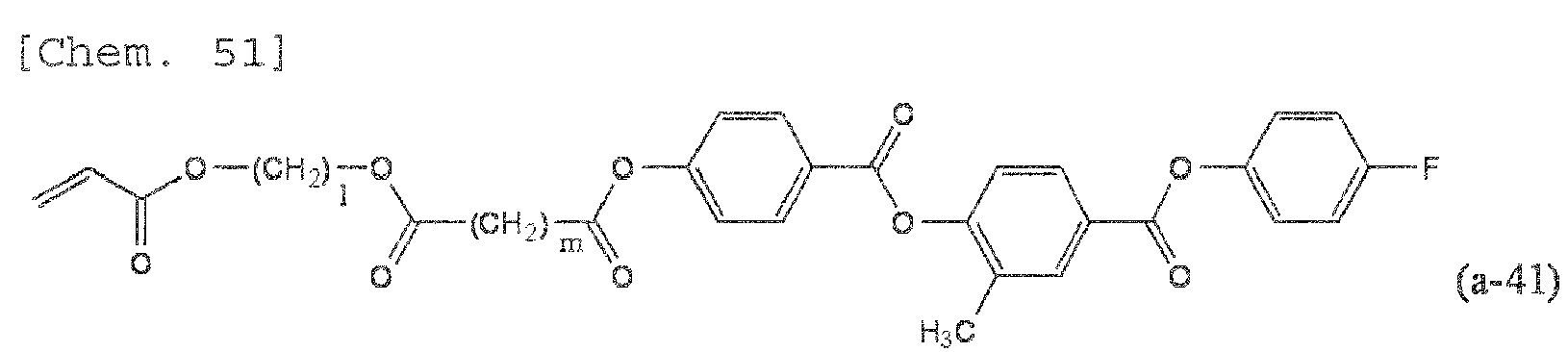
- Exemplary compounds are shown below but are not limited thereto.
-

-

-

-

-

-

-

-

-

-

-
-

-

-

-

-

-
-

-

-

-

-

-

-

-

-
-

-

-

-

-

-

-

-

-

-

-

-

-

-

-
-

-

-

-

-

- (In the formulae, m represents an integer of 2 to 18, n represents an integer of 0 to 18, and R represents a hydrogen atom, an alkyl group having 1 to 6 carbon atoms, an alkoxy group having 1 to 6 carbon atoms, a carboxyl group, or a cyano group. In the case where any of these groups is an alkyl group having 1 to 6 carbon atoms or an alkoxy group having 1 to 6 carbon atoms, the group may be unsubstituted or substituted with one or two or more halogen atoms.) These liquid crystal compounds may be used alone or in combination of two or more compounds.
- A liquid crystal compound having two or more polymerizable functional groups and used in the birefringent lens material for a stereoscopic image display of the present invention exhibits liquid crystallinity alone or in a composition containing other liquid crystal compounds. The liquid crystal compound is not particularly limited as long as the compound has two or more polymerizable functional groups, and well-known, commonly used compounds can be used.
- Examples thereof include rod-shaped polymerizable liquid crystal compounds having a rigid portion which is called a "mesogen" in which a plurality of structures such as a 1,4-phenylene group and a 1,4-cyclohexylene group are connected to each other and polymerizable functional groups such as a vinyl group, an acrylic group, or a (meth)acrylic group, the rod-shaped polymerizable liquid crystal compounds being described in, for example, Handbook of Liquid Crystals (Edited by D. Demus, J. W. Goodby, G. W. Gray, H. W. Spiess, and V. Will, published by Wiley-VCH, 1998), Kikan Kagaku Sosetsu (Survey of Chemistry, Quarterly) No. 22, Chemistry of liquid crystal (edited by the Chemical Society of Japan, 1994), or Japanese Unexamined Patent Application Publication Nos.
4-227684 11-80090 11-116538 11-148079 2000-178233 2002-308831 2002-145830 2004-125842 2004-2373 2004-99446 - Specific examples thereof preferably include compounds represented by general formula (1):
- [Chem. 57]
P-(Sp)m-MG-R1 (1)
- (where P represents a polymerizable functional group; Sp represents a spacer group having 0 to 18 carbon atoms; m represents 0 or 1; MG represents a mesogenic group or a mesogenity supporting group; and R1 is represented by general formula (1-a):
- [Chem. 58]
-(Sp)m-P (1-a)
- (where P represents a reactive functional group, Sp represents a spacer group having 0 to 18 carbon atoms, and m represents 0 or 1).) Well-known, commonly used polymerizable functional groups are used as the polymerizable functional group in general formula (1). Examples of the polymerizable functional group include a vinyl group, an allyl group, a styryl group, a vinyl ether group, an allyl ether group, an acrylic group, a (meth)acrylic group, an acrylamide group, a (meth)acrylamide group, a glycidyl group, a glycidyl ether group, an oxetanyl group, an oxetanyl ether group, a cyanuric group, an isocyanuric group, a maleimide group, a maleimide carboxyl group, a thiol group, a dialkyl fumarate group, an acetylenyl group, an organosilyl group, and functional groups that can be subjected to cyclopolymerization or ring-opening polymerization. Each of the polymerizable functional groups may have a substituent such as a halogen atom, a methyl group, or a trifluoromethyl group as long as the polymerizability is not impaired.
The mesogenic group or the mesogenity supporting group in general formula (1) includes a ring structure and a group that connects the ring structure, and is represented by, for example, general formula (1-1): - [Chem. 59]
-Sp1-(MG1-SP2)n-MG2-SP3- (1-1)
- (In the formula, MG1 and MG2 each independently represent at least one ring structure, Sp1, Sp2, and Sp3 each independently represent a single bond or a divalent organic group, in the case where one ring structure can function as a mesogenic group or a mesogenity group, n represents 0 to 5, and in the case where two or more ring structures can function as a mesogenic group or a mesogenity group, n represents 1 to 6.)
- In general formula (1-1), examples of MG1 and MG2 each having at least one ring structure include well-known, commonly used structures, and specific examples thereof include the following:
-


-


- (In the formulae, each structure may have, as at least one substituent, at least one selected from F, Cl, CF3, OCF3, a CN group, alkyl groups each having 1 to 8 carbon atoms, alkoxy groups each having 1 to 8 carbon atoms, alkanoyl groups each having 1 to 8 carbon atoms, alkanoyloxy groups each having 1 to 8 carbon atoms, alkenyl groups each having 2 to 8 carbon atoms, alkenyloxy groups each having 2 to 8 carbon atoms, alkenoyl groups each having 2 to 8 carbon atoms, alkenoyloxy groups each having 2 to 8 carbon atoms, and general formula (1-a):
- [Chem. 62]
-(Sp)m-P (1-a)
- (where P represents a polymerizable functional group, Sp represents a spacer group having 0 to 18 carbon atoms, and m represents 0 or 1).)
- In general formula (1-1), Sp1, Sp2, and Sp3 are each preferably, for example, a single bond or a divalent organic group such as -COO-, -OCO-, -COS-, -SCO-, -OCOO-, -CH2CH2-,-OCH2-, -CH2O-, -OCF2-, -CF2O-, -CH=CH-, -CH=N-, -CF=CF-, - N=N-, -C=N-N=C-, -C≡C-, -CH=CHCOO-, -OCOCH=CH-, -CH=CHCOS-, -SCOCH=CH-, -CH2CH2COO-, -CH2CH2OCO-, -COOCH2CH2-, -OCOCH2CH2-, -CONH-, -NHCO-, or an alkylene group which has 2 to 10 carbon atoms and which may have a halogen atom.
More specifically, preferable are compounds represented by general formula (1) wherein Sp represents a single bond or an alkylene group (where the alkylene group may be substituted with at least one selected from halogen atoms and CN, and one CH2 group or two or more non-adjacent CH2 groups present in this group may each be independently substituted with -O-, -S-, -NH-, -N(CH3)-, -CO-, -COO-,-OCO-, -OCOO-, -SCO-, -COS-, or -C=C- in such a manner that oxygen atoms are not directly bonded to each other), and MG is represented by general formula (1-b): - [Chem. 63]
-Z0-(A1-Z1)n-A2-Z2-A3-Z3- (1-b)
- (where A1, A2, and A3 each independently represent a 1,4-phenylene group, a 1,4-cyclohexylene group, a 1,4-cyclohexenyl group, a tetrahydropyran-2,5-diyl group, a 1,3-dioxane-2,5-diyl group, a tetrahydrothiopyran-2,5-diyl group, a 1,4-bicyclo[2.2.2]octylene group, a decahydronaphthalene-2,6-diyl group, a pyridine-2,5-diyl group, a pyrimidine-2,5-diyl group, a pyrazine-2,5-diyl group, a thiophene-2,5-diyl group, a 1,2,3,4-tetrahydronaphthalene-2,6-diyl group, a 2,6-naphthylene group, a phenanthrene-2,7-diyl group, a 9,10-dihydrophenanthrene-2,7-diyl group, a 1,2,3,4,4a,9,10a-octahydrophenanthrene-2,7-diyl group, a 1,4-naphthylene group, a benzo[1,2-b:4,5-b']dithiophene-2,6-diyl group, a benzo[1,2-b:4,5-b']diselenophene-2,6-diyl group, a [1]benzothieno[3,2-b]thiophene-2,7-diyl group, a [1]benzoselenopheno[3,2-b]selenophene-2,7-diyl group, or a fluorene-2,7-diyl group, and may have, as at least one substituent, at least one selected from F, Cl, CF3, OCF3, a CN group, alkyl groups each having 1 to 8 carbon atoms, alkoxy groups each having 1 to 8 carbon atoms, alkanoyl groups each having 1 to 8 carbon atoms, alkanoyloxy groups each having 1 to 8 carbon atoms, alkenyl groups each having 2 to 8 carbon atoms, alkenyloxy groups each having 2 to 8 carbon atoms, alkenoyl groups each having 2 to 8 carbon atoms, and alkenoyloxy groups each having 2 to 8 carbon atoms; Z0, Z1, Z2, and Z3 each independently represent -COO-, -OCO-, -CH2CH2-, -OCH2-, -CH2O-, -CH=CH-, -C≡C-, -CH=CHCOO-,-OCOCH=CH-, -CH2CH2COO-, -CH2CH2OCO-, -COOCH2CH2-, -OCOCH2CH2-, -CONH-, -NHCO-, an alkyl group which has 2 to 10 carbon atoms and which may have a halogen atom, or a single bond; and n represents 0, 1, or 2.)
- The polymerizable functional group is preferably any of an acrylic group, a (meth)acrylic group, an acrylamide group, a vinyl group, a vinyl ether group, a glycidyl group, a glycidyl ether group, an oxetanyl group, an oxetanyl ether group, a maleimide group, a maleimide carboxyl group, a thiol group, etc. represented by general formulae (P-1) to (P-18):
-

- From the standpoint of productivity, a vinyl ether group, an acrylic group, a (meth)acrylic group, a glycidyl group, and a glycidyl ether group are particularly preferable.
Furthermore, the liquid crystal compound having two or more polymerizable functional groups is preferably a compound selected from the compound group represented by general formulae (2a) and (2b): -

-


- (In the formulae, Z10 and Z11 each independently represent a hydrogen atom or a methyl group; m and ml represent 0 or 1; W1, W11, W2, and W12 each independently represent a single bond, -O-, -COO-, or -OCO-; Y0, Y1, Y2, and Y11 each independently represent -COO- or -OCO-; r, r1, s, and s1 each independently represent an integer of 2 to 18; and a 1,4-phenylene group present in the formulae may be substituted with at least one selected from alkyl groups each having 1 to 7 carbon atoms, alkoxy groups each having 1 to 7 carbon atoms, alkanoyl groups each having 1 to 7 carbon atoms, a cyano group, and halogen atoms.)
- Exemplary compounds are shown below but are not limited thereto.
-

-


-

-

-

-

-

-

-

-

-

-

-

-
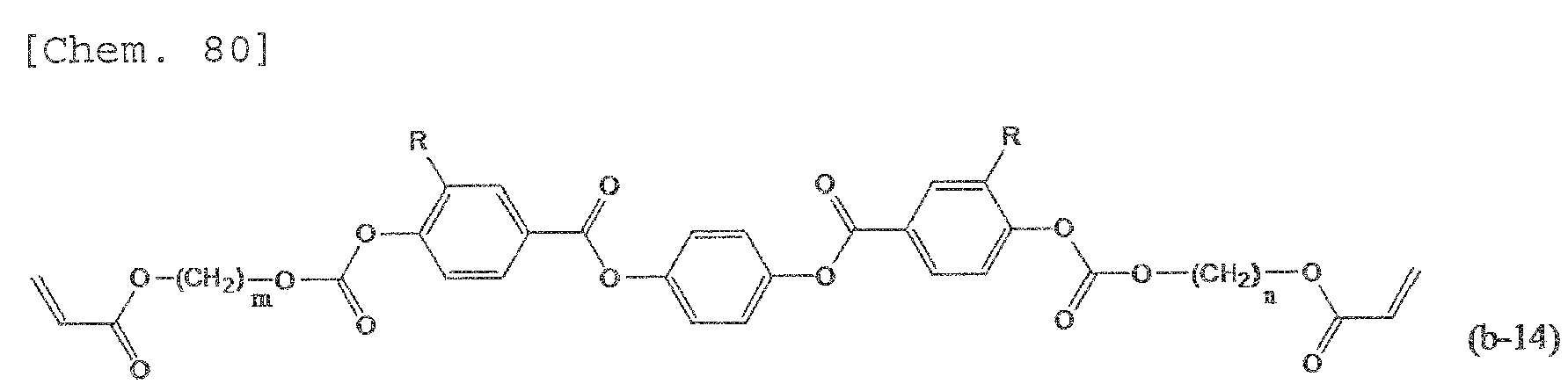
-

-


-

-

-

- (In the formulae, m and n each independently represent an integer of 1 to 18; and R represents a hydrogen atom, a halogen atom, an alkyl group having 1 to 6 carbon atoms, an alkoxy group having 1 to 6 carbon atoms, or a cyano group. In the case where any of these groups is an alkyl group having 1 to 6 carbon atoms or an alkoxy group having 1 to 6 carbon atoms, the group may be unsubstituted or substituted with one or two or more halogen atoms.) These liquid crystal compounds may be used alone or in combination of two or more compounds.
- In the birefringent lens material for a stereoscopic image display of the present invention, a polymerization initiator may be used in order to polymerize a liquid crystal compound having a polymerizable functional group. As a photopolymerization initiator used when polymerization is conducted by light irradiation, well-known, commonly used photopolymerization initiators can be used.
- Examples of the photopolymerization initiator include 2-hydroxy-2-methyl-1-phenylpropan-1-one ("DAROCUR 1173" manufactured by Merck & Co., Inc.), 1-hydroxycyclohexyl phenyl ketone ("IRGACURE 184" manufactured by BASF), 1-(4-isopropylphenyl)-2-hydroxy-2-methylpropan-1-one ("DAROCUR 1116" manufactured by Merck & Co., Inc.), 2-methyl-1-[(methylthio)phenyl]-2-morpholino propane-1 ("IRGACURE 907" manufactured by BASF), benzyl methyl ketal ("IRGACURE 651" manufactured by BASF), 2-benzyl-2-dimethylamino-1-(4-morpholinophenyl)-butanone ("IRGACURE 369" manufactured by BASF), 2-dimethylamino-2-(4-methylbenzyl)-1-(4-morpholin-4-yl-phenyl)butan-1-one ("IRGACURE 379" manufactured by BASF), 2,2-dimethoxy-1,2-diphenylethan-1-one, bis(2,4,6-trimethylbenzoyl)-phenylphosphine oxide (DAROCUR TPO), 2,4,6-trimethylbenzoyl-diphenylphosphine oxide ("IRGACURE 819" manufactured by BASF), 1,2-octanedione, 1-[4-(phenylthio)-,2-(O-benzoyloxime)] ("IRGACURE OXE01" manufactured by BASF), ethanone, 1-[9-ethyl-6-(2-methylbenzoyl)-9H-carbazol-3-yl]-,1-(O-acetyloxime) ("IRGACURE OXE02" manufactured by BASF), a mixture of 2,4-diethylthioxanthone ("KAYACURE DETX" manufactured by Nippon Kayaku Co., Ltd.) and ethyl p-dimethylamino benzoate ("KAYACURE EPA" manufactured by Nippon Kayaku Co., Ltd.), a mixture of isopropylthioxanthone ("QUANTACURE ITX" manufactured by Ward Blenkinsop Co., Ltd.) and ethyl p-dimethylamino benzoate, and acylphosphine oxide ("Lucirin TPO" manufactured by BASF). The amount of photopolymerization initiator used is preferably 0.1% to 10% by mass, and particularly preferably 0.5% to 5% by mass relative to the birefringent lens material for a stereoscopic image display. These may be used alone or in combination of two or more photopolymerization initiators.
- As a thermal polymerization initiator used in the case of thermal polymerization, well-known, commonly used thermal polymerization initiators can be used. Examples of the thermal polymerization initiator that can be used include organic peroxides such as methyl acetoacetate peroxide, cumene hydroperoxide, benzoyl peroxide, bis(4-t-butylcyclohexyl)peroxy dicarbonate, t-butylperoxy benzoate, methyl ethyl ketone peroxide, 1,1-bis(t-hexylperoxy)3,3,5-trimethylcyclohexane, p-pentahydroperoxide, t-butyl hydroperoxide, dicumyl peroxide, isobutyl peroxide, di(3-methyl-3-methoxybutyl)peroxy dicarbonate, and 1,1-bis(t-butylperoxy)cyclohexane; azonitrile compounds such as 2,2'-azobisisobutyronitrile and 2,2'-azobis(2,4-dimethyl valeronitrile; azoamidine compounds such as 2,2'-azobis(2-methyl-N-phenylpropione-amidine) dihydrochloride; azoamide compounds such as 2,2'-azobis{2-methyl-N-[1,1-bis(hydroxymethyl)-2-hydroxyethyl]propioneamide}; and alkylazo compounds such as 2,2'-azobis(2,4,4-trimethylpentane). The amount of thermal polymerization initiator used is preferably 0.1% to 10% by mass, and particularly preferably 0.5% to 5% by mass relative to the birefringent lens material for a stereoscopic image display. These may be used alone or in combination of two or more thermal polymerization initiators. These thermal polymerization initiators may be used in combination with photopolymerization initiators.
- In the birefringent lens material for a stereoscopic image display of the present invention, a polymerization inhibitor may be used in order to stably produce or stably store the birefringent lens material. Examples of the polymerization inhibitor include phenolic compounds, quinone compounds, amine compounds, thioether compounds, and nitroso compounds.
- Examples of the phenolic compound include p-methoxyphenol, cresol, t-butyl catechol, 3,5-di-t-butyl-4-hydroxytoluene, 2,2'-methylenebis(4-methyl-6-t-butylphenol), 2,2'-methylenebis(4-ethyl-6-t-butylphenol), 4,4'-thiobis(3-methyl-6-t-butylphenol), 4-methoxy-1-naphthol, and 4,4'-dialkoxy-2,2'-bi-1-naphthol.
- Examples of the quinone compound include hydroquinone, methylhydroquinone, tert-butyl hydroquinone, p-benzoquinone, methyl-p-benzoquinone, tert-butyl-p-benzoquinone, 2,5-diphenylbenzoquinone, 2-hydroxy-1,4-naphthoquinone, 1,4-naphthoquinone, 2,3-dichloro-1,4-naphthoquinone, anthraquinone, and diphenoquinone.
- Examples of the amine compound include p-phenylenediamine, 4-aminodiphenylamine, N,N'-diphenyl-p-phenylenediamine, N-i-propyl-N'-phenyl-p-phenylenediamine, N-(1,3-dimethylbutyl)-N'-phenyl-p-phenylenediamine, N,N'-di-2-naphthyl-p-phenylenediamine, diphenylamine, N-phenyl-β-naphthylamine, 4,4'-dicumyl-diphenylamine, and 4,4'-dioctyl-diphenylamine.
- Examples of the thioether compound include phenothiazine and distearyl thiodipropionate.
- Examples of the nitroso compound include N-nitrosodiphenylamine, N-nitrosophenylnaphthylamine, N-nitrosodinaphthylamine, p-nitrosophenol, nitrosobenzene, p-nitrosodiphenylamine, α-nitroso-β-naphthol etc., N,N-dimethyl-p-nitrosoaniline, p-nitrosodiphenylamine, p-nitrosodimethylamine, p-nitroso-N,N-diethylamine, N-nitrosoethanolamine, N-nitrosodi-n-butylamine, N-nitroso-N-n-butyl-4-butanolamine, N-nitroso-diisopropanolamine, N-nitroso-N-ethyl-4-butanolamine, 5-nitroso-8-hydroxyquinoline, N-nitrosomorpholine, N-nitroso-N-phenylhydroxylamine ammonium salt, nitrosobenzene, 2,4,6-tri-tert-butylnitrosobenzene, N-nitroso-N-methyl-p-toluenesulfonamide, N-nitroso-N-ethylurethane, N-nitroso-N-n-propylurethane, 1-nitroso-2-naphthol, 2-nitroso-1-naphthol, sodium 1-nitroso-2-naphthol-3,6-sulfonate, sodium 2-nitroso-1-naphthol-4-sulfonate, 2-nitroso-5-methylaminophenol hydrochloride, and 2-nitroso-5-methylaminophenol hydrochloride.
- In the birefringent lens material for a stereoscopic image display of the present invention, a general-purpose stabilizer may be used for the purpose of obtaining a coating film having a uniform thickness or for any other purposes. For example, additives such as a leveling agent, a thixotropic agent, a surfactant, an ultraviolet absorber, an infrared absorber, an antioxidant, and a surface treatment agent may be added to the extent that the liquid-crystal alignment capability is not significantly decreased.
- In the birefringent lens material for a stereoscopic image display of the present invention, no solvent is usually used. However, a solvent may be used in order to uniformly apply the birefringent lens material. The solvent used is not particularly limited as long as a substrate or an alignment layer formed on the substrate is not completed when the birefringent lens material is applied onto the substrate and a polymerizable liquid crystal composition of the present invention can be aligned without defects. Solvents in which the polymerizable liquid crystal compound exhibits good solubility are preferred. Examples of such a solvent include aromatic hydrocarbons such as toluene, xylene, cumene, and mesitylene; ester solvents such as methyl acetate, ethyl acetate, propyl acetate, and butyl acetate; ketone solvents such as methyl ethyl ketone, methyl isobutyl ketone, and cyclohexanone; ether solvents such as tetrahydrofuran, 1,2-dimethoxyethane, and anisole; amide solvents such as N,N-dimethylformamide and N-methyl-2-pyrrolidone; propylene glycol monomethyl ether acetate; diethylene glycol monomethyl ether acetate; γ-butyrolactone; and chlorobenzene. These may be used alone or in combination of two or more solvents.
- In the birefringent lens material for a stereoscopic image display of the present invention, a surfactant or polymer that promotes homogeneous alignment is used, as required, in the case where the state of homogeneous alignment is temporarily achieved by simply applying the birefringent lens material in a process of producing a birefringent lens for a stereoscopic image display.
- The surfactant used is not particularly limited, but preferably a surfactant having a surface tension lower than that of a liquid crystal compound having a polymerizable functional group. Examples of such a surfactant include fluorine-containing nonionic surfactants, organosilane surfactants, and polyacrylate surfactants. The surfactants may have a polymerizable group so that a stronger film is formed when polymerization is conducted.
The polymer used is not particularly limited, but preferably a polymer having a surface tension lower than that of a liquid crystal compound having a polymerizable functional group. Examples of such a polymer include polyethylene, polypropylene, polyisobutylene, paraffin, liquid paraffin, chlorinated polypropylene, chlorinated paraffin, chlorinated liquid paraffin, and polyvinylidene fluoride. The weight-average molecular weight of the polymer is preferably 200 to 1,000,000, more preferably 300 to 100,000, and particularly preferably 400 to 10,000. - A substrate used in a birefringent lens for a stereoscopic image display of the present invention is a substrate that is usually used in liquid crystal devices, displays, optical components, and optical films, and is not particularly limited as long as the substrate has heat resistance that can withstand heating after the birefringent lens material for a stereoscopic image display of the present invention is applied or during the production of a liquid crystal device. Examples of the substrate include glass substrates, metal substrates, ceramic substrates, and plastic substrates. In particular, in the case where the substrate is composed of an organic material, examples of the organic material include cellulose derivatives, polyolefins, polyesters, polyolefins, polycarbonates, polyacrylates, polyarylates, polyethersulfones, polyimides, polyphenylene sulfides, polyphenylene ethers, nylons, and polystyrenes. Among these, polyesters, polystyrenes, polyolefins, cellulose derivatives, polyarylates, and polycarbonates are preferable.
- The substrate is usually subjected to an alignment treatment or an alignment layer may be provided on the substrate so that the birefringent lens material for a stereoscopic image display of the present invention is aligned when the birefringent lens material for a stereoscopic image display is applied onto the substrate. Examples of the alignment treatment include a stretching treatment, a rubbing treatment, a polarized ultraviolet-visible light irradiation treatment, and an ion-beam treatment. In the case where an alignment layer is used, well-known, commonly used alignment layers are used. Examples of the material of the alignment layer include compounds such as polyimides, polysiloxanes, polyamides, polyvinyl alcohols, polycarbonates, polystyrenes, polyphenylene ethers, polyarylates, polyethylene terephthalates, polyethersulfones, epoxy resins, epoxy acrylate resins, acrylic resins, coumarin compounds, chalcon compounds, cinnamate compounds, fulgide compounds, anthraquinone compounds, azo compounds, and arylethene compounds. Compounds that are subjected to an alignment treatment by rubbing are preferably materials, the crystallization of which is accelerated by the alignment treatment or by performing a heating step after the alignment treatment. Among compounds that are subjected to an alignment treatment other than rubbing, photo-alignment materials are preferably used.
- As a coating method for obtaining a birefringent lens for a stereoscopic image display of the present invention, well-known, commonly used methods such as an applicator method, a bar coating method, a spin coating method, a gravure printing method, a flexographic printing method, an ink-jet method, a die coating method, a cap coating method, and dipping can be employed. In the case where a birefringent lens material for a stereoscopic image display, the material being diluted with a solvent, is applied, the birefringent lens material is dried after the application.
- Shaping of the birefringent lens for a stereoscopic image display of the present invention is performed by polymerizing a birefringent lens material for a stereoscopic image display in the form of a lens by using a photomask or covering a coating film of a birefringent lens material for a stereoscopic image display with a lens-shaped resin mold.
- In the case where a photomask is used, a photomask that has a pattern designed so that when the birefringent lens material for a stereoscopic image display is polymerized, the resulting polymerized material has a desired lens shape is used. In the case where a resin mold is used, a coating film of a birefringent lens material for a stereoscopic image display is covered with a concave lens-shaped resin mold having a refractive index equal to an ordinary refractive index (no) of the birefringent lens material for a stereoscopic image display of the present invention, and polymerization is conducted in this covered state. Alternatively, in the case where the resin mold is once detached, a resin used in the resin mold is applied onto the coating film of the birefringent lens material for a stereoscopic image display, the coating film having been taken from the resin mold, and polymerization is then conducted.
- A polymerization operation of the birefringent lens material for a stereoscopic image display of the present invention is generally performed by irradiation with light such as ultraviolet light or by heating after the birefringent lens material for a stereoscopic image display is applied and the resulting coating film is formed into a lens shape. When the polymerization is conducted by light irradiation, specifically, the birefringent lens material is irradiated with preferably ultraviolet light having a wavelength of 390 nm or less, and most preferably light having a wavelength of 250 to 370 nm. However, in the case where the polymerizable liquid crystal composition is, for example, decomposed by ultraviolet light having a wavelength of 390 nm or less, in some cases, it is preferable to conduct the polymerization treatment with ultraviolet light having a wavelength of 390 nm or more. This light is preferably diffused light that is not polarized.
- On the other hand, polymerization by heating is preferably conducted at a temperature at which the birefringent lens material for a stereoscopic image display exhibits a liquid-crystalline phase or lower. In particular, when a thermal polymerization initiator that releases radicals as a result of heating is used, it is preferable to use a thermal polymerization initiator, the cleavage temperature of which is within the above temperature range. In the case where a thermal polymerization initiator and a photopolymerization initiator are used in combination, the polymerization temperature and the respective initiators are suitably selected, in addition to the consideration of the limitation of the above temperature range, so that the rates of polymerization of a photo-alignment layer and a polymerizable liquid crystal film are not significantly different from each other. The polymerization is preferably conducted at a temperature lower than a temperature at which heterogeneous polymerization due to heat is induced, though the heating temperature depends on the transition temperature from a liquid-crystalline phase to an isotropic phase of the polymerizable liquid crystal composition. However, when the heating temperature exceeds a glass transition temperature of the substrate composed of an organic material, thermal deformation of the substrate becomes significant. Thus, the heating temperature is preferably in the range of room temperature to the glass transition temperature of the substrate. For example, in the case where the polymerizable group is a (meth)acryloyl group, the polymerization is preferably conducted at a temperature lower than 90°C.
- The birefringent lens for a stereoscopic image display may be heat-treated in order to stabilize solvent resistance and heat resistance of the resulting birefringent lens for a stereoscopic image display. In this case, heating is preferably conducted at a glass transition temperature of the birefringent lens for a stereoscopic image display or higher. Usually, the heating is preferably conducted within a range that does not exceed the glass transition temperature of the substrate composed of an organic material. Alternatively, a light irradiation treatment may be performed for the above purpose. In this case, it is preferable to perform the light irradiation treatment to the extent that the liquid crystal compound component in the birefringent lens for a stereoscopic image display is not subjected to photodecomposition by the light irradiation.
- The prepared birefringent lens for a stereoscopic image display may be used in integration with the substrate in the state where the substrate is left (refer to
Fig. 2 ). Alternatively, the birefringent lens for a stereoscopic image display may be separated from the substrate and used in the state where the lens does not have a substrate (refer toFig. 1 ). - The present invention will now be described by way of Synthesis Examples, Examples, and Comparative Examples. However, the present invention is not limited thereto. Note that "part" and "%" are on a mass basis unless otherwise specified.
- Fifty parts of a liquid crystal compound represented by formula (B-1), 20 parts of a liquid crystal compound represented by formula (B-2), 0.1 parts of DAROCUR TPO (C-1), and 0.1 parts of p-methoxyphenol (D-1) were mixed while heating to prepare a birefringent lens material (1) for a stereoscopic image display of the present invention.
-

-


- Birefringent lens materials (2) to (20) for a stereoscopic image display of the present invention were prepared as in the preparation of the birefringent lens material (1) for a stereoscopic image display of the present invention. Tables 1 to 5 show specific compositions of the birefringent lens materials (1) to (20) for a stereoscopic image display of the present invention.
-
[Table 1] (1) (2) (3) (4) (5) (6) (7) (8) (9) (10) Compound (A-1) 50 20 10 Compound (A-2) 50 10 Compound (A-3) 20 20 10 Compound (A-4) 20 20 15 Compound (A-5) 20 20 15 Compound (B-1) 50 30 40 30 20 20 15 10 Compound (B-2) 50 30 40 30 20 20 15 10 Compound (B-3) 20 25 25 20 20 15 10 Compound (B-4) 20 25 25 20 20 15 10 Compound (C-1) 0.1 0.1 0.1 0.1 0.1 0.1 0.1 0.1 0.1 0.1 Compound (C-2) Compound (C-3) Compound (D-1) 0.1 0.1 0.1 0.1 0.1 0.1 0.1 0.1 0.1 0.1 Compound (D-2) Compound (E-1) Compound (E-2) Compound (F-1) -
[Table 2] (11) (12) (13) (14) (15) (16) (17) (18) (19) (20) Compound (A-1) 15 15 15 10 15 Compound (A-2) Compound (A-3) 15 15 15 15 15 Compound (A-4) 10 10 10 10 10 20 Compound (A-5) 10 10 10 10 10 20 Compound (B-1) 15 15 15 15 15 20 100 Compound (B-2) 15 15 15 15 15 20 100 Compound (B-3) 10 10 10 10 10 10 100 Compound (B-4) 10 10 10 10 10 10 100 Compound (C-1) 0.1 0.1 0.1 0.1 0.1 0.1 Compound (C-2) 1 1 Compound (C-3) 1 3 Compound (D-1) 0.1 0.1 0.1 0.1 0.1 0.1 0.1 0.1 0.1 Compound (D-2) 0.1 Compound (E-1) 5 Compound (E-2) 0.2 Compound (F-1) 150 -

-

-

-

-

-

-

-
- IRGACURE 651 (C-2) (manufactured by BASF)
- IRGACURE 907 (C-3) (manufactured by BASF)
- Quino Power LSN (D-2) (manufactured by Kawasaki Kasei Chemicals Ltd.)
- Butyl acrylate (E-1) (manufactured by Toagosei Co., Ltd.) IRGANOX 1076 (E-2) (manufactured by BASF)
- Cyclopentanone (F-1)
- A polyimide solution for an alignment layer was applied onto a glass substrate having a thickness of 0.7 mm by a spin coating method. The polyimide solution was dried at 100°C for 10 minutes and then baked at 200°C for 60 minutes to obtain a coating film. The coating film was subjected to a rubbing treatment. The rubbing treatment was conducted using a commercially available rubbing device.
- The birefringent lens material (1) for a stereoscopic image display of the present invention was applied onto the rubbed substrate by a spin coating method in the state where the birefringent lens material (1) was heated at 70°C. Another substrate that had been subjected to a rubbing treatment was arranged on the resulting coating film so that the rubbing direction of the other substrate is antiparallel to the above-described substrate, and the resulting product was then cooled to room temperature. Subsequently, the product was irradiated with UV light at an intensity of 40 mW/cm2 for 25 seconds using a high-pressure mercury-vapor lamp. The cured coating film was then separated from the rubbed substrates, thus obtaining a cured product of the birefringent lens material for a stereoscopic image display of the present invention. The cured product had a film thickness of 50 µm, an ordinary refractive index no of 1.537, an extraordinary refractive index ne of 1.701, and a Δn of 0.165. The alignment of the cured product was also good. The transition temperature from a solid phase to a liquid-crystalline phase was -21°C, and the transition temperature from a liquid-crystalline phase to a liquid phase was 121°C.
- Cured products of the birefringent lens materials for a stereoscopic image display of the invention in Examples 2 to 13 were obtained as in Example 1. Each of the cured products had a film thickness of 50 µm, and the alignment thereof was good. The obtained results are shown in Table 3.
- Each of the birefringent lens materials for a stereoscopic image display of the present invention can be polymerized at room temperature, has a good alignment property, and is good in terms of productivity.
-
[Table 3] Birefringent lens material for stereoscopic image display Coating temperature (°C) Alignment at room temperature ne no Δn Transition temperature (solid/liquid crystal) Transition temperature (liquid crystal/liquid) Example 1 Birefringent lens material (1) for stereoscopic image display 80 Good 1.701 1.537 0.164 -21°C 121°C Example 2 Birefringent lens material (2) for stereoscopic image display 70 Good 1.695 1.533 0.162 -25°C 95°C Example 3 Birefringent lens material (3) for stereoscopic image display 40 Good 1.595 1.543 0.052 -30°C 53°C Example 4 Birefringent lens material (4) for stereoscopic image display 40 Good 1.646 1.544 0.102 -31°C 52°C Example 5 Birefringent lens material (5) for stereoscopic image display 70 Good 1.699 1.531 0.168 -25°C 90°C Example 6 Birefringent lens material (6) for stereoscopic image display 70 Good 1.694 1.526 0.168 -21°C 125°C Example 7 Birefringent lens material (7) for stereoscopic image display 70 Good 1.672 1.535 0.137 -21°C 86°C Example 8 Birefringent lens material (8) for stereoscopic image display 70 Good 1.697 1.531 0.166 -28°C 75°C Example 9 Birefringent lens material (9) for stereoscopic image display 70 Good 1.701 1.533 0.168 -26°C 98°C Example 10 Birefringent lens material (10) for stereoscopic image display 70 Good 1.676 1.531 0.145 -29°C 80°C Example 11 Birefringent lens material (11) for stereoscopic image display 70 Good 1.689 1.533 0.156 -28°C 85°C Example 12 Birefringent lens material (12) for stereoscopic image display 70 Good 1.689 1.533 0.156 -28°C 85°C Example 13 Birefringent lens material (13) for stereoscopic image display 70 Good 1.689 1.533 0.156 -28°C 85°C Example 14 Birefringent lens material (14) for stereoscopic image display 70 Good 1.689 1.533 0.156 -27°C 70°C - Cured products of the birefringent lens materials for a stereoscopic image display in Comparative Examples 1 to 4 were obtained as in Example 1. In each of the cured products, crystallization significantly occurred when polymerization was conducted at room temperature, and a large number of alignment defects were observed. The obtained results are shown in Table 4.
-
[Table 4] Birefringent lens material for stereoscopic image display Coating temperature (°C) Alignment at room temperature ne no Δn Transition temperature (solid/liquid crystal) Transition temperature (liquid crystal/liquid) Comparative Example 1 Birefringent lens material (17) for stereoscopic image display 80 Defects were observed 1.707 1.533 0.174 69°C 128°C Comparative Example 2 Birefringent lens material (18) for stereoscopic image display 80 Defects were observed 1.700 1.530 0.170 63°C 124°C Comparative Example 3 Birefringent lens material (19) for stereoscopic image display 80 Defects were observed - - - - 67°C Comparative Example 4 Birefringent lens material (20) for stereoscopic image display 80 Defects were observed 1.670 1.527 0.143 63°C 81°C - A polyimide solution for an alignment layer was applied onto a glass substrate having a thickness of 0.7 mm by a spin coating method. The polyimide solution was dried at 100°C for 10 minutes and then baked at 200°C for 60 minutes to obtain a coating film. The coating film was subjected to a rubbing treatment. The rubbing treatment was conducted using a commercially available rubbing device. The birefringent lens material (15) for a stereoscopic image display of the present invention was applied onto the rubbed
substrate 3 by a spin coating method in the state where the birefringent lens material (15) was heated at 70°C.A resin mold 1 that had been subjected to an alignment treatment was arranged on the resulting coating film so that an alignment direction of the rubbed substrate was parallel to an alignment direction of theresin mold 1, and the resulting product was then cooled to room temperature. Subsequently, the product was irradiated with ultraviolet light at an intensity of 40 mW/cm2 for 25 seconds using a high-pressure mercury-vapor lamp. Thus, a birefringent lens for a stereoscopic image display was obtained. Thesubstrate 3 was detached from the obtained lens to produce a birefringent lens for a stereoscopic image display illustrated inFig. 1 . The obtained birefringent lens for a stereoscopic image display of the present invention had no defect, and the alignment of the birefringent lens was also good. The birefringent lens material (15) for a stereoscopic image display of the present invention had a transition temperature from a solid phase to a liquid-crystalline phase of -25°C and a transition temperature from a liquid-crystalline phase to a liquid phase of 87°C. - A polyimide solution for an alignment layer was applied onto a glass substrate having a thickness of 0.7 mm by a spin coating method. The polyimide solution was dried at 100°C for 10 minutes and then baked at 200°C for 60 minutes to obtain a coating film. The coating film was subjected to a rubbing treatment. The rubbing treatment was conducted using a commercially available rubbing device. The birefringent lens material (15) for a stereoscopic image display of the present invention was applied onto the rubbed
substrate 3 by a spin coating method in the state where the birefringent lens material (15) was heated at 70°C.A resin mold 1 that had been subjected to an alignment treatment was arranged on the resulting coating film so that an alignment direction of the rubbed substrate was parallel to an alignment direction of theresin mold 1, and the resulting product was then cooled to room temperature. Next, theresin mold 1 was slowly detached, and an ultraviolet-curable epoxy acrylate resin was applied onto the coating film by a spin coating method. Subsequently, the resulting product was irradiated with ultraviolet light at an intensity of 40 mW/cm2 for 25 seconds using a high-pressure mercury-vapor lamp. Thus, a birefringent lens for a stereoscopic image display illustrated inFig. 2 was obtained. The obtained birefringent lens for a stereoscopic image display of the present invention had no defect, and the alignment of the birefringent lens was also good. - A polyimide solution for an alignment layer was applied onto a glass substrate having a thickness of 0.7 mm by a spin coating method. The polyimide solution was dried at 100°C for 10 minutes and then baked at 200°C for 60 minutes to obtain a coating film. The coating film was subjected to a rubbing treatment. The rubbing treatment was conducted using a commercially available rubbing device.
- Next, 0.2 parts of liquid paraffin was added to 100 parts of the birefringent lens material (16) for a stereoscopic image display, and the mixture was then applied onto the rubbed substrate by a spin coating method in an atmosphere at room temperature. The resulting coating film was dried at 80°C for 10 minutes, and then irradiated with ultraviolet light through a mask having a pattern. The ultraviolet irradiation was performed at an intensity of 40 mW/cm2 for 25 seconds using a high-pressure mercury-vapor lamp. The resulting cured film was washed with propylene glycol monomethyl ether acetate for one minute to remove uncured portions. An ultraviolet-curable epoxy acrylate resin was further applied by a spin coating method. Subsequently, the resulting product was irradiated with ultraviolet light at an intensity of 40 mW/cm2 for 25 seconds using a high-pressure mercury-vapor lamp. Thus, a birefringent lens for a stereoscopic image display illustrated in
Fig. 2 was obtained. The obtained birefringent lens for a stereoscopic image display of the present invention had no defect, and the alignment of the birefringent lens was also good. In the components except for cyclopentanone in the birefringent lens material (16) for a stereoscopic image display, the transition temperature from a solid phase to a liquid-crystalline phase was -26°C and the transition temperature from a liquid-crystalline phase to a liquid phase was 96°C. -
- [
Fig. 1] Fig. 1 illustrates a structure of a birefringent lens for a stereoscopic image display of the present invention. - [
Fig. 2] Fig. 2 illustrates a structure of a birefringent lens (including a substrate) for a stereoscopic image display of the present invention. -
- 1:
- resin mold
- 2:
- birefringent lens
- 3:
- substrate
Claims (18)
- A birefringent lens material for a stereoscopic image display, comprising two or more liquid crystal compounds each having at least one polymerizable functional group.
- The birefringent lens material for a stereoscopic image display according to Claim 1, comprising two or more liquid crystal compounds each having at least two polymerizable functional groups.
- The birefringent lens material for a stereoscopic image display according to Claim 1 or 2, having a transition temperature from a solid phase to a liquid-crystalline phase of -10°C or lower and a transition temperature from a liquid-crystalline phase to a liquid phase of 50°C or higher.
- The birefringent lens material for a stereoscopic display according to any one of Claims 1 to 3, wherein the birefringent lens material can be polymerized at room temperature.
- The birefringent lens material for a stereoscopic image display according to any one of Claims 1 to 4, wherein each of the liquid crystal compounds having at least one polymerizable functional group is a compound represented by general formula (1):
[Chem. 1]
P-(Sp)m-MG-R1 (1)
(where P represents a polymerizable functional group; Sp represents a spacer group having 0 to 18 carbon atoms; m represents 0 or 1; MG represents a mesogenic group or a mesogenity supporting group; and R1 represents a halogen atom, a cyano group, a thiocyanate group, a hydroxy group, an NCO group, an OCN group, or an alkyl group having 1 to 18 carbon atoms, the alkyl group may be substituted with at least one selected from halogen atoms, a cyano group, and a hydroxy group, and one CH2 group or two or more non-adjacent CH2 groups present in this group may each be independently substituted with a divalent organic group such as -O-, -S-, -NH-, -N(CH3)-, -CO-, -COO-, -OCO-, -OCOO-, -SCO-, -COS-, - CH=CH-, or -C≡C- in such a manner that oxygen atoms are not directly bonded to each other, or R1 represents a structure represented by general formula (1-a):
[Chem. 2]
-(Sp)m-P (1-a)
(where P represents a reactive functional group, Sp represents a spacer group having 0 to 18 carbon atoms, and m represents 0 or 1).) - The birefringent lens material for a stereoscopic image display according to any one of Claims 1 to 5, wherein, in general formula (1), MGs of the two or more liquid crystal compounds are the same.
- The birefringent lens material for a stereoscopic display according to any one of Claims 1 to 6, wherein the birefringent lens material includes two or more groups each including liquid crystal compounds having the same MG in general formula (1).
- The birefringent lens material for a stereoscopic image display according to any one of Claims 1 to 7, wherein, in general formula (1),
Sp represents a single bond or an alkylene group (where the alkylene group may be substituted with at least one selected from halogen atoms and CN, and one CH2 group or two or more non-adjacent CH2 groups present in this group may each be independently substituted with -O-, -S-, -NH-, -N(CH3)-,-CO-, -COO-, -OCO-, -OCOO-, -SCO-, -COS-, -CONH-, -NHCO-,-CH=CH-, or -C=C- in such a manner that oxygen atoms are not directly bonded to each other), and MG is represented by general formula (1-b):
[Chem. 3]
-Z0-(A1-Z1)n-A2-Z2-A3-Z3- (1-b)
(where A1, A2, and A3 each independently represent a 1,4-phenylene group, a 1,4-cyclohexylene group, a 1,4-cyclohexenyl group, a tetrahydropyran-2,5-diyl group, a 1,3-dioxane-2,5-diyl group, a tetrahydrothiopyran-2,5-diyl group, a 1,4-bicyclo[2.2.2]octylene group, a decahydronaphthalene-2,6-diyl group, a pyridine-2,5-diyl group, a pyrimidine-2,5-diyl group, a pyrazine-2,5-diyl group, a thiophene-2,5-diyl group, a 1,2,3,4-tetrahydronaphthalene-2,6-diyl group, a 1,4-naphthylene group, a 1,5-naphthylene group, a 1,6-naphthylene group, a 2,6-naphthylene group, a phenanthrene-2,7-diyl group, a 9,10-dihydrophenanthrene-2,7-diyl group, a 1,2,3,4,4a,9,10a-octahydrophenanthrene-2,7-diyl group, a benzo[1,2-b:4,5-b']dithiophene-2,5-diyl group, a benzo[1,2-b:4,5-b']diselenophene-2,6-diyl group, a [1]benzothieno[3,2-b]thiophene-2,7-diyl group, a [1]benzoselenopheno[3,2-b]selenophene-2,7-diyl group, or a fluorene-2,7-diyl group, and may have, as at least one substituent, at least one selected from F, Cl, CF3, OCF3, a CN group, alkyl groups each having 1 to 8 carbon atoms, alkoxy groups each having 1 to 8 carbon atoms, alkanoyl groups each having 1 to 8 carbon atoms, alkanoyloxy groups each having 1 to 8 carbon atoms, alkenyl groups each having 2 to 8 carbon atoms, alkenyloxy groups each having 2 to 8 carbon atoms, alkenoyl groups each having 2 to 8 carbon atoms, and alkenoyloxy groups each having 2 to 8 carbon atoms; Z0, Z1, Z2, and Z3 each independently represent -COO-, -OCO-, -CH2CH2-, -OCH2-,-CH2O-, -CH=CH-, -C≡C-, -CH=CHCOO-, -OCOCH=CH-, -CH2CH2COO-,-CH2CH2OCO-, -COOCH2CH2-, -OCOCH2CH2-, -CONH-, -NHCO-, an alkyl group which has 2 to 10 carbon atoms and which may have a halogen atom, or a single bond; and n represents 0, 1, or 2.) - The birefringent lens material for a stereoscopic display according to any one of Claims 1 to 8, wherein, in general formula (1), P represents a substituent selected from the group consisting of substituents represented by general formulae (P-1) to (P-18):

- The birefringent lens material for a stereoscopic image display according to any one of Claims 5 to 9, comprising a compound selected from the compound group represented by general formulae (2a) and (2b):


- The birefringent lens material for a stereoscopic image display according to any one of Claims 5 to 10, comprising a compound selected from the compound group represented by general formulae (3) and (4):


- A birefringent lens for a stereoscopic image display, the birefringent lens being formed by curing the birefringent lens material for a stereoscopic image display according to any one of Claims 1 to 11.
- A method for producing a birefringent lens for a stereoscopic image display, comprising applying the birefringent lens material for a stereoscopic image display according to any one of Claims 1 to 11 onto an alignment layer that has been subjected to an alignment treatment in a uniaxial direction; and forming the resulting coating film into a lens shape by conducting curing with ultraviolet light.
- The method for producing a birefringent lens for a stereoscopic image display according to Claim 13, wherein the step of forming the coating film into a lens shape by conducting curing with ultraviolet light is a step of curing the coating film with ultraviolet light through a mask having a pattern, the coating film being composed of the birefringent lens material for a stereoscopic image display.
- The method for producing a birefringent lens for a stereoscopic image display according to Claim 13, wherein the step of forming the coating film into a lens shape by conducting curing with ultraviolet light is a step of covering, with a resin mold, the coating film composed of the birefringent lens material for a stereoscopic image display, and subsequently conducting curing with ultraviolet light.
- The method for producing a birefringent lens for a stereoscopic image display according to Claim 13, wherein the step of forming the coating film into a lens shape by conducting curing with ultraviolet light is a step of covering, with a resin mold, the coating film composed of the birefringent lens material for a stereoscopic image display, subsequently detaching the resin mold, then stacking, on the coating film, a resin having at least a polymerizable functional group, and conducting curing with ultraviolet light.
- A polymerizable liquid crystal composition comprising the birefringent lens material for a stereoscopic image display according to any one of Claims 1 to 11; a photopolymerization initiator; a polymerization inhibitor; and, as required, a stabilizer.
- A polymerizable liquid crystal composition comprising the birefringent lens material for a stereoscopic image display according to any one of Claims 1 to 11; a photopolymerization initiator; a polymerization inhibitor; a surfactant or polymer that promotes homogeneous alignment; as required, a stabilizer; and as required, a solvent.
Applications Claiming Priority (2)
| Application Number | Priority Date | Filing Date | Title |
|---|---|---|---|
| JP2010289909 | 2010-12-27 | ||
| PCT/JP2011/079488 WO2012090785A1 (en) | 2010-12-27 | 2011-12-20 | Birefringent lens material for stereoscopic image display device, and method of manufacturing birefringent lens for stereoscopic image display device |
Publications (3)
| Publication Number | Publication Date |
|---|---|
| EP2660631A1 true EP2660631A1 (en) | 2013-11-06 |
| EP2660631A4 EP2660631A4 (en) | 2016-08-31 |
| EP2660631B1 EP2660631B1 (en) | 2018-12-05 |
Family
ID=46382896
Family Applications (1)
| Application Number | Title | Priority Date | Filing Date |
|---|---|---|---|
| EP11852367.9A Active EP2660631B1 (en) | 2010-12-27 | 2011-12-20 | Birefringent lens material for stereoscopic image display device, and method of manufacturing birefringent lens for stereoscopic image display device |
Country Status (7)
| Country | Link |
|---|---|
| US (2) | US9927625B2 (en) |
| EP (1) | EP2660631B1 (en) |
| JP (2) | JP5553184B2 (en) |
| KR (1) | KR101952697B1 (en) |
| CN (1) | CN103282800B (en) |
| TW (1) | TWI500744B (en) |
| WO (1) | WO2012090785A1 (en) |
Families Citing this family (18)
| Publication number | Priority date | Publication date | Assignee | Title |
|---|---|---|---|---|
| US7342112B2 (en) * | 2003-07-01 | 2008-03-11 | Ppg Industries Ohio, Inc. | Photochromic compounds |
| EP2660631B1 (en) * | 2010-12-27 | 2018-12-05 | DIC Corporation | Birefringent lens material for stereoscopic image display device, and method of manufacturing birefringent lens for stereoscopic image display device |
| JP5741901B2 (en) * | 2010-12-27 | 2015-07-01 | Dic株式会社 | Birefringent lens material for stereoscopic image display device and method of manufacturing birefringent lens for stereoscopic image display device |
| JP5718260B2 (en) | 2011-09-08 | 2015-05-13 | 富士フイルム株式会社 | Polymerizable liquid crystal compound, polymerizable composition, polymer material, and film |
| JP5786000B2 (en) * | 2012-09-25 | 2015-09-30 | 富士フイルム株式会社 | Polymerizable liquid crystal compound, liquid crystal composition, method for producing polymer material, method for producing the same, and film |
| US9164289B2 (en) * | 2012-12-04 | 2015-10-20 | Lg Display Co., Ltd. | Stereoscopic image display device |
| EP2932317B1 (en) * | 2012-12-14 | 2024-02-21 | Merck Patent GmbH | Birefringent rm lens |
| US10386556B2 (en) * | 2012-12-14 | 2019-08-20 | Merck Patent Gmbh | Birefringent RM lens |
| JP5905419B2 (en) * | 2013-03-13 | 2016-04-20 | 富士フイルム株式会社 | Polymerizable liquid crystal compound, liquid crystal composition, polymer material and method for producing the same, film, polarizing plate and liquid crystal display device |
| CN105658679B (en) * | 2013-10-17 | 2018-06-22 | Dic株式会社 | The manufacturing method of polymerizable liquid crystal compound |
| TWI491925B (en) * | 2013-12-06 | 2015-07-11 | Zhangjiagang Kangde Xin Optronics Material Co Ltd | A super stereoscopic vision separation element |
| TWI491926B (en) * | 2013-12-06 | 2015-07-11 | Zhangjiagang Kangde Xin Optronics Material Co Ltd | A super stereoscopic vision separation element |
| KR102143373B1 (en) * | 2013-12-11 | 2020-08-12 | 엘지디스플레이 주식회사 | Switchable lens device, and 2-dimensional and 3-dimensional image display device using the same |
| JP6156588B2 (en) * | 2014-09-19 | 2017-07-05 | Dic株式会社 | Polymerizable composition and film using the same |
| JP6590075B2 (en) * | 2016-09-09 | 2019-10-16 | Dic株式会社 | Polymerizable liquid crystal composition and optical film using the same |
| CN106468842A (en) * | 2016-12-27 | 2017-03-01 | 宁波视睿迪光电有限公司 | Birefringent lens film and its manufacture method |
| CN110989191B (en) * | 2019-12-20 | 2022-03-04 | 京东方科技集团股份有限公司 | Integrated display panel, method for making the same, and display device |
| CN115113416B (en) * | 2022-07-22 | 2023-08-25 | 吉林省钜鸿智能技术有限公司 | An outdoor naked-eye 3D display |
Family Cites Families (57)
| Publication number | Priority date | Publication date | Assignee | Title |
|---|---|---|---|---|
| NL9000808A (en) | 1990-04-06 | 1991-11-01 | Koninkl Philips Electronics Nv | LIQUID CRYSTALLINE MATERIAL AND IMAGE DISPLAY CELL CONTAINING THIS MATERIAL. |
| JP3579922B2 (en) | 1994-07-14 | 2004-10-20 | 大日本インキ化学工業株式会社 | Optical anisotropic film and liquid crystal display device using the same |
| JP3579914B2 (en) | 1994-04-22 | 2004-10-20 | 大日本インキ化学工業株式会社 | Substrate with optical anisotropy |
| JPH083111A (en) | 1993-12-24 | 1996-01-09 | Dainippon Ink & Chem Inc | Polymerizable liquid crystal composition and optical anisotropic body using the same |
| DE4408171A1 (en) * | 1994-03-11 | 1995-09-14 | Basf Ag | New polymerizable liquid crystalline compounds |
| JP3677817B2 (en) * | 1995-06-15 | 2005-08-03 | 佐藤 進 | POLYMER LENS AND METHOD FOR PRODUCING POLYMER LENS |
| DE19835730A1 (en) | 1997-08-18 | 1999-02-25 | Basf Ag | New liquid crystalline carbonic acid ester(s) |
| JP4006608B2 (en) | 1997-09-05 | 2007-11-14 | 大日本インキ化学工業株式会社 | Liquid crystalline (meth) acrylate compound, composition containing the compound, and optical anisotropic body using the same |
| JP4207233B2 (en) | 1997-11-18 | 2009-01-14 | Dic株式会社 | Liquid crystal composition and optical anisotropic body using the same |
| US7570798B2 (en) * | 1998-01-16 | 2009-08-04 | Beaty Elwin M | Method of manufacturing ball array devices using an inspection apparatus having one or more cameras and ball array devices produced according to the method |
| US6072898A (en) * | 1998-01-16 | 2000-06-06 | Beaty; Elwin M. | Method and apparatus for three dimensional inspection of electronic components |
| JP4200195B2 (en) | 1998-10-09 | 2008-12-24 | Dic株式会社 | Liquid crystalline (meth) acrylate compound, liquid crystal composition containing the compound, and optical anisotropic body using the same |
| GB9903670D0 (en) * | 1999-02-17 | 1999-04-14 | Rolic Ag | Liquid crystal compounds |
| JP2003509725A (en) * | 1999-09-16 | 2003-03-11 | メルク パテント ゲゼルシャフト ミット ベシュレンクテル ハフトング | Optical Compensator and Liquid Crystal Display I |
| US6730241B2 (en) | 2000-01-21 | 2004-05-04 | Dainippon Ink And Chemicals, Inc. | Polymerizable composition showing liquid-crystal phase and optically anisotropic object made with the same |
| JP5295471B2 (en) | 2000-11-13 | 2013-09-18 | Dic株式会社 | Polymerizable liquid crystal compound, polymerizable liquid crystal composition containing the compound, and polymer thereof |
| JP4873205B2 (en) * | 2001-01-30 | 2012-02-08 | Dic株式会社 | Polymerizable liquid crystal composition and optical element |
| JP4810750B2 (en) | 2001-04-11 | 2011-11-09 | Dic株式会社 | Polymerizable liquid crystal compound, polymerizable liquid crystal composition containing the compound, and polymer thereof |
| GB0119176D0 (en) * | 2001-08-06 | 2001-09-26 | Ocuity Ltd | Optical switching apparatus |
| JP4074155B2 (en) * | 2001-09-17 | 2008-04-09 | 富士フイルム株式会社 | Four-membered ring compound, birefringent medium and optical member using the same |
| JP4143891B2 (en) * | 2001-12-26 | 2008-09-03 | Dic株式会社 | Polymerizable liquid crystal composition and optical anisotropic body using the same |
| JP4304566B2 (en) | 2002-03-27 | 2009-07-29 | Dic株式会社 | Polarization separation element |
| JP4296821B2 (en) | 2002-04-17 | 2009-07-15 | チッソ株式会社 | Maleimide derivatives and polymers thereof |
| JP4296761B2 (en) | 2002-09-04 | 2009-07-15 | チッソ株式会社 | N-substituted maleimide and polymer thereof |
| JP2004125842A (en) | 2002-09-30 | 2004-04-22 | Fuji Photo Film Co Ltd | Retardation film, method for producing the same, and elliptically polarizing plate |
| KR100493164B1 (en) | 2002-12-14 | 2005-06-02 | 삼성전자주식회사 | Electromagnetic induced accelerator |
| EP1590699B1 (en) | 2003-02-05 | 2006-11-29 | Ocuity Limited | Switchable display apparatus |
| KR100540109B1 (en) | 2003-02-06 | 2006-01-10 | 가부시끼가이샤 도시바 | Stereoscopic image display apparatus |
| JP2007519013A (en) | 2003-07-01 | 2007-07-12 | トランジションズ オプティカル, インコーポレイテッド | Array device for optical dyes |
| GB2403815A (en) * | 2003-07-10 | 2005-01-12 | Ocuity Ltd | Birefringent lens array structure |
| JP2005128216A (en) * | 2003-10-23 | 2005-05-19 | Nitto Denko Corp | Optical rotator, optical element, condensing backlight system, and liquid crystal display device |
| JP4802451B2 (en) * | 2004-03-24 | 2011-10-26 | Dic株式会社 | Polymerizable liquid crystal composition and polymer thereof |
| JP4439326B2 (en) * | 2004-04-28 | 2010-03-24 | シャープ株式会社 | Method for forming microlens, solid-state imaging device including microlens, and liquid crystal display device |
| JP4138759B2 (en) * | 2005-02-03 | 2008-08-27 | セイコーエプソン株式会社 | Liquid crystal display device and electronic device |
| JP2008162894A (en) | 2005-04-20 | 2008-07-17 | Nissan Chem Ind Ltd | Polymerizable compound, polymerizable liquid crystal composition and their polymers and films |
| TW200720703A (en) | 2005-09-09 | 2007-06-01 | Koninkl Philips Electronics Nv | Lenticular device for an autostereoscopic display apparatus and method of producing the same |
| JP2007262288A (en) * | 2006-03-29 | 2007-10-11 | Dainippon Ink & Chem Inc | Polymerizable liquid crystal composition |
| JP4207987B2 (en) * | 2006-06-30 | 2009-01-14 | ソニー株式会社 | Optical element, optical element manufacturing method, and liquid crystal display device |
| JP4967563B2 (en) | 2006-09-22 | 2012-07-04 | Dic株式会社 | Polymer optical low-pass filter and manufacturing method thereof |
| GB2444081B (en) * | 2006-11-24 | 2011-05-11 | Ocuity Ltd | Manufacture of a birefringent liquid crystal component |
| JP5441311B2 (en) * | 2007-02-09 | 2014-03-12 | 株式会社Adeka | Polymerizable composition |
| JP4936930B2 (en) * | 2007-03-01 | 2012-05-23 | 株式会社Adeka | Polymerizable compound and polymerizable composition |
| JP2008222892A (en) | 2007-03-14 | 2008-09-25 | Asahi Kasei Electronics Co Ltd | Photosensitive resin composition |
| JP5181510B2 (en) * | 2007-03-30 | 2013-04-10 | Dic株式会社 | Polymerizable liquid crystal composition |
| CN101542357B (en) | 2007-05-18 | 2011-12-07 | 松下电器产业株式会社 | Stereoscopic image display device |
| JP2009025489A (en) | 2007-07-18 | 2009-02-05 | Asahi Glass Co Ltd | Method for manufacturing liquid crystal optical element and optical head device |
| WO2009101883A1 (en) * | 2008-02-13 | 2009-08-20 | Konica Minolta Opto, Inc. | Process for producing hybrid optical-element grouping |
| JP2010033420A (en) | 2008-07-30 | 2010-02-12 | Oki Semiconductor Co Ltd | Cache circuit and cache memory control method |
| GB0816557D0 (en) * | 2008-09-10 | 2008-10-15 | Merck Patent Gmbh | Electro-optical switching element and electro-optical display |
| JP2010151926A (en) | 2008-12-24 | 2010-07-08 | Dic Corp | Optical anisotropic body |
| JP2010152069A (en) * | 2008-12-25 | 2010-07-08 | Dic Corp | Polymerizable liquid crystal composition and optical anisotropic body |
| JP2010209250A (en) * | 2009-03-11 | 2010-09-24 | Fujifilm Corp | Photocurable composition, cured product using the same, method for producing the cured product, and member for liquid crystal display |
| JP5613992B2 (en) * | 2009-04-03 | 2014-10-29 | 住友化学株式会社 | Composition, film and method for producing film |
| JP5172778B2 (en) | 2009-05-20 | 2013-03-27 | 日本特殊陶業株式会社 | Manufacturing method of spark plug with pressure sensor |
| TWI611213B (en) | 2010-02-18 | 2018-01-11 | 住友化學股份有限公司 | Stereoscopic display system, glasses for stereoscopic display system, and display device for stereoscopic display system |
| JP5545262B2 (en) | 2010-12-07 | 2014-07-09 | 大日本印刷株式会社 | Light-emitting display device |
| EP2660631B1 (en) * | 2010-12-27 | 2018-12-05 | DIC Corporation | Birefringent lens material for stereoscopic image display device, and method of manufacturing birefringent lens for stereoscopic image display device |
-
2011
- 2011-12-20 EP EP11852367.9A patent/EP2660631B1/en active Active
- 2011-12-20 JP JP2012548159A patent/JP5553184B2/en active Active
- 2011-12-20 US US13/976,874 patent/US9927625B2/en active Active
- 2011-12-20 KR KR1020137015707A patent/KR101952697B1/en active Active
- 2011-12-20 CN CN201180062991.0A patent/CN103282800B/en active Active
- 2011-12-20 WO PCT/JP2011/079488 patent/WO2012090785A1/en not_active Ceased
- 2011-12-26 TW TW100148588A patent/TWI500744B/en active
-
2014
- 2014-05-13 JP JP2014099493A patent/JP5929960B2/en active Active
- 2014-10-14 US US14/513,701 patent/US9599829B2/en active Active
Also Published As
| Publication number | Publication date |
|---|---|
| EP2660631A4 (en) | 2016-08-31 |
| JP5929960B2 (en) | 2016-06-08 |
| KR20130129984A (en) | 2013-11-29 |
| WO2012090785A1 (en) | 2012-07-05 |
| TW201235453A (en) | 2012-09-01 |
| KR101952697B1 (en) | 2019-02-28 |
| US9927625B2 (en) | 2018-03-27 |
| EP2660631B1 (en) | 2018-12-05 |
| CN103282800A (en) | 2013-09-04 |
| JPWO2012090785A1 (en) | 2014-06-05 |
| US9599829B2 (en) | 2017-03-21 |
| US20130309411A1 (en) | 2013-11-21 |
| US20150030973A1 (en) | 2015-01-29 |
| CN103282800B (en) | 2018-01-23 |
| JP5553184B2 (en) | 2014-07-16 |
| TWI500744B (en) | 2015-09-21 |
| JP2014197205A (en) | 2014-10-16 |
Similar Documents
| Publication | Publication Date | Title |
|---|---|---|
| EP2660631B1 (en) | Birefringent lens material for stereoscopic image display device, and method of manufacturing birefringent lens for stereoscopic image display device | |
| JP6525031B2 (en) | Polymerizable composition and optical anisotropic body using the same | |
| JP5708972B2 (en) | Polymerizable liquid crystal composition, cholesteric reflective film and reflective polarizing plate using the same | |
| JP5741901B2 (en) | Birefringent lens material for stereoscopic image display device and method of manufacturing birefringent lens for stereoscopic image display device | |
| JP5725325B2 (en) | Polymerizable liquid crystal composition | |
| JP5532974B2 (en) | Composition for forming liquid crystal layer, circularly polarized light separating sheet and method for producing the same, brightness enhancement film, and liquid crystal display device | |
| KR20170105041A (en) | Polymerizable composition and optical anisotropic material using the same | |
| JP6264513B2 (en) | Polymerizable liquid crystal composition and optical anisotropic body using the same | |
| JPWO2018047806A1 (en) | Polymerizable liquid crystal composition, and optical film using the same | |
| JPWO2018003653A1 (en) | Polymerizable liquid crystal composition, optically anisotropic body and liquid crystal display device using the same | |
| JP2022017349A (en) | Polymerizable liquid crystal composition, optical film using the same and method for producing the same | |
| JP5737549B2 (en) | Polymerizable liquid crystal composition, cholesteric reflective film and reflective polarizing plate using the same | |
| JP6547912B2 (en) | Polymerizable composition and optically anisotropic material using the same | |
| JP5896197B2 (en) | Polymerizable liquid crystal composition, cholesteric reflective film and reflective polarizing plate using the same | |
| JP6414367B2 (en) | Polymerizable liquid crystal composition | |
| WO2018151070A1 (en) | Optically anisotropic body | |
| JP5678676B2 (en) | Polymerizable liquid crystal composition, cured product using the same, and optical anisotropic body | |
| JP6414368B2 (en) | Polymerizable liquid crystal composition | |
| JP6032238B2 (en) | Composition for forming liquid crystal layer, circularly polarized light separating sheet and method for producing the same, brightness enhancement film, and liquid crystal display device |
Legal Events
| Date | Code | Title | Description |
|---|---|---|---|
| PUAI | Public reference made under article 153(3) epc to a published international application that has entered the european phase |
Free format text: ORIGINAL CODE: 0009012 |
|
| 17P | Request for examination filed |
Effective date: 20130718 |
|
| AK | Designated contracting states |
Kind code of ref document: A1 Designated state(s): AL AT BE BG CH CY CZ DE DK EE ES FI FR GB GR HR HU IE IS IT LI LT LU LV MC MK MT NL NO PL PT RO RS SE SI SK SM TR |
|
| DAX | Request for extension of the european patent (deleted) | ||
| RA4 | Supplementary search report drawn up and despatched (corrected) |
Effective date: 20160802 |
|
| RIC1 | Information provided on ipc code assigned before grant |
Ipc: G02B 1/04 20060101AFI20160727BHEP Ipc: G02B 27/22 20060101ALI20160727BHEP Ipc: G02B 3/06 20060101ALI20160727BHEP Ipc: G02B 3/00 20060101ALI20160727BHEP Ipc: G02F 1/1335 20060101ALI20160727BHEP Ipc: G02F 1/13 20060101ALI20160727BHEP |
|
| STAA | Information on the status of an ep patent application or granted ep patent |
Free format text: STATUS: EXAMINATION IS IN PROGRESS |
|
| 17Q | First examination report despatched |
Effective date: 20170804 |
|
| GRAP | Despatch of communication of intention to grant a patent |
Free format text: ORIGINAL CODE: EPIDOSNIGR1 |
|
| STAA | Information on the status of an ep patent application or granted ep patent |
Free format text: STATUS: GRANT OF PATENT IS INTENDED |
|
| INTG | Intention to grant announced |
Effective date: 20180622 |
|
| GRAS | Grant fee paid |
Free format text: ORIGINAL CODE: EPIDOSNIGR3 |
|
| GRAA | (expected) grant |
Free format text: ORIGINAL CODE: 0009210 |
|
| GRAA | (expected) grant |
Free format text: ORIGINAL CODE: 0009210 |
|
| STAA | Information on the status of an ep patent application or granted ep patent |
Free format text: STATUS: THE PATENT HAS BEEN GRANTED |
|
| AK | Designated contracting states |
Kind code of ref document: B1 Designated state(s): AL AT BE BG CH CY CZ DE DK EE ES FI FR GB GR HR HU IE IS IT LI LT LU LV MC MK MT NL NO PL PT RO RS SE SI SK SM TR |
|
| REG | Reference to a national code |
Ref country code: GB Ref legal event code: FG4D |
|
| REG | Reference to a national code |
Ref country code: CH Ref legal event code: EP |
|
| REG | Reference to a national code |
Ref country code: AT Ref legal event code: REF Ref document number: 1073776 Country of ref document: AT Kind code of ref document: T Effective date: 20181215 |
|
| REG | Reference to a national code |
Ref country code: IE Ref legal event code: FG4D |
|
| REG | Reference to a national code |
Ref country code: DE Ref legal event code: R096 Ref document number: 602011054645 Country of ref document: DE |
|
| REG | Reference to a national code |
Ref country code: NL Ref legal event code: MP Effective date: 20181205 |
|
| REG | Reference to a national code |
Ref country code: AT Ref legal event code: MK05 Ref document number: 1073776 Country of ref document: AT Kind code of ref document: T Effective date: 20181205 |
|
| REG | Reference to a national code |
Ref country code: LT Ref legal event code: MG4D |
|
| PG25 | Lapsed in a contracting state [announced via postgrant information from national office to epo] |
Ref country code: NO Free format text: LAPSE BECAUSE OF FAILURE TO SUBMIT A TRANSLATION OF THE DESCRIPTION OR TO PAY THE FEE WITHIN THE PRESCRIBED TIME-LIMIT Effective date: 20190305 Ref country code: BG Free format text: LAPSE BECAUSE OF FAILURE TO SUBMIT A TRANSLATION OF THE DESCRIPTION OR TO PAY THE FEE WITHIN THE PRESCRIBED TIME-LIMIT Effective date: 20190305 Ref country code: FI Free format text: LAPSE BECAUSE OF FAILURE TO SUBMIT A TRANSLATION OF THE DESCRIPTION OR TO PAY THE FEE WITHIN THE PRESCRIBED TIME-LIMIT Effective date: 20181205 Ref country code: LT Free format text: LAPSE BECAUSE OF FAILURE TO SUBMIT A TRANSLATION OF THE DESCRIPTION OR TO PAY THE FEE WITHIN THE PRESCRIBED TIME-LIMIT Effective date: 20181205 Ref country code: AT Free format text: LAPSE BECAUSE OF FAILURE TO SUBMIT A TRANSLATION OF THE DESCRIPTION OR TO PAY THE FEE WITHIN THE PRESCRIBED TIME-LIMIT Effective date: 20181205 Ref country code: ES Free format text: LAPSE BECAUSE OF FAILURE TO SUBMIT A TRANSLATION OF THE DESCRIPTION OR TO PAY THE FEE WITHIN THE PRESCRIBED TIME-LIMIT Effective date: 20181205 Ref country code: LV Free format text: LAPSE BECAUSE OF FAILURE TO SUBMIT A TRANSLATION OF THE DESCRIPTION OR TO PAY THE FEE WITHIN THE PRESCRIBED TIME-LIMIT Effective date: 20181205 Ref country code: HR Free format text: LAPSE BECAUSE OF FAILURE TO SUBMIT A TRANSLATION OF THE DESCRIPTION OR TO PAY THE FEE WITHIN THE PRESCRIBED TIME-LIMIT Effective date: 20181205 |
|
| PG25 | Lapsed in a contracting state [announced via postgrant information from national office to epo] |
Ref country code: SE Free format text: LAPSE BECAUSE OF FAILURE TO SUBMIT A TRANSLATION OF THE DESCRIPTION OR TO PAY THE FEE WITHIN THE PRESCRIBED TIME-LIMIT Effective date: 20181205 Ref country code: AL Free format text: LAPSE BECAUSE OF FAILURE TO SUBMIT A TRANSLATION OF THE DESCRIPTION OR TO PAY THE FEE WITHIN THE PRESCRIBED TIME-LIMIT Effective date: 20181205 Ref country code: GR Free format text: LAPSE BECAUSE OF FAILURE TO SUBMIT A TRANSLATION OF THE DESCRIPTION OR TO PAY THE FEE WITHIN THE PRESCRIBED TIME-LIMIT Effective date: 20190306 Ref country code: RS Free format text: LAPSE BECAUSE OF FAILURE TO SUBMIT A TRANSLATION OF THE DESCRIPTION OR TO PAY THE FEE WITHIN THE PRESCRIBED TIME-LIMIT Effective date: 20181205 |
|
| PG25 | Lapsed in a contracting state [announced via postgrant information from national office to epo] |
Ref country code: NL Free format text: LAPSE BECAUSE OF FAILURE TO SUBMIT A TRANSLATION OF THE DESCRIPTION OR TO PAY THE FEE WITHIN THE PRESCRIBED TIME-LIMIT Effective date: 20181205 |
|
| PG25 | Lapsed in a contracting state [announced via postgrant information from national office to epo] |
Ref country code: PL Free format text: LAPSE BECAUSE OF FAILURE TO SUBMIT A TRANSLATION OF THE DESCRIPTION OR TO PAY THE FEE WITHIN THE PRESCRIBED TIME-LIMIT Effective date: 20181205 Ref country code: PT Free format text: LAPSE BECAUSE OF FAILURE TO SUBMIT A TRANSLATION OF THE DESCRIPTION OR TO PAY THE FEE WITHIN THE PRESCRIBED TIME-LIMIT Effective date: 20190405 Ref country code: CZ Free format text: LAPSE BECAUSE OF FAILURE TO SUBMIT A TRANSLATION OF THE DESCRIPTION OR TO PAY THE FEE WITHIN THE PRESCRIBED TIME-LIMIT Effective date: 20181205 Ref country code: IT Free format text: LAPSE BECAUSE OF FAILURE TO SUBMIT A TRANSLATION OF THE DESCRIPTION OR TO PAY THE FEE WITHIN THE PRESCRIBED TIME-LIMIT Effective date: 20181205 |
|
| REG | Reference to a national code |
Ref country code: CH Ref legal event code: PL |
|
| PG25 | Lapsed in a contracting state [announced via postgrant information from national office to epo] |
Ref country code: RO Free format text: LAPSE BECAUSE OF FAILURE TO SUBMIT A TRANSLATION OF THE DESCRIPTION OR TO PAY THE FEE WITHIN THE PRESCRIBED TIME-LIMIT Effective date: 20181205 Ref country code: EE Free format text: LAPSE BECAUSE OF FAILURE TO SUBMIT A TRANSLATION OF THE DESCRIPTION OR TO PAY THE FEE WITHIN THE PRESCRIBED TIME-LIMIT Effective date: 20181205 Ref country code: IS Free format text: LAPSE BECAUSE OF FAILURE TO SUBMIT A TRANSLATION OF THE DESCRIPTION OR TO PAY THE FEE WITHIN THE PRESCRIBED TIME-LIMIT Effective date: 20190405 Ref country code: LU Free format text: LAPSE BECAUSE OF NON-PAYMENT OF DUE FEES Effective date: 20181220 Ref country code: SM Free format text: LAPSE BECAUSE OF FAILURE TO SUBMIT A TRANSLATION OF THE DESCRIPTION OR TO PAY THE FEE WITHIN THE PRESCRIBED TIME-LIMIT Effective date: 20181205 Ref country code: SK Free format text: LAPSE BECAUSE OF FAILURE TO SUBMIT A TRANSLATION OF THE DESCRIPTION OR TO PAY THE FEE WITHIN THE PRESCRIBED TIME-LIMIT Effective date: 20181205 |
|
| REG | Reference to a national code |
Ref country code: DE Ref legal event code: R097 Ref document number: 602011054645 Country of ref document: DE |
|
| REG | Reference to a national code |
Ref country code: IE Ref legal event code: MM4A |
|
| REG | Reference to a national code |
Ref country code: BE Ref legal event code: MM Effective date: 20181231 |
|
| PLBE | No opposition filed within time limit |
Free format text: ORIGINAL CODE: 0009261 |
|
| STAA | Information on the status of an ep patent application or granted ep patent |
Free format text: STATUS: NO OPPOSITION FILED WITHIN TIME LIMIT |
|
| PG25 | Lapsed in a contracting state [announced via postgrant information from national office to epo] |
Ref country code: MC Free format text: LAPSE BECAUSE OF FAILURE TO SUBMIT A TRANSLATION OF THE DESCRIPTION OR TO PAY THE FEE WITHIN THE PRESCRIBED TIME-LIMIT Effective date: 20181205 Ref country code: DK Free format text: LAPSE BECAUSE OF FAILURE TO SUBMIT A TRANSLATION OF THE DESCRIPTION OR TO PAY THE FEE WITHIN THE PRESCRIBED TIME-LIMIT Effective date: 20181205 Ref country code: IE Free format text: LAPSE BECAUSE OF NON-PAYMENT OF DUE FEES Effective date: 20181220 Ref country code: SI Free format text: LAPSE BECAUSE OF FAILURE TO SUBMIT A TRANSLATION OF THE DESCRIPTION OR TO PAY THE FEE WITHIN THE PRESCRIBED TIME-LIMIT Effective date: 20181205 |
|
| 26N | No opposition filed |
Effective date: 20190906 |
|
| PG25 | Lapsed in a contracting state [announced via postgrant information from national office to epo] |
Ref country code: BE Free format text: LAPSE BECAUSE OF NON-PAYMENT OF DUE FEES Effective date: 20181231 |
|
| PG25 | Lapsed in a contracting state [announced via postgrant information from national office to epo] |
Ref country code: LI Free format text: LAPSE BECAUSE OF NON-PAYMENT OF DUE FEES Effective date: 20181231 Ref country code: CH Free format text: LAPSE BECAUSE OF NON-PAYMENT OF DUE FEES Effective date: 20181231 |
|
| PG25 | Lapsed in a contracting state [announced via postgrant information from national office to epo] |
Ref country code: MT Free format text: LAPSE BECAUSE OF NON-PAYMENT OF DUE FEES Effective date: 20181220 |
|
| PG25 | Lapsed in a contracting state [announced via postgrant information from national office to epo] |
Ref country code: TR Free format text: LAPSE BECAUSE OF FAILURE TO SUBMIT A TRANSLATION OF THE DESCRIPTION OR TO PAY THE FEE WITHIN THE PRESCRIBED TIME-LIMIT Effective date: 20181205 |
|
| PG25 | Lapsed in a contracting state [announced via postgrant information from national office to epo] |
Ref country code: CY Free format text: LAPSE BECAUSE OF FAILURE TO SUBMIT A TRANSLATION OF THE DESCRIPTION OR TO PAY THE FEE WITHIN THE PRESCRIBED TIME-LIMIT Effective date: 20181205 Ref country code: HU Free format text: LAPSE BECAUSE OF FAILURE TO SUBMIT A TRANSLATION OF THE DESCRIPTION OR TO PAY THE FEE WITHIN THE PRESCRIBED TIME-LIMIT; INVALID AB INITIO Effective date: 20111220 Ref country code: MK Free format text: LAPSE BECAUSE OF NON-PAYMENT OF DUE FEES Effective date: 20181205 |
|
| P01 | Opt-out of the competence of the unified patent court (upc) registered |
Effective date: 20230324 |
|
| REG | Reference to a national code |
Ref country code: GB Ref legal event code: 732E Free format text: REGISTERED BETWEEN 20240620 AND 20240627 |
|
| REG | Reference to a national code |
Ref country code: DE Ref legal event code: R082 Ref document number: 602011054645 Country of ref document: DE Representative=s name: WEIDNER STERN JESCHKE PATENTANWAELTE PARTNERSC, DE Ref country code: DE Ref legal event code: R081 Ref document number: 602011054645 Country of ref document: DE Owner name: SHIJIAZHUANG CHENGZHI YONGHUA DISPLAY MATERIAL, CN Free format text: FORMER OWNER: DIC CORPORATION, TOKYO, JP |
|
| PGFP | Annual fee paid to national office [announced via postgrant information from national office to epo] |
Ref country code: FR Payment date: 20250919 Year of fee payment: 15 |
|
| PGFP | Annual fee paid to national office [announced via postgrant information from national office to epo] |
Ref country code: DE Payment date: 20250919 Year of fee payment: 15 |
|
| PGFP | Annual fee paid to national office [announced via postgrant information from national office to epo] |
Ref country code: GB Payment date: 20251010 Year of fee payment: 15 |