EP2660317B1 - Rationally-designed single-chain meganucleases with non-palindromic recognition sequences - Google Patents
Rationally-designed single-chain meganucleases with non-palindromic recognition sequences Download PDFInfo
- Publication number
- EP2660317B1 EP2660317B1 EP13165733.0A EP13165733A EP2660317B1 EP 2660317 B1 EP2660317 B1 EP 2660317B1 EP 13165733 A EP13165733 A EP 13165733A EP 2660317 B1 EP2660317 B1 EP 2660317B1
- Authority
- EP
- European Patent Office
- Prior art keywords
- meganuclease
- sequence
- laglidadg
- chain
- site
- Prior art date
- Legal status (The legal status is an assumption and is not a legal conclusion. Google has not performed a legal analysis and makes no representation as to the accuracy of the status listed.)
- Active
Links
Images
Classifications
-
- C—CHEMISTRY; METALLURGY
- C12—BIOCHEMISTRY; BEER; SPIRITS; WINE; VINEGAR; MICROBIOLOGY; ENZYMOLOGY; MUTATION OR GENETIC ENGINEERING
- C12N—MICROORGANISMS OR ENZYMES; COMPOSITIONS THEREOF; PROPAGATING, PRESERVING, OR MAINTAINING MICROORGANISMS; MUTATION OR GENETIC ENGINEERING; CULTURE MEDIA
- C12N9/00—Enzymes; Proenzymes; Compositions thereof; Processes for preparing, activating, inhibiting, separating or purifying enzymes
- C12N9/14—Hydrolases (3)
- C12N9/16—Hydrolases (3) acting on ester bonds (3.1)
- C12N9/22—Ribonucleases [RNase]; Deoxyribonucleases [DNase]
-
- A—HUMAN NECESSITIES
- A61—MEDICAL OR VETERINARY SCIENCE; HYGIENE
- A61P—SPECIFIC THERAPEUTIC ACTIVITY OF CHEMICAL COMPOUNDS OR MEDICINAL PREPARATIONS
- A61P31/00—Antiinfectives, i.e. antibiotics, antiseptics, chemotherapeutics
-
- A—HUMAN NECESSITIES
- A61—MEDICAL OR VETERINARY SCIENCE; HYGIENE
- A61P—SPECIFIC THERAPEUTIC ACTIVITY OF CHEMICAL COMPOUNDS OR MEDICINAL PREPARATIONS
- A61P31/00—Antiinfectives, i.e. antibiotics, antiseptics, chemotherapeutics
- A61P31/04—Antibacterial agents
-
- A—HUMAN NECESSITIES
- A61—MEDICAL OR VETERINARY SCIENCE; HYGIENE
- A61P—SPECIFIC THERAPEUTIC ACTIVITY OF CHEMICAL COMPOUNDS OR MEDICINAL PREPARATIONS
- A61P31/00—Antiinfectives, i.e. antibiotics, antiseptics, chemotherapeutics
- A61P31/12—Antivirals
-
- A—HUMAN NECESSITIES
- A61—MEDICAL OR VETERINARY SCIENCE; HYGIENE
- A61P—SPECIFIC THERAPEUTIC ACTIVITY OF CHEMICAL COMPOUNDS OR MEDICINAL PREPARATIONS
- A61P33/00—Antiparasitic agents
- A61P33/02—Antiprotozoals, e.g. for leishmaniasis, trichomoniasis, toxoplasmosis
-
- A—HUMAN NECESSITIES
- A61—MEDICAL OR VETERINARY SCIENCE; HYGIENE
- A61P—SPECIFIC THERAPEUTIC ACTIVITY OF CHEMICAL COMPOUNDS OR MEDICINAL PREPARATIONS
- A61P43/00—Drugs for specific purposes, not provided for in groups A61P1/00-A61P41/00
-
- C—CHEMISTRY; METALLURGY
- C12—BIOCHEMISTRY; BEER; SPIRITS; WINE; VINEGAR; MICROBIOLOGY; ENZYMOLOGY; MUTATION OR GENETIC ENGINEERING
- C12N—MICROORGANISMS OR ENZYMES; COMPOSITIONS THEREOF; PROPAGATING, PRESERVING, OR MAINTAINING MICROORGANISMS; MUTATION OR GENETIC ENGINEERING; CULTURE MEDIA
- C12N15/00—Mutation or genetic engineering; DNA or RNA concerning genetic engineering, vectors, e.g. plasmids, or their isolation, preparation or purification; Use of hosts therefor
- C12N15/09—Recombinant DNA-technology
- C12N15/63—Introduction of foreign genetic material using vectors; Vectors; Use of hosts therefor; Regulation of expression
- C12N15/79—Vectors or expression systems specially adapted for eukaryotic hosts
- C12N15/85—Vectors or expression systems specially adapted for eukaryotic hosts for animal cells
- C12N15/8509—Vectors or expression systems specially adapted for eukaryotic hosts for animal cells for producing genetically modified animals, e.g. transgenic
-
- C—CHEMISTRY; METALLURGY
- C12—BIOCHEMISTRY; BEER; SPIRITS; WINE; VINEGAR; MICROBIOLOGY; ENZYMOLOGY; MUTATION OR GENETIC ENGINEERING
- C12N—MICROORGANISMS OR ENZYMES; COMPOSITIONS THEREOF; PROPAGATING, PRESERVING, OR MAINTAINING MICROORGANISMS; MUTATION OR GENETIC ENGINEERING; CULTURE MEDIA
- C12N15/00—Mutation or genetic engineering; DNA or RNA concerning genetic engineering, vectors, e.g. plasmids, or their isolation, preparation or purification; Use of hosts therefor
- C12N15/09—Recombinant DNA-technology
- C12N15/87—Introduction of foreign genetic material using processes not otherwise provided for, e.g. co-transformation
- C12N15/90—Stable introduction of foreign DNA into chromosome
- C12N15/902—Stable introduction of foreign DNA into chromosome using homologous recombination
-
- C—CHEMISTRY; METALLURGY
- C12—BIOCHEMISTRY; BEER; SPIRITS; WINE; VINEGAR; MICROBIOLOGY; ENZYMOLOGY; MUTATION OR GENETIC ENGINEERING
- C12N—MICROORGANISMS OR ENZYMES; COMPOSITIONS THEREOF; PROPAGATING, PRESERVING, OR MAINTAINING MICROORGANISMS; MUTATION OR GENETIC ENGINEERING; CULTURE MEDIA
- C12N15/00—Mutation or genetic engineering; DNA or RNA concerning genetic engineering, vectors, e.g. plasmids, or their isolation, preparation or purification; Use of hosts therefor
- C12N15/09—Recombinant DNA-technology
- C12N15/87—Introduction of foreign genetic material using processes not otherwise provided for, e.g. co-transformation
- C12N15/90—Stable introduction of foreign DNA into chromosome
- C12N15/902—Stable introduction of foreign DNA into chromosome using homologous recombination
- C12N15/907—Stable introduction of foreign DNA into chromosome using homologous recombination in mammalian cells
-
- C—CHEMISTRY; METALLURGY
- C12—BIOCHEMISTRY; BEER; SPIRITS; WINE; VINEGAR; MICROBIOLOGY; ENZYMOLOGY; MUTATION OR GENETIC ENGINEERING
- C12N—MICROORGANISMS OR ENZYMES; COMPOSITIONS THEREOF; PROPAGATING, PRESERVING, OR MAINTAINING MICROORGANISMS; MUTATION OR GENETIC ENGINEERING; CULTURE MEDIA
- C12N9/00—Enzymes; Proenzymes; Compositions thereof; Processes for preparing, activating, inhibiting, separating or purifying enzymes
- C12N9/14—Hydrolases (3)
- C12N9/16—Hydrolases (3) acting on ester bonds (3.1)
-
- C—CHEMISTRY; METALLURGY
- C12—BIOCHEMISTRY; BEER; SPIRITS; WINE; VINEGAR; MICROBIOLOGY; ENZYMOLOGY; MUTATION OR GENETIC ENGINEERING
- C12N—MICROORGANISMS OR ENZYMES; COMPOSITIONS THEREOF; PROPAGATING, PRESERVING, OR MAINTAINING MICROORGANISMS; MUTATION OR GENETIC ENGINEERING; CULTURE MEDIA
- C12N2800/00—Nucleic acids vectors
- C12N2800/80—Vectors containing sites for inducing double-stranded breaks, e.g. meganuclease restriction sites
-
- C—CHEMISTRY; METALLURGY
- C12—BIOCHEMISTRY; BEER; SPIRITS; WINE; VINEGAR; MICROBIOLOGY; ENZYMOLOGY; MUTATION OR GENETIC ENGINEERING
- C12Y—ENZYMES
- C12Y301/00—Hydrolases acting on ester bonds (3.1)
-
- C—CHEMISTRY; METALLURGY
- C12—BIOCHEMISTRY; BEER; SPIRITS; WINE; VINEGAR; MICROBIOLOGY; ENZYMOLOGY; MUTATION OR GENETIC ENGINEERING
- C12Y—ENZYMES
- C12Y301/00—Hydrolases acting on ester bonds (3.1)
- C12Y301/04—Phosphoric diester hydrolases (3.1.4)
Definitions
- the invention relates to the field of molecular biology and recombinant nucleic acid technology.
- the invention relates to rationally-designed, non-naturally-occurring meganucleases in which a pair of enzyme subunits having specificity for different recognition sequence half-sites are joined into a single polypeptide to form a functional heterodimer with a non-palindromic recognition sequence.
- the invention also relates to methods of producing such meganucleases, and methods of producing recombinant nucleic acids and organisms using such meganucleases.
- Genome engineering requires the ability to insert, delete, substitute and otherwise manipulate specific genetic sequences within a genome, and has numerous therapeutic and biotechnological applications.
- the development of effective means for genome modification remains a major goal in gene therapy, agrotechnology, and synthetic biology ( Porteus et al. (2005), Nat. Biotechnol. 23: 967-73 ; Tzfira et al. (2005), Trends Biotechnol. 23: 567-9 ; McDaniel et al. (2005), Curr. Opin. Biotechnol. 16: 476-83 ).
- a common method for inserting or modifying a DNA sequence involves introducing a transgenic DNA sequence flanked by sequences homologous to the genomic target and selecting or screening for a successful homologous recombination event. Recombination with the transgenic DNA occurs rarely but can be stimulated by a double-stranded break in the genomic DNA at the target site. Numerous methods have been employed to create DNA double-stranded breaks, including irradiation and chemical treatments. Although these methods efficiently stimulate recombination, the double-stranded breaks are randomly dispersed in the genome, which can be highly mutagenic and toxic. At present, the inability to target gene modifications to unique sites within a chromosomal background is a major impediment to successful genome engineering.
- One approach to achieving this goal is stimulating homologous recombination at a double-stranded break in a target locus using a nuclease with specificity for a sequence that is sufficiently large to be present at only a single site within the genome (see, e.g., Porteus et al. (2005), Nat. Biotechnol. 23: 967-73 ).
- the effectiveness of this strategy has been demonstrated in a variety of organisms using chimeric fusions between an engineered zinc finger DNA-binding domain and the non-specific nuclease domain of the FokI restriction enzyme ( Porteus (2006), Mol. Ther. 13: 438-46 ; Wright et al. (2005), Plant J.
- a group of naturally-occurring nucleases which recognize 15-40 base-pair cleavage sites commonly found in the genomes of plants and fungi may provide a less toxic genome engineering alternative.
- Such "meganucleases” or “homing endonucleases” are frequently associated with parasitic DNA elements, such as group I self-splicing introns and inteins. They naturally promote homologous recombination or gene insertion at specific locations in the host genome by producing a double-stranded break in the chromosome, which recruits the cellular DNA-repair machinery ( Stoddard (2006), Q. Rev. Biophys. 38: 49-95 ).
- LAGLIDADG Meganucleases are commonly grouped into four families: the LAGLIDADG family, the GIY-YIG family, the His-Cys box family and the HNH family. These families are characterized by structural motifs, which affect catalytic activity and recognition sequence. For instance, members of the LAGLIDADG family are characterized by having either one or two copies of the conserved LAGLIDADG motif (see Chevalier et al. (2001), Nucleic Acids Res. 29(18): 3757-3774 ).
- the LAGLIDADG meganucleases with a single copy of the LAGLIDADG motif form homodimers, whereas members with two copies of the LAGLIDADG motif (“di-LAGLIDADG meganucleases”) are found as monomers.
- Mono-LAGLIDADG meganucleases such as I-CreI, I-CeuI, and I-MsoI recognize and cleave DNA sites that are palindromic or pseudo-palindromic
- di-LAGLIDADG meganucleases such as I-SceI, I-AniI, and I-DmoI generally recognize DNA sites that are non-palindromic ( Stoddard (2006), Q. Rev. Biophys. 38: 49-95 ).
- nuclease-stimulated gene modification requires the use of genetically engineered enzymes with customized specificities to target DNA breaks to existing sites in a genome and, therefore, there has been great interest in adapting meganucleases to promote gene modifications at medically or biotechnologically relevant sites ( Porteus et al. (2005), Nat. Biotechnol. 23: 967-73 ; Sussman et al. (2004), J. Mol. Biol. 342: 31-41 ; Epinat et al. (2003), Nucleic Acids Res. 31: 2952-62 ).
- I-CreI is a member of the LAGLIDADG family which recognizes and cuts a 22 base-pair recognition sequence in the chloroplast chromosome, and which presents an attractive target for meganuclease redesign.
- the wild-type enzyme is a homodimer in which each monomer makes direct contacts with 9 base pairs in the full-length recognition sequence.
- Genetic selection techniques have been used to modify the wild-type I-CreI cleavage site preference ( Sussman et al. (2004), J. Mol. Biol. 342: 31-41 ; Chames et al. (2005), Nucleic Acids Res. 33: e178 ; Seligman et al. (2002), Nucleic Acids Res.
- a major limitation of using mono-LAGLIDADG meganucleases such as I-CreI for most genetic engineering applications is the fact that these enzymes naturally target palindromic DNA recognition sites. Such lengthy (10-40 bp) palindromic DNA sites are rare in nature and are unlikely to occur by chance in a DNA site of interest.
- a mono-LAGLIDADG meganuclease In order to target a non-palindromic DNA site with a mono-LAGLIDADG meganuclease, one can produce a pair of monomers which recognize the two different half-sites and which heterodimerize to form a meganuclease that cleaves the desired non-palindromic site.
- Heterodimerization can be achieved either by co-expressing a pair of meganuclease monomers in a host cell or by mixing a pair of purified homodimeric meganucleases in vitro and allowing the subunits to re-associate into heterodimers ( Smith et al. (2006), Nuc. Acids Res. 34:149-157 ; Chames et al. (2005), Nucleic Acids Res. 33:178-186 ; WO 2007/047859 , WO 2006/097854 , WO 2007/057781 , WO 2007/049095 , WO 2007/034262 ).
- An alternative approach to the formation of meganucleases with non-palindromic recognition sites derived from one or more mono-LAGLIDADG meganucleases is the production of a single polypeptide which comprises a fusion of the LAGLIDADG subunits derived from two meganucleases. Two general methods can be applied to produce such a meganuclease.
- one of the two LAGLIDADG subunits of a di-LAGLIDADG meganuclease can be replaced by a LAGLIDADG subunit from a mono-LAGLIDADG meganuclease.
- This approach was demonstrated by replacing the C-terminal subunit of the di-LAGLIDADG I-DmoI meganuclease with an I-CreI subunit ( Epinat et al. (2003), Nucleic Acids Res. 31: 2952-62 ; Chevalier et al. (2002), Mol. Cell 10:895-905 ; WO 2003/078619 ).
- the result was a hybrid I-DmoI/I-CreI meganuclease which recognized and cleaved a hybrid DNA site.
- a pair of mono-LAGLIDADG subunits can be joined by a peptide linker to create a "single-chain heterodimer meganuclease.”
- a single-chain derivative of I-CreI has been reported ( Epinat et al. (2003), Nucleic Acids Res. 31: 2952-62 ; WO 2003/078619 ). However, as discussed herein as well as in Fajardo-Sanchez et al. (2008), Nucleic Acids Res.
- the present invention is based, in part, upon the development of fusion proteins in which a peptide linker covalently joins two heterologous LAGLIDADG meganuclease subunits to form a "single-chain heterodimer meganuclease" or "single-chain meganuclease", in which at least the N-terminal subunit is derived from a mono-LAGLIDADG meganuclease, and in which the subunits function together to preferentially bind to and cleave a non-palindromic DNA recognition site which is a hybrid of the recognition half-sites of the two subunits.
- the invention can be used to genetically engineer single-chain meganucleases which recognize non-palindromic DNA sequences that naturally-occurring meganucleases do not recognize.
- the invention also provides methods that use such meganucleases to produce recombinant nucleic acids and organisms by utilizing the meganucleases to cause recombination of a desired genetic sequence at a limited number of loci within the genome of the organism for, enter alia, genetic engineering, gene therapy, treatment of pathogenic infections, and in vitro applications in diagnostics and research.
- recombinant single-chain meganucleases comprising a pair of covalently joined LAGLIDADG subunits derived from one or more mono-LAGLIDADG meganucleases which function together to recognize and cleave a non-palindromic recognition site.
- the mono-LAGLIDADG subunit can be derived from a wild-type meganuclease selected from I-CreI, I-Msol and I-CeuI.
- Wild-type mono-LAGLIDADG meganucleases include, without limitation, the I-CreI meganuclease of SEQ ID NO: 1, the I-MsoI meganuclease of SEQ ID NO: 2, and the I-CeuI meganuclease of SEQ ID NO: 3.
- Wild-type di-LAGLIDADG meganucleases include, without limitation, the I-DmoI meganuclease of SEQ ID NO: 4, the I-SceI meganuclease of SEQ ID NO: 5, and the I-AniI meganuclease of SEQ ID NO: 6.
- Wild-type LAGLIDADG domains include, without limitation, residues 9-151 of the wild-type I-CreI meganuclease of SEQ ID NO: 1; residues 11-162 of the wild-type I-MsoI meganuclease of SEQ ID NO: 2; and residues 55-210 of the wild-type I-CeuI meganuclease of SEQ ID NO: 3, residues 9-96 of the wild-type I-DmoI of SEQ ID NO: 4; residues 105-178 of the wild-type I-DmoI of SEQ ID NO: 4; residues 32-123 of the wild-type I-SceI of SEQ ID NO: 5; residues 134-225 of the wild-type I-SceI of SEQ ID NO: 5; residues 4-121 of the wild-type I-Anil of SEQ ID NO: 6; and residues 136-254 of the wild-type I-AniI of SEQ ID NO: 6.
- LAGLIDADG subunits derived from a wild-type LAGLIDADG meganuclease include, without limitation, subunits including a LAGLIDADG domain that has at least 85% sequence identity, or 85%-100% sequence identity, to any one of residues 9-151 of the wild-type I-CreI meganuclease of SEQ ID NO: 1; residues 11-162 of the wild-type I-MsoI meganuclease of SEQ ID NO: 2; and residues 55-210 of the wild-type I-CeuI meganuclease of SEQ ID NO: 3, residues 9-96 of the wild-type I-DmoI of SEQ ID NO: 4; residues 105-178 of the wild-type I-DmoI of SEQ ID NO: 4; residues 32-123 of the wild-type I-SceI of SEQ ID NO: 5; residues 134-225 of the wild-type I-SceI of SEQ ID NO: 5; residues 4-
- LAGLIDADG subunits derived from a wild-type LAGLIDADG meganuclease also include, without limitation, subunits comprising any of the foregoing polypeptide sequences in which one or more amino acid modifications have been included according to the methods of rationally-designing LAGLIDADG meganucleases disclosed in WO 2007/047859 , as well as other non-naturally-occurring meganuclease variants known in the art.
- the polypeptide linker joining the LAGLIDADG subunits can be a flexible linker.
- the linker can include 15-40 residues, 25-31 residues, or any number within those ranges. At least 50%, or 50%-100%, of the residues forming the linker can be polar uncharged residues.
- the polypeptide linker joining the LAGLIDADG subunits can have a stable secondary structure.
- the stable secondary structure can comprise at least two ⁇ -helix structures.
- the stable secondary structure can comprise from N-terminus to C-terminus a first loop, a first ⁇ -helix, a first turn, a second ⁇ -helix, and a second loop.
- the linker can include 23-56 residues, or any number within that range.
- the invention provides methods for producing a genetically-modified eukaryotic cell including an exogenous sequence of interest inserted in a chromosome, by transfecting the cell with (i) a first nucleic acid sequence encoding a meganuclease of the invention, and (ii) a second nucleic acid sequence including said sequence of interest, wherein the meganuclease produces a cleavage site in the chromosome and the sequence of interest is inserted into the chromosome at the cleavage site either by homologous recombination or non-homologous end-joining.
- the invention provides methods for producing a genetically-modified eukaryotic cell including an exogenous sequence of interest inserted in a chromosome, by introducing a meganuclease protein of the invention into the cell, and transfecting the cell with a nucleic acid including the sequence of interest, wherein the meganuclease produces a cleavage site in the chromosome and the sequence of interest is inserted into the chromosome at the cleavage site either by homologous recombination or non-homologous end-joining.
- the invention provides methods for producing a genetically-modified eukaryotic cell by disrupting a target sequence in a chromosome, by transfecting the cell with a nucleic acid encoding a meganuclease of the invention, wherein the meganuclease produces a cleavage site in the chromosome and the target sequence is disrupted by non-homologous end-joining at the cleavage site.
- the invention provides methods of producing a non-human genetically-modified organism by producing a genetically-modified eukaryotic cell according to the methods described above, and growing the genetically-modified eukaryotic cell to produce the genetically-modified organism.
- the eukaryotic cell is selected from a gamete, a zygote, a blastocyst cell, an embryonic stem cell, and a protoplast cell.
- methods for treating a disease by gene therapy in a eukaryote by transfecting at least one cell of the eukaryote with one or more nucleic acids including (i) a first nucleic acid sequence encoding a meganuclease of the invention, and (ii) a second nucleic acid sequence including a sequence of interest, wherein the meganuclease produces a cleavage site in the chromosome and the sequence of interest is inserted into the chromosome by homologous recombination or non-homologous end-joining, and insertion of the sequence of interest provides gene therapy for the disease.
- a meganuclease protein of the invention into at least one cell of the eukaryote, and transfecting the cell with a nucleic acid including a sequence of interest, wherein the meganuclease produces a cleavage site in the chromosome and the sequence of interest is inserted into the chromosome at the cleavage site by homologous recombination or non-homologous end-joining, and insertion of the sequence of interest provides gene therapy for the disease.
- a disease by gene therapy in a eukaryote by disrupting a target sequence in a chromosome of the eukaryotic, by transfecting at least one cell of the eukaryote with a nucleic acid encoding a meganuclease of the invention, wherein the meganuclease produces a cleavage site in the chromosome and the target sequence is disrupted by non-homologous end-joining at the cleavage site, wherein disruption of the target sequence provides the gene therapy for the disease.
- a viral or prokaryotic pathogen infection in a eukaryotic host by disrupting a target sequence in a genome of the pathogen, by transfecting at least one infected cell of the host with a nucleic acid encoding a meganuclease of the invention, wherein the meganuclease produces a cleavage site in the genome and the target sequence is disrupted by either (1) non-homologous end-joining at the cleavage site or (2) by homologous recombination with a second nucleic acid, and wherein disruption of the target sequence provides treatment for the infection.
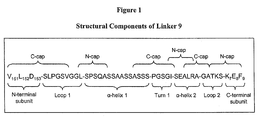
- Fig. 1 is a diagram of the structural components of one embodiment of a linker of the invention (Linker 9) and N-terminal and C-terminal residues of the endonuclease subunits joined by the liner.
- the present invention is based, in part, upon the development of fusion proteins in which a peptide linker covalently joins two heterologous LAGLIDADG meganuclease subunits to form a "single-chain heterodimer meganuclease" in which the subunits function together to preferentially bind to and cleave a non-palindromic DNA recognition site which is a hybrid of the recognition half-sites of the two subunits.
- the invention can be used to genetically engineer single-chain meganucleases which recognize non-palindromic DNA sequences that naturally-occurring meganucleases do not recognize.
- the invention provides exemplary peptide linker sequences for joining LAGLIDADG subunits into single polypeptides.
- the invention provides a general method for the production of linker sequences and the selection of fusion points for linking different LAGLIDADG subunits to produce functional rationally-designed single-chain meganucleases.
- a single-chain meganucleases comprising two LAGLIDADG subunits in which the N-terminal subunit is derived from a natural mono-LAGLIDADG meganuclease such as 1-CreI, I-MsoI, or I-CeuI or a variant thereof and the C-terminal subunit is derived from either a mono-LAGLIDADG meganuclease or one of the two domains of a di-LAGLIDADG meganuclease such as I-SceI, I-DmoI, or I-AniI.
- the method is distinct from those described previously ( Epinat et al. (2003), Nucleic Acids Res.
- the method of producing a recombinant single-chain meganuclease includes the use of defined fusion points in the two LAGLIDADG subunits to be joined as well as the use of defined linker sequences to join them into a single polypeptide.
- a set of rules is provided for identifying fusion points not explicitly described herein as well as for producing functional linker sequences that are not explicitly described herein.
- the recombinant single-chain meganucleases resulting from these methods are the recombinant single-chain meganucleases resulting from these methods.
- the term “meganuclease” refers to an endonuclease that binds double-stranded DNA at a recognition sequence that is greater than 12 base pairs in length.
- Naturally-occurring meganucleases can be monomeric (e.g., I-SceI) or dimeric (e.g., I-CreI).
- the term meganuclease, as used herein, can be used to refer to monomeric meganucleases, dimeric meganucleases, to the monomers which associate to form a dimeric meganuclease, or to a recombinant single-chain meganuclease of the invention.
- the term “homing endonuclease” is synonymous with the term “meganuclease.”
- LAGLIDADG meganuclease refers either to meganucleases including a single LAGLIDADG motif, which are naturally dimeric, or to meganucleases including two LAGLIDADG motifs, which are naturally monomeric.
- mono-LAGLIDADG meganuclease is used herein to refer to meganucleases including a single LAGLIDADG motif
- di-LAGLIDADG meganuclease is used herein to refer to meganucleases including two LAGLIDADG motifs, when it is necessary to distinguish between the two.
- LAGLIDADG Each of the two structural domains of a di-LAGLIDADG meganuclease which includes a LAGLIDADG motif and has enzymatic activity, and each of the individual monomers of a mono-LAGLIDADG meganuclease, can be referred to as a LAGLIDADG subunit, or simply "subunit".
- end refers to the C-terminus and “beginning” refers to the N-terminus.
- beginning of the LAGLIDADG motif refers to the N-terminal-most amino acid in the peptide sequence comprising the LAGLIDADG motif
- end of the LAGLIDADG motif refers to the C-terminal-most amino acid in the peptide sequence comprising the LAGLIDADG motif.
- rationally-designed means non-naturally-occurring and/or genetically engineered.
- the rationally-designed meganucleases of the invention differ from wild-type or naturally-occurring meganucleases in their amino acid sequence or primary structure, and may also differ in their secondary, tertiary or quaternary structure.
- the rationally-designed meganucleases of the invention also differ from wild-type or naturally-occurring meganucleases in recognition sequence-specificity and/or activity.
- the term “recombinant” means having an altered amino acid sequence as a result of the application of genetic engineering techniques to nucleic acids which encode the protein, and cells or organisms which express the protein.
- nucleic acid means having an altered nucleic acid sequence as a result of the application of genetic engineering techniques.
- Genetic engineering techniques include, but are not limited to, PCR and DNA cloning technologies; transfection, transformation and other gene transfer technologies; homologous recombination; site-directed mutagenesis; and gene fusion.
- a protein having an amino acid sequence identical to a naturally-occurring protein, but produced by cloning and expression in a heterologous host is not considered recombinant.
- modification means any insertion, deletion or substitution of an amino acid residue in the recombinant sequence relative to a reference sequence (e.g., a wild-type).
- the term “genetically-modified” refers to a cell or organism in which, or in an ancestor of which, a genomic DNA sequence has been deliberately modified by recombinant technology. As used herein, the term “genetically-modified” encompasses the term "transgenic.”
- wild-type refers to any naturally-occurring form of a meganuclease.
- wild-type is not intended to mean the most common allelic variant of the enzyme in nature but, rather, any allelic variant found in nature. Wild-type meganucleases are distinguished from recombinant or non-naturally-occurring meganucleases.
- the term "recognition sequence half-site” or simply “half site” means a nucleic acid sequence in a double-stranded DNA molecule which is recognized by a monomer of a mono-LAGLIDADG meganuclease or by one LAGLIDADG subunit of a di-LAGLIDADG meganuclease.
- the term "recognition sequence” refers to a pair of half-sites which is bound and cleaved by either a mono-LAGLIDADG meganuclease dimer or a di-LAGLIDADG meganuclease monomer.
- the two half-sites may or may not be separated by base pairs that are not specifically recognized by the enzyme.
- the recognition sequence half-site of each monomer spans 9 base pairs, and the two half-sites are separated by four base pairs which are not contacted directly by binding of the enzyme but which constitute the actual cleavage site (which has a 4 base pair overhang).
- the combined recognition sequences of the I-CreI, I-MsoI and I-CeuI meganuclease dimers normally span 22 base pairs, including two 9 base pair half-sites flanking a 4 base pair cleavage site.
- the recognition sequence is an approximately 18 bp non-palindromic sequence, and there are no central base pairs which are not specifically recognized.
- one of the two strands is referred to as the "sense" strand and the other the "antisense” strand, although neither strand may encode protein.
- the term "specificity" means the ability of a meganuclease to recognize and cleave double-stranded DNA molecules only at a particular sequence of base pairs referred to as the recognition sequence, or only at a particular set of recognition sequences.
- the set of recognition sequences will share certain conserved positions or sequence motifs, but may be degenerate at one or more positions.
- a highly-specific meganuclease is capable of cleaving only one or a very few recognition sequences. Specificity can be determined in a cleavage assay as described in Example 1.
- a meganuclease has "altered" specificity if it binds to and cleaves a recognition sequence which is not bound to and cleaved by a reference meganuclease (e.g., a wild-type) under physiological conditions, or if the rate of cleavage of a recognition sequence is increased or decreased by a biologically significant amount (e.g., at least 2x, or 2x-10x) relative to a reference meganuclease.
- a reference meganuclease e.g., a wild-type
- palindromic refers to a recognition sequence consisting of inverted repeats of identical half-sites. However, the palindromic sequence need not be palindromic with respect to the central base pairs which are not directly contacted by binding of the enzyme (e.g., the four central base pairs of an I-CreI recognition site). In the case of naturally-occurring dimeric meganucleases, palindromic DNA sequences are recognized by homodimers in which the two monomers make contacts with identical half-sites.
- the term "pseudo-palindromic” refers to a recognition sequence consisting of inverted repeats of non-identical or imperfectly palindromic half-sites. In addition to central base pairs that are not directly contacted by binding of the enzyme, the pseudo-palindromic sequence can deviate from a palindromic sequence between the two recognition half-sites at 1-3 base pairs at each of the two half-sites.
- Pseudo-palindromic DNA sequences are typical of the natural DNA sites recognized by wild-type homodimeric meganucleases in which two identical enzyme monomers make contacts with slightly different half-sites.
- non-palindromic refers to a recognition sequence composed of two unrelated half-sites of a meganuclease.
- the non-palindromic sequence need not be palindromic with respect to either the central base pairs or 4 or more base pairs at each of the two half-sites.
- Non-palindromic DNA sequences are recognized by either di-LAGLIDADG meganucleases, highly degenerate mono-LAGLIDADG meganucleases (e.g., I-CeuI) or by heterodimers of mono-LAGLIDADG meganuclease monomers that recognize non-identical half-sites.
- a non-palindromic recognition sequence may be referred to as a "hybrid sequence" because the heterodimer of two different mono-LAGLIDADG monomers, whether or not they are fused into a single polypeptide, will cleave a recognition sequence comprising one half-site recognized by each monomer.
- the heterodimer recognition sequence is a hybrid of the two homodimer recognition sequences.
- linker refers to an exogenous peptide sequence used to join two LAGLIDADG subunits into a single polypeptide.
- a linker may have a sequence that is found in natural proteins, or may be an artificial sequence that is not found in any natural protein.
- a linker may be flexible and lacking in secondary structure or may have a propensity to form a specific three-dimensional structure under physiological conditions.
- fusion point refers to the junction between a LAGLIDADG subunit and a linker. Specifically, the "N-terminal fusion point” is the last (C-terminal-most) amino acid of the N-terminal LAGLIDADG subunit prior to the linker sequence and the “C-terminal fusion point” is the first (N-terminal-most) amino acid of the C-terminal LAGLIDADG subunit following the linker sequence.
- single-chain meganuclease refers to a polypeptide comprising a pair of LAGLIDADG subunits joined by a linker.
- a single-chain meganuclease has the organization: N-terminal subunit - Linker - C-terminal subunit.
- a single-chain meganuclease is distinguished from a natural di-LAGLIDADG meganuclease in that the N-terminal subunit must be derived from a mono-LAGLIDADG meganuclease and, therefore, the linker must be exogenous to the N-terminal subunit.
- homologous recombination refers to the natural, cellular process in which a double-stranded DNA-break is repaired using a homologous DNA sequence as the repair template (see, e.g., Cahill et al. (2006), Front. Biosci. 11:1958-1976 ).
- the homologous DNA sequence may be an endogenous chromosomal sequence or an exogenous nucleic acid that was delivered to the cell.
- a rationally-designed meganuclease is used to cleave a recognition sequence within a target sequence and an exogenous nucleic acid with homology to or substantial sequence similarity with the target sequence is delivered into the cell and used as a template for repair by homologous recombination.
- the DNA sequence of the exogenous nucleic acid which may differ significantly from the target sequence, is thereby incorporated into the chromosomal sequence.
- the process of homologous recombination occurs primarily in eukaryotic organisms.
- the term "homology” is used herein as equivalent to "sequence similarity" and is not intended to require identity by descent or phylogenetic relatedness.
- non-homologous end-joining refers to the natural, cellular process in which a double-stranded DNA-break is repaired by the direct joining of two non-homologous DNA segments (see, e.g. Cahill et al. (2006), Front. Biosci. 11:1958-1976 ). DNA repair by non-homologous end-joining is error-prone and frequently results in the untemplated addition or deletion of DNA sequences at the site of repair.
- a rationally-designed meganuclease can be used to produce a double-stranded break at a meganuclease recognition sequence within a target sequence to disrupt a gene (e.g.
- an exogenous nucleic acid lacking homology to or substantial sequence similarity with the target sequence may be captured at the site of a meganuclease-stimulated double-stranded DNA break by non-homologous end-joining (see, e.g., Salomon et al. (1998), EMBD J. 17:6086-6095 ).
- the process of non-homologous end-joining occurs in both eukaryotes and prokaryotes such as bacteria.
- sequence of interest means any nucleic acid sequence, whether it codes for a protein, RNA, or regulatory element (e.g ., an enhancer, silencer, or promoter sequence), that can be inserted into a genome or used to replace a genomic DNA sequence using a meganuclease protein.
- Sequences of interest can have heterologous DNA sequences that allow for tagging a protein or RNA that is expressed from the sequence of interest.
- a protein can be tagged with tags including, but not limited to, an epitope (e.g., c-myc, FLAG) or other ligand (e.g., poly-His).
- a sequence of interest can encode a fusion protein, according to techniques known in the art (see, e.g., Ausubel et al., Current Protocols in Molecular Biology, Wiley 1999 ).
- the sequence of interest is flanked by a DNA sequence that is recognized by the recombinant meganuclease for cleavage.
- the flanking sequences are cleaved allowing for proper insertion of the sequence of interest into genomic recognition sequences cleaved by the recombinant meganuclease.
- the entire sequence of interest is homologous to or has substantial sequence similarity with a target sequence in the genome such that homologous recombination effectively replaces the target sequence with the sequence of interest.
- the sequence of interest is flanked by DNA sequences with homology to or substantial sequence similarity with the target sequence such that homologous recombination inserts the sequence of interest within the genome at the locus of the target sequence.
- the sequence of interest is substantially identical to the target sequence except for mutations or other modifications in the meganuclease recognition sequence such that the meganuclease can not cleave the target sequence after it has been modified by the sequence of interest.
- percentage similarity and “sequence similarity” refer to a measure of the degree of similarity of two sequences based upon an alignment of the sequences which maximizes similarity between aligned amino acid residues or nucleotides, and which is a function of the number of identical or similar residues or nucleotides, the number of total residues or nucleotides, and the presence and length of gaps in the sequence alignment.
- a variety of algorithms and computer programs are available for determining sequence similarity using standard parameters.
- sequence similarity is measured using the BLASTp program for amino acid sequences and the BLASTn program for nucleic acid sequences, both of which are available through the National Center for Biotechnology Information (www.ncbi.nlm.nih.gov/), and are described in, for example, Altschul et al. (1990), J. Mol. Biol. 215:403 -410 ; Gish and States (1993), Nature Genet. 3:266-272 ; Madden et al. (1996), Meth. Enzymol. 266:131-141 ; Altschul et al. (1997), Nucleic Acids Res. 25:33 89-3402 ); Zhang et al. (2000), J. Comput. Biol.
- the term "corresponding to” is used to indicate that a specified modification in the first protein is a substitution of the same amino acid residue as in the modification in the second protein, and that the amino acid position of the modification in the first proteins corresponds to or aligns with the amino acid position of the modification in the second protein when the two proteins are subjected to standard sequence alignments (e.g., using the BLASTp program).
- the modification of residue "X” to amino acid "A” in the first protein will correspond to the modification of residue "Y” to amino acid "A” in the second protein if residues X and Y correspond to each other in a sequence alignment, and despite the fact that X and Y may be different numbers.
- variable As used herein, the recitation of a numerical range for a variable is intended to convey that the invention may be practiced with the variable equal to any of the values within that range. Thus, for a variable which is inherently discrete, the variable can be equal to any integer value within the numerical range, including the end-points of the range. Similarly, for a variable which is inherently continuous, the variable can be equal to any real value within the numerical range, including the end-points of the range.
- a variable which is described as having values between 0 and 2 can take the values 0, 1 or 2 if the variable is inherently discrete, and can take the values 0.0, 0.1, 0.01, 0.001, or any other real values ⁇ 0 and ⁇ 2 if the variable is inherently continuous.
- a series of truncation mutants were made in which either wild-type I-CreI or an engineered variant of I-CreI which had been altered with respect to its DNA cleavage site preference (designated "CCR2", SEQ ID NO: 31; see WO 2007/047859 ) were terminated prior to the natural C-terminal amino acid, Pro 163 (Table 1).
- the mutant homodimers were expressed in E. coli, purified, and incubated with either the wild-type recognition sequence (SEQ ID NOs: 34-35) or the CCR2 recognition sequence (SEQ ID NOs: 32-33) to test for cleavage activity.
- Wild-type I-CreI was found to be active when truncated at residue 148 or further C-terminal residues, but inactive when truncated at residue 141 or further N-terminal residues. Therefore, at least some of residues 141 through 147, or conservative substitutions of those residues, are required for wild-type activity.
- CCR2 was found to be active when truncated at residue 151 or further C-terminal residues, but inactive when terminated at residue 148 or further N-terminal residues. Therefore, at least some of residues 148 through 150, or conservative substitutions of those residues, are required for CCR2 activity.
- the N-terminal fusion point (i.e., between the N-terminal I-CreI subunit and the linker) should lie at or C-terminal to residue 142 of the N-terminal subunit, including any of positions 142-151, or any position C-terminal to residue 151.
- Residues 154-163 of I-CreI are unstructured ( Jurica et al. (1998), Mol. Cell 2:469-476 ) and, therefore, inclusion of these residues will increase the flexibility and, possibly, structural instability of the resultant single-chain meganuclease.
- fusion points at residues 142-153 can be chosen.
- Residues 7,8 and 9 are of particular interest as C-terminal fusion points in I-CreI because these residues (1) are structurally conserved among LAGLIDADG meganuclease family members and, therefore, may provide greater compatibility in forming heterodimers with other LAGLIDADG family members, and (2) initiate an alpha-helix containing the conserved LAGLIDADG motif that is involved in catalytic function.
- fusion points N-terminal to residue 7, including any of residues 1-6 can also be employed in accordance with the invention.
- I-CreI N-terminal and C-terminal fusion points were chosen for further experimentation, but should not be regarded as limiting the scope of the invention: TABLE 2 I-CreI Fusion Points N-terminal fusion point C-terminal fusion point Val-151 Lys-7 Leu-152 Asp-8 Asp-153 Phe-9
- linker For the purpose of linking a pair of I-CreI monomers into a single polypeptide, two general classes of linker were considered: (1) an unstructured linker lacking secondary structure; and (2) a structured linker having secondary structure.
- unstructured linkers are well known in the art, and include artificial sequences with high Gly and Ser content, or repeats.
- Structured linkers are also well known in the art, and include those designed using basic principles of protein folding ( e.g ., Aurora and Rose (1998), Protein Sci. 7:21-38 ; Fersht, Structure and Mechanism in Protein Science, W.H. Freeman 1998 ).
- LAM1 SEQ ID NO: 36
- LAM2 SEQ ID NO: 37
- LAM1 and LAM2 monomers are merely exemplary of the many monomers which can be employed, including wild-type mono-LAGLIDADG subunits, N-terminally and/or C-terminally truncated wild-type mono-LAGLIDADG subunits, N-terminally and/or C-terminally truncated wild-type di-LAGLIDADG subunits, and rationally designed modifications of any of the foregoing.
- LAM1 One exemplary monomer, LAM1, differs by 7 amino acids from wild-type I-CreI and recognizes the half site:
- the LAM 1 homodimer recognizes the palindromic recognition sequence (where each N is unconstrained):
- LAM2 The other exemplary monomer, LAM2, differs by 5 amino acids from wild-type I-CreI and recognizes the half-site:
- the LAM2 homodimer recognizes the palindromic recognition sequence (where each N is unconstrained):
- a heterodimer comprising one LAM1 monomer and one LAM2 monomer thus recognizes the hybrid recognition sequence:
- peptide linkers comprising repeating Gly-Ser-Ser units are known to be unstructured and flexible ( Fersht, Structure and Mechanism in Protein Science, W.H. Freeman 1998 ). Linkers with this and similar compositions are frequently used to fuse protein domains together ( e.g ., single-chain antibodies ( Mack et al. (1995), Proc. Nat. Acad. Sci. 92:7021-7025 ); growth factor receptors ( Ueda et al. (2000), J. Immunol. Methods 241:159-170 ); enzymes (Brodelius et al. (2002), 269:3570-3577); and DNA-binding and nuclease domains ( Kim et al. (1996), Proc. Nat. Acad. Sci. 93:1156-1160 ).
- the flexible linker can include any polypeptide sequence which does not form stable secondary structures under physiological conditions.
- the linkers include a high percentage (e . g ., > 50%, 60%, 70%, 80% or 90%, or generally, 50%-100%) of polar uncharged residues (i.e., Gly, Ser, Cys, Asn, Gln, Tyr, Thr).
- the linkers include a low percentage of large hydrophobic residues (i.e., Phe, Trp, Met).
- the linkers may include repeats of varying lengths ( e.g ., (SG) n , (GSS) n , (SGGS) n ), may include random sequences, or may include combinations of the two.
- a set of single-chain fusions between LAM1 and LAM2 were produced in which a highly-flexible peptide linker covalently joined the N-terminal (LAM1) subunit to the C-terminal (LAM2) subunit using Val-151 or Asp-153 as the N-terminal fusion point and Phe-9 as the C-terminal fusion point.
- the single-chain proteins were expressed in E. coli, purified, and tested for the ability to cleave a hybrid DNA site comprising one LAM1 half-site and one LAM2 half-site (SEQ ID NOs: 46 and 47).
- Cleavage activity was rated on a four point scale: - no detectable activity; + minimal activity; ++ medium activity; +++ activity comparable to the LAM1/LAM2 heterodimer produced by co-expression of the two monomers in E. coli prior to endonuclease purification.
- the proteins were also evaluated by SDS-PAGE to determine the extent to which the linker region was proteolyzed during expression or purification to release the two subunits.
- Linkers 3, 6, 7, and 8, comprising 28, 29, 30, and 28 amino acids, respectively, all exhibited low levels of cleavage activity. SDS-PAGE indicated that a small amount (5%-10%) of each was proteolyzed into individual subunits while the majority had a molecular weight corresponding to the full-length single-chain meganuclease ( ⁇ 40 kilodaltons). Numbers 3 and 8 have the same linker sequence but N-terminal fusion points at Val-151 and Asp-153, respectively. Both single-chain meganucleases exhibited comparable levels of activity, indicating that the precise fusion point is not critical in this instance.
- linkers 4 and 5 comprising 31 and 34 amino acids, respectively, yielded no detectable single-chain meganuclease when purified from E. coli. These linkers were completely proteolyzed to the individual LAM1 and/or LAM2 subunits as detected by SDS-PAGE and, therefore, the cleavage activity of these meganucleases was not investigated further.
- fusions points on the acceptable linker lengths can be determined empirically by routine experimentation and/or predicted based upon three-dimensional modeling of the protein structures. Significantly, as a fusion point is moved either N-terminally or C-terminally, it may move either closer or farther from the other fusion point depending upon the secondary and tertiary structure of the protein near the fusion point.
- moving the N-terminal fusion point in the C-terminal direction does not necessarily result in the N-terminal fusion point being physically closer to the C-terminal fusion point because, for example, the N-terminal residues in that region may be part of a secondary/tertiary structure that is pointing either towards or away from the C-terminal fusion point.
- moving an N-terminal fusion point in either the N-terminal or C-terminal direction, or moving a C-terminal fusion point in either the N-terminal or C-terminal direction can result in a shift in the range of acceptable linker lengths toward either longer or shorter linkers. That shift, however, is readily determined, as shown by the experiments reported herein, by routine experimentation and/or three-dimensional modeling.
- useful flexible linkers have lengths of greater than 25 residues and less than 31 residues (including all values in between), as shown in Table 3 for a single-chain meganuclease based on two I-CreI LAGLIDADG subunits.
- useful flexible linkers can have lengths greater than 15 and less than 40 residues (including all values in between), provided that the linkers are not extensively proteolyzed and that the single-chain meganuclease retains DNA-binding and cleavage activity as determined by the simple assays described herein.
- linkers having stable secondary structures can be used to covalently join subunits.
- a search of the Protein Databank did not reveal any structurally-characterized LAGLIDADG proteins with linkers suitable for spanning the great distance (approx. 48 ⁇ ) between the identified N-and C-terminal fusion points in I-CreI. Therefore, known first principles governing protein structure (e.g., Aurora and Rose (1998), Protein Sci. 7:21-38 ; Fersht, Structure and Mechanism in Protein Science, W.H.
- a suitable linker would comprise (listed from N-terminal fusion point to C-terminal fusion point): (1) Loop 1. This structural element starts at the N-terminal fusion point and reverses the direction of the peptide chain back on itself (a 180° turn).
- the sequence can be 3-8 amino acids and can include at least one glycine residue or, in some embodiments, 2-3 glycines.
- This structural element can be stabilized by introducing a "C-capping" motif to terminate the C-terminal ⁇ -helix of I-CreI and initiate the subsequent turn.
- the helix cap motif is typically described as beginning with a hydrophobic amino acid in the final turn of the helix ( Aurora and Rose (1998), Protein Sci. 7:21-38 ).
- Thr appears in both groups h and p because its side chain has both hydrophobic (methyl group) and polar (hydroxyl) functional groups.
- the hyphen designates the end of the ⁇ -helix and h 1 is a hydrophobic amino acid in the final turn of the helix ( i.e ., a hydrophobic amino acid 0-4 amino acids prior to the N-terminal fusion point).
- h 1 is typically Val-151 or Leu-152.
- an example of motif 7 is the sequence V 151 L 152 D 153 S-PGSV (see, for example, Table 6, Linker 9).
- this first ⁇ -helix in the linker is designed to run anti-parallel to the C-terminal helix in I-CreI (amino acids 144-153) on the outside face of the protein for a distance of approximately 30 ⁇ .
- This segment should be 10-20 amino acids in length, should not contain any glycine or proline amino acids outside of the N- and C-capping motifs (below), and alternate hydrophobic and polar amino acids with 3-4 amino acid periodicity so as to bury one face of the helix (the hydrophobic face) against the surface of the N-terminal I-CreI subunit while exposing the other face to solvent.
- the helix could, for example, take the form pphpphhpphpp where p is any polar amino acid and h is any hydrophobic amino acid but neither is glycine or proline such as the sequence SQASSAASSASS (see, for example, Table 6, Linker 9).
- a peptide sequence e.g ., BMERC-PSA, http://bmerc-www.bu.edu/psa/; NNPREDICT, http://alexander.compbio.ucsf.edu/ ⁇ nomi/nnpredict.html; PredictProtein, http://www.predictprotein.org
- this helix sequence could be derived from a peptide sequence known to adopt ⁇ -helical secondary structure in an existing natural or designed protein.
- N-capping motif spans the loop - ⁇ -helix junction and typically has one of the forms shown in Table 5: TABLE 5 N-capping Motifs Number Motif 1 h-xpxhx 2 h-xxpph 3 hp-xpxhx 4 hp-xxpph 5 hpp-xpxhx 6 hpp-xxpph where the designations are as in Table 4 above and the hyphen represents the junction between the loop and the helix.
- motif number 2 is the sequence L-SPSQA (see, for example, Table 6, Linker 9).
- (3) Turn 1 Following ⁇ -helix 1, a short, flexible peptide sequence is introduced to turn the overall orientation of the peptide chain by approximately 90° relative to the orientation of ⁇ -helix 1.
- This sequence can be 3-8 amino acids in length and can contain 1 or, in some embodiments, 2-3 glycines.
- This sequence can also contain a C-cap such as one of the motifs in Table 4 to stabilize ⁇ -helix 1 and initiate the turn.
- An example is the sequence ASSS-PGSGI (see, for example, Table 6, Linker 9) which conforms to C-capping motif number 6.
- sequence ASSS is the final turn of ⁇ -helix 1 while the sequence PGSGI is Turn 1.
- ⁇ -helix 2 This helix follows Turn 1 and is designed to lie at the surface of I-CreI in a groove created at the interface between the LAGLIDADG subunits. The surface of this groove comprises primarily amino acids 94-100 and 134-139 of the N-terminal subunit and amino acids 48-61 of the C-terminal subunit.
- ⁇ -helix 2 can be designed to be shorter than ⁇ -helix 1 and can comprise 1-3 turns of the helix (4-12 amino acids).
- ⁇ -helix 2 can have the same overall amino acid composition as ⁇ -helix 1 and can also be stabilized by the addition of an N-capping motif of Table 5.
- the sequence I-SEALR is an example (see, for example, Table 6, Linker 9) that conforms to N-capping motif number 1.
- Linker 9 incorporates a relatively short ⁇ -helix 2 comprising the sequence SEALRA which is expected to make approximately two turns. Experiments with different linker ⁇ -helix 2 sequences have demonstrated the importance of helical register in this region of the linker.
- This loop terminates ⁇ -helix 2 and turns the peptide chain back on itself to join with the C-terminal I-CreI subunit at the C-terminal fusion point.
- this sequence can be 3-8 amino acids in length and can contain one or more glycines. It can also contain a C-capping motif from Table 4 to stabilize ⁇ -helix 2.
- the sequence ALRA-GA from Linker 9 conforms to C-capping motif number 1.
- this segment can begin an N-cap on the N-terminal ⁇ -helix (amino acids 7-20) of the C-terminal I-CreI subunit.
- sequence T-KSK 7 E 8 F 9 from Linker 9 conforms to N-capping motif number 2.
- the C-terminal fusion point is Lys-7.
- the fusion point can be moved further into the second subunit (for example to amino acids 8 or 9), optionally with the addition of 1-2 amino acids to Loop 2 to compensate for the change in helical register as the C-terminal fusion point is moved.
- linkers 15-23 in Table 6 below have Glu-8 as the C-terminal fusion point and all have an additional amino acid in Loop 2 relative to Linkers 1-6.
- the single-chain LAM meganuclease could be stored at 4°C in excess of 4 weeks without any evidence of degradation or loss of cleavage activity.
- a number of single-chain LAM endonucleases (9, 10, and 14) cleaved the hybrid LAM1/LAM2 recognition sequence with efficiency comparable to the purified LAM1/LAM2 heterodimer, indicating that fusing I-CreI subunits using these linkers does not significantly impair endonuclease activity (see Example 2).
- the single-chain LAM meganucleases incorporating the linkers in Table 6 cleave the hybrid site much more efficiently than either of the palindromic sequences (see Example 2).
- the palindromic sequences are typically cut with ⁇ 5% efficiency relative to the hybrid site.
- This unintended cleavage of the palindromic DNA sites could be due to (1) homo-dimerization of LAM1 or LAM2 subunits from a pair of different single-chain proteins, (2) sequential nicking of both strands of the palindromic sequence by a single subunit (LAM1 or LAM2) within the single-chain meganuclease, or (3) minute amounts of homodimeric LAM1 or LAM2 that form following proteolytic cleavage of the single-chain meganuclease into its individual subunits (although SDS-PAGE results make this latter explanation unlikely).
- the single-chain I-CreI meganucleases maintain some activity toward palindromic DNA sites, the activity is so disproportionately skewed in favor of the hybrid site that this approach represents a very significant improvement over existing methods.
- I-MsoI is a close structural homolog of I-CreI and similar methods have been presented for redesigning the DNA-binding specificity of this meganuclease ( WO 2007/047859 ).
- the method presented above for the production of a single-chain I-CreI meganuclease can be directly applied to I-MsoI.
- Amino acids Phe-160, Leu-161, and Lys-162 of I-MsoI are structurally homologous to, respectively, Val-151, Leu-152, and Asp-153 of I-CreI. These amino acids, therefore, can be selected as the N-terminal fusion points for I-MsoI.
- I-MsoI The X-ray crystal structure of I-MsoI reveals that amino acids 161-166 naturally act as a C-cap and initiate a turn at the C-terminus of the protein which reverses the direction of the peptide chain.
- Ile-66 can be selected as the N-terminal fusion point provided that the linker is shortened at its N-terminus to remove the C-cap portion of Loop 1.
- Pro-9, Thr-10, and Glu-11 of I-MsoI are structurally homologous to, respectively, Lys-7, Glu-8, and Phe-9 of I-CreI and can be selected as C-terminal fusion points for I-MsoI (Table 7).
- Linker 9 from Table 6 may be used to join a pair of I-MsoI subunits into a functional single-chain meganuclease using Lys-162 and Pro-9 as fusion points.
- Pro-9 is changed to a different amino acid (e.g., alanine or glycine) because proline is structurally constraining. This is analogous to selecting Thr-10 as the C-terminal fusion point and adding an additional amino acid to the C-terminus of the linkers listed in Tables 3 or 6.
- Linkers 26 and 27 from Table 8 are identical to Linker 9 from Table 6 except for the addition of a single amino acid at the C-terminus to account for a change in C-terminal fusion point from Pro-9 (structurally homologous to I-CreI Lys-7) to Thr-10 (structurally homologous to I-CreI Glu-8).
- a single-chain meganuclease derived from I-Mso can also be successfully produced using a linker sequence selected from Linker 28-30 from Table 8 in which I-166 is selected as the N-terminal fusion point and Leu-7 is selected as the C-terminal fusion point. Because I-166 is selected as the N-terminal fusion point, the C-cap portion of Loop 1 (corresponding to the first 6 amino acids of each of the linkers from Table 6) can be removed. In addition, ⁇ -helix 1 of Linkers 28-30 are lengthened by 3 amino acids (AAS, underlined in Table 8) relative to the linkers listed in Table 6, corresponding to one additional turn of the helix.
- AAS underlined in Table 8
- I-CeuI is a close structural homolog of I-CreI and similar methods have been presented for redesigning the DNA-binding specificity of this meganuclease ( WO 2007/047859 ).
- the method presented above for the production of a single-chain I-CreI meganuclease can be directly applied to I-CeuI.
- Amino acids Ala-210, Arg-211, and Asn-212 ofI-CeuI are structurally homologous to, respectively, Val-151, Leu-152, and Asp-153 of I-CreI. These amino acids, therefore, can be selected as the N-terminal fusion points for I-CeuI.
- Ser-53, Glu-54, and Ser-55 of I-CeuI are structurally homologous to, respectively, Lys-7, Glu-8, and Phe-9 of I-CreI and can be selected as C-terminal fusion points for I-CeuI (Table 9). TABLE 9 I-CeuI Fusion Points N-terminal fusion points C-terminal fusion points Ala-210 Ser-53 Arg-211 Glu-54 Asn-212 Ser-55
- linkers in Tables 3 or 6 can be effective for the production of single-chain I-CeuI endonucleases.
- I-CeuI subunits can be joined by Linker 9 from Table 6 using Asn-212 as the N-terminal fusion point and Ser-53 as the C-terminal fusion point.
- the C-terminal fusion points selected for I-CeuI result in the removal of amino acids 1-52 from the C-terminal I-CeuI subunit.
- Structural analyses reveal that these amino acids form a structured domain that rests on the surface ofI-CeuI and buries a substantial amount of hydrophobic surface area contributed by amino acids 94-123. It is possible, therefore, that removing this N-terminal domain will destabilize the C-terminal I-CeuI subunit in the single-chain meganuclease.
- hydrophobic amino acids that would be exposed by the removal of this N-terminal domain can be mutated to polar amino acids (e.g., non- ⁇ -branched, hydrophobic amino acids can be mutated to Ser while ⁇ -branched, hydrophobic amino acids can be mutated to Thr).
- polar amino acids e.g., non- ⁇ -branched, hydrophobic amino acids can be mutated to Ser while ⁇ -branched, hydrophobic amino acids can be mutated to Thr.
- Leu-101, Tyr-102, Leu-105, Ala-121, and Leu-123 can be mutated to Ser while Val-95, Val-98, and Ile-113 can be mutated to Thr.
- the N-terminal domain of the C-terminal I-CeuI subunit can be left largely intact and joined to the N-terminal subunit via a truncated linker.
- This can be accomplished using Lys-7, Pro-8, Gly-9, or Glu-10 as a C-terminal fusion point.
- the linker can be a flexible Gly-Ser linker (e.g ., Linker 3 from Table 3) truncated by approximately 50% of its length ( i.e., (GSS) 4 G or (GSS) 5 G).
- the linker can be any of the linkers from Table 6 truncated within Turn 1.
- Linker 9 from Table 6 as an example, a single-chain I-CeuI meganuclease can be made with the following composition:
- This invention also enables the production of single-chain meganucleases in which each of the subunits is derived from a different natural LAGLIDADG domain.
- "Different,” as used in this description refers to LAGLIDADG subunits that are not derived from the same natural LAGLIDADG family member.
- rationally-designed LAGLIDADG subunits from the same family member e.g., two I-CreI subunits that have been genetically engineered with respect to DNA cleavage specificity
- the invention enables the production of single-chain meganucleases comprising an N-terminal subunit derived from a mono-LAGLIDADG meganuclease (e.g ., I-CreI, I-MsoI, or I-CeuI) linked to a C-terminal subunit derived from a different mono-LAGLIDADG meganuclease or either of the two LAGLIDADG domains from a di-LAGLIDADG meganuclease.
- a mono-LAGLIDADG meganuclease e.g ., I-CreI, I-MsoI, or I-CeuI
- a single-chain meganuclease can be produced comprising an N-terminal I-CreI subunit, which may or may not have been rationally-designed with regard to DNA recognition site specificity, linked to a C-terminal I-MsoI subunit which also may or may not have been rationally-designed with regard to DNA recognition site specificity.
- I-CreI, I-MsoI, and I-CeuI the desirable fusion points and linkers are as described above.
- a single-chain I-CreI to I-MsoI fusion can be produced using Linker 9 from Table 6 to join I-CreI Asp-153 to I-MsoI Thr-10.
- Table 9 lists potential C-terminal fusion points for individual LAGLIDADG domains from the di-LAGLIDADG meganucleases I-SceI, I-DmoI, and I-AniI.
- Fusion points can also be identified in LAGLIDADG subunits which have not been structurally characterized using protein sequence alignments to I-CreI. This is particularly true of C-terminal fusion points which can be readily identified in any LAGLIDADG subunit based upon the location of the conserved LAGLIDADG motif.
- the amino acids which are 4-6 residues N-terminal of the start of the LAGLIDADG motif are acceptable C-terminal fusion points.
- the subunits may not associate into functional "heterodimers" despite being covalently joined as a single polypeptide.
- the interface between the two subunits can be rationally-designed, as described in WO 2007/047859 . At its simplest, this involves substituting interface residues from one subunit onto another.
- I-CreI and I-MsoI differ in the interface region primarily at I-CreI Glu-8 (which is a Thr in the homologous position of I-MsoI, amino acid 10) and Leu-11 (which is an Ala in the homologous position of I-MsoI, amino acid 13).
- I-CreI and I-MsoI subunits can be made to interact effectively by changing Glu-8 and Leu-11 of the I-CreI subunit to Thr and Ala, respectively, or by changing Thr-10 and Ala-13 of the I-MsoI subunit to Glu and Leu, respectively.
- a single-chain meganuclease comprising an N-terminal subunit derived from I-CreI and a C-terminal subunit derived from the N-terminal LAGALIDADG domain of I-DmoI can be produced by (1) selecting an N-terminal fusion point in I-CreI from Table 2, (2) selecting a C-terminal fusion point in I-DmoI from Table 10, (3) selecting a linker from Table 6 (or designing a similar linker based on the rules provided), and (4) incorporating the mutations L11A, F16I, K96N, and L97F into the I-CreI subunit and the mutations I19W, H51F, and L55R into the I-DmoI subunit as proposed by Chevalier et al.
- empirical methods such as directed evolution can be used to engineer the interface between two different LAGLIDADG subunits.
- genetic libraries can be produced in which specific amino acids in the subunit interface are randomized, and library members which permit the interaction between the two subunits are screened experimentally.
- screening methods are known in the art (e.g., Sussman et al. (2004), J. Mol. Biol. 342: 31-41 ; Chames et al. (2005), Nucl. Acids Res. 33: e178 ; Seligman et al. (2002), Nucl. Acids Res. 30: 3870-9 , Arnould et al. (2006), J. Mol. Biol. 355: 443-58 ) and can be conducted to test for the ability of a single-chain meganuclease comprising two different LAGLIDADG subunits to cleave a hybrid DNA site within a yeast or bacterial cell.
- the invention can be used to produce single-chain meganucleases comprising individual LAGLIDADG subunits that have been genetically-engineered with respect to DNA-cleavage specificity using a variety of methods.
- Such methods include rational-design (e.g., WO 2007/047859 ), computational design ( e.g., Ashworth et al. (2006), Nature 441:656-659 ), and genetic selection ( Sussman et al. (2004), J. Mol. Biol. 342: 31-41 ; Chames et al. (2005), Nucl. Acids Res. 33: e178 ; Seligman et al. (2002), Nucl. Acids Res. 30: 3870-9 , Arnould et al.
- Such meganucleases can be targeted to DNA sites that differ from the sites recognized by wild-type meganucleases.
- the invention can also be used to join LAGLIDADG subunits that have been rationally-designed to have altered activity (e.g., WO 2007/047859 ; Arnould et al. (2007), J. Mol. Biol 371(1):49-65 ) or DNA-binding affinity as described in WO 2007/047859 .
- aspects of the present invention further provide methods for producing recombinant, transgenic or otherwise genetically-modified cells and organisms using single-chain meganucleases.
- recombinant single-chain meganucleases are developed to specifically cause a double-stranded break at a single site or at relatively few sites in the genomic DNA of a cell or an organism to allow for precise insertion(s) of a sequence of interest by homologous recombination.
- recombinant meganucleases are developed to specifically cause a double-stranded break at a single site or at relatively few sites in the genomic DNA of a cell or an organism to either (a) allow for rare insertion(s) of a sequence of interest by non-homologous end-joining or (b) allow for the disruption of the target sequence by non-homologous end-joining.
- insertion means the ligation of a sequence of interest into a chromosome such that the sequence of interest is integrated into the chromosome.
- an inserted sequence can replace an endogenous sequence, such that the original DNA is replaced by exogenous DNA of equal length, but with an altered nucleotide sequence.
- an inserted sequence can include more or fewer bases than the sequence it replaces.
- the recombinant organisms include, but are not limited to, monocot plant species such as rice, wheat, corn (maize) and rye, and dicot species such as legumes (e.g., kidney beans, soybeans, lentils, peanuts, peas), alfalfa, clover, tobacco and Arabidopsis species.
- the recombinant organisms can include, but are not limited to, animals such as humans and non-human primates, horses, cows, goats, pigs, sheep, dogs, cats, guinea pigs, rats, mice, lizards, fish and insects such as Drosophila species.
- the organism is a fungus such as a Candida, Neurospora or Saccharomyces species.
- the methods of the invention involve the introduction of a sequence of interest into a cell such as a germ cell or stem cell that can become a mature recombinant organism or allow the resultant genetically-modified organism to give rise to progeny carrying the inserted sequence of interest in its genome.
- Meganuclease proteins can be delivered into cells to cleave genomic DNA, which allows for homologous recombination or non-homologous end-joining at the cleavage site with a sequence of interest, by a variety of different mechanisms known in the art.
- the recombinant meganuclease protein can introduced into a cell by techniques including, but not limited to, microinjection or liposome transfections (see, e.g. , LipofectamineTM, Invitrogen Corp., Carlsbad, CA).
- the liposome formulation can be used to facilitate lipid bilayer fusion with a target cell, thereby allowing the contents of the liposome or proteins associated with its surface to be brought into the cell.
- the enzyme can be fused to an appropriate uptake peptide such as that from the HIV TAT protein to direct cellular uptake (see, e.g., Hudecz et al. (2005), Med. Res. Rev. 25: 679-736 ).
- gene sequences encoding the meganuclease protein are inserted into a vector and transfected into a eukaryotic cell using techniques known in the art (see, e.g., Ausubel et. al., Current Protocols in Molecular Biology, Wiley 1999 ).
- the sequence of interest can be introduced in the same vector, a different vector, or by other means known in the art.
- Non-limiting examples of vectors for DNA transfection include virus vectors, plasmids, cosmids, and YAC vectors.
- Transfection of DNA sequences can be accomplished by a variety of methods known to those of skill in the art. For instance, liposomes and immunoliposomes are used to deliver DNA sequences to cells (see, e.g., Lasic et al. (1995), Science 267: 1275-76 ).
- viruses can be utilized to introduce vectors into cells (see, e.g., U.S. Pat. No. 7,037,492 ).
- transfection strategies can be utilized such that the vectors are introduced as naked DNA (see, e.g., Rui et al. (2002), Life Sci. 71(15): 1771-8 ).
- a genetically-modified plant is produced, which contains the sequence of interest inserted into the genome.
- the genetically-modified plant is produced by transfecting the plant cell with DNA sequences corresponding to the recombinant meganuclease and the sequence of interest, which may or may not be flanked by the meganuclease recognition sequences and/or sequences substantially identical to the target sequence.
- the genetically-modified plant is produced by transfecting the plant cell with DNA sequences corresponding to the recombinant meganuclease only, such that cleavage promotes non-homologous end-joining and disrupts the target sequence containing the recognition sequence.
- the meganuclease sequences are under the control of regulatory sequences that allow for expression of the meganuclease in the host plant cells.
- regulatory sequences include, but are not limited to, constitutive plant promoters such as the NOS promoter, chemically-inducible gene promoters such as the dexamethasone-inducible promoter (see, e.g., Gremillon et al. (2004), Plant J. 37:218-228 ), and plant tissue specific promoters such as the LGC1 promoter (see, e.g., Singh et al. (2003), FEBS Lett. 542:47-52 ).
- Suitable methods for introducing DNA into plant cells include virtually any method by which DNA can be introduced into a cell, including but not limited to Agrobacterium infection, PEG-mediated transformation of protoplasts ( Omirulleh et al. (1993), Plant Molecular Biology, 21:415-428 ), desiccation/inhibition-mediated DNA uptake, electroporation, agitation with silicon carbide fibers, ballistic injection or microprojectile bombardment, and the like.
- a genetically-modified animal is produced using a recombinant meganuclease.
- the nucleic acid sequences can be introduced into a germ cell or a cell that will eventually become a transgenic organism.
- the cell is a fertilized egg, and exogenous DNA molecules can be injected into the pro-nucleus of the fertilized egg. The micro-injected eggs are then transferred into the oviducts of pseudopregnant foster mothers and allowed to develop.
- the recombinant meganuclease is expressed in the fertilized egg (e.g ., under the control of a constitutive promoter, such as 3-phosphoglycerate kinase), and facilitates homologous recombination of the sequence of interest into one or a few discrete sites in the genome.
- a constitutive promoter such as 3-phosphoglycerate kinase
- the genetically-modified animals can be obtained by utilizing recombinant embryonic stem (“ES”) cells for the generation of the transgenics, as described by Gossler et al. (1986), Pro. Natl. Acad. Sci. USA 83:9065 9069 .
- a recombinant mammalian expression vector is capable of directing tissue-specific expression of the nucleic acid preferentially in a particular cell type.
- Tissue-specific regulatory elements are known in the art.
- suitable tissue-specific promoters include the albumin promoter (liver-specific; Pinkert et al. (1987), Genes Dev. 1: 268-277 ), lymphoid-specific promoters ( Calame and Eaton (1988), Adv. Immunol. 43: 235-275 ), in particular promoters of T cell receptors ( Winoto and Baltimore (1989), EMBO J. 8: 729-733 ) and immunoglobulins ( Banerji et al.
- neuron-specific promoters e. g., the neurofilament promoter; Byrne and Ruddle (1989), Proc. Natl. Acad. Sci. USA 86: 5473-5477 ), pancreas-specific promoters ( Edlund et al. (1985), Science 230: 912-916 ), and mammary gland-specific promoters (e.g., milk whey promoter; U.S. Pat. No. 4,873,316 and European Pat. Pub. EP 0 264 166 ).
- mammary gland-specific promoters e.g., milk whey promoter; U.S. Pat. No. 4,873,316 and European Pat. Pub. EP 0 264 166 .
- promoters are also encompassed, e.g ., the murine hox promoters ( Kessel and Gruss (1990), Science 249: 374-379 ) and the ⁇ -fetoprotein promoter ( Campes and Tilghman (1989), Genes Dev. 3: 537-546 ).
- a single-chain meganuclease may be tagged with a peptide epitope (e.g., an HA, FLAG, or Myc epitope) to monitor expression levels or localization.
- the meganuclease may be fused to a sub-cellular localization signal such as a nuclear-localization signal (e.g ., the nuclear localization signal from SV40) or chloroplast or mitochondrial localization signals.
- the meganuclease may be fused to a nuclear export signal to localize it to the cytoplasm.
- the meganuclease may also be fused to an unrelated protein or protein domain such as a protein that stimulates DNA-repair or homologous recombination (e.g., recA, RAD51, RAD52, RAD54, RAD57 or BRCA2).
- a protein that stimulates DNA-repair or homologous recombination e.g., recA, RAD51, RAD52, RAD54, RAD57 or BRCA2.
- gene therapy means therapeutic treatments that comprise introducing into a patient a functional copy of at least one gene, or gene regulatory sequence such as a promoter, enhancer, or silencer to replace a gene or gene regulatory region that is defective in its structure and/or function.
- gene therapy can also refer to modifications made to a deleterious gene or regulatory element (e.g., oncogenes) that reduce or eliminate expression of the gene.
- Gene therapy can be performed to treat congenital conditions, conditions resulting from mutations or damage to specific genetic loci over the life of the patient, or conditions resulting from infectious organisms.
- dysfunctional genes are replaced or disabled by the insertion of exogenous nucleic acid sequences into a region of the genome affecting gene expression.
- the recombinant meganuclease is targeted to a particular sequence in the region of the genome to be modified so as to alleviate the condition.
- the sequence can be a region within an exon, intron, promoter, or other regulatory region that is causing dysfunctional expression of the gene.
- disfunctional expression means aberrant expression of a gene product either by the cell producing too little of the gene product, too much of the gene product, or producing a gene product that has a different function such as lacking the necessary function or having more than the necessary function.
- Exogenous nucleic acid sequences inserted into the modified region can be used to provide "repaired" sequences that normalize the gene. Gene repair can be accomplished by the introduction of proper gene sequences into the gene allowing for proper function to be reestablished.
- the nucleic acid sequence to be inserted can be the entire coding sequence for a protein or, in certain embodiments, a fragment of the gene comprising only the region to be repaired.
- the nucleic acid sequence to be inserted comprises a promoter sequence or other regulatory elements such that mutations causing abnormal expression or regulation are repaired.
- the nucleic acid sequence to be inserted contains the appropriate translation stop codon lacking in a mutated gene.
- the nucleic acid sequence can also have sequences for stopping transcription in a recombinant gene lacking appropriate transcriptional stop signals.
- the nucleic acid sequences can eliminate gene function altogether by disrupting the regulatory sequence of the gene or providing a silencer to eliminate gene function.
- the exogenous nucleic acid sequence provides a translation stop codon to prevent expression of the gene product.
- the exogenous nucleic acid sequences provide transcription stop element to prevent expression of a full length RNA molecule.
- gene function is disrupted directly by the meganuclease by introducing base insertions, base deletions, and/or frameshift mutations through non-homologous end-joining.
- Such targeting of therapeutics prevents healthy cells from being targeted by the therapeutics. This increases the efficacy of the treatment, while decreasing the potentially adverse effects that the treatment could have on healthy cells.
- nucleic acids are delivered to the cells by way of viruses with particular viral genes inactivated to prevent reproduction of the virus.
- viruses can be altered so that it is capable only of delivery and maintenance within a target cell, but does not retain the ability to replicate within the target cell or tissue.
- One or more DNA sequences can be introduced to the altered viral genome, so as to produce a viral genome that acts like a vector, and may or may not be inserted into a host genome and subsequently expressed.
- certain embodiments include employing a retroviral vector such as, but not limited to, the MFG or pLJ vectors.
- An MFG vector is a simplified Moloney murine leukemia virus vector (MoMLV) in which the DNA sequences encoding the pol and env proteins have been deleted to render it replication defective.
- a pLJ retroviral vector is also a form of the MoMLV (see, e.g., Korman et al. (1987), Proc. Nat'l Acad. Sci., 84:2150-2154 ).
- a recombinant adenovirus or adeno-associated virus can be used as a delivery vector.
- the delivery of recombinant meganuclease protein and/or recombinant meganuclease gene sequences to a target cell is accomplished by the use of liposomes.
- liposomes containing nucleic acid and/or protein cargo is known in the art (see, e.g., Lasic et al. (1995), Science 267: 1275-76 ).
- Immunoliposomes incorporate antibodies against cell-associated antigens into liposomes, and can delivery DNA sequences for the meganuclease or the meganuclease itself to specific cell types (see, e.g., Lasic et al. (1995), Science 267: 1275-76 ; Young et al.
- liposomes are used to deliver the sequences of interest as well as the recombinant meganuclease protein or recombinant meganuclease gene sequences.
- Pathogenic organisms include viruses such as, but not limited to, herpes simplex virus 1, herpes simplex virus 2, human immunodeficiency virus 1, human immunodeficiency virus 2, variola virus, polio virus, Epstein-Barr virus, and human papilloma virus and bacterial organisms such as, but not limited to, Bacillus anthracis, Haemophilus species, Pneumococcus species, Staphylococcus aureus, Streptococcus species, methicillin-resistant Staphylococcus aureus , and Mycoplasma tuberculosis.
- Pathogenic organisms also include fungal organisms such as, but not limited to, Candida, Blastomyces, Cryptococcus, and Histoplasma species.
- a single-chain meganuclease can be targeted to a recognition sequence within the pathogen genome, e.g ., to a gene or regulatory element that is essential for growth, reproduction, or toxicity of the pathogen.
- the recognition sequence may be in a bacterial plasmid.
- Meganuclease-mediated cleavage of a recognition sequence in a pathogen genome can stimulate mutation within a targeted, essential gene in the form of an insertion, deletion or frameshift, by stimulating non-homologous end-joining.
- cleavage of a bacterial plasmid can result in loss of the plasmid along with any genes encoded on it, such as toxin genes ( e.g., B.
- the meganuclease may be delivered to the infected patient, animal, or plant in either protein or nucleic acid form using techniques that are common in the art.
- the meganuclease gene may be incorporated into a bacteriophage genome for delivery to pathogenic bacteria.
- aspects of the invention also provide therapeutics for the treatment of certain forms of cancer.
- human viruses are often associated with tumor formation (e.g., Epstein-Barr Virus and nasopharyngeal carcinomas; Human Papilloma Virus and cervical cancer) inactivation of these viral pathogens may prevent cancer development or progression.
- double-stranded breaks targeted to the genomes of these tumor-associated viruses using single-chain meganucleases may be used to trigger apoptosis through the DNA damage response pathway. In this manner, it may be possible to selectively induce apoptosis in tumor cells harboring the viral genome.
- aspects of the invention also provide tools for in vitro molecular biology research and development. It is common in the art to use site-specific endonucleases (e.g., restriction enzymes) for the isolation, cloning, and manipulation of nucleic acids such as plasmids, PCR products, BAC sequences, YAC sequences, viruses, and genomic sequences from eukaryotic and prokaryotic organisms (see, e.g., Ausubel et al., Current Protocols in Molecular Biology, Wiley 1999 ).
- a single-chain meganuclease may be used to manipulate nucleic acid sequences in vitro.
- single-chain meganucleases recognizing a pair of recognition sequences within the same DNA molecule can be used to isolate the intervening DNA segment for subsequent manipulation such as ligation into a bacterial plasmid, BAC, or YAC.
- this invention provides tools for the identification of pathogenic genes and organisms.
- single-chain meganucleases can be used to cleave recognition sites corresponding to polymorphic genetic regions correlated to disease to distinguish disease-causing alleles from healthy alleles (e.g., a single-chain meganuclease which recognizes the ⁇ F-508 allele of the human CFTR gene, see example 4).
- DNA sequences isolated from a human patient or other organism are digested with a single-chain meganuclease, possibly in conjunction with additional site-specific nucleases, and the resulting DNA fragment pattern is analyzed by gel electrophoresis, capillary electrophoresis, mass spectrometry, or other methods known in the art.
- This fragmentation pattern and, specifically, the presence or absence of cleavage by the single-chain meganuclease indicates the genotype of the organism by revealing whether or not the recognition sequence is present in the genome.
- a single-chain meganuclease is targeted to a polymorphic region in the genome of a pathogenic virus, fungus, or bacterium and used to identify the organism.
- the single-chain meganuclease cleaves a recognition sequence that is unique to the pathogen (e.g ., the spacer region between the 16S and 23S rRNA genes in a bacterium; see, e.g., van der Giessen et al. (1994), Microbiology 140:1103-1108 ) and can be used to distinguish the pathogen from other closely-related organisms following endonuclease digest of the genome and subsequent analysis of the fragmentation pattern by electrophoresis, mass spectrometry, or other methods known in the art.
- the pathogen e.g ., the spacer region between the 16S and 23S rRNA genes in a bacterium; see, e.g., van der Giessen et al. (1994), Microbiology 140:1103-1108 .
- the invention provides single-chain DNA-binding proteins that lack endonuclease cleavage activity.
- the catalytic activity of a single-chain meganuclease can be eliminated by mutating amino acids involved in catalysis (e.g., the mutation of Q47 to E in I-CreI, see Chevalier et al. (2001), Biochemistry. 43:14015-14026 ); the mutation of D44 or D 145 to N in I-SceI; the mutation of E66 to Q in I-CeuI; the mutation of D22 to N in I-MsoI).
- the inactivated meganuclease can then be fused to an effector domain from another protein including, but not limited to, a transcription activator (e.g., the GAL4 transactivation domain or the VP16 transactivation domain), a transcription repressor (e.g., the KRAB domain from the Kruppel protein), a DNA methylase domain (e.g., M.CviPI or M.SssI), or a histone acetyltransferase domain (e.g., HDAC1 or HDAC2).
- a transcription activator e.g., the GAL4 transactivation domain or the VP16 transactivation domain
- a transcription repressor e.g., the KRAB domain from the Kruppel protein
- a DNA methylase domain e.g., M.CviPI or M.SssI
- a histone acetyltransferase domain e.g., HDAC1 or
- Example 1 presents evidence that a previously disclosed method for the production of single-chain I-CreI meganucleases ( Epinat et al. (2003), Nucleic Acids Res. 31: 2952-62 ; WO 2003/078619 ) is not sufficient for the production of meganucleases recognizing non-palindromic DNA sites.
- Examples 2 and 3 present evidence that the method described here is sufficient to produce single-chain I-CreI meganucleases recognizing non-palindromic DNA sites using a flexible Gly-Ser linker (example 2) or a designed, structured linker (example 3).
- single-chain meganucleases comprised of subunits derived from I-SceI, I-MsoI, I-CeuI, I-AniI, and other LAGLIDADG meganucleases can be similarly produced and used, as described herein. Examples not falling within the scope of the claims are for illustrative purposes only.
- N-terminal subunit - linker - C-terminal subunit was selected because it most closely mimics the domain organization of the di-LAGLIDADG I-DmoI meganuclease.
- the authors evaluated the single-chain I-CreI meganuclease experimentally and found it to cleave a wild-type I-CreI recognition sequence effectively, albeit at a significantly reduced rate relative to the wild-type I-CreI homodimer.
- the fusion protein produced by these authors comprised two otherwise wild-type subunits, both of which recognize identical DNA half-sites, it was necessary to test the single-chain meganuclease using the pseudo-palindromic wild-type DNA site. As such, it was not possible for the authors to rule out the possibility that the observed cleavage activity was not due to cleavage by an individual single-chain meganuclease but, rather, by a intermolecular dimer of two single-chain meganucleases in which one domain from each associated to form a functional meganuclease that effectively behaves like the wild-type homodimer.
- LAM1epLAM2 This "LAM1epLAM2" meganuclease (SEQ ID NO: 48) comprises an N-terminal LAM1 domain and a C-terminal LAM2 domain while “LAM2epLAM1” (SEQ ID NO: 49) comprises an N-terminal LAM2 domain and a C-terminal LAM1 domain.
- both single-chain meganucleases differ by 11 amino acids from that reported by Epinat et al. and all amino acid changes are in regions of the enzyme responsible for DNA recognition which are not expected to affect subunit interaction.
- LAM1epLAM2 and LAM2epLAM1 were produced by PCR of existing LAM1 and LAM2 genes with primers that introduce the I-DmoI linker sequence (which translates to MLERIRLFNMR) as well as restriction enzyme sites for cloning.
- the two LAM subunits were cloned sequentially into pET-21a vectors with a six histidine tag fused at the 3' end of the full-length single-chain gene for purification (Novagen Corp., San Diego, CA). All nucleic acid sequences were confirmed using Sanger Dideoxynucleotide sequencing (see, Sanger et al. (1977), Proc. Natl. Acad. Sci. USA. 74(12): 5463-7 ).
- the LAMep meganucleases were expressed and purified using the following method.
- the constructs cloned into a pET21a vector were transformed into chemically competent BL21 (DE3) pLysS, and plated on standard 2xYT plates containing 200 ⁇ g/ml carbanicillin. Following overnight growth, transformed bacterial colonies were scraped from the plates and used to inoculate 50 ml of 2XYT broth. Cells were grown at 37°C with shaking until they reached an optical density of 0.9 at a wavelength of 600 nm. The growth temperature was then reduced from 37°C to 22°C. Protein expression was induced by the addition of 1 mM IPTG, and the cells were incubated with agitation for two and a half hours.
- Cells were then pelleted by centrifugation for 10 min. at 6000x g. Pellets were resuspended in 1 ml binding buffer (20 mM Tris-HCL, pH 8.0, 500 mM NaCl, 10 mM imidazole) by vortexing. The cells were then disrupted with 12 pulses of sonication at 50% power and the cell debris was pelleted by centrifugation for 15 min at 14,000x g. Cell supernatants were diluted in 4 ml binding buffer and loaded onto a 200 ⁇ l nickel-charged metal-chelating Sepharose column (Pharmacia).
- the column was subsequently washed with 4 ml wash buffer (20 mM Tris-HCl, pH 8.0, 500 mM NaCl, 60 mM imidazole) and with 0.2 ml elution buffer (20 mM Tris-HCl, pH 8.0, 500 mM NaCl, 400 mM imidazole).
- Meganuclease enzymes were eluted with an additional 0.6 ml of elution buffer and concentrated to 50-130 ⁇ l using Vivospin disposable concentrators (ISC, Inc., Kaysville, UT).
- the enzymes were exchanged into SA buffer (25 mM Tris-HCL, pH 8.0, 100 mM NaCl, 5 mM MgCl 2 , 5 mM EDTA) for assays and storage using Zeba spin desalting columns (Pierce Biotechnology, Inc., Rockford, IL).
- SA buffer 25 mM Tris-HCL, pH 8.0, 100 mM NaCl, 5 mM MgCl 2 , 5 mM EDTA
- SA buffer 25 mM Tris-HCL, pH 8.0, 100 mM NaCl, 5 mM MgCl 2 , 5 mM EDTA
- SA buffer 25 mM Tris-HCL, pH 8.0, 100 mM NaCl, 5 mM MgCl 2 , 5 mM EDTA
- the enzyme concentration was determined by absorbance at 280 nm using an extinction coefficient of 23,590 M -1 cm -1 . Purity and molecular weight
- the enzyme digests contained 5 ⁇ l 0.05 ⁇ M DNA substrate, 2.5 ⁇ l 5 ⁇ M single-chain meganuclease, 9.5 ⁇ l SA buffer, and 0.5 ⁇ l XmnI or ScaI. Digests were incubated at either 37°C for four hours. Digests were stopped by adding 0.3 mg/ml Proteinase K and 0.5% SDS, and incubated for one hour at 37°C. Digests were analyzed on 1.5% agarose and visualized by ethidium bromide staining.
- the LAMep meganucleases produced using the method of Epinat et al. were incubated with DNA substrates comprising the LAM1 palindrome (SEQ ID NOs: 40 and 41), the LAM2 palindrome (SEQ ID NOs. 44 and 45), or the LAM1/LAM2 hybrid site (SEQ ID NOs. 46 and 47).
- the LAM1epLAM2 single-chain meganuclease was found to cleave primarily the LAM2 palindrome whereas the LAM2epLAM1 single-chain meganuclease was found to cleave primarily the LAM1 palindrome. Neither single-chain meganuclease cleaved the hybrid site to a significant degree.
- cleavage of the palindromic DNA site may be due to sequential single strand nicking by the C-terminal subunits of different single-chain I-CreI meganucleases.
- the method does not produce a substantially functional single-chain I-CreI heterodimer and is generally not useful for the recognition and cleavage of non-palindromic DNA sites.
- LAM1 and LAM2 endonucleases were fused into a single polypeptide using Linker 3 from Table 3. Val-151 was used as the N-terminal fusion point (to the LAM1 subunit) while Phe-9 was the C-terminal fusion point (to the LAM2 subunit).
- the resulting single-chain meganuclease, "LAM1gsLAM2" (SEQ ID NO: 50) was cloned into pET21 a, expressed in E. coli and purified as described in Example 1.
- LAM1gsLAM2 was assayed for cleavage activity using the same DNA substrates and incubation conditions as described in Example 1.
- LAM1gsLAM2 was found to cleave primarily the hybrid LAM1/LAM2 recognition sequence (SEQ ID NOs: 46 and 47).
- SEQ ID NOs: 46 and 47 The extent of cleavage is significantly reduced relative to the LAM1/LAM2 heterodimer produced by co-expressing the LAM1 and LAM2 monomers in E. coli.
- the heterodimer cleaves the LAM1/LAM2 recognition sequence to completion, suggesting that the Gly-Ser linker impairs cleavage activity to some extent.
- LAM1gsLAM2 exhibits a much stronger preference for the hybrid site over the palindromic LAM1 or LAM2 sites and, so has utility for applications in which specificity is of greater importance than activity.
- LAM1 and LAM2 endonucleases were fused into a single polypeptide using Linker 9 from Table 6. Asp-153 was used as the N-terminal fusion point (to the LAM1 subunit) while Lys-7 was the C-terminal fusion point (to the LAM2 subunit).
- the resulting single-chain meganuclease, "LAM1desLAM2" (SEQ ID NO: 51) was cloned into pET21 a, expressed in E. coli and purified as described in Example 1.
- LAM1desLAM2 was assayed for cleavage activity using the same DNA substrates and incubation conditions as described in Example 1. In contrast to results with the LAMep meganucleases, LAM1desLAM2 was found to cleave primarily the hybrid LAM1/LAM2 recognition sequence (SEQ ID NO: 46 and 47). The extent of cleavage is comparable to the LAM1/LAM2 heterodimer produced by co-expressing the LAM1 and LAM2 monomers in E. coli. These results suggest that designed, structured linkers such as Linker 9 do not interfere significantly with cleavage activity. Moreover, LAM1desLAM2 is structurally stable and maintains catalytic activity for >3 weeks when stored in SA buffer at 4°C.
- LAM1desLAM2 exhibits minimal activity toward the palindromic LAM1 and LAM2 sites (SEQ ID NOS: 40 and 41 and 44 and 45), indicating that the functional species produced by the method disclosed here is primarily a single-chain heterodimer.
- a pair of I-MsoI endonuclease subunits (unmodified with respect to DNA cleavage specificity) were fused into a single polypeptide using Linker 30 from Table 8. Ile-166 was used as the N-terminal fusion point while Leu-7 was the C-terminal fusion point.
- the resulting single-chain meganuclease, "MSOdesMSO” (SEQ ID NO: 52) was cloned into pET21a with a C-terminal 6xHis-tag to facilitate purification. The meganuclease was then expressed in E. coli and purified as described in Example 1.
- MSOdesMSO was assayed for the ability to cleave a plasmid substrate harboring the wild-type I-MsoI recognition sequence (SEQ ID NO:53 and SEQ ID NO:54 and 54) under the incubation conditions as described in Example 1.
- the enzyme was found to have cleavage activity comparable to the I-MsoI homodimer (which, in this case, is expected to recognize and cut the same recognition sequence as MSOdesMSO).
- SDS-PAGE analyses revealed that MSOdesMSO has an apparent molecular weight of ⁇ 40 kilodaltons, consistent with it being a pair of covalently joined I-MsoI subunits, and no protein degradation products were apparent.
Landscapes
- Health & Medical Sciences (AREA)
- Life Sciences & Earth Sciences (AREA)
- Genetics & Genomics (AREA)
- Chemical & Material Sciences (AREA)
- Organic Chemistry (AREA)
- Engineering & Computer Science (AREA)
- Bioinformatics & Cheminformatics (AREA)
- Wood Science & Technology (AREA)
- Zoology (AREA)
- General Health & Medical Sciences (AREA)
- Molecular Biology (AREA)
- Biotechnology (AREA)
- General Engineering & Computer Science (AREA)
- Biomedical Technology (AREA)
- Medicinal Chemistry (AREA)
- Microbiology (AREA)
- Biochemistry (AREA)
- Veterinary Medicine (AREA)
- Public Health (AREA)
- Nuclear Medicine, Radiotherapy & Molecular Imaging (AREA)
- Animal Behavior & Ethology (AREA)
- Pharmacology & Pharmacy (AREA)
- Chemical Kinetics & Catalysis (AREA)
- General Chemical & Material Sciences (AREA)
- Physics & Mathematics (AREA)
- Plant Pathology (AREA)
- Biophysics (AREA)
- Communicable Diseases (AREA)
- Oncology (AREA)
- Mycology (AREA)
- Cell Biology (AREA)
- Virology (AREA)
- Tropical Medicine & Parasitology (AREA)
- Enzymes And Modification Thereof (AREA)
- Medicines That Contain Protein Lipid Enzymes And Other Medicines (AREA)
- Micro-Organisms Or Cultivation Processes Thereof (AREA)
- Breeding Of Plants And Reproduction By Means Of Culturing (AREA)
Priority Applications (3)
| Application Number | Priority Date | Filing Date | Title |
|---|---|---|---|
| DK16163925.7T DK3098309T3 (da) | 2007-10-31 | 2008-10-31 | Rationelt designet enkeltkædet meganuclease med ikke-palindrome genkendelsessekvenser |
| EP19167904.2A EP3578646A3 (en) | 2007-10-31 | 2008-10-31 | Rationally-designed single-chain meganucleases with non-palindromic recognition sequences |
| EP16163925.7A EP3098309B1 (en) | 2007-10-31 | 2008-10-31 | Rationally-designed single-chain meganucleases with non-palindromic recognition sequences |
Applications Claiming Priority (2)
| Application Number | Priority Date | Filing Date | Title |
|---|---|---|---|
| US124707P | 2007-10-31 | 2007-10-31 | |
| EP08845549.8A EP2215223B1 (en) | 2007-10-31 | 2008-10-31 | Rationally-designed single-chain meganucleases with non-palindromic recognition sequences |
Related Parent Applications (2)
| Application Number | Title | Priority Date | Filing Date |
|---|---|---|---|
| EP08845549.8A Division EP2215223B1 (en) | 2007-10-31 | 2008-10-31 | Rationally-designed single-chain meganucleases with non-palindromic recognition sequences |
| EP08845549.8 Division | 2008-10-31 |
Related Child Applications (2)
| Application Number | Title | Priority Date | Filing Date |
|---|---|---|---|
| EP19167904.2A Division EP3578646A3 (en) | 2007-10-31 | 2008-10-31 | Rationally-designed single-chain meganucleases with non-palindromic recognition sequences |
| EP16163925.7A Division EP3098309B1 (en) | 2007-10-31 | 2008-10-31 | Rationally-designed single-chain meganucleases with non-palindromic recognition sequences |
Publications (2)
| Publication Number | Publication Date |
|---|---|
| EP2660317A1 EP2660317A1 (en) | 2013-11-06 |
| EP2660317B1 true EP2660317B1 (en) | 2016-04-06 |
Family
ID=40591777
Family Applications (4)
| Application Number | Title | Priority Date | Filing Date |
|---|---|---|---|
| EP13165733.0A Active EP2660317B1 (en) | 2007-10-31 | 2008-10-31 | Rationally-designed single-chain meganucleases with non-palindromic recognition sequences |
| EP08845549.8A Active EP2215223B1 (en) | 2007-10-31 | 2008-10-31 | Rationally-designed single-chain meganucleases with non-palindromic recognition sequences |
| EP16163925.7A Active EP3098309B1 (en) | 2007-10-31 | 2008-10-31 | Rationally-designed single-chain meganucleases with non-palindromic recognition sequences |
| EP19167904.2A Pending EP3578646A3 (en) | 2007-10-31 | 2008-10-31 | Rationally-designed single-chain meganucleases with non-palindromic recognition sequences |
Family Applications After (3)
| Application Number | Title | Priority Date | Filing Date |
|---|---|---|---|
| EP08845549.8A Active EP2215223B1 (en) | 2007-10-31 | 2008-10-31 | Rationally-designed single-chain meganucleases with non-palindromic recognition sequences |
| EP16163925.7A Active EP3098309B1 (en) | 2007-10-31 | 2008-10-31 | Rationally-designed single-chain meganucleases with non-palindromic recognition sequences |
| EP19167904.2A Pending EP3578646A3 (en) | 2007-10-31 | 2008-10-31 | Rationally-designed single-chain meganucleases with non-palindromic recognition sequences |
Country Status (8)
| Country | Link |
|---|---|
| US (10) | US8445251B2 (enExample) |
| EP (4) | EP2660317B1 (enExample) |
| JP (7) | JP5761996B2 (enExample) |
| AU (1) | AU2008318430A1 (enExample) |
| CA (1) | CA2704383A1 (enExample) |
| DK (3) | DK3098309T3 (enExample) |
| ES (3) | ES2575412T3 (enExample) |
| WO (1) | WO2009059195A2 (enExample) |
Families Citing this family (131)
| Publication number | Priority date | Publication date | Assignee | Title |
|---|---|---|---|---|
| WO2009095742A1 (en) | 2008-01-31 | 2009-08-06 | Cellectis | New i-crei derived single-chain meganuclease and uses thereof |
| WO2003078619A1 (en) † | 2002-03-15 | 2003-09-25 | Cellectis | Hybrid and single chain meganucleases and use thereof |
| EP2660317B1 (en) | 2007-10-31 | 2016-04-06 | Precision Biosciences, Inc. | Rationally-designed single-chain meganucleases with non-palindromic recognition sequences |
| AU2010325549B2 (en) | 2009-11-27 | 2017-04-20 | Basf Plant Science Company Gmbh | Optimized endonucleases and uses thereof |
| US10316304B2 (en) | 2009-11-27 | 2019-06-11 | Basf Plant Science Company Gmbh | Chimeric endonucleases and uses thereof |
| CN102762726A (zh) | 2009-11-27 | 2012-10-31 | 巴斯夫植物科学有限公司 | 嵌合内切核酸酶及其用途 |
| CN103025866A (zh) | 2010-03-22 | 2013-04-03 | 菲利普莫里斯生产公司 | 修饰植物中酶的活性 |
| WO2012138901A1 (en) * | 2011-04-05 | 2012-10-11 | Cellectis Sa | Method for enhancing rare-cutting endonuclease efficiency and uses thereof |
| DK3489366T3 (da) | 2011-06-01 | 2020-02-24 | Prec Biosciences Inc | Fremgangsmåder og produkter til produktion af manipulerede mammale cellelinier med forstærkede transgener |
| EP2612918A1 (en) | 2012-01-06 | 2013-07-10 | BASF Plant Science Company GmbH | In planta recombination |
| CN104411823A (zh) | 2012-05-04 | 2015-03-11 | 纳幕尔杜邦公司 | 包含具有大范围核酸酶活性的序列的组合物和方法 |
| ES2821149T3 (es) | 2014-03-12 | 2021-04-23 | Prec Biosciences Inc | Eliminación del exón del gen de la distrofina mediante nucleasas modificadas genéticamente |
| WO2016037163A1 (en) | 2014-09-07 | 2016-03-10 | Selecta Biosciences, Inc. | Methods and compositions for attenuating gene therapy anti-viral transfer vector immune responses |
| WO2016179112A1 (en) | 2015-05-01 | 2016-11-10 | Precision Biosciences, Inc. | Precise deletion of chromoscomal sequences in vivo and treatment of nucleotide repeat expansion disorders using engineered nucleases |
| ES2962885T3 (es) | 2015-05-15 | 2024-03-21 | Massachusetts Gen Hospital | Anticuerpos antagonistas de la superfamilia del receptor del factor de necrosis tumoral |
| EP4115894A1 (en) | 2015-06-19 | 2023-01-11 | Precision Biosciences, Inc. | Self-limiting viral vectors encoding nucleases |
| EP3313420B1 (en) | 2015-06-25 | 2024-03-13 | The Children's Medical Center Corporation | Methods and compositions relating to hematopoietic stem cell expansion, enrichment, and maintenance |
| US10882894B2 (en) | 2015-08-11 | 2021-01-05 | Anie Philip | Peptidic TGF-beta antagonists |
| WO2017044649A1 (en) | 2015-09-08 | 2017-03-16 | Precision Biosciences, Inc. | Treatment of retinitis pigmentosa using engineered meganucleases |
| EP4108255A1 (en) | 2015-10-05 | 2022-12-28 | Precision Biosciences, Inc. | Genetically-modified cells comprising a modified human t cell receptor alpha constant region gene |
| AU2016333886B2 (en) * | 2015-10-05 | 2020-10-08 | Precision Biosciences, Inc. | Engineered meganucleases with recognition sequences found in the human T cell receptor alpha constant region gene |
| CA3009637A1 (en) | 2015-12-23 | 2017-06-29 | Precision Biosciences, Inc. | Engineered meganucleases with recognition sequences found in the human beta-2 microglobulin gene |
| US11274288B2 (en) | 2016-02-16 | 2022-03-15 | Emendobio Inc. | Compositions and methods for promoting homology directed repair mediated gene editing |
| DK3429603T3 (da) | 2016-03-15 | 2022-03-14 | Childrens Medical Center | Fremgangsmåder og sammensætninger vedrørende ekspansion af hæmatopoietiske stamceller |
| AU2017258304B2 (en) | 2016-04-27 | 2019-07-04 | University Of Puerto Rico | 1,5-disubstituted 1,2,3-triazoles are inhibitors of Rac/Cdc42 GTPases |
| WO2017192741A1 (en) | 2016-05-03 | 2017-11-09 | Precision Biosciences, Inc. | Engineered nucleases useful for treatment of hemophilia a |
| US20190203218A1 (en) | 2016-06-22 | 2019-07-04 | North Carolina State University | Method |
| CN109689865A (zh) * | 2016-07-25 | 2019-04-26 | 蓝鸟生物公司 | Bcl11a归巢核酸内切酶变体、组合物和使用方法 |
| US20190262398A1 (en) | 2016-08-23 | 2019-08-29 | Bluebird Bio, Inc. | Tim3 homing endonuclease variants, compositions, and methods of use |
| IL265045B2 (en) | 2016-09-08 | 2023-09-01 | Bluebird Bio Inc | Variants of endonuclease pd-1, compositions and methods of use |
| JP6887492B6 (ja) | 2016-10-04 | 2021-07-14 | プレシジョン バイオサイエンシズ,インク. | 遺伝子改変細胞で使用するための共刺激ドメイン |
| KR20230010826A (ko) * | 2016-10-14 | 2023-01-19 | 프리시젼 바이오사이언시스 인코포레이티드 | B형 간염 바이러스 게놈 내의 인식 서열에 대해 특이적인 조작된 메가뉴클레아제 |
| AU2017346683B2 (en) * | 2016-10-17 | 2024-04-18 | Regeneron Pharmaceuticals, Inc. | TGFβR2 endonuclease variants, compositions, and methods of use |
| WO2018073393A2 (en) | 2016-10-19 | 2018-04-26 | Cellectis | Tal-effector nuclease (talen) -modified allogenic cells suitable for therapy |
| CA3057159A1 (en) | 2017-04-12 | 2018-10-18 | Magenta Therapeutics Inc. | Aryl hydrocarbon receptor antagonists and uses thereof |
| AU2018254576B2 (en) | 2017-04-21 | 2022-12-22 | Precision Biosciences, Inc. | Engineered meganucleases specific for recognition sequences in the PCSK9 gene |
| EP3615662A1 (en) | 2017-04-28 | 2020-03-04 | Precision Biosciences, Inc. | Methods for reducing dna-induced cytotoxicity and enhancing gene editing in primary cells |
| WO2018208837A1 (en) | 2017-05-08 | 2018-11-15 | Precision Biosciences, Inc. | Nucleic acid molecules encoding an engineered antigen receptor and an inhibitory nucleic acid molecule and methods of use thereof |
| KR102590466B1 (ko) | 2017-05-25 | 2023-10-19 | 2세븐티 바이오, 인코포레이티드 | Cblb 엔도뉴클레아제 변이체, 조성물 및 사용 방법 |
| CA3067842C (en) | 2017-06-23 | 2025-11-04 | Univ Kentucky Res Found | Methods of modulating the alkaloid content of a plant or part thereof |
| AU2018292526A1 (en) | 2017-06-30 | 2020-01-16 | Precision Biosciences, Inc. | Genetically-modified T cells comprising a modified intron in the T cell receptor alpha gene |
| EP3661354A1 (en) | 2017-07-31 | 2020-06-10 | R. J. Reynolds Tobacco Company | Methods and compositions for viral-based gene editing in plants |
| WO2019070856A1 (en) | 2017-10-03 | 2019-04-11 | Precision Biosciences, Inc. | MODIFIED EPIDERMAL GROWTH FACTOR RECEPTOR PEPTIDES FOR USE IN GENETICALLY MODIFIED CELLS |
| WO2019070974A1 (en) * | 2017-10-04 | 2019-04-11 | Bluebird Bio, Inc. | PCSK9 ENDONUCLEASE VARIANTS, COMPOSITIONS AND METHODS OF USE |
| WO2019075360A1 (en) | 2017-10-13 | 2019-04-18 | Selecta Biosciences, Inc. | METHODS AND COMPOSITIONS FOR MITIGATING ANTI-VECTOR VIRAL TRANSFER IGM RESPONSES |
| JP2021503008A (ja) | 2017-10-31 | 2021-02-04 | マジェンタ セラピューティクス インコーポレイテッドMagenta Therapeutics, Inc. | 造血幹細胞および前駆細胞移植療法のための組成物および方法 |
| CN111542597A (zh) | 2017-10-31 | 2020-08-14 | 美真达治疗公司 | 用于扩增造血干细胞和祖细胞的组合物和方法 |
| US20200299658A1 (en) | 2017-11-01 | 2020-09-24 | Precision Biosciences, Inc. | Engineered nucleases that target human and canine factor viii genes as a treatment for hemophilia a |
| WO2019113375A2 (en) | 2017-12-06 | 2019-06-13 | Magenta Therapeutics, Inc. | Dosing regimens for the mobilization of hematopoietic stem and progenitor cells |
| WO2019126555A1 (en) * | 2017-12-20 | 2019-06-27 | Bluebird Bio, Inc. | Ctla4 homing endonuclease variants, compositions, and methods of use |
| US20200338132A1 (en) | 2018-01-03 | 2020-10-29 | Magenta Therapeutics Inc. | Compositions and methods for the expansion of hematopoietic stem and progenitor cells and treatment of inherited metabolic disorders |
| AU2019207703B2 (en) | 2018-01-09 | 2024-11-14 | Cibus Europe B.V. | Shatterproof genes and mutations |
| CA3092372A1 (en) | 2018-02-26 | 2019-08-29 | AnTolRx, Inc. | Tolerogenic liposomes and methods of use thereof |
| US20210010013A1 (en) | 2018-04-04 | 2021-01-14 | Cibus Us Llc | Fad2 genes and mutations |
| IT201800004253A1 (it) | 2018-04-05 | 2019-10-05 | Composizioni e metodi per il trattamento della tachicardia ventricolare polimorfa catecolaminergica dominante ereditaria. | |
| US11142750B2 (en) | 2018-04-12 | 2021-10-12 | Precision Biosciences, Inc. | Optimized engineered meganucleases having specificity for a recognition sequence in the Hepatitis B virus genome |
| WO2019200122A1 (en) | 2018-04-12 | 2019-10-17 | Precision Biosciences, Inc. | Optimized engineered nucleases having specificity for the human t cell receptor alpha constant region gene |
| WO2019210213A1 (en) * | 2018-04-27 | 2019-10-31 | Seattle Children's Hospital D/B/A Seattle Children's Research Institute | Bruton's tyrosine kinase homing endonuclease variants, compositions, and methods of use |
| BR112020025439A2 (pt) | 2018-06-14 | 2021-03-16 | Bluebird Bio, Inc. | Receptores de antígenos quiméricos cd79a |
| GB201812603D0 (en) | 2018-08-02 | 2018-09-19 | British American Tobacco Investments Ltd | Method |
| US20210220408A1 (en) | 2018-09-04 | 2021-07-22 | Magenta Therapeutics Inc. | Aryl hydrocarbon receptor antagonists and methods of use |
| WO2020072059A1 (en) | 2018-10-04 | 2020-04-09 | Bluebird Bio, Inc. | Cblb endonuclease variants, compositions, and methods of use |
| GB201817971D0 (en) | 2018-11-02 | 2018-12-19 | British American Tobacco Investments Ltd | Method |
| GB201818715D0 (en) | 2018-11-16 | 2019-01-02 | British American Tobacco Investments Ltd | Method |
| KR20210102925A (ko) | 2018-12-10 | 2021-08-20 | 블루버드 바이오, 인코포레이티드. | 호밍 엔도뉴클레아제 변이체 |
| EP3898661A1 (en) | 2018-12-21 | 2021-10-27 | Precision BioSciences, Inc. | Genetic modification of the hydroxyacid oxidase 1 gene for treatment of primary hyperoxaluria |
| GB201900940D0 (en) | 2019-01-23 | 2019-03-13 | British American Tobacco Investments Ltd | Method |
| CN116200342A (zh) | 2019-04-03 | 2023-06-02 | 精密生物科学公司 | 包含microRNA适应的shRNA(shRNAmiR)的遗传修饰的免疫细胞 |
| WO2020206231A1 (en) | 2019-04-05 | 2020-10-08 | Precision Biosciences, Inc. | Methods of preparing populations of genetically-modified immune cells |
| US20220195407A1 (en) | 2019-05-07 | 2022-06-23 | Precision Biosciences, Inc. | Optimization of engineered meganucleases for recognition sequences |
| GB201906768D0 (en) | 2019-05-14 | 2019-06-26 | British American Tobacco Investments Ltd | Method |
| US20200390718A1 (en) | 2019-05-28 | 2020-12-17 | Selecta Biosciences, Inc. | Methods and compositions for attenuated anti-viral transfer vector immune response |
| GB201909563D0 (en) | 2019-07-03 | 2019-08-14 | British American Tobacco Investments Ltd | Method |
| GB201909562D0 (en) | 2019-07-03 | 2019-08-14 | British American Tobacco Investments Ltd | Method |
| WO2021035054A1 (en) | 2019-08-20 | 2021-02-25 | Precision Biosciences, Inc. | Lymphodepletion dosing regimens for cellular immunotherapies |
| WO2021087305A1 (en) | 2019-10-30 | 2021-05-06 | Precision Biosciences, Inc. | Cd20 chimeric antigen receptors and methods of use for immunotherapy |
| WO2021087406A1 (en) | 2019-11-01 | 2021-05-06 | Magenta Therapeutics, Inc. | Dosing regimens for the mobilization of hematopoietic stem and progentor cells |
| EP4069729B1 (en) | 2019-12-06 | 2025-01-22 | Precision BioSciences, Inc. | Optimized engineered meganucleases having specificity for a recognition sequence in the hepatitis b virus genome |
| EP3835309A1 (en) | 2019-12-13 | 2021-06-16 | KWS SAAT SE & Co. KGaA | Method for increasing cold or frost tolerance in a plant |
| WO2021158915A1 (en) | 2020-02-06 | 2021-08-12 | Precision Biosciences, Inc. | Recombinant adeno-associated virus compositions and methods for producing and using the same |
| EP4132266A2 (en) | 2020-04-09 | 2023-02-15 | R. J. Reynolds Tobacco Company | Methods for modulating the nicotine level in nicotiana tabacum |
| AU2021263754A1 (en) | 2020-04-27 | 2022-12-01 | Ensoma, Inc. | Methods and compositions for transducing hematopoietic stem and progenitor cells in vivo |
| WO2021231259A1 (en) | 2020-05-11 | 2021-11-18 | Precision Biosciences, Inc. | Self-limiting viral vectors encoding nucleases |
| AU2021270447A1 (en) | 2020-05-12 | 2023-01-05 | The Trustees Of The University Of Pennsylvania | Compositions for DRG-specific reduction of transgene expression |
| EP4150068A1 (en) | 2020-05-12 | 2023-03-22 | Precision BioSciences, Inc. | Treatment of retinitis pigmentosa using improved engineered meganucleases |
| EP4192875A1 (en) | 2020-08-10 | 2023-06-14 | Precision BioSciences, Inc. | Antibodies and fragments specific for b-cell maturation antigen and uses thereof |
| CA3172292A1 (en) | 2020-08-21 | 2022-02-24 | Cassandra GORSUCH | Engineered meganucleases having specificity for a recognition sequence in the transthyretin gene |
| US20230365995A1 (en) | 2020-10-07 | 2023-11-16 | Precision Biosciences, Inc. | Lipid nanoparticle compositions |
| EP4236975A1 (en) | 2020-10-29 | 2023-09-06 | The Trustees of The University of Pennsylvania | Aav capsids and compositions containing same |
| EP4244342A1 (en) | 2020-11-12 | 2023-09-20 | Precision BioSciences, Inc. | Engineered meganucleases having specificity for recognition sequences in the dystrophin gene |
| EP4274889A1 (en) | 2021-01-08 | 2023-11-15 | Precision BioSciences, Inc. | Engineered meganucleases having specificity for a recognition sequence in the hydroxyacid oxidase 1 gene |
| US20250127811A1 (en) | 2021-01-28 | 2025-04-24 | Precision Biosciences, Inc. | Modulation of tgf beta signaling in genetically-modified eukaryotic cells |
| EP4308694A1 (en) | 2021-03-16 | 2024-01-24 | Magenta Therapeutics, Inc. | Dosing regimens for hematopoietic stem cell mobilization for stem cell transplants in multiple myeloma patients |
| MX2023012484A (es) | 2021-04-22 | 2024-02-15 | Prec Biosciences Inc | Meganucleasas diseñadas que se dirigen a los genomas mitocondriales humanos. |
| WO2022226316A1 (en) | 2021-04-22 | 2022-10-27 | Precision Biosciences, Inc. | Compositions and methods for generating male sterile plants |
| CA3173051A1 (en) | 2021-04-22 | 2022-10-22 | Precision Biosciences, Inc. | Engineered meganucleases that target human mitochondrial genomes |
| TW202309066A (zh) | 2021-04-27 | 2023-03-01 | 賓州大學委員會 | 衍生自豬的腺相關病毒衣殼及其用途 |
| US20230141563A1 (en) | 2021-10-12 | 2023-05-11 | Selecta Biosciences, Inc. | Methods and compositions for attenuating anti-viral transfer vector igm responses |
| EP4419111A1 (en) | 2021-10-19 | 2024-08-28 | Precision Biosciences, Inc. | Gene editing methods for treating alpha-1 antitrypsin (aat) deficiency |
| EP4419660A2 (en) | 2021-10-19 | 2024-08-28 | Precision BioSciences, Inc. | Gene editing methods for treating alpha-1 antitrypsin (aat) deficiency |
| US20250295807A1 (en) | 2021-11-15 | 2025-09-25 | The Trustees Of The University Of Pennsylvania | Compositions for drg-specific reduction of transgene expression |
| WO2023148476A1 (en) | 2022-02-03 | 2023-08-10 | Nicoventures Trading Limited | Method of modulating alkaloid content in tobacco plants |
| EP4472407A1 (en) | 2022-02-03 | 2024-12-11 | Nicoventures Trading Limited | Method of modulating alkaloid content in tobacco plants |
| JP2025505606A (ja) | 2022-02-04 | 2025-02-28 | ニコベンチャーズ トレーディング リミテッド | タバコ植物のアルカロイド含有量を調節する方法 |
| WO2023172624A1 (en) | 2022-03-09 | 2023-09-14 | Selecta Biosciences, Inc. | Immunosuppressants in combination with anti-igm agents and related dosing |
| GB202205149D0 (en) | 2022-04-07 | 2022-05-25 | Nicoventures Trading Ltd | Method |
| GB202205148D0 (en) | 2022-04-07 | 2022-05-25 | Nicoventures Trading Ltd | Method |
| GB202205562D0 (en) | 2022-04-14 | 2022-06-01 | Nicoventures Trading Ltd | Method |
| GB202205561D0 (en) | 2022-04-14 | 2022-06-01 | Nicoventures Trading Ltd | Method |
| GB202206107D0 (en) | 2022-04-27 | 2022-06-08 | Nicoventures Trading Ltd | Method |
| GB202206109D0 (en) | 2022-04-27 | 2022-06-08 | Nicoventures Trading Ltd | Method |
| WO2023215498A2 (en) | 2022-05-05 | 2023-11-09 | Modernatx, Inc. | Compositions and methods for cd28 antagonism |
| WO2024015966A2 (en) | 2022-07-15 | 2024-01-18 | The Trustees Of The University Of Pennsylvania | Recombinant aav having aav clade d and clade e capsids and compositions containing same |
| AU2023342734A1 (en) | 2022-09-16 | 2025-03-27 | King's College London | Compositions and methods for treating neurological diseases |
| WO2024097639A1 (en) | 2022-10-31 | 2024-05-10 | Modernatx, Inc. | Hsa-binding antibodies and binding proteins and uses thereof |
| WO2024118866A1 (en) | 2022-12-01 | 2024-06-06 | Modernatx, Inc. | Gpc3-specific antibodies, binding domains, and related proteins and uses thereof |
| AU2023392154A1 (en) | 2022-12-14 | 2025-06-26 | King's College London | Compositions and methods for treating neurological diseases |
| WO2024148167A1 (en) | 2023-01-05 | 2024-07-11 | Precision Biosciences, Inc. | Optimized engineered meganucleases having specificity for the human t cell receptor alpha constant region gene |
| GB202300905D0 (en) | 2023-01-20 | 2023-03-08 | Nicoventures Trading Ltd | Method |
| WO2024161022A2 (en) | 2023-02-03 | 2024-08-08 | King's College London | Compositions and methods for treating neurological diseases |
| CN120641566A (zh) | 2023-02-06 | 2025-09-12 | 蓝岩治疗有限公司 | 降解决定子融合蛋白及其产生方法和用途 |
| GB202303077D0 (en) | 2023-03-02 | 2023-04-19 | Univ Oslo | Brassica plants with improved seed retention |
| KR20250158054A (ko) | 2023-03-02 | 2025-11-05 | 알로이 테라퓨틱스, 인크. | 항-cd22 항체 및 이의 용도 |
| WO2024216116A1 (en) | 2023-04-14 | 2024-10-17 | Precision Biosciences, Inc. | Muscle-specific expression cassettes |
| AU2024255934A1 (en) | 2023-04-14 | 2025-11-20 | Precision Biosciences, Inc. | Muscle-specific expression cassettes |
| WO2024236547A1 (en) | 2023-05-18 | 2024-11-21 | Inceptor Bio, Llc | Modified phagocytic cells expressing chimeric antigen receptors comprising a herpes virus entry mediator (hvem) co-stimulatory domain and uses thereof |
| WO2025046513A1 (en) | 2023-08-29 | 2025-03-06 | Inceptor Bio, Llc | Methods of manufacturing myeloid-derived cells from hematopoietic stem cells and compositions and uses thereof |
| WO2025083169A1 (en) | 2023-10-17 | 2025-04-24 | Tenpoint Therapeutics Limited | Combination of a vegf inhibitor and a complement pathway inhibitor for treating ocular disorders |
| WO2025101946A1 (en) | 2023-11-08 | 2025-05-15 | Precision Biosciences, Inc. | Polypeptide linkers for use in engineered meganucleases |
| WO2025126153A2 (en) | 2023-12-14 | 2025-06-19 | Aviadobio Ltd. | Compositions and methods for treating sod1-mediated neurological diseases |
| WO2025233894A1 (en) | 2024-05-09 | 2025-11-13 | University Of Miami | Engineered meganucleases that target human mitochondrial genomes |
Family Cites Families (36)
| Publication number | Priority date | Publication date | Assignee | Title |
|---|---|---|---|---|
| JP2874751B2 (ja) | 1986-04-09 | 1999-03-24 | ジェンザイム・コーポレーション | 希望する蛋白質をミルク中へ分泌する遺伝子移植動物 |
| US4873316A (en) | 1987-06-23 | 1989-10-10 | Biogen, Inc. | Isolation of exogenous recombinant proteins from the milk of transgenic mammals |
| US6156304A (en) | 1990-12-20 | 2000-12-05 | University Of Pittsburgh Of The Commonwealth System Of Higher Education | Gene transfer for studying and treating a connective tissue of a mammalian host |
| US5384253A (en) | 1990-12-28 | 1995-01-24 | Dekalb Genetics Corporation | Genetic transformation of maize cells by electroporation of cells pretreated with pectin degrading enzymes |
| US5997861A (en) | 1994-10-31 | 1999-12-07 | Burstein Laboratories, Inc. | Antiviral supramolecules containing target-binding molecules and therapeutic molecules bound to spectrin |
| US6056973A (en) | 1996-10-11 | 2000-05-02 | Sequus Pharmaceuticals, Inc. | Therapeutic liposome composition and method of preparation |
| US6060082A (en) | 1997-04-18 | 2000-05-09 | Massachusetts Institute Of Technology | Polymerized liposomes targeted to M cells and useful for oral or mucosal drug delivery |
| US6511676B1 (en) | 1999-11-05 | 2003-01-28 | Teni Boulikas | Therapy for human cancers using cisplatin and other drugs or genes encapsulated into liposomes |
| US6593308B2 (en) | 1999-12-03 | 2003-07-15 | The Regents Of The University Of California | Targeted drug delivery with a hyaluronan ligand |
| AU2002317771A1 (en) * | 2001-06-05 | 2002-12-16 | Cellectis | Methods for modifying the cpg content of polynucleotides |
| AU2003210996A1 (en) * | 2002-02-11 | 2003-09-04 | Zymogenetics, Inc. | Materials and methods for preparing dimeric growth factors |
| WO2009095742A1 (en) | 2008-01-31 | 2009-08-06 | Cellectis | New i-crei derived single-chain meganuclease and uses thereof |
| WO2003078619A1 (en) * | 2002-03-15 | 2003-09-25 | Cellectis | Hybrid and single chain meganucleases and use thereof |
| EP1590468A2 (en) | 2003-01-28 | 2005-11-02 | Cellectis | Use of meganucleases for inducing homologous recombination ex vivo and in toto in vertebrate somatic tissues and application thereof |
| JP4095622B2 (ja) * | 2004-03-31 | 2008-06-04 | キヤノン株式会社 | 金結合性複合タンパク質 |
| EP1591521A1 (en) * | 2004-04-30 | 2005-11-02 | Cellectis | I-Dmo I derivatives with enhanced activity at 37 degrees C and use thereof |
| WO2006097784A1 (en) | 2005-03-15 | 2006-09-21 | Cellectis | I-crei meganuclease variants with modified specificity, method of preparation and uses thereof |
| WO2006097854A1 (en) | 2005-03-15 | 2006-09-21 | Cellectis | Heterodimeric meganucleases and use thereof |
| WO2007034262A1 (en) | 2005-09-19 | 2007-03-29 | Cellectis | Heterodimeric meganucleases and use thereof |
| EP1764414A1 (en) * | 2005-09-17 | 2007-03-21 | Icon Genetics AG | Plant viral particles comprising a plurality of fusion proteins consisting of a plant viral coat protein, a peptide linker and a recombinant protein and use of such plant viral particles for protein purification |
| ES2626025T3 (es) * | 2005-10-18 | 2017-07-21 | Precision Biosciences | Meganucleasas diseñadas racionalmente con especificidad de secuencia y afinidad de unión a ADN alteradas |
| WO2007060495A1 (en) | 2005-10-25 | 2007-05-31 | Cellectis | I-crei homing endonuclease variants having novel cleavage specificity and use thereof |
| WO2007049095A1 (en) | 2005-10-25 | 2007-05-03 | Cellectis | Laglidadg homing endonuclease variants having mutations in two functional subdomains and use thereof |
| EP1957520A4 (en) * | 2005-11-29 | 2009-05-27 | Univ Virginia Commonwealth | POLYVALENTIC CHIMERIC OSPC VACCINOGEN AND DIAGNOSTIC ANTIGEN |
| WO2007093836A1 (en) | 2006-02-13 | 2007-08-23 | Cellectis | Meganuclease variants cleaving a dna target sequence from a xp gene and uses thereof |
| GB0603099D0 (en) * | 2006-02-16 | 2006-03-29 | Lontra Environmental Technolog | Rotary piston and cylinder devices |
| WO2008010009A1 (en) | 2006-07-18 | 2008-01-24 | Cellectis | Meganuclease variants cleaving a dna target sequence from a rag gene and uses thereof |
| BRPI0718747A2 (pt) | 2006-11-14 | 2013-12-03 | Cellectis | Variantes meganuclease que clavam uma ou sequência alvo de dna a partir do gene hprt e usos das mesmas. |
| WO2008059317A1 (en) | 2006-11-14 | 2008-05-22 | Cellectis | Meganuclease variants cleaving a dna target sequence from the hprt gene and uses thereof |
| WO2008093152A1 (en) | 2007-02-01 | 2008-08-07 | Cellectis | Obligate heterodimer meganucleases and uses thereof |
| EP2126066B1 (en) | 2007-02-19 | 2013-05-01 | Cellectis | Laglidadg homing endonuclease variants having novel substrate specificity and use thereof |
| WO2008102199A1 (en) * | 2007-02-20 | 2008-08-28 | Cellectis | Meganuclease variants cleaving a dna target sequence from the beta-2-microglobulin gene and uses thereof |
| WO2008149176A1 (en) * | 2007-06-06 | 2008-12-11 | Cellectis | Meganuclease variants cleaving a dna target sequence from the mouse rosa26 locus and uses thereof |
| WO2009006297A2 (en) | 2007-06-29 | 2009-01-08 | Pioneer Hi-Bred International, Inc. | Methods for altering the genome of a monocot plant cell |
| EP2660317B1 (en) | 2007-10-31 | 2016-04-06 | Precision Biosciences, Inc. | Rationally-designed single-chain meganucleases with non-palindromic recognition sequences |
| WO2009074842A1 (en) | 2007-12-13 | 2009-06-18 | Cellectis | Improved chimeric meganuclease enzymes and uses thereof |
-
2008
- 2008-10-31 EP EP13165733.0A patent/EP2660317B1/en active Active
- 2008-10-31 EP EP08845549.8A patent/EP2215223B1/en active Active
- 2008-10-31 EP EP16163925.7A patent/EP3098309B1/en active Active
- 2008-10-31 ES ES13165733.0T patent/ES2575412T3/es active Active
- 2008-10-31 WO PCT/US2008/082072 patent/WO2009059195A2/en not_active Ceased
- 2008-10-31 EP EP19167904.2A patent/EP3578646A3/en active Pending
- 2008-10-31 DK DK16163925.7T patent/DK3098309T3/da active
- 2008-10-31 CA CA2704383A patent/CA2704383A1/en not_active Abandoned
- 2008-10-31 AU AU2008318430A patent/AU2008318430A1/en not_active Abandoned
- 2008-10-31 ES ES08845549T patent/ES2422291T3/es active Active
- 2008-10-31 ES ES16163925T patent/ES2732735T3/es active Active
- 2008-10-31 DK DK13165733.0T patent/DK2660317T3/en active
- 2008-10-31 DK DK08845549.8T patent/DK2215223T3/da active
- 2008-10-31 JP JP2010532293A patent/JP5761996B2/ja active Active
-
2010
- 2010-04-30 US US12/771,163 patent/US8445251B2/en active Active
-
2013
- 2013-05-20 US US13/897,923 patent/US20130267009A1/en not_active Abandoned
-
2015
- 2015-05-28 US US14/723,840 patent/US20150337335A1/en not_active Abandoned
- 2015-06-08 JP JP2015115646A patent/JP6050861B2/ja active Active
- 2015-09-18 US US14/858,989 patent/US9434931B2/en active Active
- 2015-09-18 US US14/858,986 patent/US9340777B2/en active Active
-
2016
- 2016-04-19 US US15/132,941 patent/US10041053B2/en active Active
- 2016-09-30 JP JP2016193485A patent/JP2017051190A/ja active Pending
-
2018
- 2018-07-02 US US16/025,747 patent/US20180340160A1/en not_active Abandoned
- 2018-11-22 JP JP2018219205A patent/JP2019062898A/ja active Pending
-
2020
- 2020-10-23 US US17/079,377 patent/US20210054354A1/en not_active Abandoned
- 2020-11-27 JP JP2020196770A patent/JP2021052770A/ja active Pending
-
2022
- 2022-11-25 JP JP2022187981A patent/JP2023029894A/ja active Pending
-
2023
- 2023-03-17 US US18/185,726 patent/US12351839B2/en active Active
-
2024
- 2024-10-24 JP JP2024187133A patent/JP2025028832A/ja active Pending
-
2025
- 2025-01-17 US US19/029,758 patent/US20250154485A1/en active Pending
Also Published As
Similar Documents
| Publication | Publication Date | Title |
|---|---|---|
| US12351839B2 (en) | Rationally-designed single-chain meganucleases with non-palindromic recognition sequences | |
| US20240132862A1 (en) | Rationally-designed meganucleases with altered sequence specificity and dna-binding affinity | |
| US20130224863A1 (en) | Rationally-designed meganucleases with recognition sequences found in dnase hypersensitive regions of the human genome | |
| AU2024203387A1 (en) | Rationally-designed single-chain meganucleases with non-palindromic recognition sequences |
Legal Events
| Date | Code | Title | Description |
|---|---|---|---|
| PUAI | Public reference made under article 153(3) epc to a published international application that has entered the european phase |
Free format text: ORIGINAL CODE: 0009012 |
|
| AC | Divisional application: reference to earlier application |
Ref document number: 2215223 Country of ref document: EP Kind code of ref document: P |
|
| AK | Designated contracting states |
Kind code of ref document: A1 Designated state(s): AT BE BG CH CY CZ DE DK EE ES FI FR GB GR HR HU IE IS IT LI LT LU LV MC MT NL NO PL PT RO SE SI SK TR |
|
| 17P | Request for examination filed |
Effective date: 20140506 |
|
| RBV | Designated contracting states (corrected) |
Designated state(s): AT BE BG CH CY CZ DE DK EE ES FI FR GB GR HR HU IE IS IT LI LT LU LV MC MT NL NO PL PT RO SE SI SK TR |
|
| 17Q | First examination report despatched |
Effective date: 20140620 |
|
| GRAP | Despatch of communication of intention to grant a patent |
Free format text: ORIGINAL CODE: EPIDOSNIGR1 |
|
| INTG | Intention to grant announced |
Effective date: 20151023 |
|
| GRAS | Grant fee paid |
Free format text: ORIGINAL CODE: EPIDOSNIGR3 |
|
| GRAA | (expected) grant |
Free format text: ORIGINAL CODE: 0009210 |
|
| AC | Divisional application: reference to earlier application |
Ref document number: 2215223 Country of ref document: EP Kind code of ref document: P |
|
| AK | Designated contracting states |
Kind code of ref document: B1 Designated state(s): AT BE BG CH CY CZ DE DK EE ES FI FR GB GR HR HU IE IS IT LI LT LU LV MC MT NL NO PL PT RO SE SI SK TR |
|
| REG | Reference to a national code |
Ref country code: GB Ref legal event code: FG4D |
|
| REG | Reference to a national code |
Ref country code: AT Ref legal event code: REF Ref document number: 787859 Country of ref document: AT Kind code of ref document: T Effective date: 20160415 Ref country code: CH Ref legal event code: EP |
|
| REG | Reference to a national code |
Ref country code: IE Ref legal event code: FG4D |
|
| REG | Reference to a national code |
Ref country code: DE Ref legal event code: R096 Ref document number: 602008043411 Country of ref document: DE |
|
| REG | Reference to a national code |
Ref country code: CH Ref legal event code: NV Representative=s name: PATENTANWALT MATTHIAS W. SCHAEFER, CH |
|
| REG | Reference to a national code |
Ref country code: ES Ref legal event code: FG2A Ref document number: 2575412 Country of ref document: ES Kind code of ref document: T3 Effective date: 20160628 |
|
| REG | Reference to a national code |
Ref country code: SE Ref legal event code: TRGR |
|
| REG | Reference to a national code |
Ref country code: NL Ref legal event code: FP |
|
| REG | Reference to a national code |
Ref country code: DK Ref legal event code: T3 Effective date: 20160722 |
|
| REG | Reference to a national code |
Ref country code: LT Ref legal event code: MG4D |
|
| REG | Reference to a national code |
Ref country code: FR Ref legal event code: PLFP Year of fee payment: 9 |
|
| PG25 | Lapsed in a contracting state [announced via postgrant information from national office to epo] |
Ref country code: PL Free format text: LAPSE BECAUSE OF FAILURE TO SUBMIT A TRANSLATION OF THE DESCRIPTION OR TO PAY THE FEE WITHIN THE PRESCRIBED TIME-LIMIT Effective date: 20160406 Ref country code: LT Free format text: LAPSE BECAUSE OF FAILURE TO SUBMIT A TRANSLATION OF THE DESCRIPTION OR TO PAY THE FEE WITHIN THE PRESCRIBED TIME-LIMIT Effective date: 20160406 Ref country code: NO Free format text: LAPSE BECAUSE OF FAILURE TO SUBMIT A TRANSLATION OF THE DESCRIPTION OR TO PAY THE FEE WITHIN THE PRESCRIBED TIME-LIMIT Effective date: 20160706 Ref country code: IS Free format text: LAPSE BECAUSE OF FAILURE TO SUBMIT A TRANSLATION OF THE DESCRIPTION OR TO PAY THE FEE WITHIN THE PRESCRIBED TIME-LIMIT Effective date: 20160806 |
|
| PG25 | Lapsed in a contracting state [announced via postgrant information from national office to epo] |
Ref country code: GR Free format text: LAPSE BECAUSE OF FAILURE TO SUBMIT A TRANSLATION OF THE DESCRIPTION OR TO PAY THE FEE WITHIN THE PRESCRIBED TIME-LIMIT Effective date: 20160707 Ref country code: HR Free format text: LAPSE BECAUSE OF FAILURE TO SUBMIT A TRANSLATION OF THE DESCRIPTION OR TO PAY THE FEE WITHIN THE PRESCRIBED TIME-LIMIT Effective date: 20160406 Ref country code: LV Free format text: LAPSE BECAUSE OF FAILURE TO SUBMIT A TRANSLATION OF THE DESCRIPTION OR TO PAY THE FEE WITHIN THE PRESCRIBED TIME-LIMIT Effective date: 20160406 Ref country code: PT Free format text: LAPSE BECAUSE OF FAILURE TO SUBMIT A TRANSLATION OF THE DESCRIPTION OR TO PAY THE FEE WITHIN THE PRESCRIBED TIME-LIMIT Effective date: 20160808 |
|
| REG | Reference to a national code |
Ref country code: DE Ref legal event code: R097 Ref document number: 602008043411 Country of ref document: DE |
|
| PG25 | Lapsed in a contracting state [announced via postgrant information from national office to epo] |
Ref country code: RO Free format text: LAPSE BECAUSE OF FAILURE TO SUBMIT A TRANSLATION OF THE DESCRIPTION OR TO PAY THE FEE WITHIN THE PRESCRIBED TIME-LIMIT Effective date: 20160406 Ref country code: CZ Free format text: LAPSE BECAUSE OF FAILURE TO SUBMIT A TRANSLATION OF THE DESCRIPTION OR TO PAY THE FEE WITHIN THE PRESCRIBED TIME-LIMIT Effective date: 20160406 Ref country code: EE Free format text: LAPSE BECAUSE OF FAILURE TO SUBMIT A TRANSLATION OF THE DESCRIPTION OR TO PAY THE FEE WITHIN THE PRESCRIBED TIME-LIMIT Effective date: 20160406 Ref country code: SK Free format text: LAPSE BECAUSE OF FAILURE TO SUBMIT A TRANSLATION OF THE DESCRIPTION OR TO PAY THE FEE WITHIN THE PRESCRIBED TIME-LIMIT Effective date: 20160406 |
|
| PLBE | No opposition filed within time limit |
Free format text: ORIGINAL CODE: 0009261 |
|
| STAA | Information on the status of an ep patent application or granted ep patent |
Free format text: STATUS: NO OPPOSITION FILED WITHIN TIME LIMIT |
|
| 26N | No opposition filed |
Effective date: 20170110 |
|
| PG25 | Lapsed in a contracting state [announced via postgrant information from national office to epo] |
Ref country code: SI Free format text: LAPSE BECAUSE OF FAILURE TO SUBMIT A TRANSLATION OF THE DESCRIPTION OR TO PAY THE FEE WITHIN THE PRESCRIBED TIME-LIMIT Effective date: 20160406 |
|
| PG25 | Lapsed in a contracting state [announced via postgrant information from national office to epo] |
Ref country code: LU Free format text: LAPSE BECAUSE OF NON-PAYMENT OF DUE FEES Effective date: 20161031 |
|
| REG | Reference to a national code |
Ref country code: FR Ref legal event code: PLFP Year of fee payment: 10 |
|
| REG | Reference to a national code |
Ref country code: FR Ref legal event code: PLFP Year of fee payment: 10 |
|
| PGFP | Annual fee paid to national office [announced via postgrant information from national office to epo] |
Ref country code: IT Payment date: 20171026 Year of fee payment: 10 |
|
| REG | Reference to a national code |
Ref country code: CH Ref legal event code: PCAR Free format text: NEW ADDRESS: SPLUEGENSTRASSE 10, 8002 ZUERICH (CH) |
|
| PG25 | Lapsed in a contracting state [announced via postgrant information from national office to epo] |
Ref country code: HU Free format text: LAPSE BECAUSE OF FAILURE TO SUBMIT A TRANSLATION OF THE DESCRIPTION OR TO PAY THE FEE WITHIN THE PRESCRIBED TIME-LIMIT; INVALID AB INITIO Effective date: 20081031 Ref country code: CY Free format text: LAPSE BECAUSE OF FAILURE TO SUBMIT A TRANSLATION OF THE DESCRIPTION OR TO PAY THE FEE WITHIN THE PRESCRIBED TIME-LIMIT Effective date: 20160406 |
|
| PG25 | Lapsed in a contracting state [announced via postgrant information from national office to epo] |
Ref country code: MT Free format text: LAPSE BECAUSE OF NON-PAYMENT OF DUE FEES Effective date: 20161031 Ref country code: MC Free format text: LAPSE BECAUSE OF FAILURE TO SUBMIT A TRANSLATION OF THE DESCRIPTION OR TO PAY THE FEE WITHIN THE PRESCRIBED TIME-LIMIT Effective date: 20160406 |
|
| PG25 | Lapsed in a contracting state [announced via postgrant information from national office to epo] |
Ref country code: BG Free format text: LAPSE BECAUSE OF FAILURE TO SUBMIT A TRANSLATION OF THE DESCRIPTION OR TO PAY THE FEE WITHIN THE PRESCRIBED TIME-LIMIT Effective date: 20160406 |
|
| REG | Reference to a national code |
Ref country code: FR Ref legal event code: PLFP Year of fee payment: 11 |
|
| PG25 | Lapsed in a contracting state [announced via postgrant information from national office to epo] |
Ref country code: TR Free format text: LAPSE BECAUSE OF FAILURE TO SUBMIT A TRANSLATION OF THE DESCRIPTION OR TO PAY THE FEE WITHIN THE PRESCRIBED TIME-LIMIT Effective date: 20160406 |
|
| PG25 | Lapsed in a contracting state [announced via postgrant information from national office to epo] |
Ref country code: IT Free format text: LAPSE BECAUSE OF NON-PAYMENT OF DUE FEES Effective date: 20181031 |
|
| REG | Reference to a national code |
Ref country code: AT Ref legal event code: UEP Ref document number: 787859 Country of ref document: AT Kind code of ref document: T Effective date: 20160406 |
|
| PGFP | Annual fee paid to national office [announced via postgrant information from national office to epo] |
Ref country code: DE Payment date: 20241029 Year of fee payment: 17 |
|
| PGFP | Annual fee paid to national office [announced via postgrant information from national office to epo] |
Ref country code: DK Payment date: 20241024 Year of fee payment: 17 |
|
| PGFP | Annual fee paid to national office [announced via postgrant information from national office to epo] |
Ref country code: BE Payment date: 20241022 Year of fee payment: 17 Ref country code: FI Payment date: 20241029 Year of fee payment: 17 |
|
| PGFP | Annual fee paid to national office [announced via postgrant information from national office to epo] |
Ref country code: GB Payment date: 20241030 Year of fee payment: 17 |
|
| PGFP | Annual fee paid to national office [announced via postgrant information from national office to epo] |
Ref country code: FR Payment date: 20241029 Year of fee payment: 17 Ref country code: AT Payment date: 20241030 Year of fee payment: 17 |
|
| PGFP | Annual fee paid to national office [announced via postgrant information from national office to epo] |
Ref country code: IE Payment date: 20241024 Year of fee payment: 17 |
|
| PGFP | Annual fee paid to national office [announced via postgrant information from national office to epo] |
Ref country code: ES Payment date: 20241106 Year of fee payment: 17 |
|
| PGFP | Annual fee paid to national office [announced via postgrant information from national office to epo] |
Ref country code: SE Payment date: 20241024 Year of fee payment: 17 |
|
| PGFP | Annual fee paid to national office [announced via postgrant information from national office to epo] |
Ref country code: CH Payment date: 20241101 Year of fee payment: 17 |
|
| REG | Reference to a national code |
Ref country code: CH Ref legal event code: U11 Free format text: ST27 STATUS EVENT CODE: U-0-0-U10-U11 (AS PROVIDED BY THE NATIONAL OFFICE) Effective date: 20251101 |
|
| PGFP | Annual fee paid to national office [announced via postgrant information from national office to epo] |
Ref country code: NL Payment date: 20251030 Year of fee payment: 18 |