EP2644211B1 - Medizinischer ballon mit partikeln darin - Google Patents
Medizinischer ballon mit partikeln darin Download PDFInfo
- Publication number
- EP2644211B1 EP2644211B1 EP13158957.4A EP13158957A EP2644211B1 EP 2644211 B1 EP2644211 B1 EP 2644211B1 EP 13158957 A EP13158957 A EP 13158957A EP 2644211 B1 EP2644211 B1 EP 2644211B1
- Authority
- EP
- European Patent Office
- Prior art keywords
- balloon
- layer
- particles
- medical
- polymeric material
- Prior art date
- Legal status (The legal status is an assumption and is not a legal conclusion. Google has not performed a legal analysis and makes no representation as to the accuracy of the status listed.)
- Active
Links
- 239000002245 particle Substances 0.000 title claims description 81
- 239000000463 material Substances 0.000 claims description 60
- 238000002844 melting Methods 0.000 claims description 15
- 230000008018 melting Effects 0.000 claims description 15
- 238000000034 method Methods 0.000 claims description 12
- 238000010438 heat treatment Methods 0.000 claims description 8
- 238000004519 manufacturing process Methods 0.000 claims description 6
- 230000007246 mechanism Effects 0.000 claims description 6
- 229910052751 metal Inorganic materials 0.000 claims description 5
- 239000002184 metal Substances 0.000 claims description 5
- 239000004952 Polyamide Substances 0.000 claims description 4
- 229920002614 Polyether block amide Polymers 0.000 claims description 4
- 239000000919 ceramic Substances 0.000 claims description 4
- 238000001125 extrusion Methods 0.000 claims description 4
- 239000011521 glass Substances 0.000 claims description 4
- 229920002647 polyamide Polymers 0.000 claims description 4
- -1 polyethylene Polymers 0.000 claims description 4
- OKTJSMMVPCPJKN-UHFFFAOYSA-N Carbon Chemical compound [C] OKTJSMMVPCPJKN-UHFFFAOYSA-N 0.000 claims description 3
- 239000004698 Polyethylene Substances 0.000 claims description 3
- 238000002399 angioplasty Methods 0.000 claims description 3
- 229910052799 carbon Inorganic materials 0.000 claims description 3
- 229920000573 polyethylene Polymers 0.000 claims description 3
- 239000005020 polyethylene terephthalate Substances 0.000 claims description 3
- 229920000139 polyethylene terephthalate Polymers 0.000 claims description 3
- 229920002635 polyurethane Polymers 0.000 claims description 3
- 239000004814 polyurethane Substances 0.000 claims description 3
- WFKWXMTUELFFGS-UHFFFAOYSA-N tungsten Chemical compound [W] WFKWXMTUELFFGS-UHFFFAOYSA-N 0.000 claims description 3
- 229910052721 tungsten Inorganic materials 0.000 claims description 3
- 239000010937 tungsten Substances 0.000 claims description 3
- 239000000155 melt Substances 0.000 claims description 2
- 229920000642 polymer Polymers 0.000 claims description 2
- 230000002792 vascular Effects 0.000 claims description 2
- 239000010410 layer Substances 0.000 description 131
- 239000012530 fluid Substances 0.000 description 15
- 238000007788 roughening Methods 0.000 description 10
- 210000003739 neck Anatomy 0.000 description 4
- 230000008569 process Effects 0.000 description 4
- 239000000654 additive Substances 0.000 description 3
- 230000000996 additive effect Effects 0.000 description 3
- 230000000052 comparative effect Effects 0.000 description 3
- 210000005166 vasculature Anatomy 0.000 description 3
- XEEYBQQBJWHFJM-UHFFFAOYSA-N Iron Chemical compound [Fe] XEEYBQQBJWHFJM-UHFFFAOYSA-N 0.000 description 2
- PXHVJJICTQNCMI-UHFFFAOYSA-N Nickel Chemical compound [Ni] PXHVJJICTQNCMI-UHFFFAOYSA-N 0.000 description 2
- 239000004677 Nylon Substances 0.000 description 2
- 230000000694 effects Effects 0.000 description 2
- 238000003384 imaging method Methods 0.000 description 2
- 230000005012 migration Effects 0.000 description 2
- 238000013508 migration Methods 0.000 description 2
- 238000000465 moulding Methods 0.000 description 2
- 229920001778 nylon Polymers 0.000 description 2
- 239000011236 particulate material Substances 0.000 description 2
- 238000005728 strengthening Methods 0.000 description 2
- FAPWRFPIFSIZLT-UHFFFAOYSA-M Sodium chloride Chemical compound [Na+].[Cl-] FAPWRFPIFSIZLT-UHFFFAOYSA-M 0.000 description 1
- 206010053648 Vascular occlusion Diseases 0.000 description 1
- 239000000853 adhesive Substances 0.000 description 1
- 230000001070 adhesive effect Effects 0.000 description 1
- 229940030225 antihemorrhagics Drugs 0.000 description 1
- 239000011324 bead Substances 0.000 description 1
- 230000015572 biosynthetic process Effects 0.000 description 1
- 239000008280 blood Substances 0.000 description 1
- 210000004369 blood Anatomy 0.000 description 1
- 239000010941 cobalt Substances 0.000 description 1
- 229910017052 cobalt Inorganic materials 0.000 description 1
- GUTLYIVDDKVIGB-UHFFFAOYSA-N cobalt atom Chemical compound [Co] GUTLYIVDDKVIGB-UHFFFAOYSA-N 0.000 description 1
- 230000008878 coupling Effects 0.000 description 1
- 238000010168 coupling process Methods 0.000 description 1
- 238000005859 coupling reaction Methods 0.000 description 1
- 238000010586 diagram Methods 0.000 description 1
- 230000003292 diminished effect Effects 0.000 description 1
- 238000011010 flushing procedure Methods 0.000 description 1
- 230000004927 fusion Effects 0.000 description 1
- 239000008187 granular material Substances 0.000 description 1
- 230000000025 haemostatic effect Effects 0.000 description 1
- 239000012216 imaging agent Substances 0.000 description 1
- 229910052742 iron Inorganic materials 0.000 description 1
- 239000002346 layers by function Substances 0.000 description 1
- 150000002739 metals Chemical class 0.000 description 1
- 229910052759 nickel Inorganic materials 0.000 description 1
- 239000008188 pellet Substances 0.000 description 1
- 238000005086 pumping Methods 0.000 description 1
- 239000007787 solid Substances 0.000 description 1
- 230000008719 thickening Effects 0.000 description 1
- 238000011282 treatment Methods 0.000 description 1
- 208000021331 vascular occlusion disease Diseases 0.000 description 1
Images

Classifications
-
- A—HUMAN NECESSITIES
- A61—MEDICAL OR VETERINARY SCIENCE; HYGIENE
- A61L—METHODS OR APPARATUS FOR STERILISING MATERIALS OR OBJECTS IN GENERAL; DISINFECTION, STERILISATION OR DEODORISATION OF AIR; CHEMICAL ASPECTS OF BANDAGES, DRESSINGS, ABSORBENT PADS OR SURGICAL ARTICLES; MATERIALS FOR BANDAGES, DRESSINGS, ABSORBENT PADS OR SURGICAL ARTICLES
- A61L29/00—Materials for catheters, medical tubing, cannulae, or endoscopes or for coating catheters
- A61L29/12—Composite materials, i.e. containing one material dispersed in a matrix of the same or different material
- A61L29/126—Composite materials, i.e. containing one material dispersed in a matrix of the same or different material having a macromolecular matrix
-
- A—HUMAN NECESSITIES
- A61—MEDICAL OR VETERINARY SCIENCE; HYGIENE
- A61L—METHODS OR APPARATUS FOR STERILISING MATERIALS OR OBJECTS IN GENERAL; DISINFECTION, STERILISATION OR DEODORISATION OF AIR; CHEMICAL ASPECTS OF BANDAGES, DRESSINGS, ABSORBENT PADS OR SURGICAL ARTICLES; MATERIALS FOR BANDAGES, DRESSINGS, ABSORBENT PADS OR SURGICAL ARTICLES
- A61L29/00—Materials for catheters, medical tubing, cannulae, or endoscopes or for coating catheters
- A61L29/14—Materials characterised by their function or physical properties, e.g. lubricating compositions
-
- A—HUMAN NECESSITIES
- A61—MEDICAL OR VETERINARY SCIENCE; HYGIENE
- A61L—METHODS OR APPARATUS FOR STERILISING MATERIALS OR OBJECTS IN GENERAL; DISINFECTION, STERILISATION OR DEODORISATION OF AIR; CHEMICAL ASPECTS OF BANDAGES, DRESSINGS, ABSORBENT PADS OR SURGICAL ARTICLES; MATERIALS FOR BANDAGES, DRESSINGS, ABSORBENT PADS OR SURGICAL ARTICLES
- A61L29/00—Materials for catheters, medical tubing, cannulae, or endoscopes or for coating catheters
- A61L29/14—Materials characterised by their function or physical properties, e.g. lubricating compositions
- A61L29/18—Materials at least partially X-ray or laser opaque
-
- A—HUMAN NECESSITIES
- A61—MEDICAL OR VETERINARY SCIENCE; HYGIENE
- A61M—DEVICES FOR INTRODUCING MEDIA INTO, OR ONTO, THE BODY; DEVICES FOR TRANSDUCING BODY MEDIA OR FOR TAKING MEDIA FROM THE BODY; DEVICES FOR PRODUCING OR ENDING SLEEP OR STUPOR
- A61M25/00—Catheters; Hollow probes
- A61M25/10—Balloon catheters
-
- A—HUMAN NECESSITIES
- A61—MEDICAL OR VETERINARY SCIENCE; HYGIENE
- A61M—DEVICES FOR INTRODUCING MEDIA INTO, OR ONTO, THE BODY; DEVICES FOR TRANSDUCING BODY MEDIA OR FOR TAKING MEDIA FROM THE BODY; DEVICES FOR PRODUCING OR ENDING SLEEP OR STUPOR
- A61M25/00—Catheters; Hollow probes
- A61M25/10—Balloon catheters
- A61M25/1027—Making of balloon catheters
-
- A—HUMAN NECESSITIES
- A61—MEDICAL OR VETERINARY SCIENCE; HYGIENE
- A61M—DEVICES FOR INTRODUCING MEDIA INTO, OR ONTO, THE BODY; DEVICES FOR TRANSDUCING BODY MEDIA OR FOR TAKING MEDIA FROM THE BODY; DEVICES FOR PRODUCING OR ENDING SLEEP OR STUPOR
- A61M25/00—Catheters; Hollow probes
- A61M25/10—Balloon catheters
- A61M25/1027—Making of balloon catheters
- A61M25/1029—Production methods of the balloon members, e.g. blow-moulding, extruding, deposition or by wrapping a plurality of layers of balloon material around a mandril
-
- A—HUMAN NECESSITIES
- A61—MEDICAL OR VETERINARY SCIENCE; HYGIENE
- A61M—DEVICES FOR INTRODUCING MEDIA INTO, OR ONTO, THE BODY; DEVICES FOR TRANSDUCING BODY MEDIA OR FOR TAKING MEDIA FROM THE BODY; DEVICES FOR PRODUCING OR ENDING SLEEP OR STUPOR
- A61M25/00—Catheters; Hollow probes
- A61M25/10—Balloon catheters
- A61M25/1027—Making of balloon catheters
- A61M25/1029—Production methods of the balloon members, e.g. blow-moulding, extruding, deposition or by wrapping a plurality of layers of balloon material around a mandril
- A61M2025/1031—Surface processing of balloon members, e.g. coating or deposition; Mounting additional parts onto the balloon member's surface
-
- A—HUMAN NECESSITIES
- A61—MEDICAL OR VETERINARY SCIENCE; HYGIENE
- A61M—DEVICES FOR INTRODUCING MEDIA INTO, OR ONTO, THE BODY; DEVICES FOR TRANSDUCING BODY MEDIA OR FOR TAKING MEDIA FROM THE BODY; DEVICES FOR PRODUCING OR ENDING SLEEP OR STUPOR
- A61M25/00—Catheters; Hollow probes
- A61M25/10—Balloon catheters
- A61M2025/1043—Balloon catheters with special features or adapted for special applications
- A61M2025/1075—Balloon catheters with special features or adapted for special applications having a balloon composed of several layers, e.g. by coating or embedding
-
- A—HUMAN NECESSITIES
- A61—MEDICAL OR VETERINARY SCIENCE; HYGIENE
- A61M—DEVICES FOR INTRODUCING MEDIA INTO, OR ONTO, THE BODY; DEVICES FOR TRANSDUCING BODY MEDIA OR FOR TAKING MEDIA FROM THE BODY; DEVICES FOR PRODUCING OR ENDING SLEEP OR STUPOR
- A61M25/00—Catheters; Hollow probes
- A61M25/10—Balloon catheters
- A61M2025/1043—Balloon catheters with special features or adapted for special applications
- A61M2025/1086—Balloon catheters with special features or adapted for special applications having a special balloon surface topography, e.g. pores, protuberances, spikes or grooves
Definitions
- the present invention relates to medical balloons and to balloon catheters.
- medical balloons and balloon catheters are gaining widespread use in the medical field for effecting a variety of medical procedures, such as angioplasty, vascular dilatation, valvuloplasty, vascular occlusion, deployment and retrieval of implantable medical devices and for other clinical applications.
- medical procedures such as angioplasty, vascular dilatation, valvuloplasty, vascular occlusion, deployment and retrieval of implantable medical devices and for other clinical applications.
- medical balloons There are a number of technical and clinical considerations involved with the design and use of medical balloons including, for example, visibility of the balloon during the medical procedure and also maintaining the position of the balloon in the patient's vasculature.
- Such medical balloons are typically made of a thin-walled material in order to ensure that the balloon can be wrapped to a very small profile and also to optimise the flexibility of the balloon.
- medical balloons of this nature tend to be very difficult to see by conventional imaging techniques when they are located within a patient.
- an imaging agent typically a radiopaque material.
- radiopaque materials tend to be relatively viscous compared to traditional inflating fluids, such as saline solution, resulting in greater inflating and deflation times of the balloon and also restricting the size of the inflation/deflation lumen which can be used for that balloon.
- these radiopaque fluids tend not to be particularly biocompatible, leading to potential difficulties should the balloon burst and release fluid into the patient's blood system.
- balloon catheters can be found in US-7,758,572 and US-2010/013092.6 .
- WO03/035161 discloses a medical balloon for endoluminal location within a patient, the balloon including a first balloon layer made of polyamide for of and a second balloon layer overlying the first balloon layer,wherein the second balloon layer includes a polymeric material comprising particles of metals (iron,nickel,cobalt..) of a a given diameter disposed therewith.
- the present invention seeks to provide an improved medical balloon and balloon catheter.
- a medical balloon for endoluminal location within a patient, the balloon including a first balloon layer made of a polymeric material, and a second balloon layer overlying the first balloon layer, which second balloon layer includes a polymeric material within which there are included generally round or cuboidal particles embedded therewithin, wherein the particles create a roughened outer surface to the balloon.
- the particles are radiopaque and/or echogenic. It will be appreciated that the particles may both create roughening and be radiopaque/echogenic.
- This structure of balloon includes the advantageous functionality provided by the particles without compromising the performance characteristics of the balloon, in particular its strength and pliability.
- the provision of an inner layer of polymeric material, which preferably includes no particulate additive, provides strength to the balloon, with the outer layer providing a roughened and/or visible layer.
- the inner layer acts as a support which in practice avoids flattening of the roughening features provided by the particles.
- the inner layer similarly provides a support structure to the outer layer, which would otherwise be weaker than a layer which does not have particulate additive. This structure of support layer and outer functional layer retains balloon strength without requiring a large increase in balloon wall thickness.
- the particles are generally spherical or cuboidal.
- the particles have a diameter of between 2 to 20 micrometres, more preferably, a diameter of between 5 to 10 micrometres and most preferably a diameter of around, that is substantially, 7 micrometres.
- the first balloon layer has a thickness in the range of 0.01 millimetres to 0.10 millimetres.
- the second balloon layer may have a thickness in the range of 0.005 millimetres to 0.05 millimetres.
- the outer surface of the balloon preferably has a roughness of 0.2 to 18 Ra.
- the particles are provided at a density of about 50 to about 80% by weight or 3 to 5 % by volume of the second layer of the balloon.
- the particles are made of a material having a higher softening or melting temperature compared to the softening or melting temperature of the polymeric material of the second balloon layer. They may be made of a material having a higher softening or melting temperature than the softening or melting temperature of the polymeric material of the first balloon layer.
- the particles are made of a material having a higher Durometer compared to the Durometer of the polymeric material of the second balloon layer.
- the particles are made of one or more of: glass, metal, a polymer, ceramic, tungsten, carbon and other similar materials.
- the polymeric material of the first balloon layer may include one or more of: polyamide (such as Nylon), polyether block amide (for instance Pebax), PET, polyethylene and polyurethane.
- the polymeric material of the second balloon layer preferably has a lower softening or melting temperature than the softening or melting temperature of the material of the first balloon layer.
- the second balloon layer covers the entirety of an inflatable portion of the balloon and may also cover end and neck portions of the balloon.
- the first and second balloon layers may be co-extruded, fused or bonded to one another.
- the particles may be of a radiopaque and/or echogenic material.
- a medical balloon provided with a first balloon layer made of a polymeric material, and a second balloon layer overlying the first balloon layer, which second balloon layer includes a polymeric material within which there are included generally rounded, spherical or cuboidal particles therewithin, said particles creating a roughened outer surface to the balloon; said balloon being for use in one of angioplasty, occlusion, dilatation, valvuloplasty, and deployment of a medical device.
- a method of making a medical balloon including a first balloon layer made of a polymeric material, and a second balloon layer overlying the first balloon layer, which second balloon layer includes a polymeric material within which there are included generally round, spherical or cuboidal particles embedded therewithin, wherein the particles create a roughened outer surface to the balloon
- the method including the steps of: providing a raw tubing having a first layer of the polymeric material and a second layer overlying the first layer and formed of a polymeric material; providing said particles; providing a mold for forming the balloon from said raw tubing; providing an inflation mechanism for inflating the raw tubing; providing a heating mechanism for heating the raw tubing; disposing in the mold the raw tubing; operating the mold, heating and inflation mechanisms, thereby to cause the raw tubing to inflate within the mold, wherein the second layer of the tubing softens or melts to reflow, said particles being embedded in the outer surface of the balloon.
- said particles are one of: attached to the outside of the raw tubing and to the inside of the mold.
- the raw tubing is formed by extrusion.
- the particles create an echogenic and/or radiopaque outer surface to the balloon.
- the medical balloon is shown as being made of two layers, an inner layer and an outer layer. Whilst this is the preferred arrangement for the medical balloon, the teachings herein are not limited to a balloon having two layers only and could, for instance, be formed of a plurality of layers and also to include additional features, such as strengthening elements, strengthening sleeves, scoring elements and so on.
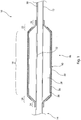
- balloon catheter 10 which includes a catheter 12 of substantially conventional form and which has a distal end 14, typically terminated with a dilator tip.
- the catheter 12 also has a proximal end which is typically coupled to an external manipulation unit, which includes one or more haemostatic valves, one or more ports for the supply of inflation fluid, flushing fluid and so on.
- an external manipulation unit which includes one or more haemostatic valves, one or more ports for the supply of inflation fluid, flushing fluid and so on.
- a medical balloon 16 Fixed to the catheter 12 is a medical balloon 16 which in this embodiment includes a substantially cylindrical body portion 18 bounded at either end by conical end portions 20, 22, the latter terminating in neck portions 24, 26.
- the neck portions 24, 26 are fixed in fluid tight manner to the catheter 12.
- the medical balloon 16 has an internal chamber 28, in practice defined by the interior surface of the balloon 16 and the exterior surface of the catheter 12.
- the catheter 12 includes a lumen 30 for the provision of inflation fluid into the chamber 28, for which purpose the catheter 12 is provided with a port 32 at a distal end of the inflation lumen 30 which couples to the chamber 28.
- the medical balloon 16 is shown in an inflated condition.
- the balloon 16 is able to deflate by withdrawal of inflation fluid from the chamber 28, and typically to be wrappable round the catheter 12 for delivery and removal purposes, again as is known in the art.
- the balloon 16 may have a non-stretched configuration in which it will at least partially fold to assist in its wrapping around the catheter 12.
- the balloon 16 has first and second layers 34, 36. These layers 34, 36 are bonded or otherwise integral with one another so that they move in unitary manner.
- the first or inner balloon layer 34 is made of a polymeric material, which may be any of the conventionally known materials, including, for example, a polyamide (nylon), polyurethane, a polyether block amide such as PebaxTM, polyethylene, PET and the like.
- the inner layer 34 of the balloon 16 is preferably made of a non-conformable material, that is which does not exhibit substantial stretching at normal operating pressures of the balloon 16. In other embodiments, though, the inner layer 34 could be made of a conformable material.
- the inner layer 34 includes no particulate material and is most preferably made purely of one or more polymeric materials. This enables the inner layer 34 to be of optimum strength and thus to be made as thin as possible. The addition of other elements, in particular particulate materials can reduce the strength of the layer, thus leading to the need for thickening of the layer.
- the inner layer 34 is substantially smooth, that is has substantially smooth inner and outer surfaces. It will be appreciated also, that the balloon 16 is substantially tubular in form with a cylindrical body portion 18.
- the outer layer 36 which in this example overlies the inner layer 34 for the entirety of the length of the balloon 16, has embedded therewithin generally round, spherical or cuboidal particles 38, described in further detail below.
- the outer layer 36 has a substantially smooth inner surface which is, preferably, entirely bonded or otherwise integral with the outer surface of the inner layer 34 and is thus substantially smooth.
- the outer surface 40 of the outer layer 36 is roughened as a result of the presence of the particles 38 in the layer 36.
- the balloon 16 has a roughened outer surface. This, as will be described in further detail below, gives the balloon better positioning characteristics within a patient able to reduce the risk of migration of the balloon catheter 10 when deployed in a patient.
- the outer layer 36 of the balloon 16 can be made of a variety of materials, including the same materials as of the inner layer 34. It is preferred that the outer layer 36 is made of a material which has a lower softening or melting temperature than that of the inner layer 34, for purposes which are explained below. The outer layer could be termed a reflow layer. In some embodiments, the outer layer 36 could be made of a softer material that that of the inner layer 34. In addition, it is preferred that the particles 38 are made of a material which has a higher softening or melting temperature than the softening or melting temperature of the material of the second layer 36 and preferably also of the inner layer 34. In the preferred embodiments, the particles 38 may be made of glass, metal, ceramic, or tungsten or carbon or the like to provide radiopacity.
- the embodiment of Figure 1 provides a balloon 16 which has a roughened outer surface.
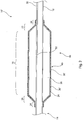
- a comparative embodiment is shown in Figure 2 , in which the balloon 16' is equally formed of inner and outer layers, in which the inner layer 34 is analogous to the layer 34 of the balloon 16 of Figure 1 .
- the outer layer 36' has a smooth outer surface and has embedded therewithin particles 38', again generally round, spherical or cuboidal.
- the particles 38' instead of imparting roughening to the surface of the balloon, are echogenic or radiopaque.
- the particles 38, 38' may be both of a nature which roughens the outer surface of the balloon and which are also echogenic and/or radiopaque. In such an embodiment, thus, the balloon would be both roughened and readily visible by ultrasonic imaging techniques when deployed within a patient.
- the embodiment of balloon 16' may have layers 34, 36' which are of the same or similar materials as the balloon 16 of Figure 1 .
- the smooth nature of the balloon 16' of the comparative embodiment in Figure 2 can be achieved in a variety of ways, including by the use of particles 38' which are relatively small compared to the thickness of the layer 36' of the balloon, by the use of a smaller concentration of particles 38' and so on.
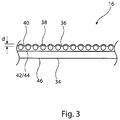
- FIG 3 shows an enlarged view of a portion of the balloon 16 of Figure 1 , in particular to depict the structure of the wall of the balloon 16.
- the balloon 16 as described above, includes a roughened or otherwise textured surface 40 forming the outer surface of the balloon 16 and a smooth inner surface 46 of the balloon 16, which is formed by the inner surface of the inner layer 34.
- the inner and outer layers 34, 36 respectively, have their facing surfaces 42, 44 bonded or otherwise integral with one another, so that the two layers 34, 36 of the balloon 16 are in effect unitary.
- the particles 38 embedded within the outer layer 36 are generally round, spherical or cuboidal and preferably made of a material having a higher Durometer compared to the Durometer of the polymeric material which forms the second balloon layer 36.
- the particles 38 may typically have an average diameter of between 2 to 20 micrometres, more preferably of between 5 to 10 micrometres.
- a practical example used particles having an average diameter of 7 micrometres. This compares to a thickness for the inner layer 34 of the balloon 16 of between 0.01 millimetres to 0.10 millimetres that a thickness of the second balloon layer (that is average thickness) in the range of 0.005 millimetres to 0.05 millimetres.
- the roughening of the outer surface 40 of the outer layer 36 of the balloon caused by the particles 38 will produce surface roughening or undulations having an average roughness of 0.2 to 18 Ra.
- This structure of balloon 16, that is with an inner support layer 34 supporting the particle-containing layer 36, provides optimum strength to the balloon 16, enabling the overall thickness of the balloon wall to be minimised without compromising the strength and therefore performance of the balloon for medical treatments.
- the inner support, layer 34 acts to prevent undue stretching of the balloon 16 and in particular of the outer layer of the balloon 16, which could compromise the integrity of the outer layer and also lead to burst during use.
- the use of particles 38 to provide roughening of the outer surface 40 of the balloon 16 does not unduly compromise the longitudinal flexibility of the balloon 16, 16', that is its flexibility about the longitudinal axis of the carrier catheter 12.
- a convenient method of manufacturing a medical balloon of the type disclosed herein is to commence from a tubing which is then heated and inflated within a mold having mold surfaces consistent with the shape of the final balloon.
- FIGS. 4 to 6 there are shown different embodiments of raw tubing which are used in the manufacture of a balloon having the characteristics taught herein.
- the examples of raw tubing in Figures 4 to 6 have, as explained below, different characteristics relating particularly to the particles embedded in the outer layer of the balloon.
- Raw tubing of such nature can conveniently be produced by extrusion, which is a technique also useful in producing multi-layered balloons.
- the embodiment of raw tubing 50 shown is intended to produce a balloon 16, 16' of the type shown in Figures 1 or 2 , in dependence upon the particles 38, 38' incorporated within the raw tubing 50.
- the raw tubing 50 includes an inner layer 52, which forms the inner layer 34 of the balloon 16, 16' and an outer layer 54, which forms the outer layer 36, 36' of the balloon.
- Embedded within the outer layer 54 are particles 38, 38' which are preferably evenly spread throughout the outer layer 54.
- the particles 38, 38' are round, preferably substantially spherical. They thus have the shape shown in Figures 1 to 3 . It is to be understood that the thickness of the layers 52, 54 will not necessarily be as shown in Figure 4 .
- the layers 52, 54 will have a thickness of 0.1 to 0.3 mm and the particles, particularly glass beads, may have an average diameter of approximately 7 micrometres.
- the thickness of the layers 52, 54 will be substantially diminished as a result of stretching, particularly in the region of the body portion 18 of the balloon.
- Figure 5 shows another embodiment of raw tubing 60, also formed of two layers 62, 64.
- the layer 64 particles 66 which have a generally cuboidal (square) form. It is preferred, in order to ensure even roughening of the outer surface of the balloon 16, that the particles 66 have a generally square or round form so that they can produce roughening depressions of substantially even depth d, as shown in Figure 3 .
- FIG. 4 shows the embodiments of raw tubing shown in Figures 4 and 5 provide the particles 38, 38' and 66 already embedded within the outer layer 54. This is not, however, a necessary feature.
- Figure 6 shows another example of raw tubing 70, again having inner and outer layers 72 and 74, but in this instance the particles 76 are disposed on the outer surface of the outer layer 74. They may be attached to the outer surface 74, for example by adhesive, fusion or other bonding.
- This embodiment thus enables the extrusion of a raw tubing having two or more layers, each of which is made of polymeric material with no particulate additive therein.
- the particles 76, which are subsequently attached to raw tubing 70 become embedded within the outer layer 74 during the balloon formation process, as described below.
- Figure 6 shows particles 76 which are substantially spherical but it is to be understood that these particles could take any other shape, particularly the cuboidal shape of which an example is shown in Figure 5 .
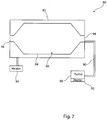
- the apparatus 18 includes a mold unit 82, typically made of metal or ceramic, which has internal walls 84 with a shape consistent with that of the final balloon shape produced by the mold 82.
- the internal mold walls 84 provide a chamber 86 for receiving the raw tubing 50, 60, 70 at the start of the process.
- the mold unit 82 will be made of a plurality of sections which can be separated to remove the balloon 16, 16' after its manufacture.
- the assembly 80 includes a pumping unit 88 coupled to the mold 82 by a suitable fluid conduit 90 and which in practice couples to the internal lumen 58, 68, 78 of the raw tubing 50, 60, 70, respectively.
- the pump unit 88 typically includes a heater 92 for heating the fluid pumped by the pump 88. Additionally or in the alternative, there may be provided a heater 94 for heating the mold unit 82.
- the internal walls 84 of the mold unit 80 include a central cylindrical portion bounded by first and second frusto-conical portions which themselves are coupled to inlet and outlets 94, 96 of the mold unit 82.
- the inlet and outlet 94, 96 are of a diameter able to accommodate the raw tubing 50, 60, 70 therethrough and they include one or more clamps (not shown) to fix the raw tubing to the mold 82 during the balloon production process, although clamps are not essential.
- the balloon 16, 16' may be formed by the raw tubing 50-70 as follows.
- the raw tubing 50-70 is, in the preferred embodiment, of continuous form, that is has no variation along its length in terms of the size and structure of the various layers of the balloon. It is not excluded, however, that the raw tubing 50-70 could have different characteristics in the zones which are to produce the end cones and necks of the balloon.
- a length of raw tubing is inserted in the mold unit 82, through the inlet 94, and out of the outlet 96. If not already cut, the raw tubing is then cut to leave very short sections extending out of the mold unit 82.
- the end of the raw tubing 50-70 which extends out of the outlet 96 is sealed by closing off its internal lumen 58-78.
- the conduit 90 is then coupled to the other end of the raw tubing 50-70 extending out of the inlet 94, this being a fluid-tight coupling of the conduit 92 supplying inflation fluid to the lumen 58-78.
- the heater or heaters 92/94 are then operated to heat the fluid (typically a gas) and/or mold 82 which is pumped under pressure into the raw tubing 50-70.
- the combination of fluid pressure and heat causes the raw tubing 50-70 to soften and expand into the chamber 86 until it comes into abutment with the internal walls 84 of the mold unit 82, thus attaining the balloon shape 16, 16'. So doing causes the layers of the raw tubing 50-70 to stretch and thus become thinner during the inflation process. In the case where the particles 38, 66, 76 create a roughing of the outer surface of the balloon 16, the stretching of the outer layer 54, 64, 74 of the raw tubing will cause this to expose the shape of the particles 38, in a manner akin to the drawing of Figure 3 .
- the polymeric material of the outer layer 54-74 of the raw tubing is such as to retain the particles 38, 66, 76 embedded therewithin and thus to ensure that the balloon 16 retains a unitary characteristic.
- the inner layer 52-72 while also stretching under the effects of pressure and heat, being a stronger layer than the outer layer 54-74 will continue to support the outer layer 54 and will retain a generally smooth outer surface 44. It is not excluded that the inner layer 52-72 may fit around the shape of the particles 38 when in the mold 82 as a result of the hardness of the mold 72 but when the balloon 16 is subsequently inflated during this deployment, the inner layer 34 of the balloon 16 will remain substantially flat so as to produce and/or retain the surface roughening or texturing. Having an inner layer 52-72 made of material which has a higher softening temperature than that of the outer layer 54-74 will assist in achieving these characteristics.
- the particles 38, 38' will not, in the preferred embodiment, alter their shape during this molding process primarily as a result of these particles being made of a material having a higher softening or melting temperature than that of the layers 52, 54 of the raw tubing and also of the temperature to which the mold unit 82 is heated.
- the method of molding is the same as that for the raw tubing of Figures 4 and 5 .
- the particles 76 remain on the outside of the outer layer 74, until they become pressed against the internal walls 84 of the mold 82.
- the material of the outer layer 74 will flow around the particles 76 until the particles 76 are substantially embedded within the material 74, which will form the outer layer 36 of the balloon 16.
- the particles 76 are roughening particles as in the embodiments of Figures 1 and 3 .
- a raw tubing which is formed only of layers of polymeric material, that is without any particles provided in or on the raw tubing.
- the particles are located within the mold cavity 86, preferably temporarily attached to the internal walls 84 of the mold 82.
- the raw tubing when heated and inflated, this will stretch until it presses against the internal walls 84, in so doing taking up the particles into the outer layer of the raw tubing and thus into what becomes the outer layer of the finished balloon.
- the particles may be granules, pellets, spheroids and could be solid or hollow. If they are hollow, they could be filled with a gas or fluid, such as to improve the radiopacity or echogenicity of the particle and thus of the balloon within which they are embedded.
- a balloon 16 having a roughened surface of the type shown in this Figure can substantially enhance the positional stability of the balloon 16 when in a patient. This is particularly important in a number of medical procedures such as valvuloplasty, occlusion and the like, where a balloon with a smooth outer surface can easily slip.
- a balloon with a roughened outer surface can also be advantageous in retaining a balloon expandable medical device such as a stent or stent graft on the balloon during deployment of the device.
- the particles may only be partially embedded in the balloon wall, particularly in the case of a balloon formed of at least two layers.
- the balloon could be formed with a wall having more than two layers and could have a different shape to the shape shown in the drawings and discussed above.
Landscapes
- Health & Medical Sciences (AREA)
- Life Sciences & Earth Sciences (AREA)
- Heart & Thoracic Surgery (AREA)
- Veterinary Medicine (AREA)
- Public Health (AREA)
- General Health & Medical Sciences (AREA)
- Animal Behavior & Ethology (AREA)
- Engineering & Computer Science (AREA)
- Hematology (AREA)
- Anesthesiology (AREA)
- Pulmonology (AREA)
- Biophysics (AREA)
- Child & Adolescent Psychology (AREA)
- Biomedical Technology (AREA)
- Epidemiology (AREA)
- Manufacturing & Machinery (AREA)
- Physics & Mathematics (AREA)
- Optics & Photonics (AREA)
- Chemical & Material Sciences (AREA)
- Composite Materials (AREA)
- Materials Engineering (AREA)
- Materials For Medical Uses (AREA)
- Media Introduction/Drainage Providing Device (AREA)
Claims (16)
- Medizinischer Ballon zur endoluminalen Positionierung innerhalb eines Patienten, wobei der Ballon eine erste Ballonschicht, die aus einem polymeren Material gefertigt ist, und eine zweite Ballonschicht einschließt, die über der ersten Ballonschicht liegt, wobei die zweite Ballonschicht ein polymeres Material einschließt, in das darin eingebettete allgemein kugelförmige oder kubische Partikel eingeschlossen sind, wobei die Partikel auf dem Ballon eine aufgeraute Außenfläche erzeugen.
- Medizinischer Ballon nach Anspruch 1, wobei die Partikel echogen und/oder röntgendicht sind.
- Medizinischer Ballon nach Anspruch 1 oder 2, wobei die Partikel einen durchschnittlichen Durchmesser zwischen 2 und 20 Mikrometern aufweisen.
- Medizinischer Ballon nach einem der vorhergehenden Ansprüche, wobei die erste Ballonschicht eine Dicke im Bereich von 0,01 Millimetern bis 0,10 Millimetern aufweist, und/oder die zweite Ballonschicht eine Dicke im Bereich von 0,005 Millimetern bis 0,05 Millimetern aufweist.
- Medizinischer Ballon nach einem der vorhergehenden Ansprüche, wobei die Außenfläche des Ballons eine Rauheit von 0,2 bis 18 Ra aufweist.
- Medizinischer Ballon nach einem der vorhergehenden Ansprüche, wobei die Partikel in einer Dichte von 50 bis 80 Gew.% oder 3 bis 5 Vol.% der zweiten Schicht des Ballons bereitgestellt werden.
- Medizinischer Ballon nach einem der vorhergehenden Ansprüche, wobei die Partikel aus einem Material mit einer höheren Erweichungs- oder Schmelztemperatur gefertigt sind, verglichen mit der Erweichungs- oder Schmelztemperatur des polymeren Materials der zweiten Ballonschicht und/oder verglichen mit der Erweichungs- oder Schmelztemperatur des polymeren Materials der ersten Ballonschicht.
- Medizinischer Ballon nach einem der vorhergehenden Ansprüche, wobei die Partikel aus einem Material mit höherem Durometerwert gefertigt sind, verglichen mit dem Durometerwert des polymeren Materials der zweiten Ballonschicht.
- Medizinischer Ballon nach einem der vorhergehenden Ansprüche, wobei die Partikel aus einem oder mehreren von Glas, Metall, einem Polymer, Keramik, Wolfram, Kohlenstoff gefertigt sind.
- Medizinischer Ballon nach einem der vorhergehenden Ansprüche, wobei das polymere Material der ersten Ballonschicht ein oder mehrere von Polyamid, Polyetherblockamid, PET, Polyethylen und Polyurethan einschließt.
- Medizinischer Ballon nach einem der vorhergehenden Ansprüche, wobei das polymere Material der zweiten Ballonschicht eine niedrigere Erweichungs- oder Schmelztemperatur aufweist als die Erweichungs- oder Schmelztemperatur des Materials der ersten Ballonschicht.
- Medizinischer Ballon nach einem der vorhergehenden Ansprüche, wobei die erste und zweite Ballonschicht Coextrusionen sind, die aneinander geschmolzen oder gebondet sind.
- Medizinischer Ballon nach einem der vorhergehenden Ansprüche zur Verwendung in einer/einem von Angioplastik, Gefäßerweiterung, Verschluss, Klappenplastik und Ausbringung von Vorrichtungen.
- Ballonkatheter, der einen medizinischen Ballon nach einem der vorhergehenden Ansprüche einschließt.
- Verfahren zur Herstellung eines medizinischen Ballons, wobei der Ballon eine erste Ballonschicht, die aus einem polymeren Material gefertigt ist, und eine zweite Ballonschicht einschließt, die über der ersten Ballonschicht liegt, wobei die zweite Ballonschicht ein polymeres Material einschließt, in das darin eingebettete allgemein kugelförmige oder kubische Partikel eingeschlossen sind, wobei die Partikel auf dem Ballon eine aufgeraute Außenfläche erzeugen;
wobei das Verfahren die Schritte einschließt:Bereitstellen eines rohen Schlauchmaterials mit einer ersten Schicht des polymeren Materials und einer zweiten Schicht, die über der ersten Schicht liegt und aus einem polymeren Material gebildet ist;Bereitstellen der Partikel;Bereitstellen einer Form zum Bilden des Ballons aus dem rohen Schlauchmaterial;Bereitstellen eines Füllmechanismus zum Füllen des rohen Schlauchmaterials;Bereitstellen eines Heizmechanismus zum Erwärmen des rohen Schlauchmaterials;Anordnen des rohen Schlauchmaterials in der Form;Bedienen der Form-, Heiz- und Füllmechanismen, um dadurch herbeizuführen, dass das rohe Schlauchmaterial innerhalb der Form gefüllt wird, wodurch die zweite Schicht des Schlauchmaterials zum Wiederaufschmelzen (Reflow) erweicht oder schmilzt, wobei die Partikel in die Außenfläche des Ballons eingebettet werden. - Verfahren nach Anspruch 15, wobei die Partikel vor dem Bedienungsschritt an der Außenseite der zweiten Schicht bereitgestellt werden.
Applications Claiming Priority (1)
| Application Number | Priority Date | Filing Date | Title |
|---|---|---|---|
| GB1205367.4A GB2500628B (en) | 2012-03-27 | 2012-03-27 | Medical balloon with particles therein |
Publications (3)
| Publication Number | Publication Date |
|---|---|
| EP2644211A2 EP2644211A2 (de) | 2013-10-02 |
| EP2644211A3 EP2644211A3 (de) | 2015-10-21 |
| EP2644211B1 true EP2644211B1 (de) | 2018-12-19 |
Family
ID=46087194
Family Applications (1)
| Application Number | Title | Priority Date | Filing Date |
|---|---|---|---|
| EP13158957.4A Active EP2644211B1 (de) | 2012-03-27 | 2013-03-13 | Medizinischer ballon mit partikeln darin |
Country Status (3)
| Country | Link |
|---|---|
| US (1) | US9409001B2 (de) |
| EP (1) | EP2644211B1 (de) |
| GB (1) | GB2500628B (de) |
Cited By (1)
| Publication number | Priority date | Publication date | Assignee | Title |
|---|---|---|---|---|
| US11690978B2 (en) | 2019-07-03 | 2023-07-04 | Medtronic, Inc. | Catheter for ultrasound-guided delivery |
Families Citing this family (17)
| Publication number | Priority date | Publication date | Assignee | Title |
|---|---|---|---|---|
| GB2526104B (en) * | 2014-05-13 | 2017-01-11 | Cook Medical Technologies Llc | Medical balloon assembly and method of making a medical balloon |
| US11179027B2 (en) | 2015-12-05 | 2021-11-23 | The Regents Of The University Of Colorado, A Body Corporate | Endoscopic devices and methods using same |
| WO2017184749A2 (en) * | 2016-04-19 | 2017-10-26 | Boston Scientific Scimed, Inc. | Weeping balloon devices |
| WO2017183605A1 (ja) * | 2016-04-20 | 2017-10-26 | 株式会社カネカ | バルーンカテーテル及びバルーンカテーテルの製造方法 |
| US11730928B2 (en) | 2018-01-16 | 2023-08-22 | Aspero Medical, Inc. | Split overtube assembly |
| EP3740169B1 (de) | 2018-01-16 | 2024-08-28 | The Regents Of The University Of Colorado | Medizinische vorrichtungen mit texturierten aufblasbaren ballonen |
| US11577056B2 (en) | 2018-01-16 | 2023-02-14 | Aspero Medical, Inc. | Medical devices including textured inflatable balloons |
| US20220257912A1 (en) * | 2019-07-19 | 2022-08-18 | C.R. Bard, Inc. | Lamination apparatus for medical balloons and related methods |
| CN211856471U (zh) | 2019-08-22 | 2020-11-03 | 贝克顿·迪金森公司 | 回声医疗器械回声反射性量化测试系统 |
| CN211884905U (zh) | 2019-08-22 | 2020-11-10 | 贝克顿·迪金森公司 | 球囊扩张导管及其球囊 |
| CN112401971B (zh) | 2019-08-23 | 2025-09-09 | 贝克顿·迪金森公司 | 为经皮肾镜取石术外科手术设计的套件 |
| JP7431007B2 (ja) * | 2019-09-30 | 2024-02-14 | テルモ株式会社 | バルーンカテーテル、およびバルーンの製造方法 |
| US12011184B2 (en) | 2020-02-10 | 2024-06-18 | Elixir Medical Corporation | Methods and apparatus for plaque disruption |
| CN213724314U (zh) * | 2020-06-05 | 2021-07-20 | 贝克顿·迪金森公司 | 超声显影装置 |
| CN113144389B (zh) * | 2021-03-16 | 2022-06-14 | 科塞尔医疗科技(苏州)有限公司 | 双层喷砂球囊,其制备方法以及多层喷砂球囊 |
| US20220346833A1 (en) * | 2021-05-03 | 2022-11-03 | Covidien Lp | Surgical access device with textured balloon |
| CN114504723A (zh) * | 2021-12-22 | 2022-05-17 | 融冲(深圳)生物医疗科技有限责任公司 | 聚合物球囊及其制备方法 |
Family Cites Families (17)
| Publication number | Priority date | Publication date | Assignee | Title |
|---|---|---|---|---|
| US5289831A (en) * | 1989-03-09 | 1994-03-01 | Vance Products Incorporated | Surface-treated stent, catheter, cannula, and the like |
| US5081997A (en) * | 1989-03-09 | 1992-01-21 | Vance Products Incorporated | Echogenic devices, material and method |
| US5290306A (en) * | 1989-11-29 | 1994-03-01 | Cordis Corporation | Puncture resistant balloon catheter |
| JP2000507117A (ja) * | 1996-01-31 | 2000-06-13 | イー・アイ・デユポン・ドウ・ヌムール・アンド・カンパニー | 向上した穿刺抵抗性を有する拡張カテーテルバルーン |
| US6258099B1 (en) | 1999-03-31 | 2001-07-10 | Scimed Life Systems, Inc. | Stent security balloon/balloon catheter |
| US6786889B1 (en) | 1999-03-31 | 2004-09-07 | Scimed Life Systems, Inc | Textured and/or marked balloon for stent delivery |
| US6911017B2 (en) | 2001-09-19 | 2005-06-28 | Advanced Cardiovascular Systems, Inc. | MRI visible catheter balloon |
| US7758572B2 (en) * | 2004-05-20 | 2010-07-20 | Boston Scientific Scimed, Inc. | Medical devices and methods including cooling balloons having nanotubes |
| US20050271844A1 (en) * | 2004-06-07 | 2005-12-08 | Scimed Life Systems, Inc. | Artificial silk reinforcement of PTCA balloon |
| US20070100279A1 (en) * | 2005-11-03 | 2007-05-03 | Paragon Intellectual Properties, Llc | Radiopaque-balloon microcatheter and methods of manufacture |
| US20070142772A1 (en) * | 2005-12-16 | 2007-06-21 | Medtronic Vascular, Inc. | Dual-Layer Medical Balloon |
| EP2095795A1 (de) | 2007-12-21 | 2009-09-02 | Abbott Laboratories Vascular Enterprises Limited | Doppellagige Ballons für medizinische Geräte |
| WO2010033231A2 (en) * | 2008-09-19 | 2010-03-25 | Nexeon Medsystems, Inc. | Interventional devices including dilute nanotube-polymer compositions, and methods of making and using same |
| US8052638B2 (en) | 2008-11-26 | 2011-11-08 | Abbott Cardiovascular Systems, Inc. | Robust multi-layer balloon |
| US20110160659A1 (en) * | 2009-12-30 | 2011-06-30 | Boston Scientific Scimed, Inc. | Drug-Delivery Balloons |
| US20130030410A1 (en) * | 2010-11-23 | 2013-01-31 | William Joseph Drasler | Venous heated ablation catheter |
| GB2494113B (en) | 2011-08-25 | 2013-07-17 | Cook Medical Technologies Llc | Medical balloon and balloon catheter assembly |
-
2012
- 2012-03-27 GB GB1205367.4A patent/GB2500628B/en active Active
-
2013
- 2013-03-06 US US13/786,690 patent/US9409001B2/en active Active
- 2013-03-13 EP EP13158957.4A patent/EP2644211B1/de active Active
Non-Patent Citations (1)
| Title |
|---|
| None * |
Cited By (1)
| Publication number | Priority date | Publication date | Assignee | Title |
|---|---|---|---|---|
| US11690978B2 (en) | 2019-07-03 | 2023-07-04 | Medtronic, Inc. | Catheter for ultrasound-guided delivery |
Also Published As
| Publication number | Publication date |
|---|---|
| US9409001B2 (en) | 2016-08-09 |
| GB201205367D0 (en) | 2012-05-09 |
| GB2500628A (en) | 2013-10-02 |
| GB2500628B (en) | 2016-08-10 |
| EP2644211A2 (de) | 2013-10-02 |
| US20130261548A1 (en) | 2013-10-03 |
| EP2644211A3 (de) | 2015-10-21 |
Similar Documents
| Publication | Publication Date | Title |
|---|---|---|
| EP2644211B1 (de) | Medizinischer ballon mit partikeln darin | |
| US10086179B2 (en) | Medical balloon | |
| EP2056915B1 (de) | Wiederfaltbarer ballon und verfahren zu seiner herstellung | |
| US5662608A (en) | Low profile balloon catheter and method | |
| CN105188823B (zh) | 用于导管的减少材料的尖端及形成其的方法 | |
| EP2990069A1 (de) | Geformter oder texturierter medizinischer ballon | |
| JP2019080933A (ja) | 膨張性バルーン及びカバー | |
| US11185669B2 (en) | High strength balloon | |
| CN104507525A (zh) | 导管球囊、导管及制造导管球囊的方法 | |
| EP2644171B1 (de) | Methode zu Herstellung eines medizinischen Ballons mit texturierter oder angerauter äußeren Schicht | |
| MX2009002154A (es) | Cateter urinario interno con superficie de sellado prolongada. | |
| WO2013122003A1 (ja) | 血管閉塞用バルーンカテーテル用バルーン、血管閉塞用バルーンカテーテル、血管閉塞用バルーンカテーテル用バルーンの製造方法 | |
| CN115068037A (zh) | 单腔封堵球囊导管和球囊的充盈与卸压方法 | |
| JP2014155657A (ja) | バルーンカテーテル用バルーン | |
| CN114681765A (zh) | 扩张球囊及球囊扩张导管 |
Legal Events
| Date | Code | Title | Description |
|---|---|---|---|
| PUAI | Public reference made under article 153(3) epc to a published international application that has entered the european phase |
Free format text: ORIGINAL CODE: 0009012 |
|
| AK | Designated contracting states |
Kind code of ref document: A2 Designated state(s): AL AT BE BG CH CY CZ DE DK EE ES FI FR GB GR HR HU IE IS IT LI LT LU LV MC MK MT NL NO PL PT RO RS SE SI SK SM TR |
|
| AX | Request for extension of the european patent |
Extension state: BA ME |
|
| PUAL | Search report despatched |
Free format text: ORIGINAL CODE: 0009013 |
|
| AK | Designated contracting states |
Kind code of ref document: A3 Designated state(s): AL AT BE BG CH CY CZ DE DK EE ES FI FR GB GR HR HU IE IS IT LI LT LU LV MC MK MT NL NO PL PT RO RS SE SI SK SM TR |
|
| AX | Request for extension of the european patent |
Extension state: BA ME |
|
| RIC1 | Information provided on ipc code assigned before grant |
Ipc: A61L 29/12 20060101AFI20150915BHEP Ipc: A61L 29/18 20060101ALI20150915BHEP Ipc: A61M 25/10 20130101ALI20150915BHEP |
|
| 17P | Request for examination filed |
Effective date: 20160129 |
|
| RBV | Designated contracting states (corrected) |
Designated state(s): AL AT BE BG CH CY CZ DE DK EE ES FI FR GB GR HR HU IE IS IT LI LT LU LV MC MK MT NL NO PL PT RO RS SE SI SK SM TR |
|
| GRAP | Despatch of communication of intention to grant a patent |
Free format text: ORIGINAL CODE: EPIDOSNIGR1 |
|
| STAA | Information on the status of an ep patent application or granted ep patent |
Free format text: STATUS: GRANT OF PATENT IS INTENDED |
|
| INTG | Intention to grant announced |
Effective date: 20180801 |
|
| RIN1 | Information on inventor provided before grant (corrected) |
Inventor name: LYSGAARD, THOMAS Inventor name: KLAUSEN, ANDERS SCHEEL Inventor name: TORP, ALLAN Inventor name: AGGERHOLM, STEEN Inventor name: SONNICHSEN, ANNE-METTE HOPPE |
|
| GRAS | Grant fee paid |
Free format text: ORIGINAL CODE: EPIDOSNIGR3 |
|
| GRAA | (expected) grant |
Free format text: ORIGINAL CODE: 0009210 |
|
| STAA | Information on the status of an ep patent application or granted ep patent |
Free format text: STATUS: THE PATENT HAS BEEN GRANTED |
|
| AK | Designated contracting states |
Kind code of ref document: B1 Designated state(s): AL AT BE BG CH CY CZ DE DK EE ES FI FR GB GR HR HU IE IS IT LI LT LU LV MC MK MT NL NO PL PT RO RS SE SI SK SM TR |
|
| REG | Reference to a national code |
Ref country code: GB Ref legal event code: FG4D |
|
| REG | Reference to a national code |
Ref country code: CH Ref legal event code: EP |
|
| REG | Reference to a national code |
Ref country code: IE Ref legal event code: FG4D |
|
| REG | Reference to a national code |
Ref country code: DE Ref legal event code: R096 Ref document number: 602013048330 Country of ref document: DE |
|
| REG | Reference to a national code |
Ref country code: AT Ref legal event code: REF Ref document number: 1077974 Country of ref document: AT Kind code of ref document: T Effective date: 20190115 |
|
| REG | Reference to a national code |
Ref country code: NL Ref legal event code: MP Effective date: 20181219 |
|
| PG25 | Lapsed in a contracting state [announced via postgrant information from national office to epo] |
Ref country code: FI Free format text: LAPSE BECAUSE OF FAILURE TO SUBMIT A TRANSLATION OF THE DESCRIPTION OR TO PAY THE FEE WITHIN THE PRESCRIBED TIME-LIMIT Effective date: 20181219 Ref country code: NO Free format text: LAPSE BECAUSE OF FAILURE TO SUBMIT A TRANSLATION OF THE DESCRIPTION OR TO PAY THE FEE WITHIN THE PRESCRIBED TIME-LIMIT Effective date: 20190319 Ref country code: LT Free format text: LAPSE BECAUSE OF FAILURE TO SUBMIT A TRANSLATION OF THE DESCRIPTION OR TO PAY THE FEE WITHIN THE PRESCRIBED TIME-LIMIT Effective date: 20181219 Ref country code: HR Free format text: LAPSE BECAUSE OF FAILURE TO SUBMIT A TRANSLATION OF THE DESCRIPTION OR TO PAY THE FEE WITHIN THE PRESCRIBED TIME-LIMIT Effective date: 20181219 Ref country code: BG Free format text: LAPSE BECAUSE OF FAILURE TO SUBMIT A TRANSLATION OF THE DESCRIPTION OR TO PAY THE FEE WITHIN THE PRESCRIBED TIME-LIMIT Effective date: 20190319 Ref country code: LV Free format text: LAPSE BECAUSE OF FAILURE TO SUBMIT A TRANSLATION OF THE DESCRIPTION OR TO PAY THE FEE WITHIN THE PRESCRIBED TIME-LIMIT Effective date: 20181219 |
|
| REG | Reference to a national code |
Ref country code: LT Ref legal event code: MG4D |
|
| REG | Reference to a national code |
Ref country code: AT Ref legal event code: MK05 Ref document number: 1077974 Country of ref document: AT Kind code of ref document: T Effective date: 20181219 |
|
| PG25 | Lapsed in a contracting state [announced via postgrant information from national office to epo] |
Ref country code: GR Free format text: LAPSE BECAUSE OF FAILURE TO SUBMIT A TRANSLATION OF THE DESCRIPTION OR TO PAY THE FEE WITHIN THE PRESCRIBED TIME-LIMIT Effective date: 20190320 Ref country code: AL Free format text: LAPSE BECAUSE OF FAILURE TO SUBMIT A TRANSLATION OF THE DESCRIPTION OR TO PAY THE FEE WITHIN THE PRESCRIBED TIME-LIMIT Effective date: 20181219 Ref country code: RS Free format text: LAPSE BECAUSE OF FAILURE TO SUBMIT A TRANSLATION OF THE DESCRIPTION OR TO PAY THE FEE WITHIN THE PRESCRIBED TIME-LIMIT Effective date: 20181219 Ref country code: SE Free format text: LAPSE BECAUSE OF FAILURE TO SUBMIT A TRANSLATION OF THE DESCRIPTION OR TO PAY THE FEE WITHIN THE PRESCRIBED TIME-LIMIT Effective date: 20181219 |
|
| PG25 | Lapsed in a contracting state [announced via postgrant information from national office to epo] |
Ref country code: NL Free format text: LAPSE BECAUSE OF FAILURE TO SUBMIT A TRANSLATION OF THE DESCRIPTION OR TO PAY THE FEE WITHIN THE PRESCRIBED TIME-LIMIT Effective date: 20181219 |
|
| PG25 | Lapsed in a contracting state [announced via postgrant information from national office to epo] |
Ref country code: IT Free format text: LAPSE BECAUSE OF FAILURE TO SUBMIT A TRANSLATION OF THE DESCRIPTION OR TO PAY THE FEE WITHIN THE PRESCRIBED TIME-LIMIT Effective date: 20181219 Ref country code: ES Free format text: LAPSE BECAUSE OF FAILURE TO SUBMIT A TRANSLATION OF THE DESCRIPTION OR TO PAY THE FEE WITHIN THE PRESCRIBED TIME-LIMIT Effective date: 20181219 Ref country code: PT Free format text: LAPSE BECAUSE OF FAILURE TO SUBMIT A TRANSLATION OF THE DESCRIPTION OR TO PAY THE FEE WITHIN THE PRESCRIBED TIME-LIMIT Effective date: 20190419 Ref country code: PL Free format text: LAPSE BECAUSE OF FAILURE TO SUBMIT A TRANSLATION OF THE DESCRIPTION OR TO PAY THE FEE WITHIN THE PRESCRIBED TIME-LIMIT Effective date: 20181219 Ref country code: CZ Free format text: LAPSE BECAUSE OF FAILURE TO SUBMIT A TRANSLATION OF THE DESCRIPTION OR TO PAY THE FEE WITHIN THE PRESCRIBED TIME-LIMIT Effective date: 20181219 |
|
| PG25 | Lapsed in a contracting state [announced via postgrant information from national office to epo] |
Ref country code: SK Free format text: LAPSE BECAUSE OF FAILURE TO SUBMIT A TRANSLATION OF THE DESCRIPTION OR TO PAY THE FEE WITHIN THE PRESCRIBED TIME-LIMIT Effective date: 20181219 Ref country code: RO Free format text: LAPSE BECAUSE OF FAILURE TO SUBMIT A TRANSLATION OF THE DESCRIPTION OR TO PAY THE FEE WITHIN THE PRESCRIBED TIME-LIMIT Effective date: 20181219 Ref country code: IS Free format text: LAPSE BECAUSE OF FAILURE TO SUBMIT A TRANSLATION OF THE DESCRIPTION OR TO PAY THE FEE WITHIN THE PRESCRIBED TIME-LIMIT Effective date: 20190419 Ref country code: SM Free format text: LAPSE BECAUSE OF FAILURE TO SUBMIT A TRANSLATION OF THE DESCRIPTION OR TO PAY THE FEE WITHIN THE PRESCRIBED TIME-LIMIT Effective date: 20181219 Ref country code: EE Free format text: LAPSE BECAUSE OF FAILURE TO SUBMIT A TRANSLATION OF THE DESCRIPTION OR TO PAY THE FEE WITHIN THE PRESCRIBED TIME-LIMIT Effective date: 20181219 |
|
| REG | Reference to a national code |
Ref country code: DE Ref legal event code: R097 Ref document number: 602013048330 Country of ref document: DE |
|
| PLBE | No opposition filed within time limit |
Free format text: ORIGINAL CODE: 0009261 |
|
| STAA | Information on the status of an ep patent application or granted ep patent |
Free format text: STATUS: NO OPPOSITION FILED WITHIN TIME LIMIT |
|
| PG25 | Lapsed in a contracting state [announced via postgrant information from national office to epo] |
Ref country code: DK Free format text: LAPSE BECAUSE OF FAILURE TO SUBMIT A TRANSLATION OF THE DESCRIPTION OR TO PAY THE FEE WITHIN THE PRESCRIBED TIME-LIMIT Effective date: 20181219 Ref country code: AT Free format text: LAPSE BECAUSE OF FAILURE TO SUBMIT A TRANSLATION OF THE DESCRIPTION OR TO PAY THE FEE WITHIN THE PRESCRIBED TIME-LIMIT Effective date: 20181219 Ref country code: MC Free format text: LAPSE BECAUSE OF FAILURE TO SUBMIT A TRANSLATION OF THE DESCRIPTION OR TO PAY THE FEE WITHIN THE PRESCRIBED TIME-LIMIT Effective date: 20181219 |
|
| REG | Reference to a national code |
Ref country code: CH Ref legal event code: PL |
|
| 26N | No opposition filed |
Effective date: 20190920 |
|
| PG25 | Lapsed in a contracting state [announced via postgrant information from national office to epo] |
Ref country code: LU Free format text: LAPSE BECAUSE OF NON-PAYMENT OF DUE FEES Effective date: 20190313 |
|
| REG | Reference to a national code |
Ref country code: BE Ref legal event code: MM Effective date: 20190331 |
|
| PG25 | Lapsed in a contracting state [announced via postgrant information from national office to epo] |
Ref country code: LI Free format text: LAPSE BECAUSE OF NON-PAYMENT OF DUE FEES Effective date: 20190331 Ref country code: CH Free format text: LAPSE BECAUSE OF NON-PAYMENT OF DUE FEES Effective date: 20190331 |
|
| PG25 | Lapsed in a contracting state [announced via postgrant information from national office to epo] |
Ref country code: SI Free format text: LAPSE BECAUSE OF FAILURE TO SUBMIT A TRANSLATION OF THE DESCRIPTION OR TO PAY THE FEE WITHIN THE PRESCRIBED TIME-LIMIT Effective date: 20181219 Ref country code: BE Free format text: LAPSE BECAUSE OF NON-PAYMENT OF DUE FEES Effective date: 20190331 Ref country code: FR Free format text: LAPSE BECAUSE OF NON-PAYMENT OF DUE FEES Effective date: 20190331 |
|
| PG25 | Lapsed in a contracting state [announced via postgrant information from national office to epo] |
Ref country code: TR Free format text: LAPSE BECAUSE OF FAILURE TO SUBMIT A TRANSLATION OF THE DESCRIPTION OR TO PAY THE FEE WITHIN THE PRESCRIBED TIME-LIMIT Effective date: 20181219 |
|
| PG25 | Lapsed in a contracting state [announced via postgrant information from national office to epo] |
Ref country code: MT Free format text: LAPSE BECAUSE OF NON-PAYMENT OF DUE FEES Effective date: 20190313 |
|
| PG25 | Lapsed in a contracting state [announced via postgrant information from national office to epo] |
Ref country code: CY Free format text: LAPSE BECAUSE OF FAILURE TO SUBMIT A TRANSLATION OF THE DESCRIPTION OR TO PAY THE FEE WITHIN THE PRESCRIBED TIME-LIMIT Effective date: 20181219 |
|
| PG25 | Lapsed in a contracting state [announced via postgrant information from national office to epo] |
Ref country code: HU Free format text: LAPSE BECAUSE OF FAILURE TO SUBMIT A TRANSLATION OF THE DESCRIPTION OR TO PAY THE FEE WITHIN THE PRESCRIBED TIME-LIMIT; INVALID AB INITIO Effective date: 20130313 |
|
| PG25 | Lapsed in a contracting state [announced via postgrant information from national office to epo] |
Ref country code: MK Free format text: LAPSE BECAUSE OF FAILURE TO SUBMIT A TRANSLATION OF THE DESCRIPTION OR TO PAY THE FEE WITHIN THE PRESCRIBED TIME-LIMIT Effective date: 20181219 |
|
| P01 | Opt-out of the competence of the unified patent court (upc) registered |
Effective date: 20230602 |
|
| PGFP | Annual fee paid to national office [announced via postgrant information from national office to epo] |
Ref country code: DE Payment date: 20250327 Year of fee payment: 13 |
|
| PGFP | Annual fee paid to national office [announced via postgrant information from national office to epo] |
Ref country code: IE Payment date: 20250318 Year of fee payment: 13 |
|
| PGFP | Annual fee paid to national office [announced via postgrant information from national office to epo] |
Ref country code: GB Payment date: 20250325 Year of fee payment: 13 |