EP2642993B1 - Compositions of rotigotine or pharmaceutically acceptable salts of rotigotine - Google Patents
Compositions of rotigotine or pharmaceutically acceptable salts of rotigotine Download PDFInfo
- Publication number
- EP2642993B1 EP2642993B1 EP11843219.4A EP11843219A EP2642993B1 EP 2642993 B1 EP2642993 B1 EP 2642993B1 EP 11843219 A EP11843219 A EP 11843219A EP 2642993 B1 EP2642993 B1 EP 2642993B1
- Authority
- EP
- European Patent Office
- Prior art keywords
- plga
- acid
- rotigotine
- microspheres
- composition
- Prior art date
- Legal status (The legal status is an assumption and is not a legal conclusion. Google has not performed a legal analysis and makes no representation as to the accuracy of the status listed.)
- Active
Links
Images





Classifications
-
- A—HUMAN NECESSITIES
- A61—MEDICAL OR VETERINARY SCIENCE; HYGIENE
- A61K—PREPARATIONS FOR MEDICAL, DENTAL OR TOILETRY PURPOSES
- A61K47/00—Medicinal preparations characterised by the non-active ingredients used, e.g. carriers or inert additives; Targeting or modifying agents chemically bound to the active ingredient
- A61K47/30—Macromolecular organic or inorganic compounds, e.g. inorganic polyphosphates
- A61K47/34—Macromolecular compounds obtained otherwise than by reactions only involving carbon-to-carbon unsaturated bonds, e.g. polyesters, polyamino acids, polysiloxanes, polyphosphazines, copolymers of polyalkylene glycol or poloxamers
-
- A—HUMAN NECESSITIES
- A61—MEDICAL OR VETERINARY SCIENCE; HYGIENE
- A61K—PREPARATIONS FOR MEDICAL, DENTAL OR TOILETRY PURPOSES
- A61K31/00—Medicinal preparations containing organic active ingredients
- A61K31/33—Heterocyclic compounds
- A61K31/38—Heterocyclic compounds having sulfur as a ring hetero atom
- A61K31/381—Heterocyclic compounds having sulfur as a ring hetero atom having five-membered rings
-
- A—HUMAN NECESSITIES
- A61—MEDICAL OR VETERINARY SCIENCE; HYGIENE
- A61K—PREPARATIONS FOR MEDICAL, DENTAL OR TOILETRY PURPOSES
- A61K9/00—Medicinal preparations characterised by special physical form
- A61K9/14—Particulate form, e.g. powders, Processes for size reducing of pure drugs or the resulting products, Pure drug nanoparticles
-
- A—HUMAN NECESSITIES
- A61—MEDICAL OR VETERINARY SCIENCE; HYGIENE
- A61K—PREPARATIONS FOR MEDICAL, DENTAL OR TOILETRY PURPOSES
- A61K9/00—Medicinal preparations characterised by special physical form
- A61K9/14—Particulate form, e.g. powders, Processes for size reducing of pure drugs or the resulting products, Pure drug nanoparticles
- A61K9/16—Agglomerates; Granulates; Microbeadlets ; Microspheres; Pellets; Solid products obtained by spray drying, spray freeze drying, spray congealing,(multiple) emulsion solvent evaporation or extraction
- A61K9/1605—Excipients; Inactive ingredients
- A61K9/1617—Organic compounds, e.g. phospholipids, fats
-
- A—HUMAN NECESSITIES
- A61—MEDICAL OR VETERINARY SCIENCE; HYGIENE
- A61K—PREPARATIONS FOR MEDICAL, DENTAL OR TOILETRY PURPOSES
- A61K9/00—Medicinal preparations characterised by special physical form
- A61K9/14—Particulate form, e.g. powders, Processes for size reducing of pure drugs or the resulting products, Pure drug nanoparticles
- A61K9/16—Agglomerates; Granulates; Microbeadlets ; Microspheres; Pellets; Solid products obtained by spray drying, spray freeze drying, spray congealing,(multiple) emulsion solvent evaporation or extraction
- A61K9/1605—Excipients; Inactive ingredients
- A61K9/1629—Organic macromolecular compounds
- A61K9/1641—Organic macromolecular compounds obtained otherwise than by reactions only involving carbon-to-carbon unsaturated bonds, e.g. polyethylene glycol, poloxamers
- A61K9/1647—Polyesters, e.g. poly(lactide-co-glycolide)
-
- A—HUMAN NECESSITIES
- A61—MEDICAL OR VETERINARY SCIENCE; HYGIENE
- A61K—PREPARATIONS FOR MEDICAL, DENTAL OR TOILETRY PURPOSES
- A61K9/00—Medicinal preparations characterised by special physical form
- A61K9/48—Preparations in capsules, e.g. of gelatin, of chocolate
- A61K9/50—Microcapsules having a gas, liquid or semi-solid filling; Solid microparticles or pellets surrounded by a distinct coating layer, e.g. coated microspheres, coated drug crystals
-
- A—HUMAN NECESSITIES
- A61—MEDICAL OR VETERINARY SCIENCE; HYGIENE
- A61P—SPECIFIC THERAPEUTIC ACTIVITY OF CHEMICAL COMPOUNDS OR MEDICINAL PREPARATIONS
- A61P25/00—Drugs for disorders of the nervous system
- A61P25/14—Drugs for disorders of the nervous system for treating abnormal movements, e.g. chorea, dyskinesia
- A61P25/16—Anti-Parkinson drugs
Definitions
- the disclosure relates to a composition of rotigotine, or the pharmaceutically acceptable salts of rotigotine.
- the oral bioavailability of rotigotine is low (about 1%-5%), and thus rotigotine is not suitable for oral administration.
- the first transdermal patch for treating Parkinson's disease a transdermal patch under the trademark Neupro® developed by Schwarz Pharma AG, is on the market in Germany, England, Australia, etc.
- crystallized rotigotine may be formed during the course of using that product.
- cold-chain storage and distribution at a temperature of 2-8°C are employed, and each prescription must not be longer than one month so as to avoid crystallization, which will apparently increase patients' difficulty in using that product.
- CN1762495A discloses a microsphere formulation comprising rotigotine and degradable polymer auxiliary materials.
- the rotigotine microsphere formulation as disclosed in CN1762495A may achieve the effect of long-acting sustained release, but a problem of burst release may occur.
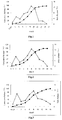
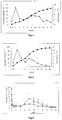
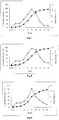
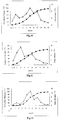
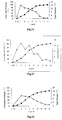
- Fig. 17 in vivo test, with a drug-loading rate of 8%
- Fig. 12 in vivo test, with a drug-loading rate of 20%
- Fig. 20 in vivo test, with a drug-loading rate of 40%
- the drug-loading rate is 20% or 40%
- the burst release effect is obvious. It may also be seen from Fig.
- the administered dosage should be also increased gradually during the treatment.
- the daily dose intake of the drug will need to be increased significantly.
- the drug-loading rate of the active component should not be too low. Otherwise, to achieve the same therapeutic effect as microspheres having a higher drug-loading rate, microspheres having a lower drug-loading rate would have to be administered in a relatively larger amount, which may cause pain to patients.
- the drug-loading rate of the microspheres is too high, when administered to patients, the drug may experience a sudden release, which may cause drug overdose.
- the present disclosure relates to a composition of rotigotine, or the pharmaceutically acceptable salts of rotigotine, which substantially reduces burst releasing of the drug.
- the present invention provides a microsphere composition which comprises rotigotine, or the pharmaceutically acceptable salts of rotigotine; at least one poly(lactide-co-glycolide) (PLGA); and at least one fatty acid, wherein the rotigotine or its pharmaceutical salt thereof is 20-40%, the at least one PLGA is 57.5-72.5% and the at least one fatty acid is 2.5-7.5% in weight relative to the total weight of the composition.
- PLGA poly(lactide-co-glycolide)
- the particle diameter of microspheres can be about 1-250 microns, e.g., about 10-200 microns.
- the rotigotine or a pharmaceutically acceptable salt thereof may be about 25-35%, about 25-30%, about 20-30%, about 20-35%, about 25-40%, about 30-35%, about 30-40%, or about 35-40% in weight relative to the total weight of the composition.
- the rotigotine or a pharmaceutically acceptable salt thereof may be about 21 %, 22%, 23%, 24%, 25%, 26%, 28%, 29%, 30%, 31%, 32%, 33%, 34%, 35%, 36%, 37%, 38%, 39%, or 40% in weight relative to the total weight of the composition.
- the at least one PLGA may comprise two, three, four, or five different types of PLGA polymers, which may be different, e.g., in molecular weight and/or polymerization ratio.
- the at least one PLGA is about 57.5-72.5%, about 60-72.5%, about 60-70%, or about 62.5-67.5% in weight relative to the total amount of the composition.
- the at least one PLGA is about 57.5%, about 60%, about 62.5%, about 65%, about 67.5%, about 70% or about 72.5% in weight relative to the total amount of the composition.
- the pharmaceutically acceptable salt is formed by rotigotine and an inorganic acid or an organic acid.
- the inorganic acid may be chosen from hydrochloric acid, sulphuric acid, phosphoric acid, and nitric acid.
- the organic acid is chosen from citric acid, fumaric acid, maleic acid, acetic acid, benzoic acid, lactic acid, methane sulfonic acid, naphthalene sulfonic acid, and toluene-p-sulfonic acid.
- the organic acid can be an acidic amino acid, such as glutamic acid and aspartic acid.
- the at least one PLGA is about 5,000-100,000 Da in molecular weight.
- the at least one PLGA may be about 5,500-99,000 Da, about 6,000-98,000 Da, about 6,500-97,000 Da, about 7,000-96,000 Da, about 7,500-95,000 Da, about 8,000-94,000 Da, about 8,500-93,000 Da, about 9,000-92,000 Da, about 9,500-91,000 Da, about 10,000-90,000 Da, about 10,500-89,000 Da, about 11,000-88,000 Da, about 10,500-87,000 Da, about 11,000-86,000 Da, about 11,500-85,000 Da, about 12,000-84,000 Da, about 12,500-83,000 Da, about 13,000-82,000 Da, about 13,500-81,000 Da, about 14,000-80,000 Da, about 14,500-79,000 Da, about 15,000-78,000 Da, about 15,500-77,000 Da, about 16,000-76,000 Da, about 16,500-75,000 Da, about 17,000-74,000 Da, about 17,500-73,000 Da, about 18,000-72,000 Da, about 18,500-71,000 Da, about 19,000-70,000 Da, about 19,500-69,000
- the at least one PLGA has a polymerization ratio of lactide to glycolide ranging from about 95:5 to 5:95.
- the polymerization ratio of lactide to glycolide can be about 90:10 to 10:90, about 85:15 to 15:85, about 80:20 to 20:80, about 75:25 to 25:75, about 70:30 to 30:70, about 65:35 to 35:65, about 60:40 to 40:60, or about 55:45 to 45:55.
- the polymerization ratio of lactide to glycolide can be about 50:50.
- the polymerization ratio of lactide to glycolide ranges from about 75:25 to 25:75.
- the at least one fatty acid is chosen from fatty acids having 8-24 carbon atoms.
- the at least one fatty acid may be chosen from stearic acid, palmitic acid, oleic acid, decanoic acid, octanoic acid, and lignoceric acid.
- the at least one fatty acid can be stearic acid.
- the at least one fatty acid can be about 3-7.5%, about 4-7.5%, about 5-7.5%, about 6-7.5%, about 4-5%, or about 3-4% in weight relative to the total weight of the composition.
- the at least one fatty acid can be about 2.5%, about 3%, about 3.5%, about 4%, about 4.5%, about 5%, about 5.5%, about 6%, about 6.5%, about 7%, or about 7.5%.
- rotigotine or a pharmaceutically acceptable salt thereof is about 20-40% in weight relative to the total weight of the composition, the at least one PLGA is about 57.5-72.5%, and the at least one fatty acid is about 2.5%.
- rotigotine or a pharmaceutically acceptable salt thereof is about 30% in weight relative to the total weight of the composition, the at least one PLGA is about 62.5-67.5%, and the at least one fatty acid is about 2.5-7.5%
- the rotigotine or a pharmaceutically acceptable salt thereof is about 30%, the at least one PLGA is about 67.5%, and the fatty acid is about 2.5% relative to the total weight of the composition.
- the at least one PLGA comprises a first PLGA and a second PLGA, wherein the first PLGA has a molecular weight of about 42,000-75,000 Da, the second PLGA has a molecular weight of about 15,000-35,000 Da, and the weight ratio of the first PLGA and the second PLGA is about 95:5 to 5:95.
- the first PLGA has a molecular weight of about 15,000-30,000 Da, about 15,000-25,000 Da, about 15,000-20,000 Da, about 20,000-35,000 Da, about 20,000-30,000 Da, about 20,000-25,000 Da, about 25,000-35,000 Da, about 25,000-30,000 Da, or about 30,000-35,000 Da.
- the second PLGA has a molecular weight of about 45,000-70,000 Da, about 50,000-65,000 Da, about 55,000-60,000 Da, about 45,000-65,000 Da, about 45,000-60,000 Da, about 45,000-55,000 Da, about 45,000-50,000 Da, about 50,000-70,000 Da, about 50,000-55,000 Da, about 60,000-65,000 Da, about 60,000-70,000 Da, about 45,000-75,000 Da, about 50,000-75,000 Da, about 55,000-75,000 Da, about 60,000-75,000 Da, about 65,000-75,000 Da, or about 70,000-75,000 Da.
- the weight ratio of the first PLGA and the second PLGA can be about 90:10 to 10:90, about 85:15 to 15:85, about 80:20 to 20:80, about 75:25 to 25:75, about 70:30 to 30:70, about 65:35 to 35:65, about 60:40 to 40:60, or about 55:45 to 45:55.
- the first PLGA is chosen from PLGA 7525 4A and PLGA 7525 5A
- the second PLGA is PLGA 5050 2.5A.
- the weight ratio of the first PLGA and the second PLGA is about 50:50.
- the rotigotine or a pharmaceutically acceptable salt thereof is about 20-40%, the amount of the first PLGA and the second PLGA is about 57.5-72.5%, and the fatty acid is about 2.5-7.5% relative to the total weight of the composition.
- the rotigotine or a pharmaceutically acceptable salt thereof is about 20-40%, the amount of the first PLGA and the second PLGA is about 57.5-72.5%, and the fatty acid is about 2.5% relative to the total weight of the composition.
- the rotigotine or a pharmaceutically acceptable salt thereof is about 30%, the amount of the first PLGA and the second PLGA is about 62.5-67.5%, and the fatty acid is about 2.5-7.5% relative to the total weight of the composition.
- the rotigotine or a pharmaceutically acceptable salt thereof is about 30%, the amount of the first PLGA and the second PLGA is about 67.5%, and the fatty acid is about 2.5% relative to the total weight of the composition.
- composition as disclosed herein may provide a long-acting sustained release of the compound, such as rotigotine, or a pharmaceutically acceptable salt thereof.
- a microsphere preparation comprising rotigotine or a pharmaceutically acceptable salt thereof, PLGA, and a fatty acid may reduce the low drug release effect that may occur after the microsphere preparation is administered for 1-4 days and in the meantime have reduced burst release effect.
- the microspheres prepared as disclosed herein also provide good batch-to-batch consistency. The variation of the drug concentrations in blood among individual animals may also be significantly reduced.
- composition as disclosed herein may reduce the burst release effect, especially when the compound, such as rotigotine, or a pharmaceutically acceptable salt thereof, is above 20% in weight relative to the total weight of the composition.
- the weight percentage of the compound, such as rotigotine, or a pharmaceutically acceptable salt thereof relative to the total weight of the composition is also referred herein as the "drug-loading rate.”
- composition as disclosed herein releases the drug stably in a long term without significant burst release, thus achieving the purpose of long-acting sustained release.
- the PLGA as disclosed herein is also known as poly(lactide-co-glycolide), which is a lactide/glycolide copolymer.
- the polymerization ratio of lactide to glycolide within poly(lactide-co-glycolide) can be any appropriate ratio.
- the polymerization ratio of lactide to glycolide can be about 95:5 to 5:95, such as about 75:25 to 25:75.
- PLGA may be represented by the following structure: wherein n is zero or a positive integer, and m is zero or a positive integer, but n and m cannot be zero at the same time.
- the PLGA as disclosed herein may be further chemically modified.
- microspheres as disclosed herein are of a matrix type comprising a drug dissolved and/or dispersed homogeneously throughout a polymer matrix.
- the microspheres as disclosed herein may range in size of about 1-250 ⁇ m such as about 10-240 ⁇ m, about 20-230 ⁇ m, about 40-210 ⁇ m, about 50-200 ⁇ m, about 60-190 ⁇ m, about 70-180 ⁇ m, about 80-170 ⁇ m, about 90-160 ⁇ m, about 100-150 ⁇ m, about 110-140 ⁇ m, or about 120-130 ⁇ m.
- the microspheres as disclosed herein may be about 10, 20, 30, 40, 50, 60, 70, 80, 90, 100, 110, 120, 130, 140, 150, 160, 170, 180, 190, 200, 210, 220, 230, 240, or 250 ⁇ m.
- microspheres as disclosed herein may be prepared by any conventional method in the art, including but not limited to, a spray drying method, a solvent volatilization method, or a spray extraction method.
- the compound such as rotigotine, or a pharmaceutically acceptable salt thereof, PLGA and the fatty acid are first dissolved in an organic solvent to prepare an organic phase.
- a continuous aqueous phase is prepared from water-soluble pharmaceutical polymer auxiliary materials.
- the organic phase is then injected into the continuous aqueous phase through a small tube to form a mixture, which is emulsified under vigorous mechanical stirring or ultrasonic stirring so as to form microspheres.
- the organic solvent is evaporated, and the resulting microspheres are filtered and dried.
- the microspheres may also be post-treated by washing, grading, etc., according to a conventional method, dried by vacuum drying or lyophilizing, and finally subpackaged.
- the organic solvent may be those with sufficient volatility, low-residue, and low boiling point.
- the organic solvent may be dichloromethane, chloroform, ethyl acetate, diethyl ether, or any combination thereof.
- the water-soluble pharmaceutical polymer auxiliary materials used for forming the continuous water phase may be chosen from, but not limited to, polyvinyl alcohol, sodium carboxymethyl cellulose, polyvinyl pyrrolidine, sodium polymethacrylate, sodium polyacrylate, and any combination thereof.
- the amounts of the compound, such as rotigotine, or a pharmaceutically acceptable salt thereof, poly(lactide-co-glycolide), and the fatty acid in the organic solvent are not particularly limited, provided that they can be dissolved in the organic solvent.
- poly(lactide-co-glycolide) and the fatty acid can be about 1-30% (w/v), such as about 5-25% (w/v) or about 10-20% (w/v), in the organic solvent.
- the concentration of these polymer auxiliary materials can be 0.01-12.0% (w/v), such as 0.01-10.0% (w/v), such as 0.1-5% (w/v), in the aqueous phase based on their solubility in water.
- the volume ratio of the aqueous phase to the organic phase should be large enough to sufficiently disperse the organic phase in the aqueous phase so as to form the microspheres with sufficiently small particle size and good uniformity. But if the amount of the aqueous phase is more than needed, post-treatment may be complicated, thus increasing cost.
- the volume ratio of the organic phase to the aqueous phase can be about 1:4 to 1:100, such as about 1:5, about 1:10, about 1:20, about 1:30, about 1:40, about 1:50, about 1:60, about 1:70, about 1:80, about 1:90, or about 1:100.
- the microspheres may also be prepared by a spray drying method.
- the compound, such as rotigotine, or a pharmaceutically acceptable salt thereof, PLGA, and other excipients are dissolved in an organic solvent sufficiently to prepare an organic solution.
- the organic solution is filtered and dried by a conventional spray drying method to form microspheres.
- the microspheres may also be post-treated by washing, grading, etc., according to conventional method, and then subpackaged.
- the organic solvent may be chosen from, but not limited to, dichloromethane, chloroform, ethyl acetate, dioxane, diethyl ether, acetone, tetrahydrofuran, glacial acetic acid, and any combination thereof.
- the concentration of PLGA can be about 1-30% (w/v), such as about 5-25% (w/v) or about 10-20% (w/v).
- the microspheres may also be prepared by a spray extraction method.
- the compound, such as Rotigotine, or a pharmaceutically acceptable salt thereof, PLGA, and other excipients are dissolved sufficiently in an organic solvent A (in which the compound, such as Rotigotine, or a pharmaceutically acceptable salt thereof, PLGA, and fatty acid can be dissolved) to prepare an organic solution.
- the organic solution is sprayed into water or an organic solvent B (in which Rotigotine or a pharmaceutically acceptable salt thereof, PLGA, and fatty acid have limited solubility) and extracted to form microspheres.
- the microspheres may also be post-treated by washing, grading, etc., according to conventional method, and then subpackaged.
- the organic solvent A may be at least one chosen from dichloromethane, chloroform, ethyl acetate, dioxane, diethyl ether, acetone, tetrahydrofuran, benzene, toluene, and glacial acetic acid.
- the organic solvent B may be at least one chosen from methanol, ethanol, propanol, isopropanol, petroleum ether, alkane, and paraffinum liquidum.
- the amount of PLGA in the organic solvent A there are no special limits on the amount of PLGA in the organic solvent A, provided that PLGA can be dissolved in the organic solvent A.
- the concentration of PLGA in the organic solvent A can be about 1-30% (w/v), such as about 5-25% (w/v) or about 10-20% (w/v).
- the spray drying method may be preferred over the solvent volatilization method and spray extraction method.
- the solvent volatilization method may be preferred.
- the microspheres may be subjected to particle-size grading, cleaning, drying, and subpackaged according to a predetermined dosage to prepare powder injections. If the particle size is of sufficient uniformity, the step of particle-size grading may be eliminated.
- the composition disclosed herein may be used in preparation of powder injections.
- the powder injections may be converted into injections in situ when in use.
- the powder injections may be prepared directly from the composition, such as in a microsphere form, as disclosed herein, and mixed uniformly with a sodium carboxymethyl cellulose injectable before use.
- the powder injections may also be prepared by mixing the composition, such as in a microsphere form, as disclosed herein, with an appropriate amount of sodium carboxymethyl cellulose, mannitol, glucose, etc. An appropriate amount of purified water can be added thereto prior to use to prepare an injectable.
- the composition disclosed herein may be useful in a method of treating a disease associated with dopamine receptors and/or Parkinson's disease comprising administering an effective amount of the composition as disclosed herein to a subject in need thereof.
- the method may comprise administering a composition comprising rotigotine or a pharmaceutically acceptable salt thereof in an amount of about 20-35% in weight relative to the total weight of the composition, at least one fatty acid in an amount of about 2.5-10% in weight relative to the total weight of the composition, and at least one PLGA in an amount of about 55-77.5% in weight relative to the total amount of the composition, wherein the composition is in a form of microspheres.
- the method may comprise administering a composition comprising rotigotine or a pharmaceutically acceptable salt thereof in an amount of about 30% in weight relative to the total weight of the composition, at least one fatty acid in an amount of about 2.5% in weight relative to the total weight of the composition, and at least one PLGA, such as a first PLA and a second PLGA as disclosed herein, in an amount of about 67.5% in weight relative to the total amount of the composition, wherein the composition is in a form of microspheres.
- a composition comprising rotigotine or a pharmaceutically acceptable salt thereof in an amount of about 30% in weight relative to the total weight of the composition, at least one fatty acid in an amount of about 2.5% in weight relative to the total weight of the composition, and at least one PLGA, such as a first PLA and a second PLGA as disclosed herein, in an amount of about 67.5% in weight relative to the total amount of the composition, wherein the composition is in a form of microspheres.
- composition as disclosed herein can be administered parenterally to a subject in need thereof.
- the composition can be administered by intramuscular injection, subcutaneous injection, intradermal injection, intraperitoneal injection, etc.
- the composition as disclosed herein can be administered via intramuscular injection or subcutaneous injection.
- composition as disclosed herein may be administered at intervals of at least about two weeks, such as about three weeks, about four weeks, about five weeks, etc.
- 0.3104 g of rotigotine and 1.2083 g of PLGA 7525 4A were weighted out and dissolved in 7.5 mL of dichloromethane with stirring to prepare a mixture.
- the mixture was added to 750 mL 0.5% PVA aqueous solution by a peristaltic pump (100 rpm) with stirring (1200-2000 rpm), which was emulsified for 2 min. Then the stirring speed was reduced and the solvent was evaporated for 5 hr.
- the solution obtained was filtered with 1200-mesh sieve to collect the microspheres.
- the microspheres retained on the 1200-mesh sieve were washed with purified water for 3-5 times, lyophilized, and filtered with 100-mesh sieve to prepare the final microspheres.
- the rotigotine microspheres were prepared from 0.3752 g of rotigotine and 1.1291 g of PLGA 7525 4A according to the method of EXAMPLE 1.
- the rotigotine microspheres were prepared from 0.4522 g of rotigotine and 1.0511 g of PIGA 7525 4A according to the method of EXAMPLE 1.
- the rotigotine microspheres were prepared from 0.5268 g of rotigotine and 0.9790 g of PLGA 7525 4A according to the method of EXAMPLE 1.
- the rotigotine microspheres were prepared from 0.6043 g of rotigotine and 0.9019 g of PLGA 7525 4A according to the method of EXAMPLE 1.
- Test Condition temperature: 37 ⁇ 0.5°C, rotation speed: 50 rpm
- Test Method Assays according to the Drug Release test (Chinese Pharmacopeia 2005, vol. II, appendix X D). 3 aliquots of 6 mg of the microspheres were placed in a centrifuge tube with a plug (10 mL), respectively. To the centrifuge tube was added 9 mL of a release medium of phosphate buffer containing 0.2% SDS. After shaking to suspension, each centrifuge tube was placed in a water bath shaker at 37 ⁇ 0.5°C, and vibrated at a speed of 50 ⁇ 3 rpm. After 3hr, 1d, 2d, 4d, 6d, 8d, 10d, 12d, 14d, 16d, 18d, and 20d, respectively, the centrifuge tubes were taken out.
- the centrifuge tubes were centrifuged at a rotation speed of 3600 rpm for 10 min. Then 6 mL of supernatant was taken out from each centrifuge tube and used as a test solution, and 6.0 mL of a release medium of phosphate buffer at the same temperature was added to the centrifuge tube. After shaking to suspension, the centrifuge tube was placed back in a water bath shaker and vibrated. The above test solution was analyzed by HPLC, and the cumulative released amount was calculated according to the external standard method. Under pH 7.4, the in vitro release data are shown in Table 1, and the in vitro release curves are shown in Figs. 1-5 . Table 1.
- the released amounts of rotigotine in 0.125 day and 1 day correlated with the burst release of the drug in vivo.
- Ion source ion spray ionization source; ion spray voltage: 5500 V; temperature: 500°C; GS1: 50psi; GS2: 50psi; the pressure of curtain gas (CUR) in the source: 15 psi; the pressure of collision gas (CAD): 8 psi; cation detection mode; scanning mode: multiple reaction monitoring (MRM); DP voltage of Rotigotine and diazepam are separately 50V and 88V; CE are separately 36V and 47V; CXP are both 10V; the ionic reaction for quantitative analysis are separately 316.2/147.1 (rotigotine) and 256.1/167.1 (diazepam).
- MRM multiple reaction monitoring
- 0.2 mL of blank plasma was added to 100 ⁇ L of rotigotine standard solution and 100 ⁇ L of internal standard (500ng/ml diazepam) to prepare plasma samples corresponding to plasma concentrations of 0.05, 0.25, 1.00, 2.50, 1.00, 2.50, 5.00 and 12.5 ng/mL, respectively.
- the plasma samples were operated according to " the analyzing method of the plasma sample" in Chinese Pharmacopeia 2005, vol. II to create standard curves.
- the microspheres with a dose of 5.5 mg/kg of rotigotine were administered by injection via the muscle of the beagle, and after administration at 0 hr, 1 hr, 3 hr, 6 hr, 24 hr, 48 hr, 96 hr, 144 hr, 192 hr, 240 hr, 288 hr, 336 hr, 384 hr, 432 hr, and 480 hr, 3 mL of blood was sampled via the forelimb vein of the beagles, placed in a heparinized test tube, centrifuged for 10 min at 6000 rpm, separating plasma, and stored at -20°C.
- the plasma was analyzed according to the above analytical method, and the in vivo release is shown in Fig. 6 .
- Table 1 the cumulative released amount of the microspheres prepared in EXAMPLE 3 within 0.125 day and 1 day were 2.00% and 9.53% respectively. It may be seen from Fig. 6 that, there was an apparent burst release of the microspheres in the body of the beagles, then the blood drug level decreased; after 96 hr, the blood drug level increased, and after 192 hr, the blood drug level increased to C max .
- the blood drug levels at 0.125 day and 1 day were higher than C max , which indicates that there was an apparent burst release in the microspheres prepared in EXAMPLE 3.
- the rotigotine microspheres were prepared from 0.3104 g of rotigotine, 1.1603 g of PLGA 7525 4A and 0.0370 g of stearic acid according to the method of EXAMPLE 1.
- the rotigotine microspheres were prepared from 0.3712 g of rotigotine, 1.0891 g of PLGA 7525 4A and 0.0379 g of stearic acid according to the method of EXAMPLE 1.
- EXAMPLE 8 Microspheres Comprising A Single PLGA And Stearic Acid (With A Theoretical Drug-Loading Rate of 30%)
- the rotigotine microspheres were prepared from 0.4522 g of rotigotine, 1.0136 g of PLGA 7525 4A and 0.0371 g of stearic acid according to the method of EXAMPLE 1.
- the rotigotine microspheres were prepared from 0.5258 g of rotigotine, 0.9790 g of PLGA 7525 4A and 0.0374 g of stearic acid according to the method of EXAMPLE 1.
- the rotigotine microspheres were prepared from 0.6083 g of rotigotine, 0.8619 g of PLGA 7525 4A and 0.0367 g of stearic acid according to the method of EXAMPLE 1.
- the rotigotine microspheres were prepared from 0.4520 g of rotigotine, 1.0119 g of PLGA 7525 4A and 0.0371 g of octanoic acid (2.5%) according to the method of EXAMPLE 1.
- Microspheres Comprising Lignoceric Acid And A Single PLGA
- the rotigotine microspheres were prepared from 0.4489 g of rotigotine, 1.0130 g of PLGA 7525 4A and 0.0373 g of lignoceric acid (2.5%) according to the method of EXAMPLE 1.
- the rotigotine microspheres were prepared from 0.4528 g of rotigotine, 1.0432 g of PLGA 7525 4A and 0.0078 g of stearic acid (0.5%) according to the method of EXAMPLE 1.
- the rotigotine microspheres were prepared from 0.4528 g of rotigotine, 1.0362 g of PLGA 7525 4A and 0.0158 g of stearic acid (1%) according to the method of EXAMPLE 1.
- the rotigotine microspheres were prepared from 0.4528 g of rotigotine, 0.9751 g of PLGA 7525 4A and 0.0758 g of stearic acid (5%) according to the method of EXAMPLE 1.
- the rotigotine microspheres were prepared from 0.4492 g of rotigotine, 0.9028 g of PLGA 7525 4A and 0.1532 g of stearic acid (10%) according to the method of EXAMPLE 1.
- the rotigotine microspheres were prepared from 0.4528 g of rotigotine, 0.8261 g of PLGA 7525 4A and 0.2258 g of stearic acid (15%) according to the method of EXAMPLE 1.
- the released amount of rotigotine in 0.125 day and the cumulative released amount of rotigotine within 1 day for the microspheres comprising 1 to 15% of stearic acid were reduced to 0.75%-1.26% and 1.90%-5.70% respectively, thus effectively reduced the burst release of the drug.
- the release of the drug was slowed down.
- the rotigotine microspheres were prepared from 0.4504 g of rotigotine, and a combination of 0.9973 g of PLGA 7525 4A and 0.0521 g of PLGA 5050 2.5A (with a weight ratio of 95:5) according to the method of EXAMPLE 1.
- the rotigotine microspheres were prepared from 0.4489 g of rotigotine, and a combination of 0.5261 g of PLGA 7525 4A and 0.5256 g of PLGA 5050 2.5A (with a weight ratio of 50:50) according to the method of EXAMPLE 1.
- the rotigotine microspheres were prepared from 0.4508 g of rotigotine, and a combination of 0.0519 g of PLGA 7525 4A and 0.9968 g of PLGA 5050 2.5A (with a weight ratio of 5:95) according to the method of EXAMPLE 1.
- the in vitro release tests were carried out for the microspheres prepared in EXAMPLEs 18-20 according to the method of Test EXAMPLE 1.
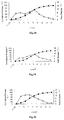
- the in vitro release results are shown in Table 5 and Figs. 20-22 .
- the rotigotine microspheres were prepared from 0.4507 g of rotigotine, a combination of 0.5170 g of PLGA 7525 4A and 0.5177 g of PLGA 5050 2.5A (with a weight ratio of 50:50), and 0.0155 g of stearic acid (1%) according to the method of EXAMPLE 1.
- the rotigotine microspheres were prepared from 0.4491 g of rotigotine, a combination of 0.5060 g of PLGA 7525 4A and 0.5055 g of PLGA 5050 2.5A (with a weight ratio of 50:50), and 0.0371 g of stearic acid (2.5%) according to the method of EXAMPLE 1.
- the rotigotine microspheres were prepared from 0.4510 g of rotigotine, a combination of 0.4680 g of PLGA 7525 4A and 0.4701 g of PLGA 5050 2.5A (with a weight ratio of 50:50), and 0.1119 g of stearic acid (7.5%) according to the method of EXAMPLE 1.
- the rotigotine microspheres were prepared from 0.4503 g of rotigotine, a combination of 0.4479 g of PLGA 7525 4A and 0.4501 g of PLGA 5050 2.5A (with a weight ratio of 50:50), and 0.1520 g of stearic acid (10%) according to the method of EXAMPLE 1.
- the rotigotine microspheres were prepared from 0.4490 g of rotigotine, a combination of 0.5101 g of PLGA 7525 4A and 0.5091 g of PLGA 5050 2.5A (with a weight ratio of 50:50), and 0.0380 g of octanoic acid (2.5%) according to the method of EXAMPLE 1.
- the rotigotine microspheres were prepared from 0.4520 g of rotigotine, a combination of 0.5055 g of PLGA 7525 4A and 0.5062 g of PLGA 5050 2.5A (with a weight ratio of 50:50), and 0.0379 g of lignoceric acid (2.5%) according to the method of EXAMPLE 1.
- the rotigotine microspheres were prepared from 0.4507 g of rotigotine, a combination of 0.9621 g of PLGA 7525 4A and 0.0505 g of PLGA 5050 2.5A (with a weight ratio of 95:5), and 0.0369 g of stearic acid (2.5%) according to the method of EXAMPLE 1.
- the rotigotine microspheres were prepared from 0.4514 g of rotigotine, a combination of 0.0501 g of PLGA 7525 4A and 0.9610 g of PLGA 5050 2.5A (with a weight ratio of 5:95), and 0.0370 g of stearic acid (2.5%) according to the method of EXAMPLE 1.
- the in vitro release tests were carried out for the microspheres prepared in EXAMPLEs 21-24 according to the method of Test EXAMPLE 1.
- the in vitro release results are shown in Table 6 and Figs. 23-26 .
- the in vitro release tests were carried out for the microspheres prepared in EXAMPLES 22, 27, and 28 according to the method of Test EXAMPLE 1.
- the in vitro release results are shown in Table 8 and Figs. 24 , 29, and 30 .
- Test EXAMPLE 12 In Vivo Test of The Microspheres with a drug-loading rate Comprising Stearic Acid (2.5%) And A Combination of PLGA 7525 4A and PLGA 5050 2.5A With Different Weight Ratios
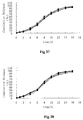
- microspheres were prepared according to EXAMPLE 8, but with different weight ratios of PLGA 7525 4A to PLGA 5050 2.5A of 90:10, 80:20, 70:30 and 50:50.
- the in vivo release tests were carried out for the microspheres according to the method of Test EXAMPLE 2. The results are shown in Fig. 31 .
- PLGA with a molecular weight of 15000-30000 may increase the drug release amount of the microspheres in 1-4 days
- PLGA with a molecular weight of 42000-75000 (PLGA 4A) may prolong the drug release period, thus obtaining microspheres with more stable in vivo drug release.
- microspheres were prepared according to EXAMPLE 8, but with different weight ratios of PLGA 7525 5A to PLGA 5050 2.5A of 90:10, 80:20 and 70:30.
- the in vitro release tests were carried out for the microspheres according to the method of Test EXAMPLE 1.
- the in vitro release data are shown in Table 9. Table 9.
- Agilent 1100 high performance liquid chromatograph comprising a quatpump, a column oven, an automatic sampler, a RID detector and HP-ChemStation with GPC software
- chromatographic column Styragel ® HT3 (7.8 ⁇ 300 mm, 10 ⁇ m, molecular weight range: 500-30000), Styragel ® 6E (7.8 ⁇ 300 mm, 10 ⁇ m, molecular weight range: 5000-600000); tetrahydrofuran (chromatographic pure, SK CHEMICAL, G6EE3H); polystyrene molecular weight standard (Fluka, 1226627); Sample: PLGA 7525 5A, PLGA 7525 4A, PLGA 5050 2.5A (Lakeshore Biomaterials, Inc.).
- the molecular weights of the samples were determined using the size exclusion chromatography. Because the polymer PLGA was liposoluble and has no ultraviolet absorption, the samples were tested on a differential refractive index detector using tetrahydrofuran as the solvent and the mobile phase. Because the molecular weight (M w ) of the polymer PLGA was about 50,000, the molecular weight range of the selected chromatographic column included this range, and the molecular weight distribution range of the samples to be measured was in the middle of the molecular weight range of the selected chromatographic column.
- Styragel ® HT3 (7.8 ⁇ 300 mm, 10 ⁇ m, molecular weight range: 500-30,000) and Styragel ® 6E (7.8 ⁇ 300 mm, 10 ⁇ m, molecular weight range: 5,000-600,000) were connected in series for use. Because the property of PLGA is similar to that of polystyrene, a polystyrene mixed standard (molecular weight range: 500-2,500,000) comprising a molecular weight range of the samples available from Fluka Chemical Corp. was selected.
- Appropriate amount of the sample was added to a mobile phase to prepare a solution with a concentration of about 1 mg/ml, and vibrated to prepare a test solution.
- One set of polystyrene molecular weight standard (3 bottles, each bottle comprising a mixed standard of 4 standard molecular weights) was added to the mobile phase to prepare a solution with a concentration of 1.0 mg/ml as a reference solution.
- the test was carried out on a differential refractive index detector according to the size exclusion chromatography (Chinese Pharmacopeia 2005, vol.
- PLGA test report from Lakeshore Biomaterials Inc. are shown in Table 11. Table 11.
Landscapes
- Health & Medical Sciences (AREA)
- Life Sciences & Earth Sciences (AREA)
- Chemical & Material Sciences (AREA)
- Engineering & Computer Science (AREA)
- Bioinformatics & Cheminformatics (AREA)
- Veterinary Medicine (AREA)
- Public Health (AREA)
- General Health & Medical Sciences (AREA)
- Animal Behavior & Ethology (AREA)
- Medicinal Chemistry (AREA)
- Pharmacology & Pharmacy (AREA)
- Epidemiology (AREA)
- Biophysics (AREA)
- Molecular Biology (AREA)
- Neurology (AREA)
- Neurosurgery (AREA)
- Biomedical Technology (AREA)
- Proteomics, Peptides & Aminoacids (AREA)
- Inorganic Chemistry (AREA)
- Psychology (AREA)
- Organic Chemistry (AREA)
- Nuclear Medicine, Radiotherapy & Molecular Imaging (AREA)
- General Chemical & Material Sciences (AREA)
- Chemical Kinetics & Catalysis (AREA)
- Medicinal Preparation (AREA)
- Pharmaceuticals Containing Other Organic And Inorganic Compounds (AREA)
- Acyclic And Carbocyclic Compounds In Medicinal Compositions (AREA)
Applications Claiming Priority (2)
| Application Number | Priority Date | Filing Date | Title |
|---|---|---|---|
| CN201010576447 | 2010-11-25 | ||
| PCT/CN2011/001958 WO2012068783A1 (en) | 2010-11-25 | 2011-11-25 | Compositions of rotigotine, derivatives thereof, or pharmaceutically acceptable salts of rotigotine or its derivative |
Publications (3)
| Publication Number | Publication Date |
|---|---|
| EP2642993A1 EP2642993A1 (en) | 2013-10-02 |
| EP2642993A4 EP2642993A4 (en) | 2014-05-14 |
| EP2642993B1 true EP2642993B1 (en) | 2016-03-02 |
Family
ID=46145374
Family Applications (1)
| Application Number | Title | Priority Date | Filing Date |
|---|---|---|---|
| EP11843219.4A Active EP2642993B1 (en) | 2010-11-25 | 2011-11-25 | Compositions of rotigotine or pharmaceutically acceptable salts of rotigotine |
Country Status (14)
| Country | Link |
|---|---|
| US (1) | US9265835B2 (enExample) |
| EP (1) | EP2642993B1 (enExample) |
| JP (2) | JP6006225B2 (enExample) |
| KR (1) | KR101481643B1 (enExample) |
| CN (1) | CN103458895B (enExample) |
| AU (1) | AU2011334494B2 (enExample) |
| BR (1) | BR112013012726B1 (enExample) |
| CA (1) | CA2816288C (enExample) |
| ES (1) | ES2572948T3 (enExample) |
| MY (1) | MY165003A (enExample) |
| PH (1) | PH12013500923A1 (enExample) |
| PL (1) | PL2642993T3 (enExample) |
| RU (1) | RU2589700C2 (enExample) |
| WO (1) | WO2012068783A1 (enExample) |
Families Citing this family (14)
| Publication number | Priority date | Publication date | Assignee | Title |
|---|---|---|---|---|
| US8682462B2 (en) | 2011-08-13 | 2014-03-25 | Colin M. Leonard | Systems and methods for dynamic audio processing |
| US11074031B1 (en) | 2016-09-06 | 2021-07-27 | Colin Leonard | Systems and methods for dynamic audio processing |
| EP2559435A1 (en) | 2011-08-19 | 2013-02-20 | UCB Pharma GmbH | Rotigotine in the treatment of hemispatial neglect, stroke and deficits following stroke |
| KR101558042B1 (ko) * | 2012-07-05 | 2015-10-07 | 에스케이케미칼주식회사 | 로티고틴을 함유한 경피흡수제제 |
| AU2014375268B2 (en) * | 2013-12-31 | 2019-11-14 | Pb & B Sa | Controlled release fatty acid compositions for use in body reconstruction and body-shaping |
| CN105310974B (zh) * | 2014-08-01 | 2019-08-23 | 山东绿叶制药有限公司 | 罗替戈汀及其衍生物或其药用盐的植入剂 |
| CN106474070B (zh) * | 2015-08-26 | 2020-03-17 | 四川科伦药物研究院有限公司 | 一种克服停滞期、恒速释放疏水性药物的微球及制备方法 |
| CN105963253A (zh) * | 2016-06-19 | 2016-09-28 | 朱武欣 | 一种罗替戈汀长效水性混悬型注射剂 |
| ES2855976T3 (es) | 2016-07-21 | 2021-09-27 | Shandong luye pharmaceutical co ltd | Behenato de rotigotina y procedimiento de fabricación y aplicación del mismo |
| WO2018045000A1 (en) | 2016-08-30 | 2018-03-08 | Dow Agrosciences Llc | Picolinamides as fungicides |
| WO2018096560A1 (en) | 2016-11-23 | 2018-05-31 | Cipla Limited | Long acting depot formulation for the continuous dopaminergic stimulation |
| KR102089737B1 (ko) * | 2017-11-01 | 2020-03-16 | 한국화학연구원 | 에씨탈로프람을 함유한 미립구형 서방출 주사제 및 그의 제조방법 |
| KR102181231B1 (ko) * | 2018-11-22 | 2020-11-20 | 주식회사 메디포럼제약 | 로티고틴 함유 고분자 미립자의 제조방법 |
| CN115484935A (zh) * | 2020-02-14 | 2022-12-16 | G2G生物公司 | 包括含有glp-1类似物或其药学上可接受的盐的缓释微球的药物组合物 |
Family Cites Families (6)
| Publication number | Priority date | Publication date | Assignee | Title |
|---|---|---|---|---|
| GB9718986D0 (en) * | 1997-09-09 | 1997-11-12 | Danbiosyst Uk | Controlled release microsphere delivery system |
| DE10234673B4 (de) * | 2002-07-30 | 2007-08-16 | Schwarz Pharma Ag | Heißschmelz-TTS zur Verabreichung von Rotigotin und Verfahren zu seiner Herstellung sowie Verwendung von Rotigotin bei der Herstellung eines TTS im Heißschmelzverfahren |
| CA2574085C (en) * | 2004-07-16 | 2014-02-11 | Oakwood Laboratories, L.L.C. | Gonadotropin releasing hormone antagonists |
| US8691277B2 (en) | 2004-09-21 | 2014-04-08 | Shandong Luye Pharmaceutical Co., Ltd. | Long acting sustained-release formulation containing dopamine receptor agonist and the preparation method thereof |
| CN1762495B (zh) * | 2004-09-21 | 2011-04-06 | 山东绿叶制药有限公司 | 含有多巴胺受体激动剂类药物的长效缓释制剂及其制备工艺 |
| JP5222550B2 (ja) | 2007-12-27 | 2013-06-26 | 財團法人工業技術研究院 | 徐放性組成物およびその製造方法 |
-
2011
- 2011-11-25 CA CA2816288A patent/CA2816288C/en active Active
- 2011-11-25 ES ES11843219.4T patent/ES2572948T3/es active Active
- 2011-11-25 US US13/989,550 patent/US9265835B2/en active Active
- 2011-11-25 MY MYPI2013001807A patent/MY165003A/en unknown
- 2011-11-25 CN CN201180049447.2A patent/CN103458895B/zh active Active
- 2011-11-25 KR KR20137013119A patent/KR101481643B1/ko active Active
- 2011-11-25 WO PCT/CN2011/001958 patent/WO2012068783A1/en not_active Ceased
- 2011-11-25 RU RU2013128430/15A patent/RU2589700C2/ru active
- 2011-11-25 BR BR112013012726-0A patent/BR112013012726B1/pt active IP Right Grant
- 2011-11-25 PL PL11843219.4T patent/PL2642993T3/pl unknown
- 2011-11-25 JP JP2013540214A patent/JP6006225B2/ja active Active
- 2011-11-25 PH PH1/2013/500923A patent/PH12013500923A1/en unknown
- 2011-11-25 AU AU2011334494A patent/AU2011334494B2/en active Active
- 2011-11-25 EP EP11843219.4A patent/EP2642993B1/en active Active
-
2015
- 2015-08-21 JP JP2015163527A patent/JP6067803B2/ja active Active
Also Published As
| Publication number | Publication date |
|---|---|
| JP6006225B2 (ja) | 2016-10-12 |
| US9265835B2 (en) | 2016-02-23 |
| ES2572948T3 (es) | 2016-06-03 |
| MY165003A (en) | 2018-02-28 |
| CN103458895B (zh) | 2014-07-09 |
| PL2642993T3 (pl) | 2016-09-30 |
| BR112013012726A2 (enExample) | 2017-04-04 |
| AU2011334494B2 (en) | 2015-11-05 |
| JP2016028043A (ja) | 2016-02-25 |
| KR20130130727A (ko) | 2013-12-02 |
| JP2013543874A (ja) | 2013-12-09 |
| US20140377369A2 (en) | 2014-12-25 |
| RU2589700C2 (ru) | 2016-07-10 |
| JP6067803B2 (ja) | 2017-01-25 |
| EP2642993A4 (en) | 2014-05-14 |
| RU2013128430A (ru) | 2014-12-27 |
| EP2642993A1 (en) | 2013-10-02 |
| HK1186978A1 (en) | 2014-03-28 |
| PH12013500923A1 (en) | 2016-02-08 |
| KR101481643B1 (ko) | 2015-01-12 |
| US20130309314A1 (en) | 2013-11-21 |
| AU2011334494A1 (en) | 2013-07-11 |
| CN103458895A (zh) | 2013-12-18 |
| CA2816288A1 (en) | 2012-05-31 |
| WO2012068783A1 (en) | 2012-05-31 |
| BR112013012726B1 (pt) | 2022-03-29 |
| CA2816288C (en) | 2016-01-26 |
Similar Documents
| Publication | Publication Date | Title |
|---|---|---|
| EP2642993B1 (en) | Compositions of rotigotine or pharmaceutically acceptable salts of rotigotine | |
| JP5809624B2 (ja) | フルベストラントナノスフェア/ミクロスフェア並びにその調製方法及び使用 | |
| EP2793865B1 (en) | Pharmaceutical compositions of triptorelin microspheres | |
| EP2832349B1 (en) | Lactate-based fulvestrant or fulvestrant derivative oily preparation and preparation method thereof | |
| EP1797871A1 (en) | Long acting sustained-release formulation containing dopamine receptor agonist and the preparation method thereof | |
| Davidson et al. | A novel proliposomal ropivacaine oil: pharmacokinetic–pharmacodynamic studies after subcutaneous administration in pigs | |
| ES2975989T3 (es) | Composiciones de micropartículas inyectables de naltrexona de acción prolongada | |
| CN110420314A (zh) | 一种醋酸亮丙瑞林缓释组合物及其制备方法 | |
| Wang et al. | Effects of Pluronic F127-PEG multi-gel-core on the release profile and pharmacodynamics of Exenatide loaded in PLGA microspheres | |
| EP4454636A1 (en) | Continuous delivery preparation capable of being stably released and preparation method therefor | |
| CN102784111A (zh) | 一种多巴胺受体激动剂类药物的缓释制剂 | |
| US20180177777A1 (en) | Formulations for mitigating opioid overdose and methods of making and using the same | |
| Lambert et al. | Poly (ethylene carbonate) microspheres: manufacturing process and internal structure characterization | |
| Gong et al. | Tablets based on compressed zein microspheres for sustained oral administration: design, pharmacokinetics, and clinical study | |
| Nguyen et al. | Novel pH‐Responsive Structural Rearrangement of Myristic Acid‐Conjugated Quetiapine Nanosuspension for Enhanced Long‐Acting Delivery Performance | |
| HK1186978B (en) | Compositions of rotigotine, derivatives thereof, or pharmaceutically acceptable salts of rotigotine or its derivative | |
| CN119212684A (zh) | 新型组合物 | |
| PANDEY et al. | Design and In Vivo Characterization of Novel Pulsatile Drug Delivery System of Biguanide Anti-Diabetic. | |
| CN115006354A (zh) | 一种利培酮-共混plga缓释微球及其制备方法 | |
| HK1107012B (en) | Long acting sustained-release formulation containing dopamine receptor agonist and the preparation method thereof |
Legal Events
| Date | Code | Title | Description |
|---|---|---|---|
| PUAI | Public reference made under article 153(3) epc to a published international application that has entered the european phase |
Free format text: ORIGINAL CODE: 0009012 |
|
| 17P | Request for examination filed |
Effective date: 20130619 |
|
| AK | Designated contracting states |
Kind code of ref document: A1 Designated state(s): AL AT BE BG CH CY CZ DE DK EE ES FI FR GB GR HR HU IE IS IT LI LT LU LV MC MK MT NL NO PL PT RO RS SE SI SK SM TR |
|
| DAX | Request for extension of the european patent (deleted) | ||
| A4 | Supplementary search report drawn up and despatched |
Effective date: 20140410 |
|
| RIC1 | Information provided on ipc code assigned before grant |
Ipc: A61K 31/381 20060101AFI20140404BHEP Ipc: A61K 9/50 20060101ALI20140404BHEP Ipc: A61K 9/14 20060101ALI20140404BHEP Ipc: A61K 9/16 20060101ALI20140404BHEP Ipc: A61K 47/34 20060101ALI20140404BHEP Ipc: A61P 25/16 20060101ALI20140404BHEP |
|
| 17Q | First examination report despatched |
Effective date: 20150121 |
|
| GRAP | Despatch of communication of intention to grant a patent |
Free format text: ORIGINAL CODE: EPIDOSNIGR1 |
|
| INTG | Intention to grant announced |
Effective date: 20150814 |
|
| GRAS | Grant fee paid |
Free format text: ORIGINAL CODE: EPIDOSNIGR3 |
|
| GRAA | (expected) grant |
Free format text: ORIGINAL CODE: 0009210 |
|
| AK | Designated contracting states |
Kind code of ref document: B1 Designated state(s): AL AT BE BG CH CY CZ DE DK EE ES FI FR GB GR HR HU IE IS IT LI LT LU LV MC MK MT NL NO PL PT RO RS SE SI SK SM TR |
|
| REG | Reference to a national code |
Ref country code: GB Ref legal event code: FG4D |
|
| REG | Reference to a national code |
Ref country code: AT Ref legal event code: REF Ref document number: 777505 Country of ref document: AT Kind code of ref document: T Effective date: 20160315 Ref country code: CH Ref legal event code: EP |
|
| REG | Reference to a national code |
Ref country code: IE Ref legal event code: FG4D |
|
| REG | Reference to a national code |
Ref country code: DE Ref legal event code: R096 Ref document number: 602011023735 Country of ref document: DE |
|
| REG | Reference to a national code |
Ref country code: CH Ref legal event code: NV Representative=s name: ISLER AND PEDRAZZINI AG, CH |
|
| REG | Reference to a national code |
Ref country code: ES Ref legal event code: FG2A Ref document number: 2572948 Country of ref document: ES Kind code of ref document: T3 Effective date: 20160603 |
|
| REG | Reference to a national code |
Ref country code: NL Ref legal event code: FP |
|
| REG | Reference to a national code |
Ref country code: LT Ref legal event code: MG4D |
|
| PG25 | Lapsed in a contracting state [announced via postgrant information from national office to epo] |
Ref country code: GR Free format text: LAPSE BECAUSE OF FAILURE TO SUBMIT A TRANSLATION OF THE DESCRIPTION OR TO PAY THE FEE WITHIN THE PRESCRIBED TIME-LIMIT Effective date: 20160603 Ref country code: FI Free format text: LAPSE BECAUSE OF FAILURE TO SUBMIT A TRANSLATION OF THE DESCRIPTION OR TO PAY THE FEE WITHIN THE PRESCRIBED TIME-LIMIT Effective date: 20160302 Ref country code: NO Free format text: LAPSE BECAUSE OF FAILURE TO SUBMIT A TRANSLATION OF THE DESCRIPTION OR TO PAY THE FEE WITHIN THE PRESCRIBED TIME-LIMIT Effective date: 20160602 Ref country code: HR Free format text: LAPSE BECAUSE OF FAILURE TO SUBMIT A TRANSLATION OF THE DESCRIPTION OR TO PAY THE FEE WITHIN THE PRESCRIBED TIME-LIMIT Effective date: 20160302 |
|
| PG25 | Lapsed in a contracting state [announced via postgrant information from national office to epo] |
Ref country code: LV Free format text: LAPSE BECAUSE OF FAILURE TO SUBMIT A TRANSLATION OF THE DESCRIPTION OR TO PAY THE FEE WITHIN THE PRESCRIBED TIME-LIMIT Effective date: 20160302 Ref country code: SE Free format text: LAPSE BECAUSE OF FAILURE TO SUBMIT A TRANSLATION OF THE DESCRIPTION OR TO PAY THE FEE WITHIN THE PRESCRIBED TIME-LIMIT Effective date: 20160302 Ref country code: LT Free format text: LAPSE BECAUSE OF FAILURE TO SUBMIT A TRANSLATION OF THE DESCRIPTION OR TO PAY THE FEE WITHIN THE PRESCRIBED TIME-LIMIT Effective date: 20160302 Ref country code: RS Free format text: LAPSE BECAUSE OF FAILURE TO SUBMIT A TRANSLATION OF THE DESCRIPTION OR TO PAY THE FEE WITHIN THE PRESCRIBED TIME-LIMIT Effective date: 20160302 |
|
| REG | Reference to a national code |
Ref country code: FR Ref legal event code: PLFP Year of fee payment: 6 |
|
| PG25 | Lapsed in a contracting state [announced via postgrant information from national office to epo] |
Ref country code: EE Free format text: LAPSE BECAUSE OF FAILURE TO SUBMIT A TRANSLATION OF THE DESCRIPTION OR TO PAY THE FEE WITHIN THE PRESCRIBED TIME-LIMIT Effective date: 20160302 Ref country code: IS Free format text: LAPSE BECAUSE OF FAILURE TO SUBMIT A TRANSLATION OF THE DESCRIPTION OR TO PAY THE FEE WITHIN THE PRESCRIBED TIME-LIMIT Effective date: 20160702 |
|
| PG25 | Lapsed in a contracting state [announced via postgrant information from national office to epo] |
Ref country code: SM Free format text: LAPSE BECAUSE OF FAILURE TO SUBMIT A TRANSLATION OF THE DESCRIPTION OR TO PAY THE FEE WITHIN THE PRESCRIBED TIME-LIMIT Effective date: 20160302 Ref country code: SK Free format text: LAPSE BECAUSE OF FAILURE TO SUBMIT A TRANSLATION OF THE DESCRIPTION OR TO PAY THE FEE WITHIN THE PRESCRIBED TIME-LIMIT Effective date: 20160302 Ref country code: RO Free format text: LAPSE BECAUSE OF FAILURE TO SUBMIT A TRANSLATION OF THE DESCRIPTION OR TO PAY THE FEE WITHIN THE PRESCRIBED TIME-LIMIT Effective date: 20160302 Ref country code: CZ Free format text: LAPSE BECAUSE OF FAILURE TO SUBMIT A TRANSLATION OF THE DESCRIPTION OR TO PAY THE FEE WITHIN THE PRESCRIBED TIME-LIMIT Effective date: 20160302 Ref country code: PT Free format text: LAPSE BECAUSE OF FAILURE TO SUBMIT A TRANSLATION OF THE DESCRIPTION OR TO PAY THE FEE WITHIN THE PRESCRIBED TIME-LIMIT Effective date: 20160704 |
|
| REG | Reference to a national code |
Ref country code: DE Ref legal event code: R097 Ref document number: 602011023735 Country of ref document: DE |
|
| PG25 | Lapsed in a contracting state [announced via postgrant information from national office to epo] |
Ref country code: BE Free format text: LAPSE BECAUSE OF FAILURE TO SUBMIT A TRANSLATION OF THE DESCRIPTION OR TO PAY THE FEE WITHIN THE PRESCRIBED TIME-LIMIT Effective date: 20160302 |
|
| PLBE | No opposition filed within time limit |
Free format text: ORIGINAL CODE: 0009261 |
|
| STAA | Information on the status of an ep patent application or granted ep patent |
Free format text: STATUS: NO OPPOSITION FILED WITHIN TIME LIMIT |
|
| PG25 | Lapsed in a contracting state [announced via postgrant information from national office to epo] |
Ref country code: DK Free format text: LAPSE BECAUSE OF FAILURE TO SUBMIT A TRANSLATION OF THE DESCRIPTION OR TO PAY THE FEE WITHIN THE PRESCRIBED TIME-LIMIT Effective date: 20160302 |
|
| 26N | No opposition filed |
Effective date: 20161205 |
|
| PG25 | Lapsed in a contracting state [announced via postgrant information from national office to epo] |
Ref country code: BG Free format text: LAPSE BECAUSE OF FAILURE TO SUBMIT A TRANSLATION OF THE DESCRIPTION OR TO PAY THE FEE WITHIN THE PRESCRIBED TIME-LIMIT Effective date: 20160602 Ref country code: SI Free format text: LAPSE BECAUSE OF FAILURE TO SUBMIT A TRANSLATION OF THE DESCRIPTION OR TO PAY THE FEE WITHIN THE PRESCRIBED TIME-LIMIT Effective date: 20160302 |
|
| REG | Reference to a national code |
Ref country code: IE Ref legal event code: MM4A |
|
| PG25 | Lapsed in a contracting state [announced via postgrant information from national office to epo] |
Ref country code: LU Free format text: LAPSE BECAUSE OF NON-PAYMENT OF DUE FEES Effective date: 20161130 |
|
| PG25 | Lapsed in a contracting state [announced via postgrant information from national office to epo] |
Ref country code: IE Free format text: LAPSE BECAUSE OF NON-PAYMENT OF DUE FEES Effective date: 20161125 |
|
| REG | Reference to a national code |
Ref country code: FR Ref legal event code: PLFP Year of fee payment: 7 |
|
| PG25 | Lapsed in a contracting state [announced via postgrant information from national office to epo] |
Ref country code: HU Free format text: LAPSE BECAUSE OF FAILURE TO SUBMIT A TRANSLATION OF THE DESCRIPTION OR TO PAY THE FEE WITHIN THE PRESCRIBED TIME-LIMIT; INVALID AB INITIO Effective date: 20111125 Ref country code: CY Free format text: LAPSE BECAUSE OF FAILURE TO SUBMIT A TRANSLATION OF THE DESCRIPTION OR TO PAY THE FEE WITHIN THE PRESCRIBED TIME-LIMIT Effective date: 20160302 |
|
| PG25 | Lapsed in a contracting state [announced via postgrant information from national office to epo] |
Ref country code: MC Free format text: LAPSE BECAUSE OF FAILURE TO SUBMIT A TRANSLATION OF THE DESCRIPTION OR TO PAY THE FEE WITHIN THE PRESCRIBED TIME-LIMIT Effective date: 20160302 Ref country code: MK Free format text: LAPSE BECAUSE OF FAILURE TO SUBMIT A TRANSLATION OF THE DESCRIPTION OR TO PAY THE FEE WITHIN THE PRESCRIBED TIME-LIMIT Effective date: 20160302 |
|
| PG25 | Lapsed in a contracting state [announced via postgrant information from national office to epo] |
Ref country code: MT Free format text: LAPSE BECAUSE OF NON-PAYMENT OF DUE FEES Effective date: 20161125 |
|
| PG25 | Lapsed in a contracting state [announced via postgrant information from national office to epo] |
Ref country code: TR Free format text: LAPSE BECAUSE OF FAILURE TO SUBMIT A TRANSLATION OF THE DESCRIPTION OR TO PAY THE FEE WITHIN THE PRESCRIBED TIME-LIMIT Effective date: 20160302 Ref country code: AL Free format text: LAPSE BECAUSE OF FAILURE TO SUBMIT A TRANSLATION OF THE DESCRIPTION OR TO PAY THE FEE WITHIN THE PRESCRIBED TIME-LIMIT Effective date: 20160302 |
|
| REG | Reference to a national code |
Ref country code: AT Ref legal event code: UEP Ref document number: 777505 Country of ref document: AT Kind code of ref document: T Effective date: 20160302 |
|
| REG | Reference to a national code |
Ref country code: DE Ref legal event code: R081 Ref document number: 602011023735 Country of ref document: DE Owner name: GENEORA PHARMA (SHIJIAZHUANG) CO., LTD., SHIJI, CN Free format text: FORMER OWNER: SHAN DONG LUYE PHARMACEUTICAL CO., LTD., YANTAI, SHANDONG, CN Ref country code: DE Ref legal event code: R082 Ref document number: 602011023735 Country of ref document: DE Representative=s name: KARO IP PATENTANWAELTE KAHLHOEFER ROESSLER KRE, DE Ref country code: DE Ref legal event code: R082 Ref document number: 602011023735 Country of ref document: DE Representative=s name: KARO IP PATENTANWAELTE PARTG MBB, DE |
|
| REG | Reference to a national code |
Ref country code: GB Ref legal event code: 732E Free format text: REGISTERED BETWEEN 20230216 AND 20230222 |
|
| REG | Reference to a national code |
Ref country code: ES Ref legal event code: PC2A Owner name: GENEORA PHARMA (SHIJIAZHUANG) CO., LTD. Effective date: 20230418 |
|
| REG | Reference to a national code |
Ref country code: NL Ref legal event code: PD Owner name: GENEORA PHARMA (SHIJIAZHUANG) CO., LTD.; CN Free format text: DETAILS ASSIGNMENT: CHANGE OF OWNER(S), ASSIGNMENT; FORMER OWNER NAME: SHAN DONG LUYE PHARMACEUTICAL CO., LTD. Effective date: 20230418 |
|
| REG | Reference to a national code |
Ref country code: AT Ref legal event code: PC Ref document number: 777505 Country of ref document: AT Kind code of ref document: T Owner name: GENEORA PHARMA (SHIJIAZHUANG) CO., LTD., CN Effective date: 20230406 |
|
| PGFP | Annual fee paid to national office [announced via postgrant information from national office to epo] |
Ref country code: DE Payment date: 20241108 Year of fee payment: 14 |
|
| PGFP | Annual fee paid to national office [announced via postgrant information from national office to epo] |
Ref country code: PL Payment date: 20241023 Year of fee payment: 14 |
|
| PGFP | Annual fee paid to national office [announced via postgrant information from national office to epo] |
Ref country code: GB Payment date: 20241122 Year of fee payment: 14 |
|
| PGFP | Annual fee paid to national office [announced via postgrant information from national office to epo] |
Ref country code: FR Payment date: 20241120 Year of fee payment: 14 |
|
| PGFP | Annual fee paid to national office [announced via postgrant information from national office to epo] |
Ref country code: AT Payment date: 20241023 Year of fee payment: 14 |
|
| PGFP | Annual fee paid to national office [announced via postgrant information from national office to epo] |
Ref country code: IT Payment date: 20241107 Year of fee payment: 14 Ref country code: ES Payment date: 20241209 Year of fee payment: 14 |
|
| PGFP | Annual fee paid to national office [announced via postgrant information from national office to epo] |
Ref country code: CH Payment date: 20241201 Year of fee payment: 14 |
|
| PGFP | Annual fee paid to national office [announced via postgrant information from national office to epo] |
Ref country code: NL Payment date: 20251028 Year of fee payment: 15 |
|
| REG | Reference to a national code |
Ref country code: CH Ref legal event code: U11 Free format text: ST27 STATUS EVENT CODE: U-0-0-U10-U11 (AS PROVIDED BY THE NATIONAL OFFICE) Effective date: 20251201 |