EP2623651B1 - Knitwear - Google Patents
Knitwear Download PDFInfo
- Publication number
- EP2623651B1 EP2623651B1 EP13000418.7A EP13000418A EP2623651B1 EP 2623651 B1 EP2623651 B1 EP 2623651B1 EP 13000418 A EP13000418 A EP 13000418A EP 2623651 B1 EP2623651 B1 EP 2623651B1
- Authority
- EP
- European Patent Office
- Prior art keywords
- knitted fabric
- fabric portion
- knitting
- front side
- partial
- Prior art date
- Legal status (The legal status is an assumption and is not a legal conclusion. Google has not performed a legal analysis and makes no representation as to the accuracy of the status listed.)
- Not-in-force
Links
Images

Classifications
-
- D—TEXTILES; PAPER
- D04—BRAIDING; LACE-MAKING; KNITTING; TRIMMINGS; NON-WOVEN FABRICS
- D04B—KNITTING
- D04B1/00—Weft knitting processes for the production of fabrics or articles not dependent on the use of particular machines; Fabrics or articles defined by such processes
- D04B1/22—Weft knitting processes for the production of fabrics or articles not dependent on the use of particular machines; Fabrics or articles defined by such processes specially adapted for knitting goods of particular configuration
- D04B1/24—Weft knitting processes for the production of fabrics or articles not dependent on the use of particular machines; Fabrics or articles defined by such processes specially adapted for knitting goods of particular configuration wearing apparel
-
- D—TEXTILES; PAPER
- D04—BRAIDING; LACE-MAKING; KNITTING; TRIMMINGS; NON-WOVEN FABRICS
- D04B—KNITTING
- D04B1/00—Weft knitting processes for the production of fabrics or articles not dependent on the use of particular machines; Fabrics or articles defined by such processes
- D04B1/22—Weft knitting processes for the production of fabrics or articles not dependent on the use of particular machines; Fabrics or articles defined by such processes specially adapted for knitting goods of particular configuration
-
- A—HUMAN NECESSITIES
- A41—WEARING APPAREL
- A41D—OUTERWEAR; PROTECTIVE GARMENTS; ACCESSORIES
- A41D1/00—Garments
- A41D1/02—Jackets
-
- D—TEXTILES; PAPER
- D04—BRAIDING; LACE-MAKING; KNITTING; TRIMMINGS; NON-WOVEN FABRICS
- D04B—KNITTING
- D04B1/00—Weft knitting processes for the production of fabrics or articles not dependent on the use of particular machines; Fabrics or articles defined by such processes
- D04B1/10—Patterned fabrics or articles
- D04B1/102—Patterned fabrics or articles with stitch pattern
- D04B1/106—Patterned fabrics or articles with stitch pattern at a selvedge, e.g. hems or turned welts
-
- D—TEXTILES; PAPER
- D04—BRAIDING; LACE-MAKING; KNITTING; TRIMMINGS; NON-WOVEN FABRICS
- D04B—KNITTING
- D04B7/00—Flat-bed knitting machines with independently-movable needles
- D04B7/30—Flat-bed knitting machines with independently-movable needles specially adapted for knitting goods of particular configuration
- D04B7/32—Flat-bed knitting machines with independently-movable needles specially adapted for knitting goods of particular configuration tubular goods
-
- D—TEXTILES; PAPER
- D10—INDEXING SCHEME ASSOCIATED WITH SUBLASSES OF SECTION D, RELATING TO TEXTILES
- D10B—INDEXING SCHEME ASSOCIATED WITH SUBLASSES OF SECTION D, RELATING TO TEXTILES
- D10B2501/00—Wearing apparel
- D10B2501/06—Details of garments
- D10B2501/061—Piped openings (pockets)
-
- D—TEXTILES; PAPER
- D10—INDEXING SCHEME ASSOCIATED WITH SUBLASSES OF SECTION D, RELATING TO TEXTILES
- D10B—INDEXING SCHEME ASSOCIATED WITH SUBLASSES OF SECTION D, RELATING TO TEXTILES
- D10B2501/00—Wearing apparel
- D10B2501/06—Details of garments
- D10B2501/062—Buttonholes
Definitions
- the present invention relates to a knitwear including a tubular knitted fabric portion, and a single layer knitted fabric portion joined to the tubular knitted fabric portion.
- a flat knitting machine including at least a front and a back needle bed is used to knit a knitwear having a portion where the body is divided to the left and the right such as a polo shirt, cardigan, and the like.
- a placket portion made from a knitting yarn different from the portion to become the base of the body is sometimes formed at the portion divided to the left and the right (see e.g., patent document 1 and US 3581325A ).
- Patent Document 1 Japanese Unexamined Patent Publication No. 2011-89225
- a knitwear in which the placket portion bulges out toward the front side of the knitwear as an accent is sometimes desired as a knitwear in which the placket portion is arranged on the body.
- a general method of producing such knitwear includes a method (linking) of knitting separately a tubular knitted fabric portion in which one end in a knitting width direction is opened as a placket portion, and sandwiching a base knitted fabric portion of the body, which is a single layer knitted fabric portion, between a front side knitted fabric portion and a back side knitted fabric portion of the tubular knitted fabric portion, and sewing the same.
- This linking involves the trouble of separately preparing the placket portion and the trouble of sewing the placket portion, and thus it is desired to make the placket portion bulge out while integrally knitting the placket portion with the body in a seamless manner.
- the knitwear in which the base knitted fabric portion (single layer knitted fabric portion) and the placket portion (tubular knitted fabric portion) are joined in a seamless manner is known from patent document 1 and the like, the base knitted fabric portion and the placket portion are continuously knitted and joined flatly in such knitwear.
- the knitwear knitted in a seamless manner in which the placket portion bulges out is not currently proposed.
- a knitwear of the present invention includes a tubular knitted fabric portion in which a front side knitted fabric portion and a back side knitted fabric portion are joined to a tubular shape, and a single layer knitted fabric portion joined to the tubular knitted fabric portion.
- the knitwear of the present invention assuming a portion having a knitting width of at least one stitch on the single layer knitted fabric portion side of the back side knitted fabric portion configuring the tubular knitted fabric portion as a partial knitted fabric portion and a remaining portion of the back side knitted fabric portion excluding the partial knitted fabric portion as a remaining knitted fabric portion, the single layer knitted fabric portion and the partial knitted fabric portion are knitted with a first knitting yarn, the remaining knitted fabric portion and the front side knitted fabric portion are knitted with a second knitting yarn, the single layer knitted fabric portion and the front side knitted fabric portion are joined in a seamless manner, and the partial knitted fabric portion and the remaining knitted fabric portion are joined in a seamless manner.
- At least the stitch on the single layer knitted fabric portion side of the stitches configuring the partial knitted fabric portion configuring the knitwear of the present invention is a front stitch when the knitwear is viewed from the front side. At least one such front stitch is to be provided in a knitting width direction, and two or three such stitches are preferably aligned in the knitting width direction.
- the single layer knitted fabric portion and the front side knitted fabric portion are joined by tuck.
- the boundary portion of the single layer knitted fabric portion and the front side knitted fabric portion can be finished with more satisfactory appearance by tucking the second knitting yarn used in the knitting of the front side knitted fabric portion to the single layer knitted fabric portion than by tucking the first knitting yarn used in the knitting of the single layer knitted fabric portion to the front side knitted fabric portion.
- the partial knitted fabric portion and the remaining knitted fabric portion are preferably joined by tuck.
- the single layer knitted fabric portion and the front side knitted fabric portion are joined by crossing the first knitting yarn and the second knitting yarn.
- an additional knitted fabric portion which is knitted using the second knitting yarn, joined to the end on the single layer knitted fabric portion side of the front side knitted fabric portion and arranged on the back side of the single layer knitted fabric portion, is formed.
- the portion joining the single layer knitted fabric portion and the partial knitted fabric portion of the first knitting yarn and the portion joining the front side knitted fabric portion and the additional knitted fabric portion of the second knitting yarn are crossed to join the single layer knitted fabric portion and the front side knitted fabric portion.
- the partial knitted fabric portion and the remaining knitted fabric portion are preferably joined by tuck.
- an end on the partial knitted fabric portion side of the remaining knitted fabric portion is joined to the front side knitted fabric portion at a position substantially facing the relevant end.
- the knitwear of the present invention is a knitwear in which a single layer knitted fabric portion and a tubular knitted fabric portion are joined in a seamless manner, wherein a portion on the single layer knitted fabric portion side of the front side knitted fabric portion of the tubular knitted fabric portion bulges out toward the front side of the knitwear.
- the front side knitted fabric portion bulges out toward a front side of the knitwear because the front stitches formed in a partial knitted fabric portion, which is part of a back side knitted fabric portion of the tubular knitted fabric portion, push the front side knitted fabric portion from the back side.
- the knitwear of the present invention is knitted in a seamless manner, and thus excels in productivity. Furthermore, the knitwear of the present invention has good stretchability since there is no seaming area between the single layer knitted fabric portion and the tubular knitted fabric portion to be joined.
- the knitwear of the present invention in which the single layer knitted fabric portion and the front side knitted fabric portion of the tubular knitted fabric portion are joined by tuck is a knitwear in which holes are less likely to be formed at the boundary portion of the single layer knitted fabric portion and the tubular knitted fabric portion even if the knitwear is pulled in the knitting width direction. This is because the single layer knitted fabric portion and the front side knitted fabric portion of the tubular knitted fabric portion are strongly joined by tuck, and a gap is less likely to be formed between the stitches at the boundary portion of the knitted fabrics.
- the knitwear of the present invention in which the single layer knitted fabric portion and the front side knitted fabric portion of the tubular knitted fabric portion are joined by crossing the first knitting yarn and the second knitting yarn is a knitwear with satisfactory appearance of the boundary portion of the single layer knitted fabric portion and the tubular knitted fabric portion. This is because double stitches for joining are not formed at the boundary portion.
- the front side knitted fabric portion of the tubular knitted fabric portion and the partial knitted fabric portion of the back side knitted fabric portion can be joined in a way that leaves no space between the front side knitted fabric portion of the tubular knitted fabric portion and the partial knitted fabric portion of the back side knitted fabric portion by joining the end on the partial knitted fabric portion side of the remaining knitted fabric portion and the front side knitted fabric portion.
- the partial knitted fabric portion can be pushed against the front side knitted fabric portion, and the front stitches of the partial knitted fabric portion can effectively cause the front side knitted fabric portion to bulge out toward the front side of the knitwear.
- a cardigan knitted with a flat knitting machine will be hereinafter described by way of example as an embodiment of a knitwear of the present invention.
- a cardigan 1 of Fig. 1A includes a front body 2 and a back body 3, the front body 2 being divided to a right front body portion 2R and a left front body portion 2L.
- the right front body portion 2R includes a base knitted fabric portion 20R and a placket portion 25R to be joined to the base knitted fabric portion 20R (the left front body portion 2L also has a similar configuration, and thus the description be omitted).
- the most characteristic aspect of the cardigan 1 lies in the joining state of the base knitted fabric portion 20R and the placket portion 25R.
- the joining state of the base knitted fabric portion 20R and the placket portion 25R will be described with reference to Fig. 1B , which is a cross-sectional view taken along line B-B of Fig. 1A , and an example of a knitting method for making the joining state will be described by way of example with reference to Figs. 2 and 3 .
- the base knitted fabric portion 20R is a non-tubular single layer knitted fabric portion
- the placket portion 25R is a tubular knitted fabric portion having a front side knitted fabric portion 5F and a back side knitted fabric portion 5B that overlap with each other in a thickness direction of the cardigan 1.
- the back side knitted fabric portion 5B configuring the placket portion 25R is divided to a partial knitted fabric portion 50 on the base knitted fabric portion 20R side and a remaining knitted fabric portion 59 excluding the partial knitted fabric portion 50, the partial knitted fabric portion 50 being knitted in continuation to the base knitted fabric portion 20R with a first knitting yarn same as the base knitted fabric portion 20R.
- the remaining knitted fabric portion 59 is knitted with a second knitting yarn same as the front side knitted fabric portion 5F.
- the base knitted fabric portion 20R and the front side knitted fabric portion 5F of the placket portion 25R are joined in a seamless manner (see arrow ⁇ ).
- the partial knitted fabric portion 50 and the remaining knitted fabric portion 59 configuring the back side knitted fabric portion 5B of the placket portion 25R are joined in a seamless manner (see arrow ⁇ ). That is, in such cardigan 1, the base knitted fabric portion 20R is more extended toward the placket portion 25R than the conventional configuration, and the extended portion configures the partial knitted fabric portion 50 that serves as one part of the placket portion 25R.
- the extended portion is on the back side of the cardigan 1, and hence the appearance of the cardigan 1 is not affected.
- the stitches on the base knitted fabric portion 20R side of the stitches configuring the partial knitted fabric portion 50 are front stitches when the cardigan 1 is viewed from the front side.
- the front stitches become a projection on the front surface side of the cardigan 1, and hence the portion that overlaps with the partial knitted fabric portion 50 in the front side knitted fabric portion 5F is pushed by the partial knitted fabric portion 50, thus bulging out toward the front side of the cardigan 1.
- Both knitting examples are knitting examples using a four-bed flat knitting machine having a lower front needle bed (hereinafter referred to as FD) and a lower back needle bed (hereinafter referred to as BD) extending in a traverse direction and disposed opposite to each other in a cross direction, as well as an upper front needle bed (hereinafter referred to as FU) and an upper back needle bed (hereinafter referred to as BU) arranged above the FD and the BD and in which a great number of knitting needles are arranged at the same pitch as the lower needle beds.
- the flat knitting machine enables transfer of stitches between the front and back needle beds, and also enables the BD and the BU of the flat knitting machine to be racked in the traverse direction.
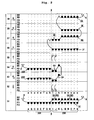
- Fig. 2 shows a knitting step diagram.
- the "alphabet + number" described in the left column in the figure indicates the number of the knitting step, and the arrow in the left and right direction as well as the arrow in the up and down direction in the middle column indicate the moving direction of a yarn feeder (K involves knitting) and the direction of transfer of the stitches, respectively.
- the right column in the figure shows the knitting operation actually carried out in each knitting step, where a black dot means the knitting needle, ⁇ means the stitch to newly form, ⁇ means the old stitch, and V-letter means the tuck stitch.
- a to Q in the right column indicate positions of the knitting needles of the FD or the FU
- a to q indicate positions of the knitting needles of the BD or the BU
- a dotted line X-X indicates a boundary portion of the base knitted fabric portion 20R and the placket portion 25R.
- a state in which a stitch row of the partial knitted fabric portion 50 is knitted on the knitting needles k to i of the BD and a stitch row of the base knitted fabric portion 20R is knitted on the knitting needles H to A of the FD using the first knitting yarn fed from a yarn feeder 8 is shown.
- a state in which a stitch row of the front side knitted fabric portion 5F is knitted on the knitting needles I to Q of the FD and a stitch row of the remaining knitted fabric portion 59 is knitted on the knitting needles 1 to q of the BD using the second knitting yarn fed from a yarn feeder 9 is also shown.
- the yarn feeder 8 is arranged on the left side in the plane of drawing, and the yarn feeder 9 is arranged on the right side in the plane of drawing.
- the yarn feeder 8 is a yarn feeder closer to the front needle beds (FD, FU) than the yarn feeder 9.
- the stitches of the partial knitted fabric portion 50 held on the knitting needles i, j of the BD are transferred to the knitting needles I, J of the FU.
- the end stitch of the partial knitted fabric portion 50 held on the knitting needle k of the BD may also be transferred to the FU.
- the end stitch of the partial knitted fabric portion 50 is left on the BD to stabilize the transfer of the stitches of the partial knitted fabric portion 50 and the knitting in the following S3, S4.
- the yarn feeder 8 is reciprocated to knit the stitch row of the base knitted fabric portion 20R on the knitting needles A to H of the FD and the stitch row of the partial knitted fabric portion 50 on the knitting needles I, J of the FU and the knitting needle k of the BD.
- S5 the stitches of the partial knitted fabric portion 50 knitted in S4 are transferred from the knitting needles I, J of the FU to the knitting needles i, j of the BD.
- the two stitches are knitted with the FU, and thus are front stitches when the cardigan 1 is seen from the front side.
- S5 is a step essential in preventing the partial knitted fabric portion 50 from being knitted into the front side knitted fabric portion 5F when knitting the front side knitted fabric portion 5F of the placket portion 25R in S6 and thereafter.
- the yarn feeder 9 is moved toward the base knitted fabric portion 20R to knit the stitch row of the front side knitted fabric portion 5F on the knitting needles Q to I of the FD.
- the yarn feeder 9 is moved toward the placket portion 25R side to perform tuck on the stitch of the base knitted fabric portion 20R held on the knitting needle H of FD, and thereafter, a part of the stitch row of the front side knitted fabric portion 5F is knitted on the knitting needle I to K of the FD and the stitch row of the remaining knitted fabric portion 59 is knitted on the knitting needles l to q of the BD.
- the tuck is performed on the stitch of the base knitted fabric portion 20R to join the base knitted fabric portion 20R and the placket portion 25R at a boundary portion X.
- the front side knitted fabric portion 5F is knitted to the middle, and then the remaining knitted fabric portion 59 (back side knitted fabric portion 5B) is knitted, so that the front side knitted fabric portion 5F and the back side knitted fabric portion 5B are joined at the position of the boundary of the partial knitted fabric portion 50 and the remaining knitted fabric portion 59.
- the yarn feeder 9 is moved toward the base knitted fabric portion 20R side to knit a part of the stitch row of the front side knitted fabric portion 5F (portion not knitted in S7) on the knitting needles Q to L of the FD, and in S9, the yarn feeder 9 is moved toward the placket portion 25R side to perform tuck on the stitch of the partial knitted fabric portion 50 held on the knitting needle k of the BD and then to knit the stitch row of the remaining knitted fabric portion 59 on the knitting needles 1 to q of the BD. According to the tuck of S9, the partial knitted fabric portion 50 and the remaining knitted fabric portion 59 can be joined in a seamless manner.
- Both ends in the knitting width direction of the partial knitted fabric portion 50 are fixed by S9, and the partial knitted fabric portion 50 pushes the front side knitted fabric portion 5F from the back side.
- the front side knitted fabric portion 5F and the back side knitted fabric portion 5B are joined in S7, and hence a gap is less likely to be formed between the partial knitted fabric portion 50, which is one part of the back side knitted fabric portion 5B, and the front side knitted fabric portion 5F, and the partial knitted fabric portion 50 can be effectively pushed against the front side knitted fabric portion 5F.
- the front side knitted fabric portion 5F of the placket portion 25R can be bulged out toward the front surface side of the cardigan by the partial knitted fabric portion 50 configured mainly with the front stitches.
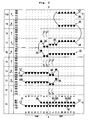
- Fig. 3 is a knitting step diagram, and the manner of viewing Fig. 3 is similar to Fig. 2 . If the portion of arrow ⁇ of Fig. 1B is joined by the second knitting example, a state in which the front side knitted fabric portion 5F is extended to the back side of the base knitted fabric portion 20R is obtained although not shown in Fig. 1B (see additional knitted fabric portion 55 in Fig. 3 to be described later).
- T1 of Fig. 3 a state in which the stitch rows of the base knitted fabric portion 20R and the partial knitted fabric portion 50 are knitted with the first knitting yarn from the yarn feeder 8 and the stitch rows of the remaining knitted fabric portion 59 and the front side knitted fabric portion 5F are knitted with the second knitting yarn from the yarn feeder 9 is shown, similar to the first knitting example.
- the additional knitted fabric portion 55 is further knitted on the knitting needles f to h of the BD with the second knitting yarn from the yarn feeder 9.
- the additional knitted fabric portion 55 is connected to the front side knitted fabric portion 5F, and is arranged on the back side of the base knitted fabric portion 20R.
- T2 to T4 the knitting the same as S2 to S4 in the first knitting example is carried out to increase the stitch rows of the base knitted fabric portion 20R and the partial knitted fabric portion 50.
- the stitches of the partial knitted fabric portion 50 knitted in T4 and held on the knitting needles I, J of the FU are transferred to the knitting needles i, j of the BD, and the stitches of the additional knitted fabric portion 55 held on the knitting needles g, h of the BD are transferred to the knitting needles G, H of the FU.
- the transfer of the partial knitted fabric portion 50 is a step essential to prevent the partial knitted fabric portion 50 from being knitted into the front side knitted fabric portion 5F in the post-step, but the transfer of the additional knitted fabric portion 55 is not an essential step. A part of the additional knitted fabric portion 55 is transferred and the front stitches and the back stitches coexist in the additional knitted fabric portion 55, so that the additional knitted fabric portion 55 is suppressed from curling.
- the stitch row of the front side knitted fabric portion 5F is knitted on the knitting needles Q to I of the FD and the stitch row of the additional knitted fabric portion 55 is knitted on the knitting needles H, G of the FU and the knitting needle f of the BD.
- the stitch row of the additional knitted fabric portion 55 is knitted on the knitting needles H, G of the FU and the knitting needle f of the BD
- the stitch row of one part of the front side knitted fabric portion 5F is knitted on the knitting needles I to K of the FD
- the stitch row of the remaining knitted fabric portion 59 is knitted on the knitting needles L to Q of the BD.
- the crossing of the portion joining the base knitted fabric portion 20R and the partial knitted fabric portion 50 of the first knitting yarn and the portion joining the front side knitted fabric portion 5F and the additional knitted fabric portion 55 of the second knitting yarn is fixed, so that the base knitted fabric portion 20R and the placket portion 25R are joined in a seamless manner at the boundary portion X. Furthermore, in T7, the knitted fabric portions 5F, 5B are joined so that a gap is not formed between the front side knitted fabric portion 5F and the partial knitted fabric portion 50.
- the stitches of the additional knitted fabric portion 55 knitted on the knitting needles G, H of the FU in T7 are transferred to the knitting needles g, h of the BD.
- the transfer is done so that the additional knitted fabric portion 55 is not arranged on the front side of the base knitted fabric portion 20R when knitting the base knitted fabric portion 20R next.
- the yarn feeder 9 is moved toward the base knitted fabric portion 20R side to knit the stitch row of the front side knitted fabric portion 5F on the knitting needles Q to L of the FD, and in T10, the yarn feeder 9 is moved toward the placket portion 25R side to perform tuck on the stitch of the partial knitted fabric portion 50 held on the knitting needle k of the BD and then to knit the stitch row of the remaining knitted fabric portion 59 on the knitting needles l to q of the BD. According to the tuck of T10, the partial knitted fabric portion 50 and the remaining knitted fabric portion 59 can be joined in a seamless manner.
- T2 to T10 are repeated to join the portions 20R, 25R while increasing the knitting course of the base knitted fabric portion 20R and the placket portion 25R.
- the front side knitted fabric portion 5F of the placket portion 25R can be bulged out toward the front surface side of the cardigan, similar to the first knitting example.
- the knitting order of the front side knitted fabric portion 5F and the remaining knitted fabric portion 59 in the first and second knitting examples can be changed.
- the stitch row of the front side knitted fabric portion 5F is knitted on the knitting needles I to Q of the FD after performing tuck on the knitting needle H of the FD in S7 of Fig. 2 .
- the stitch row of the remaining knitted fabric portion 59 is then knitted on the knitting needles q to 1 of the BD, and the knitting same as S9 is carried out last.
- the present invention is not limited to the embodiments described above, and the embodiments of the present invention can be appropriately modified within a scope not deviating from the invention.
- the knitwear of the embodiments can be knitted with the two-bed flat knitting machine.
- a half gauge knitting of providing an empty needle between the adjacent stitches is preferably carried out.
Landscapes
- Engineering & Computer Science (AREA)
- Textile Engineering (AREA)
- Knitting Of Fabric (AREA)
- Outer Garments And Coats (AREA)
Applications Claiming Priority (1)
| Application Number | Priority Date | Filing Date | Title |
|---|---|---|---|
| JP2012020150A JP5955009B2 (ja) | 2012-02-01 | 2012-02-01 | ニットウェア |
Publications (2)
| Publication Number | Publication Date |
|---|---|
| EP2623651A1 EP2623651A1 (en) | 2013-08-07 |
| EP2623651B1 true EP2623651B1 (en) | 2015-03-11 |
Family
ID=47713806
Family Applications (1)
| Application Number | Title | Priority Date | Filing Date |
|---|---|---|---|
| EP13000418.7A Not-in-force EP2623651B1 (en) | 2012-02-01 | 2013-01-29 | Knitwear |
Country Status (4)
| Country | Link |
|---|---|
| EP (1) | EP2623651B1 (enExample) |
| JP (1) | JP5955009B2 (enExample) |
| KR (1) | KR101384192B1 (enExample) |
| CN (1) | CN103243469B (enExample) |
Families Citing this family (1)
| Publication number | Priority date | Publication date | Assignee | Title |
|---|---|---|---|---|
| JP7515289B2 (ja) * | 2020-04-20 | 2024-07-12 | 株式会社島精機製作所 | 手袋および手袋の編成方法 |
Family Cites Families (8)
| Publication number | Priority date | Publication date | Assignee | Title |
|---|---|---|---|---|
| GB1236579A (en) | 1967-12-01 | 1971-06-23 | Courtaulds Ltd | Knitting method |
| JPS60194154A (ja) * | 1984-03-07 | 1985-10-02 | 株式会社島精機製作所 | 横編機による袋編地の編成方法 |
| JPH0778302B2 (ja) * | 1991-05-08 | 1995-08-23 | 株式会社島精機製作所 | 附属編地およびその編成方法 |
| JP2514489B2 (ja) * | 1991-07-04 | 1996-07-10 | 株式会社島精機製作所 | 四重構造を有する編地およびその編成方法 |
| JP3494487B2 (ja) * | 1994-11-15 | 2004-02-09 | 株式会社島精機製作所 | 筒状編地の編成方法 |
| JP4002891B2 (ja) * | 2002-02-06 | 2007-11-07 | 株式会社島精機製作所 | 筒状編地の編成方法 |
| US7143613B2 (en) * | 2003-02-14 | 2006-12-05 | Shima Seiki Mfg., Ltd. | Knitwear garment and method of knitting knitwear |
| JP2011089225A (ja) * | 2009-10-22 | 2011-05-06 | Shima Seiki Mfg Ltd | 2層編地の接合方法と接合された編地 |
-
2012
- 2012-02-01 JP JP2012020150A patent/JP5955009B2/ja not_active Expired - Fee Related
-
2013
- 2013-01-16 KR KR1020130004699A patent/KR101384192B1/ko not_active Expired - Fee Related
- 2013-01-25 CN CN201310028604.2A patent/CN103243469B/zh not_active Expired - Fee Related
- 2013-01-29 EP EP13000418.7A patent/EP2623651B1/en not_active Not-in-force
Also Published As
| Publication number | Publication date |
|---|---|
| EP2623651A1 (en) | 2013-08-07 |
| KR20130089182A (ko) | 2013-08-09 |
| KR101384192B1 (ko) | 2014-04-10 |
| CN103243469B (zh) | 2014-09-24 |
| JP2013159862A (ja) | 2013-08-19 |
| CN103243469A (zh) | 2013-08-14 |
| JP5955009B2 (ja) | 2016-07-20 |
Similar Documents
| Publication | Publication Date | Title |
|---|---|---|
| JP4002836B2 (ja) | 開き部を有するニット編地およびその編成方法 | |
| EP2530197A2 (en) | Knitting method of knitted fabric, and knitted fabric | |
| KR101903572B1 (ko) | 통모양 편성포의 편성방법 및 통모양 편성포 | |
| EP1990452B1 (en) | Method of knitting tubular knitted fabric | |
| EP2330240B1 (en) | Knitting method of knitted fabric and knitted fabric | |
| JP4852092B2 (ja) | 増し目を形成する方法および編地の編幅方向端部よりも内側に増し目が形成されている編地 | |
| KR100975531B1 (ko) | 통 모양 편성포의 편성방법 | |
| JP5980098B2 (ja) | 筒状編地の編成方法、および筒状編地 | |
| EP2450479A2 (en) | Knitted fabric with pocket,and method of knitting the same | |
| JP6211482B2 (ja) | フットウェアの編成方法 | |
| JP5538241B2 (ja) | 衿ぐり部を有する筒状編地の編成方法、および衿ぐり部を有する筒状編地 | |
| EP1829995B1 (en) | Knitwear knitted by weft knitting machine and method of knitting the same | |
| JP2010053490A (ja) | 筒状編地の編成方法と編地 | |
| EP2410085B1 (en) | Method for knitting knitted fabric and knitted fabric | |
| EP2623651A1 (en) | Knitwear | |
| EP2481840A2 (en) | Knitting method of knitted fabric | |
| JP2022088865A (ja) | 編成方法 | |
| KR102247706B1 (ko) | 편성포의 편성방법 및 편성포 | |
| KR20220018445A (ko) | 편성포의 편성방법 | |
| EP2281933B1 (en) | Method for knitting knitted fabric with overlapped stitches, and knitted fabric | |
| JP2010037701A (ja) | 筒状編地の編成方法 | |
| JP2025119340A (ja) | 編地の編成方法、および編地 | |
| JP2011089225A (ja) | 2層編地の接合方法と接合された編地 |
Legal Events
| Date | Code | Title | Description |
|---|---|---|---|
| PUAI | Public reference made under article 153(3) epc to a published international application that has entered the european phase |
Free format text: ORIGINAL CODE: 0009012 |
|
| AK | Designated contracting states |
Kind code of ref document: A1 Designated state(s): AL AT BE BG CH CY CZ DE DK EE ES FI FR GB GR HR HU IE IS IT LI LT LU LV MC MK MT NL NO PL PT RO RS SE SI SK SM TR |
|
| AX | Request for extension of the european patent |
Extension state: BA ME |
|
| 17P | Request for examination filed |
Effective date: 20130913 |
|
| RBV | Designated contracting states (corrected) |
Designated state(s): AL AT BE BG CH CY CZ DE DK EE ES FI FR GB GR HR HU IE IS IT LI LT LU LV MC MK MT NL NO PL PT RO RS SE SI SK SM TR |
|
| RIC1 | Information provided on ipc code assigned before grant |
Ipc: D04B 1/22 20060101AFI20140731BHEP |
|
| GRAP | Despatch of communication of intention to grant a patent |
Free format text: ORIGINAL CODE: EPIDOSNIGR1 |
|
| INTG | Intention to grant announced |
Effective date: 20140930 |
|
| GRAS | Grant fee paid |
Free format text: ORIGINAL CODE: EPIDOSNIGR3 |
|
| GRAA | (expected) grant |
Free format text: ORIGINAL CODE: 0009210 |
|
| AK | Designated contracting states |
Kind code of ref document: B1 Designated state(s): AL AT BE BG CH CY CZ DE DK EE ES FI FR GB GR HR HU IE IS IT LI LT LU LV MC MK MT NL NO PL PT RO RS SE SI SK SM TR |
|
| REG | Reference to a national code |
Ref country code: GB Ref legal event code: FG4D |
|
| REG | Reference to a national code |
Ref country code: CH Ref legal event code: EP |
|
| REG | Reference to a national code |
Ref country code: IE Ref legal event code: FG4D |
|
| REG | Reference to a national code |
Ref country code: AT Ref legal event code: REF Ref document number: 715406 Country of ref document: AT Kind code of ref document: T Effective date: 20150415 |
|
| REG | Reference to a national code |
Ref country code: DE Ref legal event code: R096 Ref document number: 602013001127 Country of ref document: DE Effective date: 20150423 |
|
| REG | Reference to a national code |
Ref country code: NL Ref legal event code: VDEP Effective date: 20150311 |
|
| REG | Reference to a national code |
Ref country code: NL Ref legal event code: VDEP Effective date: 20150311 |
|
| PG25 | Lapsed in a contracting state [announced via postgrant information from national office to epo] |
Ref country code: HR Free format text: LAPSE BECAUSE OF FAILURE TO SUBMIT A TRANSLATION OF THE DESCRIPTION OR TO PAY THE FEE WITHIN THE PRESCRIBED TIME-LIMIT Effective date: 20150311 Ref country code: FI Free format text: LAPSE BECAUSE OF FAILURE TO SUBMIT A TRANSLATION OF THE DESCRIPTION OR TO PAY THE FEE WITHIN THE PRESCRIBED TIME-LIMIT Effective date: 20150311 Ref country code: LT Free format text: LAPSE BECAUSE OF FAILURE TO SUBMIT A TRANSLATION OF THE DESCRIPTION OR TO PAY THE FEE WITHIN THE PRESCRIBED TIME-LIMIT Effective date: 20150311 Ref country code: SE Free format text: LAPSE BECAUSE OF FAILURE TO SUBMIT A TRANSLATION OF THE DESCRIPTION OR TO PAY THE FEE WITHIN THE PRESCRIBED TIME-LIMIT Effective date: 20150311 Ref country code: ES Free format text: LAPSE BECAUSE OF FAILURE TO SUBMIT A TRANSLATION OF THE DESCRIPTION OR TO PAY THE FEE WITHIN THE PRESCRIBED TIME-LIMIT Effective date: 20150311 Ref country code: NO Free format text: LAPSE BECAUSE OF FAILURE TO SUBMIT A TRANSLATION OF THE DESCRIPTION OR TO PAY THE FEE WITHIN THE PRESCRIBED TIME-LIMIT Effective date: 20150611 |
|
| REG | Reference to a national code |
Ref country code: AT Ref legal event code: MK05 Ref document number: 715406 Country of ref document: AT Kind code of ref document: T Effective date: 20150311 |
|
| REG | Reference to a national code |
Ref country code: LT Ref legal event code: MG4D |
|
| PG25 | Lapsed in a contracting state [announced via postgrant information from national office to epo] |
Ref country code: LV Free format text: LAPSE BECAUSE OF FAILURE TO SUBMIT A TRANSLATION OF THE DESCRIPTION OR TO PAY THE FEE WITHIN THE PRESCRIBED TIME-LIMIT Effective date: 20150311 Ref country code: GR Free format text: LAPSE BECAUSE OF FAILURE TO SUBMIT A TRANSLATION OF THE DESCRIPTION OR TO PAY THE FEE WITHIN THE PRESCRIBED TIME-LIMIT Effective date: 20150612 Ref country code: RS Free format text: LAPSE BECAUSE OF FAILURE TO SUBMIT A TRANSLATION OF THE DESCRIPTION OR TO PAY THE FEE WITHIN THE PRESCRIBED TIME-LIMIT Effective date: 20150311 |
|
| PG25 | Lapsed in a contracting state [announced via postgrant information from national office to epo] |
Ref country code: NL Free format text: LAPSE BECAUSE OF FAILURE TO SUBMIT A TRANSLATION OF THE DESCRIPTION OR TO PAY THE FEE WITHIN THE PRESCRIBED TIME-LIMIT Effective date: 20150311 |
|
| PG25 | Lapsed in a contracting state [announced via postgrant information from national office to epo] |
Ref country code: SK Free format text: LAPSE BECAUSE OF FAILURE TO SUBMIT A TRANSLATION OF THE DESCRIPTION OR TO PAY THE FEE WITHIN THE PRESCRIBED TIME-LIMIT Effective date: 20150311 Ref country code: PT Free format text: LAPSE BECAUSE OF FAILURE TO SUBMIT A TRANSLATION OF THE DESCRIPTION OR TO PAY THE FEE WITHIN THE PRESCRIBED TIME-LIMIT Effective date: 20150713 Ref country code: EE Free format text: LAPSE BECAUSE OF FAILURE TO SUBMIT A TRANSLATION OF THE DESCRIPTION OR TO PAY THE FEE WITHIN THE PRESCRIBED TIME-LIMIT Effective date: 20150311 Ref country code: RO Free format text: LAPSE BECAUSE OF FAILURE TO SUBMIT A TRANSLATION OF THE DESCRIPTION OR TO PAY THE FEE WITHIN THE PRESCRIBED TIME-LIMIT Effective date: 20150311 Ref country code: CZ Free format text: LAPSE BECAUSE OF FAILURE TO SUBMIT A TRANSLATION OF THE DESCRIPTION OR TO PAY THE FEE WITHIN THE PRESCRIBED TIME-LIMIT Effective date: 20150311 |
|
| PG25 | Lapsed in a contracting state [announced via postgrant information from national office to epo] |
Ref country code: PL Free format text: LAPSE BECAUSE OF FAILURE TO SUBMIT A TRANSLATION OF THE DESCRIPTION OR TO PAY THE FEE WITHIN THE PRESCRIBED TIME-LIMIT Effective date: 20150311 Ref country code: IS Free format text: LAPSE BECAUSE OF FAILURE TO SUBMIT A TRANSLATION OF THE DESCRIPTION OR TO PAY THE FEE WITHIN THE PRESCRIBED TIME-LIMIT Effective date: 20150711 Ref country code: AT Free format text: LAPSE BECAUSE OF FAILURE TO SUBMIT A TRANSLATION OF THE DESCRIPTION OR TO PAY THE FEE WITHIN THE PRESCRIBED TIME-LIMIT Effective date: 20150311 |
|
| REG | Reference to a national code |
Ref country code: DE Ref legal event code: R097 Ref document number: 602013001127 Country of ref document: DE |
|
| PLBE | No opposition filed within time limit |
Free format text: ORIGINAL CODE: 0009261 |
|
| STAA | Information on the status of an ep patent application or granted ep patent |
Free format text: STATUS: NO OPPOSITION FILED WITHIN TIME LIMIT |
|
| PG25 | Lapsed in a contracting state [announced via postgrant information from national office to epo] |
Ref country code: DK Free format text: LAPSE BECAUSE OF FAILURE TO SUBMIT A TRANSLATION OF THE DESCRIPTION OR TO PAY THE FEE WITHIN THE PRESCRIBED TIME-LIMIT Effective date: 20150311 |
|
| 26N | No opposition filed |
Effective date: 20151214 |
|
| PG25 | Lapsed in a contracting state [announced via postgrant information from national office to epo] |
Ref country code: SI Free format text: LAPSE BECAUSE OF FAILURE TO SUBMIT A TRANSLATION OF THE DESCRIPTION OR TO PAY THE FEE WITHIN THE PRESCRIBED TIME-LIMIT Effective date: 20150311 |
|
| PG25 | Lapsed in a contracting state [announced via postgrant information from national office to epo] |
Ref country code: BE Free format text: LAPSE BECAUSE OF NON-PAYMENT OF DUE FEES Effective date: 20160131 |
|
| PG25 | Lapsed in a contracting state [announced via postgrant information from national office to epo] |
Ref country code: LU Free format text: LAPSE BECAUSE OF FAILURE TO SUBMIT A TRANSLATION OF THE DESCRIPTION OR TO PAY THE FEE WITHIN THE PRESCRIBED TIME-LIMIT Effective date: 20160129 Ref country code: BE Free format text: LAPSE BECAUSE OF FAILURE TO SUBMIT A TRANSLATION OF THE DESCRIPTION OR TO PAY THE FEE WITHIN THE PRESCRIBED TIME-LIMIT Effective date: 20150311 |
|
| REG | Reference to a national code |
Ref country code: CH Ref legal event code: PL |
|
| PG25 | Lapsed in a contracting state [announced via postgrant information from national office to epo] |
Ref country code: MC Free format text: LAPSE BECAUSE OF FAILURE TO SUBMIT A TRANSLATION OF THE DESCRIPTION OR TO PAY THE FEE WITHIN THE PRESCRIBED TIME-LIMIT Effective date: 20150311 |
|
| REG | Reference to a national code |
Ref country code: FR Ref legal event code: ST Effective date: 20160930 |
|
| PG25 | Lapsed in a contracting state [announced via postgrant information from national office to epo] |
Ref country code: CH Free format text: LAPSE BECAUSE OF NON-PAYMENT OF DUE FEES Effective date: 20160131 Ref country code: LI Free format text: LAPSE BECAUSE OF NON-PAYMENT OF DUE FEES Effective date: 20160131 |
|
| REG | Reference to a national code |
Ref country code: IE Ref legal event code: MM4A |
|
| PG25 | Lapsed in a contracting state [announced via postgrant information from national office to epo] |
Ref country code: FR Free format text: LAPSE BECAUSE OF NON-PAYMENT OF DUE FEES Effective date: 20160201 |
|
| PG25 | Lapsed in a contracting state [announced via postgrant information from national office to epo] |
Ref country code: IE Free format text: LAPSE BECAUSE OF NON-PAYMENT OF DUE FEES Effective date: 20160129 |
|
| PGFP | Annual fee paid to national office [announced via postgrant information from national office to epo] |
Ref country code: DE Payment date: 20170125 Year of fee payment: 5 |
|
| PGFP | Annual fee paid to national office [announced via postgrant information from national office to epo] |
Ref country code: IT Payment date: 20170123 Year of fee payment: 5 |
|
| PG25 | Lapsed in a contracting state [announced via postgrant information from national office to epo] |
Ref country code: MT Free format text: LAPSE BECAUSE OF FAILURE TO SUBMIT A TRANSLATION OF THE DESCRIPTION OR TO PAY THE FEE WITHIN THE PRESCRIBED TIME-LIMIT Effective date: 20150311 |
|
| GBPC | Gb: european patent ceased through non-payment of renewal fee |
Effective date: 20170129 |
|
| PG25 | Lapsed in a contracting state [announced via postgrant information from national office to epo] |
Ref country code: GB Free format text: LAPSE BECAUSE OF NON-PAYMENT OF DUE FEES Effective date: 20170129 |
|
| PG25 | Lapsed in a contracting state [announced via postgrant information from national office to epo] |
Ref country code: SM Free format text: LAPSE BECAUSE OF FAILURE TO SUBMIT A TRANSLATION OF THE DESCRIPTION OR TO PAY THE FEE WITHIN THE PRESCRIBED TIME-LIMIT Effective date: 20150311 Ref country code: HU Free format text: LAPSE BECAUSE OF FAILURE TO SUBMIT A TRANSLATION OF THE DESCRIPTION OR TO PAY THE FEE WITHIN THE PRESCRIBED TIME-LIMIT; INVALID AB INITIO Effective date: 20130129 Ref country code: CY Free format text: LAPSE BECAUSE OF FAILURE TO SUBMIT A TRANSLATION OF THE DESCRIPTION OR TO PAY THE FEE WITHIN THE PRESCRIBED TIME-LIMIT Effective date: 20150311 |
|
| PG25 | Lapsed in a contracting state [announced via postgrant information from national office to epo] |
Ref country code: MK Free format text: LAPSE BECAUSE OF FAILURE TO SUBMIT A TRANSLATION OF THE DESCRIPTION OR TO PAY THE FEE WITHIN THE PRESCRIBED TIME-LIMIT Effective date: 20150311 Ref country code: TR Free format text: LAPSE BECAUSE OF FAILURE TO SUBMIT A TRANSLATION OF THE DESCRIPTION OR TO PAY THE FEE WITHIN THE PRESCRIBED TIME-LIMIT Effective date: 20150311 Ref country code: MT Free format text: LAPSE BECAUSE OF FAILURE TO SUBMIT A TRANSLATION OF THE DESCRIPTION OR TO PAY THE FEE WITHIN THE PRESCRIBED TIME-LIMIT Effective date: 20160131 |
|
| PG25 | Lapsed in a contracting state [announced via postgrant information from national office to epo] |
Ref country code: BG Free format text: LAPSE BECAUSE OF FAILURE TO SUBMIT A TRANSLATION OF THE DESCRIPTION OR TO PAY THE FEE WITHIN THE PRESCRIBED TIME-LIMIT Effective date: 20150311 |
|
| REG | Reference to a national code |
Ref country code: DE Ref legal event code: R119 Ref document number: 602013001127 Country of ref document: DE |
|
| PG25 | Lapsed in a contracting state [announced via postgrant information from national office to epo] |
Ref country code: DE Free format text: LAPSE BECAUSE OF NON-PAYMENT OF DUE FEES Effective date: 20180801 Ref country code: AL Free format text: LAPSE BECAUSE OF FAILURE TO SUBMIT A TRANSLATION OF THE DESCRIPTION OR TO PAY THE FEE WITHIN THE PRESCRIBED TIME-LIMIT Effective date: 20150311 |
|
| PG25 | Lapsed in a contracting state [announced via postgrant information from national office to epo] |
Ref country code: IT Free format text: LAPSE BECAUSE OF NON-PAYMENT OF DUE FEES Effective date: 20180129 |