EP2613319A1 - Schichtverbund aus einem Photopolymerfilm und einer Klebstoffschicht - Google Patents
Schichtverbund aus einem Photopolymerfilm und einer Klebstoffschicht Download PDFInfo
- Publication number
- EP2613319A1 EP2613319A1 EP12150277.7A EP12150277A EP2613319A1 EP 2613319 A1 EP2613319 A1 EP 2613319A1 EP 12150277 A EP12150277 A EP 12150277A EP 2613319 A1 EP2613319 A1 EP 2613319A1
- Authority
- EP
- European Patent Office
- Prior art keywords
- adhesive layer
- adhesive
- laminate according
- photopolymer film
- adhesives
- Prior art date
- Legal status (The legal status is an assumption and is not a legal conclusion. Google has not performed a legal analysis and makes no representation as to the accuracy of the status listed.)
- Ceased
Links
Images

Classifications
-
- G—PHYSICS
- G03—PHOTOGRAPHY; CINEMATOGRAPHY; ANALOGOUS TECHNIQUES USING WAVES OTHER THAN OPTICAL WAVES; ELECTROGRAPHY; HOLOGRAPHY
- G03F—PHOTOMECHANICAL PRODUCTION OF TEXTURED OR PATTERNED SURFACES, e.g. FOR PRINTING, FOR PROCESSING OF SEMICONDUCTOR DEVICES; MATERIALS THEREFOR; ORIGINALS THEREFOR; APPARATUS SPECIALLY ADAPTED THEREFOR
- G03F7/00—Photomechanical, e.g. photolithographic, production of textured or patterned surfaces, e.g. printing surfaces; Materials therefor, e.g. comprising photoresists; Apparatus specially adapted therefor
- G03F7/0005—Production of optical devices or components in so far as characterised by the lithographic processes or materials used therefor
- G03F7/001—Phase modulating patterns, e.g. refractive index patterns
-
- B—PERFORMING OPERATIONS; TRANSPORTING
- B42—BOOKBINDING; ALBUMS; FILES; SPECIAL PRINTED MATTER
- B42D—BOOKS; BOOK COVERS; LOOSE LEAVES; PRINTED MATTER CHARACTERISED BY IDENTIFICATION OR SECURITY FEATURES; PRINTED MATTER OF SPECIAL FORMAT OR STYLE NOT OTHERWISE PROVIDED FOR; DEVICES FOR USE THEREWITH AND NOT OTHERWISE PROVIDED FOR; MOVABLE-STRIP WRITING OR READING APPARATUS
- B42D25/00—Information-bearing cards or sheet-like structures characterised by identification or security features; Manufacture thereof
- B42D25/30—Identification or security features, e.g. for preventing forgery
- B42D25/328—Diffraction gratings; Holograms
-
- C—CHEMISTRY; METALLURGY
- C08—ORGANIC MACROMOLECULAR COMPOUNDS; THEIR PREPARATION OR CHEMICAL WORKING-UP; COMPOSITIONS BASED THEREON
- C08G—MACROMOLECULAR COMPOUNDS OBTAINED OTHERWISE THAN BY REACTIONS ONLY INVOLVING UNSATURATED CARBON-TO-CARBON BONDS
- C08G18/00—Polymeric products of isocyanates or isothiocyanates
- C08G18/06—Polymeric products of isocyanates or isothiocyanates with compounds having active hydrogen
- C08G18/28—Polymeric products of isocyanates or isothiocyanates with compounds having active hydrogen characterised by the compounds used containing active hydrogen
- C08G18/2805—Compounds having only one group containing active hydrogen
- C08G18/288—Compounds containing at least one heteroatom other than oxygen or nitrogen
- C08G18/2885—Compounds containing at least one heteroatom other than oxygen or nitrogen containing halogen atoms
-
- C—CHEMISTRY; METALLURGY
- C08—ORGANIC MACROMOLECULAR COMPOUNDS; THEIR PREPARATION OR CHEMICAL WORKING-UP; COMPOSITIONS BASED THEREON
- C08G—MACROMOLECULAR COMPOUNDS OBTAINED OTHERWISE THAN BY REACTIONS ONLY INVOLVING UNSATURATED CARBON-TO-CARBON BONDS
- C08G18/00—Polymeric products of isocyanates or isothiocyanates
- C08G18/06—Polymeric products of isocyanates or isothiocyanates with compounds having active hydrogen
- C08G18/28—Polymeric products of isocyanates or isothiocyanates with compounds having active hydrogen characterised by the compounds used containing active hydrogen
- C08G18/40—High-molecular-weight compounds
- C08G18/42—Polycondensates having carboxylic or carbonic ester groups in the main chain
- C08G18/4266—Polycondensates having carboxylic or carbonic ester groups in the main chain prepared from hydroxycarboxylic acids and/or lactones
- C08G18/4269—Lactones
- C08G18/4277—Caprolactone and/or substituted caprolactone
-
- C—CHEMISTRY; METALLURGY
- C08—ORGANIC MACROMOLECULAR COMPOUNDS; THEIR PREPARATION OR CHEMICAL WORKING-UP; COMPOSITIONS BASED THEREON
- C08G—MACROMOLECULAR COMPOUNDS OBTAINED OTHERWISE THAN BY REACTIONS ONLY INVOLVING UNSATURATED CARBON-TO-CARBON BONDS
- C08G18/00—Polymeric products of isocyanates or isothiocyanates
- C08G18/06—Polymeric products of isocyanates or isothiocyanates with compounds having active hydrogen
- C08G18/28—Polymeric products of isocyanates or isothiocyanates with compounds having active hydrogen characterised by the compounds used containing active hydrogen
- C08G18/40—High-molecular-weight compounds
- C08G18/48—Polyethers
- C08G18/4854—Polyethers containing oxyalkylene groups having four carbon atoms in the alkylene group
-
- C—CHEMISTRY; METALLURGY
- C08—ORGANIC MACROMOLECULAR COMPOUNDS; THEIR PREPARATION OR CHEMICAL WORKING-UP; COMPOSITIONS BASED THEREON
- C08G—MACROMOLECULAR COMPOUNDS OBTAINED OTHERWISE THAN BY REACTIONS ONLY INVOLVING UNSATURATED CARBON-TO-CARBON BONDS
- C08G18/00—Polymeric products of isocyanates or isothiocyanates
- C08G18/06—Polymeric products of isocyanates or isothiocyanates with compounds having active hydrogen
- C08G18/28—Polymeric products of isocyanates or isothiocyanates with compounds having active hydrogen characterised by the compounds used containing active hydrogen
- C08G18/40—High-molecular-weight compounds
- C08G18/48—Polyethers
- C08G18/4887—Polyethers containing carboxylic ester groups derived from carboxylic acids other than acids of higher fatty oils or other than resin acids
-
- C—CHEMISTRY; METALLURGY
- C08—ORGANIC MACROMOLECULAR COMPOUNDS; THEIR PREPARATION OR CHEMICAL WORKING-UP; COMPOSITIONS BASED THEREON
- C08G—MACROMOLECULAR COMPOUNDS OBTAINED OTHERWISE THAN BY REACTIONS ONLY INVOLVING UNSATURATED CARBON-TO-CARBON BONDS
- C08G18/00—Polymeric products of isocyanates or isothiocyanates
- C08G18/06—Polymeric products of isocyanates or isothiocyanates with compounds having active hydrogen
- C08G18/70—Polymeric products of isocyanates or isothiocyanates with compounds having active hydrogen characterised by the isocyanates or isothiocyanates used
- C08G18/71—Monoisocyanates or monoisothiocyanates
-
- C—CHEMISTRY; METALLURGY
- C08—ORGANIC MACROMOLECULAR COMPOUNDS; THEIR PREPARATION OR CHEMICAL WORKING-UP; COMPOSITIONS BASED THEREON
- C08G—MACROMOLECULAR COMPOUNDS OBTAINED OTHERWISE THAN BY REACTIONS ONLY INVOLVING UNSATURATED CARBON-TO-CARBON BONDS
- C08G18/00—Polymeric products of isocyanates or isothiocyanates
- C08G18/06—Polymeric products of isocyanates or isothiocyanates with compounds having active hydrogen
- C08G18/70—Polymeric products of isocyanates or isothiocyanates with compounds having active hydrogen characterised by the isocyanates or isothiocyanates used
- C08G18/71—Monoisocyanates or monoisothiocyanates
- C08G18/715—Monoisocyanates or monoisothiocyanates containing sulfur in addition to isothiocyanate sulfur
-
- C—CHEMISTRY; METALLURGY
- C08—ORGANIC MACROMOLECULAR COMPOUNDS; THEIR PREPARATION OR CHEMICAL WORKING-UP; COMPOSITIONS BASED THEREON
- C08G—MACROMOLECULAR COMPOUNDS OBTAINED OTHERWISE THAN BY REACTIONS ONLY INVOLVING UNSATURATED CARBON-TO-CARBON BONDS
- C08G18/00—Polymeric products of isocyanates or isothiocyanates
- C08G18/06—Polymeric products of isocyanates or isothiocyanates with compounds having active hydrogen
- C08G18/70—Polymeric products of isocyanates or isothiocyanates with compounds having active hydrogen characterised by the isocyanates or isothiocyanates used
- C08G18/72—Polyisocyanates or polyisothiocyanates
- C08G18/73—Polyisocyanates or polyisothiocyanates acyclic
-
- C—CHEMISTRY; METALLURGY
- C08—ORGANIC MACROMOLECULAR COMPOUNDS; THEIR PREPARATION OR CHEMICAL WORKING-UP; COMPOSITIONS BASED THEREON
- C08G—MACROMOLECULAR COMPOUNDS OBTAINED OTHERWISE THAN BY REACTIONS ONLY INVOLVING UNSATURATED CARBON-TO-CARBON BONDS
- C08G18/00—Polymeric products of isocyanates or isothiocyanates
- C08G18/06—Polymeric products of isocyanates or isothiocyanates with compounds having active hydrogen
- C08G18/70—Polymeric products of isocyanates or isothiocyanates with compounds having active hydrogen characterised by the isocyanates or isothiocyanates used
- C08G18/72—Polyisocyanates or polyisothiocyanates
- C08G18/74—Polyisocyanates or polyisothiocyanates cyclic
- C08G18/75—Polyisocyanates or polyisothiocyanates cyclic cycloaliphatic
- C08G18/751—Polyisocyanates or polyisothiocyanates cyclic cycloaliphatic containing only one cycloaliphatic ring
- C08G18/752—Polyisocyanates or polyisothiocyanates cyclic cycloaliphatic containing only one cycloaliphatic ring containing at least one isocyanate or isothiocyanate group linked to the cycloaliphatic ring by means of an aliphatic group
- C08G18/753—Polyisocyanates or polyisothiocyanates cyclic cycloaliphatic containing only one cycloaliphatic ring containing at least one isocyanate or isothiocyanate group linked to the cycloaliphatic ring by means of an aliphatic group containing one isocyanate or isothiocyanate group linked to the cycloaliphatic ring by means of an aliphatic group having a primary carbon atom next to the isocyanate or isothiocyanate group
- C08G18/755—Polyisocyanates or polyisothiocyanates cyclic cycloaliphatic containing only one cycloaliphatic ring containing at least one isocyanate or isothiocyanate group linked to the cycloaliphatic ring by means of an aliphatic group containing one isocyanate or isothiocyanate group linked to the cycloaliphatic ring by means of an aliphatic group having a primary carbon atom next to the isocyanate or isothiocyanate group and at least one isocyanate or isothiocyanate group linked to a secondary carbon atom of the cycloaliphatic ring, e.g. isophorone diisocyanate
-
- C—CHEMISTRY; METALLURGY
- C08—ORGANIC MACROMOLECULAR COMPOUNDS; THEIR PREPARATION OR CHEMICAL WORKING-UP; COMPOSITIONS BASED THEREON
- C08G—MACROMOLECULAR COMPOUNDS OBTAINED OTHERWISE THAN BY REACTIONS ONLY INVOLVING UNSATURATED CARBON-TO-CARBON BONDS
- C08G18/00—Polymeric products of isocyanates or isothiocyanates
- C08G18/06—Polymeric products of isocyanates or isothiocyanates with compounds having active hydrogen
- C08G18/70—Polymeric products of isocyanates or isothiocyanates with compounds having active hydrogen characterised by the isocyanates or isothiocyanates used
- C08G18/72—Polyisocyanates or polyisothiocyanates
- C08G18/74—Polyisocyanates or polyisothiocyanates cyclic
- C08G18/75—Polyisocyanates or polyisothiocyanates cyclic cycloaliphatic
- C08G18/758—Polyisocyanates or polyisothiocyanates cyclic cycloaliphatic containing two or more cycloaliphatic rings
-
- C—CHEMISTRY; METALLURGY
- C08—ORGANIC MACROMOLECULAR COMPOUNDS; THEIR PREPARATION OR CHEMICAL WORKING-UP; COMPOSITIONS BASED THEREON
- C08G—MACROMOLECULAR COMPOUNDS OBTAINED OTHERWISE THAN BY REACTIONS ONLY INVOLVING UNSATURATED CARBON-TO-CARBON BONDS
- C08G18/00—Polymeric products of isocyanates or isothiocyanates
- C08G18/06—Polymeric products of isocyanates or isothiocyanates with compounds having active hydrogen
- C08G18/70—Polymeric products of isocyanates or isothiocyanates with compounds having active hydrogen characterised by the isocyanates or isothiocyanates used
- C08G18/72—Polyisocyanates or polyisothiocyanates
- C08G18/77—Polyisocyanates or polyisothiocyanates having heteroatoms in addition to the isocyanate or isothiocyanate nitrogen and oxygen or sulfur
- C08G18/78—Nitrogen
- C08G18/79—Nitrogen characterised by the polyisocyanates used, these having groups formed by oligomerisation of isocyanates or isothiocyanates
- C08G18/791—Nitrogen characterised by the polyisocyanates used, these having groups formed by oligomerisation of isocyanates or isothiocyanates containing isocyanurate groups
- C08G18/792—Nitrogen characterised by the polyisocyanates used, these having groups formed by oligomerisation of isocyanates or isothiocyanates containing isocyanurate groups formed by oligomerisation of aliphatic and/or cycloaliphatic isocyanates or isothiocyanates
-
- C—CHEMISTRY; METALLURGY
- C08—ORGANIC MACROMOLECULAR COMPOUNDS; THEIR PREPARATION OR CHEMICAL WORKING-UP; COMPOSITIONS BASED THEREON
- C08G—MACROMOLECULAR COMPOUNDS OBTAINED OTHERWISE THAN BY REACTIONS ONLY INVOLVING UNSATURATED CARBON-TO-CARBON BONDS
- C08G18/00—Polymeric products of isocyanates or isothiocyanates
- C08G18/06—Polymeric products of isocyanates or isothiocyanates with compounds having active hydrogen
- C08G18/70—Polymeric products of isocyanates or isothiocyanates with compounds having active hydrogen characterised by the isocyanates or isothiocyanates used
- C08G18/81—Unsaturated isocyanates or isothiocyanates
- C08G18/8141—Unsaturated isocyanates or isothiocyanates masked
- C08G18/815—Polyisocyanates or polyisothiocyanates masked with unsaturated compounds having active hydrogen
- C08G18/8158—Polyisocyanates or polyisothiocyanates masked with unsaturated compounds having active hydrogen with unsaturated compounds having only one group containing active hydrogen
- C08G18/8175—Polyisocyanates or polyisothiocyanates masked with unsaturated compounds having active hydrogen with unsaturated compounds having only one group containing active hydrogen with esters of acrylic or alkylacrylic acid having only one group containing active hydrogen
-
- G—PHYSICS
- G03—PHOTOGRAPHY; CINEMATOGRAPHY; ANALOGOUS TECHNIQUES USING WAVES OTHER THAN OPTICAL WAVES; ELECTROGRAPHY; HOLOGRAPHY
- G03H—HOLOGRAPHIC PROCESSES OR APPARATUS
- G03H1/00—Holographic processes or apparatus using light, infrared or ultraviolet waves for obtaining holograms or for obtaining an image from them; Details peculiar thereto
- G03H1/0005—Adaptation of holography to specific applications
- G03H1/0011—Adaptation of holography to specific applications for security or authentication
-
- G—PHYSICS
- G03—PHOTOGRAPHY; CINEMATOGRAPHY; ANALOGOUS TECHNIQUES USING WAVES OTHER THAN OPTICAL WAVES; ELECTROGRAPHY; HOLOGRAPHY
- G03H—HOLOGRAPHIC PROCESSES OR APPARATUS
- G03H1/00—Holographic processes or apparatus using light, infrared or ultraviolet waves for obtaining holograms or for obtaining an image from them; Details peculiar thereto
- G03H1/02—Details of features involved during the holographic process; Replication of holograms without interference recording
- G03H1/0252—Laminate comprising a hologram layer
- G03H1/0256—Laminate comprising a hologram layer having specific functional layer
-
- G—PHYSICS
- G03—PHOTOGRAPHY; CINEMATOGRAPHY; ANALOGOUS TECHNIQUES USING WAVES OTHER THAN OPTICAL WAVES; ELECTROGRAPHY; HOLOGRAPHY
- G03H—HOLOGRAPHIC PROCESSES OR APPARATUS
- G03H1/00—Holographic processes or apparatus using light, infrared or ultraviolet waves for obtaining holograms or for obtaining an image from them; Details peculiar thereto
- G03H1/26—Processes or apparatus specially adapted to produce multiple sub- holograms or to obtain images from them, e.g. multicolour technique
- G03H1/2645—Multiplexing processes, e.g. aperture, shift, or wavefront multiplexing
- G03H1/265—Angle multiplexing; Multichannel holograms
-
- G—PHYSICS
- G11—INFORMATION STORAGE
- G11B—INFORMATION STORAGE BASED ON RELATIVE MOVEMENT BETWEEN RECORD CARRIER AND TRANSDUCER
- G11B7/00—Recording or reproducing by optical means, e.g. recording using a thermal beam of optical radiation by modifying optical properties or the physical structure, reproducing using an optical beam at lower power by sensing optical properties; Record carriers therefor
- G11B7/24—Record carriers characterised by shape, structure or physical properties, or by the selection of the material
- G11B7/2403—Layers; Shape, structure or physical properties thereof
- G11B7/24035—Recording layers
- G11B7/24044—Recording layers for storing optical interference patterns, e.g. holograms; for storing data in three dimensions, e.g. volume storage
-
- G—PHYSICS
- G11—INFORMATION STORAGE
- G11B—INFORMATION STORAGE BASED ON RELATIVE MOVEMENT BETWEEN RECORD CARRIER AND TRANSDUCER
- G11B7/00—Recording or reproducing by optical means, e.g. recording using a thermal beam of optical radiation by modifying optical properties or the physical structure, reproducing using an optical beam at lower power by sensing optical properties; Record carriers therefor
- G11B7/24—Record carriers characterised by shape, structure or physical properties, or by the selection of the material
- G11B7/241—Record carriers characterised by shape, structure or physical properties, or by the selection of the material characterised by the selection of the material
- G11B7/242—Record carriers characterised by shape, structure or physical properties, or by the selection of the material characterised by the selection of the material of recording layers
- G11B7/244—Record carriers characterised by shape, structure or physical properties, or by the selection of the material characterised by the selection of the material of recording layers comprising organic materials only
- G11B7/245—Record carriers characterised by shape, structure or physical properties, or by the selection of the material characterised by the selection of the material of recording layers comprising organic materials only containing a polymeric component
-
- G—PHYSICS
- G03—PHOTOGRAPHY; CINEMATOGRAPHY; ANALOGOUS TECHNIQUES USING WAVES OTHER THAN OPTICAL WAVES; ELECTROGRAPHY; HOLOGRAPHY
- G03H—HOLOGRAPHIC PROCESSES OR APPARATUS
- G03H1/00—Holographic processes or apparatus using light, infrared or ultraviolet waves for obtaining holograms or for obtaining an image from them; Details peculiar thereto
- G03H1/02—Details of features involved during the holographic process; Replication of holograms without interference recording
- G03H2001/026—Recording materials or recording processes
- G03H2001/0264—Organic recording material
-
- G—PHYSICS
- G03—PHOTOGRAPHY; CINEMATOGRAPHY; ANALOGOUS TECHNIQUES USING WAVES OTHER THAN OPTICAL WAVES; ELECTROGRAPHY; HOLOGRAPHY
- G03H—HOLOGRAPHIC PROCESSES OR APPARATUS
- G03H2250/00—Laminate comprising a hologram layer
- G03H2250/35—Adhesive layer
-
- G—PHYSICS
- G03—PHOTOGRAPHY; CINEMATOGRAPHY; ANALOGOUS TECHNIQUES USING WAVES OTHER THAN OPTICAL WAVES; ELECTROGRAPHY; HOLOGRAPHY
- G03H—HOLOGRAPHIC PROCESSES OR APPARATUS
- G03H2260/00—Recording materials or recording processes
- G03H2260/12—Photopolymer
-
- G—PHYSICS
- G03—PHOTOGRAPHY; CINEMATOGRAPHY; ANALOGOUS TECHNIQUES USING WAVES OTHER THAN OPTICAL WAVES; ELECTROGRAPHY; HOLOGRAPHY
- G03H—HOLOGRAPHIC PROCESSES OR APPARATUS
- G03H2260/00—Recording materials or recording processes
- G03H2260/14—Photoresist
-
- Y—GENERAL TAGGING OF NEW TECHNOLOGICAL DEVELOPMENTS; GENERAL TAGGING OF CROSS-SECTIONAL TECHNOLOGIES SPANNING OVER SEVERAL SECTIONS OF THE IPC; TECHNICAL SUBJECTS COVERED BY FORMER USPC CROSS-REFERENCE ART COLLECTIONS [XRACs] AND DIGESTS
- Y10—TECHNICAL SUBJECTS COVERED BY FORMER USPC
- Y10T—TECHNICAL SUBJECTS COVERED BY FORMER US CLASSIFICATION
- Y10T428/00—Stock material or miscellaneous articles
- Y10T428/14—Layer or component removable to expose adhesive
- Y10T428/1424—Halogen containing compound
- Y10T428/1429—Fluorine
-
- Y—GENERAL TAGGING OF NEW TECHNOLOGICAL DEVELOPMENTS; GENERAL TAGGING OF CROSS-SECTIONAL TECHNOLOGIES SPANNING OVER SEVERAL SECTIONS OF THE IPC; TECHNICAL SUBJECTS COVERED BY FORMER USPC CROSS-REFERENCE ART COLLECTIONS [XRACs] AND DIGESTS
- Y10—TECHNICAL SUBJECTS COVERED BY FORMER USPC
- Y10T—TECHNICAL SUBJECTS COVERED BY FORMER US CLASSIFICATION
- Y10T428/00—Stock material or miscellaneous articles
- Y10T428/24—Structurally defined web or sheet [e.g., overall dimension, etc.]
- Y10T428/24802—Discontinuous or differential coating, impregnation or bond [e.g., artwork, printing, retouched photograph, etc.]
-
- Y—GENERAL TAGGING OF NEW TECHNOLOGICAL DEVELOPMENTS; GENERAL TAGGING OF CROSS-SECTIONAL TECHNOLOGIES SPANNING OVER SEVERAL SECTIONS OF THE IPC; TECHNICAL SUBJECTS COVERED BY FORMER USPC CROSS-REFERENCE ART COLLECTIONS [XRACs] AND DIGESTS
- Y10—TECHNICAL SUBJECTS COVERED BY FORMER USPC
- Y10T—TECHNICAL SUBJECTS COVERED BY FORMER US CLASSIFICATION
- Y10T428/00—Stock material or miscellaneous articles
- Y10T428/24—Structurally defined web or sheet [e.g., overall dimension, etc.]
- Y10T428/24802—Discontinuous or differential coating, impregnation or bond [e.g., artwork, printing, retouched photograph, etc.]
- Y10T428/24843—Discontinuous or differential coating, impregnation or bond [e.g., artwork, printing, retouched photograph, etc.] with heat sealable or heat releasable adhesive layer
-
- Y—GENERAL TAGGING OF NEW TECHNOLOGICAL DEVELOPMENTS; GENERAL TAGGING OF CROSS-SECTIONAL TECHNOLOGIES SPANNING OVER SEVERAL SECTIONS OF THE IPC; TECHNICAL SUBJECTS COVERED BY FORMER USPC CROSS-REFERENCE ART COLLECTIONS [XRACs] AND DIGESTS
- Y10—TECHNICAL SUBJECTS COVERED BY FORMER USPC
- Y10T—TECHNICAL SUBJECTS COVERED BY FORMER US CLASSIFICATION
- Y10T428/00—Stock material or miscellaneous articles
- Y10T428/26—Web or sheet containing structurally defined element or component, the element or component having a specified physical dimension
- Y10T428/263—Coating layer not in excess of 5 mils thick or equivalent
-
- Y—GENERAL TAGGING OF NEW TECHNOLOGICAL DEVELOPMENTS; GENERAL TAGGING OF CROSS-SECTIONAL TECHNOLOGIES SPANNING OVER SEVERAL SECTIONS OF THE IPC; TECHNICAL SUBJECTS COVERED BY FORMER USPC CROSS-REFERENCE ART COLLECTIONS [XRACs] AND DIGESTS
- Y10—TECHNICAL SUBJECTS COVERED BY FORMER USPC
- Y10T—TECHNICAL SUBJECTS COVERED BY FORMER US CLASSIFICATION
- Y10T428/00—Stock material or miscellaneous articles
- Y10T428/28—Web or sheet containing structurally defined element or component and having an adhesive outermost layer
- Y10T428/2809—Web or sheet containing structurally defined element or component and having an adhesive outermost layer including irradiated or wave energy treated component
-
- Y—GENERAL TAGGING OF NEW TECHNOLOGICAL DEVELOPMENTS; GENERAL TAGGING OF CROSS-SECTIONAL TECHNOLOGIES SPANNING OVER SEVERAL SECTIONS OF THE IPC; TECHNICAL SUBJECTS COVERED BY FORMER USPC CROSS-REFERENCE ART COLLECTIONS [XRACs] AND DIGESTS
- Y10—TECHNICAL SUBJECTS COVERED BY FORMER USPC
- Y10T—TECHNICAL SUBJECTS COVERED BY FORMER US CLASSIFICATION
- Y10T428/00—Stock material or miscellaneous articles
- Y10T428/28—Web or sheet containing structurally defined element or component and having an adhesive outermost layer
- Y10T428/2848—Three or more layers
Definitions
- the present invention relates to a layer composite comprising an exposed photopolymer film and an adhesive layer connected at least in regions to the photopolymer film, the photopolymer film comprising crosslinked polyurethane matrix polymers A), crosslinked writing monomers B) and a monomeric fluorourethane additive C).
- Another object of the invention is the use of the layer composite for the production of smart cards, ID documents or 3D images, as a product protection label, as a label, in banknotes in the form of a strip or window or as holographic optical elements in displays.
- Photopolymer films of the type mentioned for the production of holographic media are known from the WO 2011/054797 and the WO 2011/067057 known. Advantages of these holographic media is their high diffractive light diffraction efficiency and that no Nachreaticians füre after the holographic exposure such as chemical or thermal development steps are necessary.
- the exposed photopolymer films are often integrated into more complex products such as smart cards or identity documents.
- the photopolymer film is bonded to a substrate.
- a liquid adhesive formulation or an adhesive film can be used.
- the object is achieved by a layer structure in which the adhesive layer is formed as a diffusion barrier for the fluorourethane additive C).
- the adhesive layer is formed so that in an ATR-IR measurement no time-dependent change of the absorption spectrum occurs when the adhesive layer is wetted with the fluorourethane additive.
- the infrared spectrum of the fluorourethane additive and the adhesive layer are respectively recorded in a first step with the aid of an infrared spectrometer with ATR measuring cell (ATR: attenuated total reflection).
- ATR attenuated total reflection
- a piece of the adhesive layer is glued evenly in a defined layer thickness on the ATR measuring cell.
- the fluorourethane additive is applied.
- the amount of the additive must be such that the area of the adhesive layer located above the ATR measuring cell is completely covered after the additive has run out.
- IR spectra of the adhesive layer are recorded for a sufficient period of time at predetermined time intervals. Since the penetration depth of the totally reflected radiation is in the ⁇ m range, the fluorourethane additive can only be detected in the IR spectrum when it has reached the underside of the adhesive layer resting on the ATR measuring cell by diffusion.
- a difference spectrum is obtained. Substituting this difference spectrum in relation to the IR spectrum of the fluorourethane additive, the time-dependent concentration of the fluorourethane additive can be estimated at the bottom of the adhesive layer.
- the adhesive layer comprises at least one compound selected from the group of synthetic rubbers, chloroprene rubbers, polyester-based hotmelt adhesives, silicone-based adhesives, urethane-based adhesives of high network density, optionally with additional radiation-curing groups or based on urethane acrylates, includes or consists of polyolefin-based adhesives and cyanoacrylate adhesives. It is particularly preferred if they have at least one compound selected from the group Synthetic rubbers, polyester-based hot melt adhesives, urethane-based adhesives containing urethane acrylates and cyanoacrylate adhesives or consists thereof.
- Synthetic rubbers are understood in addition to the poly (isoprenes) and copolymers which include or consist of other monomers acrylonitrile and derivatives, butadiene, styrene, isobutene and others.
- Typical copolymers are butadiene-nitrile rubbers (NBR), styrene-butadiene rubbers (SBR) and isoprene-isobutylene rubbers (IIR).
- NBR butadiene-nitrile rubbers
- SBR styrene-butadiene rubbers
- IIR isoprene-isobutylene rubbers
- Chloroprene rubbers are polymers of 2-chloro-1,3-butadiene and optionally an ethylenically unsaturated monomer copolymerizable with chloroprene. They are preferably used in the form of dispersions obtained by emulsion polymerization in an alkaline medium as in WO02 / 24825 (P. 3, line 26- p. 7, line 4), DE-A 3 002 734 (P. 8, lines 23- 12, line 9), WO2005035683 (A1 ) (P. 16 ff.) Or US Pat. No. 5,773,544 (Sp. 2, No. 9 to Sp. 4, No. 45). Preferred dispersions to be used are in BMS 11 1 206, p. 29f , described.
- Polyester-based hotmelt adhesives are understood to mean those which consist of polyester units to a significant weight fraction of> 30%, preferably> 50%.
- polyesters are described in part b) of this application, with any end group such as ester, ether, amide, acid end group or others being suitable for use as hotmelt adhesive.
- Copolyester types are preferably used whose composition is based on other polymer units such as urethane, polyether, polyamide or vinyl acetate. Particularly preferred is the use of the example described as adhesive 6.
- Silicone-based adhesives are understood to mean those whose linking units contain or exclusively consist of silicone groups. Silicones are organosilicon compounds with only Si-O bonds in the backbone. Frequently, silicones are used in the form of (block or graft) copolymers with polyethers or polyesters or other polymer units (modified silicones). The modifications take place via the organic side groups on the silicon atoms. More information in Müller / Rath, formulation of adhesives and sealants, 2009, ISBN: 978-3-86630-862-6, chapter 3.2.3 , Particular preference is given to the use of pressure-sensitive adhesives based on silicone, for example as mentioned in Example 5.
- High network density, urethane-based adhesives are two-part polyurethanes that form three-dimensional networks of high network densities, which in principle are also used in matrix polymers A).
- Three-dimensional network structures of high network density are in particular obtainable by reacting components which have number-average equivalent molar masses of ⁇ 1500 g / mol and more preferably of ⁇ 1200 g / mol.
- a preferred example is adhesive 8.
- Suitable compositions are obtainable by reacting at least one radiation-curing component with at least one isocyanate-functional resin and at least one photoinitiator. It is particularly preferred if in the radiation-curing component ⁇ 5 wt .-% of compounds having a weight average molecular weight ⁇ 500 and ⁇ 75 wt .-% compounds having a weight average molecular weight> 1000 are included and in the isocyanate-functional resin ⁇ 5 wt .-% compounds having a weight average molecular weight ⁇ 500 are included.
- Polyolefin-based adhesives are polymers based on the monomers propylene and ethylene and are frequently used as hot melt adhesives. The use as pressure-sensitive adhesives is possible. It is conceivable to use other purely C-H-based comonomers, but addition of vinyl acetate, as is usual in polyolefin copolymers, is not suitable.
- Cyanoacrylates are the chemical basis of the "instant adhesives" known on the market. They are reactive 1-component systems that cure very quickly by anionic mechanisms, usually initiated by atmospheric moisture. Further information on used raw materials and the chemistry of hardening can be found in Müller / Rath, formulation of adhesives and sealants, 2009, ISBN: 978-3-86630-862-6, chapter 2.3.2 described. Particularly suitable cyanoacrylate adhesives are the examples mentioned as adhesives 17, 18, 20.
- Adhesives according to the invention can preferably be used in the form of pressure-sensitive adhesives (as pressure-sensitive adhesive tapes or films), hot melt adhesives (hot melts, hot melt adhesive films) or as liquid adhesive formulations which are physically, thermally, chemically or radiation-curing drying agents.
- PSA Pressure-sensitive adhesives
- a carrier material such as a release liner, a withdrawal paper or a (foil) carrier. Due to the process, it may nevertheless be favorable to process pressure-sensitive adhesives at elevated temperatures. More information in Müller / Rath, Formulation of Adhesive and Seal Raw Materials, 2009, ISBN: 978-3-86630-862-6, Chapter 3 ,
- Hotmelt adhesives are amorphous or partially crystalline polymers whose glass transition temperature or crystalline point is above room temperature. When heated above this temperature range, a (partially slow) liquefaction takes place and a viscosity behavior is achieved which is suitable for bonding. Upon cooling, recrystallization or solidification takes place. In principle, high molecular weight polymers whose glass transition temperature is below room temperature can also function as hot melt adhesives in this way. Such polymers are accessible, for example, by drying dispersions or physical solutions. More information in Müller / Rath, formulation of adhesives and sealants, 2009, ISBN: 978-3-86630-862-6, chapter 1.1.2.3 and 1.3.1 ,
- the fluorourethane additive C) comprises at least one compound of the formula (I) contains or consists of, in which m ⁇ 1 and m ⁇ 8 and R1, R2, R3 are independently hydrogen, linear, branched, cyclic or heterocyclic unsubstituted or optionally also substituted by hetero atoms organic radicals, preferably wherein at least one of the radicals R1 R 2, R 3 is substituted by at least one fluorine atom, and more preferably R 1 is an organic radical having at least one fluorine atom.
- the isocyanate component a) preferably comprises polyisocyanates.
- polyisocyanates it is possible to use all compounds known per se to the person skilled in the art or mixtures thereof which on average have two or more NCO functions per molecule. These may be aromatic, araliphatic, aliphatic or cycloaliphatic. In minor amounts, it is also possible to use monoisocyanates and / or polyisocyanates containing unsaturated groups.
- the polyisocyanates of component a) are particularly preferably di- or oligomerized aliphatic and / or cycloaliphatic di- or triisocyanates.
- NCO-functional prepolymers with urethane, allophanate, biuret and / or amide groups are obtained in a manner well-known to the person skilled in the art by reacting monomeric, oligomeric or polyisocyanates a1) with isocyanate-reactive compounds a2) in suitable stoichiometry with the optional use of catalysts and solvents.
- Suitable polyisocyanates a1) are all aliphatic, cycloaliphatic, aromatic or araliphatic di- and triisocyanates known to the person skilled in the art, it being immaterial whether these were obtained by phosgenation or by phosgene-free processes.
- the well-known to those skilled in high molecular weight derivatives of monomeric di- and / or triisocyanates with urethane, urea, carbodiimide, acylurea, isocyanurate, allophanate, biuret, Oxadiazintrion-, uretdione, iminooxa di azadione structure are used individually or in any mixtures with each other.
- Suitable monomeric di- or triisocyanates which can be used as component a1) are butylene diisocyanate, hexamethylene diisocyanate (HDI), isophorone diisocyanate (IPDI), trimethylhexamethylene diisocyanate (TMDI), 1,8-diisocyanato-4- (isocyanatomethyl ) octane, isocyanatomethyl-1,8-octane diisocyanate (TIN), 2,4- and / or 2,6-toluene diisocyanate.
- HDI hexamethylene diisocyanate
- IPDI isophorone diisocyanate
- TMDI trimethylhexamethylene diisocyanate
- TIN isocyanatomethyl-1,8-octane diisocyanate
- 2,4- and / or 2,6-toluene diisocyanate 2,4- and / or 2,6-toluene diis
- OH-functional compounds are preferably used. These are analogous to the OH-functional compounds as described below for component b).
- Allophanates can also be used in a mixture with other prepolymers or oligomers of component a1). In these cases, the use of OH-functional compounds with functionalities of 1 to 3.1 is advantageous. When monofunctional alcohols are used, those having 3 to 20 carbon atoms are preferred.
- amines for prepolymer production.
- Isocyanate is reacted in excess with amine to produce prepolymers containing biuret phenomenon, resulting in a biuret.
- Suitable amines in this case for the reaction with the di-, tri- and polyisocyanates mentioned are all oligomeric or polymeric primary or secondary difunctional amines of the abovementioned type. Examples are aliphatic biurets based on aliphatic amines and aliphatic isocyanates, in particular HDI and TMDI.
- Preferred prepolymers are urethanes, allophanates or biurets of aliphatic isocyanate-functional compounds and oligomeric or polymeric isocyanate-reactive compounds having number average molecular weights of 200 to 10,000 g / mol.
- the prepolymers described above have residual contents of free monomeric isocyanate of less than 2 wt .-%, more preferably less than 1.0 wt .-%, most preferably less than 0.5 wt .-% to.
- the isocyanate component may contain proportionate addition to the described prepolymers further isocyanate components. It may also be possible the isocyanate component a) contains proportionally isocyanates which are partially reacted with isocyanate-reactive ethylenically unsaturated compounds.
- isocyanate component a) may comprise complete or proportionate isocyanates which have been completely or partially reacted with blocking agents known to the person skilled in the art from coating technology.
- blocking agents which may be mentioned are: alcohols, lactams, oximes, malonic esters, alkyl acetoacetates, triazoles, phenols, imidazoles, pyrazoles and amines, such as e.g.
- Butanone oxime diisopropylamine, 1,2,4-triazole, dimethyl-1,2,4-triazole, imidazole, diethyl malonate, acetoacetic ester, acetone oxime, 3,5-dimethylpyrazole, ⁇ -caprolactam, N-tert-butylbenzylamine, cyclopentanonecarboxyethyl ester or any mixtures of these blocking agents.
- all polyfunctional, isocyanate-reactive compounds can be used per se, which have on average at least 1.5 isocyanate-reactive groups per molecule.
- Isocyanate-reactive groups in the context of the present invention are preferably hydroxy, amino or thio groups, particularly preferred are hydroxy compounds.
- Suitable polyfunctional, isocyanate-reactive compounds are, for example, polyester, polyether, polycarbonate, poly (meth) acrylate and / or polyurethane polyols.
- component b) as polyfunctional, isocyanate-reactive compounds and low molecular weight, i. with molecular weights less than 500 g / mol, short chain, i. 2 to 20 carbon atoms containing aliphatic, araliphatic or cycloaliphatic di, tri or polyfunctional alcohols suitable.
- These may, for example, be ethylene glycol, diethylene glycol, triethylene glycol, tetraethylene glycol, dipropylene glycol, tripropylene glycol, 1,2-propanediol, 1,3-propanediol, 1,4-butanediol, neopentyl glycol, 2-ethyl-2-butylpropanediol, trimethylpentanediol, positionally isomeric diethyloctanediols, 1 , 3-Butylene glycol, cyclohexanediol, 1,4-cyclohexanedimethanol, 1,6-hexanediol, 1,2- and 1,4-cyclohexanediol, hydrogenated bisphenol A (2,2-bis (4-hydroxycyclohexyl) propane), 2 , 2-Dimethyl-3-hydroxypropionic acid (2,2-dimethyl-3-hydroxypropyl ester).
- triols examples are trimethylolethane, trimethylolpropane or glycerol.
- Suitable higher-functionality alcohols are ditrimethylolpropane, pentaerythritol, dipentaerythritol or sorbitol.
- Suitable polyester polyols are, for example, linear polyester diols or branched polyester polyols, as obtained in known manner from aliphatic, cycloaliphatic or aromatic di- or polycarboxylic acids or their anhydrides with polyhydric alcohols having an OH functionality ⁇ 2.
- Preferred polyester polyols are based on aliphatic alcohols and mixtures of aliphatic and aromatic acids and have number average molecular weights between 500 and 10,000 g / mol and functionalities between 1.8 and 6.1.
- the polyester polyols can also be based on natural raw materials such as castor oil. It is also possible that the polyester polyols are based on homopolymers or copolymers of lactones, as preferred by addition of lactones or lactone mixtures in the context of a ring-opening lactone polymerization such as butyrolactone, ⁇ -caprolactone and / or methyl- ⁇ -caprolactone to hydroxy-functional compounds such as polyhydric alcohols having an OH functionality ⁇ 2 or polyols a functionality of greater than 1.8, for example of the aforementioned type can be obtained.
- polyols used here as initiators are polyether polyols having a functionality of 1.8 to 3.1 with number average molar masses of 200 to 4000 g / mol, preferred are poly (tetrahydrofurans) having a functionality of 1.9 to 2.2 and number average molecular weights from 500 to 2000 g / mol.
- polyether polyols having a functionality of 1.8 to 3.1 with number average molar masses of 200 to 4000 g / mol
- poly (tetrahydrofurans) having a functionality of 1.9 to 2.2 and number average molecular weights from 500 to 2000 g / mol.
- poly (tetrahydrofurans) having a functionality of 1.9 to 2.2 and number average molecular weights from 500 to 2000 g / mol.
- Suitable polycarbonate polyols are obtainable in a manner known per se by reacting organic carbonates or phosgene with diols or diol mixtures.
- Suitable organic carbonates are dimethyl, diethyl and diphenyl carbonate.
- Suitable diols or mixtures include the polyhydric alcohols of an OH functionality ⁇ 2, preferably 1,4-butanediol, 1,6-hexanediol and / or 3-methylpentanediol, which are per se in the context of the polyester segments, or else polyester polyols can be worked into polycarbonate polyols ,
- Suitable polyether polyols are optionally block-formed polyaddition of cyclic ethers to OH or NH-functional starter molecules.
- Suitable cyclic ethers are, for example, styrene oxides, ethylene oxide, propylene oxide, tetrahydrofuran, butylene oxide, epichlorohydrin, and also any desired mixtures thereof.
- the starter used may be the polyhydric alcohols having an OH functionality ⁇ 2 and primary or secondary amines and amino alcohols, which are known per se within the scope of the polyester polyols.
- Preferred polyether polyols are those of the aforementioned type based solely on propylene oxide or random or block copolymers based on propylene oxide with further 1-alkylene oxides, wherein the 1-Alykenoxidanteil is not higher than 80 wt .-%.
- Particular preference is given to propylene oxide homopolymers and also random or block copolymers which contain oxyethylene, oxypropylene and / or oxybutylene units, the proportion of oxypropylene units based on the total amount of all oxyethylene, oxypropylene and oxybutylene units being at least 20% by weight at least 45% by weight.
- Oxypropylene and oxybutylene herein include all respective linear and branched C3 and C4 isomers.
- R is preferably a hydrogen, a methyl, butyl, hexyl or octyl group or an ether group-containing alkyl radical.
- Preferred ether group-containing alkyl radicals are those based on oxyalkylene units.
- the multiblock copolymers Y (Xi-H) n preferably have number-average molecular weights of more than 1200 g / mol, particularly preferably more than 1950 g / mol, but preferably not more than 12000 g / mol, particularly preferably not more than 8000 g / mol.
- Preferably used block copolymers of the structure Y (Xi-H) n consist of more than 50 percent by weight of the blocks Xi described above and have a number average total molar mass of greater than 1200 g / mol.
- the crosslinked writing monomers B) are preferably obtained by reacting one or more different compounds with radiation-curing groups under the action of actinic radiation.
- Compounds having radiation-curable groups can contain compounds such as ⁇ , ⁇ -unsaturated carboxylic acid derivatives such as acrylates, methacrylates, maleates, fumarates, maleimides, acrylamides, furthermore vinyl ethers, propenyl ethers, allyl ethers and dicyclopentadienyl units containing compounds as well as olefinically unsaturated compounds such.
- the writing monomers B) are photochemically crosslinked acrylates.
- Acrylates or methacrylates are generally esters of acrylic acid or methacrylic acid.
- useful acrylates and methacrylates are methyl acrylate, methyl methacrylate, ethyl acrylate, ethyl methacrylate, ethoxyethyl acrylate, ethoxyethyl methacrylate, n-butyl acrylate, n-butyl methacrylate, tert-butyl acrylate, tert-butyl methacrylate, hexyl acrylate, hexyl methacrylate, 2-ethylhexyl acrylate, 2-ethylhexyl methacrylate, butoxyethyl acrylate, Butoxyethyl methacrylate, lauryl acrylate, lauryl methacrylate, isobornyl acrylate, isobornyl methacrylate, phenyl acrylate, phenyl methacrylate,
- urethane acrylates can also be used as compounds with radiation-curing groups.
- Urethane acrylates are compounds having at least one acrylic acid ester group which additionally have at least one urethane bond. It is known that such compounds can be obtained by reacting a hydroxy-functional acrylic ester with an isocyanate-functional compound.
- urethane acrylates and / or urethane methacrylates are the addition products of aromatic triisocyanates (very particularly preferably tris (4-phenylisocyanato) thiophosphate or trimers of aromatic diisocyanates such as tolylene diisocyanate) with hydroxyethyl acrylate, hydroxypropyl acrylate, 4-hydroxybutyl acrylate, the addition products of 3-thiomethylphenyl isocyanate with hydroxyethyl acrylate, hydroxypropyl acrylate, 4-hydroxybutyl acrylate and unsaturated glycidyl ether acrylate urethanes (as in applications WO 2008/125229 A1 and in the EP 2 154 129 described) or any mixtures thereof.
- aromatic triisocyanates very particularly preferably tris (4-phenylisocyanato) thiophosphate or trimers of aromatic diisocyanates such as tolylene diisocyanate
- the photopolymer film additionally comprises a photoinitiator D) and / or a catalyst E).
- one or more photoinitiators can be used.
- the photoinitiator system used may preferably comprise an anionic, cationic or neutral dye and a coinitiator.
- examples are mixtures of tetrabutylammonium triphenylhexylborate, tetrabutylammonium triphenylbutylborate, tetrabutylammonium trinapthylbutylborate, tetrabutylammonium tris- (4-tert-butyl) -phenylbutylborate, tetrabutylammonium tris- (3-fluorophenyl) -hexylborate and tetrabutylammonium tris- (3-chloro-4-methylphenyl) -hexylborate with dyes such as Astrazon Orange G, Methylene Blue, New Methylene Blue, Azure A, Pyrillium I, Safranine O, Cyanine, Gallocyanine,
- One or more catalysts E can be used. These are catalysts for accelerating urethane formation.
- catalysts for this purpose are, for example, tin octoate, zinc octoate, dibutyltin dilaurate, dimethylbis [(1-oxoneodecyl) oxy] stannane, dimethyltin dicarboxylate, zirconium bis (ethylhexanoate), zirconium acetylacetonate or tertiary amines such as 1,4-diazablcyclo [2.2.2] octane , Diazabicyclononane, diazabicycloundecane, 1,1,3,3-tetramethylguanidine, 1,3,4,6,7,8-hexahydro-1-methyl-2H-pyrimido (1,2-a) pyrimidine, monobutyltin tris (2-ethylhexanoate).
- dibutyltin dilaurate dimethylbis [(1-oxoneodecyl) oxy] stannane, dimethyltin dicarboxylate, 1,4-diazablcyclo [2.2.2] octane, diazabicyclononane, diazabicycloundecane, 1,1,3,3-tetramethylguanidine, 1,3,4,6 , 7,8-hexahydro-1-methyl-2H-pyrimido (1,2-a) pyrimidine and monobutyltin tris (2-ethylhexanoate).
- constituents of the photopolymer film may be radical stabilizers or other auxiliaries and additives such as plasticizers.
- radical stabilizers are inhibitors and antioxidants such as in " Methods of Organic Chemistry "(Houben-Weyl), 4th Edition, Volume XIV / 1, p. 433ff, Georg Thieme Verlag, Stuttgart 1961 , are suitable. Suitable classes are, for example, phenols such as 2,6-di-tert-butyl-4-methylphenol, cresols, hydroquinones, benzyl alcohols such as benzhydrol, possibly also quinones such. B. 2,5-di-tert-butyl quinone, possibly also aromatic amines such as diisopropylamine or phenothiazine.
- a hologram may be imprinted in the photopolymer film.
- holograms for optical applications in the entire visible range and in the near UV range (300 - 800 nm) can be produced.
- Visual holograms include all holograms that can be recorded by methods known to those skilled in the art, including, but are not limited to, in-line (gabor) holograms, off-axis holograms, full-aperture transfer holograms, white-light transmission holograms ("rainbow holograms"), denisyuk holograms, Off-axis reflection holograms, edge-lit holograms and holographic stereograms, preference is given to reflection holograms, denisy-holograms, transmission holograms.
- optical elements such as lenses, mirrors, deflection mirrors, filters, diffusers, diffractive elements, light guides, waveguides, projection screens and / or masks. Frequently, these optical elements exhibit frequency selectivity depending on how the holograms were exposed and the dimensions of the hologram.
- the adhesive layer has a thickness in the range from 3 to 100 ⁇ m, preferably from 10 to 75 ⁇ m and particularly preferably from 15 to 55 ⁇ m.
- the adhesive layer is connected over the entire area to the photopolymer film.
- the layer composite according to the invention may also comprise further layers.
- the adhesive layer may be releasably provided with a cover layer. It is likewise possible for the layer composite to have a second adhesive layer. In this case, both adhesive layers may in particular be connected to the opposite sides of the photopolymer film.
- the adhesive layer may in particular be applied to the photopolymer film with laminators or via a roll-to-roll process.
- the adhesive layer may be applied via a transfer process or as a liquid adhesive.
- the formulation may consist of one or more components that may be mixed prior to application by appropriate techniques.
- all the respective customary methods known to the person skilled in the art are suitable, in particular doctoring, casting, printing, screen printing, spray application, droplet or strip application via nozzles, spraying or inkjet printing.
- droplet or strip application via nozzles, doctor blade, spray application, printing process and in particular screen printing and slot nozzles are suitable.
- suitable drying parameters are possible (physical, thermal drying, flash-off, UV light for radiation curing, curing by atmospheric oxygen). The drying or curing can be carried out completely in contact with the photopolymer film and the adhesive substrate as well as (partial) curing as long as there is only contact with one of the two substrates (photopolymer layer or adhesive substrate) followed by contact closure.
- the adhesive layer transfer method is particularly useful when no liquid chemicals are to be handled or when the layer thickness of the adhesive layer is to be precisely adjusted.
- the adhesive layer in an upstream step, is applied to a removable substrate and optionally protected with a further removable laminating film.
- the laminating film is then peeled off and the adhesive is laminated directly onto the photopolymer film. It is possible that the substrate of the adhesive remains in the product, in the other case it serves as a transfer substrate until the application of the layer structure in the final application.
- the adhesive layer can also be applied to the substrate to be bonded both by liquid application and by adhesive layer transfer processes.
- Suitable substrates are paper, thermoplastics, thermosets, metals, glass, wood, lacquered, coated, laminated or printed substrates, etc. It may be advantageous to pretreat the substrates. Examples include chemical pretreatment with solvents, pre-cleaning such as degreasing, physical pretreatment such as plasma treatment or corona treatment, radiation activation, deposition or application of adhesion-promoting layers.
- a hologram may be imprinted in the photopolymer film.
- the holograms can be any holographic volume holograms recorded by methods known to those skilled in the art. These include monochromatically illuminated multi-color or multi-color reflection holograms with multiple lasers of different emission wavelengths, in-line (Gabor) holograms, off-axis holograms, full-aperture transfer holograms, white-light transmission holograms ("rainbow holograms"), Lippmann holograms, Denisyuk holograms , Off-axis reflection holograms, edge-lit holograms and holographic stereograms.
- Possible optical functions of the holograms correspond to the optical functions of light elements such as lenses, mirrors, deflecting mirrors, filters, diffusing lenses (with and without limited eye zone), diffraction elements, optical fibers, waveguides, projection screens, masks, optical prisms for spectral Often, these optical elements exhibit frequency selectivity, depending on how the holograms were exposed and the dimensions of the hologram Portraits, biometric representations in security documents, or in general of images or image structures for advertising, security labels, trademark protection, branding, labels, design elements, decorations, illustrations, trading cards, pictures and the like, and Images that can represent digital data, i.a. also in combination with the products shown above.
- light elements such as lenses, mirrors, deflecting mirrors, filters, diffusing lenses (with and without limited eye zone), diffraction elements, optical fibers, waveguides, projection screens, masks, optical prisms for spectral Often, these optical elements exhibit frequency selectivity, depending on how the holograms were exposed and the dimensions of the
- Holographic images can have the impression of a three-dimensional image, but they can also represent image sequences, short films or a number of different objects, depending on which angle, with which (even moving) light source, etc., this is illuminated. Due to these diverse design possibilities, holograms, in particular volume holograms, represent an attractive technical solution for the above-mentioned application.
- the layer composite according to the invention can be integrated into any product with a holographic application. Preferably, it will be glued into smart cards or identity documents. Likewise, use as a product protection label, as a label, in banknotes in the form of a strip or window is preferred. It is also preferred to integrate holographic optical elements corresponding to the described layer structure in structures such as displays. Furthermore, 3D holograms with the inventive Layer composite with (black) background films are glued without causing color shifts in the holograms.
- Another object of the invention is the use of a layer composite according to the invention for the production of smart cards, identity documents or 3D images, as a product protection label, as a label, in banknotes in the form of a strip or window or as holographic optical elements in displays.
- Solid content or solids content
- the tare weight was determined. Then about 1 g of the sample to be examined evenly distributed after weighing in the can lid with the suitably bent paper clip. The paper clip remained in the sample for measurement. The weight was determined, then heated for 1 hour at 125 ° C in a laboratory oven and then determined the weight.
- the physical layer thickness was determined with commercially available white light interferometers, e.g. the device FTM-Lite NIR Coating Thickness Gauge from Ingenieurs supra Fuchs.
- the determination of the layer thickness is based in principle on interference phenomena on thin layers.
- light waves are superimposed, which have been reflected at two interfaces of different optical density.
- the undisturbed superimposition of the reflected partial beams now leads to the periodic brightening and extinction in the spectrum of a white continuum radiator (eg halogen lamp). This superposition is called the expert interference.
- These interference spectra are measured and evaluated mathematically.
- test specimens of liquid adhesives were prepared.
- films of the dry film thickness 20 .mu.m were applied to a glass plate with a wire-wound doctor or doctor blade and the adhesive was cured as described in the section "Application of the adhesive layers".
- the transfer adhesive tapes used were applied to the measuring cell as received from the manufacturer.
- An FT-IR spectrometer type ALPHA from Bruker Optik GmbH, Ettlingen, Germany was used with an ATR (attenuated total reflection) measuring cell made of ZnSe.
- the spectra were recorded with a resolution of 4 cm -1 in wave number range of 550 to 4000 cm -1.
- the reported difference spectra were obtained by subtracting the spectrum of the adhesive film recorded at the beginning of the measurement from the spectra of the adhesive film obtained after 1, 3 and 5 days. In some cases, the measurements were completed after 3 days for experimental reasons.
- the difference spectra were compared with the infrared spectrum of the fluorourethane additive 1.
- Polyol 1 experimental product of Bayer MaterialScience AG, Leverkusen, Germany, the preparation is described below.
- Additive 1 experimental product of Bayer MaterialScience AG, Leverkusen, Germany, the preparation is described below.
- Photoinitiator 1 Neumethylenblau 0.20%, Safranin O 0.10% and Astrazon Orange G 0.10% with CGI 909 (product of BASF SE, Basel, Switzerland) 1.5%, as a solution in N-ethylpyrrolidone (NEP) solved, share NEP 3.5%.
- CGI 909 product of BASF SE, Basel, Switzerland
- Catalyst 1 Fomrez UL28 ® 0.5%, urethanization, dimethylbis [(1-oxoneodecl) oxy] stannane, commercial product of Momentive Performance Chemicals, Wilton, CT, USA (as 10% solution in N-ethylpyrrolidone).
- Catalyst 2 Fascat 4102, monobutyltin tris (2-ethylhexanoate), product of Arkema GmbH, Dusseldorf, Germany.
- Byk® 310 (silicone-based surface additive from BYK-Chemie GmbH, Wesel, Germany, 25% solution in xylene) 0.3%.
- Substrate 1 Makrofol DE 1-1 CC 175 ⁇ m (Bayer MaterialScience AG, Leverkusen, Germany).
- Substrate 2 Polyethylene terephthalate film, 36 ⁇ m, type Hostaphan® RNK, from Mitsubishi Chemicals, Germany.
- Substrate 3 Makrofol DE 1-1 CC 125 ⁇ m (Bayer MaterialScience AG, Leverkusen, Germany).
- Additives 1 bis (2,2,3,3,4,4,5,5,6,6,7,7-dodecafluoroheptyl) - (2,2,4-trimethylhexane-1,6-diyl) biscarbamate):
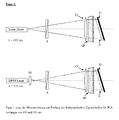
- a hologram was measured by a measuring device according to FIG. 1 imprinted. These were monochromatic holograms with 633 nm or 532 nm laser wavelengths. For this purpose, pieces of the film were cut off in the dark, the laminating film removed and the films with the photopolymer side down on a glass of size 50 x 75 mm and 1 mm bubble-free laminated.
- the glasses used were Corning glasses from Schott AG, Mainz, Germany.
- the beam of a laser (emission wavelength 633 nm or 532 nm) was widened to a diameter of -3 to 4 cm with the aid of an optional expansion lens (AF) and the collimation lens (CL) placed after the shutter S.
- the diameter of the expanded laser beam was determined by the aperture of the opened shutter. It was consciously paid attention to an inhomogeneous intensity distribution of the expanded laser beam. Thus, the edge intensity PR was only half of the intensity PZ in the center of the expanded laser beam. P was understood here as performance / area.
- the expanded laser beam first passed through an obliquely placed glass plate, which served as a shearing plate (SP).
- the interference of signal and reference beam in P produced the hologram in the photopolymer film.
- O consisted of a metal plate covered with white paper with the paper side facing P. On the paper was a square grid created by black lines. The edge length of a square was 0.5 cm. This raster was imaged by the holographic exposure of P in the hologram.
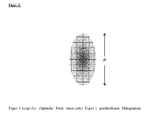
- the average exposure dose Eave was set by the opening time t of S. At fixed laser power I, therefore, t represented the size proportional to Eave. Since the expanded laser beam had an inhomogeneous (bell-shaped) intensity distribution, the local dose E for generating the hologram varies in P. This leads, together with the skew from P and O to the optical axis, the written hologram had elliptical shape. This is in FIG. 2 shown.
- O was a diffuse reflector
- the hologram was easily reconstructed by illumination with a point light source (eg flashlight or LED light).
- a point light source eg flashlight or LED light
- the photopolymer film was further laminated to glass and bleached under UV radiation.
- the samples were placed from a light-tight packed aluminum bag with the glass side up on the conveyor belt of a UV system and at a belt speed of 2.5 m / min twice under a Fusion UV 558434 KR 85 lamp with a nominal power density of 80 W / cm 2 exposed to an energy density on the photosensitive polymer of from about 2 J / cm 2.
- Adhesive products used to make the adhesive layers are:
- the layer composites of Examples 1 to 13 according to the invention showed no wavelength shift of more than 20 nm, i. there was no color shift to watch. In contrast, in the composite layers of Comparative Examples V1 to V7, a clear color shift was observed.
- the adhesive layer acted as a diffusion barrier for the fluorourethane additive C). This was confirmed by corresponding exemplary ATR-IR measurements.
- FIG. 3 shows the obtained difference spectra.
- the adhesive layers according to the invention no peaks appeared in the difference spectrum of an extinction change of> 3.2% during the measurement period.
Landscapes
- Chemical & Material Sciences (AREA)
- Health & Medical Sciences (AREA)
- Chemical Kinetics & Catalysis (AREA)
- Medicinal Chemistry (AREA)
- Polymers & Plastics (AREA)
- Organic Chemistry (AREA)
- Physics & Mathematics (AREA)
- General Physics & Mathematics (AREA)
- Engineering & Computer Science (AREA)
- Computer Security & Cryptography (AREA)
- Laminated Bodies (AREA)
- Adhesives Or Adhesive Processes (AREA)
- Polyurethanes Or Polyureas (AREA)
- Holo Graphy (AREA)
- Adhesive Tapes (AREA)
Priority Applications (8)
| Application Number | Priority Date | Filing Date | Title |
|---|---|---|---|
| EP12150277.7A EP2613319A1 (de) | 2012-01-05 | 2012-01-05 | Schichtverbund aus einem Photopolymerfilm und einer Klebstoffschicht |
| EP12809285.5A EP2801094B1 (de) | 2012-01-05 | 2012-12-27 | Schichtverbund aus einem photopolymerfilm und einer klebstoffschicht |
| KR1020147018335A KR102023965B1 (ko) | 2012-01-05 | 2012-12-27 | 광중합체 필름 및 접착제 층으로 이루어진 층 복합재 |
| CN201280066056.6A CN104040629B (zh) | 2012-01-05 | 2012-12-27 | 由光聚合物薄膜和粘合剂层构成的层复合材料 |
| JP2014550686A JP6097309B2 (ja) | 2012-01-05 | 2012-12-27 | 感光性ポリマーフィルムおよび接着剤層を含んでなる層状複合材料 |
| PCT/EP2012/076985 WO2013102603A1 (de) | 2012-01-05 | 2012-12-27 | Schichtverbund aus einem photopolymerfilm und einer klebstoffschicht |
| US14/368,822 US9261778B2 (en) | 2012-01-05 | 2012-12-27 | Layer composite consisting of a photopolymer film and an adhesive layer |
| TW102100186A TWI577554B (zh) | 2012-01-05 | 2013-01-04 | 光聚合物與黏著劑層之積層體 |
Applications Claiming Priority (1)
| Application Number | Priority Date | Filing Date | Title |
|---|---|---|---|
| EP12150277.7A EP2613319A1 (de) | 2012-01-05 | 2012-01-05 | Schichtverbund aus einem Photopolymerfilm und einer Klebstoffschicht |
Publications (1)
| Publication Number | Publication Date |
|---|---|
| EP2613319A1 true EP2613319A1 (de) | 2013-07-10 |
Family
ID=47471845
Family Applications (2)
| Application Number | Title | Priority Date | Filing Date |
|---|---|---|---|
| EP12150277.7A Ceased EP2613319A1 (de) | 2012-01-05 | 2012-01-05 | Schichtverbund aus einem Photopolymerfilm und einer Klebstoffschicht |
| EP12809285.5A Active EP2801094B1 (de) | 2012-01-05 | 2012-12-27 | Schichtverbund aus einem photopolymerfilm und einer klebstoffschicht |
Family Applications After (1)
| Application Number | Title | Priority Date | Filing Date |
|---|---|---|---|
| EP12809285.5A Active EP2801094B1 (de) | 2012-01-05 | 2012-12-27 | Schichtverbund aus einem photopolymerfilm und einer klebstoffschicht |
Country Status (7)
| Country | Link |
|---|---|
| US (1) | US9261778B2 (enExample) |
| EP (2) | EP2613319A1 (enExample) |
| JP (1) | JP6097309B2 (enExample) |
| KR (1) | KR102023965B1 (enExample) |
| CN (1) | CN104040629B (enExample) |
| TW (1) | TWI577554B (enExample) |
| WO (1) | WO2013102603A1 (enExample) |
Cited By (2)
| Publication number | Priority date | Publication date | Assignee | Title |
|---|---|---|---|---|
| WO2016016426A1 (de) * | 2014-08-01 | 2016-02-04 | Covestro Deutschland Ag | Schichtaufbau umfassend eine photopolymer- und eine substratschicht |
| EP3495886A1 (de) * | 2017-12-06 | 2019-06-12 | Covestro Deutschland AG | Klebstofffreier photopolymerschichtaufbau |
Families Citing this family (19)
| Publication number | Priority date | Publication date | Assignee | Title |
|---|---|---|---|---|
| EP2317511B1 (de) * | 2009-11-03 | 2012-03-07 | Bayer MaterialScience AG | Photopolymerformulierungen mit einstellbarem mechanischem Modul Guv |
| US9195215B2 (en) * | 2011-11-29 | 2015-11-24 | Bayer Intellectual Property Gmbh | Holographic medium having a protective layer |
| EP2700510B1 (de) * | 2012-08-23 | 2015-09-16 | Bayer MaterialScience AG | Polycarbonatbasierte Sicherheits- und/oder Wertdokumente mit Hologramm im Kartenkörper |
| RU2015109872A (ru) * | 2012-08-23 | 2016-10-10 | Байер Матириальсайенс Аг | Защищенный документ и/или ценная бумага, содержащие визуально меняющееся окно с голограммой |
| EP2772917A1 (de) | 2013-02-27 | 2014-09-03 | Bayer MaterialScience AG | Schutzlacke auf Basis von strahlenvernetzbaren Polyurethandispersionen |
| KR20160079828A (ko) * | 2013-10-30 | 2016-07-06 | 코베스트로 도이칠란트 아게 | 기재 및 광중합체 필름을 포함하는 복합체 |
| JP6809843B2 (ja) * | 2015-08-20 | 2021-01-06 | 国立大学法人大阪大学 | パターン形成方法 |
| DE102017108585A1 (de) * | 2017-04-21 | 2018-10-25 | Hologram Industries Research Gmbh | Verfahren zum Einbringen von Bildinformation in ein Volumenhologramm |
| TW201906882A (zh) | 2017-05-09 | 2019-02-16 | 德商科思創德意志股份有限公司 | 含有用於全像照射的光聚合物層及高度耐性漆層之薄膜結構 |
| TW201906730A (zh) * | 2017-05-09 | 2019-02-16 | 德商科思創德意志股份有限公司 | 用於保護光聚合物膜複合物中之全像圖之含uv硬化性黏著層的塑膠膜 |
| TW201906729A (zh) * | 2017-05-09 | 2019-02-16 | 德商科思創德意志股份有限公司 | 用於保護光聚合物薄膜複合物中的全像圖之由兩層可乾燥施用之uv固化漆層構成的系統 |
| EP3435156A1 (de) * | 2017-07-26 | 2019-01-30 | Covestro Deutschland AG | Schutzschicht für photopolymer |
| EP3461636B1 (en) | 2017-09-29 | 2021-05-19 | Wayray AG | Laminated holographic display and manufacturing thereof |
| KR102244648B1 (ko) | 2017-12-08 | 2021-04-26 | 주식회사 엘지화학 | 포토폴리머 조성물 |
| KR102166846B1 (ko) | 2017-12-11 | 2020-10-16 | 주식회사 엘지화학 | 포토폴리머 조성물 |
| WO2021021584A1 (en) | 2019-07-26 | 2021-02-04 | Solutia Inc. | Polymer coating layers for use with holographic optical elements |
| KR20220038465A (ko) | 2019-07-26 | 2022-03-28 | 솔루티아인코포레이티드 | 홀로그래픽 광학 요소와 함께 사용하기 위한 중간층 및 캡슐화 층 |
| CN118667495A (zh) * | 2024-06-13 | 2024-09-20 | 浙江多邦新材料有限公司 | 一种聚氨酯热熔烫金胶及其制备方法 |
| CN119798554B (zh) * | 2024-12-26 | 2025-11-21 | 谷东科技有限公司 | 一种全彩光致聚合物薄膜及其制备方法与应用 |
Citations (9)
| Publication number | Priority date | Publication date | Assignee | Title |
|---|---|---|---|---|
| DE3002734A1 (de) | 1980-01-25 | 1981-07-30 | Bayer Ag, 5090 Leverkusen | Verfahren zur herstellung eines polychloropren-klebstoffs mit verbesserter topfzeit |
| US5773544A (en) | 1995-03-27 | 1998-06-30 | Dupont Dow Elastomers | Polychloroprene composition |
| WO2002024825A1 (de) | 2000-09-19 | 2002-03-28 | Bayer Aktiengesellschaft | Klebstoffzusammensetzung auf basis von polychloropren-dispersionen |
| WO2005035683A1 (de) | 2003-09-18 | 2005-04-21 | Bayer Materialscience Ag | Wässrige klebstoff-dispersionen |
| US20060019172A1 (en) * | 2004-03-25 | 2006-01-26 | Hiroyuki Ohtaki | Volume hologram resin composition, surface relief hologram resin composition, and hologram layer, hologram transfer foil and brittle hologram label using the same |
| WO2008125229A1 (en) | 2007-04-11 | 2008-10-23 | Bayer Materialscience Ag | Advantageous recording media for holographic applications |
| EP2154129A1 (de) | 2008-08-08 | 2010-02-17 | Bayer MaterialScience AG | Phenylisocyanat-basierte Urethanacrylate mit hohem Brechungsindex |
| WO2011054797A1 (de) | 2009-11-03 | 2011-05-12 | Bayer Materialscience Ag | Photopolymer-formulierung mit verschiedenen schreibcomonomeren |
| WO2011067057A1 (de) | 2009-11-03 | 2011-06-09 | Bayer Materialscience Ag | Verfahren zur herstellung eines holographischen films |
Family Cites Families (13)
| Publication number | Priority date | Publication date | Assignee | Title |
|---|---|---|---|---|
| US4959283A (en) * | 1988-01-15 | 1990-09-25 | E. I. Du Pont De Nemours And Company | Dry film process for altering wavelength response of holograms |
| US5066525A (en) * | 1989-01-25 | 1991-11-19 | Central Glass Company, Limited | Laminated glass panel incorporating hologram sheet |
| JP3729461B2 (ja) * | 1993-07-27 | 2005-12-21 | 大日本印刷株式会社 | ホログラム層封入合わせガラスの作製方法 |
| EP2254003A3 (en) * | 1996-09-19 | 2011-11-16 | Dai Nippon Printing Co., Ltd. | Multilayered volume hologram structure, and label for making multilayered volume hologram structure |
| JPH1115358A (ja) * | 1997-06-25 | 1999-01-22 | Denso Corp | ホログラム |
| US20050186873A1 (en) * | 2004-02-24 | 2005-08-25 | Milliken & Company | Treated textile substrate and method for making a textile substrate |
| JP2007066465A (ja) * | 2005-09-01 | 2007-03-15 | Fujifilm Corp | 光記録媒体及びその製造方法 |
| US7173744B1 (en) * | 2005-12-02 | 2007-02-06 | Inphase Technologies, Inc. | Article comprising holographic medium between substrates having environmental barrier seal and process for preparing same |
| JP2008076674A (ja) * | 2006-09-20 | 2008-04-03 | Fujifilm Corp | ホログラム記録媒体用組成物、並びにホログラム記録媒体及びその製造方法 |
| IN2012DN03890A (enExample) * | 2009-11-03 | 2015-09-04 | Bayer Materialscience Ag | |
| EP2317511B1 (de) * | 2009-11-03 | 2012-03-07 | Bayer MaterialScience AG | Photopolymerformulierungen mit einstellbarem mechanischem Modul Guv |
| US9195215B2 (en) * | 2011-11-29 | 2015-11-24 | Bayer Intellectual Property Gmbh | Holographic medium having a protective layer |
| EP2613318B1 (de) * | 2012-01-05 | 2014-07-30 | Bayer Intellectual Property GmbH | Schichtaufbau mit einer Schutzschicht und einer belichteten Photopolymerschicht |
-
2012
- 2012-01-05 EP EP12150277.7A patent/EP2613319A1/de not_active Ceased
- 2012-12-27 KR KR1020147018335A patent/KR102023965B1/ko not_active Expired - Fee Related
- 2012-12-27 JP JP2014550686A patent/JP6097309B2/ja active Active
- 2012-12-27 EP EP12809285.5A patent/EP2801094B1/de active Active
- 2012-12-27 US US14/368,822 patent/US9261778B2/en active Active
- 2012-12-27 WO PCT/EP2012/076985 patent/WO2013102603A1/de not_active Ceased
- 2012-12-27 CN CN201280066056.6A patent/CN104040629B/zh active Active
-
2013
- 2013-01-04 TW TW102100186A patent/TWI577554B/zh not_active IP Right Cessation
Patent Citations (9)
| Publication number | Priority date | Publication date | Assignee | Title |
|---|---|---|---|---|
| DE3002734A1 (de) | 1980-01-25 | 1981-07-30 | Bayer Ag, 5090 Leverkusen | Verfahren zur herstellung eines polychloropren-klebstoffs mit verbesserter topfzeit |
| US5773544A (en) | 1995-03-27 | 1998-06-30 | Dupont Dow Elastomers | Polychloroprene composition |
| WO2002024825A1 (de) | 2000-09-19 | 2002-03-28 | Bayer Aktiengesellschaft | Klebstoffzusammensetzung auf basis von polychloropren-dispersionen |
| WO2005035683A1 (de) | 2003-09-18 | 2005-04-21 | Bayer Materialscience Ag | Wässrige klebstoff-dispersionen |
| US20060019172A1 (en) * | 2004-03-25 | 2006-01-26 | Hiroyuki Ohtaki | Volume hologram resin composition, surface relief hologram resin composition, and hologram layer, hologram transfer foil and brittle hologram label using the same |
| WO2008125229A1 (en) | 2007-04-11 | 2008-10-23 | Bayer Materialscience Ag | Advantageous recording media for holographic applications |
| EP2154129A1 (de) | 2008-08-08 | 2010-02-17 | Bayer MaterialScience AG | Phenylisocyanat-basierte Urethanacrylate mit hohem Brechungsindex |
| WO2011054797A1 (de) | 2009-11-03 | 2011-05-12 | Bayer Materialscience Ag | Photopolymer-formulierung mit verschiedenen schreibcomonomeren |
| WO2011067057A1 (de) | 2009-11-03 | 2011-06-09 | Bayer Materialscience Ag | Verfahren zur herstellung eines holographischen films |
Non-Patent Citations (3)
| Title |
|---|
| HOUBEN-WEYL: "Methoden der organischen Chemie", vol. XIV/1, 1961, GEORG THIEME VERLAG, pages: 433FF |
| MÜLLER; RATH: "Formulierung von Kleb- und Dichtrohstoffen", 2009 |
| MÜLLER; RATH: "Formulierung von Kleb-und Dichtrohstoffen", 2009 |
Cited By (3)
| Publication number | Priority date | Publication date | Assignee | Title |
|---|---|---|---|---|
| WO2016016426A1 (de) * | 2014-08-01 | 2016-02-04 | Covestro Deutschland Ag | Schichtaufbau umfassend eine photopolymer- und eine substratschicht |
| EP3495886A1 (de) * | 2017-12-06 | 2019-06-12 | Covestro Deutschland AG | Klebstofffreier photopolymerschichtaufbau |
| WO2019110505A1 (de) * | 2017-12-06 | 2019-06-13 | Covestro Deutschland Ag | Klebstofffreier photopolymerschichtaufbau |
Also Published As
| Publication number | Publication date |
|---|---|
| JP2015510526A (ja) | 2015-04-09 |
| KR102023965B1 (ko) | 2019-09-23 |
| JP6097309B2 (ja) | 2017-03-15 |
| CN104040629B (zh) | 2018-06-29 |
| EP2801094B1 (de) | 2015-12-23 |
| US9261778B2 (en) | 2016-02-16 |
| TW201345721A (zh) | 2013-11-16 |
| CN104040629A (zh) | 2014-09-10 |
| EP2801094A1 (de) | 2014-11-12 |
| KR20140110895A (ko) | 2014-09-17 |
| WO2013102603A1 (de) | 2013-07-11 |
| US20150017353A1 (en) | 2015-01-15 |
| TWI577554B (zh) | 2017-04-11 |
Similar Documents
| Publication | Publication Date | Title |
|---|---|---|
| EP2801094B1 (de) | Schichtverbund aus einem photopolymerfilm und einer klebstoffschicht | |
| EP2638089B1 (de) | Photopolymer-formulierung für die herstellung holographischer medien | |
| EP2613318B1 (de) | Schichtaufbau mit einer Schutzschicht und einer belichteten Photopolymerschicht | |
| EP2497085B1 (de) | Verfahren zur herstellung eines holographischen films | |
| EP2497080B1 (de) | Verfahren zur herstellung eines holographischen films | |
| EP2497081B1 (de) | Verfahren zur herstellung von holographischen medien | |
| EP2317511B1 (de) | Photopolymerformulierungen mit einstellbarem mechanischem Modul Guv | |
| EP3084765B1 (de) | Holographische medien mit verbesserter lichtempfindlichkeit | |
| EP2962302B1 (de) | Schutzlacke und klebstoffe auf acrylatbasis | |
| EP2342249A1 (de) | Prepolymerbasierte polyurethanformulierungen zur herstellung holografischer medien | |
| EP3233791B1 (de) | Feuchtigkeitsstabile holographische medien | |
| EP2772917A1 (de) | Schutzlacke auf Basis von strahlenvernetzbaren Polyurethandispersionen | |
| WO2018206503A1 (de) | Holographisches medium enthaltend eine photopolymerschicht zur holographischen belichtung und eine lackschicht hoher beständigkeit | |
| WO2013053771A1 (de) | Schwefelhaltige kettenübertragungsreagenzien in polyurethan-basierten photopolymer-formulierungen | |
| EP3313826B1 (de) | Substituierte triazine und ein verfahren zu ihrer herstellung | |
| EP3063762B1 (de) | Verbund umfassend ein substrat und einen photopolymerfilm | |
| EP3175297B1 (de) | Schichtaufbau umfassend eine photopolymer- und eine substratschicht |
Legal Events
| Date | Code | Title | Description |
|---|---|---|---|
| PUAI | Public reference made under article 153(3) epc to a published international application that has entered the european phase |
Free format text: ORIGINAL CODE: 0009012 |
|
| AK | Designated contracting states |
Kind code of ref document: A1 Designated state(s): AL AT BE BG CH CY CZ DE DK EE ES FI FR GB GR HR HU IE IS IT LI LT LU LV MC MK MT NL NO PL PT RO RS SE SI SK SM TR |
|
| AX | Request for extension of the european patent |
Extension state: BA ME |
|
| STAA | Information on the status of an ep patent application or granted ep patent |
Free format text: STATUS: THE APPLICATION HAS BEEN REFUSED |
|
| 18R | Application refused |
Effective date: 20131109 |