EP2595787B1 - Method for degasing polymer mixtures - Google Patents
Method for degasing polymer mixtures Download PDFInfo
- Publication number
- EP2595787B1 EP2595787B1 EP11734151.1A EP11734151A EP2595787B1 EP 2595787 B1 EP2595787 B1 EP 2595787B1 EP 11734151 A EP11734151 A EP 11734151A EP 2595787 B1 EP2595787 B1 EP 2595787B1
- Authority
- EP
- European Patent Office
- Prior art keywords
- extruder
- die plate
- barrel
- process according
- elements
- Prior art date
- Legal status (The legal status is an assumption and is not a legal conclusion. Google has not performed a legal analysis and makes no representation as to the accuracy of the status listed.)
- Not-in-force
Links
- 238000000034 method Methods 0.000 title claims description 29
- 229920002959 polymer blend Polymers 0.000 title 1
- 239000003795 chemical substances by application Substances 0.000 claims description 34
- 150000001875 compounds Chemical class 0.000 claims description 33
- 229920000642 polymer Polymers 0.000 claims description 29
- 229920005549 butyl rubber Polymers 0.000 claims description 28
- 230000008569 process Effects 0.000 claims description 28
- 239000000203 mixture Substances 0.000 claims description 16
- 229920005555 halobutyl Polymers 0.000 claims description 11
- 229920005557 bromobutyl Polymers 0.000 claims description 8
- 229920005556 chlorobutyl Polymers 0.000 claims description 7
- 238000011144 upstream manufacturing Methods 0.000 claims description 6
- 239000003039 volatile agent Substances 0.000 claims description 5
- 238000003825 pressing Methods 0.000 claims description 2
- 239000000047 product Substances 0.000 description 47
- 229920001971 elastomer Polymers 0.000 description 24
- 239000005060 rubber Substances 0.000 description 24
- XLYOFNOQVPJJNP-UHFFFAOYSA-N water Substances O XLYOFNOQVPJJNP-UHFFFAOYSA-N 0.000 description 19
- -1 ethylene propylene diene Chemical class 0.000 description 15
- 238000004898 kneading Methods 0.000 description 13
- 239000000243 solution Substances 0.000 description 12
- 229920003051 synthetic elastomer Polymers 0.000 description 11
- 239000005061 synthetic rubber Substances 0.000 description 11
- 238000001035 drying Methods 0.000 description 10
- 239000000463 material Substances 0.000 description 10
- 239000002904 solvent Substances 0.000 description 9
- 239000012855 volatile organic compound Substances 0.000 description 9
- 239000000654 additive Substances 0.000 description 8
- NEHMKBQYUWJMIP-UHFFFAOYSA-N chloromethane Chemical compound ClC NEHMKBQYUWJMIP-UHFFFAOYSA-N 0.000 description 8
- 239000000178 monomer Substances 0.000 description 7
- VLKZOEOYAKHREP-UHFFFAOYSA-N n-Hexane Chemical compound CCCCCC VLKZOEOYAKHREP-UHFFFAOYSA-N 0.000 description 7
- 239000002245 particle Substances 0.000 description 7
- RRHGJUQNOFWUDK-UHFFFAOYSA-N Isoprene Chemical compound CC(=C)C=C RRHGJUQNOFWUDK-UHFFFAOYSA-N 0.000 description 6
- IMNFDUFMRHMDMM-UHFFFAOYSA-N N-Heptane Chemical compound CCCCCCC IMNFDUFMRHMDMM-UHFFFAOYSA-N 0.000 description 6
- 229920000459 Nitrile rubber Polymers 0.000 description 6
- 230000015572 biosynthetic process Effects 0.000 description 6
- AFABGHUZZDYHJO-UHFFFAOYSA-N dimethyl butane Natural products CCCC(C)C AFABGHUZZDYHJO-UHFFFAOYSA-N 0.000 description 6
- 238000006116 polymerization reaction Methods 0.000 description 6
- 238000005086 pumping Methods 0.000 description 6
- 239000002002 slurry Substances 0.000 description 6
- LFQSCWFLJHTTHZ-UHFFFAOYSA-N Ethanol Chemical compound CCO LFQSCWFLJHTTHZ-UHFFFAOYSA-N 0.000 description 5
- 229920002367 Polyisobutene Polymers 0.000 description 5
- 239000006185 dispersion Substances 0.000 description 5
- OFBQJSOFQDEBGM-UHFFFAOYSA-N n-pentane Natural products CCCCC OFBQJSOFQDEBGM-UHFFFAOYSA-N 0.000 description 5
- 230000009467 reduction Effects 0.000 description 5
- 239000004215 Carbon black (E152) Substances 0.000 description 4
- CURLTUGMZLYLDI-UHFFFAOYSA-N Carbon dioxide Chemical compound O=C=O CURLTUGMZLYLDI-UHFFFAOYSA-N 0.000 description 4
- 229920000181 Ethylene propylene rubber Polymers 0.000 description 4
- 239000003963 antioxidant agent Substances 0.000 description 4
- 238000013461 design Methods 0.000 description 4
- 230000026030 halogenation Effects 0.000 description 4
- 238000005658 halogenation reaction Methods 0.000 description 4
- 229930195733 hydrocarbon Natural products 0.000 description 4
- 150000002430 hydrocarbons Chemical class 0.000 description 4
- QWTDNUCVQCZILF-UHFFFAOYSA-N isopentane Chemical compound CCC(C)C QWTDNUCVQCZILF-UHFFFAOYSA-N 0.000 description 4
- UAEPNZWRGJTJPN-UHFFFAOYSA-N methylcyclohexane Chemical compound CC1CCCCC1 UAEPNZWRGJTJPN-UHFFFAOYSA-N 0.000 description 4
- GDOPTJXRTPNYNR-UHFFFAOYSA-N methylcyclopentane Chemical compound CC1CCCC1 GDOPTJXRTPNYNR-UHFFFAOYSA-N 0.000 description 4
- 238000002156 mixing Methods 0.000 description 4
- 229920001200 poly(ethylene-vinyl acetate) Polymers 0.000 description 4
- 229920002857 polybutadiene Polymers 0.000 description 4
- 229920003048 styrene butadiene rubber Polymers 0.000 description 4
- ZWEHNKRNPOVVGH-UHFFFAOYSA-N 2-Butanone Chemical compound CCC(C)=O ZWEHNKRNPOVVGH-UHFFFAOYSA-N 0.000 description 3
- CSCPPACGZOOCGX-UHFFFAOYSA-N Acetone Chemical compound CC(C)=O CSCPPACGZOOCGX-UHFFFAOYSA-N 0.000 description 3
- WEVYAHXRMPXWCK-UHFFFAOYSA-N Acetonitrile Chemical compound CC#N WEVYAHXRMPXWCK-UHFFFAOYSA-N 0.000 description 3
- YMWUJEATGCHHMB-UHFFFAOYSA-N Dichloromethane Chemical compound ClCCl YMWUJEATGCHHMB-UHFFFAOYSA-N 0.000 description 3
- XEKOWRVHYACXOJ-UHFFFAOYSA-N Ethyl acetate Chemical compound CCOC(C)=O XEKOWRVHYACXOJ-UHFFFAOYSA-N 0.000 description 3
- OKKJLVBELUTLKV-UHFFFAOYSA-N Methanol Chemical compound OC OKKJLVBELUTLKV-UHFFFAOYSA-N 0.000 description 3
- ZMXDDKWLCZADIW-UHFFFAOYSA-N N,N-Dimethylformamide Chemical compound CN(C)C=O ZMXDDKWLCZADIW-UHFFFAOYSA-N 0.000 description 3
- YXFVVABEGXRONW-UHFFFAOYSA-N Toluene Chemical compound CC1=CC=CC=C1 YXFVVABEGXRONW-UHFFFAOYSA-N 0.000 description 3
- JFDZBHWFFUWGJE-UHFFFAOYSA-N benzonitrile Chemical compound N#CC1=CC=CC=C1 JFDZBHWFFUWGJE-UHFFFAOYSA-N 0.000 description 3
- 238000000576 coating method Methods 0.000 description 3
- 238000007872 degassing Methods 0.000 description 3
- 125000004968 halobutyl group Chemical group 0.000 description 3
- 229910052736 halogen Inorganic materials 0.000 description 3
- 125000001475 halogen functional group Chemical group 0.000 description 3
- 150000002367 halogens Chemical class 0.000 description 3
- 239000003381 stabilizer Substances 0.000 description 3
- WRMNZCZEMHIOCP-UHFFFAOYSA-N 2-phenylethanol Chemical compound OCCC1=CC=CC=C1 WRMNZCZEMHIOCP-UHFFFAOYSA-N 0.000 description 2
- IJGRMHOSHXDMSA-UHFFFAOYSA-N Atomic nitrogen Chemical compound N#N IJGRMHOSHXDMSA-UHFFFAOYSA-N 0.000 description 2
- 239000004604 Blowing Agent Substances 0.000 description 2
- WKBOTKDWSSQWDR-UHFFFAOYSA-N Bromine atom Chemical compound [Br] WKBOTKDWSSQWDR-UHFFFAOYSA-N 0.000 description 2
- OKTJSMMVPCPJKN-UHFFFAOYSA-N Carbon Chemical compound [C] OKTJSMMVPCPJKN-UHFFFAOYSA-N 0.000 description 2
- ZAMOUSCENKQFHK-UHFFFAOYSA-N Chlorine atom Chemical compound [Cl] ZAMOUSCENKQFHK-UHFFFAOYSA-N 0.000 description 2
- XDTMQSROBMDMFD-UHFFFAOYSA-N Cyclohexane Chemical compound C1CCCCC1 XDTMQSROBMDMFD-UHFFFAOYSA-N 0.000 description 2
- OPFTUNCRGUEPRZ-QLFBSQMISA-N Cyclohexane Natural products CC(=C)[C@@H]1CC[C@@](C)(C=C)[C@H](C(C)=C)C1 OPFTUNCRGUEPRZ-QLFBSQMISA-N 0.000 description 2
- 239000004606 Fillers/Extenders Substances 0.000 description 2
- VQTUBCCKSQIDNK-UHFFFAOYSA-N Isobutene Chemical compound CC(C)=C VQTUBCCKSQIDNK-UHFFFAOYSA-N 0.000 description 2
- AMQJEAYHLZJPGS-UHFFFAOYSA-N N-Pentanol Chemical compound CCCCCO AMQJEAYHLZJPGS-UHFFFAOYSA-N 0.000 description 2
- PXHVJJICTQNCMI-UHFFFAOYSA-N Nickel Chemical compound [Ni] PXHVJJICTQNCMI-UHFFFAOYSA-N 0.000 description 2
- 239000006057 Non-nutritive feed additive Substances 0.000 description 2
- CBENFWSGALASAD-UHFFFAOYSA-N Ozone Chemical compound [O-][O+]=O CBENFWSGALASAD-UHFFFAOYSA-N 0.000 description 2
- 239000002202 Polyethylene glycol Substances 0.000 description 2
- ATUOYWHBWRKTHZ-UHFFFAOYSA-N Propane Chemical compound CCC ATUOYWHBWRKTHZ-UHFFFAOYSA-N 0.000 description 2
- 229910000831 Steel Inorganic materials 0.000 description 2
- 239000002174 Styrene-butadiene Substances 0.000 description 2
- NRTOMJZYCJJWKI-UHFFFAOYSA-N Titanium nitride Chemical compound [Ti]#N NRTOMJZYCJJWKI-UHFFFAOYSA-N 0.000 description 2
- GSEJCLTVZPLZKY-UHFFFAOYSA-N Triethanolamine Chemical compound OCCN(CCO)CCO GSEJCLTVZPLZKY-UHFFFAOYSA-N 0.000 description 2
- 239000012190 activator Substances 0.000 description 2
- 150000001335 aliphatic alkanes Chemical class 0.000 description 2
- 230000003712 anti-aging effect Effects 0.000 description 2
- 238000009835 boiling Methods 0.000 description 2
- GDTBXPJZTBHREO-UHFFFAOYSA-N bromine Substances BrBr GDTBXPJZTBHREO-UHFFFAOYSA-N 0.000 description 2
- 229910052794 bromium Inorganic materials 0.000 description 2
- CJZGTCYPCWQAJB-UHFFFAOYSA-L calcium stearate Chemical compound [Ca+2].CCCCCCCCCCCCCCCCCC([O-])=O.CCCCCCCCCCCCCCCCCC([O-])=O CJZGTCYPCWQAJB-UHFFFAOYSA-L 0.000 description 2
- 229940078456 calcium stearate Drugs 0.000 description 2
- 235000013539 calcium stearate Nutrition 0.000 description 2
- 239000008116 calcium stearate Substances 0.000 description 2
- 229910052799 carbon Inorganic materials 0.000 description 2
- 229910002092 carbon dioxide Inorganic materials 0.000 description 2
- 239000001569 carbon dioxide Substances 0.000 description 2
- 239000003054 catalyst Substances 0.000 description 2
- 238000007385 chemical modification Methods 0.000 description 2
- 239000000460 chlorine Substances 0.000 description 2
- 229910052801 chlorine Inorganic materials 0.000 description 2
- MVPPADPHJFYWMZ-UHFFFAOYSA-N chlorobenzene Chemical compound ClC1=CC=CC=C1 MVPPADPHJFYWMZ-UHFFFAOYSA-N 0.000 description 2
- 230000015271 coagulation Effects 0.000 description 2
- 238000005345 coagulation Methods 0.000 description 2
- 229910003460 diamond Inorganic materials 0.000 description 2
- 239000010432 diamond Substances 0.000 description 2
- 239000003085 diluting agent Substances 0.000 description 2
- 238000004821 distillation Methods 0.000 description 2
- 230000000694 effects Effects 0.000 description 2
- 238000005516 engineering process Methods 0.000 description 2
- 229920000840 ethylene tetrafluoroethylene copolymer Polymers 0.000 description 2
- 239000005038 ethylene vinyl acetate Substances 0.000 description 2
- 239000012530 fluid Substances 0.000 description 2
- 239000004088 foaming agent Substances 0.000 description 2
- 239000007789 gas Substances 0.000 description 2
- 239000012760 heat stabilizer Substances 0.000 description 2
- ZSIAUFGUXNUGDI-UHFFFAOYSA-N hexan-1-ol Chemical compound CCCCCCO ZSIAUFGUXNUGDI-UHFFFAOYSA-N 0.000 description 2
- TZMQHOJDDMFGQX-UHFFFAOYSA-N hexane-1,1,1-triol Chemical compound CCCCCC(O)(O)O TZMQHOJDDMFGQX-UHFFFAOYSA-N 0.000 description 2
- 239000012456 homogeneous solution Substances 0.000 description 2
- 239000003112 inhibitor Substances 0.000 description 2
- ZXEKIIBDNHEJCQ-UHFFFAOYSA-N isobutanol Chemical compound CC(C)CO ZXEKIIBDNHEJCQ-UHFFFAOYSA-N 0.000 description 2
- 239000004611 light stabiliser Substances 0.000 description 2
- 238000005259 measurement Methods 0.000 description 2
- 229910052751 metal Inorganic materials 0.000 description 2
- 239000002184 metal Substances 0.000 description 2
- 229910044991 metal oxide Inorganic materials 0.000 description 2
- 150000004706 metal oxides Chemical class 0.000 description 2
- 150000002739 metals Chemical class 0.000 description 2
- VNWKTOKETHGBQD-UHFFFAOYSA-N methane Chemical compound C VNWKTOKETHGBQD-UHFFFAOYSA-N 0.000 description 2
- GYNNXHKOJHMOHS-UHFFFAOYSA-N methyl-cycloheptane Natural products CC1CCCCCC1 GYNNXHKOJHMOHS-UHFFFAOYSA-N 0.000 description 2
- 150000007524 organic acids Chemical class 0.000 description 2
- 235000005985 organic acids Nutrition 0.000 description 2
- 239000000049 pigment Substances 0.000 description 2
- 239000004014 plasticizer Substances 0.000 description 2
- 229920001084 poly(chloroprene) Polymers 0.000 description 2
- 229920001223 polyethylene glycol Polymers 0.000 description 2
- 229920001195 polyisoprene Polymers 0.000 description 2
- 229920001343 polytetrafluoroethylene Polymers 0.000 description 2
- 239000004810 polytetrafluoroethylene Substances 0.000 description 2
- 238000012545 processing Methods 0.000 description 2
- BDERNNFJNOPAEC-UHFFFAOYSA-N propan-1-ol Chemical compound CCCO BDERNNFJNOPAEC-UHFFFAOYSA-N 0.000 description 2
- 238000013341 scale-up Methods 0.000 description 2
- 239000012265 solid product Substances 0.000 description 2
- 235000012424 soybean oil Nutrition 0.000 description 2
- 239000003549 soybean oil Substances 0.000 description 2
- 239000010959 steel Substances 0.000 description 2
- 239000000126 substance Substances 0.000 description 2
- 239000001993 wax Substances 0.000 description 2
- 238000003466 welding Methods 0.000 description 2
- RYHBNJHYFVUHQT-UHFFFAOYSA-N 1,4-Dioxane Chemical compound C1COCCO1 RYHBNJHYFVUHQT-UHFFFAOYSA-N 0.000 description 1
- OCJBOOLMMGQPQU-UHFFFAOYSA-N 1,4-dichlorobenzene Chemical compound ClC1=CC=C(Cl)C=C1 OCJBOOLMMGQPQU-UHFFFAOYSA-N 0.000 description 1
- GFJUOMJGSXRJJY-UHFFFAOYSA-N 2-methylprop-1-ene Chemical compound CC(C)=C.CC(C)=C GFJUOMJGSXRJJY-UHFFFAOYSA-N 0.000 description 1
- QCDWFXQBSFUVSP-UHFFFAOYSA-N 2-phenoxyethanol Chemical compound OCCOC1=CC=CC=C1 QCDWFXQBSFUVSP-UHFFFAOYSA-N 0.000 description 1
- DKPFZGUDAPQIHT-UHFFFAOYSA-N Butyl acetate Natural products CCCCOC(C)=O DKPFZGUDAPQIHT-UHFFFAOYSA-N 0.000 description 1
- KJQMOGOKAYDMOR-UHFFFAOYSA-N CC(=C)C=C.CC(=C)C=C Chemical compound CC(=C)C=C.CC(=C)C=C KJQMOGOKAYDMOR-UHFFFAOYSA-N 0.000 description 1
- HEDRZPFGACZZDS-UHFFFAOYSA-N Chloroform Chemical compound ClC(Cl)Cl HEDRZPFGACZZDS-UHFFFAOYSA-N 0.000 description 1
- 229910000531 Co alloy Inorganic materials 0.000 description 1
- BZLVMXJERCGZMT-UHFFFAOYSA-N Methyl tert-butyl ether Chemical compound COC(C)(C)C BZLVMXJERCGZMT-UHFFFAOYSA-N 0.000 description 1
- FXHOOIRPVKKKFG-UHFFFAOYSA-N N,N-Dimethylacetamide Chemical compound CN(C)C(C)=O FXHOOIRPVKKKFG-UHFFFAOYSA-N 0.000 description 1
- SECXISVLQFMRJM-UHFFFAOYSA-N N-Methylpyrrolidone Chemical compound CN1CCCC1=O SECXISVLQFMRJM-UHFFFAOYSA-N 0.000 description 1
- 229910000990 Ni alloy Inorganic materials 0.000 description 1
- 229910001347 Stellite Inorganic materials 0.000 description 1
- WYURNTSHIVDZCO-UHFFFAOYSA-N Tetrahydrofuran Chemical compound C1CCOC1 WYURNTSHIVDZCO-UHFFFAOYSA-N 0.000 description 1
- 230000001133 acceleration Effects 0.000 description 1
- 230000009471 action Effects 0.000 description 1
- 150000001338 aliphatic hydrocarbons Chemical class 0.000 description 1
- 229910045601 alloy Inorganic materials 0.000 description 1
- 239000000956 alloy Substances 0.000 description 1
- 239000004411 aluminium Substances 0.000 description 1
- 229910052782 aluminium Inorganic materials 0.000 description 1
- 150000001408 amides Chemical class 0.000 description 1
- 150000004945 aromatic hydrocarbons Chemical class 0.000 description 1
- SJKRCWUQJZIWQB-UHFFFAOYSA-N azane;chromium Chemical compound N.[Cr] SJKRCWUQJZIWQB-UHFFFAOYSA-N 0.000 description 1
- CXOWYMLTGOFURZ-UHFFFAOYSA-N azanylidynechromium Chemical compound [Cr]#N CXOWYMLTGOFURZ-UHFFFAOYSA-N 0.000 description 1
- 230000008901 benefit Effects 0.000 description 1
- 125000001743 benzylic group Chemical group 0.000 description 1
- 239000001273 butane Substances 0.000 description 1
- 229940043232 butyl acetate Drugs 0.000 description 1
- 239000006227 byproduct Substances 0.000 description 1
- 239000003518 caustics Substances 0.000 description 1
- 239000004568 cement Substances 0.000 description 1
- 239000000919 ceramic Substances 0.000 description 1
- 238000006243 chemical reaction Methods 0.000 description 1
- 229960001701 chloroform Drugs 0.000 description 1
- AHICWQREWHDHHF-UHFFFAOYSA-N chromium;cobalt;iron;manganese;methane;molybdenum;nickel;silicon;tungsten Chemical compound C.[Si].[Cr].[Mn].[Fe].[Co].[Ni].[Mo].[W] AHICWQREWHDHHF-UHFFFAOYSA-N 0.000 description 1
- 230000001112 coagulating effect Effects 0.000 description 1
- 239000003086 colorant Substances 0.000 description 1
- 239000002131 composite material Substances 0.000 description 1
- 238000009833 condensation Methods 0.000 description 1
- 230000005494 condensation Effects 0.000 description 1
- 238000001816 cooling Methods 0.000 description 1
- 229920001577 copolymer Polymers 0.000 description 1
- 238000007334 copolymerization reaction Methods 0.000 description 1
- 238000005520 cutting process Methods 0.000 description 1
- HPXRVTGHNJAIIH-UHFFFAOYSA-N cyclohexanol Chemical compound OC1CCCCC1 HPXRVTGHNJAIIH-UHFFFAOYSA-N 0.000 description 1
- 230000003247 decreasing effect Effects 0.000 description 1
- 230000001419 dependent effect Effects 0.000 description 1
- 229940117389 dichlorobenzene Drugs 0.000 description 1
- 235000014113 dietary fatty acids Nutrition 0.000 description 1
- 238000009792 diffusion process Methods 0.000 description 1
- 238000007599 discharging Methods 0.000 description 1
- 239000000839 emulsion Substances 0.000 description 1
- 150000002148 esters Chemical class 0.000 description 1
- 150000002170 ethers Chemical class 0.000 description 1
- 229940052303 ethers for general anesthesia Drugs 0.000 description 1
- 229940093499 ethyl acetate Drugs 0.000 description 1
- 235000019439 ethyl acetate Nutrition 0.000 description 1
- 238000001704 evaporation Methods 0.000 description 1
- 230000008020 evaporation Effects 0.000 description 1
- 238000013213 extrapolation Methods 0.000 description 1
- 238000001125 extrusion Methods 0.000 description 1
- 229930195729 fatty acid Natural products 0.000 description 1
- 239000000194 fatty acid Substances 0.000 description 1
- 150000004665 fatty acids Chemical class 0.000 description 1
- 239000000945 filler Substances 0.000 description 1
- 239000012467 final product Substances 0.000 description 1
- 239000007792 gaseous phase Substances 0.000 description 1
- FUZZWVXGSFPDMH-UHFFFAOYSA-M hexanoate Chemical compound CCCCCC([O-])=O FUZZWVXGSFPDMH-UHFFFAOYSA-M 0.000 description 1
- 229910000039 hydrogen halide Inorganic materials 0.000 description 1
- 239000012433 hydrogen halide Substances 0.000 description 1
- 239000011261 inert gas Substances 0.000 description 1
- 238000002955 isolation Methods 0.000 description 1
- 150000002576 ketones Chemical class 0.000 description 1
- 239000007788 liquid Substances 0.000 description 1
- 238000004519 manufacturing process Methods 0.000 description 1
- IJDNQMDRQITEOD-UHFFFAOYSA-N n-butane Chemical compound CCCC IJDNQMDRQITEOD-UHFFFAOYSA-N 0.000 description 1
- JIKUXBYRTXDNIY-UHFFFAOYSA-N n-methyl-n-phenylformamide Chemical compound O=CN(C)C1=CC=CC=C1 JIKUXBYRTXDNIY-UHFFFAOYSA-N 0.000 description 1
- KPSSIOMAKSHJJG-UHFFFAOYSA-N neopentyl alcohol Chemical compound CC(C)(C)CO KPSSIOMAKSHJJG-UHFFFAOYSA-N 0.000 description 1
- 230000007935 neutral effect Effects 0.000 description 1
- 229910052759 nickel Inorganic materials 0.000 description 1
- 150000002825 nitriles Chemical class 0.000 description 1
- 229910052757 nitrogen Inorganic materials 0.000 description 1
- 229910052756 noble gas Inorganic materials 0.000 description 1
- 150000002835 noble gases Chemical class 0.000 description 1
- 150000002894 organic compounds Chemical class 0.000 description 1
- 239000012071 phase Substances 0.000 description 1
- 229960005323 phenoxyethanol Drugs 0.000 description 1
- 239000001294 propane Substances 0.000 description 1
- 230000009257 reactivity Effects 0.000 description 1
- 238000011084 recovery Methods 0.000 description 1
- 150000003839 salts Chemical class 0.000 description 1
- 239000007921 spray Substances 0.000 description 1
- 239000010935 stainless steel Substances 0.000 description 1
- 229910001220 stainless steel Inorganic materials 0.000 description 1
- MTPVUVINMAGMJL-UHFFFAOYSA-N trimethyl(1,1,2,2,2-pentafluoroethyl)silane Chemical compound C[Si](C)(C)C(F)(F)C(F)(F)F MTPVUVINMAGMJL-UHFFFAOYSA-N 0.000 description 1
- UONOETXJSWQNOL-UHFFFAOYSA-N tungsten carbide Chemical compound [W+]#[C-] UONOETXJSWQNOL-UHFFFAOYSA-N 0.000 description 1
- 238000004073 vulcanization Methods 0.000 description 1
- 239000008096 xylene Substances 0.000 description 1
- 150000003738 xylenes Chemical class 0.000 description 1
Images


Classifications
-
- B—PERFORMING OPERATIONS; TRANSPORTING
- B29—WORKING OF PLASTICS; WORKING OF SUBSTANCES IN A PLASTIC STATE IN GENERAL
- B29B—PREPARATION OR PRETREATMENT OF THE MATERIAL TO BE SHAPED; MAKING GRANULES OR PREFORMS; RECOVERY OF PLASTICS OR OTHER CONSTITUENTS OF WASTE MATERIAL CONTAINING PLASTICS
- B29B7/00—Mixing; Kneading
- B29B7/80—Component parts, details or accessories; Auxiliary operations
- B29B7/84—Venting or degassing ; Removing liquids, e.g. by evaporating components
- B29B7/845—Venting, degassing or removing evaporated components in devices with rotary stirrers
-
- B—PERFORMING OPERATIONS; TRANSPORTING
- B29—WORKING OF PLASTICS; WORKING OF SUBSTANCES IN A PLASTIC STATE IN GENERAL
- B29C—SHAPING OR JOINING OF PLASTICS; SHAPING OF MATERIAL IN A PLASTIC STATE, NOT OTHERWISE PROVIDED FOR; AFTER-TREATMENT OF THE SHAPED PRODUCTS, e.g. REPAIRING
- B29C48/00—Extrusion moulding, i.e. expressing the moulding material through a die or nozzle which imparts the desired form; Apparatus therefor
- B29C48/25—Component parts, details or accessories; Auxiliary operations
- B29C48/36—Means for plasticising or homogenising the moulding material or forcing it through the nozzle or die
- B29C48/50—Details of extruders
- B29C48/76—Venting, drying means; Degassing means
-
- B—PERFORMING OPERATIONS; TRANSPORTING
- B29—WORKING OF PLASTICS; WORKING OF SUBSTANCES IN A PLASTIC STATE IN GENERAL
- B29C—SHAPING OR JOINING OF PLASTICS; SHAPING OF MATERIAL IN A PLASTIC STATE, NOT OTHERWISE PROVIDED FOR; AFTER-TREATMENT OF THE SHAPED PRODUCTS, e.g. REPAIRING
- B29C48/00—Extrusion moulding, i.e. expressing the moulding material through a die or nozzle which imparts the desired form; Apparatus therefor
- B29C48/25—Component parts, details or accessories; Auxiliary operations
- B29C48/36—Means for plasticising or homogenising the moulding material or forcing it through the nozzle or die
- B29C48/395—Means for plasticising or homogenising the moulding material or forcing it through the nozzle or die using screws surrounded by a cooperating barrel, e.g. single screw extruders
- B29C48/40—Means for plasticising or homogenising the moulding material or forcing it through the nozzle or die using screws surrounded by a cooperating barrel, e.g. single screw extruders using two or more parallel screws or at least two parallel non-intermeshing screws, e.g. twin screw extruders
-
- B—PERFORMING OPERATIONS; TRANSPORTING
- B29—WORKING OF PLASTICS; WORKING OF SUBSTANCES IN A PLASTIC STATE IN GENERAL
- B29B—PREPARATION OR PRETREATMENT OF THE MATERIAL TO BE SHAPED; MAKING GRANULES OR PREFORMS; RECOVERY OF PLASTICS OR OTHER CONSTITUENTS OF WASTE MATERIAL CONTAINING PLASTICS
- B29B7/00—Mixing; Kneading
- B29B7/30—Mixing; Kneading continuous, with mechanical mixing or kneading devices
- B29B7/34—Mixing; Kneading continuous, with mechanical mixing or kneading devices with movable mixing or kneading devices
- B29B7/38—Mixing; Kneading continuous, with mechanical mixing or kneading devices with movable mixing or kneading devices rotary
- B29B7/46—Mixing; Kneading continuous, with mechanical mixing or kneading devices with movable mixing or kneading devices rotary with more than one shaft
- B29B7/48—Mixing; Kneading continuous, with mechanical mixing or kneading devices with movable mixing or kneading devices rotary with more than one shaft with intermeshing devices, e.g. screws
- B29B7/482—Mixing; Kneading continuous, with mechanical mixing or kneading devices with movable mixing or kneading devices rotary with more than one shaft with intermeshing devices, e.g. screws provided with screw parts in addition to other mixing parts, e.g. paddles, gears, discs
- B29B7/483—Mixing; Kneading continuous, with mechanical mixing or kneading devices with movable mixing or kneading devices rotary with more than one shaft with intermeshing devices, e.g. screws provided with screw parts in addition to other mixing parts, e.g. paddles, gears, discs the other mixing parts being discs perpendicular to the screw axis
-
- B—PERFORMING OPERATIONS; TRANSPORTING
- B29—WORKING OF PLASTICS; WORKING OF SUBSTANCES IN A PLASTIC STATE IN GENERAL
- B29B—PREPARATION OR PRETREATMENT OF THE MATERIAL TO BE SHAPED; MAKING GRANULES OR PREFORMS; RECOVERY OF PLASTICS OR OTHER CONSTITUENTS OF WASTE MATERIAL CONTAINING PLASTICS
- B29B7/00—Mixing; Kneading
- B29B7/30—Mixing; Kneading continuous, with mechanical mixing or kneading devices
- B29B7/34—Mixing; Kneading continuous, with mechanical mixing or kneading devices with movable mixing or kneading devices
- B29B7/38—Mixing; Kneading continuous, with mechanical mixing or kneading devices with movable mixing or kneading devices rotary
- B29B7/46—Mixing; Kneading continuous, with mechanical mixing or kneading devices with movable mixing or kneading devices rotary with more than one shaft
- B29B7/48—Mixing; Kneading continuous, with mechanical mixing or kneading devices with movable mixing or kneading devices rotary with more than one shaft with intermeshing devices, e.g. screws
- B29B7/488—Parts, e.g. casings, sealings; Accessories, e.g. flow controlling or throttling devices
-
- B—PERFORMING OPERATIONS; TRANSPORTING
- B29—WORKING OF PLASTICS; WORKING OF SUBSTANCES IN A PLASTIC STATE IN GENERAL
- B29B—PREPARATION OR PRETREATMENT OF THE MATERIAL TO BE SHAPED; MAKING GRANULES OR PREFORMS; RECOVERY OF PLASTICS OR OTHER CONSTITUENTS OF WASTE MATERIAL CONTAINING PLASTICS
- B29B7/00—Mixing; Kneading
- B29B7/74—Mixing; Kneading using other mixers or combinations of mixers, e.g. of dissimilar mixers ; Plant
- B29B7/7476—Systems, i.e. flow charts or diagrams; Plants
- B29B7/7495—Systems, i.e. flow charts or diagrams; Plants for mixing rubber
-
- B—PERFORMING OPERATIONS; TRANSPORTING
- B29—WORKING OF PLASTICS; WORKING OF SUBSTANCES IN A PLASTIC STATE IN GENERAL
- B29C—SHAPING OR JOINING OF PLASTICS; SHAPING OF MATERIAL IN A PLASTIC STATE, NOT OTHERWISE PROVIDED FOR; AFTER-TREATMENT OF THE SHAPED PRODUCTS, e.g. REPAIRING
- B29C48/00—Extrusion moulding, i.e. expressing the moulding material through a die or nozzle which imparts the desired form; Apparatus therefor
-
- B—PERFORMING OPERATIONS; TRANSPORTING
- B29—WORKING OF PLASTICS; WORKING OF SUBSTANCES IN A PLASTIC STATE IN GENERAL
- B29C—SHAPING OR JOINING OF PLASTICS; SHAPING OF MATERIAL IN A PLASTIC STATE, NOT OTHERWISE PROVIDED FOR; AFTER-TREATMENT OF THE SHAPED PRODUCTS, e.g. REPAIRING
- B29C48/00—Extrusion moulding, i.e. expressing the moulding material through a die or nozzle which imparts the desired form; Apparatus therefor
- B29C48/25—Component parts, details or accessories; Auxiliary operations
- B29C48/268—Throttling of the flow, e.g. for cooperating with plasticising elements or for degassing
-
- B—PERFORMING OPERATIONS; TRANSPORTING
- B29—WORKING OF PLASTICS; WORKING OF SUBSTANCES IN A PLASTIC STATE IN GENERAL
- B29C—SHAPING OR JOINING OF PLASTICS; SHAPING OF MATERIAL IN A PLASTIC STATE, NOT OTHERWISE PROVIDED FOR; AFTER-TREATMENT OF THE SHAPED PRODUCTS, e.g. REPAIRING
- B29C48/00—Extrusion moulding, i.e. expressing the moulding material through a die or nozzle which imparts the desired form; Apparatus therefor
- B29C48/25—Component parts, details or accessories; Auxiliary operations
- B29C48/36—Means for plasticising or homogenising the moulding material or forcing it through the nozzle or die
- B29C48/395—Means for plasticising or homogenising the moulding material or forcing it through the nozzle or die using screws surrounded by a cooperating barrel, e.g. single screw extruders
-
- B—PERFORMING OPERATIONS; TRANSPORTING
- B29—WORKING OF PLASTICS; WORKING OF SUBSTANCES IN A PLASTIC STATE IN GENERAL
- B29C—SHAPING OR JOINING OF PLASTICS; SHAPING OF MATERIAL IN A PLASTIC STATE, NOT OTHERWISE PROVIDED FOR; AFTER-TREATMENT OF THE SHAPED PRODUCTS, e.g. REPAIRING
- B29C48/00—Extrusion moulding, i.e. expressing the moulding material through a die or nozzle which imparts the desired form; Apparatus therefor
- B29C48/25—Component parts, details or accessories; Auxiliary operations
- B29C48/36—Means for plasticising or homogenising the moulding material or forcing it through the nozzle or die
- B29C48/395—Means for plasticising or homogenising the moulding material or forcing it through the nozzle or die using screws surrounded by a cooperating barrel, e.g. single screw extruders
- B29C48/40—Means for plasticising or homogenising the moulding material or forcing it through the nozzle or die using screws surrounded by a cooperating barrel, e.g. single screw extruders using two or more parallel screws or at least two parallel non-intermeshing screws, e.g. twin screw extruders
- B29C48/404—Means for plasticising or homogenising the moulding material or forcing it through the nozzle or die using screws surrounded by a cooperating barrel, e.g. single screw extruders using two or more parallel screws or at least two parallel non-intermeshing screws, e.g. twin screw extruders the screws having non-intermeshing parts
-
- B—PERFORMING OPERATIONS; TRANSPORTING
- B29—WORKING OF PLASTICS; WORKING OF SUBSTANCES IN A PLASTIC STATE IN GENERAL
- B29C—SHAPING OR JOINING OF PLASTICS; SHAPING OF MATERIAL IN A PLASTIC STATE, NOT OTHERWISE PROVIDED FOR; AFTER-TREATMENT OF THE SHAPED PRODUCTS, e.g. REPAIRING
- B29C48/00—Extrusion moulding, i.e. expressing the moulding material through a die or nozzle which imparts the desired form; Apparatus therefor
- B29C48/25—Component parts, details or accessories; Auxiliary operations
- B29C48/36—Means for plasticising or homogenising the moulding material or forcing it through the nozzle or die
- B29C48/50—Details of extruders
- B29C48/505—Screws
- B29C48/54—Screws with additional forward-feeding elements
-
- B—PERFORMING OPERATIONS; TRANSPORTING
- B29—WORKING OF PLASTICS; WORKING OF SUBSTANCES IN A PLASTIC STATE IN GENERAL
- B29C—SHAPING OR JOINING OF PLASTICS; SHAPING OF MATERIAL IN A PLASTIC STATE, NOT OTHERWISE PROVIDED FOR; AFTER-TREATMENT OF THE SHAPED PRODUCTS, e.g. REPAIRING
- B29C48/00—Extrusion moulding, i.e. expressing the moulding material through a die or nozzle which imparts the desired form; Apparatus therefor
- B29C48/25—Component parts, details or accessories; Auxiliary operations
- B29C48/36—Means for plasticising or homogenising the moulding material or forcing it through the nozzle or die
- B29C48/50—Details of extruders
- B29C48/505—Screws
- B29C48/57—Screws provided with kneading disc-like elements, e.g. with oval-shaped elements
-
- B—PERFORMING OPERATIONS; TRANSPORTING
- B29—WORKING OF PLASTICS; WORKING OF SUBSTANCES IN A PLASTIC STATE IN GENERAL
- B29C—SHAPING OR JOINING OF PLASTICS; SHAPING OF MATERIAL IN A PLASTIC STATE, NOT OTHERWISE PROVIDED FOR; AFTER-TREATMENT OF THE SHAPED PRODUCTS, e.g. REPAIRING
- B29C48/00—Extrusion moulding, i.e. expressing the moulding material through a die or nozzle which imparts the desired form; Apparatus therefor
- B29C48/25—Component parts, details or accessories; Auxiliary operations
- B29C48/36—Means for plasticising or homogenising the moulding material or forcing it through the nozzle or die
- B29C48/50—Details of extruders
- B29C48/505—Screws
- B29C48/575—Screws provided with elements of a generally circular cross-section for shearing the melt, i.e. shear-ring elements
-
- B—PERFORMING OPERATIONS; TRANSPORTING
- B29—WORKING OF PLASTICS; WORKING OF SUBSTANCES IN A PLASTIC STATE IN GENERAL
- B29C—SHAPING OR JOINING OF PLASTICS; SHAPING OF MATERIAL IN A PLASTIC STATE, NOT OTHERWISE PROVIDED FOR; AFTER-TREATMENT OF THE SHAPED PRODUCTS, e.g. REPAIRING
- B29C48/00—Extrusion moulding, i.e. expressing the moulding material through a die or nozzle which imparts the desired form; Apparatus therefor
- B29C48/25—Component parts, details or accessories; Auxiliary operations
- B29C48/36—Means for plasticising or homogenising the moulding material or forcing it through the nozzle or die
- B29C48/50—Details of extruders
- B29C48/505—Screws
- B29C48/64—Screws with two or more threads
-
- B—PERFORMING OPERATIONS; TRANSPORTING
- B29—WORKING OF PLASTICS; WORKING OF SUBSTANCES IN A PLASTIC STATE IN GENERAL
- B29C—SHAPING OR JOINING OF PLASTICS; SHAPING OF MATERIAL IN A PLASTIC STATE, NOT OTHERWISE PROVIDED FOR; AFTER-TREATMENT OF THE SHAPED PRODUCTS, e.g. REPAIRING
- B29C48/00—Extrusion moulding, i.e. expressing the moulding material through a die or nozzle which imparts the desired form; Apparatus therefor
- B29C48/25—Component parts, details or accessories; Auxiliary operations
- B29C48/36—Means for plasticising or homogenising the moulding material or forcing it through the nozzle or die
- B29C48/50—Details of extruders
- B29C48/695—Flow dividers, e.g. breaker plates
-
- B—PERFORMING OPERATIONS; TRANSPORTING
- B29—WORKING OF PLASTICS; WORKING OF SUBSTANCES IN A PLASTIC STATE IN GENERAL
- B29C—SHAPING OR JOINING OF PLASTICS; SHAPING OF MATERIAL IN A PLASTIC STATE, NOT OTHERWISE PROVIDED FOR; AFTER-TREATMENT OF THE SHAPED PRODUCTS, e.g. REPAIRING
- B29C48/00—Extrusion moulding, i.e. expressing the moulding material through a die or nozzle which imparts the desired form; Apparatus therefor
- B29C48/25—Component parts, details or accessories; Auxiliary operations
- B29C48/36—Means for plasticising or homogenising the moulding material or forcing it through the nozzle or die
- B29C48/50—Details of extruders
- B29C48/76—Venting, drying means; Degassing means
- B29C48/762—Vapour stripping
-
- B—PERFORMING OPERATIONS; TRANSPORTING
- B29—WORKING OF PLASTICS; WORKING OF SUBSTANCES IN A PLASTIC STATE IN GENERAL
- B29C—SHAPING OR JOINING OF PLASTICS; SHAPING OF MATERIAL IN A PLASTIC STATE, NOT OTHERWISE PROVIDED FOR; AFTER-TREATMENT OF THE SHAPED PRODUCTS, e.g. REPAIRING
- B29C48/00—Extrusion moulding, i.e. expressing the moulding material through a die or nozzle which imparts the desired form; Apparatus therefor
- B29C48/25—Component parts, details or accessories; Auxiliary operations
- B29C48/36—Means for plasticising or homogenising the moulding material or forcing it through the nozzle or die
- B29C48/50—Details of extruders
- B29C48/76—Venting, drying means; Degassing means
- B29C48/763—Vent constructions, e.g. venting means avoiding melt escape
-
- B—PERFORMING OPERATIONS; TRANSPORTING
- B29—WORKING OF PLASTICS; WORKING OF SUBSTANCES IN A PLASTIC STATE IN GENERAL
- B29C—SHAPING OR JOINING OF PLASTICS; SHAPING OF MATERIAL IN A PLASTIC STATE, NOT OTHERWISE PROVIDED FOR; AFTER-TREATMENT OF THE SHAPED PRODUCTS, e.g. REPAIRING
- B29C48/00—Extrusion moulding, i.e. expressing the moulding material through a die or nozzle which imparts the desired form; Apparatus therefor
- B29C48/25—Component parts, details or accessories; Auxiliary operations
- B29C48/36—Means for plasticising or homogenising the moulding material or forcing it through the nozzle or die
- B29C48/50—Details of extruders
- B29C48/76—Venting, drying means; Degassing means
- B29C48/765—Venting, drying means; Degassing means in the extruder apparatus
- B29C48/766—Venting, drying means; Degassing means in the extruder apparatus in screw extruders
- B29C48/767—Venting, drying means; Degassing means in the extruder apparatus in screw extruders through a degassing opening of a barrel
-
- B—PERFORMING OPERATIONS; TRANSPORTING
- B29—WORKING OF PLASTICS; WORKING OF SUBSTANCES IN A PLASTIC STATE IN GENERAL
- B29C—SHAPING OR JOINING OF PLASTICS; SHAPING OF MATERIAL IN A PLASTIC STATE, NOT OTHERWISE PROVIDED FOR; AFTER-TREATMENT OF THE SHAPED PRODUCTS, e.g. REPAIRING
- B29C48/00—Extrusion moulding, i.e. expressing the moulding material through a die or nozzle which imparts the desired form; Apparatus therefor
- B29C48/022—Extrusion moulding, i.e. expressing the moulding material through a die or nozzle which imparts the desired form; Apparatus therefor characterised by the choice of material
-
- B—PERFORMING OPERATIONS; TRANSPORTING
- B29—WORKING OF PLASTICS; WORKING OF SUBSTANCES IN A PLASTIC STATE IN GENERAL
- B29C—SHAPING OR JOINING OF PLASTICS; SHAPING OF MATERIAL IN A PLASTIC STATE, NOT OTHERWISE PROVIDED FOR; AFTER-TREATMENT OF THE SHAPED PRODUCTS, e.g. REPAIRING
- B29C48/00—Extrusion moulding, i.e. expressing the moulding material through a die or nozzle which imparts the desired form; Apparatus therefor
- B29C48/03—Extrusion moulding, i.e. expressing the moulding material through a die or nozzle which imparts the desired form; Apparatus therefor characterised by the shape of the extruded material at extrusion
-
- B—PERFORMING OPERATIONS; TRANSPORTING
- B29—WORKING OF PLASTICS; WORKING OF SUBSTANCES IN A PLASTIC STATE IN GENERAL
- B29C—SHAPING OR JOINING OF PLASTICS; SHAPING OF MATERIAL IN A PLASTIC STATE, NOT OTHERWISE PROVIDED FOR; AFTER-TREATMENT OF THE SHAPED PRODUCTS, e.g. REPAIRING
- B29C48/00—Extrusion moulding, i.e. expressing the moulding material through a die or nozzle which imparts the desired form; Apparatus therefor
- B29C48/15—Extrusion moulding, i.e. expressing the moulding material through a die or nozzle which imparts the desired form; Apparatus therefor incorporating preformed parts or layers, e.g. extrusion moulding around inserts
- B29C48/154—Coating solid articles, i.e. non-hollow articles
-
- B—PERFORMING OPERATIONS; TRANSPORTING
- B29—WORKING OF PLASTICS; WORKING OF SUBSTANCES IN A PLASTIC STATE IN GENERAL
- B29C—SHAPING OR JOINING OF PLASTICS; SHAPING OF MATERIAL IN A PLASTIC STATE, NOT OTHERWISE PROVIDED FOR; AFTER-TREATMENT OF THE SHAPED PRODUCTS, e.g. REPAIRING
- B29C48/00—Extrusion moulding, i.e. expressing the moulding material through a die or nozzle which imparts the desired form; Apparatus therefor
- B29C48/25—Component parts, details or accessories; Auxiliary operations
- B29C48/285—Feeding the extrusion material to the extruder
- B29C48/29—Feeding the extrusion material to the extruder in liquid form
-
- B—PERFORMING OPERATIONS; TRANSPORTING
- B29—WORKING OF PLASTICS; WORKING OF SUBSTANCES IN A PLASTIC STATE IN GENERAL
- B29C—SHAPING OR JOINING OF PLASTICS; SHAPING OF MATERIAL IN A PLASTIC STATE, NOT OTHERWISE PROVIDED FOR; AFTER-TREATMENT OF THE SHAPED PRODUCTS, e.g. REPAIRING
- B29C48/00—Extrusion moulding, i.e. expressing the moulding material through a die or nozzle which imparts the desired form; Apparatus therefor
- B29C48/25—Component parts, details or accessories; Auxiliary operations
- B29C48/36—Means for plasticising or homogenising the moulding material or forcing it through the nozzle or die
- B29C48/395—Means for plasticising or homogenising the moulding material or forcing it through the nozzle or die using screws surrounded by a cooperating barrel, e.g. single screw extruders
- B29C48/40—Means for plasticising or homogenising the moulding material or forcing it through the nozzle or die using screws surrounded by a cooperating barrel, e.g. single screw extruders using two or more parallel screws or at least two parallel non-intermeshing screws, e.g. twin screw extruders
- B29C48/405—Intermeshing co-rotating screws
-
- B—PERFORMING OPERATIONS; TRANSPORTING
- B29—WORKING OF PLASTICS; WORKING OF SUBSTANCES IN A PLASTIC STATE IN GENERAL
- B29C—SHAPING OR JOINING OF PLASTICS; SHAPING OF MATERIAL IN A PLASTIC STATE, NOT OTHERWISE PROVIDED FOR; AFTER-TREATMENT OF THE SHAPED PRODUCTS, e.g. REPAIRING
- B29C48/00—Extrusion moulding, i.e. expressing the moulding material through a die or nozzle which imparts the desired form; Apparatus therefor
- B29C48/25—Component parts, details or accessories; Auxiliary operations
- B29C48/36—Means for plasticising or homogenising the moulding material or forcing it through the nozzle or die
- B29C48/395—Means for plasticising or homogenising the moulding material or forcing it through the nozzle or die using screws surrounded by a cooperating barrel, e.g. single screw extruders
- B29C48/40—Means for plasticising or homogenising the moulding material or forcing it through the nozzle or die using screws surrounded by a cooperating barrel, e.g. single screw extruders using two or more parallel screws or at least two parallel non-intermeshing screws, e.g. twin screw extruders
- B29C48/41—Intermeshing counter-rotating screws
-
- B—PERFORMING OPERATIONS; TRANSPORTING
- B29—WORKING OF PLASTICS; WORKING OF SUBSTANCES IN A PLASTIC STATE IN GENERAL
- B29C—SHAPING OR JOINING OF PLASTICS; SHAPING OF MATERIAL IN A PLASTIC STATE, NOT OTHERWISE PROVIDED FOR; AFTER-TREATMENT OF THE SHAPED PRODUCTS, e.g. REPAIRING
- B29C48/00—Extrusion moulding, i.e. expressing the moulding material through a die or nozzle which imparts the desired form; Apparatus therefor
- B29C48/25—Component parts, details or accessories; Auxiliary operations
- B29C48/36—Means for plasticising or homogenising the moulding material or forcing it through the nozzle or die
- B29C48/395—Means for plasticising or homogenising the moulding material or forcing it through the nozzle or die using screws surrounded by a cooperating barrel, e.g. single screw extruders
- B29C48/40—Means for plasticising or homogenising the moulding material or forcing it through the nozzle or die using screws surrounded by a cooperating barrel, e.g. single screw extruders using two or more parallel screws or at least two parallel non-intermeshing screws, e.g. twin screw extruders
- B29C48/425—Means for plasticising or homogenising the moulding material or forcing it through the nozzle or die using screws surrounded by a cooperating barrel, e.g. single screw extruders using two or more parallel screws or at least two parallel non-intermeshing screws, e.g. twin screw extruders using three or more screws
- B29C48/43—Ring extruders
-
- B—PERFORMING OPERATIONS; TRANSPORTING
- B29—WORKING OF PLASTICS; WORKING OF SUBSTANCES IN A PLASTIC STATE IN GENERAL
- B29C—SHAPING OR JOINING OF PLASTICS; SHAPING OF MATERIAL IN A PLASTIC STATE, NOT OTHERWISE PROVIDED FOR; AFTER-TREATMENT OF THE SHAPED PRODUCTS, e.g. REPAIRING
- B29C49/00—Blow-moulding, i.e. blowing a preform or parison to a desired shape within a mould; Apparatus therefor
- B29C49/42—Component parts, details or accessories; Auxiliary operations
- B29C49/4273—Auxiliary operations after the blow-moulding operation not otherwise provided for
- B29C49/4283—Deforming the finished article
-
- B—PERFORMING OPERATIONS; TRANSPORTING
- B29—WORKING OF PLASTICS; WORKING OF SUBSTANCES IN A PLASTIC STATE IN GENERAL
- B29K—INDEXING SCHEME ASSOCIATED WITH SUBCLASSES B29B, B29C OR B29D, RELATING TO MOULDING MATERIALS OR TO MATERIALS FOR MOULDS, REINFORCEMENTS, FILLERS OR PREFORMED PARTS, e.g. INSERTS
- B29K2023/00—Use of polyalkenes or derivatives thereof as moulding material
- B29K2023/04—Polymers of ethylene
- B29K2023/08—Copolymers of ethylene
- B29K2023/083—EVA, i.e. ethylene vinyl acetate copolymer
-
- B—PERFORMING OPERATIONS; TRANSPORTING
- B29—WORKING OF PLASTICS; WORKING OF SUBSTANCES IN A PLASTIC STATE IN GENERAL
- B29K—INDEXING SCHEME ASSOCIATED WITH SUBCLASSES B29B, B29C OR B29D, RELATING TO MOULDING MATERIALS OR TO MATERIALS FOR MOULDS, REINFORCEMENTS, FILLERS OR PREFORMED PARTS, e.g. INSERTS
- B29K2023/00—Use of polyalkenes or derivatives thereof as moulding material
- B29K2023/18—Polymers of hydrocarbons having four or more carbon atoms, e.g. polymers of butylene, e.g. PB, i.e. polybutylene
- B29K2023/22—Copolymers of isobutene, e.g. butyl rubber
-
- B—PERFORMING OPERATIONS; TRANSPORTING
- B29—WORKING OF PLASTICS; WORKING OF SUBSTANCES IN A PLASTIC STATE IN GENERAL
- B29K—INDEXING SCHEME ASSOCIATED WITH SUBCLASSES B29B, B29C OR B29D, RELATING TO MOULDING MATERIALS OR TO MATERIALS FOR MOULDS, REINFORCEMENTS, FILLERS OR PREFORMED PARTS, e.g. INSERTS
- B29K2105/00—Condition, form or state of moulded material or of the material to be shaped
- B29K2105/0005—Condition, form or state of moulded material or of the material to be shaped containing compounding ingredients
-
- B—PERFORMING OPERATIONS; TRANSPORTING
- B29—WORKING OF PLASTICS; WORKING OF SUBSTANCES IN A PLASTIC STATE IN GENERAL
- B29K—INDEXING SCHEME ASSOCIATED WITH SUBCLASSES B29B, B29C OR B29D, RELATING TO MOULDING MATERIALS OR TO MATERIALS FOR MOULDS, REINFORCEMENTS, FILLERS OR PREFORMED PARTS, e.g. INSERTS
- B29K2223/00—Use of polyalkenes or derivatives thereof as reinforcement
- B29K2223/18—Polymers of hydrocarbons having four or more carbon atoms, e.g. polymers of butylene, e.g. PB, i.e. polybutylene
Definitions
- the present invention relates to a process for removing of volatile compounds from viscuous or viscoelastic masses of synthetic rubbers.
- Synthetic rubbers have important industrial uses and are typically produced by the (co)polymerization of monomers, which is typically carried out via slurry, emulsion or solution processes.
- synthetic rubbers include butyl rubbers and halogenated butyl rubbers (IIR, BIIR, CIIR), polyisobutylene (PIB), ethylene propylene diene M-class rubbers (EPDM), ethylene propylene rubbers (EPM), ethylene-vinyl acetate rubbers (EVM and EVA), nitrile butadiene rubbers (NBR), hydrogenated nitrile butadiene rubbers (HNBR), polyisoprene rubbers (IR), fluorinated rubbers (FR), polychloroprenes (CR) butadiene rubbers (BR), and styrene-butadiene rubbers (SBR).
- IIR butyl rubbers and halogenated butyl rubbers
- PIB polyisobutylene
- EPDM
- the reactor discharge mixture contains at least the polymer, solvents, residual monomers and the catalyst.
- the discharge stream is typically treated with steam and hot water. Most of the solvent and the unreacted monomers are thereby flashed off.
- One disadvantage of the contact with steam and water is, that synthetic rubbers are coagulated.
- the rubber polymers are then present in the form of wet crumbs in water. Most of the water is then be separated by draining, followed e.g. by the application of drying extruders and a final drying step.
- Copolymerization of isobutene and isoprene which leads to butyl rubber, for example is carried out industrially at low temperatures of approximately -60 °C to -100 °C to obtain high molar masses.
- the slurry process uses chloromethane as a diluent while the solution process uses an inert hydrocarbon as a solvent.
- the butyl rubber polymer is present either as a slurry in chloromethane or as a homogeneous solution in a hydrocarbon. Unreacted monomers are also present in the reactor discharge mixture. The butyl rubber polymer needs to be recovered and isolated from the diluent or solvent.
- the polymerization reactor discharge stream is treated with steam and hot water in a flash drum. Most of the chloromethane and the unreacted monomers are thereby flashed off and the water is separated from the vapors by condensation.
- the butyl rubber product may be recovered directly as a solution by discharging the reactor content into a hot solvent such as hexane. The chloromethane is evaporated after this stage and a further stripping stage is applied to remove remaining monomer residues.
- an inert hydrocarbon solvent and an aluminium alkyl halide catalyst are applied during the polymerization step.
- the remaining monomers are then removed from the reactor solution in a distillation stripping process.
- the butyl rubber polymer is present as a homogeneous solution in a hydrocarbon.
- This solution can either be processed further, such as being subjected to a halogenation step, or the butyl rubber polymer can be isolated directly from the solution.
- the isolation of the butyl rubber from solution is similar to that of the slurry process and also involves contact with steam and hot water, whereby the polymer coagulated.
- the butyl rubber polymer is then present in the form of wet crumbs in water (6 to 10 wt % polymer in water).
- salts of fatty acids are added in the flash drum containing the butyl rubber crumbs in water following the coagulation/steam stripping process. After the addition of additives, butyl rubber is then converted into the final commercial bale form through further drying. The drying is typically effected by draining, followed by the application of drying extruders and a final drying step in a fluidized bed.
- a butyl rubber thus obtained, without chemical modification, is called a 'regular' rubber.
- halogenation which leads to chlorinated and brominated butyl rubber, hereinafter also also denoted as halobutyl rubbers or individually as bromobutyl rubber or chlorobutyl rubber.
- Halobutyl rubber is technically produced by contacting a solution of regular butyl rubber in an alkane with chlorine or bromine in an agitated vessel. Said solution is generally denoted as cement. Unreacted halogen and hydrogen halide formed as byproduct are neutralized by the addition of a caustic solution. Additives can also be incorporated at that stage. The resulting solution is then steam-stripped to remove the solvent, thereby coagulating the rubber into a solid product. The solid product is generally recovered as a 5 to 12 % slurry in water. Stabilizers and/or antioxidants are added to the halogenated butyl rubber immediately before recovery. The halogenated butyl rubber is then finished using mechanical drying equipment in a process analogous to that used for regular butyl rubber; however, because of the greater reactivity of the halogenated product, less severe conditions are employed.
- the aforementioned mechanical dewatering can only reduce moisture content down to approximately 5 to 15%. Additional thermal drying stages are then required.
- the rubber is thereby heated to 150 to 200°C under pressure in a single screw or twin screw extruder. Die plates may be provided to maintain the pressure. When the rubber is pushed through the die plate at the outlet of the extruder, the water in the rubber evaporates and forms open porous crumbs. A cutting device then cuts the crumbs into small pieces. The crumbs are conveyed to a convective dryer where residual moisture is removed by hot air. After such drying, the (halo)butyl rubber generally has a moisture content of 0.1 to 0.7 %.
- a cooling stage accomplished by flowing cold air through the rubber crumbs, is then needed to cool the butyl rubber crumbs down to the maximum baling temperature of 60 °C.
- the crumbs are then formed into bales by hydraulic presses, and the bales are packed into boxes or crates for shipment.
- WO2010/031823 A discloses a process for removing volatile compounds from a fluid containing at least one non-volatile polymer and at least one volatile compound by means of an extruder comprising vent ports, through which the volatile compounds are removed in gaseous state.
- the removal is aided by the action of a stripping agent such as water, carbon dioxide or other inert gases.
- a stripping agent typically causes reduction of the partial pressure of the volatile compound to be removed thus allowing higher total pressures.
- the partial the stripping agent helps to obtain a porous structure of the polymer, which facilitates diffusion of the volatile compound from the polymer into the gaseous phase.
- the basic design of a stripping agent zone is known to those skilled in the art. For co-rotating twin screw extruders, it is shown, for example, in Klemens Kohlgrüber: Co-rotating twin screw extruders. Principles, Technology and Applications. ISBN 978-3-446-41372-6 on page 188 , Figure 10 .6.
- the stripping agent zone comprises a backward-pumping element, a stripping agent dispersion zone, and a pressure reduction zone. In that figure, the pressure reduction is accomplished by backwards-conveying elements.
- Backwards-pumping kneading blocks for pressure reduction suffer from the same disadvantages as backwards-pumping conveying elements, i.e. the formation of large particles, from which the removal of volatile compounds is substantially prevented or even impossible, and the same problems with scale-up occur.
- rotating blister discs may be employed. Rotating blister discs are, for example, described in [1], p. 235, figure 12 .35.
- Blister discs are an assembly of discs, one on each extruder shaft. Each disc has a small clearance to the barrel wall of the extruder. For a twin screw or multi-screw extruder, at the same axial position, corresponding shaft have the corresponding smaller diameter. These discs contain holes, which act as dies and aid the formation of thin strands. If the diameter of the strands is small enough, the stripping agent can, in theory, open channels to the surrounding gas phase, which aids the removal of volatile compounds.
- a drawback of this arrangement of the pressure-reduction zone is that, for viscoelastic and shear-thinning products, a substantial amount of product passes through the gap between the two discs and through the clearance between the blister discs and the barrel. Thereby, balls of material are formed which clot the strands, making effective removal of volatile compounds more difficult. In addition to that, an even larger stream of the product can escape through the gaps into the intermeshing zone of the barrels, also leading to the formation of balls which are difficult to degas efficiently.
- EP 0 551 816 A Another possible arrangement of a pressure-reduction zone is disclosed in EP 0 551 816 A .
- a fixed die plate in a multi-shaft extruder is disclosed, which can rotate freely with respect to the screw shafts.
- Said die plate comprises at least one product passage and has a radial clearance between the circumference of the plate and the extruder barrels.
- a drawback of this arrangement is that viscoelastic, shear-thinning products can pass through the clearance between the circumference of the die plate and the extruder barrel, which leads to additional ball formation and the same disadvantage as with the rotating blister discs described above.
- Another drawback is that, depending on the exact nature of the clearances, product may remain in the gap between the housing and the barrel for a long time, degrade and cause quality problems.
- extruder elements denote any type of element fixed to or part of the shafts of the extruder and include but are not limited to kneading elements, backward and forward conveying elements such as screw elements and other elements of a like nature and known to one skilled in the art.
- the scope of the invention further comprises the die plates as such as far as they are suitable to be fixed into the barrel of an extruder.
- the die plates are not claimed as such.
- Suitable extruder types include single-screw and multi-screw extruders comprising any number of barrels and types of screw elements and other single- or multi-shaft conveying kneaders.
- Possible embodiments of multi-screw extruders are twin-screw extruders, ring extruders or planetary roller extruders, whereby twin-screw extruders and ring extruders are preferred.
- Twin screw extruders are for example counter-rotating intermeshing, counter-rotating non-intermeshing, co-rotating intermeshing and co-rotating non-intermeshing twin screw extruders, where co-rotating intermeshing twin screw extruders are preferred.
- Suitable extruder elements for the extruder are not only extruder screws but also kneading sections comprising kneader elements for energy input into and mixing of the product. Such kneading elements are described in [1], page 102 and page 205. Examples of kneading elements include kneading blocks, which may be designed as double or triple flighted forward, backward or neutral conveying kneading blocks; single or double flighted screw mixing elements with grooves, single flighted tooth mixing elements, blister plates and single, double or triple flighted eccentric discs. The kneader elements may be assembled in any combination on the shafts of the extruder, in particular the shafts of an twin screw counter rotating or co-rotating twin screw extruder.
- the extruder according to the present invention preferably comprises at least one inlet port for feeding a stripping agent into the barrel.
- the extruder preferably further comprises at least one dispersion section which is, in flow direction, arranged directly before the die plate, where the stripping agent is mixed, dispersed and possibly dissolved completely or partially.
- a typical dispersion section comprises two to ten kneading blocks.
- tooth type elements or screw elements with grooves may be applied.
- Eccentric discs are preferably applied in the last section of the extruder, where the product is typically highly viscous and substantially free of volatile compounds.
- kneading elements like tooth shaped rollers are or rollers with grooves and clearances are preferred.
- the outlet port and/or the inlet port are designed to prevent the product from coming out of the ports.
- Suitable means to accomplish that purpose are stuffer screws, that are mounted on a vent of the ports and convey any material back into the extruder, or rollers or belts, that are applied to the inside of the vent ports to push deposited material back into the extruder.
- stuffer screws are known to those skilled in the art and are described, for example, in [1], page 192.
- coatings of the vent ports may be applied which reduce or prevent sticking of the material to the surface.
- Suitable coatings include DLC, Ethylene-Tetrafluoroethylene (ETFE), Polytetrafluoroethylene (PTFE) and Nickel-Alloys.
- the pressure at the ports is for example between 1 hPa and 2,000 hPa and preferably between 5 hPa and 900 hPa.
- the stripping agent is removed together with other volatile compounds. Even though the stripping agent may be added anywhere in the extruder, the addition in one or more dispersion sections is preferred. In a more preferred embodiment a stripping agent is added in one or more dispersion sections.
- Suitable stripping agents are substances that are inert to the product and are either gases (having a critical temperature below the process temperature) or preferably have a vapor pressure greater than 100 hPa at 100°C.
- the term "inert" means that the stripping agent does not or virtually not react with the polymers contained in the product.
- Suitable stripping agents are for example nitrogen, carbon dioxide, noble gases, methane, propane, butane, water or a mixture of the aforementioned substances.
- the stripping agents may further contain additives such as antioxidants, foaming agents, anti-aging agents, heat stabilizers, light stabilizers, ozone stabilizers, processing aids, plasticizers, tackifiers, blowing agents, dyestuffs, pigments, waxes, extenders, organic acids, inhibitors, metal oxides, and activators such as triethanolamine, polyethylene glycol, hexanetriol, etc., which are known to the rubber industry.
- additives include epoxidized soy bean oil (ESBO) and calcium-stearate.
- the amount of stripping agent may be 0.0001 to 10 weight-%, preferably 0.001 to 5 weight-% and more preferably 0.1 to 2 weight-% based on the amount of the product obtained at the outlet section of the extruder.
- the die plates are typically fixed to the barrel substantially orthogonally to the axis of the shafts.
- Essentially orthogonal means an angle to the axis of the shaft of 70 to 90°, preferably 80 to 90° more preferably 90°.
- the perforated die plate comprises at least one support opening for receiving one or more shafts of the corresponding conveying means.
- the shafts of the conveying means can be led through the die plate, particularly for operating a further conveying means on the other side of the die plate.
- the shaft can be supported and/or guided by the die plate by means of the support opening designed correspondingly to the shaft(s) of the conveying means.
- the gap between the conveying elements and the die plate is reduced to a minimum.
- the support opening provides a slide bearing for the shaft of the conveying means. Due to the sliding contact of the shaft to the die plate inside the support opening a clearance gap. Then, the only way through the die plate for the product and the stripping agent is through the perforation openings of the die plate.
- a clearance s is provided between an inner rim of the support opening and the shaft of the conveying means, wherein the clearance s is in relation to an inner diameter D of the barrel particularly 0.001 ⁇ s/D ⁇ 0.02, preferably 0.002 ⁇ s/D ⁇ 0.01 and more preferred 0.003 ⁇ s/D ⁇ 0.006.
- the typical thickness of the die plates are in the range of from 3 mm to 80 mm, preferably 3 mm to 50 mm, more preferably of from 3mm to 30 mm and in a further embodiment of from 5 mm to 20 mm.
- the term "thickness” denotes the average channel length of the perforations. It is apparent for those skilled in the art, that the thickness may vary over the die plates.
- the die discs may be reinforced by elements increasing the stiffness of the die plate such as rods or embossments which may be arranged radially, crisscross or in any other geometrical form and which may not have any influence on the average channel length of the perforations.
- Suitable materials for the die plates include those which are also typically used for the barrel and the conveying elements and include wear resistant materials such as nitrided steel, duplex steel, stainless steel, nickel-based alloys, cobalt-based alloys, composite materials like sintered metals, hot isostatic pressed materials, hard wear resistant materials like Stellite, coated metals with coatings for example made from ceramics, titanium nitride, chromium nitride and diamond like carbon (DLC).
- wear resistant materials such as nitrided steel, duplex steel, stainless steel, nickel-based alloys, cobalt-based alloys, composite materials like sintered metals, hot isostatic pressed materials, hard wear resistant materials like Stellite, coated metals with coatings for example made from ceramics, titanium nitride, chromium nitride and diamond like carbon (DLC).
- the die plates are at least in flow direction are additionally coated by titanium carbide or nitride, chromium nitride, tungsten carbide and diamond like carbon (DLC).
- DLC diamond like carbon
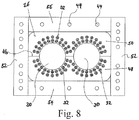
- the die plate comprises at least one, preferably a plurality of perforation openings, which may have any form.
- the perforation openings may have funnel or conical shape, a convergent or divergent nozzle shape, hour-glas shape, channel shape, circular or non-circular.
- the number and the design of the perforation openings are for example chosen such that the sum of the effective cross sectional areas of all perforation openings is from 2 to 40 % of the whole cross sectional area of the die plate within the barrel excluding the support opening(s), preferably from 4 to 20%.
- the effective cross sectional area of a perforation opening is understood as the smallest cross sectional area of each perforation opening through which product can pass the die plate.
- the perforation openings for example on the downstream side for example have an average diameter d of 1 mm ⁇ d ⁇ 6 mm, particularly 1.5 mm ⁇ d ⁇ 5 mm and preferably 2 mm ⁇ d ⁇ 4 mm.
- the average diameter is understood as the diameter of a circular perforation opening with the same cross sectional area. This diameter of the perforation opening on the downstream side of the die plate leads to a suitable high surface area to volume ratio.
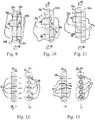
- the die plate comprises at least one perforation opening, wherein the perforation opening comprises in axial direction of the barrel a main opening extending only over a part of the axial thickness of the die plate, wherein the main opening is followed in axial direction by at least one orifice, wherein the orifice comprises a smaller cross section than the main opening.
- the perforation opening may comprise different cross sectional areas in flow direction over the thickness of the die plate. This leads to a high mechanical stability without significantly increasing the overall pressure drop over the die plate.
- the main opening may designed funnel-shaped for leading a high mass of product to the orifice without an unnecessary high counter pressure.
- the cross section area of the orifice may be such small that a kind of spray effect may be provided leading to a plurality of small particles of the product leading to a very high surface area to volume ratio.
- V ⁇ denotes the volume flow of the product in cubic meters per second and r denotes the effective radius of the die opening in meters.
- a further extruder element in the form of an extruder screw and/or a kneader is provided downstream to the die plate and particularly upstream to the outlet port.
- a plurality of conveying and/or degassing stages are provided, wherein preferably each stage is optimized to the expected parameters particularly to the expected amount of volatile compounds to be removed from the product.
- Particularly from 1 to 6, preferably from 1 to 4 die plates are provided in the flow path of the product within the extruder, wherein the cross section area of the perforation openings can be adapted to the expected parameters particularly the expected amount of volatile compounds of the product.
- the further extruder element comprises a conveying element, wherein the maximum axial distance S between the conveying element and the die plate is 0.5 mm ⁇ S ⁇ 10 mm, particularly 1 mm ⁇ S ⁇ 7 mm and preferably 1.5 mm ⁇ S ⁇ 5 mm.
- the further extruder element comprises a conveying element, wherein the maximum axial distance S between the conveying element and the die plate is 0.01 xD ⁇ S ⁇ 0.25xD, whereby D is the inner diameter of the barrel.
- the axial distance S is measured parallel to the rotation axis of the further conveying means.
- the same situation may apply to the conveying means on the upstream side of the die plate. An unnecessary large gap between the conveying means and the die plate is prevented. The extruding effect is not significantly hampered by the provision of the die plate.
- the conveying elements apply at least partially an axial force to the product for building up a pressure to move the product in flow direction.
- the further extruder element comprises a larger free volume than the extruder element.
- the further extruder element comprises conveying elements of the shear edge profile or the box profile. Such profiles are known to those skilled in the art of twin- and multi-screw extruders and are described, for example, in [1] on page 222 in figure 12.12 . Due to this profile of the conveying elements and the increased free volume a higher volume flow rate can be provided.
- a further barrel is provided, wherein the die plate is fixed between the barrel and the further barrel, particularly by means of a flange joint. This leads to a facilitated and fast fixation of the die plate within the extruder.
- the die plate may comprise openings for the fastening means of the flange joint.
- the barrel can be connected to the further barrel by means of at least one tension rod.
- the barrel and/or a further barrel connected to the barrel comprises a recess for receiving at least partially the die plate.
- the barrel and the further barrel may be connected together by means of a flange joint.
- the die plate may be clamped between the barrel and the further barrel without the need for openings in the die plate for the fastening means for connecting the barrel to the further barrel. If so, the die plate may be centered in the recess via its radial outer surface. Particularly the die plate is press fitted in the recess.
- the die plate may be inserted into the recess before the barrel is connected to the further barrel without the need of further adjusting the die plate during the connection of the barrel to the further barrel.
- the die plate is split in radial direction, wherein the split is arranged particularly radial to an at least one support opening each for receiving a shaft of the corresponding conveying means.
- the die plate is split into a lower body and an upper body, wherein both bodies are preferably substantially of identical shape or mirror shape.
- the assembling of the die plate is facilitated.
- two or more, preferably two die plates are arranged in axial direction in very close proximity or even with contact to each other so that the apparent effective cross sectional areas of the perforation openings leading through the two or more, preferably two die discs can be varied when the die plates are fixed to the barrel in different radial positions relative to each other.
- the axial distance of the two or more die plates is 5mm or below, preferably 2 mm or below and even more preferably 1 mm or below.
- the die plate is bordered by inserts, wherein the inserts are fixed to the barrel.
- the die plate can be inserted into the extruder by sliding at the edges of the inserts.
- the insert direction of the die plate is defined by the inserts.
- the parts of the die plate can be easily positioned by means of the inserts, wherein preferably only the inserts are fixed to the barrel be means of fastening means.
- the die plate can be positioned, particularly clamped, by means of the inserts.
- the extruders can either be heated via the barrels to temperatures up to 300°C or cooled.
- the extruder comprises means to operate separate zones independently of each other at different temperatures so that the zones can either be heated, unheated or cooled.
- the extruder comprises for each conveying section at least one separate zone, which can be operated independently at different temperatures.
- the extruder is operated at a feed rate of 5 to 25,000, preferably of 5 to 6,000 kilograms per hour.
- the extruder unit may comprise one or more side feeders, which may positioned anywhere in the extruder, preferably in close proximity to the feeding section of the product or the outlet section. Side feeders are suitable for the addition of additives to the product.
- the invention further comprises the use of the extruder and the die plate according to the invention for the manufacture or processing of non-volatile polymers as defined hereinabove.
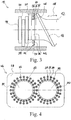
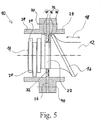
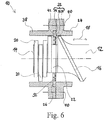
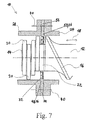
- the invention further relates to a process of removing volatile compounds from a mixture (M) containing at least one non-volatile polymer and at least one volatile compound to obtain a product (P) which is substantially free of volatile compounds, the process comprising at least the steps of: (i)feeding the mixture (M) into at least one twin-screw extruder (10) comprising at least one barrel (24), several extruder elements (12, 14) arranged inside the barrel (24), wherein a first extruder element comprises kneader elements (20) of the shear edge profile or the box profile, at least one outlet port for removing volatile compounds, whereby the extruder further comprises at least one perforated die plate (26) fixed to the barrel (24) in flow direction (18) before the outlet port, wherein the die plate (26) comprises at least one perforation opening (32), wherein the perforation opening (32) comprises in axial direction of the barrel (24) a main opening (34) extending only over a part of the axial thickness of the die plate (26), wherein
- the mixture (M) is free-flowing upon entering the extruder.
- free-flowing means a viscosity in the range of 500 to 50.000.000 mPa*s, preferably 5.000 to 30.000.000 mPa*s and most preferably 10.000 mPa*s to 300.000 mPa*s.
- the viscosity values of fluids refer to the zero shear viscosity extrapolated from measurements at given temperature using a Haake Rheostress RS 150 viscosimeter or a rotational rheometer of cone-plate type for very viscuous samples.
- the extrapolation is performed by taking a 2 nd order polynomial to reflect the shear stress vs shear rate graph obtained from the measurements.
- the linear portion of the polynomial reflects the slope at a shear rate of zero and thus represents the zero shear viscosity.
- the term "substantially free of volatile compounds” means a total concentration of volatile compounds of less than 1 wt%, preferably less than 0.5 wt% based on the mass of the non-volatile polymer.
- substantially free of volatile compounds means substantially free of water and substantially free of volatile organic compounds.
- Non-volatile polymers are considered to be substantially free of water, if the residual water concentration is less than 0.5 wt% preferably less than 0.25 wt %, more preferably less than 0.1 wt % and most preferably less than 0.075 wt % based on the mass of the polymer.
- volatile organic compounds means organic compounds having a boiling point of below 250°C at standard pressure.
- Non-volatile polymers are considered substantially free of volatile organic compound, if the residual concentration of said volatile organic compounds is less than 0.75 wt% preferably less than 0.25 wt % and most preferably less than 0.1 wt % based on the mass of the polymer.
- Said volatile organic compounds are typically the solvents employed in the polymerization or subsequent processing steps such as, for example, a halogenation step.
- the non-volatile polymers are synthetic rubber products (i.e. a halogenated butyl rubber).
- synthetic rubber products include butyl rubbers and halogenated butyl rubbers (IIR, BIIR, CIIR), polyisobutylene (PIB), ethylene propylene diene M-class rubbers (EPDM), ethylene propylene rubbers (EPM), ethylene-vinyl acetate rubbers (EVM and EVA), nitrile butadiene rubbers (NBR), hydrogenated nitrile butadiene rubbers (HNBR), polyisoprene rubbers (IR), fluorinated rubbers (FR), polychloroprenes (CR) butadiene rubbers (BR), and styrene-butadiene rubbers (SBR).
- IIR halogenated butyl rubbers
- PIB polyisobutylene
- EPDM ethylene propylene diene M-class rubbers
- EPM ethylene propylene rubbers
- EVM and EVA ethylene-vinyl acetate rubbers
- NBR nitrile buta
- Preferred synthetic rubber products are butyl rubbers and halobutyl rubbers like bromobutyl and chlorobutyl rubber, whereby bromobutyl rubber is even more preferred.
- butyl rubber denotes a (co)-polymer of isobutene (2-methylpropene) and isoprene (2-methylbuta-1,3-diene).
- the isoprene content in the polymer is between 0.001% and 5, preferably between 1.8 and 2.3 mol %.
- Butyl rubber is composed of linear polyisobutene chains with randomly distributed isoprene units. The isoprene units introduce unsaturated sites into the polymer chain to enable vulcanization.
- the mass average molecular weight of butyl rubber molecules M w is typically between 50,000 and 1,000,000 g/mol, preferably between 300.000 and 1,000,000 g/mol.
- the halogenated butyl rubbers also contain a certain amount of halogen chemically bound to the rubber molecules.
- the amount of chemically bound halogen is typically in the range of more than 0 to 3 wt% with respect to total mass of the polymer.
- additives are also applicable, dependent on the application of the butyl rubber product, i.e. fillers or colorants.
- the typical bromine content in the final product is 1.5 to 2.5 wt%, preferably 1.6 to 2.0 wt%.
- the typical chlorine content in the finished product is 1.0 to 1.5 wt%, preferably 1.15 to 1.35 wt%.
- Mixture (M) contains for example
- the remainder to 100 %, where existent, may comprise or consist of for example additives and auxiliary products typically added to synthetic rubbers, such as reaction accelerators, vulcanizing accelerators, vulcanizing acceleration auxiliaries, antioxidants, foaming agents, anti-aging agents, heat stabilizers, light stabilizers, ozone stabilizers, processing aids, plasticizers, tackifiers, blowing agents, dyestuffs, pigments, waxes, extenders, organic acids, inhibitors, metal oxides, and activators such as triethanolamine, polyethylene glycol, hexanetriol, etc., which are known to the rubber industry.
- additives and auxiliary products typically added to synthetic rubbers such as reaction accelerators, vulcanizing accelerators, vulcanizing acceleration auxiliaries, antioxidants, foaming agents, anti-aging agents, heat stabilizers, light stabilizers, ozone stabilizers, processing aids, plasticizers, tackifiers, blowing agents, dyestuffs, pigments, waxes,
- the volatile organic compounds are preferably those having a boiling point of 200°C or less at 1013 hPa and are preferably selected from the group consisting of aliphatic alcohols such as methanol, ethanol, n-propanol, isobutanol, n-pentanol, neopentanol, cyclohexanol, n-hexanol, aromatic alcohols such as benzylic alkohol, phenylethanol and phenoxyethanol, esters such as ethylacetate, butylacetate, ethers such as methyl-tertiary butyl ether, tetrahydrofurane and 1,4-dioxane, ketones such as acetone and methylethylketone, unhalogenated, partially halogenated or fully halogenated aromatic or aliphatic hydrocarbons such toluene, xylenes, chlorobenzene, dichlorobenzene, dichloromethan
- More preferred volatile organic compounds are n-pentane, iso-pentane, n-hexane, cyclo-hexane, iso-hexane, methyl-cyclopentane, methyl-cyclohexane and n-heptane as well as mixtures comprising or consisting of those alkanes.
- the extruder 10 as illustrated in Fig. 1 comprises extruder elements 12 of the extruder screw type and a further extruder elements 14 of the kneader type.
- the extruder elements 12 comprise conveying elements 16 which form a screw for pressure build up and/or conveying product in a flow direction 18.
- the flow direction is the left side to the right side and vice versa, whereby the flow direction from the left side to the right side is preferred.
- the further extruder elements 14 comprises kneading elements 20.
- the extruder elements 12 and the further extruder elements 14 comprise a common shaft 22.
- the extruder elements 12 and the further extruder elements 14 are housed by a common barrel 24.
- a die plate 26 is provided within the barrel 24 and between the extruder elements 12 and the further extruder elements 14. The die plate 26 is fixed to the barrel 24 for instance by welding, particularly laser welding so that no gap is provided between the die plate 26 and the barrel 24. Alternatively, the die plate 26 can be manufactured directly together with the barrel as one piece.
- the die plate 26 is further positioned between a not illustrated inlet port for feeding a stripping agent and a not illustrated vent port for removal of volatile compounds from the product.
- the inlet port can be arranged upstream or downstream to the die plate, preferably upstream the die plate 26.
- the die plate 26 comprises a plate body 28.
- the plate body 28 comprises two support openings 30 each for the shaft 22 of two different extruder elements 12, 14 arranged parallel to each other for instance in the case of an extruder 10 of the twin screw type.
- the plate body 28 has a plurality of perforation openings 32 which may be regularly arranged in circumferential direction on different diameters around each support opening.
- the product is pressed mainly only through the perforation openings 32 and, if so at all, through the small gap between the shaft 22 and the plate body 28 at the support opening 30. This leads to a high surface area to volume ratio of the product directly after the die plate 26 in flow direction 18 so that the stripping agent may remove a high amount of volatile compounds of the product.
- the embodiment of the extruder 10 illustrated in Fig. 3 and Fig. 4 comprises in comparison to the embodiment illustrated in Fig. 1 stepped perforation openings 32.
- all perforation openings 32 comprise a main opening 34 with a larger diameter with extends only partially over the thickness of the die plate 26.
- the main opening 34 communicates with at least one orifice 36, particularly a plurality of orifices 36, which comprise a smaller diameter than the diameter of the main opening 34.
- the main opening 34 is closer to the further extruder elements 14, wherein the orifices 36 are closer to the extruder elements 12.
- the embodiment of the extruder 10 illustrated in Fig. 5 comprises in comparison to the embodiment illustrated in Fig. 3 a further barrel 38 for housing the further extruder elements 14, wherein the barrel 24 houses mainly only the extruder elements 12.
- the die plate 26 is arranged between the front faces of the barrel 24 and the further barrel 38.
- the barrel 24 and the further barrel 38 are fixed to each other by a flange connection 40.
- the die plate 26 comprises a radial extension which is chosen such that the die plate 26 can be fixed to the barrel 24 and the further barrel 38 by means of the same flange connection 40. If so, a gasket can be provided between the die plate 26 and the barrel 24 and/or between the die plate 26 and the further barrel 38, wherein the gasket(s) are particularly fixed to the die plate 26.
- the die plate 26 may provide the function of a flange seal.
- the further barrel 38 and/or the barrel 24 comprises a recess 42 for receiving the die plate 26
- the die plate 26 may be clamped between the barrel 24 and the further barrel 38 without providing holes 44 for being fixed by means of the flange connection 40.
- the die plate 26 may provide the function of a flange seal.
- the die plate 26 is split.
- the die plate 26 comprises a split 46 extending along a substantially straight line through the center of rotation of the extruder elements 12, 14 arranged in parallel.
- the split 46 runs mainly horizontally.
- the die plate 26 or the plate body 28 is cut by the split 46 in a lower body 48 and an upper body 50.
- the lower body 48 can be inserted into the extruder 10 from the bottom in an upwards direction, wherein the upper body 50 can be inserted into the extruder 10 from top downwards direction.
- the lower body 48 and the upper body 50 can be bordered and/or guided by side inserts 52.
- the lower body 48 and the upper body 50 can be bordered by a lower insert 54 and an upper insert 56.
- the inserts 52, 54, 56 are fixed by the flange connection 40.
- die plates 26a and 26b are in contact in flow direction 18 and moveable against each other in a direction orthogonal to the flow direction 19.
- Die plate 26a comprises channel-shaped perforation openings 32a with large conical inlet sections 35b.
- Die plate 26b exhibits channel-shaped perforation openings 32b.
- Fig. 9 shows an arrangement with a maximum effective cross sectional area 33 of the perforation openings 32a and 32b leading through the two die plates 26a and 26b
- Fig. 10 shows an arrangement with reduced or throttled effective cross sectional area 33 of the perforation openings 32a and 32b leading through the two die plates 26a and 26b
- Fig. 11 shows an arrangement where the effective cross sectional area is zero.
- plates 26 comprise
- split die plate 26 can be fixed without the inserts 52, 54, 56 and/or the perforation openings 32 of a split die plate 26 may be not stepped.
Landscapes
- Engineering & Computer Science (AREA)
- Mechanical Engineering (AREA)
- Extrusion Moulding Of Plastics Or The Like (AREA)
- Processing And Handling Of Plastics And Other Materials For Molding In General (AREA)
Priority Applications (2)
| Application Number | Priority Date | Filing Date | Title |
|---|---|---|---|
| PL11734151T PL2595787T3 (pl) | 2010-07-23 | 2011-07-22 | Sposób odgazowywania mieszanin polimerowych |
| EP11734151.1A EP2595787B1 (en) | 2010-07-23 | 2011-07-22 | Method for degasing polymer mixtures |
Applications Claiming Priority (3)
| Application Number | Priority Date | Filing Date | Title |
|---|---|---|---|
| EP10007660 | 2010-07-23 | ||
| EP11734151.1A EP2595787B1 (en) | 2010-07-23 | 2011-07-22 | Method for degasing polymer mixtures |
| PCT/EP2011/062636 WO2012010693A1 (en) | 2010-07-23 | 2011-07-22 | Extruder with integrated die plate and method for degasing polymer mixtures |
Publications (2)
| Publication Number | Publication Date |
|---|---|
| EP2595787A1 EP2595787A1 (en) | 2013-05-29 |
| EP2595787B1 true EP2595787B1 (en) | 2020-08-05 |
Family
ID=42752482
Family Applications (1)
| Application Number | Title | Priority Date | Filing Date |
|---|---|---|---|
| EP11734151.1A Not-in-force EP2595787B1 (en) | 2010-07-23 | 2011-07-22 | Method for degasing polymer mixtures |
Country Status (13)
| Country | Link |
|---|---|
| US (1) | US9023983B2 (pl) |
| EP (1) | EP2595787B1 (pl) |
| JP (1) | JP5822926B2 (pl) |
| KR (3) | KR20130041964A (pl) |
| CN (2) | CN103097108B (pl) |
| CA (1) | CA2806003C (pl) |
| MY (1) | MY158472A (pl) |
| PL (1) | PL2595787T3 (pl) |
| RU (2) | RU2608956C2 (pl) |
| SA (1) | SA111320634B1 (pl) |
| SG (1) | SG187577A1 (pl) |
| TW (1) | TWI599470B (pl) |
| WO (1) | WO2012010693A1 (pl) |
Families Citing this family (7)
| Publication number | Priority date | Publication date | Assignee | Title |
|---|---|---|---|---|
| JP5956156B2 (ja) * | 2012-01-05 | 2016-07-27 | 株式会社ブリヂストン | 多軸混練押出機、及びウエットマスターバッチの製造方法 |
| TWI649180B (zh) * | 2013-04-04 | 2019-02-01 | 艾朗希歐德意志有限公司 | 用於自含彈性體媒介移除揮發性組份之方法及為此目的之去揮發物設備 |
| DE102014002209B4 (de) * | 2013-10-11 | 2016-11-24 | Blach Verwaltungs Gmbh & Co. Kg | Vorrichtung zur Seitenstrombeschickung eines Extruders |
| EP2921279B1 (de) * | 2014-03-20 | 2017-02-22 | Coperion GmbH | Vorrichtung und Verfahren zur Homogenisierung von Kunststoffschmelzen |
| CN110300649B (zh) * | 2017-02-22 | 2022-03-11 | 学校法人同志社 | 多轴混炼机和使用了该多轴混炼机的纳米复合材料的制造方法以及用于它们的盘形件 |
| WO2022018979A1 (ja) * | 2020-07-22 | 2022-01-27 | 株式会社神戸製鋼所 | 金属部材およびそれを備える装置を用いたゴム材料の加工方法 |
| CN113464716B (zh) * | 2021-08-04 | 2023-04-11 | 浙江理工大学 | 一种用于阀后偏心射流的整流装置 |
Citations (7)
| Publication number | Priority date | Publication date | Assignee | Title |
|---|---|---|---|---|
| FR1472755A (fr) * | 1965-06-26 | 1967-03-10 | Kestermann Maschf Rolf | Extrudeuse à vis munie d'un dispositif d'aspiration de composants gazeux |
| US3911069A (en) * | 1971-11-11 | 1975-10-07 | Dainichi Nippon Cables Ltd | Method of manufacturing multilayered articles |
| JPS5147904A (en) * | 1974-10-23 | 1976-04-24 | Takahama Industry | Nendosozaino oshidashiki niokeru ryushino atsuryokuyugamiokyosei suru hohooyobi sochi |
| JPS6487222A (en) * | 1987-09-29 | 1989-03-31 | Kazumasa Sarumaru | Screw extruder for viscous material |
| JP2002264118A (ja) * | 2001-03-09 | 2002-09-18 | Isamu Kawakami | 粘土の変形の除去装置及び除去方法 |
| WO2010031823A1 (en) * | 2008-09-19 | 2010-03-25 | Lanxess International Sa | Process for the production of water and solvent-free polymers |
| EP2374601A1 (de) * | 2010-04-12 | 2011-10-12 | Coperion GmbH | Mehrwellen-Schneckenmaschine mit integrierter Seiherplatte zur Entgasung von Polymerschmelzen |
Family Cites Families (16)
| Publication number | Priority date | Publication date | Assignee | Title |
|---|---|---|---|---|
| DE623903C (de) * | 1934-02-09 | 1936-01-07 | Richard Raupach Maschinenfabri | Strangpresse mit Entlueftungskammer |
| DE1554751B1 (de) * | 1966-09-10 | 1971-01-07 | Kestermann Maschf Rolf | Schnecken-Strangpresse |
| JPS5120079U (pl) * | 1974-08-02 | 1976-02-14 | ||
| US3963558A (en) * | 1974-12-09 | 1976-06-15 | W Bar E, Incorporated | Apparatus and method for producing solid polymeric material from a dilute polymer solution |
| JPS5948136A (ja) * | 1982-09-13 | 1984-03-19 | Japan Synthetic Rubber Co Ltd | ベント押出機 |
| IT8304968U1 (it) * | 1983-08-23 | 1985-02-23 | F B M Fabbrica Bondenese Macch Di F Falzoni & C S A S | Dispositivo per il dosaggio di materiale plastico di estrusori. |
| SU1597273A1 (ru) * | 1988-07-18 | 1990-10-07 | Ленинградский Технологический Институт Им.Ленсовета | Устройство дл гранулировани полимерных материалов |
| JPH065865Y2 (ja) * | 1990-03-23 | 1994-02-16 | 株式会社日本製鋼所 | 二軸脱水押出機 |
| DE4200788A1 (de) | 1992-01-15 | 1993-07-22 | Bayer Ag | Schneckenmaschine mit stauelementen |
| JPH08104899A (ja) | 1994-10-04 | 1996-04-23 | Sato Tekkosho:Kk | 多段式真空練り出し成形装置 |
| RU16101U1 (ru) * | 2000-07-19 | 2000-12-10 | Общество с ограниченной ответственностью "Ровитар" | Гранулятор термопластических композиционных полимерных материалов |
| JP2003071830A (ja) * | 2001-09-04 | 2003-03-12 | Japan Steel Works Ltd:The | 樹脂機械用混練調整装置 |
| AU2004291944A1 (en) * | 2003-11-24 | 2005-06-02 | Central Products Company | Process for preparing adhesive using planetary extruder |
| CN2666650Y (zh) * | 2003-12-26 | 2004-12-29 | 刘月星 | 销钉挤出机的销钉冷却结构 |
| DE102007045156A1 (de) * | 2007-09-20 | 2009-04-02 | Evonik Röhm Gmbh | Entgasungsextruder zur Entgasung eines Polymermaterials sowie Verfahren zur Entgasung eines Sirups aus Polymeren, Lösungsmitteln und/oder Monomeren unter Verwendung eines Entgasungsextruders |
| ES2530819T3 (es) | 2010-01-27 | 2015-03-05 | Coperion Gmbh | Procedimiento e instalación de tratamiento para la desgasificación de masas fundidas de polímeros |
-
2011
- 2011-07-22 KR KR1020137004531A patent/KR20130041964A/ko not_active Ceased
- 2011-07-22 CN CN201180044352.1A patent/CN103097108B/zh not_active Expired - Fee Related
- 2011-07-22 WO PCT/EP2011/062636 patent/WO2012010693A1/en not_active Ceased
- 2011-07-22 MY MYPI2013700140A patent/MY158472A/en unknown
- 2011-07-22 EP EP11734151.1A patent/EP2595787B1/en not_active Not-in-force
- 2011-07-22 KR KR1020177023568A patent/KR101905352B1/ko not_active Expired - Fee Related
- 2011-07-22 TW TW100126107A patent/TWI599470B/zh not_active IP Right Cessation
- 2011-07-22 PL PL11734151T patent/PL2595787T3/pl unknown
- 2011-07-22 KR KR1020167007574A patent/KR20160039296A/ko not_active Ceased
- 2011-07-22 US US13/811,330 patent/US9023983B2/en active Active
- 2011-07-22 RU RU2013107676A patent/RU2608956C2/ru active
- 2011-07-22 CA CA2806003A patent/CA2806003C/en active Active
- 2011-07-22 RU RU2016152435A patent/RU2736768C2/ru active
- 2011-07-22 CN CN201610392630.7A patent/CN106079344B/zh not_active Expired - Fee Related
- 2011-07-22 JP JP2013520160A patent/JP5822926B2/ja not_active Expired - Fee Related
- 2011-07-22 SG SG2013004742A patent/SG187577A1/en unknown
- 2011-07-23 SA SA111320634A patent/SA111320634B1/ar unknown
Patent Citations (7)
| Publication number | Priority date | Publication date | Assignee | Title |
|---|---|---|---|---|
| FR1472755A (fr) * | 1965-06-26 | 1967-03-10 | Kestermann Maschf Rolf | Extrudeuse à vis munie d'un dispositif d'aspiration de composants gazeux |
| US3911069A (en) * | 1971-11-11 | 1975-10-07 | Dainichi Nippon Cables Ltd | Method of manufacturing multilayered articles |
| JPS5147904A (en) * | 1974-10-23 | 1976-04-24 | Takahama Industry | Nendosozaino oshidashiki niokeru ryushino atsuryokuyugamiokyosei suru hohooyobi sochi |
| JPS6487222A (en) * | 1987-09-29 | 1989-03-31 | Kazumasa Sarumaru | Screw extruder for viscous material |
| JP2002264118A (ja) * | 2001-03-09 | 2002-09-18 | Isamu Kawakami | 粘土の変形の除去装置及び除去方法 |
| WO2010031823A1 (en) * | 2008-09-19 | 2010-03-25 | Lanxess International Sa | Process for the production of water and solvent-free polymers |
| EP2374601A1 (de) * | 2010-04-12 | 2011-10-12 | Coperion GmbH | Mehrwellen-Schneckenmaschine mit integrierter Seiherplatte zur Entgasung von Polymerschmelzen |
Also Published As
| Publication number | Publication date |
|---|---|
| RU2608956C2 (ru) | 2017-01-27 |
| JP5822926B2 (ja) | 2015-11-25 |
| TWI599470B (zh) | 2017-09-21 |
| US20140039142A1 (en) | 2014-02-06 |
| MY158472A (en) | 2016-10-14 |
| SA111320634B1 (ar) | 2015-02-23 |
| CN103097108B (zh) | 2016-05-25 |
| CA2806003A1 (en) | 2012-01-26 |
| RU2736768C2 (ru) | 2020-11-19 |
| KR20170102028A (ko) | 2017-09-06 |
| CA2806003C (en) | 2020-01-07 |
| KR20130041964A (ko) | 2013-04-25 |
| KR101905352B1 (ko) | 2018-10-05 |
| PL2595787T3 (pl) | 2021-02-08 |
| CN106079344B (zh) | 2019-12-17 |
| TW201221336A (en) | 2012-06-01 |
| RU2016152435A3 (pl) | 2020-05-15 |
| RU2016152435A (ru) | 2018-12-19 |
| CN106079344A (zh) | 2016-11-09 |
| JP2013535358A (ja) | 2013-09-12 |
| WO2012010693A1 (en) | 2012-01-26 |
| US9023983B2 (en) | 2015-05-05 |
| KR20160039296A (ko) | 2016-04-08 |
| SG187577A1 (en) | 2013-03-28 |
| RU2013107676A (ru) | 2014-08-27 |
| EP2595787A1 (en) | 2013-05-29 |
| CN103097108A (zh) | 2013-05-08 |
Similar Documents
| Publication | Publication Date | Title |
|---|---|---|
| EP2595787B1 (en) | Method for degasing polymer mixtures | |
| CA2849368C (en) | Process for removing volatile constituents from polymer-containing media and devolatilisation apparatuses for this purpose | |
| EP2328937B1 (en) | Process for the production of water and solvent-free synthetic rubber | |
| EP2550148B1 (en) | Process for the production of water and solvent-free polymers | |
| US9925693B2 (en) | Method for removing volatile components from elastomer-containing media and degassing devices therefor |
Legal Events
| Date | Code | Title | Description |
|---|---|---|---|
| PUAI | Public reference made under article 153(3) epc to a published international application that has entered the european phase |
Free format text: ORIGINAL CODE: 0009012 |
|
| 17P | Request for examination filed |
Effective date: 20130225 |
|
| AK | Designated contracting states |
Kind code of ref document: A1 Designated state(s): AL AT BE BG CH CY CZ DE DK EE ES FI FR GB GR HR HU IE IS IT LI LT LU LV MC MK MT NL NO PL PT RO RS SE SI SK SM TR |
|
| RAP1 | Party data changed (applicant data changed or rights of an application transferred) |
Owner name: LANXESS DEUTSCHLAND GMBH |
|
| DAX | Request for extension of the european patent (deleted) | ||
| RAP1 | Party data changed (applicant data changed or rights of an application transferred) |
Owner name: ARLANXEO DEUTSCHLAND GMBH |
|
| STAA | Information on the status of an ep patent application or granted ep patent |
Free format text: STATUS: EXAMINATION IS IN PROGRESS |
|
| 17Q | First examination report despatched |
Effective date: 20170116 |
|
| REG | Reference to a national code |
Ref country code: DE Ref legal event code: R079 Ref document number: 602011068067 Country of ref document: DE Free format text: PREVIOUS MAIN CLASS: B29C0047760000 Ipc: B29C0048760000 |
|
| GRAP | Despatch of communication of intention to grant a patent |
Free format text: ORIGINAL CODE: EPIDOSNIGR1 |
|
| STAA | Information on the status of an ep patent application or granted ep patent |
Free format text: STATUS: GRANT OF PATENT IS INTENDED |
|
| RIC1 | Information provided on ipc code assigned before grant |
Ipc: B29K 223/00 20060101ALN20200205BHEP Ipc: B29C 48/76 20190101AFI20200205BHEP Ipc: B29C 48/70 20190101ALI20200205BHEP Ipc: B29C 48/38 20190101ALI20200205BHEP Ipc: B29K 23/00 20060101ALN20200205BHEP |
|
| INTG | Intention to grant announced |
Effective date: 20200224 |
|
| GRAS | Grant fee paid |
Free format text: ORIGINAL CODE: EPIDOSNIGR3 |
|
| GRAA | (expected) grant |
Free format text: ORIGINAL CODE: 0009210 |
|
| STAA | Information on the status of an ep patent application or granted ep patent |
Free format text: STATUS: THE PATENT HAS BEEN GRANTED |
|
| AK | Designated contracting states |
Kind code of ref document: B1 Designated state(s): AL AT BE BG CH CY CZ DE DK EE ES FI FR GB GR HR HU IE IS IT LI LT LU LV MC MK MT NL NO PL PT RO RS SE SI SK SM TR |
|
| REG | Reference to a national code |
Ref country code: GB Ref legal event code: FG4D |
|
| REG | Reference to a national code |
Ref country code: CH Ref legal event code: EP |
|
| REG | Reference to a national code |
Ref country code: AT Ref legal event code: REF Ref document number: 1298101 Country of ref document: AT Kind code of ref document: T Effective date: 20200815 |
|
| REG | Reference to a national code |
Ref country code: DE Ref legal event code: R096 Ref document number: 602011068067 Country of ref document: DE |
|
| REG | Reference to a national code |
Ref country code: IE Ref legal event code: FG4D |
|
| REG | Reference to a national code |
Ref country code: LT Ref legal event code: MG4D |
|
| REG | Reference to a national code |
Ref country code: NL Ref legal event code: MP Effective date: 20200805 |
|
| REG | Reference to a national code |
Ref country code: AT Ref legal event code: MK05 Ref document number: 1298101 Country of ref document: AT Kind code of ref document: T Effective date: 20200805 |
|
| PG25 | Lapsed in a contracting state [announced via postgrant information from national office to epo] |
Ref country code: PT Free format text: LAPSE BECAUSE OF FAILURE TO SUBMIT A TRANSLATION OF THE DESCRIPTION OR TO PAY THE FEE WITHIN THE PRESCRIBED TIME-LIMIT Effective date: 20201207 Ref country code: NO Free format text: LAPSE BECAUSE OF FAILURE TO SUBMIT A TRANSLATION OF THE DESCRIPTION OR TO PAY THE FEE WITHIN THE PRESCRIBED TIME-LIMIT Effective date: 20201105 Ref country code: AT Free format text: LAPSE BECAUSE OF FAILURE TO SUBMIT A TRANSLATION OF THE DESCRIPTION OR TO PAY THE FEE WITHIN THE PRESCRIBED TIME-LIMIT Effective date: 20200805 Ref country code: SE Free format text: LAPSE BECAUSE OF FAILURE TO SUBMIT A TRANSLATION OF THE DESCRIPTION OR TO PAY THE FEE WITHIN THE PRESCRIBED TIME-LIMIT Effective date: 20200805 Ref country code: GR Free format text: LAPSE BECAUSE OF FAILURE TO SUBMIT A TRANSLATION OF THE DESCRIPTION OR TO PAY THE FEE WITHIN THE PRESCRIBED TIME-LIMIT Effective date: 20201106 Ref country code: FI Free format text: LAPSE BECAUSE OF FAILURE TO SUBMIT A TRANSLATION OF THE DESCRIPTION OR TO PAY THE FEE WITHIN THE PRESCRIBED TIME-LIMIT Effective date: 20200805 Ref country code: HR Free format text: LAPSE BECAUSE OF FAILURE TO SUBMIT A TRANSLATION OF THE DESCRIPTION OR TO PAY THE FEE WITHIN THE PRESCRIBED TIME-LIMIT Effective date: 20200805 Ref country code: BG Free format text: LAPSE BECAUSE OF FAILURE TO SUBMIT A TRANSLATION OF THE DESCRIPTION OR TO PAY THE FEE WITHIN THE PRESCRIBED TIME-LIMIT Effective date: 20201105 Ref country code: LT Free format text: LAPSE BECAUSE OF FAILURE TO SUBMIT A TRANSLATION OF THE DESCRIPTION OR TO PAY THE FEE WITHIN THE PRESCRIBED TIME-LIMIT Effective date: 20200805 Ref country code: ES Free format text: LAPSE BECAUSE OF FAILURE TO SUBMIT A TRANSLATION OF THE DESCRIPTION OR TO PAY THE FEE WITHIN THE PRESCRIBED TIME-LIMIT Effective date: 20200805 |
|
| PG25 | Lapsed in a contracting state [announced via postgrant information from national office to epo] |
Ref country code: NL Free format text: LAPSE BECAUSE OF FAILURE TO SUBMIT A TRANSLATION OF THE DESCRIPTION OR TO PAY THE FEE WITHIN THE PRESCRIBED TIME-LIMIT Effective date: 20200805 Ref country code: LV Free format text: LAPSE BECAUSE OF FAILURE TO SUBMIT A TRANSLATION OF THE DESCRIPTION OR TO PAY THE FEE WITHIN THE PRESCRIBED TIME-LIMIT Effective date: 20200805 Ref country code: RS Free format text: LAPSE BECAUSE OF FAILURE TO SUBMIT A TRANSLATION OF THE DESCRIPTION OR TO PAY THE FEE WITHIN THE PRESCRIBED TIME-LIMIT Effective date: 20200805 Ref country code: IS Free format text: LAPSE BECAUSE OF FAILURE TO SUBMIT A TRANSLATION OF THE DESCRIPTION OR TO PAY THE FEE WITHIN THE PRESCRIBED TIME-LIMIT Effective date: 20201205 |
|
| PG25 | Lapsed in a contracting state [announced via postgrant information from national office to epo] |
Ref country code: SM Free format text: LAPSE BECAUSE OF FAILURE TO SUBMIT A TRANSLATION OF THE DESCRIPTION OR TO PAY THE FEE WITHIN THE PRESCRIBED TIME-LIMIT Effective date: 20200805 Ref country code: RO Free format text: LAPSE BECAUSE OF FAILURE TO SUBMIT A TRANSLATION OF THE DESCRIPTION OR TO PAY THE FEE WITHIN THE PRESCRIBED TIME-LIMIT Effective date: 20200805 Ref country code: DK Free format text: LAPSE BECAUSE OF FAILURE TO SUBMIT A TRANSLATION OF THE DESCRIPTION OR TO PAY THE FEE WITHIN THE PRESCRIBED TIME-LIMIT Effective date: 20200805 Ref country code: EE Free format text: LAPSE BECAUSE OF FAILURE TO SUBMIT A TRANSLATION OF THE DESCRIPTION OR TO PAY THE FEE WITHIN THE PRESCRIBED TIME-LIMIT Effective date: 20200805 Ref country code: CZ Free format text: LAPSE BECAUSE OF FAILURE TO SUBMIT A TRANSLATION OF THE DESCRIPTION OR TO PAY THE FEE WITHIN THE PRESCRIBED TIME-LIMIT Effective date: 20200805 |
|
| REG | Reference to a national code |
Ref country code: DE Ref legal event code: R097 Ref document number: 602011068067 Country of ref document: DE |
|
| PG25 | Lapsed in a contracting state [announced via postgrant information from national office to epo] |
Ref country code: AL Free format text: LAPSE BECAUSE OF FAILURE TO SUBMIT A TRANSLATION OF THE DESCRIPTION OR TO PAY THE FEE WITHIN THE PRESCRIBED TIME-LIMIT Effective date: 20200805 |
|
| PLBE | No opposition filed within time limit |
Free format text: ORIGINAL CODE: 0009261 |
|
| STAA | Information on the status of an ep patent application or granted ep patent |
Free format text: STATUS: NO OPPOSITION FILED WITHIN TIME LIMIT |
|
| PG25 | Lapsed in a contracting state [announced via postgrant information from national office to epo] |
Ref country code: SK Free format text: LAPSE BECAUSE OF FAILURE TO SUBMIT A TRANSLATION OF THE DESCRIPTION OR TO PAY THE FEE WITHIN THE PRESCRIBED TIME-LIMIT Effective date: 20200805 |
|
| 26N | No opposition filed |
Effective date: 20210507 |
|
| PGFP | Annual fee paid to national office [announced via postgrant information from national office to epo] |
Ref country code: IT Payment date: 20210610 Year of fee payment: 11 |
|
| PG25 | Lapsed in a contracting state [announced via postgrant information from national office to epo] |
Ref country code: SI Free format text: LAPSE BECAUSE OF FAILURE TO SUBMIT A TRANSLATION OF THE DESCRIPTION OR TO PAY THE FEE WITHIN THE PRESCRIBED TIME-LIMIT Effective date: 20200805 |
|
| PGFP | Annual fee paid to national office [announced via postgrant information from national office to epo] |
Ref country code: GB Payment date: 20210630 Year of fee payment: 11 Ref country code: PL Payment date: 20210615 Year of fee payment: 11 |
|
| PGFP | Annual fee paid to national office [announced via postgrant information from national office to epo] |
Ref country code: DE Payment date: 20210622 Year of fee payment: 11 |
|
| REG | Reference to a national code |
Ref country code: CH Ref legal event code: PL |
|
| PG25 | Lapsed in a contracting state [announced via postgrant information from national office to epo] |
Ref country code: MC Free format text: LAPSE BECAUSE OF FAILURE TO SUBMIT A TRANSLATION OF THE DESCRIPTION OR TO PAY THE FEE WITHIN THE PRESCRIBED TIME-LIMIT Effective date: 20200805 |
|
| PG25 | Lapsed in a contracting state [announced via postgrant information from national office to epo] |
Ref country code: LI Free format text: LAPSE BECAUSE OF NON-PAYMENT OF DUE FEES Effective date: 20210731 Ref country code: CH Free format text: LAPSE BECAUSE OF NON-PAYMENT OF DUE FEES Effective date: 20210731 |
|
| PG25 | Lapsed in a contracting state [announced via postgrant information from national office to epo] |
Ref country code: LU Free format text: LAPSE BECAUSE OF NON-PAYMENT OF DUE FEES Effective date: 20210722 |
|
| PG25 | Lapsed in a contracting state [announced via postgrant information from national office to epo] |
Ref country code: IE Free format text: LAPSE BECAUSE OF NON-PAYMENT OF DUE FEES Effective date: 20210722 |
|
| PGFP | Annual fee paid to national office [announced via postgrant information from national office to epo] |
Ref country code: BE Payment date: 20220621 Year of fee payment: 12 |
|
| PGFP | Annual fee paid to national office [announced via postgrant information from national office to epo] |
Ref country code: FR Payment date: 20220609 Year of fee payment: 12 |
|
| REG | Reference to a national code |
Ref country code: DE Ref legal event code: R119 Ref document number: 602011068067 Country of ref document: DE |
|
| GBPC | Gb: european patent ceased through non-payment of renewal fee |
Effective date: 20220722 |
|
| PG25 | Lapsed in a contracting state [announced via postgrant information from national office to epo] |
Ref country code: HU Free format text: LAPSE BECAUSE OF FAILURE TO SUBMIT A TRANSLATION OF THE DESCRIPTION OR TO PAY THE FEE WITHIN THE PRESCRIBED TIME-LIMIT; INVALID AB INITIO Effective date: 20110722 Ref country code: GB Free format text: LAPSE BECAUSE OF NON-PAYMENT OF DUE FEES Effective date: 20220722 Ref country code: DE Free format text: LAPSE BECAUSE OF NON-PAYMENT OF DUE FEES Effective date: 20230201 Ref country code: CY Free format text: LAPSE BECAUSE OF FAILURE TO SUBMIT A TRANSLATION OF THE DESCRIPTION OR TO PAY THE FEE WITHIN THE PRESCRIBED TIME-LIMIT Effective date: 20200805 |
|
| PG25 | Lapsed in a contracting state [announced via postgrant information from national office to epo] |
Ref country code: IT Free format text: LAPSE BECAUSE OF NON-PAYMENT OF DUE FEES Effective date: 20220722 |
|
| PG25 | Lapsed in a contracting state [announced via postgrant information from national office to epo] |
Ref country code: PL Free format text: LAPSE BECAUSE OF NON-PAYMENT OF DUE FEES Effective date: 20220722 |
|
| REG | Reference to a national code |
Ref country code: BE Ref legal event code: MM Effective date: 20230731 |
|
| PG25 | Lapsed in a contracting state [announced via postgrant information from national office to epo] |
Ref country code: MK Free format text: LAPSE BECAUSE OF FAILURE TO SUBMIT A TRANSLATION OF THE DESCRIPTION OR TO PAY THE FEE WITHIN THE PRESCRIBED TIME-LIMIT Effective date: 20200805 |
|
| PG25 | Lapsed in a contracting state [announced via postgrant information from national office to epo] |
Ref country code: FR Free format text: LAPSE BECAUSE OF NON-PAYMENT OF DUE FEES Effective date: 20230731 Ref country code: BE Free format text: LAPSE BECAUSE OF NON-PAYMENT OF DUE FEES Effective date: 20230731 |
|
| PG25 | Lapsed in a contracting state [announced via postgrant information from national office to epo] |
Ref country code: TR Free format text: LAPSE BECAUSE OF FAILURE TO SUBMIT A TRANSLATION OF THE DESCRIPTION OR TO PAY THE FEE WITHIN THE PRESCRIBED TIME-LIMIT Effective date: 20200805 |
|
| PG25 | Lapsed in a contracting state [announced via postgrant information from national office to epo] |
Ref country code: MT Free format text: LAPSE BECAUSE OF FAILURE TO SUBMIT A TRANSLATION OF THE DESCRIPTION OR TO PAY THE FEE WITHIN THE PRESCRIBED TIME-LIMIT Effective date: 20200805 |