EP2592065B1 - Verbindung mit einer photoreaktiven funktionsgruppe, photoreaktives polymer und ausrichtungsschicht damit - Google Patents
Verbindung mit einer photoreaktiven funktionsgruppe, photoreaktives polymer und ausrichtungsschicht damit Download PDFInfo
- Publication number
- EP2592065B1 EP2592065B1 EP11803718.3A EP11803718A EP2592065B1 EP 2592065 B1 EP2592065 B1 EP 2592065B1 EP 11803718 A EP11803718 A EP 11803718A EP 2592065 B1 EP2592065 B1 EP 2592065B1
- Authority
- EP
- European Patent Office
- Prior art keywords
- carbon atoms
- polymer
- group
- chemical formula
- photoreactive polymer
- Prior art date
- Legal status (The legal status is an assumption and is not a legal conclusion. Google has not performed a legal analysis and makes no representation as to the accuracy of the status listed.)
- Active
Links
- 0 CC1=C***1 Chemical compound CC1=C***1 0.000 description 4
- WRWPPGUCZBJXKX-UHFFFAOYSA-N Cc(cc1)ccc1F Chemical compound Cc(cc1)ccc1F WRWPPGUCZBJXKX-UHFFFAOYSA-N 0.000 description 1
- YHRKHBMIIGWEQL-ONEGZZNKSA-N O/C=C(\C=C1)/OC1=O Chemical compound O/C=C(\C=C1)/OC1=O YHRKHBMIIGWEQL-ONEGZZNKSA-N 0.000 description 1
- FPYJFEHAWHCUMM-UHFFFAOYSA-N O=C(C=C1)OC1=O Chemical compound O=C(C=C1)OC1=O FPYJFEHAWHCUMM-UHFFFAOYSA-N 0.000 description 1
Images


Classifications
-
- C—CHEMISTRY; METALLURGY
- C07—ORGANIC CHEMISTRY
- C07C—ACYCLIC OR CARBOCYCLIC COMPOUNDS
- C07C69/00—Esters of carboxylic acids; Esters of carbonic or haloformic acids
- C07C69/74—Esters of carboxylic acids having an esterified carboxyl group bound to a carbon atom of a ring other than a six-membered aromatic ring
- C07C69/753—Esters of carboxylic acids having an esterified carboxyl group bound to a carbon atom of a ring other than a six-membered aromatic ring of polycyclic acids
-
- C—CHEMISTRY; METALLURGY
- C07—ORGANIC CHEMISTRY
- C07C—ACYCLIC OR CARBOCYCLIC COMPOUNDS
- C07C69/00—Esters of carboxylic acids; Esters of carbonic or haloformic acids
- C07C69/612—Esters of carboxylic acids having a carboxyl group bound to an acyclic carbon atom and having a six-membered aromatic ring in the acid moiety
- C07C69/618—Esters of carboxylic acids having a carboxyl group bound to an acyclic carbon atom and having a six-membered aromatic ring in the acid moiety having unsaturation outside the six-membered aromatic ring
-
- C—CHEMISTRY; METALLURGY
- C07—ORGANIC CHEMISTRY
- C07C—ACYCLIC OR CARBOCYCLIC COMPOUNDS
- C07C69/00—Esters of carboxylic acids; Esters of carbonic or haloformic acids
- C07C69/76—Esters of carboxylic acids having a carboxyl group bound to a carbon atom of a six-membered aromatic ring
-
- C—CHEMISTRY; METALLURGY
- C08—ORGANIC MACROMOLECULAR COMPOUNDS; THEIR PREPARATION OR CHEMICAL WORKING-UP; COMPOSITIONS BASED THEREON
- C08F—MACROMOLECULAR COMPOUNDS OBTAINED BY REACTIONS ONLY INVOLVING CARBON-TO-CARBON UNSATURATED BONDS
- C08F16/00—Homopolymers and copolymers of compounds having one or more unsaturated aliphatic radicals, each having only one carbon-to-carbon double bond, and at least one being terminated by an alcohol, ether, aldehydo, ketonic, acetal or ketal radical
- C08F16/36—Homopolymers and copolymers of compounds having one or more unsaturated aliphatic radicals, each having only one carbon-to-carbon double bond, and at least one being terminated by an alcohol, ether, aldehydo, ketonic, acetal or ketal radical by a ketonic radical
-
- C—CHEMISTRY; METALLURGY
- C08—ORGANIC MACROMOLECULAR COMPOUNDS; THEIR PREPARATION OR CHEMICAL WORKING-UP; COMPOSITIONS BASED THEREON
- C08F—MACROMOLECULAR COMPOUNDS OBTAINED BY REACTIONS ONLY INVOLVING CARBON-TO-CARBON UNSATURATED BONDS
- C08F216/00—Copolymers of compounds having one or more unsaturated aliphatic radicals, each having only one carbon-to-carbon double bond, and at least one being terminated by an alcohol, ether, aldehydo, ketonic, acetal or ketal radical
- C08F216/36—Copolymers of compounds having one or more unsaturated aliphatic radicals, each having only one carbon-to-carbon double bond, and at least one being terminated by an alcohol, ether, aldehydo, ketonic, acetal or ketal radical by a ketonic radical
-
- C—CHEMISTRY; METALLURGY
- C08—ORGANIC MACROMOLECULAR COMPOUNDS; THEIR PREPARATION OR CHEMICAL WORKING-UP; COMPOSITIONS BASED THEREON
- C08F—MACROMOLECULAR COMPOUNDS OBTAINED BY REACTIONS ONLY INVOLVING CARBON-TO-CARBON UNSATURATED BONDS
- C08F222/00—Copolymers of compounds having one or more unsaturated aliphatic radicals, each having only one carbon-to-carbon double bond, and at least one being terminated by a carboxyl radical and containing at least one other carboxyl radical in the molecule; Salts, anhydrides, esters, amides, imides, or nitriles thereof
- C08F222/36—Amides or imides
- C08F222/40—Imides, e.g. cyclic imides
-
- C—CHEMISTRY; METALLURGY
- C08—ORGANIC MACROMOLECULAR COMPOUNDS; THEIR PREPARATION OR CHEMICAL WORKING-UP; COMPOSITIONS BASED THEREON
- C08F—MACROMOLECULAR COMPOUNDS OBTAINED BY REACTIONS ONLY INVOLVING CARBON-TO-CARBON UNSATURATED BONDS
- C08F232/00—Copolymers of cyclic compounds containing no unsaturated aliphatic radicals in a side chain, and having one or more carbon-to-carbon double bonds in a carbocyclic ring system
- C08F232/08—Copolymers of cyclic compounds containing no unsaturated aliphatic radicals in a side chain, and having one or more carbon-to-carbon double bonds in a carbocyclic ring system having condensed rings
-
- C—CHEMISTRY; METALLURGY
- C08—ORGANIC MACROMOLECULAR COMPOUNDS; THEIR PREPARATION OR CHEMICAL WORKING-UP; COMPOSITIONS BASED THEREON
- C08F—MACROMOLECULAR COMPOUNDS OBTAINED BY REACTIONS ONLY INVOLVING CARBON-TO-CARBON UNSATURATED BONDS
- C08F32/00—Homopolymers and copolymers of cyclic compounds having no unsaturated aliphatic radicals in a side chain, and having one or more carbon-to-carbon double bonds in a carbocyclic ring system
-
- G—PHYSICS
- G02—OPTICS
- G02F—OPTICAL DEVICES OR ARRANGEMENTS FOR THE CONTROL OF LIGHT BY MODIFICATION OF THE OPTICAL PROPERTIES OF THE MEDIA OF THE ELEMENTS INVOLVED THEREIN; NON-LINEAR OPTICS; FREQUENCY-CHANGING OF LIGHT; OPTICAL LOGIC ELEMENTS; OPTICAL ANALOGUE/DIGITAL CONVERTERS
- G02F1/00—Devices or arrangements for the control of the intensity, colour, phase, polarisation or direction of light arriving from an independent light source, e.g. switching, gating or modulating; Non-linear optics
- G02F1/01—Devices or arrangements for the control of the intensity, colour, phase, polarisation or direction of light arriving from an independent light source, e.g. switching, gating or modulating; Non-linear optics for the control of the intensity, phase, polarisation or colour
- G02F1/13—Devices or arrangements for the control of the intensity, colour, phase, polarisation or direction of light arriving from an independent light source, e.g. switching, gating or modulating; Non-linear optics for the control of the intensity, phase, polarisation or colour based on liquid crystals, e.g. single liquid crystal display cells
- G02F1/133—Constructional arrangements; Operation of liquid crystal cells; Circuit arrangements
- G02F1/1333—Constructional arrangements; Manufacturing methods
- G02F1/1337—Surface-induced orientation of the liquid crystal molecules, e.g. by alignment layers
-
- G—PHYSICS
- G02—OPTICS
- G02F—OPTICAL DEVICES OR ARRANGEMENTS FOR THE CONTROL OF LIGHT BY MODIFICATION OF THE OPTICAL PROPERTIES OF THE MEDIA OF THE ELEMENTS INVOLVED THEREIN; NON-LINEAR OPTICS; FREQUENCY-CHANGING OF LIGHT; OPTICAL LOGIC ELEMENTS; OPTICAL ANALOGUE/DIGITAL CONVERTERS
- G02F1/00—Devices or arrangements for the control of the intensity, colour, phase, polarisation or direction of light arriving from an independent light source, e.g. switching, gating or modulating; Non-linear optics
- G02F1/01—Devices or arrangements for the control of the intensity, colour, phase, polarisation or direction of light arriving from an independent light source, e.g. switching, gating or modulating; Non-linear optics for the control of the intensity, phase, polarisation or colour
- G02F1/13—Devices or arrangements for the control of the intensity, colour, phase, polarisation or direction of light arriving from an independent light source, e.g. switching, gating or modulating; Non-linear optics for the control of the intensity, phase, polarisation or colour based on liquid crystals, e.g. single liquid crystal display cells
- G02F1/133—Constructional arrangements; Operation of liquid crystal cells; Circuit arrangements
- G02F1/1333—Constructional arrangements; Manufacturing methods
- G02F1/1337—Surface-induced orientation of the liquid crystal molecules, e.g. by alignment layers
- G02F1/133711—Surface-induced orientation of the liquid crystal molecules, e.g. by alignment layers by organic films, e.g. polymeric films
-
- C—CHEMISTRY; METALLURGY
- C07—ORGANIC CHEMISTRY
- C07C—ACYCLIC OR CARBOCYCLIC COMPOUNDS
- C07C2602/00—Systems containing two condensed rings
- C07C2602/36—Systems containing two condensed rings the rings having more than two atoms in common
- C07C2602/42—Systems containing two condensed rings the rings having more than two atoms in common the bicyclo ring system containing seven carbon atoms
-
- C—CHEMISTRY; METALLURGY
- C09—DYES; PAINTS; POLISHES; NATURAL RESINS; ADHESIVES; COMPOSITIONS NOT OTHERWISE PROVIDED FOR; APPLICATIONS OF MATERIALS NOT OTHERWISE PROVIDED FOR
- C09K—MATERIALS FOR MISCELLANEOUS APPLICATIONS, NOT PROVIDED FOR ELSEWHERE
- C09K2323/00—Functional layers of liquid crystal optical display excluding electroactive liquid crystal layer characterised by chemical composition
- C09K2323/02—Alignment layer characterised by chemical composition
-
- G—PHYSICS
- G02—OPTICS
- G02F—OPTICAL DEVICES OR ARRANGEMENTS FOR THE CONTROL OF LIGHT BY MODIFICATION OF THE OPTICAL PROPERTIES OF THE MEDIA OF THE ELEMENTS INVOLVED THEREIN; NON-LINEAR OPTICS; FREQUENCY-CHANGING OF LIGHT; OPTICAL LOGIC ELEMENTS; OPTICAL ANALOGUE/DIGITAL CONVERTERS
- G02F1/00—Devices or arrangements for the control of the intensity, colour, phase, polarisation or direction of light arriving from an independent light source, e.g. switching, gating or modulating; Non-linear optics
- G02F1/01—Devices or arrangements for the control of the intensity, colour, phase, polarisation or direction of light arriving from an independent light source, e.g. switching, gating or modulating; Non-linear optics for the control of the intensity, phase, polarisation or colour
- G02F1/13—Devices or arrangements for the control of the intensity, colour, phase, polarisation or direction of light arriving from an independent light source, e.g. switching, gating or modulating; Non-linear optics for the control of the intensity, phase, polarisation or colour based on liquid crystals, e.g. single liquid crystal display cells
- G02F1/133—Constructional arrangements; Operation of liquid crystal cells; Circuit arrangements
- G02F1/1333—Constructional arrangements; Manufacturing methods
- G02F1/1337—Surface-induced orientation of the liquid crystal molecules, e.g. by alignment layers
- G02F1/13378—Surface-induced orientation of the liquid crystal molecules, e.g. by alignment layers by treatment of the surface, e.g. embossing, rubbing or light irradiation
- G02F1/133788—Surface-induced orientation of the liquid crystal molecules, e.g. by alignment layers by treatment of the surface, e.g. embossing, rubbing or light irradiation by light irradiation, e.g. linearly polarised light photo-polymerisation
Definitions
- the present invention relates to a novel photoreactive polymer, and an alignment film comprising the same. More particularly, the present invention relates to a photoreactive polymer that shows excellent alignment stability and thermal stability together with excellent liquid crystal alignment, thereby being desirably used in an alignment film of a liquid crystal display device, and an alignment film.
- liquid crystals In order to use liquid crystals as an optical switch in the TFT-LCD, liquid crystals needs to be initially oriented in a predetermined direction on a thin film transistor, which is disposed in the most inner portion of a display cell. For this purpose, a liquid crystal alignment film is used.
- a rubbing process is applied, in which a heat resistant polymer such as polyimide is applied on a transparent glass to form a polymer alignment film and the alignment film is rubbed by rotating a rotation roller wound with a rubbing cloth made of nylon, rayon or the like at a high speed.
- a heat resistant polymer such as polyimide
- the rubbing process may cause mechanical scratches or high static electricity on the surface of the liquid crystal alignment material during the rubbing process, a thin film transistor may be destroyed.
- a defect occurs due to fine fibers generated from the rubbing cloth, which hinders the improvement in production yield.
- a novel liquid crystal alignment process is designed, which is a liquid crystal alignment by using UV, namely, light (hereinafter, referred to as "optical alignment").
- the optical alignment refers to a mechanism, in which a photosensitive group connected to the photoreactive polymer generates a photoreaction due to linearly polarized UV, and in this procedure, a main chain of the polymer is unidirectionally aligned, thereby forming a photopolymerizable liquid crystal alignment film in which the liquid crystals are aligned.
- a representative example thereof is an optical alignment by photopolymerization, which is announced by M. Schadt, et al. (Jpn. J. Appl. Phys., Vol31., 1992, 2155 ), Dae S. Kang, et al. (US Patent No. 5,464,669 ), and Yuriy Reznikov (Jpn. J. Appl. Phys. Vol. 34, 1995, L1000 ).
- polycinnamate-based polymers such as PVCN (poly(vinyl cinnamate)) and PVMC (poly(vinyl methoxycinnamate)) are generally used as the optical alignment polymers.
- the cycloaddition reaction [2+2] of the double bond [2+2] of cinnamate by UV forms cyclobutane, and thus an anisotropic property is formed to unidirectionally align liquid crystal molecules, leading to the alignment of the liquid crystals.
- Japanese Unexamined Patent Application Publication No. 11-181127 discloses a polymer having a main chain such as acrylate and methacrylate and a side chain containing a photosensitive group such as a cinnamate group, and an alignment film comprising the same.
- Korean Patent Publication No. 2002-0006819 also discloses use of alignment film produced by using a polymethacryl-based polymer.
- the aforementioned optical alignment polymers are disadvantageous in that thermal stability of the polymer main chain is reduced to deteriorate alignment stability or thermal stability of the alignment film, or the liquid crystal alignment becomes insufficient.
- a polymer having an acryl-based main chain greatly reduces the stability of the alignment film due to the low thermal stability, and when the photosensitive group is restricted by the main chain, the group is difficult to rapidly react with the polarized light radiated to the alignment film, and thus liquid crystal alignment or alignment speed is deteriorated.
- the deterioration in liquid crystal alignment or alignment speed reduces the process efficiency.
- the alignment of the liquid crystals is insufficient in the manufactured liquid crystal display, and thus there are problems in that a dichroic ratio becomes small and contrast degradation may occur.
- Journal of Macromolecular Science, Part A: Pure and Applied Chemistry, 42:327-339, 2005 discloses a norbornene monomer, which comprises a photoreactive functional group, polymers thereof and their photochemical properties.
- the present invention is defined by the appended claims and provides a photoreactive polymer that shows excellent liquid crystal alignment and thermal stability, thereby being desirably used in an alignment film of a liquid crystal display device, and disclosed is a compound having a photoreactive functional group that is used as a monomer for the preparation of the photoreactive polymer.
- the present invention provides an alignment film that comprises the photoreactive polymer as an optical alignment polymer to show excellent liquid crystal alignment and stability.
- the present invention provides a photoreactive polymer comprising a norbornene-based repeating unit represented by the following Chemical Formula 1b or 1c:
- the photoreactive polymer comprises a predetermined cyclic olefin-based repeating unit to show high glass transition temperature and excellent thermal stability, thereby providing an alignment film with excellent alignment stability and thermal stability.
- the photoreactive polymer and the alignment film comprising the same are able to show excellent liquid crystal alignment and alignment speed, and also control photoreaction rate by UV and liquid crystal alignment speed according to various repeating units or substituents.
- the photoreactive polymer can be preferably used as an optical alignment polymer in the alignment film that is applied to various liquid crystal display devices, and the alignment film comprising the photoreactive polymer is able to show excellent properties.
- a photoreactive polymer having a specific structure is provided.
- the photoreactive polymer that can be obtained essentially includes the cyclic olefin-based repeating unit, in which the repeating unit is structurally rigid and has a relatively high glass transition temperature (Tg) of 200° C or higher, preferably 200 to 350° C, and thus the photoreactive polymer is able to show excellent thermal stability, compared to the known photoreactive polymers. Accordingly, the photoreactive polymer can be used to provide an alignment film showing excellent alignment stability and thermal stability.
- Tg glass transition temperature
- the repeating unit obtained by linking a chalcone or cinnamate structure showing photoreactivity to a cyclic olefin-based or olefin-based repeating unit is included, and the double bond of the photoreactive functional groups is more easily broken to form a [2+2] bond. Therefore, the photoreactive polymer is able to show excellent photoreactivity, and the alignment film including the same is also able to show excellent liquid crystal alignment.
- the liquid crystal alignment speed can be controlled by varying the type or ratio of the repeating unit included in the photoreactive polymer or the type of various substituents substituted in each repeating unit. For example, if a strong electron donor group such as fluorine or nitro is linked to each repeating unit as a substituent, the double bond of the chalcone or cinnamate structure is more easily broken, and thus the photoreactive polymer can more quickly show photoreactivity and the liquid crystal alignment speed of the alignment film can be increased.
- a strong electron donor group such as fluorine or nitro
- the photoreactive polymer can be used to provide an alignment film showing excellent stability and liquid crystal alignment and to control the liquid crystal alignment speed, thereby being very preferably applied as an optical alignment polymer in the alignment film of various liquid crystal display devices.
- a norbornene-based compound is subjected to addition polymerization or ring-opening polymerization to obtain a representative photoreactive polymer, which will be described in more detail below. More specifically, the norbornene-based compound is subjected to addition polymerization, thereby providing a photoreactive polymer including the norbornene-based repeating unit of the following Chemical Formula 1b, and is subjected to ring-opening polymerization, thereby providing a photoreactive polymer including the repeating unit of the following Chemical Formula 1c: wherein m is 50 to 5000, q is an integer of 0 to 4, and at least one of R 1 , R 2 , R 3 and R 4 is a radical of Chemical Formula 1a and the others are each independently selected from the group consisting of hydrogen and linear or branched alkyl having 1 to 20 carbon atoms.
- the norbornene-based repeating unit of Formula 1b or 1c is structurally rigid and has a high glass transition temperature, and thus the photoreactive polymer including the same is able to show more excellent thermal stability, and the alignment stability and thermal stability of the alignment film can be more improved. Further, binding of the repeating unit and the photoreactive functional group is properly controlled to maintain the excellent liquid crystal alignment of the alignment film.
- the photoreactive polymer may include various cyclic olefin-based repeating units belonging to the category of Chemical Formula 1 in addition to those of Chemical Formula 1b and 1c.
- R 10 , R 11 , R 12 , R 13 , and R 14 may be halogen or halogen-substituted alkyl having 1 to 20 carbon atoms. More specifically, the halogen may be fluorine, chlorine, bromine, or iodine, and preferably fluorine.
- the photoreactive polymer shows more excellent photoreactivity, and is included in the alignment film, thereby showing excellent liquid crystal alignment, which is possibly attributed to a strong compositional gradient in the alignment film that is caused by the halogen substituent.
- the compositional gradient means a distribution difference of binder resin and optical alignment polymer in the alignment film with respect to the distance from a base material. For example, when UV curing is performed to form the alignment film after applying a coating composition containing the binder resin and optical alignment polymer to the base material, a compositional gradient occurs so that more binder resins exist close to the base material and more optical alignment polymers exist far from the base material, or a reverse distribution may occur.
- the photoreactive polymer includes a repeating unit having a halogen substituent (e.g., fluorine-containing substituent)
- a stronger compositional gradient may occur.
- the base material is highly polar
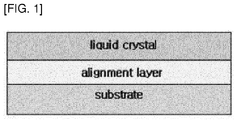
- a repulsive force causes that more binder resins exist close to the base material and more photoreactive polymers exist far from the base material (e.g., with respect to the liquid crystals as in the structure of FIG. 1 ). Due to this phenomenon, a larger amount of optical alignment polymer (that is, the photoreactive polymer) may exist close to the liquid crystals, and thus the alignment film including the same is able to show more excellent liquid crystal alignment.
- the photoreactive polymer may further include one or more repeating units selected from the group consisting of the following Chemical Formula 2b or 2c: wherein n is 50 to 5000, q' is an integer of 0 to 4, and at least one of R 1 ', R 2 ', R 3 ' and R 4 ' is a radical of Chemical Formula 2a, and the others are each independently selected from the group consisting of hydrogen; halogen; cyano; linear or branched alkyl having 1 to 20 carbon atoms; linear or branched alkenyl having 2 to 20 carbon atoms; linear or branched alkynyl having 2 to 20 carbon atoms; cycloalkyl having 3 to 12 carbon atoms; and aryl having 6 to 40 carbon atoms.
- Chemical Formula 2b or 2c wherein n is 50 to 5000, q' is an integer of 0 to 4, and at least one of R 1 ', R 2 ', R 3 ' and R 4 ' is a radical of Chemical Formula 2
- the norbornene-based repeating unit has a high glass transition temperature and is structurally rigid.
- the repeating unit is a norbornene-based repeating unit of Chemical Formula 2b or 2c
- the photoreactive polymer and the alignment film including the repeating unit are able to show more excellent thermal stability, alignment stability or the like.
- the photoreactive polymer may further include a repeating unit of the following Chemical Formula 3a: wherein o is 50 to 5000, and R 1 ", R 2 ", R 3 “ and R 4 " are each independently selected from the group consisting of a radical of Chemical Formula 1a; a radical of Chemical Formula 2a; hydrogen; halogen; cyano; linear or branched alkyl having 1 to 20 carbon atoms; linear or branched alkenyl having 2 to 20 carbon atoms; linear or branched alkynyl having 2 to 20 carbon atoms; cycloalkyl having 3 to 12 carbon atoms; and aryl having 6 to 40 carbon atoms.
- Chemical Formula 3a wherein o is 50 to 5000, and R 1 ", R 2 ", R 3 “ and R 4 " are each independently selected from the group consisting of a radical of Chemical Formula 1a; a radical of Chemical Formula 2a; hydrogen; halogen; cyano; linear or branched alkyl having 1 to 20 carbon atoms
- the olefin-based repeating unit may or may not include a photoreactive functional group, and may be a non-cyclic olefin-based repeating unit, as distinct from the aforementioned cyclic olefin-based repeating unit.
- the physical properties of the photoreactive polymer and the alignment film including the same, for example, photoreactivity, liquid crystal alignment, alignment speed or stability can be easily controlled by adjusting a content ratio of the repeating unit.
- the photoreactive polymer is a copolymer including the repeating unit(s) of Chemical Formula(e) 2b, 2c and/or 3a together with the repeating unit of Chemical Formula 1b or 1c
- the photoreactive polymer easily controls the physical properties of the alignment film including the same by adjusting a ratio of each repeating unit. Therefore, the ratio of the repeating units may be easily determined by those skilled in the art.
- each of the repeating units of Chemical Formulae 2b, 2c and 3a may be included at a ratio of 0.1 ⁇ 2.0 mol and 0.2 ⁇ 2.0 mol, and preferably 0.5 ⁇ 2.0 mol and 0.5 ⁇ 2.0 mol, based on 1 mol of the repeating unit of Chemical Formula 1.
- a photoreactive functional group such as the radical of Chemical Formula 1a or 2a may properly bind to the position corresponding to R 1 , R 1 ' or R 1 ".
- substituted or unsubstituted aryl having 6 to 40 carbon atoms or hetero aryl having 6 to 40 carbon atoms that includes Group 14, 15 or 16 hetero elements which may be selected from the functional groups listed as follows, or may be other aryls or hetero aryls: wherein R' 10 to R' 18 are each independently selected from the group consisting of substituted or unsubstituted, linear or branched alkyl having 1 to 20 carbon atoms, substituted or unsubstituted alkoxy having 1 to 20 carbon atoms, substituted or unsubstituted aryloxy having 6 to 30 carbon atoms, and substituted or unsubstituted aryl having 6 to 40 carbon atoms.
- the photoreactive polymer may further include an additional repeating unit in addition to these repeating units, and may be prepared into a variety of copolymers.
- the content ratio of additional repeating unit is also determined by those skilled in the art, considering properties of the desired photoreactive polymer.
- the photoreactive polymer may have a weight-average molecular weight of 10000 to 1000000, and preferably 20000 to 500000. Accordingly, the photoreactive polymer is properly included in the coating composition for the production of alignment film, so that it shows excellent coating properties and the alignment film formed therefrom is also able to show excellent liquid crystal alignment or the like.
- alkyl means a linear or branched, saturated monovalent hydrocarbon of 1 to 20 carbon atoms, preferably 1 to 10 carbon atoms, and more preferably 1 to 6 carbon atoms.
- alkyl group may include methyl, ethyl, propyl, 2-propyl, n-butyl, iso-butyl, tert-butyl, pentyl, hexyl, dodecyl or the like.
- alkenyl group means a linear or branched, monovalent hydrocarbon of 2 to 20 carbon atoms, preferably 2 to 10 carbon atoms, and more preferably 2 to 6 carbon atoms, which includes one or more carbon-carbon double bonds.
- the alkenyl group may be bounded through a carbon atom including a carbon-carbon double bond or a saturated carbon atom.
- Examples of the alkenyl group include ethenyl, 1-propenyl, 2-propenyl, 2-butenyl, 3-butenyl, pentenyl, 5-hexenyl, dodecenyl or the like.
- cycloalkyl group means a saturated or unsaturated nonaromatic monovalent monocyclic, bicyclic, or tricyclic hydrocarbon of 3 to 12 cyclic carbon atoms.
- examples of the cycloalkyl group include cyclopropyl, cyclobutyl, cyclopentyl, cyclopentenyl, cyclohexyl, cyclohexenyl, cycloheptyl, cyclooctyl, decahydronaphtalenyl, adamantyl, norbornyl (e.g., bicyclo[2,2,1]hept-5-enyl) or the like.
- aryl means a monovalent monocyclic, bicyclic, or tricyclic aromatic hydrocarbon having 6 to 40, preferably 6 to 12 cyclic atoms, and may encompass those that are further substituted with a specific substituent described below. Examples of the aryl group may include phenyl, naphthalenyl, fluorenyl or the like.
- alkoxyaryl means that one or more hydrogen atoms of the aryl group defined as described above are substituted with the alkoxy group.
- alkoxyaryl group may include methoxyphenyl, ethoxyphenyl, propoxyphenyl, butoxyphenyl, pentoxyphenyl, heptoxyphenyl, heptoxy, octoxy, nanoxy, methoxybiphenyl, methoxynaphthalenyl, methoxyfluorenyl, methoxyanthracenyl or the like.
- aralkyl means that one or more hydrogen atoms of the alkyl group defined as described above are substituted with the aryl group, and may encompass those that are further substituted with a specific substituent described below. Examples of the aralkyl may include benzyl, benzhydril, tritile or the like.
- alkynyl means a linear or branched, monovalent hydrocarbon of 2 to 20 carbon atoms, preferably 2 to 10 carbon atoms, and more preferably 2 to 6 carbon atoms, which includes one or more carbon-carbon triple bonds.
- the alkynyl group may be bound through a carbon atom including a carbon-carbon triple bond or a saturated carbon atom. Examples of the alkynyl group may include ethynyl, propynyl or the like.
- alkylene means a linear or branched, saturated divalent hydrocarbon of 1 to 20 carbon atoms, preferably 1 to 10 carbon atoms, and more preferably 1 to 6 carbon atoms.
- the alkylene group may encompass those that are further substituted with a specific substituent described below. Examples of the alkylene group may include methylene, ethylene, propylene, butylene, hexylene or the like.
- cycloalkylene means a saturated or unsaturated nonaromatic divalent monocyclic, bicyclic or tricyclic hydrocarbon having 3 to 12 cyclic carbons, and may encompass those that are further substituted with a specific substituent described below.
- Examples of the cycloalkylene may include cyclopropylene, cyclobutylene or the like.
- alkyl oxide or "cycloalkyl oxide” means a monovalent moiety, in which one or more hydrogen atoms of the alkyl or cycloalkyl group defined as described above are substituted with oxygen. Examples thereof may include ethyl oxide, propyl oxide, cyclohexyl oxide or the like.
- alkylene oxide or "cycloalkylene oxide” means a divalent moiety, in which one or more hydrogen atoms of the alkylene or cycloalkylene group defined as described above are substituted with oxygen. Examples thereof may include ethylene oxide, propylene oxide, cyclohexylene oxide or the like.
- hose substituted with substituents means that they encompass those further substituted with a specific substituent as well as each substituent itself.
- substituent further substituted in each substituent may include halogen, alkyl, alkenyl, alkynyl, haloalkyl, haloalkenyl, haloalkynyl, aryl, haloaryl, aralkyl, haloaralkyl, alkoxy, halo haloalkoxy, carbonyloxy, halocarbonyloxy, aryloxy, haloaryloxy, sillyl or siloxy or the like.
- the above described compound may be prepared by a typical process, in which a compound corresponding to the photoreactive functional group -R is prepared from the known compound, and then bound to the cyclic olefin-based ring A. Specific examples thereof are described in Examples hereinbelow.
- the photoreactive polymer may be prepared by different polymerization methods according to the type of each repeating unit.
- the polymer including the norbornene-based repeating unit of Chemical Formula 1b or including the norbornene-based repeating unit of Chemical Formula 2b together with the norbornene-based repeating unit of Chemical Formula 1b may be prepared by addition polymerization of one or more of the compound of Formula 1b as a monomer.
- the addition polymerization may be performed in the presence of a catalyst composition containing a Group 10 transition metal precatalyst and a cocatalyst.
- the addition polymerization may be performed at a temperature of 10° C to 200° C. If the reaction temperature is lower than 10° C, there is a problem in that activity of polymerization is very low. If the reaction temperature is higher than 200° C, the catalyst is decomposed, which is undesirable.
- the cocatalyst may include one or more selected from the group consisting of a first co-catalyst for providing a Lewis base capable of weakly coordinating with metal of the precatalyst; and a second cocatalyst for providing a compound containing a Group 15 electron donor ligand.
- the cocatalyst may be a catalytic mixture that includes the first cocatalyst for providing a Lewis base, and optionally the second cocatalyst for providing a compound containing a neutral Group 15 electron donor ligand.
- the catalytic mixture may include 1 to 1000 mol of the first cocatalyst, and 1 to 1000 mol of the second cocatalyst, based on 1 mol of the precatalyst. If the content of the first or second cocatalyst is too low, activation of the catalyst may not be properly achieved, and if the content is too high, the catalytic activity may be reduced.
- a compound having the Lewis base functional group which easily participates in a Lewis acid-base reaction to be separated from a core metal, may be used as the precatalyst having Group 10 transition metal so that the Lewis base is easily separated by the first cocatalyst to convert the central transition metal into the catalytic active species.
- the first cocatalyst for providing the Lewis base capable of weakly coordinating with metal of the precatalyst may include a compound, which easily reacts with the Lewis base to form vacancies in the transition metal and which weakly coordinates with the transition metal compound, in order to stabilize the transition metal or another compound for providing this.
- a compound which easily reacts with the Lewis base to form vacancies in the transition metal and which weakly coordinates with the transition metal compound, in order to stabilize the transition metal or another compound for providing this.
- borate such as dimethylanilinium tetrakis(pentafluorophenyl)borate
- alkyl aluminum such as methyl aluminoxane or Al(C 2 H 5 ) 3
- transition metal halide such as AgSbF 6 .
- the second cocatalyst for providing a compound containing a neutral Group 15 electron donor ligand may be alkyl phosphine, cycloalkyl phosphine or phenyl phosphine.
- first cocatalyst and the second cocatalyst may be used separately, or these cocatalysts may be prepared into a salt, and used as a compound activating the catalyst. It is exemplified by a compound prepared by an ionic bond of alkyl phosphine and borane compound.
- the polymer including the norbornene-based repeating unit of Chemical Formula 1c or including the norbornene-based repeating unit of Chemical Formula 2c together with the norbornene-based repeating unit of Chemical Formula 1c may be prepared by ring-opening polymerization of the compound of Formula 1b as a monomer.
- the ring-opening polymerization may be performed in the presence of a catalytic mixture consisting of a precatalyst having a transition metal of Group 4 (e.g., Ti, Zr, Hf), Group 6 (e.g., Mo, W), or Group 8 (e.g., Ru, Os), a cocatalyst for providing the Lewis base capable of weakly coordinating with metal of the precatalyst, and optionally, a neutral Group 15 or 16 activator capable of improving the activity of the metal of the precatalyst.
- a catalytic mixture consisting of a precatalyst having a transition metal of Group 4 (e.g., Ti, Zr, Hf), Group 6 (e.g., Mo, W), or Group 8 (e.g., Ru, Os), a cocatalyst for providing the Lewis base capable of weakly coordinating with metal of the precatalyst, and optionally, a neutral Group 15 or 16 activator capable of improving
- the polymerization may be also performed at a temperature of 10° C to 200° C by addition of 1-100 mol% of a linear alkene capable of adjusting a molecular weight such as 1-alkene and 2-alkene, based on the monomer.
- addition of hydrogens to the double bonds remaining in the main chain may be performed at a temperature of 10° C to 250° C by addition of 1 to 30% by weight of the catalyst having a transition metal of Group 4 (e.g., Ti, Zr), or Group 8 to 10 (e.g., Ru, Ni, Pd), based on the monomer.
- a transition metal of Group 4 e.g., Ti, Zr
- Group 8 to 10 e.g., Ru, Ni, Pd
- the photoreactive polymer including the olefin-based repeating unit of Chemical Formula 3a together with the cyclic olefin-based repeating units of Chemical Formula 1b and/or 2a may be obtained by performing polymerization in the presence of a catalyst composition containing a precatalyst having a Group 4 transition metal such as zirconium and titanium and a cocatalyst, or in the presence of an azo or peroxide compound.
- a catalyst composition containing a precatalyst having a Group 4 transition metal such as zirconium and titanium and a cocatalyst or in the presence of an azo or peroxide compound.
- the polymerization conditions of olefin-based monomers are well known to those skilled in the art, and thus a detail description thereof will be omitted.
- an alignment film comprising the above described photoreactive polymer is provided.
- the alignment film may also include a film type as well as a thin layer type.
- the alignment film may be produced using the components and preparation methods well known to those skilled in the art, excluding that the alignment film includes the above described photoreactive polymer as an optical alignment polymer.
- the photoreactive polymer, a binder resin and a photoinitiator are mixed and dissolved in an organic solvent to prepare a coating composition, and then the coating composition is applied to a base material, and UV curing is performed to form the alignment film.
- an acrylate-based resin may be used as the binder resin, and more particularly, pentaerythritol triacrylate, dipentaerythritol hexaacrylate, trimethylolpropane triacrylate, tris(2-acryloyloxyethyl) isocyanurate or the like may be used.
- typical photoinitiators that are known to be used in the alignment film may be used as the photoinitiator without limitation, for example, a photoinitiator under the trade name of Irgacure 907 or 819.
- Toluene anisole, chlorobenzene, dichloroethane, cyclohexane, cyclopentane, propyleneglycolmethylether acetate or the like may be used as the organic solvent.
- the above described, photoreactive norbornene-based copolymer shows excellent solubility to various organic solvents, and thus other organic solvents may be used without limitation.
- the solid containing the photoreactive polymer, the binder resin and the photoinitiator may be used at a concentration of 1 to 15% by weight.
- a preferred concentration is 10 to 15% by weight
- a preferred concentration is 1 to 5% by weight.
- the produced alignment film may be formed between the base material and the liquid crystals, and functions to align the liquid crystals.
- a base material containing a cyclic polymer, an acrylic polymer, or a cellulose polymer may be used as the base material, and the coating composition is applied to the base material by various methods such as bar coating, spin coating, and blade coating, and then UV curing is performed to form the alignment film.
- Toluene was purified by distillation from potassium/benzophenone, and dichloromethane was purified by distillation from CaH 2 .
- the mixed solution was cooled to 5° C or below, and then added to 200 ml of water. 2 N HCI was added until pH 2.00.
- Example 9 Copolymerization of and 9.56 g (25 mmol) of and 4.33 g (25 mmol) of as a monomer and 40 ml of purified toluene as a solvent were put into a 250 ml schlenk flask. 25 mg (0.1 mmol) of V65 as an initiator was put into the flask, and the reaction was performed at 65° C for 18 hrs under stirring.
- the photoreactive polymer that was synthesized using the monomer in Example 2 was dissolved in the c-pentanone solvent at a concentration of 2% by weight, and applied on a polyethylene terephthalate substrate (commercial name: SH71, manufactured by SKC Co., Ltd. in Korea) having a thickness of 80 micron by roll coating process, so that the polyethylene terephthalate substrate had a thickness of 1000 ⁇ after drying.
- the substrate was heated in an oven at 80° C for 3 min to remove the solvent inside of coating film, and thus a coating film was formed.
- the exposing was performed using a high pressure mercury lamp having an intensity of 200 mW/cm 2 as a light source while polarized UV perpendicular to the proceeding direction of the film was radiated on the coating film using a Wire-grid polarizer manufactured by Moxtek, Co., Ltd. for 5 sec, so that the alignment was provided to form an alignment film.
- the solid having 95.0% by weight of UV-polymerizable cyanobiphenyl acrylate and 5.0% by weight of Irgacure 907 (manufactured by Ciba-Geigy, Co., Ltd. in Switzerland) as a photoinitiator was dissolved in toluene to prepare a polymerizable reactive liquid crystal solution, in which the content of the liquid crystal was 25 parts by weight based on 100 parts by weight of the liquid crystal solution.
- the prepared liquid crystal solution was applied on the photo-alignment film that was formed by a roll coating process, so that the film had a thickness of 1 ⁇ m after drying, and it was dried at 80°C for 2 min to align the liquid crystal molecules.
- the non-polarized UV was radiated on the aligned liquid crystal film using a high-pressure mercury lamp having the intensity of 200 mW/cm 2 as a light source so as to fix the alignment state of the liquid crystals, thereby manufacturing the retardation film.
- the alignment properties with respect to the manufactured retardation film were compared with each other by measuring transmittance of the light leakage between the polarizing plates, and the quantitative retardation value was measured using Axoscan (manufactured by Axomatrix, Co., Ltd.).
- the photoreactive polymer that was synthesized using the monomer in Example 2 was dissolved in the c-pentanone solvent at a concentration of 2% by weight, and applied on a polyethylene terephthalate substrate (commercial name: SH71, manufactured by SKC Co., Ltd. in Korea) having a thickness of 80 micron by roll coating process, so that the polyethylene terephthalate substrate had a thickness of 1000 ⁇ after drying.
- the substrate was heated in an oven at 80° C for 3 min to remove the solvent inside of coating film, and thus a coating film was formed.
- the exposing was performed using a high pressure mercury lamp having an intensity of 200 mW/cm 2 as a light source while polarized UV perpendicular to the proceeding direction of the film was radiated on the coating film using a Wire-grid polarizer manufactured by Moxtek, Co., Ltd. for 5 sec, so that the alignment was provided to form an alignment film.
- the solid having 95.0% by weight of UV-polymerizable cyanobiphenyl acrylate and 5.0% by weight of Irgacure 907 (manufactured by Ciba-Geigy, Co., Ltd. in Switzerland) as a photoinitiator was dissolved in toluene to prepare a polymerizable reactive liquid crystal solution, in which the content of the liquid crystal was 25 parts by weight based on 100 parts by weight of the liquid crystal solution.
- the prepared liquid crystal solution was applied on the photo-alignment film that was formed by a roll coating process, so that the film had a thickness of 1 ⁇ m after drying, and it was dried at 80°C for 2 min to align the liquid crystal molecules.
- the non-polarized UV was radiated on the aligned liquid crystal film using a high-pressure mercury lamp having the intensity of 200 mW/cm 2 as a light source so as to fix the alignment state of the liquid crystals, thereby manufacturing the retardation film.
- the alignment properties with respect to the manufactured retardation film were compared with each other by measuring transmittance of the light leakage between the polarizing plates, and the quantitative retardation value was measured using Axoscan (manufactured by Axomatrix, Co., Ltd.).
Landscapes
- Chemical & Material Sciences (AREA)
- Organic Chemistry (AREA)
- Physics & Mathematics (AREA)
- Health & Medical Sciences (AREA)
- Polymers & Plastics (AREA)
- Medicinal Chemistry (AREA)
- Chemical Kinetics & Catalysis (AREA)
- Nonlinear Science (AREA)
- Mathematical Physics (AREA)
- Optics & Photonics (AREA)
- General Physics & Mathematics (AREA)
- Crystallography & Structural Chemistry (AREA)
- Spectroscopy & Molecular Physics (AREA)
- Addition Polymer Or Copolymer, Post-Treatments, Or Chemical Modifications (AREA)
- Liquid Crystal (AREA)
- Organic Low-Molecular-Weight Compounds And Preparation Thereof (AREA)
Claims (9)
- Photoreaktives Polymer, welches eine Norbornen-basierte Wiederholungseinheit umfasst, dargestellt durch die folgende Chemische Formel 1b oder 1c:
 q eine ganze Zahl von 0 bis 4 ist,mindestens einer von R1, R2, R3 und R4 ein Rest nach Chemischer Formel 1a ist,und die anderen jeweils unabhängig voneinander aus der Gruppe ausgewählt sind, bestehend aus Wasserstoff; und linearem oder verzweigtem Alkyl mit 1 bis 20 Kohlenstoffatomen,
 wobei l 1 ist, D und D' jeweils unabhängig voneinander aus der Gruppe ausgewählt sind, bestehend aus einer Einzelbindung, Sauerstoff, linearem oder verzweigtem Alkylen mit 1 bis 20 Kohlenstoffatomen und linearem oder verzweigtem Alkylenoxid mit 1 bis 20 Kohlenstoffatomen,E
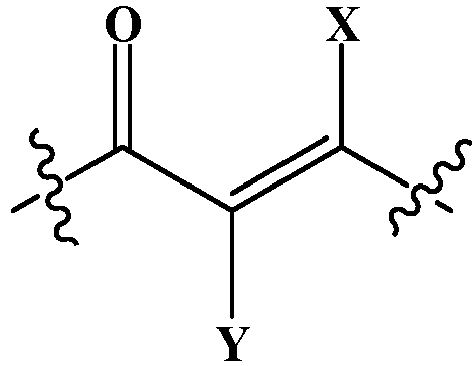 X und Y jeweils unabhängig voneinander ausgewählt sind aus der Gruppe, bestehend aus Wasserstoff; und linearem oder verzweigtem Alkyl mit 1 bis 20 Kohlenstoffatomen,R10, R11, R12, R13 und R14 jeweils unabhängig voneinander ausgewählt sind aus der Gruppe, bestehend aus Wasserstoff, Halogen, Cyano, Alkyl mit 1 bis 20 Kohlenstoffatomen; und Alkoxy mit 1 bis 20 Kohlenstoffatomen, undR15 ein oder zwei Substituent(en) ist, und diese jeweils unabhängig voneinander ausgewählt sind aus der Gruppe, bestehend aus Wasserstoff und Alkyl mit 1 bis 20 Kohlenstoffatomen.
 - Photoreaktives Polymer nach Anspruch 1, ferner umfassend eine oder mehr Wiederholungseinheiten, ausgewählt aus der Gruppe bestehend aus den folgenden Chemischen Formeln 2b, 2c und 3a:
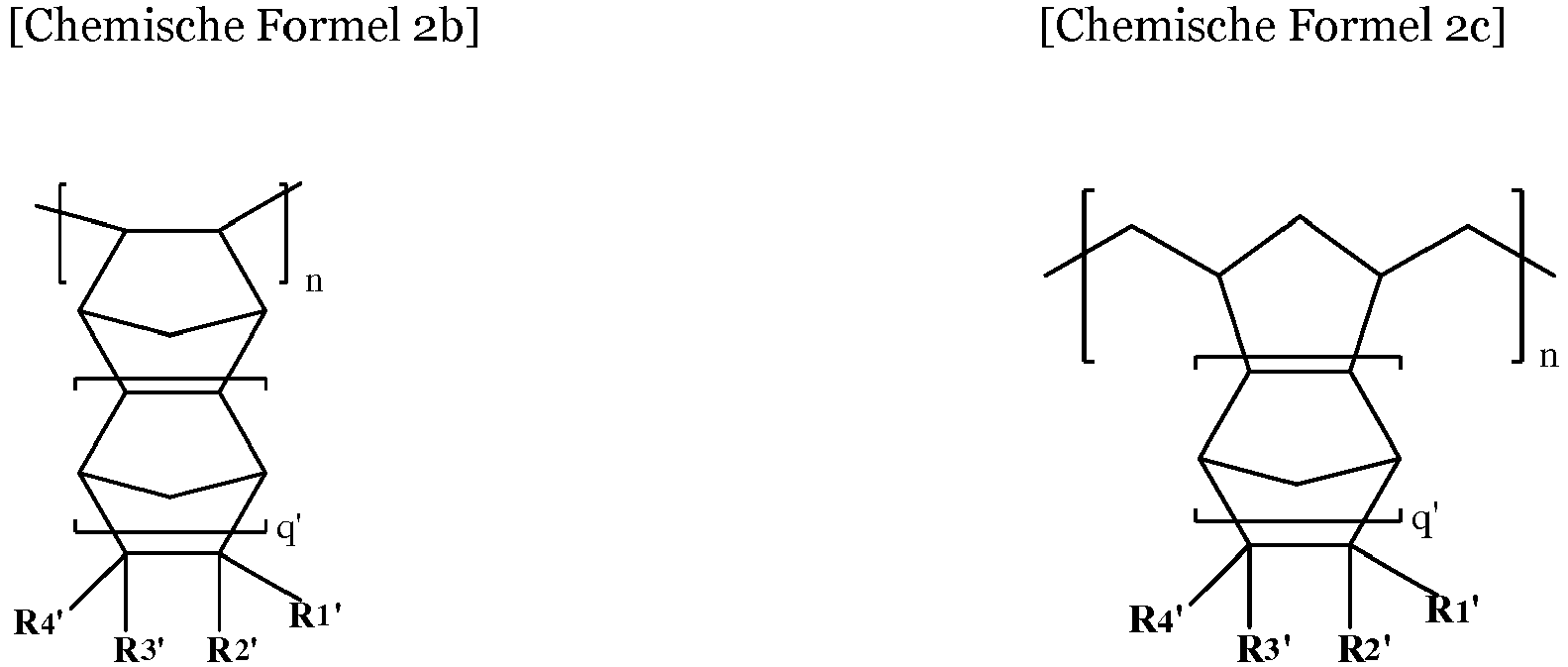 n 50 bis 5000 ist,q' eine ganze Zahl von 0 bis 4 ist,mindestens einer von R1', R2', R3' und R4' ein Rest nach Chemischer Formel 2a ist, und die anderen jeweils unabhängig voneinander ausgewählt sind aus der Gruppe, bestehend aus Wasserstoff; Halogen; Cyano; linearem oder verzweigtem Alkyl mit 1 bis 20 Kohlenstoffatomen; linearem oder verzweigtem Alkenyl mit 2 bis 20 Kohlenstoffatomen; linearem oder verzweigtem Alkinyl mit 2 bis 20 Kohlenstoffatomen; Cycloalkyl mit 3 bis 20 Kohlenstoffatomen; und Aryl, 6 bis 40 Kohlenstoffatomen,
 o 50 bis 5000 ist, undR1", R2", R3", und R4" jeweils unabhängig voneinander aus der Gruppe ausgewählt sind, bestehend aus einem Rest nach Chemischer Formel 1a; einem Rest nach Chemischer Formel 2a, Wasserstoff; Halogen; Cyano; linearem oder verzweigtem Alkyl mit 1 bis 20 Kohlenstoffatomen; linearem oder verzweigtem Alkenyl mit 2 bis 20 Kohlenstoffatomen; linearem oder verzweigtem Alkinyl mit 2 bis 20 Kohlenstoffatomen; Cycloalkyl mit 3 bis 12 Kohlenstoffatomen; und Aryl mit 6 bis 40 Kohlenstoffatomen,
 wobei 1, D, D', X, Y, R10, R11, R12; R13; und R14 dieselben sind, wie in Chemischer Formel 1a definiert, und dieselben oder unterschiedlich sind von denen in Chemischer Formel 1a.
 - Photoreaktives Polymer nach Anspruch 1 oder 2, wobei mindestens einer von R10, R11, R12, R13 und R14 Halogen oder halogensubstituiertes Alkyl mit 1 bis 20 Kohlenstoffatomen ist.
- Photoreaktives Polymer nach Anspruch 3, wobei mindestens einer von R10, R11, R12, R13 und R14 Fluor oder fluorsubstituiertes Alkyl mit 1 bis 20 Kohlenstoffatomen ist.
- Photoreaktives Polymer nach Anspruch 2, wobei eine der Wiederholungseinheiten nach Chemischer Formel 2b und 2c und 3a in einem Verhältnis von 0,1∼2,0 mol enthalten ist, basierend auf 1 mol der Wiederholungseinheit nach Chemischer Formel 1.
- Photoreaktives Polymer nach Anspruch 1, wobei R1 der Norbornen-basierten Wiederholungseinheit ein Rest nach Chemischer Formel 1a ist.
- Photoreaktives Polymer nach Anspruch 2, wobei R1' der Norbornen-basierten Wiederholungseinheit ein Rest nach Chemischer Formel 2a ist.
- Photoreaktives Polymer nach Anspruch 1 oder 2, wobei das photoreaktive Polymer ein gewichtgemitteltes Molekulargewicht von 10000 bis 1000000 hat.
- Ausrichtungsschicht, welche das photoreaktive Polymer nach Anspruch 1 oder 2 umfasst.
Applications Claiming Priority (3)
| Application Number | Priority Date | Filing Date | Title |
|---|---|---|---|
| KR20100065570 | 2010-07-07 | ||
| KR1020110027125A KR101307494B1 (ko) | 2010-07-07 | 2011-03-25 | 광반응성 작용기를 갖는 화합물, 광반응성 중합체 및 이를 포함하는 배향막 |
| PCT/KR2011/002114 WO2012005432A2 (ko) | 2010-07-07 | 2011-03-28 | 광반응성 작용기를 갖는 화합물, 광반응성 중합체 및 이를 포함하는 배향막 |
Publications (3)
| Publication Number | Publication Date |
|---|---|
| EP2592065A2 EP2592065A2 (de) | 2013-05-15 |
| EP2592065A4 EP2592065A4 (de) | 2016-06-01 |
| EP2592065B1 true EP2592065B1 (de) | 2018-11-14 |
Family
ID=45611293
Family Applications (1)
| Application Number | Title | Priority Date | Filing Date |
|---|---|---|---|
| EP11803718.3A Active EP2592065B1 (de) | 2010-07-07 | 2011-03-28 | Verbindung mit einer photoreaktiven funktionsgruppe, photoreaktives polymer und ausrichtungsschicht damit |
Country Status (7)
| Country | Link |
|---|---|
| US (1) | US8449954B2 (de) |
| EP (1) | EP2592065B1 (de) |
| JP (1) | JP5744188B2 (de) |
| KR (2) | KR101307494B1 (de) |
| CN (1) | CN102958903B (de) |
| TW (1) | TWI474108B (de) |
| WO (1) | WO2012005432A2 (de) |
Families Citing this family (14)
| Publication number | Priority date | Publication date | Assignee | Title |
|---|---|---|---|---|
| US9052548B2 (en) | 2011-11-28 | 2015-06-09 | Lg Chem, Ltd. | Photo-curable composition, optical anistropic film and its preparation method |
| JP5884923B2 (ja) * | 2012-02-02 | 2016-03-15 | エルジー・ケム・リミテッド | 液晶組成物 |
| KR101574734B1 (ko) * | 2012-05-11 | 2015-12-07 | 주식회사 엘지화학 | 광학 필름 및 이를 포함하는 표시 소자 |
| KR101515527B1 (ko) * | 2012-08-21 | 2015-04-27 | 주식회사 엘지화학 | 광학 이방성 필름 |
| TWI487742B (zh) * | 2012-09-10 | 2015-06-11 | Lg Chemical Ltd | 用於光配向層之組成物及光配向層 |
| KR101719686B1 (ko) | 2013-09-30 | 2017-03-24 | 주식회사 엘지화학 | 광반응성 공중합체 및 이를 포함하는 배향막 |
| KR101718941B1 (ko) * | 2013-09-30 | 2017-03-22 | 주식회사 엘지화학 | 광반응기를 갖는 고리형 올레핀 화합물 및 광반응성 중합체 |
| KR101732687B1 (ko) | 2013-12-27 | 2017-05-04 | 주식회사 엘지화학 | 염료형 편광체 형성용 조성물 및 염료형 편광체 |
| WO2015099377A1 (ko) | 2013-12-27 | 2015-07-02 | 주식회사 엘지화학 | 염료형 편광체 형성용 조성물 및 염료형 편광체 |
| PL3175493T3 (pl) * | 2014-07-31 | 2024-05-27 | Basf Coatings Gmbh | Struktura hermetyzacyjna dla wyświetlacza oled z właściwościami antyrefleksyjnymi |
| KR101746789B1 (ko) * | 2014-12-18 | 2017-06-13 | 주식회사 엘지화학 | 고리형 올레핀 화합물의 (공)중합체를 포함하는 수직 배향막 |
| WO2016099178A1 (ko) * | 2014-12-18 | 2016-06-23 | 주식회사 엘지화학 | 고리형 올레핀 화합물 공중합체를 포함하는 수직 배향막 |
| KR102542188B1 (ko) * | 2018-01-16 | 2023-06-13 | 삼성디스플레이 주식회사 | 편광 필름, 이의 제조방법 및 상기 편광 필름을 포함하는 표시장치 |
| CN111212828B (zh) * | 2018-06-20 | 2023-07-21 | Lg化学株式会社 | 改性聚合引发剂及其制备方法 |
Family Cites Families (20)
| Publication number | Priority date | Publication date | Assignee | Title |
|---|---|---|---|---|
| JPS62223153A (ja) | 1986-03-26 | 1987-10-01 | Nippon Petrochem Co Ltd | ノルボルネン環を有する置換桂皮酸エステル |
| KR970000356B1 (ko) | 1993-09-18 | 1997-01-08 | 엘지전자 주식회사 | 액정표시소자(lcd)용 광 폴리머 배향막 형성방법 |
| JP3945789B2 (ja) | 1997-12-19 | 2007-07-18 | 林テレンプ株式会社 | 配向膜の製造方法、配向膜、および配向膜を備えた液晶表示装置 |
| CA2413878A1 (en) * | 2000-06-20 | 2001-12-27 | Atherogenics, Inc. | 1,3-bis-(substituted-phenyl)-2-propen-1-ones and their use to treat vcam-1 mediated disorders |
| KR20020006819A (ko) | 2000-07-13 | 2002-01-26 | 김일흥 | 무선조정 로봇 축구 경주차 |
| JP4831270B2 (ja) * | 2000-08-03 | 2011-12-07 | Jsr株式会社 | 液晶配向膜形成基板および液晶表示素子 |
| KR100364504B1 (ko) | 2001-02-20 | 2002-12-18 | 엘지전선 주식회사 | 광배향막을 이용한 위상차 필름의 제조 방법 |
| TW591329B (en) | 2001-04-21 | 2004-06-11 | Samsung Electronics Co Ltd | Acetal group containing norbornene copolymer for photoresist, method for producing the same and photoresist composition containing the same |
| KR100451643B1 (ko) | 2001-04-21 | 2004-10-08 | 삼성전자주식회사 | 아세탈기를 포함하는 포토레지스트용 노르보넨 공중합체,그의 제조방법 및 그를 포함하는 포토레지스트 조성물 |
| JP5177335B2 (ja) | 2001-09-13 | 2013-04-03 | Jsr株式会社 | 架橋体および架橋用組成物 |
| FR2869611B1 (fr) * | 2004-05-03 | 2006-07-28 | Merck Sante Soc Par Actions Si | Derives de l'acide hexenoique, procedes pour leur preparation, compositions pharmaceutiques les contenant et applications en therapeutique |
| KR100789247B1 (ko) * | 2005-01-05 | 2008-01-02 | 주식회사 엘지화학 | 광반응성 중합체 및 이의 제조 방법 |
| WO2006078129A1 (en) * | 2005-01-20 | 2006-07-27 | Lg Chem. Ltd. | Alignment film for lcd using photoreactive polymer and lcd comprising the same |
| JP5584475B2 (ja) * | 2007-03-22 | 2014-09-03 | エルジー・ケム・リミテッド | 光反応基を含むエキソ異性体の過量含有ノルボルネン重合体およびその製造方法 |
| TW200904950A (en) * | 2007-04-23 | 2009-02-01 | Lg Chemical Ltd | A retardation film, a method for preparing retardation film and polarizer comprising the retardation film |
| US20100296032A1 (en) | 2008-01-18 | 2010-11-25 | Johnson Matthey Public Limited Company | Optical film, preparation method of the same, and liquid crystal display comprising the same |
| JP5124027B2 (ja) * | 2008-01-18 | 2013-01-23 | エルジー・ケム・リミテッド | 光学フィルム、その製造方法、およびこれを含む液晶表示装置 |
| WO2009091225A2 (en) | 2008-01-18 | 2009-07-23 | Lg Chem, Ltd. | Composition for liquid crystal alignment layer, preparation method of liquid crystal alignment layer using the same, and optical film comprising the liquid crystal alignment layer |
| KR101079807B1 (ko) * | 2008-08-18 | 2011-11-03 | 주식회사 엘지화학 | 노보넨계 단량체, 폴리노보넨 유도체, 이를 포함하는 액정배향막 및 이를 포함하는 액정표시소자 |
| CN101830961B (zh) * | 2010-05-14 | 2012-07-04 | 四川国康药业有限公司 | 熊果酸酯衍生物及其制备方法与应用 |
-
2011
- 2011-03-25 KR KR1020110027125A patent/KR101307494B1/ko active Active
- 2011-03-28 CN CN201180030975.3A patent/CN102958903B/zh active Active
- 2011-03-28 WO PCT/KR2011/002114 patent/WO2012005432A2/ko not_active Ceased
- 2011-03-28 EP EP11803718.3A patent/EP2592065B1/de active Active
- 2011-03-28 JP JP2013513098A patent/JP5744188B2/ja active Active
- 2011-07-06 US US13/177,399 patent/US8449954B2/en active Active
- 2011-07-07 TW TW100123997A patent/TWI474108B/zh active
-
2012
- 2012-01-11 KR KR1020120003521A patent/KR20120007564A/ko not_active Ceased
Non-Patent Citations (1)
| Title |
|---|
| None * |
Also Published As
| Publication number | Publication date |
|---|---|
| EP2592065A2 (de) | 2013-05-15 |
| US8449954B2 (en) | 2013-05-28 |
| KR20120004915A (ko) | 2012-01-13 |
| EP2592065A4 (de) | 2016-06-01 |
| US20120010381A1 (en) | 2012-01-12 |
| JP2013534937A (ja) | 2013-09-09 |
| WO2012005432A3 (ko) | 2012-03-01 |
| JP5744188B2 (ja) | 2015-07-01 |
| CN102958903A (zh) | 2013-03-06 |
| TW201209515A (en) | 2012-03-01 |
| TWI474108B (zh) | 2015-02-21 |
| CN102958903B (zh) | 2015-08-12 |
| KR20120007564A (ko) | 2012-01-20 |
| KR101307494B1 (ko) | 2013-09-11 |
| WO2012005432A2 (ko) | 2012-01-12 |
Similar Documents
| Publication | Publication Date | Title |
|---|---|---|
| EP2592065B1 (de) | Verbindung mit einer photoreaktiven funktionsgruppe, photoreaktives polymer und ausrichtungsschicht damit | |
| JP5888982B2 (ja) | ハロゲン系置換基を有する光反応性作用基を含むノルボルネン系重合体、その製造方法及びそれを利用した配向膜 | |
| JP5544334B2 (ja) | 液晶配向膜用組成物および液晶配向膜 | |
| US8008415B2 (en) | Photoreactive exo-rich norbornene polymer and method for preparing the same | |
| JP5759542B2 (ja) | 光反応性ノルボルネン系共重合体、その製造方法及びそれを含む配向膜 | |
| US9150678B2 (en) | Photoreactive polymer and alignment layer comprising the same | |
| KR101555010B1 (ko) | 광반응성 중합체 및 이의 제조 방법 | |
| US20120149848A1 (en) | Photoreactive polymer and method for preparing the same | |
| JP2015071621A (ja) | 環状オレフィン化合物、光反応性重合体およびこれを含む配向膜 | |
| KR101195186B1 (ko) | 광반응기를 포함하는 노보넨계 단량체를 포함하는 노보넨계중합체 및 이의 제조방법 | |
| EP3018158B1 (de) | Lichtreaktives copolymer und ausrichtungsschicht damit | |
| KR101506606B1 (ko) | 광 반응성 노보넨 중합체 및 이의 제조방법 | |
| KR101740655B1 (ko) | 고리형 올레핀 화합물, 광반응성 중합체 및 이를 포함하는 배향막 |
Legal Events
| Date | Code | Title | Description |
|---|---|---|---|
| PUAI | Public reference made under article 153(3) epc to a published international application that has entered the european phase |
Free format text: ORIGINAL CODE: 0009012 |
|
| 17P | Request for examination filed |
Effective date: 20121130 |
|
| AK | Designated contracting states |
Kind code of ref document: A2 Designated state(s): AL AT BE BG CH CY CZ DE DK EE ES FI FR GB GR HR HU IE IS IT LI LT LU LV MC MK MT NL NO PL PT RO RS SE SI SK SM TR |
|
| DAX | Request for extension of the european patent (deleted) | ||
| A4 | Supplementary search report drawn up and despatched |
Effective date: 20160429 |
|
| RIC1 | Information provided on ipc code assigned before grant |
Ipc: C07C 69/74 20060101AFI20160422BHEP Ipc: C08F 32/00 20060101ALI20160422BHEP Ipc: C08F 216/36 20060101ALI20160422BHEP Ipc: C08F 16/36 20060101ALI20160422BHEP Ipc: C08F 10/00 20060101ALI20160422BHEP Ipc: C08F 222/40 20060101ALI20160422BHEP Ipc: C07C 69/618 20060101ALI20160422BHEP Ipc: C07C 69/753 20060101ALI20160422BHEP Ipc: C07C 69/76 20060101ALI20160422BHEP Ipc: G02F 1/1337 20060101ALI20160422BHEP Ipc: C08F 232/08 20060101ALI20160422BHEP |
|
| STAA | Information on the status of an ep patent application or granted ep patent |
Free format text: STATUS: EXAMINATION IS IN PROGRESS |
|
| 17Q | First examination report despatched |
Effective date: 20170906 |
|
| GRAP | Despatch of communication of intention to grant a patent |
Free format text: ORIGINAL CODE: EPIDOSNIGR1 |
|
| STAA | Information on the status of an ep patent application or granted ep patent |
Free format text: STATUS: GRANT OF PATENT IS INTENDED |
|
| RAP1 | Party data changed (applicant data changed or rights of an application transferred) |
Owner name: LG CHEM, LTD. |
|
| INTG | Intention to grant announced |
Effective date: 20180831 |
|
| GRAS | Grant fee paid |
Free format text: ORIGINAL CODE: EPIDOSNIGR3 |
|
| GRAA | (expected) grant |
Free format text: ORIGINAL CODE: 0009210 |
|
| STAA | Information on the status of an ep patent application or granted ep patent |
Free format text: STATUS: THE PATENT HAS BEEN GRANTED |
|
| AK | Designated contracting states |
Kind code of ref document: B1 Designated state(s): AL AT BE BG CH CY CZ DE DK EE ES FI FR GB GR HR HU IE IS IT LI LT LU LV MC MK MT NL NO PL PT RO RS SE SI SK SM TR |
|
| REG | Reference to a national code |
Ref country code: GB Ref legal event code: FG4D |
|
| REG | Reference to a national code |
Ref country code: CH Ref legal event code: EP Ref country code: AT Ref legal event code: REF Ref document number: 1064618 Country of ref document: AT Kind code of ref document: T Effective date: 20181115 |
|
| REG | Reference to a national code |
Ref country code: DE Ref legal event code: R096 Ref document number: 602011053939 Country of ref document: DE |
|
| REG | Reference to a national code |
Ref country code: IE Ref legal event code: FG4D |
|
| REG | Reference to a national code |
Ref country code: NL Ref legal event code: MP Effective date: 20181114 |
|
| REG | Reference to a national code |
Ref country code: LT Ref legal event code: MG4D |
|
| REG | Reference to a national code |
Ref country code: AT Ref legal event code: MK05 Ref document number: 1064618 Country of ref document: AT Kind code of ref document: T Effective date: 20181114 |
|
| PG25 | Lapsed in a contracting state [announced via postgrant information from national office to epo] |
Ref country code: ES Free format text: LAPSE BECAUSE OF FAILURE TO SUBMIT A TRANSLATION OF THE DESCRIPTION OR TO PAY THE FEE WITHIN THE PRESCRIBED TIME-LIMIT Effective date: 20181114 Ref country code: LV Free format text: LAPSE BECAUSE OF FAILURE TO SUBMIT A TRANSLATION OF THE DESCRIPTION OR TO PAY THE FEE WITHIN THE PRESCRIBED TIME-LIMIT Effective date: 20181114 Ref country code: AT Free format text: LAPSE BECAUSE OF FAILURE TO SUBMIT A TRANSLATION OF THE DESCRIPTION OR TO PAY THE FEE WITHIN THE PRESCRIBED TIME-LIMIT Effective date: 20181114 Ref country code: HR Free format text: LAPSE BECAUSE OF FAILURE TO SUBMIT A TRANSLATION OF THE DESCRIPTION OR TO PAY THE FEE WITHIN THE PRESCRIBED TIME-LIMIT Effective date: 20181114 Ref country code: LT Free format text: LAPSE BECAUSE OF FAILURE TO SUBMIT A TRANSLATION OF THE DESCRIPTION OR TO PAY THE FEE WITHIN THE PRESCRIBED TIME-LIMIT Effective date: 20181114 Ref country code: NO Free format text: LAPSE BECAUSE OF FAILURE TO SUBMIT A TRANSLATION OF THE DESCRIPTION OR TO PAY THE FEE WITHIN THE PRESCRIBED TIME-LIMIT Effective date: 20190214 Ref country code: IS Free format text: LAPSE BECAUSE OF FAILURE TO SUBMIT A TRANSLATION OF THE DESCRIPTION OR TO PAY THE FEE WITHIN THE PRESCRIBED TIME-LIMIT Effective date: 20190314 Ref country code: FI Free format text: LAPSE BECAUSE OF FAILURE TO SUBMIT A TRANSLATION OF THE DESCRIPTION OR TO PAY THE FEE WITHIN THE PRESCRIBED TIME-LIMIT Effective date: 20181114 Ref country code: BG Free format text: LAPSE BECAUSE OF FAILURE TO SUBMIT A TRANSLATION OF THE DESCRIPTION OR TO PAY THE FEE WITHIN THE PRESCRIBED TIME-LIMIT Effective date: 20190214 |
|
| PG25 | Lapsed in a contracting state [announced via postgrant information from national office to epo] |
Ref country code: RS Free format text: LAPSE BECAUSE OF FAILURE TO SUBMIT A TRANSLATION OF THE DESCRIPTION OR TO PAY THE FEE WITHIN THE PRESCRIBED TIME-LIMIT Effective date: 20181114 Ref country code: GR Free format text: LAPSE BECAUSE OF FAILURE TO SUBMIT A TRANSLATION OF THE DESCRIPTION OR TO PAY THE FEE WITHIN THE PRESCRIBED TIME-LIMIT Effective date: 20190215 Ref country code: SE Free format text: LAPSE BECAUSE OF FAILURE TO SUBMIT A TRANSLATION OF THE DESCRIPTION OR TO PAY THE FEE WITHIN THE PRESCRIBED TIME-LIMIT Effective date: 20181114 Ref country code: AL Free format text: LAPSE BECAUSE OF FAILURE TO SUBMIT A TRANSLATION OF THE DESCRIPTION OR TO PAY THE FEE WITHIN THE PRESCRIBED TIME-LIMIT Effective date: 20181114 Ref country code: PT Free format text: LAPSE BECAUSE OF FAILURE TO SUBMIT A TRANSLATION OF THE DESCRIPTION OR TO PAY THE FEE WITHIN THE PRESCRIBED TIME-LIMIT Effective date: 20190314 Ref country code: NL Free format text: LAPSE BECAUSE OF FAILURE TO SUBMIT A TRANSLATION OF THE DESCRIPTION OR TO PAY THE FEE WITHIN THE PRESCRIBED TIME-LIMIT Effective date: 20181114 |
|
| PG25 | Lapsed in a contracting state [announced via postgrant information from national office to epo] |
Ref country code: DK Free format text: LAPSE BECAUSE OF FAILURE TO SUBMIT A TRANSLATION OF THE DESCRIPTION OR TO PAY THE FEE WITHIN THE PRESCRIBED TIME-LIMIT Effective date: 20181114 Ref country code: PL Free format text: LAPSE BECAUSE OF FAILURE TO SUBMIT A TRANSLATION OF THE DESCRIPTION OR TO PAY THE FEE WITHIN THE PRESCRIBED TIME-LIMIT Effective date: 20181114 Ref country code: IT Free format text: LAPSE BECAUSE OF FAILURE TO SUBMIT A TRANSLATION OF THE DESCRIPTION OR TO PAY THE FEE WITHIN THE PRESCRIBED TIME-LIMIT Effective date: 20181114 Ref country code: CZ Free format text: LAPSE BECAUSE OF FAILURE TO SUBMIT A TRANSLATION OF THE DESCRIPTION OR TO PAY THE FEE WITHIN THE PRESCRIBED TIME-LIMIT Effective date: 20181114 |
|
| REG | Reference to a national code |
Ref country code: DE Ref legal event code: R097 Ref document number: 602011053939 Country of ref document: DE |
|
| PG25 | Lapsed in a contracting state [announced via postgrant information from national office to epo] |
Ref country code: RO Free format text: LAPSE BECAUSE OF FAILURE TO SUBMIT A TRANSLATION OF THE DESCRIPTION OR TO PAY THE FEE WITHIN THE PRESCRIBED TIME-LIMIT Effective date: 20181114 Ref country code: SK Free format text: LAPSE BECAUSE OF FAILURE TO SUBMIT A TRANSLATION OF THE DESCRIPTION OR TO PAY THE FEE WITHIN THE PRESCRIBED TIME-LIMIT Effective date: 20181114 Ref country code: EE Free format text: LAPSE BECAUSE OF FAILURE TO SUBMIT A TRANSLATION OF THE DESCRIPTION OR TO PAY THE FEE WITHIN THE PRESCRIBED TIME-LIMIT Effective date: 20181114 Ref country code: SM Free format text: LAPSE BECAUSE OF FAILURE TO SUBMIT A TRANSLATION OF THE DESCRIPTION OR TO PAY THE FEE WITHIN THE PRESCRIBED TIME-LIMIT Effective date: 20181114 |
|
| PLBE | No opposition filed within time limit |
Free format text: ORIGINAL CODE: 0009261 |
|
| STAA | Information on the status of an ep patent application or granted ep patent |
Free format text: STATUS: NO OPPOSITION FILED WITHIN TIME LIMIT |
|
| 26N | No opposition filed |
Effective date: 20190815 |
|
| PG25 | Lapsed in a contracting state [announced via postgrant information from national office to epo] |
Ref country code: SI Free format text: LAPSE BECAUSE OF FAILURE TO SUBMIT A TRANSLATION OF THE DESCRIPTION OR TO PAY THE FEE WITHIN THE PRESCRIBED TIME-LIMIT Effective date: 20181114 Ref country code: MC Free format text: LAPSE BECAUSE OF FAILURE TO SUBMIT A TRANSLATION OF THE DESCRIPTION OR TO PAY THE FEE WITHIN THE PRESCRIBED TIME-LIMIT Effective date: 20181114 |
|
| REG | Reference to a national code |
Ref country code: CH Ref legal event code: PL |
|
| PG25 | Lapsed in a contracting state [announced via postgrant information from national office to epo] |
Ref country code: LU Free format text: LAPSE BECAUSE OF NON-PAYMENT OF DUE FEES Effective date: 20190328 |
|
| REG | Reference to a national code |
Ref country code: BE Ref legal event code: MM Effective date: 20190331 |
|
| PG25 | Lapsed in a contracting state [announced via postgrant information from national office to epo] |
Ref country code: IE Free format text: LAPSE BECAUSE OF NON-PAYMENT OF DUE FEES Effective date: 20190328 Ref country code: CH Free format text: LAPSE BECAUSE OF NON-PAYMENT OF DUE FEES Effective date: 20190331 Ref country code: LI Free format text: LAPSE BECAUSE OF NON-PAYMENT OF DUE FEES Effective date: 20190331 |
|
| PG25 | Lapsed in a contracting state [announced via postgrant information from national office to epo] |
Ref country code: BE Free format text: LAPSE BECAUSE OF NON-PAYMENT OF DUE FEES Effective date: 20190331 |
|
| PG25 | Lapsed in a contracting state [announced via postgrant information from national office to epo] |
Ref country code: TR Free format text: LAPSE BECAUSE OF FAILURE TO SUBMIT A TRANSLATION OF THE DESCRIPTION OR TO PAY THE FEE WITHIN THE PRESCRIBED TIME-LIMIT Effective date: 20181114 |
|
| PG25 | Lapsed in a contracting state [announced via postgrant information from national office to epo] |
Ref country code: MT Free format text: LAPSE BECAUSE OF NON-PAYMENT OF DUE FEES Effective date: 20190328 |
|
| PG25 | Lapsed in a contracting state [announced via postgrant information from national office to epo] |
Ref country code: CY Free format text: LAPSE BECAUSE OF FAILURE TO SUBMIT A TRANSLATION OF THE DESCRIPTION OR TO PAY THE FEE WITHIN THE PRESCRIBED TIME-LIMIT Effective date: 20181114 |
|
| PG25 | Lapsed in a contracting state [announced via postgrant information from national office to epo] |
Ref country code: HU Free format text: LAPSE BECAUSE OF FAILURE TO SUBMIT A TRANSLATION OF THE DESCRIPTION OR TO PAY THE FEE WITHIN THE PRESCRIBED TIME-LIMIT; INVALID AB INITIO Effective date: 20110328 |
|
| PG25 | Lapsed in a contracting state [announced via postgrant information from national office to epo] |
Ref country code: MK Free format text: LAPSE BECAUSE OF FAILURE TO SUBMIT A TRANSLATION OF THE DESCRIPTION OR TO PAY THE FEE WITHIN THE PRESCRIBED TIME-LIMIT Effective date: 20181114 |
|
| PGFP | Annual fee paid to national office [announced via postgrant information from national office to epo] |
Ref country code: DE Payment date: 20250220 Year of fee payment: 15 |
|
| PGFP | Annual fee paid to national office [announced via postgrant information from national office to epo] |
Ref country code: FR Payment date: 20250221 Year of fee payment: 15 |
|
| PGFP | Annual fee paid to national office [announced via postgrant information from national office to epo] |
Ref country code: GB Payment date: 20250224 Year of fee payment: 15 |