EP2575162A2 - Herstellungsverfahren einer Halbleitervorrichtung mit einer selektiven Schwindungsphase einer Silizium-Germanium-Schicht - Google Patents
Herstellungsverfahren einer Halbleitervorrichtung mit einer selektiven Schwindungsphase einer Silizium-Germanium-Schicht Download PDFInfo
- Publication number
- EP2575162A2 EP2575162A2 EP12185100A EP12185100A EP2575162A2 EP 2575162 A2 EP2575162 A2 EP 2575162A2 EP 12185100 A EP12185100 A EP 12185100A EP 12185100 A EP12185100 A EP 12185100A EP 2575162 A2 EP2575162 A2 EP 2575162A2
- Authority
- EP
- European Patent Office
- Prior art keywords
- silicon
- layer
- germanium
- solution
- seconds
- Prior art date
- Legal status (The legal status is an assumption and is not a legal conclusion. Google has not performed a legal analysis and makes no representation as to the accuracy of the status listed.)
- Granted
Links
Images

Classifications
-
- H—ELECTRICITY
- H10—SEMICONDUCTOR DEVICES; ELECTRIC SOLID-STATE DEVICES NOT OTHERWISE PROVIDED FOR
- H10P—GENERIC PROCESSES OR APPARATUS FOR THE MANUFACTURE OR TREATMENT OF DEVICES COVERED BY CLASS H10
- H10P50/00—Etching of wafers, substrates or parts of devices
- H10P50/60—Wet etching
- H10P50/64—Wet etching of semiconductor materials
- H10P50/642—Chemical etching
-
- H—ELECTRICITY
- H10—SEMICONDUCTOR DEVICES; ELECTRIC SOLID-STATE DEVICES NOT OTHERWISE PROVIDED FOR
- H10D—INORGANIC ELECTRIC SEMICONDUCTOR DEVICES
- H10D84/00—Integrated devices formed in or on semiconductor substrates that comprise only semiconducting layers, e.g. on Si wafers or on GaAs-on-Si wafers
- H10D84/01—Manufacture or treatment
- H10D84/0123—Integrating together multiple components covered by H10D12/00 or H10D30/00, e.g. integrating multiple IGBTs
- H10D84/0126—Integrating together multiple components covered by H10D12/00 or H10D30/00, e.g. integrating multiple IGBTs the components including insulated gates, e.g. IGFETs
- H10D84/0165—Integrating together multiple components covered by H10D12/00 or H10D30/00, e.g. integrating multiple IGBTs the components including insulated gates, e.g. IGFETs the components including complementary IGFETs, e.g. CMOS devices
- H10D84/0167—Manufacturing their channels
-
- H—ELECTRICITY
- H10—SEMICONDUCTOR DEVICES; ELECTRIC SOLID-STATE DEVICES NOT OTHERWISE PROVIDED FOR
- H10D—INORGANIC ELECTRIC SEMICONDUCTOR DEVICES
- H10D84/00—Integrated devices formed in or on semiconductor substrates that comprise only semiconducting layers, e.g. on Si wafers or on GaAs-on-Si wafers
- H10D84/01—Manufacture or treatment
- H10D84/02—Manufacture or treatment characterised by using material-based technologies
- H10D84/03—Manufacture or treatment characterised by using material-based technologies using Group IV technology, e.g. silicon technology or silicon-carbide [SiC] technology
- H10D84/038—Manufacture or treatment characterised by using material-based technologies using Group IV technology, e.g. silicon technology or silicon-carbide [SiC] technology using silicon technology, e.g. SiGe
-
- H—ELECTRICITY
- H10—SEMICONDUCTOR DEVICES; ELECTRIC SOLID-STATE DEVICES NOT OTHERWISE PROVIDED FOR
- H10P—GENERIC PROCESSES OR APPARATUS FOR THE MANUFACTURE OR TREATMENT OF DEVICES COVERED BY CLASS H10
- H10P50/00—Etching of wafers, substrates or parts of devices
- H10P50/60—Wet etching
- H10P50/66—Wet etching of conductive or resistive materials
- H10P50/663—Wet etching of conductive or resistive materials by chemical means only
- H10P50/667—Wet etching of conductive or resistive materials by chemical means only by liquid etching only
-
- H—ELECTRICITY
- H10—SEMICONDUCTOR DEVICES; ELECTRIC SOLID-STATE DEVICES NOT OTHERWISE PROVIDED FOR
- H10P—GENERIC PROCESSES OR APPARATUS FOR THE MANUFACTURE OR TREATMENT OF DEVICES COVERED BY CLASS H10
- H10P70/00—Cleaning of wafers, substrates or parts of devices
- H10P70/20—Cleaning during device manufacture
-
- C—CHEMISTRY; METALLURGY
- C09—DYES; PAINTS; POLISHES; NATURAL RESINS; ADHESIVES; COMPOSITIONS NOT OTHERWISE PROVIDED FOR; APPLICATIONS OF MATERIALS NOT OTHERWISE PROVIDED FOR
- C09K—MATERIALS FOR MISCELLANEOUS APPLICATIONS, NOT PROVIDED FOR ELSEWHERE
- C09K13/00—Etching, surface-brightening or pickling compositions
-
- H—ELECTRICITY
- H10—SEMICONDUCTOR DEVICES; ELECTRIC SOLID-STATE DEVICES NOT OTHERWISE PROVIDED FOR
- H10P—GENERIC PROCESSES OR APPARATUS FOR THE MANUFACTURE OR TREATMENT OF DEVICES COVERED BY CLASS H10
- H10P50/00—Etching of wafers, substrates or parts of devices
- H10P50/20—Dry etching; Plasma etching; Reactive-ion etching
- H10P50/28—Dry etching; Plasma etching; Reactive-ion etching of insulating materials
-
- H—ELECTRICITY
- H10—SEMICONDUCTOR DEVICES; ELECTRIC SOLID-STATE DEVICES NOT OTHERWISE PROVIDED FOR
- H10P—GENERIC PROCESSES OR APPARATUS FOR THE MANUFACTURE OR TREATMENT OF DEVICES COVERED BY CLASS H10
- H10P50/00—Etching of wafers, substrates or parts of devices
- H10P50/20—Dry etching; Plasma etching; Reactive-ion etching
- H10P50/28—Dry etching; Plasma etching; Reactive-ion etching of insulating materials
- H10P50/282—Dry etching; Plasma etching; Reactive-ion etching of insulating materials of inorganic materials
- H10P50/283—Dry etching; Plasma etching; Reactive-ion etching of insulating materials of inorganic materials by chemical means
Definitions
- the present invention relates to a method of manufacturing a semiconductor device with a step of selective removal of a silicon-germanium layer.
- the invention will find its application for the manufacture of integrated circuits and more specifically of transistors.
- CMOS transistors complementary metal oxide semiconductor or Complementary Metal Oxide Semiconductor
- SiGe silicon-germanium
- PMOS part Si Positive Metal Oxide Semiconductor or Positive Metal Oxide Semiconductor
- NMOS transistor Negative Metal Oxide Semiconductor or Negative Metal Oxide semiconductor
- a PMOS transistor is first made on a silicon-germanium layer and then the NMOS is prepared.
- the PMOS is masked by a layer of resin so as to be protected. Then, silicon-germanium must be removed locally, through the resin mask in the areas to receive an NMOS. This removal of the silicon-germanium must be selective with respect to the lower layers and the resin.
- a treatment based on gaseous hydrochloric acid (HCl) can also be carried out in a reactor. This technique is not applicable to all transistors because the selectivity varies greatly depending on the percentage of germanium in the silicon-germanium layer to be removed.
- the present invention relates to a method of manufacturing a semiconductor device by wet chemical etching, the device comprising at least one silicon layer (Si) and at least one silicon-germanium layer (SiGe) and at least one layer of photosensitive resin forming a mask partially covering the layer of silicon germanium (SiGe) and leaving free the layer of silicon germanium in certain zones characterized in that it comprises a step of removing the silicon-germanium (SiGe) layer at least at said zones by exposure to an etching solution.
- the etching solution having a pH of between 3 and 6 is advantageously formed by a manufacturing step from hydrofluoric acid (HF), hydrogen peroxide (H 2 O 2 ), acetic acid (CH 3 COOH) and ammonia (NH 4 OH).
- the combination of these four components in the etching solution makes it possible to obtain a preferentially selective removal step of the germanium silicon layer.
- the pH of the etching solution is studied both to be compatible with a resin mask and both to allow selective removal of the silicon germanium layer. Indeed, for a man of the art these objectives seem, a priori, opposite; the pH not to damage a resin, is advantageously around 3 to 6 while to obtain a selective shrinkage, the amount of etching species must be maximum or around a pH of 1 to 2.
- ammonia NH 4 OH
- HF hydrofluoric acid
- the etching solution according to the invention is diluted between 5 and 500 times.
- This dilution brings many benefits including control of etching speed and better etching.
- the dilution factor is calculated based on the total volume of the etching solution before dilution.
- the method according to the invention allows a removal of the silicon-germanium zones with a very good selectivity vis-à-vis the other layers of the transistor and without damaging, or little, the resin mask.
- the method comprises at least one pre-treatment step and / or one post-treatment step respectively before and after the withdrawal step.
- the post-treatment step advantageously improves the surface state of the layer beneath the shrinkage zones by removing any contaminants, more particularly silicon oxide, in the case of a total withdrawal of the layer. silicon-germanium on a zone, or silicon-germanium oxide in the case of a partial withdrawal. This post-treatment step facilitates the possible subsequent steps of layer removal and / or growth.
- the solutions used for the pre-treatment stage and the post-treatment stage are manufactured by mixing hydrofluoric acid (HCl) and ammonia (NH 4 OH).
- This preparation method leads to a buffered solution having a pH in accordance with use with a resin mask, preferably from 3 to 6 and advantageously to selectivity towards silicon-germanium.
- the invention also relates to a composition in which hydrofluoric acid (HF), hydrogen peroxide (H 2 O 2 ), acetic acid (CH 3 COOH) and ammonia (NH 4 OH) are mixed in. proportions of 1/2/3/4.
- HF hydrofluoric acid
- H 2 O 2 hydrogen peroxide
- CH 3 COOH acetic acid
- NH 4 OH ammonia
- composition according to the invention comprises a pH of between 3 and 6.
- composition according to the invention is diluted in deionized water 5 to 500 times.
- the semiconductor device manufactured by the present method comprises at least one transistor.
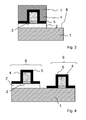
- the Figures 1 to 4 represent the various manufacturing steps of a CMOS comprising at least one PMOS transistor and at least one NMOS transistor.
- the figure 1 illustrates a PMOS transistor 6 on a silicon-germanium layer 2.
- the figure 2 illustrates the protection of PMOS transistors 6 of the figure 1 by a resin layer 7 for the manufacture of at least one NMOS transistor 9.
- the spacer 5 and the resin 7 having been removed on the zones 8 where the germanium silicon layer 2 will be withdrawn in order to form the transistor NMOS 9.
- the figure 3 illustrates a PMOS transistor 6 in which the germanium silicon layer 2 has been removed on the zones 8 intended to receive an NMOS transistor 9.
- the figure 4 illustrates a PMOS transistor 6 and an NMOS transistor 9 formed on the same substrate 1.
- the device preferably comprises a silicon 1 or silicon on insulator (Silicon On Insulator) substrate plate.
- a germanium silicon layer 2 is deposited on the silicon substrate 1.
- the silicon-germanium 2 preferentially forms the channel of the PMOS transistor 6.
- the PMOS transistor 6 comprises a gate 4, for example made of poly silicon or metal, surrounded by and others of spacers 5, for example silicon oxide or silicon nitride. Between the gate 4 and the silicon-germanium layer 2 is a layer of silicon oxide 3 or a high permittivity material called "high k" such as HfO2, HfSiO, HfZrO2, Al2O3.
- the resin 2 is then removed at the zones 8 between the PMOS transistors 6.
- the silicon-germanium layer 2 at the zones 8 is exposed so as to allow its partial or total removal.
- NMOS transistor 9 It is in these areas 8 that the NMOS transistor 9 will be formed.
- the total removal of the silicon-germanium layer 2 at the zones 8 is preferred.
- an etching solution is used to remove the silicon-germanium layer 2.
- a pre-treatment solution can be applied before the removal of this silicon-germanium layer 2.
- a post-treatment solution can be applied after the removal of this silicon-germanium layer 2.
- the NMOS transistor 9 is formed on a silicon 1 or silicon on insulator (silicon on insulator) substrate and comprises a grid 4, for example made of poly silicon or metal, surrounded by and others of spacers. 5, for example in silicon oxide or silicon nitride. Between the gate 4 and the silicon-germanium layer 2 is a layer of silicon oxide 3 or a high permittivity material called "high k" such as HfO2, HfSiO, HfZrO2, Al2O3.
- high k high permittivity material
- the removal in at least some zones 8 of the silicon-germanium layer 2 in a transistor must have a high selectivity.
- the evolution of microelectronics tends in particular to reduce the size of the nodes between the transistors, current research aims to obtain nodes smaller than 30 nanometers.
- the SOI substrate 1 is generalized and in this case the upper silicon thickness is critical, the etching of the silicon-germanium layer 2 must be highly selective so as not to etch the silicon of the substrate 1. It is then essential that the sharpness of the shrinkage is maximal without damaging or weakly the resin 7.
- the etching solution is prepared by mixing hydrofluoric acid (HF), hydrogen peroxide (H 2 O 2 ), acetic acid (CH 3 COOH) and ammonia (NH 4). 4 OH).
- the etching solution has a pH greater than 3 and advantageously less than 6, advantageously between 3.5 and 4. In this pH range, it has been found that the resin mask 7 is not damaged by the etching solution and that the etching selectivity of the silicon-germanium layer 2 is satisfactory, especially with respect to the silicon substrate 1.
- the resin 7 used according to the invention is a photosensitive resin, for example a polymer of the PolyHydroStryréne (PHS) type.
- the resin 7 is deposited in a layer with a thickness of 100 to 200 nm.
- the etching solution is prepared with a ratio between the four initial components being 1/2/3/4 respectively of HF / H 2 O 2 / CH 3 COOH / NH 4 OH.
- Ammonia (NH 4 OH) in a larger quantity makes it possible to neutralize the acids namely hydrofluoric acid (HF) and acetic acid (CH 3 COOH).
- HF hydrofluoric acid
- CH 3 COOH acetic acid
- the solution thus formed is a buffered solution, it has the property of keeping its pH stable over a certain dilution range.
- the hydrofluoric acid (HF) used is 49% by mass percentage
- the ammonia comprises 28% of NH 4 OH in weight percent
- the acetic acid is 100% pure.
- the dilution is advantageously carried out with deionized water.
- the dilution of the solution is preferably between 5 and 500 times, preferably 20 to 100 times.
- Dilution of the solution helps to reduce exothermicity when mixing the four components (see Examples 3 and 4).
- the decrease in temperature makes it possible in particular to control the etching rate and to improve the homogeneity of the etching on the entire plate by limiting the differences between the edge zones and the central zones.
- the low exothermicity of the etching solution during its manufacture allows almost simultaneous use. It is not necessary to provide a waiting period between the preparation of the etching solution and its use.
- the etching solution can be manufactured dynamically by directly injecting the four components and the deionized water simultaneously and independently unmixed or in advance where the mixture of the four components is prepared beforehand and then injected .
- the method according to the invention allows a selectivity of the step of removing the silicon-germanium layer 2 from the silicon layer 1 of between 4/1 and 50/1 for germanium silicon layers ranging from 5 to 60% germanium, preferably 10 to 60%.
- Selectivity refers to the ratio of the thicknesses of the different layers measured by the etching solution or the ratio of the etching rates of the different materials by the etching solution.
- An etching solution is prepared according to the following information without dilution: HF / H2O2 / CH3COOH / NH4O in 1/2/3/4 ratios without the addition of deionized water for dilution.
- V (H20) cc V (H202) cc V (dilution) cc 0 20 20 % HF V (HF) cc d (HF) n (HF) mol 49 10 1.19 0.2916 % NH40H V (NH40H) cc d (NH40H) n (NH40H) mol 28 40 0.895 .2860 % CH3COOH V (CH3COOH) cc d (CH 3 COOH) n (CH3COOH) mol 100 30 1,045 .5221
- An etching solution is prepared according to the information below with dilution: HF / H2O2 / CH3COOH / NH4OH in ratios of 1/2/3/4 with a dilution in 400cc of deionized water.
- the dilution is 5 times for a ratio that can be defined as 1/2/3/4/40.
- the etching solution is a buffered solution. Dilutions make it possible to adapt the etching rates without substantially modifying the pH of the solution, the latter being buffered.
- etching solution is prepared according to the amounts below. The concentrations of the various components are close to those of Example 1. v (HF) V (H2O2) v (CH3COOH) v (NH4OH) v (DI) Vtotal pH 10 20 30 40 100 200 4.03
- the etching solution thus prepared is used on: a layer of 28 nm of silicon-germanium (SiGe) at 30%, a layer of 74 nm of silicon-germanium (SiGe) at 20%, a layer of 45 nm of silicon (Si). Exposure time T ° C Thickness removed 2 min 50 All layers are removed
- the etching solution has a high exothermicity. Since the etching rate is too high, the selectivity of the solution can not be calculated.
- the thickness measurements of the layers are made by ellipsometry.
- etching solution is prepared according to the amounts below.
- concentrations of the different components are close to those of the example v (HF) V (H2O2) v (CH3COOH) v (NH4OH) v (DI) Vtotal pH 10 20 30 40 400 500 3.95
- the etching solution thus prepared is used on: a layer of 28 nm of silicon-germanium (SiGe) at 30%, a layer of 74 nm of silicon-germanium (SiGe) at 20%, a layer of 45 nm of silicon (Si). Exposure time T ° C Thickness removed 1 min 35 2.9nm of Si for 12nm of SiGe at 20%
- the thickness removed from the silicon and silicon-germanium layers is controlled.
- the etching solution contains components forming oxidizing species namely hydrogen peroxide (H2O2) and acetic acid (CH3COOH) which form per acetic acid (CH3CO3H) with high oxidizing power.
- H2O2 hydrogen peroxide
- CH3COOH acetic acid
- the etching solution also contains components forming etching species, namely hydrofluoric acid (HF) and ammonia (NH4OH), which form species with a high etching power.
- etching species namely hydrofluoric acid (HF) and ammonia (NH4OH), which form species with a high etching power.
- ammonia increases the pH of the etching solution and removes it from an efficient etching but ammonia (NH4OH) reacts notably with hydrofluoric acid (HF) to form ammonium fluoride (NH4F) in the ammonium ion / fluoride ion (NH4 + / F-) form which contributes to the etching of the silicon germanium by the formation of hydrogen difluoride (HF2-) between the hydrofluoric acid (HF) and the fluoride ion (F- ).
- HF2- hydrogen difluoride
- the oxidation and etching phenomena succeed one another in a repetitive manner.
- the removal step has a duration of between 20 and 600 seconds depending on the etching rate of the solution and the thickness of the layer that is to be removed. Preferably, it lasts from 30 to 120 seconds, advantageously of the order of 60 seconds.
- the method of manufacturing the semiconductor device also comprises at least one pre-treatment step.
- This pre-treatment step is performed before the withdrawal step. It consists in exposing the zones 8 of the silicon-germanium layer 2 (SiGe) to be removed to a pretreatment solution.
- the resin layer 7 is preferably already in place.
- the pretreatment solution is therefore advantageously compatible with the resin layer 7.
- This pretreatment step advantageously makes it possible to eliminate any contaminants on the surface of the layer of silicon germanium 2 to remove. Among the contaminants, traces of silicon oxides are removed by the pretreatment solution. Indeed, it is preferred that the silicon-germanium layer 2 (SiGe) is not contaminated or oxidized before the removal step. Otherwise, during the removal step, the etching does not begin simultaneously over the entire surface of the areas to be removed, so a non-homogeneous shrinkage is obtained.
- the duration of the exposure of the pretreatment stage is from 20 to 300 seconds, preferably from 30 to 120 seconds, advantageously of the order of 40 seconds.
- the pretreatment solution has a pH of preferably between 3 and 5, advantageously of the order of 3. It advantageously contains hydrofluoric acid (HF).
- the pretreatment solution advantageously has a ratio of NH4F / HF ranging from 2/1 to 500/1, preferentially from 2/1 to 30/1, more preferably from 2/1 to 6/1.
- the pretreatment solution is formed from hydrofluoric acid (HF) and ammonia (NH4OH).
- the solvent is typically deionized water.
- the reaction is almost complete between these two species to form an ammonium fluoride salt (NH4F).
- the hydrofluoric acid (HF) is in excess, the reaction is limited by the amount of ammonia (NH 4 OH) initially introduced so that the final equilibrium solution corresponds to a mixture of hydrofluoric acid (HF) and fluoride ammonium (NH4F).
- the solution is buffered. This manufacturing method makes it possible to obtain a solution with a pH compatible with a resin mask as well as to allow large dilutions while maintaining a suitable pH.
- the solution is diluted 5 and 100 times, preferably about 50 times.
- the ammonium fluoride salt (NH4F) is advantageously in a dissolved form (NH4 + / F-).
- the method comprises at least one post-processing step.
- This post-processing step is performed after the removal step. It consists of exposing the zones 8 of the silicon-germanium layer 2 (SiGe) which have been totally or partially removed during the removal step to a post-treatment solution. This step helps to remove any contaminants left on the surface of said zones at the end of the withdrawal step. Among these contaminants, there are oxides of silicon, silicon-germanium and / or the remaining components of the etching solution.
- This step consists of cleaning said zones 8 of sorts to allow a new withdrawal step, as described above, or a layer growth step.
- the duration of the exposure of the post-treatment step is between 10 and 180 seconds, preferably from 20 to 60 seconds and advantageously of the order of 20 seconds.
- the post-treatment solution is preferably identical to the pretreatment solution described above.
- the method comprises in the order a pretreatment step, a withdrawal step and a post-processing step. It may be advantageous to provide for several of these steps.
- the method comprises in the order a pretreatment step, a withdrawal step, a post-processing step, a withdrawal step and a post-processing step.
- the number of withdrawal steps and therefore pre and post-treatment steps depends on the thickness and the number of layers to be removed.
- the method comprises a pretreatment step of a duration of the order of 30 to 90 seconds, preferably of the order of 60 seconds, a step of withdrawal of a duration of the order of 30 to 180 seconds. seconds preferably of the order of 60 to 120 seconds and a post-processing step of a duration of the order of 20 to 90 seconds preferably of the order of 20 to 60 seconds.
- the ratio of ammonia fluoride (NH4F) / hydrofluoric acid (HF) is 3/1 for a pH of 3.48.
- the pretreatment, withdrawal and post-treatment steps are carried out successively with respective durations of 60 seconds on the following samples: either silicon or layers of silicon germanium at different concentrations: 28 nm SiGe 30% - 53 nmSiGe 10% - 75nm SiGe 20% - 40nm SiGe 40% - 26nm SiGe 50%.
- the removal of the silicon layer is of the order of 0.9 nm while the removal of the silicon-germanium layer at 10% is of the order of 1.2 nm. A 30% silicon-germanium layer is completely removed, ie 28 nm.
- a selectivity of the order of 30/1 is obtained for the 30% germanium silicon layer.
- the etching rate is 120 Angstrom / minute or 12 nm for 30% silicon germanium.
- the etching rate can be decreased if it is desired not to remove the entire silicon germanium layer. Otherwise, the burn time is reduced to limit the shrinkage.
Landscapes
- Weting (AREA)
- Chemical & Material Sciences (AREA)
- Chemical Kinetics & Catalysis (AREA)
- General Chemical & Material Sciences (AREA)
- Cleaning Or Drying Semiconductors (AREA)
Applications Claiming Priority (1)
| Application Number | Priority Date | Filing Date | Title |
|---|---|---|---|
| FR1158674A FR2980637B1 (fr) | 2011-09-28 | 2011-09-28 | Procede de fabrication d'un dispositif semi-conducteur avec une etape de retrait selective d'une couche de silicium germanium |
Publications (3)
| Publication Number | Publication Date |
|---|---|
| EP2575162A2 true EP2575162A2 (de) | 2013-04-03 |
| EP2575162A3 EP2575162A3 (de) | 2014-04-02 |
| EP2575162B1 EP2575162B1 (de) | 2018-05-23 |
Family
ID=46829677
Family Applications (1)
| Application Number | Title | Priority Date | Filing Date |
|---|---|---|---|
| EP12185100.0A Active EP2575162B1 (de) | 2011-09-28 | 2012-09-19 | Herstellungsverfahren einer Halbleitervorrichtung mit einer selektiven Schwindungsphase einer Silizium-Germanium-Schicht |
Country Status (3)
| Country | Link |
|---|---|
| US (1) | US9076732B2 (de) |
| EP (1) | EP2575162B1 (de) |
| FR (1) | FR2980637B1 (de) |
Cited By (1)
| Publication number | Priority date | Publication date | Assignee | Title |
|---|---|---|---|---|
| EP3046143A1 (de) * | 2015-01-16 | 2016-07-20 | Commissariat à l'Énergie Atomique et aux Énergies Alternatives | Verfahren zur herstellung eines dreidimensionalen integrierten schaltkreises |
Families Citing this family (10)
| Publication number | Priority date | Publication date | Assignee | Title |
|---|---|---|---|---|
| KR101790090B1 (ko) * | 2013-05-02 | 2017-10-25 | 후지필름 가부시키가이샤 | 에칭 방법, 이에 이용하는 에칭액 및 에칭액의 키트, 및 반도체 기판 제품의 제조 방법 |
| CN107851660B (zh) * | 2015-07-09 | 2022-02-01 | 恩特格里斯公司 | 相对于锗选择性蚀刻硅锗的调配物 |
| MX2018002171A (es) * | 2015-08-21 | 2018-06-15 | Ecolab Usa Inc | Complejacion y eliminacion del mercurio de sistemas de desulfuracion de gas de combustion. |
| US10043672B2 (en) * | 2016-03-29 | 2018-08-07 | Lam Research Corporation | Selective self-aligned patterning of silicon germanium, germanium and type III/V materials using a sulfur-containing mask |
| KR102710507B1 (ko) * | 2016-12-14 | 2024-09-25 | 삼성전자주식회사 | 식각용 조성물 및 이를 이용한 반도체 장치 제조 방법 |
| KR102880474B1 (ko) | 2019-07-08 | 2025-11-03 | 바스프 에스이 | 실리콘-게르마늄 재료를 선택적으로 에칭하기 위한 조성물, 그의 용도 및 방법 |
| WO2022055814A1 (en) * | 2020-09-11 | 2022-03-17 | Fujifilm Electronic Materials U.S.A., Inc. | Etching compositions |
| EP4257659A3 (de) * | 2022-04-04 | 2024-02-28 | Samsung Electronics Co., Ltd. | Ätzzusammensetzung, verfahren zum ätzen eines metallhaltigen films unter verwendung derselben und verfahren zur herstellung eines halbleiterbauelements damit |
| EP4257658A3 (de) * | 2022-04-04 | 2024-02-28 | Samsung Electronics Co., Ltd. | Ätzzusammensetzung, verfahren zum ätzen eines metallhaltigen films unter verwendung derselben und verfahren zur herstellung eines halbleiterbauelements damit |
| CN115763546B (zh) * | 2022-11-01 | 2025-10-10 | 长鑫存储技术有限公司 | 半导体结构及其制备方法 |
Family Cites Families (4)
| Publication number | Priority date | Publication date | Assignee | Title |
|---|---|---|---|---|
| CN100536167C (zh) * | 2003-08-05 | 2009-09-02 | 富士通微电子株式会社 | 半导体装置及其制造方法 |
| KR100607176B1 (ko) * | 2004-03-25 | 2006-08-01 | 삼성전자주식회사 | 희석 에이.피.엠 수용액을 이용한 반도체 장치의 제조방법들 |
| KR100585148B1 (ko) * | 2004-06-22 | 2006-05-30 | 삼성전자주식회사 | 실리콘 저매늄 희생층을 이용한 반도체 소자의 미세 패턴형성방법 및 그 패턴 형성방법을 이용한 자기정렬 콘택형성방법 |
| US7132322B1 (en) * | 2005-05-11 | 2006-11-07 | International Business Machines Corporation | Method for forming a SiGe or SiGeC gate selectively in a complementary MIS/MOS FET device |
-
2011
- 2011-09-28 FR FR1158674A patent/FR2980637B1/fr not_active Expired - Fee Related
-
2012
- 2012-09-19 EP EP12185100.0A patent/EP2575162B1/de active Active
- 2012-09-27 US US13/628,318 patent/US9076732B2/en active Active
Non-Patent Citations (1)
| Title |
|---|
| None |
Cited By (3)
| Publication number | Priority date | Publication date | Assignee | Title |
|---|---|---|---|---|
| EP3046143A1 (de) * | 2015-01-16 | 2016-07-20 | Commissariat à l'Énergie Atomique et aux Énergies Alternatives | Verfahren zur herstellung eines dreidimensionalen integrierten schaltkreises |
| FR3031835A1 (fr) * | 2015-01-16 | 2016-07-22 | Commissariat Energie Atomique | Procede de realisation d'un circuit electronique integre tridimensionnel |
| US9721850B2 (en) | 2015-01-16 | 2017-08-01 | Commissariat à l'énergie atomique et aux énergies alternatives | Method for making a three dimensional integrated electronic circuit |
Also Published As
| Publication number | Publication date |
|---|---|
| US9076732B2 (en) | 2015-07-07 |
| FR2980637A1 (fr) | 2013-03-29 |
| US20130109191A1 (en) | 2013-05-02 |
| FR2980637B1 (fr) | 2014-05-16 |
| EP2575162B1 (de) | 2018-05-23 |
| EP2575162A3 (de) | 2014-04-02 |
Similar Documents
| Publication | Publication Date | Title |
|---|---|---|
| EP2575162B1 (de) | Herstellungsverfahren einer Halbleitervorrichtung mit einer selektiven Schwindungsphase einer Silizium-Germanium-Schicht | |
| EP3072149B1 (de) | Verfahren zur selektiven ätzung einer auf einem siliciumsubstrat abgelagerten maske | |
| EP1051744B1 (de) | Verfahren zur herstellung eines halbleiterbauelements | |
| CN101379597B (zh) | 半导体装置的制造方法以及半导体表面的微粗糙度减低方法 | |
| TWI393184B (zh) | 半導體裝置之製造方法 | |
| TWI704605B (zh) | 半導體裝置與其形成方法 | |
| EP3144973B1 (de) | Verfahren zur bildung von abstandhaltern eines gates eines transistors | |
| US20050260830A1 (en) | Methods of fabricating a semiconductor device using a dilute aqueous solution of an ammonia and peroxide mixture | |
| EP1550517A1 (de) | Verfahren zum Nassreinigen von einer Oberfläche, insbesondere von einem Material wie Silizium-Germanium | |
| JP2007123903A (ja) | 選択的に高k材をエッチングするためのプラズマ組成 | |
| EP3261124B1 (de) | Verfahren zur bildung von abstandhaltern eines gates eines transistors | |
| TWI463535B (zh) | 形成半導體層之方法 | |
| EP0780889A2 (de) | Verfahren zu selektiver Abscheidung von Feuerfestmetall-Silizid über Silizium sowie durch dieses Verfahren metallizierte Siliziumwafer | |
| KR100195355B1 (ko) | 드라이산화를 포함하는 반도체장치의 제조방법 | |
| US20050139230A1 (en) | Method for cleaning semiconductor wafers | |
| CN1317743C (zh) | 用于制造半导体器件的方法 | |
| JPS62272541A (ja) | 半導体基板の表面処理方法 | |
| EP0976148A1 (de) | Verfahren zur nitridierung der gatter-oxydschicht von einem halbleiterbauelement und hergestelltes bauelement | |
| CN103000520A (zh) | Mos表面栅极侧壁层的刻蚀方法 | |
| US6908805B2 (en) | Method of manufacturing dual gate oxide film | |
| CN1577753A (zh) | 制造半导体器件的栅电极的方法 | |
| US20060024970A1 (en) | Method for preparing a semiconductor substrate surface for semiconductor device fabrication | |
| US8076219B2 (en) | Reduction of watermarks in HF treatments of semiconducting substrates | |
| CN104009037A (zh) | 半导体器件及其制造方法 | |
| US8603586B2 (en) | Method of reducing surface residual defect |
Legal Events
| Date | Code | Title | Description |
|---|---|---|---|
| PUAI | Public reference made under article 153(3) epc to a published international application that has entered the european phase |
Free format text: ORIGINAL CODE: 0009012 |
|
| AK | Designated contracting states |
Kind code of ref document: A2 Designated state(s): AL AT BE BG CH CY CZ DE DK EE ES FI FR GB GR HR HU IE IS IT LI LT LU LV MC MK MT NL NO PL PT RO RS SE SI SK SM TR |
|
| AX | Request for extension of the european patent |
Extension state: BA ME |
|
| PUAL | Search report despatched |
Free format text: ORIGINAL CODE: 0009013 |
|
| AK | Designated contracting states |
Kind code of ref document: A3 Designated state(s): AL AT BE BG CH CY CZ DE DK EE ES FI FR GB GR HR HU IE IS IT LI LT LU LV MC MK MT NL NO PL PT RO RS SE SI SK SM TR |
|
| AX | Request for extension of the european patent |
Extension state: BA ME |
|
| RIC1 | Information provided on ipc code assigned before grant |
Ipc: H01L 21/306 20060101AFI20140221BHEP Ipc: H01L 21/8238 20060101ALI20140221BHEP |
|
| 17P | Request for examination filed |
Effective date: 20140925 |
|
| RBV | Designated contracting states (corrected) |
Designated state(s): AL AT BE BG CH CY CZ DE DK EE ES FI FR GB GR HR HU IE IS IT LI LT LU LV MC MK MT NL NO PL PT RO RS SE SI SK SM TR |
|
| GRAP | Despatch of communication of intention to grant a patent |
Free format text: ORIGINAL CODE: EPIDOSNIGR1 |
|
| STAA | Information on the status of an ep patent application or granted ep patent |
Free format text: STATUS: GRANT OF PATENT IS INTENDED |
|
| INTG | Intention to grant announced |
Effective date: 20171220 |
|
| GRAS | Grant fee paid |
Free format text: ORIGINAL CODE: EPIDOSNIGR3 |
|
| GRAA | (expected) grant |
Free format text: ORIGINAL CODE: 0009210 |
|
| STAA | Information on the status of an ep patent application or granted ep patent |
Free format text: STATUS: THE PATENT HAS BEEN GRANTED |
|
| AK | Designated contracting states |
Kind code of ref document: B1 Designated state(s): AL AT BE BG CH CY CZ DE DK EE ES FI FR GB GR HR HU IE IS IT LI LT LU LV MC MK MT NL NO PL PT RO RS SE SI SK SM TR |
|
| REG | Reference to a national code |
Ref country code: GB Ref legal event code: FG4D Free format text: NOT ENGLISH |
|
| REG | Reference to a national code |
Ref country code: CH Ref legal event code: EP |
|
| REG | Reference to a national code |
Ref country code: IE Ref legal event code: FG4D Free format text: LANGUAGE OF EP DOCUMENT: FRENCH |
|
| REG | Reference to a national code |
Ref country code: DE Ref legal event code: R096 Ref document number: 602012046558 Country of ref document: DE |
|
| REG | Reference to a national code |
Ref country code: AT Ref legal event code: REF Ref document number: 1002183 Country of ref document: AT Kind code of ref document: T Effective date: 20180615 |
|
| REG | Reference to a national code |
Ref country code: NL Ref legal event code: MP Effective date: 20180523 |
|
| REG | Reference to a national code |
Ref country code: FR Ref legal event code: PLFP Year of fee payment: 7 |
|
| REG | Reference to a national code |
Ref country code: LT Ref legal event code: MG4D |
|
| PG25 | Lapsed in a contracting state [announced via postgrant information from national office to epo] |
Ref country code: NO Free format text: LAPSE BECAUSE OF FAILURE TO SUBMIT A TRANSLATION OF THE DESCRIPTION OR TO PAY THE FEE WITHIN THE PRESCRIBED TIME-LIMIT Effective date: 20180823 Ref country code: FI Free format text: LAPSE BECAUSE OF FAILURE TO SUBMIT A TRANSLATION OF THE DESCRIPTION OR TO PAY THE FEE WITHIN THE PRESCRIBED TIME-LIMIT Effective date: 20180523 Ref country code: BG Free format text: LAPSE BECAUSE OF FAILURE TO SUBMIT A TRANSLATION OF THE DESCRIPTION OR TO PAY THE FEE WITHIN THE PRESCRIBED TIME-LIMIT Effective date: 20180823 Ref country code: SE Free format text: LAPSE BECAUSE OF FAILURE TO SUBMIT A TRANSLATION OF THE DESCRIPTION OR TO PAY THE FEE WITHIN THE PRESCRIBED TIME-LIMIT Effective date: 20180523 Ref country code: LT Free format text: LAPSE BECAUSE OF FAILURE TO SUBMIT A TRANSLATION OF THE DESCRIPTION OR TO PAY THE FEE WITHIN THE PRESCRIBED TIME-LIMIT Effective date: 20180523 Ref country code: ES Free format text: LAPSE BECAUSE OF FAILURE TO SUBMIT A TRANSLATION OF THE DESCRIPTION OR TO PAY THE FEE WITHIN THE PRESCRIBED TIME-LIMIT Effective date: 20180523 |
|
| PG25 | Lapsed in a contracting state [announced via postgrant information from national office to epo] |
Ref country code: NL Free format text: LAPSE BECAUSE OF FAILURE TO SUBMIT A TRANSLATION OF THE DESCRIPTION OR TO PAY THE FEE WITHIN THE PRESCRIBED TIME-LIMIT Effective date: 20180523 Ref country code: RS Free format text: LAPSE BECAUSE OF FAILURE TO SUBMIT A TRANSLATION OF THE DESCRIPTION OR TO PAY THE FEE WITHIN THE PRESCRIBED TIME-LIMIT Effective date: 20180523 Ref country code: HR Free format text: LAPSE BECAUSE OF FAILURE TO SUBMIT A TRANSLATION OF THE DESCRIPTION OR TO PAY THE FEE WITHIN THE PRESCRIBED TIME-LIMIT Effective date: 20180523 Ref country code: LV Free format text: LAPSE BECAUSE OF FAILURE TO SUBMIT A TRANSLATION OF THE DESCRIPTION OR TO PAY THE FEE WITHIN THE PRESCRIBED TIME-LIMIT Effective date: 20180523 Ref country code: GR Free format text: LAPSE BECAUSE OF FAILURE TO SUBMIT A TRANSLATION OF THE DESCRIPTION OR TO PAY THE FEE WITHIN THE PRESCRIBED TIME-LIMIT Effective date: 20180824 |
|
| REG | Reference to a national code |
Ref country code: AT Ref legal event code: MK05 Ref document number: 1002183 Country of ref document: AT Kind code of ref document: T Effective date: 20180523 |
|
| PG25 | Lapsed in a contracting state [announced via postgrant information from national office to epo] |
Ref country code: EE Free format text: LAPSE BECAUSE OF FAILURE TO SUBMIT A TRANSLATION OF THE DESCRIPTION OR TO PAY THE FEE WITHIN THE PRESCRIBED TIME-LIMIT Effective date: 20180523 Ref country code: PL Free format text: LAPSE BECAUSE OF FAILURE TO SUBMIT A TRANSLATION OF THE DESCRIPTION OR TO PAY THE FEE WITHIN THE PRESCRIBED TIME-LIMIT Effective date: 20180523 Ref country code: AT Free format text: LAPSE BECAUSE OF FAILURE TO SUBMIT A TRANSLATION OF THE DESCRIPTION OR TO PAY THE FEE WITHIN THE PRESCRIBED TIME-LIMIT Effective date: 20180523 Ref country code: CZ Free format text: LAPSE BECAUSE OF FAILURE TO SUBMIT A TRANSLATION OF THE DESCRIPTION OR TO PAY THE FEE WITHIN THE PRESCRIBED TIME-LIMIT Effective date: 20180523 Ref country code: RO Free format text: LAPSE BECAUSE OF FAILURE TO SUBMIT A TRANSLATION OF THE DESCRIPTION OR TO PAY THE FEE WITHIN THE PRESCRIBED TIME-LIMIT Effective date: 20180523 Ref country code: DK Free format text: LAPSE BECAUSE OF FAILURE TO SUBMIT A TRANSLATION OF THE DESCRIPTION OR TO PAY THE FEE WITHIN THE PRESCRIBED TIME-LIMIT Effective date: 20180523 Ref country code: SK Free format text: LAPSE BECAUSE OF FAILURE TO SUBMIT A TRANSLATION OF THE DESCRIPTION OR TO PAY THE FEE WITHIN THE PRESCRIBED TIME-LIMIT Effective date: 20180523 |
|
| REG | Reference to a national code |
Ref country code: DE Ref legal event code: R097 Ref document number: 602012046558 Country of ref document: DE |
|
| PG25 | Lapsed in a contracting state [announced via postgrant information from national office to epo] |
Ref country code: SM Free format text: LAPSE BECAUSE OF FAILURE TO SUBMIT A TRANSLATION OF THE DESCRIPTION OR TO PAY THE FEE WITHIN THE PRESCRIBED TIME-LIMIT Effective date: 20180523 Ref country code: IT Free format text: LAPSE BECAUSE OF FAILURE TO SUBMIT A TRANSLATION OF THE DESCRIPTION OR TO PAY THE FEE WITHIN THE PRESCRIBED TIME-LIMIT Effective date: 20180523 |
|
| PLBE | No opposition filed within time limit |
Free format text: ORIGINAL CODE: 0009261 |
|
| STAA | Information on the status of an ep patent application or granted ep patent |
Free format text: STATUS: NO OPPOSITION FILED WITHIN TIME LIMIT |
|
| PG25 | Lapsed in a contracting state [announced via postgrant information from national office to epo] |
Ref country code: MC Free format text: LAPSE BECAUSE OF FAILURE TO SUBMIT A TRANSLATION OF THE DESCRIPTION OR TO PAY THE FEE WITHIN THE PRESCRIBED TIME-LIMIT Effective date: 20180523 |
|
| REG | Reference to a national code |
Ref country code: CH Ref legal event code: PL |
|
| 26N | No opposition filed |
Effective date: 20190226 |
|
| GBPC | Gb: european patent ceased through non-payment of renewal fee |
Effective date: 20180919 |
|
| PG25 | Lapsed in a contracting state [announced via postgrant information from national office to epo] |
Ref country code: SI Free format text: LAPSE BECAUSE OF FAILURE TO SUBMIT A TRANSLATION OF THE DESCRIPTION OR TO PAY THE FEE WITHIN THE PRESCRIBED TIME-LIMIT Effective date: 20180523 |
|
| REG | Reference to a national code |
Ref country code: BE Ref legal event code: MM Effective date: 20180930 |
|
| REG | Reference to a national code |
Ref country code: IE Ref legal event code: MM4A |
|
| PG25 | Lapsed in a contracting state [announced via postgrant information from national office to epo] |
Ref country code: LU Free format text: LAPSE BECAUSE OF NON-PAYMENT OF DUE FEES Effective date: 20180919 |
|
| PG25 | Lapsed in a contracting state [announced via postgrant information from national office to epo] |
Ref country code: IE Free format text: LAPSE BECAUSE OF NON-PAYMENT OF DUE FEES Effective date: 20180919 |
|
| PG25 | Lapsed in a contracting state [announced via postgrant information from national office to epo] |
Ref country code: BE Free format text: LAPSE BECAUSE OF NON-PAYMENT OF DUE FEES Effective date: 20180930 Ref country code: LI Free format text: LAPSE BECAUSE OF NON-PAYMENT OF DUE FEES Effective date: 20180930 Ref country code: CH Free format text: LAPSE BECAUSE OF NON-PAYMENT OF DUE FEES Effective date: 20180930 |
|
| PG25 | Lapsed in a contracting state [announced via postgrant information from national office to epo] |
Ref country code: GB Free format text: LAPSE BECAUSE OF NON-PAYMENT OF DUE FEES Effective date: 20180919 |
|
| PG25 | Lapsed in a contracting state [announced via postgrant information from national office to epo] |
Ref country code: AL Free format text: LAPSE BECAUSE OF FAILURE TO SUBMIT A TRANSLATION OF THE DESCRIPTION OR TO PAY THE FEE WITHIN THE PRESCRIBED TIME-LIMIT Effective date: 20180523 |
|
| PG25 | Lapsed in a contracting state [announced via postgrant information from national office to epo] |
Ref country code: MT Free format text: LAPSE BECAUSE OF FAILURE TO SUBMIT A TRANSLATION OF THE DESCRIPTION OR TO PAY THE FEE WITHIN THE PRESCRIBED TIME-LIMIT Effective date: 20180523 |
|
| PG25 | Lapsed in a contracting state [announced via postgrant information from national office to epo] |
Ref country code: TR Free format text: LAPSE BECAUSE OF FAILURE TO SUBMIT A TRANSLATION OF THE DESCRIPTION OR TO PAY THE FEE WITHIN THE PRESCRIBED TIME-LIMIT Effective date: 20180523 |
|
| PG25 | Lapsed in a contracting state [announced via postgrant information from national office to epo] |
Ref country code: PT Free format text: LAPSE BECAUSE OF FAILURE TO SUBMIT A TRANSLATION OF THE DESCRIPTION OR TO PAY THE FEE WITHIN THE PRESCRIBED TIME-LIMIT Effective date: 20180523 Ref country code: HU Free format text: LAPSE BECAUSE OF FAILURE TO SUBMIT A TRANSLATION OF THE DESCRIPTION OR TO PAY THE FEE WITHIN THE PRESCRIBED TIME-LIMIT; INVALID AB INITIO Effective date: 20120919 |
|
| PG25 | Lapsed in a contracting state [announced via postgrant information from national office to epo] |
Ref country code: MK Free format text: LAPSE BECAUSE OF NON-PAYMENT OF DUE FEES Effective date: 20180523 Ref country code: CY Free format text: LAPSE BECAUSE OF FAILURE TO SUBMIT A TRANSLATION OF THE DESCRIPTION OR TO PAY THE FEE WITHIN THE PRESCRIBED TIME-LIMIT Effective date: 20180523 |
|
| PG25 | Lapsed in a contracting state [announced via postgrant information from national office to epo] |
Ref country code: IS Free format text: LAPSE BECAUSE OF FAILURE TO SUBMIT A TRANSLATION OF THE DESCRIPTION OR TO PAY THE FEE WITHIN THE PRESCRIBED TIME-LIMIT Effective date: 20180923 |
|
| PGFP | Annual fee paid to national office [announced via postgrant information from national office to epo] |
Ref country code: DE Payment date: 20250919 Year of fee payment: 14 |
|
| PGFP | Annual fee paid to national office [announced via postgrant information from national office to epo] |
Ref country code: FR Payment date: 20250924 Year of fee payment: 14 |
|
| REG | Reference to a national code |
Ref country code: DE Ref legal event code: R079 Ref document number: 602012046558 Country of ref document: DE Free format text: PREVIOUS MAIN CLASS: H01L0021306000 Ipc: H10P0050000000 |