EP2574460A2 - Lithographic printing plate precursor and method of manufacturing lithographic printing plate - Google Patents
Lithographic printing plate precursor and method of manufacturing lithographic printing plate Download PDFInfo
- Publication number
- EP2574460A2 EP2574460A2 EP12186347A EP12186347A EP2574460A2 EP 2574460 A2 EP2574460 A2 EP 2574460A2 EP 12186347 A EP12186347 A EP 12186347A EP 12186347 A EP12186347 A EP 12186347A EP 2574460 A2 EP2574460 A2 EP 2574460A2
- Authority
- EP
- European Patent Office
- Prior art keywords
- group
- printing plate
- lithographic printing
- formula
- substituent
- Prior art date
- Legal status (The legal status is an assumption and is not a legal conclusion. Google has not performed a legal analysis and makes no representation as to the accuracy of the status listed.)
- Granted
Links
- 239000002243 precursor Substances 0.000 title claims abstract description 128
- 238000004519 manufacturing process Methods 0.000 title claims abstract description 30
- 229920000642 polymer Polymers 0.000 claims abstract description 94
- 239000010410 layer Substances 0.000 claims description 142
- 125000001424 substituent group Chemical group 0.000 claims description 96
- 125000004435 hydrogen atom Chemical group [H]* 0.000 claims description 71
- 125000005647 linker group Chemical group 0.000 claims description 61
- XLYOFNOQVPJJNP-UHFFFAOYSA-N water Substances O XLYOFNOQVPJJNP-UHFFFAOYSA-N 0.000 claims description 61
- 238000000034 method Methods 0.000 claims description 59
- 125000003118 aryl group Chemical group 0.000 claims description 51
- 239000000243 solution Substances 0.000 claims description 50
- 125000002947 alkylene group Chemical group 0.000 claims description 48
- 125000005843 halogen group Chemical group 0.000 claims description 41
- 125000001931 aliphatic group Chemical group 0.000 claims description 37
- 229920001577 copolymer Polymers 0.000 claims description 34
- 239000011241 protective layer Substances 0.000 claims description 32
- 230000008569 process Effects 0.000 claims description 31
- 125000000217 alkyl group Chemical group 0.000 claims description 26
- 239000000178 monomer Substances 0.000 claims description 26
- 125000002496 methyl group Chemical group [H]C([H])([H])* 0.000 claims description 23
- 239000004094 surface-active agent Substances 0.000 claims description 23
- 125000004169 (C1-C6) alkyl group Chemical group 0.000 claims description 16
- QGZKDVFQNNGYKY-UHFFFAOYSA-O Ammonium Chemical compound [NH4+] QGZKDVFQNNGYKY-UHFFFAOYSA-O 0.000 claims description 16
- 238000005406 washing Methods 0.000 claims description 16
- 239000007864 aqueous solution Substances 0.000 claims description 15
- 125000004432 carbon atom Chemical group C* 0.000 claims description 13
- NIXOWILDQLNWCW-UHFFFAOYSA-N acrylic acid group Chemical group C(C=C)(=O)O NIXOWILDQLNWCW-UHFFFAOYSA-N 0.000 claims description 12
- 125000004430 oxygen atom Chemical group O* 0.000 claims description 11
- 125000002252 acyl group Chemical group 0.000 claims description 10
- 125000004423 acyloxy group Chemical group 0.000 claims description 10
- 125000000732 arylene group Chemical group 0.000 claims description 10
- 125000000623 heterocyclic group Chemical group 0.000 claims description 10
- 125000003342 alkenyl group Chemical group 0.000 claims description 9
- 125000000304 alkynyl group Chemical group 0.000 claims description 8
- 150000001768 cations Chemical class 0.000 claims description 8
- 150000001450 anions Chemical class 0.000 claims description 7
- 229910052799 carbon Inorganic materials 0.000 claims description 7
- 125000004122 cyclic group Chemical group 0.000 claims description 7
- 229910021645 metal ion Inorganic materials 0.000 claims description 7
- 125000002993 cycloalkylene group Chemical group 0.000 claims description 5
- 125000001183 hydrocarbyl group Chemical group 0.000 claims 2
- 238000010186 staining Methods 0.000 abstract description 33
- -1 monoalkylamino group Chemical group 0.000 description 141
- 150000001875 compounds Chemical class 0.000 description 92
- 239000011248 coating agent Substances 0.000 description 51
- 238000000576 coating method Methods 0.000 description 50
- 238000011161 development Methods 0.000 description 45
- 239000007788 liquid Substances 0.000 description 36
- 230000000052 comparative effect Effects 0.000 description 35
- 239000000975 dye Substances 0.000 description 33
- 150000003839 salts Chemical class 0.000 description 32
- 229910052782 aluminium Inorganic materials 0.000 description 28
- XAGFODPZIPBFFR-UHFFFAOYSA-N aluminium Chemical compound [Al] XAGFODPZIPBFFR-UHFFFAOYSA-N 0.000 description 25
- 239000002245 particle Substances 0.000 description 23
- ZWEHNKRNPOVVGH-UHFFFAOYSA-N 2-Butanone Chemical compound CCC(C)=O ZWEHNKRNPOVVGH-UHFFFAOYSA-N 0.000 description 21
- 239000004372 Polyvinyl alcohol Substances 0.000 description 21
- 239000011230 binding agent Substances 0.000 description 21
- 229920002451 polyvinyl alcohol Polymers 0.000 description 21
- 239000000203 mixture Substances 0.000 description 20
- IAYPIBMASNFSPL-UHFFFAOYSA-N Ethylene oxide Chemical compound C1CO1 IAYPIBMASNFSPL-UHFFFAOYSA-N 0.000 description 19
- 238000001035 drying Methods 0.000 description 19
- 125000002887 hydroxy group Chemical group [H]O* 0.000 description 19
- 239000000463 material Substances 0.000 description 19
- HEMHJVSKTPXQMS-UHFFFAOYSA-M Sodium hydroxide Chemical compound [OH-].[Na+] HEMHJVSKTPXQMS-UHFFFAOYSA-M 0.000 description 18
- RTZKZFJDLAIYFH-UHFFFAOYSA-N ether Substances CCOCC RTZKZFJDLAIYFH-UHFFFAOYSA-N 0.000 description 17
- 238000006116 polymerization reaction Methods 0.000 description 17
- 239000007787 solid Substances 0.000 description 17
- 241000894007 species Species 0.000 description 17
- 230000001235 sensitizing effect Effects 0.000 description 16
- 125000005156 substituted alkylene group Chemical group 0.000 description 16
- XEKOWRVHYACXOJ-UHFFFAOYSA-N Ethyl acetate Chemical compound CCOC(C)=O XEKOWRVHYACXOJ-UHFFFAOYSA-N 0.000 description 15
- PPBRXRYQALVLMV-UHFFFAOYSA-N Styrene Chemical compound C=CC1=CC=CC=C1 PPBRXRYQALVLMV-UHFFFAOYSA-N 0.000 description 15
- 125000003277 amino group Chemical group 0.000 description 15
- 239000006185 dispersion Substances 0.000 description 15
- 238000010438 heat treatment Methods 0.000 description 14
- 150000002430 hydrocarbons Chemical group 0.000 description 14
- 230000015572 biosynthetic process Effects 0.000 description 13
- 229910052731 fluorine Inorganic materials 0.000 description 13
- 150000003254 radicals Chemical class 0.000 description 13
- OKKJLVBELUTLKV-UHFFFAOYSA-N Methanol Chemical compound OC OKKJLVBELUTLKV-UHFFFAOYSA-N 0.000 description 12
- 125000004450 alkenylene group Chemical group 0.000 description 12
- 125000003545 alkoxy group Chemical group 0.000 description 12
- 125000003178 carboxy group Chemical group [H]OC(*)=O 0.000 description 12
- 239000003086 colorant Substances 0.000 description 12
- 239000003505 polymerization initiator Substances 0.000 description 12
- 239000002253 acid Substances 0.000 description 11
- 235000014113 dietary fatty acids Nutrition 0.000 description 11
- 239000000194 fatty acid Substances 0.000 description 11
- 229930195729 fatty acid Natural products 0.000 description 11
- 125000000524 functional group Chemical group 0.000 description 11
- 239000000126 substance Substances 0.000 description 11
- LFQSCWFLJHTTHZ-UHFFFAOYSA-N Ethanol Chemical compound CCO LFQSCWFLJHTTHZ-UHFFFAOYSA-N 0.000 description 10
- 125000004429 atom Chemical group 0.000 description 10
- NBZBKCUXIYYUSX-UHFFFAOYSA-N iminodiacetic acid Chemical compound OC(=O)CNCC(O)=O NBZBKCUXIYYUSX-UHFFFAOYSA-N 0.000 description 10
- QAOWNCQODCNURD-UHFFFAOYSA-N sulfuric acid group Chemical class S(O)(O)(=O)=O QAOWNCQODCNURD-UHFFFAOYSA-N 0.000 description 10
- ARXJGSRGQADJSQ-UHFFFAOYSA-N 1-methoxypropan-2-ol Chemical compound COCC(C)O ARXJGSRGQADJSQ-UHFFFAOYSA-N 0.000 description 9
- 238000006243 chemical reaction Methods 0.000 description 9
- 229910052801 chlorine Inorganic materials 0.000 description 9
- 150000002148 esters Chemical class 0.000 description 9
- 230000002209 hydrophobic effect Effects 0.000 description 9
- 230000002452 interceptive effect Effects 0.000 description 9
- 150000002500 ions Chemical class 0.000 description 9
- 239000003094 microcapsule Substances 0.000 description 9
- 125000000843 phenylene group Chemical group C1(=C(C=CC=C1)*)* 0.000 description 9
- 229920000058 polyacrylate Polymers 0.000 description 9
- QGKMIGUHVLGJBR-UHFFFAOYSA-M (4z)-1-(3-methylbutyl)-4-[[1-(3-methylbutyl)quinolin-1-ium-4-yl]methylidene]quinoline;iodide Chemical compound [I-].C12=CC=CC=C2N(CCC(C)C)C=CC1=CC1=CC=[N+](CCC(C)C)C2=CC=CC=C12 QGKMIGUHVLGJBR-UHFFFAOYSA-M 0.000 description 8
- NIXOWILDQLNWCW-UHFFFAOYSA-M Acrylate Chemical compound [O-]C(=O)C=C NIXOWILDQLNWCW-UHFFFAOYSA-M 0.000 description 8
- VEXZGXHMUGYJMC-UHFFFAOYSA-N Hydrochloric acid Chemical compound Cl VEXZGXHMUGYJMC-UHFFFAOYSA-N 0.000 description 8
- NBIIXXVUZAFLBC-UHFFFAOYSA-N Phosphoric acid Chemical compound OP(O)(O)=O NBIIXXVUZAFLBC-UHFFFAOYSA-N 0.000 description 8
- 238000010521 absorption reaction Methods 0.000 description 8
- JHIVVAPYMSGYDF-UHFFFAOYSA-N cyclohexanone Chemical compound O=C1CCCCC1 JHIVVAPYMSGYDF-UHFFFAOYSA-N 0.000 description 8
- 239000003921 oil Substances 0.000 description 8
- 239000003960 organic solvent Substances 0.000 description 8
- 229910052760 oxygen Inorganic materials 0.000 description 8
- 239000011347 resin Substances 0.000 description 8
- 229920005989 resin Polymers 0.000 description 8
- 229920003169 water-soluble polymer Polymers 0.000 description 8
- PEDCQBHIVMGVHV-UHFFFAOYSA-N Glycerine Chemical compound OCC(O)CO PEDCQBHIVMGVHV-UHFFFAOYSA-N 0.000 description 7
- 125000004104 aryloxy group Chemical group 0.000 description 7
- QVGXLLKOCUKJST-UHFFFAOYSA-N atomic oxygen Chemical compound [O] QVGXLLKOCUKJST-UHFFFAOYSA-N 0.000 description 7
- 150000001732 carboxylic acid derivatives Chemical class 0.000 description 7
- 239000000470 constituent Substances 0.000 description 7
- 125000004093 cyano group Chemical group *C#N 0.000 description 7
- 238000007598 dipping method Methods 0.000 description 7
- 239000012153 distilled water Substances 0.000 description 7
- 230000000694 effects Effects 0.000 description 7
- 125000001624 naphthyl group Chemical group 0.000 description 7
- 229910052757 nitrogen Inorganic materials 0.000 description 7
- 239000001301 oxygen Substances 0.000 description 7
- 230000002829 reductive effect Effects 0.000 description 7
- 238000007788 roughening Methods 0.000 description 7
- 239000004065 semiconductor Substances 0.000 description 7
- 238000003786 synthesis reaction Methods 0.000 description 7
- BVKZGUZCCUSVTD-UHFFFAOYSA-L Carbonate Chemical compound [O-]C([O-])=O BVKZGUZCCUSVTD-UHFFFAOYSA-L 0.000 description 6
- KFZMGEQAYNKOFK-UHFFFAOYSA-N Isopropanol Chemical compound CC(C)O KFZMGEQAYNKOFK-UHFFFAOYSA-N 0.000 description 6
- SECXISVLQFMRJM-UHFFFAOYSA-N N-Methylpyrrolidone Chemical compound CN1CCCC1=O SECXISVLQFMRJM-UHFFFAOYSA-N 0.000 description 6
- XSQUKJJJFZCRTK-UHFFFAOYSA-N Urea Chemical compound NC(N)=O XSQUKJJJFZCRTK-UHFFFAOYSA-N 0.000 description 6
- 239000006096 absorbing agent Substances 0.000 description 6
- 125000004419 alkynylene group Chemical group 0.000 description 6
- 150000001408 amides Chemical class 0.000 description 6
- 229910052794 bromium Inorganic materials 0.000 description 6
- 239000012986 chain transfer agent Substances 0.000 description 6
- 239000000460 chlorine Substances 0.000 description 6
- KRKNYBCHXYNGOX-UHFFFAOYSA-N citric acid Chemical compound OC(=O)CC(O)(C(O)=O)CC(O)=O KRKNYBCHXYNGOX-UHFFFAOYSA-N 0.000 description 6
- 125000004663 dialkyl amino group Chemical group 0.000 description 6
- 125000004986 diarylamino group Chemical group 0.000 description 6
- KWIUHFFTVRNATP-UHFFFAOYSA-N glycine betaine Chemical compound C[N+](C)(C)CC([O-])=O KWIUHFFTVRNATP-UHFFFAOYSA-N 0.000 description 6
- 150000002433 hydrophilic molecules Chemical class 0.000 description 6
- 229910052740 iodine Inorganic materials 0.000 description 6
- VLKZOEOYAKHREP-UHFFFAOYSA-N n-Hexane Chemical compound CCCCCC VLKZOEOYAKHREP-UHFFFAOYSA-N 0.000 description 6
- 230000035945 sensitivity Effects 0.000 description 6
- 229910052717 sulfur Inorganic materials 0.000 description 6
- WTXXSZUATXIAJO-OWBHPGMISA-N (Z)-14-methylpentadec-2-enoic acid Chemical compound CC(CCCCCCCCCC\C=C/C(=O)O)C WTXXSZUATXIAJO-OWBHPGMISA-N 0.000 description 5
- IJGRMHOSHXDMSA-UHFFFAOYSA-N Atomic nitrogen Chemical compound N#N IJGRMHOSHXDMSA-UHFFFAOYSA-N 0.000 description 5
- BVKZGUZCCUSVTD-UHFFFAOYSA-M Bicarbonate Chemical compound OC([O-])=O BVKZGUZCCUSVTD-UHFFFAOYSA-M 0.000 description 5
- CERQOIWHTDAKMF-UHFFFAOYSA-N Methacrylic acid Chemical compound CC(=C)C(O)=O CERQOIWHTDAKMF-UHFFFAOYSA-N 0.000 description 5
- 229910052783 alkali metal Inorganic materials 0.000 description 5
- 239000003945 anionic surfactant Substances 0.000 description 5
- 230000004888 barrier function Effects 0.000 description 5
- 239000004202 carbamide Substances 0.000 description 5
- 150000001721 carbon Chemical group 0.000 description 5
- 150000007942 carboxylates Chemical class 0.000 description 5
- 125000003700 epoxy group Chemical group 0.000 description 5
- 125000001495 ethyl group Chemical group [H]C([H])([H])C([H])([H])* 0.000 description 5
- 125000004433 nitrogen atom Chemical group N* 0.000 description 5
- 239000002736 nonionic surfactant Substances 0.000 description 5
- 239000000049 pigment Substances 0.000 description 5
- 229920002037 poly(vinyl butyral) polymer Polymers 0.000 description 5
- 229920005749 polyurethane resin Polymers 0.000 description 5
- 229910052708 sodium Inorganic materials 0.000 description 5
- 239000011734 sodium Substances 0.000 description 5
- 238000005507 spraying Methods 0.000 description 5
- 150000003440 styrenes Chemical class 0.000 description 5
- BDHFUVZGWQCTTF-UHFFFAOYSA-M sulfonate Chemical compound [O-]S(=O)=O BDHFUVZGWQCTTF-UHFFFAOYSA-M 0.000 description 5
- 150000008054 sulfonate salts Chemical class 0.000 description 5
- 125000004434 sulfur atom Chemical group 0.000 description 5
- 125000000391 vinyl group Chemical group [H]C([*])=C([H])[H] 0.000 description 5
- KBPLFHHGFOOTCA-UHFFFAOYSA-N 1-Octanol Chemical compound CCCCCCCCO KBPLFHHGFOOTCA-UHFFFAOYSA-N 0.000 description 4
- 244000215068 Acacia senegal Species 0.000 description 4
- NLHHRLWOUZZQLW-UHFFFAOYSA-N Acrylonitrile Chemical compound C=CC#N NLHHRLWOUZZQLW-UHFFFAOYSA-N 0.000 description 4
- YCKRFDGAMUMZLT-UHFFFAOYSA-N Fluorine atom Chemical compound [F] YCKRFDGAMUMZLT-UHFFFAOYSA-N 0.000 description 4
- 229920000084 Gum arabic Polymers 0.000 description 4
- DGAQECJNVWCQMB-PUAWFVPOSA-M Ilexoside XXIX Chemical compound C[C@@H]1CC[C@@]2(CC[C@@]3(C(=CC[C@H]4[C@]3(CC[C@@H]5[C@@]4(CC[C@@H](C5(C)C)OS(=O)(=O)[O-])C)C)[C@@H]2[C@]1(C)O)C)C(=O)O[C@H]6[C@@H]([C@H]([C@@H]([C@H](O6)CO)O)O)O.[Na+] DGAQECJNVWCQMB-PUAWFVPOSA-M 0.000 description 4
- BAPJBEWLBFYGME-UHFFFAOYSA-N Methyl acrylate Chemical compound COC(=O)C=C BAPJBEWLBFYGME-UHFFFAOYSA-N 0.000 description 4
- AMQJEAYHLZJPGS-UHFFFAOYSA-N N-Pentanol Chemical compound CCCCCO AMQJEAYHLZJPGS-UHFFFAOYSA-N 0.000 description 4
- GRYLNZFGIOXLOG-UHFFFAOYSA-N Nitric acid Chemical compound O[N+]([O-])=O GRYLNZFGIOXLOG-UHFFFAOYSA-N 0.000 description 4
- 229920003171 Poly (ethylene oxide) Polymers 0.000 description 4
- 239000000205 acacia gum Substances 0.000 description 4
- 235000010489 acacia gum Nutrition 0.000 description 4
- 150000001340 alkali metals Chemical class 0.000 description 4
- 125000004453 alkoxycarbonyl group Chemical group 0.000 description 4
- 150000005215 alkyl ethers Chemical group 0.000 description 4
- 229910000147 aluminium phosphate Inorganic materials 0.000 description 4
- 150000001412 amines Chemical class 0.000 description 4
- 125000005161 aryl oxy carbonyl group Chemical group 0.000 description 4
- 125000001309 chloro group Chemical group Cl* 0.000 description 4
- 238000004132 cross linking Methods 0.000 description 4
- 230000000593 degrading effect Effects 0.000 description 4
- 239000011737 fluorine Substances 0.000 description 4
- 125000001072 heteroaryl group Chemical group 0.000 description 4
- RKJUIXBNRJVNHR-UHFFFAOYSA-N indolenine group Chemical group N1=CCC2=CC=CC=C12 RKJUIXBNRJVNHR-UHFFFAOYSA-N 0.000 description 4
- 239000003999 initiator Substances 0.000 description 4
- IQPQWNKOIGAROB-UHFFFAOYSA-N isocyanate group Chemical group [N-]=C=O IQPQWNKOIGAROB-UHFFFAOYSA-N 0.000 description 4
- 239000012046 mixed solvent Substances 0.000 description 4
- 229910017604 nitric acid Inorganic materials 0.000 description 4
- 239000001267 polyvinylpyrrolidone Substances 0.000 description 4
- 229920000036 polyvinylpyrrolidone Polymers 0.000 description 4
- 235000013855 polyvinylpyrrolidone Nutrition 0.000 description 4
- FBCQUCJYYPMKRO-UHFFFAOYSA-N prop-2-enyl 2-methylprop-2-enoate Chemical compound CC(=C)C(=O)OCC=C FBCQUCJYYPMKRO-UHFFFAOYSA-N 0.000 description 4
- 150000003242 quaternary ammonium salts Chemical class 0.000 description 4
- 238000010526 radical polymerization reaction Methods 0.000 description 4
- 159000000000 sodium salts Chemical class 0.000 description 4
- 239000002904 solvent Substances 0.000 description 4
- 150000005846 sugar alcohols Polymers 0.000 description 4
- 238000011144 upstream manufacturing Methods 0.000 description 4
- 229920002554 vinyl polymer Polymers 0.000 description 4
- YXIWHUQXZSMYRE-UHFFFAOYSA-N 1,3-benzothiazole-2-thiol Chemical class C1=CC=C2SC(S)=NC2=C1 YXIWHUQXZSMYRE-UHFFFAOYSA-N 0.000 description 3
- XNWFRZJHXBZDAG-UHFFFAOYSA-N 2-METHOXYETHANOL Chemical compound COCCO XNWFRZJHXBZDAG-UHFFFAOYSA-N 0.000 description 3
- CSCHRSUVGMWTLW-UHFFFAOYSA-N 2-[carboxymethyl(prop-2-enoyl)amino]acetic acid Chemical compound OC(=O)CN(CC(O)=O)C(=O)C=C CSCHRSUVGMWTLW-UHFFFAOYSA-N 0.000 description 3
- 125000003903 2-propenyl group Chemical group [H]C([*])([H])C([H])=C([H])[H] 0.000 description 3
- CSCPPACGZOOCGX-UHFFFAOYSA-N Acetone Chemical compound CC(C)=O CSCPPACGZOOCGX-UHFFFAOYSA-N 0.000 description 3
- OKTJSMMVPCPJKN-UHFFFAOYSA-N Carbon Chemical compound [C] OKTJSMMVPCPJKN-UHFFFAOYSA-N 0.000 description 3
- RWSOTUBLDIXVET-UHFFFAOYSA-N Dihydrogen sulfide Chemical class S RWSOTUBLDIXVET-UHFFFAOYSA-N 0.000 description 3
- LYCAIKOWRPUZTN-UHFFFAOYSA-N Ethylene glycol Chemical compound OCCO LYCAIKOWRPUZTN-UHFFFAOYSA-N 0.000 description 3
- 229920000881 Modified starch Polymers 0.000 description 3
- LRHPLDYGYMQRHN-UHFFFAOYSA-N N-Butanol Chemical compound CCCCO LRHPLDYGYMQRHN-UHFFFAOYSA-N 0.000 description 3
- MUBZPKHOEPUJKR-UHFFFAOYSA-N Oxalic acid Chemical compound OC(=O)C(O)=O MUBZPKHOEPUJKR-UHFFFAOYSA-N 0.000 description 3
- ISWSIDIOOBJBQZ-UHFFFAOYSA-N Phenol Chemical compound OC1=CC=CC=C1 ISWSIDIOOBJBQZ-UHFFFAOYSA-N 0.000 description 3
- 239000004793 Polystyrene Substances 0.000 description 3
- KWYUFKZDYYNOTN-UHFFFAOYSA-M Potassium hydroxide Chemical compound [OH-].[K+] KWYUFKZDYYNOTN-UHFFFAOYSA-M 0.000 description 3
- DNIAPMSPPWPWGF-UHFFFAOYSA-N Propylene glycol Chemical compound CC(O)CO DNIAPMSPPWPWGF-UHFFFAOYSA-N 0.000 description 3
- FKNQFGJONOIPTF-UHFFFAOYSA-N Sodium cation Chemical compound [Na+] FKNQFGJONOIPTF-UHFFFAOYSA-N 0.000 description 3
- YXFVVABEGXRONW-UHFFFAOYSA-N Toluene Chemical compound CC1=CC=CC=C1 YXFVVABEGXRONW-UHFFFAOYSA-N 0.000 description 3
- GSEJCLTVZPLZKY-UHFFFAOYSA-N Triethanolamine Chemical compound OCCN(CCO)CCO GSEJCLTVZPLZKY-UHFFFAOYSA-N 0.000 description 3
- 238000012644 addition polymerization Methods 0.000 description 3
- 238000007259 addition reaction Methods 0.000 description 3
- 150000001298 alcohols Chemical class 0.000 description 3
- 125000001769 aryl amino group Chemical group 0.000 description 3
- 125000005235 azinium group Chemical group 0.000 description 3
- 239000000987 azo dye Substances 0.000 description 3
- 229960003237 betaine Drugs 0.000 description 3
- 150000005323 carbonate salts Chemical class 0.000 description 3
- BVKZGUZCCUSVTD-UHFFFAOYSA-N carbonic acid Chemical class OC(O)=O BVKZGUZCCUSVTD-UHFFFAOYSA-N 0.000 description 3
- 238000007334 copolymerization reaction Methods 0.000 description 3
- MTHSVFCYNBDYFN-UHFFFAOYSA-N diethylene glycol Chemical compound OCCOCCO MTHSVFCYNBDYFN-UHFFFAOYSA-N 0.000 description 3
- 229910001873 dinitrogen Inorganic materials 0.000 description 3
- OZLBDYMWFAHSOQ-UHFFFAOYSA-N diphenyliodanium Chemical group C=1C=CC=CC=1[I+]C1=CC=CC=C1 OZLBDYMWFAHSOQ-UHFFFAOYSA-N 0.000 description 3
- 239000008151 electrolyte solution Substances 0.000 description 3
- 230000003028 elevating effect Effects 0.000 description 3
- 238000005530 etching Methods 0.000 description 3
- 238000011156 evaluation Methods 0.000 description 3
- 150000004665 fatty acids Chemical class 0.000 description 3
- 125000001153 fluoro group Chemical group F* 0.000 description 3
- 235000011187 glycerol Nutrition 0.000 description 3
- 125000005842 heteroatom Chemical group 0.000 description 3
- 239000001257 hydrogen Substances 0.000 description 3
- 229910052739 hydrogen Inorganic materials 0.000 description 3
- XMBWDFGMSWQBCA-UHFFFAOYSA-N hydrogen iodide Chemical class I XMBWDFGMSWQBCA-UHFFFAOYSA-N 0.000 description 3
- 239000003112 inhibitor Substances 0.000 description 3
- 238000003780 insertion Methods 0.000 description 3
- 230000037431 insertion Effects 0.000 description 3
- 230000003993 interaction Effects 0.000 description 3
- 239000012948 isocyanate Substances 0.000 description 3
- ZFSLODLOARCGLH-UHFFFAOYSA-N isocyanuric acid Chemical compound OC1=NC(O)=NC(O)=N1 ZFSLODLOARCGLH-UHFFFAOYSA-N 0.000 description 3
- 230000000670 limiting effect Effects 0.000 description 3
- 238000005259 measurement Methods 0.000 description 3
- 229910052751 metal Inorganic materials 0.000 description 3
- 239000002184 metal Chemical group 0.000 description 3
- 235000019426 modified starch Nutrition 0.000 description 3
- 125000001997 phenyl group Chemical group [H]C1=C([H])C([H])=C(*)C([H])=C1[H] 0.000 description 3
- UEZVMMHDMIWARA-UHFFFAOYSA-M phosphonate Chemical compound [O-]P(=O)=O UEZVMMHDMIWARA-UHFFFAOYSA-M 0.000 description 3
- 239000000047 product Substances 0.000 description 3
- 125000001436 propyl group Chemical group [H]C([*])([H])C([H])([H])C([H])([H])[H] 0.000 description 3
- 230000005855 radiation Effects 0.000 description 3
- 238000007127 saponification reaction Methods 0.000 description 3
- 229910001415 sodium ion Inorganic materials 0.000 description 3
- 239000007921 spray Substances 0.000 description 3
- 125000005650 substituted phenylene group Chemical group 0.000 description 3
- 125000000020 sulfo group Chemical group O=S(=O)([*])O[H] 0.000 description 3
- 125000001273 sulfonato group Chemical group [O-]S(*)(=O)=O 0.000 description 3
- 229920001169 thermoplastic Polymers 0.000 description 3
- 125000003396 thiol group Chemical group [H]S* 0.000 description 3
- 238000012546 transfer Methods 0.000 description 3
- 238000013519 translation Methods 0.000 description 3
- 125000006839 xylylene group Chemical group 0.000 description 3
- 125000003837 (C1-C20) alkyl group Chemical group 0.000 description 2
- 125000006585 (C6-C10) arylene group Chemical group 0.000 description 2
- BBMCTIGTTCKYKF-UHFFFAOYSA-N 1-heptanol Chemical compound CCCCCCCO BBMCTIGTTCKYKF-UHFFFAOYSA-N 0.000 description 2
- OAAZUWWNSYWWHG-UHFFFAOYSA-N 1-phenoxypropan-1-ol Chemical compound CCC(O)OC1=CC=CC=C1 OAAZUWWNSYWWHG-UHFFFAOYSA-N 0.000 description 2
- SMZOUWXMTYCWNB-UHFFFAOYSA-N 2-(2-methoxy-5-methylphenyl)ethanamine Chemical compound COC1=CC=C(C)C=C1CCN SMZOUWXMTYCWNB-UHFFFAOYSA-N 0.000 description 2
- KKFDCBRMNNSAAW-UHFFFAOYSA-N 2-(morpholin-4-yl)ethanol Chemical compound OCCN1CCOCC1 KKFDCBRMNNSAAW-UHFFFAOYSA-N 0.000 description 2
- HCLJOFJIQIJXHS-UHFFFAOYSA-N 2-[2-[2-(2-prop-2-enoyloxyethoxy)ethoxy]ethoxy]ethyl prop-2-enoate Chemical compound C=CC(=O)OCCOCCOCCOCCOC(=O)C=C HCLJOFJIQIJXHS-UHFFFAOYSA-N 0.000 description 2
- XLLIQLLCWZCATF-UHFFFAOYSA-N 2-methoxyethyl acetate Chemical compound COCCOC(C)=O XLLIQLLCWZCATF-UHFFFAOYSA-N 0.000 description 2
- CNPVJWYWYZMPDS-UHFFFAOYSA-N 2-methyldecane Chemical compound CCCCCCCCC(C)C CNPVJWYWYZMPDS-UHFFFAOYSA-N 0.000 description 2
- 125000003229 2-methylhexyl group Chemical group [H]C([H])([H])C([H])([H])C([H])([H])C([H])([H])C([H])(C([H])([H])[H])C([H])([H])* 0.000 description 2
- KUDUQBURMYMBIJ-UHFFFAOYSA-N 2-prop-2-enoyloxyethyl prop-2-enoate Chemical compound C=CC(=O)OCCOC(=O)C=C KUDUQBURMYMBIJ-UHFFFAOYSA-N 0.000 description 2
- YEJRWHAVMIAJKC-UHFFFAOYSA-N 4-Butyrolactone Chemical compound O=C1CCCO1 YEJRWHAVMIAJKC-UHFFFAOYSA-N 0.000 description 2
- HRPVXLWXLXDGHG-UHFFFAOYSA-N Acrylamide Chemical compound NC(=O)C=C HRPVXLWXLXDGHG-UHFFFAOYSA-N 0.000 description 2
- BTBUEUYNUDRHOZ-UHFFFAOYSA-N Borate Chemical compound [O-]B([O-])[O-] BTBUEUYNUDRHOZ-UHFFFAOYSA-N 0.000 description 2
- LVDKZNITIUWNER-UHFFFAOYSA-N Bronopol Chemical compound OCC(Br)(CO)[N+]([O-])=O LVDKZNITIUWNER-UHFFFAOYSA-N 0.000 description 2
- FBPFZTCFMRRESA-FSIIMWSLSA-N D-Glucitol Natural products OC[C@H](O)[C@H](O)[C@@H](O)[C@H](O)CO FBPFZTCFMRRESA-FSIIMWSLSA-N 0.000 description 2
- FBPFZTCFMRRESA-JGWLITMVSA-N D-glucitol Chemical compound OC[C@H](O)[C@@H](O)[C@H](O)[C@H](O)CO FBPFZTCFMRRESA-JGWLITMVSA-N 0.000 description 2
- RGHNJXZEOKUKBD-SQOUGZDYSA-N D-gluconic acid Chemical compound OC[C@@H](O)[C@@H](O)[C@H](O)[C@@H](O)C(O)=O RGHNJXZEOKUKBD-SQOUGZDYSA-N 0.000 description 2
- 229920001353 Dextrin Chemical class 0.000 description 2
- YMWUJEATGCHHMB-UHFFFAOYSA-N Dichloromethane Chemical compound ClCCl YMWUJEATGCHHMB-UHFFFAOYSA-N 0.000 description 2
- JIGUQPWFLRLWPJ-UHFFFAOYSA-N Ethyl acrylate Chemical compound CCOC(=O)C=C JIGUQPWFLRLWPJ-UHFFFAOYSA-N 0.000 description 2
- 239000005977 Ethylene Substances 0.000 description 2
- 244000068988 Glycine max Species 0.000 description 2
- 235000010469 Glycine max Nutrition 0.000 description 2
- CERQOIWHTDAKMF-UHFFFAOYSA-M Methacrylate Chemical compound CC(=C)C([O-])=O CERQOIWHTDAKMF-UHFFFAOYSA-M 0.000 description 2
- VVQNEPGJFQJSBK-UHFFFAOYSA-N Methyl methacrylate Chemical compound COC(=O)C(C)=C VVQNEPGJFQJSBK-UHFFFAOYSA-N 0.000 description 2
- 239000004368 Modified starch Chemical class 0.000 description 2
- IMNFDUFMRHMDMM-UHFFFAOYSA-N N-Heptane Chemical compound CCCCCCC IMNFDUFMRHMDMM-UHFFFAOYSA-N 0.000 description 2
- 239000004698 Polyethylene Substances 0.000 description 2
- NPYPAHLBTDXSSS-UHFFFAOYSA-N Potassium ion Chemical compound [K+] NPYPAHLBTDXSSS-UHFFFAOYSA-N 0.000 description 2
- CDBYLPFSWZWCQE-UHFFFAOYSA-L Sodium Carbonate Chemical compound [Na+].[Na+].[O-]C([O-])=O CDBYLPFSWZWCQE-UHFFFAOYSA-L 0.000 description 2
- 239000004115 Sodium Silicate Substances 0.000 description 2
- UIIMBOGNXHQVGW-UHFFFAOYSA-M Sodium bicarbonate Chemical compound [Na+].OC([O-])=O UIIMBOGNXHQVGW-UHFFFAOYSA-M 0.000 description 2
- 239000007877 V-601 Substances 0.000 description 2
- 101100020289 Xenopus laevis koza gene Proteins 0.000 description 2
- RJDOZRNNYVAULJ-UHFFFAOYSA-L [O--].[O--].[O--].[O--].[O--].[O--].[O--].[O--].[O--].[O--].[F-].[F-].[Mg++].[Mg++].[Mg++].[Al+3].[Si+4].[Si+4].[Si+4].[K+] Chemical compound [O--].[O--].[O--].[O--].[O--].[O--].[O--].[O--].[O--].[O--].[F-].[F-].[Mg++].[Mg++].[Mg++].[Al+3].[Si+4].[Si+4].[Si+4].[K+] RJDOZRNNYVAULJ-UHFFFAOYSA-L 0.000 description 2
- DHKHKXVYLBGOIT-UHFFFAOYSA-N acetaldehyde Diethyl Acetal Natural products CCOC(C)OCC DHKHKXVYLBGOIT-UHFFFAOYSA-N 0.000 description 2
- 150000001241 acetals Chemical class 0.000 description 2
- 150000003926 acrylamides Chemical class 0.000 description 2
- HFBMWMNUJJDEQZ-UHFFFAOYSA-N acryloyl chloride Chemical compound ClC(=O)C=C HFBMWMNUJJDEQZ-UHFFFAOYSA-N 0.000 description 2
- 125000003647 acryloyl group Chemical group O=C([*])C([H])=C([H])[H] 0.000 description 2
- 239000000654 additive Substances 0.000 description 2
- 239000003513 alkali Substances 0.000 description 2
- 239000012670 alkaline solution Substances 0.000 description 2
- 125000004414 alkyl thio group Chemical group 0.000 description 2
- 150000001413 amino acids Chemical class 0.000 description 2
- LFVGISIMTYGQHF-UHFFFAOYSA-N ammonium dihydrogen phosphate Chemical compound [NH4+].OP(O)([O-])=O LFVGISIMTYGQHF-UHFFFAOYSA-N 0.000 description 2
- ROOXNKNUYICQNP-UHFFFAOYSA-N ammonium persulfate Chemical compound [NH4+].[NH4+].[O-]S(=O)(=O)OOS([O-])(=O)=O ROOXNKNUYICQNP-UHFFFAOYSA-N 0.000 description 2
- 150000003863 ammonium salts Chemical class 0.000 description 2
- 125000000129 anionic group Chemical group 0.000 description 2
- 238000007743 anodising Methods 0.000 description 2
- 125000003710 aryl alkyl group Chemical group 0.000 description 2
- 150000007514 bases Chemical class 0.000 description 2
- QUKGYYKBILRGFE-UHFFFAOYSA-N benzyl acetate Chemical compound CC(=O)OCC1=CC=CC=C1 QUKGYYKBILRGFE-UHFFFAOYSA-N 0.000 description 2
- 229920001400 block copolymer Polymers 0.000 description 2
- 229940063013 borate ion Drugs 0.000 description 2
- 230000003139 buffering effect Effects 0.000 description 2
- 230000015556 catabolic process Effects 0.000 description 2
- 239000001913 cellulose Substances 0.000 description 2
- 229920002678 cellulose Polymers 0.000 description 2
- 235000010980 cellulose Nutrition 0.000 description 2
- 230000008859 change Effects 0.000 description 2
- 239000002738 chelating agent Substances 0.000 description 2
- 238000001311 chemical methods and process Methods 0.000 description 2
- 235000015165 citric acid Nutrition 0.000 description 2
- 238000006482 condensation reaction Methods 0.000 description 2
- 238000001816 cooling Methods 0.000 description 2
- 238000007766 curtain coating Methods 0.000 description 2
- 125000001511 cyclopentyl group Chemical group [H]C1([H])C([H])([H])C([H])([H])C([H])(*)C1([H])[H] 0.000 description 2
- MWKFXSUHUHTGQN-UHFFFAOYSA-N decan-1-ol Chemical compound CCCCCCCCCCO MWKFXSUHUHTGQN-UHFFFAOYSA-N 0.000 description 2
- 230000003247 decreasing effect Effects 0.000 description 2
- 238000006731 degradation reaction Methods 0.000 description 2
- 239000008367 deionised water Substances 0.000 description 2
- 229910021641 deionized water Inorganic materials 0.000 description 2
- 238000013461 design Methods 0.000 description 2
- FLKPEMZONWLCSK-UHFFFAOYSA-N diethyl phthalate Chemical compound CCOC(=O)C1=CC=CC=C1C(=O)OCC FLKPEMZONWLCSK-UHFFFAOYSA-N 0.000 description 2
- SZXQTJUDPRGNJN-UHFFFAOYSA-N dipropylene glycol Chemical compound OCCCOCCCO SZXQTJUDPRGNJN-UHFFFAOYSA-N 0.000 description 2
- 238000009826 distribution Methods 0.000 description 2
- 230000005611 electricity Effects 0.000 description 2
- 238000005868 electrolysis reaction Methods 0.000 description 2
- 238000010828 elution Methods 0.000 description 2
- 230000003628 erosive effect Effects 0.000 description 2
- SUPCQIBBMFXVTL-UHFFFAOYSA-N ethyl 2-methylprop-2-enoate Chemical compound CCOC(=O)C(C)=C SUPCQIBBMFXVTL-UHFFFAOYSA-N 0.000 description 2
- 239000010419 fine particle Substances 0.000 description 2
- 238000007429 general method Methods 0.000 description 2
- 150000004676 glycans Chemical class 0.000 description 2
- VOZRXNHHFUQHIL-UHFFFAOYSA-N glycidyl methacrylate Chemical compound CC(=C)C(=O)OCC1CO1 VOZRXNHHFUQHIL-UHFFFAOYSA-N 0.000 description 2
- 229910052736 halogen Inorganic materials 0.000 description 2
- 150000002367 halogens Chemical class 0.000 description 2
- ZSIAUFGUXNUGDI-UHFFFAOYSA-N hexan-1-ol Chemical compound CCCCCCO ZSIAUFGUXNUGDI-UHFFFAOYSA-N 0.000 description 2
- QNVRIHYSUZMSGM-UHFFFAOYSA-N hexan-2-ol Chemical compound CCCCC(C)O QNVRIHYSUZMSGM-UHFFFAOYSA-N 0.000 description 2
- 230000005660 hydrophilic surface Effects 0.000 description 2
- 230000000977 initiatory effect Effects 0.000 description 2
- 239000002563 ionic surfactant Substances 0.000 description 2
- 150000002513 isocyanates Chemical class 0.000 description 2
- 125000001972 isopentyl group Chemical group [H]C([H])([H])C([H])(C([H])([H])[H])C([H])([H])C([H])([H])* 0.000 description 2
- 125000001449 isopropyl group Chemical group [H]C([H])([H])C([H])(*)C([H])([H])[H] 0.000 description 2
- JVTAAEKCZFNVCJ-UHFFFAOYSA-N lactic acid Chemical compound CC(O)C(O)=O JVTAAEKCZFNVCJ-UHFFFAOYSA-N 0.000 description 2
- 229910003002 lithium salt Inorganic materials 0.000 description 2
- 159000000002 lithium salts Chemical class 0.000 description 2
- 230000007774 longterm Effects 0.000 description 2
- 150000002736 metal compounds Chemical class 0.000 description 2
- 125000005395 methacrylic acid group Chemical group 0.000 description 2
- 238000006386 neutralization reaction Methods 0.000 description 2
- ZWRUINPWMLAQRD-UHFFFAOYSA-N nonan-1-ol Chemical compound CCCCCCCCCO ZWRUINPWMLAQRD-UHFFFAOYSA-N 0.000 description 2
- SJWFXCIHNDVPSH-UHFFFAOYSA-N octan-2-ol Chemical compound CCCCCCC(C)O SJWFXCIHNDVPSH-UHFFFAOYSA-N 0.000 description 2
- 125000002347 octyl group Chemical group [H]C([*])([H])C([H])([H])C([H])([H])C([H])([H])C([H])([H])C([H])([H])C([H])([H])C([H])([H])[H] 0.000 description 2
- 239000006179 pH buffering agent Substances 0.000 description 2
- WXZMFSXDPGVJKK-UHFFFAOYSA-N pentaerythritol Chemical compound OCC(CO)(CO)CO WXZMFSXDPGVJKK-UHFFFAOYSA-N 0.000 description 2
- PNJWIWWMYCMZRO-UHFFFAOYSA-N pent‐4‐en‐2‐one Natural products CC(=O)CC=C PNJWIWWMYCMZRO-UHFFFAOYSA-N 0.000 description 2
- VLTRZXGMWDSKGL-UHFFFAOYSA-M perchlorate Chemical compound [O-]Cl(=O)(=O)=O VLTRZXGMWDSKGL-UHFFFAOYSA-M 0.000 description 2
- 125000002467 phosphate group Chemical group [H]OP(=O)(O[H])O[*] 0.000 description 2
- 150000003009 phosphonic acids Chemical class 0.000 description 2
- XYFCBTPGUUZFHI-UHFFFAOYSA-O phosphonium Chemical compound [PH4+] XYFCBTPGUUZFHI-UHFFFAOYSA-O 0.000 description 2
- 239000002798 polar solvent Substances 0.000 description 2
- 229920000172 poly(styrenesulfonic acid) Polymers 0.000 description 2
- 229920000647 polyepoxide Polymers 0.000 description 2
- 229920000573 polyethylene Polymers 0.000 description 2
- 229920005862 polyol Polymers 0.000 description 2
- 150000003077 polyols Chemical class 0.000 description 2
- 229920001451 polypropylene glycol Polymers 0.000 description 2
- 229920001282 polysaccharide Polymers 0.000 description 2
- 239000005017 polysaccharide Substances 0.000 description 2
- 229940005642 polystyrene sulfonic acid Drugs 0.000 description 2
- 229920002689 polyvinyl acetate Polymers 0.000 description 2
- 239000011118 polyvinyl acetate Substances 0.000 description 2
- 229910001414 potassium ion Inorganic materials 0.000 description 2
- 238000002360 preparation method Methods 0.000 description 2
- LLHKCFNBLRBOGN-UHFFFAOYSA-N propylene glycol methyl ether acetate Chemical compound COCC(C)OC(C)=O LLHKCFNBLRBOGN-UHFFFAOYSA-N 0.000 description 2
- WVIICGIFSIBFOG-UHFFFAOYSA-N pyrylium Chemical class C1=CC=[O+]C=C1 WVIICGIFSIBFOG-UHFFFAOYSA-N 0.000 description 2
- 239000000523 sample Substances 0.000 description 2
- 239000001509 sodium citrate Substances 0.000 description 2
- NTHWMYGWWRZVTN-UHFFFAOYSA-N sodium silicate Chemical compound [Na+].[Na+].[O-][Si]([O-])=O NTHWMYGWWRZVTN-UHFFFAOYSA-N 0.000 description 2
- 229910052911 sodium silicate Inorganic materials 0.000 description 2
- 230000003381 solubilizing effect Effects 0.000 description 2
- 239000000600 sorbitol Substances 0.000 description 2
- 238000004528 spin coating Methods 0.000 description 2
- 238000003860 storage Methods 0.000 description 2
- 125000005504 styryl group Chemical group 0.000 description 2
- 230000003746 surface roughness Effects 0.000 description 2
- 125000000999 tert-butyl group Chemical group [H]C([H])([H])C(*)(C([H])([H])[H])C([H])([H])[H] 0.000 description 2
- UEUXEKPTXMALOB-UHFFFAOYSA-J tetrasodium;2-[2-[bis(carboxylatomethyl)amino]ethyl-(carboxylatomethyl)amino]acetate Chemical compound [Na+].[Na+].[Na+].[Na+].[O-]C(=O)CN(CC([O-])=O)CCN(CC([O-])=O)CC([O-])=O UEUXEKPTXMALOB-UHFFFAOYSA-J 0.000 description 2
- 150000003573 thiols Chemical class 0.000 description 2
- LDHQCZJRKDOVOX-UHFFFAOYSA-N trans-crotonic acid Natural products CC=CC(O)=O LDHQCZJRKDOVOX-UHFFFAOYSA-N 0.000 description 2
- HRXKRNGNAMMEHJ-UHFFFAOYSA-K trisodium citrate Chemical compound [Na+].[Na+].[Na+].[O-]C(=O)CC(O)(CC([O-])=O)C([O-])=O HRXKRNGNAMMEHJ-UHFFFAOYSA-K 0.000 description 2
- 229940038773 trisodium citrate Drugs 0.000 description 2
- 230000000007 visual effect Effects 0.000 description 2
- 239000001052 yellow pigment Substances 0.000 description 2
- JNYAEWCLZODPBN-JGWLITMVSA-N (2r,3r,4s)-2-[(1r)-1,2-dihydroxyethyl]oxolane-3,4-diol Chemical compound OC[C@@H](O)[C@H]1OC[C@H](O)[C@H]1O JNYAEWCLZODPBN-JGWLITMVSA-N 0.000 description 1
- ONMLAAZEQUPQSE-UHFFFAOYSA-N (3-hydroxy-2,2-dimethylpropyl) 2-methylprop-2-enoate Chemical compound CC(=C)C(=O)OCC(C)(C)CO ONMLAAZEQUPQSE-UHFFFAOYSA-N 0.000 description 1
- MRIKSZXJKCQQFT-UHFFFAOYSA-N (3-hydroxy-2,2-dimethylpropyl) prop-2-enoate Chemical compound OCC(C)(C)COC(=O)C=C MRIKSZXJKCQQFT-UHFFFAOYSA-N 0.000 description 1
- NMRPBPVERJPACX-UHFFFAOYSA-N (3S)-octan-3-ol Natural products CCCCCC(O)CC NMRPBPVERJPACX-UHFFFAOYSA-N 0.000 description 1
- WXGXOWWOUHDUOH-UHFFFAOYSA-N (4-octoxyphenyl)-(2,4,6-trimethoxyphenyl)iodanium Chemical compound C1=CC(OCCCCCCCC)=CC=C1[I+]C1=C(OC)C=C(OC)C=C1OC WXGXOWWOUHDUOH-UHFFFAOYSA-N 0.000 description 1
- BJEPYKJPYRNKOW-REOHCLBHSA-N (S)-malic acid Chemical compound OC(=O)[C@@H](O)CC(O)=O BJEPYKJPYRNKOW-REOHCLBHSA-N 0.000 description 1
- JGTNAGYHADQMCM-UHFFFAOYSA-M 1,1,2,2,3,3,4,4,4-nonafluorobutane-1-sulfonate Chemical compound [O-]S(=O)(=O)C(F)(F)C(F)(F)C(F)(F)C(F)(F)F JGTNAGYHADQMCM-UHFFFAOYSA-M 0.000 description 1
- SVHAMPNLOLKSFU-UHFFFAOYSA-N 1,2,2-trichloroethenylbenzene Chemical compound ClC(Cl)=C(Cl)C1=CC=CC=C1 SVHAMPNLOLKSFU-UHFFFAOYSA-N 0.000 description 1
- SUTQSIHGGHVXFK-UHFFFAOYSA-N 1,2,2-trifluoroethenylbenzene Chemical compound FC(F)=C(F)C1=CC=CC=C1 SUTQSIHGGHVXFK-UHFFFAOYSA-N 0.000 description 1
- MYWOJODOMFBVCB-UHFFFAOYSA-N 1,2,6-trimethylphenanthrene Chemical compound CC1=CC=C2C3=CC(C)=CC=C3C=CC2=C1C MYWOJODOMFBVCB-UHFFFAOYSA-N 0.000 description 1
- WSLDOOZREJYCGB-UHFFFAOYSA-N 1,2-Dichloroethane Chemical compound ClCCCl WSLDOOZREJYCGB-UHFFFAOYSA-N 0.000 description 1
- AUHKVLIZXLBQSR-UHFFFAOYSA-N 1,2-dichloro-3-(1,2,2-trichloroethenyl)benzene Chemical compound ClC(Cl)=C(Cl)C1=CC=CC(Cl)=C1Cl AUHKVLIZXLBQSR-UHFFFAOYSA-N 0.000 description 1
- BPXVHIRIPLPOPT-UHFFFAOYSA-N 1,3,5-tris(2-hydroxyethyl)-1,3,5-triazinane-2,4,6-trione Chemical compound OCCN1C(=O)N(CCO)C(=O)N(CCO)C1=O BPXVHIRIPLPOPT-UHFFFAOYSA-N 0.000 description 1
- YHMYGUUIMTVXNW-UHFFFAOYSA-N 1,3-dihydrobenzimidazole-2-thione Chemical class C1=CC=C2NC(S)=NC2=C1 YHMYGUUIMTVXNW-UHFFFAOYSA-N 0.000 description 1
- OHVLMTFVQDZYHP-UHFFFAOYSA-N 1-(2,4,6,7-tetrahydrotriazolo[4,5-c]pyridin-5-yl)-2-[4-[2-[[3-(trifluoromethoxy)phenyl]methylamino]pyrimidin-5-yl]piperazin-1-yl]ethanone Chemical compound N1N=NC=2CN(CCC=21)C(CN1CCN(CC1)C=1C=NC(=NC=1)NCC1=CC(=CC=C1)OC(F)(F)F)=O OHVLMTFVQDZYHP-UHFFFAOYSA-N 0.000 description 1
- KZEVSDGEBAJOTK-UHFFFAOYSA-N 1-(2,4,6,7-tetrahydrotriazolo[4,5-c]pyridin-5-yl)-2-[5-[2-[[3-(trifluoromethoxy)phenyl]methylamino]pyrimidin-5-yl]-1,3,4-oxadiazol-2-yl]ethanone Chemical compound N1N=NC=2CN(CCC=21)C(CC=1OC(=NN=1)C=1C=NC(=NC=1)NCC1=CC(=CC=C1)OC(F)(F)F)=O KZEVSDGEBAJOTK-UHFFFAOYSA-N 0.000 description 1
- YIWGJFPJRAEKMK-UHFFFAOYSA-N 1-(2H-benzotriazol-5-yl)-3-methyl-8-[2-[[3-(trifluoromethoxy)phenyl]methylamino]pyrimidine-5-carbonyl]-1,3,8-triazaspiro[4.5]decane-2,4-dione Chemical compound CN1C(=O)N(c2ccc3n[nH]nc3c2)C2(CCN(CC2)C(=O)c2cnc(NCc3cccc(OC(F)(F)F)c3)nc2)C1=O YIWGJFPJRAEKMK-UHFFFAOYSA-N 0.000 description 1
- 239000005968 1-Decanol Substances 0.000 description 1
- HMUNWXXNJPVALC-UHFFFAOYSA-N 1-[4-[2-(2,3-dihydro-1H-inden-2-ylamino)pyrimidin-5-yl]piperazin-1-yl]-2-(2,4,6,7-tetrahydrotriazolo[4,5-c]pyridin-5-yl)ethanone Chemical compound C1C(CC2=CC=CC=C12)NC1=NC=C(C=N1)N1CCN(CC1)C(CN1CC2=C(CC1)NN=N2)=O HMUNWXXNJPVALC-UHFFFAOYSA-N 0.000 description 1
- YZUPZGFPHUVJKC-UHFFFAOYSA-N 1-bromo-2-methoxyethane Chemical compound COCCBr YZUPZGFPHUVJKC-UHFFFAOYSA-N 0.000 description 1
- XPXMCUKPGZUFGR-UHFFFAOYSA-N 1-chloro-2-(1,2,2-trichloroethenyl)benzene Chemical compound ClC(Cl)=C(Cl)C1=CC=CC=C1Cl XPXMCUKPGZUFGR-UHFFFAOYSA-N 0.000 description 1
- JOLQKTGDSGKSKJ-UHFFFAOYSA-N 1-ethoxypropan-2-ol Chemical compound CCOCC(C)O JOLQKTGDSGKSKJ-UHFFFAOYSA-N 0.000 description 1
- KJCVRFUGPWSIIH-UHFFFAOYSA-N 1-naphthol Chemical compound C1=CC=C2C(O)=CC=CC2=C1 KJCVRFUGPWSIIH-UHFFFAOYSA-N 0.000 description 1
- 125000001637 1-naphthyl group Chemical group [H]C1=C([H])C([H])=C2C(*)=C([H])C([H])=C([H])C2=C1[H] 0.000 description 1
- IBLKWZIFZMJLFL-UHFFFAOYSA-N 1-phenoxypropan-2-ol Chemical compound CC(O)COC1=CC=CC=C1 IBLKWZIFZMJLFL-UHFFFAOYSA-N 0.000 description 1
- WAPNOHKVXSQRPX-UHFFFAOYSA-N 1-phenylethanol Chemical compound CC(O)C1=CC=CC=C1 WAPNOHKVXSQRPX-UHFFFAOYSA-N 0.000 description 1
- VOBUAPTXJKMNCT-UHFFFAOYSA-N 1-prop-2-enoyloxyhexyl prop-2-enoate Chemical compound CCCCCC(OC(=O)C=C)OC(=O)C=C VOBUAPTXJKMNCT-UHFFFAOYSA-N 0.000 description 1
- MACMNSLOLFMQKL-UHFFFAOYSA-N 1-sulfanyltriazole Chemical class SN1C=CN=N1 MACMNSLOLFMQKL-UHFFFAOYSA-N 0.000 description 1
- QEDJMOONZLUIMC-UHFFFAOYSA-N 1-tert-butyl-4-ethenylbenzene Chemical compound CC(C)(C)C1=CC=C(C=C)C=C1 QEDJMOONZLUIMC-UHFFFAOYSA-N 0.000 description 1
- HYZJCKYKOHLVJF-UHFFFAOYSA-N 1H-benzimidazole Chemical class C1=CC=C2NC=NC2=C1 HYZJCKYKOHLVJF-UHFFFAOYSA-N 0.000 description 1
- JAAIPIWKKXCNOC-UHFFFAOYSA-N 1h-tetrazol-1-ium-5-thiolate Chemical class SC1=NN=NN1 JAAIPIWKKXCNOC-UHFFFAOYSA-N 0.000 description 1
- HGOUNPXIJSDIKV-UHFFFAOYSA-N 2,2-bis(hydroxymethyl)butyl 2-methylprop-2-enoate Chemical compound CCC(CO)(CO)COC(=O)C(C)=C HGOUNPXIJSDIKV-UHFFFAOYSA-N 0.000 description 1
- SYENVBKSVVOOPS-UHFFFAOYSA-N 2,2-bis(hydroxymethyl)butyl prop-2-enoate Chemical compound CCC(CO)(CO)COC(=O)C=C SYENVBKSVVOOPS-UHFFFAOYSA-N 0.000 description 1
- CYLVUSZHVURAOY-UHFFFAOYSA-N 2,2-dibromoethenylbenzene Chemical compound BrC(Br)=CC1=CC=CC=C1 CYLVUSZHVURAOY-UHFFFAOYSA-N 0.000 description 1
- CISIJYCKDJSTMX-UHFFFAOYSA-N 2,2-dichloroethenylbenzene Chemical compound ClC(Cl)=CC1=CC=CC=C1 CISIJYCKDJSTMX-UHFFFAOYSA-N 0.000 description 1
- PWESSVUYESFKBH-UHFFFAOYSA-N 2,2-dimethoxyethenylbenzene Chemical compound COC(OC)=CC1=CC=CC=C1 PWESSVUYESFKBH-UHFFFAOYSA-N 0.000 description 1
- AEQDJSLRWYMAQI-UHFFFAOYSA-N 2,3,9,10-tetramethoxy-6,8,13,13a-tetrahydro-5H-isoquinolino[2,1-b]isoquinoline Chemical compound C1CN2CC(C(=C(OC)C=C3)OC)=C3CC2C2=C1C=C(OC)C(OC)=C2 AEQDJSLRWYMAQI-UHFFFAOYSA-N 0.000 description 1
- BUZAXYQQRMDUTM-UHFFFAOYSA-N 2,4,4-trimethylpentan-2-yl prop-2-enoate Chemical compound CC(C)(C)CC(C)(C)OC(=O)C=C BUZAXYQQRMDUTM-UHFFFAOYSA-N 0.000 description 1
- RNIPJYFZGXJSDD-UHFFFAOYSA-N 2,4,5-triphenyl-1h-imidazole Chemical class C1=CC=CC=C1C1=NC(C=2C=CC=CC=2)=C(C=2C=CC=CC=2)N1 RNIPJYFZGXJSDD-UHFFFAOYSA-N 0.000 description 1
- VZSRBBMJRBPUNF-UHFFFAOYSA-N 2-(2,3-dihydro-1H-inden-2-ylamino)-N-[3-oxo-3-(2,4,6,7-tetrahydrotriazolo[4,5-c]pyridin-5-yl)propyl]pyrimidine-5-carboxamide Chemical compound C1C(CC2=CC=CC=C12)NC1=NC=C(C=N1)C(=O)NCCC(N1CC2=C(CC1)NN=N2)=O VZSRBBMJRBPUNF-UHFFFAOYSA-N 0.000 description 1
- LDXJRKWFNNFDSA-UHFFFAOYSA-N 2-(2,4,6,7-tetrahydrotriazolo[4,5-c]pyridin-5-yl)-1-[4-[2-[[3-(trifluoromethoxy)phenyl]methylamino]pyrimidin-5-yl]piperazin-1-yl]ethanone Chemical compound C1CN(CC2=NNN=C21)CC(=O)N3CCN(CC3)C4=CN=C(N=C4)NCC5=CC(=CC=C5)OC(F)(F)F LDXJRKWFNNFDSA-UHFFFAOYSA-N 0.000 description 1
- BQDBORJXHYJUIV-UHFFFAOYSA-N 2-(2-bromophenyl)-2-[2-(2-bromophenyl)-4,5-diphenylimidazol-2-yl]-4,5-diphenylimidazole Chemical compound BrC1=CC=CC=C1C1(C2(N=C(C(=N2)C=2C=CC=CC=2)C=2C=CC=CC=2)C=2C(=CC=CC=2)Br)N=C(C=2C=CC=CC=2)C(C=2C=CC=CC=2)=N1 BQDBORJXHYJUIV-UHFFFAOYSA-N 0.000 description 1
- MYSSRTPFZFYMLM-UHFFFAOYSA-N 2-(2-chlorophenyl)-2-[2-(2-chlorophenyl)-4,5-bis(3-methoxyphenyl)imidazol-2-yl]-4,5-bis(3-methoxyphenyl)imidazole Chemical compound COC1=CC=CC(C=2C(=NC(N=2)(C=2C(=CC=CC=2)Cl)C2(N=C(C(=N2)C=2C=C(OC)C=CC=2)C=2C=C(OC)C=CC=2)C=2C(=CC=CC=2)Cl)C=2C=C(OC)C=CC=2)=C1 MYSSRTPFZFYMLM-UHFFFAOYSA-N 0.000 description 1
- GZMAAYIALGURDQ-UHFFFAOYSA-N 2-(2-hexoxyethoxy)ethanol Chemical compound CCCCCCOCCOCCO GZMAAYIALGURDQ-UHFFFAOYSA-N 0.000 description 1
- XXXFZKQPYACQLD-UHFFFAOYSA-N 2-(2-hydroxyethoxy)ethyl acetate Chemical compound CC(=O)OCCOCCO XXXFZKQPYACQLD-UHFFFAOYSA-N 0.000 description 1
- FNHQLSVILKHZNI-UHFFFAOYSA-N 2-(2-nitrophenyl)-2-[2-(2-nitrophenyl)-4,5-diphenylimidazol-2-yl]-4,5-diphenylimidazole Chemical compound [O-][N+](=O)C1=CC=CC=C1C1(C2(N=C(C(=N2)C=2C=CC=CC=2)C=2C=CC=CC=2)C=2C(=CC=CC=2)[N+]([O-])=O)N=C(C=2C=CC=CC=2)C(C=2C=CC=CC=2)=N1 FNHQLSVILKHZNI-UHFFFAOYSA-N 0.000 description 1
- JAHNSTQSQJOJLO-UHFFFAOYSA-N 2-(3-fluorophenyl)-1h-imidazole Chemical compound FC1=CC=CC(C=2NC=CN=2)=C1 JAHNSTQSQJOJLO-UHFFFAOYSA-N 0.000 description 1
- OEPOKWHJYJXUGD-UHFFFAOYSA-N 2-(3-phenylmethoxyphenyl)-1,3-thiazole-4-carbaldehyde Chemical compound O=CC1=CSC(C=2C=C(OCC=3C=CC=CC=3)C=CC=2)=N1 OEPOKWHJYJXUGD-UHFFFAOYSA-N 0.000 description 1
- HZAXFHJVJLSVMW-UHFFFAOYSA-N 2-Aminoethan-1-ol Chemical compound NCCO HZAXFHJVJLSVMW-UHFFFAOYSA-N 0.000 description 1
- WOFPPJOZXUTRAU-UHFFFAOYSA-N 2-Ethyl-1-hexanol Natural products CCCCC(O)CCC WOFPPJOZXUTRAU-UHFFFAOYSA-N 0.000 description 1
- GOXQRTZXKQZDDN-UHFFFAOYSA-N 2-Ethylhexyl acrylate Chemical compound CCCCC(CC)COC(=O)C=C GOXQRTZXKQZDDN-UHFFFAOYSA-N 0.000 description 1
- LBLYYCQCTBFVLH-UHFFFAOYSA-N 2-Methylbenzenesulfonic acid Chemical compound CC1=CC=CC=C1S(O)(=O)=O LBLYYCQCTBFVLH-UHFFFAOYSA-N 0.000 description 1
- LCZVSXRMYJUNFX-UHFFFAOYSA-N 2-[2-(2-hydroxypropoxy)propoxy]propan-1-ol Chemical compound CC(O)COC(C)COC(C)CO LCZVSXRMYJUNFX-UHFFFAOYSA-N 0.000 description 1
- WZFUQSJFWNHZHM-UHFFFAOYSA-N 2-[4-[2-(2,3-dihydro-1H-inden-2-ylamino)pyrimidin-5-yl]piperazin-1-yl]-1-(2,4,6,7-tetrahydrotriazolo[4,5-c]pyridin-5-yl)ethanone Chemical compound C1C(CC2=CC=CC=C12)NC1=NC=C(C=N1)N1CCN(CC1)CC(=O)N1CC2=C(CC1)NN=N2 WZFUQSJFWNHZHM-UHFFFAOYSA-N 0.000 description 1
- JQMFQLVAJGZSQS-UHFFFAOYSA-N 2-[4-[2-(2,3-dihydro-1H-inden-2-ylamino)pyrimidin-5-yl]piperazin-1-yl]-N-(2-oxo-3H-1,3-benzoxazol-6-yl)acetamide Chemical compound C1C(CC2=CC=CC=C12)NC1=NC=C(C=N1)N1CCN(CC1)CC(=O)NC1=CC2=C(NC(O2)=O)C=C1 JQMFQLVAJGZSQS-UHFFFAOYSA-N 0.000 description 1
- IHCCLXNEEPMSIO-UHFFFAOYSA-N 2-[4-[2-(2,3-dihydro-1H-inden-2-ylamino)pyrimidin-5-yl]piperidin-1-yl]-1-(2,4,6,7-tetrahydrotriazolo[4,5-c]pyridin-5-yl)ethanone Chemical compound C1C(CC2=CC=CC=C12)NC1=NC=C(C=N1)C1CCN(CC1)CC(=O)N1CC2=C(CC1)NN=N2 IHCCLXNEEPMSIO-UHFFFAOYSA-N 0.000 description 1
- VIYWVRIBDZTTMH-UHFFFAOYSA-N 2-[4-[2-[4-[2-(2-methylprop-2-enoyloxy)ethoxy]phenyl]propan-2-yl]phenoxy]ethyl 2-methylprop-2-enoate Chemical compound C1=CC(OCCOC(=O)C(=C)C)=CC=C1C(C)(C)C1=CC=C(OCCOC(=O)C(C)=C)C=C1 VIYWVRIBDZTTMH-UHFFFAOYSA-N 0.000 description 1
- YJLUBHOZZTYQIP-UHFFFAOYSA-N 2-[5-[2-(2,3-dihydro-1H-inden-2-ylamino)pyrimidin-5-yl]-1,3,4-oxadiazol-2-yl]-1-(2,4,6,7-tetrahydrotriazolo[4,5-c]pyridin-5-yl)ethanone Chemical compound C1C(CC2=CC=CC=C12)NC1=NC=C(C=N1)C1=NN=C(O1)CC(=O)N1CC2=C(CC1)NN=N2 YJLUBHOZZTYQIP-UHFFFAOYSA-N 0.000 description 1
- OJPDDQSCZGTACX-UHFFFAOYSA-N 2-[n-(2-hydroxyethyl)anilino]ethanol Chemical compound OCCN(CCO)C1=CC=CC=C1 OJPDDQSCZGTACX-UHFFFAOYSA-N 0.000 description 1
- MWGATWIBSKHFMR-UHFFFAOYSA-N 2-anilinoethanol Chemical compound OCCNC1=CC=CC=C1 MWGATWIBSKHFMR-UHFFFAOYSA-N 0.000 description 1
- XIHNGTKOSAPCSP-UHFFFAOYSA-N 2-bromo-1-ethenyl-4-(trifluoromethyl)benzene Chemical compound FC(F)(F)C1=CC=C(C=C)C(Br)=C1 XIHNGTKOSAPCSP-UHFFFAOYSA-N 0.000 description 1
- POAOYUHQDCAZBD-UHFFFAOYSA-N 2-butoxyethanol Chemical compound CCCCOCCO POAOYUHQDCAZBD-UHFFFAOYSA-N 0.000 description 1
- SBYMUDUGTIKLCR-UHFFFAOYSA-N 2-chloroethenylbenzene Chemical compound ClC=CC1=CC=CC=C1 SBYMUDUGTIKLCR-UHFFFAOYSA-N 0.000 description 1
- WHBAYNMEIXUTJV-UHFFFAOYSA-N 2-chloroethyl prop-2-enoate Chemical compound ClCCOC(=O)C=C WHBAYNMEIXUTJV-UHFFFAOYSA-N 0.000 description 1
- MENUHMSZHZBYMK-UHFFFAOYSA-N 2-cyclohexylethenylbenzene Chemical compound C1CCCCC1C=CC1=CC=CC=C1 MENUHMSZHZBYMK-UHFFFAOYSA-N 0.000 description 1
- ZNQVEEAIQZEUHB-UHFFFAOYSA-N 2-ethoxyethanol Chemical compound CCOCCO ZNQVEEAIQZEUHB-UHFFFAOYSA-N 0.000 description 1
- 229940093475 2-ethoxyethanol Drugs 0.000 description 1
- DDBYLRWHHCWVID-UHFFFAOYSA-N 2-ethylbut-1-enylbenzene Chemical compound CCC(CC)=CC1=CC=CC=C1 DDBYLRWHHCWVID-UHFFFAOYSA-N 0.000 description 1
- YIWUKEYIRIRTPP-UHFFFAOYSA-N 2-ethylhexan-1-ol Chemical compound CCCCC(CC)CO YIWUKEYIRIRTPP-UHFFFAOYSA-N 0.000 description 1
- KBKNKFIRGXQLDB-UHFFFAOYSA-N 2-fluoroethenylbenzene Chemical compound FC=CC1=CC=CC=C1 KBKNKFIRGXQLDB-UHFFFAOYSA-N 0.000 description 1
- OZPOYKXYJOHGCW-UHFFFAOYSA-N 2-iodoethenylbenzene Chemical compound IC=CC1=CC=CC=C1 OZPOYKXYJOHGCW-UHFFFAOYSA-N 0.000 description 1
- FLFWJIBUZQARMD-UHFFFAOYSA-N 2-mercapto-1,3-benzoxazole Chemical class C1=CC=C2OC(S)=NC2=C1 FLFWJIBUZQARMD-UHFFFAOYSA-N 0.000 description 1
- CTHJQRHPNQEPAB-UHFFFAOYSA-N 2-methoxyethenylbenzene Chemical compound COC=CC1=CC=CC=C1 CTHJQRHPNQEPAB-UHFFFAOYSA-N 0.000 description 1
- TURITJIWSQEMDB-UHFFFAOYSA-N 2-methyl-n-[(2-methylprop-2-enoylamino)methyl]prop-2-enamide Chemical compound CC(=C)C(=O)NCNC(=O)C(C)=C TURITJIWSQEMDB-UHFFFAOYSA-N 0.000 description 1
- YBKWKURHPIBUEM-UHFFFAOYSA-N 2-methyl-n-[6-(2-methylprop-2-enoylamino)hexyl]prop-2-enamide Chemical compound CC(=C)C(=O)NCCCCCCNC(=O)C(C)=C YBKWKURHPIBUEM-UHFFFAOYSA-N 0.000 description 1
- IJSVVICYGLOZHA-UHFFFAOYSA-N 2-methyl-n-phenylprop-2-enamide Chemical compound CC(=C)C(=O)NC1=CC=CC=C1 IJSVVICYGLOZHA-UHFFFAOYSA-N 0.000 description 1
- BTOVVHWKPVSLBI-UHFFFAOYSA-N 2-methylprop-1-enylbenzene Chemical compound CC(C)=CC1=CC=CC=C1 BTOVVHWKPVSLBI-UHFFFAOYSA-N 0.000 description 1
- XAADYWMRAXCFHY-UHFFFAOYSA-N 2-morpholin-4-ylprop-2-enamide Chemical compound NC(=O)C(=C)N1CCOCC1 XAADYWMRAXCFHY-UHFFFAOYSA-N 0.000 description 1
- DZRLNYVDCIYXPG-UHFFFAOYSA-N 2-naphthalen-2-yloxynaphthalene Chemical compound C1=CC=CC2=CC(OC=3C=C4C=CC=CC4=CC=3)=CC=C21 DZRLNYVDCIYXPG-UHFFFAOYSA-N 0.000 description 1
- 125000001622 2-naphthyl group Chemical group [H]C1=C([H])C([H])=C2C([H])=C(*)C([H])=C([H])C2=C1[H] 0.000 description 1
- QZKSZQBYKQPELR-UHFFFAOYSA-M 2-oxo-2-phenylacetate;triphenylsulfanium Chemical compound [O-]C(=O)C(=O)C1=CC=CC=C1.C1=CC=CC=C1[S+](C=1C=CC=CC=1)C1=CC=CC=C1 QZKSZQBYKQPELR-UHFFFAOYSA-M 0.000 description 1
- QCDWFXQBSFUVSP-UHFFFAOYSA-N 2-phenoxyethanol Chemical compound OCCOC1=CC=CC=C1 QCDWFXQBSFUVSP-UHFFFAOYSA-N 0.000 description 1
- CUZKCNWZBXLAJX-UHFFFAOYSA-N 2-phenylmethoxyethanol Chemical compound OCCOCC1=CC=CC=C1 CUZKCNWZBXLAJX-UHFFFAOYSA-N 0.000 description 1
- VFZKVQVQOMDJEG-UHFFFAOYSA-N 2-prop-2-enoyloxypropyl prop-2-enoate Chemical compound C=CC(=O)OC(C)COC(=O)C=C VFZKVQVQOMDJEG-UHFFFAOYSA-N 0.000 description 1
- 125000001494 2-propynyl group Chemical group [H]C#CC([H])([H])* 0.000 description 1
- HKADMMFLLPJEAG-UHFFFAOYSA-N 3,3,3-trifluoroprop-1-enylbenzene Chemical compound FC(F)(F)C=CC1=CC=CC=C1 HKADMMFLLPJEAG-UHFFFAOYSA-N 0.000 description 1
- ZVJACUIFSAHGLZ-UHFFFAOYSA-M 3,5-bis(methoxycarbonyl)benzenesulfonate;tris(4-chlorophenyl)sulfanium Chemical compound COC(=O)C1=CC(C(=O)OC)=CC(S([O-])(=O)=O)=C1.C1=CC(Cl)=CC=C1[S+](C=1C=CC(Cl)=CC=1)C1=CC=C(Cl)C=C1 ZVJACUIFSAHGLZ-UHFFFAOYSA-M 0.000 description 1
- HTXMGVTWXZBZNC-UHFFFAOYSA-N 3,5-bis(methoxycarbonyl)benzenesulfonic acid Chemical compound COC(=O)C1=CC(C(=O)OC)=CC(S(O)(=O)=O)=C1 HTXMGVTWXZBZNC-UHFFFAOYSA-N 0.000 description 1
- YLZOPXRUQYQQID-UHFFFAOYSA-N 3-(2,4,6,7-tetrahydrotriazolo[4,5-c]pyridin-5-yl)-1-[4-[2-[[3-(trifluoromethoxy)phenyl]methylamino]pyrimidin-5-yl]piperazin-1-yl]propan-1-one Chemical compound N1N=NC=2CN(CCC=21)CCC(=O)N1CCN(CC1)C=1C=NC(=NC=1)NCC1=CC(=CC=C1)OC(F)(F)F YLZOPXRUQYQQID-UHFFFAOYSA-N 0.000 description 1
- PYSRRFNXTXNWCD-UHFFFAOYSA-N 3-(2-phenylethenyl)furan-2,5-dione Chemical compound O=C1OC(=O)C(C=CC=2C=CC=CC=2)=C1 PYSRRFNXTXNWCD-UHFFFAOYSA-N 0.000 description 1
- WFJHXXPYPMNRPK-UHFFFAOYSA-N 3-(trimethylazaniumyl)propane-1-sulfonate Chemical compound C[N+](C)(C)CCCS([O-])(=O)=O WFJHXXPYPMNRPK-UHFFFAOYSA-N 0.000 description 1
- IWTYTFSSTWXZFU-UHFFFAOYSA-N 3-chloroprop-1-enylbenzene Chemical compound ClCC=CC1=CC=CC=C1 IWTYTFSSTWXZFU-UHFFFAOYSA-N 0.000 description 1
- VCYDIDJFXXIUCY-UHFFFAOYSA-N 3-ethoxyprop-1-enylbenzene Chemical compound CCOCC=CC1=CC=CC=C1 VCYDIDJFXXIUCY-UHFFFAOYSA-N 0.000 description 1
- CEBRPXLXYCFYGU-UHFFFAOYSA-N 3-methylbut-1-enylbenzene Chemical compound CC(C)C=CC1=CC=CC=C1 CEBRPXLXYCFYGU-UHFFFAOYSA-N 0.000 description 1
- ZTHJQCDAHYOPIK-UHFFFAOYSA-N 3-methylbut-2-en-2-ylbenzene Chemical compound CC(C)=C(C)C1=CC=CC=C1 ZTHJQCDAHYOPIK-UHFFFAOYSA-N 0.000 description 1
- AIMDYNJRXHEXEL-UHFFFAOYSA-N 3-phenylprop-1-enylbenzene Chemical compound C=1C=CC=CC=1CC=CC1=CC=CC=C1 AIMDYNJRXHEXEL-UHFFFAOYSA-N 0.000 description 1
- FQMIAEWUVYWVNB-UHFFFAOYSA-N 3-prop-2-enoyloxybutyl prop-2-enoate Chemical compound C=CC(=O)OC(C)CCOC(=O)C=C FQMIAEWUVYWVNB-UHFFFAOYSA-N 0.000 description 1
- REEBJQTUIJTGAL-UHFFFAOYSA-N 3-pyridin-1-ium-1-ylpropane-1-sulfonate Chemical compound [O-]S(=O)(=O)CCC[N+]1=CC=CC=C1 REEBJQTUIJTGAL-UHFFFAOYSA-N 0.000 description 1
- BHJPEPMMKXNBKV-UHFFFAOYSA-N 4,4-dimethyl-1,3,2-dioxasilolane Chemical compound CC1(C)CO[SiH2]O1 BHJPEPMMKXNBKV-UHFFFAOYSA-N 0.000 description 1
- XOJWAAUYNWGQAU-UHFFFAOYSA-N 4-(2-methylprop-2-enoyloxy)butyl 2-methylprop-2-enoate Chemical compound CC(=C)C(=O)OCCCCOC(=O)C(C)=C XOJWAAUYNWGQAU-UHFFFAOYSA-N 0.000 description 1
- JLBJTVDPSNHSKJ-UHFFFAOYSA-N 4-Methylstyrene Chemical compound CC1=CC=C(C=C)C=C1 JLBJTVDPSNHSKJ-UHFFFAOYSA-N 0.000 description 1
- DBCAQXHNJOFNGC-UHFFFAOYSA-N 4-bromo-1,1,1-trifluorobutane Chemical compound FC(F)(F)CCCBr DBCAQXHNJOFNGC-UHFFFAOYSA-N 0.000 description 1
- JMOIDWXRUSAWHV-UHFFFAOYSA-N 4-ethenyl-1-fluoro-2-(trifluoromethyl)benzene Chemical compound FC1=CC=C(C=C)C=C1C(F)(F)F JMOIDWXRUSAWHV-UHFFFAOYSA-N 0.000 description 1
- GVGQXTJQMNTHJX-UHFFFAOYSA-N 4-ethenyl-1-methoxy-2-methylbenzene Chemical compound COC1=CC=C(C=C)C=C1C GVGQXTJQMNTHJX-UHFFFAOYSA-N 0.000 description 1
- UZFMOKQJFYMBGY-UHFFFAOYSA-N 4-hydroxy-TEMPO Chemical compound CC1(C)CC(O)CC(C)(C)N1[O] UZFMOKQJFYMBGY-UHFFFAOYSA-N 0.000 description 1
- YKXAYLPDMSGWEV-UHFFFAOYSA-N 4-hydroxybutyl 2-methylprop-2-enoate Chemical compound CC(=C)C(=O)OCCCCO YKXAYLPDMSGWEV-UHFFFAOYSA-N 0.000 description 1
- KCWJQYMVIPERDS-UHFFFAOYSA-M 4-methylbenzenesulfonate;trimethyl-[2-(2-methylprop-2-enoyloxy)ethyl]azanium Chemical compound CC1=CC=C(S([O-])(=O)=O)C=C1.CC(=C)C(=O)OCC[N+](C)(C)C KCWJQYMVIPERDS-UHFFFAOYSA-M 0.000 description 1
- JHWGFJBTMHEZME-UHFFFAOYSA-N 4-prop-2-enoyloxybutyl prop-2-enoate Chemical compound C=CC(=O)OCCCCOC(=O)C=C JHWGFJBTMHEZME-UHFFFAOYSA-N 0.000 description 1
- CEXFEPJWNWJBDN-UHFFFAOYSA-N 4-pyridin-1-ium-1-ylbutanoate Chemical compound [O-]C(=O)CCC[N+]1=CC=CC=C1 CEXFEPJWNWJBDN-UHFFFAOYSA-N 0.000 description 1
- YGTVWCBFJAVSMS-UHFFFAOYSA-N 5-hydroxypentyl 2-methylprop-2-enoate Chemical compound CC(=C)C(=O)OCCCCCO YGTVWCBFJAVSMS-UHFFFAOYSA-N 0.000 description 1
- INRQKLGGIVSJRR-UHFFFAOYSA-N 5-hydroxypentyl prop-2-enoate Chemical compound OCCCCCOC(=O)C=C INRQKLGGIVSJRR-UHFFFAOYSA-N 0.000 description 1
- CONKBQPVFMXDOV-QHCPKHFHSA-N 6-[(5S)-5-[[4-[2-(2,3-dihydro-1H-inden-2-ylamino)pyrimidin-5-yl]piperazin-1-yl]methyl]-2-oxo-1,3-oxazolidin-3-yl]-3H-1,3-benzoxazol-2-one Chemical compound C1C(CC2=CC=CC=C12)NC1=NC=C(C=N1)N1CCN(CC1)C[C@H]1CN(C(O1)=O)C1=CC2=C(NC(O2)=O)C=C1 CONKBQPVFMXDOV-QHCPKHFHSA-N 0.000 description 1
- WTFUTSCZYYCBAY-SXBRIOAWSA-N 6-[(E)-C-[[4-[2-(2,3-dihydro-1H-inden-2-ylamino)pyrimidin-5-yl]piperazin-1-yl]methyl]-N-hydroxycarbonimidoyl]-3H-1,3-benzoxazol-2-one Chemical compound C1C(CC2=CC=CC=C12)NC1=NC=C(C=N1)N1CCN(CC1)C/C(=N/O)/C1=CC2=C(NC(O2)=O)C=C1 WTFUTSCZYYCBAY-SXBRIOAWSA-N 0.000 description 1
- DFGKGUXTPFWHIX-UHFFFAOYSA-N 6-[2-[4-[2-(2,3-dihydro-1H-inden-2-ylamino)pyrimidin-5-yl]piperazin-1-yl]acetyl]-3H-1,3-benzoxazol-2-one Chemical compound C1C(CC2=CC=CC=C12)NC1=NC=C(C=N1)N1CCN(CC1)CC(=O)C1=CC2=C(NC(O2)=O)C=C1 DFGKGUXTPFWHIX-UHFFFAOYSA-N 0.000 description 1
- DEXFNLNNUZKHNO-UHFFFAOYSA-N 6-[3-[4-[2-(2,3-dihydro-1H-inden-2-ylamino)pyrimidin-5-yl]piperidin-1-yl]-3-oxopropyl]-3H-1,3-benzoxazol-2-one Chemical compound C1C(CC2=CC=CC=C12)NC1=NC=C(C=N1)C1CCN(CC1)C(CCC1=CC2=C(NC(O2)=O)C=C1)=O DEXFNLNNUZKHNO-UHFFFAOYSA-N 0.000 description 1
- LLQHSBBZNDXTIV-UHFFFAOYSA-N 6-[5-[[4-[2-(2,3-dihydro-1H-inden-2-ylamino)pyrimidin-5-yl]piperazin-1-yl]methyl]-4,5-dihydro-1,2-oxazol-3-yl]-3H-1,3-benzoxazol-2-one Chemical compound C1C(CC2=CC=CC=C12)NC1=NC=C(C=N1)N1CCN(CC1)CC1CC(=NO1)C1=CC2=C(NC(O2)=O)C=C1 LLQHSBBZNDXTIV-UHFFFAOYSA-N 0.000 description 1
- LPEKGGXMPWTOCB-UHFFFAOYSA-N 8beta-(2,3-epoxy-2-methylbutyryloxy)-14-acetoxytithifolin Natural products COC(=O)C(C)O LPEKGGXMPWTOCB-UHFFFAOYSA-N 0.000 description 1
- NLXLAEXVIDQMFP-UHFFFAOYSA-N Ammonium chloride Substances [NH4+].[Cl-] NLXLAEXVIDQMFP-UHFFFAOYSA-N 0.000 description 1
- VHUUQVKOLVNVRT-UHFFFAOYSA-N Ammonium hydroxide Chemical compound [NH4+].[OH-] VHUUQVKOLVNVRT-UHFFFAOYSA-N 0.000 description 1
- CPELXLSAUQHCOX-UHFFFAOYSA-M Bromide Chemical compound [Br-] CPELXLSAUQHCOX-UHFFFAOYSA-M 0.000 description 1
- DKPFZGUDAPQIHT-UHFFFAOYSA-N Butyl acetate Natural products CCCCOC(C)=O DKPFZGUDAPQIHT-UHFFFAOYSA-N 0.000 description 1
- MRABAEUHTLLEML-UHFFFAOYSA-N Butyl lactate Chemical compound CCCCOC(=O)C(C)O MRABAEUHTLLEML-UHFFFAOYSA-N 0.000 description 1
- ISBWNEKJSSLXOD-UHFFFAOYSA-N Butyl levulinate Chemical compound CCCCOC(=O)CCC(C)=O ISBWNEKJSSLXOD-UHFFFAOYSA-N 0.000 description 1
- ZTQSAGDEMFDKMZ-UHFFFAOYSA-N Butyraldehyde Chemical compound CCCC=O ZTQSAGDEMFDKMZ-UHFFFAOYSA-N 0.000 description 1
- 229920002134 Carboxymethyl cellulose Polymers 0.000 description 1
- RGHNJXZEOKUKBD-UHFFFAOYSA-N D-gluconic acid Natural products OCC(O)C(O)C(O)C(O)C(O)=O RGHNJXZEOKUKBD-UHFFFAOYSA-N 0.000 description 1
- 239000004375 Dextrin Chemical class 0.000 description 1
- FEWJPZIEWOKRBE-JCYAYHJZSA-N Dextrotartaric acid Chemical compound OC(=O)[C@H](O)[C@@H](O)C(O)=O FEWJPZIEWOKRBE-JCYAYHJZSA-N 0.000 description 1
- QXNVGIXVLWOKEQ-UHFFFAOYSA-N Disodium Chemical class [Na][Na] QXNVGIXVLWOKEQ-UHFFFAOYSA-N 0.000 description 1
- 102000004190 Enzymes Human genes 0.000 description 1
- 108090000790 Enzymes Proteins 0.000 description 1
- VGGSQFUCUMXWEO-UHFFFAOYSA-N Ethene Chemical compound C=C VGGSQFUCUMXWEO-UHFFFAOYSA-N 0.000 description 1
- IMROMDMJAWUWLK-UHFFFAOYSA-N Ethenol Chemical group OC=C IMROMDMJAWUWLK-UHFFFAOYSA-N 0.000 description 1
- JOYRKODLDBILNP-UHFFFAOYSA-N Ethyl urethane Chemical compound CCOC(N)=O JOYRKODLDBILNP-UHFFFAOYSA-N 0.000 description 1
- UFHFLCQGNIYNRP-UHFFFAOYSA-N Hydrogen Chemical compound [H][H] UFHFLCQGNIYNRP-UHFFFAOYSA-N 0.000 description 1
- WHXSMMKQMYFTQS-UHFFFAOYSA-N Lithium Chemical compound [Li] WHXSMMKQMYFTQS-UHFFFAOYSA-N 0.000 description 1
- HBBGRARXTFLTSG-UHFFFAOYSA-N Lithium ion Chemical compound [Li+] HBBGRARXTFLTSG-UHFFFAOYSA-N 0.000 description 1
- 240000003183 Manihot esculenta Species 0.000 description 1
- 235000016735 Manihot esculenta subsp esculenta Nutrition 0.000 description 1
- NTIZESTWPVYFNL-UHFFFAOYSA-N Methyl isobutyl ketone Chemical compound CC(C)CC(C)=O NTIZESTWPVYFNL-UHFFFAOYSA-N 0.000 description 1
- UIHCLUNTQKBZGK-UHFFFAOYSA-N Methyl isobutyl ketone Natural products CCC(C)C(C)=O UIHCLUNTQKBZGK-UHFFFAOYSA-N 0.000 description 1
- GYCMBHHDWRMZGG-UHFFFAOYSA-N Methylacrylonitrile Chemical compound CC(=C)C#N GYCMBHHDWRMZGG-UHFFFAOYSA-N 0.000 description 1
- FXHOOIRPVKKKFG-UHFFFAOYSA-N N,N-Dimethylacetamide Chemical compound CN(C)C(C)=O FXHOOIRPVKKKFG-UHFFFAOYSA-N 0.000 description 1
- MKYBYDHXWVHEJW-UHFFFAOYSA-N N-[1-oxo-1-(2,4,6,7-tetrahydrotriazolo[4,5-c]pyridin-5-yl)propan-2-yl]-2-[[3-(trifluoromethoxy)phenyl]methylamino]pyrimidine-5-carboxamide Chemical compound O=C(C(C)NC(=O)C=1C=NC(=NC=1)NCC1=CC(=CC=C1)OC(F)(F)F)N1CC2=C(CC1)NN=N2 MKYBYDHXWVHEJW-UHFFFAOYSA-N 0.000 description 1
- NEAPKZHDYMQZCB-UHFFFAOYSA-N N-[2-[4-[2-(2,3-dihydro-1H-inden-2-ylamino)pyrimidin-5-yl]piperazin-1-yl]ethyl]-2-oxo-3H-1,3-benzoxazole-6-carboxamide Chemical compound C1CN(CCN1CCNC(=O)C2=CC3=C(C=C2)NC(=O)O3)C4=CN=C(N=C4)NC5CC6=CC=CC=C6C5 NEAPKZHDYMQZCB-UHFFFAOYSA-N 0.000 description 1
- NIPNSKYNPDTRPC-UHFFFAOYSA-N N-[2-oxo-2-(2,4,6,7-tetrahydrotriazolo[4,5-c]pyridin-5-yl)ethyl]-2-[[3-(trifluoromethoxy)phenyl]methylamino]pyrimidine-5-carboxamide Chemical compound O=C(CNC(=O)C=1C=NC(=NC=1)NCC1=CC(=CC=C1)OC(F)(F)F)N1CC2=C(CC1)NN=N2 NIPNSKYNPDTRPC-UHFFFAOYSA-N 0.000 description 1
- AFCARXCZXQIEQB-UHFFFAOYSA-N N-[3-oxo-3-(2,4,6,7-tetrahydrotriazolo[4,5-c]pyridin-5-yl)propyl]-2-[[3-(trifluoromethoxy)phenyl]methylamino]pyrimidine-5-carboxamide Chemical compound O=C(CCNC(=O)C=1C=NC(=NC=1)NCC1=CC(=CC=C1)OC(F)(F)F)N1CC2=C(CC1)NN=N2 AFCARXCZXQIEQB-UHFFFAOYSA-N 0.000 description 1
- AKNUHUCEWALCOI-UHFFFAOYSA-N N-ethyldiethanolamine Chemical compound OCCN(CC)CCO AKNUHUCEWALCOI-UHFFFAOYSA-N 0.000 description 1
- LRYAPECLTRYCTR-UHFFFAOYSA-N NC(=O)C=C.NC(=O)C=C.NC(=O)C=C.NCCNCCN Chemical compound NC(=O)C=C.NC(=O)C=C.NC(=O)C=C.NCCNCCN LRYAPECLTRYCTR-UHFFFAOYSA-N 0.000 description 1
- 229930192627 Naphthoquinone Natural products 0.000 description 1
- 239000004677 Nylon Substances 0.000 description 1
- CTQNGGLPUBDAKN-UHFFFAOYSA-N O-Xylene Chemical compound CC1=CC=CC=C1C CTQNGGLPUBDAKN-UHFFFAOYSA-N 0.000 description 1
- 240000007594 Oryza sativa Species 0.000 description 1
- 235000007164 Oryza sativa Nutrition 0.000 description 1
- AMFGWXWBFGVCKG-UHFFFAOYSA-N Panavia opaque Chemical compound C1=CC(OCC(O)COC(=O)C(=C)C)=CC=C1C(C)(C)C1=CC=C(OCC(O)COC(=O)C(C)=C)C=C1 AMFGWXWBFGVCKG-UHFFFAOYSA-N 0.000 description 1
- QLZHNIAADXEJJP-UHFFFAOYSA-N Phenylphosphonic acid Chemical compound OP(O)(=O)C1=CC=CC=C1 QLZHNIAADXEJJP-UHFFFAOYSA-N 0.000 description 1
- ABLZXFCXXLZCGV-UHFFFAOYSA-N Phosphorous acid Chemical group OP(O)=O ABLZXFCXXLZCGV-UHFFFAOYSA-N 0.000 description 1
- RVGRUAULSDPKGF-UHFFFAOYSA-N Poloxamer Chemical compound C1CO1.CC1CO1 RVGRUAULSDPKGF-UHFFFAOYSA-N 0.000 description 1
- 239000002202 Polyethylene glycol Substances 0.000 description 1
- ZLMJMSJWJFRBEC-UHFFFAOYSA-N Potassium Chemical compound [K] ZLMJMSJWJFRBEC-UHFFFAOYSA-N 0.000 description 1
- OFOBLEOULBTSOW-UHFFFAOYSA-N Propanedioic acid Natural products OC(=O)CC(O)=O OFOBLEOULBTSOW-UHFFFAOYSA-N 0.000 description 1
- GOOHAUXETOMSMM-UHFFFAOYSA-N Propylene oxide Chemical group CC1CO1 GOOHAUXETOMSMM-UHFFFAOYSA-N 0.000 description 1
- 229920001218 Pullulan Polymers 0.000 description 1
- 239000004373 Pullulan Substances 0.000 description 1
- SMWDFEZZVXVKRB-UHFFFAOYSA-N Quinoline Chemical class N1=CC=CC2=CC=CC=C21 SMWDFEZZVXVKRB-UHFFFAOYSA-N 0.000 description 1
- 240000004274 Sarcandra glabra Species 0.000 description 1
- 235000010842 Sarcandra glabra Nutrition 0.000 description 1
- PMZURENOXWZQFD-UHFFFAOYSA-L Sodium Sulfate Chemical compound [Na+].[Na+].[O-]S([O-])(=O)=O PMZURENOXWZQFD-UHFFFAOYSA-L 0.000 description 1
- DBMJMQXJHONAFJ-UHFFFAOYSA-M Sodium laurylsulphate Chemical compound [Na+].CCCCCCCCCCCCOS([O-])(=O)=O DBMJMQXJHONAFJ-UHFFFAOYSA-M 0.000 description 1
- 244000061456 Solanum tuberosum Species 0.000 description 1
- 235000002595 Solanum tuberosum Nutrition 0.000 description 1
- 229920002472 Starch Polymers 0.000 description 1
- 229920000147 Styrene maleic anhydride Polymers 0.000 description 1
- CZMRCDWAGMRECN-UGDNZRGBSA-N Sucrose Chemical compound O[C@H]1[C@H](O)[C@@H](CO)O[C@@]1(CO)O[C@@H]1[C@H](O)[C@@H](O)[C@H](O)[C@@H](CO)O1 CZMRCDWAGMRECN-UGDNZRGBSA-N 0.000 description 1
- 229930006000 Sucrose Natural products 0.000 description 1
- YSMRWXYRXBRSND-UHFFFAOYSA-N TOTP Chemical compound CC1=CC=CC=C1OP(=O)(OC=1C(=CC=CC=1)C)OC1=CC=CC=C1C YSMRWXYRXBRSND-UHFFFAOYSA-N 0.000 description 1
- FEWJPZIEWOKRBE-UHFFFAOYSA-N Tartaric acid Natural products [H+].[H+].[O-]C(=O)C(O)C(O)C([O-])=O FEWJPZIEWOKRBE-UHFFFAOYSA-N 0.000 description 1
- UWHCKJMYHZGTIT-UHFFFAOYSA-N Tetraethylene glycol, Natural products OCCOCCOCCOCCO UWHCKJMYHZGTIT-UHFFFAOYSA-N 0.000 description 1
- LCXXNKZQVOXMEH-UHFFFAOYSA-N Tetrahydrofurfuryl methacrylate Chemical compound CC(=C)C(=O)OCC1CCCO1 LCXXNKZQVOXMEH-UHFFFAOYSA-N 0.000 description 1
- XSTXAVWGXDQKEL-UHFFFAOYSA-N Trichloroethylene Chemical group ClC=C(Cl)Cl XSTXAVWGXDQKEL-UHFFFAOYSA-N 0.000 description 1
- DAKWPKUUDNSNPN-UHFFFAOYSA-N Trimethylolpropane triacrylate Chemical compound C=CC(=O)OCC(CC)(COC(=O)C=C)COC(=O)C=C DAKWPKUUDNSNPN-UHFFFAOYSA-N 0.000 description 1
- OKKRPWIIYQTPQF-UHFFFAOYSA-N Trimethylolpropane trimethacrylate Chemical compound CC(=C)C(=O)OCC(CC)(COC(=O)C(C)=C)COC(=O)C(C)=C OKKRPWIIYQTPQF-UHFFFAOYSA-N 0.000 description 1
- 239000007983 Tris buffer Substances 0.000 description 1
- 235000021307 Triticum Nutrition 0.000 description 1
- 244000098338 Triticum aestivum Species 0.000 description 1
- XTXRWKRVRITETP-UHFFFAOYSA-N Vinyl acetate Chemical compound CC(=O)OC=C XTXRWKRVRITETP-UHFFFAOYSA-N 0.000 description 1
- BZHJMEDXRYGGRV-UHFFFAOYSA-N Vinyl chloride Chemical compound ClC=C BZHJMEDXRYGGRV-UHFFFAOYSA-N 0.000 description 1
- QYKIQEUNHZKYBP-UHFFFAOYSA-N Vinyl ether Chemical compound C=COC=C QYKIQEUNHZKYBP-UHFFFAOYSA-N 0.000 description 1
- 235000010724 Wisteria floribunda Nutrition 0.000 description 1
- 240000008042 Zea mays Species 0.000 description 1
- 235000005824 Zea mays ssp. parviglumis Nutrition 0.000 description 1
- 235000002017 Zea mays subsp mays Nutrition 0.000 description 1
- FHKPLLOSJHHKNU-INIZCTEOSA-N [(3S)-3-[8-(1-ethyl-5-methylpyrazol-4-yl)-9-methylpurin-6-yl]oxypyrrolidin-1-yl]-(oxan-4-yl)methanone Chemical compound C(C)N1N=CC(=C1C)C=1N(C2=NC=NC(=C2N=1)O[C@@H]1CN(CC1)C(=O)C1CCOCC1)C FHKPLLOSJHHKNU-INIZCTEOSA-N 0.000 description 1
- YMOONIIMQBGTDU-VOTSOKGWSA-N [(e)-2-bromoethenyl]benzene Chemical compound Br\C=C\C1=CC=CC=C1 YMOONIIMQBGTDU-VOTSOKGWSA-N 0.000 description 1
- ULQMPOIOSDXIGC-UHFFFAOYSA-N [2,2-dimethyl-3-(2-methylprop-2-enoyloxy)propyl] 2-methylprop-2-enoate Chemical compound CC(=C)C(=O)OCC(C)(C)COC(=O)C(C)=C ULQMPOIOSDXIGC-UHFFFAOYSA-N 0.000 description 1
- GLAAKOFLEDBBEV-UHFFFAOYSA-O [2-(1-hydroxyethyl)-1H-imidazol-1-ium-1-yl] acetate Chemical compound C(C)(=O)O[NH+]1C(=NC=C1)C(C)O GLAAKOFLEDBBEV-UHFFFAOYSA-O 0.000 description 1
- JUDXBRVLWDGRBC-UHFFFAOYSA-N [2-(hydroxymethyl)-3-(2-methylprop-2-enoyloxy)-2-(2-methylprop-2-enoyloxymethyl)propyl] 2-methylprop-2-enoate Chemical compound CC(=C)C(=O)OCC(CO)(COC(=O)C(C)=C)COC(=O)C(C)=C JUDXBRVLWDGRBC-UHFFFAOYSA-N 0.000 description 1
- JAWMENYCRQKKJY-UHFFFAOYSA-N [3-(2,4,6,7-tetrahydrotriazolo[4,5-c]pyridin-5-ylmethyl)-1-oxa-2,8-diazaspiro[4.5]dec-2-en-8-yl]-[2-[[3-(trifluoromethoxy)phenyl]methylamino]pyrimidin-5-yl]methanone Chemical compound N1N=NC=2CN(CCC=21)CC1=NOC2(C1)CCN(CC2)C(=O)C=1C=NC(=NC=1)NCC1=CC(=CC=C1)OC(F)(F)F JAWMENYCRQKKJY-UHFFFAOYSA-N 0.000 description 1
- APZPSKFMSWZPKL-UHFFFAOYSA-N [3-hydroxy-2,2-bis(hydroxymethyl)propyl] 2-methylprop-2-enoate Chemical compound CC(=C)C(=O)OCC(CO)(CO)CO APZPSKFMSWZPKL-UHFFFAOYSA-N 0.000 description 1
- ZCZFEIZSYJAXKS-UHFFFAOYSA-N [3-hydroxy-2,2-bis(hydroxymethyl)propyl] prop-2-enoate Chemical compound OCC(CO)(CO)COC(=O)C=C ZCZFEIZSYJAXKS-UHFFFAOYSA-N 0.000 description 1
- DQVUUGHMHQPVSI-UHFFFAOYSA-N [chloro(phenyl)methyl] 2-methylprop-2-enoate Chemical compound CC(=C)C(=O)OC(Cl)C1=CC=CC=C1 DQVUUGHMHQPVSI-UHFFFAOYSA-N 0.000 description 1
- CXSXCWXUCMJUGI-UHFFFAOYSA-N [methoxy(phenyl)methyl] prop-2-enoate Chemical compound C=CC(=O)OC(OC)C1=CC=CC=C1 CXSXCWXUCMJUGI-UHFFFAOYSA-N 0.000 description 1
- RSWGJHLUYNHPMX-ONCXSQPRSA-N abietic acid Chemical class C([C@@H]12)CC(C(C)C)=CC1=CC[C@@H]1[C@]2(C)CCC[C@@]1(C)C(O)=O RSWGJHLUYNHPMX-ONCXSQPRSA-N 0.000 description 1
- 150000008065 acid anhydrides Chemical class 0.000 description 1
- 230000002378 acidificating effect Effects 0.000 description 1
- 229920006322 acrylamide copolymer Polymers 0.000 description 1
- 150000008360 acrylonitriles Chemical class 0.000 description 1
- 230000003044 adaptive effect Effects 0.000 description 1
- 238000007754 air knife coating Methods 0.000 description 1
- 150000001338 aliphatic hydrocarbons Chemical class 0.000 description 1
- 150000008044 alkali metal hydroxides Chemical class 0.000 description 1
- 229910052910 alkali metal silicate Inorganic materials 0.000 description 1
- 229910052784 alkaline earth metal Inorganic materials 0.000 description 1
- 125000005250 alkyl acrylate group Chemical group 0.000 description 1
- 150000003973 alkyl amines Chemical class 0.000 description 1
- 125000003282 alkyl amino group Chemical group 0.000 description 1
- 125000004448 alkyl carbonyl group Chemical group 0.000 description 1
- 125000005907 alkyl ester group Chemical group 0.000 description 1
- 125000005037 alkyl phenyl group Chemical group 0.000 description 1
- BJEPYKJPYRNKOW-UHFFFAOYSA-N alpha-hydroxysuccinic acid Natural products OC(=O)C(O)CC(O)=O BJEPYKJPYRNKOW-UHFFFAOYSA-N 0.000 description 1
- XPNGNIFUDRPBFJ-UHFFFAOYSA-N alpha-methylbenzylalcohol Natural products CC1=CC=CC=C1CO XPNGNIFUDRPBFJ-UHFFFAOYSA-N 0.000 description 1
- AZDRQVAHHNSJOQ-UHFFFAOYSA-N alumane Chemical class [AlH3] AZDRQVAHHNSJOQ-UHFFFAOYSA-N 0.000 description 1
- ANBBXQWFNXMHLD-UHFFFAOYSA-N aluminum;sodium;oxygen(2-) Chemical compound [O-2].[O-2].[Na+].[Al+3] ANBBXQWFNXMHLD-UHFFFAOYSA-N 0.000 description 1
- 125000003368 amide group Chemical group 0.000 description 1
- 235000001014 amino acid Nutrition 0.000 description 1
- QGZKDVFQNNGYKY-UHFFFAOYSA-N ammonia Natural products N QGZKDVFQNNGYKY-UHFFFAOYSA-N 0.000 description 1
- 235000011114 ammonium hydroxide Nutrition 0.000 description 1
- 229910001870 ammonium persulfate Inorganic materials 0.000 description 1
- 229940072049 amyl acetate Drugs 0.000 description 1
- PGMYKACGEOXYJE-UHFFFAOYSA-N anhydrous amyl acetate Natural products CCCCCOC(C)=O PGMYKACGEOXYJE-UHFFFAOYSA-N 0.000 description 1
- 150000001454 anthracenes Chemical class 0.000 description 1
- 239000001000 anthraquinone dye Substances 0.000 description 1
- 230000002421 anti-septic effect Effects 0.000 description 1
- 239000007900 aqueous suspension Substances 0.000 description 1
- 150000004945 aromatic hydrocarbons Chemical class 0.000 description 1
- 150000008365 aromatic ketones Chemical class 0.000 description 1
- VUEDNLCYHKSELL-UHFFFAOYSA-N arsonium Chemical class [AsH4+] VUEDNLCYHKSELL-UHFFFAOYSA-N 0.000 description 1
- 125000005129 aryl carbonyl group Chemical group 0.000 description 1
- 150000007860 aryl ester derivatives Chemical class 0.000 description 1
- 125000005228 aryl sulfonate group Chemical group 0.000 description 1
- 125000005110 aryl thio group Chemical group 0.000 description 1
- 239000002585 base Substances 0.000 description 1
- 235000015278 beef Nutrition 0.000 description 1
- SRSXLGNVWSONIS-UHFFFAOYSA-N benzenesulfonic acid Chemical compound OS(=O)(=O)C1=CC=CC=C1 SRSXLGNVWSONIS-UHFFFAOYSA-N 0.000 description 1
- 229940092714 benzenesulfonic acid Drugs 0.000 description 1
- 150000001562 benzopyrans Chemical class 0.000 description 1
- AOJOEFVRHOZDFN-UHFFFAOYSA-N benzyl 2-methylprop-2-enoate Chemical compound CC(=C)C(=O)OCC1=CC=CC=C1 AOJOEFVRHOZDFN-UHFFFAOYSA-N 0.000 description 1
- 229940007550 benzyl acetate Drugs 0.000 description 1
- 125000001797 benzyl group Chemical group [H]C1=C([H])C([H])=C(C([H])=C1[H])C([H])([H])* 0.000 description 1
- GCTPMLUUWLLESL-UHFFFAOYSA-N benzyl prop-2-enoate Chemical compound C=CC(=O)OCC1=CC=CC=C1 GCTPMLUUWLLESL-UHFFFAOYSA-N 0.000 description 1
- YWIIIIQKJJOXRX-UHFFFAOYSA-M bis(4-chlorophenyl)-phenylsulfanium;2-oxo-2-phenylacetate Chemical compound [O-]C(=O)C(=O)C1=CC=CC=C1.C1=CC(Cl)=CC=C1[S+](C=1C=CC(Cl)=CC=1)C1=CC=CC=C1 YWIIIIQKJJOXRX-UHFFFAOYSA-M 0.000 description 1
- 230000000903 blocking effect Effects 0.000 description 1
- 150000001639 boron compounds Chemical class 0.000 description 1
- 239000006172 buffering agent Substances 0.000 description 1
- MPMBRWOOISTHJV-UHFFFAOYSA-N but-1-enylbenzene Chemical compound CCC=CC1=CC=CC=C1 MPMBRWOOISTHJV-UHFFFAOYSA-N 0.000 description 1
- 239000001191 butyl (2R)-2-hydroxypropanoate Substances 0.000 description 1
- 229940043232 butyl acetate Drugs 0.000 description 1
- HJZGNWSIJASHMX-UHFFFAOYSA-N butyl acetate;ethane-1,2-diol Chemical compound OCCO.CCCCOC(C)=O HJZGNWSIJASHMX-UHFFFAOYSA-N 0.000 description 1
- CQEYYJKEWSMYFG-UHFFFAOYSA-N butyl acrylate Chemical compound CCCCOC(=O)C=C CQEYYJKEWSMYFG-UHFFFAOYSA-N 0.000 description 1
- 229940005460 butyl levulinate Drugs 0.000 description 1
- IKWKJIWDLVYZIY-UHFFFAOYSA-M butyl(triphenyl)phosphanium;bromide Chemical compound [Br-].C=1C=CC=CC=1[P+](C=1C=CC=CC=1)(CCCC)C1=CC=CC=C1 IKWKJIWDLVYZIY-UHFFFAOYSA-M 0.000 description 1
- XBRVKMIJGWCQKF-UHFFFAOYSA-M butyl-dimethyl-[2-(2-methylprop-2-enoyloxy)ethyl]azanium 4-[2-[2-(2-ethylhexoxy)ethoxy]ethoxy]butane-1-sulfonate Chemical compound C(C)C(COCCOCCOCCCCS(=O)(=O)[O-])CCCC.C(C(=C)C)(=O)OCC[N+](C)(C)CCCC XBRVKMIJGWCQKF-UHFFFAOYSA-M 0.000 description 1
- 125000003917 carbamoyl group Chemical group [H]N([H])C(*)=O 0.000 description 1
- 125000005626 carbonium group Chemical group 0.000 description 1
- 150000001728 carbonyl compounds Chemical class 0.000 description 1
- 239000001768 carboxy methyl cellulose Substances 0.000 description 1
- 235000010948 carboxy methyl cellulose Nutrition 0.000 description 1
- 229920003064 carboxyethyl cellulose Polymers 0.000 description 1
- 150000001735 carboxylic acids Chemical class 0.000 description 1
- 239000008112 carboxymethyl-cellulose Substances 0.000 description 1
- PHIQHXFUZVPYII-UHFFFAOYSA-N carnitine Chemical compound C[N+](C)(C)CC(O)CC([O-])=O PHIQHXFUZVPYII-UHFFFAOYSA-N 0.000 description 1
- 239000004359 castor oil Substances 0.000 description 1
- 235000019438 castor oil Nutrition 0.000 description 1
- 125000002091 cationic group Chemical group 0.000 description 1
- 239000003093 cationic surfactant Substances 0.000 description 1
- 239000003795 chemical substances by application Substances 0.000 description 1
- MVPPADPHJFYWMZ-UHFFFAOYSA-N chlorobenzene Chemical compound ClC1=CC=CC=C1 MVPPADPHJFYWMZ-UHFFFAOYSA-N 0.000 description 1
- WJSDHUCWMSHDCR-UHFFFAOYSA-N cinnamyl acetate Chemical compound CC(=O)OCC=CC1=CC=CC=C1 WJSDHUCWMSHDCR-UHFFFAOYSA-N 0.000 description 1
- FCSHDIVRCWTZOX-DVTGEIKXSA-N clobetasol Chemical compound C1CC2=CC(=O)C=C[C@]2(C)[C@]2(F)[C@@H]1[C@@H]1C[C@H](C)[C@@](C(=O)CCl)(O)[C@@]1(C)C[C@@H]2O FCSHDIVRCWTZOX-DVTGEIKXSA-N 0.000 description 1
- 230000001112 coagulating effect Effects 0.000 description 1
- 239000007859 condensation product Substances 0.000 description 1
- 150000004696 coordination complex Chemical class 0.000 description 1
- 235000005822 corn Nutrition 0.000 description 1
- 235000001671 coumarin Nutrition 0.000 description 1
- 125000000332 coumarinyl group Chemical group O1C(=O)C(=CC2=CC=CC=C12)* 0.000 description 1
- 229920006037 cross link polymer Polymers 0.000 description 1
- LDHQCZJRKDOVOX-NSCUHMNNSA-N crotonic acid Chemical compound C\C=C\C(O)=O LDHQCZJRKDOVOX-NSCUHMNNSA-N 0.000 description 1
- 125000000596 cyclohexenyl group Chemical group C1(=CCCCC1)* 0.000 description 1
- OIWOHHBRDFKZNC-UHFFFAOYSA-N cyclohexyl 2-methylprop-2-enoate Chemical compound CC(=C)C(=O)OC1CCCCC1 OIWOHHBRDFKZNC-UHFFFAOYSA-N 0.000 description 1
- 125000000113 cyclohexyl group Chemical group [H]C1([H])C([H])([H])C([H])([H])C([H])(*)C([H])([H])C1([H])[H] 0.000 description 1
- 239000013530 defoamer Substances 0.000 description 1
- 230000018044 dehydration Effects 0.000 description 1
- 238000006297 dehydration reaction Methods 0.000 description 1
- 230000005595 deprotonation Effects 0.000 description 1
- 238000010537 deprotonation reaction Methods 0.000 description 1
- 238000000586 desensitisation Methods 0.000 description 1
- 235000019425 dextrin Nutrition 0.000 description 1
- 239000012954 diazonium Substances 0.000 description 1
- 150000001989 diazonium salts Chemical class 0.000 description 1
- ZBCBWPMODOFKDW-UHFFFAOYSA-N diethanolamine Chemical compound OCCNCCO ZBCBWPMODOFKDW-UHFFFAOYSA-N 0.000 description 1
- XXJWXESWEXIICW-UHFFFAOYSA-N diethylene glycol monoethyl ether Chemical compound CCOCCOCCO XXJWXESWEXIICW-UHFFFAOYSA-N 0.000 description 1
- 229940075557 diethylene glycol monoethyl ether Drugs 0.000 description 1
- 239000000539 dimer Substances 0.000 description 1
- JXEOIWVKTZSRJT-UHFFFAOYSA-N dimethyl(propyl)azanium;acetate Chemical compound CC([O-])=O.CCC[NH+](C)C JXEOIWVKTZSRJT-UHFFFAOYSA-N 0.000 description 1
- ITVBHBPCGAINNL-UHFFFAOYSA-N dimethyl(propyl)azanium;methanesulfonate Chemical compound CS([O-])(=O)=O.CCC[NH+](C)C ITVBHBPCGAINNL-UHFFFAOYSA-N 0.000 description 1
- 238000003618 dip coating Methods 0.000 description 1
- USIUVYZYUHIAEV-UHFFFAOYSA-N diphenyl ether Natural products C=1C=CC=CC=1OC1=CC=CC=C1 USIUVYZYUHIAEV-UHFFFAOYSA-N 0.000 description 1
- BJZIJOLEWHWTJO-UHFFFAOYSA-H dipotassium;hexafluorozirconium(2-) Chemical compound [F-].[F-].[F-].[F-].[F-].[F-].[K+].[K+].[Zr+4] BJZIJOLEWHWTJO-UHFFFAOYSA-H 0.000 description 1
- YGSZNSDQUQYJCY-UHFFFAOYSA-L disodium;naphthalene-1,5-disulfonate Chemical compound [Na+].[Na+].C1=CC=C2C(S(=O)(=O)[O-])=CC=CC2=C1S([O-])(=O)=O YGSZNSDQUQYJCY-UHFFFAOYSA-L 0.000 description 1
- 238000004090 dissolution Methods 0.000 description 1
- MSHALHDXRMDVAL-UHFFFAOYSA-N dodec-1-enylbenzene Chemical compound CCCCCCCCCCC=CC1=CC=CC=C1 MSHALHDXRMDVAL-UHFFFAOYSA-N 0.000 description 1
- LZHIDNDUHUIYKG-UHFFFAOYSA-M dodecyl(trimethyl)azanium;4-methylbenzenesulfonate Chemical compound CC1=CC=C(S([O-])(=O)=O)C=C1.CCCCCCCCCCCC[N+](C)(C)C LZHIDNDUHUIYKG-UHFFFAOYSA-M 0.000 description 1
- ODQWQRRAPPTVAG-GZTJUZNOSA-N doxepin Chemical compound C1OC2=CC=CC=C2C(=C/CCN(C)C)/C2=CC=CC=C21 ODQWQRRAPPTVAG-GZTJUZNOSA-N 0.000 description 1
- 238000005538 encapsulation Methods 0.000 description 1
- 230000002708 enhancing effect Effects 0.000 description 1
- 230000007613 environmental effect Effects 0.000 description 1
- 239000003822 epoxy resin Substances 0.000 description 1
- IDGUHHHQCWSQLU-UHFFFAOYSA-N ethanol;hydrate Chemical compound O.CCO IDGUHHHQCWSQLU-UHFFFAOYSA-N 0.000 description 1
- FYUWIEKAVLOHSE-UHFFFAOYSA-N ethenyl acetate;1-ethenylpyrrolidin-2-one Chemical compound CC(=O)OC=C.C=CN1CCCC1=O FYUWIEKAVLOHSE-UHFFFAOYSA-N 0.000 description 1
- 150000002170 ethers Chemical class 0.000 description 1
- SYGAXBISYRORDR-UHFFFAOYSA-N ethyl 2-(hydroxymethyl)prop-2-enoate Chemical compound CCOC(=O)C(=C)CO SYGAXBISYRORDR-UHFFFAOYSA-N 0.000 description 1
- 229940093499 ethyl acetate Drugs 0.000 description 1
- UHESRSKEBRADOO-UHFFFAOYSA-N ethyl carbamate;prop-2-enoic acid Chemical class OC(=O)C=C.CCOC(N)=O UHESRSKEBRADOO-UHFFFAOYSA-N 0.000 description 1
- OIOCQKGUUPFASA-UHFFFAOYSA-M ethyl-dimethyl-[2-(2-methylprop-2-enoyloxy)ethyl]azanium;4-methylbenzenesulfonate Chemical compound CC1=CC=C(S([O-])(=O)=O)C=C1.CC[N+](C)(C)CCOC(=O)C(C)=C OIOCQKGUUPFASA-UHFFFAOYSA-M 0.000 description 1
- STVZJERGLQHEKB-UHFFFAOYSA-N ethylene glycol dimethacrylate Substances CC(=C)C(=O)OCCOC(=O)C(C)=C STVZJERGLQHEKB-UHFFFAOYSA-N 0.000 description 1
- 125000002534 ethynyl group Chemical group [H]C#C* 0.000 description 1
- 230000005281 excited state Effects 0.000 description 1
- DWXAVNJYFLGAEF-UHFFFAOYSA-N furan-2-ylmethyl 2-methylprop-2-enoate Chemical compound CC(=C)C(=O)OCC1=CC=CO1 DWXAVNJYFLGAEF-UHFFFAOYSA-N 0.000 description 1
- 125000002541 furyl group Chemical group 0.000 description 1
- 239000007789 gas Substances 0.000 description 1
- 230000008570 general process Effects 0.000 description 1
- 125000002350 geranyl group Chemical group [H]C([*])([H])/C([H])=C(C([H])([H])[H])/C([H])([H])C([H])([H])C([H])=C(C([H])([H])[H])C([H])([H])[H] 0.000 description 1
- 239000000174 gluconic acid Substances 0.000 description 1
- 235000012208 gluconic acid Nutrition 0.000 description 1
- 125000002791 glucosyl group Chemical group C1([C@H](O)[C@@H](O)[C@H](O)[C@H](O1)CO)* 0.000 description 1
- ZEMPKEQAKRGZGQ-XOQCFJPHSA-N glycerol triricinoleate Natural products CCCCCC[C@@H](O)CC=CCCCCCCCC(=O)OC[C@@H](COC(=O)CCCCCCCC=CC[C@@H](O)CCCCCC)OC(=O)CCCCCCCC=CC[C@H](O)CCCCCC ZEMPKEQAKRGZGQ-XOQCFJPHSA-N 0.000 description 1
- 150000002334 glycols Chemical class 0.000 description 1
- 230000005484 gravity Effects 0.000 description 1
- 150000008282 halocarbons Chemical class 0.000 description 1
- 230000020169 heat generation Effects 0.000 description 1
- NGAZZOYFWWSOGK-UHFFFAOYSA-N heptan-3-one Chemical compound CCCCC(=O)CC NGAZZOYFWWSOGK-UHFFFAOYSA-N 0.000 description 1
- MNWFXJYAOYHMED-UHFFFAOYSA-M heptanoate Chemical compound CCCCCCC([O-])=O MNWFXJYAOYHMED-UHFFFAOYSA-M 0.000 description 1
- KETWBQOXTBGBBN-UHFFFAOYSA-N hex-1-enylbenzene Chemical compound CCCCC=CC1=CC=CC=C1 KETWBQOXTBGBBN-UHFFFAOYSA-N 0.000 description 1
- FUZZWVXGSFPDMH-UHFFFAOYSA-N hexanoic acid Chemical compound CCCCCC(O)=O FUZZWVXGSFPDMH-UHFFFAOYSA-N 0.000 description 1
- LNCPIMCVTKXXOY-UHFFFAOYSA-N hexyl 2-methylprop-2-enoate Chemical compound CCCCCCOC(=O)C(C)=C LNCPIMCVTKXXOY-UHFFFAOYSA-N 0.000 description 1
- 229920001519 homopolymer Polymers 0.000 description 1
- 230000007062 hydrolysis Effects 0.000 description 1
- 238000006460 hydrolysis reaction Methods 0.000 description 1
- 230000003301 hydrolyzing effect Effects 0.000 description 1
- GPRLSGONYQIRFK-UHFFFAOYSA-N hydron Chemical compound [H+] GPRLSGONYQIRFK-UHFFFAOYSA-N 0.000 description 1
- 229920001477 hydrophilic polymer Polymers 0.000 description 1
- 238000003384 imaging method Methods 0.000 description 1
- MTNDZQHUAFNZQY-UHFFFAOYSA-N imidazoline Chemical class C1CN=CN1 MTNDZQHUAFNZQY-UHFFFAOYSA-N 0.000 description 1
- 230000005764 inhibitory process Effects 0.000 description 1
- 239000010954 inorganic particle Substances 0.000 description 1
- 229910017053 inorganic salt Inorganic materials 0.000 description 1
- 238000011835 investigation Methods 0.000 description 1
- MGFYSGNNHQQTJW-UHFFFAOYSA-N iodonium Chemical compound [IH2+] MGFYSGNNHQQTJW-UHFFFAOYSA-N 0.000 description 1
- XEEYBQQBJWHFJM-UHFFFAOYSA-N iron Substances [Fe] XEEYBQQBJWHFJM-UHFFFAOYSA-N 0.000 description 1
- 229910052742 iron Inorganic materials 0.000 description 1
- LDHQCZJRKDOVOX-IHWYPQMZSA-N isocrotonic acid Chemical compound C\C=C/C(O)=O LDHQCZJRKDOVOX-IHWYPQMZSA-N 0.000 description 1
- 150000002576 ketones Chemical class 0.000 description 1
- 239000004310 lactic acid Substances 0.000 description 1
- 235000014655 lactic acid Nutrition 0.000 description 1
- 230000031700 light absorption Effects 0.000 description 1
- 229910052744 lithium Inorganic materials 0.000 description 1
- 229910001416 lithium ion Inorganic materials 0.000 description 1
- 229920002521 macromolecule Polymers 0.000 description 1
- VZCYOOQTPOCHFL-UPHRSURJSA-N maleic acid Chemical compound OC(=O)\C=C/C(O)=O VZCYOOQTPOCHFL-UPHRSURJSA-N 0.000 description 1
- 239000011976 maleic acid Substances 0.000 description 1
- 239000001630 malic acid Substances 0.000 description 1
- 235000011090 malic acid Nutrition 0.000 description 1
- 230000007246 mechanism Effects 0.000 description 1
- 229910044991 metal oxide Inorganic materials 0.000 description 1
- 150000004706 metal oxides Chemical class 0.000 description 1
- DCUFMVPCXCSVNP-UHFFFAOYSA-N methacrylic anhydride Chemical compound CC(=C)C(=O)OC(=O)C(C)=C DCUFMVPCXCSVNP-UHFFFAOYSA-N 0.000 description 1
- GBMDVOWEEQVZKZ-UHFFFAOYSA-N methanol;hydrate Chemical compound O.OC GBMDVOWEEQVZKZ-UHFFFAOYSA-N 0.000 description 1
- 125000001434 methanylylidene group Chemical group [H]C#[*] 0.000 description 1
- OYWBQYZIJUAKIS-UHFFFAOYSA-N methyl 4-(2-methylprop-2-enoylamino)benzoate Chemical compound COC(=O)C1=CC=C(NC(=O)C(C)=C)C=C1 OYWBQYZIJUAKIS-UHFFFAOYSA-N 0.000 description 1
- 229920000609 methyl cellulose Polymers 0.000 description 1
- CRVGTESFCCXCTH-UHFFFAOYSA-N methyl diethanolamine Chemical compound OCCN(C)CCO CRVGTESFCCXCTH-UHFFFAOYSA-N 0.000 description 1
- 229940057867 methyl lactate Drugs 0.000 description 1
- IHBKAGRPNRKYAO-UHFFFAOYSA-M methyl sulfate;trimethyl-[2-(2-methylprop-2-enoyloxy)ethyl]azanium Chemical compound COS([O-])(=O)=O.CC(=C)C(=O)OCC[N+](C)(C)C IHBKAGRPNRKYAO-UHFFFAOYSA-M 0.000 description 1
- XJRBAMWJDBPFIM-UHFFFAOYSA-N methyl vinyl ether Chemical compound COC=C XJRBAMWJDBPFIM-UHFFFAOYSA-N 0.000 description 1
- 239000001923 methylcellulose Substances 0.000 description 1
- 235000010981 methylcellulose Nutrition 0.000 description 1
- LVHBHZANLOWSRM-UHFFFAOYSA-N methylenebutanedioic acid Natural products OC(=O)CC(=C)C(O)=O LVHBHZANLOWSRM-UHFFFAOYSA-N 0.000 description 1
- SNVLJLYUUXKWOJ-UHFFFAOYSA-N methylidenecarbene Chemical compound C=[C] SNVLJLYUUXKWOJ-UHFFFAOYSA-N 0.000 description 1
- 150000007522 mineralic acids Chemical class 0.000 description 1
- 238000002156 mixing Methods 0.000 description 1
- ZIUHHBKFKCYYJD-UHFFFAOYSA-N n,n'-methylenebisacrylamide Chemical compound C=CC(=O)NCNC(=O)C=C ZIUHHBKFKCYYJD-UHFFFAOYSA-N 0.000 description 1
- 229940088644 n,n-dimethylacrylamide Drugs 0.000 description 1
- GWVLAXGYZUVAGV-UHFFFAOYSA-N n,n-dimethylmethanamine;methanesulfonic acid Chemical compound C[NH+](C)C.CS([O-])(=O)=O GWVLAXGYZUVAGV-UHFFFAOYSA-N 0.000 description 1
- YLGYACDQVQQZSW-UHFFFAOYSA-N n,n-dimethylprop-2-enamide Chemical compound CN(C)C(=O)C=C YLGYACDQVQQZSW-UHFFFAOYSA-N 0.000 description 1
- RFZRLVGQBIINKQ-UHFFFAOYSA-N n-(2-aminoethyl)-2-methylprop-2-enamide Chemical compound CC(=C)C(=O)NCCN RFZRLVGQBIINKQ-UHFFFAOYSA-N 0.000 description 1
- YKYONYBAUNKHLG-UHFFFAOYSA-N n-Propyl acetate Natural products CCCOC(C)=O YKYONYBAUNKHLG-UHFFFAOYSA-N 0.000 description 1
- AYOOGWWGECJQPI-NSHDSACASA-N n-[(1s)-1-(5-fluoropyrimidin-2-yl)ethyl]-3-(3-propan-2-yloxy-1h-pyrazol-5-yl)imidazo[4,5-b]pyridin-5-amine Chemical compound N1C(OC(C)C)=CC(N2C3=NC(N[C@@H](C)C=4N=CC(F)=CN=4)=CC=C3N=C2)=N1 AYOOGWWGECJQPI-NSHDSACASA-N 0.000 description 1
- YQCFXPARMSSRRK-UHFFFAOYSA-N n-[6-(prop-2-enoylamino)hexyl]prop-2-enamide Chemical compound C=CC(=O)NCCCCCCNC(=O)C=C YQCFXPARMSSRRK-UHFFFAOYSA-N 0.000 description 1
- 125000004108 n-butyl group Chemical group [H]C([H])([H])C([H])([H])C([H])([H])C([H])([H])* 0.000 description 1
- DAHPIMYBWVSMKQ-UHFFFAOYSA-N n-hydroxy-n-phenylnitrous amide Chemical compound O=NN(O)C1=CC=CC=C1 DAHPIMYBWVSMKQ-UHFFFAOYSA-N 0.000 description 1
- QNILTEGFHQSKFF-UHFFFAOYSA-N n-propan-2-ylprop-2-enamide Chemical compound CC(C)NC(=O)C=C QNILTEGFHQSKFF-UHFFFAOYSA-N 0.000 description 1
- KKFHAJHLJHVUDM-UHFFFAOYSA-N n-vinylcarbazole Chemical compound C1=CC=C2N(C=C)C3=CC=CC=C3C2=C1 KKFHAJHLJHVUDM-UHFFFAOYSA-N 0.000 description 1
- HVYCQBKSRWZZGX-UHFFFAOYSA-N naphthalen-1-yl 2-methylprop-2-enoate Chemical compound C1=CC=C2C(OC(=O)C(=C)C)=CC=CC2=C1 HVYCQBKSRWZZGX-UHFFFAOYSA-N 0.000 description 1
- PSZYNBSKGUBXEH-UHFFFAOYSA-M naphthalene-1-sulfonate Chemical compound C1=CC=C2C(S(=O)(=O)[O-])=CC=CC2=C1 PSZYNBSKGUBXEH-UHFFFAOYSA-M 0.000 description 1
- 150000004780 naphthols Chemical class 0.000 description 1
- 150000002791 naphthoquinones Chemical class 0.000 description 1
- 230000007935 neutral effect Effects 0.000 description 1
- 229910052759 nickel Inorganic materials 0.000 description 1
- PXHVJJICTQNCMI-UHFFFAOYSA-N nickel Substances [Ni] PXHVJJICTQNCMI-UHFFFAOYSA-N 0.000 description 1
- HYIMSNHJOBLJNT-UHFFFAOYSA-N nifedipine Chemical compound COC(=O)C1=C(C)NC(C)=C(C(=O)OC)C1C1=CC=CC=C1[N+]([O-])=O HYIMSNHJOBLJNT-UHFFFAOYSA-N 0.000 description 1
- 230000000269 nucleophilic effect Effects 0.000 description 1
- 229920001778 nylon Polymers 0.000 description 1
- RCALDWJXTVCBAZ-UHFFFAOYSA-N oct-1-enylbenzene Chemical compound CCCCCCC=CC1=CC=CC=C1 RCALDWJXTVCBAZ-UHFFFAOYSA-N 0.000 description 1
- NZIDBRBFGPQCRY-UHFFFAOYSA-N octyl 2-methylprop-2-enoate Chemical compound CCCCCCCCOC(=O)C(C)=C NZIDBRBFGPQCRY-UHFFFAOYSA-N 0.000 description 1
- 229940065472 octyl acrylate Drugs 0.000 description 1
- ANISOHQJBAQUQP-UHFFFAOYSA-N octyl prop-2-enoate Chemical compound CCCCCCCCOC(=O)C=C ANISOHQJBAQUQP-UHFFFAOYSA-N 0.000 description 1
- 125000001117 oleyl group Chemical group [H]C([*])([H])C([H])([H])C([H])([H])C([H])([H])C([H])([H])C([H])([H])C([H])([H])C([H])([H])/C([H])=C([H])\C([H])([H])C([H])([H])C([H])([H])C([H])([H])C([H])([H])C([H])([H])C([H])([H])C([H])([H])[H] 0.000 description 1
- 150000007524 organic acids Chemical class 0.000 description 1
- 150000002894 organic compounds Chemical class 0.000 description 1
- 239000011146 organic particle Substances 0.000 description 1
- 150000001451 organic peroxides Chemical class 0.000 description 1
- 239000012074 organic phase Substances 0.000 description 1
- 229920000620 organic polymer Polymers 0.000 description 1
- 235000006408 oxalic acid Nutrition 0.000 description 1
- 150000002916 oxazoles Chemical class 0.000 description 1
- 125000003566 oxetanyl group Chemical group 0.000 description 1
- RPQRDASANLAFCM-UHFFFAOYSA-N oxiran-2-ylmethyl prop-2-enoate Chemical compound C=CC(=O)OCC1CO1 RPQRDASANLAFCM-UHFFFAOYSA-N 0.000 description 1
- 125000006353 oxyethylene group Chemical group 0.000 description 1
- 238000005192 partition Methods 0.000 description 1
- GYDSPAVLTMAXHT-UHFFFAOYSA-N pentyl 2-methylprop-2-enoate Chemical compound CCCCCOC(=O)C(C)=C GYDSPAVLTMAXHT-UHFFFAOYSA-N 0.000 description 1
- ULDDEWDFUNBUCM-UHFFFAOYSA-N pentyl prop-2-enoate Chemical compound CCCCCOC(=O)C=C ULDDEWDFUNBUCM-UHFFFAOYSA-N 0.000 description 1
- 230000002093 peripheral effect Effects 0.000 description 1
- 239000003208 petroleum Substances 0.000 description 1
- 150000002989 phenols Chemical class 0.000 description 1
- 229960005323 phenoxyethanol Drugs 0.000 description 1
- QIWKUEJZZCOPFV-UHFFFAOYSA-N phenyl 2-methylprop-2-enoate Chemical compound CC(=C)C(=O)OC1=CC=CC=C1 QIWKUEJZZCOPFV-UHFFFAOYSA-N 0.000 description 1
- 229920013635 phenyl ether polymer Polymers 0.000 description 1
- WRAQQYDMVSCOTE-UHFFFAOYSA-N phenyl prop-2-enoate Chemical compound C=CC(=O)OC1=CC=CC=C1 WRAQQYDMVSCOTE-UHFFFAOYSA-N 0.000 description 1
- WVDDGKGOMKODPV-ZQBYOMGUSA-N phenyl(114C)methanol Chemical compound O[14CH2]C1=CC=CC=C1 WVDDGKGOMKODPV-ZQBYOMGUSA-N 0.000 description 1
- ACVYVLVWPXVTIT-UHFFFAOYSA-M phosphinate Chemical compound [O-][PH2]=O ACVYVLVWPXVTIT-UHFFFAOYSA-M 0.000 description 1
- 150000004714 phosphonium salts Chemical class 0.000 description 1
- 239000001007 phthalocyanine dye Substances 0.000 description 1
- 239000004014 plasticizer Substances 0.000 description 1
- 229920002401 polyacrylamide Polymers 0.000 description 1
- 229920001281 polyalkylene Polymers 0.000 description 1
- 229920006122 polyamide resin Polymers 0.000 description 1
- 229920000768 polyamine Polymers 0.000 description 1
- 229920001707 polybutylene terephthalate Polymers 0.000 description 1
- 238000006068 polycondensation reaction Methods 0.000 description 1
- 229920000728 polyester Polymers 0.000 description 1
- 229920001225 polyester resin Polymers 0.000 description 1
- 239000004645 polyester resin Substances 0.000 description 1
- 229920001223 polyethylene glycol Polymers 0.000 description 1
- 229920001228 polyisocyanate Polymers 0.000 description 1
- 239000005056 polyisocyanate Substances 0.000 description 1
- 229920000193 polymethacrylate Polymers 0.000 description 1
- 229920002503 polyoxyethylene-polyoxypropylene Polymers 0.000 description 1
- 229920002223 polystyrene Polymers 0.000 description 1
- 229910052700 potassium Inorganic materials 0.000 description 1
- 239000011591 potassium Substances 0.000 description 1
- XAEFZNCEHLXOMS-UHFFFAOYSA-M potassium benzoate Chemical compound [K+].[O-]C(=O)C1=CC=CC=C1 XAEFZNCEHLXOMS-UHFFFAOYSA-M 0.000 description 1
- 159000000001 potassium salts Chemical class 0.000 description 1
- 229920001592 potato starch Polymers 0.000 description 1
- 125000001844 prenyl group Chemical group [H]C([*])([H])C([H])=C(C([H])([H])[H])C([H])([H])[H] 0.000 description 1
- 238000012545 processing Methods 0.000 description 1
- 230000001902 propagating effect Effects 0.000 description 1
- BDERNNFJNOPAEC-UHFFFAOYSA-N propan-1-ol Chemical compound CCCO BDERNNFJNOPAEC-UHFFFAOYSA-N 0.000 description 1
- BOQSSGDQNWEFSX-UHFFFAOYSA-N propan-2-yl 2-methylprop-2-enoate Chemical compound CC(C)OC(=O)C(C)=C BOQSSGDQNWEFSX-UHFFFAOYSA-N 0.000 description 1
- NHARPDSAXCBDDR-UHFFFAOYSA-N propyl 2-methylprop-2-enoate Chemical compound CCCOC(=O)C(C)=C NHARPDSAXCBDDR-UHFFFAOYSA-N 0.000 description 1
- 229940090181 propyl acetate Drugs 0.000 description 1
- PNXMTCDJUBJHQJ-UHFFFAOYSA-N propyl prop-2-enoate Chemical compound CCCOC(=O)C=C PNXMTCDJUBJHQJ-UHFFFAOYSA-N 0.000 description 1
- 230000001681 protective effect Effects 0.000 description 1
- 235000019423 pullulan Nutrition 0.000 description 1
- 239000008262 pumice Substances 0.000 description 1
- JEXVQSWXXUJEMA-UHFFFAOYSA-N pyrazol-3-one Chemical compound O=C1C=CN=N1 JEXVQSWXXUJEMA-UHFFFAOYSA-N 0.000 description 1
- 125000004076 pyridyl group Chemical group 0.000 description 1
- 239000001008 quinone-imine dye Substances 0.000 description 1
- 239000007870 radical polymerization initiator Substances 0.000 description 1
- 230000009467 reduction Effects 0.000 description 1
- 238000010992 reflux Methods 0.000 description 1
- 230000015227 regulation of liquid surface tension Effects 0.000 description 1
- 238000011160 research Methods 0.000 description 1
- 230000027756 respiratory electron transport chain Effects 0.000 description 1
- 235000009566 rice Nutrition 0.000 description 1
- 238000007142 ring opening reaction Methods 0.000 description 1
- 239000012487 rinsing solution Substances 0.000 description 1
- 239000010731 rolling oil Substances 0.000 description 1
- 229910052701 rubidium Inorganic materials 0.000 description 1
- 239000012488 sample solution Substances 0.000 description 1
- 238000000790 scattering method Methods 0.000 description 1
- SPVXKVOXSXTJOY-UHFFFAOYSA-O selenonium Chemical class [SeH3+] SPVXKVOXSXTJOY-UHFFFAOYSA-O 0.000 description 1
- 229910052710 silicon Inorganic materials 0.000 description 1
- 239000010703 silicon Substances 0.000 description 1
- 239000002002 slurry Substances 0.000 description 1
- 150000003384 small molecules Chemical class 0.000 description 1
- 229910001388 sodium aluminate Inorganic materials 0.000 description 1
- 229940077386 sodium benzenesulfonate Drugs 0.000 description 1
- 235000017557 sodium bicarbonate Nutrition 0.000 description 1
- 229910000030 sodium bicarbonate Inorganic materials 0.000 description 1
- 229910000029 sodium carbonate Inorganic materials 0.000 description 1
- 235000002639 sodium chloride Nutrition 0.000 description 1
- 229940083575 sodium dodecyl sulfate Drugs 0.000 description 1
- 239000000176 sodium gluconate Substances 0.000 description 1
- 235000012207 sodium gluconate Nutrition 0.000 description 1
- 229940005574 sodium gluconate Drugs 0.000 description 1
- 235000019333 sodium laurylsulphate Nutrition 0.000 description 1
- 229910052938 sodium sulfate Inorganic materials 0.000 description 1
- 235000011152 sodium sulphate Nutrition 0.000 description 1
- KNOGXLBAOQDKTG-UHFFFAOYSA-M sodium;2-ethylhexane-1-sulfonate Chemical compound [Na+].CCCCC(CC)CS([O-])(=O)=O KNOGXLBAOQDKTG-UHFFFAOYSA-M 0.000 description 1
- ZKCDDKBKEBVTKX-UHFFFAOYSA-M sodium;4-[2-(2-butoxyethoxy)ethoxy]butane-1-sulfonate Chemical compound [Na+].CCCCOCCOCCOCCCCS([O-])(=O)=O ZKCDDKBKEBVTKX-UHFFFAOYSA-M 0.000 description 1
- KCOBZRXMFLVGLG-UHFFFAOYSA-M sodium;4-[2-(2-hexoxyethoxy)ethoxy]butane-1-sulfonate Chemical compound [Na+].CCCCCCOCCOCCOCCCCS([O-])(=O)=O KCOBZRXMFLVGLG-UHFFFAOYSA-M 0.000 description 1
- OGBAKVHUIYJANY-UHFFFAOYSA-M sodium;4-[2-[2-(2-decoxyethoxy)ethoxy]ethoxy]butane-1-sulfonate Chemical compound [Na+].CCCCCCCCCCOCCOCCOCCOCCCCS([O-])(=O)=O OGBAKVHUIYJANY-UHFFFAOYSA-M 0.000 description 1
- XIFFBGCVQCTTMX-UHFFFAOYSA-M sodium;4-[2-[2-(2-ethylhexoxy)ethoxy]ethoxy]butane-1-sulfonate Chemical compound [Na+].CCCCC(CC)COCCOCCOCCCCS([O-])(=O)=O XIFFBGCVQCTTMX-UHFFFAOYSA-M 0.000 description 1
- XFTALRAZSCGSKN-UHFFFAOYSA-M sodium;4-ethenylbenzenesulfonate Chemical compound [Na+].[O-]S(=O)(=O)C1=CC=C(C=C)C=C1 XFTALRAZSCGSKN-UHFFFAOYSA-M 0.000 description 1
- IAAKNVCARVEIFS-UHFFFAOYSA-M sodium;4-hydroxynaphthalene-1-sulfonate Chemical compound [Na+].C1=CC=C2C(O)=CC=C(S([O-])(=O)=O)C2=C1 IAAKNVCARVEIFS-UHFFFAOYSA-M 0.000 description 1
- KVCGISUBCHHTDD-UHFFFAOYSA-M sodium;4-methylbenzenesulfonate Chemical compound [Na+].CC1=CC=C(S([O-])(=O)=O)C=C1 KVCGISUBCHHTDD-UHFFFAOYSA-M 0.000 description 1
- BYMHXIQVEAYSJD-UHFFFAOYSA-M sodium;4-sulfophenolate Chemical compound [Na+].OC1=CC=C(S([O-])(=O)=O)C=C1 BYMHXIQVEAYSJD-UHFFFAOYSA-M 0.000 description 1
- MZSDGDXXBZSFTG-UHFFFAOYSA-M sodium;benzenesulfonate Chemical compound [Na+].[O-]S(=O)(=O)C1=CC=CC=C1 MZSDGDXXBZSFTG-UHFFFAOYSA-M 0.000 description 1
- XQCHMGAOAWZUPI-UHFFFAOYSA-M sodium;butane-1-sulfonate Chemical compound [Na+].CCCCS([O-])(=O)=O XQCHMGAOAWZUPI-UHFFFAOYSA-M 0.000 description 1
- DIIKAKPJAGLSOD-UHFFFAOYSA-M sodium;cyclohexanesulfonate Chemical compound [Na+].[O-]S(=O)(=O)C1CCCCC1 DIIKAKPJAGLSOD-UHFFFAOYSA-M 0.000 description 1
- QWSZRRAAFHGKCH-UHFFFAOYSA-M sodium;hexane-1-sulfonate Chemical compound [Na+].CCCCCCS([O-])(=O)=O QWSZRRAAFHGKCH-UHFFFAOYSA-M 0.000 description 1
- HIEHAIZHJZLEPQ-UHFFFAOYSA-M sodium;naphthalene-1-sulfonate Chemical compound [Na+].C1=CC=C2C(S(=O)(=O)[O-])=CC=CC2=C1 HIEHAIZHJZLEPQ-UHFFFAOYSA-M 0.000 description 1
- HRQDCDQDOPSGBR-UHFFFAOYSA-M sodium;octane-1-sulfonate Chemical compound [Na+].CCCCCCCCS([O-])(=O)=O HRQDCDQDOPSGBR-UHFFFAOYSA-M 0.000 description 1
- 239000012798 spherical particle Substances 0.000 description 1
- 239000008107 starch Substances 0.000 description 1
- 235000019698 starch Nutrition 0.000 description 1
- 238000001256 steam distillation Methods 0.000 description 1
- 125000000547 substituted alkyl group Chemical group 0.000 description 1
- 125000003107 substituted aryl group Chemical group 0.000 description 1
- 125000005649 substituted arylene group Chemical group 0.000 description 1
- 238000006467 substitution reaction Methods 0.000 description 1
- 239000005720 sucrose Substances 0.000 description 1
- IIACRCGMVDHOTQ-UHFFFAOYSA-N sulfamic acid group Chemical class S(N)(O)(=O)=O IIACRCGMVDHOTQ-UHFFFAOYSA-N 0.000 description 1
- 229940117986 sulfobetaine Drugs 0.000 description 1
- 125000000565 sulfonamide group Chemical group 0.000 description 1
- 150000003460 sulfonic acids Chemical class 0.000 description 1
- RWSOTUBLDIXVET-UHFFFAOYSA-O sulfonium Chemical compound [SH3+] RWSOTUBLDIXVET-UHFFFAOYSA-O 0.000 description 1
- 150000003467 sulfuric acid derivatives Chemical class 0.000 description 1
- 239000013589 supplement Substances 0.000 description 1
- 238000004381 surface treatment Methods 0.000 description 1
- 239000003760 tallow Substances 0.000 description 1
- MUTNCGKQJGXKEM-UHFFFAOYSA-N tamibarotene Chemical compound C=1C=C2C(C)(C)CCC(C)(C)C2=CC=1NC(=O)C1=CC=C(C(O)=O)C=C1 MUTNCGKQJGXKEM-UHFFFAOYSA-N 0.000 description 1
- 239000008399 tap water Substances 0.000 description 1
- 235000020679 tap water Nutrition 0.000 description 1
- 239000011975 tartaric acid Substances 0.000 description 1
- 235000002906 tartaric acid Nutrition 0.000 description 1
- CCIYPTIBRAUPLQ-UHFFFAOYSA-M tetrabutylphosphanium;iodide Chemical compound [I-].CCCC[P+](CCCC)(CCCC)CCCC CCIYPTIBRAUPLQ-UHFFFAOYSA-M 0.000 description 1
- BRKFQVAOMSWFDU-UHFFFAOYSA-M tetraphenylphosphanium;bromide Chemical compound [Br-].C1=CC=CC=C1[P+](C=1C=CC=CC=1)(C=1C=CC=CC=1)C1=CC=CC=C1 BRKFQVAOMSWFDU-UHFFFAOYSA-M 0.000 description 1
- 238000012719 thermal polymerization Methods 0.000 description 1
- 125000001544 thienyl group Chemical group 0.000 description 1
- 150000007944 thiolates Chemical class 0.000 description 1
- JOXIMZWYDAKGHI-UHFFFAOYSA-N toluene-4-sulfonic acid Chemical compound CC1=CC=C(S(O)(=O)=O)C=C1 JOXIMZWYDAKGHI-UHFFFAOYSA-N 0.000 description 1
- 125000005424 tosyloxy group Chemical group S(=O)(=O)(C1=CC=C(C)C=C1)O* 0.000 description 1
- VZCYOOQTPOCHFL-UHFFFAOYSA-N trans-butenedioic acid Natural products OC(=O)C=CC(O)=O VZCYOOQTPOCHFL-UHFFFAOYSA-N 0.000 description 1
- UBOXGVDOUJQMTN-UHFFFAOYSA-N trichloroethylene Natural products ClCC(Cl)Cl UBOXGVDOUJQMTN-UHFFFAOYSA-N 0.000 description 1
- DQWPFSLDHJDLRL-UHFFFAOYSA-N triethyl phosphate Chemical compound CCOP(=O)(OCC)OCC DQWPFSLDHJDLRL-UHFFFAOYSA-N 0.000 description 1
- ZIBGPFATKBEMQZ-UHFFFAOYSA-N triethylene glycol Chemical compound OCCOCCOCCO ZIBGPFATKBEMQZ-UHFFFAOYSA-N 0.000 description 1
- JLGLQAWTXXGVEM-UHFFFAOYSA-N triethylene glycol monomethyl ether Chemical compound COCCOCCOCCO JLGLQAWTXXGVEM-UHFFFAOYSA-N 0.000 description 1
- 239000013638 trimer Substances 0.000 description 1
- KYWVDGFGRYJLPE-UHFFFAOYSA-N trimethylazanium;acetate Chemical compound CN(C)C.CC(O)=O KYWVDGFGRYJLPE-UHFFFAOYSA-N 0.000 description 1
- FBOJXFNZDVRYQZ-UHFFFAOYSA-L triphenyl(7-triphenylphosphaniumylheptyl)phosphanium;sulfate Chemical compound [O-]S([O-])(=O)=O.C=1C=CC=CC=1[P+](C=1C=CC=CC=1)(C=1C=CC=CC=1)CCCCCCC[P+](C=1C=CC=CC=1)(C=1C=CC=CC=1)C1=CC=CC=C1 FBOJXFNZDVRYQZ-UHFFFAOYSA-L 0.000 description 1
- NJPKYOIXTSGVAN-UHFFFAOYSA-K trisodium;naphthalene-1,3,6-trisulfonate Chemical compound [Na+].[Na+].[Na+].[O-]S(=O)(=O)C1=CC(S([O-])(=O)=O)=CC2=CC(S(=O)(=O)[O-])=CC=C21 NJPKYOIXTSGVAN-UHFFFAOYSA-K 0.000 description 1
- 150000003673 urethanes Chemical class 0.000 description 1
- NQPDZGIKBAWPEJ-UHFFFAOYSA-N valeric acid Chemical compound CCCCC(O)=O NQPDZGIKBAWPEJ-UHFFFAOYSA-N 0.000 description 1
- 239000002699 waste material Substances 0.000 description 1
- 229920003176 water-insoluble polymer Polymers 0.000 description 1
- 239000008096 xylene Substances 0.000 description 1
- 229910000859 α-Fe Inorganic materials 0.000 description 1
Images

Classifications
-
- G—PHYSICS
- G03—PHOTOGRAPHY; CINEMATOGRAPHY; ANALOGOUS TECHNIQUES USING WAVES OTHER THAN OPTICAL WAVES; ELECTROGRAPHY; HOLOGRAPHY
- G03F—PHOTOMECHANICAL PRODUCTION OF TEXTURED OR PATTERNED SURFACES, e.g. FOR PRINTING, FOR PROCESSING OF SEMICONDUCTOR DEVICES; MATERIALS THEREFOR; ORIGINALS THEREFOR; APPARATUS SPECIALLY ADAPTED THEREFOR
- G03F7/00—Photomechanical, e.g. photolithographic, production of textured or patterned surfaces, e.g. printing surfaces; Materials therefor, e.g. comprising photoresists; Apparatus specially adapted therefor
- G03F7/004—Photosensitive materials
- G03F7/09—Photosensitive materials characterised by structural details, e.g. supports, auxiliary layers
- G03F7/11—Photosensitive materials characterised by structural details, e.g. supports, auxiliary layers having cover layers or intermediate layers, e.g. subbing layers
-
- G—PHYSICS
- G03—PHOTOGRAPHY; CINEMATOGRAPHY; ANALOGOUS TECHNIQUES USING WAVES OTHER THAN OPTICAL WAVES; ELECTROGRAPHY; HOLOGRAPHY
- G03F—PHOTOMECHANICAL PRODUCTION OF TEXTURED OR PATTERNED SURFACES, e.g. FOR PRINTING, FOR PROCESSING OF SEMICONDUCTOR DEVICES; MATERIALS THEREFOR; ORIGINALS THEREFOR; APPARATUS SPECIALLY ADAPTED THEREFOR
- G03F7/00—Photomechanical, e.g. photolithographic, production of textured or patterned surfaces, e.g. printing surfaces; Materials therefor, e.g. comprising photoresists; Apparatus specially adapted therefor
- G03F7/004—Photosensitive materials
- G03F7/09—Photosensitive materials characterised by structural details, e.g. supports, auxiliary layers
- G03F7/092—Photosensitive materials characterised by structural details, e.g. supports, auxiliary layers characterised by backside coating or layers, by lubricating-slip layers or means, by oxygen barrier layers or by stripping-release layers or means
-
- B—PERFORMING OPERATIONS; TRANSPORTING
- B41—PRINTING; LINING MACHINES; TYPEWRITERS; STAMPS
- B41C—PROCESSES FOR THE MANUFACTURE OR REPRODUCTION OF PRINTING SURFACES
- B41C1/00—Forme preparation
- B41C1/10—Forme preparation for lithographic printing; Master sheets for transferring a lithographic image to the forme
- B41C1/1008—Forme preparation for lithographic printing; Master sheets for transferring a lithographic image to the forme by removal or destruction of lithographic material on the lithographic support, e.g. by laser or spark ablation; by the use of materials rendered soluble or insoluble by heat exposure, e.g. by heat produced from a light to heat transforming system; by on-the-press exposure or on-the-press development, e.g. by the fountain of photolithographic materials
-
- B—PERFORMING OPERATIONS; TRANSPORTING
- B41—PRINTING; LINING MACHINES; TYPEWRITERS; STAMPS
- B41C—PROCESSES FOR THE MANUFACTURE OR REPRODUCTION OF PRINTING SURFACES
- B41C1/00—Forme preparation
- B41C1/10—Forme preparation for lithographic printing; Master sheets for transferring a lithographic image to the forme
- B41C1/1008—Forme preparation for lithographic printing; Master sheets for transferring a lithographic image to the forme by removal or destruction of lithographic material on the lithographic support, e.g. by laser or spark ablation; by the use of materials rendered soluble or insoluble by heat exposure, e.g. by heat produced from a light to heat transforming system; by on-the-press exposure or on-the-press development, e.g. by the fountain of photolithographic materials
- B41C1/1016—Forme preparation for lithographic printing; Master sheets for transferring a lithographic image to the forme by removal or destruction of lithographic material on the lithographic support, e.g. by laser or spark ablation; by the use of materials rendered soluble or insoluble by heat exposure, e.g. by heat produced from a light to heat transforming system; by on-the-press exposure or on-the-press development, e.g. by the fountain of photolithographic materials characterised by structural details, e.g. protective layers, backcoat layers or several imaging layers
-
- B—PERFORMING OPERATIONS; TRANSPORTING
- B41—PRINTING; LINING MACHINES; TYPEWRITERS; STAMPS
- B41C—PROCESSES FOR THE MANUFACTURE OR REPRODUCTION OF PRINTING SURFACES
- B41C2201/00—Location, type or constituents of the non-imaging layers in lithographic printing formes
- B41C2201/02—Cover layers; Protective layers
-
- B—PERFORMING OPERATIONS; TRANSPORTING
- B41—PRINTING; LINING MACHINES; TYPEWRITERS; STAMPS
- B41C—PROCESSES FOR THE MANUFACTURE OR REPRODUCTION OF PRINTING SURFACES
- B41C2201/00—Location, type or constituents of the non-imaging layers in lithographic printing formes
- B41C2201/04—Intermediate layers
-
- B—PERFORMING OPERATIONS; TRANSPORTING
- B41—PRINTING; LINING MACHINES; TYPEWRITERS; STAMPS
- B41C—PROCESSES FOR THE MANUFACTURE OR REPRODUCTION OF PRINTING SURFACES
- B41C2201/00—Location, type or constituents of the non-imaging layers in lithographic printing formes
- B41C2201/06—Backcoats; Back layers
-
- B—PERFORMING OPERATIONS; TRANSPORTING
- B41—PRINTING; LINING MACHINES; TYPEWRITERS; STAMPS
- B41C—PROCESSES FOR THE MANUFACTURE OR REPRODUCTION OF PRINTING SURFACES
- B41C2201/00—Location, type or constituents of the non-imaging layers in lithographic printing formes
- B41C2201/10—Location, type or constituents of the non-imaging layers in lithographic printing formes characterised by inorganic compounds, e.g. pigments
-
- B—PERFORMING OPERATIONS; TRANSPORTING
- B41—PRINTING; LINING MACHINES; TYPEWRITERS; STAMPS
- B41C—PROCESSES FOR THE MANUFACTURE OR REPRODUCTION OF PRINTING SURFACES
- B41C2201/00—Location, type or constituents of the non-imaging layers in lithographic printing formes
- B41C2201/14—Location, type or constituents of the non-imaging layers in lithographic printing formes characterised by macromolecular organic compounds, e.g. binder, adhesives
-
- B—PERFORMING OPERATIONS; TRANSPORTING
- B41—PRINTING; LINING MACHINES; TYPEWRITERS; STAMPS
- B41C—PROCESSES FOR THE MANUFACTURE OR REPRODUCTION OF PRINTING SURFACES
- B41C2210/00—Preparation or type or constituents of the imaging layers, in relation to lithographic printing forme preparation
- B41C2210/04—Negative working, i.e. the non-exposed (non-imaged) areas are removed
-
- B—PERFORMING OPERATIONS; TRANSPORTING
- B41—PRINTING; LINING MACHINES; TYPEWRITERS; STAMPS
- B41C—PROCESSES FOR THE MANUFACTURE OR REPRODUCTION OF PRINTING SURFACES
- B41C2210/00—Preparation or type or constituents of the imaging layers, in relation to lithographic printing forme preparation
- B41C2210/06—Developable by an alkaline solution
-
- B—PERFORMING OPERATIONS; TRANSPORTING
- B41—PRINTING; LINING MACHINES; TYPEWRITERS; STAMPS
- B41C—PROCESSES FOR THE MANUFACTURE OR REPRODUCTION OF PRINTING SURFACES
- B41C2210/00—Preparation or type or constituents of the imaging layers, in relation to lithographic printing forme preparation
- B41C2210/10—Developable by an acidic solution
-
- B—PERFORMING OPERATIONS; TRANSPORTING
- B41—PRINTING; LINING MACHINES; TYPEWRITERS; STAMPS
- B41C—PROCESSES FOR THE MANUFACTURE OR REPRODUCTION OF PRINTING SURFACES
- B41C2210/00—Preparation or type or constituents of the imaging layers, in relation to lithographic printing forme preparation
- B41C2210/22—Preparation or type or constituents of the imaging layers, in relation to lithographic printing forme preparation characterised by organic non-macromolecular additives, e.g. dyes, UV-absorbers, plasticisers
-
- B—PERFORMING OPERATIONS; TRANSPORTING
- B41—PRINTING; LINING MACHINES; TYPEWRITERS; STAMPS
- B41C—PROCESSES FOR THE MANUFACTURE OR REPRODUCTION OF PRINTING SURFACES
- B41C2210/00—Preparation or type or constituents of the imaging layers, in relation to lithographic printing forme preparation
- B41C2210/24—Preparation or type or constituents of the imaging layers, in relation to lithographic printing forme preparation characterised by a macromolecular compound or binder obtained by reactions involving carbon-to-carbon unsaturated bonds, e.g. acrylics, vinyl polymers
-
- G—PHYSICS
- G03—PHOTOGRAPHY; CINEMATOGRAPHY; ANALOGOUS TECHNIQUES USING WAVES OTHER THAN OPTICAL WAVES; ELECTROGRAPHY; HOLOGRAPHY
- G03F—PHOTOMECHANICAL PRODUCTION OF TEXTURED OR PATTERNED SURFACES, e.g. FOR PRINTING, FOR PROCESSING OF SEMICONDUCTOR DEVICES; MATERIALS THEREFOR; ORIGINALS THEREFOR; APPARATUS SPECIALLY ADAPTED THEREFOR
- G03F7/00—Photomechanical, e.g. photolithographic, production of textured or patterned surfaces, e.g. printing surfaces; Materials therefor, e.g. comprising photoresists; Apparatus specially adapted therefor
- G03F7/004—Photosensitive materials
- G03F7/027—Non-macromolecular photopolymerisable compounds having carbon-to-carbon double bonds, e.g. ethylenic compounds
Definitions
- the present invention relates to a lithographic printing plate precursor and a method of manufacturing a lithographic printing plate, according to which a printing plate is directly manufacturable based on digital signal output from a computer or the like using various types of laser, the technique being so-called direct plate making, and particularly to a lithographic printing plate precursor and a method of manufacturing planographic a printing plate suitable for simplified processes.
- Various recording materials sensitive to these types of laser light have been investigated.
- the first category of the materials are those adaptive to infrared laser recording at an image recording wavelength of 760 nm or longer, which are exemplified by positive recording material, and negative recording material causing acid-catalyzed crosslinking.
- the second category of the materials are those adoptive to ultraviolet or visible light laser recording over the wavelength range from 300 nm to 700 nm, which are exemplified by radical-polymerizable negative recording material.
- the conventional lithographic printing plate precursor (also referred to as "PS plate”, hereinafter) have essentially needed, after exposure for image forming, a process of solubilizing and removing the non-image-forming area using an aqueous strong alkaline solution (development process), and have also needed water washing of the developed printing plate, rinsing with a rinsing solution containing a surfactant, and post-treatment such as using a desensitization solution containing gum arabic or a starch derivative.
- development process a process of solubilizing and removing the non-image-forming area using an aqueous strong alkaline solution
- post-treatment such as using a desensitization solution containing gum arabic or a starch derivative.
- JP-A-2007-118579 discloses a lithographic printing plate precursor containing a copolymer having (a1) ((meth)acrylic) co-repeating unit having at least one ethylenic unsaturated bond, and (a2) a copolymer having at least one functional group interactive with the surface of a support.
- JP-A-2007-72308 discloses a lithographic printing plate precursor having the polymer shown below contained in an undercoat layer.
- the present inventors found out from our investigations that both of the lithographic printing plate precursors disclosed in JP-A-2007-118579 and JP-A-2007-72308 are still insufficient in the staining resistance.
- the present invention is directed to solve the problem in the prior art, and an object thereof is to provide a lithographic printing plate precursor excellent in the staining resistance, while keeping the printing durability at a high level, and a method of manufacturing a lithographic printing plate. It is another object of the present invention to provide a lithographic printing plate precursor also excellent in the quality of coated surface.
- the present inventors found out that, by adopting, as a polymer for composing the undercoat layer, a copolymer having introduced therein a repeating unit derived from a (meth)acrylate-type iminodiacetic acid monomer, and a repeating unit having an ethylenic unsaturated bond in the side chain thereof, interaction of the layer with a material composing the image recording layer may be enhanced, and that the printing durability may be improved while also improving the hydrophilicity.
- lithographic printing plate precursor capable of ensuring a good quality of coated surface, and is excellent in the staining resistance while keeping a high level of printing durability, and a method of manufacturing such lithographic printing plate.
- the lithographic printing plate precursor of the present invention has, on a support, an undercoat layer and an image recording layer stacked in this order.
- the undercoat layer contains a polymer (A) containing a repeating unit (a1) represented by the formula (O), and a repeating unit (a2) having an ethylenic unsaturated bond in the side chain thereof.
- each of R 7 to R 9 independently represents a hydrogen atom, halogen atom, or methyl group
- Y represents a single bond, or a divalent linking group which may have a substituent
- each of L 1 and L 2 independently represents a single bond, or a divalent linking group which may have a substituent
- L 1 or the substituent on L 1 , and L 2 or the substituent on L 2 may combine with each other to form a ring.
- Each of M 1 and M 2 independently represents a hydrogen atom or monovalent metal ion or ammonium.
- the polymer containing a repeating unit having at least one functional group interactive with the surface of the support is used.
- a repeating unit derived from iminodiacetic acid monomer has been known as an exemplary repeating unit having at least one functional group interactive with the surface of the support.
- the known repeating unit derived from iminodiacetic acid monomer was, however, of styrene type.
- the present invention succeeded in reducing hydrophobicity and improving the staining resistance, by replacing the styrene-type iminodiacetic acid monomer with (meth)crylate-type iminodiacetic acid monomer.
- the present invention also succeeded in improving the printing durability despite elevating the hydrophilicity, by introducing the (meth) acrylate-type iminodiacetic acid, to thereby enhance the interaction with a material composing the image recording layer.
- the interaction with the material composing the image recording layer is supposed to be ascribable to a hydrogen bond with the material composing the image recording layer, via an ester or amide bond.
- the present invention also succeeded in largely improving the quality of coated surface (nonuniformity in coating).
- the polymer containing the repeating unit derived from styrene-type iminodiacetic acid monomer is used, since the polymer coagulates in a coating liquid for forming the undercoat layer (water, or water-methanol mixed solvent), so that the undercoat layer cannot sufficiently cover the support in the process coating and drying.
- the acrylate-type monomer may be suppressed from coagulating, and may therefore be supposed to improve the coverage. This was an unexpected effect, and was not readily reached even by those skilled in the art. This is the basis for claiming the inventive step. Accordingly, a printing plate excellent both in the adhesiveness and hydrophilicity, and excellent in the printing durability and staining resistance may be provided.
- the polymer (A) used in the present invention contains a repeating unit (a1) represented by the formula (O): Formula (O) (In the formula (O), each of R 7 to R 9 independently represents a hydrogen atom, halogen atom, or methyl group, Y represents a single bond, or a divalent liking group which may have a substituent, each of L 1 and L 2 independently represents a single bond or a divalent linking group which may have a substituent. L 1 or the substituent on L 1 , and L 2 or the substituent on L 2 may combine with each other to form a ring. Each of M 1 and M 2 independently represents a hydrogen atom or monovalent metal ion or ammonium.)
- R 7 to R 9 represents a halogen atom
- the halogen atom is preferably a fluorine atom or chlorine atom.
- each of R 7 to R 9 independently represents a hydrogen atom or methyl group.
- Each of R 7 and R 8 is preferably represents a hydrogen atom.
- the divalent linking group is preferably selected from the group consisting of -CO-, -O-, -NH-, divalent aliphatic group, divalent aromatic group and arbitrary combinations of them, more preferably selected from the group consisting of -O-, divalent aliphatic group, divalent aromatic group and arbitrary combinations of them, and still more preferably selected from the group consisting of -O-, divalent aliphatic group and arbitrary combinations of them.
- the divalent aliphatic group herein means an alkylene group, substituted alkylene group, alkenylene group, substituted alkenylene group, alkynylene group, substituted alkynylene group or polyalkylenoxy group.
- preferable examples include alkylene group, substituted alkylene group, alkenylene group, substituted alkenylene group, and polyalkylenoxy group, and more preferable examples include alkylene group, substituted alkylene group and polyalkylenoxy group.
- the divalent aliphatic group preferably has a chain-like structure rather than a cyclic structure, and more preferably has a straight-chain structure rather than a branched structure.
- the number of the carbon atoms of the divalent aliphatic group is preferably 1 to 20, more preferably 1 to 15, still more preferably 1 to 12, furthermore preferably 1 to 10, particularly 1 to 8, and most preferably 1 to 4.
- Examples of the substituent on the divalent aliphatic group include halogen atom (F, Cl, Br, I), hydroxy group, carboxy group, amino group, cyano group, aryl group, alkoxy group, aryloxy group, monoalkylamino group, dialkyl amino group, arylamino group and diarylamino group.
- halogen atom F, Cl, Br, I
- hydroxy group carboxy group, amino group, cyano group, aryl group, alkoxy group, aryloxy group, monoalkylamino group, dialkyl amino group, arylamino group and diarylamino group.
- Examples of the divalent aromatic group include phenylene group, substituted phenylene group, naphthalene group and substituted naphthalene group, among which phenylene group is preferable.
- Examples of the substituent on the divalent aromatic group include alkyl group, in addition to those exemplified as the substituent on the divalent aliphatic group.
- Y preferably represents a single bond, or a divalent linking group selected from the group consisting of -O-, divalent aliphatic group, and arbitrary combinations of them. Single bond is more preferable.
- the divalent linking group is preferably selected from the group consisting of -CO-, -O-, -NH-, divalent aliphatic group, divalent aromatic group and arbitrary combinations of them. Preferable examples thereof are same as those exemplified for Y.
- Each of L 1 and L 2 is preferably a single bond, an alkylene group which may have a substituent, a cycloalkylene which may have a substituent, or an arylene group which may have a substituent.
- substituent possibly bound to the alkylene group or to the cycloalkylene group are same as those exemplified for the divalent aliphatic group.
- substituent possibly bound to the arylene group are same as those exemplified for the divalent aromatic group.
- Each of L 1 and L 2 preferably has 1 to 10 carbon atoms, and more preferably 1 to 7 carbon atoms, when each of them represents an alkylene group which may have a substituent, cycloalkylene group which may have a substituent, or arylene group which may have a substituent.
- Each of L 1 and L 2 independently represents a single bond, C 1-3 alkylene group, cyclohexene group, or phenylene group, wherein single bond or C 1-3 alkylene group are more preferable, and C 1-2 alkylene group is particularly preferable.
- Examples of the monovalent metal ion represented by M 1 and M 2 include lithium ion, sodium ion, and potassium ion, wherein each of M 1 and M 2 preferably represents a hydrogen atom, sodium ion or potassium ion, and more preferably represents a hydrogen atom or sodium ion.
- the content of the repeating unit represented by the formula (O) is preferably 1 to 99 mol%, more preferably 20 to 95 mol%, and still more preferably 40 to 90 mol%. The content in these ranges helps more effective expression of the effect of the present invention.
- the polymer (A) used in the present invention may contain, in addition to the repeating unit (a1) described in the above, other repeating unit having in the side chain thereof a structure interactive with the surface of the support.
- the other repeating unit having in the side chain thereof a structure interactive with the surface of the support include those having, in the side chain thereof, one or more species of structures represented by the formulae (a1-1) to (a1-5) below: [In the formulae (a1-1), (a1-2), (a1-3), (a1-4) and (a1-5), each of M 21 and M 22 independently represents a hydrogen atom, metal atom which belongs to alkali metal or alkali earth metal, or, ammonium.
- Each of R 21 to R 23 independently represents a hydrogen atom, or, alkyl group.
- Y 2 represents a single bond, or, a divalent linking group selected from the group consisting of -CO-, -O-, -NH-, divalent aliphatic group, divalent aromatic group, and arbitrary combinations of them.
- * represents a site bound to the principal chain of the polymer compound.
- Examples of the alkyl group represented by each of R 21 to R 23 include methyl group, ethyl group, propyl group, octyl group, isopropyl group, tert -butyl group, isopentyl group, 2-ethylhexyl group, 2-methylhexyl group, and cyclopentyl group.
- Each of R 21 to R 23 is preferably a hydrogen atom or methyl group.
- Y 2 represents a single bond, or, a divalent linking group selected from the group consisting of -CO-, -O-, -NH-, divalent aliphatic group, divalent aromatic group and arbitrary combinations of them.
- the divalent aliphatic group herein means an alkylene group, substituted alkylene group, alkenylene group, substituted alkenylene group, alkynylene group, substituted alkynylene group or polyalkylenoxy group. Among them, alkylene group, substituted alkylene group, alkenylene group, and substituted alkenylene group are preferable, and alkylene group and substituted alkylene group are more preferable.
- the divalent aliphatic group has a chain-like structure rather than a cyclic structure, and more preferably has a straight-chain structure rather than a branched structure.
- the number of carbon atoms of the divalent aliphatic group is preferably 1 to 20, more preferably 1 to 15, still more preferably 1 to 12, furthermore preferably 1 to 10, particularly 1 to 8, and most preferably 1 to 4.
- substituent on the divalent aliphatic group examples include halogen atom (F, Cl, Br, I), hydroxy group, carboxy group, amino group, cyano group, aryl group, alkoxy group, aryloxy group, acyl group, acyloxy group, monoalkylamino group, dialkyl amino group, arylamino group and diarylamino group.
- divalent aromatic group examples include phenylene group, substituted phenylene group, naphthalene group and substituted naphthalene group, wherein phenylene group is preferable.
- Examples of the substituent on the divalent aromatic group, other than the substituents on the divalent aliphatic group described in the above, include alkyl group.
- Y 2 preferably represents a single bond, divalent aromatic group, -L 1 -, -L 2 -, -L 3 - or -L 4 -, wherein single bond, -L 1 - and -L 2 - are most preferable.
- the structure interactive with the surface of the support is preferably (a1-1) or (a1-2).
- Each of M 21 and M 22 preferably represents a hydrogen atom.
- the repeating unit (a1-2) having in the side chain thereof a structure interactive with the surface of the support is preferably a repeating unit derived from a (meth)acrylic monomer.
- the other repeating unit (a1-2) having in the side chain thereof a structure interactive with the surface of the support, used in the present invention, is preferably a repeating unit represented by the formula (A2) below: Formula (A2)
- each of R a to R c independently represents a hydrogen atom, C 1-6 alkyl group or halogen atom.
- (a1-2) represents a structure represented by the formulae (a1-1) to (a1-5), and is bound to a carbon atom at the site indicated by * in the formulae (a1-1) to (a1-5).
- Content of the repeating unit represented by the formula (A2) is preferably 10 mol% or less of the copolymer of the present invention, more preferably 1 mol% or less, and still more preferably substantially zero. It is particularly preferable that substantially no styrene-type repeating unit derived from iminodiacetic acid monomer is contained therein.
- the polymer (A) in the present invention contains the repeating unit having an ethylenic unsaturated bond in the side chain thereof, preferably a repeating unit derived from a (meth)acrylic monomer, and more preferably a repeating unit represented by the formula (a2-1) below:
- each of R 1 to R 3 independently represents a hydrogen atom, C 1-6 alkyl group, or halogen atom.
- Each of R 4 to R 6 independently represents a hydrogen atom, C 1-6 alkyl group, halogen atom, acyl group, or acyloxy group.
- R 4 and R 5 , or, R 5 and R 6 may form a ring.
- "A" represents an oxygen atom or NR 7 -, and R 7 represents a hydrogen atom or C 1-10 monovalent hydrocarbon group.
- L 1 represents a divalent linking group which may have a substituent.
- the halogen atom is preferably a fluorine atom or chlorine atom.
- Each of R 1 to R 3 preferably represents a hydrogen atom or methyl group. Each of R 1 and R 3 preferably represents a hydrogen atom.
- the halogen atom is preferably a fluorine atom or chlorine atom.
- Each of R 4 to R 6 preferably represents a hydrogen atom or methyl group.
- Each of R 5 and R 6 preferably represents a hydrogen atom.
- R 4 and R 5 , or, R 5 and R 6 do not form a ring.
- R 7 is preferably a hydrogen atom.
- L 1 represents a divalent liking group which may have a substituent, and more specifically represents a linking group composed of two or more atoms selected from the group consisting of hydrogen atom, carbon atom, oxygen atom, nitrogen atom and sulfur atom.
- the number of carbon atoms composing the main skeleton of the linking group represented by L 1 is preferably 1 to 70, more preferably 1 to 60, still more preferably 1 to 50, and particularly 1 to 20.
- the main skeleton of the linking group in the present invention means an atom or atomic group which is used only for linking the "A" in the formula (a2-1) with the terminal ethylenic unsaturated bond.
- An exemplary structure of the compound represented by the formula (a2-1) in the present invention is shown below, with an indication and a method of counting the number of atoms composing the main skeleton of the linking group represented by L 1 in the structure.
- the polymer (A) used in the present invention may contain, as (a3), a repeating unit having at least one hydrophilic group in the side chain thereof, for the purpose of elevating the hydrophilicity of the surface of the non-image-forming area.
- the hydrophilic group means those capable of readily forming hydrogen bond, van der Waals bond, or ionic bond to water molecule, and specifically includes hydroxy group, carboxyl group, amino group, sulfo group, group having positive charge or negative charge, zwitter ion group and metal salt thereof.
- the repeating unit (a3) having a hydrophilic group in the side chain thereof is preferably a repeating unit derived from a (meth)acrylic monomer.
- the polymer used in the present invention preferably has a repeating unit having, in particular, a zwitter ion structure as a hydrophilic group, in order to make the surface of the support in the non-image-forming area highly hydrophilic.
- the side chain having the zwitter ion structure is represented by the formula (a3-1) or (a3-2) below:
- each of R 31 and R 32 independently represents a hydrogen atom, alkyl group, alkenyl group, alkynyl group, aryl group, or heterocyclic group, R 31 and R 32 may combine with each other to form a cyclic structure
- L 31 represents a divalent linking group
- a - represents a structure having an anion.
- Y 3 represents a single bond or a divalent linking group which may have a substituent. * represents a connector.
- the cyclic structure possibly formed by combination of R 31 and R 32 may have a hetero atom such as oxygen atom, and is preferably a 5 to 10-membered ring, and more preferably a 5 or 6-membered ring.
- the number of carbon atoms of R 31 and R 32 is preferably 1 to 30, more preferably 1 to 20, still more preferably 1 to 15, furthermore preferably 1 to 8, and particularly 1 to 4.
- alkyl group represented by R 31 and R 32 examples include methyl group, ethyl group, propyl group, octyl group, isopropyl group, tert-butyl group, isopentyl group, 2-ethylhexyl group, 2-methylhexyl group, and cyclopentyl group.
- Examples of the alkenyl group represented by R 31 and R 32 include vinyl group, allyl group, prenyl group, geranyl group, and oleyl group.
- Examples of the alkynyl group represented by R 31 and R 32 include ethynyl group, propargyl group, and trimethylsilylethynyl group.
- Examples of the aryl group represented by R 31 and R 32 include phenyl group, 1-naphthyl group, and 2-naphthyl group.
- Examples of the heterocyclic group include furanyl group, thiophenyl group, and pyridinyl group.
- Each of these groups may have a substituent.
- substituents include a halogen atom (F, Cl, Br, I), hydroxy group, carboxy group, amino group, cyano group, aryl group, alkoxy group, aryloxy group, acyl group, alkoxycarbonyl group, aryloxycarbonyl group, acyloxy group, monoalkylamino group, dialkyl amino group, monoarylamino group and diarylamino group.
- each of R 31 and R 32 include hydrogen atom, methyl group, and ethyl group.
- the divalent linking group linking to the principal chain of the polymer compound represented by Y 3 is preferably a single bond, or, a divalent linking group selected from the group consisting of -CO-, -O-, -NH-, divalent aliphatic group, divalent aromatic group and arbitrary combinations of them.
- the divalent aliphatic group herein means an alkylene group, substituted alkylene group, alkenylene group, substituted alkenylene group, alkynylene group, or substituted alkynylene group or polyalkylenoxy group.
- preferable examples include alkylene group, substituted alkylene group, alkenylene group and substituted alkenylene group, more preferable examples include alkylene group and substituted alkylene group, and still more preferable examples include unsubstituted alkylene group.
- the divalent aliphatic group preferably has a chain-like structure rather than a cyclic structure, and more preferably has a straight-chain structure rather than a branched structure.
- the number of the carbon atoms of the divalent aliphatic group is preferably 1 to 20, more preferably 1 to 15, still more preferably 1 to 12, furthermore preferably 1 to 10, particularly 1 to 8, and most preferably 1 to 4.
- substituent on the divalent aliphatic group examples include halogen atom (F, Cl, Br, I), hydroxy group, carboxy group, amino group, cyano group, aryl group, alkoxy group, aryloxy group, acyl group, acyloxy group, monoalkylamino group, dialkyl amino group, arylamino group and diarylamino group.
- divalent aromatic group examples include phenylene group, substituted phenylene group, naphthalene group and substituted naphthalene group. Among them, phenylene group is preferable.
- Examples of the substituent on the divalent aromatic group include alkyl group, in addition to the above-described substituents on the divalent aliphatic group.
- Y 3 include a single bond, -CO-, divalent aliphatic group, divalent aromatic group, and -L 1 - to -L 4 -. From the viewpoint of staining resistance, Y 3 is preferably -L 1 - or L 3 -, and more preferably -L 3 -.
- the divalent aliphatic group in -L 3 - is preferably C 2-4 straight-chain alkylene group, and most preferably C 3 straight-chain alkylene group from the viewpoint of readiness of synthesis.
- L 31 represents a linking group which is preferably -CO-, -O-, -NH-, divalent aliphatic group, divalent aromatic group and arbitrary combinations of them.
- L 31 preferably has the number of carbon atoms of 30 or smaller, including the number of carbon atoms of the substituent possibly bound thereto.
- Specific examples of the substituent include alkylene group (preferably C 1-20 alkylene group, more preferably C 1-10 alkylene group, and still more preferably C 2-6 alkylene group), and, phenylene group, arylene group such as xylylene group (preferably C 5-15 arylene group, and more preferably C 6-10 arylene group).
- L 31 is preferably C 3-5 straight-chain alkylene group, more preferably C 4 or C 5 straight-chain alkylene group, and still more preferably C 4 straight-chain alkylene group.
- L 31 include the linking groups listed below:
- Each of these linking groups may additionally have a substituent.
- substituents examples include halogen atom (F, Cl, Br, I), hydroxy group, carboxy group, amino group, cyano group, aryl group, alkoxy group, aryloxy group, acyl group, alkoxycarbonyl group, aryloxycarbonyl group, acyloxy group, monoalkylamino group, dialkyl amino group, monoarylamino group and diarylamino group.
- halogen atom F, Cl, Br, I
- hydroxy group carboxy group, amino group, cyano group, aryl group, alkoxy group, aryloxy group, acyl group, alkoxycarbonyl group, aryloxycarbonyl group, acyloxy group, monoalkylamino group, dialkyl amino group, monoarylamino group and diarylamino group.
- a - preferably represents a carboxylate, sulfonate, phosphonate, or phosphinate.
- a - include the anions shown below:
- a - is most preferably a sulfonate.
- a combination of L 31 representing a C 4 or C 5 straight-chain alkylene group and A - representing a sulfonate is preferable, and a combination of L 31 representing a C 4 straight-chain alkylene group and A - representing a sulfonate is most preferable.
- a combination of Y 3 representing -L 1 - or L 3 -, each of R 31 and R 32 independently representing an ethyl group or methyl group, L 31 representing a C 4 or C 5 straight-chain alkylene group, and A - representing a sulfonate group is preferable.
- Y 3 representing -L 3 -, each of R 31 and R 32 independently representing a methyl group, L 31 representing a C 4 straight-chain alkylene group, and A - representing a sulfonate is more preferable.
- L 32 represents a divalent linking group
- E + represents a structure having a cation
- Y 4 represents a single bond or a divalent linking group which may have a substituent. * represents a connector.
- L 32 represents a linking group, and preferably -CO-, -O-, -NH-, divalent aliphatic group, divalent aromatic group and arbitrary combinations of them.
- L 32 represents a linking group, and preferably -CO-, -O-, -NH-, divalent aliphatic group, divalent aromatic group and arbitrary combinations of them.
- the number of carbon atoms of L 32 is preferably 30 or smaller, including the number of carbon atoms of the substituent possibly bound thereto.
- Specific examples of the substituent include an alkylene group (preferably C 1-20 alkylene group, more preferably C 1-10 alkylene group, more preferably C 2-6 alkylene group), and, arylene group such as phenylene group, xylylene group (preferably C 5-15 arylene group, and more preferably C 6-10 arylene group). From the viewpoint of staining resistance, L 32 is preferably a C 1-5 straight-chain alkylene group, and more preferably C 1-3 straight-chain alkylene group.
- L 32 include the linking groups shown below:
- linking groups may have an additional substituent.
- substituents examples include halogen atom (F, Cl, Br, I), hydroxy group, carboxy group, amino group, cyano group, aryl group, alkoxy group, aryloxy group, acyl group, alkoxycarbonyl group, aryloxycarbonyl group, acyloxy group, monoalkylamino group, dialkyl amino group, monoarylamino group and diarylamino group.
- halogen atom F, Cl, Br, I
- hydroxy group carboxy group, amino group, cyano group, aryl group, alkoxy group, aryloxy group, acyl group, alkoxycarbonyl group, aryloxycarbonyl group, acyloxy group, monoalkylamino group, dialkyl amino group, monoarylamino group and diarylamino group.
- Y 4 is synonymous to Y 3 in the formula (a3-1), representing the same preferable range.
- E + represents a structure having a cation, preferably represents a structure having ammonium, phosphonium, iodonium, or sulfonium.
- E + more preferably represents a structure having ammonium or phosphonium, and particularly a structure having ammonium.
- Examples of the structure having a cation include trimethylammonio group, triethylammonio group, tributylammonio group, benzyl dimethylammonio group, diethylhexylammonio group, (2-hydroxyethyl)dimethylammonio group, pyridinio group, N-methylimidazolio group, N-acrydinio group, trimethylphosphonio group, triethylphosphonio group, and triphenylphosphonio group.
- L 32 represents a C 2-4 alkylene group
- Y 4 represents -L 1 - or L 3 -
- E + represents a trimethylammonio group or triethylammonio group.
- repeating unit (a3) having a hydrophilic group in the side chain thereof is specifically represented by the formula
- each of R 5 to R c independently represents a hydrogen atom, C 1-6 alkyl group or halogen atom.
- W represents a structure represented by the formula (a3-1) or formula (a3-2), and is bound to a carbon atom at the site indicated by * in the formula (a3-1) or formula (a3-2).
- each of R a to R c independently represents a hydrogen atom or methyl group.
- Each of R a and R b preferably represents a hydrogen atom.
- ratio of the repeating unit (a3) having the structure represented by the formula (a3-1) or formula (a3-2) is preferably 1 to 70 mol% of the total repeating unit, from the viewpoint of the staining resistance and developability, and more preferably 1 to 50 mol%, and still more preferably 1 to 30 mol%.
- the polymer (A) may be a copolymer having other repeating unit besides the above-described repeating units.
- the monomers copolymerizable to the polymer include those selected from acylic esters, methacrylic esters, N,N-disubstituted acrylamides, N,N-disubstituted methacrylamides, styrenes, acrylonitriles, and methacrylonitriles.
- Content of the other repeating unit is preferably 20 mol% or less of the polymer (A).
- acrylic esters such as alkyl acrylates preferably having a C 1-20 alkyl group (more specifically, for example, methyl acrylate, ethyl acrylate, propyl acrylate, butyl acrylate, amyl acrylate, ethylhexyl acrylate, octyl acrylate, tert-octyl acrylate, chloroethyl acrylate, 2,2-dimethylhydroxypropyl acrylate, 5-hydroxypentyl acrylate, trimethylolpropane monoacrylate, pentaerythritol monoacrylate, glycidyl acrylate, benzyl acrylate, methoxybenzyl acrylate, furfuryl acrylate, and tetrahydrofurfuryl acrylate); aryl acrylates (for example, phenyl acrylate); methacrylic esters such as alkyl methacrylates preferably having a C 1-20 alkyl
- the polymer (A) in the present invention contains a repeating unit, as the other repeating unit, having in the side chain thereof an alkyl ether chain composed of -(CH 2 ) n -O-, where n is an integer of 1 to 4, repeated 2 to 150 times, and more preferably 9 to 150 times from the viewpoint of staining resistance, still more preferably 9 to 100 times, furthermore preferably 20 to 100 times, and particularly 50 to 100 times.
- the other repeating unit preferably has a structure represented by the formula below:
- each of R 51 to R 53 independently represents a hydrogen atom, C 1-6 alkyl group or halogen atom, wherein hydrogen atom or methyl group is preferable.
- R 54 represents a hydrogen atom or C 1-6 alkyl group, wherein hydrogen atom, methyl group or ethyl group is more preferable.
- n represents an integer from 1 to 4, and is preferably an integer of 2 or 3.
- m represents an integer from 2 to 150, and more preferably from 9 to 150 from the viewpoint of staining resistance, still more preferably from 9 to 100, furthermore preferably from 20 to 100, and particularly from 50 to 100.
- the content of the repeating unit having the alkyl ether chain in the side chain thereof is preferably 0 to 20 mol% of the polymer (A).
- Mass average molar mass (Mw) of the polymer (A) may arbitrarily be set depending on performance design of the lithographic printing plate precursor. From the viewpoint of the printing durability and staining resistance, the mass average molar mass is preferably 2,000 to 1,000,000, more preferably 2,000 to 500,000, and most preferably 8,000 to 300,000.
- the total content of the repeating unit represented by the formula (O), the repeating unit represented by the formula (A2), and the repeating unit represented by the formula (a3-3) accounts for 80 mol% or more of the polymer (A), and more preferably 90 mol% or more.
- the polymer newly disclosed by the present invention is exemplified by the polymers below:
- polymer (A) may also be synthesized by known methods, preferably used for the synthesis is radical polymerization, followed by urea forming reaction between amino groups in the side chains of the polymer and a radical polymerizable group of an isocyanate compound.
- the lithographic printing plate precursor according to the present invention has, on the support, the undercoat layer and the image recording layer stacked in this order.
- the lithographic printing plate precursor according to the present invention has other arbitrary layer provided between the support and the image recording layer.
- the lithographic printing plate precursor according to the present invention preferably has a protective layer on the surface of the image recording layer on the side opposite to the support.
- the lithographic printing plate precursor according to the present invention may have, as necessary, a back-coat layer provided on the back surface of the support.
- the lithographic printing plate precursor according to the present invention is preferably adoptable to so-called direct plate making by which the plate is made directly based on digital signal output from a computer or the like using various types of laser.
- the original plate is also preferably developable with an aqueous solution of pH2 to 14, more preferably pH3.5 to 13, and most preferably pH6 to 13, or developable on press.
- the constitutive layers composing the lithographic printing plate precursor according to the present invention will be explained in sequence, and also a method of manufacturing the lithographic printing plate precursor according to the present invention will be explained below.
- the undercoat layer of the lithographic printing plate precursor according to the present invention contains the polymer (A).
- the undercoat layer may be provided by a method of coating a solution, prepared by dissolving the compound into water, or organic solvent such as methanol, ethanol, methyl ethyl ketone, or mixed solvent of them, over a support and then drying it; or, a method of dipping the support into a solution, prepared by dissolving the compound into water, or organic solvent such as methanol, ethanol, methyl ethyl ketone, or mixed solvent of them, so as to allow the compound to adsorb onto the support, and then by washing and drying the support.
- the solution containing 0.005 to 10% by mass of the above-described compound may be coated by various methods.
- Method of coating may be any of bar coater coating, spin coating, spray coating, curtain coating and so forth.
- the solution preferably has a concentration of 0.01 to 20% by mass, and more preferably 0.05 to 5% by mass
- dipping temperature is 20 to 90°C, preferably 25 to 50°C
- dipping time is 0.1 seconds to 20 minutes, and preferably 2 seconds to 1 minute.
- the amount of coating (by solid content) of the undercoat layer is preferably 0.1 to 100 mg/m 2 , and more preferably 1 to 30 mg/m 2 .
- the polymer compound (D) preferably accounts for 90% by mass or more of the solid content.
- the image recording layer of the lithographic printing plate precursor according to the present invention preferably contains a polymerization initiator (B), a polymerizable compound (C) and a binder (D), more preferably contains the polymerization initiator (B), the polymerizable compound (C) a binder (D) and a dye (E).
- the image recording layer of the present invention preferably contains the polymerization initiator (also referred to as initiator compound, hereinafter).
- a radical polymerization initiator is preferably used.
- the initiator compound may be arbitrarily selected from compounds known among those skilled in the art without limitation. Specific examples include trihalomethyl compound, carbonyl compound, organic peroxide, azo compound, azide compound, metallocene compound, hexaarylbiimidazole compound, organic boron compound, disulfone compound, oxim ester compound, onium salt, and iron arene complex.
- the initiator compound is preferably at least one species selected from the group consisting of hexaarylbiimidazole compound, onium salt, trihalomethyl compound and metallocene compound, and is particularly hexaarylbiimidazole compound, or onium salt. Two or more species of them may be used in combination as the polymerization initiator.
- the hexaarylbiimidazole compound is exemplified by lophine dimers described in European Patent Nos. 24, 629 and No. 107,792 , and United States Patent No. 4, 410, 621 , which are exemplified by 2,2'-bis( o -chlorophenyl)-4,4',5,5'-tetraphenylbiimidazo le, 2,2'-bis( o -bromophenyl)-4,4',5,5'-tetraphenylbiimidazol e, 2,2'-bis( o , p -dichlorophenyl)-4,4',5,5'-tetraphenylbiimi dazole, 2,2'-bis( o -chlorophenyl)-4,4',5,5'-tetra(m-methoxypheny l)biimidazole, 2,2'-bis( o , o '-
- the onium salt is exemplified by diazonium salts described in S.I. Schlesinger, Photogr. Sci. Eng., 18, 387(1974 ), T.S. Bal et al., Polymer, 21, 423(1980 ), and Japanese Laid-Open Patent Publication No. H05-158230 ; ammonium salts described for example in United States Patent No. 4,069,055 , and Japanese Laid-Open Patent Publication No. H04-365049 ; phosphonium salts described in United States Patent Nos. 4, 069, 055 and 4, 069, 056 ; iodonium salts described in European Patent Nos. 104,143 , United States Patent Publication No.
- iodonium salt iodonium salt
- sulfonium salt sulfonium salt
- azinium salts iodonium salt, sulfonium salt and azinium salts. Specific examples of these compounds will be shown below, without limiting the present invention.
- the iodonium salt is preferably diphenyliodonium salt, more preferably diphenyliodonium salt substituted by an electron donor group such as alkyl group or alkoxyl group, and still more preferably asymmetric diphenyliodonium salts.
- diphenyliodonium hexafluorophosphate 4-methoxyphenyl-4-(2-methylpropyl)phenyliodonium hexafluorophosphate, 4-(2-methylpropyl)phenyl-p-tolyliodonium hexafluorophosphate, 4-hexyloxyphenyl-2,4,6-trimethoxyphenyliodonium hexafluorophosphate, 4-hexyloxyphenyl-2,4-diethoxyphenyliodonium tetrafluoroborate, 4-octyloxyphenyl-2,4,6-trimethoxyphenyliodonium 1-perfluorobutanesulfonate, 4-octyloxyphenyl-2,4,6-trimethoxyphenyliodonium hexafluorophosphate, and bis(4-t-butylphenyl)iodonium tetraphenylborate.
- sulfonium salt examples include triphenylsulfonium hexafluorophosphate, triphenylsulfonium benzoylformate, bis(4-chlorophenyl)phenylsulfonium benzoylformate, bis(4-chlorophenyl)-4-methylphenylsulfonium tetrafluoroborate, tris(4-chlorophenyl)sulfonium 3,5-bis(methoxycarbonyl)benzenesulfonate, and tris(4-chlorophenyl)sulfonium hexafluorophosphate.
- Examples of the azinium salt include 1-cyclohexylmethyloxypyrydinium hexafluorophosphate, 1-cyclohexyloxy-4-phenylpyrydinium hexafluorophosphate, 1-ethoxy-4-phenylpyrydinium hexafluorophosphate, 1-(2-ethylhexyloxy)-4-phenylpyrydinium hexafluorophosphate, 4-chloro-1-cyclohexylmethyloxypyrydinium hexafluorophosphate, 1-ethoxy-4-cyanopyrydinium hexafluorophosphate, 3,4-dichloro-1-(2-ethylhexyloxy)pyrydinium hexafluorophosphate, 1-benzyloxy-4-phenylpyrydinium hexafluorophosphate, 1-phenetyloxy-4-phenylpyrydinium hexafluorophosphate, 1-(2-eth
- the onium salt is used in combination with an infrared absorber which shows maximum absorption in the wavelength range from 750 to 1400 nm.
- the polymerization initiator is preferably used alone, or in combination of two or more species.
- the content of the polymerization initiator in the image recording layer is preferably 0.01 to 20% by mass relative to the total solid content of the image recording layer, more preferably 0.1 to 15% by mass, and still more preferably 1.0 to 10% by mass.
- the polymerizable compound used for the image recording layer is an addition polymerizable compound having at least one ethylenic unsaturated double bond, and is selected from compounds having at least one, and preferably two, terminal ethylenic unsaturated bonds. These compounds typically have any of chemical forms including monomer; prepolymer such as dimer, trimer and oligomer; and mixtures of them. Examples of the monomer include unsaturated carboxylic acid (for example, acrylic acid, methacrylic acid, itaconic acid, crotonic acid, isocrotonic acid, maleic acid), esters of them, and amides of them.
- unsaturated carboxylic acid for example, acrylic acid, methacrylic acid, itaconic acid, crotonic acid, isocrotonic acid, maleic acid
- esters of them and amides of them.
- More preferable examples include esters formed between unsaturated carboxylic acid and polyhydric alcohol compound, and amides formed between unsaturated carboxylic acid and polyvalent amine compound. Still other preferable examples include adducts of unsaturated carboxylate esters or amides having nucleophilic substituent group such as hydroxy group, amino group, mercapto group or the like, formed together with monofunctional or polyfunctional isocyanates or epoxys; and dehydration condensation product formed together with monofunctional or polyfunctional carboxylic acid.
- Still other preferable examples include adducts of unsaturated carboxylate esters or amides having electrophilic substituent group such as isocyanate group and epoxy group, formed together with monofunctional or polyfunctional alcohols, amines, or thiols; and substitution products of unsaturated carboxylate esters or amides having eliminative substituent group such as halogen group and tosyloxy group, formed together with monofunctional or polyfunctional alcohols, amines, or thiols.
- the monomer in the form of acrylate ester formed between polyhydric alcohol compound and unsaturated carboxylic acid include ethylene glycol diacrylate, 1,3-butanediol diacrylate, tetramethylene glycol diacrylate, propylene glycol diacrylate, trimethylolpropane triacrylate, hexanediol diacrylate, tetraethylene glycol diacrylate, pentaerythritol tetraacrylate, sorbitol triacrylate, isocyanurate ethylene oxide (EO)-modified triacrylate, and polyester acrylate oligomer.
- EO ethylene oxide
- methacrylate ester examples include tetramethylene glycol dimethacrylate, neopentyl glycol dimethacrylate, trimethylolpropane trimethacrylate, ethylene glycol dimethacrylate, pentaerythritol trimethacrylate, bis [ p -(3-methacryl oxy-2-hydroxypropoxy)phenyl]dimethylmethane, and bis-[ p -(methacryloxyethoxy)phenyl]dimethylmethane.
- the monomer in the form of amide formed between polyvalent amine compound and unsaturated carboxylic acid include methylene bisacrylamide, methylene bismethacrylamide, 1,6-hexamethylene bisacrylamide, 1,6-hexamethylene bismethacrylamide, diethylenetriamine trisacrylamide, xylylene bisacrylamide, and xylylene bismethacrylamide.
- urethane-based addition polymerizable compound obtainable by addition polymerization between the isocyanate and hydroxy group
- this sort of compound include vinyl urethane compound having two or more polymerizable vinyl groups per one molecule, which is obtainable by addition reaction between a vinyl monomer having a hydroxy group represented by the formula (P) below, and a polyisocyanate compound having two or more isocyanate groups per one molecule, as described in Examined Japanese Patent Publication No. S48-41708 .
- CH 2 C (R 104 ) COOCH 2 CH (R 105 ) OH (P) (where, each of R 104 and R 105 represents H or CH 3 .)
- urethane acrylates described in Japanese Laid-Open Patent Publication No. S51-37193 , Examined Japanese Patent Publication No. H02-32293 , ibid . H02-16765 , Japanese Laid-Open Patent Publication No. 2003-344997 , ibid . No. 2006-65210 ; urethane compounds having ethylene oxide-based skeleton described in Examined Japanese Patent Publication Nos. S58-49860 , ibid . S56-17654 , ibid . S62-39417 , ibid . No. S62-39418 , Japanese Laid-Open Patent Publication No. 2000-250211 , ibid. No.
- 2007-94138 and urethane compound having hydrophilic group described in United States Patent No. 7,153,632 , Published Japanese Translation of PCT International Publication for Patent Application No. H08-505958 , Japanese Laid-Open Patent Publication No. 2007-293221 , and ibid . No. 2007-293223 .
- isocyanurate of ethylene oxide-modified acrylate such as tris(acryloyloxyethyl)isocyanurate, and bis(acryloyloxyethyl)hydroxyethyl isocyanurate are particularly preferable, from the viewpoint of good balance between hydrophilicity contributive to the on-press developability and polymerizability contributive to the printing durability.
- Structure of the polymerizable compound (C), and method of use, including whether it is used alone or in combination with other species, or amount of use, may be arbitrarilydetermined depending on a final desired goal of performance design of lithographic printing plate precursor.
- the content of the polymerizable compound (C) is preferably 5 to 75% by mass of the total solid content of the image recording layer, more preferably 25 to 70% by mass, and particularly 30 to 60% by mass.
- the binder (D) contained in the image recording layer of the lithographic printing plate precursor according to the present invention is selected from those capable of keeping the image recording layer component on the support, and removable by the developer.
- the binder (E) include (meth)acrylic polymer, polyurethane resin, polyvinyl alcohol resin, polyvinyl butyral resin, polyvinyl formal resin, polyamide resin, polyester resin, and epoxy resin.
- (meth)acrylic polymer, polyurethane resin, and polyvinyl butyral resin are preferably used. More preferable examples include (meth)acrylic polymer, polyurethane resin, and polyvinyl butyral resin.
- (meth)acrylic polymer means copolymer having, as a polymerizable component, (meth)acrylic acid derivative such as (meth)acrylic acid, (meth) acryliate ester (alkyl ester, aryl ester, allylester, etc.), (meth)acrylamide and (meth)acrylamide derivative.
- (meth)acrylic acid derivative such as (meth)acrylic acid, (meth) acryliate ester (alkyl ester, aryl ester, allylester, etc.)
- (meth)acrylamide and (meth)acrylamide derivative polyurethane resin
- Polyurethane resin means polymer produced by condensation reaction between a compound having two or more isocyanate groups and a compound having two or more hydroxy groups.
- Polyvinyl butyral resin means polymer synthesized by allowing polyvinyl alcohol obtained by partially or totally saponifying polyvinyl acetate to react with butyl aldehyde under an acidic condition (acetal forming reaction), which also includes polymer having introduced therein acid group and so forth, obtained by allowing the residual hydroxy group to react with a compound having acid group.
- the (meth)acrylic polymer is a copolymer having a repeating unit which contains an acid group.
- the acid group is exemplified by carboxylate group, sulfonate group, phosphonate group, phosphate group, and sulfonamide group, wherein carboxylate group is particularly preferable.
- the repeating unit having acid group preferably used herein includes a repeating unit derived from (meth)acrylic acid, or a unit represented by the formula (I) below:
- R 211 represents a hydrogen atom or methyl group
- R 212 represents a single bond or n 211 monovalent linking groups.
- a 211 represents an oxygen atom or -NR 213 -
- R 213 represents a hydrogen atom or C 1-10 monovalent hydrocarbon group.
- n 211 represents an integer from 1 to 5.
- the linking group represented by R 212 in the formula (I) is composed of hydrogen atom, carbon atom, oxygen atom, nitrogen atom, sulfur atom and halogen atom, with a total number of atoms of preferably 1 to 80. More specifically, the alkylene group, substituted alkylene group, arylene group, and substituted arylene group are exemplified. A plurality of these divalent groups may be linked with any of amide bond, ether bond, urethane bond, urea bond and ester bond.
- R 212 preferably has a structure in which a plurality of single bonds, alkylene groups, substituted alkylene groups and alkylene groups and/or substituted alkylene groups are linked with any of amide bond, ether bond, urethane bond, urea bond, and ester bond; more preferably has a structure in which a plurality of single bonds, C 1-5 alkylene groups, C 1-5 substituted alkylene groups and C 1-5 alkylene groups and/or C 1-5 substituted alkylene groups are linked with any of amide bond, ether bond, urethane bond, urea bond, and ester bond; and particularly has a structure in which a plurality of single bonds, C 1-3 alkylene group, C 1-3 substituted alkylene group, and C 1-3 alkylene group and/or C 1-3 substituted alkylene groups are linked with any of amide bond, ether bond, urethane bond, urea bond, and ester bond.
- Examples of the substituent group possibly bound to the linking group represented by R 212 includes group of monovalent non-metallic atoms excluding hydrogen atom, wherein examples of which include halogen atom (-F, -Br, -Cl, -I), hydroxy group, cyano group, alkoxy group, aryloxy group, mercapto group, alkylthio group, arylthio group, alkylcarbonyl group, arylcarbonyl group, carboxyl group and its conjugate base group, alkoxy carbonyl group, aryloxy carbonyl group, carbamoyl group, aryl group, alkenyl group, and alkynyl group.
- halogen atom -F, -Br, -Cl, -I
- hydroxy group cyano group, alkoxy group, aryloxy group, mercapto group, alkylthio group, arylthio group, alkylcarbonyl group, arylcarbonyl group
- R 213 is preferably a hydrogen atom or C 1-5 hydrocarbon group, more preferably a hydrogen atom or C 1-3 hydrocarbon group, and particularly a hydrogen atom or methyl group.
- n 211 is preferably 1 to 3, more preferably 1 or 2, and particularly 1.
- Ratio of the content (mol%) of the polymerizable component having carboxylate group, relative to the total polymerizable components of the (meth)acrylic polymer is preferably 1 to 70% from the viewpoint of developability, more preferably 1 to 50% considering a good balance between the developability and printing durability, and particularly 1 to 30%.
- the crosslinkable group herein means a group capable of crosslinking the binder (D), in the process of radical polymerization reaction which proceeds in the image recording layer, when the lithographic printing plate precursor is exposed to light.
- the functional group is not specifically limited so long as it can exhibit the above-described function, examples of the functional group capable of proceeding addition polymerization reaction include ethylenic unsaturated binding group, amino group, and epoxy group.
- the functional group may also be a functional group capable of producing a radical upon being exposed to light, and this sort of crosslinkable group is exemplified by thiol group and halogen group. Among them, ethylenic unsaturated binding group is preferable.
- the ethylenic unsaturated binding group is preferably styryl group, (meth)acryloyl group, or allyl group.
- the binder (D) cures in such a way that a free radical (polymerization initiating radical, or propagating radical in the process of polymerization of radical or polymerizable compound) attaches to the crosslinkable functional group, and crosslinkage is formed among the polymer molecules thereof, by addition polymerization which proceeds directly among the polymer molecules or by sequential polymerization of the polymerizable compounds.
- the binder cures in such a way that atoms (for example, hydrogen atoms on carbon atoms adjacent to the functional crosslinking groups) in the polymer are abstracted by free radicals to produce polymer radicals, and the resultant polymer radicals then combine with each other to produce the crosslinkages among the polymer molecules.
- the content of the crosslinkable group in the (meth)acrylic polymer is preferably 0.01 to 10. 0 mmol per one gram of the binder (D), more preferably 0.05 to 9.0 mmol, and particularly 0.1 to 8.0 mmol.
- the (meth) acrylic polymer used in the present invention may have a polymerization unit of alkyl (meth)acrylate or aralkyl (meth)acrylate, polymerization unit of (meth)acrylamide or its derivative, polymerization unit of ⁇ -hydroxymethyl acrylate, or polymerization unit of styrene derivative.
- the alkyl group of alkyl (meth) acrylate is preferably a C 1-5 alkyl group, or an alkyl group having the above-described C 2-8 substituent group, and more preferably methyl group.
- the aralkyl (meth)acrylate is exemplified by benzyl (meth)acrylate.
- the (meth)acrylamide derivative is exemplified by N-isopropylacrylamide, N-phenylmethacrylamide, N-(4-methoxycarbonylphenyl)methacrylamide, N,N-dimethylacrylamide, and morpholinoacrylamide.
- the ⁇ -Hydroxymethyl acrylate is exemplified by ethyl ⁇ -hydroxymethyl acrylate, and cyclohexyl ⁇ -hydroxymethyl acrylate.
- the styrene derivative is exemplified by styrene, and 4-tert-butylstyrene.
- the binder (D) preferably has a hydrophilic group.
- the hydrophilic group contributes to impart on-press developability to the image recording layer.
- the crosslinkable group and the hydrophilic group may be compatible.
- hydrophilic group possibly bound to the binder (D) examples include hydroxy group, carboxyl group, alkylene oxide structure, amino group, ammonium group, amide group, sulfo group, and phosphate group. Among them, the alkylene oxide structure having 1 to 9 C 2-3 alkylene oxide units is preferable.
- the hydrophilic group may be introduced into the binder, typically by allowing monomers having hydrophilic group to copolymerize.
- Preferable examples of the polyurethane resin include those described in paragraphs [0099] to [0210] of Japanese Laid-Open Patent Publication No. 2007-187836 , paragraphs [0019] to [0100] of Japanese Laid-Open Patent Publication No. 2008-276155 , paragraphs [0018] to [0107] of Japanese Laid-Open Patent Publication No. 2005-250438 , and paragraphs [0021] to [0083] of Japanese Laid-Open Patent Publication No. 2005-250158 .
- polyvinyl butyral resin examples include those described in paragraphs [0006] to [0013] of Japanese Laid-Open Patent Publication No. 2001-75279 .
- the binder (D) may be neutralized by a basic compound at a part of the acid groups.
- the basic compound is exemplified by compounds having basic nitrogen atom, alkali metal hydroxide, and quaternary ammonium salt of alkali metal.
- the binder (D) preferably has a mass average molecular weight of 5, 000 or larger, more preferably 10, 000 to 300, 000, and preferably has a number average molecular weight of 1, 000 or larger, and more preferably 2000 to 250,000.
- the polydispersibility is preferably 1.1 to 10.
- the binder (D) may be used alone or in combination of two or more species.
- the content of the binder (D) is preferably 5 to 75% by mass of the total solid content of the image recording layer, from the viewpoint of satisfactory levels of strength in the image-forming area and image formability, and more preferably 10 to 70% by mass, and still more preferably 10 to 60% by mass.
- Total content of the polymerizable compound (C) and the binder (D) relative to the total solid content of the image recording layer is preferably 90% by mass or less.
- the content exceeding 90% by mass may result in degraded sensitivity and developability.
- the content is more preferably 35 to 80% by mass.
- the image recording layer preferably contains a dye.
- the dye is preferably a dye(E).
- the sensitizing dye used for the image recording layer of the lithographic printing plate precursor according to the present invention may be arbitrarily selected without special limitation, so long as it can go into an excited state upon absorption of light in the process of pattern-wise exposure, and can supply energy to the polymerization initiator typically by electron transfer, energy transfer or heat generation, so as to improve the polymerization initiating property.
- sensitizing dyes showing maximum absorption in the wavelength range from 350 to 450 nm are preferably used.
- the sensitizing dyes showing maximum absorption in the wavelength range from 350 to 450 nm include merocyanines, benzopyranes, coumarines, aromatic ketones, anthracenes, styryls, and oxazoles.
- preferable dyes are those represented by the formula (IX), from the viewpoint of large sensitivity.
- a 221 represents an aryl group or heteroaryl group which may have a substituent group
- R 221 , R 222 and R 223 independently represents a monovalent group of non-metallic atom, wherein A 221 and R 221 , or R 222 and R 223 , may combine respectively to form an aliphatic or aromatic ring.
- the monovalent group of non-metallic atom represented by R 221 , R 222 or R 223 is preferably a hydrogen atom, substituted or unsubstituted alkyl group, substituted or unsubstituted alkenyl group, substituted or unsubstituted aryl group, substituted or unsubstituted heteroaryl group, substituted or unsubstituted alkoxy group, substituted or unsubstituted alkylthio group, hydroxy group, and halogen atom.
- the aryl group and heteroaryl group represented by A 221 which may have a substituent group, are same as the substituted or unsubstituted aryl group, and substituted or unsubstituted heteroaryl group represented respectively by R 221 , R 222 and R 223 .
- sensitizing dye preferably used herein include the compounds described in paragraphs [0047] to [0053] of Japanese Laid-Open Patent Publication No. 2007-58170 , paragraphs [0036] to [0037] of Japanese Laid-Open Patent Publication No. 2007-93866 , and paragraphs [0042] to [0047] of Japanese Laid-Open Patent Publication No. 2007-72816 .
- sensitizing dyes described in Japanese Laid-Open Patent Publication Nos. 2006-189604 , 2007-171406 , 2007-206216 , 2007-206217 , 2007-225701 , 2007-225702 , 2007-316582 , and 2007-328243 are preferably used.
- the sensitizing dye showing maximum absorption in the wavelength range from 750 to 1400 nm also referred to as "infrared absorber”, hereinafter
- the infrared absorber preferably used herein is dye or pigment.
- the dye adoptable herein may be arbitrarily selected from commercially available dyes and those described in literatures such as " Senryo Binran (Dye Handbook)” (edited by The Society of Synthetic Organic Chemistry, Japan, 1970 ).
- the specific examples include azo dye, metal complex azo dye, pyrazolone azo dye, naphthoquinone dye, anthraquinone dye, phthalocyanine dye, carbonium dye, quinone imine dye, methine dye, cyanine dye, squarylium colorant, pyrylium salt dye, and metal thiolate complex dye.
- cyanine colorant particularly preferable examples include cyanine colorant, squarylium colorant, pyrylium salt, nickel thiolate complex, and indolenine cyanine colorant. More preferable examples include cyanine colorant and indolenine cyanine colorant, and particularly preferable example include a cyanine colorant represented by the formula (a) below:
- X 13 represents a hydrogen atom, halogen atom, -NPh 2 , -X 132 -L 131 or the group shown below, where Ph represents a phenyl group.
- X 132 represents an oxygen atom, nitrogen atom or sulfur atom
- L 131 represents a C 1-12 hydrocarbon group, aryl group having a hetero atom (N, S, O, halogen, Se), and C 1-12 hydrocarbon group having a hetero atom.
- X a - is synonymous with Z a - described later.
- R 141 represents a substituent group selected from hydrogen atom or alkyl group, aryl group, substituted or unsubstituted amino group, and halogen atom.
- Each of R 131 and R 132 independently represents C 1-12 hydrocarbon group. From the viewpoint of stability of coating liquid for forming the image recording layer, each of R 131 and R 132 is preferably a C 2 or longer hydrocarbon group. R 131 and R 132 may combine with each other to form a ring which is preferably a five-membered ring or six-membered ring.
- Ar 131 and Ar 132 may be same or different, and each represents an aryl group which may have a substituent group.
- the aryl group include benzene ring group and naphthalene ring group.
- the substituent group include C 12 or shorter hydrocarbon group, halogen atom, and C 12 or shorter alkoxy group.
- Y 131 and Y 132 may be same or different, and each represents a sulfur atom or C 12 or shorter dialkylmethylene group.
- R 133 and R 134 may be same or different, and each represents a C 20 or shorter hydrocarbon group which may have a substituent group.
- substituent group examples include a C 12 or shorter alkoxy group, carboxyl group, and sulfo group.
- R 135 , R 136 , R 137 and R 138 may be same or different, and each represents a hydrogen atom or C 12 or shorter hydrocarbon group. From the viewpoint of availability of the source materials, hydrogen atom is preferable.
- Z a - represents a counter anion. Note that Z a - is not necessary if the cyanine colorant represented by the formula (a) has an anionic substituent group in the structure thereof, and is omissible if there is no need of neutralization of electric charge.
- Z a - include halide ion, perchlorate ion, tetrafluoroborate ion, hexafluorophosphate ion and sulfonate ion from the viewpoint of storage stability of coating liquid for forming the image recording layer.
- Particularly preferable examples include perchlorate ion, hexafluorophosphate ion and aryl sulfonate ion.
- cyanine colorant represented by the formula (a) include the compounds described in paragraphs [0017] to [0019] of Japanese Laid-Open Patent Publication No. 2001-133969 , paragraphs [0016] to [0021] of Japanese Laid-Open Patent Publication No. 2002-023360 , and paragraphs [0012] to [0037] of Japanese Laid-Open Patent Publication No. 2002-040638 , preferable examples include those described in paragraphs [0034] to [0041] of Japanese Laid-Open Patent Publication No. 2002-278057 , and paragraphs [0080] to [0086] of Japanese Laid-Open Patent Publication No. 2008-195018 , and particularly preferable examples include those described in paragraphs [0035] to [0043] of Japanese Laid-Open Patent Publication No. 2007-90850 .
- the infrared absorbing dye may be used alone, or in combination of two or more species, and may contain an infrared absorber other than infrared absorbing dye, which is exemplified by pigment.
- pigment the compounds described in paragraphs [0072] to [0076] of Japanese Laid-Open Patent Publication No. 2008-195018 are preferable.
- the content of the dye (E) is preferably 0.05 to 30 parts by mass relative to the total solid content (100 parts by mass) of the image recording layer, more preferably 0.1 to 20 parts by mass, and particularly 0.2 to 10 parts by mass.
- the image recording layer may contain a low-molecular-weight hydrophilic compound, for the purpose of improving the on-press developability without degrading the printing durability.
- Examples of the low-molecular-weight hydrophilic compound categorized as water-soluble organic compound, include glycols such as ethylene glycol, diethylene glycol, triethylene glycol, propylene glycol, dipropylene glycol, and tripropylene glycol, and ether or ester derivatives thereof; polyols such as glycerin, pentaerythritol, and tris(2-hydroxyethyl) isocyanurate; organic amines such as triethanolamine, diethanolamine, and monoethanolamine, and salts thereof; organic sulfonic acids such as alkyl sulfonic acid, toluenesulfonic acid, and benzenesulfonic acid, and salts thereof; organic sulfamic acids such as alkyl sulfamic acid, and salt thereof; organic sulfuric acids such as alkyl sulfuric acid, alkyl ether sulfuric acid, and salts thereof; organic phosphonic acids such as phenylphosphonic acid, and salt thereof
- At least one species selected from polyols, organic sulfate salts, organic sulfonate salts, and betaines are preferably contained in the present invention.
- organic sulfonate salt examples include alkylsulfonate salt such as sodium n-butylsulfonate, sodium n-hexylsulfonate, sodium 2-ethylhexylsulfonate, sodium cyclohexylsulfonate, and sodium n-octylsulfonate; alkylsulfonate salt having an ethylene oxide chain such as sodium 5,8,11-trioxapentadecane-1-sulfonate, sodium 5,8,11-trioxaheptadecane-1-sulfonate, sodium 13-ethyl-5,8,11-trioxaheptadecane-1-sulfonate, and sodium 5,8,11,14-tetraoxatetracosane-1-sulfonate; aryl sulfonate salt such as sodium benzenesulfonate, sodium p-toluenesulfonate,
- the organic sulfate salts are exemplified by sulfate salts of alkyl, alkenyl, alkynyl, aryl or heterocyclic monoether of polyethylene oxide.
- the number of ethylene oxide unit is preferably 1 to 4, and the salts are preferably sodium salt, potassium salt or lithium salt. Specific examples thereof include the compounds described in paragraphs [0034] to [0038] of Japanese Laid-Open Patent Publication No. 2007-276454 .
- the betaine is preferably a compound having C 1-5 hydrocarbon substituent group on the nitrogen atom, and preferable examples include trimethylammonium acetate, dimethylpropylammonium acetate, 3-hydroxy-4-trimethylammoniobutyrate, 4-(1-pyridinio)butyrate, 1-hydroxyethyl-1-imidazolio acetate, trimethylammonium methanesulfonate, dimethylpropylammonium methanesulfonate, 3-trimethylammonio-1-propanesulfonate, and 3-(1-pyridinio)-1-propanesulfonate.
- the low-molecular-weight hydrophilic compound scarcely exhibits a surfactant activity due to its small size of the hydrophobic portion, so that fountain solution does not immerse into the exposed area of the image recording layer (image-forming area) to consequently degrade the hydrophobicity and film strength of the image-forming area, and thereby the ink receptivity and printing durability of the image recording layer are kept at desirable levels.
- the content of the low-molecular-weight hydrophilic compound in the image recording layer is preferably 0.5 to 20% by mass of the total solid content of the image recording layer, more preferably 1 to 15% by mass, and more preferably 2 to 10% by mass. In this range, desirable levels of on-press developability and printing durability are obtained.
- the low-molecular-weight hydrophilic compound may be used alone, or in combination of two or more species.
- the image recording layer may contain a sensitizer such as phosphonium compound, nitrogen-containing low-molecular-weight compound, and ammonium group-containing polymer, aiming at improving inking performance.
- a sensitizer such as phosphonium compound, nitrogen-containing low-molecular-weight compound, and ammonium group-containing polymer, aiming at improving inking performance.
- the sensitizer functions as a surface coating agent of the inorganic layered compound, and prevent the inking performance from degrading in the process of printing, due to the inorganic layered compound.
- the phosphonium compound include those described in Japanese Laid-Open Patent Publication Nos. 2006-297907 and 2007-50660 .
- Specific examples thereof include tetrabutylphosphonium iodide, butyltriphenylphosphonium bromide, tetraphenylphosphonium bromide, 1,4-bis(triphenylphosphonio)butane di(hexafluorophosphate), 1,7-bis(triphenylphosphonio)heptane sulfate, and 1,9-bis(triphenylphosphonio)nonanenaphthalene -2,7-disulfonate.
- the nitrogen-containing low-molecular-weight compound is exemplified by amine salts, and quaternary ammonium salts.
- amine salts include imidazolinium salts, benzoimidazolinium salts, pyrydinium salts, and quinolinium salts. Among them, quaternary ammonium salts and pyrydinium salts are preferable.
- Specific examples include tetramethylammonium hexafluorophosphate, tetrabutylammonium hexafluorophosphate, dodecyltrimethylammonium p-toluenesulfonate, benzyl triethylammonium hexafluorophosphate, benzyl dimethyloctylammonium hexafluorophosphate, benzyl dimethyldodecylammonium hexafluorophosphate, the compounds described in paragraphs [0021] to [0037] of Japanese Laid-Open Patent Publication No. 2008-284858 , and the compounds described in paragraphs [0030] to [0057] of Japanese Laid-Open Patent Publication No. 2009-90645 .
- ammonium group-containing polymer may be arbitrarily selected so long as it has an ammonium group in the structure thereof
- a preferable polymer contains, as a copolymerizable component, 5 to 80 mol% of (meth)acrylate having an ammonium group in the side chain thereof.
- Specific examples include the polymers described in paragraphs [0089] to [0105] of Japanese Laid-Open Patent Publication No. 2009-208458 .
- the ammonium salt-containing polymer preferably has a reduced specific viscosity (in ml/g), measured by the method of measurement described below, of 5 to 120, more preferably 10 to 110, and particularly 15 to 100.
- Mass average molecular weight, converted from the reduced specific viscosity is preferably 10,000 to 150,000, more preferably 17,000 to 140,000, and particularly 20,000 to 130,000.
- ammonium group-containing polymer Specific examples of the ammonium group-containing polymer will be enumerated below:
- the content of the sensitizer is preferably 0.01 to 30.0% by mass of the total solid content of the image recording layer, more preferably 0.01 to 15.0% by mass, and still more preferably 1 to 5% by mass.
- the image recording layer may contain a hydrophobization precursor, for the purpose of improving the on-press developability.
- the hydrophobization precursor means a fine particle capable of turning, upon heating, the image recording layer into hydrophobic.
- the fine particle is preferably at least one species selected from hydrophobic thermoplastic polymer particle, thermoreactive polymer particle, polymer particle having polymerizable group, and microcapsule and microgel (crosslinked polymer particle) containing hydrophobic compound. Among them, polymer particle and microgel having polymerizable group are preferable.
- hydrophobic thermoplastic polymer particle examples include those described in Research Disclosure No.333003 published in January 1992, Japanese Laid-Open Patent Publication Nos. H09-123387 , H09-131850 , H09-171249 , H09-171250 and European Patent No. 931647 .
- polymer composing the polymer particle examples include ethylene, styrene, vinyl chloride, methyl acrylate, ethyl acrylate, methyl methacrylate, ethyl methacrylate, vinylidene chloride, acrylonitrile, vinylcarbazole, acrylate or methacrylate having a polyalkylene structure, all of which being available in the form of monomer, homopolymer, copolymer and mixture.
- more preferable examples include polystyrene, copolymer containing styrene and acrylonitrile, and methyl polymethacrylate.
- Average particle size of the hydrophobic thermoplastic polymer particle used in the present invention is preferably 0.01 to 2.0 ⁇ m.
- thermoreactive polymer particle used in the present invention is exemplified by polymer particle having a thermoreactive group which forms a hydrophobic domain as a result of crosslinking by thermal reaction and concomitant change in the functional group.
- thermoreactive group contained in the polymer particle used in the present invention may be arbitrarily selected from those capable of proceeding any type of reaction so long as it can form a chemical bond, it is preferably a polymerizable group.
- the preferable examples include ethylenic unsaturated group which undergoes radical polymerization reaction (acryloyl group, methacryloyl group, vinyl group, allyl group, etc.); cation polymerizable group (vinyl group, vinyloxy group, epoxy group, oxetanyl group, etc.); isocyanate group or block thereof which undergoes addition reaction; epoxy group, vinyloxy group and functional group containing an activated hydrogen atom reactive with them (amino group, hydroxy group, carboxyl group, etc.); carboxyl group which undergoes condensation reaction, and functional group capable of reacting therewith and having a hydroxy group or amino group; and acid anhydride which undergoes ring-opening addition reaction, and amino group or hydroxy group allow to react therewith.
- the microcapsule used in the present invention contains all of, or a part of, the constituents of the image recording layer, typically as described in Japanese Laid-Open Patent Publication Nos. 2001-277740 and 2001-277742 .
- the constituents of the image recording layer may also be contained outside the microcapsule.
- the image recording layer containing microcapsule may be configured so as to contain the hydrophobic constituents encapsulated in the microcapsule, and hydrophilic constituents outside the microcapsule.
- the microgel used in the present invention may contain at least either therein or on the surface thereof, a part of constituents of the image recording layer.
- an embodiment of reactive microgel, configured by attaching the radical-polymerizable group onto the surface thereof, is preferable from the viewpoint of image-forming sensitivity and printing durability.
- Encapsulation of the constituents of the image recording layer into the microcapsule or microgel is arbitrarily selectable from those known in the art.
- Average particle size of the microcapsule or microgel is preferably 0.01 to 3.0 ⁇ m, more preferably 0.05 to 2.0 ⁇ m, and particularly 0.10 to 1.0 ⁇ m. Satisfactory levels of resolution and long-term stability may be ensured in the above-described ranges.
- the content of the hydrophobization precursor is preferably 5 to 90% by mass relative to the total solid content of the image recording layer.
- the image recording layer preferably contains chain transfer agent.
- the chain transfer agent is defined typically in " Kobunshi Jiten (The Dictionary of Polymer), 3rd Edition” (edited by The Society of Polymer Science, Japan, 2005) p. 683-684 .
- the chain transfer agent adoptable herein includes compound having SH, PH, SiH or GeH in the molecule thereof. These groups may produce a radical by donating a hydrogen to a low-active radical species, or, may produce a radical after being oxidized, followed by deprotonation.
- the image recording layer prefferably contains a thiol compound (2-mercapto benzimidazoles, 2-mercapto benzthiazoles, 2-mercapto benzoxazoles, 3-mercapto triazoles, 5-mercapto tetrazoles, etc.).
- a thiol compound (2-mercapto benzimidazoles, 2-mercapto benzthiazoles, 2-mercapto benzoxazoles, 3-mercapto triazoles, 5-mercapto tetrazoles, etc.).
- the content of the chain transfer agent is preferably 0.01 to 20 parts by mass relative to the total solid content (100 parts by mass) of the image recording layer, more preferably 1 to 10 parts by mass, and particularly 1 to 5 parts by mass.
- the image recording layer may further contain various additives as needed.
- the additives are exemplified by surfactant for enhancing developability and improving coating surface texture; hydrophilic polymer for improving developability and dispersion stability of the microcapsule; colorant and baking agent for easy discrimination between the image-forming area and the non-image-forming area; polymerization inhibitor for avoiding unnecessary thermal polymerization of the polymerizable compound in the process of manufacturing or storage of the image recording layer; hydrophobic low-molecular-weight compound such as higher aliphatic acid derivative for avoiding inhibition of oxygen-induced polymerization; inorganic particle and organic particle for improving strength of cured film in the image-forming area; co-sensitizer for improving the sensitivity; and plasticizer for improving plasticity.
- These compounds may be any of those known in the art, such as those disclosed in paragraphs [0161] to [0215] of Japanese Laid-Open Patent Publication No. 2007-206217 , paragraph [0067] of Published Japanese Translation of PCT International Publication for Patent Application No. 2005-509192 , and paragraphs [0023] to [0026], and [0059] to [0066] of Japanese Laid-Open Patent Publication No. 2004-310000 .
- the surfactant may also be those which may be added to the developer described later.
- the image recording layer in the lithographic printing plate precursor according to the present invention may be formed by an arbitrary method known in the art, without special limitation.
- the image recording layer is formed by dispersing or dissolving the above-described necessary components of the image recording layer into a solvent to prepare a coating liquid, and then coating the liquid.
- the solvent adoptable herein is exemplified by methyl ethyl ketone, ethylene glycol monomethyl ether, 1-methoxy-2-propanol, 2-methoxyethyl acetate, 1-methoxy-2-propyl acetate, and ⁇ -butyrolactone, but not limited thereto.
- the solvent may be used alone, or in combination of two or more species.
- the solid content of the coating liquid is preferably 1 to 50% by mass.
- the amount of coating (solid content) of the image recording layer is preferably 0.3 to 3.0 g/m 2 .
- Method of coating may be arbitrarily selected from various methods, including bar coater coating, spin coating, spray coating, curtain coating, dip coating, air knife coating, blade coating, and roll coating.
- the copolymer (A) may be incorporated into the image recording layer or undercoat layer, by adding the copolymer (A) to the coating liquid for forming the image recording layer, or to the coating liquid for forming the undercoat layer.
- the content of the copolymer (A) (solid content) is preferably 0.1 to 100 mg/m 2 , more preferably 1 to 30 mg/m 2 , and still more preferably 5 to 24 mg/m 2 .
- the support used for the lithographic printing plate precursor according to the present invention is not specifically limited, provided that it is plate-like hydrophilic support with dimensional stability.
- Aluminum plate is particularly preferable as the support.
- the aluminum plate preferably undergoes surface treatment such as roughening or anodizing prior to use.
- the surface of aluminum plate may be roughened by various methods including mechanical roughening, electro-chemical roughening (eroding the surface by an electro-chemical process), and chemical roughening (selectively eroding the surface in a chemical process). Preferable examples of these methods of treatment are descried in paragraphs [0241] to [0245] of Japanese Laid-Open Patent Publication No. 2007-206217 .
- the support preferably has a center line average roughness of 0.10 to 1.2 ⁇ m. In this range, the support will exhibit good adhesiveness with the image recording layer, good printing durability, and good staining resistance.
- Color density of the support is preferably 0.15 to 0.65 in terms of reflection density value. In this range, good image forming performance by virtue of suppressed halation in the process of pattern-wise exposure, and readiness of plate check after development may be ensured.
- the support is preferably 0.1 to 0.6 mm thick, more preferably 0.15 to 0.4 mm thick, and still more preferably 0.2 to 0.3 mm thick.
- the lithographic printing plate precursor according to the present invention it is also effective to hydrophilize the surface of the support, for the purpose of improving the hydrophilicity in the non-image-forming area and of preventing printing blot.
- Methods of hydrophilization of the surface of the support include alkali metal silicate treatment by which the support is dipped into an aqueous solution of sodium silicate or the like, for electrolytic treatment; treatment using potassium fluorozirconate; and treatment using polyvinyl phosphonate.
- the method using an aqueous solution of polyvinyl phosphonate is preferably used.
- the lithographic printing plate precursor according to the present invention is preferably provided with the protective layer (oxygen barrier layer) on the image recording layer.
- Materials for composing the protective layer are arbitrarily selectable either from water-soluble polymer and water-insoluble polymer, and two or more species may be combined as necessary. More specifically, polyvinyl alcohol, modified polyvinyl alcohol, polyvinyl pyrrolidone, water-soluble cellulose derivative, and poly(meth)acrylonitrile are exemplified. Among them, water-soluble polymer compound is preferably used by virtue of its relatively good crystallinity. More specifically, a good result may be obtained by using polyvinyl alcohol as a major constituent, from the viewpoint of achieving excellent basic performances such as oxygen barrier performance, and removability in development.
- Polyvinyl alcohol used for the protective layer may partially be substituted, at the hydroxy groups thereof, by ester, ether or acetal, so long as a certain amount of unsubstituted vinyl alcohol units, necessary for ensuring oxygen barrier performance and water-solubility, is contained. Similarly, polyvinyl alcohol may also contain other polymerizable component partially in the structure thereof. Polyvinyl alcohol may be obtained by hydrolyzing polyvinyl acetate. Specific examples of polyvinyl alcohol include those having a degree of hydrolysis of 69.0 to 100 mol%, and having a number of polymerizable repeating units of 300 to 2400.
- Polyvinyl alcohol may be used alone, or in the form of mixture.
- the content of polyvinyl alcohol in the protective layer is preferably 20 to 95% by mass, and more preferably 30 to 90% by mass.
- modified polyvinyl alcohol may preferably be used.
- acid-modified polyvinyl alcohol having the carboxylate group or sulfonate group is preferably used. More specifically, preferable examples include the polyvinyl alcohol described in Japanese Laid-Open Patent Publication Nos. 2005-250216 and 2006-259137 .
- the materials to be mixed are preferably modified polyvinyl alcohol, polyvinyl pyrrolidone or a modified product thereof, from the viewpoint of oxygen barrier performance and readiness of removal in development.
- the content in the protective layer is 3.5 to 80% by mass, preferably 10 to 60% by mass, and more preferably 15 to 30% by mass.
- the protective layer may be added with several percents, relative to the polymer, of glycerin, dipropylene glycol or the like so as to give flexibility.
- glycerin glycerin, dipropylene glycol or the like so as to give flexibility.
- anionic surfactants such as the sodium alkyl sulfuric acid and sodium alkyl sulfonate
- ampholytic surfactants such as alkylamino carboxylate salt, and alkylamino dicarboxylate salt
- nonionic surfactants such as polyoxyethylene alkyl phenyl ether polymer
- the protective layer may contain an inorganic layered compound.
- the inorganic layered compounds fluorine-containing swellable synthetic mica, which is a synthetic inorganic layered compound, is particularly useful. More specifically, preferable examples include the inorganic layered compounds described in Japanese Laid-Open Patent Publication No. 2005-119273 .
- the amount of coating of the protective layer is preferably 0.05 to 10 g/m 2 , and is more preferably 0.1 to 5 g/m 2 if the inorganic layered compound is contained, and whereas more preferably 0.5 to 5 g/m 2 if the inorganic layered compound is not contained.
- the lithographic printing plate precursor according to the present invention may be provided with a back coat layer on the back surface of the support as necessary.
- the back coat layer is preferably exemplified by a cover layer composed of the organic polymer compounds described in Japanese Laid-Open Patent Publication No. H05-45885 , or composed of the metal oxides described in Japanese Laid-Open Patent Publication No. H06-35174 which are obtained by allowing organic metal compound or inorganic metal compound to hydrolyze or undergo polycondensation.
- alkoxy compounds of silicon such as Si (OCH 3 ) 4 , Si (OC 2 H 5 ) 4 , Si (OC 3 H 7 ) 4 , Si(OC 4 H 9 ) 4 are preferable in view of inexpensiveness and availability of the source materials.
- the lithographic printing plate may be manufactured by exposing the lithographic printing plate precursor according to the present invention in a pattern-wise manner, followed by development.
- the method of manufacturing the lithographic printing plate of the present invention include a step of exposing the lithographic printing plate precursor according to the present invention in a pattern-wise manner; and a step of developing the exposed lithographic printing plate precursor using a developer of pH2 to 10; wherein the step of development includes a step of concomitantly removing the unexposed area of the image recording layer and the protective layer, in the presence of the developer.
- the method of manufacturing the lithographic printing plate of the present invention preferably includes a step of forming a protective layer on the surface of the image recording layer on the side opposite to the support; and the step of development further includes a step of concomitantly removing the image recording layer in the unexposed area and the protective layer (excluding water washing process), under the presence of the developer additionally containing a surfactant.
- a second embodiment of the method of manufacturing the lithographic printing plate of the present invention includes a step of exposing the lithographic printing plate precursor according to the present invention in a pattern-wise manner; and a step of removing the image recording layer selectively in the unexposed area, by feeding a printing ink and a fountain solution on a printing machine.
- the lithographic printing plate precursor according to the present invention may be manufactured for the case where the step of development includes a step of water washing.
- the method of manufacturing the lithographic printing plate of the present invention includes a step of exposing the lithographic printing plate precursor according to the present invention in a pattern-wise manner.
- the lithographic printing plate precursor according to the present invention is exposed by laser shot through a transparent original having a line image or halftone image or the like, or laser scanning modulated by digital data.
- Wavelength of light source is preferably 300 to 450 nm or 750 to 1400 nm.
- the lithographic printing plate precursor preferably contains, in the image recording layer thereof, a sensitizing dye showing an absorption maximum in this wavelength.
- the lithographic printing plate precursor preferably contains, in the image recording layer thereof, an infrared absorber, which is a sensitizing dye showing an absorption maximum in this wavelength range.
- the light source of 300 to 450 nm is preferably a semiconductor laser.
- the light source of 750 to 1400 nm is preferably a solid-state laser or semiconductor laser capable of emitting infrared radiation.
- the infrared laser preferably has an output of 100 mW or larger, exposure time per pixel is preferably 20 microseconds or shorter, and exposure energy is preferably 10 to 300 ml/cm 2 .
- a multi-beam laser device is preferably used in order to shorten the exposure time.
- An exposure mechanism may be based on any of internal drum system, external drum system, and flat bed system.
- the pattern-wise exposure may be proceeded by a general method using a plate setter, for example.
- the lithographic printing plate precursor may be set on a printing machine and may be exposed pattern-wise on the printing machine.
- the development may be implemented by (1) a method of development using a developer of pH2 to 10 (developer process), or (2) a method of development on a printing machine, while feeding fountain solution and/or ink (on-machine development).
- the lithographic printing plate precursor is treated using the developer of pH2 to 10, so as to remove the unexposed area of the image recording layer, and thereby lithographic printing plate is manufactured.
- the protective layer is removed by pre-water washing, subjected to alkaline development, post-water washing for removing alkali by water washing, gum solution treatment, and drying process, to thereby obtain the lithographic printing plate.
- a strong alkaline developer pH12 or above
- the developer used herein has pH value of 2 to 10.
- the developer preferably contains a surfactant or water-soluble polymer compound, so as to concomitantly allow the development and gum solution treatment to proceed. Accordingly, the post-water washing is not indispensable, and the development and the gum solution treatment may be proceeded in a single solution.
- the pre-water washing is not indispensable, so that also the removal of the protective layer may be proceeded concomitantly with the gum solution treatment.
- the development and gum solution treatment is preferably followed by removal of excessive developer using a squeeze roller for example, and drying.
- the development by developer in the lithographic printing plate precursor of the present invention may be proceeded as usual at 0 to 60°C, preferably 15 to 40°C or around, typically by a method of dipping the exposed lithographic printing plate precursor into a developer followed by rubbing with a brush, or a method of spraying a developer followed by rubbing with a brush.
- the development using the developer is successfully implemented on an automatic processor, equipped with a developer feeder and a rubbing member.
- the automatic processor having rotating brush rollers as the rubbing member is particularly preferable.
- the automatic processor preferably has a unit for removing excessive developer, such as squeeze rollers, and a drying unit such as a hot air blower, on the downstream side of the developing unit.
- the automatic processor may have a pre-heating unit for heating the exposed lithographic printing plate precursor, on the upstream side of the developing unit.
- the automatic processor illustrated in FIG. 1 is basically composed of a developing unit 6 and a drying unit 10, wherein the lithographic printing plate precursor 4 is developed in the developing tank 20, and dried in the drying unit 10.
- the automatic processor 100 illustrated in FIG. 2 is composed of a chamber shaped by an equipment frame 202, and has a pre-heating section 200, a developing section 300 and a drying section 400 aligned in line in the direction of a feed path 11 along which the lithographic printing plate precursor is fed (indicated by arrow A).
- the pre-heating section 200 has a heating chamber 208 with a feeding port 212 and an output port 218, and has tandem rollers 210, heaters 214 and a circulating fan 216 arranged therein.
- the developing section 300 is partitioned by an outer panel 310 from the pre-heating section 200, and the outer panel 310 has an insertion slit 312.
- a process tank 306 having therein a developing tank 308 filled with a developer, and an insertion roller pair 304 for guiding the lithographic printing plate precursor into the process tank 306.
- the upper portion of the developing tank 308 is covered with a shielding lid 324.
- a guide roller 344 and a guiding member 342 Inside the developing tank 308, there is provided a guide roller 344 and a guiding member 342, an immersed roller pair 316, a brush roller pair 322, a brush roller pair 326, and an output roller pair 318 which are aligned in sequence from the upstream side of the feeding direction.
- the lithographic printing plate precursor brought into the developing tank 308 is dipped in the developer, and allowed to pass through the rotating brush roller pairs 322, 326, to be removed with the non-image-forming area.
- the spray pipe 330 is connected to a pump (not illustrated), and the developer in the developing tank 308 sucked up by the pump is ejected through the spray pipe 330 into the developing tank 308.
- the external tank 50 is connected to a second circulating pipe C2.
- the second circulating pipe C2 is provided with a filter unit 54 and a developer feed pump 55. By the developer feed pump 55, the developer is fed from the external tank 50 to the developing tank 308.
- the external tank 50 is provided with a upper level gauge 52 and a lower level gauge 53.
- the developing tank 308 is connected through a third circulating pipe C3 to a supplementary water tank 71.
- the third circulating pipe C3 is provided with a water supplement pump 72 by which water reserved in the supplementary water tank 71 is fed to the developing tank 308.
- a liquid temperature sensor 336 is provided on the upstream side of the immersed roller pair 316, and a level gauge 338 is provided on the upstream side of the output roller pair 318.
- a partition board 332 placed between the developing section 300 and the drying section 400 has an insertion slit 334 provided thereto.
- a shutter (not illustrated) which closes the path when the lithographic printing plate precursor 11 does not travel on the path.
- the drying section 400 has a support roller 402, ducts 410, 412, a feed roller pair 406, ducts 410, 412, and a feed roller pair 408 aligned therein in sequence.
- Each of the ducts 410, 412 has a slit hole 414 provided to the tip thereof.
- the drying section 400 has provided thereto an unillustrated drying unit such as a hot air blower, heat generator or the like.
- the drying section 400 has a discharge port 404, through which the lithographic printing plate dried by the drying unit is ejected.
- the developer used for the development by developer is preferably an aqueous solution of pH2 to 14, or contains a surfactant.
- the developer is preferably an aqueous solution mainly composed of water (with a water content of 60% by mass or more), wherein an aqueous solution containing a surfactant (anionic, nonioic, cationic, ampholytic ion-based, etc.), or an aqueous solution containing a water-soluble polymer compound is particularly preferable. Also an aqueous solution containing both of surfactant and water-soluble polymer compound is preferable.
- the developer is preferably pH3.5 to 13, more preferably pH6 to 13, and particularly pH6.5 to 10.5.
- the anionic surfactant used for the developer in the present invention is not specifically limited and is preferably selectable from fatty acid salts, abietate salts, hydroxyalkanesulfonate salts, alkanesulfonate salts, dialkylsulfosuccinate salts, straight-chain alkylbenzenesulfonate salts, branched alkylbenzenesulfonate salts, alkylnaphthalenesulfonate salts, alkyl diphenyl ether (di)sulfonate salts, alkylphenoxypolyoxyethylenealkylsulfonate salts, polyoxyethylenealkylsulfophenyl ether salts, sodium salts of N-alkyl-N-oleyltaurin, disodium salts of N-alkyl sulfolsuccinate monoamide, petroleum sulfonate salts, sulfated castor oil, sulfated beef t
- the cationic surfactant used for the developer in the present invention is arbitrarily selectable from those known in the art, without special limitation.
- the examples include alkylamine salts, quaternary ammonium salts, alkylimidazolinium salt, polyoxyethylene alkylamine salts, and polyethylene polyamine derivative.
- the nonionic surfactant used for the developer in the present invention is not specifically limited, and is selectable from ethylene oxide adduct of polyethylene glycol-type higher alcohol, ethylene oxide adduct of alkylphenol, ethylene oxide adduct of alkylnaphlthol, ethylene oxide adduct of phenol, ethylene oxide adduct of naphthol, ethylene oxide adduct of fatty acid, ethylene oxide adduct of polyhydric alcohol fatty acid ester, ethylene oxide adduct of higher alkylamine, ethylene oxide adduct of fatty acid amide, ethylene oxide adduct of fat, ethylene oxide adduct of polypropylene glycol, dimethylsiloxane-ethylene oxide block copolymer, dimethylsiloxane-(propylene oxide -ethylene oxide) block copolymer, fatty acid ester of polyhydric alcohol-type glycerol, fatty acid ester of pentaerythritol
- those having an aromatic ring and an ethylene oxide chain are preferable, and more preferable examples include ethylene oxide adduct of alkyl substituted or unsubstituted phenol, or ethylene oxide adduct of alkyl substituted or unsubstituted naphthol.
- ampholytic ion-based surfactant used for the developer in the present invention is not specifically limited, and is selectable from amine oxide-based surfactant such as alkyldimethylamine oxide; betaine-based surfactant such as alkyl betaine; and amino acid-based surfactant such as sodium salt of alkylaminofatty acid.
- amine oxide-based surfactant such as alkyldimethylamine oxide
- betaine-based surfactant such as alkyl betaine
- amino acid-based surfactant such as sodium salt of alkylaminofatty acid.
- alkyl dimethylamine oxide which may have a substituent group alkyl carboxybetaine which may have a substituent group
- alkyl sulfobetaine which may have a substituent group
- the content of the surfactant contained in the developer is preferably 0.01 to 20% by mass, and more preferably 0.1 to 10% by mass.
- water-soluble polymer compound used for the developer in the present invention examples include soybean polysaccharides, modified starch, gum arabic, dextrin, cellulose derivative (carboxymethyl cellulose, carboxyethyl cellulose, methyl cellulose, etc.) and modified product thereof, pullulan, polyvinyl alcohol and derivative thereof, polyvinylpyrrolidone, polyacrylamide and acrylamide copolymer, vinyl methyl ether/maleic anhydride copolymer, vinyl acetate/maleic anhydride copolymer, styrene/maleic anhydride copolymer, polyvinylsulfonic acid and salt thereof, and polystyrenesulfonic acid and salt thereof.
- soybean polysaccharides are selectable from those known in the art, such as those commercially available under the trade name of Soyafive (from Fuji Oil Co. Ltd.) with a variety of grades. Among them, those showing a viscosity of a 10% by mass aqueous solution of 10 to 100 mPa/sec are preferably used.
- modified starch is selectable from those known in the art, which may be prepared for example by decomposing starch derived from corn, potato, tapioca, rice, wheat or the like by acid or enzyme, so as to give molecules having 5 to 30 glucose residues, and by adding thereto oxypropylene in an alkaline solution.
- the content of the water-soluble polymer compound in the developer is preferably 0.1 to 20% by mass, and more preferably 0.5 to 10% by mass.
- the developer used in the present invention may contain a pH buffering agent.
- the pH buffering agent is arbitrarily selectable without special limitation, so long as it exhibits a buffering action in the range from pH2 to 14.
- a weak alkaline buffering agent is preferably used, wherein the examples include (a) carbonate ion and hydrogen carbonate ion, (b) borate ion, (c) water-soluble amine compound and ion thereof, and combination of these ions.
- combination of carbonate ion and hydrogen carbonate ion, (b) borate ion, or (c) combination of water-soluble amine compound and ion thereof, for example, exhibits a pH buffering action in the developer, capable of suppressing pH from fluctuating even if the developer is used over a long period, and is therefore capable of suppressing degradation in the developability and generation of development scum due to fluctuation in pH.
- the combination of carbonate ion and hydrogen carbonate ion is particularly preferable.
- one possible method is to add a carbonate salt and a hydrogen carbonate salt into the developer, and another method is to adjust pH after the carbonate salt or hydrogen carbonate salt are added, so as to generate carbonate ion or hydrogen ion.
- the carbonate salt and the hydrogen carbonate salt are not specifically limited, alkali metal salt is preferable.
- the alkali metal is exemplified by lithium, sodium, and potassium, wherein sodium is particularly preferable.
- the alkali metal may be used alone, or in combination of two or more species.
- Total content of carbonate ion and hydrogen carbonate ion is preferably 0.05 to 5 mol/L in the developer, more preferably 0.07 to 2 mol/L, and particularly 0.1 to 1 mol/L.
- the developer used in the present invention may contain an organic solvent.
- organic solvent adoptable herein include aliphatic hydrocarbons (hexane, heptane, Isopar E, Isopar H, Isopar G (from Esso), etc.), aromatic hydrocarbon (toluene, xylene, etc.), halogenated hydrocarbon (methylene dichloride, ethylene dichloride, trichloroethylene, monochlorobenzene, etc.), and polar solvent.
- polar solvent examples include alcohols (methanol, ethanol, propanol, isopropanol, 1-butanol, 1-pentanol, 1-hexanol, 1-heptanol, 1-octanol, 2-octanol, 2-ethyl-1-hexanol, 1-nonanol, 1-decanol, benzyl alcohol, ethylene glycol monomethyl ether, 2-ethoxyethanol, diethylene glycol monoethyl ether, diethylene glycol monohexyl ether, triethylene glycol monomethyl ether, propylene glycol monoethyl ether, propylene glycol monomethyl ether, polyethylene glycol monomethyl ether, polypropylene glycol, tetraethylene glycol, ethylene glycol monobutyl ether, ethylene glycol monobenzyl ether, ethylene glycol monophenyl ether, propylene glycol monophenyl ether, methylphenyl carbinol, n
- Two or more species of the organic solvent may be contained in the developer. If the organic solvent is not water-soluble, it may be used after solubilizing it into water with the aid of the surfactant or the like.
- the content of the organic solvent is preferably less than 40% by mass, from the viewpoint of safety and inflammability.
- the developer of the in the present invention may also contain antiseptic, chelating compound, defoamer, organic acid, inorganic acid, inorganic salt and so forth. More specifically, the compounds described in paragraphs [0266] to [0270] of Japanese Laid-Open Patent Publication No. 2007-206217 are preferably used.
- the developer may be used both as a developer and a supplementary developer for the lithographic printing plate precursor. It is also preferably adoptable to the automatic processor described in the above. In the process of development on the automatic processor, since the developer is exhausted with the progress of development, so that the supplementary solution or fresh developer may be used to restore the process capacity.
- the lithographic printing plate precursor after pattern-wise exposure is fed, on a printing machine, with an oil-based ink and water-based component, so as to remove the image recording layer selectively in the non-image-forming area, to thereby give a lithographic printing plate.
- the lithographic printing plate precursor is exposed pattern-wise and then set on the printing machine without development, or, the lithographic printing plate precursor is set on the printing machine and then exposed pattern-wise on the printing machine.
- printing is started by feeding the oil-based ink and the water-based component.
- the uncured image recording layer is removed in the early stage of printing, by dissolution or dispersion with the aid of the oil-based ink and/or water-based component fed thereto, and thereby the hydrophilic surface exposes in the area.
- the image recording layer cured by exposure forms an acceptance sites for oil-based ink where a lipophilic surface exposes.
- the oil-based ink and the water-based component While it is arbitrary which of the oil-based ink and the water-based component is the first to be fed onto the surface of plate, it is more preferable to feed the oil-based ink first, in view of preventing the water-based component from being contaminated by components of the removed image recording layer. In this way, the lithographic printing plate precursor is developed on the printing machine, and is directly used in a large number of impressions.
- the oil-based ink and the water-based component are preferably a printing ink and fountain solution, respectively, which are used for general planographic printing.
- the entire surface of the lithographic printing plate precursor may be heated before exposure, or during exposure, or between exposure and development, irrespective of the development style.
- the image forming reaction in the recording layer may be accelerated, to thereby advantageously improve the sensitivity and printing durability, and stabilize the sensitivity.
- the pre-heating is preferably proceeded under a mild condition typically at 150°C or lower. Too high temperature may result in curing of the non-image-forming area.
- the post-heating after development needs a very strong condition, typically at 100 to 500°C. Too low temperature may result in insufficient strength of the image-forming area, whereas too high temperature may degrade the support, or decompose the image-forming area.
- the organic phase was dried over sodium sulfate, and the solvent was then removed under reduced pressure.
- the obtained white solid was reslurried using a mixed solvent of hexane (700 ml) and ethyl acetate (140 ml), and the slurry was filtered to thereby obtain the target compound (22.40 g).
- N,N-bis(carboxymethyl)acrylamide (12.84 g) synthesized in (1), allyl methacrylate (2.16 g), and N-methylpyrrolidone (64.5 g) were put in a 200 ml three necked flask, and the mixture was stirred under heating at 75°C for 10 minutes, under a nitrogen gas flow. Thereafter, a solution obtained by dissolving V-601 (1.0 g) (from Wako Pure Chemical Industries, Ltd.) into N-methylpyrrolidone (20.5 g) was dropped over 3 hours. The mixture was added with V-601 (1.0 g), heated at 90°C for 3 hours, and then cooled, to thereby obtain a N-methylpyrrolidone solution of P-1.
- the mixture was added with VA-046B (0.75 g) (from Wako Pure Chemical Industries, Ltd.), heated at 80°C for 3 hours, and then cooled.
- the obtained polymer solution was added with NaOH so as to adjust pH to 9.7.
- the mixture was then added with 4-hydroxy-tetramethyl piperidinyloxy (4-OH-TEMPO) (0.1 g) (from Tokyo Chemical Industry Co. Ltd.), heated to 55°C, added with methacrylic anhydride (12.0 g), and then allowed to react at 55°C for 6 hours. Thereafter, the mixture was separated using ethyl acetate (250 g), and the lower layer was collected.
- the collected lower layer was added with an ion exchanger resin "Amberlyst 15" (10 g) (from Ardrich), and then filtered to obtain an aqueous solution of polymer P-3.
- An aluminum plate of 0.3 mm thick (JIS A1050) was degreased, in order to remove rolling oil remained on the surface, using a 10% by mass aqueous sodium aluminate solution at 50°C for 30 seconds, grained using three bristle-bundle-implanted nylon brushes having a bristle diameter of 0.3 mm, and an aqueous suspension (specific gravity: 1.1 g/cm 3 ) of pumice having a median diameter of 25 ⁇ m, and then thoroughly washed with water.
- the plate was etched by dipping it into a 25% by mass aqueous sodium hydroxide solution at 45°C for 9 seconds, washed with water, dipped in a 20% by mass aqueous nitric acid solution at 60°C for 20 seconds, and then washed with water.
- the amount of etching of the grained surface was found to be approximately 3 g/m 2 .
- the aluminum plate was subjected to continuous electrochemical surface roughening under AC voltage at 60 Hz, using a 1% by mass aqueous nitric acid solution (containing 0.5% by mass of aluminum ion) as an electrolytic solution at 50°C.
- the electrochemical surface roughening was proceeded using an AC power source producing a trapezoidal waveform with a zero-to-peak time TP of current value of 0.8 msec, and a duty ratio of 1:1, and by using a carbon electrode as the counter electrode, and a ferrite electrode as an auxiliary anode.
- the current density was 30 A/dm 2 in terms of peak current value, wherein 5% of the current fed from the power source was divided to the auxiliary anode.
- the quantity of electricity in the nitric acid electrolysis, with the aluminum plate connected to the anode, was 175 C/dm 2 .
- the aluminum plate was then washed by spraying water.
- the aluminum plate was subjected to continuous electrochemical surface roughening similarly to the electrolysis in nitric acid, except that a 0.5% by mass aqueous hydrochloric acid solution (containing 0.5% by mass of aluminum ion) was used as an electrolytic solution at 50°C, under the quantity of electricity, measured with the aluminum plate connected to the anode, of 50 C/dm 2 .
- the aluminum plate was then washed by spraying water.
- the plate was then subjected to DC anodizing in a 15% by mass aqueous sulfuric acid solution (containing 0.5% by mass of aluminum ion) used as an electrolytic solution, at a current density of 15 A/dm 2 , to thereby form an anodized film of 2.5 g/m 2 thick, followed by washing with water and drying.
- An aluminum support 1 was thus manufactured.
- the aluminum support 1 was treated using a 1% by mass aqueous sodium silicate solution at 20°C for 10 seconds, to thereby manufacture an aluminum support 2.
- the surface roughness was found to be 0.54 ⁇ m (as Ra, conforming to JIS B0601).
- An aluminum plate (material 1050, work hardened H16) of 0.24 mm thick was degreased by dipping in a 5% aqueous sodium hydroxide solution kept at 65°C for 1 minute, and then washed with water.
- the aluminum plate was dipped into a 10% aqueous hydrochloric acid solution kept at 25°C for 1 minute for neutralization, and then washed with water.
- the surface of the aluminum plate was roughened in a 0.3% by mass aqueous hydrochloric acid solution at 25°C for 60 seconds, under an AC current density of 100 A/dm 2 , and then desmutted in a 5% aqueous sodium hydroxide solution kept at 60°C for 10 seconds.
- the aluminum plate was then anodized in a 15% aqueous sulfuric acid solution at 25°C for 1 minute, under a current density of 10 A/dm 2 , and a voltage of 15V, to thereby form an aluminum support.
- the surface roughness was found to be 0.44 ⁇ m (as Ra, conforming to JIS B0601).
- a coating liquid for forming the undercoat layer having the composition shown below was coated on the aluminum support using a bar coater, and dried at 100 °C for 1 minute, to thereby form an undercoat layer.
- the dry amount of coating of the undercoat layer was found to be 12 mg/m 2 .
- ⁇ Coating Liquid for Forming Undercoat Layer> ⁇ Polymer listed in Table below, or Comparative Polymer shown below 0.50 g ⁇ methanol 90.0 g ⁇ water 10.0 g
- a coating liquid 1 for forming an image recording layer having the composition listed below was coated on the undercoat layer by bar coating, and the work was dried at 90°C for 60 seconds in an oven, to thereby form an image recording layer 1 having a dry amount of coating of 1.3 g/m 2 .
- ⁇ Coating Liquid 1 for Forming Image Recording Layer> ⁇ binder polymer (1) shown below (mass average molecular weight: 80,000) 0.34 g ⁇ polymerizable compound (1) shown below (PLEX6661-O, from Degussa Japan Co.
- a coating liquid 2 for forming an image recording layer was coated on the undercoat layer by bar coating, and the work was dried at 90°C for 60 seconds in an oven, to thereby form an image recording layer 2 having a dry amount of coating of 1.3 g/m 2 .
- ⁇ Coating Liquid 2 For Forming Image Recording Layer> ⁇ binder polymer (1) shown in the above (mass average molecular weight: 50,000) 0.04 g ⁇ binder polymer (2) shown below (mass average molecular weight: 80,000) 0.30 g ⁇ polymerizable compound (1) shown in the above 0.17 g (PLEX6661-O, from Degussa Japan Co.
- a coating liquid 3 for forming an image recording layer was coated on the undercoat layer by bar coating, and the work was dried at 100°C for 60 seconds in an oven, to thereby form an image recording layer 3 having a dry amount of coating of 1.0 g/m 2 .
- the coating liquid for forming the image recording layer 3 was prepared by mixing the sensitizing liquid (1) shown below and the hydrophobization precursor liquid (1) shown below, immediately before coating.
- Distilled water (350 ml) was placed in a 1000-ml four necked flask attached with a stirrer, a thermometer, a dropping funnel, a nitrogen introducing tube, and a reflux condenser, and was heated to attain an internal temperature of 80° C while introducing nitrogen gas for deoxigenation.
- Sodium dodecylsulfate (1.5 g) was added as a dispersion aid, ammonium persulfate (0.45 g) was added as an initiator, and a mixture of glycidyl methacrylate (45. 0 g) and styrene (45.0 g) was dropped from the dropping funnel over approximately 1 hour.
- the particle size distribution was determined by capturing an image of the polymer particle under an electron microscope, measuring the size of total 5000 particles on the image, and plotting frequency of particles in the individual size intervals obtained by dividing the dimensional range from zero to the maximum value into 50 intervals according to the logarithmic scale. Size of aspherical particle was represented by size of spherical particle having the same surface area.
- a coating liquid 1 for forming the protective layer having the composition shown below was coated on the image recording layer by bar coating, so as to attain a dry amount of coating of 0.75 g/m 2 , and the work was dried at 125°C for 70 seconds in an oven, to thereby form a protective layer 1.
- a coating liquid for forming the protective layer 2 having the composition shown below was coated on the image recording layer by bar coating, so as to attain a dry amount of coating of 0.75 g/m 2 , and the work was dried at 125°C for 70 seconds in an oven, to thereby form a protective layer 2.
- Coating Liquid 2 for forming Protective Layer ⁇ dispersion of inorganic layered compound (1) shown below 1.5 g ⁇ 6% by mass aqueous solution of sulfonic acid-modified polyvinyl alcohol (CKS50, from Nippon Synthetic Chemical Industry Co.
- the aluminum support, the undercoat layer, the image recording layer, and the protective layer were combined as listed in Tables below, to thereby manufacture the original plates of lithographic printing plate according to Examples and Comparative Examples.
- the polymers used in Comparative Examples are as listed below.
- Each of the original plates of lithographic printing plate was exposed pattern-wise using a Violet semiconductor laser plate setter Vx9600 (with an InGaN-based semiconductor laser (emission wavelength: 405 nm ⁇ 10 nm/output 30 mW)), from FUJIFILM Electronic Imaging Ltd. (FFEI).
- the pattern-wise exposure was conducted at a resolution of 2,438 dpi, using an FM screen (TAFFETA 20) from FUJIFILM Corporation, while adjusting the exposure energy on the surface to 0.05 mJ/cm 2 so as to attain a dot area ratio of 50%.
- each plate was pre-heated at 100°C for 30 seconds, and then developed using each of the developers listed below, and using the automatic processor configured as illustrated in FIG. 2 .
- the automatic processor had one brush roll of 50 mm in outer diameter, implanted with polybutylene terephthalate bristles (bristle diameter: 200 ⁇ m, bristle length: 17 mm), which was rotated at 200 rpm in the same direction as the transfer direction (peripheral speed at the brush end: 0.52 m/sec). Temperature of the developer was kept at 30°C.
- the lithographic printing plate precursor was transferred at 100 cm/min. After the development, the original plate was dried at 80°C. Note that the development using the developer 2 was followed by water washing, prior to the drying process.
- compositions of the developers 1 to 5 are shown below.
- Newcol B13 from Nippon Nyukazai Co. Ltd.
- gum arabic has a mass average molecular weight of 200,000.
- a fountain solution EU-3, etching solution from FUJIFILM Corporation
- water/isopropanol 1/89/10 (ratio by volume)
- TRANS-G(N) black ink
- Ink density on the printing paper was found to decrease as the number of impressions increased, due to gradual wear of the image recording layer and consequent degradation in the ink receptivity.
- the printing durability was evaluated by the number of impressions up to the time when the ink density (reflection density) decreased by 0.1 from that observed at the start of printing, under the same exposure energy. The larger the number of impressions, the higher the printing durability.
- Printing durability was evaluated according to relative printing durability defined by the equation below, wherein Examples 1 to 26 and Comparative Examples 1 to 7 were evaluated on the basis of Comparative Example 1 (assumed as 1.0), Examples 27 to 33 and Comparative Examples 8 to 10 were evaluated on the basis of Comparative Example 8, and, Examples 34 to 42 and Comparative Examples 11 to 13 were evaluated on the basis of Comparative Example 11. The larger the value of relative printing durability, the better the printing durability.
- Relative printing durability (printing durability of target lithographic printing plate precursor)/(printing durability of reference lithographic printing plate precursor)
- a printed matter from the 20th impression after the start of printing was sampled, and the staining resistance was evaluated based on the density of ink adhered in the non-image-forming area. Since the adhesion of ink in the non-image-forming area do not always occur in a uniform manner, so that the adhesion was expressed by scores per 75-cm 2 area based on visual observation.
- the lithographic printing plate precursors of the present invention were found to be excellent in coatability, and also in printing durability and staining resistance.
- Each of the original plates of lithographic printing plate listed in Tables below was exposed pattern-wise using a Trendsetter 3244VX from Creo (with a water-cooled, 40-W infrared semiconductor laser (830 nm)). The pattern-wise exposure was conducted at an output of 9 W, a number of rotation of external drum of 210 rpm, and a resolution of 2,400 dpi, so as to attain a dot area ratio of 50%.
- Each plate was then developed using the developers 1 or 4, on the automatic processor configured as illustrated in FIG. 1 , by setting the heater so as to adjust the plate surface temperature in the pre-heating section to 100°C, and by controlling the transfer speed so as to adjust the dipping time (development time) in the developer to 20 seconds.
- a fountain solution EU-3, etching solution from FUJIFILM Corporation
- water/isopropanol 1/89/10 (ratio by volume)
- TRANS-G(N) black ink
- the printing durability and staining resistance of the individual lithographic printing plate precursors were evaluated similarly to Example 1.
- the printing durability was evaluated according to relative printing durability defined by the equation below, wherein Examples 43 to 49 and Comparative Examples 14, 15 were evaluated on the basis of Comparative Example 1 (assumed as 1.0), and Examples 50 to 56 and Comparative Examples 16, 17 were evaluated on the basis of Comparative Example 16.
- Each of the original plates of lithographic printing plate was exposed using Luxel Platesetter T-6000III from FUJIFILM Corporation, with an infrared semiconductor laser, at a number of rotation of external drum of 1000 rpm, a laser output of 70%, and a resolution of 2,400 dpi.
- the pattern was prepared to contain a solid image and a 50% halftone chart of a 20- ⁇ m-dot FM screen.
- a black ink Values-G(N)
- Relative printing durability (Printing durability of target lithographic printing plate precursor)/(printing durability of reference lithographic printing plate precursor) [Table 8] Lithographic printing plate precursor Printing property Printing durability Staining resistance Example 5 7 A-34 1.7 7 Example 5 8 A-35 1.8 8 Example 5 9 A-36 2.0 10 Example6 0 A-37 1.9 8 Example 6 1 A-38 1.8 8 Example 6 2 A-39 2.2 10 Example 6 3 A-40 2.0 10 comparative Example 18 B-9 1.0 5 comparative Example 19 B-10 1.3 3
Landscapes
- Architecture (AREA)
- Structural Engineering (AREA)
- Physics & Mathematics (AREA)
- General Physics & Mathematics (AREA)
- Engineering & Computer Science (AREA)
- Chemical & Material Sciences (AREA)
- Materials For Photolithography (AREA)
- Printing Plates And Materials Therefor (AREA)
- Health & Medical Sciences (AREA)
- Addition Polymer Or Copolymer, Post-Treatments, Or Chemical Modifications (AREA)
- Chemical Kinetics & Catalysis (AREA)
- Medicinal Chemistry (AREA)
- Polymers & Plastics (AREA)
- Organic Chemistry (AREA)
- Photosensitive Polymer And Photoresist Processing (AREA)
Abstract
Description
- The present invention relates to a lithographic printing plate precursor and a method of manufacturing a lithographic printing plate, according to which a printing plate is directly manufacturable based on digital signal output from a computer or the like using various types of laser, the technique being so-called direct plate making, and particularly to a lithographic printing plate precursor and a method of manufacturing planographic a printing plate suitable for simplified processes.
- Solid-state laser, semiconductor laser, and gas laser capable of emitting ultraviolet radiation, visible light and infrared radiation, over a wavelength range of 300 nm to 1200 nm, have been becoming more readily available in larger output and smaller size, and these types of laser are very important as recording light sources in direct plate making process using digital data output from a computer or the like. Various recording materials sensitive to these types of laser light have been investigated. The first category of the materials are those adaptive to infrared laser recording at an image recording wavelength of 760 nm or longer, which are exemplified by positive recording material, and negative recording material causing acid-catalyzed crosslinking. The second category of the materials are those adoptive to ultraviolet or visible light laser recording over the wavelength range from 300 nm to 700 nm, which are exemplified by radical-polymerizable negative recording material.
- The conventional lithographic printing plate precursor (also referred to as "PS plate", hereinafter) have essentially needed, after exposure for image forming, a process of solubilizing and removing the non-image-forming area using an aqueous strong alkaline solution (development process), and have also needed water washing of the developed printing plate, rinsing with a rinsing solution containing a surfactant, and post-treatment such as using a desensitization solution containing gum arabic or a starch derivative.
- Indispensableness of these additional wet processes has been a big issue of the conventional PS plate. This is because, even if the former half of the plate making process (pattern-wise exposure) may be simplified by virtue of digital processing, the effect of simplification is limitative so long as the latter half (development process) relies upon such labor-consuming wet process.
- In particular in recent years, friendliness to the global environment has been a great matter of interest across the whole area of industry, so that issues to be solved from the environmental viewpoint include use of a developer more close to neutral, and reduction in volume of waste liquid. Among others, the wet post-treatment have been desired to be simplified, or replaced with a dry process.
- From this point of view, there has been known methods of simplifying the post-treatment process, exemplified by single-liquid treatment or single-bath treatment, by which development and gum solution are proceeded at the same time. More specifically, they belong to a sort of simplified development process by which the original plate is exposed pattern-wise without pre-water washing; removal of a protective layer, removal of the non-image-forming area, and coating of gum solution are implemented concomitantly using a single solution or in a single bath; the original plate is dried without post-water washing, and then put into the printing process. The lithographic printing plate precursor suitable for this sort of simplified development, implemented without the post-water washing, necessarily has an image recording layer soluble into a process solution not so strongly alkaline, and the support thereof necessarily has a hydrophilic surface in view of improving staining resistance of the non-image-forming area.
- These sorts of lithographic printing plate precursors have been disclosed, for example, in
JP-A-2007-118579 JP-A-2007-72308 JP-A-2007-118579 - On the other hand,
JP-A-2007-72308 
- In this situation, the present inventors found out from our investigations that both of the lithographic printing plate precursors disclosed in
JP-A-2007-118579 JP-A-2007-72308 - In this situation, the present inventors found out that, by adopting, as a polymer for composing the undercoat layer, a copolymer having introduced therein a repeating unit derived from a (meth)acrylate-type iminodiacetic acid monomer, and a repeating unit having an ethylenic unsaturated bond in the side chain thereof, interaction of the layer with a material composing the image recording layer may be enhanced, and that the printing durability may be improved while also improving the hydrophilicity. As has been described in paragraph [0006] in
JP-A-2007-72308 - More specifically, the subject of the present invention was solved by the embodiments described below.
- [1] A lithographic printing plate precursor having, on a support, an undercoat layer and an image recording layer stacked in this order, the undercoat layer containing a polymer (A) containing a repeating unit (a1) represented by the formula (O), and a repeating unit (a2) having an ethylenic unsaturated bond in the side chain thereof: Formula (O)
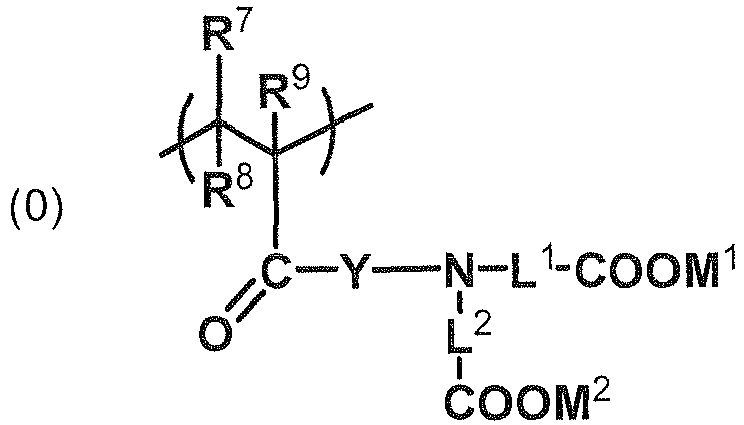
- [2] The lithographic printing plate precursor of [1], wherein the polymer (A) further contains a repeating unit having a hydrophilic group (a3) in the side chain thereof.
- [3] The lithographic printing plate precursor of [2] , wherein the repeating unit having a hydrophilic group (a3) in the side chain thereof is a repeating unit derived from a (meth)acrylic monomer.
- [4] The lithographic printing plate precursor of [2] or [3], wherein the repeating unit having a hydrophilic group (a3) in the side chain thereof has structure (s) represented by the formula formulae (a3-1) and/or (a3-2) below, in the side chain thereof:


- [5] The lithographic printing plate precursor of [4], wherein the repeating unit having a hydrophilic group (a3) in the side chain thereof is represented by the formula (a3-3) below:

- [6] The lithographic printing plate precursor of any one of [1] to [5], wherein the repeating unit (a2) having an ethylenic unsaturated bond in the side chain thereof is a repeating unit derived from a (meth)acrylic monomer.
- [7] The lithographic printing plate precursor of any one of [1] to [5], wherein the repeating unit (a2) having an ethylenic unsaturated bond in the side chain thereof is represented by the formula (a2-1):

- [8] The lithographic printing plate precursor of any one of [1] to [7], wherein each of L1 and L2 independently represents a single bond, alkylene group which may have a substituent, cycloalkylene group which may have a substituent, or arylene group which may have a substituent, L1 or the substituent on L1, and L2 or the substituent on L2 may combine with each other to form a ring.
- [9] The lithographic printing plate precursor of any one of [1] to [8], wherein Y in the formula (O) is a single bond, or, a divalent linking group selected from the group consisting of -CO-, -O-, -NH-, divalent aliphatic group, divalent aromatic group and arbitrary combinations of them.
- [10] The lithographic printing plate precursor of any one of [1] to [9], wherein the image recording layer of the lithographic printing plate precursor is removable with an aqueous solution of pH2 to 10.
- [11] The lithographic printing plate precursor of any one of [1] to [10], wherein the image recording layer of the lithographic printing plate precursor is removable with at least either of a printing ink and dampening solution.
- [12] A method of manufacturing a lithographic printing plate comprising exposing the lithographic printing plate precursor described in any one of [1] to [11] to light in a pattern-wise manner; and removing an unexposed portion of the image recording layer of the lithographic printing plate precursor under the presence of a developer of pH2 to 10.
- [13] The method of manufacturing a lithographic printing plate of [12], further comprising forming a protective layer on the surface of the support opposite to the surface having the image recording layer formed thereon,
wherein the developing process further comprises removing an unexposed portion of the image recording layer together with the protective layer under the presence of the developer further containing a surfactant (but excluding the water washing process). - [14] A method of manufacturing the lithographic printing plate comprising:
- exposing the lithographic printing plate precursor described in any one of [1] to [11] to light in a pattern-wise manner; and
- removing, on-machine, an unexposed portion of the image recording layer while feeding a printing ink and a dampening solution.
- [15] A copolymer comprising a repeating unit (a1) represented by the formula (O), and a repeating unit (a2) represented by the formula (a2-1):
- (a1) Repeating Unit Represented By Formula (O)
Formula (O)
- (a2) Repeating Unit Represented by Formula (a2-1)

- (a1) Repeating Unit Represented By Formula (O)
- [16] The copolymer of [15], further comprising a repeating unit having, in the side chain thereof, a hydrophilic group (a3) having, in the side chain thereof, structure(s) represented by the formulae (a3-1) and/or (a3-2) below:

* represents a connector.)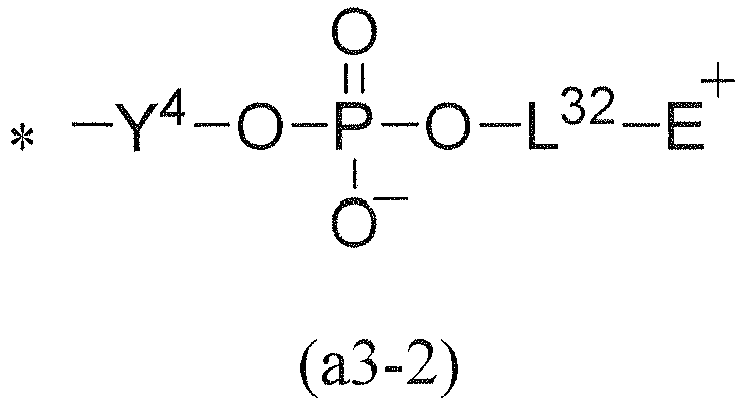
- According to the present invention, it became possible to provide a lithographic printing plate precursor capable of ensuring a good quality of coated surface, and is excellent in the staining resistance while keeping a high level of printing durability, and a method of manufacturing such lithographic printing plate.
-
-
FIG. 1 is an explanatory drawing illustrating an exemplary configuration of an automatic processor; and -
FIG. 2 is an explanatory drawing illustrating another exemplary configuration of the automatic processor. - The present invention will be detailed below. Note that, in this specification, the term "to" used together with the preceding and succeeding numerals will indicate a numerical range including the numerals as the lower limit value and the upper limit value, respectively.
- In this specification, all notation of groups in the compounds represented by the formulae, without special comment of "substituted" or "unsubstituted", will be understood to embrace not only unsubstituted groups but also groups having substituent group(s) unless otherwise specifically noted, so long as they can structurally have additional substituent group(s). For example, the description of "R represents an alkyl group, aryl group or heterocyclic group" means that "R represents an unsubstituted alkyl group, substituted alkyl group, unsubstituted aryl group, substituted aryl group, unsubstituted heterocyclic group or substituted heterocyclic group".
- The lithographic printing plate precursor of the present invention has, on a support, an undercoat layer and an image recording layer stacked in this order. The undercoat layer contains a polymer (A) containing a repeating unit (a1) represented by the formula (O), and a repeating unit (a2) having an ethylenic unsaturated bond in the side chain thereof.
Formula (O)
- In the undercoat layer, the polymer containing a repeating unit having at least one functional group interactive with the surface of the support is used. A repeating unit derived from iminodiacetic acid monomer has been known as an exemplary repeating unit having at least one functional group interactive with the surface of the support. The known repeating unit derived from iminodiacetic acid monomer was, however, of styrene type. The present invention succeeded in reducing hydrophobicity and improving the staining resistance, by replacing the styrene-type iminodiacetic acid monomer with (meth)crylate-type iminodiacetic acid monomer. The present invention also succeeded in improving the printing durability despite elevating the hydrophilicity, by introducing the (meth) acrylate-type iminodiacetic acid, to thereby enhance the interaction with a material composing the image recording layer. The interaction with the material composing the image recording layer is supposed to be ascribable to a hydrogen bond with the material composing the image recording layer, via an ester or amide bond.
- The present invention also succeeded in largely improving the quality of coated surface (nonuniformity in coating). When the polymer containing the repeating unit derived from styrene-type iminodiacetic acid monomer is used, since the polymer coagulates in a coating liquid for forming the undercoat layer (water, or water-methanol mixed solvent), so that the undercoat layer cannot sufficiently cover the support in the process coating and drying. In contrast, the acrylate-type monomer may be suppressed from coagulating, and may therefore be supposed to improve the coverage. This was an unexpected effect, and was not readily reached even by those skilled in the art. This is the basis for claiming the inventive step. Accordingly, a printing plate excellent both in the adhesiveness and hydrophilicity, and excellent in the printing durability and staining resistance may be provided.
- The polymer (A) used in the present invention contains a repeating unit (a1) represented by the formula (O): Formula (O)

- When R7 to R9 represents a halogen atom, the halogen atom is preferably a fluorine atom or chlorine atom.
- It is preferable that each of R7 to R9 independently represents a hydrogen atom or methyl group. Each of R7 and R8 is preferably represents a hydrogen atom.
- When Y represents a divalent linking group, the divalent linking group is preferably selected from the group consisting of -CO-, -O-, -NH-, divalent aliphatic group, divalent aromatic group and arbitrary combinations of them, more preferably selected from the group consisting of -O-, divalent aliphatic group, divalent aromatic group and arbitrary combinations of them, and still more preferably selected from the group consisting of -O-, divalent aliphatic group and arbitrary combinations of them.
- The divalent aliphatic group herein means an alkylene group, substituted alkylene group, alkenylene group, substituted alkenylene group, alkynylene group, substituted alkynylene group or polyalkylenoxy group. Among them, preferable examples include alkylene group, substituted alkylene group, alkenylene group, substituted alkenylene group, and polyalkylenoxy group, and more preferable examples include alkylene group, substituted alkylene group and polyalkylenoxy group. The divalent aliphatic group preferably has a chain-like structure rather than a cyclic structure, and more preferably has a straight-chain structure rather than a branched structure. The number of the carbon atoms of the divalent aliphatic group is preferably 1 to 20, more preferably 1 to 15, still more preferably 1 to 12, furthermore preferably 1 to 10, particularly 1 to 8, and most preferably 1 to 4.
- Examples of the substituent on the divalent aliphatic group include halogen atom (F, Cl, Br, I), hydroxy group, carboxy group, amino group, cyano group, aryl group, alkoxy group, aryloxy group, monoalkylamino group, dialkyl amino group, arylamino group and diarylamino group.
- Examples of the divalent aromatic group include phenylene group, substituted phenylene group, naphthalene group and substituted naphthalene group, among which phenylene group is preferable. Examples of the substituent on the divalent aromatic group include alkyl group, in addition to those exemplified as the substituent on the divalent aliphatic group.
- Y preferably represents a single bond, or a divalent linking group selected from the group consisting of -O-, divalent aliphatic group, and arbitrary combinations of them. Single bond is more preferable.
- When each of L1 and L2 represents a divalent linking group, the divalent linking group is preferably selected from the group consisting of -CO-, -O-, -NH-, divalent aliphatic group, divalent aromatic group and arbitrary combinations of them. Preferable examples thereof are same as those exemplified for Y.
- Each of L1 and L2 is preferably a single bond, an alkylene group which may have a substituent, a cycloalkylene which may have a substituent, or an arylene group which may have a substituent. Examples of the substituent possibly bound to the alkylene group or to the cycloalkylene group are same as those exemplified for the divalent aliphatic group. Examples of the substituent possibly bound to the arylene group are same as those exemplified for the divalent aromatic group.
- Each of L1 and L2 preferably has 1 to 10 carbon atoms, and more preferably 1 to 7 carbon atoms, when each of them represents an alkylene group which may have a substituent, cycloalkylene group which may have a substituent, or arylene group which may have a substituent.
- Each of L1 and L2 independently represents a single bond, C1-3 alkylene group, cyclohexene group, or phenylene group, wherein single bond or C1-3 alkylene group are more preferable, and C1-2 alkylene group is particularly preferable.
- Examples of the monovalent metal ion represented by M1 and M2 include lithium ion, sodium ion, and potassium ion, wherein each of M1 and M2 preferably represents a hydrogen atom, sodium ion or potassium ion, and more preferably represents a hydrogen atom or sodium ion.
- Preferable examples of the repeating unit represented by the formula (O) will be shown below. It is to be understood, of course, that the present invention is not limited thereto. In the formulae, Bu represents a n-butyl group.


- In the polymer (A) in the present invention, the content of the repeating unit represented by the formula (O) is preferably 1 to 99 mol%, more preferably 20 to 95 mol%, and still more preferably 40 to 90 mol%. The content in these ranges helps more effective expression of the effect of the present invention.
- The polymer (A) used in the present invention may contain, in addition to the repeating unit (a1) described in the above, other repeating unit having in the side chain thereof a structure interactive with the surface of the support. Examples of the other repeating unit having in the side chain thereof a structure interactive with the surface of the support include those having, in the side chain thereof, one or more species of structures represented by the formulae (a1-1) to (a1-5) below:


- Examples of the alkyl group represented by each of R21 to R23 include methyl group, ethyl group, propyl group, octyl group, isopropyl group, tert-butyl group, isopentyl group, 2-ethylhexyl group, 2-methylhexyl group, and cyclopentyl group.
- Each of R21 to R23 is preferably a hydrogen atom or methyl group.
- Y2 represents a single bond, or, a divalent linking group selected from the group consisting of -CO-, -O-, -NH-, divalent aliphatic group, divalent aromatic group and arbitrary combinations of them.
- Specific examples of Y2 composed of the arbitrary combinations are as follow. In the examples listed below, the left-hand side of each formula is bound to the principal chain.
- L1-: -CO-O-divalent aliphatic group-
- L2-: -CO-O-divalent aromatic group-
- L3-: -CO-NH-divalent aliphatic group-
- L4-: -CO-NH-divalent aromatic group-
- The divalent aliphatic group herein means an alkylene group, substituted alkylene group, alkenylene group, substituted alkenylene group, alkynylene group, substituted alkynylene group or polyalkylenoxy group. Among them, alkylene group, substituted alkylene group, alkenylene group, and substituted alkenylene group are preferable, and alkylene group and substituted alkylene group are more preferable.
- The divalent aliphatic group has a chain-like structure rather than a cyclic structure, and more preferably has a straight-chain structure rather than a branched structure. The number of carbon atoms of the divalent aliphatic group is preferably 1 to 20, more preferably 1 to 15, still more preferably 1 to 12, furthermore preferably 1 to 10, particularly 1 to 8, and most preferably 1 to 4.
- Examples of the substituent on the divalent aliphatic group include halogen atom (F, Cl, Br, I), hydroxy group, carboxy group, amino group, cyano group, aryl group, alkoxy group, aryloxy group, acyl group, acyloxy group, monoalkylamino group, dialkyl amino group, arylamino group and diarylamino group.
- Examples of the divalent aromatic group include phenylene group, substituted phenylene group, naphthalene group and substituted naphthalene group, wherein phenylene group is preferable.
- Examples of the substituent on the divalent aromatic group, other than the substituents on the divalent aliphatic group described in the above, include alkyl group.
- Y2 preferably represents a single bond, divalent aromatic group, -L1-, -L2-, -L3- or -L4-, wherein single bond, -L1- and -L2- are most preferable.
- From the viewpoint of the staining resistance and printing durability, the structure interactive with the surface of the support is preferably (a1-1) or (a1-2).
- Each of M21 and M22 preferably represents a hydrogen atom.
- Specific examples thereof includes the structures shown below, of course without limiting the present invention.

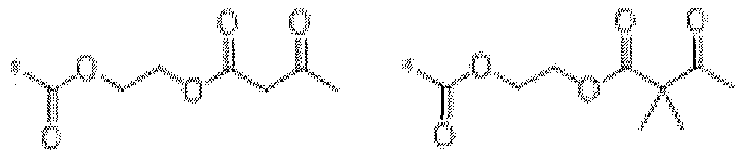
- The repeating unit (a1-2) having in the side chain thereof a structure interactive with the surface of the support is preferably a repeating unit derived from a (meth)acrylic monomer.
- The other repeating unit (a1-2) having in the side chain thereof a structure interactive with the surface of the support, used in the present invention, is preferably a repeating unit represented by the formula (A2) below: Formula (A2)

- In the formula (A2), each of Ra to Rc independently represents a hydrogen atom, C1-6 alkyl group or halogen atom.
- Content of the repeating unit represented by the formula (A2) is preferably 10 mol% or less of the copolymer of the present invention, more preferably 1 mol% or less, and still more preferably substantially zero. It is particularly preferable that substantially no styrene-type repeating unit derived from iminodiacetic acid monomer is contained therein.
- The polymer (A) in the present invention contains the repeating unit having an ethylenic unsaturated bond in the side chain thereof, preferably a repeating unit derived from a (meth)acrylic monomer, and more preferably a repeating unit represented by the formula (a2-1) below:

- When each of R1 to R3 represents a halogen atom, the halogen atom is preferably a fluorine atom or chlorine atom.
- Each of R1 to R3 preferably represents a hydrogen atom or methyl group. Each of R1 and R3 preferably represents a hydrogen atom.
- When each of R4 to R6 represents a halogen atom, the halogen atom is preferably a fluorine atom or chlorine atom.
- Each of R4 to R6 preferably represents a hydrogen atom or methyl group. Each of R5 and R6 preferably represents a hydrogen atom.
- It is more preferable that R4 and R5, or, R5 and R6 do not form a ring.
- R7 is preferably a hydrogen atom.
- L1 represents a divalent liking group which may have a substituent, and more specifically represents a linking group composed of two or more atoms selected from the group consisting of hydrogen atom, carbon atom, oxygen atom, nitrogen atom and sulfur atom. The number of carbon atoms composing the main skeleton of the linking group represented by L1 is preferably 1 to 70, more preferably 1 to 60, still more preferably 1 to 50, and particularly 1 to 20.
- Note that the main skeleton of the linking group in the present invention means an atom or atomic group which is used only for linking the "A" in the formula (a2-1) with the terminal ethylenic unsaturated bond. An exemplary structure of the compound represented by the formula (a2-1) in the present invention is shown below, with an indication and a method of counting the number of atoms composing the main skeleton of the linking group represented by L1 in the structure.

- The polymer (A) used in the present invention may contain, as (a3), a repeating unit having at least one hydrophilic group in the side chain thereof, for the purpose of elevating the hydrophilicity of the surface of the non-image-forming area. The hydrophilic group means those capable of readily forming hydrogen bond, van der Waals bond, or ionic bond to water molecule, and specifically includes hydroxy group, carboxyl group, amino group, sulfo group, group having positive charge or negative charge, zwitter ion group and metal salt thereof.
- The repeating unit (a3) having a hydrophilic group in the side chain thereof is preferably a repeating unit derived from a (meth)acrylic monomer.
- The polymer used in the present invention preferably has a repeating unit having, in particular, a zwitter ion structure as a hydrophilic group, in order to make the surface of the support in the non-image-forming area highly hydrophilic. It is particularly preferable that the side chain having the zwitter ion structure is represented by the formula (a3-1) or (a3-2) below:

* represents a connector.) - The cyclic structure possibly formed by combination of R31 and R32 may have a hetero atom such as oxygen atom, and is preferably a 5 to 10-membered ring, and more preferably a 5 or 6-membered ring.
- The number of carbon atoms of R31 and R32, including the number of atoms of the substituent described later, is preferably 1 to 30, more preferably 1 to 20, still more preferably 1 to 15, furthermore preferably 1 to 8, and particularly 1 to 4.
- Examples of the alkyl group represented by R31 and R32 include methyl group, ethyl group, propyl group, octyl group, isopropyl group, tert-butyl group, isopentyl group, 2-ethylhexyl group, 2-methylhexyl group, and cyclopentyl group.
- Examples of the alkenyl group represented by R31 and R32 include vinyl group, allyl group, prenyl group, geranyl group, and oleyl group.
- Examples of the alkynyl group represented by R31 and R32 include ethynyl group, propargyl group, and trimethylsilylethynyl group.
- Examples of the aryl group represented by R31 and R32 include phenyl group, 1-naphthyl group, and 2-naphthyl group. Examples of the heterocyclic group include furanyl group, thiophenyl group, and pyridinyl group.
- Each of these groups may have a substituent. Examples of the substituent include a halogen atom (F, Cl, Br, I), hydroxy group, carboxy group, amino group, cyano group, aryl group, alkoxy group, aryloxy group, acyl group, alkoxycarbonyl group, aryloxycarbonyl group, acyloxy group, monoalkylamino group, dialkyl amino group, monoarylamino group and diarylamino group.
- From the viewpoint of effect and availability, particularly preferable examples of each of R31 and R32 include hydrogen atom, methyl group, and ethyl group.
- The divalent linking group linking to the principal chain of the polymer compound represented by Y3 is preferably a single bond, or, a divalent linking group selected from the group consisting of -CO-, -O-, -NH-, divalent aliphatic group, divalent aromatic group and arbitrary combinations of them.
- Specific examples of Y3 composed of the arbitrary combinations are as follow. In the examples listed below, the left-hand side of each formula is bound to the principal chain.
- -L1-: -CO-O-divalent aliphatic group-
- -L2-: -CO-O-divalent aromatic group-
- -L3-: -CO-NH-divalent aliphatic group-
- -L4-: -CO-NH-divalent aromatic group-
- The divalent aliphatic group herein means an alkylene group, substituted alkylene group, alkenylene group, substituted alkenylene group, alkynylene group, or substituted alkynylene group or polyalkylenoxy group. Among them, preferable examples include alkylene group, substituted alkylene group, alkenylene group and substituted alkenylene group, more preferable examples include alkylene group and substituted alkylene group, and still more preferable examples include unsubstituted alkylene group.
- The divalent aliphatic group preferably has a chain-like structure rather than a cyclic structure, and more preferably has a straight-chain structure rather than a branched structure. The number of the carbon atoms of the divalent aliphatic group is preferably 1 to 20, more preferably 1 to 15, still more preferably 1 to 12, furthermore preferably 1 to 10, particularly 1 to 8, and most preferably 1 to 4.
- Examples of the substituent on the divalent aliphatic group include halogen atom (F, Cl, Br, I), hydroxy group, carboxy group, amino group, cyano group, aryl group, alkoxy group, aryloxy group, acyl group, acyloxy group, monoalkylamino group, dialkyl amino group, arylamino group and diarylamino group.
- Examples of the divalent aromatic group include phenylene group, substituted phenylene group, naphthalene group and substituted naphthalene group. Among them, phenylene group is preferable.
- Examples of the substituent on the divalent aromatic group include alkyl group, in addition to the above-described substituents on the divalent aliphatic group.
- More preferable examples of Y3 include a single bond, -CO-, divalent aliphatic group, divalent aromatic group, and -L1- to -L4-. From the viewpoint of staining resistance, Y3 is preferably -L1- or L3-, and more preferably -L3-. The divalent aliphatic group in -L3- is preferably C2-4 straight-chain alkylene group, and most preferably C3 straight-chain alkylene group from the viewpoint of readiness of synthesis.
- L31 represents a linking group which is preferably -CO-, -O-, -NH-, divalent aliphatic group, divalent aromatic group and arbitrary combinations of them. L31 preferably has the number of carbon atoms of 30 or smaller, including the number of carbon atoms of the substituent possibly bound thereto. Specific examples of the substituent include alkylene group (preferably C1-20 alkylene group, more preferably C1-10 alkylene group, and still more preferably C2-6 alkylene group), and, phenylene group, arylene group such as xylylene group (preferably C5-15 arylene group, and more preferably C6-10 arylene group). From the viewpoint of staining resistance, L31 is preferably C3-5 straight-chain alkylene group, more preferably C4 or C5 straight-chain alkylene group, and still more preferably C4 straight-chain alkylene group.
- Specific examples of L31 include the linking groups listed below:
- -CH2- -CH2CH2- -CH2CH2CH2- -CH2CH2CH2CH2-
- -CH2CH2CH2CH2CH2- -CH2CH2CH2CH2CH2CH2-

- Each of these linking groups may additionally have a substituent.
- Examples of the substituent include halogen atom (F, Cl, Br, I), hydroxy group, carboxy group, amino group, cyano group, aryl group, alkoxy group, aryloxy group, acyl group, alkoxycarbonyl group, aryloxycarbonyl group, acyloxy group, monoalkylamino group, dialkyl amino group, monoarylamino group and diarylamino group.
- In the formula (a3-1), A- preferably represents a carboxylate, sulfonate, phosphonate, or phosphinate.
- Specific examples of A- include the anions shown below:

- From the viewpoint of staining resistance, A- is most preferably a sulfonate. In the formula (a3-1), a combination of L31 representing a C4 or C5 straight-chain alkylene group and A- representing a sulfonate is preferable, and a combination of L31 representing a C4 straight-chain alkylene group and A- representing a sulfonate is most preferable.
- A combination of Y3 representing -L1- or L3-, each of R31 and R32 independently representing an ethyl group or methyl group, L31 representing a C4 or C5 straight-chain alkylene group, and A- representing a sulfonate group is preferable.
- Moreover, a combination of Y3 representing -L3-, each of R31 and R32 independently representing a methyl group, L31 representing a C4 straight-chain alkylene group, and A- representing a sulfonate is more preferable.
- More specifically, those represented by the formulae below are preferable:


- (In the formula (a3-2), L32 represents a divalent linking group, and E+ represents a structure having a cation. Y4 represents a single bond or a divalent linking group which may have a substituent. * represents a connector.)
- In the formula (a3-2), L32 represents a linking group, and preferably -CO-, -O-, -NH-, divalent aliphatic group, divalent aromatic group and arbitrary combinations of them.
- L32 represents a linking group, and preferably -CO-, -O-, -NH-, divalent aliphatic group, divalent aromatic group and arbitrary combinations of them. The number of carbon atoms of L32 is preferably 30 or smaller, including the number of carbon atoms of the substituent possibly bound thereto. Specific examples of the substituent include an alkylene group (preferably C1-20 alkylene group, more preferably C1-10 alkylene group, more preferably C2-6 alkylene group), and, arylene group such as phenylene group, xylylene group (preferably C5-15 arylene group, and more preferably C6-10 arylene group). From the viewpoint of staining resistance, L32 is preferably a C1-5 straight-chain alkylene group, and more preferably C1-3 straight-chain alkylene group.
- Specific examples of L32 include the linking groups shown below:
- -CH2- -CH2CH2- -CH2CH2CH2- -CH2CH2CH2CH2-
- -CH2CH2CH2CH2CH2- -CH2CH2CH2CH2CH2CH2-

- These linking groups may have an additional substituent.
- Examples of the substituent include halogen atom (F, Cl, Br, I), hydroxy group, carboxy group, amino group, cyano group, aryl group, alkoxy group, aryloxy group, acyl group, alkoxycarbonyl group, aryloxycarbonyl group, acyloxy group, monoalkylamino group, dialkyl amino group, monoarylamino group and diarylamino group.
- Y4 is synonymous to Y3 in the formula (a3-1), representing the same preferable range.
- E+ represents a structure having a cation, preferably represents a structure having ammonium, phosphonium, iodonium, or sulfonium. E+ more preferably represents a structure having ammonium or phosphonium, and particularly a structure having ammonium. Examples of the structure having a cation include trimethylammonio group, triethylammonio group, tributylammonio group, benzyl dimethylammonio group, diethylhexylammonio group, (2-hydroxyethyl)dimethylammonio group, pyridinio group, N-methylimidazolio group, N-acrydinio group, trimethylphosphonio group, triethylphosphonio group, and triphenylphosphonio group.
- In more preferable examples of combinations of L32, Y4 and E+, L32 represents a C2-4 alkylene group, Y4 represents -L1- or L3-, and E+ represents a trimethylammonio group or triethylammonio group.
- Specific examples of the structure include the followings:


- In the present invention, it is preferable that the repeating unit (a3) having a hydrophilic group in the side chain thereof is specifically represented by the formula
-

- It is preferable that each of Ra to Rc independently represents a hydrogen atom or methyl group. Each of Ra and Rb preferably represents a hydrogen atom.
- In the polymer used in the present invention, ratio of the repeating unit (a3) having the structure represented by the formula (a3-1) or formula (a3-2) is preferably 1 to 70 mol% of the total repeating unit, from the viewpoint of the staining resistance and developability, and more preferably 1 to 50 mol%, and still more preferably 1 to 30 mol%.
- The polymer (A) may be a copolymer having other repeating unit besides the above-described repeating units. Examples of the monomers copolymerizable to the polymer include those selected from acylic esters, methacrylic esters, N,N-disubstituted acrylamides, N,N-disubstituted methacrylamides, styrenes, acrylonitriles, and methacrylonitriles. Content of the other repeating unit is preferably 20 mol% or less of the polymer (A).
- Specific examples thereof include acrylic esters such as alkyl acrylates preferably having a C1-20 alkyl group (more specifically, for example, methyl acrylate, ethyl acrylate, propyl acrylate, butyl acrylate, amyl acrylate, ethylhexyl acrylate, octyl acrylate, tert-octyl acrylate, chloroethyl acrylate, 2,2-dimethylhydroxypropyl acrylate, 5-hydroxypentyl acrylate, trimethylolpropane monoacrylate, pentaerythritol monoacrylate, glycidyl acrylate, benzyl acrylate, methoxybenzyl acrylate, furfuryl acrylate, and tetrahydrofurfuryl acrylate); aryl acrylates (for example, phenyl acrylate); methacrylic esters such as alkyl methacrylates preferably having a C1-20 alkyl group (for example, methyl methacrylate, ethyl methacrylate, propyl methacrylate, isopropyl methacrylate, amyl methacrylate, hexyl methacrylate, cyclohexyl methacrylate, benzyl methacrylate, chlorobenzyl methacrylate, octyl methacrylate, 4-hydroxybutyl methacrylate, 5-hydroxypentyl methacrylate, 2,2-dimethyl-3-hydroxypropyl methacrylate, trimethylolpropane monomethacrylate, pentaerythritol monomethacrylate, glycidyl methacrylate, furfuryl methacrylate, and tetrahydrofurfuryl methacrylate); aryl methacrylates (for example, phenyl methacrylate, cresyl methacrylate, and naphthyl methacrylate); styrenes such as styrene and alkyl styrene (for example, methylstyrene, dimethylstyrene, trimethylstyrene, ethylstyrene, diethylstyrene, isopropylstyrene, butylstyrene, hexylstyrene, cyclohexylstyrene, decylstyrene, benzyl styrene, chloromethylstyrene, trifluoromethylstyrene, ethoxymethylstyrene, and acetoxymethylstyrene); alkoxystyrenes (for example, methoxystyrene, 4-methoxy-3-methylstyrene, and dimethoxystyrene); halogen-containing styrenes (for example, chlorostyrene, dichlorostyrene, trichlorostyrene, tetrachlorostyrene, pentachlorostyrene, bromostyrene, dibromostyrene, iodostyrene, fluorostyrene, trifluorostyrene, 2-bromo-4-trifluoromethylstyrene, and 4-fluoro-3-trifluoromethylstyrene); acrylonitrile, methacrylonitrile, methacrylic acid, acrylic acid, and 2-acrylamide-2-methylpropane sulfonate.
- It is particularly preferable that the polymer (A) in the present invention contains a repeating unit, as the other repeating unit, having in the side chain thereof an alkyl ether chain composed of -(CH2)n-O-, where n is an integer of 1 to 4, repeated 2 to 150 times, and more preferably 9 to 150 times from the viewpoint of staining resistance, still more preferably 9 to 100 times, furthermore preferably 20 to 100 times, and particularly 50 to 100 times. The other repeating unit preferably has a structure represented by the formula below:

- In the formula, each of R51 to R53 independently represents a hydrogen atom, C1-6 alkyl group or halogen atom, wherein hydrogen atom or methyl group is preferable. R54 represents a hydrogen atom or C1-6 alkyl group, wherein hydrogen atom, methyl group or ethyl group is more preferable. n represents an integer from 1 to 4, and is preferably an integer of 2 or 3. m represents an integer from 2 to 150, and more preferably from 9 to 150 from the viewpoint of staining resistance, still more preferably from 9 to 100, furthermore preferably from 20 to 100, and particularly from 50 to 100.
- By using the polymer (A) having such repeating unit for the undercoat layer of the lithographic printing plate precursor of the on-machine developable type, a good on-machine development property may be achieved. The content of the repeating unit having the alkyl ether chain in the side chain thereof is preferably 0 to 20 mol% of the polymer (A).
- Mass average molar mass (Mw) of the polymer (A) may arbitrarily be set depending on performance design of the lithographic printing plate precursor. From the viewpoint of the printing durability and staining resistance, the mass average molar mass is preferably 2,000 to 1,000,000, more preferably 2,000 to 500,000, and most preferably 8,000 to 300,000.
- In the polymer (A) used in the present invention, the total content of the repeating unit represented by the formula (O), the repeating unit represented by the formula (A2), and the repeating unit represented by the formula (a3-3) accounts for 80 mol% or more of the polymer (A), and more preferably 90 mol% or more.
- The polymer newly disclosed by the present invention is exemplified by the polymers below:
- (1) a copolymer containing the repeating unit (a1) represented by the formula (O) and the repeating unit (a2) represented by the formula (a2-1); and
- (2) a polymer of (1) described in the above, further containing in the side chain thereof a hydrophilic group (a3) having in the side chain thereof a structure represented by the formula (a3-1) and/or (a3-2).
- Examples of the polymer (A) used in the present invention will be shown below, of course without limiting the present invention. The content of each repeating unit is expressed in molar ratio.





- While the polymer (A) may also be synthesized by known methods, preferably used for the synthesis is radical polymerization, followed by urea forming reaction between amino groups in the side chains of the polymer and a radical polymerizable group of an isocyanate compound.
- General methods of radical polymerization are described in "Shin Kobunshi Jikkengaku (New Experimental Course in Polymer Science) 3", edited by The Society of Polymer Science, Japan, published by Kyoritsu Shuppan Co. Ltd., March 28, 1996), "Kobunshi no Gosei to Hanno (Syntheses and Reactions of Polymers) 1", edited by The Society of Polymer Science, Japan, published by Kyoritsu Shuppan Co. Ltd., May, 1992), "Shin Jikken Kagaku Koza (New Course in Experimental Chemistry) 19, Kobunshi Kagaku (Polymer Science) (I) (edited by The Chemical Society of Japan, published by Maruzen Co. Ltd., November 20, 1980,), "Bussitsu Kogaku Koza Kobunshi Gosei Kagaku (The Course of Material Engineering, Polymer Synthetic Chemistry)" (published in September, 1995, by Tokyo Denki University Press, September, 1995) and so forth, all of which adoptable to the present invention.
- Preferable embodiments of the lithographic printing plate precursor according to the present invention will be detailed below.
- The lithographic printing plate precursor according to the present invention has, on the support, the undercoat layer and the image recording layer stacked in this order. The lithographic printing plate precursor according to the present invention has other arbitrary layer provided between the support and the image recording layer.
- The lithographic printing plate precursor according to the present invention preferably has a protective layer on the surface of the image recording layer on the side opposite to the support.
- The lithographic printing plate precursor according to the present invention may have, as necessary, a back-coat layer provided on the back surface of the support.
- The lithographic printing plate precursor according to the present invention is preferably adoptable to so-called direct plate making by which the plate is made directly based on digital signal output from a computer or the like using various types of laser. The original plate is also preferably developable with an aqueous solution of pH2 to 14, more preferably pH3.5 to 13, and most preferably pH6 to 13, or developable on press.
- The constitutive layers composing the lithographic printing plate precursor according to the present invention will be explained in sequence, and also a method of manufacturing the lithographic printing plate precursor according to the present invention will be explained below.
- The undercoat layer of the lithographic printing plate precursor according to the present invention contains the polymer (A).
- The undercoat layer may be provided by a method of coating a solution, prepared by dissolving the compound into water, or organic solvent such as methanol, ethanol, methyl ethyl ketone, or mixed solvent of them, over a support and then drying it; or, a method of dipping the support into a solution, prepared by dissolving the compound into water, or organic solvent such as methanol, ethanol, methyl ethyl ketone, or mixed solvent of them, so as to allow the compound to adsorb onto the support, and then by washing and drying the support. In the former method, the solution containing 0.005 to 10% by mass of the above-described compound may be coated by various methods.
- Method of coating may be any of bar coater coating, spin coating, spray coating, curtain coating and so forth. On the other hand, in the latter method, the solution preferably has a concentration of 0.01 to 20% by mass, and more preferably 0.05 to 5% by mass, dipping temperature is 20 to 90°C, preferably 25 to 50°C, and dipping time is 0.1 seconds to 20 minutes, and preferably 2 seconds to 1 minute.
- The amount of coating (by solid content) of the undercoat layer is preferably 0.1 to 100 mg/m2, and more preferably 1 to 30 mg/m2. The polymer compound (D) preferably accounts for 90% by mass or more of the solid content.
- The image recording layer of the lithographic printing plate precursor according to the present invention preferably contains a polymerization initiator (B), a polymerizable compound (C) and a binder (D), more preferably contains the polymerization initiator (B), the polymerizable compound (C) a binder (D) and a dye (E).
- The image recording layer of the present invention preferably contains the polymerization initiator (also referred to as initiator compound, hereinafter). In the present invention, a radical polymerization initiator is preferably used.
- The initiator compound may be arbitrarily selected from compounds known among those skilled in the art without limitation. Specific examples include trihalomethyl compound, carbonyl compound, organic peroxide, azo compound, azide compound, metallocene compound, hexaarylbiimidazole compound, organic boron compound, disulfone compound, oxim ester compound, onium salt, and iron arene complex. In particular, the initiator compound is preferably at least one species selected from the group consisting of hexaarylbiimidazole compound, onium salt, trihalomethyl compound and metallocene compound, and is particularly hexaarylbiimidazole compound, or onium salt. Two or more species of them may be used in combination as the polymerization initiator.
- The hexaarylbiimidazole compound is exemplified by lophine dimers described in European Patent Nos.
24, 629 107,792 4, 410, 621 , which are exemplified by
2,2'-bis(o-chlorophenyl)-4,4',5,5'-tetraphenylbiimidazo le,
2,2'-bis(o-bromophenyl)-4,4',5,5'-tetraphenylbiimidazol e,
2,2'-bis(o,p-dichlorophenyl)-4,4',5,5'-tetraphenylbiimi dazole,
2,2'-bis(o-chlorophenyl)-4,4',5,5'-tetra(m-methoxypheny l)biimidazole,
2,2'-bis(o,o'-dichlorophenyl)-4,4',5,5'-tetraphenylbiim idazole,
2,2'-bis(o-nitrophenyl)-4,4',5,5'-tetraphenylbiimidazol e,
2,2'-bis(o-methylphenyl)-4,4',5,5'-tetraphenylbiimidazo le, and
2,2'-bis(o-trifluoromethylphenyl)-4,4',5,5'-tetraphenyl biimidazole. It is particularly preferable that the hexaarylbiimidazole compound is used in combination with a sensitizing dye which shows maximum absorption in the wavelength range from 300 to 450 nm. - The onium salt is exemplified by diazonium salts described in S.I. Schlesinger, Photogr. Sci. Eng., 18, 387(1974), T.S. Bal et al., Polymer, 21, 423(1980), and Japanese Laid-Open Patent Publication No.
H05-158230 4,069,055 , and Japanese Laid-Open Patent Publication No.H04-365049 4, 069, 055 and4, 069, 056 ; iodonium salts described in European Patent Nos.104,143 2008/0311520 , Japanese Laid-Open Patent Publication Nos.H02-150848 2008-195018 370,693 233,567 297,443 297,442 4,933,377 , ibid. No.4,760,013 , ibid. No.4,734,444 and ibid. No.2,833,827 , and German Patent No.2,904,626 , ibid. No.3,604,580 and ibid. No.3,604,581 ; selenonium salts described in J.V. Crivello et al., J. Polymer Sci., Polymer Chem. Ed., 17, 1047(1979); arsonium salts described in C.S. Wen et al., The Proc. Conf. Rad. Curing ASIA, p478, Tokyo, Oct(1988); and azinium salts described in Japanese Laid-Open Patent Publication No.2008-195018 - Among them, more preferable examples include iodonium salt, sulfonium salt and azinium salts. Specific examples of these compounds will be shown below, without limiting the present invention.
- The iodonium salt is preferably diphenyliodonium salt, more preferably diphenyliodonium salt substituted by an electron donor group such as alkyl group or alkoxyl group, and still more preferably asymmetric diphenyliodonium salts. Specific examples include diphenyliodonium hexafluorophosphate,
4-methoxyphenyl-4-(2-methylpropyl)phenyliodonium hexafluorophosphate,
4-(2-methylpropyl)phenyl-p-tolyliodonium hexafluorophosphate,
4-hexyloxyphenyl-2,4,6-trimethoxyphenyliodonium hexafluorophosphate,
4-hexyloxyphenyl-2,4-diethoxyphenyliodonium tetrafluoroborate,
4-octyloxyphenyl-2,4,6-trimethoxyphenyliodonium 1-perfluorobutanesulfonate,
4-octyloxyphenyl-2,4,6-trimethoxyphenyliodonium hexafluorophosphate, and bis(4-t-butylphenyl)iodonium tetraphenylborate. - Examples of the sulfonium salt include triphenylsulfonium hexafluorophosphate, triphenylsulfonium benzoylformate, bis(4-chlorophenyl)phenylsulfonium benzoylformate, bis(4-chlorophenyl)-4-methylphenylsulfonium tetrafluoroborate, tris(4-chlorophenyl)sulfonium 3,5-bis(methoxycarbonyl)benzenesulfonate, and tris(4-chlorophenyl)sulfonium hexafluorophosphate.
- Examples of the azinium salt include 1-cyclohexylmethyloxypyrydinium hexafluorophosphate, 1-cyclohexyloxy-4-phenylpyrydinium hexafluorophosphate, 1-ethoxy-4-phenylpyrydinium hexafluorophosphate, 1-(2-ethylhexyloxy)-4-phenylpyrydinium hexafluorophosphate,
4-chloro-1-cyclohexylmethyloxypyrydinium hexafluorophosphate, 1-ethoxy-4-cyanopyrydinium hexafluorophosphate,
3,4-dichloro-1-(2-ethylhexyloxy)pyrydinium hexafluorophosphate, 1-benzyloxy-4-phenylpyrydinium hexafluorophosphate, 1-phenetyloxy-4-phenylpyrydinium hexafluorophosphate,
1-(2-ethylhexyloxy)-4-phenylpyrydinium p-toluenesulfonate,
1-(2-ethylhexyloxy)-4-phenylpyrydinium perfluorobutanesulfonate,
1-(2-ethylhexyloxy)-4-phenylpyrydinium bromide, and
1-(2-ethylhexyloxy)-4-phenylpyrydinium tetrafluoroborate. - It is particularly preferable that the onium salt is used in combination with an infrared absorber which shows maximum absorption in the wavelength range from 750 to 1400 nm.
- Besides them, also polymerization initiators described in paragraphs [0071] to [0129] of Japanese Laid-Open Patent Publication No.
2007-206217 - The polymerization initiator is preferably used alone, or in combination of two or more species.
- The content of the polymerization initiator in the image recording layer is preferably 0.01 to 20% by mass relative to the total solid content of the image recording layer, more preferably 0.1 to 15% by mass, and still more preferably 1.0 to 10% by mass.
- The polymerizable compound used for the image recording layer is an addition polymerizable compound having at least one ethylenic unsaturated double bond, and is selected from compounds having at least one, and preferably two, terminal ethylenic unsaturated bonds. These compounds typically have any of chemical forms including monomer; prepolymer such as dimer, trimer and oligomer; and mixtures of them. Examples of the monomer include unsaturated carboxylic acid (for example, acrylic acid, methacrylic acid, itaconic acid, crotonic acid, isocrotonic acid, maleic acid), esters of them, and amides of them. More preferable examples include esters formed between unsaturated carboxylic acid and polyhydric alcohol compound, and amides formed between unsaturated carboxylic acid and polyvalent amine compound. Still other preferable examples include adducts of unsaturated carboxylate esters or amides having nucleophilic substituent group such as hydroxy group, amino group, mercapto group or the like, formed together with monofunctional or polyfunctional isocyanates or epoxys; and dehydration condensation product formed together with monofunctional or polyfunctional carboxylic acid. Still other preferable examples include adducts of unsaturated carboxylate esters or amides having electrophilic substituent group such as isocyanate group and epoxy group, formed together with monofunctional or polyfunctional alcohols, amines, or thiols; and substitution products of unsaturated carboxylate esters or amides having eliminative substituent group such as halogen group and tosyloxy group, formed together with monofunctional or polyfunctional alcohols, amines, or thiols.
- Also compounds obtained by replacing the above-described unsaturated carboxylic acid with unsaturated phosphonic acid, styrene, vinyl ether or the like are also adoptable. These compounds are disclosed in Published Japanese Translation of PCT International Publication for Patent Application No.
2006-508380 2002-287344 2008-256850 2001-342222 H09-179296 H09-179297 H09-179298 2004-294935 2006-243493 2002-275129 2003-64130 2003-280187 H10-333321 - Specific examples of the monomer in the form of acrylate ester formed between polyhydric alcohol compound and unsaturated carboxylic acid include ethylene glycol diacrylate, 1,3-butanediol diacrylate, tetramethylene glycol diacrylate, propylene glycol diacrylate, trimethylolpropane triacrylate, hexanediol diacrylate, tetraethylene glycol diacrylate, pentaerythritol tetraacrylate, sorbitol triacrylate, isocyanurate ethylene oxide (EO)-modified triacrylate, and polyester acrylate oligomer. Examples of methacrylate ester include tetramethylene glycol dimethacrylate, neopentyl glycol dimethacrylate, trimethylolpropane trimethacrylate, ethylene glycol dimethacrylate, pentaerythritol trimethacrylate, bis [p-(3-methacryl oxy-2-hydroxypropoxy)phenyl]dimethylmethane, and bis-[p-(methacryloxyethoxy)phenyl]dimethylmethane. Specific examples of the monomer in the form of amide formed between polyvalent amine compound and unsaturated carboxylic acid include methylene bisacrylamide, methylene bismethacrylamide, 1,6-hexamethylene bisacrylamide, 1,6-hexamethylene bismethacrylamide, diethylenetriamine trisacrylamide, xylylene bisacrylamide, and xylylene bismethacrylamide.
- Also urethane-based addition polymerizable compound, obtainable by addition polymerization between the isocyanate and hydroxy group, is preferable. Preferable examples of this sort of compound include vinyl urethane compound having two or more polymerizable vinyl groups per one molecule, which is obtainable by addition reaction between a vinyl monomer having a hydroxy group represented by the formula (P) below, and a polyisocyanate compound having two or more isocyanate groups per one molecule, as described in Examined Japanese Patent Publication No.
S48-41708
CH2=C (R104) COOCH2CH (R105) OH (P)
(where, each of R104 and R105 represents H or CH3.) - Other preferable examples include urethane acrylates described in Japanese Laid-Open Patent Publication No.
S51-37193 H02-32293 H02-16765 2003-344997 2006-65210 S58-49860 S56-17654 S62-39417 S62-39418 2000-250211 2007-94138 7,153,632 , Published Japanese Translation of PCT International Publication for Patent Application No.H08-505958 2007-293221 2007-293223 - Among them, for the lithographic printing plate precursor adapted to the on-machine development, isocyanurate of ethylene oxide-modified acrylate such as tris(acryloyloxyethyl)isocyanurate, and bis(acryloyloxyethyl)hydroxyethyl isocyanurate are particularly preferable, from the viewpoint of good balance between hydrophilicity contributive to the on-press developability and polymerizability contributive to the printing durability.
- Structure of the polymerizable compound (C), and method of use, including whether it is used alone or in combination with other species, or amount of use, may be arbitrarilydetermined depending on a final desired goal of performance design of lithographic printing plate precursor. The content of the polymerizable compound (C) is preferably 5 to 75% by mass of the total solid content of the image recording layer, more preferably 25 to 70% by mass, and particularly 30 to 60% by mass.
- The binder (D) contained in the image recording layer of the lithographic printing plate precursor according to the present invention is selected from those capable of keeping the image recording layer component on the support, and removable by the developer. Examples of the binder (E) include (meth)acrylic polymer, polyurethane resin, polyvinyl alcohol resin, polyvinyl butyral resin, polyvinyl formal resin, polyamide resin, polyester resin, and epoxy resin. In particular, (meth)acrylic polymer, polyurethane resin, and polyvinyl butyral resin are preferably used. More preferable examples include (meth)acrylic polymer, polyurethane resin, and polyvinyl butyral resin.
- In the present invention, "(meth)acrylic polymer" means copolymer having, as a polymerizable component, (meth)acrylic acid derivative such as (meth)acrylic acid, (meth) acryliate ester (alkyl ester, aryl ester, allylester, etc.), (meth)acrylamide and (meth)acrylamide derivative. "Polyurethane resin" means polymer produced by condensation reaction between a compound having two or more isocyanate groups and a compound having two or more hydroxy groups. "Polyvinyl butyral resin" means polymer synthesized by allowing polyvinyl alcohol obtained by partially or totally saponifying polyvinyl acetate to react with butyl aldehyde under an acidic condition (acetal forming reaction), which also includes polymer having introduced therein acid group and so forth, obtained by allowing the residual hydroxy group to react with a compound having acid group.
- One preferable example of the (meth)acrylic polymer is a copolymer having a repeating unit which contains an acid group. The acid group is exemplified by carboxylate group, sulfonate group, phosphonate group, phosphate group, and sulfonamide group, wherein carboxylate group is particularly preferable. The repeating unit having acid group preferably used herein includes a repeating unit derived from (meth)acrylic acid, or a unit represented by the formula (I) below:

- In the formula (I), R211 represents a hydrogen atom or methyl group, R212 represents a single bond or n211 monovalent linking groups. A211 represents an oxygen atom or -NR213- , and R213 represents a hydrogen atom or C1-10 monovalent hydrocarbon group. n211 represents an integer from 1 to 5.
- The linking group represented by R212 in the formula (I) is composed of hydrogen atom, carbon atom, oxygen atom, nitrogen atom, sulfur atom and halogen atom, with a total number of atoms of preferably 1 to 80. More specifically, the alkylene group, substituted alkylene group, arylene group, and substituted arylene group are exemplified. A plurality of these divalent groups may be linked with any of amide bond, ether bond, urethane bond, urea bond and ester bond. R212 preferably has a structure in which a plurality of single bonds, alkylene groups, substituted alkylene groups and alkylene groups and/or substituted alkylene groups are linked with any of amide bond, ether bond, urethane bond, urea bond, and ester bond; more preferably has a structure in which a plurality of single bonds, C1-5 alkylene groups, C1-5 substituted alkylene groups and C1-5 alkylene groups and/or C1-5 substituted alkylene groups are linked with any of amide bond, ether bond, urethane bond, urea bond, and ester bond; and particularly has a structure in which a plurality of single bonds, C1-3 alkylene group, C1-3 substituted alkylene group, and C1-3 alkylene group and/or C1-3 substituted alkylene groups are linked with any of amide bond, ether bond, urethane bond, urea bond, and ester bond.
- Examples of the substituent group possibly bound to the linking group represented by R212 includes group of monovalent non-metallic atoms excluding hydrogen atom, wherein examples of which include halogen atom (-F, -Br, -Cl, -I), hydroxy group, cyano group, alkoxy group, aryloxy group, mercapto group, alkylthio group, arylthio group, alkylcarbonyl group, arylcarbonyl group, carboxyl group and its conjugate base group, alkoxy carbonyl group, aryloxy carbonyl group, carbamoyl group, aryl group, alkenyl group, and alkynyl group.
- R213 is preferably a hydrogen atom or C1-5 hydrocarbon group, more preferably a hydrogen atom or C1-3 hydrocarbon group, and particularly a hydrogen atom or methyl group.
- n211 is preferably 1 to 3, more preferably 1 or 2, and particularly 1.
- Ratio of the content (mol%) of the polymerizable component having carboxylate group, relative to the total polymerizable components of the (meth)acrylic polymer is preferably 1 to 70% from the viewpoint of developability, more preferably 1 to 50% considering a good balance between the developability and printing durability, and particularly 1 to 30%.
- It is preferable for the (meth)acrylic polymer used in the present invention to additionally have a crosslinkable group. The crosslinkable group herein means a group capable of crosslinking the binder (D), in the process of radical polymerization reaction which proceeds in the image recording layer, when the lithographic printing plate precursor is exposed to light. While the functional group is not specifically limited so long as it can exhibit the above-described function, examples of the functional group capable of proceeding addition polymerization reaction include ethylenic unsaturated binding group, amino group, and epoxy group. The functional group may also be a functional group capable of producing a radical upon being exposed to light, and this sort of crosslinkable group is exemplified by thiol group and halogen group. Among them, ethylenic unsaturated binding group is preferable. The ethylenic unsaturated binding group is preferably styryl group, (meth)acryloyl group, or allyl group.
- The binder (D) cures in such a way that a free radical (polymerization initiating radical, or propagating radical in the process of polymerization of radical or polymerizable compound) attaches to the crosslinkable functional group, and crosslinkage is formed among the polymer molecules thereof, by addition polymerization which proceeds directly among the polymer molecules or by sequential polymerization of the polymerizable compounds. Alternatively, the binder cures in such a way that atoms (for example, hydrogen atoms on carbon atoms adjacent to the functional crosslinking groups) in the polymer are abstracted by free radicals to produce polymer radicals, and the resultant polymer radicals then combine with each other to produce the crosslinkages among the polymer molecules.
- The content of the crosslinkable group in the (meth)acrylic polymer (content of radical polymerizable unsaturated double bond determined by iodometry) is preferably 0.01 to 10. 0 mmol per one gram of the binder (D), more preferably 0.05 to 9.0 mmol, and particularly 0.1 to 8.0 mmol.
- Besides the above-described repeating unit having an acid group, and the polymerization unit having a crosslinkable group, the (meth) acrylic polymer used in the present invention may have a polymerization unit of alkyl (meth)acrylate or aralkyl (meth)acrylate, polymerization unit of (meth)acrylamide or its derivative, polymerization unit of α-hydroxymethyl acrylate, or polymerization unit of styrene derivative. The alkyl group of alkyl (meth) acrylate is preferably a C1-5 alkyl group, or an alkyl group having the above-described C2-8 substituent group, and more preferably methyl group. The aralkyl (meth)acrylate is exemplified by benzyl (meth)acrylate. The (meth)acrylamide derivative is exemplified by N-isopropylacrylamide, N-phenylmethacrylamide, N-(4-methoxycarbonylphenyl)methacrylamide, N,N-dimethylacrylamide, and morpholinoacrylamide. The α-Hydroxymethyl acrylate is exemplified by ethyl α-hydroxymethyl acrylate, and cyclohexyl α-hydroxymethyl acrylate. The styrene derivative is exemplified by styrene, and 4-tert-butylstyrene.
- For the case where the lithographic printing plate precursor is intended for on-machine development, the binder (D) preferably has a hydrophilic group. The hydrophilic group contributes to impart on-press developability to the image recording layer. In particular, by allowing the crosslinkable group and the hydrophilic group to coexist, the printing durability and the on-press developability may be compatible.
- Examples of the hydrophilic group possibly bound to the binder (D) include hydroxy group, carboxyl group, alkylene oxide structure, amino group, ammonium group, amide group, sulfo group, and phosphate group. Among them, the alkylene oxide structure having 1 to 9 C2-3 alkylene oxide units is preferable. The hydrophilic group may be introduced into the binder, typically by allowing monomers having hydrophilic group to copolymerize.
- Preferable examples of the polyurethane resin include those described in paragraphs [0099] to [0210] of Japanese Laid-Open Patent Publication No.
2007-187836 2008-276155 2005-250438 2005-250158 - Preferable examples of the polyvinyl butyral resin include those described in paragraphs [0006] to [0013] of Japanese Laid-Open Patent Publication No.
2001-75279 - The binder (D) may be neutralized by a basic compound at a part of the acid groups. The basic compound is exemplified by compounds having basic nitrogen atom, alkali metal hydroxide, and quaternary ammonium salt of alkali metal.
- The binder (D) preferably has a mass average molecular weight of 5, 000 or larger, more preferably 10, 000 to 300, 000, and preferably has a number average molecular weight of 1, 000 or larger, and more preferably 2000 to 250,000. The polydispersibility (mass average molecular weight/number average molecular weight) is preferably 1.1 to 10.
- The binder (D) may be used alone or in combination of two or more species.
- The content of the binder (D) is preferably 5 to 75% by mass of the total solid content of the image recording layer, from the viewpoint of satisfactory levels of strength in the image-forming area and image formability, and more preferably 10 to 70% by mass, and still more preferably 10 to 60% by mass.
- Total content of the polymerizable compound (C) and the binder (D) relative to the total solid content of the image recording layer is preferably 90% by mass or less. The content exceeding 90% by mass may result in degraded sensitivity and developability. The content is more preferably 35 to 80% by mass.
- The image recording layer preferably contains a dye. The dye is preferably a dye(E).
- The sensitizing dye used for the image recording layer of the lithographic printing plate precursor according to the present invention may be arbitrarily selected without special limitation, so long as it can go into an excited state upon absorption of light in the process of pattern-wise exposure, and can supply energy to the polymerization initiator typically by electron transfer, energy transfer or heat generation, so as to improve the polymerization initiating property. In particular, sensitizing dyes showing maximum absorption in the wavelength range from 350 to 450 nm are preferably used.
- The sensitizing dyes showing maximum absorption in the wavelength range from 350 to 450 nm include merocyanines, benzopyranes, coumarines, aromatic ketones, anthracenes, styryls, and oxazoles.
- Among the sensitizing dyes showing maximum absorption in the wavelength range from 350 to 450 nm, preferable dyes are those represented by the formula (IX), from the viewpoint of large sensitivity.

- In the formula (IX), A221 represents an aryl group or heteroaryl group which may have a substituent group, and X221 represents an oxygen atom, sulfur atom or =N (R223). Each of R221, R222 and R223 independently represents a monovalent group of non-metallic atom, wherein A221 and R221, or R222 and R223, may combine respectively to form an aliphatic or aromatic ring.
- The formula (IX) will now be further detailed. The monovalent group of non-metallic atom represented by R221, R222 or R223 is preferably a hydrogen atom, substituted or unsubstituted alkyl group, substituted or unsubstituted alkenyl group, substituted or unsubstituted aryl group, substituted or unsubstituted heteroaryl group, substituted or unsubstituted alkoxy group, substituted or unsubstituted alkylthio group, hydroxy group, and halogen atom.
- The aryl group and heteroaryl group represented by A221, which may have a substituent group, are same as the substituted or unsubstituted aryl group, and substituted or unsubstituted heteroaryl group represented respectively by R221, R222 and R223.
- Specific examples of the sensitizing dye preferably used herein include the compounds described in paragraphs [0047] to [0053] of Japanese Laid-Open Patent Publication No.
2007-58170 2007-93866 2007-72816 - Also the sensitizing dyes described in Japanese Laid-Open Patent Publication Nos.
2006-189604 2007-171406 2007-206216 2007-206217 2007-225701 2007-225702 2007-316582 2007-328243 - Next, the sensitizing dye showing maximum absorption in the wavelength range from 750 to 1400 nm (also referred to as "infrared absorber", hereinafter) will be described. The infrared absorber preferably used herein is dye or pigment.
- The dye adoptable herein may be arbitrarily selected from commercially available dyes and those described in literatures such as "Senryo Binran (Dye Handbook)" (edited by The Society of Synthetic Organic Chemistry, Japan, 1970). The specific examples include azo dye, metal complex azo dye, pyrazolone azo dye, naphthoquinone dye, anthraquinone dye, phthalocyanine dye, carbonium dye, quinone imine dye, methine dye, cyanine dye, squarylium colorant, pyrylium salt dye, and metal thiolate complex dye.
- Among them, particularly preferable examples include cyanine colorant, squarylium colorant, pyrylium salt, nickel thiolate complex, and indolenine cyanine colorant. More preferable examples include cyanine colorant and indolenine cyanine colorant, and particularly preferable example include a cyanine colorant represented by the formula (a) below:

- In the formula (a), X13 represents a hydrogen atom, halogen atom, -NPh2, -X132-L131 or the group shown below, where Ph represents a phenyl group.

- In the formula, X132 represents an oxygen atom, nitrogen atom or sulfur atom, and L131 represents a C1-12 hydrocarbon group, aryl group having a hetero atom (N, S, O, halogen, Se), and C1-12 hydrocarbon group having a hetero atom. Xa - is synonymous with Za - described later. R141 represents a substituent group selected from hydrogen atom or alkyl group, aryl group, substituted or unsubstituted amino group, and halogen atom.
- Each of R131 and R132 independently represents C1-12 hydrocarbon group. From the viewpoint of stability of coating liquid for forming the image recording layer, each of R131 and R132 is preferably a C2 or longer hydrocarbon group. R131 and R132 may combine with each other to form a ring which is preferably a five-membered ring or six-membered ring.
- Ar131 and Ar132 may be same or different, and each represents an aryl group which may have a substituent group. Preferable examples of the aryl group include benzene ring group and naphthalene ring group. Preferable examples of the substituent group include C12 or shorter hydrocarbon group, halogen atom, and C12 or shorter alkoxy group. Y131 and Y132 may be same or different, and each represents a sulfur atom or C12 or shorter dialkylmethylene group. R133 and R134 may be same or different, and each represents a C20 or shorter hydrocarbon group which may have a substituent group. Preferable examples of the substituent group include a C12 or shorter alkoxy group, carboxyl group, and sulfo group. R135, R136, R137 and R138 may be same or different, and each represents a hydrogen atom or C12 or shorter hydrocarbon group. From the viewpoint of availability of the source materials, hydrogen atom is preferable. Za - represents a counter anion. Note that Za - is not necessary if the cyanine colorant represented by the formula (a) has an anionic substituent group in the structure thereof, and is omissible if there is no need of neutralization of electric charge. Preferable examples of Za - include halide ion, perchlorate ion, tetrafluoroborate ion, hexafluorophosphate ion and sulfonate ion from the viewpoint of storage stability of coating liquid for forming the image recording layer. Particularly preferable examples include perchlorate ion, hexafluorophosphate ion and aryl sulfonate ion.
- Specific examples of the cyanine colorant represented by the formula (a) include the compounds described in paragraphs [0017] to [0019] of Japanese Laid-Open Patent Publication No.
2001-133969 2002-023360 2002-040638 2002-278057 2008-195018 2007-90850 - Also compounds described in paragraphs [0008] to [0009] of Japanese Laid-Open Patent Publication No.
H05-5005 2001-222101 - The infrared absorbing dye may be used alone, or in combination of two or more species, and may contain an infrared absorber other than infrared absorbing dye, which is exemplified by pigment. As the pigment, the compounds described in paragraphs [0072] to [0076] of Japanese Laid-Open Patent Publication No.
2008-195018 - The content of the dye (E) is preferably 0.05 to 30 parts by mass relative to the total solid content (100 parts by mass) of the image recording layer, more preferably 0.1 to 20 parts by mass, and particularly 0.2 to 10 parts by mass.
- The image recording layer may contain a low-molecular-weight hydrophilic compound, for the purpose of improving the on-press developability without degrading the printing durability.
- Examples of the low-molecular-weight hydrophilic compound, categorized as water-soluble organic compound, include glycols such as ethylene glycol, diethylene glycol, triethylene glycol, propylene glycol, dipropylene glycol, and tripropylene glycol, and ether or ester derivatives thereof; polyols such as glycerin, pentaerythritol, and tris(2-hydroxyethyl) isocyanurate; organic amines such as triethanolamine, diethanolamine, and monoethanolamine, and salts thereof; organic sulfonic acids such as alkyl sulfonic acid, toluenesulfonic acid, and benzenesulfonic acid, and salts thereof; organic sulfamic acids such as alkyl sulfamic acid, and salt thereof; organic sulfuric acids such as alkyl sulfuric acid, alkyl ether sulfuric acid, and salts thereof; organic phosphonic acids such as phenylphosphonic acid, and salt thereof; organic carboxylic acids such as tartaric acid, oxalic acid, citric acid, malic acid, lactic acid, gluconic acid, and amino acid, and salts thereof; and betaines.
- Among them, at least one species selected from polyols, organic sulfate salts, organic sulfonate salts, and betaines are preferably contained in the present invention.
- Specific examples of the organic sulfonate salt include alkylsulfonate salt such as sodium n-butylsulfonate, sodium n-hexylsulfonate, sodium 2-ethylhexylsulfonate, sodium cyclohexylsulfonate, and sodium n-octylsulfonate; alkylsulfonate salt having an ethylene oxide chain such as sodium 5,8,11-trioxapentadecane-1-sulfonate, sodium 5,8,11-trioxaheptadecane-1-sulfonate, sodium 13-ethyl-5,8,11-trioxaheptadecane-1-sulfonate, and
sodium 5,8,11,14-tetraoxatetracosane-1-sulfonate; aryl sulfonate salt such as sodium benzenesulfonate, sodium p-toluenesulfonate, sodium p-hydroxybenzenesulfonate, sodium p-styrenesulfonate, sodium dimethyl isophthalate-5-sulfonate, sodium 1-naphthylsulfonate, sodium 4-hydroxynaphthylsulfonate,disodium 1,5-naphthalenedisulfonate, andtrisodium 1,3,6-naphthalenetrisulfonate; the compounds described in paragraphs [0026] to [0031] of Japanese Laid-Open Patent Publication No.2007-276454 2009-154525 - The organic sulfate salts are exemplified by sulfate salts of alkyl, alkenyl, alkynyl, aryl or heterocyclic monoether of polyethylene oxide. The number of ethylene oxide unit is preferably 1 to 4, and the salts are preferably sodium salt, potassium salt or lithium salt. Specific examples thereof include the compounds described in paragraphs [0034] to [0038] of Japanese Laid-Open Patent Publication No.
2007-276454 - The betaine is preferably a compound having C1-5 hydrocarbon substituent group on the nitrogen atom, and preferable examples include trimethylammonium acetate, dimethylpropylammonium acetate, 3-hydroxy-4-trimethylammoniobutyrate, 4-(1-pyridinio)butyrate, 1-hydroxyethyl-1-imidazolio acetate, trimethylammonium methanesulfonate, dimethylpropylammonium methanesulfonate, 3-trimethylammonio-1-propanesulfonate, and 3-(1-pyridinio)-1-propanesulfonate.
- The low-molecular-weight hydrophilic compound scarcely exhibits a surfactant activity due to its small size of the hydrophobic portion, so that fountain solution does not immerse into the exposed area of the image recording layer (image-forming area) to consequently degrade the hydrophobicity and film strength of the image-forming area, and thereby the ink receptivity and printing durability of the image recording layer are kept at desirable levels. The content of the low-molecular-weight hydrophilic compound in the image recording layer is preferably 0.5 to 20% by mass of the total solid content of the image recording layer, more preferably 1 to 15% by mass, and more preferably 2 to 10% by mass. In this range, desirable levels of on-press developability and printing durability are obtained. The low-molecular-weight hydrophilic compound may be used alone, or in combination of two or more species.
- The image recording layer may contain a sensitizer such as phosphonium compound, nitrogen-containing low-molecular-weight compound, and ammonium group-containing polymer, aiming at improving inking performance. In particular, for the case where the protective layer contains an inorganic layered compound, the sensitizer functions as a surface coating agent of the inorganic layered compound, and prevent the inking performance from degrading in the process of printing, due to the inorganic layered compound.
- Preferable examples of the phosphonium compound include those described in Japanese Laid-Open Patent Publication Nos.
2006-297907 2007-50660 - The nitrogen-containing low-molecular-weight compound is exemplified by amine salts, and quaternary ammonium salts. Other examples include imidazolinium salts, benzoimidazolinium salts, pyrydinium salts, and quinolinium salts. Among them, quaternary ammonium salts and pyrydinium salts are preferable. Specific examples include tetramethylammonium hexafluorophosphate, tetrabutylammonium hexafluorophosphate, dodecyltrimethylammonium p-toluenesulfonate, benzyl triethylammonium hexafluorophosphate, benzyl dimethyloctylammonium hexafluorophosphate, benzyl dimethyldodecylammonium hexafluorophosphate, the compounds described in paragraphs [0021] to [0037] of Japanese Laid-Open Patent Publication No.
2008-284858 2009-90645 - While the ammonium group-containing polymer may be arbitrarily selected so long as it has an ammonium group in the structure thereof, a preferable polymer contains, as a copolymerizable component, 5 to 80 mol% of (meth)acrylate having an ammonium group in the side chain thereof. Specific examples include the polymers described in paragraphs [0089] to [0105] of Japanese Laid-Open Patent Publication No.
2009-208458 - The ammonium salt-containing polymer preferably has a reduced specific viscosity (in ml/g), measured by the method of measurement described below, of 5 to 120, more preferably 10 to 110, and particularly 15 to 100. Mass average molecular weight, converted from the reduced specific viscosity, is preferably 10,000 to 150,000, more preferably 17,000 to 140,000, and particularly 20,000 to 130,000.
- In a 20-ml measuring flask, 3.33 g (1 g as solid content) of a 30% polymer solution is weighed, and the flask is filled up with N-methylpyrrolidone. The obtained solution is allowed to stand in a thermostat chamber at 30°C for 30 minutes, and then placed in a Ubbelohde reduced viscosity tube (viscometer constant=0.010 cSt/s), and the time it takes for the solution to elute at 30°C is measured. The measurement is repeated twice using the same sample, to thereby find an average value. The blank (N-methylpyrrolidone only) is also measured similarly, and the reduced specific viscosity (ml/g) is calculated by the formula below.

- Specific examples of the ammonium group-containing polymer will be enumerated below:
- (1) 2-(trimethylammonio)ethyl methacrylate p-toluenesulfonate/3,6-dioxaheptylmethacrylate copolymer (molar ratio=10/90, mass average molecular weight: 450,000)
- (2) 2-(trimethylammonio)ethyl methacrylate hexafluorophosphate/3,6-dioxaheptyl methacrylate copolymer (molar ratio=20/80, mass average molecular weight: 600,000)
- (3) 2-(ethyldimethylammonio)ethyl methacrylate p-toluenesulfonate/hexyl methacrylate copolymer (molar ratio=30/70, mass average molecular weight: 450,000)
- (4) 2-(trimethylammonio)ethyl methacrylate hexafluorophosphate/2-ethylhexyl methacrylate copolymer (molar ratio=20/80, mass average molecular weight: 600,000)
- (5) 2-(trimethylammonio)ethyl methacrylate methylsulfate/hexyl methacrylate copolymer (molar ratio=40/60, mass average molecular weight: 700,000)
- (6) 2-(butyldimethylammonio)ethyl methacrylate hexafluorophosphate/3,6-dioxaheptyl methacrylate copolymer (molar ratio=25/75 mass average molecular weight: 650,000)
- (7) 2-(butyldimethylammonio)ethyl acrylate hexafluorophosphate/3,6-dioxaheptyl methacrylate copolymer (molar ratio=20/80, mass average molecular weight: 650,000)
- (8) 2-(butyldimethylammonio)ethyl methacrylate 13-ethyl-5,8,11-trioxa-1-heptadecane sulfonate/3,6-dioxaheptyl methacrylate copolymer (molar ratio=20/80, mass average molecular weight: 750,000)
- (9) 2-(butyldimethylammonio)ethyl methacrylate hexafluorophosphate/3,6-dioxaheptyl methacrylate /2-hydroxy-3-methacryloyloxypropylmethacrylate copolymer (molar ratio=15/80/5 mass average molecular weight: 650,000)
- The content of the sensitizer is preferably 0.01 to 30.0% by mass of the total solid content of the image recording layer, more preferably 0.01 to 15.0% by mass, and still more preferably 1 to 5% by mass. (H) Hydrophobization Precursor
- The image recording layer may contain a hydrophobization precursor, for the purpose of improving the on-press developability. The hydrophobization precursor means a fine particle capable of turning, upon heating, the image recording layer into hydrophobic. The fine particle is preferably at least one species selected from hydrophobic thermoplastic polymer particle, thermoreactive polymer particle, polymer particle having polymerizable group, and microcapsule and microgel (crosslinked polymer particle) containing hydrophobic compound. Among them, polymer particle and microgel having polymerizable group are preferable.
- Preferable examples of the hydrophobic thermoplastic polymer particle include those described in Research Disclosure No.333003 published in January 1992, Japanese Laid-Open Patent Publication Nos.
H09-123387 H09-131850 H09-171249 H09-171250 931647 - Specific examples of polymer composing the polymer particle include ethylene, styrene, vinyl chloride, methyl acrylate, ethyl acrylate, methyl methacrylate, ethyl methacrylate, vinylidene chloride, acrylonitrile, vinylcarbazole, acrylate or methacrylate having a polyalkylene structure, all of which being available in the form of monomer, homopolymer, copolymer and mixture. Among them, more preferable examples include polystyrene, copolymer containing styrene and acrylonitrile, and methyl polymethacrylate.
- Average particle size of the hydrophobic thermoplastic polymer particle used in the present invention is preferably 0.01 to 2.0 µm.
- The thermoreactive polymer particle used in the present invention is exemplified by polymer particle having a thermoreactive group which forms a hydrophobic domain as a result of crosslinking by thermal reaction and concomitant change in the functional group.
- While the thermoreactive group contained in the polymer particle used in the present invention may be arbitrarily selected from those capable of proceeding any type of reaction so long as it can form a chemical bond, it is preferably a polymerizable group. The preferable examples include ethylenic unsaturated group which undergoes radical polymerization reaction (acryloyl group, methacryloyl group, vinyl group, allyl group, etc.); cation polymerizable group (vinyl group, vinyloxy group, epoxy group, oxetanyl group, etc.); isocyanate group or block thereof which undergoes addition reaction; epoxy group, vinyloxy group and functional group containing an activated hydrogen atom reactive with them (amino group, hydroxy group, carboxyl group, etc.); carboxyl group which undergoes condensation reaction, and functional group capable of reacting therewith and having a hydroxy group or amino group; and acid anhydride which undergoes ring-opening addition reaction, and amino group or hydroxy group allow to react therewith.
- The microcapsule used in the present invention contains all of, or a part of, the constituents of the image recording layer, typically as described in Japanese Laid-Open Patent Publication Nos.
2001-277740 2001-277742 - The microgel used in the present invention may contain at least either therein or on the surface thereof, a part of constituents of the image recording layer. In particular, an embodiment of reactive microgel, configured by attaching the radical-polymerizable group onto the surface thereof, is preferable from the viewpoint of image-forming sensitivity and printing durability.
- Encapsulation of the constituents of the image recording layer into the microcapsule or microgel is arbitrarily selectable from those known in the art.
- Average particle size of the microcapsule or microgel is preferably 0.01 to 3.0 µm, more preferably 0.05 to 2.0 µm, and particularly 0.10 to 1.0 µm. Satisfactory levels of resolution and long-term stability may be ensured in the above-described ranges.
- The content of the hydrophobization precursor is preferably 5 to 90% by mass relative to the total solid content of the image recording layer.
- The image recording layer preferably contains chain transfer agent. The chain transfer agent is defined typically in "Kobunshi Jiten (The Dictionary of Polymer), 3rd Edition" (edited by The Society of Polymer Science, Japan, 2005) p. 683-684. The chain transfer agent adoptable herein includes compound having SH, PH, SiH or GeH in the molecule thereof. These groups may produce a radical by donating a hydrogen to a low-active radical species, or, may produce a radical after being oxidized, followed by deprotonation. It is particularly preferable for the image recording layer to contain a thiol compound (2-mercapto benzimidazoles, 2-mercapto benzthiazoles, 2-mercapto benzoxazoles, 3-mercapto triazoles, 5-mercapto tetrazoles, etc.).
- The content of the chain transfer agent is preferably 0.01 to 20 parts by mass relative to the total solid content (100 parts by mass) of the image recording layer, more preferably 1 to 10 parts by mass, and particularly 1 to 5 parts by mass.
- The image recording layer may further contain various additives as needed. The additives are exemplified by surfactant for enhancing developability and improving coating surface texture; hydrophilic polymer for improving developability and dispersion stability of the microcapsule; colorant and baking agent for easy discrimination between the image-forming area and the non-image-forming area; polymerization inhibitor for avoiding unnecessary thermal polymerization of the polymerizable compound in the process of manufacturing or storage of the image recording layer; hydrophobic low-molecular-weight compound such as higher aliphatic acid derivative for avoiding inhibition of oxygen-induced polymerization; inorganic particle and organic particle for improving strength of cured film in the image-forming area; co-sensitizer for improving the sensitivity; and plasticizer for improving plasticity. These compounds may be any of those known in the art, such as those disclosed in paragraphs [0161] to [0215] of Japanese Laid-Open Patent Publication No.
2007-206217 2005-509192 2004-310000 - The image recording layer in the lithographic printing plate precursor according to the present invention may be formed by an arbitrary method known in the art, without special limitation. The image recording layer is formed by dispersing or dissolving the above-described necessary components of the image recording layer into a solvent to prepare a coating liquid, and then coating the liquid. The solvent adoptable herein is exemplified by methyl ethyl ketone, ethylene glycol monomethyl ether, 1-methoxy-2-propanol, 2-methoxyethyl acetate, 1-methoxy-2-propyl acetate, and γ-butyrolactone, but not limited thereto. The solvent may be used alone, or in combination of two or more species. The solid content of the coating liquid is preferably 1 to 50% by mass.
- The amount of coating (solid content) of the image recording layer is preferably 0.3 to 3.0 g/m2. Method of coating may be arbitrarily selected from various methods, including bar coater coating, spin coating, spray coating, curtain coating, dip coating, air knife coating, blade coating, and roll coating.
- The copolymer (A) may be incorporated into the image recording layer or undercoat layer, by adding the copolymer (A) to the coating liquid for forming the image recording layer, or to the coating liquid for forming the undercoat layer. For the case where the copolymer (A) is contained in the image recording layer, the content of the copolymer (A) (solid content) is preferably 0.1 to 100 mg/m2, more preferably 1 to 30 mg/m2, and still more preferably 5 to 24 mg/m2.
- The support used for the lithographic printing plate precursor according to the present invention is not specifically limited, provided that it is plate-like hydrophilic support with dimensional stability. Aluminum plate is particularly preferable as the support. The aluminum plate preferably undergoes surface treatment such as roughening or anodizing prior to use. The surface of aluminum plate may be roughened by various methods including mechanical roughening, electro-chemical roughening (eroding the surface by an electro-chemical process), and chemical roughening (selectively eroding the surface in a chemical process). Preferable examples of these methods of treatment are descried in paragraphs [0241] to [0245] of Japanese Laid-Open Patent Publication No.
2007-206217 - The support preferably has a center line average roughness of 0.10 to 1.2 µm. In this range, the support will exhibit good adhesiveness with the image recording layer, good printing durability, and good staining resistance.
- Color density of the support is preferably 0.15 to 0.65 in terms of reflection density value. In this range, good image forming performance by virtue of suppressed halation in the process of pattern-wise exposure, and readiness of plate check after development may be ensured.
- The support is preferably 0.1 to 0.6 mm thick, more preferably 0.15 to 0.4 mm thick, and still more preferably 0.2 to 0.3 mm thick.
- In the lithographic printing plate precursor according to the present invention, it is also effective to hydrophilize the surface of the support, for the purpose of improving the hydrophilicity in the non-image-forming area and of preventing printing blot.
- Methods of hydrophilization of the surface of the support include alkali metal silicate treatment by which the support is dipped into an aqueous solution of sodium silicate or the like, for electrolytic treatment; treatment using potassium fluorozirconate; and treatment using polyvinyl phosphonate. The method using an aqueous solution of polyvinyl phosphonate is preferably used.
- For the purpose of blocking diffusive intrusion of oxygen which may inhibit the polymerization reaction in the process of exposure to light, the lithographic printing plate precursor according to the present invention is preferably provided with the protective layer (oxygen barrier layer) on the image recording layer. Materials for composing the protective layer are arbitrarily selectable either from water-soluble polymer and water-insoluble polymer, and two or more species may be combined as necessary. More specifically, polyvinyl alcohol, modified polyvinyl alcohol, polyvinyl pyrrolidone, water-soluble cellulose derivative, and poly(meth)acrylonitrile are exemplified. Among them, water-soluble polymer compound is preferably used by virtue of its relatively good crystallinity. More specifically, a good result may be obtained by using polyvinyl alcohol as a major constituent, from the viewpoint of achieving excellent basic performances such as oxygen barrier performance, and removability in development.
- Polyvinyl alcohol used for the protective layer may partially be substituted, at the hydroxy groups thereof, by ester, ether or acetal, so long as a certain amount of unsubstituted vinyl alcohol units, necessary for ensuring oxygen barrier performance and water-solubility, is contained. Similarly, polyvinyl alcohol may also contain other polymerizable component partially in the structure thereof. Polyvinyl alcohol may be obtained by hydrolyzing polyvinyl acetate. Specific examples of polyvinyl alcohol include those having a degree of hydrolysis of 69.0 to 100 mol%, and having a number of polymerizable repeating units of 300 to 2400. More specific examples include PVA-102, PVA-103, PVA-105, PVA-110, PVA-117, PVA-117H, PVA-120, PVA-124, PVA-124H, PVA-CS, PVA-CST, PVA-HC, PVA-203, PVA-204, PVA-205, PVA-210, PVA-217, PVA-220, PVA-224, PVA-235, PVA-217EE, PVA-217E, PVA-220E, PVA-224E, PVA-403, PVA-405, PVA-420, PVA-424H, PVA-505, PVA-617, PVA-613, PVA-706 and PVA L-8, all of which commercially available from Kuraray Co. Ltd. Polyvinyl alcohol may be used alone, or in the form of mixture. The content of polyvinyl alcohol in the protective layer is preferably 20 to 95% by mass, and more preferably 30 to 90% by mass.
- Also modified polyvinyl alcohol may preferably be used. In particular, acid-modified polyvinyl alcohol having the carboxylate group or sulfonate group is preferably used. More specifically, preferable examples include the polyvinyl alcohol described in Japanese Laid-Open Patent Publication Nos.
2005-250216 2006-259137 - For the case where polyvinyl alcohol is used in a mixed form with other materials, the materials to be mixed are preferably modified polyvinyl alcohol, polyvinyl pyrrolidone or a modified product thereof, from the viewpoint of oxygen barrier performance and readiness of removal in development. The content in the protective layer is 3.5 to 80% by mass, preferably 10 to 60% by mass, and more preferably 15 to 30% by mass.
- The protective layer may be added with several percents, relative to the polymer, of glycerin, dipropylene glycol or the like so as to give flexibility. Alternatively, several percents by mass, relative to the polymer, of anionic surfactants such as the sodium alkyl sulfuric acid and sodium alkyl sulfonate; ampholytic surfactants such as alkylamino carboxylate salt, and alkylamino dicarboxylate salt; and nonionic surfactants such as polyoxyethylene alkyl phenyl ether polymer may be added.
- In addition, for the purpose of improving the oxygen barrier performance and surface protective performance of the image recording layer, the protective layer may contain an inorganic layered compound. Among the inorganic layered compounds, fluorine-containing swellable synthetic mica, which is a synthetic inorganic layered compound, is particularly useful. More specifically, preferable examples include the inorganic layered compounds described in Japanese Laid-Open Patent Publication No.
2005-119273 - The amount of coating of the protective layer is preferably 0.05 to 10 g/m2, and is more preferably 0.1 to 5 g/m2 if the inorganic layered compound is contained, and whereas more preferably 0.5 to 5 g/m2 if the inorganic layered compound is not contained.
- The lithographic printing plate precursor according to the present invention may be provided with a back coat layer on the back surface of the support as necessary. The back coat layer is preferably exemplified by a cover layer composed of the organic polymer compounds described in Japanese Laid-Open Patent Publication No.
H05-45885 H06-35174 - The lithographic printing plate may be manufactured by exposing the lithographic printing plate precursor according to the present invention in a pattern-wise manner, followed by development.
- The method of manufacturing the lithographic printing plate of the present invention include a step of exposing the lithographic printing plate precursor according to the present invention in a pattern-wise manner; and a step of developing the exposed lithographic printing plate precursor using a developer of pH2 to 10; wherein the step of development includes a step of concomitantly removing the unexposed area of the image recording layer and the protective layer, in the presence of the developer.
- The method of manufacturing the lithographic printing plate of the present invention preferably includes a step of forming a protective layer on the surface of the image recording layer on the side opposite to the support; and the step of development further includes a step of concomitantly removing the image recording layer in the unexposed area and the protective layer (excluding water washing process), under the presence of the developer additionally containing a surfactant.
- A second embodiment of the method of manufacturing the lithographic printing plate of the present invention includes a step of exposing the lithographic printing plate precursor according to the present invention in a pattern-wise manner; and a step of removing the image recording layer selectively in the unexposed area, by feeding a printing ink and a fountain solution on a printing machine.
- Preferable embodiments of the individual steps in the method of manufacturing the lithographic printing plate of the present invention will be explained in sequence. According to the method of manufacturing the lithographic printing plate of the present invention, the lithographic printing plate precursor according to the present invention may be manufactured for the case where the step of development includes a step of water washing.
- The method of manufacturing the lithographic printing plate of the present invention includes a step of exposing the lithographic printing plate precursor according to the present invention in a pattern-wise manner. The lithographic printing plate precursor according to the present invention is exposed by laser shot through a transparent original having a line image or halftone image or the like, or laser scanning modulated by digital data.
- Wavelength of light source is preferably 300 to 450 nm or 750 to 1400 nm. When the light source of 300 to 450 nm is used, the lithographic printing plate precursor preferably contains, in the image recording layer thereof, a sensitizing dye showing an absorption maximum in this wavelength. On the other hand, for the case where the light source of 750 to 1400 nm is used, the lithographic printing plate precursor preferably contains, in the image recording layer thereof, an infrared absorber, which is a sensitizing dye showing an absorption maximum in this wavelength range. The light source of 300 to 450 nm is preferably a semiconductor laser. The light source of 750 to 1400 nm is preferably a solid-state laser or semiconductor laser capable of emitting infrared radiation. The infrared laser preferably has an output of 100 mW or larger, exposure time per pixel is preferably 20 microseconds or shorter, and exposure energy is preferably 10 to 300 ml/cm2. A multi-beam laser device is preferably used in order to shorten the exposure time. An exposure mechanism may be based on any of internal drum system, external drum system, and flat bed system.
- The pattern-wise exposure may be proceeded by a general method using a plate setter, for example. When the on-machine development is adopted, the lithographic printing plate precursor may be set on a printing machine and may be exposed pattern-wise on the printing machine.
- The development may be implemented by (1) a method of development using a developer of pH2 to 10 (developer process), or (2) a method of development on a printing machine, while feeding fountain solution and/or ink (on-machine development).
- In the developer process, the lithographic printing plate precursor is treated using the developer of pH2 to 10, so as to remove the unexposed area of the image recording layer, and thereby lithographic printing plate is manufactured.
- In a general process of development using a strong alkaline developer (pH12 or above), the protective layer is removed by pre-water washing, subjected to alkaline development, post-water washing for removing alkali by water washing, gum solution treatment, and drying process, to thereby obtain the lithographic printing plate.
- According to a first preferable embodiment of the present invention, the developer used herein has pH value of 2 to 10.
- In this embodiment, the developer preferably contains a surfactant or water-soluble polymer compound, so as to concomitantly allow the development and gum solution treatment to proceed. Accordingly, the post-water washing is not indispensable, and the development and the gum solution treatment may be proceeded in a single solution.
- Also the pre-water washing is not indispensable, so that also the removal of the protective layer may be proceeded concomitantly with the gum solution treatment. In the method of manufacturing the lithographic printing plate of the present invention, the development and gum solution treatment is preferably followed by removal of excessive developer using a squeeze roller for example, and drying.
- The development by developer in the lithographic printing plate precursor of the present invention may be proceeded as usual at 0 to 60°C, preferably 15 to 40°C or around, typically by a method of dipping the exposed lithographic printing plate precursor into a developer followed by rubbing with a brush, or a method of spraying a developer followed by rubbing with a brush.
- The development using the developer is successfully implemented on an automatic processor, equipped with a developer feeder and a rubbing member. The automatic processor having rotating brush rollers as the rubbing member is particularly preferable. The automatic processor preferably has a unit for removing excessive developer, such as squeeze rollers, and a drying unit such as a hot air blower, on the downstream side of the developing unit. Moreover, the automatic processor may have a pre-heating unit for heating the exposed lithographic printing plate precursor, on the upstream side of the developing unit.
- An example of automatic processor used for the method of manufacturing a lithographic printing plate of the present invention will be briefed below, referring to
FIG. 2 . - The automatic processor illustrated in
FIG. 1 is basically composed of a developing unit 6 and a dryingunit 10, wherein the lithographic printing plate precursor 4 is developed in the developing tank 20, and dried in the dryingunit 10. - The
automatic processor 100 illustrated inFIG. 2 is composed of a chamber shaped by anequipment frame 202, and has apre-heating section 200, a developingsection 300 and adrying section 400 aligned in line in the direction of afeed path 11 along which the lithographic printing plate precursor is fed (indicated by arrow A). - The
pre-heating section 200 has aheating chamber 208 with a feeding port 212 and anoutput port 218, and hastandem rollers 210,heaters 214 and a circulatingfan 216 arranged therein. - The developing
section 300 is partitioned by anouter panel 310 from thepre-heating section 200, and theouter panel 310 has aninsertion slit 312. - Inside the developing
section 300, there is provided aprocess tank 306 having therein a developingtank 308 filled with a developer, and aninsertion roller pair 304 for guiding the lithographic printing plate precursor into theprocess tank 306. The upper portion of the developingtank 308 is covered with a shieldinglid 324. - Inside the developing
tank 308, there is provided aguide roller 344 and a guidingmember 342, an immersedroller pair 316, abrush roller pair 322, abrush roller pair 326, and anoutput roller pair 318 which are aligned in sequence from the upstream side of the feeding direction. The lithographic printing plate precursor brought into the developingtank 308 is dipped in the developer, and allowed to pass through the rotating brush roller pairs 322, 326, to be removed with the non-image-forming area. - Below the brush roller pairs 322, 326, there is provided a
spray pipe 330. Thespray pipe 330 is connected to a pump (not illustrated), and the developer in the developingtank 308 sucked up by the pump is ejected through thespray pipe 330 into the developingtank 308. - On the sidewall of the developing
tank 308, there is provided anoverflow port 51 opened at the top end portion of a first circulating pipe C1, so as to allow an excessive portion of the developer to flow into theoverflow port 51, run down through the first circulating pipe C1, to be discharged into anexternal tank 50 provided outside the developingsection 300. - The
external tank 50 is connected to a second circulating pipe C2. The second circulating pipe C2 is provided with a filter unit 54 and adeveloper feed pump 55. By thedeveloper feed pump 55, the developer is fed from theexternal tank 50 to the developingtank 308. Theexternal tank 50 is provided with aupper level gauge 52 and alower level gauge 53. - The developing
tank 308 is connected through a third circulating pipe C3 to asupplementary water tank 71. The third circulating pipe C3 is provided with awater supplement pump 72 by which water reserved in thesupplementary water tank 71 is fed to the developingtank 308. - A
liquid temperature sensor 336 is provided on the upstream side of the immersedroller pair 316, and alevel gauge 338 is provided on the upstream side of theoutput roller pair 318. - A
partition board 332 placed between the developingsection 300 and thedrying section 400 has aninsertion slit 334 provided thereto. On a path between the developingsection 300 and thedrying section 400, there is provided a shutter (not illustrated) which closes the path when the lithographicprinting plate precursor 11 does not travel on the path. - The
drying section 400 has a support roller 402,ducts feed roller pair 406,ducts feed roller pair 408 aligned therein in sequence. Each of theducts slit hole 414 provided to the tip thereof. Thedrying section 400 has provided thereto an unillustrated drying unit such as a hot air blower, heat generator or the like. Thedrying section 400 has adischarge port 404, through which the lithographic printing plate dried by the drying unit is ejected. - In the present invention, the developer used for the development by developer is preferably an aqueous solution of pH2 to 14, or contains a surfactant. The developer is preferably an aqueous solution mainly composed of water (with a water content of 60% by mass or more), wherein an aqueous solution containing a surfactant (anionic, nonioic, cationic, ampholytic ion-based, etc.), or an aqueous solution containing a water-soluble polymer compound is particularly preferable. Also an aqueous solution containing both of surfactant and water-soluble polymer compound is preferable. The developer is preferably pH3.5 to 13, more preferably pH6 to 13, and particularly pH6.5 to 10.5. In particular, for the case where the developer of pH2.0 to 10.0 is used, it is difficult to concomitantly preventing all of staining resistance, printing durability, and long-term staining resistance from degrading. The reason why may be explained as below. When species of the developer is tried to change, while leaving the material for composing the lithographic printing plate precursor unchanged, the developer of pH2.0 to 10.0 will degrade the staining resistance of the unexposed area, as compared with the case where the conventional alkali developer of pH12 to 13 was used. On the other hand, a trial of elevating the hydrophilicity of the material so as to adapt it to the developer of pH2.0 to 10.0, aiming at improving the staining resistance, will result in a degrading tendency of the printing durability. By using the lithographic printing plate precursor according to the present invention, it is now possible to preferably use the developer of pH2.0 to 10.0.
- The anionic surfactant used for the developer in the present invention is not specifically limited and is preferably selectable from fatty acid salts, abietate salts, hydroxyalkanesulfonate salts, alkanesulfonate salts, dialkylsulfosuccinate salts, straight-chain alkylbenzenesulfonate salts, branched alkylbenzenesulfonate salts, alkylnaphthalenesulfonate salts, alkyl diphenyl ether (di)sulfonate salts, alkylphenoxypolyoxyethylenealkylsulfonate salts, polyoxyethylenealkylsulfophenyl ether salts, sodium salts of N-alkyl-N-oleyltaurin, disodium salts of N-alkyl sulfolsuccinate monoamide, petroleum sulfonate salts, sulfated castor oil, sulfated beef tallow, sulfate ester salts of fatty acid alkyl ester, alkyl sulfate ester salts, polyoxyethylenealkyl ether sulfate ester salts, fatty acid monoglyceride sulfate ester salts, polyoxyethylenealkylphenyl ether sulfate ester salts, polyoxyethylenestyrylphenyl ether sulfate ester salts, alkylphosphoester salts, polyoxyethylenealkyl ether phosphoester salts, polyoxyethylenealkylphenyl ether phosphoester salts, partially saponified styrene-maleic anhydride copolymer, partially saponified olefin-maleic anhydride copolymer, and naphthalene sulfonate salt-formalin condensates. Among them, alkylbenzenesulfonate salts, alkylnaphthalenesulfonate salts, and alkyldiphenyl ether (di)sulfonate salts are particularly preferable.
- The cationic surfactant used for the developer in the present invention is arbitrarily selectable from those known in the art, without special limitation. The examples include alkylamine salts, quaternary ammonium salts, alkylimidazolinium salt, polyoxyethylene alkylamine salts, and polyethylene polyamine derivative.
- The nonionic surfactant used for the developer in the present invention is not specifically limited, and is selectable from ethylene oxide adduct of polyethylene glycol-type higher alcohol, ethylene oxide adduct of alkylphenol, ethylene oxide adduct of alkylnaphlthol, ethylene oxide adduct of phenol, ethylene oxide adduct of naphthol, ethylene oxide adduct of fatty acid, ethylene oxide adduct of polyhydric alcohol fatty acid ester, ethylene oxide adduct of higher alkylamine, ethylene oxide adduct of fatty acid amide, ethylene oxide adduct of fat, ethylene oxide adduct of polypropylene glycol, dimethylsiloxane-ethylene oxide block copolymer, dimethylsiloxane-(propylene oxide -ethylene oxide) block copolymer, fatty acid ester of polyhydric alcohol-type glycerol, fatty acid ester of pentaerythritol, fatty acid ester of sorbitol and sorbitan, fatty acid ester of sucrose, polyhydric alcohol alkyl ether, and fatty acid amide of alkanolamines. Among them, those having an aromatic ring and an ethylene oxide chain are preferable, and more preferable examples include ethylene oxide adduct of alkyl substituted or unsubstituted phenol, or ethylene oxide adduct of alkyl substituted or unsubstituted naphthol.
- The ampholytic ion-based surfactant used for the developer in the present invention is not specifically limited, and is selectable from amine oxide-based surfactant such as alkyldimethylamine oxide; betaine-based surfactant such as alkyl betaine; and amino acid-based surfactant such as sodium salt of alkylaminofatty acid. In particular, alkyl dimethylamine oxide which may have a substituent group, alkyl carboxybetaine which may have a substituent group, and alkyl sulfobetaine which may have a substituent group are preferably used. More specifically, the compounds represented by the formula (2) in paragraph [0256] of Japanese Laid-Open Patent Publication No.
2008-203359 2008-276166 2009-47927 - Two or more species of the surfactant may be used in the developer. The content of the surfactant contained in the developer is preferably 0.01 to 20% by mass, and more preferably 0.1 to 10% by mass.
- Examples of the water-soluble polymer compound used for the developer in the present invention include soybean polysaccharides, modified starch, gum arabic, dextrin, cellulose derivative (carboxymethyl cellulose, carboxyethyl cellulose, methyl cellulose, etc.) and modified product thereof, pullulan, polyvinyl alcohol and derivative thereof, polyvinylpyrrolidone, polyacrylamide and acrylamide copolymer, vinyl methyl ether/maleic anhydride copolymer, vinyl acetate/maleic anhydride copolymer, styrene/maleic anhydride copolymer, polyvinylsulfonic acid and salt thereof, and polystyrenesulfonic acid and salt thereof.
- The soybean polysaccharides are selectable from those known in the art, such as those commercially available under the trade name of Soyafive (from Fuji Oil Co. Ltd.) with a variety of grades. Among them, those showing a viscosity of a 10% by mass aqueous solution of 10 to 100 mPa/sec are preferably used.
- Also the modified starch is selectable from those known in the art, which may be prepared for example by decomposing starch derived from corn, potato, tapioca, rice, wheat or the like by acid or enzyme, so as to give molecules having 5 to 30 glucose residues, and by adding thereto oxypropylene in an alkaline solution.
- Two or more species of the water-soluble polymer compounds may be used in the developer. The content of the water-soluble polymer compound in the developer is preferably 0.1 to 20% by mass, and more preferably 0.5 to 10% by mass.
- The developer used in the present invention may contain a pH buffering agent. For the developer of the present invention, the pH buffering agent is arbitrarily selectable without special limitation, so long as it exhibits a buffering action in the range from pH2 to 14. In the present invention, a weak alkaline buffering agent is preferably used, wherein the examples include (a) carbonate ion and hydrogen carbonate ion, (b) borate ion, (c) water-soluble amine compound and ion thereof, and combination of these ions. More specifically, (a) combination of carbonate ion and hydrogen carbonate ion, (b) borate ion, or (c) combination of water-soluble amine compound and ion thereof, for example, exhibits a pH buffering action in the developer, capable of suppressing pH from fluctuating even if the developer is used over a long period, and is therefore capable of suppressing degradation in the developability and generation of development scum due to fluctuation in pH. In the method of manufacturing the lithographic printing plate of the present invention, the combination of carbonate ion and hydrogen carbonate ion is particularly preferable.
- In order to allow carbonate ion and hydrogen carbonate ion to reside in the developer, one possible method is to add a carbonate salt and a hydrogen carbonate salt into the developer, and another method is to adjust pH after the carbonate salt or hydrogen carbonate salt are added, so as to generate carbonate ion or hydrogen ion. While the carbonate salt and the hydrogen carbonate salt are not specifically limited, alkali metal salt is preferable. The alkali metal is exemplified by lithium, sodium, and potassium, wherein sodium is particularly preferable. The alkali metal may be used alone, or in combination of two or more species.
- Total content of carbonate ion and hydrogen carbonate ion is preferably 0.05 to 5 mol/L in the developer, more preferably 0.07 to 2 mol/L, and particularly 0.1 to 1 mol/L.
- The developer used in the present invention may contain an organic solvent. Examples of the organic solvent adoptable herein include aliphatic hydrocarbons (hexane, heptane, Isopar E, Isopar H, Isopar G (from Esso), etc.), aromatic hydrocarbon (toluene, xylene, etc.), halogenated hydrocarbon (methylene dichloride, ethylene dichloride, trichloroethylene, monochlorobenzene, etc.), and polar solvent. Examples of the polar solvent include alcohols (methanol, ethanol, propanol, isopropanol, 1-butanol, 1-pentanol, 1-hexanol, 1-heptanol, 1-octanol, 2-octanol, 2-ethyl-1-hexanol, 1-nonanol, 1-decanol, benzyl alcohol, ethylene glycol monomethyl ether, 2-ethoxyethanol, diethylene glycol monoethyl ether, diethylene glycol monohexyl ether, triethylene glycol monomethyl ether, propylene glycol monoethyl ether, propylene glycol monomethyl ether, polyethylene glycol monomethyl ether, polypropylene glycol, tetraethylene glycol, ethylene glycol monobutyl ether, ethylene glycol monobenzyl ether, ethylene glycol monophenyl ether, propylene glycol monophenyl ether, methylphenyl carbinol, n-amyl alcohol, methylamyl alcohol, etc.); ketones (acetone, methyl ethyl ketone, ethyl butyl ketone, methyl isobutyl ketone, cyclohexanone, etc.); esters (ethyl acetate, propyl acetate, butyl acetate, amyl acetate, benzyl acetate, methyl lactate, butyl lactate, ethylene glycol monobutyl acetate, propylene glycol monomethyl ether acetate, diethylene glycol acetate, diethyl phthalate, butyl levulinate, etc.); and others (triethyl phosphate, tricresyl phosphate, N-phenylethanolamine, N-phenyldiethanolamine, N-methyldiethanolamine, N-ethyldiethanolamine, 4-(2-hydroxyethyl)morpholine, N,N-dimethylacetamide, N-methylpyrrolidone, etc.).
- Two or more species of the organic solvent may be contained in the developer. If the organic solvent is not water-soluble, it may be used after solubilizing it into water with the aid of the surfactant or the like. When the developer contains the organic solvent, the content of the organic solvent is preferably less than 40% by mass, from the viewpoint of safety and inflammability.
- Besides the above-described components, the developer of the in the present invention may also contain antiseptic, chelating compound, defoamer, organic acid, inorganic acid, inorganic salt and so forth. More specifically, the compounds described in paragraphs [0266] to [0270] of Japanese Laid-Open Patent Publication No.
2007-206217 - In the present invention, the developer may be used both as a developer and a supplementary developer for the lithographic printing plate precursor. It is also preferably adoptable to the automatic processor described in the above. In the process of development on the automatic processor, since the developer is exhausted with the progress of development, so that the supplementary solution or fresh developer may be used to restore the process capacity.
- In the on-machine development system, the lithographic printing plate precursor after pattern-wise exposure is fed, on a printing machine, with an oil-based ink and water-based component, so as to remove the image recording layer selectively in the non-image-forming area, to thereby give a lithographic printing plate.
- More specifically, the lithographic printing plate precursor is exposed pattern-wise and then set on the printing machine without development, or, the lithographic printing plate precursor is set on the printing machine and then exposed pattern-wise on the printing machine. Next, printing is started by feeding the oil-based ink and the water-based component. In the non-image-forming area, the uncured image recording layer is removed in the early stage of printing, by dissolution or dispersion with the aid of the oil-based ink and/or water-based component fed thereto, and thereby the hydrophilic surface exposes in the area. On the other hand, in the light-exposed area, the image recording layer cured by exposure forms an acceptance sites for oil-based ink where a lipophilic surface exposes. While it is arbitrary which of the oil-based ink and the water-based component is the first to be fed onto the surface of plate, it is more preferable to feed the oil-based ink first, in view of preventing the water-based component from being contaminated by components of the removed image recording layer. In this way, the lithographic printing plate precursor is developed on the printing machine, and is directly used in a large number of impressions. The oil-based ink and the water-based component are preferably a printing ink and fountain solution, respectively, which are used for general planographic printing.
- In the method of manufacturing a lithographic printing plate from a lithographic printing plate precursor according to the present invention, the entire surface of the lithographic printing plate precursor may be heated before exposure, or during exposure, or between exposure and development, irrespective of the development style. By the heating, the image forming reaction in the recording layer may be accelerated, to thereby advantageously improve the sensitivity and printing durability, and stabilize the sensitivity. For the development by developer, it is also effective to subject the developed plate to post-heating or exposure over the entire surface, aiming at improving the strength of the image-forming area and printing durability. In general, the pre-heating is preferably proceeded under a mild condition typically at 150°C or lower. Too high temperature may result in curing of the non-image-forming area. On the other hand, the post-heating after development needs a very strong condition, typically at 100 to 500°C. Too low temperature may result in insufficient strength of the image-forming area, whereas too high temperature may degrade the support, or decompose the image-forming area.
- Features of the present invention will further be detailed referring to Examples. Note that the amount of use, ratio, details of processes, and procedures of processes described in Examples below may be arbitrarily modified, without departing from the spirit of the present invention. The scope of the present invention is, therefore, not restrictively understood by the specific examples described below.
- Water (360 ml) and a 30 w/v% aqueous sodium hydroxide solution (160 ml) were put in a 1-L three necked flask, and iminodiacetic acid (93.17 g) was added and dissolved therein while cooling the mixture on ice. Next, acryloyl chloride (63.36 g) was added while cooling the mixture on ice, and after completion of the dropping, the mixture was allowed to react at room temperature for 3 hours. After completion of the reaction, an unreacted portion of acryloyl chloride was removed with ethyl acetate, the mixture was added with concentrated hydrochloric acid (52.07 g), and then separated using ethyl acetate. The organic phase was dried over sodium sulfate, and the solvent was then removed under reduced pressure. The obtained white solid was reslurried using a mixed solvent of hexane (700 ml) and ethyl acetate (140 ml), and the slurry was filtered to thereby obtain the target compound (22.40 g).
- The N,N-bis(carboxymethyl)acrylamide (12.84 g) synthesized in (1), allyl methacrylate (2.16 g), and N-methylpyrrolidone (64.5 g) were put in a 200 ml three necked flask, and the mixture was stirred under heating at 75°C for 10 minutes, under a nitrogen gas flow. Thereafter, a solution obtained by dissolving V-601 (1.0 g) (from Wako Pure Chemical Industries, Ltd.) into N-methylpyrrolidone (20.5 g) was dropped over 3 hours. The mixture was added with V-601 (1.0 g), heated at 90°C for 3 hours, and then cooled, to thereby obtain a N-methylpyrrolidone solution of P-1.
- The N,N-bis(carboxymethyl)acrylamide (7.26 g) synthesized in (1), [3-(methacryloylamino)propyl]dimethyl-(3-sulfopropyl)am monium betain salt (4.76 g), 2-methacrylamidoethylamine (2.98 g), and distilled water (64.5 g) were put in a 200 ml three necked flask, and stirred under heating at 55°C for 10 minutes, under a nitrogen gas flow. Thereafter, a solution obtained by dissolving VA-046B (0.75 g) (from Wako Pure Chemical Industries, Ltd.) into distilled water (20.5 g) was dropped over 3 hours. The mixture was added with VA-046B (0.75 g) (from Wako Pure Chemical Industries, Ltd.), heated at 80°C for 3 hours, and then cooled. The obtained polymer solution was added with NaOH so as to adjust pH to 9.7. The mixture was then added with 4-hydroxy-tetramethyl piperidinyloxy (4-OH-TEMPO) (0.1 g) (from Tokyo Chemical Industry Co. Ltd.), heated to 55°C, added with methacrylic anhydride (12.0 g), and then allowed to react at 55°C for 6 hours. Thereafter, the mixture was separated using ethyl acetate (250 g), and the lower layer was collected. The collected lower layer was added with an ion exchanger resin "Amberlyst 15" (10 g) (from Ardrich), and then filtered to obtain an aqueous solution of polymer P-3.
- Also the other polymers in the present invention were synthesized in a similar manner.
- An aluminum plate of 0.3 mm thick (JIS A1050) was degreased, in order to remove rolling oil remained on the surface, using a 10% by mass aqueous sodium aluminate solution at 50°C for 30 seconds, grained using three bristle-bundle-implanted nylon brushes having a bristle diameter of 0.3 mm, and an aqueous suspension (specific gravity: 1.1 g/cm3) of pumice having a median diameter of 25 µm, and then thoroughly washed with water. The plate was etched by dipping it into a 25% by mass aqueous sodium hydroxide solution at 45°C for 9 seconds, washed with water, dipped in a 20% by mass aqueous nitric acid solution at 60°C for 20 seconds, and then washed with water. The amount of etching of the grained surface was found to be approximately 3 g/m2.
- Next, the aluminum plate was subjected to continuous electrochemical surface roughening under AC voltage at 60 Hz, using a 1% by mass aqueous nitric acid solution (containing 0.5% by mass of aluminum ion) as an electrolytic solution at 50°C. The electrochemical surface roughening was proceeded using an AC power source producing a trapezoidal waveform with a zero-to-peak time TP of current value of 0.8 msec, and a duty ratio of 1:1, and by using a carbon electrode as the counter electrode, and a ferrite electrode as an auxiliary anode. The current density was 30 A/dm2 in terms of peak current value, wherein 5% of the current fed from the power source was divided to the auxiliary anode. The quantity of electricity in the nitric acid electrolysis, with the aluminum plate connected to the anode, was 175 C/dm2. The aluminum plate was then washed by spraying water.
- Next, the aluminum plate was subjected to continuous electrochemical surface roughening similarly to the electrolysis in nitric acid, except that a 0.5% by mass aqueous hydrochloric acid solution (containing 0.5% by mass of aluminum ion) was used as an electrolytic solution at 50°C, under the quantity of electricity, measured with the aluminum plate connected to the anode, of 50 C/dm2. The aluminum plate was then washed by spraying water. The plate was then subjected to DC anodizing in a 15% by mass aqueous sulfuric acid solution (containing 0.5% by mass of aluminum ion) used as an electrolytic solution, at a current density of 15 A/dm2, to thereby form an anodized film of 2.5 g/m2 thick, followed by washing with water and drying. An
aluminum support 1 was thus manufactured. - From a measurement using a probe of 2 µm in diameter, the thus-obtained support was found to have a center line average roughness (Ra) of 0.51 µm.
- The
aluminum support 1 was treated using a 1% by mass aqueous sodium silicate solution at 20°C for 10 seconds, to thereby manufacture an aluminum support 2. The surface roughness was found to be 0.54 µm (as Ra, conforming to JIS B0601). - An aluminum plate (material 1050, work hardened H16) of 0.24 mm thick was degreased by dipping in a 5% aqueous sodium hydroxide solution kept at 65°C for 1 minute, and then washed with water. The aluminum plate was dipped into a 10% aqueous hydrochloric acid solution kept at 25°C for 1 minute for neutralization, and then washed with water. Next, the surface of the aluminum plate was roughened in a 0.3% by mass aqueous hydrochloric acid solution at 25°C for 60 seconds, under an AC current density of 100 A/dm2, and then desmutted in a 5% aqueous sodium hydroxide solution kept at 60°C for 10 seconds. The aluminum plate was then anodized in a 15% aqueous sulfuric acid solution at 25°C for 1 minute, under a current density of 10 A/dm2, and a voltage of 15V, to thereby form an aluminum support. The surface roughness was found to be 0.44 µm (as Ra, conforming to JIS B0601).
- A coating liquid for forming the undercoat layer having the composition shown below was coated on the aluminum support using a bar coater, and dried at 100 °C for 1 minute, to thereby form an undercoat layer. The dry amount of coating of the undercoat layer was found to be 12 mg/m2.
<Coating Liquid for Forming Undercoat Layer> · Polymer listed in Table below, or Comparative Polymer shown below 0.50 g · methanol 90.0 g · water 10.0 g - A
coating liquid 1 for forming an image recording layer having the composition listed below was coated on the undercoat layer by bar coating, and the work was dried at 90°C for 60 seconds in an oven, to thereby form animage recording layer 1 having a dry amount of coating of 1.3 g/m2.< Coating Liquid 1 for Forming Image Recording Layer>· binder polymer (1) shown below (mass average molecular weight: 80,000) 0.34 g · polymerizable compound (1) shown below (PLEX6661-O, from Degussa Japan Co. Ltd.) 0.68 g · sensitizing dye (1) shown below 0.06 g · polymerization initiator (1) shown below 0.18 g · chain transfer agent (1) shown below 0.02 g · dispersion of ε-phthalocyanine colorant (pigment: 15 parts by mass, dispersion aid (allyl methacrylate/methacrylate copolymer (mass average molecular weight: 60,000, copolymerization molar rartio:83/17)): 10 parts by mass, cyclohexanone: 15 parts by mass) 0.40 g · heat polymerization inhibitor (aluminum salt of N-nitrosophenylhydroxylamine) 0.01 g · fluorine-containing surfactant (1) shown below (mass average molecular weight: 10,000) 0.001 g · polyoxyethylene-polyoxypropylene condensate (Pluronic L44, from ADEKA Corporation) 0.02 g · dispersion of yellow pigment (yellow pigment (Novoperm Yellow H2G, from Clariant K.K.): 15 parts by mass, dispersion aid (allyl methacrylate/methacrylate copolymer (mass average molecular weight: 60,000, copolymerization molar ratio 83/17)): 10 parts by mass, cyclohexanone: 15 parts by mass) 0.04 g · 1-methoxy-2-propanol 3.5 g · methyl ethyl ketone 8.0 g 


- A coating liquid 2 for forming an image recording layer was coated on the undercoat layer by bar coating, and the work was dried at 90°C for 60 seconds in an oven, to thereby form an image recording layer 2 having a dry amount of coating of 1.3 g/m2.
<Coating Liquid 2 For Forming Image Recording Layer> · binder polymer (1) shown in the above (mass average molecular weight: 50,000) 0.04 g · binder polymer (2) shown below (mass average molecular weight: 80,000) 0.30 g · polymerizable compound (1) shown in the above 0.17 g (PLEX6661-O, from Degussa Japan Co. Ltd.) · polymerizable compound (2) shown below 0.51 g · sensitizing dye (2) shown below 0.03 g · sensitizing dye (3) shown below 0.015 g · sensitizing dye (4) shown below 0.015 g · polymerization initiator (1) shown in the above 0.13 g · chain transfer agent: mercaptobenzothiazole 0.01 g · dispersion of ε-phthalocyanine colorant (pigment: 15 parts by mass, dispersion aid (allyl methacrylate/methacrylate copolymer) (mass average molecular weight: 60,000, copolymerization molar ratio: 83/17)): 10 parts by mass, cyclohexanone: 15 parts by mass) 0.40 g · heat polymerization inhibitor (N-nitrosophenylhydroxylamine aluminum salt) 0.01 g · fluorine-containing surfactant (1) described in the above (mass average molecular weight: 10,000) 0.001 g · 1-methoxy-2-propanol 3.5 g · methyl ethyl ketone 8.0 g 


- A coating liquid 3 for forming an image recording layer was coated on the undercoat layer by bar coating, and the work was dried at 100°C for 60 seconds in an oven, to thereby form an image recording layer 3 having a dry amount of coating of 1.0 g/m2.
- The coating liquid for forming the image recording layer 3 was prepared by mixing the sensitizing liquid (1) shown below and the hydrophobization precursor liquid (1) shown below, immediately before coating.
<Sensitizing Liquid (1)> · binder polymer (3) shown below 0.162 g · infrared absorber (1) shown below 0.030 g · polymerization initiator (3) shown below 0.162 g · polymerizable compound (Alonix M215, Toagosei Co. Ltd.) 0.385 g · surfactant (PioninA-20, from Takemoto Oil & Fat Co. Ltd.) 0.055 g · sensitizer (1) shown below 0.044 g · fluorine-containing surfactant (1) shown in the above 0.008 g · methyl ethyl ketone 1.091 g · 1-methoxy-2-propanol 8.609 g <Hydrophobization Precursor Liquid (1)> · hydrophobization precursor water dispersion (1) shown below 2.640 g · distilled water 2.425 g 


- Distilled water (350 ml) was placed in a 1000-ml four necked flask attached with a stirrer, a thermometer, a dropping funnel, a nitrogen introducing tube, and a reflux condenser, and was heated to attain an internal temperature of 80° C while introducing nitrogen gas for deoxigenation. Sodium dodecylsulfate (1.5 g) was added as a dispersion aid, ammonium persulfate (0.45 g) was added as an initiator, and a mixture of glycidyl methacrylate (45. 0 g) and styrene (45.0 g) was dropped from the dropping funnel over approximately 1 hour. After completion of the dropping, the reaction was allowed to proceed for 5 hours, and unreacted monomer was removed by steam distillation. The distillate was then cooled, adjusted to pH6 with an aqueous ammonia solution, and finally added with pure water so as to adjust the content of non-volatile matter to 15% by mass, to thereby obtain a water dispersion of hydrophobization precursor (1) containing a polymer particle. The particle size distribution of the polymer particle was found to maximize at 60 nm.
- The particle size distribution was determined by capturing an image of the polymer particle under an electron microscope, measuring the size of total 5000 particles on the image, and plotting frequency of particles in the individual size intervals obtained by dividing the dimensional range from zero to the maximum value into 50 intervals according to the logarithmic scale. Size of aspherical particle was represented by size of spherical particle having the same surface area.
- A
coating liquid 1 for forming the protective layer having the composition shown below was coated on the image recording layer by bar coating, so as to attain a dry amount of coating of 0.75 g/m2, and the work was dried at 125°C for 70 seconds in an oven, to thereby form aprotective layer 1.[ Coating Liquid 1 for Forming Protective Layer]· polyvinyl alcohol (degree of saponification: 98 mol%, degree of polymerization: 500) 40 g · polyvinyl pyrrolidone (molecular weight: 50,000) 5 g · poly[vinyl pyrrolidone/vinyl acetate (1/1)] (molecular weight: 70,000) 0.5 g · surfactant (Emalex 710, from Nihon Emulsion Co. Ltd.) 0.5 g · water 950 g - A coating liquid for forming the protective layer 2 having the composition shown below was coated on the image recording layer by bar coating, so as to attain a dry amount of coating of 0.75 g/m2, and the work was dried at 125°C for 70 seconds in an oven, to thereby form a protective layer 2.
[Coating Liquid 2 for forming Protective Layer] · dispersion of inorganic layered compound (1) shown below 1.5 g · 6% by mass aqueous solution of sulfonic acid-modified polyvinyl alcohol (CKS50, from Nippon Synthetic Chemical Industry Co. Ltd., degree of saponification: ≥99 mol%, degree of polymerization: 300) 0.55 g · 6% by mass aqueous solution of polyvinyl alcohol (PVA-405, from Kuraray Co. Ltd., degree of saponification: 81.5 mol%, degree of polymerization 500) 0.03 g · 1% by mass aqueous solution of surfactant (Emalex 710, from Nihon Emulsion Co. Ltd.) 0.86 g · deionized water (Preparation of Dispersion (1) of Inorganic Layered Compound) 6.0 g - To 193.6 g of deionized water, 6.4 g of a synthetic mica (Somasif ME-100, from CO-OP Chemical Co. Ltd.) was added, and the mixture was allowed to disperse using a homogenizer until an average particle size of 3 µm is confirmed by laser scattering method, to thereby prepare a dispersion (1) of an inorganic layered compound. The aspect ratio of the dispersed particle thus obtained was found to be 100 or larger.
- The aluminum support, the undercoat layer, the image recording layer, and the protective layer were combined as listed in Tables below, to thereby manufacture the original plates of lithographic printing plate according to Examples and Comparative Examples. The polymers used in Comparative Examples are as listed below.


- Compound Described in Patent Document 2 (
JP-A-2007-72308 
- Quality of coated surface of the obtained negative lithographic printing plate precursor [A-1] was visually evaluated. Results are shown in Table below. Results are shown in Table below. The surface found to be smooth and uniform was denoted as "good".
[Table 1] Lithographic printing plate precursor Aluminum support Specific polymer compound Coating liquid for forming image recording layer Coating liquid for forming protective layer Quality of coated surface A-1 1 P-1 1 1 good A-2 1 P-2 1 1 good A-3 1 P-3 1 1 good A-4 1 P-4 1 1 good A-5 1 P-5 1 1 good A-6 1 P-6 1 1 good A-7 1 P-7 1 1 good A-8 1 P-8 1 1 good A-9 1 P-9 1 1 good A-10 1 P-10 1 1 good A-11 1 P-11 1 1 good A-12 1 P-12 1 1 good A-13 1 P-13 1 1 good A-14 1 P-14 1 1 good A-15 1 P-15 1 1 good A-16 1 P-16 1 1 good A-17 1 P-17 1 1 good A-18 1 P-18 1 1 good A-19 1 P-19 1 1 good A-20 1 P-20 1 1 good A-21 1 P-21 1 1 good A-22 1 P-22 1 1 good A-23 1 P-23 1 1 good A-24 1 P-24 1 1 good A-25 1 P-25 1 1 good A-26 1 P-26 1 1 good [Table 2] Lithographic printing plate precursor Aluminum support Specific polymer compound Coating liquid for forming image recording layer Coating Liquid for forming protective layer Quality of coated surface A-27 3 P-1 2 1 good A-28 3 P-2 2 1 good A-29 3 P-4 2 1 good A-30 3 P-6 2 1 good A-31 3 P-7 2 1 good A-32 3 P-14 2 1 good A-33 3 P-15 2 1 good A-34 2 P-1 3 2 good A-35 2 P-2 3 2 good A-36 2 P-4 3 2 good A-37 2 P-6 3 2 good A-38 2 P-7 3 2 good A-39 2 P-14 3 2 good A-40 2 P-15 3 2 good B-1 1 R-1 1 1 not uniform B-2 1 R-2 1 1 not uniform B-3 1 R-3 1 1 not uniform B-4 1 R-4 1 1 not uniform B-5 1 R-5 1 1 not uniform B-6 3 R-2 2 1 not uniform B-7 3 R-4 2 1 not uniform B-8 3 R-5 2 1 not uniform B-9 2 R-4 3 2 not uniform B-10 2 R-5 3 2 not uniform B-11 1 R-6 1 1 not uniform B-12 1 1 1 not uniform - All of the lithographic printing plate precursors of the present invention were found to show good quality of the coated surface, whereas all of the lithographic printing plate precursors of Comparative Examples were found to show non-uniformity on the coated surface.
- Each of the original plates of lithographic printing plate was exposed pattern-wise using a Violet semiconductor laser plate setter Vx9600 (with an InGaN-based semiconductor laser (emission wavelength: 405 nm±10 nm/output 30 mW)), from FUJIFILM Electronic Imaging Ltd. (FFEI). The pattern-wise exposure was conducted at a resolution of 2,438 dpi, using an FM screen (TAFFETA 20) from FUJIFILM Corporation, while adjusting the exposure energy on the surface to 0.05 mJ/cm2 so as to attain a dot area ratio of 50%.
- Next, each plate was pre-heated at 100°C for 30 seconds, and then developed using each of the developers listed below, and using the automatic processor configured as illustrated in
FIG. 2 . The automatic processor had one brush roll of 50 mm in outer diameter, implanted with polybutylene terephthalate bristles (bristle diameter: 200 µm, bristle length: 17 mm), which was rotated at 200 rpm in the same direction as the transfer direction (peripheral speed at the brush end: 0.52 m/sec). Temperature of the developer was kept at 30°C. The lithographic printing plate precursor was transferred at 100 cm/min. After the development, the original plate was dried at 80°C. Note that the development using the developer 2 was followed by water washing, prior to the drying process. - Compositions of the
developers 1 to 5 are shown below. In the compositions below, Newcol B13 (from Nippon Nyukazai Co. Ltd.) is a polyoxyethylene β-naphthyl ether (average number of oxyethylene units n: 13), and gum arabic has a mass average molecular weight of 200,000.< Developer 1>· sodium carbonate 13.0 g · sodium hydrogen carbonate 7.0 g · Newcol B13 50.0 g · primary ammonium phosphate 2.0 g · 2-bromo-2-nitropropane-1,3-diol 0.01 g · 2-methyl-4-isotiazoline-3-one 0.01 g · trisodium citrate 15.0 g · distilled water (pH: 9.8) 913.98 g <Developer 2> · potassium hydroxide 0.15 g · Newcol B13 5.0 g · Chelest 400 (chelating agent) 0.1 g · distilled water (pH: 12.05) 94.75 g <Developer 3> · gum arabic 25.0 g · enzyme-modified potato starch 70.0 g · sodium salt of dioctylsulfosuccinic ester 5.0 g · primary ammonium phosphate 1.0 g · citric acid 1.0 g · 2-bromo-2-nitropropane-1,3-diol 0.01 g · 2-methyl-4-isothiazophosphorus-3-one 0.01 g · ampholytic surfactant (W-1) shown below 70.0 g · anionic surfactant (AN-1) shown below 3.0 g · distilled water (pH adjusted to 4.5 with phosphoric acid and sodium hydroxide) 824.98 g 

<Developer 4> · water 937.2 g · anionic surfactant (W-2) shown below 23.8 g · phosphoric acid 3 g · phenoxypropanol 5 g · triethanolamine 6 g · potato dextrin (pH adjusted to 7.0 with phosphoric acid) 25 g 
<Developer 5> · water 88.6 g · nonionic surfactant (W-3) shown below 2.4 g · nonionic surfactant (W-4) shown below 2.4 g · nonionic surfactant (Emalex 710, from Nihon Emulsion Co. Ltd.) 1.0 g · phenoxypropanol 1.0 g · octanol 0.6 g · N-(2-hydroxyethyl)morpholine 1.0 g · triethanolamine 0.5 g · sodium gluconate 1.0 g · trisodium citrate 0.5 g · tetrasodium ethylenediamine tetraacetate 0.05 g · polystyrenesulfonic acid (Versa TL77 (30% solution), from Alco Chemical) (pH adjusted to 7.0 with phosphoric acid) 1.0 g 

- Each of the thus-obtained lithographic printing plates was set on a printing machine SOR-M from Heidelberg, and subjected to printing at a printing speed of 6000 imprints per hour, using a fountain solution (EU-3, etching solution from FUJIFILM Corporation)/water/isopropanol=1/89/10 (ratio by volume)) and a black ink (TRANS-G(N), from DIC Corporation).
- Each of the original plates of lithographic printing plate was evaluated for printing durability, and staining resistance as described below. Results are shown in Tables below.
- Ink density on the printing paper was found to decrease as the number of impressions increased, due to gradual wear of the image recording layer and consequent degradation in the ink receptivity. The printing durability was evaluated by the number of impressions up to the time when the ink density (reflection density) decreased by 0.1 from that observed at the start of printing, under the same exposure energy. The larger the number of impressions, the higher the printing durability.
- Printing durability was evaluated according to relative printing durability defined by the equation below, wherein Examples 1 to 26 and Comparative Examples 1 to 7 were evaluated on the basis of Comparative Example 1 (assumed as 1.0), Examples 27 to 33 and Comparative Examples 8 to 10 were evaluated on the basis of Comparative Example 8, and, Examples 34 to 42 and Comparative Examples 11 to 13 were evaluated on the basis of Comparative Example 11. The larger the value of relative printing durability, the better the printing durability.
- Relative printing durability =(printing durability of target lithographic printing plate precursor)/(printing durability of reference lithographic printing plate precursor)
- A printed matter from the 20th impression after the start of printing was sampled, and the staining resistance was evaluated based on the density of ink adhered in the non-image-forming area. Since the adhesion of ink in the non-image-forming area do not always occur in a uniform manner, so that the adhesion was expressed by scores per 75-cm2 area based on visual observation. Scores of visual observation are as follow: "10" for a ratio of ink adhesion area of 0%; "9" for the ratio exceeding 0% and not exceeding 10%; "8" for the ratio exceeding 10% and not exceeding 20%; "7" for the ratio exceeding 20% and not exceeding 30%; "6" for the ratio exceeding 30% and not exceeding 40%; "5" for the ratio exceeding 40% and not exceeding 50%; "4" for the ratio exceeding 50% and not exceeding 60%; "3" for the ratio exceeding 60% and not exceeding 70%; "2" for the ratio exceeding 70% and not exceeding 80%; "1" for the ratio exceeding 80% and not exceeding 90%; and "0" for the ratio exceeding 90% and not exceeding 100%. The larger the score, the better the staining resistance.
[Table 3] Lithographic printing plate precursor treatment liquid Printing property Printing durability Staining resistance Example 1 A-1 1 1.8 7 Example 2 A-2 1 1.7 8 Example 3 A-3 1 2.2 9 Example 4 A-3 3 2.1 10 Example 5 A-3 4 1.9 8 Example 6 A-3 5 2.0 9 Example 7 A-4 1 2.0 9 Example 8 A-5 1 1.9 9 Example 9 A-6 1 1.8 8 Example 10 A-7 1 1.9 8 Example 1 1 A-8 1 1.7 8 Example 1 2 A-9 1 1.7 8 Example 1 3 A-10 1 2.1 9 Example 1 4 A-11 1 1.7 7 Example 1 5 A-12 1 2.0 10 Example 1 6 A-13 1 1.6 8 Example 1 7 A-14 1 2.1 10 Example 1 8 A-15 1 2.0 10 Example 1 9 A-16 1 1.9 9 Example 2 0 A-17 1 2.0 9 Example 2 1 A-18 1 2.0 8 Example 2 2 A-19 1 1.7 8 Example 2 3 A-20 1 1.7 7 Example 2 4 A-21 1 1.7 8 Example 2 5 A-22 1 1.8 7 Example 2 6 A-23 1 1.7 8 comparative Example 1 B-1 1 1.0 3 comparative Example 2 B-2 1 1.1 2 comparative Example 3 B-3 1 9.2 4 comparative Example 4 B-4 1 0.6 5 comparative Example 5 B-5 1 1.4 5 Comparative Example 6 B-12 1 0.8 0 comparative Example 7 B-11 1 0.4 5 [Table 4] Lithographic printing plate precursor treatment liquid Printing property Printing durability Staining resistance Example 2 7 A-1 2 2.0 7 Example 2 8 A-2 2 1.9 8 Example 2 9 A-4 2 2.3 10 Example 3 0 A-6 2 2.0 8 Example 3 1 A-7 2 2.1 8 Example 3 2 A-14 2 2.3 10 Example 3 3 A-15 2 2.2 10 comparative Example 8 B-2 2 1.0 4 comparative Example 9 B-4 2 0.2 5 comparative Example 10 B-5 2 1.2 5 [Table 5] Lithographic printing plate precursor treatment liquid Printing property Printing durability Staining resistance Example 3 4 A-27 4 1.8 7 Example 3 5 A-27 1 1.8 8 Example 3 6 A-27 5 1.8 7 Example 3 7 A-28 4 1.8 8 Example 3 8 A-29 4 2.2 10 Example 3 9 A-30 4 1.7 8 Example 4 0 A-31 4 1.9 7 Example 4 1 A-32 4 2.2 10 Example 4 2 A-33 4 2.1 10 com parative Example 11 B-6 4 1.0 3 comparative Example 12 B-7 4 0.5 4 comparative Example 13 B-8 4 1.1 4 - As is clear from Tables in the above, the lithographic printing plate precursors of the present invention were found to be excellent in coatability, and also in printing durability and staining resistance.
- It was also found that the effect was slightly suppressed when the repeating unit having an ethylenic unsaturated bond in the side chain thereof contains an aromatic group (Example 23).
- It was also found that the effect was slightly suppressed when the repeating unit having a hydrophilic group in the side chain thereof was not derived from a (meth)acrylic monomer (Example 24).
- It was also found that the effect was slightly suppressed when the ratio of addition of the repeating unit represented by the formula (O) in the polymer (A) was slightly fewer (Example 26).
- Each of the original plates of lithographic printing plate listed in Tables below was exposed pattern-wise using a Trendsetter 3244VX from Creo (with a water-cooled, 40-W infrared semiconductor laser (830 nm)). The pattern-wise exposure was conducted at an output of 9 W, a number of rotation of external drum of 210 rpm, and a resolution of 2,400 dpi, so as to attain a dot area ratio of 50%. Each plate was then developed using the
developers 1 or 4, on the automatic processor configured as illustrated inFIG. 1 , by setting the heater so as to adjust the plate surface temperature in the pre-heating section to 100°C, and by controlling the transfer speed so as to adjust the dipping time (development time) in the developer to 20 seconds. - Each of the thus-obtained lithographic printing plates was set on a printing machine SOR-M from Heidelberg, and subjected to printing at a printing speed of 6000 imprints per hour, using a fountain solution (EU-3, etching solution from FUJIFILM Corporation)/water/isopropanol=1/89/10 (ratio by volume)) and a black ink (TRANS-G(N), from DIC Corporation).
- The printing durability and staining resistance of the individual lithographic printing plate precursors were evaluated similarly to Example 1. The printing durability was evaluated according to relative printing durability defined by the equation below, wherein Examples 43 to 49 and Comparative Examples 14, 15 were evaluated on the basis of Comparative Example 1 (assumed as 1.0), and Examples 50 to 56 and Comparative Examples 16, 17 were evaluated on the basis of Comparative Example 16. The larger the value of relative printing durability, the better the printing durability.
[Table 6] Lithographic printing plate precursor treatment liquid Printing property Printing durability Staining resistance Example 4 3 A-34 1 1.8 8 Example 4 4 A-35 1 1.9 9 Example 4 5 A-36 1 2.1 10 Example 4 6 A-37 1 1.8 8 Example 4 7 A-38 1 1.8 9 Example 4 8 A-39 1 2.2 10 Example 4 9 A-40 1 2.1 10 comparative Example 14 B-9 1 1.0 4 comparative Example 15 B-10 1 1.6 4 [Table 7] Lithographic printing plate precursor treatment liquid Printing property Printing durability Staining resistance Example 5 0 A-34 4 1.7 6 Example 5 1 A-35 4 1.6 7 Example 5 2 A-36 4 2.0 9 Example 5 3 A-37 4 1.7 7 Example 5 4 A-38 4 1.8 7 Example 5 5 A-39 4 2.0 9 Example 5 6 A-40 4 1.9 9 comparative Example 16 B-9 4 1.0 3 comparative Example 17 B-10 4 1.4 3 - Each of the original plates of lithographic printing plate was exposed using Luxel Platesetter T-6000III from FUJIFILM Corporation, with an infrared semiconductor laser, at a number of rotation of external drum of 1000 rpm, a laser output of 70%, and a resolution of 2,400 dpi. The pattern was prepared to contain a solid image and a 50% halftone chart of a 20-µm-dot FM screen. The exposed lithographic printing plate precursor, without being developed, was attached to a plate cylinder of printing machine LITHRONE 26, from Komori Corporation. The plate was then developed on-press, using a fountain solution [(Ecolity-2, from FUJIFILM Corporation)/tap water=2/98 (ratio by volume)], and a black ink (Values-G(N), from DIC Corporation), by feeding the fountain solution and the ink according to the standard scheme of starting printing on LITHRONE 26, and then subjected to printing on 100 sheets of Tokubishi art paper (76.5 kg), at a printing speed of 10,000 imprints per hour.
- As the number of impression increased, ink density on the printed matter decreased, due to gradual wear of the image recording layer. The printing durability was evaluated while assuming the end of printing by the number of impression at which the dot area ratio of an FM screen with a dot area ratio of 50%, measured on the printed matter using a Gretag densitometer, was found to decrease by 5% from the measured value on the 100-th printed matter. The printing durability was expressed on the basis of Comparative Example 18 (assumed as 1.0), by the relative printing durability defined by the equation below. The larger the value of relative printing durability, the better the printing durability.
- Relative printing durability =(Printing durability of target lithographic printing plate precursor)/(printing durability of reference lithographic printing plate precursor)
[Table 8] Lithographic printing plate precursor Printing property Printing durability Staining resistance Example 5 7 A-34 1.7 7 Example 5 8 A-35 1.8 8 Example 5 9 A-36 2.0 10 Example6 0 A-37 1.9 8 Example 6 1 A-38 1.8 8 Example 6 2 A-39 2.2 10 Example 6 3 A-40 2.0 10 comparative Example 18 B-9 1.0 5 comparative Example 19 B-10 1.3 3
Claims (15)
- A lithographic printing plate precursor having, on a support, an undercoat layer and an image recording layer stacked in this order, the undercoat layer containing a polymer (A) containing a repeating unit (a1) represented by the formula (O), and a repeating unit (a2) having an ethylenic unsaturated bond in the side chain thereof:
Formula (O)
- The lithographic printing plate precursor of Claim 1, wherein the polymer (A) further contains a repeating unit having a hydrophilic group (a3) in the side chain thereof.
- The lithographic printing plate precursor of Claim 2, wherein the repeating unit having a hydrophilic group (a3) in the side chain thereof is a repeating unit derived from a (meth)acrylic monomer.
- The lithographic printing plate precursor of Claim 2 or 3, wherein the repeating unit having a hydrophilic group (a3) in the side chain thereof has structure (s) represented by the formula formulae (a3-1) and/or (a3-2) below, in the side chain thereof:


- The lithographic printing plate precursor of Claim 4, wherein the repeating unit having a hydrophilic group (a3) in the side chain thereof is represented by the formula (a3-3) below:

- The lithographic printing plate precursor of any one of Claims 1 to 5, wherein the repeating unit (a2) having an ethylenic unsaturated bond in the side chain thereof is a repeating unit derived from a (meth)acrylic monomer.
- The lithographic printing plate precursor of any one of Claims 1 to 5, wherein the repeating unit (a2) having an ethylenic unsaturated bond in the side chain thereof is represented by the formula (a2-1):

- The lithographic printing plate precursor of any one of Claims 1 to 7, wherein each of L1 and L2 independently represents a single bond, alkylene group which may have a substituent, cycloalkylene group which may have a substituent, or arylene group which may have a substituent, L1 or the substituent on L1, and L2 or the substituent on L2 may combine with each other to form a ring.
- The lithographic printing plate precursor of any one of Claims 1 to 8, wherein Y in the formula (O) is a single bond, or, a divalent linking group selected from the group consisting of -CO-, -O-, -NH-, divalent aliphatic group, divalent aromatic group and arbitrary combinations of them.
- The lithographic printing plate precursor of any one of Claims 1 to 9, wherein the image recording layer of the lithographic printing plate precursor is removable with an aqueous solution of pH2 to 10.
- The lithographic printing plate precursor of any one of Claims 1 to 10, wherein the image recording layer of the lithographic printing plate precursor is removable with at least either of a printing ink and dampening solution.
- A method of manufacturing a lithographic printing plate comprising exposing the lithographic printing plate precursor described in any one of Claims 1 to 11 to light in a pattern-wise manner; and removing an unexposed portion of the image recording layer of the lithographic printing plate precursor under the presence of a developer of pH2 to 10.
- The method of manufacturing a lithographic printing plate of Claim 12, further comprising forming a protective layer on the surface of the support opposite to the surface having the image recording layer formed thereon,
wherein the developing process further comprises removing an unexposed portion of the image recording layer together with the protective layer under the presence of the developer further containing a surfactant (but excluding the water washing process). - A copolymer comprising a repeating unit (a1) represented by the formula (O), and a repeating unit (a2) represented by the formula (a2-1):(a1) Repeating Unit Represented By Formula (O)
Formula (O) (In the formula (O), each of R7 to R9 independently represents a hydrogen atom, halogen atom, or methyl group, Y represent a single bond, or a divalent linking group which may have a substituent, each of L1 and L2 independently represent a single bond or a divalent linking group which may have a substituent, L1 or the substituent on L1, and L2 or the substituent on L2 may combine with each other to form a ring Each of M1 and M2 independently represents a hydrogen atom or monovalent metal ion or ammonium.)(a2) Repeating Unit Represented by Formula (a2-1)
 (In the formula (a2-1), each of R1 to R3 independently represents a hydrogen atom, C1-6 alkyl group, or halogen atom. Each of R4 to R6 independently represents a hydrogen atom, C1-6 alkyl group, halogen atom, acyl group, or acyloxy group. R4 and R5, or R5 and R6 may form a ring. "A" represents an oxygen atom or NR7-, where R7 represents a hydrogen atom or C1-10 monovalent hydrocarbon group. L1 represents a divalent linking group which may have a substituent.)
 - The copolymer of Claim 14, further comprising a repeating unit having, in the side chain thereof, a hydrophilic group (a3) having, in the side chain thereof, structure(s) represented by the formulae (a3-1) and/or (a3-2) below:


Applications Claiming Priority (2)
| Application Number | Priority Date | Filing Date | Title |
|---|---|---|---|
| JP2011210531 | 2011-09-27 | ||
| JP2012162181A JP5602195B2 (en) | 2011-09-27 | 2012-07-23 | Planographic printing plate precursor and lithographic printing plate preparation method |
Publications (3)
| Publication Number | Publication Date |
|---|---|
| EP2574460A2 true EP2574460A2 (en) | 2013-04-03 |
| EP2574460A3 EP2574460A3 (en) | 2014-05-07 |
| EP2574460B1 EP2574460B1 (en) | 2015-05-13 |
Family
ID=47002674
Family Applications (1)
| Application Number | Title | Priority Date | Filing Date |
|---|---|---|---|
| EP20120186347 Not-in-force EP2574460B1 (en) | 2011-09-27 | 2012-09-27 | Lithographic printing plate precursor and method of manufacturing lithographic printing plate |
Country Status (2)
| Country | Link |
|---|---|
| EP (1) | EP2574460B1 (en) |
| JP (1) | JP5602195B2 (en) |
Cited By (1)
| Publication number | Priority date | Publication date | Assignee | Title |
|---|---|---|---|---|
| WO2017153706A1 (en) * | 2016-03-11 | 2017-09-14 | Augmented Optics Limited | Improved hydrophilic compositions |
Families Citing this family (3)
| Publication number | Priority date | Publication date | Assignee | Title |
|---|---|---|---|---|
| JP6451549B2 (en) * | 2014-08-11 | 2019-01-16 | Jnc株式会社 | Polymerizable compound and liquid crystal display device |
| WO2017104355A1 (en) * | 2015-12-18 | 2017-06-22 | 富士フイルム株式会社 | Resist composition, resist film, mask blank, pattern forming method, and method for manufacturing electronic device |
| EP3296368B1 (en) * | 2016-09-14 | 2020-11-11 | Agfa-Gevaert | Etch-resistant inkjet inks for manufacturing printed circuit boards |
Citations (98)
| Publication number | Priority date | Publication date | Assignee | Title |
|---|---|---|---|---|
| US2833827A (en) | 1955-01-17 | 1958-05-06 | Bayer Ag | Tri (3, 5-di lower alkyl-4-hydroxy phenyl)-sulfonium chlorides and method of preparing same |
| JPS4841708B1 (en) | 1970-01-13 | 1973-12-07 | ||
| JPS5137193A (en) | 1974-09-25 | 1976-03-29 | Toyo Boseki | |
| US4069055A (en) | 1974-05-02 | 1978-01-17 | General Electric Company | Photocurable epoxy compositions containing group Va onium salts |
| US4069056A (en) | 1974-05-02 | 1978-01-17 | General Electric Company | Photopolymerizable composition containing group Va aromatic onium salts |
| DE2904626A1 (en) | 1978-02-08 | 1979-08-09 | Minnesota Mining & Mfg | TRIARYLSULFONIUM COMPLEX SALTS, METHOD FOR THE PRODUCTION THEREOF AND PHOTOPOLYMERIZABLE MIXTURES CONTAINING THESE SALTS |
| EP0024629A2 (en) | 1979-08-14 | 1981-03-11 | E.I. Du Pont De Nemours And Company | Photoimaging composition comprising a 2,4,5-triphenylimidazolyl dimer and at least one compound selected from the group consisting of a leuco dye and a polymerizable ethylenically unsaturated monomer |
| JPS5617654B2 (en) | 1970-12-28 | 1981-04-23 | ||
| US4410621A (en) | 1981-04-03 | 1983-10-18 | Toyo Boseki Kabushiki Kaisha | Photosensitive resin containing a combination of diphenyl-imiazolyl dimer and a heterocyclic mercaptan |
| JPS5849860B2 (en) | 1973-12-07 | 1983-11-07 | ヘキスト アクチェンゲゼルシャフト | Kouji Yugosei Fuchsia Yazairiyo |
| EP0104143A1 (en) | 1982-09-18 | 1984-03-28 | Ciba-Geigy Ag | Photopolymerizable compositions containing diaryliodosyl salts |
| EP0107792A1 (en) | 1982-09-27 | 1984-05-09 | Mitsubishi Kasei Corporation | Photopolymerizable compositions |
| DE3604581A1 (en) | 1986-02-14 | 1987-08-20 | Basf Ag | 4-Acylbenzylsulphonium salts, their preparation, and photocurable mixtures and recording materials containing these compounds |
| DE3604580A1 (en) | 1986-02-14 | 1987-08-20 | Basf Ag | CURABLE MIXTURES CONTAINING N-SULFONYLAMINOSULFONIUM SALTS AS CATIONICALLY EFFECTIVE CATALYSTS |
| JPS6239417B2 (en) | 1978-05-20 | 1987-08-22 | Hoechst Ag | |
| JPS6239418B2 (en) | 1978-05-20 | 1987-08-22 | Hoechst Ag | |
| US4760013A (en) | 1987-02-17 | 1988-07-26 | International Business Machines Corporation | Sulfonium salt photoinitiators |
| EP0297443A2 (en) | 1987-07-01 | 1989-01-04 | BASF Aktiengesellschaft | Light sensitive mixture for light sensitive coating materials |
| EP0297442A1 (en) | 1987-07-01 | 1989-01-04 | BASF Aktiengesellschaft | Sulfonium salts comprising groups which are labile in acid environment |
| JPH0216765A (en) | 1988-07-05 | 1990-01-19 | Fujitsu Ltd | Semiconductor device |
| JPH0232293A (en) | 1988-07-22 | 1990-02-02 | Nippon Atom Ind Group Co Ltd | Boiling water nuclear reactor |
| EP0370693A2 (en) | 1988-11-21 | 1990-05-30 | Eastman Kodak Company | Novel onium salts and the use thereof as photoinitiators |
| JPH02150848A (en) | 1988-12-02 | 1990-06-11 | Hitachi Ltd | Photobleachable radiation-sensitive composition and pattern formation method using the same |
| US4933377A (en) | 1988-02-29 | 1990-06-12 | Saeva Franklin D | Novel sulfonium salts and the use thereof as photoinitiators |
| JPH04365049A (en) | 1991-06-12 | 1992-12-17 | Fuji Photo Film Co Ltd | Photosensitive composition material |
| JPH055005A (en) | 1991-04-26 | 1993-01-14 | Kyowa Hakko Kogyo Co Ltd | Photopolymerization initiator and photopolymerizable composition containing the same |
| JPH0545885A (en) | 1991-08-19 | 1993-02-26 | Fuji Photo Film Co Ltd | Photosensitive planographic printing plate |
| JPH05158230A (en) | 1991-12-10 | 1993-06-25 | Fuji Photo Film Co Ltd | Positive type photosensitive composition |
| JPH0635174A (en) | 1992-07-16 | 1994-02-10 | Fuji Photo Film Co Ltd | Photosensitive planographic printing plate and processing method for the same |
| JPH08505958A (en) | 1993-01-20 | 1996-06-25 | アグファ−ゲヴェルト ナームロゼ ベンノートチャップ | Highly sensitive photopolymerizable composition and method for obtaining images therewith |
| JPH09123387A (en) | 1995-10-24 | 1997-05-13 | Agfa Gevaert Nv | Method for producing lithographic printing plate including on-press development |
| JPH09131850A (en) | 1995-10-24 | 1997-05-20 | Agfa Gevaert Nv | Preparation of lithographic printing plate including development on press |
| JPH09171250A (en) | 1995-11-09 | 1997-06-30 | Agfa Gevaert Nv | Thermosensitive image formation element and method for manufacture of printing plate by using it |
| JPH09171249A (en) | 1995-11-09 | 1997-06-30 | Agfa Gevaert Nv | Thermosensitive image formation element and method for manufacture of printing plate by using it |
| JPH09179297A (en) | 1995-12-22 | 1997-07-11 | Mitsubishi Chem Corp | Photopolymerizable composition |
| JPH09179298A (en) | 1995-12-22 | 1997-07-11 | Mitsubishi Chem Corp | Photopolymerizable composition |
| JPH09179296A (en) | 1995-12-22 | 1997-07-11 | Mitsubishi Chem Corp | Photopolymerizable composition |
| JPH10333321A (en) | 1997-06-03 | 1998-12-18 | Mitsubishi Chem Corp | Printed development photosensitive lithographic printing plate and plate making method |
| EP0931647A1 (en) | 1998-01-23 | 1999-07-28 | Agfa-Gevaert N.V. | A heat sensitive element and a method for producing lithographic plates therewith |
| JP2000250211A (en) | 1999-03-01 | 2000-09-14 | Fuji Photo Film Co Ltd | Photopolymerizable composition |
| JP2001075279A (en) | 1999-09-03 | 2001-03-23 | Fuji Photo Film Co Ltd | Original plate for planographic printing plate |
| JP2001133969A (en) | 1999-11-01 | 2001-05-18 | Fuji Photo Film Co Ltd | Negative type original plate of planographic printing plate |
| JP2001222101A (en) | 2000-02-09 | 2001-08-17 | Mitsubishi Paper Mills Ltd | Photosensitive composition and photosensitive lithographic printing plate material |
| JP2001277742A (en) | 2000-01-27 | 2001-10-10 | Fuji Photo Film Co Ltd | Original plate for lithographic printing plate |
| JP2001277740A (en) | 2000-01-27 | 2001-10-10 | Fuji Photo Film Co Ltd | Original plate for lithographic printing plate |
| JP2001342222A (en) | 2000-03-30 | 2001-12-11 | Mitsubishi Chemicals Corp | Photocurable composition, low birefringence optical member and method for producing the same |
| JP2002023360A (en) | 2000-07-12 | 2002-01-23 | Fuji Photo Film Co Ltd | Negative type image recording material |
| JP2002040638A (en) | 2000-07-25 | 2002-02-06 | Fuji Photo Film Co Ltd | Negative-type image recording material and image- forming method |
| JP2002275129A (en) | 2001-03-14 | 2002-09-25 | Fuji Photo Film Co Ltd | Radical-polymerizable compound |
| JP2002278057A (en) | 2001-01-15 | 2002-09-27 | Fuji Photo Film Co Ltd | Negative type image recording material and cyanine dye |
| JP2002287344A (en) | 2001-03-27 | 2002-10-03 | Fuji Photo Film Co Ltd | Photopolymerizable planographic printing plate |
| JP2003064130A (en) | 2001-08-29 | 2003-03-05 | Fuji Photo Film Co Ltd | Photo-polymerizable composition |
| JP2003280187A (en) | 2002-03-25 | 2003-10-02 | Fuji Photo Film Co Ltd | Photopolymerizable composition |
| JP2003344997A (en) | 2002-04-29 | 2003-12-03 | Agfa Gevaert Nv | Radiation-sensitive mixture and recording material produced therewith |
| JP2004294935A (en) | 2003-03-28 | 2004-10-21 | Mitsubishi Paper Mills Ltd | Photosensitive composition and photosensitive lithographic printing plate material |
| JP2004310000A (en) | 2003-02-20 | 2004-11-04 | Fuji Photo Film Co Ltd | Polymerizable composition and lithographic printing original plate using the same |
| JP2005509192A (en) | 2001-11-09 | 2005-04-07 | コダック・ポリクローム・グラフィックス・エルエルシー | High-speed negative thermal printing plate |
| JP2005119273A (en) | 2003-09-24 | 2005-05-12 | Fuji Photo Film Co Ltd | Lithographic printing original plate and lithographic printing method |
| JP2005250438A (en) | 2004-02-02 | 2005-09-15 | Fuji Photo Film Co Ltd | Polymerizable composition |
| JP2005250158A (en) | 2004-03-04 | 2005-09-15 | Fuji Photo Film Co Ltd | Polymerizable composition and lithographic printing plate precursor |
| JP2005250216A (en) | 2004-03-05 | 2005-09-15 | Fuji Photo Film Co Ltd | Original plate for negative planographic printing plate and method of manufacturing planographic printing plate |
| JP2006065210A (en) | 2004-08-30 | 2006-03-09 | Fuji Photo Film Co Ltd | Photosensitive lithographic printing plate |
| JP2006508380A (en) | 2002-11-28 | 2006-03-09 | コダック ポリクロウム グラフィクス ゲゼルシャフト ミット ベシュレンクテル ハフツング | Radiation sensitive element |
| JP2006189604A (en) | 2005-01-06 | 2006-07-20 | Konica Minolta Medical & Graphic Inc | Photopolymerizable composition, photosensitive lithographic printing plate material and method for making lithographic printing plate |
| JP2006243493A (en) | 2005-03-04 | 2006-09-14 | Fuji Photo Film Co Ltd | Photosensitive lithographic printing plate |
| JP2006259137A (en) | 2005-03-16 | 2006-09-28 | Fuji Photo Film Co Ltd | Negative lithographic printing forme original plate |
| JP2006297907A (en) | 2005-02-28 | 2006-11-02 | Fuji Photo Film Co Ltd | Lithographic printing plate precursor, method for producing lithographic printing plate precursor, and lithographic printing method |
| US7153632B1 (en) | 2005-08-03 | 2006-12-26 | Eastman Kodak Company | Radiation-sensitive compositions and imageable materials |
| JP2007050660A (en) | 2005-08-19 | 2007-03-01 | Fujifilm Corp | Planographic printing plate precursor and planographic printing method |
| JP2007058170A (en) | 2005-07-25 | 2007-03-08 | Fujifilm Corp | Planographic printing plate preparation method and planographic printing plate precursor |
| JP2007072308A (en) | 2005-09-08 | 2007-03-22 | Fujifilm Corp | Planographic printing plate precursor |
| JP2007072816A (en) | 2005-09-07 | 2007-03-22 | Takenaka Komuten Co Ltd | System for supporting layout of article |
| JP2007093866A (en) | 2005-09-28 | 2007-04-12 | Fujifilm Corp | Photosensitive composition and planographic printing plate precursor |
| JP2007090850A (en) | 2005-08-29 | 2007-04-12 | Fujifilm Corp | Planographic printing plate precursor, lithographic printing method, and novel cyanine dye |
| JP2007094138A (en) | 2005-09-29 | 2007-04-12 | Fujifilm Corp | Planographic printing plate precursor and plate making method |
| JP2007118579A (en) | 2005-09-27 | 2007-05-17 | Fujifilm Corp | Planographic printing plate precursor and planographic printing method |
| JP2007171406A (en) | 2005-12-20 | 2007-07-05 | Fujifilm Corp | Planographic printing plate preparation method and planographic printing plate precursor |
| JP2007187836A (en) | 2006-01-12 | 2007-07-26 | Fujifilm Corp | Planographic printing plate precursor |
| JP2007206217A (en) | 2006-01-31 | 2007-08-16 | Fujifilm Corp | Planographic printing plate preparation method and planographic printing plate precursor |
| JP2007206216A (en) | 2006-01-31 | 2007-08-16 | Fujifilm Corp | Planographic printing plate preparation method and planographic printing plate precursor |
| JP2007225701A (en) | 2006-02-21 | 2007-09-06 | Fujifilm Corp | Preparation method of lithographic printing plate |
| JP2007225702A (en) | 2006-02-21 | 2007-09-06 | Fujifilm Corp | Preparation method of lithographic printing plate |
| JP2007276454A (en) | 2006-03-14 | 2007-10-25 | Fujifilm Corp | Planographic printing plate precursor |
| JP2007293223A (en) | 2006-03-31 | 2007-11-08 | Fujifilm Corp | Photosensitive composition, planographic printing plate precursor and planographic printing method |
| JP2007293221A (en) | 2006-03-31 | 2007-11-08 | Fujifilm Corp | Preparation method of lithographic printing plate and lithographic printing plate precursor |
| JP2007316582A (en) | 2005-12-02 | 2007-12-06 | Fujifilm Corp | Planographic printing plate preparation method and planographic printing plate precursor |
| JP2007328243A (en) | 2006-06-09 | 2007-12-20 | Fujifilm Corp | Planographic printing plate preparation method and planographic printing plate precursor |
| JP2008195018A (en) | 2007-02-15 | 2008-08-28 | Fujifilm Corp | Planographic printing plate precursor and planographic printing method |
| JP2008203359A (en) | 2007-02-16 | 2008-09-04 | Fujifilm Corp | Preparation method of lithographic printing plate |
| JP2008256850A (en) | 2007-04-03 | 2008-10-23 | Mitsubishi Chemicals Corp | Photopolymerizable composition |
| JP2008276166A (en) | 2006-09-29 | 2008-11-13 | Fujifilm Corp | Development processing solution for lithographic printing plate and plate making method of lithographic printing plate |
| JP2008276155A (en) | 2007-03-30 | 2008-11-13 | Fujifilm Corp | Planographic printing plate precursor |
| JP2008284858A (en) | 2007-05-21 | 2008-11-27 | Fujifilm Corp | Planographic printing plate precursor and printing method using the same |
| US20080311520A1 (en) | 2007-06-13 | 2008-12-18 | Jianfei Yu | On-press developable negative-working imageable elements and methods of use |
| JP2009047927A (en) | 2007-08-20 | 2009-03-05 | Fujifilm Corp | Development processing solution for lithographic printing plate and plate making method of lithographic printing plate |
| JP2009090645A (en) | 2007-09-20 | 2009-04-30 | Fujifilm Corp | Planographic printing plate precursor and printing method using the same |
| JP2009154525A (en) | 2007-10-29 | 2009-07-16 | Fujifilm Corp | Planographic printing plate precursor |
| JP2009208458A (en) | 2007-06-21 | 2009-09-17 | Fujifilm Corp | Original printing plate of lithographic printing plate and lithographic printing method |
Family Cites Families (6)
| Publication number | Priority date | Publication date | Assignee | Title |
|---|---|---|---|---|
| US20040185375A1 (en) * | 2003-03-20 | 2004-09-23 | Fuji Photo Film Co., Ltd. | Planographic printing plate precursor |
| JP4393258B2 (en) * | 2003-08-29 | 2010-01-06 | 富士フイルム株式会社 | Image recording material and planographic printing plate |
| JP2005234385A (en) * | 2004-02-20 | 2005-09-02 | Fuji Photo Film Co Ltd | Photopolymerizable composition and lithographic printing plate precursor |
| US7704671B2 (en) * | 2005-09-27 | 2010-04-27 | Fujifilm Corporation | Lithographic printing plate precursor and lithographic printing method |
| JP2008250226A (en) * | 2007-03-30 | 2008-10-16 | Fujifilm Corp | Preparation of lithographic printing plate precursor and lithographic printing plate |
| JP2010085765A (en) * | 2008-09-30 | 2010-04-15 | Fujifilm Corp | Lithographic printing plate precursor, and method of manufacturing lithographic printing plate |
-
2012
- 2012-07-23 JP JP2012162181A patent/JP5602195B2/en not_active Expired - Fee Related
- 2012-09-27 EP EP20120186347 patent/EP2574460B1/en not_active Not-in-force
Patent Citations (100)
| Publication number | Priority date | Publication date | Assignee | Title |
|---|---|---|---|---|
| US2833827A (en) | 1955-01-17 | 1958-05-06 | Bayer Ag | Tri (3, 5-di lower alkyl-4-hydroxy phenyl)-sulfonium chlorides and method of preparing same |
| JPS4841708B1 (en) | 1970-01-13 | 1973-12-07 | ||
| JPS5617654B2 (en) | 1970-12-28 | 1981-04-23 | ||
| JPS5849860B2 (en) | 1973-12-07 | 1983-11-07 | ヘキスト アクチェンゲゼルシャフト | Kouji Yugosei Fuchsia Yazairiyo |
| US4069055A (en) | 1974-05-02 | 1978-01-17 | General Electric Company | Photocurable epoxy compositions containing group Va onium salts |
| US4069056A (en) | 1974-05-02 | 1978-01-17 | General Electric Company | Photopolymerizable composition containing group Va aromatic onium salts |
| JPS5137193A (en) | 1974-09-25 | 1976-03-29 | Toyo Boseki | |
| DE2904626A1 (en) | 1978-02-08 | 1979-08-09 | Minnesota Mining & Mfg | TRIARYLSULFONIUM COMPLEX SALTS, METHOD FOR THE PRODUCTION THEREOF AND PHOTOPOLYMERIZABLE MIXTURES CONTAINING THESE SALTS |
| JPS6239417B2 (en) | 1978-05-20 | 1987-08-22 | Hoechst Ag | |
| JPS6239418B2 (en) | 1978-05-20 | 1987-08-22 | Hoechst Ag | |
| EP0024629A2 (en) | 1979-08-14 | 1981-03-11 | E.I. Du Pont De Nemours And Company | Photoimaging composition comprising a 2,4,5-triphenylimidazolyl dimer and at least one compound selected from the group consisting of a leuco dye and a polymerizable ethylenically unsaturated monomer |
| US4410621A (en) | 1981-04-03 | 1983-10-18 | Toyo Boseki Kabushiki Kaisha | Photosensitive resin containing a combination of diphenyl-imiazolyl dimer and a heterocyclic mercaptan |
| EP0104143A1 (en) | 1982-09-18 | 1984-03-28 | Ciba-Geigy Ag | Photopolymerizable compositions containing diaryliodosyl salts |
| EP0107792A1 (en) | 1982-09-27 | 1984-05-09 | Mitsubishi Kasei Corporation | Photopolymerizable compositions |
| DE3604581A1 (en) | 1986-02-14 | 1987-08-20 | Basf Ag | 4-Acylbenzylsulphonium salts, their preparation, and photocurable mixtures and recording materials containing these compounds |
| DE3604580A1 (en) | 1986-02-14 | 1987-08-20 | Basf Ag | CURABLE MIXTURES CONTAINING N-SULFONYLAMINOSULFONIUM SALTS AS CATIONICALLY EFFECTIVE CATALYSTS |
| EP0233567A2 (en) | 1986-02-14 | 1987-08-26 | BASF Aktiengesellschaft | Curable compositions containing N-sulfonylaminosulfonium salts as cationically active catalysts |
| US4734444A (en) | 1986-02-14 | 1988-03-29 | Basf Aktiengesellschaft | Curable mixtures containing N-sulfonylaminosulfonium salts as cationically active catalysts |
| US4760013A (en) | 1987-02-17 | 1988-07-26 | International Business Machines Corporation | Sulfonium salt photoinitiators |
| EP0297443A2 (en) | 1987-07-01 | 1989-01-04 | BASF Aktiengesellschaft | Light sensitive mixture for light sensitive coating materials |
| EP0297442A1 (en) | 1987-07-01 | 1989-01-04 | BASF Aktiengesellschaft | Sulfonium salts comprising groups which are labile in acid environment |
| US4933377A (en) | 1988-02-29 | 1990-06-12 | Saeva Franklin D | Novel sulfonium salts and the use thereof as photoinitiators |
| JPH0216765A (en) | 1988-07-05 | 1990-01-19 | Fujitsu Ltd | Semiconductor device |
| JPH0232293A (en) | 1988-07-22 | 1990-02-02 | Nippon Atom Ind Group Co Ltd | Boiling water nuclear reactor |
| EP0370693A2 (en) | 1988-11-21 | 1990-05-30 | Eastman Kodak Company | Novel onium salts and the use thereof as photoinitiators |
| JPH02150848A (en) | 1988-12-02 | 1990-06-11 | Hitachi Ltd | Photobleachable radiation-sensitive composition and pattern formation method using the same |
| JPH055005A (en) | 1991-04-26 | 1993-01-14 | Kyowa Hakko Kogyo Co Ltd | Photopolymerization initiator and photopolymerizable composition containing the same |
| JPH04365049A (en) | 1991-06-12 | 1992-12-17 | Fuji Photo Film Co Ltd | Photosensitive composition material |
| JPH0545885A (en) | 1991-08-19 | 1993-02-26 | Fuji Photo Film Co Ltd | Photosensitive planographic printing plate |
| JPH05158230A (en) | 1991-12-10 | 1993-06-25 | Fuji Photo Film Co Ltd | Positive type photosensitive composition |
| JPH0635174A (en) | 1992-07-16 | 1994-02-10 | Fuji Photo Film Co Ltd | Photosensitive planographic printing plate and processing method for the same |
| JPH08505958A (en) | 1993-01-20 | 1996-06-25 | アグファ−ゲヴェルト ナームロゼ ベンノートチャップ | Highly sensitive photopolymerizable composition and method for obtaining images therewith |
| JPH09123387A (en) | 1995-10-24 | 1997-05-13 | Agfa Gevaert Nv | Method for producing lithographic printing plate including on-press development |
| JPH09131850A (en) | 1995-10-24 | 1997-05-20 | Agfa Gevaert Nv | Preparation of lithographic printing plate including development on press |
| JPH09171250A (en) | 1995-11-09 | 1997-06-30 | Agfa Gevaert Nv | Thermosensitive image formation element and method for manufacture of printing plate by using it |
| JPH09171249A (en) | 1995-11-09 | 1997-06-30 | Agfa Gevaert Nv | Thermosensitive image formation element and method for manufacture of printing plate by using it |
| JPH09179298A (en) | 1995-12-22 | 1997-07-11 | Mitsubishi Chem Corp | Photopolymerizable composition |
| JPH09179297A (en) | 1995-12-22 | 1997-07-11 | Mitsubishi Chem Corp | Photopolymerizable composition |
| JPH09179296A (en) | 1995-12-22 | 1997-07-11 | Mitsubishi Chem Corp | Photopolymerizable composition |
| JPH10333321A (en) | 1997-06-03 | 1998-12-18 | Mitsubishi Chem Corp | Printed development photosensitive lithographic printing plate and plate making method |
| EP0931647A1 (en) | 1998-01-23 | 1999-07-28 | Agfa-Gevaert N.V. | A heat sensitive element and a method for producing lithographic plates therewith |
| JP2000250211A (en) | 1999-03-01 | 2000-09-14 | Fuji Photo Film Co Ltd | Photopolymerizable composition |
| JP2001075279A (en) | 1999-09-03 | 2001-03-23 | Fuji Photo Film Co Ltd | Original plate for planographic printing plate |
| JP2001133969A (en) | 1999-11-01 | 2001-05-18 | Fuji Photo Film Co Ltd | Negative type original plate of planographic printing plate |
| JP2001277742A (en) | 2000-01-27 | 2001-10-10 | Fuji Photo Film Co Ltd | Original plate for lithographic printing plate |
| JP2001277740A (en) | 2000-01-27 | 2001-10-10 | Fuji Photo Film Co Ltd | Original plate for lithographic printing plate |
| JP2001222101A (en) | 2000-02-09 | 2001-08-17 | Mitsubishi Paper Mills Ltd | Photosensitive composition and photosensitive lithographic printing plate material |
| JP2001342222A (en) | 2000-03-30 | 2001-12-11 | Mitsubishi Chemicals Corp | Photocurable composition, low birefringence optical member and method for producing the same |
| JP2002023360A (en) | 2000-07-12 | 2002-01-23 | Fuji Photo Film Co Ltd | Negative type image recording material |
| JP2002040638A (en) | 2000-07-25 | 2002-02-06 | Fuji Photo Film Co Ltd | Negative-type image recording material and image- forming method |
| JP2002278057A (en) | 2001-01-15 | 2002-09-27 | Fuji Photo Film Co Ltd | Negative type image recording material and cyanine dye |
| JP2002275129A (en) | 2001-03-14 | 2002-09-25 | Fuji Photo Film Co Ltd | Radical-polymerizable compound |
| JP2002287344A (en) | 2001-03-27 | 2002-10-03 | Fuji Photo Film Co Ltd | Photopolymerizable planographic printing plate |
| JP2003064130A (en) | 2001-08-29 | 2003-03-05 | Fuji Photo Film Co Ltd | Photo-polymerizable composition |
| JP2005509192A (en) | 2001-11-09 | 2005-04-07 | コダック・ポリクローム・グラフィックス・エルエルシー | High-speed negative thermal printing plate |
| JP2003280187A (en) | 2002-03-25 | 2003-10-02 | Fuji Photo Film Co Ltd | Photopolymerizable composition |
| JP2003344997A (en) | 2002-04-29 | 2003-12-03 | Agfa Gevaert Nv | Radiation-sensitive mixture and recording material produced therewith |
| JP2006508380A (en) | 2002-11-28 | 2006-03-09 | コダック ポリクロウム グラフィクス ゲゼルシャフト ミット ベシュレンクテル ハフツング | Radiation sensitive element |
| JP2004310000A (en) | 2003-02-20 | 2004-11-04 | Fuji Photo Film Co Ltd | Polymerizable composition and lithographic printing original plate using the same |
| JP2004294935A (en) | 2003-03-28 | 2004-10-21 | Mitsubishi Paper Mills Ltd | Photosensitive composition and photosensitive lithographic printing plate material |
| JP2005119273A (en) | 2003-09-24 | 2005-05-12 | Fuji Photo Film Co Ltd | Lithographic printing original plate and lithographic printing method |
| JP2005250438A (en) | 2004-02-02 | 2005-09-15 | Fuji Photo Film Co Ltd | Polymerizable composition |
| JP2005250158A (en) | 2004-03-04 | 2005-09-15 | Fuji Photo Film Co Ltd | Polymerizable composition and lithographic printing plate precursor |
| JP2005250216A (en) | 2004-03-05 | 2005-09-15 | Fuji Photo Film Co Ltd | Original plate for negative planographic printing plate and method of manufacturing planographic printing plate |
| JP2006065210A (en) | 2004-08-30 | 2006-03-09 | Fuji Photo Film Co Ltd | Photosensitive lithographic printing plate |
| JP2006189604A (en) | 2005-01-06 | 2006-07-20 | Konica Minolta Medical & Graphic Inc | Photopolymerizable composition, photosensitive lithographic printing plate material and method for making lithographic printing plate |
| JP2006297907A (en) | 2005-02-28 | 2006-11-02 | Fuji Photo Film Co Ltd | Lithographic printing plate precursor, method for producing lithographic printing plate precursor, and lithographic printing method |
| JP2006243493A (en) | 2005-03-04 | 2006-09-14 | Fuji Photo Film Co Ltd | Photosensitive lithographic printing plate |
| JP2006259137A (en) | 2005-03-16 | 2006-09-28 | Fuji Photo Film Co Ltd | Negative lithographic printing forme original plate |
| JP2007058170A (en) | 2005-07-25 | 2007-03-08 | Fujifilm Corp | Planographic printing plate preparation method and planographic printing plate precursor |
| US7153632B1 (en) | 2005-08-03 | 2006-12-26 | Eastman Kodak Company | Radiation-sensitive compositions and imageable materials |
| JP2007050660A (en) | 2005-08-19 | 2007-03-01 | Fujifilm Corp | Planographic printing plate precursor and planographic printing method |
| JP2007090850A (en) | 2005-08-29 | 2007-04-12 | Fujifilm Corp | Planographic printing plate precursor, lithographic printing method, and novel cyanine dye |
| JP2007072816A (en) | 2005-09-07 | 2007-03-22 | Takenaka Komuten Co Ltd | System for supporting layout of article |
| JP2007072308A (en) | 2005-09-08 | 2007-03-22 | Fujifilm Corp | Planographic printing plate precursor |
| JP2007118579A (en) | 2005-09-27 | 2007-05-17 | Fujifilm Corp | Planographic printing plate precursor and planographic printing method |
| JP2007093866A (en) | 2005-09-28 | 2007-04-12 | Fujifilm Corp | Photosensitive composition and planographic printing plate precursor |
| JP2007094138A (en) | 2005-09-29 | 2007-04-12 | Fujifilm Corp | Planographic printing plate precursor and plate making method |
| JP2007316582A (en) | 2005-12-02 | 2007-12-06 | Fujifilm Corp | Planographic printing plate preparation method and planographic printing plate precursor |
| JP2007171406A (en) | 2005-12-20 | 2007-07-05 | Fujifilm Corp | Planographic printing plate preparation method and planographic printing plate precursor |
| JP2007187836A (en) | 2006-01-12 | 2007-07-26 | Fujifilm Corp | Planographic printing plate precursor |
| JP2007206216A (en) | 2006-01-31 | 2007-08-16 | Fujifilm Corp | Planographic printing plate preparation method and planographic printing plate precursor |
| JP2007206217A (en) | 2006-01-31 | 2007-08-16 | Fujifilm Corp | Planographic printing plate preparation method and planographic printing plate precursor |
| JP2007225701A (en) | 2006-02-21 | 2007-09-06 | Fujifilm Corp | Preparation method of lithographic printing plate |
| JP2007225702A (en) | 2006-02-21 | 2007-09-06 | Fujifilm Corp | Preparation method of lithographic printing plate |
| JP2007276454A (en) | 2006-03-14 | 2007-10-25 | Fujifilm Corp | Planographic printing plate precursor |
| JP2007293223A (en) | 2006-03-31 | 2007-11-08 | Fujifilm Corp | Photosensitive composition, planographic printing plate precursor and planographic printing method |
| JP2007293221A (en) | 2006-03-31 | 2007-11-08 | Fujifilm Corp | Preparation method of lithographic printing plate and lithographic printing plate precursor |
| JP2007328243A (en) | 2006-06-09 | 2007-12-20 | Fujifilm Corp | Planographic printing plate preparation method and planographic printing plate precursor |
| JP2008276166A (en) | 2006-09-29 | 2008-11-13 | Fujifilm Corp | Development processing solution for lithographic printing plate and plate making method of lithographic printing plate |
| JP2008195018A (en) | 2007-02-15 | 2008-08-28 | Fujifilm Corp | Planographic printing plate precursor and planographic printing method |
| JP2008203359A (en) | 2007-02-16 | 2008-09-04 | Fujifilm Corp | Preparation method of lithographic printing plate |
| JP2008276155A (en) | 2007-03-30 | 2008-11-13 | Fujifilm Corp | Planographic printing plate precursor |
| JP2008256850A (en) | 2007-04-03 | 2008-10-23 | Mitsubishi Chemicals Corp | Photopolymerizable composition |
| JP2008284858A (en) | 2007-05-21 | 2008-11-27 | Fujifilm Corp | Planographic printing plate precursor and printing method using the same |
| US20080311520A1 (en) | 2007-06-13 | 2008-12-18 | Jianfei Yu | On-press developable negative-working imageable elements and methods of use |
| JP2009208458A (en) | 2007-06-21 | 2009-09-17 | Fujifilm Corp | Original printing plate of lithographic printing plate and lithographic printing method |
| JP2009047927A (en) | 2007-08-20 | 2009-03-05 | Fujifilm Corp | Development processing solution for lithographic printing plate and plate making method of lithographic printing plate |
| JP2009090645A (en) | 2007-09-20 | 2009-04-30 | Fujifilm Corp | Planographic printing plate precursor and printing method using the same |
| JP2009154525A (en) | 2007-10-29 | 2009-07-16 | Fujifilm Corp | Planographic printing plate precursor |
Non-Patent Citations (11)
| Title |
|---|
| "Bussitsu Kogaku Koza Kobunshi Gosei Kagaku", September 1995, TOKYO DENKI UNIVERSITY PRESS |
| "Kobunshi Jiten", 2005, pages: 683 - 684 |
| "Kobunshi no Gosei to Hanno", May 1992, KYORITSU SHUPPAN CO. LTD. |
| "Shin Kobunshi Jikkengaku (New Experimental Course in Polymer Science", 28 March 1996, KYORITSU SHUPPAN CO. LTD. |
| C.S. WEN ET AL., THE PROC. CONF. RAD. CURING ASIA, October 1988 (1988-10-01), pages 478 |
| J.V. CRIVELLO ET AL., MACROMOLECULES, vol. 10, no. 6, 1977, pages 1307 |
| J.V. CRIVELLO ET AL.: "J-. Polymer Sci.", POLYMER CHEM. ED., vol. 17, 1979, pages 1047 |
| RESEARCH DISCLOSURE NO.333003, January 1992 (1992-01-01) |
| S.I. SCHLESINGER, PHOTOGR. SCI. ENG., vol. 18, 1974, pages 387 |
| SHIN JIKKEN; KAGAKU KOZA: "Polymer Science", 20 November 1980, MARUZEN CO. LTD. |
| T.S. BAL ET AL., POLYMER, vol. 21, 1980, pages 423 |
Cited By (3)
| Publication number | Priority date | Publication date | Assignee | Title |
|---|---|---|---|---|
| WO2017153706A1 (en) * | 2016-03-11 | 2017-09-14 | Augmented Optics Limited | Improved hydrophilic compositions |
| US11168167B2 (en) | 2016-03-11 | 2021-11-09 | Superdielectrics Ltd | Hydrophilic compositions |
| US11702496B2 (en) | 2016-03-11 | 2023-07-18 | Superdielectrics Ltd | Hydrophilic compositions |
Also Published As
| Publication number | Publication date |
|---|---|
| EP2574460B1 (en) | 2015-05-13 |
| JP5602195B2 (en) | 2014-10-08 |
| JP2013083929A (en) | 2013-05-09 |
| EP2574460A3 (en) | 2014-05-07 |
Similar Documents
| Publication | Publication Date | Title |
|---|---|---|
| EP2576231B1 (en) | Lithographic printing plate precursor, plate making method thereof and novel polymer compound | |
| EP2568339B1 (en) | Lithographic printing plate precursor and method of manufacturing lithographic printing plate | |
| JP5787811B2 (en) | Planographic printing plate precursor and lithographic printing plate making method | |
| JP5745371B2 (en) | Preparation of lithographic printing plate precursor and lithographic printing plate | |
| JP5572576B2 (en) | Planographic printing plate precursor and plate making method | |
| JP5964935B2 (en) | Planographic printing plate precursor and lithographic printing plate preparation method | |
| JP6523981B2 (en) | Negative-working lithographic printing plate precursor and method of preparing lithographic printing plate | |
| EP2574460B1 (en) | Lithographic printing plate precursor and method of manufacturing lithographic printing plate | |
| US9188868B2 (en) | Lithographic printing plate precursors and processes for preparing lithographic printing plates | |
| JP5525873B2 (en) | Preparation method of lithographic printing plate | |
| CN103442900B (en) | Lithographic printing plate precursor and plate making method thereof | |
| EP2682815A1 (en) | Lithographic printing master plate and method for manufacturing lithographic printing plate | |
| EP2354851B1 (en) | Lithographic printing plate precursor and method of preparing lithographic printing plate | |
| JP5612510B2 (en) | Planographic printing plate precursor and lithographic printing plate preparation method |
Legal Events
| Date | Code | Title | Description |
|---|---|---|---|
| PUAI | Public reference made under article 153(3) epc to a published international application that has entered the european phase |
Free format text: ORIGINAL CODE: 0009012 |
|
| AK | Designated contracting states |
Kind code of ref document: A2 Designated state(s): AL AT BE BG CH CY CZ DE DK EE ES FI FR GB GR HR HU IE IS IT LI LT LU LV MC MK MT NL NO PL PT RO RS SE SI SK SM TR |
|
| AX | Request for extension of the european patent |
Extension state: BA ME |
|
| PUAL | Search report despatched |
Free format text: ORIGINAL CODE: 0009013 |
|
| AK | Designated contracting states |
Kind code of ref document: A3 Designated state(s): AL AT BE BG CH CY CZ DE DK EE ES FI FR GB GR HR HU IE IS IT LI LT LU LV MC MK MT NL NO PL PT RO RS SE SI SK SM TR |
|
| AX | Request for extension of the european patent |
Extension state: BA ME |
|
| RIC1 | Information provided on ipc code assigned before grant |
Ipc: B41C 1/10 20060101AFI20140401BHEP Ipc: G03F 7/004 20060101ALI20140401BHEP |
|
| 17P | Request for examination filed |
Effective date: 20140822 |
|
| RBV | Designated contracting states (corrected) |
Designated state(s): AL AT BE BG CH CY CZ DE DK EE ES FI FR GB GR HR HU IE IS IT LI LT LU LV MC MK MT NL NO PL PT RO RS SE SI SK SM TR |
|
| GRAP | Despatch of communication of intention to grant a patent |
Free format text: ORIGINAL CODE: EPIDOSNIGR1 |
|
| INTG | Intention to grant announced |
Effective date: 20150105 |
|
| GRAS | Grant fee paid |
Free format text: ORIGINAL CODE: EPIDOSNIGR3 |
|
| GRAA | (expected) grant |
Free format text: ORIGINAL CODE: 0009210 |
|
| RAP1 | Party data changed (applicant data changed or rights of an application transferred) |
Owner name: FUJIFILM CORPORATION |
|
| AK | Designated contracting states |
Kind code of ref document: B1 Designated state(s): AL AT BE BG CH CY CZ DE DK EE ES FI FR GB GR HR HU IE IS IT LI LT LU LV MC MK MT NL NO PL PT RO RS SE SI SK SM TR |
|
| REG | Reference to a national code |
Ref country code: GB Ref legal event code: FG4D |
|
| REG | Reference to a national code |
Ref country code: CH Ref legal event code: EP |
|
| REG | Reference to a national code |
Ref country code: IE Ref legal event code: FG4D |
|
| REG | Reference to a national code |
Ref country code: AT Ref legal event code: REF Ref document number: 726667 Country of ref document: AT Kind code of ref document: T Effective date: 20150615 |
|
| REG | Reference to a national code |
Ref country code: DE Ref legal event code: R096 Ref document number: 602012007271 Country of ref document: DE Effective date: 20150625 |
|
| REG | Reference to a national code |
Ref country code: AT Ref legal event code: MK05 Ref document number: 726667 Country of ref document: AT Kind code of ref document: T Effective date: 20150513 |
|
| REG | Reference to a national code |
Ref country code: NL Ref legal event code: MP Effective date: 20150513 |
|
| REG | Reference to a national code |
Ref country code: LT Ref legal event code: MG4D |
|
| PG25 | Lapsed in a contracting state [announced via postgrant information from national office to epo] |
Ref country code: HR Free format text: LAPSE BECAUSE OF FAILURE TO SUBMIT A TRANSLATION OF THE DESCRIPTION OR TO PAY THE FEE WITHIN THE PRESCRIBED TIME-LIMIT Effective date: 20150513 Ref country code: PT Free format text: LAPSE BECAUSE OF FAILURE TO SUBMIT A TRANSLATION OF THE DESCRIPTION OR TO PAY THE FEE WITHIN THE PRESCRIBED TIME-LIMIT Effective date: 20150914 Ref country code: ES Free format text: LAPSE BECAUSE OF FAILURE TO SUBMIT A TRANSLATION OF THE DESCRIPTION OR TO PAY THE FEE WITHIN THE PRESCRIBED TIME-LIMIT Effective date: 20150513 Ref country code: NO Free format text: LAPSE BECAUSE OF FAILURE TO SUBMIT A TRANSLATION OF THE DESCRIPTION OR TO PAY THE FEE WITHIN THE PRESCRIBED TIME-LIMIT Effective date: 20150813 Ref country code: LT Free format text: LAPSE BECAUSE OF FAILURE TO SUBMIT A TRANSLATION OF THE DESCRIPTION OR TO PAY THE FEE WITHIN THE PRESCRIBED TIME-LIMIT Effective date: 20150513 Ref country code: FI Free format text: LAPSE BECAUSE OF FAILURE TO SUBMIT A TRANSLATION OF THE DESCRIPTION OR TO PAY THE FEE WITHIN THE PRESCRIBED TIME-LIMIT Effective date: 20150513 |
|
| PG25 | Lapsed in a contracting state [announced via postgrant information from national office to epo] |
Ref country code: AT Free format text: LAPSE BECAUSE OF FAILURE TO SUBMIT A TRANSLATION OF THE DESCRIPTION OR TO PAY THE FEE WITHIN THE PRESCRIBED TIME-LIMIT Effective date: 20150513 Ref country code: RS Free format text: LAPSE BECAUSE OF FAILURE TO SUBMIT A TRANSLATION OF THE DESCRIPTION OR TO PAY THE FEE WITHIN THE PRESCRIBED TIME-LIMIT Effective date: 20150513 Ref country code: BG Free format text: LAPSE BECAUSE OF FAILURE TO SUBMIT A TRANSLATION OF THE DESCRIPTION OR TO PAY THE FEE WITHIN THE PRESCRIBED TIME-LIMIT Effective date: 20150813 Ref country code: LV Free format text: LAPSE BECAUSE OF FAILURE TO SUBMIT A TRANSLATION OF THE DESCRIPTION OR TO PAY THE FEE WITHIN THE PRESCRIBED TIME-LIMIT Effective date: 20150513 Ref country code: IS Free format text: LAPSE BECAUSE OF FAILURE TO SUBMIT A TRANSLATION OF THE DESCRIPTION OR TO PAY THE FEE WITHIN THE PRESCRIBED TIME-LIMIT Effective date: 20150913 Ref country code: GR Free format text: LAPSE BECAUSE OF FAILURE TO SUBMIT A TRANSLATION OF THE DESCRIPTION OR TO PAY THE FEE WITHIN THE PRESCRIBED TIME-LIMIT Effective date: 20150814 |
|
| PG25 | Lapsed in a contracting state [announced via postgrant information from national office to epo] |
Ref country code: EE Free format text: LAPSE BECAUSE OF FAILURE TO SUBMIT A TRANSLATION OF THE DESCRIPTION OR TO PAY THE FEE WITHIN THE PRESCRIBED TIME-LIMIT Effective date: 20150513 Ref country code: DK Free format text: LAPSE BECAUSE OF FAILURE TO SUBMIT A TRANSLATION OF THE DESCRIPTION OR TO PAY THE FEE WITHIN THE PRESCRIBED TIME-LIMIT Effective date: 20150513 |
|
| REG | Reference to a national code |
Ref country code: DE Ref legal event code: R097 Ref document number: 602012007271 Country of ref document: DE |
|
| PG25 | Lapsed in a contracting state [announced via postgrant information from national office to epo] |
Ref country code: CZ Free format text: LAPSE BECAUSE OF FAILURE TO SUBMIT A TRANSLATION OF THE DESCRIPTION OR TO PAY THE FEE WITHIN THE PRESCRIBED TIME-LIMIT Effective date: 20150513 Ref country code: RO Free format text: LAPSE BECAUSE OF NON-PAYMENT OF DUE FEES Effective date: 20150513 Ref country code: PL Free format text: LAPSE BECAUSE OF FAILURE TO SUBMIT A TRANSLATION OF THE DESCRIPTION OR TO PAY THE FEE WITHIN THE PRESCRIBED TIME-LIMIT Effective date: 20150513 Ref country code: SK Free format text: LAPSE BECAUSE OF FAILURE TO SUBMIT A TRANSLATION OF THE DESCRIPTION OR TO PAY THE FEE WITHIN THE PRESCRIBED TIME-LIMIT Effective date: 20150513 |
|
| PLBE | No opposition filed within time limit |
Free format text: ORIGINAL CODE: 0009261 |
|
| STAA | Information on the status of an ep patent application or granted ep patent |
Free format text: STATUS: NO OPPOSITION FILED WITHIN TIME LIMIT |
|
| 26N | No opposition filed |
Effective date: 20160216 |
|
| PG25 | Lapsed in a contracting state [announced via postgrant information from national office to epo] |
Ref country code: MC Free format text: LAPSE BECAUSE OF FAILURE TO SUBMIT A TRANSLATION OF THE DESCRIPTION OR TO PAY THE FEE WITHIN THE PRESCRIBED TIME-LIMIT Effective date: 20150513 Ref country code: IT Free format text: LAPSE BECAUSE OF FAILURE TO SUBMIT A TRANSLATION OF THE DESCRIPTION OR TO PAY THE FEE WITHIN THE PRESCRIBED TIME-LIMIT Effective date: 20150513 Ref country code: LU Free format text: LAPSE BECAUSE OF FAILURE TO SUBMIT A TRANSLATION OF THE DESCRIPTION OR TO PAY THE FEE WITHIN THE PRESCRIBED TIME-LIMIT Effective date: 20150927 |
|
| REG | Reference to a national code |
Ref country code: CH Ref legal event code: PL |
|
| PG25 | Lapsed in a contracting state [announced via postgrant information from national office to epo] |
Ref country code: SI Free format text: LAPSE BECAUSE OF FAILURE TO SUBMIT A TRANSLATION OF THE DESCRIPTION OR TO PAY THE FEE WITHIN THE PRESCRIBED TIME-LIMIT Effective date: 20150513 |
|
| REG | Reference to a national code |
Ref country code: IE Ref legal event code: MM4A |
|
| REG | Reference to a national code |
Ref country code: FR Ref legal event code: ST Effective date: 20160531 |
|
| PG25 | Lapsed in a contracting state [announced via postgrant information from national office to epo] |
Ref country code: IE Free format text: LAPSE BECAUSE OF NON-PAYMENT OF DUE FEES Effective date: 20150927 Ref country code: LI Free format text: LAPSE BECAUSE OF NON-PAYMENT OF DUE FEES Effective date: 20150930 Ref country code: CH Free format text: LAPSE BECAUSE OF NON-PAYMENT OF DUE FEES Effective date: 20150930 |
|
| PG25 | Lapsed in a contracting state [announced via postgrant information from national office to epo] |
Ref country code: BE Free format text: LAPSE BECAUSE OF FAILURE TO SUBMIT A TRANSLATION OF THE DESCRIPTION OR TO PAY THE FEE WITHIN THE PRESCRIBED TIME-LIMIT Effective date: 20150513 Ref country code: FR Free format text: LAPSE BECAUSE OF NON-PAYMENT OF DUE FEES Effective date: 20150930 |
|
| PG25 | Lapsed in a contracting state [announced via postgrant information from national office to epo] |
Ref country code: MT Free format text: LAPSE BECAUSE OF FAILURE TO SUBMIT A TRANSLATION OF THE DESCRIPTION OR TO PAY THE FEE WITHIN THE PRESCRIBED TIME-LIMIT Effective date: 20150513 |
|
| PG25 | Lapsed in a contracting state [announced via postgrant information from national office to epo] |
Ref country code: SM Free format text: LAPSE BECAUSE OF FAILURE TO SUBMIT A TRANSLATION OF THE DESCRIPTION OR TO PAY THE FEE WITHIN THE PRESCRIBED TIME-LIMIT Effective date: 20150513 Ref country code: HU Free format text: LAPSE BECAUSE OF FAILURE TO SUBMIT A TRANSLATION OF THE DESCRIPTION OR TO PAY THE FEE WITHIN THE PRESCRIBED TIME-LIMIT; INVALID AB INITIO Effective date: 20120927 |
|
| PG25 | Lapsed in a contracting state [announced via postgrant information from national office to epo] |
Ref country code: NL Free format text: LAPSE BECAUSE OF FAILURE TO SUBMIT A TRANSLATION OF THE DESCRIPTION OR TO PAY THE FEE WITHIN THE PRESCRIBED TIME-LIMIT Effective date: 20150513 Ref country code: SE Free format text: LAPSE BECAUSE OF FAILURE TO SUBMIT A TRANSLATION OF THE DESCRIPTION OR TO PAY THE FEE WITHIN THE PRESCRIBED TIME-LIMIT Effective date: 20150513 Ref country code: CY Free format text: LAPSE BECAUSE OF FAILURE TO SUBMIT A TRANSLATION OF THE DESCRIPTION OR TO PAY THE FEE WITHIN THE PRESCRIBED TIME-LIMIT Effective date: 20150513 |
|
| PG25 | Lapsed in a contracting state [announced via postgrant information from national office to epo] |
Ref country code: TR Free format text: LAPSE BECAUSE OF FAILURE TO SUBMIT A TRANSLATION OF THE DESCRIPTION OR TO PAY THE FEE WITHIN THE PRESCRIBED TIME-LIMIT Effective date: 20150513 |
|
| PG25 | Lapsed in a contracting state [announced via postgrant information from national office to epo] |
Ref country code: MK Free format text: LAPSE BECAUSE OF FAILURE TO SUBMIT A TRANSLATION OF THE DESCRIPTION OR TO PAY THE FEE WITHIN THE PRESCRIBED TIME-LIMIT Effective date: 20150513 |
|
| PG25 | Lapsed in a contracting state [announced via postgrant information from national office to epo] |
Ref country code: AL Free format text: LAPSE BECAUSE OF FAILURE TO SUBMIT A TRANSLATION OF THE DESCRIPTION OR TO PAY THE FEE WITHIN THE PRESCRIBED TIME-LIMIT Effective date: 20150513 |
|
| PGFP | Annual fee paid to national office [announced via postgrant information from national office to epo] |
Ref country code: DE Payment date: 20180911 Year of fee payment: 7 |
|
| PGFP | Annual fee paid to national office [announced via postgrant information from national office to epo] |
Ref country code: GB Payment date: 20180926 Year of fee payment: 7 |
|
| REG | Reference to a national code |
Ref country code: DE Ref legal event code: R119 Ref document number: 602012007271 Country of ref document: DE |
|
| PG25 | Lapsed in a contracting state [announced via postgrant information from national office to epo] |
Ref country code: DE Free format text: LAPSE BECAUSE OF NON-PAYMENT OF DUE FEES Effective date: 20200401 |
|
| GBPC | Gb: european patent ceased through non-payment of renewal fee |
Effective date: 20190927 |
|
| PG25 | Lapsed in a contracting state [announced via postgrant information from national office to epo] |
Ref country code: GB Free format text: LAPSE BECAUSE OF NON-PAYMENT OF DUE FEES Effective date: 20190927 |