EP2558473B1 - Verfahren zur herstellung von dithiin-tetracarboximiden - Google Patents
Verfahren zur herstellung von dithiin-tetracarboximiden Download PDFInfo
- Publication number
- EP2558473B1 EP2558473B1 EP11712882.7A EP11712882A EP2558473B1 EP 2558473 B1 EP2558473 B1 EP 2558473B1 EP 11712882 A EP11712882 A EP 11712882A EP 2558473 B1 EP2558473 B1 EP 2558473B1
- Authority
- EP
- European Patent Office
- Prior art keywords
- alkyl
- halogen
- optionally substituted
- aryl
- haloalkyl
- Prior art date
- Legal status (The legal status is an assumption and is not a legal conclusion. Google has not performed a legal analysis and makes no representation as to the accuracy of the status listed.)
- Not-in-force
Links
- 238000004519 manufacturing process Methods 0.000 title claims description 5
- RIYVKHUVXPAOPS-UHFFFAOYSA-N dithiine Chemical compound S1SC=CC=C1 RIYVKHUVXPAOPS-UHFFFAOYSA-N 0.000 title description 5
- FYSNRJHAOHDILO-UHFFFAOYSA-N thionyl chloride Chemical compound ClS(Cl)=O FYSNRJHAOHDILO-UHFFFAOYSA-N 0.000 claims description 56
- LFQSCWFLJHTTHZ-UHFFFAOYSA-N Ethanol Chemical compound CCO LFQSCWFLJHTTHZ-UHFFFAOYSA-N 0.000 claims description 34
- 239000000460 chlorine Substances 0.000 claims description 34
- OKKJLVBELUTLKV-UHFFFAOYSA-N Methanol Chemical compound OC OKKJLVBELUTLKV-UHFFFAOYSA-N 0.000 claims description 30
- -1 sulphonylamino Chemical group 0.000 claims description 30
- XLYOFNOQVPJJNP-UHFFFAOYSA-N water Substances O XLYOFNOQVPJJNP-UHFFFAOYSA-N 0.000 claims description 27
- 238000000034 method Methods 0.000 claims description 26
- 229910052736 halogen Inorganic materials 0.000 claims description 24
- 150000002367 halogens Chemical class 0.000 claims description 24
- 239000000203 mixture Substances 0.000 claims description 22
- WEVYAHXRMPXWCK-UHFFFAOYSA-N Acetonitrile Chemical compound CC#N WEVYAHXRMPXWCK-UHFFFAOYSA-N 0.000 claims description 21
- XEKOWRVHYACXOJ-UHFFFAOYSA-N Ethyl acetate Chemical compound CCOC(C)=O XEKOWRVHYACXOJ-UHFFFAOYSA-N 0.000 claims description 18
- 239000003085 diluting agent Substances 0.000 claims description 18
- 229910052739 hydrogen Inorganic materials 0.000 claims description 16
- CSCPPACGZOOCGX-UHFFFAOYSA-N Acetone Chemical compound CC(C)=O CSCPPACGZOOCGX-UHFFFAOYSA-N 0.000 claims description 15
- 150000002431 hydrogen Chemical class 0.000 claims description 15
- 239000001257 hydrogen Substances 0.000 claims description 15
- 125000004765 (C1-C4) haloalkyl group Chemical group 0.000 claims description 14
- QTBSBXVTEAMEQO-UHFFFAOYSA-N Acetic acid Chemical compound CC(O)=O QTBSBXVTEAMEQO-UHFFFAOYSA-N 0.000 claims description 12
- LRHPLDYGYMQRHN-UHFFFAOYSA-N N-Butanol Chemical compound CCCCO LRHPLDYGYMQRHN-UHFFFAOYSA-N 0.000 claims description 12
- BTANRVKWQNVYAZ-UHFFFAOYSA-N butan-2-ol Chemical compound CCC(C)O BTANRVKWQNVYAZ-UHFFFAOYSA-N 0.000 claims description 12
- 125000002887 hydroxy group Chemical group [H]O* 0.000 claims description 12
- RYHBNJHYFVUHQT-UHFFFAOYSA-N 1,4-Dioxane Chemical compound C1COCCO1 RYHBNJHYFVUHQT-UHFFFAOYSA-N 0.000 claims description 11
- ZMXDDKWLCZADIW-UHFFFAOYSA-N N,N-Dimethylformamide Chemical compound CN(C)C=O ZMXDDKWLCZADIW-UHFFFAOYSA-N 0.000 claims description 11
- 125000003118 aryl group Chemical group 0.000 claims description 11
- 229910052801 chlorine Inorganic materials 0.000 claims description 11
- 239000002904 solvent Substances 0.000 claims description 11
- BZLVMXJERCGZMT-UHFFFAOYSA-N Methyl tert-butyl ether Chemical compound COC(C)(C)C BZLVMXJERCGZMT-UHFFFAOYSA-N 0.000 claims description 10
- WYURNTSHIVDZCO-UHFFFAOYSA-N Tetrahydrofuran Chemical compound C1CCOC1 WYURNTSHIVDZCO-UHFFFAOYSA-N 0.000 claims description 10
- ZWEHNKRNPOVVGH-UHFFFAOYSA-N 2-Butanone Chemical compound CCC(C)=O ZWEHNKRNPOVVGH-UHFFFAOYSA-N 0.000 claims description 9
- LYCAIKOWRPUZTN-UHFFFAOYSA-N Ethylene glycol Chemical compound OCCO LYCAIKOWRPUZTN-UHFFFAOYSA-N 0.000 claims description 9
- YXFVVABEGXRONW-UHFFFAOYSA-N Toluene Chemical compound CC1=CC=CC=C1 YXFVVABEGXRONW-UHFFFAOYSA-N 0.000 claims description 9
- VLKZOEOYAKHREP-UHFFFAOYSA-N n-Hexane Chemical compound CCCCCC VLKZOEOYAKHREP-UHFFFAOYSA-N 0.000 claims description 9
- KFZMGEQAYNKOFK-UHFFFAOYSA-N Isopropanol Chemical compound CC(C)O KFZMGEQAYNKOFK-UHFFFAOYSA-N 0.000 claims description 8
- AMQJEAYHLZJPGS-UHFFFAOYSA-N N-Pentanol Chemical compound CCCCCO AMQJEAYHLZJPGS-UHFFFAOYSA-N 0.000 claims description 8
- ZXEKIIBDNHEJCQ-UHFFFAOYSA-N isobutanol Chemical compound CC(C)CO ZXEKIIBDNHEJCQ-UHFFFAOYSA-N 0.000 claims description 8
- JDVPQXZIJDEHAN-UHFFFAOYSA-N succinamic acid Chemical class NC(=O)CCC(O)=O JDVPQXZIJDEHAN-UHFFFAOYSA-N 0.000 claims description 8
- 125000001309 chloro group Chemical group Cl* 0.000 claims description 7
- IMNFDUFMRHMDMM-UHFFFAOYSA-N N-Heptane Chemical compound CCCCCCC IMNFDUFMRHMDMM-UHFFFAOYSA-N 0.000 claims description 6
- XBDQKXXYIPTUBI-UHFFFAOYSA-M Propionate Chemical compound CCC([O-])=O XBDQKXXYIPTUBI-UHFFFAOYSA-M 0.000 claims description 6
- KXKVLQRXCPHEJC-UHFFFAOYSA-N acetic acid trimethyl ester Natural products COC(C)=O KXKVLQRXCPHEJC-UHFFFAOYSA-N 0.000 claims description 6
- JFDZBHWFFUWGJE-UHFFFAOYSA-N benzonitrile Chemical compound N#CC1=CC=CC=C1 JFDZBHWFFUWGJE-UHFFFAOYSA-N 0.000 claims description 6
- MVPPADPHJFYWMZ-UHFFFAOYSA-N chlorobenzene Chemical compound ClC1=CC=CC=C1 MVPPADPHJFYWMZ-UHFFFAOYSA-N 0.000 claims description 6
- UAEPNZWRGJTJPN-UHFFFAOYSA-N methylcyclohexane Chemical compound CC1CCCCC1 UAEPNZWRGJTJPN-UHFFFAOYSA-N 0.000 claims description 6
- 125000000229 (C1-C4)alkoxy group Chemical group 0.000 claims description 5
- 125000004209 (C1-C8) alkyl group Chemical group 0.000 claims description 5
- IAZDPXIOMUYVGZ-UHFFFAOYSA-N Dimethylsulphoxide Chemical compound CS(C)=O IAZDPXIOMUYVGZ-UHFFFAOYSA-N 0.000 claims description 5
- DKGAVHZHDRPRBM-UHFFFAOYSA-N Tert-Butanol Chemical compound CC(C)(C)O DKGAVHZHDRPRBM-UHFFFAOYSA-N 0.000 claims description 5
- 239000002253 acid Substances 0.000 claims description 5
- 239000003960 organic solvent Substances 0.000 claims description 5
- 229920001021 polysulfide Polymers 0.000 claims description 5
- YLQBMQCUIZJEEH-UHFFFAOYSA-N tetrahydrofuran Natural products C=1C=COC=1 YLQBMQCUIZJEEH-UHFFFAOYSA-N 0.000 claims description 5
- ZHNUHDYFZUAESO-UHFFFAOYSA-N Formamide Chemical compound NC=O ZHNUHDYFZUAESO-UHFFFAOYSA-N 0.000 claims description 4
- XBDQKXXYIPTUBI-UHFFFAOYSA-N dimethylselenoniopropionate Natural products CCC(O)=O XBDQKXXYIPTUBI-UHFFFAOYSA-N 0.000 claims description 4
- BDAGIHXWWSANSR-UHFFFAOYSA-N methanoic acid Natural products OC=O BDAGIHXWWSANSR-UHFFFAOYSA-N 0.000 claims description 4
- LQNUZADURLCDLV-UHFFFAOYSA-N nitrobenzene Chemical compound [O-][N+](=O)C1=CC=CC=C1 LQNUZADURLCDLV-UHFFFAOYSA-N 0.000 claims description 4
- BDERNNFJNOPAEC-UHFFFAOYSA-N propan-1-ol Chemical compound CCCO BDERNNFJNOPAEC-UHFFFAOYSA-N 0.000 claims description 4
- OCJBOOLMMGQPQU-UHFFFAOYSA-N 1,4-dichlorobenzene Chemical compound ClC1=CC=C(Cl)C=C1 OCJBOOLMMGQPQU-UHFFFAOYSA-N 0.000 claims description 3
- XDTMQSROBMDMFD-UHFFFAOYSA-N Cyclohexane Chemical compound C1CCCCC1 XDTMQSROBMDMFD-UHFFFAOYSA-N 0.000 claims description 3
- NTIZESTWPVYFNL-UHFFFAOYSA-N Methyl isobutyl ketone Chemical compound CC(C)CC(C)=O NTIZESTWPVYFNL-UHFFFAOYSA-N 0.000 claims description 3
- UIHCLUNTQKBZGK-UHFFFAOYSA-N Methyl isobutyl ketone Natural products CCC(C)C(C)=O UIHCLUNTQKBZGK-UHFFFAOYSA-N 0.000 claims description 3
- FXHOOIRPVKKKFG-UHFFFAOYSA-N N,N-Dimethylacetamide Chemical compound CN(C)C(C)=O FXHOOIRPVKKKFG-UHFFFAOYSA-N 0.000 claims description 3
- KVNRLNFWIYMESJ-UHFFFAOYSA-N butyronitrile Chemical compound CCCC#N KVNRLNFWIYMESJ-UHFFFAOYSA-N 0.000 claims description 3
- HPXRVTGHNJAIIH-UHFFFAOYSA-N cyclohexanol Chemical compound OC1CCCCC1 HPXRVTGHNJAIIH-UHFFFAOYSA-N 0.000 claims description 3
- 229940117389 dichlorobenzene Drugs 0.000 claims description 3
- 150000002148 esters Chemical class 0.000 claims description 3
- AUHZEENZYGFFBQ-UHFFFAOYSA-N mesitylene Substances CC1=CC(C)=CC(C)=C1 AUHZEENZYGFFBQ-UHFFFAOYSA-N 0.000 claims description 3
- 125000001827 mesitylenyl group Chemical group [H]C1=C(C(*)=C(C([H])=C1C([H])([H])[H])C([H])([H])[H])C([H])([H])[H] 0.000 claims description 3
- GYNNXHKOJHMOHS-UHFFFAOYSA-N methyl-cycloheptane Natural products CC1CCCCCC1 GYNNXHKOJHMOHS-UHFFFAOYSA-N 0.000 claims description 3
- 150000002825 nitriles Chemical class 0.000 claims description 3
- FVSKHRXBFJPNKK-UHFFFAOYSA-N propionitrile Chemical compound CCC#N FVSKHRXBFJPNKK-UHFFFAOYSA-N 0.000 claims description 3
- 239000008096 xylene Substances 0.000 claims description 3
- XNWFRZJHXBZDAG-UHFFFAOYSA-N 2-METHOXYETHANOL Chemical compound COCCO XNWFRZJHXBZDAG-UHFFFAOYSA-N 0.000 claims description 2
- OSWFIVFLDKOXQC-UHFFFAOYSA-N 4-(3-methoxyphenyl)aniline Chemical compound COC1=CC=CC(C=2C=CC(N)=CC=2)=C1 OSWFIVFLDKOXQC-UHFFFAOYSA-N 0.000 claims description 2
- SECXISVLQFMRJM-UHFFFAOYSA-N N-Methylpyrrolidone Chemical compound CN1CCCC1=O SECXISVLQFMRJM-UHFFFAOYSA-N 0.000 claims description 2
- 235000011054 acetic acid Nutrition 0.000 claims description 2
- 150000001298 alcohols Chemical class 0.000 claims description 2
- 150000001408 amides Chemical class 0.000 claims description 2
- 150000001735 carboxylic acids Chemical class 0.000 claims description 2
- XCIXKGXIYUWCLL-UHFFFAOYSA-N cyclopentanol Chemical compound OC1CCCC1 XCIXKGXIYUWCLL-UHFFFAOYSA-N 0.000 claims description 2
- 150000002170 ethers Chemical class 0.000 claims description 2
- 235000019253 formic acid Nutrition 0.000 claims description 2
- 238000010438 heat treatment Methods 0.000 claims description 2
- 229930195733 hydrocarbon Natural products 0.000 claims description 2
- 150000002430 hydrocarbons Chemical class 0.000 claims description 2
- 150000002576 ketones Chemical class 0.000 claims description 2
- PJGSXYOJTGTZAV-UHFFFAOYSA-N pinacolone Chemical compound CC(=O)C(C)(C)C PJGSXYOJTGTZAV-UHFFFAOYSA-N 0.000 claims description 2
- 235000019260 propionic acid Nutrition 0.000 claims description 2
- IUVKMZGDUIUOCP-BTNSXGMBSA-N quinbolone Chemical compound O([C@H]1CC[C@H]2[C@H]3[C@@H]([C@]4(C=CC(=O)C=C4CC3)C)CC[C@@]21C)C1=CCCC1 IUVKMZGDUIUOCP-BTNSXGMBSA-N 0.000 claims description 2
- HXJUTPCZVOIRIF-UHFFFAOYSA-N sulfolane Chemical compound O=S1(=O)CCCC1 HXJUTPCZVOIRIF-UHFFFAOYSA-N 0.000 claims description 2
- 150000003738 xylenes Chemical class 0.000 claims description 2
- 229960001760 dimethyl sulfoxide Drugs 0.000 claims 1
- 150000001875 compounds Chemical class 0.000 description 53
- YMWUJEATGCHHMB-UHFFFAOYSA-N Dichloromethane Chemical compound ClCCl YMWUJEATGCHHMB-UHFFFAOYSA-N 0.000 description 24
- 239000007787 solid Substances 0.000 description 21
- 125000002496 methyl group Chemical group [H]C([H])([H])* 0.000 description 17
- 239000000047 product Substances 0.000 description 16
- 239000011541 reaction mixture Substances 0.000 description 16
- 238000004128 high performance liquid chromatography Methods 0.000 description 12
- RGWXLLFCRBVSBL-UHFFFAOYSA-N 4-(methylamino)-4-oxobutanoic acid Chemical compound CNC(=O)CCC(O)=O RGWXLLFCRBVSBL-UHFFFAOYSA-N 0.000 description 9
- 125000001495 ethyl group Chemical group [H]C([H])([H])C([H])([H])* 0.000 description 8
- 125000002023 trifluoromethyl group Chemical group FC(F)(F)* 0.000 description 8
- UFHFLCQGNIYNRP-UHFFFAOYSA-N Hydrogen Chemical compound [H][H] UFHFLCQGNIYNRP-UHFFFAOYSA-N 0.000 description 7
- 238000006243 chemical reaction Methods 0.000 description 7
- 239000012074 organic phase Substances 0.000 description 7
- 125000004178 (C1-C4) alkyl group Chemical group 0.000 description 6
- 238000001644 13C nuclear magnetic resonance spectroscopy Methods 0.000 description 6
- 238000004895 liquid chromatography mass spectrometry Methods 0.000 description 6
- 101100132433 Arabidopsis thaliana VIII-1 gene Proteins 0.000 description 5
- 0 CC(C)(SC(C)(C)SC(C(N(*)C1=O)=O)=C1Cl)SC(C(N(*)C1=O)=O)=C1Cl Chemical compound CC(C)(SC(C)(C)SC(C(N(*)C1=O)=O)=C1Cl)SC(C(N(*)C1=O)=O)=C1Cl 0.000 description 5
- ZAMOUSCENKQFHK-UHFFFAOYSA-N Chlorine atom Chemical group [Cl] ZAMOUSCENKQFHK-UHFFFAOYSA-N 0.000 description 5
- 229910052731 fluorine Inorganic materials 0.000 description 5
- 239000011737 fluorine Substances 0.000 description 5
- 125000001153 fluoro group Chemical group F* 0.000 description 5
- 125000001997 phenyl group Chemical group [H]C1=C([H])C([H])=C(*)C([H])=C1[H] 0.000 description 5
- 239000007858 starting material Substances 0.000 description 5
- 125000006414 CCl Chemical group ClC* 0.000 description 4
- HEDRZPFGACZZDS-UHFFFAOYSA-N Chloroform Chemical compound ClC(Cl)Cl HEDRZPFGACZZDS-UHFFFAOYSA-N 0.000 description 4
- FAPWRFPIFSIZLT-UHFFFAOYSA-M Sodium chloride Chemical compound [Na+].[Cl-] FAPWRFPIFSIZLT-UHFFFAOYSA-M 0.000 description 4
- HEDRZPFGACZZDS-MICDWDOJSA-N Trichloro(2H)methane Chemical compound [2H]C(Cl)(Cl)Cl HEDRZPFGACZZDS-MICDWDOJSA-N 0.000 description 4
- 239000007795 chemical reaction product Substances 0.000 description 4
- 230000000052 comparative effect Effects 0.000 description 4
- 125000000113 cyclohexyl group Chemical group [H]C1([H])C([H])([H])C([H])([H])C([H])(*)C([H])([H])C1([H])[H] 0.000 description 4
- 125000001449 isopropyl group Chemical group [H]C([H])([H])C([H])(*)C([H])([H])[H] 0.000 description 4
- 125000000956 methoxy group Chemical group [H]C([H])([H])O* 0.000 description 4
- 125000004674 methylcarbonyl group Chemical group CC(=O)* 0.000 description 4
- 125000004123 n-propyl group Chemical group [H]C([H])([H])C([H])([H])C([H])([H])* 0.000 description 4
- 238000002360 preparation method Methods 0.000 description 4
- 125000000999 tert-butyl group Chemical group [H]C([H])([H])C(*)(C([H])([H])[H])C([H])([H])[H] 0.000 description 4
- UMGDCJDMYOKAJW-UHFFFAOYSA-N thiourea Chemical compound NC(N)=S UMGDCJDMYOKAJW-UHFFFAOYSA-N 0.000 description 4
- QPFZDZLAUAIBLL-UHFFFAOYSA-N 4-(cyclohexylamino)-4-oxobutanoic acid Chemical group OC(=O)CCC(=O)NC1CCCCC1 QPFZDZLAUAIBLL-UHFFFAOYSA-N 0.000 description 3
- PDGXYMRZBNNOTC-UHFFFAOYSA-N 4-(tert-butylamino)-4-oxobutanoic acid Chemical compound CC(C)(C)NC(=O)CCC(O)=O PDGXYMRZBNNOTC-UHFFFAOYSA-N 0.000 description 3
- WKBOTKDWSSQWDR-UHFFFAOYSA-N Bromine atom Chemical group [Br] WKBOTKDWSSQWDR-UHFFFAOYSA-N 0.000 description 3
- PXGOKWXKJXAPGV-UHFFFAOYSA-N Fluorine Chemical compound FF PXGOKWXKJXAPGV-UHFFFAOYSA-N 0.000 description 3
- GDTBXPJZTBHREO-UHFFFAOYSA-N bromine Chemical group BrBr GDTBXPJZTBHREO-UHFFFAOYSA-N 0.000 description 3
- 229910052794 bromium Inorganic materials 0.000 description 3
- 238000001035 drying Methods 0.000 description 3
- 239000000706 filtrate Substances 0.000 description 3
- 238000001914 filtration Methods 0.000 description 3
- 239000005457 ice water Substances 0.000 description 3
- 239000005077 polysulfide Substances 0.000 description 3
- 150000008117 polysulfides Polymers 0.000 description 3
- 230000035484 reaction time Effects 0.000 description 3
- 125000006296 sulfonyl amino group Chemical group [H]N(*)S(*)(=O)=O 0.000 description 3
- WSLDOOZREJYCGB-UHFFFAOYSA-N 1,2-Dichloroethane Chemical compound ClCCCl WSLDOOZREJYCGB-UHFFFAOYSA-N 0.000 description 2
- HSIGZGQPMFNMJW-UHFFFAOYSA-N 1-tert-butyl-3-[(1-tert-butyl-4-chloro-2,5-dioxopyrrol-3-yl)disulfanyl]-4-chloropyrrole-2,5-dione Chemical compound O=C1N(C(C)(C)C)C(=O)C(Cl)=C1SSC1=C(Cl)C(=O)N(C(C)(C)C)C1=O HSIGZGQPMFNMJW-UHFFFAOYSA-N 0.000 description 2
- DWVRSCKCNRQFQJ-UHFFFAOYSA-N 1-tert-butyl-3-[(1-tert-butyl-4-chloro-2,5-dioxopyrrol-3-yl)trisulfanyl]-4-chloropyrrole-2,5-dione Chemical compound O=C1N(C(C)(C)C)C(=O)C(Cl)=C1SSSC1=C(Cl)C(=O)N(C(C)(C)C)C1=O DWVRSCKCNRQFQJ-UHFFFAOYSA-N 0.000 description 2
- VNOKCWZIFTXKAR-UHFFFAOYSA-N 3-chloro-4-[(4-chloro-1-cyclohexyl-2,5-dioxopyrrol-3-yl)trisulfanyl]-1-cyclohexylpyrrole-2,5-dione Chemical compound O=C1N(C2CCCCC2)C(=O)C(Cl)=C1SSSC(C1=O)=C(Cl)C(=O)N1C1CCCCC1 VNOKCWZIFTXKAR-UHFFFAOYSA-N 0.000 description 2
- UJEHBXLKPZSCSC-UHFFFAOYSA-N 3-chloro-4-[(4-chloro-1-methyl-2,5-dioxopyrrol-3-yl)disulfanyl]-1-methylpyrrole-2,5-dione Chemical compound O=C1N(C)C(=O)C(Cl)=C1SSC1=C(Cl)C(=O)N(C)C1=O UJEHBXLKPZSCSC-UHFFFAOYSA-N 0.000 description 2
- QJYJDIBZCRMORB-UHFFFAOYSA-N 3-chloro-4-[(4-chloro-1-methyl-2,5-dioxopyrrol-3-yl)trisulfanyl]-1-methylpyrrole-2,5-dione Chemical compound O=C1N(C)C(=O)C(Cl)=C1SSSC1=C(Cl)C(=O)N(C)C1=O QJYJDIBZCRMORB-UHFFFAOYSA-N 0.000 description 2
- FZZNZOSYERAQFD-UHFFFAOYSA-N 3-chloro-4-chlorosulfonylsulfanyl-1-methyl-2,5-dioxopyrrole Chemical compound CN1C(=O)C(Cl)=C(SS(Cl)(=O)=O)C1=O FZZNZOSYERAQFD-UHFFFAOYSA-N 0.000 description 2
- NYGTWXWGPWMMJX-UHFFFAOYSA-N 4-oxo-4-(propylamino)butanoic acid Chemical compound CCCNC(=O)CCC(O)=O NYGTWXWGPWMMJX-UHFFFAOYSA-N 0.000 description 2
- RTZKZFJDLAIYFH-UHFFFAOYSA-N Diethyl ether Natural products CCOCC RTZKZFJDLAIYFH-UHFFFAOYSA-N 0.000 description 2
- RWSOTUBLDIXVET-UHFFFAOYSA-N Dihydrogen sulfide Chemical compound S RWSOTUBLDIXVET-UHFFFAOYSA-N 0.000 description 2
- OFBQJSOFQDEBGM-UHFFFAOYSA-N Pentane Chemical compound CCCCC OFBQJSOFQDEBGM-UHFFFAOYSA-N 0.000 description 2
- PMZURENOXWZQFD-UHFFFAOYSA-L Sodium Sulfate Chemical compound [Na+].[Na+].[O-]S([O-])(=O)=O PMZURENOXWZQFD-UHFFFAOYSA-L 0.000 description 2
- XSQUKJJJFZCRTK-UHFFFAOYSA-N Urea Natural products NC(N)=O XSQUKJJJFZCRTK-UHFFFAOYSA-N 0.000 description 2
- 150000001412 amines Chemical class 0.000 description 2
- 238000004458 analytical method Methods 0.000 description 2
- 239000008346 aqueous phase Substances 0.000 description 2
- 150000004945 aromatic hydrocarbons Chemical class 0.000 description 2
- 125000001797 benzyl group Chemical group [H]C1=C([H])C([H])=C(C([H])=C1[H])C([H])([H])* 0.000 description 2
- 239000003480 eluent Substances 0.000 description 2
- 125000001301 ethoxy group Chemical group [H]C([H])([H])C([H])([H])O* 0.000 description 2
- 125000004672 ethylcarbonyl group Chemical group [H]C([H])([H])C([H])([H])C(*)=O 0.000 description 2
- 239000007789 gas Substances 0.000 description 2
- 229910000037 hydrogen sulfide Inorganic materials 0.000 description 2
- 239000002244 precipitate Substances 0.000 description 2
- 229920006395 saturated elastomer Polymers 0.000 description 2
- 239000011780 sodium chloride Substances 0.000 description 2
- 229910052938 sodium sulfate Inorganic materials 0.000 description 2
- 235000011152 sodium sulphate Nutrition 0.000 description 2
- 238000010626 work up procedure Methods 0.000 description 2
- 125000004169 (C1-C6) alkyl group Chemical group 0.000 description 1
- JMRUSQFAEVRAFM-UPHRSURJSA-N (z)-4-amino-2,3-dichloro-4-oxobut-2-enoic acid Chemical compound NC(=O)C(\Cl)=C(\Cl)C(O)=O JMRUSQFAEVRAFM-UPHRSURJSA-N 0.000 description 1
- 125000004206 2,2,2-trifluoroethyl group Chemical group [H]C([H])(*)C(F)(F)F 0.000 description 1
- 125000004778 2,2-difluoroethyl group Chemical group [H]C([H])(*)C([H])(F)F 0.000 description 1
- FALRKNHUBBKYCC-UHFFFAOYSA-N 2-(chloromethyl)pyridine-3-carbonitrile Chemical compound ClCC1=NC=CC=C1C#N FALRKNHUBBKYCC-UHFFFAOYSA-N 0.000 description 1
- AGULWIQIYWWFBJ-UHFFFAOYSA-N 3,4-dichlorofuran-2,5-dione Chemical compound ClC1=C(Cl)C(=O)OC1=O AGULWIQIYWWFBJ-UHFFFAOYSA-N 0.000 description 1
- 241001465754 Metazoa Species 0.000 description 1
- 208000031888 Mycoses Diseases 0.000 description 1
- 241000244206 Nematoda Species 0.000 description 1
- CTQNGGLPUBDAKN-UHFFFAOYSA-N O-Xylene Chemical compound CC1=CC=CC=C1C CTQNGGLPUBDAKN-UHFFFAOYSA-N 0.000 description 1
- VYPSYNLAJGMNEJ-UHFFFAOYSA-N Silicium dioxide Chemical compound O=[Si]=O VYPSYNLAJGMNEJ-UHFFFAOYSA-N 0.000 description 1
- WEVYAHXRMPXWCK-FIBGUPNXSA-N acetonitrile-d3 Chemical compound [2H]C([2H])([2H])C#N WEVYAHXRMPXWCK-FIBGUPNXSA-N 0.000 description 1
- 150000001338 aliphatic hydrocarbons Chemical class 0.000 description 1
- 230000000844 anti-bacterial effect Effects 0.000 description 1
- CODNYICXDISAEA-UHFFFAOYSA-N bromine monochloride Chemical compound BrCl CODNYICXDISAEA-UHFFFAOYSA-N 0.000 description 1
- 239000006227 byproduct Substances 0.000 description 1
- 150000008280 chlorinated hydrocarbons Chemical class 0.000 description 1
- 238000004440 column chromatography Methods 0.000 description 1
- 125000001559 cyclopropyl group Chemical group [H]C1([H])C([H])([H])C1([H])* 0.000 description 1
- FPKXBFWMIYHCID-UHFFFAOYSA-N dipymetitrone Chemical compound S1C=2C(=O)N(C)C(=O)C=2SC2=C1C(=O)N(C)C2=O FPKXBFWMIYHCID-UHFFFAOYSA-N 0.000 description 1
- 238000004821 distillation Methods 0.000 description 1
- 239000000975 dye Substances 0.000 description 1
- 230000000694 effects Effects 0.000 description 1
- 230000007062 hydrolysis Effects 0.000 description 1
- 238000006460 hydrolysis reaction Methods 0.000 description 1
- 230000000749 insecticidal effect Effects 0.000 description 1
- 239000000543 intermediate Substances 0.000 description 1
- 238000002955 isolation Methods 0.000 description 1
- 238000002156 mixing Methods 0.000 description 1
- 239000003791 organic solvent mixture Substances 0.000 description 1
- 239000003973 paint Substances 0.000 description 1
- 244000045947 parasite Species 0.000 description 1
- 244000052769 pathogen Species 0.000 description 1
- 230000005501 phase interface Effects 0.000 description 1
- 108091008695 photoreceptors Proteins 0.000 description 1
- 239000000049 pigment Substances 0.000 description 1
- 229920000642 polymer Polymers 0.000 description 1
- 230000002035 prolonged effect Effects 0.000 description 1
- 150000003254 radicals Chemical class 0.000 description 1
- 238000000926 separation method Methods 0.000 description 1
- 125000003107 substituted aryl group Chemical group 0.000 description 1
- 229940014800 succinic anhydride Drugs 0.000 description 1
- 150000003464 sulfur compounds Chemical class 0.000 description 1
- 231100000331 toxic Toxicity 0.000 description 1
- 230000002588 toxic effect Effects 0.000 description 1
Classifications
-
- C—CHEMISTRY; METALLURGY
- C07—ORGANIC CHEMISTRY
- C07D—HETEROCYCLIC COMPOUNDS
- C07D495/00—Heterocyclic compounds containing in the condensed system at least one hetero ring having sulfur atoms as the only ring hetero atoms
- C07D495/12—Heterocyclic compounds containing in the condensed system at least one hetero ring having sulfur atoms as the only ring hetero atoms in which the condensed system contains three hetero rings
- C07D495/14—Ortho-condensed systems
-
- C—CHEMISTRY; METALLURGY
- C07—ORGANIC CHEMISTRY
- C07D—HETEROCYCLIC COMPOUNDS
- C07D207/00—Heterocyclic compounds containing five-membered rings not condensed with other rings, with one nitrogen atom as the only ring hetero atom
- C07D207/02—Heterocyclic compounds containing five-membered rings not condensed with other rings, with one nitrogen atom as the only ring hetero atom with only hydrogen or carbon atoms directly attached to the ring nitrogen atom
- C07D207/44—Heterocyclic compounds containing five-membered rings not condensed with other rings, with one nitrogen atom as the only ring hetero atom with only hydrogen or carbon atoms directly attached to the ring nitrogen atom having three double bonds between ring members or between ring members and non-ring members
- C07D207/444—Heterocyclic compounds containing five-membered rings not condensed with other rings, with one nitrogen atom as the only ring hetero atom with only hydrogen or carbon atoms directly attached to the ring nitrogen atom having three double bonds between ring members or between ring members and non-ring members having two doubly-bound oxygen atoms directly attached in positions 2 and 5
- C07D207/456—Heterocyclic compounds containing five-membered rings not condensed with other rings, with one nitrogen atom as the only ring hetero atom with only hydrogen or carbon atoms directly attached to the ring nitrogen atom having three double bonds between ring members or between ring members and non-ring members having two doubly-bound oxygen atoms directly attached in positions 2 and 5 with hetero atoms or with carbon atoms having three bonds to hetero atoms with at the most one bond to halogen, e.g. ester or nitrile radicals, directly attached to other ring carbon atoms
Definitions
- the present invention relates to a novel process for the preparation of dithiine tetracarboximides.
- Dithiine tetracarboximides as such are already known. It is also known that these dithiine-tetracarboximides can be used as anthelminthicides against internal parasites of animals, in particular nematodes, and have insecticidal activity (cf. US 3,364,229 ). In addition, it is known that certain dithiine-tetracarboximide have antibacterial activity and against pathogens of mycoses in humans have a certain effect (see. II Farmaco 2005, 60, 944-947 ). Furthermore, it is known that dithiine-tetracarboximides can be used as pigments in electrophotographic photoreceptors or as dyes in paints and polymers (cf. JP-A 10-251265 . PL-B 143804 ).
- the dithiine diisoimides of the formula (VII) may possibly be isolated before they are converted into the dithiine-tetracarboximides of the formula (I).
- This preparation method of the dithiine-tetracarboximides of the formula (I) can be illustrated by the following scheme:
- a disadvantage of this process is the long reaction time and the result that either the yields obtained usually do not exceed about 30-40% of theory or the purities of the isolated products are insufficient (see Comparative Examples).
- the reaction mixture in an aqueous workup of the reaction mixture is disadvantageous that thereby large amounts of thionyl chloride are destroyed; The resulting gases (SO 2 and HCl) must be disposed of.
- Another disadvantage is the fact that experience shows (see Comparative Examples), the product is not obtained in a fraction. Rather, it is often the case that after a first product isolation by filtration from the filtrate after prolonged standing (for example, overnight), further product precipitates, which must be isolated again by filtration. Sometimes this process needs to be done again. This way of working is very cumbersome and time consuming.
- the dithiine-tetracarboximides of the formula (I) can be obtained in higher yield, shorter time and better purity.
- the product mixture obtained in the first step of the process according to the invention also already contains dithiine-tetracarboximides of the formula (I), but the main components are polysulfides of the formula (IX) and, depending on the work-up method, also thiosulfonic acid derivatives of the formula (VIII)
- the thiosulfonic acid derivatives of the general formula (VIII) and the polysulfides of the general formula (IX) are novel and also the subject of the present invention.
- R is the above-mentioned meanings of R 1 or R 2 and X is chlorine or hydroxy.
- R 1 and R 2 are as defined above and n is 0, 1 or 2.
- the amount of thionyl chloride in the first step of the process according to the invention is between 2 and 100 moles per mole of succinic acid monoamide of the formula (VI). Preference is given to using between 4 and 50 mol, more preferably amounts between 10 and 40 moles per mole of succinic acid monoamide of the formula (VI).
- the reaction temperature in the first step of the process according to the invention can be varied within wide limits and is between 0 ° C and 150 ° C. To achieve satisfactory space-time yields, it is preferable to work at temperatures between 20 ° C and 120 ° C; more preferably between 30 ° C and 100 ° C.
- the reaction time in the first step of the process according to the invention is between 10 minutes and 24 hours. Preference is given to working between 30 minutes and 6 hours, more preferably between 1 and 4 hours.
- the first step of the process according to the invention can be carried out in the presence of a diluent which is as inert as possible under the reaction conditions.
- a diluent which is as inert as possible under the reaction conditions.
- diluents are aliphatic hydrocarbons such as pentane, hexane, heptane, cyclohexane, methylcyclohexane, chlorinated hydrocarbons such as methylene chloride, chloroform, 1,2-dichloroethane, aromatic hydrocarbons such as toluene, xylene, mesitylene, chlorinated aromatic hydrocarbons such as chlorobenzene, dichlorobenzene, ethers Diethyl ether, methyl tert-butyl ether, tetrahydrofuran, dioxane, nitriles such as acetonitrile, propionitrile, butyronitrile, esters such as methyl a
- the removal of the thionyl chloride can be carried out in principle by hydrolysis with water.
- the thionyl chloride is removed by distillation under reduced pressure.
- the optionally present diluent is preferably also distilled off under reduced pressure.
- the residue obtained after removal of the excess thionyl chloride and optionally the diluent is dissolved in a new diluent and converted into the dithiine-tetracarboximides of the formula (I) by heating in this solvent.
- the reaction mixture is stirred here.
- organic solvents or solvent mixtures are used. These solvents are preferably at least partially miscible with water.
- Suitable diluents for the second step of the process according to the invention are in detail water, dimethyl sulfoxide, sulfolane, alcohols such as, for example, methanol, ethanol, propanol, isopropanol, 1-butanol, 2-butanol, isobutanol, tert-butanol, 1-pentanol, cyclopentanol, cyclohexanol, Ethylene glycol, ethylene glycol monomethyl ether, hydrocarbons such as hexane, heptane, cyclohexane, methylcyclohexane, toluene, xylenes, mesitylene, chlorobenzene, dichlorobenzene, nitrobenzene, esters such as methyl acetate, ethyl acetate, amides such as formamide, N, N-dimethylformamide; N, N-dimethylacetamide, N-
- the mixing ratio of water to organic solvent can be varied within wide limits of, for example, 9 to 1 to 1 to 9.
- the reaction temperature in the second step of the process according to the invention can be varied within wide limits and is between 0 ° C and 200 ° C. Preference is given to working at temperatures between 20 ° C and 150 ° C, more preferably between 30 ° C and 130 ° C.
- the reaction time in the second step of the process according to the invention is between 5 minutes and 24 hours. Preference is given to working between 30 minutes and 12 hours, more preferably between 1 and 6 hours.
- composition is as follows: 71.1 area% Compound (I-1), ⁇ 0.1 area% Compound (IX-2) and ⁇ 0.1 area% Compound (IX-1) ,
Landscapes
- Chemical & Material Sciences (AREA)
- Organic Chemistry (AREA)
- Organic Low-Molecular-Weight Compounds And Preparation Thereof (AREA)
- Heterocyclic Carbon Compounds Containing A Hetero Ring Having Oxygen Or Sulfur (AREA)
- Plural Heterocyclic Compounds (AREA)
- Pyrrole Compounds (AREA)
- Nitrogen And Oxygen Or Sulfur-Condensed Heterocyclic Ring Systems (AREA)
Description
- Die vorliegende Erfindung betrifft ein neues Verfahren zur Herstellung von Dithiin-tetracarboximiden.
- Dithiin-tetracarboximide als solche sind bereits bekannt. Ebenso ist bekannt, dass diese Dithiin-tetracarb-oximide als Anthelminthika gegen innere Parasiten von Tieren, insbesondere Nematoden, verwendet werden können und insektizide Wirkung aufweisen (vgl.
US 3,364,229 ). Außerdem ist bekannt, dass bestimmte Dithiin-tetracarboximide antibakterielle Wirkung besitzen und gegen Erreger von Mykosen beim Menschen eine gewisse Wirkung aufweisen (vgl. II Farmaco 2005, 60, 944-947). Weiterhin ist bekannt, dass Dithiin-tetracarboximide als Pigmente in elektrophotographischen Photorezeptoren oder als Farbstoffe in Lacken und Polymeren eingesetzt werden können (vgl.JP-A 10-251265 PL-B 143804 - Dithiin-tetracarboximide der Formel (I)

- R1 und R2 gleich oder verschieden sind und für Wasserstoff, für gegebenenfalls einfach oder mehrfach durch Halogen, -OR3, -COR4 substituiertes C1-C8-Alkyl, gegebenenfalls einfach oder mehrfach durch Halogen, C1-C4-Alkyl oder C1-C4-Halogenalkyl substituiertes C3-C7-Cycloalkyl, jeweils gegebenenfalls einfach oder mehrfach durch Halogen, C1-C4-Alkyl, C1-C4-Halogenalkyl, -COR4 oder Sulfonylamino substituiertes Aryl oder Aryl-(C1-C4-alkyl) stehen,
- R3 für Wasserstoff, C1-C4-Alkyl, C1-C4-Alkylcarbonyl oder für gegebenenfalls einfach oder mehrfach durch Halogen, C1-C4-Alkyl oder C1-C4-Halogenalkyl substituiertes Aryl steht,
- R4 für Hydroxy, C1-C4-Alkyl oder C1-C4-Alkoxy steht,
- können auf verschiedene bekannte Weisen hergestellt werden.
- Beispielsweise wird in einem Verfahren (vgl.
US 3,364,229 ; Chem. Ber. 1967, 100, 1559-1570) in einer ersten Stufe Dichlormaleinsäureanhydrid der Formel (II) mit einem Amin der Formel (III) gegebenenfalls in Gegenwart eines Verdünndungsmittels umgesetzt. Anschließend werden dann die so erhaltenen Dichlormaleinsäureimide der Formel (IV) mit einer Schwefelverbindung (z.B. Schwefelwasserstoff oder Thioharnstoff) umgesetzt. Die Herstellung der Dithiin-tetracarboximide der Formel (I) nach diesem Verfahren kann durch das folgende Schema veranschaulicht werden:
- Dieses Verfahren hat den Nachteil, dass beispielsweise der Umgang mit dem hochgiftigen Schwefelwasserstoffgas technisch sehr schwierig und aufwendig ist. Bei der Verwendung von Thioharnstoff werden außer dem Zielprodukt unerwünschte Nebenprodukte erhalten, die nur sehr schwierig zu entfernen sind und die erreichbaren Ausbeuten verschlechtern (vgl. J. Heterocycl. Chem. 1988, 25, 901-906).
- In einem weiteren bekannt gewordenen Verfahren (vgl. Synthetic Communications 2006, 36, 3591-3597) wird in einer ersten Stufe Bernsteinsäureanhydrid der Formel (V) mit einem Amin der Formel (III) gegebenenfalls in Gegenwart eines Verdünndungsmittels umgesetzt. Anschließend werden die so erhaltenen Bernsteinsäuremonoamide der Formel (VI) 6 Stunden mit einem großen Überschuss an Thionylchlorid in Gegenwart von Dioxan als Verdünnungsmittel bei Raumtemperatur umgesetzt, wobei in einer Abfolge zahlreicher Reaktionsschritte schließlich die Dithiin-tetracarboximide der Formel (I) erhalten werden. Die Dithiin-tetracarboximide werden wahlweise direkt aus dem Reaktionsgemisch oder nach Versetzen mit Wasser durch Filtration isoliert. Je nach Reaktionsbedingungen (Verdünnungsmittel) und Art der Reste R können unter Umständen die Dithiin-diisoimide der Formel (VII) isoliert werden, bevor man sie in die Dithiin-tetracarboximide der Formel (I) überführt. Diese Herstellungsmethode der Dithiin-tetracarboximide der Formel (I) kann durch das folgende Schema veranschaulicht werden:

- Nachteilig an diesem Verfahren sind die lange Reaktionszeit sowie das Ergebnis, dass entweder die erhaltenen Ausbeuten in der Regel etwa 30-40% der Theorie nicht überschreiten oder aber die Reinheiten der isolierten Produkte ungenügend sind (s. Vergleichsbeispiele). Außerdem ist bei einer wässrigen Aufarbeitung des Reaktionsgemisches nachteilig, dass dabei große Mengen Thionylchlorid vernichtet werden; die entstehenden Gase (SO2 und HCl) müssen entsorgt werden. Ebenfalls nachteilig ist der Umstand, dass erfahrungsgemäß (s. Vergleichsbeispiele) das Produkt nicht in einer Fraktion erhalten wird. Vielmehr ist es häufig so, dass nach einer ersten Produktisolierung durch Filtration aus dem Filtrat nach längerem Stehen (beispielsweise über Nacht), weiteres Produkt ausfällt, das erneut durch Filtration isoliert werden muss. Zuweilen muss dieser Vorgang nochmals durchgeführt werden. Diese Arbeitsweise ist sehr umständlich und zeitraubend.
- Weiterhin ist bekann, dass man Dithiin-tetracarboximide erhält, indem man N-substituierte Bernsteinsäureamide in trockenem 1,4-Dioxan löst und anschließend mit Thionylchlorid versetzt. Anschließend wird das Reaktionsgemisch erwärmt und die Lösung wird in vacuo eingeengt und über Säulenchromatographie aufgetrennt und gereinigt (vgl. J. Heterocycl. Chem. 2010, 47, 188-193).
- Es besteht demnach weiterhin Bedarf an einem technisch einfachen und ökonomischen Herstellverfahren für Dithiin-tetracarboximide der Formel (I).
- Es wurde ein neues Verfahren zum Herstellen von Dithiin-tetracarboximide der allgemeinen Formel (I)

gefunden, dadurch gekennzeichnet, dass man
in einer ersten Stufe Bernsteinsäuremonoamide der Formel (VI)
mit einem Überschuss an Thionylchlorid gegebenenfalls in Gegenwart eines Verdünnungsmittels umsetzt, anschließend den Überschuss an Thionylchlorid entfernt und das so erhaltene Produktgemisch in einer zweiten Stufe in einem organischen Lösungsmittel in die Dithiin-tetracarboximide der Formel (I) überführt. - Auf diese Weise können die Dithiin-tetracarboximide der Formel (I) in höherer Ausbeute, kürzerer Zeit und besserer Reinheit erhalten werden.
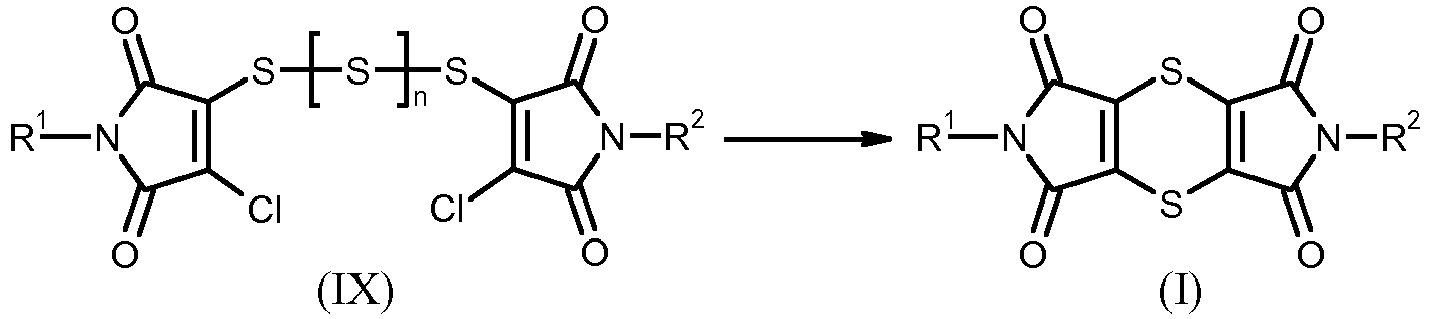
- Das im ersten Schritt des erfindungsgemäßen Verfahrens erhaltene Produktgemisch enthält auch bereits Dithiin-tetracarboximide der Formel (I), als Hauptkomponenten jedoch Polysulfide der Formel (IX),


- Die Thiosulfonsäurederivate der allgemeinen Formel (VIII) und die Polysulfide der allgemeinen Formel (IX) sind neu und ebenfalls Gegenstand der vorliegenden Erfindung.
- In den Thiosulfonsäurederivaten der allgemeinen Formel (VIII) steht R für die oben angegebenen Bedeutungen von R1 bzw. R2 und X für Chlor oder Hydroxy.
- In den Polysulfiden der allgemeinen Formel (IX) stehen R1 und R2 für die oben angegebenen Bedeutungen und n für 0, 1 oder 2.
- Verbindungen der allgemeinen Formel (VIII) erhält man neben anderen Produkten dann, wenn das Reaktionsgemisch nach der Umsetzung der Verbindungen der allgemeinen Formel (VI) mit Thionylchlorid eingeengt wird.
- Verbindungen der allgemeinen Formel (IX) erhält man neben anderen Produkten dann, wenn man das Reaktionsgemisch nach der Umsetzung der Verbindungen der allgemeinen Formel (VI) mit Thionylchlorid einengt, in einem inerten, nicht mit Wasser mischbaren Lösungsmittel wie beispielsweise Methylenchlorid löst und bei Raumtemperatur mit Wasser ausschüttelt. Nach Abtrennen der organischen Phase, Trocknen und Einengen erhält man ein Gemisch, das neben Dithiin-tetracarboximiden der Formel (I) hauptsächlich Verbindungen der allgemeinen Formel (IX) enthält.
- Das erfindungsgemäße Verfahren zur Herstellung der Dithiin-tetracarboximide der Formel (I) kann durch das folgende Schema veranschaulicht werden:

- Die bei der Durchführung des erfindungsgemäßen Verfahrens als Ausgangstoffe eingesetzten Bernsteinsäuremonoamide sind durch die Formel (VI) allgemein definiert. R steht für die Bedeutungen von R1 oder R2.
- R1 und R2
- sind bevorzugt gleich oder verschieden und stehen bevorzugt für Wasserstoff, für gegebenenfalls einfach oder mehrfach durch Fluor, Chlor, Brom, -OR3, -COR4 substituiertes C1-C6-Alkyl, gegebenenfalls einfach oder mehrfach durch Chlor, Methyl oder Trifluormethyl substituiertes C3-C7-Cycloalkyl, für jeweils gegebenenfalls einfach oder mehrfach durch Fluor, Chlor, Brom, Methyl, Trifluormethyl, -COR4, Sulfonylamino substituiertes Phenyl oder Phenyl-(C1-C4-alkyl).
- R1 und R2
- sind besonders bevorzugt gleich oder verschieden und stehen besonders bevorzugt für Wasserstoff, für gegebenenfalls einfach oder mehrfach durch Fluor, Chlor, Hydroxy, Methoxy, Ethoxy, Methylcarbonyloxy, Carboxyl substituiertes C1-C4-Alkyl, gegebenenfalls einfach oder mehrfach durch Chlor, Methyl oder Trifluormethyl substituiertes C3-C7-Cycloalkyl, für jeweils gegebenenfalls einfach bis dreifach durch Fluor, Chlor, Brom, Methyl, Trifluormethyl, -COR4, Sulfonylamino substituiertes Phenyl, Benzyl, 1-Phenethyl, 2-Phenethyl oder 2-Methyl-2-phenethyl.
- R1 und R2
- sind ganz besonders bevorzugt gleich oder verschieden und stehen ganz besonders bevorzugt für Wasserstoff, Methyl, Ethyl, n-Propyl, Isopropyl, 2,2-Difluorethyl, 2,2,2-Trifluorethyl, jeweils gegebenenfalls durch Chlor, Methyl oder Trifluormethyl substituiertes Cyclopropyl oder Cyclohexyl.
- R1 und R2
- stehen insbesondere bevorzugt gleichzeitig für Methyl.
- R3
- steht bevorzugt für Wasserstoff, Methyl, Ethyl, Methylcarbonyl, Ethylcarbonyl oder für gegebenenfalls einfach oder mehrfach durch Fluor, Chlor, Methyl, Ethyl, n-Propyl, Isopropyl oder Trifluormethyl substituiertes Phenyl.
- R3
- steht besonders bevorzugt für Wasserstoff, Methyl, Methylcarbonyl oder für Phenyl.
- R4
- steht bevorzugt für Hydroxy, Methyl, Ethyl, Methoxy oder Ethoxy.
- R4
- steht besonders bevorzugt für Hydroxy oder Methoxy.
- Setzt man Bernsteinsäuretertiärbutylamid als Ausgangsstoff ein, erhält man die Verbindung (I-2) 2,6-Di-tert-butyl-1H,5H-[1,4]dithiino[2,3-c:5,6-c']dipyrrol-1,3,5,7(2H,6H)-tetron als Endprodukt.
- Setzt man Bernsteinsäurecyclohexylamid als Ausgangsstoff ein, erhält man die Verbindung (I-3) 2,6-Dicyclohexyl-1H,5H-[1,4]dithiino[2,3-c:5,6-c']dipyrrol-1,3,5,7(2H,6H)-tetron als Endprodukt.
- Setzt man Bernsteinsäurepropylamid als Ausgangsstoff ein, erhält man die Verbindung (I-4) 2,6-Dipropyl-1H,5H-[1,4]dithiino[2,3-c:5,6-c']dipyrrol-1,3,5,7(2H,6H)-tetron als Endprodukt.
- Als Zwischenprodukte erhält man besonders bevorzugt
- (VIII-1) S-(4-Chlor-1-methyl-2,5-dioxo-2,5-dihydro-1H-pyrrol-3-yl)chlorothiosulfat (R = Me, X = Cl),
- (IX-1) 3,3'-Trisulfan-1,3-diylbis(4-chlor-1-methyl-1H-pyrrol-2,5-dion) (R1 = R2 = Me, n= 1)
- (IX-2) 3,3'-Disulfanediylbis(4-chlor-1-methyl-1H-pyrrol-2,5-dion) (R1 = R2 = Me, n = 0)
- (IX-3) 3,3'-Disulfanediylbis(1-tert-butyl-4-chlor-1H-pyrrol-2,5-dion) (R1 = R2 = t-Bu, n = 0)
- (IX-4) 3,3'-Trisulfan-1,3-diylbis(1-tert-butyl-4-chlor-1H-pyrrol-2,5-dion) (R1 = R2 = t-Bu, n = 1)
- (IX-5) 3,3'-Trisulfan-1,3-diylbis(4-chlor-1-cyclohexyl-1H-pyrrol-2,5-dion) (R1 = R2 = Cyclohexyl , n = 1)
- Die Menge an Thionylchlorid im ersten Schritt des erfindungsgemäßen Verfahrens liegt zwischen 2 und 100 Mol pro Mol Bernsteinsäuremonoamid der Formel (VI). Bevorzugt verwendet man zwischen 4 und 50 Mol, besonders bevorzugt Mengen zwischen 10 und 40 Mol pro Mol Bernsteinsäuremonoamid der Formel (VI).
- Die Reaktionstemperatur im ersten Schritt des erfindungsgemäßen Verfahrens kann in weiten Grenzen variiert werden und liegt zwischen 0°C und 150°C. Zur Erzielung befriedigender Raum-Zeit-Ausbeuten wird man bevorzugt bei Temperaturen zwischen 20°C und 120°C arbeiten; besonders bevorzugt zwischen 30°C und 100°C.
- Die Reaktionszeit im ersten Schritt des erfindungsgemäßen Verfahrens liegt zwischen 10 Minuten und 24 Stunden. Bevorzugt arbeitet man zwischen 30 Minuten und 6 Stunden, besonders bevorzugt zwischen 1 und 4 Stunden.
- Der erste Schritt des erfindungsgemäßen Verfahrens kann gegebenenfalls in Gegenwart eines unter den Reaktionsbedingungen möglichst inerten Verdünnungsmittels durchgeführt werden. Als solche Verdünnungsmittel seien beispielhaft aliphatische Kohlenwasserstoffe wie Pentan, Hexan, Heptan, Cyclohexan, Methylcyclohexan, chlorierte Kohlenwasserstoffe wie Methylenchlorid, Chloroform, 1,2-Dichlorethan, aromatische Kohlenwasserstoffe wie Toluol, Xylol, Mesitylen, chlorierte aromatische Kohlenwasserstoffe wie Chlorbenzol, Dichlorbenzol, Ether wie Diethylether, Methyl-tert-butylether, Tetrahydrofuran, Dioxan, Nitrile wie Acetonitril, Propionitril, Butyronitril, Ester wie Essigsäuremethylester und Essigsäureethylester genannt. Bevorzugt arbeitet man in Methylenchlorid, Chloroform, 1,2-Dichlorethan oder ohne Verdünnungsmittel.
- Die Entfernung des Thionylchlorids kann prinzipiell durch Hydrolyse mit Wasser erfolgen. Bevorzugt wird das Thionylchlorid durch Abdestillieren unter vermindertem Druck entfernt.
- Das gegebenenfalls vorhandene Verdünnungsmittel wird bevorzugt ebenfalls unter vermindertem Druck abdestilliert.
- Im zweiten Schritt des erfindungsgemäßen Verfahrens wird der nach Entfernung des überschüssigen Thionylchlorids und gegebenenfalls des Verdünnungsmittels erhaltene Rückstand in einem neuen Verdünnungsmittel gelöst und durch Erwärmen in diesem Lösungsmittel in die Dithiin-tetracarboximide der Formel (I) überführt. Bevorzugt wird das Reaktionsgemisch hierbei gerührt.
- Im zweiten Schritt des erfindungsgemäßen Verfahrens verwendet man organische Lösungsmittel oder Lösungsmittelgemische. Diese Lösungsmittel sind bevorzugt wenigstens teilweise mit Wasser mischbar.
- Als Verdünnungsmittel für den zweiten Schritt des erfindungsgemäßen Verfahrens eignen sich im Einzelnen Wasser, Dimethylsulfoxid, Sulfolan, Alkohole wie beispielsweise Methanol, Ethanol, Propanol, Isopropanol, 1- Butanol, 2-Butanol, Isobutanol, Tertiärbutanol, 1-Pentanol, Cyclopentanol, Cyclohexanol, Ethylenglykol, Ethylenglkyol-monomethylether, Kohlenwasserstoffe wie Hexan, Heptan, Cyclohexan, Methylcyclohexan, Toluol, Xylole, Mesitylen, Chlorbenzol, Dichlorbenzol, Nitrobenzol, Ester wie Essigsäuremethylester, Essigsäureethylester, Amide wie Formamid, N,N-Dimethylformamid; N,N-Dimethylacetamid, N-Methylpyrrolidon, Ether wie Methyl-tert-butylether, Tetrahydrofuran, 1,4-Dioxan, Nitrile wie Acetonitril, Propionitril, Butyronitril, Benzonitril, Ketone wie Aceton, Methyl-ethylketon, Methyl-isobutylketon, Pinakolon, Carbonsäuren wie Ameisensäure, Essigsäure, Propionsäure, oder Gemische dieser Verdünnungsmittel.
- Bevorzugt verwendet man Wasser, Dimethylsulfoxid, Methanol, Ethanol, Propanol, Isopropanol, 1-Butanol, 2-Butanol, Isobutanol, Tertiärbutanol, 1-Pentanol, Cyclohexanol, Ethylenglykol, Essigsäure-methylester, N,N-Dimethylformamid; N,N-Dimethylacetamid, Tetrahydrofuran, 1,4-Dioxan, Acetonitril, Aceton, Methyl-ethylketon, Methyl-isobutylketon, Essigsäure oder Gemische dieser Verdünnungsmittel.
- Ganz besonders bevorzugt verwendet man Gemische aus Wasser und Methanol, Ethanol, Propanol, Isopropanol, 1-Butanol, 2-Butanol, Isobutanol, 1-Pentanol, Essigsäure-methylester, Tetrahydrofuran, 1,4-Dioxan, Acetonitril, Aceton, Essigsäure.
- Das Mischungsverhältnis Wasser zu organischem Lösungsmittel kann dabei in weiten Grenzen von beispielsweise 9 zu 1 bis 1 zu 9 variiert werden.
- Die Reaktionstemperatur im zweiten Schritt des erfindungsgemäßen Verfahrens kann in weiten Grenzen variiert werden und liegt zwischen 0°C und 200°C. Bevorzugt arbeiten man bei Temperaturen zwischen 20°C und 150°C, besonders bevorzugt zwischen 30°C und 130°C.
- Die Reaktionszeit im zweiten Schritt des erfindungsgemäßen Verfahrens liegt zwischen 5 Minuten und 24 Stunden. Bevorzugt arbeitet man zwischen 30 Minuten und 12 Stunden, besonders bevorzugt zwischen 1 und 6 Stunden.
- Das erfindungsgemäße Verfahren wird durch folgende Beispiele veranschaulicht, ohne auf sie eingeschränkt zu sein.
- Man legt 5,24 g [40 mmol] Bernsteinsäuremethylamid vor und tropft bei 15°C 142,8 g [1200 mmol] Thionylchlorid zu. Es wird dann auf 80°C erwärmt und 1 Stunde bei dieser Temperatur gerührt. Das Reaktionsgemisch wird am Rotationsverdampfer eingeengt. Man erhält 9,9 g eines dicken braunen Öles, das laut HPLC- und LC/MS-Analyse 19,2 Flächen-% an Verbindung (VIII-1), 36,1 Flächen-% an Verbindung (I-1) und 19,1 Flächen-% an Verbindung (IX-1) enthält.
- Verbindung (VIII-1) (R = Me):
- LC/MS (ESI neg.): m/z = 256 ([M-H+], 35Cl; 65%), 176 ([M-H+]-80, 35Cl, 100%).
- 13C-NMR (CDCl3): δ = 25,1 (N-CH3), 135,5, 138,1 (=C-Cl, =C-S), 162,9, 164,9 (-CO-CS, -CO-C-Cl) ppm.
- Zu einer Lösung von 10,5 g [80 mmol] Bernsteinsäuremethylamid in 100 ml Methylenchlorid tropft man bei 15°C 285,6 g [2400 mmol] Thionylchlorid. Man lässt auf Raumtemperatur kommen, erwärmt auf 40°C und rührt 16 Stunden bei dieser Temperatur. Man kühlt auf Raumtemperatur ab und rührt das Reaktionsgemisch in 800 g Eiswasser ein. Nach Stehen über Nacht bei Raumtemperatur trennt man die organische Phase ab, extrahiert die wässrige Phase mit Methylenchlorid, trocknet die vereinigten organischen Phasen und engt dann am Rotationsverdampfer ein. Man erhält 11,8 g eines dicken braunen Öles, das laut HPLC- und LC/MS-Analyse 25,7 Flächen-% an Verbindung (I-1), 22,9 Flächen-% Verbindung (IX-2) und 37,7 Flächen-% an Verbindung (IX-1) enthält.
- Verbindung (IX-2):
- LC/MS (ESI pos.): m/z = 353 (MH+, 2 x 35Cl).
- 13C-NMR (CD3CN): δ = 25,4 (N-CH3), 136,1, 139,4 (=C-S, =C-C1), 164,4, 166,2 (-CO-C-Cl, -CO-C-S) ppm.
- Verbindung (IX-1):
- LC/MS (ESI pos.): m/z = 385 (MH+, 2 x 35Cl).
- 13C-NMR (CDCl3): δ = 25,3 (N-CH3), 136,1, 140,0 (=C-S, =C-Cl), 164,3, 166,2 (-CO-C-Cl, -CO-C-S) ppm.
- 0,2 g des Produktgemisches aus Beispiel 2 werden in 10 ml Methanol gelöst und für 4 Stunden auf 60°C erwärmt. Nach Entfernen des Lösungsmittels ist die Zusammensetzung wie folgt: 61,1 Flächen-% Verbindung (I-1), 9,7 Flächen-% Verbindung (IX-2) und 2,5 Flächen-% Verbindung (IX-1).
- 0,2 g des Produktgemisches aus Beispiel 2 werden in 10 ml Methanol/Wasser (1:1) gelöst und für 4 Stunden auf 60°C erwärmt. Nach Entfernen des Lösungsmittels ist die Zusammensetzung wie folgt: 90,1 Flächen-% Verbindung (I-1), < 0,1 Flächen-% Verbindung (IX-2) und < 0,1 Flächen-% Verbindung (IX-1).
- 0,2 g des Produktgemisches aus Beispiel 2 werden in 10 ml 1,4-Dioxan/Wasser (1:1) gelöst und für 4 Stunden auf 60°C erwärmt. Nach Entfernen des Lösungsmittels ist die Zusammensetzung wie folgt: 84,6 Flächen-% Verbindung (I-1), < 0,1 Flächen-% Verbindung (IX-2) und < 0,1 Flächen-% Verbindung (IX-1).
- 0,2 g des Produktgemisches aus Beispiel 2 werden in 10 ml DMF gelöst und für 4 Stunden auf 60°C erwärmt. Nach Entfernen des Lösungsmittels ist die Zusammensetzung wie folgt: 71,1 Flächen-% Verbindung (I-1), < 0,1 Flächen-% Verbindung (IX-2) und < 0,1 Flächen-% Verbindung (IX-1).
- 0,2 g des Produktgemisches aus Beispiel 2 werden in 10 ml Acetonitril/Wasser (1:1) gelöst und für 4 Stunden auf 60°C erwärmt. Nach Entfernen des Lösungsmittels ist die Zusammensetzung wie folgt: 85,4 Flächen-% Verbindung (I-1), < 0,1 Flächen-% Verbindung (IX-2) und < 0,1 Flächen-% Verbindung (IX-1).
- 0,2 g des Produktgemisches aus Beispiel 2 werden in 10 ml Aceton/Wasser (1:1) gelöst und für 4 Stunden auf 60°C erwärmt. Nach Entfernen des Lösungsmittels ist die Zusammensetzung wie folgt: 85,1 Flächen-% Verbindung (I-1), < 0,1 Flächen-% Verbindung (IX-2) und < 0,1 Flächen-% Verbindung (IX-1).
- 0,2 g des Produktgemisches aus Beispiel 2 werden in 10 ml Essigsäure-methylester/Wasser (1:1) gelöst und für 4 Stunden auf 60°C erwärmt. Nach Entfernen des Lösungsmittels ist die Zusammensetzung wie folgt: 89 Flächen-% Verbindung (I-1), < 0,1 Flächen-% Verbindung (IX-2) und < 0,1 Flächen-% Verbindung (IX-1).
- Zu einer Lösung von 5,24 g [40 mmol] Bernsteinsäuremethylamid in 50 ml Methylenchlorid tropft man bei 15°C 142,8 g [1200 mmol] Thionylchlorid. Man lässt auf Raumtemperatur kommen, erwärmt auf 40°C und rührt 1 Stunde bei dieser Temperatur. Man kühlt auf Raumtemperatur ab und engt am Rotationsverdampfer ein. Man erhält 12 g eines dicken braunen Öles, welches man in 100 ml Ethanol löst. Diese Lösung wird 4 Stunden auf 60°C erwärmt und anschließend auf Raumtemperatur abgekühlt. Der ausgefallene dunkelgrüne Feststoff wird abgesaugt, mit EtOH und Wasser gewaschen und getrocknet. Es resultieren 2,92 g Feststoff, der laut HPLC-Analyse zu 99,1 Flächen-% aus der Verbindung (I-1) besteht, was einer Ausbeute von 51,3% der Theorie entspricht.
- Zu einer Lösung von 5,24 g [40 mmol] Bernsteinsäure-methylamid in 50 ml 1,4-Dioxan tropft man bei 15°C 142,8 g [1200 mmol] Thionylchlorid. Man lässt auf Raumtemperatur kommen, erwärmt dann auf 80°C und rührt 1 Stunde bei dieser Temperatur. Man kühlt auf Raumtemperatur ab und engt am Rotationsverdampfer ein. Man erhält 10,9 g eines dicken braunen Öles, welches man in 100 ml Ethanol löst. Diese Lösung wird 4 Stunden auf 60°C erwärmt und anschließend auf Raumtemperatur abgekühlt. Der ausgefallene dunkelgrüne Feststoff wird abgesaugt, mit EtOH und Wasser gewaschen und getrocknet. Es resultieren 2,66 g Feststoff, der lt. HPLC-Analyse zu 99,4 Flächen-% aus der Verbindung (I-1) besteht, was einer Ausbeute von 46,8% der Theorie entspricht.
- Man legt 5,24 g [40 mmol] Bernsteinsäuremethylamid vor und tropft bei 15°C 142,8 g [1200 mmol] Thionylchlorid zu. Es wird dann auf 80°C erwärmt und 1 Stunde bei dieser Temperatur gerührt. Das Reaktionsgemisch wird am Rotationsverdampfer eingeengt. Der Rückstand (dunkelbraunes dickes Öl) wird mit 100 ml Methanol/Wasser (1:1) versetzt und 4 Stunden auf 60°C erwärmt. Danach lässt man auf Raumtemperatur abkühlen, saugt den ausgefallenen Feststoff ab und wäscht ihn mit Wasser und Methanol. Nach Trocknen resultieren 4,30 g dunkelgrüner Feststoff, der laut HPLC-Analyse zu 94,7 Flächen-% aus der Verbindung (I-1) besteht, was einer Ausbeute von 72,1% der Theorie entspricht.
- Man legt 5,24 g [40 mmol] Bernsteinsäuremethylamid vor und tropft bei 15°C 47,6 g [400 mmol] Thionylchlorid zu. Es wird dann auf 80°C erwärmt und 1 Stunde bei dieser Temperatur gerührt. Das Reaktionsgemisch wird am Rotationsverdampfer eingeengt. Der Rückstand (dunkelbraunes dickes Öl) wird mit 100 ml Methanol/Wasser (1:1) versetzt und 4 Stunden auf 60°C erwärmt. Danach lässt man auf Raumtemperatur abkühlen, saugt den ausgefallenen Feststoff ab und wäscht ihn mit Wasser und Methanol. Nach Trocknen resultieren 4,05 g dunkelgrüner Feststoff, der lt. HPLC-Analyse zu 97,8 Flächen-% aus der Verbindung (I-1) besteht, was einer Ausbeute von 70,2% der Theorie entspricht.
- Zu einer Lösung von 5,24 g [40 mmol] Bernsteinsäuremethylamid in 50 ml 1,4-Dioxan tropft man bei 15°C 142,8 g [1200 mmol] Thionylchlorid. Man lässt auf Raumtemperatur kommen und rührt 16 Stunden bei Raumtemperatur. Das Reaktionsgemisch wird in ca. 400 g Eiswasser eingerührt. Man setzt ca. 100 ml Essigsäureethylester zu und saugt den ausgefallenen grünen Feststoff ab, wäscht mit Wasser und Essigsäureethylester und trocknet. Es resultieren 1,00 g Feststoff einer Reinheit von 80,8 Flächen-%, was einer Ausbeute von 14,3% der Theorie entspricht. Die organische Phase des Filtrates wird abgetrennt und mit Wasser gewaschen. Dadurch fällt an der Phasengrenzfläche weiterer Feststoff aus: 0,40 g, 99,1%ig (7,2% der Theorie). Das Filtrat der organischen Phase wird eingeengt und der Rückstand mit Methyl-tertiärbutylether (MTBE) verrührt. Der so erhaltenen Feststoff wird abgesaugt und getrocknet: 0,70 g, 51,0%ig (6,3% der Theorie). Die gesammelten wässrigen Phasen lässt man 2 Tage bei Raumtemperatur stehen; danach ist weiterer Feststoff ausgefallen, der ebenfalls isoliert wird: 0,50 g, 99,1%ig (8,8% der Theorie). Insgesamt beträgt die erhaltene Ausbeute also 36,5% der Theorie an Verbindung (I-1).
- Zu einer Lösung von 5,24 g [40 mmol] Bernsteinsäuremethylamid in 50 ml 1,4-Dioxan tropft man bei 15°C 142,8 g [1200 mmol] Thionylchlorid. Man lässt auf Raumtemperatur kommen, erwärmt dann auf 80°C und rührt 1 Stunde bei dieser Temperatur. Man kühlt auf Raumtemperatur ab, rührt in ca. 400 g Eiswasser ein, lässt über Nacht stehen, saugt den ausgefallenen grünen Feststoff ab, wäscht mit Wasser und Essigester und trocknet. Es resultieren 3,75 g Feststoff einer Reinheit von nur 76,5 Flächen-% (50,8% der Theorie).
- Man legt 6,93 g [40 mmol] Bernsteinsäuretertiärbutylamid vor und tropft bei 15°C 142,8 g [1200 mmol] Thionylchlorid zu. Es wird dann auf 80°C erwärmt und 1 Stunde bei dieser Temperatur gerührt. Das Reaktionsgemisch wird am Rotationsverdampfer eingeengt. Das resultierende dicke braune Öl wird in Methylenchlorid gelöst und mit gesättigter wässriger NaCl-Lösung gewaschen. Die organische Phase wird über Natriumsulfat getrocknet und eingeengt. Man erhält 7,65 g braunen Rückstand, der laut HPLC und LC/MS 14,3 Flächen-% an Verbindung (IX-3) und 9,7 Flächen-% Verbindung (IX-4) enthält.
- Verbindung (IX-3):
- LC/MS (ESI pos.): m/z = 437 ([MH+], 2 x 35Cl; 60%), 454 ([MH+] + NH3, 2x 35Cl, 100%).
- Verbindung (IX-4):
- LC/MS (ESI pos.): m/z = 469 ([MH+], 2 x 35Cl; 20%), 486 ([MH+] + NH3, 2x 35Cl, 100%).
- Man legt 6,93 g [40 mmol] Bernsteinsäuretertiärbutylamid vor und tropft bei 15°C 142,8 g [1200 mmol] Thionylchlorid zu. Es wird dann auf 50°C erwärmt und 4 Stunden bei dieser Temperatur gerührt. Das Reaktionsgemisch wird am Rotationsverdampfer eingeengt. Das resultierende dicke braune Öl wird in 100 ml EtOH/H2O (1:1) aufgenommen und 4 Stunden auf 60°C erhitzt. Danach wird auf Raumtemperatur abgekühlt, der Feststoff abgesaugt, mit Wasser und EtOH gewaschen und getrocknet. Man erhält 5,00 g braunen Feststoff, der laut HPLC 99,6 Flächen-% Verbindung (I-3) enthält.
- Man legt 8 g [40 mmol] Bernsteinsäurecyclohexylamid vor und tropft bei 15°C 142,8 g [1200 mmol] Thionylchlorid zu. Es wird dann auf 80°C erwärmt und 1 Stunde bei dieser Temperatur gerührt. Das Reaktionsgemisch wird am Rotationsverdampfer eingeengt. Das resultierende dicke braune Öl wird in Methylenchlorid gelöst und mit gesättigter wässriger NaCl-Lösung gewaschen. Die organische Phase wird über Natriumsulfat getrocknet und eingeengt. Man erhält 10,8 g braunen Rückstand, der laut HPLC und LC/MS 19 Flächen-% an Verbindung (IX-5) enthält.
- Verbindung (IX-5):
- LC/MS (ESI pos.): m/z = 521 ([MH+], 2 x 35Cl; 70%), 538 ([MH+] + NH3, 2 x 35Cl, 100%).
- Man legt 8 g [40 mmol] Bernsteinsäurecyclohexylamid vor und tropft bei 15°C 142,8 g [1200 mmol] Thionylchlorid zu. Es wird dann auf 50°C erwärmt und 4 Stunden bei dieser Temperatur gerührt. Das Reaktionsgemisch wird am Rotationsverdampfer eingeengt. Das resultierende dicke braune Öl wird in 100 ml EtOH/H2O (1:1) aufgenommen und 4 Stunden auf 60°C erhitzt. Danach wird auf Raumtemperatur abgekühlt, der Feststoff abgesaugt, mit Wasser und EtOH gewaschen und getrocknet. Man erhält 2,86 g braunen Feststoff, der laut HPLC 92,1 Flächen-% Verbindung (I-3) enthält.
- Man legt 6,37 g [40 mmol] Bernsteinsäurepropylamid vor und tropft bei 15°C 142,8 g [1200 mmol] Thionylchlorid zu. Es wird dann auf 50°C erwärmt und 4 Stunden bei dieser Temperatur gerührt. Das Reaktionsgemisch wird am Rotationsverdampfer eingeengt. Das resultierende dicke braune Öl wird in 100 ml EtOH/H2O (1:1) aufgenommen und 4 Stunden auf 60°C erhitzt. Danach wird auf Raumtemperatur abgekühlt, der Feststoff abgesaugt, mit Wasser und EtOH gewaschen und getrocknet. Man erhält 2,15 g grünen Feststoff, der laut HPLC 99,4 Flächen-% Verbindung (I-4) enthält.
- HPLC-Bedingungen: Zorbax Eclipse Plus C18 4.6*50 mm 1.8µm, Eluent A: 0.1% H3P04, Eluent B: Acetonitril, Gradient: 90/10, 20%/min, 5/95 (1.75), Fluss: 2 ml/min, 55°C.
Claims (9)
- Verfahren zum Herstellen von Dithiin-tetracarboximide der allgemeinen Formel (I)
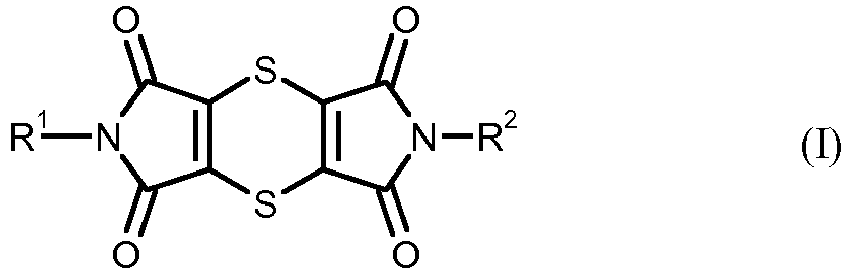 R1 und R2 gleich oder verschieden sind und für Wasserstoff, für gegebenenfalls einfach oder mehrfach durch Halogen, -OR3, -COR4 substituiertes C1-C8-Alkyl, gegebenenfalls einfach oder mehrfach durch Halogen, C1-C4-Alkyl oder C1-C4-Halogenalkyl substituiertes C3-C7-Cycloalkyl, jeweils gegebenenfalls einfach oder mehrfach durch Halogen, C1-C4-Alkyl, C1-C4-Halogenalkyl, -COR4 oder Sulfonylamino substituiertes Aryl oder Aryl-(C1-C4-alkyl) stehen,R3 für Wasserstoff, C1-C4-Alkyl, C1-C4-Alkylcarbonyl oder für gegebenenfalls einfach oder mehrfach durch Halogen, C1-C4-Alkyl oder C1-C4-Halogenalkyl substituiertes Aryl steht,R4 für Hydroxy, C1-C4-Alkyl oder C1-C4-Alkoxy steht,dadurch gekennzeichnet, dass man
in einer ersten Stufe Bernsteinsäuremonoamide der Formel (VI)
mit einem Überschuss an Thionylchlorid gegebenenfalls in Gegenwart eines Verdünnungsmittels umsetzt,
anschließend den Überschuss an Thionylchlorid entfernt und das so erhaltene Produktgemisch in einer zweiten Stufe in einem organischen Lösungsmittel in die Dithiin-tetracarboximide der Formel (I) überführt. - Verfahren gemäß Anspruch 1, dadurch gekennzeichnet, dass man im ersten Schritt zwischen 2 und 100 Mol Thionylchlorid pro Mol Bernsteinsäuremonoamid der Formel (VI) einsetzt.
- Verfahren gemäß Anspruch 1 oder 2, dadurch gekennzeichnet, dass der erste Schritt ohne Verdünnungsmittel durchgeführt wird.
- Verfahren gemäß Anspruch 1, 2 oder 3, dadurch gekennzeichnet, dass man im zweiten Schritt ein organisches Lösungsmittel einsetzt, welches wenigstens teilweise mit Wasser mischbar ist.
- Verfahren gemäß Anspruch 1, 2, 3 oder 4, dadurch gekennzeichnet, dass man im zweiten Schritt als Lösungsmittel Wasser, Dimethylsulfoxid, Sulfolan, Alkohole wie Methanol, Ethanol, Propanol, Isopropanol, 1- Butanol, 2-Butanol, Isobutanol, Tertiärbutanol, 1-Pentanol, Cyclopentanol, Cyclohexanol, Ethylenglykol, Ethylenglkyol-monomethylether, Kohlenwasserstoffe wie Hexan, Heptan, Cyclohexan, Methylcyclohexan, Toluol, Xylole, Mesitylen, Chlorbenzol, Dichlorbenzol, Nitrobenzol, Ester wie Essigsäuremethylester, Essigsäureethylester, Amide wie Formamid, N,N-Dimethylformamid; N,N-Dimethylacetamid, N-Methylpyrrolidon, Ether wie Methyl-tert-butylether, Tetrahydrofuran, 1,4-Dioxan, Nitrile wie Acetonitril, Propionitril, Butyronitril, Benzonitril, Ketone wie Aceton, Methyl-ethylketon, Methyl-isobutylketon, Pinakolon, Carbonsäuren wie Ameisensäure, Essigsäure, Propionsäure oder Gemische dieser Verdünnungsmittel einsetzt.
- Verfahren gemäß Anspruch 1, 2, 3, 4 oder 5, dadurch gekennzeichnet, dass man den zweiten Schritt unter Erwärmung durchführt.
- Verfahren zum Herstellen von Polysulfiden der Formel (IX),
 R1 und R2 gleich oder verschieden sind und für Wasserstoff, für gegebenenfalls einfach oder mehrfach durch Halogen, -OR3, -COR4 substituiertes C1-C8-Alkyl, gegebenenfalls einfach oder mehrfach durch Halogen, C1-C4-Alkyl oder C1-C4-Halogenalkyl substituiertes C3-C7-Cycloalkyl, jeweils gegebenenfalls einfach oder mehrfach durch Halogen, C1-C4-Alkyl, C1-C4-Halogenalkyl, -COR4 oder Sulfonylamino substituiertes Aryl oder Aryl-(C1-C4-alkyl) stehen,R3 für Wasserstoff, C1-C4-Alkyl, C1-C4-Alkylcarbonyl oder für gegebenenfalls einfach oder mehrfach durch Halogen, C1-C4-Alkyl oder C1-C4-Halogenalkyl substituiertes Aryl steht,R4 für Hydroxy, C1-C4-Alkyl oder C1-C4-Alkoxy steht,n für 0, 1 oder 2 steht,sowie von Thiosulfonsäurederivaten der Formel (VIII)
in einer ersten Stufe Bernsteinsäuremonoamide der Formel (VI)
mit einem Überschuss an Thionylchlorid gegebenenfalls in Gegenwart eines Verdünnungsmittels umsetzt. - Polysulfide der Formel (IX),
 R1 und R2 gleich oder verschieden sind und für Wasserstoff, für gegebenenfalls einfach oder mehrfach durch Halogen, -OR3, -COR4 substituiertes C1-C8-Alkyl, gegebenenfalls einfach oder mehrfach durch Halogen, C1-C4-Alkyl oder C1-C4-Halogenalkyl substituiertes C3-C7-Cycloalkyl, jeweils gegebenenfalls einfach oder mehrfach durch Halogen, C1-C4-Alkyl, C1-C4-Halogenalkyl, -COR4 oder Sulfonylamino substituiertes Aryl oder Aryl-(C1-C4-alkyl) stehen,R3 für Wasserstoff, C1-C4-Alkyl, C1-C4-Alkylcarbonyl oder für gegebenenfalls einfach oder mehrfach durch Halogen, C1-C4-Alkyl oder C1-C4-Halogenalkyl substituiertes Aryl steht,R4 für Hydroxy, C1-C4-Alkyl oder C1-C4-Alkoxy steht,n für 0, 1 oder 2 steht.
 - Thiosulfonsäurederivate der allgemeinen Formel (VIII)
 R für Wasserstoff, für gegebenenfalls einfach oder mehrfach durch Halogen, -OR3, -COR4 substituiertes C1-C8-Alkyl, gegebenenfalls einfach oder mehrfach durch Halogen, C1-C4-Alkyl oder C1-C4-Halogenalkyl substituiertes C3-C7-Cycloalkyl, jeweils gegebenenfalls einfach oder mehrfach durch Halogen, C1-C4-Alkyl, C1-C4-Halogenalkyl, -COR4 oder Sulfonylamino substituiertes Aryl oder Aryl-(C1-C4-alkyl) steht,R3 für Wasserstoff, C1-C4-Alkyl, C1-C4-Alkylcarbonyl oder für gegebenenfalls einfach oder mehrfach durch Halogen, C1-C4-Alkyl oder C1-C4-Halogenalkyl substituiertes Aryl steht,R4 für Hydroxy, C1-C4-Alkyl oder C1-C4-Alkoxy steht;X für Chlor oder Hydroxy steht.
Priority Applications (1)
| Application Number | Priority Date | Filing Date | Title |
|---|---|---|---|
| EP11712882.7A EP2558473B1 (de) | 2010-04-14 | 2011-04-08 | Verfahren zur herstellung von dithiin-tetracarboximiden |
Applications Claiming Priority (4)
| Application Number | Priority Date | Filing Date | Title |
|---|---|---|---|
| EP10159899 | 2010-04-14 | ||
| US32507410P | 2010-04-16 | 2010-04-16 | |
| PCT/EP2011/055512 WO2011128263A1 (de) | 2010-04-14 | 2011-04-08 | Verfahren zur herstellung von dithiin-tetracarboximiden |
| EP11712882.7A EP2558473B1 (de) | 2010-04-14 | 2011-04-08 | Verfahren zur herstellung von dithiin-tetracarboximiden |
Publications (2)
| Publication Number | Publication Date |
|---|---|
| EP2558473A1 EP2558473A1 (de) | 2013-02-20 |
| EP2558473B1 true EP2558473B1 (de) | 2016-09-07 |
Family
ID=42670476
Family Applications (1)
| Application Number | Title | Priority Date | Filing Date |
|---|---|---|---|
| EP11712882.7A Not-in-force EP2558473B1 (de) | 2010-04-14 | 2011-04-08 | Verfahren zur herstellung von dithiin-tetracarboximiden |
Country Status (14)
| Country | Link |
|---|---|
| US (1) | US8450360B2 (de) |
| EP (1) | EP2558473B1 (de) |
| JP (1) | JP5816262B2 (de) |
| KR (1) | KR101863621B1 (de) |
| CN (1) | CN103003284B (de) |
| BR (1) | BR112012026157A2 (de) |
| CO (1) | CO6630110A2 (de) |
| DK (1) | DK2558473T3 (de) |
| ES (1) | ES2605005T3 (de) |
| IL (1) | IL222243A (de) |
| MX (1) | MX2012011731A (de) |
| RU (1) | RU2559626C9 (de) |
| TW (1) | TWI488856B (de) |
| WO (1) | WO2011128263A1 (de) |
Families Citing this family (6)
| Publication number | Priority date | Publication date | Assignee | Title |
|---|---|---|---|---|
| JP5756522B2 (ja) * | 2010-09-03 | 2015-07-29 | バイエル・インテレクチュアル・プロパティ・ゲゼルシャフト・ミット・ベシュレンクテル・ハフツングBayer Intellectual Property GmbH | ジチイン−テトラカルボキシイミド類を製造する方法 |
| EP2766372A1 (de) * | 2011-10-13 | 2014-08-20 | Bayer Intellectual Property GmbH | Verfahren zur herstellung von dithiin-tetracarboximiden |
| US20140256956A1 (en) * | 2011-10-13 | 2014-09-11 | Bayer Intellectual Property Gmbh | Method for producing dithine tetracarboximides |
| EP2641908A1 (de) | 2012-03-23 | 2013-09-25 | Bayer CropScience AG | Verfahren zur Herstellung von Dithiin-tetracarboximiden |
| AR111805A1 (es) | 2017-05-19 | 2019-08-21 | Sumitomo Chemical Co | Método para controlar una fitoenfermedad resistente a multifármacos de tipo eflujo |
| CN113831354A (zh) * | 2021-09-30 | 2021-12-24 | 浙江工业大学 | 二噻烯-四甲酰亚胺类衍生物及其制备和应用 |
Family Cites Families (10)
| Publication number | Priority date | Publication date | Assignee | Title |
|---|---|---|---|---|
| US3364229A (en) | 1964-01-30 | 1968-01-16 | Shell Oil Co | 1, 4 dithiin-2, 3, 5, 6-tetracarboximides and process for their preparation |
| PL143804B2 (en) | 1985-10-15 | 1988-03-31 | Univ Lodzki | Process for preparing novel derivatives of 2,6-diphenyl-2,3,6,7-tetrahydro-1h,5h-1,4-dithiin-/2,3-c:5,6-c/-diprolo-1,3,5,7-tetraon substituted in phenyl ring |
| WO1994024985A1 (fr) | 1993-04-28 | 1994-11-10 | Japan Institute Of Advanced Dentistry | Composition de pate pour ciment dentaire et ciment dentaire |
| DE19636769A1 (de) * | 1996-09-10 | 1998-03-12 | Basf Ag | 3-Substituierte Pyrido [4',3':4,5]thieno[2,3-d]pyrimidin-Derivate, ihre Herstellung und Verwendung |
| JP3530702B2 (ja) * | 1997-03-06 | 2004-05-24 | 京セラミタ株式会社 | ジチオマレイン酸イミド誘導体を用いた電子写真感光体 |
| ES2259891B1 (es) * | 2004-11-30 | 2007-11-01 | Laboratorios Almirall S.A. | Nuevos derivados de piridotienopirimidina. |
| CN100554251C (zh) * | 2005-07-12 | 2009-10-28 | 中国科学院化学研究所 | 一种马来酰亚胺衍生物及其制备方法 |
| BR112012026411A2 (pt) | 2010-04-14 | 2015-09-08 | Bayer Cropscience Ag | processo para preparar ditiina-tetracarboxi-diiminas |
| CN103270041A (zh) | 2010-05-06 | 2013-08-28 | 拜尔农作物科学股份公司 | 二噻英-四羧基-二酰亚胺的制备方法 |
| DK2571887T3 (en) | 2010-05-21 | 2014-11-24 | Bayer Cropscience Ag | A process for the preparation of dithiine-tetracarboxy-diimides |
-
2011
- 2011-04-08 KR KR1020127028738A patent/KR101863621B1/ko not_active Expired - Fee Related
- 2011-04-08 CN CN201180028985.3A patent/CN103003284B/zh not_active Expired - Fee Related
- 2011-04-08 DK DK11712882.7T patent/DK2558473T3/da active
- 2011-04-08 RU RU2012148146/04A patent/RU2559626C9/ru not_active IP Right Cessation
- 2011-04-08 JP JP2013504207A patent/JP5816262B2/ja not_active Expired - Fee Related
- 2011-04-08 ES ES11712882.7T patent/ES2605005T3/es active Active
- 2011-04-08 BR BR112012026157A patent/BR112012026157A2/pt not_active Application Discontinuation
- 2011-04-08 EP EP11712882.7A patent/EP2558473B1/de not_active Not-in-force
- 2011-04-08 WO PCT/EP2011/055512 patent/WO2011128263A1/de not_active Ceased
- 2011-04-08 MX MX2012011731A patent/MX2012011731A/es active IP Right Grant
- 2011-04-12 TW TW100112540A patent/TWI488856B/zh not_active IP Right Cessation
- 2011-04-14 US US13/086,512 patent/US8450360B2/en not_active Expired - Fee Related
-
2012
- 2012-10-09 IL IL222243A patent/IL222243A/en active IP Right Grant
- 2012-10-12 CO CO12180999A patent/CO6630110A2/es active IP Right Grant
Also Published As
| Publication number | Publication date |
|---|---|
| RU2559626C9 (ru) | 2016-05-27 |
| TW201206941A (en) | 2012-02-16 |
| ES2605005T3 (es) | 2017-03-10 |
| WO2011128263A1 (de) | 2011-10-20 |
| JP5816262B2 (ja) | 2015-11-18 |
| US20110269973A1 (en) | 2011-11-03 |
| MX2012011731A (es) | 2012-11-16 |
| KR20130092950A (ko) | 2013-08-21 |
| DK2558473T3 (da) | 2016-12-19 |
| EP2558473A1 (de) | 2013-02-20 |
| RU2012148146A (ru) | 2014-05-20 |
| KR101863621B1 (ko) | 2018-06-04 |
| RU2559626C2 (ru) | 2015-08-10 |
| JP2013523852A (ja) | 2013-06-17 |
| IL222243A (en) | 2015-07-30 |
| TWI488856B (zh) | 2015-06-21 |
| CO6630110A2 (es) | 2013-03-01 |
| BR112012026157A2 (pt) | 2015-09-08 |
| CN103003284A (zh) | 2013-03-27 |
| CN103003284B (zh) | 2016-01-20 |
| US8450360B2 (en) | 2013-05-28 |
Similar Documents
| Publication | Publication Date | Title |
|---|---|---|
| EP2558473B1 (de) | Verfahren zur herstellung von dithiin-tetracarboximiden | |
| EP2566871A2 (de) | Verfahren zur herstellung von dithiin-tetracarboxy-diimiden | |
| EP1644314B1 (de) | Verfahren zum herstellen von difluoracetessigs urealkylestern | |
| EP2558472B1 (de) | Verfahren zur herstellung von dithiin-tetracarboxy-diimiden | |
| EP2571887B1 (de) | Verfahren zur Herstellung von Dithiin-tetracarboxy-diimiden | |
| EP2611814B1 (de) | Verfahren zur herstellung von dithiin-tetracarboximiden | |
| EP0184981B1 (de) | Neue Pyrrolinone und deren Zwischenprodukte | |
| WO2013053784A1 (de) | Verfahren zur herstellung von dithiin-tetracarboximiden | |
| EP2766371A1 (de) | Verfahren zur herstellung von dithiin-tetracarboximiden | |
| DE10331496A1 (de) | Verfahren zum Herstellen von Difluoracetessigsäurealkylestern | |
| EP2828268B1 (de) | Verfahren zur herstellung von dithiin-tetracarboximiden | |
| DE10208955A1 (de) | Verfahren zur Herstellung von 2-Halogenalkylnicotinsäuren | |
| TW201321387A (zh) | 製備二硫雜己環并-四甲醯胺類之方法 | |
| IT201800002347A1 (it) | Intermedi e procedimento per la preparazione di una forma cristallina di un farmaco antiinfiammatorio topico | |
| DE10116378C2 (de) | Verfahren zur Herstellung von 6-Aryl-4H-s-triazolo[3,4-c]-thieno[2,3-e]-1,4-diazepinen | |
| AT404726B (de) | Kristalline salze von derivaten der 3-vinyl-3-cephem-4-carbonsäure und verfahren zu deren herstellung |
Legal Events
| Date | Code | Title | Description |
|---|---|---|---|
| PUAI | Public reference made under article 153(3) epc to a published international application that has entered the european phase |
Free format text: ORIGINAL CODE: 0009012 |
|
| 17P | Request for examination filed |
Effective date: 20121114 |
|
| AK | Designated contracting states |
Kind code of ref document: A1 Designated state(s): AL AT BE BG CH CY CZ DE DK EE ES FI FR GB GR HR HU IE IS IT LI LT LU LV MC MK MT NL NO PL PT RO RS SE SI SK SM TR |
|
| DAX | Request for extension of the european patent (deleted) | ||
| RAP1 | Party data changed (applicant data changed or rights of an application transferred) |
Owner name: BAYER INTELLECTUAL PROPERTY GMBH |
|
| GRAP | Despatch of communication of intention to grant a patent |
Free format text: ORIGINAL CODE: EPIDOSNIGR1 |
|
| INTG | Intention to grant announced |
Effective date: 20160329 |
|
| GRAS | Grant fee paid |
Free format text: ORIGINAL CODE: EPIDOSNIGR3 |
|
| GRAA | (expected) grant |
Free format text: ORIGINAL CODE: 0009210 |
|
| AK | Designated contracting states |
Kind code of ref document: B1 Designated state(s): AL AT BE BG CH CY CZ DE DK EE ES FI FR GB GR HR HU IE IS IT LI LT LU LV MC MK MT NL NO PL PT RO RS SE SI SK SM TR |
|
| REG | Reference to a national code |
Ref country code: GB Ref legal event code: FG4D Free format text: NOT ENGLISH |
|
| REG | Reference to a national code |
Ref country code: CH Ref legal event code: EP |
|
| REG | Reference to a national code |
Ref country code: IE Ref legal event code: FG4D Free format text: LANGUAGE OF EP DOCUMENT: GERMAN |
|
| REG | Reference to a national code |
Ref country code: AT Ref legal event code: REF Ref document number: 826745 Country of ref document: AT Kind code of ref document: T Effective date: 20161015 |
|
| REG | Reference to a national code |
Ref country code: DE Ref legal event code: R096 Ref document number: 502011010626 Country of ref document: DE |
|
| REG | Reference to a national code |
Ref country code: NL Ref legal event code: FP |
|
| REG | Reference to a national code |
Ref country code: DK Ref legal event code: T3 Effective date: 20161215 |
|
| REG | Reference to a national code |
Ref country code: LT Ref legal event code: MG4D |
|
| PG25 | Lapsed in a contracting state [announced via postgrant information from national office to epo] |
Ref country code: LT Free format text: LAPSE BECAUSE OF FAILURE TO SUBMIT A TRANSLATION OF THE DESCRIPTION OR TO PAY THE FEE WITHIN THE PRESCRIBED TIME-LIMIT Effective date: 20160907 Ref country code: RS Free format text: LAPSE BECAUSE OF FAILURE TO SUBMIT A TRANSLATION OF THE DESCRIPTION OR TO PAY THE FEE WITHIN THE PRESCRIBED TIME-LIMIT Effective date: 20160907 Ref country code: HR Free format text: LAPSE BECAUSE OF FAILURE TO SUBMIT A TRANSLATION OF THE DESCRIPTION OR TO PAY THE FEE WITHIN THE PRESCRIBED TIME-LIMIT Effective date: 20160907 Ref country code: NO Free format text: LAPSE BECAUSE OF FAILURE TO SUBMIT A TRANSLATION OF THE DESCRIPTION OR TO PAY THE FEE WITHIN THE PRESCRIBED TIME-LIMIT Effective date: 20161207 |
|
| PG25 | Lapsed in a contracting state [announced via postgrant information from national office to epo] |
Ref country code: GR Free format text: LAPSE BECAUSE OF FAILURE TO SUBMIT A TRANSLATION OF THE DESCRIPTION OR TO PAY THE FEE WITHIN THE PRESCRIBED TIME-LIMIT Effective date: 20161208 Ref country code: SE Free format text: LAPSE BECAUSE OF FAILURE TO SUBMIT A TRANSLATION OF THE DESCRIPTION OR TO PAY THE FEE WITHIN THE PRESCRIBED TIME-LIMIT Effective date: 20160907 Ref country code: LV Free format text: LAPSE BECAUSE OF FAILURE TO SUBMIT A TRANSLATION OF THE DESCRIPTION OR TO PAY THE FEE WITHIN THE PRESCRIBED TIME-LIMIT Effective date: 20160907 |
|
| REG | Reference to a national code |
Ref country code: ES Ref legal event code: FG2A Ref document number: 2605005 Country of ref document: ES Kind code of ref document: T3 Effective date: 20170310 |
|
| REG | Reference to a national code |
Ref country code: FR Ref legal event code: PLFP Year of fee payment: 7 |
|
| PG25 | Lapsed in a contracting state [announced via postgrant information from national office to epo] |
Ref country code: RO Free format text: LAPSE BECAUSE OF FAILURE TO SUBMIT A TRANSLATION OF THE DESCRIPTION OR TO PAY THE FEE WITHIN THE PRESCRIBED TIME-LIMIT Effective date: 20160907 Ref country code: EE Free format text: LAPSE BECAUSE OF FAILURE TO SUBMIT A TRANSLATION OF THE DESCRIPTION OR TO PAY THE FEE WITHIN THE PRESCRIBED TIME-LIMIT Effective date: 20160907 |
|
| PG25 | Lapsed in a contracting state [announced via postgrant information from national office to epo] |
Ref country code: PT Free format text: LAPSE BECAUSE OF FAILURE TO SUBMIT A TRANSLATION OF THE DESCRIPTION OR TO PAY THE FEE WITHIN THE PRESCRIBED TIME-LIMIT Effective date: 20170109 Ref country code: SK Free format text: LAPSE BECAUSE OF FAILURE TO SUBMIT A TRANSLATION OF THE DESCRIPTION OR TO PAY THE FEE WITHIN THE PRESCRIBED TIME-LIMIT Effective date: 20160907 Ref country code: SM Free format text: LAPSE BECAUSE OF FAILURE TO SUBMIT A TRANSLATION OF THE DESCRIPTION OR TO PAY THE FEE WITHIN THE PRESCRIBED TIME-LIMIT Effective date: 20160907 Ref country code: IS Free format text: LAPSE BECAUSE OF FAILURE TO SUBMIT A TRANSLATION OF THE DESCRIPTION OR TO PAY THE FEE WITHIN THE PRESCRIBED TIME-LIMIT Effective date: 20170107 Ref country code: CZ Free format text: LAPSE BECAUSE OF FAILURE TO SUBMIT A TRANSLATION OF THE DESCRIPTION OR TO PAY THE FEE WITHIN THE PRESCRIBED TIME-LIMIT Effective date: 20160907 Ref country code: BG Free format text: LAPSE BECAUSE OF FAILURE TO SUBMIT A TRANSLATION OF THE DESCRIPTION OR TO PAY THE FEE WITHIN THE PRESCRIBED TIME-LIMIT Effective date: 20161207 Ref country code: PL Free format text: LAPSE BECAUSE OF FAILURE TO SUBMIT A TRANSLATION OF THE DESCRIPTION OR TO PAY THE FEE WITHIN THE PRESCRIBED TIME-LIMIT Effective date: 20160907 |
|
| REG | Reference to a national code |
Ref country code: DE Ref legal event code: R097 Ref document number: 502011010626 Country of ref document: DE |
|
| PLBE | No opposition filed within time limit |
Free format text: ORIGINAL CODE: 0009261 |
|
| STAA | Information on the status of an ep patent application or granted ep patent |
Free format text: STATUS: NO OPPOSITION FILED WITHIN TIME LIMIT |
|
| 26N | No opposition filed |
Effective date: 20170608 |
|
| PG25 | Lapsed in a contracting state [announced via postgrant information from national office to epo] |
Ref country code: SI Free format text: LAPSE BECAUSE OF FAILURE TO SUBMIT A TRANSLATION OF THE DESCRIPTION OR TO PAY THE FEE WITHIN THE PRESCRIBED TIME-LIMIT Effective date: 20160907 |
|
| REG | Reference to a national code |
Ref country code: IE Ref legal event code: MM4A |
|
| PG25 | Lapsed in a contracting state [announced via postgrant information from national office to epo] |
Ref country code: MC Free format text: LAPSE BECAUSE OF FAILURE TO SUBMIT A TRANSLATION OF THE DESCRIPTION OR TO PAY THE FEE WITHIN THE PRESCRIBED TIME-LIMIT Effective date: 20160907 |
|
| PG25 | Lapsed in a contracting state [announced via postgrant information from national office to epo] |
Ref country code: LU Free format text: LAPSE BECAUSE OF NON-PAYMENT OF DUE FEES Effective date: 20170408 |
|
| REG | Reference to a national code |
Ref country code: FR Ref legal event code: PLFP Year of fee payment: 8 |
|
| PG25 | Lapsed in a contracting state [announced via postgrant information from national office to epo] |
Ref country code: IE Free format text: LAPSE BECAUSE OF NON-PAYMENT OF DUE FEES Effective date: 20170408 |
|
| PG25 | Lapsed in a contracting state [announced via postgrant information from national office to epo] |
Ref country code: MT Free format text: LAPSE BECAUSE OF FAILURE TO SUBMIT A TRANSLATION OF THE DESCRIPTION OR TO PAY THE FEE WITHIN THE PRESCRIBED TIME-LIMIT Effective date: 20160907 |
|
| PG25 | Lapsed in a contracting state [announced via postgrant information from national office to epo] |
Ref country code: AL Free format text: LAPSE BECAUSE OF FAILURE TO SUBMIT A TRANSLATION OF THE DESCRIPTION OR TO PAY THE FEE WITHIN THE PRESCRIBED TIME-LIMIT Effective date: 20160907 |
|
| PGFP | Annual fee paid to national office [announced via postgrant information from national office to epo] |
Ref country code: FR Payment date: 20190327 Year of fee payment: 9 |
|
| PGFP | Annual fee paid to national office [announced via postgrant information from national office to epo] |
Ref country code: BE Payment date: 20190326 Year of fee payment: 9 |
|
| PG25 | Lapsed in a contracting state [announced via postgrant information from national office to epo] |
Ref country code: HU Free format text: LAPSE BECAUSE OF FAILURE TO SUBMIT A TRANSLATION OF THE DESCRIPTION OR TO PAY THE FEE WITHIN THE PRESCRIBED TIME-LIMIT; INVALID AB INITIO Effective date: 20110408 |
|
| PGFP | Annual fee paid to national office [announced via postgrant information from national office to epo] |
Ref country code: NL Payment date: 20190412 Year of fee payment: 9 |
|
| PGFP | Annual fee paid to national office [announced via postgrant information from national office to epo] |
Ref country code: FI Payment date: 20190409 Year of fee payment: 9 Ref country code: DK Payment date: 20190410 Year of fee payment: 9 Ref country code: ES Payment date: 20190503 Year of fee payment: 9 Ref country code: DE Payment date: 20190326 Year of fee payment: 9 Ref country code: IT Payment date: 20190419 Year of fee payment: 9 |
|
| PGFP | Annual fee paid to national office [announced via postgrant information from national office to epo] |
Ref country code: CH Payment date: 20190416 Year of fee payment: 9 |
|
| PG25 | Lapsed in a contracting state [announced via postgrant information from national office to epo] |
Ref country code: CY Free format text: LAPSE BECAUSE OF NON-PAYMENT OF DUE FEES Effective date: 20160907 |
|
| PGFP | Annual fee paid to national office [announced via postgrant information from national office to epo] |
Ref country code: GB Payment date: 20190403 Year of fee payment: 9 Ref country code: AT Payment date: 20190325 Year of fee payment: 9 |
|
| PG25 | Lapsed in a contracting state [announced via postgrant information from national office to epo] |
Ref country code: MK Free format text: LAPSE BECAUSE OF FAILURE TO SUBMIT A TRANSLATION OF THE DESCRIPTION OR TO PAY THE FEE WITHIN THE PRESCRIBED TIME-LIMIT Effective date: 20160907 |
|
| PG25 | Lapsed in a contracting state [announced via postgrant information from national office to epo] |
Ref country code: TR Free format text: LAPSE BECAUSE OF FAILURE TO SUBMIT A TRANSLATION OF THE DESCRIPTION OR TO PAY THE FEE WITHIN THE PRESCRIBED TIME-LIMIT Effective date: 20160907 |
|
| REG | Reference to a national code |
Ref country code: DE Ref legal event code: R119 Ref document number: 502011010626 Country of ref document: DE |
|
| REG | Reference to a national code |
Ref country code: FI Ref legal event code: MAE |
|
| REG | Reference to a national code |
Ref country code: DK Ref legal event code: EBP Effective date: 20200430 |
|
| REG | Reference to a national code |
Ref country code: CH Ref legal event code: PL |
|
| REG | Reference to a national code |
Ref country code: NL Ref legal event code: MM Effective date: 20200501 |
|
| REG | Reference to a national code |
Ref country code: AT Ref legal event code: MM01 Ref document number: 826745 Country of ref document: AT Kind code of ref document: T Effective date: 20200408 |
|
| PG25 | Lapsed in a contracting state [announced via postgrant information from national office to epo] |
Ref country code: FR Free format text: LAPSE BECAUSE OF NON-PAYMENT OF DUE FEES Effective date: 20200430 Ref country code: CH Free format text: LAPSE BECAUSE OF NON-PAYMENT OF DUE FEES Effective date: 20200430 Ref country code: DE Free format text: LAPSE BECAUSE OF NON-PAYMENT OF DUE FEES Effective date: 20201103 Ref country code: LI Free format text: LAPSE BECAUSE OF NON-PAYMENT OF DUE FEES Effective date: 20200430 Ref country code: FI Free format text: LAPSE BECAUSE OF NON-PAYMENT OF DUE FEES Effective date: 20200408 Ref country code: AT Free format text: LAPSE BECAUSE OF NON-PAYMENT OF DUE FEES Effective date: 20200408 |
|
| REG | Reference to a national code |
Ref country code: BE Ref legal event code: MM Effective date: 20200430 |
|
| PG25 | Lapsed in a contracting state [announced via postgrant information from national office to epo] |
Ref country code: BE Free format text: LAPSE BECAUSE OF NON-PAYMENT OF DUE FEES Effective date: 20200430 |
|
| GBPC | Gb: european patent ceased through non-payment of renewal fee |
Effective date: 20200408 |
|
| PG25 | Lapsed in a contracting state [announced via postgrant information from national office to epo] |
Ref country code: NL Free format text: LAPSE BECAUSE OF NON-PAYMENT OF DUE FEES Effective date: 20200501 |
|
| PG25 | Lapsed in a contracting state [announced via postgrant information from national office to epo] |
Ref country code: GB Free format text: LAPSE BECAUSE OF NON-PAYMENT OF DUE FEES Effective date: 20200408 Ref country code: DK Free format text: LAPSE BECAUSE OF NON-PAYMENT OF DUE FEES Effective date: 20200430 |
|
| REG | Reference to a national code |
Ref country code: ES Ref legal event code: FD2A Effective date: 20210831 |
|
| PG25 | Lapsed in a contracting state [announced via postgrant information from national office to epo] |
Ref country code: IT Free format text: LAPSE BECAUSE OF NON-PAYMENT OF DUE FEES Effective date: 20200408 |
|
| PG25 | Lapsed in a contracting state [announced via postgrant information from national office to epo] |
Ref country code: ES Free format text: LAPSE BECAUSE OF NON-PAYMENT OF DUE FEES Effective date: 20200409 |