EP2529152B1 - System und verfahren für digitale parallele hochfrequenzfluorometrie - Google Patents
System und verfahren für digitale parallele hochfrequenzfluorometrie Download PDFInfo
- Publication number
- EP2529152B1 EP2529152B1 EP10844948.9A EP10844948A EP2529152B1 EP 2529152 B1 EP2529152 B1 EP 2529152B1 EP 10844948 A EP10844948 A EP 10844948A EP 2529152 B1 EP2529152 B1 EP 2529152B1
- Authority
- EP
- European Patent Office
- Prior art keywords
- frequency
- sampling
- phase
- photon
- detector
- Prior art date
- Legal status (The legal status is an assumption and is not a legal conclusion. Google has not performed a legal analysis and makes no representation as to the accuracy of the status listed.)
- Active
Links
Images



Classifications
-
- G—PHYSICS
- G01—MEASURING; TESTING
- G01N—INVESTIGATING OR ANALYSING MATERIALS BY DETERMINING THEIR CHEMICAL OR PHYSICAL PROPERTIES
- G01N21/00—Investigating or analysing materials by the use of optical means, i.e. using sub-millimetre waves, infrared, visible or ultraviolet light
- G01N21/62—Systems in which the material investigated is excited whereby it emits light or causes a change in wavelength of the incident light
- G01N21/63—Systems in which the material investigated is excited whereby it emits light or causes a change in wavelength of the incident light optically excited
- G01N21/64—Fluorescence; Phosphorescence
- G01N21/6408—Fluorescence; Phosphorescence with measurement of decay time, time resolved fluorescence
-
- G—PHYSICS
- G01—MEASURING; TESTING
- G01J—MEASUREMENT OF INTENSITY, VELOCITY, SPECTRAL CONTENT, POLARISATION, PHASE OR PULSE CHARACTERISTICS OF INFRARED, VISIBLE OR ULTRAVIOLET LIGHT; COLORIMETRY; RADIATION PYROMETRY
- G01J3/00—Spectrometry; Spectrophotometry; Monochromators; Measuring colours
- G01J3/28—Investigating the spectrum
- G01J3/44—Raman spectrometry; Scattering spectrometry ; Fluorescence spectrometry
- G01J3/4406—Fluorescence spectrometry
-
- G—PHYSICS
- G01—MEASURING; TESTING
- G01J—MEASUREMENT OF INTENSITY, VELOCITY, SPECTRAL CONTENT, POLARISATION, PHASE OR PULSE CHARACTERISTICS OF INFRARED, VISIBLE OR ULTRAVIOLET LIGHT; COLORIMETRY; RADIATION PYROMETRY
- G01J3/00—Spectrometry; Spectrophotometry; Monochromators; Measuring colours
- G01J3/28—Investigating the spectrum
- G01J3/457—Correlation spectrometry, e.g. of the intensity
-
- G—PHYSICS
- G01—MEASURING; TESTING
- G01N—INVESTIGATING OR ANALYSING MATERIALS BY DETERMINING THEIR CHEMICAL OR PHYSICAL PROPERTIES
- G01N21/00—Investigating or analysing materials by the use of optical means, i.e. using sub-millimetre waves, infrared, visible or ultraviolet light
- G01N21/62—Systems in which the material investigated is excited whereby it emits light or causes a change in wavelength of the incident light
- G01N21/63—Systems in which the material investigated is excited whereby it emits light or causes a change in wavelength of the incident light optically excited
- G01N21/64—Fluorescence; Phosphorescence
- G01N21/645—Specially adapted constructive features of fluorimeters
- G01N21/6456—Spatial resolved fluorescence measurements; Imaging
- G01N21/6458—Fluorescence microscopy
-
- G—PHYSICS
- G01—MEASURING; TESTING
- G01N—INVESTIGATING OR ANALYSING MATERIALS BY DETERMINING THEIR CHEMICAL OR PHYSICAL PROPERTIES
- G01N21/00—Investigating or analysing materials by the use of optical means, i.e. using sub-millimetre waves, infrared, visible or ultraviolet light
- G01N21/62—Systems in which the material investigated is excited whereby it emits light or causes a change in wavelength of the incident light
- G01N21/63—Systems in which the material investigated is excited whereby it emits light or causes a change in wavelength of the incident light optically excited
- G01N21/64—Fluorescence; Phosphorescence
- G01N2021/6417—Spectrofluorimetric devices
- G01N2021/6423—Spectral mapping, video display
-
- G—PHYSICS
- G01—MEASURING; TESTING
- G01N—INVESTIGATING OR ANALYSING MATERIALS BY DETERMINING THEIR CHEMICAL OR PHYSICAL PROPERTIES
- G01N21/00—Investigating or analysing materials by the use of optical means, i.e. using sub-millimetre waves, infrared, visible or ultraviolet light
- G01N21/62—Systems in which the material investigated is excited whereby it emits light or causes a change in wavelength of the incident light
- G01N21/63—Systems in which the material investigated is excited whereby it emits light or causes a change in wavelength of the incident light optically excited
- G01N21/64—Fluorescence; Phosphorescence
- G01N21/6428—Measuring fluorescence of fluorescent products of reactions or of fluorochrome labelled reactive substances, e.g. measuring quenching effects, using measuring "optrodes"
- G01N2021/6439—Measuring fluorescence of fluorescent products of reactions or of fluorochrome labelled reactive substances, e.g. measuring quenching effects, using measuring "optrodes" with indicators, stains, dyes, tags, labels, marks
- G01N2021/6441—Measuring fluorescence of fluorescent products of reactions or of fluorochrome labelled reactive substances, e.g. measuring quenching effects, using measuring "optrodes" with indicators, stains, dyes, tags, labels, marks with two or more labels
Definitions
- the present invention is in the field of analytical chemistry, and particularly relates to fluorescence decay time measurement and frequency domain fluorometry.
- Fluorescence is the light emitted by molecules in solution (or in a solid or gaseous state) following the absorption of radiation.
- the value ⁇ is called the "fluorescence decay time".
- the decay time of fluorescence is best described by non-exponential relationships.
- devices measuring the fluorescence decay times provide the values ( ⁇ i , ⁇ i ) and any other parameter that describes the fluorescence decay times of each component in a mixture.
- Frequency-domain and Time-domain Measurement of Fluorescence Decay Times The instrumentation for the measurement of fluorescence decays times is broadly classified as belonging to one of two groups, time-domain and frequency-domain techniques.
- the time-domain technique uses time correlated single photon counting (TCSPC).
- TCSPC time correlated single photon counting
- An example apparatus that employs time-domain measurement of fluorescence decay times is described in US Pat. No. 6,809,816 .
- a laser emitting short pulses which repeat with a period slightly longer than the common fluorescence lifetime is used as the excitation light source, although other light sources (LEDs, synchrotron radiation, pulsed lamps) can be utilized as well.
- a high precision timer is triggered which records how much time has passed between the arrival of the excitation pulse and the emitted photon.
- the precision of the technique is determined by the accuracy of the clock. Either a time-to-amplitude converter (TAC) or a GHz digital clock can be employed.
- TAC time-to-amplitude converter
- GHz digital clock can be employed.
- a histogram of such arrival times is built. For a single exponential decay, a curve similar to the curve defined by Equation [1] is collected. The decay times ⁇ is determined using a minimization technique to fit the experimental data to the theoretical decay model. For multiple exponential decays, a curve similar to the curve defined by Equation [2] is built by the instrument. The decay times of the components are determined using a minimization technique to fit the theoretical decay model to the experimental data.
- the TCSPC acquisition electronics is synchronized to the scanning device (usually galvo-controlled mirrors or piezo-controlled stages), and the histogram acquisition restarts for each pixel of the image.
- the frequency domain technique was developed to avoid using expensive GHz electronics and TAC. It requires the modulation of the excitation light source and of the light detector.
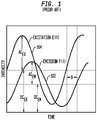
- the emission light 102 is phase-shifted and demodulated with respect to the excitation light 104 as shown in Fig. 1 .
- the modulated excitation results in a modulated fluorescence with a phase and modulation which is dependent on the lifetime of the excited fluorophores.
- the instruments utilized in frequency domain technique are called multifrequency phase fluorometers (MPF) or, simply, frequency domain fluorometers.
- MPF multifrequency phase fluorometers
- the excitation light source is modulated at a frequency ⁇ .
- the phase shift ⁇ and the modulation m are measured.
- Such measurements are repeated at several different values of the modulation frequency, ⁇ ranging typically from two or three repetitions for a single exponential decay, to up to twenty-twenty five repetitions for multiple exponential decays.
- the decay times ⁇ l are determined using a minimization technique to fit the experimental data.
- the light source is modulated at a frequency ⁇ and the light detector is modulated at a frequency ( ⁇ + ⁇ ⁇ ).
- the two frequencies are provided by phase-locked frequency synthesizers.
- the approach is also known as “heterodyning".
- the output signal includes components at the sum (2 ⁇ ) and the difference ( ⁇ ⁇ ) frequency.
- the low signal component ⁇ ⁇ called the “cross-correlation frequency", which is typically in the range from 1 Hz to 20 KHz, is utilized to determine the phase shift and the demodulation of the fluorescence.
- phase and modulation of the fluorescence can be calculated relative to that of a reference lifetime.
- An early frequency-domain instrument featured modulation at three fixed frequencies, the highest being 30 MHz. Single exponential decay times of the order of one nanosecond could be measured by the device while complex decays could not be resolved.
- two phase-locked synthesizers provide modulation to the light source (frequency ⁇ ) and to the light detectors (frequency ( ⁇ + ⁇ ⁇ )) respectively.
- the output signal at the cross-correlation frequency ⁇ ⁇ is measured and utilized to determine the phase shift and the demodulation.
- the operator selects the modulation frequencies and their number in the range from 1 MHz to 300 MHz.
- the phase shift and the demodulation are measured for each frequency in a sequential fashion. Embodiments of this instrument are described in U.S. Patent No. 4,840,485 and U.S. Patent No. 5,212,386 , for example.
- the heterodyning has heretofore been achieved by modulating the gain of the detector at a frequency that is slightly different than the light modulation frequency. For example, if the sample is excited with light modulated at 150 MHz, the gain of the detector is modulated with a frequency that differs from 150 MHz by 1000Hz (as an example). Due to heterodyning, the current produced by the detector contains the sum and the difference of the two frequencies, that is signals at 300,001,000 Hz and the difference at 1000Hz.
- a low pass filter separates the low frequency at 1000Hz from the high frequency component.
- the low frequency current is then sampled a number of times per period, for example 128 times.
- the phase shift and the modulation of the frequency at 1000Hz are obtained from the resulting sample waveform using a fast-Fourier-transform (FFT) technique.
- FFT fast-Fourier-transform
- the Fourier transform also contains higher frequencies, at 2000Hz, 3000Hz and so on up to the half the points in the period, i.e., up to 64KHz.
- U.S. Patent no. 5,212,386 describes an example of such multi-frequency systems.
- MPF phase and modulation fluorometers
- K2 system and Chronos system marketed by ISS Inc. of Champaign, Illinois.
- ISS Inc. continuous wave
- cw continuous wave
- Modem MPFs can work with pulsed sources as well such as mode-locked lasers and synchrotron radiation provided they are phase-locked with the synthesizer that modulates the gain of the light detector.
- the light impinging on the sample is modulated at 150 MHz, it contains harmonics at 300 MHz, 450 MHz, 600 MHz and so on.
- the low frequency signal at 1000 Hz, 2000 Hz, and 3000 Hz etc. represents all the harmonics.
- all the harmonics can be measured in parallel.
- a major advantage of the parallel acquisition method is that the electronic circuits for data collections are always in an ON state, so that there is no drift during the change from one radiofrequency to the other.
- the collection of data at a single frequency has a long dead time due to waiting for the electronic to stabilize when the frequency is switched.
- the electronics drifts due to heating are larger at high frequencies.
- This dead time can be on the order of 1-2 seconds per measurement at each frequency. Since about 16 different frequencies are acquired, and it is necessary to alternate between a sample and a reference to compensate for the drifts, the effective dead time can be as long as 60s or more. As a consequence the total measurement time is on the order of several minutes.
- the dead time suffered by single frequency instruments is strongly reduced since in general only two cycles of data acquisition are used, one for the sample and one for the reference compound.
- a disadvantage of the parallel acquisition mode is that the detector is turned ON only for a fraction of time due to the pulse mixing occurring at the detector.
- Both the serial and the parallel fluorometer require the modulation of the gain of the light detectors, namely modulation of a photomultiplier tube (PMT).
- the modulation can be either pulsed or sinusoidally modulated, as described in US Patent No. 6,317,207 .
- the PMTs are driven at a frequency slightly shifted from the frequency of the excitation to result in a slow heterodyned cross-correlation signal.
- An additional manufacturing problem with this apparatus is that hardware changes must be made to the PMTs voltage divider, which can be quite cumbersome, in order to inject the radio frequency signal.
- direct modulation of the PMT reduces the total collection efficiency of those PMTs, the maximum being 50%.
- avalanche photodiodes APD
- Microchannel plates MCP
- APD avalanche photodiodes
- MCP Microchannel plates
- Fluorescence spectroscopy has been implemented in microscopy to provide images with a high contrast.
- Fluorescence lifetime imaging microscopy FLIM
- FLIM Fluorescence lifetime imaging microscopy
- ions concentrations can be obtained by choosing a specific fluorophore that responds to the change in ionic concentration of its surrounding by shifting its spectrum and/or changing its lifetime. Filtering part of the spectrum to observe the intensity of the photons emitted by the fluorophore can be one way to quantify the ionic concentration. Because of the inhomogeneous nature of biological samples, the intensity information is mixed with the concentration of the fluorophore.
- the exponential decay curve of the fluorescence emission i.e., the lifetime of the fluorescence has been measured.
- FLIM was used to interpret the pH value in the uppermost epidermis of human skin, which is not available by simple fluorescence intensity imaging microscopy.
- existing FLIM devices are cumbersome to integrate with fluorescence intensity imaging microscopy systems. Therefore it is not as widely used as fluorescence intensity imaging microscopy.
- the existing FLIM devices are grouped into two categories, time domain devices and frequency domain devices.
- the time domain devices provide higher resolution for the arrival time of each photon, but also have higher cost.
- the frequency domain devices are in general unable to resolve picosecond lifetimes, but cost less.
- the time/frequency domain concepts for FLIM adapt directly from the fluorescence lifetime methods in a cuvette with the addition of microscopy techniques. From a mathematical point of view, the data of each pixel of FLIM is no different from the data from a bulk fluorescence lifetime measurement in a cuvette.
- a fluorescence lifetime image is an image in which each pixel of the image contains lifetime information for a specific region of space.
- microscopy In the case of microscopy, the size of a sample and the strength of the signal is miniaturized. The temporal resolution is mostly not restricted by the FLIM devices but by the brightness of the sample. Unlike fluorescence lifetime measurements in the cuvettes, where the number of photons collected can be several millions, a microscopy FLIM applications often measure as few as 100 to 1000 photons to determine the lifetime at a set pixel of an image. For purposes of FLIM, the high temporal resolution of the arrival time of each photon provided by the time domain devices is often not necessary.
- Frequency-domain instrumentation for tissue spectroscopy has heretofore been developed and used in a tissue oximeter for the absolute determination of oxy- and deoxy-hemoglobin concentration in the blood, for example, such as the OxiplexTS system sold by ISS Inc. of Champaign, Illinois.
- the instrument works at one single modulation frequency at about 110 MHz. While the present instrument is suitable for medical research, it cannot be made portable (for sport medicine applications, for instance) as the power utilized by the electronics is too high for the current available batteries to provide power for a reasonable measurement time.
- a digital frequency domain FLIM device In addition to the analog frequency domain fluorescence lifetime techniques described above, the implementation of a digital frequency domain FLIM device has heretofore been described. Just as with analog frequency domain techniques, the laser used in the digital frequency domain FLIM device is modulated. However, in the digital frequency domain FLIM device, instead of modulating the PMT, a flip-flop was added to a Kilohertz (KHz) photon counting device. The flip-flop was wired to the externally synchronized and shifted sampling clock (frequency ⁇ + ⁇ ⁇ ) and only outputs the cross-correlated photons when the photons arrive during one half-period of the sampling clock. This digital mixer is an inexpensive circuit and it does not require the modulation of the gain of the detector.
- KHz Kilohertz
- the mixer operation is obtained by multiplying an input train of pulses corresponding to the photons detected by a square wave, therefore only half of the pulses are counted. It is heretofore known that if two (2) mixing circuits are used that have as input, the same train of pulses, but the opposite sign of the square wave, all the photons can be processed in two separate streams.
- the cross-correlated photons are slow enough that the KHz photon counting device can sample them several times during each period to determine their phase and modulation. Then the phase and modulation are analyzed in the same way as if they were acquired by analog frequency domain devices. This technique has been used in certain data acquisition cards such as the Model A506 and A508 cards that are sold by ISS Inc. of Champaign, Illinois.
- DFD-FLIM digital frequency-domain FLIM
- the object of the present invention is solved by a method for performing parallel multifrequency phase fluorometry on a sample according to independent claim 1 and a fast fluorescence lifetime imaging apparatus according to independent claim 18. Further preferred embodiments result from the following description, the drawings and the appending claims.
- Illustrative embodiments of the present invention disclose an improved apparatus and a method for measuring and determining multiple decay times of luminescence (fluorescence and phosphorescence) in solid, liquid and gaseous samples.
- Embodiments can be implemented on a spectrofluorometer and on a multi-channel fluorescence lifetime imaging confocal microscope as well as in virtually any devices conducive to the measurement of the decay times of luminescence.
- fluorescence will be utilized in place of "luminescence” because of its common use in the literature and, unless otherwise specified, should be broadly interpreted to mean fluorescence, phosphorescence and/or luminescence.
- the illustrative embodiments of the present invention describe a parallel multifrequency phase fluorometer capable of acquiring all of the photons emitted by the sample and therefore provide high sensitivity and fast data collection. Contrary to standard multifrequency phase and modulation fluorometers, the gain of the light detectors is not modulated by using an external frequency generator. Rather, in the illustrative embodiments, heterodyning is performed digitally thus greatly simplifying the amount of electronics components utilized. Because the inventive embodiments do not require the modulation of the gain and/or the signal, virtually any light detectors (PMT, MCP, APD, photodiode) can be equally utilized.
- the invention according to claims 1 and 18 solves problems inherent to the previous data acquisition cards by using different hardware allowing for the synchronization and a different software algorithm enabling the implementation of the digital parallel principle for the simultaneous acquisition of multiple frequencies and addresses and fixes problems of previous systems in which corruption of the data occurred when certain first-in-first-out (FIFO) registers saturate.
- the present invention fulfills the major requirements for full digital parallel acquisition frequency-domain fluorescence lifetime measurements both in cuvettes and the laser scanning microscope. As a result of the present invention, new unanticipated capabilities have emerged that were not heretofore understood.
- the digital parallel acquisition scheme presented in the present application provides a digital version of the mixing scheme used in parallel acquisition and, advantageously, samples with 100% duty cycle.
- the embodiments of the present invention use only digital electronics, there is no switching time. Also there is no need to cycle between the sample and the reference. As a consequence of these improvements, the total time of data acquisition for collecting 16 frequencies is reduced form several hundred seconds to about 1s or less. Since the digital electronics used in the illustrative embodiments of the present invention are very stable, the accuracy of the measurement is increased and the electronic noise is reduced.
- the presently disclosed inventive digital parallel acquisition method can be implemented in fairly inexpensive digital electronics. It does not require factory calibration and it does not produce radiofrequency emissions. Moreover, it uses very low power which is an important advantage for the implementation of the technique in portable devices for biomedical, biotechnological and clinical applications. Although the principle of the digital frequency acquisition was previously described, it has not heretofore been applied in the field of parallel frequency-domain data acquisition.
- the present invention provides a circuit that performs all the logical operations needed for a parallel-digital frequency-domain instrument.
- embodiments of the invention can be synchronized with lasers that are intrinsically modulated or can generate a frequency signal that is used to amplitude-modulate a laser diode or LED.
- the signal can also modulate an electro-optical modulator (Pockels cell) or an acousto-optic modulator that, in turn, are used to modulate a continuous wave laser.
- the information necessary for determining when the data are valid is in the data stream itself so that the synchronization is always properly detected.
- the circuit can operate using two independent channels or four channels. An internal circuit senses that the FIFO could be saturated and interrupts the input data stream without interfering with the time information.
- embodiments of the invention use up to 16 harmonic frequencies, limited by the particular chip used (to 320MHZ). Embodiments can achieve 32 frequencies by using a lower repetition rate (10 MHz instead of 20 MHz). Faster chips are available so that a factor of 2 in the highest frequency may be attainable using these chips. However the current implementation up to 320 MHZ is adequate for most applications.
- Using the averaging principle of the digital circuit embodiments of the invention can handle very high levels of jitters in detectors, reaching a lifetime precision which is only limited by the total number of photons collected rather than by the width of the window used to determine the timing of the photon.
- the present invention includes notable advancements in the field which arise from a profound understanding of the behavior of the digital electronics.
- the result provides a highly stable circuit, which requires very low power to operate.
- Embodiments of the invention can be used in portable devices and could have many applications in sensors and in imaging.
- Embodiments of the present invention can be used to build a portable tissue spectroscopy that is for smaller and less expensive instruments than previously known frequency domain instruments. Also, the use of multiple modulation frequencies according to the present invention, instead of one modulation frequency , allows for the design of smaller sensors, which are of extreme interest for infant applications and, in general, for the measurement of hemodynamic parameters in restricted areas.
- f cc f s ⁇ f exc
- f cc f s 256
- the inverse of the cross-correlation frequency f cc is time the sampling window slides through the entire 255 waveforms of the excitation pulses; these correspond to the number of waveforms of the emission response of the sample.
- sampling window is subject to certain requirements in order to count all of the photons emitted by the sample, i.e., to have a 100% duty cycle, and insure that the measurement is performed with precision.
- eight sampling windows are generated, each of pulsewidth ⁇ t .
- Each sampling window is phase shifted with respect to the previous one by a quantity, in degrees:
- a fast clock equal to four times the sampling window, or is also generated in order to perform tagging tasks in the counter, that is to tag incoming photon with the sampling window number which corresponds to their arrival time.
- the task is performed by the cross-correlation frequency signal, which activates a counter. It provides a measurement of the relative phase difference between the sampling window and excitation clock frequency.
- the circuitry For each photon count, the circuitry provides a value identifying the arrival window w ⁇ and the cross-correlation counter value p cc .
- n w is the number of windows utilized.
- the phase index is used to generate the cross-correlation phase histogram, H ( p ), which is a histogram of the phase indexes for each photon detected.
- Other parameters can be calculated and displayed easily at this point.
- Fig. 2 is a schematic diagram of the dual-channel FLIM unit 200 using PMT detectors for FLIM applications according to an illustrative embodiment of the invention.
- the FastFLIM unit uses two separate photomultiplier tubes, PMTs.
- a signal from a respective detector goes into channels CH1 201 and CH2 202 and, after signal conditioning (amplification and formatting) by amplifiers 204, 206 and constant fraction discriminators 208, 210, the signal goes into a field-programmable gate array (FPGA) module 212.
- the FPGA module 212 also received input from a frame clock 214, and an external clock 216 and provides output via USB connections 218.
- Fig. 3 is a schematic diagram of the dual-channel FLIM unit 300 using single photon counting avalanche photodiode (SPAD) detectors for FLIM applications according to an illustrative embodiment of the invention.
- the FasFLIM unit 300 uses two separate single photon counting avalanche photodiodes, SPADs (not shown). Signals from the respective SPADs are provided as input to channels CH1 301, and CH2 302, of the FPGA Module 304.
- the FPGA module 304 also receives input from a frame clock 306 and an external clock 308 and provides output via USB connections 310.
- a frame clock 214, 306 is provided to modulate the light source. Data are transferred to the computer using the Universal Serial Bus (USB) port protocol.
- USB Universal Serial Bus
- the two-channel digital parallel fluorometer electronics are implemented with scanning coordination on an FPGA chip model Spartan-3E FPGA, Part no. XC3S100E-TQ144 made by Xilinx, Inc. of San Jose, CA.
- This chip was chosen for its low-cost, its compactness and the dedicated circuitry for digital clock management (DCM).
- DCMs provide a high quality digital clock which can perform fractional frequency adjustments, although, in general, any circuit with sufficiently fast clocking capability and the ability to shift the frequency can be used.
- the FPGA chip is connected to a USB chip model CY7C60813A, by Cypress Semiconductors of San Jose, CA.
- the combination of the two chips is packed by Avnet Electronics Marketing of Phoenix, AZ and sold as low cost general purpose evaluation kit.
- the cross-correlation frequency is equal to 78.43 KHz .
- the sampling frequency waveform covers 255 waveforms of the excitation signal.
- a narrow series of pulses is connected to the same signal that carries the photon stream. For each pulse, there is a complementary pulse, so that no photons are ever lost. In principle these pulses can be made very narrow. However, due to the particular electronic chip used in this example, the pulses cannot be made narrower than about 2 ns.
- the digital parallel fluorometer will measure all the harmonic of the 30 MHz signal up to the 15 harmonics, i.e., 300 MHz. These frequencies are adequate for most lifetime measurements both in a spectrofluorometer and in a microscope (FLIM). In fact, a lifetime of 0.5 ns will produce a phase shift of approximately 45 degrees at 300 MHz.
- phase measurement using the digital approach according to the present invention is very high.
- the phase can be measured with a precision on the order of 0.1 degrees. This precision translates to an error of a few picoseconds only. It is notable that such precision can be obtained with a window of about 2 ns. This is due to the averaging of many photons in the various windows. For the measurement of the time delay of one single photon, the granularity of the lifetime axis is still 2 ns, i.e., the width of the window.
- a particular problem that can be solved in an implementation of the present invention is the saturation of FIFO requesters used in outputting data which limits the spread of data acquisition.
- the data recorded in the 16 phases of the period transfers to the data reading register (the FIFO) every time a photon is detected, or a transition at the data enabled line is detected. The granularity of the reading is very small and there is dead time.
- the output of the FIFO can only be read at the maximum frequency allowed by the USB chip.
- the USB transfer is fast, there is a delay time to process the data transfer request. This delay in typical computers and operating systems is about 3 ms. If during the 3 ms time interval the FIFO fills up, some of the data will be lost. Since the synchronization of the data is more important than the data, the data in is stopped but the data enabled input line is not stopped when the FIFO reaches 80% of its capacity.
- the FIFO has a capacity of 8192 entries, of which we use approximately 6400 locations. If during a time of 3 ms more than 6400 photons are detected, the circuit saturate. This is equivalent to a sustained rate of about 2 MHz for a period of 2 ms.
- the number of lines in the FIFO is 16. In the 16 windows implementation for two independent data channels, 8 lines are used to determine the window number at the time the photon is detected and to determine which of the two channels has detected a photon. One line is used for the data enabled flag and 7 lines are used to determine the macro-clock cycle in which the photon was detected.
- Another implementation is used for 4 simultaneous data acquisition channels using the Xilinx 3 board.
- the photons are registered, but the timing for that photon can not be determined. This is generally not a problem because this event is rare and the software decides to disregard these particular events.
- the different implementations using the Xilinx 3 board put out a narrow pulse at the basic clock frequency which is used to modulate the intensity of lasers diodes or LEDs.
- a signal is connected to the external clock input of the board so that the card internal operation can be synchronized with the external laser source.
- the maximum clock frequency for 16 windows using the Xilinx 3 board was found to be about 20 MHz, which provides harmonic up to 320 MHz. It appears that if higher frequencies are used, the chip misbehaves. This limit is due to the internal limitation of the chip used in the Avnet board rather than due to failure of the present inventive system and method.
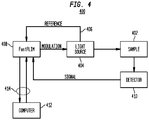
- a parallel multifrequency phase fluorometer embodiment of the invention is described with reference to Fig. 4 .
- the instrument 400 is utilized to determine the decay times of fluorescence in solutions or in solid samples 402.
- the light source 404 is a laser diode.
- a reference signal 406 is provided in this implementation to the FastFLIM unit 408.
- the reference signal 406 is not strictly required as the internal clock can be utilized as well.
- the light detector 410 can be a photomultiplier tube (for instance the type R928 by Hamamatsu, Japan), a microchannel plate detector (for instance, the model R3809U by Hamamatsu, Japan), or an avalanche photodiode (for instance the series SPCM-AQR by EG&G Perkin Elmer, Canada). No modification is required to the voltage divider circuitry of the light detectors.
- a computer communicates with the Fast FLIM 408 via a USB connector 414, for example.
- Figs. 5A and 5B provide a graph and table showing a measurement example using the digital parallel acquisition principle.
- the fluorescence excitation source is a laser operating at 20 MHz so that frequencies up to 300 MHz can be measured.
- the sample is a solution of Fluorescein at pH10. Phase and modulation against frequency (Weber plot 502) for Fluorescein is shown in Fig. 5A .
- Numerical data is shown in Fig. 5B .
- the excitation source was a laser diode emitting at 473nm. Lifetime of 4ns was reported for the sample. The entire data acquisition in this example lasted about Is.
- the fit of the phase and modulation curves gives a value of the lifetime of4.00+/-0.01 ns.
- the expected lifetime of Fluorescein at pH10 is 4.00 ns.
- a frame signal 605 from the scanner electronics 606 that accurately reports the instant of time at which the data acquisition in the microscope should start is sent to the FastFLIM unit 604.
- the card is always collecting data and a flag is added to the data stream which is directly connected to the data valid line of the microscope. Using this approach, no matter what kind of signal the microscope 603 is producing, the data stream record the signal.
- the program that determines when data are valid must follow the same logic of the valid data of the microscope 603.
- This signal could be just a single pulse at the beginning of the frame or a signal that changes and remains the same throughout all the frame.
- this signal the data enabled lien.
- this signal gets recorded at each period of the clock of the electronic circuit, which is in the 20 MHz range, providing enough synchronization accuracy for pixel dwell times in the range generally used in the microscope (1 to 200 ⁇ s).
- Data analysis is performed either by determination of the decay times at each pixels or by using a phasor plot approach.
- FCS fluorescence fluctuation correlation spectroscopy
- the FastFLIM circuitry of the present invention can take FCS measurements as well.
- the setup for performing FCS is the same as FLIM.
- the cross-correlation clock f cc is used to mark the photon arrival time.
- Fig. 7 is the autocorrelation plot 700 of a 10nM fluorescein solution. The curve 702 fits to fluorescein's known diffusion constant.
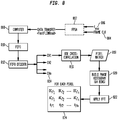
- Fig. 8 is a flow diagram displaying the process of data transfer and the determination of the measured parameters.
- An FPGA module 802 such as the FPGA module described with reference to Figs. 2 and 3 , receives a frame clock 804 and an excitation frequency 806.
- the FPGA module 802 transfers data to a computer 808, via a USB port, for example.
- the computer 808 outputs data via a FIFO 810 and FIFO decoder 812 to a plurality of channels 814. Data on the plurality of channels 814 is cross correlated 816 to generate a pixel matrix 818.
- the pixel matrix 818 is used to generate a phase histogram 820.
- a fast Fourier transform (FFT) 822 is applied to the phase histogram 820 to generate a matrix of values 824 for each pixel.
- FFT fast Fourier transform
- DC the average steady-state intensity
- AC the value of the modulation
- ⁇ the phase shift of the fluorescence.
Landscapes
- Physics & Mathematics (AREA)
- Spectroscopy & Molecular Physics (AREA)
- Health & Medical Sciences (AREA)
- General Physics & Mathematics (AREA)
- Biochemistry (AREA)
- Analytical Chemistry (AREA)
- Chemical & Material Sciences (AREA)
- General Health & Medical Sciences (AREA)
- Life Sciences & Earth Sciences (AREA)
- Immunology (AREA)
- Pathology (AREA)
- Nuclear Medicine, Radiotherapy & Molecular Imaging (AREA)
- Investigating, Analyzing Materials By Fluorescence Or Luminescence (AREA)
Claims (19)
- Ein Verfahren zum Durchführen von paralleler Multifrequenz-Phasen-Fluorometrie an einer Probe (402), wobei das Verfahren umfasst:Bestrahlen der Probe (402) mit einem gepulsten Lichtsignal bei einer vorgegebenen Anregungsfrequenz (806),digitales Abtasten von Licht durch einen Detektor (410), welches durch die Probe (402) bei einer vorgegebenen Abtastfrequenz emittiert wird, die so gewählt ist, dass eine Differenz zwischen der Abtastfrequenz und der Anregungsfrequenz gleich einer Kreuzkorrelationsfrequenz ist, die geringer ist als eine maximale Zählrate des Detektors (410),Bereitstellen eines zuerst herein - zuerst heraus (first in first out; FIFO) Datenleseregisters in Kommunikation mit dem Detektor (410) zum Übertragen von Daten an einen Computer (412), wobei das Datenleseregister eine Mehrzahl von Eingabezeilen, eine Mehrzahl von Ausgabezeilen und mindestens eine Datenaktivierungszeile umfasst, und gekennzeichnet durchVerhindern einer Sättigung des Datenleseregisters durch Stoppen einer Eingabe in die Eingabezeilen, wenn das Register ungefähr 80 % seiner Kapazität erreicht, während die Eingabe in die Datenaktivierungszeile beibehalten wird.
- Das Verfahren gemäß Anspruch 1, wobei die Abtastfrequenz extern synchronisiert und in Bezug auf die Anregungsfrequenz (806) verschoben ist.
- Das Verfahren gemäß Anspruch 2, wobei der Detektor (410) eine Kilohertz-Photonen-Zählvorrichtung umfasst.
- Das Verfahren gemäß Anspruch 1, wobei die Kreuzkorrelationsfrequenz ein ganzzahliger Teil der Abtastfrequenz ist.
- Das Verfahren gemäß Anspruch 4, wobei die Abtastfrequenz das 256/255-fache der Anregungsfrequenz (806) ist.
- Das Verfahren gemäß Anspruch 1, wobei das gepulste Licht durch einen intrinsisch modulierten Laser (404) bereitgestellt wird.
- Das Verfahren gemäß Anspruch 1, wobei das gepulste Licht bereitgestellt wird durch:Erzeugen eines Frequenzsignals, undAmplitudenmodulieren eines Emitters, der aus einer Laserdiode (404) oder einer Licht emittierenden Diode mit dem Frequenzsignal besteht.
- Das Verfahren gemäß Anspruch 1, wobei das gepulste Licht bereitgestellt wird durch:Erzeugen eines Frequenzsignals,Amplitudenmodulieren eines elektrooptischen Modulators oder eines akustooptischen Modulators mit dem Frequenzsignal, um ein erstes Modulationssignal zu erzeugen, undModulieren eines Dauerstrich-Lasers mit dem ersten Modulationssignal.
- Das Verfahren gemäß Anspruch 1, wobei das Abtasten ein digitales Überlagern ohne Modulieren der Verstärkung des Detektors (410) umfasst.
- Das Verfahren gemäß Anspruch 1, wobei die Anregungsfrequenz (806) eine Mehrzahl von harmonischen Frequenzen umfasst.
- Das Verfahren gemäß Anspruch 1, wobei der Kehrwert der Kreuzkorrelationsfrequenz die Zeit ist, in der ein Abtastfenster jede Wellenform des gepulsten Lichts abtastet.
- Das Verfahren gemäß Anspruch 1, weiterhin umfassend:Erzeugen einer Mehrzahl an Abtastfenstem, jeweils mit einer Pulsweite [delta-t], wobei jedes Abtastfenster relativ zu einem vorhergehenden Abtastfenster phasenverschoben ist in Grad um eine Größe des 360*delta-t-fachen der Abtastfrequenz,Bereitstellen eines schnellen Taktes gleich dem Vierfachen der Abtastfrequenz, undBestimmen der Phase eines detektierten Photons in Bezug auf einen Puls des gepulsten Lichts durch in Beziehung bringen eines Abtastfensters, während dem ein Photon detektiert wurde, mit dem Puls.
- Das Verfahren gemäß Anspruch 12, wobei das Bestimmen der Phase umfasst:Aktivieren eines Zählers durch ein Signal mit der Kreuzkorrelationsfrequenz, undIdentifizieren des bestimmten Abtastfensters, in dem ein Photon detektiert wurde, durch eine entsprechende Zählung des Zählers.
- Das Verfahren gemäß Anspruch 13, weiterhin umfassend:für jede Zählung Bereitstellen eines ersten Werts [Wa], der das bestimmte Abtastfenster identifiziert, und eines entsprechenden Kreuzkorrelationszählerwertes [Pcc],Erzeugen eines Phasen-Indexes [P] durch Kombinieren des ersten Wertes und des entsprechenden Kreuzkorrelationszählerwertes wie folgt: P=255-[(Pcc+256*Wa/Nw) mod 256], wobei Nw eine Anzahl der Mehrzahl an Abtastfenstern ist.
- Das Verfahren gemäß Anspruch 14, weiterhin umfassend das Erzeugen eines Kreuzkorrelation-Phasen-Histogramms H(P) (820) des Phasen-Indexes P für jedes detektierte Photon.
- Das Verfahren gemäß Anspruch 14, weiterhin umfassend:Bereitstellen eines Intensitätsbildes [I] an einer Ausgabevorrichtung, wobei das Intensitätsbild [I] an jedem Pixel der Ausgabevorrichtung eine Summe des Histogramms H(P) für jedes Photon ist.
- Das Verfahren gemäß Anspruch 1, weiterhin umfassend:Abschwächen des gepulsten Lichtsignals, um eine Sättigung des Registers zu verhindern.
- Eine Schnell-Fluoreszenz-Lebensdauer-Darstellungs-Vorrichtung (400), umfassend:einen Emitter (404) zum Bestrahlen einer Probe (402) mit einem gepulsten Lichtsignal in einer vorgegebenen Anregungsfrequenz (806), wobei die Vorrichtung (400) umfasst einen Detektor (410) zum Detektieren von Licht, das durch die Probe (402) bei einer vorgegebenen Abtastfrequenz emittiert wird, die so gewählt ist, dass eine Differenz zwischen der Abtastfrequenz und der Anregungsfrequenz gleich einer Kreuzkorrelationsfrequenz ist, die geringer ist als eine maximale Zählrate des Detektors (410), undein zuerst herein - zuerst heraus (first in first out; FIFO) Datenleseregister in Kommunikation mit dem Detektor (410) zur Übertragung von Daten an einen Computer (412), wobei das Datenleseregister eine Mehrzahl von Eingabezeilen, eine Mehrzahl von Ausgabezeilen und mindestens eine Datenaktivierungszeile umfasst, und dadurch gekennzeichnet, dassdie Vorrichtung angeordnet ist, um eine Sättigung des Datenleseregisters zu verhindern durch das Stoppen einer Eingabe in die Eingabezeilen, wenn das Register ungefähr 80 % seiner Kapazität erreicht, während eine Eingabe in die Datenaktivierungszeile beibehalten wird.
- Die Vorrichtung (400) gemäß Anspruch 18, weiterhin umfassend:ein feldprogranunierbares Gate-Array-Modul [FPGA] (212; 304), das konfiguriert ist, um eine Mehrzahl an Abtastfenstern zu erzeugen, jeweils mit einer Pulsweite [delta-t], wobei jedes Abtastfenster bezogen auf ein vorhergehendes Abtastfenster phasenverschoben ist in Grad um eine Größe des 360*delta-t-fachen der Abtastfrequenz, unddas FPGA-Modul (212; 304) ist konfiguriert, um die Phase eines detektierten Photons in Bezug auf einen Puls des gepulsten Lichts zu bestimmen durch in Bezug setzen eines Abtastfensters, während dessen ein Photon detektiert wurde, mit dem Puls.
Applications Claiming Priority (2)
| Application Number | Priority Date | Filing Date | Title |
|---|---|---|---|
| US12/695,244 US8330123B2 (en) | 2010-01-28 | 2010-01-28 | System and method for digital parallel frequency fluorometry |
| PCT/US2010/062462 WO2011093981A1 (en) | 2010-01-28 | 2010-12-30 | System and method for digital parallel frequency fluorometry |
Publications (3)
| Publication Number | Publication Date |
|---|---|
| EP2529152A1 EP2529152A1 (de) | 2012-12-05 |
| EP2529152A4 EP2529152A4 (de) | 2015-09-30 |
| EP2529152B1 true EP2529152B1 (de) | 2017-11-15 |
Family
ID=44308271
Family Applications (1)
| Application Number | Title | Priority Date | Filing Date |
|---|---|---|---|
| EP10844948.9A Active EP2529152B1 (de) | 2010-01-28 | 2010-12-30 | System und verfahren für digitale parallele hochfrequenzfluorometrie |
Country Status (5)
| Country | Link |
|---|---|
| US (1) | US8330123B2 (de) |
| EP (1) | EP2529152B1 (de) |
| JP (2) | JP5806240B2 (de) |
| KR (1) | KR20120126076A (de) |
| WO (1) | WO2011093981A1 (de) |
Families Citing this family (14)
| Publication number | Priority date | Publication date | Assignee | Title |
|---|---|---|---|---|
| US8327029B1 (en) * | 2010-03-12 | 2012-12-04 | The Mathworks, Inc. | Unified software construct representing multiple synchronized hardware systems |
| US9968258B2 (en) * | 2011-09-12 | 2018-05-15 | Tufts University | Imaging fluorescence or luminescence lifetime |
| WO2013066959A1 (en) * | 2011-10-31 | 2013-05-10 | The Trustees Of Columbia University In The City Of New York | Systems and methods for imaging using single photon avalanche diodes |
| CN102680438B (zh) * | 2011-11-25 | 2014-04-02 | 广东工业大学 | 一种荧光寿命和荧光动态各向异性参数的定量测量方法 |
| US9723993B2 (en) * | 2012-12-19 | 2017-08-08 | Koninklijke Philips N.V. | Frequency domain time resolved fluorescence method and system for plaque detection |
| US10292608B2 (en) | 2015-11-24 | 2019-05-21 | Verily Life Sciences Llc | Systems and methods for real-time laser doppler imaging |
| KR101759437B1 (ko) * | 2016-04-21 | 2017-07-18 | 연세대학교 산학협력단 | 단일 포톤 계수 장치 및 그 방법 |
| JP7004675B2 (ja) * | 2016-05-25 | 2022-02-10 | ライカ マイクロシステムズ シーエムエス ゲゼルシャフト ミット ベシュレンクテル ハフツング | 高められた光強度を許容する時間相関単一光子計数による蛍光寿命顕微鏡検査法 |
| DE102016214469A1 (de) * | 2016-08-04 | 2018-02-08 | Schaeffler Technologies AG & Co. KG | Drehmomentübertragungseinrichtung |
| EP3752818B1 (de) * | 2018-02-16 | 2022-10-19 | Leica Microsystems CMS GmbH | Fluoreszenzlebensdauer-mikroskopie-verfahren mit zeitkorrelierter einzelphotonenzählung |
| US11592393B2 (en) * | 2018-11-21 | 2023-02-28 | The Board Of Trustees Of The Leland Stanford Junior University | Wide-field nanosecond imaging methods using wide-field optical modulators |
| IT202000007807A1 (it) * | 2020-04-14 | 2021-10-14 | Flim Labs S R L | Metodo per il calcolo veloce del decadimento del tempo di vita di un segnale di fluorescenza e sistema che implementa il metodo. |
| KR102850441B1 (ko) * | 2020-08-06 | 2025-08-26 | 하마마츠 포토닉스 가부시키가이샤 | 시간 계측 장치, 형광 수명 계측 장치, 및 시간 계측 방법 |
| CN119573886B (zh) * | 2024-12-02 | 2025-10-10 | 北京航空航天大学 | 一种傅里叶变换红外光谱测量系统和方法 |
Family Cites Families (18)
| Publication number | Priority date | Publication date | Assignee | Title |
|---|---|---|---|---|
| US4840485A (en) * | 1986-12-17 | 1989-06-20 | I.S.S. (U.S.A.) Inc. | Frequency domain cross-correlation fluorometry with phase-locked loop frequency synthesizers |
| US4937457A (en) * | 1989-02-10 | 1990-06-26 | Slm Instruments, Inc. | Picosecond multi-harmonic fourier fluorometer |
| WO1990009637A1 (en) * | 1989-02-13 | 1990-08-23 | Research Corporation Technologies, Inc. | Method and means for parallel frequency acquisition in frequency domain fluorometry |
| US5151869A (en) * | 1990-02-16 | 1992-09-29 | The Boc Group, Inc. | Frequency domain fluorometry using coherent sampling |
| US5255330A (en) * | 1990-10-03 | 1993-10-19 | At&T Bell Laboratories | Image acquisition sample clock phase control employing histogram analysis |
| US5213105A (en) * | 1990-12-04 | 1993-05-25 | Research Corporation Technologies, Inc. | Frequency domain optical imaging using diffusion of intensity modulated radiation |
| EP0568596A1 (de) * | 1991-01-24 | 1993-11-10 | The University Of Maryland | Verfahren und gerät zur mehrdimensionalen abbildung mit verwendung der phasenfluoreszenzlebzeit |
| US5212386A (en) * | 1991-12-13 | 1993-05-18 | I.S.S. (U.S.A.) Inc. | High speed cross-correlation frequency domain fluorometry-phosphorimetry |
| JPH05210513A (ja) * | 1992-01-31 | 1993-08-20 | Nec Corp | 状態監視型割り込み制御システム |
| US5323010A (en) * | 1992-12-01 | 1994-06-21 | I.S.S. (Usa) Inc. | Time resolved optical array detectors and CCD cameras for frequency domain fluorometry and/or phosphorimetry |
| EP0664965B1 (de) * | 1994-02-01 | 1998-04-15 | S & S Industries, Inc. | Versteifungsbügel für die Körbchen von Büstenhaltern |
| JP4083802B2 (ja) * | 1995-08-14 | 2008-04-30 | ワーバートン,ウィリアム,ケイ. | デジタルベースの高速x線スペクトロメータについての方法 |
| JP2000155090A (ja) * | 1998-11-20 | 2000-06-06 | Fuji Photo Film Co Ltd | 血管の画像化装置 |
| AU3005400A (en) * | 1999-02-23 | 2000-09-14 | Ljl Biosystems, Inc. | Frequency-domain light detection device |
| GB0023619D0 (en) * | 2000-09-27 | 2000-11-08 | Amersham Pharm Biotech Uk Ltd | Measurement of fluorescence decay times |
| EP1193506A3 (de) * | 2000-09-29 | 2004-07-21 | Siemens Aktiengesellschaft | Verfahren zum Abtasten eines hochfrequenten Empfangssignals, insbesondere eines Hochfrequenzsignals einer Empfangsspule eines Magnetresonanzgeräts |
| US7297962B2 (en) * | 2003-01-23 | 2007-11-20 | Horiba Jobin Yvon, Inc. | Method for performing spacially coordinated high speed fluorometric measurements |
| DE102006034905B4 (de) * | 2006-07-28 | 2015-07-30 | Carl Zeiss Microscopy Gmbh | Anordnung zur Signalverarbeitung am Ausgang eines Mehrkanaldetektors |
-
2010
- 2010-01-28 US US12/695,244 patent/US8330123B2/en not_active Expired - Fee Related
- 2010-12-30 JP JP2012551169A patent/JP5806240B2/ja not_active Expired - Fee Related
- 2010-12-30 EP EP10844948.9A patent/EP2529152B1/de active Active
- 2010-12-30 WO PCT/US2010/062462 patent/WO2011093981A1/en not_active Ceased
- 2010-12-30 KR KR1020127019607A patent/KR20120126076A/ko not_active Abandoned
-
2015
- 2015-05-15 JP JP2015099771A patent/JP5856707B2/ja active Active
Non-Patent Citations (1)
| Title |
|---|
| None * |
Also Published As
| Publication number | Publication date |
|---|---|
| JP2015143719A (ja) | 2015-08-06 |
| US20110180726A1 (en) | 2011-07-28 |
| JP2013518284A (ja) | 2013-05-20 |
| EP2529152A1 (de) | 2012-12-05 |
| JP5856707B2 (ja) | 2016-02-10 |
| WO2011093981A1 (en) | 2011-08-04 |
| US8330123B2 (en) | 2012-12-11 |
| JP5806240B2 (ja) | 2015-11-10 |
| KR20120126076A (ko) | 2012-11-20 |
| EP2529152A4 (de) | 2015-09-30 |
Similar Documents
| Publication | Publication Date | Title |
|---|---|---|
| EP2529152B1 (de) | System und verfahren für digitale parallele hochfrequenzfluorometrie | |
| US5818582A (en) | Apparatus and method for phase fluorometry | |
| US5257202A (en) | Method and means for parallel frequency acquisition in frequency domain fluorometry | |
| Colyer et al. | A novel fluorescence lifetime imaging system that optimizes photon efficiency | |
| Gratton et al. | Multifrequency cross‐correlation phase fluorometer using synchrotron radiation | |
| EP0409934B1 (de) | Picosekunden-fourier fluoreszenz-messgerät mit mehreren harmonischen | |
| EP2340429B1 (de) | Vorrichtungen und verfahren für direktabtastende analoge zeitaufgelöse detektion | |
| US20130084649A1 (en) | Fluorescence measurement | |
| CN108463714A (zh) | 用于测量电子激发态的平均寿命的发射寿命测量方法和设备 | |
| Chen et al. | A practical implementation of multifrequency widefield frequency‐domain fluorescence lifetime imaging microscopy | |
| Berndt et al. | Phase‐modulation fluorometry using a frequency‐doubled pulsed laser diode light source | |
| CN101004383A (zh) | 微弱荧光光谱的测量方法及装置 | |
| EP1746411A1 (de) | Fluormetrische Mehrfrequenz-Festkörpermesssysteme und Verfahren | |
| CN107121208A (zh) | 基于频率计数卡的激发态寿命测量的数据采集装置及激发态寿命测量方法 | |
| Farina et al. | Pile-up free fluorescence lifetime imaging with a SPAD-based single pixel camera | |
| Gratton et al. | Parallel acquisition of fluorescence decay using array detectors | |
| Pelet et al. | Frequency domain lifetime and spectral imaging microscopy | |
| Redford et al. | Real-time fluorescence lifetime imaging and FRET using fast gated image intensifiers | |
| US20060289785A1 (en) | Method for both time and frequency domain protein measurements | |
| Alcala et al. | Real time frequency domain fiberoptic temperature sensor | |
| JP6290865B2 (ja) | 励起状態の寿命に関してサンプルを検査する方法及び装置 | |
| Valeur | Pulse and phase fluorometries: an objective comparison | |
| DiBenedetto et al. | Time-resolved hyperspectral fluorescence spectroscopy using frequency-modulated excitation | |
| Sulkes et al. | Measurement of luminescence decays: High performance at low cost | |
| US20120193552A1 (en) | Fluorescence lifetime imaging |
Legal Events
| Date | Code | Title | Description |
|---|---|---|---|
| PUAI | Public reference made under article 153(3) epc to a published international application that has entered the european phase |
Free format text: ORIGINAL CODE: 0009012 |
|
| 17P | Request for examination filed |
Effective date: 20120615 |
|
| AK | Designated contracting states |
Kind code of ref document: A1 Designated state(s): AL AT BE BG CH CY CZ DE DK EE ES FI FR GB GR HR HU IE IS IT LI LT LU LV MC MK MT NL NO PL PT RO RS SE SI SK SM TR |
|
| DAX | Request for extension of the european patent (deleted) | ||
| REG | Reference to a national code |
Ref country code: DE Ref legal event code: R079 Ref document number: 602010046795 Country of ref document: DE Free format text: PREVIOUS MAIN CLASS: F21V0009160000 Ipc: G01N0021640000 |
|
| RA4 | Supplementary search report drawn up and despatched (corrected) |
Effective date: 20150901 |
|
| RIC1 | Information provided on ipc code assigned before grant |
Ipc: G01J 3/457 20060101ALI20150826BHEP Ipc: G01J 3/44 20060101ALI20150826BHEP Ipc: G01N 21/64 20060101AFI20150826BHEP |
|
| 17Q | First examination report despatched |
Effective date: 20150914 |
|
| GRAP | Despatch of communication of intention to grant a patent |
Free format text: ORIGINAL CODE: EPIDOSNIGR1 |
|
| INTG | Intention to grant announced |
Effective date: 20170612 |
|
| GRAS | Grant fee paid |
Free format text: ORIGINAL CODE: EPIDOSNIGR3 |
|
| GRAA | (expected) grant |
Free format text: ORIGINAL CODE: 0009210 |
|
| AK | Designated contracting states |
Kind code of ref document: B1 Designated state(s): AL AT BE BG CH CY CZ DE DK EE ES FI FR GB GR HR HU IE IS IT LI LT LU LV MC MK MT NL NO PL PT RO RS SE SI SK SM TR |
|
| REG | Reference to a national code |
Ref country code: CH Ref legal event code: EP Ref country code: GB Ref legal event code: FG4D Ref country code: AT Ref legal event code: REF Ref document number: 946763 Country of ref document: AT Kind code of ref document: T Effective date: 20171115 |
|
| REG | Reference to a national code |
Ref country code: IE Ref legal event code: FG4D |
|
| REG | Reference to a national code |
Ref country code: FR Ref legal event code: PLFP Year of fee payment: 8 |
|
| REG | Reference to a national code |
Ref country code: DE Ref legal event code: R096 Ref document number: 602010046795 Country of ref document: DE |
|
| REG | Reference to a national code |
Ref country code: NL Ref legal event code: MP Effective date: 20171115 |
|
| REG | Reference to a national code |
Ref country code: LT Ref legal event code: MG4D |
|
| REG | Reference to a national code |
Ref country code: AT Ref legal event code: MK05 Ref document number: 946763 Country of ref document: AT Kind code of ref document: T Effective date: 20171115 |
|
| PG25 | Lapsed in a contracting state [announced via postgrant information from national office to epo] |
Ref country code: NL Free format text: LAPSE BECAUSE OF FAILURE TO SUBMIT A TRANSLATION OF THE DESCRIPTION OR TO PAY THE FEE WITHIN THE PRESCRIBED TIME-LIMIT Effective date: 20171115 Ref country code: ES Free format text: LAPSE BECAUSE OF FAILURE TO SUBMIT A TRANSLATION OF THE DESCRIPTION OR TO PAY THE FEE WITHIN THE PRESCRIBED TIME-LIMIT Effective date: 20171115 Ref country code: SE Free format text: LAPSE BECAUSE OF FAILURE TO SUBMIT A TRANSLATION OF THE DESCRIPTION OR TO PAY THE FEE WITHIN THE PRESCRIBED TIME-LIMIT Effective date: 20171115 Ref country code: FI Free format text: LAPSE BECAUSE OF FAILURE TO SUBMIT A TRANSLATION OF THE DESCRIPTION OR TO PAY THE FEE WITHIN THE PRESCRIBED TIME-LIMIT Effective date: 20171115 Ref country code: NO Free format text: LAPSE BECAUSE OF FAILURE TO SUBMIT A TRANSLATION OF THE DESCRIPTION OR TO PAY THE FEE WITHIN THE PRESCRIBED TIME-LIMIT Effective date: 20180215 Ref country code: LT Free format text: LAPSE BECAUSE OF FAILURE TO SUBMIT A TRANSLATION OF THE DESCRIPTION OR TO PAY THE FEE WITHIN THE PRESCRIBED TIME-LIMIT Effective date: 20171115 |
|
| PG25 | Lapsed in a contracting state [announced via postgrant information from national office to epo] |
Ref country code: RS Free format text: LAPSE BECAUSE OF FAILURE TO SUBMIT A TRANSLATION OF THE DESCRIPTION OR TO PAY THE FEE WITHIN THE PRESCRIBED TIME-LIMIT Effective date: 20171115 Ref country code: GR Free format text: LAPSE BECAUSE OF FAILURE TO SUBMIT A TRANSLATION OF THE DESCRIPTION OR TO PAY THE FEE WITHIN THE PRESCRIBED TIME-LIMIT Effective date: 20180216 Ref country code: AT Free format text: LAPSE BECAUSE OF FAILURE TO SUBMIT A TRANSLATION OF THE DESCRIPTION OR TO PAY THE FEE WITHIN THE PRESCRIBED TIME-LIMIT Effective date: 20171115 Ref country code: BG Free format text: LAPSE BECAUSE OF FAILURE TO SUBMIT A TRANSLATION OF THE DESCRIPTION OR TO PAY THE FEE WITHIN THE PRESCRIBED TIME-LIMIT Effective date: 20180215 Ref country code: LV Free format text: LAPSE BECAUSE OF FAILURE TO SUBMIT A TRANSLATION OF THE DESCRIPTION OR TO PAY THE FEE WITHIN THE PRESCRIBED TIME-LIMIT Effective date: 20171115 Ref country code: HR Free format text: LAPSE BECAUSE OF FAILURE TO SUBMIT A TRANSLATION OF THE DESCRIPTION OR TO PAY THE FEE WITHIN THE PRESCRIBED TIME-LIMIT Effective date: 20171115 |
|
| PG25 | Lapsed in a contracting state [announced via postgrant information from national office to epo] |
Ref country code: SK Free format text: LAPSE BECAUSE OF FAILURE TO SUBMIT A TRANSLATION OF THE DESCRIPTION OR TO PAY THE FEE WITHIN THE PRESCRIBED TIME-LIMIT Effective date: 20171115 Ref country code: DK Free format text: LAPSE BECAUSE OF FAILURE TO SUBMIT A TRANSLATION OF THE DESCRIPTION OR TO PAY THE FEE WITHIN THE PRESCRIBED TIME-LIMIT Effective date: 20171115 Ref country code: CY Free format text: LAPSE BECAUSE OF FAILURE TO SUBMIT A TRANSLATION OF THE DESCRIPTION OR TO PAY THE FEE WITHIN THE PRESCRIBED TIME-LIMIT Effective date: 20171115 Ref country code: EE Free format text: LAPSE BECAUSE OF FAILURE TO SUBMIT A TRANSLATION OF THE DESCRIPTION OR TO PAY THE FEE WITHIN THE PRESCRIBED TIME-LIMIT Effective date: 20171115 Ref country code: CZ Free format text: LAPSE BECAUSE OF FAILURE TO SUBMIT A TRANSLATION OF THE DESCRIPTION OR TO PAY THE FEE WITHIN THE PRESCRIBED TIME-LIMIT Effective date: 20171115 |
|
| REG | Reference to a national code |
Ref country code: CH Ref legal event code: PL |
|
| REG | Reference to a national code |
Ref country code: DE Ref legal event code: R097 Ref document number: 602010046795 Country of ref document: DE |
|
| PG25 | Lapsed in a contracting state [announced via postgrant information from national office to epo] |
Ref country code: SM Free format text: LAPSE BECAUSE OF FAILURE TO SUBMIT A TRANSLATION OF THE DESCRIPTION OR TO PAY THE FEE WITHIN THE PRESCRIBED TIME-LIMIT Effective date: 20171115 Ref country code: PL Free format text: LAPSE BECAUSE OF FAILURE TO SUBMIT A TRANSLATION OF THE DESCRIPTION OR TO PAY THE FEE WITHIN THE PRESCRIBED TIME-LIMIT Effective date: 20171115 Ref country code: RO Free format text: LAPSE BECAUSE OF FAILURE TO SUBMIT A TRANSLATION OF THE DESCRIPTION OR TO PAY THE FEE WITHIN THE PRESCRIBED TIME-LIMIT Effective date: 20171115 |
|
| PLBE | No opposition filed within time limit |
Free format text: ORIGINAL CODE: 0009261 |
|
| STAA | Information on the status of an ep patent application or granted ep patent |
Free format text: STATUS: NO OPPOSITION FILED WITHIN TIME LIMIT |
|
| PG25 | Lapsed in a contracting state [announced via postgrant information from national office to epo] |
Ref country code: MT Free format text: LAPSE BECAUSE OF NON-PAYMENT OF DUE FEES Effective date: 20171230 Ref country code: LU Free format text: LAPSE BECAUSE OF NON-PAYMENT OF DUE FEES Effective date: 20171230 |
|
| REG | Reference to a national code |
Ref country code: IE Ref legal event code: MM4A |
|
| REG | Reference to a national code |
Ref country code: BE Ref legal event code: MM Effective date: 20171231 |
|
| 26N | No opposition filed |
Effective date: 20180817 |
|
| PG25 | Lapsed in a contracting state [announced via postgrant information from national office to epo] |
Ref country code: IE Free format text: LAPSE BECAUSE OF NON-PAYMENT OF DUE FEES Effective date: 20171230 |
|
| PG25 | Lapsed in a contracting state [announced via postgrant information from national office to epo] |
Ref country code: SI Free format text: LAPSE BECAUSE OF FAILURE TO SUBMIT A TRANSLATION OF THE DESCRIPTION OR TO PAY THE FEE WITHIN THE PRESCRIBED TIME-LIMIT Effective date: 20171115 Ref country code: BE Free format text: LAPSE BECAUSE OF NON-PAYMENT OF DUE FEES Effective date: 20171231 Ref country code: CH Free format text: LAPSE BECAUSE OF NON-PAYMENT OF DUE FEES Effective date: 20171231 Ref country code: LI Free format text: LAPSE BECAUSE OF NON-PAYMENT OF DUE FEES Effective date: 20171231 |
|
| PG25 | Lapsed in a contracting state [announced via postgrant information from national office to epo] |
Ref country code: HU Free format text: LAPSE BECAUSE OF FAILURE TO SUBMIT A TRANSLATION OF THE DESCRIPTION OR TO PAY THE FEE WITHIN THE PRESCRIBED TIME-LIMIT; INVALID AB INITIO Effective date: 20101230 Ref country code: MC Free format text: LAPSE BECAUSE OF FAILURE TO SUBMIT A TRANSLATION OF THE DESCRIPTION OR TO PAY THE FEE WITHIN THE PRESCRIBED TIME-LIMIT Effective date: 20171115 |
|
| PG25 | Lapsed in a contracting state [announced via postgrant information from national office to epo] |
Ref country code: MK Free format text: LAPSE BECAUSE OF FAILURE TO SUBMIT A TRANSLATION OF THE DESCRIPTION OR TO PAY THE FEE WITHIN THE PRESCRIBED TIME-LIMIT Effective date: 20171115 |
|
| PG25 | Lapsed in a contracting state [announced via postgrant information from national office to epo] |
Ref country code: TR Free format text: LAPSE BECAUSE OF FAILURE TO SUBMIT A TRANSLATION OF THE DESCRIPTION OR TO PAY THE FEE WITHIN THE PRESCRIBED TIME-LIMIT Effective date: 20171115 |
|
| PG25 | Lapsed in a contracting state [announced via postgrant information from national office to epo] |
Ref country code: PT Free format text: LAPSE BECAUSE OF FAILURE TO SUBMIT A TRANSLATION OF THE DESCRIPTION OR TO PAY THE FEE WITHIN THE PRESCRIBED TIME-LIMIT Effective date: 20171115 |
|
| PG25 | Lapsed in a contracting state [announced via postgrant information from national office to epo] |
Ref country code: AL Free format text: LAPSE BECAUSE OF FAILURE TO SUBMIT A TRANSLATION OF THE DESCRIPTION OR TO PAY THE FEE WITHIN THE PRESCRIBED TIME-LIMIT Effective date: 20171115 Ref country code: IS Free format text: LAPSE BECAUSE OF FAILURE TO SUBMIT A TRANSLATION OF THE DESCRIPTION OR TO PAY THE FEE WITHIN THE PRESCRIBED TIME-LIMIT Effective date: 20180315 |
|
| PGFP | Annual fee paid to national office [announced via postgrant information from national office to epo] |
Ref country code: DE Payment date: 20241227 Year of fee payment: 15 |
|
| PGFP | Annual fee paid to national office [announced via postgrant information from national office to epo] |
Ref country code: GB Payment date: 20251229 Year of fee payment: 16 |
|
| PGFP | Annual fee paid to national office [announced via postgrant information from national office to epo] |
Ref country code: IT Payment date: 20251219 Year of fee payment: 16 |
|
| PGFP | Annual fee paid to national office [announced via postgrant information from national office to epo] |
Ref country code: FR Payment date: 20251226 Year of fee payment: 16 |