EP2520463A2 - Rollokassette und Rollosystem - Google Patents
Rollokassette und Rollosystem Download PDFInfo
- Publication number
- EP2520463A2 EP2520463A2 EP12159111A EP12159111A EP2520463A2 EP 2520463 A2 EP2520463 A2 EP 2520463A2 EP 12159111 A EP12159111 A EP 12159111A EP 12159111 A EP12159111 A EP 12159111A EP 2520463 A2 EP2520463 A2 EP 2520463A2
- Authority
- EP
- European Patent Office
- Prior art keywords
- roller blind
- connecting web
- hollow profile
- shaft
- cassette
- Prior art date
- Legal status (The legal status is an assumption and is not a legal conclusion. Google has not performed a legal analysis and makes no representation as to the accuracy of the status listed.)
- Granted
Links
- 239000002184 metal Substances 0.000 claims description 9
- 238000004519 manufacturing process Methods 0.000 description 5
- 230000002265 prevention Effects 0.000 description 3
- 230000008719 thickening Effects 0.000 description 3
- 230000000149 penetrating effect Effects 0.000 description 2
- 238000004804 winding Methods 0.000 description 2
- 230000008878 coupling Effects 0.000 description 1
- 238000010168 coupling process Methods 0.000 description 1
- 238000005859 coupling reaction Methods 0.000 description 1
- 238000006073 displacement reaction Methods 0.000 description 1
- 230000009977 dual effect Effects 0.000 description 1
- 230000000694 effects Effects 0.000 description 1
- 238000005516 engineering process Methods 0.000 description 1
- 238000003780 insertion Methods 0.000 description 1
- 230000037431 insertion Effects 0.000 description 1
- 239000007769 metal material Substances 0.000 description 1
- 238000000465 moulding Methods 0.000 description 1
- 238000004080 punching Methods 0.000 description 1
- 238000000926 separation method Methods 0.000 description 1
- 238000007493 shaping process Methods 0.000 description 1
- 230000006641 stabilisation Effects 0.000 description 1
- 238000011105 stabilization Methods 0.000 description 1
- 239000003381 stabilizer Substances 0.000 description 1
Images

Classifications
-
- B—PERFORMING OPERATIONS; TRANSPORTING
- B60—VEHICLES IN GENERAL
- B60J—WINDOWS, WINDSCREENS, NON-FIXED ROOFS, DOORS, OR SIMILAR DEVICES FOR VEHICLES; REMOVABLE EXTERNAL PROTECTIVE COVERINGS SPECIALLY ADAPTED FOR VEHICLES
- B60J1/00—Windows; Windscreens; Accessories therefor
- B60J1/20—Accessories, e.g. wind deflectors, blinds
- B60J1/2011—Blinds; curtains or screens reducing heat or light intensity
- B60J1/2013—Roller blinds
- B60J1/2036—Roller blinds characterised by structural elements
- B60J1/2038—Storage boxes
-
- E—FIXED CONSTRUCTIONS
- E06—DOORS, WINDOWS, SHUTTERS, OR ROLLER BLINDS IN GENERAL; LADDERS
- E06B—FIXED OR MOVABLE CLOSURES FOR OPENINGS IN BUILDINGS, VEHICLES, FENCES OR LIKE ENCLOSURES IN GENERAL, e.g. DOORS, WINDOWS, BLINDS, GATES
- E06B7/00—Special arrangements or measures in connection with doors or windows
-
- E—FIXED CONSTRUCTIONS
- E06—DOORS, WINDOWS, SHUTTERS, OR ROLLER BLINDS IN GENERAL; LADDERS
- E06B—FIXED OR MOVABLE CLOSURES FOR OPENINGS IN BUILDINGS, VEHICLES, FENCES OR LIKE ENCLOSURES IN GENERAL, e.g. DOORS, WINDOWS, BLINDS, GATES
- E06B9/00—Screening or protective devices for wall or similar openings, with or without operating or securing mechanisms; Closures of similar construction
- E06B9/24—Screens or other constructions affording protection against light, especially against sunshine; Similar screens for privacy or appearance; Slat blinds
- E06B9/40—Roller blinds
- E06B9/42—Parts or details of roller blinds, e.g. suspension devices, blind boxes
Definitions
- the invention relates to a roller blind cassette for receiving a roller blind shaft and a rolled in a state of congestion on the roller blind and in a functional state through an exit slit of the roller blind from the roller blind in a longitudinal direction peelable roller blind with a housing which a slotted throughout and in a main extension direction transverse to Has longitudinally extending hollow profile, the slot forms the exit slit of the roller blind cassette.
- roller blind cassettes are well known in the art and are used in roller blinds in motor vehicles, such as shading blinds or load compartment covers, used to receive the roller blind in the wound state, if it is not needed in the functional state.
- the main body of such roller blind cassettes which is designed as a slotted hollow profile, represents manufacturing technology compared to a closed and post-processed hollow profile is an advantage, since this reduces the processing cost and costs can be reduced.
- slotted hollow profiles have compared to closed hollow sections significantly reduced torsional stiffness, since their edges in the region of the slot a Relatiwerlagerung oppose little resistance in the main direction of extension.
- roller blind cassettes with slotted hollow profile is provided to achieve an externally sufficient torsional stiffness that comparatively thick center sheets are used, especially those with wall thicknesses greater than 1.5 mm. Smaller wall thicknesses have hitherto been regarded as disadvantageous because they can not guarantee sufficient torsional rigidity of the roller blind cassette.
- the object of the invention is therefore to develop a roller blind cassette of the generic type such that it has a low mass with sufficient torsional rigidity.
- the edge regions of the cassette directly to one another, wherein this connection is realized via a connecting web such that the connecting web is fixed to at least one edge in such a way that it can not rotate about an imaginary axis oriented transverse to the main direction of extent because this would counteract the desired torsional rigidity.
- a prevention of the rotational mobility of both interconnected by the connecting web edge regions is advantageous, but not mandatory, since by said rotational fixation of the connecting means at an edge region a fixation is achieved, which makes it easier to design the fixation on the opposite side.
- the edge region is understood to mean a region which is not further than 15 mm, preferably not further than 10 mm, from the slot of the hollow profile. Within this edge region is at least partially the force from the hollow section into the connecting web.
- connection of the opposite edge regions by means of a connecting web, a significant increase in the torsional stiffness can be achieved, so that the need for using very thick sheet metal material is eliminated. A mass reduction is therefore achievable.
- connection between the roller blind cassette and the connecting web can be achieved if screw connections or rivet connections are used, in which case two such screws or rivets should be provided on at least one of the two sides to achieve the positive prevention of rotational mobility ,
- connection means for connecting the connecting web to the hollow profile have a provided in the edge region of the housing and formed by the housing receiving shaft, in which a on the connecting web preferably in one piece provided plug-in portion is inserted in the main direction of extension.
- a receiving shaft extended in the main extension direction is thus formed by a suitable shaping of the hollow profile, into which a plug-in section of the connecting web also extended in the main extension direction is inserted.
- the receiving shaft and the plug portion may have a constant over their length cross-section.
- a slight taper of the plug-in portion towards its distal end is advantageous, so that when the plug-in portion is fully inserted, a frictional coupling between the housing and the plug-in portion is also achieved with respect to a relative movement in the direction of the main extension direction.
- receiving shafts are provided on both sides of the slot and two mutually substantially parallel plug-in sections are provided on the connecting web, which are inserted into the receiving shafts at the two opposite edge regions.
- a press connection which counteracts force-locking withdrawal of the connecting web on the receiving shafts or the at least one receiving shaft.
- a form-fitting acting prevention of pulling out can be formed for example by a hollow profile in the region of the receiving shaft and the plug portion penetrating connecting screw, a connecting pin or a dacasniet.
- a particularly advantageous embodiment provides that positively locking securing means are provided on the hollow profile and the plug portion, in particular for forming a snap connection, by means of which the plug portion is secured in the receiving shaft against withdrawal. These securing means are preferably designed such that they already reach a securing state by inserting the plug-in section into the receiving shaft.
- the functionality can be that of a barb.
- a specific embodiment of the securing means could provide, for example, that in the hollow profile recesses or depressions are provided on the inside of the receiving shaft into which a snap tab, which is provided on the plug portion, snaps as soon as the plug portion is inserted sufficiently far into the receiving shaft.
- a reverse design, in which the recess or depression is provided in the plug-in section and in which the snap tongue is provided on the hollow profile, is equally expedient.
- the hollow profile is folded over on both sides of the slot in the edge region of the hollow profile adjoining the slot, thereby forming slit-like receiving slots on both sides.
- the connecting web can be designed such that it merely creates the connection between the two opposite edge regions, but leaves the front ends of the hollow profile unlocked.
- the connecting web is in particular formed integrally with an end cap which terminates the hollow profile on the front side and closes off the open front end of the housing, at least for the most part.
- the connecting web thus assumes a dual function. He is wearer of attached to it or molded frontal wall of the housing and at the same time stabilizer of the housing against twisting.
- the end wall can also serve the purpose of being storage for the rotatably mounted within the housing roller blind.
- the invention further relates to a design related to this described design, in which a generic roller blind cassette is developed to the effect that extends from at least one edge region at least one of the front ends of a connecting web over the slot, which is integral part of the hollow profile and the distal end on is attached opposite area.
- a generic roller blind cassette is developed to the effect that extends from at least one edge region at least one of the front ends of a connecting web over the slot, which is integral part of the hollow profile and the distal end on is attached opposite area.
- each connecting webs extend over the slot, each of which is an integral part of the hollow profile and the distal ends are interconnected.
- connection used there is preferably a form-fitting, which in turn may be formed in particular via a the connecting web and the hollow profile penetrating screw or rivet connection. In the case of the design with two connecting webs per front end, which extend from opposite sides to each other, this connection is made flush with the slot.
- This design also achieves a high degree of torsional rigidity, which, in addition, can even be of greater stability due to the cohesive integral nature of the connecting web with the hollow profile than when using a completely separate connecting web.
- the at least one connecting web per end face is preferably formed by a cut introduced transversely to the main extension direction in the hollow profile, by means of which the connecting web is separated from a folded-over edge region of the outlet gap. This makes it possible to fold over the edge region or the edge regions in the region of the exit gap to be formed during production after introducing this crosswise to the main extension direction extending section, wherein the one or more connecting webs remain unaffected due to the cut. A simple manufacturability is the result.
- a roller blind cassette according to the invention is preferably a roller blind cassette made of metal, in particular of a metal sheet of constant thickness. This thickness is preferably at most 1.5 mm, in particular preferably at most 1 mm, in order to achieve a low mass. As illustrated above, this low wall thickness of the hollow profile may be sufficient due to the torsional stiffness that can be achieved by the connecting web.
- the connecting web itself, even if it is provided as a separate component, is made of metal. Again, this is preferably a sheet metal part, which is brought by punching or the like in the desired shape, so that, for example, thereby the plug-in portions of the type described above are formed.
- roller blind cassette according to the invention is used in a roller blind according to the invention, which is provided and designed in particular for use in a vehicle.
- this roller blind comprises, in addition to the roller blind cassette according to the invention, also a roller blind shaft which is also rotatably mounted in the roller blind cassette and a roller blind roll wound up on the roller blind shaft and capable of being developed by the roller blind shaft.
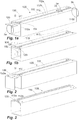
- Fig. 1a and 1b show a schematic representation of a first embodiment of a roller blind cassette according to the invention.
- This roller blind cassette 100 primarily comprises an open hollow profile 110, which is designed as a bent sheet-metal part.
- the wall thickness of this hollow profile is about 1 mm. Due to the design as an open hollow profile this is easy and inexpensive to manufacture. However, such an open hollow profile tends to twist strongly at a moment application illustrated by the arrows 2a, 2b.
- the resulting movement in the longitudinal direction of the hollow profile 110 is illustrated by the arrows 3a and 3b.
- connecting webs 120 are provided, wherein in the embodiments of the Fig. 1 to 5 for clarity, only the respective connecting webs are shown on the left side.
- Fig. 1a and 1b it is in the connecting web 120 is a simple sheet metal strip.
- Fig. 1b shown, in the assembled state provided on the inside in the region of a slot 112 of the hollow profile 110 and connected to the edge regions 112a, 112b on both sides of the slot by means of rivets 130.
- at least at one edge region 112a two holes 114a are provided for these rivets 130, so that after the in Fig. 1 b shown successful attachment of the connecting web 120 fixed and in particular also rotatably connected to the edge region 112a.
- At the edge region 112b on the opposite side is in the embodiment of the Fig. 1a and 1b only one rivet 130 is provided, which connects the hollow profile 110 with the connecting web 120.
- a second rivet can also be provided here to improve the introduction of force.
- roller shaft 102 which serves the purpose of winding a roller blind 104 is inexpensive to manufacture and very stable. It therefore represents an inexpensive alternative to a originally closed hollow profile, in which the outlet gap is introduced after production of the hollow profile.
- the connecting web 120 does not necessarily have to be designed as a simple flat connection strip. Instead, it may be shaped to partially or completely close an open cross-section at the ends 110a, 110b of the hollow profile. In such a case it is from Advantage, when the preferably integrally provided on the connecting web end wall 120a on its inside in a manner not shown and bearing means for supporting the winding shaft 102 has.
- Fig. 3 illustrates that the stabilization of the open hollow profile by means of a connecting web 120 is not limited to cartridges, in which the edge regions 112a, 112b are arranged on both sides of the slot 112 in alignment with each other. Instead, it can certainly also be provided that the slot 112 is arranged at an exposed position between two mutually angled edge regions 112a, 112b. In such a case, the tie bar 120 is in the in Fig. 3 illustrated manner to provide as a bent component.
- the Fig. 4a and 4b show a further embodiment of a roller blind cassette 200 according to the invention.
- the hollow profile 210 in the region of the slot 212 in each case folded over in both edge regions 212a, 212b, so that in each case two receiving shafts 216 form on both end faces 210a, 210b.
- the connecting web 220 is provided with two plug-in sections 222, which extend approximately in the main extension direction 1 of the roller blind cassette 200 and which have a slightly tapered shape towards their distal end. In this embodiment, it is provided that these are inserted in approximately U-shaped connecting webs 220 on both sides of the slot 212 in the receiving slots 216.
- the receiving wells 216 and the insertion portions 222 are adapted to one another in such a way that a frictional holding press connection results, which precludes a twisting of the roller blind cassette 200.
- a frictional holding press connection results, which precludes a twisting of the roller blind cassette 200.
- the design of the Fig. 5a and 5b is related to this, however, has plug-in portions 222, at the top of which locking thickening 222a are provided. These have on their outwardly facing side a vertical edge and on their - related to the Fig. 5a - In the direction of the receiving slots 216 side facing elongated slopes.
- recesses 218 are provided on both sides of the slot 212 in the edge regions 212a, 212b, into which the latching thickenings 222a can engage.
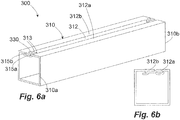
- edge regions 312a, 312b are similar to the embodiment of FIG 4 and 5 crimped.
- a section 313 is provided, are excluded by the connecting webs 315a, 315b of the Umfalzung. These therefore extend substantially in the plane of the edge regions 312a and 312b and overlap each other. In the overlapping region, they are connected to one another by a connecting means, in the present case in the form of a rivet 330.
- the torsional stiffness to be achieved thereby still exceeds the torsional stiffness of the preceding embodiments, since due to the one-piece molding of the connecting webs 315a, 315b on the hollow profile 310, separation of the connecting webs from the hollow profile 310 does not have to be expected.
- a connecting web is formed only on one of the two sides, which extends in the direction of the opposite side. This overlaps the opposite edge region on the other side of the outlet slot and is in turn fastened there by means of a connection means such as a rivet.
Landscapes
- Engineering & Computer Science (AREA)
- Structural Engineering (AREA)
- Civil Engineering (AREA)
- Architecture (AREA)
- Mechanical Engineering (AREA)
- Operating, Guiding And Securing Of Roll- Type Closing Members (AREA)
- Support Devices For Sliding Doors (AREA)
Abstract
Description
- Die Erfindung betrifft eine Rollokassette zur Aufnahme einer Rollowelle und einer in einem Stauzustand auf der Rollowelle aufgewickelte und in einen Funktionszustand durch einen Austrittsspalt der Rollokassette von der Rollowelle in einer Längsrichtung abziehbaren Rollobahn mit einem Gehäuse, welches ein durchgehend geschlitztes und sich in eine Haupterstreckungsrichtung quer zur Längsrichtung erstreckendes Hohlprofil aufweist, dessen Schlitz den Austrittsspalt der Rollokassette bildet.
- Gattungsgemäße Rollokassetten sind aus dem Stand der Technik allgemein bekannt und werden bei Rollos in Kraftfahrzeugen, beispielsweise bei Beschattungsrollos oder Laderaumabdeckungen, verwendet, um die Rollobahn im aufgewickelten Zustand aufzunehmen, wenn diese nicht im Funktionszustand benötigt wird. Der Grundkörper solcher Rollokassetten, der als geschlitztes Hohlprofil ausgebildet ist, stellt fertigungstechnisch gegenüber einem geschlossenen und nachbearbeiteten Hohlprofil einen Vorteil dar, da hierdurch der Bearbeitungsaufwand verringert und die Kosten damit gesenkt werden können. Allerdings haben derartige geschlitzte Hohlprofile eine gegenüber geschlossenen Hohlprofilen deutlich verringerte Verwindungssteifigkeit, da ihre Kanten im Bereich des Schlitzes eine Relatiwerlagerung in Haupterstreckungsrichtung wenig Widerstand entgegensetzen. Bei bekannten Rollokassetten mit geschlitztem Hohlprofil ist zur Erzielung einer außenreichenden Verwindungssteifigkeit vorgesehen, dass vergleichsweise dicke Mittelbleche Verwendung finden, insbesondere solche mit Wandstärken größer 1,5 mm. Kleinere Wandstärken sind bislang als nachteilig angesehen worden, da sie eine ausreichende Verwindungssteifigkeit der Rollokassette nicht gewährleisten können.
- Nachteilig an diesen aus dem Stand der Technik bekannten Rollokassetten mit hoher Wandungsstärke ist allerdings, dass deren Masse vergleichsweise groß ist. Zunehmend besteht jedoch das Bedürfnis, alle in einem Fahrzeug verwendeten Komponenten hinsichtlich ihrer Masse zu reduzieren, um die Effizienz der Fahrzeuge zu erhöhen. Eine solche Massenverringerung ist auch in Hinblick auf Rollokassetten gewünscht.
- Aufgabe der Erfindung ist es daher, eine Rollokassette gattungsgemäßen Typs dahingehend weiterzubilden, dass diese bei ausreichender Verwindungssteifigkeit eine geringe Masse aufweist.
- Erfindungsgemäß wird dies gemäß einem ersten Aspekt der Erfindung dadurch erreicht, dass zwei sich gegenüberliegende und in Haupterstreckungsrichtung erstreckte Randbereiche beidseitig des Schlitzes des Hohlprofils miteinander jeweils im Bereich zweier gegenüberliegenden Stirnenden des Hohlprofils durch einen Verbindungsteg verbunden sind, wobei dieser Verbindungssteg mit mindestens einem der Randbereiche mittels Verbindungsmitteln verbunden ist, die eine Drehbeweglichkeit des Verbindungsstegs am Randbereich quer zur Hauptersteckungsrichtung der Rollokassette formschlüssig entgegenwirken.
- Erfindungsgemäß ist demnach vorgesehen, die Randbereiche der Kassette unmittelbar miteinander zu verbinden, wobei diese Verbindung über einen Verbindungssteg derart realisiert ist, dass der Verbindungssteg an mindestens einem Rand derart festgelegt ist, dass er sich nicht um eine gedachte, quer zur Haupterstreckungsrichtung ausgerichtete Achse verdrehen kann, da dies der gewünschten Verwindungssteifigkeit entgegenwirken würde. Eine Verhinderung der Drehbeweglichkeit an beiden durch den Verbindungssteg miteinander verbundenen Randbereichen ist von Vorteil, jedoch nicht zwingend erforderlich, da durch die genannte Drehfixierung des Verbindungsmittels an einem Randbereich eine Fixierung erreicht ist, die es gestattet, die Fixierung auf der gegenüberliegenden Seite einfacher auszugestalten. Als Randbereich im Sinne dieser Erfindung wird ein Bereich verstanden, der von dem Schlitz des Hohlprofils nicht weiter als 15 mm, vorzugsweise nicht weiter als 10 mm entfernt ist. Innerhalb dieses Randbereichs erfolgt zumindest zum Teil die Krafteinleitung vom Hohlprofil in den Verbindungssteg.
- Durch die beschriebene Verbindung der gegenüberliegenden Randbereiche mittels eines Verbindungssteges kann eine deutliche Erhöhung der Verwindungssteifigkeit erzielt werden, so dass die Notwendigkeit der Verwendung sehr dicken Blechmaterials entfällt. Eine Massenreduktion ist daher erzielbar.
- Besonders einfache Ausgestaltungen der Verbindung zwischen der Rollokassette und dem Verbindungssteg sind zu erreichen, wenn hierfür Schraubverbindungen oder Nietverbindungen Verwendung finden, wobei in einem solchen Falle zumindest an einer der beiden Seiten zur Erzielung der formschlüssigen Verhinderung einer Drehbeweglichkeit zwei derartige Schrauben bzw. Nieten vorgesehen sein sollten.
- Eine alternative Ausgestaltung, die insbesondere in Hinblick auf eine einfache Montage von Vorteil ist, sieht vor, dass die Verbindungsmittel zur Verbindung des Verbindungssteges mit dem Hohlprofil einen im Randbereich des Gehäuses vorgesehenen und durch das Gehäuse gebildeten Aufnahmeschacht aufweisen, in den ein am Verbindungssteg vorzugsweise einstückig vorgesehener Steckabschnitt in Haupterstreckungsrichtung eingesteckt ist. Bei einer solchen Gestaltung wird somit durch eine passende Formgebung des Hohlprofils ein in Haupterstreckungsrichtung erstreckter Aufnahmeschacht gebildet, in den ein ebenfalls in Haupterstreckungsrichtung erstreckter Steckabschnitt des Verbindungssteges eingeschoben wird. Dabei können der Aufnahmeschacht und der Steckabschnitt einen über ihre Länge gleichbleibenden Querschnitt aufweisen. Vorteilhaft ist jedoch eine leichte Verjüngung des Steckabschnittes hin zu seinem distalen Ende, so dass bei vollständig eingestecktem Steckabschnitt auch eine kraftschlüssige Kopplung zwischen dem Gehäuse und dem Steckabschnitt in Hinblick auf eine Relativbewegung in Richtung der Haupterstreckungsrichtung erreicht wird. Bei dieser Gestaltung ist weiterhin von Vorteil, wenn beidseitig des Schlitzes derartige Aufnahmeschächte vorgesehen sind und am Verbindungssteg zwei zueinander im Wesentlichen parallele Steckabschnitte vorgesehen sind, die an den beiden gegenüberliegenden Randbereichen in diese Aufnahmeschächte eingeschoben werden.
- Durch die oben genannte Verjüngung lässt sich eine Pressverbindung herstellen, die kraftschlüssig einem Herausziehen des Verbindungssteges auf den Aufnahmeschächten oder dem mindestens einem Aufnahmeschacht entgegenwirkt. Vorteilhaft ist eine formschlüssig wirkende Verhinderung des Herausziehens. Diese kann beispielsweise durch eine das Hohlprofil im Bereich des Aufnahmeschachtes und den Steckabschnitt durchdringende Verbindungsschraube, einen Verbindungsstift oder einen Verbindungsniet gebildet werden. Eine besonders vorteilhafte Ausgestaltung sieht jedoch vor, dass formschlüssig wirkende Sicherungsmittel am Hohlprofil und dem Steckabschnitt vorgesehen sind, insbesondere zur Bildung einer Schnappverbindung, mittels derer der Steckabschnitt im Aufnahmeschacht gegen Herausziehen gesichert ist. Diese Sicherungsmittel sind vorzugsweise derart ausgebildet, dass sie bereits durch Einstecken des Steckabschnitts in den Aufnahmeschacht in einen Sicherungszustand gelangen. Die Funktionsweise kann dabei die eines Widerhakens sein. Dies führt zu einer sehr einfachen Montage, da lediglich der Verbindungssteg und der an ihm angeformte Steckabschnitt seitlich an das Hohlprofil herangeführt werden muss und in dieses eingeschoben werden muss, um die gewünschte Verbindung zu schaffen. Eine konkrete Ausgestaltung des Sicherungsmittels könnte beispielsweise vorsehen, dass im Hohlprofil Aussparungen oder Vertiefungen an der Innenseite des Aufnahmeschachtes vorgesehen sind, in die eine Schnappzunge, die am Steckabschnitt vorgesehen ist, einschnappt, sobald der Steckabschnitt ausreichend weit in den Aufnahmeschacht eingeführt ist. Eine umgekehrte Gestaltung, bei der die Ausnehmung oder die Vertiefung im Steckabschnitt vorgesehen ist und bei der die Schnappzunge am Hohlprofil vorgesehen ist, ist gleichermaßen zweckmäßig.
- Zur Ausbildung des Aufnahmeschachtes ist vorzugsweise vorgesehen, dass im an den Schlitz angrenzenden Randbereich des Hohlprofils beidseitig des Schlitzes das Hohlprofil umgefalzt ist und dadurch beidseitig schlitzartige Aufnahmeschächte bildet.
- Der Verbindungssteg kann derart ausgebildet sein, dass er lediglich die Verbindung zwischen den beiden gegenüberliegenden Randbereichen schafft, die Stirnenden des Hohlprofils jedoch unverschlossen lässt. Es kann jedoch auch zweckmäßig sein, wenn der Verbindungssteg insbesondere einstückig mit einer das Hohlprofil stirnseitig abschließenden Stirnkappe ausgebildet ist, welche das offene Stirnende des Gehäuses zumindest zum überwiegenden Teil verschließt. Bei einer solchen Gestaltung übernimmt der Verbindungssteg somit eine Doppelfunktion. Er ist Träger der an ihr befestigten oder angeformten stirnseitigen Wandung des Gehäuses und gleichzeitig Stabilisator des Gehäuses gegen Verwindungen. Die Stirnwandung kann gleichzeitig auch dem Zweck dienen, Lagerstelle für die innerhalb des Gehäuses drehbar gelagerte Rollowelle zu sein.
- Die Erfindung betrifft weiterhin eine zu dieser beschriebenen Gestaltung verwandte Gestaltung, bei der eine gattungsgemäße Rollokassette dahingehend weitergebildet ist, dass sich von mindestens einem Randbereich an mindestens einem der Stirnenden ein Verbindungssteg über den Schlitz erstreckt, der einstückiger Teil des Hohlprofils ist und dessen distales Ende am gegenüberliegenden Bereich befestigt ist. Alternativ dazu können sich von beiden gegenüberliegenden Randbereichen an mindestens einem Stirnende des Hohlprofils jeweils Verbindungsstege über den Schlitz erstrecken, die jeweils einstückiger Teil des Hohlprofils sind und deren distale Enden miteinander verbunden sind.
- Bei einer solchen Gestaltung wird somit auf einen separaten Verbindungssteg verzichtet. Stattdessen finden je Stirnende ein oder zwei Verbindungsstege Anwendung, die einstückiger Teil des Hohlprofils sind. Im Falle der Verwendung nur eines solchen Verbindungssteges je Stirnseite erstreckt sich dieser über den Schlitz hinweg und ist auf der gegenüberliegenden Seite mit dem dortigen Randbereich in einer Art und Weise verbunden, die eine Relativverlagerung des Verbindungsstegs gegenüber dem Randbereich in Richtung der Haupterstreckungsrichtung verhindert. Hierdurch wird wiederum die gewünschte Verwindungssteifigkeit erreicht. Die dort verwendete Verbindung ist vorzugsweise eine formschlüssige, die wiederum insbesondere über eine den Verbindungssteg und das Hohlprofil durchdringende Schrauben- oder Nietverbindung gebildet sein kann. Im Falle der Gestaltung mit zwei Verbindungsstegen je Stirnende, die sich von gegenüberliegenden Seiten aufeinander zu erstrecken, erfolgt diese Verbindung fluchtend mit dem Schlitz.
- Auch durch diese Gestaltung wird ein hohes Maß an Verwindungssteifigkeit erreicht, die zudem aufgrund der stoffschlüssigen Einstückigkeit des Verbindungsstegs mit dem Hohlprofil sogar noch von höherer Stabilität sein kann als bei der Verwendung eines vollständig separaten Verbindungsstegs.
- Der mindestens eine Verbindungssteg je Stirnende ist vorzugsweise durch einen quer zur Haupterstreckungsrichtung eingebrachten Schnitt im Hohlprofil gebildet, durch den der Verbindungssteg von einem umgefalzten Randbereich des Austrittsspalts getrennt wird. Dies erlaubt es, bei der Fertigung nach Einbringen dieses quer zu Haupterstreckungsrichtung sich erstreckenden Schnittes den Randbereich bzw. die Randbereiche im Bereich des zu bildenden Austrittsspaltes umzufalzen, wobei der oder die Verbindungsstege aufgrund des Schnittes hiervon untangiert bleiben. Eine einfache Herstellbarkeit ist die Folge.
- Bei einer erfindungsgemäßen Rollokassette handelt es sich vorzugsweise um eine Rollokassette aus Metall, insbesondere aus einem Metallblech konstanter Dicke. Diese Dicke beträgt vorzugsweise zur Erzielung einer geringen Masse maximal 1,5 mm, insbesondere vorzugsweise maximal 1 mm. Wie oben verdeutlicht, kann diese geringe Wandungsstärke des Hohlprofils aufgrund der durch den Verbindungssteg erzielbaren Verwindungssteife ausreichen. Vorzugsweise ist auch der Verbindungssteg selbst, auch wenn er als separates Bauteil vorgesehen ist, aus Metall gefertigt. Auch hierbei handelt es sich vorzugsweise um ein Blechteil, welches durch Stanzen oder dergleichen in die gewünschte Form gebracht wird, so dass beispielsweise hierdurch die Steckabschnitte oben beschriebener Art gebildet werden.
- Die erfindungsgemäße Rollokassette findet bei einem erfindungsgemäßen Rollo Verwendung, welches insbesondere zur Verwendung in einem Fahrzeug vorgesehen und ausgebildet ist. Dabei umfasst dieses Rollo neben der erfindungsgemäßen Rollokassette auch noch eine in der Rollokassette auch drehbar gelagerte Rollowelle sowie eine auf der Rollowelle aufgewickelte und von der Rollowelle abwickelbare Rollobahn.
- Weitere Vorteile und Aspekte der Erfindung ergeben sich außer aus den Ansprüchen auch aus der nachfolgenden Beschreibung bevorzugter Ausführungsbeispiele der Erfindung, welche im Weiteren erläutert sind. Dabei zeigen:
- Fig. 1a und 1b
- eine erste Ausführungsform einer erfindungsgemäßen Rollokassette mit separatem Verbindungssteg,
- Fig. 2
- eine zweite Ausführungsform einer erfindungsgemäßen Rollokassette mit separatem Verbindungssteg,
- Fig. 3
- eine dritte Ausführungsform einer erfindungsgemäßen Rollokassette mit separatem Verbindungssteg,
- Fig. 4a und 4b
- eine vierte Ausführungsform einer erfindungsgemäßen Rollokassette mit separatem Verbindungssteg,
- Fig. 5a und 5b
- eine fünfte Ausführungsform einer erfindungsgemäßen Rollokassette, die eine Variante zur Ausführungsform der
Fig. 4a und 4b darstellt, und - Fig. 6a und 6b
- eine sechste Ausführungsform einer erfindungsgemäßen Rollokassette mit angeformtem Verbindungssteg.
-
Fig. 1a und 1b zeigen in schematischer Darstellung eine erste Ausführungsform einer erfindungsgemäßen Rollokassette. Diese Rollokassette 100 umfasst primär ein offenes Hohlprofil 110, welches als gebogenes Blechteil ausgebildet ist. Die Wandungsstärke dieses Hohlprofils liegt bei etwa 1 mm. Durch die Ausgestaltung als offenes Hohlprofil ist dieses einfach und kostengünstig herzustellen. Allerdings neigt ein solches offenes Hohlprofil dazu, bei einer durch die Pfeile 2a, 2b verdeutlichten Momentenbeaufschlagung stark zu verwinden. Die daraus resultierende Bewegung in Längsrichtung des Hohlprofils 110 ist anhand der Pfeile 3a und 3b verdeutlicht. Um dies zu verhindern, sind beidseitig an den Stirnenden 110a, 110b des Hohlprofils 110 Verbindungsstege 120 vorgesehen, wobei in den Ausführungsbeispielen derFig. 1 bis 5 zur Verdeutlichung stets nur der jeweilige Verbindungsstege auf der linken Seite dargestellt sind. - Im Falle der Ausgestaltung der
Fig. 1a und 1b handelt es sich bei dem Verbindungssteg 120 um einen einfachen Blechstreifen. Dieser ist, wie inFig. 1b dargestellt, im montierten Zustand innenseitig im Bereich eines Schlitzes 112 des Hohlprofils 110 vorgesehen und mit den Randbereichen 112a, 112b beidseitig des Schlitzes mittels Nieten 130 verbunden. Dabei sind zumindest an einem Randbereich 112a zwei Bohrungen 114a für diese Nieten 130 vorgesehen, so dass nach der inFig. 1 b dargestellten erfolgten Befestigung der Verbindungssteg 120 fest und insbesondere auch drehfest mit dem Randbereich 112a verbunden ist. Am Randbereich 112b auf der gegenüberliegenden Seite ist beim Ausführungsbeispiel derFig. 1a und 1b nur ein Niet 130 vorgesehen, der das Hohlprofil 110 mit dem Verbindungssteg 120 verbindet. Selbstverständlich kann zur Verbesserung der Krafteinleitung auch hier ein zweiter Niet vorgesehen sein. - Das somit hergestellte Hohlprofil zur Aufnahme einer in
Fig. 1b dargestellten Rollowelle 102, die dem Zweck des Aufwickelns einer Rollobahn 104 dient, ist preisgünstig herzustellen und ausgesprochen stabil. Es stellt daher eine preisgünstige Alternativ zu einem originär geschlossenen Hohlprofil dar, in welches der Austrittsspalt nach Herstellung des Hohlprofils eingebracht wird. - Die Ausgestaltung der
Fig. 2 verdeutlicht, dass der Verbindungssteg 120 nicht zwingend als einfacher planer Verbindungsstreifen ausgebildet sein muss. Stattdessen kann er so geformt sein, dass er ein an den Stirnenden 110a, 110b des Hohlprofils gegebenen offenen Querschnitt teilweise oder vollständig verschließt. In einem solchen Fall ist es von Vorteil, wenn die vorzugsweise einstückig am Verbindungssteg vorgesehene Stirnwand 120a auf ihrer Innenseite in nicht dargestellter Art und Weise auch Lagermittel zur Lagerung der Wickelwelle 102 aufweist. -
Fig. 3 verdeutlicht, dass die Stabilisierung des offenen Hohlprofils mittels eines Verbindungsstegs 120 nicht auf Kassetten beschränkt ist, bei denen die Randbereiche 112a, 112b beidseitig des Schlitzes 112 fluchtend zueinander angeordnet sind. Stattdessen kann durchaus auch vorgesehen sein, dass der Schlitz 112 an exponierter Position zwischen zwei zueinander abgewinkelten Randbereichen 112a, 112b angeordnet ist. In einem solchen Fall ist der Verbindungssteg 120 in der inFig. 3 dargestellten Art und Weise als gebogenes Bauteil vorzusehen. - Die
Fig. 4a und 4b zeigen eine weitere Ausführungsform einer erfindungsgemäßen Rollokassette 200. Bei dieser finden keine vom Hohlprofil 210 und dem Verbindungssteg 220 separaten Verbindungsmittel Anwendung. Stattdessen ist das Hohlprofil 210 im Bereich des Schlitzes 212 jeweils in beiden Randbereichen 212a, 212b umgefalzt, so dass sich hierdurch an beiden Stirnseiten 210a, 210b je zwei Aufnahmeschächte 216 bilden. Korrespondierend hierzu ist der Verbindungssteg 220 mit zwei Steckabschnitten 222 versehen, die sich in etwa in der Haupterstreckungsrichtung 1 der Rollokassette 200 erstrecken und die eine sich zu ihrem distalen Ende leicht verjüngende Form aufweisen. Bei dieser Ausgestaltung ist vorgesehen, dass diese in etwa U-förmigen Verbindungsstege 220 beidseitig des Schlitzes 212 in die Aufnahmeschächte 216 eingeschoben werden. Dabei sind die Aufnahmeschächte 216 und die Einsteckabschnitte 222 derart aufeinander angepasst, dass sich eine kraftschlüssige haltende Pressverbindung ergibt, die einer Verwindung der Rollokassette 200 entgegensteht. Um eine ausreichende Pressverbindung herzustellen, ist es jedoch erforderlich, mit erheblichem Kraftaufwand die Steckabschnitte 222 in die Aufnahmeschächte 216 hineinzudrücken. Die Ausgestaltung derFig. 5a und 5b ist hierzu verwandt, weist jedoch Steckabschnitte 222 auf, an deren Oberseite Rastverdickungen 222a vorgesehen sind. Diese weisen an ihrer nach außen weisenden Seite eine senkrechte Flanke und auf ihrer - bezogen auf dieFig. 5a - in Richtung der Aufnahmeschächte 216 zeigenden Seite langgestreckte Schrägen auf. Korrespondierend hierzu sind in den Randbereichen 212a, 212b beidseitig des Schlitzes 212 Ausnehmungen 218 vorgesehen, in die die Rastverdickungen 222a einrücken können. - Bei der Montage der Rollokassette gemäß der
Fig. 5a und 5b kann daher ein erheblich geringerer Kraftaufwand ausreichen als bei der Montage der Ausgestaltung derFig. 4a und 4b . Sobald der Verbindungssteg 220 ausreichend weit mit seinen beiden Steckabschnitten 222 in die Aufnahmeschächte 216 eingeschoben ist, schnappen die Rastverdickungen 222a in die Ausnehmungen 218 ein und verhindern so in Art eines Widerhakens wirksam, dass eine Relativbewegung der Randbereiche 212a und 212b gegeneinander in entgegengesetzte Richtungen möglich ist. Wiederum ist eine hohe Verwindungssteife der Rollokassette 200 die Folge. - Bei der Ausgestaltung gemäß der
Fig. 6a ist kein separater Verbindungssteg vorgesehen. Stattdessen sind die Randbereiche 312a, 312b ähnlich der Ausgestaltung derFig. 4 und 5 umgefalzt. Jeweils in einem Stirnendbereich 310a ist jedoch ein Schnitt 313 vorgesehen, durch den Verbindungsstege 315a, 315b von der Umfalzung ausgenommen sind. Diese erstrecken sich daher im Wesentlichen in der Ebene der Randbereiche 312a und 312b und überlappen einander. Im Überlappungsbereich sind sie miteinander durch ein Verbindungsmittel, vorliegend in Form eines Niets 330 miteinander verbunden. Die hierdurch zu erzielende Verwindungssteifigkeit übersteigt noch die Verwindungssteifigkeit der vorangegangenen Ausführungsformen, da aufgrund der einstückigen Anformung der Verbindungsstege 315a, 315b an das Hohlprofil 310 eine Trennung der Verbindungsstege vom Hohlprofil 310 nicht erwartet werden muss. - Bei einer alternativen Ausgestaltung, die zeichnerisch nicht dargestellt ist, ist nur an eine der beiden Seiten ein Verbindungssteg angeformt, der sich in Richtung der gegenüberliegenden Seite erstreckt. Dieser überlappt jenseits des Austrittsschlitzes den gegenüberliegenden Randbereich und ist dort wiederum mittels eines Verbindungsmittels wie eines Niets befestigt.
Claims (10)
- Rollokassette (100; 200; 300) zur Aufnahme einer Rollowelle (102) und einer in einem Stauzustand auf der Rollowelle aufgewickelte und in einen Funktionszustand durch einen Austrittsspalt (112; 212; 312) der Rollokassette (100; 200; 300) von der Rollowelle in einer Längsrichtung abziehbaren Rollobahn (104), mit einem Gehäuse, welches ein durchgehend geschlitztes und sich in einer Haupterstreckungsrichtung (1) quer zur Längsrichtung erstreckendes Hohlprofil (110; 210; 310) aufweist, dessen Schlitz (112; 212; 312) den Austrittsspalt (112; 212; 312) der Rollokassette bildet,
dadurch gekennzeichnet, dass
zwei sich gegenüberliegende und in Erstreckungsrichtung erstreckte Randbereiche (112a, 112b; 212a, 212b) beidseitig des Schlitzes (112; 212) miteinander jeweils im Bereich zweier gegenüberliegender Stirnenden (110a, 110b; 210a, 210b) des Hohlprofils durch einen Verbindungssteg (120; 220) verbunden sind, wobei dieser Verbindungssteg (120; 220) mit mindestens einem der Randbereichs (112a, 112; 212a, 212b) mittels Verbindungsmitteln (30; 222, 216) verbunden sind, die einer Drehbeweglichkeit des Verbindungsstegs (120; 220) gegenüber dem Randbereich (112a, 112; 212a, 212b) formschlüssig entgegenwirken. - Rollokassette (100; 200) nach Anspruch 1,
dadurch gekennzeichnet, dass
die Verbindungsmittel (220) einen im Randbereich (212a, 212b) am Gehäuse vorgesehenen und durch das Gehäuse gebildeten Aufnahmeschacht (216) aufweisen, in den ein am Verbindungssteg (220) vorgesehener Steckabschnitt (222) in axialer Richtung (1) eingesteckt ist. - Rollokassette (200) nach Anspruch 2,
dadurch gekennzeichnet, dass
der Steckabschnitt (222) und der Aufnahmeschacht (216) zur Ausbildung einer Pressverbindung ausgebildet sind. - Rollokassette (200) nach Anspruch 2 oder 3,
dadurch gekennzeichnet, dass
formschlüssig wirkende Sicherungsmittel (222a, 218) vorgesehen sind, insbesondere zur Bildung einer Schnappverbindung, mittels derer der Steckabschnitt (222) im Aufnahmeschacht (216) gegen Herausziehen gesichert ist. - Rollokassette (100) nach einem der vorstehenden Ansprüche, dadurch gekennzeichnet, dass
der Verbindungssteg (120) insbesondere einstückig mit einer das Gehäuse stirnseitig abschließenden Stirnkappe (120a) ausgebildet ist, die das offene Stirnende des Hohlprofils (110) zumindest zum überwiegenden Teil verschließt. - Rollokassette (300) nach dem Oberbegriff von Anspruch 1,
dadurch gekennzeichnet, dass- sich von mindestens einem Randbereich (312a, 312b) an mindestens einem der Stirnenden (310a, 310b) ein Verbindungssteg über den Schlitz (312) erstreckt, der einstückiger Teil des Hohlprofils (310) ist und dessen distales Ende am gegenüberliegenden Randbereich befestigt ist, oder- sich von beiden gegenüberliegenden Randbereichen (312a, 312b) an mindestens einem der Stirnenden (310a, 310b) Verbindungsstege (315a, 315b) über den Schlitz (312) erstrecken, die jeweils einstückiger Teil des Hohlprofils (310) sind und deren distale Enden miteinander verbunden sind. - Rollokassette nach Anspruch 6,
dadurch gekennzeichnet, dass
der mindestens eine Verbindungssteg (315a, 315b) durch einen quer zur Haupterstreckungsrichtung (1) eingebrachten Schnitt (313) gebildet wird, durch den der Verbindungssteg (315a, 316b) von einem umgefalzten Randbereich (312a, 312b) des Austrittsspaltes (312) getrennt wird. - Rollokassette nach einem der vorsehenden Ansprüchen,
dadurch gekennzeichnet, dass
das Hohlprofil (110; 210; 310) aus Metall, insbesondere aus einem Metallblech konstanter Dicke gefertigt ist, wobei die Dicke vorzugsweise maximal 1,5 mm beträgt, vorzugsweise von maximal 1 mm. - Rollokassette nach einem der vorstehenden Ansprüchen,
dadurch gekennzeichnet, dass
der Verbindungssteg (120; 220; 320) aus Metall gefertigt ist. - Rollo, insbesondere zur Verwendung in einem Fahrzeug, mit- einem Rollokassette (100; 200; 300) und- einer in der Rollokassette drehbar gelagerten Rollowelle (102) und- einer auf der Rollowelle aufgewickelten und von der Rollowelle abwickelbare Rollobahn (104),
dadurch gekennzeichnet, dass die Rollokassette (100; 200; 300) nach einem der vorstehenden Ansprüche ausgebildet ist.
Priority Applications (1)
| Application Number | Priority Date | Filing Date | Title |
|---|---|---|---|
| EP15165455.5A EP2930064B1 (de) | 2011-03-18 | 2012-03-12 | Rollokassette und rollosystem |
Applications Claiming Priority (1)
| Application Number | Priority Date | Filing Date | Title |
|---|---|---|---|
| DE102011005819.2A DE102011005819B4 (de) | 2011-03-18 | 2011-03-18 | Rollokassette und Rollo |
Related Child Applications (2)
| Application Number | Title | Priority Date | Filing Date |
|---|---|---|---|
| EP15165455.5A Division EP2930064B1 (de) | 2011-03-18 | 2012-03-12 | Rollokassette und rollosystem |
| EP15165455.5A Division-Into EP2930064B1 (de) | 2011-03-18 | 2012-03-12 | Rollokassette und rollosystem |
Publications (3)
| Publication Number | Publication Date |
|---|---|
| EP2520463A2 true EP2520463A2 (de) | 2012-11-07 |
| EP2520463A3 EP2520463A3 (de) | 2013-02-13 |
| EP2520463B1 EP2520463B1 (de) | 2015-07-29 |
Family
ID=45851407
Family Applications (2)
| Application Number | Title | Priority Date | Filing Date |
|---|---|---|---|
| EP12159111.9A Active EP2520463B1 (de) | 2011-03-18 | 2012-03-12 | Rollokassette und Rollosystem |
| EP15165455.5A Active EP2930064B1 (de) | 2011-03-18 | 2012-03-12 | Rollokassette und rollosystem |
Family Applications After (1)
| Application Number | Title | Priority Date | Filing Date |
|---|---|---|---|
| EP15165455.5A Active EP2930064B1 (de) | 2011-03-18 | 2012-03-12 | Rollokassette und rollosystem |
Country Status (5)
| Country | Link |
|---|---|
| US (2) | US8919414B2 (de) |
| EP (2) | EP2520463B1 (de) |
| KR (1) | KR20120106654A (de) |
| CN (1) | CN102926647B (de) |
| DE (1) | DE102011005819B4 (de) |
Cited By (1)
| Publication number | Priority date | Publication date | Assignee | Title |
|---|---|---|---|---|
| WO2016096254A1 (de) * | 2014-12-15 | 2016-06-23 | Bos Gmbh & Co. Kg | Schutzvorrichtung für einen fahrzeuginnenraum sowie hutablage für einen innenraum eines personenkraftwagens |
Families Citing this family (4)
| Publication number | Priority date | Publication date | Assignee | Title |
|---|---|---|---|---|
| DE102011005819B4 (de) * | 2011-03-18 | 2015-06-25 | Bos Gmbh & Co. Kg | Rollokassette und Rollo |
| US20140345810A1 (en) * | 2013-05-22 | 2014-11-27 | Edward L. Nofziger | Horizontal Reinforcement Bar |
| FI128236B (fi) * | 2018-11-30 | 2020-01-15 | Jani Piiroinen | Rullaverho |
| DE102019200513B4 (de) | 2018-12-12 | 2025-06-26 | Bos Gmbh & Co. Kg | Gehäuse für eine Schutzvorrichtung für einen Kraftfahrzeuginnenraum, Schutzvorrichtung mit einem solchen Gehäuse und Verfahren zur Herstellung eines solchen Gehäuses |
Family Cites Families (24)
| Publication number | Priority date | Publication date | Assignee | Title |
|---|---|---|---|---|
| US1304089A (en) * | 1919-05-20 | George w | ||
| US2673608A (en) * | 1947-10-04 | 1954-03-30 | Lorentzen Hardware Mfg Corp | Venetian blind head bar construction and fitting |
| US2651358A (en) * | 1952-11-18 | 1953-09-08 | Lorentzen Hardware Mfg Corp | End brace for venetian blind head bars |
| US3146824A (en) * | 1963-01-08 | 1964-09-01 | Roger L Veilleux | Apparatus for covering truck bodies |
| US3300940A (en) * | 1964-07-13 | 1967-01-31 | Paul J Golasz | Elongated housing |
| US3425480A (en) * | 1967-05-25 | 1969-02-04 | Levolor Lorentzen Inc | End brace organization for venetian blind head channel or the like |
| US4254813A (en) * | 1979-06-20 | 1981-03-10 | Hunter Douglas International N.V. | Valance bracket for vertical venetian blind |
| US4385476A (en) * | 1980-09-22 | 1983-05-31 | United States Gypsum Company | Web stiffener for light-gauge metal framing members |
| US4662596A (en) * | 1985-08-28 | 1987-05-05 | Cooper Industries | Support bracket assembly for window covering |
| GB2196043A (en) * | 1986-10-09 | 1988-04-20 | Chang A Shen | Vertical blinds |
| CN2114374U (zh) * | 1992-02-26 | 1992-09-02 | 王英俊 | 半自动卷轴式窗纱帘盒 |
| DE19527068C2 (de) * | 1995-07-25 | 1997-05-07 | Baumeister & Ostler Gmbh Co | Hohlprofil für eine Laderaumsicherung |
| DE19707674A1 (de) * | 1997-02-26 | 1998-08-27 | Butz Peter Verwaltung | Laderaum-Trennvorrichtung für Kraftwagen, insbesondere für Kombinations-Personenkraftwagen |
| US6032718A (en) * | 1999-06-02 | 2000-03-07 | Chen; Wen-Ho | Adjustable sunshade for an automobile |
| DE20101709U1 (de) * | 2001-01-22 | 2002-06-13 | Peter Butz Gmbh & Co Verwaltungs-Kg, 40764 Langenfeld | Schutz- und/oder Abdeckrollo für Fahrzeuge, wie z.B. Lichtschutz-Fensterrollo, Laderaum-Abdeckrollo, o.dgl. |
| DE20103037U1 (de) * | 2001-02-20 | 2002-06-27 | Peter Butz Gmbh & Co Verwaltungs-Kg, 40764 Langenfeld | Schutz und/oder Abdeckrollo für Fahrzeuge |
| US6802170B2 (en) * | 2002-01-07 | 2004-10-12 | Kurt K. Davis | Box beam and method for fabricating same |
| ZA200406212B (en) * | 2003-08-04 | 2005-08-31 | Meyer Allen | Retractable display apparatus |
| US7380876B1 (en) * | 2004-11-08 | 2008-06-03 | Ford Global Technologies, Llc | Hydroformed members with internal bulkhead |
| DE102005042832B3 (de) * | 2005-09-09 | 2007-03-08 | Ise Intex Gmbh | Vorrichtung mit einer Rollowelle und einem an der Rollowelle befestigten abrollbaren Flächengebilde |
| US7621313B2 (en) * | 2008-04-01 | 2009-11-24 | Dung Viet Pham | Portable roll up window blind |
| CN201571907U (zh) * | 2009-10-30 | 2010-09-08 | 博斯股份有限两合公司 | 用于接收卷轴的盒 |
| DE102011005819B4 (de) * | 2011-03-18 | 2015-06-25 | Bos Gmbh & Co. Kg | Rollokassette und Rollo |
| FR3010441B1 (fr) * | 2013-09-06 | 2016-03-04 | Delphia | Talon destine a etre associe a un coffre-tunnel de reception d’un mecanisme de volet roulant |
-
2011
- 2011-03-18 DE DE102011005819.2A patent/DE102011005819B4/de not_active Expired - Fee Related
-
2012
- 2012-03-12 EP EP12159111.9A patent/EP2520463B1/de active Active
- 2012-03-12 EP EP15165455.5A patent/EP2930064B1/de active Active
- 2012-03-16 CN CN201210124913.5A patent/CN102926647B/zh active Active
- 2012-03-16 KR KR1020120027326A patent/KR20120106654A/ko not_active Ceased
- 2012-03-16 US US13/422,443 patent/US8919414B2/en not_active Expired - Fee Related
-
2014
- 2014-11-17 US US14/543,144 patent/US20150068685A1/en not_active Abandoned
Non-Patent Citations (1)
| Title |
|---|
| None |
Cited By (1)
| Publication number | Priority date | Publication date | Assignee | Title |
|---|---|---|---|---|
| WO2016096254A1 (de) * | 2014-12-15 | 2016-06-23 | Bos Gmbh & Co. Kg | Schutzvorrichtung für einen fahrzeuginnenraum sowie hutablage für einen innenraum eines personenkraftwagens |
Also Published As
| Publication number | Publication date |
|---|---|
| EP2930064A1 (de) | 2015-10-14 |
| US8919414B2 (en) | 2014-12-30 |
| KR20120106654A (ko) | 2012-09-26 |
| DE102011005819B4 (de) | 2015-06-25 |
| EP2520463A3 (de) | 2013-02-13 |
| CN102926647B (zh) | 2015-08-26 |
| DE102011005819A1 (de) | 2012-09-20 |
| US20150068685A1 (en) | 2015-03-12 |
| EP2930064B1 (de) | 2016-11-09 |
| EP2520463B1 (de) | 2015-07-29 |
| US20120234501A1 (en) | 2012-09-20 |
| CN102926647A (zh) | 2013-02-13 |
Similar Documents
| Publication | Publication Date | Title |
|---|---|---|
| EP2576319B1 (de) | Federkörper | |
| DE10325928B4 (de) | Hohle Schwellerträgerbaugruppe | |
| EP1965017B1 (de) | Verfahren zur Befestigung eines flexiblen Flächengebildes an einer Wickelwelle und Rollo | |
| EP2930064B1 (de) | Rollokassette und rollosystem | |
| EP3613931A1 (de) | Baugruppe eines bandes zur um eine scharnierachse scharnierbeweglichen verbindung eines flügels an einem rahmen | |
| WO2015032655A1 (de) | Wickelvorrichtung für eine rolloanordnung, rolloanordnung sowie dachanordnung | |
| EP2050912A2 (de) | Schienenelement und Torantrieb | |
| EP2345786B1 (de) | Türband für Aluminiumtüren | |
| DE202008010920U1 (de) | Fensterheberbaugruppe für ein Kraftfahrzeug mit einem Steckbolzen als Verbindungselement | |
| DD270560A5 (de) | Traeger fuer fensterrahmen | |
| DE10146615B4 (de) | Laschenverbindung | |
| EP2759666B1 (de) | Beschlaganordnung mit einem Profilelement | |
| DE202008013001U1 (de) | Schiene für eine Auszugsführung eines Möbelauszugsteiles | |
| EP1992779A2 (de) | Auszugsprofil für Fensterblende | |
| EP1153777A2 (de) | Rollo-Anordnung zum Abdecken einer transparenten Fahrzeug-Karosseriefläche | |
| DE202011050532U1 (de) | System mit einem Profil und einem Beschlagteil | |
| EP1947286B1 (de) | Rolladenkasten | |
| WO2009089819A1 (de) | Wälzlagerkäfig | |
| EP3916190A1 (de) | Federblockiersicherung | |
| DE9101597U1 (de) | Scharnier | |
| DE10008099C2 (de) | Jalousie zur Regulierung eines Gasstroms | |
| EP3591162B1 (de) | Abschlusselement für eine abschlussleiste eines behangs | |
| DE202007008184U1 (de) | Rolo mit einem daran befestigten flexiblen Flächengebilde | |
| DE20209784U1 (de) | Rohrschelle | |
| EP3130733B1 (de) | Scharniergelenk, insbesondere für fenster, türen oder dergleichen |
Legal Events
| Date | Code | Title | Description |
|---|---|---|---|
| PUAI | Public reference made under article 153(3) epc to a published international application that has entered the european phase |
Free format text: ORIGINAL CODE: 0009012 |
|
| AK | Designated contracting states |
Kind code of ref document: A2 Designated state(s): AL AT BE BG CH CY CZ DE DK EE ES FI FR GB GR HR HU IE IS IT LI LT LU LV MC MK MT NL NO PL PT RO RS SE SI SK SM TR |
|
| AX | Request for extension of the european patent |
Extension state: BA ME |
|
| PUAL | Search report despatched |
Free format text: ORIGINAL CODE: 0009013 |
|
| AK | Designated contracting states |
Kind code of ref document: A3 Designated state(s): AL AT BE BG CH CY CZ DE DK EE ES FI FR GB GR HR HU IE IS IT LI LT LU LV MC MK MT NL NO PL PT RO RS SE SI SK SM TR |
|
| AX | Request for extension of the european patent |
Extension state: BA ME |
|
| RIC1 | Information provided on ipc code assigned before grant |
Ipc: E06B 9/42 20060101ALI20130108BHEP Ipc: B60R 5/04 20060101AFI20130108BHEP Ipc: B60J 1/20 20060101ALI20130108BHEP |
|
| 17P | Request for examination filed |
Effective date: 20130812 |
|
| RBV | Designated contracting states (corrected) |
Designated state(s): AL AT BE BG CH CY CZ DE DK EE ES FI FR GB GR HR HU IE IS IT LI LT LU LV MC MK MT NL NO PL PT RO RS SE SI SK SM TR |
|
| 17Q | First examination report despatched |
Effective date: 20140514 |
|
| GRAP | Despatch of communication of intention to grant a patent |
Free format text: ORIGINAL CODE: EPIDOSNIGR1 |
|
| INTG | Intention to grant announced |
Effective date: 20150401 |
|
| GRAS | Grant fee paid |
Free format text: ORIGINAL CODE: EPIDOSNIGR3 |
|
| GRAA | (expected) grant |
Free format text: ORIGINAL CODE: 0009210 |
|
| AK | Designated contracting states |
Kind code of ref document: B1 Designated state(s): AL AT BE BG CH CY CZ DE DK EE ES FI FR GB GR HR HU IE IS IT LI LT LU LV MC MK MT NL NO PL PT RO RS SE SI SK SM TR |
|
| REG | Reference to a national code |
Ref country code: GB Ref legal event code: FG4D Free format text: NOT ENGLISH |
|
| REG | Reference to a national code |
Ref country code: CH Ref legal event code: EP |
|
| REG | Reference to a national code |
Ref country code: AT Ref legal event code: REF Ref document number: 738986 Country of ref document: AT Kind code of ref document: T Effective date: 20150815 |
|
| REG | Reference to a national code |
Ref country code: IE Ref legal event code: FG4D Free format text: LANGUAGE OF EP DOCUMENT: GERMAN |
|
| REG | Reference to a national code |
Ref country code: DE Ref legal event code: R096 Ref document number: 502012003901 Country of ref document: DE |
|
| REG | Reference to a national code |
Ref country code: LT Ref legal event code: MG4D |
|
| REG | Reference to a national code |
Ref country code: NL Ref legal event code: MP Effective date: 20150729 |
|
| PG25 | Lapsed in a contracting state [announced via postgrant information from national office to epo] |
Ref country code: GR Free format text: LAPSE BECAUSE OF FAILURE TO SUBMIT A TRANSLATION OF THE DESCRIPTION OR TO PAY THE FEE WITHIN THE PRESCRIBED TIME-LIMIT Effective date: 20151030 Ref country code: NO Free format text: LAPSE BECAUSE OF FAILURE TO SUBMIT A TRANSLATION OF THE DESCRIPTION OR TO PAY THE FEE WITHIN THE PRESCRIBED TIME-LIMIT Effective date: 20151029 Ref country code: LV Free format text: LAPSE BECAUSE OF FAILURE TO SUBMIT A TRANSLATION OF THE DESCRIPTION OR TO PAY THE FEE WITHIN THE PRESCRIBED TIME-LIMIT Effective date: 20150729 Ref country code: LT Free format text: LAPSE BECAUSE OF FAILURE TO SUBMIT A TRANSLATION OF THE DESCRIPTION OR TO PAY THE FEE WITHIN THE PRESCRIBED TIME-LIMIT Effective date: 20150729 Ref country code: FI Free format text: LAPSE BECAUSE OF FAILURE TO SUBMIT A TRANSLATION OF THE DESCRIPTION OR TO PAY THE FEE WITHIN THE PRESCRIBED TIME-LIMIT Effective date: 20150729 |
|
| PG25 | Lapsed in a contracting state [announced via postgrant information from national office to epo] |
Ref country code: SE Free format text: LAPSE BECAUSE OF FAILURE TO SUBMIT A TRANSLATION OF THE DESCRIPTION OR TO PAY THE FEE WITHIN THE PRESCRIBED TIME-LIMIT Effective date: 20150729 Ref country code: IS Free format text: LAPSE BECAUSE OF FAILURE TO SUBMIT A TRANSLATION OF THE DESCRIPTION OR TO PAY THE FEE WITHIN THE PRESCRIBED TIME-LIMIT Effective date: 20151129 Ref country code: PT Free format text: LAPSE BECAUSE OF FAILURE TO SUBMIT A TRANSLATION OF THE DESCRIPTION OR TO PAY THE FEE WITHIN THE PRESCRIBED TIME-LIMIT Effective date: 20151130 Ref country code: PL Free format text: LAPSE BECAUSE OF FAILURE TO SUBMIT A TRANSLATION OF THE DESCRIPTION OR TO PAY THE FEE WITHIN THE PRESCRIBED TIME-LIMIT Effective date: 20150729 Ref country code: HR Free format text: LAPSE BECAUSE OF FAILURE TO SUBMIT A TRANSLATION OF THE DESCRIPTION OR TO PAY THE FEE WITHIN THE PRESCRIBED TIME-LIMIT Effective date: 20150729 Ref country code: RS Free format text: LAPSE BECAUSE OF FAILURE TO SUBMIT A TRANSLATION OF THE DESCRIPTION OR TO PAY THE FEE WITHIN THE PRESCRIBED TIME-LIMIT Effective date: 20150729 Ref country code: ES Free format text: LAPSE BECAUSE OF FAILURE TO SUBMIT A TRANSLATION OF THE DESCRIPTION OR TO PAY THE FEE WITHIN THE PRESCRIBED TIME-LIMIT Effective date: 20150729 |
|
| PG25 | Lapsed in a contracting state [announced via postgrant information from national office to epo] |
Ref country code: NL Free format text: LAPSE BECAUSE OF FAILURE TO SUBMIT A TRANSLATION OF THE DESCRIPTION OR TO PAY THE FEE WITHIN THE PRESCRIBED TIME-LIMIT Effective date: 20150729 |
|
| PG25 | Lapsed in a contracting state [announced via postgrant information from national office to epo] |
Ref country code: IT Free format text: LAPSE BECAUSE OF FAILURE TO SUBMIT A TRANSLATION OF THE DESCRIPTION OR TO PAY THE FEE WITHIN THE PRESCRIBED TIME-LIMIT Effective date: 20150729 Ref country code: DK Free format text: LAPSE BECAUSE OF FAILURE TO SUBMIT A TRANSLATION OF THE DESCRIPTION OR TO PAY THE FEE WITHIN THE PRESCRIBED TIME-LIMIT Effective date: 20150729 Ref country code: EE Free format text: LAPSE BECAUSE OF FAILURE TO SUBMIT A TRANSLATION OF THE DESCRIPTION OR TO PAY THE FEE WITHIN THE PRESCRIBED TIME-LIMIT Effective date: 20150729 Ref country code: SK Free format text: LAPSE BECAUSE OF FAILURE TO SUBMIT A TRANSLATION OF THE DESCRIPTION OR TO PAY THE FEE WITHIN THE PRESCRIBED TIME-LIMIT Effective date: 20150729 Ref country code: CZ Free format text: LAPSE BECAUSE OF FAILURE TO SUBMIT A TRANSLATION OF THE DESCRIPTION OR TO PAY THE FEE WITHIN THE PRESCRIBED TIME-LIMIT Effective date: 20150729 |
|
| REG | Reference to a national code |
Ref country code: DE Ref legal event code: R097 Ref document number: 502012003901 Country of ref document: DE |
|
| PG25 | Lapsed in a contracting state [announced via postgrant information from national office to epo] |
Ref country code: RO Free format text: LAPSE BECAUSE OF FAILURE TO SUBMIT A TRANSLATION OF THE DESCRIPTION OR TO PAY THE FEE WITHIN THE PRESCRIBED TIME-LIMIT Effective date: 20150729 |
|
| PLBE | No opposition filed within time limit |
Free format text: ORIGINAL CODE: 0009261 |
|
| STAA | Information on the status of an ep patent application or granted ep patent |
Free format text: STATUS: NO OPPOSITION FILED WITHIN TIME LIMIT |
|
| 26N | No opposition filed |
Effective date: 20160502 |
|
| PG25 | Lapsed in a contracting state [announced via postgrant information from national office to epo] |
Ref country code: BE Free format text: LAPSE BECAUSE OF NON-PAYMENT OF DUE FEES Effective date: 20160331 Ref country code: SI Free format text: LAPSE BECAUSE OF FAILURE TO SUBMIT A TRANSLATION OF THE DESCRIPTION OR TO PAY THE FEE WITHIN THE PRESCRIBED TIME-LIMIT Effective date: 20150729 |
|
| PG25 | Lapsed in a contracting state [announced via postgrant information from national office to epo] |
Ref country code: MC Free format text: LAPSE BECAUSE OF FAILURE TO SUBMIT A TRANSLATION OF THE DESCRIPTION OR TO PAY THE FEE WITHIN THE PRESCRIBED TIME-LIMIT Effective date: 20150729 Ref country code: LU Free format text: LAPSE BECAUSE OF FAILURE TO SUBMIT A TRANSLATION OF THE DESCRIPTION OR TO PAY THE FEE WITHIN THE PRESCRIBED TIME-LIMIT Effective date: 20160312 |
|
| REG | Reference to a national code |
Ref country code: CH Ref legal event code: PL |
|
| GBPC | Gb: european patent ceased through non-payment of renewal fee |
Effective date: 20160312 |
|
| REG | Reference to a national code |
Ref country code: IE Ref legal event code: MM4A |
|
| REG | Reference to a national code |
Ref country code: FR Ref legal event code: ST Effective date: 20161130 |
|
| PG25 | Lapsed in a contracting state [announced via postgrant information from national office to epo] |
Ref country code: IE Free format text: LAPSE BECAUSE OF NON-PAYMENT OF DUE FEES Effective date: 20160312 Ref country code: FR Free format text: LAPSE BECAUSE OF NON-PAYMENT OF DUE FEES Effective date: 20160331 Ref country code: GB Free format text: LAPSE BECAUSE OF NON-PAYMENT OF DUE FEES Effective date: 20160312 Ref country code: CH Free format text: LAPSE BECAUSE OF NON-PAYMENT OF DUE FEES Effective date: 20160331 Ref country code: LI Free format text: LAPSE BECAUSE OF NON-PAYMENT OF DUE FEES Effective date: 20160331 |
|
| PG25 | Lapsed in a contracting state [announced via postgrant information from national office to epo] |
Ref country code: MT Free format text: LAPSE BECAUSE OF FAILURE TO SUBMIT A TRANSLATION OF THE DESCRIPTION OR TO PAY THE FEE WITHIN THE PRESCRIBED TIME-LIMIT Effective date: 20150729 |
|
| REG | Reference to a national code |
Ref country code: AT Ref legal event code: MM01 Ref document number: 738986 Country of ref document: AT Kind code of ref document: T Effective date: 20170312 |
|
| PG25 | Lapsed in a contracting state [announced via postgrant information from national office to epo] |
Ref country code: SM Free format text: LAPSE BECAUSE OF FAILURE TO SUBMIT A TRANSLATION OF THE DESCRIPTION OR TO PAY THE FEE WITHIN THE PRESCRIBED TIME-LIMIT Effective date: 20150729 Ref country code: CY Free format text: LAPSE BECAUSE OF FAILURE TO SUBMIT A TRANSLATION OF THE DESCRIPTION OR TO PAY THE FEE WITHIN THE PRESCRIBED TIME-LIMIT Effective date: 20150729 Ref country code: HU Free format text: LAPSE BECAUSE OF FAILURE TO SUBMIT A TRANSLATION OF THE DESCRIPTION OR TO PAY THE FEE WITHIN THE PRESCRIBED TIME-LIMIT; INVALID AB INITIO Effective date: 20120312 |
|
| PG25 | Lapsed in a contracting state [announced via postgrant information from national office to epo] |
Ref country code: TR Free format text: LAPSE BECAUSE OF FAILURE TO SUBMIT A TRANSLATION OF THE DESCRIPTION OR TO PAY THE FEE WITHIN THE PRESCRIBED TIME-LIMIT Effective date: 20150729 Ref country code: MK Free format text: LAPSE BECAUSE OF FAILURE TO SUBMIT A TRANSLATION OF THE DESCRIPTION OR TO PAY THE FEE WITHIN THE PRESCRIBED TIME-LIMIT Effective date: 20150729 |
|
| PG25 | Lapsed in a contracting state [announced via postgrant information from national office to epo] |
Ref country code: BG Free format text: LAPSE BECAUSE OF FAILURE TO SUBMIT A TRANSLATION OF THE DESCRIPTION OR TO PAY THE FEE WITHIN THE PRESCRIBED TIME-LIMIT Effective date: 20150729 |
|
| PG25 | Lapsed in a contracting state [announced via postgrant information from national office to epo] |
Ref country code: AT Free format text: LAPSE BECAUSE OF NON-PAYMENT OF DUE FEES Effective date: 20170312 |
|
| PG25 | Lapsed in a contracting state [announced via postgrant information from national office to epo] |
Ref country code: AL Free format text: LAPSE BECAUSE OF FAILURE TO SUBMIT A TRANSLATION OF THE DESCRIPTION OR TO PAY THE FEE WITHIN THE PRESCRIBED TIME-LIMIT Effective date: 20150729 |
|
| PGFP | Annual fee paid to national office [announced via postgrant information from national office to epo] |
Ref country code: DE Payment date: 20250325 Year of fee payment: 14 |