EP2513126B1 - Bimetallische komplexe und ihre verwendung in der diarylcarbonatherstellung - Google Patents
Bimetallische komplexe und ihre verwendung in der diarylcarbonatherstellung Download PDFInfo
- Publication number
- EP2513126B1 EP2513126B1 EP10792885.5A EP10792885A EP2513126B1 EP 2513126 B1 EP2513126 B1 EP 2513126B1 EP 10792885 A EP10792885 A EP 10792885A EP 2513126 B1 EP2513126 B1 EP 2513126B1
- Authority
- EP
- European Patent Office
- Prior art keywords
- formula
- compound
- compounds
- mmol
- catalyst
- Prior art date
- Legal status (The legal status is an assumption and is not a legal conclusion. Google has not performed a legal analysis and makes no representation as to the accuracy of the status listed.)
- Not-in-force
Links
Images


Classifications
-
- C—CHEMISTRY; METALLURGY
- C07—ORGANIC CHEMISTRY
- C07F—ACYCLIC, CARBOCYCLIC OR HETEROCYCLIC COMPOUNDS CONTAINING ELEMENTS OTHER THAN CARBON, HYDROGEN, HALOGEN, OXYGEN, NITROGEN, SULFUR, SELENIUM OR TELLURIUM
- C07F1/00—Compounds containing elements of Groups 1 or 11 of the Periodic Table
- C07F1/08—Copper compounds
-
- C—CHEMISTRY; METALLURGY
- C07—ORGANIC CHEMISTRY
- C07F—ACYCLIC, CARBOCYCLIC OR HETEROCYCLIC COMPOUNDS CONTAINING ELEMENTS OTHER THAN CARBON, HYDROGEN, HALOGEN, OXYGEN, NITROGEN, SULFUR, SELENIUM OR TELLURIUM
- C07F15/00—Compounds containing elements of Groups 8, 9, 10 or 18 of the Periodic Table
- C07F15/0006—Compounds containing elements of Groups 8, 9, 10 or 18 of the Periodic Table compounds of the platinum group
- C07F15/006—Palladium compounds
- C07F15/0066—Palladium compounds without a metal-carbon linkage
-
- C—CHEMISTRY; METALLURGY
- C07—ORGANIC CHEMISTRY
- C07C—ACYCLIC OR CARBOCYCLIC COMPOUNDS
- C07C68/00—Preparation of esters of carbonic or haloformic acids
-
- C—CHEMISTRY; METALLURGY
- C07—ORGANIC CHEMISTRY
- C07C—ACYCLIC OR CARBOCYCLIC COMPOUNDS
- C07C68/00—Preparation of esters of carbonic or haloformic acids
- C07C68/01—Preparation of esters of carbonic or haloformic acids from carbon monoxide and oxygen
-
- C—CHEMISTRY; METALLURGY
- C07—ORGANIC CHEMISTRY
- C07C—ACYCLIC OR CARBOCYCLIC COMPOUNDS
- C07C69/00—Esters of carboxylic acids; Esters of carbonic or haloformic acids
- C07C69/96—Esters of carbonic or haloformic acids
-
- C—CHEMISTRY; METALLURGY
- C07—ORGANIC CHEMISTRY
- C07F—ACYCLIC, CARBOCYCLIC OR HETEROCYCLIC COMPOUNDS CONTAINING ELEMENTS OTHER THAN CARBON, HYDROGEN, HALOGEN, OXYGEN, NITROGEN, SULFUR, SELENIUM OR TELLURIUM
- C07F15/00—Compounds containing elements of Groups 8, 9, 10 or 18 of the Periodic Table
Definitions
- the invention relates to bimetallic complexes in which the ligand contains a salophene unit that complexes copper, manganese or cobalt and a phenanthroline unit that complexes palladium and links both systems through a fully conjugated system. Furthermore, the invention relates to the use of these bimetallic complexes as catalysts for the oxidative carbonylation of aromatic hydroxy compounds to diaryl carbonates and a process for the preparation of diaryl carbonates using the bimetallic complex as a catalyst.
- Diaryl carbonates are suitable for the preparation of polycarbonates by the melt transesterification process (see, for example, in US Pat Chemistry and Physics of Polycarbonates, Polymer Reviews, H. Schnell, Vol. 9, John Wiley and Sons, Inc., 1964 ), for the production of phenylurethanes or are precursors of active substances from the pharmaceutical and phytosanitary sector.
- diaryl carbonates can be obtained by interfacial phosgenation (Schotten-Baumann reaction) of aromatic hydroxy compounds.
- this process has considerable disadvantages, such as the use of phosgene and solvents, such as methylene chloride.
- Diaryl carbonates can also be prepared via oxidative direct carbonylation of aromatic hydroxy compounds in the presence of CO, O 2 and a noble metal catalyst (see, eg, US Pat DE-OS 27 38 437 . US-A 4,349,485 . US-A 5,231,210 . EP-A 667 336 . EP-A 858 991 . US Pat. No. 5,760,272 ).
- the precious metal used is preferably palladium.
- a cocatalyst eg, manganese or cobalt salts
- a base bromide sources, quaternary salts, various quinones or hydroquinones and desiccants can be used. It can be worked in a solvent such as chlorobenzene.
- the problem to be solved was surprisingly solved by a bimetallic complex in which the second metal is stoichiometrically incorporated relative to palladium in the complex.
- This compound results in that the cocatalyst can be used synergistically and the service life of the bimetallic catalyst is increased relative to the comparison system.
- bimetallic catalysts in which the catalytically active palladium and the redox-active cocatalyst are combined in one molecule and thereby allow accelerated reoxidation of the palladium, which lead to a synergistic effect.
- the metal bound to the phenanthroline unit is additionally compulsorily complexed by further bipyridine ligands.
- catalysts for oxidative carbonylations such as the production of diphenyl carbonate from phenol, carbon monoxide and oxygen, these complexes are not suitable because the coordination point is no longer available for the addition of reactants by blocking the coordination site at the metal center M by the bipyridine unit.
- metal center M As a catalytically active metal for oxidative carbonylations (metal center M) palladium is preferred, which is in a coordination sphere consisting of two cis- ligands and two weakly coordinated ligands ( J. Mol. Cat. A: Chem. 2000, 151, 37-45 ).
- complexes are desired whose metal ions in the phenanthroline unit are not complexed by further bipyridine ligands. Furthermore, the template route is easier to do, but not yet described for copper as the central atom.
- Another object of the invention are complexes of the general formula 4a and 4b, which occur as intermediates in the preparation of the bimetallic complex according to the invention.
- R and M 1 have the abovementioned meaning.
- the invention also provides the use of the bimetallic complexes of the formula 3 as catalysts for the oxidative carbonylation of aromatic hydroxy compounds to diaryl carbonates.
- the synthesis of compounds of the formula 3 is carried out by hydrogenating the nitro groups of the compound of the formula 4a to give compounds of the formula 4b, the subsequent reaction with phendione of the formula 5 to ligands of formula 6 and complexing with a compound of formula 7, PdHal 2 L 2 (7) where Hal has the abovementioned meaning and L is an optional ligand, such as acetonitrile, triarylphosphines, cyclooctadiene, or norbornadiene.
- the 4,5-dinitro-o-phenylenediamine required for the preparation of the complexes of formula 4a may, for example, according to the Literturzitat Cheeseman GWHJ Chem. Soc., 1962, 1170 getting produced.
- the hydrogenation to compounds of formula 4b is carried out by hydrogenating the compounds of formula 4a with hydrogen donating reagents, such as H 2 , hydrazine, cyclohexene or formic acid in the presence of catalysts of the metals Ni, Co, Pd, Pt, Ru or Rh, on supports , such as coal or inorganic substances, may be immobilized.
- the reaction with phendione is e.g. by heating together under reflux with equimolar amounts of compounds of formula 4b in solvents such as methanol, ethanol or isopropanol, chloroform, benzene, toluene or mixtures thereof, optionally the water formed can be removed by azeotropic distillation.
- solvents such as methanol, ethanol or isopropanol, chloroform, benzene, toluene or mixtures thereof, optionally the water formed can be removed by azeotropic distillation.
- the formation of the complexes of formula 3 is carried out by reacting the ligands of formula 6 with compounds of formula 7 in solvents such as methylene chloride, chloroform, 1,2-dichloroethane, benzene, chlorobenzene, DMF, diethyl ether, methyl tert-butyl ether or THF Temperatures of 10 ° C to the boiling point of the solvent under atmospheric pressure.
- solvents such as methylene chloride, chloroform, 1,2-dichloroethane, benzene, chlorobenzene, DMF, diethyl ether, methyl tert-butyl ether or THF
- the bimetallic complexes of the formula 3 according to the invention are suitable for catalyzing the oxidative carbonylation of aromatic hydroxy compounds to diaryl carbonates.
- aromatic hydroxy compounds of formula 8 are: phenol, o -, m-, and p -cresol, o -, m - and p -Isopropylphenol, the corresponding halo- or alkoxyphenols such as p -Chlorphenol or p -methoxyphenol, methyl salicylate , Salicylic acid ethyl ester, furthermore monohydroxy compounds of naphthalene, anthracene and phenanthrene, furthermore 4-hydroxypyridine and hydroxyquinolines.
- Preference is given to using phenol and optionally substituted phenols, very particularly preferably phenol.
- the preparation of a diaryl carbonate via oxidative carbonylation is carried out by reacting an aromatic hydroxy compound with carbon monoxide and oxygen in the presence of a catalyst of the formula 3 according to the invention.
- the oxidative carbonylation of aromatic hydroxy compounds with the aid of the inventive catalysts of formula 3 is carried out in the liquid phase in the presence or absence of solvents such as chlorobenzene, dichlorobenzene, toluene, xylene, DMF, dimethylacetamide, tetrahydrofuran, NMP, ethylene carbonate or propylene carbonate at temperatures of 25 to 150 ° C, preferably from 60 to 110 ° C in the presence of carbon monoxide-oxygen mixtures in the partial pressure ratio of 1: 1 to 99: 1, preferably 98: 2 to 60:40, optionally in the presence of further inert gases such as nitrogen, argon or Carbon dioxide, the partial pressure ratio of inert gases too Active gases 98: 2 to 2:98, preferably 95: 5 to 50:50 may be and wherein the total pressure of 1 bar to 100 bar, preferably 5 bar to 20 bar, is.
- solvents such as chlorobenzene, dichlorobenzene, toluene,
- redox-active substances such as quinones, alkali or Erdalkaliiodide, manganese, cobalt or copper compounds, in a weight ratio of palladium compound to redox131 of 1: 1 to 1: 100, preferably 1: 2 to 1:20, be present.
- quinones are benzoquinone, naphthoquinone and anthraquinone, and their substitution products.
- manganese, cobalt or copper compounds are their oxides, halides, acetylacetonates or carboxylates.
- onium salts such as ammonium, phosphonium or sulfonium salts
- lead compounds such as lead alkyls or oxides
- polymers such as polyvinylpyrrolidone, alkyl halides, such as dibromoethane
- the bromides of the ammonium or phosphonium compounds are particularly preferably used in a weight ratio of palladium compound to auxiliaries of 1: 1 to 1: 200, preferably 1:10 to 1:50.
- the diaryl carbonates prepared with the complexes of the formula 3 according to the invention as catalysts can be used for the preparation of polycarbonates or isocyanates.
- the TON based on palladium and copper increase with the reaction time when using the compound of the invention.
- the TON based on the cocatalyst is lower in Comparative Examples 7 and 8 than when using the bimetallic catalyst of Examples 5 and 6 according to the invention.
Landscapes
- Chemical & Material Sciences (AREA)
- Organic Chemistry (AREA)
- Organic Low-Molecular-Weight Compounds And Preparation Thereof (AREA)
- Nitrogen Condensed Heterocyclic Rings (AREA)
Description
- Die Erfindung betrifft bimetallische Komplexe, wobei der Ligand eine Salophen-Einheit enthält, die Kupfer, Mangan oder Kobalt komplexiert und eine Phenanthrolin-Einheit, die Palladium komplexiert und beide Systeme durch ein durchkonjugiertes System verknüpft werden. Ferner betrifft die Erfindung die Verwendung dieser bimetallischen Komplexe als Katalysatoren für die oxidative Carbonylierung von aromatischen Hydroxyverbindungen zu Diarylcarbonaten sowie ein Verfahren zur Herstellung von Diarylcarbonaten mithilfe des bimetallischen Komplexes als Katalysator.
- Diarylcarbonate eignen sich zur Herstellung von Polycarbonaten nach dem Schmelzeumesterungsverfahren (siehe z.B. in Chemistry and Physics of Polycarbonates, Polymer Reviews, H. Schnell, Vol. 9, John Wiley and Sons, Inc., 1964), zur Herstellung von Phenylurethanen oder sind Vorprodukte von Wirkstoffen aus dem Pharma- und Pflanzenschutzsektor.
- Es ist bekannt, dass Diarylcarbonate durch Phasengrenzflächenphosgenierung (Schotten-Baumann-Reaktion) von aromatischen Hydroxyverbindungen gewonnen werden können. Dieses Verfahren hat aber erhebliche Nachteile wie den Einsatz von Phosgen und Lösungsmitteln, wie Methylenchlorid.
- Diarylcarbonate können auch über oxidative Direktcarbonylierung von aromatischen Hydroxyver-bindungen in Gegenwart von CO, O2 und eines Edelmetall-Katalysators hergestellt (siehe z.B.
DE-OS 27 38 437 US-A 4,349,485 ,US-A 5,231,210 ,EP-A 667 336 EP-A 858 991 US-A 5,760,272 ). Als Edelmetall wird bevorzugt Palladium eingesetzt. Zusätzlich können ein Cokatalysator (z.B. Mangan- oder Kobaltsalze), eine Base, Bromidquellen, quaternäre Salze, verschiedene Chinone bzw. Hydrochinone und Trockenmittel eingesetzt werden. Dabei kann in einem Lösungsmittel wie Chlorbenzol gearbeitet werden. - Im bekannten Stand der Technik wie z.B. J. Mol. Cat. A: Chem. 2000, 151, 37-45 werden Kupfer-, Mangan- oder Kobaltsalze im Überschuss relativ zu dem Edelmetall-Katalysator eingesetzt, wodurch der Katalysator und der Cokatalysator daher nur mit geringer Effizienz genutzt werden kann.
- Zudem weisen die bekannten Verfahren keine genügende Katalysatorstandzeit auf. Insbesondere kommt es zur Abscheidung von metallischem Palladium.
- Ausgehend vom bekannten Stand der Technik bestand daher Bedarf nach Katalysatoren, die eine Reaktionsführung ohne Einsatz zusätzlicher Mengen an Kupfer-, Mangan- oder Kobaltsalzen als Cokatalysator und eine gesteigerte Effizienz des Katalysators (z.B. Turn Over Number, TON) ermöglichen. Zudem bestand Bedarf danach, Katalysatoren bereitzustellen, welche eine höhere Stabilität aufweisen.
- Das zu lösende Problem wurde überraschenderweise durch einen bimetallischen Komplex, in dem das zweite Metall stöchiometrisch relativ zu Palladium im Komplex eingebaut ist, gelöst. Diese Verbindung führt dazu, dass der Cokatalysator in synergistischer Weise genutzt werden kann und die Standzeit des bimetallischen Katalysators relativ zum Vergleichssystem erhöht ist.
- Es wurden bimetallische Katalysatoren gefunden, in denen das katalytisch aktive Palladium und der redoxaktive Cokatalysator in einem Molekül kombiniert sind und dadurch eine beschleunigte Reoxidation des Palladiums ermöglichen, die zu einem synergistischen Effekt führen.
- Bimetallische Komplexe der Formel (1) sind in
WO 2008/054024 als Photosensibilisatoren für photovoltaische Zellen beschrieben:
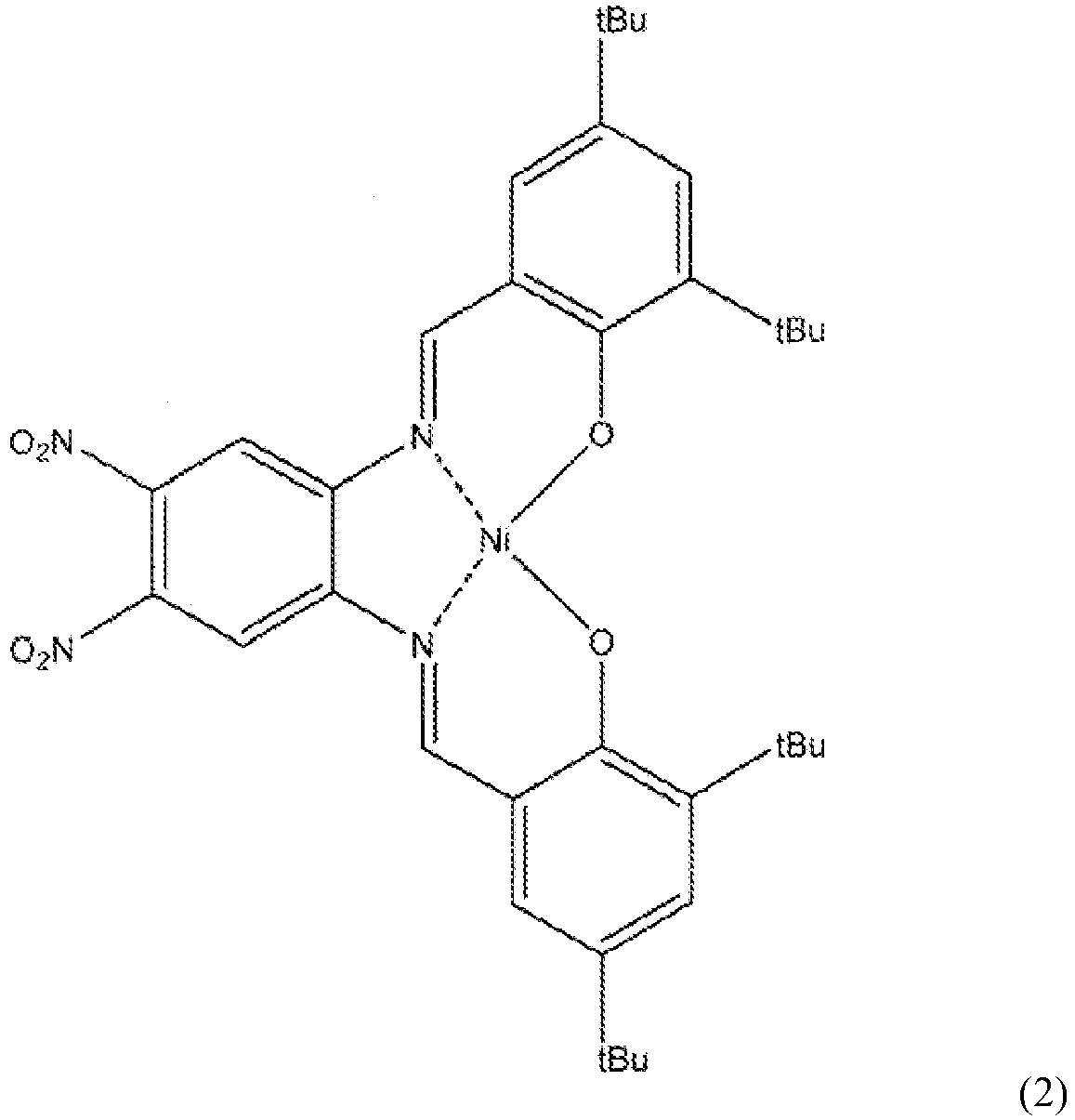
- Die Synthese solcher Liganden und Komplexe ist ferner beschrieben in European Journal of Inorganic Chemistry 2003, 10, 1900-1910. Dabei werden zwei Strategien angewandt, der Aufbau beginnend von der Phenanthrolin-Einheit und Komplexierung erst nach der kompletten Synthese des Liganden und der Aufbau beginnend von der Salophen-Einheit, wobei ein Templatverfahren gewählt wird, bei dem die Synthese in Gegenwart des Zentralions, Ni(II), vorgenommen wird. Hierfür wird als Zwischenprodukt der 3,4-Dinitro-Salophen-Ni(II)-Komplex benötigt, Formel (2), dessen Synthese in Dalton Transactions 2009, 10, 1792-1800 und der dort zitierten Literatur beschrieben wird.
- Für bestimmte Anwendungen, insbesondere in der Katalyse, sind Komplexe erwünscht, deren Metallionen in der Phenanthrolin-Einheit nicht durch weitere Bipyridin-Liganden komplexiert sind. Ferner ist der Templat-Weg einfacher durchführbar, aber für Kupfer als Zentralatom noch nicht beschrieben.
- Es wurde nun gefunden, das sich aus 3,4-Dinitro-Salophen-Cu(II)-Komplexen Liganden herstellen lassen, die zusätzlich eine Phenanthrolin-Einheit enthalten, die mit Palladiumhalogenid-Komplexen zu bimetallischen Komplexen umgesetzt werden können, bei denen das Palladium nicht durch weitere Bipyridin-Liganden stabilisiert ist. Dabei war zu erwarten, dass das Palladium durch zwei Phenanthrolin-Liganden koordiniert wird, da die beiden einzähnigen Liganden Hal leichter zu substituieren sind, als Bipyridinchelate. Die Bildung von Palladiumbisphenanthrolin-Komplexen trat jedoch nicht ein.
- Gegenstand der Erfindung sind daher Komplexe der allgemeinen Formel (3),
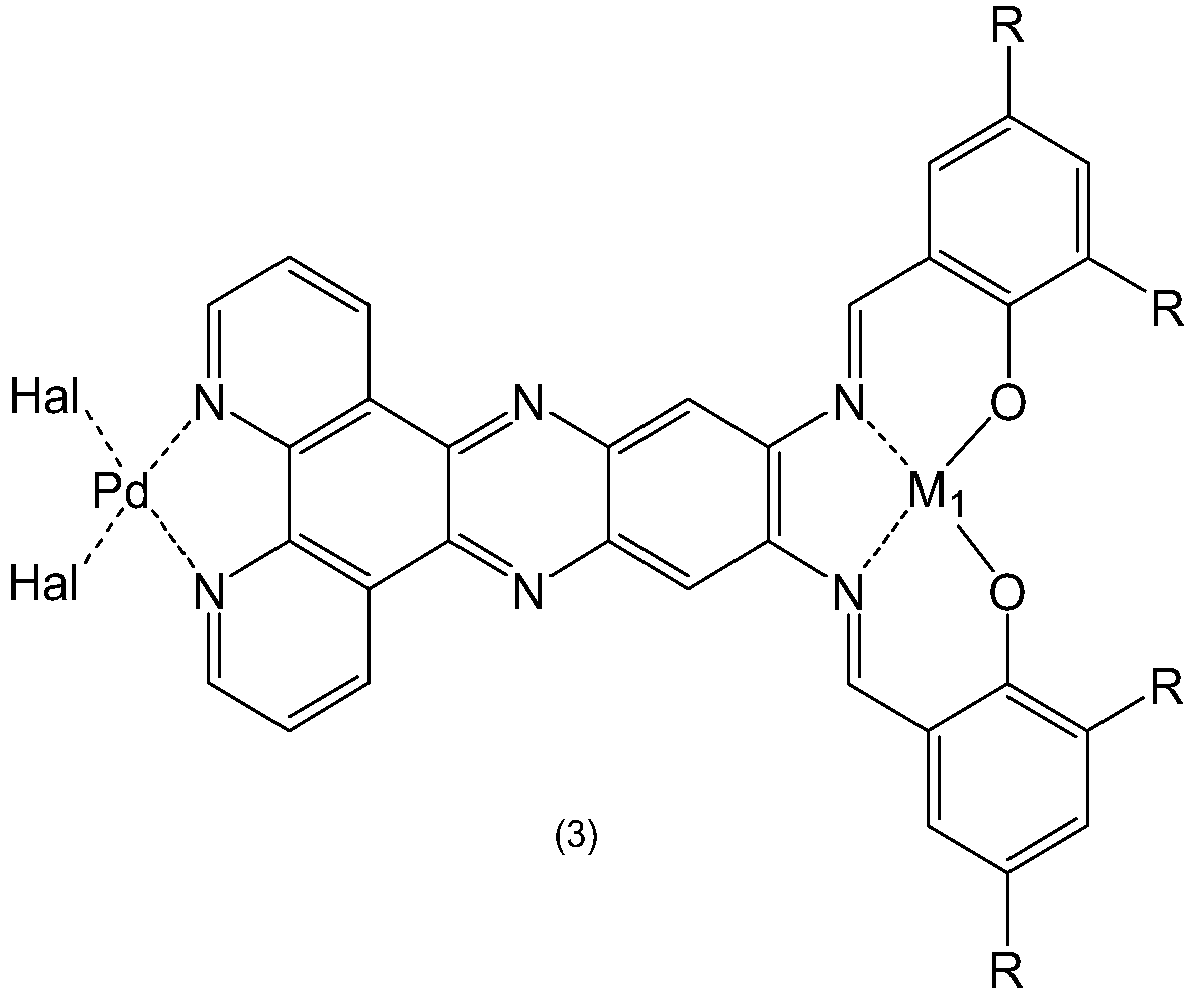
- R
- für Wasserstoff, Fluor, Chlor, eine Nitrogruppe oder einen C1 -C22-Alkylrest, vorzugsweise für Methyl, Isopropyl oder tertiär-Butyl, ganz besonders bevorzugt für tertiär-Butyl, oder einen C6-C22-Arylrest, vorzugsweise für Phenyl, Tolyl, 2-(1,4-Dihydroxy)phenyl
- Hal
- für Chlorid, Bromid oder Iodid, vorzugsweise für Chlorid oder Bromid, ganz besonders bevorzugt Bromid, oder ein Alkoholat, beispielsweise Phenolat oder Methylat oder ein schwach koordinierendes Anion, wie Triflat, Tosylat, Mesylat, Tetrafluoroborat, Perchlorat und Hexafluorophosphat und
- M1
- für Kupfer, Mangan oder Kobalt steht.
- Ein weiterer Gegenstand der Erfindung sind Komplexe der allgemeinen Formel 4a und 4b, die als Zwischenprodukte bei der Herstellung des erfindungsgemäßen bimetallischen Komplexes auftreten.

- Gegenstand der Erfindung ist auch die Verwendung der bimetallischen Komplexe der Formel 3 als Katalysatoren für die oxidative Carbonylierung von aromatischen Hydroxyverbindungen zu Diarylcarbonaten.
- Die Synthese von Verbindungen der Formel 3 erfolgt durch Hydrierung der Nitrogruppen der Verbindung der Formel 4a zu Verbindungen der Formel 4b, die anschließende Umsetzung mit Phendion der Formel 5


PdHal2L2 (7)
wobei Hal die oben angegebene Bedeutung hat und L für einen optional vorhandenen Liganden, wie z.B. Acetonitril, Triarylphosphine, Cyclooctadien, oder Norbornadien, steht. - Das zur Herstellung der Komplexe nach Formel 4a benötigte 4,5-Dinitro-o-phenylendiamin kann z.B. nach dem Literturzitat Cheeseman G.W.H. J. Chem.Soc., 1962, 1170 hergestellt werden. Die Hydrierung zu Verbindungen der Formel 4b erfolgt durch Hydrierung der Verbindungen der Formel 4a mit wasserstoffabgebenden Reagenzien, wie H2, Hydrazin, Cyclohexen oder Ameisensäure in Gegenwart von Katalysatoren aus den Metallen Ni, Co, Pd, Pt, Ru oder Rh, die auf Trägern, wie Kohle oder anorganischen Substanzen, immobilisiert sein können.
- Die Umsetzung mit Phendion erfolgt z.B. durch gemeinsames Erhitzen unter Rückfluss mit äquimolaren Mengen an Verbindungen der Formel 4b in Lösungsmitteln, wie Methanol, Ethanol oder Isopropanol, Chloroform, Benzol, Toluol oder deren Gemischen, wobei optional das gebildete Wasser durch azeotrope Destillation entfernt werden kann.
- Die Bildung der Komplexe der Formel 3 erfolgt durch Umsetzung der Liganden der Formel 6 mit Verbindungen der Formel 7 in Lösungsmitteln, wie Methylenchlorid, Chloroform, 1,2-Dichlorethan, Benzol, Chlorbenzol, DMF, Diethylether, Methyl-tert-butylether oder THF bei Temperaturen von 10°C bis zum Siedepunkt der Lösungsmittel unter Normaldruck.
- Die erfindungsgemäßen bimetallischen Komplexe der Formel 3 eignen sich zur Katalyse der oxidativen Carbonylierung von aromatischen Hydroxyverbindungen zu Diarylcarbonaten.
- Aromatische Hydroxyverbindungen für das erfindungsgemäße Verfahren sind solche der Formel 8
Ar-OH (8),
worin - Ar
- Phenyl, Naphthyl, Anthryl, Phenanthryl, Indanyl, Tetrahydronaphthyl oder den Rest eines 5- oder 6-gliedrigen aromatischen Heterocyclus mit 1 oder 2 Heteroatomen aus der Gruppe von N, O und S bedeutet, wobei diese isocyclischen und heterocyclischen Reste durch 1 oder 2 Substituenten wie geradkettiges oder verzweigtes C1-C4-Alkyl, geradkettiges oder verzweigtes C1-C4-Alkoxy, geradkettiges oder verzweigtes C1-C4-Alkoxycarbonyl, die mit Phenyl, Cyano und Halogen (z.B. F, Cl, Br) substituiert sein können und wobei weiterhin die heterocyclischen Reste mit einem ankondensierten Benzolkern verbunden sein können.
- Beispiele für aromatische Hydroxyverbindungen der Formel 8 sind: Phenol, o-, m- und p-Kresol, o-, m- und p-Isopropylphenol, die entsprechenden Halogen- bzw. Alkoxyphenole, wie p-Chlorphenol bzw. p-Methoxyphenol, Salicylsäuremethylester, Salicylsäureethylester, ferner Monohydroxyverbindungen des Naphthalins, Anthracens und Phenanthrens, weiterhin 4-Hydroxypyridin und Hydroxychinoline. Vorzugsweise werden Phenol und gegebenenfalls substituierte Phenole, ganz besonders bevorzugt Phenol eingesetzt.
- Die Herstellung eines Diarylcarbonats über oxidative Carbonylierung erfolgt durch Umsetzung einer aromatischen Hydroxyverbindung mit Kohlenmonoxid und Sauerstoff in Gegenwart eines erfindungsgemäßen Katalysators der Formel 3.
- Die oxidative Carbonylierung von aromatischen Hydroxyverbindungen mit Hilfe der erfindungsgemäßen Katalysatoren nach Formel 3 erfolgt in flüssiger Phase in Gegenwart oder Abwesenheit von Lösungsmitteln, wie Chlorbenzol, Dichlorbenzol, Toluol, Xylol, DMF, Dimethylacetamid, Tetrahydrofuran, NMP, Ethylencarbonat oder Propylencarbonat bei Temperaturen von 25 bis 150°C, vorzugsweise von 60 bis 110°C in Gegenwart von Kohlenmonoxid-Sauerstoff Gemischen im Partialdruck-Verhältnis 1:1 bis 99:1, vorzugsweise 98:2 bis 60:40, gegebenenfalls in Gegenwart weiterer Inertgase, wie Stickstoff, Argon oder Kohlendioxid, wobei das Partialdruckverhältnis Inertgase zu Aktivgase 98:2 bis 2:98, vorzugsweise 95:5 bis 50:50 betragen kann und wobei der Gesamtdruck 1 bar bis 100 bar, vorzugsweise 5 bar bis 20 bar, beträgt.
- Ferner können andere redoxaktive Substanzen, wie Chinone, Alkali- oder Erdalkaliiodide, Mangan-, Kobalt- oder Kupferverbindungen, in einem Gewichtsverhältnis Palladiumverbindung zu redoxaktiver Substanz von 1:1 bis 1:100, vorzugsweise 1:2 bis 1:20, anwesend sein. Beispiele für Chinone sind Benzochinon, Naphthochinon und Anthrachinon, sowie deren Substitutionsprodukte. Beispiele für Mangan-, Kobalt- oder Kupferverbindungen sind deren Oxide, Halogenide, Acetylacetonate oder Carboxylate.
- Als weitere Cokatalysatoren oder Hilfsmittel können Oniumsalze, wie Ammonium-, Phosphonium- oder Sulfoniumsalze, Bleiverbindungen, wie Bleialkyle oder -oxide, Polymere, wie Polyvinylpyrrolidon, Alkylhalogenide, wie Dibromethan, in einem Gewichtsverhältnis von Palladiumverbindung zu Cokatalysator oder Hilfsmittel von 1:1 bis 1:200, vorzugsweise 1:10 bis 1:50, eingesetzt werden. Besonders bevorzugt werden die Bromide der Ammonium- oder Phosphoniumverbindungen in einem Gewichtsverhältnis von Palladiumverbindung zu Hilfsmittel von 1:1 bis 1:200, vorzugsweise 1:10 bis 1:50, eingesetzt.
- Die Diarylcarbonate, hergestellt mit den erfindungsgemäßen Komplexen der Formel 3 als Katalysatoren, können zur Herstellung von Polycarbonaten oder Isocyanaten verwendet werden.
- Die nachfolgenden Beispiele sollen die Erfindung illustrieren ohne sie jedoch einzuschränken.
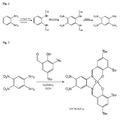
- 4,5-Dinitro-o-phenylenediamin wurde hergestellt nach
Fig. 1 entsprechend dem Literaturzitat Cheeseman G. W. H. J. Chem. Soc., 1962, 1170. - Eine Lösung von 0,69 g (3,48 mmol) Cu(OAc)2H20 in 20 mL Ethanol wurde zu einer Mischung von 0,68 g (3,48 mmol) 4,5-Dinitro-o-phenylenediamin und 1,63 g (6,96 mmol) 3,5-Di-tert-butylsalicalaldehyd in 80 mL Ethanol gegeben. Es wurde 80 min unter Rückfluss gekocht. Anschließend wurde der Niederschlag abfiltriert, mit n-Hexan gewaschen und im Vakuum getrocknet.
Ausbeute: 1,27 g (50 %).
Felddesorptions-Massenspektroskopie (FD-MS, D+Toluene) m/z (%): 691 (100) (C36H44CuN4O6) - Eine Suspension von 1,27 g (1,83 mmol) [DNtBuSalCu] und 0,2 g Pd/C (10%) in 100 mL THF wurde in einem 250 mL Autoklav mit einem Wasserstoffdruck von 40 bar beaufschlagt, 12 h bei Raumtemperatur gerührt und anschließend filtriert. Das Filtrat wurde im Vakuum eingeengt, der Rückstand mit Hexan gewaschen und anschließend im Vakuum getrocknet.
Ausbeute: 1,16 g (100 %)
FD-MS (D+Toluene) m/z (%): 631 (100) (C36H48CuN4O2) - Eine Suspension von 0,5 g (0,79 mmol) [DAtBuSalCu] in 30 mL Methanol wurde zu einer Lösung von 0,16 g (0,79 mmol) Phendion in 20 mL Methanol getropft. Dann wurde 2 h unter Rückfluss gekocht, wobei sich ein roter Niederschlag bildete, der abfiltriert, mit Petrolether gewaschen und im Vakuum getrocknet wurde.
Ausbeute: 0,5 g (78 %)
FD-MS (D+Toluene) m/z (%): 805 (100) (C48H50CuN6O2) - Zu einer Lösung von 0,05 g (0,06 mmol) [PhenpzSalCu] in 5 mL Methylenchlorid wurde die Lösung von 0,01 g (0,06 mmol) [Pd(CH3CN)2Cl2] gegeben und bei Raumtemperatur 16 h gerührt. Die flüchtigen Bestandteile wurden im Vakuum abgezogen und der Rückstand mit Hexan versetzt. Dann wurde das ausgefallene Produkt abfiltriert und im Vakuum getrocknet.
Ausbeute: 0,025 g (42 %)
FD-MS (D+Toluene) m/z (%): 981 (10) (C48H50Cl2CuN6O2Pd), 805 (100) (C48H50CuN6O2) - Eine Mischung aus 894 mg (9,5 mmol) Phenol, 8,5 mg (0,0086 mmol) [PdPhenpzSalCu], 32 mg (0,29 mmol) Benzochinon, 222 mg (0.69 mmol) Tetrabutylammoniumbromid und 110 mg Molekularsieb (3 Å) wurde dreimal mit 10 bar einer Mischung aus 97% CO und 3% O2 gespült und dann mit 18 bar dieser Gasmischung beaufschlagt. Dann wurde unter Rühren mit 900 rpm auf 90°C erhitzt. Die Analyse des Reaktionsgemisches mit Gaschromatographie nach einer Reaktionszeit von 3 h ergab eine Ausbeute von 5,1 mg (0,024 mmol) Diphenylcarbonat entsprechend einer TON des Katalysators bezogen auf Palladium von 2,8 und bezogen auf Kupfer von 2,8.
- Eine Mischung aus 954 mg (10,1 mmol) Phenol, 9,1 mg (0,0093 mmol) [PdPhenpzSalCu], 43,8 mg (0,39 mmol) Benzochinon, 212 mg (0.66 mmol) Tetrabutylammoniumbromid und 110 mg Molekularsieb (3 Å) wurde dreimal mit 10 bar einer Mischung aus 97% CO und 3% O2 gespült und dann mit 18 bar dieser Gasmischung beaufschlagt. Dann wurde unter Rühren mit 900 rpm auf 90°C erhitzt. Die Analyse des Reaktionsgemisches mit Gaschromatographie nach einer Reaktionszeit von 14 h ergab eine Ausbeute von 5,8 mg (0,027 mmol) Diphenylcarbonat entsprechend einer TON des Katalysators bezogen auf Palladium von 3,0 und bezogen auf Kupfer von 3,0.
- Die TON bezogen auf Palladium und Kupfer steigen mit der Reaktionszeit bei Verwendung der erfindungsgemäßen Verbindung.
- Nachstellung in Anlehnung an Literaturstelle J. Mol. Cat. A: Chem. 2000, 151, 37-45.
- Eine Mischung aus 920 mg (9,78 mmol) Phenol, 4,6 mg (0,012 mmol) [Pd(Phen)Cl2], 20 mg (0,056 mmol) [Co(acac)3], 31,8 mg (0,29 mmol) Benzochinon, 219 mg (0,66 mmol) Tetrabutylammoniumbromid und 110 mg Molekularsieb (3 Å) wurde dreimal mit 10 bar einer Mischung aus 97% CO und 3% O2 gespült und dann mit 18 bar dieser Gasmischung beaufschlagt. Dann wurde unter Rühren mit 900 rpm auf 90°C erhitzt. Die Analyse des Reaktionsgemisches mit Gaschromatographie nach einer Reaktionszeit von 3 h ergab eine Ausbeute von 5,8 mg (0,027 mmol) Diphenylcarbonat entsprechend einer TON des Katalysators bezogen auf Palladium von 3,4 und bezogen auf Kobalt von 0,5.
- Eine Mischung aus 994 mg (10,6 mmol) Phenol, 4,3 mg (0,011 mmol) [Pd(Phen)Cl2], 18,2 mg (0,050 mmol) [Co(acac)3], 36,2 mg (0,33 mmol) Benzochinon, 203 mg (0,60 mmol) Tetrabutylammoniumbromid und 110 mg Molekularsieb (3 Å) wurde dreimal mit 10 bar einer Mischung aus 97% CO und 3% O2 gespült und dann mit 18 bar dieser Gasmischung beaufschlagt. Dann wurde unter Rühren mit 900 rpm auf 90°C erhitzt. Die Analyse des Reaktionsgemisches mit Gaschromatographie nach einer Reaktionszeit von 14 h ergab eine Ausbeute von 4,7 mg (0,022 mmol) Diphenylcarbonat entsprechend einer TON des Katalysators bezogen auf Palladium von 2,7 und bezogen auf Kobalt von 0,4.
- In den Vergleichsbeispielen ist neben dem Palladiumkatalysator der Zusatz eines Kobaltsalzes als Cokatalysator notwendig. Das molare Verhältnis Palladium zu Cokatalysator beträgt 1:6,5, während bei Einsatz des bimetallischen Komplexes nach Beispielen 5 und 6 ein Verhältnis von 1:1 vorliegt.
Tabelle 1 Beispiel 5 Beispiel 6 Vergleichsbeispiel 7 Vergleichsbeispiel 8 TON(Pd) 2,8 (3h) 3,0 (14h) 3,4 (3h) 2,7 (14h) TON(Cu) 2,8 (3h) 3,0 (14h) - - TON(Co) - - 0,5 (3h) 0,4 (14h) - Die TON bezogen auf Palladium und Kobalt sinken in den Vergleichsbeispielen bei verlängerter Reaktionszeit. Eine Gegenüberstellung des bimetallischen Katalysators nach Beispiel 5 und den entsprechenden Vergleichsbeispielen 7 und 8 belegt eine höhere Stabilität des erfindungsgemäßen bimetallischen Katalysators im Vergleich zu Katalysatoren aus dem Stand der Technik.
- Die TON bezogen auf den Cokatalysator ist in den Vergleichsbeispielen 7 und 8 geringer als beim Einsatz des erfindungsgemäßen bimetallischen Katalysators nach Beispielen 5 und 6.
Claims (10)
- Verbindung der Formel (3)
 R für Wasserstoff, Fluor, Chlor, eine Nitrogruppe, einen C1-C22-Alkylrest, oder einen C6-C22-ArylrestHal für Chlorid, Bromid oder Iodid, ein Alkoholat, oder ein schwach koordinierendes Anion, undM1 für Kupfer, Mangan oder Kobalt steht.
 - Verfahren zur Herstellung der Verbindungen der Formel 3 durch Hydrierung der Nitrogruppen der Verbindung der Formel 4a zu Verbindungen der Formel 4b, die anschließende Umsetzung mit Phendion der Formel 5


PdHal2L2 (7)
wobei Hal die oben angegebene Bedeutung hat und L für einen optional vorhandenen Liganden, steht. - Verbindungen der allgemeinen Formel 4a und 4b,

- Verwendung einer oder mehrerer bimetallischen Verbindung(en) der Formel 3 gemäß Anspruch 1 als Katalysator.
- Verwendung einer oder mehrerer bimetallischen Verbindung(en) der Formel 3 gemäß Anspruch 1 für die oxidative Carbonylierung von aromatischen Hydroxyverbindungen zu Diarylcarbonaten
- Verfahren zur Herstellung von Diarylcarbonaten, dadurch gekennzeichnet, dass eine aromatische Hydroxyverbindung mit Kohlenmonoxid und Sauerstoff in Gegenwart des Katalysators der Formel 3 gemäß Anspruch 1 umgesetzt wird.
- Verfahren nach Anspruch 6, dadurch gekennzeichnet, dass aromatische Hydroxyverbindungen der Formel 8 eingesetzt werden.
Ar-OH (8),
worinAr Phenyl, Naphthyl, Anthryl, Phenanthryl, Indanyl, Tetrahydronaphthyl oder den Rest eines 5- oder 6-gliedrigen aromatischen Heterocyclus mit 1 oder 2 Heteroatomen aus der Gruppe von N, O und S bedeutet, wobei diese isocyclischen und heterocyclischen Reste durch 1 oder 2 Substituenten wie geradkettiges oder verzweigtes C1-C4-Alkyl, geradkettiges oder verzweigtes C1-C4-Alkoxy, geradkettiges oder verzweigtes C1-C4-Alkoxycarbonyl, die mit Phenyl, Cyano und Halogen (z.B. F, Cl, Br) substituiert sein können und wobei weiterhin die heterocyclischen Reste mit einem ankondensierten Benzolkern verbunden sein können. - Verfahren nach Anspruch 6 oder 7, dadurch gekennzeichnet, dass weitere redoxaktive Substanzen, verwendet werden.
- Verfahren nach einem der Ansprüche 6 bis 8, dadurch gekennzeichnet, dass zusätzlich Cokatalysatoren oder Hilfsmittel verwendet werden.
- Verfahren nach Anspruch 9, dadurch gekennzeichnet, dass Oniumsalze, Bleiverbindungen, Polymere, Alkylhalogenide, verwendet werden.
Applications Claiming Priority (2)
| Application Number | Priority Date | Filing Date | Title |
|---|---|---|---|
| DE102009058053A DE102009058053A1 (de) | 2009-12-14 | 2009-12-14 | Bimetalliche Komplexe und ihre Verwendung in der Diarylcarbonatherstellung |
| PCT/EP2010/069323 WO2011073087A1 (de) | 2009-12-14 | 2010-12-09 | Bimetallische komplexe und ihre verwendung in der diarylcarbonatherstellung |
Publications (2)
| Publication Number | Publication Date |
|---|---|
| EP2513126A1 EP2513126A1 (de) | 2012-10-24 |
| EP2513126B1 true EP2513126B1 (de) | 2015-07-29 |
Family
ID=43533087
Family Applications (1)
| Application Number | Title | Priority Date | Filing Date |
|---|---|---|---|
| EP10792885.5A Not-in-force EP2513126B1 (de) | 2009-12-14 | 2010-12-09 | Bimetallische komplexe und ihre verwendung in der diarylcarbonatherstellung |
Country Status (10)
| Country | Link |
|---|---|
| US (1) | US8987446B2 (de) |
| EP (1) | EP2513126B1 (de) |
| JP (1) | JP2013513633A (de) |
| KR (1) | KR20120091362A (de) |
| CN (1) | CN102753560B (de) |
| DE (1) | DE102009058053A1 (de) |
| ES (1) | ES2547311T3 (de) |
| RU (1) | RU2012129672A (de) |
| SG (1) | SG180834A1 (de) |
| WO (1) | WO2011073087A1 (de) |
Families Citing this family (2)
| Publication number | Priority date | Publication date | Assignee | Title |
|---|---|---|---|---|
| US9348608B2 (en) * | 2013-04-24 | 2016-05-24 | QRC, Inc. | System and method for registering application and application transforms on a radiofrequency digitization and collection device |
| CN113903934B (zh) * | 2021-10-11 | 2023-12-08 | 先进能源产业研究院(广州)有限公司 | 一种多孔Pd-PdO纳米棒的制备方法及其应用 |
Family Cites Families (10)
| Publication number | Priority date | Publication date | Assignee | Title |
|---|---|---|---|---|
| US4201721A (en) | 1976-10-12 | 1980-05-06 | General Electric Company | Catalytic aromatic carbonate process |
| IN148600B (de) | 1976-10-12 | 1981-04-11 | Gen Electric | |
| US4349485A (en) | 1979-11-23 | 1982-09-14 | General Electric Company | Catalytic aromatic carbonate process using manganese tetradentate redox co-catalysts |
| US5231210A (en) | 1992-08-17 | 1993-07-27 | General Electric Company | Method for making aromatic carbonates |
| DE4403075A1 (de) | 1994-02-02 | 1995-08-03 | Bayer Ag | Verfahren zur kontinuierlichen Herstellung von Diarylcarbonaten |
| DE19619949A1 (de) * | 1996-05-17 | 1997-11-20 | Bayer Ag | Verfahren zur Herstellung von Diarylcarbonaten |
| JPH10306065A (ja) | 1997-02-13 | 1998-11-17 | General Electric Co <Ge> | ハロゲン化ヘキサアルキルグアニジニウムを用いる炭酸ジアリールの製造方法 |
| CN1194260A (zh) * | 1997-03-24 | 1998-09-30 | 通用电气公司 | 高选择性制备碳酸二芳基酯的方法 |
| US5760272A (en) | 1997-03-24 | 1998-06-02 | General Electric Company | Method for preparing diaryl carbonates with improved selectivity |
| JP2008138169A (ja) | 2006-11-02 | 2008-06-19 | Nippon Oil Corp | 新規光増感剤および光起電力素子 |
-
2009
- 2009-12-14 DE DE102009058053A patent/DE102009058053A1/de not_active Withdrawn
-
2010
- 2010-12-09 EP EP10792885.5A patent/EP2513126B1/de not_active Not-in-force
- 2010-12-09 ES ES10792885.5T patent/ES2547311T3/es active Active
- 2010-12-09 RU RU2012129672/04A patent/RU2012129672A/ru not_active Application Discontinuation
- 2010-12-09 SG SG2012034971A patent/SG180834A1/en unknown
- 2010-12-09 CN CN201080056756.8A patent/CN102753560B/zh not_active Expired - Fee Related
- 2010-12-09 KR KR1020127015230A patent/KR20120091362A/ko not_active Withdrawn
- 2010-12-09 JP JP2012543622A patent/JP2013513633A/ja not_active Withdrawn
- 2010-12-09 US US13/515,710 patent/US8987446B2/en not_active Expired - Fee Related
- 2010-12-09 WO PCT/EP2010/069323 patent/WO2011073087A1/de not_active Ceased
Also Published As
| Publication number | Publication date |
|---|---|
| US8987446B2 (en) | 2015-03-24 |
| CN102753560B (zh) | 2016-01-06 |
| ES2547311T3 (es) | 2015-10-05 |
| EP2513126A1 (de) | 2012-10-24 |
| US20130018186A1 (en) | 2013-01-17 |
| JP2013513633A (ja) | 2013-04-22 |
| RU2012129672A (ru) | 2014-01-27 |
| DE102009058053A1 (de) | 2011-06-16 |
| WO2011073087A1 (de) | 2011-06-23 |
| CN102753560A (zh) | 2012-10-24 |
| KR20120091362A (ko) | 2012-08-17 |
| SG180834A1 (en) | 2012-07-30 |
Similar Documents
| Publication | Publication Date | Title |
|---|---|---|
| DE69309653T2 (de) | Verfahren zum Herstellen von aromatischem Carbonat | |
| DE69408968T2 (de) | Verfahren zum Herstellen eines aromatischen Carbonates | |
| DE19711723A1 (de) | Verfahren zur Herstellung von aromatischen Carbonaten | |
| DE19503119A1 (de) | Verfahren zur Herstellung von aromatischen Olefinen unter Katalyse von Palladacyclen | |
| EP1076648B1 (de) | Verfahren zur katalytischen herstellung von substituierten bipyridylderivaten | |
| DE2815501A1 (de) | Verfahren zur herstellung von aromatischen carbonaten | |
| DE19614062A1 (de) | Verfahren zur kontinuierlichen Herstellung von Diarylcarbonaten | |
| DE2603574C3 (de) | Verfahren zur Herstellung eines aromatischen Urethane | |
| DE69002081T2 (de) | Verfahren zur Herstellung von aromatischen Harnstoffen. | |
| DE2738520C2 (de) | Verfahren zur Herstellung von aromatischen Carbonaten | |
| DE4403075A1 (de) | Verfahren zur kontinuierlichen Herstellung von Diarylcarbonaten | |
| DE102009058053A1 (de) | Bimetalliche Komplexe und ihre Verwendung in der Diarylcarbonatherstellung | |
| EP2865446A1 (de) | Verfahren zur Herstellung von optisch aktivem sekundärem Alkohol | |
| WO2007115685A1 (de) | Verfahren zum herstellen von biphenylaminen über vinylaniline | |
| EP1749015B1 (de) | Ein verfahren zur herstellung eines anti-tumoralen platin(ii)-komplexes | |
| DE69210338T2 (de) | Verfahren zur Herstellung eines Esters der Kohlensäure | |
| US4709087A (en) | Process for the synthesis of isocyanates and of isocyanate derivatives | |
| US4469882A (en) | Process for the production of aromatic carbamates | |
| EP2220100B1 (de) | Chirale cycloplatinierte komplexe, herstellungsverfahren sowie deren verwendung in medizin und katalyse | |
| DE2311092C3 (de) | Verfarhen zur Herstellung von aromatischen Isocyanaten | |
| WO2009153272A2 (de) | Verfahren zur iodierung von aromatischen und/oder heteroaromatischen verbindungen | |
| JP2872846B2 (ja) | ハロゲノシクロプロパンカルボン酸誘導体の製法 | |
| DE60028405T2 (de) | Verfahren zur herstellung von polycarbonaten durch oxydative carbonylierung | |
| DE69010566T2 (de) | Verfahren zur Herstellung von Acylharnstoffen. | |
| EP0742213A1 (de) | Verfahren zur Herstellung von substituierten 3-Arylchinazolin-2,4-dionen |
Legal Events
| Date | Code | Title | Description |
|---|---|---|---|
| PUAI | Public reference made under article 153(3) epc to a published international application that has entered the european phase |
Free format text: ORIGINAL CODE: 0009012 |
|
| 17P | Request for examination filed |
Effective date: 20120716 |
|
| AK | Designated contracting states |
Kind code of ref document: A1 Designated state(s): AL AT BE BG CH CY CZ DE DK EE ES FI FR GB GR HR HU IE IS IT LI LT LU LV MC MK MT NL NO PL PT RO RS SE SI SK SM TR |
|
| DAX | Request for extension of the european patent (deleted) | ||
| 17Q | First examination report despatched |
Effective date: 20140630 |
|
| GRAP | Despatch of communication of intention to grant a patent |
Free format text: ORIGINAL CODE: EPIDOSNIGR1 |
|
| INTG | Intention to grant announced |
Effective date: 20150309 |
|
| GRAS | Grant fee paid |
Free format text: ORIGINAL CODE: EPIDOSNIGR3 |
|
| GRAA | (expected) grant |
Free format text: ORIGINAL CODE: 0009210 |
|
| AK | Designated contracting states |
Kind code of ref document: B1 Designated state(s): AL AT BE BG CH CY CZ DE DK EE ES FI FR GB GR HR HU IE IS IT LI LT LU LV MC MK MT NL NO PL PT RO RS SE SI SK SM TR |
|
| REG | Reference to a national code |
Ref country code: GB Ref legal event code: FG4D Free format text: NOT ENGLISH |
|
| REG | Reference to a national code |
Ref country code: CH Ref legal event code: EP |
|
| REG | Reference to a national code |
Ref country code: AT Ref legal event code: REF Ref document number: 739211 Country of ref document: AT Kind code of ref document: T Effective date: 20150815 |
|
| REG | Reference to a national code |
Ref country code: IE Ref legal event code: FG4D Free format text: LANGUAGE OF EP DOCUMENT: GERMAN |
|
| REG | Reference to a national code |
Ref country code: DE Ref legal event code: R096 Ref document number: 502010009972 Country of ref document: DE |
|
| REG | Reference to a national code |
Ref country code: ES Ref legal event code: FG2A Ref document number: 2547311 Country of ref document: ES Kind code of ref document: T3 Effective date: 20151005 |
|
| REG | Reference to a national code |
Ref country code: LT Ref legal event code: MG4D |
|
| REG | Reference to a national code |
Ref country code: NL Ref legal event code: MP Effective date: 20150729 |
|
| PG25 | Lapsed in a contracting state [announced via postgrant information from national office to epo] |
Ref country code: FI Free format text: LAPSE BECAUSE OF FAILURE TO SUBMIT A TRANSLATION OF THE DESCRIPTION OR TO PAY THE FEE WITHIN THE PRESCRIBED TIME-LIMIT Effective date: 20150729 Ref country code: NO Free format text: LAPSE BECAUSE OF FAILURE TO SUBMIT A TRANSLATION OF THE DESCRIPTION OR TO PAY THE FEE WITHIN THE PRESCRIBED TIME-LIMIT Effective date: 20151029 Ref country code: GR Free format text: LAPSE BECAUSE OF FAILURE TO SUBMIT A TRANSLATION OF THE DESCRIPTION OR TO PAY THE FEE WITHIN THE PRESCRIBED TIME-LIMIT Effective date: 20151030 Ref country code: LT Free format text: LAPSE BECAUSE OF FAILURE TO SUBMIT A TRANSLATION OF THE DESCRIPTION OR TO PAY THE FEE WITHIN THE PRESCRIBED TIME-LIMIT Effective date: 20150729 Ref country code: LV Free format text: LAPSE BECAUSE OF FAILURE TO SUBMIT A TRANSLATION OF THE DESCRIPTION OR TO PAY THE FEE WITHIN THE PRESCRIBED TIME-LIMIT Effective date: 20150729 |
|
| REG | Reference to a national code |
Ref country code: DE Ref legal event code: R081 Ref document number: 502010009972 Country of ref document: DE Owner name: COVESTRO DEUTSCHLAND AG, DE Free format text: FORMER OWNER: BAYER INTELLECTUAL PROPERTY GMBH, 40789 MONHEIM, DE |
|
| PG25 | Lapsed in a contracting state [announced via postgrant information from national office to epo] |
Ref country code: PL Free format text: LAPSE BECAUSE OF FAILURE TO SUBMIT A TRANSLATION OF THE DESCRIPTION OR TO PAY THE FEE WITHIN THE PRESCRIBED TIME-LIMIT Effective date: 20150729 Ref country code: HR Free format text: LAPSE BECAUSE OF FAILURE TO SUBMIT A TRANSLATION OF THE DESCRIPTION OR TO PAY THE FEE WITHIN THE PRESCRIBED TIME-LIMIT Effective date: 20150729 Ref country code: RS Free format text: LAPSE BECAUSE OF FAILURE TO SUBMIT A TRANSLATION OF THE DESCRIPTION OR TO PAY THE FEE WITHIN THE PRESCRIBED TIME-LIMIT Effective date: 20150729 Ref country code: SE Free format text: LAPSE BECAUSE OF FAILURE TO SUBMIT A TRANSLATION OF THE DESCRIPTION OR TO PAY THE FEE WITHIN THE PRESCRIBED TIME-LIMIT Effective date: 20150729 Ref country code: PT Free format text: LAPSE BECAUSE OF FAILURE TO SUBMIT A TRANSLATION OF THE DESCRIPTION OR TO PAY THE FEE WITHIN THE PRESCRIBED TIME-LIMIT Effective date: 20151130 Ref country code: IS Free format text: LAPSE BECAUSE OF FAILURE TO SUBMIT A TRANSLATION OF THE DESCRIPTION OR TO PAY THE FEE WITHIN THE PRESCRIBED TIME-LIMIT Effective date: 20151129 |
|
| PG25 | Lapsed in a contracting state [announced via postgrant information from national office to epo] |
Ref country code: NL Free format text: LAPSE BECAUSE OF FAILURE TO SUBMIT A TRANSLATION OF THE DESCRIPTION OR TO PAY THE FEE WITHIN THE PRESCRIBED TIME-LIMIT Effective date: 20150729 |
|
| PG25 | Lapsed in a contracting state [announced via postgrant information from national office to epo] |
Ref country code: DK Free format text: LAPSE BECAUSE OF FAILURE TO SUBMIT A TRANSLATION OF THE DESCRIPTION OR TO PAY THE FEE WITHIN THE PRESCRIBED TIME-LIMIT Effective date: 20150729 Ref country code: EE Free format text: LAPSE BECAUSE OF FAILURE TO SUBMIT A TRANSLATION OF THE DESCRIPTION OR TO PAY THE FEE WITHIN THE PRESCRIBED TIME-LIMIT Effective date: 20150729 Ref country code: SK Free format text: LAPSE BECAUSE OF FAILURE TO SUBMIT A TRANSLATION OF THE DESCRIPTION OR TO PAY THE FEE WITHIN THE PRESCRIBED TIME-LIMIT Effective date: 20150729 Ref country code: CZ Free format text: LAPSE BECAUSE OF FAILURE TO SUBMIT A TRANSLATION OF THE DESCRIPTION OR TO PAY THE FEE WITHIN THE PRESCRIBED TIME-LIMIT Effective date: 20150729 Ref country code: IT Free format text: LAPSE BECAUSE OF FAILURE TO SUBMIT A TRANSLATION OF THE DESCRIPTION OR TO PAY THE FEE WITHIN THE PRESCRIBED TIME-LIMIT Effective date: 20150729 |
|
| REG | Reference to a national code |
Ref country code: DE Ref legal event code: R097 Ref document number: 502010009972 Country of ref document: DE |
|
| PG25 | Lapsed in a contracting state [announced via postgrant information from national office to epo] |
Ref country code: BE Free format text: LAPSE BECAUSE OF NON-PAYMENT OF DUE FEES Effective date: 20151231 Ref country code: RO Free format text: LAPSE BECAUSE OF FAILURE TO SUBMIT A TRANSLATION OF THE DESCRIPTION OR TO PAY THE FEE WITHIN THE PRESCRIBED TIME-LIMIT Effective date: 20150729 |
|
| PLBE | No opposition filed within time limit |
Free format text: ORIGINAL CODE: 0009261 |
|
| STAA | Information on the status of an ep patent application or granted ep patent |
Free format text: STATUS: NO OPPOSITION FILED WITHIN TIME LIMIT |
|
| 26N | No opposition filed |
Effective date: 20160502 |
|
| PG25 | Lapsed in a contracting state [announced via postgrant information from national office to epo] |
Ref country code: MC Free format text: LAPSE BECAUSE OF FAILURE TO SUBMIT A TRANSLATION OF THE DESCRIPTION OR TO PAY THE FEE WITHIN THE PRESCRIBED TIME-LIMIT Effective date: 20150729 Ref country code: LU Free format text: LAPSE BECAUSE OF FAILURE TO SUBMIT A TRANSLATION OF THE DESCRIPTION OR TO PAY THE FEE WITHIN THE PRESCRIBED TIME-LIMIT Effective date: 20151209 |
|
| REG | Reference to a national code |
Ref country code: CH Ref legal event code: PL |
|
| GBPC | Gb: european patent ceased through non-payment of renewal fee |
Effective date: 20151209 |
|
| PG25 | Lapsed in a contracting state [announced via postgrant information from national office to epo] |
Ref country code: SI Free format text: LAPSE BECAUSE OF FAILURE TO SUBMIT A TRANSLATION OF THE DESCRIPTION OR TO PAY THE FEE WITHIN THE PRESCRIBED TIME-LIMIT Effective date: 20150729 |
|
| REG | Reference to a national code |
Ref country code: IE Ref legal event code: MM4A |
|
| REG | Reference to a national code |
Ref country code: FR Ref legal event code: ST Effective date: 20160831 |
|
| PG25 | Lapsed in a contracting state [announced via postgrant information from national office to epo] |
Ref country code: CH Free format text: LAPSE BECAUSE OF NON-PAYMENT OF DUE FEES Effective date: 20151231 Ref country code: GB Free format text: LAPSE BECAUSE OF NON-PAYMENT OF DUE FEES Effective date: 20151209 Ref country code: LI Free format text: LAPSE BECAUSE OF NON-PAYMENT OF DUE FEES Effective date: 20151231 Ref country code: IE Free format text: LAPSE BECAUSE OF NON-PAYMENT OF DUE FEES Effective date: 20151209 |
|
| PG25 | Lapsed in a contracting state [announced via postgrant information from national office to epo] |
Ref country code: FR Free format text: LAPSE BECAUSE OF NON-PAYMENT OF DUE FEES Effective date: 20151231 |
|
| PGFP | Annual fee paid to national office [announced via postgrant information from national office to epo] |
Ref country code: DE Payment date: 20161206 Year of fee payment: 7 |
|
| REG | Reference to a national code |
Ref country code: ES Ref legal event code: PC2A Owner name: BAYER MATERIALSCIENCE AG Effective date: 20170125 |
|
| REG | Reference to a national code |
Ref country code: AT Ref legal event code: MM01 Ref document number: 739211 Country of ref document: AT Kind code of ref document: T Effective date: 20151209 |
|
| PGFP | Annual fee paid to national office [announced via postgrant information from national office to epo] |
Ref country code: ES Payment date: 20161129 Year of fee payment: 7 |
|
| PG25 | Lapsed in a contracting state [announced via postgrant information from national office to epo] |
Ref country code: BG Free format text: LAPSE BECAUSE OF FAILURE TO SUBMIT A TRANSLATION OF THE DESCRIPTION OR TO PAY THE FEE WITHIN THE PRESCRIBED TIME-LIMIT Effective date: 20150729 Ref country code: HU Free format text: LAPSE BECAUSE OF FAILURE TO SUBMIT A TRANSLATION OF THE DESCRIPTION OR TO PAY THE FEE WITHIN THE PRESCRIBED TIME-LIMIT; INVALID AB INITIO Effective date: 20101209 Ref country code: AT Free format text: LAPSE BECAUSE OF NON-PAYMENT OF DUE FEES Effective date: 20151209 Ref country code: SM Free format text: LAPSE BECAUSE OF FAILURE TO SUBMIT A TRANSLATION OF THE DESCRIPTION OR TO PAY THE FEE WITHIN THE PRESCRIBED TIME-LIMIT Effective date: 20150729 |
|
| PG25 | Lapsed in a contracting state [announced via postgrant information from national office to epo] |
Ref country code: CY Free format text: LAPSE BECAUSE OF FAILURE TO SUBMIT A TRANSLATION OF THE DESCRIPTION OR TO PAY THE FEE WITHIN THE PRESCRIBED TIME-LIMIT Effective date: 20150729 |
|
| PG25 | Lapsed in a contracting state [announced via postgrant information from national office to epo] |
Ref country code: MT Free format text: LAPSE BECAUSE OF FAILURE TO SUBMIT A TRANSLATION OF THE DESCRIPTION OR TO PAY THE FEE WITHIN THE PRESCRIBED TIME-LIMIT Effective date: 20150729 |
|
| REG | Reference to a national code |
Ref country code: ES Ref legal event code: PC2A Owner name: COVESTRO DEUTSCHLAND AG Effective date: 20171219 |
|
| PG25 | Lapsed in a contracting state [announced via postgrant information from national office to epo] |
Ref country code: TR Free format text: LAPSE BECAUSE OF FAILURE TO SUBMIT A TRANSLATION OF THE DESCRIPTION OR TO PAY THE FEE WITHIN THE PRESCRIBED TIME-LIMIT Effective date: 20150729 Ref country code: MK Free format text: LAPSE BECAUSE OF FAILURE TO SUBMIT A TRANSLATION OF THE DESCRIPTION OR TO PAY THE FEE WITHIN THE PRESCRIBED TIME-LIMIT Effective date: 20150729 |
|
| REG | Reference to a national code |
Ref country code: DE Ref legal event code: R119 Ref document number: 502010009972 Country of ref document: DE |
|
| PG25 | Lapsed in a contracting state [announced via postgrant information from national office to epo] |
Ref country code: AL Free format text: LAPSE BECAUSE OF FAILURE TO SUBMIT A TRANSLATION OF THE DESCRIPTION OR TO PAY THE FEE WITHIN THE PRESCRIBED TIME-LIMIT Effective date: 20150729 Ref country code: DE Free format text: LAPSE BECAUSE OF NON-PAYMENT OF DUE FEES Effective date: 20180703 |
|
| REG | Reference to a national code |
Ref country code: ES Ref legal event code: FD2A Effective date: 20190702 |
|
| PG25 | Lapsed in a contracting state [announced via postgrant information from national office to epo] |
Ref country code: ES Free format text: LAPSE BECAUSE OF NON-PAYMENT OF DUE FEES Effective date: 20171210 |