EP2509935B1 - Verfahren zur isomerisierung eines gesättigten, verzweigten und zyklischen kohlenwasserstoffs - Google Patents
Verfahren zur isomerisierung eines gesättigten, verzweigten und zyklischen kohlenwasserstoffs Download PDFInfo
- Publication number
- EP2509935B1 EP2509935B1 EP10787752.4A EP10787752A EP2509935B1 EP 2509935 B1 EP2509935 B1 EP 2509935B1 EP 10787752 A EP10787752 A EP 10787752A EP 2509935 B1 EP2509935 B1 EP 2509935B1
- Authority
- EP
- European Patent Office
- Prior art keywords
- methyl
- process according
- oder
- ethyl
- butyl
- Prior art date
- Legal status (The legal status is an assumption and is not a legal conclusion. Google has not performed a legal analysis and makes no representation as to the accuracy of the status listed.)
- Not-in-force
Links
- 238000000034 method Methods 0.000 title claims description 28
- 229930195733 hydrocarbon Natural products 0.000 title claims description 19
- 150000002430 hydrocarbons Chemical class 0.000 title claims description 19
- 239000004215 Carbon black (E152) Substances 0.000 title claims description 17
- 229920006395 saturated elastomer Polymers 0.000 title claims description 16
- -1 copper (II) compound Chemical class 0.000 claims description 464
- GDOPTJXRTPNYNR-UHFFFAOYSA-N methylcyclopentane Chemical compound CC1CCCC1 GDOPTJXRTPNYNR-UHFFFAOYSA-N 0.000 claims description 100
- XDTMQSROBMDMFD-UHFFFAOYSA-N Cyclohexane Chemical compound C1CCCCC1 XDTMQSROBMDMFD-UHFFFAOYSA-N 0.000 claims description 60
- 239000002608 ionic liquid Substances 0.000 claims description 46
- 239000002879 Lewis base Substances 0.000 claims description 25
- 238000006317 isomerization reaction Methods 0.000 claims description 25
- 229910052799 carbon Inorganic materials 0.000 claims description 21
- VSCWAEJMTAWNJL-UHFFFAOYSA-K aluminium trichloride Chemical compound Cl[Al](Cl)Cl VSCWAEJMTAWNJL-UHFFFAOYSA-K 0.000 claims description 19
- 150000001450 anions Chemical class 0.000 claims description 17
- 125000004432 carbon atom Chemical group C* 0.000 claims description 9
- 125000000753 cycloalkyl group Chemical group 0.000 claims description 9
- UAEPNZWRGJTJPN-UHFFFAOYSA-N methylcyclohexane Chemical compound CC1CCCCC1 UAEPNZWRGJTJPN-UHFFFAOYSA-N 0.000 claims description 8
- ORTQZVOHEJQUHG-UHFFFAOYSA-L copper(II) chloride Chemical compound Cl[Cu]Cl ORTQZVOHEJQUHG-UHFFFAOYSA-L 0.000 claims description 7
- 150000007527 lewis bases Chemical class 0.000 claims description 7
- 150000002892 organic cations Chemical class 0.000 claims description 7
- QWHNJUXXYKPLQM-UHFFFAOYSA-N 1,1-dimethylcyclopentane Chemical compound CC1(C)CCCC1 QWHNJUXXYKPLQM-UHFFFAOYSA-N 0.000 claims description 6
- 229910021592 Copper(II) chloride Inorganic materials 0.000 claims description 4
- JPVYNHNXODAKFH-UHFFFAOYSA-N Cu2+ Chemical class [Cu+2] JPVYNHNXODAKFH-UHFFFAOYSA-N 0.000 claims description 4
- 229910052782 aluminium Inorganic materials 0.000 claims description 4
- 150000001449 anionic compounds Chemical class 0.000 claims description 4
- 229910001412 inorganic anion Inorganic materials 0.000 claims description 4
- GYNNXHKOJHMOHS-UHFFFAOYSA-N methyl-cycloheptane Natural products CC1CCCCCC1 GYNNXHKOJHMOHS-UHFFFAOYSA-N 0.000 claims description 4
- JUJWROOIHBZHMG-UHFFFAOYSA-O pyridinium Chemical class C1=CC=[NH+]C=C1 JUJWROOIHBZHMG-UHFFFAOYSA-O 0.000 claims description 4
- ZMANZCXQSJIPKH-UHFFFAOYSA-O triethylammonium ion Chemical compound CC[NH+](CC)CC ZMANZCXQSJIPKH-UHFFFAOYSA-O 0.000 claims description 4
- RIRARCHMRDHZAR-UHFFFAOYSA-N 1,2-dimethylcyclopentane Chemical compound CC1CCCC1C RIRARCHMRDHZAR-UHFFFAOYSA-N 0.000 claims description 2
- XAZKFISIRYLAEE-UHFFFAOYSA-N 1,3-dimethylcyclopentane Chemical compound CC1CCC(C)C1 XAZKFISIRYLAEE-UHFFFAOYSA-N 0.000 claims description 2
- QGZKDVFQNNGYKY-UHFFFAOYSA-O Ammonium Chemical compound [NH4+] QGZKDVFQNNGYKY-UHFFFAOYSA-O 0.000 claims description 2
- RAXXELZNTBOGNW-UHFFFAOYSA-O Imidazolium Chemical class C1=C[NH+]=CN1 RAXXELZNTBOGNW-UHFFFAOYSA-O 0.000 claims description 2
- XAGFODPZIPBFFR-UHFFFAOYSA-N aluminium Chemical compound [Al] XAGFODPZIPBFFR-UHFFFAOYSA-N 0.000 claims description 2
- ARUVKPQLZAKDPS-UHFFFAOYSA-L copper(II) sulfate Chemical compound [Cu+2].[O-][S+2]([O-])([O-])[O-] ARUVKPQLZAKDPS-UHFFFAOYSA-L 0.000 claims description 2
- 229910000366 copper(II) sulfate Inorganic materials 0.000 claims description 2
- QPLDLSVMHZLSFG-UHFFFAOYSA-N Copper oxide Chemical compound [Cu]=O QPLDLSVMHZLSFG-UHFFFAOYSA-N 0.000 claims 2
- QTMDXZNDVAMKGV-UHFFFAOYSA-L copper(ii) bromide Chemical compound [Cu+2].[Br-].[Br-] QTMDXZNDVAMKGV-UHFFFAOYSA-L 0.000 claims 2
- 229910021590 Copper(II) bromide Inorganic materials 0.000 claims 1
- 239000004411 aluminium Substances 0.000 claims 1
- 125000002496 methyl group Chemical group [H]C([H])([H])* 0.000 description 104
- UFHFLCQGNIYNRP-UHFFFAOYSA-N Hydrogen Chemical compound [H][H] UFHFLCQGNIYNRP-UHFFFAOYSA-N 0.000 description 87
- 125000001495 ethyl group Chemical group [H]C([H])([H])C([H])([H])* 0.000 description 65
- 239000001257 hydrogen Substances 0.000 description 58
- 229910052739 hydrogen Inorganic materials 0.000 description 58
- 239000000460 chlorine Substances 0.000 description 37
- VLKZOEOYAKHREP-UHFFFAOYSA-N n-Hexane Chemical compound CCCCCC VLKZOEOYAKHREP-UHFFFAOYSA-N 0.000 description 32
- 150000003254 radicals Chemical class 0.000 description 31
- 229910052736 halogen Inorganic materials 0.000 description 30
- 150000002367 halogens Chemical class 0.000 description 30
- 125000005842 heteroatom Chemical group 0.000 description 29
- 125000000217 alkyl group Chemical group 0.000 description 27
- 125000003118 aryl group Chemical group 0.000 description 27
- 150000002431 hydrogen Chemical group 0.000 description 27
- 238000006243 chemical reaction Methods 0.000 description 23
- 125000001997 phenyl group Chemical group [H]C1=C([H])C([H])=C(*)C([H])=C1[H] 0.000 description 22
- 239000002841 Lewis acid Substances 0.000 description 21
- 125000003545 alkoxy group Chemical group 0.000 description 21
- 125000004104 aryloxy group Chemical group 0.000 description 21
- 125000000524 functional group Chemical group 0.000 description 19
- 125000000623 heterocyclic group Chemical group 0.000 description 17
- 125000004108 n-butyl group Chemical group [H]C([H])([H])C([H])([H])C([H])([H])C([H])([H])* 0.000 description 16
- 229910052751 metal Inorganic materials 0.000 description 15
- 239000002184 metal Substances 0.000 description 15
- 150000001768 cations Chemical class 0.000 description 14
- 229910052757 nitrogen Inorganic materials 0.000 description 14
- 229910052760 oxygen Inorganic materials 0.000 description 13
- 239000001301 oxygen Substances 0.000 description 13
- 229910021591 Copper(I) chloride Inorganic materials 0.000 description 12
- OXBLHERUFWYNTN-UHFFFAOYSA-M copper(I) chloride Chemical compound [Cu]Cl OXBLHERUFWYNTN-UHFFFAOYSA-M 0.000 description 12
- 125000000959 isobutyl group Chemical group [H]C([H])([H])C([H])(C([H])([H])[H])C([H])([H])* 0.000 description 12
- 125000004433 nitrogen atom Chemical group N* 0.000 description 12
- ZMANZCXQSJIPKH-UHFFFAOYSA-N Triethylamine Chemical compound CCN(CC)CC ZMANZCXQSJIPKH-UHFFFAOYSA-N 0.000 description 11
- QVGXLLKOCUKJST-UHFFFAOYSA-N atomic oxygen Chemical compound [O] QVGXLLKOCUKJST-UHFFFAOYSA-N 0.000 description 11
- 125000001280 n-hexyl group Chemical group C(CCCCC)* 0.000 description 11
- 125000001731 2-cyanoethyl group Chemical group [H]C([H])(*)C([H])([H])C#N 0.000 description 10
- 125000000954 2-hydroxyethyl group Chemical group [H]C([*])([H])C([H])([H])O[H] 0.000 description 10
- 150000001721 carbon Chemical group 0.000 description 10
- 125000004434 sulfur atom Chemical group 0.000 description 10
- OKTJSMMVPCPJKN-UHFFFAOYSA-N Carbon Chemical compound [C] OKTJSMMVPCPJKN-UHFFFAOYSA-N 0.000 description 9
- 150000001875 compounds Chemical class 0.000 description 9
- 150000007517 lewis acids Chemical class 0.000 description 9
- 125000000740 n-pentyl group Chemical group [H]C([H])([H])C([H])([H])C([H])([H])C([H])([H])C([H])([H])* 0.000 description 9
- 125000002777 acetyl group Chemical group [H]C([H])([H])C(*)=O 0.000 description 8
- 125000004123 n-propyl group Chemical group [H]C([H])([H])C([H])([H])C([H])([H])* 0.000 description 8
- IJGRMHOSHXDMSA-UHFFFAOYSA-N nitrogen Substances N#N IJGRMHOSHXDMSA-UHFFFAOYSA-N 0.000 description 8
- GETQZCLCWQTVFV-UHFFFAOYSA-N trimethylamine Chemical compound CN(C)C GETQZCLCWQTVFV-UHFFFAOYSA-N 0.000 description 8
- 125000001841 imino group Chemical group [H]N=* 0.000 description 7
- 229910014265 BrCl Inorganic materials 0.000 description 6
- 125000001797 benzyl group Chemical group [H]C1=C([H])C([H])=C(C([H])=C1[H])C([H])([H])* 0.000 description 6
- CODNYICXDISAEA-UHFFFAOYSA-N bromine monochloride Chemical compound BrCl CODNYICXDISAEA-UHFFFAOYSA-N 0.000 description 6
- 125000004093 cyano group Chemical group *C#N 0.000 description 6
- 125000004122 cyclic group Chemical group 0.000 description 6
- 150000002500 ions Chemical class 0.000 description 6
- XEEYBQQBJWHFJM-UHFFFAOYSA-N iron Substances [Fe] XEEYBQQBJWHFJM-UHFFFAOYSA-N 0.000 description 6
- 150000003839 salts Chemical class 0.000 description 6
- 125000006702 (C1-C18) alkyl group Chemical group 0.000 description 5
- 125000004398 2-methyl-2-butyl group Chemical group CC(C)(CC)* 0.000 description 5
- 125000004918 2-methyl-2-pentyl group Chemical group CC(C)(CCC)* 0.000 description 5
- 125000004922 2-methyl-3-pentyl group Chemical group CC(C)C(CC)* 0.000 description 5
- 125000004493 2-methylbut-1-yl group Chemical group CC(C*)CC 0.000 description 5
- 125000004917 3-methyl-2-butyl group Chemical group CC(C(C)*)C 0.000 description 5
- 125000004919 3-methyl-2-pentyl group Chemical group CC(C(C)*)CC 0.000 description 5
- 125000004921 3-methyl-3-pentyl group Chemical group CC(CC)(CC)* 0.000 description 5
- 125000006201 3-phenylpropyl group Chemical group [H]C1=C([H])C([H])=C(C([H])=C1[H])C([H])([H])C([H])([H])C([H])([H])* 0.000 description 5
- 125000004920 4-methyl-2-pentyl group Chemical group CC(CC(C)*)C 0.000 description 5
- ZAMOUSCENKQFHK-UHFFFAOYSA-N Chlorine atom Chemical compound [Cl] ZAMOUSCENKQFHK-UHFFFAOYSA-N 0.000 description 5
- JGFZNNIVVJXRND-UHFFFAOYSA-N N,N-Diisopropylethylamine (DIPEA) Chemical compound CCN(C(C)C)C(C)C JGFZNNIVVJXRND-UHFFFAOYSA-N 0.000 description 5
- 239000002253 acid Substances 0.000 description 5
- 229910052801 chlorine Inorganic materials 0.000 description 5
- 125000002887 hydroxy group Chemical group [H]O* 0.000 description 5
- 125000001972 isopentyl group Chemical group [H]C([H])([H])C([H])(C([H])([H])[H])C([H])([H])C([H])([H])* 0.000 description 5
- 125000001449 isopropyl group Chemical group [H]C([H])([H])C([H])(*)C([H])([H])[H] 0.000 description 5
- 125000003538 pentan-3-yl group Chemical group [H]C([H])([H])C([H])([H])C([H])(*)C([H])([H])C([H])([H])[H] 0.000 description 5
- 238000005956 quaternization reaction Methods 0.000 description 5
- 125000002914 sec-butyl group Chemical group [H]C([H])([H])C([H])([H])C([H])(*)C([H])([H])[H] 0.000 description 5
- 229910052717 sulfur Inorganic materials 0.000 description 5
- 125000000391 vinyl group Chemical group [H]C([*])=C([H])[H] 0.000 description 5
- 229920002554 vinyl polymer Polymers 0.000 description 5
- 125000004454 (C1-C6) alkoxycarbonyl group Chemical group 0.000 description 4
- AMKUSFIBHAUBIJ-UHFFFAOYSA-N 1-hexylpyridin-1-ium Chemical compound CCCCCC[N+]1=CC=CC=C1 AMKUSFIBHAUBIJ-UHFFFAOYSA-N 0.000 description 4
- XDEQOBPALZZTCA-UHFFFAOYSA-N 1-octylpyridin-1-ium Chemical compound CCCCCCCC[N+]1=CC=CC=C1 XDEQOBPALZZTCA-UHFFFAOYSA-N 0.000 description 4
- XKRFYHLGVUSROY-UHFFFAOYSA-N Argon Chemical compound [Ar] XKRFYHLGVUSROY-UHFFFAOYSA-N 0.000 description 4
- NINIDFKCEFEMDL-UHFFFAOYSA-N Sulfur Chemical compound [S] NINIDFKCEFEMDL-UHFFFAOYSA-N 0.000 description 4
- 230000015572 biosynthetic process Effects 0.000 description 4
- 125000003178 carboxy group Chemical group [H]OC(*)=O 0.000 description 4
- 239000010949 copper Substances 0.000 description 4
- 125000001028 difluoromethyl group Chemical group [H]C(F)(F)* 0.000 description 4
- 125000000020 sulfo group Chemical group O=S(=O)([*])O[H] 0.000 description 4
- 239000011593 sulfur Substances 0.000 description 4
- 125000002023 trifluoromethyl group Chemical group FC(F)(F)* 0.000 description 4
- NJMWOUFKYKNWDW-UHFFFAOYSA-N 1-ethyl-3-methylimidazolium Chemical compound CCN1C=C[N+](C)=C1 NJMWOUFKYKNWDW-UHFFFAOYSA-N 0.000 description 3
- KEQTWHPMSVAFDA-UHFFFAOYSA-N 2,3-dihydro-1h-pyrazole Chemical compound C1NNC=C1 KEQTWHPMSVAFDA-UHFFFAOYSA-N 0.000 description 3
- IWDFHWZHHOSSGR-UHFFFAOYSA-O 3-ethyl-1h-imidazol-3-ium Chemical compound CCN1C=C[NH+]=C1 IWDFHWZHHOSSGR-UHFFFAOYSA-O 0.000 description 3
- 229910016467 AlCl 4 Inorganic materials 0.000 description 3
- 229910021589 Copper(I) bromide Inorganic materials 0.000 description 3
- YMWUJEATGCHHMB-UHFFFAOYSA-N Dichloromethane Chemical compound ClCCl YMWUJEATGCHHMB-UHFFFAOYSA-N 0.000 description 3
- HEMHJVSKTPXQMS-UHFFFAOYSA-M Sodium hydroxide Chemical compound [OH-].[Na+] HEMHJVSKTPXQMS-UHFFFAOYSA-M 0.000 description 3
- 239000011831 acidic ionic liquid Substances 0.000 description 3
- 125000002015 acyclic group Chemical group 0.000 description 3
- 125000001931 aliphatic group Chemical group 0.000 description 3
- ISNICOKBNZOJQG-UHFFFAOYSA-O guanidinium ion Chemical compound C[NH+]=C(N(C)C)N(C)C ISNICOKBNZOJQG-UHFFFAOYSA-O 0.000 description 3
- 150000004820 halides Chemical class 0.000 description 3
- 229910001507 metal halide Inorganic materials 0.000 description 3
- 150000005309 metal halides Chemical class 0.000 description 3
- DAZXVJBJRMWXJP-UHFFFAOYSA-N n,n-dimethylethylamine Chemical compound CCN(C)C DAZXVJBJRMWXJP-UHFFFAOYSA-N 0.000 description 3
- 229930195734 saturated hydrocarbon Natural products 0.000 description 3
- 239000003930 superacid Substances 0.000 description 3
- 150000003512 tertiary amines Chemical class 0.000 description 3
- FKTXDTWDCPTPHK-UHFFFAOYSA-N 1,1,1,2,3,3,3-heptafluoropropane Chemical group FC(F)(F)[C](F)C(F)(F)F FKTXDTWDCPTPHK-UHFFFAOYSA-N 0.000 description 2
- KCUGPPHNMASOTE-UHFFFAOYSA-N 1,2,3-trimethylimidazol-1-ium Chemical compound CC=1N(C)C=C[N+]=1C KCUGPPHNMASOTE-UHFFFAOYSA-N 0.000 description 2
- KLNYRFBLEYSXHW-UHFFFAOYSA-N 1,2-diethylpyridin-1-ium Chemical compound CCC1=CC=CC=[N+]1CC KLNYRFBLEYSXHW-UHFFFAOYSA-N 0.000 description 2
- JXKFTCYRLIOPQE-UHFFFAOYSA-N 1,2-dimethyl-3-octylimidazol-1-ium Chemical compound CCCCCCCC[N+]=1C=CN(C)C=1C JXKFTCYRLIOPQE-UHFFFAOYSA-N 0.000 description 2
- UMZDENILBZKMFY-UHFFFAOYSA-N 1,2-dimethylpyridin-1-ium Chemical compound CC1=CC=CC=[N+]1C UMZDENILBZKMFY-UHFFFAOYSA-N 0.000 description 2
- NOBVKAMFUBMCCA-UHFFFAOYSA-N 1,3,4,5-tetramethylimidazol-1-ium Chemical compound CC1=C(C)[N+](C)=CN1C NOBVKAMFUBMCCA-UHFFFAOYSA-N 0.000 description 2
- CDIWYWUGTVLWJM-UHFFFAOYSA-N 1,3,4-trimethylimidazol-1-ium Chemical compound CC1=C[N+](C)=CN1C CDIWYWUGTVLWJM-UHFFFAOYSA-N 0.000 description 2
- HVVRUQBMAZRKPJ-UHFFFAOYSA-N 1,3-dimethylimidazolium Chemical compound CN1C=C[N+](C)=C1 HVVRUQBMAZRKPJ-UHFFFAOYSA-N 0.000 description 2
- YAUDCIYPLNVQLB-UHFFFAOYSA-N 1,4,5-trimethyl-3-octylimidazol-1-ium Chemical compound CCCCCCCCN1C=[N+](C)C(C)=C1C YAUDCIYPLNVQLB-UHFFFAOYSA-N 0.000 description 2
- CASWLBSPGZUOFP-UHFFFAOYSA-N 1,4-dimethyl-3-octylimidazol-1-ium Chemical compound CCCCCCCCN1C=[N+](C)C=C1C CASWLBSPGZUOFP-UHFFFAOYSA-N 0.000 description 2
- ZYWSJXQRTWKCSV-UHFFFAOYSA-N 1,5-diethyl-2-methylpyridin-1-ium Chemical compound CCC1=CC=C(C)[N+](CC)=C1 ZYWSJXQRTWKCSV-UHFFFAOYSA-N 0.000 description 2
- XUAXVBUVQVRIIQ-UHFFFAOYSA-N 1-butyl-2,3-dimethylimidazol-3-ium Chemical compound CCCCN1C=C[N+](C)=C1C XUAXVBUVQVRIIQ-UHFFFAOYSA-N 0.000 description 2
- GYZXRPOUUZKBAT-UHFFFAOYSA-N 1-butyl-2-ethylpyridin-1-ium Chemical compound CCCC[N+]1=CC=CC=C1CC GYZXRPOUUZKBAT-UHFFFAOYSA-N 0.000 description 2
- BHIGPVGNEXDQBL-UHFFFAOYSA-N 1-butyl-2-methylpyridin-1-ium Chemical compound CCCC[N+]1=CC=CC=C1C BHIGPVGNEXDQBL-UHFFFAOYSA-N 0.000 description 2
- VZGDWXRMRQTAPB-UHFFFAOYSA-N 1-butyl-3-ethyl-2-methylpyridin-1-ium Chemical compound CCCC[N+]1=CC=CC(CC)=C1C VZGDWXRMRQTAPB-UHFFFAOYSA-N 0.000 description 2
- IQQRAVYLUAZUGX-UHFFFAOYSA-N 1-butyl-3-methylimidazolium Chemical compound CCCCN1C=C[N+](C)=C1 IQQRAVYLUAZUGX-UHFFFAOYSA-N 0.000 description 2
- MCMFEZDRQOJKMN-UHFFFAOYSA-N 1-butylimidazole Chemical compound CCCCN1C=CN=C1 MCMFEZDRQOJKMN-UHFFFAOYSA-N 0.000 description 2
- REACWASHYHDPSQ-UHFFFAOYSA-N 1-butylpyridin-1-ium Chemical compound CCCC[N+]1=CC=CC=C1 REACWASHYHDPSQ-UHFFFAOYSA-N 0.000 description 2
- UAGDLNCPPXLUJE-UHFFFAOYSA-N 1-dodecyl-2-ethylpyridin-1-ium Chemical compound CCCCCCCCCCCC[N+]1=CC=CC=C1CC UAGDLNCPPXLUJE-UHFFFAOYSA-N 0.000 description 2
- OMPLFUALYIEKNF-UHFFFAOYSA-N 1-dodecyl-2-methylpyridin-1-ium Chemical compound CCCCCCCCCCCC[N+]1=CC=CC=C1C OMPLFUALYIEKNF-UHFFFAOYSA-N 0.000 description 2
- MKMZBNMOMCOCOA-UHFFFAOYSA-N 1-dodecyl-3-ethyl-2-methylpyridin-1-ium Chemical compound CCCCCCCCCCCC[N+]1=CC=CC(CC)=C1C MKMZBNMOMCOCOA-UHFFFAOYSA-N 0.000 description 2
- ILQHIGIKULUQFQ-UHFFFAOYSA-N 1-dodecyl-3-methylimidazolium Chemical compound CCCCCCCCCCCCN1C=C[N+](C)=C1 ILQHIGIKULUQFQ-UHFFFAOYSA-N 0.000 description 2
- FFYRIXSGFSWFAQ-UHFFFAOYSA-N 1-dodecylpyridin-1-ium Chemical compound CCCCCCCCCCCC[N+]1=CC=CC=C1 FFYRIXSGFSWFAQ-UHFFFAOYSA-N 0.000 description 2
- IRGDPGYNHSIIJJ-UHFFFAOYSA-N 1-ethyl-2,3-dimethylimidazol-3-ium Chemical compound CCN1C=C[N+](C)=C1C IRGDPGYNHSIIJJ-UHFFFAOYSA-N 0.000 description 2
- FUZQTBHDJAOMJB-UHFFFAOYSA-N 1-ethyl-2-methylpyridin-1-ium Chemical compound CC[N+]1=CC=CC=C1C FUZQTBHDJAOMJB-UHFFFAOYSA-N 0.000 description 2
- LNCAFWKXQYNUFX-UHFFFAOYSA-N 1-ethyl-3,4,5-trimethylimidazol-3-ium Chemical compound CCN1C=[N+](C)C(C)=C1C LNCAFWKXQYNUFX-UHFFFAOYSA-N 0.000 description 2
- OIDIRWZVUWCCCO-UHFFFAOYSA-N 1-ethylpyridin-1-ium Chemical compound CC[N+]1=CC=CC=C1 OIDIRWZVUWCCCO-UHFFFAOYSA-N 0.000 description 2
- OPVAFCQZNIZLRH-UHFFFAOYSA-N 1-hexadecyl-2-methylpyridin-1-ium Chemical compound CCCCCCCCCCCCCCCC[N+]1=CC=CC=C1C OPVAFCQZNIZLRH-UHFFFAOYSA-N 0.000 description 2
- DCLKMMFVIGOXQN-UHFFFAOYSA-N 1-hexadecyl-3-methylimidazol-3-ium Chemical compound CCCCCCCCCCCCCCCCN1C=C[N+](C)=C1 DCLKMMFVIGOXQN-UHFFFAOYSA-N 0.000 description 2
- SWWLEHMBKPSRSI-UHFFFAOYSA-N 1-hexyl-2,3-dimethylimidazol-3-ium Chemical compound CCCCCCN1C=C[N+](C)=C1C SWWLEHMBKPSRSI-UHFFFAOYSA-N 0.000 description 2
- OLRSYSUCJIKFOL-UHFFFAOYSA-N 1-hexyl-2-methylpyridin-1-ium Chemical compound CCCCCC[N+]1=CC=CC=C1C OLRSYSUCJIKFOL-UHFFFAOYSA-N 0.000 description 2
- RVEJOWGVUQQIIZ-UHFFFAOYSA-N 1-hexyl-3-methylimidazolium Chemical compound CCCCCCN1C=C[N+](C)=C1 RVEJOWGVUQQIIZ-UHFFFAOYSA-N 0.000 description 2
- WWVMHGUBIOZASN-UHFFFAOYSA-N 1-methyl-3-prop-2-enylimidazol-1-ium Chemical compound CN1C=C[N+](CC=C)=C1 WWVMHGUBIOZASN-UHFFFAOYSA-N 0.000 description 2
- BMKLRPQTYXVGNK-UHFFFAOYSA-N 1-methyl-3-tetradecylimidazol-1-ium Chemical compound CCCCCCCCCCCCCCN1C=C[N+](C)=C1 BMKLRPQTYXVGNK-UHFFFAOYSA-N 0.000 description 2
- MCTWTZJPVLRJOU-UHFFFAOYSA-O 1-methylimidazole Chemical compound CN1C=C[NH+]=C1 MCTWTZJPVLRJOU-UHFFFAOYSA-O 0.000 description 2
- SIHFYNZIBKOFFK-UHFFFAOYSA-N 1-tetradecylpyridin-1-ium Chemical compound CCCCCCCCCCCCCC[N+]1=CC=CC=C1 SIHFYNZIBKOFFK-UHFFFAOYSA-N 0.000 description 2
- YKZAWSIPYMCKTA-UHFFFAOYSA-N 2-ethyl-1-hexadecylpyridin-1-ium Chemical compound CCCCCCCCCCCCCCCC[N+]1=CC=CC=C1CC YKZAWSIPYMCKTA-UHFFFAOYSA-N 0.000 description 2
- LAZBQCSALWFNRK-UHFFFAOYSA-N 2-ethyl-1-hexylpyridin-1-ium Chemical compound CCCCCC[N+]1=CC=CC=C1CC LAZBQCSALWFNRK-UHFFFAOYSA-N 0.000 description 2
- BJMBCVIFMXOIIH-UHFFFAOYSA-N 2-ethyl-1-methylpyridin-1-ium Chemical compound CCC1=CC=CC=[N+]1C BJMBCVIFMXOIIH-UHFFFAOYSA-N 0.000 description 2
- NJTLATCJDPHVMV-UHFFFAOYSA-N 2-ethyl-1-octylpyridin-1-ium Chemical compound CCCCCCCC[N+]1=CC=CC=C1CC NJTLATCJDPHVMV-UHFFFAOYSA-N 0.000 description 2
- HRDVJODPWYQQCG-UHFFFAOYSA-N 2-ethyl-1-tetradecylpyridin-1-ium Chemical compound CCCCCCCCCCCCCC[N+]1=CC=CC=C1CC HRDVJODPWYQQCG-UHFFFAOYSA-N 0.000 description 2
- UAAXLYUGYHRBLE-UHFFFAOYSA-N 2-methyl-1-octylpyridin-1-ium Chemical compound CCCCCCCC[N+]1=CC=CC=C1C UAAXLYUGYHRBLE-UHFFFAOYSA-N 0.000 description 2
- FCPJQWAQQWCBII-UHFFFAOYSA-N 2-methyl-1-tetradecylpyridin-1-ium Chemical compound CCCCCCCCCCCCCC[N+]1=CC=CC=C1C FCPJQWAQQWCBII-UHFFFAOYSA-N 0.000 description 2
- RDTIFYBSPQERAS-UHFFFAOYSA-O 3,4,5-trimethyl-1h-imidazol-3-ium Chemical compound CC=1NC=[N+](C)C=1C RDTIFYBSPQERAS-UHFFFAOYSA-O 0.000 description 2
- BLHTXORQJNCSII-UHFFFAOYSA-O 3,5-dimethyl-1h-imidazol-3-ium Chemical compound CC1=C[N+](C)=CN1 BLHTXORQJNCSII-UHFFFAOYSA-O 0.000 description 2
- MCMFEZDRQOJKMN-UHFFFAOYSA-O 3-butyl-1h-imidazol-3-ium Chemical compound CCCCN1C=C[NH+]=C1 MCMFEZDRQOJKMN-UHFFFAOYSA-O 0.000 description 2
- JMTFLSQHQSFNTE-UHFFFAOYSA-O 3-dodecyl-1h-imidazol-3-ium Chemical compound CCCCCCCCCCCCN1C=C[NH+]=C1 JMTFLSQHQSFNTE-UHFFFAOYSA-O 0.000 description 2
- KANKBJJYRFLSIR-UHFFFAOYSA-N 3-ethyl-1,4-dimethylimidazol-1-ium Chemical compound CCN1C=[N+](C)C=C1C KANKBJJYRFLSIR-UHFFFAOYSA-N 0.000 description 2
- GVHIIOWNAUSAPT-UHFFFAOYSA-N 3-ethyl-1-hexadecyl-2-methylpyridin-1-ium Chemical compound CCCCCCCCCCCCCCCC[N+]1=CC=CC(CC)=C1C GVHIIOWNAUSAPT-UHFFFAOYSA-N 0.000 description 2
- DLCGJBUWOXTQBD-UHFFFAOYSA-N 3-ethyl-1-hexyl-2-methylpyridin-1-ium Chemical compound CCCCCC[N+]1=CC=CC(CC)=C1C DLCGJBUWOXTQBD-UHFFFAOYSA-N 0.000 description 2
- SBMAVGCFVCQWMA-UHFFFAOYSA-N 3-ethyl-2-methyl-1-octylpyridin-1-ium Chemical compound CCCCCCCC[N+]1=CC=CC(CC)=C1C SBMAVGCFVCQWMA-UHFFFAOYSA-N 0.000 description 2
- YBQNFGJPJGULSW-UHFFFAOYSA-N 3-ethyl-2-methyl-1-tetradecylpyridin-1-ium Chemical compound CCCCCCCCCCCCCC[N+]1=CC=CC(CC)=C1C YBQNFGJPJGULSW-UHFFFAOYSA-N 0.000 description 2
- ORIZJEOWAFVTGA-UHFFFAOYSA-O 3-hexadecyl-1h-imidazol-3-ium Chemical compound CCCCCCCCCCCCCCCCN1C=C[NH+]=C1 ORIZJEOWAFVTGA-UHFFFAOYSA-O 0.000 description 2
- WXMVWUBWIHZLMQ-UHFFFAOYSA-N 3-methyl-1-octylimidazolium Chemical compound CCCCCCCCN1C=C[N+](C)=C1 WXMVWUBWIHZLMQ-UHFFFAOYSA-N 0.000 description 2
- KLMZKZJCMDOKFE-UHFFFAOYSA-O 3-octyl-1h-imidazol-3-ium Chemical compound CCCCCCCCN1C=C[NH+]=C1 KLMZKZJCMDOKFE-UHFFFAOYSA-O 0.000 description 2
- TZMGRMKTZVQDMX-UHFFFAOYSA-O 3-tetradecyl-1h-imidazol-3-ium Chemical compound CCCCCCCCCCCCCCN1C=C[NH+]=C1 TZMGRMKTZVQDMX-UHFFFAOYSA-O 0.000 description 2
- HSFKRYDUVJTWHM-UHFFFAOYSA-N 5-ethyl-1,2-dimethylpyridin-1-ium Chemical compound CCC1=CC=C(C)[N+](C)=C1 HSFKRYDUVJTWHM-UHFFFAOYSA-N 0.000 description 2
- 125000004070 6 membered heterocyclic group Chemical group 0.000 description 2
- NLXLAEXVIDQMFP-UHFFFAOYSA-N Ammonia chloride Chemical compound [NH4+].[Cl-] NLXLAEXVIDQMFP-UHFFFAOYSA-N 0.000 description 2
- WKBOTKDWSSQWDR-UHFFFAOYSA-N Bromine atom Chemical compound [Br] WKBOTKDWSSQWDR-UHFFFAOYSA-N 0.000 description 2
- 0 C[N+]1(*2)C(*)=NC(*)(*)C12S Chemical compound C[N+]1(*2)C(*)=NC(*)(*)C12S 0.000 description 2
- RTZKZFJDLAIYFH-UHFFFAOYSA-N Diethyl ether Chemical compound CCOCC RTZKZFJDLAIYFH-UHFFFAOYSA-N 0.000 description 2
- ROSDSFDQCJNGOL-UHFFFAOYSA-N Dimethylamine Chemical compound CNC ROSDSFDQCJNGOL-UHFFFAOYSA-N 0.000 description 2
- VEXZGXHMUGYJMC-UHFFFAOYSA-N Hydrochloric acid Chemical compound Cl VEXZGXHMUGYJMC-UHFFFAOYSA-N 0.000 description 2
- PQBAWAQIRZIWIV-UHFFFAOYSA-N N-methylpyridinium Chemical compound C[N+]1=CC=CC=C1 PQBAWAQIRZIWIV-UHFFFAOYSA-N 0.000 description 2
- OFBQJSOFQDEBGM-UHFFFAOYSA-N Pentane Chemical compound CCCCC OFBQJSOFQDEBGM-UHFFFAOYSA-N 0.000 description 2
- OAICVXFJPJFONN-UHFFFAOYSA-N Phosphorus Chemical compound [P] OAICVXFJPJFONN-UHFFFAOYSA-N 0.000 description 2
- 229910006069 SO3H Inorganic materials 0.000 description 2
- 239000004809 Teflon Substances 0.000 description 2
- 229920006362 Teflon® Polymers 0.000 description 2
- 230000002378 acidificating effect Effects 0.000 description 2
- 239000000654 additive Substances 0.000 description 2
- 125000003342 alkenyl group Chemical group 0.000 description 2
- 150000001412 amines Chemical class 0.000 description 2
- 229910052786 argon Inorganic materials 0.000 description 2
- 125000004429 atom Chemical group 0.000 description 2
- XHIHMDHAPXMAQK-UHFFFAOYSA-N bis(trifluoromethylsulfonyl)azanide;1-butylpyridin-1-ium Chemical compound CCCC[N+]1=CC=CC=C1.FC(F)(F)S(=O)(=O)[N-]S(=O)(=O)C(F)(F)F XHIHMDHAPXMAQK-UHFFFAOYSA-N 0.000 description 2
- GDTBXPJZTBHREO-UHFFFAOYSA-N bromine Substances BrBr GDTBXPJZTBHREO-UHFFFAOYSA-N 0.000 description 2
- 229910052794 bromium Inorganic materials 0.000 description 2
- WERYXYBDKMZEQL-UHFFFAOYSA-N butane-1,4-diol Chemical class OCCCCO WERYXYBDKMZEQL-UHFFFAOYSA-N 0.000 description 2
- 125000000484 butyl group Chemical group [H]C([*])([H])C([H])([H])C([H])([H])C([H])([H])[H] 0.000 description 2
- 150000003857 carboxamides Chemical class 0.000 description 2
- NEUSVAOJNUQRTM-UHFFFAOYSA-N cetylpyridinium Chemical compound CCCCCCCCCCCCCCCC[N+]1=CC=CC=C1 NEUSVAOJNUQRTM-UHFFFAOYSA-N 0.000 description 2
- GGSUCNLOZRCGPQ-UHFFFAOYSA-N diethylaniline Chemical compound CCN(CC)C1=CC=CC=C1 GGSUCNLOZRCGPQ-UHFFFAOYSA-N 0.000 description 2
- 125000002147 dimethylamino group Chemical group [H]C([H])([H])N(*)C([H])([H])[H] 0.000 description 2
- 125000004216 fluoromethyl group Chemical group [H]C([H])(F)* 0.000 description 2
- GYQYAJJFPNQOOW-UHFFFAOYSA-N gilteritinib Chemical compound N1=C(NC2CCOCC2)C(CC)=NC(C(N)=O)=C1NC(C=C1OC)=CC=C1N(CC1)CCC1N1CCN(C)CC1 GYQYAJJFPNQOOW-UHFFFAOYSA-N 0.000 description 2
- 150000002334 glycols Chemical class 0.000 description 2
- 125000005843 halogen group Chemical group 0.000 description 2
- 125000006343 heptafluoro propyl group Chemical group 0.000 description 2
- RBTARNINKXHZNM-UHFFFAOYSA-K iron trichloride Chemical compound Cl[Fe](Cl)Cl RBTARNINKXHZNM-UHFFFAOYSA-K 0.000 description 2
- 238000002844 melting Methods 0.000 description 2
- 230000008018 melting Effects 0.000 description 2
- 150000002739 metals Chemical class 0.000 description 2
- UPNQFYMXRSHQBY-UHFFFAOYSA-N n,n-diethyl-2-methylpropan-2-amine Chemical compound CCN(CC)C(C)(C)C UPNQFYMXRSHQBY-UHFFFAOYSA-N 0.000 description 2
- GNVRJGIVDSQCOP-UHFFFAOYSA-N n-ethyl-n-methylethanamine Chemical compound CCN(C)CC GNVRJGIVDSQCOP-UHFFFAOYSA-N 0.000 description 2
- 125000005246 nonafluorobutyl group Chemical group FC(F)(F)C(F)(F)C(F)(F)C(F)(F)* 0.000 description 2
- 125000002347 octyl group Chemical group [H]C([*])([H])C([H])([H])C([H])([H])C([H])([H])C([H])([H])C([H])([H])C([H])([H])C([H])([H])[H] 0.000 description 2
- 239000012074 organic phase Substances 0.000 description 2
- 230000003647 oxidation Effects 0.000 description 2
- 238000007254 oxidation reaction Methods 0.000 description 2
- 125000004430 oxygen atom Chemical group O* 0.000 description 2
- 125000006340 pentafluoro ethyl group Chemical group FC(F)(F)C(F)(F)* 0.000 description 2
- DPBLXKKOBLCELK-UHFFFAOYSA-N pentan-1-amine Chemical compound CCCCCN DPBLXKKOBLCELK-UHFFFAOYSA-N 0.000 description 2
- 229910052698 phosphorus Inorganic materials 0.000 description 2
- 239000011574 phosphorus Substances 0.000 description 2
- 238000002360 preparation method Methods 0.000 description 2
- 125000002924 primary amino group Chemical group [H]N([H])* 0.000 description 2
- QJGNMBCOLZNXRL-UHFFFAOYSA-N pyridin-1-ium-1-carbaldehyde Chemical compound O=C[N+]1=CC=CC=C1 QJGNMBCOLZNXRL-UHFFFAOYSA-N 0.000 description 2
- 238000005070 sampling Methods 0.000 description 2
- 239000007787 solid Substances 0.000 description 2
- 238000003786 synthesis reaction Methods 0.000 description 2
- 125000000999 tert-butyl group Chemical group [H]C([H])([H])C(*)(C([H])([H])[H])C([H])([H])[H] 0.000 description 2
- 125000003944 tolyl group Chemical group 0.000 description 2
- IMFACGCPASFAPR-UHFFFAOYSA-N tributylamine Chemical compound CCCCN(CCCC)CCCC IMFACGCPASFAPR-UHFFFAOYSA-N 0.000 description 2
- YFTHZRPMJXBUME-UHFFFAOYSA-N tripropylamine Chemical compound CCCN(CCC)CCC YFTHZRPMJXBUME-UHFFFAOYSA-N 0.000 description 2
- 125000004209 (C1-C8) alkyl group Chemical group 0.000 description 1
- ARJRHPLYUDOSCK-UHFFFAOYSA-N 1-butan-2-ylpiperidine Chemical compound CCC(C)N1CCCCC1 ARJRHPLYUDOSCK-UHFFFAOYSA-N 0.000 description 1
- RIDWYWYHKGNNOF-UHFFFAOYSA-N 1-butyl-3,4,5-trimethylimidazol-3-ium Chemical compound CCCCN1C=[N+](C)C(C)=C1C RIDWYWYHKGNNOF-UHFFFAOYSA-N 0.000 description 1
- YQVWRENWRRGCAE-UHFFFAOYSA-N 1-butyl-3-dodecylimidazol-3-ium Chemical compound CCCCCCCCCCCC[N+]=1C=CN(CCCC)C=1 YQVWRENWRRGCAE-UHFFFAOYSA-N 0.000 description 1
- JYARJXBHOOZQQD-UHFFFAOYSA-N 1-butyl-3-ethylimidazol-1-ium Chemical compound CCCC[N+]=1C=CN(CC)C=1 JYARJXBHOOZQQD-UHFFFAOYSA-N 0.000 description 1
- SEXHGTIIWVRNCW-UHFFFAOYSA-N 1-butyl-3-hexadecylimidazol-3-ium Chemical compound CCCCCCCCCCCCCCCC[N+]=1C=CN(CCCC)C=1 SEXHGTIIWVRNCW-UHFFFAOYSA-N 0.000 description 1
- FBYLUDUZJBTVKE-UHFFFAOYSA-N 1-butyl-3-hexylimidazol-3-ium Chemical compound CCCCCC[N+]=1C=CN(CCCC)C=1 FBYLUDUZJBTVKE-UHFFFAOYSA-N 0.000 description 1
- SFDHXQFDRRXIQD-UHFFFAOYSA-N 1-butyl-3-octylimidazol-3-ium Chemical compound CCCCCCCC[N+]=1C=CN(CCCC)C=1 SFDHXQFDRRXIQD-UHFFFAOYSA-N 0.000 description 1
- UDUANKMWNRSRHS-UHFFFAOYSA-N 1-butyl-3-tetradecylimidazol-3-ium Chemical compound CCCCCCCCCCCCCC[N+]=1C=CN(CCCC)C=1 UDUANKMWNRSRHS-UHFFFAOYSA-N 0.000 description 1
- AXWLKJWVMMAXBD-UHFFFAOYSA-N 1-butylpiperidine Chemical compound CCCCN1CCCCC1 AXWLKJWVMMAXBD-UHFFFAOYSA-N 0.000 description 1
- POKOASTYJWUQJG-UHFFFAOYSA-M 1-butylpyridin-1-ium;chloride Chemical compound [Cl-].CCCC[N+]1=CC=CC=C1 POKOASTYJWUQJG-UHFFFAOYSA-M 0.000 description 1
- SXZFAXBXUMMDRX-UHFFFAOYSA-N 1-dodecyl-3-ethylimidazol-1-ium Chemical compound CCCCCCCCCCCC[N+]=1C=CN(CC)C=1 SXZFAXBXUMMDRX-UHFFFAOYSA-N 0.000 description 1
- LMOWRYYEJQFKGZ-UHFFFAOYSA-N 1-dodecyl-3-octylimidazol-1-ium Chemical compound CCCCCCCCCCCC[N+]=1C=CN(CCCCCCCC)C=1 LMOWRYYEJQFKGZ-UHFFFAOYSA-N 0.000 description 1
- UNVFUDQXHWCYDC-UHFFFAOYSA-N 1-ethyl-3-hexadecylimidazol-3-ium Chemical compound CCCCCCCCCCCCCCCC[N+]=1C=CN(CC)C=1 UNVFUDQXHWCYDC-UHFFFAOYSA-N 0.000 description 1
- KRJBDLCQPFFVAX-UHFFFAOYSA-N 1-ethyl-3-hexylimidazol-3-ium Chemical compound CCCCCC[N+]=1C=CN(CC)C=1 KRJBDLCQPFFVAX-UHFFFAOYSA-N 0.000 description 1
- JKPTVNKULSLTHA-UHFFFAOYSA-N 1-ethyl-3-octylimidazol-3-ium Chemical compound CCCCCCCC[N+]=1C=CN(CC)C=1 JKPTVNKULSLTHA-UHFFFAOYSA-N 0.000 description 1
- YXRBLBNHFRVPSY-UHFFFAOYSA-N 1-ethyl-3-tetradecylimidazol-3-ium Chemical compound CCCCCCCCCCCCCC[N+]=1C=CN(CC)C=1 YXRBLBNHFRVPSY-UHFFFAOYSA-N 0.000 description 1
- WIAFMINWRRVYEP-UHFFFAOYSA-N 1-hexadecyl-3-octylimidazol-1-ium Chemical compound CCCCCCCCCCCCCCCC[N+]=1C=CN(CCCCCCCC)C=1 WIAFMINWRRVYEP-UHFFFAOYSA-N 0.000 description 1
- LCXKRHUGCUOJJN-UHFFFAOYSA-N 1-octyl-3-tetradecylimidazol-3-ium Chemical compound CCCCCCCCCCCCCC[N+]=1C=CN(CCCCCCCC)C=1 LCXKRHUGCUOJJN-UHFFFAOYSA-N 0.000 description 1
- 125000004343 1-phenylethyl group Chemical group [H]C1=C([H])C([H])=C(C([H])=C1[H])C([H])(*)C([H])([H])[H] 0.000 description 1
- KXIXHISTUVHOCY-UHFFFAOYSA-N 1-propan-2-ylpiperidine Chemical compound CC(C)N1CCCCC1 KXIXHISTUVHOCY-UHFFFAOYSA-N 0.000 description 1
- RSVIUCBJPRWLIZ-UHFFFAOYSA-N 1-tert-butylpiperidine Chemical compound CC(C)(C)N1CCCCC1 RSVIUCBJPRWLIZ-UHFFFAOYSA-N 0.000 description 1
- WNMQSIGDRWCJMO-UHFFFAOYSA-N 1-tert-butylpyrrolidine Chemical compound CC(C)(C)N1CCCC1 WNMQSIGDRWCJMO-UHFFFAOYSA-N 0.000 description 1
- GIWQSPITLQVMSG-UHFFFAOYSA-O 2,3-dimethylimidazolium ion Chemical compound CC1=[NH+]C=CN1C GIWQSPITLQVMSG-UHFFFAOYSA-O 0.000 description 1
- 125000001917 2,4-dinitrophenyl group Chemical group [H]C1=C([H])C(=C([H])C(=C1*)[N+]([O-])=O)[N+]([O-])=O 0.000 description 1
- KLIDCXVFHGNTTM-UHFFFAOYSA-N 2,6-dimethoxyphenol Chemical group COC1=CC=CC(OC)=C1O KLIDCXVFHGNTTM-UHFFFAOYSA-N 0.000 description 1
- 125000003456 2,6-dinitrophenyl group Chemical group [H]C1=C([H])C(=C(*)C(=C1[H])[N+]([O-])=O)[N+]([O-])=O 0.000 description 1
- 125000000022 2-aminoethyl group Chemical group [H]C([*])([H])C([H])([H])N([H])[H] 0.000 description 1
- 125000001340 2-chloroethyl group Chemical group [H]C([H])(Cl)C([H])([H])* 0.000 description 1
- 125000003006 2-dimethylaminoethyl group Chemical group [H]C([H])([H])N(C([H])([H])[H])C([H])([H])C([H])([H])* 0.000 description 1
- STMRFGRNIRUIML-UHFFFAOYSA-N 2-ethyl-n,n-di(propan-2-yl)hexan-1-amine Chemical compound CCCCC(CC)CN(C(C)C)C(C)C STMRFGRNIRUIML-UHFFFAOYSA-N 0.000 description 1
- AIJVWZSWXBRBID-UHFFFAOYSA-N 2-ethyl-n,n-dipropylhexan-1-amine Chemical compound CCCCC(CC)CN(CCC)CCC AIJVWZSWXBRBID-UHFFFAOYSA-N 0.000 description 1
- 125000004200 2-methoxyethyl group Chemical group [H]C([H])([H])OC([H])([H])C([H])([H])* 0.000 description 1
- 125000000094 2-phenylethyl group Chemical group [H]C1=C([H])C([H])=C(C([H])=C1[H])C([H])([H])C([H])([H])* 0.000 description 1
- 125000003903 2-propenyl group Chemical group [H]C([*])([H])C([H])=C([H])[H] 0.000 description 1
- 125000004975 3-butenyl group Chemical group C(CC=C)* 0.000 description 1
- QOXOZONBQWIKDA-UHFFFAOYSA-N 3-hydroxypropyl Chemical group [CH2]CCO QOXOZONBQWIKDA-UHFFFAOYSA-N 0.000 description 1
- 125000004042 4-aminobutyl group Chemical group [H]C([*])([H])C([H])([H])C([H])([H])C([H])([H])N([H])[H] 0.000 description 1
- 125000004800 4-bromophenyl group Chemical group [H]C1=C([H])C(*)=C([H])C([H])=C1Br 0.000 description 1
- FDHGUCPWMSEFHX-UHFFFAOYSA-N 4-butan-2-ylmorpholine Chemical compound CCC(C)N1CCOCC1 FDHGUCPWMSEFHX-UHFFFAOYSA-N 0.000 description 1
- 125000006283 4-chlorobenzyl group Chemical group [H]C1=C([H])C(=C([H])C([H])=C1Cl)C([H])([H])* 0.000 description 1
- SXIFAEWFOJETOA-UHFFFAOYSA-N 4-hydroxy-butyl Chemical group [CH2]CCCO SXIFAEWFOJETOA-UHFFFAOYSA-N 0.000 description 1
- OILJIEKQCVHNMM-UHFFFAOYSA-N 4-tert-butylmorpholine Chemical compound CC(C)(C)N1CCOCC1 OILJIEKQCVHNMM-UHFFFAOYSA-N 0.000 description 1
- ZCYVEMRRCGMTRW-UHFFFAOYSA-N 7553-56-2 Chemical compound [I] ZCYVEMRRCGMTRW-UHFFFAOYSA-N 0.000 description 1
- 241001136792 Alle Species 0.000 description 1
- SAIKULLUBZKPDA-UHFFFAOYSA-N Bis(2-ethylhexyl) amine Chemical compound CCCCC(CC)CNCC(CC)CCCC SAIKULLUBZKPDA-UHFFFAOYSA-N 0.000 description 1
- CPELXLSAUQHCOX-UHFFFAOYSA-M Bromide Chemical compound [Br-] CPELXLSAUQHCOX-UHFFFAOYSA-M 0.000 description 1
- UIOAQJNADLELPQ-UHFFFAOYSA-N C[C]1OCCO1 Chemical group C[C]1OCCO1 UIOAQJNADLELPQ-UHFFFAOYSA-N 0.000 description 1
- VEXZGXHMUGYJMC-UHFFFAOYSA-M Chloride anion Chemical compound [Cl-] VEXZGXHMUGYJMC-UHFFFAOYSA-M 0.000 description 1
- MYMOFIZGZYHOMD-UHFFFAOYSA-N Dioxygen Chemical compound O=O MYMOFIZGZYHOMD-UHFFFAOYSA-N 0.000 description 1
- SNRUBQQJIBEYMU-UHFFFAOYSA-N Dodecane Natural products CCCCCCCCCCCC SNRUBQQJIBEYMU-UHFFFAOYSA-N 0.000 description 1
- PXGOKWXKJXAPGV-UHFFFAOYSA-N Fluorine Chemical compound FF PXGOKWXKJXAPGV-UHFFFAOYSA-N 0.000 description 1
- 229910021578 Iron(III) chloride Inorganic materials 0.000 description 1
- SVYKKECYCPFKGB-UHFFFAOYSA-N N,N-dimethylcyclohexylamine Chemical compound CN(C)C1CCCCC1 SVYKKECYCPFKGB-UHFFFAOYSA-N 0.000 description 1
- XUIMIQQOPSSXEZ-UHFFFAOYSA-N Silicon Chemical compound [Si] XUIMIQQOPSSXEZ-UHFFFAOYSA-N 0.000 description 1
- PMZURENOXWZQFD-UHFFFAOYSA-L Sodium Sulfate Chemical compound [Na+].[Na+].[O-]S([O-])(=O)=O PMZURENOXWZQFD-UHFFFAOYSA-L 0.000 description 1
- 150000007513 acids Chemical class 0.000 description 1
- 230000000996 additive effect Effects 0.000 description 1
- 230000002152 alkylating effect Effects 0.000 description 1
- 230000029936 alkylation Effects 0.000 description 1
- 238000005804 alkylation reaction Methods 0.000 description 1
- 235000019270 ammonium chloride Nutrition 0.000 description 1
- 125000001164 benzothiazolyl group Chemical group S1C(=NC2=C1C=CC=C2)* 0.000 description 1
- 125000004541 benzoxazolyl group Chemical group O1C(=NC2=C1C=CC=C2)* 0.000 description 1
- 125000002619 bicyclic group Chemical group 0.000 description 1
- FCPMOQKUPRKDAN-UHFFFAOYSA-N bis(dimethylamino)methylidene-dimethylazanium Chemical compound CN(C)C(N(C)C)=[N+](C)C FCPMOQKUPRKDAN-UHFFFAOYSA-N 0.000 description 1
- 125000002915 carbonyl group Chemical group [*:2]C([*:1])=O 0.000 description 1
- 239000003054 catalyst Substances 0.000 description 1
- 239000003153 chemical reaction reagent Substances 0.000 description 1
- 125000004218 chloromethyl group Chemical group [H]C([H])(Cl)* 0.000 description 1
- 125000000068 chlorophenyl group Chemical group 0.000 description 1
- 238000002485 combustion reaction Methods 0.000 description 1
- 238000007796 conventional method Methods 0.000 description 1
- 229910052802 copper Inorganic materials 0.000 description 1
- 125000000392 cycloalkenyl group Chemical group 0.000 description 1
- 125000000113 cyclohexyl group Chemical group [H]C1([H])C([H])([H])C([H])([H])C([H])(*)C([H])([H])C1([H])[H] 0.000 description 1
- 125000004210 cyclohexylmethyl group Chemical group [H]C([H])(*)C1([H])C([H])([H])C([H])([H])C([H])([H])C([H])([H])C1([H])[H] 0.000 description 1
- 125000000640 cyclooctyl group Chemical group [H]C1([H])C([H])([H])C([H])([H])C([H])([H])C([H])(*)C([H])([H])C([H])([H])C1([H])[H] 0.000 description 1
- 125000001511 cyclopentyl group Chemical group [H]C1([H])C([H])([H])C([H])([H])C([H])(*)C1([H])[H] 0.000 description 1
- 125000004851 cyclopentylmethyl group Chemical group C1(CCCC1)C* 0.000 description 1
- 125000002704 decyl group Chemical group [H]C([H])([H])C([H])([H])C([H])([H])C([H])([H])C([H])([H])C([H])([H])C([H])([H])C([H])([H])C([H])([H])C([H])([H])* 0.000 description 1
- 125000004188 dichlorophenyl group Chemical group 0.000 description 1
- HPNMFZURTQLUMO-UHFFFAOYSA-N diethylamine Chemical compound CCNCC HPNMFZURTQLUMO-UHFFFAOYSA-N 0.000 description 1
- 125000004212 difluorophenyl group Chemical group 0.000 description 1
- 125000005805 dimethoxy phenyl group Chemical group 0.000 description 1
- ZZVUWRFHKOJYTH-UHFFFAOYSA-N diphenhydramine Chemical group C=1C=CC=CC=1C(OCCN(C)C)C1=CC=CC=C1 ZZVUWRFHKOJYTH-UHFFFAOYSA-N 0.000 description 1
- 125000005982 diphenylmethyl group Chemical group [H]C1=C([H])C([H])=C(C([H])=C1[H])C([H])(*)C1=C([H])C([H])=C([H])C([H])=C1[H] 0.000 description 1
- WEHWNAOGRSTTBQ-UHFFFAOYSA-N dipropylamine Chemical compound CCCNCCC WEHWNAOGRSTTBQ-UHFFFAOYSA-N 0.000 description 1
- 238000007323 disproportionation reaction Methods 0.000 description 1
- 125000003438 dodecyl group Chemical group [H]C([H])([H])C([H])([H])C([H])([H])C([H])([H])C([H])([H])C([H])([H])C([H])([H])C([H])([H])C([H])([H])C([H])([H])C([H])([H])C([H])([H])* 0.000 description 1
- 238000001035 drying Methods 0.000 description 1
- 150000002148 esters Chemical class 0.000 description 1
- 238000002474 experimental method Methods 0.000 description 1
- 229910052731 fluorine Inorganic materials 0.000 description 1
- 239000011737 fluorine Substances 0.000 description 1
- 125000002541 furyl group Chemical group 0.000 description 1
- 125000003187 heptyl group Chemical group [H]C([*])([H])C([H])([H])C([H])([H])C([H])([H])C([H])([H])C([H])([H])C([H])([H])[H] 0.000 description 1
- 125000004051 hexyl group Chemical group [H]C([H])([H])C([H])([H])C([H])([H])C([H])([H])C([H])([H])C([H])([H])* 0.000 description 1
- MTNDZQHUAFNZQY-UHFFFAOYSA-N imidazoline Chemical compound C1CN=CN1 MTNDZQHUAFNZQY-UHFFFAOYSA-N 0.000 description 1
- 125000001041 indolyl group Chemical group 0.000 description 1
- 229910052740 iodine Inorganic materials 0.000 description 1
- 239000011630 iodine Substances 0.000 description 1
- 230000007774 longterm Effects 0.000 description 1
- 235000019988 mead Nutrition 0.000 description 1
- 229910052752 metalloid Inorganic materials 0.000 description 1
- 125000004184 methoxymethyl group Chemical group [H]C([H])([H])OC([H])([H])* 0.000 description 1
- 239000000203 mixture Substances 0.000 description 1
- GICWIDZXWJGTCI-UHFFFAOYSA-I molybdenum pentachloride Chemical compound Cl[Mo](Cl)(Cl)(Cl)Cl GICWIDZXWJGTCI-UHFFFAOYSA-I 0.000 description 1
- TXQIZBKYTFVWRG-UHFFFAOYSA-N n,n,2-triethylhexan-1-amine Chemical compound CCCCC(CC)CN(CC)CC TXQIZBKYTFVWRG-UHFFFAOYSA-N 0.000 description 1
- GYVGXEWAOAAJEU-UHFFFAOYSA-N n,n,4-trimethylaniline Chemical compound CN(C)C1=CC=C(C)C=C1 GYVGXEWAOAAJEU-UHFFFAOYSA-N 0.000 description 1
- KLVOSHOFGYMCCP-UHFFFAOYSA-N n,n-di(propan-2-yl)butan-1-amine Chemical compound CCCCN(C(C)C)C(C)C KLVOSHOFGYMCCP-UHFFFAOYSA-N 0.000 description 1
- OENLNEZGRPNQDR-UHFFFAOYSA-N n,n-di(propan-2-yl)hexan-1-amine Chemical compound CCCCCCN(C(C)C)C(C)C OENLNEZGRPNQDR-UHFFFAOYSA-N 0.000 description 1
- KXFXGJYVVIZSBL-UHFFFAOYSA-N n,n-di(propan-2-yl)octan-1-amine Chemical compound CCCCCCCCN(C(C)C)C(C)C KXFXGJYVVIZSBL-UHFFFAOYSA-N 0.000 description 1
- HNIMBAXJIKTYOV-UHFFFAOYSA-N n,n-di(propan-2-yl)pentan-1-amine Chemical compound CCCCCN(C(C)C)C(C)C HNIMBAXJIKTYOV-UHFFFAOYSA-N 0.000 description 1
- DLMICMXXVVMDNV-UHFFFAOYSA-N n,n-di(propan-2-yl)propan-1-amine Chemical compound CCCN(C(C)C)C(C)C DLMICMXXVVMDNV-UHFFFAOYSA-N 0.000 description 1
- UVDXVPFJGDNPTE-UHFFFAOYSA-N n,n-dibutyl-4-methylaniline Chemical compound CCCCN(CCCC)C1=CC=C(C)C=C1 UVDXVPFJGDNPTE-UHFFFAOYSA-N 0.000 description 1
- HTDCNKTXDLRMHZ-UHFFFAOYSA-N n,n-dibutylcyclohexanamine Chemical compound CCCCN(CCCC)C1CCCCC1 HTDCNKTXDLRMHZ-UHFFFAOYSA-N 0.000 description 1
- KFOQAMWOIJJNFX-UHFFFAOYSA-N n,n-dibutylhexan-1-amine Chemical compound CCCCCCN(CCCC)CCCC KFOQAMWOIJJNFX-UHFFFAOYSA-N 0.000 description 1
- PMDQHLBJMHXBAF-UHFFFAOYSA-N n,n-dibutyloctan-1-amine Chemical compound CCCCCCCCN(CCCC)CCCC PMDQHLBJMHXBAF-UHFFFAOYSA-N 0.000 description 1
- LEHULSCLOPRJSL-UHFFFAOYSA-N n,n-dibutylpentan-1-amine Chemical compound CCCCCN(CCCC)CCCC LEHULSCLOPRJSL-UHFFFAOYSA-N 0.000 description 1
- HKJNHYJTVPWVGV-UHFFFAOYSA-N n,n-diethyl-4-methylaniline Chemical compound CCN(CC)C1=CC=C(C)C=C1 HKJNHYJTVPWVGV-UHFFFAOYSA-N 0.000 description 1
- ORSUTASIQKBEFU-UHFFFAOYSA-N n,n-diethylbutan-1-amine Chemical compound CCCCN(CC)CC ORSUTASIQKBEFU-UHFFFAOYSA-N 0.000 description 1
- CIXSDMKDSYXUMJ-UHFFFAOYSA-N n,n-diethylcyclohexanamine Chemical compound CCN(CC)C1CCCCC1 CIXSDMKDSYXUMJ-UHFFFAOYSA-N 0.000 description 1
- BVUGARXRRGZONH-UHFFFAOYSA-N n,n-diethyloctan-1-amine Chemical compound CCCCCCCCN(CC)CC BVUGARXRRGZONH-UHFFFAOYSA-N 0.000 description 1
- YZULHOOBWDXEOT-UHFFFAOYSA-N n,n-diethylpentan-1-amine Chemical compound CCCCCN(CC)CC YZULHOOBWDXEOT-UHFFFAOYSA-N 0.000 description 1
- ULWOJODHECIZAU-UHFFFAOYSA-N n,n-diethylpropan-2-amine Chemical compound CCN(CC)C(C)C ULWOJODHECIZAU-UHFFFAOYSA-N 0.000 description 1
- MMFBQHXDINNBMW-UHFFFAOYSA-N n,n-dipropylaniline Chemical compound CCCN(CCC)C1=CC=CC=C1 MMFBQHXDINNBMW-UHFFFAOYSA-N 0.000 description 1
- VJIRBKSBSKOOLV-UHFFFAOYSA-N n,n-dipropylbutan-1-amine Chemical compound CCCCN(CCC)CCC VJIRBKSBSKOOLV-UHFFFAOYSA-N 0.000 description 1
- KFXHGBDFXUDEBP-UHFFFAOYSA-N n,n-dipropylhexan-1-amine Chemical compound CCCCCCN(CCC)CCC KFXHGBDFXUDEBP-UHFFFAOYSA-N 0.000 description 1
- QISQZMBDDZCOTR-UHFFFAOYSA-N n,n-dipropyloctan-1-amine Chemical compound CCCCCCCCN(CCC)CCC QISQZMBDDZCOTR-UHFFFAOYSA-N 0.000 description 1
- MSHKXFDHUIFHMD-UHFFFAOYSA-N n-benzyl-n-butylbutan-1-amine Chemical compound CCCCN(CCCC)CC1=CC=CC=C1 MSHKXFDHUIFHMD-UHFFFAOYSA-N 0.000 description 1
- HSZCJVZRHXPCIA-UHFFFAOYSA-N n-benzyl-n-ethylaniline Chemical compound C=1C=CC=CC=1N(CC)CC1=CC=CC=C1 HSZCJVZRHXPCIA-UHFFFAOYSA-N 0.000 description 1
- ZWRDBWDXRLPESY-UHFFFAOYSA-N n-benzyl-n-ethylethanamine Chemical compound CCN(CC)CC1=CC=CC=C1 ZWRDBWDXRLPESY-UHFFFAOYSA-N 0.000 description 1
- OJKDJKUSLNKNEL-UHFFFAOYSA-N n-benzyl-n-propan-2-ylaniline Chemical compound C=1C=CC=CC=1N(C(C)C)CC1=CC=CC=C1 OJKDJKUSLNKNEL-UHFFFAOYSA-N 0.000 description 1
- YLFDIUNVGXCCPV-UHFFFAOYSA-N n-benzyl-n-propylpropan-1-amine Chemical compound CCCN(CCC)CC1=CC=CC=C1 YLFDIUNVGXCCPV-UHFFFAOYSA-N 0.000 description 1
- BBDGYADAMYMJNO-UHFFFAOYSA-N n-butyl-n-ethylbutan-1-amine Chemical compound CCCCN(CC)CCCC BBDGYADAMYMJNO-UHFFFAOYSA-N 0.000 description 1
- VEBPYKMCKZTFPJ-UHFFFAOYSA-N n-butyl-n-propylbutan-1-amine Chemical compound CCCCN(CCC)CCCC VEBPYKMCKZTFPJ-UHFFFAOYSA-N 0.000 description 1
- 230000007935 neutral effect Effects 0.000 description 1
- 125000003518 norbornenyl group Chemical group C12(C=CC(CC1)C2)* 0.000 description 1
- 125000002868 norbornyl group Chemical group C12(CCC(CC1)C2)* 0.000 description 1
- NOUWNNABOUGTDQ-UHFFFAOYSA-N octane Chemical compound CCCCCCC[CH2+] NOUWNNABOUGTDQ-UHFFFAOYSA-N 0.000 description 1
- 150000002894 organic compounds Chemical class 0.000 description 1
- 125000000636 p-nitrophenyl group Chemical group [H]C1=C([H])C(=C([H])C([H])=C1*)[N+]([O-])=O 0.000 description 1
- 230000000737 periodic effect Effects 0.000 description 1
- 239000003208 petroleum Substances 0.000 description 1
- 239000012071 phase Substances 0.000 description 1
- XYFCBTPGUUZFHI-UHFFFAOYSA-O phosphonium Chemical compound [PH4+] XYFCBTPGUUZFHI-UHFFFAOYSA-O 0.000 description 1
- 125000004437 phosphorous atom Chemical group 0.000 description 1
- WGYKZJWCGVVSQN-UHFFFAOYSA-N propylamine Chemical group CCCN WGYKZJWCGVVSQN-UHFFFAOYSA-N 0.000 description 1
- 230000005588 protonation Effects 0.000 description 1
- DNXIASIHZYFFRO-UHFFFAOYSA-N pyrazoline Chemical compound C1CN=NC1 DNXIASIHZYFFRO-UHFFFAOYSA-N 0.000 description 1
- 125000004076 pyridyl group Chemical group 0.000 description 1
- 125000001453 quaternary ammonium group Chemical group 0.000 description 1
- 150000003242 quaternary ammonium salts Chemical class 0.000 description 1
- 230000008707 rearrangement Effects 0.000 description 1
- 238000006049 ring expansion reaction Methods 0.000 description 1
- 150000003334 secondary amides Chemical class 0.000 description 1
- 238000000926 separation method Methods 0.000 description 1
- 229910052710 silicon Inorganic materials 0.000 description 1
- 239000010703 silicon Substances 0.000 description 1
- 239000011734 sodium Substances 0.000 description 1
- 238000003756 stirring Methods 0.000 description 1
- 125000001424 substituent group Chemical group 0.000 description 1
- 238000005496 tempering Methods 0.000 description 1
- 150000003511 tertiary amides Chemical class 0.000 description 1
- QEMXHQIAXOOASZ-UHFFFAOYSA-N tetramethylammonium Chemical compound C[N+](C)(C)C QEMXHQIAXOOASZ-UHFFFAOYSA-N 0.000 description 1
- UEUXEKPTXMALOB-UHFFFAOYSA-J tetrasodium;2-[2-[bis(carboxylatomethyl)amino]ethyl-(carboxylatomethyl)amino]acetate Chemical compound [Na+].[Na+].[Na+].[Na+].[O-]C(=O)CN(CC([O-])=O)CCN(CC([O-])=O)CC([O-])=O UEUXEKPTXMALOB-UHFFFAOYSA-J 0.000 description 1
- 125000001544 thienyl group Chemical group 0.000 description 1
- 150000003568 thioethers Chemical class 0.000 description 1
- 125000003866 trichloromethyl group Chemical group ClC(Cl)(Cl)* 0.000 description 1
- RKBCYCFRFCNLTO-UHFFFAOYSA-N triisopropylamine Chemical compound CC(C)N(C(C)C)C(C)C RKBCYCFRFCNLTO-UHFFFAOYSA-N 0.000 description 1
- 125000002221 trityl group Chemical group [H]C1=C([H])C([H])=C([H])C([H])=C1C([*])(C1=C(C(=C(C(=C1[H])[H])[H])[H])[H])C1=C([H])C([H])=C([H])C([H])=C1[H] 0.000 description 1
- 125000005023 xylyl group Chemical group 0.000 description 1
Classifications
-
- C—CHEMISTRY; METALLURGY
- C07—ORGANIC CHEMISTRY
- C07C—ACYCLIC OR CARBOCYCLIC COMPOUNDS
- C07C5/00—Preparation of hydrocarbons from hydrocarbons containing the same number of carbon atoms
- C07C5/22—Preparation of hydrocarbons from hydrocarbons containing the same number of carbon atoms by isomerisation
- C07C5/27—Rearrangement of carbon atoms in the hydrocarbon skeleton
- C07C5/29—Rearrangement of carbon atoms in the hydrocarbon skeleton changing the number of carbon atoms in a ring while maintaining the number of rings
-
- C—CHEMISTRY; METALLURGY
- C07—ORGANIC CHEMISTRY
- C07C—ACYCLIC OR CARBOCYCLIC COMPOUNDS
- C07C2523/00—Catalysts comprising metals or metal oxides or hydroxides, not provided for in group C07C2521/00
- C07C2523/70—Catalysts comprising metals or metal oxides or hydroxides, not provided for in group C07C2521/00 of the iron group metals or copper
- C07C2523/72—Copper
-
- C—CHEMISTRY; METALLURGY
- C07—ORGANIC CHEMISTRY
- C07C—ACYCLIC OR CARBOCYCLIC COMPOUNDS
- C07C2527/00—Catalysts comprising the elements or compounds of halogens, sulfur, selenium, tellurium, phosphorus or nitrogen; Catalysts comprising carbon compounds
- C07C2527/06—Halogens; Compounds thereof
- C07C2527/125—Compounds comprising a halogen and scandium, yttrium, aluminium, gallium, indium or thallium
- C07C2527/126—Aluminium chloride
-
- C—CHEMISTRY; METALLURGY
- C07—ORGANIC CHEMISTRY
- C07C—ACYCLIC OR CARBOCYCLIC COMPOUNDS
- C07C2531/00—Catalysts comprising hydrides, coordination complexes or organic compounds
- C07C2531/02—Catalysts comprising hydrides, coordination complexes or organic compounds containing organic compounds or metal hydrides
Definitions
- the invention relates to a process for the isomerization of a saturated, branched and cyclic hydrocarbon, wherein in the isomerization of a tertiary carbon atom of the hydrocarbon is converted into a secondary carbon atom.
- the isomerization of saturated hydrocarbons (paraffins) to the corresponding branched isomers is an important process to produce e.g. For example, to increase the research octane (RON) of gasoline to improve its combustion properties.
- RON research octane
- Branched cyclic hydrocarbons may isomerize under ring expansion to less branched cyclic hydrocarbons;
- An example is the rearrangement of methylcyclopentane (MCP) to cyclohexane. These reactions are catalyzed by strong Lewis acids or strong Br ⁇ nsted acids.
- Cyclic hydrocarbons having a tertiary carbon atom as additives increase according to EP 1 403 236 A1 (Haldor Topsoe A / S) the selectivity for the formation of more branched hydrocarbons from less or unbranched hydrocarbons.
- Ionic liquids consisting of n-butylpyridinium chloride and aluminum chloride can be used to isomerize methylcyclopentane and cyclohexane: VA Ksenofontov, TV Vasina, YE Zubarev, LM Kustov, React. Kinet. Catal. Lett. 2003, Vol. 80 (2), pages 329-335 ,
- the preparation process should also be particularly simple and economical, and provide the process product (a saturated, cyclic hydrocarbon having the same molecular formula and lower degree of branching) in high yields, especially in high space-time yields (RZA), and selectivities.
- a process has been found for the isomerization of a saturated, branched and cyclic hydrocarbon in which a tertiary C atom of the hydrocarbon is converted into a secondary carbon atom in the isomerization, characterized in that the isomerization is carried out in the presence of a supercritical hydrocarbon.
- acidic ionic liquid comprising an organic cation and an inorganic anion, wherein the anion is a super-acidic aluminum trichloride Lewis base adduct, and 0.1 to 1.5 wt .-% of a copper (II) compound based on the used performs super acidic ionic liquid.
- the isomerization of a saturated, branched and cyclic hydrocarbon can be greatly accelerated and the selectivity can be increased if the isomerization is carried out in the presence of a superacidic ionic liquid containing aluminum chloride and in the presence of a copper (II) compound as a catalyst ,
- the inventive method is superior to conventional methods, inter alia, because the reaction equilibria are reached much faster.
- the copper (II) compound is preferably a copper (II) salt.
- Preferred copper (II) compounds are CuCl 2 , CuO, CuSO 4 , Cul 2 , CuBr 2 , Cu (OH) Cl, Cu (HSO 4 ) 2 , Cu (NO 3 ) 2 .
- the copper (II) compound is particularly preferably CuCl 2 , CuO or CuSO 4 .
- the isomerization process according to the invention is particularly preferably carried out in the presence of a copper (II) compound in the absence of another compound of another metal, in particular a further halide of another metal, the metal being particularly in side-group metal.
- a copper (II) compound in the absence of another compound of another metal, in particular a further halide of another metal, the metal being particularly in side-group metal.
- the isomerization is carried out in the presence of from 0.1 to 1.5% by weight, in particular> 0.1 to 1.5% by weight, very particularly 0.5 to 1.5% by weight, of the copper (II ) Compound, in each case based on the used super acidic ionic liquid.
- the hydrocarbon to be isomerized is preferably a saturated, branched and cyclic C 4-18 hydrocarbon, particularly a saturated, branched and cyclic C 5-10 hydrocarbon, particularly a saturated, branched and cyclic C 5- 8 -hydrocarbon.
- the hydrocarbon to be isomerized is methylcyclopentane (MCP) which is isomerized to the product cyclohexane (CH 2) and / or 1,2-dimethylcyclopentane, 1,3-dimethylcyclopentane and / or 1,1-dimethylcyclopentane. which are isomerized to the product methylcyclohexane (MCH).
- MCP methylcyclopentane
- CH 2 cyclohexane
- 1,2-dimethylcyclopentane 1,3-dimethylcyclopentane
- 1,1-dimethylcyclopentane 1,1-dimethylcyclopentane
- a tertiary carbon atom of the hydrocarbon is converted into a secondary carbon atom.
- the isomerization thus provides a less branched saturated hydrocarbon as a product.
- MCP methylcyclopentane
- CH cyclohexane
- the hydrocarbon to be isomerized is preferably used in a concentration in the range from 1 to 90% by weight, in particular from 5 to 20% by weight, in each case based on the ionic liquid.
- the isomerization is preferably carried out at a temperature in the range of -20 to 150 ° C, especially 40 to 100 ° C, performed.
- the isomerization is preferably carried out at an absolute pressure in the range of 1 to 10 bar, especially 1 to 6 bar.
- Ionic liquids in the context of the present invention are preferably salts of the general formula
- the ionic liquids have a melting point of less than 180 ° C. Further preferably, the melting point is in a range of -50 ° C to 150 ° C, more preferably in the range of -20 ° C to 120 ° C, and further more preferably, less than 100 ° C.
- the ionic liquids of the invention are organic compounds, d. H. in that at least one cation or anion of the ionic liquid contains an organic radical.
- Such compounds may contain oxygen, phosphorus, sulfur or in particular nitrogen atoms, for example at least one nitrogen atom, preferably 1-10 nitrogen atoms, particularly preferably 1-5, very particularly preferably 1-3 and in particular 1-2 nitrogen atoms.
- nitrogen atom is a suitable carrier of the positive charge in the cation of the ionic liquid from which, in equilibrium, a proton or an alkyl radical can then be transferred to the anion to produce an electrically neutral molecule.
- a cation can first be generated by quaternization on the nitrogen atom of, for example, an amine or nitrogen heterocycle.
- the quaternization can be carried out by protonation or alkylation of the nitrogen atom.
- salts with different anions are obtained.
- this can be done in a further synthesis step.
- the halide can be reacted with a Lewis acid to form a complex anion from halide and Lewis acid.
- replacement of a halide ion with the desired anion is possible. This can be done by adding a metal salt to precipitate the metal halide formed, via an ion exchanger, or by displacing the halide ion with a strong acid (to release the hydrohalic acid). Suitable methods are, for example, in Angew. Chem. 2000, 112, p. 3926-3945 and the literature cited therein.
- Suitable alkyl radicals with which the nitrogen atom in the amines or nitrogen heterocycles can be quaternized are C 1 -C 18 -alkyl, preferably C 1 -C 10 -alkyl, more preferably C 1 -C 6 -alkyl, and very particularly preferably Methyl.
- the alkyl group may be unsubstituted or have one or more identical or different substituents.
- those compounds which contain at least one five- to six-membered heterocycle, in particular a five-membered heterocycle, which has at least one nitrogen atom and, if appropriate, an oxygen or sulfur atom are particularly preferred.
- aromatic heterocycles are preferred.
- Particularly preferred compounds are those which have a molecular weight below 1000 g / mol, very particularly preferably below 500 g / mol.
- the carbon-containing group contains heteroatoms, oxygen, nitrogen, sulfur, phosphorus and silicon are preferable.
- the radicals R 1 to R 9 are, in the cases in which those in the above formulas (IV) to a carbon atom (and not to a heteroatom) bound also be bound directly via the heteroatom.
- Fractional groups and heteroatoms can also be directly adjacent, so that combinations of several adjacent atoms, such as -O- (ether), -S- (thioether), -COO- (ester), -CONH- (secondary amide) or -CONR'- (tertiary amide), are included, for example, di (C 1 -C 4 alkyl) amino, C 1 -C 4 alkyloxycarbonyl or C 1 -C 4 alkyloxy.
- the radicals R ' are the remaining part of the carbon-containing radical.
- Halogens are fluorine, chlorine, bromine and iodine.
- the radical R is unbranched and unsubstituted C 1 -C 18 -alkyl, such as, for example, methyl, ethyl, 1-propyl, 1-butyl, 1-pentyl, 1-hexyl, 1-heptyl, 1-octyl, 1 Decyl, 1-dodecyl, 1-tetradecyl, 1-hexadecyl, 1-octadecyl, in particular methyl, ethyl, 1-butyl and 1-octyl and CH 3 O- (CH 2 CH 2 O) n -CH 2 CH 2 - and CH 3 CH 2 O- (CH 2 CH 2 O) n -CH 2 CH 2 - where n is 0 to 3.
- C 1 -C 18 -alkyl such as, for example, methyl, ethyl, 1-propyl, 1-butyl, 1-pentyl, 1-hexyl, 1-heptyl, 1-octyl
- C 1 -C 18 alkyl is preferably methyl, ethyl, 1-propyl, 2-propyl, 1-butyl, 2-butyl, 2-methyl-1-propyl (isobutyl), 2-methyl-2-propyl (tert-butyl), 1-pentyl, 2-pentyl, 3-pentyl, 2-methyl-1-butyl, 3 Methyl 1-butyl, 2-methyl-2-butyl, 3-methyl-2-butyl, 2,2-dimethyl-1-propyl, 1-hexyl, 2-hexyl, 3-hexyl, 2-methyl-1 -pentyl, 3-methyl-1-pentyl, 4-methyl-1-pentyl, 2-methyl-2-pentyl, 3-methyl-2-pentyl, 4-methyl-2-pentyl, 2-methyl-3-pentyl, 4-methyl-2-pentyl, 2-methyl-3-pentyl, 2-methyl-1-pentyl, 2-methyl-3-pentyl
- aryl, alkyl, aryloxy, alkyloxy, halogen, heteroatoms and / or heterocycles is preferably phenyl, tolyl, xylyl, ⁇ -naphthyl, ⁇ -naphthyl, 4-diphenylyl, Chlorophenyl, dichlorophenyl, trichlorophenyl, difluorophenyl, methylphenyl; Dimethylphenyl, trimethylphenyl, ethylphenyl, diethylphenyl, iso -propylphenyl, tert-butylphenyl, dodecylphenyl, methoxyphenyl, dimethoxyphenyl, ethoxyphenyl, hexyloxyphenyl, methylnaphthyl, isopropylnaphthyl, chloronaphth
- An optionally substituted by functional groups, aryl, alkyl, aryloxy, alkyloxy, halogen, heteroatoms and / or heterocycles substituted five- to six-membered, oxygen, nitrogen and / or sulfur atoms containing heterocycle is preferably furyl, thiophenyl, pyrryl, Pyridyl, indolyl, benzoxazolyl, dioxolyl, dioxo, benzimidazolyl, benzthiazolyl, dimethylpyridyl, methylquinolyl, dimethylpyrryl, methoxyfuryl, dimethoxypyridyl or difluoropyridyl.
- Two adjacent radicals together form an unsaturated, saturated or aromatic, optionally by functional groups, aryl, alkyl, aryloxy, alkyloxy, Halogen, heteroatoms and / or heterocycles substituted and optionally interrupted by one or more oxygen and / or sulfur atoms and / or one or more substituted or unsubstituted imino groups ring, it is preferably 1,3-propylene, 1,4-butylene , 1,5-pentylene, 2-oxa-1,3-propylene, 1-oxa-1,3-propylene, 2-oxa-1,3-propylene, 1-oxa-1,3-propenylene, 3-oxa -1,5-pentylene, 1-aza-1,3-propenylene, 1-C 1 -C 4 -alkyl-1-aza-1,3-propenylene, 1,4-buta-1,3-dienylene, 1 -Aza-1,4-buta-1,3-dienylene or 2-aza
- radicals contain oxygen and / or sulfur atoms and / or substituted or unsubstituted imino groups
- the number of oxygen and / or sulfur atoms and / or imino groups is not restricted. As a rule, it is not more than 5 in the radical, preferably not more than 4, and very particularly preferably not more than 3.
- radicals contain heteroatoms, then between two heteroatoms there are generally at least one carbon atom, preferably at least two carbon atoms.
- the radicals R 1 to R 9 independently of one another are hydrogen or C 1 -C 18 -alkyl, such as, for example, methyl, ethyl, 1-butyl, 1-pentyl, 1-hexyl, 1-heptyl, 1-octyl, for phenyl, for 2-hydroxyethyl, for 2-cyanoethyl, for 2- (methoxycarbonyl) ethyl, for 2- (ethoxycarbonyl) ethyl, for 2- (n-butoxycarbonyl) ethyl, for N, N-dimethylamino, for N, N -Diethylamino, for chlorine and for CH 3 O- (CH 2 CH 2 O) n -CH 2 CH 2 - and CH 3 CH 2 O- (CH 2 CH 2 O) n -CH 2 CH 2 - where n is 0 to 3.
- C 1 -C 18 -alkyl such as, for example, methyl, ethyl,
- pyridinium ions (IVa) there may be mentioned 1-methylpyridinium, 1-ethylpyridinium, 1- (1-butyl) pyridinium, 1- (1-hexyl) pyridinium, 1- (1-octyl) -pyridinium, 1- (1 -Hexyl) -pyridinium, 1- (1-octyl) -pyridinium, 1- (1-dodecyl) -pyridinium, 1- (1-tetradecyl) -pyridinium, 1- (1-hexadecyl) -pyridinium, 1,2- Dimethylpyridinium, 1-ethyl-2-methylpyridinium, 1- (1-butyl) -2-methylpyridinium, 1- (1-hexyl) -2-methylpyridinium, 1- (1-octyl) -2-methylpyridinium, 1- (1 Dodecyl) -2-methylpyridinium, 1- (1-methylpyr
- imidazolium ions which may be mentioned are 1-methylimidazolium, 1-ethylimidazolium, 1- (1-butyl) -imidazolium, 1- (1-octyl) -imidazolium, 1- (1-dodecyl) -imidazolium, 1 (1-tetradecyl) -imidazolium, 1- (1-hexadecyl) -imidazolium, 1,3-dimethylimidazolium, 1-ethyl-3-methylimidazolium, 1- (1-butyl) -3-methylimidazolium, 1- (1-butyl ) -3-ethylimidazolium, 1- (1-hexyl) -3-methyl-imidazolium, 1- (1-hexyl) -3-ethyl-imidazolium, 1- (1-hexyl) -3-methyl-imidazolium, 1- (1-hexyl) -3-e
- ammonium ions may be mentioned trimethylammonium, triethylammonium, dimethylethylammonium, diethylmethylammonium, tetramethylammonium.
- Examples of the tertiary amines from which the quaternary ammonium ions of the general formula (IVu) are derived by quaternization with the abovementioned radicals R are trimethylamine, triethylamine, tri-n-propylamine, tri-n-butylamine, diethylmethylamine, dimethylethylamine, triisopropylamine, Isopropyldiethylamine, diisopropylethylamine, diethyl-n-butylamine, diethyl-tert-butylamine, diethyl-n-pentylamine, diethyl-hexylamine, diethyloctylamine, diethyl (2-ethylhexyl) -amine, di-n-propylbutylamine, di-n-propylamine.
- n-pentylamine di-n-propylhexylamine, di-n-propyloctylamine, di-n-propyl (2-ethyl-hexyl) -amine, di-isopropylethylamine, di-iso-propyl-n-propylamine, di-isopropyl butylamine, diisopropylpentylamine, di-iso-propylhexylamine, di-isopropyloctylamine, di-iso-propyl- (2-ethylhexyl) -amine, di-n-butylethylamine, di-n-butyl-n-propylamine, di-n-butyl n-pentylamine, di-n-butylhexylamine, di-n-butyloctylamine, di-n-butyl (2-ethylhexyl) amine, Nn-butylpyr
- Preferred quaternary ammonium salts of the general formula (IVu) are those which can be derived from the following tertiary amines by quaternization with the abovementioned radicals R, such as dimethylamine, trimethylamine, diethylamine, triethylamine, dimethylethylamine, diethyl-tert-butylamine, diisopropylethylamine , Tripropylamine, tributylamine.
- Particularly preferred tertiary amines are trimethylamine and triethylamine.
- guanidinium ion (IVv) is N, N, N ', N', N ", N" -hexamethylguanidinium.
- Particularly preferred cholinium ions are those in which R 3 is selected from hydrogen, methyl, ethyl, acetyl, 5-methoxy-3-oxa-pentyl, 8-methoxy-3,6-dioxo-octyl, 11-methoxy 3,6,9-trioxa-undecyl, 7-methoxy-4-oxa-heptyl, 11-methoxy-4,8-dioxa-undecyl, 15-methoxy-4,8,12-trioxa-pentadecyl, 9-methoxy 5-oxa-nonyl, 14-methoxy-5,10-oxa-tetradecyl, 5-ethoxy-3-oxa-pentyl, 8-ethoxy-3,6-dioxa-octyl, 11-ethoxy-3,6,9-trioxa-undecyl, 7-ethoxy-4-o
- the pyridinium ions, pyrazolinium, pyrazolium ions and imidazolinium and imidazolium ions are preferable. Furthermore, ammonium ions are preferred.
- the metal cations [M 1 ] + , [M 2 ] + , [M 3 ] + , [M 4 ] 2+ and [M 5 ] 3+ mentioned in formulas (IIIa) to (IIIj) are generally to metal cations of the 1st, 2nd, 6th, 7th, 8th, 9th, 10th, 11th, 12th and 13th group of the periodic table.
- Suitable metal cations are, for example, Li +, Na +, K +, Cs +, Mg 2+, Ca 2+, Ba 2+, Cr 3+, Fe 2+, Fe 3+, Co 2+, Ni 2+, Cu 2 + , Ag + , Zn 2+ and Al 3+ .
- the organic cation is particularly preferably an ammonium ion, optionally C 1-4 -alkyl-substituted pyridinium ion or optionally C 1-4 -alkyl-substituted imidazolium ion.
- the organic cation is very particularly preferably a trimethylammonium ion, triethylammonium ion, unsubstituted pyridinium ion or 1-ethyl-3-methylimidazolium ion.
- the anion of the ionic liquids used in the invention is selected from super acidic aluminum trichloride Lewis base adducts.
- Aluminum trichloride (AlCl 3 ) is a Lewis acid.
- the term "superacid aluminum trichloride Lewis base adducts" denotes those aluminum trichloride Lewis base adducts which have a pK s value in protonated form which is smaller than that of a strong acid or less than or equal to pK s Value of a very strong acid.
- the superacid aluminum trichloride-Lewis base adducts used in accordance with the invention in protonated form preferably have a pK s value ⁇ -7, ie a smaller pK s value than HCl.
- aluminum trichloride Lewis base adduct refers to complex anions formed by the addition of an anion, especially a chloride or bromide, to the Lewis acid aluminum trichloride.
- the addition products may also form adducts with one or two further (identical or different) Lewis acid molecules.
- a has a value in the range of 1 to 3.
- a is 2 or 3.
- the metals or semimetals Met contained in the Lewis acid-Lewis base adduct may be the same or different.
- Lewis acid Lewis base adducts with various metals are formed when a first Lewis acid Lewis base adduct of a Lewis acid and a halide ion forms and this then reacts with another, different from the first Lewis acid Lewis acid with adduct formation.
- all the mead contained in the Lewis acid Lewis base adduct [Met a Z b ] - are the same, namely Al.
- Lewis acid Lewis base adduct of the formula [Met a Z b ] - Z may be the same or different.
- Lewis acid Lewis base adducts with mixed Z are obtained, for example, when, as described above, the Lewis acid Lewis base adduct is formed from two different Lewis acids. Alternatively, they are obtained when Lewis acid with mixed halogen atoms are used or when the halide ion, which acts as a Lewis base, is different from the halogen atom of the Lewis acid.
- all Z contained in the Lewis acid Lewis base adduct of formula [Met a Z b ] - are the same, in particular Z is chlorine or bromine.
- Lewis bases examples include Cl - , Br, AlCl 4 - , AlBrCl 3 - , Al 2 Cl 7 - , Al 2 BrCl 6 - , Al 3 Cl 10 - , Al 3 BrCl 9 - , BCl 4 - , BBr 4 - , TiCl 5 -, VCl 6 -, FeCl 4 -, FeBr 4 -, Fe 2 Cl 7 -, Fe 3 Cl 10 -, ZnCl 3 -, ZnBr 3 -, CuCl 2 -, CuBr 2 -, CuCl 3 -, CuBr 3 - , NbCl 6 - , SnCl 3 - , SnBr 3 - , SnCl 5 - , SnBr 5 - and (CF 3 SO 2 ) 2 N - .
- Preferred Lewis bases are AlCl 4 - , Al 2 Cl 7 - , BCl 4 - , BBr 4 - , TiCl 5 - , FeCl 4 - , FeBr 4 - , Fe 2 Cl 7 - and Fe 3 Cl 10 - .
- the anion of the ionic liquid is, for example, AlCl 4 - , AlBrCl 3 - , Al 2 Cl 7 - , Al 2 BrCl 6 - , Al 3 Cl 10 - , Al 3 BrCl 9 - or (CF 3 SO 2 ) 2 NAlCl 3 - ,
- Preferred anions Y - are selected from AlBrCl 3 - , Al 2 Cl 7 - , Al 2 BrCl 6 - , AbCl 10 - , Al 3 BrCl 9 - .
- anions Y - selected from Al 2 Cl 7 - , Al 3 Cl 10 - , especially Al 2 Cl 7 - .
- the preparation of such an ionic liquid is carried out in particular by adding the appropriate amount of aluminum chloride to the ionic liquid or to an ammonium chloride.
- the molar ratio of aluminum trichloride to Lewis base is preferably> 1.0, especially ⁇ 1.5, further especially ⁇ 2.0.
- the Hammett function Ho is preferably in the range of -16 to -20, especially in the range of -17 to -19.
- the entire contents of the feed vessel was transferred within 1-2 seconds with stirring in the stirred tank with the IL by opening the Teflon stopcock.
- 5 ml of sample were taken at predetermined time intervals by means of 30 cm cannula and syringe via the sampling nozzle with septum.
- the separated, lighter organic phase was added from the syringe in about 5 ml of 10 wt .-% - aqueous sodium EDTA solution and shaken. Subsequently, the phases were separated.
- the organic phase was diluted with 2 ml of methylene chloride and, after drying with anhydrous sodium sulfate, analyzed by GC.
- the following examples relate to the isomerization of methylcyclopentane to cyclohexane.
Landscapes
- Chemical & Material Sciences (AREA)
- Organic Chemistry (AREA)
- Organic Low-Molecular-Weight Compounds And Preparation Thereof (AREA)
Description
- Die Erfindung betrifft ein Verfahren zur Isomerisierung eines gesättigten, verzweigten und zyklischen Kohlenwasserstoffs, wobei bei der Isomerisierung ein tertiäres C-Atom des Kohlenwasserstoffs in ein sekundäres C-Atom umgewandelt wird.
- Die Isomerisierung von gesättigten Kohlenwasserstoffen (Paraffinen) zu den korrespondierenden verzweigten Isomeren ist ein wichtiger Prozess, um z. B. die Research Octanzahl (ROZ) von Benzin zu erhöhen, um dessen Verbrennungseigenschaften zu verbessern.
- Verzweigte zyklische Kohlenwasserstoffe können unter Ringerweiterung zu weniger verzweigten zyklischen Kohlenwasserstoffen isomerisieren; ein Beispiel ist die Umlagerung von Methylcyclopentan (MCP) zu Cyclohexan. Katalysiert werden diese Reaktionen durch starke Lewis-Säuren bzw. starke Brønsted-Säuren.
- Die Isomerisierung gesättigter Kohlenwasserstoffe mit festem Aluminiumchlorid ist seit langem bekannt. Als beschleunigender Zusatz wird häufig HCl eingesetzt (z. B.
US 2,493,567 ,US 3,233,001 ,US 5,202,519 ). Problematisch in diesen Verfahren ist die Langzeitstabilität von festem Aluminiumchlorid und dessen Abtrennung. -
US 2003/0109767 A1 (Vasina et al. ) berichtet, dass ionische Flüssigkeiten bestehend aus einem stickstoffhaltigen heterocyclischen oder aliphatischen Kation und einem Anion, das sich von einem Metallhalogenid ableitet, zur Isomerisierung von Paraffinen in Richtung höher verzweigter Paraffine bei relativ niedrigen Temperaturen genutzt werden können. - Zyklische Kohlenwasserstoffe mit einem tertiären Kohlenstoffatom als Additive, wie Methylcyclohexan und Dimethylcyclopentan, erhöhen gemäß
EP 1 403 236 A1 (Haldor Topsoe A/S) die Selektivität bezüglich der Bildung stärker verzweigter Kohlenwasserstoffe aus weniger oder nicht verzweigten Kohlenwasserstoffen. - Ionische Flüssigkeiten bestehend aus n-Butylpyridiniumchlorid und Aluminiumchlorid können benutzt werden, um Methylcyclopentan und Cyclohexan zu isomerisieren: V.A. Ksenofontov, T.V. Vasina, Y.E. Zubarev, L.M. Kustov, React. Kinet. Catal. Lett. 2003, Vol. 80 (2), Seiten 329-335.
- Die Nutzung von Kombinationen aus Aluminiumhalogeniden und Kupfer(II)-chlorid oder Kupfer(II)-sulfat jeweils im Verhältnis 1:1 für die Isomerisierung von Pentan wird von Ono et al. in Chem. Lett. 1978, 1061-64; J. Catal. 1979, 56, 47-51; und J. Catal. 1980, 64, 13-17, berichtet.
- Die Isomerisierung von Paraffinen mit Aluminiumchlorid und Kupfer(II)-chlorid in molaren Verhältnissen von 2:1 bis 3:1 wird in
US 5,202,519 A (Phillips Petroleum Comp.) beschrieben, wobei die Selektivität bezüglich der Isomensierung geringer ist als die Selektivität bezüglich Disproportionierung. - In
US 2003/0181780 A1 (Herbst et al. ) wird über die Isomerisierung von Paraffinen zu höher verzweigten Kohlenwasserstoffen mit ionischen Flüssigkeiten, die Aluminiumhalogenid und zusätzlich Metallhalogenide, wie z. B. Kupfer-(II)-chlorid, Eisen-(III)-chlorid und Molybdän-(V)-chlorid, enthalten, berichtet. - Der vorliegenden Erfindung lag die Aufgabe zugrunde, unter Überwindung von Nachteilen des Stands der Technik, ein verbessertes wirtschaftliches Verfahren zur Isomerisierung eines gesättigten, verzweigten und zyklischen Kohlenwasserstoffs bereitzustellen.
Das Herstellverfahren sollte zudem besonders einfach und wirtschaftlich sein und das Verfahrensprodukt (ein gesättigter, zyklischer Kohlenwasserstoff mit gleicher Summenformel und geringerem Verzweigungsgrad) in hohen Ausbeuten, insbesondere in hohen Raum-Zeit-Ausbeuten (RZA), und Selektivitäten liefern. - Demgemäß wurde ein Verfahren zur Isomerisierung eines gesättigten, verzweigten und zyklischen Kohlenwasserstoffs, wobei bei der Isomerisierung ein tertiäres C-Atom des Kohlenwasserstoffs in ein sekundäres C-Atom umgewandelt wird, gefunden, welches dadurch gekennzeichnet ist, dass man die Isomerisierung in Gegenwart einer super-sauren ionischen Flüssigkeit, umfassend ein organisches Kation und ein anorganisches Anion, wobei das Anion ein super-saures Aluminiumtrichlorid-Lewisbase-Addukt ist, und 0,1 bis 1,5 Gew.-% einer Kupfer(II)-Verbindung bezogen auf die eingesetzte super saure ionische Flüssigkeit durchführt.
- Erfindungsgemäß wurde erkannt, dass die Isomerisierung eines gesättigten, verzweigten und zyklischen Kohlenwasserstoffs stark beschleunigt und die Selektivität erhöht werden kann, wenn die Isomerisierung in Gegenwart einer super-sauren ionischen Flüssigkeit enthaltend Aluminiumchlorid und in Gegenwart einer Kupfer(II)-Verbindung als Katalysator durchgeführt wird.
Somit ist das erfindungsgemäße Verfahren herkömmlichen Verfahren überlegen, u. a. weil die Reaktionsgleichgewichte deutlich schneller erreicht werden. - Bei der Kupfer(II)-Verbindung handelt es sich bevorzugt um ein Kupfer(II)-Salz.
- Bevorzugte Kupfer(II)-Verbindungen sind CuCl2, CuO, CuSO4, Cul2, CuBr2, Cu(OH)Cl, Cu(HSO4)2, Cu(NO3)2.
- Besonders bevorzugt handelt es sich bei der Kupfer(II)-Verbindung um CuCl2, CuO oder CuSO4.
- Besonders bevorzugt wird das erfindungsgemäße Isomerisierungsverfahren in Gegenwart einer Kupfer(II)-Verbindung in Abwesenheit einer weiteren Verbindung eines anderen Metalls, insbesondere eines weiteren Halogenids eines anderen Metalls, durchgeführt, wobei es sich bei dem Metall besonders um in Nebengruppen-Metall handelt.
- Die Isomerisierung wird in Gegenwart von 0,1 bis 1,5 Gew.-%, insbesondere > 0,1 bis 1,5 Gew.-%, ganz besonders 0,5 bis 1,5 Gew.=%, der Kupfer(II)-Verbindung, jeweils bezogen auf die eingesetzte super-saure ionische Flüssigkeit, durchführt.
- Bei dem zu isomerisierenden Kohlenwasserstoff handelt es sich bevorzugt um einen gesättigten, verzweigten und zyklischen C4-18-Kohlenwasserstoff, besonders um einen gesättigten, verzweigten und zyklischen C5-10-Kohlenwasserstoff, ganz besonders um einen gesättigten, verzweigten und zyklischen C5-8-Kohlenwasserstoff.
- Besonders bevorzugt handelt es sich bei dem zu isomerisierenden Kohlenwasserstoff um Methylcyclopentan (MCP), das zum Produkt Cyclohexan (CH) isomerisiert wird, und/oder um 1,2-Dimethylcyclopentan,1,3-Dimethylcyclopentan und/oder 1,1-Dimethylcyclopentan, die zum Produkt Methylcyclohexan (MCH) isomerisiert werden.
- Mit dem erfindungsgemäßen Isomerisierungsverfahren wird ein tertiäres C-Atom des Kohlenwasserstoffs in ein sekundäres C-Atom umgewandelt. Die Isomerisierung liefert also einen weniger verzweigten gesättigten Kohlenwasserstoff als Produkt. Besonderes Beispiel hiefür ist die Isomerisierung von Methylcyclopentan (MCP) zu Cyclohexan (CH).
- Der zu isomerisierende Kohlenwasserstoff wird bevorzugt in einer Konzentration im Bereich von 1 bis 90 Gew.-%, besonders von 5 bis 20 Gew.-%, jeweils bezogen auf die ionische Flüssigkeit, einsetzt.
- Die Isomerisierung wird bevorzugt bei einer Temperatur im Bereich von -20 bis 150 °C, besonders 40 bis 100 °C, durchführt.
- Die Isomerisierung wird bevorzugt bei einem Absolutdruck im Bereich von 1 bis 10 bar, besonders 1 bis 6 bar, durchführt.
- Ionische Flüssigkeiten im Sinne der vorliegenden Erfindung sind vorzugsweise Salze der allgemeinen Formel
-
[A]+ n [Y]n- (I),
in der n für 1, 2, 3 oder 4 steht, [A]+ für ein quartäres Ammonium-Kation, ein O-xonium-Kation, ein Sulfonium-Kation oder ein Phosphonium-Kation und [Y]n- für ein ein-, zwei-, drei- oder vierwertiges Anion steht; -
[A1]+[A2]+ [Y]n- (IIa), wobei n = 2; [A1]+[A2]+[A3]+ [Y]n- (IIb), wobei n = 3; oder [A1]+[A2]+[A3]+[A4]+ [Y]n- (IIc), wobei n = 4 und -
[A1]+[A2]+[A3]+[M1]+ [Y]n- (IIIa), wobei n = 4; [A1]+[A2]+[M1]+[M2]+ [Y]n- (IIIb), wobei n = 4; [A1]+[M1]+[M2]+[M3]+ [Y]n- (IIIc), wobei n = 4; [A1]+[A2]+[M1]+ [Y]n- (IIId), wobei n = 3; [A1]+[M1]+[M2]+ [Y]n- (IIIe), wobei n = 3; [A1]+[M1]+ [Y]n- (IIIf), wobei n = 2; [A1]+[A2]+[M4]2+ [Y]n- (IIIg), wobei n = 4; [A1]+[M1]+[M4]2+ [Y]n- (IIIh), wobei n = 4; [A1]+[M5]3+ [Y]n- (Illi), wobei n = 4; oder [A1]+[M4]2+ [Y]n- (IIIj), wobei n = 3 und - Vorzugsweise besitzen die ionischen Flüssigkeiten einen Schmelzpunkt von weniger als 180 °C. Weiterhin bevorzugt liegt der Schmelzpunkt in einem Bereich von -50 °C bis 150 °C, mehr bevorzugt im Bereich von -20 °C bis 120 °C und weiterhin mehr bevorzugt unter 100°C.
- Bei den erfindungsgemäßen ionischen Flüssigkeiten handelt es sich um organische Verbindungen, d. h. dass mindestens ein Kation oder ein Anion der ionischen Flüssigkeit einen organischen Rest enthält.
- Verbindungen, die sich zur Bildung des Kations [A]+ von ionischen Flüssigkeiten eignen, sind z. B. aus
DE 102 02 838 A1 bekannt. So können solche Verbindungen Sauerstoff-, Phosphor-, Schwefel- oder insbesondere Stickstoffatome enthalten, beispielsweise mindestens ein Stickstoffatom, bevorzugt 1-10 Stickstoffatome, besonders bevorzugt 1-5, ganz besonders bevorzugt 1-3 und insbesondere 1-2 Stickstoffatome. Gegebenenfalls können auch weitere Heteroatome wie Sauerstoff-, Schwefel- oder Phosphoratome enthalten sein. Das Stickstoffatom ist ein geeigneter Träger der positiven Ladung im Kation der ionischen Flüssigkeit, von dem im Gleichgewicht dann ein Proton bzw. ein Alkylrest auf das Anion übergehen kann, um ein elektrisch neutrales Molekül zu erzeugen. - Für den Fall, dass das Stickstoffatom der Träger der positiven Ladung im Kation der ionischen Flüssigkeit ist, kann bei der Synthese der ionischen Flüssigkeiten zunächst durch Quaternisierung am Stickstoffatom etwa eines Amins oder Stickstoff-Heterocyclus' ein Kation erzeugt werden. Die Quaternisierung kann durch Protonierung oder Alkylierung des Stickstoffatoms erfolgen. Je nach verwendetem Alkylierungsreagens werden Salze mit unterschiedlichen Anionen erhalten. In Fällen, in denen es nicht möglich ist, das gewünschte Anion bereits bei der Quaternisierung zu bilden, kann dies in einem weiteren Syntheseschritt erfolgen. Ausgehend beispielsweise von einem Ammoniumhalogenid kann das Halogenid mit einer Lewissäure umgesetzt werden, wobei aus Halogenid und Lewissäure ein komplexes Anion gebildet wird. Alternativ dazu ist der Austausch eines Halogenidions gegen das gewünschte Anion möglich. Dies kann durch Zugabe eines Metallsalzes unter Ausfällung des gebildeten Metallhalogenids, über einen Ionenaustauscher oder durch Verdrängung des Halogenidions durch eine starke Säure (unter Freisetzung der Halogenwasserstoffsäure) geschehen. Geeignete Verfahren sind beispielsweise in Angew. Chem. 2000, 112, S. 3926 - 3945 und der darin zitierten Literatur beschrieben.
- Geeignete Alkylreste, mit denen das Stickstoffatom in den Aminen oder Stickstoff-Heterocyclen beispielsweise quaternisiert sein kann, sind C1-C18-Alkyl, bevorzugt C1-C10-Alkyl, besonders bevorzugt C1-C6-Alkyl und ganz besonders bevorzugt Methyl. Die Alkylgruppe kann unsubstituiert sein oder einen oder mehrere gleiche oder verschiedene Substituenten aufweisen.
- Bevorzugt sind solche Verbindungen, die mindestens einen fünf- bis sechsgliedrigen Heterocyclus, insbesondere einen fünfgliedrigen Heterocyclus, enthalten, der mindestens ein Stickstoffatom sowie gegebenenfalls ein Sauerstoff- oder Schwefelatom aufweist, besonders bevorzugt sind solche Verbindungen, die mindestens einen fünf- bis sechsgliedrigen Heterocyclus enthalten, der ein, zwei oder drei Stickstoffatome und ein Schwefel- oder ein Sauerstoffatom aufweist, ganz besonders bevorzugt solche mit zwei Stickstoffatomen. Weiterhin bevorzugt sind aromatische Heterocyclen.
- Besonders bevorzugte Verbindungen sind solche, die ein Molgewicht unter 1000 g/mol aufweisen, ganz besonders bevorzugt unter 500 g/mol.
- Weiterhin sind solche Kationen bevorzugt, die ausgewählt sind aus den Verbindungen der Formeln (IVa) bis (IVw),


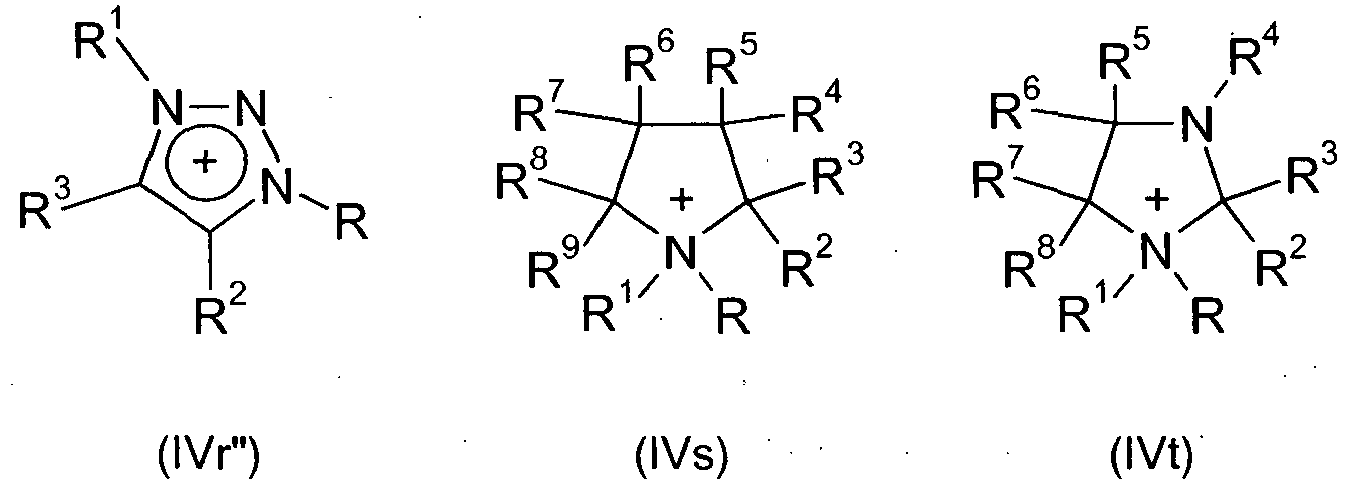

- Weitere geeignete Kationen sind Verbindungen der allgemeinen Formel (IVx) und (IVy)

- In den oben genannten Formeln (IVa) bis (IVy) stehen
- der Rest R für Wasserstoff, einen Kohlenstoff enthaltenden organischen, gesättigten oder ungesättigten, acyclischen oder cyclischen, aliphatischen, aromatischen oder araliphatischen, unsubstituierten oder durch 1 bis 5 Heteroatome oder funktionelle Gruppen unterbrochenen oder substituierten Rest mit 1 bis 20 Kohlenstoffatomen; und
- die Reste R1 bis R9 unabhängig voneinander für Wasserstoff, eine Sulfo-Gruppe oder einen Kohlenstoff enthaltenden organischen, gesättigten oder ungesättigten, acyclischen oder cyclischen, aliphatischen, aromatischen oder araliphatischen, unsubstituierten oder durch 1 bis 5 Heteroatome oder funktionelle Gruppen unterbrochenen oder substituierten Rest mit 1 bis 20 Kohlenstoffatomen, wobei die Reste R1 bis R9, welche in den oben genannten Formeln (IV) an ein Kohlenstoffatom (und nicht an ein Heteroatom) gebunden sind, zusätzlich auch für Halogen oder eine funktionelle Gruppe stehen können; oder
zwei benachbarte Reste aus der Reihe R1 bis R9 zusammen auch für einen zweibindigen, Kohlenstoff enthaltenden organischen, gesättigten oder ungesättigten, acyclischen oder cyclischen, aliphatischen, aromatischen oder araliphatischen, unsubstituierten oder durch 1 bis 5 Heteroatome oder funktionelle Gruppen unterbrochenen oder substituierten Rest mit 1 bis 30 Kohlenstoffatomen. - Als Heteroatome kommen bei der Definition der Reste R und R1 bis R9 prinzipiell alle Heteroatome in Frage, welche in der Lage sind, formell eine -CH2-, eine -CH=, eine -C≡ oder eine =C= -Gruppe zu ersetzen. Enthält der Kohlenstoff enthaltende Rest Heteroatome, so sind Sauerstoff, Stickstoff, Schwefel, Phosphor und Silizium bevorzugt. Als bevorzugte Gruppen seien insbesondere -O-, -S-, -SO-, -SO2-, -NR'-, -N=, -PR'-, -PR'2 und -SiR'2- genannt, wobei es sich bei den Resten R' um den verbleibenden Teil des Kohlenstoff enthaltenden Rests handelt. Die Reste R1 bis R9 können dabei in den Fällen, in denen diese in den oben genannten Formeln (IV) an ein Kohlenstoffatom (und nicht an ein Heteroatom) gebunden sind, auch direkt über das Heteroatom gebunden sein.
- Als funktionelle Gruppen kommen prinzipiell alle funktionellen Gruppen in Frage, welche an ein Kohlenstoffatom oder ein Heteroatom gebunden sein können. Als geeignete Beispiele seien -OH (Hydroxy), =O (insbesondere als Carbonylgruppe), -NH2 (Amino), -NHR', -NR2' =NH (Imino), -COOH (Carboxy), -CONH2 (Carboxamid), -SO3H (Sulfo) und -CN (Cyano) genannt. Fuktionelle Gruppen und Heteroatome können auch direkt benachbart sein, so dass auch Kombinationen aus mehreren benachbarten Atomen, wie etwa -O- (Ether), -S- (Thioether), -COO- (Ester), -CONH- (sekundäres Amid) oder -CONR'- (tertiäres Amid), mit umfasst sind, beispielsweise Di-(C1-C4-Alkyl)-amino, C1-C4-Alkyloxycarbonyl oder C1-C4-Alkyloxy. Bei den Resten R' handelt es sich um den verbleibenden Teil des Kohlenstoff enthaltenden Restes.
- Als Halogene seien Fluor, Chlor, Brom und lod genannt.
- Bevorzugt steht der Rest R für
- unverzweigtes oder verzweigtes, unsubstituiertes oder ein bis mehrfach mit Hydroxy, Halogen, Phenyl, Cyano, C1-C6-Alkoxycarbonyl und/oder SO3H substituiertes C1-C18-Alkyl mit insgesamt 1 bis 20 Kohlenstoffatomen, wie beispielsweise Methyl, Ethyl, 1-Propyl, 2-Propyl, 1-Butyl, 2-Butyl, 2-Methyl-1-propyl (Isobutyl), 2-Methyl-2-propyl (tert.-Butyl), 1-Pentyl, 2-Pentyl, 3-Pentyl, 2-Methyl-1-butyl, 3-Methyl-1-butyl, 2-Methyl-2-butyl, 3-Methyl-2-butyl, 2,2-Dimethyl1-propyl, 1-Hexyl, 2-Hexyl, 3-Hexyl, 2-Methyl-1-pentyl, 3-Methyl-1-pentyl, 4-Methyl-1-pentyl, 2-Methyl-2-pentyl, 3-Methyl-2-pentyl, 4-Methyl-2-pentyl, 2-Methyl-3-pentyl, 3-Methyl-3-pentyl, 2,2-Dimethyl-1-butyl, 2,3-Dimethyl-1-butyl, 3,3-Dimethyl-1-butyl, 2-Ethyl-1-butyl, 2,3-Dimethyl-2-butyl, 3,3-Dimethyl-2-butyl, 1-Heptyl, 1-Octyl, 1-Nonyl, 1-Decyl, 1-Undecyl, 1-Dodecyl, 1-Tetradecyl, 1-Hexadecyl, 1-Octadecyl, Benzyl, 3-Phenylpropyl, 2-Hydroxyethyl, 2-Cyanoethyl, 2-(Methoxycarbonyl)-ethyl, 2-(Ethoxycarbonyl)-ethyl, 2-(n-Butoxy-carbonyl)-ethyl, Trifluormethyl, Difluormethyl, Fluormethyl, Pentafluorethyl, Heptafluorpropyl, Heptafluorisopropyl, Nonafluorbutyl, Nonafluorisobutyl, Undecylfluorpentyl, Undecylfluorisopentyl, 6-Hydroxyhexyl und Sulfopropyl;
- Glykole, Butylenglykole und deren Oligomere mit 1 bis 100 Einheiten und einem Wasserstoff oder einem C1-C8-Alkyl als Endgruppe, wie beispielsweise RAO-(CHRB-CH2-O)n-CHRB-CH2- oder RAO-(CH2CH2CH2CH2O)n-CH2CH2CH2CH2O- mit RA und RB bevorzugt Wasserstoff, Methyl oder Ethyl und n bevorzugt 0 bis 3, insbesondere 3-Oxabutyl, 3-Oxapentyl, 3,6-Dioxaheptyl, 3,6-Dioxaoctyl, 3,6,9-Trioxadecyl, 3,6,9-Trioxaundecyl, 3,6,9,12-Tetraoxatridecyl und 3,6,9,12-Tetraoxatetradecyl;
- Vinyl;
- 1-Propen-1-yl, 1-Propen-2-yl und 1-Propen-3-yl; und
- N,N-Di-C1-C6-alkyl-amino, wie beispielsweise N,N-Dimethylamino und N,N-Diethylamino.
- Besonders bevorzugt steht der Rest R für unverzweigtes und unsubstituiertes C1-C18-Alkyl, wie beispielsweise Methyl, Ethyl, 1-Propyl, 1-Butyl, 1-Pentyl, 1-Hexyl, 1-Heptyl, 1-Octyl, 1-Decyl, 1-Dodecyl, 1-Tetradecyl, 1-Hexadecyl, 1-Octadecyl, insbesondere für Methyl, Ethyl, 1-Butyl und 1-Octyl sowie für CH3O-(CH2CH2O)n-CH2CH2- und CH3CH2O-(CH2CH2O)n-CH2CH2- mit n gleich 0 bis 3.
- Bevorzugt stehen die Reste R1 bis R9 unabhängig voneinander für
- Wasserstoff;
- Halogen;
- eine funktionelle Gruppe;
- gegebenenfalls durch funktionelle Gruppen, Aryl, Alkyl, Aryloxy, Alkyloxy, Halogen, Heteroatome und/oder Heterocyclen substituiertes und/oder durch ein oder mehrere Sauerstoff- und/oder Schwefelatome und/oder ein oder mehrere substituierte oder unsubstituierte Iminogruppen unterbrochenes C1-C18-Alkyl;
- gegebenenfalls durch funktionelle Gruppen, Aryl, Alkyl, Aryloxy, Alkyloxy, Halo-gen, Heteroatome und/oder Heterocyclen substituiertes und/oder durch ein oder mehrere Sauerstoff- und/oder Schwefelatome und/oder ein oder mehrere substituierte oder unsubstituierte Iminogruppen unterbrochenes C2-C18-Alkenyl;
- gegebenenfalls durch funktionelle Gruppen, Aryl, Alkyl, Aryloxy, Alkyloxy, Halogen, Heteroatome und/oder Heterocyclen substituiertes C6-C12-Aryl;
- gegebenenfalls durch funktionelle Gruppen, Aryl, Alkyl, Aryloxy, Alkyloxy, Halogen, Heteroatome und/oder Heterocyclen substituiertes C5-C12-Cycloalkyl;
- gegebenenfalls durch funktionelle Gruppen, Aryl, Alkyl, Aryloxy, Alkyloxy, Halogen, Heteroatome und/oder Heterocyclen substituiertes C5-C12-Cycloalkenyl; oder
- einen gegebenenfalls durch funktionelle Gruppen, Aryl, Alkyl, Aryloxy, Alkyloxy, Halogen, Heteroatome und/oder Heterocyclen substituierten fünf- bis sechsgliedrigen, Sauerstoff-, Stickstoff- und/oder Schwefelatome aufweisenden Heterocyclus bedeuten; oder
- einen ungesättigten, gesättigten oder aromatischen, gegebenenfalls durch funktionelle Gruppen, Aryl, Alkyl, Aryloxy, Alkyloxy, Halogen, Heteroatome und/oder Heterocyclen substituierten und gegebenenfalls durch ein oder mehrere Sauerstoff- und/oder Schwefelatome und/oder ein oder mehrere substituierte oder unsubstituierte Iminogruppen unterbrochenen Ring.
- Bei gegebenenfalls durch funktionelle Gruppen, Aryl, Alkyl, Aryloxy, Alkyloxy, Halogen, Heteroatome und/oder Heterocyclen substituiertem C1-C18-Alkyl handelt es sich bevorzugt um Methyl, Ethyl, 1-Propyl, 2-Propyl, 1-Butyl, 2-Butyl, 2-Methyl-1-propyl (Isobutyl), 2-Methyl-2-propyl (tert.-Butyl), 1-Pentyl, 2-Pentyl, 3-Pentyl, 2-Methyl-1-butyl, 3-Methyl-1-butyl, 2-Methyl-2-butyl, 3-Methyl-2-butyl, 2,2-Dimethyl-1-propyl, 1-Hexyl, 2-Hexyl, 3-Hexyl, 2-Methyl-1-pentyl, 3-Methyl-1-pentyl, 4-Methyl-1-pentyl, 2-Methyl-2-pentyl, 3-Methyl-2-pentyl, 4-Methyl-2-pentyl, 2-Methyl-3-pentyl, 3-Methyl-3-pentyl, 2,2-Dimethyl-1-butyl, 2,3-Dimethyl-1-butyl, 3,3-Dimethyl-1-butyl, 2-Ethyl-1-butyl, 2,3-Dimethyl-2-butyl, 3,3-Dimethyl-2-butyl, Heptyl, Octyl, 2-Etylhexyl, 2,4,4-Trimethylpentyl, 1,1,3,3-Tetramethylbutyl, 1-Nonyl, 1-Decyl, 1-Undecyl, 1-Dodecyl, 1-Tridecyl, 1-Tetradecyl, 1-Pentadecyl, 1-Hexadecyl, 1-Heptadecyl, 1-Octadecyl, Cyclopentylmethyl, 2-Cyclopentylethyl, 3-Cyclopentylpropyl, Cyclohexylmethyl, 2-Cyclohexylethyl, 3-Cyclohexylpropyl, Benzyl (Phenylmethyl), Diphenylmethyl (Benzhydryl), Triphenylmethyl, 1-Phenylethyl, 2-Phenylethyl, 3-Phenylpropyl, α,α-Dimethylbenzyl, p-Tolylmethyl, 1-(p-Butylphenyl)-ethyl, p-Chlorbenzyl, 2,4-Dichlorbenzyl, p-Methoxybenzyl, m-Ethoxybenzyl, 2-Cyanoethyl, 2-Cyanopropyl, 2-Methoxycarbonylethyl, 2-Ethoxycarbonylethyl, 2-Butoxycarbonylpropyl, 1,2-Di-(methoxycarbonyl)-ethyl, Methoxy, Ethoxy, Formyl, 1,3-Dioxolan-2-yl, 1,3-Dioxan-2-yl, 2-Methyl-1,3-dioxolan-2-yl, 4-Methyl-1,3-dioxolan-2-yl, 2-Hydroxyethyl, 2-Hydroxypropyl, 3-Hydroxypropyl, 4-Hydroxybutyl, 6-Hydroxyhexyl, 2-Aminoethyl, 2-Aminopropyl, 3-Aminopropyl, 4-Aminobutyl, 6-Aminohexyl, 2-Methylaminoethyl, 2-Methylaminopropyl, 3-Methylaminopropyl, 4-Methylaminobutyl, 6-Methylaminohexyl, 2-Dimethylaminoethyl, 2-Dimethylaminopropyl, 3-Dimethylaminopropyl, 4-Dimethylaminobutyl, 6-Dimethylaminohexyl, 2-Hydroxy-2,2-di-methylethyl, 2-Phenoxyethyl, 2-Phenoxypropyl, 3-Phenoxypropyl, 4-Phenoxybutyl, 6-Phenoxyhexyl, 2-Methoxyethyl, 2-Methoxypropyl, 3-Methoxypropyl, 4-Methoxybutyl, 6-Methoxyhexyl, 2-Ethoxyethyl, 2-Ethoxypropyl, 3-Ethoxypropyl, 4-Ethoxybutyl, 6-Ethoxyhexyl, Acetyl, CnF2(n-a)+(1-b)H2a+b mit n gleich 1 bis 30, 0 ≤ a ≤ n und b = 0 oder 1 (beispielsweise CF3, C2F5, CH2CH2-C(n-2)F2(n-2)+1, C6F13, C8F17, C10F21, C12F25), Chlormethyl, 2-Chlorethyl, Trichlormethyl, 1,1-Dimethyl-2-chlorethyl, Methoxymethyl, 2-Butoxyethyl, Diethoxymethyl, Diethoxyethyl, 2-Isopropoxyethyl, 2-Butoxypropyl, 2-Octyloxyethyl, 2-Methoxyisopropyl, 2-(Methoxycarbonyl)-ethyl, 2-(Ethoxycarbonyl)-ethyl, 2-(n-Butoxycarbonyl)-ethyl, Butylthiomethyl, 2-Dodecylthioethyl, 2-Phenylthioethyl, 5-Hydroxy-3-oxa-pentyl, 8-Hydroxy-3,6-dioxa-octyl, 11-Hydroxy-3,6,9-trioxaundecyl, 7-Hydroxy-4-oxa-heptyl, 11-Hydroxy-4,8-dioxa-undecyl, 15-Hydroxy-4,8,12-trioxa-pentadecyl, 9-Hydroxy-5-oxa-nonyl, 14-Hydroxy-5,10-dioxa-tetradecyl, 5-Methoxy-3-oxa-pentyl, 8-Methoxy-3,6-dioxa-octyl, 11-Methoxy-3,6,9-trioxa-undecyl, 7-Methoxy-4-oxa-heptyl, 11-Methoxy-4,8-dioxa-undecyl, 15-Methoxy-4,8,12-trioxapentadecyl, 9-Methoxy-5-oxa-nonyl, 14-Methoxy-5,10-dioxa-tetradecyl, 5-Ethoxy-3-oxa-pentyl, 8-Ethoxy-3,6-dioxa-octyl, 11-Ethoxy-3,6,9-trioxa-undecyl, 7-Ethoxy-4-oxaheptyl, 11-Ethoxy-4,8-dioxa-undecyl, 15-Ethoxy-4,8,12-trioxa-pentadecyl, 9-Ethoxy-5-oxa-nonyl oder 14-Ethoxy-5,10-oxa-tetradecyl.
- Bei gegebenenfalls durch funktionelle Gruppen, Aryl, Alkyl, Aryloxy, Alkyloxy, Halogen, Heteroatome und/oder Heterocyclen substituiertes und/oder durch ein oder mehrere Sauerstoff- und/oder Schwefelatome und/oder ein oder mehrere substituierte oder unsubstituierte Iminogruppen unterbrochenes C2-C18-Alkenyl handelt es sich bevorzugt um Vinyl, 2-Propenyl, 3-Butenyl, cis-2-Butenyl, trans-2-Butenyl oder CnF2(n-a)-(1-b)H2a-b mit n≤30, 0 ≤ a ≤ n und b = 0 oder 1.
- Bei gegebenenfalls durch funktionelle Gruppen, Aryl, Alkyl, Aryloxy, Alkyloxy, Halogen, Heteroatome und/oder Heterocyclen substituiertes C6-C12-Aryl handelt es sich bevorzugt um Phenyl, Tolyl, Xylyl, α-Naphthyl, β-Naphthyl, 4-Diphenylyl, Chlorphenyl, Dichlorphenyl, Trichlorphenyl, Difluorphenyl, Methylphenyl; Dimethylphenyl, Trimethylphenyl, Ethylphenyl, Diethylphenyl, iso-Propylphenyl, tert.-Butylphenyl, Dodecylphenyl, Methoxyphenyl, Dimethoxyphenyl, Ethoxyphenyl, Hexyloxyphenyl, Methylnaphthyl, Isopropylnaphthyl, Chlornaphthyl, Ethoxynaphthyl, 2,6-Dimethylphenyl, 2,4,6-Trimethylphenyl, 2,6-Dimethoxyphenyl, 2,6-Dichlorphenyl, 4-Bromphenyl, 2-Nitrophenyl, 4-Nitrophenyl, 2,4-Dinitrophenyl, 2,6-Dinitrophenyl, 4-Dimethylaminophenyl, 4-Acetylphenyl, Methoxyethylphenyl, Ethoxymethylphenyl, Methylthiophenyl, Isopropylthiophenyl oder tert.-Butylthiophenyl oder C6F(5-a)Ha mit 0 ≤ a ≤5.
- Bei gegebenenfalls durch funktionelle Gruppen, Aryl, Alkyl, Aryloxy, Alkyloxy, Halogen, Heteroatome und/oder Heterocyclen substituiertes C5-C12-Cycloalkyl handelt es sich bevorzugt um Cyclopentyl, Cyclohexyl, Cyclooctyl, Cyclododecyl, Methylcyclopentyl, Dimethylcyclopentyl, Methylcyclohexyl, Dimethylcyclohexyl, Diethylcyclohexyl, Butylcyclohexyl, Methoxycyclohexyl, Dimethoxycyclohexyl, Diethoxycyclohexyl, Butylthiocyclohexyl, Chlorcyclohexyl, Dichlorcyclohexyl, Dichlorcyclopentyl, CnF2(n-a)-(1-b)H2a-b mit n ≤ 30, 0 ≤ a ≤ n und b = 0 oder 1 sowie ein gesättigtes oder ungesättigtes bicyclisches System wie z. B. Norbornyl oder Norbornenyl.
- Bei gegebenenfalls durch funktionelle Gruppen, Aryl, Alkyl, Aryloxy, Alkyloxy, Halogen, Heteroatome und/oder Heterocyclen substituiertes C5-C12-Cycloalkenyl handelt es sich bevorzugt um 3-Cyclopentenyl, 2-Cyclohexenyl, 3-Cyclohexenyl, 2,5-Cyclohexadienyl oder CnF2(n-a)-3(1-b)H2a-3b mit n ≤ 30, 0 ≤ a ≤ n und b = 0 oder 1.
- Bei einen gegebenenfalls durch funktionelle Gruppen, Aryl, Alkyl, Aryloxy, Alkyloxy, Halogen, Heteroatome und/oder Heterocyclen substituierten fünf- bis sechsgliedrigen, Sauerstoff-, Stickstoff- und/oder Schwefelatome aufweisenden Heterocyclus handelt es sich bevorzugt um Furyl, Thiophenyl, Pyrryl, Pyridyl, Indolyl, Benzoxazolyl, Dioxolyl, Dioxyl, Benzimidazolyl, Benzthiazolyl, Dimethylpyridyl, Methylchinolyl, Dimethylpyrryl, Methoxyfuryl, Dimethoxypyridyl oder Difluorpyridyl.
- Bilden zwei benachbarte Reste gemeinsam einen ungesättigten, gesättigten oder aromatischen, gegebenenfalls durch funktionelle Gruppen, Aryl, Alkyl, Aryloxy, Alkyloxy, Halogen, Heteroatome und/oder Heterocyclen substituierten und gegebenenfalls durch ein oder mehrere Sauerstoff- und/oder Schwefelatome und/oder ein oder mehrere substituierte oder unsubstituierte Iminogruppen unterbrochenen Ring, so handelt es sich bevorzugt um 1,3-Propylen, 1,4-Butylen, 1,5-Pentylen, 2-Oxa-1,3-propylen, 1-Oxa-1,3-propylen, 2-Oxa-1,3-propylen, 1-Oxa-1,3-propenylen, 3-Oxa-1,5-pentylen, 1-Aza-1,3-propenylen, 1-C1-C4-Alkyl-1-aza-1,3-propenylen, 1,4-Buta-1,3-dienylen, 1-Aza-1,4-buta-1,3-dienylen oder 2-Aza-1,4-buta-1,3-dienylen.
- Enthalten die oben genannten Reste Sauerstoff- und/oder Schwefelatome und/oder substituierte oder unsubstituierte Iminogruppen, so ist die Anzahl der Sauerstoff- und/oder Schwefelatome und/oder Iminogruppen nicht beschränkt. In der Regel beträgt sie nicht mehr als 5 in dem Rest, bevorzugt nicht mehr als 4 und ganz besonders bevorzugt nicht mehr als 3.
- Enthalten die oben genannten Reste Heteroatome, so befinden sich zwischen zwei Heteroatomen in der Regel mindestens ein Kohlenstoffatom, bevorzugt mindestens zwei Kohlenstoffatome.
- Besonders bevorzugt stehen die Reste R1 bis R9 unabhängig voneinander für
- Wasserstoff;
- unverzweigtes oder verzweigtes, unsubstituiertes oder ein bis mehrfach mit Hydroxy, Halogen, Phenyl, Cyano, C1-C6-Alkoxycarbonyl und/oder SO3H substituiertes C1-C18-Alkyl mit insgesamt 1 bis 20 Kohlenstoffatomen, wie beispielsweise Methyl, Ethyl, 1-Propyl, 2-Propyl, 1-Butyl, 2-Butyl, 2-Methyl-1-propyl (Isobutyl), 2-Methyl-2-propyl (tert.-Butyl), 1-Pentyl, 2-Pentyl, 3-Pentyl, 2-Methyl-1-butyl, 3-Methyl-1-butyl, 2-Methyl-2-butyl, 3-Methyl-2-butyl, 2,2-Dimethyl-1-propyl, 1-Hexyl, 2-Hexyl, 3-Hexyl, 2-Methyl-1-pentyl, 3-Methyl-1-pentyl, 4-Methyl-1-pentyl, 2-Methyl-2-pentyl, 3-Methyl-2-pentyl, 4-Methyl-2-pentyl, 2-Methyl-3-pentyl, 3-Methyl-3-pentyl, 2,2-Dimethyl-1-butyl, 2,3-Dimethyl-1-butyl, 3,3-Dimethyl-1-butyl, 2-Ethyl-1-butyl, 2,3-Dimethyl-2-butyl, 3,3-Dimethyl-2-butyl, 1-Heptyl, 1-Octyl, 1-Nonyl, 1-Decyl, 1-Undecyl, 1-Dodecyl, 1-Tetradecyl, 1-Hexadecyl, 1-Octadecyl, Benzyl, 3-Phenylpropyl, 2-Hydroxyethyl, 2-Cyanoethyl, 2-(Methoxycarbonyl)-ethyl, 2-(Ethoxycarbonyl)-ethyl, 2-(n-Butoxy-carbonyl)-ethyl, Trifluormethyl, Difluormethyl, Fluormethyl, Pentafluorethyl, Heptafluorpropyl, Heptafluorisopropyl, Nonafluorbutyl, Nonafluorisobutyl, Undecylfluorpentyl, Undecylfluorisopentyl, 6-Hydroxyhexyl und Sulfopropyl;
- Glykole, Butylenglykole und deren Oligomere mit 1 bis 100 Einheiten und einem Wasserstoff oder einem C1- bis C8-Alkyl als Endgruppe, wie beispielsweise RAO-(CHRB-CH2-O)n-CHRB-CH2- oder RAO-(CH2CH2CH2CH2O)n-CH2CH2CH2CH2O- mit RA und RB bevorzugt Wasserstoff, Methyl oder Ethyl und n bevorzugt 0 bis 3, insbesondere 3-Oxabutyl, 3-Oxapentyl, 3,6-Dioxaheptyl, 3,6-Dioxaoctyl, 3,6,9-Trioxadecyl, 3,6,9-Trioxaundecyl, 3,6,9,12-Tetraoxatridecyl und 3,6,9,12-Tetraoxatetradecyl;
- Vinyl;
- 1-Propen-1y1, 1-Propen-2-yl und 1-Propen-3y1; und
- N,N-Di-C1-C6-alkyl-amino, wie beispielsweise N,N-Dimethylamino und N,N-Diethylamino.
- Ganz besonders bevorzugt stehen die Reste R1 bis R9 unabhängig voneinander für Wasserstoff oder C1-C18-Alkyl, wie beispielsweise Methyl, Ethyl, 1-Butyl, 1-Pentyl, 1-Hexyl, 1-Heptyl, 1-Octyl, für Phenyl, für 2-Hydroxyethyl, für 2-Cyanoethyl, für 2-(Methoxycarbonyl)ethyl, für 2-(Ethoxycarbonyl)ethyl, für 2-(n-Butoxycarbonyl)ethyl, für N,N-Dimethylamino, für N,N-Diethylamino, für Chlor sowie für CH3O-(CH2CH2O)n-CH2CH2- und CH3CH2O-(CH2CH2O)n-CH2CH2- mit n gleich 0 bis 3.
- Ganz besonders bevorzugt setzt man als Pyridiniumionen (IVa) solche ein, bei denen
- einer der Reste R1 bis R5 Methyl, Ethyl oder Chlor ist und die verbleibenden Reste R1 bis R5 Wasserstoff sind;
- R3 Dimethylamino ist und die verbleibenden Reste R1, R2, R4 und R5 Wasserstoff sind;
- alle Reste R1 bis R5 Wasserstoff sind;
- R2 Carboxy oder Carboxamid ist und die verbleibenden Reste R1, R2, R4 und R5 Wasserstoff sind; oder
- R1 und R2 oder R2 und R3 1,4-Buta-1,3-dienylen ist und die verbleibenden Reste R1, R2, R4 und R5 Wasserstoff sind;
- R1 bis R5 Wasserstoff sind; oder
- einer der Reste R1 bis R5 Methyl oder Ethyl ist und die verbleibenden Reste R1 bis R5 Wasserstoff sind.
- Als ganz besonders bevorzugte Pyridiniumionen (IVa) seien genannt 1-Methylpyridinium, 1-Ethylpyridinium, 1-(1-Butyl)pyridinium, 1-(1-Hexyl)pyridinium, 1-(1-Octyl)-pyridinium, 1-(1-Hexyl)-pyridinium, 1-(1-Octyl)-pyridinium, 1-(1-Dodecyl)-pyridinium, 1-(1-Tetradecyl)-pyridinium, 1-(1-Hexadecyl)-pyridinium, 1,2-Dimethylpyridinium, 1-Ethyl-2-methylpyridinium, 1-(1-Butyl)-2-methylpyridinium, 1-(1-Hexyl)-2-methylpyridinium, 1-(1-Octyl)-2-methylpyridinium, 1-(1-Dodecyl)-2-methylpyridinium, 1-(1-Tetradecyl)-2-methylpyridinium, 1-(1-Hexadecyl)-2-methylpyridinium, 1-Methyl-2-ethylpyridinium, 1,2-Diethylpyridinium, 1-(1-Butyl)-2-ethylpyridinium, 1-(1-Hexyl)-2-ethylpyridinium, 1-(1-Octyl)-2-ethylpyridinium, 1-(1-Dodecyl)-2-ethylpyridinium, 1-(1-Tetradecyl)-2-ethylpyridinium, 1-(1-Hexadecyl)-2-ethylpyridinium, 1,2-Dimethyl-5-ethyl-pyridinium, 1,5-Diethyl-2-methyl-pyridinium, 1-(1-Butyl)-2-methyl-3-ethyl-pyridinium, 1-(1-Hexyl)-2-methyl-3-ethyl-pyridinium und 1-(1-Octyl)-2-methyl-3-ethyl-pyridinium, 1-(1-Dodecyl)-2-methyl-3-ethyl-pyridinium, 1-(1-Tetradecyl)-2-methyl-3-ethyl-pyridinium und 1-(1-Hexadecyl)-2-methyl-3-ethyl-pyridinium.
- Ganz besonders bevorzugt setzt man als Pyridaziniumionen (IVb) solche ein, bei denen
- R1 bis R4 Wasserstoff sind; oder
- einer der Reste R1 bis R4 Methyl oder Ethyl ist und die verbleibenden Reste R1 bis R4 Wasserstoff sind.
- Ganz besonders bevorzugt setzt man als Pyrimidiniumionen (IVc) solche ein, bei denen
- R1 Wasserstoff, Methyl oder Ethyl ist und R2 bis R4 unabhängig voneinander Wasserstoff oder Methyl sind; oder
- R1 Wasserstoff, Methyl oder Ethyl ist, R2 und R4 Methyl sind und R3 Wasserstoff ist.
- Ganz besonders bevorzugt setzt man als Pyraziniumionen (IVd) solche ein, bei denen
- R1 Wasserstoff, Methyl oder Ethyl ist und R2 bis R4 unabhängig voneinander Wasserstoff oder Methyl sind;
- R1 Wasserstoff, Methyl oder Ethyl ist, R2 und R4 Methyl sind und R3 Wasserstoff ist;
- R1 bis R4 Methyl sind; oder
- R1 bis R4 Wasserstoff sind.
- Ganz besonders bevorzugt setzt man als Imidazoliumionen (IVe) solche ein, bei denen
- R1 Wasserstoff, Methyl, Ethyl, 1-Propyl, 1-Butyl, 1-Pentyl, 1-Hexyl, 1-Octyl, 2-Hydroxyethyl oder 2-Cyanoethyl und R2 bis R4 unabhängig voneinander Wasserstoff, Methyl oder Ethyl sind.
- Als ganz besonders bevorzugte Imidazoliumionen (IVe) seien genannt 1-Methylimidazolium, 1-Ethylimidazolium, 1-(1-Butyl)-imidazolium, 1-(1-Octyl)-imidazolium, 1-(1-Dodecyl)-imidazolium, 1-(1-Tetradecyl)-imidazolium, 1-(1-Hexadecyl)-imidazolium, 1,3-Dimethylimidazolium, 1-Ethyl-3-methylimidazolium, 1-(1-Butyl)-3-methylimidazolium, 1-(1-Butyl)-3-ethylimidazolium, 1-(1-Hexyl)-3-methyl-imidazolium, 1-(1-Hexyl)-3-ethyl-imidazolium, 1-(1-Hexyl)-3-butyl-imidazolium, 1-(1-Octyl)-3-methylimidazolium, 1-(1-Octyl)-3-ethylimidazolium, 1-(1-Octyl)-3-butylimidazolium, 1-(1-Dodecyl)-3-methyl-imidazolium, 1-(1-Dodecyl)-3-ethylimidazolium, 1-(1-Dodecyl)-3-butylimidazolium, 1-(1-Dodecyl)-3-octylimidazolium, 1-(1-Tetradecyl)-3-methylimidazolium, 1-(1-Tetradecyl)-3-ethylimidazolium, 1-(1-Tetradecyl)-3-butylimidazolium, 1-(1-Tetradecyl)-3-octylimidazolium, 1-(1-Hexadecyl)-3-methylimidazolium, 1-(1-Hexadecyl)-3-ethylimidazolium, 1-(1-Hexadecyl)-3-butylimidazolium, 1-(1-Hexadecyl)-3-octylimidazolium, 1,2-Dimethylimidazolium, 1,2,3-Trimethylimidazolium, 1-Ethyl-2,3-dimethylimidazolium, 1-(1-Butyl)-2,3-dimethylimidazolium, 1-(1-Hexyl)-2,3-dimethyl-imidazolium, 1-(1-Octyl)-2,3-dimethylimidazolium, 1,4-Dimethylimidazolium, 1,3,4-Trimethylimidazolium, 1,4-Dimethyl-3-ethylimidazolium, 3-butylimidazolium, 1,4-Dimethyl-3-octylimidazolium, 1,4,5-Trimethylimidazolium, 1,3,4,5-Tetramethylimidazolium, 1,4,5-Trimethyl-3-ethylimidazolium, 1,4,5-Trimethyl-3-butylimidazolium, 1,4,5-Trimethyl-3-octylimidazolium und 1-(Prop-1-en-3-yl)-3-methylimidazolium.
- Ganz besonders bevorzugt setzt man als Pyrazoliumionen (IVf), (IVg) beziehungsweise (IVg') solche ein, bei denen
- R1 Wasserstoff, Methyl oder Ethyl ist und R2 bis R4 unabhängig voneinander Wasserstoff oder Methyl sind.
- Ganz besonders bevorzugt setzt man als Pyrazoliumionen (IVh) solche ein, bei denen
- R1 bis R4 unabhängig voneinander Wasserstoff oder Methyl sind.
- Ganz besonders bevorzugt setzt man als 1-Pyrazoliniumionen (IVi) solche ein, bei denen
- unabhängig voneinander R1 bis R6 Wasserstoff oder Methyl sind.
- Ganz besonders bevorzugt setzt man als 2-Pyrazoliniumionen (IVj) beziehungsweise (IVj') solche ein, bei denen
- R1 Wasserstoff, Methyl, Ethyl oder Phenyl ist und R2 bis R6 unabhängig voneinander Wasserstoff oder Methyl sind.
- Ganz besonders bevorzugt setzt man als 3-Pyrazoliniumionen (IVk) beziehungsweise (IVk') solche ein, bei denen
- R1 und R2 unabhängig voneinander Wasserstoff, Methyl, Ethyl oder Phenyl sind und R3 bis R6 unabhängig voneinander Wasserstoff oder Methyl sind.
- Ganz besonders bevorzugt setzt man als Imidazoliniumionen (IVI) solche ein, bei denen
- R1 und R2 unabhängig voneinander Wasserstoff, Methyl, Ethyl, 1-Butyl oder Phenyl sind, R3 und R4 unabhängig voneinander Wasserstoff, Methyl oder Ethyl sind und R5 und R6 unabhängig voneinander Wasserstoff oder Methyl sind.
- Ganz besonders bevorzugt setzt man als Imidazoliniumionen (IVm) beziehungsweise (IVm') solche ein, bei denen
- R1 und R2 unabhängig voneinander Wasserstoff, Methyl oder Ethyl sind und R3 bis R6 unabhängig voneinander Wasserstoff oder Methyl sind.
- Ganz besonders bevorzugt setzt man als Imidazoliniumionen (IVn) beziehungsweise (IVn') solche ein, bei denen
- R1 bis R3 unabhängig voneinander Wasserstoff, Methyl oder Ethyl sind und R4 bis R6 unabhängig voneinander Wasserstoff oder Methyl sind.
- Ganz besonders bevorzugt setzt man als Thiazoliumionen (IVo) beziehungsweise (I-Vo') sowie als Oxazoliumionen (IVp) solche ein, bei denen
- R1 Wasserstoff, Methyl, Ethyl oder Phenyl ist und R2 und R3 unabhängig voneinander Wasserstoff oder Methyl sind.
- Ganz besonders bevorzugt setzt man als 1,2,4-Triazoliumionen (IVq), (IVq') beziehungsweise (IVq") solche ein, bei denen
- R1 und R2 unabhängig voneinander Wasserstoff, Methyl, Ethyl oder Phenyl sind und R3 Wasserstoff, Methyl oder Phenyl ist.
- Ganz besonders bevorzugt setzt man als 1,2,3-Triazoliumionen (IVr), (IVr') beziehungsweise (IVr") solche ein, bei denen
- R1 Wasserstoff, Methyl oder Ethyl ist und R2 und R3 unabhängig voneinander Wasserstoff oder Methyl sind, oder R2 und R3 zusammen 1,4-Buta-1,3-dienylen ist.
- Ganz besonders bevorzugt setzt man als Pyrrolidiniumionen (IVs) solche ein, bei denen
- R1 Wasserstoff, Methyl, Ethyl oder Phenyl ist und R2 bis R9 unabhängig vonein-ander Wasserstoff oder Methyl sind.
- Ganz besonders bevorzugt setzt man als Imidazolidiniumionen (IVt) solche ein, bei denen
- R1 und R4 unabhängig voneinander Wasserstoff, Methyl, Ethyl oder Phenyl sind und R2 und R3 sowie R5 bis R8 unabhängig voneinander Wasserstoff oder Methyl sind.
- Ganz besonders bevorzugt setzt man als Ammoniumionen (IVu) solche ein, bei denen
- R1 bis R3 unabhängig voneinander C1- bis C18-Alkyl sind; oder
- R1 und R2 zusammen 1,5-Pentylen oder 3-Oxa-1,5-pentylen sind und R3 C1-C18-Alkyl, 2-Hydroxyethyl oder 2-Cyanoethyl ist.
- Als ganz besonders bevorzugte Ammoniumionen (IVu) seien genannt Trimethylammonium, Triethylammonium, Dimethylethylammonium, Diethylmethylammonium, Tetramethylammonium.
- Beispiele für die tertiären Amine, von denen sich die quatären Ammoniumionen der allgemeinen Formel (IVu) durch Quaternisierung mit den genannten Resten R ableiten, sind Trimethylamin, Triethylamin, Tri-n-propylamin, Tri-n-butylamin, Diethylmethylamin, Dimethylethylamin, Triisopropylamin, Isopropyldiethylamin, Diisopropylethylamin, Diethyl-n-butylamin, Diethyl-tert-butylamin, Diethyl-n-pentylamin, Diethyl-hexylamin, Diethyloctylamin, Diethyl-(2-ethylhexyl)-amin, Di-n-propylbutylamin, Di-n-propyl-n-pentylamin, Di-n-propylhexylamin, Di-n-propyloctylamin, Di-n-propyl-(2-ethyl-hexyl)-amin, Di-isopropylethylamin, Di-iso-propyl-n-propylamin, Di-isopropyl-butylamin, Diisopropylpentylamin, Di-iso-propylhexylamin, Di-isopropyloctylamin, Di-iso-propyl-(2-ethylhexyl)-amin, Di-n-butylethylamin, Di-n-butyl-n-propylamin, Di-n-butyl-n-pentylamin, Di-n-butylhexylamin, Di-n-butyloctylamin, Di-n-butyl-(2-ethylhexyl)-amin, N-n-Butylpyrrolidin, N-sek-Butylpyrrodidin, N-tert-Butylpyrrolidin, N-n-Pentylpyrrolidin, N,N-Dimethylcyclohexylamin, N,N-Diethylcyclohexylamin, N,N-Di-n-butylcyclohexylamin, N-n-Propylpiperidin, N-iso-Propylpiperidin, N-n-Butyl-piperidin, N-sek-Butylpiperidin, N-tert-Butylpiperidin, N-n-Pentylpiperidin, N-n-Butylmorpholin, N-sek-Butylmorpholin, N-tert-Butylmorpholin, N-n-Pentylmorpholin, N-Benzyl-N-ethylanilin, N-Benzyl-N-n-propylanilin, N-Benzyl-N-iso-propylanilin, N-Benzyl-N-n-butylanilin, N,N-Dimethyl-p-toluidin, N,N-Diethyl-p-toluidin, N,N-Di-n-butyl-p-toluidin, Diethylbenzylamin, Di-n-propylbenzylamin, Di-n-butylbenzylamin, Diethylphenylamin, Di-n-Propylphenylamin und Din-Butylphenylamin.
- Bevorzugte quartäre Ammoniumsalze der allgemeinen Formel (IVu) sind solche, die sich von folgenden tertiären Aminen durch Quärternisierung mit den genannten Resten R ableiten lassen, wie Dimethylamin, Trimethylamin, Diethylamin, Triethylamin, Dimethylethylamin, Diethyl-tert-butylamin, Di-iso-propylethylamin, Tripropylamin, Tributylamin.
- Besonders bevorzugte tertiäre Amine sind Trimethylamin und Triethylamin.
- Ganz besonders bevorzugt setzt man als Guanidiniumionen (IVv) solche ein, bei denen
- R1 bis R5 Methyl sind.
- Als ganz besonders bevorzugtes Guanidiniumion (IVv) sei genannt N,N,N',N',N",N"-Hexamethylguanidinium.
- Ganz besonders bevorzugt setzt man als Choliniumionen (IVw) solche ein, bei denen
- R1 und R2 unabhängig voneinander Methyl, Ethyl, 1-Butyl oder 1-Octyl sind und R3 Wasserstoff, Methyl, Ethyl, Acetyl, -SO2OH oder -PO(OH)2 ist;
- R1 Methyl, Ethyl, 1-Butyl oder 1-Octyl ist, R2 eine -CH2-CH2-OR4-Gruppe ist und R3 und R4 unabhängig voneinander Wasserstoff, Methyl, Ethyl, Acetyl, -SO2OH oder -PO(OH)2 sind; oder
- R1 eine -CH2-CH2-OR4-Gruppe ist, R2 eine -CH2-CH2-OR5-Gruppe ist und R3 bis R5 unabhängig voneinander Wasserstoff, Methyl, Ethyl, Acetyl, -SO2OH oder - PO(OH)2 sind.
- Besonders bevorzugte Choliniumionen (IVw) sind solche, bei denen R3 ausgewählt ist aus Wasserstoff, Methyl, Ethyl, Acetyl, 5-Methoxy-3-oxa-pentyl, 8-Methoxy-3,6-dioxa-octyl, 11-Methoxy-3,6,9-trioxa-undecyl, 7-Methoxy-4-oxa-heptyl, 11-Methoxy-4,8-dioxa-undecyl, 15-Methoxy-4,8,12-trioxa-pentadecyl, 9-Methoxy-5-oxa-nonyl, 14-Methoxy-5,10-oxa-tetradecyl, 5-Ethoxy-3-oxa-pentyl, 8-Ethoxy-3,6-dioxa-octyl, 11-Ethoxy-3,6,9-trioxa-undecyl, 7-Ethoxy-4-oxa-heptyl, 11-Ethoxy-4,8-dioxa-undecyl, 15-Ethoxy-4,8,12-trioxa-pentadecyl, 9-Ethoxy-5-oxa-nonyl oder 14-Ethoxy-5,10-oxa-tetradecyl.
- Ganz besonders bevorzugt setzt man als Phosphoniumionen (IVx) solche ein, bei denen
- R1 bis R3 unabhängig voneinander C1-C18-Alkyl, insbesondere Butyl, Isobutyl, 1-Hexyl oder 1-Octyl sind.
- Unter den vorstehend genannten heterocyclischen Kationen sind die Pyridiniumionen, Pyrazolinium-, Pyrazoliumionen und die Imidazolinium- sowie die Imidazoliumionen bevorzugt. Weiterhin sind Ammoniumionen bevorzugt.
- Insbesondere bevorzugt sind 1-Methylpyridinium, 1-Ethylpyridinium, 1-(1-Butyl)pyridinium, 1-(1-Hexyl)pyridinium, 1-(1-Octyl)pyridinium, 1-(1-Hexyl)-pyridinium, 1-(1-Octyl)-pyridinium, 1-(1-Dodecyl)-pyridinium, 1-(1-Tetradecyl)-pyridinium, 1-(1-Hexadecyl)-pyridinium, 1,2-Dimethylpyridinium, 1-Ethyl-2-methylpyridinium, 1-(1-Butyl)-2-methylpyridinium, 1-(1-Hexyl)-2-methylpyridinium, 1-(1-Octyl)-2-methylpyridinium, 1-(1-Dodecyl)-2-methylpyridinium, 1-(1-Tetradecyl)-2-methylpyridinium, 1-(1-Hexadecyl)-2-methylpyridinium, 1-Methyl-2-ethylpyridinium, 1,2-Diethylpyridinium, 1-(1-Butyl)-2-ethylpyridinium, 1-(1-Hexyl)-2-ethylpyridinium, 1-(1-Octyl)-2-ethylpyridinium, 1-(1-Dodecyl)-2-ethylpyridinium, 1-(1-Tetradecyl)-2-ethylpyridinium, 1-(1-Hexadecyl)-2-ethylpyridinium, 1,2-Dimethyl-5-ethyl-pyridinium, 1,5-Diethyl-2-methyl-pyridinium, 1-(1-Butyl)-2-methyl-3-ethyl-pyridinium, 1-(1-Hexyl)-2-methyl-3-ethyl-pyridinium, 1-(1-Octyl)-2-methyl-3-ethyl-pyridinium, 1-(1-Dodecyl)-2-methyl-3-ethyl-pyridinium, 1-(1-Tetradecyl)-2-methyl-3-ethyl-pyridinium, 1-(1-Hexadecyl)-2-methyl-3-ethyl-pyridinium, 1-Methylimidazolium, 1-Ethylimidazolium, 1-(1-Butyl)-imidazolium, 1-(1-Octyl)-imidazolium, 1-(1-Dodecyl)-imidazolium, 1-(1-Tetradecyl)-imidazolium, 1-(1-Hexadecyl)-imidazolium, 1,3-Dimethylimidazolium, 1-Ethyl-3-methylimidazolium, 1-(1-Butyl)-3-methylimidazolium, 1-(1-Hexyl)-3-methyl-imidazolium, 1-(1-Octyl)-3-methylimidazolium, 1-(1-Dodecyl)-3-methylimidazolium, 1-(1-Tetradecyl)-3-methylimidazolium, 1-(1-Hexadecyl)-3-methylimidazolium, 1,2-Dimethylimidazolium, 1,2,3-Trimethylimidazolium, 1-Ethyl-2,3-dimethylimidazolium, 1-(1-Butyl)-2,3-dimethylimidazolium, 1-(1-Hexyl)-2,3-dimethyl-imidazolium und 1-(1-Octyl)-2,3-dimethylimidazolium, 1,4-Dimethylimidazolium, 1,3,4-Trimethylimidazolium, 1,4-Dimethyl-3-ethylimidazolium, 3-Butylimidazolium, 1,4-Dimethyl-3-octylimidazolium, 1,4,5-Trimethylimidazolium, 1,3,4,5-Tetramethylimidazolium, 1,4,5-Trimethyl-3-ethylimidazolium, 1,4,5-Trimethyl-3-butylimidazolium, 1,4,5-Trimethyl-3-octylimidazolium und 1-(Prop-1-en-3-yl)-3-metyl-imidazolium.
- Bei den in den Formeln (IIIa) bis (IIIj) genannten Metallkationen [M1]+, [M2]+, [M3]+, [M4]2+ und [M5]3+ handelt es sich im Allgemeinen um Metallkationen der 1., 2., 6., 7., 8., 9., 10., 11., 12. und 13. Gruppe des Periodensystems. Geeignete Metallkationen sind beispielsweise Li+, Na+, K+, Cs+, Mg2+, Ca2+, Ba2+, Cr3+, Fe2+, Fe3+, Co2+, Ni2+, Cu2+, Ag+, Zn2+ und Al3+.
- Bei dem organischen Kation handelt es sich besonders bevorzugt um ein Ammoniumion, ggf. C1-4-Alkyl-substituiertes Pyridiniumion oder ggf. C1-4-Alkyl-substituiertes Imidazoliumion.
- Ganz besonders bevorzugt handelt es sich bei dem organischen Kation um ein Trimethylammoniumion, Triethylammoniumion, unsubstituiertes Pyridiniumion oder 1-Ethyl-3-methylimidazoliumion.
- Das Anion der erfindungsgemäß verwendeten ionischen Flüssigkeiten ist ausgewählt unter super-sauren Aluminiumtrichlorid-Lewisbase-Addukten. Aluminiumtrichlorid (AlCl3) ist eine Lewissäure.
- Im Sinne der vorliegenden Erfindung bezeichnet der Ausdruck "super-saure Aluminiumtrichlorid-Lewisbase-Addukte" solche Aluminiumtrichlorid-Lewisbase-Addukte, die in protonierter Form einen pKs-Wert aufweisen, welcher kleiner dem einer starken Säure bzw. kleiner oder gleich dem pKs-Wert einer überaus starken Säure ist. Bevorzugt weisen die erfindungsgemäß verwendeten super-sauren Aluminiumtrichlorid-Lewisbase-Addukte in protonierter Form einen pKs-Wert < -7 auf, d. h. einen kleineren pKs-Wert als HCl.
- Im Sinne der vorliegenden Erfindung bezeichnet der Ausdruck "Aluminiumtrichlorid-Lewisbase-Addukt" komplexe Anionen, die durch die Anlagerung eines Anions, speziell eines Chlorids oder Bromids, an die Lewissäure Aluminiumtrichlorid gebildet werden. Dabei können die Anlagerungsprodukte auch Addukte mit einem oder zwei weiteren (gleichen oder verschiedenen) Lewissäuremolekülen bilden.
- Üblicherweise sind geeignete Lewissäure-Lewisbase-Addukte ausgewählt unter Verbindungen der Formel [MetaZb]-, worin der Wert von b dem Produkt von Oxidationszahl des Metalls oder Halbmetalls Met und dem Index a, plus 1 entspricht, d. h. b = a•Ox + 1, wobei Ox für die Oxidationszahl des Metalls oder Halbmetalls steht. Üblicherweise weist a einen Wert im Bereich von 1 bis 3 auf. Bevorzugt steht in den Lewissäure-Lewisbase-Addukten a für 2 oder 3.
- Wenn a für 2 oder 3 steht, können die im Lewissäure-Lewisbase-Addukt enthaltenen Metalle oder Halbmetalle Met gleich oder verschieden sein. Lewissäure-Lewisbase-Addukte mit verschiedenen Metallen entstehen beispielsweise, wenn sich zuerst ein Lewissäure-Lewisbase-Addukt aus einer Lewissäure und einem Halogenidion bildet und dieses sich anschließend mit einer weiteren, von der ersten Lewissäure verschiedenen Lewissäure unter Adduktbildung umsetzt. Vorzugsweise sind jedoch alle im Lewissäure-Lewisbase-Addukt [MetaZb]- enthaltenen Met gleich und zwar Al.
- Im Lewissäure-Lewisbase-Addukt der Formel [MetaZb]- kann Z gleich oder verschieden sein. Lewissäure-Lewisbase-Addukte mit gemischten Z werden beispielsweise erhalten, wenn, wie oben beschrieben, das Lewissäure-Lewisbase-Addukt aus zwei verschiedenen Lewissäuren entsteht. Alternativ erhält man sie, wenn Lewissäuren mit gemischten Halogenatomen eingesetzt werden oder wenn das Halogenidion, das als Lewisbase fungiert, vom Halogenatom der Lewissäure verschieden ist. Speziell sind alle im Lewissäure-Lewisbase-Addukt der Formel [MetaZb]- enthaltenen Z gleich, insbesondere steht Z für Chlor oder Brom.
- Beispiele geeigneter Lewisbasen sind Cl-, Br, AlCl4 -, AlBrCl3 -, Al2Cl7 -, Al2BrCl6 -, Al3Cl10 -, Al3BrCl9 -, BCl4 -, BBr4 -, TiCl5 -, VCl6 -, FeCl4 -, FeBr4 -, Fe2Cl7 -, Fe3Cl10 -, ZnCl3 -, ZnBr3 -, CuCl2 -, CuBr2 -, CuCl3 -, CuBr3 -, NbCl6 -, SnCl3 -, SnBr3 -, SnCl5 -, SnBr5 - und (CF3SO2)2N-.
- Bevorzugte Lewisbasen sind AlCl4 -, Al2Cl7 -, BCl4 -, BBr4 -, TiCl5 -, FeCl4 -, FeBr4 -, Fe2Cl7 - und Fe3Cl10 -.
- Dementsprechend ist das Anion der ionischen Flüssigkeit beispielsweise AlCl4 -, AlBrCl3 -, Al2Cl7 -, Al2BrCl6 -, Al3Cl10 -, Al3BrCl9 - oder (CF3SO2)2NAlCl3 -.
- Bevorzugte Anionen Y- sind ausgewählt unter AlBrCl3 -, Al2Cl7 -, Al2BrCl6 -, AbCl10 -, Al3BrCl9 -.
- Besonders bevorzugt sind die Anionen Y- ausgewählt unter Al2Cl7 -, Al3Cl10 -, speziell ist es Al2Cl7 -.
- Die Herstellung einer solchen ionischen Flüssigkeit erfolgt insbesondere durch Zugabe der entsprechenden Menge an Aluminiumchlorid zur ionischen Flüssigkeit oder zu einem Ammoniumchlorid.
- In der super-sauren ionischen Flüssigkeit, umfassend ein organisches Kation und ein anorganisches Anion, wobei das Anion ein super-saures Aluminiumtrichlorid-Lewisbase-Addukt ist, beträgt das Molverhältnis von Aluminiumtrichlorid zu Lewisbase bevorzugt > 1,0, besonders ≥ 1,5, weiter besonders ≥ 2,0. Das Molverhältnis von Aluminiumtrichlorid zu Lewisbase beträgt bevorzugt ≤ 3,0, besonders ≤ 2,5, ganz besonders bevorzugt = 2,0.
- Für die erfindungsgemäß verwendete super-saure ionische Flüssigkeit liegt die Hammett-Funktion Ho bevorzugt im Bereich von -16 bis -20, besonders im Bereich von -17 bis -19.
- Verwendet wurde jeweils ein 250-ml-Miniplant-Rührbehälter mit Scheibenrührer, Innenthermometer, Intensivkühler, 200-ml-Zulaufgefäß mit Teflonhahn (10 mm Bohrung), Thermometer und Druckausgleich zum Intensivkühler, Rührerantrieb mit Drehzahlanzeige, Probeentnahmeaufsatz mit Hahn und Septum sowie Inertisierung mit über Natriumhydroxid getrocknetem Argon.
Unter Argon wurde die ionische Flüssigkeit (IL) (150 ml) im Rührbehälter vorgelegt und das zu isomerisierende Methylcyclopentan-haltige Organikgemisch (30 ml) in das Zulaufgefäß eingefüllt. In die ionische Flüssigkeit wurde die jeweils angegebene Menge eines Kupfer(II)-Salzes gegeben. Nach Temperierung aller Edukte auf 60 °C wurde unter Rühren durch Öffnen des Teflonhahnes der gesamte Inhalt des Zulaufgefäßes innerhalb von 1-2 Sekunden in den Rührbehälter mit der IL überführt. In vorgegebenen Zeitabständen wurden jeweils 5 ml Probe mittels 30 cm-Kanüle und Spritze über den Probeentnahmestutzen mit Septum entnommen. Nach ca. 2 Minuten wurde die abgeschiedene, leichtere organische Phase aus der Spritze in ca. 5 ml 10 Gew.-%-ige wässrige Natrium-EDTA-Lösung gegeben und geschüttelt. Anschließend wurden die Phasen getrennt. Die organische Phase wurde mit 2 ml Methylenchlorid verdünnt und nach Trocknen mit wasserfreiem Natriumsulfat mittels GC untersucht.
Die folgenden Beispiele betreffen die Isomerisierung von Methylcyclopentan zu Cyclohexan. -
- RGG: Reaktionsgleichgewicht
- MCP: Methylcyclopentan
- CH: Cyclohexan
- TMA: Trimethylammonium
- TEA: Triethylammonium
- EMIM: 1-Ethyl-3-methylimidazolium
-
- IL: TMA-Al2Cl7
- Zusatz: keiner
- Organik: rein-MCP
- Zeit bis zum Erreichen des RGG (80 % MCP-Umsatz): 180 min
-
- IL: TMA-Al2Cl7
- Zusatz: 1,22 g CuCl2
- Organik: rein-MCP
- Zeit bis zum Erreichen des RGG (80 % MCP-Umsatz): 15 min
-
- IL: TMA-Al2Cl7
- Zusatz: keiner
- Organik: 39 Gew.-% MCP, 12 Gew.-% CH, 49 Gew.-% n-Hexan
- Zeit bis zum Erreichen des RGG (77 % MCP-Umsatz): 120 min
-
- IL: TMA-Al2Cl7
- Zusatz: 0,1 g CuCl2
- Organik: 39 Gew.-% MCP, 12 Gew.-% CH, 49 Gew.-% n-Hexan
- Zeit bis zum Erreichen des RGG (77 % MCP-Umsatz): 70 min
-
- IL: TMA-Al2Cl7
- Zusatz: 0,5 g CuCl2
- Organik: 39 Gew.-% MCP, 12 Gew.-% CH, 49 Gew.-% n-Hexan
- Zeit bis zum Erreichen des RGG (77 % MCP-Umsatz): 30 min
-
- IL: TMA-Al2Cl7
- Zusatz: 1,0 g CuCl2
- Organik: 39 Gew.-% MCP, 12 Gew.-% CH, 49 Gew.-% n-Hexan
- Zeit bis zum Erreichen des RGG (77 % MCP-Umsatz): 3 min
-
- IL: TMA-Al2Cl7
- Zusatz: 0,1 g CuO
- Organik: 39 Gew.-% MCP, 12 Gew.-% CH, 49 Gew.-% n-Hexan
- Zeit bis zum Erreichen des RGG (77 % MCP-Umsatz): 70 min
-
- IL: TMA-Al2Cl7
- Zusatz: 0,5 g CuO
- Organik: 39 Gew.-% MCP, 12 Gew.-% CH, 49 Gew.-% n-Hexan
- Zeit bis zum Erreichen des RGG (77 % MCP-Umsatz): 30 min
-
- IL: TMA-Al2Cl7
- Zusatz: 1,0 g CuO
- Organik: 39 Gew.-% MCP, 12 Gew.-% CH, 49 Gew.-% n-Hexan
- Zeit bis zum Erreichen des RGG (77 % MCP-Umsatz): 3 min
-
- IL: TEA-Al2Cl7
- Zusatz: keiner
- Organik: 39 Gew.-% MCP, 12 Gew.-% CH, 49 Gew.-% n-Hexan
- Zeit bis zum Erreichen des RGG (77 % MCP-Umsatz): 60 min
-
- IL: TEA-Al2Cl7
- Zusatz: 0,3 g CuO
- Organik: 39 Gew.-% MCP, 12 Gew.-% CH, 49 Gew.-% n-Hexan
- Zeit bis zum Erreichen des RGG (77 % MCP-Umsatz): 20 min
-
- IL: TEA-Al2Cl7
- Zusatz: 1,22 g CuCl2
- Organik: 39 Gew.-% MCP, 12 Gew.-% CH, 49 Gew.-% n-Hexan
- Zeit bis zum Erreichen des RGG (77 % MCP-Umsatz): 10 min
-
- IL: EMIM-Al2Cl7
- Zusatz: keiner
- Organik: 39 Gew.-% MCP, 12 Gew.-% CH, 49 Gew.-% n-Hexan
- RGG (77 % MCP-Umsatz) nach 300 min nicht erreicht, MCP-Umsatz nach 300 min: 70 %
-
- IL: EMIM-Al2Cl2
- Zusatz: 1,22 g CuCl2
- Organik: 39 Gew.-% MCP, 12 Gew.-% CH, 49 Gew.-% n-Hexan
- Zeit bis zum Erreichen des RGG (80 % MCP-Umsatz): 90 min
-
- IL: Pyridinium-Al2Cl7
- Zusatz: keiner
- Organik: 39 Gew.-% MCP, 12 Gew.-% CH, 49 Gew.-% n-Hexan
- Zeit bis zum Erreichen des RGG (80 % MCP-Umsatz): 90 min
-
- IL: Pyridinium-Al2Cl7
- Zusatz: 1,22 g CuCl2
- Organik: 39 Gew.-% MCP, 12 Gew.-% CH, 49 Gew.-% n-Hexan
- Zeit bis zum Erreichen des RGG (80 % MCP-Umsatz): 10 min
-
- IL: n-Butylpyridinium-Al2Cl7
- Zusatz: keiner
- Organik: 39 Gew.-% MCP, 12 Gew.-% CH, 49 Gew.-% n-Hexan
- RGG (77 % MCP-Umsatz) nach 300 min nicht erreicht, MCP-Umsatz nach 300 min: 67 %
-
- IL: n-Butylpyridinium-Al2Cl7
- Zusatz: 1,22 g CuCl2
- Organik: 39 Gew.-% MCP, 12 Gew.-% CH, 49 Gew.-% n-Hexan
- Zeit bis zum Erreichen des RGG (80 % MCP-Umsatz): 60 min
Claims (17)
- Verfahren zur Isomerisierung eines gesättigten, verzweigten und zyklischen Kohlenwasserstoffs, wobei bei der Isomerisierung ein tertiäres C-Atom des Kohlenwasserstoffs in ein sekundäres C-Atom umgewandelt wird, dadurch gekennzeichnet, dass man die Isomerisierung in Gegenwart einer super-sauren ionischen Flüssigkeit, umfassend ein organisches Kation und ein anorganisches Anion, wobei das Anion ein super-saures Aluminiumtrichlorid-Lewisbase-Addukt ist, und 0,1 bis 1,5 Gew.-% einer Kupfer(II)-Verbindung bezogen auf die eingesetzte super-saure ionische Flüssigkeit durchführt.
- Verfahren nach Anspruch 1, dadurch gekennzeichnet, dass das Molverhältnis von Aluminiumtrichlorid zu Lewisbase > 1,0 bis ≤ 3,0 beträgt.
- Verfahren nach Anspruch 1, dadurch gekennzeichnet, dass das Molverhältnis von Aluminiumtrichlorid zu Lewisbase ≥ 2,0 bis ≤ 2,5 beträgt.
- Verfahren nach einem der vorhergehenden Ansprüche, dadurch gekennzeichnet, dass es sich bei der Kupfer(II)-Verbindung um ein Kupfer(II)-Salz handelt.
- Verfahren nach einem der vorhergehenden Ansprüche, dadurch gekennzeichnet, dass es sich bei der Kupfer(II)-Verbindung um CuCl2, CuO, CuSO4, CuBr2 oder Cul2 handelt.
- Verfahren nach einem der Ansprüche 1 bis 5, dadurch gekennzeichnet, dass man die Isomerisierung in Gegenwart von 0,5 bis 1,5 Gew.-% der Kupfer(II)-Verbindung, bezogen auf die eingesetzte ionische Flüssigkeit, durchführt.
- Verfahren nach einem der vorhergehenden Ansprüche, dadurch gekennzeichnet, dass es sich bei dem zu isomerisierenden Kohlenwasserstoff um einen C4-18-Kohlenwasserstoff handelt.
- Verfahren nach einem der Ansprüche 1 bis 6, dadurch gekennzeichnet, dass es sich bei dem zu isomerisierenden Kohlenwasserstoff um einen C5-8-Kohlenwasserstoff handelt.
- Verfahren nach einem der vorhergehenden Ansprüche zur Isomerisierung von Methylcyclopentan zu Cyclohexan.
- Verfahren nach einem der vorhergehenden Ansprüche 1 bis 8 zur Isomerisierung von 1,2-Dimethylcyclopentan, 1,3-Dimethylcyclopentan oder 1,1-Dimethylcyclopentan zu Methylcyclohexan.
- Verfahren nach einem der vorhergehenden Ansprüche, dadurch gekennzeichnet, dass für die super-saure ionische Flüssigkeit enthaltend Aluminiumchlorid die Hammett-Funktion Ho im Bereich von -16 bis -20 liegt.
- Verfahren nach einem der vorhergehenden Ansprüche, dadurch gekennzeichnet, dass es sich bei dem organischen Kation um ein Ammoniumion, ggf. C1-4-Alkylsubstituiertes Pyridiniumion oder ggf. C1-4-Alkyl-substituiertes Imidazoliumion handelt.
- Verfahren nach einem der vorhergehenden Ansprüche, dadurch gekennzeichnet, dass es sich bei dem organischen Kation um ein Trimethylammoniumion, Triethylammoniumion, unsubstituiertes Pyridihiumion oder 1-Ethyl-3-methyl-imidazoliumion handelt.
- Verfahren nach einem der vorhergehenden Ansprüche, dadurch gekennzeichnet, dass es sich bei dem anorganischen Anion um Al2Cl7 - oder Al2Cl6Br- handelt.
- Verfahren nach einem der vorhergehenden Ansprüche, dadurch gekennzeichnet, dass man die Isomerisierung bei einer Temperatur im Bereich von -20 bis 150 °C durchführt.
- Verfahren nach einem der vorhergehenden Ansprüche, dadurch gekennzeichnet, dass man die Isomerisierung bei einem Absolutdruck im Bereich von 1 bis 10 bar durchführt.
- Verfahren nach einem der vorhergehenden Ansprüche, dadurch gekennzeichnet, dass man den zu isomerisierenden Kohlenwasserstoff in einer Konzentration im Bereich von 1 bis 90 Gew.-%, bezogen auf die ionische Flüssigkeit, einsetzt.
Priority Applications (1)
| Application Number | Priority Date | Filing Date | Title |
|---|---|---|---|
| EP10787752.4A EP2509935B1 (de) | 2009-12-07 | 2010-12-06 | Verfahren zur isomerisierung eines gesättigten, verzweigten und zyklischen kohlenwasserstoffs |
Applications Claiming Priority (3)
| Application Number | Priority Date | Filing Date | Title |
|---|---|---|---|
| EP09178208 | 2009-12-07 | ||
| EP10787752.4A EP2509935B1 (de) | 2009-12-07 | 2010-12-06 | Verfahren zur isomerisierung eines gesättigten, verzweigten und zyklischen kohlenwasserstoffs |
| PCT/EP2010/068958 WO2011069957A1 (de) | 2009-12-07 | 2010-12-06 | Verfahren zur isomerisierung eines gesättigten, verzweigten und zyklischen kohlenwasserstoffs |
Publications (2)
| Publication Number | Publication Date |
|---|---|
| EP2509935A1 EP2509935A1 (de) | 2012-10-17 |
| EP2509935B1 true EP2509935B1 (de) | 2013-10-16 |
Family
ID=43402087
Family Applications (1)
| Application Number | Title | Priority Date | Filing Date |
|---|---|---|---|
| EP10787752.4A Not-in-force EP2509935B1 (de) | 2009-12-07 | 2010-12-06 | Verfahren zur isomerisierung eines gesättigten, verzweigten und zyklischen kohlenwasserstoffs |
Country Status (4)
| Country | Link |
|---|---|
| US (1) | US8410327B2 (de) |
| EP (1) | EP2509935B1 (de) |
| CN (1) | CN102666448B (de) |
| WO (1) | WO2011069957A1 (de) |
Families Citing this family (22)
| Publication number | Priority date | Publication date | Assignee | Title |
|---|---|---|---|---|
| US8933262B2 (en) | 2011-05-24 | 2015-01-13 | Basf Se | Process for preparing polyisocyanates from biomass |
| US8993819B2 (en) | 2011-07-12 | 2015-03-31 | Basf Se | Process for preparing cycloheptene |
| US9095789B2 (en) | 2012-07-11 | 2015-08-04 | Basf Se | Removal of ionic liquids by means of coalescing filters made from acrylic/phenolic resin |
| US9409839B2 (en) | 2012-07-11 | 2016-08-09 | Basf Se | Removal of ionic liquids by means of a knitted fabric |
| US10207201B2 (en) | 2012-07-11 | 2019-02-19 | Basf Se | Phase separation process by inversion of the direction of dispersion |
| EP2872471B1 (de) | 2012-07-11 | 2016-06-29 | Basf Se | Chemisches umsetzungsverfahren in einer dispersion |
| WO2014009351A1 (de) | 2012-07-11 | 2014-01-16 | Basf Se | Verfahren zur abtrennung von wasserstoffhalogeniden in einer rektifizierkolonne mit partialkondensator |
| WO2014009347A1 (de) | 2012-07-11 | 2014-01-16 | Basf Se | Verfahren zur behandlung eines austrags einer kohlenwasserstoffkonversion unter abtrennung von wasserstoffhalogeniden und nachgeschalteter wäsche |
| EP2872470A1 (de) | 2012-07-11 | 2015-05-20 | Basf Se | Isomerisierungsverfahren von kohlenwasserstoffen unter rückleitung von wasserstoffhalogeniden |
| WO2014009350A1 (de) | 2012-07-11 | 2014-01-16 | Basf Se | Durchführung einer kohlenwasserstoffkonversion oder aufbereitung einer kohlenwasserstoffkonversion in vorrichtungen mit oberflächen aus nichtmetallischen werkstoffen |
| WO2014009343A1 (de) | 2012-07-11 | 2014-01-16 | Basf Se | Verfahren zur behandlung eines austrags einer kohlenwasserstoffkonversion durch wäsche mit einem wässrigen medium |
| US10815168B2 (en) | 2012-07-11 | 2020-10-27 | Basf Se | Chemical conversion process in a dispersion |
| CN104755447A (zh) * | 2012-10-18 | 2015-07-01 | 巴斯夫欧洲公司 | 具有在先氢化的在酸性离子液体存在下的烃转化方法 |
| US10081580B2 (en) | 2012-10-18 | 2018-09-25 | Basf Se | Process for preparing cyclohexane with starting materials originating from a steamcracking process |
| EP2909159B1 (de) | 2012-10-18 | 2016-09-21 | Basf Se | Verfahren zur herstellung von cyclohexan mit aus einem steamcrackverfahren stammenden ausgangsmaterialien |
| CN104718179A (zh) * | 2012-10-18 | 2015-06-17 | 巴斯夫欧洲公司 | 由甲基环戊烷和苯制备环己烷的新方法 |
| CN105189416A (zh) * | 2013-03-07 | 2015-12-23 | 巴斯夫欧洲公司 | 在恒定卤化氢分压下的化学转化方法 |
| CN105026343A (zh) * | 2013-03-07 | 2015-11-04 | 巴斯夫欧洲公司 | 在加入金属卤化物下的化学转化方法 |
| EA032895B1 (ru) | 2014-04-22 | 2019-07-31 | Басф Се | Способ получения циклогексана из бензола и метилциклопентана с предварительным гидрированием бензола |
| CN105439801B (zh) * | 2014-08-27 | 2018-04-06 | 中国石油化工股份有限公司 | 环己烷的制备方法 |
| CN106608806A (zh) * | 2015-10-22 | 2017-05-03 | 中国石油化工股份有限公司 | 催化异构化反应的方法 |
| CN111298835B (zh) * | 2020-04-15 | 2023-05-16 | 福州大学 | 一种用于轻质烷烃异构化的复合离子液体催化剂及其制备方法 |
Family Cites Families (12)
| Publication number | Priority date | Publication date | Assignee | Title |
|---|---|---|---|---|
| US83606A (en) * | 1868-11-03 | John f | ||
| US181780A (en) * | 1876-09-05 | Improvement in compound engines | ||
| US109767A (en) * | 1870-11-29 | Improvement in paper-trimming machines | ||
| US2493567A (en) | 1945-01-12 | 1950-01-03 | Anglo Iranian Oil Co Ltd | Preparation in a condition of purity of hydrocarbons from mixtures containing them |
| US3233001A (en) | 1963-01-25 | 1966-02-01 | Phillips Petroleum Co | Process for producing cyclohexane |
| US3846503A (en) * | 1972-05-30 | 1974-11-05 | Universal Oil Prod Co | Saturated hydrocarbon isomerization process |
| US5202519A (en) | 1992-09-04 | 1993-04-13 | Phillips Petroleum Company | Isomerization process and catalyst therefor |
| RU2001130402A (ru) | 2001-11-13 | 2003-08-20 | Хальдор Топсеэ А/С (DK) | Способ изомеризации С5-С8 парафинового углеводородного сырья |
| AR038161A1 (es) | 2002-01-24 | 2004-12-29 | Basf Ag | Procedimiento para separar acidos de mezclas de reaccion quimicas con la ayuda de liquidos ionicos |
| DE10202838A1 (de) | 2002-01-24 | 2003-08-07 | Basf Ag | Verfahren zur Abtrennung von Säuren aus chemischen Reaktionsgemischen mit Hilfe von ionischen Flüssigkeiten |
| EP1346768B1 (de) | 2002-03-22 | 2005-08-17 | Haldor Topsoe A/S | Verfahren zur Paraffinisomerisierung und dafür geeignete katalytische Zusammensetzung, enthaltend eine ionische Flüssigkeit und ein Metallsalz-Additiv |
| EP1403236A1 (de) | 2002-09-25 | 2004-03-31 | Haldor Topsoe A/S | Verfahren zur Isomerisierung von paraffinischen Kohelenwasserstoffen katalysiert durch eine ionischen Flüssigkeit in Gegenwart eines cyclischen Kohlenwasserstoffs |
-
2010
- 2010-12-06 EP EP10787752.4A patent/EP2509935B1/de not_active Not-in-force
- 2010-12-06 WO PCT/EP2010/068958 patent/WO2011069957A1/de not_active Ceased
- 2010-12-06 US US12/961,281 patent/US8410327B2/en not_active Expired - Fee Related
- 2010-12-06 CN CN201080055257.7A patent/CN102666448B/zh not_active Expired - Fee Related
Also Published As
| Publication number | Publication date |
|---|---|
| CN102666448A (zh) | 2012-09-12 |
| US20110137097A1 (en) | 2011-06-09 |
| EP2509935A1 (de) | 2012-10-17 |
| US8410327B2 (en) | 2013-04-02 |
| CN102666448B (zh) | 2014-12-10 |
| WO2011069957A1 (de) | 2011-06-16 |
Similar Documents
| Publication | Publication Date | Title |
|---|---|---|
| EP2509935A1 (de) | Verfahren zur isomerisierung eines gesättigten, verzweigten und zyklischen kohlenwasserstoffs | |
| WO2011069929A1 (de) | Verfahren zur isomerisierung eines gesättigten kohlenwasserstoffs | |
| EP1893651B1 (de) | Löslichkeit von cellulose in ionischen flüssigkeiten unter zugabe von aminbase | |
| EP1881994B1 (de) | Lösungen von cellulose in ionischen flüssigkeiten | |
| EP1753837B1 (de) | Verwendung von arbeitsstoffpaaren für absorptionswärmepumpen, absorptionskältemaschinen und wärmetransformatoren | |
| EP2038307A1 (de) | Verfahren zur acylierung von cellulose mit gezieltem durchschnittlichen polymerisationsgrad | |
| JP2009516720A (ja) | イオン液体の製造方法 | |
| EP2035458A1 (de) | Verfahren zur acylierung von cellulose | |
| WO2005019183A1 (de) | Verfahren zur herstellung von gereinigten 1,3-substituierten imidazoliumsalzen | |
| DE102010028583B4 (de) | Abbau von Polyurethanen in Gegenwart spezieller ionischer Flüssigkeiten und einem geringen Wasseranteil | |
| EP1784380A1 (de) | Verfahren zur herstellung quartärer ammoniumverbindungen hoher reinheit | |
| EP1786776B1 (de) | Verfahren zur herstellung quartärer ammoniumverbindungen hoher reinheit | |
| WO2010072696A9 (de) | Mischungen hydrophober und hydrophiler ionischer flüssigkeiten und ihre verwendung in flüssigkeitsringverdichtern | |
| DE102006011077A1 (de) | Verfahren zum Abbau von Cellulose mit Nucleophilen | |
| WO2006027069A1 (de) | Verfahren zur herstellung heterocyclischer quartärer ammonium- und/oder guanidinium-verbindungen | |
| WO2006027070A1 (de) | Verfahren zur herstellung heterocyclischer quartärer ammonium-verbindungen und/oder guanidinium-verbindungen hoher reinheit | |
| WO2006077082A1 (de) | Verfahren zur abdichtung rotierender wellen | |
| DE102009027094A1 (de) | Verfahren zur Zementation von Nickel und/oder Kobalt auf Kupfer | |
| DE102006011076A1 (de) | Verfahren zum Abbau von Cellulose | |
| DE102006030696A1 (de) | Verfahren zur Acylierung von Cellulose mit gezieltem durchschnittlichen Polymerisationsgrad | |
| WO2007088152A1 (de) | Verfahren zur herstellung von isocyanaten | |
| DE102006042892A1 (de) | Verfahren zur Acylierung von Cellulose mit gezieltem durchschnittlichen Polymerisationsgrad | |
| DE102006032569A1 (de) | Verfahren zur Silylierung von Cellulose | |
| DE102006054233A1 (de) | Verfahren zur Silylierung von Cellulose | |
| DE102006042890A1 (de) | Verfahren zur Silylierung von Cellulose |
Legal Events
| Date | Code | Title | Description |
|---|---|---|---|
| PUAI | Public reference made under article 153(3) epc to a published international application that has entered the european phase |
Free format text: ORIGINAL CODE: 0009012 |
|
| 17P | Request for examination filed |
Effective date: 20120709 |
|
| AK | Designated contracting states |
Kind code of ref document: A1 Designated state(s): AL AT BE BG CH CY CZ DE DK EE ES FI FR GB GR HR HU IE IS IT LI LT LU LV MC MK MT NL NO PL PT RO RS SE SI SK SM TR |
|
| DAX | Request for extension of the european patent (deleted) | ||
| GRAP | Despatch of communication of intention to grant a patent |
Free format text: ORIGINAL CODE: EPIDOSNIGR1 |
|
| INTG | Intention to grant announced |
Effective date: 20130701 |
|
| GRAS | Grant fee paid |
Free format text: ORIGINAL CODE: EPIDOSNIGR3 |
|
| GRAA | (expected) grant |
Free format text: ORIGINAL CODE: 0009210 |
|
| AK | Designated contracting states |
Kind code of ref document: B1 Designated state(s): AL AT BE BG CH CY CZ DE DK EE ES FI FR GB GR HR HU IE IS IT LI LT LU LV MC MK MT NL NO PL PT RO RS SE SI SK SM TR |
|
| REG | Reference to a national code |
Ref country code: GB Ref legal event code: FG4D Free format text: NOT ENGLISH |
|
| REG | Reference to a national code |
Ref country code: CH Ref legal event code: EP |
|
| REG | Reference to a national code |
Ref country code: IE Ref legal event code: FG4D Free format text: LANGUAGE OF EP DOCUMENT: GERMAN |
|
| REG | Reference to a national code |
Ref country code: AT Ref legal event code: REF Ref document number: 636413 Country of ref document: AT Kind code of ref document: T Effective date: 20131115 |
|
| REG | Reference to a national code |
Ref country code: DE Ref legal event code: R096 Ref document number: 502010005115 Country of ref document: DE Effective date: 20131212 |
|
| REG | Reference to a national code |
Ref country code: NL Ref legal event code: T3 |
|
| REG | Reference to a national code |
Ref country code: LT Ref legal event code: MG4D |
|
| PG25 | Lapsed in a contracting state [announced via postgrant information from national office to epo] |
Ref country code: NO Free format text: LAPSE BECAUSE OF FAILURE TO SUBMIT A TRANSLATION OF THE DESCRIPTION OR TO PAY THE FEE WITHIN THE PRESCRIBED TIME-LIMIT Effective date: 20140116 Ref country code: HR Free format text: LAPSE BECAUSE OF FAILURE TO SUBMIT A TRANSLATION OF THE DESCRIPTION OR TO PAY THE FEE WITHIN THE PRESCRIBED TIME-LIMIT Effective date: 20131016 Ref country code: FI Free format text: LAPSE BECAUSE OF FAILURE TO SUBMIT A TRANSLATION OF THE DESCRIPTION OR TO PAY THE FEE WITHIN THE PRESCRIBED TIME-LIMIT Effective date: 20131016 Ref country code: LT Free format text: LAPSE BECAUSE OF FAILURE TO SUBMIT A TRANSLATION OF THE DESCRIPTION OR TO PAY THE FEE WITHIN THE PRESCRIBED TIME-LIMIT Effective date: 20131016 Ref country code: IS Free format text: LAPSE BECAUSE OF FAILURE TO SUBMIT A TRANSLATION OF THE DESCRIPTION OR TO PAY THE FEE WITHIN THE PRESCRIBED TIME-LIMIT Effective date: 20140216 Ref country code: SE Free format text: LAPSE BECAUSE OF FAILURE TO SUBMIT A TRANSLATION OF THE DESCRIPTION OR TO PAY THE FEE WITHIN THE PRESCRIBED TIME-LIMIT Effective date: 20131016 |
|
| PG25 | Lapsed in a contracting state [announced via postgrant information from national office to epo] |
Ref country code: CY Free format text: LAPSE BECAUSE OF FAILURE TO SUBMIT A TRANSLATION OF THE DESCRIPTION OR TO PAY THE FEE WITHIN THE PRESCRIBED TIME-LIMIT Effective date: 20131016 Ref country code: LV Free format text: LAPSE BECAUSE OF FAILURE TO SUBMIT A TRANSLATION OF THE DESCRIPTION OR TO PAY THE FEE WITHIN THE PRESCRIBED TIME-LIMIT Effective date: 20131016 Ref country code: RS Free format text: LAPSE BECAUSE OF FAILURE TO SUBMIT A TRANSLATION OF THE DESCRIPTION OR TO PAY THE FEE WITHIN THE PRESCRIBED TIME-LIMIT Effective date: 20131016 Ref country code: ES Free format text: LAPSE BECAUSE OF FAILURE TO SUBMIT A TRANSLATION OF THE DESCRIPTION OR TO PAY THE FEE WITHIN THE PRESCRIBED TIME-LIMIT Effective date: 20131016 |
|
| PG25 | Lapsed in a contracting state [announced via postgrant information from national office to epo] |
Ref country code: PT Free format text: LAPSE BECAUSE OF FAILURE TO SUBMIT A TRANSLATION OF THE DESCRIPTION OR TO PAY THE FEE WITHIN THE PRESCRIBED TIME-LIMIT Effective date: 20140217 |
|
| REG | Reference to a national code |
Ref country code: DE Ref legal event code: R097 Ref document number: 502010005115 Country of ref document: DE |
|
| PG25 | Lapsed in a contracting state [announced via postgrant information from national office to epo] |
Ref country code: EE Free format text: LAPSE BECAUSE OF FAILURE TO SUBMIT A TRANSLATION OF THE DESCRIPTION OR TO PAY THE FEE WITHIN THE PRESCRIBED TIME-LIMIT Effective date: 20131016 |
|
| PLBE | No opposition filed within time limit |
Free format text: ORIGINAL CODE: 0009261 |
|
| STAA | Information on the status of an ep patent application or granted ep patent |
Free format text: STATUS: NO OPPOSITION FILED WITHIN TIME LIMIT |
|
| PG25 | Lapsed in a contracting state [announced via postgrant information from national office to epo] |
Ref country code: LU Free format text: LAPSE BECAUSE OF FAILURE TO SUBMIT A TRANSLATION OF THE DESCRIPTION OR TO PAY THE FEE WITHIN THE PRESCRIBED TIME-LIMIT Effective date: 20131206 Ref country code: SK Free format text: LAPSE BECAUSE OF FAILURE TO SUBMIT A TRANSLATION OF THE DESCRIPTION OR TO PAY THE FEE WITHIN THE PRESCRIBED TIME-LIMIT Effective date: 20131016 Ref country code: RO Free format text: LAPSE BECAUSE OF FAILURE TO SUBMIT A TRANSLATION OF THE DESCRIPTION OR TO PAY THE FEE WITHIN THE PRESCRIBED TIME-LIMIT Effective date: 20131016 Ref country code: CZ Free format text: LAPSE BECAUSE OF FAILURE TO SUBMIT A TRANSLATION OF THE DESCRIPTION OR TO PAY THE FEE WITHIN THE PRESCRIBED TIME-LIMIT Effective date: 20131016 Ref country code: PL Free format text: LAPSE BECAUSE OF FAILURE TO SUBMIT A TRANSLATION OF THE DESCRIPTION OR TO PAY THE FEE WITHIN THE PRESCRIBED TIME-LIMIT Effective date: 20131016 |
|
| 26N | No opposition filed |
Effective date: 20140717 |
|
| REG | Reference to a national code |
Ref country code: IE Ref legal event code: MM4A |
|
| PG25 | Lapsed in a contracting state [announced via postgrant information from national office to epo] |
Ref country code: DK Free format text: LAPSE BECAUSE OF FAILURE TO SUBMIT A TRANSLATION OF THE DESCRIPTION OR TO PAY THE FEE WITHIN THE PRESCRIBED TIME-LIMIT Effective date: 20131016 |
|
| REG | Reference to a national code |
Ref country code: DE Ref legal event code: R097 Ref document number: 502010005115 Country of ref document: DE Effective date: 20140717 |
|
| PG25 | Lapsed in a contracting state [announced via postgrant information from national office to epo] |
Ref country code: IE Free format text: LAPSE BECAUSE OF NON-PAYMENT OF DUE FEES Effective date: 20131206 |
|
| PGFP | Annual fee paid to national office [announced via postgrant information from national office to epo] |
Ref country code: GB Payment date: 20141230 Year of fee payment: 5 |
|
| PG25 | Lapsed in a contracting state [announced via postgrant information from national office to epo] |
Ref country code: SI Free format text: LAPSE BECAUSE OF FAILURE TO SUBMIT A TRANSLATION OF THE DESCRIPTION OR TO PAY THE FEE WITHIN THE PRESCRIBED TIME-LIMIT Effective date: 20131016 |
|
| PGFP | Annual fee paid to national office [announced via postgrant information from national office to epo] |
Ref country code: NL Payment date: 20141219 Year of fee payment: 5 |
|
| PGFP | Annual fee paid to national office [announced via postgrant information from national office to epo] |
Ref country code: IT Payment date: 20141218 Year of fee payment: 5 |
|
| PG25 | Lapsed in a contracting state [announced via postgrant information from national office to epo] |
Ref country code: MC Free format text: LAPSE BECAUSE OF FAILURE TO SUBMIT A TRANSLATION OF THE DESCRIPTION OR TO PAY THE FEE WITHIN THE PRESCRIBED TIME-LIMIT Effective date: 20131016 |
|
| PGFP | Annual fee paid to national office [announced via postgrant information from national office to epo] |
Ref country code: DE Payment date: 20150227 Year of fee payment: 5 |
|
| PG25 | Lapsed in a contracting state [announced via postgrant information from national office to epo] |
Ref country code: SM Free format text: LAPSE BECAUSE OF FAILURE TO SUBMIT A TRANSLATION OF THE DESCRIPTION OR TO PAY THE FEE WITHIN THE PRESCRIBED TIME-LIMIT Effective date: 20131016 |
|
| PGFP | Annual fee paid to national office [announced via postgrant information from national office to epo] |
Ref country code: FR Payment date: 20141230 Year of fee payment: 5 |
|
| PGFP | Annual fee paid to national office [announced via postgrant information from national office to epo] |
Ref country code: BE Payment date: 20141230 Year of fee payment: 5 |
|
| PG25 | Lapsed in a contracting state [announced via postgrant information from national office to epo] |
Ref country code: HU Free format text: LAPSE BECAUSE OF FAILURE TO SUBMIT A TRANSLATION OF THE DESCRIPTION OR TO PAY THE FEE WITHIN THE PRESCRIBED TIME-LIMIT; INVALID AB INITIO Effective date: 20101206 Ref country code: BG Free format text: LAPSE BECAUSE OF FAILURE TO SUBMIT A TRANSLATION OF THE DESCRIPTION OR TO PAY THE FEE WITHIN THE PRESCRIBED TIME-LIMIT Effective date: 20131016 Ref country code: MK Free format text: LAPSE BECAUSE OF FAILURE TO SUBMIT A TRANSLATION OF THE DESCRIPTION OR TO PAY THE FEE WITHIN THE PRESCRIBED TIME-LIMIT Effective date: 20131016 |
|
| REG | Reference to a national code |
Ref country code: CH Ref legal event code: PL |
|
| PG25 | Lapsed in a contracting state [announced via postgrant information from national office to epo] |
Ref country code: MT Free format text: LAPSE BECAUSE OF FAILURE TO SUBMIT A TRANSLATION OF THE DESCRIPTION OR TO PAY THE FEE WITHIN THE PRESCRIBED TIME-LIMIT Effective date: 20131016 Ref country code: GR Free format text: LAPSE BECAUSE OF NON-PAYMENT OF DUE FEES Effective date: 20131016 |
|
| PG25 | Lapsed in a contracting state [announced via postgrant information from national office to epo] |
Ref country code: CH Free format text: LAPSE BECAUSE OF NON-PAYMENT OF DUE FEES Effective date: 20141231 Ref country code: LI Free format text: LAPSE BECAUSE OF NON-PAYMENT OF DUE FEES Effective date: 20141231 |
|
| PG25 | Lapsed in a contracting state [announced via postgrant information from national office to epo] |
Ref country code: BE Free format text: LAPSE BECAUSE OF NON-PAYMENT OF DUE FEES Effective date: 20151231 |
|
| PG25 | Lapsed in a contracting state [announced via postgrant information from national office to epo] |
Ref country code: GR Free format text: LAPSE BECAUSE OF FAILURE TO SUBMIT A TRANSLATION OF THE DESCRIPTION OR TO PAY THE FEE WITHIN THE PRESCRIBED TIME-LIMIT Effective date: 20140117 |
|
| REG | Reference to a national code |
Ref country code: DE Ref legal event code: R119 Ref document number: 502010005115 Country of ref document: DE |
|
| PG25 | Lapsed in a contracting state [announced via postgrant information from national office to epo] |
Ref country code: TR Free format text: LAPSE BECAUSE OF FAILURE TO SUBMIT A TRANSLATION OF THE DESCRIPTION OR TO PAY THE FEE WITHIN THE PRESCRIBED TIME-LIMIT Effective date: 20131016 |
|
| GBPC | Gb: european patent ceased through non-payment of renewal fee |
Effective date: 20151206 |
|
| REG | Reference to a national code |
Ref country code: NL Ref legal event code: MM Effective date: 20160101 |
|
| REG | Reference to a national code |
Ref country code: FR Ref legal event code: ST Effective date: 20160831 |
|
| PG25 | Lapsed in a contracting state [announced via postgrant information from national office to epo] |
Ref country code: DE Free format text: LAPSE BECAUSE OF NON-PAYMENT OF DUE FEES Effective date: 20160701 Ref country code: GB Free format text: LAPSE BECAUSE OF NON-PAYMENT OF DUE FEES Effective date: 20151206 Ref country code: NL Free format text: LAPSE BECAUSE OF NON-PAYMENT OF DUE FEES Effective date: 20160101 |
|
| PG25 | Lapsed in a contracting state [announced via postgrant information from national office to epo] |
Ref country code: FR Free format text: LAPSE BECAUSE OF NON-PAYMENT OF DUE FEES Effective date: 20151231 |
|
| PG25 | Lapsed in a contracting state [announced via postgrant information from national office to epo] |
Ref country code: IT Free format text: LAPSE BECAUSE OF NON-PAYMENT OF DUE FEES Effective date: 20151206 |
|
| REG | Reference to a national code |
Ref country code: AT Ref legal event code: MM01 Ref document number: 636413 Country of ref document: AT Kind code of ref document: T Effective date: 20151206 |
|
| PG25 | Lapsed in a contracting state [announced via postgrant information from national office to epo] |
Ref country code: AT Free format text: LAPSE BECAUSE OF NON-PAYMENT OF DUE FEES Effective date: 20151206 |
|
| PG25 | Lapsed in a contracting state [announced via postgrant information from national office to epo] |
Ref country code: AL Free format text: LAPSE BECAUSE OF FAILURE TO SUBMIT A TRANSLATION OF THE DESCRIPTION OR TO PAY THE FEE WITHIN THE PRESCRIBED TIME-LIMIT Effective date: 20131016 |