EP2499105B1 - Gedopte alpha-beta-sialonkeramiken - Google Patents
Gedopte alpha-beta-sialonkeramiken Download PDFInfo
- Publication number
- EP2499105B1 EP2499105B1 EP10776735.2A EP10776735A EP2499105B1 EP 2499105 B1 EP2499105 B1 EP 2499105B1 EP 10776735 A EP10776735 A EP 10776735A EP 2499105 B1 EP2499105 B1 EP 2499105B1
- Authority
- EP
- European Patent Office
- Prior art keywords
- sialon
- phase
- volume
- atomic number
- earth element
- Prior art date
- Legal status (The legal status is an assumption and is not a legal conclusion. Google has not performed a legal analysis and makes no representation as to the accuracy of the status listed.)
- Not-in-force
Links
- 239000000919 ceramic Substances 0.000 title description 10
- 229910003564 SiAlON Inorganic materials 0.000 claims description 73
- 239000000463 material Substances 0.000 claims description 40
- 239000000203 mixture Substances 0.000 claims description 37
- 229910052761 rare earth metal Inorganic materials 0.000 claims description 31
- LFQSCWFLJHTTHZ-UHFFFAOYSA-N Ethanol Chemical compound CCO LFQSCWFLJHTTHZ-UHFFFAOYSA-N 0.000 claims description 21
- 229910052727 yttrium Inorganic materials 0.000 claims description 20
- 229910052757 nitrogen Inorganic materials 0.000 claims description 19
- VWQVUPCCIRVNHF-UHFFFAOYSA-N yttrium atom Chemical compound [Y] VWQVUPCCIRVNHF-UHFFFAOYSA-N 0.000 claims description 19
- 150000004767 nitrides Chemical class 0.000 claims description 18
- 229910052791 calcium Inorganic materials 0.000 claims description 17
- 239000011575 calcium Substances 0.000 claims description 17
- OYPRJOBELJOOCE-UHFFFAOYSA-N Calcium Chemical compound [Ca] OYPRJOBELJOOCE-UHFFFAOYSA-N 0.000 claims description 15
- 229910010293 ceramic material Inorganic materials 0.000 claims description 13
- 238000005245 sintering Methods 0.000 claims description 13
- 150000001875 compounds Chemical class 0.000 claims description 10
- 229910052782 aluminium Inorganic materials 0.000 claims description 8
- 229910052760 oxygen Inorganic materials 0.000 claims description 8
- 229910052710 silicon Inorganic materials 0.000 claims description 8
- 150000001768 cations Chemical class 0.000 claims description 7
- 239000000126 substance Substances 0.000 claims description 7
- XLYOFNOQVPJJNP-UHFFFAOYSA-N water Substances O XLYOFNOQVPJJNP-UHFFFAOYSA-N 0.000 claims description 7
- 229910052581 Si3N4 Inorganic materials 0.000 claims description 5
- -1 ethanol Chemical compound 0.000 claims description 5
- 238000004519 manufacturing process Methods 0.000 claims description 5
- 238000000227 grinding Methods 0.000 claims description 4
- 238000000034 method Methods 0.000 claims description 4
- 238000003825 pressing Methods 0.000 claims description 4
- PNEYBMLMFCGWSK-UHFFFAOYSA-N aluminium oxide Inorganic materials [O-2].[O-2].[O-2].[Al+3].[Al+3] PNEYBMLMFCGWSK-UHFFFAOYSA-N 0.000 claims description 3
- 229910052593 corundum Inorganic materials 0.000 claims description 3
- 238000001035 drying Methods 0.000 claims description 3
- 239000003960 organic solvent Substances 0.000 claims description 3
- 229910001845 yogo sapphire Inorganic materials 0.000 claims description 3
- 229910018509 Al—N Inorganic materials 0.000 claims description 2
- 229910018516 Al—O Inorganic materials 0.000 claims description 2
- 229910021332 silicide Inorganic materials 0.000 claims description 2
- FVBUAEGBCNSCDD-UHFFFAOYSA-N silicide(4-) Chemical compound [Si-4] FVBUAEGBCNSCDD-UHFFFAOYSA-N 0.000 claims description 2
- 229910017083 AlN Inorganic materials 0.000 claims 1
- 239000012071 phase Substances 0.000 description 47
- 235000001465 calcium Nutrition 0.000 description 14
- HBMJWWWQQXIZIP-UHFFFAOYSA-N silicon carbide Chemical compound [Si+]#[C-] HBMJWWWQQXIZIP-UHFFFAOYSA-N 0.000 description 11
- 229910010271 silicon carbide Inorganic materials 0.000 description 11
- 238000007792 addition Methods 0.000 description 7
- 239000007789 gas Substances 0.000 description 6
- 229910018072 Al 2 O 3 Inorganic materials 0.000 description 5
- 239000000843 powder Substances 0.000 description 4
- 238000002441 X-ray diffraction Methods 0.000 description 3
- 239000000654 additive Substances 0.000 description 3
- 239000011230 binding agent Substances 0.000 description 3
- 238000002149 energy-dispersive X-ray emission spectroscopy Methods 0.000 description 3
- 238000002360 preparation method Methods 0.000 description 3
- IJGRMHOSHXDMSA-UHFFFAOYSA-N Atomic nitrogen Chemical compound N#N IJGRMHOSHXDMSA-UHFFFAOYSA-N 0.000 description 2
- 206010013786 Dry skin Diseases 0.000 description 2
- 102100029360 Hematopoietic cell signal transducer Human genes 0.000 description 2
- 101000990188 Homo sapiens Hematopoietic cell signal transducer Proteins 0.000 description 2
- 229910007991 Si-N Inorganic materials 0.000 description 2
- 229910006294 Si—N Inorganic materials 0.000 description 2
- 239000002131 composite material Substances 0.000 description 2
- 239000007791 liquid phase Substances 0.000 description 2
- 229910052744 lithium Inorganic materials 0.000 description 2
- 238000003754 machining Methods 0.000 description 2
- 229910052749 magnesium Inorganic materials 0.000 description 2
- 229910044991 metal oxide Inorganic materials 0.000 description 2
- 150000004706 metal oxides Chemical class 0.000 description 2
- 238000003801 milling Methods 0.000 description 2
- 230000003647 oxidation Effects 0.000 description 2
- 238000007254 oxidation reaction Methods 0.000 description 2
- 239000002245 particle Substances 0.000 description 2
- 238000004626 scanning electron microscopy Methods 0.000 description 2
- HQVNEWCFYHHQES-UHFFFAOYSA-N silicon nitride Chemical compound N12[Si]34N5[Si]62N3[Si]51N64 HQVNEWCFYHHQES-UHFFFAOYSA-N 0.000 description 2
- 229910052684 Cerium Inorganic materials 0.000 description 1
- 229910052691 Erbium Inorganic materials 0.000 description 1
- 229910052689 Holmium Inorganic materials 0.000 description 1
- 229910052765 Lutetium Inorganic materials 0.000 description 1
- VYPSYNLAJGMNEJ-UHFFFAOYSA-N Silicium dioxide Chemical compound O=[Si]=O VYPSYNLAJGMNEJ-UHFFFAOYSA-N 0.000 description 1
- XUIMIQQOPSSXEZ-UHFFFAOYSA-N Silicon Chemical group [Si] XUIMIQQOPSSXEZ-UHFFFAOYSA-N 0.000 description 1
- 229910052775 Thulium Inorganic materials 0.000 description 1
- 229910052769 Ytterbium Inorganic materials 0.000 description 1
- 230000000996 additive effect Effects 0.000 description 1
- AZDRQVAHHNSJOQ-UHFFFAOYSA-N alumane Chemical group [AlH3] AZDRQVAHHNSJOQ-UHFFFAOYSA-N 0.000 description 1
- 230000015572 biosynthetic process Effects 0.000 description 1
- 238000006243 chemical reaction Methods 0.000 description 1
- 238000001816 cooling Methods 0.000 description 1
- 239000013078 crystal Substances 0.000 description 1
- 238000005520 cutting process Methods 0.000 description 1
- 230000007423 decrease Effects 0.000 description 1
- 238000000280 densification Methods 0.000 description 1
- 238000010304 firing Methods 0.000 description 1
- 230000009477 glass transition Effects 0.000 description 1
- 238000007654 immersion Methods 0.000 description 1
- 229910052746 lanthanum Inorganic materials 0.000 description 1
- 229910052751 metal Inorganic materials 0.000 description 1
- 239000002184 metal Substances 0.000 description 1
- 150000002739 metals Chemical class 0.000 description 1
- 238000001000 micrograph Methods 0.000 description 1
- 238000002156 mixing Methods 0.000 description 1
- 125000004433 nitrogen atom Chemical group N* 0.000 description 1
- 125000004430 oxygen atom Chemical group O* 0.000 description 1
- 239000008188 pellet Substances 0.000 description 1
- 230000000704 physical effect Effects 0.000 description 1
- 239000004014 plasticizer Substances 0.000 description 1
- 230000008092 positive effect Effects 0.000 description 1
- 239000002994 raw material Substances 0.000 description 1
- 229910052814 silicon oxide Inorganic materials 0.000 description 1
- 239000007787 solid Substances 0.000 description 1
- 239000007921 spray Substances 0.000 description 1
- 238000001694 spray drying Methods 0.000 description 1
- 238000010561 standard procedure Methods 0.000 description 1
- 238000001665 trituration Methods 0.000 description 1
- 238000001238 wet grinding Methods 0.000 description 1
Images
Classifications
-
- C—CHEMISTRY; METALLURGY
- C04—CEMENTS; CONCRETE; ARTIFICIAL STONE; CERAMICS; REFRACTORIES
- C04B—LIME, MAGNESIA; SLAG; CEMENTS; COMPOSITIONS THEREOF, e.g. MORTARS, CONCRETE OR LIKE BUILDING MATERIALS; ARTIFICIAL STONE; CERAMICS; REFRACTORIES; TREATMENT OF NATURAL STONE
- C04B35/00—Shaped ceramic products characterised by their composition; Ceramics compositions; Processing powders of inorganic compounds preparatory to the manufacturing of ceramic products
- C04B35/515—Shaped ceramic products characterised by their composition; Ceramics compositions; Processing powders of inorganic compounds preparatory to the manufacturing of ceramic products based on non-oxide ceramics
- C04B35/58—Shaped ceramic products characterised by their composition; Ceramics compositions; Processing powders of inorganic compounds preparatory to the manufacturing of ceramic products based on non-oxide ceramics based on borides, nitrides, i.e. nitrides, oxynitrides, carbonitrides or oxycarbonitrides or silicides
- C04B35/584—Shaped ceramic products characterised by their composition; Ceramics compositions; Processing powders of inorganic compounds preparatory to the manufacturing of ceramic products based on non-oxide ceramics based on borides, nitrides, i.e. nitrides, oxynitrides, carbonitrides or oxycarbonitrides or silicides based on silicon nitride
- C04B35/593—Shaped ceramic products characterised by their composition; Ceramics compositions; Processing powders of inorganic compounds preparatory to the manufacturing of ceramic products based on non-oxide ceramics based on borides, nitrides, i.e. nitrides, oxynitrides, carbonitrides or oxycarbonitrides or silicides based on silicon nitride obtained by pressure sintering
- C04B35/5935—Shaped ceramic products characterised by their composition; Ceramics compositions; Processing powders of inorganic compounds preparatory to the manufacturing of ceramic products based on non-oxide ceramics based on borides, nitrides, i.e. nitrides, oxynitrides, carbonitrides or oxycarbonitrides or silicides based on silicon nitride obtained by pressure sintering obtained by gas pressure sintering
-
- C—CHEMISTRY; METALLURGY
- C04—CEMENTS; CONCRETE; ARTIFICIAL STONE; CERAMICS; REFRACTORIES
- C04B—LIME, MAGNESIA; SLAG; CEMENTS; COMPOSITIONS THEREOF, e.g. MORTARS, CONCRETE OR LIKE BUILDING MATERIALS; ARTIFICIAL STONE; CERAMICS; REFRACTORIES; TREATMENT OF NATURAL STONE
- C04B35/00—Shaped ceramic products characterised by their composition; Ceramics compositions; Processing powders of inorganic compounds preparatory to the manufacturing of ceramic products
- C04B35/622—Forming processes; Processing powders of inorganic compounds preparatory to the manufacturing of ceramic products
- C04B35/626—Preparing or treating the powders individually or as batches ; preparing or treating macroscopic reinforcing agents for ceramic products, e.g. fibres; mechanical aspects section B
- C04B35/62605—Treating the starting powders individually or as mixtures
- C04B35/6261—Milling
-
- C—CHEMISTRY; METALLURGY
- C04—CEMENTS; CONCRETE; ARTIFICIAL STONE; CERAMICS; REFRACTORIES
- C04B—LIME, MAGNESIA; SLAG; CEMENTS; COMPOSITIONS THEREOF, e.g. MORTARS, CONCRETE OR LIKE BUILDING MATERIALS; ARTIFICIAL STONE; CERAMICS; REFRACTORIES; TREATMENT OF NATURAL STONE
- C04B35/00—Shaped ceramic products characterised by their composition; Ceramics compositions; Processing powders of inorganic compounds preparatory to the manufacturing of ceramic products
- C04B35/622—Forming processes; Processing powders of inorganic compounds preparatory to the manufacturing of ceramic products
- C04B35/626—Preparing or treating the powders individually or as batches ; preparing or treating macroscopic reinforcing agents for ceramic products, e.g. fibres; mechanical aspects section B
- C04B35/62605—Treating the starting powders individually or as mixtures
- C04B35/62625—Wet mixtures
- C04B35/6264—Mixing media, e.g. organic solvents
-
- C—CHEMISTRY; METALLURGY
- C04—CEMENTS; CONCRETE; ARTIFICIAL STONE; CERAMICS; REFRACTORIES
- C04B—LIME, MAGNESIA; SLAG; CEMENTS; COMPOSITIONS THEREOF, e.g. MORTARS, CONCRETE OR LIKE BUILDING MATERIALS; ARTIFICIAL STONE; CERAMICS; REFRACTORIES; TREATMENT OF NATURAL STONE
- C04B2235/00—Aspects relating to ceramic starting mixtures or sintered ceramic products
- C04B2235/02—Composition of constituents of the starting material or of secondary phases of the final product
- C04B2235/30—Constituents and secondary phases not being of a fibrous nature
- C04B2235/32—Metal oxides, mixed metal oxides, or oxide-forming salts thereof, e.g. carbonates, nitrates, (oxy)hydroxides, chlorides
- C04B2235/3205—Alkaline earth oxides or oxide forming salts thereof, e.g. beryllium oxide
- C04B2235/3208—Calcium oxide or oxide-forming salts thereof, e.g. lime
-
- C—CHEMISTRY; METALLURGY
- C04—CEMENTS; CONCRETE; ARTIFICIAL STONE; CERAMICS; REFRACTORIES
- C04B—LIME, MAGNESIA; SLAG; CEMENTS; COMPOSITIONS THEREOF, e.g. MORTARS, CONCRETE OR LIKE BUILDING MATERIALS; ARTIFICIAL STONE; CERAMICS; REFRACTORIES; TREATMENT OF NATURAL STONE
- C04B2235/00—Aspects relating to ceramic starting mixtures or sintered ceramic products
- C04B2235/02—Composition of constituents of the starting material or of secondary phases of the final product
- C04B2235/30—Constituents and secondary phases not being of a fibrous nature
- C04B2235/32—Metal oxides, mixed metal oxides, or oxide-forming salts thereof, e.g. carbonates, nitrates, (oxy)hydroxides, chlorides
- C04B2235/3217—Aluminum oxide or oxide forming salts thereof, e.g. bauxite, alpha-alumina
-
- C—CHEMISTRY; METALLURGY
- C04—CEMENTS; CONCRETE; ARTIFICIAL STONE; CERAMICS; REFRACTORIES
- C04B—LIME, MAGNESIA; SLAG; CEMENTS; COMPOSITIONS THEREOF, e.g. MORTARS, CONCRETE OR LIKE BUILDING MATERIALS; ARTIFICIAL STONE; CERAMICS; REFRACTORIES; TREATMENT OF NATURAL STONE
- C04B2235/00—Aspects relating to ceramic starting mixtures or sintered ceramic products
- C04B2235/02—Composition of constituents of the starting material or of secondary phases of the final product
- C04B2235/30—Constituents and secondary phases not being of a fibrous nature
- C04B2235/32—Metal oxides, mixed metal oxides, or oxide-forming salts thereof, e.g. carbonates, nitrates, (oxy)hydroxides, chlorides
- C04B2235/3224—Rare earth oxide or oxide forming salts thereof, e.g. scandium oxide
-
- C—CHEMISTRY; METALLURGY
- C04—CEMENTS; CONCRETE; ARTIFICIAL STONE; CERAMICS; REFRACTORIES
- C04B—LIME, MAGNESIA; SLAG; CEMENTS; COMPOSITIONS THEREOF, e.g. MORTARS, CONCRETE OR LIKE BUILDING MATERIALS; ARTIFICIAL STONE; CERAMICS; REFRACTORIES; TREATMENT OF NATURAL STONE
- C04B2235/00—Aspects relating to ceramic starting mixtures or sintered ceramic products
- C04B2235/02—Composition of constituents of the starting material or of secondary phases of the final product
- C04B2235/30—Constituents and secondary phases not being of a fibrous nature
- C04B2235/32—Metal oxides, mixed metal oxides, or oxide-forming salts thereof, e.g. carbonates, nitrates, (oxy)hydroxides, chlorides
- C04B2235/3224—Rare earth oxide or oxide forming salts thereof, e.g. scandium oxide
- C04B2235/3225—Yttrium oxide or oxide-forming salts thereof
-
- C—CHEMISTRY; METALLURGY
- C04—CEMENTS; CONCRETE; ARTIFICIAL STONE; CERAMICS; REFRACTORIES
- C04B—LIME, MAGNESIA; SLAG; CEMENTS; COMPOSITIONS THEREOF, e.g. MORTARS, CONCRETE OR LIKE BUILDING MATERIALS; ARTIFICIAL STONE; CERAMICS; REFRACTORIES; TREATMENT OF NATURAL STONE
- C04B2235/00—Aspects relating to ceramic starting mixtures or sintered ceramic products
- C04B2235/02—Composition of constituents of the starting material or of secondary phases of the final product
- C04B2235/30—Constituents and secondary phases not being of a fibrous nature
- C04B2235/38—Non-oxide ceramic constituents or additives
- C04B2235/3817—Carbides
- C04B2235/3826—Silicon carbides
-
- C—CHEMISTRY; METALLURGY
- C04—CEMENTS; CONCRETE; ARTIFICIAL STONE; CERAMICS; REFRACTORIES
- C04B—LIME, MAGNESIA; SLAG; CEMENTS; COMPOSITIONS THEREOF, e.g. MORTARS, CONCRETE OR LIKE BUILDING MATERIALS; ARTIFICIAL STONE; CERAMICS; REFRACTORIES; TREATMENT OF NATURAL STONE
- C04B2235/00—Aspects relating to ceramic starting mixtures or sintered ceramic products
- C04B2235/02—Composition of constituents of the starting material or of secondary phases of the final product
- C04B2235/30—Constituents and secondary phases not being of a fibrous nature
- C04B2235/38—Non-oxide ceramic constituents or additives
- C04B2235/3852—Nitrides, e.g. oxynitrides, carbonitrides, oxycarbonitrides, lithium nitride, magnesium nitride
- C04B2235/3856—Carbonitrides, e.g. titanium carbonitride, zirconium carbonitride
-
- C—CHEMISTRY; METALLURGY
- C04—CEMENTS; CONCRETE; ARTIFICIAL STONE; CERAMICS; REFRACTORIES
- C04B—LIME, MAGNESIA; SLAG; CEMENTS; COMPOSITIONS THEREOF, e.g. MORTARS, CONCRETE OR LIKE BUILDING MATERIALS; ARTIFICIAL STONE; CERAMICS; REFRACTORIES; TREATMENT OF NATURAL STONE
- C04B2235/00—Aspects relating to ceramic starting mixtures or sintered ceramic products
- C04B2235/02—Composition of constituents of the starting material or of secondary phases of the final product
- C04B2235/30—Constituents and secondary phases not being of a fibrous nature
- C04B2235/38—Non-oxide ceramic constituents or additives
- C04B2235/3852—Nitrides, e.g. oxynitrides, carbonitrides, oxycarbonitrides, lithium nitride, magnesium nitride
- C04B2235/3865—Aluminium nitrides
-
- C—CHEMISTRY; METALLURGY
- C04—CEMENTS; CONCRETE; ARTIFICIAL STONE; CERAMICS; REFRACTORIES
- C04B—LIME, MAGNESIA; SLAG; CEMENTS; COMPOSITIONS THEREOF, e.g. MORTARS, CONCRETE OR LIKE BUILDING MATERIALS; ARTIFICIAL STONE; CERAMICS; REFRACTORIES; TREATMENT OF NATURAL STONE
- C04B2235/00—Aspects relating to ceramic starting mixtures or sintered ceramic products
- C04B2235/02—Composition of constituents of the starting material or of secondary phases of the final product
- C04B2235/30—Constituents and secondary phases not being of a fibrous nature
- C04B2235/38—Non-oxide ceramic constituents or additives
- C04B2235/3852—Nitrides, e.g. oxynitrides, carbonitrides, oxycarbonitrides, lithium nitride, magnesium nitride
- C04B2235/3886—Refractory metal nitrides, e.g. vanadium nitride, tungsten nitride
-
- C—CHEMISTRY; METALLURGY
- C04—CEMENTS; CONCRETE; ARTIFICIAL STONE; CERAMICS; REFRACTORIES
- C04B—LIME, MAGNESIA; SLAG; CEMENTS; COMPOSITIONS THEREOF, e.g. MORTARS, CONCRETE OR LIKE BUILDING MATERIALS; ARTIFICIAL STONE; CERAMICS; REFRACTORIES; TREATMENT OF NATURAL STONE
- C04B2235/00—Aspects relating to ceramic starting mixtures or sintered ceramic products
- C04B2235/02—Composition of constituents of the starting material or of secondary phases of the final product
- C04B2235/30—Constituents and secondary phases not being of a fibrous nature
- C04B2235/38—Non-oxide ceramic constituents or additives
- C04B2235/3891—Silicides, e.g. molybdenum disilicide, iron silicide
-
- C—CHEMISTRY; METALLURGY
- C04—CEMENTS; CONCRETE; ARTIFICIAL STONE; CERAMICS; REFRACTORIES
- C04B—LIME, MAGNESIA; SLAG; CEMENTS; COMPOSITIONS THEREOF, e.g. MORTARS, CONCRETE OR LIKE BUILDING MATERIALS; ARTIFICIAL STONE; CERAMICS; REFRACTORIES; TREATMENT OF NATURAL STONE
- C04B2235/00—Aspects relating to ceramic starting mixtures or sintered ceramic products
- C04B2235/65—Aspects relating to heat treatments of ceramic bodies such as green ceramics or pre-sintered ceramics, e.g. burning, sintering or melting processes
- C04B2235/656—Aspects relating to heat treatments of ceramic bodies such as green ceramics or pre-sintered ceramics, e.g. burning, sintering or melting processes characterised by specific heating conditions during heat treatment
-
- C—CHEMISTRY; METALLURGY
- C04—CEMENTS; CONCRETE; ARTIFICIAL STONE; CERAMICS; REFRACTORIES
- C04B—LIME, MAGNESIA; SLAG; CEMENTS; COMPOSITIONS THEREOF, e.g. MORTARS, CONCRETE OR LIKE BUILDING MATERIALS; ARTIFICIAL STONE; CERAMICS; REFRACTORIES; TREATMENT OF NATURAL STONE
- C04B2235/00—Aspects relating to ceramic starting mixtures or sintered ceramic products
- C04B2235/65—Aspects relating to heat treatments of ceramic bodies such as green ceramics or pre-sintered ceramics, e.g. burning, sintering or melting processes
- C04B2235/656—Aspects relating to heat treatments of ceramic bodies such as green ceramics or pre-sintered ceramics, e.g. burning, sintering or melting processes characterised by specific heating conditions during heat treatment
- C04B2235/6567—Treatment time
-
- C—CHEMISTRY; METALLURGY
- C04—CEMENTS; CONCRETE; ARTIFICIAL STONE; CERAMICS; REFRACTORIES
- C04B—LIME, MAGNESIA; SLAG; CEMENTS; COMPOSITIONS THEREOF, e.g. MORTARS, CONCRETE OR LIKE BUILDING MATERIALS; ARTIFICIAL STONE; CERAMICS; REFRACTORIES; TREATMENT OF NATURAL STONE
- C04B2235/00—Aspects relating to ceramic starting mixtures or sintered ceramic products
- C04B2235/65—Aspects relating to heat treatments of ceramic bodies such as green ceramics or pre-sintered ceramics, e.g. burning, sintering or melting processes
- C04B2235/66—Specific sintering techniques, e.g. centrifugal sintering
- C04B2235/661—Multi-step sintering
-
- C—CHEMISTRY; METALLURGY
- C04—CEMENTS; CONCRETE; ARTIFICIAL STONE; CERAMICS; REFRACTORIES
- C04B—LIME, MAGNESIA; SLAG; CEMENTS; COMPOSITIONS THEREOF, e.g. MORTARS, CONCRETE OR LIKE BUILDING MATERIALS; ARTIFICIAL STONE; CERAMICS; REFRACTORIES; TREATMENT OF NATURAL STONE
- C04B2235/00—Aspects relating to ceramic starting mixtures or sintered ceramic products
- C04B2235/70—Aspects relating to sintered or melt-casted ceramic products
- C04B2235/74—Physical characteristics
- C04B2235/76—Crystal structural characteristics, e.g. symmetry
- C04B2235/766—Trigonal symmetry, e.g. alpha-Si3N4 or alpha-Sialon
-
- C—CHEMISTRY; METALLURGY
- C04—CEMENTS; CONCRETE; ARTIFICIAL STONE; CERAMICS; REFRACTORIES
- C04B—LIME, MAGNESIA; SLAG; CEMENTS; COMPOSITIONS THEREOF, e.g. MORTARS, CONCRETE OR LIKE BUILDING MATERIALS; ARTIFICIAL STONE; CERAMICS; REFRACTORIES; TREATMENT OF NATURAL STONE
- C04B2235/00—Aspects relating to ceramic starting mixtures or sintered ceramic products
- C04B2235/70—Aspects relating to sintered or melt-casted ceramic products
- C04B2235/74—Physical characteristics
- C04B2235/76—Crystal structural characteristics, e.g. symmetry
- C04B2235/767—Hexagonal symmetry, e.g. beta-Si3N4, beta-Sialon, alpha-SiC or hexa-ferrites
-
- C—CHEMISTRY; METALLURGY
- C04—CEMENTS; CONCRETE; ARTIFICIAL STONE; CERAMICS; REFRACTORIES
- C04B—LIME, MAGNESIA; SLAG; CEMENTS; COMPOSITIONS THEREOF, e.g. MORTARS, CONCRETE OR LIKE BUILDING MATERIALS; ARTIFICIAL STONE; CERAMICS; REFRACTORIES; TREATMENT OF NATURAL STONE
- C04B2235/00—Aspects relating to ceramic starting mixtures or sintered ceramic products
- C04B2235/70—Aspects relating to sintered or melt-casted ceramic products
- C04B2235/74—Physical characteristics
- C04B2235/77—Density
-
- C—CHEMISTRY; METALLURGY
- C04—CEMENTS; CONCRETE; ARTIFICIAL STONE; CERAMICS; REFRACTORIES
- C04B—LIME, MAGNESIA; SLAG; CEMENTS; COMPOSITIONS THEREOF, e.g. MORTARS, CONCRETE OR LIKE BUILDING MATERIALS; ARTIFICIAL STONE; CERAMICS; REFRACTORIES; TREATMENT OF NATURAL STONE
- C04B2235/00—Aspects relating to ceramic starting mixtures or sintered ceramic products
- C04B2235/70—Aspects relating to sintered or melt-casted ceramic products
- C04B2235/80—Phases present in the sintered or melt-cast ceramic products other than the main phase
-
- C—CHEMISTRY; METALLURGY
- C04—CEMENTS; CONCRETE; ARTIFICIAL STONE; CERAMICS; REFRACTORIES
- C04B—LIME, MAGNESIA; SLAG; CEMENTS; COMPOSITIONS THEREOF, e.g. MORTARS, CONCRETE OR LIKE BUILDING MATERIALS; ARTIFICIAL STONE; CERAMICS; REFRACTORIES; TREATMENT OF NATURAL STONE
- C04B2235/00—Aspects relating to ceramic starting mixtures or sintered ceramic products
- C04B2235/70—Aspects relating to sintered or melt-casted ceramic products
- C04B2235/80—Phases present in the sintered or melt-cast ceramic products other than the main phase
- C04B2235/85—Intergranular or grain boundary phases
-
- C—CHEMISTRY; METALLURGY
- C04—CEMENTS; CONCRETE; ARTIFICIAL STONE; CERAMICS; REFRACTORIES
- C04B—LIME, MAGNESIA; SLAG; CEMENTS; COMPOSITIONS THEREOF, e.g. MORTARS, CONCRETE OR LIKE BUILDING MATERIALS; ARTIFICIAL STONE; CERAMICS; REFRACTORIES; TREATMENT OF NATURAL STONE
- C04B2235/00—Aspects relating to ceramic starting mixtures or sintered ceramic products
- C04B2235/70—Aspects relating to sintered or melt-casted ceramic products
- C04B2235/96—Properties of ceramic products, e.g. mechanical properties such as strength, toughness, wear resistance
Definitions
- the invention relates to an ⁇ - and ⁇ -SiAlON composite comprising an ⁇ -SiAlON, a ⁇ -SiAlON, an intergranular amorphous and / or crystalline phase and a hard material.
- the intergranular amorphous and / or crystalline phase is prepared from a multi-cation mixture which, in addition to the elements Si, Al, O and N, the element calcium, at least one element of yttrium and / or rare earths having an atomic number greater than 62 and at least one rare earth Element with an atomic number equal to or less than 62.
- Silicon nitride and SiAlON ceramics are engineering ceramics characterized by an excellent combination of physical properties such as stiffness, strength, toughness and toughness, which are theoretically maintained even at very high temperatures (> 1000 ° C).
- the SiAlONs are based on compositions of the elements Si, Al, O, N, from which the acronym derives.
- the most commercially successful SiAlON ( ⁇ -SiAlON) has a ⁇ -Si 3 N 4 crystal structure in which some silicon atoms are replaced by aluminum atoms and the same number of nitrogen atoms are replaced by oxygen atoms, so that Si 6-z Al z O z N 8 -z is created, where 0 ⁇ z ⁇ 4,2.
- Another common SiAlON phase is ⁇ -SiAlON of general composition M x Si 12-mn Al m + n O n N 16-n , where m is the number of Si-N bonds in the unit cell Al-N are replaced, and n is the number of Si-N bonds replaced by Al-O in the unit cell and 0 ⁇ x ⁇ 2, and M is a cation such as Li, Mg, Ca, Y and Rare earth element (only La, Ce) stands.
- ⁇ -SiAlON is a solid technical ceramic of good oxidation resistance and creep resistance up to 1300 ° C.
- ⁇ -SiAlON has a high hardness but a slightly lower strength, toughness and oxidation resistance than ⁇ -SiAlON.
- SiAlONs are commonly prepared by mixing Si 3 N 4 , Al 2 O 3 , AlN powders with one or more metal oxides (often Y 2 O 3 ), compacting the powders to the desired shape, and then firing the components at 1750 ° C for a few hours.
- the function of the metal oxide is to react with the silicon oxide which is always present on the surface of each silicon nitride particle so as to obtain a liquid phase which promotes densification. After sintering, the liquid phase, which also contains nitrogen, cools and forms an amorphous phase between the SiAlON grains. In the subsequent use of these materials, the amorphous phase begins to soften at temperatures slightly above its glass transition temperature (Tg), and the mechanical properties deteriorate rapidly. Even with the most refractory oxide additives, the Tg is barely above 1000 ° C.
- the prior art proposes the provision of high temperature ceramic SiAlON ceramic compositions consisting of a combination of ⁇ -SiAlON, ⁇ -SiAlON and intergranular phases.
- the U.S. Patents 4,563,433 and 4,711,644 disclose a ceramic containing ⁇ -SiAlON, ⁇ -SiAlON and an intergranular phase.
- the ⁇ -SiAlON phase is prepared by using yttrium and / or other rare earth elements.
- the U.S. Patent 5,200,374 discloses a ceramic with ⁇ -SiAlON, ⁇ -SiAlON and an intergranular phase.
- the ⁇ -SiAlON phase is prepared by using rare earth elements from the group Ho, Er, Tm, Yb and Lu.
- the U.S. Patents 5,227,346 and 5,413,972 disclose a ceramic with ⁇ -SiAlON, ⁇ -SiAlON and intergranular phases.
- This SiAlON material is prepared by using a compound of the group of oxides and nitrides of Sr, at least one element of Ca, Mg, Li, or Na and at least one element of yttrium or rare earth elements.
- the object of the present invention is the production of a multi-phase SiAlON material with better properties and stable microstructure at high temperatures, which does not have the disadvantages of the prior art.
- the object of the invention is surprisingly achieved by a hard material-reinforced SiAlON material with three phases. These phases are the ⁇ - and ⁇ -SiAlONs and the intergranular amorphous and / or crystalline grain boundary phase (s).
- the intergranular amorphous and / or crystalline phase contains, in addition to the elements Si, Al, O and N, the element calcium, at least one element of yttrium and / or a rare earth element having an atomic number greater than 62, and at least one rare earth element having an atomic number equal or less than 62.
- the ⁇ -SiAlON is present either with equiaxed or elongated grain morphology, whereas the ⁇ -SiAlON phase occurs only in the elongated form.
- materials that have high hardness, strength and toughness at room temperature and high temperature.
- hard materials SiC, Ti (C, N) or mixtures thereof are added.
- the invention discloses the introduction of three different cation types into the ⁇ -SiAlON structure.
- Calcium is the largest ⁇ -SiAlON generator and stabilizes ⁇ -SiAlON so that it does not convert to ⁇ -SiAlON upon sintering during cooling and reduces the amount of grain boundary phase remaining becomes.
- Yttrium or rare earth elements with an atomic number greater than 62 also stabilize the ⁇ -SiAlON and thus increase the hardness of the finished material.
- Rare earth elements with an atomic number equal to or less than 62 support the formation of an elongated grain morphology for ⁇ and ⁇ -SiAlONs.
- the combination of the three different cation types significantly reduces the amorphous and / or crystalline grain boundary phase (s) after sintering.
- the present invention is a hartstoffver prisoner, multiphase SiAlON ceramic material containing a mixture of three phases and at least one hard material. These phases include ⁇ - and ⁇ -SiAlONs and intergranular amorphous and / or crystalline grain boundary phase (s).
- the third intergranular amorphous and / or crystalline phase contains in addition to the elements Si, Al, O and N (i) the element calcium, (ii) at least one element of yttrium and / or a rare earth element having an atomic number greater than 62 and (iii ) at least one rare earth element having an atomic number equal to or smaller than 62.
- As hard materials SiC, Ti (C, N) or mixtures thereof are preferably used.
- the ⁇ -SiAlON phase is a crystalline phase which, depending on the starting composition, exists as fine grains with equiaxed or elongated grain morphology.
- Micrograms were recorded by scanning electron microscopy (SEM) and chemical analyzes of ⁇ -SiAlONs were performed by energy dispersive X-ray analysis (EDX).
- SEM scanning electron microscopy
- EDX energy dispersive X-ray analysis
- the EDX analysis results showed three different types of cation, (i) calcium, (ii) at least one element of yttrium and / or a rare earth element having an atomic number greater than 62, and (iii) at least one rare earth element having an atomic number equal to or less 62 include.
- the second phase of the SiAlON ceramic material is a ⁇ -SiAlON having the general formula Si 6-z Al z O z N 8-z, in accordance with the invention, the values for z is 0 ⁇ z ⁇ 1.6 instead z of usually 0 ⁇ 4 , 2 are.
- Micrographs recorded by SEM show elongated grain morphology.
- the weight percent ratio of ⁇ - to ⁇ -SiAlON preferably changes from about 20:80 to about 80:20.
- the third phase of the multiphase SiAlON ceramic material comprises intergranular amorphous and / or crystalline phase (s) with Si, Al, O, N in combination with (i) calcium, (ii) at least one element of yttrium and / or a rare earth element having an atomic number greater than 62 and (iii) at least one rare earth element having an atomic number equal to or less than 62.
- the intergranular amorphous and / or crystalline phase (s) are present in an amount of not more than 16 volume percent, based on the total volume of the workpiece ,
- the present invention furthermore relates to a process for the production of multiphase SiAlON ceramic materials.
- a mixture of the above five components was mixed in the amounts indicated by trituration with Si 3 N 4 medium in water for 2 hrs to obtain a powder mixture, which was then added with suitable binders, press additives and plasticizers and by a Spray dryer was dried.
- the dried powders were sieved and pressed uniaxially at a pressure of 150 MPa.
- the unsintered pellets were sintered with a five-step cycle for 2 hours at 1800 ° C in a gas pressure sintering furnace at a pressure of up to 22 bar.
- the material was fully dense with a density of 3.26 g / cm 3 as measured by immersion in water. X-ray diffraction showed ⁇ - and ⁇ -SiAlONs. An ⁇ - ⁇ ratio of 50:50 was obtained.
- Example 2 A mixture of the above five components was mixed as described in Example 1 in the indicated amounts by attrition milling and by gas pressure sintering sintered. The material density was measured at 3.25 g / cm 3 . X-ray diffraction showed ⁇ - and ⁇ -SiAlONs. An ⁇ - ⁇ ratio of 50:50 was obtained.
- connection weight Si 3 N 4 72.52 AlN 13.61 Al 2 O 3 6.61 Y 2 O 3 2.74 Sm 2 O 3 2.43 CaCO 3 2.09
- Example 2 A mixture of the above-mentioned six components was mixed by grinding milling in the indicated amounts as in Example 1 and sintered by gas pressure sintering. The material density was measured at 3.25 g / cm 3 . X-ray diffraction showed ⁇ - and ⁇ -SiAlONs. An ⁇ - ⁇ ratio of 75:25 was obtained. The extent of grain boundary phase is significantly reduced in this example.
- the mixture B is formed from the mixture A with the addition of 25 mass% silicon carbide (Table 1).
- the preparation of the mass was carried out by standard methods (wet milling in Attritor to a fineness of D 50 about 1 micron, binder addition, spray drying, pressing, binder burnout).
- the samples were gas sintered under the following conditions: sintering at 1990 ° C, 100 bar N 2 , 2h.
- composition and properties of a mixture without or with 25% hard material additive are provided.
Landscapes
- Chemical & Material Sciences (AREA)
- Engineering & Computer Science (AREA)
- Ceramic Engineering (AREA)
- Manufacturing & Machinery (AREA)
- Materials Engineering (AREA)
- Structural Engineering (AREA)
- Organic Chemistry (AREA)
- Inorganic Chemistry (AREA)
- Ceramic Products (AREA)
Description
- Die Erfindung betrifft einen α- und β-SiAlON-Verbundstoff, der eine α-SiAlON-, eine β-SiAlON-, eine intergranuläre amorphe und/oder kristalline Phase und einen Hartstoff umfasst. Die intergranuläre amorphe und/oder kristalline Phase wird hergestellt aus einem Multikation-Gemisch, das neben den Elementen Si, Al, O und N das Element Calcium, mindestens ein Element aus Yttrium und/oder Seltenen Erden mit einer Atomzahl größer 62 und mindestens ein Seltenerd-Element mit einer Atomzahl gleich oder kleiner 62 enthält.
- Siliziumnitrid- und SiAlON-Keramiken sind technische Keramikwerkstoffe, die sich durch eine hervorragende Kombination von Körpereigenschaften wie Steifigkeit, Festigkeit, Härte und Zähigkeit auszeichnen, die theoretisch auch bei sehr hohen Temperaturen (>1000°C) erhalten bleiben.
- Die SiAlONe beruhen auf Zusammensetzungen der Elemente Si, Al, O, N, woraus sich auch das Akronym ableitet. Das kommerziell erfolgreichste SiAlON (β-SiAlON) weist eine β-Si3N4-Kristallstruktur auf, in der einige Siliziumatome durch Aluminiumatome und die gleiche Anzahl Stickstoffatome durch Sauerstoffatome ersetzt sind, so dass ein Si6-zAlzOzN8-z entsteht, in dem 0<z<4,2 ist. Eine weitere übliche SiAlON-Phase ist α-SiAlON mit der allgemeinen Zusammensetzung MxSi12-m-nAlm+nOnN16-n, in der m für die Zahl der Si-N-Bindungen steht, die in der Einheitszelle durch Al-N ersetzt sind, und n für die Zahl der Si-N-Bindungen, die durch Al-O in der Einheitszelle ersetzt sind, und 0<x<2 ist und M für ein Kation wie Li, Mg, Ca, Y und Seltenerd-Element (ausschließlich La, Ce) steht.
- β-SiAlON ist eine feste technische Keramik von guter Oxidationsbeständigkeit und Kriechfestigkeit bis zu 1300°C. α-SiAlON hat eine hohe Härte aber eine etwas schlechtere Festigkeit, Zähigkeit und Oxidationsbeständigkeit als β-SiAlON. Durch Wahl einer besonderen Phase kann man recht genau eine optimale Kombination von Körpereigenschaften definieren. Durch geeignete Kombinationen von α-β-SiAlONen lassen sich optimierte Verbundwerkstoffe herstellen.
- SiAlONe werden gewöhnlich hergestellt durch Mischen von Si3N4-, Al2O3-, AlN-Pulvern mit einem oder mehreren Metalloxiden (oft mit Y2O3), Kompaktieren der Pulver auf die gewünschte Form und dann Brennen der Komponenten bei 1750°C für einige Stunden. Die Funktion des Metalloxids ist die Umsetzung mit dem Siliziumoxid, das immer auf der Oberfläche jedes Siliziumnitridteilchens anwesend ist, so dass eine flüssige Phase erhalten wird, die die Verdichtung unterstützt. Nach dem Sintern kühlt die flüssige Phase, die auch Stickstoff enthält, ab und bildet eine amorphe Phase zwischen den SiAlON-Körnern. Bei der anschließenden Verwendung dieser Werkstoffe beginnt die amorphe Phase bei Temperaturen leicht über ihrer Glasübergangstemperatur (Tg) zu erweichen, und die mechanischen Eigenschaften verschlechtern sich rasch. Selbst bei den feuerfestesten Oxid-Additiven liegt der Tg kaum über 1000°C.
- Im Stand der Technik wird die Bereitstellung von hochtemperaturfesten keramischen SiAlON-Zusammensetzungen vorgeschlagen, die aus einer Kombination von α-SiAlON, β-SiAlON und intergranulären Phasen bestehen.
- Die
US-Patente 4 563 433 und4 711 644 offenbaren eine Keramik, die α-SiAlON, β-SiAlON und eine intergranuläre Phase enthält. Die α-SiAlON-Phase wird hergestellt durch Verwendung von Yttrium und/oder anderen Seltenerd-Elementen. - Das
US-Patent 5 200 374 offenbart eine Keramik mit α-SiAlON, β-SiAlON und einer intergranulären Phase. Die α-SiAlON-Phase wird hergestellt durch Verwendung von Seltenerd-Elementen aus der Gruppe Ho, Er, Tm, Yb und Lu. - Die
US-Patente 5 227 346 und5 413 972 offenbaren eine Keramik mit α-SiAlON-, β-SiAlON- und intergranulärer Phase. Dieser SiAlON-Werkstoff wird hergestellt durch die Verwendung einer Verbindung aus der Gruppe der Oxide und Nitride von Sr, mindestens einem Element von Ca, Mg, Li, oder Na und mindestens einem Element von Yttrium oder Seltenerd-Elementen. - Die erwähnten Veröffentlichungen verwenden Yttrium und/oder Seltenerd-Kationen, ausgenommen die
US-Patente 5 227 346 und5 413 972 . Obwohl die Verwendung von Yttrium und/oder Seltenerd-Kationen die erforderlichen mehrphasigen SiAlON-Keramikwerkstoffe ergibt, sind die Mikrostruktur und in größerem Maße die körper- und/oder thermischen Eigenschaften nicht wie erhofft. Dies lässt sich durch die Umwandlung von α-SiAlON zu β-SiAlON erklären, wenn es bei Gebrauch zu einer Abreicherung der α-SiAlON-Phase kommt. - Aufgabe der vorliegenden Erfindung ist die Herstellung eines mehrphasigen SiAlON-Werkstoffs mit besseren Eigenschaften und stabiler Mikrostruktur bei hohen Temperaturen, der die Nachteile des Standes der Technik nicht aufweist.
- Die erfindungsgemäße Aufgabe wird überraschenderweise durch einen hartstoffverstärkten SiAlON-Werkstoff mit drei Phasen gelöst. Diese Phasen sind die α- und β-SiAlONe und die intergranulär amorphe und/oder kristalline Korngrenzenphase(n). Die intergranuläre amorphe und/oder kristalline Phase enthält neben den Elementen Si, Al, O und N das Element Calcium, mindestens ein Element aus Yttrium und/oder ein Seltenerd-Element mit einer Atomzahl größer 62, und mindestens ein Seltenerd-Element mit einer Atomzahl gleich oder kleiner 62. Das α-SiAlON liegt entweder mit gleichachsiger oder länglicher Kornmorphologie vor, wohingegen die β-SiAlON-Phase nur in der länglichen Form vorkommt. Durch Einstellen der Phasenmengen zueinander können erfindungsgemäß überraschenderweise Werkstoffe bereitgestellt werden, die hohe Härte, Festigkeit und Zähigkeit bei Raumtemperatur und hoher Temperatur aufweisen. Als Hartstoffe werden SiC, Ti(C,N) oder Mischungen daraus zugesetzt.
- Die Erfindung offenbart die Einführung von drei verschiedenen Kation-Typen in die α-SiAlON-Struktur. Calcium ist der größte α-SiAlON-Bildner und stabilisiert α-SiAlON, so dass es sich nach dem Sintern während des Abkühlens nicht in β-SiAlON umwandelt und die Menge an verbliebener Korngrenzenphase reduziert wird. Yttrium beziehungsweise Seltenerd-Elemente mit einer Atomzahl größer 62 stabilisieren auch das α-SiAlON und steigern so die Härte des fertigen Werkstoffs. Seltenerd-Elemente mit einer Atomzahl gleich oder kleiner 62 unterstützen die Bildung einer länglichen Kornmorphologie für β- und α-SiAlONe. Durch die Kombination der drei verschiedenen Kationtypen wird die amorphe und/oder kristalline Korngrenzenphase(n) nach dem Sintern erheblich reduziert.
- Gegenstand der vorliegenden Erfindung ist ein hartstoffverstärkter, mehrphasiger SiAlON-Keramikwerkstoff, der ein Gemisch von drei Phasen und mindestens einen Hartstoff enthält. Diese Phasen umfassen α- und β-SiAlONe und intergranulär amorphe und/oder kristalline Korngrenzenphase(n). Die dritte intergranulär amorphe und/oder kristalline Phase enthält neben den Elementen Si, Al, O und N (i) das Element Calcium, (ii) mindestens ein Element aus Yttrium und/oder einem Seltenerd-Element mit einer Atomzahl größer 62 und (iii) mindestens ein Seltenerd-Element mit einer Atomzahl gleich oder kleiner als 62. Als Hartstoffe werden vorzugsweise SiC, Ti(C,N) oder Mischungen daraus eingesetzt.
- Die α-SiAlON-Phase ist eine kristalline Phase, die je nach Ausgangs-Zusammensetzung als feine Körner mit gleichachsiger oder länglicher Kornmorphologie existiert. Mikrogramme wurden durch Rasterelektronenmikroskopie (SEM) aufgenommen, und chemische Analysen von α-SiAlONen erfolgten durch energiedispersive Röntgenanalyse (EDX). Die EDX-Analyseergebnisse zeigten drei verschiedene Kationentypen, die (i) Calcium, (ii) mindestens ein Element aus Yttrium und/oder einem Seltenerd-Element mit einer Atomzahl größer 62 und (iii) mindestens ein Seltenerd-Element mit einer Atomzahl gleich oder kleiner 62 umfassen.
- Die zweite Phase des SiAlON-Keramikwerkstoffs ist ein β-SiAlON der allgemeinen Formel Si6-zAlzOzN8-z, in der erfindungsgemäß die Werte für z 0<z<1,6 anstelle von üblicherweise 0<z<4,2 sind. Durch SEM aufgenommene Mikrogramme zeigen eine längliche Kornmorphologie. Das Gewichtsprozent-Verhältnis von α- zu β-SiAlON ändert sich vorzugsweise von etwa 20:80 bis etwa 80:20.
- Die dritte Phase des mehrphasigen SiAlON-Keramikwerkstoffs umfasst intergranuläre amorphe und/oder kristalline Phase(n) mit Si, Al, O, N in Kombination mit (i) Calcium, (ii) mindestens einem Element aus Yttrium und/oder einem Seltenerd-Element mit einer Atomzahl größer 62 und (iii) mindestens einem Seltenerd-Element mit einer Atomzahl gleich oder kleiner 62. Die intergranuläre amorphe und/oder kristalline Phase(n) liegen in einer Menge von maximal 16 Volumenprozent, bezogen auf das Gesamtvolumen des Werkstücks, vor.
- Überraschenderweise wurde festgestellt, dass die oben beschriebenen, keinen Hartstoff enthaltenden, aber bereits einen hohen Verschleißwiderstand aufweisenden α-/β-SiAlONe erfindungsgemäß überraschenderweise durch den Zusatz von mindestens einem Hartstoff, insbesondere durch den Zusatz von SiC, Ti(C,N) oder Mischungen daraus, weiter verbessert werden können. Die Hartstoffe können zu einem hohen Prozentsatz zugesetzt werden, so dass erfindungsgemäß ausreichend dichte Werkstoffe hergestellt werden können. Derartige Werkstoffe mit deutlich gesteigerter Härte weisen einen nochmals verbesserten Verschleißwiderstand beim Zerspanen von Metallen aus und eignen sich hervorragend für die Anwendung als Schneidstoff.
- Gegenstand der vorliegenden Erfindung ist weiterhin ein Verfahren zur Herstellung von mehrphasigen SiAlON-Keramikwerkstoffen.
- Das Verfahren umfasst die Schritte:
- (a) Herstellen eines Gemisches aus Si3N4, AIN, Al2O3, einer Verbindung aus der Gruppe der Oxide und Nitride des Calciums, mindestens einer Verbindung aus der Gruppe der Oxide und Nitride des Yttriums und/oder eines Seltenerd-Elements mit einer Atomzahl größer 62, mindestens einer Verbindung aus der Gruppe der Oxide und Nitride eines Seltenerd-Elements mit einer Atomzahl gleich oder kleiner 62 und mindestens einem Hartstoff aus der Reihe SiC, Ti(C,N) oder aus Mischungen daraus,
- (b) Zerreibmahlen dieses Gemisches in Wasser oder in einem organischen Lösungsmittel, beispielsweise in einem Alkohol wie Ethanol,
- (c) Trocknen des Gemisches,
- (d) Pressen bei 150 MPa und
- (e) mindestens 18-minütiges Sintern zwischen 1600 und 2000°C, vorzugsweise zwischen 1700 und 1850°C in einem Gasdruck-Sinterofen unter einem Druck zwischen 1 und 100 bar.
- Aus dem Vorstehenden ergibt sich, dass die erfindungsgemäße Lehre mehrphasige SiAlON-Keramikwerkstoffe betrifft, wobei der jeweilige Werkstoff:
- mindestens eine erste, eine zweite und eine dritte Phase und einen Hartstoff enthält, wobei die erste Phase ein α-SiAlON, die zweite Phase ein β-SiAlON und die dritte Phase intergranulär amorph und/oder kristallin ist und der Hartstoff ausgewählt ist aus SiC, Ti(C,N) oder aus Mischungen daraus, wobei dass die dritte intergranulär amorphe und/oder kristalline Phase neben den Elementen Si, Al, O und N,

- (i) das Element Calcium;
- (ii) mindestens ein Element aus Yttrium und/oder einem Seltenerd-Element mit einer Atomzahl größer 62;
- (iii) mindestens ein Seltenerd-Element mit einer Atomzahl gleich oder kleiner 62 enthält.
- Bei dem jeweiligen Werkstoff ist dabei bevorzugt:
- dass das α-SiAlON der allgemeinen Formel MxSi12-m-nAlm+nOnN16-n entspricht, wobei 0 < x ≤ 2 ist und M für ein Gemisch aus mehreren Kationen steht, ausgewählt aus

- (i) dem Element Calcium;
- (ii) mindestens einem Element aus der Reihe Yttrium und/oder einem Seltenerd-Element mit einer Atomzahl größer 62;
- (iii) mindestens einem Seltenerd-Element mit einer Atomzahl gleich oder kleiner 62;
- dass das β-SiAlON der allgemeinen Formel Si6-zAlzOzN8-z entspricht, wobei 0 < z ≤ 1,6 ist;
- dass der Hartstoff gemäß d) in Mengen von 10 bis 40 Vol.%, bevorzugt in Mengen von 13 bis 30 Vol.%, besonders bevorzugt in Mengen von 15 bis 20 Vol.%, bezogen auf das Gesamtvolumen des Materials, enthalten ist;
- dass die intragranuläre Phase in einer Menge von maximal 16 Vol.%, bezogen auf das Gesamtvolumen des Materials, vorliegt;
- dass das Gewichtsverhältnis von α-SiAlON zu β-SiAlON von etwa 20 : 80 bis etwa 80 : 20 reicht;
- Die erfindungsgemäße Lehre betrifft weiterhin ein Verfahren zur Herstellung eines erfindungsgemäßen SiAlON-Keramikwerkstoffs:
- das die Schritte (a) bis (e) umfasst:
- (a) Herstellen eines Gemisches aus Si3N4, AIN, Al2O3, einer Verbindung aus der Gruppe der Oxide und Nitride des Calciums, mindestens einer Verbindung aus der Gruppe der Oxide und Nitride des Yttriums und/oder eines Seltenerd-Elements mit einer Atomzahl größer 62, mindestens einer Verbindung aus der Gruppe der Oxide und Nitride eines Seltenerd-Elements mit einer Atomzahl gleich oder kleiner 62 und mindestens einem Hartstoff aus der Reihe eines Karbids, Nitrids oder Silizids oder Mischungen daraus,
- (b) Zerreibmahlen dieses Gemisches in Wasser oder in einem organischen Lösungsmittel, beispielsweise in einem Alkohol wie Ethanol,
- (c) Trocknen des Gemisches,
- (d) Pressen bei 150 MPa und
- (e) mindestens 18-minütiges Sintern zwischen 1600 und 2000°C, vorzugsweise zwischen 1700 und 1850°C in einem Gasdruck-Sinterofen unter einem Druck zwischen 1 und 100 bar, wobei der Hartstoff ausgewählt ist aus der Reihe SiC, Ti(C,N) oder aus Mischungen daraus.
- Bevorzugt ist ein Verfahren, bei dem:
- der Hartstoff in Mengen von 10 bis 40 Vol.%, bevorzugt in Mengen von 13 bis 30 Vol.%, besonders bevorzugt in Mengen von 15 bis 20 Vol.%, bezogen auf das Gesamtvolumen des Materials, zugegeben wird.
- Die folgenden Beispiele dienen der Veranschaulichung der erfindungsgemäßen Lehre, ohne den Schutzbereich dieser Erfindung einzuschränken. Sämtliche Prozentangaben beziehen sich, wenn nicht anders angegeben, auf das Gewicht.
-
Verbindung Gewichtsprozent Si3N4 89,34 AlN 5,330 Y2O3 4,800 Sm2O3 0,412 CaCO3 0,118 - Ein Gemisch der oben angegebenen fünf Komponenten wurde in den angegebenen Mengen durch Zerreibmahlen mit Si3N4-Medium in Wasser für 2 Std. gemischt, so dass ein Pulvergemisch erhalten wurde, das dann mit geeigneten Bindemitteln, Presszusätzen und Weichmachern versetzt wurde und durch einen Sprühtrockner getrocknet wurde. Die getrockneten Pulver wurden gesiebt und uniaxial mit einem Druck von 150 MPa gepresst. Die ungesinterten Presspellets wurden mit einem Fünfschritt-Zyklus für 2 Std. auf 1800°C in einem Gasdruck-Sinterofen bei einem Druck von bis zu 22 bar gesintert. Der Werkstoff war vollständig dicht mit einer Dichte von 3,26 g/cm3, gemessen durch Eintauchen in Wasser. Die Röntgenbeugung zeigte α- und β-SiAlONe. Es wurde ein α-β-Verhältnis von 50:50 erhalten.
-
Verbindung Gewichtsprozent Si3N4 89,22 AlN 5,32 Y2O3 3,99 Sm2O3 1,234 CaCO3 0,236 - Ein Gemisch der oben angegebenen fünf Komponenten wurde wie in Beispiel 1 in den angegebenen Mengen durch Zerreibmahlen gemischt und durch Gasdruck-Sintern gesintert. Die Werkstoffdichte wurde bei 3,25 g/cm3 gemessen. Die Röntgenbeugung zeigte α- und β-SiAlONe. Es wurde ein α-β-Verhältnis von 50:50 erhalten.
-
Verbindung Gewichtsprozent Si3N4 72,52 AlN 13,61 Al2O3 6,61 Y2O3 2,74 Sm2O3 2,43 CaCO3 2,09 - Ein Gemisch der oben angegebenen sechs Komponenten wurde wie in Beispiel 1 in den angegebenen Mengen durch Zerreibmahlen gemischt und durch Gasdruck-Sintern gesintert. Die Werkstoffdichte wurde bei 3,25 g/cm3 gemessen. Die Röntgenbeugung zeigte α- und β-SiAlONe. Es wurde ein α-β-Verhältnis von 75:25 erhalten. Das Ausmaß der Korngrenzenphase ist in diesem Beispiel erheblich reduziert.
- In diesem Beispiel wird überraschenderweise der positive Effekt einer Hartstoffzugabe verdeutlicht. Die Mischung B entsteht aus der Mischung A unter Zugabe von 25 Massen% Siliziumkarbid (Tabelle 1). Die Aufbereitung der Masse wurde mittels Standardverfahren durchgeführt (Nassmahlung in Attritor bis zu einer Feinheit von D50 ca. 1 µm; Binderzugabe; Sprühtrocknen; Pressen; Binderausbrand). Die Proben wurden unter folgenden Bedingungen gasdruckgesintert: Sintern bei 1990°C, 100 bar N2, 2h.
- Auch bei der Zusammensetzung mit hohem Hartstoffzusatz kann 100% der theoretischen Dichte erreicht werden (Tabelle 1). Das Phasenverhältnis von alphazu beta-SiAlON wird durch den Hartstoffzusatz nicht wesentlich beeinflusst. Es ergibt sich jedoch eine deutliche Härtesteigerung. Die Zähigkeit sinkt minimal, da die Hartstoffpartikel das Längenwachstum der beta-SiAlON-Körner behindern.
Tabelle 1: A (Hartstoff-frei) B Zusammensetzung in Masse-%: Rohstoffe: Si3N4 89,69 67,31 UBE SNE10 AlN 4,69 3,52 Tokuyama, Gr. H Al2O3 0,49 0,37 Baikowsky, RC-HP DBM Y2O3 4,61 3,46 HCST, Gr. C Sm2O3 0,40 0,30 Treibacher, 99,9% CaCO3 0,11 0,085 Merck, z.A. SiC - 25 HCST, UF15 Dichte / g/cm3 3,254 3,250 % theoret. Dichte 100 100 Alpha:Beta 24:76 23:77 HV10 /GPa 15,4 19,2 KIC /MPam0,5 6,4 5,2 - Zusammensetzung und Eigenschaften einer Mischung ohne bzw. mit 25% Hartstoffzusatz.
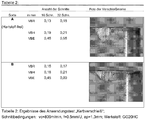
- Die stark erhöhte Härte wirkt sich in einem verringertem Verschleiß bei der Zerspanung aus (s. Tabelle 2).
Claims (8)
- Mehrphasiger SiAlON-Keramikwerkstoff, der mindestens eine erste, eine zweite und eine dritte Phase und einen Hartstoff enthält, wobei die erste Phase ein α-SiAlON, die zweite Phase ein β-SiAlON und die dritte Phase intergranulär amorph und/oder kristallin ist, dadurch gekennzeichnet, dass der Hartstoff ausgewählt ist aus Reihe SiC, Ti(C,N) oder aus Mischungen daraus, und dass die dritte intergranulär amorphe und/oder kristalline Phase neben den Elementen Si, Al, O und N,(i) das Element Calcium;(ii) mindestens ein Element aus Yttrium und/oder einem Seltenerd-Element mit einer Atomzahl größer 62 und(iii) mindestens ein Seltenerd-Element mit einer Atomzahl gleich oder kleiner 62 enthält.
- Mehrphasiger SiAlON-Keramikwerkstoff gemäß Anspruch 1, dadurch gekennzeichnet, dass das α-SiAlON der allgemeinen Formel MxSi12-m-nAlm+nOnN16-n entspricht, wobei 0 < x ≤ 2, m die Anzahl der SiN-Bindungen, die durch Al-N pro Einheitszelle ersetzt sind, n die Anzahl der SiN-Bindungen, die durch Al-O pro Einheitszelle ersetzt sind und M für ein Gemisch aus mehreren Kationen steht, ausgewählt aus(i) dem Element Calcium;(ii) mindestens einem Element aus Yttrium und/oder einem Seltenerd-Element mit einer Atomzahl größer 62 und(iii) mindestens einem Seltenerd-Element mit einer Atomzahl gleich oder kleiner 62.
- Mehrphasiger SiAlON-Keramikwerkstoff gemäß Anspruch 1 oder 2, dadurch gekennzeichnet, dass das β-SiAlON der allgemeinen Formel Si6-zAlzOzN8-z entspricht, wobei 0 < z ≤ 1,6 ist.
- Mehrphasiger SiAlON-Keramikwerkstoff gemäß einem oder mehreren der Ansprüche 1 bis 3, dadurch gekennzeichnet, dass der Hartstoff in Mengen von 10 bis 40 Vol.%, bevorzugt in Mengen von 13 bis 30 Vol.%, besonders bevorzugt in Mengen von 15 bis 20 Vol.%, bezogen auf das Gesamtvolumen des Materials, enthalten ist.
- Mehrphasiger SiAlON-Keramikwerkstoff gemäß einem oder mehreren der Ansprüche 1 bis 4, dadurch gekennzeichnet, dass die intragranuläre Phase in einer Menge von maximal 16 Vol.%, bezogen auf das Gesamtvolumen des Materials, vorliegt.
- Mehrphasiger SiAlON-Keramikwerkstoff gemäß einem oder mehreren der Ansprüche 1 bis 5, dadurch gekennzeichnet, dass das Gewichtsverhältnis von α-SiAlON zu β-SiAlON von etwa 20 : 80 bis etwa 80 : 20 reicht.
- Verfahren zur Herstellung eines SiAlON-Keramikwerkstoffs gemäß einem oder mehreren der Ansprüche 1 bis 6, dadurch gekennzeichnet, dass es die Schritte (a) bis (e) umfasst:(a) Herstellen eines Gemisches aus Si3N4, AIN, Al2O3, einer Verbindung aus der Gruppe der Oxide und Nitride des Calciums, mindestens einer Verbindung aus der Gruppe der Oxide und Nitride des Yttriums und/oder eines Seltenerd-Elements mit einer Atomzahl größer 62, mindestens einer Verbindung aus der Gruppe der Oxide und Nitride eines Seltenerd-Elements mit einer Atomzahl gleich oder kleiner 62 und mindestens einem Hartstoff aus der Reihe eines Karbids, Nitrids oder Silizids oder Mischungen daraus,(b) Zerreibmahlen dieses Gemisches in Wasser oder in einem organischen Lösungsmittel, beispielsweise in einem Alkohol wie Ethanol,(c) Trocknen des Gemisches,(d) Pressen bei 150 MPa und(e) mindestens 18-minütiges Sintern zwischen 1600 und 2000°C, vorzugsweise zwischen 1700 und 1850°C in einem Gasdruck-Sinterofen unter einem Druck zwischen 1 und 100 bar,wobei der Hartstoff ausgewählt ist aus der Reihe SiC, Ti(C,N) oder aus Mischungen daraus.
- Verfahren gemäß Anspruch 7, dadurch gekennzeichnet, dass der Hartstoff in Mengen von 10 bis 40 Vol.%, bevorzugt in Mengen von 13 bis 30 Vol.%, besonders bevorzugt in Mengen von 15 bis 20 Vol.%, bezogen auf das Gesamtvolumen des Materials, zugegeben wird.
Applications Claiming Priority (2)
| Application Number | Priority Date | Filing Date | Title |
|---|---|---|---|
| DE102009046690 | 2009-11-13 | ||
| PCT/EP2010/067496 WO2011058176A1 (de) | 2009-11-13 | 2010-11-15 | Gedopte alpha-beta-sialonkeramiken |
Publications (2)
| Publication Number | Publication Date |
|---|---|
| EP2499105A1 EP2499105A1 (de) | 2012-09-19 |
| EP2499105B1 true EP2499105B1 (de) | 2017-08-23 |
Family
ID=43532829
Family Applications (1)
| Application Number | Title | Priority Date | Filing Date |
|---|---|---|---|
| EP10776735.2A Not-in-force EP2499105B1 (de) | 2009-11-13 | 2010-11-15 | Gedopte alpha-beta-sialonkeramiken |
Country Status (3)
| Country | Link |
|---|---|
| EP (1) | EP2499105B1 (de) |
| DE (1) | DE102010043927A1 (de) |
| WO (1) | WO2011058176A1 (de) |
Cited By (1)
| Publication number | Priority date | Publication date | Assignee | Title |
|---|---|---|---|---|
| CN108610067A (zh) * | 2018-05-18 | 2018-10-02 | 中钢集团耐火材料有限公司 | 一种高赛隆相的碳化硅制品及其制备方法 |
Families Citing this family (1)
| Publication number | Priority date | Publication date | Assignee | Title |
|---|---|---|---|---|
| EP2692711B1 (de) | 2012-08-02 | 2019-08-14 | MDA Ileri Teknoloji Seramikleri Sanayi Ticaret Ltd. STi. | SiAlON-Keramik |
Family Cites Families (7)
| Publication number | Priority date | Publication date | Assignee | Title |
|---|---|---|---|---|
| US4563433A (en) | 1982-02-22 | 1986-01-07 | Kennametal Inc. | Ceramic material and method of manufacture |
| US4711644A (en) | 1982-02-22 | 1987-12-08 | Kennametal Inc. | Ceramic material and method of manufacture |
| US5200374A (en) | 1990-04-06 | 1993-04-06 | Ube Industries, Ltd. | Sialon-based sintered body and process for producing same |
| US5227346A (en) | 1992-03-06 | 1993-07-13 | The Dow Chemical Company | Sialon composites and method of preparing the same |
| US5413972A (en) | 1993-12-23 | 1995-05-09 | The Dow Chemical Company | SiAlON composites and method of preparing the same |
| DE102004035364B4 (de) * | 2003-08-07 | 2019-03-14 | Ceramtec Gmbh | Werkstoff auf der Basis von SiAIONen |
| EP1656331A1 (de) * | 2003-08-07 | 2006-05-17 | Ceramtec AG Innovative Ceramic Engineering | Werkstoff auf basis von sialonen |
-
2010
- 2010-11-15 WO PCT/EP2010/067496 patent/WO2011058176A1/de not_active Ceased
- 2010-11-15 DE DE102010043927A patent/DE102010043927A1/de not_active Withdrawn
- 2010-11-15 EP EP10776735.2A patent/EP2499105B1/de not_active Not-in-force
Non-Patent Citations (1)
| Title |
|---|
| None * |
Cited By (2)
| Publication number | Priority date | Publication date | Assignee | Title |
|---|---|---|---|---|
| CN108610067A (zh) * | 2018-05-18 | 2018-10-02 | 中钢集团耐火材料有限公司 | 一种高赛隆相的碳化硅制品及其制备方法 |
| CN108610067B (zh) * | 2018-05-18 | 2021-06-15 | 中钢洛耐科技股份有限公司 | 一种高赛隆相的碳化硅制品及其制备方法 |
Also Published As
| Publication number | Publication date |
|---|---|
| DE102010043927A1 (de) | 2011-07-28 |
| EP2499105A1 (de) | 2012-09-19 |
| WO2011058176A1 (de) | 2011-05-19 |
Similar Documents
| Publication | Publication Date | Title |
|---|---|---|
| DE3610041C2 (de) | Keramik auf Zirkoniumdioxidbasis mit Aluminiumoxid, Spinell, Mullit oder Spinell und Mullit und mit verbesserter hydrothermaler und thermischer Stabilität | |
| DE69326562T2 (de) | Siliziumnitridkeramik und daraus hergestelltes schneidwerkzeug | |
| DE19850366B4 (de) | Plateletverstärkter Sinterformkörper, dessen Verwendung und Verfahren zu seiner Herstellung | |
| EP0004031A1 (de) | Dichte polykristalline Formkörper aus alpha-Siliciumcarbid und Verfahren zu ihrer Herstellung durch drucklose Sinterung | |
| DE3414979A1 (de) | Keramikmaterial auf sialon-basis mit hoher verschleissfestigkeit | |
| DE69601256T2 (de) | Aluminiumnitrrid-sinterkörper und verfahren zu dessen herstellung | |
| EP0021239B1 (de) | Verfahren zur Herstellung von dichten Formkörpern aus polykristallinem alpha-Siliciumcarbid durch Heisspressen und so hergestellte Formkörper | |
| DE69225304T2 (de) | Gesinterter siliciumnitridverbundkörper und seine herstellung | |
| DE69403209T2 (de) | Gesintertes selbstarmiertes siliciumnitrid | |
| DE60222906T2 (de) | Mit mehreren kationen gedopte alpha-beta-sialonkeramiken | |
| DE69203603T2 (de) | Gesintertes silicumnitrid von hoher zähigkeit und festigkeit. | |
| DE69309664T2 (de) | Sialon-verbundwerkstoffe und verfahren zu ihrer herstellung | |
| DE69418578T2 (de) | Keramischer Werkstoff auf Aluminiumoxid-Basis und Verfahren zu seiner Herstellung | |
| DE69212398T2 (de) | Siliciumnitridkeramik mit einer dispergierten Pentamolybdäntrisilicidphase | |
| DE69121689T2 (de) | Siliciumnitrid-Siliciumcarbid gesinterter Verbundwerkstoff | |
| DE69018868T2 (de) | Siliciumnitridkeramik mit einer Metallsilizidphase. | |
| DE69317254T2 (de) | Siliciumnitrid-Sinterkörper | |
| EP0022522B1 (de) | Dichte Formkörper aus polykristallinem Beta-Siliciumcarbid und Verfahren zu ihrer Herstellung durch Heisspressen | |
| DE69518750T2 (de) | Herstellungsverfahren für keramik | |
| DE2923729A1 (de) | Sinterkeramisches produkt und verfahren zu seiner herstellung | |
| DE68918690T2 (de) | Gesintertes erzeugnis vom siliziumnitridtyp und verfahren zur herstellung. | |
| DE102006013746A1 (de) | Gesinterter verschleißbeständiger Werkstoff, sinterfähige Pulvermischung, Verfahren zur Herstellung des Werkstoffs und dessen Verwendung | |
| DE3873767T2 (de) | Verfahren zur herstellung keramischer verbundwerkstoffe, enthaltend siliziumoxynitrid und zirkoniumoxid. | |
| DE102010043927A1 (de) | Gedopte Alpha-Beta-Sialonkeramiken | |
| DE19850597B4 (de) | α-SiAION-Werkstoffe |
Legal Events
| Date | Code | Title | Description |
|---|---|---|---|
| PUAI | Public reference made under article 153(3) epc to a published international application that has entered the european phase |
Free format text: ORIGINAL CODE: 0009012 |
|
| 17P | Request for examination filed |
Effective date: 20120613 |
|
| AK | Designated contracting states |
Kind code of ref document: A1 Designated state(s): AL AT BE BG CH CY CZ DE DK EE ES FI FR GB GR HR HU IE IS IT LI LT LU LV MC MK MT NL NO PL PT RO RS SE SI SK SM TR |
|
| DAX | Request for extension of the european patent (deleted) | ||
| 17Q | First examination report despatched |
Effective date: 20160201 |
|
| REG | Reference to a national code |
Ref country code: DE Ref legal event code: R079 Ref document number: 502010014055 Country of ref document: DE Free format text: PREVIOUS MAIN CLASS: C04B0035580000 Ipc: C04B0035593000 |
|
| RIC1 | Information provided on ipc code assigned before grant |
Ipc: C04B 35/593 20060101AFI20170125BHEP Ipc: C04B 35/626 20060101ALI20170125BHEP |
|
| GRAP | Despatch of communication of intention to grant a patent |
Free format text: ORIGINAL CODE: EPIDOSNIGR1 |
|
| INTG | Intention to grant announced |
Effective date: 20170316 |
|
| GRAS | Grant fee paid |
Free format text: ORIGINAL CODE: EPIDOSNIGR3 |
|
| GRAA | (expected) grant |
Free format text: ORIGINAL CODE: 0009210 |
|
| AK | Designated contracting states |
Kind code of ref document: B1 Designated state(s): AL AT BE BG CH CY CZ DE DK EE ES FI FR GB GR HR HU IE IS IT LI LT LU LV MC MK MT NL NO PL PT RO RS SE SI SK SM TR |
|
| REG | Reference to a national code |
Ref country code: GB Ref legal event code: FG4D Free format text: NOT ENGLISH |
|
| REG | Reference to a national code |
Ref country code: CH Ref legal event code: EP |
|
| REG | Reference to a national code |
Ref country code: AT Ref legal event code: REF Ref document number: 921157 Country of ref document: AT Kind code of ref document: T Effective date: 20170915 |
|
| REG | Reference to a national code |
Ref country code: IE Ref legal event code: FG4D Free format text: LANGUAGE OF EP DOCUMENT: GERMAN |
|
| REG | Reference to a national code |
Ref country code: DE Ref legal event code: R096 Ref document number: 502010014055 Country of ref document: DE |
|
| REG | Reference to a national code |
Ref country code: NL Ref legal event code: MP Effective date: 20170823 |
|
| REG | Reference to a national code |
Ref country code: LT Ref legal event code: MG4D |
|
| PG25 | Lapsed in a contracting state [announced via postgrant information from national office to epo] |
Ref country code: FI Free format text: LAPSE BECAUSE OF FAILURE TO SUBMIT A TRANSLATION OF THE DESCRIPTION OR TO PAY THE FEE WITHIN THE PRESCRIBED TIME-LIMIT Effective date: 20170823 Ref country code: HR Free format text: LAPSE BECAUSE OF FAILURE TO SUBMIT A TRANSLATION OF THE DESCRIPTION OR TO PAY THE FEE WITHIN THE PRESCRIBED TIME-LIMIT Effective date: 20170823 Ref country code: NO Free format text: LAPSE BECAUSE OF FAILURE TO SUBMIT A TRANSLATION OF THE DESCRIPTION OR TO PAY THE FEE WITHIN THE PRESCRIBED TIME-LIMIT Effective date: 20171123 Ref country code: LT Free format text: LAPSE BECAUSE OF FAILURE TO SUBMIT A TRANSLATION OF THE DESCRIPTION OR TO PAY THE FEE WITHIN THE PRESCRIBED TIME-LIMIT Effective date: 20170823 Ref country code: NL Free format text: LAPSE BECAUSE OF FAILURE TO SUBMIT A TRANSLATION OF THE DESCRIPTION OR TO PAY THE FEE WITHIN THE PRESCRIBED TIME-LIMIT Effective date: 20170823 Ref country code: SE Free format text: LAPSE BECAUSE OF FAILURE TO SUBMIT A TRANSLATION OF THE DESCRIPTION OR TO PAY THE FEE WITHIN THE PRESCRIBED TIME-LIMIT Effective date: 20170823 |
|
| PG25 | Lapsed in a contracting state [announced via postgrant information from national office to epo] |
Ref country code: PL Free format text: LAPSE BECAUSE OF FAILURE TO SUBMIT A TRANSLATION OF THE DESCRIPTION OR TO PAY THE FEE WITHIN THE PRESCRIBED TIME-LIMIT Effective date: 20170823 Ref country code: ES Free format text: LAPSE BECAUSE OF FAILURE TO SUBMIT A TRANSLATION OF THE DESCRIPTION OR TO PAY THE FEE WITHIN THE PRESCRIBED TIME-LIMIT Effective date: 20170823 Ref country code: BG Free format text: LAPSE BECAUSE OF FAILURE TO SUBMIT A TRANSLATION OF THE DESCRIPTION OR TO PAY THE FEE WITHIN THE PRESCRIBED TIME-LIMIT Effective date: 20171123 Ref country code: LV Free format text: LAPSE BECAUSE OF FAILURE TO SUBMIT A TRANSLATION OF THE DESCRIPTION OR TO PAY THE FEE WITHIN THE PRESCRIBED TIME-LIMIT Effective date: 20170823 Ref country code: GR Free format text: LAPSE BECAUSE OF FAILURE TO SUBMIT A TRANSLATION OF THE DESCRIPTION OR TO PAY THE FEE WITHIN THE PRESCRIBED TIME-LIMIT Effective date: 20171124 Ref country code: IS Free format text: LAPSE BECAUSE OF FAILURE TO SUBMIT A TRANSLATION OF THE DESCRIPTION OR TO PAY THE FEE WITHIN THE PRESCRIBED TIME-LIMIT Effective date: 20171223 Ref country code: RS Free format text: LAPSE BECAUSE OF FAILURE TO SUBMIT A TRANSLATION OF THE DESCRIPTION OR TO PAY THE FEE WITHIN THE PRESCRIBED TIME-LIMIT Effective date: 20170823 |
|
| PG25 | Lapsed in a contracting state [announced via postgrant information from national office to epo] |
Ref country code: CZ Free format text: LAPSE BECAUSE OF FAILURE TO SUBMIT A TRANSLATION OF THE DESCRIPTION OR TO PAY THE FEE WITHIN THE PRESCRIBED TIME-LIMIT Effective date: 20170823 Ref country code: RO Free format text: LAPSE BECAUSE OF FAILURE TO SUBMIT A TRANSLATION OF THE DESCRIPTION OR TO PAY THE FEE WITHIN THE PRESCRIBED TIME-LIMIT Effective date: 20170823 Ref country code: DK Free format text: LAPSE BECAUSE OF FAILURE TO SUBMIT A TRANSLATION OF THE DESCRIPTION OR TO PAY THE FEE WITHIN THE PRESCRIBED TIME-LIMIT Effective date: 20170823 |
|
| REG | Reference to a national code |
Ref country code: DE Ref legal event code: R097 Ref document number: 502010014055 Country of ref document: DE |
|
| PG25 | Lapsed in a contracting state [announced via postgrant information from national office to epo] |
Ref country code: SM Free format text: LAPSE BECAUSE OF FAILURE TO SUBMIT A TRANSLATION OF THE DESCRIPTION OR TO PAY THE FEE WITHIN THE PRESCRIBED TIME-LIMIT Effective date: 20170823 Ref country code: SK Free format text: LAPSE BECAUSE OF FAILURE TO SUBMIT A TRANSLATION OF THE DESCRIPTION OR TO PAY THE FEE WITHIN THE PRESCRIBED TIME-LIMIT Effective date: 20170823 Ref country code: IT Free format text: LAPSE BECAUSE OF FAILURE TO SUBMIT A TRANSLATION OF THE DESCRIPTION OR TO PAY THE FEE WITHIN THE PRESCRIBED TIME-LIMIT Effective date: 20170823 Ref country code: EE Free format text: LAPSE BECAUSE OF FAILURE TO SUBMIT A TRANSLATION OF THE DESCRIPTION OR TO PAY THE FEE WITHIN THE PRESCRIBED TIME-LIMIT Effective date: 20170823 |
|
| REG | Reference to a national code |
Ref country code: DE Ref legal event code: R119 Ref document number: 502010014055 Country of ref document: DE |
|
| PG25 | Lapsed in a contracting state [announced via postgrant information from national office to epo] |
Ref country code: MC Free format text: LAPSE BECAUSE OF FAILURE TO SUBMIT A TRANSLATION OF THE DESCRIPTION OR TO PAY THE FEE WITHIN THE PRESCRIBED TIME-LIMIT Effective date: 20170823 |
|
| PLBE | No opposition filed within time limit |
Free format text: ORIGINAL CODE: 0009261 |
|
| STAA | Information on the status of an ep patent application or granted ep patent |
Free format text: STATUS: NO OPPOSITION FILED WITHIN TIME LIMIT |
|
| GBPC | Gb: european patent ceased through non-payment of renewal fee |
Effective date: 20171123 |
|
| PG25 | Lapsed in a contracting state [announced via postgrant information from national office to epo] |
Ref country code: CH Free format text: LAPSE BECAUSE OF NON-PAYMENT OF DUE FEES Effective date: 20171130 Ref country code: LI Free format text: LAPSE BECAUSE OF NON-PAYMENT OF DUE FEES Effective date: 20171130 |
|
| 26N | No opposition filed |
Effective date: 20180524 |
|
| PG25 | Lapsed in a contracting state [announced via postgrant information from national office to epo] |
Ref country code: LU Free format text: LAPSE BECAUSE OF NON-PAYMENT OF DUE FEES Effective date: 20171115 Ref country code: SI Free format text: LAPSE BECAUSE OF FAILURE TO SUBMIT A TRANSLATION OF THE DESCRIPTION OR TO PAY THE FEE WITHIN THE PRESCRIBED TIME-LIMIT Effective date: 20170823 |
|
| REG | Reference to a national code |
Ref country code: FR Ref legal event code: ST Effective date: 20180731 Ref country code: BE Ref legal event code: MM Effective date: 20171130 |
|
| REG | Reference to a national code |
Ref country code: IE Ref legal event code: MM4A |
|
| PG25 | Lapsed in a contracting state [announced via postgrant information from national office to epo] |
Ref country code: MT Free format text: LAPSE BECAUSE OF FAILURE TO SUBMIT A TRANSLATION OF THE DESCRIPTION OR TO PAY THE FEE WITHIN THE PRESCRIBED TIME-LIMIT Effective date: 20170823 |
|
| PG25 | Lapsed in a contracting state [announced via postgrant information from national office to epo] |
Ref country code: FR Free format text: LAPSE BECAUSE OF NON-PAYMENT OF DUE FEES Effective date: 20171130 Ref country code: DE Free format text: LAPSE BECAUSE OF NON-PAYMENT OF DUE FEES Effective date: 20180602 Ref country code: IE Free format text: LAPSE BECAUSE OF NON-PAYMENT OF DUE FEES Effective date: 20171115 |
|
| PG25 | Lapsed in a contracting state [announced via postgrant information from national office to epo] |
Ref country code: BE Free format text: LAPSE BECAUSE OF NON-PAYMENT OF DUE FEES Effective date: 20171130 Ref country code: GB Free format text: LAPSE BECAUSE OF NON-PAYMENT OF DUE FEES Effective date: 20171123 |
|
| REG | Reference to a national code |
Ref country code: AT Ref legal event code: MM01 Ref document number: 921157 Country of ref document: AT Kind code of ref document: T Effective date: 20171115 |
|
| PG25 | Lapsed in a contracting state [announced via postgrant information from national office to epo] |
Ref country code: AT Free format text: LAPSE BECAUSE OF NON-PAYMENT OF DUE FEES Effective date: 20171115 |
|
| PG25 | Lapsed in a contracting state [announced via postgrant information from national office to epo] |
Ref country code: HU Free format text: LAPSE BECAUSE OF FAILURE TO SUBMIT A TRANSLATION OF THE DESCRIPTION OR TO PAY THE FEE WITHIN THE PRESCRIBED TIME-LIMIT; INVALID AB INITIO Effective date: 20101115 |
|
| PG25 | Lapsed in a contracting state [announced via postgrant information from national office to epo] |
Ref country code: CY Free format text: LAPSE BECAUSE OF NON-PAYMENT OF DUE FEES Effective date: 20170823 |
|
| PG25 | Lapsed in a contracting state [announced via postgrant information from national office to epo] |
Ref country code: MK Free format text: LAPSE BECAUSE OF FAILURE TO SUBMIT A TRANSLATION OF THE DESCRIPTION OR TO PAY THE FEE WITHIN THE PRESCRIBED TIME-LIMIT Effective date: 20170823 |
|
| PG25 | Lapsed in a contracting state [announced via postgrant information from national office to epo] |
Ref country code: TR Free format text: LAPSE BECAUSE OF FAILURE TO SUBMIT A TRANSLATION OF THE DESCRIPTION OR TO PAY THE FEE WITHIN THE PRESCRIBED TIME-LIMIT Effective date: 20170823 |
|
| PG25 | Lapsed in a contracting state [announced via postgrant information from national office to epo] |
Ref country code: PT Free format text: LAPSE BECAUSE OF FAILURE TO SUBMIT A TRANSLATION OF THE DESCRIPTION OR TO PAY THE FEE WITHIN THE PRESCRIBED TIME-LIMIT Effective date: 20170823 |
|
| PG25 | Lapsed in a contracting state [announced via postgrant information from national office to epo] |
Ref country code: AL Free format text: LAPSE BECAUSE OF FAILURE TO SUBMIT A TRANSLATION OF THE DESCRIPTION OR TO PAY THE FEE WITHIN THE PRESCRIBED TIME-LIMIT Effective date: 20170823 |