EP2486020B1 - Procede de synthese de l'ergothioneine et analogues - Google Patents
Procede de synthese de l'ergothioneine et analogues Download PDFInfo
- Publication number
- EP2486020B1 EP2486020B1 EP10763362.0A EP10763362A EP2486020B1 EP 2486020 B1 EP2486020 B1 EP 2486020B1 EP 10763362 A EP10763362 A EP 10763362A EP 2486020 B1 EP2486020 B1 EP 2486020B1
- Authority
- EP
- European Patent Office
- Prior art keywords
- mixture
- formula
- compound
- acid
- stereomer
- Prior art date
- Legal status (The legal status is an assumption and is not a legal conclusion. Google has not performed a legal analysis and makes no representation as to the accuracy of the status listed.)
- Not-in-force
Links
- 238000000034 method Methods 0.000 title claims description 26
- SSISHJJTAXXQAX-ZETCQYMHSA-N L-ergothioneine Chemical compound C[N+](C)(C)[C@H](C([O-])=O)CC1=CNC(=S)N1 SSISHJJTAXXQAX-ZETCQYMHSA-N 0.000 title claims description 25
- 238000003786 synthesis reaction Methods 0.000 title claims description 11
- 229940093497 ergothioneine Drugs 0.000 title claims description 9
- 230000015572 biosynthetic process Effects 0.000 title description 14
- 239000000203 mixture Substances 0.000 claims description 99
- 150000001875 compounds Chemical class 0.000 claims description 66
- XUJNEKJLAYXESH-REOHCLBHSA-N L-Cysteine Chemical compound SC[C@H](N)C(O)=O XUJNEKJLAYXESH-REOHCLBHSA-N 0.000 claims description 34
- KWIUHFFTVRNATP-UHFFFAOYSA-N glycine betaine Chemical class C[N+](C)(C)CC([O-])=O KWIUHFFTVRNATP-UHFFFAOYSA-N 0.000 claims description 28
- 150000003573 thiols Chemical class 0.000 claims description 28
- 238000006243 chemical reaction Methods 0.000 claims description 25
- 150000003839 salts Chemical class 0.000 claims description 25
- HBAQYPYDRFILMT-UHFFFAOYSA-N 8-[3-(1-cyclopropylpyrazol-4-yl)-1H-pyrazolo[4,3-d]pyrimidin-5-yl]-3-methyl-3,8-diazabicyclo[3.2.1]octan-2-one Chemical class C1(CC1)N1N=CC(=C1)C1=NNC2=C1N=C(N=C2)N1C2C(N(CC1CC2)C)=O HBAQYPYDRFILMT-UHFFFAOYSA-N 0.000 claims description 22
- 150000001944 cysteine derivatives Chemical class 0.000 claims description 20
- XUJNEKJLAYXESH-UHFFFAOYSA-N cysteine Natural products SCC(N)C(O)=O XUJNEKJLAYXESH-UHFFFAOYSA-N 0.000 claims description 19
- 125000004435 hydrogen atom Chemical group [H]* 0.000 claims description 16
- 239000002253 acid Substances 0.000 claims description 14
- 238000002360 preparation method Methods 0.000 claims description 14
- 235000018417 cysteine Nutrition 0.000 claims description 13
- 125000004178 (C1-C4) alkyl group Chemical group 0.000 claims description 11
- CWERGRDVMFNCDR-UHFFFAOYSA-N thioglycolic acid Chemical compound OC(=O)CS CWERGRDVMFNCDR-UHFFFAOYSA-N 0.000 claims description 11
- 238000003776 cleavage reaction Methods 0.000 claims description 10
- XMBWDFGMSWQBCA-UHFFFAOYSA-N hydrogen iodide Chemical class I XMBWDFGMSWQBCA-UHFFFAOYSA-N 0.000 claims description 10
- 239000012429 reaction media Substances 0.000 claims description 10
- WKBOTKDWSSQWDR-UHFFFAOYSA-N Bromine atom Chemical compound [Br] WKBOTKDWSSQWDR-UHFFFAOYSA-N 0.000 claims description 9
- 239000004201 L-cysteine Substances 0.000 claims description 9
- 235000013878 L-cysteine Nutrition 0.000 claims description 9
- GDTBXPJZTBHREO-UHFFFAOYSA-N bromine Substances BrBr GDTBXPJZTBHREO-UHFFFAOYSA-N 0.000 claims description 9
- 229910052794 bromium Inorganic materials 0.000 claims description 9
- DKIDEFUBRARXTE-UHFFFAOYSA-N 3-mercaptopropanoic acid Chemical compound OC(=O)CCS DKIDEFUBRARXTE-UHFFFAOYSA-N 0.000 claims description 8
- 125000002496 methyl group Chemical group [H]C([H])([H])* 0.000 claims description 8
- DGVVWUTYPXICAM-UHFFFAOYSA-N β‐Mercaptoethanol Chemical compound OCCS DGVVWUTYPXICAM-UHFFFAOYSA-N 0.000 claims description 7
- PMNLUUOXGOOLSP-UHFFFAOYSA-N 2-mercaptopropanoic acid Chemical compound CC(S)C(O)=O PMNLUUOXGOOLSP-UHFFFAOYSA-N 0.000 claims description 6
- 238000000926 separation method Methods 0.000 claims description 5
- 125000004432 carbon atom Chemical group C* 0.000 claims description 4
- VHJLVAABSRFDPM-QWWZWVQMSA-N dithiothreitol Chemical compound SC[C@@H](O)[C@H](O)CS VHJLVAABSRFDPM-QWWZWVQMSA-N 0.000 claims description 3
- 238000010438 heat treatment Methods 0.000 claims description 3
- 230000007017 scission Effects 0.000 claims description 3
- 230000002194 synthesizing effect Effects 0.000 claims description 3
- JSGPBRQYMLFVJQ-UHFFFAOYSA-N 2-sulfanylhexanoic acid Chemical compound CCCCC(S)C(O)=O JSGPBRQYMLFVJQ-UHFFFAOYSA-N 0.000 claims description 2
- 125000000217 alkyl group Chemical group 0.000 claims description 2
- 229910052799 carbon Inorganic materials 0.000 claims description 2
- 125000000896 monocarboxylic acid group Chemical group 0.000 claims 1
- XLYOFNOQVPJJNP-UHFFFAOYSA-N water Chemical compound O XLYOFNOQVPJJNP-UHFFFAOYSA-N 0.000 description 26
- -1 aluminum ion Chemical class 0.000 description 19
- XEKOWRVHYACXOJ-UHFFFAOYSA-N Ethyl acetate Chemical compound CCOC(C)=O XEKOWRVHYACXOJ-UHFFFAOYSA-N 0.000 description 18
- VEXZGXHMUGYJMC-UHFFFAOYSA-N Hydrochloric acid Chemical compound Cl VEXZGXHMUGYJMC-UHFFFAOYSA-N 0.000 description 18
- 229960003237 betaine Drugs 0.000 description 15
- 239000008346 aqueous phase Substances 0.000 description 10
- 238000005160 1H NMR spectroscopy Methods 0.000 description 9
- LFQSCWFLJHTTHZ-UHFFFAOYSA-N Ethanol Chemical compound CCO LFQSCWFLJHTTHZ-UHFFFAOYSA-N 0.000 description 9
- 239000002244 precipitate Substances 0.000 description 9
- 239000000047 product Substances 0.000 description 9
- 239000011541 reaction mixture Substances 0.000 description 9
- 238000003756 stirring Methods 0.000 description 9
- 239000007787 solid Substances 0.000 description 8
- 239000002904 solvent Substances 0.000 description 8
- 238000000746 purification Methods 0.000 description 7
- LCTONWCANYUPML-UHFFFAOYSA-N Pyruvic acid Chemical compound CC(=O)C(O)=O LCTONWCANYUPML-UHFFFAOYSA-N 0.000 description 6
- NINIDFKCEFEMDL-UHFFFAOYSA-N Sulfur Chemical compound [S] NINIDFKCEFEMDL-UHFFFAOYSA-N 0.000 description 6
- HUMNYLRZRPPJDN-UHFFFAOYSA-N benzaldehyde Chemical compound O=CC1=CC=CC=C1 HUMNYLRZRPPJDN-UHFFFAOYSA-N 0.000 description 6
- 238000002955 isolation Methods 0.000 description 6
- 229920005989 resin Polymers 0.000 description 6
- 239000011347 resin Substances 0.000 description 6
- 229910052717 sulfur Inorganic materials 0.000 description 6
- 239000011593 sulfur Substances 0.000 description 6
- QTBSBXVTEAMEQO-UHFFFAOYSA-N Acetic acid Chemical compound CC(O)=O QTBSBXVTEAMEQO-UHFFFAOYSA-N 0.000 description 5
- QAOWNCQODCNURD-UHFFFAOYSA-N Sulfuric acid Chemical compound OS(O)(=O)=O QAOWNCQODCNURD-UHFFFAOYSA-N 0.000 description 5
- GPPYTCRVKHULJH-UHFFFAOYSA-O [1-carboxy-2-(1h-imidazol-5-yl)ethyl]-trimethylazanium Chemical compound C[N+](C)(C)C(C(O)=O)CC1=CN=CN1 GPPYTCRVKHULJH-UHFFFAOYSA-O 0.000 description 5
- 238000004458 analytical method Methods 0.000 description 5
- 239000003153 chemical reaction reagent Substances 0.000 description 5
- 238000000909 electrodialysis Methods 0.000 description 5
- 239000000706 filtrate Substances 0.000 description 5
- 238000001914 filtration Methods 0.000 description 5
- 239000002609 medium Substances 0.000 description 5
- 0 C*C(CC(C)=C*C1C(C)NC1)C(O)=O Chemical compound C*C(CC(C)=C*C1C(C)NC1)C(O)=O 0.000 description 4
- HNDVDQJCIGZPNO-YFKPBYRVSA-N L-histidine Chemical compound OC(=O)[C@@H](N)CC1=CN=CN1 HNDVDQJCIGZPNO-YFKPBYRVSA-N 0.000 description 4
- KWYUFKZDYYNOTN-UHFFFAOYSA-M Potassium hydroxide Chemical compound [OH-].[K+] KWYUFKZDYYNOTN-UHFFFAOYSA-M 0.000 description 4
- HEMHJVSKTPXQMS-UHFFFAOYSA-M Sodium hydroxide Chemical compound [OH-].[Na+] HEMHJVSKTPXQMS-UHFFFAOYSA-M 0.000 description 4
- 239000002585 base Substances 0.000 description 4
- 239000007810 chemical reaction solvent Substances 0.000 description 4
- 230000007717 exclusion Effects 0.000 description 4
- 235000013305 food Nutrition 0.000 description 4
- 239000000543 intermediate Substances 0.000 description 4
- 150000002500 ions Chemical class 0.000 description 4
- 239000000843 powder Substances 0.000 description 4
- 230000000717 retained effect Effects 0.000 description 4
- 238000001946 ultra-performance liquid chromatography-mass spectrometry Methods 0.000 description 4
- NLXLAEXVIDQMFP-UHFFFAOYSA-N Ammonium chloride Substances [NH4+].[Cl-] NLXLAEXVIDQMFP-UHFFFAOYSA-N 0.000 description 3
- VHUUQVKOLVNVRT-UHFFFAOYSA-N Ammonium hydroxide Chemical compound [NH4+].[OH-] VHUUQVKOLVNVRT-UHFFFAOYSA-N 0.000 description 3
- OKTJSMMVPCPJKN-UHFFFAOYSA-N Carbon Chemical compound [C] OKTJSMMVPCPJKN-UHFFFAOYSA-N 0.000 description 3
- YMWUJEATGCHHMB-UHFFFAOYSA-N Dichloromethane Chemical compound ClCCl YMWUJEATGCHHMB-UHFFFAOYSA-N 0.000 description 3
- 241000233866 Fungi Species 0.000 description 3
- AFVFQIVMOAPDHO-UHFFFAOYSA-N Methanesulfonic acid Chemical compound CS(O)(=O)=O AFVFQIVMOAPDHO-UHFFFAOYSA-N 0.000 description 3
- NBIIXXVUZAFLBC-UHFFFAOYSA-N Phosphoric acid Chemical compound OP(O)(O)=O NBIIXXVUZAFLBC-UHFFFAOYSA-N 0.000 description 3
- XBDQKXXYIPTUBI-UHFFFAOYSA-N Propionic acid Chemical compound CCC(O)=O XBDQKXXYIPTUBI-UHFFFAOYSA-N 0.000 description 3
- YXFVVABEGXRONW-UHFFFAOYSA-N Toluene Chemical compound CC1=CC=CC=C1 YXFVVABEGXRONW-UHFFFAOYSA-N 0.000 description 3
- 230000002378 acidificating effect Effects 0.000 description 3
- 235000011114 ammonium hydroxide Nutrition 0.000 description 3
- 125000003178 carboxy group Chemical group [H]OC(*)=O 0.000 description 3
- KRKNYBCHXYNGOX-UHFFFAOYSA-N citric acid Chemical compound OC(=O)CC(O)(C(O)=O)CC(O)=O KRKNYBCHXYNGOX-UHFFFAOYSA-N 0.000 description 3
- 238000001816 cooling Methods 0.000 description 3
- 238000010511 deprotection reaction Methods 0.000 description 3
- 238000001035 drying Methods 0.000 description 3
- 239000012467 final product Substances 0.000 description 3
- 229960002885 histidine Drugs 0.000 description 3
- IXCSERBJSXMMFS-UHFFFAOYSA-N hydrogen chloride Substances Cl.Cl IXCSERBJSXMMFS-UHFFFAOYSA-N 0.000 description 3
- 238000005580 one pot reaction Methods 0.000 description 3
- QNGNSVIICDLXHT-UHFFFAOYSA-N para-ethylbenzaldehyde Natural products CCC1=CC=C(C=O)C=C1 QNGNSVIICDLXHT-UHFFFAOYSA-N 0.000 description 3
- 229940107700 pyruvic acid Drugs 0.000 description 3
- 229920006395 saturated elastomer Polymers 0.000 description 3
- 231100000331 toxic Toxicity 0.000 description 3
- 230000002588 toxic effect Effects 0.000 description 3
- HZAXFHJVJLSVMW-UHFFFAOYSA-N 2-Aminoethan-1-ol Chemical compound NCCO HZAXFHJVJLSVMW-UHFFFAOYSA-N 0.000 description 2
- PWKSKIMOESPYIA-UHFFFAOYSA-N 2-acetamido-3-sulfanylpropanoic acid Chemical compound CC(=O)NC(CS)C(O)=O PWKSKIMOESPYIA-UHFFFAOYSA-N 0.000 description 2
- AZDYQBFYMBALBY-UHFFFAOYSA-N 2-phenyl-1,3-thiazolidin-3-ium-4-carboxylate Chemical compound N1C(C(=O)O)CSC1C1=CC=CC=C1 AZDYQBFYMBALBY-UHFFFAOYSA-N 0.000 description 2
- RGHNJXZEOKUKBD-SQOUGZDYSA-N D-gluconic acid Chemical compound OC[C@@H](O)[C@@H](O)[C@H](O)[C@@H](O)C(O)=O RGHNJXZEOKUKBD-SQOUGZDYSA-N 0.000 description 2
- VZCYOOQTPOCHFL-OWOJBTEDSA-N Fumaric acid Chemical compound OC(=O)\C=C\C(O)=O VZCYOOQTPOCHFL-OWOJBTEDSA-N 0.000 description 2
- AEMRFAOFKBGASW-UHFFFAOYSA-N Glycolic acid Chemical compound OCC(O)=O AEMRFAOFKBGASW-UHFFFAOYSA-N 0.000 description 2
- PWKSKIMOESPYIA-BYPYZUCNSA-N L-N-acetyl-Cysteine Chemical compound CC(=O)N[C@@H](CS)C(O)=O PWKSKIMOESPYIA-BYPYZUCNSA-N 0.000 description 2
- WHUUTDBJXJRKMK-VKHMYHEASA-N L-glutamic acid Chemical compound OC(=O)[C@@H](N)CCC(O)=O WHUUTDBJXJRKMK-VKHMYHEASA-N 0.000 description 2
- 241001465754 Metazoa Species 0.000 description 2
- MBBZMMPHUWSWHV-BDVNFPICSA-N N-methylglucamine Chemical compound CNC[C@H](O)[C@@H](O)[C@H](O)[C@H](O)CO MBBZMMPHUWSWHV-BDVNFPICSA-N 0.000 description 2
- GRYLNZFGIOXLOG-UHFFFAOYSA-N Nitric acid Chemical compound O[N+]([O-])=O GRYLNZFGIOXLOG-UHFFFAOYSA-N 0.000 description 2
- CDBYLPFSWZWCQE-UHFFFAOYSA-L Sodium Carbonate Chemical compound [Na+].[Na+].[O-]C([O-])=O CDBYLPFSWZWCQE-UHFFFAOYSA-L 0.000 description 2
- DTQVDTLACAAQTR-UHFFFAOYSA-N Trifluoroacetic acid Chemical compound OC(=O)C(F)(F)F DTQVDTLACAAQTR-UHFFFAOYSA-N 0.000 description 2
- 229960004308 acetylcysteine Drugs 0.000 description 2
- 238000013019 agitation Methods 0.000 description 2
- 229910052782 aluminium Inorganic materials 0.000 description 2
- WNROFYMDJYEPJX-UHFFFAOYSA-K aluminium hydroxide Chemical compound [OH-].[OH-].[OH-].[Al+3] WNROFYMDJYEPJX-UHFFFAOYSA-K 0.000 description 2
- 150000001413 amino acids Chemical class 0.000 description 2
- QGZKDVFQNNGYKY-UHFFFAOYSA-N ammonia Natural products N QGZKDVFQNNGYKY-UHFFFAOYSA-N 0.000 description 2
- WPYMKLBDIGXBTP-UHFFFAOYSA-N benzoic acid Chemical compound OC(=O)C1=CC=CC=C1 WPYMKLBDIGXBTP-UHFFFAOYSA-N 0.000 description 2
- 125000000484 butyl group Chemical group [H]C([*])([H])C([H])([H])C([H])([H])C([H])([H])[H] 0.000 description 2
- 239000002537 cosmetic Substances 0.000 description 2
- 239000013078 crystal Substances 0.000 description 2
- 238000002425 crystallisation Methods 0.000 description 2
- 230000008025 crystallization Effects 0.000 description 2
- 230000002255 enzymatic effect Effects 0.000 description 2
- 125000001495 ethyl group Chemical group [H]C([H])([H])C([H])([H])* 0.000 description 2
- 238000001704 evaporation Methods 0.000 description 2
- 230000008020 evaporation Effects 0.000 description 2
- HNDVDQJCIGZPNO-UHFFFAOYSA-N histidine Natural products OC(=O)C(N)CC1=CN=CN1 HNDVDQJCIGZPNO-UHFFFAOYSA-N 0.000 description 2
- 150000004677 hydrates Chemical class 0.000 description 2
- 125000001183 hydrocarbyl group Chemical group 0.000 description 2
- 150000007529 inorganic bases Chemical class 0.000 description 2
- SUMDYPCJJOFFON-UHFFFAOYSA-N isethionic acid Chemical compound OCCS(O)(=O)=O SUMDYPCJJOFFON-UHFFFAOYSA-N 0.000 description 2
- JVTAAEKCZFNVCJ-UHFFFAOYSA-N lactic acid Chemical compound CC(O)C(O)=O JVTAAEKCZFNVCJ-UHFFFAOYSA-N 0.000 description 2
- 238000004519 manufacturing process Methods 0.000 description 2
- 150000004702 methyl esters Chemical class 0.000 description 2
- TXXHDPDFNKHHGW-UHFFFAOYSA-N muconic acid Chemical compound OC(=O)C=CC=CC(O)=O TXXHDPDFNKHHGW-UHFFFAOYSA-N 0.000 description 2
- 150000007530 organic bases Chemical class 0.000 description 2
- 239000003960 organic solvent Substances 0.000 description 2
- 229920001467 poly(styrenesulfonates) Polymers 0.000 description 2
- ZNNZYHKDIALBAK-UHFFFAOYSA-M potassium thiocyanate Chemical compound [K+].[S-]C#N ZNNZYHKDIALBAK-UHFFFAOYSA-M 0.000 description 2
- 125000001436 propyl group Chemical group [H]C([*])([H])C([H])([H])C([H])([H])[H] 0.000 description 2
- 125000001453 quaternary ammonium group Chemical group 0.000 description 2
- 238000001953 recrystallisation Methods 0.000 description 2
- HBEFYGYBMKPNSZ-UHFFFAOYSA-N s-phenyl chloromethanethioate Chemical compound ClC(=O)SC1=CC=CC=C1 HBEFYGYBMKPNSZ-UHFFFAOYSA-N 0.000 description 2
- YGSDEFSMJLZEOE-UHFFFAOYSA-N salicylic acid Chemical compound OC(=O)C1=CC=CC=C1O YGSDEFSMJLZEOE-UHFFFAOYSA-N 0.000 description 2
- 229930195734 saturated hydrocarbon Natural products 0.000 description 2
- 239000012453 solvate Substances 0.000 description 2
- 125000001424 substituent group Chemical group 0.000 description 2
- KDYFGRWQOYBRFD-UHFFFAOYSA-N succinic acid Chemical compound OC(=O)CCC(O)=O KDYFGRWQOYBRFD-UHFFFAOYSA-N 0.000 description 2
- 125000000999 tert-butyl group Chemical group [H]C([H])([H])C(*)(C([H])([H])[H])C([H])([H])[H] 0.000 description 2
- JOXIMZWYDAKGHI-UHFFFAOYSA-N toluene-4-sulfonic acid Chemical compound CC1=CC=C(S(O)(=O)=O)C=C1 JOXIMZWYDAKGHI-UHFFFAOYSA-N 0.000 description 2
- VZCYOOQTPOCHFL-UHFFFAOYSA-N trans-butenedioic acid Natural products OC(=O)C=CC(O)=O VZCYOOQTPOCHFL-UHFFFAOYSA-N 0.000 description 2
- QBYIENPQHBMVBV-HFEGYEGKSA-N (2R)-2-hydroxy-2-phenylacetic acid Chemical compound O[C@@H](C(O)=O)c1ccccc1.O[C@@H](C(O)=O)c1ccccc1 QBYIENPQHBMVBV-HFEGYEGKSA-N 0.000 description 1
- YONLFQNRGZXBBF-ZIAGYGMSSA-N (2r,3r)-2,3-dibenzoyloxybutanedioic acid Chemical compound O([C@@H](C(=O)O)[C@@H](OC(=O)C=1C=CC=CC=1)C(O)=O)C(=O)C1=CC=CC=C1 YONLFQNRGZXBBF-ZIAGYGMSSA-N 0.000 description 1
- TYZYNGFWGHGRBZ-REOHCLBHSA-N (2s)-2-(chloroamino)propanoic acid Chemical compound ClN[C@@H](C)C(O)=O TYZYNGFWGHGRBZ-REOHCLBHSA-N 0.000 description 1
- MIOPJNTWMNEORI-GMSGAONNSA-N (S)-camphorsulfonic acid Chemical compound C1C[C@@]2(CS(O)(=O)=O)C(=O)C[C@@H]1C2(C)C MIOPJNTWMNEORI-GMSGAONNSA-N 0.000 description 1
- BJEPYKJPYRNKOW-REOHCLBHSA-N (S)-malic acid Chemical compound OC(=O)[C@@H](O)CC(O)=O BJEPYKJPYRNKOW-REOHCLBHSA-N 0.000 description 1
- UPHOPMSGKZNELG-UHFFFAOYSA-N 2-hydroxynaphthalene-1-carboxylic acid Chemical compound C1=CC=C2C(C(=O)O)=C(O)C=CC2=C1 UPHOPMSGKZNELG-UHFFFAOYSA-N 0.000 description 1
- BMYNFMYTOJXKLE-UHFFFAOYSA-N 3-azaniumyl-2-hydroxypropanoate Chemical compound NCC(O)C(O)=O BMYNFMYTOJXKLE-UHFFFAOYSA-N 0.000 description 1
- SSISHJJTAXXQAX-UHFFFAOYSA-N 5-[2-carboxy-2-(trimethylazaniumyl)ethyl]-1h-imidazole-2-thiolate Chemical compound C[N+](C)(C)C(C([O-])=O)CC1=CNC(=S)N1 SSISHJJTAXXQAX-UHFFFAOYSA-N 0.000 description 1
- 239000005711 Benzoic acid Substances 0.000 description 1
- OYPRJOBELJOOCE-UHFFFAOYSA-N Calcium Chemical compound [Ca] OYPRJOBELJOOCE-UHFFFAOYSA-N 0.000 description 1
- 239000004215 Carbon black (E152) Substances 0.000 description 1
- BVKZGUZCCUSVTD-UHFFFAOYSA-L Carbonate Chemical compound [O-]C([O-])=O BVKZGUZCCUSVTD-UHFFFAOYSA-L 0.000 description 1
- 241000221751 Claviceps purpurea Species 0.000 description 1
- RGHNJXZEOKUKBD-UHFFFAOYSA-N D-gluconic acid Natural products OCC(O)C(O)C(O)C(O)C(O)=O RGHNJXZEOKUKBD-UHFFFAOYSA-N 0.000 description 1
- FEWJPZIEWOKRBE-JCYAYHJZSA-N Dextrotartaric acid Chemical compound OC(=O)[C@H](O)[C@@H](O)C(O)=O FEWJPZIEWOKRBE-JCYAYHJZSA-N 0.000 description 1
- WHUUTDBJXJRKMK-UHFFFAOYSA-N Glutamic acid Natural products OC(=O)C(N)CCC(O)=O WHUUTDBJXJRKMK-UHFFFAOYSA-N 0.000 description 1
- CPELXLSAUQHCOX-UHFFFAOYSA-N Hydrogen bromide Chemical compound Br CPELXLSAUQHCOX-UHFFFAOYSA-N 0.000 description 1
- DGAQECJNVWCQMB-PUAWFVPOSA-M Ilexoside XXIX Chemical compound C[C@@H]1CC[C@@]2(CC[C@@]3(C(=CC[C@H]4[C@]3(CC[C@@H]5[C@@]4(CC[C@@H](C5(C)C)OS(=O)(=O)[O-])C)C)[C@@H]2[C@]1(C)O)C)C(=O)O[C@H]6[C@@H]([C@H]([C@@H]([C@H](O6)CO)O)O)O.[Na+] DGAQECJNVWCQMB-PUAWFVPOSA-M 0.000 description 1
- BZLVMXJERCGZMT-UHFFFAOYSA-N Methyl tert-butyl ether Chemical compound COC(C)(C)C BZLVMXJERCGZMT-UHFFFAOYSA-N 0.000 description 1
- TXXHDPDFNKHHGW-CCAGOZQPSA-N Muconic acid Natural products OC(=O)\C=C/C=C\C(O)=O TXXHDPDFNKHHGW-CCAGOZQPSA-N 0.000 description 1
- GPPYTCRVKHULJH-QMMMGPOBSA-N N(alpha),N(alpha),N(alpha)-trimethyl-L-histidine Chemical compound C[N+](C)(C)[C@H](C([O-])=O)CC1=CNC=N1 GPPYTCRVKHULJH-QMMMGPOBSA-N 0.000 description 1
- XZNPNXSZABHULP-UHFFFAOYSA-N NC(CSC=1NC=C(N=1)CC(C(=O)[O-])[N+](C)(C)C)C(=O)O Chemical compound NC(CSC=1NC=C(N=1)CC(C(=O)[O-])[N+](C)(C)C)C(=O)O XZNPNXSZABHULP-UHFFFAOYSA-N 0.000 description 1
- OFOBLEOULBTSOW-UHFFFAOYSA-N Propanedioic acid Natural products OC(=O)CC(O)=O OFOBLEOULBTSOW-UHFFFAOYSA-N 0.000 description 1
- IWYDHOAUDWTVEP-UHFFFAOYSA-N R-2-phenyl-2-hydroxyacetic acid Natural products OC(=O)C(O)C1=CC=CC=C1 IWYDHOAUDWTVEP-UHFFFAOYSA-N 0.000 description 1
- FEWJPZIEWOKRBE-UHFFFAOYSA-N Tartaric acid Natural products [H+].[H+].[O-]C(=O)C(O)C(O)C([O-])=O FEWJPZIEWOKRBE-UHFFFAOYSA-N 0.000 description 1
- ZMZDMBWJUHKJPS-UHFFFAOYSA-M Thiocyanate anion Chemical compound [S-]C#N ZMZDMBWJUHKJPS-UHFFFAOYSA-M 0.000 description 1
- GSEJCLTVZPLZKY-UHFFFAOYSA-N Triethanolamine Chemical compound OCCN(CCO)CCO GSEJCLTVZPLZKY-UHFFFAOYSA-N 0.000 description 1
- CWJCRLWRXIZXIC-UHFFFAOYSA-N [2-[2-(2-amino-2-carboxyethyl)sulfanyl-1h-imidazol-5-yl]-1-carboxyethyl]-trimethylazanium;chloride;hydrochloride Chemical compound Cl.[Cl-].C[N+](C)(C)C(C(O)=O)CC1=CN=C(SCC(N)C(O)=O)N1 CWJCRLWRXIZXIC-UHFFFAOYSA-N 0.000 description 1
- 229910001413 alkali metal ion Inorganic materials 0.000 description 1
- 229910001420 alkaline earth metal ion Inorganic materials 0.000 description 1
- BJEPYKJPYRNKOW-UHFFFAOYSA-N alpha-hydroxysuccinic acid Natural products OC(=O)C(O)CC(O)=O BJEPYKJPYRNKOW-UHFFFAOYSA-N 0.000 description 1
- 239000004411 aluminium Substances 0.000 description 1
- XAGFODPZIPBFFR-UHFFFAOYSA-N aluminium Chemical compound [Al] XAGFODPZIPBFFR-UHFFFAOYSA-N 0.000 description 1
- 229910000147 aluminium phosphate Inorganic materials 0.000 description 1
- 229940024606 amino acid Drugs 0.000 description 1
- 235000001014 amino acid Nutrition 0.000 description 1
- 238000005349 anion exchange Methods 0.000 description 1
- 230000003078 antioxidant effect Effects 0.000 description 1
- 239000012736 aqueous medium Substances 0.000 description 1
- 238000011021 bench scale process Methods 0.000 description 1
- SRSXLGNVWSONIS-UHFFFAOYSA-N benzenesulfonic acid Chemical compound OS(=O)(=O)C1=CC=CC=C1 SRSXLGNVWSONIS-UHFFFAOYSA-N 0.000 description 1
- 229940092714 benzenesulfonic acid Drugs 0.000 description 1
- 235000010233 benzoic acid Nutrition 0.000 description 1
- 230000003592 biomimetic effect Effects 0.000 description 1
- KDYFGRWQOYBRFD-NUQCWPJISA-N butanedioic acid Chemical compound O[14C](=O)CC[14C](O)=O KDYFGRWQOYBRFD-NUQCWPJISA-N 0.000 description 1
- 239000006227 byproduct Substances 0.000 description 1
- 229910052791 calcium Inorganic materials 0.000 description 1
- 239000011575 calcium Substances 0.000 description 1
- AXCZMVOFGPJBDE-UHFFFAOYSA-L calcium dihydroxide Chemical compound [OH-].[OH-].[Ca+2] AXCZMVOFGPJBDE-UHFFFAOYSA-L 0.000 description 1
- 239000000920 calcium hydroxide Substances 0.000 description 1
- 229910001861 calcium hydroxide Inorganic materials 0.000 description 1
- BVKZGUZCCUSVTD-UHFFFAOYSA-N carbonic acid Chemical group OC(O)=O BVKZGUZCCUSVTD-UHFFFAOYSA-N 0.000 description 1
- 150000001768 cations Chemical class 0.000 description 1
- 229920001429 chelating resin Polymers 0.000 description 1
- 230000001143 conditioned effect Effects 0.000 description 1
- 238000010612 desalination reaction Methods 0.000 description 1
- ZBCBWPMODOFKDW-UHFFFAOYSA-N diethanolamine Chemical compound OCCNCCO ZBCBWPMODOFKDW-UHFFFAOYSA-N 0.000 description 1
- 125000002147 dimethylamino group Chemical group [H]C([H])([H])N(*)C([H])([H])[H] 0.000 description 1
- 238000002845 discoloration Methods 0.000 description 1
- 230000000694 effects Effects 0.000 description 1
- 238000010828 elution Methods 0.000 description 1
- 230000007613 environmental effect Effects 0.000 description 1
- 150000002148 esters Chemical class 0.000 description 1
- CCIVGXIOQKPBKL-UHFFFAOYSA-M ethanesulfonate Chemical compound CCS([O-])(=O)=O CCIVGXIOQKPBKL-UHFFFAOYSA-M 0.000 description 1
- RIFGWPKJUGCATF-UHFFFAOYSA-N ethyl chloroformate Chemical compound CCOC(Cl)=O RIFGWPKJUGCATF-UHFFFAOYSA-N 0.000 description 1
- 238000000605 extraction Methods 0.000 description 1
- 238000004108 freeze drying Methods 0.000 description 1
- 239000001530 fumaric acid Substances 0.000 description 1
- 239000007789 gas Substances 0.000 description 1
- 239000011521 glass Substances 0.000 description 1
- 239000000174 gluconic acid Substances 0.000 description 1
- 235000012208 gluconic acid Nutrition 0.000 description 1
- 239000004220 glutamic acid Substances 0.000 description 1
- 235000013922 glutamic acid Nutrition 0.000 description 1
- 125000004051 hexyl group Chemical group [H]C([H])([H])C([H])([H])C([H])([H])C([H])([H])C([H])([H])C([H])([H])* 0.000 description 1
- 229930195733 hydrocarbon Natural products 0.000 description 1
- 150000002430 hydrocarbons Chemical class 0.000 description 1
- 229910052739 hydrogen Inorganic materials 0.000 description 1
- 239000001257 hydrogen Substances 0.000 description 1
- ZMZDMBWJUHKJPS-UHFFFAOYSA-N hydrogen thiocyanate Natural products SC#N ZMZDMBWJUHKJPS-UHFFFAOYSA-N 0.000 description 1
- 229940071870 hydroiodic acid Drugs 0.000 description 1
- NBGMRMDAEWWFIR-UHFFFAOYSA-N imidazole-2-thione Chemical group S=C1N=CC=N1 NBGMRMDAEWWFIR-UHFFFAOYSA-N 0.000 description 1
- 125000002883 imidazolyl group Chemical group 0.000 description 1
- 239000013067 intermediate product Substances 0.000 description 1
- 125000000959 isobutyl group Chemical group [H]C([H])([H])C([H])(C([H])([H])[H])C([H])([H])* 0.000 description 1
- 125000001449 isopropyl group Chemical group [H]C([H])([H])C([H])(*)C([H])([H])[H] 0.000 description 1
- 150000002576 ketones Chemical group 0.000 description 1
- 239000004310 lactic acid Substances 0.000 description 1
- 235000014655 lactic acid Nutrition 0.000 description 1
- 229960000448 lactic acid Drugs 0.000 description 1
- 230000004807 localization Effects 0.000 description 1
- 231100000053 low toxicity Toxicity 0.000 description 1
- VZCYOOQTPOCHFL-UPHRSURJSA-N maleic acid Chemical compound OC(=O)\C=C/C(O)=O VZCYOOQTPOCHFL-UPHRSURJSA-N 0.000 description 1
- 239000011976 maleic acid Substances 0.000 description 1
- 229940098895 maleic acid Drugs 0.000 description 1
- 239000001630 malic acid Substances 0.000 description 1
- 235000011090 malic acid Nutrition 0.000 description 1
- 229940099690 malic acid Drugs 0.000 description 1
- 229960002510 mandelic acid Drugs 0.000 description 1
- 238000010907 mechanical stirring Methods 0.000 description 1
- 239000012528 membrane Substances 0.000 description 1
- 229910021645 metal ion Inorganic materials 0.000 description 1
- 229940098779 methanesulfonic acid Drugs 0.000 description 1
- 230000011987 methylation Effects 0.000 description 1
- 238000007069 methylation reaction Methods 0.000 description 1
- 230000005012 migration Effects 0.000 description 1
- 238000013508 migration Methods 0.000 description 1
- 150000007522 mineralic acids Chemical class 0.000 description 1
- KVBGVZZKJNLNJU-UHFFFAOYSA-N naphthalene-2-sulfonic acid Chemical compound C1=CC=CC2=CC(S(=O)(=O)O)=CC=C21 KVBGVZZKJNLNJU-UHFFFAOYSA-N 0.000 description 1
- 229910017604 nitric acid Inorganic materials 0.000 description 1
- 231100000252 nontoxic Toxicity 0.000 description 1
- 230000003000 nontoxic effect Effects 0.000 description 1
- 230000003287 optical effect Effects 0.000 description 1
- 150000007524 organic acids Chemical class 0.000 description 1
- 235000005985 organic acids Nutrition 0.000 description 1
- FJKROLUGYXJWQN-UHFFFAOYSA-N papa-hydroxy-benzoic acid Natural products OC(=O)C1=CC=C(O)C=C1 FJKROLUGYXJWQN-UHFFFAOYSA-N 0.000 description 1
- 125000001147 pentyl group Chemical group C(CCCC)* 0.000 description 1
- 230000000144 pharmacologic effect Effects 0.000 description 1
- IUGYQRQAERSCNH-UHFFFAOYSA-N pivalic acid Chemical compound CC(C)(C)C(O)=O IUGYQRQAERSCNH-UHFFFAOYSA-N 0.000 description 1
- 229940116357 potassium thiocyanate Drugs 0.000 description 1
- WSHYKIAQCMIPTB-UHFFFAOYSA-M potassium;2-oxo-3-(3-oxo-1-phenylbutyl)chromen-4-olate Chemical compound [K+].[O-]C=1C2=CC=CC=C2OC(=O)C=1C(CC(=O)C)C1=CC=CC=C1 WSHYKIAQCMIPTB-UHFFFAOYSA-M 0.000 description 1
- 230000000750 progressive effect Effects 0.000 description 1
- 235000019260 propionic acid Nutrition 0.000 description 1
- IUVKMZGDUIUOCP-BTNSXGMBSA-N quinbolone Chemical compound O([C@H]1CC[C@H]2[C@H]3[C@@H]([C@]4(C=CC(=O)C=C4CC3)C)CC[C@@]21C)C1=CCCC1 IUVKMZGDUIUOCP-BTNSXGMBSA-N 0.000 description 1
- 238000001223 reverse osmosis Methods 0.000 description 1
- 229960004889 salicylic acid Drugs 0.000 description 1
- 125000002914 sec-butyl group Chemical group [H]C([H])([H])C([H])([H])C([H])(*)C([H])([H])[H] 0.000 description 1
- 229910052708 sodium Inorganic materials 0.000 description 1
- 239000011734 sodium Substances 0.000 description 1
- 229910000029 sodium carbonate Inorganic materials 0.000 description 1
- 239000000725 suspension Substances 0.000 description 1
- 235000002906 tartaric acid Nutrition 0.000 description 1
- 239000011975 tartaric acid Substances 0.000 description 1
- 125000002813 thiocarbonyl group Chemical group *C(*)=S 0.000 description 1
- ZWZVWGITAAIFPS-UHFFFAOYSA-N thiophosgene Chemical compound ClC(Cl)=S ZWZVWGITAAIFPS-UHFFFAOYSA-N 0.000 description 1
- LENZDBCJOHFCAS-UHFFFAOYSA-N tris Chemical compound OCC(N)(CO)CO LENZDBCJOHFCAS-UHFFFAOYSA-N 0.000 description 1
- 229960000281 trometamol Drugs 0.000 description 1
- 231100000925 very toxic Toxicity 0.000 description 1
- 238000010626 work up procedure Methods 0.000 description 1
Classifications
-
- C—CHEMISTRY; METALLURGY
- C07—ORGANIC CHEMISTRY
- C07D—HETEROCYCLIC COMPOUNDS
- C07D233/00—Heterocyclic compounds containing 1,3-diazole or hydrogenated 1,3-diazole rings, not condensed with other rings
- C07D233/54—Heterocyclic compounds containing 1,3-diazole or hydrogenated 1,3-diazole rings, not condensed with other rings having two double bonds between ring members or between ring members and non-ring members
- C07D233/66—Heterocyclic compounds containing 1,3-diazole or hydrogenated 1,3-diazole rings, not condensed with other rings having two double bonds between ring members or between ring members and non-ring members with hetero atoms or with carbon atoms having three bonds to hetero atoms with at the most one bond to halogen, e.g. ester or nitrile radicals, directly attached to ring carbon atoms
- C07D233/84—Sulfur atoms
-
- A—HUMAN NECESSITIES
- A61—MEDICAL OR VETERINARY SCIENCE; HYGIENE
- A61K—PREPARATIONS FOR MEDICAL, DENTAL OR TOILETRY PURPOSES
- A61K31/00—Medicinal preparations containing organic active ingredients
- A61K31/33—Heterocyclic compounds
- A61K31/395—Heterocyclic compounds having nitrogen as a ring hetero atom, e.g. guanethidine or rifamycins
- A61K31/41—Heterocyclic compounds having nitrogen as a ring hetero atom, e.g. guanethidine or rifamycins having five-membered rings with two or more ring hetero atoms, at least one of which being nitrogen, e.g. tetrazole
- A61K31/4164—1,3-Diazoles
-
- C—CHEMISTRY; METALLURGY
- C07—ORGANIC CHEMISTRY
- C07B—GENERAL METHODS OF ORGANIC CHEMISTRY; APPARATUS THEREFOR
- C07B55/00—Racemisation; Complete or partial inversion
-
- C—CHEMISTRY; METALLURGY
- C07—ORGANIC CHEMISTRY
- C07B—GENERAL METHODS OF ORGANIC CHEMISTRY; APPARATUS THEREFOR
- C07B2200/00—Indexing scheme relating to specific properties of organic compounds
- C07B2200/07—Optical isomers
Definitions
- the present patent application relates to a novel process for the synthesis of ergothonein and related derivatives.
- Ergothioneine discovered in 1909 by Tanret in ergot of rye, is a naturally occurring amino acid, with antioxidant properties, with the following formula:
- the patent application US 2009/093 642 also discloses a 9-step synthesis of L-ergothioneine from histidine by opening the imidazole ring and reaction with a thiocyanate such as potassium thiocyanate, to give 2-thiohistidine (according to the method described by Heath, H. et al., 1951, J.Chem.Soc., 2215 ), then protection of sulfur with a tert-butyl group, formation of quaternary ammonium and sulfur deprotection.
- KSCN used in acidic medium, is a highly toxic reagent.
- Ishikawa et al. (The Journal of Biological Chemistry 1974, Vol 249, No. 14, Issue of July 25, pp. 4420-4427 ) also disclose an enzymatic process for obtaining ergothioneine from hercynin.
- tautomer means an isomer of constitution of the compound obtained by prototropy, ie by migration of a hydrogen atom and change of localization of a double bond.
- the different tautomers of a compound are generally interconvertible and present in equilibrium, in solution, in proportions that may vary depending on the solvent used, the temperature or the pH.
- the 2-thioimidazole ring may be present in the following different tautomeric forms:
- physiologically acceptable is meant that which is generally safe, non-toxic and neither biologically nor otherwise undesirable and which is acceptable for pharmaceutical, cosmetic or food (human or animal) use, in particular food.
- stereoisomers means diastereoisomers and enantiomers. It is therefore optical isomers. Stereoisomers that are not mirror images of each other are referred to as “diastereoisomers”, and stereoisomers that are mirror images of one another but not superimposable are designated by "Enantiomers”.
- racemic mixture A mixture containing equal amounts of two individual enantiomeric forms of opposite chirality is referred to as a "racemic mixture".
- (C 1 -C 4 ) alkyl is meant, in the sense of the present invention, a saturated hydrocarbon chain, linear or branched, having 1 to 4 carbon atoms. carbon. It may be methyl, ethyl, propyl, isopropyl, butyl, isobutyl, sec-butyl, or tert-butyl. In particular, it will be the methyl group.
- thiol is meant, within the meaning of the present invention, any reagent containing an SH group in its molecular structure. It will more particularly be a compound of formula R-SH with R representing a hydrocarbon chain saturated C 1 to C 8 , especially C 2 to C 6 , linear or branched, substituted by one or more polar substituents.
- saturated hydrocarbon chain is intended to mean a saturated, linear or branched hydrocarbon-based chain advantageously comprising 1 to 8 carbon atoms. It may be more particularly a saturated linear chain, such as a methyl, ethyl, propyl, butyl, pentyl or hexyl group.
- polar substituents such as the groups OH, SH, NH 2 and COOH.
- cleavage reaction is intended to mean that the compound involved in this reaction is split into two parts during this reaction, in order in this case to make it possible to form the thiocarbonyl function of the compound of formula ( I).
- the compound of formula (I) may in particular be a compound of formula (Ia) below: or a physiologically acceptable salt, a tautomer, a stereoisomer or a mixture of stereoisomers in all proportions, in particular a mixture of enantiomers, and in particular a racemic mixture thereof, for which R 1 , R 2 , R 3 , R 4 and R 5 are as defined above.
- the compound of formula (I) will especially represent ergothioneine, and in particular L-ergothioneine.
- This cleavage reaction carried out in the presence of a thiol, makes it possible to obtain the compound of formula (I) as well as pyruvic acid (CH 3 C (O) -CO 2 H) or a derivative thereof, in particular an ester (CH 3 C (O) -CO 2 R 7 ) or a derivative obtained by reaction with the thiol, such as a thioketal derivative (two thiol molecules that can react with the ketone function of pyruvic acid).
- pyruvic acid CH 3 C (O) -CO 2 H
- an ester CH 3 C (O) -CO 2 R 7
- a derivative obtained by reaction with the thiol such as a thioketal derivative (two thiol molecules that can react with the ketone function of pyruvic acid).
- the thiol should preferably be soluble in the reaction solvent which may be in particular water, which has the additional advantage of being more ecological.
- the thiol used in this step (i) may be more particularly a thiol corresponding to the formula R-SH, with R representing a linear or branched, and preferably linear, alkyl chain containing from 1 to 8, especially 2 to 6, in particular 2 to 4, carbon atoms, substituted with one or more groups selected from OH, SH, NH 2 and COOH.
- hydrophilic groups may in particular make it possible to make the thiol more soluble in water, when the water is used as a solvent.
- the thiol may more particularly be selected from cysteine, dithiothreitol, 2-mercaptoethanol, 2-mercaptopropionic acid, 3-mercaptopropionic acid and thioglycolic acid, and preferably will be 3-mercaptopropionic acid.
- It may also be mercaptoacetic acid and mercaptohexanoic acid.
- At least 2 molar equivalents of thiol relative to the compound (II) will be used, that is to say at least 2 moles of thiol are used for one mole of compound (II) used.
- the reaction mixture is heated to a temperature above 60 ° C because below this temperature, the kinetics of the reaction would be too slow.
- the reaction may be carried out at a temperature between 60 and 120 ° C, preferably between 80 and 100 ° C, more particularly after addition of the thiol.
- the reaction may be carried out in particular in an acid medium.
- the final product obtained (compound of formula (I)) can be separated from the reaction medium by techniques well known to those skilled in the art and applicable on an industrial scale, in particular by evaporation, possibly partial, of the solvents, followed by preferably a recrystallization to purify the product.
- the compounds of formula (I) being soluble in water, one or more preliminary extractions with an organic solvent, such as, for example, ethyl acetate or tert-butyl-methyl ether, may make it possible to eliminate the organic by-products formed during the reaction, such as pyruvic acid or its derivatives, as well as excess thiol.
- an organic solvent such as, for example, ethyl acetate or tert-butyl-methyl ether
- the product obtained can be purified if necessary by techniques well known to those skilled in the art, for example by recrystallization, optionally after desalinization of the aqueous phase containing it, by techniques well known to those skilled in the art (for example by electrodialysis, by adding a suitable resin, or by reverse osmosis).
- a salt of the compound formed may be prepared, if desired, in particular by addition of a physiologically acceptable acid or base as defined above.
- the compound of formula (II) may be prepared from an acid addition salt, excluding the hydroiodic acid salt (HI), a betaine compound of formula (III) next : or a tautomer, a stereoisomer or a mixture of stereoisomers in all proportions, in particular a mixture of enantiomers, and especially a racemic mixture thereof, for which R 3 , R 4 and R 5 are as defined above, by reaction successively with bromine, then with a cysteine derivative of formula (IV) below: or a stereoisomer or mixture of stereoisomers in all proportions, in particular a mixture of enantiomers, and especially a racemic mixture thereof, wherein R 6 and R 7 are as defined above.
- an acid addition salt excluding the hydroiodic acid salt (HI)
- a betaine compound of formula (III) next or a tautomer, a stereoisomer or a mixture of stereoisomers in all proportions, in particular a mixture of enantiomers, and
- acid addition salt of the betaine compound of formula (III) is meant, in the sense of the present invention, a salt of the betaine compound of formula (III) obtained by addition of an acid excluding hydroiodic acid HI.
- the acid may in particular be hydrochloric acid or sulfuric acid.
- the dibroma may be used in a proportion of 1 to 1.5 molar equivalents relative to the betaine compound of formula (III).
- the bromine is added cold (very rapid addition preferably), at a temperature below 10 ° C, preferably below 5 ° C.
- the addition of the dibrome may therefore be carried out at a temperature between -10 ° C and 10 ° C, preferably between -5 ° C and 5 ° C.
- the cysteine derivative may be in particular N-acetylcysteine or cysteine (in particular in D, L or racemic form), and in particular cysteine and in particular L-cysteine.
- the cysteine derivative will advantageously be used in excess, in particular in a proportion of 2 to 10, advantageously 3 to 7, molar equivalents of cysteine derivative relative to the betaine compound of formula (III), that is to say that 2 to 10, advantageously 3 to 7 moles of cysteine derivative are used for one mole of compound (III) used.
- This reaction may be carried out in a solvent such as water.
- the yield of this step may be greater than or equal to 45%, or even greater than or equal to 60%.
- the compound of formula (II) will not be isolated from the reaction medium but will be directly engaged in the following step (i).
- the preparation of the compound (I) from the compound (III) can be carried out in a single reactor, without isolation of the compound (II) intermediate ("one-pot" reaction).
- Steps (b1) and (c1) correspond respectively to steps (i) and (ii) above.
- Step (a1) in turn, corresponds to the step of preparing the betaine compound of formula (II) described above.
- the steps (a1) and (b1) will be carried out in the same solvent, such as water, preferably in the same reactor, that is to say without isolation of the intermediate products (compound of formula (II) ) in particular).
- the reaction medium may contain a cysteine derivative preferably used in excess in step (a1).
- a cysteine derivative preferably used in excess in step (a1).
- it may therefore be necessary to remove the excess of cysteine derivative in order to facilitate the isolation and the purification of the compound of formula (I ) .
- it may be added for example benzaldehyde which will then form with the derivative excess of cysteine a derivative of 2-phenylthiazolidine-4-carboxylic acid compound which precipitates in a solvent such as water.
- the excess cysteine derivative could be recycled.
- the overall yield of preparation of the compound of formula (I) from the betaine compound of formula (III) may be greater than or equal to 40%.
- Steps (a2), (b2) and (c2) respectively correspond to the preceding steps (a1), (b1) and (c1).
- the compounds of formula (IIa) represent particular forms of the compound of formula (II).
- the betaine compounds of formula (IIIa) represent particular forms of the betaine compound of formula (III).
- this compound may be in particular a compound of formula (IIa) as defined above.
- this compound may be the dihydrochloride of 2- ⁇ 2 - [(2-ammonio-2-carboxyethyl) thio] -1 H- imidazol-4-yl ⁇ -1-carboxy-N, N, N-trimethylethanaminium ( Herc-Cys, 2HCl)
- the dibroma may be used in a proportion of 1 to 1.5 molar equivalents relative to the betaine compound of formula (III).
- the bromine is added cold (very rapid addition preferably), at a temperature below 10 ° C, preferably below 5 ° C.
- the addition of the dibrome may therefore be carried out at a temperature between -10 ° C and 10 ° C, preferably between -5 ° C and 5 ° C.
- the cysteine derivative may be in particular N-acetylcysteine or cysteine (in particular in D, L or racemic form), and in particular cysteine and in particular L-cysteine.
- the cysteine derivative will advantageously be used in excess, in particular in a proportion of 2 to 10, advantageously 3 to 7, molar equivalents of cysteine derivative relative to the betaine compound of formula (III), that is to say that 2 to 10, advantageously 3 to 7 moles of cysteine derivative are used for one mole of compound (III) used.
- This reaction may be carried out in a solvent such as water.
- the filtrate is loaded onto a column filled with 75g of Dowex ® 50WX2-400, previously conditioned with HCl 1N hydrochloric acid. After elution with 400 ml of 1N hydrochloric acid HCl and then 500 ml of 2N hydrochloric acid HCl, the fractions containing the desired product are combined. After evaporation and 2 coevaporations with 2 ⁇ 20 ml of toluene, 894 mg (46%) of the desired product are obtained after drying in the form of yellow crystals.
- the reaction mixture is cooled to 0 ° C, and a white precipitate is formed. After filtration and rinsing of the precipitate with 2x2 mL of cold water, the filtrate is washed with 5 ⁇ 20 mL of dichloromethane and 5 ⁇ 20 mL of ethyl acetate.
- the aqueous phase is evaporated under vacuum, and the residue is dissolved in 33 ml of water.
- a 20% ammonia solution the pH of the solution is adjusted to 6.
- the powder obtained is solubilized while hot in an ethanol / water mixture (7/1).
- activated charcoal (100 mg) and hot filtration with Clarcel the solution obtained is kept cold for 14 hours. After filtration and drying, 676 mg (69%) of L-ergothioneine are obtained in the form of a white powder.
- the ice bath is removed, and the reaction mixture is allowed to stir for one hour.
- the internal temperature rises to 10 ° C.
- the product obtained is not isolated from the reaction medium and is used directly in the next step.
- aqueous phase is retained, and the pH is adjusted to 4.5-5 with 20% aqueous ammonia solution (about 21 mL).
- aqueous ammonia solution about 21 mL.
- 50.8 ml 53.0 g, 5 equiv.
- benzaldehyde (according to MP Schubert, J. Biol. Chem. 114, 341-350 (1936) ) or M. Seki et al. , J. Org. Chem. 67 (16), 5532 (2002) )) .
- the aqueous phase retained is desalted.
- it is treated for example with Amberlite resin IRA 410 in hydrogencarbonate form (according to KA Piez et al., J. Biol. Chem. 194, 669-672 (1952) )) .
- 120 g of the resin are added to the reaction mixture and stirred for 2 hours at room temperature.
- a strong gas evolution is observed, as well as a progressive discoloration of the medium.
- the resin is filtered. After rinsing with 5x20 mL of water, the operation is repeated a further 2 times.
- the cooling system is stopped, and the reaction mixture is allowed to stir for one hour.
- the internal temperature rises to 10 ° C.
- aqueous phase is retained, and the pH is adjusted to 4.5-5 with 20% aqueous ammonia solution (about 110 mL).
- aqueous ammonia solution about 110 mL.
- 359 ml (375 g, 3.5 mol, 7 equiv) of benzaldehyde accordinging to MP Schubert, J. Biol. Chem. 114, 341-350 (1936) ) or M. Seki et al. , J. Org. Chem. 67 (16), 5532 (2002) ) .
- the aqueous phase retained is desalted.
- it is for example desalinated by electrodialysis (Bench Scale Electrodialysis Pump System BED 1-3 of PCCell (Germany), ED200-020 cell, 20 pairs of membranes (exchange cation PC-SK, anion-exchange PC-SA), 10V).
Landscapes
- Chemical & Material Sciences (AREA)
- Organic Chemistry (AREA)
- Health & Medical Sciences (AREA)
- Animal Behavior & Ethology (AREA)
- Epidemiology (AREA)
- Life Sciences & Earth Sciences (AREA)
- Pharmacology & Pharmacy (AREA)
- General Health & Medical Sciences (AREA)
- Public Health (AREA)
- Veterinary Medicine (AREA)
- Medicinal Chemistry (AREA)
- Organic Low-Molecular-Weight Compounds And Preparation Thereof (AREA)
- Low-Molecular Organic Synthesis Reactions Using Catalysts (AREA)
Description
- La présente demande de brevet concerne un nouveau procédé de synthèse de l'ergothonéine et de dérivés apparentés.
- L'Ergothionéine, découverte en 1909 par Tanret dans l'ergot de seigle, est un acide aminé d'origine naturelle, aux propriétés antioxydantes, répondant à la formule suivante :

- Sa présence a été démontrée non seulement dans un grand nombre de champignons et de mycobactéries, mais aussi chez les végétaux, les animaux et l'Homme. C'est au niveau de leurs racines que les végétaux absorbent l'ergothionéine biosynthétisée par les champignons qui y sont fixés. Ce n'est qu'au travers de leur alimentation que les organismes supérieurs, et l'Homme en particulier, ingèrent ce composé.
- Plusieurs synthèses de cette molécule ont ainsi été proposées dans la littérature, deux d'entre elles seulement permettant d'aboutir à la L-ergothionéine (énantiomère naturel).
- La demande internationale
WO 95/00 494 - La demande de brevet
US 2009/093 642 décrit également une synthèse en 9 étapes de la L-ergothionéine à partir de l'histidine par ouverture du cycle imidazole et réaction avec un thiocyanate tel que le thiocyanate de potassium, pour donner la 2-thiohistidine (selon la méthode décrite par Heath, H. et al., 1951, J.Chem.Soc., 2215), puis protection du soufre par un groupement tertiobutyle, formation de l'ammonium quaternaire et déprotection du soufre. Outre l'utilisation de grands volumes d'acide chlorhydrique, le KSCN, utilisé en milieu acide, est un réactif hautement toxique. - Ces deux procédés présentent plusieurs points communs. Outre leur nombre d'étapes élevé, ils cumulent les inconvénients d'utiliser non seulement des réactifs très toxiques mais aussi des quantités importantes de solvants organiques et d'acide chlorhydrique concentré, d'où des risques sur le plan environnemental.
- Sur le plan de la stratégie de synthèse, ces deux procédés ont en commun d'introduire le soufre, à partir de l'histidine ou de l'un de ses dérivés N-diméthylés, avant de générer le groupement bétaïne, ce qui présente l'inconvénient d'alourdir la synthèse par des étapes supplémentaires de protection et de déprotection.
- Ishikawa et al. (the Journal of Biological Chemistry 1974, vol 249, No 14, Issue of July 25, pp 4420-4427) décrivent également un procédé enzymatique d'obtention de l'ergothionéine à partir de l'hercynine.
- Ainsi, il existe un réel besoin de développer un nouveau procédé de synthèse de l'ergothionéine et de ses dérivés qui soit applicable au niveau industriel, c'est-à-dire qui ne présente pas de difficultés de purification, qui n'utilise pas de produits ou de solvants dangereux et toxiques pour l'Homme et l'environnement, et qui permet d'accéder, à l'échelle industrielle, au produit avec un bon rendement et un faible coût.
- Dans le souci de développer un procédé respectueux de l'environnement, en utilisant à la fois des réactifs peu toxiques, en minimisant le nombre d'étapes ainsi qu'en réalisant des réactions en milieu aqueux, la Demanderesse a décidé d'opter pour une stratégie de synthèse « inversée » qui consiste à introduire le soufre sur un intermédiaire possédant déjà le groupement bétaïne. Cette approche, totalement originale, peut être qualifiée de bio-mimétique dans la mesure où la biosynthèse par voie enzymatique de la L-ergothionéine dans les champignons procède de la même façon (Askari, A. et Melville, D.B., 1962, J. Biol. Chem., 237, 1615-1618).
- La présente demande de brevet a ainsi pour objet un procédé de synthèse d'un dérivé de formule (I) suivante :

- R1 et R2 représentent, indépendamment l'un de l'autre, un atome d'hydrogène ou un groupe (C1-C4)alkyle tel que méthyle, au moins un des groupements R1 et R2 représentant un atome d'hydrogène, et avantageusement représentant chacun un atome d'hydrogène, et
- R3, R4 et R5 représentent, indépendamment les uns des autres, un groupe (C1-C4)alkyle tel que méthyle,
- (i) réaction de clivage d'un composé de formule (II) suivante :

pour laquelle :-


- R1, R2, R3, R4 et R5 sont tels que définis ci-dessus,
- R6 représente un atome d'hydrogène ou un groupe (C1-C4)alkyle ou -CO-((C1-C4)alkyle), et en particulier un atome d'hydrogène ou un groupe -COCH3, et plus particulièrement un atome d'hydrogène, et
- R7 représente un atome d'hydrogène ou un groupe (C1-C4)alkyle, et en particulier un atome d'hydrogène,
-
- (ii) séparation du composé de formule (I) obtenu à l'étape (i) précédente du milieu réactionnel.
- Par « tautomère », on entend, au sens de la présente invention, un isomère de constitution du composé obtenu par prototropie, c'est-à-dire par migration d'un atome d'hydrogène et changement de localisation d'une double liaison. Les différents tautomères d'un composé sont généralement interconvertibles et présents en équilibre, en solution, dans des proportions qui peuvent varier selon le solvant utilisé, la température ou encore le pH.
- Dans le cadre des composés de l'invention, le cycle 2-thioimidazole peut être présent sous les différentes formes tautomères suivantes :

- Dans la présente invention, on entend désigner par « physiologiquement acceptable » ce qui est généralement sûr, non toxique et ni biologiquement ni autrement non souhaitable et qui est acceptable pour une utilisation pharmaceutique, cosmétique ou alimentaire (humaine ou animale), en particulier alimentaire.
- On entend désigner par « sels physiologiquement acceptables » d'un composé, des sels qui sont physiologiquement acceptables, comme défini ci-dessus, et qui possèdent l'activité (pharmacologique, cosmétique ou alimentaire) souhaitée du composé parent. De tels sels comprennent :
- (1) les hydrates et les solvates,
- (2) les sels d'addition d'acide formés avec des acides inorganiques tels que l'acide chlorhydrique, l'acide bromhydrique, l'acide sulfurique, l'acide nitrique, l'acide phosphorique et similaires ; ou formés avec des acides organiques tels que l'acide acétique, l'acide benzènesulfonique, l'acide benzoïque, l'acide camphresulfonique, l'acide citrique, l'acide éthanesulfonique, l'acide fumarique, l'acide glucoheptonique, l'acide gluconique, l'acide glutamique, l'acide glycolique, l'acide hydroxynaphtoïque, l'acide 2-hydroxyéthanesulfonique, l'acide lactique, l'acide maléique, l'acide malique, l'acide mandélique, l'acide méthanesulfonique, l'acide muconique, l'acide 2-naphtalènesulfonique, l'acide propionique, l'acide salicylique, l'acide succinique, l'acide dibenzoyl-L-tartrique, l'acide tartrique, l'acide p-toluènesulfonique, l'acide triméthylacétique, l'acide trifluoroacétique et similaires, ou
- (3) les sels formés lorsqu'un proton acide présent dans le composé parent est soit remplacé par un ion métallique, par exemple un ion de métal alcalin, un ion de métal alcalino-terreux ou un ion d'aluminium ; soit coordonné avec une base organique ou inorganique. Les bases organiques acceptables comprennent la diéthanolamine, l'éthanolamine, N-méthylglucamine, la triéthanolamine, la trométhamine et similaires. Les bases inorganiques acceptables comprennent l'hydroxyde d'aluminium, l'hydroxyde de calcium, l'hydroxyde de potassium, le carbonate de sodium et l'hydroxyde de sodium.
- Par « stéréoisomères », on entend, au sens de la présente invention, des diastéréoisomères et des énantiomères. Il s'agit donc d'isomères optiques. Les stéréoisomères qui ne sont pas des images dans un miroir l'un de l'autre sont désignés par « diastéréoisomères », et les stéréoisomères qui sont des images dans un miroir l'un de l'autre, mais non superposables, sont désignés par « énantiomères ».
- Un mélange contenant des quantités égales de deux formes énantiomères individuelles de chiralité opposée est désigné par « mélange racémique ».
- Par groupement « (C1-C4)alkyle », on entend, au sens de la présente invention, une chaîne hydrocarbonée saturée, linéaire ou ramifiée, comportant 1 à 4 atomes de carbone. Il pourra s'agir des groupes méthyle, éthyle, propyle, isopropyle, butyle, isobutyle, sec-butyle, ou tert-butyle. En particulier, il s'agira du groupe méthyle.
- Par « thiol », on entend, au sens de la présente invention, tout réactif contenant un groupement SH dans sa structure moléculaire. Il s'agira plus particulièrement d'un composé de formule R-SH avec R représentant une chaine hydrocarbonée saturée en C1 à C8, notamment en C2 à C6, linéaire ou ramifiée, substituée par un ou plusieurs substituants polaires.
- Par « chaîne hydrocarbonée saturée », on entend, au sens de la présente invention, une chaîne hydrocarbonée saturée, linéaire ou ramifiée, comprenant avantageusement 1 à 8 atomes de carbone. Il pourra s'agir plus particulièrement d'une chaîne saturée, linéaire, telle qu'un groupe méthyle, éthyle, propyle, butyle, pentyle ou encore hexyle.
- Par substituants polaires, on entend, au sens de la présente invention, des groupements hydrophiles tels que les groupements OH, SH, NH2 et COOH.
- Par « réaction de clivage », on entend, au sens de la présente invention, que le composé engagé dans cette réaction est scindé en deux parties lors de cette réaction, pour permettre dans le cas présent de former la fonction thiocarbonyle du composé de formule (I).
- Le composé de formule (I) pourra être en particulier un composé de formule (Ia) suivante :

pour laquelle R1, R2, R3, R4 et R5 sont tels que définis précédent. - Le composé de formule (I) représentera notamment l'ergothionéine, et en particulier la L-ergothionéine.
- Cette réaction de clivage, réalisée en présence d'un thiol, permet d'obtenir le composé de formule (I) ainsi que de l'acide pyruvique (CH3C(O)-CO2H) ou un de ses dérivés, notamment un ester (CH3C(O)-CO2R7) ou un dérivé obtenu par réaction avec le thiol, tel qu'un dérivé thiocétalique (deux molécules de thiol pouvant réagir avec la fonction cétone de l'acide pyruvique).
- Par ailleurs, le thiol devra être de préférence soluble dans le solvant de réaction qui pourra être notamment de l'eau, ce qui présente l'avantage supplémentaire d'être plus écologique.
- Le thiol utilisé dans cette étape (i) pourra être plus particulièrement un thiol répondant à la formule R-SH, avec R représentant une chaîne alkyle, linéaire ou ramifiée, et de préférence linéaire, comportant de 1 à 8, notamment 2 à 6, en particulier 2 à 4, atomes de carbone, substituée par un ou plusieurs groupes choisis parmi OH, SH, NH2 et COOH.
- La présence de groupements hydrophiles (OH, SH, NH2 et COOH) pourra permettre notamment de rendre le thiol plus soluble dans l'eau, lorsque l'eau est utilisée comme solvant.
- Le thiol pourra plus particulièrement être choisi parmi la cystéine, le dithiothréitol, le 2-mercaptoéthanol, l'acide 2-mercaptopropionique, l'acide 3-mercaptopropionique et l'acide thioglycolique, et de préférence sera l'acide 3-mercaptopropionique.
- Il pourra s'agir également de l'acide mercaptoacétique et l'acide mercaptohexanoïque.
- Avantageusement, on utilisera au moins 2 équivalents molaires de thiol par rapport au composé (II), c'est-à-dire qu'au moins 2 moles de thiol sont utilisées pour une mole de composé (II) utilisée. On pourra en particulier utiliser au moins 5 équivalents molaires de thiol, et notamment 5 à 10 équivalents molaires de thiol par rapport au composé (II).
- Le mélange réactionnel est chauffé à une température supérieure à 60°C car en-dessous de cette température, la cinétique de la réaction serait trop lente. La réaction pourra être réalisée à une température comprise entre 60 et 120°C, avantageusement entre 80 et 100°C, plus particulièrement après addition du thiol.
- La réaction pourra être réalisée notamment en milieu acide.
- Le produit final obtenu (composé de formule (I)) pourra être séparé du milieu réactionnel par des techniques bien connues de l'homme du métier et applicables à l'échelle industrielle, en particulier par évaporation, éventuellement partielle, des solvants, suivie de préférence d'une recristallisation pour purifier le produit.
- Les composés de formule (I) étant solubles dans l'eau, une ou plusieurs extractions préalables avec un solvant organique, tel que par exemple l'acétate d'éthyle ou l'éther tert-butyl-méthylique, pourront permettre d'éliminer les sous-produits organiques formés au cours de la réaction, tels que l'acide pyruvique ou ses dérivés, ainsi que l'excès de thiol.
- Le produit obtenu pourra être purifié si nécessaire par des techniques bien connues de l'homme du métier, par exemple par recristallisation, éventuellement après désalinisation de la phase aqueuse le contenant, par des techniques bien connues de l'homme du métier (par exemple par électrodialyse, par ajout d'une résine adéquate, ou par osmose inverse).
- Avant ou après cette étape (ii), un sel du composé formé pourra être préparé, si cela est souhaité, notamment par addition d'un acide ou d'une base physiologiquement acceptable tel que défini précédemment.
- Le composé de formule (II) pourra être préparé à partir d'un sel d'addition d'acide, à l'exclusion du sel de l'acide iodhydrique (HI), d'un composé de type bétaïne de formule (III) suivante :

pour laquelle
puis avec un dérivé de cystéine de formule (IV) suivante :
- Par « sel d'addition d'acide du composé de type bétaïne de formule (III) », on entend, au sens de la présente invention, un sel du composé de type bétaïne de formule (III) obtenu par addition d'un acide, à l'exclusion de l'acide iodhydrique HI. L'acide pourra être en particulier de l'acide chlorhydrique ou de l'acide sulfurique.
- Dans cette réaction, le dibrome pourra être utilisé à raison de 1 à 1,5 équivalent molaire par rapport au composé de type bétaïne de formule (III).
- De préférence, le dibrome est ajouté à froid (addition très rapide de préférence), à une température inférieure à 10°C, de préférence inférieure à 5°C. L'addition du dibrome pourra donc être réalisée à une température comprise entre -10°C et 10°C, avantageusement comprise entre -5°C et 5°C.
- Le dérivé de cystéine pourra être en particulier la N-acétylcystéine ou la cystéine (notamment sous forme D, L ou racémique), et en particulier de la cystéine et notamment de la L-cystéine.
- Le dérivé de cystéine sera avantageusement utilisé en excès, en particulier à raison de 2 à 10, avantageusement 3 à 7 équivalents molaires de dérivé de cystéine par rapport au composé de type bétaïne de formule (III), c'est-à-dire que 2 à 10, avantageusement 3 à 7 moles de dérivé de cystéine sont utilisées pour une mole de composé (III) utilisée.
- Cette réaction pourra être réalisée dans un solvant tel que l'eau.
- Le rendement de cette étape pourra être supérieur ou égal à 45%, voire supérieur ou égal à 60%.
- De préférence, le composé de formule (II) ne sera pas isolé du milieu réactionnel mais sera engagé directement dans l'étape (i) suivante. Ainsi, la préparation du composé (I) à partir du composé (III) peut être réalisée dans un seul réacteur, sans isolement du composé (II) intermédiaire (réaction « one-pot »).
- Le procédé de préparation d'un composé de formule (I) selon l'invention pourra donc comprendre les étapes successives suivantes :
- (a1) réaction d'un sel d'addition d'acide, à l'exclusion du sel de l'acide iodhydrique, d'un composé de type bétaïne de formule (III) tel que défini ci-dessus, ou d'un tautomère, d'un stéréoisomère ou d'un mélange de stéréoisomères en toutes proportions, en particulier d'un mélange d'énantiomères, et notamment d'un mélange racémique de celui-ci,
avec du dibrome,
puis avec un dérivé de cystéine de formule (IV) tel que défini ci-dessus ou un stéréoisomère ou un mélange de stéréoisomères en toutes proportions, en particulier un mélange d'énantiomères, et notamment un mélange racémique de celui-ci, et en particulier avec de la cystéine et notamment de la L-cystéine,
pour donner une composé de formule (II) tel que défini ci-dessus, - (b1) réaction de clivage du composé de formule (II) obtenu à l'étape (a1) précédente en présence d'un thiol tel que défini précédemment, de préférence soluble dans le solvant de réaction qui pourra être notamment de l'eau, à une température supérieure ou égale à 60°C, pour donner un composé de formule (I), et
- (c1) séparation du composé de formule (I) obtenu à l'étape (b1) précédente du milieu réactionnel.
- Les étapes (b1) et (c1) correspondent respectivement aux étapes (i) et (ii) précédentes. L'étape (a1), quant à elle, correspond à l'étape de préparation du composé de type bétaïne de formule (II) décrite précédemment.
- Avantageusement, les étapes (a1) et (b1) seront réalisées dans un même solvant, tel que l'eau, de préférence, dans un même réacteur, c'est-à-dire sans isolement des produits intermédiaires (composé de formule (II) en particulier).
- Dans ces conditions, le milieu réactionnel pourra contenir un dérivé de cystéine utilisé de préférence en excès à l'étape (a1). Avant de séparer le composé de formule (I) du milieu réactionnel (étape (c1)), il pourra donc être nécessaire d'éliminer l'excès de dérivé de cystéine afin de faciliter l'isolement et la purification du composé de formule (I). Notamment, dans le cas d'un dérivé de cystéine pour lequel R7 = H ou (C1-C4)alkyle et en particulier dans le cas de la cystéine, il peut être ajouté par exemple du benzaldéhyde qui formera alors avec le dérivé de cystéine en excès un dérivé de l'acide 2-phénylthiazolidine-4-carboxylique, composé qui précipite dans un solvant tel que l'eau. Par ce moyen, le dérivé de cystéine en excès pourrait être recyclée.
- Le rendement global de préparation du composé de formule (I) à partir du composé de type bétaïne de formule (III) pourra être supérieur ou égal à 40%.
- Selon un mode de réalisation particulier de l'invention, le composé de formule (I) est un composé de formule (Ia) et son procédé de préparation comprend les étapes successives suivantes :
- (a2) réaction d'un sel d'addition d'acide, à l'exclusion du sel de l'acide iodhydrique, d'un composé de type bétaïne de formule (IIIa) suivante :


puis avec un dérivé de cystéine de formule (IV) tel que défini ci-dessus ou un stéréoisomère ou un mélange de stéréoisomères en toutes proportions, en particulier un mélange d'énantiomères, et notamment un mélange racémique de celui-ci, et en particulier avec de la cystéine et notamment de la L-cystéine,
pour donner un composé de type bétaïne de formule (IIa) suivante :
pour laquelle
- (b2) réaction de clivage du composé de type bétaïne de formule (IIa) obtenu à l'étape (a2) précédente en présence d'un thiol tel que défini précédemment, de préférence soluble dans le solvant de réaction qui pourra être notamment de l'eau, et en particulier avec la cystéine, le dithiothréitol, le 2-mercaptoéthanol, l'acide 2-mercaptopropionique, l'acide 3-mercaptopropionique ou l'acide thioglycolique, et de préférence avec l'acide 3-mercaptopropionique, à une température supérieure ou égale à 60°C,
pour donner un composé de formule (Ia), et - (c2) séparation du composé de formule (Ia) obtenu à l'étape (b2) précédente du milieu réactionnel.
- Les étapes (a2), (b2) et (c2) correspondent respectivement aux étapes (a1), (b1) et (c1) précédentes.
- Les composés de formule (IIa) représentent des formes particulières du composé de formule (II). De même, les composés de type bétaïne de formule (IIIa) représentent des formes particulières du composé de type bétaïne de formule (III).
- La présente invention a également pour objet l'utilisation d'un composé de formule (II) suivante :

-


- R1, R2, R3, R4, R5, R6 et R7 sont tels que définis précédemment, à l'exclusion du composé pour lequel


pour la préparation d'un dérivé de formule (I) suivante :
- Le composé exclu est décrit dans : Ishikawa et al. J. Biol. Chem. 1974, 249(14), 4420.
- En particulier, il ne s'agira pas d'un composé de formule (II) pour lequel


- Il pourra s'agir notamment d'un composé de formule (IIa) telle que défini précédemment. En particulier, ce composé pourra être le dichlorhydrate du 2-{2-[(2-ammonio-2-carboxyéthyl)thio]-1H-imidazol-4-yl}-1-carboxy-N,N,N-triméthyléthanaminium (Herc-Cys, 2HCl)
- La présente invention décrit également un procédé de préparation d'un composé de formule(II) suivante :

-


- R1, R2, R3, R4, R5, R6 et R7 sont tels que définis précédemment,
- Dans cette réaction, le dibrome pourra être utilisé à raison de 1 à 1,5 équivalents molaires par rapport au composé de type bétaïne de formule (III).
- De préférence, le dibrome est ajouté à froid (addition très rapide de préférence), à une température inférieure à 10°C, de préférence inférieure à 5°C. L'addition du dibrome pourra donc être réalisée à une température comprise entre -10°C et 10°C, avantageusement comprise entre -5°C et 5°C.
- Le dérivé de cystéine pourra être en particulier la N-acétylcystéine ou la cystéine (notamment sous forme D, L ou racémique), et en particulier de la cystéine et notamment de la L-cystéine.
- Le dérivé de cystéine sera avantageusement utilisé en excès, en particulier à raison de 2 à 10, avantageusement 3 à 7 équivalents molaires de dérivé de cystéine par rapport au composé de type bétaïne de formule (III), c'est-à-dire que 2 à 10, avantageusement 3 à 7 moles de dérivé de cystéine sont utilisées pour une mole de composé (III) utilisée.
- Cette réaction pourra être réalisée dans un solvant tel que l'eau.
- La présente invention sera mieux comprise à la lumière des exemples qui suivent, qui sont fournis simplement à titre d'illustration et ne sauraient en aucune façon limiter la portée de l'invention.
- Toutes les réactions sont réalisées à l'air libre sauf indication contraire.
-

- 986 mg (5 mmoles) d'Hercynine (V. N. Reinhold et al., J. Med. Chem. 11, 258 (1968 )) sont dissous dans 10 mL d'eau. On ajoute 417 µL (5 mmoles) d'acide chlorhydrique concentré, puis on refroidit la solution à 0°C. Sous très forte agitation, 308 µL (959 mg, 6 mmoles, 1,2 équiv.) de dibrome sont ajoutés goutte à goutte (temps d'addition 1min20). Le mélange réactionnel se colore en jaune, et un solide rougeâtre se forme. Cinq minutes après la fin de l'addition du dibrome, 1,87 g (15 mmoles, 3 équiv.) de L-Cystéine sont ajoutés. Immédiatement, le mélange se décolore, et le précipité rougeâtre se dissout en quelques minutes.
- Après agitation à 0°C pendant 1h, le mélange est filtré, et le précipité lavé avec 2x0,5 mL d'eau.
- Le filtrat est déposé sur une colonne remplie avec 75g de DOWEX® 50WX2-400, conditionnée auparavant avec de l'acide chlorhydrique HCl 1N. Après élution avec 400 mL d'acide chlorhydrique HCl 1N, puis 500 mL d'acide chlorhydrique HCl 2N, les fractions contenant le produit désiré sont réunies. Après évaporation et 2 co-évaporations avec 2x20 mL de toluène, on obtient après séchage 894 mg (46%) du produit désiré sous forme de cristaux jaunes.
- (Ce produit a été synthétisé avec un faible rendement à partir de l'Ergothionéine et de la Chloroalanine, mais sous forme acide aminé libre, par Ishikawa et al., J. Biol. Chem. 249 (14), 4420 (1974 ).)
1H-RMN (D2O/DCl, 400 MHz) : δ (ppm) = 3,14 (s, 9H) ; 3,37 (m, 2H) ; 3,56 (m, 2H) ; 4,20 (m, 1H) ; 4,28 (m, 1H) ; 7,31 (s, 1H).
UPLC-MS (ES+) : 317,4 (MH+) -

- On procède comme décrit dans l'Exemple 1, sauf que l'on ajoute 3,12g (25 mmoles, 5 équiv.) de L-Cystéine. Sept minutes après la fin de l'addition de dibrome.
- Après traitement et purification sur colonne de DOWEX®, on obtient après séchage 1,13 g (58%) du produit désiré sous forme de cristaux jaunes.
- L'analyse 1H-RMN (D2O/DCl) est identique à celle décrite dans l'Exemple 1.
-

- 1,67g (4,4 mmoles) de Herc-Cys, 2HCl sont solubilisés dans 16,7 mL d'eau, et on ajoute 1,895 mL (2,29g, 21,39 mmoles, 5 équiv.) d'acide 3-mercaptopropionique. Le mélange limpide, légèrement jaune, est chauffé sous agitation pendant 24h à 85°C. Ensuite on ajoute de nouveau 1,895 mL (2,29g, 21,39 mmoles, 5 équiv.) d'acide 3-mercaptopropionique, et on poursuit le chauffage pendant 48h.
- Le mélange réactionnel est refroidit à 0°C, et un précipité blanc se forme. Après filtration et rinçage du précipité avec 2x2 mL d'eau froide, on lave le filtrat avec 5x20 mL de dichlorométhane et 5x20 mL d'acétate d'éthyle.
- La phase aqueuse est évaporée sous vide, et le résidu dissout dans 33 mL d'eau. Par addition d'une solution d'ammoniaque à 20%, le pH de la solution est ajusté à 6. Après lyophilisation, la poudre obtenue est solubilisée à chaud dans un mélange éthanol/eau (7/1). Après addition de charbon activé (100 mg) et filtration à chaud sur Clarcel, la solution obtenue est gardée à froid pendant 14h. Après filtration et séchage on obtient 676 mg (69%) de L-Ergothionéine sous forme de poudre blanche.
- Les données analytiques obtenues sont identiques à celles obtenues dans la littérature (J. Xu, J. C. Yadan, J. Org. Chem. 60, 6296 - 6301 (1995 )).
1H-RMN (D2O, 400 MHz) : δ (ppm) = 3,20 (m, 2H) ; 3,29 (s, 9H) ; 3,90 (dd, J = 11 Hz, J = 5 Hz, 1 H) ; 6, 81 (s, 1 H).
UPLC-MS (ES+): 230,6 (MH+) - 19,72 g (0,1 mole) d'Hercynine (V. N. Reinhold et al., J. Med. Chem. 11, 258 (1968 )) sont dissous dans 200 mL d'eau. On ajoute 8,35 mL (0,1 mole) d'acide chlorhydrique concentré, puis on refroidit la solution à 2°C. Sous très forte agitation, 6,68 mL (20,77 g, 130 mmoles, 1,3 équiv.) de dibrome sont ajoutés goutte à goutte sans dépasser 3°C (temps d'addition 10min). Le mélange réactionnel se colore en jaune, et un solide rougeâtre se forme. Sept minutes après la fin de l'addition du dibrome, 62,4 g (0,5 moles, 5 équiv.) de L-Cystéine sont ajoutés, et la température interne monte à 3°C. Immédiatement, le mélange se décolore, et le précipité rougeâtre se dissout en quelques minutes.
- Après agitation à 0°C pendant 1h, une analyse d'un échantillon par 1H-RMN (D2O) montre que l'adduit Herc-Cys est formé avec un rendement réactionnel de 55%.
- Le bain de glace est enlevé, et on laisse agiter le mélange réactionnel pendant une heure. La température interne monte à 10°C. Le produit obtenu n'est pas isolé du milieu réactionnel et est utilisé directement dans l'étape suivante.
- On ajoute ensuite 87,7 mL (106 g, 10 équiv.) d'acide 3-mercaptopropionique au mélange, et l'on chauffe sous forte agitation à 80°C pour 22h.
- Une analyse d'un échantillon par 1H-RMN (D2O) montre que l'adduit Herc-Cys est complètement clivé en Ergothionéine.
- Après refroidissement à température ambiante, le mélange d'une couleur orange-marron est extrait avec 4x400 mL d'acétate d'éthyle.
- La phase aqueuse est retenue, et le pH est ajusté à 4,5 - 5 avec une solution d'ammoniaque aqueuse à 20% (environ 21 mL). Afin de piéger l'excès de la L-cystéine présente dans le milieu, on ajoute 50,8 mL (53,0 g, 5 équiv.) de benzaldéhyde (selon M. P. Schubert, J. Biol. Chem. 114, 341-350 (1936 ) ou M. Seki et al. , J. Org. Chem. 67 (16), 5532 (2002)).
- Le mélange est agité à température ambiante pendant 15h, et l'acide 2-phénylthiazolidine-4-carboxylique précipite sous forme d'un solide jaune claire. Après filtration du solide et rinçage avec 4x50 mL d'eau, le filtrat est extrait avec 2x200 mL d'acétate d'éthyle.
- Pour faciliter la cristallisation du produit final, la phase aqueuse retenue est désalinisée. Pour cela, elle est traitée par exemple avec de la résine Amberlite IRA 410 sous forme hydrogénocarbonate (selon K. A. Piez et al., J. Biol. Chem. 194, 669-672 (1952)). On ajoute 120 g de la résine au mélange réactionnel et on agite pendant 2h à température ambiante. Un fort dégagement gazeux est observé, ainsi qu'une décoloration progressive du milieu. Par ailleurs, le pH du mélange réactionnel descend vers pH = 8. Après 2h de temps de contact, on filtre la résine. Après rinçage avec 5x20 mL d'eau, l'opération est répétée encore 2 fois.
- Le filtrat est ensuite évaporé à sec, et le solide obtenu est recristallisé avec de l'éthanol aqueux. On obtient 8,21g (34,9%) de L-Ergothionéine sous forme d'une poudre blanche.
1H-RMN (D2O, 400 MHz) : δ (ppm) = 3,20 (m, 2H) ; 3,29 (s, 9H) ; 3,90 (dd, J = 11 Hz, J = 5 Hz, 1H) ; 6, 81 (s, 1H).
UPLC-MS (ES+): 230,6 (NH+)
[α]D = +124,6° (c=1, H2O) - 98,6 g (0,5 mole) d'Hercynine sont dissous dans 1,5 L d'eau. La solution est transférée dans un réacteur en verre double enveloppe avec agitation mécanique. On ajoute 41,75 mL (0,5 mole) d'acide chlorhydrique concentré, puis on refroidit la solution à 0°C. Sous très forte agitation, 34 mL (106 g, 0,66 mole, 1,3 équiv.) de dibrome sont ajoutés goutte à goutte sans dépasser 2°C (temps d'addition 6,5min). Le mélange réactionnel se colore en jaune, et des flocons rougeâtres se forment. Sept minutes après la fin de l'addition du dibrome, 432 g (3,5 moles, 7 équiv.) de L-Cystéine sont ajoutés, et la température interne monte à 4°C. Immédiatement, le mélange se décolore, et le précipité rougeâtre se dissout en quelques minutes. On obtient une suspension blanchâtre.
- Après agitation à 0°C pendant 1h, une analyse d'un échantillon par 1H-RMN (D2O) montre que l'adduit Herc-Cys est formé avec un rendement réactionnel de 56%.
- Le système de refroidissement est arrêté, et on laisse agiter le mélange réactionnel pendant une heure. La température interne monte à 10°C.
- On ajoute ensuite 441 mL (533 g, 5 moles, 10 équiv.) d'acide 3-mercaptopropionique au mélange, et l'on chauffe sous forte agitation à 80°C pour 24h.
- Une analyse d'un échantillon par 1H-RMN (D2O) montre que l'adduit Herc-Cys est complètement clivé en Ergothionéine.
- Après refroidissement à température ambiante, le mélange d'une couleur orange-marron est extrait avec 4 x 2 L d'acétate d'éthyle.
- La phase aqueuse est retenue, et le pH est ajusté à 4,5 - 5 avec une solution d'ammoniaque aqueuse à 20% (environ 110 mL). Afin de piéger l'excès de la cystéine présente dans le milieu, on ajoute 359 mL (375 g, 3,5 moles, 7 équiv.) de benzaldéhyde (selon M. P. Schubert, J. Biol. Chem. 114, 341-350 (1936 ) ou M. Seki et al. , J. Org. Chem. 67 (16), 5532 (2002 )).
- Le mélange est agité à température ambiante pendant 15h, et la 2-phénylthiazolidine-4-carboxylique acide précipite sous forme d'un solide jaune clair. Après filtration du solide et rinçage avec 4x500 mL d'eau, le filtrat est extrait avec 4 x 1,5 L d'acétate d'éthyle.
- Pour faciliter la cristallisation du produit final, la phase aqueuse retenue est désalinisée. Pour cela, elle est par exemple désalinisée par électrodialyse (Bench Scale Electrodialysis Pump System BED 1-3 de PCCell (Allemagne), cellule ED200-020, 20 paires de membranes (cation échange PC-SK, anion-échange PC-SA), 10V).
- La solution désalinisée est ensuite évaporée à sec, et le solide obtenu est recristallisé avec de l'éthanol aqueux. On obtient 47,68 g (41%) de L-Ergothionéine sous forme d'une poudre blanche.
1H-RMN (D2O, 400 MHz) : δ (ppm) = 3,20 (m, 2H) ; 3,29 (s, 9H) ; 3,90 (dd, J = 11 Hz, J = 5 Hz, 1H) ; 6, 81 (s, 1H).
UPLC-MS (ES+): 230,6 (MH+)
[α]D = +125,2° (c=1, H2O)
pour laquelle

Claims (12)
- Procédé de synthèse d'un dérivé de formule (I) suivante :

pour laquelle :- R1 et R2 représentent, indépendamment l'un de l'autre, un atome d'hydrogène ou un groupe (C1-C4)alkyle, au moins un des groupements R1 et R2 représentant un atome d'hydrogène, et- R3, R4 et R5 représentent, indépendamment les uns des autres, un groupe (C1-C4)alkyle,comprenant les étapes successives suivantes :(i) réaction de clivage d'un composé de type bétaïne de formule (II) suivante : -
-
 - R1, R2, R3, R4 et R5 sont tels que définis ci-dessus,- R6 représente un atome d'hydrogène ou un groupe (C1-C4)alkyle ou -CO-((C1-C4)alkyle), et- R7 représente un atome d'hydrogène ou un groupe (C1-C4)alkyle, ,en présence d'un thiol, à une température supérieure ou égale à 60°C, pour donner un composé de formule (I), et(ii) séparation du composé de formule (I) obtenu à l'étape (i) précédente du milieu réactionnel.
 - Procédé selon la revendication 1, caractérisé en ce que le thiol répond à la formule R-SH, avec R représentant une chaîne alkyle, linéaire ou ramifiée, et de préférence linéaire, comportant de 1 à 8, notamment 2 à 6, atomes de carbone, substituée par un ou plusieurs groupes choisis parmi OH, SH, NH2 et COOH.
- Procédé selon la revendication 2, caractérisé en ce que le thiol est choisi parmi la cystéine, le dithiothréitol, le 2-mercaptoéthanol, l'acide 2-mercaptopropionique, l'acide 3-mercaptopropionique, l'acide mercaptoacétique, l'acide mercaptohexanoïque et l'acide thioglycolique, et de préférence est l'acide 3-mercaptopropionique.
- Procédé selon la revendication 1, caractérisé en ce que l'étape (i) est réalisée à une température comprise entre 60 et 120°C, notamment entre 80 et 100°C.
- Procédé selon l'une quelconque des revendications 1 à 4, caractérisé en ce que le composé de formule (I) répond à la formule (Ia) suivante :

pour laquelle R1, R2, R3, R4 et R5 sont tels que définis à la revendication 1. - Procédé selon l'une quelconque des revendications 1 à 5, caractérisé en ce que le composé de formule (I) représente l'ergothionéine, et notamment la L-ergothionéine.
- Procédé selon l'une quelconque des revendications 1 à 6, caractérisé en ce que le composé de type bétaine de formule (II) est préparé à partir d'un sel d'addition d'acide, à l'exclusion du sel de l'acide iodhydrique, d'un composé de type bétaïne de formule (III) suivante :
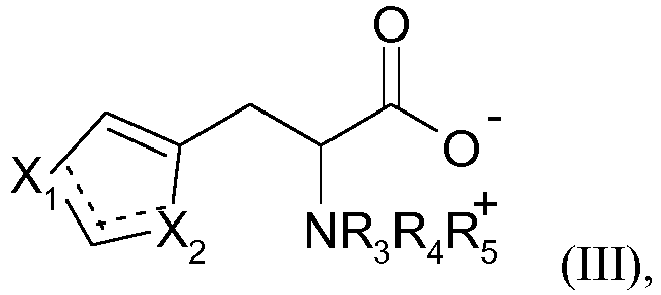
pour laquelle
puis avec un dérivé de cystéine de formule (IV) suivante :
dans laquelle R6 et R7 sont tels que définis à la revendication 1. - Procédé selon la revendication 7, caractérisé en ce que le composé de formule (I) répond à la formule (Ia) telle que définie à la revendication 5 et que le procédé comprend les étapes successives suivantes :(a2) réaction d'un sel d'addition d'acide, à l'exclusion du sel de l'acide iodhydrique, d'un composé de type bétaïne de formule (IIIa) suivante :

pour laquelle
puis avec un dérivé de cystéine de formule (IV) tel que défini à la revendication 7 ou un stéréoisomère ou un mélange de stéréoisomères en toutes proportions, en particulier un mélange d'énantiomères, et notamment un mélange racémique de celui-ci, et en particulier avec de la cystéine et notamment de la L-cystéine
pour donner un composé de type bétaïne de formule (IIa) suivante :
pour laquelle (b2) réaction de clivage du composé de type bétaïne de formule (IIa) obtenu à l'étape (a2) précédente en présence d'un thiol, à une température supérieure ou égale à 60°C,
pour donner un composé de formule (Ia), et(c2) séparation du composé de formule (Ia) obtenu à l'étape (b2) précédente du milieu réactionnel. - Procédé selon l'une quelconque des revendications 7 et 8, caractérisé en ce que le dérivé de cystéine est utilisé en excès, à raison de 2 à 10, avantageusement 3 à 7 équivalents molaires de dérivé de cystéine par rapport au composé de type bétaïne de formule (III).
- Procédé selon l'une quelconque des revendications 7 à 9, caractérisé en ce que le dibrome est utilisé à raison de 1 à 1,5 équivalents molaires par rapport au composé de type bétaïne de formule (III).
- Procédé selon l'une quelconque des revendications 7 à 10, caractérisé en ce que la préparation du composé (I) à partir du composé (III) est réalisé dans un seul réacteur, sans isolation du composé (II) intermédiaire.
- Utilisation d'un composé de type bétaïne de formule (II) suivante :

pour laquelle :-
 - R1, R2, R3, R4, R5, R6 et R7 sont tels que définis à la revendication 1,a l' exclusion du composé pour lequel


pour la préparation d'un dérivé de formule (I) suivante :
Applications Claiming Priority (2)
| Application Number | Priority Date | Filing Date | Title |
|---|---|---|---|
| FR0956962A FR2950889B1 (fr) | 2009-10-06 | 2009-10-06 | Procede de synthese de l'ergothioneine et analogues |
| PCT/EP2010/064950 WO2011042480A1 (fr) | 2009-10-06 | 2010-10-06 | Procede de synthese de l'ergothioneine et analogues |
Publications (2)
| Publication Number | Publication Date |
|---|---|
| EP2486020A1 EP2486020A1 (fr) | 2012-08-15 |
| EP2486020B1 true EP2486020B1 (fr) | 2017-08-16 |
Family
ID=41650166
Family Applications (1)
| Application Number | Title | Priority Date | Filing Date |
|---|---|---|---|
| EP10763362.0A Not-in-force EP2486020B1 (fr) | 2009-10-06 | 2010-10-06 | Procede de synthese de l'ergothioneine et analogues |
Country Status (13)
| Country | Link |
|---|---|
| US (1) | US8399500B2 (fr) |
| EP (1) | EP2486020B1 (fr) |
| JP (2) | JP5813647B2 (fr) |
| KR (1) | KR101832396B1 (fr) |
| CN (1) | CN102686568B (fr) |
| AU (1) | AU2010305399B2 (fr) |
| BR (1) | BR112012007869B1 (fr) |
| CA (1) | CA2776836C (fr) |
| ES (1) | ES2646331T3 (fr) |
| FR (1) | FR2950889B1 (fr) |
| IN (1) | IN2012DN03818A (fr) |
| RU (1) | RU2550202C2 (fr) |
| WO (1) | WO2011042480A1 (fr) |
Families Citing this family (20)
| Publication number | Priority date | Publication date | Assignee | Title |
|---|---|---|---|---|
| FR2950890B1 (fr) | 2009-10-06 | 2011-12-30 | Tetrahedron | Procede de synthese de la 2-thiohistidine et analogues |
| WO2014100752A1 (fr) * | 2012-12-21 | 2014-06-26 | Liu Pinghua | Production d'ergothionéine par l'intermédiaire de l'ingénierie métabolique |
| US10544437B2 (en) | 2014-04-29 | 2020-01-28 | Conagen Inc. | Microbial ergothioneine biosynthesis |
| FR3021655B1 (fr) | 2014-05-30 | 2016-07-08 | Tetrahedron | Nouveaux composes de type 5-acylsulfanyl-histidine en tant que precurseurs des 5-sulfanylhistidines correspondantes et de leurs disulfures |
| GB201416678D0 (en) | 2014-09-22 | 2014-11-05 | Univ Cape Town | Process For Synthesizing Ergothioneine And Its Intermediates |
| CN107848984B (zh) | 2015-03-13 | 2021-08-24 | 米洛诺瓦创新有限责任公司 | 用于制备麦角硫因化合物的Nα,Nα,Nα-三烷基组氨酸衍生物 |
| BR112022000183A2 (pt) | 2019-07-10 | 2022-02-22 | Kureha Corp | Regulador de crescimento de plantal e método para promover o crescimento de planta |
| JP6864131B1 (ja) * | 2020-03-04 | 2021-04-28 | 長瀬産業株式会社 | L−エルゴチオネイン含有組成物 |
| KR20220081067A (ko) | 2020-12-08 | 2022-06-15 | 코오롱인더스트리 주식회사 | 에르고티오네인 생산능이 향상된 재조합 효모 및 이를 이용한 에르고티오네인의 생산 방법 |
| CN117729918A (zh) * | 2021-07-28 | 2024-03-19 | 南京纽邦生物科技有限公司 | L-麦角硫因及其用途 |
| AU2022430726A1 (en) | 2022-01-06 | 2024-07-25 | Nanjing Nutrabuilding Bio-Tech Co., Ltd. | Use of ergothioneine for enhancing glutathione level |
| US11491141B1 (en) | 2022-01-06 | 2022-11-08 | Nanjing Nutrabuilding Bio-Tech Co., Ltd. | Methods of treating glutathione deficiencies and deficiencies in glutathione synthetase activity |
| WO2023201707A1 (fr) * | 2022-04-22 | 2023-10-26 | Nanjing Nutrabuilding Bio-Tech Co., Ltd. | Procédé de synthèse chimique d'ergothionéine et procédés d'utilisation |
| JP7752245B2 (ja) | 2022-07-06 | 2025-10-09 | 株式会社クレハ | 植物生長調整剤、植物の生長促進方法または植物生長調整用製品 |
| AR130564A1 (es) | 2022-09-27 | 2024-12-18 | Kureha Corp | Agente para mejorar la tolerancia al estrés ambiental en una planta y método para mejorar la tolerancia al estrés ambiental en una planta |
| CN116102502A (zh) * | 2022-11-28 | 2023-05-12 | 南京艾希帝生物科技有限公司 | 一种麦角硫因的合成方法 |
| AR134099A1 (es) | 2023-10-16 | 2025-12-03 | Kureha Corp | Método para tratar una planta, formulación, propágulo de una planta, método para cultivar una planta, y plántula de trasplante |
| AR134409A1 (es) | 2023-11-21 | 2026-01-14 | Kureha Corp | Mejorador de tolerancia al estrés abiótico de una planta, método para mejorar la tolerancia al estrés abiótico, formulación para mejorar la tolerancia al estrés abiótico, producto para mejorar la tolerancia al estrés abiótico, y planta |
| AR134410A1 (es) | 2023-11-21 | 2026-01-14 | Kureha Corp | Agente para mejorar la recuperabilidad de daño y formulación para mejorar la recuperabilidad de daño de la planta, método para mejorar la recuperabilidad de daño de la planta, cuerpo de la planta y agente para mejorar la tolerancia al estrés físico de la planta |
| WO2025143153A1 (fr) | 2023-12-27 | 2025-07-03 | 株式会社クレハ | Agent pour raccourcir la période de croissance d'une plante, formulation pour raccourcir la période de croissance, agent pour induire l'expression d'un gène induisant une anthogenèse, procédé pour raccourcir la période de croissance d'une plante, plante, agent pour rendre la vitesse de croissance d'une plante uniforme, et procédé pour rendre la vitesse de croissance d'une plante uniforme |
Family Cites Families (6)
| Publication number | Priority date | Publication date | Assignee | Title |
|---|---|---|---|---|
| FR2707087B1 (fr) * | 1993-06-28 | 1995-10-13 | Bioxytech | Nouveau procédé de préparation de l'ergothionéine. |
| GB9811427D0 (en) * | 1998-05-29 | 1998-07-22 | Zeneca Ltd | Chemical compounds |
| KR20070063016A (ko) * | 2004-09-24 | 2007-06-18 | 알러간, 인코포레이티드 | 알파2 아드레날린성 아고니스트로서 작용하는 4-(축합시클릭메틸)-이미다졸-2-티온 |
| US7115748B2 (en) * | 2004-12-07 | 2006-10-03 | Allergan, Inc. | Method of making imidazole-2-thiones |
| US7767826B2 (en) * | 2007-10-05 | 2010-08-03 | Pharmatech International, Inc. | Process for the synthesis of L-(+)-ergothioneine |
| JP2009161498A (ja) * | 2008-01-10 | 2009-07-23 | Univ Nagoya | エルゴチオネインの製造方法 |
-
2009
- 2009-10-06 FR FR0956962A patent/FR2950889B1/fr not_active Expired - Fee Related
-
2010
- 2010-10-06 EP EP10763362.0A patent/EP2486020B1/fr not_active Not-in-force
- 2010-10-06 WO PCT/EP2010/064950 patent/WO2011042480A1/fr not_active Ceased
- 2010-10-06 CA CA2776836A patent/CA2776836C/fr not_active Expired - Fee Related
- 2010-10-06 CN CN201080047019.1A patent/CN102686568B/zh not_active Expired - Fee Related
- 2010-10-06 BR BR112012007869-0A patent/BR112012007869B1/pt not_active IP Right Cessation
- 2010-10-06 KR KR1020127011715A patent/KR101832396B1/ko not_active Expired - Fee Related
- 2010-10-06 AU AU2010305399A patent/AU2010305399B2/en not_active Ceased
- 2010-10-06 US US13/121,891 patent/US8399500B2/en not_active Expired - Fee Related
- 2010-10-06 JP JP2012532585A patent/JP5813647B2/ja not_active Expired - Fee Related
- 2010-10-06 ES ES10763362.0T patent/ES2646331T3/es active Active
- 2010-10-06 RU RU2012117978/04A patent/RU2550202C2/ru active
-
2012
- 2012-05-01 IN IN3818DEN2012 patent/IN2012DN03818A/en unknown
-
2015
- 2015-08-12 JP JP2015159327A patent/JP2016006099A/ja active Pending
Non-Patent Citations (1)
| Title |
|---|
| None * |
Also Published As
| Publication number | Publication date |
|---|---|
| FR2950889B1 (fr) | 2011-11-18 |
| JP2016006099A (ja) | 2016-01-14 |
| BR112012007869B1 (pt) | 2021-10-13 |
| EP2486020A1 (fr) | 2012-08-15 |
| IN2012DN03818A (fr) | 2015-08-28 |
| CN102686568B (zh) | 2015-03-18 |
| AU2010305399A1 (en) | 2012-05-17 |
| AU2010305399B2 (en) | 2014-06-12 |
| CN102686568A (zh) | 2012-09-19 |
| FR2950889A1 (fr) | 2011-04-08 |
| KR20120091187A (ko) | 2012-08-17 |
| JP5813647B2 (ja) | 2015-11-17 |
| WO2011042480A1 (fr) | 2011-04-14 |
| RU2550202C2 (ru) | 2015-05-10 |
| US20120136159A1 (en) | 2012-05-31 |
| ES2646331T3 (es) | 2017-12-13 |
| CA2776836C (fr) | 2019-01-15 |
| KR101832396B1 (ko) | 2018-02-26 |
| JP2013506706A (ja) | 2013-02-28 |
| CA2776836A1 (fr) | 2011-04-14 |
| RU2012117978A (ru) | 2013-11-20 |
| US8399500B2 (en) | 2013-03-19 |
| BR112012007869A2 (pt) | 2015-09-22 |
Similar Documents
| Publication | Publication Date | Title |
|---|---|---|
| CA2776836C (fr) | Procede de synthese de l'ergothioneine et analogues | |
| EP2379501B1 (fr) | Procede de preparation d'esters actives | |
| EP2486019B1 (fr) | Procede de synthese de la 2-thiohistidine et analogues | |
| CA2261829C (fr) | Intermediaires pour la preparation de 2-imidazoline-5-ones | |
| FR3021655A1 (fr) | Nouveaux composes de type 5-acylsulfanyl-histidine en tant que precurseurs des 5-sulfanylhistidines correspondantes et de leurs disulfures | |
| EP0510168B1 (fr) | Procede de dedoublement d'hydantoines chirales | |
| EP3562950B1 (fr) | Procédé de synthèse de dithiocarbamates cycliques fonctionnalisés | |
| WO1998039286A1 (fr) | PROCEDE D'OBTENTION D'ENANTIOMERES D'ACIDES α-AMINES ET SELS DIASTEREOISOMERIQUES INTERMEDIAIRES | |
| EP0925280A1 (fr) | Nouveaux sels n proteges d'acide alpha-amino sulfinique, leur procede d'obtention, et les sulfonopeptides qui en derivent | |
| CA2153577A1 (fr) | Procede de preparation de n-methyl (pyridyl-3)-2 tetrahydrothiopyrannecarbothioamide-2-oxyde-1-(1r,2r) |
Legal Events
| Date | Code | Title | Description |
|---|---|---|---|
| PUAI | Public reference made under article 153(3) epc to a published international application that has entered the european phase |
Free format text: ORIGINAL CODE: 0009012 |
|
| 17P | Request for examination filed |
Effective date: 20120329 |
|
| AK | Designated contracting states |
Kind code of ref document: A1 Designated state(s): AL AT BE BG CH CY CZ DE DK EE ES FI FR GB GR HR HU IE IS IT LI LT LU LV MC MK MT NL NO PL PT RO RS SE SI SK SM TR |
|
| DAX | Request for extension of the european patent (deleted) | ||
| 17Q | First examination report despatched |
Effective date: 20130717 |
|
| GRAP | Despatch of communication of intention to grant a patent |
Free format text: ORIGINAL CODE: EPIDOSNIGR1 |
|
| INTG | Intention to grant announced |
Effective date: 20170309 |
|
| RAP1 | Party data changed (applicant data changed or rights of an application transferred) |
Owner name: TETRAHEDRON |
|
| GRAS | Grant fee paid |
Free format text: ORIGINAL CODE: EPIDOSNIGR3 |
|
| GRAA | (expected) grant |
Free format text: ORIGINAL CODE: 0009210 |
|
| AK | Designated contracting states |
Kind code of ref document: B1 Designated state(s): AL AT BE BG CH CY CZ DE DK EE ES FI FR GB GR HR HU IE IS IT LI LT LU LV MC MK MT NL NO PL PT RO RS SE SI SK SM TR |
|
| REG | Reference to a national code |
Ref country code: GB Ref legal event code: FG4D Free format text: NOT ENGLISH |
|
| REG | Reference to a national code |
Ref country code: CH Ref legal event code: EP |
|
| REG | Reference to a national code |
Ref country code: IE Ref legal event code: FG4D Free format text: LANGUAGE OF EP DOCUMENT: FRENCH |
|
| REG | Reference to a national code |
Ref country code: AT Ref legal event code: REF Ref document number: 918892 Country of ref document: AT Kind code of ref document: T Effective date: 20170915 |
|
| REG | Reference to a national code |
Ref country code: DE Ref legal event code: R096 Ref document number: 602010044450 Country of ref document: DE |
|
| REG | Reference to a national code |
Ref country code: FR Ref legal event code: PLFP Year of fee payment: 8 |
|
| REG | Reference to a national code |
Ref country code: CH Ref legal event code: NV Representative=s name: MICHELI AND CIE SA, CH |
|
| REG | Reference to a national code |
Ref country code: ES Ref legal event code: FG2A Ref document number: 2646331 Country of ref document: ES Kind code of ref document: T3 Effective date: 20171213 |
|
| REG | Reference to a national code |
Ref country code: NL Ref legal event code: MP Effective date: 20170816 |
|
| REG | Reference to a national code |
Ref country code: LT Ref legal event code: MG4D |
|
| REG | Reference to a national code |
Ref country code: AT Ref legal event code: MK05 Ref document number: 918892 Country of ref document: AT Kind code of ref document: T Effective date: 20170816 |
|
| PG25 | Lapsed in a contracting state [announced via postgrant information from national office to epo] |
Ref country code: LT Free format text: LAPSE BECAUSE OF FAILURE TO SUBMIT A TRANSLATION OF THE DESCRIPTION OR TO PAY THE FEE WITHIN THE PRESCRIBED TIME-LIMIT Effective date: 20170816 Ref country code: SE Free format text: LAPSE BECAUSE OF FAILURE TO SUBMIT A TRANSLATION OF THE DESCRIPTION OR TO PAY THE FEE WITHIN THE PRESCRIBED TIME-LIMIT Effective date: 20170816 Ref country code: FI Free format text: LAPSE BECAUSE OF FAILURE TO SUBMIT A TRANSLATION OF THE DESCRIPTION OR TO PAY THE FEE WITHIN THE PRESCRIBED TIME-LIMIT Effective date: 20170816 Ref country code: NO Free format text: LAPSE BECAUSE OF FAILURE TO SUBMIT A TRANSLATION OF THE DESCRIPTION OR TO PAY THE FEE WITHIN THE PRESCRIBED TIME-LIMIT Effective date: 20171116 Ref country code: NL Free format text: LAPSE BECAUSE OF FAILURE TO SUBMIT A TRANSLATION OF THE DESCRIPTION OR TO PAY THE FEE WITHIN THE PRESCRIBED TIME-LIMIT Effective date: 20170816 Ref country code: AT Free format text: LAPSE BECAUSE OF FAILURE TO SUBMIT A TRANSLATION OF THE DESCRIPTION OR TO PAY THE FEE WITHIN THE PRESCRIBED TIME-LIMIT Effective date: 20170816 |
|
| PG25 | Lapsed in a contracting state [announced via postgrant information from national office to epo] |
Ref country code: IS Free format text: LAPSE BECAUSE OF FAILURE TO SUBMIT A TRANSLATION OF THE DESCRIPTION OR TO PAY THE FEE WITHIN THE PRESCRIBED TIME-LIMIT Effective date: 20171216 Ref country code: PL Free format text: LAPSE BECAUSE OF FAILURE TO SUBMIT A TRANSLATION OF THE DESCRIPTION OR TO PAY THE FEE WITHIN THE PRESCRIBED TIME-LIMIT Effective date: 20170816 Ref country code: LV Free format text: LAPSE BECAUSE OF FAILURE TO SUBMIT A TRANSLATION OF THE DESCRIPTION OR TO PAY THE FEE WITHIN THE PRESCRIBED TIME-LIMIT Effective date: 20170816 Ref country code: BG Free format text: LAPSE BECAUSE OF FAILURE TO SUBMIT A TRANSLATION OF THE DESCRIPTION OR TO PAY THE FEE WITHIN THE PRESCRIBED TIME-LIMIT Effective date: 20171116 Ref country code: GR Free format text: LAPSE BECAUSE OF FAILURE TO SUBMIT A TRANSLATION OF THE DESCRIPTION OR TO PAY THE FEE WITHIN THE PRESCRIBED TIME-LIMIT Effective date: 20171117 Ref country code: RS Free format text: LAPSE BECAUSE OF FAILURE TO SUBMIT A TRANSLATION OF THE DESCRIPTION OR TO PAY THE FEE WITHIN THE PRESCRIBED TIME-LIMIT Effective date: 20170816 |
|
| PG25 | Lapsed in a contracting state [announced via postgrant information from national office to epo] |
Ref country code: RO Free format text: LAPSE BECAUSE OF FAILURE TO SUBMIT A TRANSLATION OF THE DESCRIPTION OR TO PAY THE FEE WITHIN THE PRESCRIBED TIME-LIMIT Effective date: 20170816 Ref country code: DK Free format text: LAPSE BECAUSE OF FAILURE TO SUBMIT A TRANSLATION OF THE DESCRIPTION OR TO PAY THE FEE WITHIN THE PRESCRIBED TIME-LIMIT Effective date: 20170816 Ref country code: CZ Free format text: LAPSE BECAUSE OF FAILURE TO SUBMIT A TRANSLATION OF THE DESCRIPTION OR TO PAY THE FEE WITHIN THE PRESCRIBED TIME-LIMIT Effective date: 20170816 |
|
| REG | Reference to a national code |
Ref country code: DE Ref legal event code: R097 Ref document number: 602010044450 Country of ref document: DE |
|
| PG25 | Lapsed in a contracting state [announced via postgrant information from national office to epo] |
Ref country code: EE Free format text: LAPSE BECAUSE OF FAILURE TO SUBMIT A TRANSLATION OF THE DESCRIPTION OR TO PAY THE FEE WITHIN THE PRESCRIBED TIME-LIMIT Effective date: 20170816 Ref country code: MC Free format text: LAPSE BECAUSE OF FAILURE TO SUBMIT A TRANSLATION OF THE DESCRIPTION OR TO PAY THE FEE WITHIN THE PRESCRIBED TIME-LIMIT Effective date: 20170816 Ref country code: SM Free format text: LAPSE BECAUSE OF FAILURE TO SUBMIT A TRANSLATION OF THE DESCRIPTION OR TO PAY THE FEE WITHIN THE PRESCRIBED TIME-LIMIT Effective date: 20170816 Ref country code: SK Free format text: LAPSE BECAUSE OF FAILURE TO SUBMIT A TRANSLATION OF THE DESCRIPTION OR TO PAY THE FEE WITHIN THE PRESCRIBED TIME-LIMIT Effective date: 20170816 |
|
| PLBE | No opposition filed within time limit |
Free format text: ORIGINAL CODE: 0009261 |
|
| STAA | Information on the status of an ep patent application or granted ep patent |
Free format text: STATUS: NO OPPOSITION FILED WITHIN TIME LIMIT |
|
| 26N | No opposition filed |
Effective date: 20180517 |
|
| REG | Reference to a national code |
Ref country code: IE Ref legal event code: MM4A |
|
| PG25 | Lapsed in a contracting state [announced via postgrant information from national office to epo] |
Ref country code: LU Free format text: LAPSE BECAUSE OF NON-PAYMENT OF DUE FEES Effective date: 20171006 |
|
| REG | Reference to a national code |
Ref country code: BE Ref legal event code: MM Effective date: 20171031 |
|
| PG25 | Lapsed in a contracting state [announced via postgrant information from national office to epo] |
Ref country code: BE Free format text: LAPSE BECAUSE OF NON-PAYMENT OF DUE FEES Effective date: 20171031 Ref country code: SI Free format text: LAPSE BECAUSE OF FAILURE TO SUBMIT A TRANSLATION OF THE DESCRIPTION OR TO PAY THE FEE WITHIN THE PRESCRIBED TIME-LIMIT Effective date: 20170816 |
|
| PG25 | Lapsed in a contracting state [announced via postgrant information from national office to epo] |
Ref country code: MT Free format text: LAPSE BECAUSE OF FAILURE TO SUBMIT A TRANSLATION OF THE DESCRIPTION OR TO PAY THE FEE WITHIN THE PRESCRIBED TIME-LIMIT Effective date: 20170816 |
|
| REG | Reference to a national code |
Ref country code: FR Ref legal event code: PLFP Year of fee payment: 9 |
|
| PG25 | Lapsed in a contracting state [announced via postgrant information from national office to epo] |
Ref country code: IE Free format text: LAPSE BECAUSE OF NON-PAYMENT OF DUE FEES Effective date: 20171006 |
|
| PG25 | Lapsed in a contracting state [announced via postgrant information from national office to epo] |
Ref country code: HU Free format text: LAPSE BECAUSE OF FAILURE TO SUBMIT A TRANSLATION OF THE DESCRIPTION OR TO PAY THE FEE WITHIN THE PRESCRIBED TIME-LIMIT; INVALID AB INITIO Effective date: 20101006 |
|
| PG25 | Lapsed in a contracting state [announced via postgrant information from national office to epo] |
Ref country code: CY Free format text: LAPSE BECAUSE OF NON-PAYMENT OF DUE FEES Effective date: 20170816 |
|
| PG25 | Lapsed in a contracting state [announced via postgrant information from national office to epo] |
Ref country code: MK Free format text: LAPSE BECAUSE OF FAILURE TO SUBMIT A TRANSLATION OF THE DESCRIPTION OR TO PAY THE FEE WITHIN THE PRESCRIBED TIME-LIMIT Effective date: 20170816 |
|
| PG25 | Lapsed in a contracting state [announced via postgrant information from national office to epo] |
Ref country code: TR Free format text: LAPSE BECAUSE OF FAILURE TO SUBMIT A TRANSLATION OF THE DESCRIPTION OR TO PAY THE FEE WITHIN THE PRESCRIBED TIME-LIMIT Effective date: 20170816 |
|
| PG25 | Lapsed in a contracting state [announced via postgrant information from national office to epo] |
Ref country code: PT Free format text: LAPSE BECAUSE OF FAILURE TO SUBMIT A TRANSLATION OF THE DESCRIPTION OR TO PAY THE FEE WITHIN THE PRESCRIBED TIME-LIMIT Effective date: 20170816 |
|
| PG25 | Lapsed in a contracting state [announced via postgrant information from national office to epo] |
Ref country code: HR Free format text: LAPSE BECAUSE OF FAILURE TO SUBMIT A TRANSLATION OF THE DESCRIPTION OR TO PAY THE FEE WITHIN THE PRESCRIBED TIME-LIMIT Effective date: 20170816 |
|
| PG25 | Lapsed in a contracting state [announced via postgrant information from national office to epo] |
Ref country code: AL Free format text: LAPSE BECAUSE OF FAILURE TO SUBMIT A TRANSLATION OF THE DESCRIPTION OR TO PAY THE FEE WITHIN THE PRESCRIBED TIME-LIMIT Effective date: 20170816 |
|
| PGFP | Annual fee paid to national office [announced via postgrant information from national office to epo] |
Ref country code: IT Payment date: 20210429 Year of fee payment: 11 Ref country code: DE Payment date: 20210429 Year of fee payment: 11 Ref country code: FR Payment date: 20210423 Year of fee payment: 11 |
|
| PGFP | Annual fee paid to national office [announced via postgrant information from national office to epo] |
Ref country code: GB Payment date: 20210427 Year of fee payment: 11 Ref country code: ES Payment date: 20210427 Year of fee payment: 11 Ref country code: CH Payment date: 20210427 Year of fee payment: 11 |
|
| REG | Reference to a national code |
Ref country code: DE Ref legal event code: R119 Ref document number: 602010044450 Country of ref document: DE |
|
| REG | Reference to a national code |
Ref country code: CH Ref legal event code: PL |
|
| GBPC | Gb: european patent ceased through non-payment of renewal fee |
Effective date: 20211006 |
|
| PG25 | Lapsed in a contracting state [announced via postgrant information from national office to epo] |
Ref country code: GB Free format text: LAPSE BECAUSE OF NON-PAYMENT OF DUE FEES Effective date: 20211006 Ref country code: DE Free format text: LAPSE BECAUSE OF NON-PAYMENT OF DUE FEES Effective date: 20220503 |
|
| PG25 | Lapsed in a contracting state [announced via postgrant information from national office to epo] |
Ref country code: LI Free format text: LAPSE BECAUSE OF NON-PAYMENT OF DUE FEES Effective date: 20211031 Ref country code: CH Free format text: LAPSE BECAUSE OF NON-PAYMENT OF DUE FEES Effective date: 20211031 |
|
| PG25 | Lapsed in a contracting state [announced via postgrant information from national office to epo] |
Ref country code: FR Free format text: LAPSE BECAUSE OF NON-PAYMENT OF DUE FEES Effective date: 20211031 |
|
| PG25 | Lapsed in a contracting state [announced via postgrant information from national office to epo] |
Ref country code: IT Free format text: LAPSE BECAUSE OF NON-PAYMENT OF DUE FEES Effective date: 20211006 |
|
| REG | Reference to a national code |
Ref country code: ES Ref legal event code: FD2A Effective date: 20221125 |
|
| PG25 | Lapsed in a contracting state [announced via postgrant information from national office to epo] |
Ref country code: ES Free format text: LAPSE BECAUSE OF NON-PAYMENT OF DUE FEES Effective date: 20211007 |