EP2485582B1 - Transportierbare vorrichtung zur ansiedlung und erntung von wirbellosen tieren und anwendung davon - Google Patents
Transportierbare vorrichtung zur ansiedlung und erntung von wirbellosen tieren und anwendung davon Download PDFInfo
- Publication number
- EP2485582B1 EP2485582B1 EP10779675.7A EP10779675A EP2485582B1 EP 2485582 B1 EP2485582 B1 EP 2485582B1 EP 10779675 A EP10779675 A EP 10779675A EP 2485582 B1 EP2485582 B1 EP 2485582B1
- Authority
- EP
- European Patent Office
- Prior art keywords
- frames
- transportable
- transportable device
- central hinge
- opening angle
- Prior art date
- Legal status (The legal status is an assumption and is not a legal conclusion. Google has not performed a legal analysis and makes no representation as to the accuracy of the status listed.)
- Active
Links
- 238000003306 harvesting Methods 0.000 title claims description 17
- XLYOFNOQVPJJNP-UHFFFAOYSA-N water Substances O XLYOFNOQVPJJNP-UHFFFAOYSA-N 0.000 claims description 27
- 229910000831 Steel Inorganic materials 0.000 claims description 8
- 239000010959 steel Substances 0.000 claims description 8
- 238000005192 partition Methods 0.000 claims description 3
- 238000007688 edging Methods 0.000 claims 2
- 241000238424 Crustacea Species 0.000 claims 1
- 241001465754 Metazoa Species 0.000 description 19
- 241000238557 Decapoda Species 0.000 description 15
- 241000238565 lobster Species 0.000 description 8
- 239000002689 soil Substances 0.000 description 5
- 239000004575 stone Substances 0.000 description 4
- 239000000758 substrate Substances 0.000 description 4
- 241000238017 Astacoidea Species 0.000 description 3
- 206010028980 Neoplasm Diseases 0.000 description 3
- 238000011084 recovery Methods 0.000 description 3
- 230000006978 adaptation Effects 0.000 description 2
- 238000010276 construction Methods 0.000 description 2
- 238000009434 installation Methods 0.000 description 2
- 238000007726 management method Methods 0.000 description 2
- 238000013316 zoning Methods 0.000 description 2
- 241000237502 Ostreidae Species 0.000 description 1
- 241000694533 Recurvirostra Species 0.000 description 1
- 238000013459 approach Methods 0.000 description 1
- 238000009395 breeding Methods 0.000 description 1
- 230000001488 breeding effect Effects 0.000 description 1
- 238000004140 cleaning Methods 0.000 description 1
- 230000000881 depressing effect Effects 0.000 description 1
- 238000011161 development Methods 0.000 description 1
- 230000018109 developmental process Effects 0.000 description 1
- 238000007599 discharging Methods 0.000 description 1
- 238000005553 drilling Methods 0.000 description 1
- 239000000463 material Substances 0.000 description 1
- 238000005259 measurement Methods 0.000 description 1
- 235000020636 oyster Nutrition 0.000 description 1
- 238000009304 pastoral farming Methods 0.000 description 1
- 230000001737 promoting effect Effects 0.000 description 1
- 239000011435 rock Substances 0.000 description 1
- 239000013049 sediment Substances 0.000 description 1
- 239000008234 soft water Substances 0.000 description 1
- 230000006641 stabilisation Effects 0.000 description 1
- 238000011105 stabilization Methods 0.000 description 1
- 230000000087 stabilizing effect Effects 0.000 description 1
- 238000003860 storage Methods 0.000 description 1
- 239000003643 water by type Substances 0.000 description 1
- 239000002023 wood Substances 0.000 description 1
Images



Classifications
-
- A—HUMAN NECESSITIES
- A01—AGRICULTURE; FORESTRY; ANIMAL HUSBANDRY; HUNTING; TRAPPING; FISHING
- A01K—ANIMAL HUSBANDRY; AVICULTURE; APICULTURE; PISCICULTURE; FISHING; REARING OR BREEDING ANIMALS, NOT OTHERWISE PROVIDED FOR; NEW BREEDS OF ANIMALS
- A01K69/00—Stationary catching devices
- A01K69/06—Traps
- A01K69/10—Collapsible traps
-
- A—HUMAN NECESSITIES
- A01—AGRICULTURE; FORESTRY; ANIMAL HUSBANDRY; HUNTING; TRAPPING; FISHING
- A01K—ANIMAL HUSBANDRY; AVICULTURE; APICULTURE; PISCICULTURE; FISHING; REARING OR BREEDING ANIMALS, NOT OTHERWISE PROVIDED FOR; NEW BREEDS OF ANIMALS
- A01K61/00—Culture of aquatic animals
- A01K61/50—Culture of aquatic animals of shellfish
- A01K61/59—Culture of aquatic animals of shellfish of crustaceans, e.g. lobsters or shrimps
-
- A—HUMAN NECESSITIES
- A01—AGRICULTURE; FORESTRY; ANIMAL HUSBANDRY; HUNTING; TRAPPING; FISHING
- A01K—ANIMAL HUSBANDRY; AVICULTURE; APICULTURE; PISCICULTURE; FISHING; REARING OR BREEDING ANIMALS, NOT OTHERWISE PROVIDED FOR; NEW BREEDS OF ANIMALS
- A01K61/00—Culture of aquatic animals
- A01K61/70—Artificial fishing banks or reefs
-
- Y—GENERAL TAGGING OF NEW TECHNOLOGICAL DEVELOPMENTS; GENERAL TAGGING OF CROSS-SECTIONAL TECHNOLOGIES SPANNING OVER SEVERAL SECTIONS OF THE IPC; TECHNICAL SUBJECTS COVERED BY FORMER USPC CROSS-REFERENCE ART COLLECTIONS [XRACs] AND DIGESTS
- Y02—TECHNOLOGIES OR APPLICATIONS FOR MITIGATION OR ADAPTATION AGAINST CLIMATE CHANGE
- Y02A—TECHNOLOGIES FOR ADAPTATION TO CLIMATE CHANGE
- Y02A40/00—Adaptation technologies in agriculture, forestry, livestock or agroalimentary production
- Y02A40/80—Adaptation technologies in agriculture, forestry, livestock or agroalimentary production in fisheries management
- Y02A40/81—Aquaculture, e.g. of fish
Definitions
- the invention relates to a transportable device for locating and harvesting invertebrates in the vicinity of a water bottom with at least two square frames, the catch surfaces and positioned by means disposed between opposite inner transverse sides of the frame central hinge in its one-sided folding direction in different opening angles of the device are and on an application of this device.
- a collapsible lobster trap which consists of a triangular floor grid and three triangular side rails.
- the side rails are connected to the floor grid by hinges.
- the transport of the unused lobster trap is carried out in the collapsed state, the harvesting takes place in the erected state in the form of a tetrahedron, which are net reinforced through holes for the lobster in the side rails.
- Application and recovery of the lobster trap are also carried out in the erected state.
- the lobster trap is intended for short-term application and is not suitable as a habitat, as the crayfish are caught immediately.
- a collapsible lobster trap in which a grid vault can be closed by side mesh flaps.
- the grid vault consists of a grid plate, which is hinged on one side with a floor grid. When stored, all lattices are flat on the floor grid. Before deployment, the grid plate is curved to a vault and locked with a hook on the bottom plate.
- the mesh flaps are adjustable via ropes in their angle of attack to the lattice vault. When deploying the ropes pull the lattice flaps on the grid vault, after settling and relieving the ropes lie the lattice flaps then on the bottom of the water and release the interior of the lattice vault. When catching the lobster trap, the lattice vault is then closed by tightening the ropes from the lattice flaps.
- This lobster trap is also suitable as a habitat, but is not very attractive for crayfish.
- a network of oval cross-section is known for catching oysters.
- the net has an elongated opening cross-section with lateral curves.
- a device is used which consists of two interconnected via a central hinge plates each having the shape of the half opening cross-section. This device is inserted and opened in the folded state in the network, so that the plates are arranged at an opening angle to each other. However, the opening distance is smaller than the width of the opening cross-section.
- the plates By depressing the central hinge, the plates are aligned in a plane and now have a width which is greater than the width of the opening cross section, so that the device clamps in the network.
- a locking of the hinge to prevent the folding back of the plates is done by overstretching the hinge.
- the net is not suitable for catching benthic organisms.
- the Aqualkulturzuchtussi consists of two rectangular frames, are introduced into the grid as a breeding and catching surfaces.
- the two frames are hinged together at their opposite inner transverse sides by means of a central hinge.
- the central hinge has a one-sided folding direction. There are two different positions for the two frames. In the deployed state, the two frames lie against each other (opening angle of the device 0 °) and form as it were a closed box, in the interior of which the sponges spread starting from the settling and catching surfaces can.
- the device is also recovered in the folded state.
- the two frames are opened and, if necessary, opened up to one level (maximum opening angle of the device 180 °), so that the settled sponges can be easily removed.
- maximum opening angle of the device 180 ° maximum opening angle of the device 180 °
- This known device is designed for the cultivation and harvesting of stationary sponges, benthic invertebrate moving (vagile) animals can be difficult or impossible to raise, since the attractiveness as a habitat is not sufficient here. Catching is also not possible because the vagile animals can quickly leave this when lifting the folded device.
- the known device in single version allows no adaptation to the occurring water bottom, but can only rest flat on the water bottom. Only by a combination of several devices with each other is an adaptation possible. However, this results in a difficult application or collection or a relatively complex assembly under water.
- the TASK for the present invention is therefore to be seen in a transportable device of the generic type described above for the settlement and harvesting of invertebrates on a water bottom in such a way that on the one hand even vagile invertebrates can be settled and harvested.
- the device should be adaptable to the waterbed without further combination with other devices and offer the animals a particularly attractive habitat. On the other hand, the device should be easy to hiev and bombbar and be harvested and require no installation work under water.
- the solution according to the invention for this task can be taken from claim 1, advantageous Further developments of the invention are shown in the subclaims and explained in more detail below in connection with the invention.
- the device according to the invention is characterized by two parallel arranged on both sides of the central hinge side hinges in the frame with the folding direction of the central hinge opposite unilateral folding directions.
- the central hinge in the device according to the invention serves to adapt it to the structure of the watercourse by changing the opening angle of the device. For particularly level and soft water bottoms, the central hinge can be fully opened (opening angle of the device in a range of 180 °), so that both frames rest in one plane on the water bottom.
- An areal spreading is useful for finer sediments, as it comes here to a Einsedimenttechnik and the device can also be used by burrowing and grazing large crabs, such as lobsters.
- the central hinge can be opened according to the different opening angles of the device, so that the two frames can be placed at different obliquely on the water bottom.
- the smaller the opening angle of the device the higher the free space below the frame, so that particularly high unevenness can be overcome.
- an artificial height zoning can thus be generated in which smaller vagile animal species find a habitat in higher areas of the device.
- the secondary hinges are used for improved deployment and retrieval of the device, especially in the fully unfolded state of the central hinge.
- the side hinges With their folding direction opposite to the central hinge, allow the frames to be easily bent so that the device does not offer so much resistance in the water.
- fetching can on the side hinges the two frames be folded completely upwards, so that they are opposite each other and the space between them - and thus the animals located there - include. This ensures safe harvesting.
- the device can be stacked and transported in the folded state to save space.
- the central hinge and / or the two secondary hinges on locking devices in order to fix each hinge according to the desired opening angle of the device can.
- tubular devices are provided in the device according to the invention, which essentially serve the stabilization and the function of the device.
- These tubular components are arranged at least parallel along the inner and outer transverse sides of the two frames.
- the tubular components are located on the inner transverse sides in each case between the central hinge and the secondary hinge and thus stabilize the device, in particular in the folded state.
- the device according to the invention also has a Hie- and Fiervorraum with acting on the frame at the opposite longitudinal sides ropes, with a simple deployment and retrieval of the device, for example, from a ship is possible. About the ropes, the device is opened and closed with its two frames.
- the prior art described at the outset requires a device which can be exposed in the immediate vicinity of metropolitan areas and, by virtue of its properties, enables sustainable management of these fishing grounds even in deep-sea operations. These requirements are met by the device according to the invention.
- This is a combination of fishing gear and artificial reef and is ideal for longer exposure in the offshore area.
- a boil the device is not necessary in contrast to normal baskets, it makes sense only with a very short application time of only a few days.
- the attractiveness of the device However, it can be increased even more by natural growth, so it may be advantageous not to clean the device after fetching it before re-application of fouling.
- the device according to the invention is automatically folded on the hinges and folded folded transported on deck. Central are the animals previously on the device included.
- the foldability of the device not only gives the opportunity to catch the animals and to quickly retrieve the device, but is also advantageous for the transport of the trapped animals.
- the device can be completely assembled on land and transported at sea saving space and deployed without much work. Application and recovery of the device according to the invention can be undertaken with conventional seagoing ships with outboard crane.
- the device according to the invention in addition to the adaptability to the water bottom consist in the high flexibility of the device in use and in the combination of an artificial reef with the ability to use the device for the productive capture of mobile invertebrate benthic animals, especially of large crabs , In particular, it enables the management of large crabs and other avocets on habitats that are difficult to access for conventional devices.
- the risk of entanglement is minimized hereby by the special frame construction with integrated catching surfaces and by the possibility of deploying the device with different opening angles through different opening angles of the central hinge, ie with different inclination (angle of attack) of the two frames.
- the device according to the invention is thus ideally suited for the sustainable fishing of spatially limited habitats.
- the device according to the invention offers in particular the resident cancers an enlargement of their habitat and begins in proportion to the density of the animals in the Habitat, so that sustainability is guaranteed.
- the catch surfaces of the device in particular in conjunction with additional stocking modules (see below) represent an attractive living space and thus ensure good catchability. Together with the possibility of height zoning, an ideal habitat is offered in particular to different types and sizes of cancers.
- the device according to the invention is thus ideally suited for extensive fishing in small areas, which are also operated intensively with sufficient number of suitable locations. Furthermore, the device according to the invention can also be used as an artificial reef, z. B. where favoring and promoting a hard-ground fauna is desired from a nature conservation point of view. The device according to the invention can thus be used particularly advantageously and preferably for the settlement and harvesting of benthic crabs in the immediate vicinity of towers of wind power plants in offshore areas.
- a particular advantage of the device according to the invention is its adaptability to the respective soil structure.
- a locking device is provided for determining the two frames in different opening angles of the device.
- the device can be deployed in fully unfolded state.
- a locking of the central hinge is advantageous.
- the folding of the device is possible via the unlocked secondary hinges.
- the device can be advantageously applied with any desired opening angle.
- at least the secondary hinges are locked.
- the central hinge can be locked, so that the opening angle of the device can be determined before they are discontinued.
- the locking device for fixing the central hinge and / or the secondary hinges with a double-angled guide plate, by means of Bolt is attached to the frame, or with a steel rod, which is guided by eyelets on the frame to be carried out.
- a locking device with eyelets can be provided on the opposite longitudinal sides of both frames and ropes or rods of adjustable length attached to the eyelets.
- the opening angle of the device is set and set on board.
- the device can still collapse when catching.
- the two frames are advantageously made slightly laterally during deployment (opening angle of the device in a range of 45 °).
- the slight angling can be limited by a Tarklapp Vietnamese with at least one held between the employed at an opening angle frame buoyant and captive bar.
- a Tarklapp With at least one held between the employed at an opening angle frame buoyant and captive bar.
- Their buoyancy avoids entanglement in the device, so that the function of the device and the recovery process are not hindered.
- a security line By a security line, a drive off the shared bar can be easily prevented.
- the main catch surfaces in the device according to the invention are flat in the two frames, so that snagging on textured substrates is safely avoided.
- it can be catching surfaces with clamped heavy nets or reticulated plastic mats.
- the plastic mats can for example be designed as rubber mats with rectangular openings.
- collecting nets can also be provided along the longitudinal sides of the frames between the tubular components and / or on the outer transverse sides of the frames underneath the tubular components. In particular, these nets serve to catch smaller animals that might otherwise escape from the device when being retrieved.
- the device according to the invention serves not only as a gear but at the same time as a populating structure, i. as artificial reef or habitat.
- stocking modules adapted to the needs of the animals on the catching surfaces.
- These stocking modules provide shelter for large crabs of the hard and soft bottom substrate and can be placed on the catch surfaces as needed.
- it can be stocking modules made of two half-tubes, which are connected to each other at their vertices. different materials with different roughness (e.g., roughened PVC) may be used.
- the vertex narrowing spaces between the two half tubes are particularly attractive for smaller crabs.
- the larger, curved areas with lateral protection, on the other hand, are preferred settlements for larger crabs.
- Alternative Besatzmodule for example in the form of simple stones or complex microhabitats, are also readily usable.
- the tubular components are essential to the function and stability of the device according to the invention. They fill the space between the hinges and thus stabilize the basic construction in the folded state. They may advantageously be provided with weight elements and / or compensation openings for the escape of air.
- the weight elements facilitate the lowering of the device on the bottom of the water.
- the tubular components on the outer transverse sides can also be provided with weight elements to the unfolding in the application to accelerate or to provide additional stability in the angled application state. A larger tube diameter also simplifies unfolding.
- the equalization openings also serve the better Absink because it can easily escape pent-up air. When retrieving the compensation holes serve the drainage of water reserves, so that the device can be brought to the invention largely anhydrous on the deck of a ship.
- the tubular components may have lateral openings to the catching surfaces, so that they also serve as a shelter for crabs. The lateral openings can advantageously extend only over sections. Partitions between the sections create interesting habitats for the crabs.
- the opening and closing of the device takes place essentially on the Hiev and Fiervorraum with ropes that attack the frame. It is advantageous to combine all ropes to a buoyancy body. This ensures that the ropes are kept tight so that they can not get caught in the device. Furthermore, the buoyancy body prevents excessive shaking of the underwater structure to which the device is possibly attached.
- the device after application to a mooring line with ground anchor and surface buoy or on an underwater structure, such as the pylon of a wind turbine, be attached. Further details of the device according to the invention can be found in the following specific description part.
- FIG. 1 shows a transportable device 01 according to the invention for the settlement and harvesting of invertebrates near a water bottom 02.
- the frame 03 At their opposite inner transverse sides 05, the frame 03 via a central hinge 06 with one-sided folding direction 07 hinged together.
- ⁇ of the device 01 can be adjusted via the central hinge 06 between 0 ° (closed state) and 180 ° (fully opened, extended state).
- an angled embodiment of the device 01 is shown with a rectangular opening angle ( ⁇ ⁇ 90 °).
- both secondary hinges 11 are provided which have a folding direction 12 opposite the folding direction 07 of the central hinge 06 .
- both secondary hinges 11 are fully open (opening angle ⁇ of the device 01 ⁇ 180 °) and in this extended position via a locking device 13 (see Figure 5A, 5B ) fixed.
- the device 01 On the inner transverse sides 05 are on both sides of the central hinge 06 as well as on outer transverse sides 14 of the frame 03 tubular components 15 arranged in parallel, which serve primarily to stabilize the device 01 . Furthermore, a Hiev and Fier device 16 (catch-applying) with the frame 03 on the opposite longitudinal sides 17 engaging ropes 18 is provided. The ropes 18 are brought together in a common buoyancy body 19 . Furthermore, the device 01 still shows trim modules 20 on the catch surfaces 04 and tensioned collecting nets 21 along the longitudinal sides 17 of the frame 03 between the tubular components 15 and bulged collecting nets 22 on the outer transverse sides 14 of the frame 03 below the tubular components 15th
- the FIGURE 2 shows the device 01 according to the invention in the fully unfolded embodiment in the view of the interior of the device 01 (without trim modules 20 ). Shown are the two frames 03 with additional stabilizing braces 23 and the catch surfaces 04, which can be designed differently. By way of example, a stable mesh 24, a mesh 25 or a cutout 26 comprising plastic mat 27 are shown as alternatives. Furthermore, the central hinge 06 and the two secondary hinges 11 (with dashed folding axes and locking devices 13 , cf. FIGURES 5A, 5B ) and the eyelets 10 for the ropes 18 of the Hie- and Fiervorraum 16 to recognize. In addition, more eyelets 28 for alternative striking the ropes 18 on the outer transverse sides 1 4 of the frame 03 can be seen. This constellation will be completely unfolded Form of the device 01 used for level waterbed 02 (see FIG. 3A ).
- the tubular members 15 have equalization holes 29 for discharging air (in water) and water (in air).
- FIG. 3A is the device 01 according to the invention in an elongated form ( ⁇ ⁇ 180 °) for a level water bottom 02 shown in the side view.
- the Besatzmodule 20 which consist of two half-tubes 30 in the selected embodiment, which are connected to each other with their vertices 31 .
- the stocking modules 20 are arbitrarily positionable and displaceable on the catching surfaces 04 and can be formed in a wide variety of shapes adapted to the animals to be caught.
- the central hinge 06 is fixed via a guide plate 32 and two bolts 33 .
- the tubular components 15 further comprise weight elements 35 for improving the downforce and the unfolding, as well as dividing walls 36 for subdividing the interior and further improving the quality of the habitat for the animals, in particular crabs.
- weight elements 35 for improving the downforce and the unfolding, as well as dividing walls 36 for subdividing the interior and further improving the quality of the habitat for the animals, in particular crabs.
- the ropes 18 of the lifting and Fier device 16 are struck at the other eyelets 28 .
- FIG. 3B shows the device 01 according to the invention in an employee form (here opening angle ⁇ ⁇ 90 °, steeper or flatter opening angle of the device 01 are also readily available depending on the soil structure) for positioning on a highly structured water bottom 02, for example, a dense field of stones 37.
- the two secondary hinges 11 are by means of guide plates 32 and bolts 33 (see FIG. 5A ) fixed.
- the opening angle ⁇ of the device 01 can either arise automatically by the current soil structure or be already fixed on board by providing the rods 09 .
- At a corresponding Fixation of the central hinge 06 remains the device 01 when lifting and Fieren in this position and will not open or collapsed.
- the cables 18 of the lifting and fering device 16 are therefore fastened to the eyelets 10 .
- the device 01 is in the form for application on level water bottom 02 according to FIG. 3A shown with locked central hinge 06 .
- the frame 03 By folding the frame 03 in an angled state ( ⁇ in a range of 45 °), the lowering is facilitated.
- a Aufklapp Anlagen 38 in the embodiment shown in the form of a simple bar 39 , clamped between the frame 03 in the raised state.
- the strip 39 may be made of wood and thus buoyant so that it floats after release after discontinuation of the device 01 and folding down the frame 03 and does not hinder the device 01 .
- a captive the released bar 39 is given by a securing line 40 so that the released bar 39 does not drift.
- FIG. 4B shows the device 01 for application on level water bottom 02 according to FIG. 3A in folded state for collection and storage.
- the central hinge 06 is still locked, but the secondary hinges 11 are now folded at an angle (closed), so that an opening angle ⁇ ⁇ 0 ° with parallel frame 03 results for the entire device.
- the animal stock is optimally trapped in the device 01 .
- Harvesting then takes place after picking up on board the ship with the frame 03 unfolded. Thereafter, the device 01 - without a cleaning so - immediately ready for use again or can be stored in the folded state.
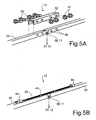
- FIGS 5A , 5B show in perspective exploded view two embodiments of the locking device 13 for fixing the central hinge 06 or the secondary hinges 11 in the fully open position.
- the FIG. 5A shows the already mentioned above embodiment with the guide plate 32 and the bolt 33 in detail.
- the guide plate 32 is angled twice in the thickness of the frame 03 and is pushed against the folding direction 07, 12 in the region of the central hinge 06 or the secondary hinges 11 on the frame 03 .
- the determination of the guide plate 32 via the guided through the frame 03 through holes 46 bolts 33 which are secured with nuts 41 .
- the FIG. 5B shows an embodiment which is also suitable for receiving stronger forces with a larger dimensioning of the device 01.
- a steel rod 42 is placed against the folding direction 07 , 12 via the central hinge 06 or the secondary hinges 11 , which is fixed in holding eyes 43 on the frame 03 .
- this has an end plate 44 at one end.
- a further end plate 44 is screwed by means of a locking nut 45 after pushing through the steel rod 42 through the holding eyes 43 .
- a corresponding length measurement of the steel rod 42 and the central hinge 06 and the secondary hinges 11 can be fixed simultaneously.
- the central hinge 06 and / or the secondary hinges 11 can be fixed by the locking device 13 in other angles, which are smaller than the fully extended angle.
- FIG. 6 Finally, the application of several device 01 according to the invention in unfolded form for even waterbed 02 with a connection of the buoyant body 19 via a fastening cable 47 to the tower 48 of a wind turbine.
- This application shows that the device 01 according to the invention is particularly well suited to enable sustainable and simple harvesting of benthic animals, in particular crabs and lobsters, by providing artificial reefs in difficult to access areas.
Landscapes
- Life Sciences & Earth Sciences (AREA)
- Environmental Sciences (AREA)
- Animal Husbandry (AREA)
- Biodiversity & Conservation Biology (AREA)
- Marine Sciences & Fisheries (AREA)
- Zoology (AREA)
- Catching Or Destruction (AREA)
- Tents Or Canopies (AREA)
Applications Claiming Priority (2)
| Application Number | Priority Date | Filing Date | Title |
|---|---|---|---|
| DE102009049083A DE102009049083B3 (de) | 2009-10-07 | 2009-10-07 | Transportierbare Vorrichtung zur Ansiedlung und Erntung von wirbellosen Tieren und Anwendung davon |
| PCT/DE2010/001146 WO2011042003A1 (de) | 2009-10-07 | 2010-09-24 | Transportierbare vorrichtung zur ansiedlung und erntung von wirbellosen tieren und anwendung davon |
Publications (2)
| Publication Number | Publication Date |
|---|---|
| EP2485582A1 EP2485582A1 (de) | 2012-08-15 |
| EP2485582B1 true EP2485582B1 (de) | 2013-10-23 |
Family
ID=43507448
Family Applications (1)
| Application Number | Title | Priority Date | Filing Date |
|---|---|---|---|
| EP10779675.7A Active EP2485582B1 (de) | 2009-10-07 | 2010-09-24 | Transportierbare vorrichtung zur ansiedlung und erntung von wirbellosen tieren und anwendung davon |
Country Status (6)
| Country | Link |
|---|---|
| US (1) | US8291863B2 (da) |
| EP (1) | EP2485582B1 (da) |
| CA (1) | CA2764735C (da) |
| DE (1) | DE102009049083B3 (da) |
| DK (1) | DK2485582T3 (da) |
| WO (1) | WO2011042003A1 (da) |
Families Citing this family (18)
| Publication number | Priority date | Publication date | Assignee | Title |
|---|---|---|---|---|
| JP5610296B2 (ja) * | 2011-02-09 | 2014-10-22 | 義裕 藤芳 | 二枚貝等の底棲生物の多段式養殖装置及び養殖方法並びにこれを用いたバイオフィルター |
| CN103168729A (zh) * | 2013-03-01 | 2013-06-26 | 大连海洋大学 | 海底人工鱼礁移动方法及装置 |
| WO2015175975A1 (en) | 2014-05-15 | 2015-11-19 | Coastal Environments, Incorporated | Apparatus facilitating formation of a vertical oyster reef and shoreline rehabilitation with induced oyster reef barrier and lagoon implementing the same |
| CN104181009B (zh) * | 2014-08-13 | 2017-09-26 | 张�浩 | 一种底栖动物采集定量框 |
| CN104782534A (zh) * | 2015-02-09 | 2015-07-22 | 大连海洋大学 | 一种高成活率的中间球海胆运输方法 |
| AU2016229172B2 (en) * | 2015-03-06 | 2020-10-01 | The University Of North Carolina At Chapel Hill | Ephemeral substrates for oyster aquaculture |
| CN105284687A (zh) * | 2015-11-12 | 2016-02-03 | 浙江海洋学院 | 一种人工海藻礁 |
| CN106973836A (zh) * | 2017-04-24 | 2017-07-25 | 中国电建集团贵阳勘测设计研究院有限公司 | 一种底栖和穴居性鱼类栖息隐蔽装置 |
| US12396441B2 (en) * | 2018-02-12 | 2025-08-26 | David Fries | Biomimetic sentinel reef structures for optical sensing and communications |
| US11877563B2 (en) * | 2018-02-12 | 2024-01-23 | David Fries | Biomimetic sentinel reef structures for optical sensing and communications |
| WO2020055980A1 (en) | 2018-09-11 | 2020-03-19 | Coastal Environments, Incorporated | Concrete wave attenuating apparatus and an assembly thereof |
| JP2023526226A (ja) * | 2020-05-11 | 2023-06-21 | ランニング タイド テクノロジーズ,インコーポレイテッド | 標的産物を養殖するためのシステム及び方法 |
| CN111972367B (zh) * | 2020-08-14 | 2022-04-19 | 鹏城实验室 | 可折展的仿生嘴和捕获设备 |
| EP4409482A1 (en) | 2021-10-01 | 2024-08-07 | Running Tide Technologies, Inc. | Systems and methods for quantifying and/or verifying ocean-based interventions for sequestering carbon dioxide |
| JP2025500018A (ja) | 2021-11-11 | 2025-01-07 | ランニング タイド テクノロジーズ,インコーポレイテッド | 海洋ベースの二酸化炭素除去デバイス及び標的プロダクトの蓄積を監視するためのシステム及び方法 |
| CN114568396B (zh) * | 2022-03-09 | 2023-03-21 | 湖南省水产科学研究所 | 一种稻田小龙虾采收起捕装置 |
| CN117337810A (zh) * | 2023-11-02 | 2024-01-05 | 山东省淡水渔业研究院(山东省淡水渔业监测中心) | 一种南北白对虾ras养殖池专用捕捞组件 |
| CN119631952A (zh) * | 2025-02-19 | 2025-03-18 | 山东长龙海洋生物科技有限公司 | 一种贝类自收集养殖装置 |
Family Cites Families (16)
| Publication number | Priority date | Publication date | Assignee | Title |
|---|---|---|---|---|
| US401994A (en) | 1889-04-23 | Disk harrow and cultivator | ||
| US954283A (en) * | 1908-01-17 | 1910-04-05 | Frederick W Hawkes | Revetment. |
| US2821047A (en) | 1956-04-20 | 1958-01-28 | Ignacio L Ruiz | Combination crab trap and net |
| US3985101A (en) * | 1973-01-07 | 1976-10-12 | Thompson Jerome C | Marine organism rearing system |
| US3950885A (en) | 1974-09-10 | 1976-04-20 | Samuel Simeti | Molded one-piece plastic crab trap with integral outwardly biased hinge elements |
| FR2345914A1 (fr) * | 1976-03-30 | 1977-10-28 | Besseiches Jean | Dispositif de fermeture instantanee a montage rapide pour poches ostreicoles |
| US4736708A (en) * | 1986-11-10 | 1988-04-12 | Yoder Daniel C | Portable habitat and havesting apparatus for stone crabs, lobster and crayfish |
| US5201136A (en) * | 1990-01-23 | 1993-04-13 | Lamorte David L | Artificial fish habitat structures |
| US4982525A (en) * | 1990-07-05 | 1991-01-08 | Miller James S | Collapsible lobster or crab trap |
| US5109796A (en) * | 1991-07-17 | 1992-05-05 | Alfred R. Priest | Fish habitat structure |
| US5269254A (en) * | 1992-07-06 | 1993-12-14 | Gagliano Sherwood M | Method and apparatus for growing oyster reef |
| US5457910A (en) * | 1993-05-12 | 1995-10-17 | Fillios; Jean-Pierre R. | Shelter-trap for crustaceans |
| USD401994S (en) * | 1997-09-09 | 1998-12-01 | Whalley Steven A | Collapsible crab trap |
| DE10161174C1 (de) * | 2001-12-13 | 2003-06-12 | Peter Van Treeck | Aquakulturzuchteinheit |
| DE20310089U1 (de) | 2003-07-01 | 2004-12-02 | Wobben, Aloys | Windenergieanlage |
| GB0625899D0 (en) * | 2006-12-23 | 2007-02-07 | Navital Uk Ltd | Apparatus for the cultivation of shellfish |
-
2009
- 2009-10-07 DE DE102009049083A patent/DE102009049083B3/de not_active Expired - Fee Related
-
2010
- 2010-09-24 CA CA2764735A patent/CA2764735C/en not_active Expired - Fee Related
- 2010-09-24 DK DK10779675.7T patent/DK2485582T3/da active
- 2010-09-24 WO PCT/DE2010/001146 patent/WO2011042003A1/de not_active Ceased
- 2010-09-24 EP EP10779675.7A patent/EP2485582B1/de active Active
- 2010-09-24 US US13/500,369 patent/US8291863B2/en not_active Expired - Fee Related
Also Published As
| Publication number | Publication date |
|---|---|
| EP2485582A1 (de) | 2012-08-15 |
| DE102009049083B3 (de) | 2011-03-10 |
| US20120199078A1 (en) | 2012-08-09 |
| CA2764735C (en) | 2013-09-17 |
| WO2011042003A1 (de) | 2011-04-14 |
| DK2485582T3 (da) | 2014-01-13 |
| CA2764735A1 (en) | 2011-04-14 |
| US8291863B2 (en) | 2012-10-23 |
Similar Documents
| Publication | Publication Date | Title |
|---|---|---|
| EP2485582B1 (de) | Transportierbare vorrichtung zur ansiedlung und erntung von wirbellosen tieren und anwendung davon | |
| DE102004010652B4 (de) | Trägervorrichtung zur Kultur von Makroorganismen in marinen Gewässern | |
| CN101052297B (zh) | 有鳍鱼类水产养殖业所用的圈养围栏 | |
| DE3821327C2 (da) | ||
| DE102009058278B3 (de) | Vorrichtung zur Ansiedelung und Erntung von marinen Hartbodentieren | |
| DE2522948A1 (de) | Fischzuchtvorrichtung | |
| DE2722747A1 (de) | Verfahren zur errichtung einer offshore-plattform sowie offshore-plattform | |
| NZ552980A (en) | Foldable fish-trap | |
| DE102010049049B3 (de) | Künstliches Habitat in Polyederform für Krebstiere auf marinen Weichböden und Anwendung | |
| CN113057147B (zh) | 一种龙虾捕捞装置 | |
| PT1806964E (pt) | Jaulas de confinamento para aquacultura de peixes | |
| DE4324449A1 (de) | Reuse, insbesondere Fischreuse | |
| DE102008057515A1 (de) | System, Technologie, Funktion und Verfahren von mobilen und versenkbaren Fischkäfigen für das offene Meer | |
| DE60122887T2 (de) | Anlage zur meeresfischzucht | |
| AU2017371479A1 (en) | Collapsible fishing trap and a method of its use | |
| DE102016103201A1 (de) | Schwimmende Struktur | |
| DE102023108355B3 (de) | Lineares Großgehege für Binnenaquakultur | |
| KR100382788B1 (ko) | 활어 포획용 어구 | |
| EP4360454B1 (de) | Habitat für reptilien und/oder amphibien und/oder arten der wirbellosen tiere, umfassend einen ein aufnahmevolumen definierenden portablen aufnahmekörper | |
| DE102022110961B3 (de) | Vorrichtung zur Untersuchung von Umwelteinflüssen auf einen Gewässerboden | |
| DE3718287A1 (de) | Netz- oder foliengehege | |
| KR200271829Y1 (ko) | 착저 채롱식 가두리 양식 장치 | |
| DE202009013011U1 (de) | Kescheranordnung | |
| DE2532523B2 (de) | Vorrichtung zum Fangen von Bisamratten und artverwandten Tieren | |
| EP4230034A1 (de) | Tragbare transportvorrichtung zum lebendtransport von marinen organismen und anwendungen davon |
Legal Events
| Date | Code | Title | Description |
|---|---|---|---|
| PUAI | Public reference made under article 153(3) epc to a published international application that has entered the european phase |
Free format text: ORIGINAL CODE: 0009012 |
|
| 17P | Request for examination filed |
Effective date: 20111207 |
|
| AK | Designated contracting states |
Kind code of ref document: A1 Designated state(s): AL AT BE BG CH CY CZ DE DK EE ES FI FR GB GR HR HU IE IS IT LI LT LU LV MC MK MT NL NO PL PT RO SE SI SK SM TR |
|
| DAX | Request for extension of the european patent (deleted) | ||
| GRAP | Despatch of communication of intention to grant a patent |
Free format text: ORIGINAL CODE: EPIDOSNIGR1 |
|
| INTG | Intention to grant announced |
Effective date: 20130801 |
|
| GRAS | Grant fee paid |
Free format text: ORIGINAL CODE: EPIDOSNIGR3 |
|
| GRAA | (expected) grant |
Free format text: ORIGINAL CODE: 0009210 |
|
| AK | Designated contracting states |
Kind code of ref document: B1 Designated state(s): AL AT BE BG CH CY CZ DE DK EE ES FI FR GB GR HR HU IE IS IT LI LT LU LV MC MK MT NL NO PL PT RO SE SI SK SM TR |
|
| REG | Reference to a national code |
Ref country code: GB Ref legal event code: FG4D Free format text: NOT ENGLISH |
|
| REG | Reference to a national code |
Ref country code: CH Ref legal event code: EP |
|
| REG | Reference to a national code |
Ref country code: AT Ref legal event code: REF Ref document number: 637035 Country of ref document: AT Kind code of ref document: T Effective date: 20131115 |
|
| REG | Reference to a national code |
Ref country code: IE Ref legal event code: FG4D Free format text: LANGUAGE OF EP DOCUMENT: GERMAN |
|
| REG | Reference to a national code |
Ref country code: DE Ref legal event code: R096 Ref document number: 502010005180 Country of ref document: DE Effective date: 20131219 |
|
| REG | Reference to a national code |
Ref country code: DK Ref legal event code: T3 Effective date: 20140106 |
|
| REG | Reference to a national code |
Ref country code: NL Ref legal event code: VDEP Effective date: 20131023 |
|
| REG | Reference to a national code |
Ref country code: LT Ref legal event code: MG4D |
|
| PG25 | Lapsed in a contracting state [announced via postgrant information from national office to epo] |
Ref country code: IS Free format text: LAPSE BECAUSE OF FAILURE TO SUBMIT A TRANSLATION OF THE DESCRIPTION OR TO PAY THE FEE WITHIN THE PRESCRIBED TIME-LIMIT Effective date: 20140223 Ref country code: NL Free format text: LAPSE BECAUSE OF FAILURE TO SUBMIT A TRANSLATION OF THE DESCRIPTION OR TO PAY THE FEE WITHIN THE PRESCRIBED TIME-LIMIT Effective date: 20131023 Ref country code: NO Free format text: LAPSE BECAUSE OF FAILURE TO SUBMIT A TRANSLATION OF THE DESCRIPTION OR TO PAY THE FEE WITHIN THE PRESCRIBED TIME-LIMIT Effective date: 20140123 Ref country code: HR Free format text: LAPSE BECAUSE OF FAILURE TO SUBMIT A TRANSLATION OF THE DESCRIPTION OR TO PAY THE FEE WITHIN THE PRESCRIBED TIME-LIMIT Effective date: 20131023 Ref country code: FI Free format text: LAPSE BECAUSE OF FAILURE TO SUBMIT A TRANSLATION OF THE DESCRIPTION OR TO PAY THE FEE WITHIN THE PRESCRIBED TIME-LIMIT Effective date: 20131023 Ref country code: LT Free format text: LAPSE BECAUSE OF FAILURE TO SUBMIT A TRANSLATION OF THE DESCRIPTION OR TO PAY THE FEE WITHIN THE PRESCRIBED TIME-LIMIT Effective date: 20131023 Ref country code: SE Free format text: LAPSE BECAUSE OF FAILURE TO SUBMIT A TRANSLATION OF THE DESCRIPTION OR TO PAY THE FEE WITHIN THE PRESCRIBED TIME-LIMIT Effective date: 20131023 |
|
| PG25 | Lapsed in a contracting state [announced via postgrant information from national office to epo] |
Ref country code: ES Free format text: LAPSE BECAUSE OF FAILURE TO SUBMIT A TRANSLATION OF THE DESCRIPTION OR TO PAY THE FEE WITHIN THE PRESCRIBED TIME-LIMIT Effective date: 20131023 Ref country code: CY Free format text: LAPSE BECAUSE OF FAILURE TO SUBMIT A TRANSLATION OF THE DESCRIPTION OR TO PAY THE FEE WITHIN THE PRESCRIBED TIME-LIMIT Effective date: 20131023 Ref country code: LV Free format text: LAPSE BECAUSE OF FAILURE TO SUBMIT A TRANSLATION OF THE DESCRIPTION OR TO PAY THE FEE WITHIN THE PRESCRIBED TIME-LIMIT Effective date: 20131023 |
|
| PG25 | Lapsed in a contracting state [announced via postgrant information from national office to epo] |
Ref country code: PT Free format text: LAPSE BECAUSE OF FAILURE TO SUBMIT A TRANSLATION OF THE DESCRIPTION OR TO PAY THE FEE WITHIN THE PRESCRIBED TIME-LIMIT Effective date: 20140224 |
|
| REG | Reference to a national code |
Ref country code: DE Ref legal event code: R097 Ref document number: 502010005180 Country of ref document: DE |
|
| PG25 | Lapsed in a contracting state [announced via postgrant information from national office to epo] |
Ref country code: EE Free format text: LAPSE BECAUSE OF FAILURE TO SUBMIT A TRANSLATION OF THE DESCRIPTION OR TO PAY THE FEE WITHIN THE PRESCRIBED TIME-LIMIT Effective date: 20131023 |
|
| PG25 | Lapsed in a contracting state [announced via postgrant information from national office to epo] |
Ref country code: RO Free format text: LAPSE BECAUSE OF FAILURE TO SUBMIT A TRANSLATION OF THE DESCRIPTION OR TO PAY THE FEE WITHIN THE PRESCRIBED TIME-LIMIT Effective date: 20131023 Ref country code: SK Free format text: LAPSE BECAUSE OF FAILURE TO SUBMIT A TRANSLATION OF THE DESCRIPTION OR TO PAY THE FEE WITHIN THE PRESCRIBED TIME-LIMIT Effective date: 20131023 Ref country code: PL Free format text: LAPSE BECAUSE OF FAILURE TO SUBMIT A TRANSLATION OF THE DESCRIPTION OR TO PAY THE FEE WITHIN THE PRESCRIBED TIME-LIMIT Effective date: 20131023 Ref country code: IT Free format text: LAPSE BECAUSE OF FAILURE TO SUBMIT A TRANSLATION OF THE DESCRIPTION OR TO PAY THE FEE WITHIN THE PRESCRIBED TIME-LIMIT Effective date: 20131023 Ref country code: CZ Free format text: LAPSE BECAUSE OF FAILURE TO SUBMIT A TRANSLATION OF THE DESCRIPTION OR TO PAY THE FEE WITHIN THE PRESCRIBED TIME-LIMIT Effective date: 20131023 |
|
| PLBE | No opposition filed within time limit |
Free format text: ORIGINAL CODE: 0009261 |
|
| STAA | Information on the status of an ep patent application or granted ep patent |
Free format text: STATUS: NO OPPOSITION FILED WITHIN TIME LIMIT |
|
| 26N | No opposition filed |
Effective date: 20140724 |
|
| REG | Reference to a national code |
Ref country code: DE Ref legal event code: R097 Ref document number: 502010005180 Country of ref document: DE Effective date: 20140724 |
|
| REG | Reference to a national code |
Ref country code: NL Ref legal event code: RD1H Effective date: 20150123 |
|
| PG25 | Lapsed in a contracting state [announced via postgrant information from national office to epo] |
Ref country code: SI Free format text: LAPSE BECAUSE OF FAILURE TO SUBMIT A TRANSLATION OF THE DESCRIPTION OR TO PAY THE FEE WITHIN THE PRESCRIBED TIME-LIMIT Effective date: 20131023 |
|
| PG25 | Lapsed in a contracting state [announced via postgrant information from national office to epo] |
Ref country code: LU Free format text: LAPSE BECAUSE OF FAILURE TO SUBMIT A TRANSLATION OF THE DESCRIPTION OR TO PAY THE FEE WITHIN THE PRESCRIBED TIME-LIMIT Effective date: 20140924 Ref country code: MC Free format text: LAPSE BECAUSE OF FAILURE TO SUBMIT A TRANSLATION OF THE DESCRIPTION OR TO PAY THE FEE WITHIN THE PRESCRIBED TIME-LIMIT Effective date: 20131023 |
|
| REG | Reference to a national code |
Ref country code: CH Ref legal event code: PL |
|
| REG | Reference to a national code |
Ref country code: IE Ref legal event code: MM4A |
|
| PG25 | Lapsed in a contracting state [announced via postgrant information from national office to epo] |
Ref country code: BE Free format text: LAPSE BECAUSE OF NON-PAYMENT OF DUE FEES Effective date: 20140930 |
|
| PG25 | Lapsed in a contracting state [announced via postgrant information from national office to epo] |
Ref country code: CH Free format text: LAPSE BECAUSE OF NON-PAYMENT OF DUE FEES Effective date: 20140930 Ref country code: LI Free format text: LAPSE BECAUSE OF NON-PAYMENT OF DUE FEES Effective date: 20140930 |
|
| REG | Reference to a national code |
Ref country code: NL Ref legal event code: RD2H Effective date: 20150223 |
|
| PG25 | Lapsed in a contracting state [announced via postgrant information from national office to epo] |
Ref country code: IE Free format text: LAPSE BECAUSE OF NON-PAYMENT OF DUE FEES Effective date: 20140924 |
|
| REG | Reference to a national code |
Ref country code: FR Ref legal event code: PLFP Year of fee payment: 6 |
|
| REG | Reference to a national code |
Ref country code: FR Ref legal event code: CD Owner name: ALFRED-WEGENER-INSTITUT, HELMHOLTZ-ZENTRUM FUE, DE Effective date: 20151119 |
|
| PG25 | Lapsed in a contracting state [announced via postgrant information from national office to epo] |
Ref country code: SM Free format text: LAPSE BECAUSE OF FAILURE TO SUBMIT A TRANSLATION OF THE DESCRIPTION OR TO PAY THE FEE WITHIN THE PRESCRIBED TIME-LIMIT Effective date: 20131023 |
|
| PG25 | Lapsed in a contracting state [announced via postgrant information from national office to epo] |
Ref country code: MT Free format text: LAPSE BECAUSE OF FAILURE TO SUBMIT A TRANSLATION OF THE DESCRIPTION OR TO PAY THE FEE WITHIN THE PRESCRIBED TIME-LIMIT Effective date: 20131023 Ref country code: BG Free format text: LAPSE BECAUSE OF FAILURE TO SUBMIT A TRANSLATION OF THE DESCRIPTION OR TO PAY THE FEE WITHIN THE PRESCRIBED TIME-LIMIT Effective date: 20131023 Ref country code: GR Free format text: LAPSE BECAUSE OF FAILURE TO SUBMIT A TRANSLATION OF THE DESCRIPTION OR TO PAY THE FEE WITHIN THE PRESCRIBED TIME-LIMIT Effective date: 20140124 |
|
| PG25 | Lapsed in a contracting state [announced via postgrant information from national office to epo] |
Ref country code: TR Free format text: LAPSE BECAUSE OF FAILURE TO SUBMIT A TRANSLATION OF THE DESCRIPTION OR TO PAY THE FEE WITHIN THE PRESCRIBED TIME-LIMIT Effective date: 20131023 Ref country code: HU Free format text: LAPSE BECAUSE OF FAILURE TO SUBMIT A TRANSLATION OF THE DESCRIPTION OR TO PAY THE FEE WITHIN THE PRESCRIBED TIME-LIMIT; INVALID AB INITIO Effective date: 20100924 |
|
| REG | Reference to a national code |
Ref country code: FR Ref legal event code: PLFP Year of fee payment: 7 |
|
| PGFP | Annual fee paid to national office [announced via postgrant information from national office to epo] |
Ref country code: DK Payment date: 20160819 Year of fee payment: 7 Ref country code: DE Payment date: 20160816 Year of fee payment: 7 Ref country code: GB Payment date: 20160912 Year of fee payment: 7 |
|
| REG | Reference to a national code |
Ref country code: AT Ref legal event code: MM01 Ref document number: 637035 Country of ref document: AT Kind code of ref document: T Effective date: 20150924 |
|
| PGFP | Annual fee paid to national office [announced via postgrant information from national office to epo] |
Ref country code: FR Payment date: 20160908 Year of fee payment: 7 |
|
| PG25 | Lapsed in a contracting state [announced via postgrant information from national office to epo] |
Ref country code: AT Free format text: LAPSE BECAUSE OF NON-PAYMENT OF DUE FEES Effective date: 20150924 |
|
| REG | Reference to a national code |
Ref country code: DE Ref legal event code: R119 Ref document number: 502010005180 Country of ref document: DE |
|
| REG | Reference to a national code |
Ref country code: DK Ref legal event code: EBP Effective date: 20170930 |
|
| GBPC | Gb: european patent ceased through non-payment of renewal fee |
Effective date: 20170924 |
|
| PG25 | Lapsed in a contracting state [announced via postgrant information from national office to epo] |
Ref country code: MK Free format text: LAPSE BECAUSE OF FAILURE TO SUBMIT A TRANSLATION OF THE DESCRIPTION OR TO PAY THE FEE WITHIN THE PRESCRIBED TIME-LIMIT Effective date: 20131023 |
|
| REG | Reference to a national code |
Ref country code: FR Ref legal event code: ST Effective date: 20180531 |
|
| PG25 | Lapsed in a contracting state [announced via postgrant information from national office to epo] |
Ref country code: DE Free format text: LAPSE BECAUSE OF NON-PAYMENT OF DUE FEES Effective date: 20180404 Ref country code: GB Free format text: LAPSE BECAUSE OF NON-PAYMENT OF DUE FEES Effective date: 20170924 |
|
| PG25 | Lapsed in a contracting state [announced via postgrant information from national office to epo] |
Ref country code: FR Free format text: LAPSE BECAUSE OF NON-PAYMENT OF DUE FEES Effective date: 20171002 |
|
| PG25 | Lapsed in a contracting state [announced via postgrant information from national office to epo] |
Ref country code: AL Free format text: LAPSE BECAUSE OF FAILURE TO SUBMIT A TRANSLATION OF THE DESCRIPTION OR TO PAY THE FEE WITHIN THE PRESCRIBED TIME-LIMIT Effective date: 20131023 |
|
| PG25 | Lapsed in a contracting state [announced via postgrant information from national office to epo] |
Ref country code: DK Free format text: LAPSE BECAUSE OF NON-PAYMENT OF DUE FEES Effective date: 20170930 |