EP2482035A2 - Elektronische Systeme zum Orten von Objekten - Google Patents
Elektronische Systeme zum Orten von Objekten Download PDFInfo
- Publication number
- EP2482035A2 EP2482035A2 EP20120152092 EP12152092A EP2482035A2 EP 2482035 A2 EP2482035 A2 EP 2482035A2 EP 20120152092 EP20120152092 EP 20120152092 EP 12152092 A EP12152092 A EP 12152092A EP 2482035 A2 EP2482035 A2 EP 2482035A2
- Authority
- EP
- European Patent Office
- Prior art keywords
- orientation
- sections
- pmr
- calculated
- distance
- Prior art date
- Legal status (The legal status is an assumption and is not a legal conclusion. Google has not performed a legal analysis and makes no representation as to the accuracy of the status listed.)
- Withdrawn
Links
- 238000012545 processing Methods 0.000 claims description 28
- 238000000034 method Methods 0.000 claims description 18
- 230000015654 memory Effects 0.000 claims description 9
- 230000008859 change Effects 0.000 claims description 8
- YCLAMANSVUJYPT-UHFFFAOYSA-L aluminum chloride hydroxide hydrate Chemical compound O.[OH-].[Al+3].[Cl-] YCLAMANSVUJYPT-UHFFFAOYSA-L 0.000 description 25
- 230000033001 locomotion Effects 0.000 description 11
- 238000010586 diagram Methods 0.000 description 4
- 238000004891 communication Methods 0.000 description 3
- 238000012986 modification Methods 0.000 description 3
- 230000004048 modification Effects 0.000 description 3
- 238000005516 engineering process Methods 0.000 description 2
- 230000008569 process Effects 0.000 description 2
- 238000007792 addition Methods 0.000 description 1
- 230000005540 biological transmission Effects 0.000 description 1
- 238000012937 correction Methods 0.000 description 1
- 230000003287 optical effect Effects 0.000 description 1
- 230000004044 response Effects 0.000 description 1
- 239000000126 substance Substances 0.000 description 1
- 238000006467 substitution reaction Methods 0.000 description 1
- 238000012546 transfer Methods 0.000 description 1
Images



Classifications
-
- G—PHYSICS
- G01—MEASURING; TESTING
- G01C—MEASURING DISTANCES, LEVELS OR BEARINGS; SURVEYING; NAVIGATION; GYROSCOPIC INSTRUMENTS; PHOTOGRAMMETRY OR VIDEOGRAMMETRY
- G01C21/00—Navigation; Navigational instruments not provided for in groups G01C1/00 - G01C19/00
- G01C21/38—Electronic maps specially adapted for navigation; Updating thereof
- G01C21/3863—Structures of map data
- G01C21/387—Organisation of map data, e.g. version management or database structures
- G01C21/3874—Structures specially adapted for data searching and retrieval
-
- G—PHYSICS
- G01—MEASURING; TESTING
- G01C—MEASURING DISTANCES, LEVELS OR BEARINGS; SURVEYING; NAVIGATION; GYROSCOPIC INSTRUMENTS; PHOTOGRAMMETRY OR VIDEOGRAMMETRY
- G01C21/00—Navigation; Navigational instruments not provided for in groups G01C1/00 - G01C19/00
- G01C21/10—Navigation; Navigational instruments not provided for in groups G01C1/00 - G01C19/00 by using measurements of speed or acceleration
- G01C21/12—Navigation; Navigational instruments not provided for in groups G01C1/00 - G01C19/00 by using measurements of speed or acceleration executed aboard the object being navigated; Dead reckoning
-
- G—PHYSICS
- G01—MEASURING; TESTING
- G01C—MEASURING DISTANCES, LEVELS OR BEARINGS; SURVEYING; NAVIGATION; GYROSCOPIC INSTRUMENTS; PHOTOGRAMMETRY OR VIDEOGRAMMETRY
- G01C21/00—Navigation; Navigational instruments not provided for in groups G01C1/00 - G01C19/00
- G01C21/26—Navigation; Navigational instruments not provided for in groups G01C1/00 - G01C19/00 specially adapted for navigation in a road network
- G01C21/28—Navigation; Navigational instruments not provided for in groups G01C1/00 - G01C19/00 specially adapted for navigation in a road network with correlation of data from several navigational instruments
- G01C21/30—Map- or contour-matching
Definitions
- a conventional inertial navigation system includes a dead reckoning (DR) system for calculating a position and an orientation of a moving object according to motion tracking information.
- the DR system can obtain the motion tracking information from a motion sensor such as a gyroscope and a milemeter.
- a motion sensor such as a gyroscope and a milemeter.
- the gyroscope and the milemeter can introduce errors that reduce the accuracy of the calculated position and orientation of the moving object.
- a database for a set of orientation-matched road (OMR) sections is searched according to a calculated orientation of an object and orientations of road sections stored in the database.
- the OMR sections are searched for a position-matched road (PMR) set according to a calculated position of the object and positions of the OMR sections.
- the PMR set includes one or more PMR sections.
- the object is located using the PMR set.
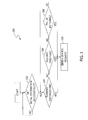
- FIG. 1 illustrates a block diagram of an example of a positioning system, in accordance with one embodiment of the present invention.
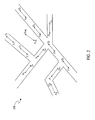
- FIG. 2 illustrates a diagram of part of an example of a map, in accordance with one embodiment of the present invention.
- FIG. 3 illustrates a flowchart of examples of operations performed by a positioning system, in accordance with one embodiment of the present invention.
- FIG. 4 illustrates a flowchart of examples of operations performed by a positioning system, in accordance with one embodiment of the present invention.
- FIG. 5 illustrates a flowchart of examples of operations performed by a positioning system, in accordance with one embodiment of the present invention.
- FIG. 6 illustrates a flowchart of examples of operations performed by a positioning system, in accordance with one embodiment of the present invention.
- Embodiments described herein may be discussed in the general context of computer-executable instructions residing on some form of computer-usable medium, such as program modules, executed by one or more computers or other devices.
- program modules include routines, programs, objects, components, data structures, etc., that perform particular tasks or implement particular abstract data types.
- the functionality of the program modules may be combined or distributed as desired in various embodiments.
- Computer-usable media may comprise computer storage media and communication media.
- Computer storage media includes volatile and nonvolatile, removable and non-removable media implemented in any method or technology for storage of information such as computer-readable instructions, data structures, program modules or other data.
- Computer storage media includes, but is not limited to, random access memory (RAM), read only memory (ROM), electrically erasable programmable ROM (EEPROM), flash memory or other memory technology, compact disk ROM (CD-ROM), digital versatile disks (DVDs) or other optical storage, magnetic cassettes, magnetic tape, magnetic disk storage or other magnetic storage devices, or any other medium that can be used to store the desired information.
- Communication media can embody computer-readable instructions, data structures, program modules or other data and includes any information delivery media.
- communication media includes wired media such as a wired network or direct-wired connection, and wireless media such as acoustic, radio frequency (RF), infrared and other wireless media. Combinations of any of the above should also be included within the scope of computer-readable media.
- the present invention provides a positioning system for locating a moving object.
- the positioning system calculates a position of the moving object and an orientation of the moving object, and compares the calculated position and orientation with information about road sections on an electronic map.
- the positioning system further selects a matched reference road section from the road sections on the electronic map, and corrects the calculated position and the calculated orientation based on the matched reference road section.
- FIG. 1 illustrates a block diagram of an example of a positioning system 100, e.g., an inertial navigation system/global positioning system (INS/GPS), in accordance with one embodiment of the present invention.
- the positioning system 100 includes a map system 102 and a position calculation system 112.
- the position calculation system 112 can calculate a position of a moving object (not shown), e.g., a vehicle.
- the position calculation system 112 can receive GPS signals from satellites (not shown) and calculate a current position of the moving object according to the GPS signals. If the GPS signals are too weak to be received, the position calculation system 112 can also calculate a current position of the moving object according to an initial position of the moving object and a motion track of the moving object.
- the position calculation system 112 can correct the calculated position of the moving object according to reference information from the map system 102.
- the map system 102 stores a navigation map that includes information about road sections.
- a navigation map includes multiple roads, and each road is divided into several sections.
- Each section of the road e.g., referred to as road section, has an orientation and a position.
- the map system 102 can store the orientation and position information of road sections on the navigation map.
- the map system 102 can receive the calculated or corrected position information of the moving object from the position calculation system 112 and display the position of the moving object on the navigation map.
- the map system 102 can further search the navigation map for reference information, and provide the reference information to the position calculation system 112.
- the map system 102 includes a map information storage unit 104, a processing unit 106, and memory 108.
- the map information storage unit 104 stores a database that includes information for a navigation map, e.g., position information and orientation information about road sections.
- the memory 108 stores computer-executable software, e.g., computer-readable instructions.
- the processing unit 106 executes the computer-executable software, e.g., the computer-readable instructions, such that the processing unit 106 searches the map information database for a set of orientation-matched road (OMR) sections according to a calculated orientation O CAL of the moving object and orientations O RS of road sections stored in the map information database.
- OMR orientation-matched road
- the processing unit 106 also executes the computer-executable software, e.g., the computer-readable instructions, such that the processing unit 106 searches the OMR sections for a position-matched road (PMR) set according to a calculated position P CAL of the moving object and positions P RS of the OMR sections.
- the PMR set includes one or more PMR sections and is used to locate the moving object.
- the processing unit 106 searches for the OMR sections by comparing a difference ⁇ DIF between the calculated orientation O CAL of the moving object and the orientation O RS of each road section stored in the map information database with an orientation offset reference ⁇ REF . If the difference ⁇ DIF between the calculated orientation O CAL and an orientation O RS of a road section is less than the orientation offset reference ⁇ REF , e.g.
- the processing unit 106 also searches for one or more PMR sections by comparing a distance reference D REF with a distance D CRS from the calculated position P CAL of the moving object to each of the OMR sections. If the distance D CRS from the calculated position P CAL to an OMR section is less than the distance reference D REF , then that OMR section is a PMR section.
- the processing unit 106 increases the distance reference D REF to another value D' REF .
- the processing unit 106 re-searches the OMR sections for one or more PMR sections by comparing the distance reference D' REF with the distance D CRS from the calculated position P CAL of the moving object to each of the OMR sections.
- the distance reference D REF can be initially set to 10m.
- the processing unit 106 If the processing unit 106 cannot find any PMR section within 10m, the processing unit 106 increases the distance reference D REF to 30m, or 50m, or 70m, etc., and repeats the comparison until one or more PMR sections are found. In one embodiment, the distance reference D REF has a limit, e.g., 70m. If the processing unit 106 cannot find any PMR section within that limit, then the processing unit 106 can terminate the search. On the other hand, if one or more PMR sections are found, then the map system 102 provides information for the one or more PMR sections to the position calculation system 112.
- the position calculation system 112 includes a GPS module 118 and a processor 120 that includes a navigation aid module 114 and a dead reckoning (DR) module 116.
- the GPS module 118 can calculate the position of the moving object according to GPS signals if the GPS signals are strong enough.
- the DR module 116 can calculate the position of the moving object according to the initial position of the moving object and a motion track of the moving object if the GPS signals are not strong enough.
- the navigation aid module 114 can correct the position of the moving object that is calculated by the DR module 116.
- the GPS module 118 can receive GPS signals via an antenna 124 and calculate a position of the moving object according to the GPS signals.
- the GPS module 118 can provide the position information of the moving object to the map system 102 to display the position of the moving object on the navigation map.
- the GPS module 118 can also provide the position information for the moving object to the processor 120.
- the DR module 116 in the processor 120 can calculate a position P CAL of the moving object according to initial position information for the moving object, e.g. the position information provided by the GPS module 118 or position information pre-stored in the DR module 116, and according to the motion track of the moving object.
- the motion track includes the change in the orientation of the moving object and includes the running distance of the moving object.
- the motion track of the moving object can be sensed by a motion sensor 122, e.g., a gyroscope, a milemeter, etc.
- the DR module 116 can also calculate an orientation O CAL of movement of the moving object according to the motion track.
- An interface 110 coupled to the processor 120 can receive reference information from the map system 102 periodically, and can transfer the reference information to the processor 120.
- the reference information indicates a reference orientation O REF and a reference position P REF of a reference road section, shown on the navigation map, where the moving object is located.
- the processor 120 can further compare the calculated position P CAL and the calculated orientation O CAL with the reference orientation O REF and the reference position P REF , respectively.
- the processor 120 can request the map system 102 for the aforementioned one or more PMR sections.
- the processor 120 can receive information indicative of the one or more PMR sections via the interface 110 and use that information to correct the calculated orientation O CAL and the calculated position P CAL .
- FIG. 2 illustrates a diagram of part of an example of a map 200, in accordance with one embodiment of the present invention.
- FIG. 2 is described in combination with FIG. 1 .
- the map 200 includes multiple road sections. Each road section includes a position P 1 , P 2 , ... (shown as a dot) and an orientation O 1 , O 2 , ... (shown as an arrow).
- P CAL represents a position of the moving object calculated by the DR module 116
- O CAL represents an orientation of the moving object calculated by the DR module 116.
- the processor 120 generates a request to search the map system 102.
- the request includes an orientation O CAL and a position P CAL calculated by the DR module 116.
- the processing unit 106 in response to the request, searches the map 200 for a first set of OMR sections by comparing a difference between the calculated orientation O CAL and each orientation O 1 , O 2 , ... with an orientation offset reference ⁇ REF , e.g., 60°.
- an orientation offset reference ⁇ REF e.g. 60°.
- the differences between the calculated orientation O CAL and the orientations O 1 , O 2 , O 3 , O 4 , O 5 , O 6 , O 9 and O 10 are less than 60°, therefore the first set of OMR sections include road sections (P 1 , O 1 ), (P 2 , O 2 ), (P 3 , O 3 ), (P 4 , O 4 ), (P 5 , O 5 ), (P 6 , O 6 ), (P 9 , O 9 ) and (P 10 , O 10 ).
- the processing unit 106 further searches for one or more PMR sections by comparing a distance from the calculated position P CAL to each member of the first set of OMR sections with a distance reference D REF .
- the distance reference D REF can be initially set to 10m, for example.
- the processing unit 106 can then increase the distance reference D REF to 30m, for example.
- the processing unit 106 searches the first set of OMR sections for one or more PMR sections within 30m. If one or more PMR sections are found, the map system 102 provides information for the one or more PMR sections to the position calculation system 112; otherwise, the processing unit 106 increases the distance reference D REF again, e.g., to 50m.
- the processing unit 106 can increase the distance reference D REF step by step until one or more PMR sections are found. However, the distance reference D REF has a maximum limit, e.g., 70m. If no PMR section is found within the maximum limit, then the processing unit 106 terminates the search and may generate an output signal indicating failure.
- the map system 102 when one or more PMR sections are found, provides information for the PMR sections to the position calculation system 112.
- the processor 120 selects a matched reference road (MRR) section from the PMR sections according to a distance from the calculated position P CAL of the moving object to each member of the PMR sections and the total number of PMR sections.
- MRR matched reference road
- the distance from the calculated position P CAL to the position P 3 may be less than the distance reference D REF , while the distances from the calculated position P CAL to the other positions P 1 , P 2 , P 4 , P 57 P 6 , P 9 and P 10 may be greater than the distance reference D REF . Accordingly, only one PMR section, e.g., the road section (P 3 , O 3 ), is found.
- the navigation aid module 114 can use the road section (P 3 , O 3 ) as an MRR section, and correct the calculated position P CAL and the calculated orientation O CAL to the position P 3 and the orientation O 3 , respectively.
- the DR module 116 includes a register unit to store currently calculated information, e.g., position and orientation information, of the moving object.
- the navigation aid module 114 can erase the currently calculated information in the register unit and write the information indicative of the position P 3 and the orientation O 3 into the register unit.
- the distances from the calculated position P CAL to the positions P 3 and P 5 may be less than the distance reference D REF , while the distances from the calculated position P CAL to the other positions P 1 , P 2 , P 4 , P 6 , P 9 and P 10 may be greater than the distance reference D REF .
- two PMR sections e.g., the road sections (P 3 , O 3 ) and (P 5 , O 5 ), are found.
- the processor 120 can compare the distance
- the navigation aid module 114 selects the road section that has the shorter distance from the calculated position P CAL as an MRR section, e.g., the road section (P 3 , O 3 ), and corrects the calculated position P CAL and the calculated orientation O CAL according to the selected MRR section.
- the number of PMR sections may be greater than two.
- the processor 120 can discard the currently received information for the PMR sections.
- the processor 120 can generate a new search request when a predefined time interval expires or when a running distance of the moving object exceeds a preset reference.
- the new request includes a newly calculated orientation O' CAL and a newly calculated position P' CAL of the moving object.
- the processing unit 106 receives the new request and searches the database, e.g., the map 200, in the map information storage unit 104 for a second set of OMR sections based on the newly calculated orientation O' CAL .
- the processing unit 106 further searches the second set of OMR sections for one or more PMR sections based on the newly calculated position P' CAL .
- the processing unit 106 performs the search steps in a similar manner as described above.
- the positioning system 100 can reduce mistakes such as correcting the calculated position and the calculated orientation of the moving object using the wrong road section.
- FIG. 3 illustrates a flowchart 300 of examples of operations performed by the position calculation system 112, e.g., by the processor 120, in accordance with one embodiment of the present invention.
- FIG. 3 is described in combination with FIG. 1 .
- the processor 120 performs the flowchart 300 to send the map system 102 a request to search for one or more PMR sections (hereinafter, a search request).
- the processor 120 attempts to get initial information for the moving object.
- the initial information includes an initial position P INT of the moving object and an initial time t INT corresponding to the initial position P INT .
- the initial information for the moving object can be pre-stored in the DR module 116 or the navigation aid module 114.
- the GPS module 118 receives GPS signals
- the GPS module 118 generates position information for the moving object to the processor 120.
- the processor 120 can use the position information previously generated by the GPS module 118 as the initial position information.
- the processor 120 can also use position information previously calculated by the DR module 116 as the initial position information.
- the processor 120 can also uses position information previously corrected by the navigation aid module 114 as the initial position information.
- the processor 120 compares a running distance of the moving object with a preset reference, e.g., 10m.
- the running distance is the distance from the initial position P INT to a currently calculated position P CAL . If the running distance
- the processor 120 counts the running time of the moving object, measured from the initial time t INT to a current time t CUR . If the running time
- a preset time reference e.g. 3 minutes
- the processor 120 can receive reference information e.g., indicative of a reference orientation O REF and a reference position P REF , for a reference road section, shown on the navigation map, where the moving object is located.
- the processor 120 compares a currently calculated position P CAL of the moving object with the reference position P REF and compares a currently calculated orientation O CAL of the moving object with the reference orientation O REF .
- the processor 120 compares the distance from the currently calculated position P CAL to the reference position P REF with a predetermined distance threshold, e.g., 10m.
- the processor 120 compares the difference between the currently calculated orientation O CAL and the reference orientation O REF with a predetermined orientation threshold, e.g., 10°. If the difference
- a predetermined orientation threshold e.g. 10°.
- the processor 120 can send a search request to the map system 102 for various distance thresholds.
- the processor 120 can also send a search request to the map system 102 at various time intervals.
- the processor 120 also sends a search request to the map system 102.
- the map system 102 receives the search request and provides one or more PMR sections to the processor 120 to correct the calculated information for the moving object.
- FIG. 4 illustrates a flowchart 400 of examples of operations performed by the map system 102, in accordance with one embodiment of the present invention. FIG. 4 is described in combination with FIG. 1 and FIG. 2 . In one embodiment, the map system 102 performs the flowchart 400 to provide one or more PMR sections to the processor 120.
- the map system 102 detects a search request. If the map system 102 receives a search request, the map system 102 performs step 404 to search the database in the map information storage unit 104 for a set of OMR sections. At step 406, the map system 102 searches the OMR sections for one or more PMR sections. If one or more PMR sections are found, then the map system 102 provides the orientation information and the position information for the one or more PMR sections to the position calculation system 112. The map system 102 can perform the search for the OMR sections and the search for the one or more PMR sections in a manner similar to those described in relation to FIG. 1 and FIG. 2 .
- FIG. 5 illustrates a flowchart 500 of examples of operations performed by the position calculation system 112, in accordance with one embodiment of the present invention.
- FIG. 5 is described in combination with FIG. 1 and FIG. 2 .
- the position calculation system 112 performs the flowchart 500 to correct a calculated position P CAL of and a calculated orientation O CAL of the moving object.
- the processor 120 receives information for one or more PMR sections from the map system 102 and checks whether a matched road count, e.g., the number of PMR sections, is greater than zero and less than three. If the matched road count is greater than zero and less than three, the flowchart 500 goes to step 504; otherwise, the flowchart 500 ends.
- a matched road count e.g., the number of PMR sections
- the processor 120 selects an MRR section from the PMR sections.
- the processor 120 performs the selecting step in a similar manner to that described in relation to FIG. 2 .
- the processor 120 sets an orientation offset threshold ⁇ TH according to a pattern of change in the calculated orientation O CAL of the moving object, and sets a distance threshold D TH according to a pattern of change in the calculated position P CAL of the moving object. More specifically, if the change in the calculated orientation O CAL in a predefined time interval increases, then the processor 120 increases the orientation offset threshold ⁇ TH .
- the orientation offset threshold ⁇ TH can be set to 15°.
- the orientation offset threshold ⁇ TH can be set to 20°.
- the moving object can run substantially straight on a road, e.g., a turning angle of the moving object within a predefined time interval is less than 20°. If a straight-running distance of the moving object during the time when the moving object runs substantially straight on a road increases, the processor 120 increases the distance threshold D TH .
- the distance threshold D TH can be set to 50m. If the straight-running distance of the moving object is greater than 150m, the distance threshold D TH can be set to 70m.
- the processor 120 performs steps 510 and 512 in parallel.
- the processor 120 determines whether a distance D CRS from the calculated position P CAL of the moving object to the reference position P REF of the MRR section is within a first distance range, e.g., less the distance threshold D TH .
- the processor 120 also determines whether a difference ⁇ DIF between the calculated orientation O CAL of the moving object and the reference orientation O REF of the MRR section is within a first orientation offset range, e.g., from 3° to the orientation offset threshold ⁇ TH .
- the processor 120 performs step 514; otherwise, the processor 120 performs step 518.
- the navigation aid module 114 corrects the calculated orientation O CAL to the reference orientation O REF , e.g., by writing information for the reference orientation O REF into the DR module 116 to replace the information for the calculated orientation O CAL .
- the processor 120 determines whether the distance D CRS is within a second distance range, e.g., from 5m to the distance threshold D TH , and whether the difference ⁇ DIF is within a second orientation offset range, e.g., less than the orientation offset threshold ⁇ TH . If the distance D CRS is within the second distance range and the difference ⁇ DIF is within the second orientation offset range, then the processor 120 performs step 516; otherwise, the processor 120 performs step 518.
- the navigation aid module 114 corrects the calculated position P CAL to the reference position P REF , e.g., by writing the information for the reference position P REF into the DR module 116 to replace the information for the calculated position P CAL .
- the processor 120 determines whether the position and orientation of the moving object currently stored in the DR module 116 is correct. For example, if a distance D CRS between the reference position P REF and the currently stored position of the moving object is less than a predetermined threshold, e.g., 10m, and a difference ⁇ DIF between the reference orientation O REF and the currently stored orientation of the moving object is less than a predetermined threshold, e.g., 10°, then the currently stored position and orientation information of the moving object is considered to be correct. If the currently stored information of the moving object is correct, then the flowchart 500 goes to step 520; otherwise, the flowchart 500 ends.
- a predetermined threshold e.g. 10m
- a difference ⁇ DIF between the reference orientation O REF and the currently stored orientation of the moving object is less than a predetermined threshold, e.g. 10°
- the position calculation system 112 updates a start point flag. More specifically, the position calculation system 112 instructs the map system 102 to update the position of the moving object shown on the navigation map according to the information for the moving object currently stored in the DR module 116. The position calculation system 112 can also replace the previously obtained initial information for the moving object with the currently stored information.
- FIG. 6 illustrates a flowchart 600 of examples of operations performed by the positioning system 100, in accordance with one embodiment of the present invention.
- FIG. 6 is described in combination with FIG. 1 , FIG. 2 , FIG. 3 , FIG. 4 and FIG. 5 .
- the positioning system 100 searches a database in the map information storage unit 104 for a set of OMR sections according to a calculated orientation O CAL of a moving object and orientations O RS of road sections stored in the map information database.
- the positioning system 100 searches the OMR sections for a PMR set that includes one or more PMR sections according to a calculated position P CAL of the moving object and positions P RS of the OMR sections.
- the positioning system 100 locates the moving object using the PMR set.
Landscapes
- Engineering & Computer Science (AREA)
- Radar, Positioning & Navigation (AREA)
- Remote Sensing (AREA)
- Automation & Control Theory (AREA)
- Physics & Mathematics (AREA)
- General Physics & Mathematics (AREA)
- Databases & Information Systems (AREA)
- Navigation (AREA)
Applications Claiming Priority (2)
| Application Number | Priority Date | Filing Date | Title |
|---|---|---|---|
| CN201110034870.7A CN102620732B (zh) | 2011-01-27 | 2011-01-27 | 物体定位方法及装置 |
| US13/030,948 US9116005B2 (en) | 2009-06-30 | 2011-02-18 | Electronic systems for locating objects |
Publications (2)
| Publication Number | Publication Date |
|---|---|
| EP2482035A2 true EP2482035A2 (de) | 2012-08-01 |
| EP2482035A3 EP2482035A3 (de) | 2014-07-30 |
Family
ID=45491492
Family Applications (1)
| Application Number | Title | Priority Date | Filing Date |
|---|---|---|---|
| EP20120152092 Withdrawn EP2482035A3 (de) | 2011-01-27 | 2012-01-23 | Elektronische Systeme zum Orten von Objekten |
Country Status (4)
| Country | Link |
|---|---|
| US (1) | US9116005B2 (de) |
| EP (1) | EP2482035A3 (de) |
| JP (1) | JP2012154930A (de) |
| KR (1) | KR20120087083A (de) |
Cited By (1)
| Publication number | Priority date | Publication date | Assignee | Title |
|---|---|---|---|---|
| CN109974718A (zh) * | 2019-04-09 | 2019-07-05 | 百度在线网络技术(北京)有限公司 | 地图匹配方法、装置、设备和介质 |
Families Citing this family (3)
| Publication number | Priority date | Publication date | Assignee | Title |
|---|---|---|---|---|
| TWI592320B (zh) * | 2015-05-15 | 2017-07-21 | Jon Chao Hong | 以行動終端控制座椅的控制方法及系統 |
| CN107564125A (zh) * | 2017-09-01 | 2018-01-09 | 深圳市深水水务咨询有限公司 | 排水管网巡检处理方法和装置 |
| KR102585785B1 (ko) * | 2021-05-31 | 2023-10-13 | 한국기계연구원 | 절대거리 측정 기반 다변측정시스템 및 이를 이용한 다변측정방법 |
Family Cites Families (24)
| Publication number | Priority date | Publication date | Assignee | Title |
|---|---|---|---|---|
| US4796191A (en) * | 1984-06-07 | 1989-01-03 | Etak, Inc. | Vehicle navigational system and method |
| NL9001810A (nl) * | 1990-08-13 | 1992-03-02 | Philips Nv | Werkwijze voor de positiebepaling van een voertuig, inrichting voor de positiebepaling van een voertuig, alsmede voertuig voorzien van de inrichting. |
| EP0514887B1 (de) | 1991-05-21 | 1997-04-16 | Matsushita Electric Industrial Co., Ltd. | Fahrzeugpositionsbestimmungsvorrichtung |
| JPH06347278A (ja) | 1993-06-10 | 1994-12-20 | Alpine Electron Inc | 車両の存在リンク検出方法 |
| US5528518A (en) | 1994-10-25 | 1996-06-18 | Laser Technology, Inc. | System and method for collecting data used to form a geographic information system database |
| JP3483962B2 (ja) | 1994-12-05 | 2004-01-06 | 株式会社ザナヴィ・インフォマティクス | 航法装置 |
| JP3578511B2 (ja) | 1995-04-21 | 2004-10-20 | 株式会社ザナヴィ・インフォマティクス | 現在位置算出装置 |
| JP3578512B2 (ja) | 1995-04-21 | 2004-10-20 | 株式会社ザナヴィ・インフォマティクス | 現在位置算出装置およびその距離係数補正方法 |
| JP3758710B2 (ja) | 1995-06-08 | 2006-03-22 | 株式会社ザナヴィ・インフォマティクス | 現在位置算出システムおよび現在位置算出方法 |
| JP3545839B2 (ja) | 1995-06-09 | 2004-07-21 | 株式会社ザナヴィ・インフォマティクス | 現在位置算出装置 |
| JP3634006B2 (ja) | 1995-06-09 | 2005-03-30 | 株式会社ザナヴィ・インフォマティクス | 現在位置算出装置 |
| KR970002797A (ko) | 1995-11-30 | 1997-01-28 | 모리 하루오 | 네비게이션(navigation) 장치 |
| US5906653A (en) | 1995-12-01 | 1999-05-25 | Fujitsu Ten Limited | Navigation system and gyroscopic device |
| JPH09229698A (ja) | 1996-02-21 | 1997-09-05 | Sumitomo Electric Ind Ltd | 位置検出装置 |
| US6502033B1 (en) | 2000-10-05 | 2002-12-31 | Navigation Technologies Corp. | Turn detection algorithm for vehicle positioning |
| JP3570372B2 (ja) | 2000-11-08 | 2004-09-29 | 株式会社デンソー | 車両用現在位置検出装置、車両用現在位置表示装置、ナビゲーション装置および記録媒体 |
| KR100520166B1 (ko) | 2003-03-14 | 2005-10-10 | 삼성전자주식회사 | 네비게이션시스템에서 이동체의 위치검출장치 및 그 방법 |
| CN1837754A (zh) | 2005-03-23 | 2006-09-27 | 赵志弘 | 基于交通信息的智能化地图匹配车辆导航方法 |
| CN100561130C (zh) | 2006-07-18 | 2009-11-18 | 华南农业大学 | 一种导航定位数据的校正方法 |
| JP2008180551A (ja) | 2007-01-23 | 2008-08-07 | Jr Higashi Nippon Consultants Kk | 位置表示システムおよび位置表示装置ならびにマップマッチング方法 |
| CN100494905C (zh) | 2007-02-09 | 2009-06-03 | 江苏华科导航科技有限公司 | Gps/ins组合定位导航系统的角度检测校正方法 |
| TW200900655A (en) | 2007-06-21 | 2009-01-01 | Mitac Int Corp | Navigation device and method calibrated by map position-matching |
| JP5051550B2 (ja) | 2009-02-26 | 2012-10-17 | アイシン・エィ・ダブリュ株式会社 | ナビゲーション装置及びナビゲーション用プログラム |
| CN101545788B (zh) | 2009-05-14 | 2011-07-27 | 四川长虹电器股份有限公司 | 车辆定位的实现方法 |
-
2011
- 2011-02-18 US US13/030,948 patent/US9116005B2/en active Active
-
2012
- 2012-01-20 KR KR20120006720A patent/KR20120087083A/ko not_active Withdrawn
- 2012-01-23 EP EP20120152092 patent/EP2482035A3/de not_active Withdrawn
- 2012-01-26 JP JP2012013977A patent/JP2012154930A/ja active Pending
Non-Patent Citations (1)
| Title |
|---|
| None |
Cited By (1)
| Publication number | Priority date | Publication date | Assignee | Title |
|---|---|---|---|---|
| CN109974718A (zh) * | 2019-04-09 | 2019-07-05 | 百度在线网络技术(北京)有限公司 | 地图匹配方法、装置、设备和介质 |
Also Published As
| Publication number | Publication date |
|---|---|
| JP2012154930A (ja) | 2012-08-16 |
| EP2482035A3 (de) | 2014-07-30 |
| US9116005B2 (en) | 2015-08-25 |
| KR20120087083A (ko) | 2012-08-06 |
| US20110137558A1 (en) | 2011-06-09 |
Similar Documents
| Publication | Publication Date | Title |
|---|---|---|
| US11408741B2 (en) | Self-localization estimation device | |
| US9952597B2 (en) | Apparatus for correcting vehicle location | |
| US10145690B2 (en) | Map information generation system, method, and program | |
| Hashemi et al. | A weight-based map-matching algorithm for vehicle navigation in complex urban networks | |
| US10698100B2 (en) | Method and device for determining the position of a vehicle | |
| US11193782B2 (en) | Vehicle position estimation apparatus | |
| CN103033184B (zh) | 用于惯性导航系统的纠错方法、装置和系统 | |
| CN109416256B (zh) | 行驶车道推定系统 | |
| CN108303075B (zh) | 轨迹生成方法和系统 | |
| CN103021261B (zh) | 数字地图自动修正方法及装置 | |
| US10338230B2 (en) | Multipath error correction | |
| US10794709B2 (en) | Apparatus of compensating for a sensing value of a gyroscope sensor, a system having the same, and a method thereof | |
| US11327155B2 (en) | Radar sensor misalignment detection for a vehicle | |
| JPH0518774A (ja) | 車両位置方位算出装置 | |
| JP6302848B2 (ja) | 地図生成システム及び地図生成方法 | |
| JP2009280126A (ja) | 測位装置 | |
| CN111380542A (zh) | 一种车辆定位、导航方法和装置及相关系统 | |
| US20230417931A1 (en) | Method for real-time position estimate correction of a movable object | |
| EP2482035A2 (de) | Elektronische Systeme zum Orten von Objekten | |
| CN113165661A (zh) | 用于确定车辆的修正轨迹的方法和系统 | |
| CN114509087B (zh) | 定位方法、电子设备及计算机存储介质 | |
| JP2007042095A (ja) | 周囲のスキャンの比較により移動ユニットの相対位置を検出する方法、移動ユニット、コンピュータプログラムおよびコンピュータ読み出し可能なデータ担体 | |
| CN104483692A (zh) | 基于移动通讯终端的汽车定位系统及方法 | |
| KR20150103979A (ko) | 지형지물의 위치정보를 이용한 자율이동차량의 위치추정시스템 및 방법 | |
| RU2515959C2 (ru) | Навигационное устройство и способ его позиционирования |
Legal Events
| Date | Code | Title | Description |
|---|---|---|---|
| PUAI | Public reference made under article 153(3) epc to a published international application that has entered the european phase |
Free format text: ORIGINAL CODE: 0009012 |
|
| AK | Designated contracting states |
Kind code of ref document: A2 Designated state(s): AL AT BE BG CH CY CZ DE DK EE ES FI FR GB GR HR HU IE IS IT LI LT LU LV MC MK MT NL NO PL PT RO RS SE SI SK SM TR |
|
| AX | Request for extension of the european patent |
Extension state: BA ME |
|
| RAP1 | Party data changed (applicant data changed or rights of an application transferred) |
Owner name: MAISHI ELECTRONIC (SHANGHAI) LTD. |
|
| PUAL | Search report despatched |
Free format text: ORIGINAL CODE: 0009013 |
|
| AK | Designated contracting states |
Kind code of ref document: A3 Designated state(s): AL AT BE BG CH CY CZ DE DK EE ES FI FR GB GR HR HU IE IS IT LI LT LU LV MC MK MT NL NO PL PT RO RS SE SI SK SM TR |
|
| AX | Request for extension of the european patent |
Extension state: BA ME |
|
| RIC1 | Information provided on ipc code assigned before grant |
Ipc: G01C 21/30 20060101AFI20140620BHEP |
|
| STAA | Information on the status of an ep patent application or granted ep patent |
Free format text: STATUS: THE APPLICATION IS DEEMED TO BE WITHDRAWN |
|
| 18D | Application deemed to be withdrawn |
Effective date: 20150131 |