EP2476534B1 - A moulding method - Google Patents
A moulding method Download PDFInfo
- Publication number
- EP2476534B1 EP2476534B1 EP11151312.3A EP11151312A EP2476534B1 EP 2476534 B1 EP2476534 B1 EP 2476534B1 EP 11151312 A EP11151312 A EP 11151312A EP 2476534 B1 EP2476534 B1 EP 2476534B1
- Authority
- EP
- European Patent Office
- Prior art keywords
- mould
- moulding
- mould cavity
- oven
- particulate
- Prior art date
- Legal status (The legal status is an assumption and is not a legal conclusion. Google has not performed a legal analysis and makes no representation as to the accuracy of the status listed.)
- Not-in-force
Links
- 238000000034 method Methods 0.000 title claims description 58
- 238000000465 moulding Methods 0.000 title claims description 51
- 239000000463 material Substances 0.000 claims description 57
- 239000011236 particulate material Substances 0.000 claims description 34
- 239000004033 plastic Substances 0.000 claims description 34
- 229920003023 plastic Polymers 0.000 claims description 34
- 238000001816 cooling Methods 0.000 claims description 26
- 238000010438 heat treatment Methods 0.000 claims description 19
- 229920005669 high impact polystyrene Polymers 0.000 claims description 12
- 239000004797 high-impact polystyrene Substances 0.000 claims description 12
- 239000004698 Polyethylene Substances 0.000 claims description 8
- 229920000573 polyethylene Polymers 0.000 claims description 8
- 238000004519 manufacturing process Methods 0.000 claims description 7
- -1 polyethylene Polymers 0.000 claims description 5
- 230000015572 biosynthetic process Effects 0.000 claims description 3
- 239000002991 molded plastic Substances 0.000 claims description 3
- 230000005484 gravity Effects 0.000 claims description 2
- 238000003825 pressing Methods 0.000 description 29
- 239000002826 coolant Substances 0.000 description 6
- 239000004604 Blowing Agent Substances 0.000 description 4
- 239000007789 gas Substances 0.000 description 4
- 239000000654 additive Substances 0.000 description 3
- 230000000996 additive effect Effects 0.000 description 3
- 238000010276 construction Methods 0.000 description 3
- 239000003063 flame retardant Substances 0.000 description 3
- 239000007788 liquid Substances 0.000 description 3
- 238000002844 melting Methods 0.000 description 3
- 230000008018 melting Effects 0.000 description 3
- 230000008569 process Effects 0.000 description 3
- 238000005096 rolling process Methods 0.000 description 3
- XLYOFNOQVPJJNP-UHFFFAOYSA-N water Substances O XLYOFNOQVPJJNP-UHFFFAOYSA-N 0.000 description 3
- 239000012530 fluid Substances 0.000 description 2
- 238000002347 injection Methods 0.000 description 2
- 239000007924 injection Substances 0.000 description 2
- 238000003780 insertion Methods 0.000 description 2
- 230000037431 insertion Effects 0.000 description 2
- 239000003595 mist Substances 0.000 description 2
- 239000000843 powder Substances 0.000 description 2
- 230000009467 reduction Effects 0.000 description 2
- 239000011800 void material Substances 0.000 description 2
- 229910000831 Steel Inorganic materials 0.000 description 1
- 230000009471 action Effects 0.000 description 1
- 239000011248 coating agent Substances 0.000 description 1
- 238000000576 coating method Methods 0.000 description 1
- 239000003086 colorant Substances 0.000 description 1
- 230000009970 fire resistant effect Effects 0.000 description 1
- 239000006260 foam Substances 0.000 description 1
- 239000000155 melt Substances 0.000 description 1
- 239000002184 metal Substances 0.000 description 1
- 238000012986 modification Methods 0.000 description 1
- 230000004048 modification Effects 0.000 description 1
- 239000000049 pigment Substances 0.000 description 1
- 239000012254 powdered material Substances 0.000 description 1
- 230000000284 resting effect Effects 0.000 description 1
- 238000001175 rotational moulding Methods 0.000 description 1
- 125000006850 spacer group Chemical group 0.000 description 1
- 238000005507 spraying Methods 0.000 description 1
- 239000010959 steel Substances 0.000 description 1
Images



Classifications
-
- B—PERFORMING OPERATIONS; TRANSPORTING
- B29—WORKING OF PLASTICS; WORKING OF SUBSTANCES IN A PLASTIC STATE IN GENERAL
- B29C—SHAPING OR JOINING OF PLASTICS; SHAPING OF MATERIAL IN A PLASTIC STATE, NOT OTHERWISE PROVIDED FOR; AFTER-TREATMENT OF THE SHAPED PRODUCTS, e.g. REPAIRING
- B29C41/00—Shaping by coating a mould, core or other substrate, i.e. by depositing material and stripping-off the shaped article; Apparatus therefor
- B29C41/02—Shaping by coating a mould, core or other substrate, i.e. by depositing material and stripping-off the shaped article; Apparatus therefor for making articles of definite length, i.e. discrete articles
- B29C41/18—Slush casting, i.e. pouring moulding material into a hollow mould with excess material being poured off
-
- B—PERFORMING OPERATIONS; TRANSPORTING
- B29—WORKING OF PLASTICS; WORKING OF SUBSTANCES IN A PLASTIC STATE IN GENERAL
- B29C—SHAPING OR JOINING OF PLASTICS; SHAPING OF MATERIAL IN A PLASTIC STATE, NOT OTHERWISE PROVIDED FOR; AFTER-TREATMENT OF THE SHAPED PRODUCTS, e.g. REPAIRING
- B29C69/00—Combinations of shaping techniques not provided for in a single one of main groups B29C39/00 - B29C67/00, e.g. associations of moulding and joining techniques; Apparatus therefore
-
- B—PERFORMING OPERATIONS; TRANSPORTING
- B29—WORKING OF PLASTICS; WORKING OF SUBSTANCES IN A PLASTIC STATE IN GENERAL
- B29C—SHAPING OR JOINING OF PLASTICS; SHAPING OF MATERIAL IN A PLASTIC STATE, NOT OTHERWISE PROVIDED FOR; AFTER-TREATMENT OF THE SHAPED PRODUCTS, e.g. REPAIRING
- B29C41/00—Shaping by coating a mould, core or other substrate, i.e. by depositing material and stripping-off the shaped article; Apparatus therefor
- B29C41/02—Shaping by coating a mould, core or other substrate, i.e. by depositing material and stripping-off the shaped article; Apparatus therefor for making articles of definite length, i.e. discrete articles
- B29C41/22—Making multilayered or multicoloured articles
-
- B—PERFORMING OPERATIONS; TRANSPORTING
- B29—WORKING OF PLASTICS; WORKING OF SUBSTANCES IN A PLASTIC STATE IN GENERAL
- B29C—SHAPING OR JOINING OF PLASTICS; SHAPING OF MATERIAL IN A PLASTIC STATE, NOT OTHERWISE PROVIDED FOR; AFTER-TREATMENT OF THE SHAPED PRODUCTS, e.g. REPAIRING
- B29C41/00—Shaping by coating a mould, core or other substrate, i.e. by depositing material and stripping-off the shaped article; Apparatus therefor
- B29C41/34—Component parts, details or accessories; Auxiliary operations
- B29C41/36—Feeding the material on to the mould, core or other substrate
-
- B—PERFORMING OPERATIONS; TRANSPORTING
- B29—WORKING OF PLASTICS; WORKING OF SUBSTANCES IN A PLASTIC STATE IN GENERAL
- B29C—SHAPING OR JOINING OF PLASTICS; SHAPING OF MATERIAL IN A PLASTIC STATE, NOT OTHERWISE PROVIDED FOR; AFTER-TREATMENT OF THE SHAPED PRODUCTS, e.g. REPAIRING
- B29C41/00—Shaping by coating a mould, core or other substrate, i.e. by depositing material and stripping-off the shaped article; Apparatus therefor
- B29C41/34—Component parts, details or accessories; Auxiliary operations
- B29C41/48—Compensating volume change, e.g. retraction
-
- B—PERFORMING OPERATIONS; TRANSPORTING
- B29—WORKING OF PLASTICS; WORKING OF SUBSTANCES IN A PLASTIC STATE IN GENERAL
- B29C—SHAPING OR JOINING OF PLASTICS; SHAPING OF MATERIAL IN A PLASTIC STATE, NOT OTHERWISE PROVIDED FOR; AFTER-TREATMENT OF THE SHAPED PRODUCTS, e.g. REPAIRING
- B29C44/00—Shaping by internal pressure generated in the material, e.g. swelling or foaming ; Producing porous or cellular expanded plastics articles
- B29C44/02—Shaping by internal pressure generated in the material, e.g. swelling or foaming ; Producing porous or cellular expanded plastics articles for articles of definite length, i.e. discrete articles
- B29C44/04—Shaping by internal pressure generated in the material, e.g. swelling or foaming ; Producing porous or cellular expanded plastics articles for articles of definite length, i.e. discrete articles consisting of at least two parts of chemically or physically different materials, e.g. having different densities
- B29C44/0461—Shaping by internal pressure generated in the material, e.g. swelling or foaming ; Producing porous or cellular expanded plastics articles for articles of definite length, i.e. discrete articles consisting of at least two parts of chemically or physically different materials, e.g. having different densities by having different chemical compositions in different places, e.g. having different concentrations of foaming agent, feeding one composition after the other
-
- B—PERFORMING OPERATIONS; TRANSPORTING
- B29—WORKING OF PLASTICS; WORKING OF SUBSTANCES IN A PLASTIC STATE IN GENERAL
- B29K—INDEXING SCHEME ASSOCIATED WITH SUBCLASSES B29B, B29C OR B29D, RELATING TO MOULDING MATERIALS OR TO MATERIALS FOR MOULDS, REINFORCEMENTS, FILLERS OR PREFORMED PARTS, e.g. INSERTS
- B29K2025/00—Use of polymers of vinyl-aromatic compounds or derivatives thereof as moulding material
-
- B—PERFORMING OPERATIONS; TRANSPORTING
- B29—WORKING OF PLASTICS; WORKING OF SUBSTANCES IN A PLASTIC STATE IN GENERAL
- B29K—INDEXING SCHEME ASSOCIATED WITH SUBCLASSES B29B, B29C OR B29D, RELATING TO MOULDING MATERIALS OR TO MATERIALS FOR MOULDS, REINFORCEMENTS, FILLERS OR PREFORMED PARTS, e.g. INSERTS
- B29K2105/00—Condition, form or state of moulded material or of the material to be shaped
- B29K2105/04—Condition, form or state of moulded material or of the material to be shaped cellular or porous
- B29K2105/043—Skinned foam
Definitions
- the present invention relates to a moulding method, and more particularly relates to a moulding method for producing a moulded product having an outer skin and an inner core.
- PIMs powder injection methods
- open moulds comprising two discrete mould parts.
- an outer skin is formed on each mould part by heating the mould parts and then spraying them with powdered plastic material.
- the heat of each mould part melts the powdered material, causing it to adhere to the mould parts in the form of a thin skin.
- one of the two mould parts is covered with a second powdered plastic material including a blowing agent, and the two mould parts are then brought together to form a closed mould cavity, and the entire mould is then placed inside a curing oven.
- the second material expands inside the mould during curing in the oven, and thus forms an expanded inner core inside the outer skin.
- the above-mentioned open mould method has disadvantages, arising from the supporting structures necessary to turn and manipulate the mould parts. These structures are often very significant and they need to be placed inside the oven along with the mould parts, meaning that a high proportion of the heat energy produced by the oven is wasted in heating the supporting structure. Also, problems arise due to the sheer size of oven that is required for such a method; large ovens generally being less efficient than smaller ones.
- the material used to form the inner skin includes a blowing agent, and so after the unmelted particulate has been removed from the central region of the mould cavity, leaving a central void behind, the mould is subsequently heated to an elevated temperature whereupon the remaining inner skin expands to fill the void and hence form an expanded inner core inside the outer skin.
- the above-described moulding method goes some way to addressing the aforementioned problems with the open mould method, the resulting moulded products can often be of inadequate quality and integrity for use in construction.
- this method of the prior art can result in panels having unacceptable internal voids which can significantly reduce the strength and integrity of the panel.
- the method also fails to produce panels which are flat, or sufficiently flat for many construction uses.
- WO 2008/133535 discloses an apparatus and method for large-scale rotational moulding.
- GB 1082277A discloses a method of manufacturing an expanded foam product.
- a method for producing a moulded plastic product having an outer skin and in inner core comprising the steps of: providing a mould having a mould cavity; forming an outer skin from a first plastic material on at least two opposed surfaces inside the mould cavity; forming an inner core from a second plastic material inside the mould cavity; and at least partially curing the plastic materials to form a moulding inside the mould cavity via the application of heat, the method further comprising the subsequent steps of simultaneously cooling the moulding and compressing the moulding so as to reduce its size in at least one dimension to a desired dimension of the finished product.
- the moulding is removed from said mould cavity prior to the simultaneous steps of cooling and compressing.
- said simultaneous steps of cooling and compressing are performed in a press having a cooling arrangement configured to cool the moulding whilst in the press.
- said press is a fluid-cooled hydraulic press.
- said press comprises a pair of platens, each having a series of channels formed therein for the flow of coolant.
- the cooling step is effective to reduce the temperature of the moulding from over 200 °C to under 40 °C.
- the cooling step is effective to reduce the temperature of the moulding from approximately 200 °C to approximately 40 °C.
- said cooling step continues for approximately 20 minutes.
- the compressing step is effective to reduce said dimension by at least 20%.
- the compressing step comprises applying a pressure of at least 150 N/cm 2 to the moulding for the substantially the entire duration of the cooling step.
- the pressing force is approximately 190 N/cm 2 .
- said step of forming the outer skin comprises filling the mould cavity with said first plastic material in particulate form, heating the mould to form a skin of melted particulate against said at least two opposed mould surfaces, and removing un-melted particulate from the mould cavity once a desired thickness of skin has been formed on said surfaces.
- said step of removing un-melted particulate from the mould cavity is performed by opening an outlet aperture formed in a lower part of the mould, and permitting the un-melted particulate material to fall through the outlet aperture under gravity.
- the mould may be tilted slightly to pour out the um-melted material.
- said aperture outlet aperture is subsequently closed after removal of the unmelted particulate material, ready for the receipt of said second plastic material in the mould cavity.
- said step of filling the mould cavity with said first plastic material involves pouring said material in particulate form through an inlet aperture formed in an upper part of the mould, and subsequently closing said inlet aperture.
- said step of forming the inner core comprises filling the mould cavity with said second plastic material in particulate form after the formation of the outer skin on said at least two opposed surfaces, and heating the mould to at least partially cure substantially the entire volume of said second material inside the mould cavity.
- said step of filling the mould cavity with said second plastic material involves pouring said material in particulate form through an inlet aperture formed in an upper part of the mould, and subsequently closing said inlet aperture.
- the mould is held at an internal temperature of at least 200 °C for a period of at least 5 minutes.
- the method further comprises the step of cooling the mould prior to removal of the moulding.
- At least one of said first and second materials comprises recycled High Impact Polystyrene (HIPS).
- HIPS High Impact Polystyrene
- At least the first material may additionally comprise a dye pigment.
- the first and second materials may optionally include a fire-retardant additive.
- the first and second materials may optionally be substantially identical.
- the second material comprises recycled polyethylene.
- the second material may comprise approximately 75 % by weight recycled HIPS and approximately 25 % recycled polyethylene.
- the addition of polyethylene can help to reduce the melting point of the material, preferably down to approximately 140 °C.
- second plastic material may comprise a blowing agent.
- a moulding method in accordance with the type defined above is effective to produce very high quality flat or shaped panels from recycled plastic materials.
- the resulting panels are waterproof and can be made fire-resistant in a variety of thicknesses and colours for a multitude of different uses such as, for example: shelving; flood plane use; panelling for the building industry; prefabricated building use; and military use.
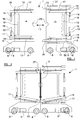
- FIGs 1 to 4 show an oven 1 and a mould 2 of a type suitable for use in the method of the present invention.
- the oven 1 comprises two parts 3, 4, each of which comprises a housing mounted on a respective carriage 5, 6 for movement towards and away from one another as depicted by arrow 7.
- the oven is shown in figure 1 in an open configuration in which the two over parts 3, 4 are separated and spaced from one another to permit the insertion or removal of the mould.
- Figure 2 shows the oven in a closed configuration in which the two parts 3, 4 engage such that their respective housings cooperate to form a generally closed oven chamber around the mould 2.
- the carriages 5, 6 supporting each over part are provided with wheels 8 for rolling movement along the ground (for example on cooperating rails) between their open and closed positions by the operation of electric motors 9 which are each arranged to drive at least one wheel 8.
- Each oven part 3, 4 is provided with a heat source.
- the heat source may comprise one or more burners 10 positioned within the oven chamber. Gas powered infra-red burners may be used, although it is to be appreciated that other types of burner or heater could be used instead.
- Each oven part 3, 4 is additionally provided with a respective lower door 11 and an upper door 12.
- the lower and upper doors 11, 12 are provided in the form of flaps mounted for pivotal movement about respective pivots 13, 14 between generally horizontal positions as illustrated in figure 1 , and tilted positions.
- Figure 2 shows the lower door flaps 11 in their tilted positions in which it can be seen that the two door flaps extend generally downwardly from their pivots towards one another.
- the upper door flaps 12 may be moved about their pivots to upwardly tilted positions in which they extend generally upwardly from their pivots towards one another.
- Each door flap 11, 12 is moved between its horizontal and tilted positions by a respective actuator in the form of a hydraulic or pneumatic cylinder 15, 16.
- Each door flap 11, 12 carries a closure rod 17 mounted for sliding movement along the door flap.
- the closure rods 17 are moved by respective actuators 18 mounted to the door flaps, the actuators preferably taking the form of hydraulic or pneumatic cylinders.
- FIG. 1 and 2 both show the two shut-off members 19, 20 in closed positions in which they project outwardly from the over part 3 on which they are provided.
- the shut-off members 19 20 extend across above and below the mould 2 respectively.
- each shut-off member is moveable relative to the housing of the over part 3 on which they are provided, and can be retracted from their closed positions illustrated to open positions in which they do not project significantly from the housing and hence will not extend above or below the mould when the oven is closed as illustrated in figure 2 .
- the housing of at least one of the over parts 4 is provided with an exhaust outlet 23 in an upper part, the exhaust outlet permitting the exhaust of hot gas from inside the oven chamber.
- the exhaust outlet 23 is connectable to an exhaust pipe or duct (not shown).
- the mould 2 is illustrated most clearly in figures 2 and 4 .
- the mould is shaped and configured for use in moulding a substantially flat planar panel.
- the mould comprises a pair of mould parts 24, 25 which are releasably connectable to one another to define a mould cavity 26 therebetween.
- the inner surfaces of the mould cavity 26 are preferably coated with a high temperature non-stick coating.
- the mould 2 may be configured to be adjustable in thickness to vary the size of the mould cavity 26, thereby facilitating the moulding of panels of different thickness. For example, it is proposed to provide spacers of various sizes for insertion between the mould parts 24, 25.
- the mould 2 is shown in a moulding position in which it is oriented substantially vertically within the oven chamber, at the interface between the two oven parts 3, 4.
- the mould 2 is configured to be selectively opened at the top and at the bottom when oriented in this manner, and so is provided with top and bottom closures 27, 28.
- the closures 27, 28 may take the form of pivotally mounted flaps.
- the closures are arranged for movement between their open and closed positions by the closure rods 17 and associated actuators 18 mounted to the door flaps when the doors flaps are in their horizontal, un-tilted, positions.
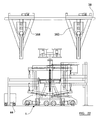
- FIGS 5 to 8 illustrate a hopper arrangement 29 which is used to fill the mould 2 with particulate material, in a manner which will be described in more detail below.
- the hopper arrangement comprises a support frame 30 extending between a pair of horizontal rails 31.
- the support frame 30 is moveable along the rails 31 via a plurality of small wheels 32 which engage and roll along the rails.
- the support frame 30 comprises a pair of spaced apart end frames 33 which are interconnected by a pair of transverse beams 34.
- the end frames 33 are generally triangular in form comprising a horizontal member 35, a central vertical member 36, and a pair of diagonal bracing members 37.
- the central vertical members 36 take the form of elongate channels having a generally C-shaped cross-section, the two channels being arranged so that their open sides face one another across the span between the two rails 31.
- a filling hopper 38 is supported between the two end frames 33.
- the hopper is configured to hold and dispense particulate material and so has a downwardly tapering form as is conventional.
- the hopper 38 is arranged for vertical movement between the two end frames 33, and for this purpose has a pair of wheels 38 rotatably mounted at each end, the wheels 38 being arranged vertically one above the other.
- the wheels 38 are configured to be received within and to run along the C-shaped channels defined by the vertical members 36 of the two end frames 33. The wheels 38 thus cooperate with the vertical members 36 to guide the hopper 38 for vertical movement between a raised position as illustrated in figure 7 and a lowered position as illustrated in figure 8 .
- the hopper 38 has a plurality of elongate dispensing tubes 40 which extend vertically downwardly from the narrow lower region of the hopper.
- the dispensing tubes are arranged in a side-by-side array along the entire length of the hopper and each has a bore sized to permit the substantially free-flow of particulate material.
- Each tube terminates with an open dispensing aperture 41 at its lowermost free end.
- the flow of particulate material from the chamber of the hopper and down the dispensing tubes 40 is controlled by a rotary valve 42.
- the hopper is provided with a pair of vibrators 43 in a lower region of the hopper, slightly above the dispensing tubes.
- FIGS 9 to 11 illustrate a collection hopper 44 which is used in the method of the invention to collect unused particulate material from the mould 2 in a manner which will be explained in more detail below.
- the collection hopper comprises an upwardly open elongate rectangular housing 45 which is mounted on a carriage 46 having wheels 47 for rolling movement along the ground, for example along cooperating rails (not shown).
- the collection hopper 44 is self-propelled, and may thus comprises an electric motor 48 arranged to drive at least one of the wheels 47.
- Figures 12 to 16 illustrate a carriage arrangement 49 configured to support, carry and manipulate the mould 2.
- the carriage arrangement comprises a trolley 50 which is configured for self-propelled movement via wheels 51 and a motor 52.
- the trolley 50 comprises a support frame 53 which supports a shaft 54 for rotation in bearings 55 about a horizontal axis 56 spaced above the wheels.
- the support frame 53 also supports a motor 57 which is operatively connected to the shaft 54 via a gearbox 58, the motor thus being operable to rotate the shaft 54 in the bearings 55.
- the shaft 54 supports a cantilever support frame 59 for co-rotation therewith, the cantilever frame extending outwardly from the trolley 50 in spaced relation to the ground.
- the cantilever frame 59 is configured to support the mould 2, and is shown in figures 12 and 13 supporting the mould 2 in a substantially horizontal orientation. However, via operation of the motor 57, the shaft 54 and the cantilever frame 59 can be rotated about the axis 56 so as to support the mould 2 in vertical orientation as previously illustrated in figures 2 , 3 and 4 .
- the cantilever frame 59 is shown in this orientation in figure 14 .
- the cantilever nature of the frame 59 means that regardless of the orientation of the frame and the mould, there is always free space beneath the frame and mould. As will be explained in more detail, this free space is sufficient to permit the collection hopper 44 to move beneath the mould 2 when in its vertical orientation illustrated in figure 14 .
- the trolley 50 also carries an upstanding post 60.
- the post 60 supports a gantry 61 for rotation about the vertical axis 62 of the post.
- the gantry 61 comprises a beam 63, such as an I-section beam in the case of the particular embodiment illustrated.
- the beam 63 supports an array of cooling fans 64 arranged to direct a cooling flow of air in a generally downwards direction.
- the cooling fans 64 are preferably provided in the form of ducted units, and may be provided with a supply of water or other liquid coolant so as to produce a fine cooling mist.
- Figures 12 to 15 all show the gantry 61 and cooling fans 64 positioned vertically above the mould 2 supported by the cantilever frame 59.
- figure 16 illustrates the gantry and the cooling fans having been rotated about the axis 62 by approximately 90 degrees such that they are substantially clear of the mould 2.
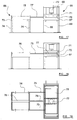
- FIGS 17 to 19 illustrate a pressing arrangement 65 and a pusher arrangement 66.
- the pressing arrangement comprises a pressing table 67 which is supported above the ground by a plurality of legs 68.
- the table 67 supports a hydraulic or pneumatic press 69 comprising a lower fixed platen 70 and an upper moveable platen 71.
- the two platens 70, 71 are made of steel and are preferably substantially planar for use in producing a substantially flat panel.
- the or each platen may have a relief pattern formed in its pressing surface so as to impress a corresponding pattern into the outer surfaces of a panel to be formed therebetween, as will be described in more detail below.
- the platens 70, 71 each have internal fluid channels for the flow of water or other liquid coolant, and are thus chilled, or at least cooled by a supply of coolant.
- the upper moveable platen 71 is mounted for vertical sliding movement under the action of a hydraulic or pneumatic cylinder 72, the cylinder thus being operable to press the upper platen 71 downwardly towards the lower platen 70.
- the pressing cylinder is configured to apply very high pressing forces to the upper platen 71, for example pressing forces in excess of 100 tonnes.
- the pusher arrangement 66 is located generally adjacent to, but spaced from the pressing arrangement, and similarly comprises a table 73 supported above the ground by a plurality of legs 74.
- the table supports horizontal pushing rods 75 which are hydraulically or pneumatically slideable within corresponding cylinders 76, between retracted positions as illustrated in figure 17 , and extended positions as illustrated in figures 18 and 19 in which the pushing rods 75 extend across the gap between the pusher table 73 and the pressing table 67.
- a moulding 77 is shown positioned between the pusher 66 and the press 65.
- the moulding 77 is shown having been pushed horizontally by the pushing rods so as to become positioned between the platens 70, 71, and more particularly resting on the lower platen 70.
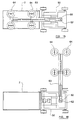
- the oven 1 is positioned generally centrally, below the filling hopper arrangement 29.
- the rails 31 of the hopper arrangement are supported above the oven 1, and are arranged so as to be substantially parallel to the direction in which the two oven parts 3, 4 are arranged to move along the ground.
- the hopper arrangement 29 actually comprises two discrete filling hoppers 38a, 38b with respective associated end frames 33 etc., both filling hoppers 38a, 38b being arranged to move along the same rails 12.
- the first filling hopper 38a is filled with a first particulate material for use in forming the outer skin of a panel product to be moulded via the method of the present invention.
- the first particulate material comprises recycled plastic material, and preferably consists substantially entirely of recycled plastic material.
- the recycled plastic material preferably comprises High Impact Polystyrene (HIPS), and may optionally include a die and/or a fire-retardant additive.
- HIPS High Impact Polystyrene
- the grain size of the first particulate material is not thought to be of significant importance to the method, providing that the material can be poured and can flow down the dispensing tubes 40 of the hopper 38a.
- the second filling hopper 38b is filled with a second particulate material for use in forming an inner core of a panel product to be moulded via the method of the present invention.
- the second particulate material also comprises recycled plastic material, and preferably consists substantially entirely of recycled plastic material.
- the recycled plastic material preferably comprises High Impact Polystyrene (HIPS), and may optionally include a fire-retardant additive and/or a blowing agent. It is considered preferable for the second particulate material to comprise both HIPS and recycled polyethylene (PE), most preferably in a ratio by weight of 75% HIPS to 25% PE.
- PE recycled polyethylene
- the addition of PE to the HIPS serves to reduce the melting point of the material. It has been found that a melting point in the region of approximately 140 °C is preferable. Again, the grain size of the second particulate material is not thought to be of significant importance to the method, providing that the material can be poured and can flow down the dispensing tubes 40 of the hopper 38b.
- the collection hopper 44 is arranged for rolling movement along the ground beneath the oven 1, between the wheels 8 at each end of the oven 1.
- the collection hopper my thus be moved in a direction generally parallel to the rails 31.
- a pressing arrangement 65 and a pusher arrangement 66 is provided on each side of the oven 1, each pressing arrangement working in concert with the associated pusher arrangement from respective sides of the oven 1, as will become clear. Also, a pair of carriage arrangements 49 are provided; each on a respective side of the oven 1. However, it is to be appreciated that the method could alternatively use just a single pressing arrangement 65 and associated pusher 66 and carriage 49.
- a control panel 78 is operatively connected to all of the various motors, heaters, coolers and actuators, the panel thus controlling the entire moulding process.
- a mould 2 is closed by clamping the two mould parts 24, 25 together to define the mould cavity 26 therebetween. This is performed on one of the carriage arrangements 49, most conveniently with its cantilever support frame 59 arranged horizontally.
- the cantilever frame 59 is then rotated through 90 degrees via the carriage motor 57 so that the mould 2 is moved to a substantially vertical orientation.
- the oven 1 is then opened by moving the two oven parts 3, 4 apart from one another as illustrated in figure 1 .
- the carriage 59 is then advanced towards the oven, moving between the press 65 and the pusher 66, to move the mould 2 into the oven.
- the upstanding post 60 supporting the gantry 61 is sufficiently high for the gantry 61 to move over the top of the pressing arrangement 65 without obstruction.
- each part 2, 3 of the oven has a semi-circular cut-out 79, the two cut-outs cooperating to fit around the shaft 54 of the carriage arrangement 49.
- the oven 1 can be closed around the mould 2 whilst the mould remains supported in the vertical orientation by the cantilever frame 59 of the carriage.
- the bottom closure 28 of the mould 2 is then closed by the lower closure rod 17 on the oven.
- the lower and upper door flaps 11, 12 of the oven are then moved to their horizontal positions in which they close to the bottom and top of the mould 2.
- the heaters 10 inside the oven are then energised to pre-heat the mould 2.
- the mould is preferably pre-heated in this manner to a temperature in the range of 200 °C to 240 °C, and most preferably 220 °C.
- the filling hopper arrangement 29 is then operated to move the first filling hopper 38a to a position vertically above the oven 1.
- the first filling hopper 38a is then lowered along its vertical members 36 such that the dispensing tubes move into the mould cavity and are lowered towards the bottom of the mould.
- the hopper valve 42 is then actuated to fill the mould with the first particulate material.
- the vibrators 42 are energised to ensure steady and uninterrupted flow of material down the dispensing tubes.
- the hopper 38a is steadily raised along its vertical members 36 as the mould 2 fills with the first particulate material.
- the hopper valve 42 is closed and the hopper 38a is raised and moved clear of the oven to its park position as illustrated in figure 21 .
- the top closure 27 on the mould is then closed by the upper closure rod 17 on the oven and the heaters 10 continue to operate to heat the mould 2.
- the first particulate material is melted in the regions against the inner surfaces of the two mould parts 24, 25.
- An outer skin of the material is thus formed against the opposed surfaces inside the mould 2.
- the oven door flaps 11, 12 remain in their substantially horizontal positions during this heating phase, and are thus effectively closed against the top and bottom of the mould 2. This prevents significant heating of the top and bottom closures 27, 28 of the mould, thereby preventing the formation of a skin against the inside surfaces of the closures.
- the mould is typically held at an elevated temperature of approximately 220 °C for a period of 8 minutes during this heating phase, which is effective to form an outer skin of approximately 3 to 4 mm thick against the inner surfaces of the mould.
- longer heating periods may be used if it is desired to form thicker skins.
- the collection hopper 44 is moved into a collection position in which it is located immediately below the mould 2.
- the bottom mould closure 28 Upon completion of the skin-forming heating phase, the bottom mould closure 28 is opened and the unmelted particulate material remaining between the two layers of outer skin formed inside the mould is permitted to fall down from the mould 2 and into the collection hopper 44.
- the collection hopper 44 is then moved out from underneath the oven and the particulate material inside can then be returned to the first filling hopper 38a, for example via a worm-screw arrangement or the like (not shown).
- the bottom closure 28 of the mould 2 is closed and the top closure 27 is opened.
- the second filling hopper 38b is then (or simultaneously) moved into to a filling position above the mould 2 and is operated as before to fill the mould 2 with the second particulate material, between the two layers of skin formed against the opposed surfaces inside the mould 2.
- the top mould closure 27 is then closed once again.
- the door flaps 11, 12 of the oven are then all moved from their horizontal positions to their tilted positions via operation of their respective actuators on the oven. As will be appreciated from consideration of the tilted lower door flaps 11 shown in figure 2 , this is effective to permit the hot gases inside the oven to move around the ends of the mould 2 and in particular to heat the mould closures 27, 28.
- the top and bottom shut-off members 19, 20 are closed to prevent the escape of hot gases from the oven.
- the heaters 10 then heat the mould 2 and the second particulate material therein for a second heating phase, in order to cure the second particulate material and thereby form an inner core of plastic material inside the outer skin. It is proposed that this heating phase will continue for approximately 20 minutes at a temperature of 220 °C. This has been found sufficient to cure the second plastic material when producing a moulding having a thickness of 65 mm. During this heating phase it may be necessary to rotate the mould 2 inside the oven via rotation of the supporting cantilever frame 59 on the carriage 49, in order to ensure even heating throughout the mould so that the entire volume of the second particulate material is cured.
- the oven 1 is opened and the mould 2 retrieved via movement of the carriage arrangement 49 away from the oven.
- next processing steps are performed outside the oven which means that the oven is now free for use in producing another moulding via the operation of the equipment located on the opposite side of the oven 1, in a similar manner to that described above.
- the mould 2 removed from the oven will be hot and so it is necessary to cool the mould before it can be opened and the moulding inside safely removed for further processing.
- the gantry 61 and array of fans 64 is thus moved into position above the mould, and the fans are energised to direct a cooling flow of air (and optionally a mist) downwardly and over the mould.
- the mould 2 may be rotated during this cooling phase.
- the mould 2 is then opened. This is done with the mould supported in a horizontal position between the pusher arrangement 66 and the pressing arrangement 65 by the underlying cantilever frame 59 as illustrated most clearly in figure 21 .
- the gantry 61 may be used as a crane to lift the upper part of the mould 25 away from the lower part 24.
- the pusher arrangement 66 is then actuated to slide the moulding 77 into the space between the two platens 70, 71 of the pressing arrangement 65.
- the pushing rods 75 slide the moulding 77 onto the lower platen 70 and are then retracted back into their park position.
- the pressing arrangement 65 is then actuated to simultaneously cool and compress the moulding 77 between the platens 70, 71.
- the pressing cylinder 72 is actuated to press the upper platen 71 against the moulding with a pressing force.
- the pressure applied by the press is preferably in excess of 150 N/cm 2 .
- An applied pressure of approximately 190 N/cm 2 has been found particularly effective, and in a typical case this will require pressing force of approximately 60 tons.
- the cooling arrangement is operated to pump coolant through the channels inside the platens 70, 71 to chill the moulding 77 as it is being pressed.
- the press 65 is operated to compress the moulding 2 so as to reduce its thickness down to a desired thickness of the finished panel, whilst simultaneously imparting a surface finish to the panel corresponding to any relief pattern formed on the platens.
- a substantially rectangular (400mm x 700mm) moulding 77 formed inside the mould 2 having an initial thickness of 65 mm can be compressed down to a thickness in the region of 30 - 50 mm in the press under a pressure of 190 N/cm 2 , whilst being cooled.
- the thickness of the moulding is thus typically reduced by 20% or more in the press. It has been found appropriate in the production of such panels to operate the press in this manner whilst cooling the moulding from a starting temperature of approximately 200 °C (following removal from the mould 2) down to approximately 30 - 40 °C over a period of approximately 8 minutes.
- Panels manufactured by the above-described process have been found to have extremely good structural properties and integrity. It has been found that by producing an interim moulding 77 of greater thickness and then compressing it to the desired panel thickness whilst simultaneously cooling the moulding/panel results in a significantly improved product when compared to products obtained by the prior art methods. Panels manufactured in accordance with the method of the present invention typically have much improved flatness and integrity.
- each pair of said rollers would be configured to be urged, for example either pneumatically or hydraulically, towards the oppositely arranged roller to apply the requisite pressing force to the moulding.
- the external surfaces of one or both of each pair of rollers may have a relief pattern formed therein so as to impress a corresponding pattern into the outer surfaces of a panel to be formed therebetween.
- the moulding will still be simultaneously cooled and compressed so as to reduce its thickness as proposed above. It is envisaged that in order to achieve a sufficient reduction in the thickness of the moulding via use of a roller press, the reduction will need to be achieved over a longer footprint of the equipment which may require more space than in the case of the platen press arrangement discussed above.
- the pressing equipment suitable for use in the method of this invention could be configured in other ways, the important aspect being that it must be effective to compress the moulding, whilst the moulding is simultaneously cooled, so as to achieve the desired thickness and flatness in the finished product.
Landscapes
- Engineering & Computer Science (AREA)
- Mechanical Engineering (AREA)
- Casting Or Compression Moulding Of Plastics Or The Like (AREA)
Priority Applications (5)
| Application Number | Priority Date | Filing Date | Title |
|---|---|---|---|
| PL11151312T PL2476534T3 (pl) | 2011-01-13 | 2011-01-18 | Sposób formowania |
| EP11151312.3A EP2476534B1 (en) | 2011-01-13 | 2011-01-18 | A moulding method |
| CA2860812A CA2860812C (en) | 2011-01-13 | 2012-01-12 | A moulding method |
| PCT/GB2012/000029 WO2012095635A1 (en) | 2011-01-13 | 2012-01-12 | A moulding method |
| US13/979,347 US8940212B2 (en) | 2011-01-13 | 2012-01-12 | Method for producing a moulded plastic product |
Applications Claiming Priority (2)
| Application Number | Priority Date | Filing Date | Title |
|---|---|---|---|
| EP11150886 | 2011-01-13 | ||
| EP11151312.3A EP2476534B1 (en) | 2011-01-13 | 2011-01-18 | A moulding method |
Publications (2)
| Publication Number | Publication Date |
|---|---|
| EP2476534A1 EP2476534A1 (en) | 2012-07-18 |
| EP2476534B1 true EP2476534B1 (en) | 2014-05-21 |
Family
ID=44904642
Family Applications (1)
| Application Number | Title | Priority Date | Filing Date |
|---|---|---|---|
| EP11151312.3A Not-in-force EP2476534B1 (en) | 2011-01-13 | 2011-01-18 | A moulding method |
Country Status (7)
| Country | Link |
|---|---|
| US (1) | US8940212B2 (pl) |
| EP (1) | EP2476534B1 (pl) |
| CA (1) | CA2860812C (pl) |
| DK (1) | DK2476534T3 (pl) |
| ES (1) | ES2492516T3 (pl) |
| PL (1) | PL2476534T3 (pl) |
| WO (1) | WO2012095635A1 (pl) |
Families Citing this family (6)
| Publication number | Priority date | Publication date | Assignee | Title |
|---|---|---|---|---|
| GB2500876B8 (en) * | 2012-03-26 | 2016-02-17 | 100 Recycled Panel Company Ltd | A moulding method |
| RU2628392C2 (ru) * | 2015-10-20 | 2017-08-16 | Публичное акционерное общество "Транснефть" (ПАО "Транснефть") | Способ изготовления сферообразных двухслойных изделий из полиуретана |
| US10525683B2 (en) * | 2016-11-08 | 2020-01-07 | The Boeing Company | Heated double diaphragm tool for decorative laminate application |
| CN108748773B (zh) * | 2018-05-23 | 2020-06-05 | 浙江利帆家具有限公司 | 基于CaCO3纳米SiO2改性的HDPE家具料的生产设备及工艺 |
| CN113211699B (zh) * | 2021-05-10 | 2022-03-25 | 江苏圣泰防腐设备东台有限公司 | 一种基于滚塑工艺的防腐处理装置及方法 |
| CN118124094B (zh) * | 2024-05-08 | 2024-07-05 | 四川新升包装科技有限责任公司 | 一种包装盒的模具 |
Family Cites Families (18)
| Publication number | Priority date | Publication date | Assignee | Title |
|---|---|---|---|---|
| US2802766A (en) * | 1954-02-11 | 1957-08-13 | Roy F Leverenz | Method of manufacturing a laminated article |
| US3366993A (en) * | 1958-05-09 | 1968-02-06 | Jerome H Lemelson | Apparatus for molding |
| ES307132A1 (es) * | 1963-12-19 | 1965-04-01 | Lakeside Plastics Corp | Un metodo para preparar una composicion de moldeo. |
| US3286004A (en) * | 1964-04-30 | 1966-11-15 | Gen Electric | Method of manufacturing a foam plastic article |
| US3949125A (en) * | 1965-05-14 | 1976-04-06 | Roberts Arthur H | Molded solid plastics articles and a method for their manufacture |
| US4043721A (en) * | 1968-07-11 | 1977-08-23 | Lemelson Jerome H | Composite body molding apparatus |
| US3608007A (en) * | 1968-08-05 | 1971-09-21 | American Seating Co | Method of forming a rigid panel by casting polyurethane in a resin impregnated paper shell |
| US5505886A (en) * | 1992-12-11 | 1996-04-09 | Utah State University Foundation | Process for densification of low density polystyrene |
| JPH06238761A (ja) * | 1993-02-16 | 1994-08-30 | Sekisui Plastics Co Ltd | 建物用断熱板の製造方法 |
| US5972259A (en) * | 1995-09-27 | 1999-10-26 | Hettinga; Siebolt | Method for forming an angled plastic article of varying density |
| JPH10128890A (ja) * | 1996-10-31 | 1998-05-19 | Itoki Crebio Corp | クッション基体並びにクッション体及びそれらの製造方法 |
| JP3368197B2 (ja) * | 1997-12-26 | 2003-01-20 | 中小企業総合事業団 | 高機能圧縮木材の製造装置 |
| US6146562A (en) * | 1998-03-13 | 2000-11-14 | Hettinga; Siebolt | Method of injection molding an article with a cellular density distribution which gradually varies between a high density cellular exterior and a low density cellular interior |
| EP2383095A1 (en) | 2001-02-05 | 2011-11-02 | Environmental Recycling Technologies plc | Processes for forming plastic, apparatuses for forming plastic, and articles made therefrom |
| US6485800B1 (en) * | 2001-02-07 | 2002-11-26 | Jeld-Wen, Inc. | Articles of composite structure having appearance of wood |
| US6599452B1 (en) * | 2002-06-17 | 2003-07-29 | Bevona, Inc. | Method for manufacturing simulated architectural forms |
| US20100166990A1 (en) * | 2007-04-30 | 2010-07-01 | Charles Caulder Bree | Rotationally moulded products and moulds |
| GB2466432B (en) * | 2008-12-16 | 2010-11-03 | Crompton Mouldings Ltd | A moulding method and moulding machine |
-
2011
- 2011-01-18 ES ES11151312.3T patent/ES2492516T3/es active Active
- 2011-01-18 PL PL11151312T patent/PL2476534T3/pl unknown
- 2011-01-18 DK DK11151312.3T patent/DK2476534T3/da active
- 2011-01-18 EP EP11151312.3A patent/EP2476534B1/en not_active Not-in-force
-
2012
- 2012-01-12 CA CA2860812A patent/CA2860812C/en not_active Expired - Fee Related
- 2012-01-12 WO PCT/GB2012/000029 patent/WO2012095635A1/en not_active Ceased
- 2012-01-12 US US13/979,347 patent/US8940212B2/en not_active Expired - Fee Related
Also Published As
| Publication number | Publication date |
|---|---|
| PL2476534T3 (pl) | 2014-10-31 |
| WO2012095635A1 (en) | 2012-07-19 |
| DK2476534T3 (da) | 2014-08-18 |
| CA2860812C (en) | 2018-07-03 |
| US8940212B2 (en) | 2015-01-27 |
| CA2860812A1 (en) | 2012-07-19 |
| US20130285282A1 (en) | 2013-10-31 |
| ES2492516T3 (es) | 2014-09-09 |
| EP2476534A1 (en) | 2012-07-18 |
Similar Documents
| Publication | Publication Date | Title |
|---|---|---|
| CA2860812C (en) | A moulding method | |
| US3398434A (en) | Vacuum forming apparatus | |
| CN105499532A (zh) | 一种车轮模具喷涂料装置 | |
| EP3628468B1 (en) | Device for creating supports, formworks, constructions or structures made of foamed plastics | |
| US20080251969A1 (en) | Bladder Molding Systems and Methods For Fabricating Composite Articles | |
| EP0502378A1 (de) | Vorrichtung und Verfahren zum Herstellen von Formhäuten und -körpern aus Kunststoff | |
| US4012186A (en) | Panel forming device | |
| CN105711023B (zh) | 用于发泡物体的方法与装置 | |
| CN112223493B (zh) | 一种预制构件成型设备 | |
| CN108394058A (zh) | 一种制造易脱模的建筑用木塑模板的设备 | |
| US20040232601A1 (en) | Continuous twin sheet thermoforming process and apparatus | |
| DE2922314A1 (de) | Verfahren und vorrichtung zur herstellung von formkoerpern aus schaeumbaren thermoplastischen kunststoffen | |
| DE202010000469U1 (de) | Anordnung zur Herstellung von Transportpaletten aus Kunststoff | |
| GB2500876A (en) | Moulding Method | |
| CN108943555B (zh) | 一种发泡板的发泡冷却取料自动化生产线 | |
| CN114161554B (zh) | 高效加气混凝土砌块生产线模具涂刷一体机及涂刷工艺 | |
| CN108748949A (zh) | 管体的生产装置及基于该装置的增强管体的生产方法 | |
| WO2003101700A1 (en) | Technique for producing recycled article comprising pouring molding of molten waste plastic | |
| RU2574619C1 (ru) | Способ формовки | |
| US3963395A (en) | Mass production line for fabricating structural building members | |
| CN212331602U (zh) | A级防火保温材料生产设备 | |
| CN214383235U (zh) | 可发性树脂模片微波加热成型和模片制取组合机 | |
| CN204639133U (zh) | 一种具有可升降桶底的激光粉末烧结成型机 | |
| CN110861207B (zh) | 双面叠合混凝土预制构件生产系统 | |
| US20110248418A1 (en) | Moulding Method and A Moulding Machine |
Legal Events
| Date | Code | Title | Description |
|---|---|---|---|
| PUAI | Public reference made under article 153(3) epc to a published international application that has entered the european phase |
Free format text: ORIGINAL CODE: 0009012 |
|
| AK | Designated contracting states |
Kind code of ref document: A1 Designated state(s): AL AT BE BG CH CY CZ DE DK EE ES FI FR GB GR HR HU IE IS IT LI LT LU LV MC MK MT NL NO PL PT RO RS SE SI SK SM TR |
|
| AX | Request for extension of the european patent |
Extension state: BA ME |
|
| 17P | Request for examination filed |
Effective date: 20120730 |
|
| TPAC | Observations filed by third parties |
Free format text: ORIGINAL CODE: EPIDOSNTIPA |
|
| 17Q | First examination report despatched |
Effective date: 20120927 |
|
| RIC1 | Information provided on ipc code assigned before grant |
Ipc: B29C 44/04 20060101ALI20130905BHEP Ipc: B29B 17/00 20060101ALN20130905BHEP Ipc: B29C 44/56 20060101ALN20130905BHEP Ipc: B29C 41/36 20060101ALI20130905BHEP Ipc: B29C 41/18 20060101AFI20130905BHEP |
|
| RIC1 | Information provided on ipc code assigned before grant |
Ipc: B29C 41/18 20060101AFI20131015BHEP Ipc: B29C 44/56 20060101ALN20131015BHEP Ipc: B29C 44/04 20060101ALI20131015BHEP Ipc: B29C 41/36 20060101ALI20131015BHEP Ipc: B29B 17/00 20060101ALN20131015BHEP |
|
| GRAP | Despatch of communication of intention to grant a patent |
Free format text: ORIGINAL CODE: EPIDOSNIGR1 |
|
| INTG | Intention to grant announced |
Effective date: 20131206 |
|
| GRAS | Grant fee paid |
Free format text: ORIGINAL CODE: EPIDOSNIGR3 |
|
| GRAA | (expected) grant |
Free format text: ORIGINAL CODE: 0009210 |
|
| AK | Designated contracting states |
Kind code of ref document: B1 Designated state(s): AL AT BE BG CH CY CZ DE DK EE ES FI FR GB GR HR HU IE IS IT LI LT LU LV MC MK MT NL NO PL PT RO RS SE SI SK SM TR |
|
| REG | Reference to a national code |
Ref country code: GB Ref legal event code: FG4D |
|
| REG | Reference to a national code |
Ref country code: CH Ref legal event code: EP |
|
| REG | Reference to a national code |
Ref country code: AT Ref legal event code: REF Ref document number: 669379 Country of ref document: AT Kind code of ref document: T Effective date: 20140615 |
|
| REG | Reference to a national code |
Ref country code: IE Ref legal event code: FG4D |
|
| REG | Reference to a national code |
Ref country code: DE Ref legal event code: R096 Ref document number: 602011007127 Country of ref document: DE Effective date: 20140710 |
|
| REG | Reference to a national code |
Ref country code: DK Ref legal event code: T3 Effective date: 20140815 |
|
| REG | Reference to a national code |
Ref country code: SE Ref legal event code: TRGR |
|
| REG | Reference to a national code |
Ref country code: ES Ref legal event code: FG2A Ref document number: 2492516 Country of ref document: ES Kind code of ref document: T3 Effective date: 20140909 |
|
| REG | Reference to a national code |
Ref country code: NL Ref legal event code: VDEP Effective date: 20140521 |
|
| REG | Reference to a national code |
Ref country code: NO Ref legal event code: T2 Effective date: 20140521 |
|
| REG | Reference to a national code |
Ref country code: LT Ref legal event code: MG4D |
|
| PG25 | Lapsed in a contracting state [announced via postgrant information from national office to epo] |
Ref country code: GR Free format text: LAPSE BECAUSE OF FAILURE TO SUBMIT A TRANSLATION OF THE DESCRIPTION OR TO PAY THE FEE WITHIN THE PRESCRIBED TIME-LIMIT Effective date: 20140822 Ref country code: LT Free format text: LAPSE BECAUSE OF FAILURE TO SUBMIT A TRANSLATION OF THE DESCRIPTION OR TO PAY THE FEE WITHIN THE PRESCRIBED TIME-LIMIT Effective date: 20140521 Ref country code: IS Free format text: LAPSE BECAUSE OF FAILURE TO SUBMIT A TRANSLATION OF THE DESCRIPTION OR TO PAY THE FEE WITHIN THE PRESCRIBED TIME-LIMIT Effective date: 20140921 |
|
| REG | Reference to a national code |
Ref country code: PL Ref legal event code: T3 |
|
| PG25 | Lapsed in a contracting state [announced via postgrant information from national office to epo] |
Ref country code: HR Free format text: LAPSE BECAUSE OF FAILURE TO SUBMIT A TRANSLATION OF THE DESCRIPTION OR TO PAY THE FEE WITHIN THE PRESCRIBED TIME-LIMIT Effective date: 20140521 Ref country code: RS Free format text: LAPSE BECAUSE OF FAILURE TO SUBMIT A TRANSLATION OF THE DESCRIPTION OR TO PAY THE FEE WITHIN THE PRESCRIBED TIME-LIMIT Effective date: 20140521 Ref country code: LV Free format text: LAPSE BECAUSE OF FAILURE TO SUBMIT A TRANSLATION OF THE DESCRIPTION OR TO PAY THE FEE WITHIN THE PRESCRIBED TIME-LIMIT Effective date: 20140521 |
|
| PG25 | Lapsed in a contracting state [announced via postgrant information from national office to epo] |
Ref country code: PT Free format text: LAPSE BECAUSE OF FAILURE TO SUBMIT A TRANSLATION OF THE DESCRIPTION OR TO PAY THE FEE WITHIN THE PRESCRIBED TIME-LIMIT Effective date: 20140922 |
|
| PG25 | Lapsed in a contracting state [announced via postgrant information from national office to epo] |
Ref country code: SK Free format text: LAPSE BECAUSE OF FAILURE TO SUBMIT A TRANSLATION OF THE DESCRIPTION OR TO PAY THE FEE WITHIN THE PRESCRIBED TIME-LIMIT Effective date: 20140521 Ref country code: EE Free format text: LAPSE BECAUSE OF FAILURE TO SUBMIT A TRANSLATION OF THE DESCRIPTION OR TO PAY THE FEE WITHIN THE PRESCRIBED TIME-LIMIT Effective date: 20140521 Ref country code: BE Free format text: LAPSE BECAUSE OF FAILURE TO SUBMIT A TRANSLATION OF THE DESCRIPTION OR TO PAY THE FEE WITHIN THE PRESCRIBED TIME-LIMIT Effective date: 20140521 Ref country code: RO Free format text: LAPSE BECAUSE OF FAILURE TO SUBMIT A TRANSLATION OF THE DESCRIPTION OR TO PAY THE FEE WITHIN THE PRESCRIBED TIME-LIMIT Effective date: 20140521 Ref country code: CZ Free format text: LAPSE BECAUSE OF FAILURE TO SUBMIT A TRANSLATION OF THE DESCRIPTION OR TO PAY THE FEE WITHIN THE PRESCRIBED TIME-LIMIT Effective date: 20140521 |
|
| REG | Reference to a national code |
Ref country code: DE Ref legal event code: R097 Ref document number: 602011007127 Country of ref document: DE |
|
| PG25 | Lapsed in a contracting state [announced via postgrant information from national office to epo] |
Ref country code: NL Free format text: LAPSE BECAUSE OF FAILURE TO SUBMIT A TRANSLATION OF THE DESCRIPTION OR TO PAY THE FEE WITHIN THE PRESCRIBED TIME-LIMIT Effective date: 20140521 |
|
| PLBE | No opposition filed within time limit |
Free format text: ORIGINAL CODE: 0009261 |
|
| STAA | Information on the status of an ep patent application or granted ep patent |
Free format text: STATUS: NO OPPOSITION FILED WITHIN TIME LIMIT |
|
| 26N | No opposition filed |
Effective date: 20150224 |
|
| REG | Reference to a national code |
Ref country code: DE Ref legal event code: R097 Ref document number: 602011007127 Country of ref document: DE Effective date: 20150224 |
|
| PG25 | Lapsed in a contracting state [announced via postgrant information from national office to epo] |
Ref country code: SI Free format text: LAPSE BECAUSE OF FAILURE TO SUBMIT A TRANSLATION OF THE DESCRIPTION OR TO PAY THE FEE WITHIN THE PRESCRIBED TIME-LIMIT Effective date: 20140521 |
|
| PG25 | Lapsed in a contracting state [announced via postgrant information from national office to epo] |
Ref country code: LU Free format text: LAPSE BECAUSE OF FAILURE TO SUBMIT A TRANSLATION OF THE DESCRIPTION OR TO PAY THE FEE WITHIN THE PRESCRIBED TIME-LIMIT Effective date: 20150118 |
|
| PG25 | Lapsed in a contracting state [announced via postgrant information from national office to epo] |
Ref country code: MC Free format text: LAPSE BECAUSE OF FAILURE TO SUBMIT A TRANSLATION OF THE DESCRIPTION OR TO PAY THE FEE WITHIN THE PRESCRIBED TIME-LIMIT Effective date: 20140521 |
|
| REG | Reference to a national code |
Ref country code: FR Ref legal event code: PLFP Year of fee payment: 6 |
|
| REG | Reference to a national code |
Ref country code: FR Ref legal event code: PLFP Year of fee payment: 7 |
|
| PG25 | Lapsed in a contracting state [announced via postgrant information from national office to epo] |
Ref country code: MT Free format text: LAPSE BECAUSE OF FAILURE TO SUBMIT A TRANSLATION OF THE DESCRIPTION OR TO PAY THE FEE WITHIN THE PRESCRIBED TIME-LIMIT Effective date: 20140521 |
|
| PG25 | Lapsed in a contracting state [announced via postgrant information from national office to epo] |
Ref country code: BG Free format text: LAPSE BECAUSE OF FAILURE TO SUBMIT A TRANSLATION OF THE DESCRIPTION OR TO PAY THE FEE WITHIN THE PRESCRIBED TIME-LIMIT Effective date: 20140521 Ref country code: SM Free format text: LAPSE BECAUSE OF FAILURE TO SUBMIT A TRANSLATION OF THE DESCRIPTION OR TO PAY THE FEE WITHIN THE PRESCRIBED TIME-LIMIT Effective date: 20140521 Ref country code: HU Free format text: LAPSE BECAUSE OF FAILURE TO SUBMIT A TRANSLATION OF THE DESCRIPTION OR TO PAY THE FEE WITHIN THE PRESCRIBED TIME-LIMIT; INVALID AB INITIO Effective date: 20110118 |
|
| PG25 | Lapsed in a contracting state [announced via postgrant information from national office to epo] |
Ref country code: CY Free format text: LAPSE BECAUSE OF FAILURE TO SUBMIT A TRANSLATION OF THE DESCRIPTION OR TO PAY THE FEE WITHIN THE PRESCRIBED TIME-LIMIT Effective date: 20140521 |
|
| REG | Reference to a national code |
Ref country code: FR Ref legal event code: PLFP Year of fee payment: 8 |
|
| PG25 | Lapsed in a contracting state [announced via postgrant information from national office to epo] |
Ref country code: MK Free format text: LAPSE BECAUSE OF FAILURE TO SUBMIT A TRANSLATION OF THE DESCRIPTION OR TO PAY THE FEE WITHIN THE PRESCRIBED TIME-LIMIT Effective date: 20140521 |
|
| PG25 | Lapsed in a contracting state [announced via postgrant information from national office to epo] |
Ref country code: AL Free format text: LAPSE BECAUSE OF FAILURE TO SUBMIT A TRANSLATION OF THE DESCRIPTION OR TO PAY THE FEE WITHIN THE PRESCRIBED TIME-LIMIT Effective date: 20140521 |
|
| PGFP | Annual fee paid to national office [announced via postgrant information from national office to epo] |
Ref country code: SE Payment date: 20191223 Year of fee payment: 10 Ref country code: FI Payment date: 20191220 Year of fee payment: 10 Ref country code: IE Payment date: 20191223 Year of fee payment: 10 |
|
| PGFP | Annual fee paid to national office [announced via postgrant information from national office to epo] |
Ref country code: DK Payment date: 20191223 Year of fee payment: 10 Ref country code: FR Payment date: 20191223 Year of fee payment: 10 |
|
| PGFP | Annual fee paid to national office [announced via postgrant information from national office to epo] |
Ref country code: CH Payment date: 20191223 Year of fee payment: 10 |
|
| PGFP | Annual fee paid to national office [announced via postgrant information from national office to epo] |
Ref country code: NO Payment date: 20191227 Year of fee payment: 10 Ref country code: AT Payment date: 20191220 Year of fee payment: 10 Ref country code: DE Payment date: 20191223 Year of fee payment: 10 Ref country code: PL Payment date: 20200102 Year of fee payment: 10 Ref country code: IT Payment date: 20191223 Year of fee payment: 10 Ref country code: ES Payment date: 20200203 Year of fee payment: 10 |
|
| PGFP | Annual fee paid to national office [announced via postgrant information from national office to epo] |
Ref country code: TR Payment date: 20200110 Year of fee payment: 10 |
|
| PGFP | Annual fee paid to national office [announced via postgrant information from national office to epo] |
Ref country code: GB Payment date: 20210125 Year of fee payment: 11 |
|
| REG | Reference to a national code |
Ref country code: DE Ref legal event code: R119 Ref document number: 602011007127 Country of ref document: DE |
|
| REG | Reference to a national code |
Ref country code: FI Ref legal event code: MAE |
|
| REG | Reference to a national code |
Ref country code: DK Ref legal event code: EBP Effective date: 20210131 |
|
| REG | Reference to a national code |
Ref country code: NO Ref legal event code: MMEP |
|
| REG | Reference to a national code |
Ref country code: CH Ref legal event code: PL Ref country code: SE Ref legal event code: EUG |
|
| REG | Reference to a national code |
Ref country code: AT Ref legal event code: MM01 Ref document number: 669379 Country of ref document: AT Kind code of ref document: T Effective date: 20210118 |
|
| PG25 | Lapsed in a contracting state [announced via postgrant information from national office to epo] |
Ref country code: FI Free format text: LAPSE BECAUSE OF NON-PAYMENT OF DUE FEES Effective date: 20210118 Ref country code: FR Free format text: LAPSE BECAUSE OF NON-PAYMENT OF DUE FEES Effective date: 20210131 Ref country code: AT Free format text: LAPSE BECAUSE OF NON-PAYMENT OF DUE FEES Effective date: 20210118 |
|
| PG25 | Lapsed in a contracting state [announced via postgrant information from national office to epo] |
Ref country code: SE Free format text: LAPSE BECAUSE OF NON-PAYMENT OF DUE FEES Effective date: 20210119 Ref country code: LI Free format text: LAPSE BECAUSE OF NON-PAYMENT OF DUE FEES Effective date: 20210131 Ref country code: NO Free format text: LAPSE BECAUSE OF NON-PAYMENT OF DUE FEES Effective date: 20210131 Ref country code: CH Free format text: LAPSE BECAUSE OF NON-PAYMENT OF DUE FEES Effective date: 20210131 Ref country code: DE Free format text: LAPSE BECAUSE OF NON-PAYMENT OF DUE FEES Effective date: 20210803 |
|
| PG25 | Lapsed in a contracting state [announced via postgrant information from national office to epo] |
Ref country code: DK Free format text: LAPSE BECAUSE OF NON-PAYMENT OF DUE FEES Effective date: 20210131 Ref country code: IE Free format text: LAPSE BECAUSE OF NON-PAYMENT OF DUE FEES Effective date: 20210118 |
|
| REG | Reference to a national code |
Ref country code: ES Ref legal event code: FD2A Effective date: 20220427 |
|
| PG25 | Lapsed in a contracting state [announced via postgrant information from national office to epo] |
Ref country code: IT Free format text: LAPSE BECAUSE OF NON-PAYMENT OF DUE FEES Effective date: 20210118 |
|
| PG25 | Lapsed in a contracting state [announced via postgrant information from national office to epo] |
Ref country code: ES Free format text: LAPSE BECAUSE OF NON-PAYMENT OF DUE FEES Effective date: 20210119 |
|
| GBPC | Gb: european patent ceased through non-payment of renewal fee |
Effective date: 20220118 |
|
| PG25 | Lapsed in a contracting state [announced via postgrant information from national office to epo] |
Ref country code: GB Free format text: LAPSE BECAUSE OF NON-PAYMENT OF DUE FEES Effective date: 20220118 |
|
| PG25 | Lapsed in a contracting state [announced via postgrant information from national office to epo] |
Ref country code: PL Free format text: LAPSE BECAUSE OF NON-PAYMENT OF DUE FEES Effective date: 20210118 |
|
| PG25 | Lapsed in a contracting state [announced via postgrant information from national office to epo] |
Ref country code: TR Free format text: LAPSE BECAUSE OF NON-PAYMENT OF DUE FEES Effective date: 20210118 |