EP2474653B1 - Three-dimensional knitted fabric, method of knitting same, and supporter - Google Patents
Three-dimensional knitted fabric, method of knitting same, and supporter Download PDFInfo
- Publication number
- EP2474653B1 EP2474653B1 EP11010011.2A EP11010011A EP2474653B1 EP 2474653 B1 EP2474653 B1 EP 2474653B1 EP 11010011 A EP11010011 A EP 11010011A EP 2474653 B1 EP2474653 B1 EP 2474653B1
- Authority
- EP
- European Patent Office
- Prior art keywords
- knitted fabric
- inner layer
- layer knitted
- outer layer
- dimensional
- Prior art date
- Legal status (The legal status is an assumption and is not a legal conclusion. Google has not performed a legal analysis and makes no representation as to the accuracy of the status listed.)
- Not-in-force
Links
- 239000004744 fabric Substances 0.000 title claims description 335
- 238000009940 knitting Methods 0.000 title claims description 58
- 238000000034 method Methods 0.000 title claims description 14
- 238000010586 diagram Methods 0.000 description 7
- 230000000052 comparative effect Effects 0.000 description 4
- 238000009963 fulling Methods 0.000 description 4
- 239000004677 Nylon Substances 0.000 description 3
- 210000002414 leg Anatomy 0.000 description 3
- 229920001778 nylon Polymers 0.000 description 3
- 210000003423 ankle Anatomy 0.000 description 1
- 230000000694 effects Effects 0.000 description 1
- 210000003127 knee Anatomy 0.000 description 1
- 239000000463 material Substances 0.000 description 1
- 238000012986 modification Methods 0.000 description 1
- 230000004048 modification Effects 0.000 description 1
- 230000002787 reinforcement Effects 0.000 description 1
- 238000009958 sewing Methods 0.000 description 1
Images



Classifications
-
- D—TEXTILES; PAPER
- D04—BRAIDING; LACE-MAKING; KNITTING; TRIMMINGS; NON-WOVEN FABRICS
- D04B—KNITTING
- D04B1/00—Weft knitting processes for the production of fabrics or articles not dependent on the use of particular machines; Fabrics or articles defined by such processes
- D04B1/22—Weft knitting processes for the production of fabrics or articles not dependent on the use of particular machines; Fabrics or articles defined by such processes specially adapted for knitting goods of particular configuration
-
- D—TEXTILES; PAPER
- D10—INDEXING SCHEME ASSOCIATED WITH SUBLASSES OF SECTION D, RELATING TO TEXTILES
- D10B—INDEXING SCHEME ASSOCIATED WITH SUBLASSES OF SECTION D, RELATING TO TEXTILES
- D10B2403/00—Details of fabric structure established in the fabric forming process
- D10B2403/02—Cross-sectional features
- D10B2403/022—Lofty fabric with variably spaced front and back plies, e.g. spacer fabrics
- D10B2403/0221—Lofty fabric with variably spaced front and back plies, e.g. spacer fabrics with at least one corrugated ply
-
- D—TEXTILES; PAPER
- D10—INDEXING SCHEME ASSOCIATED WITH SUBLASSES OF SECTION D, RELATING TO TEXTILES
- D10B—INDEXING SCHEME ASSOCIATED WITH SUBLASSES OF SECTION D, RELATING TO TEXTILES
- D10B2509/00—Medical; Hygiene
- D10B2509/02—Bandages, dressings or absorbent pads
- D10B2509/028—Elastic support stockings or elastic bandages
Definitions
- the present invention relates to a three-dimensional knitted fabric, a method of knitting the same, and a supporter.
- Patent Document 1 Japanese Patent Publication No. 2002-294539
- a gap is present at the concave sections of the three-dimensional knitted fabrics between the front and rear knitted fabrics. This affects the flexibility of the three-dimensional knitted fabrics. Since in the three-dimensional knitted fabrics do not have any sections where the front and rear knitted fabrics are not directly connected in any portion, the elastic yarns need to be bent when the three-dimensional knitted fabrics are bent. This results in a reduction of the flexibility. Therefore, the three dimensional knitted fabrics according to Patent Document 1 are not suitable for supporters or the like to be bent during use. Furthermore, according to Patent Document 1, the three-dimensional knitted fabrics are knitted by warp knitting not by a flat knitting machine.
- Patent Document 1 JP2002-294539
- Prior art document DE 20 2006 016 338 U1 discloses a three-dimensional knitted fabric for a seating furniture comprising a support area for the support of a body portion of a seating person, the support area being knitted in one piece.
- the support area comprises alternately portions made by a distance knitted fabric and portions made from a second knitted fabric, wherein the portions of the second knitted fabric have a thickness which is smaller than the areas made out of the distance knitted fabric.
- a three-dimensional double-faced fabric is known, which is produced on a weft knitting machine.
- the fabric comprises two external faces which are connected by means of rows of binding threads.
- Such fabric comprises hollow zones in which the thread from a first external face works with the second external face; and the binding thread works with only one of the two external faces.
- Document EP 0 734 670 A2 discloses a fabric upholstered structure having a core, whose external surface is covered by a knitted fabric cover, the external surface of the cover having at least one strip of hook member of any hook/loop fastener attached hereto, the hook member engaging knitted loops on the internal surface of the cover which are formed integrally with the knitted cover.
- a knitted fabric which comprises in at least one area a form knitted distance structure so that reinforcement is achieved.
- An object of the present invention is to provide a three-dimensional knitted fabric, which is knitted seamlessly, provides sufficient cushion characteristics and is flexible, a method of knitting such a three-dimensional knitted fabric, and a supporter.
- This and other objects are solved by a three-dimensional knitted fabric having the features as setforth in claim 1.
- the method of knitting a three-dimensional knitted fabric as defined in claim 2 does also solve the objects, as well as a supporter comprising the three-dimensional knitted fabric of claim 1
- a three-dimensional knitted fabric of the present invention is one that has an outer layer knitted fabric, an inner layer knitted fabric and a rear knitted fabric.
- the outer layer knitted fabric and the inner layer knitted fabric are connected to each other with a connecting yarn, that convex sections where the outer layer knitted fabric and the inner layer knitted fabric are separated from each other by the connecting yarn and concave sections where the outer layer knitted fabric and the inner layer knitted fabric are attached to each other with no gaps therebetween are alternately repeated, and that the three-dimensional knitted fabric is seamless.
- the convex sections provide cushion characteristics in order to protect, for example, a human body from an external force.
- the concave sections of the three-dimensional knitted fabric make the three-dimensional knitted fabric flexible. Therefore, the three-dimensional knitted fabric may deform in response to a movement of the human body, etc. or a motion of a joint, etc.
- the three-dimensional knitted fabric of the present invention may be produced seamlessly into a required dimension on a flat knitting machine.
- the term "seamlessly" means that the three-dimensional knitted fabric with an inner layer, an outer layer and a connecting yarn may be knitted seamlessly, and includes the options of sewing accessories and other parts to the three-dimensional knitted fabric.
- the supporter comprising the three-dimensional knitted fabric of the present invention bends at the concave sections thereof, it is suitable to movements of the human body and the like, protects the human body and the like with the elasticity of the convex sections thereof, and may be produced seamlessly.
- the number of courses in the outer layer knitted fabric is greater than the number of courses in the inner layer knitted fabric, at the convex sections and along a height direction of the three-dimensional knitted fabric. In this manner, the inner layer knitted fabric of the three-dimensional knitted fabric is made flat, and the outer layer knitted fabric of the same is expanded outward.
- the three-dimensional knitted fabric comprises the three layers of the outer layer knitted fabric, the inner layer knitted fabric, and the rear knitted fabric, that the outer layer knitted fabric is disposed on one side of the inner layer knitted fabric, the rear knitted fabric is disposed on the other side of the inner layer knitted fabric, and that the inner layer knitted fabric and the rear knitted fabric configure a tube extending in a height direction of the three dimensional knitted fabric. In this manner, an arm, a leg and the like of the human body may be passed through the tube of the three-dimensional knitted fabric.
- the method of knitting a three-dimensional knitted fabric according to the present invention is a method of knitting a three-dimensional knitted fabric having an outer layer knitted fabric, an inner layer knitted fabric and a rear knitted fabric, on a flat knitting machine that has at least a pair of needle beds and is capable of transferring the knitted fabric between the needle beds.
- the method executes the steps of: knitting the outer layer knitted fabric on one of the needle beds; knitting the inner layer knitted fabric and the rear knitted fabric on the other of the needle beds; connecting the outer layer knitted fabric and the inner layer knitted fabric on a connecting yarn such that the outer layer knitted fabric and the inner layer knitted fabric are separated from each other with the connecting yarn on the needle beds; and knitting the outer layer knitted fabric and the inner layer knitted fabric such that the outer layer knitted fabric and the inner layer fabric are attached to each other with no gaps therebetween, on the needle beds, to thereby knit the three-dimensional knitted fabric seamlessly such that convex sections where the outer layer knitted fabric and the inner layer knitted fabric are separated from each other with the connecting yarn and concave sections where the outer layer knitted fabric and the inner layer knitted fabric are attached to each other with no gaps therebetween, are alternately repeated.
- a flat knitting machine knits seamlessly the three-dimensional knitted fabric in which the convex sections where the outer layer knitted fabric and the inner layer knitted fabric are separated from each other with the connecting yarn, and the concave sections where the outer layer knitted fabric and the inner layer knitted fabric are attached to each other with no gaps therebetween, are alternately repeated.
- the descriptions on the three-dimensional knitted fabric may be applied to the method of knitting the three-dimensional knitted fabric and to the supporter.
- the order of the steps executed in the method of knitting the three-dimensional knitted fabric may be changed depending on the situation, and there are not special orders in the step of knitting the outer layer knitted fabric on one needle bed and the step of knitting the inner layer knitted fabric on the other needle bed.
- the step of knitting the outer layer knitted fabric on one needle bed and the step of knitting the inner layer knitted fabric on the other needle bed may repeatedly be executed as many times as needed.
- the step of connecting the outer layer knitted fabric and the inner layer knitted fabric to each other with the connecting yarn and the step of knitting the outer knitted fabric and the inner layer knitted fabric such that they are attached to each other with no gaps therebetween may also repeatedly be executed as many times as needed.
- FIGS. 1 to 8 illustrate an embodiment.
- FIGS. 1 to 3 show a three-dimensional knitted fabric of the embodiment, which is a supporter.
- the white part in the knitted fabric in FIGS. 1 to 3 are the substantial part of this three-dimensional knitted fabric, which are simply described as "three-dimensional knitted fabric” hereinafter.
- the three-dimensional knitted fabric is knitted of three layers, i.e., a rear knitted fabric, an inner layer knitted fabric, and an outer layer knitted fabric shown sequentially from right to left of FIG. 2 .
- the inner layer knitted fabric and the outer layer knitted fabric are connected to each other by a connecting yarn and are joined to each other with no gaps therebetween, at a plurality of parts arranged at regular intervals along a height direction of the three-dimensional knitted fabric. Joining the outer layer knitted fabric and the inner layer knitted fabric to each other with no gaps therebetween is called "closing stitches.”
- the inner layer knitted fabric is invisible in FIGS. 1 to 3 as it is positioned between the rear knitted fabric and the outer layer knitted fabric.
- the connecting yarn is also invisible in FIGS. 1 to 3 as it is positioned between the inner layer knitted fabric and the outer layer knitted fabric.
- the number of courses (the number of rows of stitches in the height direction) knitted in the outer layer knitted fabric is greater than the number of courses knitted in the inner layer knitted fabric.
- the inner layer knitted fabric has a flat front surface to fit to a human body and the like.
- the number of courses in the rear knitted fabric is smaller than those of the inner layer knitted fabric and the outer layer knitted fabric.
- the number of stitches along a course direction (a knitting width direction) in the rear knitted fabric is also smaller than those of the inner layer knitted fabric and the outer layer knitted fabric.
- the three-dimensional knitted fabric is bent into an L-shape with the outer layer knitted fabric protruding into the inside and is also bent such that the outer layer knitted fabric covers an area larger than half the circumference of an arm.
- Colored parts at top and bottom ends of the three-dimensional knitted fabric shown in FIGS. 1 to 3 represent the knitting start part and the knitting end part, and there are no connecting yarns.
- the structures of these parts are, for example, rib structures but may be plain structures.
- the inner layer knitted fabric and the outer layer knitted fabric have, for example, a plain structure but may have a rib structure or the like.
- the inner layer knitted fabric, the outer layer knitted fabric and the rear knitted fabric are knitted by a yarns with appropriate strength and stretchability.
- the connecting yarn is knitted by wooly nylon made of, for example, multifilament nylon yarn or other yarn with appropriate cushion characteristics.
- the connecting yarn may also be a monofilament, and in that case a hard three-dimensional knitted fabric is obtained.
- the material and other characteristics of the yarn for the three-dimensional knitted fabric are determined according to the purpose of the three-dimensional knitted fabric.
- the three-dimensional knitted fabric may be used as a supporter for an arm, a leg, an elbow and a knee, and may also be used in a part of a sock lower than the ankle, a helmet. They may be for sport activities or for medical purpose.
- the three-dimensional knitted fabric of the embodiment may be used as a cover for protecting one surface of a column, a pipe or the like.
- the three-dimensional knitted fabric of the present embodiment has the convex sections where spaces are knitted between the outer layer knitted fabric and the inner layer knitted fabric by the connecting yarn and the concave sections where the outer layer knitted fabric and the inner layer knitted fabric are attached to each other with no gaps therebetween. They are alternately repeated.
- the three-dimensional knitted fabric of the embodiment is made elastic by the cushion characteristics in the convex sections to protect the human body, and is also made bendable at the concave sections so as to be bent in response to a movement of the human body.
- FIG. 4 shows a three-dimensional knitted fabric of a modified example (left) and a three-dimensional knitted fabric of a comparative example (right), and the difference therebetween is whether the existence or the absence of the connecting yarn between the outer layer knitted fabric and the inner layer knitted fabric.
- wooly nylon is the connecting yarn and filled in a gap between the inner layer knitted fabric and the outer layer knitted fabric with tucking them.
- the outer layer knitted fabric and the inner layer knitted fabric are joined to each other at regular intervals, with no gaps therebetween.
- the three-dimensional knitted fabric of the comparative example lacks the cushion characteristics because no connecting yarns are used therein. Two layers of the outer layer knitted fabric and the inner layer knitted fabric protect an arm, a leg and the like.
- the three-dimensional knitted fabric of the modified example provides the cushion characteristics by the connecting yarn between the inner layer knitted fabric and the outer layer knitted fabric, and the connecting yarn is compressed in response to an external force, thereby protecting a human body or the like from the external force.
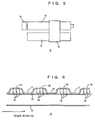
- FIG. 5 shows a flat knitting machine 2 used in the embodiment, which has a pair of front and rear needle beds 4, 6.
- the flat knitting machine 2 may have a total of four needle beds at the front, the rear, the top and the bottom.
- Reference numeral 8 represents a carriage that reciprocally moves on the needle beds 4, 6 and operates the needles of the needle beds 4, 6 to form the three-dimensional knitted fabric.
- Reference numeral 9 represents a racking motor for laterally moving the needle beds 4, 6 relatively in a horizontal direction of FIG. 5 .
- the racking motor 9 may also move the knitted fabric between the front and rear needle beds 4, 6 with transferring the knitted fabric.
- a group of linear motors may be provided to the needle beds 4, 6 to move the needles back and forth.
- the stitch sizes may be changed among the fabrics, or the course numbers may be altered among the fabrics.
- the extent to which the needles pulled by the stitch cam in the carriage is altered.
- the inner layer knitted fabric may be knitted with heat shrinkable yarn by the same number of courses and stitch size as the outer layer knitted fabric, and then the inner layer may thermally be shrunk after knitting.
- the knitting length (the length of the three-dimensional knitted fabric in the height direction) means the length of the three-dimensional knitted fabric in a direction perpendicular to a longitudinal direction of the needle beds 4, 6 when the three-dimensional knitted fabric is knitted on the flat knitting machine 2 shown in FIG. 5 .
- the knitting width, or the size of the knitted fabric in the course direction means the width of the three-dimensional knitted fabric along the needle beds 4, 6 when the three-dimensional knitted fabric is knitted on the flat knitting machine 2 shown in FIG. 5 .
- the number of courses means the number of rows of stitches in the knitting height direction and is proportional to the knitting length when the size of stitches is constant.
- FIG. 6 schematically shows a cross section of the three-dimensional knitted fabric 10 of the embodiment.
- Reference numeral 12 represents the rear knitted fabric, 14 the inner layer knitted fabric, and 16 the outer layer knitted fabric.
- the three-dimensional knitted fabric 10 comprises these three layers of the rear knitted fabric 12, the inner layer knitted fabric 14, and the outer layer knitted fabric 16.
- the inner layer knitted fabric 14 and the outer layer knitted fabric 16 are joined to each other such that the inner layer knitted fabric 14 and the outer layer knitted fabric 16 are attached to each other at concave sections 17 arranged for example at regular intervals.
- a connecting yarn 18 is filled in the areas between the concave sections 17 to connect the knitted fabrics 14, 16 to each other. Sections where the inner layer knitted fabric 14 and the outer layer knitted fabric 16 are connected to each other by the connecting yarn 18 configure the convex sections of the three-dimensional knitted fabric 10.
- the knitted fabrics 12, 14, 16 are assigned to separate needle beds, and the three-dimensional knitted fabric 10 is knitted with knitting the knitted fabrics 12, 14, 16 on the assigned needle beds.
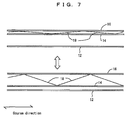
- the three-dimensional knitted fabric 10 is knitted in a manner shown in FIG. 7 , for example.
- the rear knitted fabric 12 is assigned to one of the needle beds, and the inner layer knitted fabric 14 and the outer layer knitted fabric 16 are assigned to the other needle bed.
- the inner layer knitted fabric 14 is disposed in a position shifted closer to a trick gap between the needle beds than the outer layer knitted fabric 16.
- the rear knitted fabric 12 may be knitted in an arrangement shown in an upper part of FIG. 7 .
- the inner layer knitted fabric 14 may be transferred between the upper arrangement and lower arrangement in FIG. 7 .
- the inner layer knitted fabric 14 and the outer layer knitted fabric 16 may be knitted in the lower arrangement in FIG. 7 , and the space between the knitted fabrics 14, 16 may be filled with the connecting yarn 18 by tucking or knitting the connecting yarn 18.
- the tucking operation is shown in FIG. 7 .
- a series of operations such as ⁇ ... missing several stitches, knitting one stitch (forming one stitch) on the inner layer knitted fabric 14, missing several stitches, knitting one stitch on the outer layer knitted fabric 16, ...> are performed with the connecting yarn 18.
- both the tubular knitting courses for the outer layer knitted fabric 16 and the inner layer knitted fabric 14 and those for the outer layer knitted fabric 16 and the rear knitted fabric 12 are carried out.
- the three-dimensional knitted fabric shown in FIGS. 1 to 3 may be knitted.
- FIG. 8 shows a method of knitting the three-dimensional knitted fabric shown in FIGS. 1 to 3 .
- the symbol “FB" in the diagram represents the front needle bed of the flat knitting machine, "BB” the rear needle bed, " ⁇ ” a yarn feeder for feeding yarns for the outer layer knitted fabric 16, the inner layer knitted fabric 14 and the rear knitted fabric 12, and "V” a yarn feeder for feeding the connecting yarn 18.
- the symbol “ ⁇ ” represents stitches knitted in a current course, “ ⁇ ” stitches that have already been knitted in the previous courses, and "V” tuck stitches.
- the number of needles and the number of stitches in the diagram are less than the actual numbers.
- the outer layer knitted fabric 16 is held by the needles of the front needle bed FB, and the inner layer knitted fabric 14 and the rear knitted fabric 12 are held by the needles of the rear needle bed BB.
- the inner layer knitted fabric 14 is held such that the prolongations between stitches are positioned closer to the front needle bed FB than the prolongations of the rear knitted fabric 12.
- the inner layer knitted fabric 14 is held by the needles b, d, f, h, ... of the rear needle bed BB, and the rear knitted fabric 12 is held by the needles a, c, e, g, ....
- the outer layer knitted fabric 16 is knitted by these courses in steps 1, 4, 7 among steps 1 to 8, the inner layer knitted fabric 14 is knitted by tow courses in steps 2, 8, and the rear knitted fabric 12 is knitted by one course in step 5. Therefore, the knitting lengths of these knitted fabric are in the order of the outer layer knitted fabric 16 > the inner layer knitted fabric 14 > and the rear knitted fabric 12.
- the outer layer knitted fabric 16 expands outward at the convex sections.
- step 3 the inner layer knitted fabric 14 is transferred to the front needle bed FB, and, in step 4, the outer layer knitted fabric 16 is knitted by one course on the front needle bed FB.
- prolongations of the outer layer knitted fabric 16 fix prolongations of the inner layer knitted fabric 14 to the front needle bed FB side, knitting the concave sections 17.
- the rear knitted fabric 12 is knitted by one course on the rear needle bed BB.
- the prolongations do not fix the inner layer knitted fabric 14 when the rear knitted fabric 12 is knitted.
- the rear knitted fabric 12 is knitted in step 2 in place of the inner layer knitted fabric 14, the prolongations of the rear knitted fabric 12 fix the prolongations of the inner layer knitted fabric 14, and the rear knitted fabric 12 and the inner layer knitted fabric 14 are joined to each other.
- the inner layer knitted fabric 14 is transferred back to the rear needle bed BB in step 6, and one course of the outer layer knitted fabric 16 and one course of the inner layer knitted fabric 14 are knitted in steps 7, 8.
- steps 9 to 13 the outer layer knitted fabric 16 and the inner layer knitted fabric 14 are connected to each other with the connecting yarn 18, and the outer layer knitted fabric 16 and the inner layer knitted fabric 14 are tucked alternately every several needles (the number of stitches is 1/2 the number of needles), while shifting the tucking needles for each course (step).
- the number of courses knitted in steps 1 to 8 and the number of courses tucked in steps 9 to 13 are arbitrary.
- the three-dimensional knitted fabric shown in FIGS. 1 to 3 is knitted with repeating steps 1 to 13.
- the three-dimensional knitted fabric with three layers has been described in the embodiment. However, when a sewn stretchable band or the like in place of the rear knitted fabric 12, in incorporated, or when a semispherical helmet is knitted, the seamless three-dimensional knitted fabric may have the two layers, the outer layer knitted fabric 16 and the inner layer knitted fabric 14.
Landscapes
- Engineering & Computer Science (AREA)
- Textile Engineering (AREA)
- Knitting Of Fabric (AREA)
- Professional, Industrial, Or Sporting Protective Garments (AREA)
- Braiding, Manufacturing Of Bobbin-Net Or Lace, And Manufacturing Of Nets By Knotting (AREA)
- Knitting Machines (AREA)
Description
- The present invention relates to a three-dimensional knitted fabric, a method of knitting the same, and a supporter.
- In three-dimensional knitted fabrics the front and rear knitted fabrics are connected with connecting yarns, and a space is knitted between the front and rear knitted fabrics by the elasticity of the connecting yarns. Three-dimensional knitted fabrics with uneven surfaces are disclosed by Patent Document 1 (Japanese Patent Publication No.
2002-294539 - Patent Document 1:
JP2002-294539
Prior art documentDE 20 2006 016 338 U1 discloses a three-dimensional knitted fabric for a seating furniture comprising a support area for the support of a body portion of a seating person, the support area being knitted in one piece. The support area comprises alternately portions made by a distance knitted fabric and portions made from a second knitted fabric, wherein the portions of the second knitted fabric have a thickness which is smaller than the areas made out of the distance knitted fabric. - From
WO 03/042441 A1 - Document
EP 0 734 670 A2 discloses a fabric upholstered structure having a core, whose external surface is covered by a knitted fabric cover, the external surface of the cover having at least one strip of hook member of any hook/loop fastener attached hereto, the hook member engaging knitted loops on the internal surface of the cover which are formed integrally with the knitted cover. - From
EP 2 233 621 A1 - An object of the present invention is to provide a three-dimensional knitted fabric, which is knitted seamlessly, provides sufficient cushion characteristics and is flexible, a method of knitting such a three-dimensional knitted fabric, and a supporter.
This and other objects are solved by a three-dimensional knitted fabric having the features as setforth in claim 1. The method of knitting a three-dimensional knitted fabric as defined inclaim 2 does also solve the objects, as well as a supporter comprising the three-dimensional knitted fabric of claim 1 - A three-dimensional knitted fabric of the present invention is one that has an outer layer knitted fabric, an inner layer knitted fabric and a rear knitted fabric. The outer layer knitted fabric and the inner layer knitted fabric are connected to each other with a connecting yarn, that convex sections where the outer layer knitted fabric and the inner layer knitted fabric are separated from each other by the connecting yarn and concave sections where the outer layer knitted fabric and the inner layer knitted fabric are attached to each other with no gaps therebetween are alternately repeated, and that the three-dimensional knitted fabric is seamless.
- In this three-dimensional knitted fabric of the present invention, the convex sections provide cushion characteristics in order to protect, for example, a human body from an external force. The concave sections of the three-dimensional knitted fabric make the three-dimensional knitted fabric flexible. Therefore, the three-dimensional knitted fabric may deform in response to a movement of the human body, etc. or a motion of a joint, etc. Furthermore, the three-dimensional knitted fabric of the present invention may be produced seamlessly into a required dimension on a flat knitting machine. Note that the term "seamlessly" means that the three-dimensional knitted fabric with an inner layer, an outer layer and a connecting yarn may be knitted seamlessly, and includes the options of sewing accessories and other parts to the three-dimensional knitted fabric.
- The supporter comprising the three-dimensional knitted fabric of the present invention bends at the concave sections thereof, it is suitable to movements of the human body and the like, protects the human body and the like with the elasticity of the convex sections thereof, and may be produced seamlessly.
- The number of courses in the outer layer knitted fabric is greater than the number of courses in the inner layer knitted fabric, at the convex sections and along a height direction of the three-dimensional knitted fabric. In this manner, the inner layer knitted fabric of the three-dimensional knitted fabric is made flat, and the outer layer knitted fabric of the same is expanded outward.
- The three-dimensional knitted fabric comprises the three layers of the outer layer knitted fabric, the inner layer knitted fabric, and the rear knitted fabric, that the outer layer knitted fabric is disposed on one side of the inner layer knitted fabric, the rear knitted fabric is disposed on the other side of the inner layer knitted fabric, and that the inner layer knitted fabric and the rear knitted fabric configure a tube extending in a height direction of the three dimensional knitted fabric. In this manner, an arm, a leg and the like of the human body may be passed through the tube of the three-dimensional knitted fabric.
- The method of knitting a three-dimensional knitted fabric according to the present invention is a method of knitting a three-dimensional knitted fabric having an outer layer knitted fabric, an inner layer knitted fabric and a rear knitted fabric, on a flat knitting machine that has at least a pair of needle beds and is capable of transferring the knitted fabric between the needle beds. The method executes the steps of: knitting the outer layer knitted fabric on one of the needle beds; knitting the inner layer knitted fabric and the rear knitted fabric on the other of the needle beds; connecting the outer layer knitted fabric and the inner layer knitted fabric on a connecting yarn such that the outer layer knitted fabric and the inner layer knitted fabric are separated from each other with the connecting yarn on the needle beds; and knitting the outer layer knitted fabric and the inner layer knitted fabric such that the outer layer knitted fabric and the inner layer fabric are attached to each other with no gaps therebetween, on the needle beds, to thereby knit the three-dimensional knitted fabric seamlessly such that convex sections where the outer layer knitted fabric and the inner layer knitted fabric are separated from each other with the connecting yarn and concave sections where the outer layer knitted fabric and the inner layer knitted fabric are attached to each other with no gaps therebetween, are alternately repeated.
- According to the present invention, a flat knitting machine knits seamlessly the three-dimensional knitted fabric in which the convex sections where the outer layer knitted fabric and the inner layer knitted fabric are separated from each other with the connecting yarn, and the concave sections where the outer layer knitted fabric and the inner layer knitted fabric are attached to each other with no gaps therebetween, are alternately repeated. In this specification, the descriptions on the three-dimensional knitted fabric may be applied to the method of knitting the three-dimensional knitted fabric and to the supporter. The order of the steps executed in the method of knitting the three-dimensional knitted fabric may be changed depending on the situation, and there are not special orders in the step of knitting the outer layer knitted fabric on one needle bed and the step of knitting the inner layer knitted fabric on the other needle bed. The step of knitting the outer layer knitted fabric on one needle bed and the step of knitting the inner layer knitted fabric on the other needle bed may repeatedly be executed as many times as needed. The step of connecting the outer layer knitted fabric and the inner layer knitted fabric to each other with the connecting yarn and the step of knitting the outer knitted fabric and the inner layer knitted fabric such that they are attached to each other with no gaps therebetween may also repeatedly be executed as many times as needed.
-
-
FIG. 1 is a front view of a three-dimensional knitted fabric (supporter) of an embodiment; -
FIG. 2 is a side view of the three-dimensional knitted fabric of the embodiment; -
FIG. 3 is a diagram showing a state in which the three-dimensional knitted fabric of the embodiment is applied to a human body; -
FIG. 4 is a diagram showing a three-dimensional knitted fabric of a modified example and a three-dimensional knitted fabric of a comparative example; -
FIG. 5 is a plan view of a flat knitting machine; -
FIG. 6 is a diagram schematically showing the three-dimensional knitted fabric of the embodiment along a height direction thereof; -
FIG. 7 is a diagram showing a state in which the three-dimensional knitted fabric of the embodiment is latched onto needle beds of the flat knitting machine; and -
FIG. 8 is a diagram showing a method of knitting the three-dimensional knitted fabric of the embodiment. - Best modes for carrying out the present invention are described hereinafter. The scope of the present invention should be interpreted based upon the patent claims with the possibility of modifications in accordance with the well-known techniques.
-
FIGS. 1 to 8 illustrate an embodiment.FIGS. 1 to 3 show a three-dimensional knitted fabric of the embodiment, which is a supporter. The white part in the knitted fabric inFIGS. 1 to 3 are the substantial part of this three-dimensional knitted fabric, which are simply described as "three-dimensional knitted fabric" hereinafter. The three-dimensional knitted fabric is knitted of three layers, i.e., a rear knitted fabric, an inner layer knitted fabric, and an outer layer knitted fabric shown sequentially from right to left ofFIG. 2 . The inner layer knitted fabric and the outer layer knitted fabric are connected to each other by a connecting yarn and are joined to each other with no gaps therebetween, at a plurality of parts arranged at regular intervals along a height direction of the three-dimensional knitted fabric. Joining the outer layer knitted fabric and the inner layer knitted fabric to each other with no gaps therebetween is called "closing stitches." The inner layer knitted fabric is invisible inFIGS. 1 to 3 as it is positioned between the rear knitted fabric and the outer layer knitted fabric. The connecting yarn is also invisible inFIGS. 1 to 3 as it is positioned between the inner layer knitted fabric and the outer layer knitted fabric. The number of courses (the number of rows of stitches in the height direction) knitted in the outer layer knitted fabric is greater than the number of courses knitted in the inner layer knitted fabric. As a result, the length of the outer layer knitted fabric in the height direction, the knitting length is greater than that of the inner layer knitted fabric, and the three-dimensional knitted fabric consequently expands outward. The inner layer knitted fabric has a flat front surface to fit to a human body and the like. The number of courses in the rear knitted fabric is smaller than those of the inner layer knitted fabric and the outer layer knitted fabric. The number of stitches along a course direction (a knitting width direction) in the rear knitted fabric is also smaller than those of the inner layer knitted fabric and the outer layer knitted fabric. For this reason, as shown inFIGS. 1 and 2 , the three-dimensional knitted fabric is bent into an L-shape with the outer layer knitted fabric protruding into the inside and is also bent such that the outer layer knitted fabric covers an area larger than half the circumference of an arm. Colored parts at top and bottom ends of the three-dimensional knitted fabric shown inFIGS. 1 to 3 represent the knitting start part and the knitting end part, and there are no connecting yarns. The structures of these parts are, for example, rib structures but may be plain structures. The inner layer knitted fabric and the outer layer knitted fabric have, for example, a plain structure but may have a rib structure or the like. - The inner layer knitted fabric, the outer layer knitted fabric and the rear knitted fabric are knitted by a yarns with appropriate strength and stretchability. The connecting yarn is knitted by wooly nylon made of, for example, multifilament nylon yarn or other yarn with appropriate cushion characteristics. The connecting yarn may also be a monofilament, and in that case a hard three-dimensional knitted fabric is obtained. The material and other characteristics of the yarn for the three-dimensional knitted fabric are determined according to the purpose of the three-dimensional knitted fabric. The three-dimensional knitted fabric may be used as a supporter for an arm, a leg, an elbow and a knee, and may also be used in a part of a sock lower than the ankle, a helmet. They may be for sport activities or for medical purpose. Moreover, the three-dimensional knitted fabric of the embodiment may be used as a cover for protecting one surface of a column, a pipe or the like. The three-dimensional knitted fabric of the present embodiment has the convex sections where spaces are knitted between the outer layer knitted fabric and the inner layer knitted fabric by the connecting yarn and the concave sections where the outer layer knitted fabric and the inner layer knitted fabric are attached to each other with no gaps therebetween. They are alternately repeated. The three-dimensional knitted fabric of the embodiment is made elastic by the cushion characteristics in the convex sections to protect the human body, and is also made bendable at the concave sections so as to be bent in response to a movement of the human body.
-
FIG. 4 shows a three-dimensional knitted fabric of a modified example (left) and a three-dimensional knitted fabric of a comparative example (right), and the difference therebetween is whether the existence or the absence of the connecting yarn between the outer layer knitted fabric and the inner layer knitted fabric. In the three-dimensional knitted fabric on the left-hand side (the modified example), wooly nylon is the connecting yarn and filled in a gap between the inner layer knitted fabric and the outer layer knitted fabric with tucking them. The three-dimensional knitted fabric on the right-hand side (the comparative example), on the other hand, has no connecting yarns. In both the right and left three-dimensional knitted fabric, the outer layer knitted fabric and the inner layer knitted fabric are joined to each other at regular intervals, with no gaps therebetween. The three-dimensional knitted fabric of the comparative example lacks the cushion characteristics because no connecting yarns are used therein. Two layers of the outer layer knitted fabric and the inner layer knitted fabric protect an arm, a leg and the like. The three-dimensional knitted fabric of the modified example provides the cushion characteristics by the connecting yarn between the inner layer knitted fabric and the outer layer knitted fabric, and the connecting yarn is compressed in response to an external force, thereby protecting a human body or the like from the external force. -
FIG. 5 shows aflat knitting machine 2 used in the embodiment, which has a pair of front andrear needle beds flat knitting machine 2 may have a total of four needle beds at the front, the rear, the top and the bottom. Reference numeral 8 represents a carriage that reciprocally moves on theneedle beds needle beds Reference numeral 9 represents a racking motor for laterally moving theneedle beds FIG. 5 . The rackingmotor 9 may also move the knitted fabric between the front andrear needle beds needle beds - In this specification, the knitting length (the length of the three-dimensional knitted fabric in the height direction) means the length of the three-dimensional knitted fabric in a direction perpendicular to a longitudinal direction of the
needle beds flat knitting machine 2 shown inFIG. 5 . The knitting width, or the size of the knitted fabric in the course direction, means the width of the three-dimensional knitted fabric along theneedle beds flat knitting machine 2 shown inFIG. 5 . The number of courses means the number of rows of stitches in the knitting height direction and is proportional to the knitting length when the size of stitches is constant. -
FIG. 6 schematically shows a cross section of the three-dimensionalknitted fabric 10 of the embodiment.Reference numeral 12 represents the rear knitted fabric, 14 the inner layer knitted fabric, and 16 the outer layer knitted fabric. The three-dimensionalknitted fabric 10 comprises these three layers of the rear knittedfabric 12, the inner layer knittedfabric 14, and the outer layer knittedfabric 16. The inner layer knittedfabric 14 and the outer layer knittedfabric 16 are joined to each other such that the inner layer knittedfabric 14 and the outer layer knittedfabric 16 are attached to each other atconcave sections 17 arranged for example at regular intervals. A connectingyarn 18 is filled in the areas between theconcave sections 17 to connect the knittedfabrics fabric 14 and the outer layer knittedfabric 16 are connected to each other by the connectingyarn 18 configure the convex sections of the three-dimensionalknitted fabric 10. - With a flat knitting machine having four needle beds at the front, the rear, the top and the bottom, the knitted
fabrics knitted fabric 10 is knitted with knitting the knittedfabrics flat knitting machine 2 having two needle beds at the front and the rear, the three-dimensionalknitted fabric 10 is knitted in a manner shown inFIG. 7 , for example. The rear knittedfabric 12 is assigned to one of the needle beds, and the inner layer knittedfabric 14 and the outer layer knittedfabric 16 are assigned to the other needle bed. The inner layer knittedfabric 14 is disposed in a position shifted closer to a trick gap between the needle beds than the outer layer knittedfabric 16. The rear knittedfabric 12 may be knitted in an arrangement shown in an upper part ofFIG. 7 . The inner layer knittedfabric 14 may be transferred between the upper arrangement and lower arrangement inFIG. 7 . The inner layer knittedfabric 14 and the outer layer knittedfabric 16 may be knitted in the lower arrangement inFIG. 7 , and the space between theknitted fabrics yarn 18 by tucking or knitting the connectingyarn 18. The tucking operation is shown inFIG. 7 . In the knitting operation, a series of operations such as <... missing several stitches, knitting one stitch (forming one stitch) on the inner layer knittedfabric 14, missing several stitches, knitting one stitch on the outer layer knittedfabric 16, ...> are performed with the connectingyarn 18. - In order to make the number of courses in the outer layer knitted
fabric 16 greater than the number of courses in the inner layer knittedfabric 14, both the tubular knitting courses for the outer layer knittedfabric 16 and the inner layer knittedfabric 14 and those for the outer layer knittedfabric 16 and the rear knittedfabric 12 are carried out. As a result, the three-dimensional knitted fabric shown inFIGS. 1 to 3 may be knitted. -
FIG. 8 shows a method of knitting the three-dimensional knitted fabric shown inFIGS. 1 to 3 . The symbol "FB" in the diagram represents the front needle bed of the flat knitting machine, "BB" the rear needle bed, "▼" a yarn feeder for feeding yarns for the outer layer knittedfabric 16, the inner layer knittedfabric 14 and the rear knittedfabric 12, and "V" a yarn feeder for feeding the connectingyarn 18. The symbol "●" represents stitches knitted in a current course, "○" stitches that have already been knitted in the previous courses, and "V" tuck stitches. The number of needles and the number of stitches in the diagram are less than the actual numbers. The outer layer knittedfabric 16 is held by the needles of the front needle bed FB, and the inner layer knittedfabric 14 and the rear knittedfabric 12 are held by the needles of the rear needle bed BB. The inner layer knittedfabric 14 is held such that the prolongations between stitches are positioned closer to the front needle bed FB than the prolongations of the rear knittedfabric 12. The inner layer knittedfabric 14 is held by the needles b, d, f, h, ... of the rear needle bed BB, and the rear knittedfabric 12 is held by the needles a, c, e, g, .... - The outer layer knitted
fabric 16 is knitted by these courses insteps 1, 4, 7 among steps 1 to 8, the inner layer knittedfabric 14 is knitted by tow courses insteps 2, 8, and the rear knittedfabric 12 is knitted by one course in step 5. Therefore, the knitting lengths of these knitted fabric are in the order of the outer layer knittedfabric 16 > the inner layer knittedfabric 14 > and the rear knittedfabric 12. The outer layer knittedfabric 16 expands outward at the convex sections. Instep 3, the inner layer knittedfabric 14 is transferred to the front needle bed FB, and, instep 4, the outer layer knittedfabric 16 is knitted by one course on the front needle bed FB. Therefore, prolongations of the outer layer knittedfabric 16 fix prolongations of the inner layer knittedfabric 14 to the front needle bed FB side, knitting theconcave sections 17. In step 5, the rear knittedfabric 12 is knitted by one course on the rear needle bed BB. At this moment, because the inner layer knittedfabric 14 has been moved to the front needle bed FB, the prolongations do not fix the inner layer knittedfabric 14 when the rear knittedfabric 12 is knitted. On the other hand, if the rear knittedfabric 12 is knitted instep 2 in place of the inner layer knittedfabric 14, the prolongations of the rear knittedfabric 12 fix the prolongations of the inner layer knittedfabric 14, and the rear knittedfabric 12 and the inner layer knittedfabric 14 are joined to each other. The inner layer knittedfabric 14 is transferred back to the rear needle bed BB instep 6, and one course of the outer layer knittedfabric 16 and one course of the inner layer knittedfabric 14 are knitted in steps 7, 8. - In
steps 9 to 13, the outer layer knittedfabric 16 and the inner layer knittedfabric 14 are connected to each other with the connectingyarn 18, and the outer layer knittedfabric 16 and the inner layer knittedfabric 14 are tucked alternately every several needles (the number of stitches is 1/2 the number of needles), while shifting the tucking needles for each course (step). The number of courses knitted in steps 1 to 8 and the number of courses tucked insteps 9 to 13 are arbitrary. The three-dimensional knitted fabric shown inFIGS. 1 to 3 is knitted with repeating steps 1 to 13. - The three-dimensional knitted fabric with three layers has been described in the embodiment. However, when a sewn stretchable band or the like in place of the rear knitted
fabric 12, in incorporated, or when a semispherical helmet is knitted, the seamless three-dimensional knitted fabric may have the two layers, the outer layer knittedfabric 16 and the inner layer knittedfabric 14. -
- 2
- Flat knitting machine
- 4, 6
- Needle bed
- 8
- Carriage
- 9
- Racking motor
- 10
- Three-dimensional knitted fabric
- 12
- Rear knitted fabric
- 14
- Inner layer knitted fabric
- 16
- Outer layer knitted fabric
- 17
- Concave section
- 18
- Connecting yarn
Claims (3)
- A three-dimensional knitted fabric (10), comprising an outer layer knitted fabric (16), an inner layer knitted fabric (14), and a rear knitted fabric (12), wherein
the outer layer knitted fabric (16) and the inner layer knitted fabric (14) are connected to each other with a connecting yarn (18),
wherein convex sections where the outer layer knitted fabric (16) and the inner layer knitted fabric (14) are separated from each other by the connecting yarn (18) and concave sections (17) where the outer layer knitted fabric (16) and the inner layer knitted fabric (14) are attached to each other with no gaps therebetween are alternately repeated,
wherein t the three-dimensional knitted fabric (10) is seamless,
wherein the number of courses in the outer layer knitted fabric (16) is greater than the number of courses in the inner layer knitted fabric (14) at the convex sections along a height direction of the three-dimensional knitted fabric (10),and
wherein the outer layer knitted fabric (16) is disposed on one side of the inner layer knitted fabric (14), the rear knitted fabric (12) is disposed on the other side of the inner layer knitted fabric (14), and the inner layer knitted fabric (14) and the rear knitted fabric (12) configure a tube extending in a height direction of the three dimensional knitted fabric (10). - A method of knitting a three-dimensional knitted fabric (10) having an outer layer knitted fabric (16), an inner layer knitted fabric (14), and a rear knitted fabric (12) on a flat knitting machine (2) that has at least a pair of needle beds (4, 6) and is capable of transferring the knitted fabric (14, 16) between the needle beds (4,6), whereby the method executes the steps of:knitting the outer layer knitted fabric (16) on one of the needle beds (4,6);knitting the inner layer knitted fabric (14) and the rear knitted fabric (12) on the other of the needle beds (4,6);connecting the outer layer knitted fabric (16) and the inner layer knitted fabric (14) with a connecting yarn (18) such that the outer layer knitted fabric (16) and the inner layer knitted fabric (14) are separated from each other with the connecting yarn (18) on the needle beds (4,6); andknitting the outer layer knitted fabric (16) and the inner layer knitted fabric (14) such that the outer layer knitted fabric (16) and the inner layer fabric (14) are attached to each other with no gaps therebetween on the needle beds (4,6),to thereby knit the three-dimensional knitted fabric (10) seamlessly such that convex sections where the outer layer knitted fabric (16) and the inner layer knitted fabric (14) are separated from each other with the connecting yarn (18) and concave sections (17) where the outer layer knitted fabric (16) and the inner layer knitted fabric (14) are attached to each other with no gaps therebetween, are alternately repeated,whereby, in order to make the number of courses in the outer layer knitted fabric (16) greater than the number of courses in the inner layer knitted fabric (14), both tubular knitting of courses forming the outer layer knitted fabric (16) and the inner layer knitted fabric (14) and tubular knitting of courses forming the outer layer knitted fabric (16) and the rear knitted fabric (12) are carried out.
- A supporter comprising the three-dimensional knitted fabric (10) of claim 1.
Applications Claiming Priority (1)
| Application Number | Priority Date | Filing Date | Title |
|---|---|---|---|
| JP2010282905A JP5709511B2 (en) | 2010-12-20 | 2010-12-20 | Three-dimensional knitted fabric, its knitting method and supporter |
Publications (2)
| Publication Number | Publication Date |
|---|---|
| EP2474653A1 EP2474653A1 (en) | 2012-07-11 |
| EP2474653B1 true EP2474653B1 (en) | 2016-09-14 |
Family
ID=45400841
Family Applications (1)
| Application Number | Title | Priority Date | Filing Date |
|---|---|---|---|
| EP11010011.2A Not-in-force EP2474653B1 (en) | 2010-12-20 | 2011-12-20 | Three-dimensional knitted fabric, method of knitting same, and supporter |
Country Status (3)
| Country | Link |
|---|---|
| EP (1) | EP2474653B1 (en) |
| JP (1) | JP5709511B2 (en) |
| CN (1) | CN102560840B (en) |
Cited By (1)
| Publication number | Priority date | Publication date | Assignee | Title |
|---|---|---|---|---|
| US11166516B2 (en) | 2016-08-26 | 2021-11-09 | Nike, Inc. | Article of footwear having an upper that includes a knitted component with a cushioning region and methods for fabricating the same |
Families Citing this family (20)
| Publication number | Priority date | Publication date | Assignee | Title |
|---|---|---|---|---|
| JP6045209B2 (en) * | 2012-06-14 | 2016-12-14 | 株式会社島精機製作所 | Protective knitted product and method for producing the same |
| US9474328B2 (en) * | 2013-01-15 | 2016-10-25 | Nike, Inc. | Spacer textile material with tensile strands in non-linear arrangements |
| JP6150836B2 (en) * | 2015-03-31 | 2017-06-21 | 株式会社島精機製作所 | Supporters and how to organize supporters |
| ITVR20150074A1 (en) * | 2015-05-06 | 2016-11-06 | Dainese Spa | PROTECTIVE DEVICE AND METHOD FOR REALIZING THIS PROTECTIVE DEVICE |
| EP3426087B1 (en) * | 2016-03-11 | 2026-01-28 | NIKE Innovate C.V. | An upper for an article of footwear with a cuff |
| CN109072507B (en) * | 2016-04-01 | 2022-10-04 | 耐克创新有限合伙公司 | Article with knitted component and method of making the same |
| ITUA20164534A1 (en) * | 2016-06-01 | 2017-12-01 | Pro Eight S R L | TECHNICAL FABRIC |
| WO2018144504A1 (en) * | 2017-02-01 | 2018-08-09 | Knitmasters, Llc | Spacer fabrics and methods of making the same |
| JP6874991B2 (en) * | 2017-09-02 | 2021-05-19 | ナック商会株式会社 | A knitted fabric in which the front and back knitted fabrics are not connected between the quilting-like polygonal patterns, and a fabric for supporters using the knitted fabric. |
| US10945482B2 (en) * | 2017-10-20 | 2021-03-16 | Nike, Inc. | Knitted loft zones |
| CN108251950A (en) * | 2017-12-22 | 2018-07-06 | 珠海建轩服装有限公司 | Has woollen jersey of stereoscopic effect and preparation method thereof |
| CN110016752B (en) * | 2019-05-16 | 2024-02-02 | 福建荣荣新材料股份有限公司 | Fabric with sandwich element drum structure and fly weaving method thereof |
| IT202100008042A1 (en) | 2021-03-31 | 2022-10-01 | Essepi Srl | PADDED KNITTED FABRIC AND PROCESS FOR MANUFACTURING THIS FABRIC |
| CN115216880B (en) * | 2021-04-16 | 2024-04-30 | 佰龙机械厂股份有限公司 | Method for forming weft knitted fabric with varying thickness by flat knitting machine and weft knitted fabric |
| ES3015186T3 (en) * | 2021-05-10 | 2025-04-30 | Pai Lung Machinery Mill Co Ltd | Method for knitting and forming weft-knitted fabric with varying thickness by flat knitting machine and weft-knitted fabric thereof |
| US12553161B2 (en) * | 2021-06-01 | 2026-02-17 | Asahi Kasei Kabushiki Kaisha | Double raschel knitted fabric and upholstery material containing same |
| CN113832593A (en) * | 2021-07-19 | 2021-12-24 | 信泰(福建)科技有限公司 | A multi-layer knitted shoe upper |
| CN114032634B (en) * | 2021-10-21 | 2023-02-28 | 上海群德纺织科技有限公司 | Double-sided functional knitted fabric with scale effect and weaving process thereof |
| US12207735B2 (en) | 2022-03-03 | 2025-01-28 | MillerKnoll, Inc. | Cover assembly for a chair |
| US12070132B2 (en) | 2022-09-09 | 2024-08-27 | MillerKnoll, Inc. | Seating structure having a knitted suspension material |
Family Cites Families (16)
| Publication number | Priority date | Publication date | Assignee | Title |
|---|---|---|---|---|
| EP0752839B1 (en) * | 1994-03-30 | 1998-05-20 | Smith & Nephew plc | Medical articles |
| GB9506807D0 (en) * | 1995-04-01 | 1995-05-24 | Gen Motors Corp | Kntted covers |
| CN2248466Y (en) * | 1995-11-22 | 1997-03-05 | 黄澄烟 | Knee and Elbow Pads |
| FR2749327B1 (en) * | 1996-06-04 | 1998-06-26 | Commissariat Energie Atomique | KNITTED DOUBLE-SKIN TEXTILE STRUCTURE AND ORIENTABLE BONDING YARN AND METHOD FOR MANUFACTURING THE SAME |
| JP3990546B2 (en) | 2001-03-30 | 2007-10-17 | セーレン株式会社 | Uneven solid knitted fabric and method for producing the same |
| JP4789345B2 (en) * | 2001-05-16 | 2011-10-12 | 株式会社デルタツーリング | 3D solid knitting |
| JP2003013346A (en) * | 2001-06-27 | 2003-01-15 | Suminoe Textile Co Ltd | 3D knitting |
| US6711920B2 (en) * | 2001-11-14 | 2004-03-30 | Federal-Mogul World Wide, Inc. | Knit convolute protective sleeve |
| FR2832165B1 (en) * | 2001-11-15 | 2004-01-23 | Textiles Plastiques Chomarat | THREE-DIMENSIONAL DOUBLE-SIDED KNIT |
| JP3702221B2 (en) * | 2001-12-04 | 2005-10-05 | 日本マイヤー株式会社 | Method for knitting uneven two-sided warp knitted fabric and warp knitted fabric |
| JP4428655B2 (en) * | 2002-06-20 | 2010-03-10 | フェデラル−モーグル パワートレイン インコーポレイテッド | Multi-layer insulation sleeve |
| JP4383135B2 (en) * | 2003-09-09 | 2009-12-16 | 竹中繊維株式会社 | Fiber fitting with a hardened area |
| DE202006016338U1 (en) * | 2006-10-23 | 2007-01-04 | Gebrüder Achter GmbH & Co. KG | Knitted seat cover comprises a body support region knitted in one piece with alternate spacer fabric zones and thinner opaque or open-mesh zones |
| US7380421B1 (en) * | 2007-02-09 | 2008-06-03 | Ruey Tay Fibre Industry Co., Ltd. | Fabric |
| JP5022207B2 (en) * | 2007-12-19 | 2012-09-12 | 地方独立行政法人 東京都立産業技術研究センター | Multilayer knitted fabric and knitting method of multilayer knitted fabric |
| DE102009015369A1 (en) * | 2009-03-27 | 2010-09-30 | Kobleder Strickmode Gmbh & Co. | Garment or part of a garment |
-
2010
- 2010-12-20 JP JP2010282905A patent/JP5709511B2/en not_active Expired - Fee Related
-
2011
- 2011-12-16 CN CN201110421806.4A patent/CN102560840B/en not_active Expired - Fee Related
- 2011-12-20 EP EP11010011.2A patent/EP2474653B1/en not_active Not-in-force
Cited By (1)
| Publication number | Priority date | Publication date | Assignee | Title |
|---|---|---|---|---|
| US11166516B2 (en) | 2016-08-26 | 2021-11-09 | Nike, Inc. | Article of footwear having an upper that includes a knitted component with a cushioning region and methods for fabricating the same |
Also Published As
| Publication number | Publication date |
|---|---|
| CN102560840B (en) | 2016-04-27 |
| CN102560840A (en) | 2012-07-11 |
| JP5709511B2 (en) | 2015-04-30 |
| EP2474653A1 (en) | 2012-07-11 |
| JP2012132108A (en) | 2012-07-12 |
Similar Documents
| Publication | Publication Date | Title |
|---|---|---|
| EP2474653A1 (en) | Three-dimensional knitted fabric, method of knitting same, and supporter | |
| TWI232247B (en) | Stretchable warp knitted fabric | |
| EP1887116B1 (en) | Knitting method for knitting fabric and knitted product | |
| CN103189557B (en) | Fabric and band crotch clothes | |
| JP6078406B2 (en) | Ground thickness stretch fabric | |
| KR101725421B1 (en) | Method for knitting knitted fabric | |
| KR101329124B1 (en) | Partial knitting method and fabric | |
| JP6411859B2 (en) | Wavy double raschel knitted fabric | |
| CN101248228B (en) | Rib fabric and its knitting method | |
| CN103687510B (en) | zipper chain | |
| EP2180093B1 (en) | Cylindrical fabric knitting method | |
| JP2012132109A (en) | Method for knitting three-dimensional fabric, three-dimensional fabric and pipe cover made of the fabric | |
| JP5174264B1 (en) | Elastic pile warp knitted fabric, bandages, female face fasteners | |
| CN110409043B (en) | Knitting method of knitted fabric and knitted fabric | |
| EP1835058B1 (en) | Method of knitting tubular fabric | |
| JP5988895B2 (en) | Knitting method of knitted fabric | |
| JP7233205B2 (en) | Knitted fabric knitting method and knitted fabric | |
| TW201121456A (en) | Woven slide fastener | |
| JP2001303414A (en) | Lace knitted fabric and method for producing the same | |
| JP5531129B1 (en) | Elastic pile warp knitted fabric, bandages, female face fasteners | |
| JP2017214671A (en) | Knitted product and method for producing knitted product | |
| JP2012132107A (en) | Method for knitting three-dimensional fabric, three-dimensional fabric and pipe cover made of the fabric | |
| JP2002327359A (en) | Lace knitted fabric and method for producing the same | |
| JP5984766B2 (en) | Raschel warp knitted fabric | |
| HK1174508B (en) | Woven slide fastener |
Legal Events
| Date | Code | Title | Description |
|---|---|---|---|
| PUAI | Public reference made under article 153(3) epc to a published international application that has entered the european phase |
Free format text: ORIGINAL CODE: 0009012 |
|
| AK | Designated contracting states |
Kind code of ref document: A1 Designated state(s): AL AT BE BG CH CY CZ DE DK EE ES FI FR GB GR HR HU IE IS IT LI LT LU LV MC MK MT NL NO PL PT RO RS SE SI SK SM TR |
|
| AX | Request for extension of the european patent |
Extension state: BA ME |
|
| 17P | Request for examination filed |
Effective date: 20130111 |
|
| RIC1 | Information provided on ipc code assigned before grant |
Ipc: D04B 1/22 20060101AFI20160212BHEP |
|
| GRAP | Despatch of communication of intention to grant a patent |
Free format text: ORIGINAL CODE: EPIDOSNIGR1 |
|
| INTG | Intention to grant announced |
Effective date: 20160329 |
|
| GRAS | Grant fee paid |
Free format text: ORIGINAL CODE: EPIDOSNIGR3 |
|
| GRAA | (expected) grant |
Free format text: ORIGINAL CODE: 0009210 |
|
| AK | Designated contracting states |
Kind code of ref document: B1 Designated state(s): AL AT BE BG CH CY CZ DE DK EE ES FI FR GB GR HR HU IE IS IT LI LT LU LV MC MK MT NL NO PL PT RO RS SE SI SK SM TR |
|
| REG | Reference to a national code |
Ref country code: GB Ref legal event code: FG4D |
|
| REG | Reference to a national code |
Ref country code: CH Ref legal event code: EP |
|
| REG | Reference to a national code |
Ref country code: IE Ref legal event code: FG4D |
|
| REG | Reference to a national code |
Ref country code: AT Ref legal event code: REF Ref document number: 829106 Country of ref document: AT Kind code of ref document: T Effective date: 20161015 |
|
| REG | Reference to a national code |
Ref country code: DE Ref legal event code: R096 Ref document number: 602011030286 Country of ref document: DE |
|
| REG | Reference to a national code |
Ref country code: LT Ref legal event code: MG4D |
|
| REG | Reference to a national code |
Ref country code: NL Ref legal event code: MP Effective date: 20160914 |
|
| PG25 | Lapsed in a contracting state [announced via postgrant information from national office to epo] |
Ref country code: RS Free format text: LAPSE BECAUSE OF FAILURE TO SUBMIT A TRANSLATION OF THE DESCRIPTION OR TO PAY THE FEE WITHIN THE PRESCRIBED TIME-LIMIT Effective date: 20160914 Ref country code: HR Free format text: LAPSE BECAUSE OF FAILURE TO SUBMIT A TRANSLATION OF THE DESCRIPTION OR TO PAY THE FEE WITHIN THE PRESCRIBED TIME-LIMIT Effective date: 20160914 Ref country code: FI Free format text: LAPSE BECAUSE OF FAILURE TO SUBMIT A TRANSLATION OF THE DESCRIPTION OR TO PAY THE FEE WITHIN THE PRESCRIBED TIME-LIMIT Effective date: 20160914 Ref country code: LT Free format text: LAPSE BECAUSE OF FAILURE TO SUBMIT A TRANSLATION OF THE DESCRIPTION OR TO PAY THE FEE WITHIN THE PRESCRIBED TIME-LIMIT Effective date: 20160914 Ref country code: NO Free format text: LAPSE BECAUSE OF FAILURE TO SUBMIT A TRANSLATION OF THE DESCRIPTION OR TO PAY THE FEE WITHIN THE PRESCRIBED TIME-LIMIT Effective date: 20161214 |
|
| PGFP | Annual fee paid to national office [announced via postgrant information from national office to epo] |
Ref country code: DE Payment date: 20161213 Year of fee payment: 6 |
|
| REG | Reference to a national code |
Ref country code: AT Ref legal event code: MK05 Ref document number: 829106 Country of ref document: AT Kind code of ref document: T Effective date: 20160914 |
|
| PG25 | Lapsed in a contracting state [announced via postgrant information from national office to epo] |
Ref country code: GR Free format text: LAPSE BECAUSE OF FAILURE TO SUBMIT A TRANSLATION OF THE DESCRIPTION OR TO PAY THE FEE WITHIN THE PRESCRIBED TIME-LIMIT Effective date: 20161215 Ref country code: NL Free format text: LAPSE BECAUSE OF FAILURE TO SUBMIT A TRANSLATION OF THE DESCRIPTION OR TO PAY THE FEE WITHIN THE PRESCRIBED TIME-LIMIT Effective date: 20160914 Ref country code: SE Free format text: LAPSE BECAUSE OF FAILURE TO SUBMIT A TRANSLATION OF THE DESCRIPTION OR TO PAY THE FEE WITHIN THE PRESCRIBED TIME-LIMIT Effective date: 20160914 Ref country code: LV Free format text: LAPSE BECAUSE OF FAILURE TO SUBMIT A TRANSLATION OF THE DESCRIPTION OR TO PAY THE FEE WITHIN THE PRESCRIBED TIME-LIMIT Effective date: 20160914 |
|
| PGFP | Annual fee paid to national office [announced via postgrant information from national office to epo] |
Ref country code: IT Payment date: 20161221 Year of fee payment: 6 |
|
| PG25 | Lapsed in a contracting state [announced via postgrant information from national office to epo] |
Ref country code: EE Free format text: LAPSE BECAUSE OF FAILURE TO SUBMIT A TRANSLATION OF THE DESCRIPTION OR TO PAY THE FEE WITHIN THE PRESCRIBED TIME-LIMIT Effective date: 20160914 Ref country code: RO Free format text: LAPSE BECAUSE OF FAILURE TO SUBMIT A TRANSLATION OF THE DESCRIPTION OR TO PAY THE FEE WITHIN THE PRESCRIBED TIME-LIMIT Effective date: 20160914 |
|
| PG25 | Lapsed in a contracting state [announced via postgrant information from national office to epo] |
Ref country code: PT Free format text: LAPSE BECAUSE OF FAILURE TO SUBMIT A TRANSLATION OF THE DESCRIPTION OR TO PAY THE FEE WITHIN THE PRESCRIBED TIME-LIMIT Effective date: 20170116 Ref country code: ES Free format text: LAPSE BECAUSE OF FAILURE TO SUBMIT A TRANSLATION OF THE DESCRIPTION OR TO PAY THE FEE WITHIN THE PRESCRIBED TIME-LIMIT Effective date: 20160914 Ref country code: IS Free format text: LAPSE BECAUSE OF FAILURE TO SUBMIT A TRANSLATION OF THE DESCRIPTION OR TO PAY THE FEE WITHIN THE PRESCRIBED TIME-LIMIT Effective date: 20170114 Ref country code: SM Free format text: LAPSE BECAUSE OF FAILURE TO SUBMIT A TRANSLATION OF THE DESCRIPTION OR TO PAY THE FEE WITHIN THE PRESCRIBED TIME-LIMIT Effective date: 20160914 Ref country code: AT Free format text: LAPSE BECAUSE OF FAILURE TO SUBMIT A TRANSLATION OF THE DESCRIPTION OR TO PAY THE FEE WITHIN THE PRESCRIBED TIME-LIMIT Effective date: 20160914 Ref country code: SK Free format text: LAPSE BECAUSE OF FAILURE TO SUBMIT A TRANSLATION OF THE DESCRIPTION OR TO PAY THE FEE WITHIN THE PRESCRIBED TIME-LIMIT Effective date: 20160914 Ref country code: BG Free format text: LAPSE BECAUSE OF FAILURE TO SUBMIT A TRANSLATION OF THE DESCRIPTION OR TO PAY THE FEE WITHIN THE PRESCRIBED TIME-LIMIT Effective date: 20161214 Ref country code: CZ Free format text: LAPSE BECAUSE OF FAILURE TO SUBMIT A TRANSLATION OF THE DESCRIPTION OR TO PAY THE FEE WITHIN THE PRESCRIBED TIME-LIMIT Effective date: 20160914 Ref country code: BE Free format text: LAPSE BECAUSE OF FAILURE TO SUBMIT A TRANSLATION OF THE DESCRIPTION OR TO PAY THE FEE WITHIN THE PRESCRIBED TIME-LIMIT Effective date: 20160914 Ref country code: PL Free format text: LAPSE BECAUSE OF FAILURE TO SUBMIT A TRANSLATION OF THE DESCRIPTION OR TO PAY THE FEE WITHIN THE PRESCRIBED TIME-LIMIT Effective date: 20160914 |
|
| REG | Reference to a national code |
Ref country code: DE Ref legal event code: R097 Ref document number: 602011030286 Country of ref document: DE |
|
| PLBE | No opposition filed within time limit |
Free format text: ORIGINAL CODE: 0009261 |
|
| STAA | Information on the status of an ep patent application or granted ep patent |
Free format text: STATUS: NO OPPOSITION FILED WITHIN TIME LIMIT |
|
| PG25 | Lapsed in a contracting state [announced via postgrant information from national office to epo] |
Ref country code: DK Free format text: LAPSE BECAUSE OF FAILURE TO SUBMIT A TRANSLATION OF THE DESCRIPTION OR TO PAY THE FEE WITHIN THE PRESCRIBED TIME-LIMIT Effective date: 20160914 |
|
| REG | Reference to a national code |
Ref country code: CH Ref legal event code: PL |
|
| 26N | No opposition filed |
Effective date: 20170615 |
|
| GBPC | Gb: european patent ceased through non-payment of renewal fee |
Effective date: 20161220 |
|
| PG25 | Lapsed in a contracting state [announced via postgrant information from national office to epo] |
Ref country code: MC Free format text: LAPSE BECAUSE OF FAILURE TO SUBMIT A TRANSLATION OF THE DESCRIPTION OR TO PAY THE FEE WITHIN THE PRESCRIBED TIME-LIMIT Effective date: 20160914 |
|
| REG | Reference to a national code |
Ref country code: FR Ref legal event code: ST Effective date: 20170831 |
|
| REG | Reference to a national code |
Ref country code: IE Ref legal event code: MM4A |
|
| PG25 | Lapsed in a contracting state [announced via postgrant information from national office to epo] |
Ref country code: LI Free format text: LAPSE BECAUSE OF NON-PAYMENT OF DUE FEES Effective date: 20161231 Ref country code: CH Free format text: LAPSE BECAUSE OF NON-PAYMENT OF DUE FEES Effective date: 20161231 Ref country code: LU Free format text: LAPSE BECAUSE OF NON-PAYMENT OF DUE FEES Effective date: 20161220 Ref country code: FR Free format text: LAPSE BECAUSE OF NON-PAYMENT OF DUE FEES Effective date: 20170102 |
|
| PG25 | Lapsed in a contracting state [announced via postgrant information from national office to epo] |
Ref country code: IE Free format text: LAPSE BECAUSE OF NON-PAYMENT OF DUE FEES Effective date: 20161220 Ref country code: GB Free format text: LAPSE BECAUSE OF NON-PAYMENT OF DUE FEES Effective date: 20161220 Ref country code: SI Free format text: LAPSE BECAUSE OF FAILURE TO SUBMIT A TRANSLATION OF THE DESCRIPTION OR TO PAY THE FEE WITHIN THE PRESCRIBED TIME-LIMIT Effective date: 20160914 |
|
| PG25 | Lapsed in a contracting state [announced via postgrant information from national office to epo] |
Ref country code: HU Free format text: LAPSE BECAUSE OF FAILURE TO SUBMIT A TRANSLATION OF THE DESCRIPTION OR TO PAY THE FEE WITHIN THE PRESCRIBED TIME-LIMIT; INVALID AB INITIO Effective date: 20111220 Ref country code: CY Free format text: LAPSE BECAUSE OF FAILURE TO SUBMIT A TRANSLATION OF THE DESCRIPTION OR TO PAY THE FEE WITHIN THE PRESCRIBED TIME-LIMIT Effective date: 20160914 |
|
| PG25 | Lapsed in a contracting state [announced via postgrant information from national office to epo] |
Ref country code: TR Free format text: LAPSE BECAUSE OF FAILURE TO SUBMIT A TRANSLATION OF THE DESCRIPTION OR TO PAY THE FEE WITHIN THE PRESCRIBED TIME-LIMIT Effective date: 20160914 Ref country code: MK Free format text: LAPSE BECAUSE OF FAILURE TO SUBMIT A TRANSLATION OF THE DESCRIPTION OR TO PAY THE FEE WITHIN THE PRESCRIBED TIME-LIMIT Effective date: 20160914 |
|
| REG | Reference to a national code |
Ref country code: DE Ref legal event code: R119 Ref document number: 602011030286 Country of ref document: DE |
|
| PG25 | Lapsed in a contracting state [announced via postgrant information from national office to epo] |
Ref country code: MT Free format text: LAPSE BECAUSE OF NON-PAYMENT OF DUE FEES Effective date: 20161220 |
|
| PG25 | Lapsed in a contracting state [announced via postgrant information from national office to epo] |
Ref country code: AL Free format text: LAPSE BECAUSE OF FAILURE TO SUBMIT A TRANSLATION OF THE DESCRIPTION OR TO PAY THE FEE WITHIN THE PRESCRIBED TIME-LIMIT Effective date: 20160914 Ref country code: IT Free format text: LAPSE BECAUSE OF NON-PAYMENT OF DUE FEES Effective date: 20171220 Ref country code: DE Free format text: LAPSE BECAUSE OF NON-PAYMENT OF DUE FEES Effective date: 20180703 |