EP2473592B1 - Verwendung von mitteln zur behandlung harter oberflächen - Google Patents
Verwendung von mitteln zur behandlung harter oberflächen Download PDFInfo
- Publication number
- EP2473592B1 EP2473592B1 EP10743172.8A EP10743172A EP2473592B1 EP 2473592 B1 EP2473592 B1 EP 2473592B1 EP 10743172 A EP10743172 A EP 10743172A EP 2473592 B1 EP2473592 B1 EP 2473592B1
- Authority
- EP
- European Patent Office
- Prior art keywords
- alkyl
- independently
- another
- groups
- aryl
- Prior art date
- Legal status (The legal status is an assumption and is not a legal conclusion. Google has not performed a legal analysis and makes no representation as to the accuracy of the status listed.)
- Not-in-force
Links
- 239000000203 mixture Substances 0.000 claims description 69
- 239000003795 chemical substances by application Substances 0.000 claims description 68
- -1 polyoxyethylene groups Polymers 0.000 claims description 64
- 229920000642 polymer Polymers 0.000 claims description 47
- 229920001577 copolymer Polymers 0.000 claims description 30
- NIXOWILDQLNWCW-UHFFFAOYSA-N 2-Propenoic acid Natural products OC(=O)C=C NIXOWILDQLNWCW-UHFFFAOYSA-N 0.000 claims description 24
- 229920006149 polyester-amide block copolymer Polymers 0.000 claims description 23
- 125000000217 alkyl group Chemical group 0.000 claims description 22
- 125000004432 carbon atom Chemical group C* 0.000 claims description 22
- SMZOUWXMTYCWNB-UHFFFAOYSA-N 2-(2-methoxy-5-methylphenyl)ethanamine Chemical compound COC1=CC=C(C)C=C1CCN SMZOUWXMTYCWNB-UHFFFAOYSA-N 0.000 claims description 21
- 229920000570 polyether Polymers 0.000 claims description 21
- 239000004721 Polyphenylene oxide Chemical group 0.000 claims description 18
- 125000001453 quaternary ammonium group Chemical group 0.000 claims description 17
- 125000005842 heteroatom Chemical group 0.000 claims description 16
- 239000004094 surface-active agent Substances 0.000 claims description 16
- 239000000919 ceramic Substances 0.000 claims description 15
- 239000000126 substance Substances 0.000 claims description 15
- 125000000041 C6-C10 aryl group Chemical group 0.000 claims description 13
- 244000005700 microbiome Species 0.000 claims description 13
- 125000000524 functional group Chemical group 0.000 claims description 12
- 239000012459 cleaning agent Substances 0.000 claims description 11
- 229910052739 hydrogen Inorganic materials 0.000 claims description 11
- 150000001875 compounds Chemical class 0.000 claims description 10
- 230000001603 reducing effect Effects 0.000 claims description 9
- 125000002496 methyl group Chemical group [H]C([H])([H])* 0.000 claims description 8
- YIOJGTBNHQAVBO-UHFFFAOYSA-N dimethyl-bis(prop-2-enyl)azanium Chemical compound C=CC[N+](C)(C)CC=C YIOJGTBNHQAVBO-UHFFFAOYSA-N 0.000 claims description 7
- 125000001495 ethyl group Chemical group [H]C([H])([H])C([H])([H])* 0.000 claims description 7
- HRPVXLWXLXDGHG-UHFFFAOYSA-N Acrylamide Chemical compound NC(=O)C=C HRPVXLWXLXDGHG-UHFFFAOYSA-N 0.000 claims description 6
- XSQUKJJJFZCRTK-UHFFFAOYSA-N Urea Chemical compound NC(N)=O XSQUKJJJFZCRTK-UHFFFAOYSA-N 0.000 claims description 6
- 150000002148 esters Chemical class 0.000 claims description 6
- 150000002170 ethers Chemical class 0.000 claims description 6
- 239000001257 hydrogen Substances 0.000 claims description 6
- 125000004435 hydrogen atom Chemical class [H]* 0.000 claims description 5
- 125000004430 oxygen atom Chemical group O* 0.000 claims description 5
- RAXXELZNTBOGNW-UHFFFAOYSA-N 1H-imidazole Chemical compound C1=CNC=N1 RAXXELZNTBOGNW-UHFFFAOYSA-N 0.000 claims description 4
- 229910019142 PO4 Inorganic materials 0.000 claims description 4
- XYFCBTPGUUZFHI-UHFFFAOYSA-N Phosphine Chemical compound P XYFCBTPGUUZFHI-UHFFFAOYSA-N 0.000 claims description 4
- BLRPTPMANUNPDV-UHFFFAOYSA-N Silane Chemical compound [SiH4] BLRPTPMANUNPDV-UHFFFAOYSA-N 0.000 claims description 4
- 150000001412 amines Chemical class 0.000 claims description 4
- 125000006353 oxyethylene group Chemical group 0.000 claims description 4
- 229910000077 silane Inorganic materials 0.000 claims description 4
- UMGDCJDMYOKAJW-UHFFFAOYSA-N thiourea Chemical compound NC(N)=S UMGDCJDMYOKAJW-UHFFFAOYSA-N 0.000 claims description 4
- 125000004209 (C1-C8) alkyl group Chemical group 0.000 claims description 3
- UFHFLCQGNIYNRP-UHFFFAOYSA-N Hydrogen Chemical compound [H][H] UFHFLCQGNIYNRP-UHFFFAOYSA-N 0.000 claims description 3
- QAOWNCQODCNURD-UHFFFAOYSA-L Sulfate Chemical compound [O-]S([O-])(=O)=O QAOWNCQODCNURD-UHFFFAOYSA-L 0.000 claims description 3
- 150000001408 amides Chemical class 0.000 claims description 3
- 125000003277 amino group Chemical group 0.000 claims description 3
- 150000003457 sulfones Chemical class 0.000 claims description 3
- WKBOTKDWSSQWDR-UHFFFAOYSA-N Bromine atom Chemical compound [Br] WKBOTKDWSSQWDR-UHFFFAOYSA-N 0.000 claims description 2
- BVKZGUZCCUSVTD-UHFFFAOYSA-L Carbonate Chemical compound [O-]C([O-])=O BVKZGUZCCUSVTD-UHFFFAOYSA-L 0.000 claims description 2
- ZAMOUSCENKQFHK-UHFFFAOYSA-N Chlorine atom Chemical compound [Cl] ZAMOUSCENKQFHK-UHFFFAOYSA-N 0.000 claims description 2
- XFXPMWWXUTWYJX-UHFFFAOYSA-N Cyanide Chemical compound N#[C-] XFXPMWWXUTWYJX-UHFFFAOYSA-N 0.000 claims description 2
- JOYRKODLDBILNP-UHFFFAOYSA-N Ethyl urethane Chemical compound CCOC(N)=O JOYRKODLDBILNP-UHFFFAOYSA-N 0.000 claims description 2
- PXGOKWXKJXAPGV-UHFFFAOYSA-N Fluorine Chemical compound FF PXGOKWXKJXAPGV-UHFFFAOYSA-N 0.000 claims description 2
- BPQQTUXANYXVAA-UHFFFAOYSA-N Orthosilicate Chemical compound [O-][Si]([O-])([O-])[O-] BPQQTUXANYXVAA-UHFFFAOYSA-N 0.000 claims description 2
- UCKMPCXJQFINFW-UHFFFAOYSA-N Sulphide Chemical compound [S-2] UCKMPCXJQFINFW-UHFFFAOYSA-N 0.000 claims description 2
- 125000002015 acyclic group Chemical group 0.000 claims description 2
- GDTBXPJZTBHREO-UHFFFAOYSA-N bromine Substances BrBr GDTBXPJZTBHREO-UHFFFAOYSA-N 0.000 claims description 2
- 229910052794 bromium Inorganic materials 0.000 claims description 2
- 239000004202 carbamide Substances 0.000 claims description 2
- 239000000460 chlorine Substances 0.000 claims description 2
- 229910052801 chlorine Inorganic materials 0.000 claims description 2
- 229910052731 fluorine Inorganic materials 0.000 claims description 2
- 239000011737 fluorine Substances 0.000 claims description 2
- 150000003949 imides Chemical class 0.000 claims description 2
- 150000002466 imines Chemical class 0.000 claims description 2
- PNDPGZBMCMUPRI-UHFFFAOYSA-N iodine Chemical compound II PNDPGZBMCMUPRI-UHFFFAOYSA-N 0.000 claims description 2
- 150000002923 oximes Chemical class 0.000 claims description 2
- NBIIXXVUZAFLBC-UHFFFAOYSA-K phosphate Chemical compound [O-]P([O-])([O-])=O NBIIXXVUZAFLBC-UHFFFAOYSA-K 0.000 claims description 2
- 239000010452 phosphate Substances 0.000 claims description 2
- 229910000073 phosphorus hydride Inorganic materials 0.000 claims description 2
- 229920001296 polysiloxane Polymers 0.000 claims description 2
- MDDUHVRJJAFRAU-YZNNVMRBSA-N tert-butyl-[(1r,3s,5z)-3-[tert-butyl(dimethyl)silyl]oxy-5-(2-diphenylphosphorylethylidene)-4-methylidenecyclohexyl]oxy-dimethylsilane Chemical compound C1[C@@H](O[Si](C)(C)C(C)(C)C)C[C@H](O[Si](C)(C)C(C)(C)C)C(=C)\C1=C/CP(=O)(C=1C=CC=CC=1)C1=CC=CC=C1 MDDUHVRJJAFRAU-YZNNVMRBSA-N 0.000 claims description 2
- 150000003573 thiols Chemical class 0.000 claims description 2
- 125000003837 (C1-C20) alkyl group Chemical group 0.000 claims 1
- 125000003158 alcohol group Chemical group 0.000 claims 1
- 125000000753 cycloalkyl group Chemical group 0.000 claims 1
- 125000001181 organosilyl group Chemical group [SiH3]* 0.000 claims 1
- KRKNYBCHXYNGOX-UHFFFAOYSA-N citric acid Chemical compound OC(=O)CC(O)(C(O)=O)CC(O)=O KRKNYBCHXYNGOX-UHFFFAOYSA-N 0.000 description 27
- 150000003254 radicals Chemical class 0.000 description 27
- 125000003808 silyl group Chemical group [H][Si]([H])([H])[*] 0.000 description 25
- XLYOFNOQVPJJNP-UHFFFAOYSA-N water Substances O XLYOFNOQVPJJNP-UHFFFAOYSA-N 0.000 description 24
- 229920005862 polyol Polymers 0.000 description 20
- 150000003077 polyols Chemical class 0.000 description 20
- IAYPIBMASNFSPL-UHFFFAOYSA-N Ethylene oxide Chemical compound C1CO1 IAYPIBMASNFSPL-UHFFFAOYSA-N 0.000 description 18
- 238000004140 cleaning Methods 0.000 description 18
- BDAGIHXWWSANSR-UHFFFAOYSA-N methanoic acid Natural products OC=O BDAGIHXWWSANSR-UHFFFAOYSA-N 0.000 description 18
- 238000000034 method Methods 0.000 description 18
- 150000003839 salts Chemical class 0.000 description 17
- 102000004190 Enzymes Human genes 0.000 description 16
- 108090000790 Enzymes Proteins 0.000 description 16
- LFQSCWFLJHTTHZ-UHFFFAOYSA-N Ethanol Chemical compound CCO LFQSCWFLJHTTHZ-UHFFFAOYSA-N 0.000 description 16
- 229940088598 enzyme Drugs 0.000 description 16
- 239000003599 detergent Substances 0.000 description 15
- 238000009472 formulation Methods 0.000 description 15
- 239000002253 acid Substances 0.000 description 14
- 239000007921 spray Substances 0.000 description 13
- 150000007524 organic acids Chemical class 0.000 description 11
- 230000008569 process Effects 0.000 description 11
- 239000000975 dye Substances 0.000 description 10
- 230000000694 effects Effects 0.000 description 10
- RTZKZFJDLAIYFH-UHFFFAOYSA-N ether Substances CCOCC RTZKZFJDLAIYFH-UHFFFAOYSA-N 0.000 description 10
- JVTAAEKCZFNVCJ-UHFFFAOYSA-N lactic acid Chemical compound CC(O)C(O)=O JVTAAEKCZFNVCJ-UHFFFAOYSA-N 0.000 description 10
- PEDCQBHIVMGVHV-UHFFFAOYSA-N Glycerine Chemical compound OCC(O)CO PEDCQBHIVMGVHV-UHFFFAOYSA-N 0.000 description 9
- HEMHJVSKTPXQMS-UHFFFAOYSA-M Sodium hydroxide Chemical compound [OH-].[Na+] HEMHJVSKTPXQMS-UHFFFAOYSA-M 0.000 description 9
- YXFVVABEGXRONW-UHFFFAOYSA-N Toluene Chemical compound CC1=CC=CC=C1 YXFVVABEGXRONW-UHFFFAOYSA-N 0.000 description 9
- 150000007513 acids Chemical class 0.000 description 9
- 230000003115 biocidal effect Effects 0.000 description 9
- 239000007844 bleaching agent Substances 0.000 description 9
- 0 CC(C(C)(C)C(C)(*)C(C)(C)N)OC(BC(N(*)*)=O)=O Chemical compound CC(C(C)(C)C(C)(*)C(C)(C)N)OC(BC(N(*)*)=O)=O 0.000 description 8
- 235000015165 citric acid Nutrition 0.000 description 8
- 239000000194 fatty acid Substances 0.000 description 8
- 235000005985 organic acids Nutrition 0.000 description 8
- 238000002360 preparation method Methods 0.000 description 8
- 239000003381 stabilizer Substances 0.000 description 8
- 239000002562 thickening agent Substances 0.000 description 8
- 241000588724 Escherichia coli Species 0.000 description 7
- 230000015572 biosynthetic process Effects 0.000 description 7
- 235000014113 dietary fatty acids Nutrition 0.000 description 7
- 229930195729 fatty acid Natural products 0.000 description 7
- 239000004615 ingredient Substances 0.000 description 7
- 239000007788 liquid Substances 0.000 description 7
- 239000002736 nonionic surfactant Substances 0.000 description 7
- 230000009467 reduction Effects 0.000 description 7
- 239000011734 sodium Substances 0.000 description 7
- 229910052708 sodium Inorganic materials 0.000 description 7
- OSWFIVFLDKOXQC-UHFFFAOYSA-N 4-(3-methoxyphenyl)aniline Chemical compound COC1=CC=CC(C=2C=CC(N)=CC=2)=C1 OSWFIVFLDKOXQC-UHFFFAOYSA-N 0.000 description 6
- QTBSBXVTEAMEQO-UHFFFAOYSA-N Acetic acid Chemical compound CC(O)=O QTBSBXVTEAMEQO-UHFFFAOYSA-N 0.000 description 6
- DGAQECJNVWCQMB-PUAWFVPOSA-M Ilexoside XXIX Chemical compound C[C@@H]1CC[C@@]2(CC[C@@]3(C(=CC[C@H]4[C@]3(CC[C@@H]5[C@@]4(CC[C@@H](C5(C)C)OS(=O)(=O)[O-])C)C)[C@@H]2[C@]1(C)O)C)C(=O)O[C@H]6[C@@H]([C@H]([C@@H]([C@H](O6)CO)O)O)O.[Na+] DGAQECJNVWCQMB-PUAWFVPOSA-M 0.000 description 6
- 229910052799 carbon Inorganic materials 0.000 description 6
- 150000004665 fatty acids Chemical class 0.000 description 6
- 235000019253 formic acid Nutrition 0.000 description 6
- 239000003112 inhibitor Substances 0.000 description 6
- 239000000047 product Substances 0.000 description 6
- 230000002829 reductive effect Effects 0.000 description 6
- 241000894006 Bacteria Species 0.000 description 5
- 241000194029 Enterococcus hirae Species 0.000 description 5
- GOOHAUXETOMSMM-UHFFFAOYSA-N Propylene oxide Chemical compound CC1CO1 GOOHAUXETOMSMM-UHFFFAOYSA-N 0.000 description 5
- 239000013543 active substance Substances 0.000 description 5
- 150000001298 alcohols Chemical class 0.000 description 5
- 230000032770 biofilm formation Effects 0.000 description 5
- 239000004310 lactic acid Substances 0.000 description 5
- 235000014655 lactic acid Nutrition 0.000 description 5
- 229920002959 polymer blend Polymers 0.000 description 5
- 229920002554 vinyl polymer Polymers 0.000 description 5
- RGHNJXZEOKUKBD-SQOUGZDYSA-N D-gluconic acid Chemical compound OC[C@@H](O)[C@@H](O)[C@H](O)[C@@H](O)C(O)=O RGHNJXZEOKUKBD-SQOUGZDYSA-N 0.000 description 4
- VGGSQFUCUMXWEO-UHFFFAOYSA-N Ethene Chemical compound C=C VGGSQFUCUMXWEO-UHFFFAOYSA-N 0.000 description 4
- 239000005977 Ethylene Substances 0.000 description 4
- KDYFGRWQOYBRFD-UHFFFAOYSA-N Succinic acid Natural products OC(=O)CCC(O)=O KDYFGRWQOYBRFD-UHFFFAOYSA-N 0.000 description 4
- BOTDANWDWHJENH-UHFFFAOYSA-N Tetraethyl orthosilicate Chemical compound CCO[Si](OCC)(OCC)OCC BOTDANWDWHJENH-UHFFFAOYSA-N 0.000 description 4
- 125000000129 anionic group Chemical group 0.000 description 4
- 239000003945 anionic surfactant Substances 0.000 description 4
- 230000000845 anti-microbial effect Effects 0.000 description 4
- 125000003118 aryl group Chemical group 0.000 description 4
- 230000008901 benefit Effects 0.000 description 4
- 235000010338 boric acid Nutrition 0.000 description 4
- 238000005260 corrosion Methods 0.000 description 4
- 230000007797 corrosion Effects 0.000 description 4
- 238000001035 drying Methods 0.000 description 4
- LYCAIKOWRPUZTN-UHFFFAOYSA-N ethylene glycol Natural products OCCO LYCAIKOWRPUZTN-UHFFFAOYSA-N 0.000 description 4
- 230000002550 fecal effect Effects 0.000 description 4
- 239000011521 glass Substances 0.000 description 4
- 150000002338 glycosides Chemical group 0.000 description 4
- 125000004356 hydroxy functional group Chemical group O* 0.000 description 4
- 239000000178 monomer Substances 0.000 description 4
- 239000002304 perfume Substances 0.000 description 4
- 229920000151 polyglycol Polymers 0.000 description 4
- 239000010695 polyglycol Substances 0.000 description 4
- 239000002243 precursor Substances 0.000 description 4
- 239000003755 preservative agent Substances 0.000 description 4
- RMAQACBXLXPBSY-UHFFFAOYSA-N silicic acid Chemical class O[Si](O)(O)O RMAQACBXLXPBSY-UHFFFAOYSA-N 0.000 description 4
- 239000002689 soil Substances 0.000 description 4
- 239000002904 solvent Substances 0.000 description 4
- FRGPKMWIYVTFIQ-UHFFFAOYSA-N triethoxy(3-isocyanatopropyl)silane Chemical compound CCO[Si](OCC)(OCC)CCCN=C=O FRGPKMWIYVTFIQ-UHFFFAOYSA-N 0.000 description 4
- IMNIMPAHZVJRPE-UHFFFAOYSA-N triethylenediamine Chemical compound C1CN2CCN1CC2 IMNIMPAHZVJRPE-UHFFFAOYSA-N 0.000 description 4
- PUAQLLVFLMYYJJ-UHFFFAOYSA-N 2-aminopropiophenone Chemical compound CC(N)C(=O)C1=CC=CC=C1 PUAQLLVFLMYYJJ-UHFFFAOYSA-N 0.000 description 3
- OSCJHTSDLYVCQC-UHFFFAOYSA-N 2-ethylhexyl 4-[[4-[4-(tert-butylcarbamoyl)anilino]-6-[4-(2-ethylhexoxycarbonyl)anilino]-1,3,5-triazin-2-yl]amino]benzoate Chemical compound C1=CC(C(=O)OCC(CC)CCCC)=CC=C1NC1=NC(NC=2C=CC(=CC=2)C(=O)NC(C)(C)C)=NC(NC=2C=CC(=CC=2)C(=O)OCC(CC)CCCC)=N1 OSCJHTSDLYVCQC-UHFFFAOYSA-N 0.000 description 3
- 235000008733 Citrus aurantifolia Nutrition 0.000 description 3
- 229920000858 Cyclodextrin Polymers 0.000 description 3
- FBPFZTCFMRRESA-FSIIMWSLSA-N D-Glucitol Natural products OC[C@H](O)[C@H](O)[C@@H](O)[C@H](O)CO FBPFZTCFMRRESA-FSIIMWSLSA-N 0.000 description 3
- FBPFZTCFMRRESA-JGWLITMVSA-N D-glucitol Chemical compound OC[C@H](O)[C@@H](O)[C@H](O)[C@H](O)CO FBPFZTCFMRRESA-JGWLITMVSA-N 0.000 description 3
- 229920013708 Dow VORANOL™ CP 1421 Polyol Polymers 0.000 description 3
- OKKJLVBELUTLKV-UHFFFAOYSA-N Methanol Chemical compound OC OKKJLVBELUTLKV-UHFFFAOYSA-N 0.000 description 3
- DNIAPMSPPWPWGF-UHFFFAOYSA-N Propylene glycol Chemical compound CC(O)CO DNIAPMSPPWPWGF-UHFFFAOYSA-N 0.000 description 3
- RWRDLPDLKQPQOW-UHFFFAOYSA-N Pyrrolidine Chemical class C1CCNC1 RWRDLPDLKQPQOW-UHFFFAOYSA-N 0.000 description 3
- 239000004115 Sodium Silicate Substances 0.000 description 3
- CZMRCDWAGMRECN-UGDNZRGBSA-N Sucrose Chemical compound O[C@H]1[C@H](O)[C@@H](CO)O[C@@]1(CO)O[C@@H]1[C@H](O)[C@@H](O)[C@H](O)[C@@H](CO)O1 CZMRCDWAGMRECN-UGDNZRGBSA-N 0.000 description 3
- 229930006000 Sucrose Natural products 0.000 description 3
- 235000011941 Tilia x europaea Nutrition 0.000 description 3
- 229920013701 VORANOL™ Polymers 0.000 description 3
- 239000002250 absorbent Substances 0.000 description 3
- 239000012190 activator Substances 0.000 description 3
- 239000004599 antimicrobial Substances 0.000 description 3
- 239000003125 aqueous solvent Substances 0.000 description 3
- 230000003385 bacteriostatic effect Effects 0.000 description 3
- 239000003139 biocide Substances 0.000 description 3
- KGBXLFKZBHKPEV-UHFFFAOYSA-N boric acid Chemical compound OB(O)O KGBXLFKZBHKPEV-UHFFFAOYSA-N 0.000 description 3
- 239000004327 boric acid Substances 0.000 description 3
- 239000003054 catalyst Substances 0.000 description 3
- 230000003749 cleanliness Effects 0.000 description 3
- 239000008139 complexing agent Substances 0.000 description 3
- 238000011109 contamination Methods 0.000 description 3
- MTHSVFCYNBDYFN-UHFFFAOYSA-N diethylene glycol Chemical compound OCCOCCO MTHSVFCYNBDYFN-UHFFFAOYSA-N 0.000 description 3
- 239000006260 foam Substances 0.000 description 3
- 239000007789 gas Substances 0.000 description 3
- BUZRAOJSFRKWPD-UHFFFAOYSA-N isocyanatosilane Chemical class [SiH3]N=C=O BUZRAOJSFRKWPD-UHFFFAOYSA-N 0.000 description 3
- 239000004571 lime Substances 0.000 description 3
- 239000000463 material Substances 0.000 description 3
- 235000021317 phosphate Nutrition 0.000 description 3
- 230000003449 preventive effect Effects 0.000 description 3
- 239000003380 propellant Substances 0.000 description 3
- 235000018102 proteins Nutrition 0.000 description 3
- 102000004169 proteins and genes Human genes 0.000 description 3
- 108090000623 proteins and genes Proteins 0.000 description 3
- 239000005871 repellent Substances 0.000 description 3
- HFHDHCJBZVLPGP-UHFFFAOYSA-N schardinger α-dextrin Chemical compound O1C(C(C2O)O)C(CO)OC2OC(C(C2O)O)C(CO)OC2OC(C(C2O)O)C(CO)OC2OC(C(O)C2O)C(CO)OC2OC(C(C2O)O)C(CO)OC2OC2C(O)C(O)C1OC2CO HFHDHCJBZVLPGP-UHFFFAOYSA-N 0.000 description 3
- 239000003352 sequestering agent Substances 0.000 description 3
- NTHWMYGWWRZVTN-UHFFFAOYSA-N sodium silicate Chemical compound [Na+].[Na+].[O-][Si]([O-])=O NTHWMYGWWRZVTN-UHFFFAOYSA-N 0.000 description 3
- 229910052911 sodium silicate Inorganic materials 0.000 description 3
- 239000000600 sorbitol Substances 0.000 description 3
- 238000003756 stirring Methods 0.000 description 3
- 239000004575 stone Substances 0.000 description 3
- 229960004793 sucrose Drugs 0.000 description 3
- 238000012360 testing method Methods 0.000 description 3
- 125000000391 vinyl group Chemical group [H]C([*])=C([H])[H] 0.000 description 3
- 238000009736 wetting Methods 0.000 description 3
- 229920001285 xanthan gum Polymers 0.000 description 3
- RWNUSVWFHDHRCJ-UHFFFAOYSA-N 1-butoxypropan-2-ol Chemical compound CCCCOCC(C)O RWNUSVWFHDHRCJ-UHFFFAOYSA-N 0.000 description 2
- POAOYUHQDCAZBD-UHFFFAOYSA-N 2-butoxyethanol Chemical compound CCCCOCCO POAOYUHQDCAZBD-UHFFFAOYSA-N 0.000 description 2
- GJCOSYZMQJWQCA-UHFFFAOYSA-N 9H-xanthene Chemical compound C1=CC=C2CC3=CC=CC=C3OC2=C1 GJCOSYZMQJWQCA-UHFFFAOYSA-N 0.000 description 2
- 241000589158 Agrobacterium Species 0.000 description 2
- QGZKDVFQNNGYKY-UHFFFAOYSA-N Ammonia Chemical compound N QGZKDVFQNNGYKY-UHFFFAOYSA-N 0.000 description 2
- QGZKDVFQNNGYKY-UHFFFAOYSA-O Ammonium Chemical compound [NH4+] QGZKDVFQNNGYKY-UHFFFAOYSA-O 0.000 description 2
- 241000320697 Aquabacterium Species 0.000 description 2
- BTBUEUYNUDRHOZ-UHFFFAOYSA-N Borate Chemical compound [O-]B([O-])[O-] BTBUEUYNUDRHOZ-UHFFFAOYSA-N 0.000 description 2
- 241000589174 Bradyrhizobium japonicum Species 0.000 description 2
- 241000195493 Cryptophyta Species 0.000 description 2
- 244000303965 Cyamopsis psoralioides Species 0.000 description 2
- RGHNJXZEOKUKBD-UHFFFAOYSA-N D-gluconic acid Natural products OCC(O)C(O)C(O)C(O)C(O)=O RGHNJXZEOKUKBD-UHFFFAOYSA-N 0.000 description 2
- QXNVGIXVLWOKEQ-UHFFFAOYSA-N Disodium Chemical compound [Na][Na] QXNVGIXVLWOKEQ-UHFFFAOYSA-N 0.000 description 2
- 229940120146 EDTMP Drugs 0.000 description 2
- 208000034347 Faecal incontinence Diseases 0.000 description 2
- 241000233866 Fungi Species 0.000 description 2
- AEMRFAOFKBGASW-UHFFFAOYSA-N Glycolic acid Chemical compound OCC(O)=O AEMRFAOFKBGASW-UHFFFAOYSA-N 0.000 description 2
- VEXZGXHMUGYJMC-UHFFFAOYSA-N Hydrochloric acid Chemical compound Cl VEXZGXHMUGYJMC-UHFFFAOYSA-N 0.000 description 2
- MHAJPDPJQMAIIY-UHFFFAOYSA-N Hydrogen peroxide Chemical compound OO MHAJPDPJQMAIIY-UHFFFAOYSA-N 0.000 description 2
- XEEYBQQBJWHFJM-UHFFFAOYSA-N Iron Chemical compound [Fe] XEEYBQQBJWHFJM-UHFFFAOYSA-N 0.000 description 2
- KFZMGEQAYNKOFK-UHFFFAOYSA-N Isopropanol Chemical compound CC(C)O KFZMGEQAYNKOFK-UHFFFAOYSA-N 0.000 description 2
- 241000605122 Nitrosomonas Species 0.000 description 2
- NBIIXXVUZAFLBC-UHFFFAOYSA-N Phosphoric acid Chemical compound OP(O)(O)=O NBIIXXVUZAFLBC-UHFFFAOYSA-N 0.000 description 2
- ABLZXFCXXLZCGV-UHFFFAOYSA-N Phosphorous acid Chemical compound OP(O)=O ABLZXFCXXLZCGV-UHFFFAOYSA-N 0.000 description 2
- GLUUGHFHXGJENI-UHFFFAOYSA-N Piperazine Chemical class C1CNCCN1 GLUUGHFHXGJENI-UHFFFAOYSA-N 0.000 description 2
- NQRYJNQNLNOLGT-UHFFFAOYSA-N Piperidine Chemical class C1CCNCC1 NQRYJNQNLNOLGT-UHFFFAOYSA-N 0.000 description 2
- 239000004698 Polyethylene Substances 0.000 description 2
- 239000002202 Polyethylene glycol Substances 0.000 description 2
- 229920000388 Polyphosphate Polymers 0.000 description 2
- 241000589517 Pseudomonas aeruginosa Species 0.000 description 2
- XUIMIQQOPSSXEZ-UHFFFAOYSA-N Silicon Chemical compound [Si] XUIMIQQOPSSXEZ-UHFFFAOYSA-N 0.000 description 2
- CDBYLPFSWZWCQE-UHFFFAOYSA-L Sodium Carbonate Chemical compound [Na+].[Na+].[O-]C([O-])=O CDBYLPFSWZWCQE-UHFFFAOYSA-L 0.000 description 2
- 241000191967 Staphylococcus aureus Species 0.000 description 2
- QAOWNCQODCNURD-UHFFFAOYSA-N Sulfuric acid Chemical compound OS(O)(=O)=O QAOWNCQODCNURD-UHFFFAOYSA-N 0.000 description 2
- ZMANZCXQSJIPKH-UHFFFAOYSA-N Triethylamine Chemical compound CCN(CC)CC ZMANZCXQSJIPKH-UHFFFAOYSA-N 0.000 description 2
- 241000589634 Xanthomonas Species 0.000 description 2
- 230000002378 acidificating effect Effects 0.000 description 2
- 230000009471 action Effects 0.000 description 2
- WNLRTRBMVRJNCN-UHFFFAOYSA-N adipic acid Chemical compound OC(=O)CCCCC(O)=O WNLRTRBMVRJNCN-UHFFFAOYSA-N 0.000 description 2
- 150000001299 aldehydes Chemical class 0.000 description 2
- 150000001340 alkali metals Chemical class 0.000 description 2
- 125000003545 alkoxy group Chemical group 0.000 description 2
- 239000002280 amphoteric surfactant Substances 0.000 description 2
- 229910021538 borax Inorganic materials 0.000 description 2
- KDYFGRWQOYBRFD-NUQCWPJISA-N butanedioic acid Chemical compound O[14C](=O)CC[14C](O)=O KDYFGRWQOYBRFD-NUQCWPJISA-N 0.000 description 2
- 239000002775 capsule Substances 0.000 description 2
- 150000004649 carbonic acid derivatives Chemical class 0.000 description 2
- 239000003093 cationic surfactant Substances 0.000 description 2
- 229910010293 ceramic material Inorganic materials 0.000 description 2
- 239000000470 constituent Substances 0.000 description 2
- AYOHIQLKSOJJQH-UHFFFAOYSA-N dibutyltin Chemical compound CCCC[Sn]CCCC AYOHIQLKSOJJQH-UHFFFAOYSA-N 0.000 description 2
- 150000001991 dicarboxylic acids Chemical class 0.000 description 2
- 235000019820 disodium diphosphate Nutrition 0.000 description 2
- GYQBBRRVRKFJRG-UHFFFAOYSA-L disodium pyrophosphate Chemical class [Na+].[Na+].OP([O-])(=O)OP(O)([O-])=O GYQBBRRVRKFJRG-UHFFFAOYSA-L 0.000 description 2
- NFDRPXJGHKJRLJ-UHFFFAOYSA-N edtmp Chemical compound OP(O)(=O)CN(CP(O)(O)=O)CCN(CP(O)(O)=O)CP(O)(O)=O NFDRPXJGHKJRLJ-UHFFFAOYSA-N 0.000 description 2
- 239000003792 electrolyte Substances 0.000 description 2
- 150000002191 fatty alcohols Chemical class 0.000 description 2
- 230000002349 favourable effect Effects 0.000 description 2
- 239000003205 fragrance Substances 0.000 description 2
- 239000000499 gel Substances 0.000 description 2
- 239000000174 gluconic acid Substances 0.000 description 2
- 235000012208 gluconic acid Nutrition 0.000 description 2
- 239000008187 granular material Substances 0.000 description 2
- 238000011534 incubation Methods 0.000 description 2
- 230000003993 interaction Effects 0.000 description 2
- 239000010410 layer Substances 0.000 description 2
- 238000004519 manufacturing process Methods 0.000 description 2
- 238000005259 measurement Methods 0.000 description 2
- 239000002609 medium Substances 0.000 description 2
- 239000002245 particle Substances 0.000 description 2
- 125000005007 perfluorooctyl group Chemical group FC(C(C(C(C(C(C(C(F)(F)F)(F)F)(F)F)(F)F)(F)F)(F)F)(F)F)(F)* 0.000 description 2
- 230000002093 peripheral effect Effects 0.000 description 2
- 150000002978 peroxides Chemical class 0.000 description 2
- 150000002989 phenols Chemical class 0.000 description 2
- 150000003013 phosphoric acid derivatives Chemical class 0.000 description 2
- 229920003023 plastic Polymers 0.000 description 2
- 239000004033 plastic Substances 0.000 description 2
- 229920000233 poly(alkylene oxides) Polymers 0.000 description 2
- 229920000573 polyethylene Polymers 0.000 description 2
- 229920001223 polyethylene glycol Polymers 0.000 description 2
- 239000001205 polyphosphate Substances 0.000 description 2
- 235000011176 polyphosphates Nutrition 0.000 description 2
- 230000002335 preservative effect Effects 0.000 description 2
- 230000002265 prevention Effects 0.000 description 2
- 230000002035 prolonged effect Effects 0.000 description 2
- BDERNNFJNOPAEC-UHFFFAOYSA-N propan-1-ol Chemical compound CCCO BDERNNFJNOPAEC-UHFFFAOYSA-N 0.000 description 2
- 229920005604 random copolymer Polymers 0.000 description 2
- 239000011541 reaction mixture Substances 0.000 description 2
- 230000002940 repellent Effects 0.000 description 2
- 150000004756 silanes Chemical class 0.000 description 2
- 229910052710 silicon Inorganic materials 0.000 description 2
- FQENQNTWSFEDLI-UHFFFAOYSA-J sodium diphosphate Chemical compound [Na+].[Na+].[Na+].[Na+].[O-]P([O-])(=O)OP([O-])([O-])=O FQENQNTWSFEDLI-UHFFFAOYSA-J 0.000 description 2
- GCLGEJMYGQKIIW-UHFFFAOYSA-H sodium hexametaphosphate Chemical compound [Na]OP1(=O)OP(=O)(O[Na])OP(=O)(O[Na])OP(=O)(O[Na])OP(=O)(O[Na])OP(=O)(O[Na])O1 GCLGEJMYGQKIIW-UHFFFAOYSA-H 0.000 description 2
- 235000019982 sodium hexametaphosphate Nutrition 0.000 description 2
- 235000019795 sodium metasilicate Nutrition 0.000 description 2
- 159000000000 sodium salts Chemical class 0.000 description 2
- GEHJYWRUCIMESM-UHFFFAOYSA-L sodium sulfite Chemical compound [Na+].[Na+].[O-]S([O-])=O GEHJYWRUCIMESM-UHFFFAOYSA-L 0.000 description 2
- 239000004328 sodium tetraborate Substances 0.000 description 2
- 235000010339 sodium tetraborate Nutrition 0.000 description 2
- 239000005720 sucrose Substances 0.000 description 2
- 235000000346 sugar Nutrition 0.000 description 2
- IIACRCGMVDHOTQ-UHFFFAOYSA-N sulfamic acid Chemical compound NS(O)(=O)=O IIACRCGMVDHOTQ-UHFFFAOYSA-N 0.000 description 2
- RYCLIXPGLDDLTM-UHFFFAOYSA-J tetrapotassium;phosphonato phosphate Chemical compound [K+].[K+].[K+].[K+].[O-]P([O-])(=O)OP([O-])([O-])=O RYCLIXPGLDDLTM-UHFFFAOYSA-J 0.000 description 2
- 235000019818 tetrasodium diphosphate Nutrition 0.000 description 2
- 239000001577 tetrasodium phosphonato phosphate Substances 0.000 description 2
- 210000002700 urine Anatomy 0.000 description 2
- 239000010457 zeolite Substances 0.000 description 2
- BJEPYKJPYRNKOW-REOHCLBHSA-N (S)-malic acid Chemical compound OC(=O)[C@@H](O)CC(O)=O BJEPYKJPYRNKOW-REOHCLBHSA-N 0.000 description 1
- VUWCWMOCWKCZTA-UHFFFAOYSA-N 1,2-thiazol-4-one Chemical class O=C1CSN=C1 VUWCWMOCWKCZTA-UHFFFAOYSA-N 0.000 description 1
- OGYGFUAIIOPWQD-UHFFFAOYSA-N 1,3-thiazolidine Chemical class C1CSCN1 OGYGFUAIIOPWQD-UHFFFAOYSA-N 0.000 description 1
- JOLQKTGDSGKSKJ-UHFFFAOYSA-N 1-ethoxypropan-2-ol Chemical compound CCOCC(C)O JOLQKTGDSGKSKJ-UHFFFAOYSA-N 0.000 description 1
- GQCZPFJGIXHZMB-UHFFFAOYSA-N 1-tert-Butoxy-2-propanol Chemical compound CC(O)COC(C)(C)C GQCZPFJGIXHZMB-UHFFFAOYSA-N 0.000 description 1
- SJJMMZVIBLQHLI-UHFFFAOYSA-N 11-triethoxysilylundecanal Chemical compound CCO[Si](OCC)(OCC)CCCCCCCCCCC=O SJJMMZVIBLQHLI-UHFFFAOYSA-N 0.000 description 1
- 238000005160 1H NMR spectroscopy Methods 0.000 description 1
- AEQDJSLRWYMAQI-UHFFFAOYSA-N 2,3,9,10-tetramethoxy-6,8,13,13a-tetrahydro-5H-isoquinolino[2,1-b]isoquinoline Chemical compound C1CN2CC(C(=C(OC)C=C3)OC)=C3CC2C2=C1C=C(OC)C(OC)=C2 AEQDJSLRWYMAQI-UHFFFAOYSA-N 0.000 description 1
- OVSKIKFHRZPJSS-UHFFFAOYSA-N 2,4-D Chemical compound OC(=O)COC1=CC=C(Cl)C=C1Cl OVSKIKFHRZPJSS-UHFFFAOYSA-N 0.000 description 1
- TYFSYONDMQEGJK-UHFFFAOYSA-N 2-(2,2-dihydroxyethylamino)acetic acid Chemical compound OC(O)CNCC(O)=O TYFSYONDMQEGJK-UHFFFAOYSA-N 0.000 description 1
- XRIBIDPMFSLGFS-UHFFFAOYSA-N 2-(dimethylamino)-2-methylpropan-1-ol Chemical compound CN(C)C(C)(C)CO XRIBIDPMFSLGFS-UHFFFAOYSA-N 0.000 description 1
- HZAXFHJVJLSVMW-UHFFFAOYSA-N 2-Aminoethan-1-ol Chemical compound NCCO HZAXFHJVJLSVMW-UHFFFAOYSA-N 0.000 description 1
- BYACHAOCSIPLCM-UHFFFAOYSA-N 2-[2-[bis(2-hydroxyethyl)amino]ethyl-(2-hydroxyethyl)amino]ethanol Chemical compound OCCN(CCO)CCN(CCO)CCO BYACHAOCSIPLCM-UHFFFAOYSA-N 0.000 description 1
- URDCARMUOSMFFI-UHFFFAOYSA-N 2-[2-[bis(carboxymethyl)amino]ethyl-(2-hydroxyethyl)amino]acetic acid Chemical compound OCCN(CC(O)=O)CCN(CC(O)=O)CC(O)=O URDCARMUOSMFFI-UHFFFAOYSA-N 0.000 description 1
- YXSJRZBKSLLIOM-UHFFFAOYSA-N 2-[2-[bis(carboxymethyl)amino]ethyl-(carboxymethyl)amino]acetate;tris(2-hydroxyethyl)azanium Chemical compound OCCN(CCO)CCO.OC(=O)CN(CC(O)=O)CCN(CC(O)=O)CC(O)=O YXSJRZBKSLLIOM-UHFFFAOYSA-N 0.000 description 1
- DHVLDKHFGIVEIP-UHFFFAOYSA-N 2-bromo-2-(bromomethyl)pentanedinitrile Chemical compound BrCC(Br)(C#N)CCC#N DHVLDKHFGIVEIP-UHFFFAOYSA-N 0.000 description 1
- 125000001731 2-cyanoethyl group Chemical group [H]C([H])(*)C([H])([H])C#N 0.000 description 1
- RGAHQVPQZZNNOV-UHFFFAOYSA-N 2-diethoxyphosphorylethyl(triethoxy)silane Chemical compound CCO[Si](OCC)(OCC)CCP(=O)(OCC)OCC RGAHQVPQZZNNOV-UHFFFAOYSA-N 0.000 description 1
- WBIQQQGBSDOWNP-UHFFFAOYSA-N 2-dodecylbenzenesulfonic acid Chemical compound CCCCCCCCCCCCC1=CC=CC=C1S(O)(=O)=O WBIQQQGBSDOWNP-UHFFFAOYSA-N 0.000 description 1
- WVQOMTOKECOSHT-UHFFFAOYSA-N 2-triethoxysilylbutanal Chemical class CCO[Si](OCC)(OCC)C(CC)C=O WVQOMTOKECOSHT-UHFFFAOYSA-N 0.000 description 1
- GXDMUOPCQNLBCZ-UHFFFAOYSA-N 3-(3-triethoxysilylpropyl)oxolane-2,5-dione Chemical compound CCO[Si](OCC)(OCC)CCCC1CC(=O)OC1=O GXDMUOPCQNLBCZ-UHFFFAOYSA-N 0.000 description 1
- KNTKCYKJRSMRMZ-UHFFFAOYSA-N 3-chloropropyl-dimethoxy-methylsilane Chemical compound CO[Si](C)(OC)CCCCl KNTKCYKJRSMRMZ-UHFFFAOYSA-N 0.000 description 1
- WYVVKGNFXHOCQV-UHFFFAOYSA-N 3-iodoprop-2-yn-1-yl butylcarbamate Chemical compound CCCCNC(=O)OCC#CI WYVVKGNFXHOCQV-UHFFFAOYSA-N 0.000 description 1
- XDLMVUHYZWKMMD-UHFFFAOYSA-N 3-trimethoxysilylpropyl 2-methylprop-2-enoate Chemical compound CO[Si](OC)(OC)CCCOC(=O)C(C)=C XDLMVUHYZWKMMD-UHFFFAOYSA-N 0.000 description 1
- KBQVDAIIQCXKPI-UHFFFAOYSA-N 3-trimethoxysilylpropyl prop-2-enoate Chemical compound CO[Si](OC)(OC)CCCOC(=O)C=C KBQVDAIIQCXKPI-UHFFFAOYSA-N 0.000 description 1
- GUUULVAMQJLDSY-UHFFFAOYSA-N 4,5-dihydro-1,2-thiazole Chemical class C1CC=NS1 GUUULVAMQJLDSY-UHFFFAOYSA-N 0.000 description 1
- MOMKYJPSVWEWPM-UHFFFAOYSA-N 4-(chloromethyl)-2-(4-methylphenyl)-1,3-thiazole Chemical compound C1=CC(C)=CC=C1C1=NC(CCl)=CS1 MOMKYJPSVWEWPM-UHFFFAOYSA-N 0.000 description 1
- BDDLHHRCDSJVKV-UHFFFAOYSA-N 7028-40-2 Chemical compound CC(O)=O.CC(O)=O.CC(O)=O.CC(O)=O BDDLHHRCDSJVKV-UHFFFAOYSA-N 0.000 description 1
- ZCYVEMRRCGMTRW-UHFFFAOYSA-N 7553-56-2 Chemical compound [I] ZCYVEMRRCGMTRW-UHFFFAOYSA-N 0.000 description 1
- 244000215068 Acacia senegal Species 0.000 description 1
- RZVAJINKPMORJF-UHFFFAOYSA-N Acetaminophen Chemical compound CC(=O)NC1=CC=C(O)C=C1 RZVAJINKPMORJF-UHFFFAOYSA-N 0.000 description 1
- 241001156739 Actinobacteria <phylum> Species 0.000 description 1
- 241000186046 Actinomyces Species 0.000 description 1
- 229920001817 Agar Polymers 0.000 description 1
- 241000607620 Aliivibrio fischeri Species 0.000 description 1
- 241001135756 Alphaproteobacteria Species 0.000 description 1
- 102000013142 Amylases Human genes 0.000 description 1
- 108010065511 Amylases Proteins 0.000 description 1
- 241000416162 Astragalus gummifer Species 0.000 description 1
- 241000193738 Bacillus anthracis Species 0.000 description 1
- 244000063299 Bacillus subtilis Species 0.000 description 1
- 235000014469 Bacillus subtilis Nutrition 0.000 description 1
- 241001135755 Betaproteobacteria Species 0.000 description 1
- 239000004604 Blowing Agent Substances 0.000 description 1
- 241000589969 Borreliella burgdorferi Species 0.000 description 1
- 241000157902 Brachybacterium Species 0.000 description 1
- 241000589513 Burkholderia cepacia Species 0.000 description 1
- 241001136175 Burkholderia pseudomallei Species 0.000 description 1
- GAWIXWVDTYZWAW-UHFFFAOYSA-N C[CH]O Chemical group C[CH]O GAWIXWVDTYZWAW-UHFFFAOYSA-N 0.000 description 1
- OYPRJOBELJOOCE-UHFFFAOYSA-N Calcium Chemical compound [Ca] OYPRJOBELJOOCE-UHFFFAOYSA-N 0.000 description 1
- OKTJSMMVPCPJKN-UHFFFAOYSA-N Carbon Chemical group [C] OKTJSMMVPCPJKN-UHFFFAOYSA-N 0.000 description 1
- 229920002134 Carboxymethyl cellulose Polymers 0.000 description 1
- 102000005575 Cellulases Human genes 0.000 description 1
- 108010084185 Cellulases Proteins 0.000 description 1
- 229920001661 Chitosan Polymers 0.000 description 1
- KZBUYRJDOAKODT-UHFFFAOYSA-N Chlorine Chemical compound ClCl KZBUYRJDOAKODT-UHFFFAOYSA-N 0.000 description 1
- 241000588879 Chromobacterium violaceum Species 0.000 description 1
- RYGMFSIKBFXOCR-UHFFFAOYSA-N Copper Chemical compound [Cu] RYGMFSIKBFXOCR-UHFFFAOYSA-N 0.000 description 1
- 241000186216 Corynebacterium Species 0.000 description 1
- 241000186427 Cutibacterium acnes Species 0.000 description 1
- HTJDQJBWANPRPF-UHFFFAOYSA-N Cyclopropylamine Chemical group NC1CC1 HTJDQJBWANPRPF-UHFFFAOYSA-N 0.000 description 1
- AEMOLEFTQBMNLQ-AQKNRBDQSA-N D-glucopyranuronic acid Chemical compound OC1O[C@H](C(O)=O)[C@@H](O)[C@H](O)[C@H]1O AEMOLEFTQBMNLQ-AQKNRBDQSA-N 0.000 description 1
- QXKAIJAYHKCRRA-BXXZVTAOSA-N D-ribonic acid Chemical compound OC[C@@H](O)[C@@H](O)[C@@H](O)C(O)=O QXKAIJAYHKCRRA-BXXZVTAOSA-N 0.000 description 1
- 241000191949 Dermacoccus nishinomiyaensis Species 0.000 description 1
- 229920001353 Dextrin Polymers 0.000 description 1
- 239000004375 Dextrin Substances 0.000 description 1
- FEWJPZIEWOKRBE-JCYAYHJZSA-N Dextrotartaric acid Chemical compound OC(=O)[C@H](O)[C@@H](O)C(O)=O FEWJPZIEWOKRBE-JCYAYHJZSA-N 0.000 description 1
- 241000588700 Dickeya chrysanthemi Species 0.000 description 1
- RUPBZQFQVRMKDG-UHFFFAOYSA-M Didecyldimethylammonium chloride Chemical compound [Cl-].CCCCCCCCCC[N+](C)(C)CCCCCCCCCC RUPBZQFQVRMKDG-UHFFFAOYSA-M 0.000 description 1
- RPNUMPOLZDHAAY-UHFFFAOYSA-N Diethylenetriamine Chemical class NCCNCCN RPNUMPOLZDHAAY-UHFFFAOYSA-N 0.000 description 1
- 239000003109 Disodium ethylene diamine tetraacetate Substances 0.000 description 1
- KCXVZYZYPLLWCC-UHFFFAOYSA-N EDTA Chemical compound OC(=O)CN(CC(O)=O)CCN(CC(O)=O)CC(O)=O KCXVZYZYPLLWCC-UHFFFAOYSA-N 0.000 description 1
- ZGTMUACCHSMWAC-UHFFFAOYSA-L EDTA disodium salt (anhydrous) Chemical compound [Na+].[Na+].OC(=O)CN(CC([O-])=O)CCN(CC(O)=O)CC([O-])=O ZGTMUACCHSMWAC-UHFFFAOYSA-L 0.000 description 1
- QZKRHPLGUJDVAR-UHFFFAOYSA-K EDTA trisodium salt Chemical compound [Na+].[Na+].[Na+].OC(=O)CN(CC([O-])=O)CCN(CC([O-])=O)CC([O-])=O QZKRHPLGUJDVAR-UHFFFAOYSA-K 0.000 description 1
- DBVJJBKOTRCVKF-UHFFFAOYSA-N Etidronic acid Chemical compound OP(=O)(O)C(O)(C)P(O)(O)=O DBVJJBKOTRCVKF-UHFFFAOYSA-N 0.000 description 1
- 241000192125 Firmicutes Species 0.000 description 1
- IAJILQKETJEXLJ-UHFFFAOYSA-N Galacturonsaeure Natural products O=CC(O)C(O)C(O)C(O)C(O)=O IAJILQKETJEXLJ-UHFFFAOYSA-N 0.000 description 1
- 241000192128 Gammaproteobacteria Species 0.000 description 1
- 108010010803 Gelatin Proteins 0.000 description 1
- 241000206672 Gelidium Species 0.000 description 1
- 229920002148 Gellan gum Polymers 0.000 description 1
- 229920002907 Guar gum Polymers 0.000 description 1
- 229920000084 Gum arabic Polymers 0.000 description 1
- 241000606790 Haemophilus Species 0.000 description 1
- 101000801643 Homo sapiens Retinal-specific phospholipid-transporting ATPase ABCA4 Proteins 0.000 description 1
- 241000216643 Hydrogenophaga Species 0.000 description 1
- 102000004157 Hydrolases Human genes 0.000 description 1
- 108090000604 Hydrolases Proteins 0.000 description 1
- 241000191946 Kytococcus sedentarius Species 0.000 description 1
- 102000004882 Lipase Human genes 0.000 description 1
- 108090001060 Lipase Proteins 0.000 description 1
- 239000004367 Lipase Substances 0.000 description 1
- 229920000161 Locust bean gum Polymers 0.000 description 1
- JLVVSXFLKOJNIY-UHFFFAOYSA-N Magnesium ion Chemical compound [Mg+2] JLVVSXFLKOJNIY-UHFFFAOYSA-N 0.000 description 1
- 241000192041 Micrococcus Species 0.000 description 1
- YNAVUWVOSKDBBP-UHFFFAOYSA-N Morpholine Natural products C1COCCN1 YNAVUWVOSKDBBP-UHFFFAOYSA-N 0.000 description 1
- 241000186359 Mycobacterium Species 0.000 description 1
- AOMUHOFOVNGZAN-UHFFFAOYSA-N N,N-bis(2-hydroxyethyl)dodecanamide Chemical compound CCCCCCCCCCCC(=O)N(CCO)CCO AOMUHOFOVNGZAN-UHFFFAOYSA-N 0.000 description 1
- TXSXOLNIJMZKME-UHFFFAOYSA-N N,N-diethyl-2-hexoxyethanamine Chemical compound CCCCCCOCCN(CC)CC TXSXOLNIJMZKME-UHFFFAOYSA-N 0.000 description 1
- 241000588653 Neisseria Species 0.000 description 1
- GRYLNZFGIOXLOG-UHFFFAOYSA-N Nitric acid Chemical compound O[N+]([O-])=O GRYLNZFGIOXLOG-UHFFFAOYSA-N 0.000 description 1
- IGFHQQFPSIBGKE-UHFFFAOYSA-N Nonylphenol Natural products CCCCCCCCCC1=CC=C(O)C=C1 IGFHQQFPSIBGKE-UHFFFAOYSA-N 0.000 description 1
- TTZMPOZCBFTTPR-UHFFFAOYSA-N O=P1OCO1 Chemical compound O=P1OCO1 TTZMPOZCBFTTPR-UHFFFAOYSA-N 0.000 description 1
- 241001622831 Obesumbacterium proteus Species 0.000 description 1
- 108010038807 Oligopeptides Proteins 0.000 description 1
- 102000015636 Oligopeptides Human genes 0.000 description 1
- WYNCHZVNFNFDNH-UHFFFAOYSA-N Oxazolidine Chemical class C1COCN1 WYNCHZVNFNFDNH-UHFFFAOYSA-N 0.000 description 1
- GMRSOAQRYMQYMF-UHFFFAOYSA-N P(=O)(O)(O)C[N+](CP(=O)(O)O)(CP(=O)(O)O)[O-].[K] Chemical class P(=O)(O)(O)C[N+](CP(=O)(O)O)(CP(=O)(O)O)[O-].[K] GMRSOAQRYMQYMF-UHFFFAOYSA-N 0.000 description 1
- CCIJGWXUOOLYKL-UHFFFAOYSA-N P1(OCCCCCO1)=O.NCCNCCN.[Na] Chemical compound P1(OCCCCCO1)=O.NCCNCCN.[Na] CCIJGWXUOOLYKL-UHFFFAOYSA-N 0.000 description 1
- 241000588912 Pantoea agglomerans Species 0.000 description 1
- 241000932831 Pantoea stewartii Species 0.000 description 1
- 241000588701 Pectobacterium carotovorum Species 0.000 description 1
- 102000035195 Peptidases Human genes 0.000 description 1
- 108091005804 Peptidases Proteins 0.000 description 1
- 229920003171 Poly (ethylene oxide) Polymers 0.000 description 1
- 239000004952 Polyamide Substances 0.000 description 1
- ZLMJMSJWJFRBEC-UHFFFAOYSA-N Potassium Chemical compound [K] ZLMJMSJWJFRBEC-UHFFFAOYSA-N 0.000 description 1
- HLCFGWHYROZGBI-JJKGCWMISA-M Potassium gluconate Chemical compound [K+].OC[C@@H](O)[C@@H](O)[C@H](O)[C@@H](O)C([O-])=O HLCFGWHYROZGBI-JJKGCWMISA-M 0.000 description 1
- 239000004365 Protease Substances 0.000 description 1
- 241000519590 Pseudoalteromonas Species 0.000 description 1
- 241000589516 Pseudomonas Species 0.000 description 1
- 241000588671 Psychrobacter Species 0.000 description 1
- 241000589771 Ralstonia solanacearum Species 0.000 description 1
- 102100033617 Retinal-specific phospholipid-transporting ATPase ABCA4 Human genes 0.000 description 1
- 241000589180 Rhizobium Species 0.000 description 1
- 241000191043 Rhodobacter sphaeroides Species 0.000 description 1
- 241000607142 Salmonella Species 0.000 description 1
- 241001138501 Salmonella enterica Species 0.000 description 1
- 241000607720 Serratia Species 0.000 description 1
- 241000878021 Shewanella baltica Species 0.000 description 1
- PMZURENOXWZQFD-UHFFFAOYSA-L Sodium Sulfate Chemical compound [Na+].[Na+].[O-]S([O-])(=O)=O PMZURENOXWZQFD-UHFFFAOYSA-L 0.000 description 1
- 239000005708 Sodium hypochlorite Substances 0.000 description 1
- 229920002472 Starch Polymers 0.000 description 1
- 241000122971 Stenotrophomonas Species 0.000 description 1
- 241000194017 Streptococcus Species 0.000 description 1
- FEWJPZIEWOKRBE-UHFFFAOYSA-N Tartaric acid Natural products [H+].[H+].[O-]C(=O)C(O)C(O)C([O-])=O FEWJPZIEWOKRBE-UHFFFAOYSA-N 0.000 description 1
- 229920001615 Tragacanth Polymers 0.000 description 1
- 241000589884 Treponema pallidum Species 0.000 description 1
- SLINHMUFWFWBMU-UHFFFAOYSA-N Triisopropanolamine Chemical compound CC(O)CN(CC(C)O)CC(C)O SLINHMUFWFWBMU-UHFFFAOYSA-N 0.000 description 1
- 241000544286 Vibrio anguillarum Species 0.000 description 1
- 241000700605 Viruses Species 0.000 description 1
- 229920004482 WACKER® Polymers 0.000 description 1
- 241000589636 Xanthomonas campestris Species 0.000 description 1
- 241000607735 Xenorhabdus nematophila Species 0.000 description 1
- 241000607734 Yersinia <bacteria> Species 0.000 description 1
- 241001164734 Zooshikella Species 0.000 description 1
- WHITVGOZNGJULM-UHFFFAOYSA-N [N-2]CC[N-2].[K+].[K+].[K+].[K+] Chemical compound [N-2]CC[N-2].[K+].[K+].[K+].[K+] WHITVGOZNGJULM-UHFFFAOYSA-N 0.000 description 1
- FENRSEGZMITUEF-ATTCVCFYSA-E [Na+].[Na+].[Na+].[Na+].[Na+].[Na+].[Na+].[Na+].[Na+].OP(=O)([O-])O[C@@H]1[C@@H](OP(=O)([O-])[O-])[C@H](OP(=O)(O)[O-])[C@H](OP(=O)([O-])[O-])[C@H](OP(=O)(O)[O-])[C@H]1OP(=O)([O-])[O-] Chemical compound [Na+].[Na+].[Na+].[Na+].[Na+].[Na+].[Na+].[Na+].[Na+].OP(=O)([O-])O[C@@H]1[C@@H](OP(=O)([O-])[O-])[C@H](OP(=O)(O)[O-])[C@H](OP(=O)([O-])[O-])[C@H](OP(=O)(O)[O-])[C@H]1OP(=O)([O-])[O-] FENRSEGZMITUEF-ATTCVCFYSA-E 0.000 description 1
- MWGMEGAYPPQWFG-UHFFFAOYSA-N [SiH4].OC(=O)C=C Chemical class [SiH4].OC(=O)C=C MWGMEGAYPPQWFG-UHFFFAOYSA-N 0.000 description 1
- UKLDJPRMSDWDSL-UHFFFAOYSA-L [dibutyl(dodecanoyloxy)stannyl] dodecanoate Chemical compound CCCCCCCCCCCC(=O)O[Sn](CCCC)(CCCC)OC(=O)CCCCCCCCCCC UKLDJPRMSDWDSL-UHFFFAOYSA-L 0.000 description 1
- YBUIRAZOPRQNDE-UHFFFAOYSA-N [dimethoxy(methyl)silyl]methyl 2-methylprop-2-enoate Chemical compound CO[Si](C)(OC)COC(=O)C(C)=C YBUIRAZOPRQNDE-UHFFFAOYSA-N 0.000 description 1
- 239000003082 abrasive agent Substances 0.000 description 1
- 230000002745 absorbent Effects 0.000 description 1
- 235000010489 acacia gum Nutrition 0.000 description 1
- 239000000205 acacia gum Substances 0.000 description 1
- WDJHALXBUFZDSR-UHFFFAOYSA-N acetoacetic acid Chemical compound CC(=O)CC(O)=O WDJHALXBUFZDSR-UHFFFAOYSA-N 0.000 description 1
- 239000004480 active ingredient Substances 0.000 description 1
- 239000000654 additive Substances 0.000 description 1
- 239000001361 adipic acid Substances 0.000 description 1
- 235000011037 adipic acid Nutrition 0.000 description 1
- 230000002411 adverse Effects 0.000 description 1
- 239000000443 aerosol Substances 0.000 description 1
- 235000010419 agar Nutrition 0.000 description 1
- 230000032683 aging Effects 0.000 description 1
- 230000001476 alcoholic effect Effects 0.000 description 1
- 235000010443 alginic acid Nutrition 0.000 description 1
- 229920000615 alginic acid Polymers 0.000 description 1
- 150000007933 aliphatic carboxylic acids Chemical class 0.000 description 1
- 125000001931 aliphatic group Chemical group 0.000 description 1
- 229910052783 alkali metal Inorganic materials 0.000 description 1
- 229910000272 alkali metal oxide Inorganic materials 0.000 description 1
- 229910052784 alkaline earth metal Inorganic materials 0.000 description 1
- 229910001860 alkaline earth metal hydroxide Inorganic materials 0.000 description 1
- 125000005907 alkyl ester group Chemical group 0.000 description 1
- 150000008051 alkyl sulfates Chemical class 0.000 description 1
- BJEPYKJPYRNKOW-UHFFFAOYSA-N alpha-hydroxysuccinic acid Natural products OC(=O)C(O)CC(O)=O BJEPYKJPYRNKOW-UHFFFAOYSA-N 0.000 description 1
- 229910000147 aluminium phosphate Inorganic materials 0.000 description 1
- 150000001414 amino alcohols Chemical class 0.000 description 1
- 229910021529 ammonia Inorganic materials 0.000 description 1
- 235000019418 amylase Nutrition 0.000 description 1
- 229940025131 amylases Drugs 0.000 description 1
- 238000012653 anionic ring-opening polymerization Methods 0.000 description 1
- 150000001450 anions Chemical class 0.000 description 1
- 239000000729 antidote Substances 0.000 description 1
- 239000003963 antioxidant agent Substances 0.000 description 1
- 229940111121 antirheumatic drug quinolines Drugs 0.000 description 1
- 229940027983 antiseptic and disinfectant quaternary ammonium compound Drugs 0.000 description 1
- 238000013459 approach Methods 0.000 description 1
- QVGXLLKOCUKJST-UHFFFAOYSA-N atomic oxygen Chemical compound [O] QVGXLLKOCUKJST-UHFFFAOYSA-N 0.000 description 1
- 229940065181 bacillus anthracis Drugs 0.000 description 1
- 244000052616 bacterial pathogen Species 0.000 description 1
- 239000002585 base Substances 0.000 description 1
- 150000003937 benzamidines Chemical class 0.000 description 1
- UHOVQNZJYSORNB-MZWXYZOWSA-N benzene-d6 Chemical compound [2H]C1=C([2H])C([2H])=C([2H])C([2H])=C1[2H] UHOVQNZJYSORNB-MZWXYZOWSA-N 0.000 description 1
- LZCZIHQBSCVGRD-UHFFFAOYSA-N benzenecarboximidamide;hydron;chloride Chemical compound [Cl-].NC(=[NH2+])C1=CC=CC=C1 LZCZIHQBSCVGRD-UHFFFAOYSA-N 0.000 description 1
- UCMIRNVEIXFBKS-UHFFFAOYSA-N beta-alanine Chemical class NCCC(O)=O UCMIRNVEIXFBKS-UHFFFAOYSA-N 0.000 description 1
- 235000010290 biphenyl Nutrition 0.000 description 1
- 125000006267 biphenyl group Chemical group 0.000 description 1
- 229920001400 block copolymer Polymers 0.000 description 1
- 125000005619 boric acid group Chemical class 0.000 description 1
- 125000005620 boronic acid group Chemical class 0.000 description 1
- 230000002308 calcification Effects 0.000 description 1
- 239000011575 calcium Substances 0.000 description 1
- 239000001201 calcium disodium ethylene diamine tetra-acetate Substances 0.000 description 1
- 235000011188 calcium disodium ethylene diamine tetraacetate Nutrition 0.000 description 1
- 229910001424 calcium ion Inorganic materials 0.000 description 1
- SHWNNYZBHZIQQV-UHFFFAOYSA-L calcium;disodium;2-[2-[bis(carboxylatomethyl)azaniumyl]ethyl-(carboxylatomethyl)azaniumyl]acetate Chemical compound [Na+].[Na+].[Ca+2].[O-]C(=O)C[NH+](CC([O-])=O)CC[NH+](CC([O-])=O)CC([O-])=O SHWNNYZBHZIQQV-UHFFFAOYSA-L 0.000 description 1
- 235000010948 carboxy methyl cellulose Nutrition 0.000 description 1
- 239000001768 carboxy methyl cellulose Substances 0.000 description 1
- 150000001733 carboxylic acid esters Chemical class 0.000 description 1
- 239000008112 carboxymethyl-cellulose Substances 0.000 description 1
- 235000010418 carrageenan Nutrition 0.000 description 1
- 239000000679 carrageenan Substances 0.000 description 1
- 229920001525 carrageenan Polymers 0.000 description 1
- 229940113118 carrageenan Drugs 0.000 description 1
- 239000005018 casein Substances 0.000 description 1
- BECPQYXYKAMYBN-UHFFFAOYSA-N casein, tech. Chemical compound NCCCCC(C(O)=O)N=C(O)C(CC(O)=O)N=C(O)C(CCC(O)=N)N=C(O)C(CC(C)C)N=C(O)C(CCC(O)=O)N=C(O)C(CC(O)=O)N=C(O)C(CCC(O)=O)N=C(O)C(C(C)O)N=C(O)C(CCC(O)=N)N=C(O)C(CCC(O)=N)N=C(O)C(CCC(O)=N)N=C(O)C(CCC(O)=O)N=C(O)C(CCC(O)=O)N=C(O)C(COP(O)(O)=O)N=C(O)C(CCC(O)=N)N=C(O)C(N)CC1=CC=CC=C1 BECPQYXYKAMYBN-UHFFFAOYSA-N 0.000 description 1
- 235000021240 caseins Nutrition 0.000 description 1
- 239000001913 cellulose Substances 0.000 description 1
- 229920002678 cellulose Polymers 0.000 description 1
- 229920003086 cellulose ether Polymers 0.000 description 1
- 229960000541 cetyl alcohol Drugs 0.000 description 1
- 238000006243 chemical reaction Methods 0.000 description 1
- 239000003638 chemical reducing agent Substances 0.000 description 1
- FPOSCXQHGOVVPD-UHFFFAOYSA-N chloromethyl(trimethoxy)silane Chemical compound CO[Si](CCl)(OC)OC FPOSCXQHGOVVPD-UHFFFAOYSA-N 0.000 description 1
- 239000002734 clay mineral Substances 0.000 description 1
- 239000011248 coating agent Substances 0.000 description 1
- 238000000576 coating method Methods 0.000 description 1
- 238000004040 coloring Methods 0.000 description 1
- 230000000536 complexating effect Effects 0.000 description 1
- 238000010668 complexation reaction Methods 0.000 description 1
- 239000000356 contaminant Substances 0.000 description 1
- 238000007796 conventional method Methods 0.000 description 1
- 229910052802 copper Inorganic materials 0.000 description 1
- 239000010949 copper Substances 0.000 description 1
- 239000012043 crude product Substances 0.000 description 1
- YMHQVDAATAEZLO-UHFFFAOYSA-N cyclohexane-1,1-diamine Chemical class NC1(N)CCCCC1 YMHQVDAATAEZLO-UHFFFAOYSA-N 0.000 description 1
- 150000003946 cyclohexylamines Chemical class 0.000 description 1
- 125000003493 decenyl group Chemical group [H]C([*])=C([H])C([H])([H])C([H])([H])C([H])([H])C([H])([H])C([H])([H])C([H])([H])C([H])([H])C([H])([H])[H] 0.000 description 1
- 238000000354 decomposition reaction Methods 0.000 description 1
- 230000001934 delay Effects 0.000 description 1
- 238000004925 denaturation Methods 0.000 description 1
- 230000036425 denaturation Effects 0.000 description 1
- 235000019425 dextrin Nutrition 0.000 description 1
- YXVFQADLFFNVDS-UHFFFAOYSA-N diammonium citrate Chemical class [NH4+].[NH4+].[O-]C(=O)CC(O)(C(=O)O)CC([O-])=O YXVFQADLFFNVDS-UHFFFAOYSA-N 0.000 description 1
- MNNHAPBLZZVQHP-UHFFFAOYSA-N diammonium hydrogen phosphate Chemical class [NH4+].[NH4+].OP([O-])([O-])=O MNNHAPBLZZVQHP-UHFFFAOYSA-N 0.000 description 1
- 235000019838 diammonium phosphate Nutrition 0.000 description 1
- 239000012973 diazabicyclooctane Substances 0.000 description 1
- KYQODXQIAJFKPH-UHFFFAOYSA-N diazanium;2-[2-[bis(carboxymethyl)amino]ethyl-(carboxylatomethyl)amino]acetate Chemical compound [NH4+].[NH4+].OC(=O)CN(CC([O-])=O)CCN(CC(O)=O)CC([O-])=O KYQODXQIAJFKPH-UHFFFAOYSA-N 0.000 description 1
- 239000012975 dibutyltin dilaurate Substances 0.000 description 1
- 229960004670 didecyldimethylammonium chloride Drugs 0.000 description 1
- 229940028356 diethylene glycol monobutyl ether Drugs 0.000 description 1
- YNQRWVCLAIUHHI-UHFFFAOYSA-L dilithium;oxalate Chemical class [Li+].[Li+].[O-]C(=O)C([O-])=O YNQRWVCLAIUHHI-UHFFFAOYSA-L 0.000 description 1
- 229940008099 dimethicone Drugs 0.000 description 1
- 239000004205 dimethyl polysiloxane Substances 0.000 description 1
- 235000013870 dimethyl polysiloxane Nutrition 0.000 description 1
- 235000019329 dioctyl sodium sulphosuccinate Nutrition 0.000 description 1
- WMFHTIJCSNSMDO-UHFFFAOYSA-N diphenylphosphinoethyl-pss Chemical group C=1C=CC=CC=1P(C=1C=CC=CC=1)CC[Si](O1)(O2)O[Si](O3)(C4CCCC4)O[Si](O4)(C5CCCC5)O[Si]1(C1CCCC1)O[Si](O1)(C5CCCC5)O[Si]2(C2CCCC2)O[Si]3(C2CCCC2)O[Si]41C1CCCC1 WMFHTIJCSNSMDO-UHFFFAOYSA-N 0.000 description 1
- ZPWVASYFFYYZEW-UHFFFAOYSA-L dipotassium hydrogen phosphate Chemical class [K+].[K+].OP([O-])([O-])=O ZPWVASYFFYYZEW-UHFFFAOYSA-L 0.000 description 1
- 235000019797 dipotassium phosphate Nutrition 0.000 description 1
- QLBHNVFOQLIYTH-UHFFFAOYSA-L dipotassium;2-[2-[bis(carboxymethyl)amino]ethyl-(carboxylatomethyl)amino]acetate Chemical compound [K+].[K+].OC(=O)CN(CC([O-])=O)CCN(CC(O)=O)CC([O-])=O QLBHNVFOQLIYTH-UHFFFAOYSA-L 0.000 description 1
- IRXRGVFLQOSHOH-UHFFFAOYSA-L dipotassium;oxalate Chemical class [K+].[K+].[O-]C(=O)C([O-])=O IRXRGVFLQOSHOH-UHFFFAOYSA-L 0.000 description 1
- 235000019301 disodium ethylene diamine tetraacetate Nutrition 0.000 description 1
- BNIILDVGGAEEIG-UHFFFAOYSA-L disodium hydrogen phosphate Chemical class [Na+].[Na+].OP([O-])([O-])=O BNIILDVGGAEEIG-UHFFFAOYSA-L 0.000 description 1
- 235000019800 disodium phosphate Nutrition 0.000 description 1
- 229940038485 disodium pyrophosphate Drugs 0.000 description 1
- YHAIUSTWZPMYGG-UHFFFAOYSA-L disodium;2,2-dioctyl-3-sulfobutanedioate Chemical compound [Na+].[Na+].CCCCCCCCC(C([O-])=O)(C(C([O-])=O)S(O)(=O)=O)CCCCCCCC YHAIUSTWZPMYGG-UHFFFAOYSA-L 0.000 description 1
- 125000005066 dodecenyl group Chemical group C(=CCCCCCCCCCC)* 0.000 description 1
- YRIUSKIDOIARQF-UHFFFAOYSA-N dodecyl benzenesulfonate Chemical compound CCCCCCCCCCCCOS(=O)(=O)C1=CC=CC=C1 YRIUSKIDOIARQF-UHFFFAOYSA-N 0.000 description 1
- 229940071161 dodecylbenzenesulfonate Drugs 0.000 description 1
- 229940060296 dodecylbenzenesulfonic acid Drugs 0.000 description 1
- 239000000428 dust Substances 0.000 description 1
- 238000004043 dyeing Methods 0.000 description 1
- 229940058180 edetate dipotassium anhydrous Drugs 0.000 description 1
- 239000003995 emulsifying agent Substances 0.000 description 1
- 230000007613 environmental effect Effects 0.000 description 1
- 150000002169 ethanolamines Chemical class 0.000 description 1
- 125000005448 ethoxyethyl group Chemical group [H]C([H])([H])C([H])([H])OC([H])([H])C([H])([H])* 0.000 description 1
- OUDSFQBUEBFSPS-UHFFFAOYSA-N ethylenediaminetriacetic acid Chemical compound OC(=O)CNCCN(CC(O)=O)CC(O)=O OUDSFQBUEBFSPS-UHFFFAOYSA-N 0.000 description 1
- 229940009626 etidronate Drugs 0.000 description 1
- 238000002474 experimental method Methods 0.000 description 1
- 238000001125 extrusion Methods 0.000 description 1
- 239000004744 fabric Substances 0.000 description 1
- 239000005357 flat glass Substances 0.000 description 1
- 235000013312 flour Nutrition 0.000 description 1
- 238000011010 flushing procedure Methods 0.000 description 1
- 239000012634 fragment Substances 0.000 description 1
- 239000012737 fresh medium Substances 0.000 description 1
- 239000008273 gelatin Substances 0.000 description 1
- 229920000159 gelatin Polymers 0.000 description 1
- 235000019322 gelatine Nutrition 0.000 description 1
- 235000011852 gelatine desserts Nutrition 0.000 description 1
- 125000002791 glucosyl group Chemical group C1([C@H](O)[C@@H](O)[C@H](O)[C@H](O1)CO)* 0.000 description 1
- 229940097043 glucuronic acid Drugs 0.000 description 1
- 150000004676 glycans Chemical class 0.000 description 1
- 150000002334 glycols Chemical class 0.000 description 1
- 238000005469 granulation Methods 0.000 description 1
- 230000003179 granulation Effects 0.000 description 1
- 150000002357 guanidines Chemical class 0.000 description 1
- 235000010417 guar gum Nutrition 0.000 description 1
- 229910001385 heavy metal Inorganic materials 0.000 description 1
- 229920001519 homopolymer Polymers 0.000 description 1
- 125000002887 hydroxy group Chemical group [H]O* 0.000 description 1
- WGCNASOHLSPBMP-UHFFFAOYSA-N hydroxyacetaldehyde Natural products OCC=O WGCNASOHLSPBMP-UHFFFAOYSA-N 0.000 description 1
- 230000006872 improvement Effects 0.000 description 1
- 230000000415 inactivating effect Effects 0.000 description 1
- 230000002779 inactivation Effects 0.000 description 1
- 238000010348 incorporation Methods 0.000 description 1
- 239000011261 inert gas Substances 0.000 description 1
- 230000002401 inhibitory effect Effects 0.000 description 1
- 239000003999 initiator Substances 0.000 description 1
- 239000011630 iodine Substances 0.000 description 1
- 229910052740 iodine Inorganic materials 0.000 description 1
- 150000002500 ions Chemical class 0.000 description 1
- 229910052742 iron Inorganic materials 0.000 description 1
- QRFPECUQGPJPMV-UHFFFAOYSA-N isocyanatomethyl(trimethoxy)silane Chemical compound CO[Si](OC)(OC)CN=C=O QRFPECUQGPJPMV-UHFFFAOYSA-N 0.000 description 1
- HENJUOQEQGBPSV-UHFFFAOYSA-N isocyanatomethyl-dimethoxy-methylsilane Chemical compound CO[Si](C)(OC)CN=C=O HENJUOQEQGBPSV-UHFFFAOYSA-N 0.000 description 1
- 150000003854 isothiazoles Chemical class 0.000 description 1
- 230000002045 lasting effect Effects 0.000 description 1
- 229940031957 lauric acid diethanolamide Drugs 0.000 description 1
- 235000019421 lipase Nutrition 0.000 description 1
- 235000010420 locust bean gum Nutrition 0.000 description 1
- 239000000711 locust bean gum Substances 0.000 description 1
- 229910001425 magnesium ion Inorganic materials 0.000 description 1
- 159000000003 magnesium salts Chemical class 0.000 description 1
- 230000014759 maintenance of location Effects 0.000 description 1
- 239000001630 malic acid Substances 0.000 description 1
- 235000011090 malic acid Nutrition 0.000 description 1
- 229910052751 metal Inorganic materials 0.000 description 1
- 239000002184 metal Substances 0.000 description 1
- 229910021645 metal ion Inorganic materials 0.000 description 1
- 150000007522 mineralic acids Chemical class 0.000 description 1
- 238000002156 mixing Methods 0.000 description 1
- 229910052901 montmorillonite Inorganic materials 0.000 description 1
- 150000002780 morpholines Chemical class 0.000 description 1
- 210000003097 mucus Anatomy 0.000 description 1
- LNOPIUAQISRISI-UHFFFAOYSA-N n'-hydroxy-2-propan-2-ylsulfonylethanimidamide Chemical compound CC(C)S(=O)(=O)CC(N)=NO LNOPIUAQISRISI-UHFFFAOYSA-N 0.000 description 1
- 229930014626 natural product Natural products 0.000 description 1
- 229910017604 nitric acid Inorganic materials 0.000 description 1
- IJGRMHOSHXDMSA-UHFFFAOYSA-N nitrogen Substances N#N IJGRMHOSHXDMSA-UHFFFAOYSA-N 0.000 description 1
- 229910052757 nitrogen Inorganic materials 0.000 description 1
- LYGJENNIWJXYER-UHFFFAOYSA-N nitromethane Chemical class C[N+]([O-])=O LYGJENNIWJXYER-UHFFFAOYSA-N 0.000 description 1
- 125000005187 nonenyl group Chemical group C(=CCCCCCCC)* 0.000 description 1
- SNQQPOLDUKLAAF-UHFFFAOYSA-N nonylphenol Chemical compound CCCCCCCCCC1=CC=CC=C1O SNQQPOLDUKLAAF-UHFFFAOYSA-N 0.000 description 1
- 125000004365 octenyl group Chemical group C(=CCCCCCC)* 0.000 description 1
- 235000019645 odor Nutrition 0.000 description 1
- 239000003960 organic solvent Substances 0.000 description 1
- 230000003647 oxidation Effects 0.000 description 1
- 238000007254 oxidation reaction Methods 0.000 description 1
- 238000006864 oxidative decomposition reaction Methods 0.000 description 1
- JCGNDDUYTRNOFT-UHFFFAOYSA-N oxolane-2,4-dione Chemical compound O=C1COC(=O)C1 JCGNDDUYTRNOFT-UHFFFAOYSA-N 0.000 description 1
- 239000001301 oxygen Substances 0.000 description 1
- 229910052760 oxygen Inorganic materials 0.000 description 1
- 239000003973 paint Substances 0.000 description 1
- 235000011837 pasties Nutrition 0.000 description 1
- 239000001814 pectin Substances 0.000 description 1
- 229920001277 pectin Polymers 0.000 description 1
- 235000010987 pectin Nutrition 0.000 description 1
- RGSFGYAAUTVSQA-UHFFFAOYSA-N pentamethylene Natural products C1CCCC1 RGSFGYAAUTVSQA-UHFFFAOYSA-N 0.000 description 1
- 125000004817 pentamethylene group Chemical group [H]C([H])([*:2])C([H])([H])C([H])([H])C([H])([H])C([H])([H])[*:1] 0.000 description 1
- 230000000737 periodic effect Effects 0.000 description 1
- 150000004965 peroxy acids Chemical class 0.000 description 1
- ISWSIDIOOBJBQZ-UHFFFAOYSA-N phenol group Chemical group C1(=CC=CC=C1)O ISWSIDIOOBJBQZ-UHFFFAOYSA-N 0.000 description 1
- HXITXNWTGFUOAU-UHFFFAOYSA-N phenylboronic acid Chemical class OB(O)C1=CC=CC=C1 HXITXNWTGFUOAU-UHFFFAOYSA-N 0.000 description 1
- XKJCHHZQLQNZHY-UHFFFAOYSA-N phthalimide Chemical class C1=CC=C2C(=O)NC(=O)C2=C1 XKJCHHZQLQNZHY-UHFFFAOYSA-N 0.000 description 1
- 239000000049 pigment Substances 0.000 description 1
- 229920000435 poly(dimethylsiloxane) Polymers 0.000 description 1
- 229920002647 polyamide Polymers 0.000 description 1
- 229920000728 polyester Polymers 0.000 description 1
- 229920000139 polyethylene terephthalate Polymers 0.000 description 1
- 239000005020 polyethylene terephthalate Substances 0.000 description 1
- 229920001522 polyglycol ester Polymers 0.000 description 1
- 229920001282 polysaccharide Polymers 0.000 description 1
- 239000005017 polysaccharide Substances 0.000 description 1
- 239000011591 potassium Substances 0.000 description 1
- 229960003975 potassium Drugs 0.000 description 1
- 229910052700 potassium Inorganic materials 0.000 description 1
- 239000004224 potassium gluconate Substances 0.000 description 1
- 235000013926 potassium gluconate Nutrition 0.000 description 1
- 229960003189 potassium gluconate Drugs 0.000 description 1
- OQZCJRJRGMMSGK-UHFFFAOYSA-M potassium metaphosphate Chemical compound [K+].[O-]P(=O)=O OQZCJRJRGMMSGK-UHFFFAOYSA-M 0.000 description 1
- 235000019828 potassium polyphosphate Nutrition 0.000 description 1
- 235000019353 potassium silicate Nutrition 0.000 description 1
- 238000004321 preservation Methods 0.000 description 1
- 150000003138 primary alcohols Chemical class 0.000 description 1
- 108090000765 processed proteins & peptides Proteins 0.000 description 1
- 230000035755 proliferation Effects 0.000 description 1
- 229940055019 propionibacterium acne Drugs 0.000 description 1
- 125000001436 propyl group Chemical group [H]C([*])([H])C([H])([H])C([H])([H])[H] 0.000 description 1
- QQONPFPTGQHPMA-UHFFFAOYSA-N propylene Natural products CC=C QQONPFPTGQHPMA-UHFFFAOYSA-N 0.000 description 1
- 125000004805 propylene group Chemical group [H]C([H])([H])C([H])([*:1])C([H])([H])[*:2] 0.000 description 1
- 239000011241 protective layer Substances 0.000 description 1
- 230000006337 proteolytic cleavage Effects 0.000 description 1
- 238000000746 purification Methods 0.000 description 1
- 150000003222 pyridines Chemical class 0.000 description 1
- 150000003856 quaternary ammonium compounds Chemical class 0.000 description 1
- 150000003248 quinolines Chemical class 0.000 description 1
- 239000008237 rinsing water Substances 0.000 description 1
- 238000005096 rolling process Methods 0.000 description 1
- OARRHUQTFTUEOS-UHFFFAOYSA-N safranin Chemical compound [Cl-].C=12C=C(N)C(C)=CC2=NC2=CC(C)=C(N)C=C2[N+]=1C1=CC=CC=C1 OARRHUQTFTUEOS-UHFFFAOYSA-N 0.000 description 1
- 229920006395 saturated elastomer Polymers 0.000 description 1
- 125000005372 silanol group Chemical class 0.000 description 1
- 150000004760 silicates Chemical class 0.000 description 1
- 239000010703 silicon Substances 0.000 description 1
- 229940083542 sodium Drugs 0.000 description 1
- 229910000029 sodium carbonate Inorganic materials 0.000 description 1
- 239000001509 sodium citrate Substances 0.000 description 1
- NLJMYIDDQXHKNR-UHFFFAOYSA-K sodium citrate Chemical compound O.O.[Na+].[Na+].[Na+].[O-]C(=O)CC(O)(CC([O-])=O)C([O-])=O NLJMYIDDQXHKNR-UHFFFAOYSA-K 0.000 description 1
- 239000000176 sodium gluconate Substances 0.000 description 1
- 235000012207 sodium gluconate Nutrition 0.000 description 1
- 229940005574 sodium gluconate Drugs 0.000 description 1
- SUKJFIGYRHOWBL-UHFFFAOYSA-N sodium hypochlorite Chemical compound [Na+].Cl[O-] SUKJFIGYRHOWBL-UHFFFAOYSA-N 0.000 description 1
- 235000019983 sodium metaphosphate Nutrition 0.000 description 1
- 239000011684 sodium molybdate Substances 0.000 description 1
- 235000015393 sodium molybdate Nutrition 0.000 description 1
- TVXXNOYZHKPKGW-UHFFFAOYSA-N sodium molybdate (anhydrous) Chemical compound [Na+].[Na+].[O-][Mo]([O-])(=O)=O TVXXNOYZHKPKGW-UHFFFAOYSA-N 0.000 description 1
- DZCAZXAJPZCSCU-UHFFFAOYSA-K sodium nitrilotriacetate Chemical compound [Na+].[Na+].[Na+].[O-]C(=O)CN(CC([O-])=O)CC([O-])=O DZCAZXAJPZCSCU-UHFFFAOYSA-K 0.000 description 1
- LPXPTNMVRIOKMN-UHFFFAOYSA-M sodium nitrite Chemical class [Na+].[O-]N=O LPXPTNMVRIOKMN-UHFFFAOYSA-M 0.000 description 1
- 235000010288 sodium nitrite Nutrition 0.000 description 1
- ZNCPFRVNHGOPAG-UHFFFAOYSA-L sodium oxalate Chemical compound [Na+].[Na+].[O-]C(=O)C([O-])=O ZNCPFRVNHGOPAG-UHFFFAOYSA-L 0.000 description 1
- 229940039790 sodium oxalate Drugs 0.000 description 1
- 239000001488 sodium phosphate Substances 0.000 description 1
- 229940083982 sodium phytate Drugs 0.000 description 1
- 235000010265 sodium sulphite Nutrition 0.000 description 1
- UGTZMIPZNRIWHX-UHFFFAOYSA-K sodium trimetaphosphate Chemical compound [Na+].[Na+].[Na+].[O-]P1(=O)OP([O-])(=O)OP([O-])(=O)O1 UGTZMIPZNRIWHX-UHFFFAOYSA-K 0.000 description 1
- FMYOMWCQJXWGEN-WYRLRVFGSA-M sodium;(2r,3r,4s,5r,6r)-2,3,4,5,6,7-hexahydroxyheptanoate Chemical compound [Na+].OC[C@@H](O)[C@@H](O)[C@H](O)[C@@H](O)[C@@H](O)C([O-])=O FMYOMWCQJXWGEN-WYRLRVFGSA-M 0.000 description 1
- 239000007787 solid Substances 0.000 description 1
- 238000001694 spray drying Methods 0.000 description 1
- 239000010935 stainless steel Substances 0.000 description 1
- 229910001220 stainless steel Inorganic materials 0.000 description 1
- 239000008107 starch Substances 0.000 description 1
- 235000019698 starch Nutrition 0.000 description 1
- 239000007858 starting material Substances 0.000 description 1
- 238000003860 storage Methods 0.000 description 1
- 239000001384 succinic acid Substances 0.000 description 1
- 235000011044 succinic acid Nutrition 0.000 description 1
- 150000003900 succinic acid esters Chemical class 0.000 description 1
- 150000005846 sugar alcohols Polymers 0.000 description 1
- 150000008163 sugars Chemical class 0.000 description 1
- BDHFUVZGWQCTTF-UHFFFAOYSA-M sulfonate Chemical compound [O-]S(=O)=O BDHFUVZGWQCTTF-UHFFFAOYSA-M 0.000 description 1
- 150000003871 sulfonates Chemical class 0.000 description 1
- 150000003467 sulfuric acid derivatives Chemical class 0.000 description 1
- 238000004381 surface treatment Methods 0.000 description 1
- 230000002195 synergetic effect Effects 0.000 description 1
- 238000003786 synthesis reaction Methods 0.000 description 1
- 239000003760 tallow Substances 0.000 description 1
- 239000011975 tartaric acid Substances 0.000 description 1
- 235000002906 tartaric acid Nutrition 0.000 description 1
- 125000001302 tertiary amino group Chemical group 0.000 description 1
- 150000005621 tetraalkylammonium salts Chemical class 0.000 description 1
- LFQCEHFDDXELDD-UHFFFAOYSA-N tetramethyl orthosilicate Chemical compound CO[Si](OC)(OC)OC LFQCEHFDDXELDD-UHFFFAOYSA-N 0.000 description 1
- KWXLCDNSEHTOCB-UHFFFAOYSA-J tetrasodium;1,1-diphosphonatoethanol Chemical compound [Na+].[Na+].[Na+].[Na+].[O-]P(=O)([O-])C(O)(C)P([O-])([O-])=O KWXLCDNSEHTOCB-UHFFFAOYSA-J 0.000 description 1
- UEUXEKPTXMALOB-UHFFFAOYSA-J tetrasodium;2-[2-[bis(carboxylatomethyl)amino]ethyl-(carboxylatomethyl)amino]acetate Chemical compound [Na+].[Na+].[Na+].[Na+].[O-]C(=O)CN(CC([O-])=O)CCN(CC([O-])=O)CC([O-])=O UEUXEKPTXMALOB-UHFFFAOYSA-J 0.000 description 1
- BRNULMACUQOKMR-UHFFFAOYSA-N thiomorpholine Chemical class C1CSCCN1 BRNULMACUQOKMR-UHFFFAOYSA-N 0.000 description 1
- 231100000331 toxic Toxicity 0.000 description 1
- 230000002588 toxic effect Effects 0.000 description 1
- 235000010487 tragacanth Nutrition 0.000 description 1
- 239000000196 tragacanth Substances 0.000 description 1
- 229940116362 tragacanth Drugs 0.000 description 1
- 125000005208 trialkylammonium group Chemical group 0.000 description 1
- HPEPIADELDNCED-UHFFFAOYSA-N triethoxysilylmethanol Chemical compound CCO[Si](CO)(OCC)OCC HPEPIADELDNCED-UHFFFAOYSA-N 0.000 description 1
- UZIAQVMNAXPCJQ-UHFFFAOYSA-N triethoxysilylmethyl 2-methylprop-2-enoate Chemical compound CCO[Si](OCC)(OCC)COC(=O)C(C)=C UZIAQVMNAXPCJQ-UHFFFAOYSA-N 0.000 description 1
- BPSIOYPQMFLKFR-UHFFFAOYSA-N trimethoxy-[3-(oxiran-2-ylmethoxy)propyl]silane Chemical compound CO[Si](OC)(OC)CCCOCC1CO1 BPSIOYPQMFLKFR-UHFFFAOYSA-N 0.000 description 1
- YUYCVXFAYWRXLS-UHFFFAOYSA-N trimethoxysilane Chemical compound CO[SiH](OC)OC YUYCVXFAYWRXLS-UHFFFAOYSA-N 0.000 description 1
- PZJJKWKADRNWSW-UHFFFAOYSA-N trimethoxysilicon Chemical group CO[Si](OC)OC PZJJKWKADRNWSW-UHFFFAOYSA-N 0.000 description 1
- FYZXEMANQYHCFX-UHFFFAOYSA-K tripotassium;2-[2-[bis(carboxylatomethyl)amino]ethyl-(carboxymethyl)amino]acetate Chemical compound [K+].[K+].[K+].OC(=O)CN(CC([O-])=O)CCN(CC([O-])=O)CC([O-])=O FYZXEMANQYHCFX-UHFFFAOYSA-K 0.000 description 1
- HRXKRNGNAMMEHJ-UHFFFAOYSA-K trisodium citrate Chemical compound [Na+].[Na+].[Na+].[O-]C(=O)CC(O)(CC([O-])=O)C([O-])=O HRXKRNGNAMMEHJ-UHFFFAOYSA-K 0.000 description 1
- 229940117565 trisodium dicarboxymethyl alaninate Drugs 0.000 description 1
- 229940048198 trisodium hedta Drugs 0.000 description 1
- RYFMWSXOAZQYPI-UHFFFAOYSA-K trisodium phosphate Chemical compound [Na+].[Na+].[Na+].[O-]P([O-])([O-])=O RYFMWSXOAZQYPI-UHFFFAOYSA-K 0.000 description 1
- 235000019801 trisodium phosphate Nutrition 0.000 description 1
- 229910000406 trisodium phosphate Inorganic materials 0.000 description 1
- WHNXAQZPEBNFBC-UHFFFAOYSA-K trisodium;2-[2-[bis(carboxylatomethyl)amino]ethyl-(2-hydroxyethyl)amino]acetate Chemical compound [Na+].[Na+].[Na+].OCCN(CC([O-])=O)CCN(CC([O-])=O)CC([O-])=O WHNXAQZPEBNFBC-UHFFFAOYSA-K 0.000 description 1
- OHOTVSOGTVKXEL-UHFFFAOYSA-K trisodium;2-[bis(carboxylatomethyl)amino]propanoate Chemical compound [Na+].[Na+].[Na+].[O-]C(=O)C(C)N(CC([O-])=O)CC([O-])=O OHOTVSOGTVKXEL-UHFFFAOYSA-K 0.000 description 1
- SOBHUZYZLFQYFK-UHFFFAOYSA-K trisodium;hydroxy-[[phosphonatomethyl(phosphonomethyl)amino]methyl]phosphinate Chemical compound [Na+].[Na+].[Na+].OP(O)(=O)CN(CP(O)([O-])=O)CP([O-])([O-])=O SOBHUZYZLFQYFK-UHFFFAOYSA-K 0.000 description 1
- 125000005065 undecenyl group Chemical group C(=CCCCCCCCCC)* 0.000 description 1
- 241001515965 unidentified phage Species 0.000 description 1
- 150000003672 ureas Chemical class 0.000 description 1
- 238000001291 vacuum drying Methods 0.000 description 1
- 238000012795 verification Methods 0.000 description 1
- 239000000341 volatile oil Substances 0.000 description 1
- 235000010493 xanthan gum Nutrition 0.000 description 1
- 239000000230 xanthan gum Substances 0.000 description 1
- 229940082509 xanthan gum Drugs 0.000 description 1
- UHVMMEOXYDMDKI-JKYCWFKZSA-L zinc;1-(5-cyanopyridin-2-yl)-3-[(1s,2s)-2-(6-fluoro-2-hydroxy-3-propanoylphenyl)cyclopropyl]urea;diacetate Chemical compound [Zn+2].CC([O-])=O.CC([O-])=O.CCC(=O)C1=CC=C(F)C([C@H]2[C@H](C2)NC(=O)NC=2N=CC(=CC=2)C#N)=C1O UHVMMEOXYDMDKI-JKYCWFKZSA-L 0.000 description 1
Classifications
-
- C—CHEMISTRY; METALLURGY
- C11—ANIMAL OR VEGETABLE OILS, FATS, FATTY SUBSTANCES OR WAXES; FATTY ACIDS THEREFROM; DETERGENTS; CANDLES
- C11D—DETERGENT COMPOSITIONS; USE OF SINGLE SUBSTANCES AS DETERGENTS; SOAP OR SOAP-MAKING; RESIN SOAPS; RECOVERY OF GLYCEROL
- C11D3/00—Other compounding ingredients of detergent compositions covered in group C11D1/00
- C11D3/16—Organic compounds
- C11D3/37—Polymers
- C11D3/3703—Macromolecular compounds obtained otherwise than by reactions only involving carbon-to-carbon unsaturated bonds
- C11D3/3707—Polyethers, e.g. polyalkyleneoxides
-
- C—CHEMISTRY; METALLURGY
- C11—ANIMAL OR VEGETABLE OILS, FATS, FATTY SUBSTANCES OR WAXES; FATTY ACIDS THEREFROM; DETERGENTS; CANDLES
- C11D—DETERGENT COMPOSITIONS; USE OF SINGLE SUBSTANCES AS DETERGENTS; SOAP OR SOAP-MAKING; RESIN SOAPS; RECOVERY OF GLYCEROL
- C11D3/00—Other compounding ingredients of detergent compositions covered in group C11D1/00
- C11D3/16—Organic compounds
- C11D3/37—Polymers
- C11D3/3703—Macromolecular compounds obtained otherwise than by reactions only involving carbon-to-carbon unsaturated bonds
- C11D3/3719—Polyamides or polyimides
-
- C—CHEMISTRY; METALLURGY
- C11—ANIMAL OR VEGETABLE OILS, FATS, FATTY SUBSTANCES OR WAXES; FATTY ACIDS THEREFROM; DETERGENTS; CANDLES
- C11D—DETERGENT COMPOSITIONS; USE OF SINGLE SUBSTANCES AS DETERGENTS; SOAP OR SOAP-MAKING; RESIN SOAPS; RECOVERY OF GLYCEROL
- C11D3/00—Other compounding ingredients of detergent compositions covered in group C11D1/00
- C11D3/16—Organic compounds
- C11D3/37—Polymers
- C11D3/3703—Macromolecular compounds obtained otherwise than by reactions only involving carbon-to-carbon unsaturated bonds
- C11D3/373—Macromolecular compounds obtained otherwise than by reactions only involving carbon-to-carbon unsaturated bonds containing silicones
- C11D3/3738—Alkoxylated silicones
-
- C—CHEMISTRY; METALLURGY
- C11—ANIMAL OR VEGETABLE OILS, FATS, FATTY SUBSTANCES OR WAXES; FATTY ACIDS THEREFROM; DETERGENTS; CANDLES
- C11D—DETERGENT COMPOSITIONS; USE OF SINGLE SUBSTANCES AS DETERGENTS; SOAP OR SOAP-MAKING; RESIN SOAPS; RECOVERY OF GLYCEROL
- C11D3/00—Other compounding ingredients of detergent compositions covered in group C11D1/00
- C11D3/16—Organic compounds
- C11D3/37—Polymers
- C11D3/3746—Macromolecular compounds obtained by reactions only involving carbon-to-carbon unsaturated bonds
- C11D3/3769—(Co)polymerised monomers containing nitrogen, e.g. carbonamides, nitriles or amines
-
- C—CHEMISTRY; METALLURGY
- C11—ANIMAL OR VEGETABLE OILS, FATS, FATTY SUBSTANCES OR WAXES; FATTY ACIDS THEREFROM; DETERGENTS; CANDLES
- C11D—DETERGENT COMPOSITIONS; USE OF SINGLE SUBSTANCES AS DETERGENTS; SOAP OR SOAP-MAKING; RESIN SOAPS; RECOVERY OF GLYCEROL
- C11D2111/00—Cleaning compositions characterised by the objects to be cleaned; Cleaning compositions characterised by non-standard cleaning or washing processes
- C11D2111/10—Objects to be cleaned
- C11D2111/14—Hard surfaces
Definitions
- the invention relates to the use of a composition comprising a copolymer of quaternary ammonium acrylamide and acrylic acid and a multi-arm star-shaped polyalkoxylate and / or a polyester amide for reducing the adhesion of microorganisms to a hard surface or to the bacteriostatic finish of a hard surface.
- copolymers which consist of at least one anionic vinyl monomer, one vinyl monomer having a quaternary ammonium group or one tertiary amino group, and a nonionic hydrophilic vinyl monomer or a polyfunctional vinyl monomer. These copolymers are useful as anti-soiling components in detergents and are effective, for example, against fecal contamination.
- toilet cleaners for better lime solution are often after application for a long time, often several hours or even overnight, left to act on the ceramic.
- the formulations are usually thickened to improve the adhesion to the ceramic. When prolonged exposure then forms on the surface of a film that is usually colored due to the product coloring and after drying is difficult to remove.
- Biofilms consist of a thin layer of mucus (film) in which microorganisms (e.g., bacteria, algae, fungi, protozoa) are embedded. This can be not only a hygienic but also an aesthetic problem. As an antidote biocidal substances are often used. However, this is not always unproblematic in view of the ecotoxicological properties of many of these substances and the associated limitations in their application. In addition, biofilms contribute to the formation of unpleasant-smelling substances and are therefore a source of undesirable bad odors, especially in the sanitary sector.
- microorganisms e.g., bacteria, algae, fungi, protozoa
- agents for the treatment of hard surfaces must fulfill further requirements. So it is important that after the treatment of the surface their appearance is not affected. This is in particular the preservation of the gloss of surfaces which have a gloss in the original or clean state, and the avoidance of residues of the treatment agent, for example in the form of stripes or streaks.
- the object of the invention was therefore to remedy the above-described disadvantages of the prior art, at least partially.
- the object was to provide means for improving the removability of dirt and biofilms of hard surfaces, especially toilet ceramics, as well as the prevention of new formation of such soiling on such surfaces.
- polyesteramides can be used to finish surfaces.
- the present invention therefore provides the use of a composition comprising a copolymer of quaternary ammonium acrylamide and acrylic acid and a multi-arm star-shaped polyalkoxylate and / or a polysteramide for reducing the adhesion of microorganisms to a hard surface
- a mixture of a multi-arm silyl polyalkoxylate and a copolymer of quaternary ammonium acrylamide and acrylic acid is used.
- a mixture of a polyesteramide and a copolymer of quaternary ammonium acrylamide and acrylic acid is used.
- a mixture of a multi-arm silyl polyalkoxylate, a polyester amide and a copolymer of quaternary ammonium acrylamide and acrylic acid is used.
- Multi-armed star-shaped polyalkoxylates in the context of this invention contain polymer arms which are essentially star-shaped or radially bonded to a central unit and each comprise polyoxyalkylene units, preferably polyoxyethylene units and / or polyoxypropylene units.
- the number of polymer arms is preferably 3 to 20, in particular 3 to 8.
- the weight average molecular weight is preferably 500 to 100,000, in particular 1000 to 50,000, and particularly preferably 2,000 to 30,000.
- Peripherals on the polymer arms may optionally also contain functional groups, such as positively or negatively charged groups or reactive groups.
- Multi-arm star-shaped polyalkoxylates which can be used according to the invention are described, for example, in the patents WO2003 / 063926 . WO2007 / 096056 and DE102008063070 described.
- a silyl polyalkoxylate or a mixture of several of these compounds wherein the silyl group is preferably located peripherally on the polymer arms.
- the silyl polyalkoxylate preferably contains 0.3 to 10 wt .-%, particularly preferably 0.5 to 5 wt .-% silicon, based on the total weight of the silyl polyalkoxylate.
- the peripheral silyl groups themselves are preferably bonded to alkoxy and alkyl groups; instead or in turn, further functional groups may in turn be attached to the silyl groups.
- Z preferably represents an at least trihydric, in particular tri-to octahedral, acyclic or cyclic hydrocarbon radical having 3 to 12 carbon atoms, where the radical may be saturated or unsaturated and in particular also aromatic.
- Z is particularly preferably the trivalent radical of glycerol or the trihydric to hexahydric radical of a sugar, for example the hexavalent radical of sorbitol or the octahedral radical of sucrose.
- the x-valent radical of one of the abovementioned polyols is to be understood as meaning that molecule fragment which remains from the polyol after removal of the hydrogen atoms from x alcoholic or phenolic hydroxyl groups.
- Z can stand for any central unit which is known from the literature for the preparation of star-shaped (pre) polymers.
- D is preferably selected from poly-C 2 -C 4 -alkylene oxides, particularly preferably a (co) polymer of ethylene oxide and / or propylene oxide, in particular a copolymer having a propylene oxide content of up to 60% by weight, preferably to to 30 wt .-% and particularly preferably of up to 20 wt .-%, which may be random and / or block copolymers.
- D is - (CHR 3 -CHR 4 -O) q -, where R 3 and R 4 independently of one another denote hydrogen, methyl or ethyl and q is an integer of 2 to 10,000 means.
- E stands in particular for a chemical bond or a bivalent, low molecular weight organic radical having preferably 1 to 50, in particular 2 to 20 carbon atoms.
- divalent low molecular weight organic radicals are short-chain aliphatic and heteroaliphatic radicals such as - (CH 2 ) 2 -, - (CH 2 ) 3 -, -C (O) -NH- (CH 2 ) 3 - and -C (O) -NH-X-NH-C (O) -NH- (CH 2 ) 3 -, wherein X is a bivalent aromatic radical such as the phenylene radical or an alkylidene radical.
- E is a bond or the radical -C (O) -NH- (CH 2 ) 3 -.
- R 1 and R 2 independently of one another are methyl or ethyl, and r is 2 or 3.
- radicals -Si (OR 1 ) r (R 2 ) 3-r are dimethylethoxysilyl, dimethylmethoxysilyl, diisopropylethoxysilyl, methyldimethoxysilyl
- trimethoxysilyl and triethoxysilyl radicals are most preferred.
- R 1 and R 2 are the same and are methyl or ethyl.
- r stands for the number 3.
- the sum o + p is preferably 3 to 50, in particular 3 to 10 and particularly preferably 3 to 8, and coincides with the number of arms which is bound in the compound (I) to the central unit Z.
- the central unit therefore preferably has 3 to 50, in particular 3 to 10 and particularly preferably 3 to 8, oxygen atoms which serve as attachment points for the arms.
- o is 0.
- the ratio o / p is between 99/1 and 1/99, preferably 49/1 and 1/49, and especially 9/1 and 1 /.
- the agent contains a mixture of at least two, in particular two to four, different multi-armed silyl polyalkoxylates of the formula (I).
- the at least two different multi-armed silyl polyalkoxylates differ in the number of their arms.
- a first silyl polyalkoxylate having 3 to 6 arms is combined with a second silyl polyalkoxylate having 6 to 10 arms.
- two different multi-arm silyl polyalkoxylates are used, they are generally present in a quantitative ratio of from 99: 1 to 1:99, preferably from 49: 1 to 1:49, and more preferably from 9: 1 to 1: 9.
- Suitable polyalkoxylate precursors for preparing silyl polyalkoxylates which can be used according to the invention are obtainable, for example, under the trade names Voranol 4053, Wanol R420 or Voranol CP 1421.
- Voranol 4053 is a polyether polyol (poly (ethylene oxide-co-propylene oxide)) from DOW Chemicals.
- Wanol R420 from WANHUA, China, which is a mixture of a linear poly (propylene / ethylene) diethylene glycol and an 8-arm polyether polyol (poly (propyleneoxy / ethyleneoxy) sucrose) in a ratio of about 15 -25: 85-75 represents.
- polyether polyol Voranol CP 1421 from DOW Chemicals, which is a 3-arm random poly (ethylene oxide-co-propylene oxide) having an EO / PO ratio of about 75/25 and a weight average (Weight average molecular weight) of about 5000 is.
- silyl polyalkoxylates which can be used according to the invention are obtainable starting from these polyalkoxylate precursors by reacting the hydroxy end groups of these polyhydric polyalkoxylate precursors with functional silanes which have a functional group which is reactive with the hydroxy end groups of the polyalkoxylate precursor.
- Examples are tetraalkoxy silanes such as tetramethyl silicate and tetraethyl silicate, (meth) acrylate silanes such as (3-methacryloxypropyl) trimethoxysilane, (methacryloxymethyl) triethoxysilane, (meth-acryloxymethyl) methyldimethoxysilane and (3-acryloxypropyl) trimethoxysilane, isocyanato-silanes such as Isocyanatopropyl) trimethoxysilane, (3-isocyanato-propyl) triethoxysilane, (isocyanatomethyl) methyl-dimethoxysilane and (isocyanato-methyl) trimethoxysilane, aldehyde-silanes such as triethoxysilylundecanal and triethoxysilyl-butyraldehydes, epoxy-silanes such as (3-glycidoxypropy
- the multi-armed, star-shaped polyalkoxylate, and in particular the silyl polyalkoxylate, in the composition according to the invention preferably in an amount of 0.001 to 5 wt .-%, in particular 0.005 to 2 wt .-%, particularly preferably 0.02 to 0.5 wt .-% and especially 0.05 to 0.3 wt .-% used, each based on the total weight of the composition.
- the polyesteramide is particularly preferably a polymer of the formula (IV) in which W is for H, C 1-20 -alkyl, C 6-10 -aryl or stands, A for OH or stands, B is C 2-24 -alkylene or C 6-24 -arylene, X 1 for stands, X 2 for H, X 1 , or stands, R 1, R 2 , R 3, R 4, R 5 and R 6 independently of one another represent H, C 1-8 -alkyl, C 6-10 -aryl or -CH 2 -OX 2 , R7 and R8 independently of one another represent optionally substituted by heteroatoms and / or heteroatom-containing groups substituted C 1-28 alkyl or C 6-10 aryl.
- W is for H, C 1-20 -alkyl, C 6-10 -aryl or stands, A for OH or stands
- B is C 2-24 -alkylene or C 6-24 -arylene
- the polyesteramide is a polymer of the formula (V) in which A for OH or stands, B is C 2-24 -alkylene or C 6-24 -arylene, X 1 for stands, X 2 is hydrogen, X 1 , or stands, R 3 and R 6 independently of one another represent H, C 1-8 -alkyl or C 6-10 -aryl, R7 and R8 independently of one another represent optionally substituted by heteroatoms and / or heteroatom-containing groups substituted C 1-28 alkyl or C 6-10 aryl.
- V formula (V) in which A for OH or stands, B is C 2-24 -alkylene or C 6-24 -arylene, X 1 for stands, X 2 is hydrogen, X 1 , or stands, R 3 and R 6 independently of one another represent H, C 1-8 -alkyl or C 6-10 -aryl, R7 and R8 independently of one another represent optionally substituted by heteroatoms and / or heteroatom-containing groups substituted C 1-28 alkyl or
- R3 and R6 are preferably C 1-4 alkyl, more preferably methyl or ethyl.
- R 7 and R 8 are preferably C 1-20 -alkyl which is optionally substituted by heteroatoms and / or groups containing heteroatoms, more preferably C 2 -, C -substituted by heteroatoms and / or by heteroatom-containing groups 3 or C 6 alkyl.
- R 7 and R 8 may in particular be mono- or polysubstituted by groups selected from alcohols, ethers, polyethers, esters, cyanide, carbonate, urethane, urea, amide, imide, amine, imine, imidazole, oxime, sulfide, thiol, thiourea, sulfone , Sulfone oxide, sulfate, phosphate, phosphine, phosphine oxide, silane, silicone, silicate, fluorine, chlorine, bromine or iodine and groups containing at least one of the aforementioned functional groups.
- radicals R7 and R8 are di (m) ethylaminoethyl, di (m) ethylaminopropyl and di (m) ethylaminohexyl and quaternized forms of these radicals; Tri (m) ethylsilylpropyl, tri (m) ethoxysilylpropyl, perfluorooctyl, perfluorooctyl (m) ethyl, (M) ethoxyethyl, (M) ethoxy-2-propyl, maleimidopropyl, maleimidohexyl, octenylsuccinimidohexyl, hexahydrophthalimidohexyl, 2- (benz) imidazolethyl, diphenylphosphinoethyl , Furfuryl, cyanoethyl, cyanopropyl and optionally substituted
- the radicals R7 and R8 contain independently quaternized amino groups or polyether groups, in particular polyoxyethylene groups, or any mixtures thereof, wherein in the same molecule some radicals R7 and R8 only quaternized amino groups and other radicals R7 and R8 only polyether groups, especially polyoxyethylene , may contain.
- the polyoxyethylene groups here preferably contain 3 to 20, particularly preferably 5 to 15, in particular 6 to 10 oxyethylene units, where the hydroxy end group of the oxyethylene units can be etherified with a short-chain alcohol, in particular methanol.
- At least 10%, preferably at least 20% or 30%, of the radicals R 7 and R 8 are tri (m) ethylammoniumalkyl radicals, in particular selected from tri (m) ethylammoniumethyl, tri (m ) ethylammoniumpropyl and tri (m) ethylammoniumhexyl.
- At least 10%, preferably at least 20% or 30%, of the radicals R7 and R8 are polyoxyethylene groups having 6 to 10, preferably 7, 8 or 9, oxyethylene units which are optionally terminal may be etherified with methyl or ethyl.
- B may optionally be substituted, preferably by a radical C 1-26 alkyl, more preferably by methyl, octenyl, nonenyl, decenyl, undecenyl or dodecenyl.
- B may in particular be a radical optionally substituted by one of the abovementioned radicals selected from among ethylene, ethenylene, 1,3-propylene, 1,2-cyclohexyl, 1,2-phenylene, 1,3-phenylene, 1, 4-phenylene, 2,3-norbornyl, 2,3-norbornen-5-yl and 1,2-cyclohex-4-enyl.
- the molecular weight of the polyesteramides according to the invention is preferably from 600 g / mol to 50,000 g / mol, more preferably from 1000 g / mol to 40,000 g / mol, especially from 5000 g / mol to 35,000 g / mol.
- the polyesteramide according to the invention may be both linear and branched, but it is preferably a branched polymer, more preferably a highly branched polymer.
- polyesteramides which can be used according to the invention and in particular with regard to their preparation, particular reference is also made to the disclosure content of US Pat WO 99/16810 and WO 00/58388 directed.
- Polyesteramides which can be used according to the invention are obtainable, for example, under the trade names Hybrane DAEO 5000 28037 or Hybrane Quat 48 from DSM.
- the polyesteramides are preferably present in the compositions according to the invention in an amount of 0.02 to 5.0% by weight, more preferably in an amount of 0.05 to 2.0% by weight, in particular in an amount of 0.1 to 1.0 wt .-%, especially in an amount of 0.1 to 0.8 wt .-%, included.
- copolymers of Quaternary Ammonium Acrylamide and Acrylic Acid are preferably copolymers of diallyldimethyl ammonium acrylamide and acrylic acid.
- Such copolymers are available, for example, under the trade name Mirapol Surf from Rhodia. Above all, Mirapol Surf-S100, Mirapol Surf-S110, Mirapol Surf-S210 or Mirapol Surf-S500 and mixtures thereof can be used according to the invention.
- copolymers of quaternary ammonium acrylamide and acrylic acid are preferably used in the compositions which can be used according to the invention in an amount of from 0.1 to 5.0% by weight, more preferably in an amount of from 0.2 to 2.0% by weight, in particular an amount of 0.3 to 1.0 wt .-%, especially in an amount of 0.4 to 0.8 wt .-%, included.
- hard surfaces are in particular surfaces of stone or ceramic materials, hard plastics, glass or metal. It can be hard surfaces such as walls, work surfaces, floors or sanitary items.
- the invention relates to surfaces of ceramics, preferably sanitary ceramics, and more particularly of toilet bowls.
- Embodiments of the present invention include the use of all known and / or appropriate administration forms of the agents which can be used according to the invention. These include, for example, solid, powdery, liquid, gelatinous or pasty agents, optionally also of several phases, compressed or uncompressed; further include, for example: extrudates, granules, tablets or pouches, packed both in large containers and in portions.
- the agent which can be used according to the invention is preferably a WC cleaner, a bath cleaner or an all-purpose cleaner.
- an agent which can be used according to the invention preferably has a pH of from 1 to 5, in particular from 1 to 3; when used as a bath cleaner preferably has a pH of 1 to 6, in particular from 3 to 5; and when used as a general-purpose cleaner preferably has a pH of 8 to 12, in particular from 9 to 11.
- the treatment of a surface all conventional methods are suitable, with which the agent can be applied to the surface.
- the agent is liquid at room temperature
- the treatment of the surface is preferably carried out so that the agent is transferred to the surface by means of an absorbent fabric or that the agent is sprayed onto the surface.
- the treatment can also be done, for example, by immersing the surface in the agent.
- dirt or soiling are in particular fecal dirt and / or biofilms.
- reducing the adhesion is here preferably to be understood that at least 20, 40 or 60%, more preferably at least 80, 90 or 95% less microorganisms adhere to the hard surface than when using a treatment agent without addition according to the invention polymers to be used.
- the percentages here refer to the difference in the total mass of the adhered material.
- microorganisms whose adhesion is reduced are preferably selected from bacteria, fungi, especially molds, viruses, especially bacteriophages, and algae.
- the bacteria whose adhesion is reduced are preferably selected from the group consisting of Gram-negative and Gram-positive bacteria, especially pathogenic bacteria selected from Propionibacterium acnes, Staphylococcus aureus, Streptococcus spp., Corynebacterium spp., Micrococcus spp. (especially M. sedentarius), Bacillus anthracis, Neisseria spp., Pseudomonas aeruginosa, P.
- Gram-negative and Gram-positive bacteria especially pathogenic bacteria selected from Propionibacterium acnes, Staphylococcus aureus, Streptococcus spp., Corynebacterium spp., Micrococcus spp. (especially M. sedentarius), Bacillus anthracis, Neisseria spp., Pseudomonas aeruginosa, P.
- Microorganisms that are particularly relevant to biofilm formation, and whose adhesion is particularly preferably reduced, are for example Aeromonads, Agrobacterium, Aquabacterium, Bradyrhizobium japonicum, Burkholderia cepacia, Chromobacterium violaceum, Dermacoccen, Enterobacter agglomerans, Erwinia carotovora, Erwinia chrysanthemi, Escherichia coli, Nitrosomona europaea, Obesumbacterium proteus, Pantoea stewartii, Pseudomonas, Ralstonia solanacearum, Rhizobium, Rhodobacter sphaeroides, Salmonella enterica, Serratia, Vibrio anguillarum, Vibrio fischeri, Xanthomonas, Xenorhabdus nematophilus, Yersinia, Zooshikella gangwhensis, Cythophaga sp.
- biofilm-forming agents are also relevant in the marine field, as they can contribute to the so-called fouling on submerged surfaces.
- the agent preferably prevents the formation of biofilms without having a biocidal activity. It is believed that the effectiveness of the biofilm formation agents of the present invention is due to a bacteriostatic effect of the polymers used, thereby inhibiting colonization of the surfaces with microorganisms and hindering their adhesion and proliferation to the surfaces. On the other hand, since no biocidal effects were observed for the agents, they are not subject to the disadvantages mentioned in the introduction of biocides.
- the agents used in the present invention provide for easier soil removability and reduced tendency to re-soak and, in particular, improve the cleaning performance of hard surface cleaners. As a result, appropriately treated or cleaned surfaces are perceived longer than clean.
- polymer mixtures which can be used according to the invention as additives in surfactant-containing cleaning agents makes it possible to not only clean one surface in a single work step, but at the same time provides it with protection against dirt. In this way, for example, a calcification, an adhesion of protein or fat-containing dirt and the growth of bacteria is prevented. The treated surfaces stay clean longer and, moreover, the subsequent cleaning is greatly facilitated. This means that you need to clean the surfaces less often without sacrificing cleanliness, and their subsequent cleaning is associated with less effort insofar as it can be done in a time-saving manner and / or requires milder detergents. So it is possible in favorable cases, for a certain time alone with the help of water to achieve a sufficient cleaning effect, i. without the need for the use of a conventional cleaning agent.
- the polymers of the polymer mixtures which can be used according to the invention can be formulated easily and simply with the other constituents of the composition and, in particular, can be incorporated very easily into conventional detergent formulations.
- the advantageous solubility properties of these substances mean that their incorporation into customary cleaning agents does not entail any restrictions, such as a reduced sprayability.
- the agent which can be used according to the invention furthermore contains at least one hydrolyzable silicic acid derivative.
- Hydrolyzable silicic acid derivatives are to be understood as meaning in particular the esters of orthosilicic acid, in particular the tetraalkoxysilanes and very particularly preferably tetraethoxysilane.
- hydrolyzable silicic acid derivatives are also compounds which also carry a carbon residue on the silicon atom in addition to three alkoxy groups, for example N- (triethoxysilylpropyl) -O-polyethylene oxide-urethane, dimethyl-octadecyl- (3- (trimethoxysilylpropyl) ammonium chloride, diethylphosphatoethyltriethoxysilane and the trisodium salt of N- (trimethoxysilylpropyl) ethylenediaminetriacetic acid.
- the other components contained in the agent used according to the invention are to be selected according to their type and the amount used in such a way that there are no undesired interactions with the polymers to be used according to the invention.
- the agents which can be used according to the invention preferably contain at least one surfactant which is selected from the anionic, nonionic, amphoteric and cationic surfactants and mixtures thereof.
- surfactants which can be used according to the invention, reference is made in particular to the published patent application WO2008 / 10190 directed.
- Suitable anionic surfactants are preferably C 8 -C 18 -alkylbenzenesulfonates, in particular having about 12 C atoms in the alkyl moiety, C 8 -C 20 -alkanesulfonates, C 8 -C 18 -monoalkyl sulfates, C 8 -C 18 -alkyl polyglycol ether sulfates 2 to 6 ethylene oxide units (EO) in the ether portion and sulfosuccinic mono- and di-C 8 -C 18 alkyl esters.
- C 8 -C 18 -alkylbenzenesulfonates in particular having about 12 C atoms in the alkyl moiety
- C 8 -C 20 -alkanesulfonates C 8 -C 18 -monoalkyl sulfates
- C 8 -C 18 - ⁇ -olefinsulfonates sulfonated C 8 -C 18 -fatty acids, in particular dodecylbenzenesulfonate, C 8 -C 22 -Carbonklamid ether sulfates, C 8 -C 18 -Alkylpolyglykolethercarboxylate, C 8 -C 18 -N Acyltauride, C 8 -C 18 -N sarcosinates and C 8 -C 18 -Alkylisethionate or mixtures thereof.
- the anionic surfactants are preferably used as sodium salts, but may also be present as other alkali metal or alkaline earth metal salts, for example magnesium salts, and in the form of ammonium or mono-, di-, tri- or tetraalkylammonium salts, in the case of the sulfonates also in the form their corresponding acid, eg dodecylbenzenesulfonic acid.
- examples of such surfactants are sodium cocoalkyl sulfate, sodium sec-alkanesulfonate having about 15 carbon atoms and sodium dioctylsulfosuccinate.
- Sodium fatty alkyl sulfates and fatty alkyl + 2EO ether sulfates having 12 to 14 C atoms have proven to be particularly suitable.
- C 8 -C 18 -alcohol polyglycol ethers ie ethoxylated and / or propoxylated alcohols having 8 to 18 C atoms in the alkyl moiety and 2 to 15 ethylene oxide (EO) and / or propylene oxide units (PO), C 8 - are especially nonionic surfactants.
- C 18 -carboxylic acid polyglycol esters having 2 to 15 EO, for example tallow fatty acid + 6-EO esters, ethoxylated fatty acid amides having 12 to 18 C atoms in the fatty acid part and 2 to 8 EO, long-chain amine oxides having 14 to 20 C atoms and long-chain alkylpolyglycosides with 8 to mention 14 carbon atoms in the alkyl moiety and 1 to 3 glycoside units.
- surfactants examples include oleyl-cetyl-alcohol with 5 EO, nonylphenol with 10 EO, lauric acid diethanolamide, Kokosalkyldimethylaminoxid and Kokosalkylpolyglucosid with an average of 1.4 glucose units.
- Particular preference is given to using C 8-18 -fatty alcohol polyglycol ethers having in particular 2 to 8 EO, for example C 12 -fatty alcohol + 7-EO ether, and C 8-10 -alkyl polyglucosides having 1 to 2 glycoside units.
- the nonionic surfactant is selected from the group comprising polyalkylene oxides, in particular alkoxylated primary alcohols, where the polyalkylene oxides may also be end-capped, alkoxylated fatty acid alkyl esters, amine oxides and alkyl polyglycosides and mixtures thereof.
- Suitable amphoteric surfactants are, for example, betaines of the formula (R iii ) (R iv ) (R v ) N + CH 2 COO - , in which R iii is an alkyl radical optionally interrupted by hetero atoms or heteroatom groups having 8 to 25, preferably 10 to 21 carbon atoms and R iv and R v are the same or different Alkyl radicals having 1 to 3 carbon atoms, in particular C 10 -C 18 alkyl dimethylcarboxymethylbetain and C 11 -C 17 -Alkylamidopropyl-dimethylcarboxymethylbetain.
- Suitable cationic surfactants include the quaternary ammonium compounds of the formula (R vi ) (R vii ) (R viii ) (R ix ) N + X - , in which R vi to R ix are four identical or different, in particular two long and two short-chain, alkyl radicals and X - are an anion, in particular a halide ion, for example, didecyl-dimethyl-ammonium chloride, alkyl-benzyl-didecyl-ammonium chloride and mixtures thereof.
- the surfactant component comprises only one or more anionic surfactants, preferably C 8 -C 18 -alkyl sulfates and / or C 8 -C 18 -alkyl ether sulfates, and / or one or more nonionic surfactants, preferably C 8-18 Fatty alcohol polyglycol ethers having 2 to 8 EO and / or C 8-10 alkyl polyglucosides having 1 to 2 glycoside units.
- the agents which can be used according to the invention contain at least one nonionic surfactant which is in particular selected from the ethoxylated and / or propoxylated alcohols having 8 to 18 C atoms in the alkyl moiety and 2 to 15 ethylene oxide (EO) and / or propylene oxide units (PO) and the alkyl polyglycosides having 8 to 14 carbon atoms in the alkyl moiety and 1 to 3 glycoside units.
- EO ethylene oxide
- PO propylene oxide units
- the agents which can be used according to the invention preferably comprise surfactants in amounts of from 0.01 to 20% by weight, in particular from 0.05 to 10% by weight, preferably from 0.1 to 5% by weight and more preferably from 0.2 to 1% by weight. -%, in each case based on the total weight of the agent.
- the agents which can be used according to the invention comprise water and / or at least one non-aqueous solvent.
- Suitable non-aqueous solvents are preferably those solvents which are miscible in any ratio with water.
- the nonaqueous solvents include, for example, monohydric or polyhydric alcohols, alkanolamines, glycol ethers and mixtures thereof.
- the alcohols used are in particular ethanol, isopropanol and n-propanol.
- ether alcohols are sufficiently water-soluble compounds having up to 10 carbon atoms in the molecule into consideration.
- ether alcohols examples include ethylene glycol monobutyl ether, propylene glycol monobutyl ether, diethylene glycol monobutyl ether, propylene glycol monotertiary butyl ether and propylene glycol monoethyl ether, of which in turn ethylene glycol monobutyl ether and propylene glycol monobutyl ether are preferred.
- ethanol is used as the nonaqueous solvent.
- Non-aqueous solvents may be present in the composition usable according to the invention in amounts of from 0.01 to 99.9% by weight, in particular from 0.1 to 50% by weight, and particularly preferably from 2 to 20% by weight, based in each case on the total weight of the agent.
- water is present in the composition which can be used according to the invention in amounts of from 1 to 98% by weight, in particular from 50 to 95% by weight, and particularly preferably from 80 to 93% by weight, based in each case on the total weight of the composition.
- the agent which can be used according to the invention contains a thickener.
- a thickener Suitable for this purpose are in principle all viscosity regulators used in detergents and cleaners in the state of the art, for example organic natural thickeners (agar-agar, carrageenan, tragacanth, gum arabic, guar, guaran, gellan, xanthan, alginates, pectins, polyoses, guar Flour, locust bean gum, starch, dextrins, gelatin, casein), organic modified natural products (carboxymethyl cellulose and other cellulose ethers, hydroxyethyl and propyl cellulose and the like, gum ethers and other derivatives of polysaccharides and heteropolysaccharides), organic fully synthetic thickeners (polyacrylic and polymethacrylic) Compounds, vinyl polymers, polycarboxylic acids, polyethers, polyimines, polyamides) and inorganic thickeners (polysili
- agent which can be used according to the invention contains a thickener, this is generally contained in amounts of from 0.01 to 30% by weight, in particular from 0.2 to 15% by weight.
- the viscosity of the agents which can be used according to the invention can be adjusted within a wide range, depending on the intended use. Thus, for general-purpose and bathroom cleaners, generally low, almost water-thin formulations may be preferred, while for other uses, for example, toilet bowl cleaners, higher-viscosity, thickened formulations may be preferred.
- the viscosity of the agents which can be used according to the invention is in the range from 1 to 3000 mPas, preferably from 200 to 1500 mPas and particularly preferably from 400 to 900 mPas (Brookfield viscometer Rotovisco LV-DV II plus, spindle 31, 20 ° C., 20 U / min).
- the agent which can be used according to the invention has a pH of less than 9, in particular a pH of 0 to 6, preferably 1 to 5 and particularly preferably 2 to 4.
- the agent which can be used according to the invention contains at least one acid.
- Suitable acids are in particular organic acids such as formic acid, acetic acid, citric acid, glycolic acid, lactic acid, succinic acid, adipic acid, malic acid, tartaric acid and gluconic acid or amidosulfonic acid.
- acetic acid is not used as the acid.
- the inorganic acids hydrochloric acid, sulfuric acid, phosphoric acid and nitric acid or mixtures thereof.
- acids selected from the group comprising amidosulfonic acid, citric acid, lactic acid and formic acid They are preferably used in amounts of 0.01 to 30 wt .-%, particularly preferably 0.2 to 15 wt .-%, each based on the total weight of the composition.
- agents which can be used according to the invention can contain customary other constituents of agents, in particular cleaning agents, for the treatment of hard surfaces, provided that they do not interact in an undesired manner with the substances used according to the invention.
- compositions should preferably contain not more than 30% by weight of further ingredients, preferably from 0.01 to 30% by weight, in particular from 0.2 to 15% by weight.
- the agents which can be used according to the invention may contain film formers which can contribute to a better wetting of the surface.
- film formers which can contribute to a better wetting of the surface.
- the film former is selected from the group comprising polyethylene glycol, polyethylene glycol derivatives and mixtures thereof, preferably having a molecular weight between 200 and 20,000,000, more preferably between 5,000 and 200,000.
- the film former is advantageously used in amounts of from 0.01 to 30% by weight, in particular from 0.2 to 15% by weight.
- Agents which can be used according to the invention can furthermore comprise one or more antimicrobial active substances, preferably in an amount of from 0.01 to 1% by weight, in particular from 0.05 to 0.5% by weight, particularly preferably from 0.1 to 0, 3% by weight.
- Suitable examples are antimicrobial agents from the groups of alcohols, aldehydes, antimicrobial acids or their salts, carboxylic acid esters, acid amides, phenols, phenol derivatives, diphenyls, diphenylalkanes, urea derivatives, oxygen, nitrogen acetals and formals, benzamidines, isothiazoles and their derivatives such as isothiazolines and isothiazolinones, phthalimide derivatives, pyridine derivatives, antimicrobial surface active compounds, guanidines, antimicrobial amphoteric compounds, quinolines, 1,2-dibromo-2,4-dicyanobutane, iodo-2-propynyl-butyl-
- Water-soluble and / or water-insoluble builders can be used in the compositions which can be used according to the invention.
- Water-soluble builders are preferred since they are usually less tend to leave insoluble residue on hard surfaces.
- Typical builders which may be present in the invention are the low molecular weight polycarboxylic acids and their salts, the homopolymeric and copolymeric polycarboxylic acids and their salts, the citric acid and its salts, the carbonates, phosphates and silicates.
- Water-insoluble builders include the zeolites, which may also be used, as well as mixtures of the aforementioned builders. With regard to further builders and / or cobuilders which can be used according to the invention and their preferred amounts used, reference is made to the published patent application WO2008 / 101909 directed.
- Suitable corrosion inhibitors are, for example, the following substances named according to INCI: cyclohexylamines, diammonium phosphates, dilithium oxalates, dimethylamino methylpropanol, dipotassium oxalates, dipotassium phosphates, disodium phosphates, disodium pyrophosphates, disodium tetrapropenyl succinates, hexoxyethyl diethylammonium, phosphates, nitromethanes, potassium silicates, sodium aluminates, Sodium Hexametaphosphate, Sodium Metasilicate, Sodium Molybdate, Sodium Nitrites, Sodium Oxalate, Sodium Silicate, Stearamidopropyl Dimethicone, Tetrapotassium Pyrophosphate, Tetrasodium Pyrophosphate, Triisopropanolamine.
- further corrosion inhibitors which can be used according to the invention, in particular also glass
- Chelants also called sequestering agents, are ingredients that are capable of complexing and inactivating metal ions to prevent their adverse effects on the stability or appearance of the agents, for example clouding.
- it is important to complex the incompatible with numerous ingredients calcium and magnesium ions of water hardness.
- the complexation of the ions of heavy metals such as iron or copper delays the oxidative decomposition of the finished agents.
- the complexing agents support the cleaning effect.
- Suitable examples are the following according to INCI called complexing agents: aminotrimethylene, phosphonic acid, beta-alanines diacetic acid, calcium disodium EDTA, citric acid, cyclodextrin, cyclohexanediamines tetraacetic acid, diammonium citrates, diammonium EDTA, diethylenetriamines pentamethylene phosphonic acid, dipotassium EDTA, disodium azacycloheptanes diphosphonates Disodium EDTA Disodium Pyrophosphate EDTA Etidronic Acid Galactic Acid Gluconic Acid Glucuronic Acid HEDTA Hydroxypropyl Cyclodextrin Methyl Cyclodextrin Pentapotassium Triphosphate Pentasodium Aminotrimethylene Phosphonate Pentasodium Potassium Citrate, Potassium EDTMP, Potassium Gluconate, Potassium Polyphosphate, Potassium Trisphosphonomethylamine Oxides
- Alkalis which may be used according to the invention may furthermore be present.
- Suitable bases in agents according to the invention are preferably those from the group of alkali metal and alkaline earth metal hydroxides and carbonates, in particular sodium carbonate or sodium hydroxide.
- ammonia and / or alkanolamines having up to 9 C atoms in the molecule preferably the ethanolamines, in particular monoethanolamine.
- Preservatives may also be included in agents useful in this invention. As such, essentially the substances mentioned in the antimicrobial agents can be used.
- the agents may further contain bleaching agents.
- Suitable bleaching agents include peroxides, peracids and / or perborates, particularly preferred is hydrogen peroxide.
- Sodium hypochlorite is less suitable for acidic detergents due to the release of toxic chlorine gas vapors, but can be used in alkaline detergents.
- a bleach activator may be included in addition to the bleaching agent.
- the agent which can be used according to the invention may also contain enzymes, preferably proteases, lipases, amylases, hydrolases and / or cellulases. They may be added to the composition in any form established in the art. In the case of liquid or gel-containing compositions, these include, in particular, solutions of the enzymes, advantageously as concentrated as possible, sparing in water and / or added with stabilizers.
- the enzymes can be encapsulated, for example by spray drying or extrusion of the enzyme solution together with a, preferably natural, polymer or in the form of capsules, for example those in which the enzymes are entrapped as in a solidified gel or in core-shelled form.
- an enzyme-containing core is coated with a water, air and / or chemical impermeable protective layer.
- further active ingredients for example stabilizers, emulsifiers, pigments, bleaches or dyes, may additionally be applied.
- Such capsules are applied by methods known per se, for example by shaking or rolling granulation or in fluid-bed processes.
- such granules for example by applying polymeric film-forming agent, low in dust and storage stable due to the coating.
- enzyme stabilizers may be present in enzyme-containing agents in order to protect an enzyme contained in an agent according to the invention from damage such as, for example, inactivation, denaturation or decomposition, for example by physical influences, oxidation or proteolytic cleavage.
- Suitable enzyme stabilizers are in particular: benzamidine hydrochloride, borax, boric acids, boronic acids or their salts or esters, especially derivatives with aromatic groups, for example substituted phenylboronic acids or their salts or esters; Peptide aldehydes (oligopeptides with reduced C-terminus), amino alcohols such as mono-, di-, triethanol- and -propanolamine and mixtures thereof, aliphatic carboxylic acids up to C12, such as succinic acid, other dicarboxylic acids or salts of said acids; end-capped fatty acid amide alkoxylates; lower aliphatic alcohols and especially polyols, for example glycerol, ethylene glycol, propylene glycol or sorbitol; and reducing agents and antioxidants such as sodium sulfite and reducing sugars.
- benzamidine hydrochloride borax, boric acids, boronic acids or their salts or esters, especially derivatives with aromatic
- stabilizers for example the combination of polyols, boric acid and / or borax, the combination of boric acid or borate, reducing salts and succinic acid or other dicarboxylic acids or the combination of boric acid or borate with polyols or polyamino compounds and with reducing salts.
- the agent which can be used according to the invention may finally contain one or more fragrances and / or one or more dyes.
- dyes both water-soluble and oil-soluble dyes can be used, on the one hand the compatibility with other ingredients, such as bleaches, is observed and on the other hand, the dye used should not be substantive to the surfaces, especially compared to toilet ceramics, even with prolonged exposure , The choice of suitable perfume is also limited only by possible interactions with the other detergent components.
- An inventive hard surface cleaner may also contain one or more propellants (INCI propellants), usually in an amount of 1 to 80% by weight, preferably 1.5 to 30% by weight, especially 2 to 10% by weight. , more preferably 2.5 to 8 wt .-%, most preferably 3 to 6 wt .-%, included.
- ICI propellants usually in an amount of 1 to 80% by weight, preferably 1.5 to 30% by weight, especially 2 to 10% by weight. , more preferably 2.5 to 8 wt .-%, most preferably 3 to 6 wt .-%, included.
- blowing agent is on the publication WO2008 / 101909 directed.
- a further subject of the present invention is also a product comprising a hard surface cleaner to be used in accordance with the invention, and a spray dispenser.
- the product may be both a single-chamber and a multi-chamber container, in particular a two-chamber container.
- the spray dispenser is preferably a manually activated spray dispenser, in particular selected from the group consisting of aerosol spray dispensers (pressurized gas containers, also known as spray can), pressure-building spray dispensers, pump spray dispensers and trigger spray dispensers, in particular pump spray dispensers and trigger spray dispensers with a container made of transparent polyethylene or polyethylene terephthalate.
- Spray dispensers are more detailed in the WO 96/04940 (Procter & Gamble) and the US patents cited therein to Sprühspendern, to which all reference is made in this regard and the contents of which are hereby incorporated into this application described.
- Trigger spray dispensers and pump sprayers have the advantage over compressed gas tanks that no propellant must be used.
- suitable particles-passing attachments, nozzles, etc. so-called “nozzle valves”
- enzyme in this embodiment can optionally also be added to the composition in a form immobilized on particles and thus metered in as a cleaning foam.
- the agent which can be used according to the invention is preferably a cleaning agent, in particular a cleaning agent for ceramics, more preferably sanitary ceramics.
- the preparation of the agents which can be used according to the invention can be carried out in a customary manner by mixing the components contained in the agent in a suitable manner.
- a further subject of the present invention is a method for treating a hard surface, in which the surface is brought into contact with an agent which can be used according to the invention, as described in the preceding text.
- This process may be carried out as a stand-alone treatment process for the surface, for example, to provide it with antisoiling properties or one or more of the other properties which effect the agents of the invention in accordance with the teachings of the present invention.
- the surface is brought into contact with a composition according to the invention.
- the method is carried out so that the agent is distributed over the surface area and advantageously then either after a contact time of 1 second to 20 minutes, preferably 1 to 10 minutes, rinsed or left to dry.
- the bringing into contact takes place at a temperature of 5 to 50 ° C, in particular 15 to 35 ° C.
- the process represents a purification process which serves to clean the surface.
- the inventive method is used to treat a surface of ceramic, glass, stainless steel or plastic.
- the invention relates to the use of an agent which can be used according to the invention for protecting a hard surface against stains and / or for easier removal of new stains from the surface, the stain (s) in particular being faecal dirt and / or biofilms and / or protein deposits is.
- agents which can be used according to the invention are used for improved removal of faecal dirt and / or biofilms from the surfaces of flush toilets and / or for reducing the re-soiling of such surfaces with faecal dirt and / or biofilms.
- the agent is advantageously distributed over the surface area and either rinsed after a contact time of preferably 1 to 10 minutes or left to dry. After treating the surface in this manner, fecal soiling is easier to remove, often without the aid of mechanical aids such as a toilet brush. In addition, any dried-up detergent residues can be rinsed off more easily.
- This feature is particularly useful where surfaces are particularly prone to limescale and dirt and biofilm deposits, such as typically toilet bowls, sinks, bathtubs and shower stalls.
- Another benefit of this feature is that water drains from treated surfaces faster, allowing them to dry faster. In a cleaning process, a rinse with pure water is usually required after treating the surface with detergent. It is desirable that the surfaces after this rinse quickly dry again, for example, because a fast-drying surface in a consumer enhances the impression of cleanliness.
- an agent for bacteriostatic finishing of a hard surface which can be used according to the invention.
- a particular advantage of the polymer mixtures used according to the invention is that the colonization by and growth of microorganisms is suppressed on surfaces treated therewith without the need for biocides. This achieves a surface finish on which bacteria can not multiply or only in a much slower way. This is a clear advantage over the prior art, especially in view of the fact that the use of biocides is becoming increasingly critical with regard to environmental and consumer protection.
- the starting material used was a polyether polyol which is a 6-arm random poly (ethylene oxide-co-propylene oxide) having an EO / PO ratio of 80/20 and a molecular weight of 12,000 g / mol, obtained by anionic ring-opening polymerization of ethylene oxide and propylene oxide using sorbitol as initiator.
- the polyether polyol was heated in vacuo with stirring for 1 h at 80 ° C.
- Voranol CP 1421 from DOW Chemicals was dried in vacuo with stirring for 1 h at 80 ° C.
- To 2.04 g (0.41 mmol) of the dried polyether polyol was slowly added 317 mg (1.0 equivalents) of (3-isocyanatopropyl) triethoxysilane.
- the reaction mixture was further stirred under inert gas at 100 ° C for 2 days until the vibration band of the NCO group disappeared upon IR measurement.
- Voranol 4053 from DOW Chemicals was dried in vacuo with stirring for 1 h at 80 ° C.
- To 209 g (16.9 mmol) of the dried polyether polyol was slowly added 20.9 mg (0.01%) of dibutyltindilaurate and 30.3 g (1.0 eq) of (3-isocyanatopropyl) triethoxysilane.
- dibutyltin dilaureate it is also possible to use DABCO (1,4-diazabicyclo [2.2.2] octane) as the catalyst.
- the reaction mixture was further stirred under blanketing gas at room temperature for 2 days until the NCO band in the IR measurement had disappeared.
- the product was obtained, which in each case has a triethoxylsilyl group at the free ends of the polymer arms of the polyether polyol and represents a mixture of a 3-armed and an 8-armed polyalkoxylate in a ratio of about 20/80, as a colorless viscous liquid (Hydrostellan S100).
- Example 2 WC reactor test with individual polymers and polymer mixtures
- the preventive effect with regard to the biofilm reduction of different polymers as a function of their concentration in a commercially available WC cleaner was investigated in an application-oriented dynamic test system.
- the preventive effect of the individual polymers was also compared with the effect of mixtures of these polymers.
- the so-called toilet reactor simulates the flushing cycles of a toilet and thus the periodic wetting and drying of ceramic surfaces. This system makes it possible to examine adhesion and biofilm formation in a test system on several different surfaces over a defined period of 48 h. Instead of water in a real toilet, fresh medium (TBY 1:50) is passed over the tiles in this model.
- the reactor is first filled with 680 ml of medium and inoculated with a germ mixture consisting of Dermacoccus nishinomiyaensis DSMZ 20448, Bradyrhizobium japonicum DSMZ 1982 and Xanthomonas campestris DSMZ 1526, which forms a stable biofilm in aqueous environments.
- the incubation takes place overnight, so that the germ flora can establish itself in the system.
- the 'water rinses' are semi-automatically controlled by a pump and the time-delayed opening of a solenoid valve. Per wash, 680 ml of medium are used. The first and second days after incubation are rinsed 15 times each, with a single rinse lasting 20 minutes. The tiles are removed after a total of 30 rinses at the end of the reactor run.
- the horizontally placed tiles were submerged in 15-20 ml of the polymer solutions with defined concentrations for three minutes before being clamped in the reactor, then rinsed briefly with water and dried at 60 ° C. for two hours.
- the solvent used was a detergent formulation.
- the ceramic tiles are dried after removal from the reactor at room temperature and then stained with 6 ml of 0.01% safranine solution for 15 minutes. Thereafter, the dyeing solution is filtered off, removed with H 2 O bidist non-bonded dye from the glasses and the colored tiles are dried.
- the stained surfaces are scanned and evaluated with Corel Draw Paint 9.
- the background value (caused by the ceramic) is measured from untreated surfaces and from the color intensity of the stained Tiles removed.
- the intensity of the biofilm on tiles which were previously treated only with the cleaner without polymer addition, set to 100% biofilm formation and 0% biofilm reduction.
- Table 1 Biofilm reducing effect of individual polymers and combinations of polymers formulated in a WC cleaner Polymer (s) Conc.
- DSM Hybrane DAEO 5000 is a branched polyester amide containing quaternized ammonium groups and long-chain polyoxyethylene groups.
- biocidal properties of the individual polymers were investigated in accordance with DIN standard EN 1276 on Staphylococcus aureus, Enterococcus hirae, Pseudomonas aeruginosa and Escherichia coli .
- biocidal properties were then compared with the biorepulsive properties of the polymers determined as described in Example 2.
- tiles were used, which were treated in advance with water to determine a biofilm reduction by the toilet cleaner itself.
- the WC cleaner with the addition of the polymers HydroStellan, DSM Hybrane Quat and DSM Hybrane 5000 each showed an approximately 70% increase in biofilm reduction.
- Both the 80% cleaner / polymer formulations under 'clean' and 'dirty' conditions, and the 10% formulations under 'clean' conditions showed the same biocidal effect as the toilet cleaner without polymer.
- Table 2 Comparison of biocidal (EN1276) and biorepulsive efficacy (biofilm reduction) of various polymers formulated in WC cleaners EN1276 concentration experimental condition 80% biofilm reduction clean dirty [%] Toilet cleaner + 0.25 wt .-% Hydrostellan S. aureus 2,97E + 05 2,97E + 05 71 ⁇ 5 E. hirae 1,32E + 05 1,32E + 05 P. aeruginosa 2,73E + 05 2,73E + 05 E. coli 1,73E + 05 1,73E + 05 WC cleaner + 1% by weight AS DSM Hybrane DAEO Quat S. aureus 2,97E + 05 2,97E + 05 66 ⁇ 7 E.
- the data in the table are in wt .-% of active substance based on the total composition.
- the pH of the compositions was adjusted to 2.2.
- the viscosity of the compositions at 20 ° C was 550 mPaxs (Brookfield LV-DV II +, spindle 31, 20 rpm).
- the data in the table are in wt .-% of active substance based on the total composition.
- the pH of the compositions was adjusted to 3.9.
- the Viscosity of the compositions was less than 10 mPaxs at 20 ° C (Brookfield LV-DV II +, spindle 31, 20 rpm).
- the data in the table are in wt .-% of active substance based on the total composition.
- the pH of the compositions was adjusted to 10.0.
Landscapes
- Chemical & Material Sciences (AREA)
- Life Sciences & Earth Sciences (AREA)
- Engineering & Computer Science (AREA)
- Chemical Kinetics & Catalysis (AREA)
- Oil, Petroleum & Natural Gas (AREA)
- Wood Science & Technology (AREA)
- Organic Chemistry (AREA)
- Detergent Compositions (AREA)
- Pharmaceuticals Containing Other Organic And Inorganic Compounds (AREA)
Description
- Die Erfindung betrifft die Verwendung eines Mittels, enthaltend ein Copolymer aus quaternärem Ammoniumacrylamid und Acrylsäure sowie ein mehrarmiges sternförmiges Polyalkoxylat und/oder ein Polyesteramid zur Verminderung der Anhaftung von Mikroorganismen an eine harte Oberfläche oder zur bakteriostatischen Ausrüstung einer harten Oberfläche.
- Sowohl im Haushalt als auch im gewerblichen Bereich kommen in vielfältigen Ausgestaltungen harte Oberflächen vor, welche der Einwirkung unterschiedlichster Arten von Schmutz ausgesetzt sind. Beispielhaft seien hier lediglich die Oberflächen von Wand- und Bodenfliesen, Fensterglas, Kücheneinrichtungen und Sanitärkeramik genannt. Zur Reinigung solcher Oberflächen werden seit langer Zeit tensidhaltige Mittel benutzt, deren Reinigungswirkung in erster Linie auf der Fähigkeit von Tensiden beruht, Schmutzpartikel zu solubilisieren und damit von der Oberfläche ablösbar bzw. abspülbar zu machen. Je nach Art der Oberfläche und der Art des Schmutzes kann der Schmutz an der Oberfläche jedoch ausgesprochen stark anhaften. Dies gilt umso mehr, wenn die Anschmutzung längere Zeit an der Oberfläche verbleibt und damit durch Alterungsprozesse die Anhaftung weiter verstärkt wird. Als Folge kann der Schmutz sehr schwer entfernbar werden und damit einen hohen Aufwand beim Reinigen verursachen. Daher hat man in der jüngeren Zeit mitzunehmender Intensität nach Mitteln gesucht, um nicht nur die Reinigungskraft von Reinigungsmitteln zu verbessern, sondern die Verschmutzung von Oberflächen bereits im Ansatz zu verhindern oder zumindest zu erschweren.
- So wurden für verschiedene harte Werkstoffe Verfahren entwickelt, mit welchen diese bereits während des Herstellungsprozesses mit einer schmutzabweisenden Ausrüstung versehen werden. Solche Permanentausrüstungen lassen sich jedoch nur durch aufwendige Verfahren erzeugen und sind in der Regel nur für neue Materialien verfügbar, welche bereits herstellerseitig so ausgerüstet werden.
- Daneben wurden jedoch auch Mittel gefunden, mit denen Oberflächen nachträglich und auf eine auch in einem Haushalt durchführbare Weise so ausgerüstet werden können, dass sie zumindest für eine gewisse Gebrauchsdauer weniger leicht verschmutzen bzw. sich leichter reinigen lassen (auch als "semi-permanente Ausrüstung" bezeichnet).
- Von besonderem praktischen Interesse ist eine Erleichterung und Verbesserung der Reinigung und eine Vorbeugung gegen Neuanschmutzung im Bereich der Sanitärkeramik. Bei der Reinigung einer Spültoilette müssen vor allem Kalk und Urinstein sowie an der Keramik haftende Fäkalreste entfernt werden. Übliche WC-Reinigungsmittel sind häufig sauer formuliert, beispielsweise durch Zusatz organischer Säuren wie Citronensäure oder Sulfaminsäure, so dass sie eine gute Wirksamkeit gegenüber Kalk und Urinstein aufweisen. In der Regel ist auch die Reinigungsleistung gegenüber Fäkalschmutz gut, wobei allerdings mechanisch, also unter Zuhilfenahme einer Toilettenbürste, auf die WC-Oberfläche eingewirkt werden muss. Dieser mechanische Aufwand erhöht sich noch bei älteren, bereits angetrockneten Anschmutzungen, wobei auch schon feuchter Fäkalschmutz hartnäckig auf keramischen Materialien anhaften kann.
- Aus der Patentanmeldung
WO 2006/005358 sind Copolymere bekannt, die aus mindestens je einem anionischen Vinylmonomer, einem Vinylmonomer mit einer quaternären Ammoniumgruppe oder einer tertiären Aminogruppe, und einem nichtionischen hydrophilen Vinylmonomer oder einem polyfunktionellen Vinylmonomer bestehen. Diese Copolymere eignen sich als verschmutzungshemmende Komponenten in Reinigungsmitteln und sind beispielsweise gegenüber Fäkalanschmutzungen wirksam. - Eine über die einmalige Benutzung hinausgehende, längeranhaltende Sauberkeit der Toiletteninnenseite gegenüber neuer Fäkalanschmutzung ist jedoch auch mit diesen Reinigern nicht in völlig befriedigender Weise zu erzielen.
- Ein weiteres Problem kann sich daraus ergeben, dass Toilettenreinigungsmittel zur besseren Kalklösung nicht selten nach dem Auftragen längere Zeit, oftmals mehrere Stunden oder gar über Nacht, zum Einwirken auf der Keramik belassen werden. Dabei sind die Formulierungen in der Regel zur Verbesserung der Haftung an der Keramik verdickt. Beim längeren Einwirken bildet sich dann auf der Oberfläche ein Film, der aufgrund der Produkteinfärbung meist farbig ist und nach dem Eintrocknen nur schwer zu entfernen ist.
- Harte Oberflächen, welche immer wieder der Einwirkung von Feuchtigkeit unterliegen, werden häufig von Mikroorganismen besiedelt, und es kommt zur Ausbildung von Biofilmen. Biofilme bestehen aus einer dünnen Schleimschicht (Film), in der Mikroorganismen (z.B. Bakterien, Algen, Pilze, Protozoen) eingebettet sind. Dies kann nicht nur ein hygienisches, sondern auch ein ästhetisches Problem darstellen. Als Gegenmittel werden häufig biozide Stoffe eingesetzt. Dies ist jedoch nicht immer unproblematisch im Hinblick auf die ökotoxikologischen Eigenschaften vieler dieser Stoffe und die damit verbundenen Beschränkungen bei ihrer Anwendung. Darüber hinaus tragen Biofilme zur Entstehung unangenehm riechender Stoffe bei und sind daher eine Quelle unerwünschter Schlechtgerüche, insbesondere im Sanitärbereich.
- Mittel zur Behandlung harter Oberflächen müssen darüber hinaus weitere Anforderungen erfüllen. So ist es wichtig, dass nach der Behandlung der Oberfläche deren Erscheinungsbild nicht beeinträchtigt ist. Hier geht es insbesondere um den Erhalt des Glanzes von Oberflächen, welche im ursprünglichen bzw. sauberen Zustand einen Glanz aufweisen, und um die Vermeidung von Rückständen des Behandlungsmittels, beispielsweise in Form von Streifen oder Schlieren.
- Schließlich bestand ein Bedürfnis nach Verfahren und Mitteln, um die Bildung oder Anhaftung von Biofilmen zu vermindern, wo diese Wirkungen wahlweise in einem eigenständigen Oberflächenbehandlungsverfahren erzielt werden können, oder aber im Verlauf eines Reinigungsverfahrens, bei dem eine Oberfläche gereinigt und gleichzeitig mit den vorstehend genannten Eigenschaften ausgestattet wird.
- Weiterhin ist es zur Herstellung solcher Mittel erforderlich, dass die verwendeten Inhaltsstoffe sich problemlos in die Rezeptur einarbeiten lassen, und die Mittel eine gute Lagerstabilität aufweisen.
- Aufgabe der Erfindung war es nun, den eingangs geschilderten Nachteilen des Stands der Technik zumindest teilweise abzuhelfen. Insbesondere lag die Aufgabe in der Bereitstellung von Mitteln zur Verbesserung der Entfernbarkeit von Schmutz und Biofilmen von harten Oberflächen, insbesondere WC-Keramik, sowie der Vorbeugung gegen Neubildung derartiger Anschmutzungen an solchen Oberflächen.
- In den Offenlegungsschriften
WO2008/068236 undWO2008/068235 wird in diesem Sinne die Verwendung von mehrarmigen Silyl-Polyalkoxylaten beschrieben, die zur Ausrüstung von Oberflächen geeignet sind. - Weiterhin ist aus der Offenlegungsschrift
WO2009/071452 bekannt, dass Polyesteramide zur Ausrüstung von Oberflächen verwendet werden können. - Überraschenderweise wurde nun gefunden, dass Mischungen aus einem Copolymer aus quaternärem Ammoniumacrylamid und Acrylsäure sowie
einem mehrarmigen sternförmigen Polyalkoxylat und/oder
einem Polyesteramid
deutlich verbesserte Eigenschaften gegenüber den einzelnen Komponenten aufweisen. - Gegenstand der vorliegenden Erfindung ist daher die Verwendung eines Mittels enthaltend ein Copolymer aus quaternärem Ammoniumacrylamid und Acrylsäure sowie ein mehrarmiges sternförmiges Polyalkoxylat und/oder
ein Polysteramid
zur Verminderung der Anhaftung von Mikroorganismen an eine harte Oberfläche - In einer bevorzugten Ausführungsform wird eine Mischung aus einem mehrarmigen Silyl-Polyalkoxylat und einem Copolymer aus quaternärem Ammoniumacrylamid und Acrylsäure eingesetzt.
- In einer weiteren bevorzugten Ausführungsform wird eine Mischung aus einem Polyesteramid und einem Copolymer aus quaternärem Ammoniumacrylamid und Acrylsäure eingesetzt.
- In einer weiteren bevorzugten Ausführungsform wird eine Mischung aus einem mehrarmigen Silyl-Polyalkoxylat, einem Polyesteramid und einem Copolymer aus quaternärem Ammoniumacrylamid und Acrylsäure eingesetzt.
- Mehrarmige sternförmige Polyalkoxylate im Sinne dieser Erfindung enthalten Polymerarme, die im wesentlichen sternförmig beziehungsweise radial an eine Zentraleinheit gebunden sind und jeweils Polyoxyalkylen-Einheiten, vorzugsweise Polyoxyethylen-Einheiten und/oder Polyoxypropylen-Einheiten, umfassen. Die Anzahl der Polymerarme beträgt vorzugsweise 3 bis 20, insbesondere 3 bis 8. Das Massemittel (Gewichtsmittel des Molekulargewichts) beträgt vorzugsweise 500 bis 100000, insbesondere 1000 bis 50000, und besonders bevorzugt 2000 bis 30000. Peripher an den Polymerarmen können gegebenenfalls auch funktionelle Gruppen, wie etwa positiv oder negativ geladene Gruppen oder reaktive Gruppen, lokalisiert sein. Erfindungsgemäß verwendbare mehrarmige sternförmige Polyalkoxylate werden beispielsweise in den Patentschriften
WO2003/063926 ,WO2007/096056 undDE102008063070 beschrieben. - In einer erfindungsgemäß bevorzugten Ausführungsform wird als mehrarmiges sternförmiges Polyalkoxylat ein Silyl-Polyalkoxylat oder ein Gemisch aus mehreren dieser Verbindungen eingesetzt, wobei die Silyl-Gruppe vorzugsweise peripher an den Polymerarmen lokalisiert ist. Das Silyl-Polyalkoxylat enthält dabei vorzugsweise 0,3 bis 10 Gew.-%, besonders bevorzugt 0,5 bis 5 Gew.-% Silizium, bezogen auf das Gesamtgewicht des Silyl-Polyalkoxylats. An die peripheren Silyl-Gruppen selbst sind vorzugsweise Alkoxy- und Alkyl-Gruppen gebunden; stattdessen oder daneben können wiederum weitere funktionelle Gruppen an die Silyl-Gruppen gebunden sein.
- Bei dem mehrarmigen Silyl-Polyalkoxylat handelt es sich vorzugsweise um eine Verbindung der Formel (I)
(H-D)p-Z-[D-E-Si(OR1)r(R2)3-r]o (I)
worin - Z für einen (o+p)-wertigen Rest mit mindestens drei Kohlenstoffatomen steht,
- D einen zweiwertigen Polyoxyalkylenrest bedeutet, wobei die an Z gebundenen o+p Polyoxyalkylenreste voneinander unterschiedlich sein können, und wobei ein Rest D jeweils über ein zu Z gehöriges Sauerstoffatom mit Z und ein zu D gehöriges Sauerstoffatom mit E beziehungsweise Wasserstoff verbunden ist,
- E für eine chemische Bindung oder einen zweiwertigen organischen Rest mit 1 bis 50 Kohlenstoffatomen steht,
- OR1 eine hydrolysierbare Gruppe bedeutet, R1 und R2 unabhängig voneinander eine lineare oder verzweigte Alkylgruppe mit 1 bis 6 Kohlenstoffatomen bedeuten und r für eine ganze Zahl von 1 bis 3 steht, und
- o 0 oder eine ganze Zahl ≥ 1 ist und p für 0 oder eine ganze Zahl ≥ 1 steht, und o+p einen Wert von 3 bis 100 aufweist.
- Z steht vorzugsweise für einen mindestens dreiwertigen, insbesondere drei- bis achtwertigen, acyclischen oder cyclischen Kohlenwasserstoffrest mit 3 bis 12 Kohlenstoffatomen, wobei der Rest gesättigt oder ungesättigt und insbesondere auch aromatisch sein kann. Besonders bevorzugt steht Z für den dreiwertigen Rest von Glycerol oder den drei- bis achtwertigen Rest eines Zuckers, beispielsweise den sechswertigen Rest von Sorbitol oder den achtwertigen Rest von Sucrose. Unter dem x-wertigen Rest eines der vorgenannten Polyole ist dabei dasjenige Molekülfragment zu verstehen, welches von dem Polyol nach Entfernung der Wasserstoffatome von x alkoholischen oder phenolischen Hydroxygruppen verbleibt. Grundsätzlich kann Z für jede Zentraleinheit stehen, welche aus der Literatur zur Herstellung von sternförmigen (Prä)polymeren bekannt ist.
- Weiter ist es besonders bevorzugt, wenn in Formel (I) p für 0, 1 oder 2 steht und o eine Zahl von 3 bis 8 bedeutet.
- D steht vorzugsweise für Gruppen ausgewählt aus Poly-C2-C4-alkylenoxiden, besonders bevorzugt für ein (Co)polymerisat aus Ethylenoxid und/oder Propylenoxid, insbesondere für ein Copolymerisat mit einem Propylenoxidanteil von bis zu 60 Gew.-%, vorzugsweise bis zu 30 Gew.-% und besonders bevorzugt von bis zu 20 Gew.-%, wobei es sich um Random- und/oder Blockcopolymerisate handeln kann. Demzufolge steht in einer weiteren bevorzugten Ausführungsform der Erfindung in Formel (I) D für -(CHR3-CHR4-O)q-, wobei R3 und R4 unabhängig voneinander Wasserstoff, Methyl oder Ethyl bedeuten und q eine ganze Zahl von 2 bis 10000 bedeutet.
- E steht insbesondere für eine chemische Bindung oder einen zweiwertigen, niedermolekularen organischen Rest mit vorzugsweise 1 bis 50, insbesondere 2 bis 20 Kohlenstoffatomen. Beispiele für zweiwertige niedermolekulare organische Reste sind kurzkettige aliphatische und heteroaliphatische Reste wie beispielsweise -(CH2)2-, -(CH2)3-, -C(O)-NH-(CH2)3- und -C(O)-NH-X-NH-C(O)-NH-(CH2)3-, wobei X für einen zweiwertigen aromatischen Rest wie den Phenylenrest oder für einen Alkylidenrest steht. Ganz besonders bevorzugt steht E für eine Bindung oder für den Rest -C(O)-NH-(CH2)3-.
- Vorzugsweise stehen R1 und R2 unabhängig voneinander für Methyl oder Ethyl, und r für 2 oder 3. Beispiele für Reste -Si(OR1)r(R2)3-r sind Dimethylethoxysilyl-, Dimethylmethoxysilyl-, Diisopropylethoxysilyl-, Methyldimethoxysilyl-, Methyldiethoxysilyl-, Trimethoxysilyl-, Triethoxysilyl-oder Tri-t-Butoxysilyl-Reste, ganz besonders bevorzugt sind jedoch Trimethoxysilyl- und Triethoxysilyl-Reste.
- Ganz besonders bevorzugt ist es, wenn R1 und R2 gleich sind und für Methyl oder Ethyl stehen.
- Weiterhin ist es besonders bevorzugt, wenn r für die Zahl 3 steht.
- Die Summe o+p beträgt vorzugsweise 3 bis 50, insbesondere 3 bis 10 und besonders bevorzugt 3 bis 8, und stimmt mit der Anzahl der Arme überein, welche in der Verbindung (I) an die Zentraleinheit Z gebunden ist. Die Zentraleinheit besitzt daher vorzugsweise 3 bis 50, insbesondere 3 bis 10 und besonders bevorzugt 3 bis 8 Sauerstoffatome, welche als Anknüpfungspunkte für die Arme dienen.
- In einer besonderen Ausführungsform ist o gleich 0. Für den Fall, dass o>0 ist, liegt das Verhältnis o/p zwischen 99/1 und 1/99, vorzugsweise 49/1 und 1/49, und insbesondere 9/1 und 1/9.
- In einer weiteren bevorzugten Ausführungsform der Erfindung enthält das Mittel ein Gemisch aus mindestens zwei, insbesondere zwei bis vier verschiedenen mehrarmigen Silyl-Polyalkoxylaten der Formel (I).
- Besonders bevorzugt ist es dabei, wenn sich die mindestens zwei verschiedenen mehrarmigen Silyl-Polyalkoxylate in der Anzahl ihrer Arme unterscheiden. Vorteilhafterweise wird dabei ein erstes Silyl-Polyalkoxylat mit 3 bis 6 Armen mit einem zweiten Silyl-Polyalkoxylat mit 6 bis 10 Armen kombiniert.
- Insbesondere bevorzugt sind Gemische umfassend mindestens zwei verschiedene mehrarmige Silyl-Polyalkoxylate der Formel (I) mit p=0, welche ausgewählt sind aus der Gruppe der mehrarmigen Silyl-Polyalkoxylate der Formel (I) mit o=3, o=6 und o=8.
- Wenn zwei verschiedene mehrarmige Silyl-Polyalkoxylate eingesetzt werden, liegen sie in der Regel in einem Mengenverhältnis von 99:1 bis 1:99, vorzugsweise von 49:1 bis 1:49, und insbesondere von 9:1 bis 1:9 vor.
- Hinsichtlich der Herstellung erfindungsgemäß verwendbarer Silyl-Polyalkoxylate wird insbesondere auch auf die Offenlegungsschriften
WO2008/068236 undWO2008/068235 verwiesen. Geeignete Polyalkoxylat-Vorstufen zur Herstellung erfindungsgemäß verwendbarer Silyl-Polyalkoxylate sind beispielsweise unter den Handelsnamen Voranol 4053, Wanol R420 oder Voranol CP 1421 erhältlich. Voranol 4053 ist ein Polyether-Polyol (Poly(ethylenoxid-co-propylenoxid)) der Firma DOW Chemicals. Es handelt sich um eine Mischung aus zwei verschiedenen Polyether-Polyolen, bestehend aus einem 3-armigen Polyether-Polyol mit Glycerin als Zentraleinheit sowie einem 8-armigen Polyether-Polyol mit Rohrzucker als Zentraleinheit. Die Arme stellen statistische Copolymere aus ca. 75% EO und ca. 25% PO dar, die OH-Funktionalität (Hydroxy-Endgruppen) beträgt durchschnittlich 6,9 bei einem Massenmittel (Gewichtsmittel des Molekulargewichts) von ca. 12000. Daraus ergibt sich ein Verhältnis von etwa 78% 8-armigem Polyether-Polyol und etwa 22% 3-armigem Polyether-Polyol. Ein weiteres Beispiel ist Wanol R420 der Firma WANHUA, China, welches eine Mischung aus einem linearen Poly(propylen/ethylen)-diethylenglycol und einem 8-armigen Polyether-Polyol (Poly(propylenoxy/ethylenoxy)sucrose) in einem Verhältnis von ca. 15-25 : 85-75 darstellt. Ebenfalls kommerziell erhältlich ist das Polyether-Polyol Voranol CP 1421 der Firma DOW Chemicals, bei welchem es sich um ein 3-armiges statistisches Poly(ethylenoxid-co-propylenoxid) mit einem EO/PO-Verhältnis von ca. 75/25 und einem Massenmittel (Gewichtsmittel des Molekulargewichts) von ca. 5000 handelt. - Die erfindungsgemäß einsetzbaren Silyl-Polyalkoxylate sind ausgehend von diesen Polyalkoxylat-Vorstufen durch Umsetzung der Hydroxy-Endgruppen dieser mehrarmigen Polyalkoxylat-Vorstufen mit funktionellen Silanen erhältlich, die eine funktionelle Gruppe aufweisen, welche gegenüber den Hydroxy-Endgruppen der Polyalkoxylat-Vorstufe reaktiv ist. Beispiele sind Tetraalkoxy-Silane wie Tetramethylsilikat und Tetraethylsilikat, (Meth)acrylat-Silane wie (3-Methacryloxypropyl)trimethoxysilan, (Methacryloxymethyl)triethoxysilan, (Meth-acryloxymethyl)methyldimethoxysilan und (3-Acryloxypropyl)trimethoxysilan, Isocyanato-Silane wie (3-Isocyanatopropyl)trimethoxysilan, (3-Isocyanato-propyl)triethoxysilan, (Isocyanatomethyl)methyl-dimethoxysilan und (Isocyanato-methyl)trimethoxysilan, Aldehyd-Silane wie Triethoxysilylundecanal und Triethoxysilylbutyraldehyde, Epoxy-Silane wie (3-Glycidoxypropyl)-trimethoxysilan, Anhydrid-Silane wie 3-(Triethoxysilyl)propylbernstein-säureanhydrid, Halogen-Silane wie Chloromethyltrimethoxysilan und 3-Chloropropyl-methyldimethoxysilan, Hydroxy-Silane wie Hydroxymethyltriethoxysilan, sowie Tetraethylsilikat (TEOS), die kommerziell beispielsweise bei der Wacker Chemie GmbH (Burghausen), der Gelest, Inc. (Morrisville, USA) oder ABCR GmbH & Co. KG (Karlsruhe) erhältlich sind oder nach bekannten Verfahren hergestellt werden können. Besonders bevorzugt werden Tetraalkoxy-Silane, Isocyanato-Silane oder Anhydrid-Silane, insbesondere aber Isocyanato-Silane oder Anhydrid-Silane zur Herstellung erfindungsgemäß einsetzbarer Silyl-Polyalkoxylate verwendet.
- Das mehrarmige, sternförmige Polyalkoxylat, und insbesondere das Silyl-Polyalkoxylat, wird in dem erfindungsgemäßen Mittel vorzugsweise in einer Menge von 0,001 bis 5 Gew.-%, insbesondere 0,005 bis 2 Gew.-%, besonders bevorzugt 0,02 bis 0,5 Gew.-% und vor allem 0,05 bis 0,3 Gew.-% eingesetzt, jeweils bezogen auf das Gesamtgewicht des Mittels.
- Die erfindungsgemäß einzusetzenden Polyesteramide enthalten vorzugsweise mindestens zwei Gruppen gemäß Formel (II)


Y für H, C1-20-Alkyl, C6-10-Aryl,

- B für C2-24-Alkylen oder C6-24-Arylen steht,
- R1, R2, R3, R4, R5 und R6 unabhängig voneinander für H, C1-8-Alkyl oder C6-10-Aryl stehen,
- R7 und R8 unabhängig voneinander für gegebenenfalls durch Heteroatome substituieres C1-28-Alkyl oder C6-10-Aryl stehen,
- sowie m und n unabhängig voneinander einen Wert von 1 bis 4 annehmen, wobei der Wert von m und n vorzugsweise 1 beträgt.
- Besonders bevorzugt handelt es sich hierbei bei dem Polyesteramid um ein Polymer gemäß Formel (IV)

W für für H, C1-20-Alkyl, C6-10-Aryl oder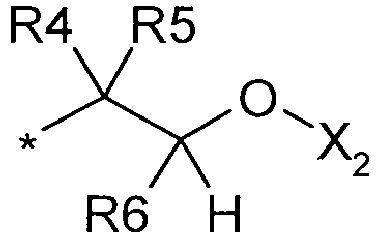
A für OH oder
B für C2-24-Alkylen oder C6-24-Arylen steht,
X1 für
X2 für H, X1,

R1, R2, R3, R4, R5 und R6 unabhängig voneinander für H, C1-8-Alkyl, C6-10-Aryl oder -CH2-OX2 stehen,
R7 und R8 unabhängig voneinander für gegebenenfalls durch Heteroatome substituieres und/oder durch Heteroatome enthaltende Gruppen substituiertes C1-28-Alkyl oder C6-10-Aryl stehen. - In einer ganz besonders bevorzugten Ausführungsform handelt es sich bei dem Polyesteramid um ein Polymer gemäß Formel (V)

A für OH oder
B für C2-24-Alkylen oder C6-24-Arylen steht,
X1 für
X2 für Wasserstoff, X1,

R3 und R6 unabhängig voneinander für H, C1-8-Alkyl oder C6-10-Aryl stehen,
R7 und R8 unabhängig voneinander für gegebenenfalls durch Heteroatome substituieres und/oder durch Heteroatome enthaltende Gruppen substituiertes C1-28-Alkyl oder C6-10-Aryl stehen. - In allen zuvor genannten Ausführungsformen stehen R3 und R6 vorzugsweise für C1-4-Alkyl, besonders bevorzugt für Methyl oder Ethyl. Des Weiteren stehen in allen zuvor genannten Ausführungsformen R7 und R8 vorzugsweise für gegebenenfalls durch Heteroatome substituiertes und/oder durch Heteroatome enthaltende Gruppen substituiertes C1-20-Alkyl, besonders bevorzugt für durch Heteroatome und/oder durch Heteroatome enthaltende Gruppen substituiertes C2-, C3-oder C6-Alkyl.
- R7 und R8 können insbesondere ein- oder mehrfach substituiert sein durch Gruppen ausgewählt aus Alkoholen, Ethern, Polyethern, Estern, Cyanid, Carbonat, Urethan, Harnstoff, Amid, Imid, Amin, Imin, Imidazol, Oxim, Sulfid, Thiol, Thioharnstoff, Sulfon, Sulfonoxid, Sulfat, Phosphat, Phosphin, Phosphinoxid, Silan, Silikon, Silikat, Fluor, Chlor, Brom oder Iod sowie aus Gruppen, die mindestens eine der zuvor genannten funktionellen Gruppen enthalten.
- Beispiele für erfindungsgemäße Reste R7 und R8 sind Di(m)ethylaminoethyl, Di(m)ethylaminopropyl und Di(m)ethylaminohexyl sowie quaternisierte Formen dieser Reste; Tri(m)ethylsilylpropyl, Tri(m)ethoxysilylpropyl, Perfluoroctyl, Perfluoroctyl(m)ethyl, (M)ethoxyethyl, (M)ethyoxy-2-propyl, Maleimidopropyl, Maleimidohexyl, Octenylsuccinimidohexyl, Hexahydrophthalimidohexyl, 2-(Benz)imidazolethyl, Diphenylphosphinoethyl, Furfuryl, Cyanoethyl, Cyanopropyl sowie gegebenenfalls substituiertes Morpholin, Thiomorpholin, Piperidin, Pyrrolidin, Oxazolidin, Thiazolidin oder Piperazin.
- In einer erfindungsgemäß besonders bevorzugten Ausführungsform enthalten die Reste R7 und R8 unabhängig voneinander quaternisierte Aminogruppen oder Polyethergruppen, insbesondere Polyoxyethylengruppen, oder beliebige Mischungen davon, wobei im selben Molekül einige Reste R7 und R8 nur quaternisierte Aminogruppen und andere Reste R7 und R8 nur Polyethergruppen, insbesondere Polyoxyethylengruppen, enthalten können. Die Polyoxyethylengruppen enthalten hierbei vorzugsweise 3 bis 20, besonders bevorzugt 5 bis 15, insbesondere 6 bis 10 Oxyethylen-Einheiten, wobei die Hydroxy-Endgruppe der Oxyethylen-Einheiten mit einem kurzkettigen Alkohol, insbesondere Methanol, verethert sein kann.
- In einer ganz besonders bevorzugten Ausführungsform handelt es sich bei zumindest 10 %, vorzugsweise bei zumindest 20 % oder 30 %, der Reste R7 und R8 hierbei um Tri(m)ethylammoniumalkyl-Reste, insbesondere ausgewählt aus Tri(m)ethylammoniumethyl, Tri(m)ethylammoniumpropyl und Tri(m)ethylammoniumhexyl.
- In einer weiteren ganz besonders bevorzugten Ausführungsform handelt es sich bei zumindest 10 %, vorzugsweise zumindest 20 % oder 30 %, der Reste R7 und R8 um Polyoxyethylengruppen mit 6 bis 10, vorzugsweise mit 7, 8 oder 9, Oxyethylen-Einheiten, die gegebenenfalls endständig mit Methyl oder Ethyl verethert sein können.
- In allen zuvor genannten Ausführungsformen kann B gegebenenfalls substituiert sein, vorzugsweise durch einen Rest C1-26-Alkyl, besonders bevorzugt durch Methyl, Octenyl, Nonenyl, Decenyl, Undecenyl oder Dodecenyl. Bei B kann es sich hierbei insbesondere um einen gegebenenfalls durch einen der zuvor genannten Reste substituierten Rest ausgewählt aus Ethylen, Ethenylen, 1,3-Propylen, 1,2-Cyclohexyl, 1,2-Phenylen, 1,3-Phenylen, 1,4-Phenylen, 2,3-Norbornyl, 2,3-Norbornen-5-yl und 1,2-Cyclohex-4-enyl handeln.
- Das Molekulargewicht der erfindungsgemäßen Polyesteramide beträgt vorzugsweise von 600 g/mol bis 50.000 g/mol, besonders bevorzugt von 1000 g/mol bis 40.000 g/mol, vor allem von 5000 g/mol bis 35.000 g/mol. Das erfindungsgemäße Polyesteramid kann sowohl linear als auch verzweigt sein, vorzugsweise handelt es sich jedoch um ein verzweigtes Polymer, besonders bevorzugt um ein hochverzweigtes Polymer.
- Hinsichtlich erfindungsgemäß verwendbarer Polyesteramide und insbesondere hinsichtlich deren Herstellung wird insbesondere auch auf den Offenbarungsgehalt der
WO 99/16810 WO 00/58388 - Die Polyesteramide sind in den erfindungsgemäßen Mitteln vorzugsweise in einer Menge von 0,02 bis 5,0 Gew.-%, besonders bevorzugt in einer Menge von 0,05 bis 2,0 Gew.-%, insbesondere in einer Menge von 0,1 bis 1,0 Gew.-%, vor allem in einer Menge von 0,1 bis 0,8 Gew.-%, enthalten.
- Copolymere aus quaternärem Ammoniumacrylamid und Acrylsäure Bei den Copolymeren aus quaternärem Ammoniumacrylamid und Acrylsäure handelt es sich vorzugsweise um Copolymere aus Diallyldimethyl-Ammoniumacrylamid und Acrylsäure. Solche Copolymere sind beispielsweise unter dem Handelsnamen Mirapol Surf von Rhodia erhältlich. Vor allem Mirapol Surf-S100, Mirapol Surf-S110, Mirapol Surf-S210 oder Mirapol Surf-S500 sowie Mischungen davon können erfindungsgemäß eingesetzt werden.
- Die Copolymere aus quaternärem Ammoniumacrylamid und Acrylsäure sind in den erfindungsgemäß verwendbaren Mitteln vorzugsweise in einer Menge von 0,1 bis 5,0 Gew.-%, besonders bevorzugt in einer Menge von 0,2 bis 2,0 Gew.-%, insbesondere in einer Menge von 0,3 bis 1,0 Gew.-%, vor allem in einer Menge von 0,4 bis 0,8 Gew.-%, enthalten.
- Im Sinne der vorliegenden Erfindung handelt es sich bei harten Oberflächen insbesondere um Oberflächen von Stein- oder Keramikmaterialien, Hartkunststoffen, Glas oder Metall. Es kann sich um harte Oberflächen beispielsweise von Wänden, Arbeitsoberflächen, Fußböden oder Sanitärgegenständen handeln. Insbesondere betrifft die Erfindung Oberflächen von Keramik, vorzugsweise Sanitärkeramik, und ganz besonders von Toilettenbecken.
- Ausführungsformen der vorliegenden Erfindung umfassen die Verwendung aller nach dem Stand der Technik etablierten und/oder zweckmäßigen Darreichungsformen der erfindungsgemäß verwendbaren Mittel. Dazu zählen beispielsweise feste, pulverförmige, flüssige, gelförmige oder pastöse Mittel, gegebenenfalls auch aus mehreren Phasen, komprimiert oder nicht komprimiert; ferner gehören beispielsweise dazu: Extrudate, Granulate, Tabletten oder Pouches, sowohl in Großgebinden als auch portionsweise abgepackt.
- Bei dem erfindungsgemäß verwendbaren Mittel handelt es sich vorzugsweise um einen WC-Reiniger, einen Bad-Reiniger oder einen Allzweckreiniger. Ein erfindungsgemäß verwendbares Mittel hat bei Verwendung als WC-Reiniger vorzugsweise einen pH-Wert von 1 bis 5, insbesondere von 1 bis 3; bei Verwendung als Badreiniger vorzugsweise einen pH-Wert von 1 bis 6, insbesondere von 3 bis 5; und bei Verwendung als Allzweckreiniger vorzugsweise einen pH-Wert von 8 bis 12, insbesondere von 9 bis 11.
- Für die Behandlung einer Oberfläche sind alle konventionellen Methoden geeignet, mit denen sich das Mittel auf die Oberfläche aufbringen lässt. Für den besonders bevorzugten Fall, dass das Mittel bei Raumtemperatur flüssig ist, erfolgt die Behandlung der Oberfläche vorzugsweise so, dass das Mittel mit Hilfe eines saugfähigen Gewebes auf die Oberfläche übertragen wird, oder dass das Mittel auf die Oberfläche aufgesprüht wird. Die Behandlung kann jedoch beispielsweise auch durch Eintauchen der Oberfläche in das Mittel erfolgen.
- Unter Schmutz bzw. Verschmutzungen sind im Sinne der Erfindung insbesondere Fäkalschmutz und/oder Biofilme zu verstehen.
- Durch die Behandlung einer harten Oberfläche mit dem erfindungsgemäß verwendbaren Mittel wird diese vor Verschmutzung geschützt und/oder die Ablösung von Verschmutzungen von der Oberfläche erleichtert und/oder die Anhaftung von Mikroorganismen vermindert. Unter "Verminderung der Anhaftung" ist hierbei vorzugsweise zu verstehen, dass mindestens 20, 40 oder 60 %, besonders bevorzugt mindestens 80, 90 oder 95 % weniger Mikroorganismen an die harte Oberfläche anhaften als bei Verwendung eines Behandlungsmittels ohne Zusatz erfindungsgemäß zu verwendender Polymere. Die Prozentangaben beziehen sich hierbei auf den Unterschied in der Gesamtmasse des adhärierten Materials.
- Die Mikroorganismen, deren Anhaftung vermindert wird, sind vorzugsweise ausgewählt aus Bakterien, Pilzen, insbesondere Schimmelpilzen, Viren, insbesondere Bakteriophagen, und Algen.
- Die Bakterien, deren Anhaftung vermindert wird, sind vorzugsweise ausgewählt aus der Gruppe bestehend aus gramnegativen und grampositiven Bakterien, vor allem pathogenen Bakterien ausgewählt aus Propionibacterium acnes, Staphylococcus aureus, Streptococcus spp., Corynebacterium spp., Micrococcus spp. (insbesondere M. sedentarius), Bacillus anthracis, Neisseria spp., Pseudomonas aeruginosa, P. pseudomallei, Borrelia burgdorferi, Treponema pallidum, Mycobacterium spp., Escherichia coli sowie Actinomyces spec., Salmonella spec., Actinobacteria (insbesondere Brachybacterium spec.), alpha-Proteobacteria (insbesondere Agrobacterium spec.), beta-Proteobacteria (insbesondere Nitrosomonas spec.), Aquabacterium spec., Hydrogenophaga, gamma-Proteobacteria, Stenotrophomonas spec., Xanthomonas spec., Haemophilus spec. sowie alle Mikroorganismen, die von Paster et al. (J. Bac. 183 (2001) 12, 3770-3783) beschrieben werden.
- Mikroorganismen, die hinsichtlich der Biofilmbildung besonders relevant sind, und deren Anhaftung besonders bevorzugt vermindert wird, sind beispielsweise Aeromonaden, Agrobacterium, Aquabakterium, Bradyrhizobium japonicum, Burkholderia cepacia, Chromobacterium violaceum, Dermacoccen, Enterobacter agglomerans, Erwinia carotovora, Erwinia chrysanthemi, Escherichia coli, Nitrosomona europaea, Obesumbacterium proteus, Pantoea stewartii, Pseudomonaden, Ralstonia solanacearum, Rhizobium, Rhodobacter sphaeroides, Salmonella enterica, Serratia, Vibrio anguillarum, Vibrio fischeri, Xanthomonas, Xenorhabdus nematophilus, Yersinia, Zooshikella gangwhensis, Cythophaga sp. KT0803, Psychrobakter glacinola, Pseudoalteromonas carragenovora, Shewanella baltica und Bacillus subtilis. Einige dieser Biofilmbildner sind auch im marinen Bereich relevant, da sie das sogenannte Fouling auf submersen Oberflächen mitverursachen können.
- Insbesondere beugt das Mittel vorzugsweise der Bildung von Biofilmen vor, ohne dass es eine biozide Wirkung aufweist. Es wird vermutet, dass die Wirksamkeit der erfindungsgemäß verwendeten Mittel gegen die Bildung von Biofilmen auf eine bakteriostatische Wirkung der verwendeten Polymere zurückzuführen ist, wodurch die Besiedelung der Oberflächen mit Mikroorganismen gehemmt und ihre Anhaftung und Vermehrung auf den Oberflächen behindert wird. Da für die Mittel andererseits keine bioziden Effekte beobachtet wurden, unterliegen sie nicht den eingangs erwähnten Nachteilen beim Einsatz von Bioziden.
- Die erfindungsgemäß verwendeten Mittel bewirken eine leichtere Entfernbarkeit von Verschmutzungen und eine verringerte Wiederanschmutzungsneigung und verbessern insbesondere die Reinigungsleistung von Reinigungsmitteln für harte Oberflächen. Dadurch werden entsprechend behandelte bzw. gereinigte Oberflächen länger als sauber wahrgenommen.
- Weiter wurde beobachtet, dass sowohl eine leichtere und schnellere Entfernung von Fäkalschmutz als auch ein verbessertes Abspülen des eingetrockneten (gegebenenfalls farbigen) Reinigungsmittels selbst möglich ist, wenn der Reinigungsmittelformulierung erfindungsgemäß verwendbare Polymer-Mischungen zugesetzt werden. Trifft Fäkalschmutz auf eine so behandelte Oberfläche, so lässt sich der Schmutz beim nächsten Spülgang ohne nennenswerte mechanische Kraft entfernen. In der Regel gelingt dies alleine durch die mechanische Einwirkung des Spülwassers, ohne dass es der zusätzlichen Unterstützung durch die Toilettenbürste bedarf. Lässt man gefärbte Reinigungsformulierungen länger auf die Oberfläche einwirken und kommt es dadurch zu einem gewissen Antrocknen der Formulierung, wird der gebildete farbige Film dennoch leicht und vollständig beim nächsten Spülvorgang entfernt.
- Die Verwendung von erfindungsgemäß verwendbaren Polymer-Mischungen als Additive in tensidhaltigen Reinigungsmitteln ermöglicht es, dass man in einem einzigen Arbeitsschritt nicht nur eine Oberfläche reinigen kann, sondern sie gleichzeitig mit einem Schutz gegen Schmutz versieht. Auf diese Weise wird beispielsweise einer Kalkablagerung, einer Anhaftung von protein- oder fettenthaltendem Schmutz und auch dem Wachstum von Bakterien vorgebeugt. Die behandelten Oberflächen bleiben länger sauber, und darüber hinaus wird die nachfolgende Reinigung erheblich erleichtert. Dies bedeutet, dass man die Oberflächen ohne Einbußen bei der Sauberkeit weniger oft reinigen muss, und ihre nachfolgende Reinigung insofern mit weniger Aufwand verbunden ist, als sie zeitsparender erfolgen kann und/oder mildere Reinigungsmittel benötigt. So ist es in günstigen Fällen möglich, für eine gewisse Zeit alleine mit Hilfe von Wasser eine ausreichende Reinigungswirkung zu erzielen, d.h. ohne dass es der Verwendung eines herkömmlichen Reinigungsmittels bedarf.
- Die Polymere der erfindungsgemäß verwendbaren Polymer-Mischungen lassen sich leicht und einfach mit den übrigen Bestandteilen des Mittels formulieren und können insbesondere auf sehr einfache Weise auch in herkömmliche Reinigungsmittelformulierungen eingearbeitet werden. Insbesondere führen die vorteilhaften Löslichkeitseigenschaften dieser Stoffe dazu, dass ihre Einarbeitung in übliche Reinigungsmittel keine Einschränkungen, wie etwa eine verschlechterte Versprühbarkeit, mit sich bringt.
- In einer weiteren bevorzugten Ausführungsform der Erfindung enthält das erfindungsgemäß verwendbare Mittel weiterhin mindestens ein hydrolysierbares Kieselsäurederivat.
- Unter hydrolysierbaren Kieselsäurederivaten sind insbesondere die Ester der Orthokieselsäure zu verstehen, insbesondere die Tetraalkoxysilane und ganz besonders bevorzugt Tetraethoxysilan. Im Sinne der vorliegenden Erfindung sind unter hydrolysierbaren Kieselsäurederivaten jedoch auch Verbindungen zu verstehen, die am Siliciumatom neben drei Alkoxygruppen auch einen Kohlenstoffrest tragen, wie beispielsweise N-(Triethoxysilylpropyl)-O-polyethylenoxid-urethan, Dimethyl-octadecyl-(3-(trimethoxysilylpropyl)-ammoniumchlorid, Diethylphosphatoethyltriethoxysilan und das Trinatriumsalz von N-(Trimethoxysilylpropyl)ethylendiamin- triessigsäure.
- Die in dem erfindungsgemäß verwendeten Mittel enthaltenen weiteren Komponenten sind nach ihrer Art und der eingesetzten Menge so auszuwählen, dass es zu keinen unerwünschten Wechselwirkungen mit den erfindungsgemäß einzusetzenden Polymeren kommt.
- Die erfindungsgemäß verwendbaren Mittel enthalten vorzugsweise mindestens ein Tensid, welches aus den anionischen, nichtionischen, amphoteren und kationischen Tensiden sowie deren Gemischen ausgewählt ist. Hinsichtlich erfindungsgemäß verwendbarer Tenside wird insbesondere auf die Offenlegungsschrift
WO2008/10190 - Als anionische Tenside eignen sich vorzugsweise C8-C18-Alkylbenzolsulfonate, insbesondere mit etwa 12 C-Atomen im Alkylteil, C8-C20-Alkansulfonate, C8-C18-Monoalkylsulfate, C8-C18-Al-kylpolyglykolethersulfate mit 2 bis 6 Ethylenoxideinheiten (EO) im Etherteil sowie Sulfobernsteinsäuremono- und -di-C8-C18-Alkylester. Weiterhin können auch C8-C18-α-Olefinsulfonate, sulfonierte C8-C18-Fettsäuren, insbesondere Dodecylbenzolsulfonat, C8-C22-Carbonsäureamid-ethersulfate, C8-C18-Alkylpolyglykolethercarboxylate, C8-C18-N-Acyltauride, C8-C18-N-Sarkosinate und C8-C18-Alkylisethionate bzw. deren Mischungen verwendet werden. Die anionischen Tenside werden vorzugsweise als Natriumsalze eingesetzt, können aber auch als andere Alkali- oder Erdalkalimetallsalze, beispielsweise Magnesiumsalze, sowie in Form von Ammonium- oder Mono-, Di-, Tri- bzw. Tetraalkylammoniumsalzen enthalten sein, im Falle der Sulfonate auch in Form ihrer korrespondierenden Säure, z.B. Dodecylbenzolsulfonsäure. Beispiele derartiger Tenside sind Natriumkokosalkylsulfat, Natrium-sec.-Alkansulfonat mit ca. 15 C-Atomen sowie Natriumdioctylsulfosuccinat. Als besonders geeignet haben sich Natrium-Fettalkylsulfate und - Fettalkyl+2EO-ethersulfate mit 12 bis 14 C-Atomen erwiesen.
- Als nichtionische Tenside sind vor allem C8-C18-Alkoholpolyglykolether, d.h. ethoxylierte und/oder propoxylierte Alkohole mit 8 bis 18 C-Atomen im Alkylteil und 2 bis 15 Ethylenoxid- (EO) und/oder Propylenoxideinheiten (PO), C8-C18-Carbonsäurepolyglykolester mit 2 bis 15 EO, beispielsweise Talgfettsäure+6-EO-ester, ethoxylierte Fettsäureamide mit 12 bis 18 C-Atomen im Fettsäureteil und 2 bis 8 EO, langkettige Aminoxide mit 14 bis 20 C-Atomen und langkettige Alkylpolyglycoside mit 8 bis 14 C-Atomen im Alkylteil und 1 bis 3 Glycosideinheiten zu erwähnen. Beispiele derartiger Tenside sind Oleyl-Cetyl-Alkohol mit 5 EO, Nonylphenol mit 10 EO, Laurinsäurediethanolamid, Kokosalkyldimethylaminoxid und Kokosalkylpolyglucosid mit im Mittel 1,4 Glucoseeinheiten. Besonders bevorzugt werden C8-18-Fettalkoholpolyglykolether mit insbesondere 2 bis 8 EO, beispielsweise C12-Fettalkohol+7-EO-ether, sowie C8-10-Alkylpolyglucoside mit 1 bis 2 Glycosideinheiten eingesetzt.
- In einer bevorzugten Ausführungsform der Erfindung ist das nichtionische Tensid ausgewählt aus der Gruppe umfassend Polyalkylenoxide, insbesondere alkoxylierte primäre Alkohole, wobei die Polyalkylenoxide auch endgruppenverschlossen sein können, alkoxylierte Fettsäurealkylester, Aminoxide und Alkylpolyglykoside sowie deren Mischungen.
- Geeignete Amphotenside sind beispielsweise Betaine der Formel (Riii)(Riv)(Rv)N+CH2COO-, in der Riii einen gegebenenfalls durch Heteroatome oder Heteroatomgruppen unterbrochenen Alkylrest mit 8 bis 25, vorzugsweise 10 bis 21 Kohlenstoffatomen und Riv sowie Rv gleichartige oder verschiedene Alkylreste mit 1 bis 3 Kohlenstoffatomen bedeuten, insbesondere C10-C18-Alkyl-dimethylcarboxymethylbetain und C11-C17-Alkylamidopropyl-dimethylcarboxymethylbetain.
- Geeignete Kationtenside sind u.a. die quartären Ammoniumverbindungen der Formel (Rvi)(Rvii)(Rviii)(Rix)N+ X-, in der Rvi bis Rix für vier gleich- oder verschiedenartige, insbesondere zwei lang- und zwei kurzkettige, Alkylreste und X- für ein Anion, insbesondere ein Halogenidion, stehen, beispielsweise Didecyl-dimethyl-ammoniumchlorid, Alkyl-benzyl-didecyl-ammoniumchlorid und deren Mischungen.
- In einer bevorzugten Ausführungsform enthält das Mittel als tensidische Komponenten jedoch nur ein oder mehrere Aniontenside, vorzugsweise C8-C18-Alkylsulfate und/oder C8-C18-Alkylethersulfate, und/oder ein oder mehrere nichtionische Tenside, vorzugsweise C8-18-Fettalkoholpolyglykolether mit 2 bis 8 EO und/oder C8-10-Alkylpolyglucoside mit 1 bis 2 Glycosideinheiten.
- In einer besonders bevorzugten Ausführungsform der Erfindung enthalten die erfindungsgemäß verwendbaren Mittel mindestens ein nichtionisches Tensid, welche(s) insbesondere ausgewählt ist aus den ethoxylierten und/oder propoxylierten Alkoholen mit 8 bis 18 C-Atomen im Alkylteil und 2 bis 15 Ethylenoxid- (EO) und/oder Propylenoxideinheiten (PO) sowie den Alkylpolyglycosiden mit 8 bis 14 C-Atomen im Alkylteil und 1 bis 3 Glycosideinheiten.
- Die erfindungsgemäß verwendbaren Mittel enthalten Tenside vorzugsweise in Mengen von von 0,01 bis 20 Gew.-%, insbesondere 0.05 bis 10 Gew.-%, vorzugsweise 0,1 bis 5 Gew.-% und besonders bevorzugt 0,2 bis 1 Gew.-%, jeweils bezogen auf das Gesamtgewicht des Mittels.
- Die erfindungsgemäß verwendbaren Mittel enthalten Wasser und/oder mindestens ein nichtwässriges Lösungsmittel. Als nichtwässrige Lösungsmittel kommen vorzugsweise solche Lösungsmittel in Betracht, welche in beliebigen Verhältnissen mit Wasser mischbar sind. Zu den nichtwässrigen Lösungsmitteln zählen beispielsweise ein- oder mehrwertige Alkohole, Alkanolamine, Glycolether sowie deren Mischungen. Als Alkohole werden insbesondere Ethanol, Isopropanol und n-Propanol eingesetzt. Als Etheralkohole kommen hinreichend wasserlösliche Verbindungen mit bis zu 10 C-Atomen im Molekül in Betracht. Beispiele derartiger Etheralkohole sind Ethylenglykolmonobutylether, Propylenglykolmonobutylether, Diethylenglykolmonobutylether, Propylenglykolmonotertiärbutylether und Propylenglykolmonoethylether, von denen wiederum Ethylenglykolmonobutylether und Propylenglykolmonobutylether bevorzugt werden. In einer bevorzugten Ausführungsform wird jedoch Ethanol als nichtwässriges Lösungsmittel eingesetzt.
- Nichtwässrige Lösungsmittel können in dem erfindungsgemäß verwendbaren Mittel in Mengen von 0,01 bis 99,9 Gew.-%, insbesondere 0,1 bis 50 Gew.-%, und besonders bevorzugt 2 bis 20 Gew.-% enthalten sein, jeweils bezogen auf das Gesamtgewicht des Mittels.
- Wasser ist in dem erfindungsgemäß verwendbaren Mittel im allgemeinen in Mengen von 1 bis 98 Gew.-%, insbesondere 50 bis 95 Gew.-%, und besonders bevorzugt 80 bis 93 Gew.-% enthalten, jeweils bezogen auf das Gesamtgewicht des Mittels.
- In einer weiteren bevorzugten Ausführungsform enthält das erfindungsgemäß verwendbare Mittel ein Verdickungsmittel. Hierfür kommen grundsätzlich alle im Stand der Technik in Wasch-und Reinigungsmitteln eingesetzten Viskositätsregulatoren in Betracht, wie beispielsweise organische natürliche Verdickungsmittel (Agar-Agar, Carrageen, Tragant, Gummi arabicum, Guar, Guaran, Gellan, Xanthan, Alginate, Pektine, Polyosen, Guar-Mehl, Johannisbrotbaumkernmehl, Stärke, Dextrine, Gelatine, Casein), organische abgewandelte Naturstoffe (Carboxymethylcellulose und andere Celluloseether, Hydroxyethyl- und -propylcellulose und dergleichen, Kernmehlether sowie weitere Derivate von Polysacchariden und Heteropolysacchariden), organische vollsynthetische Verdickungsmittel (Polyacryl- und Polymethacryl-Verbindungen, Vinylpolymere, Polycarbonsäuren, Polyether, Polyimine, Polyamide) und anorganische Verdickungsmittel (Polykieselsäuren, Tonmineralien wie Montmorillonite, Zeolithe, Kieselsäuren). In einer bevorzugten Ausführungsform enthält das erfindungsgemäß verwendbare Mittel Xanthan Gum und Succinoglycan-Gum.
- Wenn das erfindungsgemäß verwendbare Mittel einen Verdicker enthält, ist dieser in der Regel in Mengen von 0,01 bis 30 Gew.-%, insbesondere 0,2 bis 15 Gew.-%, enthalten.
- Die Viskosität der erfindungsgemäß verwendbaren Mittel kann je nach beabsichtigtem Einsatzzweck in einem weiten Bereich eingestellt werden. So können für Allzweck- und Badreiniger im allgemeinen niedrige, nahezu wasserdünne Formulierungen bevorzugt sein, während für andere Einsatzzwecke, beispielsweise Reinigungsmittel für Toilettenbecken, höherviskose, verdickte Formulierungen bevorzugt sein können. In der Regel liegt die Viskosität der erfindungsgemäß verwendbaren Mittel im Bereich von 1 bis 3000 mPas, vorzugsweise von 200 bis 1500 mPas und besonders bevorzugt von 400 bis 900 mPas (Brookfield Viskosimeter Rotovisco LV-DV II plus, Spindel 31, 20°C, 20 U/min).
- In einer bevorzugten Ausführungsform weist das erfindungsgemäß verwendbare Mittel einen pH-Wert von weniger als 9 auf, insbesondere einen pH-Wert von 0 bis 6, vorzugsweise von 1 bis 5 und besonders bevorzugt von 2 bis 4.
- In einer weiteren, besonders bevorzugten Ausführungsform enthält das erfindungsgemäß verwendbare Mittel mindestens eine Säure. Als Säuren eignen sich insbesondere organische Säuren wie Ameisensäure, Essigsäure, Zitronensäure, Glycolsäure, Milchsäure, Bernsteinsäure, Adipinsäure, Äpfelsäure, Weinsäure und Gluconsäure oder auch Amidosulfonsäure. Es kann jedoch bevorzugt sein, wenn als Säure nicht Essigsäure eingesetzt wird. Daneben können aber auch die anorganischen Säuren Salzsäure, Schwefelsäure, Phosphorsäure und Salpetersäure bzw. deren Mischungen eingesetzt werden. Besonders bevorzugt sind Säuren, ausgewählt aus der Gruppe umfassend Amidosulfonsäure, Zitronensäure, Milchsäure und Ameisensäure. Sie werden vorzugsweise in Mengen von 0,01 bis 30 Gew.-% eingesetzt, besonders bevorzugt 0,2 bis 15 Gew.-%, jeweils bezogen auf das Gesamtgewicht des Mittels.
- Die erfindungsgemäß verwendbaren Mittel können darüber hinaus übliche sonstige Bestandteile von Mitteln, insbesondere Reinigungsmitteln, zur Behandlung harter Oberflächen enthalten, soweit diese nicht in unerwünschter Weise mit den erfindungsgemäß verwendeten Stoffen wechselwirken.
- Als derartige sonstige Bestandteile kommen beispielsweise weitere Säuren, Salze, Filmbildner, antimikrobielle Wirkstoffe, Builder, Korrosionsinhibitoren, Komplexbildner, Sequestrierungsmittel, Elektrolyte, Schauminhibitoren, Desintegrationshilfsstoffe, Soil-Release-Wirkstoffe bzw. Soil-Repellents, UV-Absorbenzien, Alkalien, Konservierungsmittel, Bleichmittel, Bleichaktivatoren, Bleichkatalysatoren, Enzyme, Enzymstabilisatoren, Abrasivstoffe, Polymere sowie Duft- und Farbstoffe in Betracht. Insgesamt sollten in den Mitteln vorzugsweise nicht mehr als 30 Gew.-% weitere Inhaltsstoffe enthalten sein, vorzugsweise 0,01 bis 30 Gew.-%, insbesondere 0,2 bis 15 Gew.-%.
- Die erfindungsgemäß verwendbaren Mittel können Filmbildner enthalten, die zur besseren Benetzung der Oberfläche beitragen können. Hierfür kommen grundsätzlich alle im Stand der Technik in Wasch-und Reinigungsmitteln eingesetzten filmbildenden Polymere in Betracht. Vorzugsweise wird der Filmbildner jedoch ausgewählt aus der Gruppe umfassend Polyethylenglykol, Polyethylenglykol- Derivate sowie Gemische derselben, vorzugsweise mit einem Molekulargewicht zwischen 200 und 20.000.000, besonders bevorzugt zwischen 5.000 und 200.000. Der Filmbildner wird vorteilhafterweise in Mengen von 0,01 bis 30 Gew.-%, insbesondere 0,2 bis 15 Gew.-% eingesetzt.
- Erfindungsgemäß verwendbare Mittel können weiterhin einen oder mehrere antimikrobielle Wirkstoffe enthalten, vorzugsweise in einer Menge von 0,01 bis 1 Gew.-%, insbesondere von 0,05 bis 0,5 Gew.-%, besonders bevorzugt von 0,1 bis 0,3 Gew.-%. Geeignet sind beispielsweise antimikrobielle Wirkstoffe aus den Gruppen der Alkohole, Aldehyde, antimikrobiellen Säuren bzw. deren Salze, Carbonsäureester, Säureamide, Phenole, Phenolderivate, Diphenyle, Diphenylalkane, Harnstoffderivate, Sauerstoff-, Stickstoff-Acetale sowie -Formale, Benzamidine, Isothiazole und deren Derivate wie Isothiazoline und Isothiazolinone, Phthalimidderivate, Pyridinderivate, antimikrobiellen oberflächenaktiven Verbindungen, Guanidine, antimikrobiellen amphoteren Verbindungen, Chinoline, 1,2-Dibrom-2,4-dicyanobutan, lodo-2-propynyl-butyl-carbamat, Iod, lodophore und Peroxide. Weiterhin können auch antimikrobiell wirksame ätherische Öle eingesetzt werden, die gleichzeitig für eine Beduftung des Reinigungsmittels sorgen.
- In den erfindungsgemäß verwendbaren Mitteln können wasserlösliche und/oder wasserunlösliche Builder eingesetzt werden. Dabei sind wasserlösliche Builder bevorzugt, da sie in der Regel weniger dazu tendieren, auf harten Oberflächen unlösliche Rückstände zu hinterlassen. Übliche Builder, die im Rahmen der Erfindung zugegen sein können, sind die niedermolekularen Polycarbonsäuren und ihre Salze, die homopolymeren und copolymeren Polycarbonsäuren und ihre Salze, die Citronensäure und ihre Salze, die Carbonate, Phosphate und Silikate. Zu wasserunlöslichen Buildern zählen die Zeolithe, die ebenfalls verwendet werden können, ebenso wie Mischungen der vorgenannten Buildersubstanzen. Hinsichtlich weiterer erfindungsgemäß einsetzbarer Builder und/oder Cobuilder sowie deren bevorzugten Einsatzmengen wird auf die Offenlegungsschrift
WO2008/101909 verwiesen. - Geeignete Korrosionsinhibitoren sind beispielsweise folgende gemäß INCI benannte Substanzen: Cyclohexylamine, Diammonium Phosphate, Dilithium Oxalate, Dimethylamino Methylpropanol, Dipotassium Oxalate, Dipotassium Phosphate, Disodium Phosphate, Disodium Pyrophosphate, Disodium Tetrapropenyl Succinate, Hexoxyethyl Diethylammonium, Phosphate, Nitromethane, Potassium Silicate, Sodium Aluminate, Sodium Hexametaphosphate, Sodium Metasilicate, Sodium Molybdate, Sodium Nitrite, Sodium Oxalate, Sodium Silicate, Stearamidopropyl Dimethicone, Tetrapotassium Pyrophosphate, Tetrasodium Pyrophosphate, Triisopropanolamine. Hinsichtlich weiterer erfindungsgemäß einsetzbarer Korrosionsinhibitoren, insbesondere auch Glaskorrosionsinhibitoren, wird auf die Offenlegungsschrift
WO2008/101909 verwiesen. - Komplexbildner, auch Sequestriermittel genannt, sind Inhaltsstoffe, die Metallionen zu komplexieren und inaktivieren vermögen, um ihre nachteiligen Wirkungen auf die Stabilität oder das Aussehen der Mittel, beispielsweise Trübungen, zu verhindern. Einerseits ist es dabei wichtig, die mit zahlreichen Inhaltsstoffen inkompatiblen Calcium- und Magnesiumionen der Wasserhärte zu komplexieren. Die Komplexierung der Ionen von Schwermetallen wie Eisen oder Kupfer verzögert andererseits die oxidative Zersetzung der fertigen Mittel. Zudem unterstützen die Komplexbildner die Reinigungswirkung. Geeignet sind beispielsweise die folgenden gemäß INCI bezeichneten Komplexbildner: Aminotrimethylene, Phosphonsäure, Beta-Alanine Diacetic Acid, Calcium Disodium EDTA, Citric Acid, Cyclodextrin, Cyclohexanediamine Tetraacetic Acid, Diammonium Citrate, Diammonium EDTA, Diethylenetriamine Pentamethylene Phosphonic Acid, Dipotassium EDTA, Disodium Azacycloheptane Diphosphonate, Disodium EDTA, Disodium Pyrophosphate, EDTA, EtidronicAcid, Galactaric Acid, GluconicAcid, GlucuronicAcid, HEDTA, Hydroxypropyl Cyclodextrin, Methyl Cyclodextrin, Pentapotassium Triphosphate, Pentasodium Aminotrimethylene Phosphonate, Pentasodium Ethylenediamine Tetramethylene Phosphonate, Pentasodium Pentetate, Pentasodium Triphosphate, Pentetic Acid, Phytic Acid, Potassium Citrate, Potassium EDTMP, Potassium Gluconate, Potassium Polyphosphate, Potassium Trisphosphonomethylamine Oxide, Ribonic Acid, Sodium Chitosan Methylene Phosphonate, Sodium Citrate, Sodium Diethylenetriamine Pentamethylene Phosphonate, Sodium Dihydroxyethylglycinate, Sodium EDTMP, Sodium Gluceptate, Sodium Gluconate, Sodium Glycereth-1 Polyphosphate, Sodium Hexametaphosphate, Sodium Metaphosphate, Sodium Metasilicate, Sodium Phytate, Sodium Polydimethylglycinophenolsulfonate, Sodium Trimetaphosphate, TEA-EDTA, TEA-Polyphosphate, Tetrahydroxyethyl Ethylenediamine, Tetrahydroxypropyl Ethylenediamine, Tetrapotassium Etidronate, Tetrapotassium Pyrophosphate, Tetrasodium EDTA, Tetrasodium Etidronate, Tetrasodium Pyrophosphate, Tripotassium EDTA, Trisodium Dicarboxymethyl Alaninate, Trisodium EDTA, Trisodium HEDTA, Trisodium NTA und Trisodium Phosphate.
- In erfindungsgemäß verwendbaren Mitteln können weiterhin Alkalien enthalten sein. Als Basen werden in erfindungsgemäßen Mitteln vorzugsweise solche aus der Gruppe der Alkali- und Erdalkalimetallhydroxide und -carbonate, insbesondere Natriumcarbonat oder Natriumhydroxid, eingesetzt. Daneben können aber auch Ammoniak und/oder Alkanolamine mit bis zu 9 C-Atomen im Molekül verwendet werden, vorzugsweise die Ethanolamine, insbesondere Monoethanolamin.
- Konservierungsmittel können gleichfalls in erfindungsgemäß verwendbaren Mitteln enthalten sein. Als solche können im wesentlichen die bei den antimikrobiellen Wirkstoffen genannten Stoffe eingesetzt werden.
- Erfindungsgemäß können die Mittel weiterhin Bleichmittel enthalten. Geeignete Bleichmittel umfassen Peroxide, Persäuren und/oder Perborate, besonders bevorzugt ist Wasserstoffperoxid. Natriumhypochlorit ist dagegen bei sauer formulierten Reinigungsmitteln aufgrund der Freisetzung giftiger Chlorgas-Dämpfe weniger geeignet, kann jedoch in alkalisch eingestellten Reinigungsmitteln eingesetzt werden. Unter Umständen kann neben dem Bleichmittel auch ein Bleichaktivator enthalten sein. Hinsichtlich weiterer erfindungsgemäß einsetzbarer Bleichmittel sowie hinsichtlich erfindungsgemäß einsetzbarer Bleichaktivatoren und Bleichkatalysatoren sowie hinsichtlich derer bevorzugten Einsatzmengen wird auf die Offenlegungsschrift
WO2008/101909 verwiesen. - Das erfindungsgemäß verwendbare Mittel kann auch Enzyme enthalten, vorzugsweise Proteasen, Lipasen, Amylasen, Hydrolasen und/oder Cellulasen. Sie können dem Mittel in jeder nach dem Stand der Technik etablierten Form zugesetzt werden. Hierzu gehören bei flüssigen oder gelförmigen Mitteln insbesondere Lösungen der Enzyme, vorteilhafterweise möglichst konzentriert, wasserarm und/oder mit Stabilisatoren versetzt. Alternativ können die Enzyme verkapselt werden, beispielsweise durch Sprühtrocknung oder Extrusion der Enzymlösung zusammen mit einem, vorzugsweise natürlichen, Polymer oder in Form von Kapseln, beispielsweise solchen, bei denen die Enzyme wie in einem erstarrten Gel eingeschlossen sind oder in solchen vom Kern-Schale-Typ, bei dem ein enzymhaltiger Kern mit einer Wasser-, Luft- und/oder Chemikalien-undurchlässigen Schutzschicht überzogen ist. In aufgelagerten Schichten können zusätzlich weitere Wirkstoffe, beispielsweise Stabilisatoren, Emulgatoren, Pigmente, Bleich- oder Farbstoffe aufgebracht werden. Derartige Kapseln werden nach an sich bekannten Methoden, beispielsweise durch Schüttel- oder Rollgranulation oder in Fluid-bed-Prozessen aufgebracht. Vorteilhafterweise sind derartige Granulate, beispielsweise durch Aufbringen polymerer Filmbildner, staubarm und aufgrund der Beschichtung lagerstabil.
- Weiterhin können in enzymhaltigen Mitteln Enzymstabilisatoren vorhanden sein, um ein in einem erfindungsgemäßen Mittel enthaltenes Enzym vor Schädigungen wie beispielsweise Inaktivierung, Denaturierung oder Zerfall etwa durch physikalische Einflüsse, Oxidation oder proteolytische Spaltung zu schützen. Als Enzymstabilisatoren sind, jeweils in Abhängigkeit vom verwendeten Enzym, insbesondere geeignet: Benzamidin-Hydrochlorid, Borax, Borsäuren, Boronsäuren oder deren Salze oder Ester, vor allem Derivate mit aromatischen Gruppen, etwa substituierte Phenylboronsäuren beziehungsweise deren Salze oder Ester; Peptidaldehyde (Oligopeptide mit reduziertem C-Terminus), Aminoalkohole wie Mono-, Di-, Triethanol- und -Propanolamin und deren Mischungen, aliphatische Carbonsäuren bis zu C12, wie Bernsteinsäure, andere Dicarbonsäuren oder Salze der genannten Säuren; endgruppenverschlossene Fettsäureamidalkoxylate; niedere aliphatische Alkohole und vor allem Polyole, beispielsweise Glycerin, Ethylenglykol, Propylenglykol oder Sorbit; sowie Reduktionsmittel und Antioxidantien wie Natrium-Sulfit und reduzierende Zucker. Weitere geeignete Stabilisatoren sind aus dem Stand der Technik bekannt. Bevorzugt werden Kombinationen von Stabilisatoren verwendet, beispielsweise die Kombination aus Polyolen, Borsäure und/oder Borax, die Kombination von Borsäure oder Borat, reduzierenden Salzen und Bernsteinsäure oder anderen Dicarbonsäuren oder die Kombination von Borsäure oder Borat mit Polyolen oder Polyaminoverbindungen und mit reduzierenden Salzen.
- Hinsichtlich weiterer erfindungsgemäß einsetzbarer Enzyme und Enzymstabilisatoren sowie deren bevorzugten Einsatzmengen wird auf die Offenlegungsschrift
WO2008/101909 verwiesen. - Als weitere Inhaltsstoffe kann das erfindungsgemäß verwendbare Mittel schließlich einen oder mehrere Duftstoffe und/oder ein oder mehrere Farbstoffe enthalten. Als Farbstoffe können dabei sowohl wasserlösliche als auch öllösliche Farbstoffe verwendet werden, wobei einerseits die Kompatibilität mit weiteren Inhaltsstoffen, beispielsweise Bleichmitteln, zu beachten ist und andererseits der eingesetzte Farbstoff gegenüber den Oberflächen, insbesondere gegenüber WC-Keramik, auch bei längerem Einwirken nicht substantiv wirken sollte. Die Wahl des geeigneten Duftstoffs ist ebenfalls nur durch mögliche Wechselwirkungen mit den übrigen Reinigungsmittelkomponenten beschränkt.
- Hinsichtlich erfindungsgemäß bevorzugt einsetzbarer Sequestrierungsmittel, Elektrolyte, Schauminhibitoren, Desintegrationshilfsstoffe, "Soil-Release"-Wirkstoffe bzw. "Soil-Repellents" und UV-Absorbenzien sowie hinsichtlich derer bevorzugten Einsatzmengen wird auf die Offenlegungsschrift
WO2008/101909 verwiesen. - Ein erfindungsgemäß verwendbarer Reiniger für harte Oberflächen kann auch ein oder mehrere Treibmittel (INCI Propellants), üblicherweise in einer Menge von 1 bis 80 Gew.-%, vorzugsweise 1,5 bis 30 Gew.-%, insbesondere 2 bis 10 Gew.-%, besonders bevorzugt 2,5 bis 8 Gew.-%, äußerst bevorzugt 3 bis 6 Gew.-%, enthalten.
- Hinsichtlich erfindungsgemäß bevorzugt einsetzbarer Treibmittel wird auf die Offenlegungsschrift
WO2008/101909 verwiesen. - Ein weiterer Gegenstand der vorliegenden Erfindung ist auch ein Erzeugnis, enthaltend einen erfindungsgemäß verwendbaren Reiniger für harte Oberflächen, und einen Sprühspender. Bei dem Erzeugnis kann es sich hierbei sowohl um ein Einkammer- als auch um ein Mehrkammerbehältnis, insbesondere ein Zweikammerbehältnis handeln. Bevorzugt ist der Sprühspender hierbei ein manuell aktivierter Sprühspender, insbesondere ausgewählt aus der Gruppe umfassend Aerosolsprühspender (Druckgasbehälter; auch u.a. als Spraydose bezeichnet), selbst Druck aufbauende Sprühspender, Pumpsprühspender und Triggersprühspender, insbesondere Pumpsprühspender und Triggersprühspender mit einem Behälter aus transparentem Polyethylen oder Polyethylenterephthalat. Sprühspender werden ausführlicher in der
WO 96/04940 - Bei dem erfindungsgemäß verwendbaren Mittel handelt es sich vorzugsweise um ein Reinigungsmittel, insbesondere um ein Reinigungsmittel für Keramik, besonders bevorzugt von Sanitärkeramik.
- Die Herstellung der erfindungsgemäß verwendbaren Mittel kann in fachüblicher Weise erfolgen, indem die in dem Mittel enthaltenen Komponenten in geeigneter Weise miteinander vermischt werden.
- Ein weiterer Gegenstand der vorliegenden Erfindung ist ein Verfahren zum Behandeln einer harten Oberfläche, bei dem die Oberfläche mit einem erfindungsgemäß verwendbaren Mittel, wie es im vorangehenden Text beschrieben ist, in Kontakt gebracht wird.
- Dieses Verfahren kann als eigenständiges Behandlungsverfahren für die Oberfläche ausgeführt werden, beispielsweise um sie mit schmutzabweisenden Eigenschaften oder einer oder mehrerer der sonstigen Eigenschaften auszustatten, welche die erfindungsgemäßen Mittel nach der Lehre der vorliegenden Erfindung bewirken. Dabei wird die Oberfläche mit einem erfindungsgemäßen Mittel in Kontakt gebracht.
- Vorzugsweise wird das Verfahren so ausgeführt, dass das Mittel auf der Oberfläche flächig verteilt wird und vorteilhafterweise anschließend entweder nach einer Einwirkzeit von 1 Sekunde bis 20 Minuten, vorzugsweise 1 bis 10 Minuten, abgespült oder aber trocknen gelassen wird.
- In einer bevorzugten Ausführungsform des Verfahrens erfolgt das In-Kontakt-Bringen bei einer Temperatur von 5 bis 50°C, insbesondere 15 bis 35°C.
- Das Verfahren stellt in einer besonders bevorzugten Ausführungsform ein Reinigungsverfahren dar, welches zur Reinigung der Oberfläche dient.
- Insbesondere dient das erfindungsgemäße Verfahren zur Behandlung einer Oberfläche von Keramik, Glas, Edelstahl oder Kunststoff.
- Die Erfindung betrifft die Verwendung eines erfindungsgemäß verwendbaren Mittels zum Schutz einer harten Oberfläche gegen Anschmutzungen und/oder zur leichteren Ablösung von Neuanschmutzungen von der Oberfläche, wobei es sich bei der/den Anschmutzung(en) insbesondere um Fäkalschmutz und/oder Biofilme und/oder Proteinbeläge handelt.
- In einer bevorzugten Ausführungsform der Erfindung dienen erfindungsgemäß verwendbare Mittel zur verbesserten Entfernung von Fäkalschmutz und/oder Biofilmen von den Oberflächen von Spültoiletten und/oder zur Verminderung der Neuanschmutzung solcher Oberflächen mit Fäkalschmutz und/oder Biofilmen. Dazu wird das Mittel vorteilhafterweise auf der Oberfläche flächig verteilt und entweder nach einer Einwirkzeit von vorzugsweise 1 bis 10 Minuten abgespült oder aber trocknen gelassen. Nach Behandlung der Oberfläche auf diese Art und Weise ist Fäkalschmutz leichter, oft ohne Zuhilfenahme mechanischer Hilfsmittel, wie etwa einer WC-Bürste, zu entfernen. Zudem lassen sich eventuell eingetrocknete Reinigungsmittelreste leichter abspülen.
- Aus reinigungstechnischen Gründen ist es einerseits günstiger, wenn Oberflächen hydrophile Eigenschaften aufweisen, da sich solche Oberflächen leicht mit üblichen Reinigungsflüssigkeiten auf wässriger Basis benetzen lassen und somit Abwaschprozesse erleichtern. Andererseits ist es auch erwünscht, dass die Oberflächen nach einer Reinigung mit Wasser beziehungsweise mit wasserbasierten Reinigungsmitteln möglichst schnell wieder vom Wasserfilm befreit werden, also das Wasser möglichst schnell und vollständig wieder abläuft, und somit kein Wasserfilm auf der Oberfläche verbleibt. Ansonsten kann beim Eintrocknen des Wasserfilms eine Restanschmutzung auf der Oberfläche verbleiben, beispielsweise eine Kalkablagerung, welche unschön aussieht und eine erneute Anschmutzung, z.B. auch durch Proteine und Mikroorganismen, begünstigen kann. Aus diesem Grunde ist es sehr vorteilhaft, dass die Behandlung einer Oberfläche mit den erfindungsgemäß verwendbaren Mitteln diese Oberfläche hydrophil macht. Dies erleichtert die Benetzung und die Ablösung von Schmutz und bewirkt gleichzeitig, dass die Oberfläche von einem Wasserfilm leicht "entnetzt" wird, wodurch die Bildung von Wassertropfen und somit das Verbleiben von Restanschmutzungen vermieden wird. Diese Eigenschaft ist besonders nützlich dort, wo Oberflächen Kalk- und Schmutz- und Biofilmablagerungen besonders ausgesetzt sind, wie typischerweise Toilettenschüsseln, Waschbecken, Badewannen und Duschkabinen. Ein weiterer Vorteil dieser Eigenschaft liegt darin, dass Wasser von behandelten Oberflächen schneller abläuft und diese dadurch schneller trocknen. Bei einem Reinigungsprozess ist in der Regel nach der Behandlung der Oberfläche mit Reiniger ein Spülgang mit reinem Wasser erforderlich. Wünschenswert ist, dass die Oberflächen nach diesem Spülgang schnell wieder trocken werden, beispielsweise weil eine schnell abtrocknende Oberfläche bei einem Verbraucher den Eindruck von Sauberkeit verstärkt.
- Ebenfalls Gegenstand der vorliegenden Erfindung ist die Verwendung eines erfindungsgemäß verwendbaren Mittels zur bakteriostatischen Ausrüstung einer harten Oberfläche.
- Ein besonderer Vorteil der erfindungsgemäß verwendeten Polymer-Gemische liegt darin, dass auf damit behandelten Oberflächen die Besiedlung durch und das Wachstum von Mikroorganismen unterdrückt wird, ohne dass dazu Biozide benötigt würden. Man erreicht auf diese Weise eine Oberflächenausrüstung, auf der sich Bakterien nicht bzw. nur in einer wesentlich verlangsamten Weise vermehren können. Dies ist ein deutlicher Vorteil gegenüber dem Stand der Technik, insbesondere vor dem Hintergrund, dass im Hinblick auf den Umwelt- und Verbraucherschutz der Einsatz von Bioziden zunehmend kritischer gesehen wird.
- Erfindungsgemäß besonders bevorzugt verwendbare Badreiniger umfassen
- 0,5 bis 12 Gew.-%, vorzugsweise 1 bis 10 Gew.-% und insbesondere 2 bis 8 Gew.-% an organischer Säure und/oder eines Salzes organischer Säuren, vorzugsweise ausgewählt aus Ameisensäure, Citronensäure, Milchsäure und Mischungen davon sowie Salzen dieser organischen Säuren;
- 0,1 bis 5 Gew.-%, vorzugsweise 0,2 bis 4 Gew.-% und insbesondere 0,5 bis 3 Gew.-% Tensid(e), vorzugsweise nichtionische(s) und/oder anionische(s) Tensid(e), besonders bevorzugt nichtionische(s) Tensid(e), insbesondere Alkylpolyglykosid(e);
- 0,1 bis 5 Gew.-%, vorzugsweise 0,2 bis 4 Gew.-% und insbesondere 0,5 bis 3 Gew.-% Verdicker; sowie
- 0,01 bis 5 Gew.-%, vorzugsweise 0,02 bis 4 Gew.-% und insbesondere 0,05 bis 3 Gew.-% an mindestens zwei Polymeren ausgewählt aus der Gruppe bestehend aus einem mehrarmigen Polyalkoxylat, insbesondere Silyl-Polyalkoxylat, einem Polyesteramid und einem Copolymer aus quaternärem Ammoniumacrylamid und Acrylsäure;
- bei einem pH-Wert von 1 bis 6, vorzugsweise 3 bis 5.
- Erfindungsgemäß besonders bevorzugt verwendbare WC-Reiniger umfassen
- 0,5 bis 12 Gew.-%, vorzugsweise 1 bis 10 Gew.-% und insbesondere 2 bis 8 Gew.-% an organischer Säure und/oder eines Salzes organischer Säuren, vorzugsweise ausgewählt aus Ameisensäure, Citronensäure, Milchsäure und Mischungen davon sowie Salzen dieser organischen Säuren;
- 0,1 bis 5 Gew.-%, vorzugsweise 0,2 bis 4 Gew.-% und insbesondere 0,5 bis 3 Gew.-% Tensid(e), vorzugsweise nichtionische(s) und/oder anionische(s) Tensid(e), besonders bevorzugt nichtionische(s) Tensid(e), insbesondere Alkylpolyglykosid(e);
- 0,1 bis 5 Gew.-%, vorzugsweise 0,2 bis 4 Gew.-% und insbesondere 0,5 bis 3 Gew.-% Verdicker; sowie
- 0,01 bis 5 Gew.-%, vorzugsweise 0,02 bis 4 Gew.-% und insbesondere 0,05 bis 3 Gew.-% an mindestens zwei Polymeren ausgewählt aus der Gruppe bestehend aus einem mehrarmigen Polyalkoxylat, insbesondere Silyl-Polyalkoxylat, einem Polyesteramid und einem Copolymer aus quaternärem Ammoniumacrylamid und Acrylsäure;
- bei einem pH-Wert von 1 bis 5, vorzugsweise 1 bis 3.
- Erfindungsgemäß besonders bevorzugt verwendbare Allzweckreiniger umfassen:
- 0,05 bis 5 Gew.-%, vorzugsweise 0,1 bis 2 Gew.-% und insbesondere 0,2 bis 1 Gew.-% an organischer Säure und/oder eines Salzes organischer Säuren, vorzugsweise ausgewählt aus Ameisensäure, Citronensäure, Milchsäure und Mischungen davon sowie Salzen dieser organischen Säuren;
- 0,1 bis 8 Gew.-%, vorzugsweise 0,2 bis 6 Gew.-% und insbesondere 0,5 bis 5 Gew.-% Tensid(e), vorzugsweise nichtionische(s) und/oder anionische(s) Tensid(e), besonders bevorzugt Sulfat(e), Sulfonat(e), Fettalkoholethoxylat(e), Alkylpolyglykosid(e) oder Mischungen davon;
- 0,1 bis 8 Gew.-%, vorzugsweise 0,5 bis 6 Gew.-% und insbesondere 1 bis 5 Gew.-% an Fettsäure(n), insbesondere an C12-18-Fettsäure(n), und/oder eines Salzes davon;
- 0,1 bis 6 Gew.-%, vorzugsweise 0,2 bis 5 Gew.-% und insbesondere 0,5 bis 4 Gew.-% eines organischen Lösungsmittels, insbesondere Ethanol; sowie
- 0,01 bis 5 Gew.-%, vorzugsweise 0,02 bis 4 Gew.-% und insbesondere 0,05 bis 3 Gew.-% an mindestens zwei Polymeren ausgewählt aus der Gruppe bestehend aus einem mehrarmigen Polyalkoxylat, insbesondere Silyl-Polyalkoxylat, einem Polyesteramid und einem Copolymer aus quaternärem Ammoniumacrylamid und Acrylsäure;
- bei einem pH-Wert von 8 bis 12, vorzugsweise 9 bis 11.
- Als Ausgangsmaterial wurde ein Polyether-Polyol verwendet, welches ein 6-armiges statistisches Poly(ethylenoxid-co-propylenoxid) mit einem EO/PO-Verhältnis von 80/20 und mit einem Molekulargewicht von 12000 g/mol darstellt, das durch anionische ringöffnende Polymerisation von Ethylenoxid und Propylenoxid unter Verwendung von Sorbitol als Initiator hergestellt wurde. Vor der weiteren Umsetzung wurde das Polyether-Polyol im Vakuum unter Rühren für 1 h auf 80 °C erwärmt. Eine Lösung von Polyether-Polyol (3 g, 0,25 mmol), Triethylendiamin (9 mg, 0,081 mmol) und Dibutylzinndilaureat (9 mg, 0,014 mmol) in 25 ml wasserfreiem Toluol wurde vorgelegt, dazu wurde eine Lösung von (3-Isocyanatopropyl)triethoxysilan (0,6 ml, 2,30 mmol) in 10 ml wasserfreiem Toluol tropfenweise zugegeben. Die Lösung wurde weiter bei 50°C über Nacht gerührt. Nach dem Entfernen des Toluols unter Vakuum wurde das Rohprodukt wiederholt mit wasserfreiem Ether gewaschen. Nach dem Vakuumtrocknen erhielt man das Produkt, welches jeweils eine Triethoxylsilyl-Gruppe an den freien Enden der Polymerarme des sternförmigen Präpolymers aufweist, als eine farblos viskose Flüssigkeit. IR (Film, cm-1): 3349 (m, -CO-NH-), 2868 (s, -CH2-,-CH3), 1719 (s, -C=O), 1456 (m, -CH2-, -CH3), 1107 (s, -C-O-C-), 954 (m, -Si-O-). 1H-NMR (Benzol-d6, ppm): 1,13 (d, -CH3 von Polymerarmen), 1,21 (t, -CH3 von Silan-Endgruppen), 3,47 (s, -CH2 von Polymerarmen), 3,74 (q, -CH2 von Silan-Endgruppen). Das erhaltene Triethoxysilyl-terminierte Polyalkoxylat weist ein Molekulargewicht von 13500 auf.
- Voranol CP 1421 der Firma DOW Chemicals wurde im Vakuum unter Rühren für 1 h bei 80 °C getrocknet. Zu 2,04 g (0,41 mmol) des getrockneten Polyether-Polyols wurden 317 mg (1,0 Aquivalente) (3-Isocyanatopropyl)triethoxysilan langsam zugegeben. Die Reaktionsmischung wurde weiter unter Schutzgas bei 100°C für 2 Tage gerührt, bis die Schwingungsbande der NCO-Gruppe bei IR-Messung verschwunden war. Man erhielt das Produkt, welches jeweils eine Triethoxylsilyl-Gruppe an den freien Enden der Polymerarme des Polyether-Polyols aufweist, als eine farblose viskose Flüssigkeit.
- Voranol 4053 der Firma DOW Chemicals wurde im Vakuum unter Rühren für 1 h bei 80 °C getrocknet. Zu 209 g (16,9 mmol) des getrockneten Polyether-Polyols wurden 20,9 mg (0,01%) Dibutylzinndilaureat und 30,3 g (1,0 Äquivalente) (3-Isocyanatopropyl)triethoxysilan langsam zugegeben. Alternativ zu dem Dibutylzinndilaureat kann etwa auch DABCO (1,4-diazabicyclo[2.2.2]octan) als Katalysator verwendet werden. Die Reaktionsmischung wurde weiter unter Schutzgas bei Raumtemperatur für 2 Tage gerührt, bis die NCO-Bande bei der IR-Messung verschwunden war. Man erhielt das Produkt, welches jeweils eine Triethoxylsilyl-Gruppe an den freien Enden der Polymerarme des Polyether-Polyols aufweist und eine Mischung aus einem 3-armigen sowie einem 8-armigen Polyalkoxylat in einem Verhältnis von ca. 20/80 darstellt, als eine farblose viskose Flüssigkeit (Hydrostellan S100).
- Die präventive Wirkung hinsichtlich der Biofilmreduktion von verschiedenen Polymeren in Abhängigkeit von ihrer Konzentration in einem handelsüblichen WC-Reiniger wurde in einem anwendungsnahen dynamischen Testsystem untersucht. Die präventive Wirkung der einzelnen Polymere wurde zudem mit der Wirkung von Mischungen dieser Polymere verglichen.
Der sogenannte WC-Reaktor stellt die Spülzyklen einer Toilette und somit das periodische Benetzen und Trocknen von Keramikoberflächen nach.
Dieses System erlaubt es, Adhäsion und Biofilmbildung in einem Testsystem auf mehreren unterschiedlichen Oberflächen über einen definierten Zeitraum von 48 h zu untersuchen. Anstelle von Wasser in einer realen Toilette wird in diesem Modell frisches Medium (TBY 1:50) über die Kacheln geleitet.
Der Reaktor wird zunächst mit 680 ml Medium befüllt und mit einem Keimgemisch, bestehend aus Dermacoccus nishinomiyaensis DSMZ 20448, Bradyrhizobium japonicum DSMZ 1982 und Xanthomonas campestris DSMZ 1526, welches in wässrigen Umgebungen einen stabilen Biofilm bildet, angeimpft. Die Inkubation erfolgt über Nacht, damit sich die Keimflora in dem System etablieren kann. - Die 'Wasserspülungen' erfolgen halbautomatisch gesteuert durch eine Pumpe und das zeitversetzte Öffnen eines Magnetventils. Pro Spülgang werden 680 ml Medium verwendet. Am ersten und zweiten Tag nach der Inkubation wird jeweils 15mal gespült, wobei ein einzelner Spülgang 20 Minuten dauert.
Die Kacheln werden nach insgesamt 30 Spülgängen am Ende des Reaktorlaufs entnommen. - Die waagerecht platzierten Kacheln wurden vor dem Einspannen in den Reaktor in 15 - 20 ml der Polymerlösungen mit definierten Konzentrationen für drei Minuten getaucht, anschließend kurz mit Wasser gespült und für zwei Stunden bei 60°C getrocknet. Als Lösungsmittel wurde eine Reinigerformulierung verwendet.
- Die Keramikkacheln werden nach Entnahme aus dem Reaktor bei Raumtemperatur getrocknet und anschließend mit je 6 ml 0,01%iger SafraninO -Lösung 15 Minuten angefärbt. Danach wird die Färbelösung abgesaugt, mit H2Obidest nicht-gebundener Farbstoff von den Gläsern entfernt und die gefärbten Kacheln werden getrocknet. Die angefärbten Oberflächen werden eingescannt und mit Corel Draw Paint 9 ausgewertet. Der Hintergrundwert (verursacht durch die Keramik) wird anhand von unbehandelten Oberflächen gemessen und von der detektierten Farbintensität der gefärbten Kacheln abgezogen. Als Referenz wird die Intensität des Biofilms auf Kacheln, welche im Vorfeld lediglich mit dem Reiniger ohne Polymerzusatz behandelt wurden, auf 100% Biofilmbildung bzw. 0% Biofilmreduktion gesetzt.
Tabelle 1: Biofilm-reduzierende Wirkung von einzelnen Polymeren und Kombinationen der Polymere formuliert in einem WC-Reiniger Polymer(e) Konz. [Gew.-%] Biofilmreduktion [%] Copolymer aus Diallyldimethylammoniumacrylamid und Acrylsäure 0,5 25 ± 7 DSM Hybrane DAEO 5000 0,1 35 ± 7 0,5 36 ± 2 1,0 49 ± 4 1,5 61 ± 8 2,0 67 ± 12 Hydrostellan S100 0,01 14 ± 5 0,05 42 ± 6 0,1 53 ± 9 0,25 71 ± 4 0,5 43 ± 2 1,0 14 ± 14 Copolymer aus Diallyldimethylammoniumacrylamid und Acrylsäure + 0,5 DSM Hybrane DAEO 5000 0,1 58 ± 7 DSM Hybrane DAEO 5000 + 0,1 Hydrostellan S100 0,05 69 ± 1 Kontrolle (ohne Polymer) 0 0 - Die Angaben in Gew.-% beziehen sich jeweils auf die enthaltene Menge an Aktivsubstanz. Bei DSM Hybrane DAEO 5000 handelt es sich um verzweigtes Polyesteramid, das quaternisierte Ammoniumgruppen und langkettige Polyoxyethylen-Gruppen enthält.
- Überraschenderweise stellte sich heraus, dass Kombinationen der Polymere eine deutlich höhere präventive Wirkung gegenüber der Biofilmbildung zeigen als die einzelnen Polymere in derselben Einsatzmenge. Es ist daher davon auszugehen, dass ein synergistischer Effekt vorliegt. Bei Einsatz von Polymer-Mischungen kann somit derselbe Gesamteffekt mit einer relativ geringen Gesamtmenge an Polymeren erreicht werden.
- Die bioziden Eigenschaften der einzelnen Polymere wurde gemäß DIN-Norm EN 1276 an Staphylococcus aureus, Enterococcus hirae, Pseudomonas aeruginosa und Escherichia coli untersucht.
- Die bioziden Eigenschaften wurden anschließend mit den biorepulsiven Eigenschaften der Polymere verglichen, die wie in Beispiel 2 beschrieben ermittelt wurden.
Als Referenz für diesen Versuch dienten Kacheln, welche im Vorfeld mit Wasser behandelt wurden, um eine Biofilmreduktion durch den WC-Reiniger selbst zu ermitteln. - Hinsichtlich der biorepulsiven Wirksamkeit zeigte der WC-Reiniger unter Zusatz der Polymere HydroStellan, DSM Hybrane Quat bzw. DSM Hybrane 5000 jeweils eine um ca. 70% erhöhte Biofilmreduktion. Die biozide Wirkung der verschiedenen Reiniger-Formulierungen hingegen blieb weitestgehend erhalten. Sowohl die 80%igen Reiniger/Polymer-Formulierungen unter 'clean' und 'dirty' Bedingungen, als auch die 10%igen Formulierungen unter ,clean' Bedingungen zeigten die gleiche biozide Wirkung wie der WC-Reiniger ohne Polymer.
Tabelle 2: Gegenüberstellung der bioziden (EN1276) und der biorepulsiven Wirksamkeit (Biofilmreduktion) verschiedener, in WC-Reiniger formulierter Polymere EN1276 Konzentration Versuchsbedingung 80% Biofilmreduktion clean dirty [%] WC-Reiniger + 0,25 Gew.-% Hydrostellan S. aureus 2,97E+05 2,97E+05 71 ± 5 E. hirae 1,32E+05 1,32E+05 P. aeruginosa 2,73E+05 2,73E+05 E. coli 1,73E+05 1,73E+05 WC-Reiniger + 1 Gew.-% AS DSM Hybrane DAEO Quat S. aureus 2,97E+05 2,97E+05 66 ± 7 E. hirae 1,32E+05 1,32E+05 P. aeruginosa 2,73E+05 2,73E+05 E. coli 1,73E+05 1,73E+05 WC-Reiniger + 1 Gew.-% AS DSM Hybrane DAEO 5000 S. aureus 2,97E+05 2,97E+05 68 ± 4 E. hirae 1,32E+05 1,32E+05 P. aeruginosa 2,73E+05 2,73E+05 E. coli 1,73E+05 1,73E+05 WC-Reiniger (Kontrolle) S. aureus 2,97E+05 2,97E+05 -6 ± 1 E. hirae 1,32E+05 1,32E+05 P. aeruginosa 2,73E+05 2,73E+05 E. coli 1,73E+05 1,73E+05 -
Komponente C9/11-8EO (Neodol 91/8E) 1,5 1,5 1,5 1,5 1,5 Ameisensäure 5,0 5,0 5,0 5,0 5,0 Xanthan-Verdicker (Kelzan ASX-T) 0,35 0,35 0,35 0,35 0,35 Parfüm 0,25 0,25 0,25 0,25 0,25 NaOH 0,15 0,15 0,15 0,15 0,15 Copolymer aus Diallyldimethylammoniumacrylamid und Acrylsäure 0,5 -- 0,5 0,5 0,3 DSM Hybrane 5000 0,1 0,1 -- 0,1 0,05 Hydrostellan S100 -- 0,05 0,05 0,05 0,05 Farbstoffe + + + + + Wasser ad 100 ad 100 ad 100 ad 100 ad 100 - Die Angaben in der Tabelle sind in Gew.-% Aktivsubstanz bezogen auf die Gesamtzusammensetzung. Der pH-Wert der Zusammensetzungen wurde auf 2,2 eingestellt. Die Viskosität der Zusammensetzungen betrug bei 20°C 550 mPaxs (Brookfield LV-DV II+, Spindel 31, 20 UpM).
-
Komponente C8/10-Alkylpolyglucosid (Glucopon 215 UP) 1,5 1,5 1,5 1,5 1,5 Citronensäure-1-Hydrat 3,5 3,5 3,5 3,5 3,5 Parfüm 0,1 0,1 0,1 0,1 0,1 NaOH 0,8 0,8 0,8 0,8 0,8 Copolymer aus Diallyldimethylammoniumacrylamid und Acrylsäure 0,5 -- 0,5 0,5 0,3 DSM Hybrane 5000 0,1 0,1 -- 0,1 0,05 Hydrostellan S100 -- 0,05 0,05 0,05 0,05 Konservierungsmittel + + + + + Farbstoffe + + + + + Wasser ad 100 ad 100 ad 100 ad 100 ad 100 - Die Angaben in der Tabelle sind in Gew.-% Aktivsubstanz bezogen auf die Gesamtzusammensetzung. Der pH-Wert der Zusammensetzungen wurde auf 3,9 eingestellt. Die Viskosität der Zusammensetzungen betrug bei 20°C weniger als 10 mPaxs (Brookfield LV-DV II+, Spindel 31, 20 UpM).
-
Komponente C10/13-Alkylbenzolsulfonsäure, Natriumsalz (Maranil A55) 2,5 2,5 2,5 2,5 2,5 C12/18-Fettsäure-Natriumsalz 4,0 4,0 4,0 4,0 4,0 C12/18-7EO (Dehydol LT7) 1,5 1,5 1,5 1,5 1,5 Tri-Natriumcitrat-2-Hydrat 0,4 0,4 0,4 0,4 0,4 Ethanol 2,0 2,0 2,0 2,0 2,0 Parfüm 0,8 0,8 0,8 0,8 0,8 Copolymer aus Diallyldimethylammoniumacrylamid und Acrylsäure 0,5 -- 0,5 0,5 0,3 DSM Hybrane 5000 0,1 0,1 -- 0,1 0,05 Hydrostellan S100 -- 0,05 0,05 0,05 0,05 Konservierungsmittel + + + + + Farbstoffe + + + + + Wasser ad 100 ad 100 ad 100 ad 100 ad 100 - Die Angaben in der Tabelle sind in Gew.-% Aktivsubstanz bezogen auf die Gesamtzusammensetzung. Der pH-Wert der Zusammensetzungen wurde auf 10,0 eingestellt.
Claims (13)
- Verwendung eines Mittels, enthaltend ein Copolymer aus quaternärem Ammoniumacrylamid und Acrylsäure sowie
ein mehrarmiges sternförmiges Polyalkoxylat und/oder
ein Polyesteramid
zur Verminderung der Anhaftung von Mikroorganismen an eine harte Oberfläche. - Verwendung eines Mittels, enthaltend ein Copolymer aus quaternärem Ammoniumacrylamid und Acrylsäure sowie
ein mehrarmiges sternförmiges Polyalkoxylat und/oder
ein Polyesteramid
zur bakteriostatischen Ausrüstung einer harten Oberfläche. - Verwendung nach einem der Ansprüche 1 bis 2, dadurch gekennzeichnet, dass es sich bei dem mehrarmigen sternförmigen Polyalkoxylat um ein Silyl-Polyalkoxylat, insbesondere um eine Verbindung der Formel (I)
(H-D)p-Z-[D-E-Si(OR1)r(R2)3-r]o (I)
handelt, worinZ für einen (o+p)-wertigen Rest mit mindestens drei Kohlenstoffatomen steht, vorzugsweise für einen mindestens dreiwertigen, insbesondere drei- bis achtwertigen, acyclischen oder cyclischen Kohlenwasserstoffrest mit 3 bis 12 Kohlenstoffatomen,D einen zweiwertigen Polyoxyalkylenrest bedeutet, wobei die an Z gebundenen o+p Polyoxyalkylenreste voneinander unterschiedlich sein können, und wobei ein Rest D jeweils über ein zu Z gehöriges Sauerstoffatom mit Z und ein zu D gehöriges Sauerstoffatom mit E beziehungsweise Wasserstoff verbunden ist, und wobei D vorzugsweise für -(CHR3-CHR4-O)q- steht, wobei R3 und R4 unabhängig voneinander Wasserstoff, Methyl oder Ethyl bedeuten und q eine ganze Zahl von 2 bis 10000 bedeutet,E für eine chemische Bindung oder einen zweiwertigen organischen Rest mit 1 bis 50 Kohlenstoffatomen steht, vorzugsweise für eine kovalente Bindung oder für den Rest -C(O)-NH-(CH2)3-,OR1 eine hydrolysierbare Gruppe bedeutet, R1 und R2 unabhängig voneinander eine lineare oder verzweigte Alkylgruppe mit 1 bis 6 Kohlenstoffatomen bedeuten und r für eine ganze Zahl von 1 bis 3 steht, undo eine ganze Zahl ≥ 1 ist und p für 0 oder eine ganze Zahl ≥ 1 steht, und o+p einen Wert von 3 bis 100 aufweist, wobei o vorzugsweise für 1 oder 2 steht und p eine Zahl von 3 bis 8 bedeutet. - Verwendung nach einem der Ansprüche 1 bis 3, dadurch gekennzeichnet, dass das Polyesteramid mindestens zwei Gruppen gemäß Formel (II)

Y für H, C1-20-(Cyclo-)Alkyl, C6-10-Aryl oder B für C2-24-Alkylen oder C6-24-Arylen steht,R1, R2, R3, R4, R5 und R6 unabhängig voneinander für H, C1-8-(Cyclo-)Alkyl oder C6-10-Aryl stehen,R7 und R8 unabhängig voneinander für gegebenenfalls durch Heteroatome substituiertes C1-28-Alkyl oder C6-10-Aryl stehen,sowie m und n unabhängig voneinander einen Wert von 1 bis 4 annehmen.
 - Verwendung nach einem der Ansprüche 1 bis 4, dadurch gekennzeichnet, dass das Polyesteramid mindestens zwei Gruppen gemäß Formel (III)

Y für H, C1-20-(Cyclo-)Alkyl, C6-10-Aryl oder B für C2-24-Alkylen oder C6-24-Arylen steht,R1, R2, R3, R4, R5 und R6 unabhängig voneinander für H, C1-8-(Cyclo-)Alkyl oder C6-10-Aryl stehen,R7 für gegebenenfalls durch Heteroatome substituiertes C1-28-Alkyl oder C6-10-Aryl steht, sowie m und n unabhängig voneinander einen Wert von 1 bis 4 annehmen.
 - Verwendung nach einem der Ansprüche 1 bis 5, dadurch gekennzeichnet, dass es sich bei dem Polyesteramid um ein Polymer gemäß Formel (IV)

W für H, C1-20-Alkyl, C6-10-Aryl oder
A für OH oder
B für C2-24-Alkylen oder C6-24-Arylen steht, X1 für
X2 für H, X1,
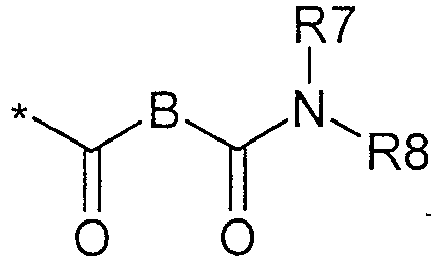
R1, R2, R3, R4, R5 und R6 unabhängig voneinander für H, C1-8-Alkyl, C6-10-Aryl oder-CH2-OX2 stehen,
R7 und R8 unabhängig voneinander für gegebenenfalls durch Heteroatome substituiertes C1-28-Alkyl oder C6-10-Aryl stehen. - Verwendung nach einem der Ansprüche 1 bis 6, dadurch gekennzeichnet, dass es sich bei dem Polyesteramid um ein Polymer gemäß Formel (V)

A für OH oder
B für C2-24-Alkylen oder C6-24-Arylen steht, X1 für
X2 für Wasserstoff, X1,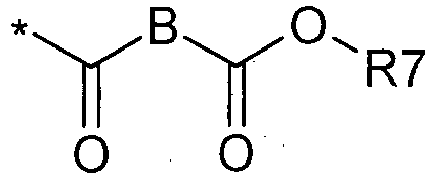

R3 und R6 unabhängig voneinander für H, C1-8-Alkyl oder C6-10-Aryl stehen,
R7 und R8 unabhängig voneinander für gegebenenfalls durch Heteroatome substituiertes und/oder durch Heteroatome enthaltende Gruppen substituiertes C1-28-Alkyl oder C6-10-Aryl stehen. - Verwendung nach einem der Ansprüche 4 bis 7, dadurch gekennzeichnet, dass R7 und R8 unabhängig voneinander ein- oder mehrfach substituiert sind durch Gruppen ausgewählt aus Alkoholen, Ethern, Polyethern, Estern, Cyanid, Carbonat, Urethan, Harnstoff, Amid, Imid, Amin, Imin, Imidazol, Oxim, Sulfid, Thiol, Thioharnstoff, Sulfon, Sulfonoxid, Sulfat, Phosphat, Phosphin, Phosphinoxid, Silan, Silikon, Silikat, Fluor, Chlor, Brom oder Iod sowie aus Gruppen, die mindestens eine der zuvor genannten funktionellen Gruppen enthalten.
- Verwendung nach einem der Ansprüche 4 bis 8, dadurch gekennzeichnet, dass R7 und R8 unabhängig voneinander quaternisierte Aminogruppen oder Polyethergruppen, insbesondere Polyoxyethylengruppen, oder beliebige Mischungen davon enthalten und insbesondere ausgewählt sind aus Tri(m)ethylammoniumalkyl-Resten sowie gegebenenfalls veretherten Polyoxyethylengruppen mit 6 bis 10 Oxyethylen-Einheiten.
- Verwendung nach einem der Ansprüche 1 bis 9, dadurch gekennzeichnet, dass es sich bei dem quaternären Ammoniumacrylamid des Copolymers aus quaternärem Ammoniumacrylamid und Acrylsäure um ein Diallyldimethylammoniumacrylamid handelt.
- Verwendung nach einem der Ansprüche 1 bis 10, dadurch gekennzeichnet, dass das Mittel mindestens ein Tensid enthält.
- Verwendung nach einem der Ansprüche 1 bis 11, dadurch gekennzeichnet, dass das Mittel einen pH-Wert von weniger als 9, insbesondere von 0 bis 6, vorzugsweise von 1 bis 5 und besonders bevorzugt von 2 bis 4 aufweist.
- Verwendung nach einem der Ansprüche 1 bis 12, dadurch gekennzeichnet, dass es sich bei dem Mittel um ein Reinigungsmittel handelt, vorzugsweise ein Reinigungsmittel für Keramik, insbesondere für Sanitärkeramik.
Priority Applications (1)
| Application Number | Priority Date | Filing Date | Title |
|---|---|---|---|
| PL10743172T PL2473592T3 (pl) | 2009-09-01 | 2010-08-19 | Zastosowanie środków do traktowania twardych powierzchni |
Applications Claiming Priority (2)
| Application Number | Priority Date | Filing Date | Title |
|---|---|---|---|
| DE102009029060A DE102009029060A1 (de) | 2009-09-01 | 2009-09-01 | Mittel zur Behandlung harter Oberflächen |
| PCT/EP2010/062108 WO2011026735A1 (de) | 2009-09-01 | 2010-08-19 | Mittel zur behandlung harter oberflächen |
Publications (2)
| Publication Number | Publication Date |
|---|---|
| EP2473592A1 EP2473592A1 (de) | 2012-07-11 |
| EP2473592B1 true EP2473592B1 (de) | 2016-12-21 |
Family
ID=42985491
Family Applications (1)
| Application Number | Title | Priority Date | Filing Date |
|---|---|---|---|
| EP10743172.8A Not-in-force EP2473592B1 (de) | 2009-09-01 | 2010-08-19 | Verwendung von mitteln zur behandlung harter oberflächen |
Country Status (7)
| Country | Link |
|---|---|
| US (1) | US20120156377A1 (de) |
| EP (1) | EP2473592B1 (de) |
| DE (1) | DE102009029060A1 (de) |
| ES (1) | ES2618862T3 (de) |
| HU (1) | HUE031859T2 (de) |
| PL (1) | PL2473592T3 (de) |
| WO (1) | WO2011026735A1 (de) |
Families Citing this family (15)
| Publication number | Priority date | Publication date | Assignee | Title |
|---|---|---|---|---|
| FR2920763B1 (fr) * | 2007-09-06 | 2011-04-01 | Saint Gobain Technical Fabrics | Composition d'ensimage sous forme de gel physique pour fils de verre, fils de verre obtenus et composites comprenant lesdits fils. |
| DE102010038340A1 (de) * | 2010-07-23 | 2012-01-26 | Henkel Ag & Co. Kgaa | Verhinderung der bakteriellen Adhäsion |
| EP2840895B1 (de) * | 2012-04-25 | 2016-09-14 | Akzo Nobel Chemicals International B.V. | Verwendung von ethoxyliertem alkanolamid als hydrotrop für nicht ionische tenside |
| US9534190B2 (en) | 2012-12-20 | 2017-01-03 | Ecolab Usa Inc. | Citrate salt bathroom cleaners |
| US9790456B2 (en) * | 2012-12-20 | 2017-10-17 | Ecolab Usa Inc. | Citrate salt bathroom cleaners |
| US9234164B2 (en) * | 2014-02-11 | 2016-01-12 | Gregory E Robinson | Graffiti remover comprising a solvent mixture of propylene carbonate and soy methyl ester |
| AT515627B1 (de) * | 2014-04-15 | 2015-12-15 | Bmb Gebäudehygiene Gmbh | Verfahren zur Bekämpfung von Schimmel, Algen sowie anderen Mikroorganismen auf unterschiedlichen von diesen Organismen befallenen Wand-, Boden- oder Deckenflächen sowie Mauerwerk im Allgemeinen |
| US20180030389A1 (en) * | 2016-07-29 | 2018-02-01 | Amit Garyali | Multi-Purpose Cleaner System |
| BR112020011623A2 (pt) * | 2017-12-19 | 2020-12-08 | Colgate-Palmolive Company | Composição de limpeza para proporcionar repelência à água de longa duração em superfícies |
| JP2021172715A (ja) * | 2020-04-23 | 2021-11-01 | 山崎産業株式会社 | 防汚洗浄剤、清掃用品及び防汚洗浄方法 |
| GR20220100628A (el) * | 2022-08-01 | 2024-03-12 | Παπαδοπουλος Νικολαος-Ξαφακης Σωτηριος Ομορρυθμη Εταιρεια, | Μεθοδος αναπτυξης ανθεκτικων αντιρρυπαντικων νανοεπικαλυπτικων συστηματων με επιπροσθετη ισχυρη αντιμικροβιακη δραση |
| JP2024026937A (ja) * | 2022-08-16 | 2024-02-29 | ライオン株式会社 | 硬表面用の液体洗浄剤組成物 |
| CN120265593A (zh) * | 2022-11-29 | 2025-07-04 | 康宁股份有限公司 | 用于清洁玻璃制品的水溶液及其使用方法 |
| EP4695365A1 (de) * | 2023-04-10 | 2026-02-18 | Reckitt Benckiser Health Limited | Optimierung der fliesseigenschaften von flüssigen reinigungsmitteln |
| WO2025191669A1 (ja) * | 2024-03-12 | 2025-09-18 | アコロテックジャパン株式会社 | 尿石除去方法及び尿石溶解剤 |
Family Cites Families (16)
| Publication number | Priority date | Publication date | Assignee | Title |
|---|---|---|---|---|
| US4861511A (en) * | 1987-06-26 | 1989-08-29 | Nalco Chemical Company | Toilet bowl cleaner and stain-inhibiting composition |
| WO1996004940A1 (en) | 1994-08-12 | 1996-02-22 | The Procter & Gamble Company | Composition for reducing malodor impression on inanimate surfaces |
| NL1007186C2 (nl) | 1997-10-01 | 1999-04-07 | Dsm Nv | ß-hydroxyalkylamide groepen bevattend condensatiepolymeer. |
| EP1038902A1 (de) | 1999-03-26 | 2000-09-27 | Dsm N.V. | Kondensationpolymere, die Dialkylamid-Endgruppen enthalten, Verfahren zu ihrer Herstellung, und deren Verwendungen |
| EP1469893A1 (de) | 2002-02-01 | 2004-10-27 | Sustech GmbH & Co. KG | Sternformige prapolymere fur die herstellung ultradunner hydrogel-bildender beschichtungen |
| US6926745B2 (en) * | 2002-05-17 | 2005-08-09 | The Clorox Company | Hydroscopic polymer gel films for easier cleaning |
| EP1781717B1 (de) | 2004-07-10 | 2012-11-07 | Henkel AG & Co. KGaA | Copolymerhaltige reinigungsmittel |
| DE102006009004A1 (de) | 2006-02-23 | 2007-09-06 | Sustech Gmbh & Co. Kg | Multifunktionelle sternförmige Präpolymere, deren Herstellung und Verwendung |
| DE102007039652A1 (de) | 2006-12-05 | 2008-06-12 | Henkel Kgaa | Mittel zur Behandlung harter Oberflächen |
| DE102007039649A1 (de) | 2006-12-05 | 2008-06-12 | Henkel Kgaa | Reinigungsmittel für harte Oberflächen |
| WO2008068061A1 (de) * | 2006-12-05 | 2008-06-12 | Henkel Ag & Co. Kgaa | Reinigungsmittel für glasoberflächen |
| DE102007008655A1 (de) | 2007-02-20 | 2008-08-21 | Henkel Ag & Co. Kgaa | Siderophor-Metall-Komplexe als Bleichkatalysatoren |
| US7741265B2 (en) * | 2007-08-14 | 2010-06-22 | S.C. Johnson & Son, Inc. | Hard surface cleaner with extended residual cleaning benefit |
| DE102007039665A1 (de) * | 2007-08-22 | 2009-02-26 | Sustech Gmbh & Co. Kg | Silylfunktionelle lineare Präpolymere, deren Herstellung und Verwendung |
| DE102007058343A1 (de) | 2007-12-03 | 2009-06-04 | Henkel Ag & Co. Kgaa | Verminderung der Adhäsion von Schmutz, Staub und biologischem Material durch Polyesteramide |
| DE102008063070A1 (de) | 2008-12-23 | 2010-07-01 | Henkel Ag & Co. Kgaa | Verwendung sternförmiger Polymere mit peripheren negativ geladenen Gruppen und/oder peripheren Silyl-Gruppen zur Ausrüstung von Oberflächen |
-
2009
- 2009-09-01 DE DE102009029060A patent/DE102009029060A1/de not_active Withdrawn
-
2010
- 2010-08-19 PL PL10743172T patent/PL2473592T3/pl unknown
- 2010-08-19 EP EP10743172.8A patent/EP2473592B1/de not_active Not-in-force
- 2010-08-19 ES ES10743172.8T patent/ES2618862T3/es active Active
- 2010-08-19 WO PCT/EP2010/062108 patent/WO2011026735A1/de not_active Ceased
- 2010-08-19 HU HUE10743172A patent/HUE031859T2/hu unknown
-
2012
- 2012-03-01 US US13/409,354 patent/US20120156377A1/en not_active Abandoned
Non-Patent Citations (1)
| Title |
|---|
| None * |
Also Published As
| Publication number | Publication date |
|---|---|
| PL2473592T3 (pl) | 2017-06-30 |
| WO2011026735A1 (de) | 2011-03-10 |
| US20120156377A1 (en) | 2012-06-21 |
| EP2473592A1 (de) | 2012-07-11 |
| DE102009029060A1 (de) | 2011-03-03 |
| ES2618862T3 (es) | 2017-06-22 |
| HUE031859T2 (hu) | 2017-08-28 |
Similar Documents
| Publication | Publication Date | Title |
|---|---|---|
| EP2473592A1 (de) | Mittel zur behandlung harter oberflächen | |
| EP2129763B1 (de) | Mittel zur behandlung harter oberflächen | |
| EP2487231B1 (de) | Mittel zur Behandlung harter Oberflächen | |
| EP2109664B1 (de) | Mittel zur behandlung harter oberflächen | |
| JP4005357B2 (ja) | 水溶性又は水分散性コポリマーを含む清浄用組成物 | |
| EP2494025B1 (de) | Antimikrobielles reinigungsmittel für harte oberflächen | |
| EP4006132B1 (de) | Selbstklebende waschmittelzusammensetzungen mit farbverändernden systemen | |
| CN101679915A (zh) | 具有亲水剂的硬质表面清洁组合物以及清洁硬质表面的方法 | |
| EP2430138A1 (de) | Probiotischer reiniger für harte oberflächen | |
| WO2017157777A1 (en) | Method for controlling malodors with regard to sanitary applications, using bacterial spores capable of inhibiting or preventing the production of malodor | |
| EP2109663B1 (de) | Reinigungsmittel für glasoberflächen | |
| WO2017157772A1 (en) | Method for controlling malodors with regard to sanitary applications, using bacterial spores capable of inhibiting or preventing the production of malodor | |
| EP1781765B1 (de) | Verwendung eines reinigers mit fäkalschmutz-abweisenden eigenschaften | |
| WO2012010700A1 (de) | Verhinderung der bakteriellen adhäsion | |
| EP2414495B1 (de) | Reinigungsmittel für böden | |
| DE102014226909A1 (de) | Polymere für Reiniger mit Oberflächen-modifizierender Wirkung | |
| DE102007038452A1 (de) | Mittel zur Behandlung harter Oberflächen | |
| DE102007023871A1 (de) | Mittel zur Behandlung harter Oberflächen |
Legal Events
| Date | Code | Title | Description |
|---|---|---|---|
| PUAI | Public reference made under article 153(3) epc to a published international application that has entered the european phase |
Free format text: ORIGINAL CODE: 0009012 |
|
| 17P | Request for examination filed |
Effective date: 20120124 |
|
| AK | Designated contracting states |
Kind code of ref document: A1 Designated state(s): AL AT BE BG CH CY CZ DE DK EE ES FI FR GB GR HR HU IE IS IT LI LT LU LV MC MK MT NL NO PL PT RO SE SI SK SM TR |
|
| DAX | Request for extension of the european patent (deleted) | ||
| 17Q | First examination report despatched |
Effective date: 20150828 |
|
| GRAP | Despatch of communication of intention to grant a patent |
Free format text: ORIGINAL CODE: EPIDOSNIGR1 |
|
| INTG | Intention to grant announced |
Effective date: 20160728 |
|
| GRAS | Grant fee paid |
Free format text: ORIGINAL CODE: EPIDOSNIGR3 |
|
| GRAA | (expected) grant |
Free format text: ORIGINAL CODE: 0009210 |
|
| AK | Designated contracting states |
Kind code of ref document: B1 Designated state(s): AL AT BE BG CH CY CZ DE DK EE ES FI FR GB GR HR HU IE IS IT LI LT LU LV MC MK MT NL NO PL PT RO SE SI SK SM TR |
|
| REG | Reference to a national code |
Ref country code: GB Ref legal event code: FG4D Free format text: NOT ENGLISH |
|
| REG | Reference to a national code |
Ref country code: CH Ref legal event code: EP |
|
| REG | Reference to a national code |
Ref country code: IE Ref legal event code: FG4D Free format text: LANGUAGE OF EP DOCUMENT: GERMAN |
|
| REG | Reference to a national code |
Ref country code: AT Ref legal event code: REF Ref document number: 855537 Country of ref document: AT Kind code of ref document: T Effective date: 20170115 |
|
| REG | Reference to a national code |
Ref country code: DE Ref legal event code: R096 Ref document number: 502010012929 Country of ref document: DE |
|
| PG25 | Lapsed in a contracting state [announced via postgrant information from national office to epo] |
Ref country code: LV Free format text: LAPSE BECAUSE OF FAILURE TO SUBMIT A TRANSLATION OF THE DESCRIPTION OR TO PAY THE FEE WITHIN THE PRESCRIBED TIME-LIMIT Effective date: 20161221 |
|
| REG | Reference to a national code |
Ref country code: LT Ref legal event code: MG4D |
|
| REG | Reference to a national code |
Ref country code: NL Ref legal event code: MP Effective date: 20161221 |
|
| PG25 | Lapsed in a contracting state [announced via postgrant information from national office to epo] |
Ref country code: SE Free format text: LAPSE BECAUSE OF FAILURE TO SUBMIT A TRANSLATION OF THE DESCRIPTION OR TO PAY THE FEE WITHIN THE PRESCRIBED TIME-LIMIT Effective date: 20161221 Ref country code: LT Free format text: LAPSE BECAUSE OF FAILURE TO SUBMIT A TRANSLATION OF THE DESCRIPTION OR TO PAY THE FEE WITHIN THE PRESCRIBED TIME-LIMIT Effective date: 20161221 Ref country code: GR Free format text: LAPSE BECAUSE OF FAILURE TO SUBMIT A TRANSLATION OF THE DESCRIPTION OR TO PAY THE FEE WITHIN THE PRESCRIBED TIME-LIMIT Effective date: 20170322 Ref country code: NO Free format text: LAPSE BECAUSE OF FAILURE TO SUBMIT A TRANSLATION OF THE DESCRIPTION OR TO PAY THE FEE WITHIN THE PRESCRIBED TIME-LIMIT Effective date: 20170321 |
|
| PG25 | Lapsed in a contracting state [announced via postgrant information from national office to epo] |
Ref country code: FI Free format text: LAPSE BECAUSE OF FAILURE TO SUBMIT A TRANSLATION OF THE DESCRIPTION OR TO PAY THE FEE WITHIN THE PRESCRIBED TIME-LIMIT Effective date: 20161221 Ref country code: HR Free format text: LAPSE BECAUSE OF FAILURE TO SUBMIT A TRANSLATION OF THE DESCRIPTION OR TO PAY THE FEE WITHIN THE PRESCRIBED TIME-LIMIT Effective date: 20161221 |
|
| REG | Reference to a national code |
Ref country code: ES Ref legal event code: FG2A Ref document number: 2618862 Country of ref document: ES Kind code of ref document: T3 Effective date: 20170622 |
|
| PG25 | Lapsed in a contracting state [announced via postgrant information from national office to epo] |
Ref country code: NL Free format text: LAPSE BECAUSE OF FAILURE TO SUBMIT A TRANSLATION OF THE DESCRIPTION OR TO PAY THE FEE WITHIN THE PRESCRIBED TIME-LIMIT Effective date: 20161221 |
|
| PG25 | Lapsed in a contracting state [announced via postgrant information from national office to epo] |
Ref country code: RO Free format text: LAPSE BECAUSE OF FAILURE TO SUBMIT A TRANSLATION OF THE DESCRIPTION OR TO PAY THE FEE WITHIN THE PRESCRIBED TIME-LIMIT Effective date: 20161221 Ref country code: EE Free format text: LAPSE BECAUSE OF FAILURE TO SUBMIT A TRANSLATION OF THE DESCRIPTION OR TO PAY THE FEE WITHIN THE PRESCRIBED TIME-LIMIT Effective date: 20161221 Ref country code: IS Free format text: LAPSE BECAUSE OF FAILURE TO SUBMIT A TRANSLATION OF THE DESCRIPTION OR TO PAY THE FEE WITHIN THE PRESCRIBED TIME-LIMIT Effective date: 20170421 Ref country code: SK Free format text: LAPSE BECAUSE OF FAILURE TO SUBMIT A TRANSLATION OF THE DESCRIPTION OR TO PAY THE FEE WITHIN THE PRESCRIBED TIME-LIMIT Effective date: 20161221 |
|
| REG | Reference to a national code |
Ref country code: FR Ref legal event code: PLFP Year of fee payment: 8 |
|
| REG | Reference to a national code |
Ref country code: HU Ref legal event code: AG4A Ref document number: E031859 Country of ref document: HU |
|
| PG25 | Lapsed in a contracting state [announced via postgrant information from national office to epo] |
Ref country code: BG Free format text: LAPSE BECAUSE OF FAILURE TO SUBMIT A TRANSLATION OF THE DESCRIPTION OR TO PAY THE FEE WITHIN THE PRESCRIBED TIME-LIMIT Effective date: 20170321 Ref country code: SM Free format text: LAPSE BECAUSE OF FAILURE TO SUBMIT A TRANSLATION OF THE DESCRIPTION OR TO PAY THE FEE WITHIN THE PRESCRIBED TIME-LIMIT Effective date: 20161221 Ref country code: PT Free format text: LAPSE BECAUSE OF FAILURE TO SUBMIT A TRANSLATION OF THE DESCRIPTION OR TO PAY THE FEE WITHIN THE PRESCRIBED TIME-LIMIT Effective date: 20170421 |
|
| REG | Reference to a national code |
Ref country code: DE Ref legal event code: R097 Ref document number: 502010012929 Country of ref document: DE |
|
| PLBE | No opposition filed within time limit |
Free format text: ORIGINAL CODE: 0009261 |
|
| STAA | Information on the status of an ep patent application or granted ep patent |
Free format text: STATUS: NO OPPOSITION FILED WITHIN TIME LIMIT |
|
| PGFP | Annual fee paid to national office [announced via postgrant information from national office to epo] |
Ref country code: IT Payment date: 20170828 Year of fee payment: 8 Ref country code: ES Payment date: 20170928 Year of fee payment: 8 Ref country code: DE Payment date: 20170822 Year of fee payment: 8 Ref country code: FR Payment date: 20170822 Year of fee payment: 8 Ref country code: GB Payment date: 20170822 Year of fee payment: 8 Ref country code: CZ Payment date: 20170818 Year of fee payment: 8 |
|
| 26N | No opposition filed |
Effective date: 20170922 |
|
| PG25 | Lapsed in a contracting state [announced via postgrant information from national office to epo] |
Ref country code: DK Free format text: LAPSE BECAUSE OF FAILURE TO SUBMIT A TRANSLATION OF THE DESCRIPTION OR TO PAY THE FEE WITHIN THE PRESCRIBED TIME-LIMIT Effective date: 20161221 |
|
| PGFP | Annual fee paid to national office [announced via postgrant information from national office to epo] |
Ref country code: TR Payment date: 20170801 Year of fee payment: 8 Ref country code: HU Payment date: 20170830 Year of fee payment: 8 Ref country code: PL Payment date: 20170720 Year of fee payment: 8 |
|
| PG25 | Lapsed in a contracting state [announced via postgrant information from national office to epo] |
Ref country code: SI Free format text: LAPSE BECAUSE OF FAILURE TO SUBMIT A TRANSLATION OF THE DESCRIPTION OR TO PAY THE FEE WITHIN THE PRESCRIBED TIME-LIMIT Effective date: 20161221 |
|
| REG | Reference to a national code |
Ref country code: CH Ref legal event code: PL |
|
| PG25 | Lapsed in a contracting state [announced via postgrant information from national office to epo] |
Ref country code: MC Free format text: LAPSE BECAUSE OF FAILURE TO SUBMIT A TRANSLATION OF THE DESCRIPTION OR TO PAY THE FEE WITHIN THE PRESCRIBED TIME-LIMIT Effective date: 20161221 |
|
| PG25 | Lapsed in a contracting state [announced via postgrant information from national office to epo] |
Ref country code: CH Free format text: LAPSE BECAUSE OF NON-PAYMENT OF DUE FEES Effective date: 20170831 Ref country code: LI Free format text: LAPSE BECAUSE OF NON-PAYMENT OF DUE FEES Effective date: 20170831 |
|
| REG | Reference to a national code |
Ref country code: IE Ref legal event code: MM4A |
|
| REG | Reference to a national code |
Ref country code: BE Ref legal event code: MM Effective date: 20170831 |
|
| PG25 | Lapsed in a contracting state [announced via postgrant information from national office to epo] |
Ref country code: LU Free format text: LAPSE BECAUSE OF NON-PAYMENT OF DUE FEES Effective date: 20170819 |
|
| PG25 | Lapsed in a contracting state [announced via postgrant information from national office to epo] |
Ref country code: IE Free format text: LAPSE BECAUSE OF NON-PAYMENT OF DUE FEES Effective date: 20170819 |
|
| PG25 | Lapsed in a contracting state [announced via postgrant information from national office to epo] |
Ref country code: BE Free format text: LAPSE BECAUSE OF NON-PAYMENT OF DUE FEES Effective date: 20170831 |
|
| PG25 | Lapsed in a contracting state [announced via postgrant information from national office to epo] |
Ref country code: MT Free format text: LAPSE BECAUSE OF FAILURE TO SUBMIT A TRANSLATION OF THE DESCRIPTION OR TO PAY THE FEE WITHIN THE PRESCRIBED TIME-LIMIT Effective date: 20161221 |
|
| REG | Reference to a national code |
Ref country code: AT Ref legal event code: MM01 Ref document number: 855537 Country of ref document: AT Kind code of ref document: T Effective date: 20170819 |
|
| PG25 | Lapsed in a contracting state [announced via postgrant information from national office to epo] |
Ref country code: AT Free format text: LAPSE BECAUSE OF NON-PAYMENT OF DUE FEES Effective date: 20170819 |
|
| REG | Reference to a national code |
Ref country code: DE Ref legal event code: R119 Ref document number: 502010012929 Country of ref document: DE |
|
| GBPC | Gb: european patent ceased through non-payment of renewal fee |
Effective date: 20180819 |
|
| PG25 | Lapsed in a contracting state [announced via postgrant information from national office to epo] |
Ref country code: CZ Free format text: LAPSE BECAUSE OF NON-PAYMENT OF DUE FEES Effective date: 20180819 Ref country code: HU Free format text: LAPSE BECAUSE OF NON-PAYMENT OF DUE FEES Effective date: 20180820 |
|
| PG25 | Lapsed in a contracting state [announced via postgrant information from national office to epo] |
Ref country code: IT Free format text: LAPSE BECAUSE OF NON-PAYMENT OF DUE FEES Effective date: 20180819 Ref country code: DE Free format text: LAPSE BECAUSE OF NON-PAYMENT OF DUE FEES Effective date: 20190301 |
|
| PG25 | Lapsed in a contracting state [announced via postgrant information from national office to epo] |
Ref country code: FR Free format text: LAPSE BECAUSE OF NON-PAYMENT OF DUE FEES Effective date: 20180831 |
|
| REG | Reference to a national code |
Ref country code: ES Ref legal event code: FD2A Effective date: 20190918 |
|
| PG25 | Lapsed in a contracting state [announced via postgrant information from national office to epo] |
Ref country code: ES Free format text: LAPSE BECAUSE OF NON-PAYMENT OF DUE FEES Effective date: 20180820 Ref country code: CY Free format text: LAPSE BECAUSE OF NON-PAYMENT OF DUE FEES Effective date: 20161221 Ref country code: GB Free format text: LAPSE BECAUSE OF NON-PAYMENT OF DUE FEES Effective date: 20180819 |
|
| PG25 | Lapsed in a contracting state [announced via postgrant information from national office to epo] |
Ref country code: MK Free format text: LAPSE BECAUSE OF FAILURE TO SUBMIT A TRANSLATION OF THE DESCRIPTION OR TO PAY THE FEE WITHIN THE PRESCRIBED TIME-LIMIT Effective date: 20161221 |
|
| PG25 | Lapsed in a contracting state [announced via postgrant information from national office to epo] |
Ref country code: PL Free format text: LAPSE BECAUSE OF NON-PAYMENT OF DUE FEES Effective date: 20180819 |
|
| PG25 | Lapsed in a contracting state [announced via postgrant information from national office to epo] |
Ref country code: AL Free format text: LAPSE BECAUSE OF FAILURE TO SUBMIT A TRANSLATION OF THE DESCRIPTION OR TO PAY THE FEE WITHIN THE PRESCRIBED TIME-LIMIT Effective date: 20161221 |
|
| PG25 | Lapsed in a contracting state [announced via postgrant information from national office to epo] |
Ref country code: TR Free format text: LAPSE BECAUSE OF NON-PAYMENT OF DUE FEES Effective date: 20180819 |