EP2467350B1 - Massekennzeichnungen - Google Patents
Massekennzeichnungen Download PDFInfo
- Publication number
- EP2467350B1 EP2467350B1 EP10751942.3A EP10751942A EP2467350B1 EP 2467350 B1 EP2467350 B1 EP 2467350B1 EP 10751942 A EP10751942 A EP 10751942A EP 2467350 B1 EP2467350 B1 EP 2467350B1
- Authority
- EP
- European Patent Office
- Prior art keywords
- mass
- label
- group
- moiety
- substituted
- Prior art date
- Legal status (The legal status is an assumption and is not a legal conclusion. Google has not performed a legal analysis and makes no representation as to the accuracy of the status listed.)
- Active
Links
- 0 C*C1C(*)C(*)C(C)N(CC(N*(*)*)=O)C1C Chemical compound C*C1C(*)C(*)C(C)N(CC(N*(*)*)=O)C1C 0.000 description 11
- JLJDGMUEWVTJGZ-ROUUACIJSA-N C/[O](/C[C@H](CCC1)N[C@H]1C=C)=C/NCCC(NCCSSc1ncccc1)=O Chemical compound C/[O](/C[C@H](CCC1)N[C@H]1C=C)=C/NCCC(NCCSSc1ncccc1)=O JLJDGMUEWVTJGZ-ROUUACIJSA-N 0.000 description 1
- WQKLJKAIDKAMQQ-UHFFFAOYSA-N CC(C)NCCC(NCCC(C)=O)=O Chemical compound CC(C)NCCC(NCCC(C)=O)=O WQKLJKAIDKAMQQ-UHFFFAOYSA-N 0.000 description 1
- MARSKFXHUWIMOR-UHFFFAOYSA-N CCC(C)(C)NS Chemical compound CCC(C)(C)NS MARSKFXHUWIMOR-UHFFFAOYSA-N 0.000 description 1
- YLKPPZGUPGJXOY-UHFFFAOYSA-N CCC(C)NNNC(C)(C)C Chemical compound CCC(C)NNNC(C)(C)C YLKPPZGUPGJXOY-UHFFFAOYSA-N 0.000 description 1
Images


Classifications
-
- G—PHYSICS
- G01—MEASURING; TESTING
- G01N—INVESTIGATING OR ANALYSING MATERIALS BY DETERMINING THEIR CHEMICAL OR PHYSICAL PROPERTIES
- G01N33/00—Investigating or analysing materials by specific methods not covered by groups G01N1/00 - G01N31/00
- G01N33/48—Biological material, e.g. blood, urine; Haemocytometers
- G01N33/50—Chemical analysis of biological material, e.g. blood, urine; Testing involving biospecific ligand binding methods; Immunological testing
- G01N33/74—Chemical analysis of biological material, e.g. blood, urine; Testing involving biospecific ligand binding methods; Immunological testing involving hormones or other non-cytokine intercellular protein regulatory factors such as growth factors, including receptors to hormones and growth factors
- G01N33/743—Steroid hormones
-
- C—CHEMISTRY; METALLURGY
- C07—ORGANIC CHEMISTRY
- C07B—GENERAL METHODS OF ORGANIC CHEMISTRY; APPARATUS THEREFOR
- C07B59/00—Introduction of isotopes of elements into organic compounds ; Labelled organic compounds per se
- C07B59/002—Heterocyclic compounds
-
- C—CHEMISTRY; METALLURGY
- C07—ORGANIC CHEMISTRY
- C07D—HETEROCYCLIC COMPOUNDS
- C07D211/00—Heterocyclic compounds containing hydrogenated pyridine rings, not condensed with other rings
- C07D211/04—Heterocyclic compounds containing hydrogenated pyridine rings, not condensed with other rings with only hydrogen or carbon atoms directly attached to the ring nitrogen atom
- C07D211/06—Heterocyclic compounds containing hydrogenated pyridine rings, not condensed with other rings with only hydrogen or carbon atoms directly attached to the ring nitrogen atom having no double bonds between ring members or between ring members and non-ring members
- C07D211/08—Heterocyclic compounds containing hydrogenated pyridine rings, not condensed with other rings with only hydrogen or carbon atoms directly attached to the ring nitrogen atom having no double bonds between ring members or between ring members and non-ring members with hydrocarbon or substituted hydrocarbon radicals directly attached to ring carbon atoms
- C07D211/10—Heterocyclic compounds containing hydrogenated pyridine rings, not condensed with other rings with only hydrogen or carbon atoms directly attached to the ring nitrogen atom having no double bonds between ring members or between ring members and non-ring members with hydrocarbon or substituted hydrocarbon radicals directly attached to ring carbon atoms with radicals containing only carbon and hydrogen atoms attached to ring carbon atoms
- C07D211/14—Heterocyclic compounds containing hydrogenated pyridine rings, not condensed with other rings with only hydrogen or carbon atoms directly attached to the ring nitrogen atom having no double bonds between ring members or between ring members and non-ring members with hydrocarbon or substituted hydrocarbon radicals directly attached to ring carbon atoms with radicals containing only carbon and hydrogen atoms attached to ring carbon atoms with hydrocarbon or substituted hydrocarbon radicals attached to the ring nitrogen atom
-
- C—CHEMISTRY; METALLURGY
- C07—ORGANIC CHEMISTRY
- C07D—HETEROCYCLIC COMPOUNDS
- C07D401/00—Heterocyclic compounds containing two or more hetero rings, having nitrogen atoms as the only ring hetero atoms, at least one ring being a six-membered ring with only one nitrogen atom
- C07D401/02—Heterocyclic compounds containing two or more hetero rings, having nitrogen atoms as the only ring hetero atoms, at least one ring being a six-membered ring with only one nitrogen atom containing two hetero rings
- C07D401/12—Heterocyclic compounds containing two or more hetero rings, having nitrogen atoms as the only ring hetero atoms, at least one ring being a six-membered ring with only one nitrogen atom containing two hetero rings linked by a chain containing hetero atoms as chain links
-
- G—PHYSICS
- G01—MEASURING; TESTING
- G01N—INVESTIGATING OR ANALYSING MATERIALS BY DETERMINING THEIR CHEMICAL OR PHYSICAL PROPERTIES
- G01N33/00—Investigating or analysing materials by specific methods not covered by groups G01N1/00 - G01N31/00
- G01N33/48—Biological material, e.g. blood, urine; Haemocytometers
- G01N33/50—Chemical analysis of biological material, e.g. blood, urine; Testing involving biospecific ligand binding methods; Immunological testing
- G01N33/58—Chemical analysis of biological material, e.g. blood, urine; Testing involving biospecific ligand binding methods; Immunological testing involving labelled substances
-
- G—PHYSICS
- G01—MEASURING; TESTING
- G01N—INVESTIGATING OR ANALYSING MATERIALS BY DETERMINING THEIR CHEMICAL OR PHYSICAL PROPERTIES
- G01N2458/00—Labels used in chemical analysis of biological material
- G01N2458/15—Non-radioactive isotope labels, e.g. for detection by mass spectrometry
-
- G—PHYSICS
- G01—MEASURING; TESTING
- G01N—INVESTIGATING OR ANALYSING MATERIALS BY DETERMINING THEIR CHEMICAL OR PHYSICAL PROPERTIES
- G01N2560/00—Chemical aspects of mass spectrometric analysis of biological material
-
- Y—GENERAL TAGGING OF NEW TECHNOLOGICAL DEVELOPMENTS; GENERAL TAGGING OF CROSS-SECTIONAL TECHNOLOGIES SPANNING OVER SEVERAL SECTIONS OF THE IPC; TECHNICAL SUBJECTS COVERED BY FORMER USPC CROSS-REFERENCE ART COLLECTIONS [XRACs] AND DIGESTS
- Y10—TECHNICAL SUBJECTS COVERED BY FORMER USPC
- Y10T—TECHNICAL SUBJECTS COVERED BY FORMER US CLASSIFICATION
- Y10T436/00—Chemistry: analytical and immunological testing
- Y10T436/19—Halogen containing
- Y10T436/196666—Carbon containing compound [e.g., vinylchloride, etc.]
-
- Y—GENERAL TAGGING OF NEW TECHNOLOGICAL DEVELOPMENTS; GENERAL TAGGING OF CROSS-SECTIONAL TECHNOLOGIES SPANNING OVER SEVERAL SECTIONS OF THE IPC; TECHNICAL SUBJECTS COVERED BY FORMER USPC CROSS-REFERENCE ART COLLECTIONS [XRACs] AND DIGESTS
- Y10—TECHNICAL SUBJECTS COVERED BY FORMER USPC
- Y10T—TECHNICAL SUBJECTS COVERED BY FORMER US CLASSIFICATION
- Y10T436/00—Chemistry: analytical and immunological testing
- Y10T436/20—Oxygen containing
- Y10T436/200833—Carbonyl, ether, aldehyde or ketone containing
-
- Y—GENERAL TAGGING OF NEW TECHNOLOGICAL DEVELOPMENTS; GENERAL TAGGING OF CROSS-SECTIONAL TECHNOLOGIES SPANNING OVER SEVERAL SECTIONS OF THE IPC; TECHNICAL SUBJECTS COVERED BY FORMER USPC CROSS-REFERENCE ART COLLECTIONS [XRACs] AND DIGESTS
- Y10—TECHNICAL SUBJECTS COVERED BY FORMER USPC
- Y10T—TECHNICAL SUBJECTS COVERED BY FORMER US CLASSIFICATION
- Y10T436/00—Chemistry: analytical and immunological testing
- Y10T436/24—Nuclear magnetic resonance, electron spin resonance or other spin effects or mass spectrometry
Definitions
- This invention relates to compounds for labelling analytes, particularly biomolecules such as proteins. This invention also relates to methods of analysis by mass spectrometry, using specific mass labels.
- the field of human medicine has been dependent on the ability to detect changes caused by or in response to disease. Such changes provide means of diagnosis and offer insights to the targets for therapeutic compounds such as vaccines and medicines.
- a wide range of biological molecules can be used in medicine including nucleic acids, proteins, steroids, sugars and lipids.
- mass spectrometers the ability to quantitatively detect such biomolecules using mass spectrometers has provided considerable advances in their study and application to human and veterinary disease, in environmental analysis and monitoring, and in food and beverage manufacturing.
- stable isotopes to provide synthetic quantitative references has been developed in isotope dilution mass spectrometry for monitoring of all classes of biomolecules.
- these methods have traditionally required an available synthetic standard which is not always possible.
- ICAT Isotope-Coded Affinity Tags
- isochemic tags allow a degree of improvement in the reproducibility of proteomic studies, this is achieved at the cost of increasing the complexity of the mass spectrum.
- isobaric mass tags were developed. Since their introduction in 2000 isobaric mass tags have provided improved means of proteomic expression profiling by universal labelling of amine functions in proteins and peptides prior to mixing and simultaneous analysis of multiple samples. Because the tags are isobaric, having the same mass, they do not increase the complexity of the mass spectrum since all precursors of the same peptide will appear at exactly the same point in the chromatographic separation and have the same aggregate mass. Only when the molecules are fragmented prior to tandem mass spectrometry are unique mass reporters released, thereby allowing the relative or absolute amount of the peptide present in each of the original samples to be calculated.
- US 7,294,456 sets out the underlying principles of isobaric mass tags and provides specific examples of suitable tags wherein different specific atoms within the molecules are substituted with heavy isotope forms including 13C and 15N respectively. US 7,294,456 further describes the use of offset masses to make multiple isobaric sets to increase the overall plexing rates available without unduly increasing the size of the individual tags. WO 2004/070352 describes additional sets of isobaric mass tags.
- WO 2007/012849 describes further sets of isobaric mass tags including 3-[2-(2,6-Dimethyl-piperidin-1-yl)-acetylamino]-propanoic acid-(2,5-dioxo-pyrrolidine-1-yl)-ester (DMPip- ⁇ Ala-OSu).
- the inventors found that by using a common core structure, preferably based on DMPip- ⁇ Ala it was possible to develop a range of products with selective labelling properties and/or additional offset masses which circumvent the need to re-design workflows or software for interpretation of quantitative mass spectrometry data.
- a common core structure preferably based on DMPip- ⁇ Ala it was possible to develop a range of products with selective labelling properties and/or additional offset masses which circumvent the need to re-design workflows or software for interpretation of quantitative mass spectrometry data.
- it is possible to use the same core structure to develop isochemic tags offering the benefit of quantitation in LC-MS with direct conversion to equivalent isobaric mass tags for biomarker qualification and/or clinical assay development.
- the present invention provides a set of two or more reactive mass labels, wherein each label in the set is for labelling a biological molecule for detection by mass spectrometry, and each label comprises the following structure: wherein R 1 , R 2 , R 3 and Z are selected from one of the following definitions (a) to (d):
- the present invention further provides a reactive mass label for labelling a biological molecule for detection by mass spectrometry, which label comprises the following structure: wherein R 1 , R 2 , R 3 and Z are selected from one of the following definitions (a) to (c):
- mass label used in the present context is intended to refer to a moiety suitable to label an analyte for determination.
- label is synonymous with the term tag.
- Tandem Mass Tag TMT is synonymous with the term mass label.
- mass marker moiety used in the present context is intended to refer to a moiety that is to be detected by mass spectrometry.
- mass normalisation moiety used in the present context is intended to refer to a moiety that is not necessarily to be detected by mass spectrometry, but is present to ensure that a mass label has a desired aggregate mass.
- the mass normalisation moiety serves to vary the overall mass of the mass label.
- the mass normalisation moiety M attaches group A to the remainder of the mass label.
- the mass marker moiety X attaches group A to the remainder of the mass label.
- EP 1105517 discloses a set of isotopic mass tags with cysteine reactivity wherein two samples can be analysed per experiment.
- the principles of isobaric mass tags and complexity reduction through cysteine labelling are combined in a manner that allows the same workflow and analytical methods to be adopted from use of the amine labelling reagent described in WO 2007/012849 . This has substantial benefits in terms of manufacturing costs where a common precursor can be applied, and in the time and cost of method development.
- Embodiment b) above comprises the 2-dithiopyridine group and has several advantages: it shows a high selectivity to label cysteine residues, even at increased pH as often used in buffer solutions useful in proteomic investigations (eg. Triethylammonium bicarbonate TEAB) and it is not labile to exposure to water. Furthermore, this group can be re-cleaved from peptides easily if desired by treatment with any disulfide-reducing reagents.
- Triethylammonium bicarbonate TEAB Triethylammonium bicarbonate
- R 1 and R 2 together form R 3 is absent, Z is O, and R 4 and R 5 are both H.
- R 1 and R 3 together form R 2 is Z is N, and each of R 6 to R 9 is H.
- R 1 is R 2 is A, R 3 is absent and Z is O.
- a set of isobaric mass tags with selective reactivity for carbonyl groups such as aldehydes and ketones is disclosed.
- Aldehyde and ketone groups are found naturally on complex bioactive molecules such as steroids and may also be present in proteins and glycoproteins that have been subjected to oxidation.
- An isobaric mass tag with selective reactivity for carbonyl groups may therefore have a wide range of utilities.
- a number of chemical groups are able to react with ketones and in the present invention the hydrazide and aminoxy groups have been attached to the core molecule to produce sets of carbonyl-selective isobaric mass tags.
- R 1 is R 2 is A, R 3 is absent, Z is O, and B is -NH 2 .
- R 1 is R 2 is A, R 3 is absent, Z is O, and B is -(CH 2 ) 3 -ONH 2 .
- a reactive mass label for labelling a biological molecule for detection by mass spectrometry
- the mass label comprises the following structure: X-L-M-Re wherein X is a mass marker moiety, L is a cleavable linker, M is a mass normalisation moiety, and Re is a reactive functionality for attaching the mass label to a biological molecule comprising the following structure:
- Such reactive mass labels have improved aqueous solubility and stability.
- the majority of mass tags carry a succinimide ester group to allow efficient labelling of amine functions on peptides and proteins. Whilst the succinimide labelling reaction is rapid and can be driven to completion with relatively low molar excess, it is highly sensitive to hydrolysis of the succinimide ester. In certain applications such as labelling of cell surfaces it is necessary to employ a predominantly aqueous environment and the use of a standard succinimide ester is not possible. Improvements to succinimide esters have been made with sulfo-N-hydroxysuccinimide ester (sulfo-NHS) showing a greater resistance to hydrolysis than the non-sulfonated parent.
- sulfo-NHS sulfo-N-hydroxysuccinimide ester
- sulfo-NHS type of group renders the tandem mass tag highly polar and prevents uptake of tags into the cell through the intact cell membrane. Consequently the sulfo-NHS derivatives of TMT are specifically able to label extracellular proteins. However, removal of free sulfo-NHS during mass tag manufacture can be problematic. To circumvent this, the present inventors discovered that a sulfo-tetrafluorophenyl moiety could be used.
- a reactive mass label for labelling a biological molecule for detection by mass spectrometry wherein the mass label comprises the following structure: X-L-M-S-Re wherein X is a mass marker moiety, L is a cleavable linker, M is a mass normalisation moiety, S is a mass series modifying group comprising the following group:
- the limitation on the multiplexing rate for a single isobaric mass tag set can be overcome by providing multiple sets each carrying a unique additional mass.
- the additional mass is provided by the mass series modifying group. This concept is described in US 7,294,456 which is incorporated herein.
- the inventors found that it was possible to develop arrays of isobaric mass tag sets by adding additional beta-alanine moieties into the linker region of the DMPip- ⁇ ALA core structure. Such a unitary approach provides a rapid and inexpensive means of increasing the multiplexing rate from 6 to 12, 18, 24 or more samples.
- a described reactive functionality may comprise the following group: wherein each R 2 is independently H, a substituted or unsubstituted straight or branched C 1 -C 6 alkyl group, a substituted or unsubstituted aliphatic cyclic group, a substituted or unsubstituted aromatic group or a substituted or unsubstituted heterocyclic group.
- the cleavable linker L comprises an amide bond.
- the mass marker moiety X comprises the following group: wherein the cyclic unit is aromatic or aliphatic and comprises from 0-3 double bonds independently between any two adjacent atoms; each Z is independently N, N(R 1 ), C(R 1 ), CO, CO(R 1 ), C(R 1 ) 2 , O or S; X is N, C or C(R 1 ); each R 1 is independently H, a substituted or unsubstituted straight or branched C 1 -C 6 alkyl group, a substituted or unsubstituted aliphatic cyclic group, a substituted or unsubstituted aromatic group or a substituted or unsubstituted heterocyclic group; and y is an integer from 0-10.
- the mass marker moiety may comprise a group selected from the following groups:
- the mass marker moiety comprises a group selected from the following groups: and
- the reactive mass label has one of the following structures:
- n 0 and the reactive mass label has one of the following structures:
- the reactive mass label has one of the following structures:
- n 0 and the reactive mass label has one of the following structures:
- m is 0 and thus the label has the following structure:
- the reactive mass label may have one of the following structures: wherein n is at least 1.
- n 1 and therefore the mass label has one of the following structures:
- each label in the set comprises a mass marker moiety having a common mass and each label in the set has a unique aggregate mass. In another embodiment, each label in the set comprises a mass marker moiety having a unique mass and each label in the set has a common aggregate mass.
- the number of labels in the set is not especially limited, provided that the set comprises a plurality of labels. However, it is preferred if the set comprises two or more, three or more, four or more, or five or more labels, more preferably six or more labels, most preferably eight or more labels.
- aggregate mass in the present context refers to the total mass of the mass label, i.e. the sum of the masses of the mass marker moiety, the cleavable linker, the mass normalisation moiety and any other components of the mass label.
- the mass normalisation moiety comprises a straight or branched C 1 to C 20 substituted or unsubstituted aliphatic group and/or one or more substituted or unsubstituted amino acids, and is limited by its mass, which may vary between different mass labels in a set. For instance, where a set comprises a group of labels having mass marker moieties of different masses but a common aggregate mass, the mass of the mass normalisation moiety will be different in each mass label in the set. In this case, the mass of the mass normalisation moiety in each individual mass label will be equal to the common aggregate mass minus the mass of the particular mass marker moiety in that mass label and minus the mass of the cleavable linker. Where the set comprises a group of labels having a mass marker moiety of common mass but different aggregate masses, it is clear that the mass of the mass normalisation moiety will need to vary such that the aggregate mass of all labels in the group is different.
- mass labels in the set are distinguishable from each other by mass spectroscopy. Therefore, a mass spectrometer can discriminate between the mass labels, i.e. the peaks derived from individual mass labels can be clearly separated from one another.
- the difference in mass between the mass marker moieties or the mass labels means that a mass spectrometer can discriminate between ions derived from different mass labels or mass marker moieties.
- each mass label in the set comprises A which has the following structure: M(D) y -L-X(D) z wherein M is a mass normalisation moiety, X is a mass marker moiety, D is a mass adjuster moiety, L is a cleavable linker, y and z are integers of 0 or greater, and y+z is an integer of 1 or greater.
- the mass adjuster moiety is preferably selected from:
- the mass adjuster moiety is selected from a halogen atom substituent, a methyl group substituent, and 2 H, 15 N, 13 C or 18 O isotopic substituents.
- each mass label in the set comprises A which has the following structure: X (*)n -L-M (*)m wherein X is the mass marker moiety, L is the cleavable linker and M is the mass normalisation moiety, and *is an isotopic mass adjuster moiety, and n and m are integers of 0 or greater such that either:
- the set of reactive mass labels comprises two or more mass labels of any of the following structures: wherein * represents that the oxygen is O 18 , carbon is C 13 or the nitrogen is N 15 , and wherein the each label in the set comprises one or more * such that either:
- label reagents for example, thiopyridine, succinimide moieties
- no heavy isotopes are present.
- the mass adjuster moiety * is C 13 or N 15 and the set comprises six reactive mass labels having the following structures:
- mass adjuster moiety * is C 13 or N 15 and the set comprises six reactive mass labels having the following structures:
- the mass adjuster moiety * is C 13 or N 15 and the set comprises six reactive mass labels having the following structures:
- an array of mass labels comprising two or more sets of mass labels as defined above, wherein the aggregate mass of each of the mass labels of any one set in the array is different from the aggregate mass of each of the mass labels of every other set in the array.
- the aim of this aspect of the invention is to increase the number of samples (multiplexing rate) that can be analysed in a single experiment.
- multiplexing rate it is necessary to consider the relationship between the number of samples and sensitivity in MS/MS analysis.
- ions of the desired mass to charge ratio are accumulated in a collision cell that has a finite capacity.
- the trapped ions are then fragmented and the fragments allowed to pass through to the detector where the mass-to-charge ratio and abundance are determined. If too many samples are included there is a risk that the number of fragments released into the detector will be below the limit of detection of the instrument.
- each mass label in at least one set comprises a mass series modifying group of a common mass, the mass series modifying group in each of the mass labels of any one set having a different mass from the mass series modifying groups in each of the mass labels of every other set in the array.
- the mass series modifying group separates the masses of the sets from each other.
- a further aspect of the invention is provided by use of a reactive mass label as defined above in a method of analysis by mass spectrometry.
- the method comprises the following steps:
- the reactive mass label of the present invention for labelling a biological molecule for detection by mass spectroscopy comprises a reactive functionality for facilitating attachment of or for attaching the mass label to a biological molecule and a mass label A as defined below.
- the reactive functionality allows the mass label to be reacted covalently to an appropriate functional group in the biological molecule, such as, but not limited to, a nucleotide oligonucleotide, polynucleotide, amino acid, peptide, polypeptide or steroid hormone.
- the reactive functionality may be attached to the mass labels via a linker which may or may not be cleavable.
- the reactive functionality may be attached to the mass marker moiety of the mass label or the mass normalisation moiety of the mass label.
- the reactive functionality may react with an amino group on the biological molecule, for example the ⁇ -amino group of a lysine residue. In the simplest embodiments this may be an N-hydroxysuccinimide ester.
- an amino group on the biological molecule for example the ⁇ -amino group of a lysine residue. In the simplest embodiments this may be an N-hydroxysuccinimide ester.
- the present inventors realised that there was a need to provide a range of mass labels which can react with functional groups other than amino groups.
- the present inventors identified reactive functionalities which react with thiol groups in biological molecules.
- these reactive functionalities are designed to react with the thiol group of a cysteine residue.
- reactive groups of the present invention which are able to react with cysteine residues are the maleimido, haloacetyl and 2-dithiopyridine groups as shown in Figure 1 .
- the thiol group of cysteine undergoes nucleophilic addition across the double bond of the maleimido group and undergoes nucleophilic substitution with the haloacetyl or 2-dithiopyridine group.
- the present inventors have also designed mass labels with reactive functionalities which are capable of reacting with carbonyl or hydroxyl groups in biological molecules.
- these reactive functionalities are designed to react with the carbonyl or hydroxyl groups of steroid hormones.
- Reactive groups of the present invention which are able to react with carbonyl or hydroxyl groups in a biological molecule are hydrazide or -CONH-(CH 2 ) n -ONH 2 , wherein n is from 1 to 6, and preferably n is 3 i.e. aminoxypropyl amide (see Figures 5 , 6 , 9 and 10 ). These groups react with carbonyl groups to form hydrazones or O-alkyloximes respectively.
- the substituents R 4 , R 5 , R 6 , R 7 , R 8 , R 9 are not particularly limited and may comprise any organic group and/or one or more atoms from any of groups IIIA, IVA, VA, VIA or VIIA of the Periodic Table, such as a B, Si, N, P, O, or S atom or a halogen atom (e.g. F, Cl, Br or I).
- groups IIIA, IVA, VA, VIA or VIIA of the Periodic Table such as a B, Si, N, P, O, or S atom or a halogen atom (e.g. F, Cl, Br or I).
- the organic group preferably comprises a hydrocarbon group.
- the hydrocarbon group may comprise a straight chain, a branched chain or a cyclic group. Independently, the hydrocarbon group may comprise an aliphatic or an aromatic group. Also independently, the hydrocarbon group may comprise a saturated or unsaturated group.
- the hydrocarbon when the hydrocarbon comprises an unsaturated group, it may comprise one or more alkene functionalities and/or one or more alkyne functionalities. When the hydrocarbon comprises a straight or branched chain group, it may comprise one or more primary, secondary and/or tertiary alkyl groups. When the hydrocarbon comprises a cyclic group it may comprise an aromatic ring, an aliphatic ring, a heterocyclic group, and/or fused ring derivatives of these groups.
- the cyclic group may thus comprise a benzene, naphthalene, anthracene, indene, fluorene, pyridine, quinoline, thiophene, benzothiophene, furan, benzofuran, pyrrole, indole, imidazole, thiazole, and/or an oxazole group, as well as regioisomers of the above groups.
- the number of carbon atoms in the hydrocarbon group is not especially limited, but preferably the hydrocarbon group comprises from 1-40 C atoms.
- the hydrocarbon group may thus be a lower hydrocarbon (1-6 C atoms) or a higher hydrocarbon (7 C atoms or more, e.g. 7-40 C atoms).
- the number of atoms in the ring of the cyclic group is not especially limited, but preferably the ring of the cyclic group comprises from 3-10 atoms, such as 3, 4, 5, 6 or 7 atoms.
- the groups comprising heteroatoms described above, as well as any of the other groups defined above, may comprise one or more heteroatoms from any of groups IIIA, IVA, VA, VIA or VIIA of the Periodic Table, such as a B, Si, N, P, O, or S atom or a halogen atom (e.g. F, Cl, Br or I).
- the substituent may comprise one or more of any of the common functional groups in organic chemistry, such as hydroxy groups, carboxylic acid groups, ester groups, ether groups, aldehyde groups, ketone groups, amine groups, amide groups, imine groups, thiol groups, thioether groups, sulphate groups, sulphonic acid groups, and phosphate groups etc.
- the substituent may also comprise derivatives of these groups, such as carboxylic acid anhydrides and carboxylic acid halides.
- any substituent may comprise a combination of two or more of the substituents and/or functional groups defined above.
- R 1 and R 2 together form R 3 is absent, Z is O, and R 4 and R 5 are both H, i.e. the label comprises a maleimido group.
- R 1 and R 3 together form R 2 Z is N, and each of R 6 to R 9 is H, i.e. the label comprises a 2-dithiopyridine group.
- R 1 is R 2 is A, R 3 is absent and Z is O, i.e. the label comprises a haloacetyl group.
- the halo group is iodo or bromo.
- R 1 is R 2 is A, R 3 is absent, Z is O, and B is -NH 2 .
- R 1 is R 2 is A, R 3 is absent, Z is O, and B is -(CH 2 ) 3 -ONH 2 .
- the mass normalisation moiety M attaches group A to the remainder of the mass label.
- the mass marker moiety X attaches group A to the remainder of the mass label.
- mass label used in the present context is intended to refer to a moiety suitable to label an analyte for determination.
- label is synonymous with the term tag.
- Tandem Mass Tag TMT is synonymous with the term mass label.
- mass marker moiety used in the present context is intended to refer to a moiety that is to be detected by mass spectrometry.
- the components of the mass marker moiety of this invention are preferably fragmentation resistant so that the site of fragmentation of the markers can be controlled by the introduction of a linkage that is easily broken by Collision Induced Dissociation (CID).
- CID Collision Induced Dissociation
- the mass marker moiety of the present invention comprises the following group: wherein the cyclic unit is aromatic or aliphatic and comprises from 0-3 double bonds independently between any two adjacent atoms; each Z is independently N, N(R 1 ), C(R 1 ), CO, CO(R 1 ) (i.e.
- each R 1 is independently H, a substituted or unsubstituted straight or branched C 1 -C 6 alkyl group, a substituted or unsubstituted aliphatic cyclic group, a substituted or unsubstituted aromatic group or a substituted or unsubstituted heterocyclic group; and y is an integer from 0-10, L is a cleavable linker comprising an amide bond and M is a mass normalisation moiety.
- the substituents of the mass marker moiety are not particularly limited and may comprise any organic group and/or one or more atoms from any of groups IIIA, IVA, VA, VIA or VIIA of the Periodic Table, such as a B, Si, N, P, O, or S atom or a halogen atom (e.g. F, Cl, Br or I).
- groups IIIA, IVA, VA, VIA or VIIA of the Periodic Table such as a B, Si, N, P, O, or S atom or a halogen atom (e.g. F, Cl, Br or I).
- the organic group preferably comprises a hydrocarbon group.
- the hydrocarbon group may comprise a straight chain, a branched chain or a cyclic group. Independently, the hydrocarbon group may comprise an aliphatic or an aromatic group. Also independently, the hydrocarbon group may comprise a saturated or unsaturated group.
- the hydrocarbon when the hydrocarbon comprises an unsaturated group, it may comprise one or more alkene functionalities and/or one or more alkyne functionalities. When the hydrocarbon comprises a straight or branched chain group, it may comprise one or more primary, secondary and/or tertiary alkyl groups. When the hydrocarbon comprises a cyclic group it may comprise an aromatic ring, an aliphatic ring, a heterocyclic group, and/or fused ring derivatives of these groups.
- the cyclic group may thus comprise a benzene, naphthalene, anthracene, indene, fluorene, pyridine, quinoline, thiophene, benzothiophene, furan, benzofuran, pyrrole, indole, imidazole, thiazole, and/or an oxazole group, as well as regioisomers of the above groups.
- the number of carbon atoms in the hydrocarbon group is not especially limited, but preferably the hydrocarbon group comprises from 1-40 C atoms.
- the hydrocarbon group may thus be a lower hydrocarbon (1-6 C atoms) or a higher hydrocarbon (7 C atoms or more, e.g. 7-40 C atoms).
- the number of atoms in the ring of the cyclic group is not especially limited, but preferably the ring of the cyclic group comprises from 3-10 atoms, such as 3, 4, 5, 6 or 7 atoms.
- the groups comprising heteroatoms described above, as well as any of the other groups defined above, may comprise one or more heteroatoms from any of groups IIIA, IVA, VA, VIA or VIIA of the Periodic Table, such as a B, Si, N, P, O, or S atom or a halogen atom (e.g. F, Cl, Br or I).
- the substituent may comprise one or more of any of the common functional groups in organic chemistry, such as hydroxy groups, carboxylic acid groups, ester groups, ether groups, aldehyde groups, ketone groups, amine groups, amide groups, imine groups, thiol groups, thioether groups, sulphate groups, sulphonic acid groups, and phosphate groups etc.
- the substituent may also comprise derivatives of these groups, such as carboxylic acid anhydrydes and carboxylic acid halides.
- any substituent may comprise a combination of two or more of the substituents and/or functional groups defined above.
- mass marker moiety comprising the group as defined above, means that the mass marker moiety may also comprise other groups depending upon where cleavage of the mass label occurs.
- the mass marker moiety may further comprise the CO group as shown below:
- the mass marker moiety may further comprise the CO and NH groups as shown below:
- the mass marker moiety only comprises the following group:
- y is 0, 1 or 2, more preferably y is 0 or 1.
- the cyclic unit is aromatic and each Z in the cyclic unit is N. It is also preferred that X is C. It is also preferred that the Z not in the cyclic unit is S.
- the cyclic unit is aliphatic and each Z in the cyclic unit is C(R 1 ) 2 . It is also preferred that X is N. It is also preferred that the Z not in the cyclic unit is C(R 1 ) 2 .
- the mass marker moiety comprises a group selected from the following groups:
- the above groups may also comprise other groups depending upon where cleavage of the mass label occurs.
- the above mass marker moiety groups may further comprise the CO group as shown below:
- the above mass marker moiety groups may further comprise the CO and NH groups as shown below:
- the mass marker moiety only comprises the following group:
- the mass marker moiety comprises a group selected from the following groups:
- the above groups may also comprise other groups depending upon where cleavage of the mass label occurs.
- the above mass marker moiety groups may further comprise the CO group as shown below:
- the above mass marker moiety groups may further comprise the CO and NH groups as shown below:
- the mass marker moiety only comprises the following group:
- the structure of the linker is cleavable and comprises an amide bond.
- the cleavable linker is a linker cleavable by collision. More preferably, the linker consists of an amide bond.
- linker groups which may be used to connect molecules of interest to the mass label compounds of this invention.
- a variety of linkers is known in the art which may be introduced between the mass labels of this invention and their covalently attached biological molecule. Some of these linkers may be cleavable. Oligo- or poly-ethylene glycols or their derivatives may be used as linkers, such as those disclosed in Maskos, U. & Southern, E.M. Nucleic Acids Research 20: 1679 -1684, 1992 .
- Succinic acid based linkers are also widely used, although these are less preferred for applications involving the labelling of oligonucleotides as they are generally base labile and are thus incompatible with the base mediated de-protection steps used in a number of oligonucleotide synthesisers.
- Propargylic alcohol is a bifunctional linker that provides a linkage that is stable under the conditions of oligonucleotide synthesis and is a preferred linker for use with this invention in relation to oligonucleotide applications.
- 6-aminohexanol is a useful bifunctional reagent to link appropriately functionalised molecules and is also a preferred linker.
- cleavable linker groups may be used in conjunction with the compounds of this invention, such as photocleavable linkers.
- Ortho-nitrobenzyl groups are known as photocleavable linkers, particularly 2-nitrobenzyl esters and 2-nitrobenzylamines, which cleave at the benzylamine bond.
- photocleavable linkers see Lloyd-Williams et al., Tetrahedron 49, 11065-11133, 1993 , which covers a variety of photocleavable and chemically cleavable linkers.
- WO 00/02895 discloses the vinyl sulphone compounds as cleavable linkers, which are also applicable for use with this invention, particularly in applications involving the labelling of polypeptides, peptides and amino acids. The content of this application is incorporated by reference.
- WO 00/02895 discloses the use of silicon compounds as linkers that are cleavable by base in the gas phase. These linkers are also applicable for use with this invention, particularly in applications involving the labelling of oligonucleotides. The content of this application is incorporated by reference.
- the structure of the mass normalisation moiety is suitable for ensuring that the mass label has a desired aggregate mass.
- the mass normalisation moiety comprises a straight or branched C 1 -C 20 substituted or unsubstituted aliphatic group and/or one or more substituted or unsubstituted amino acids.
- the mass normalisation moiety comprises a C 1 -C 6 substituted or unsubstituted aliphatic group, more preferably a C 1 , C 2 , C 3 , C 4 , C 5 substituted or unsubstituted aliphatic group, still more preferably a C 1 , C 2 , or C 5 substituted or unsubstituted aliphatic group or a C 1 methyl substituted group.
- the one or more substituted or unsubstituted amino acids may be any essential or non-essential naturally occurring amino acids or non-naturally occurring amino acids.
- Preferred amino acids are alanine, ⁇ -alanine and glycine.
- the substituents of the mass normalisation moiety are not particularly limited and may comprise any organic group and/or one or more atoms from any of groups IIIA, IVA, VA, VIA or VIIA of the Periodic Table, such as a B, Si, N, P, O, or S atom or a halogen atom (e.g. F, Cl, Br or I).
- groups IIIA, IVA, VA, VIA or VIIA of the Periodic Table such as a B, Si, N, P, O, or S atom or a halogen atom (e.g. F, Cl, Br or I).
- the organic group preferably comprises a hydrocarbon group.
- the hydrocarbon group may comprise a straight chain, a branched chain or a cyclic group. Independently, the hydrocarbon group may comprise an aliphatic or an aromatic group. Also independently, the hydrocarbon group may comprise a saturated or unsaturated group.
- the hydrocarbon when the hydrocarbon comprises an unsaturated group, it may comprise one or more alkene functionalities and/or one or more alkyne functionalities. When the hydrocarbon comprises a straight or branched chain group, it may comprise one or more primary, secondary and/or tertiary alkyl groups. When the hydrocarbon comprises a cyclic group it may comprise an aromatic ring, an aliphatic ring, a heterocyclic group, and/or fused ring derivatives of there groups.
- the cyclic group may thus comprise a benzene, naphthalene, anthracene, indene, fluorene, pyridine, quinoline, thiophene, benzothiophene, furan, benzofuran, pyrrole, indole, imidazole, thiazole, and/or an oxazole group, as well as regioisomers of the above groups.
- the number of carbon atoms in the hydrocarbon group is not especially limited, but preferably the hydrocarbon group comprises from 1-40 C atoms.
- the hydrocarbon group may thus be a lower hydrocarbon (1-6 C atoms) or a higher hydrocarbon (7 C atoms or more, e.g. 7-40 C atoms).
- the number of atoms in the ring of the cyclic group is not especially limited, but preferably the ring of the cyclic group comprises from 3-10 atoms, such as 3, 4, 5, 6 or 7 atoms.
- the groups comprising heteroatoms described above, as well as any of the other groups defined above, may comprise one or more heteroatoms from any of groups IIIA, IVA, VA, VIA or VIIA of the Periodic Table, such as a B, Si, N, P, O, or S atom or a halogen atom (e.g. F, Cl, Br or I).
- the substituent may comprise one or more of any of the common functional groups in organic chemistry, such as hydroxy groups, carboxylic acid groups, ester groups, ether groups, aldehyde groups, ketone groups, amine groups, amide groups, imine groups, thiol groups, thioether groups, sulphate groups, sulphonic acid groups, and phosphate groups etc.
- the substituent may also comprise derivatives of these groups, such as carboxylic acid anhydrydes and carboxylic acid halides.
- any substituent may comprise a combination of two or more of the substituents and/or functional groups defined above.
- first, second, third, fourth and fifth aspects of the invention may additionally incorporate a means for the selective enrichment of labelled peptides prior to analysis by mass spectrometry.
- the particular method used for such enrichment is not particularly limiting and many such methods are well known in the art including incorporation of an affinity capture ligand.
- Affinity capture ligands are ligands which have highly specific binding partners. These binding partners allow molecules tagged with the ligand to be selectively captured by the binding partner.
- a solid support is derivatised with the binding partner so that affinity ligand tagged molecules can be selectively captured onto the solid phase support.
- a preferred affinity capture ligand is biotin, which can be introduced into the mass labels of this invention by standard methods known in the art.
- a lysine residue may be incorporated after the mass marker moiety or mass normalisation moiety through which an amine-reactive biotin can be linked to the mass labels
- an amine-reactive biotin can be linked to the mass labels
- affinity capture ligands include digoxigenin, fluorescein, nitrophenyl moieties and a number of peptide epitopes, such as the c-myc epitope, for which selective monoclonal antibodies exist as counter-ligands.
- Metal ion binding ligands such as hexahistidine, which readily binds Ni 2+ ions, are also applicable.
- Chromatographic resins which present iminodiacetic acid chelated Ni 2+ ions are commercially available, for example. These immobilised nickel columns may be used to capture mass labels.
- an affinity capture functionality may be selectively reactive with an appropriately derivatised solid phase support. Boronic acid, for example, is known to selectively react with vicinal cis-diols and chemically similar ligands, such as salicylhydroxamic acid.
- the term biological molecule is not especially limiting and includes proteins, glycoproteins, peptides, polypeptides, amino acids, nucleic acids, hormones, metabolites, and carbohydrates.
- Steroids are an important class of hormones. Examples of steroid hormones include estrogens, progesterone and testosterone.
- the accurate analysis and quantification of hormones in body liquids such as plasma, serum, urine or saliva is becoming more important. For example, estrogen and estrogen like compounds are playing an important role in hormone replacement therapy. Also, the analysis and quantification of estrogen and estrogenic compounds helps in the management of estrogen-related diseases, like breast cancer.
- the invention provides a set of two or more reactive mass labels, wherein each label in the set is for labelling a biological molecule for detection by mass spectrometry, and each label comprises the following structure: wherein R 1 , R 2 , R 3 and Z are selected from one of the following definitions (a) to (d):
- each label in the set comprises a mass marker moiety having a common mass and each label in the set has a unique aggregate mass (the first label type). In another embodiment, each label in the set comprises a mass marker moiety having a unique mass and each label in the set has a common aggregate mass (the second label type).
- the set of labels need not be limited to the two preferred embodiments described above, and may for example comprise labels of both types, provided that all labels are distinguishable by mass spectrometry.
- each mass marker moiety in the set has a common basic structure and each mass normalisation moiety in the set has a common basic structure, and each mass label in the set comprises one or more mass adjuster moieties, the mass adjuster moieties being attached to or situated within the basic structure of the mass marker moiety and/or the basic structure of the mass normalisation moiety.
- every mass marker moiety in the set comprises a different number of mass adjuster moieties and every mass label in the set has the same number of mass adjuster moieties.
- skeleton comprises the mass marker moiety of the formula given above or the mass normalisation moiety as defined above, but may additionally comprise a number of amino acids linked by amide bonds. However, other units such as aryl ether units may also be present.
- the skeleton or backbone may comprise substituents pendent from it, or atomic or isotopic replacements within it, without changing the common basic structure.
- the number of labels in the set is not especially limited, provided that the set comprises a plurality of labels. However, it is preferred if the set comprises two or more, three or more, four or more, or five or more labels, more preferably six or more labels, most preferably eight or more labels.
- aggregate mass in the present context refers to the total mass of the mass label, i.e. the sum of the masses of the mass marker moiety, the cleavable linker, the mass normalisation moiety and any other components of the mass label.
- the mass normalisation moiety is only limited by its mass, which may vary between different mass labels in a set. For instance, where a set comprises a group of labels having mass marker moieties of different masses but a common aggregate mass, the mass of the mass normalisation moiety will be different in each mass label in the set. In this case, the mass of the mass normalisation moiety in each individual mass label will be equal to the common aggregate mass minus the mass of the particular mass marker moiety in that mass label and minus the mass of the cleavable linker. Where the set comprises a group of labels having a mass marker moiety of common mass but different aggregate masses, it is clear that the mass of the mass normalisation moiety will need to vary such that the aggregate mass of all labels in the group is different.
- mass labels in the set are distinguishable from each other by mass spectroscopy. Therefore, a mass spectrometer can discriminate between the mass labels, i.e. the peaks derived from individual mass labels can be clearly separated from one another.
- the difference in mass between the mass marker moieties or the mass labels means that a mass spectrometer can discriminate between ions derived from different mass labels or mass marker moieties.
- each mass label in the set comprises A which has the following structure: M(D) y -L-X(D) z wherein M is a mass normalisation moiety, X is a mass marker moiety, D is a mass adjuster moiety, L is a cleavable linker, y and z are integers of 0 or greater, and y+z is an integer of 1 or greater.
- M is a fragmentation resistant group
- L is a linker that is susceptible to fragmentation on collision with another molecule or atom
- X is preferably a pre-ionised, fragmentation resistant group.
- the sum of the masses of M and X is the same for all members of the set.
- M and X have the same basic structure or core structure, this structure being modified by the mass adjuster moieties.
- the mass adjuster moiety ensures that the sum of the masses of M and X in is the same for all mass labels in a set, but ensures that each X has a distinct (unique) mass.
- the mass adjuster moiety is preferably selected from:
- the mass adjuster moiety is selected from a halogen atom substituent, a methyl group substituent, and 2 H, 15 N, 13 C or 18 O isotopic substituents.
- each mass label in the set comprises A which has the following structure: X (*)n -L-M (*)m wherein X is the mass marker moiety, L is the cleavable linker and M is the mass normalisation moiety, and *is an isotopic mass adjuster moiety, and n and m are integers of 0 or greater such that either:
- X comprises the following group: wherein R 1 , Z, X and y are as defined above and each label in the set comprises 0, 1 or more * such that either:
- the mass marker moiety comprises a group selected from the following groups: and wherein the set comprises 0, 1 or more * such that either:
- the mass marker moiety comprises a group selected from the following groups: and wherein the set comprises 0, 1 or more * such that either:
- the set of reactive mass labels comprises two or more mass labels of any of the following structures: wherein * represents that the oxygen is O 18 , carbon is C 13 or the nitrogen is N 15 , and wherein the each label in the set comprises one or more * such that either:
- the mass adjuster moiety * is C 13 or N 15 and the set comprises six reactive mass labels having the following structures:
- mass adjuster moiety * is C 13 or N 15 and the set comprises six reactive mass labels having the following structures:
- the mass adjuster moiety * is C 13 or N 15 and the set comprises six reactive mass labels having the following structures:
- an array of mass labels comprising two or more sets of mass labels as defined above, wherein the aggregate mass of each of the mass labels of any one set in the array is different from the aggregate mass of each of the mass labels of every other set in the array.
- each mass label in at least one set comprises a mass series modifying group of a common mass, the mass series modifying group in each of the mass labels of any one set having a different mass from the mass series modifying groups in each of the mass labels of every other set in the array.
- US 7,294,456 describes one approach to deliver an array of isobaric mass sets by linking the isobaric mass tags to a mass series modifying group.
- the examples provided in US 7,294,456 use different levels of substitution with fluorine or methyl groups, or different numbers of cyclic aryl ethers. Whilst these approaches achieve the desired aim, there is a risk that the use of non-identical structures in the mass series modifying group will affect chromatographic retention time or the co-migration in 1- or 2-dimensional gel electrophoresis.
- silent region of a mass spectrum (such as an MS/MS spectrum) used in the present context is intended to refer to the region of a mass spectrum with low background "noise” caused by peaks relating to the presence of fragments generated by fragmentation of the labelled peptides.
- An MS/MS spectrum is obtained by the fragmentation of one peak in MS-mode, such that no contaminants, such as buffering reagents, denaturants and detergent should appear in the MS/MS spectrum. In this way, quantification in MS/MS mode is advantageous.
- the term silent region is intended to refer to the region of the mass spectrum with low "noise” caused by peaks relating to the biological molecule to be detected.
- the silent region of the mass spectrum is less than 200 Daltons.
- the biological molecule to be detected is DNA, RNA, an oligonucleotide or a nucleic acid base, the silent region of the mass spectrum is less than 500 Daltons.
- TMTsixplex sets having six, twelve, eighteen, twenty-four and thirty individual mass tags respectively can be generated which are structurally identical but differ in mass.
- Such sets have isotopic and isobaric features combined in the same reagent, thereby increasing the multiplex capacity.
- the nature of the mass series modifying group is not particularly limiting so long as it has a minimum of four atoms that can be substituted by heavy isotope atoms. It is preferred that the mass series modifying group has a free amine group to allow facile coupling to the existing TMT core molecule. It is further preferred that the mass series modifying group additionally has a reactive group that is able to react with functional groups in proteins, nucleic acids, lipids or sugars. Alternatively the mass series modifying group may be readily derivatised to provide such reactivity.
- the TMT core structure preferably contains a ⁇ Alanine residue as the mass normalisation group. This contains a free carboxyl acid moiety that can readily be reacted with a free-amine containing mass series modifying reagent.
- a reactive mass label for labelling a biological molecule for detection by mass spectrometry wherein the mass label comprises the following structure: X-L-M-S-Re wherein X is a mass marker moiety, L is a cleavable linker, M is a mass normalisation moiety, S is a mass series modifying group comprising the following group:
- the mass series modifying group preferably comprises: or:
- mass series modifying group can be incorporated into mass labels comprising any reactive functionality, including amine reactive, cysteine reactive and carbonyl reactive functionalities.
- the reactive functionality is as defined in any of a) to d) above.
- each R 2 is independently H, a substituted or unsubstituted straight or branched C 1 -C 6 alkyl group, a substituted or unsubstituted aliphatic cyclic group, a substituted or unsubstituted aromatic group or a substituted or unsubstituted heterocyclic group.
- This reactive group is designed to react with amine groups of biomolecules.
- a ⁇ Ala- ⁇ Ala dipeptidyl mass series modifying group has been prepared into which various levels of heavy isotope atoms can be exchanged.
- an aminohexanoic acid mass series modifying group has been prepared into which various levels of heavy isotope atoms can be exchanged.
- the mass series modifying group preferably comprises: or: wherein n is at least 1, and the mass series modifying group of each of the mass labels of any one set has a different mass from the mass series modifying groups in each of the mass labels of every other set in the array due to the presence of a different number of isotopic mass adjuster moieties *.
- Figure 11 shows an array of different label structures with light, medium (+4 Da) and heavy (+8 Da) relative masses.
- the ⁇ Ala- ⁇ Ala dipeptidyl mass series modifying group is highlighted in Figure 11 .
- Figure 12 shows the synthetic strategy for the different members of the array. Individual syntheses require starting forms of DMP-bALA and bALA building blocks carrying different levels of isotope substitution. To form an array of sets of isobaric mass tags the DMP- ⁇ ALA group carries the normal TMTduplex or TMTsixplex substitutions as disclosed in WO 2007/012849 . By this method a 4-, 6-, 12- or 18-plex array is formed. It will be understood by the skilled practitioner that alternate isotopic substitutions can be incorporated to yield different offset masses and/or plexing rates.
- FIG. 13 shows two possible structures and indicates the atoms in the aminohexanoic acid carrying a heavy isotope substitution to deliver the desired offset mass.
- Figure 14 shows a method of synthesizing the aminohexanoic acid mass labels.
- the present invention provides mass labelled biological molecules.
- the invention also provides sets and arrays of mass labelled biological molecules.
- each biological molecule is preferably attached to a unique combination of mass labels, each combination being distinguished by the presence or absence of each mass label in the set of mass labels and/or the quantity of each mass label attached to the biological molecule.
- this is termed the "mixing mode" of the present invention, since the biological molecules may be attached to a mixture of mass labels.
- a chromatographic or electrophoretic separation is preferred to reduce the complexity of the sample prior to analysis by mass spectrometry.
- mass spectrometry techniques are compatible with separation technologies particularly capillary zone electrophoresis and High Performance Liquid Chromatography (HPLC).
- HPLC High Performance Liquid Chromatography
- the choice of ionisation source is limited to some extent if a separation is required as ionisation techniques such as MALDI and FAB (discussed below) which ablate material from a solid surface are less suited to chromatographic separations.
- MALDI and FAB ablate material from a solid surface are less suited to chromatographic separations.
- Dynamic FAB and ionisation techniques based on spraying such as electrospray, thermospray and APCI are all readily compatible with in-line chromatographic separations and equipment to perform such liquid chromatography mass spectrometry analysis is commercially available.
- ESI-MS Electrospray Ionisation Mass Spectrometry
- FAB Fast Atom Bombardment
- MALDI MS Matrix Assisted Laser Desorption Ionisation Mass Spectrometry
- APCI-MS Atmospheric Pressure Chemical Ionisation Mass Spectrometry
- Electrospray ionisation requires that the dilute solution of the analyte biological molecule is 'atomised' into the spectrometer, i.e. injected as a fine spray.
- the solution is, for example, sprayed from the tip of a charged needle in a stream of dry nitrogen and an electrostatic field.
- the mechanism of ionisation is not fully understood but is thought to work broadly as follows. In a stream of nitrogen the solvent is evaporated. With a small droplet, this results in concentration of the analyte molecule. Given that most biological molecules have a net charge this increases the electrostatic repulsion of the dissolved molecule. As evaporation continues this repulsion ultimately becomes greater than the surface tension of the droplet and the droplet disintegrates into smaller droplets.
- This process is sometimes referred to as a 'Coulombic explosion'.
- the electrostatic field helps to further overcome the surface tension of the droplets and assists in the spraying process.
- the evaporation continues from the smaller droplets which, in turn, explode iteratively until essentially the biological molecules are in the vapour phase, as is all the solvent.
- This technique is of particular importance in the use of mass labels in that the technique imparts a relatively small amount of energy to ions in the ionisation process and the energy distribution within a population tends to fall in a narrower range when compared with other techniques.
- the ions are accelerated out of the ionisation chamber by the use of electric fields that are set up by appropriately positioned electrodes. The polarity of the fields may be altered to extract either negative or positive ions.
- Electrospray ionisation is particularly advantageous as it can be used in-line with liquid chromatography, referred to as Liquid Chromatography Mass Spectrometry (LC-MS).
- MALDI Matrix Assisted Laser Desorption Ionisation
- MALDI requires that the biological molecule solution be embedded in a large molar excess of a photo-excitable 'matrix'.
- the application of laser light of the appropriate frequency results in the excitation of the matrix which in turn leads to rapid evaporation of the matrix along with its entrapped biological molecule.
- Proton transfer from the acidic matrix to the biological molecule gives rise to protonated forms of the biological molecule which can be detected by positive ion mass spectrometry, particularly by Time-Of-Flight (TOF) mass spectrometry.
- TOF Time-Of-Flight
- Negative ion mass spectrometry is also possible by MALDI TOF. This technique imparts a significant quantity of translational energy to ions, but tends not to induce excessive fragmentation despite this. Accelerating voltages can again be used to control fragmentation with this technique though.
- FAB Fast Atom Bombardment
- FAB techniques are also compatible with liquid phase inlet systems - the liquid eluting from a capillary electrophoresis inlet or a high pressure liquid chromatography system pass through a frit, essentially coating the surface of the frit with analyte solution which can be ionised from the frit surface by atom bombardment.
- Fragmentation of peptides by collision induced dissociation is used in this invention to identify tags on proteins.
- Various mass analyser geometries may be used to fragment peptides and to determine the mass of the fragments.
- Tandem mass spectrometers allow ions with a pre-determined mass-to-charge ratio to be selected and fragmented by collision induced dissociation (CID). The fragments can then be detected providing structural information about the selected ion.
- CID collision induced dissociation
- characteristic cleavage patterns are observed, which allow the sequence of the peptide to be determined.
- Natural peptides typically fragment randomly at the amide bonds of the peptide backbone to give series of ions that are characteristic of the peptide.
- CID fragment series are denoted a n , b n , c n , etc.
- fragment series are denoted x n , y n , z n , etc. where the charge is retained on the C-terminal fragment of the ion.
- Trypsin and thrombin are favoured cleavage agents for tandem mass spectrometry as they produce peptides with basic groups at both ends of the molecule, i.e. the alpha-amino group at the N-terminus and lysine or arginine side-chains at the C-terminus.
- These doubly charged ions produce both C-terminal and N-terminal ion series after CID. This assists in determining the sequence of the peptide. Generally speaking only one or two of the possible ion series are observed in the CID spectra of a given peptide.
- the b-series of N-terminal fragments or the y-series of C-terminal fragments predominate. If doubly charged ions are analysed then both series are often detected. In general, the y-series ions predominate over the b-series.
- a typical tandem mass spectrometer geometry is a triple quadrupole which comprises two quadrupole mass analysers separated by a collision chamber, also a quadrupole.
- This collision quadrupole acts as an ion guide between the two mass analyser quadrupoles.
- a gas can be introduced into the collision quadrupole to allow collision with the ion stream from the first mass analyser.
- the first mass analyser selects ions on the basis of their mass/charge ration which pass through the collision cell where they fragment.
- the fragment ions are separated and detected in the third quadrupole. Induced cleavage can be performed in geometries other than tandem analysers.
- Ion trap mass spectrometers can promote fragmentation through introduction of a gas into the trap itself with which trapped ions will collide.
- Ion traps generally contain a bath gas, such as helium but addition of neon for example, promotes fragmentation. Similarly photon induced fragmentation could be applied to trapped ions.
- Another favourable geometry is a Quadrupole/Orthogonal Time of Flight tandem instrument where the high scanning rate of a quadrupole is coupled to the greater sensitivity of a reflectron TOF mass analyser to identify the products of fragmentation.
- a sector mass analyser comprises two separate 'sectors', an electric sector which focuses an ion beam leaving a source into a stream of ions with the same kinetic energy using electric fields.
- the magnetic sector separates the ions on the basis of their mass to generate a spectrum at a detector.
- tandem mass spectrometry a two sector mass analyser of this kind can be used where the electric sector provide the first mass analyser stage, the magnetic sector provides the second mass analyser, with a collision cell placed between the two sectors.
- Two complete sector mass analysers separated by a collision cell can also be used for analysis of mass tagged peptides.
- Ion Trap mass analysers are related to the quadrupole mass analysers.
- the ion trap generally has a 3 electrode construction - a cylindrical electrode with 'cap' electrodes at each end forming a cavity.
- a sinusoidal radio frequency potential is applied to the cylindrical electrode while the cap electrodes are biased with DC or AC potentials.
- Ions injected into the cavity are constrained to a stable circular trajectory by the oscillating electric field of the cylindrical electrode.
- certain ions will have an unstable trajectory and will be ejected from the trap.
- a sample of ions injected into the trap can be sequentially ejected from the trap according to their mass/charge ratio by altering the oscillating radio frequency potential. The ejected ions can then be detected allowing a mass spectrum to be produced.
- Ion traps are generally operated with a small quantity of a 'bath gas', such as helium, present in the ion trap cavity. This increases both the resolution and the sensitivity of the device as the ions entering the trap are essentially cooled to the ambient temperature of the bath gas through collision with the bath gas. Collisions both increase ionisation when a sample is introduced into the trap and dampen the amplitude and velocity of ion trajectories keeping them nearer the centre of the trap. This means that when the oscillating potential is changed, ions whose trajectories become unstable gain energy more rapidly, relative to the damped circulating ions and exit the trap in a tighter bunch giving a narrower larger peaks.
- a 'bath gas' such as helium
- Ion traps can mimic tandem mass spectrometer geometries, in fact they can mimic multiple mass spectrometer geometries allowing complex analyses of trapped ions.
- a single mass species from a sample can be retained in a trap, i.e. all other species can be ejected and then the retained species can be carefully excited by super-imposing a second oscillating frequency on the first.
- the excited ions will then collide with the bath gas and will fragment if sufficiently excited.
- the fragments can then be analysed further. It is possible to retain a fragment ion for further analysis by ejecting other ions and then exciting the fragment ion to fragment. This process can be repeated for as long as sufficient sample exists to permit further analysis.
- FTICR mass spectrometry has similar features to ion traps in that a sample of ions is retained within a cavity but in FTICR MS the ions are trapped in a high vacuum chamber by crossed electric and magnetic fields.
- the electric field is generated by a pair of plate electrodes that form two sides of a box.
- the box is contained in the field of a superconducting magnet which in conjunction with the two plates, the trapping plates, constrain injected ions to a circular trajectory between the trapping plates, perpendicular to the applied magnetic field.
- the ions are excited to larger orbits by applying a radio-frequency pulse to two 'transmitter plates' which form two further opposing sides of the box.
- the cycloidal motion of the ions generate corresponding electric fields in the remaining two opposing sides of the box which comprise the 'receiver plates'.
- the excitation pulses excite ions to larger orbits which decay as the coherent motions of the ions is lost through collisions.
- the corresponding signals detected by the receiver plates are converted to a mass spectrum by Fourier Transform (FT) analysis.
- FT Fourier Transform
- these instruments can perform in a similar manner to an ion trap - all ions except a single species of interest can be ejected from the trap.
- a collision gas can be introduced into the trap and fragmentation can be induced.
- the fragment ions can be subsequently analysed.
- fragmentation products and bath gas combine to give poor resolution if analysed by FT analysis of signals detected by the 'receiver plates', however the fragment ions can be ejected from the cavity and analysed in a tandem configuration with a quadrupole, for example.
- labelled biomolecules are subjected to a chromatographic separation prior to analysis by mass spectrometry.
- This is preferably High Performance Liquid Chromatography (HPLC) which can be coupled directly to a mass spectrometer for in-line analysis of the peptides as they elute from the chromatographic column.
- HPLC High Performance Liquid Chromatography
- a variety of separation techniques may be performed by HPLC but reverse phase chromatography is a popular method for the separation of peptides prior to mass spectrometry.
- Capillary zone electrophoresis is another separation method that may be coupled directly to a mass spectrometer for automatic analysis of eluting samples.
- fractionation techniques may be applied to reduce the complexity of a mixture of biological molecules prior to analysis by mass spectrometry.
- a combination of separation techniques may also be used, including orthogonal separation.
- a further aspect of the invention is provided by use of a reactive mass label as defined above in a method of analysis by mass spectrometry.
- the method comprises the following steps:
- the mass spectrometry is tandem mass spectrometry.
- step 2. comprises separating the unlabelled analytes from the labelled analytes by reverse phase high pressure liquid chromatography, cation exchange or size exclusion chromatography.
- the quality controlled DMPip- ⁇ ALA-DTP reagent was then applied to develop a labelling protocol.
- An individual cysteine-containing peptide H-Vat-Ala-Thr-Val-Cys-Leu-Pro-Arg-OH was chosen to allow for an easy monitoring of the reaction progress by HPLC with UV-readout.
- a protocol was developed that yields an essentially complete labelling. 50 ⁇ g BSA were dissolved in 100 ⁇ L TEAB (100mM, pH 8.5) including 0.1 % SDS.
- the analysis of hormones is typically performed by radioimmunoassay and colorimetric or chemiluminscent enzyme immunoassay.
- current immunoassays are disadvantageous since they are limited to quantitative detection of only one steroid hormone per assay, may lack specificity, and as a result of such cross-reactivity can show up to 15 fold variance in the quantitative results of the same sample when using kits from different manufacturers.
- GC-MS gas chromatography-mass spectrometry
- LC-MS Liquid chromatography-MS
- LC-tandem MS liquid chromatography-tandem MS are equally specific and offer simpler approaches to sample preparation often without such complex sample derivatization steps.
- MRM multiple reaction monitoring mode
- steroids are derivatized into Girard P hydrazones at their carbonyl functions and can be identified by tandem MS with high sensitivity at the subpicogram level.
- derivatisation of steroids at the carbonyl group is particularly desirable, other derivatisations on the hydroxyl groups may also be used such as derivatization to picolinyl or dimethylglycine esters. Irrespective of the derivatisation used this method is especially useful for the quantitation of neutral steroids.
- LC-MS/MS methods have provided some advantages over immunoassays and GC-MS analysis, they are still limited in being able to analyse only one sample at a time. It is desirable to provide alternate derivatization reagents to allow the analysis of multiple steroids in multiple samples simultaneously. Alternatively it would be particularly desirable to allow derivatisation of steroids from several samples and reference standards using mass tags that then allow for the mixing and combined analysis of all samples in a single assay.
- TMT reagents offer such mixing capabilities but lack the necessary reactive group for labelling of steroids via carbonyl or hydroxyl groups.
- the free acid form of the dimethylpiperidine- ⁇ alanine-OSu TMT core molecule was activated with di-( N,N' -succinimidyl) carbonate (DSC) and reacted with hydrazine to form the dimethylpiperidine- ⁇ alanine-hydrazide tag.
- DSC di-( N,N' -succinimidyl) carbonate
- Both the ⁇ Alanine and aminohexanoic acid extended reagents were found to have very similar performance to the standard TMT reagent in terms of solubility in organic and organic-aqueous solvents and labelling efficiency.
- the labelling protocol as used for the standard TMT reagents was kept and used to label a tryptic digest of bovine serum albumin (BSA). These samples were purified and subjected to LC-MS/MS analyses.
- FIG. 15A shows the total ion count chromatogram for a BSA tryptic digest labelled with either DMP- ⁇ ALA-OSu or DMP-( ⁇ Ala)3-OSu respectively.
- the respective ion for a chosen peptide and its corresponding MS/MS profile is shown in Figure 15B . It can be seen that the fragment ions are essentially identical save for the mass shift induced by the tag, and that the confidence of identification in SEQUEST is not affected by additional tag-related fragments.
- the synthesis of the label is a one step reaction, wherein the starting point is the corresponding acid:
Landscapes
- Chemical & Material Sciences (AREA)
- Organic Chemistry (AREA)
- Life Sciences & Earth Sciences (AREA)
- Health & Medical Sciences (AREA)
- Engineering & Computer Science (AREA)
- Molecular Biology (AREA)
- Urology & Nephrology (AREA)
- Biomedical Technology (AREA)
- Hematology (AREA)
- Immunology (AREA)
- Biotechnology (AREA)
- General Physics & Mathematics (AREA)
- Cell Biology (AREA)
- Food Science & Technology (AREA)
- Medicinal Chemistry (AREA)
- Physics & Mathematics (AREA)
- Analytical Chemistry (AREA)
- Biochemistry (AREA)
- General Health & Medical Sciences (AREA)
- Microbiology (AREA)
- Pathology (AREA)
- Endocrinology (AREA)
- Other Investigation Or Analysis Of Materials By Electrical Means (AREA)
- Hydrogenated Pyridines (AREA)
- Plural Heterocyclic Compounds (AREA)
- Peptides Or Proteins (AREA)
- Investigating Or Analysing Biological Materials (AREA)
Claims (14)
- Menge aus zwei oder mehreren reaktive Massekennzeichnungen, wobei jede Kennzeichnung in der Menge dem Kennzeichnen eines biologischen Moleküls zum Bestimmen durch Massenspektrometrie dient, und jede Kennzeichnung die folgende Struktur umfasst:
 (a) R1 und R2 bilden zusammen:
 R3 ist nicht vorhanden;Z ist O; undR4 und R5 können gleich oder unterschiedlich sein und sind jeweils unabhängig aus H, einer substituierten oder nicht substituierten geraden oder verzweigten C1-C6-Alkylgruppe, einer substituierten oder nicht substituierten aliphatischen cyclischen Gruppe, einer substituierten oder nicht substituierten aromatischen Gruppe und einer substituierten oder nicht substituierten heterocyclischen Gruppe ausgewählt;(b) R1 und R3 bilden zusammen:
 R2 ist:
 Z ist N; undR6 bis R9 sind jeweils unabhängig aus H, einer substituierten oder nicht substituierten geraden oder verzweigten C1-C6-Alkylgruppe, einer substituierten oder nicht substituierten aliphatischen cyclischen Gruppe, einer substituierten oder nicht substituierten aromatischen Gruppe und einer substituierten oder nicht substituierten heterocyclischen Gruppe ausgewählt;(c) R1 ist:
 R2 ist A;R3 ist nicht vorhanden;Z ist O; undHalo ist ein Halogen;(d) R1 ist:und wobei in (a) (b) (c) und (d) A die folgende Struktur umfasst:
 R2 ist A;R3 ist nicht vorhanden;Z ist O; undB ist -NH2 oder -(CH2)n-ONH2, wobei n 1 bis 6 ist;
X-L-M
wobei L ein spaltbarer Linker ist, der eine Amidbindung umfasst,X ein Massekennzeichnungsteil ist, der die folgende Gruppe umfasst:wobei die cyclische Einheit aromatisch oder aliphatisch ist und unabhängig zwischen beliebigen zwei angrenzenden Atomen 0-3 Doppelbindungen umfasst; jedes Z unabhängig N, N(R1), C(R1), CO, CO(R1), C(R1)2, O oder S ist; X N, C oder C(R1) ist; jedes R1 unabhängig H, eine substituierte oder nicht substituierte gerade oder verzweigte C1-C6-Alkylgruppe, eine substituierte oder nicht substituierte aliphatische cyclische Gruppe, eine substituierte oder nicht substituierte aromatische Gruppe oder eine substituierte oder nicht substituierte heterocyclische Gruppe ist; und y eine ganze Zahl von 0-10 ist und M ein Massenormalisierungsteil ist, der eine gerade oder verzweigte substituierte oder nicht substituierte aliphatische C1-C20-Gruppe und/oder eine oder mehrere substituierte oder nicht substituierte Aminosäuren umfasst,
und wobei jeder Massenormalisierungsteil sicherstellt, dass eine Massekennzeichnung eine gewünschte Aggregatmasse hat, und wobei die Menge Folgendes umfasst:- eine Gruppe aus Kennzeichnungen mit einem Massekennzeichnungsteil einer gemeinsamen Masse, wobei jede Kennzeichnung in der Gruppe eine einzigartige Aggregatmasse hat; oder- eine Gruppe aus Kennzeichnungen mit einem Massekennzeichnungsteil, wobei jeder Massekennzeichnungsteil eine Masse hat, die sich von derjenigen aller anderen Massekennzeichnungsteile in dieser Gruppe unterscheidet, und wobei jede Kennzeichnung in der Gruppe eine gemeinsame Aggregatmasse hat;und wobei all die Massekennzeichnungen in der Menge durch Massenspektroskopie voneinander unterscheidbar sind. - Menge aus reaktive Massekennzeichnungen nach Anspruch 1, wobei der Massenormalisierungsteil Gruppe A an den Rest jeder Massekennzeichnung bindet,
und/oder wobei R1 und R2 zusammen Folgendes bilden:
und/oder wobei R1 und R3 zusammen Folgendes bilden:

und/oder wobei R1 Folgendes ist:
und/oder wobei R1 Folgendes ist:
und/oder wobei R1 Folgendes ist: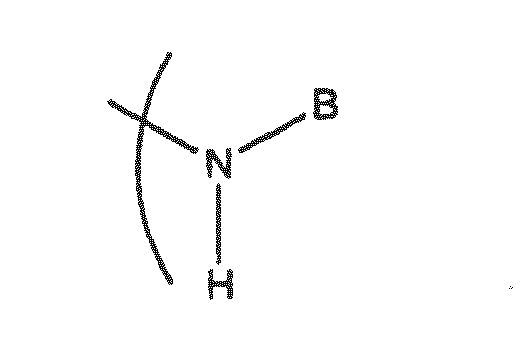
- Menge aus reaktive Massekennzeichnungen nach einem vorhergehenden Anspruch
wobei der Massekennzeichnungsteil eine Gruppe umfasst, die aus den folgenden Gruppen ausgewählt ist:


 wobei J C=O ist, K NH ist, und n 2 ist;oder J und K beide CH2 sind und n 1 ist; undwobei m eine beliebige positive ganze Zahl einschließlich 0 ist,und/oder wobei die reaktive Massekennzeichnung eine der folgenden Strukturen hat:
 wobei J C=O ist, K NH ist, und n 2 ist;oder J und K beide CH2 sind und n 1 ist; undwobei m eine beliebige positive ganze Zahl einschließlich 0 ist,wobei bevorzugt m in den Strukturen 0 ist.
 - Menge aus reaktive Massekennzeichnungen nach einem vorhergehenden Anspruch, wobei jede Kennzeichnung in der Menge einen Massekennzeichnungsteil mit einer gemeinsamen Masse umfasst und jede Kennzeichnung in der Menge eine einzigartige Aggregatmasse hat, oder wobei jede Kennzeichnung in der Menge einen Massekennzeichnungsteil mit einer einzigartigen Masse umfasst und jede Kennzeichnung in der Menge eine gemeinsame Aggregatmasse hat,
und/oder wobei jede Massekennzeichnung in der Menge ein A umfasst, das die folgende Struktur hat:
M(D)y-L-X(D)z
wobei M ein Massenormalisierungsteil ist, X ein Massekennzeichnungsteil ist, D ein Masseanpassungsteil ist, L ein spaltbarer Linker ist, y und z ganze Zahlen von 0 oder größer sind, und y+z eine ganze Zahl von 1 oder größer ist, wobei der Masseanpassungsteil bevorzugt aus Folgendem ausgewählt ist:(a) einem isotopen Substituenten, der sich im Massekennzeichnungsteil und/oder im Massenormalisierungsteil befindet, und(b) Substituentenatomen oder -gruppen, die an den Massekennzeichnungsteil gebunden und/oder an den Massenormalisierungsteil gebunden sind, wobei der Masseanpassungsteil bevorzugt aus einem Halogenatomsubstituenten, einem Methylgruppensubstituenten, und isotopen 2H-, 15N-, 13C- oder 18O-Substituenten ausgewählt istund/oder wobei jede Massekennzeichnung in der Menge ein A umfasst, das die folgende Struktur hat:
X(*)n-L-M(*)m
wobei X der Massekennzeichnungsteil ist, L der spaltbare Linker ist und M der Massenormalisierungsteil ist, und * ein isotoper Masseanpassungsteil ist, und n und m ganze Zahlen von 0 oder größer sind, sodass entweder:- jede Kennzeichnung in der Menge einen Massekennzeichnungsteil mit einer gemeinsamen Masse umfasst und jede Kennzeichnung in der Menge eine einzigartige Aggregatmasse hat; oder- jede Kennzeichnung in der Menge einen Massekennzeichnungsteil mit einer einzigartigen Masse umfasst und jede Kennzeichnung in der Menge eine gemeinsame Aggregatmasse hat,und/oder wobei die Menge zwei oder mehr Massekennzeichnungen mit der folgenden Struktur umfasst: - jede Kennzeichnung in der Menge einen Massekennzeichnungsteil mit einer gemeinsamen Masse umfasst und jede Kennzeichnung in der Menge eine einzigartige Aggregatmasse hat; oder- jede Kennzeichnung in der Menge einen Massekennzeichnungsteil mit einer einzigartigen Masse umfasst und jede Kennzeichnung in der Menge eine gemeinsame Aggregatmasse hat,und/oder wobei die Menge zwei oder mehr Massekennzeichnungen mit der folgenden Struktur umfasst:
 - jede Kennzeichnung in der Menge einen Massekennzeichnungsteil mit einer gemeinsamen Masse umfasst und jede Kennzeichnung in der Menge eine einzigartige Aggregatmasse hat; oder- jede Kennzeichnung in der Menge einen Massekennzeichnungsteil mit einer einzigartigen Masse umfasst und jede Kennzeichnung in der Menge eine gemeinsame Aggregatmasse hat,und/oder wobei die Menge zwei oder mehr Massekennzeichnungen mit der folgenden Struktur umfasst:
 - jede Kennzeichnung in der Menge einen Massekennzeichnungsteil mit einer gemeinsamen Masse umfasst und jede Kennzeichnung in der Menge eine einzigartige Aggregatmasse hat; oder- jede Kennzeichnung in der Menge einen Massekennzeichnungsteil mit einer einzigartigen Masse umfasst und jede Kennzeichnung in der Menge eine gemeinsame Aggregatmasse hat,und/oder wobei die Menge zwei oder mehr Massekennzeichnungen mit der folgenden Struktur umfasst:
 - jede Kennzeichnung in der Menge einen Massekennzeichnungsteil mit einer gemeinsamen Masse umfasst und jede Kennzeichnung in der Menge eine einzigartige Aggregatmasse hat; oder- jede Kennzeichnung in der Menge einen Massekennzeichnungsteil mit einer einzigartigen Masse umfasst und jede Kennzeichnung in der Menge eine gemeinsame Aggregatmasse hat,und/oder wobei die Menge zwei oder mehr Massekennzeichnungen mit der folgenden Struktur umfasst:
 - jede Kennzeichnung in der Menge einen Massekennzeichnungsteil mit einer gemeinsamen Masse umfasst und jede Kennzeichnung in der Menge eine einzigartige Aggregatmasse hat; oder- jede Kennzeichnung in der Menge einen Massekennzeichnungsteil mit einer einzigartigen Masse umfasst und jede Kennzeichnung in der Menge eine gemeinsame Aggregatmasse hat.
 - Menge aus reaktive Massekennzeichnungen nach Anspruch 4, wobei der Masseanpassungsteil * C13 oder N15 ist und die Menge sechs reaktive Massekennzeichnungen mit den folgenden Strukturen umfasst:


- Menge aus reaktive Massekennzeichnungen nach Anspruch 4, wobei der Masseanpassungsteil * C13 oder N15 ist und die Menge sechs reaktive Massekennzeichnungen mit den folgenden Strukturen umfasst:


- Menge aus reaktive Massekennzeichnungen nach Anspruch 4, wobei der Masseanpassungsteil * C13 oder N15 ist und die Menge sechs reaktive Massekennzeichnungen mit den folgenden Strukturen umfasst:


- Reaktive Massekennzeichnung zum Kennzeichnen eines biologischen Moleküls zum Bestimmen durch Massenspektrometrie, wobei die Kennzeichnung die folgende Struktur umfasst:
 (a) R1 und R2 bilden zusammen:
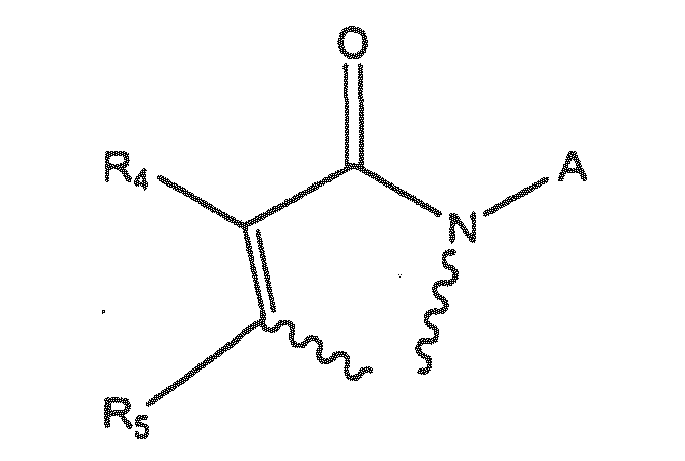 R3 ist nicht vorhanden;Z ist O; undR4 und R5 können gleich oder unterschiedlich sein und sind jeweils unabhängig aus H, einer substituierten oder nicht substituierten geraden oder verzweigten C1-C6-Alkylgruppe, einer substituierten oder nicht substituierten aliphatischen cyclischen Gruppe, einer substituierten oder nicht substituierten aromatischen Gruppe und einer substituierten oder nicht substituierten heterocyclischen Gruppe ausgewählt;(b) R1 und R3 bilden zusammen:
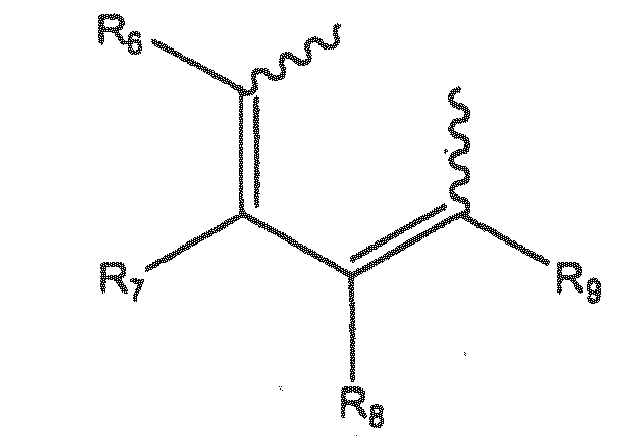 R2 ist:
 Z ist N; undR6 bis R9 sind jeweils unabhängig aus H, einer substituierten oder nicht substituierten geraden oder verzweigten C1-C6-Alkylgruppe, einer substituierten oder nicht substituierten aliphatischen cyclischen Gruppe, einer substituierten oder nicht substituierten aromatischen Gruppe und einer substituierten oder nicht substituierten heterocyclischen Gruppe ausgewählt;(c) R1 ist:und wobei in (a) (b) und (c) A die folgende Struktur umfasst:
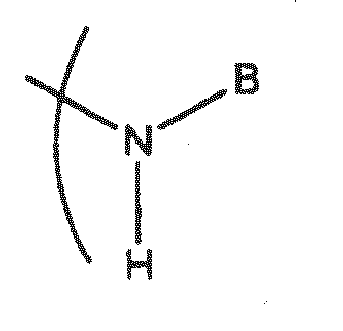 R2 ist A;R3 ist nicht vorhanden;Z ist O; undB ist -(CH2)n-ONH2, wobei n 1 bis 6 ist;
X-L-M
wobei X ein Massekennzeichnungsteil ist, wobei L ein spaltbarer Linker ist, der eine Amidbindung umfasst,
wobei X ein Massekennzeichnungsteil ist, die die folgende Gruppe umfasst:
- Reaktive Massekennzeichnung nach Anspruch 8, wobei der Massenormalisierungsteil Gruppe A an den Rest der Massekennzeichnung bindet,
und/oder wobei R1 und R2 zusammen Folgendes bilden: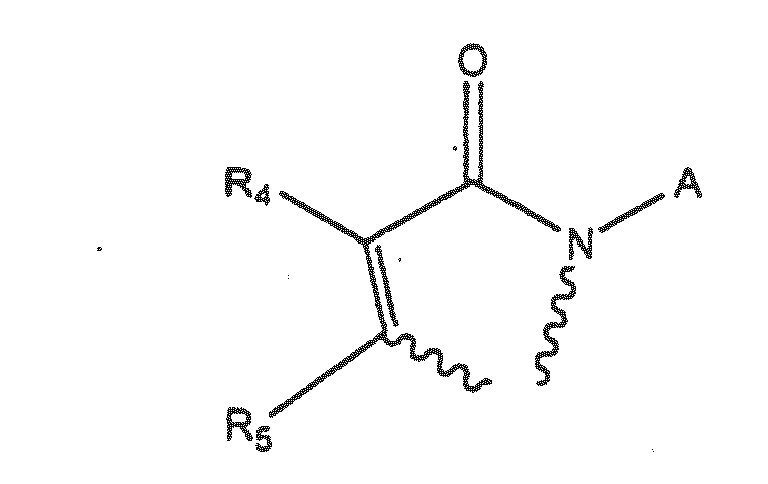
und/oder wobei R1 und R3 zusammen Folgendes bilden:

und/oder wobei R1 Folgendes ist:
- Reaktive Massekennzeichnung nach Anspruch 8 oder Anspruch 9
und/oder wobei der Massekennzeichnungsteil eine Gruppe umfasst, die aus den folgenden Gruppen ausgewählt ist:


 wobei J C=O ist, K NH ist, und n 2 ist;oder J und K beide CH2 sind und n 1 ist; undwobei m eine beliebige positive ganze Zahl einschließlich 0 ist,und/oder wobei die reaktive Massekennzeichnung die folgende Struktur hat:
 wobei J C=O ist, K NH ist, und n 2 ist;oder J und K beide CH2 sind und n 1 ist; undwobei m eine beliebige positive ganze Zahl einschließlich 0 ist.
 - Array an Massekennzeichnungen, umfassend zwei oder mehr Mengen aus Massekennzeichnungen wie in einem vorhergehenden Anspruch definiert, wobei die Aggregatmasse jeder der Massekennzeichnungen einer Menge im Array sich von der Aggregatmasse jeder der Massekennzeichnungen jeder anderen Menge im Array unterscheidet.
- Verwendung einer reaktive Massekennzeichnung oder einer Menge einer reaktive Massekennzeichnung wie in einem vorhergehenden Anspruch definiert in einem Analyseverfahren durch Massenspektrometrie.
- Analyseverfahren, wobei das Verfahren das Bestimmen eines biologischen Moleküls umfasst, indem durch Massenspektrometrie eine Massekennzeichnung, die dem biologischen Molekül zuordenbar ist, identifiziert wird, wobei die Massekennzeichnung eine Massekennzeichnung wie in einem vorhergehenden Anspruch definiert ist.
- Verfahren nach Anspruch 13, wobei das Verfahren die folgenden Schritte umfasst:1. Reagieren des biologischen Moleküls mit einer reaktive Massekennzeichnung wie in einem vorhergehenden Anspruch definiert;2. Trennen des gekennzeichneten biologischen Moleküls;3. Identifizieren der Massekennzeichnung, die dem biologischen Molekül zuordenbar ist, durch Massenspektrometrie.
Applications Claiming Priority (2)
| Application Number | Priority Date | Filing Date | Title |
|---|---|---|---|
| GBGB0916881.6A GB0916881D0 (en) | 2009-09-25 | 2009-09-25 | Mass labels |
| PCT/EP2010/063191 WO2011036059A1 (en) | 2009-09-25 | 2010-09-08 | Mass labels |
Publications (2)
| Publication Number | Publication Date |
|---|---|
| EP2467350A1 EP2467350A1 (de) | 2012-06-27 |
| EP2467350B1 true EP2467350B1 (de) | 2015-11-11 |
Family
ID=41350393
Family Applications (1)
| Application Number | Title | Priority Date | Filing Date |
|---|---|---|---|
| EP10751942.3A Active EP2467350B1 (de) | 2009-09-25 | 2010-09-08 | Massekennzeichnungen |
Country Status (7)
| Country | Link |
|---|---|
| US (2) | US9341635B2 (de) |
| EP (1) | EP2467350B1 (de) |
| JP (3) | JP2013505908A (de) |
| AU (1) | AU2010297417B2 (de) |
| CA (1) | CA2775118C (de) |
| GB (1) | GB0916881D0 (de) |
| WO (1) | WO2011036059A1 (de) |
Families Citing this family (13)
| Publication number | Priority date | Publication date | Assignee | Title |
|---|---|---|---|---|
| JP5895694B2 (ja) * | 2012-05-11 | 2016-03-30 | 株式会社島津製作所 | マトリックス支援レーザ脱離イオン化質量分析用マトリックス |
| GB201215924D0 (en) * | 2012-09-06 | 2012-10-24 | Univ Swansea | Kit and method for quantitative detection of steroids |
| GB201308765D0 (en) * | 2013-05-15 | 2013-06-26 | Electrophoretics Ltd | Mass Tag Reagents |
| GB201322567D0 (en) * | 2013-12-19 | 2014-02-05 | Electrophoretics Ltd | Mass labels |
| GB201410523D0 (en) | 2014-06-12 | 2014-07-30 | Electrophoretics Ltd | Mass labels |
| GB201519186D0 (en) * | 2015-10-30 | 2015-12-16 | Electrophoretics Ltd | Isotopic methods for measurement of tryptophan and metabolites thereof |
| GB201521919D0 (en) * | 2015-12-11 | 2016-01-27 | Electrophoretics Ltd | Isobaric mass labels |
| GB201521903D0 (en) | 2015-12-11 | 2016-01-27 | Electrophoretics Ltd | Isorbaric mass labels |
| EP3587382A1 (de) | 2018-06-28 | 2020-01-01 | Rheinische Friedrich-Wilhelms-Universität Bonn | Klick-massenspektrometrie von alkin-markierten verbindungen |
| US20240230687A1 (en) * | 2021-04-07 | 2024-07-11 | The Texas A&M University System | Mass tags for lipid analyses |
| US20240329051A1 (en) * | 2021-08-06 | 2024-10-03 | Shimadzu Corporation | Peptide analysis method and peptide analysis apparatus |
| EP4695227A1 (de) | 2023-04-11 | 2026-02-18 | Electrophoretics Limited | Massenspektrometrische analyse |
| WO2026053185A1 (en) | 2024-09-09 | 2026-03-12 | Electrophoretics Limited | Mass spectrometric analysis |
Family Cites Families (24)
| Publication number | Priority date | Publication date | Assignee | Title |
|---|---|---|---|---|
| US2324283A (en) * | 1942-02-28 | 1943-07-13 | Gen Electric | Diazine derivatives |
| JPS59164797A (ja) * | 1983-03-09 | 1984-09-17 | Wakunaga Seiyaku Kk | タンパク誘導体およびその製造法 |
| WO1996040662A2 (en) * | 1995-06-07 | 1996-12-19 | Cellpro, Incorporated | Aminooxy-containing linker compounds and their application in conjugates |
| GB9815163D0 (en) | 1998-07-13 | 1998-09-09 | Brax Genomics Ltd | Compounds |
| EP1329513B1 (de) * | 1998-08-25 | 2011-12-07 | University of Washington | Schnelle quantitative Analyse von Proteinen oder Proteinfunktionen in komplexen Gemischen |
| GB0006141D0 (en) * | 2000-03-14 | 2000-05-03 | Brax Group Ltd | Mass labels |
| DE10108481A1 (de) * | 2001-02-22 | 2002-10-24 | Bayer Ag | Pyridylpyrimidine |
| WO2002086168A1 (en) * | 2001-04-19 | 2002-10-31 | Ciphergen Biosystems, Inc. | Biomolecule characterization using mass spectrometry and affinity tags |
| JP4290003B2 (ja) * | 2001-09-14 | 2009-07-01 | エレクトロフォレティクス リミテッド | 質量標識体 |
| DE10154744A1 (de) * | 2001-11-09 | 2003-05-22 | Bayer Ag | Isotopencodierte Affinitätsmarker |
| US20050037423A1 (en) * | 2001-11-09 | 2005-02-17 | Bayer Healthcare Ag | Isotopycally coded affinity marker 2 |
| DE602004030212D1 (de) * | 2003-01-16 | 2011-01-05 | Caprotec Bioanalytics Gmbh | Verfahren zur identifizierung von auf arzneimittel nicht-zielgerichteten proteinen |
| US20040219685A1 (en) * | 2003-01-30 | 2004-11-04 | Applera Corporation | Methods and mixtures pertaining to analyte determination using electrophilic labeling reagents |
| US7145019B2 (en) * | 2003-10-16 | 2006-12-05 | Ambergen, Inc. | Photocleavable isotope-coded affinity tags |
| TW200533919A (en) * | 2003-12-08 | 2005-10-16 | Oxford Gene Tech Ip Ltd | Derivatived molecules for mass spectrometry |
| GB0411186D0 (en) * | 2004-05-19 | 2004-06-23 | Celltech R&D Ltd | Biological products |
| US20070048752A1 (en) * | 2004-07-12 | 2007-03-01 | Applera Corporation | Mass tags for quantitative analyses |
| US20080076700A1 (en) * | 2004-10-18 | 2008-03-27 | Novo Nordisk A/S | Method for the Preparation of Oxime, Thiazolidine, Dithiane, Dithiolane, or Hydrazone Linked Analogues of Growth Hormone |
| GB0515323D0 (en) * | 2005-07-26 | 2005-08-31 | Electrophoretics Ltd | Mass labels |
| GB0518585D0 (en) * | 2005-09-12 | 2005-10-19 | Electrophoretics Ltd | Mass labels |
| WO2008064239A2 (en) * | 2006-11-20 | 2008-05-29 | Perkinelmer Las, Inc. | Imidazolidine derivative mass tags |
| GB0704764D0 (en) * | 2007-03-12 | 2007-04-18 | Electrophoretics Ltd | Isobarically labelled reagents and methods of their use |
| GB0809488D0 (en) * | 2008-05-23 | 2008-07-02 | Electrophoretics Ltd | Mass spectrometric analysis |
| WO2010141075A1 (en) * | 2009-05-31 | 2010-12-09 | Dh Technologies Development Pte. Ltd. | Specific analysis of ketone and aldehyde analytes using reagent compounds labeling strategies, and mass spectrometry workflow |
-
2009
- 2009-09-25 GB GBGB0916881.6A patent/GB0916881D0/en not_active Ceased
-
2010
- 2010-09-08 JP JP2012530210A patent/JP2013505908A/ja active Pending
- 2010-09-08 US US13/497,875 patent/US9341635B2/en active Active
- 2010-09-08 AU AU2010297417A patent/AU2010297417B2/en active Active
- 2010-09-08 WO PCT/EP2010/063191 patent/WO2011036059A1/en not_active Ceased
- 2010-09-08 EP EP10751942.3A patent/EP2467350B1/de active Active
- 2010-09-08 CA CA2775118A patent/CA2775118C/en active Active
-
2014
- 2014-09-15 US US14/485,994 patent/US20150065392A1/en not_active Abandoned
-
2015
- 2015-03-27 JP JP2015066347A patent/JP2015143254A/ja not_active Withdrawn
-
2016
- 2016-10-14 JP JP2016202227A patent/JP6374931B2/ja active Active
Also Published As
| Publication number | Publication date |
|---|---|
| GB0916881D0 (en) | 2009-11-11 |
| JP2013505908A (ja) | 2013-02-21 |
| EP2467350A1 (de) | 2012-06-27 |
| US20120283137A1 (en) | 2012-11-08 |
| US9341635B2 (en) | 2016-05-17 |
| CA2775118C (en) | 2020-03-24 |
| WO2011036059A1 (en) | 2011-03-31 |
| AU2010297417A1 (en) | 2012-04-19 |
| AU2010297417B2 (en) | 2015-05-07 |
| JP6374931B2 (ja) | 2018-08-15 |
| JP2017037088A (ja) | 2017-02-16 |
| US20150065392A1 (en) | 2015-03-05 |
| JP2015143254A (ja) | 2015-08-06 |
| CA2775118A1 (en) | 2011-03-31 |
Similar Documents
| Publication | Publication Date | Title |
|---|---|---|
| AU2010297417B2 (en) | Mass labels | |
| CN102077092B (zh) | 质谱分析 | |
| JP4290003B2 (ja) | 質量標識体 | |
| US8697604B2 (en) | Labeling agents for mass spectrometry comprising tertiary amines | |
| JP4163103B2 (ja) | ポリペプチドの特徴分析方法 | |
| CN105209921A (zh) | 质量标记物 | |
| EP1926997B1 (de) | Massenmarkierungen | |
| EP1451207B1 (de) | Markierungsreagens und anwendungsverfahren | |
| CN108463728B (zh) | 同量异位质量标记 | |
| EP3155436B1 (de) | Isobare massenmarker | |
| JP2004529364A (ja) | ポリペプチドの特徴分析 | |
| AU2002331952B2 (en) | Mass labels | |
| JP2005528614A (ja) | 高分子の選択的結合および分析方法 | |
| AU2002331952A1 (en) | Mass labels |
Legal Events
| Date | Code | Title | Description |
|---|---|---|---|
| PUAI | Public reference made under article 153(3) epc to a published international application that has entered the european phase |
Free format text: ORIGINAL CODE: 0009012 |
|
| 17P | Request for examination filed |
Effective date: 20120321 |
|
| AK | Designated contracting states |
Kind code of ref document: A1 Designated state(s): AL AT BE BG CH CY CZ DE DK EE ES FI FR GB GR HR HU IE IS IT LI LT LU LV MC MK MT NL NO PL PT RO SE SI SK SM TR |
|
| DAX | Request for extension of the european patent (deleted) | ||
| 17Q | First examination report despatched |
Effective date: 20130207 |
|
| GRAJ | Information related to disapproval of communication of intention to grant by the applicant or resumption of examination proceedings by the epo deleted |
Free format text: ORIGINAL CODE: EPIDOSDIGR1 |
|
| GRAP | Despatch of communication of intention to grant a patent |
Free format text: ORIGINAL CODE: EPIDOSNIGR1 |
|
| INTG | Intention to grant announced |
Effective date: 20150714 |
|
| GRAS | Grant fee paid |
Free format text: ORIGINAL CODE: EPIDOSNIGR3 |
|
| GRAR | Information related to intention to grant a patent recorded |
Free format text: ORIGINAL CODE: EPIDOSNIGR71 |
|
| GRAA | (expected) grant |
Free format text: ORIGINAL CODE: 0009210 |
|
| INTG | Intention to grant announced |
Effective date: 20150922 |
|
| AK | Designated contracting states |
Kind code of ref document: B1 Designated state(s): AL AT BE BG CH CY CZ DE DK EE ES FI FR GB GR HR HU IE IS IT LI LT LU LV MC MK MT NL NO PL PT RO SE SI SK SM TR |
|
| REG | Reference to a national code |
Ref country code: GB Ref legal event code: FG4D |
|
| REG | Reference to a national code |
Ref country code: CH Ref legal event code: EP |
|
| REG | Reference to a national code |
Ref country code: IE Ref legal event code: FG4D |
|
| REG | Reference to a national code |
Ref country code: AT Ref legal event code: REF Ref document number: 760348 Country of ref document: AT Kind code of ref document: T Effective date: 20151215 |
|
| REG | Reference to a national code |
Ref country code: DE Ref legal event code: R096 Ref document number: 602010029009 Country of ref document: DE |
|
| REG | Reference to a national code |
Ref country code: LT Ref legal event code: MG4D |
|
| REG | Reference to a national code |
Ref country code: NL Ref legal event code: MP Effective date: 20160211 |
|
| REG | Reference to a national code |
Ref country code: AT Ref legal event code: MK05 Ref document number: 760348 Country of ref document: AT Kind code of ref document: T Effective date: 20151111 |
|
| PG25 | Lapsed in a contracting state [announced via postgrant information from national office to epo] |
Ref country code: IT Free format text: LAPSE BECAUSE OF FAILURE TO SUBMIT A TRANSLATION OF THE DESCRIPTION OR TO PAY THE FEE WITHIN THE PRESCRIBED TIME-LIMIT Effective date: 20151111 Ref country code: NL Free format text: LAPSE BECAUSE OF FAILURE TO SUBMIT A TRANSLATION OF THE DESCRIPTION OR TO PAY THE FEE WITHIN THE PRESCRIBED TIME-LIMIT Effective date: 20151111 Ref country code: LT Free format text: LAPSE BECAUSE OF FAILURE TO SUBMIT A TRANSLATION OF THE DESCRIPTION OR TO PAY THE FEE WITHIN THE PRESCRIBED TIME-LIMIT Effective date: 20151111 Ref country code: ES Free format text: LAPSE BECAUSE OF FAILURE TO SUBMIT A TRANSLATION OF THE DESCRIPTION OR TO PAY THE FEE WITHIN THE PRESCRIBED TIME-LIMIT Effective date: 20151111 Ref country code: NO Free format text: LAPSE BECAUSE OF FAILURE TO SUBMIT A TRANSLATION OF THE DESCRIPTION OR TO PAY THE FEE WITHIN THE PRESCRIBED TIME-LIMIT Effective date: 20160211 Ref country code: IS Free format text: LAPSE BECAUSE OF FAILURE TO SUBMIT A TRANSLATION OF THE DESCRIPTION OR TO PAY THE FEE WITHIN THE PRESCRIBED TIME-LIMIT Effective date: 20160311 Ref country code: HR Free format text: LAPSE BECAUSE OF FAILURE TO SUBMIT A TRANSLATION OF THE DESCRIPTION OR TO PAY THE FEE WITHIN THE PRESCRIBED TIME-LIMIT Effective date: 20151111 |
|
| PG25 | Lapsed in a contracting state [announced via postgrant information from national office to epo] |
Ref country code: AT Free format text: LAPSE BECAUSE OF FAILURE TO SUBMIT A TRANSLATION OF THE DESCRIPTION OR TO PAY THE FEE WITHIN THE PRESCRIBED TIME-LIMIT Effective date: 20151111 Ref country code: FI Free format text: LAPSE BECAUSE OF FAILURE TO SUBMIT A TRANSLATION OF THE DESCRIPTION OR TO PAY THE FEE WITHIN THE PRESCRIBED TIME-LIMIT Effective date: 20151111 Ref country code: PT Free format text: LAPSE BECAUSE OF FAILURE TO SUBMIT A TRANSLATION OF THE DESCRIPTION OR TO PAY THE FEE WITHIN THE PRESCRIBED TIME-LIMIT Effective date: 20160311 Ref country code: SE Free format text: LAPSE BECAUSE OF FAILURE TO SUBMIT A TRANSLATION OF THE DESCRIPTION OR TO PAY THE FEE WITHIN THE PRESCRIBED TIME-LIMIT Effective date: 20151111 Ref country code: GR Free format text: LAPSE BECAUSE OF FAILURE TO SUBMIT A TRANSLATION OF THE DESCRIPTION OR TO PAY THE FEE WITHIN THE PRESCRIBED TIME-LIMIT Effective date: 20160212 Ref country code: PL Free format text: LAPSE BECAUSE OF FAILURE TO SUBMIT A TRANSLATION OF THE DESCRIPTION OR TO PAY THE FEE WITHIN THE PRESCRIBED TIME-LIMIT Effective date: 20151111 Ref country code: LV Free format text: LAPSE BECAUSE OF FAILURE TO SUBMIT A TRANSLATION OF THE DESCRIPTION OR TO PAY THE FEE WITHIN THE PRESCRIBED TIME-LIMIT Effective date: 20151111 |
|
| PG25 | Lapsed in a contracting state [announced via postgrant information from national office to epo] |
Ref country code: CZ Free format text: LAPSE BECAUSE OF FAILURE TO SUBMIT A TRANSLATION OF THE DESCRIPTION OR TO PAY THE FEE WITHIN THE PRESCRIBED TIME-LIMIT Effective date: 20151111 |
|
| REG | Reference to a national code |
Ref country code: DE Ref legal event code: R097 Ref document number: 602010029009 Country of ref document: DE |
|
| PG25 | Lapsed in a contracting state [announced via postgrant information from national office to epo] |
Ref country code: SM Free format text: LAPSE BECAUSE OF FAILURE TO SUBMIT A TRANSLATION OF THE DESCRIPTION OR TO PAY THE FEE WITHIN THE PRESCRIBED TIME-LIMIT Effective date: 20151111 Ref country code: EE Free format text: LAPSE BECAUSE OF FAILURE TO SUBMIT A TRANSLATION OF THE DESCRIPTION OR TO PAY THE FEE WITHIN THE PRESCRIBED TIME-LIMIT Effective date: 20151111 Ref country code: DK Free format text: LAPSE BECAUSE OF FAILURE TO SUBMIT A TRANSLATION OF THE DESCRIPTION OR TO PAY THE FEE WITHIN THE PRESCRIBED TIME-LIMIT Effective date: 20151111 Ref country code: RO Free format text: LAPSE BECAUSE OF FAILURE TO SUBMIT A TRANSLATION OF THE DESCRIPTION OR TO PAY THE FEE WITHIN THE PRESCRIBED TIME-LIMIT Effective date: 20151111 Ref country code: SK Free format text: LAPSE BECAUSE OF FAILURE TO SUBMIT A TRANSLATION OF THE DESCRIPTION OR TO PAY THE FEE WITHIN THE PRESCRIBED TIME-LIMIT Effective date: 20151111 |
|
| PLBE | No opposition filed within time limit |
Free format text: ORIGINAL CODE: 0009261 |
|
| STAA | Information on the status of an ep patent application or granted ep patent |
Free format text: STATUS: NO OPPOSITION FILED WITHIN TIME LIMIT |
|
| REG | Reference to a national code |
Ref country code: FR Ref legal event code: PLFP Year of fee payment: 7 |
|
| 26N | No opposition filed |
Effective date: 20160812 |
|
| PG25 | Lapsed in a contracting state [announced via postgrant information from national office to epo] |
Ref country code: SI Free format text: LAPSE BECAUSE OF FAILURE TO SUBMIT A TRANSLATION OF THE DESCRIPTION OR TO PAY THE FEE WITHIN THE PRESCRIBED TIME-LIMIT Effective date: 20151111 |
|
| PG25 | Lapsed in a contracting state [announced via postgrant information from national office to epo] |
Ref country code: BE Free format text: LAPSE BECAUSE OF FAILURE TO SUBMIT A TRANSLATION OF THE DESCRIPTION OR TO PAY THE FEE WITHIN THE PRESCRIBED TIME-LIMIT Effective date: 20151111 |
|
| PG25 | Lapsed in a contracting state [announced via postgrant information from national office to epo] |
Ref country code: MC Free format text: LAPSE BECAUSE OF FAILURE TO SUBMIT A TRANSLATION OF THE DESCRIPTION OR TO PAY THE FEE WITHIN THE PRESCRIBED TIME-LIMIT Effective date: 20151111 |
|
| REG | Reference to a national code |
Ref country code: CH Ref legal event code: PL |
|
| REG | Reference to a national code |
Ref country code: IE Ref legal event code: MM4A |
|
| PG25 | Lapsed in a contracting state [announced via postgrant information from national office to epo] |
Ref country code: LI Free format text: LAPSE BECAUSE OF NON-PAYMENT OF DUE FEES Effective date: 20160930 Ref country code: IE Free format text: LAPSE BECAUSE OF NON-PAYMENT OF DUE FEES Effective date: 20160908 Ref country code: CH Free format text: LAPSE BECAUSE OF NON-PAYMENT OF DUE FEES Effective date: 20160930 |
|
| PG25 | Lapsed in a contracting state [announced via postgrant information from national office to epo] |
Ref country code: LU Free format text: LAPSE BECAUSE OF NON-PAYMENT OF DUE FEES Effective date: 20160908 |
|
| REG | Reference to a national code |
Ref country code: FR Ref legal event code: PLFP Year of fee payment: 8 |
|
| PG25 | Lapsed in a contracting state [announced via postgrant information from national office to epo] |
Ref country code: CY Free format text: LAPSE BECAUSE OF FAILURE TO SUBMIT A TRANSLATION OF THE DESCRIPTION OR TO PAY THE FEE WITHIN THE PRESCRIBED TIME-LIMIT Effective date: 20151111 Ref country code: HU Free format text: LAPSE BECAUSE OF FAILURE TO SUBMIT A TRANSLATION OF THE DESCRIPTION OR TO PAY THE FEE WITHIN THE PRESCRIBED TIME-LIMIT; INVALID AB INITIO Effective date: 20100908 |
|
| PG25 | Lapsed in a contracting state [announced via postgrant information from national office to epo] |
Ref country code: TR Free format text: LAPSE BECAUSE OF FAILURE TO SUBMIT A TRANSLATION OF THE DESCRIPTION OR TO PAY THE FEE WITHIN THE PRESCRIBED TIME-LIMIT Effective date: 20151111 Ref country code: MT Free format text: LAPSE BECAUSE OF NON-PAYMENT OF DUE FEES Effective date: 20160930 Ref country code: MK Free format text: LAPSE BECAUSE OF FAILURE TO SUBMIT A TRANSLATION OF THE DESCRIPTION OR TO PAY THE FEE WITHIN THE PRESCRIBED TIME-LIMIT Effective date: 20151111 |
|
| PG25 | Lapsed in a contracting state [announced via postgrant information from national office to epo] |
Ref country code: BG Free format text: LAPSE BECAUSE OF FAILURE TO SUBMIT A TRANSLATION OF THE DESCRIPTION OR TO PAY THE FEE WITHIN THE PRESCRIBED TIME-LIMIT Effective date: 20151111 |
|
| REG | Reference to a national code |
Ref country code: FR Ref legal event code: PLFP Year of fee payment: 9 |
|
| PG25 | Lapsed in a contracting state [announced via postgrant information from national office to epo] |
Ref country code: AL Free format text: LAPSE BECAUSE OF FAILURE TO SUBMIT A TRANSLATION OF THE DESCRIPTION OR TO PAY THE FEE WITHIN THE PRESCRIBED TIME-LIMIT Effective date: 20151111 |
|
| PGFP | Annual fee paid to national office [announced via postgrant information from national office to epo] |
Ref country code: DE Payment date: 20250929 Year of fee payment: 16 |
|
| PGFP | Annual fee paid to national office [announced via postgrant information from national office to epo] |
Ref country code: GB Payment date: 20250929 Year of fee payment: 16 |
|
| PGFP | Annual fee paid to national office [announced via postgrant information from national office to epo] |
Ref country code: FR Payment date: 20250925 Year of fee payment: 16 |