EP2464230B1 - Intravenous formulations of rolapitant - Google Patents
Intravenous formulations of rolapitant Download PDFInfo
- Publication number
- EP2464230B1 EP2464230B1 EP10808756.0A EP10808756A EP2464230B1 EP 2464230 B1 EP2464230 B1 EP 2464230B1 EP 10808756 A EP10808756 A EP 10808756A EP 2464230 B1 EP2464230 B1 EP 2464230B1
- Authority
- EP
- European Patent Office
- Prior art keywords
- compound
- composition
- triglyceride
- weight
- pharmaceutically acceptable
- Prior art date
- Legal status (The legal status is an assumption and is not a legal conclusion. Google has not performed a legal analysis and makes no representation as to the accuracy of the status listed.)
- Not-in-force
Links
- 239000000203 mixture Substances 0.000 title claims description 446
- 238000009472 formulation Methods 0.000 title claims description 312
- 238000001990 intravenous administration Methods 0.000 title claims description 67
- FIVSJYGQAIEMOC-ZGNKEGEESA-N rolapitant Chemical compound C([C@@](NC1)(CO[C@H](C)C=2C=C(C=C(C=2)C(F)(F)F)C(F)(F)F)C=2C=CC=CC=2)C[C@@]21CCC(=O)N2 FIVSJYGQAIEMOC-ZGNKEGEESA-N 0.000 title description 7
- 229960001068 rolapitant Drugs 0.000 title 1
- 206010018910 Haemolysis Diseases 0.000 claims description 109
- 230000008588 hemolysis Effects 0.000 claims description 108
- 239000008194 pharmaceutical composition Substances 0.000 claims description 100
- 150000001875 compounds Chemical class 0.000 claims description 98
- UFTFJSFQGQCHQW-UHFFFAOYSA-N triformin Chemical compound O=COCC(OC=O)COC=O UFTFJSFQGQCHQW-UHFFFAOYSA-N 0.000 claims description 92
- 150000003839 salts Chemical class 0.000 claims description 90
- 238000001802 infusion Methods 0.000 claims description 74
- LFQSCWFLJHTTHZ-UHFFFAOYSA-N Ethanol Chemical compound CCO LFQSCWFLJHTTHZ-UHFFFAOYSA-N 0.000 claims description 65
- 239000003921 oil Substances 0.000 claims description 53
- 235000019198 oils Nutrition 0.000 claims description 53
- 239000003814 drug Substances 0.000 claims description 51
- 238000000034 method Methods 0.000 claims description 50
- 229940079593 drug Drugs 0.000 claims description 49
- 239000000693 micelle Substances 0.000 claims description 49
- 239000000839 emulsion Substances 0.000 claims description 45
- 239000003549 soybean oil Substances 0.000 claims description 44
- 235000012424 soybean oil Nutrition 0.000 claims description 44
- 239000002202 Polyethylene glycol Substances 0.000 claims description 36
- 239000004530 micro-emulsion Substances 0.000 claims description 36
- 229920001223 polyethylene glycol Polymers 0.000 claims description 36
- BKVAAWMQOQLENB-UHFFFAOYSA-N 15-hydroxy stearic acid Chemical compound CCCC(O)CCCCCCCCCCCCCC(O)=O BKVAAWMQOQLENB-UHFFFAOYSA-N 0.000 claims description 35
- LYCAIKOWRPUZTN-UHFFFAOYSA-N Ethylene glycol Chemical compound OCCO LYCAIKOWRPUZTN-UHFFFAOYSA-N 0.000 claims description 35
- 229960003511 macrogol Drugs 0.000 claims description 35
- PEDCQBHIVMGVHV-UHFFFAOYSA-N Glycerine Chemical compound OCC(O)CO PEDCQBHIVMGVHV-UHFFFAOYSA-N 0.000 claims description 33
- 206010047700 Vomiting Diseases 0.000 claims description 31
- XLYOFNOQVPJJNP-UHFFFAOYSA-N water Substances O XLYOFNOQVPJJNP-UHFFFAOYSA-N 0.000 claims description 27
- WHGYBXFWUBPSRW-FOUAGVGXSA-N beta-cyclodextrin Chemical compound OC[C@H]([C@H]([C@@H]([C@H]1O)O)O[C@H]2O[C@@H]([C@@H](O[C@H]3O[C@H](CO)[C@H]([C@@H]([C@H]3O)O)O[C@H]3O[C@H](CO)[C@H]([C@@H]([C@H]3O)O)O[C@H]3O[C@H](CO)[C@H]([C@@H]([C@H]3O)O)O[C@H]3O[C@H](CO)[C@H]([C@@H]([C@H]3O)O)O3)[C@H](O)[C@H]2O)CO)O[C@@H]1O[C@H]1[C@H](O)[C@@H](O)[C@@H]3O[C@@H]1CO WHGYBXFWUBPSRW-FOUAGVGXSA-N 0.000 claims description 26
- 229960004853 betadex Drugs 0.000 claims description 25
- WWZKQHOCKIZLMA-UHFFFAOYSA-N octanoic acid Chemical compound CCCCCCCC(O)=O WWZKQHOCKIZLMA-UHFFFAOYSA-N 0.000 claims description 20
- 239000003981 vehicle Substances 0.000 claims description 18
- 238000002512 chemotherapy Methods 0.000 claims description 17
- 239000008363 phosphate buffer Substances 0.000 claims description 17
- 150000003904 phospholipids Chemical class 0.000 claims description 17
- 239000000872 buffer Substances 0.000 claims description 15
- 235000011187 glycerol Nutrition 0.000 claims description 15
- 230000008569 process Effects 0.000 claims description 14
- 206010028813 Nausea Diseases 0.000 claims description 13
- -1 cremophors Substances 0.000 claims description 13
- 150000004668 long chain fatty acids Chemical class 0.000 claims description 13
- 230000008693 nausea Effects 0.000 claims description 13
- 239000002111 antiemetic agent Substances 0.000 claims description 12
- 229940072106 hydroxystearate Drugs 0.000 claims description 12
- SHBUUTHKGIVMJT-UHFFFAOYSA-N Hydroxystearate Chemical compound CCCCCCCCCCCCCCCCCC(=O)OO SHBUUTHKGIVMJT-UHFFFAOYSA-N 0.000 claims description 11
- 102000008100 Human Serum Albumin Human genes 0.000 claims description 10
- 108091006905 Human Serum Albumin Proteins 0.000 claims description 10
- 241001465754 Metazoa Species 0.000 claims description 10
- 229920000858 Cyclodextrin Polymers 0.000 claims description 8
- 125000005457 triglyceride group Chemical group 0.000 claims description 7
- 208000031649 Postoperative Nausea and Vomiting Diseases 0.000 claims description 6
- 235000005687 corn oil Nutrition 0.000 claims description 6
- 239000002285 corn oil Substances 0.000 claims description 6
- 238000010438 heat treatment Methods 0.000 claims description 6
- 150000002632 lipids Chemical class 0.000 claims description 6
- 235000019483 Peanut oil Nutrition 0.000 claims description 5
- 150000001413 amino acids Chemical class 0.000 claims description 5
- 235000012343 cottonseed oil Nutrition 0.000 claims description 5
- 239000002385 cottonseed oil Substances 0.000 claims description 5
- FBUKVWPVBMHYJY-UHFFFAOYSA-N nonanoic acid Chemical compound CCCCCCCCC(O)=O FBUKVWPVBMHYJY-UHFFFAOYSA-N 0.000 claims description 5
- 239000000312 peanut oil Substances 0.000 claims description 5
- 239000003369 serotonin 5-HT3 receptor antagonist Substances 0.000 claims description 5
- 235000019485 Safflower oil Nutrition 0.000 claims description 4
- 230000003474 anti-emetic effect Effects 0.000 claims description 4
- 230000001062 anti-nausea Effects 0.000 claims description 4
- 239000004359 castor oil Substances 0.000 claims description 4
- 235000019438 castor oil Nutrition 0.000 claims description 4
- 239000003240 coconut oil Substances 0.000 claims description 4
- 235000019864 coconut oil Nutrition 0.000 claims description 4
- ZEMPKEQAKRGZGQ-XOQCFJPHSA-N glycerol triricinoleate Natural products CCCCCC[C@@H](O)CC=CCCCCCCCC(=O)OC[C@@H](COC(=O)CCCCCCCC=CC[C@@H](O)CCCCCC)OC(=O)CCCCCCCC=CC[C@H](O)CCCCCC ZEMPKEQAKRGZGQ-XOQCFJPHSA-N 0.000 claims description 4
- 239000002502 liposome Substances 0.000 claims description 4
- 239000004006 olive oil Substances 0.000 claims description 4
- 235000008390 olive oil Nutrition 0.000 claims description 4
- 235000005713 safflower oil Nutrition 0.000 claims description 4
- 239000003813 safflower oil Substances 0.000 claims description 4
- 229940124834 selective serotonin reuptake inhibitor Drugs 0.000 claims description 4
- 239000008159 sesame oil Substances 0.000 claims description 4
- 235000011803 sesame oil Nutrition 0.000 claims description 4
- LADGBHLMCUINGV-UHFFFAOYSA-N tricaprin Chemical compound CCCCCCCCCC(=O)OCC(OC(=O)CCCCCCCCC)COC(=O)CCCCCCCCC LADGBHLMCUINGV-UHFFFAOYSA-N 0.000 claims description 4
- VLPFTAMPNXLGLX-UHFFFAOYSA-N trioctanoin Chemical compound CCCCCCCC(=O)OCC(OC(=O)CCCCCCC)COC(=O)CCCCCCC VLPFTAMPNXLGLX-UHFFFAOYSA-N 0.000 claims description 4
- LVGKNOAMLMIIKO-UHFFFAOYSA-N Elaidinsaeure-aethylester Natural products CCCCCCCCC=CCCCCCCCC(=O)OCC LVGKNOAMLMIIKO-UHFFFAOYSA-N 0.000 claims description 3
- 239000001116 FEMA 4028 Substances 0.000 claims description 3
- 239000002246 antineoplastic agent Substances 0.000 claims description 3
- 235000011175 beta-cyclodextrine Nutrition 0.000 claims description 3
- 230000037396 body weight Effects 0.000 claims description 3
- 229940127089 cytotoxic agent Drugs 0.000 claims description 3
- LVGKNOAMLMIIKO-QXMHVHEDSA-N ethyl oleate Chemical compound CCCCCCCC\C=C/CCCCCCCC(=O)OCC LVGKNOAMLMIIKO-QXMHVHEDSA-N 0.000 claims description 3
- 229940093471 ethyl oleate Drugs 0.000 claims description 3
- 239000000194 fatty acid Substances 0.000 claims description 3
- 239000002736 nonionic surfactant Substances 0.000 claims description 3
- 235000021315 omega 9 monounsaturated fatty acids Nutrition 0.000 claims description 3
- 239000003960 organic solvent Substances 0.000 claims description 3
- 239000010686 shark liver oil Substances 0.000 claims description 3
- 229940069764 shark liver oil Drugs 0.000 claims description 3
- VMPHSYLJUKZBJJ-UHFFFAOYSA-N trilaurin Chemical compound CCCCCCCCCCCC(=O)OCC(OC(=O)CCCCCCCCCCC)COC(=O)CCCCCCCCCCC VMPHSYLJUKZBJJ-UHFFFAOYSA-N 0.000 claims description 3
- DCXXMTOCNZCJGO-UHFFFAOYSA-N tristearoylglycerol Chemical compound CCCCCCCCCCCCCCCCCC(=O)OCC(OC(=O)CCCCCCCCCCCCCCCCC)COC(=O)CCCCCCCCCCCCCCCCC DCXXMTOCNZCJGO-UHFFFAOYSA-N 0.000 claims description 3
- 230000008673 vomiting Effects 0.000 claims description 3
- QCQCHGYLTSGIGX-GHXANHINSA-N 4-[[(3ar,5ar,5br,7ar,9s,11ar,11br,13as)-5a,5b,8,8,11a-pentamethyl-3a-[(5-methylpyridine-3-carbonyl)amino]-2-oxo-1-propan-2-yl-4,5,6,7,7a,9,10,11,11b,12,13,13a-dodecahydro-3h-cyclopenta[a]chrysen-9-yl]oxy]-2,2-dimethyl-4-oxobutanoic acid Chemical group N([C@@]12CC[C@@]3(C)[C@]4(C)CC[C@H]5C(C)(C)[C@@H](OC(=O)CC(C)(C)C(O)=O)CC[C@]5(C)[C@H]4CC[C@@H]3C1=C(C(C2)=O)C(C)C)C(=O)C1=CN=CC(C)=C1 QCQCHGYLTSGIGX-GHXANHINSA-N 0.000 claims description 2
- 239000008186 active pharmaceutical agent Substances 0.000 claims description 2
- 235000014113 dietary fatty acids Nutrition 0.000 claims description 2
- 229930195729 fatty acid Natural products 0.000 claims description 2
- 150000004665 fatty acids Chemical class 0.000 claims description 2
- 239000003002 pH adjusting agent Substances 0.000 claims description 2
- 239000012896 selective serotonin reuptake inhibitor Substances 0.000 claims description 2
- 230000001430 anti-depressive effect Effects 0.000 claims 2
- 239000000935 antidepressant agent Substances 0.000 claims 2
- 229940005513 antidepressants Drugs 0.000 claims 2
- 229960001777 castor oil Drugs 0.000 claims 2
- 241000288906 Primates Species 0.000 claims 1
- 206010066962 Procedural nausea Diseases 0.000 claims 1
- 206010066963 Procedural vomiting Diseases 0.000 claims 1
- 239000002260 anti-inflammatory agent Substances 0.000 claims 1
- 229940121363 anti-inflammatory agent Drugs 0.000 claims 1
- 230000000973 chemotherapeutic effect Effects 0.000 claims 1
- 239000012064 sodium phosphate buffer Substances 0.000 claims 1
- 229940125904 compound 1 Drugs 0.000 description 115
- 241000700159 Rattus Species 0.000 description 56
- 239000002609 medium Substances 0.000 description 37
- 239000000243 solution Substances 0.000 description 27
- 230000002949 hemolytic effect Effects 0.000 description 23
- 238000012360 testing method Methods 0.000 description 23
- DNIAPMSPPWPWGF-UHFFFAOYSA-N Propylene glycol Chemical compound CC(O)CO DNIAPMSPPWPWGF-UHFFFAOYSA-N 0.000 description 21
- 210000002700 urine Anatomy 0.000 description 19
- HEMHJVSKTPXQMS-UHFFFAOYSA-M Sodium hydroxide Chemical compound [OH-].[Na+] HEMHJVSKTPXQMS-UHFFFAOYSA-M 0.000 description 18
- 210000003743 erythrocyte Anatomy 0.000 description 16
- 230000003993 interaction Effects 0.000 description 16
- 229940002612 prodrug Drugs 0.000 description 16
- 239000000651 prodrug Substances 0.000 description 16
- 235000010469 Glycine max Nutrition 0.000 description 15
- FAPWRFPIFSIZLT-UHFFFAOYSA-M Sodium chloride Chemical compound [Na+].[Cl-] FAPWRFPIFSIZLT-UHFFFAOYSA-M 0.000 description 15
- 239000006184 cosolvent Substances 0.000 description 15
- 239000002245 particle Substances 0.000 description 15
- 238000009826 distribution Methods 0.000 description 13
- 239000003995 emulsifying agent Substances 0.000 description 13
- 241000124008 Mammalia Species 0.000 description 12
- 230000001954 sterilising effect Effects 0.000 description 12
- 238000004659 sterilization and disinfection Methods 0.000 description 12
- 244000068988 Glycine max Species 0.000 description 11
- 101000656751 Haloarcula marismortui (strain ATCC 43049 / DSM 3752 / JCM 8966 / VKM B-1809) 30S ribosomal protein S24e Proteins 0.000 description 11
- 230000002209 hydrophobic effect Effects 0.000 description 11
- 238000002347 injection Methods 0.000 description 11
- 239000007924 injection Substances 0.000 description 11
- 239000011780 sodium chloride Substances 0.000 description 10
- 101000831616 Homo sapiens Protachykinin-1 Proteins 0.000 description 9
- 102100024304 Protachykinin-1 Human genes 0.000 description 9
- 230000003287 optical effect Effects 0.000 description 9
- AICOOMRHRUFYCM-ZRRPKQBOSA-N oxazine, 1 Chemical compound C([C@@H]1[C@H](C(C[C@]2(C)[C@@H]([C@H](C)N(C)C)[C@H](O)C[C@]21C)=O)CC1=CC2)C[C@H]1[C@@]1(C)[C@H]2N=C(C(C)C)OC1 AICOOMRHRUFYCM-ZRRPKQBOSA-N 0.000 description 9
- WTJKGGKOPKCXLL-RRHRGVEJSA-N phosphatidylcholine Chemical compound CCCCCCCCCCCCCCCC(=O)OC[C@H](COP([O-])(=O)OCC[N+](C)(C)C)OC(=O)CCCCCCCC=CCCCCCCCC WTJKGGKOPKCXLL-RRHRGVEJSA-N 0.000 description 9
- 239000002904 solvent Substances 0.000 description 9
- 210000003462 vein Anatomy 0.000 description 9
- 125000004169 (C1-C6) alkyl group Chemical group 0.000 description 8
- 241000282693 Cercopithecidae Species 0.000 description 8
- 206010028980 Neoplasm Diseases 0.000 description 8
- BCKXLBQYZLBQEK-KVVVOXFISA-M Sodium oleate Chemical compound [Na+].CCCCCCCC\C=C/CCCCCCCC([O-])=O BCKXLBQYZLBQEK-KVVVOXFISA-M 0.000 description 8
- 230000001154 acute effect Effects 0.000 description 8
- 229940125683 antiemetic agent Drugs 0.000 description 8
- 201000011510 cancer Diseases 0.000 description 8
- 239000003153 chemical reaction reagent Substances 0.000 description 8
- GVJHHUAWPYXKBD-UHFFFAOYSA-N d-alpha-tocopherol Natural products OC1=C(C)C(C)=C2OC(CCCC(C)CCCC(C)CCCC(C)C)(C)CCC2=C1C GVJHHUAWPYXKBD-UHFFFAOYSA-N 0.000 description 8
- 230000003111 delayed effect Effects 0.000 description 8
- 229940028435 intralipid Drugs 0.000 description 8
- ADNPLDHMAVUMIW-CUZNLEPHSA-N substance P Chemical compound C([C@@H](C(=O)NCC(=O)N[C@@H](CC(C)C)C(=O)N[C@@H](CCSC)C(N)=O)NC(=O)[C@H](CC=1C=CC=CC=1)NC(=O)[C@H](CCC(N)=O)NC(=O)[C@H](CCC(N)=O)NC(=O)[C@H]1N(CCC1)C(=O)[C@H](CCCCN)NC(=O)[C@H]1N(CCC1)C(=O)[C@@H](N)CCCN=C(N)N)C1=CC=CC=C1 ADNPLDHMAVUMIW-CUZNLEPHSA-N 0.000 description 8
- 150000003626 triacylglycerols Chemical class 0.000 description 8
- GVJHHUAWPYXKBD-IEOSBIPESA-N α-tocopherol Chemical compound OC1=C(C)C(C)=C2O[C@@](CCC[C@H](C)CCC[C@H](C)CCCC(C)C)(C)CCC2=C1C GVJHHUAWPYXKBD-IEOSBIPESA-N 0.000 description 8
- 239000013022 formulation composition Substances 0.000 description 7
- DKAGJZJALZXOOV-UHFFFAOYSA-N hydrate;hydrochloride Chemical compound O.Cl DKAGJZJALZXOOV-UHFFFAOYSA-N 0.000 description 7
- 239000000463 material Substances 0.000 description 7
- 239000012071 phase Substances 0.000 description 7
- 238000002360 preparation method Methods 0.000 description 7
- 238000012545 processing Methods 0.000 description 7
- 229960004063 propylene glycol Drugs 0.000 description 7
- WEVYAHXRMPXWCK-UHFFFAOYSA-N Acetonitrile Chemical compound CC#N WEVYAHXRMPXWCK-UHFFFAOYSA-N 0.000 description 6
- WQZGKKKJIJFFOK-GASJEMHNSA-N Glucose Natural products OC[C@H]1OC(O)[C@H](O)[C@@H](O)[C@@H]1O WQZGKKKJIJFFOK-GASJEMHNSA-N 0.000 description 6
- 102000001554 Hemoglobins Human genes 0.000 description 6
- 108010054147 Hemoglobins Proteins 0.000 description 6
- OKKJLVBELUTLKV-UHFFFAOYSA-N Methanol Chemical compound OC OKKJLVBELUTLKV-UHFFFAOYSA-N 0.000 description 6
- 150000001412 amines Chemical group 0.000 description 6
- 239000008121 dextrose Substances 0.000 description 6
- 230000000095 emetic effect Effects 0.000 description 6
- 239000002105 nanoparticle Substances 0.000 description 6
- ZQPPMHVWECSIRJ-KTKRTIGZSA-N oleic acid Chemical compound CCCCCCCC\C=C/CCCCCCCC(O)=O ZQPPMHVWECSIRJ-KTKRTIGZSA-N 0.000 description 6
- 239000002953 phosphate buffered saline Substances 0.000 description 6
- 102220271883 rs1555611550 Human genes 0.000 description 6
- 230000001052 transient effect Effects 0.000 description 6
- WRIDQFICGBMAFQ-UHFFFAOYSA-N (E)-8-Octadecenoic acid Natural products CCCCCCCCCC=CCCCCCCC(O)=O WRIDQFICGBMAFQ-UHFFFAOYSA-N 0.000 description 5
- JVKUCNQGESRUCL-UHFFFAOYSA-N 2-Hydroxyethyl 12-hydroxyoctadecanoate Chemical compound CCCCCCC(O)CCCCCCCCCCC(=O)OCCO JVKUCNQGESRUCL-UHFFFAOYSA-N 0.000 description 5
- LQJBNNIYVWPHFW-UHFFFAOYSA-N 20:1omega9c fatty acid Natural products CCCCCCCCCCC=CCCCCCCCC(O)=O LQJBNNIYVWPHFW-UHFFFAOYSA-N 0.000 description 5
- QSBYPNXLFMSGKH-UHFFFAOYSA-N 9-Heptadecensaeure Natural products CCCCCCCC=CCCCCCCCC(O)=O QSBYPNXLFMSGKH-UHFFFAOYSA-N 0.000 description 5
- 239000005642 Oleic acid Substances 0.000 description 5
- ZQPPMHVWECSIRJ-UHFFFAOYSA-N Oleic acid Natural products CCCCCCCCC=CCCCCCCCC(O)=O ZQPPMHVWECSIRJ-UHFFFAOYSA-N 0.000 description 5
- 238000004458 analytical method Methods 0.000 description 5
- LDVVMCZRFWMZSG-UHFFFAOYSA-N captan Chemical compound C1C=CCC2C(=O)N(SC(Cl)(Cl)Cl)C(=O)C21 LDVVMCZRFWMZSG-UHFFFAOYSA-N 0.000 description 5
- 238000011161 development Methods 0.000 description 5
- 238000000502 dialysis Methods 0.000 description 5
- 238000010790 dilution Methods 0.000 description 5
- 239000012895 dilution Substances 0.000 description 5
- 235000013601 eggs Nutrition 0.000 description 5
- 238000011156 evaluation Methods 0.000 description 5
- 230000006870 function Effects 0.000 description 5
- 201000001505 hemoglobinuria Diseases 0.000 description 5
- QXJSBBXBKPUZAA-UHFFFAOYSA-N isooleic acid Natural products CCCCCCCC=CCCCCCCCCC(O)=O QXJSBBXBKPUZAA-UHFFFAOYSA-N 0.000 description 5
- 239000000787 lecithin Substances 0.000 description 5
- 235000010445 lecithin Nutrition 0.000 description 5
- 239000007788 liquid Substances 0.000 description 5
- 235000021313 oleic acid Nutrition 0.000 description 5
- 239000000546 pharmaceutical excipient Substances 0.000 description 5
- 239000008389 polyethoxylated castor oil Substances 0.000 description 5
- 230000002265 prevention Effects 0.000 description 5
- HFHDHCJBZVLPGP-UHFFFAOYSA-N schardinger α-dextrin Chemical compound O1C(C(C2O)O)C(CO)OC2OC(C(C2O)O)C(CO)OC2OC(C(C2O)O)C(CO)OC2OC(C(O)C2O)C(CO)OC2OC(C(C2O)O)C(CO)OC2OC2C(O)C(O)C1OC2CO HFHDHCJBZVLPGP-UHFFFAOYSA-N 0.000 description 5
- 238000000638 solvent extraction Methods 0.000 description 5
- 239000000126 substance Substances 0.000 description 5
- 239000004094 surface-active agent Substances 0.000 description 5
- 229960000984 tocofersolan Drugs 0.000 description 5
- 238000012546 transfer Methods 0.000 description 5
- 239000002076 α-tocopherol Substances 0.000 description 5
- 235000004835 α-tocopherol Nutrition 0.000 description 5
- DHMQDGOQFOQNFH-UHFFFAOYSA-N Glycine Chemical compound NCC(O)=O DHMQDGOQFOQNFH-UHFFFAOYSA-N 0.000 description 4
- NBIIXXVUZAFLBC-UHFFFAOYSA-N Phosphoric acid Chemical compound OP(O)(O)=O NBIIXXVUZAFLBC-UHFFFAOYSA-N 0.000 description 4
- 229920002685 Polyoxyl 35CastorOil Polymers 0.000 description 4
- 229920001304 Solutol HS 15 Polymers 0.000 description 4
- 239000008346 aqueous phase Substances 0.000 description 4
- WQZGKKKJIJFFOK-VFUOTHLCSA-N beta-D-glucose Chemical compound OC[C@H]1O[C@@H](O)[C@H](O)[C@@H](O)[C@@H]1O WQZGKKKJIJFFOK-VFUOTHLCSA-N 0.000 description 4
- 210000004369 blood Anatomy 0.000 description 4
- 239000008280 blood Substances 0.000 description 4
- 238000002474 experimental method Methods 0.000 description 4
- 239000011521 glass Substances 0.000 description 4
- 238000004128 high performance liquid chromatography Methods 0.000 description 4
- 238000011068 loading method Methods 0.000 description 4
- 230000014759 maintenance of location Effects 0.000 description 4
- 238000004519 manufacturing process Methods 0.000 description 4
- 229960005343 ondansetron Drugs 0.000 description 4
- 238000000399 optical microscopy Methods 0.000 description 4
- QUANRIQJNFHVEU-UHFFFAOYSA-N oxirane;propane-1,2,3-triol Chemical compound C1CO1.OCC(O)CO QUANRIQJNFHVEU-UHFFFAOYSA-N 0.000 description 4
- 238000007911 parenteral administration Methods 0.000 description 4
- 229940068196 placebo Drugs 0.000 description 4
- 239000000902 placebo Substances 0.000 description 4
- 210000002381 plasma Anatomy 0.000 description 4
- 235000010482 polyoxyethylene sorbitan monooleate Nutrition 0.000 description 4
- 229920000053 polysorbate 80 Polymers 0.000 description 4
- 230000005855 radiation Effects 0.000 description 4
- 239000011734 sodium Substances 0.000 description 4
- 229910052708 sodium Inorganic materials 0.000 description 4
- FELGMEQIXOGIFQ-CYBMUJFWSA-N (3r)-9-methyl-3-[(2-methylimidazol-1-yl)methyl]-2,3-dihydro-1h-carbazol-4-one Chemical compound CC1=NC=CN1C[C@@H]1C(=O)C(C=2C(=CC=CC=2)N2C)=C2CC1 FELGMEQIXOGIFQ-CYBMUJFWSA-N 0.000 description 3
- IIZPXYDJLKNOIY-JXPKJXOSSA-N 1-palmitoyl-2-arachidonoyl-sn-glycero-3-phosphocholine Chemical compound CCCCCCCCCCCCCCCC(=O)OC[C@H](COP([O-])(=O)OCC[N+](C)(C)C)OC(=O)CCC\C=C/C\C=C/C\C=C/C\C=C/CCCCC IIZPXYDJLKNOIY-JXPKJXOSSA-N 0.000 description 3
- WVDDGKGOMKODPV-UHFFFAOYSA-N Benzyl alcohol Chemical compound OCC1=CC=CC=C1 WVDDGKGOMKODPV-UHFFFAOYSA-N 0.000 description 3
- FBPFZTCFMRRESA-KVTDHHQDSA-N D-Mannitol Chemical compound OC[C@@H](O)[C@@H](O)[C@H](O)[C@H](O)CO FBPFZTCFMRRESA-KVTDHHQDSA-N 0.000 description 3
- DGAQECJNVWCQMB-PUAWFVPOSA-M Ilexoside XXIX Chemical compound C[C@@H]1CC[C@@]2(CC[C@@]3(C(=CC[C@H]4[C@]3(CC[C@@H]5[C@@]4(CC[C@@H](C5(C)C)OS(=O)(=O)[O-])C)C)[C@@H]2[C@]1(C)O)C)C(=O)O[C@H]6[C@@H]([C@H]([C@@H]([C@H](O6)CO)O)O)O.[Na+] DGAQECJNVWCQMB-PUAWFVPOSA-M 0.000 description 3
- 229930195725 Mannitol Natural products 0.000 description 3
- MBBZMMPHUWSWHV-BDVNFPICSA-N N-methylglucamine Chemical class CNC[C@H](O)[C@@H](O)[C@H](O)[C@H](O)CO MBBZMMPHUWSWHV-BDVNFPICSA-N 0.000 description 3
- 229910019142 PO4 Inorganic materials 0.000 description 3
- 229920002690 Polyoxyl 40 HydrogenatedCastorOil Polymers 0.000 description 3
- 229930003427 Vitamin E Natural products 0.000 description 3
- 239000004480 active ingredient Substances 0.000 description 3
- 229940087168 alpha tocopherol Drugs 0.000 description 3
- KXDAEFPNCMNJSK-UHFFFAOYSA-N benzene carboxamide Natural products NC(=O)C1=CC=CC=C1 KXDAEFPNCMNJSK-UHFFFAOYSA-N 0.000 description 3
- 230000015572 biosynthetic process Effects 0.000 description 3
- 150000001768 cations Chemical class 0.000 description 3
- 239000003795 chemical substances by application Substances 0.000 description 3
- UREBDLICKHMUKA-CXSFZGCWSA-N dexamethasone Chemical compound C1CC2=CC(=O)C=C[C@]2(C)[C@]2(F)[C@@H]1[C@@H]1C[C@@H](C)[C@@](C(=O)CO)(O)[C@@]1(C)C[C@@H]2O UREBDLICKHMUKA-CXSFZGCWSA-N 0.000 description 3
- 229960003957 dexamethasone Drugs 0.000 description 3
- 239000003085 diluting agent Substances 0.000 description 3
- BNIILDVGGAEEIG-UHFFFAOYSA-L disodium hydrogen phosphate Chemical compound [Na+].[Na+].OP([O-])([O-])=O BNIILDVGGAEEIG-UHFFFAOYSA-L 0.000 description 3
- 239000006185 dispersion Substances 0.000 description 3
- 238000001914 filtration Methods 0.000 description 3
- 239000012458 free base Substances 0.000 description 3
- WIGCFUFOHFEKBI-UHFFFAOYSA-N gamma-tocopherol Natural products CC(C)CCCC(C)CCCC(C)CCCC1CCC2C(C)C(O)C(C)C(C)C2O1 WIGCFUFOHFEKBI-UHFFFAOYSA-N 0.000 description 3
- IPCSVZSSVZVIGE-UHFFFAOYSA-N hexadecanoic acid Chemical compound CCCCCCCCCCCCCCCC(O)=O IPCSVZSSVZVIGE-UHFFFAOYSA-N 0.000 description 3
- 229910052739 hydrogen Inorganic materials 0.000 description 3
- 229940067606 lecithin Drugs 0.000 description 3
- 239000000594 mannitol Substances 0.000 description 3
- 235000010355 mannitol Nutrition 0.000 description 3
- 229940057917 medium chain triglycerides Drugs 0.000 description 3
- 239000002742 neurokinin 1 receptor antagonist Substances 0.000 description 3
- NBIIXXVUZAFLBC-UHFFFAOYSA-K phosphate Chemical compound [O-]P([O-])([O-])=O NBIIXXVUZAFLBC-UHFFFAOYSA-K 0.000 description 3
- 239000010452 phosphate Substances 0.000 description 3
- 239000000843 powder Substances 0.000 description 3
- 230000009467 reduction Effects 0.000 description 3
- AJPJDKMHJJGVTQ-UHFFFAOYSA-M sodium dihydrogen phosphate Chemical compound [Na+].OP(O)([O-])=O AJPJDKMHJJGVTQ-UHFFFAOYSA-M 0.000 description 3
- 239000003381 stabilizer Substances 0.000 description 3
- 238000003756 stirring Methods 0.000 description 3
- 238000002560 therapeutic procedure Methods 0.000 description 3
- 239000011709 vitamin E Substances 0.000 description 3
- 229940046009 vitamin E Drugs 0.000 description 3
- 235000019165 vitamin E Nutrition 0.000 description 3
- 239000008215 water for injection Substances 0.000 description 3
- OVYMWJFNQQOJBU-UHFFFAOYSA-N 1-octanoyloxypropan-2-yl octanoate Chemical compound CCCCCCCC(=O)OCC(C)OC(=O)CCCCCCC OVYMWJFNQQOJBU-UHFFFAOYSA-N 0.000 description 2
- ULQISTXYYBZJSJ-UHFFFAOYSA-N 12-hydroxyoctadecanoic acid Chemical compound CCCCCCC(O)CCCCCCCCCCC(O)=O ULQISTXYYBZJSJ-UHFFFAOYSA-N 0.000 description 2
- NFIHXTUNNGIYRF-UHFFFAOYSA-N 2-decanoyloxypropyl decanoate Chemical compound CCCCCCCCCC(=O)OCC(C)OC(=O)CCCCCCCCC NFIHXTUNNGIYRF-UHFFFAOYSA-N 0.000 description 2
- 102000009027 Albumins Human genes 0.000 description 2
- 108010088751 Albumins Proteins 0.000 description 2
- CIWBSHSKHKDKBQ-JLAZNSOCSA-N Ascorbic acid Chemical compound OC[C@H](O)[C@H]1OC(=O)C(O)=C1O CIWBSHSKHKDKBQ-JLAZNSOCSA-N 0.000 description 2
- CURLTUGMZLYLDI-UHFFFAOYSA-N Carbon dioxide Chemical compound O=C=O CURLTUGMZLYLDI-UHFFFAOYSA-N 0.000 description 2
- IAZDPXIOMUYVGZ-UHFFFAOYSA-N Dimethylsulphoxide Chemical compound CS(C)=O IAZDPXIOMUYVGZ-UHFFFAOYSA-N 0.000 description 2
- AOJJSUZBOXZQNB-TZSSRYMLSA-N Doxorubicin Chemical compound O([C@H]1C[C@@](O)(CC=2C(O)=C3C(=O)C=4C=CC=C(C=4C(=O)C3=C(O)C=21)OC)C(=O)CO)[C@H]1C[C@H](N)[C@H](O)[C@H](C)O1 AOJJSUZBOXZQNB-TZSSRYMLSA-N 0.000 description 2
- KCXVZYZYPLLWCC-UHFFFAOYSA-N EDTA Chemical compound OC(=O)CN(CC(O)=O)CCN(CC(O)=O)CC(O)=O KCXVZYZYPLLWCC-UHFFFAOYSA-N 0.000 description 2
- 206010015548 Euthanasia Diseases 0.000 description 2
- 239000004471 Glycine Substances 0.000 description 2
- QPCDCPDFJACHGM-UHFFFAOYSA-N N,N-bis{2-[bis(carboxymethyl)amino]ethyl}glycine Chemical compound OC(=O)CN(CC(O)=O)CCN(CC(=O)O)CCN(CC(O)=O)CC(O)=O QPCDCPDFJACHGM-UHFFFAOYSA-N 0.000 description 2
- SECXISVLQFMRJM-UHFFFAOYSA-N N-Methylpyrrolidone Chemical compound CN1CCCC1=O SECXISVLQFMRJM-UHFFFAOYSA-N 0.000 description 2
- 102000002002 Neurokinin-1 Receptors Human genes 0.000 description 2
- 108010040718 Neurokinin-1 Receptors Proteins 0.000 description 2
- 229910006067 SO3−M Inorganic materials 0.000 description 2
- 239000002253 acid Substances 0.000 description 2
- DTOSIQBPPRVQHS-PDBXOOCHSA-N alpha-linolenic acid Chemical compound CC\C=C/C\C=C/C\C=C/CCCCCCCC(O)=O DTOSIQBPPRVQHS-PDBXOOCHSA-N 0.000 description 2
- 229910000147 aluminium phosphate Inorganic materials 0.000 description 2
- 239000005557 antagonist Substances 0.000 description 2
- 239000004599 antimicrobial Substances 0.000 description 2
- 239000003963 antioxidant agent Substances 0.000 description 2
- 235000006708 antioxidants Nutrition 0.000 description 2
- 230000008901 benefit Effects 0.000 description 2
- WPYMKLBDIGXBTP-UHFFFAOYSA-N benzoic acid Chemical compound OC(=O)C1=CC=CC=C1 WPYMKLBDIGXBTP-UHFFFAOYSA-N 0.000 description 2
- 239000006172 buffering agent Substances 0.000 description 2
- 239000004067 bulking agent Substances 0.000 description 2
- 229910052799 carbon Inorganic materials 0.000 description 2
- 239000002738 chelating agent Substances 0.000 description 2
- DQLATGHUWYMOKM-UHFFFAOYSA-L cisplatin Chemical compound N[Pt](N)(Cl)Cl DQLATGHUWYMOKM-UHFFFAOYSA-L 0.000 description 2
- 229960004316 cisplatin Drugs 0.000 description 2
- 239000012141 concentrate Substances 0.000 description 2
- 239000003246 corticosteroid Substances 0.000 description 2
- 230000006378 damage Effects 0.000 description 2
- LOKCTEFSRHRXRJ-UHFFFAOYSA-I dipotassium trisodium dihydrogen phosphate hydrogen phosphate dichloride Chemical compound P(=O)(O)(O)[O-].[K+].P(=O)(O)([O-])[O-].[Na+].[Na+].[Cl-].[K+].[Cl-].[Na+] LOKCTEFSRHRXRJ-UHFFFAOYSA-I 0.000 description 2
- 229910000397 disodium phosphate Inorganic materials 0.000 description 2
- 235000019800 disodium phosphate Nutrition 0.000 description 2
- 238000004090 dissolution Methods 0.000 description 2
- 230000000694 effects Effects 0.000 description 2
- 239000008344 egg yolk phospholipid Substances 0.000 description 2
- 238000007918 intramuscular administration Methods 0.000 description 2
- 230000010534 mechanism of action Effects 0.000 description 2
- 238000002483 medication Methods 0.000 description 2
- 150000007522 mineralic acids Chemical class 0.000 description 2
- 229960003330 pentetic acid Drugs 0.000 description 2
- 229940068918 polyethylene glycol 400 Drugs 0.000 description 2
- 239000000244 polyoxyethylene sorbitan monooleate Substances 0.000 description 2
- 229940068968 polysorbate 80 Drugs 0.000 description 2
- 239000003755 preservative agent Substances 0.000 description 2
- GEHJYWRUCIMESM-UHFFFAOYSA-L sodium sulfite Chemical compound [Na+].[Na+].[O-]S([O-])=O GEHJYWRUCIMESM-UHFFFAOYSA-L 0.000 description 2
- HPALAKNZSZLMCH-UHFFFAOYSA-M sodium;chloride;hydrate Chemical compound O.[Na+].[Cl-] HPALAKNZSZLMCH-UHFFFAOYSA-M 0.000 description 2
- 239000007787 solid Substances 0.000 description 2
- 239000012453 solvate Substances 0.000 description 2
- 238000007920 subcutaneous administration Methods 0.000 description 2
- 229940124597 therapeutic agent Drugs 0.000 description 2
- 230000001225 therapeutic effect Effects 0.000 description 2
- LWIHDJKSTIGBAC-UHFFFAOYSA-K tripotassium phosphate Chemical compound [K+].[K+].[K+].[O-]P([O-])([O-])=O LWIHDJKSTIGBAC-UHFFFAOYSA-K 0.000 description 2
- HDTRYLNUVZCQOY-UHFFFAOYSA-N α-D-glucopyranosyl-α-D-glucopyranoside Natural products OC1C(O)C(O)C(CO)OC1OC1C(O)C(O)C(O)C(CO)O1 HDTRYLNUVZCQOY-UHFFFAOYSA-N 0.000 description 1
- AHOUBRCZNHFOSL-YOEHRIQHSA-N (+)-Casbol Chemical compound C1=CC(F)=CC=C1[C@H]1[C@H](COC=2C=C3OCOC3=CC=2)CNCC1 AHOUBRCZNHFOSL-YOEHRIQHSA-N 0.000 description 1
- RTHCYVBBDHJXIQ-MRXNPFEDSA-N (R)-fluoxetine Chemical compound O([C@H](CCNC)C=1C=CC=CC=1)C1=CC=C(C(F)(F)F)C=C1 RTHCYVBBDHJXIQ-MRXNPFEDSA-N 0.000 description 1
- ZORQXIQZAOLNGE-UHFFFAOYSA-N 1,1-difluorocyclohexane Chemical compound FC1(F)CCCCC1 ZORQXIQZAOLNGE-UHFFFAOYSA-N 0.000 description 1
- ASWBNKHCZGQVJV-HSZRJFAPSA-N 1-hexadecanoyl-sn-glycero-3-phosphocholine Chemical compound CCCCCCCCCCCCCCCC(=O)OC[C@@H](O)COP([O-])(=O)OCC[N+](C)(C)C ASWBNKHCZGQVJV-HSZRJFAPSA-N 0.000 description 1
- 229940114072 12-hydroxystearic acid Drugs 0.000 description 1
- OIQOAYVCKAHSEJ-UHFFFAOYSA-N 2-[2,3-bis(2-hydroxyethoxy)propoxy]ethanol;hexadecanoic acid;octadecanoic acid Chemical compound OCCOCC(OCCO)COCCO.CCCCCCCCCCCCCCCC(O)=O.CCCCCCCCCCCCCCCCCC(O)=O OIQOAYVCKAHSEJ-UHFFFAOYSA-N 0.000 description 1
- NZAQRZWBQUIBSF-UHFFFAOYSA-N 4-(4-sulfobutoxy)butane-1-sulfonic acid Chemical class OS(=O)(=O)CCCCOCCCCS(O)(=O)=O NZAQRZWBQUIBSF-UHFFFAOYSA-N 0.000 description 1
- GUBGYTABKSRVRQ-XLOQQCSPSA-N Alpha-Lactose Chemical compound O[C@@H]1[C@@H](O)[C@@H](O)[C@@H](CO)O[C@H]1O[C@@H]1[C@@H](CO)O[C@H](O)[C@H](O)[C@H]1O GUBGYTABKSRVRQ-XLOQQCSPSA-N 0.000 description 1
- 208000019901 Anxiety disease Diseases 0.000 description 1
- 239000004475 Arginine Substances 0.000 description 1
- 239000005711 Benzoic acid Substances 0.000 description 1
- LSNNMFCWUKXFEE-UHFFFAOYSA-M Bisulfite Chemical compound OS([O-])=O LSNNMFCWUKXFEE-UHFFFAOYSA-M 0.000 description 1
- COVZYZSDYWQREU-UHFFFAOYSA-N Busulfan Chemical compound CS(=O)(=O)OCCCCOS(C)(=O)=O COVZYZSDYWQREU-UHFFFAOYSA-N 0.000 description 1
- OYPRJOBELJOOCE-UHFFFAOYSA-N Calcium Chemical compound [Ca] OYPRJOBELJOOCE-UHFFFAOYSA-N 0.000 description 1
- 244000020518 Carthamus tinctorius Species 0.000 description 1
- 235000003255 Carthamus tinctorius Nutrition 0.000 description 1
- 241000251730 Chondrichthyes Species 0.000 description 1
- CMSMOCZEIVJLDB-UHFFFAOYSA-N Cyclophosphamide Chemical compound ClCCN(CCCl)P1(=O)NCCCO1 CMSMOCZEIVJLDB-UHFFFAOYSA-N 0.000 description 1
- XBPCUCUWBYBCDP-UHFFFAOYSA-N Dicyclohexylamine Chemical compound C1CCCCC1NC1CCCCC1 XBPCUCUWBYBCDP-UHFFFAOYSA-N 0.000 description 1
- 241000282326 Felis catus Species 0.000 description 1
- GHASVSINZRGABV-UHFFFAOYSA-N Fluorouracil Chemical compound FC1=CNC(=O)NC1=O GHASVSINZRGABV-UHFFFAOYSA-N 0.000 description 1
- 206010061166 Gastroenteritis bacterial Diseases 0.000 description 1
- 206010017918 Gastroenteritis viral Diseases 0.000 description 1
- JZNWSCPGTDBMEW-UHFFFAOYSA-N Glycerophosphorylethanolamin Natural products NCCOP(O)(=O)OCC(O)CO JZNWSCPGTDBMEW-UHFFFAOYSA-N 0.000 description 1
- UFHFLCQGNIYNRP-UHFFFAOYSA-N Hydrogen Chemical compound [H][H] UFHFLCQGNIYNRP-UHFFFAOYSA-N 0.000 description 1
- 206010061218 Inflammation Diseases 0.000 description 1
- HNDVDQJCIGZPNO-YFKPBYRVSA-N L-histidine Chemical compound OC(=O)[C@@H](N)CC1=CN=CN1 HNDVDQJCIGZPNO-YFKPBYRVSA-N 0.000 description 1
- FFEARJCKVFRZRR-BYPYZUCNSA-N L-methionine Chemical compound CSCC[C@H](N)C(O)=O FFEARJCKVFRZRR-BYPYZUCNSA-N 0.000 description 1
- GUBGYTABKSRVRQ-QKKXKWKRSA-N Lactose Natural products OC[C@H]1O[C@@H](O[C@H]2[C@H](O)[C@@H](O)C(O)O[C@@H]2CO)[C@H](O)[C@@H](O)[C@H]1O GUBGYTABKSRVRQ-QKKXKWKRSA-N 0.000 description 1
- OYHQOLUKZRVURQ-HZJYTTRNSA-N Linoleic acid Chemical compound CCCCC\C=C/C\C=C/CCCCCCCC(O)=O OYHQOLUKZRVURQ-HZJYTTRNSA-N 0.000 description 1
- KDXKERNSBIXSRK-UHFFFAOYSA-N Lysine Natural products NCCCCC(N)C(O)=O KDXKERNSBIXSRK-UHFFFAOYSA-N 0.000 description 1
- 239000004472 Lysine Substances 0.000 description 1
- FYYHWMGAXLPEAU-UHFFFAOYSA-N Magnesium Chemical compound [Mg] FYYHWMGAXLPEAU-UHFFFAOYSA-N 0.000 description 1
- 208000019695 Migraine disease Diseases 0.000 description 1
- FXHOOIRPVKKKFG-UHFFFAOYSA-N N,N-Dimethylacetamide Chemical compound CN(C)C(C)=O FXHOOIRPVKKKFG-UHFFFAOYSA-N 0.000 description 1
- ZDZOTLJHXYCWBA-VCVYQWHSSA-N N-debenzoyl-N-(tert-butoxycarbonyl)-10-deacetyltaxol Chemical compound O([C@H]1[C@H]2[C@@](C([C@H](O)C3=C(C)[C@@H](OC(=O)[C@H](O)[C@@H](NC(=O)OC(C)(C)C)C=4C=CC=CC=4)C[C@]1(O)C3(C)C)=O)(C)[C@@H](O)C[C@H]1OC[C@]12OC(=O)C)C(=O)C1=CC=CC=C1 ZDZOTLJHXYCWBA-VCVYQWHSSA-N 0.000 description 1
- FELGMEQIXOGIFQ-UHFFFAOYSA-N Ondansetron Chemical compound CC1=NC=CN1CC1C(=O)C(C=2C(=CC=CC=2)N2C)=C2CC1 FELGMEQIXOGIFQ-UHFFFAOYSA-N 0.000 description 1
- FVJZSBGHRPJMMA-IOLBBIBUSA-N PG(18:0/18:0) Chemical compound CCCCCCCCCCCCCCCCCC(=O)OC[C@H](COP(O)(=O)OC[C@@H](O)CO)OC(=O)CCCCCCCCCCCCCCCCC FVJZSBGHRPJMMA-IOLBBIBUSA-N 0.000 description 1
- 229930012538 Paclitaxel Natural products 0.000 description 1
- 208000002193 Pain Diseases 0.000 description 1
- 235000021314 Palmitic acid Nutrition 0.000 description 1
- AHOUBRCZNHFOSL-UHFFFAOYSA-N Paroxetine hydrochloride Natural products C1=CC(F)=CC=C1C1C(COC=2C=C3OCOC3=CC=2)CNCC1 AHOUBRCZNHFOSL-UHFFFAOYSA-N 0.000 description 1
- RVGRUAULSDPKGF-UHFFFAOYSA-N Poloxamer Chemical compound C1CO1.CC1CO1 RVGRUAULSDPKGF-UHFFFAOYSA-N 0.000 description 1
- 229920002556 Polyethylene Glycol 300 Polymers 0.000 description 1
- 229920002700 Polyoxyl 60 hydrogenated castor oil Polymers 0.000 description 1
- 244000000231 Sesamum indicum Species 0.000 description 1
- 235000003434 Sesamum indicum Nutrition 0.000 description 1
- 235000021355 Stearic acid Nutrition 0.000 description 1
- 229930006000 Sucrose Natural products 0.000 description 1
- CZMRCDWAGMRECN-UGDNZRGBSA-N Sucrose Chemical compound O[C@H]1[C@H](O)[C@@H](CO)O[C@@]1(CO)O[C@@H]1[C@H](O)[C@@H](O)[C@H](O)[C@@H](CO)O1 CZMRCDWAGMRECN-UGDNZRGBSA-N 0.000 description 1
- 102000003141 Tachykinin Human genes 0.000 description 1
- BPEGJWRSRHCHSN-UHFFFAOYSA-N Temozolomide Chemical compound O=C1N(C)N=NC2=C(C(N)=O)N=CN21 BPEGJWRSRHCHSN-UHFFFAOYSA-N 0.000 description 1
- HDTRYLNUVZCQOY-WSWWMNSNSA-N Trehalose Natural products O[C@@H]1[C@@H](O)[C@@H](O)[C@@H](CO)O[C@@H]1O[C@@H]1[C@H](O)[C@@H](O)[C@@H](O)[C@@H](CO)O1 HDTRYLNUVZCQOY-WSWWMNSNSA-N 0.000 description 1
- 239000007983 Tris buffer Substances 0.000 description 1
- 150000007513 acids Chemical class 0.000 description 1
- 239000003513 alkali Substances 0.000 description 1
- 229910052783 alkali metal Inorganic materials 0.000 description 1
- 229910052784 alkaline earth metal Inorganic materials 0.000 description 1
- HDTRYLNUVZCQOY-LIZSDCNHSA-N alpha,alpha-trehalose Chemical compound O[C@@H]1[C@@H](O)[C@H](O)[C@@H](CO)O[C@@H]1O[C@@H]1[C@H](O)[C@@H](O)[C@H](O)[C@@H](CO)O1 HDTRYLNUVZCQOY-LIZSDCNHSA-N 0.000 description 1
- 235000020661 alpha-linolenic acid Nutrition 0.000 description 1
- 230000004075 alteration Effects 0.000 description 1
- 150000003863 ammonium salts Chemical class 0.000 description 1
- 239000012874 anionic emulsifier Substances 0.000 description 1
- 230000003466 anti-cipated effect Effects 0.000 description 1
- 230000003110 anti-inflammatory effect Effects 0.000 description 1
- 230000036506 anxiety Effects 0.000 description 1
- 239000007864 aqueous solution Substances 0.000 description 1
- ODKSFYDXXFIFQN-UHFFFAOYSA-N arginine Natural products OC(=O)C(N)CCCNC(N)=N ODKSFYDXXFIFQN-UHFFFAOYSA-N 0.000 description 1
- 125000003118 aryl group Chemical group 0.000 description 1
- 235000010323 ascorbic acid Nutrition 0.000 description 1
- 229960005070 ascorbic acid Drugs 0.000 description 1
- 239000011668 ascorbic acid Substances 0.000 description 1
- 235000013871 bee wax Nutrition 0.000 description 1
- 239000012166 beeswax Substances 0.000 description 1
- 150000003936 benzamides Chemical class 0.000 description 1
- 235000010233 benzoic acid Nutrition 0.000 description 1
- 235000019445 benzyl alcohol Nutrition 0.000 description 1
- 230000036765 blood level Effects 0.000 description 1
- 239000012267 brine Substances 0.000 description 1
- 239000007853 buffer solution Substances 0.000 description 1
- 229910052791 calcium Inorganic materials 0.000 description 1
- 239000011575 calcium Substances 0.000 description 1
- 239000001506 calcium phosphate Substances 0.000 description 1
- 229910000389 calcium phosphate Inorganic materials 0.000 description 1
- 235000011010 calcium phosphates Nutrition 0.000 description 1
- 239000001569 carbon dioxide Substances 0.000 description 1
- 229910002092 carbon dioxide Inorganic materials 0.000 description 1
- 150000001735 carboxylic acids Chemical class 0.000 description 1
- 230000015556 catabolic process Effects 0.000 description 1
- 238000005119 centrifugation Methods 0.000 description 1
- 230000008859 change Effects 0.000 description 1
- 238000012512 characterization method Methods 0.000 description 1
- UKTAZPQNNNJVKR-KJGYPYNMSA-N chembl2368925 Chemical compound C1=CC=C2C(C(O[C@@H]3C[C@@H]4C[C@H]5C[C@@H](N4CC5=O)C3)=O)=CNC2=C1 UKTAZPQNNNJVKR-KJGYPYNMSA-N 0.000 description 1
- UHZZMRAGKVHANO-UHFFFAOYSA-M chlormequat chloride Chemical compound [Cl-].C[N+](C)(C)CCCl UHZZMRAGKVHANO-UHFFFAOYSA-M 0.000 description 1
- 239000007979 citrate buffer Substances 0.000 description 1
- 239000007957 coemulsifier Substances 0.000 description 1
- 230000000052 comparative effect Effects 0.000 description 1
- 238000007796 conventional method Methods 0.000 description 1
- 229960004397 cyclophosphamide Drugs 0.000 description 1
- STORWMDPIHOSMF-UHFFFAOYSA-N decanoic acid;octanoic acid;propane-1,2,3-triol Chemical compound OCC(O)CO.CCCCCCCC(O)=O.CCCCCCCCCC(O)=O STORWMDPIHOSMF-UHFFFAOYSA-N 0.000 description 1
- 230000003247 decreasing effect Effects 0.000 description 1
- 238000006731 degradation reaction Methods 0.000 description 1
- 238000002716 delivery method Methods 0.000 description 1
- 238000010586 diagram Methods 0.000 description 1
- 239000010432 diamond Substances 0.000 description 1
- CITHEXJVPOWHKC-UHFFFAOYSA-N dimyristoyl phosphatidylcholine Chemical compound CCCCCCCCCCCCCC(=O)OCC(COP([O-])(=O)OCC[N+](C)(C)C)OC(=O)CCCCCCCCCCCCC CITHEXJVPOWHKC-UHFFFAOYSA-N 0.000 description 1
- 229960005160 dimyristoylphosphatidylglycerol Drugs 0.000 description 1
- 239000012153 distilled water Substances 0.000 description 1
- 229960003668 docetaxel Drugs 0.000 description 1
- 229960003413 dolasetron Drugs 0.000 description 1
- 229960004679 doxorubicin Drugs 0.000 description 1
- 238000001647 drug administration Methods 0.000 description 1
- 238000002296 dynamic light scattering Methods 0.000 description 1
- 229940068998 egg yolk phospholipid Drugs 0.000 description 1
- 239000002895 emetic Substances 0.000 description 1
- 229960004756 ethanol Drugs 0.000 description 1
- VJJPUSNTGOMMGY-MRVIYFEKSA-N etoposide Chemical compound COC1=C(O)C(OC)=CC([C@@H]2C3=CC=4OCOC=4C=C3[C@@H](O[C@H]3[C@@H]([C@@H](O)[C@@H]4O[C@H](C)OC[C@H]4O3)O)[C@@H]3[C@@H]2C(OC3)=O)=C1 VJJPUSNTGOMMGY-MRVIYFEKSA-N 0.000 description 1
- 229960005420 etoposide Drugs 0.000 description 1
- 230000002349 favourable effect Effects 0.000 description 1
- 238000011049 filling Methods 0.000 description 1
- 229960002464 fluoxetine Drugs 0.000 description 1
- 229960004038 fluvoxamine Drugs 0.000 description 1
- CJOFXWAVKWHTFT-XSFVSMFZSA-N fluvoxamine Chemical compound COCCCC\C(=N/OCCN)C1=CC=C(C(F)(F)F)C=C1 CJOFXWAVKWHTFT-XSFVSMFZSA-N 0.000 description 1
- SDUQYLNIPVEERB-QPPQHZFASA-N gemcitabine Chemical compound O=C1N=C(N)C=CN1[C@H]1C(F)(F)[C@H](O)[C@@H](CO)O1 SDUQYLNIPVEERB-QPPQHZFASA-N 0.000 description 1
- 229960005277 gemcitabine Drugs 0.000 description 1
- 229960005150 glycerol Drugs 0.000 description 1
- MFWNKCLOYSRHCJ-BTTYYORXSA-N granisetron Chemical compound C1=CC=C2C(C(=O)N[C@H]3C[C@H]4CCC[C@@H](C3)N4C)=NN(C)C2=C1 MFWNKCLOYSRHCJ-BTTYYORXSA-N 0.000 description 1
- 229960003727 granisetron Drugs 0.000 description 1
- HNDVDQJCIGZPNO-UHFFFAOYSA-N histidine Natural products OC(=O)C(N)CC1=CN=CN1 HNDVDQJCIGZPNO-UHFFFAOYSA-N 0.000 description 1
- 150000004677 hydrates Chemical class 0.000 description 1
- 125000001183 hydrocarbyl group Chemical group 0.000 description 1
- 239000001257 hydrogen Substances 0.000 description 1
- 239000008173 hydrogenated soybean oil Substances 0.000 description 1
- 239000008172 hydrogenated vegetable oil Substances 0.000 description 1
- 230000006872 improvement Effects 0.000 description 1
- 238000001727 in vivo Methods 0.000 description 1
- 239000005414 inactive ingredient Substances 0.000 description 1
- 238000010348 incorporation Methods 0.000 description 1
- 101150002826 inf2 gene Proteins 0.000 description 1
- 230000004054 inflammatory process Effects 0.000 description 1
- 239000004615 ingredient Substances 0.000 description 1
- 230000000977 initiatory effect Effects 0.000 description 1
- 229910052500 inorganic mineral Inorganic materials 0.000 description 1
- 239000008101 lactose Substances 0.000 description 1
- 235000020778 linoleic acid Nutrition 0.000 description 1
- OYHQOLUKZRVURQ-IXWMQOLASA-N linoleic acid Natural products CCCCC\C=C/C\C=C\CCCCCCCC(O)=O OYHQOLUKZRVURQ-IXWMQOLASA-N 0.000 description 1
- 229960004488 linolenic acid Drugs 0.000 description 1
- 239000012669 liquid formulation Substances 0.000 description 1
- 210000004185 liver Anatomy 0.000 description 1
- 229910052749 magnesium Inorganic materials 0.000 description 1
- 239000011777 magnesium Substances 0.000 description 1
- 238000012423 maintenance Methods 0.000 description 1
- 239000001525 mentha piperita l. herb oil Substances 0.000 description 1
- 230000004060 metabolic process Effects 0.000 description 1
- 229910052751 metal Inorganic materials 0.000 description 1
- 239000002184 metal Substances 0.000 description 1
- 229930182817 methionine Natural products 0.000 description 1
- QCAWEPFNJXQPAN-UHFFFAOYSA-N methoxyfenozide Chemical compound COC1=CC=CC(C(=O)NN(C(=O)C=2C=C(C)C=C(C)C=2)C(C)(C)C)=C1C QCAWEPFNJXQPAN-UHFFFAOYSA-N 0.000 description 1
- TTWJBBZEZQICBI-UHFFFAOYSA-N metoclopramide Chemical group CCN(CC)CCNC(=O)C1=CC(Cl)=C(N)C=C1OC TTWJBBZEZQICBI-UHFFFAOYSA-N 0.000 description 1
- 229960004503 metoclopramide Drugs 0.000 description 1
- 238000001000 micrograph Methods 0.000 description 1
- 206010027599 migraine Diseases 0.000 description 1
- 239000011707 mineral Substances 0.000 description 1
- 230000000116 mitigating effect Effects 0.000 description 1
- 238000002156 mixing Methods 0.000 description 1
- 239000000178 monomer Substances 0.000 description 1
- WQEPLUUGTLDZJY-UHFFFAOYSA-N n-Pentadecanoic acid Natural products CCCCCCCCCCCCCCC(O)=O WQEPLUUGTLDZJY-UHFFFAOYSA-N 0.000 description 1
- QIQXTHQIDYTFRH-UHFFFAOYSA-N octadecanoic acid Chemical compound CCCCCCCCCCCCCCCCCC(O)=O QIQXTHQIDYTFRH-UHFFFAOYSA-N 0.000 description 1
- OQCDKBAXFALNLD-UHFFFAOYSA-N octadecanoic acid Natural products CCCCCCCC(C)CCCCCCCCC(O)=O OQCDKBAXFALNLD-UHFFFAOYSA-N 0.000 description 1
- 229940127249 oral antibiotic Drugs 0.000 description 1
- 239000006186 oral dosage form Substances 0.000 description 1
- 150000007524 organic acids Chemical class 0.000 description 1
- 150000007530 organic bases Chemical class 0.000 description 1
- 229940127084 other anti-cancer agent Drugs 0.000 description 1
- 229960001592 paclitaxel Drugs 0.000 description 1
- 239000003346 palm kernel oil Substances 0.000 description 1
- 239000003182 parenteral nutrition solution Substances 0.000 description 1
- 229960002296 paroxetine Drugs 0.000 description 1
- 238000003921 particle size analysis Methods 0.000 description 1
- 235000019477 peppermint oil Nutrition 0.000 description 1
- 238000005191 phase separation Methods 0.000 description 1
- 150000008104 phosphatidylethanolamines Chemical group 0.000 description 1
- 150000003013 phosphoric acid derivatives Chemical class 0.000 description 1
- 230000036470 plasma concentration Effects 0.000 description 1
- 229940044476 poloxamer 407 Drugs 0.000 description 1
- 229920001992 poloxamer 407 Polymers 0.000 description 1
- 229940113116 polyethylene glycol 1000 Drugs 0.000 description 1
- 229940068886 polyethylene glycol 300 Drugs 0.000 description 1
- 239000011148 porous material Substances 0.000 description 1
- 230000002980 postoperative effect Effects 0.000 description 1
- 229910000160 potassium phosphate Inorganic materials 0.000 description 1
- 235000011009 potassium phosphates Nutrition 0.000 description 1
- 238000001959 radiotherapy Methods 0.000 description 1
- 238000013102 re-test Methods 0.000 description 1
- 230000008707 rearrangement Effects 0.000 description 1
- 239000002464 receptor antagonist Substances 0.000 description 1
- 229940044551 receptor antagonist Drugs 0.000 description 1
- 102000005962 receptors Human genes 0.000 description 1
- 108020003175 receptors Proteins 0.000 description 1
- 239000010464 refined olive oil Substances 0.000 description 1
- 102220081735 rs201715603 Human genes 0.000 description 1
- 235000003441 saturated fatty acids Nutrition 0.000 description 1
- 150000004671 saturated fatty acids Chemical class 0.000 description 1
- 230000020341 sensory perception of pain Effects 0.000 description 1
- 229960002073 sertraline Drugs 0.000 description 1
- VGKDLMBJGBXTGI-SJCJKPOMSA-N sertraline Chemical compound C1([C@@H]2CC[C@@H](C3=CC=CC=C32)NC)=CC=C(Cl)C(Cl)=C1 VGKDLMBJGBXTGI-SJCJKPOMSA-N 0.000 description 1
- 235000010267 sodium hydrogen sulphite Nutrition 0.000 description 1
- 239000001488 sodium phosphate Substances 0.000 description 1
- 229910000162 sodium phosphate Inorganic materials 0.000 description 1
- 235000011008 sodium phosphates Nutrition 0.000 description 1
- 235000010265 sodium sulphite Nutrition 0.000 description 1
- 239000001593 sorbitan monooleate Substances 0.000 description 1
- 235000011069 sorbitan monooleate Nutrition 0.000 description 1
- 229940035049 sorbitan monooleate Drugs 0.000 description 1
- 241000894007 species Species 0.000 description 1
- 239000007858 starting material Substances 0.000 description 1
- 239000008117 stearic acid Substances 0.000 description 1
- 239000008223 sterile water Substances 0.000 description 1
- 230000003637 steroidlike Effects 0.000 description 1
- 239000011550 stock solution Substances 0.000 description 1
- 238000003860 storage Methods 0.000 description 1
- 239000008362 succinate buffer Substances 0.000 description 1
- KDYFGRWQOYBRFD-UHFFFAOYSA-L succinate(2-) Chemical compound [O-]C(=O)CCC([O-])=O KDYFGRWQOYBRFD-UHFFFAOYSA-L 0.000 description 1
- 239000005720 sucrose Substances 0.000 description 1
- 238000001356 surgical procedure Methods 0.000 description 1
- 238000003786 synthesis reaction Methods 0.000 description 1
- 108060008037 tachykinin Proteins 0.000 description 1
- RCINICONZNJXQF-MZXODVADSA-N taxol Chemical compound O([C@@H]1[C@@]2(C[C@@H](C(C)=C(C2(C)C)[C@H](C([C@]2(C)[C@@H](O)C[C@H]3OC[C@]3([C@H]21)OC(C)=O)=O)OC(=O)C)OC(=O)[C@H](O)[C@@H](NC(=O)C=1C=CC=CC=1)C=1C=CC=CC=1)O)C(=O)C1=CC=CC=C1 RCINICONZNJXQF-MZXODVADSA-N 0.000 description 1
- 229960004964 temozolomide Drugs 0.000 description 1
- 239000011732 tocopherol Substances 0.000 description 1
- 229960001295 tocopherol Drugs 0.000 description 1
- 239000012929 tonicity agent Substances 0.000 description 1
- QORWJWZARLRLPR-UHFFFAOYSA-H tricalcium bis(phosphate) Chemical compound [Ca+2].[Ca+2].[Ca+2].[O-]P([O-])([O-])=O.[O-]P([O-])([O-])=O QORWJWZARLRLPR-UHFFFAOYSA-H 0.000 description 1
- RYFMWSXOAZQYPI-UHFFFAOYSA-K trisodium phosphate Chemical compound [Na+].[Na+].[Na+].[O-]P([O-])([O-])=O RYFMWSXOAZQYPI-UHFFFAOYSA-K 0.000 description 1
- 235000021122 unsaturated fatty acids Nutrition 0.000 description 1
- 150000004670 unsaturated fatty acids Chemical class 0.000 description 1
- GBABOYUKABKIAF-GHYRFKGUSA-N vinorelbine Chemical compound C1N(CC=2C3=CC=CC=C3NC=22)CC(CC)=C[C@H]1C[C@]2(C(=O)OC)C1=CC([C@]23[C@H]([C@]([C@H](OC(C)=O)[C@]4(CC)C=CCN([C@H]34)CC2)(O)C(=O)OC)N2C)=C2C=C1OC GBABOYUKABKIAF-GHYRFKGUSA-N 0.000 description 1
- 229960002066 vinorelbine Drugs 0.000 description 1
- 230000003612 virological effect Effects 0.000 description 1
- 238000011179 visual inspection Methods 0.000 description 1
- 239000011800 void material Substances 0.000 description 1
Images




Classifications
-
- C—CHEMISTRY; METALLURGY
- C07—ORGANIC CHEMISTRY
- C07D—HETEROCYCLIC COMPOUNDS
- C07D471/00—Heterocyclic compounds containing nitrogen atoms as the only ring hetero atoms in the condensed system, at least one ring being a six-membered ring with one nitrogen atom, not provided for by groups C07D451/00 - C07D463/00
- C07D471/02—Heterocyclic compounds containing nitrogen atoms as the only ring hetero atoms in the condensed system, at least one ring being a six-membered ring with one nitrogen atom, not provided for by groups C07D451/00 - C07D463/00 in which the condensed system contains two hetero rings
- C07D471/10—Spiro-condensed systems
-
- A—HUMAN NECESSITIES
- A61—MEDICAL OR VETERINARY SCIENCE; HYGIENE
- A61K—PREPARATIONS FOR MEDICAL, DENTAL OR TOILETRY PURPOSES
- A61K47/00—Medicinal preparations characterised by the non-active ingredients used, e.g. carriers or inert additives; Targeting or modifying agents chemically bound to the active ingredient
- A61K47/06—Organic compounds, e.g. natural or synthetic hydrocarbons, polyolefins, mineral oil, petrolatum or ozokerite
- A61K47/08—Organic compounds, e.g. natural or synthetic hydrocarbons, polyolefins, mineral oil, petrolatum or ozokerite containing oxygen, e.g. ethers, acetals, ketones, quinones, aldehydes, peroxides
- A61K47/14—Esters of carboxylic acids, e.g. fatty acid monoglycerides, medium-chain triglycerides, parabens or PEG fatty acid esters
-
- A—HUMAN NECESSITIES
- A61—MEDICAL OR VETERINARY SCIENCE; HYGIENE
- A61K—PREPARATIONS FOR MEDICAL, DENTAL OR TOILETRY PURPOSES
- A61K47/00—Medicinal preparations characterised by the non-active ingredients used, e.g. carriers or inert additives; Targeting or modifying agents chemically bound to the active ingredient
- A61K47/06—Organic compounds, e.g. natural or synthetic hydrocarbons, polyolefins, mineral oil, petrolatum or ozokerite
- A61K47/24—Organic compounds, e.g. natural or synthetic hydrocarbons, polyolefins, mineral oil, petrolatum or ozokerite containing atoms other than carbon, hydrogen, oxygen, halogen, nitrogen or sulfur, e.g. cyclomethicone or phospholipids
-
- A—HUMAN NECESSITIES
- A61—MEDICAL OR VETERINARY SCIENCE; HYGIENE
- A61K—PREPARATIONS FOR MEDICAL, DENTAL OR TOILETRY PURPOSES
- A61K47/00—Medicinal preparations characterised by the non-active ingredients used, e.g. carriers or inert additives; Targeting or modifying agents chemically bound to the active ingredient
- A61K47/44—Oils, fats or waxes according to two or more groups of A61K47/02-A61K47/42; Natural or modified natural oils, fats or waxes, e.g. castor oil, polyethoxylated castor oil, montan wax, lignite, shellac, rosin, beeswax or lanolin
-
- A—HUMAN NECESSITIES
- A61—MEDICAL OR VETERINARY SCIENCE; HYGIENE
- A61K—PREPARATIONS FOR MEDICAL, DENTAL OR TOILETRY PURPOSES
- A61K9/00—Medicinal preparations characterised by special physical form
- A61K9/0012—Galenical forms characterised by the site of application
- A61K9/0019—Injectable compositions; Intramuscular, intravenous, arterial, subcutaneous administration; Compositions to be administered through the skin in an invasive manner
-
- A—HUMAN NECESSITIES
- A61—MEDICAL OR VETERINARY SCIENCE; HYGIENE
- A61K—PREPARATIONS FOR MEDICAL, DENTAL OR TOILETRY PURPOSES
- A61K9/00—Medicinal preparations characterised by special physical form
- A61K9/08—Solutions
-
- A—HUMAN NECESSITIES
- A61—MEDICAL OR VETERINARY SCIENCE; HYGIENE
- A61K—PREPARATIONS FOR MEDICAL, DENTAL OR TOILETRY PURPOSES
- A61K9/00—Medicinal preparations characterised by special physical form
- A61K9/10—Dispersions; Emulsions
- A61K9/107—Emulsions ; Emulsion preconcentrates; Micelles
-
- A—HUMAN NECESSITIES
- A61—MEDICAL OR VETERINARY SCIENCE; HYGIENE
- A61K—PREPARATIONS FOR MEDICAL, DENTAL OR TOILETRY PURPOSES
- A61K9/00—Medicinal preparations characterised by special physical form
- A61K9/10—Dispersions; Emulsions
- A61K9/107—Emulsions ; Emulsion preconcentrates; Micelles
- A61K9/1075—Microemulsions or submicron emulsions; Preconcentrates or solids thereof; Micelles, e.g. made of phospholipids or block copolymers
-
- A—HUMAN NECESSITIES
- A61—MEDICAL OR VETERINARY SCIENCE; HYGIENE
- A61P—SPECIFIC THERAPEUTIC ACTIVITY OF CHEMICAL COMPOUNDS OR MEDICINAL PREPARATIONS
- A61P1/00—Drugs for disorders of the alimentary tract or the digestive system
- A61P1/08—Drugs for disorders of the alimentary tract or the digestive system for nausea, cinetosis or vertigo; Antiemetics
-
- A—HUMAN NECESSITIES
- A61—MEDICAL OR VETERINARY SCIENCE; HYGIENE
- A61P—SPECIFIC THERAPEUTIC ACTIVITY OF CHEMICAL COMPOUNDS OR MEDICINAL PREPARATIONS
- A61P25/00—Drugs for disorders of the nervous system
- A61P25/24—Antidepressants
-
- A—HUMAN NECESSITIES
- A61—MEDICAL OR VETERINARY SCIENCE; HYGIENE
- A61P—SPECIFIC THERAPEUTIC ACTIVITY OF CHEMICAL COMPOUNDS OR MEDICINAL PREPARATIONS
- A61P29/00—Non-central analgesic, antipyretic or antiinflammatory agents, e.g. antirheumatic agents; Non-steroidal antiinflammatory drugs [NSAID]
-
- A—HUMAN NECESSITIES
- A61—MEDICAL OR VETERINARY SCIENCE; HYGIENE
- A61P—SPECIFIC THERAPEUTIC ACTIVITY OF CHEMICAL COMPOUNDS OR MEDICINAL PREPARATIONS
- A61P35/00—Antineoplastic agents
-
- A—HUMAN NECESSITIES
- A61—MEDICAL OR VETERINARY SCIENCE; HYGIENE
- A61P—SPECIFIC THERAPEUTIC ACTIVITY OF CHEMICAL COMPOUNDS OR MEDICINAL PREPARATIONS
- A61P7/00—Drugs for disorders of the blood or the extracellular fluid
- A61P7/06—Antianaemics
-
- C—CHEMISTRY; METALLURGY
- C07—ORGANIC CHEMISTRY
- C07D—HETEROCYCLIC COMPOUNDS
- C07D487/00—Heterocyclic compounds containing nitrogen atoms as the only ring hetero atoms in the condensed system, not provided for by groups C07D451/00 - C07D477/00
- C07D487/02—Heterocyclic compounds containing nitrogen atoms as the only ring hetero atoms in the condensed system, not provided for by groups C07D451/00 - C07D477/00 in which the condensed system contains two hetero rings
- C07D487/04—Ortho-condensed systems
-
- A—HUMAN NECESSITIES
- A01—AGRICULTURE; FORESTRY; ANIMAL HUSBANDRY; HUNTING; TRAPPING; FISHING
- A01N—PRESERVATION OF BODIES OF HUMANS OR ANIMALS OR PLANTS OR PARTS THEREOF; BIOCIDES, e.g. AS DISINFECTANTS, AS PESTICIDES OR AS HERBICIDES; PEST REPELLANTS OR ATTRACTANTS; PLANT GROWTH REGULATORS
- A01N43/00—Biocides, pest repellants or attractants, or plant growth regulators containing heterocyclic compounds
- A01N43/34—Biocides, pest repellants or attractants, or plant growth regulators containing heterocyclic compounds having rings with one nitrogen atom as the only ring hetero atom
- A01N43/40—Biocides, pest repellants or attractants, or plant growth regulators containing heterocyclic compounds having rings with one nitrogen atom as the only ring hetero atom six-membered rings
- A01N43/42—Biocides, pest repellants or attractants, or plant growth regulators containing heterocyclic compounds having rings with one nitrogen atom as the only ring hetero atom six-membered rings condensed with carbocyclic rings
-
- A—HUMAN NECESSITIES
- A61—MEDICAL OR VETERINARY SCIENCE; HYGIENE
- A61K—PREPARATIONS FOR MEDICAL, DENTAL OR TOILETRY PURPOSES
- A61K31/00—Medicinal preparations containing organic active ingredients
- A61K31/33—Heterocyclic compounds
- A61K31/395—Heterocyclic compounds having nitrogen as a ring hetero atom, e.g. guanethidine or rifamycins
- A61K31/435—Heterocyclic compounds having nitrogen as a ring hetero atom, e.g. guanethidine or rifamycins having six-membered rings with one nitrogen as the only ring hetero atom
- A61K31/44—Non condensed pyridines; Hydrogenated derivatives thereof
Definitions
- the present invention relates to pharmaceutical compositions of a neurokinin-1 antagonist for intravenous administration, production of the pharmaceutical compositions and their use.
- WO 2005/063243 discloses certain pharmaceutical compositions comprising NK-1 antagonists.
- the formulations described therein require a polyanionic betacyclodextrin derivative with about one to seven sodium sulfonate groups separated from the lipophilic cavity by at least one butyl ether spacer group-i.e., Captisol®. There is no reference therein to iv formulations which minimize hemolysis.
- various salt forms of a compound of Formula I have been described in, for example, U.S. Pat. Publication 2007/0244142 and which is also incorporated by reference.
- the compound of formula I is classified as a tachykinin compound and is an antagonist of neuropeptide neurokinin-1 (NK-1) receptors.
- the compound of formula I may be in the form of a free base or in the form of a pharmaceutically acceptable salt.
- the free base or salt may be in the amorphous form or the pharmaceutically acceptable salt used herein may be in a crystalline form or crystalline hydrate or solvate form.
- the compound of formula I may be in the form of a mixed free amine/salt form.
- Prodrugs of a compound of formula I may also be utilized in the formulations suitable for parenteral administration.
- Suitable cations or dications for the ionized form(s) of the prodrugs include metal salts or organic amine cations including meglumine salts and the like (N-methyl D-glucamine).
- Such prodrugs may be utilized with or without the described parenteral delivery vehicles in a suitable liquid formulation to treat patients in need of treatment thereof.
- Such prodrugs are converted to the non-prodrug form of the drug (or salt thereof) upon parenteral administration to the patient.
- Such prodrugs may be in amorphous form or in crystalline and/or crystalline solvate/hydrate form.
- NK-1 receptor antagonists have been shown to be useful therapeutic agents, for example, in the treatment of pain, inflammation, migraine, nausea, emesis (vomiting), and nociception.
- the present invention is directed to a pharmaceutical composition according to any one of claims 1 to 12, 17 to 24 and 26 to 27, a process for making a pharmaceutical composition according to any one of claims 13 to 16 and a combination according to claim 25.
- the present invention broadly relates to formulations suitable for intravenous administration to a patient in need of treatment thereof wherein said formulations comprise a compound of Formula I or pharmaceutically acceptable salts thereof and a vehicle selected from the group consisting of water soluble organic solvents, non-ionic surfactants, water insoluble lipids, organic lipids/semisolids and phospholipids.
- Water soluble organic solvents may be selected from, for example, polyethylene glycol 300, polyethylene glycol 400, ethanol, propylene glycol, glycerin, N-methyl-2-pyrrolidone, dimethylacetamide and dimethylsulfoxide.
- Non-ionic surfactants may be selected from Cremophor EL, Cremophor RH 40, Cremophor RH 60, d- ⁇ -tocopherol polyethylene glycol 1000 succinate, polysorbate 80, Solutol HS 15, sorbitan monooleate, poloxamer 407, Labrifil M-1944CS, Labrafil M-2125CS, Labrasol, Gellucire 44/14, Softigen 767, and mono- and di-fatty acid esters of PEG 300, 400 or 1750.
- the water insoluble lipids are selected from castor oil, corn oil, cottonseed oil, olive oil, peanut oil, peppermint oil, safflower oil, sesame oil, soybean oil, hydrogenated vegetable oils, hydrogenated soybean oil, and medium chain triglycerides of coconut oil and palm seed oil.
- Organic liquids and semisolids may be selected from beeswax, d- ⁇ -tocopherol, oleic acid and medium chain mono- and diglycerides.
- the phospholipids are selected from lecithin, hydrogenated soy phosphatidylcholine, distearoylphosphatidylglycerol, L- ⁇ -dimyristoylphosphatidylcholine and L- ⁇ -dimyristoylphosphatidylglycerol and others as disclosed herein.
- the formulations are made to provide sufficient solubility and chemical stability which is defined as ⁇ 5-10% degradation over one year (preferrably two years) under the specified storage conditions which vary depending upon the particular formulation, location etc.
- the formulations are useful as intravenous formulations.
- the formulations may also be used broadly as parenteral formulations suitable for delivery by means known in the art including intravenous (IV), intramuscular (IM) or subcutaneous (SC) administration.
- IV intravenous
- IM intramuscular
- SC subcutaneous
- Prodrugs may be used in oral form or in parenteral formulations comprising an aqueous/saline delivery system with or without the optional delivery vehicles recited above.
- the present invention describes inter alia pharmaceutical compositions and formulations of Compound 1 and pharmaceutically acceptable salts thereof for use in treating nausea and/or emesis.
- the preferred form of Compound 1 used to formulate the compositions recited herein including the iv formulations is as the crystalline monohydrate hydrochloride salt.
- Development of the claimed formulations required substantial experimentation and effort as described below and in the Examples to overcome the problem of low drug solubility and, in particular, the problem of hemolysis (the alteration, dissolution or destruction of the red blood cells leading to blood leakage in the urine) believed to be caused by a transient, local free concentrations of some form of Compound 1 when intravenously administered via the bolus route to experimental mammals.
- Hemolysis of the blood does not occur upon administration of conventional oral dosage forms of Compound 1. Hemolysis, in most cases, also does not occur when orally or very slowly administered to the mammal but did occur during either slow infusion and/or bolus administration with certain formulations.
- Compound 1 has low solubility at the physiological pH of 7.4 ( ⁇ 4 mcg/ml) and thus, required solubility enhancement to reach therapeutic plasma concentration levels in the body and at an anticipated dose of 100 mg.
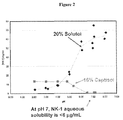
- Captisol® (a ⁇ -cyclodextrin derivative also referred herein as Captisol) and co-solvent-based formulations containing propylene glycol and ethanol significantly enhanced solubility of Compound 1.
- the co-solvent formulations upon intravenous administration unexpectedly caused hemolysis. Further attempts to reduce/minimize the incidence of hemolysis observed with intravenous administration of Captisol formulations of Compound 1, by varying Captisol's concentration, volume, rate of administration or addition of buffers, or utilizing various combinations of ethanol, propylene glycol and polyethylene glycol 400 were successful in some cases.
- a Captisol formulation administered by infusion over a 15 minute period to rats at doses of 10 mg/kg and 5 mg/kg and with a dose volume of 10 ml/kg gave a low incidence of hemolysis (1/5).
- bolus administration of a Captisol formulation at a dose of 10 mg/kg and in a dose volume of 5 ml/kg caused hemolysis in 2/5 rats.
- Bolus administration of Captisol at a lower concentration e.g. comparable to the infusion concentrations of 1 mg/ml and 0.5 mg/ml
- transient local high free concentration of Compound 1 at the injection site may be the main cause of hemolysis.
- micellar 7.5 % Solutol, 25 mg/kg; 5 ml/kg; 5 mg/ml
- micellar 7.5 % Solutol, 25 mg/kg; 5 ml/kg; 5 mg/ml
- a high rate of incidence of hemolysis was observed in rats when the micellar formulation was administered via the bolus mode of administration (5/5), whereas no hemolysis was observed via the infusion route (0/10).
- the present invention relates to parenteral formulations comprising, a) a compound of formula I or a pharmaceutically acceptable salt thereof, and b) a pharmaceutically acceptable vehicle.
- pharmaceutically acceptable vehicle means any suitable component which enhances the solubility of a compound of formula I or a pharmaceutically acceptable salt thereof in order to facilitate the parenteral delivery of a therapeutic concentration of such compound or salt to the target NK-1 receptor site(s).
- the vehicles are selected from the group consisting of cremophors, emulsions, microemulsions, micelles, negatively charged micelles, oil loaded micelles, intralipids, HSA, liposomes and negatively and positively charged amino acids and the like as additionally described herein.
- Pharmaceutically acceptable vehicles do not include ⁇ -cyclodextrin formulations.
- Human Serum albumin based formulations relate to the strong binding of HSA to Compound 1 and which would minimize the partitioning of free drug into red blood cells.
- Such formulations could be co-formulated with Solutol, Myglyol and vitamin E.
- Negatively charged amino acids would complex with and neutralize a portion of Compound 1 that retains a positive charge and thus prevent the partitioning of Compound 1 into red blood cells.
- the positively charged amino acids would complex with a negatively charged portion of Compound 1 and neutralize it and reduce exposure of the compound to red blood cells.
- a negatively charged micelle would repel the negatively charged erythrocytes and prevent contact of Compound 1 with red blood cells.
- micelle formulation means that the formulation is in the form of a micelle and is derived from or made up of any component which forms or can form a micelle in a pharmaceutically acceptable delivery system such as water, saline, dextrose water, and the like.
- emulsion formulation means that the formulation is in the form of an emulsion and which is derived from or made up of any component which forms or can form an emulsion when presented in and/or combined with a pharmaceutically acceptable delivery system such as water, saline, dextrose water and the like.
- a pharmaceutically acceptable delivery system such as water, saline, dextrose water and the like.
- the preferred emulsion formulations which avoid any hemolytic effects upon bolus or slow infusion administration have an oil content of about 10% or less.
- the drug concentration can be varied from about 1 mg/mL to about 30 mg/mL with less volume and higher concentration being preferred for intravenous delivery.
- the pharmaceutical compositions can be prepared to increase or enhance the solubility of the NK-1 antagonist and can also be diluted significantly to avoid any possible hemolytic results but some dilution volumes may be impractical to administer to a patient in need of treatment thereof.
- An emulsion formulation or micelle formulation of the present invention additionally comprises an active pharmaceutical ingredient selected from a compound of formula I or Ia and/or pharmaceutically acceptable salts, hydrates, polymorphs or physical forms thereof.
- Such drug loaded emulsion or micelle formulations may additionally contain excipients which facilitate delivery and/or are useful to prevent or mitigate factors such as hemolysis.
- excipients can thus include, for example, oils or other components which enhance or further enhance solubility while mitigating any potential hemolytic effects.
- Such emulsion formulations or micelle formulations may be further processed to form more stable physical forms or solutions and can be further processed to, for example, provide sterilized parenteral solutions.
- the present invention also relates to parenteral formulations comprising a compound of formula I or a pharmaceutically acceptable salt thereof in the form of a nanoparticle.
- the nanoparticles of a compound of formula I or salt thereof may then be incorporated in a solution to deliver such nanoparticle by intravenous means.
- the nanoparticles of compound 1 and pharmaceutically acceptable salts thereof may further include a pharmaceutically acceptable vehicle. It is believed that slow dissolution of such nanoparticles ( ⁇ 200 nm) would result in less hemolysis due to less dissolved drug in a solubilized fraction.
- the present invention also relates to the composition according to the invention for use in a method of delivering a compound of formula I or pharmaceutically acceptable salts thereof to a patient comprising (a) combining a compound of formula I or a pharmaceutically acceptable salt thereof with a pharmaceutically acceptable vehicle to form an intravenous formulation (b) delivering the parenteral formulation to a patient in need of treatment thereof.
- the present invention relates to a pharmaceutical composition suitable for parenteral administration, comprising:
- the invention also comprises an intravenous formulation comprising a compound of Formula I or a pharmaceutically acceptable salt thereof and human serum albumin (HSA).
- HSA human serum albumin
- the invention also comprises an intravenous formulation comprising a compound of Formula I or a pharmaceutically acceptable salt thereof wherein the compound or salt thereof is in the form of a nanoparticle.
- the invention additionally comprises an intravenous formulation comprising a compound of Formula I or a pharmaceutically acceptable salt thereof and a delivery vehicle selected from Cremophor.
- the invention further comprises an intravenous formulation comprising a compound of Formula I or a pharmaceutically acceptable salt thereof and a delivery vehicle selected from a micelle.
- the invention further comprises an intravenous formulation comprising a compound of Formula I or a pharmaceutically acceptable salt thereof and a delivery vehicle selected from a liposome.
- the invention preferably relates to an intravenous emulsion formulation which is suitable for both bolus and infusion administration.
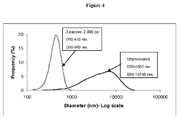
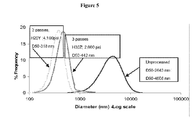
- a preferred embodiment of the invention comprises an intravenous formulation comprising a compound of Formula I or a pharmaceutically acceptable salt thereof and at least one emulsifier wherein an emulsion is formed and subject to microfluidization to form droplets having less than 500 nm median diameters and/or a D 90 of about 600 nm or less.
- the invention further relates to an intravenous formulation comprising a compound of Formula I or a pharmaceutically acceptable salt thereof and a negatively or positively charged amino acid.
- the invention further comprises an intravenous formulation comprising a compound of Formula I or a pharmaceutically acceptable salt thereof which is lyophilized.
- the invention further comprises an intravenous formulation comprising a compound of Formula I or a pharmaceutically acceptable salt thereof in the form of a powder.
- the powder is reconstituted or added to a liquid to form a liquid intravenous formulation comprising a compound of Formula I or salt thereof which is administered to a patient in need of treatment thereof.
- Emulsifiers such as Polysorbate 80 (Tween 80) and the like may be added to this formulation as well as other inactive ingredients such as pH adjusters, preservatives (EDTA) etc.
- the preferred form of the compound of Formula I or a salt thereof added to the formulation is as the solid crystalline monohydrate hydrochloride salt.
- a pro-drug of a compound of formula I selected from a compound of Formula Ia and pharmaceutically acceptable salts thereof: wherein Z and Y are independently selected from the group consisting of H, -PO(OH)O - M + , -PO(O - ) 2 2M + , -PO(O - ) 2 D 2+ , -[C(R 1 )(R 2 )] n -PO(OH)O - M + , -[C(R 1 )(R 2 )] n -PO(O - ) 2 2M + , -[C(R 1 )(R 2 )] n -PO(O - ) 2 D 2+ , -C(O)[C(R 1 )(R 2 )] m -OPO(O - ) 2 2M + , -C(O)[C(R 1 )(R 2 )] o NR 1 R 2 ,-C(Z
- Z is selected from H and Y is selected from any one of the groups shown above for Z and Y exclusive of H.
- such pro-drugs are selected from:
- the preferred M + salts are selected from, for example, ammonium salts, alkali metal salts such as sodium, alkaline earth metal salts such as calcium and magnesium, salts with organic bases such as N-methyl-D-glucamine or dicyclohexylamine, amino acid salts such as arginine, lysine and the like.
- the pro-drugs are made by reacting the amine or suitably protected amine with an activated group Z-X or Y-X or by any conventional means to form the pro-drug variant of a compound of formula I.
- the prodrugs possess enhanced solubility over the parent drug and are thus useful and suitable for intravenous administration.
- the above formulation may be in the form of an oil-loaded micelle or microemulsion.
- the invention provides a pharmaceutical composition which comprises macrogol 15-hydroxystearate in an amount of from about 0.50% to about 7.5% by weight of the total composition; a medium chain triglyceride in an amount of from about 0.15% to about 1.5% by weight of the total composition; and a long chain triglyceride in an amount of from about 0.10% to about 1.2% by weight of the total composition.
- the invention provides a pharmaceutical composition which comprises macrogol 15-hydroxystearate in an amount of from about 0.88% to about 4.84% by weight of the total composition; a medium chain triglyceride in an amount of from about 0.20% to about 1.20% by weight of the total composition; and a long chain triglyceride in an amount of from about 0.10% to about 0.75% by weight of the total composition.
- the invention provides a pharmaceutical composition which comprises:
- the invention provides a pharmaceutical composition which comprises:
- the invention provides a process for making a pharmaceutical composition which comprises:
- the invention provides a pharmaceutical composition which comprises:
- compositions according to the invention are provided for use in a method for treating nausea and/or emesis in a patient in need of treatment which comprises intravenously administering by infusion to the patient an effective amount of a pharmaceutical composition of the present invention, wherein hemolysis in the patient is minimized.
- compositions according to the invention are provided for use in a method for minimizing hemolysis in a patient following intravenous administration of a compound of the formula I or a pharmaceutically acceptable salt thereof, the method comprising intravenously administering by infusion to the patient an effective amount of a pharmaceutical composition of the present invention.
- the recited intravenous formulations may be used in combination with other antiemetic and antinausea medications; anti-inflammatory or steroidal agents (e.g. dexamethasone) and with chemotherapeutic agents.
- anti-inflammatory or steroidal agents e.g. dexamethasone
- chemotherapeutic agents e.g. anti-inflammatory or steroidal agents
- the recited intravenous formulations may be given to the patient according to the prescription and regimen provided by a physician.
- Such other medications include ondansetron and other known 5HT 3 antagonists.
- a compound of formula I and salts thereof for injection may be utilized with other antiemetic agents for the prevention of acute and delayed nausea and vomiting associated with initial and repeat courses of highly emetogenic cancer chemotherapy including, for example, treatment with cisplatin.
- a compound of formula I and salts thereof for injection may also be utilized with other antiemetic agents for the prevention of acute and delayed nausea and vomiting associated with initial and repeat course of moderately emetogenic cancer chemotherapy.
- other anticancer agents that are administered in this combination dosing regimen include etoposide, flurouracil, gemcitabine, vinorelbine, paclitaxel, cyclophosphamide, doxorubicin, docetaxel and can also include temozolomide.
- the treatment with a compound of formula I should begin thirty minutes before chemotherapy treatment on day 1 of such treatment.
- the i.v. formulation may be administered by slow infusion over fifteen minutes or by bolus injection depending upon the formulation.
- the i.v. formulations of a compound of Formula I and a pharmaceutically acceptable salt thereof may be administered alone or in combination with other agents for the treatment and/or prevention of post operative nausea and vomiting.
- combination agents include other antiemetic therapeutic agents such as ondansetron and other 5HT 3 antagonists.
- microemulsion refers to a clear, stable, isotropic liquid mixture of oil, water and the surfactant. This term also means an oil-loaded micelle.
- hemolysis means destruction of red blood cells which leads to the release of hemoglobin from within the red blood cells into the blood plasma. Hemolysis can be measured by methods well known in the art, e.g., Hemastix® reagent strips (Bayer Corp., Elkhart, IN) which detect blood in urine. The Hemastix® reagent strips turn from yellow to dark green depending upon the amount of hemoglobin found in the urine.
- minimal hemolysis and "hemolysis is minimized” as used herein means that upon administration in experimental mammals of a formulation of Compound 1, either no hemolysis has been observed in the experimental mammals or no more than two experimental mammals out of ten experimental mammals exhibit a trace level of hemolysis, as measured, e.g., on the Hemastix® scale as three or less.
- stable refers to both chemical and physical stability.
- Physical stability refers to micelles and microemulsions that show no significant difference in the particle size/droplet size and do not show any phase separation.
- Chemical stability as used herein pertains to the maintenance of active potency of Compound 1 in the allowable range (greater than 90% of labelled strength).
- an effective amount refers to the amount of Compound 1 or pharmaceutically acceptable salt thereof that will prevent, improve or reduce nausea and/or emesis in a patient, e.g., a mammal such as a human or non-human primate or a companion animal such as a dog or a cat.
- treat refers to prevention or improvement or reduction of nausea and/or emesis.
- the present invention is directed to pharmaceutical compositions in the form of microemulsions for intravenous administration comprising a compound of Formula I (also referred herein as Compound 1), methods for preparing the pharmaceutical compositions and their use in methods for treating nausea and/or emesis utilizing the pharmaceutical compositions.
- a compound of Formula I also referred herein as Compound 1
- a pharmaceutical composition of the present invention which comprises from about 0.50% to about 10.0% of Solutol, from about 0.10% to about 2.5% of a medium chain triglyceride and from about 0.10% to about 1.5% of a long chain triglyceride, wherein the weight ratio of macrogol 15-hydroxystearate:medium chain triglyceride:long chain triglyceride in the composition is about 5-100:1-5:1.
- the problem of hemolysis caused by intravenous administration of Compound 1 was also solved utilizing a formulation comprising pegylated hydroxystearate alone in a particular concentration range, wherein the pegylated hydroxystearate was substantially free of free polyethylene glycol.
- the present invention provides a pharmaceutical composition comprising:
- composition of the present invention is surprisingly associated with minimal hemolysis when intravenously administered by infusion to a patient.
- the compound of Formula I may form pharmaceutically acceptable salts with organic and inorganic acids.
- suitable acids for salt formation are hydrochloric, sulfuric, phosphoric, acetic, citric, malonic, salicylic, malic, fumaric, succinic, ascorbic, maleic, methanesulfonic and other mineral and carboxylic acids well known to those skilled in the art.
- the compound of Formula I is present as a hydrochloride salt.
- the salts are prepared by contacting the free base form with a sufficient amount of the desired acid to produce a salt in a conventional manner.
- the compound of Formula I or pharmaceutically acceptable salt thereof is present in the pharmaceutical composition in a concentration of from 1 mg/ml to 15 mg/ml, from 2.0 mg/ml to 10 mg/ml, or 2.0 mg/ml of the total composition.
- Macrogol 15-hydroxystearate (Solutol® HS15, available from BASF Ludvigshafen, Germany) is a surfactant with a critical micellar concentration in the range of 0.005% to 0.02%. Without intending to be limited to any particular mechanism of action, the inventors believe that a concentration above its critical micelle concentration results in the formation of micelles that provide a hydrophobic environment to encapsulate Compound 1 and reduce exposure of Compound 1 to the red blood cells. Solutol® HS 15 is present in the pharmaceutical composition in an amount of from about 0.50% to about 10.0% by weight of the total composition.
- Suitable medium chain triglycerides include, but are not limited to, caprylic acid triglyceride, capric acid triglyceride, and caprylic/ capric acid triglyceride sold as propylene glycol dicaprylate/dicaprate -MIGLYOL® 812 or MIGLYOL® 810 by SASOL North America; trigylceride from coconut oil sold as CAPTEX 300/CAPTEX 850® by Abitech Corp; caprylic/caprylic triglyceride sold as CAPTEX 355® by Abitech Corp; caprylic/caprylic/lauric triglyceride sold as CAPTEX 350® by Abitech Corp; caprylic/caprylic/linoleic triglyceride sold as CAPTEX 810® by Abitech Corp; caprylic/caprylic/stearic triglyceride sold as CAPTEX SBE® by Abitech Corp and combinations of two or more thereof.
- Suitable long chain triglyercerides and/or long chain fatty acids include, but are not limited to, soybean oil sold as SUPER-REFINED SOYBEAN OIL USP® by Croda; corn oil sold as SUPER-REFINED CORN OIL NF® by Croda; cottonseed oil sold as SUPER-REFINED COTTONSEED OIL NF® by Croda; olive oil sold as SUPER-REFINED OLIVE OIL NF® by Croda; peanut oil sold as SUPER-REFINED PEANUT OIL BF® by Croda; safflower oil sold as SUPER-REFINED SAFFLOWER USP® by Croda; sesame oil sold as SUPER-REFINED SESAME NF® by Croda; shark liver oil sold as; SUPER-REFINED SHARK LIVER® by Croda; ethyl oleate sold as Crodamol EO® by Croda, castor oil, monounsaturated omega-9 fatty acid sold as Oleic acid by Cro
- the invention provides a pharmaceutical composition which comprises macrogol 15-hydroxystearate in an amount of from about 0.50% to about 7.5% by weight of the total composition; a medium chain triglyceride in an amount of from about 0.15% to about 1.5% by weight of the total composition; and a long chain triglyceride in an amount of from about 0.10% to about 1.2% by weight of the total composition.
- the invention provides a pharmaceutical composition which comprises macrogol 15-hydroxystearate in an amount of from about 0.88% to about 4.84% by weight of the total composition; a medium chain triglyceride in an amount of from about 0.20% to about 1.20% by weight of the total composition; and a long chain triglyceride in an amount of from about 0.10% to about 0.75% by weight of the total composition.
- the medium chain triglyceride is caprylic/capric triglyceride sold as propylene glycol dicaprylate/dicaprate-MIGLYOL® 810 or MIGLYOL®812 by SASOL North America (Houston, Texas), and the long chain triglyceride is soybean oil in a super refined form.
- the pharmaceutical composition may also comprise at least one buffer.
- suitable buffers which can be included in the pharmaceutical composition include phosphate buffers (pH 7-8) such as sodium phosphate, potassium phosphate and calcium phosphate buffers, succinate buffers (pH 4-6), citrate buffers (pH 2-6), TRIS (pH 7-8) from 5-20mM and mixtures thereof.
- the amount of buffer in the pharmaceutical composition may depend on the type and concentration of buffer. For example, assuming a 10-20 mM phosphate buffer for adjustment between pH 6.5 to 8.0, the phosphate may be added to the composition in an amount of from 0.01% to 0.5% by weight; or about 0.05% to 0.02% by weight or 0.4% to 0.2% by weight, of the total composition. As an example, when a sodium phosphate dibasic anhydrous/monobasic dehydrate system is utilized about 0.2% by weight sodium phosphate monobasic and about 0.284% by weight sodium phosphate dibasic (anhydrous) is added to the composition.
- the pH of the composition of the present invention is adjusted, if necessary by means of an alkali such as sodium hydroxide, to a pH of from about 6.5 to about 8.0.
- an alkali such as sodium hydroxide
- the pH of the composition is from about 7.0 to about 8.0, a pH of about pH 7.5, or a pH of 7.5.
- the pharmaceutical composition of the present invention may further comprise other excipients, e.g., antioxidants (preservatives), anti-microbial agents, chelating agents, albumin, tonicity adjustors, bulking agents, etc.
- anti-microbial agents are BAC (0.1%-0.025%), benzoic acid (0.1-0.2%), benzyl alcohol (0.0001-1.5%); antioxidants are BHT, BHA (0.0001-0.001%), histidine, methionine, glycine, sodium sulphite/bisulfite (0.01-0.2%) and ascorbic acid (0.02-0.2%); chelating agents are EDTA (0.01-1.0%), DTPA (diethylene triamine pentaacetic acid); albumin (0.05-1.2%); tonicity adjustors (NaCl, mannitol (1-10%), glycerol (0.2-2.5%); and bulking agents are mannitol (1-10%), sucrose, glycine (0.1%-2.5%)
- the invention provides a pharmaceutical composition which comprises:
- the invention provides a pharmaceutical composition which comprises:
- medium chain triglycerides examples are as described above.
- the pharmaceutical composition of the present invention can be sterilized by any of several sterilization techniques including filtration sterilization, and sterilization by autoclaving.
- the pharmaceutical composition is sterilized by a filtration method, e.g., utilizing a filter having a pore size from 0.01 to about 0.45 ⁇ m., e . g ., a 0.22 ⁇ m. filter.
- the pharmaceutical composition of the present invention is chemically and physically stable for 1 to 6 months, typically 3 months at a temperature from 5°C to 40°C/75%RH (relative humidity).
- the present invention provides a process for making the pharmaceutical composition which comprises the steps of:
- Solutol® HS15 is melted by heating the Solutol® HS15 at a temperature of 60°C to 65°C, or at a temperature of about 65°C.
- the melted Solutol® HS15, medium and long chain triglycerides are mixed at a temperature of 50°C to 65°C, or at about 60°C for about 5 minutes to about 15 minutes to form a composition.
- Water for Injection is then added to form a microemulsion composition followed by the addition of Compound 1 to form a pharmaceutical composition.
- Sodium monobasic/dibasic phosphate is then added to the pharmaceutical composition.
- the pH of the pharmaceutical composition is adjusted to a pH of e.g., 7.5 utilizing sodium hydroxide and the tonicity of the composition is adjusted with the tonicity agent, sodium chloride, to approximately 290 mM. Water is then added to the desired volume followed by sterilization of the composition by filtration through a 0.22 ⁇ M filter (See infra Example 5).
- Example 72a The process for preparing Compound 1 is described in the '320 patent as preparation of Example 72a and is carried out in 18 individual steps from commercially available starting materials (See the '320 patent at col. 43, line 55 to col. 45, line 20; col. 75, line 55 to col. 80, line 21; col. 90 lines 35 to 63; and col. 98, line 1 to col. 99, line 24, which is herein incorporated by reference. See also WO2008/11833 , Examples 1-6, which are herein incorporated by reference).
- the invention provides a pharmaceutical composition which comprises:
- pegylated hydroxystearate substantially free from free PEG
- the free PEG contained in pegylated hydroxystearate e.g., Solutol®HS15
- dialysis see infra Example 5, Preparation of Dialyzed Solutol in Phosphate Buffered Saline and Table 9).
- compositions of the present invention are useful for the treatment of nausea and/or emesis. Accordingly, in another aspect, the composition of the present invention is provided for use in a method for treating nausea and/or emesis in a patient in need of treatment, e.g., a human or non-human primate such as a monkey or a companion animal such as a dog or a cat.
- the method comprises intravenously administering by infusion to the patient an effective amount of a pharmaceutical composition of the present invention, wherein hemolysis is minimized upon the intravenous administration of the pharmaceutical composition.
- the pharmaceutical compositions are useful in treating delayed onset emesis such as that experienced 24 hours to several days after the administration of chemotherapy. See Gonzales et al, Oncology Special Edition, Vol.
- the pharmaceutical compositions are also useful in treating acute nausea and/or emesis induced by chemotherapy, radiation, motion and alcohol (e.g., ethanol), high dose oral antibiotics, viral or bacterial gastroenteritis.
- the pharmaceutical compositions may also be co-formulated to include at least one other anti-emetic agent, e.g., dexamethasone or ondansetron HCl.
- the pharmaceutical compositions herein may also be provided in combination with such other anti-nausea and/or emetic agents and/or chemotherapeutic agents as prescribed by a physician.
- the pharmaceutical composition can be diluted prior to administration with a suitable aqueous diluent(s) such as normal saline, dextrose, dextrose filtered water and mannitol, to obtain any intermediary composition between about 0.88% to about 4.4% Solutol® HS15 by weight of the total composition.
- a suitable aqueous diluent(s) such as normal saline, dextrose, dextrose filtered water and mannitol
- the dosage regimen utilized for the pharmaceutical composition of the present invention is selected based on consideration of a variety of factors, including species, age, weight, sex and medical condition of the patient in need of treatment, and the severity of the nausea and/or vomiting experienced by the patient.
- An ordinary skilled physician can readily determine and prescribe the effective amount of Compound 1 to prevent, improve or reduce the nausea and/or emesis.
- the total daily dosage of the compound of formula I for an adult human is from 1 mg/kg to 9 mg/kg patient body weight or from 1mg/kg to 3 mg/kg patient body weight (assuming a dose of 200 mg for a 70 kg patient).
- the pharmaceutical composition may be intravenously administered by infusion for a period of 15 to 90 minutes, 15 to 60 minutes, or 15 to 30 minutes.
- the composition may be administered by a bolus injection.
- the composition of the present invention is provided for use in a method for minimizing hemolysis in a patient, e . g ., a mammal, such as a human or non-human primate or a companion animal such as a dog or cat, following intravenous administration of a compound of the formula I or a pharmaceutically acceptable salt thereof, comprising intravenously administering by infusion to the patient an effective amount of a pharmaceutical composition of the present invention.
- the present invention relates to the composition of the invention for use in a method of treating a patient in need of treatment thereof with an intravenous formulation comprising a compound of Formula I or a pharmaceutically acceptable salt thereof wherein the dosage ranges from 100 to 200 mgs of such compound and the formulation is administered to the patient as a single dose once prior to a chemotherapy or radiation cycle or once prior or post surgery to treat CINV (Chemotherapy Induced Nausea and Vomiting), PONV (Post Operative Nausea and Vomiting) or RINV (Radiation Induced Nausea and Vomiting).
- CINV Cirotherapy Induced Nausea and Vomiting
- PONV Post Operative Nausea and Vomiting
- RINV Random Access Induced Nausea and Vomiting
- the present invention also relates to emulsion formulations which are suitable for both bolus and slow infusion intravenous administration.
- the compounds useful in such formulations include compounds of formula I and Ia and pharmaceutically acceptable salts thereof.
- Parenteral emulsions based upon medium and long chain triglycerides and with additional excipients such as egg lecithins were formulated. Some of these formulations prepared with egg PC and Lipoid E80S resulted in clean (i.e., little or no hemolysis) formulations when administered by both bolus and infusion routes to mammals (rats).
- the preferred formulations were subject to microfluidization to result in emulsions having smaller droplet size and a relatively narrow particle size distribution (sub 500 nm median diameter and having a D 90 of less than about 600 nm). Such formulations were also physically stable after sterilization by autoclaving at 121°C.
- the invention provides a pharmaceutical composition which comprises:
- the invention provides a pharmaceutical composition which comprises:
- the invention provides a pharmaceutical composition which comprises:
- the invention provides a pharmaceutical composition which comprises:
- the invention provides a pharmaceutical composition which comprises:
- the invention provides a pharmaceutical composition which comprises:
- the weight percentage of the oil load (e.g. component(s) b) is about 10% wt/wt based upon the weight of the total composition.
- the invention provides a pharmaceutical composition which comprises:
- an effective amount of one or more of the formulations recited herein may be used in combination with other active ingredients either in separate doses and before or after administration of the additional active ingredient (or concurrently therewith) or in fixed combination doses of the NK-1 antagonist in combination with such other active ingredient.
- the formulations of the invention may be administered in combination with one or more selective serotonin reuptake inhibitors ("SSRIs") to treat depression or anxiety.
- SSRIs include fluoxetine, fluvoxamine, paroxetine, sertraline and pharmaceutically acceptable salts thereof.
- the invention relates to a method of treating emesis or delayed onset emesis such as that experienced hours to days after receiving chemotherapy.
- Combinations of the iv formulations of the present invention with another anti-emetic agent such as a serotonin 5-HT 3 receptor antagonist, a corticosteroid or a substituted benzamide can be used to treat other forms of emesis including acute emesis induced by chemotherapy, radiation, motion and/or alcohol (ethanol), and post-operative nausea and vomiting.
- 5-HT 3 antagonists include palosetron, dolasetron, ondansetron and granisetron or pharmaceutically acceptable salts thereof.
- An example of a suitable corticosteroid is dexamethasone.
- An example of a suitable benzamide is metoclopramide.
- Preferred combinations include combinations of any two of the above or any one of the above with (or within) the NK-1 iv formulation.
- the present invention relates to the composition of the invention for use in a method of treating acute and delayed nausea and vomiting associated with initial and repeat courses of highly emetogenic cancer chemotherapy comprising administration of an intravenous formulation of a compound of formula I in combination with at least one additional antiemetic agent.
- the present invention relates to the composition of the invention for use in a method of treating acute and delayed nausea and vomiting associated with initial and repeat courses of moderately emetogenic cancer chemotherapy comprising administration of an intravenous formulation of a compound of formula I in combination with at least one additional antiemetic agent.
- the present invention relates to the composition of the invention for use in a method of treating acute and delayed nausea and vomiting associated with initial and repeat courses of highly emetogenic cancer chemotherapy comprising administration of an intravenous formulation of a compound of formula Ia in combination with at least one additional antiemetic agent.
- the present invention relates to the composition of the invention for use in a method of treating acute and delayed nausea and vomiting associated with initial and repeat courses of moderately emetogenic cancer chemotherapy comprising administration of an intravenous formulation of a compound of formula Ia in combination with at least one additional antiemetic agent.
- Examples 1-4 describe the development of certain intravenous formulations of Compound 1 or other studies regarding hemolysis.
- Example 5 provides a description of the development of the intravenous microemulsion (oil-load micelle) formulation of Compound 1 of the present invention.
- Example 6 provides additional formulations.
- Example 7 describes an emulsion formulation suitable for both bolus and slow infusion iv administration.
- Captisol® a sulfobutyl ether derivative of ⁇ -cyclodextrin, available from Cydex Inc. of Overland Park, Kansas
- PG:EtOH a co-solvent system propylene glycol:ethanol
- Captisol® and the co-solvent system PG:EtOH 40%:10% were intravenously administered to rats.
- Urine samples from the rats were assessed for hemolysis using Hemastix® reagent strips (No. 2190, Bayer Corp., Elkhart IN).
- the presence of blood in urine was detected using Hemastix® reagent strips (No. 2190, Bayer Corp., Elkhart IN.).
- the Hemastix® reagent strips detect the peroxide-like activity of hemoglobin. The strips turn from yellow to dark green depending upon the amount of hemoglobin found in the urine.
- Captisol® and Co-Solvent Hemolytic Testing Results on intravenous Administration Formulation Bolus (B) or Infusion (I) Dose (mg/kg) Dose vol (mL/kg) Dose Conc (mg/mL) Incidence + hb-uria/ sex 16% Captisol I 10 10 1 1/5 16% Captisol B 10 5 2 2/5 Cosolvent (40%PG:10%EtOH) I 2.5 1.7 1.5 3/5
- Dose Group Time Point Hemolysis (Male rats) Hemolysis (Female rats) 10mg/kg 15min 3 1 30min 0 1 60min 0 0 20mg/kg 15min 3 3 30min 3 0 60min 0 0 30mg/kg 15min 3 3 30min 0 2 60min 0 0
- Formulation 10 mg/mL drug, 22% Solutol® HS15, 20 mM Phosphate buffer, pH 7.0
- the methodology for this study was to administer (into the tail vein of a rat) each formulation over 15 minutes by intravenous infusion using an infusion pump or to administer the formulation within two minutes by bolus route using a syringe.
- Urine was tested for the presence of free hemoglobin using the pooled urine collection method at the six-hour interval.
- rats were dosed and placed in a metabolism cage.
- the rats were euthanized by carbon dioxide over-inhalation, and the urine sample was collected.
- a minimum of five subjects were tested for each formulation and the urine samples were analyzed for hemolysis using Hemastix® reagent strips as indicated in Comparative Example 2.
- rats were dosed and then returned to their home cage (individually housed) without bedding. If the rat voided any urine in the cage, the urine was analyzed using Hemastix® reagent strips to determine the presence of hemoglobinuria. If the rat did not void in the cage, but voided upon euthanasia, the urine in the euthanasia chamber was analyzed.
- Solutol is an amphiphilic molecule and has about 30% of free polyethylene glycol (PEG) in the molecule.
- PEG polyethylene glycol
- the objective of the dialysis study was to minimize/eliminate the hydrophilic portion in the molecule.
- 50 ml of placebo formulation consisting of 20% Solutol in phosphate buffer
- the dialysis bag was wet with phosphate buffer at pH 7.0.
- the weight of the wetted bag was recorded.
- the dialyzed bag was then filled with 50 ml of the above placebo formulation and this bag was put in no less than 750 ml of phosphate buffer at pH 7.0 and the medium stirred using a stir bar.
- the buffer outside the dialysis bag was changed two times a day and the process was repeated for a total of 72 hours, with a total of at least 6 exchanges made within 72 hours. After completion of 72 hours, the weight of the dialyzed bag along with the placebo solution inside the bag was recorded. The placebo formulation was also analyzed by HPLC to confirm the levels of PEG in the solution.
- HPLC conditions for testing of the free PEG in the Solutol molecule is as follows:
- microemulsion composition for Compound 1.
- a schematic flow diagram for the method of manufacture of the microemulsion formulation is depicted in Figure 1 .
- HPLC conditions for analysis of Compound 1 are as follows:
- micellar solution with 22% Solutol at 10 mg/ml of Compound 1 at pH 8.0 was used as a starting point for the formulation of Compound 1.
- a formulation pH of 8.0 was chosen to remain above the pKa of 6.9 of Compound 1, such that Compound 1 would be unionized to reside preferentially in the hydrophobic core of the micelle.
- micellar formulation with 22% Solutol was tested in rats, highly unexpected results were obtained in vivo. Severe hemolysis was observed in rats on administering the formulation by a bolus infusion at all dose range tested from 10-30 mg/kg of Compound 1 (Table 5). Table 5. Summary of Bolus Administration of 22% Solutol Formulation of Compound 1 in Rats.
- Dose Group (mg/kg) Red Tinted Urine (observed on animal's fur) Red Tinted Plasma (observed after centrifugation) M F M F 10 0/3 0/3 3/3 1/3 20 0/3 3/3 3/3 2/3 30 1/3 3/3 3/3 3/3 Hemolysis results after single intravenous 1-2 minute slow-hand bolus administration of 22% Solutol HS15, 10 mg/mL drug, 20 mM phosphate buffer formulation using an appropriately sized needle and syringe into tail vein. The above observations were made at 15-60 minutes post dose.
- Solutol is an amphiphilic drug molecule having a lipophilic portion (12-hydroxystearic acid) which constitutes about 70% of the drug molecule and a hydrophilic portion which consists of 30% of free PEG. It was also hypothesized that the presence of the free PEG in the Solutol molecule increases the overall hydrophilicity and facilitates transfer from the lipophilic core to the aqueous phase thereby increasing drug exposure to the red blood cells.
- oils were loaded onto the micelles (forming a microemulsion) to shield the drug inside the hydrophobic core and delay the partitioning of Compound 1 to the red blood cells by increasing the overall hydrophobicity of the micelles by inclusion of a triglyceride. It was hypothesized that the inclusion of a triglyceride may also serve to increase the life-time of a micelle which are otherwise highly dynamic structures having a short life-time.
- the micelles are in equilibrium with the individual surfactant molecules/monomers that undergo constant exchange between the bulk and the micelles, besides the micelles themselves undergoing continuous disintegration and reassembly.
- the formulations that were tested based on the above guidelines included 4.4% Solutol, 1.1% Miglyol and 0.66% Soybean oil and 0.88% Solutol, 0.2% Miglyol and 0.12% Soybean oil at 2 mg/ml of Compound 1 at a pH of 8.0.
- the levels of Solutol were reduced 5-fold in the above case from 4.4% to 0.88% level, to further reduce chances of hemolytic occurrence and obtain reproducible results that were more consistent at the lower levels of Solutol as confirmed by the previous data.
- Formulations with 1.5%, 3.5% and 5.0% Solutol levels with oils were tested in 3 monkeys to observe for any occurrence of hemolysis.
- the 1.5% Solutol formulations lead to hemolysis in one of three monkeys tested.
- the monkey that tested positive for hemolysis had a +1 rating on a scale of 6 in terms of severity of hemolysis.
- Table 14 provides a list of other formulations that were prepared and tested for hemolysis results in addition to the Solutol, co-solvent and cyclodextrin formulations discussed previously.
- Table 14 Formulation Dose mg/kg Infusion minutes Volume mL/kg Concentration mg/mL Incidence +hb-uria Intralipid® 5 15 5 1 0/2 Emulsion 5 15 5 1 0/4 HSA 5 15 5 1 0/2 Micelle 5 15 5 1 0/5 Micelle 25 15 5 5 0/5 Nanosized 5 15 5 1 0/5 Cremophor RH40 20 15 10 2 0/12 Cremophor EL 20 15 10 2 1/6
- Formulation 1 Compound 1 + Cyclodextrin Captisol ; Delivery Method(Total Daily Dose)(Dose Volume)(Dose Concentration)-hemolysis results: Bolus (TDD 5 mg/kg)(DV 5 mL/kg)(DC 1 mg/mL)-5/5 Slow Infusion(TDD 10 mg/kg)(DV 10 mL/kg)(1 mg/mL)-1/5
- Formulation 2 Compound 1 + cosolvent PEG / EtOH B- SI(TDD 2.5 mg/kg)(1.5 mL/kg)(1.5 mg/mL)-3/5
- Formulation 3 Compound 1 + Polyethylene glycol ⁇ 660 ⁇ hydroxystearate, Solutol® HS 15 (22%), 20 mM phosphate buffer; pH 7 Solutol HS 15 forms a micelle 10 mg/mL
- Formulation 4 Bolus or Infusion Dose (mg/kg) Dose vol (mL/kg) Dose Cone. (mg/mL) Incidence + hb-una/ sex 7.5% Solutol I 25 5 5 0 / 10M 7.5% Solutol B 25 5 5 5 / 5M
- the doses were administered into the tail vein of rats via infusion. over a 15 minute period.
- the data for some of the formulations in Table 14 is repeated bellow in formulations 5-10.
- Formulation 5 10 ml intralipid (20% soybean oil, 1.2% egg phospholipid, 2.25% glycerol); 100 ul NK-1/ethanol 1 mg/mL; 80 ul 0.1 N NaOH, pH 6.07 Intralipid 5510/2 (emulsion)
- Formulation 6 (similar to intralipid) Emulsion 5 5 1 0/4
- Formulation 7 10 ml HAS (20%); 100 ul NK-1/ethanol solution (1 mg/ml) pH 6.66 HSA 5 5 1 0/2
- Formulation 8 45 g solutol 15 HS; 15 g propylene glycol, 250 mg NK-1; 8 gr PBS (1X) diluted with 2 gm NK-1 Solutol solution, pH 6.5 or 50 mg/ml drug in Solutol:PG (3:1 w/w) diluted with saline to 1 or 5 mg/ml drug before use
- the major unsaturated fatty acids in soybean oil triglycerides are 7% alpha-Linolenic acid (C-18:3); 51% linoleic acid (C-18:2); and 23% oleic acid (C-18:1). It also contains the saturated fatty acids 4% stearic acid and 10% palmitic acid.
- the formulations of compound 1 are administered by IV Infusion over a 15-30 minute period and would be presented in a bottle having 100 mg/bottle with 50 mL solution having a drug concentration of 2 mg/mL.
- the dose and volume can be adjusted to provide for additional target doses (e.g. 100 to 200 mg target dose).
- Compound 1 has a half life (T 1/2 ) of 180 hrs-this makes it particularly convenient for a one dose per treatment cycle regimen for treating CINV; T1/2 at doses ranging from 5-200 mg as ng/mL of api per time at different doses: The ng/ml at time directly upon administration ranges from 850 ng/mL (200 mg); 430 ng/mL (100 mg); 280 ng/mL (50 mg) with half concentration achieved for all doses at around 180 hrs after administration.
- IV formulations can be premixed at 2 mg/mL or can be a concentrate for dilution (10 mg/mL and 20 mg/mL strength for dilution to 2 mg/mL).
- the Intralipid® formulation contained 10 ml Intralipid® (20%) (20% Soybean Oil, 1.2% Egg Yolk Phospholipids, 2.25% Glycerin, and Water for Injection); 100 ⁇ l Compound 1/ethanol solution (1 mg/ml); 80 ul 0.1 N NaOH to form a pH of 6.07.
- the Intralipid formulation is an emulsion.
- Emulsion formulation (formulation 6) was composed of palmitoyl-oleoyl-phosphotidylcholine (POPC),oleic acid, glycerol and Tween 80.
- POPC palmitoyl-oleoyl-phosphotidylcholine
- glycerol glycerol
- Micelle particle sizes are typically less than 100 nm and fall within a range of 15 to 100 nm.
- the Micelle formulation is 45 g Solutol HS; 15 g propylene glycol; 250 mg Compound 1 (as the crystalline monohydrate hydrochloride salt); 8 g PBS (1X) diluted with 2 g Compound 1, Solutol 15S and propylene glycol solution; pH 6.5 to 10 mg/mL; diluted before use or was prepared as 50 mg/mL solution with drug in Solutol:PG (3:1, w:w), diluted with saline to 1 or 5 mg/ml drug before use.
- the HSA formulation was 10 ml HSA 20%; 100 ul Compound 1/ethanol solution (1 mg/ml); pH 6.66.
- Parenteral emulsion formulation based upon medium and long chain triglyercides and with appropriate use of emulsifiers such as egg lecithins and sodium oleate were also formulated. Some of these formulations as recited below resulted in clean results when administered by both the bolus route and by slow infusion. In addition, the emulsions led to reduced hemolysis even at very high doses of 30 mgs/kg.
- the formulations were subject to microfluidization in which the processing conditions were optimized to result in an emulsion with smaller droplet sizes and a narrow particle size distribution (psd).
- the emulsion formulations described below have the advantage of enhanced retention of the drug in the hydrophobic core; increases droplet size compared to a micellar formulation to delay drug transfer/partitioning from the oil droplets to the RBCs, and provide increased flexibility in formulating by utilizing naturally occuring lipids as emulsifiers thereby avoiding, for example, free polyethylene glycol which is present in Solutol and which, therefore, further prevents drug transfer from the hydrophobic environment to the RBCs.
- Parenteral emulsions are used to carry poorly water soluble drugs and typically constitute small oil droplets in an aqueous solution. The preferred emulsifier is selected from those regarded as safe to use for parenteral administration.
- lecithin is the preferred emulsifier.
- Purified egg lecithin is the most preferred.
- Additional stabilizers can be added including, for example, oleic acid or sodium oleate.
- Medium chain (Myglyol) and long chain (Soybean oil) triglycerides may also be added.
- Glycerin may be used as a tonicity adjuster and ethanol may be used as a co-solvent/solubilizer for the lecithin and drug (Compound of formula I or salt thereof-e.g. Compound 1).
- the methodology for this example was to administer each formulation over 15 minutes by i.v. infusion using an infusion pump or to administer the formulations within 2 minutes by bolus injection using a syringe and delivering the formulation into the tail vein of a rat.
- Urine was tested by dipstick for the presence of free hemoglobin using the pooled urine collection method at the 6-hour interval. A minimum of four subjects were tested for each formulation and the frequency of hemolysis was observed in such animals.
- the unprocessed emulsion described above or within the scope of the invention may be subsequently passed through a microfluidizer to result in more stable emulsions with a narrow droplet size distribution.
- a microfluidization process involves the use of a microfluidizer that is designed to supply a desired pressure to the product at a constant rate to the product stream. As a result the product stream accelerates to high velocities through precisely designed fixed geometry microchannels (interaction chamber), creating shear rates within the product stream that are much higher than any other conventional methods. This causes the droplets to break down into smaller sizes and results in a formulation with a more uniform and narrow droplet size distribution for enhanced physical stability.
- Colloidal emulsions were processed using either F20Y (75 micron) interaction chamber with a pressure range between 4,100 and 10,000 psi or H30Z (200 microns) at a pressure of 2000 and 5000 psi. The number of passes ranged from one to three. A water-bath enclosing the interaction chamber was used to prevent any temperature increase for the product during the microfluization step. Analysis involved the use of an optical microscope and a particle size analyzer. Images were captured for each sample collected after processing. Particle size analysis was measured for the unprocessed sample and at the conclusion of each cycle of microfluidization.
- the formulations were filled and sealed in a glass vial and put in an autoclave for terminal sterilization at one cycle of 121 °C for 20 minutes.
- the particle size was measured using the Malvern Zetasizer Nano-ZS to observe changes in droplet size distribution after the sterilization process.
- the instrument operates on the principle of dynamic light scattering.
- Lipoid E80S has a high phosphotidyethanolamine (PE) content and acts an as anionic emulsifier. This product is commercially available from Lipoid KG of Ludwigshafen, Germany.
- the PE content in Lipoid E80S is about 20% while egg phosphotidylcholine constitutes about 80% of the substance.
- the preferred emulsion formulation thus contained a 10% oil load.
- Sodium oleate was added as an additional ingredient but did not produce favorable hemolytic results in all delivery routes (Table 19).
- Table 19 Batch No. Formulation composition
- Drug conc. (mg/ml) Target Dose (mg/kg) Dose Route Time Point (hr) Hemoglobinuria 85266-M/L 10%SOinf Soybean oil-5% 4 20 i.v. infusion 6 1/5 Myglyol-5% Lipoid E80*-1.2%
- Lipoid E80 has a 10% PE content as compared to 20% in Lipoid E80S.
- the microscopic images confirm the uniformity in the psd of the oil droplets obtained after subjecting the formulation to 3 passes of microfluidization at 2000 psi compared to one pass at 2000 psi ( Figure 7).
- Figure 7 shows the Optical microscopic images of formulations, BOL15SO and INFWSO during microfluidization.
- the optical microscopy results clearly show the impact of number of cycles of microfluidization on the formulation, BOL 15 SO (top 2 images) and INFWSO (bottom 4 images).
- the images on the right hand side are observed to be devoid of very large oil globules with a more uniform and a narrow size distribution.
- Figure 8 shows Optical microscopic images of formulations, BOL10WSO during microfluidization.
- optical microscopy results clearly show the impact of the pressure and the number of cycles of microfluidization on formulation, BOL10WSO.
- the images on the right hand side are observed to be devoid of very large oil globules with a more uniform and narrow size distribution. Further, the oil droplets are also smaller when the formulation is subject to microfluidization at higher pressure as expected.
- Figure 9 shows Optical microscopic images of formulations, BOL15SO and INFWSO during microfluidization. The optical microscopy results clearly show the impact of the number of cycles of microfluidization on formulation, INFSO. Higher number of cycles results in a more uniform particle size distribution.
- Figure 10 shows Optical microscopic images of formulations, BOL10SO during microfluidization. The optical microscopy results clearly show the impact of the number of cycles of microfluidization on formulation, BOL10SO. Higher number of cycles results in a more uniform particle size distribution.
- Microfluidization processing thus provided physically stable emulsion formulations comprising a compound of Formula I and pharmaceutically acceptable salts thereof.
- the present invention also relates to emulsion formulations of Formula I and salts thereof having droplets with median diameters of about 500 nm or less and a D 90 of about 600 or less. Even smaller droplet particle sizes were achieved when the formulations were subject to additional passes and higher pressures.
- the formulations were then subjected to autoclaving to sterilize the formulations for intravenous administration. No visible stability issues arose as a result of the autoclaving. INFWSO and BOL10WSO were autoclaved and after visual inspection the mean particle size obtained after one cycle was determined to be 353.4 nm and 336.7 nm respectively ( Figures 11 and 12 ). Thus, non-hemolytic results were reproducibly achieved using phospholipid based emulsion formulations for both bolus and slow infusion administration.
- the formulations are useful in the prevention and treatment of nausea and vomiting associated with radiation therapy for cancer treatment; chemotherapy therapy for cancer treatment and with post operative associated nausea and vomiting.
- the course of therapy comprises a single dose of the formulation comprising a compound of Formula I or salt thereof on day one before the initiation of chemotherapy followed by once a day dosing on days two and three.
- the course of therapy also comprises a single dose administration on day 1.
- the iv solution can be in the form of a 2 mg/ml solution with 50 mls necessary to deliver 100 mgs to the patient in need of treatment thereof.
- the formulation can be a ready to go premixed solution or a concentrate which can be dilute before use.
- the lyophilized formulations disclosed herein may be in the form of a powder which is mixed with saline or appropriate buffer solution before use.
- Hemolysis Data for Glucamine Phosphate Salt Prodrug in Dextrose/water 20 mg/kgdose 2 mL/kg 10 mg/mL 0/4 urine; 1/4 plasma .25 hour timepoint 20 2 10 0/3 urine; 0/3 plasma 1 hr timepoint Data for amine generated with a vehicle (10% Solutol) .25 hr 3/3 hemolysis
Landscapes
- Health & Medical Sciences (AREA)
- Chemical & Material Sciences (AREA)
- Life Sciences & Earth Sciences (AREA)
- Medicinal Chemistry (AREA)
- General Health & Medical Sciences (AREA)
- Veterinary Medicine (AREA)
- Public Health (AREA)
- Pharmacology & Pharmacy (AREA)
- Animal Behavior & Ethology (AREA)
- Epidemiology (AREA)
- Organic Chemistry (AREA)
- Chemical Kinetics & Catalysis (AREA)
- General Chemical & Material Sciences (AREA)
- Oil, Petroleum & Natural Gas (AREA)
- Engineering & Computer Science (AREA)
- Molecular Biology (AREA)
- Biophysics (AREA)
- Dispersion Chemistry (AREA)
- Nuclear Medicine, Radiotherapy & Molecular Imaging (AREA)
- Dermatology (AREA)
- Bioinformatics & Cheminformatics (AREA)
- Pain & Pain Management (AREA)
- Rheumatology (AREA)
- Neurosurgery (AREA)
- Neurology (AREA)
- Biomedical Technology (AREA)
- Psychiatry (AREA)
- Hospice & Palliative Care (AREA)
- Otolaryngology (AREA)
- Hematology (AREA)
- Diabetes (AREA)
- Pharmaceuticals Containing Other Organic And Inorganic Compounds (AREA)
- Medicinal Preparation (AREA)
- Medicines That Contain Protein Lipid Enzymes And Other Medicines (AREA)
- Acyclic And Carbocyclic Compounds In Medicinal Compositions (AREA)
- Nitrogen Condensed Heterocyclic Rings (AREA)
Priority Applications (1)
| Application Number | Priority Date | Filing Date | Title |
|---|---|---|---|
| EP16181864.6A EP3143996A1 (en) | 2009-08-14 | 2010-08-12 | Intravenous formulations of neurokinin 1-antagonists |
Applications Claiming Priority (2)
| Application Number | Priority Date | Filing Date | Title |
|---|---|---|---|
| US23412909P | 2009-08-14 | 2009-08-14 | |
| PCT/US2010/045317 WO2011019911A1 (en) | 2009-08-14 | 2010-08-12 | Intravenous formulations of neurokinin-1 antagonists |
Related Child Applications (2)
| Application Number | Title | Priority Date | Filing Date |
|---|---|---|---|
| EP16181864.6A Division-Into EP3143996A1 (en) | 2009-08-14 | 2010-08-12 | Intravenous formulations of neurokinin 1-antagonists |
| EP16181864.6A Division EP3143996A1 (en) | 2009-08-14 | 2010-08-12 | Intravenous formulations of neurokinin 1-antagonists |
Publications (3)
| Publication Number | Publication Date |
|---|---|
| EP2464230A1 EP2464230A1 (en) | 2012-06-20 |
| EP2464230A4 EP2464230A4 (en) | 2013-01-02 |
| EP2464230B1 true EP2464230B1 (en) | 2016-10-05 |
Family
ID=43586486
Family Applications (2)
| Application Number | Title | Priority Date | Filing Date |
|---|---|---|---|
| EP10808756.0A Not-in-force EP2464230B1 (en) | 2009-08-14 | 2010-08-12 | Intravenous formulations of rolapitant |
| EP16181864.6A Withdrawn EP3143996A1 (en) | 2009-08-14 | 2010-08-12 | Intravenous formulations of neurokinin 1-antagonists |
Family Applications After (1)
| Application Number | Title | Priority Date | Filing Date |
|---|---|---|---|
| EP16181864.6A Withdrawn EP3143996A1 (en) | 2009-08-14 | 2010-08-12 | Intravenous formulations of neurokinin 1-antagonists |
Country Status (15)
| Country | Link |
|---|---|
| US (2) | US9101615B2 (enExample) |
| EP (2) | EP2464230B1 (enExample) |
| JP (2) | JP5860399B2 (enExample) |
| KR (1) | KR101834577B1 (enExample) |
| CN (2) | CN105503870A (enExample) |
| AU (1) | AU2010282483B2 (enExample) |
| BR (1) | BR112012003263A2 (enExample) |
| CA (1) | CA2770403C (enExample) |
| ES (1) | ES2609640T3 (enExample) |
| IL (1) | IL217942A0 (enExample) |
| MX (1) | MX336071B (enExample) |
| RU (2) | RU2642234C2 (enExample) |
| SG (2) | SG178403A1 (enExample) |
| TW (2) | TWI498329B (enExample) |
| WO (1) | WO2011019911A1 (enExample) |
Cited By (1)
| Publication number | Priority date | Publication date | Assignee | Title |
|---|---|---|---|---|
| WO2018094394A1 (en) * | 2016-11-21 | 2018-05-24 | Zhuhai Beihai Biotech Co., Ltd. | Formulations of rolapitant |
Families Citing this family (26)
| Publication number | Priority date | Publication date | Assignee | Title |
|---|---|---|---|---|
| SG170838A1 (en) * | 2006-04-05 | 2011-05-30 | Opko Health Inc | Hydrochloride salts of 8-[{1-(3,5-bis-(trifluoromethyl) phenyl) -ethoxy}- methyl] -8-phenyl-1,7-diaza-spiro[4.5] decan-2-one and preparation process therefor |
| NZ571693A (en) | 2006-04-05 | 2011-12-22 | Opko Health Inc | Pharmaceutical formulations: salts of 8-[{ 1-(3,5-bis-(trifluoromethyl)phenyl)-ethoxy} -methyl]-8-phenyl-1,7-diaza-spiro[4.5]decan-2-one and treatment methods using the same |
| AR066191A1 (es) | 2007-03-22 | 2009-08-05 | Schering Corp | Proceso e intermediarios para la sintesis de compuestos 8- [ ( 1- (3,5- bis- ( trifluorometil) fenil) - etoxi ) - metil]- 8 fenil - 1,7- diaza - espiro (4, 5) decan -2 ona |
| HUE026148T2 (en) | 2008-09-05 | 2016-05-30 | Opko Health Inc | 8 - ({1- [3,5-bis (trifluoromethyl) phenyl] ethoxy} methyl) -8-phenyl-1,7-diaza-spiro [4,5] decane-on-compounds intermediates |
| CN105503870A (zh) | 2009-08-14 | 2016-04-20 | 欧科生医股份有限公司 | 神经激肽-1拮抗剂的静脉内制剂 |
| TW201605852A (zh) * | 2013-09-26 | 2016-02-16 | 美國禮來大藥廠 | 新穎化合物及其製備tau造影劑及tau造影調配物之用途 |
| JP6741655B2 (ja) | 2014-09-19 | 2020-08-19 | ヘロン セラピューティクス, インコーポレイテッドHeron Therapeutics, Inc. | アプレピタントのエマルジョン製剤 |
| BR112017018620A2 (pt) | 2015-03-04 | 2018-04-17 | Vanda Pharmaceuticals Inc. | método de administração de tradipitanto, e, tradipitanto. |
| US20180250270A1 (en) | 2015-09-11 | 2018-09-06 | Chase Pharmaceuticals Corporation | Muscarinic combination and its use for combating hypocholinergic disorders of the central nervous system |
| US9974742B2 (en) | 2016-02-01 | 2018-05-22 | Heron Therapeutics, Inc. | Emulsion formulations of an NK-1 receptor antagonist and uses thereof |
| EP3411013A1 (en) * | 2016-02-01 | 2018-12-12 | Heron Therapeutics, Inc. | Emulsion comprising an nk-1 receptor antagonist |
| US20190175702A1 (en) * | 2016-08-03 | 2019-06-13 | Zhuhai Beihai Biotech Co., Ltd. | Formulations of fosaprepitant and aprepitant |
| IL312486B2 (en) | 2017-04-10 | 2025-05-01 | Chase Therapeutics Corp | NK1 antagonist combination and method for treating synucleinopathies |
| CN110996911B (zh) * | 2017-06-26 | 2023-01-17 | 福多兹制药公司 | 阿瑞匹坦的纳米微脂囊配制品及其方法和应用 |
| KR20250069704A (ko) | 2017-06-30 | 2025-05-19 | 체이스 테라퓨틱스 코포레이션 | 우울증을 치료하기 위한 nk-1 길항제 조성물 및 우울증 치료에 사용하는 방법 |
| CN109200018A (zh) * | 2017-07-04 | 2019-01-15 | 南京诺瑞特医药科技有限公司 | 含有奈妥吡坦的微乳制剂 |
| CN108703950B (zh) * | 2018-08-27 | 2021-04-20 | 辅必成(上海)医药科技有限公司 | 一种罗拉吡坦的乳剂注射液 |
| CN109394693A (zh) * | 2018-12-25 | 2019-03-01 | 广州白云山汉方现代药业有限公司 | 一种罗拉匹坦乳剂及其制备方法和应用 |
| CN109453115A (zh) * | 2018-12-25 | 2019-03-12 | 广州白云山汉方现代药业有限公司 | 一种罗拉匹坦静脉注射乳剂及其制备方法和应用 |
| US12421260B2 (en) * | 2019-06-28 | 2025-09-23 | Shanghai Shengdi Pharmaceutical Co., Ltd | Neurokinin-1 antagonist |
| EP4125875A1 (en) | 2020-04-03 | 2023-02-08 | NeRRe Therapeutics Limited | An nk-1 receptor antagonist for treating a disease selecting from sepsis, septic shock,, acute respiratory distress syndrome (ards) or multiple organ dysfunction syndrome (mods) |
| KR20230018485A (ko) | 2020-06-02 | 2023-02-07 | 네르 쎄라퓨틱스 리미티드 | 폐에 대한 기계적 손상에 의해 촉진된 폐 섬유증 상태의 치료에 사용하기 위한 뉴로키닌 (nk)-1 수용체 길항제 |
| CN116472048B (zh) * | 2020-12-25 | 2025-02-18 | 上海盛迪医药有限公司 | Nk1拮抗剂前药化合物与5-ht3受体拮抗剂的联用用途 |
| CN118510509A (zh) * | 2022-01-12 | 2024-08-16 | 江苏恒瑞医药股份有限公司 | 一种包含神经激肽-1拮抗剂前药化合物的药物组合物 |
| EP4464712A4 (en) * | 2022-01-12 | 2025-07-23 | Jiangsu Hengrui Pharmaceuticals Co Ltd | CRYSTALLINE FORM OF A NEUROKININ-1 ANTAGONIST PRODRUG COMPOUND |
| CN119528985A (zh) * | 2023-08-28 | 2025-02-28 | 科睿迪(南京)医药科技有限公司 | 神经激肽-1受体拮抗剂化合物 |
Family Cites Families (43)
| Publication number | Priority date | Publication date | Assignee | Title |
|---|---|---|---|---|
| EP0338372A3 (en) * | 1988-04-22 | 1991-10-09 | American Cyanamid Company | Solubilized pro-drugs |
| JP3350048B2 (ja) * | 1989-07-07 | 2002-11-25 | アンドルシェルシュ・インコーポレイテッド | アンドロゲン関連疾患の治療方法 |
| US5610140A (en) * | 1991-04-01 | 1997-03-11 | Cortech, Inc. | Bradykinin receptor antagonists with neurokinin receptor blocking activity |
| ES2141174T3 (es) | 1992-10-28 | 2000-03-16 | Merck Sharp & Dohme | 4-arilmetiloximetil piperidinas como antagonistas de taquiquinina. |
| US5661162A (en) | 1992-12-14 | 1997-08-26 | Merck Sharp & Dohme Limited | 4-aminomethyl/thiomethyl/sulfonylmethyl-4-phenylpiperdines as tachykinin receptor antagonists |
| GB9305718D0 (en) * | 1993-03-19 | 1993-05-05 | Glaxo Group Ltd | Medicaments |
| WO1995019344A1 (en) | 1994-01-13 | 1995-07-20 | Merck Sharp & Dohme Limited | Gem-disubstituted azacyclic tachykinin antagonists |
| NZ302926A (en) | 1995-02-28 | 1998-10-28 | Hoechst Marion Roussel Inc | Composition for use as antihistamines comprising piperidinoalkanol derivatives and inert ingredients |
| SE9503143D0 (sv) * | 1995-09-12 | 1995-09-12 | Astra Ab | New preparation |
| GB9601680D0 (en) | 1996-01-27 | 1996-03-27 | Pfizer Ltd | Therapeutic agents |
| CA2260269A1 (en) | 1996-07-17 | 1998-01-22 | Merck & Co., Inc. | Alteration of circadian rhythmicity with a tachykinin antagonist |
| AU735760B2 (en) | 1997-04-24 | 2001-07-12 | Merck Sharp & Dohme Limited | Use of a NK-1 receptor antagonist and an SSRI for treating obesity |
| JP3571511B2 (ja) * | 1997-11-11 | 2004-09-29 | トーアエイヨー株式会社 | 経皮吸収製剤 |
| CA2356638A1 (en) | 1998-12-23 | 2000-07-06 | Nps Allelix Corp. | Indole and indolizidine derivatives for the treatment of migraine |
| EP1185301A1 (en) * | 1999-05-24 | 2002-03-13 | Sonus Pharmaceuticals, Inc. | Emulsion vehicle for poorly soluble drugs |
| EP1237874B1 (en) | 1999-12-17 | 2006-02-22 | Schering Corporation | Selective neurokinin antagonists |
| US6436928B1 (en) | 1999-12-17 | 2002-08-20 | Schering Corporation | Selective neurokinin antagonists |
| US6499984B1 (en) | 2000-05-22 | 2002-12-31 | Warner-Lambert Company | Continuous production of pharmaceutical granulation |
| MY128450A (en) * | 2000-05-24 | 2007-02-28 | Upjohn Co | 1-(pyrrolidin-1-ylmethyl)-3-(pyrrol-2-ylmethylidene)-2-indolinone derivatives |
| HUP0303154A3 (en) | 2001-02-12 | 2009-08-28 | Teva Pharma | New crystal forms of oxcarbazepine and processes for their preparation |
| ES2291538T3 (es) | 2001-11-13 | 2008-03-01 | Schering Corporation | Antagonistas de nk1. |
| PE20030762A1 (es) | 2001-12-18 | 2003-09-05 | Schering Corp | Compuestos heterociclicos como antagonistas nk1 |
| ATE358482T1 (de) | 2002-07-03 | 2007-04-15 | Schering Corp | 1-amido-4-phenyl-4-benzyloxymethyl-piperidin derivative und verwandte verbindungen als neurokinin-1 (nk-1) antagonsisten zur behandlung von erbrechen, depressionen, angstzustände und husten |
| US7534913B2 (en) | 2002-07-18 | 2009-05-19 | Teva Pharmaceutica Industries Ltd. | Crystalline form of nateglinide |
| US7323459B2 (en) | 2002-12-24 | 2008-01-29 | Teva Pharmaceutical Industries Ltd. | Crystal forms, methods for their preparation and method for preparation of olanzapine |
| CA2518836A1 (en) * | 2003-03-13 | 2004-09-30 | Conforma Therapeutics Corporation | Drug formulations having long and medium chain triglycerides |
| GB0321256D0 (en) | 2003-09-11 | 2003-10-08 | Generics Uk Ltd | Novel crystalline compounds |
| ES2295924T3 (es) | 2003-10-03 | 2008-04-16 | Pfizer, Inc. | Derivados de tropano imidazopirina sustituidos con actividad antagonista de los receptores ccr5 para el tratamiento de vih y de la inflamacion. |
| CA2550432A1 (en) * | 2003-12-22 | 2005-07-14 | Schering Corporation | Pharmaceutical compositions |
| SG154443A1 (en) | 2004-07-01 | 2009-08-28 | Schering Corp | Piperidine derivatives as nk1 antagonists |
| US7871632B2 (en) | 2004-07-12 | 2011-01-18 | Adventrx Pharmaceuticals, Inc. | Compositions for delivering highly water soluble drugs |
| CA2588052A1 (en) * | 2004-11-30 | 2006-06-08 | Myriad Genetics, Inc. | Therapeutic formulations |
| CN100367951C (zh) * | 2005-12-16 | 2008-02-13 | 石药集团恩必普药业有限公司 | 丁苯酞静脉乳剂及其应用 |
| US20070207201A1 (en) * | 2006-03-06 | 2007-09-06 | Wyeth | Liquid and Semi-Solid Pharmaceutical Formulations and Processes |
| NZ571693A (en) * | 2006-04-05 | 2011-12-22 | Opko Health Inc | Pharmaceutical formulations: salts of 8-[{ 1-(3,5-bis-(trifluoromethyl)phenyl)-ethoxy} -methyl]-8-phenyl-1,7-diaza-spiro[4.5]decan-2-one and treatment methods using the same |
| SG170838A1 (en) | 2006-04-05 | 2011-05-30 | Opko Health Inc | Hydrochloride salts of 8-[{1-(3,5-bis-(trifluoromethyl) phenyl) -ethoxy}- methyl] -8-phenyl-1,7-diaza-spiro[4.5] decan-2-one and preparation process therefor |
| CN101110758A (zh) | 2006-07-21 | 2008-01-23 | 华为技术有限公司 | 建立紧急会话的方法、系统及代理呼叫会话控制功能 |
| JP2010513222A (ja) | 2006-08-07 | 2010-04-30 | スティーフェル ラボラトリーズ インコーポレイテッド | 結晶抗真菌化合物 |
| EP2125802A4 (en) * | 2007-02-16 | 2014-08-20 | Debiopharm Int Sa | SALTS, PRODRUGS AND POLYMORPHES OF FAB I INHIBITORS |
| PE20081891A1 (es) | 2007-03-22 | 2008-12-27 | Opko Health Inc | Formulaciones de comprimidos que contienen sales de 8-[{1-(3,5-bis-(trifluorometil)fenil)-etoxi}-metil]-8-fenil-1,7-diaza-spiro[4.5]decan-2-ona y comprimidos elaborados a partir de estas |
| AR066191A1 (es) | 2007-03-22 | 2009-08-05 | Schering Corp | Proceso e intermediarios para la sintesis de compuestos 8- [ ( 1- (3,5- bis- ( trifluorometil) fenil) - etoxi ) - metil]- 8 fenil - 1,7- diaza - espiro (4, 5) decan -2 ona |
| HUE026148T2 (en) | 2008-09-05 | 2016-05-30 | Opko Health Inc | 8 - ({1- [3,5-bis (trifluoromethyl) phenyl] ethoxy} methyl) -8-phenyl-1,7-diaza-spiro [4,5] decane-on-compounds intermediates |
| CN105503870A (zh) | 2009-08-14 | 2016-04-20 | 欧科生医股份有限公司 | 神经激肽-1拮抗剂的静脉内制剂 |
-
2010
- 2010-08-12 CN CN201510830177.9A patent/CN105503870A/zh active Pending
- 2010-08-12 EP EP10808756.0A patent/EP2464230B1/en not_active Not-in-force
- 2010-08-12 WO PCT/US2010/045317 patent/WO2011019911A1/en not_active Ceased
- 2010-08-12 MX MX2012001872A patent/MX336071B/es unknown
- 2010-08-12 KR KR1020127006576A patent/KR101834577B1/ko not_active Expired - Fee Related
- 2010-08-12 ES ES10808756.0T patent/ES2609640T3/es active Active
- 2010-08-12 JP JP2012524868A patent/JP5860399B2/ja not_active Expired - Fee Related
- 2010-08-12 SG SG2012010146A patent/SG178403A1/en unknown
- 2010-08-12 BR BR112012003263A patent/BR112012003263A2/pt not_active Application Discontinuation
- 2010-08-12 SG SG10201407538WA patent/SG10201407538WA/en unknown
- 2010-08-12 CA CA2770403A patent/CA2770403C/en active Active
- 2010-08-12 AU AU2010282483A patent/AU2010282483B2/en not_active Ceased
- 2010-08-12 RU RU2012109405A patent/RU2642234C2/ru not_active IP Right Cessation
- 2010-08-12 EP EP16181864.6A patent/EP3143996A1/en not_active Withdrawn
- 2010-08-12 RU RU2017145628A patent/RU2017145628A/ru not_active Application Discontinuation
- 2010-08-12 CN CN201080046905.2A patent/CN102573475B/zh not_active Expired - Fee Related
- 2010-08-13 TW TW099127158A patent/TWI498329B/zh not_active IP Right Cessation
- 2010-08-13 TW TW104121014A patent/TW201604195A/zh unknown
- 2010-08-13 US US12/855,889 patent/US9101615B2/en active Active
-
2012
- 2012-02-05 IL IL217942A patent/IL217942A0/en unknown
-
2015
- 2015-07-28 US US14/811,342 patent/US20160024092A1/en not_active Abandoned
- 2015-11-04 JP JP2015216374A patent/JP6308991B2/ja not_active Expired - Fee Related
Cited By (1)
| Publication number | Priority date | Publication date | Assignee | Title |
|---|---|---|---|---|
| WO2018094394A1 (en) * | 2016-11-21 | 2018-05-24 | Zhuhai Beihai Biotech Co., Ltd. | Formulations of rolapitant |
Also Published As
| Publication number | Publication date |
|---|---|
| TWI498329B (zh) | 2015-09-01 |
| CN102573475B (zh) | 2016-01-20 |
| BR112012003263A2 (pt) | 2015-09-22 |
| RU2017145628A (ru) | 2019-02-19 |
| RU2012109405A (ru) | 2013-09-20 |
| TW201111382A (en) | 2011-04-01 |
| MX2012001872A (es) | 2012-04-11 |
| AU2010282483A1 (en) | 2012-03-01 |
| SG178403A1 (en) | 2012-03-29 |
| TW201604195A (zh) | 2016-02-01 |
| JP6308991B2 (ja) | 2018-04-11 |
| CN102573475A (zh) | 2012-07-11 |
| RU2642234C2 (ru) | 2018-01-24 |
| EP2464230A1 (en) | 2012-06-20 |
| US20110038925A1 (en) | 2011-02-17 |
| WO2011019911A1 (en) | 2011-02-17 |
| IL217942A0 (en) | 2012-03-29 |
| US9101615B2 (en) | 2015-08-11 |
| KR101834577B1 (ko) | 2018-03-05 |
| KR20120060215A (ko) | 2012-06-11 |
| EP3143996A1 (en) | 2017-03-22 |
| EP2464230A4 (en) | 2013-01-02 |
| MX336071B (es) | 2016-01-06 |
| ES2609640T3 (es) | 2017-04-21 |
| US20160024092A1 (en) | 2016-01-28 |
| CN105503870A (zh) | 2016-04-20 |
| JP5860399B2 (ja) | 2016-02-16 |
| CA2770403A1 (en) | 2011-02-17 |
| SG10201407538WA (en) | 2015-01-29 |
| JP2013501806A (ja) | 2013-01-17 |
| JP2016041734A (ja) | 2016-03-31 |
| AU2010282483B2 (en) | 2014-09-04 |
| CA2770403C (en) | 2020-09-01 |
Similar Documents
| Publication | Publication Date | Title |
|---|---|---|
| EP2464230B1 (en) | Intravenous formulations of rolapitant | |
| JP2021011488A (ja) | 安定なニモジピン非経口製剤 | |
| US20170296522A1 (en) | Stable nimodipine parenteral formulation | |
| US20230310465A1 (en) | Nano lipid carrier system for improving permeation of active ingredients | |
| US20200163947A1 (en) | Methods of treatment using nimodipine parenteral formulations | |
| WO2021064730A1 (en) | Liposomal cannabinoids and uses thereof | |
| CN113613632A (zh) | 麻醉剂的稳定制剂和相关剂型 | |
| AU2014271269B2 (en) | Intravenous formulations of neurokinin-1 antagonists | |
| HK1172244B (en) | Intravenous formulations of rolapitant | |
| CN1929817B (zh) | 包含特定的p物质拮抗剂的微乳制剂 | |
| EP3316859B1 (en) | Propofol emulsion for parenteral administration | |
| HK1254431B (en) | Propofol emulsion for parenteral administration | |
| HK1154502B (en) | Preparation method of drug loaded emulsion | |
| HK1154502A1 (en) | Preparation method of drug loaded emulsion |
Legal Events
| Date | Code | Title | Description |
|---|---|---|---|
| PUAI | Public reference made under article 153(3) epc to a published international application that has entered the european phase |
Free format text: ORIGINAL CODE: 0009012 |
|
| 17P | Request for examination filed |
Effective date: 20120313 |
|
| AK | Designated contracting states |
Kind code of ref document: A1 Designated state(s): AL AT BE BG CH CY CZ DE DK EE ES FI FR GB GR HR HU IE IS IT LI LT LU LV MC MK MT NL NO PL PT RO SE SI SK SM TR |
|
| DAX | Request for extension of the european patent (deleted) | ||
| A4 | Supplementary search report drawn up and despatched |
Effective date: 20121129 |
|
| RIC1 | Information provided on ipc code assigned before grant |
Ipc: A61P 1/08 20060101ALI20121123BHEP Ipc: A01N 43/42 20060101ALI20121123BHEP Ipc: A61K 31/44 20060101AFI20121123BHEP |
|
| REG | Reference to a national code |
Ref country code: HK Ref legal event code: DE Ref document number: 1172244 Country of ref document: HK |
|
| 17Q | First examination report despatched |
Effective date: 20130802 |
|
| REG | Reference to a national code |
Ref country code: DE Ref legal event code: R079 Ref document number: 602010037017 Country of ref document: DE Free format text: PREVIOUS MAIN CLASS: A01N0043420000 Ipc: A61K0047240000 |
|
| RIC1 | Information provided on ipc code assigned before grant |
Ipc: A61K 47/24 20060101AFI20160121BHEP Ipc: A61K 31/44 20060101ALI20160121BHEP Ipc: A61P 1/08 20060101ALI20160121BHEP Ipc: A61K 9/107 20060101ALI20160121BHEP Ipc: A61K 9/00 20060101ALI20160121BHEP Ipc: A61K 47/44 20060101ALI20160121BHEP Ipc: A61K 47/14 20060101ALI20160121BHEP |
|
| GRAP | Despatch of communication of intention to grant a patent |
Free format text: ORIGINAL CODE: EPIDOSNIGR1 |
|
| INTG | Intention to grant announced |
Effective date: 20160302 |
|
| RIN1 | Information on inventor provided before grant (corrected) |
Inventor name: GUPTA, PRANAV Inventor name: MONTEITH, DAVID Inventor name: WAN, JIANSHENG Inventor name: BHATTACHARYA, SOUMENDU |
|
| GRAS | Grant fee paid |
Free format text: ORIGINAL CODE: EPIDOSNIGR3 |
|
| GRAA | (expected) grant |
Free format text: ORIGINAL CODE: 0009210 |
|
| AK | Designated contracting states |
Kind code of ref document: B1 Designated state(s): AL AT BE BG CH CY CZ DE DK EE ES FI FR GB GR HR HU IE IS IT LI LT LU LV MC MK MT NL NO PL PT RO SE SI SK SM TR |
|
| REG | Reference to a national code |
Ref country code: GB Ref legal event code: FG4D |
|
| REG | Reference to a national code |
Ref country code: CH Ref legal event code: EP |
|
| REG | Reference to a national code |
Ref country code: AT Ref legal event code: REF Ref document number: 834045 Country of ref document: AT Kind code of ref document: T Effective date: 20161015 |
|
| REG | Reference to a national code |
Ref country code: IE Ref legal event code: FG4D |
|
| REG | Reference to a national code |
Ref country code: DE Ref legal event code: R096 Ref document number: 602010037017 Country of ref document: DE |
|
| REG | Reference to a national code |
Ref country code: NL Ref legal event code: MP Effective date: 20161005 |
|
| REG | Reference to a national code |
Ref country code: LT Ref legal event code: MG4D |
|
| PG25 | Lapsed in a contracting state [announced via postgrant information from national office to epo] |
Ref country code: LV Free format text: LAPSE BECAUSE OF FAILURE TO SUBMIT A TRANSLATION OF THE DESCRIPTION OR TO PAY THE FEE WITHIN THE PRESCRIBED TIME-LIMIT Effective date: 20161005 |
|
| REG | Reference to a national code |
Ref country code: AT Ref legal event code: MK05 Ref document number: 834045 Country of ref document: AT Kind code of ref document: T Effective date: 20161005 |
|
| REG | Reference to a national code |
Ref country code: ES Ref legal event code: FG2A Ref document number: 2609640 Country of ref document: ES Kind code of ref document: T3 Effective date: 20170421 |
|
| PG25 | Lapsed in a contracting state [announced via postgrant information from national office to epo] |
Ref country code: SE Free format text: LAPSE BECAUSE OF FAILURE TO SUBMIT A TRANSLATION OF THE DESCRIPTION OR TO PAY THE FEE WITHIN THE PRESCRIBED TIME-LIMIT Effective date: 20161005 Ref country code: LT Free format text: LAPSE BECAUSE OF FAILURE TO SUBMIT A TRANSLATION OF THE DESCRIPTION OR TO PAY THE FEE WITHIN THE PRESCRIBED TIME-LIMIT Effective date: 20161005 Ref country code: GR Free format text: LAPSE BECAUSE OF FAILURE TO SUBMIT A TRANSLATION OF THE DESCRIPTION OR TO PAY THE FEE WITHIN THE PRESCRIBED TIME-LIMIT Effective date: 20170106 Ref country code: NO Free format text: LAPSE BECAUSE OF FAILURE TO SUBMIT A TRANSLATION OF THE DESCRIPTION OR TO PAY THE FEE WITHIN THE PRESCRIBED TIME-LIMIT Effective date: 20170105 |
|
| PG25 | Lapsed in a contracting state [announced via postgrant information from national office to epo] |
Ref country code: IS Free format text: LAPSE BECAUSE OF FAILURE TO SUBMIT A TRANSLATION OF THE DESCRIPTION OR TO PAY THE FEE WITHIN THE PRESCRIBED TIME-LIMIT Effective date: 20170205 Ref country code: FI Free format text: LAPSE BECAUSE OF FAILURE TO SUBMIT A TRANSLATION OF THE DESCRIPTION OR TO PAY THE FEE WITHIN THE PRESCRIBED TIME-LIMIT Effective date: 20161005 Ref country code: PT Free format text: LAPSE BECAUSE OF FAILURE TO SUBMIT A TRANSLATION OF THE DESCRIPTION OR TO PAY THE FEE WITHIN THE PRESCRIBED TIME-LIMIT Effective date: 20170206 Ref country code: NL Free format text: LAPSE BECAUSE OF FAILURE TO SUBMIT A TRANSLATION OF THE DESCRIPTION OR TO PAY THE FEE WITHIN THE PRESCRIBED TIME-LIMIT Effective date: 20161005 Ref country code: PL Free format text: LAPSE BECAUSE OF FAILURE TO SUBMIT A TRANSLATION OF THE DESCRIPTION OR TO PAY THE FEE WITHIN THE PRESCRIBED TIME-LIMIT Effective date: 20161005 Ref country code: HR Free format text: LAPSE BECAUSE OF FAILURE TO SUBMIT A TRANSLATION OF THE DESCRIPTION OR TO PAY THE FEE WITHIN THE PRESCRIBED TIME-LIMIT Effective date: 20161005 Ref country code: AT Free format text: LAPSE BECAUSE OF FAILURE TO SUBMIT A TRANSLATION OF THE DESCRIPTION OR TO PAY THE FEE WITHIN THE PRESCRIBED TIME-LIMIT Effective date: 20161005 Ref country code: BE Free format text: LAPSE BECAUSE OF FAILURE TO SUBMIT A TRANSLATION OF THE DESCRIPTION OR TO PAY THE FEE WITHIN THE PRESCRIBED TIME-LIMIT Effective date: 20161005 |
|
| REG | Reference to a national code |
Ref country code: DE Ref legal event code: R097 Ref document number: 602010037017 Country of ref document: DE |
|
| PG25 | Lapsed in a contracting state [announced via postgrant information from national office to epo] |
Ref country code: RO Free format text: LAPSE BECAUSE OF FAILURE TO SUBMIT A TRANSLATION OF THE DESCRIPTION OR TO PAY THE FEE WITHIN THE PRESCRIBED TIME-LIMIT Effective date: 20161005 Ref country code: DK Free format text: LAPSE BECAUSE OF FAILURE TO SUBMIT A TRANSLATION OF THE DESCRIPTION OR TO PAY THE FEE WITHIN THE PRESCRIBED TIME-LIMIT Effective date: 20161005 Ref country code: SK Free format text: LAPSE BECAUSE OF FAILURE TO SUBMIT A TRANSLATION OF THE DESCRIPTION OR TO PAY THE FEE WITHIN THE PRESCRIBED TIME-LIMIT Effective date: 20161005 Ref country code: CZ Free format text: LAPSE BECAUSE OF FAILURE TO SUBMIT A TRANSLATION OF THE DESCRIPTION OR TO PAY THE FEE WITHIN THE PRESCRIBED TIME-LIMIT Effective date: 20161005 Ref country code: EE Free format text: LAPSE BECAUSE OF FAILURE TO SUBMIT A TRANSLATION OF THE DESCRIPTION OR TO PAY THE FEE WITHIN THE PRESCRIBED TIME-LIMIT Effective date: 20161005 |
|
| PLBE | No opposition filed within time limit |
Free format text: ORIGINAL CODE: 0009261 |
|
| STAA | Information on the status of an ep patent application or granted ep patent |
Free format text: STATUS: NO OPPOSITION FILED WITHIN TIME LIMIT |
|
| REG | Reference to a national code |
Ref country code: FR Ref legal event code: PLFP Year of fee payment: 8 |
|
| PG25 | Lapsed in a contracting state [announced via postgrant information from national office to epo] |
Ref country code: BG Free format text: LAPSE BECAUSE OF FAILURE TO SUBMIT A TRANSLATION OF THE DESCRIPTION OR TO PAY THE FEE WITHIN THE PRESCRIBED TIME-LIMIT Effective date: 20170105 Ref country code: SM Free format text: LAPSE BECAUSE OF FAILURE TO SUBMIT A TRANSLATION OF THE DESCRIPTION OR TO PAY THE FEE WITHIN THE PRESCRIBED TIME-LIMIT Effective date: 20161005 |
|
| 26N | No opposition filed |
Effective date: 20170706 |
|
| PG25 | Lapsed in a contracting state [announced via postgrant information from national office to epo] |
Ref country code: SI Free format text: LAPSE BECAUSE OF FAILURE TO SUBMIT A TRANSLATION OF THE DESCRIPTION OR TO PAY THE FEE WITHIN THE PRESCRIBED TIME-LIMIT Effective date: 20161005 |
|
| REG | Reference to a national code |
Ref country code: HK Ref legal event code: GR Ref document number: 1172244 Country of ref document: HK |
|
| REG | Reference to a national code |
Ref country code: CH Ref legal event code: PL |
|
| PG25 | Lapsed in a contracting state [announced via postgrant information from national office to epo] |
Ref country code: MC Free format text: LAPSE BECAUSE OF FAILURE TO SUBMIT A TRANSLATION OF THE DESCRIPTION OR TO PAY THE FEE WITHIN THE PRESCRIBED TIME-LIMIT Effective date: 20161005 |
|
| PG25 | Lapsed in a contracting state [announced via postgrant information from national office to epo] |
Ref country code: LI Free format text: LAPSE BECAUSE OF NON-PAYMENT OF DUE FEES Effective date: 20170831 Ref country code: CH Free format text: LAPSE BECAUSE OF NON-PAYMENT OF DUE FEES Effective date: 20170831 |
|
| PG25 | Lapsed in a contracting state [announced via postgrant information from national office to epo] |
Ref country code: LU Free format text: LAPSE BECAUSE OF NON-PAYMENT OF DUE FEES Effective date: 20170812 |
|
| REG | Reference to a national code |
Ref country code: FR Ref legal event code: PLFP Year of fee payment: 9 |
|
| PG25 | Lapsed in a contracting state [announced via postgrant information from national office to epo] |
Ref country code: MT Free format text: LAPSE BECAUSE OF NON-PAYMENT OF DUE FEES Effective date: 20170812 |
|
| PG25 | Lapsed in a contracting state [announced via postgrant information from national office to epo] |
Ref country code: HU Free format text: LAPSE BECAUSE OF FAILURE TO SUBMIT A TRANSLATION OF THE DESCRIPTION OR TO PAY THE FEE WITHIN THE PRESCRIBED TIME-LIMIT; INVALID AB INITIO Effective date: 20100812 |
|
| PG25 | Lapsed in a contracting state [announced via postgrant information from national office to epo] |
Ref country code: CY Free format text: LAPSE BECAUSE OF NON-PAYMENT OF DUE FEES Effective date: 20161005 |
|
| PGFP | Annual fee paid to national office [announced via postgrant information from national office to epo] |
Ref country code: ES Payment date: 20190902 Year of fee payment: 10 Ref country code: IE Payment date: 20190827 Year of fee payment: 10 Ref country code: IT Payment date: 20190826 Year of fee payment: 10 Ref country code: FR Payment date: 20190826 Year of fee payment: 10 Ref country code: DE Payment date: 20190828 Year of fee payment: 10 |
|
| PG25 | Lapsed in a contracting state [announced via postgrant information from national office to epo] |
Ref country code: MK Free format text: LAPSE BECAUSE OF FAILURE TO SUBMIT A TRANSLATION OF THE DESCRIPTION OR TO PAY THE FEE WITHIN THE PRESCRIBED TIME-LIMIT Effective date: 20161005 |
|
| PGFP | Annual fee paid to national office [announced via postgrant information from national office to epo] |
Ref country code: GB Payment date: 20190827 Year of fee payment: 10 |
|
| PG25 | Lapsed in a contracting state [announced via postgrant information from national office to epo] |
Ref country code: TR Free format text: LAPSE BECAUSE OF FAILURE TO SUBMIT A TRANSLATION OF THE DESCRIPTION OR TO PAY THE FEE WITHIN THE PRESCRIBED TIME-LIMIT Effective date: 20161005 |
|
| PG25 | Lapsed in a contracting state [announced via postgrant information from national office to epo] |
Ref country code: AL Free format text: LAPSE BECAUSE OF FAILURE TO SUBMIT A TRANSLATION OF THE DESCRIPTION OR TO PAY THE FEE WITHIN THE PRESCRIBED TIME-LIMIT Effective date: 20161005 |
|
| REG | Reference to a national code |
Ref country code: DE Ref legal event code: R119 Ref document number: 602010037017 Country of ref document: DE |
|
| GBPC | Gb: european patent ceased through non-payment of renewal fee |
Effective date: 20200812 |
|
| PG25 | Lapsed in a contracting state [announced via postgrant information from national office to epo] |
Ref country code: IT Free format text: LAPSE BECAUSE OF NON-PAYMENT OF DUE FEES Effective date: 20200812 Ref country code: FR Free format text: LAPSE BECAUSE OF NON-PAYMENT OF DUE FEES Effective date: 20200831 Ref country code: DE Free format text: LAPSE BECAUSE OF NON-PAYMENT OF DUE FEES Effective date: 20210302 |
|
| PG25 | Lapsed in a contracting state [announced via postgrant information from national office to epo] |
Ref country code: IE Free format text: LAPSE BECAUSE OF NON-PAYMENT OF DUE FEES Effective date: 20200812 Ref country code: GB Free format text: LAPSE BECAUSE OF NON-PAYMENT OF DUE FEES Effective date: 20200812 |
|
| REG | Reference to a national code |
Ref country code: ES Ref legal event code: FD2A Effective date: 20220110 |
|
| PG25 | Lapsed in a contracting state [announced via postgrant information from national office to epo] |
Ref country code: ES Free format text: LAPSE BECAUSE OF NON-PAYMENT OF DUE FEES Effective date: 20200813 |