EP2458334A2 - Straßenbeurteilungsvorrichtung und Verfahren zur Straßenbeurteilung - Google Patents
Straßenbeurteilungsvorrichtung und Verfahren zur Straßenbeurteilung Download PDFInfo
- Publication number
- EP2458334A2 EP2458334A2 EP20110190045 EP11190045A EP2458334A2 EP 2458334 A2 EP2458334 A2 EP 2458334A2 EP 20110190045 EP20110190045 EP 20110190045 EP 11190045 A EP11190045 A EP 11190045A EP 2458334 A2 EP2458334 A2 EP 2458334A2
- Authority
- EP
- European Patent Office
- Prior art keywords
- road
- link
- attribute
- links
- attributes
- Prior art date
- Legal status (The legal status is an assumption and is not a legal conclusion. Google has not performed a legal analysis and makes no representation as to the accuracy of the status listed.)
- Withdrawn
Links
- 238000000034 method Methods 0.000 title claims description 20
- 239000000284 extract Substances 0.000 claims abstract description 8
- 238000012545 processing Methods 0.000 description 206
- 239000013598 vector Substances 0.000 description 24
- 238000006243 chemical reaction Methods 0.000 description 13
- 238000003491 array Methods 0.000 description 10
- 238000012937 correction Methods 0.000 description 7
- 238000009825 accumulation Methods 0.000 description 6
- 230000008859 change Effects 0.000 description 6
- 238000000605 extraction Methods 0.000 description 6
- 238000010586 diagram Methods 0.000 description 2
- 230000001105 regulatory effect Effects 0.000 description 2
- 230000005540 biological transmission Effects 0.000 description 1
- 238000004891 communication Methods 0.000 description 1
- 230000000694 effects Effects 0.000 description 1
- 238000012986 modification Methods 0.000 description 1
- 230000004048 modification Effects 0.000 description 1
- 230000008569 process Effects 0.000 description 1
- 230000004044 response Effects 0.000 description 1
Images









Classifications
-
- G—PHYSICS
- G01—MEASURING; TESTING
- G01C—MEASURING DISTANCES, LEVELS OR BEARINGS; SURVEYING; NAVIGATION; GYROSCOPIC INSTRUMENTS; PHOTOGRAMMETRY OR VIDEOGRAMMETRY
- G01C21/00—Navigation; Navigational instruments not provided for in groups G01C1/00 - G01C19/00
- G01C21/26—Navigation; Navigational instruments not provided for in groups G01C1/00 - G01C19/00 specially adapted for navigation in a road network
- G01C21/28—Navigation; Navigational instruments not provided for in groups G01C1/00 - G01C19/00 specially adapted for navigation in a road network with correlation of data from several navigational instruments
- G01C21/30—Map- or contour-matching
-
- G—PHYSICS
- G01—MEASURING; TESTING
- G01C—MEASURING DISTANCES, LEVELS OR BEARINGS; SURVEYING; NAVIGATION; GYROSCOPIC INSTRUMENTS; PHOTOGRAMMETRY OR VIDEOGRAMMETRY
- G01C21/00—Navigation; Navigational instruments not provided for in groups G01C1/00 - G01C19/00
- G01C21/38—Electronic maps specially adapted for navigation; Updating thereof
- G01C21/3804—Creation or updating of map data
- G01C21/3807—Creation or updating of map data characterised by the type of data
- G01C21/3815—Road data
-
- G—PHYSICS
- G01—MEASURING; TESTING
- G01C—MEASURING DISTANCES, LEVELS OR BEARINGS; SURVEYING; NAVIGATION; GYROSCOPIC INSTRUMENTS; PHOTOGRAMMETRY OR VIDEOGRAMMETRY
- G01C21/00—Navigation; Navigational instruments not provided for in groups G01C1/00 - G01C19/00
- G01C21/38—Electronic maps specially adapted for navigation; Updating thereof
- G01C21/3804—Creation or updating of map data
- G01C21/3833—Creation or updating of map data characterised by the source of data
- G01C21/3844—Data obtained from position sensors only, e.g. from inertial navigation
-
- H—ELECTRICITY
- H04—ELECTRIC COMMUNICATION TECHNIQUE
- H04H—BROADCAST COMMUNICATION
- H04H20/00—Arrangements for broadcast or for distribution combined with broadcast
- H04H20/53—Arrangements specially adapted for specific applications, e.g. for traffic information or for mobile receivers
- H04H20/55—Arrangements specially adapted for specific applications, e.g. for traffic information or for mobile receivers for traffic information
Definitions
- the present invention relates to a road estimation device configured to extract a link corresponding to a road represented by core points each including an attribute for identifying the road on a map.
- the present invention further relates to a method for estimating a road represented by core points.
- the vehicle information and communication system is known as a conventional service for broadcasting traffic information.
- the present service is implemented to provide various kinds of traffic information and vehicle information to a user.
- the VICS Center is caused to transmit traffic information, such as traffic congestion information about the road, to a vehicle.
- a vehicular device is caused to search map data for identifying a road.
- a display device is caused to change a display mode of a road according to the received traffic information.
- the present service enables a user to obtain traffic information such as traffic congestion information in real time.
- An in-vehicle device stores map data including road data in a format defined with links and nodes.
- a link represents a road having nodes being termination points.
- the VICS Center transmits the VICS Link being information for identifying roads.
- the VICS link is assigned with various traffic information and change instruction information on a display mode.
- a vehicular device has a position reference table for comparing the VICS Link with links in the map data.
- the in-vehicle device searches a link corresponding to the VICS Link with reference to the table. That is, the position reference table is requisite for the VICS system (see, for example, JP-A-2006-275777 and JP-A-2009-270953 ).
- TPEG transport protocol expert group
- position information is represented in the form of, for example, dynamic location referencing data (DLR data).
- DLR data dynamic location referencing data
- the position information includes core points each having position coordinates and attributes for identifying a road.
- the core point is distributed in the form of multiple arrays arranged along the road.
- a position reference table which may vary in dependence upon difference in manufacturer of the map data, the format and the version of the map data, and the like, is unnecessary. That is, the system using the core points enables identification of a road (link) on the map data, regardless of the map data in the in-vehicle device.
- the system using the core points needs various processings for identifying a road according to the core points.
- various kinds of map data exist. Therefore, core points do not necessarily exist on a road of map data. Therefore, it is necessary to implement a processing to identify a link pertinent to a road represented by core points on a map.
- another road may extend in parallel along a road represented by core points in a center of a city.
- a wrong link may be extracted as a link pertinent to the road represented by the core points. That is, a method is required for extracting a link, which is pertinent to a road represented by core points, from multiple roads extending in parallel.
- a road estimation device configured to receive data including a core point from an external object, the core point being assigned along a road and being assigned with attributes for identifying the road, the road estimation device further configured to extract a link pertinent to a road represented by the core point for estimating the road on a map
- the road estimation device comprises a map data input unit configured to input map data including links having attributes corresponding to the attributes of the core point.
- the road estimation device further comprises a link narrowing down unit configured to narrow down the links into a candidate link being candidate of the road represented by the core point from the map data, according to the attributes of the link and a shape-relevant attribute of the attributes of the core point, the shape-relevant attribute being relevant to a road shape.
- the link narrowing down unit is further configured to set a search area for the core point; extract links in the search area; and narrow down the links into the candidate link according to parallel road information being the shape-relevant attribute.
- a method for estimating a road comprises receiving data including a core point from an external object, the core point being assigned along a road and being assigned with attributes for identifying the road, the attributes of the core point including at least a shape-relevant attribute being relevant to a road shape.
- the method further comprises inputting map data including links having attributes.
- the method further comprises setting a search area in a map for the core point.
- the method further comprises extractting links, which are located in the search area and pertinent to the road represented by the core point, from the map data.
- the method further comprises narrowing down the extracted links into a candidate link, which is candidate of the road represented by the core point, from the map data, according to the attributes of the links and parallel road information being the shape-relevant attribute of the core point.
- a navigation device 10 shown in FIG. 1 may function as a road estimation device. Specifically, the navigation device 10 is configured to receive transport protocol expert group data (TPEG data), to implement matching of a road based on position information contained in the data, and to implement indication of traffic information transmitted with position information correspondingly to the road.
- TPEG data transport protocol expert group data
- the navigation device 10 shown in FIG. 1 includes a receiver device 11, a position sensing device 12, a map data input device 13, an operation device 14, a voice output device 15, an indication device 16, and a control circuit 17.
- the receiver device 11 is for receiving the TPEG data from a center 20.
- the navigation device 10 causes the control circuit 17 to implement tuning thereby to obtain the TPEG data through the receiver device 11.
- the position sensing device 12 is for detecting the present position of the vehicle equipped with the navigation device 10.
- the position sensing device 12 includes various devices such as a generally-known gyroscope, a distance sensor, and/or a GPS receiver.
- the map data input device 13 includes a storage medium such as a hard disk and/or a DVD device storing map data.
- the map data input device 13 is configured to input map data stored in the storage medium into the control circuit 17.
- the map data input device 13 may include a DVD drive in addition to the hard disk storing the map data.
- the navigation device 10 is configured to install additional data of the map data into the hard disk.
- the additional data may be an optional supply and may be sold as a DVD medium.
- the map data is managed in a unit of parcel and cashed in the unit of the parcel.
- the operation device 14 is for enabling a user to input an instruction into the control circuit 17.
- the operation device 14 may include a touch panel located at the indication device 16, an operation switch group equipped on the surface of a main body of the navigation device 10, and/or in a remote controller, and/or the like.
- the user is enabled to implement various operations of the navigation device 10, such as a destination determining operation, a scale change operation of the map, and/or a scrolling operation of the map, via the operation device 14.
- the voice output device 15 includes an audio device such as a speaker for outputting a guidance voice and/or the like to a user, in response to a signal from the control circuit 17.
- the indication device 16 has a full color indication function.
- the indication device 16 is configured to overlap traffic information, which is generated based on the TPEG data obtained by the receiver device 11, on a map image generated based on the map data received from the map data input device 13.
- the control circuit 17 has a configuration similar to a generally-known microcomputer and includes components, such as a CPU 17a, a ROM 17b, a RAM 17c, an I/O device, and a bus line connecting the components.
- the CPU 17a implements various operations according to the program stored in the ROM 17b.
- the receiver device 11 may receive the TPEG data including information such as the position information being dynamic location referencing data (DLR data).
- the control circuit 17 estimates a pertinent road in the map data based on the position information.
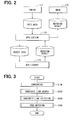
- FIG. 2 is an explanatory view showing the function of the control circuit 17.
- the function of the control circuit 17 is categorized into a tuning block 171, an application block 172, a DLR library block 173, and an image block 174.
- the tuning block 171 is configured to receive the TPEG data via the receiver device 11. That is, the tuning block 171 has the above-described tuning function.
- the tuning block 171 sends the received TPEG data to the application block 172.
- the application block 172 is a function produced by an application program.
- the application program is stored in the ROM 17b and executed by the CPU 17a.
- the application block 172 manages the TPEG data sent from the tuning block 171 and updates the TPEG data when receiving new TPEG data.
- the application block 172 further includes information for identifying a parcel (object parcel) being an indicated object to be indicated on the screen.
- the screen may include a single object parcel or may include multiple object parcels such as nine object parcels, in dependence on a scale size.
- the application block 172 sends information on the object parcel and position information of TPEG data as object data to the DLR library block 173.
- the DLR library block 173 is a function produced by a DLR library program. Similarly to the application program, the DLR library program is stored in the ROM 17b and executed by the CPU 17a.
- the DLR library block 173 executes a matching processing described later.
- the matching processing is implemented to estimate a pertinent road (link) in the map data inputted from the map data input device 13 according to the position information of the TPEG data.
- the DLR library block 173 reads the map data from the map data input device 13 into the RAM 17c on request caused by the application block 172.
- the DLR library block 173 sends the result of the matching processing as a matching result to the application block 172.
- the application block 172 manages the matching result. Further, the image block 174 implements map update based on the matching result. Thus, as described above, the traffic information based on the TPEG data is overlapped on the map image based on the map data inputted from the map data input device 13.
- FIG. 3 is a flow chart showing the matching processing.
- the conversion processing is implemented to convert the position information (binary data) as DLR of the TPEG data into intermediate data.
- discrete points are mainly used as the position information of the TPEG data.
- These discrete points are core points (CPs).
- the CPs have various attributes. In the present configuration, attributes necessary for the road estimation processing are retrieved to generate intermediate data.
- FIG. 4 shows attributes included in the CPs converted into the intermediate data.
- multiple CPs are transmitted as the position information of the TPEG data. Therefore, the CPs are managed as data array.
- the position may be estimated based on a single CP. In this case, a single CP may be transmitted.
- the CP includes the latitude, the longitude, an IP flag, and a virtual CP flag fundamental attributes.
- the latitude is the coordinates representing the latitude of the CP
- the longitude is the coordinates representing the longitude of the CP.
- the IP flag represents whether the CP is an intersection.
- the IP flag is set at 1 when the CP represents an intersection, and the IP flag is set at 0 otherwise.
- the virtual CP flag represents whether the CP is a virtual CP.
- the virtual CP flag is set at 1 when the CP represents a virtual CP, and the virtual CP flag is set at 0 otherwise.
- the virtual CP will be described later.
- the CP includes various attributes about a road, which connects CPs.
- the attribute is categorized into a shape-relevant attribute related to a road shape and a non-shape-relevant attribute, which is not related to a road shape.
- the non-shape-relevant attribute will be described.
- An attribute FC represents a road classification. As shown by the example of FIG. 5 , a road is classified into ten levels including 0 to 9 levels. The number 0 represents a main road, the number 1 represents the first class road, and the number 2 represents the second class road. Similarly, the road is classified into levels from the third class road represented by 3 to the ninth class road represented by 9. For example, the main road is connected to a country or a capital, and the first class road is a national highway connecting major cities therebetween.
- An attribute FW represents a physical road type. As shown by one example of FIG. 6 , the physical road type is classified into thirteen categories including 0 to 13. In FIG. 6 , 0 represents unclear, 1 represents a highway, 2 represents multiple-lane driveway excluding a highway, 3 represents a single-lane driveway, 4 represents a rotary, 5 represents a traffic square, 6 represents a surrounded traffic area, 7 represents a bypass, 8 represents a feeder road, 9 represents an inlet or an outlet of a parking space, 10 represents an inlet or an outlet of a service area, 11 represents a pedestrian zone, and 12 represents a passage.
- 0 unclear
- 1 represents a highway
- 2 represents multiple-lane driveway excluding a highway
- 3 represents a single-lane driveway
- 4 represents a rotary
- 5 represents a traffic square
- 6 represents a surrounded traffic area
- 7 represents a bypass
- 8 represents a feeder road
- 9 represents an inlet or an outlet of a parking space
- 10 represents an inlet or an outlet of
- An attribute RD represents an RD value being the route number, if a road is assigned with the route number.
- the RD value may represent a national route number, such as "1" in a case where the road is the route 1.
- a road name is assigned as the RD value. Referring to FIG. 4 , the road name includes five characters of a formal name at maximum.
- an attribute IT represents the classification (intersection classification) of an intersection.
- the intersection classification is classified into seven categories including 0 to 6.
- 0 represents undefined
- 1 represents a highway or a speed-limited interchange
- 2 represents a rotary
- 3 represents a complicated intersection other than the categories of 1 and 2
- 4 represents a simple intersection
- 5 represents a traffic square
- 6 represents a two-value intersection where a route number or a road name changes.
- an attribute RDI represents the name of an intersection.
- an attribute DD represents a legally-permitted driving direction.
- 0 represents that legally-permitted driving direction is undefined
- 1 represents that legally-permitted driving direction is the forward direction
- 2 represents that legally-permitted driving direction is the backward direction
- 3 represents that legally-permitted driving direction is both directions.
- An attribute AFR is a flag, which represents whether the attribute DD is referable. The attribute AFR is set at 1 when the attribute DD has a value of one of 0 to 3. Otherwise, the attribute AFR is set at 0 to represent that the attribute DD is non-referable when the attribute DD does not have a value.
- an attribute BR represents the geographical angle to the subsequent CP.
- multiple CPs are, in general, managed as data arrays.
- the attribute BR represents a value being the angle in the clockwise direction relative to the north direction.
- an attribute DMB represents the linear distance to the subsequent CP.
- the attribute DMB represents a value of the linear distance to the subsequent CP, since the subsequent CP exists in general.
- An attribute CA represents the angle relative to a side road.
- the side road is a minor road, which is not assigned with a route number.
- the attribute CA is assigned to represent a value being the angle to the side road.
- the attribute CA is a positive value when the side road is in the clockwise direction with respect to the angle of the attribute BR, and is a negative value when the side road is in the counterclockwise direction with respect to the angle of the attribute BR.
- An attribute DCA represents the connection distance to the side road.
- the attribute CA represents the direction of the vector from the CP
- the attribute DCA represents the volume of the vector from the CP. Therefore, the position coordinates are determined by the attribute CA and the attribute DCA. The position coordinates represent the point where the side road exists.
- an attribute PCI represents one of driveways (roads) being selected when multiple driveways exist in the same direction.
- the attribute PCI includes the number of driveways and a sequence number representing the order of the object road in the driveways.
- an attribute PDM represents the spaced distance by which the object road is spaced from a straight line connected to the subsequent CP.
- the spaced distance represents the maximum distance to the object road.
- an attribute PD represents the travel distance along the object road to the CP including the subsequent attribute PD.
- FIG. 8 shows the detailed processing of the conversion.
- FIG. 9 is an explanatory view showing a two-dot chain line indicating a road shape represented by CPs for convenience.
- the object is to estimate such a road shape and to implement matching of the estimated road shape with a road represented by a link array of the map data.
- the road shape indicated by the two-dot chain line in FIG. 9 is an example simplified for convenience of explanation and does not represent an actual road shape.
- the array of CPs may be within an object parcel. Otherwise, it is further noted that, as shown in FIG. 9 , the array of CPs may extend beyond the object parcel to a parcel around the object parcel. In such a case, a virtual CP is assigned to the boundary of the object parcel.
- FIG. 10A shows a case where two CPa and CPb are located through the boundary of the object parcel.
- a peak V of the road shape can be derived from the value of the attribute PDM.
- a line segment, which connects the peak V of the road shape with the CPa, and a line segment, which connects the peak V with the CPb, are also derived.
- the virtual CP is assigned to the intersection between one of the line segments and the boundary of the object parcel.
- the CPs are represented as CPa, CPb, CPc, and the like by adding symbols a, b, c and the like in order to distinguish multiple CPs.
- the attributes of CPs are recalculated. Since the virtual CP is assigned, the CP on the end side (end-side CP) is excluded from CPs to be processed (described later). In the example of FIG. 10A , the CPb on the end side is excluded from CPs to be processed. Therefore, the attributes of the CP on the start side (start-side CP) and the attributes of the virtual CP are recalculated. In the example of FIG. 10A , the attributes of the CPa and the attributes of the virtual CP are recalculated. The attributes to be recalculated include the attribute BR, the attribute DMB, the attribute PCI, the attribute CA, the attribute DCA, the attribute PDM, and the attribute PD.
- the attribute BR and the attribute DMB respectively represent the angle relative to the subsequent CP and the linear distance from the subsequent CP. Therefore, the angle relative to the subsequent CP and the linear distance from the subsequent CP including the newly assigned virtual CP are calculated and set.
- the attribute CA and the attribute DCA of the CP on the start side are not recalculated.
- the attribute CA and the attribute DCA of the CPa are not recalculated.
- the attribute CA and the attribute DCA of the virtual CP are set at invalid values. The processing is implemented in this manner, since the attribute CA and the attribute DCA are related with a side road, and such information on a side road is not applicable to the virtual CP.
- the attribute PCI is related to the number of driveways (roads, lanes) extending in parallel. Therefore, the attribute PCI of the CP on the start side is not recalculated. In the example of FIG. 10A , the attribute PCI of the CPa is not recalculated.
- the attribute PCI of the virtual CP is set in accordance with the attributes PCI of the CPs on the start side and on the end side. In the example of FIG. 10A , the attribute PCI of the virtual CP is set in accordance with the attributes PCI of the CPa and the CPb.
- FIG. 11 shows a detailed calculation rule of the attribute PCI of the virtual CP.
- the attribute PCI of the virtual CP is set at the same value of the attributes PCI of both the CPs. Otherwise, when the attributes PCI of both the CPs do not coincide with each other, the attribute PCI of the virtual CP is set at an invalid value.
- the attribute PCI of the virtual CP is set at the value of the attribute PCI of the one CP. Otherwise, when one of the CP on the start side and the CP on the end side has the attribute PCI and when the virtual CP is not located in the vicinity of the CP, which has the attribute PCI, the attribute PCI of the virtual CP is set at an invalid value.
- the virtual CP is determined to be located in the vicinity of the CP having the attribute PCI when, for example, the linear distance from the virtual CP to the CP having the attribute PCI is 10% or less of the linear distance between the CP on the start side and the CP on the end side.
- the attribute PCI of the virtual CP is set at an invalid value.
- the attribute PDM represents the spaced distance by which the object road is spaced from the straight line connected to the subsequent CP.
- the value of the attribute PDM before being assigned with the virtual CP is multiplied by a correction value to set the attribute PDM. Specifically, a divisional rate of the virtual CP is calculated, and a correction value is calculated by using the subsequent formula.
- the divisional rate is calculated by using the subsequent formula.
- the divisional rate, when the attribute PDM of the CP on the start side is recalculated, is:
- the divisional rate, when the attribute PDM of the virtual CP is recalculated, is:
- the total linear distance is the summation of the linear distances of the linear paths from the CP on the start side to the CP on the end side through the virtual CP. That is, the total linear distance is the summation of the linear distance between the CP on the start side and the virtual CP and the linear distance between the virtual CP and the CP on the end side.
- the attribute PD is the travel distance to the subsequent CP having the attribute PD and is not necessarily assigned to all the CPs. Therefore, two CPs located beyond a parcel boundary may not have the attribute PD. Therefore, recalculation is implemented using one of CPs having the attribute PD and closest to the virtual CP. When a CP, which has the attribute PD, does not exist, recalculation of the attribute PD is not implemented.
- the value of the attribute PD assigned to the CP is divided proportionally according to the linear distance to the virtual CP. That is, the value of the attribute PD of the CP is calculated by multiplying the original value of the attribute PD of the CP by the divisional rate calculated by using the formula 3. In addition, the value of the attribute PD of the virtual CP is calculated by multiplying the original value of the attribute PD of the CP on the start side by the divisional rate calculated by using the formula 4.
- narrowing down processing of CPs within the object parcel is implemented.
- the present processing is implemented to set only the CPs including the virtual CP within the object parcel to obtain the processing object.
- An array of CPs may extend beyond a boundary of an object parcel. Nevertheless, it suffices to implement the matching only to the object parcel being an indicated object of the application.
- the virtual CP is assigned thereby to set the processing object in the range to the virtual CP on assumption that the CP exists in the boundary of the object parcel.
- the processing may be implemented by using an original CP, which is included in the DLR data being provided, as a CP on the end side of an object parcel.
- the CPa in the object parcel may be used as the CP on the end side.
- the CPb which first appears outside the object parcel may be used as the CP on the end side.
- the CPa and/or the CPb may be away from the boundary of the object parcel.
- one of the CPa and the CPb may be selected as the CP on the end side, according to the distance of the CPa and the CPb from the boundary of the object parcel.
- FIG. 33 shows a conversion processing according to other embodiment (1).
- a CP inside the boundary of the object parcel and closest to the boundary is retrieved.
- the distance from the CP retrieved at S500 to the boundary of the object parcel is measured.
- FIG. 10B it is conceived to calculate an intersection K between a straight line, which connects the CPa with the CPb, and the boundary of the object parcel and to measure the linear distance A to the intersection K.
- the distance to the CP which is inside the boundary and closest to the boundary, is greater than or equal to a predetermined distance.
- the predetermined distance may be set in consideration of an accuracy of road estimation close to the boundary of the object parcel.
- the CP inside the object parcel is set as a processing object CP.
- the CP which is outside the boundary and closest to the boundary, is set as the processing object CP, in addition to the CP inside the object parcel.
- the CPa which is inside the object parcel, is set as the CP on the end side normally at S530 in FIG. 33 .
- the CPb outside the object parcel is set as the CP on the end side.
- the region defined by the CPa is the processing object normally, thereby to reduce the processing time as much as possible.
- the region defined by the CPb is the processing object. Therefore, accuracy of the road estimation close to the boundary of the object parcel can be enhanced. Thus, it is possible to avoid insufficient traffic information, such as traffic congestion information.
- FIG. 34 shows a conversion processing according to other embodiment (2).
- a CP outside the boundary of the object parcel and closest to the boundary is retrieved.
- the distance from the CP retrieved at S600 to the boundary of the object parcel is measured.
- FIG. 10B it is conceived to calculate an intersection K between a straight line, which connects the CPa with the CPb, and the boundary of the object parcel and to measure the linear distance B to the intersection K.
- the distance to the CP is greater than or equal to a predetermined distance.
- the predetermined distance may be determined in consideration of processing load for CPs (core points).
- the CP which is outside the boundary and closest to the boundary, is set as the processing object CP, in addition to the CP inside the object parcel.
- the CP inside the object parcel is set as the processing object CP.
- the CPb which is outside the object parcel, is set as the CP on the end side normally at S630 in FIG. 34 .
- the CPa inside the object parcel is set as the CP on the end side.
- the region defined by the CPb is the processing object normally. Therefore, accuracy of road estimation around the boundary of the object parcel can be enhanced.
- traffic information such as traffic congestion information, can be sufficiently indicated.
- the processing time can be restricted from being too long.
- FIG. 35 shows a conversion processing according to other embodiment (3).
- a CP outside and inside the boundary of the object parcel and closest to the boundary is retrieved.
- the distance from each CP retrieved at S700 to the boundary of the object parcel is measured.
- FIG. 10B it is conceived to calculate an intersection K between a straight line, which connects the CPa with the CPb, and the boundary of the object parcel and to measure the linear distances A, B to the intersection K.
- the CP which is outside the boundary and closest to the boundary, is set as the processing object CP, in addition to the CP inside the object parcel.
- the linear distance A is compared with the linear distance B.
- the CPa which is inside the object parcel, is set as the CP on the end side when the linear distance B is greater than the linear distance A.
- the CPb which is outside the object parcel, is set as the CP on the end side when the linear distance B is less than the linear distance A.
- the CP on the end side is determined according to the linear distances A, B.
- inheritance of the attributes is also implemented.
- the non-shape-relevant attributes of such a CP is inherited to a CP, which exists between intersections. In this way, acquisition of the non-shape-relevant attributes at each time in processings described later can be omitted.
- the attributes to be inherited are the attribute FC, the attribute FW, the attribute RD, the attribute DD, and the attribute AFR.
- the array of CPs converted into intermediate data is generated. That is, at this time, the CPs have the various kinds of attributes shown in FIG. 4 . At least one of the node and the link of the map data also has the attributes corresponding to the attributes of the CPs. Therefore, a road represented by the CPs is finally estimated by comparing the various attributes.
- a candidate link search processing is implemented.
- a candidate link array is searched, and thereafter narrowing down processing is implemented for each link.
- a candidate selection processing is implemented.
- the candidate selection processing is implemented further to narrow down the link, which has been narrowed down at S200.
- a road matching processing is implemented.
- the road matching processing is implemented to estimate a link, which connects CPs therebetween.
- the processing of S200 to S400 is repeatedly implemented by the number of the object CPs each being narrowed down at S130 in FIG. 8 .
- FIG. 12 shows an example of the candidate link search processing at S200.
- information on the object CP is first obtained.
- the processing is implemented to obtain the category of the CP, the latitude of the CP, and the longitude of the CP.
- the category of the CP represents distinction among the CP, which represents an intersection, the virtual CP, and other CPs.
- a search region is set.
- the processing is implemented to set the search region of links around the object CP.
- the search region has the boundary defined by a polygon including a vertical line segment and a horizontal line segment.
- the search region is defined by the region including a square and a cross shape being combined together. The cross shape is longer than one side of the square.
- a parcel located in the search region is retrieved.
- This processing is implemented to retrieve all the parcels related to the search region in the selection of the link array, in consideration of that the node and the link are managed by each parcel. For example, as shown in FIG. 13B , the three parcels P1, P2, P3 are retrieved in dependence upon the search region.
- the link array selection processing is implemented to search links for each link array, according to the non-shape-relevant attributes.
- the link array is a link group including a series of links having the same road classification, such as a highway or a local road.
- a link array partially included in the parcel retrieved at S230 is a search object.
- a link array is first narrowed down according to the attributes without determination whether the link array is in the search region.
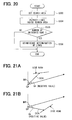
- FIG. 14 shows one example of the link-array selection processing.
- extraction is implemented for each link array according to the attribute FC, the attribute FW, and the attribute RD each being the non-shape-relevant attribute.
- link arrays are narrowed down into link arrays having the same attribute FC.
- the attribute FC represents the road classification, as described above.
- the road classifications assigned to links of a link array are compared with the attribute FC of the object CP to narrow down the link arrays. It is noted that the road classification may change in the course of a link array. In consideration of this, when the road classifications of all the links of a link array coincide with the attribute FC, the link array is determined to be a candidate link array.
- link arrays are narrowed down into link arrays having the same attribute FW.
- the attribute FW represents the physical road type, as described above.
- the physical road types assigned to links of a link array are compared with the attribute FW of the object CP to extract a link array. It is noted that the physical road type may change in the course of a link array. In consideration of this, when the physical road types of all the links of a link array coincide with the attribute FW, the link array is determined to be a candidate link array.
- link arrays are narrowed down into link arrays having the same attribute RD.
- the attribute RD represents the route number or the road name, as described above.
- the route numbers assigned to links of a link array are compared with the attribute RD of the object CP to narrow down link arrays. It is noted that the route number may change in the course of a link array. In consideration of this, when the route numbers of all the links of a link array coincide with the attribute RD, the link array is determined to be a candidate link array.
- a link partially included in the search region centering on, i.e., around the object CP is extracted.
- the link array is selected in the link array selection processing at S240. Therefore, in this processing, a link partially included in the search region is extracted from the links of the selected link array.
- the link partially included in the search region will be described here. The following description is made on the premise that a node is assigned normally to an intersection, a node is assigned to the boundary of a parcel, and a shape-interpolation point is set between nodes as needed.
- a node-conscious processing is implemented.
- the node-conscious processing is implemented, since the object CP is matched with a node when the object CP represents an intersection. Therefore, in this case, when one of two nodes of a link is included in the search region, the link is determined to be a link partially included in the search region.
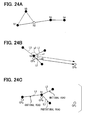
- each of the links L1, L2, L3, L4, L5 having one termination point being one of the nodes A, B, C is the link partially included in the search region.
- the map data has a level (parcel level) corresponding to its scale size.
- the parcel level is changed as a user switches the scale size. Therefore, extraction of a link is implemented for all the parcel levels.
- the parcel level is set sequentially from the lower level in a manner of, for example, LV0 to LV2 to LV4 to LV6 to LV8 to LV10, etc. As the parcel level goes up to the higher level, intersections and roads are reduced.
- the CPs are data corresponding to LV0 being the lowest parcel level. Therefore, on the parcel levels higher than LV2, a node corresponding to an intersection does not necessarily exist. In consideration of this, in the extraction processing on the parcel level higher than LV2, even when nodes of a link do not exist in the search region, the link is extracted in a case where the link satisfies a predetermined condition. The case where the link satisfies the predetermined condition will be described later.
- the object CP represents a virtual CP
- a node-conscious processing is also implemented.
- the specification of the map data regulates to define a node in a parcel boundary. Therefore, when the object CP is a virtual CP, the virtual CP is assigned in the parcel boundary. In consideration of this, when a node exists in the same parcel boundary, the node is matched with the virtual CP.
- the link is determined to be the link partially included in the search region.
- the object CP represents the virtual CP
- the node D exists in the parcel boundary.
- the links L6, L8 having the node D as one termination point are the links partially included in the search region.
- a link is extracted without being conscious of a node.
- a link, in which at least one of nodes is included in the search region, and a link, in which none of nodes is included in the search region are extracted in a case where the link satisfies a predetermined condition.
- the extraction of a link is implemented in a similar manner on all the parcel levels.
- the link satisfies the predetermined condition.
- shape-interpolation points are set between the two nodes, and a line segment connecting the shape-interpolation points is partially included in the search region.
- a link L9 includes a line segment, which connects the shape-interpolation points (small black dots), and the line segment of the link L9 is partially included in the search region. Therefore, although the nodes E, F are not included in the search region, the link L9 is the link partially included in the search region.
- the link L10 includes a line segment, which connects the shape-interpolation points, and the line segment of the link L10 is not partially included in the search region.
- the link L10 is not the link partially included in the search region.
- a shape-interpolation point is not set between the two nodes, and a line segment connecting the two nodes is partially included in the search region.
- a link L11 includes two nodes G, H connected by a line segment, and the line segment is partially included in the search region. Therefore, the link L11 is the link partially included in the search region.
- ten links at maximum are extracted. Specifically, when the number of links is more than ten after the narrowing down at S260, ten links are selected sequentially from one link near the object CP. Specifically, for example, a perpendicular line may be drawn from the object CP to each link to measure the distance between the object CP and each link, and thereby it is determined whether the link is near the object CP.
- the candidate selection processing is implemented to select a candidate for each of links and nodes.
- FIG. 16 shows one example of the candidate selection processing.
- coincidence determination is implemented according to non-shape-relevant attributes.
- the coincidence determination is implemented for the link extracted at S200 and/or the nodes of the extracted link according to the attribute FC, the attribute FW, the attribute IT, the attribute RDI, the attribute DD, and the attribute AFR. Details of the coincidence determination processing will be described later in detail.
- the attribute FC and the attribute FW are already used in the narrowing down processing of the link array at S241, S242 in FIG. 14 . Therefore, this processing may include a redundant processing. Nevertheless, the narrowing down processing is again implemented in order to make sure the narrowing down processing.
- This coincidence determination is implemented further by using the attribute IT, the attribute RDI, the attribute DD, the attribute AFR, and the like in order to implement a finer coincidence determination processing to surely retrieve a correct result.
- a candidate link is narrowed down, i.e., extracted based on the determination result according to the non-shape-relevant attributes. Specifically, as a result of the coincidence determination according to the non-shape-relevant attributes at S310, a link having many coincident attributes is determined to be a candidate link.
- coincidence determination is implemented according to shape-relevant attributes.
- the coincidence determination is implemented for the candidate link determined at S320 and/or the nodes of the determined link according to the attribute BR, the attribute PCI, the attribute CA, and the attribute DCA. Details of the coincidence determination processing will be described later in detail.
- a candidate link is further narrowed down, i.e., extracted based on the determination result according to the shape-relevant attributes. Specifically, as a result of the coincidence determination according to the shape-relevant attributes at S330, a link having many coincident attributes is determined to be a candidate link.
- FIG. 17 shows one example of the coincidence determination according to the non-shape-relevant attributes.
- coincidence determination is implemented according to the attribute FC.
- the attribute FC represents the road classification, as described above. In this processing, coincidence is determined between the road classification assigned to a link being a determination object and the attribute FC of the object CP.
- coincidence determination is implemented according to the attribute FW.
- the attribute FW represents the physical road type, as described above. In this processing, coincidence is determined between the physical road type assigned to a link being a determination object and the attribute FW of the object CP.
- coincidence determination is implemented according to the attribute IT.
- the attribute IT represents the classification of an intersection, as described above. Therefore, only when the object CP represents an intersection, the coincidence determination is implemented.
- At least one of the nodes and the links has an attribute equivalent to the attribute IT.
- intersection classification information which represents the classification of an intersection
- coincidence is determined between the intersection classification information on the node corresponding to the object CP and the attribute IT of the object CP.
- link has intersection classification information, which represents the classification of an intersection
- coincidence is determined between the intersection classification information on the link connecting to a node, which corresponds to the object CP, and the attribute IT of the object CP.
- the link may have the intersection classification information on two nodes. Therefore, in this case, coincidence is determined between the intersection classification information on one of the nodes and the attribute IT.
- coincidence determination is implemented according to the attribute RDI.
- the attribute RDI represents the name of an intersection, as described above. Therefore, only when the object CP represents an intersection, the coincidence determination is implemented. In this processing, coincidence is determined. between the intersection name of a node corresponding to the object CP and the attribute RDI of the object CP. This processing is implemented by determining whether the character string, which is the value of the attribute RDI, is included in the intersection name.
- coincidence determination is implemented according to the attribute DD and the attribute AFR.
- the attribute DD represents a legally-permitted driving direction
- the attribute AFR is a flag, which represents whether the attribute DD is referable.
- the determination is made by comparing the attribute DD of the object CP with an attribute (one-way traffic code) of the link being the determination object.
- the determination is implemented when the attribute AFR is set at 1 to represent that the attribute DD is valid, excluding a case where the attribute DD is 0 (undefined). It is noted that the attribute DD represents the drivable direction of the road with respect to certain traffic information.
- FIG. 18 shows one example of the coincidence determination processing according to the shape-relevant attributes.
- coincidence determination is implemented according to the attribute BR.
- the attribute BR represents the geographical angle to the subsequent CP, as described above.
- a link has an attribute representing the traveling direction legally regulated by law.
- non-coincidence determination is implemented in this processing when the traveling direction of the link largely differs from the direction represented by the attribute BR of the object CP.
- it is conceived to make non-coincidence determination when the angle between the vector, which represents the traveling direction of the link, and the vector, which is directed to the subsequent CP and represented by the attribute BR, is greater than or equal to a predetermined angle, such as 90 degrees.
- the link is a two-way traffic road to allow two-way traveling in both traveling directions, the determination is made based on two vectors each representing the traveling direction.
- the determination is made based on the angle between the vectors VL1, VL21, VL22, VL3, which respectively represent the traveling directions of the links L1, L2, L3, and the vector VB represented by the attribute BR.
- the non-coincidence determination is made.
- the non-coincidence determination is made. Determinations for the vectors VL21, VL22, VL3 are made, similarly to the determination for the vector VL1.
- the link L2 is a two-way traffic road to allow two-way traveling in both traveling directions. Therefore, the determination for the link L2 is made based on the two vectors VL21, VL22 representing the traveling directions.
- the angle between the vector VB and the vector VL1 is approximately 180 degrees and is greater than or equal to 90 degrees. Therefore, non-coincidence determination is made for the link L1.
- the angle between the vector VL22 of the link L2 and the vector VB is greater than or equal to 90 degrees. Nevertheless, the angle between the vector VL21 of the link L2 and the vector VB is less than 90 degrees. Therefore, coincidence determination is made for the link L2.
- the angle between the vector VL3 of the link L3 and the vector VB is less than 90 degrees. Therefore, coincidence determination is made for the link L3.
- the non-coincidence determination is made when the angle is greater than or equal to 90 degrees. Therefore, as shown in FIG. 19B , with respect to the vector VB represented by the attribute BR, the coincidence determination is made for the traveling directions of the links represented by the vectors V1, V2, and the non-coincidence determination is made for the traveling directions of the links represented by the vectors V3, V4.
- coincidence determination processing is implemented according to the attribute PCI.
- the attribute PCI represents one of driveways being selected when multiple driveways exist in the same direction, as described above.
- the attribute PCI includes attributes PCISF, PCIT, PCII, PCIN, PCIS.
- the attribute PCISF is a flag representing whether a default search area is set. The value of the attribute PCISF is true or false. When the value of the attribute PCISF is true, the attribute PCISF represents that the default search area is set. Alternatively, when the value of the attribute PCISF is false, the attribute PCISF represents that the default search area is not set.
- the attribute PCIT is a flag representing the direction of a driveway extending in parallel.
- the value of the attribute PCIT is true or false.
- driveways, each of which extending substantially in the north-south direction are arranged in line along the east-west direction.
- driveways, each of which extending substantially in the east-west direction are arranged in line along the north-south east-west direction.
- the attribute PCII is a sequence number of the parallel driveways extending in parallel and represents the order (number of position) of a road represented by the CP in the parallel driveways.
- the attribute PCIN represents the number of the parallel driveways extending in parallel. For example, when the PCIN is 5, the attribute PCIN represents that five roads (driveways) extend in parallel.
- the attribute PCIS represents the radius of a default search area.
- the radius of the default search area is set.
- a search area around the object CP is set.
- the search area is inside the circle centering on the object CP. More specifically, for example, when the value of the attribute PCISF is false, the search area is set inside a circle having a predetermined radius such as 150 meters. For example, in FIG. 37 , the radius r is set at 150 meters.
- the search area is set inside a circle having a radius, which is summation of a predetermined distance, such as 150 meters, and the value of the attribute PCIS.
- a predetermined distance such as 150 meters
- the radius r is set at a summation of the value of the attribute PCIS and 150 meters.
- a virtual straight line is drawn in the direction along the latitude or in the direction along the longitude according to the value of the attribute PCIS, thereby to extract links intersecting to the virtual straight line
- the attribute PCIT when the attribute PCIT is true, multiple driveways are arranged along the east-west direction. Therefore, a virtual straight line is drawn on the same latitude in the east-west direction, and links, which intersect with the virtual straight line, are extracted.
- the attribute PCIT is false
- multiple driveways are arranged along the south-north direction. Therefore, a virtual straight line is drawn on the same longitude in the south-north direction, and links, which intersect with the virtual straight line, are extracted.
- the number of the extracted links coincides with the number of the driveways. Specifically, in this processing, the number of the links, which intersect with the virtual straight line K at S334 is compared with the value of the attribute PCIN. In the example of FIG. 37 , the number of 4 is compared with the value of the attribute PCIN.
- the links are identified based on the sequence number of the parallel driveways being the value of the attribute PCII. Further, it is determined whether the identified links coincide with links of the determination object. Thus, the coincidence determination processing according to the attribute PCI is terminated.
- the attribute CA represents the angle relative to a side road
- the attribute DCA represents the connection distance to the side road.
- the direction to the side road is first detected. Specifically, as shown in FIG. 21A , when the attribute CA is a negative value, it is determined that the side road is located on the left side relative to the direction, which is represented by the attribute BR and directed to the subsequent CP. Otherwise, as shown in FIG. 21 B , when the attribute CA is a positive value, it is determined that the side road is located on the right side relative to the direction, which is represented by the attribute BR and directed to the subsequent CP.
- the links being the candidates are selected around each CP.
- the road matching processing (S400) in FIG. 3 is implemented in order to estimate a link, which connects these links, i.e., to implement a link, which connects CPs therebetween.
- FIG. 22 shows one example of the road matching processing.
- two CPs are defined as object CPs.
- the CP on the start side of the two CPs is a start-side CP
- the CP on the end side of the two CPs is an end-side CP.
- a search processing is implemented to search a road, which connects a start-side candidate link with an end-side candidate link.
- the start-side candidate link is a link extracted for the start-side CP.
- the end-side candidate link is a link extracted for the end-side CP.
- all the roads, each of which connects the start-side candidate link with the end-side candidate link are searched.
- the start-side CP is a CPa
- the end-side CP is a CPb
- the extracted link for the CPa is SL
- the extracted link for the CPb is GL.
- the search processing is implemented to search a road connecting the start-side candidate link SL with the end-side candidate link GL. It is noted that the search processing searches the road for all the combinations between any one of the two nodes SN1, SN2 of the link SL and any one of the two nodes GN1, GN2 of the link GL. More specifically, the processing searches the road connecting the SN1 with the GN1 in this order, the road connecting the SN1 with the GN2 in this order, the road connecting the SN2 with the GN1 in this order, and the road connecting the SN2 with the GN2 in this order.
- a road-by-road candidate selection is implemented. This processing is implemented to determine a candidate road among the roads searched at S410 based on various kinds of shape-relevant attributes.
- a candidate road is narrowed down based on the determination result at S420.
- the road matching processing (S410 to S440) is repeated for the two object CPs being paired. It is noted that at S410, a road to be searched using the result of the road matching processing may be omitted.
- a road from the link SL through the link CL to the link GL1 is uniquely determined, as a result of the road matching processing between the CPa and the CPb.
- the road matching processing is implemented to search a road from the CPb to the subsequent CP, a road connected from the link GL1 is searched. That is, even when the link GL2 exists in the candidate links, the road search processing starting from the link GL2 is omitted.
- the road search processing is omitted according to the category of the CP. Specifically, for example, as shown in FIG. 23C , when the CPb is an intersection, the CPb coincides with the node GN2, which represents an intersection. Therefore, in this case, the road search processing is implemented for the link GL to search a road connected to the one node GN1 of the link GL. That is, the processing searches a road connecting the node SN1 with the node GN1 and a road connecting the node SN2 with the node GN1.
- the node is the start-side node or the end-side node.
- a road connected to one node GN1 is searched for the link GL, similarly to the previous case. That is, the processing searches a road connecting the node SN1 with the node GN1 and a road connecting the node SN2 with the node GN1.
- the search processing is first implemented and has searched a road starting from the node N1 through the nodes N2 and N3 to the node N4 in this order.
- the road search processing is implemented to search a road starting from the node N1 through the node N5 to the N2.
- the road search processing for searching a road from the node N2 has been already implemented. Therefore, the road search processing for searching a road starting from the node N2 is not implemented at this time.
- a priority is assigned to the link, and the road search processing is implemented.
- the road search processing is implemented from a certain node, a reference direction in which the certain node is connected with the object CP is calculated. Subsequently, an angle between each of links, which is connected with the certain node, and the reference direction is calculated. Thus, only links within a predetermined angle are set as objects in the road search processing.
- the road search processing is implemented to search a road starting from the node N1.
- the reference direction is set at the direction from the CPa to the CPb.
- angles a1, a2, a3 of the links N1, L2, L3 each connected with the node N1 are calculated relative to the reference direction.
- the angles a1, a2 are within the predetermined angle, and therefore, the links L1, L2 are set as the objects of the road search processing.
- the angle a3 is out of the predetermined angle, and therefore, the link L3 is excluded from the object of the road search processing.
- a link which has the road classification being the same as the road classification of the link to certain the node, is set as the object of the road search processing.
- a road which starts from the CPb to the CPc, is searched from the node N1.
- the road classification of the link L1 represents a national road. Therefore, in the road search from the node N1, the link L2, which has the road classification representing a national road, is set as the object of the road search. That is, the link L3, which has the road classification representing a prefectural road, is excluded from the object of the road search.
- the road search processing at S410 is not necessarily completed within a predetermined time. In consideration of this, the road search processing may be aborted in the course of the processing.
- the attribute PD For example, it is conceivable to use the attribute PD.
- both the CPa and the CPb respectively have the attributes PD.
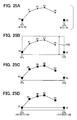
- the accumulation distance is calculated along the shape-interpolation points K1, K2, K3, K4.
- the road search processing is stopped.
- the distance along the U-shaped path shown by the dashed line is calculated by using the linear distance between the CPa and the CPb and the value of the attribute PDM.
- the accumulation distance is calculated along the shape-interpolation points K1, K2, K3, K4.
- the number of the nodes it is conceivable to use the number of the nodes to be passed.
- the road search processing is implemented to search a road starting from the node N1 to the node N2, the number of the nodes N3, N4, N5, N6 being passed therethrough is counted.
- the road search processing is stopped.
- a CP is an intersection.
- both the CPa and the CPb are respectively intersections.
- the node N1 and the node N2 respectively coincide with the CPa and the CPb. Therefore, the linear distance between the node N1 and the node N2 is calculated beforehand.
- the accumulation distance of the path passing through the nodes N3, N4, N5, N6 is calculated.
- the road search processing is stopped.
- the road search processing is stopped in the course of the processing when determined to be wrong. Therefore, the processing load for the road search processing is reduced.
- FIG. 26 shows one example of the road-by-road candidate selection processing.
- the road-by-road candidate selection processing is implemented to make determination of "OK" or "NG” road by road (per road unit) for the roads extracted between the CPs.
- the attribute CA represents the angle relative to a side road
- the attribute DCA represents the connection distance to the side road, as described above.
- an NG determination is made to the link.
- FIG. 27A when the circumference of coordinates represented by the attribute CA and the attribute DCA includes a link, an NG determination is made to a road including the link.
- FIG. 27B shows a road 1 and a road 2 connecting the CPs therebetween.
- a link is determined to be a side road based on the attribute CA and the attribute DCA. Therefore, an NG determination is made to the road 1 including the link determined to be a side road.
- determination is implemented according to the attributes BR, DMB.
- the attribute BR represents the angle to the subsequent CP
- the attribute DMB represents the linear distance to the subsequent CP, as described above.
- a road being further possible can be identified by using the attribute BR and the attribute DMB.
- determination of the road between the CPb and the CPc is implemented by using the attribute BR and the attribute DMB of the CPa in advance of the CPb. Specifically, an OK determination is made to the road including the link L around the coordinates identified by the attribute BR and the attribute DMB.
- the link L overlaps the region H shown by the dashed line around the coordinates.
- the determination is implemented for a road between the CPb and the CPc. Therefore, the determination is made on condition that a node of the link L or a shape-interpolation point of the link L is in the predetermined region.
- the predetermined region in the rectangle area shown by the two-dot chain line in FIG. 28 according to the line segment, which connects the CPb with the CPc, and the attribute PDM.
- the predetermined region is not limited to the rectangle area and may be defined in an ellipse, which passes the CPb and the CPc.
- the attribute PD is the travel distance to the subsequent CP having the attribute PD, as described above. Therefore, it is determined whether a searched road is a candidate according to the travel distance of the searched road.
- the travel distance between the CPa and the CPb is calculated.
- each of the CPs does not necessarily coincide with a node. Therefore, a perpendicular line is drawn from the CPa to the link L1, and the intersection M is set between the perpendicular line and the link L1.
- a perpendicular line is further drawn from the CPb to the link L3, and the intersection N is set between the perpendicular line and the link L3.
- the travel distance from the intersection M to the intersection N is calculated.
- the travel distance from the intersection M to the next node is obtained by calculating a rate (percentage) of the travel distance relative to the link L1. Specifically, in the case where the distance from the intersection M to the next node is m percent (%) of the link L1, the travel distance of the link L1 is multiplied by (m / 100) to calculate the travel distance from the intersection M to the next node.
- the travel distance from the intersection N to the preceding node is obtained by calculating a rate (percentage) of the travel distance relative to the link L3. Specifically, in the case where the distance from the intersection N to the preceding node is n percent (%) of the link L3, the travel distance of the link L3 is multiplied by (n / 100) to calculate the travel distance from the intersection N to the preceding node.
- each of the CPs do not necessarily have the attribute PD.
- the candidate determination of the road is not implemented, and the road is maintained as it is.
- the road determination is implemented for the road between the CPa and the CPc based on the attributes PD.
- the NG determination is implemented for a candidate road from the link L1 through the links L2, L3, L5, L6 to the link L10 in this order, a candidate road from the link L1 through the links L4, L5, L6 to the link L10 in this order, a candidate road from the link L1 through the links L2, L3, L5, L7, L8, L9 to the link L10 in this order, and a candidate road from the link L1 through the links L4, L5, L7, L8, L9 to the link L10 in this order.
- a road from the link L1 through the links L2, L3, L5, L6, to the link L10 remains.
- the NG determinations are made to the road between the CPa and the CPb including the link L4 and the road between the CPb and CPc starting from the link L7 through the link L8 to the link L9.
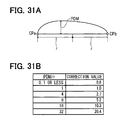
- the attribute PDM represents the spaced distance by which the object road is spaced from the straight line connected to the subsequent CP, as described above. This processing is implemented to calculate the travel distance when traveling along a way according to the attribute PDM and to determine whether the searched road is a candidate.
- the correction value is found from a table according to a ratio of a half value of the linear distance between CPs to the value of the attribute PDM.
- the half value of the linear distance between the CPa and the CPb is denoted by r.
- the correction value corresponding to the ratio (PDM / r) is found from the table shown in FIG. 31 B .
- the ratio (PDM / r) is the ratio of the attribute PDM to the distance r.
- the table shown in FIG. 31 B is an exemplified portion extracted from an example table.
- the travel distance along a candidate road is defined as a road travel distance.
- an OK determined is made to the road: PDM travel distance x 0.5 ⁇ road travel distance ⁇ PDM travel distance x 1.5
- a road is narrowed down according to these determination results, as described above.
- a matching result is outputted at S450.
- the matching result includes the link IDs of all the links of the road being uniquely identified, a start-point offset distance, an end-point offset distance, and the like.
- the start-point offset distance represents a start position of the matching in a link including the start point of the road.
- the end-point offset distance represents an end position of the matching in a link including the end point of the road.
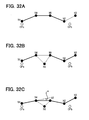
- FIG. 32A it is supposed that two roads remain as a result of the road search processing for searching a road from the CPa to the CPb.
- One of the two is a road starting from the node N1 through the nodes N4, N5, N2 to the node N3 in this order.
- the other is a road starting from the node N1 through the nodes N4, N5 to the node N2 in this order.
- the road starting from the node N1 through the nodes N4, N5 to the node N2 represented by the thick line is included by both the two roads, and therefore, the road is determined uniquely.
- the along-way road includes links at an angle denoted by the symbol a therebetween, and the angle a is less than or equal to the predetermined angle such as 15 degrees.
- the coincidence determination is implemented about the attribute PCI. More specifically, the search area is first set at S333 in FIG. 20 , the link in the search area is extracted at S334, and it is determined whether the number of the driveways coincides at S335. Only when the number of the driveways coincides (S335: YES), the coincidence determination of the links is implemented thereby to narrow down the links at S336. That is, in the present embodiment, it is supposed that multiple roads (driveways) extending in parallel are represented by the CP. In consideration of this, the search area is set for the CP, and links in the search area are extracted. For example, in FIG. 37 , the circular area having the radius r is set as the search area.
- the search area is set by using the radius of the default search area represented by the attribute PCIS. Specifically, the search area is set with the radius being the summation calculated by adding a predetermined distance to the radius of the default search area. In this way, a sufficiently large search area can be set. Therefore, it is highly possible to extract links extending in parallel, without wrong omission.
- the virtual straight line is drawn to pass through a core point (CP) according to a parallel driveway indicator type representing the direction of parallel driveways.
- CP core point
- a parallel driveway indicator type representing the direction of parallel driveways.
- the present embodiment it is determined whether the number of the links extracted in the search area coincides with the number of driveways represented by the value of the attribute PCIN and being the attribute of the CP at S335 in FIG. 20 . Only when the number of the links coincides with the number of driveways (S335: YES), the links are narrowed down at S336. In this way, links pertinent to the road represented by the CP can be appropriately extracted, excluding a case where wrong determination may be made.
- the links in search area are narrowed down into the pertinent link by using the parallel driveway sequence number, which is the value of the attribute PCII, at S336 in FIG. 20 .
- the parallel driveway sequence number which is the value of the attribute PCII, at S336 in FIG. 20 .
- a link pertinent to the road represented by the CP can be appropriately estimated.
- the navigation device 10 may function as a road estimation device
- the map data input device 13 may function as a map data input unit
- the CPU 17a of the control circuit 17 may function as a link narrowing down unit.
- the coincidence determination according to the attribute PCI in FIG. 20 may function as a processing of a link narrowing down unit.
- the present invention is not limited to the above embodiment, and is capable of being applied to various embodiments as long as being undeviating from the gist thereof.
- the search area is set to have the radius calculated by adding the predetermined distance to the radius of the default search area.
- the radius of the default search area is the value of the attribute PCIS.
- the default search area may be used as the search area, as it is.
- the road estimation device is configured to receive data including a core point from the external object.
- the core point is assigned along a road.
- the core point is assigned with attributes for identifying a road.
- the road estimation device is further configured to extract links pertinent to (or coincide with) the road represented by the core point for estimating the road on the map.
- the map data input unit is configured to input the map data.
- the map data includes the links each having the attributes corresponding to the attribute of the core point.
- the link narrowing down unit is configured to narrow down the links into a candidate link being candidate of the road represented by the core point from the map data, according to the attributes of the link and the shape-relevant attribute of the attributes of the core point.
- the shape-relevant attribute is relevant to the road shape.
- the link narrowing down unit is further configured to: set the search area for the core point; extract links in the search area; and narrow down the extracted links into the candidate link according to parallel road information (parallel driveway information) being the shape-relevant attribute.
- the search area is set for the core point, links in the search area are extracted, and the parallel road information is used.
- the search area may be a circular region having the radius being a predetermined distance.
- the parallel road information (attribute PCI) being the shape-relevant attribute of a core point is used. Therefore, a pertinent link to the road represented by the core point can be appropriately extracted.
- the attribute PCI includes the attributes shown in FIG. 36 .
- the attribute PCII is a number representing the number (order) of the pertinent road among roads (driveways) extending in parallel.
- the link narrowing down unit may be further configured to narrow down the links in the search area into the candidate link according to an information item on the parallel driveway sequence number (attribute PCII) being one of the parallel road information. In this way, links pertinent to the road represented by the core point can be appropriately estimated.
- the link narrowing down unit may be further configured to narrow down links in the search area into the candidate link, according to an information item on the number (attribute PCIN) of roads (driveways) being one of the parallel road information, when the number of the links in the search area coincides with the number of roads (driveways). This processing is implemented, since wrong determination may be made when the number of the links in the search area does not coincide with the number of roads (driveways).
- the link narrowing down unit may be further configured to: set the virtual straight line to pass through the core point according to an information item on the parallel driveway indicator type being one of the parallel road information and representing the direction of parallel roads extending in parallel; and extract links located in the search area to intersect with the virtual straight line. In this way, it is highly possible to extract links located in the search region and extending in parallel, without wrong omission.
- the link narrowing down unit may be further configured to: set the virtual straight line in the latitude direction or in the longitude direction to intersect with the parallel roads, according to the direction of the parallel roads represented by the information item on the parallel driveway indicator type; and extract links located in the search area to intersect with the virtual straight line.
- the link narrowing down unit may be further configured to: set the virtual straight line in the latitude direction or in the longitude direction to intersect with the parallel roads, according to the direction of the parallel roads represented by the information item on the parallel driveway indicator type; and extract links located in the search area to intersect with the virtual straight line.
- the attribute PCI may include information on the default search area represented by the attribute PCISF and the attribute PCIS.
- the link narrowing down unit may be further configured to set the search area according to an information item on the default search area radius (attribute PCIS) being one of the parallel road information and representing the radius (r) of the default circular region.
- the radius of the default search area may be used as it is.
- the link narrowing down unit may be further configured to set the search area being the circular region having the radius, which is calculated by adding the predetermined distance to the default search area radius. In this way, a sufficiently large search area can be set. Therefore, it is highly possible to extract links in the search area, without wrong omission.
- control unit 17 may have various structures including the control unit 17 shown as an example.
- the above processings such as calculations and determinations may be performed by any one or any combinations of software, an electric circuit, a mechanical device, and the like.
- the software may be stored in a storage medium, and may be transmitted via a transmission device such as a network device.
- the electric circuit may be an integrated circuit, and may be a discrete circuit such as a hardware logic configured with electric or electronic elements or the like.
- the elements producing the above processings may be discrete elements and may be partially or entirely integrated.
Landscapes
- Engineering & Computer Science (AREA)
- Radar, Positioning & Navigation (AREA)
- Remote Sensing (AREA)
- Automation & Control Theory (AREA)
- Physics & Mathematics (AREA)
- General Physics & Mathematics (AREA)
- Traffic Control Systems (AREA)
- Navigation (AREA)
Applications Claiming Priority (4)
| Application Number | Priority Date | Filing Date | Title |
|---|---|---|---|
| JP2010261388A JP5152306B2 (ja) | 2010-11-24 | 2010-11-24 | 道路推定装置 |
| JP2010261387A JP5152305B2 (ja) | 2010-11-24 | 2010-11-24 | 道路推定装置 |
| JP2011004119A JP5152348B2 (ja) | 2011-01-12 | 2011-01-12 | 道路推定装置 |
| JP2011051765A JP5348159B2 (ja) | 2011-03-09 | 2011-03-09 | 道路推定装置 |
Publications (2)
| Publication Number | Publication Date |
|---|---|
| EP2458334A2 true EP2458334A2 (de) | 2012-05-30 |
| EP2458334A3 EP2458334A3 (de) | 2014-10-22 |
Family
ID=44992789
Family Applications (1)
| Application Number | Title | Priority Date | Filing Date |
|---|---|---|---|
| EP11190045.2A Withdrawn EP2458334A3 (de) | 2010-11-24 | 2011-11-22 | Straßenbeurteilungsvorrichtung und Verfahren zur Straßenbeurteilung |
Country Status (3)
| Country | Link |
|---|---|
| US (1) | US8761456B2 (de) |
| EP (1) | EP2458334A3 (de) |
| CN (1) | CN102479434B (de) |
Families Citing this family (11)
| Publication number | Priority date | Publication date | Assignee | Title |
|---|---|---|---|---|
| EP2458331B1 (de) * | 2010-11-24 | 2016-01-27 | Denso Corporation | Straßenbeurteilungsvorrichtung und Verfahren zur Straßenbeurteilung |
| JP5152305B2 (ja) * | 2010-11-24 | 2013-02-27 | 株式会社デンソー | 道路推定装置 |
| JP5152306B2 (ja) * | 2010-11-24 | 2013-02-27 | 株式会社デンソー | 道路推定装置 |
| US8768012B2 (en) * | 2010-11-24 | 2014-07-01 | Denso Corporation | Road estimation device and method for estimating road |
| EP2458334A3 (de) * | 2010-11-24 | 2014-10-22 | Denso Corporation | Straßenbeurteilungsvorrichtung und Verfahren zur Straßenbeurteilung |
| US8670595B2 (en) * | 2010-11-24 | 2014-03-11 | Denso Corporation | Road estimation device and method for estimating road |
| US8977488B2 (en) * | 2012-06-27 | 2015-03-10 | Toyota Motor Engineering & Manufacturing North America, Inc. | Systems, methods and vehicles for providing route guidance |
| JP6768365B2 (ja) | 2016-06-14 | 2020-10-14 | クラリオン株式会社 | 経路情報変換システム、経路情報送信装置、経路情報受信装置 |
| GB201613105D0 (en) * | 2016-07-29 | 2016-09-14 | Tomtom Navigation Bv | Methods and systems for map matching |
| US20180292952A1 (en) * | 2017-04-05 | 2018-10-11 | Riot Games, Inc. | Methods and systems for object selection |
| CN109990791B (zh) * | 2017-12-30 | 2021-04-13 | 中国移动通信集团辽宁有限公司 | 道路数据提取的方法、装置、设备和介质 |
Citations (3)
| Publication number | Priority date | Publication date | Assignee | Title |
|---|---|---|---|---|
| EP1225552A1 (de) * | 2001-01-19 | 2002-07-24 | Siemens Aktiengesellschaft | Verfahren und Vorrichtung für Referenzstandorte in der Transporttelematik |
| JP2006275777A (ja) | 2005-03-29 | 2006-10-12 | Nissan Motor Co Ltd | ナビゲーション装置、地図データ更新システム、地図データ更新方法 |
| JP2009270953A (ja) | 2008-05-08 | 2009-11-19 | Panasonic Corp | ナビゲーション装置 |
Family Cites Families (23)
| Publication number | Priority date | Publication date | Assignee | Title |
|---|---|---|---|---|
| JP3191649B2 (ja) | 1995-12-01 | 2001-07-23 | 松下電器産業株式会社 | 地点近傍判別方式 |
| US5790973A (en) * | 1995-12-19 | 1998-08-04 | Prince Corporation | Last exit warning system |
| US6169952B1 (en) * | 1997-04-08 | 2001-01-02 | Honda Giken Kogyo Kabushiki Kaisha | System for determining passability of vehicle |
| JP3481168B2 (ja) * | 1999-08-27 | 2003-12-22 | 松下電器産業株式会社 | デジタル地図の位置情報伝達方法 |
| JP4663136B2 (ja) * | 2001-01-29 | 2011-03-30 | パナソニック株式会社 | デジタル地図の位置情報伝達方法と装置 |
| JP2003172624A (ja) * | 2001-12-10 | 2003-06-20 | Mitsubishi Electric Corp | 交差点検索装置および交差点検索方法 |
| CN1656357A (zh) | 2002-03-28 | 2005-08-17 | 松下电器产业株式会社 | 相对位置信息校正装置、相对位置信息校正方法、相对位置信息校正程序、形状向量产生装置、形状向量产生方法和形状向量产生程序 |
| EP1492072A4 (de) * | 2002-03-29 | 2008-01-02 | Matsushita Electric Industrial Co Ltd | Map-anpassungsverfahren, map-anpassungseinrichtung, datenbank zur formanpassung und formanpassungseinrichtung |
| JP4087678B2 (ja) | 2002-10-10 | 2008-05-21 | 株式会社ザナヴィ・インフォマティクス | 地図データ送信方法 |
| JP2004294148A (ja) * | 2003-03-26 | 2004-10-21 | Toyota Motor Corp | 経路案内装置、経路案内方法および経路案内システム |
| JP2004354395A (ja) * | 2004-09-09 | 2004-12-16 | Matsushita Electric Ind Co Ltd | マップマッチング方法と装置 |
| KR100674506B1 (ko) * | 2005-06-01 | 2007-01-25 | 주식회사 현대오토넷 | 원터치 맵매칭 보정 기능을 가지는 네비게이션 시스템 및그 방법 |
| KR101223035B1 (ko) | 2006-08-21 | 2013-01-17 | 엘지전자 주식회사 | 차량의 안전속도를 제공하고 이를 이용하는 방법 및 장치 |
| JP5305598B2 (ja) * | 2007-02-13 | 2013-10-02 | アイシン・エィ・ダブリュ株式会社 | ナビゲーション装置 |
| JP2009300405A (ja) | 2008-06-17 | 2009-12-24 | Pioneer Electronic Corp | 地図データ更新装置、地図データ更新方法、地図データ更新プログラム、および記録媒体 |
| CN105136158B (zh) * | 2008-06-30 | 2018-06-12 | 通腾科技股份有限公司 | 对连续路径位置进行编码的方法和系统 |
| JP2010032243A (ja) | 2008-07-25 | 2010-02-12 | Alpine Electronics Inc | ナビゲーション装置 |
| JP5415205B2 (ja) | 2009-09-30 | 2014-02-12 | 株式会社野村総合研究所 | 走行リンク確定装置及びリンク旅行時間算出装置 |
| JP5152306B2 (ja) * | 2010-11-24 | 2013-02-27 | 株式会社デンソー | 道路推定装置 |
| EP2458331B1 (de) * | 2010-11-24 | 2016-01-27 | Denso Corporation | Straßenbeurteilungsvorrichtung und Verfahren zur Straßenbeurteilung |
| EP2458334A3 (de) * | 2010-11-24 | 2014-10-22 | Denso Corporation | Straßenbeurteilungsvorrichtung und Verfahren zur Straßenbeurteilung |
| JP5152305B2 (ja) * | 2010-11-24 | 2013-02-27 | 株式会社デンソー | 道路推定装置 |
| US8670595B2 (en) * | 2010-11-24 | 2014-03-11 | Denso Corporation | Road estimation device and method for estimating road |
-
2011
- 2011-11-22 EP EP11190045.2A patent/EP2458334A3/de not_active Withdrawn
- 2011-11-22 US US13/301,834 patent/US8761456B2/en not_active Expired - Fee Related
- 2011-11-24 CN CN201110378272.1A patent/CN102479434B/zh not_active Expired - Fee Related
Patent Citations (3)
| Publication number | Priority date | Publication date | Assignee | Title |
|---|---|---|---|---|
| EP1225552A1 (de) * | 2001-01-19 | 2002-07-24 | Siemens Aktiengesellschaft | Verfahren und Vorrichtung für Referenzstandorte in der Transporttelematik |
| JP2006275777A (ja) | 2005-03-29 | 2006-10-12 | Nissan Motor Co Ltd | ナビゲーション装置、地図データ更新システム、地図データ更新方法 |
| JP2009270953A (ja) | 2008-05-08 | 2009-11-19 | Panasonic Corp | ナビゲーション装置 |
Also Published As
| Publication number | Publication date |
|---|---|
| US20120128217A1 (en) | 2012-05-24 |
| EP2458334A3 (de) | 2014-10-22 |
| US8761456B2 (en) | 2014-06-24 |
| CN102479434A (zh) | 2012-05-30 |
| CN102479434B (zh) | 2014-08-27 |
Similar Documents
| Publication | Publication Date | Title |
|---|---|---|
| EP2458335B1 (de) | Vorrichtung und Verfahren zur Straßenermittlung | |
| EP2458333B1 (de) | Strassenschätzvorrichtung und verfahren zur strassenschätzung | |
| EP2458334A2 (de) | Straßenbeurteilungsvorrichtung und Verfahren zur Straßenbeurteilung | |
| EP2458332B1 (de) | Straßenschätzvorrichtung und Verfahren zur Straßenschätzung | |
| EP2458331B1 (de) | Straßenbeurteilungsvorrichtung und Verfahren zur Straßenbeurteilung | |
| EP2458330B1 (de) | Straßenbeurteilungsvorrichtung und Verfahren zur Straßenbeurteilung | |
| CN102119320A (zh) | 行驶路线评价系统及行驶路线评价程序 | |
| CN113447035B (zh) | 用于生成停车场几何结构的方法、设备和计算机程序产品 | |
| JP5223938B2 (ja) | 道路推定装置 | |
| JP5152348B2 (ja) | 道路推定装置 | |
| JP5348159B2 (ja) | 道路推定装置 | |
| JP2016020811A (ja) | 電子装置、路車間通信システム、現在位置補正方法および現在位置補正プログラム | |
| JP5348181B2 (ja) | 道路推定装置 | |
| JP4884340B2 (ja) | ナビゲーション装置 | |
| JP4696013B2 (ja) | ナビゲーション装置、および経路探索方法 | |
| JP2009002885A (ja) | ナビゲーション装置 | |
| JP2006317335A (ja) | カーナビゲーション装置、道路地図データのデータ構造、道路地図データの導入経路情報付加システムおよびその付加方法。 |
Legal Events
| Date | Code | Title | Description |
|---|---|---|---|
| PUAI | Public reference made under article 153(3) epc to a published international application that has entered the european phase |
Free format text: ORIGINAL CODE: 0009012 |
|
| AK | Designated contracting states |
Kind code of ref document: A2 Designated state(s): AL AT BE BG CH CY CZ DE DK EE ES FI FR GB GR HR HU IE IS IT LI LT LU LV MC MK MT NL NO PL PT RO RS SE SI SK SM TR |
|
| AX | Request for extension of the european patent |
Extension state: BA ME |
|
| PUAL | Search report despatched |
Free format text: ORIGINAL CODE: 0009013 |
|
| AK | Designated contracting states |
Kind code of ref document: A3 Designated state(s): AL AT BE BG CH CY CZ DE DK EE ES FI FR GB GR HR HU IE IS IT LI LT LU LV MC MK MT NL NO PL PT RO RS SE SI SK SM TR |
|
| AX | Request for extension of the european patent |
Extension state: BA ME |
|
| RIC1 | Information provided on ipc code assigned before grant |
Ipc: H04H 20/55 20080101ALI20140915BHEP Ipc: G08G 1/09 20060101ALI20140915BHEP Ipc: G01C 21/32 20060101ALI20140915BHEP Ipc: G01C 21/30 20060101AFI20140915BHEP |
|
| 17P | Request for examination filed |
Effective date: 20150421 |
|
| RBV | Designated contracting states (corrected) |
Designated state(s): AL AT BE BG CH CY CZ DE DK EE ES FI FR GB GR HR HU IE IS IT LI LT LU LV MC MK MT NL NO PL PT RO RS SE SI SK SM TR |
|
| 17Q | First examination report despatched |
Effective date: 20150529 |
|
| STAA | Information on the status of an ep patent application or granted ep patent |
Free format text: STATUS: THE APPLICATION IS DEEMED TO BE WITHDRAWN |
|
| 18D | Application deemed to be withdrawn |
Effective date: 20150902 |