EP2455050A2 - Hebevorrichtung mit verteilter Erfassungsskala - Google Patents
Hebevorrichtung mit verteilter Erfassungsskala Download PDFInfo
- Publication number
- EP2455050A2 EP2455050A2 EP11189047A EP11189047A EP2455050A2 EP 2455050 A2 EP2455050 A2 EP 2455050A2 EP 11189047 A EP11189047 A EP 11189047A EP 11189047 A EP11189047 A EP 11189047A EP 2455050 A2 EP2455050 A2 EP 2455050A2
- Authority
- EP
- European Patent Office
- Prior art keywords
- actuator
- lifting arm
- pivot
- torque
- lifting device
- Prior art date
- Legal status (The legal status is an assumption and is not a legal conclusion. Google has not performed a legal analysis and makes no representation as to the accuracy of the status listed.)
- Withdrawn
Links
- 238000006073 displacement reaction Methods 0.000 claims abstract description 28
- 238000005452 bending Methods 0.000 description 5
- 238000005303 weighing Methods 0.000 description 5
- 230000003071 parasitic effect Effects 0.000 description 3
- 230000003068 static effect Effects 0.000 description 3
- 235000004443 Ricinus communis Nutrition 0.000 description 2
- 230000009286 beneficial effect Effects 0.000 description 2
- 238000010276 construction Methods 0.000 description 1
- 230000003247 decreasing effect Effects 0.000 description 1
- 230000001627 detrimental effect Effects 0.000 description 1
- 230000005489 elastic deformation Effects 0.000 description 1
- 238000005259 measurement Methods 0.000 description 1
- 238000012986 modification Methods 0.000 description 1
- 230000004048 modification Effects 0.000 description 1
- 230000035945 sensitivity Effects 0.000 description 1
Images


Classifications
-
- A—HUMAN NECESSITIES
- A61—MEDICAL OR VETERINARY SCIENCE; HYGIENE
- A61G—TRANSPORT, PERSONAL CONVEYANCES, OR ACCOMMODATION SPECIALLY ADAPTED FOR PATIENTS OR DISABLED PERSONS; OPERATING TABLES OR CHAIRS; CHAIRS FOR DENTISTRY; FUNERAL DEVICES
- A61G7/00—Beds specially adapted for nursing; Devices for lifting patients or disabled persons
- A61G7/10—Devices for lifting patients or disabled persons, e.g. special adaptations of hoists thereto
- A61G7/1013—Lifting of patients by
- A61G7/1017—Pivoting arms, e.g. crane type mechanisms
-
- A—HUMAN NECESSITIES
- A61—MEDICAL OR VETERINARY SCIENCE; HYGIENE
- A61G—TRANSPORT, PERSONAL CONVEYANCES, OR ACCOMMODATION SPECIALLY ADAPTED FOR PATIENTS OR DISABLED PERSONS; OPERATING TABLES OR CHAIRS; CHAIRS FOR DENTISTRY; FUNERAL DEVICES
- A61G7/00—Beds specially adapted for nursing; Devices for lifting patients or disabled persons
- A61G7/10—Devices for lifting patients or disabled persons, e.g. special adaptations of hoists thereto
- A61G7/104—Devices carried or supported by
- A61G7/1046—Mobile bases, e.g. having wheels
-
- A—HUMAN NECESSITIES
- A61—MEDICAL OR VETERINARY SCIENCE; HYGIENE
- A61G—TRANSPORT, PERSONAL CONVEYANCES, OR ACCOMMODATION SPECIALLY ADAPTED FOR PATIENTS OR DISABLED PERSONS; OPERATING TABLES OR CHAIRS; CHAIRS FOR DENTISTRY; FUNERAL DEVICES
- A61G7/00—Beds specially adapted for nursing; Devices for lifting patients or disabled persons
- A61G7/10—Devices for lifting patients or disabled persons, e.g. special adaptations of hoists thereto
- A61G7/1049—Attachment, suspending or supporting means for patients
- A61G7/1061—Yokes
-
- A—HUMAN NECESSITIES
- A61—MEDICAL OR VETERINARY SCIENCE; HYGIENE
- A61G—TRANSPORT, PERSONAL CONVEYANCES, OR ACCOMMODATION SPECIALLY ADAPTED FOR PATIENTS OR DISABLED PERSONS; OPERATING TABLES OR CHAIRS; CHAIRS FOR DENTISTRY; FUNERAL DEVICES
- A61G7/00—Beds specially adapted for nursing; Devices for lifting patients or disabled persons
- A61G7/10—Devices for lifting patients or disabled persons, e.g. special adaptations of hoists thereto
- A61G7/1063—Safety means
- A61G7/1065—Safety means with electronic monitoring
-
- A—HUMAN NECESSITIES
- A61—MEDICAL OR VETERINARY SCIENCE; HYGIENE
- A61G—TRANSPORT, PERSONAL CONVEYANCES, OR ACCOMMODATION SPECIALLY ADAPTED FOR PATIENTS OR DISABLED PERSONS; OPERATING TABLES OR CHAIRS; CHAIRS FOR DENTISTRY; FUNERAL DEVICES
- A61G7/00—Beds specially adapted for nursing; Devices for lifting patients or disabled persons
- A61G7/10—Devices for lifting patients or disabled persons, e.g. special adaptations of hoists thereto
- A61G7/1073—Parts, details or accessories
- A61G7/108—Weighing means
-
- B—PERFORMING OPERATIONS; TRANSPORTING
- B66—HOISTING; LIFTING; HAULING
- B66C—CRANES; LOAD-ENGAGING ELEMENTS OR DEVICES FOR CRANES, CAPSTANS, WINCHES, OR TACKLES
- B66C13/00—Other constructional features or details
- B66C13/16—Applications of indicating, registering, or weighing devices
-
- B—PERFORMING OPERATIONS; TRANSPORTING
- B66—HOISTING; LIFTING; HAULING
- B66C—CRANES; LOAD-ENGAGING ELEMENTS OR DEVICES FOR CRANES, CAPSTANS, WINCHES, OR TACKLES
- B66C13/00—Other constructional features or details
- B66C13/18—Control systems or devices
- B66C13/46—Position indicators for suspended loads or for crane elements
-
- B—PERFORMING OPERATIONS; TRANSPORTING
- B66—HOISTING; LIFTING; HAULING
- B66F—HOISTING, LIFTING, HAULING OR PUSHING, NOT OTHERWISE PROVIDED FOR, e.g. DEVICES WHICH APPLY A LIFTING OR PUSHING FORCE DIRECTLY TO THE SURFACE OF A LOAD
- B66F9/00—Devices for lifting or lowering bulky or heavy goods for loading or unloading purposes
- B66F9/06—Devices for lifting or lowering bulky or heavy goods for loading or unloading purposes movable, with their loads, on wheels or the like, e.g. fork-lift trucks
- B66F9/061—Devices for lifting or lowering bulky or heavy goods for loading or unloading purposes movable, with their loads, on wheels or the like, e.g. fork-lift trucks characterised by having a lifting jib
-
- A—HUMAN NECESSITIES
- A61—MEDICAL OR VETERINARY SCIENCE; HYGIENE
- A61G—TRANSPORT, PERSONAL CONVEYANCES, OR ACCOMMODATION SPECIALLY ADAPTED FOR PATIENTS OR DISABLED PERSONS; OPERATING TABLES OR CHAIRS; CHAIRS FOR DENTISTRY; FUNERAL DEVICES
- A61G2203/00—General characteristics of devices
- A61G2203/30—General characteristics of devices characterised by sensor means
- A61G2203/32—General characteristics of devices characterised by sensor means for force
-
- A—HUMAN NECESSITIES
- A61—MEDICAL OR VETERINARY SCIENCE; HYGIENE
- A61G—TRANSPORT, PERSONAL CONVEYANCES, OR ACCOMMODATION SPECIALLY ADAPTED FOR PATIENTS OR DISABLED PERSONS; OPERATING TABLES OR CHAIRS; CHAIRS FOR DENTISTRY; FUNERAL DEVICES
- A61G2203/00—General characteristics of devices
- A61G2203/30—General characteristics of devices characterised by sensor means
- A61G2203/38—General characteristics of devices characterised by sensor means for torque
-
- A—HUMAN NECESSITIES
- A61—MEDICAL OR VETERINARY SCIENCE; HYGIENE
- A61G—TRANSPORT, PERSONAL CONVEYANCES, OR ACCOMMODATION SPECIALLY ADAPTED FOR PATIENTS OR DISABLED PERSONS; OPERATING TABLES OR CHAIRS; CHAIRS FOR DENTISTRY; FUNERAL DEVICES
- A61G2203/00—General characteristics of devices
- A61G2203/30—General characteristics of devices characterised by sensor means
- A61G2203/40—General characteristics of devices characterised by sensor means for distance
-
- A—HUMAN NECESSITIES
- A61—MEDICAL OR VETERINARY SCIENCE; HYGIENE
- A61G—TRANSPORT, PERSONAL CONVEYANCES, OR ACCOMMODATION SPECIALLY ADAPTED FOR PATIENTS OR DISABLED PERSONS; OPERATING TABLES OR CHAIRS; CHAIRS FOR DENTISTRY; FUNERAL DEVICES
- A61G2203/00—General characteristics of devices
- A61G2203/30—General characteristics of devices characterised by sensor means
- A61G2203/44—General characteristics of devices characterised by sensor means for weight
Definitions
- the present invention relates to a lifting device with a distributed-sensing scale, and more particularly but not necessarily exclusively to an invalid hoist having such a scale.
- Lifting devices and in particular hoists are well known and used in many different fields, from automotive to patient care. These lifting devices are frequently freestanding and fully mobile, but may be static, fixed or ceiling / wall mounted.
- the present invention seeks to provide a solution to these problems.
- a lifting device comprising a support element, a lifting arm which is pivotably connected to the support element, an actuator which is pivotably connected to the lifting arm and the support element for raising and lowering the lifting arm, a load cell for outputting a load signal corresponding to a load imparted to the actuator, a first torque sensor for outputting a first torque signal corresponding to a first torque imparted at at least one of the pivot between the lifting arm and the support element and along the lifting arm, a second torque sensor for outputting a second torque signal corresponding to a second torque imparted at at least one of the pivot between the actuator and the support element, the pivot between the actuator and the lifting arm and along the actuator, a displacement sensor for outputting a displacement signal corresponding to a displacement of the actuator, and calculation means for calculating a weight at a distal end of the lifting arm based on the load signal, first and second torque signals, and the displacement signal.
- the load cell is on the actuator.
- the load cell may be
- the load cell and the second torque sensor are provided together.
- the load cell and the second torque sensor may be provided at or adjacent to opposite ends of the actuator.
- the load cell may be a load pin provided at at least one of the pivot between the actuator and the support element and the pivot between the actuator and the lifting arm.
- the first torque sensor may be in the pivot between the lifting arm and the support element. Additionally or alternatively, the first torque sensor may be on the lifting arm.
- the second torque sensor may be in the pivot between the actuator and the support element. Additionally or alternatively, the second torque sensor may be in the pivot between the actuator and the lifting arm. Furthermore, the second torque sensor may be on the actuator.
- the displacement sensor is on the actuator.
- the displacement sensor may output a displacement signal corresponding to a linear displacement of the actuator.
- the support element preferably includes a chassis, a plurality of wheels on the chassis, and a mast element which upstands from the chassis.
- the chassis may include two elongate legs which extend forwardly of the mast element.
- the legs may be angularly and/or length adjustable.
- the mast element may be height-adjustable.
- the mast element may include two spaced apart elongate mast members which extend upwardly from the chassis. The longitudinal extents of the mast members may also be non-planer.
- a longitudinal extent of the lifting arm is non-planer.
- the actuator may be pivotably connected to the lifting arm between its proximal and distal ends.
- the lifting device further comprises a spreader bar at or adjacent to the distal end of the lifting arm for attachment of a patient lifting sling.
- a lifting device 10 in this case being a patient hoist 12, which comprises a chassis 14, a mast element 16 upstanding from the chassis 14, and a lifting arm 18 supported by the mast element 16.
- the chassis 14 includes two legs 20 and a cross-member 22 connected between the two legs 20 at or substantially at proximal ends 24 thereof.
- the legs 20 may be pivotable at or adjacent to the cross-member 22 so that they can be moved from a position in which they are parallel or substantially parallel to each other to a position in which they are splayed apart. When splayed, the legs 20 diverge in a direction towards their distal ends 26. This enables, for example, a chair to be accommodated between the splayed legs 20.
- the pivoting of the legs 20 may be motorised, for example by an electric motor being provided in the cross-member 22, or manual.
- each leg 20 is provided with a castor 28, and two spaced apart outriggers 30 extend oppositely to the legs 20 from the cross-member 22.
- Each outrigger 30 includes a further castor 32 at its distal end 34.
- the mast element 16 upstands from the cross-member 22.
- the mast element 16 includes two mast members 36 which are spaced apart at their lower ends 38 and which are interconnected at their upper ends 40.
- the lower ends 38 of the mast members 36 are supported by the cross-member 22 at or adjacent to side edges of the cross-member 22, thereby improving lateral stability.
- each mast member 36 is aligned so as to be in parallel with each other, but are non-planer.
- each mast member 36 is at least in part arcuate, defining substantially a swan-neck profile.
- the mast element 16 is fixed.
- the mast element may be height-adjustable, and typically this would be via a telescopic adjustment mechanism.
- a proximal end 42 of the lifting arm 18 is pivotably connected to the mast element 16 at a first pivot 44 at the interconnected upper ends 40 of the mast members 36.
- the lifting arm 18 is raised and lowered by telescopic extension and retraction of a lifting arm actuator 46 which is pivotably connected to the lifting arm 18 at a second pivot 48 partway between the proximal and distal ends 42, 50.
- the second pivot 48 is preferably closer to the proximal end 42 of the lifting arm 18 than the distal end 50.
- the lifting arm 18 has, in this case, a non-planer longitudinal extent.
- the longitudinal extent is smoothly and continuously arcuate or curved from the distal end 50 to the proximal end 42. However, it may include one or more rectilinear portions, as necessity dictates.
- the free distal end 50 of the lifting arm 18 is provided with a spreader bar attachment 52 in the form of a spindle pivotable about a rigid vertical or substantially vertical axis.
- a spreader bar 54 comprises a sling hanger 56 and a sling hanger support 58.
- the sling hanger support 58 which is of generally inverted U-shaped configuration is attached to the spindle, and the sling hanger 56 which is of generally Y-shaped configuration is connected to the lower ends of the two arms of the sling hanger support 58 so as to be pivotable about a generally horizontal axis.
- the sling hanger 56 has studs or connectors 60 for releasable attachment of a patient support sling, which is typically a full body support sling.
- a spreader bar actuator 62 is provided to provide powered control of the sling hanger 56.
- the spreader bar actuator 62 is mounted on one side of the sling hanger support 58 and extends to a point on the sling hanger 56 which is adjacent to the pivot between the sling hanger support 58 and the sling hanger 56.
- the spreader bar actuator 62 is preferably battery powered and controlled by an associated user-controller.
- the lifting arm actuator 46 includes an actuator housing 64 in or on which is receivable a rechargeable battery pack 65, and which includes a user-operable lifting arm controller 66.
- the lifting arm controller 66 is typically also a remotely operable device thereby allowing a carer the greatest degree of freedom and control.
- a lower end 68 of the actuator 46 is pivotably mounted at a third pivot 70 to a cross-bar 72 extending substantially horizontally between the mast members 36 partway along their longitudinal extents.
- the actuator housing 64 extends around the third pivot 70 and at least a majority of the cross-bar 72.
- a telescopic ram 74 of the actuator 46 extends from an upper end 76 of the actuator housing 64 to the second pivot 48.
- the first pivot 44 incorporates a first torque sensor 78 for outputting a first torque signal indicative of a torque imparted between the lifting arm 18 and the mast element 16 at the first pivot 44.
- the first torque sensor 78 beneficially includes at least one strain gauge mounted on at least one flexure strip element which interconnects the lifting arm 18 and the mast member 36.
- first torque sensor 78 may be dispensed with in favour of the supplementary first torque sensor.
- the third pivot 70 incorporates a second torque sensor 80 for outputting a second torque signal indicative of a torque imparted between the lifting arm actuator 46 and the cross-bar 72 of the mast element 16 at the second pivot 48.
- the second torque sensor 80 again beneficially includes at least one strain gauge mounted on at least one flexure strip element which interconnects the lifting arm actuator 46 and the cross-bar 72.
- the second torque sensor 80 may be dispensed with in favour of the supplementary second torque sensor.
- the second torque sensor 80 or a further second torque sensor can be provided at the second pivot 48 in the manner as described above.
- the lifting arm actuator 46 also includes a load cell 82 for outputting a load signal corresponding to a load imparted to the lifting arm actuator 46, typically being via the lifting arm 18 once a patient is lifted.
- the load cell 82 may conveniently be of an S-shaped bending beam configuration, and is preferably on the lifting arm actuator 46 adjacent to the third pivot 70. Beneficially, the load cell 82 may be coupled with the second torque sensor 80 arrangement in piggy-backed fashion, thereby providing a compact unit for measuring load and torque at or adjacent to a single point.
- the second torque sensor 80 and the load cell 82 can be combined into a single integral multi-component transducer.
- the or a said load cell 82 may additionally or alternatively be utilised at or adjacent to the second pivot 48, or along the lifting arm actuator 46.
- the load cell 82 may be in the form of a shear pin load cell which could thus be accommodated within the second and/or third pivots 48, 70.
- the lifting arm actuator 46 also includes a displacement sensor 84, such as a shaft encoder, for outputting a displacement signal corresponding to a linear displacement of the lifting arm actuator 46.
- a displacement sensor 84 such as a shaft encoder
- this is incorporated within or on the telescopic ram 74 of the lifting arm actuator 46, but may additionally or alternatively be within the actuator housing 64.
- linear displacement is preferably monitored, the displacement could be angular, for example if the extension and retraction of the ram is screwed rotation.
- Output signals of the first torque sensor 78, supplementary first torque sensor if provided, second torque sensor 80, supplementary second torque sensor if provided, load cell 82 and displacement sensor 84 are inputted to a calculation unit 86 having processing circuitry 88, preferably provided within the actuator housing 64.
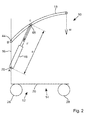
- the patient weight force W is balanced by the lifting arm actuator force F and the 'parasitic' torque M A at the second pivot A and M B at the first pivot B, which are distributed around the lifting device structure and thus spaced apart. If all three are measured, the variable lifting arm actuator length s is known, along with remaining geometry of the lifting device then the weight W at the distal end of the lifting arm can be calculated.
- the input values are substantially as follows:
- the influence of the parasitic moments can be estimated easily by calculation: Assuming M A and M B are both 10Nm, the 2000N weight value is affected by 22N, or about 2%.
- a lifting arm actuator length change of 1 mm produces a weight change of 3.3N.
- the lifting arm actuator length sensitivity is high. As such, an accuracy of at least 0.1 mm from the actuator is required, however the displacement signal generated by conventionally known means will be able to achieve this.
- any lifting device can incorporate the distributed-sensing scale as outlined.
- the invalid hoist enables weighing of a patient suspended from the lifting arm, but the distributed-sensing scale is applicable to fixed or wall / ceiling mounted hoists if torques and/or bending moments are imparted during use.
- the lifting device may be a hoist or crane within different fields, such as construction or automotive, as well as in the medical and patient care fields.
Landscapes
- Health & Medical Sciences (AREA)
- Life Sciences & Earth Sciences (AREA)
- Nursing (AREA)
- Animal Behavior & Ethology (AREA)
- General Health & Medical Sciences (AREA)
- Public Health (AREA)
- Veterinary Medicine (AREA)
- Engineering & Computer Science (AREA)
- Mechanical Engineering (AREA)
- Structural Engineering (AREA)
- Transportation (AREA)
- Civil Engineering (AREA)
- Geology (AREA)
- Automation & Control Theory (AREA)
- Invalid Beds And Related Equipment (AREA)
- Forklifts And Lifting Vehicles (AREA)
- Manipulator (AREA)
Applications Claiming Priority (1)
| Application Number | Priority Date | Filing Date | Title |
|---|---|---|---|
| GB1019778.8A GB2485770A (en) | 2010-11-23 | 2010-11-23 | Lifting Device with Distributed-Sensing Scale |
Publications (2)
| Publication Number | Publication Date |
|---|---|
| EP2455050A2 true EP2455050A2 (de) | 2012-05-23 |
| EP2455050A3 EP2455050A3 (de) | 2012-11-07 |
Family
ID=43467111
Family Applications (1)
| Application Number | Title | Priority Date | Filing Date |
|---|---|---|---|
| EP11189047A Withdrawn EP2455050A3 (de) | 2010-11-23 | 2011-11-14 | Hebevorrichtung mit verteilter Erfassungsskala |
Country Status (5)
| Country | Link |
|---|---|
| US (1) | US20120128448A1 (de) |
| EP (1) | EP2455050A3 (de) |
| AU (1) | AU2011250861A1 (de) |
| CA (1) | CA2757785A1 (de) |
| GB (1) | GB2485770A (de) |
Cited By (1)
| Publication number | Priority date | Publication date | Assignee | Title |
|---|---|---|---|---|
| EP3453373B1 (de) * | 2017-09-12 | 2020-11-04 | Groupe Winncare | Verbindungseinheit für eine hubeinrichtung und eine hubeinrichtung |
Families Citing this family (4)
| Publication number | Priority date | Publication date | Assignee | Title |
|---|---|---|---|---|
| FI127826B (en) * | 2014-08-01 | 2019-03-15 | Konecranes Oyj | Method of detecting a worn link in a chain, and lifting device |
| US9255416B1 (en) * | 2015-03-02 | 2016-02-09 | Eric Snell | Construction hoist system |
| US9617075B2 (en) | 2015-03-24 | 2017-04-11 | Joseph Porat | System and method for overhead warehousing |
| IL299825B2 (en) * | 2016-02-23 | 2024-07-01 | Deka Products Lp | Mobility device control system |
Family Cites Families (18)
| Publication number | Priority date | Publication date | Assignee | Title |
|---|---|---|---|---|
| GB1500501A (en) * | 1974-04-10 | 1978-02-08 | Pye Ltd | Crane load indicating arrangement |
| US4677579A (en) * | 1985-09-25 | 1987-06-30 | Becor Western Inc. | Suspended load measurement system |
| US5143232A (en) * | 1991-09-18 | 1992-09-01 | Stewart James T | Crane load instrument and method therefor |
| US5263597A (en) * | 1991-09-18 | 1993-11-23 | Stewart James T | Crane load instrument and method therefor |
| GB9902859D0 (en) * | 1999-02-10 | 1999-03-31 | Arjo Ltd | Invalid hoists |
| NL1013174C2 (nl) * | 1999-09-29 | 2001-04-03 | Careflex Holding Bv | Tilinrichting. |
| WO2001036924A1 (en) * | 1999-11-17 | 2001-05-25 | Sieco, Inc. | Torque compensated weight sensing modules |
| US7690056B2 (en) * | 2004-03-26 | 2010-04-06 | Millennium Medical Products, Inc. | Stretcher supporter for a storable patient lift and transfer device and method for doing the same |
| DK1879536T3 (da) * | 2005-05-09 | 2013-09-23 | Hecare Systems Aps | Håndteringssystem til løftning eller flytning af en person, vejesystem og fremgangsmåde til løftning og flytning af en person |
| JP5239776B2 (ja) * | 2008-11-19 | 2013-07-17 | トヨタ自動車株式会社 | 移乗支援装置及び移乗支援装置の制御方法 |
| US8474794B2 (en) * | 2009-03-06 | 2013-07-02 | Liko Research & Development Ab | Lift control systems for lifting devices and lifting devices comprising the same |
| CN102575457B (zh) * | 2009-10-19 | 2014-12-17 | 日立建机株式会社 | 作业机械 |
| US8779306B2 (en) * | 2010-02-19 | 2014-07-15 | Methode Electronics, Inc. | Weight sensing method and apparatus for forklifts |
| CA2743647C (en) * | 2010-06-17 | 2018-06-19 | Key Energy Services, Llc | Method and system for automatically setting, adjusting, and monitoring load-based limits on a well service rig |
| JP5645069B2 (ja) * | 2010-10-21 | 2014-12-24 | 株式会社ジェイテクト | 車両用操舵装置 |
| WO2012139575A1 (en) * | 2011-04-15 | 2012-10-18 | INS - Europe | A method for estimating volume |
| WO2013028961A1 (en) * | 2011-08-24 | 2013-02-28 | Hill-Rom Services, Inc. | Patient stand assist, therapy devices, and methods |
| EP2684549B1 (de) * | 2012-07-12 | 2019-09-11 | Liko Research & Development AB | Überwachungssystemvorrichtungen und Verfahren für Patientenlifte |
-
2010
- 2010-11-23 GB GB1019778.8A patent/GB2485770A/en not_active Withdrawn
-
2011
- 2011-11-14 CA CA2757785A patent/CA2757785A1/en not_active Abandoned
- 2011-11-14 EP EP11189047A patent/EP2455050A3/de not_active Withdrawn
- 2011-11-18 AU AU2011250861A patent/AU2011250861A1/en not_active Abandoned
- 2011-11-21 US US13/300,682 patent/US20120128448A1/en not_active Abandoned
Non-Patent Citations (1)
| Title |
|---|
| None |
Cited By (1)
| Publication number | Priority date | Publication date | Assignee | Title |
|---|---|---|---|---|
| EP3453373B1 (de) * | 2017-09-12 | 2020-11-04 | Groupe Winncare | Verbindungseinheit für eine hubeinrichtung und eine hubeinrichtung |
Also Published As
| Publication number | Publication date |
|---|---|
| GB201019778D0 (en) | 2011-01-05 |
| AU2011250861A1 (en) | 2013-06-13 |
| EP2455050A3 (de) | 2012-11-07 |
| US20120128448A1 (en) | 2012-05-24 |
| GB2485770A (en) | 2012-05-30 |
| CA2757785A1 (en) | 2012-05-23 |
Similar Documents
| Publication | Publication Date | Title |
|---|---|---|
| US9987182B2 (en) | Hospital bed with patient weight and displacement sensors for determining at least one of lateral and longitudinal patient location on a patient support assembly | |
| EP2455050A2 (de) | Hebevorrichtung mit verteilter Erfassungsskala | |
| ES2302289T3 (es) | Equipo de trabajo movil con brazos de apoyo extensibles. | |
| US20260041592A1 (en) | Lift Systems And Load Cells For Patient Support Apparatus | |
| US20180296299A1 (en) | Robotic surgical systems and methods for monitoring applied forces | |
| JP5964944B2 (ja) | 電気アクチュエータ・システム | |
| JP6970706B2 (ja) | 歩行支援器具 | |
| JP2009034501A (ja) | 手術台 | |
| JP2005300368A (ja) | 荷重スケール及びこれを用いた荷重スケールシステム | |
| EP2558346A1 (de) | Hubwagen | |
| US6329612B1 (en) | Invalid hoists | |
| JP5086165B2 (ja) | ストレッチャー型体重計 | |
| ES2313111T3 (es) | Celula de pesaje. | |
| US20060278771A1 (en) | Load carrying apparatus with security detection system | |
| CA2391207C (en) | Invalid hoist | |
| ES2316905T3 (es) | Cama para cuidados. | |
| GB2475080A (en) | Weighing suspended loads having a pivotable load pin attached to a load cell | |
| CN208333647U (zh) | 一种医用体重秤及医用体重秤组件 | |
| SK500712022U1 (sk) | Váhový systém na lôžku s nožnicovým zdvihom | |
| PL230040B1 (pl) | Medyczne mobilne urządzenie transportowe zwłaszcza do transportu w szpitalu |
Legal Events
| Date | Code | Title | Description |
|---|---|---|---|
| PUAI | Public reference made under article 153(3) epc to a published international application that has entered the european phase |
Free format text: ORIGINAL CODE: 0009012 |
|
| AK | Designated contracting states |
Kind code of ref document: A2 Designated state(s): AL AT BE BG CH CY CZ DE DK EE ES FI FR GB GR HR HU IE IS IT LI LT LU LV MC MK MT NL NO PL PT RO RS SE SI SK SM TR |
|
| AX | Request for extension of the european patent |
Extension state: BA ME |
|
| PUAL | Search report despatched |
Free format text: ORIGINAL CODE: 0009013 |
|
| AK | Designated contracting states |
Kind code of ref document: A3 Designated state(s): AL AT BE BG CH CY CZ DE DK EE ES FI FR GB GR HR HU IE IS IT LI LT LU LV MC MK MT NL NO PL PT RO RS SE SI SK SM TR |
|
| AX | Request for extension of the european patent |
Extension state: BA ME |
|
| RIC1 | Information provided on ipc code assigned before grant |
Ipc: A61G 7/10 20060101AFI20121004BHEP |
|
| STAA | Information on the status of an ep patent application or granted ep patent |
Free format text: STATUS: THE APPLICATION IS DEEMED TO BE WITHDRAWN |
|
| 18D | Application deemed to be withdrawn |
Effective date: 20130508 |