EP2438888A1 - Ummantelung zur Wiederherstellung der Klappenfunktion variköser Venen - Google Patents
Ummantelung zur Wiederherstellung der Klappenfunktion variköser Venen Download PDFInfo
- Publication number
- EP2438888A1 EP2438888A1 EP11193306A EP11193306A EP2438888A1 EP 2438888 A1 EP2438888 A1 EP 2438888A1 EP 11193306 A EP11193306 A EP 11193306A EP 11193306 A EP11193306 A EP 11193306A EP 2438888 A1 EP2438888 A1 EP 2438888A1
- Authority
- EP
- European Patent Office
- Prior art keywords
- sheath
- piece
- woven material
- vein
- polyurethane
- Prior art date
- Legal status (The legal status is an assumption and is not a legal conclusion. Google has not performed a legal analysis and makes no representation as to the accuracy of the status listed.)
- Granted
Links
Images
Classifications
-
- A—HUMAN NECESSITIES
- A61—MEDICAL OR VETERINARY SCIENCE; HYGIENE
- A61B—DIAGNOSIS; SURGERY; IDENTIFICATION
- A61B17/00—Surgical instruments, devices or methods
- A61B17/12—Surgical instruments, devices or methods for ligaturing or otherwise compressing tubular parts of the body, e.g. blood vessels or umbilical cord
- A61B17/12009—Implements for ligaturing other than by clamps or clips, e.g. using a loop with a slip knot
-
- A—HUMAN NECESSITIES
- A61—MEDICAL OR VETERINARY SCIENCE; HYGIENE
- A61F—FILTERS IMPLANTABLE INTO BLOOD VESSELS; PROSTHESES; DEVICES PROVIDING PATENCY TO, OR PREVENTING COLLAPSING OF, TUBULAR STRUCTURES OF THE BODY, e.g. STENTS; ORTHOPAEDIC, NURSING OR CONTRACEPTIVE DEVICES; FOMENTATION; TREATMENT OR PROTECTION OF EYES OR EARS; BANDAGES, DRESSINGS OR ABSORBENT PADS; FIRST-AID KITS
- A61F2/00—Filters implantable into blood vessels; Prostheses, i.e. artificial substitutes or replacements for parts of the body; Appliances for connecting them with the body; Devices providing patency to, or preventing collapsing of, tubular structures of the body, e.g. stents
- A61F2/02—Prostheses implantable into the body
- A61F2/24—Heart valves ; Vascular valves, e.g. venous valves; Heart implants, e.g. passive devices for improving the function of the native valve or the heart muscle; Transmyocardial revascularisation [TMR] devices; Valves implantable in the body
- A61F2/2475—Venous valves
-
- A—HUMAN NECESSITIES
- A61—MEDICAL OR VETERINARY SCIENCE; HYGIENE
- A61F—FILTERS IMPLANTABLE INTO BLOOD VESSELS; PROSTHESES; DEVICES PROVIDING PATENCY TO, OR PREVENTING COLLAPSING OF, TUBULAR STRUCTURES OF THE BODY, e.g. STENTS; ORTHOPAEDIC, NURSING OR CONTRACEPTIVE DEVICES; FOMENTATION; TREATMENT OR PROTECTION OF EYES OR EARS; BANDAGES, DRESSINGS OR ABSORBENT PADS; FIRST-AID KITS
- A61F2/00—Filters implantable into blood vessels; Prostheses, i.e. artificial substitutes or replacements for parts of the body; Appliances for connecting them with the body; Devices providing patency to, or preventing collapsing of, tubular structures of the body, e.g. stents
- A61F2/02—Prostheses implantable into the body
- A61F2/24—Heart valves ; Vascular valves, e.g. venous valves; Heart implants, e.g. passive devices for improving the function of the native valve or the heart muscle; Transmyocardial revascularisation [TMR] devices; Valves implantable in the body
- A61F2/2442—Annuloplasty rings or inserts for correcting the valve shape; Implants for improving the function of a native heart valve
Definitions
- the present invention relates to a sheath for the restoration of valvular function of varicose veins and their use in surgery.
- VSM saphenous vein
- the range of treatment options for the main insufficiency of the saphenous vein range from conservative measures, such as compression stockings, physiotherapy and pharmacotherapy, minimally invasive procedures to surgical procedures.
- the classic surgical treatment consists in the removal (stripping) of the insufficient veins.
- minimally invasive procedures such as endovascular laser therapy (ELT) and radiofrequency electrowelling (RFO) are increasingly being used.
- ELT endovascular laser therapy
- RFO radiofrequency electrowelling
- a disadvantage of the surgical or minimally invasive procedures is that the veins in question are removed from the body or desolate in the body.
- Dacron ® polyethylene terephthalate
- a problem with this sleeve material is that it has no elastic extensibility.
- Dacron ® can trigger foreign body reactions, especially fibrotic reactions ( S. Raju, ANN. SURG. (1983) 197, 688-697 ).
- the invention therefore has as its object to provide a casing for varicose veins, which overcomes problems known from the prior art.
- the sheath should in particular have a vein-adequate elasticity, be biocompatible and easy and inexpensive to produce.
- the invention provides a sheath or a venous patch or a venous sleeve for venous valve reconstruction of varicose veins in human and / or veterinary medicine.
- the sheath is particularly suitable for the reconstruction of the muzzle flap of a varicose saphenous vein.
- a saphenous venous saphenous vein is in most cases an etiological starting point for the development of primary varicosis.
- the sheath according to the invention is advantageously placed in a cuff shape around the varicose vein.
- the cuff acts as a kind of inner compression stocking of the relevant Venous section preferably completely encased.
- the cuff and thus the luminal diameter of the vein can be steadily tightened until blood backflow into the vein is no longer detectable. Subsequently, the sheath is fixed as a rule at their touching or possibly overlapping edges.
- the edges can be glued and / or sewn, for example.
- the piece of material has a greater length than width.
- the piece of material itself may be present in particular as a strip.
- the piece of material can have fixing elements, for example lugs, for fixing the sheathing on a vein.
- the fixing elements are preferably limb-shaped extensions of the piece of material, the piece of material preferably having two limb-shaped extensions.
- the fixing elements can be provided, in particular, for fixing the sheath in the region of a natural venous entry region, for example the so-called Krosseregion.
- the Krosseregion is the natural Veneneinmündung the leg vein saphenous vein into the lower femoral vein (also known as femoral vein).
- the sheath is usually fixed with the femoral vein.
- fixing methods all known to those skilled fixation techniques, such as gluing and / or sewing, into consideration.
- the piece of material has an approximately rectangular shape and has a special blank on a narrow side.
- This blank is designed with particular advantage such that the sheath according to the invention can be placed in the region of a natural venous entry region.
- the special blank is a U-shaped cutout, the width of which is preferably adapted to the diameter of the vein that is to be covered.
- the U-shaped cutout has a width between 5.8 and 8.2 mm, in particular a width of about 6 mm.
- the piece of material is adjusted in its dimensions of the varicose vein, whose flap function is to be restored.
- the piece of material may have a length between 3 and 5 cm, preferably about 4 cm, and a width between 1 and 3 cm, preferably about 2 cm.
- the piece of material is furthermore preferably expansible, in particular essentially elastic.
- the piece of material has a stretching behavior which essentially corresponds to the extensibility of healthy veins, in particular of an intact saphenous vein.
- the extensibility of healthy or intact veins is also referred to as compliance.
- the piece of material in particular the non-woven material, is pre-stretched in the transverse direction. Due to the pre-stretching, the piece of material is particularly advantageously provided with a pressure-expansion behavior which preferably corresponds approximately to the extensibility of intact veins. If the non-woven material of the sheath according to the invention is pre-stretched in the transverse direction, this can advantageously lead to reinforcement and thus stabilization of the sheath. The reason for this is in particular the realignment of the fibers of the non-woven material. As a result of the pre-stretching, comparable to cold stretching, they at least partially lose their original orientation and align themselves again. The fiber reorientation can result in reinforcement of the non-woven Material and thus the sheathing. Normally, the piece of material is cold pre-stretched.
- the piece of material in particular the non-woven material, is mechanically pre-stretched.
- the piece of material in the transverse direction by a tensile force between 1 and 20 N / cm, in particular 4 and 18 N / cm, preferably 8 and 16 N / cm, pre-stretched.
- the non-woven material is a nonwoven.
- the non-woven material is in the form of a spray fleece.
- the fleece in particular spray fleece, has fibers which are glued together.
- a solution of the non-woven material in a volatile solvent is normally used. Suitable solvents are therefore in particular halogenated solvents.
- the solvents may be partially and / or perhalogenated. Particularly preferred are chlorinated and / or fluorinated solvents, for example chloroform and / or dichloromethane.
- the solution of the non-woven material is usually sprayed onto a flat application surface.
- the spraying itself is normally carried out with the aid of a suitable spraying or atomizing device, for example a spray gun or nozzle.
- the spraying path is dimensioned such that fiber formation of the non-woven material takes place from the solution when passing through the spraying path.
- the spray path can be, for example, between 10 and 75 cm, in particular 15 and 20 cm.
- the solvent usually volatilizes when passing through the spray path, so that non-woven material fibers deposit on the application surface, which, due to a certain residual moisture, preferably stick together to form a three-dimensional fiber structure (nonwoven structure).
- a particular advantage of Sprühvliestechnik is the mean pore diameter in the spray fleece can be adjusted as a function of the spraying path. The longer the spray path, the larger the average pore diameter in the finished spray fleece. In this way, nonwoven structures with pore gradients can be produced.
- the non-woven material is formed as a film or foil.
- the film may in particular be a cast or spray film.
- a suitable carrier plate may be doused with a solution of the non-woven material. After volatilization of the solvent and / or optionally after one or more drying steps, the cast film is obtained.
- the spray path is now dimensioned so that fiber formation of the non-woven material from the solution when passing through the Sprühweges is not possible.
- the spray path can be, for example, between 1 and 10 cm, in particular 4 and 8 cm.
- the piece of material is in a further embodiment of multi-layered, in particular two or three layers constructed.
- the piece of material as a whole can be made up of three layers, of which two layers are in the form of fleece structures and the third layer is formed as a film or foil.
- the film-like or film-like layer is preferably sandwiched between the two nonwoven structures.
- non-woven material fibers having a fiber thickness between 0.01 and 20 .mu.m, in particular 0.1 and 10 .mu.m, preferably 0.5 and 5 .mu.m.
- the non-woven material is a substantially non-resorbable polymer under physiological conditions.
- the non-woven material is preferably a biocompatible polymer.
- the non-woven material is a polyurethane.
- Polyurethane has the advantage of being an exceptionally biocompatible material which also has elastic extensibility which is substantially equivalent to the natural extensibility of a healthy venous wall.
- provision may in particular be made for the non-woven material to be a thermoplastic polyurethane.
- the polyurethane is soluble in organic solvents, especially in volatile organic solvents.
- the non-woven material is a linear polyurethane, preferably linear aliphatic polyurethane.
- the polyurethanes in question may in particular be polyurethanes which are prepared from macro and / or low molecular weight aliphatic diols and aliphatic diisocyanates.
- the macromolecular diols are polycarbonates, in particular 1,6-hexanediol polycarbonate.
- Suitable low molecular weight diols are preferably 2,2,4-trimethylhexanediol, 2,4,4-trimethylhexanediol and / or 1,4-butanediol.
- Preferred aliphatic diisocyanates are cycloaliphatic diisocyanates, in particular 4,4'-dicyclohexylmethane diisocyanate and / or 1,4-cyclohexyl diisocyanate.
- suitable polyurethanes is on the DE 36 43 465 A1 .
- DE 33 18 730 A1 and the DE 41 07 284 A1 the disclosure of which is hereby incorporated by reference into the content of the present description.
- the non-woven material may further be a polyurethane having a molecular weight between 5,000 and 50,000 daltons, especially 20,000 and 40,000 daltons.
- the piece of material is thinner than the cuffs known from the prior art.
- the piece of material has a thickness which allows a problem-free fixation of the sheath, in particular by sewing, on a natural vein.
- the piece of material has a thickness of between 0.1 and 0.5 mm, in particular 0.15 and 0.3 mm.
- a thin piece of material, which is in particular elastically extensible, moreover advantageously improves the general handling by the surgeon, whereby operating times and risks can be reduced.
- the piece of material is porous in another embodiment.
- the piece of material may in particular have a continuous porosity.
- the piece of material preferably has pores with a diameter between 0.1 and 100 ⁇ m, in particular 0.5 and 50 ⁇ m, preferably 1 and 10 ⁇ m.
- the casing may have at least one reinforcement.
- the reinforcement may be, for example, a textile net, a metal wire or a foil.
- Gain is preferably matched to the compliance of natural healthy veins.
- the sheath comprises active substances, in particular antimicrobial active ingredients.
- the active compounds themselves can be present in the form of particles whose diameter is preferably between 50 and 100 nm.
- the drug particles may also be linked to agglomerates.
- the agglomerate size may be in particular between 5 and 10 microns.
- active ingredients especially metals or metal alloys with antimicrobial effect in question, with metallic silver being particularly preferred.
- the active ingredients may optionally be applied together with other materials in the form of a layer on the casing.
- the active ingredients may be present together with resorbable materials, in particular gelatin and / or collagen, in the form of a resorbable layer on the surface of the sheath.
- the sheath has a silver layer.
- the thickness of the silver layer may basically be in the range between 1,000 and 4,000 ⁇ , in particular 1,000 and 2,500 ⁇ .
- the sheath is in packaged form.
- the sheath can be sterilized with particular advantage and is preferably in sterilized form.
- the piece of material consists of the non-woven material.
- the non-woven material For further details and features of the non-woven material, reference is made to the previous description.
- the invention further relates to a kit, in particular for use in extraluminal valvuloplasty, which comprises at least the sheath.
- the kit preferably comprises a biocompatible adhesive composition.
- the adhesive composition itself may consist, for example, of n-alkyl cyanoacrylates.
- the adhesive composition of n-butyl-2-cyanoacrylate (Histoacryl ®) consists.
- the kit may comprise a suture, such as a polypropylene thread.
- the present invention also relates to the use of the sheath for preparing or producing a surgical implant for restoring the venous valve function of varicose veins, in particular a varicose saphenous vein.
- the inventive Sheath is particularly suitable for use in extraluminal valvuloplasty.
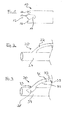
- the FIG. 1 schematically shows a sheath 10 according to the invention, which is completely formed as a porous Sprühvlies.
- the spunbond material is polyestercarbonaturethane.
- the sheath 10 is an approximately 4 x 2 cm large, rectangular piece of material whose one narrow side 12 has a U-shaped cutout 14 , whereby the sheath 10 receives two leg-shaped extensions 16 .
- the width of the cutout 14 is about 6 mm.
- the narrow side 12 also has in the direction of the U-shaped cutout 14 beveled courses 17 . Due to this special cut, the Sheath 10, for example, be placed exactly in the muzzle flap region of an insufficient saphenous vein (VSM), in particular in the angle between the VSM junction and the lower femoral vein (cf.
- VSM insufficient saphenous vein
- FIG. 2 represented Krosseregion).
- the thickness of the sheath 10 is about 0.15 mm.
- the sheath 10 can be sutured particularly easily in the region of a natural venous entry region, in particular with the femoral vein.
- FIG. 2 schematically shows the natural junction region 20 of the saphenous vein (VSM) 22 in the lower leg vein of the femoral vein 24th
- the confluence region 20 is also referred to as Krosseregion.
- the venous valve of the saphenous vein 22 is located approximately where the VSM 22 leads directly into the lower femoral vein 24 . If the valvular function of the saphenous vein 22 is impaired, usually because the venous appendages of the valve no longer close, there is an increased blood backflow into the saphenous vein 22 . This leads to increased congestion in the lower extremities, which increases the blood pressure and thus the risk of varicose veins.
- FIG. 3 schematically shows the Krosseregion 30 after a performed extraluminal valvuloplasty, as it is similarly known for a sheath of polyester.
- the vena saphena magna 32 is, starting from its junction 33 in the underlying femoral vein 34 over a certain longitudinal section substantially completely wrapped with the sheath 35 according to the invention of a polyurethane nonwoven fabric.
- the sheath 35 is sewn at its contacting or optionally overlapping edges with a polypropylene thread 36 .
- the sheath 35 is sewn to the femoral vein 34 via two thigh-shaped extensions 38 .
- the non-ligated side branch 39 serves as indicator vein for controlling the Blood backflow during the closure of the luminal diameter of the saphenous vein by means of the sheath 35 .
Landscapes
- Health & Medical Sciences (AREA)
- Life Sciences & Earth Sciences (AREA)
- Cardiology (AREA)
- Animal Behavior & Ethology (AREA)
- Surgery (AREA)
- Vascular Medicine (AREA)
- Engineering & Computer Science (AREA)
- Biomedical Technology (AREA)
- Heart & Thoracic Surgery (AREA)
- Veterinary Medicine (AREA)
- Public Health (AREA)
- General Health & Medical Sciences (AREA)
- Nuclear Medicine, Radiotherapy & Molecular Imaging (AREA)
- Molecular Biology (AREA)
- Medical Informatics (AREA)
- Reproductive Health (AREA)
- Oral & Maxillofacial Surgery (AREA)
- Transplantation (AREA)
- Materials For Medical Uses (AREA)
- Prostheses (AREA)
Abstract
Description
- Die vorliegende Erfindung betrifft eine Ummantelung zur Wiederherstellung der Klappenfunktion variköser Venen und ihre Verwendung in der Chirurgie.
- Die chronisch venöse Insuffizienz der unteren Extremitäten ist eine in der Bevölkerung weit verbreitete Erkrankung. Ursache hierfür ist häufig eine gestörte Venenklappenfunktion. Neuere Untersuchungen belegen, dass die Pathogenese für variköse Venen ursächlich mit veränderten elastischen Eigenschaften innerhalb der Gefäßwand zusammenhängt, die zu einer Dilatation der Venenwand führen. Infolge der Dilatation können die Venenklappen nicht mehr schließen, wodurch es zu einem vermehrten Blutrückfluss in die betreffenden Venen und schließlich zur Entstehung einer Varikose kommt. Vor allem das Nicht-Schließen der Mündungsklappe der Vena saphena magna (VSM) ist häufig Ausgangspunkt einer primären Varikose.
- Das Spektrum an Therapiemöglichkeiten für die Stamminsuffizienz der Vena saphena magna reicht von konservativen Maßnahmen, wie etwa Kompressionsstrümpfen, Physio- und Pharmakotherapie, über minimalinvasive Verfahren bis hin zu operativen Verfahren. Die klassische operative Behandlung besteht in der Entfernung (Stripping) der insuffizienten Venen. In jüngster Zeit gelangen jedoch zunehmend auch minimalinvasive Verfahren, wie beispielsweise die endovaskuläre Lasertherapie (ELT) und die Radiofrequenzobliteration (RFO), zum Einsatz. Ein Nachteil der operativen bzw. minimal-invasiven Verfahren besteht allerdings darin, dass die betreffenden Venen aus dem Körper entfernt bzw. im Körper verödet werden.
- Der allgemeine Wunsch nach Erhaltung von venösem Bypassmaterial für die koronare Bypasschirurgie sowie das Bestreben nach Minimierung des Operationstraumas haben zur Entwicklung von verschiedenen Venen erhaltenden Operationsverfahren geführt. In diesem Zusammenhang ist vor allem die sogenannte extraluminale Valvuloplastie der VSM-Mündungsklappe zu nennen. Die Klappenfunktion wird bei dieser Behandlungsmethode dadurch wieder hergestellt, dass eine Manschette um die dilatierte Klappenregion gelegt wird. Durch diese Operationstechnik können pathologische Refluxe in die Venen der unteren Extremitäten beseitigt werden, ohne die Venen selbst zu entfernen. Beispiele für derartige Manschetten sind aus der
WO 88/00454 A1 US 5,147,389 ,US 4,904,254 und derWO 02/076305 A1 - Eine vergleichsweise einfache Venenmanschette aus Dacron® (Polyethylenterephthalat) wurde von Mumme et al. (Phlebologie 2004; 33: 149 bis 155) erfolgreich in klinischen Studien für die extraluminale Venenklappenrekonstruktion eingesetzt. Problematisch ist jedoch auch bei diesem Manschettenmaterial, dass es keine elastische Dehnbarkeit aufweist. Zudem ist allgemein bekannt, dass Dacron® Fremdkörperreaktionen, insbesondere fibrotische Reaktionen, auslösen kann (S. Raju, ANN. SURG. (1983) 197, 688 bis 697).
- Die Erfindung stellt sich daher die Aufgabe, eine Ummantelung für variköse Venen zur Verfügung zu stellen, welche aus dem Stand der Technik bekannte Probleme überwindet. Die Ummantelung soll insbesondere eine venenadäquate Elastizität aufweisen, bioverträglich sowie einfach und kostengünstig herstellbar sein.
- Diese Aufgabe wird gelöst durch eine Ummantelung mit einer Längs-und einer Querrichtung zur Wiederherstellung der Klappenfunktion variköser Venen in Form eines flächigen, flexiblen Materialstücks, wobei das Materialstück ein non-woven Material aufweist.
- Durch die Erfindung wird eine Ummantelung oder ein Venen-Patch bzw. eine Venenmanschette zur Venenklappenrekonstruktion variköser Venen in der Human- und/oder Veterinärmedizin bereitgestellt. Die Ummantelung eignet sich insbesondere zur Mündungsklappenrekonstruktion einer varikösen Vena saphena magna. Wie bereits einleitend erwähnt, ist eine stamminsuffiziente Vena saphena magna in den meisten Fällen ätiologischer Ausgangspunkt für die Entstehung einer primären Varikose. Zur Wiederherstellung eines intakten Venenklappenverschlusses wird die erfindungsgemäße Ummantelung in vorteilhafter Weise manschettenförmig um die variköse Vene gelegt. Die Manschette wirkt hierbei als eine Art innerer Kompressionstrumpf der den maßgeblichen Venenabschnitt vorzugsweise vollständig ummantelt. Unter ständiger Kontrolle des Blutrückflusses, meistens über einen nicht ligierten venösen Seitenast, kann die Manschette und damit der Lumendurchmesser der Vene stetig enger gestellt werden, bis ein Blutrückfluss in die Vene nicht mehr nachweisbar ist. Anschließend wird die Ummantelung in der Regel an ihren sich berührenden oder gegebenenfalls überlappenden Rändern fixiert. Die Ränder können beispielsweise verklebt und/oder vernäht werden.
- In einer bevorzugten Ausführungsform besitzt das Materialstück eine größere Länge als Breite. Das Materialstück selbst kann insbesondere als Streifen vorliegen. Grundsätzlich kann das Materialstück Fixierelemente, beispielsweise Laschen, zur Fixierung der Ummantelung auf einer Vene aufweisen. Bevorzugt handelt es sich bei den Fixierelementen um schenkelförmige Fortsätze des Materialstücks, wobei das Materialstück vorzugsweise zwei schenkelförmige Fortsätze aufweist. Die Fixierelemente können insbesondere für eine Fixierung der Ummantelung im Bereich einer natürlichen Veneneinmündungsregion, beilspielsweise der sogenannten Krosseregion, vorgesehen sein. Bei der Krosseregion handelt es sich um die natürliche Veneneinmündung der Beinvene Vena saphena magna in die tiefer liegende Vena femoralis (auch als Femoralvene bezeichnet). Zur Wiederherstellung der Klappenfunktion einer varikösen Vena saphena magna ist die Ummantelung gewöhnlich mit der Femoralvene fixiert. Als Fixierungsmethoden kommen alle dem Fachmann geläufigen Fixierungstechniken, beispielsweise Kleben und/oder Nähen, in Betracht.
- In einer weiteren Ausführungsform besitzt das Materialstück eine in etwa rechteckige Form und weist an einer Schmalseite einen speziellen Zuschnitt auf. Dieser Zuschnitt ist mit besonderem Vorteil derart ausgebildet, dass die erfindungsgemäße Ummantelung im Bereich einer natürlichen Veneneinmündungsregion platziert werden kann. Vorzugsweise handelt es sich bei dem speziellen Zuschnitt um einen U-förmigen Ausschnitt, dessen Breite vorzugsweise dem Durchmesser der zu umfassenden Vene angepasst ist. Bevorzugt besitzt der U-förmige Ausschnitt eine Breite zwischen 5,8 und 8,2 mm, insbesondere eine Breite von ca. 6 mm.
- In einer weitergehenden Ausführungsform ist das Materialstück in seinen Dimensionen der varikösen Vene, deren Klappenfunktion wiederhergestellt werden soll, angepasst. Das Materialstück kann eine Länge zwischen 3 und 5 cm, vorzugsweise von ca. 4 cm, und eine Breite zwischen 1 und 3 cm, bevorzugt von ca. 2 cm, aufweisen.
- Das Materialstück ist weiterhin vorzugsweise dehnbar, insbesondere im Wesentlichen elastisch, ausgebildet. Mit besonderem Vorteil weist das Materialstück ein Dehnungsverhalten auf, das im Wesentlichen der Dehnbarkeit von gesunden Venen, insbesondere einer intakten Vena saphena magna, entspricht. Die Dehnbarkeit von gesunden bzw. intakten Venen wird auch als Compliance bezeichnet.
- Besonders bevorzugt ist das Materialstück, insbesondere das non-woven Material, in Querrichtung vorgedehnt. Durch die Vordehnung erhält das Materialstück mit besonderem Vorteil ein Druck-Dehnungsverhalten, welches vorzugsweise in etwa der Dehnbarkeit von intakten Venen entspricht. Wird das non-woven Material der erfindungsgemäßen Ummantelung in Querrichtung vorgedehnt, kann dies in vorteilhafter Weise zu einer Verstärkung und damit Stabilisierung der Ummantelung führen. Der Grund hierfür ist insbesondere die Neuausrichtung der Fasern des non-woven Materials. Diese verlieren durch die Vordehnung, einer kalten Verstreckung vergleichbar, zumindest zum Teil ihre ursprüngliche Orientierung untereinander und richten sich neu aus. Durch die Faserneuausrichtung kann es zu einer Verstärkung des non-woven Materials und damit insgesamt der Ummantelung kommen. Normalerweise ist das Materialstück kalt vorgedehnt.
- Vorzugsweise ist das Materialstück, insbesondere das non-woven Material, mechanisch vorgedehnt. In einer weitergehenden Ausführungsform ist das Materialstück in Querrichtung durch eine Zugkraft zwischen 1 und 20 N/cm, insbesondere 4 und 18 N/cm, vorzugsweise 8 und 16 N/cm, vorgedehnt.
- Gewöhnlich handelt es sich bei dem non-woven Material um ein Vlies. Vorzugsweise liegt das non-woven Material in Form eines Sprühvlieses vor. Erfindungsgemäß kann es vorgesehen sein, dass das Vlies, insbesondere Sprühvlies, Fasern aufweist, die miteinander verklebt sind. Zur Herstellung des Vlieses wird normalerweise eine Lösung des non-woven Materials in einem leicht flüchtigen Lösungsmittel verwendet. Als Lösungsmittel kommen daher insbesondere halogenierte Lösungsmittel in Betracht. Die Lösungsmittel können dabei teil- und/oder perhalogeniert sein. Besonders bevorzugt sind chlorierte und/oder fluorierte Lösungsmittel, beispielsweise Chloroform und/oder Dichlormethan. Zur Herstellung einer Sprühvliesstruktur wird die Lösung des non-woven Materials in der Regel auf eine ebene Auftragsfläche aufgesprüht. Das Aufsprühen selbst erfolgt normalerweise mit Hilfe einer geeigneten Sprüh- oder Zerstäubervorrichtung, beispielsweise einer Sprühpistole oder -düse. Der Sprühweg ist dabei so bemessen, dass eine Faserbildung des non-woven Materials aus der Lösung beim Durchlaufen des Sprühweges stattfindet. Der Sprühweg kann beispielsweise zwischen 10 und 75 cm, insbesondere 15 und 20 cm, betragen. Das Lösungsmittel verflüchtigt sich dagegen in der Regel beim Durchlaufen des Sprühweges, so dass sich auf der Auftragsfläche non-woven Materialfasern abscheiden, welche sich aufgrund einer gewissen Restfeuchte vorzugsweise unter Bildung einer dreidimensionalen Faserstruktur (Vliesstruktur) miteinander verkleben. Ein besonderer Vorteil der Sprühvliestechnik besteht darin, dass sich der mittlere Porendurchmesser im Sprühvlies in Abhängigkeit vom Sprühweg einstellen lässt. Je länger der Sprühweg ist, desto größer ist der mittlere Porendurchmesser im fertigen Sprühvlies. Auf diese Weise können Vliesstrukturen mit Porengradienten hergestellt werden.
- In einer weiteren Ausführungsform ist das non-woven Material als Film oder Folie ausgebildet. Bei der Folie kann es sich insbesondere um eine Gieß- oder Sprühfolie handeln. Zur Herstellung der Gießfolie kann beispielsweise eine geeignete Trägerplatte mit einer Lösung des non-woven Materials übergossen werden. Nach Verflüchtigung des Lösungsmittels und/oder gegebenenfalls nach einem oder mehreren Trocknungsschritten wird die Gießfolie erhalten. Zur Herstellung der Sprühfolie kann entsprechend der im vorherigen Abschnitt beschriebenen Sprühvliestechnik verfahren werden, wobei der Sprühweg jetzt so bemessen ist, dass eine Faserbildung des non-woven Materials aus der Lösung beim Durchlaufen des Sprühweges nicht möglich ist. Der Sprühweg kann beispielsweise zwischen 1 und 10 cm, insbesondere 4 und 8 cm liegen. Bezüglich weiterer Einzelheiten und Merkmalen wird auf die bisherige Beschreibung Bezug genommen.
- Das Materialstück ist bei einer weiteren Ausführungsform mehrschichtig, insbesondere zwei- oder dreischichtig, aufgebaut. Beispielsweise kann das Materialstück insgesamt aus drei Schichten aufgebaut sein, wovon zwei Schichten in Form von Vliesstrukturen vorliegen und die dritte Schicht als Film oder Folie ausgebildet ist. Bevorzugt ist die film- bzw. folienartige Schicht zwischen den beiden Vliesstrukturen sandwichartig angeordnet.
- Weiterhin kann das non-woven Material Fasern mit einer Faserstärke zwischen 0,01 und 20 µm, insbesondere 0,1 und 10 µm, vorzugsweise 0,5 und 5 µm, aufweisen.
- In einer weitergehenden Ausführungsform ist das non-woven Material ein unter physiologischen Bedingungen im Wesentlichen nicht resorbierbares Polymer. Das non-woven Material ist bevorzugt ein bioverträgliches Polymer. Vorzugsweise handelt es sich bei dem non-woven Material um ein Polyurethan. Polyurethan besitzt den Vorteil, dass es ein au-βerordentlich bioverträgliches Material darstellt, welches zudem eine elastische Dehnbarkeit besitzt, die im Wesentlichen der natürlichen Dehnbarkeit einer gesunden Venenwand entspricht. Erfindungsgemäß ist es insbesondere vorgesehen sein, dass das non-woven Material ein thermoplastisches Polyurethan ist. Zweckmäßigerweise ist das Polyurethan in organischen Lösungsmitteln, insbesondere in flüchtigen organischen Lösungsmitteln, löslich. Insbesondere handelt es sich bei dem non-woven Material um ein lineares Polyurethan, vorzugsweise lineares aliphatisches Polyurethan. Bei den in Frage kommenden Polyurethanen kann es sich vor allem um Polyurethane handeln, welche aus makro-und/oder niedermolekularen aliphatischen Diolen sowie aliphatischen Diisocyanaten hergestellt sind. Erfindungsgemäß ist es insbesondere vorgesehen, dass es sich bei den makromolekularen Diolen um Polycarbonate, insbesondere um 1,6-Hexandiolpolycarbonat, handelt. Als niedermolekulare Diole kommen bevorzugt 2,2,4-Trimethylhexandiol, 2,4,4-Trimethylhexandiol und/oder 1,4-Butandiol in Betracht. Als aliphatische Diisocyanate werden bevorzugt cycloaliphatische Diisocyanate, insbesondere 4,4'-Dicyclohexylmethan-diisocyanat und/oder 1,4-Cyclohexyl-diisocyanat, verwendet. Bezüglich weiterer in Frage kommende Polyurethane wird auf die
DE 36 43 465 A1 ,DE 33 18 730 A1 und dieDE 41 07 284 A1 verwiesen, deren Offenbarungsgehalt jeweils durch Bezugnahme zum Inhalt der vorliegenden Beschreibung gemacht wird. - Das non-woven Material kann weiterhin ein Polyurethan mit einem Molekulargewicht zwischen 5.000 und 50.000 Dalton, insbesondere 20.000 und 40.000 Dalton, sein.
- In einer besonders vorteilhaften Ausführungsform ist das Materialstück dünner ausgebildet als die aus dem Stand der Technik bekannten Manschetten. Vorzugsweise weist das Materialstück eine Dicke auf, die eine problemlose Fixierung der Ummantelung, insbesondere durch Vernähen, auf einer natürlichen Vene erlaubt. Bevorzugt weist das Materialstück eine Dicke zwischen 0,1 und 0,5 mm, insbesondere 0,15 und 0,3 mm, auf. Ein dünnes und insbesondere elastisch dehnbar ausgebildetes Materialstück verbessert zudem mit besonderem Vorteil die allgemeine Handhabung durch den Chirurgen, wodurch Operationszeiten und - risiken verringert werden können.
- Das Materialstück ist bei einer weiteren Ausführungsform porös. Das Materialstück kann insbesondere eine durchgängige Porosität aufweisen. Bevorzugt weist das Materialstück Poren mit einem Durchmesser zwischen 0,1 und 100 µm, insbesondere 0,5 und 50 µm, vorzugsweise 1 und 10 µm, auf.
- Erfindungsgemäß kann die Ummantelung zumindest eine Verstärkung aufweisen. Bei der Verstärkung kann es sich beispielsweise um ein textiles Netz, ein Metalldraht oder eine Folie handeln. Die Verstärkung ist vorzugsweise der Compliance von natürlichen gesunden Venen angepasst.
- Erfindungsgemäß kann es zu dem vorgesehen sein, dass die Ummantelung Wirkstoffe, insbesondere antimikrobielle Wirkstoffe, aufweist. Die Wirkstoffe selbst können dabei in Form von Partikeln vorliegen, deren Durchmesser bevorzugt zwischen 50 und 100 nm liegt. Die Wirkstoffpartikel können auch zu Agglomeraten verbunden sein. Die Agglomeratgröße kann insbesondere zwischen 5 und 10 µm liegen. Als Wirkstoffe kommen vor allem Metalle oder Metalllegierungen mit antimikrobieller Wirkung in Frage, wobei metallisches Silber besonders bevorzugt ist. Weiterhin können die Wirkstoffe gegebenenfalls zusammen mit anderen Materialien in Form einer Schicht auf der Ummantelung aufgebracht sein. Beispielsweise können die Wirkstoffe zusammen mit resorbierbaren Materialien, insbesondere Gelatine und/oder Kollagen, in Form einer resorbierbaren Schicht auf der Oberfläche der Ummantelung vorliegen. Besonders bevorzugt weist die Ummantelung eine Silberschicht auf. Die Dicke der Silberschicht kann grundsätzlich im Bereich zwischen 1.000 und 4.000 Å, insbesondere 1.000 und 2.500 Å, liegen.
- Gemäß einer weiteren Ausführungsform liegt die Ummantelung in verpackter Form vor. Die Ummantelung ist mit besonderem Vorteil sterilisierbar und liegt vorzugsweise in sterilisierter Form vor.
- In einer bevorzugten Ausführungsform besteht das Materialstück aus dem non-woven Material. Bezüglich weiterer Einzelheiten und Merkmale des non-woven Materials wird auf die bisherige Beschreibung Bezug genommen.
- Die Erfindung betrifft weiterhin ein Kit, insbesondere zur Verwendung in der extraluminalen Valvuloplastie, welcher zumindest die Ummantelung umfasst. Als weitere Komponente umfasst das Kit vorzugsweise eine bioverträgliche Klebstoffzusammensetzung. Die Klebstoffzusammensetzung selbst kann beispielsweise aus n-Alkyl-Cyanacrylate bestehen. Bevorzugt besteht die Klebstoffzusammensetzung aus n-Butyl-2-Cyanacrylat (Histoacryl®). Als Alternative zu einer Klebstoffzusammensetzung oder in Kombination dazu kann das Kit ein Nahtmaterial, beispielsweise einen Polypropylenfaden, aufweisen.
- Die vorliegende Erfindung betrifft schließlich auch die Verwendung der Ummantelung zur Bereit- oder Herstellung eines chirurgischen Implantats zur Wiederherstellung der Venenklappenfunktion variköser Venen, insbesondere einer varikösen Vena saphena magna. Die erfindungsgemäße Ummantelung eignet sich dabei insbesondere für einen Einsatz in der extraluminalen Valvuloplastie.
- Weitere Einzelheiten und Merkmale der vorliegenden Erfindung ergeben sich aus der nachfolgenden Beschreibung bevorzugter Ausführungsformen anhand der Figuren in Kombination mit den Unteransprüchen. In diesen Ausführungsformen können einzelne Merkmale der Erfindung allein oder in Kombination mit anderen Merkmalen verwirklicht sein. Sämtliche Figuren werden hiermit durch ausdrückliche Bezugnahme zum Inhalt dieser Beschreibung gemacht.
- In den Figuren zeigen:
- Figur 1:
- eine Ausführungsform einer erfindungsgemäßen Ummantelung,
- Figur 2:
- die Krosseregion,
- Figur 3:
- die Mündungsklappenregion der Vena saphena magna nach einer durchgeführten extraluminalen Valvuloplastie.
- Die
Figur 1 zeigt schematisch eine erfindungsgemäße Ummantelung 10, welche vollständig als poröser Sprühvlies ausgebildet ist. Bei dem Sprühvliesmaterial handelt es sich um Polyestercarbonaturethan. Die Ummantelung 10 ist ein etwa 4 x 2 cm großes, rechteckiges Materialstück, dessen eine Schmalseite 12 einen U-förmigen Ausschnitts 14 aufweist, wodurch die Ummantelung 10 zwei schenkelförmige Fortsätze 16 erhält. Die Breite des Ausschnitts 14 beträgt ca. 6 mm. Die Schmalseite 12 weist zudem in Richtung des U-förmigen Ausschnitts 14 abgeschrägte Verläufe 17 auf. Durch diesen speziellen Zuschnitt kann die Ummantelung 10 beispielsweise genau in die Mündungsklappenregion einer insuffizienten Vena saphena magna (VSM), insbesondere in den Winkel zwischen der VSM-Einmündung und der tiefer liegenden Vena femoralis, platziert werden (vgl. hierzu auch die inFigur 2 dargestellte Krosseregion). Die Dicke der Ummantelung 10 beträgt etwa 0,15 mm. Dadurch lässt sich die Ummantelung 10 besonders einfach im Bereich einer natürlichen Veneneinmündungsregion, insbesondere mit der Vena femoralis, vernähen. -
Figur 2 zeigt schematisch die natürliche Einmündungsregion 20 der Vena saphena magna (VSM) 22 in die tiefer liegende Beinvene Vena femoralis 24. Die Einmündungsregion 20 wird auch als Krosseregion bezeichnet. Die Venenklappe der Vena saphena magna 22 befindet sich in etwa dort, wo die VSM 22 direkt in die tiefer liegende Femoralvene 24 einmündet. Ist die Klappenfunktion der Vena saphena magna 22 beeinträchtigt, gewöhnlich weil die Venensegel der Klappe nicht mehr schlie-βen, kommt es zu einem vermehrten Blutrückfluss in die Vena saphena magna 22. Dadurch kommt es zu einem vermehrten Blutstau in den unteren Extremitäten, wodurch der Blutdruck und damit allgemein das Risiko für eine Varikose steigt. -
Figur 3 zeigt schematisch die Krosseregion 30 nach einer durchgeführten extraluminalen Valvuloplastie, wie sie in ähnlicher Weise für eine Ummantelung aus Polyester bekannt ist. Die Vena saphena magna 32 ist ausgehend von ihrer Einmündung 33 in die darunter liegende Vena femoralis 34 über einen bestimmten Längsabschnitt im Wesentlichen vollständig mit der erfindungsgemäßen Ummantelung 35 aus einem Polyurethan-Vlies umwickelt. Die Ummantelung 35 ist an ihren sich berührenden oder gegebenenfalls überlappenden Rändern mit einem Polypropylenfaden 36 vernäht. Des Weiteren ist die Ummantelung 35 über zwei schenkelförmige Fortsätze 38 mit der Vena femoralis 34 vernäht. Der nicht ligierte Seitenast 39 dient als Indikatorvene zur Kontrolle des Blutrückflusses während des Engerstellens des Lumendurchmessers der Vena saphena magna mittels der Ummantelung 35.
Claims (14)
- Ummantelung (10; 35) mit einer Längsrichtung und einer Querrichtung zur Wiederherstellung der Venenklappenfunktion variköser Venen in Form eines flächigen, flexiblen Materialstücks, wobei das Materialstück ein non-woven Material aufweist, dadurch gekennzeichnet, dass das non-woven Material als Film oder Folie ausgebildet ist.
- Ummantelung (10; 35) nach Anspruch 1, dadurch gekennzeichnet, dass das Materialstück eine größere Länge als Breite besitzt.
- Ummantelung (10; 35) nach Anspruch 1 oder 2, dadurch gekennzeichnet, dass das Materialstück schenkelförmige Fortsätze (16; 38), vorzugsweise zwei schenkelförmige Fortsätze (16; 38), aufweist.
- Ummantelung (10; 35) nach einem der vorhergehenden Ansprüche, dadurch gekennzeichnet, dass das Materialstück eine in etwa rechteckige Form besitzt und an einer Schmalseite (12) einen U-förmigen Ausschnitt (14) aufweist, dessen Breite dem Durchmesser der zu umfassenden Vene angepasst ist.
- Ummantelung (10; 35) nach einem der vorhergehenden Ansprüche, dadurch gekennzeichnet, dass das Materialstück dehnbar, insbesondere im Wesentlichen elastisch, ausgebildet ist.
- Ummantelung (10; 35) nach einem der vorhergehenden Ansprüche, dadurch gekennzeichnet, dass das Materialstück ein Dehnungsverhalten aufweist, das im Wesentlichen der Dehnbarkeit von gesunden Venen entspricht.
- Ummantelung (10; 35) nach einem der vorhergehenden Ansprüche, dadurch gekennzeichnet, dass das Materialstück in Querrichtung vorgedehnt ist.
- Ummantelung (10; 35) nach einem der vorhergehenden Ansprüche, dadurch gekennzeichnet, dass das Materialstück in Querrichtung durch eine Zugkraft zwischen 1 und 20 N/cm, insbesondere 4 und 18 N/cm, vorzugsweise 8 und 16 N/cm, vorgedehnt ist.
- Ummantelung (10; 35) nach einem der vorhergehenden Ansprüche, dadurch gekennzeichnet, dass das non-woven Material in Form eines Sprühvlieses vorliegt.
- Ummantelung (10; 35) nach einem der vorhergehenden Ansprüche, dadurch gekennzeichnet, dass das non-woven Material ein unter physiologischen Bedingungen im Wesentlichen nicht resorbierbares Polymer ist.
- Ummantelung (10; 35) nach einem der vorhergehenden Ansprüche, dadurch gekennzeichnet, dass es sich bei dem non-woven Material um ein Polyurethan, insbesondere lineares Polyurethan, vorzugsweise lineares aliphatisches Polyurethan, handelt.
- Ummantelung (10; 35) nach einem der vorhergehenden Ansprüche, dadurch gekennzeichnet, dass die Ummantelung (10; 35) eine Verstärkung aufweist.
- Kit, insbesondere zur Verwendung in der extraluminalen Valvuloplastie, umfassend zumindest eine Ummantelung (10; 35) nach einem der vorhergehenden Ansprüche und vorzugsweise eine bioverträgliche Klebstoffzusammensetzung für die Ummantelung (10; 35).
- Verwendung einer Ummantelung (10; 35) nach einem der Ansprüche 1 bis 12 zur Bereitstellung eines chirurgischen Implantats für die Wiederherstellung der Klappenfunktion variköser Venen, insbesondere für die extraluminale Valvuloplastie.
Priority Applications (1)
| Application Number | Priority Date | Filing Date | Title |
|---|---|---|---|
| PL11193306T PL2438888T3 (pl) | 2007-12-10 | 2008-12-10 | Osłona do przywracania funkcji zastawek żylakowatych żył |
Applications Claiming Priority (2)
| Application Number | Priority Date | Filing Date | Title |
|---|---|---|---|
| DE102007061301A DE102007061301A1 (de) | 2007-12-10 | 2007-12-10 | Ummantelung zur Wiederherstellung der Klappenfunktion variköser Venen und Verwendung der Ummantelung in der Chirurgie |
| EP08021409.1A EP2070490B1 (de) | 2007-12-10 | 2008-12-10 | Ummantelung zur Wiederherstellung der Klappenfunktion variköser Venen |
Related Parent Applications (3)
| Application Number | Title | Priority Date | Filing Date |
|---|---|---|---|
| EP08021409.1 Division | 2008-12-10 | ||
| EP08021409.1A Division EP2070490B1 (de) | 2007-12-10 | 2008-12-10 | Ummantelung zur Wiederherstellung der Klappenfunktion variköser Venen |
| EP08021409.1A Division-Into EP2070490B1 (de) | 2007-12-10 | 2008-12-10 | Ummantelung zur Wiederherstellung der Klappenfunktion variköser Venen |
Publications (2)
| Publication Number | Publication Date |
|---|---|
| EP2438888A1 true EP2438888A1 (de) | 2012-04-11 |
| EP2438888B1 EP2438888B1 (de) | 2019-04-03 |
Family
ID=40380706
Family Applications (2)
| Application Number | Title | Priority Date | Filing Date |
|---|---|---|---|
| EP08021409.1A Active EP2070490B1 (de) | 2007-12-10 | 2008-12-10 | Ummantelung zur Wiederherstellung der Klappenfunktion variköser Venen |
| EP11193306.5A Active EP2438888B1 (de) | 2007-12-10 | 2008-12-10 | Ummantelung zur Wiederherstellung der Klappenfunktion variköser Venen. |
Family Applications Before (1)
| Application Number | Title | Priority Date | Filing Date |
|---|---|---|---|
| EP08021409.1A Active EP2070490B1 (de) | 2007-12-10 | 2008-12-10 | Ummantelung zur Wiederherstellung der Klappenfunktion variköser Venen |
Country Status (4)
| Country | Link |
|---|---|
| US (1) | US8313533B2 (de) |
| EP (2) | EP2070490B1 (de) |
| DE (2) | DE102007061301A1 (de) |
| PL (2) | PL2438888T3 (de) |
Families Citing this family (23)
| Publication number | Priority date | Publication date | Assignee | Title |
|---|---|---|---|---|
| US8731673B2 (en) | 2007-02-26 | 2014-05-20 | Sapiens Steering Brain Stimulation B.V. | Neural interface system |
| WO2010096717A1 (en) | 2009-02-20 | 2010-08-26 | Sapheon, Inc. | Methods and devices for venous occlusion for the treatment of venous insufficiency |
| US10143455B2 (en) | 2011-07-20 | 2018-12-04 | Covidien LLP | Enhanced ultrasound visualization of intravascular devices |
| DE102009024648B4 (de) | 2009-06-03 | 2018-05-09 | Aesculap Ag | Markierte Venen-Ummantelung, insbesondere zur Wiederherstellung der Venenklappenfunktion variköser Venen |
| DE102009037134A1 (de) * | 2009-07-31 | 2011-02-03 | Aesculap Ag | Tubuläres Implantat zum Ersatz von natürlichen Blutgefäßen |
| DE102010008357A1 (de) * | 2010-02-17 | 2011-08-18 | Gottfried Wilhelm Leibniz Universität Hannover, 30167 | Stützelement für Gewebeimplantate |
| US8579964B2 (en) | 2010-05-05 | 2013-11-12 | Neovasc Inc. | Transcatheter mitral valve prosthesis |
| US9308087B2 (en) | 2011-04-28 | 2016-04-12 | Neovasc Tiara Inc. | Sequentially deployed transcatheter mitral valve prosthesis |
| US9554897B2 (en) | 2011-04-28 | 2017-01-31 | Neovasc Tiara Inc. | Methods and apparatus for engaging a valve prosthesis with tissue |
| US8808620B1 (en) | 2012-02-22 | 2014-08-19 | Sapheon, Inc. | Sterilization process design for a medical adhesive |
| US9345573B2 (en) | 2012-05-30 | 2016-05-24 | Neovasc Tiara Inc. | Methods and apparatus for loading a prosthesis onto a delivery system |
| US9572665B2 (en) | 2013-04-04 | 2017-02-21 | Neovasc Tiara Inc. | Methods and apparatus for delivering a prosthetic valve to a beating heart |
| DE202016008737U1 (de) | 2015-12-15 | 2019-04-05 | Neovasc Tiara Inc. | Transseptales Zuführsystem |
| CN108882981B (zh) | 2016-01-29 | 2021-08-10 | 内奥瓦斯克迪亚拉公司 | 用于防止流出阻塞的假体瓣膜 |
| CN109996581B (zh) | 2016-11-21 | 2021-10-15 | 内奥瓦斯克迪亚拉公司 | 用于快速收回经导管心脏瓣膜递送系统的方法和系统 |
| CA3073834A1 (en) | 2017-08-25 | 2019-02-28 | Neovasc Tiara Inc. | Sequentially deployed transcatheter mitral valve prosthesis |
| US11109867B2 (en) | 2018-03-16 | 2021-09-07 | Boston Scientific Scimed, Inc. | Devices and methods for vein closure |
| WO2020093172A1 (en) | 2018-11-08 | 2020-05-14 | Neovasc Tiara Inc. | Ventricular deployment of a transcatheter mitral valve prosthesis |
| WO2020185597A1 (en) | 2019-03-08 | 2020-09-17 | Neovasc Tiara Inc. | Retrievable prosthesis delivery system |
| US11602429B2 (en) | 2019-04-01 | 2023-03-14 | Neovasc Tiara Inc. | Controllably deployable prosthetic valve |
| EP3952792A4 (de) | 2019-04-10 | 2023-01-04 | Neovasc Tiara Inc. | Herzklappenprothese mit natürlichem blutfluss |
| EP3972673B1 (de) | 2019-05-20 | 2026-01-28 | Neovasc Tiara Inc. | Einführungsvorrichtung mit hämostasemechanismus |
| CN114144144B (zh) | 2019-06-20 | 2026-01-13 | 内奥瓦斯克迪亚拉公司 | 低轮廓假体二尖瓣 |
Citations (9)
| Publication number | Priority date | Publication date | Assignee | Title |
|---|---|---|---|---|
| DE3318730A1 (de) | 1983-05-21 | 1984-11-22 | Akzo Gmbh, 5600 Wuppertal | Biokompatible polyurethane |
| WO1988000454A1 (en) | 1986-07-17 | 1988-01-28 | Quotidian No. 100 Pty. Limited | Correction of incompetent venous valves |
| DE3643465A1 (de) | 1986-12-19 | 1988-07-07 | Akzo Gmbh | Biokompatible polyurethane |
| DE4107284A1 (de) | 1990-03-08 | 1991-09-12 | Heba Otoplastisches Labor Paul | Verfahren zur herstellung von polyurethanen |
| WO1995005122A1 (en) * | 1993-08-19 | 1995-02-23 | Mind-E.M.S.G. Ltd. | Device and method for external correction of insufficient valves in venous junctions |
| WO1997040755A1 (en) * | 1996-04-29 | 1997-11-06 | W.L. Gore & Associates, Inc. | Device for restoring competence to venous valves |
| DE19912648A1 (de) * | 1999-03-20 | 2000-09-21 | Aesculap Ag & Co Kg | Flächiges Implantat, Verfahren zu seiner Herstellung und Verwendung in der Chirurgie |
| WO2002076305A1 (en) | 2001-03-23 | 2002-10-03 | Rodney James Lane | Improvements in design of external venous valve stents for the correction of incompetent venous valves |
| WO2004026178A2 (en) * | 2002-09-19 | 2004-04-01 | Exstent Limited | External stent |
Family Cites Families (8)
| Publication number | Priority date | Publication date | Assignee | Title |
|---|---|---|---|---|
| US5163951A (en) * | 1990-12-27 | 1992-11-17 | Corvita Corporation | Mesh composite graft |
| US6544167B2 (en) * | 1998-05-01 | 2003-04-08 | Correstore, Inc. | Ventricular restoration patch |
| DE19910340A1 (de) * | 1999-03-09 | 2000-09-21 | Juergen C Froelich | Verbessertes autologes Venentransplantat |
| US6610006B1 (en) * | 2000-07-25 | 2003-08-26 | C. R. Bard, Inc. | Implantable prosthesis |
| DE10137414B4 (de) * | 2001-07-31 | 2005-12-29 | Aesculap Ag & Co. Kg | Ummantelung für Venen und Verwendung in der Chirurgie |
| US7485141B2 (en) * | 2002-05-10 | 2009-02-03 | Cordis Corporation | Method of placing a tubular membrane on a structural frame |
| EP1561437B1 (de) | 2004-02-06 | 2009-10-28 | Sangomed S.R.L. | Externes Abstützelement zur Wiederherstellung der Funktionsfähigkeit von Venenklappen durch Zug an ihren Kommissurenwänden |
| WO2006072926A2 (en) | 2005-01-09 | 2006-07-13 | Shifrin Edward G | External repair of incompetent venous valves |
-
2007
- 2007-12-10 DE DE102007061301A patent/DE102007061301A1/de not_active Ceased
-
2008
- 2008-12-05 US US12/328,852 patent/US8313533B2/en not_active Expired - Fee Related
- 2008-12-10 DE DE202008017504U patent/DE202008017504U1/de not_active Expired - Lifetime
- 2008-12-10 EP EP08021409.1A patent/EP2070490B1/de active Active
- 2008-12-10 EP EP11193306.5A patent/EP2438888B1/de active Active
- 2008-12-10 PL PL11193306T patent/PL2438888T3/pl unknown
- 2008-12-10 PL PL08021409T patent/PL2070490T3/pl unknown
Patent Citations (11)
| Publication number | Priority date | Publication date | Assignee | Title |
|---|---|---|---|---|
| DE3318730A1 (de) | 1983-05-21 | 1984-11-22 | Akzo Gmbh, 5600 Wuppertal | Biokompatible polyurethane |
| WO1988000454A1 (en) | 1986-07-17 | 1988-01-28 | Quotidian No. 100 Pty. Limited | Correction of incompetent venous valves |
| US4904254A (en) | 1986-07-17 | 1990-02-27 | Vaso Products Australia Pty. Limited | Correction of incompetent venous valves |
| US5147389A (en) | 1986-07-17 | 1992-09-15 | Vaso Products Australia Pty Limited | Correction of incompetent venous valves |
| DE3643465A1 (de) | 1986-12-19 | 1988-07-07 | Akzo Gmbh | Biokompatible polyurethane |
| DE4107284A1 (de) | 1990-03-08 | 1991-09-12 | Heba Otoplastisches Labor Paul | Verfahren zur herstellung von polyurethanen |
| WO1995005122A1 (en) * | 1993-08-19 | 1995-02-23 | Mind-E.M.S.G. Ltd. | Device and method for external correction of insufficient valves in venous junctions |
| WO1997040755A1 (en) * | 1996-04-29 | 1997-11-06 | W.L. Gore & Associates, Inc. | Device for restoring competence to venous valves |
| DE19912648A1 (de) * | 1999-03-20 | 2000-09-21 | Aesculap Ag & Co Kg | Flächiges Implantat, Verfahren zu seiner Herstellung und Verwendung in der Chirurgie |
| WO2002076305A1 (en) | 2001-03-23 | 2002-10-03 | Rodney James Lane | Improvements in design of external venous valve stents for the correction of incompetent venous valves |
| WO2004026178A2 (en) * | 2002-09-19 | 2004-04-01 | Exstent Limited | External stent |
Non-Patent Citations (2)
| Title |
|---|
| MUMME ET AL., PHLEBOLOGIE, vol. 33, 2004, pages 149 - 155 |
| S. RAJU, ANN. SURG., vol. 197, 1983, pages 688 - 697 |
Also Published As
| Publication number | Publication date |
|---|---|
| US8313533B2 (en) | 2012-11-20 |
| PL2438888T3 (pl) | 2019-09-30 |
| DE202008017504U1 (de) | 2009-10-08 |
| US20090149937A1 (en) | 2009-06-11 |
| EP2070490A1 (de) | 2009-06-17 |
| PL2070490T3 (pl) | 2019-07-31 |
| EP2438888B1 (de) | 2019-04-03 |
| DE102007061301A1 (de) | 2009-06-18 |
| EP2070490B1 (de) | 2019-02-13 |
Similar Documents
| Publication | Publication Date | Title |
|---|---|---|
| EP2438888B1 (de) | Ummantelung zur Wiederherstellung der Klappenfunktion variköser Venen. | |
| DE60112293T2 (de) | Vorrichtung zum bewegen und strecken von gewebe | |
| DE69523615T3 (de) | Eine medizinische vorrichtung zur implantation in das gefässystem eines menschen | |
| DE69924524T2 (de) | Intramuskuläre implantate | |
| DE69826110T2 (de) | Medizinische vorrichtung zur behandlung einer beschädigung einer anatomischen leitung | |
| DE69629590T2 (de) | Intraluminales verbundimplantat | |
| DE102009024648B4 (de) | Markierte Venen-Ummantelung, insbesondere zur Wiederherstellung der Venenklappenfunktion variköser Venen | |
| EP2380526B1 (de) | Implantat und Verfahren zur Herstellung desselben | |
| DE69309051T2 (de) | Vorrichtung zum strecken von lebendem gewebe | |
| DE60104647T2 (de) | Gefässtransplantat für die Aorta | |
| EP3528748B2 (de) | Intraluminale gefaessprothese zur implantation in das herz oder herzgefaesse eines patienten | |
| DE60108847T2 (de) | Knollenförmige klappe und stent zur behandlung von gefässrückfluss | |
| DE60032758T2 (de) | Intraluminale auskleidung | |
| DE60128705T2 (de) | Vorrichtung zur verminderung von erhöhtem lungenvenendruck | |
| EP1411997B1 (de) | Textiles implantat mit monofilen polyvinylfluorid-fäden | |
| DE69826982T2 (de) | Hämostatische Punktionsschließvorrichtung | |
| EP3203931B1 (de) | Gefässprothesen-system | |
| EP1475056B1 (de) | Implantat zur Spreizung der Nasenflügel | |
| DE202009018975U1 (de) | Aggregat aus Abgabekatheter und faltbarer temporärer Embolieschutzvorrichtung für den Aortenbogen | |
| DE29623953U1 (de) | Aufweitbare stützende verzweigte endoluminale Implantate | |
| WO2013113876A1 (de) | INTRALUMINALE GEFÄßPROTHESE | |
| DE102018105671A1 (de) | Thrombektomievorrichtung | |
| DE69925252T2 (de) | Vorrichtung zur anastomose | |
| DE602005003830T2 (de) | Vorrichtung zur befestigung von knochenlappen nach einer kraniotomie | |
| DE29917306U1 (de) | Stent-Hülle |
Legal Events
| Date | Code | Title | Description |
|---|---|---|---|
| AC | Divisional application: reference to earlier application |
Ref document number: 2070490 Country of ref document: EP Kind code of ref document: P |
|
| AK | Designated contracting states |
Kind code of ref document: A1 Designated state(s): AT BE BG CH CY CZ DE DK EE ES FI FR GB GR HR HU IE IS IT LI LT LU LV MC MT NL NO PL PT RO SE SI SK TR |
|
| PUAI | Public reference made under article 153(3) epc to a published international application that has entered the european phase |
Free format text: ORIGINAL CODE: 0009012 |
|
| 17P | Request for examination filed |
Effective date: 20121009 |
|
| 17Q | First examination report despatched |
Effective date: 20151006 |
|
| GRAP | Despatch of communication of intention to grant a patent |
Free format text: ORIGINAL CODE: EPIDOSNIGR1 |
|
| STAA | Information on the status of an ep patent application or granted ep patent |
Free format text: STATUS: GRANT OF PATENT IS INTENDED |
|
| INTG | Intention to grant announced |
Effective date: 20181031 |
|
| GRAS | Grant fee paid |
Free format text: ORIGINAL CODE: EPIDOSNIGR3 |
|
| GRAA | (expected) grant |
Free format text: ORIGINAL CODE: 0009210 |
|
| STAA | Information on the status of an ep patent application or granted ep patent |
Free format text: STATUS: THE PATENT HAS BEEN GRANTED |
|
| AC | Divisional application: reference to earlier application |
Ref document number: 2070490 Country of ref document: EP Kind code of ref document: P |
|
| AK | Designated contracting states |
Kind code of ref document: B1 Designated state(s): AT BE BG CH CY CZ DE DK EE ES FI FR GB GR HR HU IE IS IT LI LT LU LV MC MT NL NO PL PT RO SE SI SK TR |
|
| REG | Reference to a national code |
Ref country code: GB Ref legal event code: FG4D Free format text: NOT ENGLISH |
|
| REG | Reference to a national code |
Ref country code: CH Ref legal event code: EP Ref country code: AT Ref legal event code: REF Ref document number: 1114809 Country of ref document: AT Kind code of ref document: T Effective date: 20190415 |
|
| REG | Reference to a national code |
Ref country code: DE Ref legal event code: R096 Ref document number: 502008016691 Country of ref document: DE |
|
| REG | Reference to a national code |
Ref country code: IE Ref legal event code: FG4D Free format text: LANGUAGE OF EP DOCUMENT: GERMAN |
|
| REG | Reference to a national code |
Ref country code: NL Ref legal event code: MP Effective date: 20190403 |
|
| REG | Reference to a national code |
Ref country code: LT Ref legal event code: MG4D |
|
| PG25 | Lapsed in a contracting state [announced via postgrant information from national office to epo] |
Ref country code: NL Free format text: LAPSE BECAUSE OF FAILURE TO SUBMIT A TRANSLATION OF THE DESCRIPTION OR TO PAY THE FEE WITHIN THE PRESCRIBED TIME-LIMIT Effective date: 20190403 |
|
| PG25 | Lapsed in a contracting state [announced via postgrant information from national office to epo] |
Ref country code: CZ Free format text: LAPSE BECAUSE OF FAILURE TO SUBMIT A TRANSLATION OF THE DESCRIPTION OR TO PAY THE FEE WITHIN THE PRESCRIBED TIME-LIMIT Effective date: 20190403 Ref country code: ES Free format text: LAPSE BECAUSE OF FAILURE TO SUBMIT A TRANSLATION OF THE DESCRIPTION OR TO PAY THE FEE WITHIN THE PRESCRIBED TIME-LIMIT Effective date: 20190403 Ref country code: PT Free format text: LAPSE BECAUSE OF FAILURE TO SUBMIT A TRANSLATION OF THE DESCRIPTION OR TO PAY THE FEE WITHIN THE PRESCRIBED TIME-LIMIT Effective date: 20190803 Ref country code: SE Free format text: LAPSE BECAUSE OF FAILURE TO SUBMIT A TRANSLATION OF THE DESCRIPTION OR TO PAY THE FEE WITHIN THE PRESCRIBED TIME-LIMIT Effective date: 20190403 Ref country code: NO Free format text: LAPSE BECAUSE OF FAILURE TO SUBMIT A TRANSLATION OF THE DESCRIPTION OR TO PAY THE FEE WITHIN THE PRESCRIBED TIME-LIMIT Effective date: 20190703 Ref country code: HR Free format text: LAPSE BECAUSE OF FAILURE TO SUBMIT A TRANSLATION OF THE DESCRIPTION OR TO PAY THE FEE WITHIN THE PRESCRIBED TIME-LIMIT Effective date: 20190403 Ref country code: LT Free format text: LAPSE BECAUSE OF FAILURE TO SUBMIT A TRANSLATION OF THE DESCRIPTION OR TO PAY THE FEE WITHIN THE PRESCRIBED TIME-LIMIT Effective date: 20190403 Ref country code: FI Free format text: LAPSE BECAUSE OF FAILURE TO SUBMIT A TRANSLATION OF THE DESCRIPTION OR TO PAY THE FEE WITHIN THE PRESCRIBED TIME-LIMIT Effective date: 20190403 |
|
| PG25 | Lapsed in a contracting state [announced via postgrant information from national office to epo] |
Ref country code: LV Free format text: LAPSE BECAUSE OF FAILURE TO SUBMIT A TRANSLATION OF THE DESCRIPTION OR TO PAY THE FEE WITHIN THE PRESCRIBED TIME-LIMIT Effective date: 20190403 Ref country code: BG Free format text: LAPSE BECAUSE OF FAILURE TO SUBMIT A TRANSLATION OF THE DESCRIPTION OR TO PAY THE FEE WITHIN THE PRESCRIBED TIME-LIMIT Effective date: 20190703 Ref country code: GR Free format text: LAPSE BECAUSE OF FAILURE TO SUBMIT A TRANSLATION OF THE DESCRIPTION OR TO PAY THE FEE WITHIN THE PRESCRIBED TIME-LIMIT Effective date: 20190704 |
|
| PG25 | Lapsed in a contracting state [announced via postgrant information from national office to epo] |
Ref country code: IS Free format text: LAPSE BECAUSE OF FAILURE TO SUBMIT A TRANSLATION OF THE DESCRIPTION OR TO PAY THE FEE WITHIN THE PRESCRIBED TIME-LIMIT Effective date: 20190803 |
|
| REG | Reference to a national code |
Ref country code: DE Ref legal event code: R097 Ref document number: 502008016691 Country of ref document: DE |
|
| PG25 | Lapsed in a contracting state [announced via postgrant information from national office to epo] |
Ref country code: DK Free format text: LAPSE BECAUSE OF FAILURE TO SUBMIT A TRANSLATION OF THE DESCRIPTION OR TO PAY THE FEE WITHIN THE PRESCRIBED TIME-LIMIT Effective date: 20190403 Ref country code: SK Free format text: LAPSE BECAUSE OF FAILURE TO SUBMIT A TRANSLATION OF THE DESCRIPTION OR TO PAY THE FEE WITHIN THE PRESCRIBED TIME-LIMIT Effective date: 20190403 Ref country code: EE Free format text: LAPSE BECAUSE OF FAILURE TO SUBMIT A TRANSLATION OF THE DESCRIPTION OR TO PAY THE FEE WITHIN THE PRESCRIBED TIME-LIMIT Effective date: 20190403 Ref country code: RO Free format text: LAPSE BECAUSE OF FAILURE TO SUBMIT A TRANSLATION OF THE DESCRIPTION OR TO PAY THE FEE WITHIN THE PRESCRIBED TIME-LIMIT Effective date: 20190403 |
|
| PLBE | No opposition filed within time limit |
Free format text: ORIGINAL CODE: 0009261 |
|
| STAA | Information on the status of an ep patent application or granted ep patent |
Free format text: STATUS: NO OPPOSITION FILED WITHIN TIME LIMIT |
|
| PG25 | Lapsed in a contracting state [announced via postgrant information from national office to epo] |
Ref country code: IT Free format text: LAPSE BECAUSE OF FAILURE TO SUBMIT A TRANSLATION OF THE DESCRIPTION OR TO PAY THE FEE WITHIN THE PRESCRIBED TIME-LIMIT Effective date: 20190403 |
|
| 26N | No opposition filed |
Effective date: 20200106 |
|
| PG25 | Lapsed in a contracting state [announced via postgrant information from national office to epo] |
Ref country code: TR Free format text: LAPSE BECAUSE OF FAILURE TO SUBMIT A TRANSLATION OF THE DESCRIPTION OR TO PAY THE FEE WITHIN THE PRESCRIBED TIME-LIMIT Effective date: 20190403 |
|
| PG25 | Lapsed in a contracting state [announced via postgrant information from national office to epo] |
Ref country code: SI Free format text: LAPSE BECAUSE OF FAILURE TO SUBMIT A TRANSLATION OF THE DESCRIPTION OR TO PAY THE FEE WITHIN THE PRESCRIBED TIME-LIMIT Effective date: 20190403 |
|
| REG | Reference to a national code |
Ref country code: CH Ref legal event code: PL |
|
| REG | Reference to a national code |
Ref country code: BE Ref legal event code: MM Effective date: 20191231 |
|
| PG25 | Lapsed in a contracting state [announced via postgrant information from national office to epo] |
Ref country code: MC Free format text: LAPSE BECAUSE OF FAILURE TO SUBMIT A TRANSLATION OF THE DESCRIPTION OR TO PAY THE FEE WITHIN THE PRESCRIBED TIME-LIMIT Effective date: 20190403 |
|
| GBPC | Gb: european patent ceased through non-payment of renewal fee |
Effective date: 20191210 |
|
| PG25 | Lapsed in a contracting state [announced via postgrant information from national office to epo] |
Ref country code: IE Free format text: LAPSE BECAUSE OF NON-PAYMENT OF DUE FEES Effective date: 20191210 Ref country code: LU Free format text: LAPSE BECAUSE OF NON-PAYMENT OF DUE FEES Effective date: 20191210 Ref country code: FR Free format text: LAPSE BECAUSE OF NON-PAYMENT OF DUE FEES Effective date: 20191231 Ref country code: GB Free format text: LAPSE BECAUSE OF NON-PAYMENT OF DUE FEES Effective date: 20191210 |
|
| PG25 | Lapsed in a contracting state [announced via postgrant information from national office to epo] |
Ref country code: BE Free format text: LAPSE BECAUSE OF NON-PAYMENT OF DUE FEES Effective date: 20191231 Ref country code: CH Free format text: LAPSE BECAUSE OF NON-PAYMENT OF DUE FEES Effective date: 20191231 Ref country code: LI Free format text: LAPSE BECAUSE OF NON-PAYMENT OF DUE FEES Effective date: 20191231 |
|
| REG | Reference to a national code |
Ref country code: AT Ref legal event code: MM01 Ref document number: 1114809 Country of ref document: AT Kind code of ref document: T Effective date: 20191210 |
|
| PG25 | Lapsed in a contracting state [announced via postgrant information from national office to epo] |
Ref country code: CY Free format text: LAPSE BECAUSE OF FAILURE TO SUBMIT A TRANSLATION OF THE DESCRIPTION OR TO PAY THE FEE WITHIN THE PRESCRIBED TIME-LIMIT Effective date: 20190403 Ref country code: AT Free format text: LAPSE BECAUSE OF NON-PAYMENT OF DUE FEES Effective date: 20191210 |
|
| PG25 | Lapsed in a contracting state [announced via postgrant information from national office to epo] |
Ref country code: MT Free format text: LAPSE BECAUSE OF FAILURE TO SUBMIT A TRANSLATION OF THE DESCRIPTION OR TO PAY THE FEE WITHIN THE PRESCRIBED TIME-LIMIT Effective date: 20190403 Ref country code: HU Free format text: LAPSE BECAUSE OF FAILURE TO SUBMIT A TRANSLATION OF THE DESCRIPTION OR TO PAY THE FEE WITHIN THE PRESCRIBED TIME-LIMIT; INVALID AB INITIO Effective date: 20081210 |
|
| P01 | Opt-out of the competence of the unified patent court (upc) registered |
Effective date: 20230926 |
|
| PGFP | Annual fee paid to national office [announced via postgrant information from national office to epo] |
Ref country code: DE Payment date: 20231214 Year of fee payment: 16 |
|
| PGFP | Annual fee paid to national office [announced via postgrant information from national office to epo] |
Ref country code: PL Payment date: 20231124 Year of fee payment: 16 |
|
| REG | Reference to a national code |
Ref country code: DE Ref legal event code: R119 Ref document number: 502008016691 Country of ref document: DE |
|
| PG25 | Lapsed in a contracting state [announced via postgrant information from national office to epo] |
Ref country code: DE Free format text: LAPSE BECAUSE OF NON-PAYMENT OF DUE FEES Effective date: 20250701 |