EP2436687A1 - Selective glycosidase inhibitors, methods of making inhibitors, and uses thereof - Google Patents
Selective glycosidase inhibitors, methods of making inhibitors, and uses thereof Download PDFInfo
- Publication number
- EP2436687A1 EP2436687A1 EP11184538A EP11184538A EP2436687A1 EP 2436687 A1 EP2436687 A1 EP 2436687A1 EP 11184538 A EP11184538 A EP 11184538A EP 11184538 A EP11184538 A EP 11184538A EP 2436687 A1 EP2436687 A1 EP 2436687A1
- Authority
- EP
- European Patent Office
- Prior art keywords
- glcnacase
- pyran
- tetrahydro
- glcnac
- inhibitor
- Prior art date
- Legal status (The legal status is an assumption and is not a legal conclusion. Google has not performed a legal analysis and makes no representation as to the accuracy of the status listed.)
- Withdrawn
Links
- 238000000034 method Methods 0.000 title abstract description 40
- 239000003316 glycosidase inhibitor Substances 0.000 title abstract description 9
- 239000003112 inhibitor Substances 0.000 title description 154
- 150000001875 compounds Chemical class 0.000 claims abstract description 126
- 239000000651 prodrug Substances 0.000 claims abstract description 13
- 229940002612 prodrug Drugs 0.000 claims abstract description 13
- 239000008194 pharmaceutical composition Substances 0.000 claims abstract description 9
- 229910052739 hydrogen Inorganic materials 0.000 claims description 108
- 125000000217 alkyl group Chemical group 0.000 claims description 57
- 125000000753 cycloalkyl group Chemical group 0.000 claims description 27
- 208000037265 diseases, disorders, signs and symptoms Diseases 0.000 claims description 24
- YQHOHPOCZUAUKP-UHFFFAOYSA-N n-[(aminooxy)carbonyl]aniline Chemical compound NOC(=O)NC1=CC=CC=C1 YQHOHPOCZUAUKP-UHFFFAOYSA-N 0.000 claims description 21
- 208000024827 Alzheimer disease Diseases 0.000 claims description 20
- 150000003839 salts Chemical class 0.000 claims description 20
- 239000000126 substance Substances 0.000 claims description 11
- 239000003937 drug carrier Substances 0.000 claims description 8
- 206010028980 Neoplasm Diseases 0.000 claims description 6
- 201000011510 cancer Diseases 0.000 claims description 6
- 206010012601 diabetes mellitus Diseases 0.000 claims description 5
- 208000034799 Tauopathies Diseases 0.000 claims description 4
- 230000004770 neurodegeneration Effects 0.000 claims description 4
- 208000015122 neurodegenerative disease Diseases 0.000 claims description 4
- UPNKSKIWQXUCNU-UAFMIMERSA-N [(2R,3S,4R,5R)-3,4-diacetyloxy-5-(2-methylpropanoylamino)-6-(phenylcarbamoyloxyimino)oxan-2-yl]methyl acetate Chemical compound CC(C)C(=O)N[C@@H]1[C@@H](OC(C)=O)[C@H](OC(C)=O)[C@@H](COC(C)=O)OC1=NOC(=O)NC1=CC=CC=C1 UPNKSKIWQXUCNU-UAFMIMERSA-N 0.000 claims 2
- XRDNWZVQUMBWDZ-ZHHKINOHSA-N [(2R,3S,4R,5R)-3,4-diacetyloxy-5-(3-methylbutanoylamino)-6-(phenylcarbamoyloxyimino)oxan-2-yl]methyl acetate Chemical compound CC(C)CC(=O)N[C@@H]1[C@@H](OC(C)=O)[C@H](OC(C)=O)[C@@H](COC(C)=O)OC1=NOC(=O)NC1=CC=CC=C1 XRDNWZVQUMBWDZ-ZHHKINOHSA-N 0.000 claims 2
- PZVOPNJAMSKNRV-CWJKEVGVSA-N [(2R,3S,4R,5R)-3,4-diacetyloxy-5-(butanoylamino)-6-(phenylcarbamoyloxyimino)oxan-2-yl]methyl acetate Chemical compound CCCC(=O)N[C@@H]1[C@@H](OC(C)=O)[C@H](OC(C)=O)[C@@H](COC(C)=O)OC1=NOC(=O)NC1=CC=CC=C1 PZVOPNJAMSKNRV-CWJKEVGVSA-N 0.000 claims 2
- UTUSUBILKFMLGZ-JMJGKCIBSA-N [(2R,3S,4R,5R)-3,4-diacetyloxy-5-(hexanoylamino)-6-(phenylcarbamoyloxyimino)oxan-2-yl]methyl acetate Chemical compound CCCCCC(=O)N[C@@H]1[C@@H](OC(C)=O)[C@H](OC(C)=O)[C@@H](COC(C)=O)OC1=NOC(=O)NC1=CC=CC=C1 UTUSUBILKFMLGZ-JMJGKCIBSA-N 0.000 claims 2
- SPEVHRHAEZJBOE-ZHHKINOHSA-N [(2R,3S,4R,5R)-3,4-diacetyloxy-5-(pentanoylamino)-6-(phenylcarbamoyloxyimino)oxan-2-yl]methyl acetate Chemical compound CCCCC(=O)N[C@@H]1[C@@H](OC(C)=O)[C@H](OC(C)=O)[C@@H](COC(C)=O)OC1=NOC(=O)NC1=CC=CC=C1 SPEVHRHAEZJBOE-ZHHKINOHSA-N 0.000 claims 2
- 125000006755 (C2-C20) alkyl group Chemical group 0.000 claims 1
- 125000006376 (C3-C10) cycloalkyl group Chemical group 0.000 claims 1
- UIPOTIGLSUPBEG-VBSBHUPXSA-N [(2R,3S,4R,5R)-3,4-diacetyloxy-6-(phenylcarbamoyloxyimino)-5-(propanoylamino)oxan-2-yl]methyl acetate Chemical compound CCC(=O)N[C@@H]1[C@@H](OC(C)=O)[C@H](OC(C)=O)[C@@H](COC(C)=O)OC1=NOC(=O)NC1=CC=CC=C1 UIPOTIGLSUPBEG-VBSBHUPXSA-N 0.000 claims 1
- ITVRELFVFCOUMV-NMFUWQPSSA-N [[(3r,4r,5s,6r)-3-(butanoylamino)-4,5-dihydroxy-6-(hydroxymethyl)oxan-2-ylidene]amino] n-phenylcarbamate Chemical compound CCCC(=O)N[C@@H]1[C@@H](O)[C@H](O)[C@@H](CO)OC1=NOC(=O)NC1=CC=CC=C1 ITVRELFVFCOUMV-NMFUWQPSSA-N 0.000 claims 1
- QIDNPKQVOUOABR-AAVRWANBSA-N [[(3r,4r,5s,6r)-4,5-dihydroxy-6-(hydroxymethyl)-3-(2-methylpropanoylamino)oxan-2-ylidene]amino] n-phenylcarbamate Chemical compound CC(C)C(=O)N[C@@H]1[C@@H](O)[C@H](O)[C@@H](CO)OC1=NOC(=O)NC1=CC=CC=C1 QIDNPKQVOUOABR-AAVRWANBSA-N 0.000 claims 1
- NUNQIQQEEPOGDJ-DTZQCDIJSA-N [[(3r,4r,5s,6r)-4,5-dihydroxy-6-(hydroxymethyl)-3-(pentanoylamino)oxan-2-ylidene]amino] n-phenylcarbamate Chemical compound CCCCC(=O)N[C@@H]1[C@@H](O)[C@H](O)[C@@H](CO)OC1=NOC(=O)NC1=CC=CC=C1 NUNQIQQEEPOGDJ-DTZQCDIJSA-N 0.000 claims 1
- ADGOMNHDQHIKMZ-FMKGYKFTSA-N [[(3r,4r,5s,6r)-4,5-dihydroxy-6-(hydroxymethyl)-3-(propanoylamino)oxan-2-ylidene]amino] n-phenylcarbamate Chemical compound CCC(=O)N[C@@H]1[C@@H](O)[C@H](O)[C@@H](CO)OC1=NOC(=O)NC1=CC=CC=C1 ADGOMNHDQHIKMZ-FMKGYKFTSA-N 0.000 claims 1
- ALBYIUDWACNRRB-UHFFFAOYSA-N hexanamide Chemical compound CCCCCC(N)=O ALBYIUDWACNRRB-UHFFFAOYSA-N 0.000 claims 1
- 102000005744 Glycoside Hydrolases Human genes 0.000 abstract description 59
- 108010031186 Glycoside Hydrolases Proteins 0.000 abstract description 59
- 238000009825 accumulation Methods 0.000 abstract description 11
- 238000010171 animal model Methods 0.000 abstract description 9
- 230000007812 deficiency Effects 0.000 abstract description 9
- 230000002401 inhibitory effect Effects 0.000 abstract description 9
- 208000037765 diseases and disorders Diseases 0.000 abstract description 8
- 230000002018 overexpression Effects 0.000 abstract description 6
- 108010085377 beta-N-Acetylhexosaminidases Proteins 0.000 description 75
- 102000007478 beta-N-Acetylhexosaminidases Human genes 0.000 description 75
- 101001120790 Caenorhabditis elegans UDP-N-acetylglucosamine-peptide N-acetylglucosaminyltransferase Proteins 0.000 description 70
- XEKOWRVHYACXOJ-UHFFFAOYSA-N Ethyl acetate Chemical compound CCOC(C)=O XEKOWRVHYACXOJ-UHFFFAOYSA-N 0.000 description 70
- OKKJLVBELUTLKV-UHFFFAOYSA-N Methanol Chemical compound OC OKKJLVBELUTLKV-UHFFFAOYSA-N 0.000 description 54
- 125000001570 methylene group Chemical group [H]C([H])([*:1])[*:2] 0.000 description 51
- 102000004190 Enzymes Human genes 0.000 description 45
- 108090000790 Enzymes Proteins 0.000 description 45
- 229940088598 enzyme Drugs 0.000 description 45
- 239000000243 solution Substances 0.000 description 44
- 210000004027 cell Anatomy 0.000 description 43
- 108090000623 proteins and genes Proteins 0.000 description 43
- 102000004169 proteins and genes Human genes 0.000 description 39
- HEDRZPFGACZZDS-MICDWDOJSA-N Trichloro(2H)methane Chemical compound [2H]C(Cl)(Cl)Cl HEDRZPFGACZZDS-MICDWDOJSA-N 0.000 description 38
- 241000700159 Rattus Species 0.000 description 37
- 125000005842 heteroatom Chemical group 0.000 description 37
- ZSJLQEPLLKMAKR-GKHCUFPYSA-N streptozocin Chemical compound O=NN(C)C(=O)N[C@H]1[C@@H](O)O[C@H](CO)[C@@H](O)[C@@H]1O ZSJLQEPLLKMAKR-GKHCUFPYSA-N 0.000 description 37
- CBDKQYKMCICBOF-UHFFFAOYSA-N thiazoline Chemical compound C1CN=CS1 CBDKQYKMCICBOF-UHFFFAOYSA-N 0.000 description 37
- 239000000758 substrate Substances 0.000 description 35
- OKKJLVBELUTLKV-MZCSYVLQSA-N Deuterated methanol Chemical compound [2H]OC([2H])([2H])[2H] OKKJLVBELUTLKV-MZCSYVLQSA-N 0.000 description 34
- ZSJLQEPLLKMAKR-UHFFFAOYSA-N Streptozotocin Natural products O=NN(C)C(=O)NC1C(O)OC(CO)C(O)C1O ZSJLQEPLLKMAKR-UHFFFAOYSA-N 0.000 description 33
- 229960001052 streptozocin Drugs 0.000 description 33
- 230000015572 biosynthetic process Effects 0.000 description 32
- 210000001519 tissue Anatomy 0.000 description 32
- 238000003556 assay Methods 0.000 description 31
- 238000004458 analytical method Methods 0.000 description 30
- 235000019439 ethyl acetate Nutrition 0.000 description 30
- FAPWRFPIFSIZLT-UHFFFAOYSA-M Sodium chloride Chemical compound [Na+].[Cl-] FAPWRFPIFSIZLT-UHFFFAOYSA-M 0.000 description 29
- PBLNJFVQMUMOJY-JXZOILRNSA-N [(z)-[(3r,4r,5s,6r)-3-acetamido-4,5-dihydroxy-6-(hydroxymethyl)oxan-2-ylidene]amino] n-phenylcarbamate Chemical compound CC(=O)N[C@@H]1[C@@H](O)[C@H](O)[C@@H](CO)O\C1=N/OC(=O)NC1=CC=CC=C1 PBLNJFVQMUMOJY-JXZOILRNSA-N 0.000 description 29
- 230000007246 mechanism Effects 0.000 description 29
- 238000006243 chemical reaction Methods 0.000 description 28
- 125000003118 aryl group Chemical group 0.000 description 27
- 230000005764 inhibitory process Effects 0.000 description 27
- 238000003786 synthesis reaction Methods 0.000 description 25
- 150000001408 amides Chemical class 0.000 description 24
- 230000001413 cellular effect Effects 0.000 description 24
- 230000000694 effects Effects 0.000 description 23
- 102000013498 tau Proteins Human genes 0.000 description 23
- 108010026424 tau Proteins Proteins 0.000 description 23
- 238000001262 western blot Methods 0.000 description 23
- 239000000872 buffer Substances 0.000 description 21
- -1 cycloalhyl groups Chemical group 0.000 description 21
- 238000005160 1H NMR spectroscopy Methods 0.000 description 20
- 150000002148 esters Chemical class 0.000 description 20
- 230000002132 lysosomal effect Effects 0.000 description 20
- 239000000203 mixture Substances 0.000 description 19
- 108091005573 modified proteins Proteins 0.000 description 18
- 102000035118 modified proteins Human genes 0.000 description 18
- 101000585728 Homo sapiens Protein O-GlcNAcase Proteins 0.000 description 17
- ZMXDDKWLCZADIW-UHFFFAOYSA-N N,N-Dimethylformamide Chemical compound CN(C)C=O ZMXDDKWLCZADIW-UHFFFAOYSA-N 0.000 description 17
- ZMANZCXQSJIPKH-UHFFFAOYSA-N Triethylamine Chemical compound CCN(CC)CC ZMANZCXQSJIPKH-UHFFFAOYSA-N 0.000 description 17
- 238000002347 injection Methods 0.000 description 17
- 239000007924 injection Substances 0.000 description 17
- VLKZOEOYAKHREP-UHFFFAOYSA-N n-Hexane Chemical class CCCCCC VLKZOEOYAKHREP-UHFFFAOYSA-N 0.000 description 17
- WQZGKKKJIJFFOK-GASJEMHNSA-N Glucose Natural products OC[C@H]1OC(O)[C@H](O)[C@@H](O)[C@@H]1O WQZGKKKJIJFFOK-GASJEMHNSA-N 0.000 description 16
- VYPSYNLAJGMNEJ-UHFFFAOYSA-N Silicium dioxide Chemical compound O=[Si]=O VYPSYNLAJGMNEJ-UHFFFAOYSA-N 0.000 description 16
- 125000002252 acyl group Chemical group 0.000 description 16
- WQZGKKKJIJFFOK-VFUOTHLCSA-N beta-D-glucose Chemical compound OC[C@H]1O[C@@H](O)[C@H](O)[C@@H](O)[C@@H]1O WQZGKKKJIJFFOK-VFUOTHLCSA-N 0.000 description 16
- 210000004556 brain Anatomy 0.000 description 16
- 230000003197 catalytic effect Effects 0.000 description 16
- 229960001031 glucose Drugs 0.000 description 16
- 239000008103 glucose Substances 0.000 description 16
- OKKJLVBELUTLKV-VMNATFBRSA-N methanol-d1 Chemical compound [2H]OC OKKJLVBELUTLKV-VMNATFBRSA-N 0.000 description 16
- DRHXTSWSUAJOJZ-FMDGEEDCSA-N (3ar,5r,6s,7r,7ar)-5-(hydroxymethyl)-2-methyl-5,6,7,7a-tetrahydro-3ah-pyrano[3,2-d][1,3]thiazole-6,7-diol Chemical compound S1C(C)=N[C@H]2[C@@H]1O[C@H](CO)[C@@H](O)[C@@H]2O DRHXTSWSUAJOJZ-FMDGEEDCSA-N 0.000 description 15
- LFQSCWFLJHTTHZ-UHFFFAOYSA-N Ethanol Chemical compound CCO LFQSCWFLJHTTHZ-UHFFFAOYSA-N 0.000 description 15
- 150000002923 oximes Chemical class 0.000 description 15
- JRNVZBWKYDBUCA-UHFFFAOYSA-N N-chlorosuccinimide Chemical compound ClN1C(=O)CCC1=O JRNVZBWKYDBUCA-UHFFFAOYSA-N 0.000 description 14
- 150000001412 amines Chemical class 0.000 description 14
- 230000006870 function Effects 0.000 description 14
- 239000002904 solvent Substances 0.000 description 14
- YMWUJEATGCHHMB-UHFFFAOYSA-N Dichloromethane Chemical compound ClCCl YMWUJEATGCHHMB-UHFFFAOYSA-N 0.000 description 13
- 150000002170 ethers Chemical class 0.000 description 13
- 230000036962 time dependent Effects 0.000 description 13
- XLYOFNOQVPJJNP-UHFFFAOYSA-N water Substances O XLYOFNOQVPJJNP-UHFFFAOYSA-N 0.000 description 13
- 229910001868 water Inorganic materials 0.000 description 13
- GQHTUMJGOHRCHB-UHFFFAOYSA-N 2,3,4,6,7,8,9,10-octahydropyrimido[1,2-a]azepine Chemical compound C1CCCCN2CCCN=C21 GQHTUMJGOHRCHB-UHFFFAOYSA-N 0.000 description 12
- HSHNITRMYYLLCV-UHFFFAOYSA-N 4-methylumbelliferone Chemical compound C1=C(O)C=CC2=C1OC(=O)C=C2C HSHNITRMYYLLCV-UHFFFAOYSA-N 0.000 description 12
- CSNNHWWHGAXBCP-UHFFFAOYSA-L Magnesium sulfate Chemical compound [Mg+2].[O-][S+2]([O-])([O-])[O-] CSNNHWWHGAXBCP-UHFFFAOYSA-L 0.000 description 12
- YXFVVABEGXRONW-UHFFFAOYSA-N Toluene Chemical compound CC1=CC=CC=C1 YXFVVABEGXRONW-UHFFFAOYSA-N 0.000 description 12
- 201000010099 disease Diseases 0.000 description 12
- 208000001072 type 2 diabetes mellitus Diseases 0.000 description 12
- QCQCHGYLTSGIGX-GHXANHINSA-N 4-[[(3ar,5ar,5br,7ar,9s,11ar,11br,13as)-5a,5b,8,8,11a-pentamethyl-3a-[(5-methylpyridine-3-carbonyl)amino]-2-oxo-1-propan-2-yl-4,5,6,7,7a,9,10,11,11b,12,13,13a-dodecahydro-3h-cyclopenta[a]chrysen-9-yl]oxy]-2,2-dimethyl-4-oxobutanoic acid Chemical compound N([C@@]12CC[C@@]3(C)[C@]4(C)CC[C@H]5C(C)(C)[C@@H](OC(=O)CC(C)(C)C(O)=O)CC[C@]5(C)[C@H]4CC[C@@H]3C1=C(C(C2)=O)C(C)C)C(=O)C1=CN=CC(C)=C1 QCQCHGYLTSGIGX-GHXANHINSA-N 0.000 description 11
- 108010055851 Acetylglucosaminidase Proteins 0.000 description 11
- 102100030122 Protein O-GlcNAcase Human genes 0.000 description 11
- 208000035475 disorder Diseases 0.000 description 11
- 238000002474 experimental method Methods 0.000 description 11
- 230000001965 increasing effect Effects 0.000 description 11
- 239000000543 intermediate Substances 0.000 description 11
- 230000003389 potentiating effect Effects 0.000 description 11
- 239000011780 sodium chloride Substances 0.000 description 11
- 238000001644 13C nuclear magnetic resonance spectroscopy Methods 0.000 description 10
- 241001465754 Metazoa Species 0.000 description 10
- 150000001298 alcohols Chemical class 0.000 description 10
- 150000001299 aldehydes Chemical class 0.000 description 10
- 230000000903 blocking effect Effects 0.000 description 10
- 150000004657 carbamic acid derivatives Chemical class 0.000 description 10
- 235000013877 carbamide Nutrition 0.000 description 10
- 150000001735 carboxylic acids Chemical class 0.000 description 10
- NOESYZHRGYRDHS-UHFFFAOYSA-N insulin Chemical compound N1C(=O)C(NC(=O)C(CCC(N)=O)NC(=O)C(CCC(O)=O)NC(=O)C(C(C)C)NC(=O)C(NC(=O)CN)C(C)CC)CSSCC(C(NC(CO)C(=O)NC(CC(C)C)C(=O)NC(CC=2C=CC(O)=CC=2)C(=O)NC(CCC(N)=O)C(=O)NC(CC(C)C)C(=O)NC(CCC(O)=O)C(=O)NC(CC(N)=O)C(=O)NC(CC=2C=CC(O)=CC=2)C(=O)NC(CSSCC(NC(=O)C(C(C)C)NC(=O)C(CC(C)C)NC(=O)C(CC=2C=CC(O)=CC=2)NC(=O)C(CC(C)C)NC(=O)C(C)NC(=O)C(CCC(O)=O)NC(=O)C(C(C)C)NC(=O)C(CC(C)C)NC(=O)C(CC=2NC=NC=2)NC(=O)C(CO)NC(=O)CNC2=O)C(=O)NCC(=O)NC(CCC(O)=O)C(=O)NC(CCCNC(N)=N)C(=O)NCC(=O)NC(CC=3C=CC=CC=3)C(=O)NC(CC=3C=CC=CC=3)C(=O)NC(CC=3C=CC(O)=CC=3)C(=O)NC(C(C)O)C(=O)N3C(CCC3)C(=O)NC(CCCCN)C(=O)NC(C)C(O)=O)C(=O)NC(CC(N)=O)C(O)=O)=O)NC(=O)C(C(C)CC)NC(=O)C(CO)NC(=O)C(C(C)O)NC(=O)C1CSSCC2NC(=O)C(CC(C)C)NC(=O)C(NC(=O)C(CCC(N)=O)NC(=O)C(CC(N)=O)NC(=O)C(NC(=O)C(N)CC=1C=CC=CC=1)C(C)C)CC1=CN=CN1 NOESYZHRGYRDHS-UHFFFAOYSA-N 0.000 description 10
- 239000012528 membrane Substances 0.000 description 10
- 238000012986 modification Methods 0.000 description 10
- 210000003205 muscle Anatomy 0.000 description 10
- 239000000047 product Substances 0.000 description 10
- 239000011541 reaction mixture Substances 0.000 description 10
- 150000003672 ureas Chemical class 0.000 description 10
- XLYOFNOQVPJJNP-ZSJDYOACSA-N Heavy water Chemical compound [2H]O[2H] XLYOFNOQVPJJNP-ZSJDYOACSA-N 0.000 description 9
- 102000002268 Hexosaminidases Human genes 0.000 description 9
- 108010000540 Hexosaminidases Proteins 0.000 description 9
- 125000001495 ethyl group Chemical group [H]C([H])([H])C([H])([H])* 0.000 description 9
- 102000046319 human OGA Human genes 0.000 description 9
- 125000001449 isopropyl group Chemical group [H]C([H])([H])C([H])(*)C([H])([H])[H] 0.000 description 9
- 238000004519 manufacturing process Methods 0.000 description 9
- 238000012360 testing method Methods 0.000 description 9
- 150000003549 thiazolines Chemical class 0.000 description 9
- 210000003462 vein Anatomy 0.000 description 9
- PSGQCCSGKGJLRL-UHFFFAOYSA-N 4-methyl-2h-chromen-2-one Chemical group C1=CC=CC2=C1OC(=O)C=C2C PSGQCCSGKGJLRL-UHFFFAOYSA-N 0.000 description 8
- KXDHJXZQYSOELW-UHFFFAOYSA-M Carbamate Chemical compound NC([O-])=O KXDHJXZQYSOELW-UHFFFAOYSA-M 0.000 description 8
- JUJWROOIHBZHMG-UHFFFAOYSA-N Pyridine Chemical compound C1=CC=NC=C1 JUJWROOIHBZHMG-UHFFFAOYSA-N 0.000 description 8
- 238000011161 development Methods 0.000 description 8
- 230000018109 developmental process Effects 0.000 description 8
- 239000000284 extract Substances 0.000 description 8
- 125000000959 isobutyl group Chemical group [H]C([H])([H])C([H])(C([H])([H])[H])C([H])([H])* 0.000 description 8
- 230000004048 modification Effects 0.000 description 8
- 230000026731 phosphorylation Effects 0.000 description 8
- 238000006366 phosphorylation reaction Methods 0.000 description 8
- 238000000746 purification Methods 0.000 description 8
- BUBVLQDEIIUIQG-UHFFFAOYSA-N 3,4,5-tris(phenylmethoxy)-6-(phenylmethoxymethyl)oxan-2-one Chemical compound C=1C=CC=CC=1COC1C(OCC=2C=CC=CC=2)C(OCC=2C=CC=CC=2)C(=O)OC1COCC1=CC=CC=C1 BUBVLQDEIIUIQG-UHFFFAOYSA-N 0.000 description 7
- 229960002246 beta-d-glucopyranose Drugs 0.000 description 7
- 239000008280 blood Substances 0.000 description 7
- 210000004369 blood Anatomy 0.000 description 7
- 238000013461 design Methods 0.000 description 7
- 238000003818 flash chromatography Methods 0.000 description 7
- 125000001153 fluoro group Chemical group F* 0.000 description 7
- 150000002373 hemiacetals Chemical class 0.000 description 7
- 230000006951 hyperphosphorylation Effects 0.000 description 7
- 238000012417 linear regression Methods 0.000 description 7
- 210000002682 neurofibrillary tangle Anatomy 0.000 description 7
- 229910052760 oxygen Inorganic materials 0.000 description 7
- QWOPEBCGKASVQP-QXOHVQIXSA-N (3ar,5r,6s,7r,7ar)-5-(hydroxymethyl)-2-propyl-5,6,7,7a-tetrahydro-3ah-pyrano[3,2-d][1,3]thiazole-6,7-diol Chemical compound S1C(CCC)=N[C@H]2[C@@H]1O[C@H](CO)[C@@H](O)[C@@H]2O QWOPEBCGKASVQP-QXOHVQIXSA-N 0.000 description 6
- IAZDPXIOMUYVGZ-WFGJKAKNSA-N Dimethyl sulfoxide Chemical compound [2H]C([2H])([2H])S(=O)C([2H])([2H])[2H] IAZDPXIOMUYVGZ-WFGJKAKNSA-N 0.000 description 6
- DHMQDGOQFOQNFH-UHFFFAOYSA-N Glycine Chemical compound NCC(O)=O DHMQDGOQFOQNFH-UHFFFAOYSA-N 0.000 description 6
- 108010077991 O-GlcNAc transferase Proteins 0.000 description 6
- 102000005520 O-GlcNAc transferase Human genes 0.000 description 6
- 229940124639 Selective inhibitor Drugs 0.000 description 6
- 210000005013 brain tissue Anatomy 0.000 description 6
- 238000004587 chromatography analysis Methods 0.000 description 6
- 230000007062 hydrolysis Effects 0.000 description 6
- 238000006460 hydrolysis reaction Methods 0.000 description 6
- 230000002779 inactivation Effects 0.000 description 6
- 238000001990 intravenous administration Methods 0.000 description 6
- 229910052943 magnesium sulfate Inorganic materials 0.000 description 6
- 239000000463 material Substances 0.000 description 6
- 239000000377 silicon dioxide Substances 0.000 description 6
- 125000000999 tert-butyl group Chemical group [H]C([H])([H])C(*)(C([H])([H])[H])C([H])([H])[H] 0.000 description 6
- OMRLTNCLYHKQCK-RGDJUOJXSA-N 4-nitrophenyl N-acetyl-alpha-D-galactosaminide Chemical compound CC(=O)N[C@@H]1[C@@H](O)[C@@H](O)[C@@H](CO)O[C@@H]1OC1=CC=C([N+]([O-])=O)C=C1 OMRLTNCLYHKQCK-RGDJUOJXSA-N 0.000 description 5
- 102000007469 Actins Human genes 0.000 description 5
- 108010085238 Actins Proteins 0.000 description 5
- KRKNYBCHXYNGOX-UHFFFAOYSA-K Citrate Chemical compound [O-]C(=O)CC(O)(CC([O-])=O)C([O-])=O KRKNYBCHXYNGOX-UHFFFAOYSA-K 0.000 description 5
- 102000004877 Insulin Human genes 0.000 description 5
- 108090001061 Insulin Proteins 0.000 description 5
- 206010022489 Insulin Resistance Diseases 0.000 description 5
- OVRNDRQMDRJTHS-UHFFFAOYSA-N N-acelyl-D-glucosamine Natural products CC(=O)NC1C(O)OC(CO)C(O)C1O OVRNDRQMDRJTHS-UHFFFAOYSA-N 0.000 description 5
- MBLBDJOUHNCFQT-LXGUWJNJSA-N N-acetylglucosamine Natural products CC(=O)N[C@@H](C=O)[C@@H](O)[C@H](O)[C@H](O)CO MBLBDJOUHNCFQT-LXGUWJNJSA-N 0.000 description 5
- DTQVDTLACAAQTR-UHFFFAOYSA-N Trifluoroacetic acid Chemical compound OC(=O)C(F)(F)F DTQVDTLACAAQTR-UHFFFAOYSA-N 0.000 description 5
- ZRAWPYYLRZSVEU-DHGKCCLASA-N [(2r,3s,4r,5r,6s)-3,4,6-triacetyloxy-5-aminooxan-2-yl]methyl acetate Chemical compound CC(=O)OC[C@H]1O[C@@H](OC(C)=O)[C@H](N)[C@@H](OC(C)=O)[C@@H]1OC(C)=O ZRAWPYYLRZSVEU-DHGKCCLASA-N 0.000 description 5
- 230000009471 action Effects 0.000 description 5
- 238000001460 carbon-13 nuclear magnetic resonance spectrum Methods 0.000 description 5
- 238000003776 cleavage reaction Methods 0.000 description 5
- 238000001514 detection method Methods 0.000 description 5
- 229910052731 fluorine Inorganic materials 0.000 description 5
- 239000011737 fluorine Substances 0.000 description 5
- 229930182470 glycoside Natural products 0.000 description 5
- 150000002338 glycosides Chemical class 0.000 description 5
- 229940125396 insulin Drugs 0.000 description 5
- 210000000496 pancreas Anatomy 0.000 description 5
- 238000000425 proton nuclear magnetic resonance spectrum Methods 0.000 description 5
- 230000007017 scission Effects 0.000 description 5
- 230000035945 sensitivity Effects 0.000 description 5
- AJPJDKMHJJGVTQ-UHFFFAOYSA-M sodium dihydrogen phosphate Chemical compound [Na+].OP(O)([O-])=O AJPJDKMHJJGVTQ-UHFFFAOYSA-M 0.000 description 5
- 229910000162 sodium phosphate Inorganic materials 0.000 description 5
- 238000006467 substitution reaction Methods 0.000 description 5
- 150000003556 thioamides Chemical class 0.000 description 5
- 230000007704 transition Effects 0.000 description 5
- IMSODMZESSGVBE-UHFFFAOYSA-N 2-Oxazoline Chemical compound C1CN=CO1 IMSODMZESSGVBE-UHFFFAOYSA-N 0.000 description 4
- QGZKDVFQNNGYKY-UHFFFAOYSA-N Ammonia Chemical compound N QGZKDVFQNNGYKY-UHFFFAOYSA-N 0.000 description 4
- IJGRMHOSHXDMSA-UHFFFAOYSA-N Atomic nitrogen Chemical compound N#N IJGRMHOSHXDMSA-UHFFFAOYSA-N 0.000 description 4
- 0 CC(C*)C(C(**)C(*)N)NOC Chemical compound CC(C*)C(C(**)C(*)N)NOC 0.000 description 4
- QOSSAOTZNIDXMA-UHFFFAOYSA-N Dicylcohexylcarbodiimide Chemical compound C1CCCCC1N=C=NC1CCCCC1 QOSSAOTZNIDXMA-UHFFFAOYSA-N 0.000 description 4
- LLQPHQFNMLZJMP-UHFFFAOYSA-N Fentrazamide Chemical compound N1=NN(C=2C(=CC=CC=2)Cl)C(=O)N1C(=O)N(CC)C1CCCCC1 LLQPHQFNMLZJMP-UHFFFAOYSA-N 0.000 description 4
- 108010053345 Hexosaminidase B Proteins 0.000 description 4
- 102000016870 Hexosaminidase B Human genes 0.000 description 4
- OVRNDRQMDRJTHS-RTRLPJTCSA-N N-acetyl-D-glucosamine Chemical compound CC(=O)N[C@H]1C(O)O[C@H](CO)[C@@H](O)[C@@H]1O OVRNDRQMDRJTHS-RTRLPJTCSA-N 0.000 description 4
- OVRNDRQMDRJTHS-FMDGEEDCSA-N N-acetyl-beta-D-glucosamine Chemical compound CC(=O)N[C@H]1[C@H](O)O[C@H](CO)[C@@H](O)[C@@H]1O OVRNDRQMDRJTHS-FMDGEEDCSA-N 0.000 description 4
- 238000005481 NMR spectroscopy Methods 0.000 description 4
- WQDUMFSSJAZKTM-UHFFFAOYSA-N Sodium methoxide Chemical compound [Na+].[O-]C WQDUMFSSJAZKTM-UHFFFAOYSA-N 0.000 description 4
- 108091023040 Transcription factor Proteins 0.000 description 4
- 102000040945 Transcription factor Human genes 0.000 description 4
- LFTYTUAZOPRMMI-CFRASDGPSA-N UDP-N-acetyl-alpha-D-glucosamine Chemical compound O1[C@H](CO)[C@@H](O)[C@H](O)[C@@H](NC(=O)C)[C@H]1OP(O)(=O)OP(O)(=O)OC[C@@H]1[C@@H](O)[C@@H](O)[C@H](N2C(NC(=O)C=C2)=O)O1 LFTYTUAZOPRMMI-CFRASDGPSA-N 0.000 description 4
- LFTYTUAZOPRMMI-UHFFFAOYSA-N UNPD164450 Natural products O1C(CO)C(O)C(O)C(NC(=O)C)C1OP(O)(=O)OP(O)(=O)OCC1C(O)C(O)C(N2C(NC(=O)C=C2)=O)O1 LFTYTUAZOPRMMI-UHFFFAOYSA-N 0.000 description 4
- 125000000738 acetamido group Chemical group [H]C([H])([H])C(=O)N([H])[*] 0.000 description 4
- 150000001263 acyl chlorides Chemical class 0.000 description 4
- 210000000227 basophil cell of anterior lobe of hypophysis Anatomy 0.000 description 4
- 125000002619 bicyclic group Chemical group 0.000 description 4
- 125000006355 carbonyl methylene group Chemical group [H]C([H])([*:2])C([*:1])=O 0.000 description 4
- 238000006555 catalytic reaction Methods 0.000 description 4
- 230000002860 competitive effect Effects 0.000 description 4
- 238000000354 decomposition reaction Methods 0.000 description 4
- 230000003247 decreasing effect Effects 0.000 description 4
- 238000006911 enzymatic reaction Methods 0.000 description 4
- 235000019197 fats Nutrition 0.000 description 4
- 235000013305 food Nutrition 0.000 description 4
- 238000007446 glucose tolerance test Methods 0.000 description 4
- 125000002496 methyl group Chemical group [H]C([H])([H])* 0.000 description 4
- 239000012038 nucleophile Substances 0.000 description 4
- 239000012044 organic layer Substances 0.000 description 4
- 230000037361 pathway Effects 0.000 description 4
- YBYRMVIVWMBXKQ-UHFFFAOYSA-N phenylmethanesulfonyl fluoride Chemical compound FS(=O)(=O)CC1=CC=CC=C1 YBYRMVIVWMBXKQ-UHFFFAOYSA-N 0.000 description 4
- RGCLLPNLLBQHPF-HJWRWDBZSA-N phosphamidon Chemical compound CCN(CC)C(=O)C(\Cl)=C(/C)OP(=O)(OC)OC RGCLLPNLLBQHPF-HJWRWDBZSA-N 0.000 description 4
- 230000004481 post-translational protein modification Effects 0.000 description 4
- 230000001737 promoting effect Effects 0.000 description 4
- UMJSCPRVCHMLSP-UHFFFAOYSA-N pyridine Natural products COC1=CC=CN=C1 UMJSCPRVCHMLSP-UHFFFAOYSA-N 0.000 description 4
- 230000001105 regulatory effect Effects 0.000 description 4
- 239000007787 solid Substances 0.000 description 4
- 210000000952 spleen Anatomy 0.000 description 4
- 230000035882 stress Effects 0.000 description 4
- 125000001424 substituent group Chemical group 0.000 description 4
- KZNICNPSHKQLFF-UHFFFAOYSA-N succinimide Chemical compound O=C1CCC(=O)N1 KZNICNPSHKQLFF-UHFFFAOYSA-N 0.000 description 4
- 238000002560 therapeutic procedure Methods 0.000 description 4
- MTCFGRXMJLQNBG-REOHCLBHSA-N (2S)-2-Amino-3-hydroxypropansäure Chemical compound OC[C@H](N)C(O)=O MTCFGRXMJLQNBG-REOHCLBHSA-N 0.000 description 3
- 238000004293 19F NMR spectroscopy Methods 0.000 description 3
- WDYVUKGVKRZQNM-UHFFFAOYSA-N 6-phosphonohexylphosphonic acid Chemical compound OP(O)(=O)CCCCCCP(O)(O)=O WDYVUKGVKRZQNM-UHFFFAOYSA-N 0.000 description 3
- 241000283707 Capra Species 0.000 description 3
- OKTJSMMVPCPJKN-UHFFFAOYSA-N Carbon Chemical compound [C] OKTJSMMVPCPJKN-UHFFFAOYSA-N 0.000 description 3
- CURLTUGMZLYLDI-UHFFFAOYSA-N Carbon dioxide Chemical compound O=C=O CURLTUGMZLYLDI-UHFFFAOYSA-N 0.000 description 3
- RTZKZFJDLAIYFH-UHFFFAOYSA-N Diethyl ether Chemical compound CCOCC RTZKZFJDLAIYFH-UHFFFAOYSA-N 0.000 description 3
- 239000004471 Glycine Substances 0.000 description 3
- 108010053317 Hexosaminidase A Proteins 0.000 description 3
- 102000016871 Hexosaminidase A Human genes 0.000 description 3
- 241000282412 Homo Species 0.000 description 3
- WTDHULULXKLSOZ-UHFFFAOYSA-N Hydroxylamine hydrochloride Chemical compound Cl.ON WTDHULULXKLSOZ-UHFFFAOYSA-N 0.000 description 3
- 108010044467 Isoenzymes Proteins 0.000 description 3
- 102100041030 Pancreas/duodenum homeobox protein 1 Human genes 0.000 description 3
- 101710144033 Pancreas/duodenum homeobox protein 1 Proteins 0.000 description 3
- MTCFGRXMJLQNBG-UHFFFAOYSA-N Serine Natural products OCC(N)C(O)=O MTCFGRXMJLQNBG-UHFFFAOYSA-N 0.000 description 3
- UIIMBOGNXHQVGW-DEQYMQKBSA-M Sodium bicarbonate-14C Chemical class [Na+].O[14C]([O-])=O UIIMBOGNXHQVGW-DEQYMQKBSA-M 0.000 description 3
- HEMHJVSKTPXQMS-UHFFFAOYSA-M Sodium hydroxide Chemical compound [OH-].[Na+] HEMHJVSKTPXQMS-UHFFFAOYSA-M 0.000 description 3
- 239000007983 Tris buffer Substances 0.000 description 3
- MJOQJPYNENPSSS-XQHKEYJVSA-N [(3r,4s,5r,6s)-4,5,6-triacetyloxyoxan-3-yl] acetate Chemical compound CC(=O)O[C@@H]1CO[C@@H](OC(C)=O)[C@H](OC(C)=O)[C@H]1OC(C)=O MJOQJPYNENPSSS-XQHKEYJVSA-N 0.000 description 3
- 238000006640 acetylation reaction Methods 0.000 description 3
- 230000008901 benefit Effects 0.000 description 3
- 210000004958 brain cell Anatomy 0.000 description 3
- 239000012267 brine Substances 0.000 description 3
- 229910052799 carbon Inorganic materials 0.000 description 3
- 238000004113 cell culture Methods 0.000 description 3
- 230000024245 cell differentiation Effects 0.000 description 3
- 239000003795 chemical substances by application Substances 0.000 description 3
- 238000006073 displacement reaction Methods 0.000 description 3
- 230000004064 dysfunction Effects 0.000 description 3
- 238000000921 elemental analysis Methods 0.000 description 3
- 238000010438 heat treatment Methods 0.000 description 3
- 230000002427 irreversible effect Effects 0.000 description 3
- 239000010410 layer Substances 0.000 description 3
- 210000004185 liver Anatomy 0.000 description 3
- 238000005259 measurement Methods 0.000 description 3
- 230000002093 peripheral effect Effects 0.000 description 3
- 125000002467 phosphate group Chemical group [H]OP(=O)(O[H])O[*] 0.000 description 3
- 230000003169 placental effect Effects 0.000 description 3
- 238000010791 quenching Methods 0.000 description 3
- 230000000171 quenching effect Effects 0.000 description 3
- HPALAKNZSZLMCH-UHFFFAOYSA-M sodium;chloride;hydrate Chemical compound O.[Na+].[Cl-] HPALAKNZSZLMCH-UHFFFAOYSA-M 0.000 description 3
- 238000012453 sprague-dawley rat model Methods 0.000 description 3
- 239000007858 starting material Substances 0.000 description 3
- 230000003335 steric effect Effects 0.000 description 3
- 239000006188 syrup Substances 0.000 description 3
- 235000020357 syrup Nutrition 0.000 description 3
- 125000000341 threoninyl group Chemical group [H]OC([H])(C([H])([H])[H])C([H])(N([H])[H])C(*)=O 0.000 description 3
- LENZDBCJOHFCAS-UHFFFAOYSA-N tris Chemical compound OCC(N)(CO)CO LENZDBCJOHFCAS-UHFFFAOYSA-N 0.000 description 3
- AOSZTAHDEDLTLQ-AZKQZHLXSA-N (1S,2S,4R,8S,9S,11S,12R,13S,19S)-6-[(3-chlorophenyl)methyl]-12,19-difluoro-11-hydroxy-8-(2-hydroxyacetyl)-9,13-dimethyl-6-azapentacyclo[10.8.0.02,9.04,8.013,18]icosa-14,17-dien-16-one Chemical compound C([C@@H]1C[C@H]2[C@H]3[C@]([C@]4(C=CC(=O)C=C4[C@@H](F)C3)C)(F)[C@@H](O)C[C@@]2([C@@]1(C1)C(=O)CO)C)N1CC1=CC=CC(Cl)=C1 AOSZTAHDEDLTLQ-AZKQZHLXSA-N 0.000 description 2
- QTBSBXVTEAMEQO-UHFFFAOYSA-N Acetic acid Chemical compound CC(O)=O QTBSBXVTEAMEQO-UHFFFAOYSA-N 0.000 description 2
- 102100022549 Beta-hexosaminidase subunit beta Human genes 0.000 description 2
- 238000009010 Bradford assay Methods 0.000 description 2
- 229940126657 Compound 17 Drugs 0.000 description 2
- 101000874334 Dalbergia nigrescens Isoflavonoid 7-O-beta-apiosyl-glucoside beta-glycosidase Proteins 0.000 description 2
- KCXVZYZYPLLWCC-UHFFFAOYSA-N EDTA Chemical compound OC(=O)CN(CC(O)=O)CCN(CC(O)=O)CC(O)=O KCXVZYZYPLLWCC-UHFFFAOYSA-N 0.000 description 2
- 101000757733 Enterococcus faecalis (strain ATCC 700802 / V583) Autolysin Proteins 0.000 description 2
- 101001045440 Homo sapiens Beta-hexosaminidase subunit alpha Proteins 0.000 description 2
- 101001045433 Homo sapiens Beta-hexosaminidase subunit beta Proteins 0.000 description 2
- VEXZGXHMUGYJMC-UHFFFAOYSA-N Hydrochloric acid Chemical compound Cl VEXZGXHMUGYJMC-UHFFFAOYSA-N 0.000 description 2
- 231100000757 Microbial toxin Toxicity 0.000 description 2
- 241000699666 Mus <mouse, genus> Species 0.000 description 2
- 101000757734 Mycolicibacterium phlei 38 kDa autolysin Proteins 0.000 description 2
- MWUXSHHQAYIFBG-UHFFFAOYSA-N Nitric oxide Chemical compound O=[N] MWUXSHHQAYIFBG-UHFFFAOYSA-N 0.000 description 2
- 108091000080 Phosphotransferase Proteins 0.000 description 2
- 102000012338 Poly(ADP-ribose) Polymerases Human genes 0.000 description 2
- 108010061844 Poly(ADP-ribose) Polymerases Proteins 0.000 description 2
- 229920000776 Poly(Adenosine diphosphate-ribose) polymerase Polymers 0.000 description 2
- 229920001213 Polysorbate 20 Polymers 0.000 description 2
- 108010029485 Protein Isoforms Proteins 0.000 description 2
- 102000001708 Protein Isoforms Human genes 0.000 description 2
- QAOWNCQODCNURD-UHFFFAOYSA-N Sulfuric acid Chemical compound OS(O)(=O)=O QAOWNCQODCNURD-UHFFFAOYSA-N 0.000 description 2
- 102000001435 Synapsin Human genes 0.000 description 2
- 108050009621 Synapsin Proteins 0.000 description 2
- 210000001789 adipocyte Anatomy 0.000 description 2
- 125000001931 aliphatic group Chemical group 0.000 description 2
- 206010002026 amyotrophic lateral sclerosis Diseases 0.000 description 2
- 239000004599 antimicrobial Substances 0.000 description 2
- 239000007864 aqueous solution Substances 0.000 description 2
- 239000003637 basic solution Substances 0.000 description 2
- 230000015556 catabolic process Effects 0.000 description 2
- 230000005754 cellular signaling Effects 0.000 description 2
- 230000004637 cellular stress Effects 0.000 description 2
- 238000012512 characterization method Methods 0.000 description 2
- 238000010367 cloning Methods 0.000 description 2
- 230000006957 competitive inhibition Effects 0.000 description 2
- 230000002939 deleterious effect Effects 0.000 description 2
- KXGVEGMKQFWNSR-LLQZFEROSA-N deoxycholic acid Chemical compound C([C@H]1CC2)[C@H](O)CC[C@]1(C)[C@@H]1[C@@H]2[C@@H]2CC[C@H]([C@@H](CCC(O)=O)C)[C@@]2(C)[C@@H](O)C1 KXGVEGMKQFWNSR-LLQZFEROSA-N 0.000 description 2
- 229960003964 deoxycholic acid Drugs 0.000 description 2
- 230000018514 detection of nutrient Effects 0.000 description 2
- 230000001627 detrimental effect Effects 0.000 description 2
- 235000005911 diet Nutrition 0.000 description 2
- 230000037213 diet Effects 0.000 description 2
- PBWZKZYHONABLN-UHFFFAOYSA-N difluoroacetic acid Chemical compound OC(=O)C(F)F PBWZKZYHONABLN-UHFFFAOYSA-N 0.000 description 2
- 238000001952 enzyme assay Methods 0.000 description 2
- 230000005284 excitation Effects 0.000 description 2
- QEWYKACRFQMRMB-UHFFFAOYSA-N fluoroacetic acid Chemical compound OC(=O)CF QEWYKACRFQMRMB-UHFFFAOYSA-N 0.000 description 2
- 230000014509 gene expression Effects 0.000 description 2
- 230000002068 genetic effect Effects 0.000 description 2
- 125000003147 glycosyl group Chemical group 0.000 description 2
- 238000009396 hybridization Methods 0.000 description 2
- 230000000937 inactivator Effects 0.000 description 2
- 238000011534 incubation Methods 0.000 description 2
- 230000003834 intracellular effect Effects 0.000 description 2
- 210000004731 jugular vein Anatomy 0.000 description 2
- 238000011068 loading method Methods 0.000 description 2
- 239000012139 lysis buffer Substances 0.000 description 2
- 210000003712 lysosome Anatomy 0.000 description 2
- 230000001868 lysosomic effect Effects 0.000 description 2
- 235000010335 lysozyme Nutrition 0.000 description 2
- QCTHLCFVVACBSA-JVNHZCFISA-N n-[(2s,3r,4r,5s,6r)-4,5-dihydroxy-6-(hydroxymethyl)-2-(4-methyl-2-oxochromen-7-yl)oxyoxan-3-yl]acetamide Chemical compound CC(=O)N[C@@H]1[C@@H](O)[C@H](O)[C@@H](CO)O[C@H]1OC1=CC=C(C(C)=CC(=O)O2)C2=C1 QCTHLCFVVACBSA-JVNHZCFISA-N 0.000 description 2
- 210000002569 neuron Anatomy 0.000 description 2
- 230000007935 neutral effect Effects 0.000 description 2
- 229910052757 nitrogen Inorganic materials 0.000 description 2
- 230000000269 nucleophilic effect Effects 0.000 description 2
- 235000015097 nutrients Nutrition 0.000 description 2
- 239000012074 organic phase Substances 0.000 description 2
- PFGVNLZDWRZPJW-OPAMFIHVSA-N otamixaban Chemical compound C([C@@H](C(=O)OC)[C@@H](C)NC(=O)C=1C=CC(=CC=1)C=1C=C[N+]([O-])=CC=1)C1=CC=CC(C(N)=N)=C1 PFGVNLZDWRZPJW-OPAMFIHVSA-N 0.000 description 2
- 235000015927 pasta Nutrition 0.000 description 2
- DGTNSSLYPYDJGL-UHFFFAOYSA-N phenyl isocyanate Chemical compound O=C=NC1=CC=CC=C1 DGTNSSLYPYDJGL-UHFFFAOYSA-N 0.000 description 2
- 102000020233 phosphotransferase Human genes 0.000 description 2
- 239000000256 polyoxyethylene sorbitan monolaurate Substances 0.000 description 2
- 235000010486 polyoxyethylene sorbitan monolaurate Nutrition 0.000 description 2
- 239000000843 powder Substances 0.000 description 2
- 238000011160 research Methods 0.000 description 2
- 239000011347 resin Substances 0.000 description 2
- 229920005989 resin Polymers 0.000 description 2
- 230000004044 response Effects 0.000 description 2
- 150000003384 small molecules Chemical class 0.000 description 2
- 230000003595 spectral effect Effects 0.000 description 2
- 238000003756 stirring Methods 0.000 description 2
- 229960002317 succinimide Drugs 0.000 description 2
- 230000001225 therapeutic effect Effects 0.000 description 2
- 238000012546 transfer Methods 0.000 description 2
- QAEDZJGFFMLHHQ-UHFFFAOYSA-N trifluoroacetic anhydride Chemical compound FC(F)(F)C(=O)OC(=O)C(F)(F)F QAEDZJGFFMLHHQ-UHFFFAOYSA-N 0.000 description 2
- 150000004072 triols Chemical class 0.000 description 2
- 239000011534 wash buffer Substances 0.000 description 2
- DGVVWUTYPXICAM-UHFFFAOYSA-N β‐Mercaptoethanol Chemical compound OCCS DGVVWUTYPXICAM-UHFFFAOYSA-N 0.000 description 2
- MSWZFWKMSRAUBD-UHFFFAOYSA-N 2-Amino-2-Deoxy-Hexose Chemical compound NC1C(O)OC(CO)C(O)C1O MSWZFWKMSRAUBD-UHFFFAOYSA-N 0.000 description 1
- IOOWNWLVCOUUEX-WPRPVWTQSA-N 2-[(3r,6s)-2-hydroxy-3-[(2-thiophen-2-ylacetyl)amino]oxaborinan-6-yl]acetic acid Chemical compound OB1O[C@H](CC(O)=O)CC[C@@H]1NC(=O)CC1=CC=CS1 IOOWNWLVCOUUEX-WPRPVWTQSA-N 0.000 description 1
- PPSMYAUEJRADFE-HXUWFJFHSA-N 2-[(5r)-4-[2-[3-(6-methylpyridin-3-yl)oxyphenyl]acetyl]-8-(trifluoromethyl)-1,2,3,5-tetrahydropyrido[2,3-e][1,4]diazepin-5-yl]acetic acid Chemical compound C1=NC(C)=CC=C1OC1=CC=CC(CC(=O)N2[C@@H](C3=CC=C(N=C3NCC2)C(F)(F)F)CC(O)=O)=C1 PPSMYAUEJRADFE-HXUWFJFHSA-N 0.000 description 1
- MSWZFWKMSRAUBD-IVMDWMLBSA-N 2-amino-2-deoxy-D-glucopyranose Chemical compound N[C@H]1C(O)O[C@H](CO)[C@@H](O)[C@@H]1O MSWZFWKMSRAUBD-IVMDWMLBSA-N 0.000 description 1
- BTJIUGUIPKRLHP-UHFFFAOYSA-N 4-nitrophenol Chemical compound OC1=CC=C([N+]([O-])=O)C=C1 BTJIUGUIPKRLHP-UHFFFAOYSA-N 0.000 description 1
- 241001149952 Amylomyces rouxii Species 0.000 description 1
- 241000272814 Anser sp. Species 0.000 description 1
- 241000228245 Aspergillus niger Species 0.000 description 1
- 210000002237 B-cell of pancreatic islet Anatomy 0.000 description 1
- 229940122138 Beta-N-acetylglucosaminidase inhibitor Drugs 0.000 description 1
- 101710124978 Beta-hexosaminidase B Proteins 0.000 description 1
- 241000283690 Bos taurus Species 0.000 description 1
- QUMCIHKVKQYNPA-RUZDIDTESA-N C1(CCCCC1)CN1[C@@H](C=2N(C=3C=NC(=NC1=3)NC1=C(C=C(C(=O)NC3CCN(CC3)C)C=C1)OC)C(=NN=2)C)CC Chemical compound C1(CCCCC1)CN1[C@@H](C=2N(C=3C=NC(=NC1=3)NC1=C(C=C(C(=O)NC3CCN(CC3)C)C=C1)OC)C(=NN=2)C)CC QUMCIHKVKQYNPA-RUZDIDTESA-N 0.000 description 1
- 244000045232 Canavalia ensiformis Species 0.000 description 1
- 235000010520 Canavalia ensiformis Nutrition 0.000 description 1
- 206010011086 Coronary artery occlusion Diseases 0.000 description 1
- 102000010831 Cytoskeletal Proteins Human genes 0.000 description 1
- 108010037414 Cytoskeletal Proteins Proteins 0.000 description 1
- 108020004414 DNA Proteins 0.000 description 1
- 102000053602 DNA Human genes 0.000 description 1
- 206010012289 Dementia Diseases 0.000 description 1
- 208000031124 Dementia Alzheimer type Diseases 0.000 description 1
- 206010013082 Discomfort Diseases 0.000 description 1
- 239000006144 Dulbecco’s modified Eagle's medium Substances 0.000 description 1
- 241000206602 Eukaryota Species 0.000 description 1
- JNCMHMUGTWEVOZ-UHFFFAOYSA-N F[CH]F Chemical compound F[CH]F JNCMHMUGTWEVOZ-UHFFFAOYSA-N 0.000 description 1
- PXGOKWXKJXAPGV-UHFFFAOYSA-N Fluorine Chemical compound FF PXGOKWXKJXAPGV-UHFFFAOYSA-N 0.000 description 1
- 201000011240 Frontotemporal dementia Diseases 0.000 description 1
- 229930186217 Glycolipid Natural products 0.000 description 1
- 229940122069 Glycosidase inhibitor Drugs 0.000 description 1
- 108090000246 Histone acetyltransferases Proteins 0.000 description 1
- 102000003893 Histone acetyltransferases Human genes 0.000 description 1
- UFHFLCQGNIYNRP-UHFFFAOYSA-N Hydrogen Chemical compound [H][H] UFHFLCQGNIYNRP-UHFFFAOYSA-N 0.000 description 1
- PIWKPBJCKXDKJR-UHFFFAOYSA-N Isoflurane Chemical compound FC(F)OC(Cl)C(F)(F)F PIWKPBJCKXDKJR-UHFFFAOYSA-N 0.000 description 1
- 102000029749 Microtubule Human genes 0.000 description 1
- 108091022875 Microtubule Proteins 0.000 description 1
- 102000016943 Muramidase Human genes 0.000 description 1
- 108010014251 Muramidase Proteins 0.000 description 1
- 241000699670 Mus sp. Species 0.000 description 1
- 108010062010 N-Acetylmuramoyl-L-alanine Amidase Proteins 0.000 description 1
- 125000003047 N-acetyl group Chemical group 0.000 description 1
- BAWFJGJZGIEFAR-NNYOXOHSSA-O NAD(+) Chemical compound NC(=O)C1=CC=C[N+]([C@H]2[C@@H]([C@H](O)[C@@H](COP(O)(=O)OP(O)(=O)OC[C@@H]3[C@H]([C@@H](O)[C@@H](O3)N3C4=NC=NC(N)=C4N=C3)O)O2)O)=C1 BAWFJGJZGIEFAR-NNYOXOHSSA-O 0.000 description 1
- 208000012902 Nervous system disease Diseases 0.000 description 1
- 102000008763 Neurofilament Proteins Human genes 0.000 description 1
- 108010088373 Neurofilament Proteins Proteins 0.000 description 1
- 101100519293 Neurospora crassa (strain ATCC 24698 / 74-OR23-1A / CBS 708.71 / DSM 1257 / FGSC 987) pdx-1 gene Proteins 0.000 description 1
- 239000000020 Nitrocellulose Substances 0.000 description 1
- 230000006271 O-GlcNAcylation Effects 0.000 description 1
- 229910019142 PO4 Inorganic materials 0.000 description 1
- 102000004160 Phosphoric Monoester Hydrolases Human genes 0.000 description 1
- 108090000608 Phosphoric Monoester Hydrolases Proteins 0.000 description 1
- 208000000609 Pick Disease of the Brain Diseases 0.000 description 1
- 241000786363 Rhampholeon spectrum Species 0.000 description 1
- 241000283984 Rodentia Species 0.000 description 1
- 208000021811 Sandhoff disease Diseases 0.000 description 1
- 101710172711 Structural protein Proteins 0.000 description 1
- 206010067584 Type 1 diabetes mellitus Diseases 0.000 description 1
- 208000007930 Type C Niemann-Pick Disease Diseases 0.000 description 1
- 102000005456 Vesicular Transport Adaptor Proteins Human genes 0.000 description 1
- 108010031770 Vesicular Transport Adaptor Proteins Proteins 0.000 description 1
- NPUXORBZRBIOMQ-RUZDIDTESA-N [(2R)-1-[[4-[[3-(benzenesulfonylmethyl)-5-methylphenoxy]methyl]phenyl]methyl]-2-pyrrolidinyl]methanol Chemical compound C=1C(OCC=2C=CC(CN3[C@H](CCC3)CO)=CC=2)=CC(C)=CC=1CS(=O)(=O)C1=CC=CC=C1 NPUXORBZRBIOMQ-RUZDIDTESA-N 0.000 description 1
- 230000002159 abnormal effect Effects 0.000 description 1
- 230000005856 abnormality Effects 0.000 description 1
- 229960000583 acetic acid Drugs 0.000 description 1
- 239000002253 acid Substances 0.000 description 1
- 230000004913 activation Effects 0.000 description 1
- 230000002730 additional effect Effects 0.000 description 1
- 230000004931 aggregating effect Effects 0.000 description 1
- 230000029936 alkylation Effects 0.000 description 1
- 238000005804 alkylation reaction Methods 0.000 description 1
- 125000000539 amino acid group Chemical group 0.000 description 1
- 229910021529 ammonia Inorganic materials 0.000 description 1
- APUPEJJSWDHEBO-UHFFFAOYSA-P ammonium molybdate Chemical compound [NH4+].[NH4+].[O-][Mo]([O-])(=O)=O APUPEJJSWDHEBO-UHFFFAOYSA-P 0.000 description 1
- 239000011609 ammonium molybdate Substances 0.000 description 1
- 235000018660 ammonium molybdate Nutrition 0.000 description 1
- 229940010552 ammonium molybdate Drugs 0.000 description 1
- 238000013459 approach Methods 0.000 description 1
- 239000002585 base Substances 0.000 description 1
- 230000031018 biological processes and functions Effects 0.000 description 1
- 230000006696 biosynthetic metabolic pathway Effects 0.000 description 1
- 238000010241 blood sampling Methods 0.000 description 1
- 239000000337 buffer salt Substances 0.000 description 1
- 239000006227 byproduct Substances 0.000 description 1
- 230000000981 bystander Effects 0.000 description 1
- 150000001720 carbohydrates Chemical class 0.000 description 1
- 125000002915 carbonyl group Chemical group [*:2]C([*:1])=O 0.000 description 1
- 230000030833 cell death Effects 0.000 description 1
- 230000003915 cell function Effects 0.000 description 1
- 108091092356 cellular DNA Proteins 0.000 description 1
- 230000033077 cellular process Effects 0.000 description 1
- 238000005119 centrifugation Methods 0.000 description 1
- 230000008859 change Effects 0.000 description 1
- 239000007795 chemical reaction product Substances 0.000 description 1
- 239000003153 chemical reaction reagent Substances 0.000 description 1
- 230000002759 chromosomal effect Effects 0.000 description 1
- 238000010835 comparative analysis Methods 0.000 description 1
- 239000002131 composite material Substances 0.000 description 1
- 239000012043 crude product Substances 0.000 description 1
- 239000013078 crystal Substances 0.000 description 1
- 210000004748 cultured cell Anatomy 0.000 description 1
- 230000001086 cytosolic effect Effects 0.000 description 1
- 231100000433 cytotoxic Toxicity 0.000 description 1
- 230000001472 cytotoxic effect Effects 0.000 description 1
- 230000000779 depleting effect Effects 0.000 description 1
- 230000001904 diabetogenic effect Effects 0.000 description 1
- 230000004069 differentiation Effects 0.000 description 1
- 238000010790 dilution Methods 0.000 description 1
- 239000012895 dilution Substances 0.000 description 1
- 238000004821 distillation Methods 0.000 description 1
- 231100000673 dose–response relationship Toxicity 0.000 description 1
- 230000009977 dual effect Effects 0.000 description 1
- 238000001962 electrophoresis Methods 0.000 description 1
- 210000000750 endocrine system Anatomy 0.000 description 1
- 230000002255 enzymatic effect Effects 0.000 description 1
- AEOCXXJPGCBFJA-UHFFFAOYSA-N ethionamide Chemical compound CCC1=CC(C(N)=S)=CC=N1 AEOCXXJPGCBFJA-UHFFFAOYSA-N 0.000 description 1
- OAYLNYINCPYISS-UHFFFAOYSA-N ethyl acetate;hexane Chemical class CCCCCC.CCOC(C)=O OAYLNYINCPYISS-UHFFFAOYSA-N 0.000 description 1
- UREBWPXBXRYXRJ-UHFFFAOYSA-N ethyl acetate;methanol Chemical compound OC.CCOC(C)=O UREBWPXBXRYXRJ-UHFFFAOYSA-N 0.000 description 1
- INCWELKXTZCRSA-UHFFFAOYSA-N ethyl acetate;methanol;hydrate Chemical compound O.OC.CCOC(C)=O INCWELKXTZCRSA-UHFFFAOYSA-N 0.000 description 1
- 125000000816 ethylene group Chemical group [H]C([H])([*:1])C([H])([H])[*:2] 0.000 description 1
- 238000011156 evaluation Methods 0.000 description 1
- 230000003631 expected effect Effects 0.000 description 1
- 239000012065 filter cake Substances 0.000 description 1
- 239000000706 filtrate Substances 0.000 description 1
- 238000000806 fluorine-19 nuclear magnetic resonance spectrum Methods 0.000 description 1
- VUWZPRWSIVNGKG-UHFFFAOYSA-N fluoromethane Chemical compound F[CH2] VUWZPRWSIVNGKG-UHFFFAOYSA-N 0.000 description 1
- 150000002270 gangliosides Chemical class 0.000 description 1
- 239000000499 gel Substances 0.000 description 1
- 239000012362 glacial acetic acid Substances 0.000 description 1
- 230000014101 glucose homeostasis Effects 0.000 description 1
- 238000003306 harvesting Methods 0.000 description 1
- 238000000265 homogenisation Methods 0.000 description 1
- 239000001257 hydrogen Substances 0.000 description 1
- 230000003301 hydrolyzing effect Effects 0.000 description 1
- 230000001900 immune effect Effects 0.000 description 1
- 230000001976 improved effect Effects 0.000 description 1
- 238000000338 in vitro Methods 0.000 description 1
- 230000001939 inductive effect Effects 0.000 description 1
- 230000003993 interaction Effects 0.000 description 1
- 229960002725 isoflurane Drugs 0.000 description 1
- 210000003734 kidney Anatomy 0.000 description 1
- 238000012933 kinetic analysis Methods 0.000 description 1
- 150000002596 lactones Chemical class 0.000 description 1
- CFHGBZLNZZVTAY-UHFFFAOYSA-N lawesson's reagent Chemical compound C1=CC(OC)=CC=C1P1(=S)SP(=S)(C=2C=CC(OC)=CC=2)S1 CFHGBZLNZZVTAY-UHFFFAOYSA-N 0.000 description 1
- 230000000670 limiting effect Effects 0.000 description 1
- 239000007788 liquid Substances 0.000 description 1
- 210000005228 liver tissue Anatomy 0.000 description 1
- 239000012160 loading buffer Substances 0.000 description 1
- 230000033001 locomotion Effects 0.000 description 1
- 235000004213 low-fat Nutrition 0.000 description 1
- 239000004325 lysozyme Substances 0.000 description 1
- 229960000274 lysozyme Drugs 0.000 description 1
- 230000014759 maintenance of location Effects 0.000 description 1
- 230000007257 malfunction Effects 0.000 description 1
- 230000010534 mechanism of action Effects 0.000 description 1
- 239000002609 medium Substances 0.000 description 1
- VNWKTOKETHGBQD-UHFFFAOYSA-N methane Natural products C VNWKTOKETHGBQD-UHFFFAOYSA-N 0.000 description 1
- 210000004688 microtubule Anatomy 0.000 description 1
- 230000005012 migration Effects 0.000 description 1
- 238000013508 migration Methods 0.000 description 1
- 230000003278 mimic effect Effects 0.000 description 1
- 238000012544 monitoring process Methods 0.000 description 1
- 150000002772 monosaccharides Chemical class 0.000 description 1
- 239000004570 mortar (masonry) Substances 0.000 description 1
- 208000010125 myocardial infarction Diseases 0.000 description 1
- 229950006780 n-acetylglucosamine Drugs 0.000 description 1
- 239000006225 natural substrate Substances 0.000 description 1
- 229920001220 nitrocellulos Polymers 0.000 description 1
- ZHCAAFJSYLFLPX-UHFFFAOYSA-N nitrocyclohexatriene Chemical group [O-][N+](=O)C1=CC=C=C[CH]1 ZHCAAFJSYLFLPX-UHFFFAOYSA-N 0.000 description 1
- 239000012740 non-selective inhibitor Substances 0.000 description 1
- 238000000655 nuclear magnetic resonance spectrum Methods 0.000 description 1
- 239000002773 nucleotide Substances 0.000 description 1
- 125000003729 nucleotide group Chemical group 0.000 description 1
- 235000016709 nutrition Nutrition 0.000 description 1
- 230000035764 nutrition Effects 0.000 description 1
- 150000002482 oligosaccharides Polymers 0.000 description 1
- 238000005580 one pot reaction Methods 0.000 description 1
- 230000001590 oxidative effect Effects 0.000 description 1
- 244000052769 pathogen Species 0.000 description 1
- NBIIXXVUZAFLBC-UHFFFAOYSA-K phosphate Chemical compound [O-]P([O-])([O-])=O NBIIXXVUZAFLBC-UHFFFAOYSA-K 0.000 description 1
- 239000010452 phosphate Substances 0.000 description 1
- 229920002401 polyacrylamide Polymers 0.000 description 1
- 238000002264 polyacrylamide gel electrophoresis Methods 0.000 description 1
- 102000035123 post-translationally modified proteins Human genes 0.000 description 1
- 108091005626 post-translationally modified proteins Proteins 0.000 description 1
- 235000008476 powdered milk Nutrition 0.000 description 1
- 238000012545 processing Methods 0.000 description 1
- 230000035755 proliferation Effects 0.000 description 1
- 125000006239 protecting group Chemical group 0.000 description 1
- 230000004063 proteosomal degradation Effects 0.000 description 1
- 150000003254 radicals Chemical class 0.000 description 1
- 238000010992 reflux Methods 0.000 description 1
- 239000011369 resultant mixture Substances 0.000 description 1
- 230000000717 retained effect Effects 0.000 description 1
- 230000002441 reversible effect Effects 0.000 description 1
- 238000006798 ring closing metathesis reaction Methods 0.000 description 1
- 239000012047 saturated solution Substances 0.000 description 1
- 238000007790 scraping Methods 0.000 description 1
- 230000028327 secretion Effects 0.000 description 1
- 210000002966 serum Anatomy 0.000 description 1
- 238000002415 sodium dodecyl sulfate polyacrylamide gel electrophoresis Methods 0.000 description 1
- JGFYQVQAXANWJU-UHFFFAOYSA-M sodium fluoroacetate Chemical compound [Na+].[O-]C(=O)CF JGFYQVQAXANWJU-UHFFFAOYSA-M 0.000 description 1
- 241000894007 species Species 0.000 description 1
- 238000001228 spectrum Methods 0.000 description 1
- 238000010183 spectrum analysis Methods 0.000 description 1
- 230000004936 stimulating effect Effects 0.000 description 1
- 239000012258 stirred mixture Substances 0.000 description 1
- 239000006228 supernatant Substances 0.000 description 1
- 230000008093 supporting effect Effects 0.000 description 1
- 239000000725 suspension Substances 0.000 description 1
- 208000011580 syndromic disease Diseases 0.000 description 1
- 230000009897 systematic effect Effects 0.000 description 1
- 230000008685 targeting Effects 0.000 description 1
- DKVBOUDTNWVDEP-NJCHZNEYSA-N teicoplanin aglycone Chemical compound N([C@H](C(N[C@@H](C1=CC(O)=CC(O)=C1C=1C(O)=CC=C2C=1)C(O)=O)=O)[C@H](O)C1=CC=C(C(=C1)Cl)OC=1C=C3C=C(C=1O)OC1=CC=C(C=C1Cl)C[C@H](C(=O)N1)NC([C@H](N)C=4C=C(O5)C(O)=CC=4)=O)C(=O)[C@@H]2NC(=O)[C@@H]3NC(=O)[C@@H]1C1=CC5=CC(O)=C1 DKVBOUDTNWVDEP-NJCHZNEYSA-N 0.000 description 1
- 125000002769 thiazolinyl group Chemical group 0.000 description 1
- 230000000451 tissue damage Effects 0.000 description 1
- 231100000827 tissue damage Toxicity 0.000 description 1
- 230000001988 toxicity Effects 0.000 description 1
- 231100000419 toxicity Toxicity 0.000 description 1
- 238000013518 transcription Methods 0.000 description 1
- 230000035897 transcription Effects 0.000 description 1
- 230000001052 transient effect Effects 0.000 description 1
- 125000000430 tryptophan group Chemical group [H]N([H])C(C(=O)O*)C([H])([H])C1=C([H])N([H])C2=C([H])C([H])=C([H])C([H])=C12 0.000 description 1
- 230000003827 upregulation Effects 0.000 description 1
- JQSHBVHOMNKWFT-DTORHVGOSA-N varenicline Chemical compound C12=CC3=NC=CN=C3C=C2[C@H]2C[C@@H]1CNC2 JQSHBVHOMNKWFT-DTORHVGOSA-N 0.000 description 1
- 238000011179 visual inspection Methods 0.000 description 1
- 238000005406 washing Methods 0.000 description 1
Images






Classifications
-
- C—CHEMISTRY; METALLURGY
- C07—ORGANIC CHEMISTRY
- C07H—SUGARS; DERIVATIVES THEREOF; NUCLEOSIDES; NUCLEOTIDES; NUCLEIC ACIDS
- C07H17/00—Compounds containing heterocyclic radicals directly attached to hetero atoms of saccharide radicals
-
- A—HUMAN NECESSITIES
- A61—MEDICAL OR VETERINARY SCIENCE; HYGIENE
- A61P—SPECIFIC THERAPEUTIC ACTIVITY OF CHEMICAL COMPOUNDS OR MEDICINAL PREPARATIONS
- A61P25/00—Drugs for disorders of the nervous system
-
- A—HUMAN NECESSITIES
- A61—MEDICAL OR VETERINARY SCIENCE; HYGIENE
- A61P—SPECIFIC THERAPEUTIC ACTIVITY OF CHEMICAL COMPOUNDS OR MEDICINAL PREPARATIONS
- A61P25/00—Drugs for disorders of the nervous system
- A61P25/28—Drugs for disorders of the nervous system for treating neurodegenerative disorders of the central nervous system, e.g. nootropic agents, cognition enhancers, drugs for treating Alzheimer's disease or other forms of dementia
-
- A—HUMAN NECESSITIES
- A61—MEDICAL OR VETERINARY SCIENCE; HYGIENE
- A61P—SPECIFIC THERAPEUTIC ACTIVITY OF CHEMICAL COMPOUNDS OR MEDICINAL PREPARATIONS
- A61P3/00—Drugs for disorders of the metabolism
- A61P3/08—Drugs for disorders of the metabolism for glucose homeostasis
- A61P3/10—Drugs for disorders of the metabolism for glucose homeostasis for hyperglycaemia, e.g. antidiabetics
-
- A—HUMAN NECESSITIES
- A61—MEDICAL OR VETERINARY SCIENCE; HYGIENE
- A61P—SPECIFIC THERAPEUTIC ACTIVITY OF CHEMICAL COMPOUNDS OR MEDICINAL PREPARATIONS
- A61P35/00—Antineoplastic agents
-
- A—HUMAN NECESSITIES
- A61—MEDICAL OR VETERINARY SCIENCE; HYGIENE
- A61P—SPECIFIC THERAPEUTIC ACTIVITY OF CHEMICAL COMPOUNDS OR MEDICINAL PREPARATIONS
- A61P43/00—Drugs for specific purposes, not provided for in groups A61P1/00-A61P41/00
Definitions
- This application relates to compounds which selectively inhibit glycosidases, methods of making the inhibitors, and uses thereof.
- a wide range of cellular proteins, both nuclear and cytoplasmic, are post-translationally modified by the addition of the monosaccharide 2-acetamido-2-deoxy- ⁇ -D-glucopyranoside ( ⁇ -N-acetylglucosamine) which is attached via an O-glycosidic linkage [1] .
- This modification is generally referred to as O-linked N-acetylglucosamine or O-GlcNAc.
- O -GlcNAc-modified proteins have a wide range of vital cellular functions including, for example, transcription [2-5] , proteasomal degradation [6] , and cellular signaling [7] .
- O-GlcNAc is also found on many structural proteins [8-10] . For example, it has been found on a number of cytoskeletal proteins, including neurofilament proteins [11,12] , synapsins [13,14] , synapsin-specific clathrin assembly protein AP-3 [15] , and ankyrinG [16] .
- O-GlcNAc modification has been found to be abundant in the brain [17, 18] . It has also been found on proteins clearly implicated in the etiology of several diseases including type II diabetes, Alzheimer's disease (AD), and cancer.
- AD and a number of related tauopathies including Downs' syndrome, Pick's disease, Niemann-Pick Type C disease, and amyotrophic lateral sclerosis (ALS) are characterized, in part, by the development of neurofibrillary tangles (NFTs).
- NFTs neurofibrillary tangles
- PHFs paired helical filaments
- tau normal tau stabilizes a key cellular network of microtubules that is essential for distributing proteins and nutrients within neurons.
- tau becomes hyperphosphorylated, disrupting its normal functions, forming PHFs and ultimately aggregating to form detrimental NFTs.
- O-GlcNAcase O-glycoprotein 2-acetamido-2-deoxy- ⁇ -D-glucopyranosidase
- O-GlcNAcase is a member of family 84 of glycoside hydrolases that includes enzymes from organisms as diverse as prokaryotic pathogens to humans (for the family classification of glycoside hydrolases see Coutinho, P.M. & Henrissat, B.
- O-GlcNAcase acts to hydrolyse O-GlcNAc off of serine and threonine residues of post-translationally modified proteins [1, 22, 23] . Consistent with the presence of O-GlcNAc on many intracellular proteins, the enzyme O-GlcNAcase appears to have a role in the etiology of several diseases including type II diabetes [7, 21] , AD [9, 17, 24] , and cancer [18] .
- O-GlcNAcase was likely isolated earlier on [11, 12] , about 20 years elapsed before its biochemical role in acting to cleave O-GlcNAc from serine and threonine residues of proteins was understood [13] . More recently O-GlcNAcase has been cloned [15] , partially characterized [16] , and suggested to have additional activity as a histone acetyltransferase [14] . However, little was known about the catalytic mechanism of this enzyme.
- HEXA and HEXB encode enzymes catalyzing the hydrolytic cleavage of terminal ⁇ -N-acetylglucosamine residues from glycoconjugates.
- the gene products of HEXA and HEXB predominantly yield two dimeric isozymes, hexosaminidase A and hexosaminidase B, respectively.
- Hexosaminidase A ( ⁇ ), a heterodimeric isozyme is composed of an ⁇ - and a ⁇ -subunit.
- Hexosaminidase B ( ⁇ ) a homodimeric isozyme, is composed of two ⁇ -subunits.
- Both of these enzymes are classified as members of family 20 of glycoside hydrolases and are normally localized within lysosomes.
- the proper functioning of these lysosomal ⁇ -hexosaminidases is critical for human development, a fact that is underscored by the tragic genetic illnesses, Tay-Sach's and Sandhoff diseases which stem from a dysfunction in, respectively, hexosaminidase A and hexosaminidase B [25] .
- These enzymatic deficiencies cause an accumulation of glycolipids and glycoconjugates in the lysosomes resulting in neurological impairment and deformation.
- the deleterious effects of accumulation of gangliosides at the organismal level are still being uncovered [26] .
- glycosidases As a result of the biological importance of these ⁇ - N -acetyl-glucosaminidases, small molecule inhibitors of glycosidases [27-30] have received a great deal of attention [31] , both as tools for elucidating the role of these enzymes in biological processes and in developing potential therapeutic applications.
- the control of glycosidase function using small molecules offers several advantages over genetic knockout studies including the ability to rapidly vary doses or to entirely withdraw treatment.
- STZ has long been used as a diabetogenic compound because it has a particularly detrimental effect on ⁇ -islet cells [36] .
- STZ exerts its cytotoxic effects through both the alkylation of cellular DNA [36, 37] as well as the generation of radical species including nitric oxide [38] .
- the resulting DNA strand breakage promotes the activation of poly(ADP-ribose) polymerase (PARP) [39] with the net effect of depleting cellular NAD+ levels and, ultimately, leading to cell death [40, 41] .
- PARP poly(ADP-ribose) polymerase
- Other investigators have proposed instead that STZ toxicity is a consequence of the irreversible inhibition of O-GlcNAcase, which is highly expressed within ⁇ -islet cells [32,42] .
- NAG-thiazoline has been found to be a potent inhibitor of family 20 hexosaminidases, [30, 48] and more recently, the family 84 O -GlcNAcases [49] .
- family 20 hexosaminidases [30, 48]
- family 84 O -GlcNAcases [49] .
- a downside to using NAG-thiazoline in a complex biological context is that it lacks selectivity and therefore perturbs multiple cellular processes.
- PUGNAc is another compound that suffers from the same problem of lack of selectivity, yet has enjoyed use as an inhibitor of both human O -GlcNAcase [13,50] and the family 20 human ⁇ -hexosaminidases [51] .
- This molecule developed by Vasella and coworkers, was found to be a potent competitive inhibitor of the ⁇ - N -acetyl-glucosaminidases from Canavalia ensiformis , Mucor rouxii , and the ⁇ -hexosaminidase from bovine kidney [28] .
- the embodiments of the inventions relate to compounds which selectively inhibit glycosidases.
- the invention also relates to methods of making such compounds and uses thereof.
- the compounds have the general chemical formula (I): wherein R 3 , R 5 , R 6 , are selected from the group consisting of branched alkyl chains, unbranched alkyl chains, cycloalkyl groups, aromatic groups, alcohols, ethers, amines, substituted or unsubstituted carbamates, substituted or unsubstituted ureas, esters, amides, aldehydes, carboxylic acids, and heteroatom containing derivatives thereof, wherein said esters and amides may comprise an acyl group selected from the group consisting of branched alkyl chains, unbranched alkyl chains, cycloalhyl groups, aromatic groups, and heteroatom derivatives thereof; R 2 and R 4 are CH 2 , CHR 1 , NH, NR 1 , or any heteroatom, and R 1 is selected from the group consisting of H, ethers, amines, branched alkyl chains, unbranched alkyl chains, unbranched alkyl
- the invention includes pharmaceutically acceptable salts of the above compounds.
- R 2 is S
- R 1 is selected from the group consisting of CH 2 CH 3 , (CH 2 ) 2 CH 3 , (CH 2 ) 3 CH 3 , (CH 2 ) 4 CH 3 , CH(CH 3 ) 2 and CH 2 CH(CH 3 ) 2
- R 4 is O.
- the invention also relates to prodrugs of the compounds, pharmaceutical compositions containing the compounds and a pharmaceutically acceptable carrier, and pharmaceutical compositions containing prodrugs of the compounds and a pharmaceutically acceptable carrier.
- the compounds have the general chemical formula (II): wherein X 1 -X 6 are O, NH, NR 1 , CHR 1 , CH 2 or any heteroatom, R 1 to R 5 are selected from the group consisting of branched alkyl chains, unbranched alkyl chains, cycloalkyl groups, aromatic groups, alcohols, ethers, amines, substituted or unsubstituted carbamates, substituted or unsubstituted ureas, esters, amides, aldehydes, carboxylic acids, and heteroatom containing derivatives thereof, wherein said esters and amides may comprise an acyl group selected from the group consisting of branched alkyl chains, unbranched alkyl chains, cycloalkyl groups, aromatic groups, and heteroatom derivatives thereof, and pharmaceutically acceptable salts thereof.
- R 1 to R 5 are selected from the group consisting of branched alkyl chains, unbranched alkyl chains, cycloalkyl groups, aromatic
- the compounds selectively inhibit the activity of specific glycosidases over other glycosidases.
- the glycosidases comprise glycoside hydrolases.
- the glycoside hydrolases are family 84 glycoside hydrolases.
- the glycosidase is O-GlcNAcase.
- the compounds selectively inhibit the activity O-GlcNAcase over ⁇ -hexosaminidase.
- the compounds selectively inhibit the cleavage of 2-acetamido-2-deoxy- ⁇ -D-glucopyranoside (O-GlcNAc) from proteins in this particular embodiment.
- the compounds are useful in the development of animal models for studying diseases or disorders related to deficiencies in O-GlcNAcase, over-expression of O-GlcNAcase, accumulation of O-GlcNAc, depletion of O-GlcNAc, and for studying treatment of diseases and disorders related to deficiency or over-expression of O-GlcNAcase, or accumulation or depletion of O-GlcNAc.
- diseases and disorders include diabetes, neurodegenerative diseases, including Alzheimer's disease, and cancer.
- the compounds are also useful in the treatment of diseases and disorders responsive to glycosidase inhibition therapy.
- the compounds are also useful in preparing cells and tissues for stress associated with tissue damage or stress, stimulating cells, and promoting differentiation of cells. These compounds may also be useful in inhibiting specific glycosidases, for example microbial toxins that are members of family 84 glycoside hydrolases, and thereby find use as antimicrobials.
- the invention also relates to methods of making the compounds.
- the method may comprise the steps of:
- the invention also relates to methods of making selective glycosidase inhibitors comprising:
- the method of making selective glycoside inhibitors comprises the steps of:
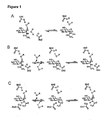
- Figure 1 is an illustration of three possible catalytic mechanisms for O-GlcNAcase. Pathway A; the single step inverting mechanism; pathway B; the double displacement retaining mechanism involving formation and breakdown of a covalent glycosyl enzyme intermediate; pathway C; the double displacement retaining mechanism involving formation and breakdown of a bicyclic oxazoline intermediate.
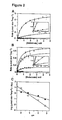
- Figure 2 illustrates the activity of O-GlcNAcase and ⁇ -hexosaminidase in the presence ofN-fluoroacetyl derivatives of MU-GlcNAc.
- A Initial velocity of the human ⁇ -hexosaminidase catalyzed hydrolysis of N-fluoroacetyl derivatives of MU-GlcNAc;
- MU-GlcNAc-F 5a),
- MU-GlcNAcF3 5c
- Figure 3 illustrates a competitive inhibition pattern of human O-GlcNAcase catalyzed hydrolysis of pNP-GlcNAc in the presence of NAG-Thiazoline ( 9a ).
- concentrations of 9a (mM) used were 0.00 ( ⁇ ), 0.033 ( ⁇ ), 0.100 ( ⁇ ), 0.300 (X), 0.900 ( ⁇ ), and 3.04 ( ⁇ ).
- Inset graphical analysis of K I from plotting K M apparent against NAG-Thiazoline ( 9a ) concentration.
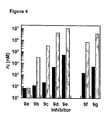
- Figure 4 is a graph illustrating the selectivity of inhibition of O-GlcNAcase over ⁇ -hexosaminidase by a panel of thiazoline inhibitors. Bar graph of the K I values of the thiazoline inhibitors panel ( 9a-f ) measured for the inhibition of O-GlcNAcase and ⁇ -hexosaminidase ( )catalyzed hydrolysis of MU-GlcNAc.
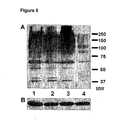
- Figure 5 is a Western blot of proteins from COS-7 cells cultured for 40 hours in the presence or absence of 50 ⁇ M of different thiazoline inhibitors. Incubation of COS-7 cells with thiazoline inhibitors causes an increase in cellular levels of O-GlcNAc-modified proteins. Lane 1, thiazoline 9a ; lane 2, thiazoline 9c ; lane 3, thiazoline 9g ; lane 4, no inhibitor. (A) Western blot analysis of cellular levels of O-GlcNAc-modified proteins using anti-O-GlcNAc MAb CTD 110.6 followed by an anti-mouse IgG-HRP conjugate. (B) Western blot of samples loaded in (A) treated with anti- ⁇ -actin mAb Clone AC-40 followed by an anti-mouse IgG-HRP conjugate reveals equivalent ⁇ -actin levels in each sample.
- Figure 6 is a Western blot of proteins from COS-7 cells cultured over 40 hours in the presence or absence of 50 ⁇ M thiazoline inhibitor ( 9c ). Incubation of COS-7 cells with thiazoline inhibitor ( 9c ) results in a time dependent increase in cellular levels of O-GlcNAc-modified proteins.
- Figure 7 illustrates the decomposition of Streptozotocin (STZ) in D 2 O.
- STZ dissolved in D 2 O was monitored over a period of 24 hours.
- the resonance marked with an asterisk (*) is from H-1 of the ⁇ -anomer of STZ.
- Spectra were collected at room temperature from a sample of STZ ( ⁇ 10 mM) freshly dissolved in D 2 O. NMR spectra were collected A) 5 minutes, B) 20 minutes, C) 40 minutes, D) 2 hours, E) 4 hours, and F) 24 hours after dissolving STZ.
- Figure 8 is a graph which illustrates that STZ does not show a time dependent inactivation of O -GlcNAcase or ⁇ -hexosaminidase.
- O-GlcNAcase (0.116 mg/mL) was incubated with 10 mM STZ in the presence of 50 mM NaH 2 PO 4 , 100 mM NaCl, 1% BSA, 5 mM ⁇ -mercaptoethanol, pH 6.5. At several time intervals the enzyme activities of the inactivation mixture and control were assayed.
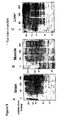
- Figure 9 shows Western blots of proteins from brain, muscle and liver tissue of rats injected with varying doses of inhibitor 9c.
- Four rats were treated by tail vein injection of different doses of inhibitor 9c or a buffer control. Two sequential injections were performed approximately 18 hours apart and the rats were then sacrificed 24 hours after the first injection.
- Western blot analyses using an ⁇ - O- GlcNAc antibody (CTD110.6) clearly indicate that the inhibitor 9c easily gains access into a variety of tissues including brain (A), muscle (B) and liver (C) and doses as low as 50 mg kg -1 are almost enough to elicit a maximal increase in O-GlcNAc levels.
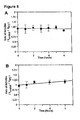
- Figure 10 illustrates the results of an intravenous glucose tolerance test conducted on rats.
- A Eight rats, four of which were exposed to a 50 mg kg -1 tail vein injection of inhibitor 9c, were tested for their ability to clear glucose.
- An intravenous glucose tolerance test (IVGTT) was performed with a 1 g kg -1 challenge of glucose that was also delivered via the tail vein. Error bars indicate variance between the four rats used under each condition.
- B Western blot analyses using an ⁇ -O-GlcNAc antibody (CTD110.6) indicates that the four rats treated with the inhibitor in the IVGTT did have increased levels of O -GlcNAc modified proteins.
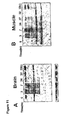
- Figure 11 shows Western blots of proteins from brain and muscle tissue of rats injected with inhibitor 9c at various time periods.
- Several rats were treated by tail vein injection with 50 mg kg -1 of inhibitor 9c and sacrificed at specific times after the injection to observe how O-GlcNAc levels vary over time.
- Western blot analyses using an ⁇ - O -GlcNAc antibody (CTD110.6) was used to monitor O-GlcNAc levels.
- Brain (A) and muscle (B) tissue show that the inhibitor is able to gain access to tissues rapidly where it acts quickly to elevate O-GlcNAc levels ( ⁇ 3 hours). Within approximately 24-32 hours, inhibitor 9c is cleared from the tissues and O-GlcNAc levels return to normal.
- Time 0 and 32(-) represent untreated control animals at time 0 hours and 32 hours.
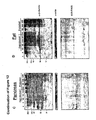
- Figure 12 shows Western blots of proteins from brain, muscle, pancreas, fat and spleen tissue of rats fed two different forms and doses of inhibitor 9c. Rats were fed food containing varying amounts of the deprotected (polar) or protected (nonpolar) inhibitor 9c or no inhibitor at all for three days. Levels of O-GlcNAc in tissues were evaluated by Western blot analyses using an ⁇ - O -GlcNAc antibody (CTD110.6).
- a dose of 100 mg kg -1 day -1 is enough to inhibit O -GlcNAcase and cause large increases in O -GlcNAc modified proteins, as judge by western blot analyses using an ⁇ - O -GlcNAc antibody in brain (A), muscle (B), pancreas (C), fat (D) and spleen (E) tissue.
- a dose of 1000 mg kg -1 day -1 causes slightly greater increases in O -GlcNAc modified proteins. Control blots with an ⁇ -actin anitibody or SDS-PAGE shows that sample loading was equal.
- the invention comprises compounds which selectively inhibit glycosidases.
- the compounds have the general chemical formula (I): wherein R 3 , R 5 , R 6 , are selected from the group consisting of branched alkyl chains, unbranched alkyl chains, cycloalkyl groups, aromatic groups, alcohols, ethers, amines, substituted or unsubstituted carbamates, substituted or unsubstituted ureas, esters, amides, aldehydes, carboxylic acids, and heteroatom containing derivatives thereof, wherein said esters and amides may comprise an acyl group selected from the group consisting of branched alkyl chains, unbranched alkyl chains, cycloalkyl groups, aromatic groups, and heteroatom derivatives thereof; R 2 and R 4 are CH 2 , CHR 1 , NH, NR 1 , or any heteroatom, and R 1 is selected from the group consisting of H, ethers, amines, branche
- R 2 is S
- R 1 is selected from the group consisting of CH 2 CH 3 , (CH 2 ) 2 CH 3 , (CH 2 ) 3 CH 3 , (CH 2 ) 4 CH 3 , CH(CH 3 ) 2 and CH 2 CH(CH 3 ) 2 and R 4 is O.
- the compounds comprise 1,2-dideoxy-2'-ethyl- ⁇ -D-glucopyranoso-[2,1-d]- ⁇ 2'-thiazoline, 1,2-dideoxy-2'-propyl- ⁇ -D-glucopyranoso-[2,1-d]- ⁇ 2'-thiazoline, 1,2-dideoxy-2'-butyl- ⁇ -D-glucopyranoso-[2,1-d]- ⁇ 2'-thiazoline, 1,2-dideoxy-2'-pentyl- ⁇ -D-glucopyranoso-[2,1-d]- ⁇ 2'-thiazoline, 1,2-dideoxy-2'-isopropyl- ⁇ -D-glucopyranoso-[2,1-d]- ⁇ 2'-thiazoline, 1,2-dideoxy-2'-isobutyl- ⁇ -D-glucopyranoso-[2,1-d]- ⁇ 2'-thiazoline.
- the compounds have the general chemical formula (II): wherein X 1 -X 6 are O, NH, NR 1 , CHR 1 , CH 2 or any heteroatom, R 1 to R 5 are selected from the group consisting of branched alkyl chains, unbranched alkyl chains, cycloalkyl groups, aromatic groups, alcohols, ethers, amines, substituted or unsubstituted carbamates, substituted or unsubstituted ureas, esters, amides, aldehydes, carboxylic acids, and heteroatom containing derivatives thereof, wherein said esters and amides may comprise an acyl group selected from the group consisting of branched alkyl chains, unbranched alkyl chains, cycloalkyl groups, aromatic groups, and heteroatom derivatives thereof, and pharmaceutically acceptable salts thereof.
- R 1 to R 5 are selected from the group consisting of branched alkyl chains, unbranched alkyl chains, cycloalkyl groups, aromatic
- R 1 is selected from the group consisting of CH 2 CH 3 , (CH 2 ) 2 CH 3 , (CH 2 ) 3 CH 3 , (CH 2 ) 4 CH 3 , CH(CH 3 ) 2 and CH 2 CH(CH 3 ) 2 , R 2 , R 3 and R 4 are OH, X 1 and X 2 are O, X 3 is NH, X 4 and X 5 are O, X 6 is NH, and R 5 is C 6 H 6 .
- the compounds comprise O-(2-deoxy-2-propamido-D-glucopyranosylidene)amino N -Phenylcarbamate, O-(2-deoxy-2-butamido-D-glucopyranosylidene)amino N -Phenylcarbamate, O-(2-deoxy-2-valeramido-D-glucopyranosylidene)amino N -Phenylcarbamate, O-(2-deoxy-2-hexamido-D-glucopyranosylidene)amino N -Phenylcarbamate, O-(2-deoxy-2-isobutamido-D-glucopyranosylidene)amino N -Phenylcarbamate, or O-(2-deoxy-2-isovaleramido-D-glucopyranosylidene)amino N -Phenylcarbamate.
- the term "compounds” refers to the compounds discussed above and includes derivatives of the compounds, including acyl-protected derivatives, and pharmaceutically acceptable salts of the compounds and the derivatives.
- the invention also comprises prodrugs of the compounds, pharmaceutical compositions containing the compounds and a pharmaceutically acceptable carrier, and pharmaceutical compositions containing prodrugs of the compounds and a pharmaceutically acceptable carrier.
- the compounds selectively inhibit the activity of specific glycosidases over other glycosidases.
- the glycosidases may comprise glycoside hydrolases.
- the glycoside hydrolases may be family 84 glycoside hydrolases.
- the glycosidase is O-GlcNAcase.
- the invention comprises compounds which selectively inhibit the activity of O-GlcNAcase over ⁇ -hexosaminidase.
- the compounds selectively inhibit the cleavage of O-GlcNAc from proteins.
- the compounds of the invention are valuable tools in studying the physiological role of O-GlcNAc at the cellular and organismal level.
- the compounds are useful in the development of animal models to study a disease or disorder, or for studying treatment of a disease or disorder, related to deficiency or over-expression of O-GlcNAcase or accumulation or depletion of O-GlcNAc.
- the compounds are useful in the development of a disease model for the development of Type I or Type II diabetes.
- Type II diabetes develops when humans or animals are unable to properly regulate blood glucose levels. Tissues must be able to sense and rapidly respond to changes in glucose availability as well as to signals from other components of the endocrine system.
- Glucose is the key nutrient in regulating insulin synthesis and secretion from the ⁇ -cells of the pancreas. Of all glucose entering into cells, 2-5% is shunted into the hexosamine biosynthetic pathway, thereby regulating cellular concentrations of the end product of this pathway, uridine diphosphate-N-acetylglucosamine (UDP-GlcNAc).
- UDP-GlcNAc is a substrate of the nucleocytoplasmic enzyme O-GlcNAc transferase (OGTase), [53-56] which acts to post-translationally add GlcNAc to specific serine and threonine residues of numerous nucleocytoplasmic proteins.
- OGTase recognizes many of its substrates [57,58] and binding palmers [59, 60] through its tetratricopeptide repeat (TPR) domains.
- TPR tetratricopeptide repeat
- O-GlcNAc has been found in several proteins on known phosphorylation sites, [3, 64-66] suggesting a role for O-GlcNAc in cellular signaling. Additionally, OGTase shows unusual kinetic behaviour making it extraordinarly sensitive to intracellular UDP-GlcNAc substrate concentrations and therefore glucose supply. [67] All of these data point to a logical role for O-GlcNAc levels acting as a nutrient sensing mechanism. To support such a potential role in nutrient sensing it has been shown that in peripheral tissues, elevated O-GlcNAc levels result in the development of insulin resistance.
- the compounds of the invention are also useful in the treatment of diseases or disorders related to deficiency or over-expression of O-GlcNAcase or accumulation or depletion of O-GlcNAc, or any disease or disorder responsive to glycosidase inhibition therapy.
- diseases and disorders include, but are not limited to, diabetes, neurodegenerative disorders, such as Alzheimer's disease (AD), and cancer.
- diseases and disorders may also include diseases or disorders related to the accumulation or deficiency in the enzyme OGTase.
- the compounds of the invention may be used to study and treat AD and other tauopathies.
- Six isoforms of tau are found in the human brain. In AD patients, all six isoforms of tau are found in NFTs, and all are markedly hyperphosphorylated. [69, 70]
- Tau in healthy brain tissue bears only 2 or 3 phosphate groups, whereas those found in the brains of AD patients bear, on average, 8 phosphate groups [71, 72] .
- O-GlcNAc is a dynamic modification that can be removed and reinstalled several times during the lifespan of a protein. Suggestively, the gene encoding O-GlcNAcase has been mapped to a chromosomal locus that is linked to AD. [15, 76]
- the compounds of the invention are useful as selective inhibitors of other types of glycosidases.
- some microbial toxins are members of family 84 glycoside hydrolases, and therefore, the compounds of the invention may be useful as antimicrobials.
- the compounds of the invention are also useful in promoting differentiation of cells, such as promoting pluripotent cells into islet ⁇ -cells.
- O-GlcNAc is known to regulate the function of several transcription factors and is known to be found on the transcription factor PDX-1. Modification of the transcription factor PDX-1 by modification of O-GlcNAc residues may affect activity of PDX-1, which in turn affects cell differentiation.
- the compounds of the invention are also useful in preparing cells for stress. Recent studies have indicated that PUGNAc can be used in an animal model to reduce myocardial infarct size after left coronary artery occlusions [77] .
- the invention also relates to various methods of making the compounds.
- the method may comprise the steps of:
- the invention also relates to methods of making selective glycosidase inhibitors comprising, for example, the steps of:
- the method of making selective glycoside inhibitors comprises the steps of:
- Example 1 Comparative Analysis of the Catalytic Mechanisms of O-GlcNAcase and ⁇ -Hexosaminidase
- a logical starting point for the design of inhibitors of O-GlcNAcase takes into consideration the catalytic mechanism of O-GlcNAcase and ⁇ -hexosaminidase. Although the catalytic mechanism of action of the family 20 human ⁇ -hexosaminidase A and B have been fairly well established [78] , that of the family 84 O-GlcNAcase remains unknown. The inventors therefore first elucidated the catalytic mechanism of human O-GlcNAcase and secondly, used this information in designing simple inhibitors that would be potent, cell permeable, and highly selective for O-GlcNAcase over the lysosomal ⁇ -hexosaminidases.
- the first alternative is an inverting mechanism ( Figure 1A ) such as that found for goose lysozyme [79] from family 23 of glycoside hydrolases.
- This catalytic mechanism generally involves the base-catalyzed nucleophilic attack of water at the anomeric centre concomitant with the acid-catalyzed departure of the leaving group.
- the second mechanistic possibility is the canonical two step double displacement mechanism that results in retention of configuration at the anomeric center ( Figure 1B ).
- This mechanism is used by most retaining ⁇ -glycosidases and involves, in the first step, attack of an enzymic nucleophile at the anomeric center with the resulting formation of a transient covalent glycosyl enzyme intermediate [80] .
- Departure of the aglycon leaving group is facilitated by an enzymic residue acting as a catalytic general acid.
- this same residue acts as a catalytic general base to facilitate the attack of a water molecule at the anomeric center, cleaving the intermediate to liberate the hemiacetal product with retained stereochemistry.
- ⁇ -N-acetylglucosaminidases from family 3 of glycoside hydrolases have been shown to use this mechanism [81] as have the C-type lysozymes from family 22 [82] .
- the third mechanistic alternative involves the nucleophilic participation of the 2-acetamido group of the substrate in place of an enzymic catalytic nucleophile ( Figure 1C ).
- This last mechanistic option is exploited by ⁇ -hexosaminidases from family 20 of glycoside hydrolases [30, 48, 83] These three mechanisms differ in several aspects.
- the inverting mechanism is a one step reaction that results in the formation of a product with inverted stereochemistry at the anomeric center.
- a key difference between these mechanistic alternatives is the involvement of the 2-acetamido group of the substrate.
- This moiety may actively participate in catalysis as a nucleophile, as for the lysosomal ⁇ -hexosaminidases, or it may act as a bystander.
- All buffer salts used in this study were obtained from Sigma-Aldrich. Dry methanol and toluene were purchased from Acros Organics. Dicloromethane and triethylamine were dried by distillation over CaH 2 prior to use. ⁇ -Hexosaminidase was purchased from Sigma (Lot 043K3783). STZ was purchased from Sigma-Aldrich and samples were freshly dissolved just prior to assays. PUGNAc was obtainined from Toronto Research Chemicals. All other reagents were purchased from Sigma-Aldrich and used without further purification. Milli-Q (18.2 m ⁇ cm -1 ) water was used to prepare all buffers.
- the combined organic extracts were washed successively with water, twice with saturated sodium bicarbonate, and finally with a solution of saturated sodium chloride.
- the organic extracts were dried over MgSO 4 , filtered, and the solvent removed in vacuo to yield a light yellow syrup.
- the desired product was purified using flash column silica chromatography (2:1; ethyl acetate - hexanes) to yield the partially purified desired compound as an amorphous white solid ( ⁇ 356 mg, 0.68 mmol, 68 %) that was used in the next step without further purification.
- the desired product was purified using flash column silica chromatography using a gradient solvent system (1:1; hexanes - ethyl acetate) to yield the partially purified desired compound as a white amorphous solid ( ⁇ 0.10 mg, 0.19 mmol, 64 %) that was used in the next step without further purification.
- the reaction mixture was then diluted with ethyl acetate (20 mL) and a solution of saturated sodium chloride (40 mL) was added.
- the organic layer was collected and the aqueous layer was extracted twice with ethyl acetate.
- the combined organic extracts were washed successively with water, twice with saturated sodium bicarbonate, and finally with a solution of saturated sodium chloride.
- the organic extracts were dried over MgSO 4 , filtered, and the solvent removed in vacuo to yield a light yellow syrup.
- the desired product was purified using flash column silica chromatography using a gradient solvent system (1:1; hexanes - ethyl acetate) to yield the partially purified desired compound as an amorphous white solid ( ⁇ 0.93 g, 0.17 mmol, 82 %) that was used in the next step without further purification.
- the desired deprotected glycosides were isolated by flash column silica chromatography using the following solvent systems: ethyl acetate - methanol - water (12:1:1) for the N -tri- and N -difluoroacetyl derivatives ( 5b and 5c ) and ethyl acetate - methanol (1:1) for the N- monofluoroacetyl derivative (5a).
- Time dependent assay of ⁇ -hexosaminidase and O-GlcNAcase revealed that both enzymes were stable over this period in their respective buffers; 50 mM citrate, 100 mM NaCl, 0.1% BSA, pH 4.25 and 50 mM NaH 2 PO 4 , 100 mM NaCl, 0.1% BSA, pH 6.5.
- the progress of the reaction at the end of thirty minutes was determined by measuring the extent of 4-methylumbelliferone liberated as determined by fluorescence measurements using a Varian CARY Eclipse Fluoresence-Spectrophotometer 96-well plate system and comparison to a standard curve of 4-methylumbelliferone under identical buffer conditions.
- the concentration ( ⁇ g/ ⁇ l) of ⁇ -hexosaminidase and O -GlcNAcase used in assays with fluorinated substrates were as follows: for 4-methylumbelliferyl 2-acetamido-2-deoxy- ⁇ -D-glucopyranoside (MuGlcNAc) (5): 0.00077, 0.0126; MuGlcNAc-F (5a): 0.0031, 0.0189; MuGlcNAc-F 2 (5b): 0.0154, 0.0756, and for MuGlcNAc-F 3 (5c): 0.0154, 0.01523.
- ⁇ -hexosaminidase and O-GlcNAcase were used at a concentration ( ⁇ g/ ⁇ L) of 0.0154 and 0.0378, respectively to test the inhibitors using substrate 5 at a concentration of 0.64 mM. All inhibitors were tested at eight concentrations ranging from 5 times to 1/5 th K I with the exception of the assay of inhibitor 8e with ⁇ -hexosaminidase, where such high concentrations of inhibitor could not be reached owing to the high K I value of 8e. K I values were determined by linear regression of data in Dixon plots. Where necessary, assays were carried out in triplicate and error bars are included in plots of the data.
- b Values were estimated by non-linear regression of the Michelis-Menten data. Note that substrate concentrations assayed matched but did not exceed K M due to limited substrate solubility. c These values could not be determined as saturation kinetics were not observed owing to limitations in substrate solubility. d Values were determined by linear regression of the second order region of the Michelis-Menten plot.
- This constant can be considered a function of both an electronic component ( ⁇ *, which is governed by sensitivity of the reaction to the electronic parameter of the substituents, ⁇ *) and a steric component ( ⁇ , which is governed by sensitivity of the reaction to the steric Taft parameters of the substituent, E s ) according to the following equation.
- ⁇ ⁇ * + ⁇
- the difference between the slopes measured for lysosomal ⁇ -hexosaminidase and O-GlcNAcase may thus reflect the position of the transition state along the reaction coordinate or may indicate that the lysosomal ⁇ -hexosaminidase has a more sterically constrained active site architecture than does O-GlcNAcase.
- fluorine 147 pm Van der Waals radius and 138 pm C-F bond length
- hydrogen 120 pm Van der Waals radius and 109 pm C-H bond length
- NAG-thiazoline As a further test of whether O-GlcNAcase uses a catalytic mechanism involving anchimeric assistance, the inhibitor NAG-thiazoline ( 9a ) was tested with this enzyme. NAG-thiazoline, designed as a mimic of the bicyclic oxazoline intermediate, has been previously demonstrated to function as an inhibitor of family 20 hexosaminidases [30, 48] . Using pNP-GlcNAc as a substrate, NAG-thiazoline was found to be a potent inhibitor of family 84 human O-GlcNAcase and a clear pattern of competitive inhibition was observed ( Figure 3 ).
- Non-linear regression revealed a K I value of 180 nM at pH 7.4 and analysis using MU-GlcNAc ( 5 ) revealed a K I value of 70 nM at pH 6.5 (Table 2).
- Glycoside hydrolases from families 18 [89] and 56 [90] which are endo-glycosidases acting to cleave oligosaccharide chains, have also been shown to use a mechanism involving anchimeric assistance [91] .
- families 18, 20, 56 and 84 are all comprised of retaining glycosidases that use a catalytic mechanism involving anchimeric assistance from the acetamido group of the substrate.
- the first is that the slope of the Taft-like analysis for the lysosomal enzyme is much steeper than that measured for O-GlcNAcase thereby suggesting that the bulk of the N-acyl group may be a determinant in substrate recognition ( vide supra ).
- the second, and related, consideration is that the structure of the human lysosomal ß-hexosaminidase B reveals a snug pocket into which the methyl group of the acetamido substituent is poised [78] .
- STZ which bears a bulky N-acyl substituent shows some selectivity for O-GlcNAcase over ⁇ -hexosaminidase [46] .
- the organic phase was dried over MgSO 4 , filtered, and concentrated to yield a white crystalline solid.
- the material was recrystallized using a mixture of ethyl acetate and hexanes to yield the desired N -acylated materials in yields ranging from 46 to 74 %.
- 1,2-dideoxy-2'-ethyl- ⁇ -D-glucopyranoso-[2,1-d]- ⁇ 2'-thiazoline ( 9a ) has been previously prepared using similar reaction conditions as described above [30] . All spectral characterization agreed with the literature values as did the elemental analysis of the sample used in these assays. Analytical calculated for C 8 H 13 O 4 NS; C, 43.82; H, 5.98; N, 6.39; Experimental C, 43.45; H, 6.23; N, 6.18.
- Time dependent assay of ⁇ -hexosaminidase and O-GlcNAcase revealed that both enzymes were stable over this period in their respective buffers; 50 mM citrate, 100 mM NaCl, 0.1% BSA, pH 4.25 and 50 mM NaH 2 PO 4 , 100 mM NaCl, 0.1% BSA, pH 6.5.
- the progress of the reaction at the end of thirty minutes was determined by the measuring the extent of 4-methylumbelliferone liberated as determined by fluorescence measurements using a Varian CARY Eclipse Fluoresence-Spectrophotometer 96-well plate system and comparison to a standard curve of 4-methylumbelliferone under identical buffer conditions.
- Excitation and emission wavelengths of 368 and 450 nM were used, respectively, with 5 mm slit openings.
- the possible time dependent inactivation of O-GlcNAcase was assayed by incubating 10 mM STZ with 0.016 mg/mL O-GlcNAcase in the presence of 50 mM NaH 2 PO 4 , 100 mM NaCl, 1% BSA, 5 mM ⁇ -mercaptoethanol, pH 6.5 or 0.036 mg/mL ⁇ -hexosaminidase in the presence of 50 mM citrate, 100 mM NaCl, 0.1% BSA, pH 4.25. At several time intervals the residual enzyme activity contained in the inactivation mixture was assayed.
- ⁇ -hexosaminidase and O-GlcNAcase were used at a concentration ( ⁇ g/ ⁇ L) of 0.0154 and 0.0378, respectively to test the inhibitors using substrate 5 at a concentration of 0.64 mM. All inhibitors were tested at eight concentrations ranging from 5 times to 1/5 th K I with the exception of the assay of inhibitor 8e with ⁇ -hexosaminidase, where a such high concentrations of inhibitor could not reached owing to the high K I value of 8e. K I values were determined by linear regression of data in Dixon plots. Where necessary, assays were carried out in triplicate and error bars are included in plots of the data.
- the sensitivity of the reaction to the electronic effect of the fluorine substituents ( ⁇ *) may therefore be the same for both enzymes but the significant sensitivity of the lysosomal ⁇ -hexosaminidase catalyzed reaction to the steric effect of the substrates ( ⁇ ) results in an apparently steeper slope for ⁇ -hexosaminidase than that measured for O-GlcNAcase.
- the Taft-like linear free energy analysis and the selective inhibition data suggest that the active site of O-GlcNAcase has considerably more space in the region surrounding the 2-acetamido group of the substrate than does lysosomal ß-hexosamindiase.
- the common intermediate, 20 can be treated with a range of acyl chlorides to provide 21c-g as crude products. Immediate de- O -acetylation of these crude intermediates readily furnishes the triols 22b-f , in good yield.
- Phenyl isocyanate (0.5 mL, 3.7 mmol) was added to the lactone 17 (1.3 g, 3.1 mmol) and Et 3 N (1.3 mL, 9.3 mmol) in THF (50 mL) and the solution stirred (r.t., 3 h). Concentration followed by flash chromatography of the resultant residue (EtOAc/hexanes 1:4) yielded the carbamate 19 as a colourless oil (1.2 g, 71%).
- Trifluoroacetic acid 13 mmol was added to the carbamate 19 (1 mmol) in CH 2 Cl 2 (10 mL) at 0 °C and the solution stirred (2 h). Pyridine (200 mmol) was then slowly added to the solution and the resulting mixture left to stand (0 °C, 10 min). The appropriate acyl chloride (3 mmol) was then added at 0 °C and the solution allowed to stand at 4 °C overnight. Concentration of the mixture gave a yellowish residue which was dissolved in EtOAc (30 mL) and washed with (2 x 20 mL), brine (1 x 20 mL), dried (MgSO 4 ) filtered and concentrated.
- Time-dependent assay of O -GlcNAcase and ⁇ -hexosaminidase revealed that enzymes were stable in their respective buffers over the period of the assay: 50 mM NaH 2 PO 4 , 100 mM NaCl, 0.1% BSA, pH 6.5 and 50 mM citrate, 100 mM NaCl, 0.1% BSA, pH 4.25.
- the progress of the reaction at the end of 30 minutes was determined by measuring the extent of 4-nitrophenol liberated as determined by UV measurements at 400 nm using a 96-well plate (Sarstedt) and 96-well plate reader (Molecular Devices).
- PUGNAc is a potent competitive inhibitor of both O- GlcNAcase [13, 50] and ⁇ -hexosaminidase [28, 51] .
- the respective K I values are 46 nM and 36 nM.
- the selectivity of inhibitors 22a-f were evaluated and compared to PUGNAc. Using p NP-GlcNAc as a substrate it was found that these compounds 22a-f are inhibitors of both human O -GlcNAcase and human ⁇ -hexosaminidase (Table 3). Table 3. Inhibition constants and selectivities of inhibitors for O -GlcNAcase and ⁇ -hexosaminidase.
- the thiazolines, NAG-thiazoline and 9b-g , with a sp 3 hybridised anomeric carbon comprise a bicyclic scaffold that restricts movement of the acyl chain as compared to the acyl chain on the corresponding PUGNAc derivatives, PUGNAc and 22a-f , that have a sp 2 hybridised anomeric carbon.
- PUGNAc and 22a-f PUGNAc derivatives
- the precise positioning of the side chain within the active sites must vary between these two sets of compounds. Together, these two factors must contribute to both the overall somewhat poorer inhibition and lesser selectivity of the PUGNAc-derived compounds compared to the thiazoline derivatives.
- COS-7 cells were cultured in DMEM medium (Invitrogen) supplemented with 5-10% FBS (Invitrogen). Aliquots of inhibitors (50 ⁇ L of a stock in 95% ethanol) were delivered onto tissue culture plates and the ethanol was evaporated. The cells were incubated at 37°C for 40 hours at which time they reached approximately 80 % confluence. The time dependent accumulation of O -GlcNAc-modified proteins in response to treatment with 50 ⁇ M of compound 9a, 9c or 9g in cells was studied as follows.
- COS-7 cells were cultured to 25 % confluence in 5% FBS and an aliquot (100 ⁇ L) of inhibitor dissolved in media and filter sterilized was added to each plate to yield a final concentration of 50 ⁇ M of inhibitor.
- COS-7 cells (2 x 10 cm plates) were harvested at the appropriate times by scraping and were pooled by centrifugation (200 ⁇ g, 10 min). Cells were washed once with PBS, pH 7.0 (10 mL) and pelleted (200 ⁇ g, 10 min). The cells could be frozen at -80°C at this point. Control cultures without inhibitors were treated in the same manner.
- COS-7 cells were cultured in the presence of inhibitors 9a, 9c, or 9g as described above to approximately 90 % of confluence.
- a culture of control cells was treated in the same manner as follows but the cultures contained no inhibitor.
- Cells were harvested as described above. Frozen cells were thawed at 4°C, and cold lysis buffer (1 mL of 50 mM Tris, pH 8.0 containing 150 mM NaCl, 1 mM EDTA, 1 mM PMSF, 1% NP-40, 0.5% sodium deoxycholate, and 1 mM of inhibitor 9f ) was added.
- the membrane was blocked by using 5% BSA (fraction V, Sigma) in PBS (blocking buffer A for samples probed with mouse anti- O -GlcNAc monoclonal IgM antibody (MAb CTD 110.6 - Covance)) or 5% low-fat dry powdered milk (blocking buffer B for samples probed with anti- ⁇ -actin), pH 7.4, containing 0.1% Tween 20 for 1 h at room temperature or overnight at 4°C.
- the blocking solution was decanted, and a solution of blocking buffer A containing MAb CTD 110.6 (1:2500 of the stock) or blocking buffer B containing mouse monoclonal anti- ⁇ -actin IgG (Clone AC-40 - Sigma) was added (1:1000 dilution) as appropriate.
- the membrane was incubated at room temperature for 1 h or overnight at 4°C after which the blocking buffer was decanted and the membrane was rinsed with PBS, pH 7.4, containing 0.1 % Tween 20 (wash buffer). Membranes were then rinsed for 2 ⁇ 5 min and 3 ⁇ 15 min with wash buffer.
- the membrane was incubated in blocking buffer A for 1 hour at RT and, after washing, the membrane was incubated with a secondary goat anti-mouse-IgM-HRP-conjugate (1:2500, Santa Cruz Biotech) for one hour at RT or 4 °C overnight in blocking solution.
- the membrane was incubated with a secondary goat anti-mouse-IgG-HRP conjugate (1:100000, Sigma) for one hour at RT or 4 °C overnight in blocking solution B.
- a secondary goat anti-mouse-IgG-HRP conjugate (1:100000, Sigma) for one hour at RT or 4 °C overnight in blocking solution B.
- Membranes were washed and detection of membrane bound goat anti-mouse-IgG-HRP conjugate was accomplished by chemiluminescent detection using the SuperSignal West Pico Chemiluminescent Detection Kit (Pierce) and film (Kodak Biomax MR).
- COS-7 cells incubated in plates with 50 ⁇ M of inhibitor 9a, 9c, or 9g revealed no abnormalities in proliferation rate or morphology as compared to control cells (data not shown).
- Cellular levels of O-GlcNAc-modified proteins within cells cultured for 40 hours in the presence of inhibitors 9a, 9c or 9g , or in their absence was carried out using the O-GlcNAc directed monoclonal antibody (64) mAbCTD110.6. Marked increases in cellular levels of O-GlcNAc-modified proteins within the cells were observed as compared to the control ( Figure 5A ) indicating that these compounds readily gain access to the interior of the cell where they act to block O-GlcNAcase function.
- Example 5 Use of Selective O-GlcNAcase Inhibitors to Develop an Animal Model for Studying Type II Diabetes
- a 100 ⁇ L sample of blood was taken from the jugular vein.
- a small aliquot of the blood was used to measure the blood glucose concentration using a glucometer (Accu-Check Advantage, Roche) and the remaining blood was stored on ice for 20 minutes and spun down to isolate the serum.
- the rats were sacrificed with 1:1 mixture of CO 2 /O 2 .
- Tissue samples (brain, muscle, liver, spleen, pancreas, fat) were immediately harvested and flash frozen with liquid nitrogen and stored at - 80°C.
- tissue were kept frozen while they were ground with a mortar and pestle into a fine powder. 100 mg of the powder was then homogenized in 1 mL of cold lysis buffer (50 mM Tris, 0.5 % sodium deoxycholate, 0.1 % SDS, 1% nonidet P-40, 1 mM EDTA, 1 mM PMSF, and 1 mM butyl-NAG-thiazoline) using two 10 second pulse on a Jenke and Kunkel Ultra-Turrax tissue homogenizer tissue homogenize. Tissues were then spun down at 13,000 rpm in a microcentrifuge (eppendrof) to remove the cell debris. The soluble cell extract was then analyzed for levels O-GlcNAc modified proteins using Western blot analysis as described above for the cell studies.
- cold lysis buffer 50 mM Tris, 0.5 % sodium deoxycholate, 0.1 % SDS, 1% nonidet P-40, 1 mM EDTA, 1 mM PMSF, and 1
- Rats injected with varying doses of inhibitor 9c via the tail vein showed that intravenous administration of inhibitor 9c affects cellular levels of O-GlcNAc modified proteins in various tissue types ( Figure 9 ).
- Samples of brain tissue ( Figure 9A ) showed that there were marked increases in cellular levels of O-GlcNAc modified proteins when rats are injected with 50, 120 and 300 mg/kg doses of inhibitor 9c as compared to controls. This indicates that inhibitor 9c readily gains access to the interior of brain cells where it acts to block O-GlcNAcase function. Similar results were observed for tissue samples of muscle and liver ( Figures 9B and 9C ).
- Rats injected with inhibitor 9c showed that intravenous administration of inhibitor 9c affects cellular levels of O-GlcNAc modified proteins in various tissue types as early as three hours following injection ( Figure 11 ).
- Samples of brain tissue ( Figure 11A ) showed that there were marked increases in cellular levels of-GlcNAc modified proteins after three hours following injection as compared to controls. This indicates that inhibitor 9c readily gains access to the interior of brain cells where it acts to block O-GlcNAcase function.
- Cellular levels of O-GlcNAc modified proteins remained high after seven hours. The levels dropped after 24 hours and appeared to return to normal levels after about 32 hours. Similar results were observed for muscle tissue samples ( Figure 11B ).
- the inhibitor 9c was incorporated into the chow (Lab Diet 5001 Rodent Diet, PMI Nutrition International, LLC).
- 600 g of the ground chow was mixed with 355 ml of water and 5 mL of the inhibitor dissolved in ethanol. Small pieces were then prepared with a pasta machine (Pasta Express, Creative) and dehydrated overnight at 37 °C (Snackmaster Dehydrator, American Harvest). Five sets of chow were made with the following amounts of inhibitor: 0 mg kg -1 day -1 , 100 or 1000 mg kg -1 day -1 of the deprotected (polar) inhibitor, and 100 or 1000 mg kg -1 day -1 of the protected (non-polar) inhibitor.
- Rats were fed two different doses of protected (non-polar) and deprotected (polar) forms of inhibitor 9c for three days.
- Western blot analyses showed that oral administration of both forms of inhibitor 9c affects cellular levels of O-GlcNAc modified proteins in various tissue types ( Figure 12 ).
- Samples of brain tissue ( Figure 12A ) showed that there were marked increases in cellular levels of O-GlcNAc modified proteins when rats are fed 100 mg/kg/day doses of either the protected or deprotected forms of inhibitor 9c.
- Cellular levels of O-GlcNAc modified proteins within brain tissue was even greater when rats were fed the larger dose of 1000 mg/kg/day doses of either the protected or deprotected forms of inhibitor 9c.
- inhibitor 9c readily gains access to the interior of brain cells where it acts to block O-GlcNAcase function even when it is orally administered in a dose dependant manner. Similar results were observed for other types of tissue samples, including muscle, pancreas, fat and spleen ( Figure 12B-12E ).
- R 3 , R 5 , R 6 are selected from the group consisting of branched alkyl chains, unbranched alkyl chains, cycloalkyl groups, aromatic groups, alcohols, ethers, amines, substituted or unsubstituted carbamates, substituted or unsubstituted ureas, esters, amides, aldehydes, carboxylic acids, and heteroatom containing derivatives thereof, wherein said esters and amides may comprise an acyl group selected from the group consisting of branched alkyl chains, unbranched alkyl chains, cycloalkyl groups, aromatic groups, and heteroatom derivatives thereof, and; wherein R 2 and R 4 are CH 2 , CHR 1 , NH, NR 1 , or any heteroatom, and R 1 is selected from the group consisting of H, ethers, amines, branched alkyl chains,
- R 3 , R 5 , and R 6 are OH
- R 2 is S
- R 1 is selected from the group consisting of CH 2 CH 3 , (CH 2 ) 2 CH 3 , (CH 2 ) 3 CH 3 , (CH 2 ) 4 CH 3 , CH(CH 3 ) 2 and CH 2 CH(CH 3 ) 2
- R 4 is O.
- R 3 , R 5 , and R 6 are OH, R 2 is S, and R 1 is CH 2 CH 3 , and R 4 is O.
- R 3 , R 5 , and R 6 are OH, R 2 is S, and R 1 is (CH 2 ) 2 CH 3 , and R 4 is O.
- R 3 , R 5 , and R 6 are OH, R 2 is S, and R 1 is (CH 2 ) 3 CH 3 , and R 4 is O.
- R 3 , R 5 , and R 6 are OH, R 2 is S, and R 1 is (CH 2 ) 4 CH 3 , and R 4 is O.
- R 3 , R 5 , and R 6 are OH, R 2 is S, and R 1 is CH(CH 3 ) 2 , and R 4 is O.
- R 3 , R 5 , and R 6 are OH, R 2 is S, and R 1 is CH 2 CH(CH 3 ) 2 , and R 4 is O.
- the compound is selected from the group consisting of 1,2-dideoxy-2'-ethyl- ⁇ -D-glucopyranoso-[2,1-d]- ⁇ 2'- thiazoline, 1,2-dideoxy-2'-propyl- ⁇ -D-glucopyranoso-[2,1-d]- ⁇ 2'-thiazoline, 1,2-dideoxy-2'-butyl- ⁇ -D-glucopyranoso-[2,1-d]- ⁇ 2'-thiazoline, 1,2-dideoxy-2'-pentyl- ⁇ -D-glucopyranoso-[2,1-d]- ⁇ 2'-thiazoline, 1,2-dideoxy-2'-isopropyl- ⁇ -D-glucopyranoso-[2,1-d]- ⁇ 2'-thiazoline, and 1,2-dideoxy-2'-isobutyl- ⁇ -D- glucopyranoso-[2,1-d]- ⁇ 2'-thiazoline, and 1,2-dideoxy-2
- prodrug comprising one or more of the above compounds.
- a prodrug comprising one or more of the above compounds, wherein R 3 , R 5 , and R 6 comprise an acyl group selected from the group consisting of branched alkyl chains, unbranched alkyl chains, cycloalkyl groups, aromatic groups, and heteroatom derivatives thereof.
- Disclosed is also a pharmaceutical composition comprising one or more of the above compounds and a pharmaceutically acceptable carrier.
- composition comprising one or more of the above prodrugs and a pharmaceutically acceptable carrier.
- composition comprising one or more of the above compounds and a pharmaceutically acceptable carrier.
- a method of inhibiting a glycosidase comprising administering one or more of the above compounds.
- glycosidase comprises glycoside hydrolases.
- glycoside hydrolases comprise family 84 glycoside hydrolases.
- glycoside hydrolase comprises O-GlcNAcase.
- Also disclosed is a method of selectively inhibiting cleavage of O-GlcNAc comprising administering one or more of the above prodrugs.
- a method of developing an animal model for studying a disease or disorder, or for studying treatment of a disease or disorder, related to deficiency or over-expression of O-GlcNAcase, or accumulation or depletion of O-GlcNAc comprising administering the above compound to an animal.
- the disease or disorder is selected from the group consisting of diabetes, neurodegenerative diseases, Alzheimer diseases, and cancer.
- a method of treating a disorder responsive to glycosidase inhibition therapy comprising administering the above compound.
- a selective glycosidase inhibitor comprising a compound selected from the group consisting of the following structures: wherein X 1 -X 6 are O, NH, NR 1 , CHR 1 , CH 2 or any heteroatom, R 1 to R 5 are selected from the group consisting of branched alkyl chains, unbranched alkyl chains, cycloalkyl groups, aromatic groups, alcohols, ethers, amines, substituted or unsubstituted carbamates, substituted or unsubstituted ureas, esters, amides, aldehydes, carboxylic acids, and heteroatom containing derivatives thereof, wherein said esters and amides may comprise an acyl group selected from the group consisting of branched alkyl chains, unbranched alkyl chains, cycloalkyl groups, aromatic groups, and heteroatom derivatives thereof, and pharmaceutically acceptable salts thereof.
- a compound having the general chemical formula (II) and pharmaceutically acceptable salts thereof wherein X 1 -X 6 are O, NH, NR 1 , CHR 1 , CH 2 or any heteroatom, R 1 to R 5 are selected from the group consisting of branched alkyl chains, unbranched alkyl chains, cycloalkyl groups, aromatic groups, alcohols, ethers, amines, substituted or unsubstituted carbamates, substituted or unsubstituted ureas, esters, amides, aldehydes, carboxylic acids, and heteroatom containing derivatives thereof, wherein said esters and amides may comprise an acyl group selected from the group consisting of branched alkyl chains, unbranched alkyl chains, cycloalkyl groups, aromatic groups, and heteroatom derivatives thereof, and pharmaceutically acceptable salts thereof.
Landscapes
- Health & Medical Sciences (AREA)
- Chemical & Material Sciences (AREA)
- Organic Chemistry (AREA)
- Engineering & Computer Science (AREA)
- General Health & Medical Sciences (AREA)
- Life Sciences & Earth Sciences (AREA)
- General Chemical & Material Sciences (AREA)
- Nuclear Medicine, Radiotherapy & Molecular Imaging (AREA)
- Medicinal Chemistry (AREA)
- Pharmacology & Pharmacy (AREA)
- Bioinformatics & Cheminformatics (AREA)
- Animal Behavior & Ethology (AREA)
- Chemical Kinetics & Catalysis (AREA)
- Public Health (AREA)
- Veterinary Medicine (AREA)
- Diabetes (AREA)
- Biomedical Technology (AREA)
- Neurology (AREA)
- Neurosurgery (AREA)
- Biochemistry (AREA)
- Molecular Biology (AREA)
- Genetics & Genomics (AREA)
- Biotechnology (AREA)
- Emergency Medicine (AREA)
- Psychiatry (AREA)
- Hospice & Palliative Care (AREA)
- Obesity (AREA)
- Hematology (AREA)
- Endocrinology (AREA)
- Pharmaceuticals Containing Other Organic And Inorganic Compounds (AREA)
- Saccharide Compounds (AREA)
- Pyrane Compounds (AREA)
- Plural Heterocyclic Compounds (AREA)
Applications Claiming Priority (2)
| Application Number | Priority Date | Filing Date | Title |
|---|---|---|---|
| US65687805P | 2005-03-01 | 2005-03-01 | |
| EP06705254A EP1869060B1 (en) | 2005-03-01 | 2006-03-01 | Selective glycosidase inhibitors, methods of making inhibitors, and uses thereof |
Related Parent Applications (2)
| Application Number | Title | Priority Date | Filing Date |
|---|---|---|---|
| EP06705254A Division-Into EP1869060B1 (en) | 2005-03-01 | 2006-03-01 | Selective glycosidase inhibitors, methods of making inhibitors, and uses thereof |
| EP06705254.8 Division | 2006-03-01 |
Publications (1)
| Publication Number | Publication Date |
|---|---|
| EP2436687A1 true EP2436687A1 (en) | 2012-04-04 |
Family
ID=36940808
Family Applications (2)
| Application Number | Title | Priority Date | Filing Date |
|---|---|---|---|
| EP11184538A Withdrawn EP2436687A1 (en) | 2005-03-01 | 2006-03-01 | Selective glycosidase inhibitors, methods of making inhibitors, and uses thereof |
| EP06705254A Expired - Lifetime EP1869060B1 (en) | 2005-03-01 | 2006-03-01 | Selective glycosidase inhibitors, methods of making inhibitors, and uses thereof |
Family Applications After (1)
| Application Number | Title | Priority Date | Filing Date |
|---|---|---|---|
| EP06705254A Expired - Lifetime EP1869060B1 (en) | 2005-03-01 | 2006-03-01 | Selective glycosidase inhibitors, methods of making inhibitors, and uses thereof |
Country Status (7)
| Country | Link |
|---|---|
| US (1) | US20080287375A1 (enExample) |
| EP (2) | EP2436687A1 (enExample) |
| JP (1) | JP5154954B2 (enExample) |
| CN (1) | CN101208352B (enExample) |
| AU (1) | AU2006220187B2 (enExample) |
| CA (2) | CA2599843C (enExample) |
| WO (1) | WO2006092049A1 (enExample) |
Families Citing this family (48)
| Publication number | Priority date | Publication date | Assignee | Title |
|---|---|---|---|---|
| EP1734821A4 (en) * | 2004-04-14 | 2011-07-06 | Uab Research Foundation | ACTIVATORS OF HEXOSAMIN BINOSYNTHESIS AS AN INHIBITORS FOR INDUCED DAMAGE CAUSED BY ISCHEMIC SHOCK OR HEMORRHAGIC SHOCK |
| CN107253970A (zh) * | 2006-08-31 | 2017-10-17 | 西蒙·弗雷瑟大学 | 选择性糖苷酶抑制剂及其用途 |
| EP2057171A4 (en) * | 2006-08-31 | 2010-04-21 | Univ Fraser Simon | SELECTIVE GLYCOSIDASE INHIBITORS AND APPLICATIONS THEREOF |
| GB0622702D0 (en) * | 2006-11-15 | 2006-12-27 | Univ Dundee | Selective glycosidase inhibitors |
| US8518903B2 (en) | 2007-04-19 | 2013-08-27 | University of Pittsburgh—of the Commonwealth System of Higher Education | Use of toll-like receptor-9 agonists |
| AU2009276222B2 (en) | 2008-08-01 | 2015-03-05 | Simon Fraser University | Selective glycosidase inhibitors and uses thereof |
| JP5687194B2 (ja) * | 2008-08-01 | 2015-03-18 | サイモン フレイザー ユニバーシティ | 選択的グリコシダーゼインヒビターおよびその使用 |
| EP2344452A4 (en) * | 2008-09-16 | 2012-03-14 | Univ Fraser Simon | SELECTIVE GLYCOSIDASE HEMMER AND ITS USE |
| US9120781B2 (en) | 2010-05-11 | 2015-09-01 | Simon Fraser University | Selective glycosidase inhibitors and uses thereof |
| US10668092B2 (en) | 2010-09-24 | 2020-06-02 | The John Hopkins University | Compositions and methods for treatment of inflammatory disorders |
| US9072760B2 (en) | 2010-09-24 | 2015-07-07 | University of Pittsburgh—of the Commonwealth System of Higher Education | TLR4 inhibitors for the treatment of human infectious and inflammatory disorders |
| WO2012040719A2 (en) * | 2010-09-24 | 2012-03-29 | University Of Pittsburgh - Of The Commonwealth System Of Higher Education | Novel tlr4 inhibitors for the treatment of human infectious and inflammatory disorders |
| WO2012061972A1 (en) * | 2010-11-08 | 2012-05-18 | Alectos Therapeutics Inc. | Selective glycosidase inhibitors and uses thereof |
| US8901087B2 (en) * | 2010-11-08 | 2014-12-02 | Merck Sharp & Dohme Corp. | Selective glycosidase inhibitors and uses thereof |
| US8933040B2 (en) | 2010-11-08 | 2015-01-13 | Craig A. Coburn | Selective glycosidase inhibitors and uses thereof |
| TW201249848A (en) | 2010-11-08 | 2012-12-16 | Merck Sharp & Dohme | Selective glycosidase inhibitors and uses thereof |
| WO2012088425A2 (en) | 2010-12-22 | 2012-06-28 | University Of Pittsburgh - Of The Commonwealth System Of Higher Education | Gap junction-enhancing agents for treatment of necrotizing enterocolitis and inflammatory bowel disease |
| LT2655388T (lt) | 2010-12-23 | 2016-11-10 | Alectos Therapeutics Inc. | Selektyvieji glikozidazės inhibitoriai ir jų panaudojimas |
| US8927507B2 (en) * | 2011-03-24 | 2015-01-06 | Ernest J. McEachern | Selective glycosidase inhibitors and uses thereof |
| US9718854B2 (en) | 2011-03-31 | 2017-08-01 | Alectos Therapeutics Inc. | Selective glycosidase inhibitors and uses thereof |
| WO2012129802A1 (en) * | 2011-03-31 | 2012-10-04 | Alectos Therapeutics Inc. | Pyrano[3,2-d]thiazol derivatives and uses as selective glycosidase inhibitors thereof |
| WO2013000084A1 (en) | 2011-06-27 | 2013-01-03 | Alectos Therapeutics Inc. | Selective glycosidase inhibitors and uses thereof |
| US9199949B2 (en) | 2011-06-27 | 2015-12-01 | Alectos Therapeutics Inc. | Selective glycosidase inhibitors and uses thereof |
| US9701693B2 (en) | 2011-06-27 | 2017-07-11 | Alectos Therapeutics Inc. | Selective glycosidase inhibitors and uses thereof |
| EP2744338B1 (en) | 2011-08-18 | 2016-04-27 | Merck Sharp & Dohme Corp. | Selective glycosidase inhibitors and uses thereof |
| HRP20160334T1 (hr) * | 2011-08-25 | 2016-05-06 | Merck Patent Gmbh | Pirano [3, 2 - d][1, 3]tiazol kao inhibitori glikozidaze |
| KR102108586B1 (ko) * | 2012-05-08 | 2020-05-07 | 머크 샤프 앤드 돔 코포레이션 | 투과성 글리코시다제 억제제 및 그의 용도 |
| WO2014032185A1 (en) | 2012-08-31 | 2014-03-06 | Alectos Therapeutics Inc. | Glycosidase inhibitors and uses thereof |
| WO2014032188A1 (en) | 2012-08-31 | 2014-03-06 | Alectos Therapeutics Inc. | Glycosidase inhibitors and uses thereof |
| WO2014052453A1 (en) | 2012-09-25 | 2014-04-03 | University Of Pittsburgh - Of The Commonwealth System Of Higher Education | Oral therapy of necrotizing enterocolitis |
| CA2890115A1 (en) * | 2012-10-31 | 2014-05-08 | Alectos Therapeutics Inc. | Glycosidase inhibitors and uses thereof |
| WO2014100934A1 (en) | 2012-12-24 | 2014-07-03 | Merck Sharp & Dohme Corp. | Glycosidase inhibitors and uses thereof |
| WO2014171206A1 (ja) * | 2013-04-17 | 2014-10-23 | Yuasa Tomoyuki | 糖尿病治療薬の新規なスクリーニング方法 |
| BR112017003658B1 (pt) | 2014-08-28 | 2022-12-06 | Asceneuron Sa | Composto, mistura, método para inibição de uma glicosidase, e, composição farmacêutica |
| US11612599B2 (en) | 2016-02-25 | 2023-03-28 | Asceneuron Sa | Glycosidase inhibitors |
| EP3419976B1 (en) | 2016-02-25 | 2021-04-07 | Asceneuron SA | Acid addition salts of piperazine derivatives |
| EP3585783A2 (en) | 2016-02-25 | 2020-01-01 | Asceneuron SA | Sulfoximine glycosidase inhibitors |
| AU2017222964B2 (en) | 2016-02-25 | 2020-01-02 | Asceneuron S. A. | Glycosidase inhibitors |
| EP3672959A1 (en) | 2017-08-24 | 2020-07-01 | Asceneuron SA | Linear glycosidase inhibitors |
| US11731972B2 (en) | 2018-08-22 | 2023-08-22 | Asceneuron Sa | Spiro compounds as glycosidase inhibitors |
| EP3841093B1 (en) | 2018-08-22 | 2023-06-21 | Asceneuron SA | Succinate and fumarate acid addition salts of piperazine derivatives useful as glycosidase inhibitors |
| US12016852B2 (en) | 2018-08-22 | 2024-06-25 | Asceneuron Sa | Pyrrolidine glycosidase inhibitors |
| WO2020039028A1 (en) | 2018-08-22 | 2020-02-27 | Asceneuron S. A. | Tetrahydro-benzoazepine glycosidase inhibitors |
| CN114524854B (zh) * | 2022-02-25 | 2023-05-26 | 中国农业大学 | 一种糖基芳香环碳苷衍生物及其制备方法与应用 |
| WO2024083820A1 (en) | 2022-10-18 | 2024-04-25 | Institut National de la Santé et de la Recherche Médicale | Method and composition for determining the level of o-glcnacylation in horses |
| CN116376875B (zh) * | 2023-03-03 | 2024-02-23 | 云南师范大学 | 耐热性提高的n-乙酰氨基葡萄糖苷酶突变体及其应用 |
| CN116555229B (zh) * | 2023-05-25 | 2024-09-20 | 云南师范大学 | N-乙酰氨基葡萄糖苷酶突变体、重组表达载体及菌和应用 |
| CN118086249B (zh) * | 2024-01-24 | 2024-12-06 | 云南师范大学 | 一种协同提高酶活和热稳定性的n-乙酰氨基葡萄糖苷酶突变体及其制备与应用 |
Family Cites Families (13)
| Publication number | Priority date | Publication date | Assignee | Title |
|---|---|---|---|---|
| GB9818732D0 (en) * | 1998-08-27 | 1998-10-21 | Univ Portsmouth | Collection of compounds |
| US6774140B1 (en) * | 1999-05-11 | 2004-08-10 | The Scripps Research Institute | Iminocyclitol inhibitors of hexoaminidase and glycosidase |
| EP1371733B1 (en) * | 2001-03-14 | 2011-05-11 | Denki Kagaku Kogyo Kabushiki Kaisha | Process for producing hyaluronic acid or its derivative |
| WO2004103368A1 (en) * | 2003-05-22 | 2004-12-02 | The Hospital For Sick Children | Treatment of tay sachs or sandhoff diseases by enhancing hexosaminidase activity |
| EP2057171A4 (en) * | 2006-08-31 | 2010-04-21 | Univ Fraser Simon | SELECTIVE GLYCOSIDASE INHIBITORS AND APPLICATIONS THEREOF |
| AU2009276222B2 (en) * | 2008-08-01 | 2015-03-05 | Simon Fraser University | Selective glycosidase inhibitors and uses thereof |
| JP5687194B2 (ja) * | 2008-08-01 | 2015-03-18 | サイモン フレイザー ユニバーシティ | 選択的グリコシダーゼインヒビターおよびその使用 |
| EP2344452A4 (en) * | 2008-09-16 | 2012-03-14 | Univ Fraser Simon | SELECTIVE GLYCOSIDASE HEMMER AND ITS USE |
| US9120781B2 (en) * | 2010-05-11 | 2015-09-01 | Simon Fraser University | Selective glycosidase inhibitors and uses thereof |
| US8933040B2 (en) * | 2010-11-08 | 2015-01-13 | Craig A. Coburn | Selective glycosidase inhibitors and uses thereof |
| LT2655388T (lt) * | 2010-12-23 | 2016-11-10 | Alectos Therapeutics Inc. | Selektyvieji glikozidazės inhibitoriai ir jų panaudojimas |
| US8927507B2 (en) * | 2011-03-24 | 2015-01-06 | Ernest J. McEachern | Selective glycosidase inhibitors and uses thereof |
| US9718854B2 (en) * | 2011-03-31 | 2017-08-01 | Alectos Therapeutics Inc. | Selective glycosidase inhibitors and uses thereof |
-
2006
- 2006-03-01 EP EP11184538A patent/EP2436687A1/en not_active Withdrawn
- 2006-03-01 CN CN2006800149950A patent/CN101208352B/zh not_active Expired - Fee Related
- 2006-03-01 US US11/817,465 patent/US20080287375A1/en not_active Abandoned
- 2006-03-01 JP JP2007557300A patent/JP5154954B2/ja not_active Expired - Fee Related
- 2006-03-01 WO PCT/CA2006/000300 patent/WO2006092049A1/en not_active Ceased
- 2006-03-01 CA CA2599843A patent/CA2599843C/en not_active Expired - Fee Related
- 2006-03-01 AU AU2006220187A patent/AU2006220187B2/en not_active Ceased
- 2006-03-01 CA CA2819464A patent/CA2819464A1/en not_active Abandoned
- 2006-03-01 EP EP06705254A patent/EP1869060B1/en not_active Expired - Lifetime
Non-Patent Citations (103)
| Title |
|---|
| "U. J. G. Conference", US/JAPAN GLYCO 2004 CONFERENCE, 2004 |
| 1. BRAIDMAN, M. CARROLL, N. DANCE, D. ROBINSON, BIOCHEM J, vol. 143, 1974, pages 295 - 301 |
| 1. TEWS, A. PERRAKIS, A. OPPENHEIM, Z. DAUTER, K. S. WILSON, C. E. VORGIAS, NAT STRUCT BIOL, vol. 3, 1996, pages 638 - 648 |
| A. C. CUNHA, L. 0. R. PEREIRA, D. S. M. C. B. V., V. F. FERREIRA, J. CHEM. ED, vol. 76, 1999, pages 79 - 80 |
| A. C. TERWISSCHA VAN SCHELTINGA, S. ANNAND, K. H. KALK, A. ISOGAI, B. HENRISSAT, B. W. DIJKSTRA, BIOCHEMISTRY, vol. 34, 1995, pages 15619 - 15623 |
| A. JUNOD, A. E. LAMBERT, L. ORCI, R. PICTET, A. E. GONET, A. E. RENOLD, PROC SOC EXP BIOL MED, vol. 126, 1967, pages 201 - 205 |
| B. HENRISSAT, A. BAIROCH, BIOCHEM J, vol. 293, 1993, pages 781 - 788 |
| B. HENRISSAT, A. BAIROCH, BIOCHEM J, vol. 316, 1996, pages 695 - 696 |
| B. L. MARK, D. J. MAHURAN, M. M. CHERNEY, D. ZHAO, S. KNAPP, M. N. JAMES, JMOL BIOL, vol. 327, 2003, pages 1093 - 1109 |
| B. L. MARK, D. J. VOCADLO, S. KNAPP, B. L. TRIGGS-RAINE, S. G. WITHERS, M. N. JAMES, JBIOL CHEM, vol. 276, 2001, pages 10330 - 10337 |
| B. L. MARK, M. N. G. JAMES, CAN. J CHEM., vol. 80, 2002, pages 1064 - 1074 |
| B. TRIGGS-RAINE, D. J. MAHURAN, A. GRAVEL, ADV GENET, vol. 44, 2001, pages 199 - 224 |
| C. HANSCH, A. LEO: "Substituent constants for correlation analysis in chemistry and biology.", 1979, WILEY |
| C. R. TORRES, G. W. HART, JBIOL CHEM, vol. 259, 1984, pages 3308 - 3317 |
| C. S. JONES, D. J. KOSMAN, J BIOL CHEM, vol. 255, 1980, pages 11861 - 11869 |
| C. TOLEMAN, A. J. PATERSON, T. R. WHISENHUNT, J. E. KUDLOW, JBIOL CHEM, 2004 |
| D. A. MCCLAIN, W. A. LUBAS, R. C. COOKSEY, M. HAZEL, G. J. PARKER, D. C. LOVE, J. A. HANOVER, PROC NATL ACAD SCI USA, vol. 99, 2002, pages 10695 - 10699 |
| D. J. MILLER, X. GONG, B. D. SHUR, DEVELOPMENT, vol. 118, 1993, pages 1279 - 1289 |
| D. J. VOCADLO, C. MAYER, S. HE, S. G. WITHERS, BIOCHEMISTRY, vol. 39, 2000, pages 117 - 126 |
| D. J. VOCADLO, G. J. DAVIES, R. LAINE, S. G. WITHERS, NATURE, vol. 412, 2001, pages 835 - 838 |
| D. J. VOCADLO, S. G. WITHERS, BIOCHEMISTRY, vol. 44, 2005, pages 12809 - 12818 |
| D. L. DONG, G. W. HART, JBIOL CHEM, vol. 269, 1994, pages 19321 - 19330 |
| D. L. ZECHEL, S. G. WITHERS, ACC CHEM RES, vol. 33, 2000, pages 11 - 18 |
| D. ZHOU, J. MATTNER, C. CANTU III, N. SCHRANTZ, N. YIN, Y. GAO, Y. SAGIV, K. HUDSPETH, Y. WU, T. YAMASHITA, SCIENCE, 2004 |
| E. B. ARIAS, J. KIM, G. D. CARTEE, DIABETES, vol. 53, 2004, pages 921 - 930 |
| E. KOPKE, Y. C. TUNG, S. SHAIKH, A. C. ALONSO, K. IQBAL, I. GRUNDKE-IQBAL, J BIOL CHEM, vol. 268, 1993, pages 24374 - 24384 |
| E. P. ROQUEMORE, M. R. CHEVRIER, R. J. COTTER, G. W. HART, BIOCHEMISTRY, vol. 35, 1996, pages 3578 - 3586 |
| E. SHITARA, Y. NISHIMURA, F. KOJIMA, T. TAKEUCHI, BIOORG MED CHEM, vol. 7, 1999, pages 1241 - 1246 |
| EDWARD B. ARIAS, ET AL.: "Prolonged incubation in PUGNAc results in increased protein O-linked glycosylation and insulin resistance in rat skeletal muscle", DIABETES, vol. 53, 2004, pages 921 - 930, XP002529272 * |
| F. LIU, K. IQBAL, 1. GRUNDKE-IQBAL, G. W. HART, C. X. GONG, PROC NATL ACAD SCI USA, vol. 101, 2004, pages 10804 - 10809 |
| F. ZHANG, K. SU, X. YANG, D. B. BOWE, A. J. PATERSON, J. E. KUDLOW, CELL, vol. 115, 2003, pages 715 - 725 |
| G. LEGLER, E. LULLAU, E. KAPPES, F. KASTENHOLZ, BIOCHIM BIOPHYS ACTA, vol. 1080, 1991, pages 89 - 95 |
| G. PARKER, R. TAYLOR, D. JONES, D. MCCLAIN, J BIOL CHEM, vol. 279, 2004, pages 20636 - 20642 |
| H. KSIEZAK-REDING, W. K. LIU, S. H. YEN, BRAIN RES, vol. 597, 1992, pages 209 - 219 |
| H. MOHAN, A. VASELLA, HELV CHIM ACTA, vol. 83, 2000, pages 114 - 118 |
| H. YAMAMOTO, Y. UCHIGATA, H. OKAMOTO, NATURE, vol. 294, 1981, pages 284 - 286 |
| J. A. HANOVER, FASEB J, vol. 15, 2001, pages 1865 - 1876 |
| J. A. HANOVER, Z. LAI, G. LEE, W. A. LUBAS, S. M. SATO, ARCH BIOCHEM BIOPHYS, vol. 362, 1999, pages 38 - 45 |
| J. LIU, A. R. SHILDHMAN, M. K. LOTZ, C. H. WONG, CHEM BIOL, vol. 8, 2001, pages 701 - 711 |
| K. BRICKLEY, M. J. SMITH, M. BECK, F. A. STEPHENSON, J BIOL CHEM, vol. 280, 2005, pages 14723 - 14732 |
| K. D. KRONCKE, K. FEHSEL, A. SOMMER, M. L. RODRIGUEZ, V. KOLB-BACHOFEN, BIOL CHEM HOPPE SEYLER, vol. 376, 1995, pages 179 - 185 |
| K. KAMEMURA, B. K. HAYES, F. I. COMER, G. W. HART, JBIOL CHEM, vol. 277, 2002, pages 19229 - 19235 |
| K. KAMEMURA, G. W. HART, PROG NUCLEIC ACID RES MOL BIOL, vol. 73, 2003, pages 107 - 136 |
| K. LIU, A. J. PATERSON, F. ZHANG, J. MCANDREW, K. FUKUCHI, J. M. WYSS, L. PENG, Y. HU, J. E. KUDLOW, J NEUROCHEM, vol. 89, 2004, pages 1044 - 1055 |
| K. LIU, A. J. PATERSON, R. J. KONRAD, A. F. PARLOW, S. JIMI, M. ROH, E. CHIN, JR., J. E. KUDLOW, MOL CELL ENDOCRINOL, vol. 194, 2002, pages 135 - 146 |
| K. R. ROESER, G. LEGLER, BIOCHIM BIOPHYS ACTA, vol. 657, 1981, pages 321 - 333 |
| K. VOSSELLER, L. WELLS, M. D. LANE, G. W. HART, PROC NATL ACAD SCI USA, vol. 99, 2002, pages 5313 - 5318 |
| K. YAMADA, K. NONAKA, T. HANAFUSA, A. MIYAZAKI, H. TOYOSHIMA, S. TARUI, DIABETES, vol. 31, 1982, pages 749 - 753 |
| KEITH A. STUBBS ET AL: "A divergent synthesis of 2-acyl derivatives of PUGNAc yields selective inhibitors of O-GlcNAcase", ORGANIC & BIOMOLECULAR CHEMISTRY, vol. 4, no. 5, 1 January 2006 (2006-01-01), pages 839, XP055019600, ISSN: 1477-0520, DOI: 10.1039/b516273d * |
| L. BERTRAM, D. BLACKER, K. MULLIN, D. KEENEY, J. JONES, S. BASU, S. YHU, M. G. MCINNIS, R. C. GO, K. VEKRELLIS, SCIENCE, vol. 290, 2000, pages 2302 - 2303 |
| L. K. KREPPEL, G. W. HART, JBIOL CHEM, vol. 274, 1999, pages 32015 - 32022 |
| L. K. KREPPEL, M. A. BLOMBERG, G. W. HART, JBIOL CHEM, vol. 272, 1997, pages 9308 - 9315 |
| L. S. GRIFFITH, B. SCHMITZ, BIOCHEM BIOPHYS RES COMMUN, vol. 213, 1995, pages 424 - 431 |
| L. S. GRIFFITH, B. SCHMITZ, EUR J BIOCHEM, vol. 262, 1999, pages 824 - 831 |
| L. WELLS, K. VOSSELLER, G. W. HART, SCIENCE, vol. 291, 2001, pages 2376 - 2378 |
| L. WELLS, L. K. KREPPEL, F. I. COMER, B. E. WADZINSKI, G. W. HART, JBIOL CHEM, vol. 279, 2004, pages 38466 - 38470 |
| L. WELLS, Y. GAO, J. A. MAHONEY, K. VOSSELLER, C. CHEN, A. ROSEN, G. W. HART, J BIOL CHEM, vol. 277, 2002, pages 1755 - 1761 |
| M. B. TROPAK, S. P. REID, M. GUIRAL, S. G. WITHERS, D. MAHURAN, JBIOL CHEM, vol. 279, 2004, pages 13478 - 13487 |
| M. BERGMANN, L. ZERVAS, BER. DTSCH. CHEM. GES., vol. 64B, 1999, pages 975 - 980 |
| M. D. ROOS, K. SU, J. R. BAKER, J. E. KUDLOW, MOL CELL BIOL, vol. 17, 1997, pages 6472 - 6480 |
| M. D. ROOS, W. XIE, K. SU, J. A. CLARK, X. YANG, E. CHIN, A. J. PATERSON, J. E. KUDLOW, PROC ASSOC AM PHYSICIANS, vol. 110, 1998, pages 422 - 432 |
| M. GOEDERT, M. G. SPILLANTINI, N. J. CAIRNS, R. A. CROWTHER, NEURON, vol. 8, 1992, pages 159 - 168 |
| M. GOEDERT, M. G. SPILLANTINI, R. JAKES, D. RUTHERFORD, R. A. CROWTHER, NEURON, vol. 3, 1989, pages 519 - 526 |
| M. HORSCH, L. HOESCH, A. VASELLA, D. M. RAST, EUR JBIOCHEM, vol. 197, 1991, pages 815 - 818 |
| M. JEYAKUMAR, R. A. DWEK, T. D. BUTTERS, F. M. PLATT, NAT REV NEUROSCI, vol. 6, 2005, pages 713 - 725 |
| M. JINEK, J. REHWINKEL, B. D. LAZARUS, E. IZAURRALDE, J. A. HANOVER, E. CONTI, NAT STRUCT MOL BIOL, vol. 11, 2004, pages 1001 - 1007 |
| M. S. MACAULEY, G. E. WHITWORTH, A. W. DEBOWSKI, D. CHIN, D. J. VOCADLO, J BIOL CHEM, vol. 280, 2005, pages 25313 - 25322 |
| M. S. MACAULEY, K. A. STUBBS, D. J. VOCADLO, JAM CHEM SOC, vol. 127, 2005, pages 17202 - 17203 |
| N. E. ZACHARA, G. W. HART, BIOCHIM BIOPHYS ACTA, vol. 1673, 2004, pages 13 - 28 |
| N. E. ZACHARA, N. O'DONNELL, W. D. CHEUNG, J. J. MERCER, J. D. MARTH, G. W. HART, JBIOL CHEM, vol. 279, 2004, pages 30133 - 30142 |
| N. LAMARRE-VINCENT, L. C. HSIEH-WILSON, JAM CHEM SOC, vol. 125, 2003, pages 6612 - 6613 |
| P. BOULLANGER, M. JOUINEAU, B. BOUAMMALI, D. LAFONT, G. DESCOTES, CARBOHYDR, RES., vol. 202, 1990, pages 151 - 164 |
| P. J. YAO, P. D. COLEMAN, JNEUROSCI, vol. 18, 1998, pages 2399 - 2411 |
| R. A. BENNETT, A. E. PEGG, CANCER RES, vol. 41, 1981, pages 2786 - 2790 |
| R. J. KONRAD, I. MIKOLAENKO, J. F. TOLAR, K. LIU, J. E. KUDLOW, BIOCHEM J, vol. 356, 2001, pages 31 - 41 |
| R. J. VAN DEN BERG, W. DONKER-KOOPMAN, J. H. VAN BOOM, H. M. AERTS, D. NOORT, BIOORG MED CHEM, vol. 12, 2004, pages 891 - 902 |
| R. KUROKI, L. H. WEAVER, B. L. MATTHEWS, PROC. NATL. ACAD. SCI. USA, vol. 96, 1999, pages 8949 - 8954 |
| R. N. COLE, G. W. HART, J NEUROCHEM, vol. 73, 1999, pages 418 - 428 |
| R. OKUYAMA, M. YACHI, BIOCHEM BIOPHYS RES COMMUN, vol. 287, 2001, pages 366 - 371 |
| R. S. HALTIWANGER, G. D. HOLT, G. W. HART, J BIOL CHEM, vol. 265, 1990, pages 2563 - 2568 |
| R. S. HALTIWANGER, K. GROVE, G. A. PHILIPSBERG, JBIOL CHEM, vol. 273, 1998, pages 3611 - 3617 |
| R. UENO, C. S. YUAN, BIOCHIM BIOPHYS ACTA, vol. 1074, 1991, pages 79 - 84 |
| S. KNAPP, D. J. VOCADLO, Z. N. GAO, B. KIRK, J. P. LOU, S. G. WITHERS, J. AM. CHEM. SOC, vol. 118, 1996, pages 6804 - 6805 |
| S. MARSHALL, W. T. GARVEY, R. R. TRAXINGER, FASEB J, vol. 5, 1991, pages 3031 - 3036 |
| S. P. IYER, G. W. HART, JBIOL CHEM, vol. 278, 2003, pages 24608 - 24616 |
| S. P. IYER, Y. AKIMOTO, G. W. HART, J BIOL CHEM, vol. 278, 2003, pages 5399 - 5409 |
| S. P. JACKSON, R. TJIAN, CELL, vol. 55, 1988, pages 125 - 133 |
| T. D. HEIGHTMAN, A. T. VASELLA, ANGEW CHEM INT EDIT, vol. 38, 1999, pages 750 - 770 |
| T. MAIER, N. STRATER, C. G. SCHUETTE, R. KLINGENSTEIN, K. SANDHOFF, W. SAENGER, JMOL BIOL, vol. 328, 2003, pages 669 - 681 |
| T. Y. CHOU, G. W. HART, ADV EXP MED BIOL, vol. 491, 2001, pages 413 - 418 |
| T. Y. CHOU, G. W. HART, C. V. DANG, JBIOL CHEM, vol. 270, 1995, pages 18961 - 18965 |
| V. BURKART, Z. Q. WANG, J. RADONS, B. HELLER, Z. HERCEG, L. STINGL, E. F. WAGNER, H. KOLB, NAT MED, vol. 5, 1999, pages 314 - 319 |
| V. H. LILLELUND, H. H. JENSEN, X. LIANG, M. BOLS, CHEM REV, vol. 102, 2002, pages 15 - 553 |
| W. A. LUBAS, D. W. FRANK, M. KRAUSE, J. A. HANOVER, JBIOL CHEM, vol. 272, 1997, pages 9316 - 9324 |
| W. A. LUBAS, J. A. HANOVER, JBIOL CHEM, vol. 275, 2000, pages 10983 - 10988 |
| W. A. LUBAS, M. SMITH, C. M. STARR, J. A. HANOVER, BIOCHEMISTRY, vol. 34, 1995, pages 1686 - 1694 |
| W. G. KELLY, M. E. DAHMUS, G. W. HART, J BIOL CHEM, vol. 268, 1993, pages 10416 - 10424 |
| X. CHENG, G. W. HART, JBIOL CHEM, vol. 276, 2001, pages 10570 - 10575 |
| X. CHENG, R. N. COLE, J. ZAIA, G. W. HART, BIOCHEMISTRY, vol. 39, 2000, pages 11609 - 11620 |
| X. YANG, F. ZHANG, J. E. KUDLOW, CELL, vol. 110, 2002, pages 69 - 80 |
| Y. GAO, G. J. PARKER, G. W. HART, ARCH BIOCHEM BIOPHYS, vol. 383, 2000, pages 296 - 302 |
| Y. GAO, L. WELLS, F. 1. COMER, G. J. PARKER, G. W. HART, JBIOL CHEM, vol. 276, 2001, pages 9838 - 9845 |
| Z. MARKOVIC-HOUSLEY, G. MIGLIERINI, L. SOLDATOVA, P. J. RIZKALLAH, U. MULLER, T. SCHIRMER, STRUCTURE FOLD DES, vol. 8, 2000, pages 1025 - 1035 |
Also Published As
| Publication number | Publication date |
|---|---|
| EP1869060A4 (en) | 2009-08-12 |
| CA2599843A1 (en) | 2006-09-08 |
| CN101208352B (zh) | 2013-08-07 |
| CA2599843C (en) | 2013-08-27 |
| EP1869060A1 (en) | 2007-12-26 |
| US20080287375A1 (en) | 2008-11-20 |
| EP1869060B1 (en) | 2012-08-15 |
| JP2008531604A (ja) | 2008-08-14 |
| WO2006092049A1 (en) | 2006-09-08 |
| AU2006220187A1 (en) | 2006-09-08 |
| JP5154954B2 (ja) | 2013-02-27 |
| CA2819464A1 (en) | 2006-09-08 |
| CN101208352A (zh) | 2008-06-25 |
| AU2006220187B2 (en) | 2012-11-08 |
Similar Documents
| Publication | Publication Date | Title |
|---|---|---|
| EP1869060B1 (en) | Selective glycosidase inhibitors, methods of making inhibitors, and uses thereof | |
| EP2322529B1 (en) | Selective glycosidase inhibitors and uses thereof | |
| EP2340250B1 (en) | N-(1,7,8-trihydroxy-octahydroindolizin-6-yl)carboxylic acid amide derivatives as glycosidase inhibitors (O-GlcNAcse) for the treatment of allergy and asthma | |
| EP2935283B1 (en) | Glycosidase inhibitors and uses thereof | |
| EP2691407B1 (en) | Selective glycosidase inhibitors and uses thereof | |
| CA2816798C (en) | Selective glycosidase inhibitors and uses thereof | |
| EP2688899B1 (en) | Selective glycosidase inhibitors and uses thereof | |
| WO2012061972A1 (en) | Selective glycosidase inhibitors and uses thereof | |
| CN107253970A (zh) | 选择性糖苷酶抑制剂及其用途 | |
| US20130296301A1 (en) | Selective glycosidase inhibitors and uses thereof | |
| AU2013200241A1 (en) | Selective glycosidase inhibitors, methods of making inhibitors, and uses thereof | |
| Kim | Studies towards finding selective substrates for human β-glucosidases |
Legal Events
| Date | Code | Title | Description |
|---|---|---|---|
| PUAI | Public reference made under article 153(3) epc to a published international application that has entered the european phase |
Free format text: ORIGINAL CODE: 0009012 |
|
| AC | Divisional application: reference to earlier application |
Ref document number: 1869060 Country of ref document: EP Kind code of ref document: P |
|
| AK | Designated contracting states |
Kind code of ref document: A1 Designated state(s): AT BE BG CH CY CZ DE DK EE ES FI FR GB GR HU IE IS IT LI LT LU LV MC NL PL PT RO SE SI SK TR |
|
| STAA | Information on the status of an ep patent application or granted ep patent |
Free format text: STATUS: THE APPLICATION IS DEEMED TO BE WITHDRAWN |
|
| 18D | Application deemed to be withdrawn |
Effective date: 20121005 |