EP2429486B2 - Verfahren zur herstellung eines vernetzten gels - Google Patents
Verfahren zur herstellung eines vernetzten gels Download PDFInfo
- Publication number
- EP2429486B2 EP2429486B2 EP10726239.6A EP10726239A EP2429486B2 EP 2429486 B2 EP2429486 B2 EP 2429486B2 EP 10726239 A EP10726239 A EP 10726239A EP 2429486 B2 EP2429486 B2 EP 2429486B2
- Authority
- EP
- European Patent Office
- Prior art keywords
- crosslinking
- process according
- carried out
- pouch
- gel
- Prior art date
- Legal status (The legal status is an assumption and is not a legal conclusion. Google has not performed a legal analysis and makes no representation as to the accuracy of the status listed.)
- Active
Links
Images


Classifications
-
- C—CHEMISTRY; METALLURGY
- C08—ORGANIC MACROMOLECULAR COMPOUNDS; THEIR PREPARATION OR CHEMICAL WORKING-UP; COMPOSITIONS BASED THEREON
- C08B—POLYSACCHARIDES; DERIVATIVES THEREOF
- C08B37/00—Preparation of polysaccharides not provided for in groups C08B1/00 - C08B35/00; Derivatives thereof
- C08B37/006—Heteroglycans, i.e. polysaccharides having more than one sugar residue in the main chain in either alternating or less regular sequence; Gellans; Succinoglycans; Arabinogalactans; Tragacanth or gum tragacanth or traganth from Astragalus; Gum Karaya from Sterculia urens; Gum Ghatti from Anogeissus latifolia; Derivatives thereof
- C08B37/0063—Glycosaminoglycans or mucopolysaccharides, e.g. keratan sulfate; Derivatives thereof, e.g. fucoidan
- C08B37/0072—Hyaluronic acid, i.e. HA or hyaluronan; Derivatives thereof, e.g. crosslinked hyaluronic acid (hylan) or hyaluronates
-
- A—HUMAN NECESSITIES
- A61—MEDICAL OR VETERINARY SCIENCE; HYGIENE
- A61K—PREPARATIONS FOR MEDICAL, DENTAL OR TOILETRY PURPOSES
- A61K8/00—Cosmetics or similar toiletry preparations
- A61K8/02—Cosmetics or similar toiletry preparations characterised by special physical form
- A61K8/04—Dispersions; Emulsions
- A61K8/042—Gels
-
- A—HUMAN NECESSITIES
- A61—MEDICAL OR VETERINARY SCIENCE; HYGIENE
- A61K—PREPARATIONS FOR MEDICAL, DENTAL OR TOILETRY PURPOSES
- A61K8/00—Cosmetics or similar toiletry preparations
- A61K8/18—Cosmetics or similar toiletry preparations characterised by the composition
- A61K8/72—Cosmetics or similar toiletry preparations characterised by the composition containing organic macromolecular compounds
- A61K8/73—Polysaccharides
- A61K8/735—Mucopolysaccharides, e.g. hyaluronic acid; Derivatives thereof
-
- A—HUMAN NECESSITIES
- A61—MEDICAL OR VETERINARY SCIENCE; HYGIENE
- A61Q—SPECIFIC USE OF COSMETICS OR SIMILAR TOILETRY PREPARATIONS
- A61Q19/00—Preparations for care of the skin
- A61Q19/08—Anti-ageing preparations
-
- C—CHEMISTRY; METALLURGY
- C08—ORGANIC MACROMOLECULAR COMPOUNDS; THEIR PREPARATION OR CHEMICAL WORKING-UP; COMPOSITIONS BASED THEREON
- C08J—WORKING-UP; GENERAL PROCESSES OF COMPOUNDING; AFTER-TREATMENT NOT COVERED BY SUBCLASSES C08B, C08C, C08F, C08G or C08H
- C08J3/00—Processes of treating or compounding macromolecular substances
- C08J3/02—Making solutions, dispersions, lattices or gels by other methods than by solution, emulsion or suspension polymerisation techniques
- C08J3/03—Making solutions, dispersions, lattices or gels by other methods than by solution, emulsion or suspension polymerisation techniques in aqueous media
- C08J3/075—Macromolecular gels
-
- C—CHEMISTRY; METALLURGY
- C08—ORGANIC MACROMOLECULAR COMPOUNDS; THEIR PREPARATION OR CHEMICAL WORKING-UP; COMPOSITIONS BASED THEREON
- C08J—WORKING-UP; GENERAL PROCESSES OF COMPOUNDING; AFTER-TREATMENT NOT COVERED BY SUBCLASSES C08B, C08C, C08F, C08G or C08H
- C08J3/00—Processes of treating or compounding macromolecular substances
- C08J3/24—Crosslinking, e.g. vulcanising, of macromolecules
-
- C—CHEMISTRY; METALLURGY
- C08—ORGANIC MACROMOLECULAR COMPOUNDS; THEIR PREPARATION OR CHEMICAL WORKING-UP; COMPOSITIONS BASED THEREON
- C08J—WORKING-UP; GENERAL PROCESSES OF COMPOUNDING; AFTER-TREATMENT NOT COVERED BY SUBCLASSES C08B, C08C, C08F, C08G or C08H
- C08J2305/00—Characterised by the use of polysaccharides or of their derivatives not provided for in groups C08J2301/00 or C08J2303/00
- C08J2305/08—Chitin; Chondroitin sulfate; Hyaluronic acid; Derivatives thereof
Definitions
- the present invention relates to a novel method of preparing hydrogels based on a crosslinked polymer, more particularly that are derived from polysaccharide, the polysaccharide being hyaluronic acid or from one of its salts.
- the present invention proposes, in particular, a process that makes it possible to obtain a hydrogel quality that is particularly advantageous for the long-lasting filling of volume defects of the skin.
- Hyaluronic acid is known for its viscoelastic properties and also its very great propensity to absorb water. Its properties largely explain the elasticity of the skin. Its biocompatibilities, tolerance and lack of toxicity are such that for more than ten years, this molecule has had applications in medical and cosmetic fields.
- Hyaluronic acid is especially used for filling wrinkles.
- Wrinkles originate more particularly from a local weakening of the structure of the dermis.
- the injection into the dermis of a crosslinked polymer hydrogel at the wrinkles to be treated makes it possible to reduce, or even eliminate the depression of the epidermis.
- the injections are carried out using pre-filled syringes containing the sterile hydrogel.
- the deepest depressions require relatively viscous gels to be injected.
- the crosslinking makes it necessary to first have a homogeneous solution of the starting polymer.
- crosslinking which conditions the qualities of the final crosslinked hydrogel, it is also important that it be uniform in the gel.
- the present invention aims precisely to propose a process that makes it possible to respond favourably to the constraints mentioned above.
- the inventors have discovered that it is possible not only to improve the homogenization of the polymer before crosslinking, but also to improve the correct progression of the crosslinking process, subject to using all of the steps necessary for its conversion to a crosslinked gel within a specific hermetic cavity.
- the process further comprises a step f) of stopping the crosslinking that consists in exposing the crosslinked gel to conditions conducive to stopping its crosslinking, this step possibly being carried out prior to, together with or subsequent to the recovery step e).
- the process further comprises a step f) of stopping the crosslinking that consists in exposing the crosslinked gel to conditions conducive to stopping its crosslinking, this step possibly being carried out prior to, together with or subsequent to the recovery step e).
- step f) is carried out prior to the recovery step e).
- steps a) to d) and f) are carried out within said cavity.
- the crosslinking is stopped by exposing the gel present in the hermetic cavity to conditions conducive to stopping the crosslinking.
- the receptacle in which the cavity is made may be provided with a sealing means, on the one hand conducive to the incorporation of reactants and, on the other hand, suitable for guaranteeing a total hermeticity during steps b) to d), or even a) and f).
- this hermeticity may also be obtained via the adjustment of the receptacle within the apparatus used for ensuring the homogenization of step b).
- step a) of said process is characterized by the fact that the cavity initially contains the polymer or one of its salts, said aqueous medium being introduced consecutively or vice versa.
- said cavity is made within a deformable pouch.
- the polymer gel obtained is a single-phase gel and more particularly a solid gel, that is to say stripped of the ability to flow under its own weight, like, for example, a gum.
- the polymer gel obtained is a single-phase gel and more particularly a solid gel, that is to say stripped of the ability to flow under its own weight, like, for example, a gum.
- the deformability properties of the receptacle according to the invention and its hermetic nature make it possible, it appears, to carry out the homogenization and crosslinking steps under optimal conditions that result in a crosslinked gel being obtained that has injectability properties greater than those displayed by a gel obtained according to a conventional process.
- the injectability properties in question according to the invention are those displayed by the crosslinked gel, recovered once the crosslinking has stopped, that is to say without complementary treatment.
- the process according to the invention makes possible an agitation according to step a) by deformation of the wall or of all of the deformable walls delimiting the cavity, or even of the receptacle when it is a pouch, containing said gel.
- the process of the invention is advantageously compatible with the implementation of polymers having a very high molecular weight, for example greater than 4MDa, unlike the conventional methods of homogenization.
- crosslinking reaction it may also be carried out under optimal conditions, with respect, on the one hand, to the good homogeneity of the gel obtained at the end of step b) and, on the other hand, to the nature of the receptacle containing said gel.
- this hermetic receptacle may be directly exposed, in its entirety, to the conditions used for the crosslinking.
- the latter may advantageously be carried out by directly immersing the receptacle, for example the pouch, in a thermostatted bath at a temperature conducive to this crosslinking, that thus makes it possible to ensure an excellent heat conduction and a homogeneous temperature gradient over the entire volume of the gel.
- the process according to the invention also proves particularly advantageous from the point of view of the harmlessness in so far as it effectively minimizes the contacts of the uncrosslinked, then crosslinked, gel with the atmosphere.
- the process according to the invention implements a hermetic receptacle in which a cavity delimited at least partially by a deformable wall is made.
- Figure 1b represents an embodiment provided with a single deformable wall positioned at the surface of a frame that makes a hermetic cavity.
- all of the walls delimiting the cavity are deformable.
- a pouch like those illustrated in Figures 1a, 1c, 1d and 1e , is especially representative of this embodiment.
- the deformable wall, or even the pouch has mechanical properties which are adjusted in order to withstand the stresses exerted, especially internally, during the homogenization, and during the handling of the receptacle, in order to prevent any risk of tearing.
- the deformable wall or the pouch has a degree of deformability such that it can be deformed manually, that is to say under the effect of a pressure resulting, for example, from a simple palpation.
- this pressure may also be applied mechanically.
- the degree of deformability of the deformable wall may be such that, according to one particular embodiment, it allows the contact, especially when the cavity is empty, of the deformable wall with the face which is opposite it.
- the receptacle, or even the pouch, according to one practical aspect but also with a view to limiting as much as possible the contacts with the outside environment, has a hermetic nature.
- the receptacle according to the invention may however be advantageously equipped with an opening system or port, preferably resealable, and suitable for introducing any compound used for the manufacture of a gel in accordance with the invention.
- This system may, for example, be suitable for introducing, via a needle for example, additional components within said cavity ( Figure 1d ).
- the cavity may initially contain the polymer and the aqueous medium is introduced subsequently there into via such an opening system.
- the closure system may be in the form of at least one tongue positioned at the upper edge of the pouch and over the entire length of the back of the latter, the side edges of said tongue possibly being folded over at the periphery ( Figure 1e ).
- the closure system of said pouch is in the form of a zip, similar to those that can be found on certain food bags ( Figure 1c ).
- the constituent deformable membrane(s) of said receptacle has (have) a thickness between 10 ⁇ m and 1 mm, preferably between 40 ⁇ m and 0.3 mm.
- the volume of said cavity is also suitable for the total amount of compounds used for the manufacture of a hydrogel in accordance with the invention.
- the cavity has a volume such that said medium in question in step a) fills at least 1/10, preferably at least 1/5 thereof.
- the cavity in question according to the invention preferably has a volume of the order of 50 to 10 000 cm 3 , preferably of 200 to 4000 cm 3 .
- Said cavity may advantageously have a regular shape, for example square or rectangular or else be of small carton type, such as those presented in Figure 1 .
- the receptacle in question according to the invention may advantageously lend itself to a storage of the medium that it contains under an inert atmosphere, or even under vacuum.
- this receptacle is made from a material that is inert with respect to the various compounds used for the manufacture of a hydrogel in accordance with the invention.
- the deformable wall or the pouch is, furthermore, made from a material which makes it possible to give satisfaction with respect to the mechanical characteristics described above.
- This material may especially be chosen from plastic polymers, like, in particular, pharmaceutical grade polyethylene for use in the pharmaceutical or biomedical industry.
- the receptacle is advantageously sterile.
- the latter before use, may also be packaged in a sterile packaging.
- At least one of the components of the receptacle is preferably transparent or is in a material that is clear enough to be able to observe the changes carried out internally.
- the receptacle is a pouch.
- One specific embodiment of this preferred variant may consist of a two-sided pouch having, preferably along one of its edges, a closure means of screw thread type onto which a cap may be screwed ( Figure 1d ) or else a closure means of zip/slide type ( Figure 1c ).
- the pouch is a single-compartment pouch.
- one variant consists in having a pouch that may be empty or that comprises beforehand:
- the pouch is a multicompartment pouch, and more particularly a two-compartment pouch.
- the pouch may have at least two compartments separated from one another by a membrane that is leaktight but is weak enough to tear under the action of a compression, each compartment being intended to store at least one compound used for the manufacture of a gel in accordance with the invention.
- the first compartment comprises at least one aqueous medium
- the second compartment comprises at least one polymer or polymer salt.
- the first compartment comprises at least one mixture of at least one aqueous medium in combination with at least one polymer or polymer salt, and the second compartment comprises at least one crosslinking agent.
- the pouch is a three-compartment pouch, each compartment possibly being dedicated respectively to packaging the polymer to be crosslinked, the aqueous medium and the crosslinking agent.
- a process according to the invention requires, firstly, having a cavity that comprises at least one aqueous medium with at least one polymer or polymer salts.
- step a This relates more particularly to step a).
- the cavity according to the invention may contain only one of the two compounds, the second then being introduced subsequently thereinto.
- step a) then involves first breaking the membrane that separates these two compartments, for example by means of simple pressure.
- the receptacle in question according to the invention allows an improved homogenization of the compounds used for the formation of a hydrogel in accordance with the invention.
- the objective of the homogenization is more particularly to completely dissolve the polymer in the aqueous medium and to arrange the formation of the chains of said polymer so as to activate the latter in readiness for the crosslinking.
- the homogenization is considered to be satisfactory when the solution obtained has a homogenous coloration, without agglomerates, and a uniform viscosity.
- the homogenization must be gentle enough to limit the degradation of the polymer chains.
- This step is even more important when the polymer has a high molecular weight. This is because the hydration of such a compound then has a tendency to lead to the formation of a high-viscosity solution within which the appearance of lumps is commonly observed.
- the deformable wall, or even the pouch has a degree of deformability such that the homogenization, considered in step b), is be carried out by optionally successive, mechanical deformations of the outer face of the deformable wall, or even of the pouch.
- the deformations in question in the present application may be carried out using any means known to a person skilled in the art.
- the homogenization may be carried out manually, in particular by simple successive manual compressions of the outer faces of the wall or of said pouch, for example by palpations.
- the deformations may be carried out mechanically, for example using a device of "paddle mill” type, commonly used for the preparation of biological samples.
- the receptacle is placed in the device, then the homogenization is carried out by virtue of a system of two blades side-by-side which alternately press the deformable wall or at least one of the deformable walls following a back and forth motion.
- the receptacle may be placed on a conveyor belt that exerts a back and forth motion, in the vicinity of which at least one roller is positioned, said roller being placed at a distance such that it exerts a compression on the deformable wall or at least one of the deformable walls during the passage thereof and thus generates a deformation of the latter conducive to the homogenization.
- a pouch in accordance with the invention may be exposed to a back and forth motion between two diametrically opposed rollers, each of them exerting, during the passage of said pouch, a compression on each of the outer faces of the pouch.
- a satisfactory homogenization time depends on the nature of the polymer, and more particularly on its molecular weight, on its concentration, on the operating conditions within the aqueous medium and also on the homogenization device used.
- the process according to the invention permits a homogenization time of less than 400 minutes, in particular of less than 150 minutes, even comprised between 30 and 100 minutes.
- the homogenization time necessary to obtain a satisfactory gel is around 40 to 120 minutes.
- the homogenization may be carried out firstly by palpation, then using a mechanical device.
- these various homogenization means may be used alternately.
- such a step requires particular conditions that depend simultaneously on the nature of the polymer, on its molecular weight, on the aqueous medium and on the nature of the crosslinking agent.
- condition is also understood to denote the element that initiates the crosslinking such as, for example, heating or UV exposure.
- the crosslinking step is carried out by thermal means.
- an initiation element of "heating" type may be achieved by:
- the receptacle in question according to the invention makes it possible to keep one and the same temperature at any point of the gel that it contains.
- An optimized crosslinking in terms of homogeneity ensues therefrom.
- the heating means and its intensity are of course adjusted with respect to the method of crosslinking, the degree of crosslinking and the viscosity of the gel that are desired.
- a temperature particularly suitable for the step of crosslinking hyaluronic acid in the presence of a crosslinking agent such as BDDE is between 40 and 65°C.
- the degree of crosslinking also depends on the crosslinking time imposed on the gels. The longer the time is, the greater it will be, with however an optimum that should not be exceeded, at the risk of degrading the crosslinking agent and/or the polymer.
- the crosslinking step may be carried out over a time ranging from 30 to 300 minutes, preferably from 100 to 200 minutes.
- the crosslinking conditions are adjusted in order to obtain a degree of crosslinking such that the gel formed is a viscous, viscoelastic or even solid gel.
- the step of crosslinking sodium hyaluronate is carried out in a basic medium, the pouch containing the corresponding gel being placed in a thermostatted bath brought to a temperature of around 50 to 55°C, for a period of 2 to 4 hours.
- a homogenization step consecutive to the addition of said agent in the pouch may be envisaged. Such an operation may take place via palpations and/or mechanical agitation in the case of a pouch or by any other suitable means, over a period ranging from 15 to 20 minutes.
- step f) may take place prior to, together with or subsequent to the step e) of recovering the gel.
- Such a step requires exposing the crosslinked gel or gel in the process of being crosslinked, or even the receptacle containing it, to conditions conducive the stopping of the crosslinking, or else to conditions capable of stopping the formation of bonds between the various polymer chains.
- step f) is carried out prior to step e).
- all of steps a) to f) are then carried out within said cavity, and the stopping of the crosslinking then consists in exposing the gel still present in the hermetic cavity to conditions conducive to this stopping of the crosslinking.
- the crosslinking may be stopped:
- the crosslinked gel thus obtained may, for example, be demoulded from said receptacle, for example by simple opening of the receptacle or else by laceration of the deformable wall or one of its deformable wall(s).
- the receptacle may also be provided with an opening system that makes it possible to extract, or even to demould, the crosslinked gel in its entirety without damaging its structure.
- the crosslinked gel obtained at the end of the process as described previously is not generally directly injectable, due, in particular, to its excessively high polymer concentration and the possible presence of residues of crosslinking agents, or else to its physiological conditions or pH.
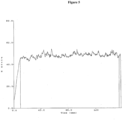
- this gel obtained already has an injectability profile that is improved with respect to that which conventional gels have, as illustrated by Figures 5 , 6 and 7 .
- the gel obtained at the end of the implementation of the process as described previously may especially have a stiffness that is too high in order to be injected into a patient as is.
- a step of protection and of redensification of the gel is also capable of being carried out in order to further improve the qualities of the implant, according to the know-how of a person skilled in the art.
- the gel must be physiologically formulated by virtue of the presence of salts in equivalent amounts to those of the medium injected.
- an additional purification step may be, in addition, carried out.
- the last step consists in filling a syringe with the gel, which is carried out under controlled atmospheric conditions, followed by a final heat sterilization which takes place immediately after the syringe filling.
- polymer in accordance with the invention is understood to mean any macromolecule constituted of the repeated linkage of one and the same unit or of different units, connected to one another by covalent bonds.
- a polymer is more particularly selected with respect to the properties that it is desired to see the crosslinked gel obtained according to the invention display. More particularly, such a polymer must have a good biocompatibility.
- a physiologically acceptable polymer or polymer salt may be of natural or synthetic origin.
- the polymers suitable for the invention are polysaccharides, the polysaccharides being hyaluronic acid and biologically acceptable salts thereof.
- polysaccharide salts in accordance with the invention are more particularly chosen from the physiologically acceptable salts, such as the sodium salt, the potassium salt and the mixture thereof, preferably the sodium salt.
- the polysaccharide is hyaluronic acid or one of its salts, preferably sodium hyaluronate (NaHA).
- the process of the invention advantageously allows the implementation of polymers having a very high molecular weight, and especially polymers having a molecular weight greater than 4MDa, unlike the conventional methods of homogenization.
- a polymer or polymer salt according to the invention has a high molecular weight, preferably a molecular weight greater than or equal to 100 000 Da, or even greater than 3 MDa depending on the application in question.
- This polymer is formulated in step a) of the process according to the invention in an aqueous medium.
- aqueous medium in accordance with the invention is understood to mean any liquid medium which has the property of dissolving a polymer, and more specifically, a polysaccharide or one of its salts.
- aqueous medium is more particularly conditioned with respect to the type of crosslinking envisaged but also with respect to the type of polymer used.
- an aqueous medium capable of being suitable may be either acid, or basic.
- One particularly preferred aqueous medium is an alkaline medium, preferably sodium hydroxide (NaOH), more particularly a solution of sodium hydroxide having a pH greater than 12.
- alkaline medium preferably sodium hydroxide (NaOH), more particularly a solution of sodium hydroxide having a pH greater than 12.
- crosslinking agent in accordance with the invention is understood to mean any compound capable of inducing a crosslinking between the various polymer chains.
- a crosslinking agent in accordance with the invention is chosen from epoxides, aldehydes, polyaziridyl compounds, divinyl sulphone (DVS) or butanediol diglycidyl ether (BDDE), preferably butanediol diglycidyl ether, the latter having the lowest toxicity among the standard crosslinking agents.
- the crosslinking agent of changeable and very often unstable nature, is, within a receptacle in accordance with the invention, stored in a protective environment thus guaranteeing that the subsequent crosslinking step takes place successfully.
- the process according to the invention also guarantees a rapid, complete and uniform diffusion of the crosslinking agent through the network of polymer chains.
- the process according to the invention implements sodium hyaluronate in an alkaline medium with butanediol diglycidyl ether (BDDE), as crosslinking agent.
- BDDE butanediol diglycidyl ether
- the pouch (working volume: 400 ml, length: 310 mm, width: 180 mm, food grade PE) in which sample 1 is dissolved is exposed to a mechanical homogenization. In order to do this, the pouch is exposed to successive agitation cycles for a total duration of 1 hour at 210 rpm (22 rad.s -1 ) using a paddle mill.
- the agitation is manual via a sterile stainless steel spatula for 5 to 10 minutes, followed by a new manual agitation cycle every 30 minutes up to complete hydration.
- the dissolution of the NaHA is considered complete once all of the NaHA is hydrated and the solution is perfectly homogeneous (absence of agglomerates and uniform colour). In the case where the dissolution does not appear to be complete, a supplementary agitation cycle may be carried out.
- Table 1 The total dissolution times of the NaHA in the 1% sodium hydroxide solution for the three samples are indicated in Table 1 below.
- Table 1 Total dissolution time Sample 1 (pouch) Sample 2 (pot) Sample3 (pot) Total dissolution time (minutes) 60 114 106
- the homogenization of the hyaluronic acid in the pouch is faster than the homogenization in a pot with a spatula without requiring an increase in temperature, like with sample 3. This alternative is also cleaner since the gel is not in contact with the outside and there is no direct friction on the reaction medium which could generate particles.
- a solution of BDDE diluted to 1/5 th in a 1 % sodium hydroxide solution is added, for each of the samples obtained in Example 1, to the homogeneous NaHA solution obtained at the end of the preceding step.
- the homogenization of the reaction medium of sample 1 is then carried out by virtue of successive agitation cycles each comprising:
- the homogenization of the reaction media of the samples 2 and 3 is carried out by agitation with a sterile stainless steel spatula for 15 minutes.
- Three temperature probes are then placed in each of the products to be crosslinked (two at the periphery and diametrically opposed, and one in the middle) in order to be able to record the temperatures within the reaction medium during the crosslinking reaction.
- the sealed pouch is placed in a water bath at 52°C for 3 hours, making sure that the opening of the pouch remains outside of the bath.
- the pots are placed in the water bath for 3 hours, respectively at 52°C and at 55.5°C.
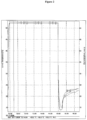
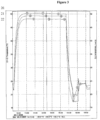
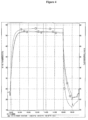
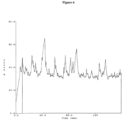
- the temperature within the reaction medium was monitored throughout the crosslinking reaction by virtue of three temperature probes.
- Figures 1 to 3 represent the temperature profiles observed during the crosslinking reactions of the three samples.
- the numbers 1 to 3 on each profile correspond to the three temperature probes which were placed in the pouch or in the pots in order to monitor the change in temperature within the reaction medium.
- the pouch and the pots are withdrawn from the thermostatted bath and placed in a container that contains refrigerated sterile water until the temperature has cooled to 25°C (ambient temperature).
- the yield is defined by relating the weight of the product obtained to the weight of starting reactants.
- Table 2 Weight yields of the crosslinking reactions Sample 1 (pouch) Sample 2 (pot) Sample 3 (pot) Yield (%) 99.6 94.5 94.6
- Example 2 The three samples of crosslinked gels obtained in Example 2 are divided into small cubes of around 1 cm 3 .
- the pieces are introduced into a sterile 1 L rigid plastic pot containing the appropriate amount of pyrogen-free sterile phosphate buffer (PB) to bring the gel to a concentration of 20 mg/g.
- PB pyrogen-free sterile phosphate buffer
- the amount of PB solution is adjusted so as to obtain a gel containing 20 mg/m of HA.
- the amount of hydrochloric acid is adjusted so as to neutralize the pH.
- the content of the pot is agitated for 5 minutes using a sterile stainless steel spatula. The pot is then placed in a three-dimensional agitator for 20 hours at ambient temperature.
- the crosslinked gels thus obtained have a pH close to neutrality and a physiological concentration ofNaCl.
- the gels resulting from the pouch process have a greater tolerance for sterilization, in terms of rheological properties, than the gels obtained by the pot process.
- sample 1 makes it possible to obtain a crosslinked gel for which the residual content of BDDE before crosslinking is substantially lower than that recorded for samples 2 and 3, by around a factor of 2.
Landscapes
- Health & Medical Sciences (AREA)
- Chemical & Material Sciences (AREA)
- Life Sciences & Earth Sciences (AREA)
- General Health & Medical Sciences (AREA)
- Veterinary Medicine (AREA)
- Animal Behavior & Ethology (AREA)
- Public Health (AREA)
- Dispersion Chemistry (AREA)
- Chemical Kinetics & Catalysis (AREA)
- Medicinal Chemistry (AREA)
- Polymers & Plastics (AREA)
- Organic Chemistry (AREA)
- Epidemiology (AREA)
- Birds (AREA)
- Gerontology & Geriatric Medicine (AREA)
- Dermatology (AREA)
- Molecular Biology (AREA)
- Engineering & Computer Science (AREA)
- Biochemistry (AREA)
- Materials Engineering (AREA)
- Processes Of Treating Macromolecular Substances (AREA)
- Polysaccharides And Polysaccharide Derivatives (AREA)
- Medicinal Preparation (AREA)
- Pharmaceuticals Containing Other Organic And Inorganic Compounds (AREA)
- Cosmetics (AREA)
- Materials For Medical Uses (AREA)
- Colloid Chemistry (AREA)
- Organic Low-Molecular-Weight Compounds And Preparation Thereof (AREA)
Claims (13)
- Verfahren zum Herstellen eines vernetzten Gels wenigstens eines Polysaccharids oder eines seiner Salze, umfassend wenigstens die Schritte bestehend aus:a) Bereitstellen eines wässrigen Mediums, das das Polysaccharid enthält;b) Bilden eines homogenen Gels aus dem Medium von Schritt a);c) Inkontaktbringen des bei Schritt b) erhaltenen Gels mit einer wirksamen Menge wenigstens eines Vernetzungsmittels;d) Vernetzen des bei Schritt c) gebildeten Gemischs; unde) Gewinnen des vernetzten Hydrogels,wobei- wenigstens die Schritte a) bis d) innerhalb eines luftdichten Hohlraums durchgeführt werden, der wenigstens teilweise von einer verformbaren Wand begrenzt ist, wobei der Hohlraum innerhalb eines verformbaren Beutels gebildet ist, wobei das in dem Hohlraum vorhandene Gemisch bei Schritt d) gegenüber Bedingungen, die zum Vernetzen führen, exponiert wird;- das Homogenisieren bei Schritt b) durch gegebenenfalls aufeinanderfolgende mechanische Verformungen der Außenfläche der verformbaren Wand oder des Beutels durchgeführt wird,wobei das Polysaccharid Hyaluronsäure oder eines ihrer Salze ist.
- Verfahren gemäß Anspruch 1, ferner umfassend einen Schritt f) des Unterbrechens des Vernetzens, wobei der Schritt f) vor, zusammen mit oder nach dem Schritt des Gewinnens e) durchgeführt wird.
- Verfahren gemäß Anspruch 2, wobei der Vernetzungsschritt f) vor dem Schritt des Gewinnens e) durchgeführt wird.
- Verfahren gemäß dem vorstehenden Anspruch, wobei die Schritte a) bis d) und f) alle innerhalb des Hohlraums durchgeführt werden.
- Verfahren gemäß einem der vorstehenden Ansprüche, wobei der Beutel mit einem Öffnungssystem ausgestattet ist.
- Verfahren gemäß einem der vorstehenden Ansprüche, wobei der Beutel aus Kunststoff besteht, vorzugsweise aus Polyethylen mit pharmazeutischer Qualität.
- Verfahren gemäß einem der vorstehenden Ansprüche, wobei die Homogenisierung über eine Dauer von weniger als 400 Minuten erfolgt, vorzugsweise weniger als 150 Minuten, sogar in dem Bereich zwischen 30 und 100 Minuten.
- Verfahren gemäß einem der vorstehenden Ansprüche, wobei der Schritt des Vernetzens durch thermische Mittel durchgeführt wird.
- Verfahren gemäß einem der vorstehenden Ansprüche, wobei das Vernetzen über eine Dauer in dem Bereich von 30 bis 300 Minuten, vorzugsweise von 100 bis 200 Minuten, erfolgt.
- Verfahren gemäß einem der vorstehenden Ansprüche, das Natriumhyaluronat in einem alkalischen Medium mit Butandioldiglycidylether (BDDE) als Vernetzungsmittel einsetzt.
- Verfahren gemäß einem der vorstehenden Ansprüche, wobei das vernetzte Gel ein festes Gel ist.
- Verfahren gemäß Anspruch 1, wobei die Homogenisierung bei Schritt b) mithilfe eines Systems von zwei Seite an Seite liegenden Schaufeln durchgeführt wird, die abwechselnd in einer Vor- und Zurückbewegung die verformbare Wand oder wenigstens eine der verformbaren Wände drücken.
- Verfahren gemäß Anspruch 1, wobei die Homogenisierung bei Schritt b) zuerst durch Palpation und dann unter Verwendung einer mechanischen Vorrichtung oder unter abwechselnder Verwendung dieser Homogenisierungsmittel durchgeführt wird.
Priority Applications (4)
| Application Number | Priority Date | Filing Date | Title |
|---|---|---|---|
| PL10726239.6T PL2429486T5 (pl) | 2009-05-11 | 2010-05-07 | Sposób otrzymywania sieciowanego żelu |
| SM20170532T SMT201700532T1 (it) | 2009-05-11 | 2010-05-07 | Processo per preparare un gel reticolato |
| HRP20171780TT HRP20171780T1 (hr) | 2009-05-11 | 2010-05-07 | Postupak za pripremanje umreženog gela |
| SI201031584T SI2429486T1 (en) | 2009-05-11 | 2010-05-07 | A process for the preparation of a crosslinked gel |
Applications Claiming Priority (2)
| Application Number | Priority Date | Filing Date | Title |
|---|---|---|---|
| FR0953108A FR2945293B1 (fr) | 2009-05-11 | 2009-05-11 | Procede de preparation d'un gel reticule. |
| PCT/IB2010/052027 WO2010131175A1 (en) | 2009-05-11 | 2010-05-07 | Process for preparing a crosslinked gel |
Publications (3)
| Publication Number | Publication Date |
|---|---|
| EP2429486A1 EP2429486A1 (de) | 2012-03-21 |
| EP2429486B1 EP2429486B1 (de) | 2017-08-23 |
| EP2429486B2 true EP2429486B2 (de) | 2024-10-30 |
Family
ID=41571500
Family Applications (1)
| Application Number | Title | Priority Date | Filing Date |
|---|---|---|---|
| EP10726239.6A Active EP2429486B2 (de) | 2009-05-11 | 2010-05-07 | Verfahren zur herstellung eines vernetzten gels |
Country Status (21)
| Country | Link |
|---|---|
| US (1) | US9353194B2 (de) |
| EP (1) | EP2429486B2 (de) |
| JP (1) | JP5871793B2 (de) |
| KR (1) | KR101732530B1 (de) |
| AU (1) | AU2010247068B2 (de) |
| BR (1) | BRPI1014306B8 (de) |
| CA (1) | CA2760197C (de) |
| CY (1) | CY1119812T1 (de) |
| DK (1) | DK2429486T4 (de) |
| ES (1) | ES2647547T5 (de) |
| FR (1) | FR2945293B1 (de) |
| HR (1) | HRP20171780T1 (de) |
| HU (1) | HUE034942T2 (de) |
| LT (1) | LT2429486T (de) |
| NO (1) | NO2429486T3 (de) |
| PL (1) | PL2429486T5 (de) |
| PT (1) | PT2429486T (de) |
| RU (1) | RU2540667C2 (de) |
| SI (1) | SI2429486T1 (de) |
| SM (1) | SMT201700532T1 (de) |
| WO (1) | WO2010131175A1 (de) |
Families Citing this family (34)
| Publication number | Priority date | Publication date | Assignee | Title |
|---|---|---|---|---|
| FR2968305B1 (fr) | 2010-12-06 | 2014-02-28 | Teoxane | Procede de preparation d'un gel reticule |
| WO2013110322A1 (en) * | 2012-01-24 | 2013-08-01 | Total Research & Technology Feluy | Method for processing polyethylene |
| FR2997014B1 (fr) * | 2012-10-24 | 2015-03-20 | Teoxane | Composition sterile dermo-injectable |
| FR2997085B1 (fr) | 2012-10-24 | 2015-05-29 | Teoxane | Procede de preparation d'un gel reticule |
| FR3006689A1 (fr) * | 2013-06-11 | 2014-12-12 | Benedicte Vincente Tauzin | Procede de reticulation de l'acide hyaluronique; procede de preparation d'un hydrogel injectable; hydrogel obtenu; utilisation de l'hydroget obtenu |
| US9421198B2 (en) | 2013-07-30 | 2016-08-23 | Teoxane | Composition comprising hyaluronic acid and mepivacaine |
| FR3029928B1 (fr) | 2014-12-15 | 2018-03-09 | Teoxane | Gel reticule |
| US10004824B2 (en) | 2015-05-11 | 2018-06-26 | Laboratoires Vivacy | Compositions comprising at least one polyol and at least one anesthetic |
| CZ2015398A3 (cs) * | 2015-06-15 | 2017-02-08 | Contipro A.S. | Způsob síťování polysacharidů s využitím fotolabilních chránicích skupin |
| FR3037797B1 (fr) | 2015-06-24 | 2018-08-17 | Kylane Laboratoires Sa | Procede de preparation d'un hydrogel reticule injectable; hydrogel obtenu; utilisation de l'hydrogel obtenu |
| EP3515511A1 (de) * | 2016-09-21 | 2019-07-31 | Nestlé Skin Health SA | Hyaluronsäuregel mit einem divalenten zinkkation |
| KR20180076063A (ko) * | 2016-12-27 | 2018-07-05 | (주) 삼보 | 덱스트란 기반의 창상피복재 및 그 제조방법 |
| EP3354258A1 (de) | 2017-01-31 | 2018-08-01 | Teoxane SA | Verwendung eines kohäsiven gels als matrixmaterial in zahntaschen |
| EP3684331A1 (de) | 2017-09-18 | 2020-07-29 | Teoxane | Topische zusammensetzung mit vernetzter hyaluronsäure und einer polyacrylatverbindung |
| EP3743079A1 (de) | 2018-02-06 | 2020-12-02 | Regen Lab SA | Vernetzte hyaluronsäuren und kombinationen mit prp/bmc |
| KR102053913B1 (ko) * | 2018-10-12 | 2019-12-09 | 바이오플러스 주식회사 | 다당류를 이용한 가교 중점도 용액의 제조 방법 |
| EP3659632A1 (de) * | 2018-11-29 | 2020-06-03 | Nestlé Skin Health SA | Nachvernetzender teilabbau von amidvernetzten hydrogelen |
| LU101045B1 (en) | 2018-12-11 | 2020-06-11 | Qventis GmbH | Method for the manufacture and use of a bionic hydrogel composition for medical applications |
| KR102146499B1 (ko) * | 2020-01-31 | 2020-08-20 | 장진희 | 전자선을 이용하여 펜던트를 제거하는 필러 시술용 히알루론산 하이드로겔의 제조 방법 |
| KR102521838B1 (ko) * | 2020-12-28 | 2023-04-17 | (주)아크로스 | 탄성력 및 안전성이 우수한 조직수복용 생체재료의 제조 방법 |
| US20230233441A1 (en) * | 2022-01-24 | 2023-07-27 | The Procter & Gamble Company | Skin care composition containing sodium hyaluronate and method of making the same |
| WO2023198920A1 (fr) * | 2022-04-15 | 2023-10-19 | Teoxane SA | Procede de preparation d'un hydrogel |
| DE102022113526A1 (de) * | 2022-05-30 | 2023-11-30 | Louna Aesthetics SAS | Verfahren zur Herstellung einer Zusammensetzung, Zusammensetzung und Verwendung der Zusammensetzung |
| CN114933717B (zh) * | 2022-06-07 | 2025-08-12 | 山东圳谷新材料科技有限公司 | 一种可擦除水凝胶材料的制备方法及应用 |
| FR3146900B1 (fr) | 2023-03-21 | 2026-06-05 | Teoxane SA | Procédé de préparation d’un hydrogel stérile comprenant un polysaccharide réticulé, non réticulé ou leur mélange |
| FR3146899B1 (fr) | 2023-03-21 | 2026-03-20 | Teoxane SA | Procédé de préparation d’un hydrogel stérile comprenant un polysaccharide réticulé, non réticulé ou leur mélange |
| WO2025125597A1 (en) | 2023-12-15 | 2025-06-19 | Teoxane SA | Polysaccharide-based hydrogel comprising silicon |
| FR3157186A1 (fr) | 2023-12-22 | 2025-06-27 | Teoxane SA | Procédé de réticulation d’hydrogels de polysaccharides par ligation chimique native, les hydrogels obtenus par ce procédé, et leurs utilisations |
| CN118994638B (zh) * | 2024-07-18 | 2025-10-17 | 东华大学 | 初始等效、构象转变速率不同的sf水凝胶的制备方法 |
| EP4710952A1 (de) | 2024-09-16 | 2026-03-18 | Paul Hartmann AG | Wundauflage zur wundbehandiung im feuchten oder feucht-nassen milieu |
| EP4710955A1 (de) | 2024-09-16 | 2026-03-18 | Paul Hartmann AG | Silikonhaltige wundkontaktschicht mit infektionshemmenden eigenschaften |
| EP4710953A1 (de) | 2024-09-16 | 2026-03-18 | Paul Hartmann AG | Vliesstoff mit infektionshemmenden eigenschaften |
| EP4710954A1 (de) | 2024-09-16 | 2026-03-18 | Paul Hartmann AG | Absorbierende wundabdeckung mit infektionshemmenden eigenschaften |
| FR3170303A1 (fr) | 2024-12-20 | 2026-06-26 | Teoxane SA | Hydrogel stérile à base d’acide hyaluronique ayant des propriétés antioxydantes améliorées |
Citations (5)
| Publication number | Priority date | Publication date | Assignee | Title |
|---|---|---|---|---|
| US20030148995A1 (en) † | 2000-07-19 | 2003-08-07 | Estelle Piron | Polysaccharide crosslinking, hydrogel preparation, resulting polysaccharide(s) and hydrogel(s), uses thereof |
| US20050142152A1 (en) † | 2003-12-30 | 2005-06-30 | Leshchiner Adelya K. | Polymeric materials, their preparation and use |
| US20050281880A1 (en) † | 2004-05-20 | 2005-12-22 | Wei Wang | Methods for making injectable polymer hydrogels |
| EP1818344A1 (de) † | 2004-11-15 | 2007-08-15 | Shiseido Company, Limited | Verfahren zur herstellung von vernetzem hyaluronsäuregel |
| WO2008068297A1 (fr) † | 2006-12-06 | 2008-06-12 | Pierre Fabre Dermo-Cosmetique | Gel d'acide hyaluronique pour injection intradermique |
Family Cites Families (17)
| Publication number | Priority date | Publication date | Assignee | Title |
|---|---|---|---|---|
| BE788274A (fr) | 1971-09-06 | 1973-02-28 | Unilever Nv | Dispositifs servant a melanger des matieres |
| SU827492A1 (ru) * | 1978-07-27 | 1981-05-07 | Ордена Ленина Институт Элементоор-Ганических Соединений Ah Cccp | Сшитые гели на основе хитозана |
| SE442820B (sv) * | 1984-06-08 | 1986-02-03 | Pharmacia Ab | Gel av tverbunden hyaluronsyra for anvendning som glaskroppssubstitut |
| DE4014051A1 (de) | 1990-05-02 | 1991-11-07 | Schreiber Hans | Verfahren und vorrichtung zum mischen von wenigstens zwei materialkomponenten, insbesondere von zahnaerztlichen abdruckmaterialien |
| US5497913A (en) | 1993-12-15 | 1996-03-12 | Denny D. Baker | Mixing bag arrangement and method |
| DE4426421A1 (de) | 1994-07-26 | 1996-02-01 | Heinz Hartmann | Verfahren und Vorrichtung zur Herstellung disperser Systeme, insbesondere Salben, Cremes, Suspensionen, Emulsionen, Gele oder Pasten |
| IL112816A0 (en) | 1995-02-27 | 1995-05-26 | Travenol Lab Israel Ltd | Infusion bag with injection port |
| US5863551A (en) * | 1996-10-16 | 1999-01-26 | Organogel Canada Ltee | Implantable polymer hydrogel for therapeutic uses |
| GB9819897D0 (en) | 1998-09-11 | 1998-11-04 | Seward Limited | Devices for blending materials |
| AU2003266947A1 (en) * | 2002-10-02 | 2004-04-23 | Coloplast A/S | A hydrogel |
| US8524213B2 (en) | 2003-12-30 | 2013-09-03 | Genzyme Corporation | Polymeric materials, their preparation and use |
| FR2865737B1 (fr) * | 2004-02-03 | 2006-03-31 | Anteis Sa | Gel reticule biocompatible |
| DE102004021731A1 (de) | 2004-04-30 | 2005-11-24 | Albrecht Konietzko | Beutelmix |
| US20060105022A1 (en) | 2004-11-15 | 2006-05-18 | Shiseido Co., Ltd. | Process for preparing crosslinked hyaluronic acid gel |
| EP1817347B1 (de) | 2004-11-24 | 2017-05-17 | Albumedix A/S | Verfahren zur vernetzung von hyaluronsäure mit divinylsulfon |
| JP5071766B2 (ja) | 2006-12-08 | 2012-11-14 | 独立行政法人日本原子力研究開発機構 | 多糖類を原料とするゲルの製造方法 |
| FR2968305B1 (fr) * | 2010-12-06 | 2014-02-28 | Teoxane | Procede de preparation d'un gel reticule |
-
2009
- 2009-05-11 FR FR0953108A patent/FR2945293B1/fr active Active
-
2010
- 2010-05-07 SI SI201031584T patent/SI2429486T1/en unknown
- 2010-05-07 HU HUE10726239A patent/HUE034942T2/en unknown
- 2010-05-07 LT LTEP10726239.6T patent/LT2429486T/lt unknown
- 2010-05-07 ES ES10726239T patent/ES2647547T5/es active Active
- 2010-05-07 EP EP10726239.6A patent/EP2429486B2/de active Active
- 2010-05-07 BR BRPI1014306A patent/BRPI1014306B8/pt not_active IP Right Cessation
- 2010-05-07 AU AU2010247068A patent/AU2010247068B2/en active Active
- 2010-05-07 DK DK10726239.6T patent/DK2429486T4/da active
- 2010-05-07 CA CA2760197A patent/CA2760197C/en active Active
- 2010-05-07 WO PCT/IB2010/052027 patent/WO2010131175A1/en not_active Ceased
- 2010-05-07 PT PT107262396T patent/PT2429486T/pt unknown
- 2010-05-07 SM SM20170532T patent/SMT201700532T1/it unknown
- 2010-05-07 KR KR1020117029306A patent/KR101732530B1/ko active Active
- 2010-05-07 HR HRP20171780TT patent/HRP20171780T1/hr unknown
- 2010-05-07 PL PL10726239.6T patent/PL2429486T5/pl unknown
- 2010-05-07 RU RU2011145421/05A patent/RU2540667C2/ru active
- 2010-05-07 NO NO10726239A patent/NO2429486T3/no unknown
- 2010-05-07 US US13/266,638 patent/US9353194B2/en active Active
- 2010-05-07 JP JP2012510410A patent/JP5871793B2/ja active Active
-
2017
- 2017-11-16 CY CY20171101199T patent/CY1119812T1/el unknown
Patent Citations (5)
| Publication number | Priority date | Publication date | Assignee | Title |
|---|---|---|---|---|
| US20030148995A1 (en) † | 2000-07-19 | 2003-08-07 | Estelle Piron | Polysaccharide crosslinking, hydrogel preparation, resulting polysaccharide(s) and hydrogel(s), uses thereof |
| US20050142152A1 (en) † | 2003-12-30 | 2005-06-30 | Leshchiner Adelya K. | Polymeric materials, their preparation and use |
| US20050281880A1 (en) † | 2004-05-20 | 2005-12-22 | Wei Wang | Methods for making injectable polymer hydrogels |
| EP1818344A1 (de) † | 2004-11-15 | 2007-08-15 | Shiseido Company, Limited | Verfahren zur herstellung von vernetzem hyaluronsäuregel |
| WO2008068297A1 (fr) † | 2006-12-06 | 2008-06-12 | Pierre Fabre Dermo-Cosmetique | Gel d'acide hyaluronique pour injection intradermique |
Also Published As
Similar Documents
| Publication | Publication Date | Title |
|---|---|---|
| EP2429486B1 (de) | Verfahren zur herstellung eines vernetzten gels | |
| EP2666462B1 (de) | Strahlungsvernetztes kollagengel, herstellungsverfahren dafür | |
| EP3381438B2 (de) | Zusammensetzung zur injektion von hyaluronsäure mit hyaluronsäurederivat und dna-fraktion sowie verwendung davon | |
| JP5657545B2 (ja) | 注射用容器内で架橋した注射用ヒドロゲルの調製方法 | |
| CA2817837C (en) | Process of preparing a crosslinked gel | |
| CA2876070C (en) | Method of preparing a composition based on hyaluronic acid | |
| CN112399862A (zh) | 具有高提拉能力和低注射力的透明质酸填充剂 | |
| EP3285781B1 (de) | Homogene wässerige lösung von injizierbarem chitosan mit einem ph-wert nahe dem physiologischen ph-wert | |
| WO2014064633A1 (en) | Process for preparing a crosslinked gel | |
| WO2014172784A1 (en) | Crosslinked hyaluronic acid compositions | |
| US9669007B2 (en) | Method for obtaining a stable gel of hyaluronic acid and of a free form of vitamin C and/or a salt thereof | |
| KR20150064454A (ko) | 히알루론산을 고농도로 함유하는 피부 외용제 조성물 및 이의 제조방법 | |
| KR20040019299A (ko) | 대량 오토클레이빙 방법 | |
| KR102488243B1 (ko) | 화장료용 성형물 및 그 제조 방법 | |
| IL166231A (en) | Process for preparing a sterile high molecular weight hyaluronic acid formulation | |
| CN119455103A (zh) | 一种短效可注射琼脂糖凝胶植入剂 | |
| EP3675922A1 (de) | Vernetzung von biopolymeren in halbfestem zustand | |
| CA2880450C (en) | Kit, use thereof, and method for filling connective tissue of the skin | |
| CN110382193A (zh) | 透明质酸盐薄膜的制备方法及由此制备的透明质酸盐薄膜 | |
| Carpenter | Development and Optimization of Medicinal Infused Hydrogel Patch and Cloth for the Treatment of Burn Patients | |
| Häusler | Hyaluronic Acid–an Extraordinarily Versatile Vital Substance | |
| HK1224573A1 (en) | Sterilised thermogelling composition |
Legal Events
| Date | Code | Title | Description |
|---|---|---|---|
| PUAI | Public reference made under article 153(3) epc to a published international application that has entered the european phase |
Free format text: ORIGINAL CODE: 0009012 |
|
| 17P | Request for examination filed |
Effective date: 20111104 |
|
| AK | Designated contracting states |
Kind code of ref document: A1 Designated state(s): AL AT BE BG CH CY CZ DE DK EE ES FI FR GB GR HR HU IE IS IT LI LT LU LV MC MK MT NL NO PL PT RO SE SI SK SM TR |
|
| DAX | Request for extension of the european patent (deleted) | ||
| 17Q | First examination report despatched |
Effective date: 20131108 |
|
| STAA | Information on the status of an ep patent application or granted ep patent |
Free format text: STATUS: EXAMINATION IS IN PROGRESS |
|
| TPAC | Observations filed by third parties |
Free format text: ORIGINAL CODE: EPIDOSNTIPA |
|
| GRAP | Despatch of communication of intention to grant a patent |
Free format text: ORIGINAL CODE: EPIDOSNIGR1 |
|
| STAA | Information on the status of an ep patent application or granted ep patent |
Free format text: STATUS: GRANT OF PATENT IS INTENDED |
|
| INTG | Intention to grant announced |
Effective date: 20170210 |
|
| GRAJ | Information related to disapproval of communication of intention to grant by the applicant or resumption of examination proceedings by the epo deleted |
Free format text: ORIGINAL CODE: EPIDOSDIGR1 |
|
| STAA | Information on the status of an ep patent application or granted ep patent |
Free format text: STATUS: EXAMINATION IS IN PROGRESS |
|
| INTC | Intention to grant announced (deleted) | ||
| GRAP | Despatch of communication of intention to grant a patent |
Free format text: ORIGINAL CODE: EPIDOSNIGR1 |
|
| STAA | Information on the status of an ep patent application or granted ep patent |
Free format text: STATUS: GRANT OF PATENT IS INTENDED |
|
| INTG | Intention to grant announced |
Effective date: 20170602 |
|
| GRAS | Grant fee paid |
Free format text: ORIGINAL CODE: EPIDOSNIGR3 |
|
| GRAA | (expected) grant |
Free format text: ORIGINAL CODE: 0009210 |
|
| STAA | Information on the status of an ep patent application or granted ep patent |
Free format text: STATUS: THE PATENT HAS BEEN GRANTED |
|
| AK | Designated contracting states |
Kind code of ref document: B1 Designated state(s): AL AT BE BG CH CY CZ DE DK EE ES FI FR GB GR HR HU IE IS IT LI LT LU LV MC MK MT NL NO PL PT RO SE SI SK SM TR |
|
| REG | Reference to a national code |
Ref country code: GB Ref legal event code: FG4D |
|
| REG | Reference to a national code |
Ref country code: CH Ref legal event code: EP |
|
| REG | Reference to a national code |
Ref country code: AT Ref legal event code: REF Ref document number: 920549 Country of ref document: AT Kind code of ref document: T Effective date: 20170915 |
|
| REG | Reference to a national code |
Ref country code: IE Ref legal event code: FG4D |
|
| REG | Reference to a national code |
Ref country code: DE Ref legal event code: R096 Ref document number: 602010044615 Country of ref document: DE |
|
| REG | Reference to a national code |
Ref country code: RO Ref legal event code: EPE |
|
| REG | Reference to a national code |
Ref country code: HR Ref legal event code: TUEP Ref document number: P20171780 Country of ref document: HR |
|
| REG | Reference to a national code |
Ref country code: PT Ref legal event code: SC4A Ref document number: 2429486 Country of ref document: PT Date of ref document: 20171120 Kind code of ref document: T Free format text: AVAILABILITY OF NATIONAL TRANSLATION Effective date: 20171114 |
|
| REG | Reference to a national code |
Ref country code: DK Ref legal event code: T3 Effective date: 20171123 |
|
| REG | Reference to a national code |
Ref country code: SE Ref legal event code: TRGR |
|
| REG | Reference to a national code |
Ref country code: NL Ref legal event code: FP |
|
| REG | Reference to a national code |
Ref country code: ES Ref legal event code: FG2A Ref document number: 2647547 Country of ref document: ES Kind code of ref document: T3 Effective date: 20171222 |
|
| REG | Reference to a national code |
Ref country code: HR Ref legal event code: T1PR Ref document number: P20171780 Country of ref document: HR |
|
| REG | Reference to a national code |
Ref country code: EE Ref legal event code: FG4A Ref document number: E014550 Country of ref document: EE Effective date: 20171113 |
|
| REG | Reference to a national code |
Ref country code: NO Ref legal event code: T2 Effective date: 20170823 |
|
| REG | Reference to a national code |
Ref country code: SK Ref legal event code: T3 Ref document number: E 25823 Country of ref document: SK |
|
| REG | Reference to a national code |
Ref country code: HU Ref legal event code: AG4A Ref document number: E034942 Country of ref document: HU |
|
| REG | Reference to a national code |
Ref country code: FR Ref legal event code: PLFP Year of fee payment: 9 |
|
| REG | Reference to a national code |
Ref country code: GR Ref legal event code: EP Ref document number: 20170403130 Country of ref document: GR Effective date: 20180420 |
|
| REG | Reference to a national code |
Ref country code: DE Ref legal event code: R026 Ref document number: 602010044615 Country of ref document: DE |
|
| PLBI | Opposition filed |
Free format text: ORIGINAL CODE: 0009260 |
|
| PLAX | Notice of opposition and request to file observation + time limit sent |
Free format text: ORIGINAL CODE: EPIDOSNOBS2 |
|
| 26 | Opposition filed |
Opponent name: LABORATOIRES FILL-MED MANUFACTURING/LABORATOIRES F Effective date: 20180515 |
|
| PLAF | Information modified related to communication of a notice of opposition and request to file observations + time limit |
Free format text: ORIGINAL CODE: EPIDOSCOBS2 |
|
| PLBB | Reply of patent proprietor to notice(s) of opposition received |
Free format text: ORIGINAL CODE: EPIDOSNOBS3 |
|
| REG | Reference to a national code |
Ref country code: HR Ref legal event code: ODRP Ref document number: P20171780 Country of ref document: HR Payment date: 20190418 Year of fee payment: 10 |
|
| REG | Reference to a national code |
Ref country code: AT Ref legal event code: UEP Ref document number: 920549 Country of ref document: AT Kind code of ref document: T Effective date: 20170823 |
|
| RDAF | Communication despatched that patent is revoked |
Free format text: ORIGINAL CODE: EPIDOSNREV1 |
|
| APAH | Appeal reference modified |
Free format text: ORIGINAL CODE: EPIDOSCREFNO |
|
| APBM | Appeal reference recorded |
Free format text: ORIGINAL CODE: EPIDOSNREFNO |
|
| APBP | Date of receipt of notice of appeal recorded |
Free format text: ORIGINAL CODE: EPIDOSNNOA2O |
|
| APBQ | Date of receipt of statement of grounds of appeal recorded |
Free format text: ORIGINAL CODE: EPIDOSNNOA3O |
|
| REG | Reference to a national code |
Ref country code: HR Ref legal event code: ODRP Ref document number: P20171780 Country of ref document: HR Payment date: 20200429 Year of fee payment: 11 |
|
| REG | Reference to a national code |
Ref country code: HR Ref legal event code: ODRP Ref document number: P20171780 Country of ref document: HR Payment date: 20210428 Year of fee payment: 12 |
|
| PGFP | Annual fee paid to national office [announced via postgrant information from national office to epo] |
Ref country code: HR Payment date: 20210428 Year of fee payment: 12 Ref country code: GR Payment date: 20210422 Year of fee payment: 12 Ref country code: CY Payment date: 20210422 Year of fee payment: 12 Ref country code: CZ Payment date: 20210426 Year of fee payment: 12 Ref country code: LT Payment date: 20210421 Year of fee payment: 12 Ref country code: SK Payment date: 20210427 Year of fee payment: 12 Ref country code: SM Payment date: 20210422 Year of fee payment: 12 Ref country code: EE Payment date: 20210423 Year of fee payment: 12 |
|
| PGFP | Annual fee paid to national office [announced via postgrant information from national office to epo] |
Ref country code: IE Payment date: 20210422 Year of fee payment: 12 Ref country code: HU Payment date: 20210424 Year of fee payment: 12 Ref country code: LV Payment date: 20210421 Year of fee payment: 12 Ref country code: SI Payment date: 20210426 Year of fee payment: 12 Ref country code: BG Payment date: 20210507 Year of fee payment: 12 |
|
| PGFP | Annual fee paid to national office [announced via postgrant information from national office to epo] |
Ref country code: MK Payment date: 20210422 Year of fee payment: 12 Ref country code: IS Payment date: 20210421 Year of fee payment: 12 |
|
| PGFP | Annual fee paid to national office [announced via postgrant information from national office to epo] |
Ref country code: MT Payment date: 20210423 Year of fee payment: 12 |
|
| PGFP | Annual fee paid to national office [announced via postgrant information from national office to epo] |
Ref country code: AL Payment date: 20210527 Year of fee payment: 12 |
|
| APBU | Appeal procedure closed |
Free format text: ORIGINAL CODE: EPIDOSNNOA9O |
|
| PLAY | Examination report in opposition despatched + time limit |
Free format text: ORIGINAL CODE: EPIDOSNORE2 |
|
| PGFP | Annual fee paid to national office [announced via postgrant information from national office to epo] |
Ref country code: NO Payment date: 20220422 Year of fee payment: 13 Ref country code: LU Payment date: 20220420 Year of fee payment: 13 |
|
| PGFP | Annual fee paid to national office [announced via postgrant information from national office to epo] |
Ref country code: TR Payment date: 20220421 Year of fee payment: 13 Ref country code: FI Payment date: 20220414 Year of fee payment: 13 |
|
| PLBC | Reply to examination report in opposition received |
Free format text: ORIGINAL CODE: EPIDOSNORE3 |
|
| REG | Reference to a national code |
Ref country code: HR Ref legal event code: PBON Ref document number: P20171780 Country of ref document: HR Effective date: 20220507 |
|
| REG | Reference to a national code |
Ref country code: LT Ref legal event code: MM4D Effective date: 20220507 |
|
| REG | Reference to a national code |
Ref country code: EE Ref legal event code: MM4A Ref document number: E014550 Country of ref document: EE Effective date: 20220531 |
|
| REG | Reference to a national code |
Ref country code: SK Ref legal event code: MM4A Ref document number: E 25823 Country of ref document: SK Effective date: 20220507 |
|
| PLAY | Examination report in opposition despatched + time limit |
Free format text: ORIGINAL CODE: EPIDOSNORE2 |
|
| PG25 | Lapsed in a contracting state [announced via postgrant information from national office to epo] |
Ref country code: SM Free format text: LAPSE BECAUSE OF NON-PAYMENT OF DUE FEES Effective date: 20221216 Ref country code: SK Free format text: LAPSE BECAUSE OF NON-PAYMENT OF DUE FEES Effective date: 20220507 Ref country code: LV Free format text: LAPSE BECAUSE OF NON-PAYMENT OF DUE FEES Effective date: 20220507 Ref country code: LT Free format text: LAPSE BECAUSE OF NON-PAYMENT OF DUE FEES Effective date: 20220507 Ref country code: HU Free format text: LAPSE BECAUSE OF NON-PAYMENT OF DUE FEES Effective date: 20220508 Ref country code: EE Free format text: LAPSE BECAUSE OF NON-PAYMENT OF DUE FEES Effective date: 20220531 Ref country code: CZ Free format text: LAPSE BECAUSE OF NON-PAYMENT OF DUE FEES Effective date: 20220507 Ref country code: CY Free format text: LAPSE BECAUSE OF NON-PAYMENT OF DUE FEES Effective date: 20220507 |
|
| PG25 | Lapsed in a contracting state [announced via postgrant information from national office to epo] |
Ref country code: SI Free format text: LAPSE BECAUSE OF NON-PAYMENT OF DUE FEES Effective date: 20220508 Ref country code: HR Free format text: LAPSE BECAUSE OF NON-PAYMENT OF DUE FEES Effective date: 20220507 Ref country code: GR Free format text: LAPSE BECAUSE OF NON-PAYMENT OF DUE FEES Effective date: 20221208 |
|
| PG25 | Lapsed in a contracting state [announced via postgrant information from national office to epo] |
Ref country code: IE Free format text: LAPSE BECAUSE OF NON-PAYMENT OF DUE FEES Effective date: 20220507 |
|
| P01 | Opt-out of the competence of the unified patent court (upc) registered |
Effective date: 20230411 |
|
| PLBC | Reply to examination report in opposition received |
Free format text: ORIGINAL CODE: EPIDOSNORE3 |
|
| PLAH | Information related to despatch of examination report in opposition + time limit modified |
Free format text: ORIGINAL CODE: EPIDOSCORE2 |
|
| PLAP | Information related to despatch of examination report in opposition + time limit deleted |
Free format text: ORIGINAL CODE: EPIDOSDORE2 |
|
| PLAT | Information related to reply to examination report in opposition deleted |
Free format text: ORIGINAL CODE: EPIDOSDORE3 |
|
| PLAY | Examination report in opposition despatched + time limit |
Free format text: ORIGINAL CODE: EPIDOSNORE2 |
|
| REG | Reference to a national code |
Ref country code: NO Ref legal event code: MMEP |
|
| PG25 | Lapsed in a contracting state [announced via postgrant information from national office to epo] |
Ref country code: NO Free format text: LAPSE BECAUSE OF NON-PAYMENT OF DUE FEES Effective date: 20230531 Ref country code: LU Free format text: LAPSE BECAUSE OF NON-PAYMENT OF DUE FEES Effective date: 20230507 Ref country code: FI Free format text: LAPSE BECAUSE OF NON-PAYMENT OF DUE FEES Effective date: 20230507 |
|
| PG25 | Lapsed in a contracting state [announced via postgrant information from national office to epo] |
Ref country code: BG Free format text: LAPSE BECAUSE OF NON-PAYMENT OF DUE FEES Effective date: 20220507 |
|
| PG25 | Lapsed in a contracting state [announced via postgrant information from national office to epo] |
Ref country code: MT Free format text: LAPSE BECAUSE OF NON-PAYMENT OF DUE FEES Effective date: 20220705 |
|
| PUAH | Patent maintained in amended form |
Free format text: ORIGINAL CODE: 0009272 |
|
| STAA | Information on the status of an ep patent application or granted ep patent |
Free format text: STATUS: PATENT MAINTAINED AS AMENDED |
|
| PG25 | Lapsed in a contracting state [announced via postgrant information from national office to epo] |
Ref country code: AL Free format text: LAPSE BECAUSE OF NON-PAYMENT OF DUE FEES Effective date: 20220507 |
|
| 27A | Patent maintained in amended form |
Effective date: 20241030 |
|
| AK | Designated contracting states |
Kind code of ref document: B2 Designated state(s): AL AT BE BG CH CY CZ DE DK EE ES FI FR GB GR HR HU IE IS IT LI LT LU LV MC MK MT NL NO PL PT RO SE SI SK SM TR |
|
| REG | Reference to a national code |
Ref country code: DE Ref legal event code: R102 Ref document number: 602010044615 Country of ref document: DE |
|
| REG | Reference to a national code |
Ref country code: DK Ref legal event code: T4 Effective date: 20250117 |
|
| REG | Reference to a national code |
Ref country code: SE Ref legal event code: RPEO |
|
| REG | Reference to a national code |
Ref country code: NL Ref legal event code: FP |
|
| REG | Reference to a national code |
Ref country code: ES Ref legal event code: DC2A Ref document number: 2647547 Country of ref document: ES Kind code of ref document: T5 Effective date: 20250311 |
|
| PG25 | Lapsed in a contracting state [announced via postgrant information from national office to epo] |
Ref country code: GR Free format text: LAPSE BECAUSE OF FAILURE TO SUBMIT A TRANSLATION OF THE DESCRIPTION OR TO PAY THE FEE WITHIN THE PRESCRIBED TIME-LIMIT Effective date: 20250131 |
|
| PGFP | Annual fee paid to national office [announced via postgrant information from national office to epo] |
Ref country code: ES Payment date: 20250627 Year of fee payment: 16 |
|
| PG25 | Lapsed in a contracting state [announced via postgrant information from national office to epo] |
Ref country code: GR Free format text: LAPSE BECAUSE OF FAILURE TO SUBMIT A TRANSLATION OF THE DESCRIPTION OR TO PAY THE FEE WITHIN THE PRESCRIBED TIME-LIMIT Effective date: 20221208 |
|
| PG25 | Lapsed in a contracting state [announced via postgrant information from national office to epo] |
Ref country code: IS Free format text: LAPSE BECAUSE OF NON-PAYMENT OF DUE FEES Effective date: 20221205 |
|
| REG | Reference to a national code |
Ref country code: CH Ref legal event code: U11 Free format text: ST27 STATUS EVENT CODE: U-0-0-U10-U11 (AS PROVIDED BY THE NATIONAL OFFICE) Effective date: 20260601 |
|
| PGFP | Annual fee paid to national office [announced via postgrant information from national office to epo] |
Ref country code: NL Payment date: 20260520 Year of fee payment: 17 |
|
| PG25 | Lapsed in a contracting state [announced via postgrant information from national office to epo] |
Ref country code: TR Free format text: LAPSE BECAUSE OF NON-PAYMENT OF DUE FEES Effective date: 20230507 |
|
| PGFP | Annual fee paid to national office [announced via postgrant information from national office to epo] |
Ref country code: PL Payment date: 20260423 Year of fee payment: 17 Ref country code: GB Payment date: 20260521 Year of fee payment: 17 Ref country code: DK Payment date: 20260522 Year of fee payment: 17 |
|
| PGFP | Annual fee paid to national office [announced via postgrant information from national office to epo] |
Ref country code: IT Payment date: 20260525 Year of fee payment: 17 Ref country code: MC Payment date: 20260528 Year of fee payment: 17 |
|
| PGFP | Annual fee paid to national office [announced via postgrant information from national office to epo] |
Ref country code: DE Payment date: 20260522 Year of fee payment: 17 |
|
| PGFP | Annual fee paid to national office [announced via postgrant information from national office to epo] |
Ref country code: AT Payment date: 20260521 Year of fee payment: 17 Ref country code: SE Payment date: 20260520 Year of fee payment: 17 |
|
| PGFP | Annual fee paid to national office [announced via postgrant information from national office to epo] |
Ref country code: CH Payment date: 20260601 Year of fee payment: 17 Ref country code: RO Payment date: 20260423 Year of fee payment: 17 Ref country code: BE Payment date: 20260520 Year of fee payment: 17 |
|
| PGFP | Annual fee paid to national office [announced via postgrant information from national office to epo] |
Ref country code: PT Payment date: 20260423 Year of fee payment: 17 |
|
| PGFP | Annual fee paid to national office [announced via postgrant information from national office to epo] |
Ref country code: FR Payment date: 20260526 Year of fee payment: 17 |