EP2421960B1 - Zellen und verfahren zur herstellung von aceton - Google Patents
Zellen und verfahren zur herstellung von aceton Download PDFInfo
- Publication number
- EP2421960B1 EP2421960B1 EP10704577.5A EP10704577A EP2421960B1 EP 2421960 B1 EP2421960 B1 EP 2421960B1 EP 10704577 A EP10704577 A EP 10704577A EP 2421960 B1 EP2421960 B1 EP 2421960B1
- Authority
- EP
- European Patent Office
- Prior art keywords
- acetone
- cell
- enzyme
- adc
- thla
- Prior art date
- Legal status (The legal status is an assumption and is not a legal conclusion. Google has not performed a legal analysis and makes no representation as to the accuracy of the status listed.)
- Active
Links
Images
Classifications
-
- C—CHEMISTRY; METALLURGY
- C12—BIOCHEMISTRY; BEER; SPIRITS; WINE; VINEGAR; MICROBIOLOGY; ENZYMOLOGY; MUTATION OR GENETIC ENGINEERING
- C12N—MICROORGANISMS OR ENZYMES; COMPOSITIONS THEREOF; PROPAGATING, PRESERVING, OR MAINTAINING MICROORGANISMS; MUTATION OR GENETIC ENGINEERING; CULTURE MEDIA
- C12N9/00—Enzymes; Proenzymes; Compositions thereof; Processes for preparing, activating, inhibiting, separating or purifying enzymes
- C12N9/10—Transferases (2.)
- C12N9/13—Transferases (2.) transferring sulfur containing groups (2.8)
-
- C—CHEMISTRY; METALLURGY
- C12—BIOCHEMISTRY; BEER; SPIRITS; WINE; VINEGAR; MICROBIOLOGY; ENZYMOLOGY; MUTATION OR GENETIC ENGINEERING
- C12N—MICROORGANISMS OR ENZYMES; COMPOSITIONS THEREOF; PROPAGATING, PRESERVING, OR MAINTAINING MICROORGANISMS; MUTATION OR GENETIC ENGINEERING; CULTURE MEDIA
- C12N9/00—Enzymes; Proenzymes; Compositions thereof; Processes for preparing, activating, inhibiting, separating or purifying enzymes
- C12N9/10—Transferases (2.)
- C12N9/1025—Acyltransferases (2.3)
- C12N9/1029—Acyltransferases (2.3) transferring groups other than amino-acyl groups (2.3.1)
-
- C—CHEMISTRY; METALLURGY
- C12—BIOCHEMISTRY; BEER; SPIRITS; WINE; VINEGAR; MICROBIOLOGY; ENZYMOLOGY; MUTATION OR GENETIC ENGINEERING
- C12N—MICROORGANISMS OR ENZYMES; COMPOSITIONS THEREOF; PROPAGATING, PRESERVING, OR MAINTAINING MICROORGANISMS; MUTATION OR GENETIC ENGINEERING; CULTURE MEDIA
- C12N9/00—Enzymes; Proenzymes; Compositions thereof; Processes for preparing, activating, inhibiting, separating or purifying enzymes
- C12N9/14—Hydrolases (3)
- C12N9/16—Hydrolases (3) acting on ester bonds (3.1)
-
- C—CHEMISTRY; METALLURGY
- C12—BIOCHEMISTRY; BEER; SPIRITS; WINE; VINEGAR; MICROBIOLOGY; ENZYMOLOGY; MUTATION OR GENETIC ENGINEERING
- C12N—MICROORGANISMS OR ENZYMES; COMPOSITIONS THEREOF; PROPAGATING, PRESERVING, OR MAINTAINING MICROORGANISMS; MUTATION OR GENETIC ENGINEERING; CULTURE MEDIA
- C12N9/00—Enzymes; Proenzymes; Compositions thereof; Processes for preparing, activating, inhibiting, separating or purifying enzymes
- C12N9/88—Lyases (4.)
-
- C—CHEMISTRY; METALLURGY
- C12—BIOCHEMISTRY; BEER; SPIRITS; WINE; VINEGAR; MICROBIOLOGY; ENZYMOLOGY; MUTATION OR GENETIC ENGINEERING
- C12P—FERMENTATION OR ENZYME-USING PROCESSES TO SYNTHESISE A DESIRED CHEMICAL COMPOUND OR COMPOSITION OR TO SEPARATE OPTICAL ISOMERS FROM A RACEMIC MIXTURE
- C12P7/00—Preparation of oxygen-containing organic compounds
- C12P7/24—Preparation of oxygen-containing organic compounds containing a carbonyl group
- C12P7/26—Ketones
- C12P7/28—Acetone-containing products
- C12P7/30—Acetone-containing products produced from substrate containing inorganic compounds other than water
-
- C—CHEMISTRY; METALLURGY
- C12—BIOCHEMISTRY; BEER; SPIRITS; WINE; VINEGAR; MICROBIOLOGY; ENZYMOLOGY; MUTATION OR GENETIC ENGINEERING
- C12Y—ENZYMES
- C12Y203/00—Acyltransferases (2.3)
- C12Y203/01—Acyltransferases (2.3) transferring groups other than amino-acyl groups (2.3.1)
- C12Y203/01009—Acetyl-CoA C-acetyltransferase (2.3.1.9)
-
- Y—GENERAL TAGGING OF NEW TECHNOLOGICAL DEVELOPMENTS; GENERAL TAGGING OF CROSS-SECTIONAL TECHNOLOGIES SPANNING OVER SEVERAL SECTIONS OF THE IPC; TECHNICAL SUBJECTS COVERED BY FORMER USPC CROSS-REFERENCE ART COLLECTIONS [XRACs] AND DIGESTS
- Y02—TECHNOLOGIES OR APPLICATIONS FOR MITIGATION OR ADAPTATION AGAINST CLIMATE CHANGE
- Y02P—CLIMATE CHANGE MITIGATION TECHNOLOGIES IN THE PRODUCTION OR PROCESSING OF GOODS
- Y02P20/00—Technologies relating to chemical industry
- Y02P20/50—Improvements relating to the production of bulk chemicals
- Y02P20/52—Improvements relating to the production of bulk chemicals using catalysts, e.g. selective catalysts
Definitions
- the invention relates to a process for acetone production.
- Clostridium acetobutylicum and Clostridium beijerinckii Both are Gram-positive and multiply under strictly anaerobic conditions. These organisms can convert mono-, di- and polysaccharides, the substrates used mainly in the fermentation being molasses and starch.
- the fermentation process with C. acetobutylicum is divided into two phases.
- biomass formation is associated with the formation of acetate, butyrate and traces of ethanol (acidogenic phase).
- Solventogenic Phase the acids are then used to form the fermentation products acetone, butanol and ethanol (ABE).
- the products acetone, butanol and ethanol are formed in the wild type C. acetobutylicum in a ratio of approximately 3: 6: 1. This product ratio can vary widely depending on the chosen culture conditions (eg pH or nutrient delivery) or substrates used.
- acetobutylicum is also available ( Noelling, J., Breton, G., Omelchenko, MV & 16 other authors (2001). Genome sequence and comparative analysis of the solvent-producing bacterium Clostridium acetobutylicum. J Bacteriol 183, 4823-4838 .).
- Clostridium acetobutylicum strains have already been generated in which the acetone production is decoupled from butanol and ethanol production, so that these strains produce only acetone ( Mermelstein et al. (1993). Metabolic engineering of Clostridium acetobutylicum ATCC824 for enhanced production of acetone by enzymes. Biotech. Bioeng. 42: 1053-1060 . Nair, RV, and Papoutsakis, ET 1994). The measured titers for acetone were generally below the concentrations of those in the wild type.
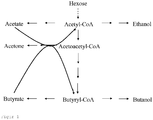
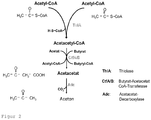
- FIG. 2 is the classic Clostridium- characterized metabolic pathway for acetone synthesis. This pathway starts from acetyl-CoA, a central metabolite that is formed in all microorganisms, regardless of which C source is metabolized or which metabolic pathways are established. Enzymes that are needed are: the ⁇ -ketothiolase, the two subunits of acetyl-CoA / butyryl-CoA transferase, and the acetoacetate decarboxylase.
- Acetogenic cells therefore cells that are capable of forming acetate by anaerobic respiration, are known.
- the acetogenic bacteria include, for example, species of the genus Acetobacterium such as A. woodii and Clostridium aceticum.
- the WO0068407 describes the use of acetogenic bacteria for the production of ethanol.
- C. aceticum and C. carboxidivorans have not yet published a genome sequence.
- C. aceticum additionally carries a plasmid (5.6 kbp, Lee et al., 1987).
- plasmid 5.6 kbp, Lee et al., 1987.
- the group of acetogenic bacteria belongs to the anaerobic prokaryotes, which can use CO2 as a terminal electron acceptor and thereby form acetate.
- 21 different genera are counted among the acetogens (Drake et al ., 2006), including some clostridia (Drake & kusel, 2005).
- You are able to use carbon dioxide plus hydrogen or also to use carbon monoxide as a carbon and energy source (Wood, 1991).
- alcohols, aldehydes, carboxylic acids and numerous hexoses can be used as a carbon source (Drake et al., 2004).
- the reductive pathway that leads to the formation of acetate is referred to as the acetyl-CoA or Wood-Ljungdahl pathway.
- the object of the invention was to provide a process with which acetone can be prepared from ubiquitously available carbon sources.
- the present invention is a process for the preparation of acetone as described in claim 1.
- An advantage of the invention is that the cells can be cultivated anaerobically and thus energetically particularly favorably.
- Another advantage of the invention is that the cells according to the invention contribute to a reduction of climate-damaging carbon dioxide.
- Another advantage of cells according to the invention is an increase in yield due to acetone production from carbon dioxide and hydrogen.
- the present invention is an acetogenic cell capable of forming acetone.
- acetogenic cell in the context of the present invention is meant cells which are capable of forming acetate by anaerobic respiration.
- the acetogenic cell is preferably an isolated cell, in particular a genetically modified cell. According to the invention, preference is given to a cell which is able to form acetone from at least one carbon source selected from the group comprising carbon dioxide and carbon monoxide. Particularly preferably, the acetogenic cell according to the invention is capable of forming acetone from carbon monoxide and carbon dioxide as sole carbon source.
- the acetogenic cell has been genetically engineered with respect to its wild type such that it is capable of producing more acetone compared to its wild-type.
- phrase "that it is capable of producing more acetone compared to its wild type” also refers to the case that the wild-type of the genetically engineered cell is unable to form acetone, or at least no detectable amounts of this compound, and detectable only after the genetic modification Quantities of this component can be formed.
- acetogenic cell in the context of the present invention is meant cells which are capable of forming acetate by anaerobic respiration. All percentages are by weight unless otherwise specified.
- the acetogenic cell is preferably an isolated cell, in particular a genetically modified cell.
- the cell is one which is capable of forming acetone from at least one carbon source selected from the group comprising carbon dioxide and carbon monoxide.
- the acetogenic cell according to the invention is capable of forming acetone from carbon monoxide and carbon dioxide as sole carbon source.
- acetogenic cell has been genetically engineered compared to its wild type in such a way that it is able to form more acetone compared to its wild type.
- phrase "that it is capable of producing more acetone compared to its wild type” also refers to the case that the wild-type of the genetically engineered cell is unable to form acetone, or at least no detectable amounts of this compound, and detectable only after the genetic modification Quantities of this component can be formed.
- a wild type of a cell is preferably referred to as a cell whose genome is in a state such as naturally originated by evolution. The term is used for both the entire cell and for individual genes. The term “wild-type” therefore does not include, in particular, those cells or genes whose gene sequences have been altered at least in part by humans by means of recombinant methods.
- These cells are genetically engineered to produce more acetone from a carbon source compared to their wild-type.
- the acetogenic cell is genetically engineered such that it is at least 2 times, more preferably at least 2 times, more preferably within 8 hours and most preferably within 24 hours within a defined time interval More preferably at least 100 times, more preferably at least 1,000 times, and most preferably at least 10,000 times more acetone than the wild type of the cell.
- the increase in product formation can be determined, for example, by culturing the cell according to the invention and the wild-type cell separately under the same conditions (same cell density, same nutrient medium, same culture conditions) for a specific time interval in a suitable nutrient medium and then the amount Target product (acetone) is determined in the nutrient medium.
- an increased activity of an enzyme E x which is increased in comparison with its wild type, is preferably always a factor greater than or equal to at least 2, particularly preferably at least 10, more preferably at least 100, moreover even more preferably at least 1,000 and most preferably at least 10,000 increased activity of the respective enzyme E x .
- the cell according to the invention which "has an increased compared to their wild type activity of an enzyme E x ", in particular a cell whose wild type has no or at least no detectable activity of this enzyme E x and which only after increasing the enzyme activity, for example by overexpression, a detectable activity of this enzyme E x shows.
- the term "overexpression” or the expression “increase in expression” used in the following also encompasses the case that a starting cell, for example a wild-type cell, has no or at least no detectable expression and only by recombinant methods a detectable Expression of the enzyme E x is induced.
- particularly preferred cells are those in which the activity of the following enzyme or of the following enzymes is increased: E 1 , E 2 , E 3 , E 1 + E 2 , E 1 + E 3 , E 2 + E 3 , E 1 + E 2 + E 3 , wherein E 1 + E 2 + E 3 is particularly preferred.
- the enzyme E 1 is an acetyl-CoA-C-acetyltransferase (EC 2.3.1.9); the enzyme E 2 is a butyrate-acetoacetate-CoA transferase (EC 2.8.3.9) or an acyl-CoA hydrolase (EC 3.1.2.20); the enzyme E 3 is an acetoacetate decarboxylase (EC 4.1.1.4); Particularly preferred enzyme used as enzyme E 1 is thlA from Clostridium acetobutylicum.
- Butyrate-acetoacetate-CoA transferase used particularly preferably as enzyme E 2 are ctfA and ctfB from Clostridium acetobutylicum and atoD and atoA from Escherichia coli.
- Particularly preferably used as the enzyme E 2 acyl-CoA hydrolase are TEII from B. subtilis or ybgC from Heamophilus influenzae.
- Particularly preferred enzyme used as enzyme E 3 is adc from Clostridium acetobutylicum.
- the acetogenic cell according to the invention is preferably a microorganism, preferably a bacterium and particularly preferably an anaerobic bacterium, in particular a rod-shaped, gram-positive bacterium.
- acetogenic cells selected from the group comprising Thermoanaerobacter kivui, Acetobacterium woodii, Acetoanaerobium notera, Clostridium aceticum, Butyribacterium methylotrophicum, Moorella thermoacetica , Eubacterium limosum, Peptostreptococcus productus, Clostridium ljungdahlii and Clostridium carboxivivorans.
- a particularly suitable bacterium is Clostridium carboxidivorans, in particular such strains as "P7" and "P11". Such cells are for example in US 2007/0275447 and US 2008/0057554 described.
- Clostridium ljungdahlii is Clostridium ljungdahlii, especially strains selected from the group comprising Clostridium ljungdahlii PETC, Clostridium ljungdahlii ERI2, Clostridium ljungdahlii C01 and Clostridium ljungdahlii O-52 and are used in the WO 98/00558 and WO 00/68407 described.
- the acetogenic cell according to the invention can, preferably under anaerobic conditions, form acetone from at least one carbon source selected from the group consisting of carbon dioxide and carbon monoxide.
- the carbon source be provided by exhaust gases such as synthesis gas, flue gas, petroleum refinery emissions, gases resulting from yeast fermentation or clostridial fermentation, Exhaust gas from gasification cellulosic materials or coal gasification.
- exhaust gases such as synthesis gas, flue gas, petroleum refinery emissions, gases resulting from yeast fermentation or clostridial fermentation, Exhaust gas from gasification cellulosic materials or coal gasification.
- any exhaust gas capable of supplying the acetogenic cell with enough carbon to enable it to perform its anaerobic respiration can be used.
- the carbon source is synthesis gas.
- Synthesis gas can e.g. be provided from the by-product of coal gasification.
- the acetogenic cell thus converts a substance that is a waste product into a valuable raw material.
- synthesis gas may be provided by the gasification of widely available, inexpensive agricultural raw materials for the process of the present invention.
- raw materials that can be converted into synthesis gas, since almost all forms of vegetation can be used for this purpose.
- Preferred raw materials are selected from the group comprising perennial grasses such as miscanthus, cereal residues, processing waste such as sawdust.
- synthesis gas is recovered in a gasification apparatus from dried biomass, mainly by pyrolysis, partial oxidation and steam reforming, the primary products being CO, H 2 and CO 2 .
- the nutrient media used in the method according to the invention must suitably satisfy the requirements of the respective strains. Descriptions of nutrient media of various microorganisms are in the handbook " Manual of Methods for General Bacteriology of the American Society for Bacteriology (Washington DC, USA, 1981 ) contain.
- the nutrient medium contains in particular nitrogen and phosphorus sources, salts and pH control agents.
- organic nitrogen-containing compounds such as peptones, yeast extract, meat extract, malt extract, corn steep liquor, soybean meal and urea or inorganic compounds such as ammonium sulfate, ammonium chloride, ammonium phosphate, ammonium carbonate and ammonium nitrate may be used.
- the nitrogen sources can be used singly or as a mixture.
- Phosphoric acid, potassium dihydrogen phosphate or dipotassium hydrogen phosphate or the corresponding sodium-containing salts may be present in the nutrient medium as the phosphorus source.
- the culture medium must continue to contain salts of metals such. As magnesium sulfate or iron sulfate, which are necessary for growth.
- essential growth factors such as amino acids and vitamins can be used in addition to the above-mentioned substances.
- the said feedstocks may be added to the culture in the form of a one-time batch or fed in a suitable manner during the cultivation.
- basic compounds such as sodium hydroxide, potassium hydroxide, ammonia or ammonia water or acidic compounds such as phosphoric acid or sulfuric acid are suitably used.
- acidic compounds such as phosphoric acid or sulfuric acid are suitably used.
- B. fatty acid polyglycol esters are used.
- the medium suitable selective substances such as B. antibiotics are added.
- the acetogenic cells are cultured under conditions which allow the cell to form acetone.
- this cultivation takes place under anaerobic conditions.
- the genetically modified cells according to the invention can be used continuously or discontinuously in the batch process ( batch culturing) or in the fed-batch process (feed process) or repeated-fed-batch process (repetitive feed process) for the purpose of producing acetone with the nutrient medium in Contact and thus be cultivated.
- step C) of the process according to the invention the acetone formed by the cells can optionally be isolated from the cells and / or the nutrient medium, all methods known to those skilled in the art for isolating low molecular weight substances from complex compositions being suitable for isolation.
- the precipitation by means of suitable solvents the extraction by means of suitable solvents, the complexation, for example by means of cyclodextrins or cyclodextrin derivatives, crystallization, purification or isolation by means of chromatographic methods or the conversion of the acetone into readily separable derivatives may be mentioned at this point.
- distillative separation processes are suitable for use in process step C).
- the cloning was carried out in E. coli XL2 blue.
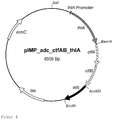
- the genes were ctfA and ctfB from Clostridium acetobutylicum, or atoA and atoD from E. coli, or teII from B. subtilis, as well as ybgC from Heamophilus influenzae together with the genes thlA and adc from C. acetobutylicum on the plasmid pIMP1 (Mermelstein et al., 1992).
- Table 1 Plasmids plasmid CoA transferase / thioesterase Seq ID No pIMP_adc_ctfAB_thlA C. acetobutylicum 13 pIMP_adc_atoDA_thlA E. coli 14 pIMP_adc_teII_thlA B. subtilis 15 pIMP_adc_ybgC_thlA H. influenzae 16
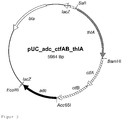
- FIG. 3 shows the resulting pUC plasmid.
- coli produced up to 80 mM acetone.
- purely clostridial genes thlA, ctfAB, adc
- 5 mM acetone were produced and with the combinations clostridial genes ( thlA and adc ) with B.II. subtilis or ybgC from H. influenzae 1 mM acetone.
- the pH was adjusted to 5.6 before boiling and anaerobicizing, and after autoclaving, 10 ml of reducing agent 1 (see below) was added, whereafter the pH should be 6.0.
- the nitrilotriacetic acid was completely dissolved in water, the pH was adjusted to 6.0 with potassium hydroxide, and then the other components were dissolved.
- the plasmids constructed in E. coli X12-blue were then introduced into acetogenic clostridia by conjugation (Purdy et al., 2002) or transformation (Zhu et al. , 2004), thereby giving the recombinant strain the ability to produce acetone.
- the cells were again centrifuged and taken up in 200 ⁇ l of a Clostridia culture grown overnight in appropriate medium.
- this mixture was distributed on well-dried agar plates in 10 ⁇ l drops and incubated at 37 ° C for 6 h anaerobically. Subsequently, the cells were washed 2 to 3 times with 0.5 ml of sterile, anaerobic PBS buffer from the agar plate. The conjugation mixture was plated on selective agar plates (clarithromycin) and incubated anaerobically at 37 ° C.
- the clostridial cells were grown in 50 ml C. aceticum medium with 40 mM DL-threonine at 30 ° C. to an optical density of 0.3-0.4. The following steps took place in the anaerobic chamber. Here, the cells were harvested (6000 rpm, 10 min, RT), washed twice with SMP buffer (270 mM sucrose, 1 mM MgCl 2 , 7 mM NaH 2 PO 4 ) and finally taken up in 500 to 700 ⁇ l SMP buffer and these used in the transformation. For this, the cells were transferred into electroporation cuvettes (4 mm) and mixed with 0.5 to 1.5 ⁇ g of plasmid DNA.
- SMP buffer 270 mM sucrose, 1 mM MgCl 2 , 7 mM NaH 2 PO 4
- Plasmid isolation means "peqGOLD ® Plasmid Miniprep Kit II” (Peqlab, Er Weg, Germany). The preparation was carried out according to the manufacturer's instructions, with all optional steps being carried out. This was followed by a "Plasmidrecovery", the E. coli strain XL2-blue was used and then a restriction digestion.
Landscapes
- Chemical & Material Sciences (AREA)
- Life Sciences & Earth Sciences (AREA)
- Health & Medical Sciences (AREA)
- Organic Chemistry (AREA)
- Wood Science & Technology (AREA)
- Engineering & Computer Science (AREA)
- Zoology (AREA)
- Genetics & Genomics (AREA)
- Bioinformatics & Cheminformatics (AREA)
- General Health & Medical Sciences (AREA)
- Biochemistry (AREA)
- General Engineering & Computer Science (AREA)
- Microbiology (AREA)
- Biotechnology (AREA)
- Medicinal Chemistry (AREA)
- Biomedical Technology (AREA)
- Molecular Biology (AREA)
- Chemical Kinetics & Catalysis (AREA)
- Inorganic Chemistry (AREA)
- General Chemical & Material Sciences (AREA)
- Micro-Organisms Or Cultivation Processes Thereof (AREA)
- Preparation Of Compounds By Using Micro-Organisms (AREA)
- Organic Low-Molecular-Weight Compounds And Preparation Thereof (AREA)
Applications Claiming Priority (2)
| Application Number | Priority Date | Filing Date | Title |
|---|---|---|---|
| DE102009002583A DE102009002583A1 (de) | 2009-04-23 | 2009-04-23 | Zellen und Verfahren zur Herstellung von Aceton |
| PCT/EP2010/052244 WO2010121849A1 (de) | 2009-04-23 | 2010-02-23 | Zellen und verfahren zur herstellung von aceton |
Publications (2)
| Publication Number | Publication Date |
|---|---|
| EP2421960A1 EP2421960A1 (de) | 2012-02-29 |
| EP2421960B1 true EP2421960B1 (de) | 2017-07-19 |
Family
ID=42103849
Family Applications (1)
| Application Number | Title | Priority Date | Filing Date |
|---|---|---|---|
| EP10704577.5A Active EP2421960B1 (de) | 2009-04-23 | 2010-02-23 | Zellen und verfahren zur herstellung von aceton |
Country Status (9)
| Country | Link |
|---|---|
| US (1) | US9453210B2 (enExample) |
| EP (1) | EP2421960B1 (enExample) |
| JP (1) | JP5805073B2 (enExample) |
| CN (1) | CN102414314A (enExample) |
| AU (1) | AU2010241185B2 (enExample) |
| BR (1) | BRPI1013430A2 (enExample) |
| DE (1) | DE102009002583A1 (enExample) |
| ES (1) | ES2639224T3 (enExample) |
| WO (1) | WO2010121849A1 (enExample) |
Cited By (1)
| Publication number | Priority date | Publication date | Assignee | Title |
|---|---|---|---|---|
| WO2024231219A1 (en) | 2023-05-11 | 2024-11-14 | Evonik Operations Gmbh | Biotechnological production of acetone |
Families Citing this family (17)
| Publication number | Priority date | Publication date | Assignee | Title |
|---|---|---|---|---|
| JP5397136B2 (ja) * | 2009-09-30 | 2014-01-22 | 住友電気工業株式会社 | Iii族窒化物半導体レーザ素子、及びiii族窒化物半導体レーザ素子を作製する方法 |
| DE102010062587A1 (de) | 2010-12-08 | 2012-06-14 | Evonik Degussa Gmbh | Verfahren zur Herstellung von Isophoron |
| US9365868B2 (en) | 2011-02-25 | 2016-06-14 | Lanzatech New Zealand Limited | Fermentation process for producing isopropanol using a recombinant microorganism |
| US9410130B2 (en) | 2011-02-25 | 2016-08-09 | Lanzatech New Zealand Limited | Recombinant microorganisms and uses therefor |
| WO2012115527A2 (en) * | 2011-02-25 | 2012-08-30 | Lanzatech New Zealand Limited | Recombinant microorganisms and uses therefor |
| DE102011075777A1 (de) | 2011-05-13 | 2012-11-15 | Evonik Degussa Gmbh | Verfahren zur Herstellung von Isophoron in Gegenwart mindestens eines Entschäumers in der Abwasserkolonne im Aufarbeitungsteil |
| DE102011077705A1 (de) | 2011-06-17 | 2012-12-20 | Evonik Degussa Gmbh | Mikrobielles Verfahren zur Herstellung niedermolekularer, organischer Verbindungen umfassend die Produktabsorption durch Isophoron |
| EP2710117B1 (en) * | 2012-01-31 | 2016-04-27 | Lanzatech New Zealand Limited | Recombinant microorganisms and methods of use thereof |
| WO2013181647A2 (en) | 2012-06-01 | 2013-12-05 | Danisco Us Inc. | Compositions and methods of producing isoprene and/or industrrial bio-products using anaerobic microorganisms |
| FI2970868T3 (fi) * | 2013-03-15 | 2024-11-29 | Lanzatech Nz Inc | Menetelmä metaboliitin tuotannon säätelemiseksi mikrobifermentaatiossa |
| EP3050966A1 (en) * | 2015-01-28 | 2016-08-03 | Evonik Degussa GmbH | An aerobic method of producing alcohols |
| AU2016222565A1 (en) * | 2015-02-27 | 2017-09-28 | White Dog Labs, Inc. | Mixotrophic fermentation method for making acetone, isopropanol, butyric acid and other bioproducts, and mixtures thereof |
| KR101750293B1 (ko) | 2015-03-04 | 2017-06-26 | 한국과학기술연구원 | 이산화탄소로부터의 아세톤 생성능을 갖는 형질전환된 시네코코커스 일롱게투스 균주 |
| EP3348646A1 (de) | 2017-01-17 | 2018-07-18 | Evonik Degussa GmbH | Mikrobielles verfahren zur herstellung von aceton, isopropanol, butanol und/oder ethanol umfassend die produktabsorption durch wasser |
| TWI857205B (zh) * | 2020-01-29 | 2024-10-01 | 香港商巨鵬生物(香港)有限公司 | 用於在二氧化碳生物轉換方法中控制有機酸比率之方法 |
| EP4208541A1 (en) * | 2020-09-01 | 2023-07-12 | Danmarks Tekniske Universitet | Methods and cells for production of volatile compounds |
| CN112608935A (zh) * | 2020-12-18 | 2021-04-06 | 北京化工大学 | 一种改造乙酸梭菌代谢途径产丙酮的方法 |
Family Cites Families (10)
| Publication number | Priority date | Publication date | Assignee | Title |
|---|---|---|---|---|
| NL301993A (enExample) | 1962-12-18 | |||
| US5807722A (en) | 1992-10-30 | 1998-09-15 | Bioengineering Resources, Inc. | Biological production of acetic acid from waste gases with Clostridium ljungdahlii |
| ATE259881T1 (de) | 1999-05-07 | 2004-03-15 | Emmaus Foundation Inc | Aus substrathaltigen gasgemischen aethanol erzeugende clostridium stamme |
| JP4883872B2 (ja) | 2000-07-25 | 2012-02-22 | エモース・フアンデーシヨン・インコーポレーテツド | 微生物発酵によるエタノール生産を向上させる方法 |
| US20070275447A1 (en) | 2006-05-25 | 2007-11-29 | Lewis Randy S | Indirect or direct fermentation of biomass to fuel alcohol |
| US7704723B2 (en) | 2006-08-31 | 2010-04-27 | The Board Of Regents For Oklahoma State University | Isolation and characterization of novel clostridial species |
| US8426172B2 (en) * | 2007-08-29 | 2013-04-23 | Research Institute of Innovation Technology for the Earth | Transformant capable of producing isopropanol |
| JP2011500031A (ja) * | 2007-10-12 | 2011-01-06 | ザ レジェンツ オブ ザ ユニヴァースティ オブ カリフォルニア | イソプロパノールを生産するように操作された微生物 |
| DE102007052463A1 (de) * | 2007-11-02 | 2009-05-07 | Evonik Degussa Gmbh | Fermentative Gewinnung von Aceton aus erneuerbaren Rohstoffen mittels neuen Stoffwechselweges |
| DE102010062587A1 (de) | 2010-12-08 | 2012-06-14 | Evonik Degussa Gmbh | Verfahren zur Herstellung von Isophoron |
-
2009
- 2009-04-23 DE DE102009002583A patent/DE102009002583A1/de not_active Withdrawn
-
2010
- 2010-02-23 BR BRPI1013430-1A patent/BRPI1013430A2/pt not_active Application Discontinuation
- 2010-02-23 WO PCT/EP2010/052244 patent/WO2010121849A1/de not_active Ceased
- 2010-02-23 US US13/260,012 patent/US9453210B2/en active Active
- 2010-02-23 ES ES10704577.5T patent/ES2639224T3/es active Active
- 2010-02-23 AU AU2010241185A patent/AU2010241185B2/en not_active Ceased
- 2010-02-23 CN CN2010800177745A patent/CN102414314A/zh active Pending
- 2010-02-23 JP JP2012506411A patent/JP5805073B2/ja active Active
- 2010-02-23 EP EP10704577.5A patent/EP2421960B1/de active Active
Non-Patent Citations (3)
| Title |
|---|
| BERMEJO L L ET AL: "Expression of Clostridium acetobutylicum ATCC 824 genes in Escherichia coli for acetone production and acetate detoxification", APPLIED AND ENVIRONMENTAL MICROBIOLOGY, AMERICAN SOCIETY FOR MICROBIOLOGY, US, vol. 64, no. 3, 1 March 1998 (1998-03-01), pages 1079 - 1085, XP002334443, ISSN: 0099-2240 * |
| HENSTRA ET AL: "Microbiology of synthesis gas fermentation for biofuel production", CURRENT OPINION IN BIOTECHNOLOGY, LONDON, GB, vol. 18, no. 3, 8 June 2007 (2007-06-08), pages 200 - 206, XP022110181, ISSN: 0958-1669, DOI: 10.1016/J.COPBIO.2007.03.008 * |
| HIROKI MATSUI ET AL: "Diversity of the Formyltetrahydrofolate Synthetase Gene ( fhs ), a Key Enzyme for Reductive Acetogenesis, in the Bovine Rumen", BIOSCIENCE, BIOTECHNOLOGY, AND BIOCHEMISTRY, vol. 72, no. 12, 23 December 2008 (2008-12-23), pages 3273 - 3276, XP055158612, ISSN: 0916-8451, DOI: 10.1271/bbb.70375 * |
Cited By (1)
| Publication number | Priority date | Publication date | Assignee | Title |
|---|---|---|---|---|
| WO2024231219A1 (en) | 2023-05-11 | 2024-11-14 | Evonik Operations Gmbh | Biotechnological production of acetone |
Also Published As
| Publication number | Publication date |
|---|---|
| US9453210B2 (en) | 2016-09-27 |
| CN102414314A (zh) | 2012-04-11 |
| JP2012524529A (ja) | 2012-10-18 |
| JP5805073B2 (ja) | 2015-11-04 |
| AU2010241185B2 (en) | 2016-03-10 |
| US20120101304A1 (en) | 2012-04-26 |
| BRPI1013430A2 (pt) | 2015-09-01 |
| DE102009002583A1 (de) | 2010-10-28 |
| WO2010121849A1 (de) | 2010-10-28 |
| AU2010241185A1 (en) | 2011-10-27 |
| ES2639224T3 (es) | 2017-10-25 |
| EP2421960A1 (de) | 2012-02-29 |
Similar Documents
| Publication | Publication Date | Title |
|---|---|---|
| DE102009002583A1 (de) | Zellen und Verfahren zur Herstellung von Aceton | |
| US9359611B2 (en) | Recombinant microorganism and methods of production thereof | |
| AU2007316189B2 (en) | Process for the biological production of n-Butanol with high yield | |
| EP2181195B1 (de) | Fermentative Gewinnung von Aceton aus erneuerbaren Rohstoffen mittels neuen Stoffwechselweges | |
| EP1999264B1 (de) | Verfahren zur enzymatischen herstellung von 2-hydroxy-2-methylcarbonsäuren | |
| EP2813575A1 (de) | Verfahren zur Herstellung von organischen Verbindungen aus Knallgas und CO2 über Acetoacetyl-CoA als Zwischenprodukt | |
| EP3273782B1 (en) | Mixotrophic fermentation method for making acetone, isopropanol, and other bioproducts, and mixtures thereof | |
| US20090286294A1 (en) | Methods and Compositions for Improving the Production of Fuels in Microorganisms | |
| DE69934366T2 (de) | Transformierte mikroorganismen mit verbesserten eigenschaften | |
| KR102011540B1 (ko) | 발효 방법 | |
| TW201610165A (zh) | 微生物共培養系統及其應用 | |
| WO2012104244A1 (de) | Verfahren zur fermentativen herstellung von 2,3-butandiol | |
| US20180125092A1 (en) | Method for preparing feedstuffs comprising butyric acid and/or butyrate | |
| DE102012201360A1 (de) | Zellen und Verfahren zur Herstellung von Rhamnolipiden | |
| KR101144235B1 (ko) | 바이오에탄올 폐발효액을 이용한 부탄올의 제조방법 | |
| DE69131015T2 (de) | Rekombinante zellen, die stark chromosomal-integrierte heterologe gene exprimieren | |
| WO2015110518A1 (de) | Fermentatives verfahren umfassend eine kultivierung von zellen unter niedriger gelöstsauerstoffkonzentration | |
| DE102016007810B4 (de) | Verfahren zur Herstellung von D-Xylonat | |
| WO2014146881A1 (de) | Mikroorganismenstamm und verfahren zur fermentativen herstellung von c4-verbindungen aus c5-zuckern | |
| US20230050887A1 (en) | Recombinant microorganisms as a versatile and stable platform for production of antigen-binding molecules | |
| EP4448780A2 (de) | Mischungen von glucose und xylose zur fermentativen herstellung von ortho-aminobenzoesäure | |
| DE102021101004B3 (de) | Verfahren zur Herstellung von 2,4-Dihydroxybutyrat oder L-Threonin unter Nutzung eines mikrobiellen Stoffwechselweges | |
| CA3133087C (en) | Gas fermentation for the production of protein-based bioplastics | |
| DE102013216658A1 (de) | Verfahren zur fermentativen Herstellung von C4-Produkten und dafür geeignete Mikroorganismenstämme | |
| Hanif et al. | FERMENTATIVE PRODUCTS OF GENUS CLOSTRIDIUM FOR VARIOUS INDUSTRIAL APPLICATIONS |
Legal Events
| Date | Code | Title | Description |
|---|---|---|---|
| PUAI | Public reference made under article 153(3) epc to a published international application that has entered the european phase |
Free format text: ORIGINAL CODE: 0009012 |
|
| 17P | Request for examination filed |
Effective date: 20111004 |
|
| AK | Designated contracting states |
Kind code of ref document: A1 Designated state(s): AT BE BG CH CY CZ DE DK EE ES FI FR GB GR HR HU IE IS IT LI LT LU LV MC MK MT NL NO PL PT RO SE SI SK SM TR |
|
| DAX | Request for extension of the european patent (deleted) | ||
| 17Q | First examination report despatched |
Effective date: 20150105 |
|
| GRAP | Despatch of communication of intention to grant a patent |
Free format text: ORIGINAL CODE: EPIDOSNIGR1 |
|
| INTG | Intention to grant announced |
Effective date: 20170307 |
|
| GRAS | Grant fee paid |
Free format text: ORIGINAL CODE: EPIDOSNIGR3 |
|
| GRAA | (expected) grant |
Free format text: ORIGINAL CODE: 0009210 |
|
| AK | Designated contracting states |
Kind code of ref document: B1 Designated state(s): AT BE BG CH CY CZ DE DK EE ES FI FR GB GR HR HU IE IS IT LI LT LU LV MC MK MT NL NO PL PT RO SE SI SK SM TR |
|
| REG | Reference to a national code |
Ref country code: GB Ref legal event code: FG4D Free format text: NOT ENGLISH |
|
| REG | Reference to a national code |
Ref country code: CH Ref legal event code: EP |
|
| REG | Reference to a national code |
Ref country code: IE Ref legal event code: FG4D Free format text: LANGUAGE OF EP DOCUMENT: GERMAN |
|
| REG | Reference to a national code |
Ref country code: AT Ref legal event code: REF Ref document number: 910421 Country of ref document: AT Kind code of ref document: T Effective date: 20170815 |
|
| REG | Reference to a national code |
Ref country code: DE Ref legal event code: R096 Ref document number: 502010013876 Country of ref document: DE |
|
| REG | Reference to a national code |
Ref country code: ES Ref legal event code: FG2A Ref document number: 2639224 Country of ref document: ES Kind code of ref document: T3 Effective date: 20171025 Ref country code: NL Ref legal event code: FP |
|
| REG | Reference to a national code |
Ref country code: LT Ref legal event code: MG4D |
|
| PG25 | Lapsed in a contracting state [announced via postgrant information from national office to epo] |
Ref country code: FI Free format text: LAPSE BECAUSE OF FAILURE TO SUBMIT A TRANSLATION OF THE DESCRIPTION OR TO PAY THE FEE WITHIN THE PRESCRIBED TIME-LIMIT Effective date: 20170719 Ref country code: LT Free format text: LAPSE BECAUSE OF FAILURE TO SUBMIT A TRANSLATION OF THE DESCRIPTION OR TO PAY THE FEE WITHIN THE PRESCRIBED TIME-LIMIT Effective date: 20170719 Ref country code: SE Free format text: LAPSE BECAUSE OF FAILURE TO SUBMIT A TRANSLATION OF THE DESCRIPTION OR TO PAY THE FEE WITHIN THE PRESCRIBED TIME-LIMIT Effective date: 20170719 Ref country code: NO Free format text: LAPSE BECAUSE OF FAILURE TO SUBMIT A TRANSLATION OF THE DESCRIPTION OR TO PAY THE FEE WITHIN THE PRESCRIBED TIME-LIMIT Effective date: 20171019 Ref country code: HR Free format text: LAPSE BECAUSE OF FAILURE TO SUBMIT A TRANSLATION OF THE DESCRIPTION OR TO PAY THE FEE WITHIN THE PRESCRIBED TIME-LIMIT Effective date: 20170719 |
|
| REG | Reference to a national code |
Ref country code: FR Ref legal event code: PLFP Year of fee payment: 9 |
|
| PG25 | Lapsed in a contracting state [announced via postgrant information from national office to epo] |
Ref country code: GR Free format text: LAPSE BECAUSE OF FAILURE TO SUBMIT A TRANSLATION OF THE DESCRIPTION OR TO PAY THE FEE WITHIN THE PRESCRIBED TIME-LIMIT Effective date: 20171020 Ref country code: IS Free format text: LAPSE BECAUSE OF FAILURE TO SUBMIT A TRANSLATION OF THE DESCRIPTION OR TO PAY THE FEE WITHIN THE PRESCRIBED TIME-LIMIT Effective date: 20171119 Ref country code: PL Free format text: LAPSE BECAUSE OF FAILURE TO SUBMIT A TRANSLATION OF THE DESCRIPTION OR TO PAY THE FEE WITHIN THE PRESCRIBED TIME-LIMIT Effective date: 20170719 Ref country code: BG Free format text: LAPSE BECAUSE OF FAILURE TO SUBMIT A TRANSLATION OF THE DESCRIPTION OR TO PAY THE FEE WITHIN THE PRESCRIBED TIME-LIMIT Effective date: 20171019 Ref country code: LV Free format text: LAPSE BECAUSE OF FAILURE TO SUBMIT A TRANSLATION OF THE DESCRIPTION OR TO PAY THE FEE WITHIN THE PRESCRIBED TIME-LIMIT Effective date: 20170719 |
|
| REG | Reference to a national code |
Ref country code: DE Ref legal event code: R097 Ref document number: 502010013876 Country of ref document: DE |
|
| PG25 | Lapsed in a contracting state [announced via postgrant information from national office to epo] |
Ref country code: DK Free format text: LAPSE BECAUSE OF FAILURE TO SUBMIT A TRANSLATION OF THE DESCRIPTION OR TO PAY THE FEE WITHIN THE PRESCRIBED TIME-LIMIT Effective date: 20170719 Ref country code: CZ Free format text: LAPSE BECAUSE OF FAILURE TO SUBMIT A TRANSLATION OF THE DESCRIPTION OR TO PAY THE FEE WITHIN THE PRESCRIBED TIME-LIMIT Effective date: 20170719 Ref country code: RO Free format text: LAPSE BECAUSE OF FAILURE TO SUBMIT A TRANSLATION OF THE DESCRIPTION OR TO PAY THE FEE WITHIN THE PRESCRIBED TIME-LIMIT Effective date: 20170719 |
|
| PLBE | No opposition filed within time limit |
Free format text: ORIGINAL CODE: 0009261 |
|
| STAA | Information on the status of an ep patent application or granted ep patent |
Free format text: STATUS: NO OPPOSITION FILED WITHIN TIME LIMIT |
|
| PG25 | Lapsed in a contracting state [announced via postgrant information from national office to epo] |
Ref country code: EE Free format text: LAPSE BECAUSE OF FAILURE TO SUBMIT A TRANSLATION OF THE DESCRIPTION OR TO PAY THE FEE WITHIN THE PRESCRIBED TIME-LIMIT Effective date: 20170719 Ref country code: SK Free format text: LAPSE BECAUSE OF FAILURE TO SUBMIT A TRANSLATION OF THE DESCRIPTION OR TO PAY THE FEE WITHIN THE PRESCRIBED TIME-LIMIT Effective date: 20170719 Ref country code: SM Free format text: LAPSE BECAUSE OF FAILURE TO SUBMIT A TRANSLATION OF THE DESCRIPTION OR TO PAY THE FEE WITHIN THE PRESCRIBED TIME-LIMIT Effective date: 20170719 |
|
| 26N | No opposition filed |
Effective date: 20180420 |
|
| PG25 | Lapsed in a contracting state [announced via postgrant information from national office to epo] |
Ref country code: SI Free format text: LAPSE BECAUSE OF FAILURE TO SUBMIT A TRANSLATION OF THE DESCRIPTION OR TO PAY THE FEE WITHIN THE PRESCRIBED TIME-LIMIT Effective date: 20170719 |
|
| REG | Reference to a national code |
Ref country code: CH Ref legal event code: PL |
|
| PG25 | Lapsed in a contracting state [announced via postgrant information from national office to epo] |
Ref country code: MT Free format text: LAPSE BECAUSE OF FAILURE TO SUBMIT A TRANSLATION OF THE DESCRIPTION OR TO PAY THE FEE WITHIN THE PRESCRIBED TIME-LIMIT Effective date: 20170719 Ref country code: MC Free format text: LAPSE BECAUSE OF FAILURE TO SUBMIT A TRANSLATION OF THE DESCRIPTION OR TO PAY THE FEE WITHIN THE PRESCRIBED TIME-LIMIT Effective date: 20170719 |
|
| PG25 | Lapsed in a contracting state [announced via postgrant information from national office to epo] |
Ref country code: LU Free format text: LAPSE BECAUSE OF NON-PAYMENT OF DUE FEES Effective date: 20180223 Ref country code: CH Free format text: LAPSE BECAUSE OF NON-PAYMENT OF DUE FEES Effective date: 20180228 Ref country code: LI Free format text: LAPSE BECAUSE OF NON-PAYMENT OF DUE FEES Effective date: 20180228 |
|
| REG | Reference to a national code |
Ref country code: IE Ref legal event code: MM4A |
|
| PG25 | Lapsed in a contracting state [announced via postgrant information from national office to epo] |
Ref country code: IE Free format text: LAPSE BECAUSE OF NON-PAYMENT OF DUE FEES Effective date: 20180223 |
|
| REG | Reference to a national code |
Ref country code: AT Ref legal event code: MM01 Ref document number: 910421 Country of ref document: AT Kind code of ref document: T Effective date: 20180223 |
|
| PG25 | Lapsed in a contracting state [announced via postgrant information from national office to epo] |
Ref country code: AT Free format text: LAPSE BECAUSE OF NON-PAYMENT OF DUE FEES Effective date: 20180223 |
|
| REG | Reference to a national code |
Ref country code: DE Ref legal event code: R081 Ref document number: 502010013876 Country of ref document: DE Owner name: EVONIK OPERATIONS GMBH, DE Free format text: FORMER OWNER: EVONIK DEGUSSA GMBH, 45128 ESSEN, DE |
|
| PG25 | Lapsed in a contracting state [announced via postgrant information from national office to epo] |
Ref country code: TR Free format text: LAPSE BECAUSE OF FAILURE TO SUBMIT A TRANSLATION OF THE DESCRIPTION OR TO PAY THE FEE WITHIN THE PRESCRIBED TIME-LIMIT Effective date: 20170719 |
|
| PGFP | Annual fee paid to national office [announced via postgrant information from national office to epo] |
Ref country code: IT Payment date: 20200225 Year of fee payment: 11 Ref country code: ES Payment date: 20200322 Year of fee payment: 11 |
|
| PG25 | Lapsed in a contracting state [announced via postgrant information from national office to epo] |
Ref country code: HU Free format text: LAPSE BECAUSE OF FAILURE TO SUBMIT A TRANSLATION OF THE DESCRIPTION OR TO PAY THE FEE WITHIN THE PRESCRIBED TIME-LIMIT; INVALID AB INITIO Effective date: 20100223 Ref country code: PT Free format text: LAPSE BECAUSE OF FAILURE TO SUBMIT A TRANSLATION OF THE DESCRIPTION OR TO PAY THE FEE WITHIN THE PRESCRIBED TIME-LIMIT Effective date: 20170719 |
|
| REG | Reference to a national code |
Ref country code: ES Ref legal event code: PC2A Owner name: EVONIK OPERATIONS GMBH Effective date: 20200623 |
|
| PG25 | Lapsed in a contracting state [announced via postgrant information from national office to epo] |
Ref country code: MK Free format text: LAPSE BECAUSE OF NON-PAYMENT OF DUE FEES Effective date: 20170719 Ref country code: CY Free format text: LAPSE BECAUSE OF FAILURE TO SUBMIT A TRANSLATION OF THE DESCRIPTION OR TO PAY THE FEE WITHIN THE PRESCRIBED TIME-LIMIT Effective date: 20170719 |
|
| REG | Reference to a national code |
Ref country code: BE Ref legal event code: HC Owner name: EVONIK OPERATIONS GMBH; DE Free format text: DETAILS ASSIGNMENT: CHANGE OF OWNER(S), CHANGEMENT DE NOM DU PROPRIETAIRE; FORMER OWNER NAME: EVONIK DEGUSSA GMBH Effective date: 20200403 |
|
| REG | Reference to a national code |
Ref country code: NL Ref legal event code: HC Owner name: EVONIK OPERATIONS GMBH; DE Free format text: DETAILS ASSIGNMENT: CHANGE OF OWNER(S), CHANGE OF OWNER(S) NAME Effective date: 20200928 |
|
| PG25 | Lapsed in a contracting state [announced via postgrant information from national office to epo] |
Ref country code: IT Free format text: LAPSE BECAUSE OF NON-PAYMENT OF DUE FEES Effective date: 20210223 |
|
| REG | Reference to a national code |
Ref country code: ES Ref legal event code: FD2A Effective date: 20220513 |
|
| PG25 | Lapsed in a contracting state [announced via postgrant information from national office to epo] |
Ref country code: ES Free format text: LAPSE BECAUSE OF NON-PAYMENT OF DUE FEES Effective date: 20210224 |
|
| P01 | Opt-out of the competence of the unified patent court (upc) registered |
Effective date: 20230526 |
|
| PGFP | Annual fee paid to national office [announced via postgrant information from national office to epo] |
Ref country code: NL Payment date: 20260218 Year of fee payment: 17 |
|
| PGFP | Annual fee paid to national office [announced via postgrant information from national office to epo] |
Ref country code: GB Payment date: 20260219 Year of fee payment: 17 |
|
| PGFP | Annual fee paid to national office [announced via postgrant information from national office to epo] |
Ref country code: DE Payment date: 20260218 Year of fee payment: 17 |
|
| PGFP | Annual fee paid to national office [announced via postgrant information from national office to epo] |
Ref country code: BE Payment date: 20260218 Year of fee payment: 17 |
|
| PGFP | Annual fee paid to national office [announced via postgrant information from national office to epo] |
Ref country code: FR Payment date: 20260218 Year of fee payment: 17 |
|
| REG | Reference to a national code |
Ref country code: DE Ref legal event code: R081 Ref document number: 502010013876 Country of ref document: DE Owner name: EVONIK OPERATIONS GMBH, DE Free format text: FORMER OWNER: EVONIK OPERATIONS GMBH, 45128 ESSEN, DE |