EP2420480A2 - Trockenmörtel - Google Patents
Trockenmörtel Download PDFInfo
- Publication number
- EP2420480A2 EP2420480A2 EP20110177315 EP11177315A EP2420480A2 EP 2420480 A2 EP2420480 A2 EP 2420480A2 EP 20110177315 EP20110177315 EP 20110177315 EP 11177315 A EP11177315 A EP 11177315A EP 2420480 A2 EP2420480 A2 EP 2420480A2
- Authority
- EP
- European Patent Office
- Prior art keywords
- dry mortar
- oil
- mortar according
- soil
- oil binder
- Prior art date
- Legal status (The legal status is an assumption and is not a legal conclusion. Google has not performed a legal analysis and makes no representation as to the accuracy of the status listed.)
- Withdrawn
Links
- 239000004570 mortar (masonry) Substances 0.000 title claims abstract description 35
- 239000003921 oil Substances 0.000 claims abstract description 61
- 239000011230 binding agent Substances 0.000 claims abstract description 34
- 239000000523 sample Substances 0.000 claims abstract description 32
- 239000002689 soil Substances 0.000 claims abstract description 32
- 239000000463 material Substances 0.000 claims abstract description 16
- 239000000126 substance Substances 0.000 claims abstract description 13
- XLYOFNOQVPJJNP-UHFFFAOYSA-N water Substances O XLYOFNOQVPJJNP-UHFFFAOYSA-N 0.000 claims abstract description 13
- 239000000203 mixture Substances 0.000 claims abstract description 10
- VYPSYNLAJGMNEJ-UHFFFAOYSA-N Silicium dioxide Chemical compound O=[Si]=O VYPSYNLAJGMNEJ-UHFFFAOYSA-N 0.000 claims abstract description 9
- 239000002734 clay mineral Substances 0.000 claims abstract description 6
- 235000008733 Citrus aurantifolia Nutrition 0.000 claims abstract description 5
- 235000011941 Tilia x europaea Nutrition 0.000 claims abstract description 5
- 239000004568 cement Substances 0.000 claims abstract description 5
- 239000000945 filler Substances 0.000 claims abstract description 5
- 239000004571 lime Substances 0.000 claims abstract description 5
- 239000006004 Quartz sand Substances 0.000 claims abstract description 4
- 230000009969 flowable effect Effects 0.000 claims abstract description 4
- 239000002245 particle Substances 0.000 claims description 20
- 239000000835 fiber Substances 0.000 claims description 9
- 239000011440 grout Substances 0.000 claims description 9
- 239000013543 active substance Substances 0.000 claims description 7
- OKTJSMMVPCPJKN-UHFFFAOYSA-N Carbon Chemical compound [C] OKTJSMMVPCPJKN-UHFFFAOYSA-N 0.000 claims description 4
- UQSXHKLRYXJYBZ-UHFFFAOYSA-N Iron oxide Chemical compound [Fe]=O UQSXHKLRYXJYBZ-UHFFFAOYSA-N 0.000 claims description 4
- 230000015556 catabolic process Effects 0.000 claims description 4
- 238000006731 degradation reaction Methods 0.000 claims description 4
- -1 Polypropylene Polymers 0.000 claims description 3
- 239000004743 Polypropylene Substances 0.000 claims description 3
- 229920001155 polypropylene Polymers 0.000 claims description 3
- 238000003825 pressing Methods 0.000 claims description 3
- 235000019738 Limestone Nutrition 0.000 claims description 2
- 239000002250 absorbent Substances 0.000 claims description 2
- 230000002745 absorbent Effects 0.000 claims description 2
- 239000003463 adsorbent Substances 0.000 claims description 2
- 239000003077 lignite Substances 0.000 claims description 2
- 239000006028 limestone Substances 0.000 claims description 2
- 150000004760 silicates Chemical class 0.000 claims description 2
- 239000010457 zeolite Substances 0.000 claims description 2
- 230000006835 compression Effects 0.000 claims 1
- 238000007906 compression Methods 0.000 claims 1
- 229910021485 fumed silica Inorganic materials 0.000 claims 1
- 238000005553 drilling Methods 0.000 description 7
- 238000001179 sorption measurement Methods 0.000 description 6
- 239000003673 groundwater Substances 0.000 description 5
- 238000010521 absorption reaction Methods 0.000 description 4
- 239000012530 fluid Substances 0.000 description 4
- 238000001816 cooling Methods 0.000 description 3
- 238000000034 method Methods 0.000 description 3
- 241000222128 Candida maltosa Species 0.000 description 2
- 240000004808 Saccharomyces cerevisiae Species 0.000 description 2
- 230000002349 favourable effect Effects 0.000 description 2
- 239000007789 gas Substances 0.000 description 2
- 238000010438 heat treatment Methods 0.000 description 2
- 229930195733 hydrocarbon Natural products 0.000 description 2
- 150000002430 hydrocarbons Chemical class 0.000 description 2
- 238000001746 injection moulding Methods 0.000 description 2
- 239000007788 liquid Substances 0.000 description 2
- 244000005700 microbiome Species 0.000 description 2
- 239000002480 mineral oil Substances 0.000 description 2
- 235000010446 mineral oil Nutrition 0.000 description 2
- 239000012778 molding material Substances 0.000 description 2
- 239000007787 solid Substances 0.000 description 2
- 241000894006 Bacteria Species 0.000 description 1
- 239000004215 Carbon black (E152) Substances 0.000 description 1
- 239000005909 Kieselgur Substances 0.000 description 1
- 241000948822 Nocardia cyriacigeorgica Species 0.000 description 1
- 230000001580 bacterial effect Effects 0.000 description 1
- 239000000440 bentonite Substances 0.000 description 1
- 229910000278 bentonite Inorganic materials 0.000 description 1
- SVPXDRXYRYOSEX-UHFFFAOYSA-N bentoquatam Chemical compound O.O=[Si]=O.O=[Al]O[Al]=O SVPXDRXYRYOSEX-UHFFFAOYSA-N 0.000 description 1
- 239000000428 dust Substances 0.000 description 1
- 230000000694 effects Effects 0.000 description 1
- 230000007613 environmental effect Effects 0.000 description 1
- 239000006260 foam Substances 0.000 description 1
- 229910052500 inorganic mineral Inorganic materials 0.000 description 1
- 238000004519 manufacturing process Methods 0.000 description 1
- 239000011159 matrix material Substances 0.000 description 1
- 239000011707 mineral Substances 0.000 description 1
- 238000005065 mining Methods 0.000 description 1
- 239000003595 mist Substances 0.000 description 1
- 238000012986 modification Methods 0.000 description 1
- 230000004048 modification Effects 0.000 description 1
- 239000004033 plastic Substances 0.000 description 1
- 239000002861 polymer material Substances 0.000 description 1
- 239000000377 silicon dioxide Substances 0.000 description 1
- 239000002594 sorbent Substances 0.000 description 1
- 235000013311 vegetables Nutrition 0.000 description 1
Images
Classifications
-
- C—CHEMISTRY; METALLURGY
- C04—CEMENTS; CONCRETE; ARTIFICIAL STONE; CERAMICS; REFRACTORIES
- C04B—LIME, MAGNESIA; SLAG; CEMENTS; COMPOSITIONS THEREOF, e.g. MORTARS, CONCRETE OR LIKE BUILDING MATERIALS; ARTIFICIAL STONE; CERAMICS; REFRACTORIES; TREATMENT OF NATURAL STONE
- C04B28/00—Compositions of mortars, concrete or artificial stone, containing inorganic binders or the reaction product of an inorganic and an organic binder, e.g. polycarboxylate cements
- C04B28/02—Compositions of mortars, concrete or artificial stone, containing inorganic binders or the reaction product of an inorganic and an organic binder, e.g. polycarboxylate cements containing hydraulic cements other than calcium sulfates
-
- C—CHEMISTRY; METALLURGY
- C04—CEMENTS; CONCRETE; ARTIFICIAL STONE; CERAMICS; REFRACTORIES
- C04B—LIME, MAGNESIA; SLAG; CEMENTS; COMPOSITIONS THEREOF, e.g. MORTARS, CONCRETE OR LIKE BUILDING MATERIALS; ARTIFICIAL STONE; CERAMICS; REFRACTORIES; TREATMENT OF NATURAL STONE
- C04B28/00—Compositions of mortars, concrete or artificial stone, containing inorganic binders or the reaction product of an inorganic and an organic binder, e.g. polycarboxylate cements
- C04B28/02—Compositions of mortars, concrete or artificial stone, containing inorganic binders or the reaction product of an inorganic and an organic binder, e.g. polycarboxylate cements containing hydraulic cements other than calcium sulfates
- C04B28/10—Lime cements or magnesium oxide cements
-
- C—CHEMISTRY; METALLURGY
- C04—CEMENTS; CONCRETE; ARTIFICIAL STONE; CERAMICS; REFRACTORIES
- C04B—LIME, MAGNESIA; SLAG; CEMENTS; COMPOSITIONS THEREOF, e.g. MORTARS, CONCRETE OR LIKE BUILDING MATERIALS; ARTIFICIAL STONE; CERAMICS; REFRACTORIES; TREATMENT OF NATURAL STONE
- C04B40/00—Processes, in general, for influencing or modifying the properties of mortars, concrete or artificial stone compositions, e.g. their setting or hardening ability
- C04B40/06—Inhibiting the setting, e.g. mortars of the deferred action type containing water in breakable containers ; Inhibiting the action of active ingredients
- C04B40/0608—Dry ready-made mixtures, e.g. mortars at which only water or a water solution has to be added before use
-
- E—FIXED CONSTRUCTIONS
- E21—EARTH OR ROCK DRILLING; MINING
- E21B—EARTH OR ROCK DRILLING; OBTAINING OIL, GAS, WATER, SOLUBLE OR MELTABLE MATERIALS OR A SLURRY OF MINERALS FROM WELLS
- E21B21/00—Methods or apparatus for flushing boreholes, e.g. by use of exhaust air from motor
- E21B21/16—Methods or apparatus for flushing boreholes, e.g. by use of exhaust air from motor using gaseous fluids
-
- E—FIXED CONSTRUCTIONS
- E21—EARTH OR ROCK DRILLING; MINING
- E21B—EARTH OR ROCK DRILLING; OBTAINING OIL, GAS, WATER, SOLUBLE OR MELTABLE MATERIALS OR A SLURRY OF MINERALS FROM WELLS
- E21B33/00—Sealing or packing boreholes or wells
- E21B33/10—Sealing or packing boreholes or wells in the borehole
- E21B33/13—Methods or devices for cementing, for plugging holes, crevices or the like
-
- F—MECHANICAL ENGINEERING; LIGHTING; HEATING; WEAPONS; BLASTING
- F24—HEATING; RANGES; VENTILATING
- F24T—GEOTHERMAL COLLECTORS; GEOTHERMAL SYSTEMS
- F24T10/00—Geothermal collectors
- F24T10/10—Geothermal collectors with circulation of working fluids through underground channels, the working fluids not coming into direct contact with the ground
- F24T10/13—Geothermal collectors with circulation of working fluids through underground channels, the working fluids not coming into direct contact with the ground using tube assemblies suitable for insertion into boreholes in the ground, e.g. geothermal probes
- F24T10/15—Geothermal collectors with circulation of working fluids through underground channels, the working fluids not coming into direct contact with the ground using tube assemblies suitable for insertion into boreholes in the ground, e.g. geothermal probes using bent tubes; using tubes assembled with connectors or with return headers
-
- C—CHEMISTRY; METALLURGY
- C04—CEMENTS; CONCRETE; ARTIFICIAL STONE; CERAMICS; REFRACTORIES
- C04B—LIME, MAGNESIA; SLAG; CEMENTS; COMPOSITIONS THEREOF, e.g. MORTARS, CONCRETE OR LIKE BUILDING MATERIALS; ARTIFICIAL STONE; CERAMICS; REFRACTORIES; TREATMENT OF NATURAL STONE
- C04B2111/00—Mortars, concrete or artificial stone or mixtures to prepare them, characterised by specific function, property or use
- C04B2111/00474—Uses not provided for elsewhere in C04B2111/00
- C04B2111/00663—Uses not provided for elsewhere in C04B2111/00 as filling material for cavities or the like
-
- Y—GENERAL TAGGING OF NEW TECHNOLOGICAL DEVELOPMENTS; GENERAL TAGGING OF CROSS-SECTIONAL TECHNOLOGIES SPANNING OVER SEVERAL SECTIONS OF THE IPC; TECHNICAL SUBJECTS COVERED BY FORMER USPC CROSS-REFERENCE ART COLLECTIONS [XRACs] AND DIGESTS
- Y02—TECHNOLOGIES OR APPLICATIONS FOR MITIGATION OR ADAPTATION AGAINST CLIMATE CHANGE
- Y02E—REDUCTION OF GREENHOUSE GAS [GHG] EMISSIONS, RELATED TO ENERGY GENERATION, TRANSMISSION OR DISTRIBUTION
- Y02E10/00—Energy generation through renewable energy sources
- Y02E10/10—Geothermal energy
Definitions
- the invention relates to a dry mortar mixed with water results in a grouting material with which geothermal probes interspaces between the geothermal probes and the surrounding soil are pressed, and the substantially hydraulically binding substances, such as cement and / or lime, inert fillers, such as quartz sand, and a clay mineral mixture.
- the invention relates to a grouting material which can be produced from the dry mortar and water.
- boreholes which can reach depths of several hundred meters, are introduced into the soil.
- piping systems are used through which flows a fluid that can absorb geothermal heat from the ground and this geothermal energy transported to a transfer station for the purpose of building heating.
- the geothermal probe which is generally designed as a plastic tube to the surrounding soil
- the space between the geothermal probe and the surrounding soil is pressed with a grout.
- the grouting material can be produced from a dry mortar that is mixed with water.
- the dry mortar itself may contain hydraulically binding substances such as cement and / or lime, inert fillers, and a clay mineral mixture.
- the geothermal probe line is also stabilized by the grouting material, that is, it is compared to the in the line through the fluid generated pressure built up an external back pressure.
- aquifers cut groundwater aquifers in the soil (so-called aquifers) are permanently separated from each other by the usually hydraulically bonded grouting material, which brings with it great advantages in securing the groundwater resources.
- a dry mortar for this purpose is for example from the DE 10 2007 031 418 B3 known.
- the boreholes in the ground for the borehole heat exchangers to be introduced are sunk in the air lifting or in the so-called Imlochhammer drilling method.
- the drill bit is driven by gases under high pressure, in which case compressed air is preferably used.
- the compressed air is generated by appropriate compressors, whereby the compressed air is always added a small amount of oil in the form of a fine oil mist.
- a disadvantage of this prior art is that this oily compressed air exits after actuation of the compressed air-powered drilling tool in the borehole.
- Another object of the invention is to provide a grout material which can be produced from the dry mortar and water.
- the object of the invention is achieved with a dry mortar according to claim 1.
- a dry mortar which contains hydraulically binding substances, such as cement and / or lime, inert fillers, such as quartz sand, and a clay mineral mixture which, mixed with water, yields a flowable grout material with which interspaces are introduced when geothermal probes are introduced into the soil between the geothermal probes and the surrounding soil are compressible, and which is characterized in that an oil binder is included.
- oil in this context is meant a hydrocarbon or a mixture of hydrocarbons, a mineral oil, a synthetically produced oil, an oil of vegetable or animal origin, or a mixture of the foregoing.
- oil binder is homogeneously mixed or distributed both in the dry mortar and in the grouting material which can be produced from the dry mortar and water.
- the dry mortar contains an oil binder, which is an adsorbent or an absorbent material.
- oil By providing an adsorption substance or an absorption substance as an oil binder, oil can be bound particularly advantageously.
- adsorptio or adsorbed (suck)
- adsorption here the enrichment of substances from gases or liquids on the surface of a solid, more generally understood at the interface between two phases.
- Adsorption differs from absorption, in which the substances penetrate into the interior of a solid or liquid.
- the generic term for these enrichment processes is sorption.
- adsorption substance is understood as meaning a substance which is suitable for binding oils on its surface by adsorption.
- the absorption substance is understood as meaning a substance which binds oils by absorption into its interior (into the matrix).
- the oil binder is selected from particles, such as disperse silica, silicates from the group of zeolites, swellable minerals, such as bentonite, iron oxide, diatomaceous earth, activated carbon, lignite, limestone.
- particles such as disperse silica, silicates from the group of zeolites, swellable minerals, such as bentonite, iron oxide, diatomaceous earth, activated carbon, lignite, limestone.
- the oil binder contains fibers, such as polypropylene fibers that can absorb oil.
- the dry mortar contains the oil binder to a weight fraction of 1 to 25%, preferably 5 to 10%. This allows a particularly effective binding of the oil carried by the oil binder.
- the mechanical-physical properties of the thus modified dry mortar according to the invention and the prepared therefrom with water injection molding material are by the intended amount of contained oil binder not or only slightly changed.
- the particles have a particle size of 2 to 1,000 microns, preferably a particle size of 20 to 300 microns.
- An oil binder of the form of particles of this particle size is on the one hand especially homogeneous in the dry mortar and in the injection molding material produced therefrom distributed, on the other hand, such an oil binder has a high binding capacity for oil.
- the fibers used as oil binders have a diameter of 1 to 500 microns, preferably a diameter of 10 to 200 microns.
- Fibers of such diameter take up these quantities of oil.
- the oil binder is pre-granulated or compacted in dry mortar.
- a pre-granulated or compacted oil binder has the advantage that on the one hand it can be added very precisely to the dry mortar; on the other hand, it can be distributed particularly homogeneously in the dry mortar and then in the grouting material produced therefrom. Furthermore, the dust load during handling of the dry mortar is considerably reduced.
- pre-granulated or compacted By pre-granulated or compacted is meant here that the particles and / or fibers, which constitute the oil binder, are assembled into aggregates. This can be done by binders or by mechanical bonding (for example by pressing).
- the oil binder is provided with an active substance, which causes degradation of the bound oil.
- Microorganisms are preferably used as the active substance, preferably yeasts, such as, for example, the strain Candida maltosa.
- Yeasts of the strain Candida maltosa are able to break down oils biochemically.
- bacteria preferably Alkanivorax borkumensis or Nocardia cyriacigeorgica, or mixtures of the aforementioned as an active substance for the oil binder.
- active substances such as microorganisms for the degradation of the oil is particularly preferred because it is the mineralized mineral oil, so after mining no negative impact on the environment entails.
- dry mortar thermally conductive particles are added, which favor the heat conduction between soil and geothermal probe.
- thermally conductive particles may also be particles which act as oil binders.
- the dry mortar thermally insulating particles are added, which reduce the heat conduction between soil and geothermal probe.
- Heat-insulating particles can be, for example, foamed particles of polymer material, such as polypropylene foam particles.
- a geothermal probe can be pressed in the well in the ground so that in a lower section at great depth, a grout material is used, which is prepared from water and dry mortar, having thermally conductive particles. As a result, a high transfer of heat is achieved.
- the borehole heat exchanger can be pressed into the ground in the borehole in such a way that a grout material is used which is prepared from water and dry mortar which has heat-insulating particles.
- a grout material which is prepared from water and dry mortar which has heat-insulating particles.
- this can be used to make targeted heat exchange in deep layers of the soil, without causing significant losses of heat in upper, so colder soil layers, so that the fluid there undergoes no cooling.
- the dry mortar according to the invention can be carried out by admixing water or an aqueous fluid in a flowable grout, which hardens after pressing the spaces between geothermal probe and soil and allows optimal mechanical and thermal connection of the geothermal probe to the surrounding soil.
- the invention further relates to a geothermal probe, which is introduced into the ground, wherein intermediate spaces between the geothermal probe and the surrounding soil with a grouting material, as described above, is compressed.
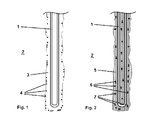
- Fig. 1 is shown in a longitudinal section, a lower portion of a borehole 3 in the ground 2.
- a geothermal probe 1 is used in borehole 3. Due to the drilling for the production of the borehole 3 in the ground 2 3 oil deposits 4 are present in the borehole. These are shown schematically as droplets on the wall of the wellbore 3. The oil deposits 4 contaminate the borehole 3 in the soil 2 and endanger the quality of the groundwater.
- Fig. 2 is a longitudinal section through a lower portion of a borehole 3 in the soil 2 shown.
- a geothermal probe 1 is introduced.
- the space between geothermal probe 1 and soil 2 is pressed with a grout 5.
- oil binder 6 are largely homogeneously distributed.
- the oil binder 6 is capable of binding oil deposits, thereby resulting in oil binder 6 bound oil. 7
Landscapes
- Engineering & Computer Science (AREA)
- Chemical & Material Sciences (AREA)
- Ceramic Engineering (AREA)
- Life Sciences & Earth Sciences (AREA)
- Mining & Mineral Resources (AREA)
- Geology (AREA)
- Materials Engineering (AREA)
- Structural Engineering (AREA)
- Organic Chemistry (AREA)
- General Life Sciences & Earth Sciences (AREA)
- Physics & Mathematics (AREA)
- Mechanical Engineering (AREA)
- Environmental & Geological Engineering (AREA)
- Fluid Mechanics (AREA)
- Inorganic Chemistry (AREA)
- Chemical Kinetics & Catalysis (AREA)
- Geochemistry & Mineralogy (AREA)
- Sustainable Energy (AREA)
- Combustion & Propulsion (AREA)
- General Engineering & Computer Science (AREA)
- Sustainable Development (AREA)
- Soil Conditioners And Soil-Stabilizing Materials (AREA)
- Curing Cements, Concrete, And Artificial Stone (AREA)
Abstract
Description
- Die Erfindung betrifft einen Trockenmörtel, der mit Wasser gemischt ein Verpressmaterial ergibt, mit dem bei Erdwärmesonden Zwischenräume zwischen den Erdwärmesonden und dem umgebenden Erdreich verpresst werden, und der im Wesentlichen hydraulisch bindende Stoffe, wie Zement und/oder Kalk, inerte Füllstoffe, wie Quarzsand, und ein Tonmineralgemisch enthält.
- Weiterhin betrifft die Erfindung ein Verpressmaterial, welches aus dem Trockenmörtel und Wasser herstellbar ist.
- Moderne und energiesparende Heizungs- und Kühlsysteme für Gebäude werden mehr und mehr mit Erdwärmesonden versorgt.
- Dazu werden Bohrungen, die bis in mehrere Hundert Meter Tiefe reichen können, in das Erdreich eingebracht. In diese Bohrungen werden Rohrleitungssysteme eingesetzt, durch die ein Fluid strömt, welches Erdwärme aus dem Erdreich aufnehmen kann und diese Erdwärme an eine Übergabestation zum Zwecke der Gebäudeheizung transportiert.
- In einer Abwandlung kann auch vorgesehen sein, dass beispielsweise in der Sommerperiode Energie aus dem Gebäude zum Zwecke der Kühlung mittels der Erdwärmesonde in das Erdreich abgeleitet wird, um dort dann an das Erdreich abgegeben zu werden.
- Um den thermischen Anschluss der Erdwärmesonde, die im Allgemeinen als Kunststoffrohr ausgebildet ist, an das umgebende Erdreich herzustellen, wird der Zwischenraum zwischen Erdwärmesonde und umgebenden Erdreich mit einem Verpressmaterial verpresst.
- Das Verpressmaterial ist aus einem Trockenmörtel, der mit Wasser gemischt wird, herstellbar.
- Der Trockenmörtel selbst kann hydraulisch bindende Stoffe, wie Zement und/oder Kalk, inerte Füllstoffe, und ein Tonmineralgemisch enthalten.
- Neben der Schaffung des thermischen Anschlusses der Erdwärmesonde an das umgebende Erdreich mit Hilfe des die Zwischenräume ausfüllenden Verpressmaterials, welches nach dem Einbringen in das Bohrloch aushärtet, wird die Erdwärmesondenleitung durch das Verpressmaterial auch stabilisiert, dass heißt es wird gegenüber dem in der Leitung durch das Fluid erzeugten Druck ein äußerer Gegendruck aufgebaut.
- Schließlich werden beim Bohren angeschnittene Grundwasserleiter im Erdboden (so genannten Aquiferen) durch das in der Regel hydraulisch gebundene Verpressmaterial dauerhaft voneinander getrennt, was große Vorteile bei der Sicherung der Grundwasservorkommen mit sich bringt.
- Ein Trockenmörtel für diesen Zweck ist beispielsweise aus der
DE 10 2007 031 418 B3 bekannt. - Die Bohrungen im Erdboden für die einzubringenden Erdwärmesonden werden im Lufthebe-Spülbohrverfahren oder im so genannten Imlochhammer-Bohrverfahren abgeteuft.
- Bei diesen beiden Bohrverfahren erfolgt der Antrieb des Bohrmeißels durch unter hohem Druck stehende Gase, wobei hier bevorzugt Druckluft eingesetzt wird.
- Die Druckluft wird mit entsprechenden Kompressoren erzeugt, wobei der Druckluft stets ein geringer Ölanteil in Form eines feinen Ölnebels zugesetzt wird.
- Diese ölhaltige Druckluft wirkt dem Verschleiß sowohl der Kompressoren als auch der eingesetzten druckluftbetriebenen Bohrwerkzeuge entgegen und minimiert diesen.
- Nachteilig an diesem Stand der Technik ist, dass diese ölhaltige Druckluft nach Betätigung des druckluftbetriebenen Bohrwerkzeugs im Bohrloch austritt.
- Daher wird bei einer Bohrung ein gewisser Ölanteil in die Bohrung im Erdreich eingetragen und lagert sich dort ab. Dies hat erhebliche negative Auswirkungen auf den Erdboden und das anstehende Grundwasser.
- Aus diesem Grund sind in Zonen erhöhten Grundwasserschutzes derartige Bohrarbeiten oftmals stark eingeschränkt beziehungsweise vollständig untersagt.
- Zur Verdeutlichung der Problematik ist davon auszugehen, dass pro 100 m zu bohrendes Erdreich Ölmengen von bis zu 10 Liter freigesetzt und damit in das Erdreich eingebracht werden, die oftmals beträchtliche negative Auswirkungen nach sich ziehen.
- Hier setzt die Erfindung ein, die es sich zur Aufgabe stellt hat, einen Trockenmörtel anzugeben, der die vorstehenden geschilderten Nachteile des Standes der Technik überwindet.
- Eine weitere Aufgabe der Erfindung ist es, ein Verpressmaterial anzugeben, welches aus dem Trockenmörtel und Wasser herstellbar ist.
- Die Aufgabe der Erfindung wird mit einem Trockenmörtel gemäß Anspruch 1 gelöst.
- Erfindungsgemäß ist hierzu vorgesehen, einen Trockenmörtel einzusetzen, welcher hydraulisch bindende Stoffe, wie Zement und/oder Kalk, inerte Füllstoffe, wie Quarzsand, und ein Tonmineralgemisch enthält, der mit Wasser gemischt ein fließfähiges Verpressmaterial ergibt, mit dem bei in das Erdreich eingebrachten Erdwärmesonden Zwischenräumen zwischen den Erdwärmesonden und dem umgebenden Erdreich verpressbar sind, und der sich dadurch auszeichnet, dass ein Ölbindemittel enthalten ist.
- Durch das erfindungsgemäße Vorsehen eines Ölbindemittels wird Öl im Bohrloch gebunden.
- Unter "Öl" wird in diesem Zusammenhang ein Kohlenwasserstoff oder eine Mischung von Kohlenwasserstoffen, ein Mineralöl, ein synthetisch hergestelltes Öl, ein Öl pflanzlichen oder tierischen Ursprungs oder eine Mischung der vorgenannten verstanden.
- Es ist in diesem Zusammenhang besonders vorteilhaft, wenn das Ölbindemittel sich sowohl im Trockenmörtel, als auch im Verpressmaterial, das aus dem Trockenmörtel und Wasser herstellbar ist, homogen eingemischt bzw. verteilt ist.
- Es ist im Rahmen der vorliegenden Erfindung vorgesehen, dass der Trockenmörtel ein Ölbindemittel enthält, welches ein Adsorptionsstoff oder ein Absorptionsstoff ist.
- Durch das Vorsehen eines Adsorptionsstoffes oder eines Absorptionsstoffes als Ölbindemittel lässt sich Öl besonders vorteilhaft binden.
- Als Adsorption (lat.: adsorptio bzw. adsorbere = (an-)saugen) wird hier die Anreicherung von Stoffen aus Gasen oder Flüssigkeiten an der Oberfläche eines Festkörpers, allgemeiner an der Grenzfläche zwischen zwei Phasen verstanden.
- Adsorption unterscheidet sich von der Absorption, bei der die Stoffe in das Innere eines Festkörpers oder einer Flüssigkeit eindringen. Der Oberbegriff für diese Anreicherungsvorgänge lautet Sorption.
- Als Adsorptionsstoff wird in diesem Zusammenhang ein Stoff verstanden, der geeignet ist, an seiner Oberfläche Öle durch Adsorption zu binden.
- Als Absorptionsstoff dagegen wird ein Stoff verstanden, welcher Öle durch Aufnahme in sein Inneres (in die Matrix) bindet.
- Es ist besonders vorteilhaft, wenn das Ölbindemittel aus Partikeln ausgewählt ist, wie disperse Kieselsäure, Silikaten aus der Gruppe der Zeolithe, quellfähige Mineralien, wie beispielsweise Bentonit, Eisenoxid, Kieselgur, Aktivkohle, Braunkohle, Kalksteinmehl.
- Erfindungsgemäß kann auch vorgesehen sein, dass das Ölbindemittel Fasern enthält, wie beispielsweise Polypropylenfasern, die Öl aufnehmen können.
- Es können auch Mischungen der vorgenannten Partikel und der vorgenannten Fasern als Ölbindemittel eingesetzt werden.
- Es ist im Rahmen der Erfindung von großem Vorteil, wenn der Trockenmörtel das Ölbindemittel zu einem Gewichtsanteil von 1 bis 25 %, vorzugweise 5 bis10 %, enthält. Dadurch kann eine besonders wirksame Bindung des Öls durch das Ölbindemittel erfolgen. Die mechanisch-physikalischen Eigenschaften des derart modifizierten erfindungsgemäßen Trockenmörtels und des daraus mit Wasser zubereiteten Verpressmaterials werden durch die vorgesehene Menge an enthaltenem Ölbindemittel nicht oder nur unwesentlich verändert.
- Es hat sich in diesem Zusammenhang ganz besonders günstig erwiesen, wenn die Partikel eine Korngröße von 2 bis 1.000 µm, vorzugsweise eine Korngröße von 20 bis 300 µm aufweisen.
- Ein Ölbindemittel von Form von Partikeln dieser Korngröße ist einerseits besonders homogen im Trockenmörtel und im daraus hergestellten Verpressmaterial verteilbar, andererseits weist ein derartiges Ölbindemittel eine hohe Bindefähigkeit für Öl auf.
- Besonders vorteilhaft ist, dass die Fasern, die als Ölbindemittel eingesetzt werden, einen Durchmesser von 1 bis 500 µm aufweisen, bevorzugt einen Durchmesser von 10 bis 200 µm.
- Fasern mit einem derartigen Durchmesser nehmen diese Mengen Öl auf.
- In einer bevorzugten Weiterbildung der Erfindung kann vorgesehen sein, dass das Ölbindemittel im Trockenmörtel vorgranuliert oder kompaktiert ist.
- Ein vorgranuliertes oder kompaktiertes Ölbindemittel weist den Vorteil auf, dass es einerseits sehr exakt zum Trockenmörtel zudosierbar ist, andererseits lässt es sich im Trockenmörtel und dann im daraus hergestellten Verpressmaterial besonders homogen verteilen, weiterhin ist damit die Staubbelastung bei der Handhabung des Trockenmörtel erheblich reduziert.
- Unter vorgranuliert oder kompaktiert wird hierbei verstanden, dass die Partikel und / oder Fasern, die das Ölbindemittel darstellen, zu Aggregaten zusammengefügt sind. Dies kann durch Bindemittel oder durch mechanisches Binden (beispielsweise durch Pressen) geschehen.
- In einer günstigen Weiterbildung der Erfindung kann vorgesehen sein, dass das Ölbindemittel mit einer Wirksubstanz versehen ist, die einen Abbau des gebundenen Öls bewirkt.
- Dies kann so vorgesehen sein, dass das Ölbindemittel mit der Wirksubstanz imprägniert ist.
- Als Wirksubstanz kommen dabei bevorzugt Mikroorganismen zum Einsatz, vorzugsweise Hefen, wie beispielsweise vom Stamm Candida maltosa.
- Hefen des Stammes Candida maltosa sind in der Lage, Öle auf biochemischem Wege abzubauen.
- Es kann auch vorgesehen sein, Bakterien vorzugsweise Alkanivorax borkumensis oder Nocardia cyriacigeorgica oder Mischungen der vorgenannten als Wirksubstanz für das Ölbindemittel vorzusehen.
- Die Wirksubstanz wird dabei bevorzugt mit einer Bakterienanzahl von mindestens 1,0 × 10⁷ KBE / ml (KBE = Keim bildende Einheiten) eingesetzt.
- Hierdurch wird ein besonders wirksamer Abbau des Öles mit den Ölbindemitteln erreicht.
- Der Einsatz von Wirksubstanzen wie beispielsweise Mikroorganismen zum Abbau des Öles ist besonders bevorzugt, da dadurch das Öl mineralisiert wird, also nach dem Abbau keine negativen Auswirkungen auf die Umwelt nach sich zieht.
- In einer Weiterbildung der Erfindung kann auch vorgesehen sein, dass dem Trockenmörtel wärmeleitende Partikel zugesetzt sind, die die Wärmeleitung zwischen Erdreich und Erdwärmesonde begünstigen.
- Solche wärmeleitende Partikel können auch Partikel sein, die als Ölbindemittel wirken.
- In einer anderen Weiterbildung der Erfindung kann vorgesehen sein, dass dem Trockenmörtel wärmedämmende Partikel zugesetzt sind, die die Wärmeleitung zwischen Erdreich und Erdwärmesonde herabsetzen.
- Wärmedämmende Partikel können beispielsweise geschäumte Partikel aus Polymermaterial sein, wie Polypropylenschaumpartikel.
- Damit kann beispielsweise eine Erdwärmesonde derart im Bohrloch im Erdreich verpresst werden, dass in einem unteren Abschnitt in großer Tiefe ein Verpressmaterial eingesetzt wird, das aus Wasser und Trockenmörtel zubereitet wird, der wärmeleitende Partikel aufweist. Hierdurch wird eine hohe Übertragungsleistung an Wärme erzielt.
- In einem oberen - nahe der Erdoberfläche befindlichen - Abschnitt in geringer Tiefe kann die Erdwärmesonde derart im Bohrloch im Erdreich verpresst werden, dass ein Verpressmaterial eingesetzt wird, das aus Wasser und Trockenmörtel zubereitet wird, der wärmedämmende Partikel aufweist. Hierdurch wird der Wärmeübergang wirksam reduziert. Vorteilhaft kann dies genutzt werden, um Wärmeaustausch gezielt in tiefen Schichten des Erdreichs vorzunehmen, ohne dass es zu erheblichen Verlusten an Wärme in oberen, also kälteren Bodenschichten kommt, so dass das Fluid dort keine Abkühlung erleidet.
- Der erfindungsgemäße Trockenmörtel lässt sich durch Zumischen von Wasser oder einem wässrigen Fluid in ein fließfähiges Verpressmaterial führen, welches nach dem Verpressen der Zwischenräume zwischen Erdwärmesonde und Erdreich erhärtet und eine optimale mechanische und thermische Anbindung der Erdwärmesonde an das umgebende Erdreich ermöglicht.
- Die Erfindung betrifft weiterhin eine Erdwärmesonde, die in das Erdreich eingebracht ist, wobei Zwischenräume zwischen der Erdwärmesonde und dem umgebenden Erdreich mit einem Verpressmaterial, wie vorstehend geschildert, verpresst ist.
- Die Erfindung wird im Folgenden anhand von zwei Figuren verdeutlicht.
- Fig. 1
- zeigt einen Längsschnitt durch ein Bohrloch im Erdreich, wobei in das Bohrloch eine Erdwärmesonde eingesetzt ist;
- Fig. 2
- zeigt einen Längsschnitt durch ein Bohrloch im Erdreich, wobei in das Bohrloch eine Erdwärmesonde eingesetzt ist und der Zwischenraum zwischen Erdwärmesonde und Erdreich mit einem Verpressmaterial verpresst ist.
- In
Fig. 1 ist in einem Längsschnitt ein unterer Abschnitt eines Bohrloches 3 im Erdboden 2 gezeigt. - Im Bohrloch 3 ist eine Erdwärmesonde 1 eingesetzt. Bedingt durch die Bohrarbeiten zur Herstellung des Bohrloches 3 im Erdreich 2 sind im Bohrloch 3 Ölablagerungen 4 vorhanden. Diese sind schematisch als Tröpfchen an der Wand des Bohrloches 3 gezeigt. Die Ölablagerungen 4 kontaminieren das Bohrloch 3 im Erdreich 2 und gefährden die Qualität des Grundwassers.
- In
Fig. 2 ist ein Längsschnitt durch einen unteren Abschnitt eines Bohrloches 3 im Erdreich 2 dargestellt. In das Bohrloch 3 ist eine Erdwärmesonde 1 eingebracht. - Der Zwischenraum zwischen Erdwärmesonde 1 und Erdreich 2 ist mit einem Verpressmaterial 5 verpresst.
Im Verpressmaterial 5 sind Ölbindemittel 6 weitgehend homogen verteilt. - Das Ölbindemittel 6 ist fähig, Ölablagerungen zu binden, dadurch entsteht an Ölbindemittel 6 gebundenes Öl 7.
- Durch die Bindung des Öls 7 am Ölbindemittel 6 stellt dies keine Umweltgefährdung mehr dar.
-
- 1
- Erdwärmesonde
- 2
- Erdreich
- 3
- Bohrloch
- 4
- Ölablagerungen
- 5
- Verpressmaterial
- 6
- Ölbindemittel
- 7
- an Ölbindemittel gebundenes Öl
Claims (10)
- Trockenmörtel, enthaltend hydraulisch bindende Stoffe, wie Zement und/oder Kalk, inerte Füllstoffe, wie Quarzsand, und ein Tonmineralgemisch, der mit Wasser gemischt ein fließfähiges Verpressmaterial (5) ergibt, mit dem bei in das Erdreich eingebrachten Erdwärmesonden (1) Zwischenräume zwischen den Erdwärmesonden (1) und dem umgebenden Erdreich (2) verpressbar sind, dadurch gekennzeichnet, dass ein Ölbindemittel (6) enthalten ist.
- Trockenmörtel nach Anspruch 1, dadurch gekennzeichnet, dass das Ölbindemittel (6) ein Adsorptionsstoff oder eine Absorptionsstoff ist.
- Trockenmörtel nach Anspruch 1 oder 2, dadurch gekennzeichnet, dass das Ölbindemittel (6) ausgewählt ist aus Partikeln, wie hochdisperser Kieselsäure, Silikaten aus der Gruppe der Zeolithe, Tonmineralien, Eisenoxid, Kieselgur, Aktivkohle, Braunkohle, Kalksteinmehl, und / oder Fasern, wie Polypropylenfasern oder Mischungen der vorgenannten.
- Trockenmörtel nach einem der vorangehenden Ansprüche, dadurch gekennzeichnet, dass das Ölbindemittel (6) zu einem Gewichtsanteil von 1 bis 25 %, vorzugweise 5 bis10%, enthalten ist.
- Trockenmörtel nach einem der vorangehenden Ansprüche, dadurch gekennzeichnet, dass die Partikel eine Korngröße von 2 bis 1000 µm, vorzugsweise 20 bis 300 µm aufweisen.
- Trockenmörtel nach einem der Ansprüche 1 bis 4, dadurch gekennzeichnet, dass die Fasern einen Durchmesser von 1 bis 500 µm, vorzugsweise 10 bis 200 µm aufweisen.
- Trockenmörtel nach einem der vorangehenden Ansprüche, dadurch gekennzeichnet, dass das Ölbindemittel (6) vorgranuliert oder kompaktiert ist.
- Trockenmörtel nach einem der vorangehenden Ansprüche, dadurch gekennzeichnet, dass das Ölbindemittel (6) eine Wirksubstanz enthält, die einen Abbau des gebundenen Öls (7) bewirkt.
- Verpressmaterial (5) aus einem Trockenmörtel nach einem der Ansprüche 1 bis 8 und Wasser zur Verpressung von Zwischenräumen bei in das Erdreich (2) eingebrachten Erdwärmesonden (1) zwischen den Erdwärmesonden (1) und dem umgebenden Erdreich (2).
- Erdwärmesonde (1), die in das Erdreich (2) eingebracht ist, wobei Zwischenräume zwischen der Erdwärmesonde (1) und dem umgebenden Erdreich (2) mit einem Verpressmaterial (5) nach Anspruch 9 verpresst sind.
Applications Claiming Priority (1)
| Application Number | Priority Date | Filing Date | Title |
|---|---|---|---|
| DE202010011640U DE202010011640U1 (de) | 2010-08-20 | 2010-08-20 | Trockenmörtel |
Publications (2)
| Publication Number | Publication Date |
|---|---|
| EP2420480A2 true EP2420480A2 (de) | 2012-02-22 |
| EP2420480A3 EP2420480A3 (de) | 2015-06-03 |
Family
ID=44587707
Family Applications (1)
| Application Number | Title | Priority Date | Filing Date |
|---|---|---|---|
| EP11177315.6A Withdrawn EP2420480A3 (de) | 2010-08-20 | 2011-08-11 | Trockenmörtel |
Country Status (2)
| Country | Link |
|---|---|
| EP (1) | EP2420480A3 (de) |
| DE (1) | DE202010011640U1 (de) |
Cited By (1)
| Publication number | Priority date | Publication date | Assignee | Title |
|---|---|---|---|---|
| EP3954946A1 (de) * | 2020-08-03 | 2022-02-16 | Commercial Energy Saving Plus, LLC | Geothermischer adapter zur verwendung mit einer wärmepumpe |
Families Citing this family (3)
| Publication number | Priority date | Publication date | Assignee | Title |
|---|---|---|---|---|
| ITMI20121028A1 (it) * | 2012-06-14 | 2013-12-15 | Manenti Dott Ing Flavio | Impianto per lo sfruttamento dell'energia geotermica |
| DE102013016425A1 (de) * | 2013-10-02 | 2015-04-02 | Dyckerhoff Gmbh | Verfahren zum Verfüllen von Hohlräumen mit einer Verfüllmasse |
| DE102022112012A1 (de) | 2022-05-13 | 2023-11-16 | Tilman Fritsch | Baustoff oder Bindemittel und Verfahren zu dessen Herstellung sowie Verwendung einer Faser als Bestandteil eines Baustoffes oder Bindemittels |
Citations (1)
| Publication number | Priority date | Publication date | Assignee | Title |
|---|---|---|---|---|
| DE102007031418B3 (de) | 2007-07-04 | 2008-10-30 | Dornburger Zement Gmbh & Co. Kg | Trockenmörtel für Erdwärmesonden |
Family Cites Families (5)
| Publication number | Priority date | Publication date | Assignee | Title |
|---|---|---|---|---|
| CZ119694A3 (en) * | 1992-09-21 | 1994-12-15 | Brunn Betonwerk | Adsorption material for binding harmful substances and process for preparing thereof |
| GB9220561D0 (en) * | 1992-09-29 | 1992-11-11 | Ecc Int Ltd | Immobilisation of material |
| DE19964421B4 (de) * | 1999-04-09 | 2008-07-03 | Franken Maxit Mauermörtel GmbH & Co. | Trockenmörtel zur Herstellung von Frischmörtel zur deckelnden Dünnbettvermörtelung von Hochlochplanziegel |
| DE19958765A1 (de) * | 1999-06-29 | 2001-06-13 | Zae Bayern | Graphithaltiges Verfüllmaterial für Erdreichwärmeübertrager und Erdstarkstromkabel |
| DE102004039107A1 (de) * | 2003-08-21 | 2005-06-30 | Anneliese Zementwerke Ag | Höchwärmeleitfähiger Verfüllbaustoff für tiefe Erdwärmesonden |
-
2010
- 2010-08-20 DE DE202010011640U patent/DE202010011640U1/de not_active Expired - Lifetime
-
2011
- 2011-08-11 EP EP11177315.6A patent/EP2420480A3/de not_active Withdrawn
Patent Citations (1)
| Publication number | Priority date | Publication date | Assignee | Title |
|---|---|---|---|---|
| DE102007031418B3 (de) | 2007-07-04 | 2008-10-30 | Dornburger Zement Gmbh & Co. Kg | Trockenmörtel für Erdwärmesonden |
Cited By (1)
| Publication number | Priority date | Publication date | Assignee | Title |
|---|---|---|---|---|
| EP3954946A1 (de) * | 2020-08-03 | 2022-02-16 | Commercial Energy Saving Plus, LLC | Geothermischer adapter zur verwendung mit einer wärmepumpe |
Also Published As
| Publication number | Publication date |
|---|---|
| EP2420480A3 (de) | 2015-06-03 |
| DE202010011640U1 (de) | 2011-11-21 |
Similar Documents
| Publication | Publication Date | Title |
|---|---|---|
| DE69419352T2 (de) | Ölbohrlochzementschlämme, ihre Herstellung und ihre Verwendung in Ölbohrungen | |
| EP2420480A2 (de) | Trockenmörtel | |
| DE69903810T2 (de) | Unterirdisches wärmetauchsystem | |
| DE1944636B2 (de) | Oelbindemittel zur adsorptiven beseitigung fluessiger mineraloelerzeugnisse vom erdboden, von gewaesseroberflaechen oder aus kanalisationsanlagen | |
| DE2727077C2 (de) | Verfahren zur Herstellung einer flüssigkeitsdichten Sperrschicht als Auskleidung einer Grube für eine Mülldeponie od.dgl. | |
| DE102007031418B3 (de) | Trockenmörtel für Erdwärmesonden | |
| DE202012011152U1 (de) | Katalysatorzusammensetzung zur Verwendung bei Puzzolanzusammensetzungen | |
| DE3201996A1 (de) | Einrichtung zum vollbohren ohne kernentnahme | |
| CN109052656B (zh) | 一种活性炭粉-降解菌组合物及地下水修复技术 | |
| DE4341858C2 (de) | Unterirdischer Energiespeicher für Wärme- bzw. Kälteenergie sowie Verfahren zur Herstellung eines derartigen Energiespeichers | |
| EP2844716B1 (de) | Biologisch abbaubare organophile tonerden für bohrflüssigkeiten | |
| DE19851256C2 (de) | Verfahren zum Verfestigen von insbesondere schadstoffhaltigen, staubförmigen bis grobkörnigen, nicht hydraulischen Anfallstoffen | |
| DE102013016425A1 (de) | Verfahren zum Verfüllen von Hohlräumen mit einer Verfüllmasse | |
| AT391905B (de) | Injektionsverfahren zur bodenverbesserung im lockergestein, insbesondere zur verfestigung von wenig wasserdurchlaessigen und/oder wasserun- durchlaessigen, d. h. bindigen boeden und vorrichtung zur durchfuehrung des verfahrens | |
| DE102009031474B3 (de) | Vorrichtung zum Auffinden von Öffnungen unter Asphaltdecken | |
| DE10021549A1 (de) | Verfahren zur Herstellung von Gründungselementen | |
| DE4401284C2 (de) | Verwendung von Diabas oder Basalt zur Bodenverfestigung | |
| EP4098715A1 (de) | Verfahren zum freimachen einer durch ein adsorbens zugesetzten tiefbohrung | |
| DE3637946A1 (de) | Verfahren zum sanieren eines brunnens | |
| DE102011108821A1 (de) | Verfüllmaterial für Erdsonden und Erdstromkabeln aus wärmeleitenden Transporteilchen und Verdrängungskörpern zur Optimierung des Wärmetransports, sowie Verfahren zu dessen Herstellung und Verwendung desselben | |
| DE102004017199B4 (de) | Calciumsilikathydratgebundener Baustein nach Art eines Kalksandsteins und Verfahren zu seiner Herstellung | |
| EP2254964B1 (de) | Verfahren zur herstellung eines ölbindemittels | |
| AT391637B (de) | Verfahren zur verfestigung und/oder abdichtung von altdeponien von abfallstoffen | |
| DE102005056568A1 (de) | Trockengemisch | |
| DE102010045126A1 (de) | Erdsondenanordnung und Erdsondeneinbauvorrichtung |
Legal Events
| Date | Code | Title | Description |
|---|---|---|---|
| AK | Designated contracting states |
Kind code of ref document: A2 Designated state(s): AL AT BE BG CH CY CZ DE DK EE ES FI FR GB GR HR HU IE IS IT LI LT LU LV MC MK MT NL NO PL PT RO RS SE SI SK SM TR |
|
| AX | Request for extension of the european patent |
Extension state: BA ME |
|
| PUAI | Public reference made under article 153(3) epc to a published international application that has entered the european phase |
Free format text: ORIGINAL CODE: 0009012 |
|
| PUAL | Search report despatched |
Free format text: ORIGINAL CODE: 0009013 |
|
| AK | Designated contracting states |
Kind code of ref document: A3 Designated state(s): AL AT BE BG CH CY CZ DE DK EE ES FI FR GB GR HR HU IE IS IT LI LT LU LV MC MK MT NL NO PL PT RO RS SE SI SK SM TR |
|
| AX | Request for extension of the european patent |
Extension state: BA ME |
|
| RIC1 | Information provided on ipc code assigned before grant |
Ipc: C04B 28/10 20060101ALI20150429BHEP Ipc: C04B 28/02 20060101AFI20150429BHEP Ipc: C04B 40/06 20060101ALI20150429BHEP |
|
| STAA | Information on the status of an ep patent application or granted ep patent |
Free format text: STATUS: THE APPLICATION IS DEEMED TO BE WITHDRAWN |
|
| 18D | Application deemed to be withdrawn |
Effective date: 20151204 |