EP2381312A2 - Alkaline liquid developer for lithographic printing plate and method for preparing lithographic printing plate - Google Patents
Alkaline liquid developer for lithographic printing plate and method for preparing lithographic printing plate Download PDFInfo
- Publication number
- EP2381312A2 EP2381312A2 EP11174317A EP11174317A EP2381312A2 EP 2381312 A2 EP2381312 A2 EP 2381312A2 EP 11174317 A EP11174317 A EP 11174317A EP 11174317 A EP11174317 A EP 11174317A EP 2381312 A2 EP2381312 A2 EP 2381312A2
- Authority
- EP
- European Patent Office
- Prior art keywords
- group
- image
- lithographic printing
- printing plate
- developer
- Prior art date
- Legal status (The legal status is an assumption and is not a legal conclusion. Google has not performed a legal analysis and makes no representation as to the accuracy of the status listed.)
- Granted
Links
- 239000007788 liquid Substances 0.000 title claims abstract description 73
- 238000007639 printing Methods 0.000 title claims abstract description 63
- 238000000034 method Methods 0.000 title claims abstract description 46
- 239000003093 cationic surfactant Substances 0.000 claims abstract description 21
- 239000006096 absorbing agent Substances 0.000 claims abstract description 20
- 230000005855 radiation Effects 0.000 claims abstract description 7
- -1 ester ion Chemical class 0.000 claims description 91
- 239000002253 acid Substances 0.000 claims description 20
- 125000004432 carbon atom Chemical group C* 0.000 claims description 18
- 150000003242 quaternary ammonium salts Chemical group 0.000 claims description 8
- 229920006395 saturated elastomer Polymers 0.000 claims description 5
- 150000001450 anions Chemical class 0.000 claims description 4
- 229910052736 halogen Inorganic materials 0.000 claims description 4
- 229930195734 saturated hydrocarbon Natural products 0.000 claims description 4
- 229930195735 unsaturated hydrocarbon Natural products 0.000 claims description 4
- XLYOFNOQVPJJNP-UHFFFAOYSA-M hydroxide Chemical compound [OH-] XLYOFNOQVPJJNP-UHFFFAOYSA-M 0.000 claims description 3
- 150000005837 radical ions Chemical class 0.000 claims description 2
- 238000011161 development Methods 0.000 abstract description 37
- 238000012545 processing Methods 0.000 abstract description 30
- 239000002280 amphoteric surfactant Substances 0.000 abstract description 20
- 229920005989 resin Polymers 0.000 abstract description 12
- 239000011347 resin Substances 0.000 abstract description 12
- 239000011230 binding agent Substances 0.000 abstract description 8
- 230000001747 exhibiting effect Effects 0.000 abstract description 3
- 125000001424 substituent group Chemical group 0.000 description 57
- 150000001875 compounds Chemical class 0.000 description 51
- 229920000642 polymer Polymers 0.000 description 40
- 239000000975 dye Substances 0.000 description 38
- 239000000049 pigment Substances 0.000 description 36
- 239000000178 monomer Substances 0.000 description 31
- 239000002243 precursor Substances 0.000 description 28
- 230000000052 comparative effect Effects 0.000 description 27
- 239000007864 aqueous solution Substances 0.000 description 24
- 239000004094 surface-active agent Substances 0.000 description 24
- 239000000758 substrate Substances 0.000 description 23
- 239000000203 mixture Substances 0.000 description 22
- 239000000243 solution Substances 0.000 description 22
- 150000002605 large molecules Chemical class 0.000 description 20
- 125000000217 alkyl group Chemical group 0.000 description 19
- 239000011248 coating agent Substances 0.000 description 19
- 238000000576 coating method Methods 0.000 description 19
- XLYOFNOQVPJJNP-UHFFFAOYSA-N water Substances O XLYOFNOQVPJJNP-UHFFFAOYSA-N 0.000 description 19
- 150000003839 salts Chemical class 0.000 description 18
- 239000007787 solid Substances 0.000 description 18
- 235000000346 sugar Nutrition 0.000 description 18
- 125000004435 hydrogen atom Chemical group [H]* 0.000 description 17
- ISWSIDIOOBJBQZ-UHFFFAOYSA-N Phenol Natural products OC1=CC=CC=C1 ISWSIDIOOBJBQZ-UHFFFAOYSA-N 0.000 description 16
- 229910052782 aluminium Inorganic materials 0.000 description 16
- XAGFODPZIPBFFR-UHFFFAOYSA-N aluminium Chemical compound [Al] XAGFODPZIPBFFR-UHFFFAOYSA-N 0.000 description 16
- 239000003795 chemical substances by application Substances 0.000 description 16
- 239000000463 material Substances 0.000 description 16
- OKKJLVBELUTLKV-UHFFFAOYSA-N Methanol Chemical compound OC OKKJLVBELUTLKV-UHFFFAOYSA-N 0.000 description 15
- VYPSYNLAJGMNEJ-UHFFFAOYSA-N Silicium dioxide Chemical compound O=[Si]=O VYPSYNLAJGMNEJ-UHFFFAOYSA-N 0.000 description 15
- 125000003118 aryl group Chemical group 0.000 description 15
- 239000004793 Polystyrene Substances 0.000 description 14
- 229910052814 silicon oxide Inorganic materials 0.000 description 14
- 230000002829 reductive effect Effects 0.000 description 13
- WSFSSNUMVMOOMR-UHFFFAOYSA-N Formaldehyde Chemical compound O=C WSFSSNUMVMOOMR-UHFFFAOYSA-N 0.000 description 12
- 230000006735 deficit Effects 0.000 description 12
- 125000005843 halogen group Chemical group 0.000 description 12
- 229920001577 copolymer Polymers 0.000 description 11
- 239000000126 substance Substances 0.000 description 11
- 238000011282 treatment Methods 0.000 description 11
- 125000002915 carbonyl group Chemical group [*:2]C([*:1])=O 0.000 description 10
- 238000010438 heat treatment Methods 0.000 description 10
- 125000002887 hydroxy group Chemical group [H]O* 0.000 description 10
- 239000003921 oil Substances 0.000 description 10
- ZWEHNKRNPOVVGH-UHFFFAOYSA-N 2-Butanone Chemical compound CCC(C)=O ZWEHNKRNPOVVGH-UHFFFAOYSA-N 0.000 description 9
- LFQSCWFLJHTTHZ-UHFFFAOYSA-N Ethanol Chemical compound CCO LFQSCWFLJHTTHZ-UHFFFAOYSA-N 0.000 description 9
- 229910019142 PO4 Inorganic materials 0.000 description 9
- KWYUFKZDYYNOTN-UHFFFAOYSA-M Potassium hydroxide Chemical compound [OH-].[K+] KWYUFKZDYYNOTN-UHFFFAOYSA-M 0.000 description 9
- HEMHJVSKTPXQMS-UHFFFAOYSA-M Sodium hydroxide Chemical compound [OH-].[Na+] HEMHJVSKTPXQMS-UHFFFAOYSA-M 0.000 description 9
- ZMANZCXQSJIPKH-UHFFFAOYSA-N Triethylamine Chemical compound CCN(CC)CC ZMANZCXQSJIPKH-UHFFFAOYSA-N 0.000 description 9
- 229910000272 alkali metal oxide Inorganic materials 0.000 description 9
- 239000012954 diazonium Substances 0.000 description 9
- 150000001989 diazonium salts Chemical class 0.000 description 9
- 230000000694 effects Effects 0.000 description 9
- 239000010452 phosphate Substances 0.000 description 9
- QGKMIGUHVLGJBR-UHFFFAOYSA-M (4z)-1-(3-methylbutyl)-4-[[1-(3-methylbutyl)quinolin-1-ium-4-yl]methylidene]quinoline;iodide Chemical compound [I-].C12=CC=CC=C2N(CCC(C)C)C=CC1=CC1=CC=[N+](CCC(C)C)C2=CC=CC=C12 QGKMIGUHVLGJBR-UHFFFAOYSA-M 0.000 description 8
- BPQQTUXANYXVAA-UHFFFAOYSA-N Orthosilicate Chemical compound [O-][Si]([O-])([O-])[O-] BPQQTUXANYXVAA-UHFFFAOYSA-N 0.000 description 8
- NBIIXXVUZAFLBC-UHFFFAOYSA-N Phosphoric acid Chemical compound OP(O)(O)=O NBIIXXVUZAFLBC-UHFFFAOYSA-N 0.000 description 8
- 239000003431 cross linking reagent Substances 0.000 description 8
- 239000012847 fine chemical Substances 0.000 description 8
- 125000000449 nitro group Chemical group [O-][N+](*)=O 0.000 description 8
- 125000002467 phosphate group Chemical group [H]OP(=O)(O[H])O[*] 0.000 description 8
- 150000003459 sulfonic acid esters Chemical group 0.000 description 8
- RWSOTUBLDIXVET-UHFFFAOYSA-N Dihydrogen sulfide Chemical class S RWSOTUBLDIXVET-UHFFFAOYSA-N 0.000 description 7
- 230000002378 acidificating effect Effects 0.000 description 7
- 125000003178 carboxy group Chemical group [H]OC(*)=O 0.000 description 7
- 125000000753 cycloalkyl group Chemical group 0.000 description 7
- 125000000113 cyclohexyl group Chemical group [H]C1([H])C([H])([H])C([H])([H])C([H])(*)C([H])([H])C1([H])[H] 0.000 description 7
- 238000004090 dissolution Methods 0.000 description 7
- 238000001035 drying Methods 0.000 description 7
- 150000002430 hydrocarbons Chemical group 0.000 description 7
- 125000005462 imide group Chemical group 0.000 description 7
- 229910052751 metal Inorganic materials 0.000 description 7
- 239000002184 metal Substances 0.000 description 7
- 150000002894 organic compounds Chemical class 0.000 description 7
- 150000002989 phenols Chemical class 0.000 description 7
- 150000004714 phosphonium salts Chemical class 0.000 description 7
- 230000035945 sensitivity Effects 0.000 description 7
- 125000000565 sulfonamide group Chemical group 0.000 description 7
- 125000000472 sulfonyl group Chemical group *S(*)(=O)=O 0.000 description 7
- CSCPPACGZOOCGX-UHFFFAOYSA-N Acetone Chemical compound CC(C)=O CSCPPACGZOOCGX-UHFFFAOYSA-N 0.000 description 6
- QGZKDVFQNNGYKY-UHFFFAOYSA-O Ammonium Chemical compound [NH4+] QGZKDVFQNNGYKY-UHFFFAOYSA-O 0.000 description 6
- 229920002134 Carboxymethyl cellulose Polymers 0.000 description 6
- CDBYLPFSWZWCQE-UHFFFAOYSA-L Sodium Carbonate Chemical group [Na+].[Na+].[O-]C([O-])=O CDBYLPFSWZWCQE-UHFFFAOYSA-L 0.000 description 6
- 230000009471 action Effects 0.000 description 6
- 239000000654 additive Substances 0.000 description 6
- 125000003342 alkenyl group Chemical group 0.000 description 6
- 239000002585 base Substances 0.000 description 6
- 235000010948 carboxy methyl cellulose Nutrition 0.000 description 6
- 150000001733 carboxylic acid esters Chemical group 0.000 description 6
- 125000002496 methyl group Chemical group [H]C([H])([H])* 0.000 description 6
- 125000002560 nitrile group Chemical group 0.000 description 6
- XAEFZNCEHLXOMS-UHFFFAOYSA-M potassium benzoate Chemical compound [K+].[O-]C(=O)C1=CC=CC=C1 XAEFZNCEHLXOMS-UHFFFAOYSA-M 0.000 description 6
- 239000002904 solvent Substances 0.000 description 6
- 238000003756 stirring Methods 0.000 description 6
- QTWJRLJHJPIABL-UHFFFAOYSA-N 2-methylphenol;3-methylphenol;4-methylphenol Chemical compound CC1=CC=C(O)C=C1.CC1=CC=CC(O)=C1.CC1=CC=CC=C1O QTWJRLJHJPIABL-UHFFFAOYSA-N 0.000 description 5
- DGAQECJNVWCQMB-PUAWFVPOSA-M Ilexoside XXIX Chemical compound C[C@@H]1CC[C@@]2(CC[C@@]3(C(=CC[C@H]4[C@]3(CC[C@@H]5[C@@]4(CC[C@@H](C5(C)C)OS(=O)(=O)[O-])C)C)[C@@H]2[C@]1(C)O)C)C(=O)O[C@H]6[C@@H]([C@H]([C@@H]([C@H](O6)CO)O)O)O.[Na+] DGAQECJNVWCQMB-PUAWFVPOSA-M 0.000 description 5
- 229910000147 aluminium phosphate Inorganic materials 0.000 description 5
- 229930003836 cresol Natural products 0.000 description 5
- 239000006185 dispersion Substances 0.000 description 5
- 229930182470 glycoside Natural products 0.000 description 5
- 230000002401 inhibitory effect Effects 0.000 description 5
- 239000002736 nonionic surfactant Substances 0.000 description 5
- 125000001997 phenyl group Chemical group [H]C1=C([H])C([H])=C(*)C([H])=C1[H] 0.000 description 5
- 150000003384 small molecules Chemical class 0.000 description 5
- 239000011734 sodium Substances 0.000 description 5
- 229910052708 sodium Inorganic materials 0.000 description 5
- 238000003860 storage Methods 0.000 description 5
- 238000004381 surface treatment Methods 0.000 description 5
- 125000000391 vinyl group Chemical group [H]C([*])=C([H])[H] 0.000 description 5
- ARXJGSRGQADJSQ-UHFFFAOYSA-N 1-methoxypropan-2-ol Chemical compound COCC(C)O ARXJGSRGQADJSQ-UHFFFAOYSA-N 0.000 description 4
- NQRAOOGLFRBSHM-UHFFFAOYSA-N 2-methyl-n-(4-sulfamoylphenyl)prop-2-enamide Chemical compound CC(=C)C(=O)NC1=CC=C(S(N)(=O)=O)C=C1 NQRAOOGLFRBSHM-UHFFFAOYSA-N 0.000 description 4
- 125000003903 2-propenyl group Chemical group [H]C([*])([H])C([H])=C([H])[H] 0.000 description 4
- QGZKDVFQNNGYKY-UHFFFAOYSA-N Ammonia Chemical compound N QGZKDVFQNNGYKY-UHFFFAOYSA-N 0.000 description 4
- LSNNMFCWUKXFEE-UHFFFAOYSA-M Bisulfite Chemical compound OS([O-])=O LSNNMFCWUKXFEE-UHFFFAOYSA-M 0.000 description 4
- 235000011960 Brassica ruvo Nutrition 0.000 description 4
- DHMQDGOQFOQNFH-UHFFFAOYSA-N Glycine Chemical compound NCC(O)=O DHMQDGOQFOQNFH-UHFFFAOYSA-N 0.000 description 4
- VEXZGXHMUGYJMC-UHFFFAOYSA-N Hydrochloric acid Chemical compound Cl VEXZGXHMUGYJMC-UHFFFAOYSA-N 0.000 description 4
- 239000004115 Sodium Silicate Substances 0.000 description 4
- QAOWNCQODCNURD-UHFFFAOYSA-N Sulfuric acid Chemical compound OS(O)(=O)=O QAOWNCQODCNURD-UHFFFAOYSA-N 0.000 description 4
- 150000003863 ammonium salts Chemical class 0.000 description 4
- 238000002048 anodisation reaction Methods 0.000 description 4
- 230000015572 biosynthetic process Effects 0.000 description 4
- 150000001768 cations Chemical class 0.000 description 4
- 238000006243 chemical reaction Methods 0.000 description 4
- 238000001816 cooling Methods 0.000 description 4
- 238000004132 cross linking Methods 0.000 description 4
- 238000011156 evaluation Methods 0.000 description 4
- KWIUHFFTVRNATP-UHFFFAOYSA-N glycine betaine Chemical compound C[N+](C)(C)CC([O-])=O KWIUHFFTVRNATP-UHFFFAOYSA-N 0.000 description 4
- XMBWDFGMSWQBCA-UHFFFAOYSA-N hydrogen iodide Chemical class I XMBWDFGMSWQBCA-UHFFFAOYSA-N 0.000 description 4
- 230000006872 improvement Effects 0.000 description 4
- 230000003993 interaction Effects 0.000 description 4
- 229920002521 macromolecule Polymers 0.000 description 4
- WSFSSNUMVMOOMR-NJFSPNSNSA-N methanone Chemical compound O=[14CH2] WSFSSNUMVMOOMR-NJFSPNSNSA-N 0.000 description 4
- 238000002156 mixing Methods 0.000 description 4
- 150000007524 organic acids Chemical class 0.000 description 4
- 239000003960 organic solvent Substances 0.000 description 4
- IWDCLRJOBJJRNH-UHFFFAOYSA-N p-cresol Chemical compound CC1=CC=C(O)C=C1 IWDCLRJOBJJRNH-UHFFFAOYSA-N 0.000 description 4
- PNJWIWWMYCMZRO-UHFFFAOYSA-N pent‐4‐en‐2‐one Natural products CC(=O)CC=C PNJWIWWMYCMZRO-UHFFFAOYSA-N 0.000 description 4
- BWHMMNNQKKPAPP-UHFFFAOYSA-L potassium carbonate Chemical group [K+].[K+].[O-]C([O-])=O BWHMMNNQKKPAPP-UHFFFAOYSA-L 0.000 description 4
- 239000002244 precipitate Substances 0.000 description 4
- WQGWDDDVZFFDIG-UHFFFAOYSA-N pyrogallol Chemical compound OC1=CC=CC(O)=C1O WQGWDDDVZFFDIG-UHFFFAOYSA-N 0.000 description 4
- WVIICGIFSIBFOG-UHFFFAOYSA-N pyrylium Chemical compound C1=CC=[O+]C=C1 WVIICGIFSIBFOG-UHFFFAOYSA-N 0.000 description 4
- 239000011541 reaction mixture Substances 0.000 description 4
- NTHWMYGWWRZVTN-UHFFFAOYSA-N sodium silicate Chemical compound [Na+].[Na+].[O-][Si]([O-])=O NTHWMYGWWRZVTN-UHFFFAOYSA-N 0.000 description 4
- 229910052911 sodium silicate Inorganic materials 0.000 description 4
- BDHFUVZGWQCTTF-UHFFFAOYSA-M sulfonate Chemical compound [O-]S(=O)=O BDHFUVZGWQCTTF-UHFFFAOYSA-M 0.000 description 4
- JOXIMZWYDAKGHI-UHFFFAOYSA-N toluene-4-sulfonic acid Chemical compound CC1=CC=C(S(O)(=O)=O)C=C1 JOXIMZWYDAKGHI-UHFFFAOYSA-N 0.000 description 4
- WEVYAHXRMPXWCK-UHFFFAOYSA-N Acetonitrile Chemical compound CC#N WEVYAHXRMPXWCK-UHFFFAOYSA-N 0.000 description 3
- NLHHRLWOUZZQLW-UHFFFAOYSA-N Acrylonitrile Chemical compound C=CC#N NLHHRLWOUZZQLW-UHFFFAOYSA-N 0.000 description 3
- WVDDGKGOMKODPV-UHFFFAOYSA-N Benzyl alcohol Chemical compound OCC1=CC=CC=C1 WVDDGKGOMKODPV-UHFFFAOYSA-N 0.000 description 3
- FBPFZTCFMRRESA-FSIIMWSLSA-N D-Glucitol Natural products OC[C@H](O)[C@H](O)[C@@H](O)[C@H](O)CO FBPFZTCFMRRESA-FSIIMWSLSA-N 0.000 description 3
- FBPFZTCFMRRESA-JGWLITMVSA-N D-glucitol Chemical compound OC[C@H](O)[C@@H](O)[C@H](O)[C@H](O)CO FBPFZTCFMRRESA-JGWLITMVSA-N 0.000 description 3
- WMFOQBRAJBCJND-UHFFFAOYSA-M Lithium hydroxide Chemical compound [Li+].[OH-] WMFOQBRAJBCJND-UHFFFAOYSA-M 0.000 description 3
- CERQOIWHTDAKMF-UHFFFAOYSA-N Methacrylic acid Chemical compound CC(=C)C(O)=O CERQOIWHTDAKMF-UHFFFAOYSA-N 0.000 description 3
- FXHOOIRPVKKKFG-UHFFFAOYSA-N N,N-Dimethylacetamide Chemical compound CN(C)C(C)=O FXHOOIRPVKKKFG-UHFFFAOYSA-N 0.000 description 3
- ZMXDDKWLCZADIW-UHFFFAOYSA-N N,N-Dimethylformamide Chemical compound CN(C)C=O ZMXDDKWLCZADIW-UHFFFAOYSA-N 0.000 description 3
- MUBZPKHOEPUJKR-UHFFFAOYSA-N Oxalic acid Chemical compound OC(=O)C(O)=O MUBZPKHOEPUJKR-UHFFFAOYSA-N 0.000 description 3
- ZLMJMSJWJFRBEC-UHFFFAOYSA-N Potassium Chemical group [K] ZLMJMSJWJFRBEC-UHFFFAOYSA-N 0.000 description 3
- JUJWROOIHBZHMG-UHFFFAOYSA-N Pyridine Chemical compound C1=CC=NC=C1 JUJWROOIHBZHMG-UHFFFAOYSA-N 0.000 description 3
- CZMRCDWAGMRECN-UGDNZRGBSA-N Sucrose Chemical compound O[C@H]1[C@H](O)[C@@H](CO)O[C@@]1(CO)O[C@@H]1[C@H](O)[C@@H](O)[C@H](O)[C@@H](CO)O1 CZMRCDWAGMRECN-UGDNZRGBSA-N 0.000 description 3
- 229930006000 Sucrose Natural products 0.000 description 3
- YXFVVABEGXRONW-UHFFFAOYSA-N Toluene Chemical compound CC1=CC=CC=C1 YXFVVABEGXRONW-UHFFFAOYSA-N 0.000 description 3
- 238000009825 accumulation Methods 0.000 description 3
- 239000003513 alkali Substances 0.000 description 3
- 150000001336 alkenes Chemical class 0.000 description 3
- 125000003545 alkoxy group Chemical group 0.000 description 3
- 125000002947 alkylene group Chemical group 0.000 description 3
- 125000003710 aryl alkyl group Chemical group 0.000 description 3
- 125000000732 arylene group Chemical group 0.000 description 3
- 239000000987 azo dye Substances 0.000 description 3
- 229960003237 betaine Drugs 0.000 description 3
- 229910052799 carbon Inorganic materials 0.000 description 3
- 125000002091 cationic group Chemical group 0.000 description 3
- 229910052801 chlorine Inorganic materials 0.000 description 3
- 125000001309 chloro group Chemical group Cl* 0.000 description 3
- 239000003086 colorant Substances 0.000 description 3
- 230000008878 coupling Effects 0.000 description 3
- 238000010168 coupling process Methods 0.000 description 3
- 238000005859 coupling reaction Methods 0.000 description 3
- 125000004122 cyclic group Chemical group 0.000 description 3
- 125000002993 cycloalkylene group Chemical group 0.000 description 3
- 238000000354 decomposition reaction Methods 0.000 description 3
- 230000003247 decreasing effect Effects 0.000 description 3
- 230000007547 defect Effects 0.000 description 3
- 238000000151 deposition Methods 0.000 description 3
- 238000007598 dipping method Methods 0.000 description 3
- 125000003438 dodecyl group Chemical group [H]C([H])([H])C([H])([H])C([H])([H])C([H])([H])C([H])([H])C([H])([H])C([H])([H])C([H])([H])C([H])([H])C([H])([H])C([H])([H])C([H])([H])* 0.000 description 3
- 150000002148 esters Chemical class 0.000 description 3
- SUPCQIBBMFXVTL-UHFFFAOYSA-N ethyl 2-methylprop-2-enoate Chemical compound CCOC(=O)C(C)=C SUPCQIBBMFXVTL-UHFFFAOYSA-N 0.000 description 3
- 125000001495 ethyl group Chemical group [H]C([H])([H])C([H])([H])* 0.000 description 3
- 229940093915 gynecological organic acid Drugs 0.000 description 3
- FBPFZTCFMRRESA-UHFFFAOYSA-N hexane-1,2,3,4,5,6-hexol Chemical compound OCC(O)C(O)C(O)C(O)CO FBPFZTCFMRRESA-UHFFFAOYSA-N 0.000 description 3
- 238000005984 hydrogenation reaction Methods 0.000 description 3
- 230000001771 impaired effect Effects 0.000 description 3
- 150000002500 ions Chemical class 0.000 description 3
- 238000004519 manufacturing process Methods 0.000 description 3
- 230000007246 mechanism Effects 0.000 description 3
- HEBKCHPVOIAQTA-UHFFFAOYSA-N meso ribitol Natural products OCC(O)C(O)C(O)CO HEBKCHPVOIAQTA-UHFFFAOYSA-N 0.000 description 3
- FQPSGWSUVKBHSU-UHFFFAOYSA-N methacrylamide Chemical class CC(=C)C(N)=O FQPSGWSUVKBHSU-UHFFFAOYSA-N 0.000 description 3
- 125000001624 naphthyl group Chemical group 0.000 description 3
- 229920003986 novolac Polymers 0.000 description 3
- 229920001542 oligosaccharide Polymers 0.000 description 3
- 150000002482 oligosaccharides Chemical class 0.000 description 3
- 235000005985 organic acids Nutrition 0.000 description 3
- 150000003009 phosphonic acids Chemical class 0.000 description 3
- 229910052700 potassium Inorganic materials 0.000 description 3
- 239000011591 potassium Chemical group 0.000 description 3
- 229960003975 potassium Drugs 0.000 description 3
- 230000008569 process Effects 0.000 description 3
- 239000000047 product Substances 0.000 description 3
- 230000009467 reduction Effects 0.000 description 3
- 239000004065 semiconductor Substances 0.000 description 3
- 229910000029 sodium carbonate Inorganic materials 0.000 description 3
- 235000017550 sodium carbonate Nutrition 0.000 description 3
- 229960002920 sorbitol Drugs 0.000 description 3
- 239000005720 sucrose Substances 0.000 description 3
- 150000005846 sugar alcohols Chemical class 0.000 description 3
- 238000005979 thermal decomposition reaction Methods 0.000 description 3
- 229920002554 vinyl polymer Polymers 0.000 description 3
- QQVDJLLNRSOCEL-UHFFFAOYSA-N (2-aminoethyl)phosphonic acid Chemical compound [NH3+]CCP(O)([O-])=O QQVDJLLNRSOCEL-UHFFFAOYSA-N 0.000 description 2
- UZKWTJUDCOPSNM-UHFFFAOYSA-N 1-ethenoxybutane Chemical compound CCCCOC=C UZKWTJUDCOPSNM-UHFFFAOYSA-N 0.000 description 2
- JLIDVCMBCGBIEY-UHFFFAOYSA-N 1-penten-3-one Chemical compound CCC(=O)C=C JLIDVCMBCGBIEY-UHFFFAOYSA-N 0.000 description 2
- SMZOUWXMTYCWNB-UHFFFAOYSA-N 2-(2-methoxy-5-methylphenyl)ethanamine Chemical compound COC1=CC=C(C)C=C1CCN SMZOUWXMTYCWNB-UHFFFAOYSA-N 0.000 description 2
- NIXOWILDQLNWCW-UHFFFAOYSA-N 2-Propenoic acid Natural products OC(=O)C=C NIXOWILDQLNWCW-UHFFFAOYSA-N 0.000 description 2
- JESXATFQYMPTNL-UHFFFAOYSA-N 2-ethenylphenol Chemical compound OC1=CC=CC=C1C=C JESXATFQYMPTNL-UHFFFAOYSA-N 0.000 description 2
- XLLIQLLCWZCATF-UHFFFAOYSA-N 2-methoxyethyl acetate Chemical compound COCCOC(C)=O XLLIQLLCWZCATF-UHFFFAOYSA-N 0.000 description 2
- QZYCWJVSPFQUQC-UHFFFAOYSA-N 3-phenylfuran-2,5-dione Chemical compound O=C1OC(=O)C(C=2C=CC=CC=2)=C1 QZYCWJVSPFQUQC-UHFFFAOYSA-N 0.000 description 2
- NPFYZDNDJHZQKY-UHFFFAOYSA-N 4-Hydroxybenzophenone Chemical compound C1=CC(O)=CC=C1C(=O)C1=CC=CC=C1 NPFYZDNDJHZQKY-UHFFFAOYSA-N 0.000 description 2
- 244000215068 Acacia senegal Species 0.000 description 2
- ATRRKUHOCOJYRX-UHFFFAOYSA-N Ammonium bicarbonate Chemical group [NH4+].OC([O-])=O ATRRKUHOCOJYRX-UHFFFAOYSA-N 0.000 description 2
- CIWBSHSKHKDKBQ-JLAZNSOCSA-N Ascorbic acid Chemical compound OC[C@H](O)[C@H]1OC(=O)C(O)=C1O CIWBSHSKHKDKBQ-JLAZNSOCSA-N 0.000 description 2
- KAKZBPTYRLMSJV-UHFFFAOYSA-N Butadiene Chemical compound C=CC=C KAKZBPTYRLMSJV-UHFFFAOYSA-N 0.000 description 2
- SOGAXMICEFXMKE-UHFFFAOYSA-N Butylmethacrylate Chemical compound CCCCOC(=O)C(C)=C SOGAXMICEFXMKE-UHFFFAOYSA-N 0.000 description 2
- KCXZNSGUUQJJTR-UHFFFAOYSA-N Di-n-hexyl phthalate Chemical compound CCCCCCOC(=O)C1=CC=CC=C1C(=O)OCCCCCC KCXZNSGUUQJJTR-UHFFFAOYSA-N 0.000 description 2
- ROSDSFDQCJNGOL-UHFFFAOYSA-N Dimethylamine Chemical compound CNC ROSDSFDQCJNGOL-UHFFFAOYSA-N 0.000 description 2
- IAZDPXIOMUYVGZ-UHFFFAOYSA-N Dimethylsulphoxide Chemical compound CS(C)=O IAZDPXIOMUYVGZ-UHFFFAOYSA-N 0.000 description 2
- SNRUBQQJIBEYMU-UHFFFAOYSA-N Dodecane Natural products CCCCCCCCCCCC SNRUBQQJIBEYMU-UHFFFAOYSA-N 0.000 description 2
- 239000004593 Epoxy Substances 0.000 description 2
- QUSNBJAOOMFDIB-UHFFFAOYSA-N Ethylamine Chemical compound CCN QUSNBJAOOMFDIB-UHFFFAOYSA-N 0.000 description 2
- 239000004471 Glycine Substances 0.000 description 2
- 229920000084 Gum arabic Polymers 0.000 description 2
- QIGBRXMKCJKVMJ-UHFFFAOYSA-N Hydroquinone Chemical compound OC1=CC=C(O)C=C1 QIGBRXMKCJKVMJ-UHFFFAOYSA-N 0.000 description 2
- RRHGJUQNOFWUDK-UHFFFAOYSA-N Isoprene Chemical compound CC(=C)C=C RRHGJUQNOFWUDK-UHFFFAOYSA-N 0.000 description 2
- BAPJBEWLBFYGME-UHFFFAOYSA-N Methyl acrylate Chemical compound COC(=O)C=C BAPJBEWLBFYGME-UHFFFAOYSA-N 0.000 description 2
- BAVYZALUXZFZLV-UHFFFAOYSA-N Methylamine Chemical compound NC BAVYZALUXZFZLV-UHFFFAOYSA-N 0.000 description 2
- 229930192627 Naphthoquinone Natural products 0.000 description 2
- GRYLNZFGIOXLOG-UHFFFAOYSA-N Nitric acid Chemical compound O[N+]([O-])=O GRYLNZFGIOXLOG-UHFFFAOYSA-N 0.000 description 2
- QLZHNIAADXEJJP-UHFFFAOYSA-N Phenylphosphonic acid Chemical compound OP(O)(=O)C1=CC=CC=C1 QLZHNIAADXEJJP-UHFFFAOYSA-N 0.000 description 2
- 239000002202 Polyethylene glycol Substances 0.000 description 2
- FAPWRFPIFSIZLT-UHFFFAOYSA-M Sodium chloride Chemical compound [Na+].[Cl-] FAPWRFPIFSIZLT-UHFFFAOYSA-M 0.000 description 2
- 229920002472 Starch Polymers 0.000 description 2
- PPBRXRYQALVLMV-UHFFFAOYSA-N Styrene Chemical compound C=CC1=CC=CC=C1 PPBRXRYQALVLMV-UHFFFAOYSA-N 0.000 description 2
- KKEYFWRCBNTPAC-UHFFFAOYSA-N Terephthalic acid Chemical compound OC(=O)C1=CC=C(C(O)=O)C=C1 KKEYFWRCBNTPAC-UHFFFAOYSA-N 0.000 description 2
- ZFOZVQLOBQUTQQ-UHFFFAOYSA-N Tributyl citrate Chemical compound CCCCOC(=O)CC(O)(C(=O)OCCCC)CC(=O)OCCCC ZFOZVQLOBQUTQQ-UHFFFAOYSA-N 0.000 description 2
- WYGWHHGCAGTUCH-ISLYRVAYSA-N V-65 Substances CC(C)CC(C)(C#N)\N=N\C(C)(C#N)CC(C)C WYGWHHGCAGTUCH-ISLYRVAYSA-N 0.000 description 2
- 235000010724 Wisteria floribunda Nutrition 0.000 description 2
- 238000010521 absorption reaction Methods 0.000 description 2
- 239000000205 acacia gum Substances 0.000 description 2
- 235000010489 acacia gum Nutrition 0.000 description 2
- 150000007513 acids Chemical class 0.000 description 2
- 150000003926 acrylamides Chemical class 0.000 description 2
- 125000005396 acrylic acid ester group Chemical group 0.000 description 2
- WNLRTRBMVRJNCN-UHFFFAOYSA-N adipic acid Chemical compound OC(=O)CCCCC(O)=O WNLRTRBMVRJNCN-UHFFFAOYSA-N 0.000 description 2
- 125000001931 aliphatic group Chemical group 0.000 description 2
- 229910052910 alkali metal silicate Inorganic materials 0.000 description 2
- 239000012670 alkaline solution Substances 0.000 description 2
- 239000001099 ammonium carbonate Chemical group 0.000 description 2
- 239000003945 anionic surfactant Substances 0.000 description 2
- VUEDNLCYHKSELL-UHFFFAOYSA-N arsonium Chemical class [AsH4+] VUEDNLCYHKSELL-UHFFFAOYSA-N 0.000 description 2
- 125000004429 atom Chemical group 0.000 description 2
- 239000000981 basic dye Substances 0.000 description 2
- WPYMKLBDIGXBTP-UHFFFAOYSA-N benzoic acid Chemical compound OC(=O)C1=CC=CC=C1 WPYMKLBDIGXBTP-UHFFFAOYSA-N 0.000 description 2
- IISBACLAFKSPIT-UHFFFAOYSA-N bisphenol A Chemical compound C=1C=C(O)C=CC=1C(C)(C)C1=CC=C(O)C=C1 IISBACLAFKSPIT-UHFFFAOYSA-N 0.000 description 2
- 230000003139 buffering effect Effects 0.000 description 2
- FUSUHKVFWTUUBE-UHFFFAOYSA-N buten-2-one Chemical compound CC(=O)C=C FUSUHKVFWTUUBE-UHFFFAOYSA-N 0.000 description 2
- 239000006229 carbon black Substances 0.000 description 2
- 150000001244 carboxylic acid anhydrides Chemical class 0.000 description 2
- 150000001735 carboxylic acids Chemical class 0.000 description 2
- NEHMKBQYUWJMIP-UHFFFAOYSA-N chloromethane Chemical group ClC NEHMKBQYUWJMIP-UHFFFAOYSA-N 0.000 description 2
- 238000007334 copolymerization reaction Methods 0.000 description 2
- 239000013078 crystal Substances 0.000 description 2
- ZXJXZNDDNMQXFV-UHFFFAOYSA-M crystal violet Chemical compound [Cl-].C1=CC(N(C)C)=CC=C1[C+](C=1C=CC(=CC=1)N(C)C)C1=CC=C(N(C)C)C=C1 ZXJXZNDDNMQXFV-UHFFFAOYSA-M 0.000 description 2
- JHIVVAPYMSGYDF-UHFFFAOYSA-N cyclohexanone Chemical compound O=C1CCCCC1 JHIVVAPYMSGYDF-UHFFFAOYSA-N 0.000 description 2
- HGCIXCUEYOPUTN-UHFFFAOYSA-N cyclohexene Chemical compound C1CCC=CC1 HGCIXCUEYOPUTN-UHFFFAOYSA-N 0.000 description 2
- 125000001511 cyclopentyl group Chemical group [H]C1([H])C([H])([H])C([H])([H])C([H])(*)C1([H])[H] 0.000 description 2
- DOIRQSBPFJWKBE-UHFFFAOYSA-N dibutyl phthalate Chemical compound CCCCOC(=O)C1=CC=CC=C1C(=O)OCCCC DOIRQSBPFJWKBE-UHFFFAOYSA-N 0.000 description 2
- FLKPEMZONWLCSK-UHFFFAOYSA-N diethyl phthalate Chemical compound CCOC(=O)C1=CC=CC=C1C(=O)OCC FLKPEMZONWLCSK-UHFFFAOYSA-N 0.000 description 2
- POULHZVOKOAJMA-UHFFFAOYSA-N dodecanoic acid Chemical compound CCCCCCCCCCCC(O)=O POULHZVOKOAJMA-UHFFFAOYSA-N 0.000 description 2
- 229940071161 dodecylbenzenesulfonate Drugs 0.000 description 2
- 239000003792 electrolyte Substances 0.000 description 2
- 238000005530 etching Methods 0.000 description 2
- FJKIXWOMBXYWOQ-UHFFFAOYSA-N ethenoxyethane Chemical compound CCOC=C FJKIXWOMBXYWOQ-UHFFFAOYSA-N 0.000 description 2
- LZCLXQDLBQLTDK-UHFFFAOYSA-N ethyl 2-hydroxypropanoate Chemical compound CCOC(=O)C(C)O LZCLXQDLBQLTDK-UHFFFAOYSA-N 0.000 description 2
- JVICFMRAVNKDOE-UHFFFAOYSA-M ethyl violet Chemical compound [Cl-].C1=CC(N(CC)CC)=CC=C1C(C=1C=CC(=CC=1)N(CC)CC)=C1C=CC(=[N+](CC)CC)C=C1 JVICFMRAVNKDOE-UHFFFAOYSA-M 0.000 description 2
- 238000001914 filtration Methods 0.000 description 2
- 229910052731 fluorine Inorganic materials 0.000 description 2
- ANSXAPJVJOKRDJ-UHFFFAOYSA-N furo[3,4-f][2]benzofuran-1,3,5,7-tetrone Chemical compound C1=C2C(=O)OC(=O)C2=CC2=C1C(=O)OC2=O ANSXAPJVJOKRDJ-UHFFFAOYSA-N 0.000 description 2
- 229960002449 glycine Drugs 0.000 description 2
- 150000002338 glycosides Chemical class 0.000 description 2
- 150000002367 halogens Chemical class 0.000 description 2
- JTHNLKXLWOXOQK-UHFFFAOYSA-N hex-1-en-3-one Chemical compound CCCC(=O)C=C JTHNLKXLWOXOQK-UHFFFAOYSA-N 0.000 description 2
- 229920001519 homopolymer Polymers 0.000 description 2
- 239000005457 ice water Substances 0.000 description 2
- MTNDZQHUAFNZQY-UHFFFAOYSA-N imidazoline Chemical class C1CN=CN1 MTNDZQHUAFNZQY-UHFFFAOYSA-N 0.000 description 2
- 238000007654 immersion Methods 0.000 description 2
- 239000004615 ingredient Substances 0.000 description 2
- QQVIHTHCMHWDBS-UHFFFAOYSA-N isophthalic acid Chemical compound OC(=O)C1=CC=CC(C(O)=O)=C1 QQVIHTHCMHWDBS-UHFFFAOYSA-N 0.000 description 2
- KWGKDLIKAYFUFQ-UHFFFAOYSA-M lithium chloride Chemical compound [Li+].[Cl-] KWGKDLIKAYFUFQ-UHFFFAOYSA-M 0.000 description 2
- 229910003002 lithium salt Inorganic materials 0.000 description 2
- 159000000002 lithium salts Chemical class 0.000 description 2
- RLSSMJSEOOYNOY-UHFFFAOYSA-N m-cresol Chemical compound CC1=CC=CC(O)=C1 RLSSMJSEOOYNOY-UHFFFAOYSA-N 0.000 description 2
- 238000012423 maintenance Methods 0.000 description 2
- FDZZZRQASAIRJF-UHFFFAOYSA-M malachite green Chemical compound [Cl-].C1=CC(N(C)C)=CC=C1C(C=1C=CC=CC=1)=C1C=CC(=[N+](C)C)C=C1 FDZZZRQASAIRJF-UHFFFAOYSA-M 0.000 description 2
- FPYJFEHAWHCUMM-UHFFFAOYSA-N maleic anhydride Chemical compound O=C1OC(=O)C=C1 FPYJFEHAWHCUMM-UHFFFAOYSA-N 0.000 description 2
- 125000005397 methacrylic acid ester group Chemical group 0.000 description 2
- 125000001434 methanylylidene group Chemical group [H]C#[*] 0.000 description 2
- CXKWCBBOMKCUKX-UHFFFAOYSA-M methylene blue Chemical compound [Cl-].C1=CC(N(C)C)=CC2=[S+]C3=CC(N(C)C)=CC=C3N=C21 CXKWCBBOMKCUKX-UHFFFAOYSA-M 0.000 description 2
- 150000002791 naphthoquinones Chemical class 0.000 description 2
- 229910017604 nitric acid Inorganic materials 0.000 description 2
- JRZJOMJEPLMPRA-UHFFFAOYSA-N olefin Natural products CCCCCCCC=C JRZJOMJEPLMPRA-UHFFFAOYSA-N 0.000 description 2
- LPNBBFKOUUSUDB-UHFFFAOYSA-N p-toluic acid Chemical compound CC1=CC=C(C(O)=O)C=C1 LPNBBFKOUUSUDB-UHFFFAOYSA-N 0.000 description 2
- 239000002245 particle Substances 0.000 description 2
- FDPIMTJIUBPUKL-UHFFFAOYSA-N pentan-3-one Chemical compound CCC(=O)CC FDPIMTJIUBPUKL-UHFFFAOYSA-N 0.000 description 2
- XNGKCOFXDHYSGR-UHFFFAOYSA-N perillene Chemical compound CC(C)=CCCC=1C=COC=1 XNGKCOFXDHYSGR-UHFFFAOYSA-N 0.000 description 2
- 229920001568 phenolic resin Polymers 0.000 description 2
- CMPQUABWPXYYSH-UHFFFAOYSA-N phenyl phosphate Chemical compound OP(O)(=O)OC1=CC=CC=C1 CMPQUABWPXYYSH-UHFFFAOYSA-N 0.000 description 2
- MLCHBQKMVKNBOV-UHFFFAOYSA-N phenylphosphinic acid Chemical compound OP(=O)C1=CC=CC=C1 MLCHBQKMVKNBOV-UHFFFAOYSA-N 0.000 description 2
- XNGIFLGASWRNHJ-UHFFFAOYSA-N phthalic acid Chemical compound OC(=O)C1=CC=CC=C1C(O)=O XNGIFLGASWRNHJ-UHFFFAOYSA-N 0.000 description 2
- LGRFSURHDFAFJT-UHFFFAOYSA-N phthalic anhydride Chemical compound C1=CC=C2C(=O)OC(=O)C2=C1 LGRFSURHDFAFJT-UHFFFAOYSA-N 0.000 description 2
- 239000004014 plasticizer Substances 0.000 description 2
- 229920001223 polyethylene glycol Polymers 0.000 description 2
- 230000000379 polymerizing effect Effects 0.000 description 2
- 229920002223 polystyrene Polymers 0.000 description 2
- 229910000027 potassium carbonate Inorganic materials 0.000 description 2
- 235000011181 potassium carbonates Nutrition 0.000 description 2
- 229940079877 pyrogallol Drugs 0.000 description 2
- SPVXKVOXSXTJOY-UHFFFAOYSA-O selenonium Chemical class [SeH3+] SPVXKVOXSXTJOY-UHFFFAOYSA-O 0.000 description 2
- 239000002002 slurry Substances 0.000 description 2
- GEHJYWRUCIMESM-UHFFFAOYSA-L sodium sulfite Chemical compound [Na+].[Na+].[O-]S([O-])=O GEHJYWRUCIMESM-UHFFFAOYSA-L 0.000 description 2
- 238000005507 spraying Methods 0.000 description 2
- 239000008107 starch Substances 0.000 description 2
- 235000019698 starch Nutrition 0.000 description 2
- 125000000547 substituted alkyl group Chemical group 0.000 description 2
- 125000003107 substituted aryl group Chemical group 0.000 description 2
- 238000003786 synthesis reaction Methods 0.000 description 2
- 239000006188 syrup Substances 0.000 description 2
- 235000020357 syrup Nutrition 0.000 description 2
- GETQZCLCWQTVFV-UHFFFAOYSA-N trimethylamine Chemical compound CN(C)C GETQZCLCWQTVFV-UHFFFAOYSA-N 0.000 description 2
- ZDPHROOEEOARMN-UHFFFAOYSA-N undecanoic acid Chemical compound CCCCCCCCCCC(O)=O ZDPHROOEEOARMN-UHFFFAOYSA-N 0.000 description 2
- 239000002699 waste material Substances 0.000 description 2
- HDTRYLNUVZCQOY-UHFFFAOYSA-N α-D-glucopyranosyl-α-D-glucopyranoside Natural products OC1C(O)C(O)C(CO)OC1OC1C(O)C(O)C(O)C(CO)O1 HDTRYLNUVZCQOY-UHFFFAOYSA-N 0.000 description 1
- OKJFKPFBSPZTAH-UHFFFAOYSA-N (2,4-dihydroxyphenyl)-(4-hydroxyphenyl)methanone Chemical compound C1=CC(O)=CC=C1C(=O)C1=CC=C(O)C=C1O OKJFKPFBSPZTAH-UHFFFAOYSA-N 0.000 description 1
- HZBSQYSUONRRMW-UHFFFAOYSA-N (2-hydroxyphenyl) 2-methylprop-2-enoate Chemical compound CC(=C)C(=O)OC1=CC=CC=C1O HZBSQYSUONRRMW-UHFFFAOYSA-N 0.000 description 1
- IUSXXDHQFMPZQX-UHFFFAOYSA-N (2-hydroxyphenyl) prop-2-enoate Chemical compound OC1=CC=CC=C1OC(=O)C=C IUSXXDHQFMPZQX-UHFFFAOYSA-N 0.000 description 1
- NTHRHRINERQNSR-UHFFFAOYSA-N (3-hydroxyphenyl) 2-methylprop-2-enoate Chemical compound CC(=C)C(=O)OC1=CC=CC(O)=C1 NTHRHRINERQNSR-UHFFFAOYSA-N 0.000 description 1
- DRZPXZMMDBMTHL-UHFFFAOYSA-N (3-hydroxyphenyl) prop-2-enoate Chemical compound OC1=CC=CC(OC(=O)C=C)=C1 DRZPXZMMDBMTHL-UHFFFAOYSA-N 0.000 description 1
- YJSCOYMPEVWETJ-UHFFFAOYSA-N (3-sulfamoylphenyl) 2-methylprop-2-enoate Chemical compound CC(=C)C(=O)OC1=CC=CC(S(N)(=O)=O)=C1 YJSCOYMPEVWETJ-UHFFFAOYSA-N 0.000 description 1
- PJMXUSNWBKGQEZ-UHFFFAOYSA-N (4-hydroxyphenyl) 2-methylprop-2-enoate Chemical compound CC(=C)C(=O)OC1=CC=C(O)C=C1 PJMXUSNWBKGQEZ-UHFFFAOYSA-N 0.000 description 1
- NIUHGYUFFPSEOW-UHFFFAOYSA-N (4-hydroxyphenyl) prop-2-enoate Chemical compound OC1=CC=C(OC(=O)C=C)C=C1 NIUHGYUFFPSEOW-UHFFFAOYSA-N 0.000 description 1
- AVQQQNCBBIEMEU-UHFFFAOYSA-N 1,1,3,3-tetramethylurea Chemical compound CN(C)C(=O)N(C)C AVQQQNCBBIEMEU-UHFFFAOYSA-N 0.000 description 1
- KMOUUZVZFBCRAM-UHFFFAOYSA-N 1,2,3,6-tetrahydrophthalic anhydride Chemical compound C1C=CCC2C(=O)OC(=O)C21 KMOUUZVZFBCRAM-UHFFFAOYSA-N 0.000 description 1
- WSLDOOZREJYCGB-UHFFFAOYSA-N 1,2-Dichloroethane Chemical compound ClCCCl WSLDOOZREJYCGB-UHFFFAOYSA-N 0.000 description 1
- WCFAPJDPAPDDAQ-UHFFFAOYSA-N 1,2-dihydropyrimidine Chemical compound C1NC=CC=N1 WCFAPJDPAPDDAQ-UHFFFAOYSA-N 0.000 description 1
- JIHQDMXYYFUGFV-UHFFFAOYSA-N 1,3,5-triazine Chemical class C1=NC=NC=N1 JIHQDMXYYFUGFV-UHFFFAOYSA-N 0.000 description 1
- PQUXFUBNSYCQAL-UHFFFAOYSA-N 1-(2,3-difluorophenyl)ethanone Chemical compound CC(=O)C1=CC=CC(F)=C1F PQUXFUBNSYCQAL-UHFFFAOYSA-N 0.000 description 1
- HMLSBRLVTDLLOI-UHFFFAOYSA-N 1-(dimethylamino)ethyl 2-methylprop-2-enoate Chemical compound CN(C)C(C)OC(=O)C(C)=C HMLSBRLVTDLLOI-UHFFFAOYSA-N 0.000 description 1
- NFTVTXIQFYRSHF-UHFFFAOYSA-N 1-(dimethylamino)ethyl prop-2-enoate Chemical compound CN(C)C(C)OC(=O)C=C NFTVTXIQFYRSHF-UHFFFAOYSA-N 0.000 description 1
- HXKKHQJGJAFBHI-UHFFFAOYSA-N 1-aminopropan-2-ol Chemical compound CC(O)CN HXKKHQJGJAFBHI-UHFFFAOYSA-N 0.000 description 1
- GKQHIYSTBXDYNQ-UHFFFAOYSA-M 1-dodecylpyridin-1-ium;chloride Chemical compound [Cl-].CCCCCCCCCCCC[N+]1=CC=CC=C1 GKQHIYSTBXDYNQ-UHFFFAOYSA-M 0.000 description 1
- XXCVIFJHBFNFBO-UHFFFAOYSA-N 1-ethenoxyoctane Chemical compound CCCCCCCCOC=C XXCVIFJHBFNFBO-UHFFFAOYSA-N 0.000 description 1
- OVGRCEFMXPHEBL-UHFFFAOYSA-N 1-ethenoxypropane Chemical compound CCCOC=C OVGRCEFMXPHEBL-UHFFFAOYSA-N 0.000 description 1
- KUIZKZHDMPERHR-UHFFFAOYSA-N 1-phenylprop-2-en-1-one Chemical compound C=CC(=O)C1=CC=CC=C1 KUIZKZHDMPERHR-UHFFFAOYSA-N 0.000 description 1
- HYZJCKYKOHLVJF-UHFFFAOYSA-N 1H-benzimidazole Chemical class C1=CC=C2NC=NC2=C1 HYZJCKYKOHLVJF-UHFFFAOYSA-N 0.000 description 1
- HTQNYBBTZSBWKL-UHFFFAOYSA-N 2,3,4-trihydroxbenzophenone Chemical compound OC1=C(O)C(O)=CC=C1C(=O)C1=CC=CC=C1 HTQNYBBTZSBWKL-UHFFFAOYSA-N 0.000 description 1
- MFGALGYVFGDXIX-UHFFFAOYSA-N 2,3-Dimethylmaleic anhydride Chemical compound CC1=C(C)C(=O)OC1=O MFGALGYVFGDXIX-UHFFFAOYSA-N 0.000 description 1
- LXFQSRIDYRFTJW-UHFFFAOYSA-M 2,4,6-trimethylbenzenesulfonate Chemical compound CC1=CC(C)=C(S([O-])(=O)=O)C(C)=C1 LXFQSRIDYRFTJW-UHFFFAOYSA-M 0.000 description 1
- LXOFYPKXCSULTL-UHFFFAOYSA-N 2,4,7,9-tetramethyldec-5-yne-4,7-diol Chemical compound CC(C)CC(C)(O)C#CC(C)(O)CC(C)C LXOFYPKXCSULTL-UHFFFAOYSA-N 0.000 description 1
- IRLYGRLEBKCYPY-UHFFFAOYSA-M 2,5-dimethylbenzenesulfonate Chemical compound CC1=CC=C(C)C(S([O-])(=O)=O)=C1 IRLYGRLEBKCYPY-UHFFFAOYSA-M 0.000 description 1
- JAHNSTQSQJOJLO-UHFFFAOYSA-N 2-(3-fluorophenyl)-1h-imidazole Chemical compound FC1=CC=CC(C=2NC=CN=2)=C1 JAHNSTQSQJOJLO-UHFFFAOYSA-N 0.000 description 1
- MXLVVOUBPBBRDE-UHFFFAOYSA-N 2-(4-hydroxyphenyl)ethyl 2-methylprop-2-enoate Chemical compound CC(=C)C(=O)OCCC1=CC=C(O)C=C1 MXLVVOUBPBBRDE-UHFFFAOYSA-N 0.000 description 1
- YEVQZPWSVWZAOB-UHFFFAOYSA-N 2-(bromomethyl)-1-iodo-4-(trifluoromethyl)benzene Chemical compound FC(F)(F)C1=CC=C(I)C(CBr)=C1 YEVQZPWSVWZAOB-UHFFFAOYSA-N 0.000 description 1
- HZAXFHJVJLSVMW-UHFFFAOYSA-N 2-Aminoethan-1-ol Chemical compound NCCO HZAXFHJVJLSVMW-UHFFFAOYSA-N 0.000 description 1
- XNWFRZJHXBZDAG-UHFFFAOYSA-N 2-METHOXYETHANOL Chemical compound COCCO XNWFRZJHXBZDAG-UHFFFAOYSA-N 0.000 description 1
- IVLXQGJVBGMLRR-UHFFFAOYSA-N 2-aminoacetic acid;hydron;chloride Chemical compound Cl.NCC(O)=O IVLXQGJVBGMLRR-UHFFFAOYSA-N 0.000 description 1
- 125000000022 2-aminoethyl group Chemical group [H]C([*])([H])C([H])([H])N([H])[H] 0.000 description 1
- GPOGMJLHWQHEGF-UHFFFAOYSA-N 2-chloroethyl 2-methylprop-2-enoate Chemical compound CC(=C)C(=O)OCCCl GPOGMJLHWQHEGF-UHFFFAOYSA-N 0.000 description 1
- WHBAYNMEIXUTJV-UHFFFAOYSA-N 2-chloroethyl prop-2-enoate Chemical compound ClCCOC(=O)C=C WHBAYNMEIXUTJV-UHFFFAOYSA-N 0.000 description 1
- WBIQQQGBSDOWNP-UHFFFAOYSA-N 2-dodecylbenzenesulfonic acid Chemical compound CCCCCCCCCCCCC1=CC=CC=C1S(O)(=O)=O WBIQQQGBSDOWNP-UHFFFAOYSA-N 0.000 description 1
- VUIWJRYTWUGOOF-UHFFFAOYSA-N 2-ethenoxyethanol Chemical compound OCCOC=C VUIWJRYTWUGOOF-UHFFFAOYSA-N 0.000 description 1
- DILXLMRYFWFBGR-UHFFFAOYSA-N 2-formylbenzene-1,4-disulfonic acid Chemical compound OS(=O)(=O)C1=CC=C(S(O)(=O)=O)C(C=O)=C1 DILXLMRYFWFBGR-UHFFFAOYSA-N 0.000 description 1
- OMIGHNLMNHATMP-UHFFFAOYSA-N 2-hydroxyethyl prop-2-enoate Chemical compound OCCOC(=O)C=C OMIGHNLMNHATMP-UHFFFAOYSA-N 0.000 description 1
- KXGFMDJXCMQABM-UHFFFAOYSA-N 2-methoxy-6-methylphenol Chemical compound [CH]OC1=CC=CC([CH])=C1O KXGFMDJXCMQABM-UHFFFAOYSA-N 0.000 description 1
- XCSZUHHAYFILGO-UHFFFAOYSA-N 2-methyl-4-nitrobenzenesulfonic acid Chemical compound CC1=CC([N+]([O-])=O)=CC=C1S(O)(=O)=O XCSZUHHAYFILGO-UHFFFAOYSA-N 0.000 description 1
- JITOHJHWLTXNCU-UHFFFAOYSA-N 2-methyl-n-(4-methylphenyl)sulfonylprop-2-enamide Chemical compound CC(=C)C(=O)NS(=O)(=O)C1=CC=C(C)C=C1 JITOHJHWLTXNCU-UHFFFAOYSA-N 0.000 description 1
- VRWOCLJWLOZDAI-UHFFFAOYSA-N 2-methyl-n-propanoylprop-2-enamide Chemical compound CCC(=O)NC(=O)C(C)=C VRWOCLJWLOZDAI-UHFFFAOYSA-N 0.000 description 1
- DUIOKRXOKLLURE-UHFFFAOYSA-N 2-octylphenol Chemical compound CCCCCCCCC1=CC=CC=C1O DUIOKRXOKLLURE-UHFFFAOYSA-N 0.000 description 1
- XLLXMBCBJGATSP-UHFFFAOYSA-N 2-phenylethenol Chemical class OC=CC1=CC=CC=C1 XLLXMBCBJGATSP-UHFFFAOYSA-N 0.000 description 1
- XYJLPCAKKYOLGU-UHFFFAOYSA-N 2-phosphonoethylphosphonic acid Chemical compound OP(O)(=O)CCP(O)(O)=O XYJLPCAKKYOLGU-UHFFFAOYSA-N 0.000 description 1
- WJQOZHYUIDYNHM-UHFFFAOYSA-N 2-tert-Butylphenol Chemical compound CC(C)(C)C1=CC=CC=C1O WJQOZHYUIDYNHM-UHFFFAOYSA-N 0.000 description 1
- AGULWIQIYWWFBJ-UHFFFAOYSA-N 3,4-dichlorofuran-2,5-dione Chemical compound ClC1=C(Cl)C(=O)OC1=O AGULWIQIYWWFBJ-UHFFFAOYSA-N 0.000 description 1
- DAUAQNGYDSHRET-UHFFFAOYSA-N 3,4-dimethoxybenzoic acid Chemical compound COC1=CC=C(C(O)=O)C=C1OC DAUAQNGYDSHRET-UHFFFAOYSA-N 0.000 description 1
- REEBWSYYNPPSKV-UHFFFAOYSA-N 3-[(4-formylphenoxy)methyl]thiophene-2-carbonitrile Chemical compound C1=CC(C=O)=CC=C1OCC1=C(C#N)SC=C1 REEBWSYYNPPSKV-UHFFFAOYSA-N 0.000 description 1
- QDWTXRWOKORYQH-UHFFFAOYSA-N 3-bromobenzenesulfonic acid Chemical compound OS(=O)(=O)C1=CC=CC(Br)=C1 QDWTXRWOKORYQH-UHFFFAOYSA-N 0.000 description 1
- IQOJIHIRSVQTJJ-UHFFFAOYSA-N 3-chlorobenzenesulfonic acid Chemical compound OS(=O)(=O)C1=CC=CC(Cl)=C1 IQOJIHIRSVQTJJ-UHFFFAOYSA-N 0.000 description 1
- IWTYTFSSTWXZFU-UHFFFAOYSA-N 3-chloroprop-1-enylbenzene Chemical compound ClCC=CC1=CC=CC=C1 IWTYTFSSTWXZFU-UHFFFAOYSA-N 0.000 description 1
- YNGIFMKMDRDNBQ-UHFFFAOYSA-N 3-ethenylphenol Chemical compound OC1=CC=CC(C=C)=C1 YNGIFMKMDRDNBQ-UHFFFAOYSA-N 0.000 description 1
- ZOMPBXWFMAJRRU-UHFFFAOYSA-N 3-ethyloxiran-2-one Chemical compound CCC1OC1=O ZOMPBXWFMAJRRU-UHFFFAOYSA-N 0.000 description 1
- ZRYCRPNCXLQHPN-UHFFFAOYSA-N 3-hydroxy-2-methylbenzaldehyde Chemical compound CC1=C(O)C=CC=C1C=O ZRYCRPNCXLQHPN-UHFFFAOYSA-N 0.000 description 1
- GJMPSRSMBJLKKB-UHFFFAOYSA-N 3-methylphenylacetic acid Chemical compound CC1=CC=CC(CC(O)=O)=C1 GJMPSRSMBJLKKB-UHFFFAOYSA-N 0.000 description 1
- HMMBJOWWRLZEMI-UHFFFAOYSA-N 4,5,6,7-tetrahydro-2-benzofuran-1,3-dione Chemical compound C1CCCC2=C1C(=O)OC2=O HMMBJOWWRLZEMI-UHFFFAOYSA-N 0.000 description 1
- MSYFITFSZJKRQJ-UHFFFAOYSA-N 4,5-dihydroimidazol-1-amine Chemical class NN1CCN=C1 MSYFITFSZJKRQJ-UHFFFAOYSA-N 0.000 description 1
- LKVFCSWBKOVHAH-UHFFFAOYSA-N 4-Ethoxyphenol Chemical compound CCOC1=CC=C(O)C=C1 LKVFCSWBKOVHAH-UHFFFAOYSA-N 0.000 description 1
- JLBJTVDPSNHSKJ-UHFFFAOYSA-N 4-Methylstyrene Chemical compound CC1=CC=C(C=C)C=C1 JLBJTVDPSNHSKJ-UHFFFAOYSA-N 0.000 description 1
- WFCQTAXSWSWIHS-UHFFFAOYSA-N 4-[bis(4-hydroxyphenyl)methyl]phenol Chemical compound C1=CC(O)=CC=C1C(C=1C=CC(O)=CC=1)C1=CC=C(O)C=C1 WFCQTAXSWSWIHS-UHFFFAOYSA-N 0.000 description 1
- MPFIISCRTZAMEQ-UHFFFAOYSA-N 4-chloro-n-(2-methylprop-2-enoyl)benzamide Chemical compound CC(=C)C(=O)NC(=O)C1=CC=C(Cl)C=C1 MPFIISCRTZAMEQ-UHFFFAOYSA-N 0.000 description 1
- WTQZSMDDRMKJRI-UHFFFAOYSA-N 4-diazoniophenolate Chemical compound [O-]C1=CC=C([N+]#N)C=C1 WTQZSMDDRMKJRI-UHFFFAOYSA-N 0.000 description 1
- KFDVPJUYSDEJTH-UHFFFAOYSA-N 4-ethenylpyridine Chemical compound C=CC1=CC=NC=C1 KFDVPJUYSDEJTH-UHFFFAOYSA-N 0.000 description 1
- CCTOEAMRIIXGDJ-UHFFFAOYSA-N 4-hydroxy-2-benzofuran-1,3-dione Chemical compound OC1=CC=CC2=C1C(=O)OC2=O CCTOEAMRIIXGDJ-UHFFFAOYSA-N 0.000 description 1
- FUGYGGDSWSUORM-UHFFFAOYSA-N 4-hydroxystyrene Chemical compound OC1=CC=C(C=C)C=C1 FUGYGGDSWSUORM-UHFFFAOYSA-N 0.000 description 1
- TWWAWPHAOPTQEU-UHFFFAOYSA-N 4-methyl-2-benzofuran-1,3-dione Chemical compound CC1=CC=CC2=C1C(=O)OC2=O TWWAWPHAOPTQEU-UHFFFAOYSA-N 0.000 description 1
- BTJIUGUIPKRLHP-UHFFFAOYSA-N 4-nitrophenol Chemical compound OC1=CC=C([N+]([O-])=O)C=C1 BTJIUGUIPKRLHP-UHFFFAOYSA-N 0.000 description 1
- VETOZLDSVKEYKO-UHFFFAOYSA-N 4-phenyl-2-benzofuran-1,3-dione Chemical compound O=C1OC(=O)C2=C1C=CC=C2C1=CC=CC=C1 VETOZLDSVKEYKO-UHFFFAOYSA-N 0.000 description 1
- XNCNNYXFGGTEMT-UHFFFAOYSA-N 4-propan-2-yl-1,3-oxazolidine-2,5-dione Chemical compound CC(C)C1NC(=O)OC1=O XNCNNYXFGGTEMT-UHFFFAOYSA-N 0.000 description 1
- YCPXWRQRBFJBPZ-UHFFFAOYSA-N 5-sulfosalicylic acid Chemical compound OC(=O)C1=CC(S(O)(=O)=O)=CC=C1O YCPXWRQRBFJBPZ-UHFFFAOYSA-N 0.000 description 1
- VVPHSMHEYVOVLH-UHFFFAOYSA-N 6-hydroxynaphthalene-2-sulfonic acid Chemical compound C1=C(S(O)(=O)=O)C=CC2=CC(O)=CC=C21 VVPHSMHEYVOVLH-UHFFFAOYSA-N 0.000 description 1
- HWTDMFJYBAURQR-UHFFFAOYSA-N 80-82-0 Chemical compound OS(=O)(=O)C1=CC=CC=C1[N+]([O-])=O HWTDMFJYBAURQR-UHFFFAOYSA-N 0.000 description 1
- LPEKGGXMPWTOCB-UHFFFAOYSA-N 8beta-(2,3-epoxy-2-methylbutyryloxy)-14-acetoxytithifolin Natural products COC(=O)C(C)O LPEKGGXMPWTOCB-UHFFFAOYSA-N 0.000 description 1
- HRPVXLWXLXDGHG-UHFFFAOYSA-N Acrylamide Chemical compound NC(=O)C=C HRPVXLWXLXDGHG-UHFFFAOYSA-N 0.000 description 1
- 229910000838 Al alloy Inorganic materials 0.000 description 1
- FBPFZTCFMRRESA-FBXFSONDSA-N Allitol Chemical compound OC[C@H](O)[C@H](O)[C@H](O)[C@H](O)CO FBPFZTCFMRRESA-FBXFSONDSA-N 0.000 description 1
- 229910000013 Ammonium bicarbonate Inorganic materials 0.000 description 1
- IJGRMHOSHXDMSA-UHFFFAOYSA-N Atomic nitrogen Chemical compound N#N IJGRMHOSHXDMSA-UHFFFAOYSA-N 0.000 description 1
- NOWKCMXCCJGMRR-UHFFFAOYSA-N Aziridine Chemical compound C1CN1 NOWKCMXCCJGMRR-UHFFFAOYSA-N 0.000 description 1
- 239000005711 Benzoic acid Substances 0.000 description 1
- DPUOLQHDNGRHBS-UHFFFAOYSA-N Brassidinsaeure Natural products CCCCCCCCC=CCCCCCCCCCCCC(O)=O DPUOLQHDNGRHBS-UHFFFAOYSA-N 0.000 description 1
- OKTJSMMVPCPJKN-UHFFFAOYSA-N Carbon Chemical compound [C] OKTJSMMVPCPJKN-UHFFFAOYSA-N 0.000 description 1
- 239000004215 Carbon black (E152) Substances 0.000 description 1
- 229910021580 Cobalt(II) chloride Inorganic materials 0.000 description 1
- FBPFZTCFMRRESA-KAZBKCHUSA-N D-altritol Chemical compound OC[C@@H](O)[C@H](O)[C@H](O)[C@H](O)CO FBPFZTCFMRRESA-KAZBKCHUSA-N 0.000 description 1
- 239000004375 Dextrin Substances 0.000 description 1
- 229920001353 Dextrin Polymers 0.000 description 1
- MQIUGAXCHLFZKX-UHFFFAOYSA-N Di-n-octyl phthalate Natural products CCCCCCCCOC(=O)C1=CC=CC=C1C(=O)OCCCCCCCC MQIUGAXCHLFZKX-UHFFFAOYSA-N 0.000 description 1
- XTHFKEDIFFGKHM-UHFFFAOYSA-N Dimethoxyethane Chemical compound COCCOC XTHFKEDIFFGKHM-UHFFFAOYSA-N 0.000 description 1
- KCXVZYZYPLLWCC-UHFFFAOYSA-N EDTA Chemical compound OC(=O)CN(CC(O)=O)CCN(CC(O)=O)CC(O)=O KCXVZYZYPLLWCC-UHFFFAOYSA-N 0.000 description 1
- URXZXNYJPAJJOQ-UHFFFAOYSA-N Erucic acid Natural products CCCCCCC=CCCCCCCCCCCCC(O)=O URXZXNYJPAJJOQ-UHFFFAOYSA-N 0.000 description 1
- JIGUQPWFLRLWPJ-UHFFFAOYSA-N Ethyl acrylate Chemical compound CCOC(=O)C=C JIGUQPWFLRLWPJ-UHFFFAOYSA-N 0.000 description 1
- KIWBPDUYBMNFTB-UHFFFAOYSA-N Ethyl hydrogen sulfate Chemical compound CCOS(O)(=O)=O KIWBPDUYBMNFTB-UHFFFAOYSA-N 0.000 description 1
- PIICEJLVQHRZGT-UHFFFAOYSA-N Ethylenediamine Chemical compound NCCN PIICEJLVQHRZGT-UHFFFAOYSA-N 0.000 description 1
- YCKRFDGAMUMZLT-UHFFFAOYSA-N Fluorine atom Chemical compound [F] YCKRFDGAMUMZLT-UHFFFAOYSA-N 0.000 description 1
- WOBHKFSMXKNTIM-UHFFFAOYSA-N Hydroxyethyl methacrylate Chemical compound CC(=C)C(=O)OCCO WOBHKFSMXKNTIM-UHFFFAOYSA-N 0.000 description 1
- HEBKCHPVOIAQTA-IMJSIDKUSA-N L-arabinitol Chemical compound OC[C@H](O)C(O)[C@@H](O)CO HEBKCHPVOIAQTA-IMJSIDKUSA-N 0.000 description 1
- 239000005639 Lauric acid Substances 0.000 description 1
- PEEHTFAAVSWFBL-UHFFFAOYSA-N Maleimide Chemical compound O=C1NC(=O)C=C1 PEEHTFAAVSWFBL-UHFFFAOYSA-N 0.000 description 1
- VVQNEPGJFQJSBK-UHFFFAOYSA-N Methyl methacrylate Chemical compound COC(=O)C(C)=C VVQNEPGJFQJSBK-UHFFFAOYSA-N 0.000 description 1
- WWKGVZASJYXZKN-UHFFFAOYSA-N Methyl violet 2B Chemical compound [Cl-].C1=CC(N(C)C)=CC=C1C(C=1C=CC(N)=CC=1)=C1C=CC(=[N+](C)C)C=C1 WWKGVZASJYXZKN-UHFFFAOYSA-N 0.000 description 1
- GYCMBHHDWRMZGG-UHFFFAOYSA-N Methylacrylonitrile Chemical compound CC(=C)C#N GYCMBHHDWRMZGG-UHFFFAOYSA-N 0.000 description 1
- 229920000881 Modified starch Polymers 0.000 description 1
- OKIZCWYLBDKLSU-UHFFFAOYSA-M N,N,N-Trimethylmethanaminium chloride Chemical compound [Cl-].C[N+](C)(C)C OKIZCWYLBDKLSU-UHFFFAOYSA-M 0.000 description 1
- CNCOEDDPFOAUMB-UHFFFAOYSA-N N-Methylolacrylamide Chemical compound OCNC(=O)C=C CNCOEDDPFOAUMB-UHFFFAOYSA-N 0.000 description 1
- SECXISVLQFMRJM-UHFFFAOYSA-N N-Methylpyrrolidone Chemical compound CN1CCCC1=O SECXISVLQFMRJM-UHFFFAOYSA-N 0.000 description 1
- WHNWPMSKXPGLAX-UHFFFAOYSA-N N-Vinyl-2-pyrrolidone Chemical compound C=CN1CCCC1=O WHNWPMSKXPGLAX-UHFFFAOYSA-N 0.000 description 1
- 239000004677 Nylon Substances 0.000 description 1
- 239000004111 Potassium silicate Substances 0.000 description 1
- NRCMAYZCPIVABH-UHFFFAOYSA-N Quinacridone Chemical compound N1C2=CC=CC=C2C(=O)C2=C1C=C1C(=O)C3=CC=CC=C3NC1=C2 NRCMAYZCPIVABH-UHFFFAOYSA-N 0.000 description 1
- JVWLUVNSQYXYBE-UHFFFAOYSA-N Ribitol Natural products OCC(C)C(O)C(O)CO JVWLUVNSQYXYBE-UHFFFAOYSA-N 0.000 description 1
- 235000010842 Sarcandra glabra Nutrition 0.000 description 1
- 240000004274 Sarcandra glabra Species 0.000 description 1
- 239000006087 Silane Coupling Agent Substances 0.000 description 1
- UIIMBOGNXHQVGW-DEQYMQKBSA-M Sodium bicarbonate-14C Chemical group [Na+].O[14C]([O-])=O UIIMBOGNXHQVGW-DEQYMQKBSA-M 0.000 description 1
- IYFATESGLOUGBX-YVNJGZBMSA-N Sorbitan monopalmitate Chemical compound CCCCCCCCCCCCCCCC(=O)OC[C@@H](O)[C@H]1OC[C@H](O)[C@H]1O IYFATESGLOUGBX-YVNJGZBMSA-N 0.000 description 1
- 239000004147 Sorbitan trioleate Substances 0.000 description 1
- PRXRUNOAOLTIEF-ADSICKODSA-N Sorbitan trioleate Chemical compound CCCCCCCC\C=C/CCCCCCCC(=O)OC[C@@H](OC(=O)CCCCCCC\C=C/CCCCCCCC)[C@H]1OC[C@H](O)[C@H]1OC(=O)CCCCCCC\C=C/CCCCCCCC PRXRUNOAOLTIEF-ADSICKODSA-N 0.000 description 1
- LSNNMFCWUKXFEE-UHFFFAOYSA-N Sulfurous acid Chemical compound OS(O)=O LSNNMFCWUKXFEE-UHFFFAOYSA-N 0.000 description 1
- YSMRWXYRXBRSND-UHFFFAOYSA-N TOTP Chemical compound CC1=CC=CC=C1OP(=O)(OC=1C(=CC=CC=1)C)OC1=CC=CC=C1C YSMRWXYRXBRSND-UHFFFAOYSA-N 0.000 description 1
- HDTRYLNUVZCQOY-WSWWMNSNSA-N Trehalose Natural products O[C@@H]1[C@@H](O)[C@@H](O)[C@@H](CO)O[C@@H]1O[C@@H]1[C@H](O)[C@@H](O)[C@@H](O)[C@@H](CO)O1 HDTRYLNUVZCQOY-WSWWMNSNSA-N 0.000 description 1
- XSTXAVWGXDQKEL-UHFFFAOYSA-N Trichloroethylene Chemical group ClC=C(Cl)Cl XSTXAVWGXDQKEL-UHFFFAOYSA-N 0.000 description 1
- GSEJCLTVZPLZKY-UHFFFAOYSA-N Triethanolamine Chemical compound OCCN(CCO)CCO GSEJCLTVZPLZKY-UHFFFAOYSA-N 0.000 description 1
- GPVDHNVGGIAOQT-UHFFFAOYSA-N Veratric acid Natural products COC1=CC=C(C(O)=O)C(OC)=C1 GPVDHNVGGIAOQT-UHFFFAOYSA-N 0.000 description 1
- XTXRWKRVRITETP-UHFFFAOYSA-N Vinyl acetate Chemical compound CC(=O)OC=C XTXRWKRVRITETP-UHFFFAOYSA-N 0.000 description 1
- QYKIQEUNHZKYBP-UHFFFAOYSA-N Vinyl ether Chemical class C=COC=C QYKIQEUNHZKYBP-UHFFFAOYSA-N 0.000 description 1
- TVXBFESIOXBWNM-UHFFFAOYSA-N Xylitol Natural products OCCC(O)C(O)C(O)CCO TVXBFESIOXBWNM-UHFFFAOYSA-N 0.000 description 1
- IJCWFDPJFXGQBN-RYNSOKOISA-N [(2R)-2-[(2R,3R,4S)-4-hydroxy-3-octadecanoyloxyoxolan-2-yl]-2-octadecanoyloxyethyl] octadecanoate Chemical compound CCCCCCCCCCCCCCCCCC(=O)OC[C@@H](OC(=O)CCCCCCCCCCCCCCCCC)[C@H]1OC[C@H](O)[C@H]1OC(=O)CCCCCCCCCCCCCCCCC IJCWFDPJFXGQBN-RYNSOKOISA-N 0.000 description 1
- 125000003647 acryloyl group Chemical group O=C([*])C([H])=C([H])[H] 0.000 description 1
- 239000001361 adipic acid Substances 0.000 description 1
- 235000011037 adipic acid Nutrition 0.000 description 1
- 238000007754 air knife coating Methods 0.000 description 1
- 125000003172 aldehyde group Chemical group 0.000 description 1
- 229910052783 alkali metal Inorganic materials 0.000 description 1
- 150000001340 alkali metals Chemical class 0.000 description 1
- 125000004450 alkenylene group Chemical group 0.000 description 1
- 125000004849 alkoxymethyl group Chemical group 0.000 description 1
- 125000005250 alkyl acrylate group Chemical group 0.000 description 1
- HDTRYLNUVZCQOY-LIZSDCNHSA-N alpha,alpha-trehalose Chemical compound O[C@@H]1[C@@H](O)[C@H](O)[C@@H](CO)O[C@@H]1O[C@@H]1[C@H](O)[C@@H](O)[C@H](O)[C@@H](CO)O1 HDTRYLNUVZCQOY-LIZSDCNHSA-N 0.000 description 1
- XYLMUPLGERFSHI-UHFFFAOYSA-N alpha-Methylstyrene Chemical compound CC(=C)C1=CC=CC=C1 XYLMUPLGERFSHI-UHFFFAOYSA-N 0.000 description 1
- AWUCVROLDVIAJX-UHFFFAOYSA-N alpha-glycerophosphate Natural products OCC(O)COP(O)(O)=O AWUCVROLDVIAJX-UHFFFAOYSA-N 0.000 description 1
- 150000001412 amines Chemical class 0.000 description 1
- 150000001413 amino acids Chemical class 0.000 description 1
- 125000003277 amino group Chemical group 0.000 description 1
- 229910021529 ammonia Inorganic materials 0.000 description 1
- 235000012538 ammonium bicarbonate Nutrition 0.000 description 1
- 235000012501 ammonium carbonate Nutrition 0.000 description 1
- 125000000129 anionic group Chemical group 0.000 description 1
- PYKYMHQGRFAEBM-UHFFFAOYSA-N anthraquinone Natural products CCC(=O)c1c(O)c2C(=O)C3C(C=CC=C3O)C(=O)c2cc1CC(=O)OC PYKYMHQGRFAEBM-UHFFFAOYSA-N 0.000 description 1
- 239000001000 anthraquinone dye Substances 0.000 description 1
- 150000004056 anthraquinones Chemical class 0.000 description 1
- 239000002518 antifoaming agent Substances 0.000 description 1
- 239000007900 aqueous suspension Substances 0.000 description 1
- 150000001491 aromatic compounds Chemical group 0.000 description 1
- 235000010323 ascorbic acid Nutrition 0.000 description 1
- 229960005070 ascorbic acid Drugs 0.000 description 1
- 239000011668 ascorbic acid Substances 0.000 description 1
- HRBFQSUTUDRTSV-UHFFFAOYSA-N benzene-1,2,3-triol;propan-2-one Chemical compound CC(C)=O.OC1=CC=CC(O)=C1O HRBFQSUTUDRTSV-UHFFFAOYSA-N 0.000 description 1
- CXJVMJWCNFOERL-UHFFFAOYSA-N benzenesulfonylsulfonylbenzene Chemical compound C=1C=CC=CC=1S(=O)(=O)S(=O)(=O)C1=CC=CC=C1 CXJVMJWCNFOERL-UHFFFAOYSA-N 0.000 description 1
- 235000010233 benzoic acid Nutrition 0.000 description 1
- AOJOEFVRHOZDFN-UHFFFAOYSA-N benzyl 2-methylprop-2-enoate Chemical compound CC(=C)C(=O)OCC1=CC=CC=C1 AOJOEFVRHOZDFN-UHFFFAOYSA-N 0.000 description 1
- 235000019445 benzyl alcohol Nutrition 0.000 description 1
- 125000001797 benzyl group Chemical group [H]C1=C([H])C([H])=C(C([H])=C1[H])C([H])([H])* 0.000 description 1
- GCTPMLUUWLLESL-UHFFFAOYSA-N benzyl prop-2-enoate Chemical compound C=CC(=O)OCC1=CC=CC=C1 GCTPMLUUWLLESL-UHFFFAOYSA-N 0.000 description 1
- VJGNLOIQCWLBJR-UHFFFAOYSA-M benzyl(tributyl)azanium;chloride Chemical compound [Cl-].CCCC[N+](CCCC)(CCCC)CC1=CC=CC=C1 VJGNLOIQCWLBJR-UHFFFAOYSA-M 0.000 description 1
- HTZCNXWZYVXIMZ-UHFFFAOYSA-M benzyl(triethyl)azanium;chloride Chemical compound [Cl-].CC[N+](CC)(CC)CC1=CC=CC=C1 HTZCNXWZYVXIMZ-UHFFFAOYSA-M 0.000 description 1
- UUZYBYIOAZTMGC-UHFFFAOYSA-M benzyl(trimethyl)azanium;bromide Chemical compound [Br-].C[N+](C)(C)CC1=CC=CC=C1 UUZYBYIOAZTMGC-UHFFFAOYSA-M 0.000 description 1
- KXHPPCXNWTUNSB-UHFFFAOYSA-M benzyl(trimethyl)azanium;chloride Chemical compound [Cl-].C[N+](C)(C)CC1=CC=CC=C1 KXHPPCXNWTUNSB-UHFFFAOYSA-M 0.000 description 1
- XFOZBWSTIQRFQW-UHFFFAOYSA-M benzyl-dimethyl-prop-2-enylazanium;chloride Chemical compound [Cl-].C=CC[N+](C)(C)CC1=CC=CC=C1 XFOZBWSTIQRFQW-UHFFFAOYSA-M 0.000 description 1
- NDKBVBUGCNGSJJ-UHFFFAOYSA-M benzyltrimethylammonium hydroxide Chemical compound [OH-].C[N+](C)(C)CC1=CC=CC=C1 NDKBVBUGCNGSJJ-UHFFFAOYSA-M 0.000 description 1
- UCMIRNVEIXFBKS-UHFFFAOYSA-N beta-alanine Chemical compound NCCC(O)=O UCMIRNVEIXFBKS-UHFFFAOYSA-N 0.000 description 1
- VBICKXHEKHSIBG-UHFFFAOYSA-N beta-monoglyceryl stearate Natural products CCCCCCCCCCCCCCCCCC(=O)OCC(O)CO VBICKXHEKHSIBG-UHFFFAOYSA-N 0.000 description 1
- BJQHLKABXJIVAM-UHFFFAOYSA-N bis(2-ethylhexyl) phthalate Chemical compound CCCCC(CC)COC(=O)C1=CC=CC=C1C(=O)OCC(CC)CCCC BJQHLKABXJIVAM-UHFFFAOYSA-N 0.000 description 1
- 238000012661 block copolymerization Methods 0.000 description 1
- 239000001055 blue pigment Substances 0.000 description 1
- 229910021538 borax Inorganic materials 0.000 description 1
- KGBXLFKZBHKPEV-UHFFFAOYSA-N boric acid Chemical compound OB(O)O KGBXLFKZBHKPEV-UHFFFAOYSA-N 0.000 description 1
- 239000004327 boric acid Substances 0.000 description 1
- 150000001639 boron compounds Chemical class 0.000 description 1
- 239000001058 brown pigment Substances 0.000 description 1
- 244000309464 bull Species 0.000 description 1
- HQABUPZFAYXKJW-UHFFFAOYSA-N butan-1-amine Chemical compound CCCCN HQABUPZFAYXKJW-UHFFFAOYSA-N 0.000 description 1
- JHIWVOJDXOSYLW-UHFFFAOYSA-N butyl 2,2-difluorocyclopropane-1-carboxylate Chemical compound CCCCOC(=O)C1CC1(F)F JHIWVOJDXOSYLW-UHFFFAOYSA-N 0.000 description 1
- CQEYYJKEWSMYFG-UHFFFAOYSA-N butyl acrylate Chemical compound CCCCOC(=O)C=C CQEYYJKEWSMYFG-UHFFFAOYSA-N 0.000 description 1
- 125000005626 carbonium group Chemical group 0.000 description 1
- 239000001768 carboxy methyl cellulose Substances 0.000 description 1
- 150000001732 carboxylic acid derivatives Chemical class 0.000 description 1
- 239000008112 carboxymethyl-cellulose Substances 0.000 description 1
- 229920006317 cationic polymer Polymers 0.000 description 1
- 239000013522 chelant Substances 0.000 description 1
- 239000002738 chelating agent Substances 0.000 description 1
- 238000003486 chemical etching Methods 0.000 description 1
- 239000003638 chemical reducing agent Substances 0.000 description 1
- 239000000460 chlorine Substances 0.000 description 1
- KRVSOGSZCMJSLX-UHFFFAOYSA-L chromic acid Substances O[Cr](O)(=O)=O KRVSOGSZCMJSLX-UHFFFAOYSA-L 0.000 description 1
- 239000000084 colloidal system Substances 0.000 description 1
- 238000007796 conventional method Methods 0.000 description 1
- 150000004696 coordination complex Chemical class 0.000 description 1
- 238000007766 curtain coating Methods 0.000 description 1
- 125000000392 cycloalkenyl group Chemical group 0.000 description 1
- 125000005724 cycloalkenylene group Chemical group 0.000 description 1
- RUSTYNDGQSCBHW-UHFFFAOYSA-N cyclohex-3-ene-1,1-dicarboxylic acid Chemical compound OC(=O)C1(C(O)=O)CCC=CC1 RUSTYNDGQSCBHW-UHFFFAOYSA-N 0.000 description 1
- OIWOHHBRDFKZNC-UHFFFAOYSA-N cyclohexyl 2-methylprop-2-enoate Chemical compound CC(=C)C(=O)OC1CCCCC1 OIWOHHBRDFKZNC-UHFFFAOYSA-N 0.000 description 1
- 125000002433 cyclopentenyl group Chemical group C1(=CCCC1)* 0.000 description 1
- 230000008021 deposition Effects 0.000 description 1
- 230000006866 deterioration Effects 0.000 description 1
- 230000001627 detrimental effect Effects 0.000 description 1
- 235000019425 dextrin Nutrition 0.000 description 1
- 125000000664 diazo group Chemical group [N-]=[N+]=[*] 0.000 description 1
- ZBCBWPMODOFKDW-UHFFFAOYSA-N diethanolamine Chemical compound OCCNCCO ZBCBWPMODOFKDW-UHFFFAOYSA-N 0.000 description 1
- HPNMFZURTQLUMO-UHFFFAOYSA-N diethylamine Chemical compound CCNCC HPNMFZURTQLUMO-UHFFFAOYSA-N 0.000 description 1
- LVTYICIALWPMFW-UHFFFAOYSA-N diisopropanolamine Chemical compound CC(O)CNCC(C)O LVTYICIALWPMFW-UHFFFAOYSA-N 0.000 description 1
- 229940043276 diisopropanolamine Drugs 0.000 description 1
- 238000010790 dilution Methods 0.000 description 1
- 239000012895 dilution Substances 0.000 description 1
- 229910001873 dinitrogen Inorganic materials 0.000 description 1
- PPSZHCXTGRHULJ-UHFFFAOYSA-N dioxazine Chemical compound O1ON=CC=C1 PPSZHCXTGRHULJ-UHFFFAOYSA-N 0.000 description 1
- 238000003618 dip coating Methods 0.000 description 1
- ASMQGLCHMVWBQR-UHFFFAOYSA-M diphenyl phosphate Chemical compound C=1C=CC=CC=1OP(=O)([O-])OC1=CC=CC=C1 ASMQGLCHMVWBQR-UHFFFAOYSA-M 0.000 description 1
- BJZIJOLEWHWTJO-UHFFFAOYSA-H dipotassium;hexafluorozirconium(2-) Chemical compound [F-].[F-].[F-].[F-].[F-].[F-].[K+].[K+].[Zr+4] BJZIJOLEWHWTJO-UHFFFAOYSA-H 0.000 description 1
- 150000002016 disaccharides Chemical class 0.000 description 1
- YRIUSKIDOIARQF-UHFFFAOYSA-N dodecyl benzenesulfonate Chemical compound CCCCCCCCCCCCOS(=O)(=O)C1=CC=CC=C1 YRIUSKIDOIARQF-UHFFFAOYSA-N 0.000 description 1
- 229940060296 dodecylbenzenesulfonic acid Drugs 0.000 description 1
- ODQWQRRAPPTVAG-GZTJUZNOSA-N doxepin Chemical compound C1OC2=CC=CC=C2C(=C/CCN(C)C)/C2=CC=CC=C21 ODQWQRRAPPTVAG-GZTJUZNOSA-N 0.000 description 1
- 238000004043 dyeing Methods 0.000 description 1
- 238000004070 electrodeposition Methods 0.000 description 1
- 238000000866 electrolytic etching Methods 0.000 description 1
- DPUOLQHDNGRHBS-KTKRTIGZSA-N erucic acid Chemical compound CCCCCCCC\C=C/CCCCCCCCCCCC(O)=O DPUOLQHDNGRHBS-KTKRTIGZSA-N 0.000 description 1
- NHOGGUYTANYCGQ-UHFFFAOYSA-N ethenoxybenzene Chemical compound C=COC1=CC=CC=C1 NHOGGUYTANYCGQ-UHFFFAOYSA-N 0.000 description 1
- XJELOQYISYPGDX-UHFFFAOYSA-N ethenyl 2-chloroacetate Chemical compound ClCC(=O)OC=C XJELOQYISYPGDX-UHFFFAOYSA-N 0.000 description 1
- MEGHWIAOTJPCHQ-UHFFFAOYSA-N ethenyl butanoate Chemical compound CCCC(=O)OC=C MEGHWIAOTJPCHQ-UHFFFAOYSA-N 0.000 description 1
- RIFGWPKJUGCATF-UHFFFAOYSA-N ethyl chloroformate Chemical compound CCOC(Cl)=O RIFGWPKJUGCATF-UHFFFAOYSA-N 0.000 description 1
- 229940116333 ethyl lactate Drugs 0.000 description 1
- 230000002349 favourable effect Effects 0.000 description 1
- 239000011737 fluorine Substances 0.000 description 1
- 125000001153 fluoro group Chemical group F* 0.000 description 1
- 238000005187 foaming Methods 0.000 description 1
- 125000000524 functional group Chemical group 0.000 description 1
- AWJWCTOOIBYHON-UHFFFAOYSA-N furo[3,4-b]pyrazine-5,7-dione Chemical compound C1=CN=C2C(=O)OC(=O)C2=N1 AWJWCTOOIBYHON-UHFFFAOYSA-N 0.000 description 1
- FBPFZTCFMRRESA-GUCUJZIJSA-N galactitol Chemical compound OC[C@H](O)[C@@H](O)[C@@H](O)[C@H](O)CO FBPFZTCFMRRESA-GUCUJZIJSA-N 0.000 description 1
- 238000005227 gel permeation chromatography Methods 0.000 description 1
- 238000001879 gelation Methods 0.000 description 1
- VOZRXNHHFUQHIL-UHFFFAOYSA-N glycidyl methacrylate Chemical compound CC(=C)C(=O)OCC1CO1 VOZRXNHHFUQHIL-UHFFFAOYSA-N 0.000 description 1
- 229960001269 glycine hydrochloride Drugs 0.000 description 1
- 239000001056 green pigment Substances 0.000 description 1
- 230000009931 harmful effect Effects 0.000 description 1
- MUTGBJKUEZFXGO-UHFFFAOYSA-N hexahydrophthalic anhydride Chemical compound C1CCCC2C(=O)OC(=O)C21 MUTGBJKUEZFXGO-UHFFFAOYSA-N 0.000 description 1
- LNCPIMCVTKXXOY-UHFFFAOYSA-N hexyl 2-methylprop-2-enoate Chemical compound CCCCCCOC(=O)C(C)=C LNCPIMCVTKXXOY-UHFFFAOYSA-N 0.000 description 1
- LNMQRPPRQDGUDR-UHFFFAOYSA-N hexyl prop-2-enoate Chemical compound CCCCCCOC(=O)C=C LNMQRPPRQDGUDR-UHFFFAOYSA-N 0.000 description 1
- 229930195733 hydrocarbon Natural products 0.000 description 1
- 150000003840 hydrochlorides Chemical class 0.000 description 1
- 239000001257 hydrogen Substances 0.000 description 1
- 229910052739 hydrogen Inorganic materials 0.000 description 1
- 125000004029 hydroxymethyl group Chemical group [H]OC([H])([H])* 0.000 description 1
- 150000003949 imides Chemical class 0.000 description 1
- 230000005764 inhibitory process Effects 0.000 description 1
- 239000001023 inorganic pigment Substances 0.000 description 1
- 229910017053 inorganic salt Inorganic materials 0.000 description 1
- PXZQEOJJUGGUIB-UHFFFAOYSA-N isoindolin-1-one Chemical compound C1=CC=C2C(=O)NCC2=C1 PXZQEOJJUGGUIB-UHFFFAOYSA-N 0.000 description 1
- JJWLVOIRVHMVIS-UHFFFAOYSA-N isopropylamine Chemical compound CC(C)N JJWLVOIRVHMVIS-UHFFFAOYSA-N 0.000 description 1
- 125000000468 ketone group Chemical group 0.000 description 1
- PAZHGORSDKKUPI-UHFFFAOYSA-N lithium metasilicate Chemical compound [Li+].[Li+].[O-][Si]([O-])=O PAZHGORSDKKUPI-UHFFFAOYSA-N 0.000 description 1
- 229910052912 lithium silicate Inorganic materials 0.000 description 1
- 229940107698 malachite green Drugs 0.000 description 1
- 239000000845 maltitol Substances 0.000 description 1
- 235000010449 maltitol Nutrition 0.000 description 1
- VQHSOMBJVWLPSR-WUJBLJFYSA-N maltitol Chemical compound OC[C@H](O)[C@@H](O)[C@@H]([C@H](O)CO)O[C@H]1O[C@H](CO)[C@@H](O)[C@H](O)[C@H]1O VQHSOMBJVWLPSR-WUJBLJFYSA-N 0.000 description 1
- 229940035436 maltitol Drugs 0.000 description 1
- MBKDYNNUVRNNRF-UHFFFAOYSA-N medronic acid Chemical compound OP(O)(=O)CP(O)(O)=O MBKDYNNUVRNNRF-UHFFFAOYSA-N 0.000 description 1
- 229940050176 methyl chloride Drugs 0.000 description 1
- 229940057867 methyl lactate Drugs 0.000 description 1
- LVHBHZANLOWSRM-UHFFFAOYSA-N methylenebutanedioic acid Natural products OC(=O)CC(=C)C(O)=O LVHBHZANLOWSRM-UHFFFAOYSA-N 0.000 description 1
- JCDWETOKTFWTHA-UHFFFAOYSA-N methylsulfonylbenzene Chemical group CS(=O)(=O)C1=CC=CC=C1 JCDWETOKTFWTHA-UHFFFAOYSA-N 0.000 description 1
- 229960000907 methylthioninium chloride Drugs 0.000 description 1
- XKBGEWXEAPTVCK-UHFFFAOYSA-M methyltrioctylammonium chloride Chemical compound [Cl-].CCCCCCCC[N+](C)(CCCCCCCC)CCCCCCCC XKBGEWXEAPTVCK-UHFFFAOYSA-M 0.000 description 1
- 150000007522 mineralic acids Chemical class 0.000 description 1
- 235000019426 modified starch Nutrition 0.000 description 1
- 239000008164 mustard oil Substances 0.000 description 1
- LNOPIUAQISRISI-UHFFFAOYSA-N n'-hydroxy-2-propan-2-ylsulfonylethanimidamide Chemical compound CC(C)S(=O)(=O)CC(N)=NO LNOPIUAQISRISI-UHFFFAOYSA-N 0.000 description 1
- UUORTJUPDJJXST-UHFFFAOYSA-N n-(2-hydroxyethyl)prop-2-enamide Chemical compound OCCNC(=O)C=C UUORTJUPDJJXST-UHFFFAOYSA-N 0.000 description 1
- ICWPRFNZEBFLPT-UHFFFAOYSA-N n-(2-hydroxyphenyl)-2-methylprop-2-enamide Chemical compound CC(=C)C(=O)NC1=CC=CC=C1O ICWPRFNZEBFLPT-UHFFFAOYSA-N 0.000 description 1
- KIQBVKPQYARZTK-UHFFFAOYSA-N n-(2-hydroxyphenyl)prop-2-enamide Chemical compound OC1=CC=CC=C1NC(=O)C=C KIQBVKPQYARZTK-UHFFFAOYSA-N 0.000 description 1
- VAVZHSBOROHMQD-UHFFFAOYSA-N n-(3-hydroxyphenyl)-2-methylprop-2-enamide Chemical compound CC(=C)C(=O)NC1=CC=CC(O)=C1 VAVZHSBOROHMQD-UHFFFAOYSA-N 0.000 description 1
- PMHOLXNNEPPFNZ-UHFFFAOYSA-N n-(3-hydroxyphenyl)prop-2-enamide Chemical compound OC1=CC=CC(NC(=O)C=C)=C1 PMHOLXNNEPPFNZ-UHFFFAOYSA-N 0.000 description 1
- XZSZONUJSGDIFI-UHFFFAOYSA-N n-(4-hydroxyphenyl)-2-methylprop-2-enamide Chemical compound CC(=C)C(=O)NC1=CC=C(O)C=C1 XZSZONUJSGDIFI-UHFFFAOYSA-N 0.000 description 1
- POVITWJTUUJBNK-UHFFFAOYSA-N n-(4-hydroxyphenyl)prop-2-enamide Chemical compound OC1=CC=C(NC(=O)C=C)C=C1 POVITWJTUUJBNK-UHFFFAOYSA-N 0.000 description 1
- MXDDRENDTSVWLG-UHFFFAOYSA-N n-(4-methylphenyl)sulfonylprop-2-enamide Chemical compound CC1=CC=C(S(=O)(=O)NC(=O)C=C)C=C1 MXDDRENDTSVWLG-UHFFFAOYSA-N 0.000 description 1
- RINSWHLCRAFXEY-UHFFFAOYSA-N n-(4-sulfamoylphenyl)prop-2-enamide Chemical compound NS(=O)(=O)C1=CC=C(NC(=O)C=C)C=C1 RINSWHLCRAFXEY-UHFFFAOYSA-N 0.000 description 1
- AJDUTMFFZHIJEM-UHFFFAOYSA-N n-(9,10-dioxoanthracen-1-yl)-4-[4-[[4-[4-[(9,10-dioxoanthracen-1-yl)carbamoyl]phenyl]phenyl]diazenyl]phenyl]benzamide Chemical compound O=C1C2=CC=CC=C2C(=O)C2=C1C=CC=C2NC(=O)C(C=C1)=CC=C1C(C=C1)=CC=C1N=NC(C=C1)=CC=C1C(C=C1)=CC=C1C(=O)NC1=CC=CC2=C1C(=O)C1=CC=CC=C1C2=O AJDUTMFFZHIJEM-UHFFFAOYSA-N 0.000 description 1
- OJBZOTFHZFZOIJ-UHFFFAOYSA-N n-acetyl-2-methylprop-2-enamide Chemical compound CC(=O)NC(=O)C(C)=C OJBZOTFHZFZOIJ-UHFFFAOYSA-N 0.000 description 1
- PMJFVKWBSWWAKT-UHFFFAOYSA-N n-cyclohexylprop-2-enamide Chemical compound C=CC(=O)NC1CCCCC1 PMJFVKWBSWWAKT-UHFFFAOYSA-N 0.000 description 1
- BNTUIAFSOCHRHV-UHFFFAOYSA-N n-ethyl-n-phenylprop-2-enamide Chemical compound C=CC(=O)N(CC)C1=CC=CC=C1 BNTUIAFSOCHRHV-UHFFFAOYSA-N 0.000 description 1
- SWPMNMYLORDLJE-UHFFFAOYSA-N n-ethylprop-2-enamide Chemical compound CCNC(=O)C=C SWPMNMYLORDLJE-UHFFFAOYSA-N 0.000 description 1
- FYCBGURDLIKBDA-UHFFFAOYSA-N n-hexyl-2-methylprop-2-enamide Chemical compound CCCCCCNC(=O)C(C)=C FYCBGURDLIKBDA-UHFFFAOYSA-N 0.000 description 1
- BPCNEKWROYSOLT-UHFFFAOYSA-N n-phenylprop-2-enamide Chemical compound C=CC(=O)NC1=CC=CC=C1 BPCNEKWROYSOLT-UHFFFAOYSA-N 0.000 description 1
- CHDKQNHKDMEASZ-UHFFFAOYSA-N n-prop-2-enoylprop-2-enamide Chemical compound C=CC(=O)NC(=O)C=C CHDKQNHKDMEASZ-UHFFFAOYSA-N 0.000 description 1
- KKFHAJHLJHVUDM-UHFFFAOYSA-N n-vinylcarbazole Chemical compound C1=CC=C2N(C=C)C3=CC=CC=C3C2=C1 KKFHAJHLJHVUDM-UHFFFAOYSA-N 0.000 description 1
- YOOYVODKUBZAPO-UHFFFAOYSA-N naphthalen-1-ylphosphonic acid Chemical compound C1=CC=C2C(P(O)(=O)O)=CC=CC2=C1 YOOYVODKUBZAPO-UHFFFAOYSA-N 0.000 description 1
- PSZYNBSKGUBXEH-UHFFFAOYSA-M naphthalene-1-sulfonate Chemical compound C1=CC=C2C(S(=O)(=O)[O-])=CC=CC2=C1 PSZYNBSKGUBXEH-UHFFFAOYSA-M 0.000 description 1
- 125000004957 naphthylene group Chemical group 0.000 description 1
- 230000007935 neutral effect Effects 0.000 description 1
- 238000006386 neutralization reaction Methods 0.000 description 1
- PXHVJJICTQNCMI-UHFFFAOYSA-N nickel Substances [Ni] PXHVJJICTQNCMI-UHFFFAOYSA-N 0.000 description 1
- 229910052759 nickel Inorganic materials 0.000 description 1
- 150000004767 nitrides Chemical group 0.000 description 1
- 229910052757 nitrogen Inorganic materials 0.000 description 1
- 125000004433 nitrogen atom Chemical group N* 0.000 description 1
- 229910000069 nitrogen hydride Inorganic materials 0.000 description 1
- 125000000018 nitroso group Chemical group N(=O)* 0.000 description 1
- 239000012457 nonaqueous media Substances 0.000 description 1
- 229920001778 nylon Polymers 0.000 description 1
- 229940065472 octyl acrylate Drugs 0.000 description 1
- ANISOHQJBAQUQP-UHFFFAOYSA-N octyl prop-2-enoate Chemical compound CCCCCCCCOC(=O)C=C ANISOHQJBAQUQP-UHFFFAOYSA-N 0.000 description 1
- 239000001053 orange pigment Substances 0.000 description 1
- 229920000620 organic polymer Polymers 0.000 description 1
- 235000006408 oxalic acid Nutrition 0.000 description 1
- 150000002916 oxazoles Chemical class 0.000 description 1
- RPQRDASANLAFCM-UHFFFAOYSA-N oxiran-2-ylmethyl prop-2-enoate Chemical compound C=CC(=O)OCC1CO1 RPQRDASANLAFCM-UHFFFAOYSA-N 0.000 description 1
- GIPDEPRRXIBGNF-KTKRTIGZSA-N oxolan-2-ylmethyl (z)-octadec-9-enoate Chemical compound CCCCCCCC\C=C/CCCCCCCC(=O)OCC1CCCO1 GIPDEPRRXIBGNF-KTKRTIGZSA-N 0.000 description 1
- 125000004430 oxygen atom Chemical group O* 0.000 description 1
- 238000010979 pH adjustment Methods 0.000 description 1
- 230000000149 penetrating effect Effects 0.000 description 1
- 230000035515 penetration Effects 0.000 description 1
- UCUUFSAXZMGPGH-UHFFFAOYSA-N penta-1,4-dien-3-one Chemical class C=CC(=O)C=C UCUUFSAXZMGPGH-UHFFFAOYSA-N 0.000 description 1
- GYDSPAVLTMAXHT-UHFFFAOYSA-N pentyl 2-methylprop-2-enoate Chemical compound CCCCCOC(=O)C(C)=C GYDSPAVLTMAXHT-UHFFFAOYSA-N 0.000 description 1
- ULDDEWDFUNBUCM-UHFFFAOYSA-N pentyl prop-2-enoate Chemical compound CCCCCOC(=O)C=C ULDDEWDFUNBUCM-UHFFFAOYSA-N 0.000 description 1
- VLTRZXGMWDSKGL-UHFFFAOYSA-M perchlorate Chemical compound [O-]Cl(=O)(=O)=O VLTRZXGMWDSKGL-UHFFFAOYSA-M 0.000 description 1
- DGBWPZSGHAXYGK-UHFFFAOYSA-N perinone Chemical compound C12=NC3=CC=CC=C3N2C(=O)C2=CC=C3C4=C2C1=CC=C4C(=O)N1C2=CC=CC=C2N=C13 DGBWPZSGHAXYGK-UHFFFAOYSA-N 0.000 description 1
- 125000000843 phenylene group Chemical group C1(=C(C=CC=C1)*)* 0.000 description 1
- NIXKBAZVOQAHGC-UHFFFAOYSA-N phenylmethanesulfonic acid Chemical class OS(=O)(=O)CC1=CC=CC=C1 NIXKBAZVOQAHGC-UHFFFAOYSA-N 0.000 description 1
- NBIIXXVUZAFLBC-UHFFFAOYSA-K phosphate Chemical compound [O-]P([O-])([O-])=O NBIIXXVUZAFLBC-UHFFFAOYSA-K 0.000 description 1
- 235000021317 phosphate Nutrition 0.000 description 1
- 150000003014 phosphoric acid esters Chemical class 0.000 description 1
- IEQIEDJGQAUEQZ-UHFFFAOYSA-N phthalocyanine Chemical compound N1C(N=C2C3=CC=CC=C3C(N=C3C4=CC=CC=C4C(=N4)N3)=N2)=C(C=CC=C2)C2=C1N=C1C2=CC=CC=C2C4=N1 IEQIEDJGQAUEQZ-UHFFFAOYSA-N 0.000 description 1
- 239000001007 phthalocyanine dye Substances 0.000 description 1
- 239000002985 plastic film Substances 0.000 description 1
- 229920006255 plastic film Polymers 0.000 description 1
- 229920001228 polyisocyanate Polymers 0.000 description 1
- 239000005056 polyisocyanate Substances 0.000 description 1
- 229920001451 polypropylene glycol Polymers 0.000 description 1
- 239000011736 potassium bicarbonate Substances 0.000 description 1
- 235000015497 potassium bicarbonate Nutrition 0.000 description 1
- 229910000028 potassium bicarbonate Inorganic materials 0.000 description 1
- 239000001508 potassium citrate Substances 0.000 description 1
- 229960002635 potassium citrate Drugs 0.000 description 1
- QEEAPRPFLLJWCF-UHFFFAOYSA-K potassium citrate (anhydrous) Chemical compound [K+].[K+].[K+].[O-]C(=O)CC(O)(CC([O-])=O)C([O-])=O QEEAPRPFLLJWCF-UHFFFAOYSA-K 0.000 description 1
- 235000011082 potassium citrates Nutrition 0.000 description 1
- TYJJADVDDVDEDZ-UHFFFAOYSA-M potassium hydrogencarbonate Chemical compound [K+].OC([O-])=O TYJJADVDDVDEDZ-UHFFFAOYSA-M 0.000 description 1
- NNHHDJVEYQHLHG-UHFFFAOYSA-N potassium silicate Chemical compound [K+].[K+].[O-][Si]([O-])=O NNHHDJVEYQHLHG-UHFFFAOYSA-N 0.000 description 1
- 229910052913 potassium silicate Inorganic materials 0.000 description 1
- 235000019353 potassium silicate Nutrition 0.000 description 1
- 238000002360 preparation method Methods 0.000 description 1
- 238000004321 preservation Methods 0.000 description 1
- BDERNNFJNOPAEC-UHFFFAOYSA-N propan-1-ol Chemical compound CCCO BDERNNFJNOPAEC-UHFFFAOYSA-N 0.000 description 1
- NHARPDSAXCBDDR-UHFFFAOYSA-N propyl 2-methylprop-2-enoate Chemical compound CCCOC(=O)C(C)=C NHARPDSAXCBDDR-UHFFFAOYSA-N 0.000 description 1
- PNXMTCDJUBJHQJ-UHFFFAOYSA-N propyl prop-2-enoate Chemical compound CCCOC(=O)C=C PNXMTCDJUBJHQJ-UHFFFAOYSA-N 0.000 description 1
- LLHKCFNBLRBOGN-UHFFFAOYSA-N propylene glycol methyl ether acetate Chemical compound COCC(C)OC(C)=O LLHKCFNBLRBOGN-UHFFFAOYSA-N 0.000 description 1
- 239000008262 pumice Substances 0.000 description 1
- 239000001057 purple pigment Substances 0.000 description 1
- JEXVQSWXXUJEMA-UHFFFAOYSA-N pyrazol-3-one Chemical compound O=C1C=CN=N1 JEXVQSWXXUJEMA-UHFFFAOYSA-N 0.000 description 1
- UMJSCPRVCHMLSP-UHFFFAOYSA-N pyridine Natural products COC1=CC=CN=C1 UMJSCPRVCHMLSP-UHFFFAOYSA-N 0.000 description 1
- IZMJMCDDWKSTTK-UHFFFAOYSA-N quinoline yellow Chemical compound C1=CC=CC2=NC(C3C(C4=CC=CC=C4C3=O)=O)=CC=C21 IZMJMCDDWKSTTK-UHFFFAOYSA-N 0.000 description 1
- 239000001008 quinone-imine dye Substances 0.000 description 1
- 239000001054 red pigment Substances 0.000 description 1
- GHMLBKRAJCXXBS-UHFFFAOYSA-N resorcinol Chemical compound OC1=CC=CC(O)=C1 GHMLBKRAJCXXBS-UHFFFAOYSA-N 0.000 description 1
- 229960001755 resorcinol Drugs 0.000 description 1
- 230000000284 resting effect Effects 0.000 description 1
- PYWVYCXTNDRMGF-UHFFFAOYSA-N rhodamine B Chemical compound [Cl-].C=12C=CC(=[N+](CC)CC)C=C2OC2=CC(N(CC)CC)=CC=C2C=1C1=CC=CC=C1C(O)=O PYWVYCXTNDRMGF-UHFFFAOYSA-N 0.000 description 1
- 229940043267 rhodamine b Drugs 0.000 description 1
- HEBKCHPVOIAQTA-ZXFHETKHSA-N ribitol Chemical compound OC[C@H](O)[C@H](O)[C@H](O)CO HEBKCHPVOIAQTA-ZXFHETKHSA-N 0.000 description 1
- 239000012487 rinsing solution Substances 0.000 description 1
- 239000004576 sand Substances 0.000 description 1
- 230000001235 sensitizing effect Effects 0.000 description 1
- 229910052710 silicon Inorganic materials 0.000 description 1
- AWUCVROLDVIAJX-GSVOUGTGSA-N sn-glycerol 3-phosphate Chemical compound OC[C@@H](O)COP(O)(O)=O AWUCVROLDVIAJX-GSVOUGTGSA-N 0.000 description 1
- 239000000344 soap Substances 0.000 description 1
- 229940047670 sodium acrylate Drugs 0.000 description 1
- 239000011780 sodium chloride Substances 0.000 description 1
- 239000001509 sodium citrate Substances 0.000 description 1
- NLJMYIDDQXHKNR-UHFFFAOYSA-K sodium citrate Chemical compound O.O.[Na+].[Na+].[Na+].[O-]C(=O)CC(O)(CC([O-])=O)C([O-])=O NLJMYIDDQXHKNR-UHFFFAOYSA-K 0.000 description 1
- 159000000000 sodium salts Chemical class 0.000 description 1
- 235000010265 sodium sulphite Nutrition 0.000 description 1
- 235000010339 sodium tetraborate Nutrition 0.000 description 1
- 239000001570 sorbitan monopalmitate Substances 0.000 description 1
- 235000011071 sorbitan monopalmitate Nutrition 0.000 description 1
- 229940031953 sorbitan monopalmitate Drugs 0.000 description 1
- 235000019337 sorbitan trioleate Nutrition 0.000 description 1
- 229960000391 sorbitan trioleate Drugs 0.000 description 1
- 239000001589 sorbitan tristearate Substances 0.000 description 1
- 235000011078 sorbitan tristearate Nutrition 0.000 description 1
- 229960004129 sorbitan tristearate Drugs 0.000 description 1
- 239000007921 spray Substances 0.000 description 1
- 239000004575 stone Substances 0.000 description 1
- 150000003440 styrenes Chemical class 0.000 description 1
- RINCXYDBBGOEEQ-UHFFFAOYSA-N succinic anhydride Chemical compound O=C1CCC(=O)O1 RINCXYDBBGOEEQ-UHFFFAOYSA-N 0.000 description 1
- 150000008163 sugars Chemical class 0.000 description 1
- 125000000446 sulfanediyl group Chemical group *S* 0.000 description 1
- FDDDEECHVMSUSB-UHFFFAOYSA-N sulfanilamide Chemical compound NC1=CC=C(S(N)(=O)=O)C=C1 FDDDEECHVMSUSB-UHFFFAOYSA-N 0.000 description 1
- 150000003455 sulfinic acids Chemical class 0.000 description 1
- HXJUTPCZVOIRIF-UHFFFAOYSA-N sulfolane Chemical compound O=S1(=O)CCCC1 HXJUTPCZVOIRIF-UHFFFAOYSA-N 0.000 description 1
- 229940124530 sulfonamide Drugs 0.000 description 1
- 150000003456 sulfonamides Chemical class 0.000 description 1
- 150000003460 sulfonic acids Chemical class 0.000 description 1
- CXVGEDCSTKKODG-UHFFFAOYSA-N sulisobenzone Chemical compound C1=C(S(O)(=O)=O)C(OC)=CC(O)=C1C(=O)C1=CC=CC=C1 CXVGEDCSTKKODG-UHFFFAOYSA-N 0.000 description 1
- 230000001502 supplementing effect Effects 0.000 description 1
- 125000005207 tetraalkylammonium group Chemical group 0.000 description 1
- JRMUNVKIHCOMHV-UHFFFAOYSA-M tetrabutylammonium bromide Chemical compound [Br-].CCCC[N+](CCCC)(CCCC)CCCC JRMUNVKIHCOMHV-UHFFFAOYSA-M 0.000 description 1
- VDZOOKBUILJEDG-UHFFFAOYSA-M tetrabutylammonium hydroxide Chemical compound [OH-].CCCC[N+](CCCC)(CCCC)CCCC VDZOOKBUILJEDG-UHFFFAOYSA-M 0.000 description 1
- AUHHYELHRWCWEZ-UHFFFAOYSA-N tetrachlorophthalic anhydride Chemical compound ClC1=C(Cl)C(Cl)=C2C(=O)OC(=O)C2=C1Cl AUHHYELHRWCWEZ-UHFFFAOYSA-N 0.000 description 1
- HWCKGOZZJDHMNC-UHFFFAOYSA-M tetraethylammonium bromide Chemical compound [Br-].CC[N+](CC)(CC)CC HWCKGOZZJDHMNC-UHFFFAOYSA-M 0.000 description 1
- 229940072958 tetrahydrofurfuryl oleate Drugs 0.000 description 1
- DDFYFBUWEBINLX-UHFFFAOYSA-M tetramethylammonium bromide Chemical compound [Br-].C[N+](C)(C)C DDFYFBUWEBINLX-UHFFFAOYSA-M 0.000 description 1
- JOUDBUYBGJYFFP-FOCLMDBBSA-N thioindigo Chemical compound S\1C2=CC=CC=C2C(=O)C/1=C1/C(=O)C2=CC=CC=C2S1 JOUDBUYBGJYFFP-FOCLMDBBSA-N 0.000 description 1
- 150000007944 thiolates Chemical class 0.000 description 1
- OKYDCMQQLGECPI-UHFFFAOYSA-N thiopyrylium Chemical class C1=CC=[S+]C=C1 OKYDCMQQLGECPI-UHFFFAOYSA-N 0.000 description 1
- WYXIGTJNYDDFFH-UHFFFAOYSA-Q triazanium;borate Chemical compound [NH4+].[NH4+].[NH4+].[O-]B([O-])[O-] WYXIGTJNYDDFFH-UHFFFAOYSA-Q 0.000 description 1
- 150000003918 triazines Chemical class 0.000 description 1
- STCOOQWBFONSKY-UHFFFAOYSA-N tributyl phosphate Chemical compound CCCCOP(=O)(OCCCC)OCCCC STCOOQWBFONSKY-UHFFFAOYSA-N 0.000 description 1
- UBOXGVDOUJQMTN-UHFFFAOYSA-N trichloroethylene Natural products ClCC(Cl)Cl UBOXGVDOUJQMTN-UHFFFAOYSA-N 0.000 description 1
- 229940117957 triethanolamine hydrochloride Drugs 0.000 description 1
- RKBCYCFRFCNLTO-UHFFFAOYSA-N triisopropylamine Chemical compound CC(C)N(C(C)C)C(C)C RKBCYCFRFCNLTO-UHFFFAOYSA-N 0.000 description 1
- SRPWOOOHEPICQU-UHFFFAOYSA-N trimellitic anhydride Chemical compound OC(=O)C1=CC=C2C(=O)OC(=O)C2=C1 SRPWOOOHEPICQU-UHFFFAOYSA-N 0.000 description 1
- WUUHFRRPHJEEKV-UHFFFAOYSA-N tripotassium borate Chemical compound [K+].[K+].[K+].[O-]B([O-])[O-] WUUHFRRPHJEEKV-UHFFFAOYSA-N 0.000 description 1
- BSVBQGMMJUBVOD-UHFFFAOYSA-N trisodium borate Chemical compound [Na+].[Na+].[Na+].[O-]B([O-])[O-] BSVBQGMMJUBVOD-UHFFFAOYSA-N 0.000 description 1
- 229960004418 trolamine Drugs 0.000 description 1
- ROVRRJSRRSGUOL-UHFFFAOYSA-N victoria blue bo Chemical compound [Cl-].C12=CC=CC=C2C(NCC)=CC=C1C(C=1C=CC(=CC=1)N(CC)CC)=C1C=CC(=[N+](CC)CC)C=C1 ROVRRJSRRSGUOL-UHFFFAOYSA-N 0.000 description 1
- KOZCZZVUFDCZGG-UHFFFAOYSA-N vinyl benzoate Chemical compound C=COC(=O)C1=CC=CC=C1 KOZCZZVUFDCZGG-UHFFFAOYSA-N 0.000 description 1
- 229920001567 vinyl ester resin Polymers 0.000 description 1
- 238000010792 warming Methods 0.000 description 1
- 238000005406 washing Methods 0.000 description 1
- 239000000811 xylitol Substances 0.000 description 1
- 235000010447 xylitol Nutrition 0.000 description 1
- HEBKCHPVOIAQTA-SCDXWVJYSA-N xylitol Chemical compound OC[C@H](O)[C@@H](O)[C@H](O)CO HEBKCHPVOIAQTA-SCDXWVJYSA-N 0.000 description 1
- 229960002675 xylitol Drugs 0.000 description 1
- 239000001043 yellow dye Substances 0.000 description 1
- 239000001052 yellow pigment Substances 0.000 description 1
Classifications
-
- G—PHYSICS
- G03—PHOTOGRAPHY; CINEMATOGRAPHY; ANALOGOUS TECHNIQUES USING WAVES OTHER THAN OPTICAL WAVES; ELECTROGRAPHY; HOLOGRAPHY
- G03F—PHOTOMECHANICAL PRODUCTION OF TEXTURED OR PATTERNED SURFACES, e.g. FOR PRINTING, FOR PROCESSING OF SEMICONDUCTOR DEVICES; MATERIALS THEREFOR; ORIGINALS THEREFOR; APPARATUS SPECIALLY ADAPTED THEREFOR
- G03F7/00—Photomechanical, e.g. photolithographic, production of textured or patterned surfaces, e.g. printing surfaces; Materials therefor, e.g. comprising photoresists; Apparatus specially adapted therefor
- G03F7/26—Processing photosensitive materials; Apparatus therefor
- G03F7/30—Imagewise removal using liquid means
- G03F7/32—Liquid compositions therefor, e.g. developers
- G03F7/322—Aqueous alkaline compositions
-
- B—PERFORMING OPERATIONS; TRANSPORTING
- B41—PRINTING; LINING MACHINES; TYPEWRITERS; STAMPS
- B41N—PRINTING PLATES OR FOILS; MATERIALS FOR SURFACES USED IN PRINTING MACHINES FOR PRINTING, INKING, DAMPING, OR THE LIKE; PREPARING SUCH SURFACES FOR USE AND CONSERVING THEM
- B41N3/00—Preparing for use and conserving printing surfaces
- B41N3/06—Preparing for use and conserving printing surfaces by use of detergents
Definitions
- the present invention relates to a liquid developer suitable for alkaline development for processing a lithographic printing plate precursor, i.e., a presensitized plate for use in making a lithographic printing plate (hereinafter possibly referred to as "PS plate") which is directly imageable by scanning an infrared (IR) laser on the basis of digital signals through a computer, etc., i.e., a directly-imageable lithographic printing plate precursor.
- PS plate infrared
- the present invention further relates to a method for preparing a lithographic printing plate wherein said liquid developer is used.
- a solid state laser or semiconductor laser having an emission range of from near infrared ray to infrared ray is very useful as a light exposure source in a system wherein a printing plate precursor is directly imaged by digital data, since such laser of high powered and compact type has been easily available.
- J.P. KOKAI Japanese Patent Un-examined Publication
- a positive-working image recording material comprising (a) a binder such as a cresol resin, (b) a compound which absorbs light so as to generate the heat, and (c) a compound such as quinonediazide which is heat-decomposable, whose pre-decomposition state being capable of substantially decreasing a solubility of said binder.
- the mechanism of this material is that on IR radiation, the light-exposed area becomes alkaline-soluble (i.e., heat-mode type), since the compound (b) generates the heat in the light-exposed area and then the compound (c) is decomposed.
- the generated heat is absorbed in some degree by a substrate aluminum plate and so the thermal efficiency of this mechanism is poor, and therefore the solubility of the light-exposed area to an alkaline liquid developer is not satisfactory in a development process. Consequently, alkaline strength of liquid developer must be raised to ensure the solubility of the light-exposed area.
- the resistance of non-heated areas (i.e., image areas) to dissolution in an alkaline liquid developer is poor under the above highly alkaline concentration, and when the image recording material has slightly scratches on the surface thereof, said scratched areas may be easily dissolved. Accordingly, there is a problem such that the image areas, particularly fine line areas and the like are easily impaired. This tendency is particularly serious in a positive-working lithographic printing plate precursor employing a polymeric compound which is highly soluble to an alkaline aqueous solution.
- the raise in alkaline strength of liquid developer should be limited, though said raise in alkaline strength is intended not to leave undissolved materials on non-image areas, and it is difficult to form a highly sharp and clear image without impairment to the formed image areas.
- an object of the present invention is to provide an alkaline liquid developer for a lithographic printing plate, which developer can overcome the above conventional drawbacks, and form a highly sharp and clear image in a lithographic printing plate without damages to the formed image areas.
- Another object of the present invention is to provide an alkaline liquid developer for a lithographic printing plate, which developer can prevent occurrence of insoluble matter originated from a binder resin and/or an IR-absorbing agent, as well as adherence of the insoluble matter to the surface of a plate during processing while retaining liquid conditions suitable for an alkaline liquid developer, said developer being capable of providing a stable processing procedure in an extended period.
- Another object of the present invention is to provide a method for preparing a lithographic printing plate which does not cause the formation of insoluble matter during development processing even when a large quantity of lithographic printing plate precursor are processed over a long time period and which allows stable treatment of a lithographic printing plate precursor.
- the inventors of this invention have searched a compound which prevents the occurrence of insoluble matter and enhances the inhibition on dissolution of image areas in an alkaline liquid developer, while retaining liquid conditions suitable for an alkaline liquid developer such as a balance between a suitable alkaline concentration (hydroxide ion concentration) and SiO 2 concentration, and have found that the use of a specific surfactant in a liquid developer can prevent the occurrence of insoluble matter, adherence of said insoluble matter to the surface of a plate and deposit of said insoluble matter in processing tanks, and also can inhibit the dissolution of image areas on a plate to an alkaline aqueous solution.
- the inventors have completed the present invention.
- the present invention is directed to an alkaline liquid developer suitable for development of an infrared radiation-presensitized plate for use in making a lithographic printing plate, which developer comprises at least one selected from the group consisting of amphoteric surfactants and cationic surfactants.
- the present invention is also directed to a method for preparing a lithographic printing plate comprising the steps of imagewise light-exposing to infrared radiation, a presensitized plate for use in making a lithographic printing plate, said presensitized plate having an image-forming layer which comprises an IR-absorbing agent, and then developing the light-exposed plate with an alkaline liquid developer comprising at least one selected from the group consisting of amphoteric surfactants and cationic surfactants.
- An alkaline liquid developer and a method for preparing a lithographic printing plate according to the present invention can be applied to a processing procedure of all kinds of a presensitized plate for use in making a lithographic printing plate, said presensitized plate having an image-forming layer which comprises an IR-absorbing agents.
- the alkaline liquid developer (hereinafter possibly referred to as simply “developer") according to the present invention is fundamentally an alkaline aqueous solution, and the composition of said alkaline aqueous solution can be selected from conventional ones.
- the alkaline aqueous solution includes an alkaline aqueous solution comprising an alkaline silicate or a nonreducing sugar, and a base, said solution's pH being preferably from 12.5 to 14.0.
- the alkaline silicate may be those exhibiting an alkalinity when dissolved in water, and examples thereof include an alkali metal silicate such as sodium silicate, potassium silicate and lithium silicate, and ammonium silicate. Said alkaline silicate may be used alone, or in combination.
- the development performance of the alkaline aqueous solution may be easily modulated by adjusting a molar ratio of silicon oxide (SiO 2 ) and an alkali oxide (M 2 O, wherein M represents an alkali metal or an ammonium group) which are components of the alkaline silicate, and concentrations thereof.
- the alkaline aqueous solution has preferably the molar ratio between silicon oxide (SiO 2 ) and an alkali oxide (M 2 O) (SiO 2 /M 2 O: molar ratio) of from 0.5 to 3.0, and more preferably from 1.0 to 2.0.
- SiO 2 /M 2 O is less than 0.5, alkalinity of the solution strengthens so as to cause a harmful effect such as etching of an aluminum plate which is generally used as a substrate in a lithographic printing plate precursor.
- SiO 2 /M 2 O is more than 3.0, the development performance of the solution may be degraded.
- the concentration of alkaline silicate in the developer ranges generally from 1 to 10% by weight, preferably from 3 to 8% by weight, and more preferably from 4 to 7% by weight. When said concentration is less than 1% by weight, the development performance or treatment capacity may be degraded. When said concentration is more than 10% by weight, precipitated materials or crystals may be easily generated, and gelation may be easily caused during neutralization of waste liquid, resulting in an obstacle to the waste disposal.
- the nonreducing sugar denotes sugars having no reductive property due to the absence of a free aldehyde group or a free ketone group.
- Said nonreducing sugar is classified into trehalose-type oligosaccharides wherein a reductive group and another reductive group make a linkage; glycosides wherein a reductive group in a sugar is linked to a non-sugar compound; and sugar alcohols which are produced by reducing a sugar with hydrogenation.
- Said trehalose-type oligosaccharides include sucrose and trehalose, and said glycosides include alkyl glycosides, phenol glycosides, mustard oil glycosides and the like.
- Said sugar alcohols include D,L-arabitol, ribitol, xylitol, D,L-sorbitol, D,L-mannitol, D,L-iditol, talitol, dulcitol, allodulcitol and the like.
- maltitol obtained by hydrogenation of disaccharide a reduced material obtained by hydrogenation of oligosaccharide (a reduced starch syrup) and the like are preferably used.
- sugar alcohols and sucrose preferred are sugar alcohols and sucrose, and particularly preferred are D-sorbitol, sucrose and a reduced starch syrup, since they have buffering action in appropriate pH range.
- the above nonreducing sugar may be used alone or in combination, and the concentration thereof in the developer ranges generally from 0.1 to 30% by weight, and preferably from 1 to 20% by weight.
- an alkaline agent may be used as a base in combination with the above mentioned alkaline silicate or nonreducing sugar, and said alkaline agent may be selected from those well known.
- the alkaline agent includes inorganic alkaline agents such as sodium hydroxide, potassium hydroxide, lithium hydroxide, sodium tertiary phosphate, potassium tertiary phosphate, ammonium tertiary phosphate, sodium secondary phosphate, potassium secondary phosphate, ammonium secondary phosphate, sodium carbonate, sodium carbonate, potassium carbonate, ammonium carbonate, sodium bicarbonate, potassium bicarbonate, ammonium bicarbonate, sodium borate, potassium borate and ammonium borate, and potassium citrate, sodium citrate and the like.
- inorganic alkaline agents such as sodium hydroxide, potassium hydroxide, lithium hydroxide, sodium tertiary phosphate, potassium tertiary phosphate, ammonium tertiary phosphate, sodium secondary phosphate, potassium secondary phosphate, ammonium secondary phosphate, sodium carbonate, sodium carbonate, potassium carbonate, ammonium carbonate, sodium bicarbonate, potassium bicarbonate, ammonium bicarbon
- the alkaline agent also includes organic alkaline agents such as monomethylamine, dimethylamine, trimethylamine, monoethylamine, diethylamine, triethylamine, monoisopropylamine, diasopropylamine, triisopropylamine, n-butylamine, monoethanolamine, diethanolamine, triethanolamine, monoisopropanolamine, diisopropanolamine, ethyleneimine, ethylenediamine, pyridine and the like.
- organic alkaline agents such as monomethylamine, dimethylamine, trimethylamine, monoethylamine, diethylamine, triethylamine, monoisopropylamine, diasopropylamine, triisopropylamine, n-butylamine, monoethanolamine, diethanolamine, triethanolamine, monoisopropanolamine, diisopropanolamine, ethyleneimine, ethylenediamine, pyridine and the like.
- alkaline agents preferred are sodium hydroxide and potassium hydroxide, since the amount of them with respect to the nonreducing sugar can be varied to allow pH adjustment in broad range of pH. Further, sodium tertiary phosphate, potassium tertiary phosphate, sodium carbonate and potassium carbonate are also preferable, since they have themselves, buffering action.
- the above alkaline agent may be used alone or in combination.
- the alkaline liquid developer according to the present invention comprises at least one selected from the group consisting of amphoteric surfactants and cationic surfactants in the above mentioned alkaline aqueous solution.
- the amphoteric surfactant used in the developer according to the present invention may be specifically selected from the group consisting of the compounds represented by the following formula (I) or (II), and a salt thereof.
- the salt of the compound represented by the following formula (I) or (II) includes alkaline metal salts such as sodium salt, potassium salt and lithium salt, ammonium salt, and amine salt.
- the hydrocarbon group represented by R 1 and R 2 may be preferably an aliphatic group, which may be a linear or branched chain, and may be saturated or unsaturated.
- n and p are normally identical.
- the above compound and a salt thereof may be prepared by means of a conventional method.
- the above compound and the salt thereof may be commercially available, and it is known as a market product, for example, a trade name Paionin C-158-G- manufactured by Takemoto Yushi Inc.
- the above compound and the salt thereof may be used alone or in combination and the amount thereof in the alkaline liquid developer ranges generally from 0.001 to 10% by weight, preferably from 0.005 to 1% by weight, and most preferably from 0.01 to 0.5% by weight.
- the amount is less than 0.001% by weight, the occurrence of insoluble matter is not sufficiently prevented, and when the amount is more than 10% by weight, the development performance of the developer possibly degrades.
- the cationic surfactant used in the developer according to the present invention includes amine salts, quaternary ammonium salts, phosphonium salts, sulfonium salts and the like.
- amine salts are primary amine salts represented by for example, the following formula (1), secondary amine salts represented by for example, the following formula (2), tertiary amine salts represented by for example, the following formula (3), modified amine salts represented by for example, the following formulas (4) to (6), and imidazoline-amine salts represented by for example, the following formula (7).
- Examples of the quaternary ammonium salts include tetraalkyl quaternary ammonium salts represented by for example, the following formula (8), modified trialkyl quaternary ammonium salts represented by for example, the following formulas (9) to (11), trialkyl benzyl quaternary ammonium salts represented by for example, the following formula (12), modified trialkyl benzyl quaternary ammonium salts represented by for example, the following formulas (13) to (15), alkyl pyridinium salts represented by for example, the following formula (16), modified alkyl pyridinium salts represented by for example, the following formulas (17) to (19), alkyl quinolinium salts represented by for example, the following formula (20), imidazolinium salts represented by for example, the following formula (21) and benzimidazolinium salts represented by for example, the following formula (22).
- Examples of the phosphonium salts include alkyl phosphonium salts represented by for example, the following formula (23).
- sulfonium salts examples include alkyl sulfonium salts represented by for example, the following formula (24).
- Counter anions of the above compounds are for example, various acid radical ions, an acid ester ion such as R-O-SO 3 - , halogen ions, hydroxide ion (OH - ), etc.
- the monovalent hydrocarbon group may be a chain or cyclic form.
- the saturated or unsaturated hydrocarbon monovalent group includes an alkyl group, a cycloalkyl group, an alkenyl group, a cycloalkenyl group, an aryl group, an aralkyl group, a phenyl group, a benzyl group and the like.
- the substituent includes halogen, hydroxyl group and the like.
- R 8 , R 12 , R 16 , R 25 , R 30 , R 35 , R 43 , R 47 , R 51 , R 56 , R 58 and R 60 each independently represents a single bond or an optionally substituted, saturated or unsaturated hydrocarbon bivalent group having from 1 to 18 carbon atoms.
- the bivalent hydrocarbon group may be a chain or cyclic form.
- the hydrocarbon bivalent group includes an alkylene group, a cycloalkylene group, an alkenylene group, cycloalkenylene group, an arylene group, an aralkylene group and the like.
- the substituent includes halogen, hydroxyl group and the like.
- the above cationic surfactant may be commercially available.
- the marketing product thereof are triethyl benzyl ammonium chloride manufactured by Tokyo Kasei, Nippon Fine Chemical, etc., tetramethyl ammonium chloride manufactured by Tokyo Kasei, etc., trimethyl benzyl ammonium bromide manufactured by Nippon Fine Chemical, etc, trioctyl methyl ammonium chloride manufactured by Koei Kagaku, etc., tributyl benzyl ammonium chloride manufactured by Koei Kagaku, etc., trimethyl benzyl ammonium chloride manufactured by Nippon Fine Chemical, etc., N-lauryl pyridinium chloride manufactured by Koei Kagaku, etc., tetra-n-butyl ammonium hydroxide manufactured by Nippon Fine Chemical, etc., trimethyl benzyl ammonium hydroxide manufactured by Nippon Fine Chemical, etc., tetramethyl ammonium bromide manufactured by Nippo
- the molecular weight of the above cationic surfactant ranges preferably from 50 to 10,000, and more preferably from 100 to 5,000, and most preferably from 500 to 3, 500. When the molecular weight thereof is less than 50, the inhibitive power against the solubility of image areas is not obtained sufficiently, and when the molecular weight thereof is more than 10,000, the development performance to the non-image areas will be degraded.
- the above cationic surfactant may be used alone or in combination and the amount thereof in the alkaline liquid developer ranges generally from 0.001 to 10% by weight, preferably from 0.05 to 5% by weight, and most preferably from 0.1 to 3% by weight.
- the amount is less than 0.001% by weight, the solubility of image areas formed is not sufficiently inhibited, and when the amount is more than 10% by weight, the inhibitive power against the solubility of image areas becomes excessive and the development sensitivity is possibly degraded.
- the use of the above amphoteric surfactant and/or cationic surfactant in an alkaline liquid developer is capable of forming an edge-form, highly shrap and clear image without impairment to the formed image areas caused by dissolving the image, even if a highly alkali-soluble high molecular weight compound is used in an image-forming layer or alkaline concentration of the developer is raised.
- the use of the above surfactant in an alkaline liquid developer is capable of sharply reproducing fine images including dot patterns, fine lines and the like.
- the above surfactant also adsorbs the deposited insoluble matter which is caused by a binder resin and/or an IR-absorbing agent in an alkaline developer, and then the compound exhibits surface activity to increase the dispersion properties of the insoluble matter, and the surfactant ultimately prevents the insoluble matter from adhering to a plate and/or depositing in a processing tank.
- the above surfactant per se exhibits an excellent surface activity, and the solubility thereof in an alkaline developer is favorable. Additionally, the above surfactant prevents effective components in an alkaline liquid developer from depositing in the developer so as to increase the solubility of effective components in the alkaline liquid developer. Accordingly, the use of the above surfactant also advantageously contribute to a highly concentrated developer.
- the realization of highly concentrated developer will exhibit improvement of preservation and carrier efficiency of the developer, reduction of a volume of replenisher-tank, etc., and therefore such realization can exhibit efficacy on a handling quality of the developer and reduction of devices.
- the use of the above surfactant inhibits in an expended period, adherence of insoluble matter to a plate or a processing tank and deposition of effective components in a processing device in which the processing procedure is repeatedly performed, without, affecting properties which reside in the developer, and without a necessity of adjusting a component balance such as the molar ratio of SiO 2 /M 2 O and pH, so as to allow a stable processing procedure.
- the alkaline liquid developer according to the present invention is a developer comprising an alkaline silicate or a nonreducing sugar, and a base.
- the cationic component thereof Li + , Na + , K + and NH 4 + are conventionally used.
- a developer system comprising lot of a cation which has a small ionic radius is highly penetrative to an image-forming layer, such system being excellent in development performance, however, the system also dissolve the image area to impair the image. Accordingly, the increase of alkaline concentration should be limited to a certain extent, and it is in need of setting of subtle liquid condition in order that simultaneously impairment of the image and the image-forming layer which is left on non-image areas (undissolved, left materials) may not be generated.
- cationic component other cations than alkaline metal cations and ammonium cation may be used.
- the alkaline developer according to the present invention may comprise the following additives so as to enhance the performance of developing: for example, neutral salts such as NaCl, KCl and KBr disclosed in J.P. KOKAI No. Sho 58-75152 , chelating agents such as EDTA, NTA and the like disclosed in J.P. KOKAI No. Sho 58-190952 , complex compounds such as [Co(NH 3 ) 6 ]Cl 3 and CoCl 2 ⁇ 6H 2 O disclosed in J.P. KOKAI No.
- anion or amphoteric surfactants such as sodium alkyl naphthalene sulfonate, N-tetradecyl-N,N-dihydroxyethyl betaine and the like disclosed in J.P. KOKAI No. Sho 50-51324 , nonionic surfactants such as tetramethyl decynediol disclosed in USP 4,374,920 , cationic polymers such as quaternary methyl chloride of p-dimethylamino methyl polystyrene disclosed in J.P. KOKAI No.
- amphoteric polymeric electrolyte such as a copolymer of vinylbenzyl trimethylammonium chloride and sodium acrylate disclosed in J.P. KOKAI No. Sho 56-142528
- reducing inorganic salts such as sodium sulfite disclosed in J.P. KOKAI No. Sho 57-192951
- inorganic lithium salts such as lithium chloride disclosed in J.P. KOKAI No. Sho 58-59444
- organic metal surfactant comprising organic Si, Ti and the like disclosed in J.P. KOKAI No. Sho 59-75255
- organic boron compounds disclosed in J.P. KOKAI No. Sho 59-84241 organic quaternary ammonium salts such as tetraalkyl ammonium oxide disclose in EP 101010 , and the like.
- the method for preparing a lithographic printing plate according to the present invention comprises a step of imagewise exposing to infrared radiation, a presensitized plate for use in making a lithographic printing plate, said presensitized plate (PS plate) having at least an image-forming layer which comprises an IR-absorbing agent, and a step of developing the light-exposed plate with the alkaline liquid developer comprising at least one selected from the group consisting of amphoteric surfactants and cationic surfactants.
- PS plate having at least an image-forming layer comprising an IR-absorbing agent is desirably-imagewise exposed to the light for example, by means of infrared radiation laser based on digital signals, and so the IR-absorbing agent in the image-forming layer efficiently absorbs the laser light so as to convert the laser light into the heat to form a image through the following mechanism.
- the light-exposed area of the image-forming layer generates the heat through accumulation of absorbed energy by light exposure so as to become alkaline-soluble.
- the alkaline developer removes merely the light-exposed area so as to form the desirable image.
- the light-exposed area of the image-forming layer generates the heat through accumulation of absorbed energy by light exposure so as to generate an acid, and said acid makes a coexistent crosslinking-agent start a crosslinking reaction, and so merely the light-exposed area becomes alkaline-nonsoluble to form an image.
- the non-exposed area is removed by an alkaline developer so as to form a desirable image.
- the alkaline liquid developer comprising the above surfactant is used as an alkaline developer in the above process.
- the use of the above surfactant in an alkaline developer can control the development performance of alkaline developer in well-balance to prevent undesirable dissolution of micro image areas such as fine lines and dot patterns, and therefore the reproducibility of fine images are improved. Accordingly, the alkaline liquid developer of the present invention is particularly useful for use in processing a positive-working lithographic printing plate precursor.
- the manner of use on the alkaline liquid developer according to the present invention is not specifically limited. Recently, in order to realize rationalization and standardization of plate making procedure in the field of plate-making and printing industries, automatic processors for printing plate have been widely used.
- the alkaline liquid developer according to the present invention may be used in the automatic processor.
- the above automatic processor commonly comprises a developing zone and a post-treating zone, and also comprises a device for transporting PS plates, a tank for processing solutions, and a spray device, wherein a light-exposed plate is carried horizontally, and processed by spraying each processing solution from a nozzle which solution is pumped up.
- a PS plate is conveyed and immersed in a processing tank filled up with a processing solution through the action of dipped guide roll to thus develop the plate.
- the treatment may be performed while supplementing a replenisher to each processing tank, in proportion to the quantity of PS plates processed and the running time of the processor.
- an aqueous solution which has the higher alkalinity than the developer can be used as a replenisher into the developer so as to treat a large amount of PS plate over an extended period without a replacement of developer in a processing tank. Since the alkaline liquid developer of the present invention facilitates a highly concentrated composition, it is a preferable embodiment to employ the above supplementary manner.
- the alkaline liquid developer of the present invention may be used as a replenisher, which has a higher alkalinity and a higher concentration with respect of ingredients than those of a developer.
- the above alkaline liquid developer and replenisher may comprise possibly, various surfactants other than the above-mentioned surfactants, organic solvents and the like in order to enhance or repress development performance, and enhance dispersion of insoluble matter during development procedure and an ink-affinity of image areas on a plate.
- surfactant may be selected from anionic, cationic, nonionic and amphoteric surfactants, and such organic solvent includes benzyl alcohol and the like.
- organic solvent includes benzyl alcohol and the like.
- polyethylene glycol and/or the derivatives thereof, or polypropylene glycol and/or derivative thereof may be also added.
- hydroquinone hydroquinone
- resorcin inorganic salt reductants such as sodium or potassium salt of sulfurous acid or bisulfurous acid, organic carboxylic acid, antifoaming agents and water softners.
- inorganic salt reductants such as sodium or potassium salt of sulfurous acid or bisulfurous acid, organic carboxylic acid, antifoaming agents and water softners.
- the lithographic printing plate obtained by processing a PS plate with the alkaline liquid developer and optionally a replenisher according to the present invention may be further subjected to post-treatments with any of washing-water, a rinsing solution which commonly comprises a surfactant and a desensitizing gum solution which comprises for instance, gum arabic and starch derivatives.
- a rinsing solution which commonly comprises a surfactant and a desensitizing gum solution which comprises for instance, gum arabic and starch derivatives.
- the plates can be subjected to any combination of these post-treatments.
- the PS plate can be processed by a so-called throwaway-processing system in which the PS plate is processed with a substantially flesh processing solution.
- the lithographic printing plate precursor comprises a substrate, an image-forming layer applied onto the substrate and further an optional other layer.
- the image-forming layer comprises (A) an IR-absorbing agent as well as at least (B) an alkali-soluble high molecular weight compound, and optionally (C) a compound, which may be compatible with the alkali-soluble high molecular weight compound to thus reduce the solubility of the alkali-soluble high molecular weight compound in an alkaline liquid developer and whose effect of reducing the solubility of the polymeric compound is lowered through heating and (D) a cyclic acid anhydride.
- the image-forming layer further comprises (E) a compound capable of generating an acid through heating and (F) a crosslinking agent capable of causing crosslinking by the action of an acid.
- E a compound capable of generating an acid through heating
- F a crosslinking agent capable of causing crosslinking by the action of an acid.
- the IR-absorbing agent (hereunder also referred to as “component (A)") serves to convert infrared rays absorbed into heat.
- IR-absorbing agents which may be used in the present invention, there may be listed, for instance, dyes or pigments capable of absorbing, at a high rate, infrared rays having a wavelength of not less than 700 nm and preferably infrared rays falling within the range of from 750 to 1200 nm, with dyes or pigments having an absorption peak falling within the range of from 760 to 1200 nm being more preferred.
- the foregoing dye materials may be commercially available ones or those known in the literature (see, for instance, " SENRYO BINRAN", edited by YUKI GOSEI KAGAKU KYOKAI, Published in Showa 45 (1970 )) and specific examples thereof are azo dyes, metal complex azo dyes, pyrazolone azo dyes, naphthoquinone dyes, anthraquinone dyes, phthalocyanine dyes, carbonium dyes, quinoneimine dyes, methine dyes, cyanine dyes, squarylium dyes, pyrylium dyes and metal thiolate complexes.
- cyanine dyes such as those disclosed in, for instance, Japanese Un-Examined Patent Publication Nos. Sho 58-125246 , Sho 59-84356 , Sho 59-202829 and Sho 60-78787 ; methine dyes such as those disclosed in, for instance, Japanese Un-Examined Patent Publication Nos. Sho 58-173696 , Sho 58-181690 and Sho 58-194595 ; naphthoquinone dyes such as those disclosed in, for instance, Japanese Un-Examined Patent Publication Nos.
- Preferably used herein also include, for instance, sensitizing agents capable of absorbing near infrared rays disclosed in U.S. Patent No. 5,156,938 ; substituted arylbenzo (thio) pyrylium salts disclosed in U.S. Patent No. 3,881,924 ; trimethine thiopyrylium salts disclosed in Japanese Un-Examined Patent Publication No. Sho 57-142645 ( U.S. Patent No. 4,327,169 ); pyrylium compounds disclosed in Japanese Un-Examined Patent Publication Nos.
- Preferably used herein also include near infrared ray-absorbing dyes such as those represented by the general formulas (I) and (II) disclosed in U.S. Patent No. 4,756,993 .
- cyanine dyes squarylium dyes, pyrylium dyes and nickel thiolate complexes.
- pigments there may be listed, for instance, commercially available pigments or those disclosed in, for instance, Color Index (C.I.) BINRAN ("SAISHIN GANRYO BINRAN”, edited by NIPPON GANRYO GIJUTSU KYOKAI, 1977 ), " SAISHIN GANRYO OYO GIJUTSU", CMC Publishing Company, 1986 , “ INSATSU INKU GIJUTSU”, CMC Publishing Company, 1984 and examples thereof are black pigments, yellow pigments, orange pigments, brown pigments, red pigments, purple pigments, blue pigments, green pigments, fluorescent pigments, powdery metal pigments and other polymer-bonded dyes.
- C.I. BINRAN SAISHIN GANRYO BINRAN
- SAISHIN GANRYO OYO GIJUTSU CMC Publishing Company
- INSATSU INKU GIJUTSU CMC Publishing Company, 1984 and examples thereof are black pigments, yellow pigments, orange pigments, brown pigments, red pigments, purple pigments, blue pigments
- insoluble azo pigments examples include insoluble azo pigments, azo lake pigments, condensed azo pigments, chelate azo pigments, phthalocyanine pigments, anthraquinone pigments, perillen and perinone pigments, thioindigo pigments, quinacridone pigments, dioxazine pigments, isoindolinone pigments, quinophthalone pigments, dyeing lake pigments, azine pigments, nitroso pigments, nitro pigments, natural pigments, fluorescent pigments, inorganic pigments and carbon black.
- carbon black preferred is carbon black.
- the foregoing pigments may be used after subjecting them to surface treatments or without any surface treatment.
- Such surface treatments may be, for instance, a method comprising coating the surface thereof with a resin or a wax, a method comprising adhering a surfactant to the surface of these pigments, and a method comprising bonding a reactive substance (such as a silane-coupling agent, an epoxy compound or polyisocyanate) to the surface of these pigments.
- a reactive substance such as a silane-coupling agent, an epoxy compound or polyisocyanate
- the particle size of the foregoing pigments preferably ranges from 0.01 to 10 ⁇ m, more preferably 0.05 to 1 ⁇ m and most preferably 0.1 to 1 ⁇ m.
- the particle size is less than 0.01 ⁇ m, the dispersed substances present in prepared dispersions such as a coating liquid for forming a light-sensitive layer sometimes have deteriorated stability, while if it exceeds 10 ⁇ m, the uniformity of the resulting image-forming layer is often impaired.
- Methods for dispersing a pigment in a medium may appropriately be selected from known dispersion techniques such as those, which make use of, for instance, a dispersing device widely used in, for instance, ink-manufacturing and toner- manufacturing techniques.
- the foregoing dispersing devices may be, for instance, ultrasonic dispersing devices, sand mills, attritors, pearl mills, super mills, ball mills, impellers, dispersers, KD mills, colloid mills, dynatrons, three roll mills and pressurized kneaders. These devices are detailed in, for instance, " SAISHIN GANRYO OYO GIJUTSU", CMC Publishing Company, 1986 .
- the content of the foregoing dye or pigment preferably ranges from 0.01 to 50%> by weight, more preferably 0.1 to 10% by weight and most preferably 0.5 to 10% by weight for dyes and 3.1 to 10% by weight for pigments, on the basis of the total solid content (by weight) of the image-forming layer.
- the resulting image-forming layer has a reduced sensitivity, while if it exceeds 50% by weight, the uniformity of the resulting image-forming layer is sometimes impaired and the durability thereof is often deteriorated.
- the foregoing dye or pigment may be added to the same layer together with other components or may be added to a separate layer. When it is added to a separate layer, it is preferred to add the same to a layer adjacent to the component (C)-containing layer as will be detailed later.
- the dye or pigment is preferably incorporated into the layer containing the alkali-soluble high molecular weight compound, but these components may be added to separate layers.
- component (B) As the alkali-soluble high molecular weight compounds (hereunder also referred to as “component (B)”) usable in the present invention, there may be listed, for instance, high molecular weight compounds soluble in an alkali aqueous solution and having the following acidic groups (1) to (3) in their main chains and/or side chains:
- Ar represents a substituted or unsubstituted divalent aryl coupling group and R represents a substituted or unsubstituted hydrocarbon group.
- alkali-soluble high molecular weight compounds will be listed below, but the present invention is not restricted to these specific ones at all.
- Examples of such compounds suitably used herein also include, in addition to those listed above, polymeric compounds obtained by polymerizing at least two polymerizable monomers selected from the group consisting of the foregoing polymerizable monomers each carrying a phenol group, polymerizable monomers each carrying a sulfonamide group and polymerizable monomers each carrying an active imide group, or polymeric compounds obtained by copolymerizing these at least two polymerizable monomers with other polymerizable monomers.
- the mixing ratio of these monomers preferably ranges from 50:50 to 5:95 and more preferably 40:60 to 10:90.
- the alkali-soluble polymeric compound is a copolymer comprising repeating units of a monomer carrying a group selected from the foregoing acidic groups (1) to (3) and repeating units of another polymerizable monomer
- the resulting copolymer preferably comprises not less than 10 mole% and more preferably not less than 20 mole% of the repeating units derived from the monomer carrying a group selected from the foregoing acidic groups (1) to (3).
- the resulting polymeric compound does not have any sufficient solubility in an alkaline solution and this accordingly results in the reduction of the developing latitude.
- the foregoing copolymer may be prepared by any conventionally known method such as graft copolymerization, block copolymerization and random copolymerization.
- polymerizable monomers which are copolymerized with the monomer carrying a group selected from the foregoing acidic groups (1) to (3) may, for instance, be those listed bellow as monomers (a) to (1), but the present invention is not restricted to these specific ones at all:
- the foregoing alkali-soluble polymeric compound preferably has a weight-average molecular weight of not less than 2000, a number-average molecular weight of not less than 500, more preferably a weight-average molecular weight ranging from 5000 to 300,000, a number-average molecular weight ranging from 800 to 250,000 and a degree of dispersion (weight-average molecular weight/number-average molecular weight) ranging from 1.1 to 10, from the viewpoint of the film strength no matter what it is a homopolymers or a copolymer.
- the alkali-soluble polymeric compound is, for instance, a phenol-formaldehyde resin or a cresol-aldehyde resin
- the polymeric compound preferably has a weight-average molecular weight ranging from 500 to 20000 and a number-average molecular weight ranging from 200 to 10000.
- the content of the alkali-soluble polymeric compound in the image-forming layer preferably ranges from 30 to 99% by weight, more preferably 40 to 95% by weight and most preferably 50 to 90% by weight on the basis of the total solid content, by weight, of the image-forming layer.
- the resulting image-forming layer often has reduced durability, while if it exceeds 99% by weight, the sensitivity and durability of the layer may sometimes be reduced.
- polymeric compounds may be used alone or in any combination.
- the compound which may be compatible with the alkali-soluble high molecular weight compound to thus reduce the solubility of the alkali-soluble high molecular weight compound in an alkaline aqueous solution and whose effect of reducing the solubility of the polymeric compound is lowered through heating
- the component (C) means a compound, which has good compatibility with the foregoing alkali-soluble polymeric compound (B) because of the action of the functional group capable of forming hydrogen bond present in the molecule, can form a coating liquid for a uniform image-forming layer and has a function (solubility-controlling action) of controlling the alkali-solubility of the alkali-soluble polymeric compound due to the interaction thereof with the polymeric compound.
- the component (C) loses the solubility-controlling effect on the alkali-soluble polymeric compound through heating.
- the IR-absorbing agent is a compound, which can, in itself, be decomposed by heating, however, the effect of controlling the solubility of the alkali-soluble polymeric compound cannot sufficiently be reduced unless an energy sufficient for the decomposition thereof is provided by establishing a variety of conditions such as the laser output and exposure time period and the sensitivity of the resulting image-forming layer may be reduced.
- the component (C) preferably has a thermal decomposition temperature of not less than 150°C.
- the component (C) can appropriately be selected from compounds capable of undergoing interaction with the foregoing alkali-soluble polymeric compound, such as sulfone compounds, ammonium salts, phosphonium salts and amide compounds, while taking into consideration the interaction thereof with the alkali-soluble polymeric compound (B).
- component (A+C) when a novolak resin is, for instance, used alone as the component (B), "component (A+C)" as will be detailed below is preferred, with the following substances such as Cyanine Dye A being more preferred.
- the component (A+C) will be detailed below.
- the mixing ratio of the component (C) to the alkali-soluble polymeric compound (B) preferably ranges from 1/99 to 25/75.
- the foregoing mixing ratio is less than 1/99 or the amount of the component (C) is too small, the component (C) insufficiently interacts with the alkali-soluble polymeric compound and cannot reduce the solubility in an alkaline solution. This accordingly makes it difficult to form good images.
- the mixing ratio exceeds 25/75 or the amount of the component (C) is too large, the component (C) unreasonably interacts with the alkali-soluble polymeric compound (B) and the sensitivity of the resulting image-forming layer is often reduced significantly.
- a compound (the component (A+C)) possessing the characteristic properties of the both components (A) and (C) may be substituted for the foregoing component (A) and the component (C).
- the foregoing component (A+C) is a basic dye, which can absorb light rays to thus generate heat (characteristic properties of the component (A)), which has an absorption region falling within the wavelength range of from 700 to 1200 nm and which can be well compatible with the alkali-soluble polymeric compound.
- the component (A+C) has, in the molecule, a group capable of interacting with the alkali-soluble polymeric compound (characteristic properties of the component (C)) such as an ammonium group or an iminium group and therefore, the component can undergo the interaction with the alkali-soluble polymeric compound to thus control the alkali-solubility thereof.
- the substituents R 21 to R 21 independently represent a hydrogen atom on an alkyl group having 1 to 12 carbon atoms, an alkenyl group, an alkoxy group, a cycloalkyl group or an aryl group, which may have a substituent, provided that R 21 and R 22 or R 23 and R 24 may be bonded together to form a ring structure.
- substituents R 21 to R 24 are a hydrogen atom, a methyl group, an ethyl group, a phenyl group, a dodecyl group, a naphthyl group, a vinyl group, an allyl group and a cyclohexyl group and these groups may have a substituent.
- substituents are halogen atoms, a carbonyl group, a nitro group, a nitrile group, a sulfonyl group, a carboxyl group, a carboxylic acid ester residue and a sulfonic acid ester residue.
- the substituents R 25 to R 30 each independently represents an alkyl group having 1 to 12 carbon atoms, which may have a substituent and specific examples thereof are methyl, ethyl, phenyl, dodecyl, naphthyl, vinyl, allyl and cyclohexyl groups and these groups may have a substituent.
- substituents are halogen atoms, a carbonyl group, a nitro group, a nitride group, a sulfonyl group, a carboxyl group, a carboxylic acid ester residue and a sulfonic acid ester residue.
- the substituents R 31 to R 33 may independently represent a hydrogen atom, a halogen atom, or an alkyl group having 1 to 8 carbon atoms, which may further have a substituent, provided that the substituent R 32 may be bonded to the substituent R 31 or R 33 to form a ring structure and that in case of m>2, a plurality of the substituents R 32 may be bonded together to form a ring structure.
- substituents R 31 to R 33 are a chlorine atom, a cyclohexyl group or, a cyclopentyl ring or a cyclohexyl ring formed through coupling of the plurality of the substituents R 32 .
- These groups may further have a substituent.
- substituents are halogen atoms, a carbonyl group, a nitro group, a nitrile group, a sulfonyl group, a carboxyl group, a carboxylic acid ester residue and a sulfonic acid ester residue.
- n is an integer falling within the range of from 1 to 8 and preferably 1 to 3.
- substituents R 34 to R 35 may independently represent a hydrogen atom, a halogen atom, or an alkyl group having 1 to 8 carbon atoms, which may further have a substituent, provided that the substituent R 34 may be bonded to the substituent R 35 to form a ring structure and that in case of m>2, a plurality of the substituents R 34 may be bonded together to form a ring structure.
- substituents R 34 to R 35 are a chlorine atom, a cyclohexyl group or, a cyclopentyl ring or a cyclohexyl ring formed through coupling of the plurality of the substituents R 34 .
- These groups may further have a substituent.
- substituents are halogen atoms, a carbonyl group, a nitro group, a nitrile group, a sulfonyl group, a carboxyl group, a carboxylic acid ester residue and a sulfonic acid ester residue.
- n is an integer falling within the range of from 1 to 8 and preferably 1 to 3.
- X represents an anion such as a perchlorate ion, a tetrafluoroborate ion, a hexafluorophosphate ion, a triisopropylnaphthalene sulfonate ion, a 5-nitro-O-toluenesulfonate ion, a 5-sulfosalicylate ion, a 2,5-dimethylbenzene- sulfonate ion, a 2,4,6-trimethylbenzenesulfonate ion, a 2-nitrobenzenesulfonate ion, a 3-chlorobenzenesulfonate ion, a 3-bromobenzenesulfonate ion, a 2-fluorocapryl- naphthalenesulfonate ion, a dodecylbenzenesulfonate ion, a 1-na
- alkyl aromatic sulfonate ions such as a hexafluorophosphate ion, a triisopropylnaphthalene sulfonate ion and a 2,5-dimethyl- benzenesulfonate ion.
- the compound represented by the foregoing general formula (Z) is in general a compound called cyanine dye and more specifically, the following compounds are preferably used in the invention, but the present invention is not restricted to these specific compounds.
- the ratio of the amount of the component (A+C) to that of the component (B) [(A+C)/(B)] preferably ranges from 1/99 to 30/70 and more preferably 1/99 to 25/75.
- a cyclic acid anhydride may be further used.
- the cyclic acid anhydride has, within the structure thereof, a bond conjugated with the carbonyl group of a carboxylic acid anhydride, can control the decomposition rate of the carboxylic anhydride through the improvement of the stability of the carbonyl group and can generate an acid at an appropriate rate during storage and with the elapse of time. For this reason, the cyclic acid anhydride can control the deterioration of the developing ability of the lithographic printing plate precursor thus permits the stable maintenance of the developing ability thereof over a long period of time.
- the substituents R 41 and R 42 independently represent a hydrogen atom, or an alkyl group having 1 to 12 carbon, atoms, an alkenyl group, an alkoxy group, a cycloalkyl group, an aryl group, a carbonyl group, a carboxyl group or a carboxylic acid ester residue, which may have a substituent.
- the substituents R 41 and R 42 may be bonded together to form a ring structure.
- R 41 and R 42 suitably used herein are a hydrogen atom, or an unsubstituted alkyl group having 1 to 12 carbon atoms, an aryl group, an alkenyl group or a cycloalkyl group, and specific examples thereof are a hydrogen atom or a methyl, ethyl, phenyl, dodecyl, naphthyl, vinyl, allyl or cyclohexyl group, and these groups may further have a substituent.
- examples of such cyclic groups are phenylene, naphthylene, cyclohexene and cyclopentene groups.
- substituents are halogen atoms, a hydroxyl group, a carbonyl group, a sulfonic acid ester residue, a nitro group and a nitrile group.
- the substituents R 43 to R 46 independently represent a hydrogen atom, a hydroxyl group, a halogen atom such as a chlorine atom, a nitro group, a nitrile group, or an alkyl group having 1 to 12 carbon atoms, an alkenyl group, an alkoxy group, a cycloalkyl group, an aryl group, a carbonyl group, a carboxyl group or a carboxylic acid ester residue, which may have a substituent.
- a substituent independently represent a hydrogen atom, a hydroxyl group, a halogen atom such as a chlorine atom, a nitro group, a nitrile group, or an alkyl group having 1 to 12 carbon atoms, an alkenyl group, an alkoxy group, a cycloalkyl group, an aryl group, a carbonyl group, a carboxyl group or a carboxylic acid ester residue, which may have a substituent
- R 43 to R 46 suitably used herein are a hydrogen atom, halogen atoms, alkyl groups having 1 to 12 carbon atoms, alkenyl groups and aryl groups having 6 to 12 carbon atoms and specific examples thereof are methyl, vinyl, phenyl and allyl groups. These groups may further have substituents.
- substituents are halogen atoms, hydroxyl group, carbonyl group, sulfonic acid ester resides, nitro group, nitrile group and carboxyl group.
- cyclic acid anhydrides suitably used herein are phthalic acid anhydride, 3,4,5,6-tetrahydrophthalic acid anhydride, tetrachlorophthalic acid anhydride, 3-hydroxyphthalic acid anhydride, 3-methylphthalic acid anhydride, 3-phenylphthalic acid anhydride, trimellitic acid anhydride, pyromellitic acid anhydride; maleic acid anhydride, phenyl maleic acid anhydride, dimethyl maleic acid anhydride, dichloromaleic acid anhydride and chloromaleic acid anhydride.
- the content of the cyclic acid anhydride present in the image-forming layer preferably ranges from 0.5 to 20% by weight, more preferably 1 to 15% by weight and most preferably 1 to 10% by weight on the basis of the total solid content, by weight, of the image-forming layer. If the content of the cyclic acid anhydride is less than 0.5% by weight, the effect of maintaining the developing ability is sometimes insufficient, while if the content thereof exceeds 20% by weight, the resulting image-forming layer cannot often form any image.
- the following are components for constituting the recording layer for a negative lithographic printing plate.
- the image-forming material is a negative type one
- a compound capable of generating an acid upon heating is simultaneously used.
- This acid-generating agent is decomposed when it is heated to a temperature of not less than 100°C to thus increase the amount of an acid-generating compound.
- the acid thus generated is preferably a strong acid having a pKa value of not more than 2 such as sulfonic acid or hydrochloric acid.
- Such acid-generating agents are preferably onium salts such as iodonium salts, sulfonium salts, phosphonium salts and diazonium salts.
- onium salts such as iodonium salts, sulfonium salts, phosphonium salts and diazonium salts.
- onium salts such as iodonium salts, sulfonium salts, phosphonium salts and diazonium salts.
- iodonium salts, sulfonium salts, phosphonium salts and diazonium salts are compounds disclosed in, for instance, U.S. Patent No. 4,708,925 and Japanese Un-Examined Patent Publication No. Hei 7-20629 , with iodonium salts, sulfonium salts and diazonium salts, whose counterions are sulfonate ions, among others.
- diazonium salts suitably used herein are diazonium salt compounds disclosed in U.S. Patent No. 3,867,147 , diazonium compounds disclosed in U.S. Patent No. 2,632,703 and diazo resins such as those disclosed in Japanese Un-Examined Patent Publication Nos. Hei 1-102456 and Hei 1-102457 .
- Diazonium salts preferably used herein also include benzyl sulfonates disclosed in U.S. Patent Nos. 5,135,838 and 5,200,544 , and active sulfonic acid esters and disulfonyl compounds disclosed in Japanese Un-Examined Patent Publication Nos. Hei 2-100054 , Hei 2-100055 and Hei 8-9444 . Moreover, preferred also include haloalkyl-substituted S-triazines disclosed in Japanese Un-Examined Patent Publication No. Hei 7-271029 .
- the amount of the foregoing acid-generating agent to be incorporated preferably ranges from 0.01 to 50% by weight, more preferably 0.1 to 40% by weight and most preferably 0.5 to 30% by weight on the basis of the total solid content, by weight, of the image-forming layer.
- crosslinking agent capable of causing crosslinking by the action of an acid
- crosslinking agents examples include those listed below:
- Examples thereof also include those disclosed in Japanese Un-Examined Patent Publication No. Hei 11-254850 and phenol derivatives.
- the amount of the crosslinking agent to be added to the image-forming layer preferably ranges from 5 to 80% by weight, more preferably 10 to 75% by weight and most preferably 20 to 70% by weight on the basis of the total solid content, by weight, of the image-forming layer.
- the amount of the phenol derivative to be incorporated into the image-forming layer preferably ranges from 5 to 70% by weight and more preferably 10 to 50% by weight on the basis of the total solid content, by weight, of the image-forming layer.
- additives may, if necessary, be added to the image-forming layer of a lithographic printing plate precursor to which the alkaline developing liquid of the invention is applied.
- known additives such as cyclic acid anhydrides, phenols, organic acids and sulfonyl compounds may simultaneously be used in order to improve the sensitivity of the image-forming layer.
- cyclic acid anhydrides there may be listed, for instance, tetrahydrophthalic acid anhydride, hexahydrophthalic acid anhydride, 3,6-endooxy- ⁇ 4 - tetrahydrophthalic acid anhydride, ⁇ -phenylmaleic acid anhydride, succinic acid anhydride and pyromellitic acid anhydride disclosed in U.S. Patent No. 4,115,128 .
- phenols are bisphenol A, p-nitrophenol, p-ethoxyphenol, 2,4,4'-tri- hydroxybenzophenone, 2,3,4-trihydroxybenzophenone, 4-hydroxybenzophenone, 4,4',4"- trihydroxy-triphenyl methane and 4,4',3",4"-tetrahydroxy-3,5,3',5'-tetramethyl- triphenyl methane.
- organic acids examples include those disclosed in, for instance, Japanese Un-Examined Patent Publication Nos. Sho 60-88942 and Hei 2-96755 such as sulfonic acids, sulfinic acids, alkyl sulfuric acids, phosphonic acids, phosphoric acid esters and carboxylic acids and more specifically, they include, for instance, p-toluenesulfonic acid, dodecylbenzenesulfonic acid, p-toluenesulfinic acid, ethyl sulfuric acid, phenyl phosphonic acid, phenyl phosphinic acid, phenyl phosphate, diphenyl phosphate, benzoic acid, isophthalic acid, adipic acid, p-toluylic acid, 3,4-dimethoxy benzoic acid, phthalic acid, terephthalic acid, 4-cyclohexene-2,2- dicarboxylic acid, erucic acid, lauric acid,
- sulfonyl compounds there may be listed, for instance, bishydroxyphenyl sulfone, methylphenyl sulfone and diphenyl disulfone.
- the amount of the foregoing additional additives such as cyclic acid anhydrides, phenols, organic acids or sulfonyl compounds to be incorporated into the image-forming layer preferably ranges from 0.05 to 20% by weight, more preferably 0.1 to 15% by weight and most preferably 0.1 to 10% by weight based on the total solid content, by weight, of the image-forming layer.
- a nonionic surfactant such as those disclosed in Japanese Un-Examined Patent Publication Nos. Sho 62-251740 and Hei 3-208514 and/or an amphoteric surfactant such as those disclosed in Japanese Un-Examined Patent Publication Nos. Sho 59-121044 and Hei 4-13149 in order to improve the stability of processability to developing conditions.
- nonionic surfactants examples include sorbitan tristearate, sorbitan monopalmitate, sorbitan trioleate, stearic acid monoglyceride and polyoxyethylene nonyl phenyl ether.
- amphoteric surfactants are alkyl-di (aminoethyl) glycine, alkyl polyaminoethyl glycine hydrochloride, 2-alkyl-N-carboxyethyl-N-hydroxyethyl imidazolinium betaine and N-tetradecyl-N,N-betaine type ones (such as Amogen K available from Dai-Ichi Kogyo (K.K.)).
- the amount of the foregoing nonionic or amphoteric surfactant to be incorporated into the image-forming layer preferably ranges from 0.05 to 15% by weight and more preferably 0.1 to 5% by weight on the basis of the total solid content, by weight, of the image-forming layer.
- an agent for obtaining a visible image immediately after heating through imagewise exposure hereunder referred to as "printing-out agent”
- a dye or a pigment as an image-coloring agent
- the printing-out agent there may be used, for instance, a combination of a compound capable of generating an acid upon heating through exposure and an organic dye capable of forming a salt with the acid-generating compound.
- Specific examples thereof include a combination of an o-naphthoquinone- diazide-4-sulfonic acid halogenide with a salt-forming organic dye disclosed in Japanese Un-Examined Patent Publication Nos. Sho 50-36209 , Sho 53-8128 and a combination of a trihalomethyl compound with a salt-forming organic dye disclosed in Japanese Un-Examined Patent Publication Nos. Sho 53-36223 , Sho 54-74728 , Sho 60-3626 , Sho 61-143748 , Sho 61-151644 and Sho 63-58440 .
- the foregoing trihalomethyl compound may be, for instance, oxazole compounds and triazines compounds and they are both excellent in stability with time and can provide clear printed out images.
- the foregoing image-coloring agent usable herein may be, for instance, the aforementioned salt-forming organic dyes as well as other dyes and preferably used herein include, for instance, oil-soluble dyes and basic dyes.
- Oil Yellow #101, Oil Yellow #103, Oil Pink #312, Oil Green BG, Oil Blue BOS, Oil Blue #603, Oil Black BY, Oil Black BS, Oil Black T-505 all of these coloring agents are available from ORIENT Chemical Industries, Co., Ltd.), Victoria Pure Blue, Crystal Violet (C.I. 42555), Methyl Violet (C.I. 42535), Ethyl Violet, Rhodamine B (C.I. 145170B), Malachite Green (C.I. 42000), and Methylene Blue (C.I. 52015).
- dyes disclosed in Japanese Un-Examined Patent Publication No. Sho 62-293247 are particularly preferably used in the present invention.
- the amount of the foregoing various kinds of dyes to be added to the image-forming layer preferably ranges from 0.01 to 10% by weight and more preferably 0.1 to 3% by weight on the basis of the total solid content, by weight, of the image-forming layer.
- a plasticizer may likewise be added, if necessary, to the image-forming layer in order to impart flexibility to the resulting coated film.
- plasticizers examples include butyl phthalyl, polyethylene glycol, tributyl citrate, diethyl phthalate, dibutyl phthalate, dihexyl phthalate, dioctyl phthalate, tricresyl phosphate, tributyl phosphate, trioctyl phosphate, tetrahydrofurfuryl oleate, oligomers or polymers of acrylic acid or methacrylic acid.
- the image-forming layer may, if necessary, comprise a variety of additives listed below.
- onium salts, o-quinonediazide compounds, aromatic sulfone compounds and aromatic sulfonic acid ester compounds may simultaneously be used, these compounds being thermally decomposable and capable of substantially reducing the solubility of the alkali-soluble polymeric compound when it is not thermally decomposed.
- the addition of the compound is preferred to improve the ability of inhibiting any dissolution of the image area in a developer.
- onium salts examples include diazonium salts, ammonium salts, phosphonium salts, iodonium salts, sulfonium salts, selenonium salts and arsonium salts.
- diazonium salts disclosed in S.I. Schlesinger, Photogr. Sci. Eng., 1974, 18:387 , T.S. Bal et al., Polymer, 1980, 21:423 and Japanese Un-Examined Patent Publication No. Sho 5-158230 ; ammonium salts disclosed in U.S. Patent Nos. 4,069,055 and 4,069,056 and Japanese Un-Examined Patent Publication No. Hei 3-140140 ; phosphonium salts disclosed in D.C. Necker et al., Macromolecules, 1984, 17:2468 , C.S. Wen et al., The Proc. Conf. Rad.
- diazonium salts preferred are diazonium salts, with those disclosed in Japanese Un-Examined Patent Publication No. Hei 5-158230 being more preferred.
- Counter ions for these onium salts may be, for instance, tetrafluoroborate, hexafluorophosphate, triisopropylnaphthalene sulfonate, 5-nitro-o-toluene sulfonate, 5-sulfosalicylate, 2,5-dimethylbenzene sulfonate, 2,4,6-trimethylbenzene sulfonate, 2-nitrobenzene sulfonate, 3-chlorobenzene sulfonate, 3-bromobenzene sulfonate, 2-fluorocaprylnaphthalene sulfonate, dodecylbenzene sulfonate, 1-naphthol-5-sulfonate, 2-methoxy-4-hydroxy-5-benzoyl-benzenesulfonate and p-toluenesulfonate ions.
- hexafluorophosphate and alkyl aromatic sulfonate such as triisopropylnaphthalene sulfonate and 2,5-dimethylbenzene sulfonate ions.
- o-quinonediazide compounds are those having at least one o-quinonediazide group and capable of increasing the alkali-solubility through thermal decomposition and the compounds may have a variety of structures.
- the o-quinonediazide loses the ability of inhibiting the dissolution of a binder and the o-quinonediazide per se is converted into an alkali-soluble substance, through thermal decomposition.
- the o-quinonediazide is involved in the improvement of the solubility of the lithographic printing plate precursor.
- o-quinonediazide compounds usable herein are those disclosed in J. Coaser, "Light-Sensitive Systems", John Wiley & Sons Inc., pp. 339-352 and preferred are sulfonic acid esters or sulfonic acid amides reacted with a variety of aromatic polyhydroxy compounds or aromatic amino compounds among others.
- preferably used herein also include benzoquinone-(1,2)-diazide sulfonic acid chloride disclosed in Japanese Un-Examined Patent Publication No. Sho 43-28403 or esters of benzoquinone-(1,2)-diazide sulfonic acid chloride or naphthoquinone-(1,2)-diazide-5-sulfonic acid chloride disclosed in U.S. Patent Nos. 3,046,120 and 3,188,210 .
- effectively used herein also include those disclosed in, for instance, Japanese Un-Examined Patent Publication Nos. Sho 47-5303 , Sho 48-63802 , Sho 48-63803 , Sho 48-96575 , Sho 49-38701 and Sho 48-13354 , Japanese Examined Patent Publication Nos. Sho 41-11222 , Sho 45-9610 and Sho 49-17481 , U.S. Patent Nos. 2,797,213 , 3,454,400 , 3,544,323 , 3,573,917 , 3,674,495 and 3,785,825 , G.B. Patent Nos. 1,227,602 , 1,251,345 , 1,267,005 , 1,329,888 and 1,330,932 and German Patent No. 854,890 .
- These compounds may be used alone or a mixture comprising a combination of several compounds.
- the amount of these optional additives such as onium salts, o-quinonediazide compounds and aromatic sulfonic acid esters to be incorporated into the image-forming layer preferably ranges from 0.1 to 50% by weight, more preferably 0.5 to 30% by weight and most preferably 0.5 to 20% by weight on the basis of the total solid content, by weight, of the image-forming layer.
- the substrate to which the image-forming layer is applied may be, for instance, a pure aluminum plate, aluminum alloy plates, and plastic films that are laminated with aluminum or on which aluminum is vapor-deposited.
- the surface of the aluminum plate is preferably subjected to a surface-treatment such as graining, immersion in an aqueous solution of, for instance, sodium silicate, potassium fluorozirconate or a phosphate, or anodization.
- a surface-treatment such as graining, immersion in an aqueous solution of, for instance, sodium silicate, potassium fluorozirconate or a phosphate, or anodization.
- preferably used herein also include, for instance, an aluminum plate, which is subjected to a graining treatment and then to an immersion treatment using an aqueous sodium silicate solution, as disclosed in U.S. Patent No. 2,714,066 and an aluminum plate, which is anodized and then immersed in an aqueous alkali metal silicate solution, as disclosed in Japanese Examined Patent Publication No. Sho 47-5125 .
- the foregoing anodization treatment is carried out by, for instance, passing an electric current through an electrolyte such as an aqueous or non-aqueous solution containing, for instance, an inorganic acid such as sulfuric acid, phosphoric acid, chromic acid, nitric acid or boric acid, an organic acid such as oxalic acid or sulfamic acid or a salt thereof, wherein these aqueous and non-aqueous solutions may be used alone or in any combination, while using an aluminum plate as an anode.
- an electrolyte such as an aqueous or non-aqueous solution containing, for instance, an inorganic acid such as sulfuric acid, phosphoric acid, chromic acid, nitric acid or boric acid, an organic acid such as oxalic acid or sulfamic acid or a salt thereof, wherein these aqueous and non-aqueous solutions may be used alone or in any combination, while using an aluminum plate as an anode.
- useful substrates also include, for instance, those subjected to an electrolytic graining treatment and then the foregoing anodization treatment, such as those disclosed in U.S. Patent No. 4,087,341 , Japanese Examined Patent Publication No. Sho 46-27481 and Japanese Un-Examined Patent Publication No. Sho 52-30503 .
- Useful substrates also include, for instance, aluminum plates each subjected to, in order, surface-graining, chemical etching and anodization, as disclosed in U.S. Patent No. 3,834,998 .
- the substrate is subjected to these surface-treatments for a variety of purposes, for instance, for making the surface of the substrate hydrophilic, for preventing the occurrence of any detrimental reaction between the substrate and the image-forming layer applied thereto and for improving the adhesion of the substrate surface to the image-forming layer.
- a lithographic printing plate precursor can be prepared by applying an image-forming layer as a light-sensitive layer onto the surface of a desired substrate, but a primary layer may, if necessary, be formed on the substrate prior to the formation of the image-forming layer.
- Such a primary layer may be formed from a variety of organic compounds, for instance, carboxymethyl cellulose, dextrin, gum Arabic, phosphonic acids carrying an amino group such as 2-aminoethyl phosphonic acid; organic phosphonic acids, which may have a substituent, such as phenyl phosphonic acid, naphthyl phosphonic acid, alkyl phosphonic acid, glycerophosphonic acid, methylenediphosphonic acid and ethylenediphosphonic acid; organic phosphoric acid, which may have a substituent, such as phenyl phosphoric acid, naphthyl phosphoric acid, alkyl phosphoric acid and glycerophosphoric acid; organic phosphinic acids, which may have a substituent, such as phenyl phosphinic acid, naphthyl phosphinic acid, alkyl phosphinic acid and glycerophosphinic acid; amino acids such as glycine and ⁇ -alanine;
- the foregoing organic compounds may be used alone or in any combination thereof.
- the foregoing diazonium salt is applied onto the substrate to form such a primary layer.
- An organic primary layer comprising at least one organic polymeric compound, which comprises repeating units represented by the following general formula (V) may preferably be used as the foregoing primary layer:
- the substituent R 51 represents a hydrogen atom, a halogen atom or an alkyl group
- the substituents R 52 and R 53 independently represent a hydrogen atom, a halogen atom, a hydroxyl group, an alkyl group, a substituted alkyl group, an aryl group, a substituted aryl group, -OR 54 , -COOR 55 , -CONHR 56 , -COR 57 or -CN
- the foregoing substituents R 52 and R 53 may be bonded together to form a ring structure.
- the substituents R 54 to R 57 independently represent an alkyl group or an aryl group.
- X represents a hydrogen atom, a metal atom or -NR 58 R 59 R 60 R 61 , wherein the foregoing substituents R 58 to R 61 independently represent a hydrogen atom, an alkyl group, a substituted alkyl group, an aryl group or a substituted aryl group, provided that R 58 and R 59 may be bonded together to form a ring structure.
- m is an integer ranging from 1 to 3.
- the dry coated amount of the foregoing primary layer preferably falls within the range of from 2 to 200 mg/m 2 and more preferably 5 to 100 mg/m 2 . If the dry coated amount thereof is less than 2 mg/m 2 , the resulting coated film does not provide desired characteristic properties. On the other hand, if it exceeds 200 mg/m 2 , any further effect thereof cannot be expected.
- the foregoing primary layer can be formed by the following method.
- the primary layer may be formed by, for instance, a method comprising the steps of coating, onto a substrate such as an aluminum plate, a primary layer-forming solution prepared by dissolving the foregoing organic compound in a solvent such as water, an organic solvent such as methanol, ethanol or methyl ethyl ketone or a mixture thereof and then drying the coated layer; or a method comprising the steps of dipping a substrate such as an aluminum plate in a primary layer-forming solution prepared by dissolving the foregoing organic compound in a solvent such as water, an organic solvent such as methanol, ethanol or methyl ethyl ketone or a mixture thereof to thus adsorb the organic compound on the substrate surface, washing with, for instance, water and drying.
- a primary layer-forming solution containing the organic compound in a concentration ranging from 0.005 to 10% by weight.
- the dipping temperature preferably ranges from 20 to 90°C and more preferably 25 to 50°C.
- the dipping time preferably ranges from 0.1 second to 20 minutes and more preferably 2 second to one minute.
- a basic substance such as ammonia, triethylamine or potassium hydroxide or an acidic substance such as hydrochloric acid or phosphoric acid to thus control the pH value thereof to 1 to 12.
- a yellow dye may additionally be incorporated into the solution to improve the tone reproduction of the resulting layer.
- a lithographic printing plate precursor which is developed using the alkali liquid developer according to the present invention, is in general prepared by dissolving the foregoing various kinds of components (the components (A) to (F) and other components) in a solvent to give a coating liquid for forming an image-forming layer and then applying the coating liquid onto a desired substrate.
- solvents examples include ethylene dichloride, cyclohexanone, methyl ethyl ketone, methanol, ethanol, propanol, ethylene glycol monomethyl ether, 1-methoxy- 2-propanol, 2-methoxyethyl acetate, 1-methoxy-2-propyl acetate, dimethoxy ethane, methyl lactate, ethyl lactate, N,N-dimethylacetamide, N,N-dimethyl formamide, tetramethylurea, N-methyl pyrrolidone, dimethyl sulfoxide, sulfolane, ⁇ -butyrolactone, and toluene, but the present invention is not restricted to these specific examples.
- the foregoing solvents may be used alone or in any combination of at least two of them.
- the total solid content of the foregoing various kinds of components (the components (A) to (F) and other components) in the solvent preferably falls within the range of from 1 to 50% by weight.
- the dry coated amount (solid content) of the image-forming layer which is formed by applying the foregoing coating liquid onto a substrate and then drying the coated layer preferably ranges from 0.5 to 5.0 g/m 2 .
- the coating liquid for forming an image-forming layer can be applied onto the surface of a substrate by a method selected from a variety of known methods such as bar coater coating, whirler coating, spray coating, curtain coating, dip coating, air knife coating, grade coating and roll coating.
- a surfactant such as a fluorine-containing surfactant disclosed in Japanese Un-Examined Patent Publication No. Sho 62-170950 can be incorporated into the coating liquid for forming an image-forming layer in order to improve the coating characteristics of the liquid.
- the amount thereof to be added preferably ranges from 0.01 to 1% by weight and more preferably 0.05 to 0.5% by weight on the basis of the total solid content of the image-forming layer.
- the lithographic printing plate precursor used in the present invention can be recorded with an IR laser and further the printing plate precursor can likewise be recorded by a UV lamp or can thermally be recorded using, for instance, a thermal head.
- the foregoing IR laser is preferably a laser emitting IR rays having a wavelength ranging from 700 to 1200 nm and more preferably a solid state laser or a semiconductor laser capable of emitting infrared rays having a wavelength falling within the same range specified above.
- An aluminum plate of 0.3mm thick (grade 1050) was washed with trichloroethylene to be degreased, and surface-grained with a nylon brush and an aqueous suspension of 400 mesh pumice stone, and then sufficiently washed with water.
- the aluminum plate was then subjected to an immersed-electrolytic etching in a 25% aqueous solution of sodium hydroxide at 45 °C for 9 seconds, washed with water, and further immersed in a 20% aqueous solution of nitric acid for 20 seconds, and washed with water.
- the etching amount of grained surface was about 3g/m 2 .
- the aluminum plate was treated with a 2.5% aqueous solution of sodium silicate at 30 °C for 10 seconds, coated with the following coating solution of primary layer, and dried under 80°C for 15 seconds to obtain a substrate.
- the coated amount of the primary layer after drying was 15mg/m 2 .
- Copolymer P (molecular weight: 28,000) represented by the formula below 0.3g Methanol 100g Water 1g
- the following coating solution of image-forming layer was applied onto the surface of the aluminum substrate obtained above in an amount of 1.8 g/m 2 (weighed after drying) to obtain a positive-working lithographic printing plate precursor.
- SiO 2 -containing alkaline liquid developers were prepared as follows. Diverse amphoteric surfactants were added in various amount summarized in the following Table 1 to one litter of aqueous solution comprising 5% by weight of potassium salt whose molar ratio of SiO 2 /K 2 O was 1.1, and 0.015% by weight of Olefin AK-02 (manufactured by Nisshin Chemicals, Inc) to obtain Developers (1) to (16) according to the present invention to be used in Examples 1 to 16.
- Comparative developer (1) to be used in Comparative Example 1 was prepared according to the above procedure, provided that the amphoteric surfactant was not added.
- SiO 2 -containing alkaline liquid developers were prepared as follows. Diverse cationic surfactants were added in various amount summarized in the following Table 1 to one litter of aqueous solution comprising 4% by weight of potassium salt whose molar ratio of SiO 2 /K 2 O was 1.1 to obtain Developers (17) to (45) according to the present invention to be used in Examples 17 to 45.
- Comparative developer (2) to be used in Comparative Example 2 was prepared according to the above procedure, provided that the cationic surfactant was not added
- Nonreducing sugar-containing alkaline liquid developers were prepared as follows. Diverse amphoteric surfactants were added in various amount summarized in the following Table 2 to one litter of aqueous solution comprising 5% by weight of potassium salt consisting of a combination of a nonreducing sugar and a base: D-sorbitol/pottasium oxide K 2 O, and 0.015% by weight of Olefin AK-02 (manufactured by Nisshin Chemicals, Inc) to obtained Developers (46) to (61) according to the present invention to be used in Examples 46 to 61.
- aqueous solution comprising 5% by weight of potassium salt consisting of a combination of a nonreducing sugar and a base: D-sorbitol/pottasium oxide K 2 O, and 0.015% by weight of Olefin AK-02 (manufactured by Nisshin Chemicals, Inc) to obtained Developers (46) to (61) according to the present invention to be used in Examples 46 to 61.
- Comparative developer (3) to be used in Comparative Example 3 was prepared according to the above procedure, provided that the amphoteric surfactant was not added.
- Nonreducing sugar-containing alkaline liquid developers were prepared as follows. Diverse cationic surfactants were added in various amount summarized in the following Table 2 to one litter of aqueous solution comprising 5% by weight of potassium salt consisting of a combination of a nonreducing sugar and a base: D-sorbitol/pottasium oxide K 2 O to obtain Developers (62) to (90) according to the present invention to be used in Examples 62 to 90.
- Comparative developer (4) to be used in Comparative Example 4 was prepared according to the above procedure, provided that the cationic surfactant was not added.
- the above obtained lithographic printing plate precursor was light-exposed using a semiconductor laser with an output power of 500mW, a wave length of 830nm and a beam diameter of 17 ⁇ m(1/e 2 ) at a horizontal scanning speed of 5m/sec, and maintained at 25°C.
- the lithographic printing plate precursor thus treated was processed by an automatic processor, PS900NP (manufactured by Fuji Photo Film Co., Ltd.) filled up with the above each developer, at a development temperature of 25°C, 28°C, 30°C or 35°C for 12 seconds. After the development procedure, the plate was washed with water and treated with a gum solution (two-fold dilution of GU-7 manufactured by Fuji Photo Film Co., Ltd.) so as to obtain a lithographic printing plate.
- PS900NP manufactured by Fuji Photo Film Co., Ltd.
- Impairment of the image areas of the above lithographic printing plate obtained by processing at the given temperature was visually determined.
- the developer which had been used in the processing of 1m 2 , 10m 2 or 100m 2 plate per one litter was left in a refrigerator at 5°C, at room temperature at from 20 to 25°C, or in a thermostatic chamber at 35°C for one month, and then the insoluble matter in the developer was observed.
- the alkaline liquid developer of the present invention makes it possible to form a highly sharp and clear image in a lithographic printing plate without damages to the image areas, simultaneously exhibiting highly development performance to the non-image areas.
- the alkaline liquid developer of the present invention further inhibits occurrence of insoluble matter originated from a binder resin and/or an IR-absorbing agent, as well as adherence of the insoluble matter to the surface of a plate during processing, while retaining liquid conditions suitable for an alkaline liquid developer, and being capable of providing a stable processing procedure in an extended period.
Landscapes
- Physics & Mathematics (AREA)
- General Physics & Mathematics (AREA)
- Photosensitive Polymer And Photoresist Processing (AREA)
- Materials For Photolithography (AREA)
Abstract
Description
- The present invention relates to a liquid developer suitable for alkaline development for processing a lithographic printing plate precursor, i.e., a presensitized plate for use in making a lithographic printing plate (hereinafter possibly referred to as "PS plate") which is directly imageable by scanning an infrared (IR) laser on the basis of digital signals through a computer, etc., i.e., a directly-imageable lithographic printing plate precursor. The present invention further relates to a method for preparing a lithographic printing plate wherein said liquid developer is used.
- Recently, progress of technique on a laser has been remarkable, and particularly, a solid state laser or semiconductor laser having an emission range of from near infrared ray to infrared ray is very useful as a light exposure source in a system wherein a printing plate precursor is directly imaged by digital data, since such laser of high powered and compact type has been easily available.
- As an image recording material suitable for laser-writing, for example, Japanese Patent Un-examined Publication (hereunder referred to as "
J.P. KOKAI") No. Hei 7-285275 - On the other hand, in the lithographic printing plate precursor of heat-mode type, the resistance of non-heated areas (i.e., image areas) to dissolution in an alkaline liquid developer is poor under the above highly alkaline concentration, and when the image recording material has slightly scratches on the surface thereof, said scratched areas may be easily dissolved. Accordingly, there is a problem such that the image areas, particularly fine line areas and the like are easily impaired. This tendency is particularly serious in a positive-working lithographic printing plate precursor employing a polymeric compound which is highly soluble to an alkaline aqueous solution.
- Consequently, the raise in alkaline strength of liquid developer should be limited, though said raise in alkaline strength is intended not to leave undissolved materials on non-image areas, and it is difficult to form a highly sharp and clear image without impairment to the formed image areas. There is therefore a need for improved sharpness and reproducibility of images, particularly fine images comprising a dot pattern, fine lines and the like.
- Incidentally, in association with recent improvement on image recording materials of IR-laser exposure type, it tends to use an IR-absorbing agent in the image recording material, which absorber is more insoluble in an alkaline liquid developer than a conventional IR-absorbing dye such as o-quinonediazide. When such image recording material is processed in an alkaline liquid developer, insoluble matter originated from the IR-absorbing agent is discharged into the developer, and such insoluble matter may further interact with a component of binder polymers in the image recording material or inorganic substances in water to generate insoluble matter. The above insoluble matter may adhere to a plate during development procedure in making a printing plate so as to impair image areas of the plate. In addition, there is a large labor or cost for maintenance of processing tanks, since it is necessary to regularly remove the precipitated insoluble matter in the processing tanks.
- Accordingly, an object of the present invention is to provide an alkaline liquid developer for a lithographic printing plate, which developer can overcome the above conventional drawbacks, and form a highly sharp and clear image in a lithographic printing plate without damages to the formed image areas.
- Another object of the present invention is to provide an alkaline liquid developer for a lithographic printing plate, which developer can prevent occurrence of insoluble matter originated from a binder resin and/or an IR-absorbing agent, as well as adherence of the insoluble matter to the surface of a plate during processing while retaining liquid conditions suitable for an alkaline liquid developer, said developer being capable of providing a stable processing procedure in an extended period.
- Another object of the present invention is to provide a method for preparing a lithographic printing plate which does not cause the formation of insoluble matter during development processing even when a large quantity of lithographic printing plate precursor are processed over a long time period and which allows stable treatment of a lithographic printing plate precursor.
- Under such circumstances, the inventors of this invention have searched a compound which prevents the occurrence of insoluble matter and enhances the inhibition on dissolution of image areas in an alkaline liquid developer, while retaining liquid conditions suitable for an alkaline liquid developer such as a balance between a suitable alkaline concentration (hydroxide ion concentration) and SiO2 concentration, and have found that the use of a specific surfactant in a liquid developer can prevent the occurrence of insoluble matter, adherence of said insoluble matter to the surface of a plate and deposit of said insoluble matter in processing tanks, and also can inhibit the dissolution of image areas on a plate to an alkaline aqueous solution. Thus the inventors have completed the present invention.
- Consequently, the present invention is directed to an alkaline liquid developer suitable for development of an infrared radiation-presensitized plate for use in making a lithographic printing plate, which developer comprises at least one selected from the group consisting of amphoteric surfactants and cationic surfactants. The present invention is also directed to a method for preparing a lithographic printing plate comprising the steps of imagewise light-exposing to infrared radiation, a presensitized plate for use in making a lithographic printing plate, said presensitized plate having an image-forming layer which comprises an IR-absorbing agent, and then developing the light-exposed plate with an alkaline liquid developer comprising at least one selected from the group consisting of amphoteric surfactants and cationic surfactants.
- The present invention will be described in more detail below.
- An alkaline liquid developer and a method for preparing a lithographic printing plate according to the present invention can be applied to a processing procedure of all kinds of a presensitized plate for use in making a lithographic printing plate, said presensitized plate having an image-forming layer which comprises an IR-absorbing agents.
- The alkaline liquid developer (hereinafter possibly referred to as simply "developer") according to the present invention is fundamentally an alkaline aqueous solution, and the composition of said alkaline aqueous solution can be selected from conventional ones.
- The alkaline aqueous solution includes an alkaline aqueous solution comprising an alkaline silicate or a nonreducing sugar, and a base, said solution's pH being preferably from 12.5 to 14.0. The alkaline silicate may be those exhibiting an alkalinity when dissolved in water, and examples thereof include an alkali metal silicate such as sodium silicate, potassium silicate and lithium silicate, and ammonium silicate. Said alkaline silicate may be used alone, or in combination.
- The development performance of the alkaline aqueous solution may be easily modulated by adjusting a molar ratio of silicon oxide (SiO2) and an alkali oxide (M2O, wherein M represents an alkali metal or an ammonium group) which are components of the alkaline silicate, and concentrations thereof.
- The alkaline aqueous solution has preferably the molar ratio between silicon oxide (SiO2) and an alkali oxide (M2O) (SiO2/M2O: molar ratio) of from 0.5 to 3.0, and more preferably from 1.0 to 2.0. When the molar ratio, SiO2/M2O is less than 0.5, alkalinity of the solution strengthens so as to cause a harmful effect such as etching of an aluminum plate which is generally used as a substrate in a lithographic printing plate precursor. When the molar ratio, SiO2/M2O is more than 3.0, the development performance of the solution may be degraded.
- The concentration of alkaline silicate in the developer ranges generally from 1 to 10% by weight, preferably from 3 to 8% by weight, and more preferably from 4 to 7% by weight. When said concentration is less than 1% by weight, the development performance or treatment capacity may be degraded. When said concentration is more than 10% by weight, precipitated materials or crystals may be easily generated, and gelation may be easily caused during neutralization of waste liquid, resulting in an obstacle to the waste disposal.
- In the developer based on an alkaline aqueous solution comprising a nonreducing sugar and a base, the nonreducing sugar denotes sugars having no reductive property due to the absence of a free aldehyde group or a free ketone group. Said nonreducing sugar is classified into trehalose-type oligosaccharides wherein a reductive group and another reductive group make a linkage; glycosides wherein a reductive group in a sugar is linked to a non-sugar compound; and sugar alcohols which are produced by reducing a sugar with hydrogenation.
- Said trehalose-type oligosaccharides include sucrose and trehalose, and said glycosides include alkyl glycosides, phenol glycosides, mustard oil glycosides and the like.
- Said sugar alcohols include D,L-arabitol, ribitol, xylitol, D,L-sorbitol, D,L-mannitol, D,L-iditol, talitol, dulcitol, allodulcitol and the like.
- Further, maltitol obtained by hydrogenation of disaccharide, a reduced material obtained by hydrogenation of oligosaccharide (a reduced starch syrup) and the like are preferably used.
- In the above nonreducing sugar, preferred are sugar alcohols and sucrose, and particularly preferred are D-sorbitol, sucrose and a reduced starch syrup, since they have buffering action in appropriate pH range.
- The above nonreducing sugar may be used alone or in combination, and the concentration thereof in the developer ranges generally from 0.1 to 30% by weight, and preferably from 1 to 20% by weight.
- In the developer, an alkaline agent may be used as a base in combination with the above mentioned alkaline silicate or nonreducing sugar, and said alkaline agent may be selected from those well known.
- The alkaline agent includes inorganic alkaline agents such as sodium hydroxide, potassium hydroxide, lithium hydroxide, sodium tertiary phosphate, potassium tertiary phosphate, ammonium tertiary phosphate, sodium secondary phosphate, potassium secondary phosphate, ammonium secondary phosphate, sodium carbonate, sodium carbonate, potassium carbonate, ammonium carbonate, sodium bicarbonate, potassium bicarbonate, ammonium bicarbonate, sodium borate, potassium borate and ammonium borate, and potassium citrate, sodium citrate and the like.
- The alkaline agent also includes organic alkaline agents such as monomethylamine, dimethylamine, trimethylamine, monoethylamine, diethylamine, triethylamine, monoisopropylamine, diasopropylamine, triisopropylamine, n-butylamine, monoethanolamine, diethanolamine, triethanolamine, monoisopropanolamine, diisopropanolamine, ethyleneimine, ethylenediamine, pyridine and the like.
- Among these alkaline agents, preferred are sodium hydroxide and potassium hydroxide, since the amount of them with respect to the nonreducing sugar can be varied to allow pH adjustment in broad range of pH. Further, sodium tertiary phosphate, potassium tertiary phosphate, sodium carbonate and potassium carbonate are also preferable, since they have themselves, buffering action.
- The above alkaline agent may be used alone or in combination.
- The alkaline liquid developer according to the present invention comprises at least one selected from the group consisting of amphoteric surfactants and cationic surfactants in the above mentioned alkaline aqueous solution.
- The amphoteric surfactant used in the developer according to the present invention may be specifically selected from the group consisting of the compounds represented by the following formula (I) or (II), and a salt thereof.
R1-NH-(CH2)mCOOH (I)

- The salt of the compound represented by the following formula (I) or (II) includes alkaline metal salts such as sodium salt, potassium salt and lithium salt, ammonium salt, and amine salt. The hydrocarbon group represented by R1 and R2 may be preferably an aliphatic group, which may be a linear or branched chain, and may be saturated or unsaturated. In the formula (II), n and p are normally identical.
- The above compound and a salt thereof may be prepared by means of a conventional method. The above compound and the salt thereof may be commercially available, and it is known as a market product, for example, a trade name Paionin C-158-G- manufactured by Takemoto Yushi Inc.
- The above compound and the salt thereof may be used alone or in combination and the amount thereof in the alkaline liquid developer ranges generally from 0.001 to 10% by weight, preferably from 0.005 to 1% by weight, and most preferably from 0.01 to 0.5% by weight. When the amount is less than 0.001% by weight, the occurrence of insoluble matter is not sufficiently prevented, and when the amount is more than 10% by weight, the development performance of the developer possibly degrades.
- The cationic surfactant used in the developer according to the present invention includes amine salts, quaternary ammonium salts, phosphonium salts, sulfonium salts and the like.
- Examples of the amine salts are primary amine salts represented by for example, the following formula (1), secondary amine salts represented by for example, the following formula (2), tertiary amine salts represented by for example, the following formula (3), modified amine salts represented by for example, the following formulas (4) to (6), and imidazoline-amine salts represented by for example, the following formula (7).
- Examples of the quaternary ammonium salts include tetraalkyl quaternary ammonium salts represented by for example, the following formula (8), modified trialkyl quaternary ammonium salts represented by for example, the following formulas (9) to (11), trialkyl benzyl quaternary ammonium salts represented by for example, the following formula (12), modified trialkyl benzyl quaternary ammonium salts represented by for example, the following formulas (13) to (15), alkyl pyridinium salts represented by for example, the following formula (16), modified alkyl pyridinium salts represented by for example, the following formulas (17) to (19), alkyl quinolinium salts represented by for example, the following formula (20), imidazolinium salts represented by for example, the following formula (21) and benzimidazolinium salts represented by for example, the following formula (22).
- Examples of the phosphonium salts include alkyl phosphonium salts represented by for example, the following formula (23).
- Examples of the sulfonium salts include alkyl sulfonium salts represented by for example, the following formula (24).
- Counter anions of the above compounds are for example, various acid radical ions, an acid ester ion such as R-O-SO3 -, halogen ions, hydroxide ion (OH-), etc.


- In the above formulas, R8, R12, R16, R25, R30, R35, R43, R47, R51, R56, R58 and R60 each independently represents a single bond or an optionally substituted, saturated or unsaturated hydrocarbon bivalent group having from 1 to 18 carbon atoms. The bivalent hydrocarbon group may be a chain or cyclic form. The hydrocarbon bivalent group includes an alkylene group, a cycloalkylene group, an alkenylene group, cycloalkenylene group, an arylene group, an aralkylene group and the like. The substituent includes halogen, hydroxyl group and the like.
- The above cationic surfactant may be commercially available. Examples of the marketing product thereof are triethyl benzyl ammonium chloride manufactured by Tokyo Kasei, Nippon Fine Chemical, etc., tetramethyl ammonium chloride manufactured by Tokyo Kasei, etc., trimethyl benzyl ammonium bromide manufactured by Nippon Fine Chemical, etc, trioctyl methyl ammonium chloride manufactured by Koei Kagaku, etc., tributyl benzyl ammonium chloride manufactured by Koei Kagaku, etc., trimethyl benzyl ammonium chloride manufactured by Nippon Fine Chemical, etc., N-lauryl pyridinium chloride manufactured by Koei Kagaku, etc., tetra-n-butyl ammonium hydroxide manufactured by Nippon Fine Chemical, etc., trimethyl benzyl ammonium hydroxide manufactured by Nippon Fine Chemical, etc., tetramethyl ammonium bromide manufactured by Nippon Fine Chemical, etc., tetraethyl ammonium bromide manufactured by Nippon Fine Chemical, etc., tetra-n-butyl ammonium bromide manufactured by Nippon Fine Chemical, etc., and the like.
- The molecular weight of the above cationic surfactant ranges preferably from 50 to 10,000, and more preferably from 100 to 5,000, and most preferably from 500 to 3, 500. When the molecular weight thereof is less than 50, the inhibitive power against the solubility of image areas is not obtained sufficiently, and when the molecular weight thereof is more than 10,000, the development performance to the non-image areas will be degraded.
- The above cationic surfactant may be used alone or in combination and the amount thereof in the alkaline liquid developer ranges generally from 0.001 to 10% by weight, preferably from 0.05 to 5% by weight, and most preferably from 0.1 to 3% by weight. When the amount is less than 0.001% by weight, the solubility of image areas formed is not sufficiently inhibited, and when the amount is more than 10% by weight, the inhibitive power against the solubility of image areas becomes excessive and the development sensitivity is possibly degraded.
- The use of the above amphoteric surfactant and/or cationic surfactant in an alkaline liquid developer is capable of forming an edge-form, highly shrap and clear image without impairment to the formed image areas caused by dissolving the image, even if a highly alkali-soluble high molecular weight compound is used in an image-forming layer or alkaline concentration of the developer is raised. Thus the use of the above surfactant in an alkaline liquid developer is capable of sharply reproducing fine images including dot patterns, fine lines and the like.
- The above surfactant also adsorbs the deposited insoluble matter which is caused by a binder resin and/or an IR-absorbing agent in an alkaline developer, and then the compound exhibits surface activity to increase the dispersion properties of the insoluble matter, and the surfactant ultimately prevents the insoluble matter from adhering to a plate and/or depositing in a processing tank.
- The above surfactant per se exhibits an excellent surface activity, and the solubility thereof in an alkaline developer is favorable. Additionally, the above surfactant prevents effective components in an alkaline liquid developer from depositing in the developer so as to increase the solubility of effective components in the alkaline liquid developer. Accordingly, the use of the above surfactant also advantageously contribute to a highly concentrated developer. The realization of highly concentrated developer will exhibit improvement of preservation and carrier efficiency of the developer, reduction of a volume of replenisher-tank, etc., and therefore such realization can exhibit efficacy on a handling quality of the developer and reduction of devices. In addition, the use of the above surfactant inhibits in an expended period, adherence of insoluble matter to a plate or a processing tank and deposition of effective components in a processing device in which the processing procedure is repeatedly performed, without, affecting properties which reside in the developer, and without a necessity of adjusting a component balance such as the molar ratio of SiO2/M2O and pH, so as to allow a stable processing procedure.
- The alkaline liquid developer according to the present invention is a developer comprising an alkaline silicate or a nonreducing sugar, and a base. As the cationic component thereof, Li+, Na+, K+ and NH4 + are conventionally used. In particular, a developer system comprising lot of a cation which has a small ionic radius is highly penetrative to an image-forming layer, such system being excellent in development performance, however, the system also dissolve the image area to impair the image. Accordingly, the increase of alkaline concentration should be limited to a certain extent, and it is in need of setting of subtle liquid condition in order that simultaneously impairment of the image and the image-forming layer which is left on non-image areas (undissolved, left materials) may not be generated.
- However, the use of cation which has relatively large ionic radius in a developer inhibits the penetration of developer into an image-forming layer, and so it is possible to improve an inhibitive power against the solubility of image areas without decrease of alkaline concentration, i.e., without decrease of the development performance.
- As the cationic component, other cations than alkaline metal cations and ammonium cation may be used.
- The alkaline developer according to the present invention may comprise the following additives so as to enhance the performance of developing: for example, neutral salts such as NaCl, KCl and KBr disclosed in
J.P. KOKAI No. Sho 58-75152 J.P. KOKAI No. Sho 58-190952 J.P. KOKAI No. Sho 59-121336 J.P. KOKAI No. Sho 50-51324 USP 4,374,920 , cationic polymers such as quaternary methyl chloride of p-dimethylamino methyl polystyrene disclosed inJ.P. KOKAI No. Sho 55-95946 J.P. KOKAI No. Sho 56-142528 J.P. KOKAI No. Sho 57-192951 J.P. KOKAI No. Sho 58-59444 J.P. KOKAI No. Sho 59-75255 J.P. KOKAI No. Sho 59-84241 EP 101010 - The method for preparing a lithographic printing plate wherein the alkaline developer according to the present invention is used is explained below.
- The method for preparing a lithographic printing plate according to the present invention comprises a step of imagewise exposing to infrared radiation, a presensitized plate for use in making a lithographic printing plate, said presensitized plate (PS plate) having at least an image-forming layer which comprises an IR-absorbing agent, and a step of developing the light-exposed plate with the alkaline liquid developer comprising at least one selected from the group consisting of amphoteric surfactants and cationic surfactants.
- PS plate having at least an image-forming layer comprising an IR-absorbing agent is desirably-imagewise exposed to the light for example, by means of infrared radiation laser based on digital signals, and so the IR-absorbing agent in the image-forming layer efficiently absorbs the laser light so as to convert the laser light into the heat to form a image through the following mechanism.
- Namely, in case of a positive-working lithographic printing plate precursor, merely the light-exposed area of the image-forming layer generates the heat through accumulation of absorbed energy by light exposure so as to become alkaline-soluble. The alkaline developer removes merely the light-exposed area so as to form the desirable image. In case of a negative-working lithographic printing plate precursor, the light-exposed area of the image-forming layer generates the heat through accumulation of absorbed energy by light exposure so as to generate an acid, and said acid makes a coexistent crosslinking-agent start a crosslinking reaction, and so merely the light-exposed area becomes alkaline-nonsoluble to form an image. On the other hand, the non-exposed area is removed by an alkaline developer so as to form a desirable image.
- In the method for preparing lithographic printing plate according to the present invention, the alkaline liquid developer comprising the above surfactant is used as an alkaline developer in the above process.
- For example, in developing process of a positive-working PS plate, merely the light-exposed area of the image-forming layer generates the heat through accumulation of absorbed energy by light exposure so as to become alkaline-soluble. When a strong alkaline developer is used, it is problem that marginal parts of image areas which are close to the light-exposed area, or slightly scratched parts of image area may be possibly removed together with the non-image area (non-exposed area) through the alkaline developer, since the image-forming layer of heat-mode type PS plate is poor in resistance to dissolution in an alkaline developer as above-mentioned. The use of the above surfactant in an alkaline developer can control the development performance of alkaline developer in well-balance to prevent undesirable dissolution of micro image areas such as fine lines and dot patterns, and therefore the reproducibility of fine images are improved. Accordingly, the alkaline liquid developer of the present invention is particularly useful for use in processing a positive-working lithographic printing plate precursor.
- The manner of use on the alkaline liquid developer according to the present invention is not specifically limited. Recently, in order to realize rationalization and standardization of plate making procedure in the field of plate-making and printing industries, automatic processors for printing plate have been widely used. The alkaline liquid developer according to the present invention may be used in the automatic processor.
- The above automatic processor commonly comprises a developing zone and a post-treating zone, and also comprises a device for transporting PS plates, a tank for processing solutions, and a spray device, wherein a light-exposed plate is carried horizontally, and processed by spraying each processing solution from a nozzle which solution is pumped up. Recently, it has also been known a method wherein a PS plate is conveyed and immersed in a processing tank filled up with a processing solution through the action of dipped guide roll to thus develop the plate. In these automatic treatments, the treatment may be performed while supplementing a replenisher to each processing tank, in proportion to the quantity of PS plates processed and the running time of the processor.
- In this case, an aqueous solution which has the higher alkalinity than the developer can be used as a replenisher into the developer so as to treat a large amount of PS plate over an extended period without a replacement of developer in a processing tank. Since the alkaline liquid developer of the present invention facilitates a highly concentrated composition, it is a preferable embodiment to employ the above supplementary manner.
- In other words, the alkaline liquid developer of the present invention may be used as a replenisher, which has a higher alkalinity and a higher concentration with respect of ingredients than those of a developer.
- The above alkaline liquid developer and replenisher may comprise possibly, various surfactants other than the above-mentioned surfactants, organic solvents and the like in order to enhance or repress development performance, and enhance dispersion of insoluble matter during development procedure and an ink-affinity of image areas on a plate. Such surfactant may be selected from anionic, cationic, nonionic and amphoteric surfactants, and such organic solvent includes benzyl alcohol and the like. To the above alkaline liquid developer and replenisher, polyethylene glycol and/or the derivatives thereof, or polypropylene glycol and/or derivative thereof may be also added.
- Further, as occasion demands, there may be added to the developer or replenisher, hydroquinone, resorcin, inorganic salt reductants such as sodium or potassium salt of sulfurous acid or bisulfurous acid, organic carboxylic acid, antifoaming agents and water softners.
- The lithographic printing plate obtained by processing a PS plate with the alkaline liquid developer and optionally a replenisher according to the present invention may be further subjected to post-treatments with any of washing-water, a rinsing solution which commonly comprises a surfactant and a desensitizing gum solution which comprises for instance, gum arabic and starch derivatives. The plates can be subjected to any combination of these post-treatments.
- The PS plate can be processed by a so-called throwaway-processing system in which the PS plate is processed with a substantially flesh processing solution.
- Then, the lithographic printing plate precursor to which the alkali liquid developer according to the present invention can be applied will hereunder be described in detail.
- The lithographic printing plate precursor comprises a substrate, an image-forming layer applied onto the substrate and further an optional other layer. The image-forming layer comprises (A) an IR-absorbing agent as well as at least (B) an alkali-soluble high molecular weight compound, and optionally (C) a compound, which may be compatible with the alkali-soluble high molecular weight compound to thus reduce the solubility of the alkali-soluble high molecular weight compound in an alkaline liquid developer and whose effect of reducing the solubility of the polymeric compound is lowered through heating and (D) a cyclic acid anhydride. Moreover, in case of a negative-working lithographic printing plate precursor, the light-exposed area is cured to give an image area and therefore, the image-forming layer further comprises (E) a compound capable of generating an acid through heating and (F) a crosslinking agent capable of causing crosslinking by the action of an acid. Each ingredient of the lithographic printing plate precursor will briefly be described below.
- The IR-absorbing agent (hereunder also referred to as "component (A)") serves to convert infrared rays absorbed into heat.
- As IR-absorbing agents, which may be used in the present invention, there may be listed, for instance, dyes or pigments capable of absorbing, at a high rate, infrared rays having a wavelength of not less than 700 nm and preferably infrared rays falling within the range of from 750 to 1200 nm, with dyes or pigments having an absorption peak falling within the range of from 760 to 1200 nm being more preferred.
- The foregoing dye materials may be commercially available ones or those known in the literature (see, for instance, "SENRYO BINRAN", edited by YUKI GOSEI KAGAKU KYOKAI, Published in Showa 45 (1970)) and specific examples thereof are azo dyes, metal complex azo dyes, pyrazolone azo dyes, naphthoquinone dyes, anthraquinone dyes, phthalocyanine dyes, carbonium dyes, quinoneimine dyes, methine dyes, cyanine dyes, squarylium dyes, pyrylium dyes and metal thiolate complexes.
- Among them, preferably used herein include, for instance, cyanine dyes such as those disclosed in, for instance, Japanese Un-Examined Patent Publication Nos.
Sho 58-125246 Sho 59-84356 Sho 59-202829 Sho 60-78787 Sho 58-173696 Sho 58-181690 Sho 58-194595 Sho 58-112793 Sho 58-224793 Sho 59-48187 Sho 59-73996 Sho 60-52940 Sho 60-63744 Sho 58-112792 G.B. Patent No. 434,875 U.S. Patent No. 5,380,635 . - Preferably used herein also include, for instance, sensitizing agents capable of absorbing near infrared rays disclosed in
U.S. Patent No. 5,156,938 ; substituted arylbenzo (thio) pyrylium salts disclosed inU.S. Patent No. 3,881,924 ; trimethine thiopyrylium salts disclosed in Japanese Un-Examined Patent Publication No.Sho 57-142645 U.S. Patent No. 4,327,169 ); pyrylium compounds disclosed in Japanese Un-Examined Patent Publication Nos.Sho 58-181051 Sho 58-220143 Sho 59-41363 Sho 59-84248 Sho 59-84249 Sho 59-146063 59-146061 Sho 59-216146 U.S. Patent No. 4,283,475 ; pyrilium compounds disclosed in Japanese Examined Patent Publication Nos.Hei 5-13514 Hei 5-19702 - Preferably used herein also include near infrared ray-absorbing dyes such as those represented by the general formulas (I) and (II) disclosed in
U.S. Patent No. 4,756,993 . - Among these, more preferably used herein are cyanine dyes, squarylium dyes, pyrylium dyes and nickel thiolate complexes.
- As the foregoing pigments, there may be listed, for instance, commercially available pigments or those disclosed in, for instance, Color Index (C.I.) BINRAN ("SAISHIN GANRYO BINRAN", edited by NIPPON GANRYO GIJUTSU KYOKAI, 1977), "SAISHIN GANRYO OYO GIJUTSU", CMC Publishing Company, 1986, "INSATSU INKU GIJUTSU", CMC Publishing Company, 1984 and examples thereof are black pigments, yellow pigments, orange pigments, brown pigments, red pigments, purple pigments, blue pigments, green pigments, fluorescent pigments, powdery metal pigments and other polymer-bonded dyes.
- Specific examples thereof include insoluble azo pigments, azo lake pigments, condensed azo pigments, chelate azo pigments, phthalocyanine pigments, anthraquinone pigments, perillen and perinone pigments, thioindigo pigments, quinacridone pigments, dioxazine pigments, isoindolinone pigments, quinophthalone pigments, dyeing lake pigments, azine pigments, nitroso pigments, nitro pigments, natural pigments, fluorescent pigments, inorganic pigments and carbon black.
- Among them, preferred is carbon black.
- The foregoing pigments may be used after subjecting them to surface treatments or without any surface treatment.
- Such surface treatments may be, for instance, a method comprising coating the surface thereof with a resin or a wax, a method comprising adhering a surfactant to the surface of these pigments, and a method comprising bonding a reactive substance (such as a silane-coupling agent, an epoxy compound or polyisocyanate) to the surface of these pigments. These surface treating methods are disclosed in "Characteristic Properties and Applications of Metal soaps", SAIWAI Publishing Company, "SAISHIN GANRYO OYO GIJUTSU", CMC Publishing Company, 1986 and "INSATSU INKU GIJUTSU", CMC Publishing Company, 1984.
- The particle size of the foregoing pigments preferably ranges from 0.01 to 10µm, more preferably 0.05 to 1µm and most preferably 0.1 to 1 µm.
- This is because if the particle size is less than 0.01 µm, the dispersed substances present in prepared dispersions such as a coating liquid for forming a light-sensitive layer sometimes have deteriorated stability, while if it exceeds 10 µm, the uniformity of the resulting image-forming layer is often impaired.
- Methods for dispersing a pigment in a medium may appropriately be selected from known dispersion techniques such as those, which make use of, for instance, a dispersing device widely used in, for instance, ink-manufacturing and toner- manufacturing techniques.
- The foregoing dispersing devices may be, for instance, ultrasonic dispersing devices, sand mills, attritors, pearl mills, super mills, ball mills, impellers, dispersers, KD mills, colloid mills, dynatrons, three roll mills and pressurized kneaders. These devices are detailed in, for instance, "SAISHIN GANRYO OYO GIJUTSU", CMC Publishing Company, 1986.
- The content of the foregoing dye or pigment preferably ranges from 0.01 to 50%> by weight, more preferably 0.1 to 10% by weight and most preferably 0.5 to 10% by weight for dyes and 3.1 to 10% by weight for pigments, on the basis of the total solid content (by weight) of the image-forming layer.
- If the content of the dye or pigment is less than 0.01% by weight, the resulting image-forming layer has a reduced sensitivity, while if it exceeds 50% by weight, the uniformity of the resulting image-forming layer is sometimes impaired and the durability thereof is often deteriorated.
- The foregoing dye or pigment may be added to the same layer together with other components or may be added to a separate layer. When it is added to a separate layer, it is preferred to add the same to a layer adjacent to the component (C)-containing layer as will be detailed later.
- In addition, the dye or pigment is preferably incorporated into the layer containing the alkali-soluble high molecular weight compound, but these components may be added to separate layers.
- As the alkali-soluble high molecular weight compounds (hereunder also referred to as "component (B)") usable in the present invention, there may be listed, for instance, high molecular weight compounds soluble in an alkali aqueous solution and having the following acidic groups (1) to (3) in their main chains and/or side chains:
- (1) phenolic group (-Ar-OH)
- (2) sulfonamide group (-SO2NH-R)
- (3) substituted sulfonamide type acidic group (hereunder referred to as "active imide group") [-SO2NHCOR, -SO2NHSO2R, -CONHSO2R].
- In the foregoing acidic groups (1) to (3), Ar represents a substituted or unsubstituted divalent aryl coupling group and R represents a substituted or unsubstituted hydrocarbon group.
- Specific examples of alkali-soluble high molecular weight compounds will be listed below, but the present invention is not restricted to these specific ones at all.
- (1) Examples of alkali-soluble high molecular weight compounds carrying phenolic groups are novolak resins such as polycondensates of phenol with formaldehyde, polycondensates of m-cresol with formaldehyde, polycondensates of p-cresol with formaldehyde, polycondensates of m-/p-mixed cresol with formaldehyde and polycondensates of phenol, cresol (which may be m-, p- or m-/p-mixed cresol) and formaldehyde; or polycondensates of pyrogallol with acetone. In addition, high molecular weight compounds obtained by polymerizing monomers having phenol groups on the side chains may likewise be listed as examples.
Examples of high molecular weight compounds carrying phenolic hydroxyl groups on the side chains are those obtained by homopolymerizing polymerizable monomers consisting of low molecular weight compounds each having at least one phenolic hydroxyl group and at least one polymerizable unsaturated bond or copolymerizing such polymerizable monomers with other polymerizable monomers.
Examples of such monomers carrying phenol groups are acrylamides, methacrylamides, acrylic acid esters, methacrylic acid esters or hydroxystyrenes, which have phenol groups on the side chains.
Specific examples thereof preferably include N-(2-hydroxyphenyl) acrylamide, N-(3-hydroxyphenyl) acrylamide, N-(4-hydroxyphenyl) acrylamide, N-(2-hydroxy- phenyl) methacrylamide, N-(3-hydroxyphenyl) methacrylamide, N-(4-hydroxyphenyl) methacrylamide, o-hydroxyphenyl acrylate, m-hydroxyphenyl acrylate, p-hydroxy- phenyl acrylate, o-hydroxyphenyl methacrylate, m-hydroxyphenyl methacrylate, p-hydroxyphenyl methacrylate, o-hydroxystyrene, m-hydroxystyrene, p-hydroxy- styrene, 2-(2-hydroxyphenyl) ethyl acrylate, 2-(3-hydroxyphenyl) ethyl acrylate, 2-(4-hydroxyphenyl) ethyl acrylate, 2-(2-hydroxyphenyl) ethyl methacrylate, 2-(3-hydroxyphenyl) ethyl methacrylate and 2-(4-hydroxyphenyl) ethyl methacrylate.
The foregoing alkali-soluble high molecular weight compound carrying a phenolic group preferably has a weight-average molecular weight ranging from 5.0 × 10² to 2.0 × 10⁵ and a number-average molecular weight ranging from 2.0 × 10² to 1.0 × 10⁵ from the viewpoint of the image-forming ability.
Moreover, the alkali-soluble high molecular weight compounds carrying phenolic groups may be used alone or in any combination of at least two of them. When they are used in combination, they may be used in combination with polycondensates of phenols carrying an alkyl group having 3 to 8 carbon atoms as a substituent with formaldehyde such as polycondensates of t-butyl phenol with formaldehyde and those of octyl phenol with formaldehyde, as disclosed inU.S. Patent No. 4, 123, 279 .
These polycondensates likewise preferably have a weight-average molecular weight ranging from 5.0 × 10² to 2.0 × 10⁵ and a number-average molecular weight ranging from 2.0 × 10² to 1.0 × 10⁵. - (2) Examples of alkali-soluble high molecular weight compounds carrying sulfonamide groups include polymers mainly comprising compounds carrying sulfonamide groups as monomer units such as homopolymers of such monomers and copolymers obtained by copolymerizing the monomers with other polymerizable monomers.
Such a polymerizable monomer carrying a sulfonamide group may be ones consisting of low molecular weight compounds each having at least one sulfonamide group: -SO2-NH- in which at least one hydrogen atom is bonded to the nitrogen atom and at least one polymerizable unsaturated bond in the molecule. Preferred are low molecular weight compounds each having an acryloyl group, an aryl group or a vinyloxy group and a substituted or mono-substituted aminosulfonyl group or a substituted sulfonylimino group, among others.
The foregoing low molecular weight compound may be, for instance, compounds represented by the following general formulas (a) to (e), but the present invention is not restricted to these specific compounds:


Among them, preferably used herein are, for instance, m-aminosulfonylphenyl methacrylate, N-(p-aminosulfonylphenyl) methacrylamide and N-(p-aminosulfonyl- phenyl) acrylamide. - (3) The alkali-soluble high molecular weight compound carrying active imide group may be, for instance, polymers comprising compounds carrying active imide groups as principal monomer units.
Examples of the alkali-soluble high molecular weight compound carrying active imide group may be, for instance, high molecular weight compounds such as those prepared by homopolymerizing monomers consisting of low molecular weight compounds each having, in the molecule, at least one active imide group represented by the formula: - CO-NH-SO2- and at least one polymerizable unsaturated bond or those obtained by copolymerizing such monomers with other polymerizable monomers. - Specific examples of such compounds suitably used herein are N-(p-toluene- sulfonyl) methacrylamide and N-(p-toluenesulfonyl) acrylamide.
- Examples of such compounds suitably used herein also include, in addition to those listed above, polymeric compounds obtained by polymerizing at least two polymerizable monomers selected from the group consisting of the foregoing polymerizable monomers each carrying a phenol group, polymerizable monomers each carrying a sulfonamide group and polymerizable monomers each carrying an active imide group, or polymeric compounds obtained by copolymerizing these at least two polymerizable monomers with other polymerizable monomers.
- When copolymerizing a polymerizable monomer (M1) carrying a phenol group, a polymerizable monomer (M2) carrying a sulfonamide group and/or a polymerizable monomer (M3) carrying an active imide group, the mixing ratio of these monomers (M1: M2 and/or M3, by weight) preferably ranges from 50:50 to 5:95 and more preferably 40:60 to 10:90.
- In case where the alkali-soluble polymeric compound is a copolymer comprising repeating units of a monomer carrying a group selected from the foregoing acidic groups (1) to (3) and repeating units of another polymerizable monomer, the resulting copolymer preferably comprises not less than 10 mole% and more preferably not less than 20 mole% of the repeating units derived from the monomer carrying a group selected from the foregoing acidic groups (1) to (3).
- This is because if the content of the repeating units derived from the foregoing monomer is less than 10 mole%, the resulting polymeric compound does not have any sufficient solubility in an alkaline solution and this accordingly results in the reduction of the developing latitude.
- The foregoing copolymer may be prepared by any conventionally known method such as graft copolymerization, block copolymerization and random copolymerization.
- Other polymerizable monomers, which are copolymerized with the monomer carrying a group selected from the foregoing acidic groups (1) to (3) may, for instance, be those listed bellow as monomers (a) to (1), but the present invention is not restricted to these specific ones at all:
- (a) Acrylic acid esters and methacrylic acid esters each carrying an aliphatic hydroxyl group such as 2-hydroxyethyl acrylate or 2-hydroxyethyl methacrylate;
- (b) Alkyl acrylates such as methyl acrylate, ethyl acrylate, propyl acrylate, butyl acrylate, amyl acrylate, hexyl acrylate, octyl acrylate, benzyl acrylate, 2-chloroethyl acrylate, glycidyl acrylate and N-dimethylaminoethyl acrylate;
- (c) Alkyl methacrylates such as methyl methacrylate, ethyl methacrylate, propyl methacrylate, butyl methacrylate, amyl methacrylate, hexyl methacrylate, cyclohexyl methacrylate, benzyl methacrylate, 2-chloroethyl methacrylate, glycidyl methacrylate and N-dimethylaminoethyl methacrylate;
- (d) Acrylamides or methacrylamides such as acrylamide, methacrylamide, N-methylol acrylamide, N-ethyl acrylamide, N-hexyl methacrylamide, N-cyclohexyl acrylamide, N-hydroxyethyl acrylamide, N-phenyl acrylamide, N-nitrophenyl acrylamide and N-ethyl-N-phenyl acrylamide;
- (e) Vinyl ethers such as ethyl vinyl ether, 2-chloroethyl vinyl ether, hydroxyethyl vinyl ether, propyl vinyl ether, butyl vinyl ether, octyl vinyl ether and phenyl vinyl ether;
- (f) Vinyl esters such as vinyl acetate, vinyl chloroacetate, vinyl butyrate and vinyl benzoate;
- (g) Styrenes such as styrene, α -methyl styrene, methyl styrene and chloromethyl styrene;
- (h) Vinyl ketones such as methyl vinyl ketone, ethyl vinyl ketone, propyl vinyl ketone and phenyl vinyl ketone;
- (i) Olefins such as ethylene, propylene, isobutylene, butadiene and isoprene;
- (j) N-Vinyl pyrrolidone, N-vinyl carbazole, 4-vinyl pyridine, acrylonitrile, methacrylonitrile or the like;
- (k) Unsaturated imides such as maleimide, N-acryloyl acrylamide, N-acetyl methacrylamide, N-propionyl methacrylamide and N-(p-chlorobenzoyl) methacrylamide; and
- (l) Unsaturated carboxylic acids such as acrylic acid, methacrylic acid, maleic anhydride and itaconic acid.
- The foregoing alkali-soluble polymeric compound preferably has a weight-average molecular weight of not less than 2000, a number-average molecular weight of not less than 500, more preferably a weight-average molecular weight ranging from 5000 to 300,000, a number-average molecular weight ranging from 800 to 250,000 and a degree of dispersion (weight-average molecular weight/number-average molecular weight) ranging from 1.1 to 10, from the viewpoint of the film strength no matter what it is a homopolymers or a copolymer.
- Moreover, in case where the alkali-soluble polymeric compound is, for instance, a phenol-formaldehyde resin or a cresol-aldehyde resin, the polymeric compound preferably has a weight-average molecular weight ranging from 500 to 20000 and a number-average molecular weight ranging from 200 to 10000.
- The content of the alkali-soluble polymeric compound in the image-forming layer preferably ranges from 30 to 99% by weight, more preferably 40 to 95% by weight and most preferably 50 to 90% by weight on the basis of the total solid content, by weight, of the image-forming layer.
- This is because if the content of the polymeric compound is less than 30% by weight, the resulting image-forming layer often has reduced durability, while if it exceeds 99% by weight, the sensitivity and durability of the layer may sometimes be reduced.
- In addition, the foregoing polymeric compounds may be used alone or in any combination.
(C) The compound, which may be compatible with the alkali-soluble high molecular weight compound to thus reduce the solubility of the alkali-soluble high molecular weight compound in an alkaline aqueous solution and whose effect of reducing the solubility of the polymeric compound is lowered through heating - The component (C) means a compound, which has good compatibility with the foregoing alkali-soluble polymeric compound (B) because of the action of the functional group capable of forming hydrogen bond present in the molecule, can form a coating liquid for a uniform image-forming layer and has a function (solubility-controlling action) of controlling the alkali-solubility of the alkali-soluble polymeric compound due to the interaction thereof with the polymeric compound.
- Moreover, the component (C) loses the solubility-controlling effect on the alkali-soluble polymeric compound through heating. When the IR-absorbing agent is a compound, which can, in itself, be decomposed by heating, however, the effect of controlling the solubility of the alkali-soluble polymeric compound cannot sufficiently be reduced unless an energy sufficient for the decomposition thereof is provided by establishing a variety of conditions such as the laser output and exposure time period and the sensitivity of the resulting image-forming layer may be reduced. For this reason, the component (C) preferably has a thermal decomposition temperature of not less than 150°C.
- The component (C) can appropriately be selected from compounds capable of undergoing interaction with the foregoing alkali-soluble polymeric compound, such as sulfone compounds, ammonium salts, phosphonium salts and amide compounds, while taking into consideration the interaction thereof with the alkali-soluble polymeric compound (B).
- In particular, when a novolak resin is, for instance, used alone as the component (B), "component (A+C)" as will be detailed below is preferred, with the following substances such as Cyanine Dye A being more preferred. The component (A+C) will be detailed below.
- In general, the mixing ratio of the component (C) to the alkali-soluble polymeric compound (B) (C/B) preferably ranges from 1/99 to 25/75.
- If the foregoing mixing ratio is less than 1/99 or the amount of the component (C) is too small, the component (C) insufficiently interacts with the alkali-soluble polymeric compound and cannot reduce the solubility in an alkaline solution. This accordingly makes it difficult to form good images. On the other hand, if the mixing ratio exceeds 25/75 or the amount of the component (C) is too large, the component (C) unreasonably interacts with the alkali-soluble polymeric compound (B) and the sensitivity of the resulting image-forming layer is often reduced significantly.
- A compound (the component (A+C)) possessing the characteristic properties of the both components (A) and (C) may be substituted for the foregoing component (A) and the component (C).
- The foregoing component (A+C) is a basic dye, which can absorb light rays to thus generate heat (characteristic properties of the component (A)), which has an absorption region falling within the wavelength range of from 700 to 1200 nm and which can be well compatible with the alkali-soluble polymeric compound.
- The component (A+C) has, in the molecule, a group capable of interacting with the alkali-soluble polymeric compound (characteristic properties of the component (C)) such as an ammonium group or an iminium group and therefore, the component can undergo the interaction with the alkali-soluble polymeric compound to thus control the alkali-solubility thereof.
- Examples of the foregoing components (A+C) may be those represented by the following general formula (Z):

- In the foregoing general formula (Z), the substituents R21 to R21 independently represent a hydrogen atom on an alkyl group having 1 to 12 carbon atoms, an alkenyl group, an alkoxy group, a cycloalkyl group or an aryl group, which may have a substituent, provided that R21 and R22 or R23 and R24 may be bonded together to form a ring structure.
- Specific examples of the substituents R21 to R24 are a hydrogen atom, a methyl group, an ethyl group, a phenyl group, a dodecyl group, a naphthyl group, a vinyl group, an allyl group and a cyclohexyl group and these groups may have a substituent. In this respect, examples of such substituents are halogen atoms, a carbonyl group, a nitro group, a nitrile group, a sulfonyl group, a carboxyl group, a carboxylic acid ester residue and a sulfonic acid ester residue.
- In the foregoing general formula, the substituents R25 to R30 each independently represents an alkyl group having 1 to 12 carbon atoms, which may have a substituent and specific examples thereof are methyl, ethyl, phenyl, dodecyl, naphthyl, vinyl, allyl and cyclohexyl groups and these groups may have a substituent. In this respect, examples of such substituents are halogen atoms, a carbonyl group, a nitro group, a nitride group, a sulfonyl group, a carboxyl group, a carboxylic acid ester residue and a sulfonic acid ester residue.
- In the foregoing general formula, the substituents R31 to R33 may independently represent a hydrogen atom, a halogen atom, or an alkyl group having 1 to 8 carbon atoms, which may further have a substituent, provided that the substituent R32 may be bonded to the substituent R31 or R33 to form a ring structure and that in case of m>2, a plurality of the substituents R32 may be bonded together to form a ring structure.
- Specific examples of the foregoing substituents R31 to R33 are a chlorine atom, a cyclohexyl group or, a cyclopentyl ring or a cyclohexyl ring formed through coupling of the plurality of the substituents R32. These groups may further have a substituent. In this respect, examples of such substituents are halogen atoms, a carbonyl group, a nitro group, a nitrile group, a sulfonyl group, a carboxyl group, a carboxylic acid ester residue and a sulfonic acid ester residue.
- In addition, m is an integer falling within the range of from 1 to 8 and preferably 1 to 3.
- In the foregoing general formula, substituents R34 to R35 may independently represent a hydrogen atom, a halogen atom, or an alkyl group having 1 to 8 carbon atoms, which may further have a substituent, provided that the substituent R34 may be bonded to the substituent R35 to form a ring structure and that in case of m>2, a plurality of the substituents R34 may be bonded together to form a ring structure.
- Specific examples of the foregoing substituents R34 to R35 are a chlorine atom, a cyclohexyl group or, a cyclopentyl ring or a cyclohexyl ring formed through coupling of the plurality of the substituents R34. These groups may further have a substituent. In this respect, examples of such substituents are halogen atoms, a carbonyl group, a nitro group, a nitrile group, a sulfonyl group, a carboxyl group, a carboxylic acid ester residue and a sulfonic acid ester residue.
- In addition, m is an integer falling within the range of from 1 to 8 and preferably 1 to 3.
- In the foregoing formula, X represents an anion such as a perchlorate ion, a tetrafluoroborate ion, a hexafluorophosphate ion, a triisopropylnaphthalene sulfonate ion, a 5-nitro-O-toluenesulfonate ion, a 5-sulfosalicylate ion, a 2,5-dimethylbenzene- sulfonate ion, a 2,4,6-trimethylbenzenesulfonate ion, a 2-nitrobenzenesulfonate ion, a 3-chlorobenzenesulfonate ion, a 3-bromobenzenesulfonate ion, a 2-fluorocapryl- naphthalenesulfonate ion, a dodecylbenzenesulfonate ion, a 1-naphthol-5-sulfonate ion, a 2-methoxy-4-hydroxy-5-benzoyl-benzenesulfonate ion and a p-toluenesulfonate ion.
- Among these ions, preferred are alkyl aromatic sulfonate ions such as a hexafluorophosphate ion, a triisopropylnaphthalene sulfonate ion and a 2,5-dimethyl- benzenesulfonate ion.
- The compound represented by the foregoing general formula (Z) is in general a compound called cyanine dye and more specifically, the following compounds are preferably used in the invention, but the present invention is not restricted to these specific compounds.


- In case where the foregoing component (A+C) possessing the characteristic properties of the foregoing components (A) and (C) is substituted for these components (A) and (C), the ratio of the amount of the component (A+C) to that of the component (B) [(A+C)/(B)] preferably ranges from 1/99 to 30/70 and more preferably 1/99 to 25/75.
- In the lithographic printing plate precursor, a cyclic acid anhydride may be further used. The cyclic acid anhydride has, within the structure thereof, a bond conjugated with the carbonyl group of a carboxylic acid anhydride, can control the decomposition rate of the carboxylic anhydride through the improvement of the stability of the carbonyl group and can generate an acid at an appropriate rate during storage and with the elapse of time. For this reason, the cyclic acid anhydride can control the deterioration of the developing ability of the lithographic printing plate precursor thus permits the stable maintenance of the developing ability thereof over a long period of time.
- Examples of the foregoing cyclic acid anhydrides are compounds represented by the following general formula (III) or (IV):

- In the general formula (III), the substituents R41 and R42 independently represent a hydrogen atom, or an alkyl group having 1 to 12 carbon, atoms, an alkenyl group, an alkoxy group, a cycloalkyl group, an aryl group, a carbonyl group, a carboxyl group or a carboxylic acid ester residue, which may have a substituent. In this respect, the substituents R41 and R42 may be bonded together to form a ring structure.
- Examples of the foregoing substituents R41 and R42 suitably used herein are a hydrogen atom, or an unsubstituted alkyl group having 1 to 12 carbon atoms, an aryl group, an alkenyl group or a cycloalkyl group, and specific examples thereof are a hydrogen atom or a methyl, ethyl, phenyl, dodecyl, naphthyl, vinyl, allyl or cyclohexyl group, and these groups may further have a substituent.
- In case where R41 and R42 are bonded together to form a ring structure, examples of such cyclic groups are phenylene, naphthylene, cyclohexene and cyclopentene groups.
- Examples of the foregoing substituents are halogen atoms, a hydroxyl group, a carbonyl group, a sulfonic acid ester residue, a nitro group and a nitrile group.
- In the foregoing general formula (IV), the substituents R43 to R46 independently represent a hydrogen atom, a hydroxyl group, a halogen atom such as a chlorine atom, a nitro group, a nitrile group, or an alkyl group having 1 to 12 carbon atoms, an alkenyl group, an alkoxy group, a cycloalkyl group, an aryl group, a carbonyl group, a carboxyl group or a carboxylic acid ester residue, which may have a substituent.
- Examples of the foregoing substituents R43 to R46 suitably used herein are a hydrogen atom, halogen atoms, alkyl groups having 1 to 12 carbon atoms, alkenyl groups and aryl groups having 6 to 12 carbon atoms and specific examples thereof are methyl, vinyl, phenyl and allyl groups. These groups may further have substituents.
- Examples of such substituents are halogen atoms, hydroxyl group, carbonyl group, sulfonic acid ester resides, nitro group, nitrile group and carboxyl group.
- Examples of the cyclic acid anhydrides, suitably used herein are phthalic acid anhydride, 3,4,5,6-tetrahydrophthalic acid anhydride, tetrachlorophthalic acid anhydride, 3-hydroxyphthalic acid anhydride, 3-methylphthalic acid anhydride, 3-phenylphthalic acid anhydride, trimellitic acid anhydride, pyromellitic acid anhydride; maleic acid anhydride, phenyl maleic acid anhydride, dimethyl maleic acid anhydride, dichloromaleic acid anhydride and chloromaleic acid anhydride.
- The content of the cyclic acid anhydride present in the image-forming layer preferably ranges from 0.5 to 20% by weight, more preferably 1 to 15% by weight and most preferably 1 to 10% by weight on the basis of the total solid content, by weight, of the image-forming layer. If the content of the cyclic acid anhydride is less than 0.5% by weight, the effect of maintaining the developing ability is sometimes insufficient, while if the content thereof exceeds 20% by weight, the resulting image-forming layer cannot often form any image.
- The following are components for constituting the recording layer for a negative lithographic printing plate.
- If the image-forming material is a negative type one, a compound (hereunder referred to as "acid-generating agent") capable of generating an acid upon heating is simultaneously used. This acid-generating agent is decomposed when it is heated to a temperature of not less than 100°C to thus increase the amount of an acid-generating compound. The acid thus generated is preferably a strong acid having a pKa value of not more than 2 such as sulfonic acid or hydrochloric acid.
- Examples of such acid-generating agents are preferably onium salts such as iodonium salts, sulfonium salts, phosphonium salts and diazonium salts. Specific examples thereof are compounds disclosed in, for instance,
U.S. Patent No. 4,708,925 and Japanese Un-Examined Patent Publication No.Hei 7-20629 - Examples of the foregoing diazonium salts suitably used herein are diazonium salt compounds disclosed in
U.S. Patent No. 3,867,147 , diazonium compounds disclosed inU.S. Patent No. 2,632,703 and diazo resins such as those disclosed in Japanese Un-Examined Patent Publication Nos.Hei 1-102456 Hei 1-102457 - Diazonium salts preferably used herein also include benzyl sulfonates disclosed in
U.S. Patent Nos. 5,135,838 and5,200,544 , and active sulfonic acid esters and disulfonyl compounds disclosed in Japanese Un-Examined Patent Publication Nos.Hei 2-100054 Hei 2-100055 Hei 8-9444 Hei 7-271029 - The amount of the foregoing acid-generating agent to be incorporated preferably ranges from 0.01 to 50% by weight, more preferably 0.1 to 40% by weight and most preferably 0.5 to 30% by weight on the basis of the total solid content, by weight, of the image-forming layer.
- In case where the lithographic printing plate precursor is a negative type once, a crosslinking agent capable of causing crosslinking by the action of an acid (hereunder simply referred to as "crosslinking agent") is used in combination.
- Examples of the foregoing crosslinking agents include those listed below:
- (i) Aromatic compounds substituted with an alkoxymethyl or hydroxymethyl group;
- (ii) Compounds having an N-hydroxymethyl, N-alkoxymethyl or N-acyloxymethyl group; and
- (iii) Epoxy compounds.
- Examples thereof also include those disclosed in Japanese Un-Examined Patent Publication No.
Hei 11-254850 - The amount of the crosslinking agent to be added to the image-forming layer preferably ranges from 5 to 80% by weight, more preferably 10 to 75% by weight and most preferably 20 to 70% by weight on the basis of the total solid content, by weight, of the image-forming layer.
- When the foregoing phenol derivative is used as a crosslinking agent, the amount of the phenol derivative to be incorporated into the image-forming layer preferably ranges from 5 to 70% by weight and more preferably 10 to 50% by weight on the basis of the total solid content, by weight, of the image-forming layer.
- The details of the foregoing various kinds of compounds are disclosed in Japanese Un-Examined Patent Publication No.
2000-267265 - Moreover, a variety of additives may, if necessary, be added to the image-forming layer of a lithographic printing plate precursor to which the alkaline developing liquid of the invention is applied.
- For instance, known additives such as cyclic acid anhydrides, phenols, organic acids and sulfonyl compounds may simultaneously be used in order to improve the sensitivity of the image-forming layer.
- As the foregoing cyclic acid anhydrides, there may be listed, for instance, tetrahydrophthalic acid anhydride, hexahydrophthalic acid anhydride, 3,6-endooxy- Δ 4- tetrahydrophthalic acid anhydride, α-phenylmaleic acid anhydride, succinic acid anhydride and pyromellitic acid anhydride disclosed in
U.S. Patent No. 4,115,128 . - Examples of phenols are bisphenol A, p-nitrophenol, p-ethoxyphenol, 2,4,4'-tri- hydroxybenzophenone, 2,3,4-trihydroxybenzophenone, 4-hydroxybenzophenone, 4,4',4"- trihydroxy-triphenyl methane and 4,4',3",4"-tetrahydroxy-3,5,3',5'-tetramethyl- triphenyl methane.
- Examples of the foregoing organic acids are those disclosed in, for instance, Japanese Un-Examined Patent Publication Nos.
Sho 60-88942 Hei 2-96755 - As the sulfonyl compounds, there may be listed, for instance, bishydroxyphenyl sulfone, methylphenyl sulfone and diphenyl disulfone.
- The amount of the foregoing additional additives such as cyclic acid anhydrides, phenols, organic acids or sulfonyl compounds to be incorporated into the image-forming layer preferably ranges from 0.05 to 20% by weight, more preferably 0.1 to 15% by weight and most preferably 0.1 to 10% by weight based on the total solid content, by weight, of the image-forming layer.
- It is also possible to add, to the image-forming layer, a nonionic surfactant such as those disclosed in Japanese Un-Examined Patent Publication Nos.
Sho 62-251740 Hei 3-208514 Sho 59-121044 Hei 4-13149 - Examples of such nonionic surfactants are sorbitan tristearate, sorbitan monopalmitate, sorbitan trioleate, stearic acid monoglyceride and polyoxyethylene nonyl phenyl ether.
- Examples of amphoteric surfactants are alkyl-di (aminoethyl) glycine, alkyl polyaminoethyl glycine hydrochloride, 2-alkyl-N-carboxyethyl-N-hydroxyethyl imidazolinium betaine and N-tetradecyl-N,N-betaine type ones (such as Amogen K available from Dai-Ichi Kogyo (K.K.)).
- The amount of the foregoing nonionic or amphoteric surfactant to be incorporated into the image-forming layer preferably ranges from 0.05 to 15% by weight and more preferably 0.1 to 5% by weight on the basis of the total solid content, by weight, of the image-forming layer.
- It is also possible to add, to the foregoing image-forming layer, an agent for obtaining a visible image immediately after heating through imagewise exposure (hereunder referred to as "printing-out agent") and/or a dye or a pigment as an image-coloring agent.
- As the printing-out agent, there may be used, for instance, a combination of a compound capable of generating an acid upon heating through exposure and an organic dye capable of forming a salt with the acid-generating compound.
- Specific examples thereof include a combination of an o-naphthoquinone- diazide-4-sulfonic acid halogenide with a salt-forming organic dye disclosed in Japanese Un-Examined Patent Publication Nos.
Sho 50-36209 Sho 53-8128 Sho 53-36223 Sho 54-74728 Sho 60-3626 Sho 61-143748 Sho 61-151644 Sho 63-58440 - The foregoing trihalomethyl compound may be, for instance, oxazole compounds and triazines compounds and they are both excellent in stability with time and can provide clear printed out images.
- The foregoing image-coloring agent usable herein may be, for instance, the aforementioned salt-forming organic dyes as well as other dyes and preferably used herein include, for instance, oil-soluble dyes and basic dyes.
- Specific examples thereof are Oil Yellow #101, Oil Yellow #103, Oil Pink #312, Oil Green BG, Oil Blue BOS, Oil Blue #603, Oil Black BY, Oil Black BS, Oil Black T-505 (all of these coloring agents are available from ORIENT Chemical Industries, Co., Ltd.), Victoria Pure Blue, Crystal Violet (C.I. 42555), Methyl Violet (C.I. 42535), Ethyl Violet, Rhodamine B (C.I. 145170B), Malachite Green (C.I. 42000), and Methylene Blue (C.I. 52015). Moreover, dyes disclosed in Japanese Un-Examined Patent Publication No.
Sho 62-293247 - The amount of the foregoing various kinds of dyes to be added to the image-forming layer preferably ranges from 0.01 to 10% by weight and more preferably 0.1 to 3% by weight on the basis of the total solid content, by weight, of the image-forming layer.
- A plasticizer may likewise be added, if necessary, to the image-forming layer in order to impart flexibility to the resulting coated film.
- Examples of such plasticizers are butyl phthalyl, polyethylene glycol, tributyl citrate, diethyl phthalate, dibutyl phthalate, dihexyl phthalate, dioctyl phthalate, tricresyl phosphate, tributyl phosphate, trioctyl phosphate, tetrahydrofurfuryl oleate, oligomers or polymers of acrylic acid or methacrylic acid.
- Moreover, the image-forming layer may, if necessary, comprise a variety of additives listed below.
- For instance, onium salts, o-quinonediazide compounds, aromatic sulfone compounds and aromatic sulfonic acid ester compounds may simultaneously be used, these compounds being thermally decomposable and capable of substantially reducing the solubility of the alkali-soluble polymeric compound when it is not thermally decomposed. The addition of the compound is preferred to improve the ability of inhibiting any dissolution of the image area in a developer.
- Examples of the foregoing onium salts are diazonium salts, ammonium salts, phosphonium salts, iodonium salts, sulfonium salts, selenonium salts and arsonium salts.
- Among these, there may specifically be listed, for instance, diazonium salts disclosed in S.I. Schlesinger, Photogr. Sci. Eng., 1974, 18:387, T.S. Bal et al., Polymer, 1980, 21:423 and Japanese Un-Examined Patent Publication No.
Sho 5-158230 U.S. Patent Nos. 4,069,055 and4,069,056 and Japanese Un-Examined Patent Publication No.Hei 3-140140 U.S. Patent Nos. 4,069,055 and4,069,056 ; iodonium salts disclosed in J.V Crivelloet et al., Macromolecules, 1977, 10(6), p. 1307, Chem. & Eng. News, Nov. 28, p.31 (1988), European Patent No.104,143 U.S. Patent Nos. 339,049 and410,201 and Japanese Un-Examined Patent Publication Nos.Hei 2-150848 Hei 2-296514 370,693 233,567 297,443 297,442 U.S. Patent Nos. 4,933,377 ,3,902,114 ,410,201 ,399,049 ,4,760,013 ,4,734,444 and2,833,827 , and German Patent Nos.2,904,626 ,3,604,580 and3,604,581 ; selenonium salts disclosed in J.V Crivelloet et al., Macromolecules, 1977, 10(6), p. 1307 and J.V. Crivello et al., J. Polymer Sci., Polymer Chem. Ed., 1979, 17:1047; and arsonium salts disclosed in C.S. Wen et al., The Proc. Conf. Rad. Curing ASIA, p478 Tokyo, Oct (1988). - Among the onium salts listed above, preferred are diazonium salts, with those disclosed in Japanese Un-Examined Patent Publication No.
Hei 5-158230 - Counter ions for these onium salts may be, for instance, tetrafluoroborate, hexafluorophosphate, triisopropylnaphthalene sulfonate, 5-nitro-o-toluene sulfonate, 5-sulfosalicylate, 2,5-dimethylbenzene sulfonate, 2,4,6-trimethylbenzene sulfonate, 2-nitrobenzene sulfonate, 3-chlorobenzene sulfonate, 3-bromobenzene sulfonate, 2-fluorocaprylnaphthalene sulfonate, dodecylbenzene sulfonate, 1-naphthol-5-sulfonate, 2-methoxy-4-hydroxy-5-benzoyl-benzenesulfonate and p-toluenesulfonate ions.
- Among these, preferred are hexafluorophosphate, and alkyl aromatic sulfonate such as triisopropylnaphthalene sulfonate and 2,5-dimethylbenzene sulfonate ions.
- Examples of the foregoing o-quinonediazide compounds are those having at least one o-quinonediazide group and capable of increasing the alkali-solubility through thermal decomposition and the compounds may have a variety of structures.
- The o-quinonediazide loses the ability of inhibiting the dissolution of a binder and the o-quinonediazide per se is converted into an alkali-soluble substance, through thermal decomposition. The o-quinonediazide is involved in the improvement of the solubility of the lithographic printing plate precursor.
- Examples of such o-quinonediazide compounds usable herein are those disclosed in J. Coaser, "Light-Sensitive Systems", John Wiley & Sons Inc., pp. 339-352 and preferred are sulfonic acid esters or sulfonic acid amides reacted with a variety of aromatic polyhydroxy compounds or aromatic amino compounds among others.
- In addition, preferably used herein also include benzoquinone-(1,2)-diazide sulfonic acid chloride disclosed in Japanese Un-Examined Patent Publication No.
Sho 43-28403 U.S. Patent Nos. 3,046,120 and3,188,210 . - Furthermore, also preferred are esters of naphthoquinone-(1,2)-diazide-4-sulfonic acid chloride with phenol-formaldehyde resins or cresol-formaldehyde resins and esters of naphthoquinone-(1,2)-diazide-4-sulfonic acid chloride with pyrogallol-acetone resins.
- In addition, effectively used herein also include those disclosed in, for instance, Japanese Un-Examined Patent Publication Nos.
Sho 47-5303 Sho 48-63802 Sho 48-63803 Sho 48-96575 Sho 49-38701 Sho 48-13354 Sho 41-11222 Sho 45-9610 Sho 49-17481 U.S. Patent Nos. 2,797,213 ,3,454,400 ,3,544,323 ,3,573,917 ,3,674,495 and3,785,825 ,G.B. Patent Nos. 1,227,602 1,251,345 1,267,005 1,329,888 1,330,932 854,890 . - These compounds may be used alone or a mixture comprising a combination of several compounds.
- The amount of these optional additives such as onium salts, o-quinonediazide compounds and aromatic sulfonic acid esters to be incorporated into the image-forming layer preferably ranges from 0.1 to 50% by weight, more preferably 0.5 to 30% by weight and most preferably 0.5 to 20% by weight on the basis of the total solid content, by weight, of the image-forming layer.
- The substrate to which the image-forming layer is applied may be, for instance, a pure aluminum plate, aluminum alloy plates, and plastic films that are laminated with aluminum or on which aluminum is vapor-deposited.
- The surface of the aluminum plate is preferably subjected to a surface-treatment such as graining, immersion in an aqueous solution of, for instance, sodium silicate, potassium fluorozirconate or a phosphate, or anodization.
- In addition, preferably used herein also include, for instance, an aluminum plate, which is subjected to a graining treatment and then to an immersion treatment using an aqueous sodium silicate solution, as disclosed in
U.S. Patent No. 2,714,066 and an aluminum plate, which is anodized and then immersed in an aqueous alkali metal silicate solution, as disclosed in Japanese Examined Patent Publication No.Sho 47-5125 - The foregoing anodization treatment is carried out by, for instance, passing an electric current through an electrolyte such as an aqueous or non-aqueous solution containing, for instance, an inorganic acid such as sulfuric acid, phosphoric acid, chromic acid, nitric acid or boric acid, an organic acid such as oxalic acid or sulfamic acid or a salt thereof, wherein these aqueous and non-aqueous solutions may be used alone or in any combination, while using an aluminum plate as an anode.
- It is also effective to use the silicate-electrodeposition disclosed in
U.S. Patent No. 3,658,662 . - Moreover, useful substrates also include, for instance, those subjected to an electrolytic graining treatment and then the foregoing anodization treatment, such as those disclosed in
U.S. Patent No. 4,087,341 , Japanese Examined Patent Publication No.Sho 46-27481 Sho 52-30503 - Useful substrates also include, for instance, aluminum plates each subjected to, in order, surface-graining, chemical etching and anodization, as disclosed in
U.S. Patent No. 3,834,998 . - The substrate is subjected to these surface-treatments for a variety of purposes, for instance, for making the surface of the substrate hydrophilic, for preventing the occurrence of any detrimental reaction between the substrate and the image-forming layer applied thereto and for improving the adhesion of the substrate surface to the image-forming layer.
- A lithographic printing plate precursor can be prepared by applying an image-forming layer as a light-sensitive layer onto the surface of a desired substrate, but a primary layer may, if necessary, be formed on the substrate prior to the formation of the image-forming layer.
- Such a primary layer may be formed from a variety of organic compounds, for instance, carboxymethyl cellulose, dextrin, gum Arabic, phosphonic acids carrying an amino group such as 2-aminoethyl phosphonic acid; organic phosphonic acids, which may have a substituent, such as phenyl phosphonic acid, naphthyl phosphonic acid, alkyl phosphonic acid, glycerophosphonic acid, methylenediphosphonic acid and ethylenediphosphonic acid; organic phosphoric acid, which may have a substituent, such as phenyl phosphoric acid, naphthyl phosphoric acid, alkyl phosphoric acid and glycerophosphoric acid; organic phosphinic acids, which may have a substituent, such as phenyl phosphinic acid, naphthyl phosphinic acid, alkyl phosphinic acid and glycerophosphinic acid; amino acids such as glycine and β-alanine; and hydrochlorides of amines having a hydroxyl group such as triethanolamine hydrochloride.
- The foregoing organic compounds may be used alone or in any combination thereof. In a preferred embodiment, the foregoing diazonium salt is applied onto the substrate to form such a primary layer.
- An organic primary layer comprising at least one organic polymeric compound, which comprises repeating units represented by the following general formula (V) may preferably be used as the foregoing primary layer:

- In the general formula (V), the substituent R51 represents a hydrogen atom, a halogen atom or an alkyl group, the substituents R52 and R53 independently represent a hydrogen atom, a halogen atom, a hydroxyl group, an alkyl group, a substituted alkyl group, an aryl group, a substituted aryl group, -OR54, -COOR55, -CONHR56, -COR57 or -CN, the foregoing substituents R52 and R53 may be bonded together to form a ring structure. In this respect, the substituents R54 to R57 independently represent an alkyl group or an aryl group. X represents a hydrogen atom, a metal atom or -NR58R59R60R61, wherein the foregoing substituents R58 to R61 independently represent a hydrogen atom, an alkyl group, a substituted alkyl group, an aryl group or a substituted aryl group, provided that R58 and R59 may be bonded together to form a ring structure. m is an integer ranging from 1 to 3.
- The dry coated amount of the foregoing primary layer preferably falls within the range of from 2 to 200 mg/m2 and more preferably 5 to 100 mg/m2. If the dry coated amount thereof is less than 2 mg/m2, the resulting coated film does not provide desired characteristic properties. On the other hand, if it exceeds 200 mg/m2, any further effect thereof cannot be expected.
- The foregoing primary layer can be formed by the following method.
- More specifically, the primary layer may be formed by, for instance, a method comprising the steps of coating, onto a substrate such as an aluminum plate, a primary layer-forming solution prepared by dissolving the foregoing organic compound in a solvent such as water, an organic solvent such as methanol, ethanol or methyl ethyl ketone or a mixture thereof and then drying the coated layer; or a method comprising the steps of dipping a substrate such as an aluminum plate in a primary layer-forming solution prepared by dissolving the foregoing organic compound in a solvent such as water, an organic solvent such as methanol, ethanol or methyl ethyl ketone or a mixture thereof to thus adsorb the organic compound on the substrate surface, washing with, for instance, water and drying.
- In the former method, it is preferred to use a primary layer-forming solution containing the organic compound in a concentration ranging from 0.005 to 10% by weight.
- On the other hand, in the latter method, it is preferred to use a primary layer-forming solution containing the organic compound in a concentration ranging from 0.01 to 20% by weight and more preferably 0.05 to 5% by weight. In addition, the dipping temperature preferably ranges from 20 to 90°C and more preferably 25 to 50°C. In this case, the dipping time preferably ranges from 0.1 second to 20 minutes and more preferably 2 second to one minute.
- To the foregoing primary layer-forming solution, there may be added a basic substance such as ammonia, triethylamine or potassium hydroxide or an acidic substance such as hydrochloric acid or phosphoric acid to thus control the pH value thereof to 1 to 12.
- A yellow dye may additionally be incorporated into the solution to improve the tone reproduction of the resulting layer.
- A lithographic printing plate precursor, which is developed using the alkali liquid developer according to the present invention, is in general prepared by dissolving the foregoing various kinds of components (the components (A) to (F) and other components) in a solvent to give a coating liquid for forming an image-forming layer and then applying the coating liquid onto a desired substrate.
- Examples of such solvents are ethylene dichloride, cyclohexanone, methyl ethyl ketone, methanol, ethanol, propanol, ethylene glycol monomethyl ether, 1-methoxy- 2-propanol, 2-methoxyethyl acetate, 1-methoxy-2-propyl acetate, dimethoxy ethane, methyl lactate, ethyl lactate, N,N-dimethylacetamide, N,N-dimethyl formamide, tetramethylurea, N-methyl pyrrolidone, dimethyl sulfoxide, sulfolane, α-butyrolactone, and toluene, but the present invention is not restricted to these specific examples.
- The foregoing solvents may be used alone or in any combination of at least two of them.
- The total solid content of the foregoing various kinds of components (the components (A) to (F) and other components) in the solvent preferably falls within the range of from 1 to 50% by weight.
- In general the dry coated amount (solid content) of the image-forming layer, which is formed by applying the foregoing coating liquid onto a substrate and then drying the coated layer preferably ranges from 0.5 to 5.0 g/m2.
- The coating liquid for forming an image-forming layer can be applied onto the surface of a substrate by a method selected from a variety of known methods such as bar coater coating, whirler coating, spray coating, curtain coating, dip coating, air knife coating, grade coating and roll coating.
- The smaller the coated amount of the coating liquid, the higher the apparent sensitivity of the resulting image-forming layer, but the film characteristic properties of the layer are lowered.
- A surfactant such as a fluorine-containing surfactant disclosed in Japanese Un-Examined Patent Publication No.
Sho 62-170950 - The lithographic printing plate precursor used in the present invention can be recorded with an IR laser and further the printing plate precursor can likewise be recorded by a UV lamp or can thermally be recorded using, for instance, a thermal head.
- The foregoing IR laser is preferably a laser emitting IR rays having a wavelength ranging from 700 to 1200 nm and more preferably a solid state laser or a semiconductor laser capable of emitting infrared rays having a wavelength falling within the same range specified above.
- The present invention will hereinafter be explained in more detail with reference to the following non-limitative working Examples.
- An aluminum plate of 0.3mm thick (grade 1050) was washed with trichloroethylene to be degreased, and surface-grained with a nylon brush and an aqueous suspension of 400 mesh pumice stone, and then sufficiently washed with water. The aluminum plate was then subjected to an immersed-electrolytic etching in a 25% aqueous solution of sodium hydroxide at 45 °C for 9 seconds, washed with water, and further immersed in a 20% aqueous solution of nitric acid for 20 seconds, and washed with water. The etching amount of grained surface was about 3g/m2. Then it was anodized in a 7% aqueous solution of sulfuric acid at a DC current density of 15 A/dm2 so that the thickness of the resulting anodized layer was 3 g/m2, washed with water, and then dried. Thereafter, the aluminum plate was treated with a 2.5% aqueous solution of sodium silicate at 30 °C for 10 seconds, coated with the following coating solution of primary layer, and dried under 80°C for 15 seconds to obtain a substrate. The coated amount of the primary layer after drying was 15mg/m2.
-
Copolymer P (molecular weight: 28,000) represented by the formula below 0.3g Methanol 100g Water 1g 
- To a 500 ml volume three-necked flask equipped with a stirring machine, a cooling tube and a dropping funnel, there were added 31.0 g (0.36 mole) of methacrylic acid, 39.1 g (0.36 mole) of ethyl chloroformate and 200 ml of acetonitrile and then the resulting mixture was stirred while cooling it in an ice-water bath. To this mixture, there was dropwise added 36.4 g (0.36 mole) of triethylamine through the dropping funnel over about one hour. After the completion of the dropwise addition, the ice-water bath was removed and the mixture was stirred at room temperature for 30 minutes. To this reaction mixture, there was added 51.7 g (0.30 mole) of p-aminobenzene sulfonamide and the resulting mixture was stirred over one hour while warming the mixture at 70°C in an oil bath. After the completion of the reaction, the mixture was introduced into 1 L of water while stirring the water and the resulting mixture was stirred for 30 minutes. This mixture was filtered to recover the precipitates, followed by addition of 500 ml of water to the precipitates to give a slurry, filtration of the slurry and drying the resulting solid to give N-(p-aminosulfonylphenyl) methacrylamide as a white solid (yield 46.9 g).
- Then there were added 4.61 g (0.0192 mole) of N-(p-aminosulfonylphenyl) methacrylamide, 2.94 g (0.0258 mole) of ethyl methacrylate, 0.80 g (0.015 mole) of acrylonitrile and 20 g of N,N-dimethyl acetamide to a 20 ml volume three-necked flask equipped with a stirring machine, a cooling tube and a dropping funnel, followed by stirring the resulting mixture while heating it to 65°C in a hot water bath. To this mixture, there was added 0.15 g of "V-65" (available from WAKO Pure Chemical Co., Ltd.) and then the mixture was stirred in a nitrogen gas stream for 2 hours while resting the same at 65°C. To this reaction mixture, there was further dropwise added a mixture comprising 4.61 g of N-(p-aminosulfonylphenyl) methacrylamide, 2.94 g of ethyl methacrylate, 0.80 g of acrylonitrile, N,N-dimethyl acetamide and 0.15 g of "V-65" through the dropping funnel over 2 hours. After the dropwise addition of the mixture, the resulting mixture was additionally stirred at 65°C for 2 hours. After the completion of the reaction, 40 g of methanol was added to the reaction mixture, followed by cooling the mixture, introduction of the resulting mixture into 2 L of water while stirring the water, stirring the mixture over 30 minutes, filtration of the reaction mixture to remove precipitates thus formed and then drying the precipitates to give 15 g of a white solid. The weight-average molecular weight (polystyrene standard) of the specific copolymer was determined by the gel permeation chromatography and it was found to be 53,000.
- The following coating solution of image-forming layer was applied onto the surface of the aluminum substrate obtained above in an amount of 1.8 g/m2 (weighed after drying) to obtain a positive-working lithographic printing plate precursor.
-
The above specific copolymer 1 [Component (B)] 0.4g M,p-cresol novolac [Component (B)] (m/p ratio=6/4, weight-average molecular weight of 8,000, comprising (3.5% by weight of unreacted cresol) 0.6g Cyanine dye A [Component (A+C)] 0.1g Phthalic anhydride [Component (D)] 0.05g P-toluene sulfonic acid 0.002g Ethylviolet (counter ion: 6-hydroxy-β-naphthalene sulfonic acid) 0.02g Esterified product of 1,2-diazonaphthoquinone-5-sulfonyl chloride and pyrogallol/acetone resin 0.01g Fluorine atom-containing surfactant (trade name of MegafacF-177 manufacture by Dainippon Ink and Chemicals, Inc.) 0.05g Methy ethyl ketone 8g 1-Methoxy-2-propanol 4g - SiO2-containing alkaline liquid developers were prepared as follows. Diverse amphoteric surfactants were added in various amount summarized in the following Table 1 to one litter of aqueous solution comprising 5% by weight of potassium salt whose molar ratio of SiO2/K2O was 1.1, and 0.015% by weight of Olefin AK-02 (manufactured by Nisshin Chemicals, Inc) to obtain Developers (1) to (16) according to the present invention to be used in Examples 1 to 16.
- Comparative developer (1) to be used in Comparative Example 1 was prepared according to the above procedure, provided that the amphoteric surfactant was not added.
- SiO2-containing alkaline liquid developers were prepared as follows. Diverse cationic surfactants were added in various amount summarized in the following Table 1 to one litter of aqueous solution comprising 4% by weight of potassium salt whose molar ratio of SiO2/K2O was 1.1 to obtain Developers (17) to (45) according to the present invention to be used in Examples 17 to 45.
- Comparative developer (2) to be used in Comparative Example 2 was prepared according to the above procedure, provided that the cationic surfactant was not added
- Nonreducing sugar-containing alkaline liquid developers were prepared as follows. Diverse amphoteric surfactants were added in various amount summarized in the following Table 2 to one litter of aqueous solution comprising 5% by weight of potassium salt consisting of a combination of a nonreducing sugar and a base: D-sorbitol/pottasium oxide K2O, and 0.015% by weight of Olefin AK-02 (manufactured by Nisshin Chemicals, Inc) to obtained Developers (46) to (61) according to the present invention to be used in Examples 46 to 61.
- Comparative developer (3) to be used in Comparative Example 3 was prepared according to the above procedure, provided that the amphoteric surfactant was not added.
- Nonreducing sugar-containing alkaline liquid developers were prepared as follows. Diverse cationic surfactants were added in various amount summarized in the following Table 2 to one litter of aqueous solution comprising 5% by weight of potassium salt consisting of a combination of a nonreducing sugar and a base: D-sorbitol/pottasium oxide K2O to obtain Developers (62) to (90) according to the present invention to be used in Examples 62 to 90.
- Comparative developer (4) to be used in Comparative Example 4 was prepared according to the above procedure, provided that the cationic surfactant was not added.
- The surfactants used in the above Developers (1) to (90) were depicted below.

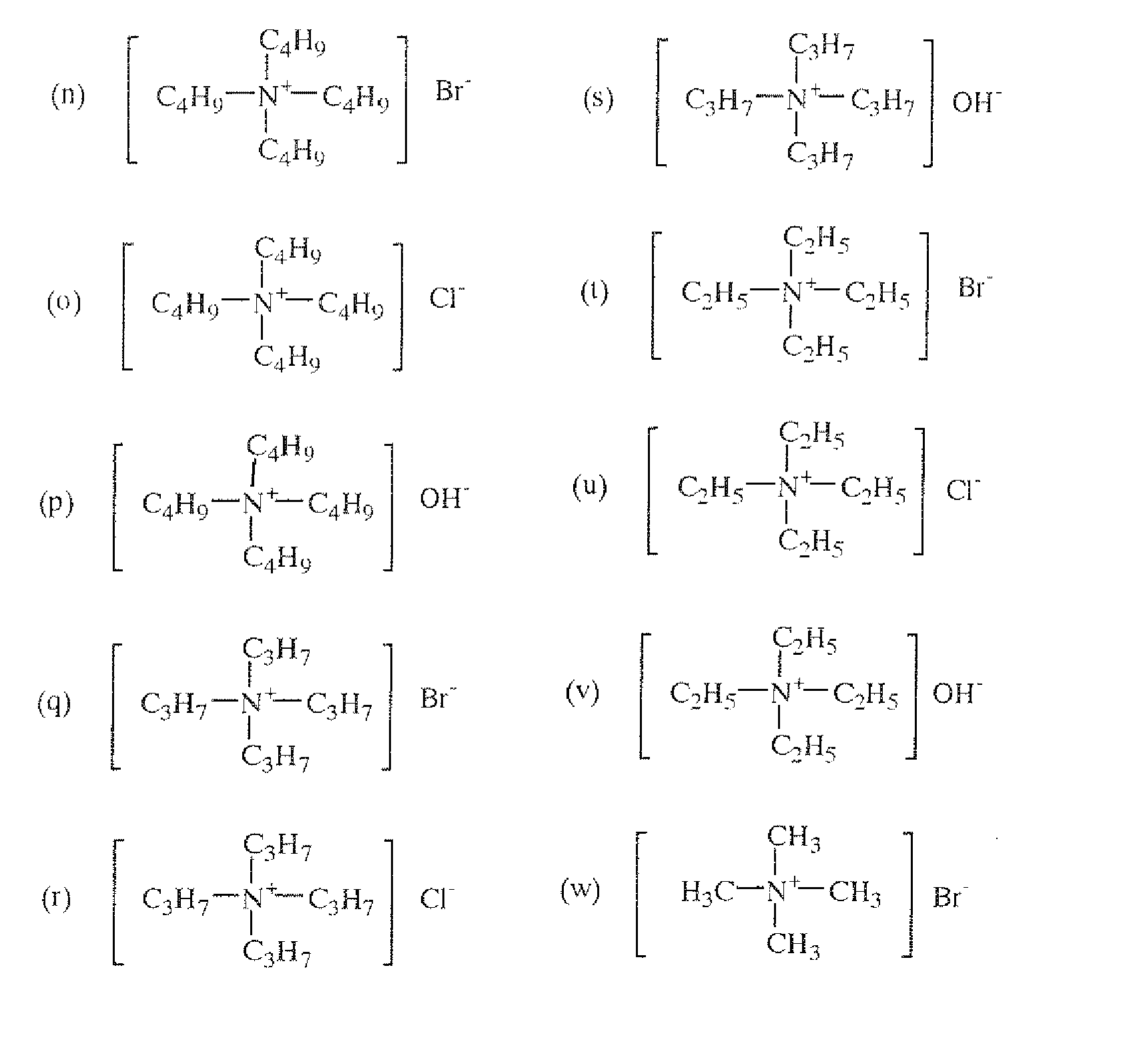


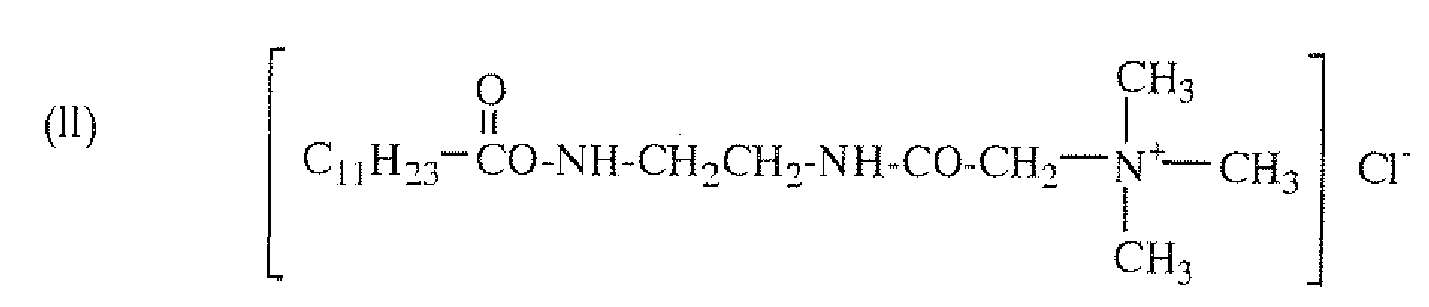


Table 1 SiO2-containing Developers (1) to (45) Developer No. Surfactant Concentration of the Surfactant (g/little) (1) (a) 0.01 (2) (a) 1.0 (3) (a) 10.0 (4) (a) 100.0 (5) (b) 1.0 (6) (c) 1.0 (7) (d) 1.0 (8) (e) 1.0 (9) (f) 1.0 (10) (g) 1.0 (11) (h) 1.0 (12) (i) 1.0 (13) (j) 1.0 (14) (k) 1.0 (15) (l) 1.0 (16) (m) 1.0 (17) (n) 1.0 (18) (o) 1.0 (19) (p) 1.0 (20) (q) 0.01 (21) (q) 1.0 (22) (q) 100.0 (23) (r) 1.0 (24) (s) 1.0 (25) (t) 1.0 (26) (u) 1.0 (27) (v) 1.0 (28) (w) 1.0 (29) (x) 1.0 (30) (y) 1.0 (31) (z) 1.0 (32) (aa) 1.0 (33) (bb) 1.0 (34) (cc) 1.0 (35) (dd) 1.0 (36) (ee) 1.0 (37) (ff) 1.0 (38) (gg) 1.0 (39) (hh) 1.0 (40) (ii) 1.0 (41) (jj) 1.0 (42) (kk) 1.0 (43) (ll) 1.0 (44) (mm) 1.0 (45) (nn) 1.0 Table 2 Nonreducing sugar-containing Developers (46) to (90) Developer No. Surfactant Concentration of the Surfactant (g/little) (46) (a) 0.01 (47) (a) 1.0 (48) (a) 10.0 (49) (a) 100.0 (50) (b) 1.0 (51) (c) 1.0 (52) (d) 1.0 (53) (e) 1.0 (54) (f) 1.0 (55) (g) 1.0 (56) (h) 1.0 (57) (i) 1.0 (58) (j) 1.0 (59) (k) 1.0 (60) (l) 1.0 (61) (m) 1.0 (62) (n) 1.0 (63) (o) 1.0 (64) (p) 1.0 (65) (q) 0.01 (66) (q) 1.0 (67) (q) 100.0 (68) (r) 1.0 (69) (s) 1.0 (70) (t) 1.0 (71) (u) 1.0 (72) (v) 1.0 (73) (w) 1.0 (74) (x) 1.0 (75) (y) 1.0 (76) (z) 1.0 (77) (aa) 1.0 (78) (bb) 1.0 (79) (cc) 1.0 (80) (dd) 1.0 (81) (ee) 1.0 (82) (ff) 1.0 (83) (gg) 1.0 (84) (hh) 1.0 (85) (ii) 1.0 (86) (jj) 1.0 (87) (kk) 1.0 (88) (ll) 1.0 (89) (mm) 1.0 (90) (nn) 1.0 - The above obtained lithographic printing plate precursor was light-exposed using a semiconductor laser with an output power of 500mW, a wave length of 830nm and a beam diameter of 17 µm(1/e2) at a horizontal scanning speed of 5m/sec, and maintained at 25°C.
- The lithographic printing plate precursor thus treated was processed by an automatic processor, PS900NP (manufactured by Fuji Photo Film Co., Ltd.) filled up with the above each developer, at a development temperature of 25°C, 28°C, 30°C or 35°C for 12 seconds. After the development procedure, the plate was washed with water and treated with a gum solution (two-fold dilution of GU-7 manufactured by Fuji Photo Film Co., Ltd.) so as to obtain a lithographic printing plate.
- Development of the non-image areas of the above lithographic printing plate obtained by processing at the given temperature was visually determined by observing undissolved, left materials on non-image areas. In addition, toning on a printed matter was also evaluated.
-
- ○: The non-image areas were sufficiently developed and there was observed no undissolved, left materials on the non-image areas. Toning on the printed matter was not observed.
- Δ: The image-forming layer was left slightly on the non-image areas. Toning on the printed matter was not observed.
- ×: Failure of development was observed, and the image-forming layer was left on the non-image areas. Toning on the printed matter was observed.
- Impairment of the image areas of the above lithographic printing plate obtained by processing at the given temperature was visually determined.
-
- ○: There was observed no impairment in the image areas. Color defect of the image areas on the printed matter was not observed.
- Δ: Image density was slightly decreased, and the impairment of the image areas was partially observed. Color defect of the image areas on the printed matter was not observed.
- ×: Image density was largely decreased, and the impairment of the image areas was partially observed. Color defect of the image areas on the printed matter was observed.
- The results of the above evaluation are summarized in Tables 3 to 6.
- The developer which had been used in the processing of 1m2, 10m2 or 100m2 plate per one litter was left in a refrigerator at 5°C, at room temperature at from 20 to 25°C, or in a thermostatic chamber at 35°C for one month, and then the insoluble matter in the developer was observed.
-
- ○: There was no insoluble matter.
- Δ: There was slightly insoluble matter, but the insoluble matter was dissolved and eliminated by shaking.
- ×: There was insoluble matter, even if the developer was shaken.
- The results obtained are summarized in Tables 7 to 10.
Table 3 Example No Developer No. Development of Non-Image Area Impairment of Image Area Development temperature Development temperature 25°C 28°C 30°C 25°C 28°C 30°C 1 (1) ○ ○ ○ ○ ○ ○ 2 (2) ○ ○ ○ ○ ○ ○ 3 (3) ○ ○ ○ ○ ○ ○ 4 (4) ○ ○ ○ ○ ○ ○ 5 (5) ○ ○ ○ ○ ○ ○ 6 (6) ○ ○ ○ ○ ○ ○ 7 (7) ○ ○ ○ ○ ○ ○ 8 (8) ○ ○ ○ ○ ○ ○ 9 (9) ○ ○ ○ ○ ○ ○ 10 (10) ○ ○ ○ ○ ○ ○ 11 (11) ○ ○ ○ ○ ○ ○ 12 (12) ○ ○ ○ ○ ○ ○ 13 (13) ○ ○ ○ ○ ○ ○ 14 (14) ○ ○ ○ ○ ○ ○ 15 (15) ○ ○ ○ ○ ○ ○ 16 (16) ○ ○ ○ ○ ○ ○ Comparative Example 1 Comparative developer (1) × Δ ○ ○ Δ × Table 4 Example No Developer No Development of Non-Image Area Impairment of Image Area Development temperature Development temperature 25°C 30°C 35°C 25°C 30°C 35°C 17 (17) ○ ○ ○ ○ ○ ○ 18 (18) ○ ○ ○ ○ ○ ○ 19 (19) ○ ○ ○ ○ ○ ○ 20 (20) ○ ○ ○ ○ ○ ○ 21 (21) ○ ○ ○ ○ ○ ○ 22 (22) ○ ○ ○ ○ ○ ○ 23 (23) ○ ○ ○ ○ ○ ○ 24 (24) ○ ○ ○ ○ ○ ○ 25 (25) ○ ○ ○ ○ ○ ○ 26 (26) ○ ○ ○ ○ ○ ○ 27 (27) ○ ○ ○ ○ ○ ○ 28 (28) ○ ○ ○ ○ ○ ○ 29 (29) ○ ○ ○ ○ ○ ○ 30 (30) ○ ○ ○ ○ ○ ○ 31 (31) ○ ○ ○ ○ ○ ○ 32 (32) ○ ○ ○ ○ ○ ○ 33 (33) ○ ○ ○ ○ ○ ○ 34 (34) ○ ○ ○ ○ ○ ○ 35 (35) ○ ○ ○ ○ ○ ○ 36 (36) ○ ○ ○ ○ ○ ○ 37 (37) ○ ○ ○ ○ ○ ○ 38 (38) ○ ○ ○ ○ ○ ○ 39 (39) ○ ○ ○ ○ ○ ○ 40 (40) ○ ○ ○ ○ ○ ○ 41 (41) ○ ○ ○ ○ ○ ○ 42 (42) ○ ○ ○ ○ ○ ○ 43 (43) ○ ○ ○ ○ ○ ○ 44 (44) ○ ○ ○ ○ ○ ○ 45 (45) ○ ○ ○ ○ ○ ○ Comparative Example 2 Comparative developer (2) × Δ ○ ○ × × Table 5 Example No. Developer No. Development of Non-Image Area Impairment of Image Area Development temperature Development temperature 25°C 28°C 30°C 25°C 28°C 30°C 46 (46) ○ ○ ○ ○ ○ ○ 47 (47) ○ ○ ○ ○ ○ ○ 48 (48) ○ ○ ○ ○ ○ ○ 49 (49) ○ ○ ○ ○ ○ ○ 50 (50) ○ ○ ○ ○ ○ ○ 51 (51) ○ ○ ○ ○ ○ ○ 52 (52) ○ ○ ○ ○ ○ ○ 53 (53) ○ ○ ○ ○ ○ ○ 54 (54) ○ ○ ○ ○ ○ ○ 55 (55) ○ ○ ○ ○ ○ ○ 56 (56) ○ ○ ○ ○ ○ ○ 57 (57) ○ ○ ○ ○ ○ ○ 58 (58) ○ ○ ○ ○ ○ ○ 59 (59) ○ ○ ○ ○ ○ ○ 60 (60) ○ ○ ○ ○ ○ ○ 61 (61) ○ ○ ○ ○ ○ ○ Comparative Example 3 Comparative developer (3) × Δ ○ ○ Δ × Table 6 Example No Developer No Development of Non-Image Area Impairment of Image Area Development temperature Development temperature 25°C 30°C 35°C 25°C 30°C 35°C 62 (62) ○ ○ ○ ○ ○ ○ 63 (63) ○ ○ ○ ○ ○ ○ 64 (64) ○ ○ ○ ○ ○ ○ 65 (65) ○ ○ ○ ○ ○ ○ 66 (66) ○ ○ ○ ○ ○ ○ 67 (67) ○ ○ ○ ○ ○ ○ 68 (68) ○ ○ ○ ○ ○ ○ 69 (69) ○ ○ ○ ○ ○ ○ 70 (70) ○ ○ ○ ○ ○ ○ 71 (71) ○ ○ ○ ○ ○ ○ 72 (72) ○ ○ ○ ○ ○ ○ 73 (73) ○ ○ ○ ○ ○ ○ 74 (74) ○ ○ ○ ○ ○ ○ 75 (75) ○ ○ ○ ○ ○ ○ 76 (76) ○ ○ ○ ○ ○ ○ 77 (77) ○ ○ ○ ○ ○ ○ 78 (78) ○ ○ ○ ○ ○ ○ 79 (79) ○ ○ ○ ○ ○ ○ 80 (80) ○ ○ ○ ○ ○ ○ 81 (81) ○ ○ ○ ○ ○ ○ 82 (82) ○ ○ ○ ○ ○ ○ 83 (83) ○ ○ ○ ○ ○ ○ 84 (84) ○ ○ ○ ○ ○ ○ 85 (85) ○ ○ ○ ○ ○ ○ 86 (86) ○ ○ ○ ○ ○ ○ 87 (87) ○ ○ ○ ○ ○ ○ 88 (88) ○ ○ ○ ○ ○ ○ 89 (89) ○ ○ ○ ○ ○ ○ 90 (90) ○ ○ ○ ○ ○ ○ Camparative Example 4 Comparative developer (4) × Δ ○ ○ × × Table 7 Insoluble Matter in Developer Example No Developer No. Throughput (plate m2/litter) 1 10 100 1 10 100 1 10 100 Storage Temperature 5°C 20∼25°C 35°C 1 (1) ○ ○ ○ ○ ○ ○ ○ ○ ○ 2 (2) ○ ○ ○ ○ ○ ○ ○ ○ ○ 3 (3) ○ ○ ○ ○ ○ ○ ○ ○ ○ 4 (4) ○ ○ ○ ○ ○ ○ ○ ○ ○ 5 (5) ○ ○ ○ ○ ○ ○ ○ ○ ○ 6 (6) ○ ○ ○ ○ ○ ○ ○ ○ ○ 7 (7) ○ ○ ○ ○ ○ ○ ○ ○ ○ 8 (8) ○ ○ ○ ○ ○ ○ ○ ○ ○ 9 (9) ○ ○ ○ ○ ○ ○ ○ ○ ○ 10 (10) ○ ○ ○ ○ ○ ○ ○ ○ ○ 11 (11) ○ ○ ○ ○ ○ ○ ○ ○ ○ 12 (12) ○ ○ ○ ○ ○ ○ ○ ○ ○ 13 (13) ○ ○ ○ ○ ○ ○ ○ ○ ○ 14 (14) ○ ○ ○ ○ ○ ○ ○ ○ ○ 15 (15) ○ ○ ○ ○ ○ ○ ○ ○ ○ 16 (16) ○ ○ ○ ○ ○ ○ ○ ○ ○ Comparative Example 1 Comparative developer (1) × × × Δ × × ○ Δ × Table 8 Insoluble Matter in Developer Example No Developer No Throughput (plate m2/litter) 1 10 100 1 10 100 1 10 100 Storage Temperature 5°C 20∼25°C 35°C 17 (17) ○ ○ ○ ○ ○ ○ ○ ○ ○ 18 (18) ○ ○ ○ ○ ○ ○ ○ ○ ○ 19 (19) ○ ○ ○ ○ ○ ○ ○ ○ ○ 20 (20) ○ ○ ○ ○ ○ ○ ○ ○ ○ 21 (21) ○ ○ ○ ○ ○ ○ ○ ○ ○ 22 (22) ○ ○ ○ ○ ○ ○ ○ ○ ○ 23 (23) ○ ○ ○ ○ ○ ○ ○ ○ ○ 24 (24) ○ ○ ○ ○ ○ ○ ○ ○ ○ 25 (25) ○ ○ ○ ○ ○ ○ ○ ○ ○ 26 (26) ○ ○ ○ ○ ○ ○ ○ ○ ○ 27 (27) ○ ○ ○ ○ ○ ○ ○ ○ ○ 28 (28) ○ ○ ○ ○ ○ ○ ○ ○ ○ 29 (29) ○ ○ ○ ○ ○ ○ ○ ○ ○ 30 (30) ○ ○ ○ ○ ○ ○ ○ ○ ○ 31 (31) ○ ○ ○ ○ ○ ○ ○ ○ ○ 32 (32) ○ ○ ○ ○ ○ ○ ○ ○ ○ 33 (33) ○ ○ ○ ○ ○ ○ ○ ○ ○ 34 (34) ○ ○ ○ ○ ○ ○ ○ ○ ○ 35 (35) ○ ○ ○ ○ ○ ○ ○ ○ ○ 36 (36) ○ ○ ○ ○ ○ ○ ○ ○ ○ 37 (37) ○ ○ ○ ○ ○ ○ ○ ○ ○ 38 (38) ○ ○ ○ ○ ○ ○ ○ ○ ○ 39 (39) ○ ○ ○ ○ ○ ○ ○ ○ ○ 40 (40) ○ ○ ○ ○ ○ ○ ○ ○ ○ 41 (41) ○ ○ ○ ○ ○ ○ ○ ○ ○ 42 (42) ○ ○ ○ ○ ○ ○ ○ ○ ○ 43 (43) ○ ○ ○ ○ ○ ○ ○ ○ ○ 44 (44) ○ ○ ○ ○ ○ ○ ○ ○ ○ 45 (45) ○ ○ ○ ○ ○ ○ ○ ○ ○ Comparative Example 2 Comparative developer (2) × × × Δ × × ○ Δ × Table 9 Insoluble Matter in Developer Example No Developer No Throughput (plate m2/litter) 1 10 100 1 10 100 1 10 100 Storage Temperature 5°C 20∼25°C 35°C 46 (46) ○ ○ ○ ○ ○ ○ ○ ○ ○ 47 (47) ○ ○ ○ ○ ○ ○ ○ ○ ○ 48 (48) ○ ○ ○ ○ ○ ○ ○ ○ ○ 49 (49) ○ ○ ○ ○ ○ ○ ○ ○ ○ 50 (50) ○ ○ ○ ○ ○ ○ ○ ○ ○ 51 (51) ○ ○ ○ ○ ○ ○ ○ ○ ○ 52 (52) ○ ○ ○ ○ ○ ○ ○ ○ ○ 53 (53) ○ ○ ○ ○ ○ ○ ○ ○ ○ 54 (54) ○ ○ ○ ○ ○ ○ ○ ○ ○ 55 (55) ○ ○ ○ ○ ○ ○ ○ ○ ○ 56 (56) ○ ○ ○ ○ ○ ○ ○ ○ ○ 57 (57) ○ ○ ○ ○ ○ ○ ○ ○ ○ 58 (58) ○ ○ ○ ○ ○ ○ ○ ○ ○ 59 (59) ○ ○ ○ ○ ○ ○ ○ ○ ○ 60 (60) ○ ○ ○ ○ ○ ○ ○ ○ ○ 61 (61) ○ ○ ○ ○ ○ ○ ○ ○ ○ Comparative Example 3 Comparative developer (3) × × × Δ × × ○ Δ × Table 10 Insoluble Matter in Developer Example No Developer No Throughput (plate m2/litter) 1 10 100 1 10 100 1 10 100 Storage Temperature 5°C 20∼25° C 35°C 62 (62) ○ ○ ○ ○ ○ ○ ○ ○ ○ 63 (63) ○ ○ ○ ○ ○ ○ ○ ○ ○ 64 (64) ○ ○ ○ ○ ○ ○ ○ ○ ○ 65 (65) ○ ○ ○ ○ ○ ○ ○ ○ ○ 66 (66) ○ ○ ○ ○ ○ ○ ○ ○ ○ 67 (67) ○ ○ ○ ○ ○ ○ ○ ○ ○ 68 (68) ○ ○ ○ ○ ○ ○ ○ ○ ○ 69 (69) ○ ○ ○ ○ ○ ○ ○ ○ ○ 70 (70) ○ ○ ○ ○ ○ ○ ○ ○ ○ 71 (71) ○ ○ ○ ○ ○ ○ ○ ○ ○ 72 (72) ○ ○ ○ ○ ○ ○ ○ ○ ○ 73 (73) ○ ○ ○ ○ ○ ○ ○ ○ ○ 74 (74) ○ ○ ○ ○ ○ ○ ○ ○ ○ 75 (75) ○ ○ ○ ○ ○ ○ ○ ○ ○ 76 (76) ○ ○ ○ ○ ○ ○ ○ ○ ○ 77 (77) ○ ○ ○ ○ ○ ○ ○ ○ ○ 78 (78) ○ ○ ○ ○ ○ ○ ○ ○ ○ 79 (79) ○ ○ ○ ○ ○ ○ ○ ○ ○ 80 (80) ○ ○ ○ ○ ○ ○ ○ ○ ○ 81 (81) ○ ○ ○ ○ ○ ○ ○ ○ ○ 82 (82) ○ ○ ○ ○ ○ ○ ○ ○ ○ 83 (83) ○ ○ ○ ○ ○ ○ ○ ○ ○ 84 (84) ○ ○ ○ ○ ○ ○ ○ ○ ○ 85 (85) ○ ○ ○ ○ ○ ○ ○ ○ ○ 86 (86) ○ ○ ○ ○ ○ ○ ○ ○ ○ 87 (87) ○ ○ ○ ○ ○ ○ ○ ○ ○ 88 (88) ○ ○ ○ ○ ○ ○ ○ ○ ○ 89 (89) ○ ○ ○ ○ ○ ○ ○ ○ ○ 90 (90) ○ ○ ○ ○ ○ ○ ○ ○ ○ Comparative Example 4 Comparative developer (4) × × × Δ × × ○ Δ × - The alkaline liquid developer of the present invention makes it possible to form a highly sharp and clear image in a lithographic printing plate without damages to the image areas, simultaneously exhibiting highly development performance to the non-image areas. The alkaline liquid developer of the present invention further inhibits occurrence of insoluble matter originated from a binder resin and/or an IR-absorbing agent, as well as adherence of the insoluble matter to the surface of a plate during processing, while retaining liquid conditions suitable for an alkaline liquid developer, and being capable of providing a stable processing procedure in an extended period.
-
- 1. An alkaline liquid developer suitable for development of an infrared radiation-presensitized plate for use in making a lithographic printing plate, which developer comprises at least one selected from the group consisting of amphoteric surfactant and cationic surfactant.
- 2. The alkaline liquid developer of item 1 wherein the amphoteric surfactant is selected from the group consisting of the compounds represented by the following formula (I) or (II), and a salt thereof.
R1-NH-(CH2)mCOOH (I)

- 3. The alkaline liquid developer of item 1 wherein the cationic surfactant is selected from the group consisting of amine salts, quaternary ammonium salts, phosphonium salts and sulfonium salts.
- 4. A method for preparing a lithographic printing plate comprising the steps of imagewise light-exposing to infrared radiation, a presensitized plate for use in making a lithographic printing plate, said presensitized plate having an image-forming layer which comprises an IR-absorbing agent, and developing the light-exposed plate with an alkaline liquid developer comprising at least one selected from the group consisting of amphoteric surfactant and cationic surfactant.
Claims (3)
- Amethod for preparing a lithographic printing plate comprising the steps of imagewise light-exposing to infrared radiation, a presensitized plate for use in making a lithographic printing plate, said presensitized plate having an image-forming layer which comprises an IR-absorbing agent, and developing the light-exposed plate with an alkaline liquid developer comprising at least one selected from cationic surfactants.
- The method of claim 1 wherein the cationic surfactant is selected from quaternary ammonium salts.
- The method of claim 2 wherein quaternary ammonium salts are represented by the following formula:

Applications Claiming Priority (3)
| Application Number | Priority Date | Filing Date | Title |
|---|---|---|---|
| JP2000255670A JP2002072501A (en) | 2000-08-25 | 2000-08-25 | Alkali developer liquid for lithographic printing plate, and method for making lithographic printing plate |
| JP2000297954A JP2002107954A (en) | 2000-09-29 | 2000-09-29 | Alkali developer for lithographic printing plate and method for plate making of lithographic printing plate |
| EP01119713.4A EP1182512B1 (en) | 2000-08-25 | 2001-08-24 | Method for preparing lithographic printing plate using alkaline liquid developer |
Related Parent Applications (2)
| Application Number | Title | Priority Date | Filing Date |
|---|---|---|---|
| EP01119713.4A Division EP1182512B1 (en) | 2000-08-25 | 2001-08-24 | Method for preparing lithographic printing plate using alkaline liquid developer |
| EP01119713.4 Division | 2001-08-24 |
Publications (3)
| Publication Number | Publication Date |
|---|---|
| EP2381312A2 true EP2381312A2 (en) | 2011-10-26 |
| EP2381312A3 EP2381312A3 (en) | 2012-02-29 |
| EP2381312B1 EP2381312B1 (en) | 2014-07-30 |
Family
ID=26598479
Family Applications (2)
| Application Number | Title | Priority Date | Filing Date |
|---|---|---|---|
| EP11174317.5A Expired - Lifetime EP2381312B1 (en) | 2000-08-25 | 2001-08-24 | Method for preparing lithographic printing plate applying an alkaline liquid developer |
| EP01119713.4A Expired - Lifetime EP1182512B1 (en) | 2000-08-25 | 2001-08-24 | Method for preparing lithographic printing plate using alkaline liquid developer |
Family Applications After (1)
| Application Number | Title | Priority Date | Filing Date |
|---|---|---|---|
| EP01119713.4A Expired - Lifetime EP1182512B1 (en) | 2000-08-25 | 2001-08-24 | Method for preparing lithographic printing plate using alkaline liquid developer |
Country Status (2)
| Country | Link |
|---|---|
| US (1) | US6511790B2 (en) |
| EP (2) | EP2381312B1 (en) |
Cited By (2)
| Publication number | Priority date | Publication date | Assignee | Title |
|---|---|---|---|---|
| CN112140692A (en) * | 2019-06-26 | 2020-12-29 | 诺翔新材料(无锡)有限公司 | Computer-to-plate washing fluid and preparation method thereof |
| EP3779599A4 (en) * | 2018-03-28 | 2021-05-05 | FUJIFILM Corporation | AQUEOUS DEVELOPMENT SOLUTION FOR FLEXOGRAPHIC PRINTING PLATE, AND FLEXOGRAPHIC PRINTING PLATE MANUFACTURING PROCESS |
Families Citing this family (22)
| Publication number | Priority date | Publication date | Assignee | Title |
|---|---|---|---|---|
| JP2003021901A (en) * | 2001-07-05 | 2003-01-24 | Fuji Photo Film Co Ltd | Method for photopolymerizing photosensitive lithographic printing plate |
| JP2003107684A (en) * | 2001-09-28 | 2003-04-09 | Fuji Photo Film Co Ltd | Method for developing photosensitive planographic printing plate |
| JP2003315987A (en) * | 2002-02-21 | 2003-11-06 | Fuji Photo Film Co Ltd | Method for making lithographic printing plate |
| EP1376241A1 (en) * | 2002-06-24 | 2004-01-02 | Fuji Photo Film Co., Ltd. | Method for preparing lithographic printing plate |
| US7018777B2 (en) * | 2002-09-11 | 2006-03-28 | Fuji Photo Film Co., Ltd. | Method of making lithographic printing plate |
| US7081330B2 (en) | 2002-09-20 | 2006-07-25 | Fuji Photo Film Co., Ltd. | Method of making lithographic printing plate |
| US20040192876A1 (en) * | 2002-11-18 | 2004-09-30 | Nigel Hacker | Novolac polymer planarization films with high temparature stability |
| DE10310168B4 (en) * | 2003-03-08 | 2007-07-19 | Huber Gmbh | Aqueous developer solution for offset printing plates |
| JP2004271985A (en) * | 2003-03-10 | 2004-09-30 | Fuji Photo Film Co Ltd | Developing solution for photosensitive lithographic printing plate and platemaking method for lithographic printing plate |
| JP4040539B2 (en) * | 2003-06-13 | 2008-01-30 | 東京応化工業株式会社 | Developer composition for resist and method for forming resist pattern |
| JP4040544B2 (en) * | 2003-06-27 | 2008-01-30 | 東京応化工業株式会社 | Developer composition for resist and method for forming resist pattern |
| US20070059650A1 (en) * | 2003-07-14 | 2007-03-15 | Tatsusro Nagahara | Developing solution for photosensitive composition and method for forming patterned resist film |
| EP1649322A4 (en) | 2003-07-17 | 2007-09-19 | Honeywell Int Inc | PLANARIZATION FILMS FOR ADVANCED MICROELECTRONIC DEVICES AND APPLICATIONS AND METHODS FOR PRODUCING SAID FILMS |
| DE102004058584A1 (en) * | 2004-12-03 | 2006-06-08 | Basf Ag | Radiation-curable coating compositions |
| US7923424B2 (en) * | 2005-02-14 | 2011-04-12 | Advanced Process Technologies, Llc | Semiconductor cleaning using superacids |
| US20060183654A1 (en) * | 2005-02-14 | 2006-08-17 | Small Robert J | Semiconductor cleaning using ionic liquids |
| WO2006106061A1 (en) * | 2005-04-07 | 2006-10-12 | Alstom Technology Ltd | Method for repairing or renewing cooling holes of a coated component of a gas turbine |
| JP2006301404A (en) * | 2005-04-22 | 2006-11-02 | Tokyo Ohka Kogyo Co Ltd | Developer composition, method for producing the same, and method for forming resist pattern |
| WO2007107494A1 (en) | 2006-03-17 | 2007-09-27 | Agfa Graphics Nv | Method for making a lithographic printing plate |
| EP1834803B1 (en) | 2006-03-17 | 2011-07-27 | Agfa Graphics N.V. | Method for making a lithographic printing plate |
| US7326521B1 (en) | 2006-08-31 | 2008-02-05 | Eastman Kodak Company | Method of imaging and developing negative-working elements |
| CN103467346B (en) * | 2013-09-23 | 2015-02-25 | 富士胶片精细化学(无锡)有限公司 | A kind of method for preparing N-[4-(sulfonamide) phenyl] methacrylamide |
Citations (119)
| Publication number | Priority date | Publication date | Assignee | Title |
|---|---|---|---|---|
| US339049A (en) | 1886-03-30 | Sole-edge-burnishing | ||
| US399049A (en) | 1889-03-05 | Folding chair | ||
| US410201A (en) | 1889-09-03 | Bent for suspension-bridges | ||
| GB434875A (en) | 1933-02-08 | 1935-09-05 | Bela Gasper | An improved method of producing multi-colour photographic images on coloured and differently sensitized multi-layer photographic material |
| DE854890C (en) | 1949-07-23 | 1952-12-18 | Kalle & Co Ag | Process for the production of copies, especially printing forms, with the aid of diazo compounds |
| US2632703A (en) | 1948-12-30 | 1953-03-24 | Gen Aniline & Film Corp | Light sensitive diazotype materials containing tetrazo diphenyl compounds |
| US2714066A (en) | 1950-12-06 | 1955-07-26 | Minnesota Mining & Mfg | Planographic printing plate |
| US2797213A (en) | 1954-08-20 | 1957-06-25 | Gen Aniline & Film Corp | Rosin derivatives of diazonaphthol-and diazophenol-sulfonamides |
| US2833827A (en) | 1955-01-17 | 1958-05-06 | Bayer Ag | Tri (3, 5-di lower alkyl-4-hydroxy phenyl)-sulfonium chlorides and method of preparing same |
| US3046120A (en) | 1950-10-31 | 1962-07-24 | Azoplate Corp | Light-sensitive layers for photomechanical reproduction |
| US3188210A (en) | 1959-01-21 | 1965-06-08 | Azoplate Corp | Naphthoquinone (1, 2)-diazide-sulfonic acid derivatives and process of producing printing plates therefrom |
| US3454400A (en) | 1964-08-05 | 1969-07-08 | Algraphy Ltd | Light-sensitive naphthoquinone diazide ester compounds and printing plates made therefrom |
| US3544323A (en) | 1966-12-12 | 1970-12-01 | Sumner Williams Inc | Diazo compound for lithographic plates |
| US3573917A (en) | 1968-07-12 | 1971-04-06 | Takashi Okamoto | Light-sensitive printing plate composition |
| GB1227602A (en) | 1967-11-24 | 1971-04-07 | ||
| GB1251345A (en) | 1967-11-21 | 1971-10-27 | ||
| GB1267005A (en) | 1969-06-16 | 1972-03-15 | ||
| US3658662A (en) | 1969-01-21 | 1972-04-25 | Durolith Corp | Corrosion resistant metallic plates particularly useful as support members for photo-lithographic plates and the like |
| US3674495A (en) | 1969-05-30 | 1972-07-04 | Okamoto Chem Ind Co Ltd | Sensitizing layer |
| GB1329888A (en) | 1970-09-16 | 1973-09-12 | Konishiroku Photo Ind | Phenolic resin compositions containing it |
| GB1330932A (en) | 1970-09-16 | 1973-09-19 | Konishiroku Photo Ind | Phenolic resin condensation product and light-sensitive compositions containing it |
| US3785825A (en) | 1971-07-19 | 1974-01-15 | Polychrome Corp | Light-sensitive quinone diazide compounds,compositions,and presensitized lithographic plate |
| US3834998A (en) | 1971-10-21 | 1974-09-10 | Fuji Photo Film Co Ltd | Method of producing aluminum planographic printing plates |
| US3867147A (en) | 1969-05-20 | 1975-02-18 | Hoechst Co American | Light-sensitive diazo compounds and reproduction material employing the same |
| US3881924A (en) | 1971-08-25 | 1975-05-06 | Matsushita Electric Industrial Co Ltd | Organic photoconductive layer sensitized with trimethine compound |
| US3902114A (en) | 1967-10-20 | 1975-08-26 | Gunther Alich | Method of and apparatus for measuring the distance between cooperating rollers of a rolling mill |
| US4069055A (en) | 1974-05-02 | 1978-01-17 | General Electric Company | Photocurable epoxy compositions containing group Va onium salts |
| US4069056A (en) | 1974-05-02 | 1978-01-17 | General Electric Company | Photopolymerizable composition containing group Va aromatic onium salts |
| JPS5336223A (en) | 1976-09-13 | 1978-04-04 | Hoechst Ag | Photosensitive composition |
| US4087341A (en) | 1975-11-06 | 1978-05-02 | Nippon Light Metal Research Laboratory Ltd. | Process for electrograining aluminum substrates for lithographic printing |
| US4115128A (en) | 1975-12-26 | 1978-09-19 | Fuji Photo Film Co., Ltd. | Positive image forming radiation sensitive compositions containing diazide compound and organic cyclic anhydride |
| US4123279A (en) | 1974-03-25 | 1978-10-31 | Fuji Photo Film Co., Ltd. | Light-sensitive o-quinonediazide containing planographic printing plate |
| DE2904626A1 (en) | 1978-02-08 | 1979-08-09 | Minnesota Mining & Mfg | TRIARYLSULFONIUM COMPLEX SALTS, METHOD FOR THE PRODUCTION THEREOF AND PHOTOPOLYMERIZABLE MIXTURES CONTAINING THESE SALTS |
| JPS5595946A (en) | 1979-01-16 | 1980-07-21 | Mitsubishi Chem Ind Ltd | Developer for o-quinone diazide type photosensitive material |
| US4283475A (en) | 1979-08-21 | 1981-08-11 | Fuji Photo Film Co., Ltd. | Pentamethine thiopyrylium salts, process for production thereof, and photoconductive compositions containing said salts |
| JPS56142528A (en) | 1980-04-08 | 1981-11-06 | Mitsubishi Chem Ind Ltd | Developing solution for o-quinone diazide photosensitive material |
| US4327169A (en) | 1981-01-19 | 1982-04-27 | Eastman Kodak Company | Infrared sensitive photoconductive composition, elements and imaging method using trimethine thiopyrylium dye |
| JPS57192951A (en) | 1981-05-25 | 1982-11-27 | Konishiroku Photo Ind Co Ltd | Composition of developing solution |
| US4374920A (en) | 1981-07-27 | 1983-02-22 | American Hoechst Corporation | Positive developer containing non-ionic surfactants |
| JPS5859444A (en) | 1981-08-06 | 1983-04-08 | ヘキスト・セラニ−ズ・コ−ポレイシヨン | Water alkaline developer for photosensitive copying layer with exposed positive action |
| JPS5875152A (en) | 1981-10-06 | 1983-05-06 | ポリクロム・コ−ポレイシヨン | Improved developer for positive lithograph photolithograph product |
| JPS58112793A (en) | 1981-12-28 | 1983-07-05 | Ricoh Co Ltd | Optical information recording member |
| JPS58112792A (en) | 1981-12-28 | 1983-07-05 | Ricoh Co Ltd | Optical information recording medium |
| JPS58125246A (en) | 1982-01-22 | 1983-07-26 | Ricoh Co Ltd | Laser recording medium |
| JPS58173696A (en) | 1982-04-06 | 1983-10-12 | Canon Inc | Optical recording medium |
| JPS58181051A (en) | 1982-04-19 | 1983-10-22 | Canon Inc | Organic photoconductor |
| JPS58181690A (en) | 1982-04-19 | 1983-10-24 | Canon Inc | Optical recording medium |
| JPS58190952A (en) | 1982-04-30 | 1983-11-08 | Fuji Photo Film Co Ltd | Developing solution of photosensitive printing plate |
| JPS58194595A (en) | 1982-05-10 | 1983-11-12 | Canon Inc | optical recording medium |
| JPS58220143A (en) | 1982-06-16 | 1983-12-21 | Canon Inc | Organic film |
| JPS58224793A (en) | 1982-06-25 | 1983-12-27 | Nec Corp | Optical recording medium |
| EP0101010A1 (en) | 1982-08-13 | 1984-02-22 | Hoechst Aktiengesellschaft | Aqueous-alkaline solution and process for developping positively acting layers |
| JPS5941363A (en) | 1982-08-31 | 1984-03-07 | Canon Inc | Pyrylium dye, thiopyrylium dye and its preparation |
| JPS5948187A (en) | 1982-09-10 | 1984-03-19 | Nec Corp | Photo recording medium |
| EP0104143A1 (en) | 1982-09-18 | 1984-03-28 | Ciba-Geigy Ag | Photopolymerizable compositions containing diaryliodosyl salts |
| JPS5973996A (en) | 1982-10-22 | 1984-04-26 | Nec Corp | Optical recording medium |
| JPS5975255A (en) | 1982-10-22 | 1984-04-27 | Fuji Photo Film Co Ltd | Developing solution used for positive type photosensitive lithographic plate |
| JPS5984248A (en) | 1982-11-05 | 1984-05-15 | Canon Inc | organic film |
| JPS5984249A (en) | 1982-11-05 | 1984-05-15 | Canon Inc | organic film |
| JPS5984241A (en) | 1982-11-05 | 1984-05-15 | Fuji Photo Film Co Ltd | Developer for photosensitive lithographic printing plate |
| JPS5984356A (en) | 1982-11-05 | 1984-05-16 | Ricoh Co Ltd | How to create an optical disc master |
| JPS59121044A (en) | 1982-12-27 | 1984-07-12 | Fuji Photo Film Co Ltd | Photosolubilizable composition |
| JPS59121336A (en) | 1982-12-28 | 1984-07-13 | Fuji Photo Film Co Ltd | Developing solution for photosensitive lithographic printing plate |
| JPS59146061A (en) | 1983-02-09 | 1984-08-21 | Canon Inc | Organic film |
| JPS59146063A (en) | 1983-02-09 | 1984-08-21 | Canon Inc | Organic film |
| JPS59202829A (en) | 1983-05-04 | 1984-11-16 | Sanpo Gokin Kogyo Kk | Mold for injection molding synthetic resin product |
| JPS59216146A (en) | 1983-05-24 | 1984-12-06 | Sony Corp | Electrophotographic sensitive material |
| JPS61143748A (en) | 1984-12-17 | 1986-07-01 | Fuji Photo Film Co Ltd | Photosensitive composition |
| JPS61151644A (en) | 1984-12-26 | 1986-07-10 | Fuji Photo Film Co Ltd | Photosensitive composition |
| JPS62170950A (en) | 1986-01-23 | 1987-07-28 | Fuji Photo Film Co Ltd | Photosensitive composition |
| DE3604581A1 (en) | 1986-02-14 | 1987-08-20 | Basf Ag | 4-Acylbenzylsulphonium salts, their preparation, and photocurable mixtures and recording materials containing these compounds |
| DE3604580A1 (en) | 1986-02-14 | 1987-08-20 | Basf Ag | CURABLE MIXTURES CONTAINING N-SULFONYLAMINOSULFONIUM SALTS AS CATIONICALLY EFFECTIVE CATALYSTS |
| JPS62251740A (en) | 1986-04-24 | 1987-11-02 | Fuji Photo Film Co Ltd | Positive type photosensitive composition |
| US4708925A (en) | 1984-12-11 | 1987-11-24 | Minnesota Mining And Manufacturing Company | Photosolubilizable compositions containing novolac phenolic resin |
| JPS62293247A (en) | 1986-06-12 | 1987-12-19 | Fuji Photo Film Co Ltd | Photosensitive printing plate |
| US4756993A (en) | 1986-01-27 | 1988-07-12 | Fuji Photo Film Co., Ltd. | Electrophotographic photoreceptor with light scattering layer or light absorbing layer on support backside |
| US4760013A (en) | 1987-02-17 | 1988-07-26 | International Business Machines Corporation | Sulfonium salt photoinitiators |
| EP0297443A2 (en) | 1987-07-01 | 1989-01-04 | BASF Aktiengesellschaft | Light sensitive mixture for light sensitive coating materials |
| EP0297442A1 (en) | 1987-07-01 | 1989-01-04 | BASF Aktiengesellschaft | Sulfonium salts comprising groups which are labile in acid environment |
| JPH01102456A (en) | 1987-10-15 | 1989-04-20 | Konica Corp | photosensitive composition |
| JPH01102457A (en) | 1987-10-15 | 1989-04-20 | Konica Corp | photosensitive composition |
| JPH0296755A (en) | 1988-10-03 | 1990-04-09 | Konica Corp | photosensitive composition |
| JPH02100055A (en) | 1988-10-07 | 1990-04-12 | Fuji Photo Film Co Ltd | Positive type photosensitive composition |
| JPH02100054A (en) | 1988-10-07 | 1990-04-12 | Fuji Photo Film Co Ltd | Positive type photosensitive composition |
| EP0370693A2 (en) | 1988-11-21 | 1990-05-30 | Eastman Kodak Company | Novel onium salts and the use thereof as photoinitiators |
| JPH02150848A (en) | 1988-12-02 | 1990-06-11 | Hitachi Ltd | Photobleachable radiation-sensitive composition and pattern formation method using the same |
| US4933377A (en) | 1988-02-29 | 1990-06-12 | Saeva Franklin D | Novel sulfonium salts and the use thereof as photoinitiators |
| JPH02296514A (en) | 1989-05-12 | 1990-12-07 | Matsushita Electric Ind Co Ltd | Vehicle suspension control device |
| JPH03140140A (en) | 1989-10-27 | 1991-06-14 | Hitachi Ltd | Area extracting method |
| JPH03208514A (en) | 1990-01-04 | 1991-09-11 | Nippon Steel Corp | Method for cutting pained steel plate |
| JPH0413149A (en) | 1990-05-02 | 1992-01-17 | Fuji Photo Film Co Ltd | Photosensitive composition |
| JPH0475303A (en) | 1990-07-17 | 1992-03-10 | Mosutetsuku:Kk | Vertically-wound coil and coil manufacturing method |
| US5135838A (en) | 1988-02-25 | 1992-08-04 | At&T Bell Laboratories | Resist materials |
| JPH0459610B2 (en) | 1986-12-10 | 1992-09-22 | Mitsubishi Cable Ind Ltd | |
| US5156938A (en) | 1989-03-30 | 1992-10-20 | Graphics Technology International, Inc. | Ablation-transfer imaging/recording |
| JPH04328403A (en) | 1991-04-26 | 1992-11-17 | Furukawa Electric Co Ltd:The | Apparatus for measuring long material |
| JPH0475125B2 (en) | 1984-10-09 | 1992-11-30 | ||
| JPH0536209A (en) | 1991-07-30 | 1993-02-12 | Matsushita Electric Ind Co Ltd | Sync pattern detection circuit |
| JPH0538128A (en) | 1991-07-29 | 1993-02-12 | Isuzu Motors Ltd | Eddy-current speed reducer |
| JPH0513514B2 (en) | 1985-09-10 | 1993-02-22 | Fuji Photo Film Co Ltd | |
| JPH0551324A (en) | 1991-08-21 | 1993-03-02 | Res Dev Corp Of Japan | Immune system active substance and method for producing the same |
| JPH0519702B2 (en) | 1985-09-05 | 1993-03-17 | Fuji Photo Film Co Ltd | |
| US5200544A (en) | 1988-02-25 | 1993-04-06 | At&T Bell Laboratories | Resist materials |
| JPH05158230A (en) | 1991-12-10 | 1993-06-25 | Fuji Photo Film Co Ltd | Positive type photosensitive composition |
| JPH05230503A (en) | 1992-02-21 | 1993-09-07 | Kawasaki Steel Corp | Method for manufacturing raw material for metal powder injection molding |
| JPH063626A (en) | 1992-06-19 | 1994-01-14 | Canon Inc | Variable power optical system having vibration-control function |
| JPH0652940A (en) | 1992-07-30 | 1994-02-25 | Amp Japan Ltd | Card edge connector |
| JPH0663744A (en) | 1992-08-17 | 1994-03-08 | Matsushita Electric Ind Co Ltd | DC TIG welding machine |
| JPH0678787A (en) | 1992-12-07 | 1994-03-22 | Aichi Pref Gov | Monoclonal antibody against human mucinous ovarian tumor and method for detecting human ovarian tumor using the antibody |
| JPH0688942A (en) | 1992-09-08 | 1994-03-29 | Asahi Optical Co Ltd | Zoom lens and focusing system |
| US5380635A (en) | 1994-02-28 | 1995-01-10 | Minnesota Mining And Manufacturing Company | Dihydroperimidine squarylium dyes as antihalation and acutance materials for photographic and photothermographic articles |
| JPH0720629A (en) | 1993-05-19 | 1995-01-24 | Eastman Kodak Co | Lithographic printing plate |
| JPH07271029A (en) | 1994-03-14 | 1995-10-20 | Eastman Kodak Co | Radiation sensitive composition and lithography printing board including composition thereof |
| JPH07285275A (en) | 1994-04-18 | 1995-10-31 | Fuji Photo Film Co Ltd | Image recording material |
| JPH089444A (en) | 1994-06-23 | 1996-01-12 | Nec Corp | Call control system for mobile object communication |
| JPH11254850A (en) | 1998-03-05 | 1999-09-21 | Fuji Photo Film Co Ltd | Negative type picture recording material |
| JP2000267265A (en) | 1999-03-12 | 2000-09-29 | Fuji Photo Film Co Ltd | Image forming material |
| JP4111222B2 (en) | 2003-07-22 | 2008-07-02 | 株式会社村田製作所 | Surface mount parts |
| JP4917481B2 (en) | 2007-06-13 | 2012-04-18 | 太陽誘電株式会社 | filter |
Family Cites Families (7)
| Publication number | Priority date | Publication date | Assignee | Title |
|---|---|---|---|---|
| US3891439A (en) | 1972-11-02 | 1975-06-24 | Polychrome Corp | Aqueous developing composition for lithographic diazo printing plates |
| US5902718A (en) | 1990-04-27 | 1999-05-11 | Mitsubishi Denki Kabushiki Kaisha | Methods and developer for developing a positive photoresist |
| EP0996869A1 (en) * | 1997-07-05 | 2000-05-03 | Kodak Polychrome Graphics LLC | Pattern-forming methods and radiation sensitive materials |
| US6261740B1 (en) * | 1997-09-02 | 2001-07-17 | Kodak Polychrome Graphics, Llc | Processless, laser imageable lithographic printing plate |
| JP3858374B2 (en) * | 1997-09-18 | 2006-12-13 | コニカミノルタホールディングス株式会社 | Photosensitive composition and image forming material |
| DE19845605A1 (en) | 1998-10-05 | 2000-04-06 | Agfa Gevaert Ag | Concentrate and aqueous developer made therefrom for imagewise irradiated recording materials |
| JP4050854B2 (en) | 1999-12-21 | 2008-02-20 | 富士フイルム株式会社 | Image forming method |
-
2001
- 2001-08-23 US US09/934,520 patent/US6511790B2/en not_active Expired - Lifetime
- 2001-08-24 EP EP11174317.5A patent/EP2381312B1/en not_active Expired - Lifetime
- 2001-08-24 EP EP01119713.4A patent/EP1182512B1/en not_active Expired - Lifetime
Patent Citations (122)
| Publication number | Priority date | Publication date | Assignee | Title |
|---|---|---|---|---|
| US339049A (en) | 1886-03-30 | Sole-edge-burnishing | ||
| US399049A (en) | 1889-03-05 | Folding chair | ||
| US410201A (en) | 1889-09-03 | Bent for suspension-bridges | ||
| GB434875A (en) | 1933-02-08 | 1935-09-05 | Bela Gasper | An improved method of producing multi-colour photographic images on coloured and differently sensitized multi-layer photographic material |
| US2632703A (en) | 1948-12-30 | 1953-03-24 | Gen Aniline & Film Corp | Light sensitive diazotype materials containing tetrazo diphenyl compounds |
| DE854890C (en) | 1949-07-23 | 1952-12-18 | Kalle & Co Ag | Process for the production of copies, especially printing forms, with the aid of diazo compounds |
| US3046120A (en) | 1950-10-31 | 1962-07-24 | Azoplate Corp | Light-sensitive layers for photomechanical reproduction |
| US2714066A (en) | 1950-12-06 | 1955-07-26 | Minnesota Mining & Mfg | Planographic printing plate |
| US2797213A (en) | 1954-08-20 | 1957-06-25 | Gen Aniline & Film Corp | Rosin derivatives of diazonaphthol-and diazophenol-sulfonamides |
| US2833827A (en) | 1955-01-17 | 1958-05-06 | Bayer Ag | Tri (3, 5-di lower alkyl-4-hydroxy phenyl)-sulfonium chlorides and method of preparing same |
| US3188210A (en) | 1959-01-21 | 1965-06-08 | Azoplate Corp | Naphthoquinone (1, 2)-diazide-sulfonic acid derivatives and process of producing printing plates therefrom |
| US3454400A (en) | 1964-08-05 | 1969-07-08 | Algraphy Ltd | Light-sensitive naphthoquinone diazide ester compounds and printing plates made therefrom |
| US3544323A (en) | 1966-12-12 | 1970-12-01 | Sumner Williams Inc | Diazo compound for lithographic plates |
| US3902114A (en) | 1967-10-20 | 1975-08-26 | Gunther Alich | Method of and apparatus for measuring the distance between cooperating rollers of a rolling mill |
| GB1251345A (en) | 1967-11-21 | 1971-10-27 | ||
| GB1227602A (en) | 1967-11-24 | 1971-04-07 | ||
| US3573917A (en) | 1968-07-12 | 1971-04-06 | Takashi Okamoto | Light-sensitive printing plate composition |
| US3658662A (en) | 1969-01-21 | 1972-04-25 | Durolith Corp | Corrosion resistant metallic plates particularly useful as support members for photo-lithographic plates and the like |
| US3867147A (en) | 1969-05-20 | 1975-02-18 | Hoechst Co American | Light-sensitive diazo compounds and reproduction material employing the same |
| US3674495A (en) | 1969-05-30 | 1972-07-04 | Okamoto Chem Ind Co Ltd | Sensitizing layer |
| GB1267005A (en) | 1969-06-16 | 1972-03-15 | ||
| GB1329888A (en) | 1970-09-16 | 1973-09-12 | Konishiroku Photo Ind | Phenolic resin compositions containing it |
| GB1330932A (en) | 1970-09-16 | 1973-09-19 | Konishiroku Photo Ind | Phenolic resin condensation product and light-sensitive compositions containing it |
| US3785825A (en) | 1971-07-19 | 1974-01-15 | Polychrome Corp | Light-sensitive quinone diazide compounds,compositions,and presensitized lithographic plate |
| US3881924A (en) | 1971-08-25 | 1975-05-06 | Matsushita Electric Industrial Co Ltd | Organic photoconductive layer sensitized with trimethine compound |
| US3834998A (en) | 1971-10-21 | 1974-09-10 | Fuji Photo Film Co Ltd | Method of producing aluminum planographic printing plates |
| US4123279A (en) | 1974-03-25 | 1978-10-31 | Fuji Photo Film Co., Ltd. | Light-sensitive o-quinonediazide containing planographic printing plate |
| US4069055A (en) | 1974-05-02 | 1978-01-17 | General Electric Company | Photocurable epoxy compositions containing group Va onium salts |
| US4069056A (en) | 1974-05-02 | 1978-01-17 | General Electric Company | Photopolymerizable composition containing group Va aromatic onium salts |
| US4087341A (en) | 1975-11-06 | 1978-05-02 | Nippon Light Metal Research Laboratory Ltd. | Process for electrograining aluminum substrates for lithographic printing |
| US4115128A (en) | 1975-12-26 | 1978-09-19 | Fuji Photo Film Co., Ltd. | Positive image forming radiation sensitive compositions containing diazide compound and organic cyclic anhydride |
| JPS5336223A (en) | 1976-09-13 | 1978-04-04 | Hoechst Ag | Photosensitive composition |
| DE2904626A1 (en) | 1978-02-08 | 1979-08-09 | Minnesota Mining & Mfg | TRIARYLSULFONIUM COMPLEX SALTS, METHOD FOR THE PRODUCTION THEREOF AND PHOTOPOLYMERIZABLE MIXTURES CONTAINING THESE SALTS |
| JPS5595946A (en) | 1979-01-16 | 1980-07-21 | Mitsubishi Chem Ind Ltd | Developer for o-quinone diazide type photosensitive material |
| US4283475A (en) | 1979-08-21 | 1981-08-11 | Fuji Photo Film Co., Ltd. | Pentamethine thiopyrylium salts, process for production thereof, and photoconductive compositions containing said salts |
| JPS56142528A (en) | 1980-04-08 | 1981-11-06 | Mitsubishi Chem Ind Ltd | Developing solution for o-quinone diazide photosensitive material |
| US4327169A (en) | 1981-01-19 | 1982-04-27 | Eastman Kodak Company | Infrared sensitive photoconductive composition, elements and imaging method using trimethine thiopyrylium dye |
| JPS57142645A (en) | 1981-01-19 | 1982-09-03 | Eastman Kodak Co | Infrared sensitive photoconductive element |
| JPS57192951A (en) | 1981-05-25 | 1982-11-27 | Konishiroku Photo Ind Co Ltd | Composition of developing solution |
| US4374920A (en) | 1981-07-27 | 1983-02-22 | American Hoechst Corporation | Positive developer containing non-ionic surfactants |
| JPS5859444A (en) | 1981-08-06 | 1983-04-08 | ヘキスト・セラニ−ズ・コ−ポレイシヨン | Water alkaline developer for photosensitive copying layer with exposed positive action |
| JPS5875152A (en) | 1981-10-06 | 1983-05-06 | ポリクロム・コ−ポレイシヨン | Improved developer for positive lithograph photolithograph product |
| JPS58112793A (en) | 1981-12-28 | 1983-07-05 | Ricoh Co Ltd | Optical information recording member |
| JPS58112792A (en) | 1981-12-28 | 1983-07-05 | Ricoh Co Ltd | Optical information recording medium |
| JPS58125246A (en) | 1982-01-22 | 1983-07-26 | Ricoh Co Ltd | Laser recording medium |
| JPS58173696A (en) | 1982-04-06 | 1983-10-12 | Canon Inc | Optical recording medium |
| JPS58181051A (en) | 1982-04-19 | 1983-10-22 | Canon Inc | Organic photoconductor |
| JPS58181690A (en) | 1982-04-19 | 1983-10-24 | Canon Inc | Optical recording medium |
| JPS58190952A (en) | 1982-04-30 | 1983-11-08 | Fuji Photo Film Co Ltd | Developing solution of photosensitive printing plate |
| JPS58194595A (en) | 1982-05-10 | 1983-11-12 | Canon Inc | optical recording medium |
| JPS58220143A (en) | 1982-06-16 | 1983-12-21 | Canon Inc | Organic film |
| JPS58224793A (en) | 1982-06-25 | 1983-12-27 | Nec Corp | Optical recording medium |
| EP0101010A1 (en) | 1982-08-13 | 1984-02-22 | Hoechst Aktiengesellschaft | Aqueous-alkaline solution and process for developping positively acting layers |
| JPS5941363A (en) | 1982-08-31 | 1984-03-07 | Canon Inc | Pyrylium dye, thiopyrylium dye and its preparation |
| JPS5948187A (en) | 1982-09-10 | 1984-03-19 | Nec Corp | Photo recording medium |
| EP0104143A1 (en) | 1982-09-18 | 1984-03-28 | Ciba-Geigy Ag | Photopolymerizable compositions containing diaryliodosyl salts |
| JPS5973996A (en) | 1982-10-22 | 1984-04-26 | Nec Corp | Optical recording medium |
| JPS5975255A (en) | 1982-10-22 | 1984-04-27 | Fuji Photo Film Co Ltd | Developing solution used for positive type photosensitive lithographic plate |
| JPS5984241A (en) | 1982-11-05 | 1984-05-15 | Fuji Photo Film Co Ltd | Developer for photosensitive lithographic printing plate |
| JPS5984249A (en) | 1982-11-05 | 1984-05-15 | Canon Inc | organic film |
| JPS5984248A (en) | 1982-11-05 | 1984-05-15 | Canon Inc | organic film |
| JPS5984356A (en) | 1982-11-05 | 1984-05-16 | Ricoh Co Ltd | How to create an optical disc master |
| JPS59121044A (en) | 1982-12-27 | 1984-07-12 | Fuji Photo Film Co Ltd | Photosolubilizable composition |
| JPS59121336A (en) | 1982-12-28 | 1984-07-13 | Fuji Photo Film Co Ltd | Developing solution for photosensitive lithographic printing plate |
| JPS59146061A (en) | 1983-02-09 | 1984-08-21 | Canon Inc | Organic film |
| JPS59146063A (en) | 1983-02-09 | 1984-08-21 | Canon Inc | Organic film |
| JPS59202829A (en) | 1983-05-04 | 1984-11-16 | Sanpo Gokin Kogyo Kk | Mold for injection molding synthetic resin product |
| JPS59216146A (en) | 1983-05-24 | 1984-12-06 | Sony Corp | Electrophotographic sensitive material |
| JPH0475125B2 (en) | 1984-10-09 | 1992-11-30 | ||
| US4708925A (en) | 1984-12-11 | 1987-11-24 | Minnesota Mining And Manufacturing Company | Photosolubilizable compositions containing novolac phenolic resin |
| JPS61143748A (en) | 1984-12-17 | 1986-07-01 | Fuji Photo Film Co Ltd | Photosensitive composition |
| JPS61151644A (en) | 1984-12-26 | 1986-07-10 | Fuji Photo Film Co Ltd | Photosensitive composition |
| JPH0519702B2 (en) | 1985-09-05 | 1993-03-17 | Fuji Photo Film Co Ltd | |
| JPH0513514B2 (en) | 1985-09-10 | 1993-02-22 | Fuji Photo Film Co Ltd | |
| JPS62170950A (en) | 1986-01-23 | 1987-07-28 | Fuji Photo Film Co Ltd | Photosensitive composition |
| US4756993A (en) | 1986-01-27 | 1988-07-12 | Fuji Photo Film Co., Ltd. | Electrophotographic photoreceptor with light scattering layer or light absorbing layer on support backside |
| EP0233567A2 (en) | 1986-02-14 | 1987-08-26 | BASF Aktiengesellschaft | Curable compositions containing N-sulfonylaminosulfonium salts as cationically active catalysts |
| US4734444A (en) | 1986-02-14 | 1988-03-29 | Basf Aktiengesellschaft | Curable mixtures containing N-sulfonylaminosulfonium salts as cationically active catalysts |
| DE3604580A1 (en) | 1986-02-14 | 1987-08-20 | Basf Ag | CURABLE MIXTURES CONTAINING N-SULFONYLAMINOSULFONIUM SALTS AS CATIONICALLY EFFECTIVE CATALYSTS |
| DE3604581A1 (en) | 1986-02-14 | 1987-08-20 | Basf Ag | 4-Acylbenzylsulphonium salts, their preparation, and photocurable mixtures and recording materials containing these compounds |
| JPS62251740A (en) | 1986-04-24 | 1987-11-02 | Fuji Photo Film Co Ltd | Positive type photosensitive composition |
| JPS62293247A (en) | 1986-06-12 | 1987-12-19 | Fuji Photo Film Co Ltd | Photosensitive printing plate |
| JPH0459610B2 (en) | 1986-12-10 | 1992-09-22 | Mitsubishi Cable Ind Ltd | |
| US4760013A (en) | 1987-02-17 | 1988-07-26 | International Business Machines Corporation | Sulfonium salt photoinitiators |
| EP0297443A2 (en) | 1987-07-01 | 1989-01-04 | BASF Aktiengesellschaft | Light sensitive mixture for light sensitive coating materials |
| EP0297442A1 (en) | 1987-07-01 | 1989-01-04 | BASF Aktiengesellschaft | Sulfonium salts comprising groups which are labile in acid environment |
| JPH01102456A (en) | 1987-10-15 | 1989-04-20 | Konica Corp | photosensitive composition |
| JPH01102457A (en) | 1987-10-15 | 1989-04-20 | Konica Corp | photosensitive composition |
| US5200544A (en) | 1988-02-25 | 1993-04-06 | At&T Bell Laboratories | Resist materials |
| US5135838A (en) | 1988-02-25 | 1992-08-04 | At&T Bell Laboratories | Resist materials |
| US4933377A (en) | 1988-02-29 | 1990-06-12 | Saeva Franklin D | Novel sulfonium salts and the use thereof as photoinitiators |
| JPH0296755A (en) | 1988-10-03 | 1990-04-09 | Konica Corp | photosensitive composition |
| JPH02100055A (en) | 1988-10-07 | 1990-04-12 | Fuji Photo Film Co Ltd | Positive type photosensitive composition |
| JPH02100054A (en) | 1988-10-07 | 1990-04-12 | Fuji Photo Film Co Ltd | Positive type photosensitive composition |
| EP0370693A2 (en) | 1988-11-21 | 1990-05-30 | Eastman Kodak Company | Novel onium salts and the use thereof as photoinitiators |
| JPH02150848A (en) | 1988-12-02 | 1990-06-11 | Hitachi Ltd | Photobleachable radiation-sensitive composition and pattern formation method using the same |
| US5156938A (en) | 1989-03-30 | 1992-10-20 | Graphics Technology International, Inc. | Ablation-transfer imaging/recording |
| JPH02296514A (en) | 1989-05-12 | 1990-12-07 | Matsushita Electric Ind Co Ltd | Vehicle suspension control device |
| JPH03140140A (en) | 1989-10-27 | 1991-06-14 | Hitachi Ltd | Area extracting method |
| JPH03208514A (en) | 1990-01-04 | 1991-09-11 | Nippon Steel Corp | Method for cutting pained steel plate |
| JPH0413149A (en) | 1990-05-02 | 1992-01-17 | Fuji Photo Film Co Ltd | Photosensitive composition |
| JPH0475303A (en) | 1990-07-17 | 1992-03-10 | Mosutetsuku:Kk | Vertically-wound coil and coil manufacturing method |
| JPH04328403A (en) | 1991-04-26 | 1992-11-17 | Furukawa Electric Co Ltd:The | Apparatus for measuring long material |
| JPH0538128A (en) | 1991-07-29 | 1993-02-12 | Isuzu Motors Ltd | Eddy-current speed reducer |
| JPH0536209A (en) | 1991-07-30 | 1993-02-12 | Matsushita Electric Ind Co Ltd | Sync pattern detection circuit |
| JPH0551324A (en) | 1991-08-21 | 1993-03-02 | Res Dev Corp Of Japan | Immune system active substance and method for producing the same |
| JPH05158230A (en) | 1991-12-10 | 1993-06-25 | Fuji Photo Film Co Ltd | Positive type photosensitive composition |
| JPH05230503A (en) | 1992-02-21 | 1993-09-07 | Kawasaki Steel Corp | Method for manufacturing raw material for metal powder injection molding |
| JPH063626A (en) | 1992-06-19 | 1994-01-14 | Canon Inc | Variable power optical system having vibration-control function |
| JPH0652940A (en) | 1992-07-30 | 1994-02-25 | Amp Japan Ltd | Card edge connector |
| JPH0663744A (en) | 1992-08-17 | 1994-03-08 | Matsushita Electric Ind Co Ltd | DC TIG welding machine |
| JPH0688942A (en) | 1992-09-08 | 1994-03-29 | Asahi Optical Co Ltd | Zoom lens and focusing system |
| JPH0678787A (en) | 1992-12-07 | 1994-03-22 | Aichi Pref Gov | Monoclonal antibody against human mucinous ovarian tumor and method for detecting human ovarian tumor using the antibody |
| JPH0720629A (en) | 1993-05-19 | 1995-01-24 | Eastman Kodak Co | Lithographic printing plate |
| US5380635A (en) | 1994-02-28 | 1995-01-10 | Minnesota Mining And Manufacturing Company | Dihydroperimidine squarylium dyes as antihalation and acutance materials for photographic and photothermographic articles |
| JPH07271029A (en) | 1994-03-14 | 1995-10-20 | Eastman Kodak Co | Radiation sensitive composition and lithography printing board including composition thereof |
| JPH07285275A (en) | 1994-04-18 | 1995-10-31 | Fuji Photo Film Co Ltd | Image recording material |
| JPH089444A (en) | 1994-06-23 | 1996-01-12 | Nec Corp | Call control system for mobile object communication |
| JPH11254850A (en) | 1998-03-05 | 1999-09-21 | Fuji Photo Film Co Ltd | Negative type picture recording material |
| JP2000267265A (en) | 1999-03-12 | 2000-09-29 | Fuji Photo Film Co Ltd | Image forming material |
| JP4111222B2 (en) | 2003-07-22 | 2008-07-02 | 株式会社村田製作所 | Surface mount parts |
| JP4917481B2 (en) | 2007-06-13 | 2012-04-18 | 太陽誘電株式会社 | filter |
Non-Patent Citations (20)
| Title |
|---|
| "Characteristic Properties and Applications of Metal soaps", SAIWAI PUBLISHING COMPANY |
| "INSATSU INKU GIJUTSU", 1984, CMC PUBLISHING COMPANY |
| "SAISHIN GANRYO BINRAN", 1977 |
| "SAISHIN GANRYO OYO GIJUTSU", 1986, CMC PUBLISHING COMPANY |
| "SENRYO BINRAN", 1970, SHOWA, pages: 45 |
| C.S. WEN ET AL., THE PROC. CONF. RAD. CURING ASIA, October 1988 (1988-10-01), pages 478 |
| CHEM. & ENG. NEWS, vol. 28, November 1988 (1988-11-01), pages 31 |
| D.C. NECKER ET AL., MACROMOLECULES, vol. 17, 1984, pages 2468 |
| J. COASER: "Light-Sensitive Systems", JOHN WILEY & SONS INC., pages: 339 - 352 |
| J.V CRIVELLO ET AL., J. POLYMER SCI., POLYMER CHEM. ED., vol. 17, 1979, pages 2877 |
| J.V CRIVELLOET ET AL., MACROMOLECULES, vol. 10, no. 6, 1977, pages 1307 |
| J.V. CRIVELLO ET AL., J. ORG. CHEM., vol. 43, 1978, pages 3055 |
| J.V. CRIVELLO ET AL., J. POLYMER SCI., POLYMER CHEM. ED., vol. 17, 1979, pages 1047 |
| J.V. CRIVELLO ET AL., MACROMOLECULES, vol. 14, no. 5, 1981, pages 1141 |
| J.V. CRIVELLO ET AL., POLYMER BULL., vol. 14, 1985, pages 279 |
| J.V. CRIVELLO ET AL., POLYMER J., vol. 17, 1985, pages 73 |
| J.V. CRIVELLOET ET AL., MACROMOLECULES, vol. 10, no. 6, 1977, pages 1307 |
| S.I. SCHLESINGER, PHOTOGR. SCI. ENG., vol. 18, 1974, pages 387 |
| T.S. BAL ET AL., POLYMER, vol. 21, 1980, pages 423 |
| W.R. WATT ET AL., J. POLYMER SCI., POLYMER CHEM. ED., vol. 22, 1984, pages 1789 |
Cited By (3)
| Publication number | Priority date | Publication date | Assignee | Title |
|---|---|---|---|---|
| EP3779599A4 (en) * | 2018-03-28 | 2021-05-05 | FUJIFILM Corporation | AQUEOUS DEVELOPMENT SOLUTION FOR FLEXOGRAPHIC PRINTING PLATE, AND FLEXOGRAPHIC PRINTING PLATE MANUFACTURING PROCESS |
| US12044972B2 (en) | 2018-03-28 | 2024-07-23 | Fujifilm Corporation | Method of manufacturing flexographic printing plate |
| CN112140692A (en) * | 2019-06-26 | 2020-12-29 | 诺翔新材料(无锡)有限公司 | Computer-to-plate washing fluid and preparation method thereof |
Also Published As
| Publication number | Publication date |
|---|---|
| EP2381312B1 (en) | 2014-07-30 |
| EP1182512B1 (en) | 2013-10-02 |
| EP1182512A1 (en) | 2002-02-27 |
| US6511790B2 (en) | 2003-01-28 |
| EP2381312A3 (en) | 2012-02-29 |
| US20020055066A1 (en) | 2002-05-09 |
Similar Documents
| Publication | Publication Date | Title |
|---|---|---|
| EP2381312B1 (en) | Method for preparing lithographic printing plate applying an alkaline liquid developer | |
| US6346365B1 (en) | Method of forming a positive image on a lithographic printing plate using an infrared laser | |
| US7063937B2 (en) | Method for making lithographic printing plate | |
| US20070184388A1 (en) | Developing solution for lithographic printing plate precursor and method for preparing lithographic printing plate | |
| US7081330B2 (en) | Method of making lithographic printing plate | |
| US7147995B2 (en) | Developing solution for heat-sensitive lithographic printing plate precursor and method for preparing lithographic printing plate | |
| EP1253472B1 (en) | Alkaline developer for lithographic printing plate and method for preparing lithographic printing plate | |
| EP1275497B1 (en) | Planographic printing plate precursor | |
| US6919166B2 (en) | Method for preparing lithographic printing plate | |
| EP1398151B1 (en) | Method of making lithographic printing plate | |
| EP2641738B1 (en) | Planographic printing plate precursor and method for producing a planographic printing plate | |
| JP4024968B2 (en) | Positive lithographic printing plate | |
| US7485409B2 (en) | Planographic printing plate precursor | |
| JP2003015319A (en) | Alkali developing solution for photosensitive planographic printing plate and plate making method for planographic printing plate | |
| JP2004093871A (en) | Original plate for planographic printing plate | |
| JP2003015317A (en) | Alkali developing solution for planographic printing plate and plate making method for planographic printing plate |
Legal Events
| Date | Code | Title | Description |
|---|---|---|---|
| AC | Divisional application: reference to earlier application |
Ref document number: 1182512 Country of ref document: EP Kind code of ref document: P |
|
| AK | Designated contracting states |
Kind code of ref document: A2 Designated state(s): AT BE CH CY DE DK ES FI FR GB GR IE IT LI LU MC NL PT SE TR |
|
| PUAI | Public reference made under article 153(3) epc to a published international application that has entered the european phase |
Free format text: ORIGINAL CODE: 0009012 |
|
| PUAL | Search report despatched |
Free format text: ORIGINAL CODE: 0009013 |
|
| AK | Designated contracting states |
Kind code of ref document: A3 Designated state(s): AT BE CH CY DE DK ES FI FR GB GR IE IT LI LU MC NL PT SE TR |
|
| RIC1 | Information provided on ipc code assigned before grant |
Ipc: B41C 1/10 20060101ALI20120125BHEP Ipc: G03F 7/32 20060101AFI20120125BHEP |
|
| 17P | Request for examination filed |
Effective date: 20120820 |
|
| 17Q | First examination report despatched |
Effective date: 20121001 |
|
| GRAP | Despatch of communication of intention to grant a patent |
Free format text: ORIGINAL CODE: EPIDOSNIGR1 |
|
| INTG | Intention to grant announced |
Effective date: 20140225 |
|
| GRAS | Grant fee paid |
Free format text: ORIGINAL CODE: EPIDOSNIGR3 |
|
| GRAA | (expected) grant |
Free format text: ORIGINAL CODE: 0009210 |
|
| AC | Divisional application: reference to earlier application |
Ref document number: 1182512 Country of ref document: EP Kind code of ref document: P |
|
| AK | Designated contracting states |
Kind code of ref document: B1 Designated state(s): AT BE CH CY DE DK ES FI FR GB GR IE IT LI LU MC NL PT SE TR |
|
| REG | Reference to a national code |
Ref country code: GB Ref legal event code: FG4D |
|
| REG | Reference to a national code |
Ref country code: CH Ref legal event code: EP |
|
| REG | Reference to a national code |
Ref country code: AT Ref legal event code: REF Ref document number: 680249 Country of ref document: AT Kind code of ref document: T Effective date: 20140815 |
|
| REG | Reference to a national code |
Ref country code: IE Ref legal event code: FG4D |
|
| REG | Reference to a national code |
Ref country code: DE Ref legal event code: R096 Ref document number: 60148940 Country of ref document: DE Effective date: 20140911 |
|
| REG | Reference to a national code |
Ref country code: AT Ref legal event code: MK05 Ref document number: 680249 Country of ref document: AT Kind code of ref document: T Effective date: 20140730 |
|
| REG | Reference to a national code |
Ref country code: NL Ref legal event code: VDEP Effective date: 20140730 |
|
| PG25 | Lapsed in a contracting state [announced via postgrant information from national office to epo] |
Ref country code: FI Free format text: LAPSE BECAUSE OF FAILURE TO SUBMIT A TRANSLATION OF THE DESCRIPTION OR TO PAY THE FEE WITHIN THE PRESCRIBED TIME-LIMIT Effective date: 20140730 Ref country code: ES Free format text: LAPSE BECAUSE OF FAILURE TO SUBMIT A TRANSLATION OF THE DESCRIPTION OR TO PAY THE FEE WITHIN THE PRESCRIBED TIME-LIMIT Effective date: 20140730 Ref country code: SE Free format text: LAPSE BECAUSE OF FAILURE TO SUBMIT A TRANSLATION OF THE DESCRIPTION OR TO PAY THE FEE WITHIN THE PRESCRIBED TIME-LIMIT Effective date: 20140730 Ref country code: GR Free format text: LAPSE BECAUSE OF FAILURE TO SUBMIT A TRANSLATION OF THE DESCRIPTION OR TO PAY THE FEE WITHIN THE PRESCRIBED TIME-LIMIT Effective date: 20141031 Ref country code: PT Free format text: LAPSE BECAUSE OF FAILURE TO SUBMIT A TRANSLATION OF THE DESCRIPTION OR TO PAY THE FEE WITHIN THE PRESCRIBED TIME-LIMIT Effective date: 20141202 |
|
| PG25 | Lapsed in a contracting state [announced via postgrant information from national office to epo] |
Ref country code: NL Free format text: LAPSE BECAUSE OF FAILURE TO SUBMIT A TRANSLATION OF THE DESCRIPTION OR TO PAY THE FEE WITHIN THE PRESCRIBED TIME-LIMIT Effective date: 20140730 Ref country code: CY Free format text: LAPSE BECAUSE OF FAILURE TO SUBMIT A TRANSLATION OF THE DESCRIPTION OR TO PAY THE FEE WITHIN THE PRESCRIBED TIME-LIMIT Effective date: 20140730 Ref country code: AT Free format text: LAPSE BECAUSE OF FAILURE TO SUBMIT A TRANSLATION OF THE DESCRIPTION OR TO PAY THE FEE WITHIN THE PRESCRIBED TIME-LIMIT Effective date: 20140730 |
|
| REG | Reference to a national code |
Ref country code: CH Ref legal event code: PL |
|
| REG | Reference to a national code |
Ref country code: DE Ref legal event code: R026 Ref document number: 60148940 Country of ref document: DE |
|
| PG25 | Lapsed in a contracting state [announced via postgrant information from national office to epo] |
Ref country code: BE Free format text: LAPSE BECAUSE OF NON-PAYMENT OF DUE FEES Effective date: 20140831 Ref country code: LI Free format text: LAPSE BECAUSE OF NON-PAYMENT OF DUE FEES Effective date: 20140831 Ref country code: CH Free format text: LAPSE BECAUSE OF NON-PAYMENT OF DUE FEES Effective date: 20140831 Ref country code: IT Free format text: LAPSE BECAUSE OF FAILURE TO SUBMIT A TRANSLATION OF THE DESCRIPTION OR TO PAY THE FEE WITHIN THE PRESCRIBED TIME-LIMIT Effective date: 20140730 Ref country code: MC Free format text: LAPSE BECAUSE OF FAILURE TO SUBMIT A TRANSLATION OF THE DESCRIPTION OR TO PAY THE FEE WITHIN THE PRESCRIBED TIME-LIMIT Effective date: 20140730 Ref country code: DK Free format text: LAPSE BECAUSE OF FAILURE TO SUBMIT A TRANSLATION OF THE DESCRIPTION OR TO PAY THE FEE WITHIN THE PRESCRIBED TIME-LIMIT Effective date: 20140730 |
|
| PLBI | Opposition filed |
Free format text: ORIGINAL CODE: 0009260 |
|
| REG | Reference to a national code |
Ref country code: IE Ref legal event code: MM4A |
|
| 26 | Opposition filed |
Opponent name: AGFA GRAPHICS NV Effective date: 20150423 |
|
| PLAX | Notice of opposition and request to file observation + time limit sent |
Free format text: ORIGINAL CODE: EPIDOSNOBS2 |
|
| REG | Reference to a national code |
Ref country code: FR Ref legal event code: ST Effective date: 20150612 |
|
| PG25 | Lapsed in a contracting state [announced via postgrant information from national office to epo] |
Ref country code: IE Free format text: LAPSE BECAUSE OF NON-PAYMENT OF DUE FEES Effective date: 20140824 Ref country code: FR Free format text: LAPSE BECAUSE OF NON-PAYMENT OF DUE FEES Effective date: 20140930 |
|
| PLAF | Information modified related to communication of a notice of opposition and request to file observations + time limit |
Free format text: ORIGINAL CODE: EPIDOSCOBS2 |
|
| PLBB | Reply of patent proprietor to notice(s) of opposition received |
Free format text: ORIGINAL CODE: EPIDOSNOBS3 |
|
| PLBP | Opposition withdrawn |
Free format text: ORIGINAL CODE: 0009264 |
|
| PLAU | Termination of opposition procedure: information related to despatch of decision deleted |
Free format text: ORIGINAL CODE: EPIDOSDOPC1 |
|
| PLBD | Termination of opposition procedure: decision despatched |
Free format text: ORIGINAL CODE: EPIDOSNOPC1 |
|
| PLBD | Termination of opposition procedure: decision despatched |
Free format text: ORIGINAL CODE: EPIDOSNOPC1 |
|
| REG | Reference to a national code |
Ref country code: DE Ref legal event code: R100 Ref document number: 60148940 Country of ref document: DE |
|
| PG25 | Lapsed in a contracting state [announced via postgrant information from national office to epo] |
Ref country code: BE Free format text: LAPSE BECAUSE OF FAILURE TO SUBMIT A TRANSLATION OF THE DESCRIPTION OR TO PAY THE FEE WITHIN THE PRESCRIBED TIME-LIMIT Effective date: 20140730 Ref country code: TR Free format text: LAPSE BECAUSE OF FAILURE TO SUBMIT A TRANSLATION OF THE DESCRIPTION OR TO PAY THE FEE WITHIN THE PRESCRIBED TIME-LIMIT Effective date: 20140730 Ref country code: LU Free format text: LAPSE BECAUSE OF NON-PAYMENT OF DUE FEES Effective date: 20140824 |
|
| PLBM | Termination of opposition procedure: date of legal effect published |
Free format text: ORIGINAL CODE: 0009276 |
|
| STAA | Information on the status of an ep patent application or granted ep patent |
Free format text: STATUS: OPPOSITION PROCEDURE CLOSED |
|
| 27C | Opposition proceedings terminated |
Effective date: 20160523 |
|
| PGFP | Annual fee paid to national office [announced via postgrant information from national office to epo] |
Ref country code: DE Payment date: 20180814 Year of fee payment: 18 |
|
| PGFP | Annual fee paid to national office [announced via postgrant information from national office to epo] |
Ref country code: GB Payment date: 20180822 Year of fee payment: 18 |
|
| REG | Reference to a national code |
Ref country code: DE Ref legal event code: R119 Ref document number: 60148940 Country of ref document: DE |
|
| GBPC | Gb: european patent ceased through non-payment of renewal fee |
Effective date: 20190824 |
|
| PG25 | Lapsed in a contracting state [announced via postgrant information from national office to epo] |
Ref country code: DE Free format text: LAPSE BECAUSE OF NON-PAYMENT OF DUE FEES Effective date: 20200303 |
|
| PG25 | Lapsed in a contracting state [announced via postgrant information from national office to epo] |
Ref country code: GB Free format text: LAPSE BECAUSE OF NON-PAYMENT OF DUE FEES Effective date: 20190824 |