EP2376335B1 - Package for tobacco-related articles - Google Patents
Package for tobacco-related articles Download PDFInfo
- Publication number
- EP2376335B1 EP2376335B1 EP10781839A EP10781839A EP2376335B1 EP 2376335 B1 EP2376335 B1 EP 2376335B1 EP 10781839 A EP10781839 A EP 10781839A EP 10781839 A EP10781839 A EP 10781839A EP 2376335 B1 EP2376335 B1 EP 2376335B1
- Authority
- EP
- European Patent Office
- Prior art keywords
- lid
- wall
- shell
- inner shell
- package
- Prior art date
- Legal status (The legal status is an assumption and is not a legal conclusion. Google has not performed a legal analysis and makes no representation as to the accuracy of the status listed.)
- Active
Links
Images




Classifications
-
- B—PERFORMING OPERATIONS; TRANSPORTING
- B65—CONVEYING; PACKING; STORING; HANDLING THIN OR FILAMENTARY MATERIAL
- B65D—CONTAINERS FOR STORAGE OR TRANSPORT OF ARTICLES OR MATERIALS, e.g. BAGS, BARRELS, BOTTLES, BOXES, CANS, CARTONS, CRATES, DRUMS, JARS, TANKS, HOPPERS, FORWARDING CONTAINERS; ACCESSORIES, CLOSURES, OR FITTINGS THEREFOR; PACKAGING ELEMENTS; PACKAGES
- B65D85/00—Containers, packaging elements or packages, specially adapted for particular articles or materials
- B65D85/07—Containers, packaging elements or packages, specially adapted for particular articles or materials for compressible or flexible articles
- B65D85/08—Containers, packaging elements or packages, specially adapted for particular articles or materials for compressible or flexible articles rod-shaped or tubular
- B65D85/10—Containers, packaging elements or packages, specially adapted for particular articles or materials for compressible or flexible articles rod-shaped or tubular for cigarettes
- B65D85/1036—Containers formed by erecting a rigid or semi-rigid blank
- B65D85/1045—Containers formed by erecting a rigid or semi-rigid blank having a cap-like lid hinged to an edge
- B65D85/1054—Containers formed by erecting a rigid or semi-rigid blank having a cap-like lid hinged to an edge combined with an outer sleeve connected to the lid
-
- A—HUMAN NECESSITIES
- A24—TOBACCO; CIGARS; CIGARETTES; SIMULATED SMOKING DEVICES; SMOKERS' REQUISITES
- A24F—SMOKERS' REQUISITES; MATCH BOXES; SIMULATED SMOKING DEVICES
- A24F15/00—Receptacles or boxes specially adapted for cigars, cigarettes, simulated smoking devices or cigarettes therefor
- A24F15/12—Receptacles or boxes specially adapted for cigars, cigarettes, simulated smoking devices or cigarettes therefor for pocket use
- A24F15/16—Receptacles or boxes specially adapted for cigars, cigarettes, simulated smoking devices or cigarettes therefor for pocket use with means for offering
-
- B—PERFORMING OPERATIONS; TRANSPORTING
- B65—CONVEYING; PACKING; STORING; HANDLING THIN OR FILAMENTARY MATERIAL
- B65D—CONTAINERS FOR STORAGE OR TRANSPORT OF ARTICLES OR MATERIALS, e.g. BAGS, BARRELS, BOTTLES, BOXES, CANS, CARTONS, CRATES, DRUMS, JARS, TANKS, HOPPERS, FORWARDING CONTAINERS; ACCESSORIES, CLOSURES, OR FITTINGS THEREFOR; PACKAGING ELEMENTS; PACKAGES
- B65D85/00—Containers, packaging elements or packages, specially adapted for particular articles or materials
- B65D85/07—Containers, packaging elements or packages, specially adapted for particular articles or materials for compressible or flexible articles
- B65D85/08—Containers, packaging elements or packages, specially adapted for particular articles or materials for compressible or flexible articles rod-shaped or tubular
- B65D85/10—Containers, packaging elements or packages, specially adapted for particular articles or materials for compressible or flexible articles rod-shaped or tubular for cigarettes
- B65D85/1009—Containers, packaging elements or packages, specially adapted for particular articles or materials for compressible or flexible articles rod-shaped or tubular for cigarettes provided with proffering means
-
- B—PERFORMING OPERATIONS; TRANSPORTING
- B65—CONVEYING; PACKING; STORING; HANDLING THIN OR FILAMENTARY MATERIAL
- B65D—CONTAINERS FOR STORAGE OR TRANSPORT OF ARTICLES OR MATERIALS, e.g. BAGS, BARRELS, BOTTLES, BOXES, CANS, CARTONS, CRATES, DRUMS, JARS, TANKS, HOPPERS, FORWARDING CONTAINERS; ACCESSORIES, CLOSURES, OR FITTINGS THEREFOR; PACKAGING ELEMENTS; PACKAGES
- B65D85/00—Containers, packaging elements or packages, specially adapted for particular articles or materials
- B65D85/07—Containers, packaging elements or packages, specially adapted for particular articles or materials for compressible or flexible articles
- B65D85/08—Containers, packaging elements or packages, specially adapted for particular articles or materials for compressible or flexible articles rod-shaped or tubular
- B65D85/10—Containers, packaging elements or packages, specially adapted for particular articles or materials for compressible or flexible articles rod-shaped or tubular for cigarettes
- B65D85/1036—Containers formed by erecting a rigid or semi-rigid blank
- B65D85/1045—Containers formed by erecting a rigid or semi-rigid blank having a cap-like lid hinged to an edge
- B65D85/1048—Containers formed by erecting a rigid or semi-rigid blank having a cap-like lid hinged to an edge characterized by the shape of the container
-
- B—PERFORMING OPERATIONS; TRANSPORTING
- B65—CONVEYING; PACKING; STORING; HANDLING THIN OR FILAMENTARY MATERIAL
- B65D—CONTAINERS FOR STORAGE OR TRANSPORT OF ARTICLES OR MATERIALS, e.g. BAGS, BARRELS, BOTTLES, BOXES, CANS, CARTONS, CRATES, DRUMS, JARS, TANKS, HOPPERS, FORWARDING CONTAINERS; ACCESSORIES, CLOSURES, OR FITTINGS THEREFOR; PACKAGING ELEMENTS; PACKAGES
- B65D85/00—Containers, packaging elements or packages, specially adapted for particular articles or materials
- B65D85/07—Containers, packaging elements or packages, specially adapted for particular articles or materials for compressible or flexible articles
- B65D85/08—Containers, packaging elements or packages, specially adapted for particular articles or materials for compressible or flexible articles rod-shaped or tubular
- B65D85/10—Containers, packaging elements or packages, specially adapted for particular articles or materials for compressible or flexible articles rod-shaped or tubular for cigarettes
- B65D85/1036—Containers formed by erecting a rigid or semi-rigid blank
- B65D85/1045—Containers formed by erecting a rigid or semi-rigid blank having a cap-like lid hinged to an edge
- B65D85/1056—Containers formed by erecting a rigid or semi-rigid blank having a cap-like lid hinged to an edge characterized by the lid
Definitions
- the invention relates to a package for tobacco-related articles, e.g. for cigarettes or for cigarillos.
- a conventional package for tobacco-related articles comprises a shell having a front wall, a rear wall, two lateral walls opposite to each other and a bottom wall connecting the front wall and the rear wall.
- the top side of the shell is closed by a lid, which can be opened by swivelling or rotating it about a hinge line provided at the rear wall or one of the lateral walls of the shell.
- the lid comprises a top wall and side walls, the side walls of the lid overlapping with some wall portions of the shell when the lid is closed.
- This kind of package is shown in, e.g., US Patent 4,729,508 . Its design is conventional and less appealing.
- the package according to the invention is designed to accommodate tobacco-related articles.
- the package comprises a shell having a front wall, a rear wall, two lateral walls opposite to each other and optionally a bottom wall, which connect the front wall and the rear wall, as well as a top side.
- a lid is adapted to close the top side of the shell when it is in a closed state.
- the lid is swivelably connected to the rear wall or one of the lateral walls of the shell at a hinge line, and it can be swivelled about this hinge line for transfer from the closed state to an opened state.
- the lid comprises a top wall having a front edge, a rear edge, two lateral edges and a bottom side. This top wall is adapted to close the top side of the shell when the lid is in its closed state.
- a bevelled edge wall extends from at least the edge of the top wall opposite to the hinge line of the lid, which bevelled edge wall fits into the shell when the lid is in its closed state.
- the lid When the lid is in its closed state, the bevelled edge wall is accommodated in the shell and generally not visible.
- the lid essentially appears as a flat top closure of the package, in contrast to a conventional package in which the lid exhibits a side wall on the side opposite to its hinge line.
- the package according to the invention provides to the user an appealing and attractive design.
- the lid is rigid because it is strengthened by the bevelled edge wall. In its closed state, the lid also strengthens the upper part of the package with respect to distortion. Due to its bevelled shape, the edge wall fits well into the shell during the closing procedure. Thus, it facilitates the closing process by guiding the lid into the top side space of the outer shell, stabilises the package when it is closed, and provides a better protection for the contents of the package.
- the hinge line of the lid is located at the rear edge or at one of the lateral edges of the top wall, which enhances the overall impression of the lid in terms of its "flatness".
- the bevelled edge wall can also extend from other edges of the top wall of the lid different from the edge comprising the hinge line.
- the bevelled edge wall may extend from all edges of the top wall of the lid, except for the edge comprising the hinge line. This provides to the lid a high overall strength and does not affect the "flatness" effect of the lid in its closed state and does not interfere with an easy closing procedure.
- the lid comprises a rear wall or a lateral wall extending from the rear edge or one of the lateral edges, respectively, of the top wall, and the hinge line of the lid is located at the free end of this rear wall or lateral wall.
- Such rear wall or lateral wall does not significantly reduce the "flatness" effect of the lid, which is dominated by the appearance at the edge opposite to the hinge line.
- this wall provides a lever having its pivot at the hinge line of the lid and facilitating the opening procedure.
- the user can take the package in her or his hand, the wall having the hinge line of the lid facing the hand's palm, and grasp the top side of the lid by the thumb. When the thumb is moved towards the palm and is pressed slightly downwardly, the lid opens.
- the lid comprises at least one additional edge wall other than the bevelled edge wall opposite to the hinge line of the lid.
- the lid may include a bevelled edge wall extending along all edges of the top wall of the lid, except for the edge from which the rear or lateral wall ending with the hinge line emerges. Fixing the ends of this bevelled edge wall to the rear or lateral wall of the lid additionally strengthens the lid.
- the bevelled edge wall is folded from a blank of the shell comprising a blank of the lid.
- the bevelled edge wall can have different kinds of cross-sectional shapes.
- a triangular shape is advantageous because it can be easily folded from a blank and it is stable.
- Other shapes, like quadrangular, polygonal in general or a shape including at least one curved face are conceivable as well.
- the shell is designed as an outer shell, and the package further comprises an inner shell adapted to accommodate a plurality of tobacco-related articles.
- the inner shell is mounted in the outer shell, wherein the inner shell is moveable from a retracted position to an advanced position, which enables access to the smoking articles.
- the inner shell, in its retracted position is housed inside the outer shell.
- the outer shell can also be designed as a less comprehensive structure so that the outer shell and the lid, when closed, do not fully enclose the inner shell in its retracted position. In an example of the latter design, part of the inner shell protrudes at the bottom end of the outer shell when the lid is closed.
- the package further comprises a connector, preferably a hinged connector, between a portion of the inner shell and the lid, which engages the lid at a distance from the hinge line smaller than the dimension of the lid in a direction perpendicular to the hinge line and is adapted to push the lid into its opened state when the inner shell is moved into its advanced position and to pull the lid into its closed state when the inner shell is moved into its retracted position.
- a connector preferably a hinged connector
- a cutout in the front wall and/or the lateral walls of the outer shell is adapted to expose part of the inner shell and to enable transmitting (optionally by means of an actuator, e.g., a knob or a pin) or exerting (e.g. by means of a thumb) a force onto the inner shell for moving the inner shell.
- the cutout can extend over more than one wall of the outer shell, e.g. in a corner area between the front wall and one of the lateral walls.
- more than one cutout is conceivable as well. It is also possible that the bottom wall of the outer shell includes part of the cutout or an additional cutout.
- Such package can be handled in a very convenient way.
- this package can be handled or operated just by means of one hand.
- the user can hold it in one hand, e.g. the rear wall of the outer shell facing his or her palm, and he or she can use his or her thumb in order to grasp through the cutout (or operate the actuator) and shift the inner shell by slightly pressing onto the inner shell and moving the thumb in a direction towards the lid or away from the lid, respectively. Because of the hinged connector, the lid opens and closes automatically. Again, this package permits an attractive design, and it can also be manufactured to a moderate price.
- the one-hand use of the package is advantageous in many situations, for example while driving, when operating a computer, when talking on the phone, etc., or, generally, when the user has ready one hand only and wants to take a tobacco-related article.
- the package can rest well in the user's hand, and the one-hand use of the package is fast and convenient.
- the inner shell can comprise a rear wall or a lateral wall having an upper edge, wherein the connector extends from this upper edge, having a first hinge line at or in the area of the upper edge, and wherein the connector has a second hinge line at the bottom side of the top wall.
- An advantageous geometrical condition for a reliable operation of the lid is that, in the closed state of the lid, the ratio of the distance between the first hinge line of the connector and the hinge line of the lid to the distance between the hinge line of the lid and the second hinge line of the connector is in the range from 0.5 to 1.0, preferably in the range from 0.70 to 0.85, e.g. about 0.78.
- Another useful geometrical condition for a space-saving, reliable and smooth coupling between the inner shell and the lid is that the distance between the first hinge line and the second hinge line of the connector is greater than the distance between the hinge line of the lid and the second hinge line of the connector, e.g. greater by an amount in the range of from 0.4 mm to 1.8 mm, or by an amount of about 0.7 mm.
- the inner shell of the package can comprise a front wall providing a free access area, which facilitates the access to the contents of the inner shell when the inner shell is in its advanced position.
- This free access area can be designed, e.g., as a cutoff from the front wall or by means of a portion of the front wall having a lowered upper edge or by means of a front wall having generally a low upper edge.
- the free access area of the inner shell does not overlap with the cutout of the outer shell, i.e. the free access area is not visible when the package is closed. This improves the appearance of the package.
- the inner shell can comprise a front wall and a rear wall as well as two lateral walls opposite to each other and a bottom wall, which connect the front wall and the rear wall. It is also conceivable, however, that the inner shell has a lighter structure in which not all of the above-mentioned walls are designed as wall panels. In a lighter structure, an inner wrapper or a bundle wrapper can be applied for providing additional support to the contents of the package.
- the front wall of the inner shell comprises a reinforced structure in order to improve its counteraction capabilities when the user touches this front wall, through the cutout, in order to move the inner shell.
- a reinforced structure can be made from double-layer or triple-layer cardboard, e.g., using cardboard panels folded from a blank of the inner shell. It is also conceivable to apply a separate reinforcement panel which is attached to the rest of the inner shell.
- a reinforcement insert can be inserted into the inner shell.
- the reinforcement insert can be formed, e.g., as a plastic container, preferably made by injection-moulding.
- Such design still uses an inner shell, e.g. made from a cardboard blank, which can be coupled to the lid via a connector.
- the inner shell it is also possible to dispense with such cardboard inner shell and to design the inner shell as a plastic container which provides the desired rigidity.
- the connector can be formed as part of the plastic container, but it is also conceivable to attach a connector completely formed from a blank of the lid (e.g., as part of a blank of the outer shell) to the plastic container when assembling the package.
- the cutout of the outer shell is provided in the front wall of the outer shell. This is a location which allows for a convenient use of the package. However, it is possible as well to place the cutout at a different wall or in an area which extends over two walls or to provide more than one cutout.
- the cutout of the outer shell can be located in a side area of the front wall of the outer shell, i.e. not in the centre area. This is particularly advantageous when the inner shell comprises a front wall providing a free access area (see above), because in this case the cutout of the outer shell can be placed at a location where it does not overlap with the free access area of the inner shell when the inner shell is in its retracted position. Moreover, in this design, the front wall of the outer shell exhibits a large continuous area which can be used for, e.g., warning hints.
- the cutout of the outer shell can be formed from a blank of the outer shell in which at least part of the blank material of the cutout area is folded back to the inner face of the outer shell.
- the edges of the cutout are not sharp or somewhat irregular, but they are determined by the corresponding folding lines, which tend to be smooth and provide a greater thickness of the wall area surrounding the cutout. It can be advantageous when the blank material is not folded back at the top edge of the cutout, because that edge is not seen in detail when the user holds the package in a usual way, whereas a back-folded flap at the top edge of the cutout could interfere with an unimpeded assemblage of the package.
- the inner shell can comprise, opposite to the cutout of the outer shell, a grip-enhancing surface.
- a grip-enhancing surface can be presented, e.g., by means of a relief structure incorporated in the wall material of the inner shell or provided by a sticker glued to the inner shell in the area in question.
- Another option is a cutout structure, e.g. in a double-layer wall structure of the inner shell in which the outer layer comprises a series of cutouts whereas the inner layer folded to the outer layer is smooth.
- Other embodiments include a high-friction coating or rubber-like coating, either applied to a wall or wall area of the inner shell or to a sticker glued to the inner shell in the area in question.
- the grip-enhancing surface facilitates the operation of the package because it increases the frictional forces to, e.g., the user's thumb.
- the cutout of the outer shell is designed as an aperture for an actuator for moving the inner shell and not as a relatively large access area for thumb operation of the inner shell movement.
- the connector can be folded by part of a blank of the outer shell and by part of a blank of the inner shell, wherein both parts are glued together upon assemblage of the package. Or it can be folded by part of a blank of the outer shell and glued directly to the inner shell. Or it can be folded by part of a blank of the inner shell and glued to the lid, which preferably is made from part of a blank of the outer shell.
- the shape of the connector it can be relatively narrow measured in a direction along the hinge line of the lid. But it can also have the greatest or the almost greatest possible width measured in this direction. Generally, a larger width increases the rigidity of the structure.
- a trapezoidal shape of the connector e.g., provides for a large extension where it is required for improving strength but also provides sloped edges which may facilitate the assemblage of the package.
- the outer shell does not have a cutout in its front wall, rear wall or lateral walls.
- the outer shell rather comprises a cutout in its bottom wall (including a missing bottom).
- the embodiment can be constructed as outlined above. For advancing the inner shell, the user has to press upon its bottom (through the bottom aperture of the outer shell), while for retracting the inner shell, the user has to manually close the lid.
- the embodiments of the package including an outer shell and an inner shell are not restricted to a design comprising one inner shell containing one charge or bundle of tobacco-related products only. It is also conceivable that the package includes one inner shell containing more than one bundle or that the package includes more than one inner shell.
- the package can comprise at least two inner shells which are arranged side by side.
- the lid is swivelably connected to the rear wall of the outer shell.
- the lid can be formed from at least two separate parts, which are arranged side by side and are swivelably connected to the rear wall of the outer shell, wherein each of the separate parts of the lid is associated to one of the inner shells.
- the front wall of the outer shell can be provided with at least one cutout adapted to expose part of each of the inner shells and to enable exerting a force onto each of the inner shells for moving the respective inner shell and actuating the respective part of the lid via a hinged connector.
- This at least one cutout can be a single cutout in an area having access to all of the inner shells, or it can include at least two cutouts, one for each inner shell.
- the shell (or the outer shell) can be box-shaped. It can also comprise rounded edges, wherein preferably the longitudinal edges between the front wall and both lateral walls are rounded.
- Another option for the shape of the shell is a form with a hexagonal or octagonal cross-sectional shape, wherein the lateral walls or the front wall comprise side panels folded from the rest of the respective lateral wall or from the rest of the front wall (or rear wall) along fold lines running in parallel to a longitudinal axis of the package.
- Such shapes provide an attractive appearance of the package, whereas additional manufacturing expenses are moderate. If an inner shell is present, its shape can be adjusted accordingly.
- the shell (to which the lid is connected via the hinge line) is designed as an inner shell, which is at least partially surrounded by an outer shell.
- the inner shell can accommodate and protect the smoking articles, and such outer shell may serve, e.g., as an operating means for opening and closing the lid, which will become more evident by a specific embodiment described further below.
- the invention also covers packages in which the lid is formed from two separate parts, which are arranged opposite to each other, one part of the lid being swivelably connected to the rear wall or one of the lateral walls of the shell at the hinge line and the other part of the lid being swivelably connected to the front wall or the other one of the lateral walls of the shell at another hinge line.
- Each of both parts of the lid comprises a bevelled edge wall at least opposite to the respective hinge line.
- the lid when considered as a whole comprises two additional edges, i.e. the edge of the one part opposite to its hinge line and the edge of the other part opposite to the other hinge line, which edges face each other when the lid is closed. At least these edges comprise bevelled edge walls, which facilitate the closing process when the parts of the lid are swivelled into the closed state of the lid.
- both parts of the lid are designed in general mirror symmetry with respect to each other, but non-symmetrical configurations are conceivable as well.
- each part of the lid can be designed as described further above with a one-part lid in mind.
- a connector for operating the one part of the lid can be connected to a rear wall of the inner shell, and a connector for operating the other part of the lid can be connected to a front wall of the inner shell.
- the lid can comprise a gripping device, for example a tab, a nose, a gripping depression, or a gripping hole.
- a gripping device for example a tab, a nose, a gripping depression, or a gripping hole.
- the shell (or the outer shell and/or the inner shell) of the package is folded from a blank made from cardboard (which term includes laminated cardboard) in the weight range from 180 g/m 2 to 290 g/m 2 .
- cardboard which term includes laminated cardboard
- Cardboard blanks can be designed in a large number of varieties.
- Other materials for the components of the package are conceivable as well, for example cardboard having a weight outside of the range indicated above or laminated materials or plastic materials or metal.
- the package according to the invention can be filled with all kinds of tobacco-related articles, for example with cigarettes, cigarillos, cigars, tobacco-containing rods, smokeless tobacco, simulated smoking devices (e.g., electronic cigarettes), inhalors without combustion of tobacco, or aroma reservoirs.
- tobacco-related articles for example with cigarettes, cigarillos, cigars, tobacco-containing rods, smokeless tobacco, simulated smoking devices (e.g., electronic cigarettes), inhalors without combustion of tobacco, or aroma reservoirs.
- the package When filled with tobacco-related articles, the package can be enclosed by, e.g., a cellophane or transparent plastic (e.g., polypropylene) wrapper, which is removed or partially removed by the user before opening the package for the first time.
- a cellophane or transparent plastic e.g., polypropylene
- wrappers aid in maintaining the aroma and freshness of the tobacco-related articles and serve as a temper-evident closure.
- Figure 1 illustrates a first embodiment of a package 1 for tobacco-related articles.
- the package 1 comprises an outer shell 2, a lid 4 adapted to close the outer shell 2, and an inner shell 6, which is movable within the outer shell 2 from a retracted position, see Figure 1(a) , to an advanced position, see Figure 1(b) .
- the inner shell 6 accommodates a bundle 8 of tobacco-related articles, e.g. a bundle of cigarettes.
- the bundle 8 is provided in a conventional manner, e.g. by wrapping a plurality of cigarettes with, e.g., an aluminium foil or aluminium-laminated paper. In the state of the package 1 shown in Figure 1(b) , the bundle 8 can be easily opened in order to take out a cigarette.
- the outer shell 2 comprises front wall 10, a rear wall 12, two lateral walls 14 and a bottom wall 16.
- the top side 18 provides a free cross-sectional area.
- the front wall 10 includes a cutout 20, i.e. an aperture fully penetrating the front wall 10.
- the cutout 20 is located approximately in the centre area of the front wall 10.
- the lid 4 is connected to the upper edge of the rear wall 12 via a hinge line 22 so that it can be swivelled from a closed state, see Figure 1(c) , to a fully opened state, see Figure 1(b), Figure 1(d), and Figure 1(e) .
- the lid 4 comprises a top wall 24 having a front edge 26 and a rear edge 28, see Figure 1(d) , as well as two lateral edges 30, see Figure 1(a) . Its bottom side is designated by reference numeral 32, see Figure 1(e) .
- the hinge line 22 runs along the rear edge 28 of lid 4 and is designed from a fold line of the blank the outer shell is formed from.
- the lid 4 comprises a front edge wall 34 extending from front edge 26 and two lateral edge walls 36 extending from the two lateral edges 30 of the top wall 24 of lid 4.
- the edge walls 34 and 36 have a "bevelled" shape. That means, they extend from the front edge 26 and the lateral edges 30, respectively, in a somewhat inwardly inclined manner such that the edge walls 34 and 36 can enter the interior space of the outer shell 2 when the lid 4 is closed. Consequently, the edge walls 34 and 36 are not visible when the lid 4 is closed, see Figure 1(c) . In other words, when the lid 4 is closed, only its top wall 24 can be seen, which imparts to the package 1 a striking design.
- the edge walls 34 and 36 are located inside the outer shell 2 and stabilise the package 1.
- the edge walls 34 and 36 have a triangular cross-sectional shape, see Figure 1(e) , which provides for a generally large strength of the edge walls 34 and 36.
- the bevelled or inclined shape of the edge walls 34, 36 facilitates the closing process of the lid 4.
- the cross-sectional shape of the edge walls is not triangular, but different, e.g. more or less rounded.
- the inner shell 6 comprises a front wall 40 and a rear wall 42, see Figure 1(e) , two lateral walls 44, see Figure 1(d) , as well as a bottom wall 46, see Figure 1(e) .
- the upper edge of the front wall 40 and part of the upper edges of the lateral walls 44 are arranged below the upper edge of the rear wall 42, see Figure 1(b) and Figure 1(d) , which provides a free access area 48 for facilitating the removal of the tobacco-related articles of bundle 8.
- the front wall 40 of the inner shell 6 is coated with a grip-enhancing, high-frictional material, e.g. a rubber-like material.
- the inner shell 6 is coupled to the lid 4 by means of a hinged connector 50. As shown in Figure 1(b) , the connector 50 extends over most of the width of package 1. Figure 1(e) illustrates the details of the connector 50 and explains how it works.
- the connector 50 extends from the upper edge of the rear wall 42 of the inner shell 6 at a first hinge line 52.
- the connector 50 is attached to the bottom side 32 of the top wall 24 of lid 4 at a second hinge line 54.
- the connector 50 can swivel about the hinge lines 52 and 54.
- the distance between the first hinge line 52 and the second hinge line 54 is greater than the distance between the second hinge line 54 and the hinge line 22 of lid 4, e.g. by an amount of about 0.7 mm.
- the ratio of the distance between the first hinge line 52 of the connector 50 and the hinge line 22 of the lid 4 to the distance between the hinge line 22 of the lid 4 and the second hinge line 54 of the connector 50 is about 0.78, in the embodiment. This implies that, on the one hand, the lid 4 experiences a sufficient torque during the initial moments of the opening movement, whereas, on the other hand, the upper edge of the inner shell 6, i.e. the first hinge line 52, is not located too much below the hinge line 22, i.e. the connector mechanism does not waste much space in top of the inner shell 6 when the inner shell 6 assumes its retracted position.
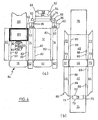
- Figure 2 illustrates a blank 60 of the outer shell 2, see Figure 2(a) , as well as a blank 70 of the inner shell 6, see Figure 2(b) .
- both blanks are made from cardboard of a usual thickness, e.g. in the weight range from 180 g/m 2 to 290 g/m 2 .
- Other blank materials are conceivable as well, e.g. laminated cardboard or plastic materials.
- FIG. 2(a) the front wall 10, the rear wall 12, the lateral walls 14, and the bottom wall 16 of the outer shell 2 are indicated by their reference numerals. Moreover, any gluing tabs are designated by reference numeral 62 and any cut-through lines by reference numeral 63. The lines not indicated by reference numerals are usual fold lines. The hatched areas are completely cut away.
- three tabs 64 are provided which are folded back during the assemblage of the package and are glued to the inner side of the front wall 10 in order to form smooth and well-appearing edges of the cutout 20.
- Reference numeral 65 indicates an area for a warning hint. The size of this area is prescribed by national regulations. In blank 60, the area 65 is located below the cutout 20.
- a reinforcement panel 66 is folded back during assemblage of the outer shell 2 in order to strengthen the outer shell 2 and form a well-appearing upper edge of the front wall 10.
- Figure 2(a) also illustrates how the lid 4 including its top wall 24 and the edge walls 34 and 36 is formed from the blank 60.
- the edge walls 34 and 36 are folded about their respective fold lines and are fixed to the lower side of top wall 24 by means of respective gluing tabs 62.
- a first part 68 of the hinged connector 50 is incorporated in the gluing tab 62 of the front edge wall 34.
- the blank 70 of the inner shell 6 shown in Figure 2(b) comprises the front wall 40, the rear wall 42, both lateral walls 44 and the bottom wall 46 of the inner shell 6 and additionally some gluing tabs 72. Cut-through lines are indicated by reference numeral 73.
- Part 74 is a reinforcement part which, after having been folded and glued to the rear wall 42, stabilises the rear wall 42 and provides for a well-appearing upper edge of the rear wall 42.
- a reinforcement panel 76 is folded back (and preferably glued) to the inner side of the front wall 40 in order to stabilise the front wall 40 of the inner shell 6.
- the front wall 40 of the inner shell 6 does not much yield under this pressure.
- the residual bundle 8 gets smaller and does not stabilise the inner shell 6 anymore.
- the rigid front wall 40 is advantageous.
- another reinforcement panel can be used. This additional reinforcement panel can be part of the blank of the inner shell 6.
- a separate reinforcement panel, e.g. made from a stronger material, which is attached during the assembly process of the inner shell 6, is conceivable as well.
- the inner shell could be made completely from a sufficiently strong plastic material, e.g. as an injection-moulded part.
- Figure 2(b) also shows a second part 78 of the connector 50 which is cut out from the reinforcement part 74 along three cut-through lines 73.
- the inner shell 6 is inserted in the outer shell 2 via top side 18, and the first part 68 and the second part 78 of the connector 50 are glued together, e.g. in a position of the lid 4 as in Figure 1(a) .
- the connector can be different from that shown in Figure 2 , e.g. an even wider connector which would stabilise the package even more than the connector 50 of package 1.
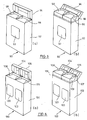
- Figure 3 illustrates another embodiment of a package for tobacco-related articles, which is designated by reference numeral 80.
- the package 80 is similar to the package 1 described so far. For this reason, for most parts of package 80, the same reference numerals are used as for package 1. These parts, which include the opening mechanism of the lid 4, are not explained again.
- the outer shell 2 has an octagonal cross-sectional shape, see in particular the bottom view according to Figure 3(c) .
- This octagonal shape is achieved by means of side panels 82 which are folded by fold lines 83 from the front wall 10 and the rear wall 12, respectively.
- the side panels 82 are considered as parts of the front wall 10 and the rear wall 12, respectively, but they could be considered as parts of the lateral walls 14 as well.
- Figure 4 (a) shows a blank 84 for the outer shell of package 80.
- a warning-hint area 85 is located above the cutout of the front wall.
- the cutout in the front wall of the outer shell should not overlap with the free access area of the inner shell when the inner shell is in its retracted position.
- a blank 86 of the inner shell of package 80 is shown in Figure 4(b) .
- the shape of the inner shell is adapted to that of the outer shell, i.e. the inner shell has an octagonal cross-sectional shape as well.
- the corresponding side panels and fold lines are indicated by reference numerals 88 and 89, respectively.
- FIG. 5 illustrates a third embodiment of the package for tobacco-related articles, which is designated by reference numeral 90.
- an outer shell 92 with a cutout 93 at its front wall can be closed at its top side by means of a swivelable lid 94.
- An inner shell 96 is shiftably mounted in the outer shell 92 and can be moved from a retracted position to an advanced position.
- the lid 94 is coupled to the inner shell 96 by means of a connector.
- a user can move the inner shell 96 and automatically open the lid 94 by gripping with, e.g., the thumb through the cutout 93 and sliding the inner shell 96 upwards. So far, the package 1 and the package 90 are very similar.
- package 90 is wider such that its inner shell 96 can accommodate two bundles 98 and 99 of tobacco-related articles, e.g. cigarettes.
- one bundle is consumed first, while the other one stays closed at the beginning to keep its freshness. Afterwards, the other bundle is consumed.
- FIG. 6 A fourth embodiment of the package for tobacco-related articles is shown in Figure 6 .
- This package is designated by reference numeral 100.
- the package 100 comprises an outer shell 102 with two cutouts 103 in its front wall.
- the lid which is swivelably connected to the upper edge of the rear wall of the outer shell 102, consists of two parts, a first part 104 and a second part 105. Both parts 104 and 105 of the lid are independent from each other.
- the outer shell 102 houses two inner shells, a first inner shell 106 and a second inner shell 107.
- the first inner shell 106 accommodates one bundle 108 of tobacco-related articles, the second inner shell 107 one bundle 109.
- the first part 104 of the lid is coupled to the first inner shell 106 by means of a connector designed as connector 50 of the embodiment according to Figure 1 .
- the second part 105 of the lid is coupled to the second inner shell 107 by means of a corresponding connector. Consequently, both inner shells 106 and 107 including the parts of the lid coupled thereto, i.e. the first part 104 and the second part 105, respectively, can be moved independently from each other.
- the package 100 can be considered as two packages 1 arranged side by side with a common outer shell 102.
- FIG. 7 shows a fifth embodiment of a package for tobacco-related articles.
- This package designated by reference numeral 110, in its outer appearance is similar to package 1 of the first embodiment, but it does not comprise an outer shell plus an inner shell, but just a shell 112.
- a lid 114 is hingedly connected to the rear wall of the shell 112. In the view of Figure 7 , the lid 114 has been partially opened. A bundle 118 of cigarettes is still closed.
- the shell 112 comprises a front wall 120, two lateral walls 122, the rear wall already mentioned and a bottom wall.
- the package 110 does not have a cutout comparable to the cutout 20 because there is no inner shell to be moved via the cutout.
- the package 110 does not include a connector for automatically opening the lid 114.
- the lid 114 is designed similar to lid 4. It comprises a bevelled edge wall 124 at the front edge of its top wall and two bevelled edge walls 126 at the lateral sides. In order to open the lid 114, a user can grasp a tab 128 protruding from the top wall of the lid 114 and cut out from the part of the blank used for forming the bevelled edge wall 124.
- the package 110 is simple from a technical point of view, but nevertheless it has an appealing design because of the structure of its lid 114.
- Figure 8 illustrates a sixth embodiment of a package for tobacco-related articles, which is designated by reference numeral 130. Again, this embodiment just comprises a shell 132 but no additional inner shell.
- the package 130 includes a front wall 134, a rear wall 135 and a bottom wall 136.
- the longitudinal section in a plane in parallel to the front wall 134 shows the lateral walls 138 of shell 132, see Figure 8(b) .
- the lateral walls 138 of the shell 132 are rectangular and extend over the full height of package 130.
- the top side of the shell 132 can be closed by a lid 140.
- the lid 140 comprises a top wall 142 and a rear wall 144. At the free end of its rear wall 144, the lid 140 is connected to the rear wall 135 of the shell 132 along a hinge line 145, see Figure 8(a) .
- a bevelled edge wall 146 having a triangular cross-sectional shape extends from the edge of the top wall 142 opposite to the hinge line 145, see Figure 8(a) .
- the bevelled edge wall 146 is schematically indicated in dashed lines.
- At the lateral sides of the top wall 142 there are provided bevelled edge walls 148, see Figure 8(b) and the indication in dashed lines in Figure 8(a) .
- the ends 149 of the bevelled edge walls 148 are glued to the rear wall 144 of lid 140.
- the user can press the top wall 142 of the lid 140 at a location and in a direction as indicated by the arrow in Figure 8(a) . Under the action of such force, the lid 140 will swivel into its opened state. To close the lid 140, it is sufficient to press its top wall 142 in a downward direction. Because of their shape, the bevelled edge walls 146 and 148 will easily enter into the shell 132.
- Figure 9 illustrates a package 150, in which the lid is formed from two separate parts. Moreover, the package 150 includes an inner shell which can be moved to an advanced position in order to automatically open both parts of the lid.
- the package 150 comprises an outer shell 152 having a front wall 154, a rear wall 155, and a bottom wall 158.
- the lid designated by reference numeral 160 and having a general top wall 161, is composed of a first part 162 and a second part 163.
- the first part 162 is connected to the rear wall 155 of the outer shell 152 along a hinge line 164.
- the second part 163 is connected to the front wall 154 via a hinge line 165.
- the first part 162 comprises a bevelled edge wall 166.
- the second part 163 comprises a bevelled edge wall 167.
- bevelled edge walls 168 indicated in Figure 9 in dashed lines are provided at the lateral edges of the first part 162 and the second part 163 of the lid 160.
- the inner shell designated by reference numeral 170, has a front wall 172, a rear wall 173, a bottom wall 174 and two lateral walls.
- a connector 176 is hingedly connected to the upper end of the rear wall 173 of the inner shell 170 and to an area on the bottom side of the first part 162 of lid 160 in between the hinge line 164 and the bevelled edge wall 166.
- a hinged connector 177 is arranged in the area of the second part 163 of the lid 160.
- a user grasps through a cutout provided, in the embodiment, in one of the lateral walls of the outer shell 152 and moves the inner shell 170 in the upward direction, which causes the connectors 176 and 177 to swivel the parts 162 and 163 of the lid 160 into the open state.
- the connectors 176 and 177 pull the lid 160 into the closed state. Because of the triangular cross-sectional shape of the bevelled edge walls 166 and 167, there are no geometrical problems during the closing procedure.
- Figure 10 shows, as an eighths embodiment, a package 180 in which the lid is hingedly connected to an inner shell 182.
- the inner shell 182 comprises a front wall 184, a rear wall 185, a bottom wall 188 as well as two lateral walls not visible in the longitudinal section according to Figure 10 .
- the lid designated by 190, includes a top wall 191 and a rear wall 192, which is connected to the upper end of the rear wall 185 of the inner shell 182 via a hinge line 193.
- the lid 190 is stabilized by a bevelled edge wall 194 at the front edge of the top wall 191 and by bevelled edge walls 195 at the lateral sides, as indicated in Figure 10 by a dashed line.
- the package 180 comprises an outer shell 196.
- the outer shell 196 surrounds the inner shell 182 and is shaped like a short sleeve.
- a connector 198 is hingedly connected to the outer shell 196 and the rear edge of top wall 191 of the lid 190 along two hinge lines 199, as indicated in Figure 10 .
- the connector 198 pulls the lid 190 into an opened state.
- the lid 190 closes, wherein the bevelled edge walls 194 and 195 easily fit into the inner shell 182.
Landscapes
- Engineering & Computer Science (AREA)
- Mechanical Engineering (AREA)
- Packaging Of Annular Or Rod-Shaped Articles, Wearing Apparel, Cassettes, Or The Like (AREA)
- Cartons (AREA)
- Manufacture Of Tobacco Products (AREA)
Description
- The invention relates to a package for tobacco-related articles, e.g. for cigarettes or for cigarillos.
- A conventional package for tobacco-related articles comprises a shell having a front wall, a rear wall, two lateral walls opposite to each other and a bottom wall connecting the front wall and the rear wall. The top side of the shell is closed by a lid, which can be opened by swivelling or rotating it about a hinge line provided at the rear wall or one of the lateral walls of the shell. Usually, the lid comprises a top wall and side walls, the side walls of the lid overlapping with some wall portions of the shell when the lid is closed. For opening or closing such package, the user generally has to apply both of his or her hands. This kind of package is shown in, e.g.,
US Patent 4,729,508 . Its design is conventional and less appealing. Other examples of conventional packages are disclosed inUS Patent 5,921,384 and inWO 93/01095 A - It is the object of the invention to provide an attractive and moderate-priced package for tobacco-related articles which can be handled in a convenient way, optionally by means of one hand.
- This problem is solved by a package for tobacco-related articles having the features of
claim 1. Advantageous versions of the invention follow from the dependent claims. - The package according to the invention is designed to accommodate tobacco-related articles. The package comprises a shell having a front wall, a rear wall, two lateral walls opposite to each other and optionally a bottom wall, which connect the front wall and the rear wall, as well as a top side. A lid is adapted to close the top side of the shell when it is in a closed state. The lid is swivelably connected to the rear wall or one of the lateral walls of the shell at a hinge line, and it can be swivelled about this hinge line for transfer from the closed state to an opened state. The lid comprises a top wall having a front edge, a rear edge, two lateral edges and a bottom side. This top wall is adapted to close the top side of the shell when the lid is in its closed state.
- Moreover, a bevelled edge wall extends from at least the edge of the top wall opposite to the hinge line of the lid, which bevelled edge wall fits into the shell when the lid is in its closed state.
- When the lid is in its closed state, the bevelled edge wall is accommodated in the shell and generally not visible. Thus, the lid essentially appears as a flat top closure of the package, in contrast to a conventional package in which the lid exhibits a side wall on the side opposite to its hinge line. The package according to the invention provides to the user an appealing and attractive design.
- Moreover, in spite of its "flatness", the lid is rigid because it is strengthened by the bevelled edge wall. In its closed state, the lid also strengthens the upper part of the package with respect to distortion. Due to its bevelled shape, the edge wall fits well into the shell during the closing procedure. Thus, it facilitates the closing process by guiding the lid into the top side space of the outer shell, stabilises the package when it is closed, and provides a better protection for the contents of the package.
- In advantageous embodiments of the invention, the hinge line of the lid is located at the rear edge or at one of the lateral edges of the top wall, which enhances the overall impression of the lid in terms of its "flatness". The bevelled edge wall can also extend from other edges of the top wall of the lid different from the edge comprising the hinge line. For example, the bevelled edge wall may extend from all edges of the top wall of the lid, except for the edge comprising the hinge line. This provides to the lid a high overall strength and does not affect the "flatness" effect of the lid in its closed state and does not interfere with an easy closing procedure.
- In alternative embodiments, the lid comprises a rear wall or a lateral wall extending from the rear edge or one of the lateral edges, respectively, of the top wall, and the hinge line of the lid is located at the free end of this rear wall or lateral wall. Such rear wall or lateral wall does not significantly reduce the "flatness" effect of the lid, which is dominated by the appearance at the edge opposite to the hinge line. On the other hand, this wall provides a lever having its pivot at the hinge line of the lid and facilitating the opening procedure. For example, the user can take the package in her or his hand, the wall having the hinge line of the lid facing the hand's palm, and grasp the top side of the lid by the thumb. When the thumb is moved towards the palm and is pressed slightly downwardly, the lid opens. Optionally the lid comprises at least one additional edge wall other than the bevelled edge wall opposite to the hinge line of the lid. For example, the lid may include a bevelled edge wall extending along all edges of the top wall of the lid, except for the edge from which the rear or lateral wall ending with the hinge line emerges. Fixing the ends of this bevelled edge wall to the rear or lateral wall of the lid additionally strengthens the lid.
- In advantageous versions, the bevelled edge wall is folded from a blank of the shell comprising a blank of the lid. The bevelled edge wall can have different kinds of cross-sectional shapes. A triangular shape is advantageous because it can be easily folded from a blank and it is stable. Other shapes, like quadrangular, polygonal in general or a shape including at least one curved face are conceivable as well.
- In advantageous embodiments of the invention, the shell is designed as an outer shell, and the package further comprises an inner shell adapted to accommodate a plurality of tobacco-related articles. The inner shell is mounted in the outer shell, wherein the inner shell is moveable from a retracted position to an advanced position, which enables access to the smoking articles. Optionally, the inner shell, in its retracted position, is housed inside the outer shell. However, the outer shell can also be designed as a less comprehensive structure so that the outer shell and the lid, when closed, do not fully enclose the inner shell in its retracted position. In an example of the latter design, part of the inner shell protrudes at the bottom end of the outer shell when the lid is closed.
- This design is particularly advantageous when the package further comprises a connector, preferably a hinged connector, between a portion of the inner shell and the lid, which engages the lid at a distance from the hinge line smaller than the dimension of the lid in a direction perpendicular to the hinge line and is adapted to push the lid into its opened state when the inner shell is moved into its advanced position and to pull the lid into its closed state when the inner shell is moved into its retracted position. Thus, the lid is automatically opened and closed, respectively, when the user moves the inner shell.
- In this case, a cutout in the front wall and/or the lateral walls of the outer shell is adapted to expose part of the inner shell and to enable transmitting (optionally by means of an actuator, e.g., a knob or a pin) or exerting (e.g. by means of a thumb) a force onto the inner shell for moving the inner shell. The cutout can extend over more than one wall of the outer shell, e.g. in a corner area between the front wall and one of the lateral walls. Moreover, more than one cutout is conceivable as well. It is also possible that the bottom wall of the outer shell includes part of the cutout or an additional cutout.
- Such package can be handled in a very convenient way. In contrast to a conventional package, which the user has to hold by one hand while opening the lid by the other hand, this package can be handled or operated just by means of one hand. The user can hold it in one hand, e.g. the rear wall of the outer shell facing his or her palm, and he or she can use his or her thumb in order to grasp through the cutout (or operate the actuator) and shift the inner shell by slightly pressing onto the inner shell and moving the thumb in a direction towards the lid or away from the lid, respectively. Because of the hinged connector, the lid opens and closes automatically. Again, this package permits an attractive design, and it can also be manufactured to a moderate price.
- The one-hand use of the package is advantageous in many situations, for example while driving, when operating a computer, when talking on the phone, etc., or, generally, when the user has ready one hand only and wants to take a tobacco-related article. The package can rest well in the user's hand, and the one-hand use of the package is fast and convenient.
- The inner shell can comprise a rear wall or a lateral wall having an upper edge, wherein the connector extends from this upper edge, having a first hinge line at or in the area of the upper edge, and wherein the connector has a second hinge line at the bottom side of the top wall. An advantageous geometrical condition for a reliable operation of the lid is that, in the closed state of the lid, the ratio of the distance between the first hinge line of the connector and the hinge line of the lid to the distance between the hinge line of the lid and the second hinge line of the connector is in the range from 0.5 to 1.0, preferably in the range from 0.70 to 0.85, e.g. about 0.78. Another useful geometrical condition for a space-saving, reliable and smooth coupling between the inner shell and the lid is that the distance between the first hinge line and the second hinge line of the connector is greater than the distance between the hinge line of the lid and the second hinge line of the connector, e.g. greater by an amount in the range of from 0.4 mm to 1.8 mm, or by an amount of about 0.7 mm.
- The inner shell of the package can comprise a front wall providing a free access area, which facilitates the access to the contents of the inner shell when the inner shell is in its advanced position. This free access area can be designed, e.g., as a cutoff from the front wall or by means of a portion of the front wall having a lowered upper edge or by means of a front wall having generally a low upper edge. Preferably, when the inner shell is in its retracted position, the free access area of the inner shell does not overlap with the cutout of the outer shell, i.e. the free access area is not visible when the package is closed. This improves the appearance of the package.
- Generally, the inner shell can comprise a front wall and a rear wall as well as two lateral walls opposite to each other and a bottom wall, which connect the front wall and the rear wall. It is also conceivable, however, that the inner shell has a lighter structure in which not all of the above-mentioned walls are designed as wall panels. In a lighter structure, an inner wrapper or a bundle wrapper can be applied for providing additional support to the contents of the package.
- In advantageous embodiments including an inner shell, the front wall of the inner shell comprises a reinforced structure in order to improve its counteraction capabilities when the user touches this front wall, through the cutout, in order to move the inner shell. Such structure can be made from double-layer or triple-layer cardboard, e.g., using cardboard panels folded from a blank of the inner shell. It is also conceivable to apply a separate reinforcement panel which is attached to the rest of the inner shell.
- Alternatively or additionally to this reinforcement structure, a reinforcement insert can be inserted into the inner shell. The reinforcement insert can be formed, e.g., as a plastic container, preferably made by injection-moulding. Such design still uses an inner shell, e.g. made from a cardboard blank, which can be coupled to the lid via a connector.
- It is also possible to dispense with such cardboard inner shell and to design the inner shell as a plastic container which provides the desired rigidity. In this case, at least part of the connector can be formed as part of the plastic container, but it is also conceivable to attach a connector completely formed from a blank of the lid (e.g., as part of a blank of the outer shell) to the plastic container when assembling the package.
- Preferably, the cutout of the outer shell is provided in the front wall of the outer shell. This is a location which allows for a convenient use of the package. However, it is possible as well to place the cutout at a different wall or in an area which extends over two walls or to provide more than one cutout.
- The cutout of the outer shell can be located in a side area of the front wall of the outer shell, i.e. not in the centre area. This is particularly advantageous when the inner shell comprises a front wall providing a free access area (see above), because in this case the cutout of the outer shell can be placed at a location where it does not overlap with the free access area of the inner shell when the inner shell is in its retracted position. Moreover, in this design, the front wall of the outer shell exhibits a large continuous area which can be used for, e.g., warning hints.
- The cutout of the outer shell can be formed from a blank of the outer shell in which at least part of the blank material of the cutout area is folded back to the inner face of the outer shell. In this way, the edges of the cutout are not sharp or somewhat irregular, but they are determined by the corresponding folding lines, which tend to be smooth and provide a greater thickness of the wall area surrounding the cutout. It can be advantageous when the blank material is not folded back at the top edge of the cutout, because that edge is not seen in detail when the user holds the package in a usual way, whereas a back-folded flap at the top edge of the cutout could interfere with an unimpeded assemblage of the package.
- The inner shell can comprise, opposite to the cutout of the outer shell, a grip-enhancing surface. Such grip-enhancing surface can be presented, e.g., by means of a relief structure incorporated in the wall material of the inner shell or provided by a sticker glued to the inner shell in the area in question. Another option is a cutout structure, e.g. in a double-layer wall structure of the inner shell in which the outer layer comprises a series of cutouts whereas the inner layer folded to the outer layer is smooth. Other embodiments include a high-friction coating or rubber-like coating, either applied to a wall or wall area of the inner shell or to a sticker glued to the inner shell in the area in question. The grip-enhancing surface facilitates the operation of the package because it increases the frictional forces to, e.g., the user's thumb.
- As already mentioned above, it is also conceivable that the cutout of the outer shell is designed as an aperture for an actuator for moving the inner shell and not as a relatively large access area for thumb operation of the inner shell movement.
- There are many design options for the connector. For example, it can be folded by part of a blank of the outer shell and by part of a blank of the inner shell, wherein both parts are glued together upon assemblage of the package. Or it can be folded by part of a blank of the outer shell and glued directly to the inner shell. Or it can be folded by part of a blank of the inner shell and glued to the lid, which preferably is made from part of a blank of the outer shell. Regarding the shape of the connector, it can be relatively narrow measured in a direction along the hinge line of the lid. But it can also have the greatest or the almost greatest possible width measured in this direction. Generally, a larger width increases the rigidity of the structure. A trapezoidal shape of the connector, e.g., provides for a large extension where it is required for improving strength but also provides sloped edges which may facilitate the assemblage of the package.
- In a different embodiment, the outer shell does not have a cutout in its front wall, rear wall or lateral walls. In this case, the outer shell rather comprises a cutout in its bottom wall (including a missing bottom). Otherwise, the embodiment can be constructed as outlined above. For advancing the inner shell, the user has to press upon its bottom (through the bottom aperture of the outer shell), while for retracting the inner shell, the user has to manually close the lid.
- The embodiments of the package including an outer shell and an inner shell are not restricted to a design comprising one inner shell containing one charge or bundle of tobacco-related products only. It is also conceivable that the package includes one inner shell containing more than one bundle or that the package includes more than one inner shell. For example, the package can comprise at least two inner shells which are arranged side by side. In this case, preferably, the lid is swivelably connected to the rear wall of the outer shell. The lid can be formed from at least two separate parts, which are arranged side by side and are swivelably connected to the rear wall of the outer shell, wherein each of the separate parts of the lid is associated to one of the inner shells. The front wall of the outer shell can be provided with at least one cutout adapted to expose part of each of the inner shells and to enable exerting a force onto each of the inner shells for moving the respective inner shell and actuating the respective part of the lid via a hinged connector. This at least one cutout can be a single cutout in an area having access to all of the inner shells, or it can include at least two cutouts, one for each inner shell.
- Turning now again to more general embodiments of the invention, which do not necessarily include a connector operating the lid.
- The shell (or the outer shell) can be box-shaped. It can also comprise rounded edges, wherein preferably the longitudinal edges between the front wall and both lateral walls are rounded. Another option for the shape of the shell is a form with a hexagonal or octagonal cross-sectional shape, wherein the lateral walls or the front wall comprise side panels folded from the rest of the respective lateral wall or from the rest of the front wall (or rear wall) along fold lines running in parallel to a longitudinal axis of the package. Such shapes provide an attractive appearance of the package, whereas additional manufacturing expenses are moderate. If an inner shell is present, its shape can be adjusted accordingly.
- In other embodiments of the invention, the shell (to which the lid is connected via the hinge line) is designed as an inner shell, which is at least partially surrounded by an outer shell. For example, the inner shell can accommodate and protect the smoking articles, and such outer shell may serve, e.g., as an operating means for opening and closing the lid, which will become more evident by a specific embodiment described further below.
- The invention also covers packages in which the lid is formed from two separate parts, which are arranged opposite to each other, one part of the lid being swivelably connected to the rear wall or one of the lateral walls of the shell at the hinge line and the other part of the lid being swivelably connected to the front wall or the other one of the lateral walls of the shell at another hinge line. Each of both parts of the lid comprises a bevelled edge wall at least opposite to the respective hinge line. In this case, the lid when considered as a whole comprises two additional edges, i.e. the edge of the one part opposite to its hinge line and the edge of the other part opposite to the other hinge line, which edges face each other when the lid is closed. At least these edges comprise bevelled edge walls, which facilitate the closing process when the parts of the lid are swivelled into the closed state of the lid.
- In advantageous embodiments of such packages, both parts of the lid are designed in general mirror symmetry with respect to each other, but non-symmetrical configurations are conceivable as well. In these embodiments, each part of the lid can be designed as described further above with a one-part lid in mind. For example, in a package comprising an inner shell, a connector for operating the one part of the lid can be connected to a rear wall of the inner shell, and a connector for operating the other part of the lid can be connected to a front wall of the inner shell.
- Generally, the lid can comprise a gripping device, for example a tab, a nose, a gripping depression, or a gripping hole. When the lid is not opened automatically, such gripping device may be helpful in order to facilitate the opening process.
- In advantageous embodiments of the invention, the shell (or the outer shell and/or the inner shell) of the package is folded from a blank made from cardboard (which term includes laminated cardboard) in the weight range from 180 g/m2 to 290 g/m2. This involves well-established techniques. Cardboard blanks can be designed in a large number of varieties. Other materials for the components of the package are conceivable as well, for example cardboard having a weight outside of the range indicated above or laminated materials or plastic materials or metal.
- The package according to the invention can be filled with all kinds of tobacco-related articles, for example with cigarettes, cigarillos, cigars, tobacco-containing rods, smokeless tobacco, simulated smoking devices (e.g., electronic cigarettes), inhalors without combustion of tobacco, or aroma reservoirs.
- When filled with tobacco-related articles, the package can be enclosed by, e.g., a cellophane or transparent plastic (e.g., polypropylene) wrapper, which is removed or partially removed by the user before opening the package for the first time. Such kinds of wrappers aid in maintaining the aroma and freshness of the tobacco-related articles and serve as a temper-evident closure.
- In the following, the invention is further explained by means of embodiments. The drawings show in
- Figure 1
- in parts (a) to (e) several views of a first embodiment of a package for tobacco-related articles according to the invention, i.e. in part (a) an isometric view of the package, the lid being partially opened, in part (b) an isometric view of the package, the lid being fully opened and an inner shell of the package having been moved to an advanced position, in part (c) a side view of the package, the lid being closed, in part (d) a side view of the package in the state according to part (b), and in part (e) a longitudinal section through the package in a plane containing the centre longitudinal axis,
- Figure 2
- in part (a) a plane view of a blank for the outer shell of the package according to
Figure 1 and in part (b) a plane view of a blank for the inner shell of the package according toFigure 1 , - Figure 3
- in parts (a) to (d) several views of a second embodiment of a package for tobacco-related articles according to the invention, i.e. in part (a) an isometric view of the package, the lid being partially opened, in part (b) an isometric view of the package, the lid being fully opened and an inner shell of the package having been moved to an advanced position, in part (c) a bottom view of the package, and in part (d) a side view of the package in the state according to part (b),
- Figure 4
- in part (a) a plane view of a blank for the outer shell of the package according to
Figure 3 and in part (b) a plane view of a blank for the inner shell of the package according toFigure 3 , - Figure 5
- in parts (a) and (b) isometric views of a third embodiment of a package according to the invention, which contains two bundles, i.e. in part (a) with the lid partially opened and in part (b) with an inner shell of the package in an advanced position and the lid being fully opened,
- Figure 6
- in parts (a) and (b) isometric views of a fourth embodiment of a package according to the invention, i.e. in part (a) with a two-part lid partially opened and in part (b) with two inner shells of the package in an advanced position, the two-part lid being fully opened,
- Figure 7
- an isometric view of a fifth embodiment of a package according to the invention, the lid being partially opened,
- Figure 8
- in parts (a) and (b) schematic longitudinal sections of a sixth embodiment of a package according to the invention, the lid being closed, i.e. in part (a) in a plane in parallel to the lateral walls of a shell of the package and in part (b) in a plane in parallel to the front wall of the shell,
- Figure 9
- a schematic longitudinal section of a seventh embodiment of a package according to the invention in a plane in parallel to the lateral walls of a shell of the package, the lid comprising two parts and being closed, and
- Figure 10
- a schematic longitudinal section of an eighth embodiment of a package according to the invention in a plane in parallel to the lateral walls of a shell of the package, the lid being hinged to an inner shell and being closed.
-
Figure 1 illustrates a first embodiment of apackage 1 for tobacco-related articles. - The
package 1 comprises anouter shell 2, alid 4 adapted to close theouter shell 2, and aninner shell 6, which is movable within theouter shell 2 from a retracted position, seeFigure 1(a) , to an advanced position, seeFigure 1(b) . - The
inner shell 6 accommodates abundle 8 of tobacco-related articles, e.g. a bundle of cigarettes. Thebundle 8 is provided in a conventional manner, e.g. by wrapping a plurality of cigarettes with, e.g., an aluminium foil or aluminium-laminated paper. In the state of thepackage 1 shown inFigure 1(b) , thebundle 8 can be easily opened in order to take out a cigarette. - The
outer shell 2 comprisesfront wall 10, arear wall 12, twolateral walls 14 and abottom wall 16. In the embodiment, thetop side 18 provides a free cross-sectional area. - The
front wall 10 includes acutout 20, i.e. an aperture fully penetrating thefront wall 10. In the embodiment, thecutout 20 is located approximately in the centre area of thefront wall 10. - The
lid 4 is connected to the upper edge of therear wall 12 via ahinge line 22 so that it can be swivelled from a closed state, seeFigure 1(c) , to a fully opened state, seeFigure 1(b), Figure 1(d), and Figure 1(e) . In the embodiment, thelid 4 comprises atop wall 24 having afront edge 26 and arear edge 28, seeFigure 1(d) , as well as twolateral edges 30, seeFigure 1(a) . Its bottom side is designated byreference numeral 32, seeFigure 1(e) . Thehinge line 22 runs along therear edge 28 oflid 4 and is designed from a fold line of the blank the outer shell is formed from. - Moreover, the
lid 4 comprises afront edge wall 34 extending fromfront edge 26 and twolateral edge walls 36 extending from the twolateral edges 30 of thetop wall 24 oflid 4. As can be seen inFigures 1(a), (b), (d) and (e) , theedge walls front edge 26 and the lateral edges 30, respectively, in a somewhat inwardly inclined manner such that theedge walls outer shell 2 when thelid 4 is closed. Consequently, theedge walls lid 4 is closed, seeFigure 1(c) . In other words, when thelid 4 is closed, only itstop wall 24 can be seen, which imparts to the package 1 a striking design. - When the
lid 4 is closed, theedge walls outer shell 2 and stabilise thepackage 1. In the embodiment, theedge walls Figure 1(e) , which provides for a generally large strength of theedge walls edge walls lid 4. In variants of the embodiment according toFigure 1 , the cross-sectional shape of the edge walls is not triangular, but different, e.g. more or less rounded. - The
inner shell 6 comprises afront wall 40 and arear wall 42, seeFigure 1(e) , twolateral walls 44, seeFigure 1(d) , as well as abottom wall 46, seeFigure 1(e) . The upper edge of thefront wall 40 and part of the upper edges of thelateral walls 44 are arranged below the upper edge of therear wall 42, seeFigure 1(b) and Figure 1(d) , which provides afree access area 48 for facilitating the removal of the tobacco-related articles ofbundle 8. - In the area of the
cutout 20 of theouter shell 2, thefront wall 40 of theinner shell 6 is coated with a grip-enhancing, high-frictional material, e.g. a rubber-like material. - The
inner shell 6 is coupled to thelid 4 by means of a hingedconnector 50. As shown inFigure 1(b) , theconnector 50 extends over most of the width ofpackage 1.Figure 1(e) illustrates the details of theconnector 50 and explains how it works. - In the embodiment, the
connector 50 extends from the upper edge of therear wall 42 of theinner shell 6 at afirst hinge line 52. Theconnector 50 is attached to thebottom side 32 of thetop wall 24 oflid 4 at asecond hinge line 54. Theconnector 50 can swivel about the hinge lines 52 and 54. - Moreover, in the embodiment, the distance between the
first hinge line 52 and thesecond hinge line 54 is greater than the distance between thesecond hinge line 54 and thehinge line 22 oflid 4, e.g. by an amount of about 0.7 mm. - When the
lid 4 is in its closed state, seeFigure 1(c) , a user can place thepackage 1 in the palm of one of his or her hands, touch thefront wall 40 of theinner shell 6 through thecutout 20 in theouter shell 2 with his or her thumb and move the thumb upwards. In this wary, the user shifts theinner shell 6 from its retracted position upwards until it achieves its fully advanced position. During the movement of theinner shell 6, theconnector 50 opens thelid 4 by swivelling it about thehinge line 22. Since during all times of this movement, the hinge lines 22, 52 and 54 form a triangle in the plane ofFigure 1(e) , the swivel movement of thelid 4 is well-defined. - Initially, when
lid 4 is closed, the ratio of the distance between thefirst hinge line 52 of theconnector 50 and thehinge line 22 of thelid 4 to the distance between thehinge line 22 of thelid 4 and thesecond hinge line 54 of theconnector 50 is about 0.78, in the embodiment. This implies that, on the one hand, thelid 4 experiences a sufficient torque during the initial moments of the opening movement, whereas, on the other hand, the upper edge of theinner shell 6, i.e. thefirst hinge line 52, is not located too much below thehinge line 22, i.e. the connector mechanism does not waste much space in top of theinner shell 6 when theinner shell 6 assumes its retracted position. - When the user moves his or her thumb downwards, the
inner shell 6 is shifted back to its retracted position, and theconnector 50 pulls thelid 4 down to its closed state. - Other numerical values of the numbers presented above can be chosen as well. A person skilled in the art can optimise the geometry of the
connector 50 depending on the actual dimensions of theouter shell 2 and theinner shell 6. -
Figure 2 illustrates a blank 60 of theouter shell 2, seeFigure 2(a) , as well as a blank 70 of theinner shell 6, seeFigure 2(b) . In the embodiment, both blanks are made from cardboard of a usual thickness, e.g. in the weight range from 180 g/m2 to 290 g/m2. Other blank materials are conceivable as well, e.g. laminated cardboard or plastic materials. - In
Figure 2(a) , thefront wall 10, therear wall 12, thelateral walls 14, and thebottom wall 16 of theouter shell 2 are indicated by their reference numerals. Moreover, any gluing tabs are designated byreference numeral 62 and any cut-through lines byreference numeral 63. The lines not indicated by reference numerals are usual fold lines. The hatched areas are completely cut away. - The area of the
cutout 20, threetabs 64 are provided which are folded back during the assemblage of the package and are glued to the inner side of thefront wall 10 in order to form smooth and well-appearing edges of thecutout 20. -
Reference numeral 65 indicates an area for a warning hint. The size of this area is prescribed by national regulations. In blank 60, thearea 65 is located below thecutout 20. - Similar to the
tabs 64, areinforcement panel 66 is folded back during assemblage of theouter shell 2 in order to strengthen theouter shell 2 and form a well-appearing upper edge of thefront wall 10. -
Figure 2(a) also illustrates how thelid 4 including itstop wall 24 and theedge walls edge walls top wall 24 by means ofrespective gluing tabs 62. Afirst part 68 of the hingedconnector 50 is incorporated in thegluing tab 62 of thefront edge wall 34. - The individual steps for assembling the
outer shell 2 from blank 60 are evident to a person skilled in the art. - In a similar way, the blank 70 of the
inner shell 6 shown inFigure 2(b) comprises thefront wall 40, therear wall 42, bothlateral walls 44 and thebottom wall 46 of theinner shell 6 and additionally some gluingtabs 72. Cut-through lines are indicated byreference numeral 73.Part 74 is a reinforcement part which, after having been folded and glued to therear wall 42, stabilises therear wall 42 and provides for a well-appearing upper edge of therear wall 42. - A
reinforcement panel 76 is folded back (and preferably glued) to the inner side of thefront wall 40 in order to stabilise thefront wall 40 of theinner shell 6. When the user puts his or her thumb through thecutout 20, he or she exerts some force onto thefront wall 40 of theinner shell 6. As long as thebundle 8 in theinner shell 6 is still complete or almost complete, thefront wall 40 of theinner shell 6 does not much yield under this pressure. During use of thepackage 1, however, theresidual bundle 8 gets smaller and does not stabilise theinner shell 6 anymore. For this reason, the rigidfront wall 40 is advantageous. In addition toreinforcement panel 76, another reinforcement panel can be used. This additional reinforcement panel can be part of the blank of theinner shell 6. A separate reinforcement panel, e.g. made from a stronger material, which is attached during the assembly process of theinner shell 6, is conceivable as well. As an alternative, the inner shell could be made completely from a sufficiently strong plastic material, e.g. as an injection-moulded part. -
Figure 2(b) also shows asecond part 78 of theconnector 50 which is cut out from thereinforcement part 74 along three cut-throughlines 73. - Again, it is evident to a person skilled in the art how the
inner shell 6 is assembled from blank 70. - After assemblage of the
outer shell 2 and theinner shell 6 from theblanks inner shell 6 is inserted in theouter shell 2 viatop side 18, and thefirst part 68 and thesecond part 78 of theconnector 50 are glued together, e.g. in a position of thelid 4 as inFigure 1(a) . - Different designs of the connector are conceivable as well, e.g. a connector fully integrated in the blank of the outer shell or a connector fully integrated in the blank of the inner shell. Moreover, the shape of the connector can be different from that shown in
Figure 2 , e.g. an even wider connector which would stabilise the package even more than theconnector 50 ofpackage 1. -
Figure 3 illustrates another embodiment of a package for tobacco-related articles, which is designated byreference numeral 80. - The
package 80 is similar to thepackage 1 described so far. For this reason, for most parts ofpackage 80, the same reference numerals are used as forpackage 1. These parts, which include the opening mechanism of thelid 4, are not explained again. - The main difference between the
packages package 80, theouter shell 2 has an octagonal cross-sectional shape, see in particular the bottom view according toFigure 3(c) . This octagonal shape is achieved by means ofside panels 82 which are folded byfold lines 83 from thefront wall 10 and therear wall 12, respectively. By definition, theside panels 82 are considered as parts of thefront wall 10 and therear wall 12, respectively, but they could be considered as parts of thelateral walls 14 as well. -
Figure 4 (a) shows a blank 84 for the outer shell ofpackage 80. In this case, a warning-hint area 85 is located above the cutout of the front wall. Generally, the cutout in the front wall of the outer shell should not overlap with the free access area of the inner shell when the inner shell is in its retracted position. - A blank 86 of the inner shell of
package 80 is shown inFigure 4(b) . The shape of the inner shell is adapted to that of the outer shell, i.e. the inner shell has an octagonal cross-sectional shape as well. InFigure 4(b) , the corresponding side panels and fold lines are indicated byreference numerals - Otherwise, the explanation given for the assemblage of
package 1 by means of theblanks package 80 by means of theblanks -
Figure 5 illustrates a third embodiment of the package for tobacco-related articles, which is designated byreference numeral 90. In this embodiment, anouter shell 92 with acutout 93 at its front wall can be closed at its top side by means of aswivelable lid 94. Aninner shell 96 is shiftably mounted in theouter shell 92 and can be moved from a retracted position to an advanced position. Thelid 94 is coupled to theinner shell 96 by means of a connector. - As before, a user can move the
inner shell 96 and automatically open thelid 94 by gripping with, e.g., the thumb through thecutout 93 and sliding theinner shell 96 upwards. So far, thepackage 1 and thepackage 90 are very similar. - In contrast to
package 1, however,package 90 is wider such that itsinner shell 96 can accommodate twobundles - A fourth embodiment of the package for tobacco-related articles is shown in
Figure 6 . This package is designated byreference numeral 100. - The
package 100 comprises anouter shell 102 with twocutouts 103 in its front wall. The lid, which is swivelably connected to the upper edge of the rear wall of theouter shell 102, consists of two parts, afirst part 104 and asecond part 105. Bothparts - The
outer shell 102 houses two inner shells, a firstinner shell 106 and a secondinner shell 107. The firstinner shell 106 accommodates onebundle 108 of tobacco-related articles, the secondinner shell 107 onebundle 109. - The
first part 104 of the lid is coupled to the firstinner shell 106 by means of a connector designed asconnector 50 of the embodiment according toFigure 1 . Similarly, thesecond part 105 of the lid is coupled to the secondinner shell 107 by means of a corresponding connector. Consequently, bothinner shells first part 104 and thesecond part 105, respectively, can be moved independently from each other. In other words, thepackage 100 can be considered as twopackages 1 arranged side by side with a commonouter shell 102. -
Figure 7 shows a fifth embodiment of a package for tobacco-related articles. This package, designated byreference numeral 110, in its outer appearance is similar topackage 1 of the first embodiment, but it does not comprise an outer shell plus an inner shell, but just ashell 112. - A
lid 114 is hingedly connected to the rear wall of theshell 112. In the view ofFigure 7 , thelid 114 has been partially opened. Abundle 118 of cigarettes is still closed. - The
shell 112 comprises afront wall 120, twolateral walls 122, the rear wall already mentioned and a bottom wall. In contrast to the first embodiment, thepackage 110 does not have a cutout comparable to thecutout 20 because there is no inner shell to be moved via the cutout. Moreover, thepackage 110 does not include a connector for automatically opening thelid 114. - Otherwise, the
lid 114 is designed similar tolid 4. It comprises abevelled edge wall 124 at the front edge of its top wall and twobevelled edge walls 126 at the lateral sides. In order to open thelid 114, a user can grasp atab 128 protruding from the top wall of thelid 114 and cut out from the part of the blank used for forming thebevelled edge wall 124. - Thus, the
package 110 is simple from a technical point of view, but nevertheless it has an appealing design because of the structure of itslid 114. -
Figure 8 illustrates a sixth embodiment of a package for tobacco-related articles, which is designated byreference numeral 130. Again, this embodiment just comprises ashell 132 but no additional inner shell. - It can be seen from the longitudinal section in
Figure 8(a) , i.e. a section in a plane in parallel to the lateral walls ofshell 132, that thepackage 130 includes afront wall 134, arear wall 135 and abottom wall 136. The longitudinal section in a plane in parallel to thefront wall 134 shows thelateral walls 138 ofshell 132, seeFigure 8(b) . In the embodiment, thelateral walls 138 of theshell 132 are rectangular and extend over the full height ofpackage 130. The top side of theshell 132 can be closed by alid 140. Thelid 140 comprises atop wall 142 and arear wall 144. At the free end of itsrear wall 144, thelid 140 is connected to therear wall 135 of theshell 132 along ahinge line 145, seeFigure 8(a) . - A
bevelled edge wall 146 having a triangular cross-sectional shape extends from the edge of thetop wall 142 opposite to thehinge line 145, seeFigure 8(a) . InFigure 8(b) the bevellededge wall 146 is schematically indicated in dashed lines. At the lateral sides of thetop wall 142, there are providedbevelled edge walls 148, seeFigure 8(b) and the indication in dashed lines inFigure 8(a) . In order to stabilise thelid 140, theends 149 of the bevellededge walls 148 are glued to therear wall 144 oflid 140. - To open the
lid 140, the user can press thetop wall 142 of thelid 140 at a location and in a direction as indicated by the arrow inFigure 8(a) . Under the action of such force, thelid 140 will swivel into its opened state. To close thelid 140, it is sufficient to press itstop wall 142 in a downward direction. Because of their shape, thebevelled edge walls shell 132. - As a seventh embodiment of a package for tobacco-related articles,
Figure 9 illustrates apackage 150, in which the lid is formed from two separate parts. Moreover, thepackage 150 includes an inner shell which can be moved to an advanced position in order to automatically open both parts of the lid. - The
package 150 comprises anouter shell 152 having afront wall 154, arear wall 155, and abottom wall 158. - The lid, designated by
reference numeral 160 and having a generaltop wall 161, is composed of afirst part 162 and asecond part 163. Thefirst part 162 is connected to therear wall 155 of theouter shell 152 along ahinge line 164. Similarly, thesecond part 163 is connected to thefront wall 154 via ahinge line 165. At its edge opposite to thehinge line 164, thefirst part 162 comprises abevelled edge wall 166. Similarly, thesecond part 163 comprises abevelled edge wall 167. Moreover, bevellededge walls 168 indicated inFigure 9 in dashed lines are provided at the lateral edges of thefirst part 162 and thesecond part 163 of thelid 160. - The inner shell, designated by
reference numeral 170, has afront wall 172, arear wall 173, abottom wall 174 and two lateral walls. Aconnector 176 is hingedly connected to the upper end of therear wall 173 of theinner shell 170 and to an area on the bottom side of thefirst part 162 oflid 160 in between thehinge line 164 and thebevelled edge wall 166. Similarly, a hingedconnector 177 is arranged in the area of thesecond part 163 of thelid 160. - To open the
package 180, a user grasps through a cutout provided, in the embodiment, in one of the lateral walls of theouter shell 152 and moves theinner shell 170 in the upward direction, which causes theconnectors parts lid 160 into the open state. When theinner shell 170 is shifted in the downward direction, theconnectors lid 160 into the closed state. Because of the triangular cross-sectional shape of the bevellededge walls -
Figure 10 shows, as an eighths embodiment, apackage 180 in which the lid is hingedly connected to aninner shell 182. - The
inner shell 182 comprises afront wall 184, arear wall 185, abottom wall 188 as well as two lateral walls not visible in the longitudinal section according toFigure 10 . - The lid, designated by 190, includes a
top wall 191 and arear wall 192, which is connected to the upper end of therear wall 185 of theinner shell 182 via ahinge line 193. Thelid 190 is stabilized by abevelled edge wall 194 at the front edge of thetop wall 191 and bybevelled edge walls 195 at the lateral sides, as indicated inFigure 10 by a dashed line. - Moreover, the
package 180 comprises anouter shell 196. Theouter shell 196 surrounds theinner shell 182 and is shaped like a short sleeve. Aconnector 198 is hingedly connected to theouter shell 196 and the rear edge oftop wall 191 of thelid 190 along twohinge lines 199, as indicated inFigure 10 . - Upon shifting the
outer shell 196 in the downward direction, theconnector 198 pulls thelid 190 into an opened state. When theouter shell 196 is moved upwardly, thelid 190 closes, wherein thebevelled edge walls inner shell 182.
Claims (18)
- A package for tobacco-related articles, comprising- a shell (2; 92; 102; 112; 132; 152; 182) having a front wall (10; 120; 134; 154; 184), a rear wall (12; 135; 155; 185), two lateral walls (14; 122; 138) opposite to each other connecting the front wall (10; 120; 134; 154; 184) and the rear wall (12; 135; 155; 185), as well as a top side (18), and- a lid (4; 94; 104, 105; 114; 140; 160; 190) adapted to close the top side (18) of the shell (2; 92; 102; 112; 132; 152; 182) when in a closed state, the lid (4; 94; 104, 105; 114; 140; 160; 190) being swivelably connected to the rear wall (12; 135; 155; 185) or one of the lateral walls (14; 122; 138) of the shell (2; 92; 102; 112; 132; 152; 182) at a hinge line (22; 145; 164; 193) and being swivelable about the hinge line (22; 145; 164; 193) for transfer from the closed state to an opened state,- wherein the lid (4; 94; 104, 105; 114; 140; 160; 190) comprises a top wall (24; 142; 161; 191) having a front edge (26), a rear edge (28), two lateral edges (30) and a bottom side (32) and adapted to close the top side (18) of the shell (2; 92; 102; 112; 132; 152; 182) when the lid (4; 94; 104, 105; 114; 140; 160; 190) is in its closed state, and- wherein a bevelled edge wall (34; 124; 146; 166; 194) extends from at least the edge (26) of the top wall (24; 142; 161; 191) opposite to the hinge line (22; 145; 164; 193) of the lid (4; 94; 104, 105; 114; 140; 160; 190), which bevelled edge wall (34; 124; 146; 166; 194) fits into the shell (2; 92; 102; 112; 132; 152; 182) when the lid (4; 94; 104, 105; 114; 140; 160; 190) is in its closed state so that the bevelled edge wall is accommodated in the shell and generally not visible.
- Package according to claim 1, characterised in that the hinge line (22; 164) of the lid (4; 94; 104, 105; 114; 160) is located at the rear edge (28) or at one of the lateral edges (30) of the top wall (24; 161).
- Package according to claim 2, characterised in that the bevelled edge wall (34, 36; 124, 126; 166, 168) also extends from other edges (30) of the top wall (24; 161) different from the edge (28) comprising the hinge line (22; 164) of the lid (4; 94; 104, 105; 114; 160).
- Package according to claim 1, characterised in that the lid (140; 190) comprises a rear wall (144; 192) or a lateral wall extending from the rear edge or one of the lateral edges, respectively, of the top wall (142; 191) and in that the hinge line (145; 193) of the lid (140; 190) is located at the free end of this rear wall (144; 192) or lateral wall, wherein optionally the lid (140; 190) comprises at least one additional edge wall (148; 195) other than the bevelled edge wall (146; 194) opposite to the hinge line (145; 193) of the lid (140; 190).
- Package according to anyone of claims 1 to 4, characterised in that the bevelled edge wall (34, 36; 124, 126; 146, 148; 166, 167, 168; 194, 195) is folded from a blank (60; 84) of the shell (2; 92; 102; 112; 132; 152; 182) comprising a blank of the lid (4; 94; 104, 105; 114; 140; 160; 190).
- Package according to anyone of claims 1 to 5, characterised in that the bevelled edge wall (34, 36; 124, 126; 146, 148; 166, 167, 168; 194, 195) has a cross-sectional shape selected from the following list: triangular, quadrangular, polygonal, shape including at least one curved face.
- Package according to anyone of claims 1 to 6, characterised in that the shell (2; 92; 102; 112; 132; 152; 182) comprises a bottom wall (16; 136; 158; 188), wherein the two lateral walls (14; 122; 138) and the bottom wall (16; 136; 158; 188) connect the front wall (10; 120; 134; 154; 184) and the rear wall (12; 135; 155; 185).
- Package according to anyone of claims 1 to 7, characterised in that the shell (2; 92; 102; 152) is designed as an outer shell (2; 92; 102; 152) and in that the package further comprises an inner shell (6; 96; 106, 107; 170) adapted to accommodate a plurality of tobacco-related articles and shiftably mounted in the outer shell (2; 92; 102; 152), wherein the inner shell (6; 96; 106, 107; 170) is moveable from a retracted position to an advanced position, which enables access to the smoking articles, wherein otionally the inner shell (6; 96; 106, 107; 170), in its retracted position, is housed inside the outer shell (2; 92; 102; 152).
- Package according to claim 8, characterised in that the package further comprises - a cutout (20; 93; 103) in at least one wall of the outer shell (2; 92; 102; 152), selected out of the front wall (10), the rear wall (12) or the two lateral walls (14), which cutout (20; 93; 103) is adapted to expose part of the inner shell (6; 96; 106, 107; 170) and to enable transmitting a force onto the inner shell (6; 96; 106, 107; 170) for moving the inner shell (6; 96; 106, 107; 170),- a connector (50; 176), preferably a hinged connector, between a portion of the inner shell (6; 96; 106, 107; 170) and the lid (4; 94; 104, 105; 160, 162), which engages the lid (4; 94; 104, 105; 160, 162) at a distance from the hinge line (22; 164) smaller than the dimension of the lid (4; 94; 104, 105; 160, 162) in a direction perpendicular to the hinge line (22; 164) and is adapted to push the lid (4; 94; 104, 105; 160, 162) into its opened state when the inner shell (6; 96; 106, 107; 170) is moved into its advanced position and to pull the lid (4; 94; 104, 105; 160, 162) into its closed state when the inner shell (6; 96; 106, 107; 170) is moved into its retracted position.
- Package according to claim 9, characterised in that the cutout (20; 93; 103), in being adapted to enable transmitting a force onto the inner shell (6; 96; 106, 107; 170) for moving the inner shell (6; 96; 106, 107; 170), is adapted to enable exerting a force onto the inner shell (6; 96; 106, 107; 170) for moving the inner shell (6; 96; 106, 107; 170).
- Package according to claim 9 or 10, characterised in that the inner shell (6; 96; 106, 107; 170) comprises a rear wall (42; 173) or a lateral wall (44) having an upper edge, wherein the connector (50; 176) extends from said upper edge, having a first hinge line (52) at or in the area of said upper edge, and wherein the connector (50; 176) has a second hinge line (54) at the bottom side (32) of the top wall (24; 161).
- Package according to claim 11, characterised in that, in the closed state of the lid (4; 94; 104, 105; 160, 162), the ratio of the distance between the first hinge line (52) of the connector (50; 176) and the hinge line (22; 164) of the lid (4; 94; 104, 105; 160, 162) to the distance between the hinge line (22; 164) of the lid (4; 94; 104, 105; 160, 162) and the second hinge line (54) of the connector (50; 176) is in the range from 0.5 to 1.0, preferably in the range from 0.70 to 0.85, most preferred about 0.78.
- Package according to anyone of claims 8 to 12, characterised by at least two inner shells (106, 107) which are arranged side by side, wherein optionally the lid (104, 105) is formed from at least two separate parts (104, 105), which are arranged side by side and are swivelably connected to the rear wall of the outer shell (102), wherein each of the separate parts (104, 105) of the lid is associated to one of the inner shells (106, 107).
- Package according to anyone of claims 1 to 7, characterised in that the shell (182) is designed as an inner shell (182), which is at least partially surrounded by an outer shell (196).
- Package according to claim 1, characterised in that the lid (160) is formed from two separate parts (162, 163), which are arranged opposite to each other, one part (162) of the lid (160) being swivelably connected to the rear wall (155) or one of the lateral walls of the shell (152) at the hinge line (164) and the other part (163) of the lid (160) being swivelably connected to the front wall (154) or the other one of the lateral walls of the shell (152) at another hinge line (165), wherein each of both parts (162, 163) of the lid (160) comprises a bevelled edge wall (166, 167) at least opposite to the respective hinge line (164, 165).
- Package according to claim 15, characterised in that both parts (162, 163) of the lid (160) are designed in a general mirror symmetry with respect to each other, wherein optionally the package (150) comprises the features corresponding to anyone of claims 2 to 12 or to claim 14.
- Package according to anyone of claims 1 to 16, characterised in that the lid (114) comprises a gripping device (128), preferably selected from the following devices: tab (128), nose, gripping depression, gripping hole.
- Package according to anyone of claims 1 to 17, characterised in that the package (1; 80; 90; 100; 110; 130; 150; 180) contains tobacco-related articles, wherein the tobacco-related articles are selected from the following group: cigarettes, cigarillos, cigars, tobacco-containing rods, smokeless tobacco, simulated smoking devices, inhalors without combustion of tobacco, aroma reservoirs.
Priority Applications (5)
| Application Number | Priority Date | Filing Date | Title |
|---|---|---|---|
| EP10781839A EP2376335B1 (en) | 2009-11-20 | 2010-11-18 | Package for tobacco-related articles |
| MEP-2012-125A ME01448B (en) | 2009-11-20 | 2010-11-18 | PACKAGING FOR TOBACCO PRODUCTS |
| PL10781839T PL2376335T3 (en) | 2009-11-20 | 2010-11-18 | Package for tobacco-related articles |
| SI201030121T SI2376335T1 (en) | 2009-11-20 | 2010-11-18 | Package for tobacco-related articles |
| CY20121101139T CY1113660T1 (en) | 2009-11-20 | 2012-11-27 | PACKAGING FOR TOBACCO PRODUCTS |
Applications Claiming Priority (3)
| Application Number | Priority Date | Filing Date | Title |
|---|---|---|---|
| EP09014501A EP2325093B1 (en) | 2009-11-20 | 2009-11-20 | Package for tobacco-related articles |
| EP10781839A EP2376335B1 (en) | 2009-11-20 | 2010-11-18 | Package for tobacco-related articles |
| PCT/EP2010/007008 WO2011060931A1 (en) | 2009-11-20 | 2010-11-18 | Package for tobacco-related articles |
Publications (2)
| Publication Number | Publication Date |
|---|---|
| EP2376335A1 EP2376335A1 (en) | 2011-10-19 |
| EP2376335B1 true EP2376335B1 (en) | 2012-10-31 |
Family
ID=41692043
Family Applications (3)
| Application Number | Title | Priority Date | Filing Date |
|---|---|---|---|
| EP09014501A Not-in-force EP2325093B1 (en) | 2009-11-20 | 2009-11-20 | Package for tobacco-related articles |
| EP10781839A Active EP2376335B1 (en) | 2009-11-20 | 2010-11-18 | Package for tobacco-related articles |
| EP10781838A Active EP2376334B1 (en) | 2009-11-20 | 2010-11-18 | Package for tobacco-related articles |
Family Applications Before (1)
| Application Number | Title | Priority Date | Filing Date |
|---|---|---|---|
| EP09014501A Not-in-force EP2325093B1 (en) | 2009-11-20 | 2009-11-20 | Package for tobacco-related articles |
Family Applications After (1)
| Application Number | Title | Priority Date | Filing Date |
|---|---|---|---|
| EP10781838A Active EP2376334B1 (en) | 2009-11-20 | 2010-11-18 | Package for tobacco-related articles |
Country Status (38)
| Country | Link |
|---|---|
| US (2) | US8556071B2 (en) |
| EP (3) | EP2325093B1 (en) |
| JP (2) | JP5528566B2 (en) |
| KR (2) | KR101437247B1 (en) |
| CN (2) | CN102712383B (en) |
| AP (2) | AP2012006305A0 (en) |
| AU (2) | AU2010321233B9 (en) |
| BR (2) | BR112012011986A2 (en) |
| CA (2) | CA2777500A1 (en) |
| CL (1) | CL2012001278A1 (en) |
| CO (2) | CO6541542A2 (en) |
| CR (2) | CR20120257A (en) |
| CU (2) | CU20120075A7 (en) |
| CY (3) | CY1113365T1 (en) |
| DK (3) | DK2325093T3 (en) |
| EA (2) | EA020835B1 (en) |
| EC (2) | ECSP12011912A (en) |
| EG (1) | EG27171A (en) |
| ES (3) | ES2387633T3 (en) |
| GE (2) | GEP20146116B (en) |
| GT (1) | GT201200152A (en) |
| HR (3) | HRP20120925T1 (en) |
| IL (2) | IL219847A (en) |
| MA (2) | MA33820B1 (en) |
| ME (1) | ME01448B (en) |
| MX (2) | MX2012005770A (en) |
| MY (2) | MY159295A (en) |
| NI (2) | NI201200094A (en) |
| NZ (2) | NZ599846A (en) |
| PH (2) | PH12012500983A1 (en) |
| PL (3) | PL2325093T3 (en) |
| PT (3) | PT2325093E (en) |
| RS (2) | RS52554B (en) |
| SI (3) | SI2325093T1 (en) |
| TN (2) | TN2012000156A1 (en) |
| UA (2) | UA103708C2 (en) |
| WO (2) | WO2011060931A1 (en) |
| ZA (2) | ZA201204118B (en) |
Cited By (1)
| Publication number | Priority date | Publication date | Assignee | Title |
|---|---|---|---|---|
| USD805686S1 (en) | 2014-10-02 | 2017-12-19 | Digirettes, Inc. | Vaping device |
Families Citing this family (98)
| Publication number | Priority date | Publication date | Assignee | Title |
|---|---|---|---|---|
| US10244793B2 (en) | 2005-07-19 | 2019-04-02 | Juul Labs, Inc. | Devices for vaporization of a substance |
| EP2325093B1 (en) * | 2009-11-20 | 2012-06-20 | Imperial Tobacco Limited | Package for tobacco-related articles |
| IT1402824B1 (en) * | 2010-11-29 | 2013-09-27 | Gd Spa | PACK OF CIGARETTES. |
| US9382062B2 (en) * | 2010-12-14 | 2016-07-05 | Altria Client Services Llc | Hinged lid packaging |
| DE102011114054A1 (en) * | 2011-08-22 | 2013-02-28 | Focke & Co. (Gmbh & Co. Kg) | Apparatus and method for producing packages for cigarettes |
| DE102011117302A1 (en) * | 2011-11-01 | 2013-05-02 | Focke & Co. (Gmbh & Co. Kg) | Pack, in particular cigarette pack |
| ITBO20110632A1 (en) * | 2011-11-07 | 2013-05-08 | Gd Spa | METHOD OF WRITING TO CREATE A PACKAGE OF SMOKE ARTICLES WITH SLIDING OPENING AND WITH A HINGED COVER PROVIDED WITH A SEALANT TONGUE. |
| ITBO20120030A1 (en) * | 2012-01-26 | 2013-07-27 | Gd Spa | PACKAGE OF SMOKE ARTICLES WITH SLIDING OPENING. |
| ITBO20120035A1 (en) | 2012-01-26 | 2013-07-27 | Gd Spa | METHOD AND UNIT OF WRAPPING FOR FOLDING AN EMBEDDED INTENDED FOR FORMING A CONTAINER SO AS TO REALIZE A BOXED FRONT WALL AND TWO CURED SIDE WALLS OF A HINGED CONTAINER LID. |
| ITBO20120034A1 (en) * | 2012-01-26 | 2013-07-27 | Gd Spa | MEASUREMENT METHOD AND PACKAGING MACHINE THAT USE RESTORABLE GLUE THAT DOES NOT DRY. |
| ITBO20120032A1 (en) | 2012-01-26 | 2013-07-27 | Gd Spa | WRAPPING MACHINE AND WRAPPING METHOD TO PRODUCE A PACKAGE OF SLIDING SMOKE ITEMS. |
| ITBO20120031A1 (en) * | 2012-01-26 | 2012-04-26 | Gd Spa | WRAPPING MACHINE AND WRAPPING METHOD TO CREATE A PACKAGE OF SMOKE ITEMS WITH SLIDING OPENING AND WITH HINGED AND BOILED LID. |
| ITBO20120033A1 (en) * | 2012-01-26 | 2013-07-27 | Gd Spa | METHOD AND UNIT OF WRITING TO CREATE AN EXTERNAL CONTAINER OF A PACKAGE OF SMOKE ARTICLES WITH SLIDING OPENING AND WITH HINGED LID. |
| WO2013131616A1 (en) * | 2012-03-09 | 2013-09-12 | Philip Morris Products S.A. | Container with slidable lid and lifting feature |
| US20130248385A1 (en) * | 2012-03-23 | 2013-09-26 | Njoy, Inc. | Electronic cigarette container |
| GB201205243D0 (en) | 2012-03-26 | 2012-05-09 | Kraft Foods R & D Inc | Packaging and method of opening |
| ITBO20120260A1 (en) * | 2012-05-11 | 2013-11-12 | Gd Spa | RIGID CIGARETTE PACKAGE WITH SLIDING OPENING AND CORRESPONDING REALIZATION METHOD |
| CN102730262B (en) * | 2012-06-01 | 2015-01-14 | 上海烟草集团有限责任公司 | Flip draw-pull type cigarette packaging box |
| US10517530B2 (en) | 2012-08-28 | 2019-12-31 | Juul Labs, Inc. | Methods and devices for delivering and monitoring of tobacco, nicotine, or other substances |
| US8794245B1 (en) | 2013-01-17 | 2014-08-05 | Njoy, Inc. | Aroma pack for an electronic cigarette |
| GB2511560B (en) | 2013-03-07 | 2018-11-14 | Mondelez Uk R&D Ltd | Improved Packaging and Method of Forming Packaging |
| GB2511559B (en) | 2013-03-07 | 2018-11-14 | Mondelez Uk R&D Ltd | Improved Packaging and Method of Forming Packaging |
| US10279934B2 (en) | 2013-03-15 | 2019-05-07 | Juul Labs, Inc. | Fillable vaporizer cartridge and method of filling |
| JP6013584B2 (en) * | 2013-03-25 | 2016-10-25 | 日本たばこ産業株式会社 | Side open package |
| EP2986519B1 (en) * | 2013-04-17 | 2017-06-28 | ITC Limited | Rolling bundling mechanism for automatic opening and closing |
| KR102705152B1 (en) | 2013-05-06 | 2024-09-09 | 쥴 랩스, 인크. | Nicotine salt formulations for aerosol devices and methods thereof |
| EP3073846B1 (en) | 2013-05-22 | 2023-07-05 | Njoy, Inc. | Compositions, devices, and methods for nicotine aerosol delivery |
| JP2016519943A (en) * | 2013-05-31 | 2016-07-11 | キムリー ハイ—テク インコーポレイテッド | Electronic Cigarette |
| SG11201509977XA (en) | 2013-06-10 | 2016-01-28 | Itc Ltd | Packet for holding substantially elongated articles such as cigarettes |
| CN111642812A (en) | 2013-06-14 | 2020-09-11 | 尤尔实验室有限公司 | Multiple heating elements with individual vaporizable materials in electronic vaporization devices |
| PT2865612T (en) * | 2013-10-22 | 2016-10-14 | Reemtsma Cigarettenfabriken Gmbh | Package for tobacco products or tobacco related commodities or smoking devices and use thereof |
| USD721577S1 (en) | 2013-11-21 | 2015-01-27 | Njoy, Inc. | Packaging assembly |
| KR102957402B1 (en) | 2013-12-05 | 2026-04-24 | 쥴 랩스, 인크. | Nicotine liquid formulations for aerosol devices and methods thereof |
| US9549573B2 (en) | 2013-12-23 | 2017-01-24 | Pax Labs, Inc. | Vaporization device systems and methods |
| USD825102S1 (en) | 2016-07-28 | 2018-08-07 | Juul Labs, Inc. | Vaporizer device with cartridge |
| US10159282B2 (en) | 2013-12-23 | 2018-12-25 | Juul Labs, Inc. | Cartridge for use with a vaporizer device |
| USD842536S1 (en) | 2016-07-28 | 2019-03-05 | Juul Labs, Inc. | Vaporizer cartridge |
| US10058129B2 (en) | 2013-12-23 | 2018-08-28 | Juul Labs, Inc. | Vaporization device systems and methods |
| KR102721939B1 (en) | 2013-12-23 | 2024-10-25 | 쥴 랩스, 인크. | Vaporization device systems and methods |
| US10076139B2 (en) | 2013-12-23 | 2018-09-18 | Juul Labs, Inc. | Vaporizer apparatus |
| US20160366947A1 (en) | 2013-12-23 | 2016-12-22 | James Monsees | Vaporizer apparatus |
| US9089166B1 (en) | 2014-05-09 | 2015-07-28 | Njoy, Inc. | Packaging for vaporizing device |
| US9010335B1 (en) | 2014-05-13 | 2015-04-21 | Njoy, Inc. | Mechanisms for vaporizing devices |
| WO2015175979A1 (en) | 2014-05-16 | 2015-11-19 | Pax Labs, Inc. | Systems and methods for aerosolizing a smokeable material |
| EP2982610B1 (en) | 2014-08-07 | 2016-10-05 | Reemtsma Cigarettenfabriken GmbH | Package for tobacco-related articles |
| US11350669B2 (en) | 2014-08-22 | 2022-06-07 | Njoy, Llc | Heating control for vaporizing device |
| GB2530090A (en) * | 2014-09-15 | 2016-03-16 | British American Tobacco Co | Pack For Tobacco Industry Products |
| GB2531067A (en) * | 2014-10-10 | 2016-04-13 | British American Tobacco Investments Ltd | Tobacco industry product container |
| JP6504790B2 (en) * | 2014-11-13 | 2019-04-24 | 日本製紙クレシア株式会社 | Paper products containing cartons and cartons containing cardboard boxes |
| JP6504800B2 (en) * | 2014-11-28 | 2019-04-24 | 日本製紙クレシア株式会社 | Paper product containing carton |
| KR20250012730A (en) | 2014-12-05 | 2025-01-24 | 쥴 랩스, 인크. | Calibrated dose control |
| EP3034432A1 (en) | 2014-12-16 | 2016-06-22 | Reemtsma Cigarettenfabriken GmbH | Package of tobacco-related articles |
| WO2016151812A1 (en) * | 2015-03-25 | 2016-09-29 | 日本たばこ産業株式会社 | Storage case for storing hinge-lidded box-type package |
| ITBO20150185A1 (en) * | 2015-04-16 | 2016-10-16 | Gd Spa | PACKAGE OF SMOKING ITEMS. |
| EP3085639A1 (en) * | 2015-04-20 | 2016-10-26 | Imperial Tobacco Limited | Package of tobacco-related articles |
| JP2018521911A (en) * | 2015-06-30 | 2018-08-09 | フィリップ・モーリス・プロダクツ・ソシエテ・アノニム | Container with improved opening |
| US10251425B2 (en) | 2015-07-06 | 2019-04-09 | Njoy, Llc | Vaporizing device with power component |
| USD809190S1 (en) | 2015-07-13 | 2018-01-30 | Njoy, Llc | Vaporizer |
| US10039323B2 (en) | 2015-07-16 | 2018-08-07 | Njoy, Llc | Vaporizer tank with atomizer |
| ITUB20152568A1 (en) * | 2015-07-29 | 2017-01-29 | Gd Spa | Rigid package with hinged lid and inner container with a lower extension. |
| ITUB20154593A1 (en) * | 2015-10-13 | 2017-04-13 | Gd Spa | Method and wrapping unit for folding a blank intended to form a container so as to form a box-shaped front wall and two box-shaped side walls of a hinged lid of the container. |
| US11661268B2 (en) | 2015-10-26 | 2023-05-30 | R.J. Reynolds Tobacco Company | Product package |
| ITUB20155031A1 (en) * | 2015-10-28 | 2017-04-28 | Gd Spa | Package of items from rigid smoke with hinged lid and with a wrapping equipped with a repositionable closure label. |
| MX388616B (en) | 2016-02-11 | 2025-03-20 | Juul Labs Inc | SECURE FITTING CARTRIDGES FOR VAPORIZING DEVICES |
| MX377347B (en) | 2016-02-11 | 2025-03-07 | Juul Labs Inc | Fillable vaporizer cartridge and method of filling |
| US10405582B2 (en) | 2016-03-10 | 2019-09-10 | Pax Labs, Inc. | Vaporization device with lip sensing |
| US10786002B2 (en) * | 2016-05-18 | 2020-09-29 | Dossie McKinney | Protective cigarette pack case |
| WO2017199214A1 (en) | 2016-05-20 | 2017-11-23 | G.D Società per Azioni | Pack of electrically heated cigarettes |
| USD849996S1 (en) | 2016-06-16 | 2019-05-28 | Pax Labs, Inc. | Vaporizer cartridge |
| USD848057S1 (en) | 2016-06-23 | 2019-05-07 | Pax Labs, Inc. | Lid for a vaporizer |
| USD851830S1 (en) | 2016-06-23 | 2019-06-18 | Pax Labs, Inc. | Combined vaporizer tamp and pick tool |
| USD836541S1 (en) | 2016-06-23 | 2018-12-25 | Pax Labs, Inc. | Charging device |
| FR3053028B1 (en) * | 2016-06-28 | 2018-07-27 | Finega | PACKAGING COMPRISING A CASE AND A DRAWER, DRAWER FOR SUCH PACKAGING, AND FLAN FOR SUCH A DRAWER |
| GB201615320D0 (en) * | 2016-09-09 | 2016-10-26 | Invitron Ltd | Point of care platform test |
| US11660403B2 (en) | 2016-09-22 | 2023-05-30 | Juul Labs, Inc. | Leak-resistant vaporizer device |
| WO2018111879A1 (en) | 2016-12-12 | 2018-06-21 | Vmr Products Llc | Vaporizer |
| USD887632S1 (en) | 2017-09-14 | 2020-06-16 | Pax Labs, Inc. | Vaporizer cartridge |
| CN108045737B (en) * | 2017-12-12 | 2019-04-26 | 湖北中烟工业有限责任公司 | Box body pull-down automatic lid open cigarette case |
| CN109941552B (en) * | 2017-12-20 | 2024-04-26 | 上海新型烟草制品研究院有限公司 | Buccal food packing box |
| KR20210003207A (en) * | 2018-05-18 | 2021-01-11 | 제이티 인터내셔널 소시에떼 아노님 | Containers for consumer goods with inserts and methods of making such containers |
| US10961015B2 (en) | 2018-05-23 | 2021-03-30 | Diamond Packaging | Locking folding carton |
| USD886638S1 (en) | 2018-08-08 | 2020-06-09 | Juul Labs, Inc. | Packaging |
| USD902054S1 (en) | 2019-01-18 | 2020-11-17 | Juul Labs, Inc. | Packaging |
| USD864710S1 (en) | 2018-08-20 | 2019-10-29 | Rai Strategic Holdings, Inc. | Vapor product packaging |
| USD868577S1 (en) | 2018-08-20 | 2019-12-03 | Rai Strategic Holdings, Inc. | Vapor product packaging |
| USD894730S1 (en) | 2018-08-30 | 2020-09-01 | Rai Strategic Holdings, Inc. | Packaging |
| US11103013B2 (en) | 2018-09-07 | 2021-08-31 | Fontem Holdings 1 B.V. | Pivotable charging case for electronic smoking device |
| JP6684877B2 (en) * | 2018-10-02 | 2020-04-22 | 日本製紙クレシア株式会社 | Cartons with paper products and carton boxes |
| JP6684878B2 (en) * | 2018-10-02 | 2020-04-22 | 日本製紙クレシア株式会社 | Carton with paper products |
| US10926943B2 (en) | 2018-10-19 | 2021-02-23 | Altria Client Services Llc | Opening pack |
| KR102768271B1 (en) | 2018-11-05 | 2025-02-13 | 쥴 랩스, 인크. | Cartridge for vaporizer device |
| IT201800020284A1 (en) * | 2018-12-20 | 2020-06-20 | Modica Vincenzo Renato Di | Eco-Cartridge |
| IT201800020494A1 (en) * | 2018-12-20 | 2020-06-20 | Gd Spa | Rigid package of smoking items with a hinged and sliding lid |
| US11014736B2 (en) | 2019-04-18 | 2021-05-25 | Altria Client Services Llc | Sliding packs with flip top hinged lids |
| IT201900015686A1 (en) * | 2019-09-05 | 2021-03-05 | Gd Spa | Rigid package of smoking items equipped with a hinged lid |
| DE102019132850A1 (en) * | 2019-12-03 | 2021-06-10 | Focke & Co. (Gmbh & Co. Kg) | Pack for products of the cigarette industry |
| US12070059B2 (en) | 2020-09-04 | 2024-08-27 | Nicoventures Trading Limited | Child-resistant container for tobacco-containing products |
| CN114506534B (en) * | 2022-02-09 | 2024-04-19 | 平利县秦蓝生态农业有限公司 | Anti-deformation packaging box for small-bag functional tea and use method thereof |
Family Cites Families (40)
| Publication number | Priority date | Publication date | Assignee | Title |
|---|---|---|---|---|
| US1185560A (en) | 1913-11-12 | 1916-05-30 | John M Walcutt | Box. |
| GB388971A (en) | 1932-05-28 | 1933-03-09 | Leon Piornik | Improved construction of cigarette, cigar, match or like cases or cartons |
| US2353761A (en) * | 1942-02-07 | 1944-07-18 | Nat Folding Box Co | Carton or container |
| FR1081649A (en) | 1952-11-12 | 1954-12-21 | Cigarette packaging and pocket-sized cigarette case with simultaneous opening and exit of cigarettes | |
| US2865498A (en) * | 1956-03-13 | 1958-12-23 | Diamond Match Co | Paperboard tobacco pouch |
| US2859865A (en) * | 1957-07-05 | 1958-11-11 | Barney B Williams | Cigarette retaining means |
| US2929542A (en) | 1957-11-01 | 1960-03-22 | Garrett Container Corp | Slide box for cigarettes or the like |
| US2940590A (en) * | 1958-03-10 | 1960-06-14 | Robert D H Hook | Package for cigarettes and other articles |
| DE1167258B (en) * | 1960-01-29 | 1964-04-02 | Arenco Ab | Pack for cigarettes or similar items |
| US3019892A (en) * | 1960-02-19 | 1962-02-06 | Gellert Jobst | Cigarette dispensing package |
| US3090541A (en) * | 1960-04-09 | 1963-05-21 | Zd Y V I Plzen | Cigarette wrapper box |
| US3102675A (en) * | 1961-06-29 | 1963-09-03 | Archie M Schrom | Dispensing carton |
| US3223275A (en) * | 1964-01-02 | 1965-12-14 | Phillips Petroleum Co | Cigarette box |
| US3311283A (en) * | 1964-06-19 | 1967-03-28 | Shimada Katsuji | Carton having an automatically openable cover |
| JPS4724259Y1 (en) * | 1968-02-02 | 1972-08-01 | ||
| US3589505A (en) * | 1969-04-14 | 1971-06-29 | Swank Inc | Cigarette case |
| JPS5332843Y2 (en) * | 1974-04-30 | 1978-08-14 | ||
| US3899125A (en) | 1974-09-05 | 1975-08-12 | Container Corp | Flip top carton |
| US4240548A (en) | 1979-10-09 | 1980-12-23 | Stio Joseph B | Push pack |
| JPS6168379A (en) * | 1984-09-12 | 1986-04-08 | 高分子技研株式会社 | Method of forming resin layer on surface of plywood for concrete frame |
| GB2167042A (en) * | 1984-11-12 | 1986-05-21 | Tabac Fab Reunies Sa | Cigarette pack |
| DE3601470A1 (en) | 1986-01-20 | 1987-07-23 | Hauni Werke Koerber & Co Kg | HINGED LID BOX |
| JPH055184Y2 (en) * | 1986-05-07 | 1993-02-10 | ||
| US4763832A (en) * | 1988-01-21 | 1988-08-16 | Westvaco Corporation | Carton with bottom lock |
| US4848648A (en) | 1988-01-26 | 1989-07-18 | Dopaco, Inc. | Multi-compartment container |
| DK170417B1 (en) * | 1991-07-10 | 1995-08-28 | Schur Eng As | Cardboard box type of the flap lid and with means for snap-locking the flap lid |
| DE19545200A1 (en) * | 1995-12-05 | 1997-06-12 | Focke & Co | Hinged box for cigarettes or the like |
| CA2203597A1 (en) * | 1997-04-24 | 1998-10-24 | Rothmans, Benson & Hedges Inc. | Freshness pack |
| JP4240571B2 (en) * | 1998-04-20 | 2009-03-18 | 大日本印刷株式会社 | Auto lid carton |
| US6889827B2 (en) * | 2002-08-13 | 2005-05-10 | Don Stringfield | Resealable cigarette package |
| ITBO20030015A1 (en) | 2003-01-14 | 2004-07-15 | Gd Spa | RIGID TYPE PACKAGING FOR SMOKING ITEMS |
| US7147103B2 (en) * | 2004-01-30 | 2006-12-12 | Marian Retelski | Cigarette pack with cigarette elevation capability |
| JP2006335451A (en) * | 2005-06-06 | 2006-12-14 | Alps Electric Co Ltd | Resin case |
| DE102005058720A1 (en) * | 2005-12-08 | 2007-06-14 | British American Tobacco (Germany) Gmbh | Smoking article pack with Ausschiebedurchgang |
| DE102006028130A1 (en) * | 2006-06-15 | 2007-12-20 | Focke & Co.(Gmbh & Co. Kg) | Folding box for cigarettes |
| EP1927548A1 (en) * | 2006-11-30 | 2008-06-04 | Philip Morris Products S.A. | Hinged lid container with outer shell |
| EP2033900A1 (en) | 2007-08-29 | 2009-03-11 | Philip Morris Products S.A. | Improved hinged-lid container with sliding device |
| GB0806700D0 (en) * | 2008-04-14 | 2008-05-14 | British American Tobacco Co | Package for smoking articles |
| JP5323399B2 (en) * | 2008-06-06 | 2013-10-23 | 日本たばこ産業株式会社 | Hinge lid type package with slide function |
| EP2325093B1 (en) * | 2009-11-20 | 2012-06-20 | Imperial Tobacco Limited | Package for tobacco-related articles |
-
2009
- 2009-11-20 EP EP09014501A patent/EP2325093B1/en not_active Not-in-force
- 2009-11-20 DK DK09014501.2T patent/DK2325093T3/en active
- 2009-11-20 SI SI200930333T patent/SI2325093T1/en unknown
- 2009-11-20 PL PL09014501T patent/PL2325093T3/en unknown
- 2009-11-20 ES ES09014501T patent/ES2387633T3/en active Active
- 2009-11-20 PT PT09014501T patent/PT2325093E/en unknown
-
2010
- 2010-11-18 EP EP10781839A patent/EP2376335B1/en active Active
- 2010-11-18 ES ES10781839T patent/ES2396958T3/en active Active
- 2010-11-18 AP AP2012006305A patent/AP2012006305A0/en unknown
- 2010-11-18 GE GEAP201012713A patent/GEP20146116B/en unknown
- 2010-11-18 UA UAA201206037A patent/UA103708C2/en unknown
- 2010-11-18 PH PH1/2012/500983A patent/PH12012500983A1/en unknown
- 2010-11-18 MX MX2012005770A patent/MX2012005770A/en active IP Right Grant
- 2010-11-18 CA CA2777500A patent/CA2777500A1/en not_active Abandoned
- 2010-11-18 AP AP2012006306A patent/AP2012006306A0/en unknown
- 2010-11-18 HR HRP20120925AT patent/HRP20120925T1/en unknown
- 2010-11-18 CA CA2777488A patent/CA2777488A1/en not_active Abandoned
- 2010-11-18 BR BR112012011986A patent/BR112012011986A2/en not_active IP Right Cessation
- 2010-11-18 US US13/510,774 patent/US8556071B2/en not_active Expired - Fee Related
- 2010-11-18 EA EA201290366A patent/EA020835B1/en not_active IP Right Cessation
- 2010-11-18 EA EA201290365A patent/EA020803B1/en not_active IP Right Cessation
- 2010-11-18 CN CN201080052667.6A patent/CN102712383B/en active Active
- 2010-11-18 JP JP2012539227A patent/JP5528566B2/en not_active Expired - Fee Related
- 2010-11-18 MY MYPI2012002226A patent/MY159295A/en unknown
- 2010-11-18 KR KR1020127013551A patent/KR101437247B1/en not_active Expired - Fee Related
- 2010-11-18 NZ NZ599846A patent/NZ599846A/en not_active IP Right Cessation
- 2010-11-18 CN CN201080052671.2A patent/CN102712384B/en not_active Expired - Fee Related
- 2010-11-18 DK DK10781839.5T patent/DK2376335T3/en active
- 2010-11-18 RS RS20120518A patent/RS52554B/en unknown
- 2010-11-18 EP EP10781838A patent/EP2376334B1/en active Active
- 2010-11-18 JP JP2012539226A patent/JP5528565B2/en not_active Expired - Fee Related
- 2010-11-18 ME MEP-2012-125A patent/ME01448B/en unknown
- 2010-11-18 SI SI201030122T patent/SI2376334T1/en unknown
- 2010-11-18 HR HRP20120928AT patent/HRP20120928T1/en unknown
- 2010-11-18 AU AU2010321233A patent/AU2010321233B9/en not_active Ceased
- 2010-11-18 PT PT107818387T patent/PT2376334E/en unknown
- 2010-11-18 PL PL10781839T patent/PL2376335T3/en unknown
- 2010-11-18 WO PCT/EP2010/007008 patent/WO2011060931A1/en not_active Ceased
- 2010-11-18 GE GEAP201012714A patent/GEP20146117B/en unknown
- 2010-11-18 MX MX2012005772A patent/MX2012005772A/en active IP Right Grant
- 2010-11-18 BR BR112012011984A patent/BR112012011984A2/en not_active IP Right Cessation
- 2010-11-18 RS RS20120490A patent/RS52595B/en unknown
- 2010-11-18 UA UAA201206038A patent/UA105538C2/en unknown
- 2010-11-18 PH PH1/2012/500984A patent/PH12012500984A1/en unknown
- 2010-11-18 KR KR1020127013547A patent/KR101462743B1/en not_active Expired - Fee Related
- 2010-11-18 MY MYPI2012002233A patent/MY155085A/en unknown
- 2010-11-18 SI SI201030121T patent/SI2376335T1/en unknown
- 2010-11-18 NZ NZ599481A patent/NZ599481A/en not_active IP Right Cessation
- 2010-11-18 DK DK10781838.7T patent/DK2376334T3/en active
- 2010-11-18 PT PT107818395T patent/PT2376335E/en unknown
- 2010-11-18 AU AU2010321234A patent/AU2010321234B2/en not_active Ceased
- 2010-11-18 PL PL10781838T patent/PL2376334T3/en unknown
- 2010-11-18 WO PCT/EP2010/007007 patent/WO2011060930A1/en not_active Ceased
- 2010-11-18 US US13/510,772 patent/US8464867B2/en not_active Expired - Fee Related
- 2010-11-18 ES ES10781838T patent/ES2395812T3/en active Active
-
2012
- 2012-04-04 TN TNP2012000156A patent/TN2012000156A1/en unknown
- 2012-04-06 TN TNP2012000165A patent/TN2012000165A1/en unknown
- 2012-05-03 CO CO12072191A patent/CO6541542A2/en not_active Application Discontinuation
- 2012-05-10 EC ECSP12011912 patent/ECSP12011912A/en unknown
- 2012-05-16 CL CL2012001278A patent/CL2012001278A1/en unknown
- 2012-05-17 GT GT201200152A patent/GT201200152A/en unknown
- 2012-05-17 IL IL219847A patent/IL219847A/en not_active IP Right Cessation
- 2012-05-17 IL IL219848A patent/IL219848A/en not_active IP Right Cessation
- 2012-05-17 EG EG2012050896A patent/EG27171A/en active
- 2012-05-18 CR CR20120257A patent/CR20120257A/en unknown
- 2012-05-18 CU CU2012000075A patent/CU20120075A7/en unknown
- 2012-05-18 NI NI201200094A patent/NI201200094A/en unknown
- 2012-05-18 NI NI201200093A patent/NI201200093A/en unknown
- 2012-05-18 EC ECSP12011913 patent/ECSP12011913A/en unknown
- 2012-05-18 CR CR20120258A patent/CR20120258A/en unknown
- 2012-05-18 CU CU2012000077A patent/CU20120077A7/en unknown
- 2012-05-22 CO CO12083837A patent/CO6612234A2/en active IP Right Grant
- 2012-06-04 ZA ZA2012/04118A patent/ZA201204118B/en unknown
- 2012-06-04 ZA ZA2012/04121A patent/ZA201204121B/en unknown
- 2012-06-14 MA MA34963A patent/MA33820B1/en unknown
- 2012-06-14 MA MA34965A patent/MA33822B1/en unknown
- 2012-07-10 HR HRP20120569AT patent/HRP20120569T1/en unknown
- 2012-09-18 CY CY20121100850T patent/CY1113365T1/en unknown
- 2012-11-27 CY CY20121101139T patent/CY1113660T1/en unknown
- 2012-11-27 CY CY20121101140T patent/CY1113619T1/en unknown
Cited By (2)
| Publication number | Priority date | Publication date | Assignee | Title |
|---|---|---|---|---|
| USD805686S1 (en) | 2014-10-02 | 2017-12-19 | Digirettes, Inc. | Vaping device |
| USD805687S1 (en) | 2014-10-02 | 2017-12-19 | Digirettes, Inc. | Vaping device tank |
Also Published As
Similar Documents
| Publication | Publication Date | Title |
|---|---|---|
| US8556071B2 (en) | Package for tobacco-related articles | |
| EP2459467B1 (en) | Container comprising smoking articles with a lifting element | |
| WO2008065038A1 (en) | Hinged lid container with outer shell | |
| HK1159045B (en) | Package for tobacco-related articles | |
| HK1157297B (en) | Package for tobacco-related articles | |
| HK1158157B (en) | Package for tobacco-related articles | |
| HK1171726B (en) | Container comprising smoking articles with a lifting element |
Legal Events
| Date | Code | Title | Description |
|---|---|---|---|
| PUAI | Public reference made under article 153(3) epc to a published international application that has entered the european phase |
Free format text: ORIGINAL CODE: 0009012 |
|
| 17P | Request for examination filed |
Effective date: 20110622 |
|
| AK | Designated contracting states |
Kind code of ref document: A1 Designated state(s): AL AT BE BG CH CY CZ DE DK EE ES FI FR GB GR HR HU IE IS IT LI LT LU LV MC MK MT NL NO PL PT RO RS SE SI SK SM TR |
|
| GRAP | Despatch of communication of intention to grant a patent |
Free format text: ORIGINAL CODE: EPIDOSNIGR1 |
|
| DAX | Request for extension of the european patent (deleted) | ||
| DAX | Request for extension of the european patent (deleted) | ||
| RAX | Requested extension states of the european patent have changed |
Extension state: BA Payment date: 20120511 Extension state: ME Payment date: 20120511 |
|
| REG | Reference to a national code |
Ref country code: HK Ref legal event code: DE Ref document number: 1159045 Country of ref document: HK |
|
| GRAS | Grant fee paid |
Free format text: ORIGINAL CODE: EPIDOSNIGR3 |
|
| GRAP | Despatch of communication of intention to grant a patent |
Free format text: ORIGINAL CODE: EPIDOSNIGR1 |
|
| GRAA | (expected) grant |
Free format text: ORIGINAL CODE: 0009210 |
|
| AK | Designated contracting states |
Kind code of ref document: B1 Designated state(s): AL AT BE BG CH CY CZ DE DK EE ES FI FR GB GR HR HU IE IS IT LI LT LU LV MC MK MT NL NO PL PT RO RS SE SI SK SM TR |
|
| AX | Request for extension of the european patent |
Extension state: BA ME |
|
| REG | Reference to a national code |
Ref country code: GB Ref legal event code: FG4D Ref country code: CH Ref legal event code: EP |
|
| REG | Reference to a national code |
Ref country code: AT Ref legal event code: REF Ref document number: 581869 Country of ref document: AT Kind code of ref document: T Effective date: 20121115 Ref country code: CH Ref legal event code: NV Representative=s name: R. A. EGLI AND CO. PATENTANWAELTE, CH |
|
| REG | Reference to a national code |
Ref country code: HR Ref legal event code: TUEP Ref document number: P20120928 Country of ref document: HR |
|
| REG | Reference to a national code |
Ref country code: SE Ref legal event code: TRGR |
|
| REG | Reference to a national code |
Ref country code: IE Ref legal event code: FG4D |
|
| REG | Reference to a national code |
Ref country code: DE Ref legal event code: R096 Ref document number: 602010003468 Country of ref document: DE Effective date: 20121227 |
|
| REG | Reference to a national code |
Ref country code: HR Ref legal event code: T1PR Ref document number: P20120928 Country of ref document: HR |
|
| REG | Reference to a national code |
Ref country code: RO Ref legal event code: EPE |
|
| REG | Reference to a national code |
Ref country code: PT Ref legal event code: SC4A Free format text: AVAILABILITY OF NATIONAL TRANSLATION Effective date: 20130123 |
|
| REG | Reference to a national code |
Ref country code: DK Ref legal event code: T3 |
|
| REG | Reference to a national code |
Ref country code: NL Ref legal event code: T3 |
|
| REG | Reference to a national code |
Ref country code: HK Ref legal event code: GR Ref document number: 1159045 Country of ref document: HK |
|
| REG | Reference to a national code |
Ref country code: NO Ref legal event code: T2 Effective date: 20121031 |
|
| REG | Reference to a national code |
Ref country code: GR Ref legal event code: EP Ref document number: 20120402643 Country of ref document: GR Effective date: 20130122 Ref country code: ES Ref legal event code: FG2A Ref document number: 2396958 Country of ref document: ES Kind code of ref document: T3 Effective date: 20130301 |
|
| REG | Reference to a national code |
Ref country code: LT Ref legal event code: MG4D |
|
| REG | Reference to a national code |
Ref country code: PL Ref legal event code: T3 |
|
| REG | Reference to a national code |
Ref country code: SK Ref legal event code: T3 Ref document number: E 13269 Country of ref document: SK |
|
| REG | Reference to a national code |
Ref country code: EE Ref legal event code: FG4A Ref document number: E007583 Country of ref document: EE Effective date: 20130130 |
|
| PG25 | Lapsed in a contracting state [announced via postgrant information from national office to epo] |
Ref country code: IS Free format text: LAPSE BECAUSE OF FAILURE TO SUBMIT A TRANSLATION OF THE DESCRIPTION OR TO PAY THE FEE WITHIN THE PRESCRIBED TIME-LIMIT Effective date: 20130228 Ref country code: LT Free format text: LAPSE BECAUSE OF FAILURE TO SUBMIT A TRANSLATION OF THE DESCRIPTION OR TO PAY THE FEE WITHIN THE PRESCRIBED TIME-LIMIT Effective date: 20121031 |
|
| PG25 | Lapsed in a contracting state [announced via postgrant information from national office to epo] |
Ref country code: LV Free format text: LAPSE BECAUSE OF FAILURE TO SUBMIT A TRANSLATION OF THE DESCRIPTION OR TO PAY THE FEE WITHIN THE PRESCRIBED TIME-LIMIT Effective date: 20121031 |
|
| PLBE | No opposition filed within time limit |
Free format text: ORIGINAL CODE: 0009261 |
|
| STAA | Information on the status of an ep patent application or granted ep patent |
Free format text: STATUS: NO OPPOSITION FILED WITHIN TIME LIMIT |
|
| 26N | No opposition filed |
Effective date: 20130801 |
|
| REG | Reference to a national code |
Ref country code: DE Ref legal event code: R097 Ref document number: 602010003468 Country of ref document: DE Effective date: 20130801 |
|
| REG | Reference to a national code |
Ref country code: HU Ref legal event code: AG4A Ref document number: E017523 Country of ref document: HU |
|
| PG25 | Lapsed in a contracting state [announced via postgrant information from national office to epo] |
Ref country code: MC Free format text: LAPSE BECAUSE OF NON-PAYMENT OF DUE FEES Effective date: 20121130 |
|
| PG25 | Lapsed in a contracting state [announced via postgrant information from national office to epo] |
Ref country code: SM Free format text: LAPSE BECAUSE OF FAILURE TO SUBMIT A TRANSLATION OF THE DESCRIPTION OR TO PAY THE FEE WITHIN THE PRESCRIBED TIME-LIMIT Effective date: 20121031 |
|
| REG | Reference to a national code |
Ref country code: HR Ref legal event code: ODRP Ref document number: P20120928 Country of ref document: HR Payment date: 20151023 Year of fee payment: 6 Ref country code: FR Ref legal event code: PLFP Year of fee payment: 6 |
|
| PGFP | Annual fee paid to national office [announced via postgrant information from national office to epo] |
Ref country code: LU Payment date: 20151023 Year of fee payment: 6 |
|
| PGFP | Annual fee paid to national office [announced via postgrant information from national office to epo] |
Ref country code: DK Payment date: 20151022 Year of fee payment: 6 |
|
| PGFP | Annual fee paid to national office [announced via postgrant information from national office to epo] |
Ref country code: DE Payment date: 20151022 Year of fee payment: 6 Ref country code: IT Payment date: 20151023 Year of fee payment: 6 Ref country code: GB Payment date: 20151027 Year of fee payment: 6 Ref country code: GR Payment date: 20151022 Year of fee payment: 6 Ref country code: NO Payment date: 20151026 Year of fee payment: 6 Ref country code: IE Payment date: 20151023 Year of fee payment: 6 Ref country code: FI Payment date: 20151022 Year of fee payment: 6 Ref country code: EE Payment date: 20151021 Year of fee payment: 6 Ref country code: BG Payment date: 20151022 Year of fee payment: 6 Ref country code: CH Payment date: 20151021 Year of fee payment: 6 Ref country code: TR Payment date: 20151104 Year of fee payment: 6 |
|
| PGFP | Annual fee paid to national office [announced via postgrant information from national office to epo] |
Ref country code: RO Payment date: 20151118 Year of fee payment: 6 Ref country code: SI Payment date: 20151027 Year of fee payment: 6 Ref country code: BE Payment date: 20151022 Year of fee payment: 6 Ref country code: HU Payment date: 20151113 Year of fee payment: 6 Ref country code: ES Payment date: 20151110 Year of fee payment: 6 Ref country code: SE Payment date: 20151026 Year of fee payment: 6 Ref country code: NL Payment date: 20151021 Year of fee payment: 6 Ref country code: FR Payment date: 20151023 Year of fee payment: 6 Ref country code: RS Payment date: 20151027 Year of fee payment: 6 Ref country code: PT Payment date: 20151102 Year of fee payment: 6 Ref country code: HR Payment date: 20151023 Year of fee payment: 6 Ref country code: CZ Payment date: 20151026 Year of fee payment: 6 Ref country code: SK Payment date: 20151022 Year of fee payment: 6 Ref country code: PL Payment date: 20151026 Year of fee payment: 6 Ref country code: AT Payment date: 20151022 Year of fee payment: 6 |
|
| PGFP | Annual fee paid to national office [announced via postgrant information from national office to epo] |
Ref country code: AL Payment date: 20151022 Year of fee payment: 6 Ref country code: CY Payment date: 20151022 Year of fee payment: 6 |
|
| PG25 | Lapsed in a contracting state [announced via postgrant information from national office to epo] |
Ref country code: BE Free format text: LAPSE BECAUSE OF NON-PAYMENT OF DUE FEES Effective date: 20161130 |
|
| REG | Reference to a national code |
Ref country code: HR Ref legal event code: PBON Ref document number: P20120928 Country of ref document: HR Effective date: 20161118 |
|
| REG | Reference to a national code |
Ref country code: DE Ref legal event code: R119 Ref document number: 602010003468 Country of ref document: DE |
|
| REG | Reference to a national code |
Ref country code: EE Ref legal event code: MM4A Ref document number: E007583 Country of ref document: EE Effective date: 20161130 |
|
| REG | Reference to a national code |
Ref country code: DK Ref legal event code: EBP Effective date: 20161130 Ref country code: NO Ref legal event code: MMEP |
|
| REG | Reference to a national code |
Ref country code: CH Ref legal event code: PL |
|
| REG | Reference to a national code |
Ref country code: SE Ref legal event code: EUG |
|
| REG | Reference to a national code |
Ref country code: NL Ref legal event code: MM Effective date: 20161201 |
|
| REG | Reference to a national code |
Ref country code: AT Ref legal event code: MM01 Ref document number: 581869 Country of ref document: AT Kind code of ref document: T Effective date: 20161118 |
|
| GBPC | Gb: european patent ceased through non-payment of renewal fee |
Effective date: 20161118 |
|
| PG25 | Lapsed in a contracting state [announced via postgrant information from national office to epo] |
Ref country code: RO Free format text: LAPSE BECAUSE OF NON-PAYMENT OF DUE FEES Effective date: 20161118 Ref country code: EE Free format text: LAPSE BECAUSE OF NON-PAYMENT OF DUE FEES Effective date: 20161130 Ref country code: FI Free format text: LAPSE BECAUSE OF NON-PAYMENT OF DUE FEES Effective date: 20161118 Ref country code: HR Free format text: LAPSE BECAUSE OF NON-PAYMENT OF DUE FEES Effective date: 20161118 Ref country code: SK Free format text: LAPSE BECAUSE OF NON-PAYMENT OF DUE FEES Effective date: 20161118 Ref country code: CY Free format text: LAPSE BECAUSE OF NON-PAYMENT OF DUE FEES Effective date: 20161118 Ref country code: CH Free format text: LAPSE BECAUSE OF NON-PAYMENT OF DUE FEES Effective date: 20161130 Ref country code: GR Free format text: LAPSE BECAUSE OF NON-PAYMENT OF DUE FEES Effective date: 20170612 Ref country code: CZ Free format text: LAPSE BECAUSE OF NON-PAYMENT OF DUE FEES Effective date: 20161118 Ref country code: NO Free format text: LAPSE BECAUSE OF NON-PAYMENT OF DUE FEES Effective date: 20161130 Ref country code: LI Free format text: LAPSE BECAUSE OF NON-PAYMENT OF DUE FEES Effective date: 20161130 |
|
| REG | Reference to a national code |
Ref country code: SK Ref legal event code: MM4A Ref document number: E 13269 Country of ref document: SK Effective date: 20161118 |
|
| REG | Reference to a national code |
Ref country code: IE Ref legal event code: MM4A |
|
| REG | Reference to a national code |
Ref country code: FR Ref legal event code: ST Effective date: 20170731 |
|
| PG25 | Lapsed in a contracting state [announced via postgrant information from national office to epo] |
Ref country code: AT Free format text: LAPSE BECAUSE OF NON-PAYMENT OF DUE FEES Effective date: 20161118 Ref country code: HU Free format text: LAPSE BECAUSE OF NON-PAYMENT OF DUE FEES Effective date: 20161119 Ref country code: SE Free format text: LAPSE BECAUSE OF NON-PAYMENT OF DUE FEES Effective date: 20161119 Ref country code: PT Free format text: LAPSE BECAUSE OF NON-PAYMENT OF DUE FEES Effective date: 20170518 Ref country code: RS Free format text: LAPSE BECAUSE OF NON-PAYMENT OF DUE FEES Effective date: 20170530 Ref country code: SI Free format text: LAPSE BECAUSE OF NON-PAYMENT OF DUE FEES Effective date: 20161119 |
|
| PGFP | Annual fee paid to national office [announced via postgrant information from national office to epo] |
Ref country code: MT Payment date: 20151219 Year of fee payment: 6 |
|
| PG25 | Lapsed in a contracting state [announced via postgrant information from national office to epo] |
Ref country code: NL Free format text: LAPSE BECAUSE OF NON-PAYMENT OF DUE FEES Effective date: 20161201 Ref country code: LU Free format text: LAPSE BECAUSE OF NON-PAYMENT OF DUE FEES Effective date: 20161130 |
|
| REG | Reference to a national code |
Ref country code: SI Ref legal event code: KO00 Effective date: 20170804 |
|
| PG25 | Lapsed in a contracting state [announced via postgrant information from national office to epo] |
Ref country code: FR Free format text: LAPSE BECAUSE OF NON-PAYMENT OF DUE FEES Effective date: 20161130 Ref country code: IT Free format text: LAPSE BECAUSE OF NON-PAYMENT OF DUE FEES Effective date: 20161118 |
|
| PG25 | Lapsed in a contracting state [announced via postgrant information from national office to epo] |
Ref country code: IE Free format text: LAPSE BECAUSE OF NON-PAYMENT OF DUE FEES Effective date: 20161118 Ref country code: GB Free format text: LAPSE BECAUSE OF NON-PAYMENT OF DUE FEES Effective date: 20161118 Ref country code: DE Free format text: LAPSE BECAUSE OF NON-PAYMENT OF DUE FEES Effective date: 20170601 Ref country code: DK Free format text: LAPSE BECAUSE OF NON-PAYMENT OF DUE FEES Effective date: 20161130 |
|
| REG | Reference to a national code |
Ref country code: BE Ref legal event code: MM Effective date: 20161130 |
|
| PG25 | Lapsed in a contracting state [announced via postgrant information from national office to epo] |
Ref country code: PL Free format text: LAPSE BECAUSE OF NON-PAYMENT OF DUE FEES Effective date: 20161118 |
|
| PG25 | Lapsed in a contracting state [announced via postgrant information from national office to epo] |
Ref country code: ES Free format text: LAPSE BECAUSE OF NON-PAYMENT OF DUE FEES Effective date: 20161119 |
|
| PGFP | Annual fee paid to national office [announced via postgrant information from national office to epo] |
Ref country code: MK Payment date: 20151022 Year of fee payment: 6 |
|
| PG25 | Lapsed in a contracting state [announced via postgrant information from national office to epo] |
Ref country code: MK Free format text: LAPSE BECAUSE OF NON-PAYMENT OF DUE FEES Effective date: 20161119 |
|
| PG25 | Lapsed in a contracting state [announced via postgrant information from national office to epo] |
Ref country code: MT Free format text: LAPSE BECAUSE OF NON-PAYMENT OF DUE FEES Effective date: 20161118 |
|
| REG | Reference to a national code |
Ref country code: ES Ref legal event code: FD2A Effective date: 20181112 |
|
| PG25 | Lapsed in a contracting state [announced via postgrant information from national office to epo] |
Ref country code: BG Free format text: LAPSE BECAUSE OF NON-PAYMENT OF DUE FEES Effective date: 20170808 |
|
| PG25 | Lapsed in a contracting state [announced via postgrant information from national office to epo] |
Ref country code: AL Free format text: LAPSE BECAUSE OF NON-PAYMENT OF DUE FEES Effective date: 20161118 |
|
| PG25 | Lapsed in a contracting state [announced via postgrant information from national office to epo] |
Ref country code: TR Free format text: LAPSE BECAUSE OF NON-PAYMENT OF DUE FEES Effective date: 20161118 |