EP2376265B1 - Verfahren zur herstellung von polypropylenfolien, biaxial orientierte polypropylenfolie - Google Patents
Verfahren zur herstellung von polypropylenfolien, biaxial orientierte polypropylenfolie Download PDFInfo
- Publication number
- EP2376265B1 EP2376265B1 EP09771510.6A EP09771510A EP2376265B1 EP 2376265 B1 EP2376265 B1 EP 2376265B1 EP 09771510 A EP09771510 A EP 09771510A EP 2376265 B1 EP2376265 B1 EP 2376265B1
- Authority
- EP
- European Patent Office
- Prior art keywords
- film
- polymer
- propylene polymer
- propylene
- polymers
- Prior art date
- Legal status (The legal status is an assumption and is not a legal conclusion. Google has not performed a legal analysis and makes no representation as to the accuracy of the status listed.)
- Not-in-force
Links
- 229920001155 polypropylene Polymers 0.000 title claims description 78
- 238000004519 manufacturing process Methods 0.000 title claims description 39
- -1 polypropylene Polymers 0.000 title claims description 23
- 239000004743 Polypropylene Substances 0.000 title claims description 18
- 229920000642 polymer Polymers 0.000 claims description 91
- 238000000034 method Methods 0.000 claims description 58
- 239000000155 melt Substances 0.000 claims description 33
- 239000000463 material Substances 0.000 claims description 31
- 239000000203 mixture Substances 0.000 claims description 22
- 238000002844 melting Methods 0.000 claims description 10
- 230000008018 melting Effects 0.000 claims description 9
- ZAMOUSCENKQFHK-UHFFFAOYSA-N Chlorine atom Chemical compound [Cl] ZAMOUSCENKQFHK-UHFFFAOYSA-N 0.000 claims description 8
- 239000000460 chlorine Substances 0.000 claims description 8
- 229910052801 chlorine Inorganic materials 0.000 claims description 8
- 239000003381 stabilizer Substances 0.000 claims description 7
- 239000003795 chemical substances by application Substances 0.000 claims description 6
- 230000003472 neutralizing effect Effects 0.000 claims description 6
- 229920006378 biaxially oriented polypropylene Polymers 0.000 claims description 5
- 239000011127 biaxially oriented polypropylene Substances 0.000 claims description 5
- 239000010408 film Substances 0.000 description 159
- 239000010410 layer Substances 0.000 description 47
- 239000002994 raw material Substances 0.000 description 22
- 239000002585 base Substances 0.000 description 16
- 229920001897 terpolymer Polymers 0.000 description 11
- 238000001125 extrusion Methods 0.000 description 9
- 229920001577 copolymer Polymers 0.000 description 8
- VGGSQFUCUMXWEO-UHFFFAOYSA-N Ethene Chemical compound C=C VGGSQFUCUMXWEO-UHFFFAOYSA-N 0.000 description 6
- 239000005977 Ethylene Substances 0.000 description 6
- 239000003990 capacitor Substances 0.000 description 6
- 229920002959 polymer blend Polymers 0.000 description 6
- 125000004805 propylene group Chemical group [H]C([H])([H])C([H])([*:1])C([H])([H])[*:2] 0.000 description 6
- 125000000383 tetramethylene group Chemical group [H]C([H])([*:1])C([H])([H])C([H])([H])C([H])([H])[*:2] 0.000 description 6
- 238000005259 measurement Methods 0.000 description 5
- 239000002667 nucleating agent Substances 0.000 description 5
- QQONPFPTGQHPMA-UHFFFAOYSA-N propylene Natural products CC=C QQONPFPTGQHPMA-UHFFFAOYSA-N 0.000 description 5
- 229920006280 packaging film Polymers 0.000 description 4
- 239000012785 packaging film Substances 0.000 description 4
- ISWSIDIOOBJBQZ-UHFFFAOYSA-N phenol group Chemical group C1(=CC=CC=C1)O ISWSIDIOOBJBQZ-UHFFFAOYSA-N 0.000 description 4
- 229920001384 propylene homopolymer Polymers 0.000 description 4
- 238000000926 separation method Methods 0.000 description 4
- 239000002699 waste material Substances 0.000 description 4
- 239000000654 additive Substances 0.000 description 3
- 150000001336 alkenes Chemical class 0.000 description 3
- 238000001816 cooling Methods 0.000 description 3
- 238000005520 cutting process Methods 0.000 description 3
- 238000010292 electrical insulation Methods 0.000 description 3
- 239000011888 foil Substances 0.000 description 3
- 239000008187 granular material Substances 0.000 description 3
- 238000010438 heat treatment Methods 0.000 description 3
- 239000002245 particle Substances 0.000 description 3
- 238000012545 processing Methods 0.000 description 3
- 239000000126 substance Substances 0.000 description 3
- 239000010409 thin film Substances 0.000 description 3
- 229910001369 Brass Inorganic materials 0.000 description 2
- VTYYLEPIZMXCLO-UHFFFAOYSA-L Calcium carbonate Chemical compound [Ca+2].[O-]C([O-])=O VTYYLEPIZMXCLO-UHFFFAOYSA-L 0.000 description 2
- NRCMAYZCPIVABH-UHFFFAOYSA-N Quinacridone Chemical compound N1C2=CC=CC=C2C(=O)C2=C1C=C1C(=O)C3=CC=CC=C3NC1=C2 NRCMAYZCPIVABH-UHFFFAOYSA-N 0.000 description 2
- VYPSYNLAJGMNEJ-UHFFFAOYSA-N Silicium dioxide Chemical compound O=[Si]=O VYPSYNLAJGMNEJ-UHFFFAOYSA-N 0.000 description 2
- BGYHLZZASRKEJE-UHFFFAOYSA-N [3-[3-(3,5-ditert-butyl-4-hydroxyphenyl)propanoyloxy]-2,2-bis[3-(3,5-ditert-butyl-4-hydroxyphenyl)propanoyloxymethyl]propyl] 3-(3,5-ditert-butyl-4-hydroxyphenyl)propanoate Chemical compound CC(C)(C)C1=C(O)C(C(C)(C)C)=CC(CCC(=O)OCC(COC(=O)CCC=2C=C(C(O)=C(C=2)C(C)(C)C)C(C)(C)C)(COC(=O)CCC=2C=C(C(O)=C(C=2)C(C)(C)C)C(C)(C)C)COC(=O)CCC=2C=C(C(O)=C(C=2)C(C)(C)C)C(C)(C)C)=C1 BGYHLZZASRKEJE-UHFFFAOYSA-N 0.000 description 2
- 238000010521 absorption reaction Methods 0.000 description 2
- 230000002411 adverse Effects 0.000 description 2
- 229910052783 alkali metal Inorganic materials 0.000 description 2
- 150000001340 alkali metals Chemical class 0.000 description 2
- 229910052784 alkaline earth metal Inorganic materials 0.000 description 2
- WPYMKLBDIGXBTP-UHFFFAOYSA-N benzoic acid Chemical class OC(=O)C1=CC=CC=C1 WPYMKLBDIGXBTP-UHFFFAOYSA-N 0.000 description 2
- 239000010951 brass Substances 0.000 description 2
- 239000011575 calcium Substances 0.000 description 2
- 238000011088 calibration curve Methods 0.000 description 2
- 239000007795 chemical reaction product Substances 0.000 description 2
- 230000000052 comparative effect Effects 0.000 description 2
- 150000001875 compounds Chemical class 0.000 description 2
- 230000006735 deficit Effects 0.000 description 2
- 238000009826 distribution Methods 0.000 description 2
- 238000009998 heat setting Methods 0.000 description 2
- 230000001771 impaired effect Effects 0.000 description 2
- 238000001465 metallisation Methods 0.000 description 2
- 238000002156 mixing Methods 0.000 description 2
- 239000000178 monomer Substances 0.000 description 2
- QIQXTHQIDYTFRH-UHFFFAOYSA-N octadecanoic acid Chemical compound CCCCCCCCCCCCCCCCCC(O)=O QIQXTHQIDYTFRH-UHFFFAOYSA-N 0.000 description 2
- 238000004806 packaging method and process Methods 0.000 description 2
- 229920000098 polyolefin Polymers 0.000 description 2
- 238000004064 recycling Methods 0.000 description 2
- 238000007711 solidification Methods 0.000 description 2
- 230000008023 solidification Effects 0.000 description 2
- 239000007921 spray Substances 0.000 description 2
- 238000012360 testing method Methods 0.000 description 2
- 238000005303 weighing Methods 0.000 description 2
- FMZUHGYZWYNSOA-VVBFYGJXSA-N (1r)-1-[(4r,4ar,8as)-2,6-diphenyl-4,4a,8,8a-tetrahydro-[1,3]dioxino[5,4-d][1,3]dioxin-4-yl]ethane-1,2-diol Chemical compound C([C@@H]1OC(O[C@@H]([C@@H]1O1)[C@H](O)CO)C=2C=CC=CC=2)OC1C1=CC=CC=C1 FMZUHGYZWYNSOA-VVBFYGJXSA-N 0.000 description 1
- NWXADGGHXYSLSP-IYWMVGAKSA-N (3s,4s,5s,6r)-1,8-diphenylocta-1,7-diene-2,3,4,5,6,7-hexol Chemical class OC([C@H](O)[C@@H](O)[C@H](O)[C@H](O)C(O)=CC=1C=CC=CC=1)=CC1=CC=CC=C1 NWXADGGHXYSLSP-IYWMVGAKSA-N 0.000 description 1
- VSAWBBYYMBQKIK-UHFFFAOYSA-N 4-[[3,5-bis[(3,5-ditert-butyl-4-hydroxyphenyl)methyl]-2,4,6-trimethylphenyl]methyl]-2,6-ditert-butylphenol Chemical compound CC1=C(CC=2C=C(C(O)=C(C=2)C(C)(C)C)C(C)(C)C)C(C)=C(CC=2C=C(C(O)=C(C=2)C(C)(C)C)C(C)(C)C)C(C)=C1CC1=CC(C(C)(C)C)=C(O)C(C(C)(C)C)=C1 VSAWBBYYMBQKIK-UHFFFAOYSA-N 0.000 description 1
- 241001136792 Alle Species 0.000 description 1
- 239000005711 Benzoic acid Substances 0.000 description 1
- 238000004847 absorption spectroscopy Methods 0.000 description 1
- 230000000996 additive effect Effects 0.000 description 1
- 229910052782 aluminium Inorganic materials 0.000 description 1
- XAGFODPZIPBFFR-UHFFFAOYSA-N aluminium Chemical compound [Al] XAGFODPZIPBFFR-UHFFFAOYSA-N 0.000 description 1
- 238000004458 analytical method Methods 0.000 description 1
- 238000000137 annealing Methods 0.000 description 1
- 239000002216 antistatic agent Substances 0.000 description 1
- 238000000149 argon plasma sintering Methods 0.000 description 1
- 239000000440 bentonite Substances 0.000 description 1
- 229910000278 bentonite Inorganic materials 0.000 description 1
- SVPXDRXYRYOSEX-UHFFFAOYSA-N bentoquatam Chemical compound O.O=[Si]=O.O=[Al]O[Al]=O SVPXDRXYRYOSEX-UHFFFAOYSA-N 0.000 description 1
- 235000010233 benzoic acid Nutrition 0.000 description 1
- 229910000019 calcium carbonate Inorganic materials 0.000 description 1
- CJZGTCYPCWQAJB-UHFFFAOYSA-L calcium stearate Chemical compound [Ca+2].CCCCCCCCCCCCCCCCCC([O-])=O.CCCCCCCCCCCCCCCCCC([O-])=O CJZGTCYPCWQAJB-UHFFFAOYSA-L 0.000 description 1
- 239000008116 calcium stearate Substances 0.000 description 1
- 235000013539 calcium stearate Nutrition 0.000 description 1
- 229910052799 carbon Inorganic materials 0.000 description 1
- 125000004432 carbon atom Chemical group C* 0.000 description 1
- 230000015556 catabolic process Effects 0.000 description 1
- 238000007906 compression Methods 0.000 description 1
- 230000006835 compression Effects 0.000 description 1
- 239000004020 conductor Substances 0.000 description 1
- 239000000470 constituent Substances 0.000 description 1
- 238000007796 conventional method Methods 0.000 description 1
- 238000003851 corona treatment Methods 0.000 description 1
- 239000006184 cosolvent Substances 0.000 description 1
- 230000007423 decrease Effects 0.000 description 1
- 230000007547 defect Effects 0.000 description 1
- 238000001514 detection method Methods 0.000 description 1
- 230000006866 deterioration Effects 0.000 description 1
- 229940087101 dibenzylidene sorbitol Drugs 0.000 description 1
- 238000001035 drying Methods 0.000 description 1
- 230000000694 effects Effects 0.000 description 1
- 239000003480 eluent Substances 0.000 description 1
- 230000002349 favourable effect Effects 0.000 description 1
- 238000005227 gel permeation chromatography Methods 0.000 description 1
- 229920001519 homopolymer Polymers 0.000 description 1
- 239000012535 impurity Substances 0.000 description 1
- 238000001746 injection moulding Methods 0.000 description 1
- 238000003475 lamination Methods 0.000 description 1
- 239000000314 lubricant Substances 0.000 description 1
- 239000011159 matrix material Substances 0.000 description 1
- 238000010309 melting process Methods 0.000 description 1
- 229910052751 metal Inorganic materials 0.000 description 1
- 239000002184 metal Substances 0.000 description 1
- 239000012764 mineral filler Substances 0.000 description 1
- 229920006113 non-polar polymer Polymers 0.000 description 1
- JRZJOMJEPLMPRA-UHFFFAOYSA-N olefin Natural products CCCCCCCC=C JRZJOMJEPLMPRA-UHFFFAOYSA-N 0.000 description 1
- 230000002093 peripheral effect Effects 0.000 description 1
- 229920005606 polypropylene copolymer Polymers 0.000 description 1
- 229910052573 porcelain Inorganic materials 0.000 description 1
- 239000011148 porous material Substances 0.000 description 1
- 239000000843 powder Substances 0.000 description 1
- 238000002360 preparation method Methods 0.000 description 1
- 238000005096 rolling process Methods 0.000 description 1
- 150000003839 salts Chemical class 0.000 description 1
- 238000007493 shaping process Methods 0.000 description 1
- 239000000377 silicon dioxide Substances 0.000 description 1
- 239000002356 single layer Substances 0.000 description 1
- WXMKPNITSTVMEF-UHFFFAOYSA-M sodium benzoate Chemical compound [Na+].[O-]C(=O)C1=CC=CC=C1 WXMKPNITSTVMEF-UHFFFAOYSA-M 0.000 description 1
- 235000010234 sodium benzoate Nutrition 0.000 description 1
- 239000004299 sodium benzoate Substances 0.000 description 1
- SNAQARSCIHDMGI-UHFFFAOYSA-M sodium;bis(4-tert-butylphenyl) phosphate Chemical class [Na+].C1=CC(C(C)(C)C)=CC=C1OP([O-])(=O)OC1=CC=C(C(C)(C)C)C=C1 SNAQARSCIHDMGI-UHFFFAOYSA-M 0.000 description 1
- 230000000087 stabilizing effect Effects 0.000 description 1
- 238000004381 surface treatment Methods 0.000 description 1
- 239000000454 talc Substances 0.000 description 1
- 229910052623 talc Inorganic materials 0.000 description 1
- 238000012546 transfer Methods 0.000 description 1
- 238000009966 trimming Methods 0.000 description 1
- 238000004804 winding Methods 0.000 description 1
- 238000004876 x-ray fluorescence Methods 0.000 description 1
- 239000004711 α-olefin Substances 0.000 description 1
Images


Classifications
-
- B—PERFORMING OPERATIONS; TRANSPORTING
- B29—WORKING OF PLASTICS; WORKING OF SUBSTANCES IN A PLASTIC STATE IN GENERAL
- B29D—PRODUCING PARTICULAR ARTICLES FROM PLASTICS OR FROM SUBSTANCES IN A PLASTIC STATE
- B29D7/00—Producing flat articles, e.g. films or sheets
-
- B—PERFORMING OPERATIONS; TRANSPORTING
- B29—WORKING OF PLASTICS; WORKING OF SUBSTANCES IN A PLASTIC STATE IN GENERAL
- B29B—PREPARATION OR PRETREATMENT OF THE MATERIAL TO BE SHAPED; MAKING GRANULES OR PREFORMS; RECOVERY OF PLASTICS OR OTHER CONSTITUENTS OF WASTE MATERIAL CONTAINING PLASTICS
- B29B17/00—Recovery of plastics or other constituents of waste material containing plastics
- B29B17/0005—Direct recuperation and re-use of scrap material during moulding operation, i.e. feed-back of used material
-
- B—PERFORMING OPERATIONS; TRANSPORTING
- B29—WORKING OF PLASTICS; WORKING OF SUBSTANCES IN A PLASTIC STATE IN GENERAL
- B29C—SHAPING OR JOINING OF PLASTICS; SHAPING OF MATERIAL IN A PLASTIC STATE, NOT OTHERWISE PROVIDED FOR; AFTER-TREATMENT OF THE SHAPED PRODUCTS, e.g. REPAIRING
- B29C48/00—Extrusion moulding, i.e. expressing the moulding material through a die or nozzle which imparts the desired form; Apparatus therefor
- B29C48/03—Extrusion moulding, i.e. expressing the moulding material through a die or nozzle which imparts the desired form; Apparatus therefor characterised by the shape of the extruded material at extrusion
- B29C48/07—Flat, e.g. panels
- B29C48/08—Flat, e.g. panels flexible, e.g. films
-
- B—PERFORMING OPERATIONS; TRANSPORTING
- B29—WORKING OF PLASTICS; WORKING OF SUBSTANCES IN A PLASTIC STATE IN GENERAL
- B29C—SHAPING OR JOINING OF PLASTICS; SHAPING OF MATERIAL IN A PLASTIC STATE, NOT OTHERWISE PROVIDED FOR; AFTER-TREATMENT OF THE SHAPED PRODUCTS, e.g. REPAIRING
- B29C48/00—Extrusion moulding, i.e. expressing the moulding material through a die or nozzle which imparts the desired form; Apparatus therefor
- B29C48/03—Extrusion moulding, i.e. expressing the moulding material through a die or nozzle which imparts the desired form; Apparatus therefor characterised by the shape of the extruded material at extrusion
- B29C48/12—Articles with an irregular circumference when viewed in cross-section, e.g. window profiles
-
- B—PERFORMING OPERATIONS; TRANSPORTING
- B29—WORKING OF PLASTICS; WORKING OF SUBSTANCES IN A PLASTIC STATE IN GENERAL
- B29C—SHAPING OR JOINING OF PLASTICS; SHAPING OF MATERIAL IN A PLASTIC STATE, NOT OTHERWISE PROVIDED FOR; AFTER-TREATMENT OF THE SHAPED PRODUCTS, e.g. REPAIRING
- B29C48/00—Extrusion moulding, i.e. expressing the moulding material through a die or nozzle which imparts the desired form; Apparatus therefor
- B29C48/16—Articles comprising two or more components, e.g. co-extruded layers
-
- B—PERFORMING OPERATIONS; TRANSPORTING
- B29—WORKING OF PLASTICS; WORKING OF SUBSTANCES IN A PLASTIC STATE IN GENERAL
- B29C—SHAPING OR JOINING OF PLASTICS; SHAPING OF MATERIAL IN A PLASTIC STATE, NOT OTHERWISE PROVIDED FOR; AFTER-TREATMENT OF THE SHAPED PRODUCTS, e.g. REPAIRING
- B29C48/00—Extrusion moulding, i.e. expressing the moulding material through a die or nozzle which imparts the desired form; Apparatus therefor
- B29C48/16—Articles comprising two or more components, e.g. co-extruded layers
- B29C48/18—Articles comprising two or more components, e.g. co-extruded layers the components being layers
- B29C48/19—Articles comprising two or more components, e.g. co-extruded layers the components being layers the layers being joined at their edges
-
- B—PERFORMING OPERATIONS; TRANSPORTING
- B29—WORKING OF PLASTICS; WORKING OF SUBSTANCES IN A PLASTIC STATE IN GENERAL
- B29C—SHAPING OR JOINING OF PLASTICS; SHAPING OF MATERIAL IN A PLASTIC STATE, NOT OTHERWISE PROVIDED FOR; AFTER-TREATMENT OF THE SHAPED PRODUCTS, e.g. REPAIRING
- B29C48/00—Extrusion moulding, i.e. expressing the moulding material through a die or nozzle which imparts the desired form; Apparatus therefor
- B29C48/16—Articles comprising two or more components, e.g. co-extruded layers
- B29C48/18—Articles comprising two or more components, e.g. co-extruded layers the components being layers
- B29C48/21—Articles comprising two or more components, e.g. co-extruded layers the components being layers the layers being joined at their surfaces
-
- B—PERFORMING OPERATIONS; TRANSPORTING
- B29—WORKING OF PLASTICS; WORKING OF SUBSTANCES IN A PLASTIC STATE IN GENERAL
- B29C—SHAPING OR JOINING OF PLASTICS; SHAPING OF MATERIAL IN A PLASTIC STATE, NOT OTHERWISE PROVIDED FOR; AFTER-TREATMENT OF THE SHAPED PRODUCTS, e.g. REPAIRING
- B29C48/00—Extrusion moulding, i.e. expressing the moulding material through a die or nozzle which imparts the desired form; Apparatus therefor
- B29C48/25—Component parts, details or accessories; Auxiliary operations
- B29C48/36—Means for plasticising or homogenising the moulding material or forcing it through the nozzle or die
- B29C48/49—Means for plasticising or homogenising the moulding material or forcing it through the nozzle or die using two or more extruders to feed one die or nozzle
- B29C48/495—Feedblocks
-
- B—PERFORMING OPERATIONS; TRANSPORTING
- B29—WORKING OF PLASTICS; WORKING OF SUBSTANCES IN A PLASTIC STATE IN GENERAL
- B29C—SHAPING OR JOINING OF PLASTICS; SHAPING OF MATERIAL IN A PLASTIC STATE, NOT OTHERWISE PROVIDED FOR; AFTER-TREATMENT OF THE SHAPED PRODUCTS, e.g. REPAIRING
- B29C55/00—Shaping by stretching, e.g. drawing through a die; Apparatus therefor
- B29C55/02—Shaping by stretching, e.g. drawing through a die; Apparatus therefor of plates or sheets
- B29C55/10—Shaping by stretching, e.g. drawing through a die; Apparatus therefor of plates or sheets multiaxial
-
- C—CHEMISTRY; METALLURGY
- C08—ORGANIC MACROMOLECULAR COMPOUNDS; THEIR PREPARATION OR CHEMICAL WORKING-UP; COMPOSITIONS BASED THEREON
- C08J—WORKING-UP; GENERAL PROCESSES OF COMPOUNDING; AFTER-TREATMENT NOT COVERED BY SUBCLASSES C08B, C08C, C08F, C08G or C08H
- C08J5/00—Manufacture of articles or shaped materials containing macromolecular substances
- C08J5/18—Manufacture of films or sheets
-
- H—ELECTRICITY
- H01—ELECTRIC ELEMENTS
- H01B—CABLES; CONDUCTORS; INSULATORS; SELECTION OF MATERIALS FOR THEIR CONDUCTIVE, INSULATING OR DIELECTRIC PROPERTIES
- H01B3/00—Insulators or insulating bodies characterised by the insulating materials; Selection of materials for their insulating or dielectric properties
- H01B3/18—Insulators or insulating bodies characterised by the insulating materials; Selection of materials for their insulating or dielectric properties mainly consisting of organic substances
- H01B3/30—Insulators or insulating bodies characterised by the insulating materials; Selection of materials for their insulating or dielectric properties mainly consisting of organic substances plastics; resins; waxes
- H01B3/44—Insulators or insulating bodies characterised by the insulating materials; Selection of materials for their insulating or dielectric properties mainly consisting of organic substances plastics; resins; waxes vinyl resins; acrylic resins
- H01B3/441—Insulators or insulating bodies characterised by the insulating materials; Selection of materials for their insulating or dielectric properties mainly consisting of organic substances plastics; resins; waxes vinyl resins; acrylic resins from alkenes
-
- H—ELECTRICITY
- H01—ELECTRIC ELEMENTS
- H01G—CAPACITORS; CAPACITORS, RECTIFIERS, DETECTORS, SWITCHING DEVICES, LIGHT-SENSITIVE OR TEMPERATURE-SENSITIVE DEVICES OF THE ELECTROLYTIC TYPE
- H01G4/00—Fixed capacitors; Processes of their manufacture
- H01G4/002—Details
- H01G4/018—Dielectrics
- H01G4/06—Solid dielectrics
- H01G4/14—Organic dielectrics
- H01G4/18—Organic dielectrics of synthetic material, e.g. derivatives of cellulose
-
- B—PERFORMING OPERATIONS; TRANSPORTING
- B29—WORKING OF PLASTICS; WORKING OF SUBSTANCES IN A PLASTIC STATE IN GENERAL
- B29C—SHAPING OR JOINING OF PLASTICS; SHAPING OF MATERIAL IN A PLASTIC STATE, NOT OTHERWISE PROVIDED FOR; AFTER-TREATMENT OF THE SHAPED PRODUCTS, e.g. REPAIRING
- B29C48/00—Extrusion moulding, i.e. expressing the moulding material through a die or nozzle which imparts the desired form; Apparatus therefor
- B29C48/001—Combinations of extrusion moulding with other shaping operations
- B29C48/0018—Combinations of extrusion moulding with other shaping operations combined with shaping by orienting, stretching or shrinking, e.g. film blowing
-
- B—PERFORMING OPERATIONS; TRANSPORTING
- B29—WORKING OF PLASTICS; WORKING OF SUBSTANCES IN A PLASTIC STATE IN GENERAL
- B29C—SHAPING OR JOINING OF PLASTICS; SHAPING OF MATERIAL IN A PLASTIC STATE, NOT OTHERWISE PROVIDED FOR; AFTER-TREATMENT OF THE SHAPED PRODUCTS, e.g. REPAIRING
- B29C48/00—Extrusion moulding, i.e. expressing the moulding material through a die or nozzle which imparts the desired form; Apparatus therefor
- B29C48/25—Component parts, details or accessories; Auxiliary operations
- B29C48/30—Extrusion nozzles or dies
- B29C48/305—Extrusion nozzles or dies having a wide opening, e.g. for forming sheets
-
- B—PERFORMING OPERATIONS; TRANSPORTING
- B29—WORKING OF PLASTICS; WORKING OF SUBSTANCES IN A PLASTIC STATE IN GENERAL
- B29C—SHAPING OR JOINING OF PLASTICS; SHAPING OF MATERIAL IN A PLASTIC STATE, NOT OTHERWISE PROVIDED FOR; AFTER-TREATMENT OF THE SHAPED PRODUCTS, e.g. REPAIRING
- B29C48/00—Extrusion moulding, i.e. expressing the moulding material through a die or nozzle which imparts the desired form; Apparatus therefor
- B29C48/25—Component parts, details or accessories; Auxiliary operations
- B29C48/30—Extrusion nozzles or dies
- B29C48/305—Extrusion nozzles or dies having a wide opening, e.g. for forming sheets
- B29C48/307—Extrusion nozzles or dies having a wide opening, e.g. for forming sheets specially adapted for bringing together components, e.g. melts within the die
-
- B—PERFORMING OPERATIONS; TRANSPORTING
- B29—WORKING OF PLASTICS; WORKING OF SUBSTANCES IN A PLASTIC STATE IN GENERAL
- B29C—SHAPING OR JOINING OF PLASTICS; SHAPING OF MATERIAL IN A PLASTIC STATE, NOT OTHERWISE PROVIDED FOR; AFTER-TREATMENT OF THE SHAPED PRODUCTS, e.g. REPAIRING
- B29C55/00—Shaping by stretching, e.g. drawing through a die; Apparatus therefor
- B29C55/02—Shaping by stretching, e.g. drawing through a die; Apparatus therefor of plates or sheets
- B29C55/10—Shaping by stretching, e.g. drawing through a die; Apparatus therefor of plates or sheets multiaxial
- B29C55/12—Shaping by stretching, e.g. drawing through a die; Apparatus therefor of plates or sheets multiaxial biaxial
-
- B—PERFORMING OPERATIONS; TRANSPORTING
- B29—WORKING OF PLASTICS; WORKING OF SUBSTANCES IN A PLASTIC STATE IN GENERAL
- B29K—INDEXING SCHEME ASSOCIATED WITH SUBCLASSES B29B, B29C OR B29D, RELATING TO MOULDING MATERIALS OR TO MATERIALS FOR MOULDS, REINFORCEMENTS, FILLERS OR PREFORMED PARTS, e.g. INSERTS
- B29K2023/00—Use of polyalkenes or derivatives thereof as moulding material
- B29K2023/10—Polymers of propylene
- B29K2023/12—PP, i.e. polypropylene
-
- B—PERFORMING OPERATIONS; TRANSPORTING
- B29—WORKING OF PLASTICS; WORKING OF SUBSTANCES IN A PLASTIC STATE IN GENERAL
- B29K—INDEXING SCHEME ASSOCIATED WITH SUBCLASSES B29B, B29C OR B29D, RELATING TO MOULDING MATERIALS OR TO MATERIALS FOR MOULDS, REINFORCEMENTS, FILLERS OR PREFORMED PARTS, e.g. INSERTS
- B29K2105/00—Condition, form or state of moulded material or of the material to be shaped
- B29K2105/25—Solid
- B29K2105/253—Preform
- B29K2105/256—Sheets, plates, blanks or films
-
- B—PERFORMING OPERATIONS; TRANSPORTING
- B29—WORKING OF PLASTICS; WORKING OF SUBSTANCES IN A PLASTIC STATE IN GENERAL
- B29K—INDEXING SCHEME ASSOCIATED WITH SUBCLASSES B29B, B29C OR B29D, RELATING TO MOULDING MATERIALS OR TO MATERIALS FOR MOULDS, REINFORCEMENTS, FILLERS OR PREFORMED PARTS, e.g. INSERTS
- B29K2105/00—Condition, form or state of moulded material or of the material to be shaped
- B29K2105/26—Scrap or recycled material
-
- B—PERFORMING OPERATIONS; TRANSPORTING
- B29—WORKING OF PLASTICS; WORKING OF SUBSTANCES IN A PLASTIC STATE IN GENERAL
- B29L—INDEXING SCHEME ASSOCIATED WITH SUBCLASS B29C, RELATING TO PARTICULAR ARTICLES
- B29L2009/00—Layered products
-
- C—CHEMISTRY; METALLURGY
- C08—ORGANIC MACROMOLECULAR COMPOUNDS; THEIR PREPARATION OR CHEMICAL WORKING-UP; COMPOSITIONS BASED THEREON
- C08J—WORKING-UP; GENERAL PROCESSES OF COMPOUNDING; AFTER-TREATMENT NOT COVERED BY SUBCLASSES C08B, C08C, C08F, C08G or C08H
- C08J2323/00—Characterised by the use of homopolymers or copolymers of unsaturated aliphatic hydrocarbons having only one carbon-to-carbon double bond; Derivatives of such polymers
- C08J2323/02—Characterised by the use of homopolymers or copolymers of unsaturated aliphatic hydrocarbons having only one carbon-to-carbon double bond; Derivatives of such polymers not modified by chemical after treatment
- C08J2323/10—Homopolymers or copolymers of propene
- C08J2323/12—Polypropene
-
- C—CHEMISTRY; METALLURGY
- C08—ORGANIC MACROMOLECULAR COMPOUNDS; THEIR PREPARATION OR CHEMICAL WORKING-UP; COMPOSITIONS BASED THEREON
- C08J—WORKING-UP; GENERAL PROCESSES OF COMPOUNDING; AFTER-TREATMENT NOT COVERED BY SUBCLASSES C08B, C08C, C08F, C08G or C08H
- C08J2423/00—Characterised by the use of homopolymers or copolymers of unsaturated aliphatic hydrocarbons having only one carbon-to-carbon double bond; Derivatives of such polymers
- C08J2423/02—Characterised by the use of homopolymers or copolymers of unsaturated aliphatic hydrocarbons having only one carbon-to-carbon double bond; Derivatives of such polymers not modified by chemical after treatment
- C08J2423/10—Homopolymers or copolymers of propene
- C08J2423/12—Polypropene
-
- Y—GENERAL TAGGING OF NEW TECHNOLOGICAL DEVELOPMENTS; GENERAL TAGGING OF CROSS-SECTIONAL TECHNOLOGIES SPANNING OVER SEVERAL SECTIONS OF THE IPC; TECHNICAL SUBJECTS COVERED BY FORMER USPC CROSS-REFERENCE ART COLLECTIONS [XRACs] AND DIGESTS
- Y02—TECHNOLOGIES OR APPLICATIONS FOR MITIGATION OR ADAPTATION AGAINST CLIMATE CHANGE
- Y02W—CLIMATE CHANGE MITIGATION TECHNOLOGIES RELATED TO WASTEWATER TREATMENT OR WASTE MANAGEMENT
- Y02W30/00—Technologies for solid waste management
- Y02W30/50—Reuse, recycling or recovery technologies
- Y02W30/62—Plastics recycling; Rubber recycling
-
- Y—GENERAL TAGGING OF NEW TECHNOLOGICAL DEVELOPMENTS; GENERAL TAGGING OF CROSS-SECTIONAL TECHNOLOGIES SPANNING OVER SEVERAL SECTIONS OF THE IPC; TECHNICAL SUBJECTS COVERED BY FORMER USPC CROSS-REFERENCE ART COLLECTIONS [XRACs] AND DIGESTS
- Y10—TECHNICAL SUBJECTS COVERED BY FORMER USPC
- Y10T—TECHNICAL SUBJECTS COVERED BY FORMER US CLASSIFICATION
- Y10T428/00—Stock material or miscellaneous articles
- Y10T428/31504—Composite [nonstructural laminate]
- Y10T428/31678—Of metal
- Y10T428/31692—Next to addition polymer from unsaturated monomers
-
- Y—GENERAL TAGGING OF NEW TECHNOLOGICAL DEVELOPMENTS; GENERAL TAGGING OF CROSS-SECTIONAL TECHNOLOGIES SPANNING OVER SEVERAL SECTIONS OF THE IPC; TECHNICAL SUBJECTS COVERED BY FORMER USPC CROSS-REFERENCE ART COLLECTIONS [XRACs] AND DIGESTS
- Y10—TECHNICAL SUBJECTS COVERED BY FORMER USPC
- Y10T—TECHNICAL SUBJECTS COVERED BY FORMER US CLASSIFICATION
- Y10T428/00—Stock material or miscellaneous articles
- Y10T428/31504—Composite [nonstructural laminate]
- Y10T428/31855—Of addition polymer from unsaturated monomers
- Y10T428/31909—Next to second addition polymer from unsaturated monomers
- Y10T428/31913—Monoolefin polymer
Definitions
- the present invention relates to a process for producing biaxially oriented polypropylene films comprising at least one layer and their use.
- Biaxially oriented (boPP films) polypropylene films are used for many different packaging applications because of their good handling properties. These good performance properties include, for example, high mechanical strengths, good dimensional stability and a brilliant appearance.
- boPP films are used in considerable quantities in technical applications. Worth mentioning are the metallization and the transfer metallization, the lamination and the use as an electrical insulation film in capacitor production.
- the boPP film is produced by extrusion, shaping in a slot die and stretching in the longitudinal and transverse directions.
- this procedure is such that the propylene polymers are compressed in an extruder, heated and melted, then the corresponding layers of the film corresponding melts are extruded through a flat die, the film thus obtained is stripped to solidify on one or more rollers , the film is oriented and then heat-set. Finally, the machine roll produced in this way is assembled into a customer-ready cutting roll.
- EP 0 740 993 describes a process for producing biaxially oriented polypropylene films in which the edge region is driven separately from an inferior raw material.
- the high purity propylene polymer of the film is melted in a separate extruder and extruded from a second extruder along with this second low grade propylene polymer.
- the melt of the second propylene polymer is fed to the two sides of the first propylene polymer melt, that both melts are extruded together and simultaneously through the flat die and the inferior propylene polymer forms the edge region of the film during the manufacturing process.
- This edge region can be separated after the longitudinal and transverse extension of the film and reused.
- the US 5252389 describes a biaxially stretched polypropylene monofilm of pure polypropylene with an ash content of less than 50 ppm.
- the foil points to both
- polypropylene monofilm different roughness depths.
- the smoother surface of polypropylene monofilm is largely fibril-free and crater-less.
- the film is used as an electrical insulating film for the manufacture of capacitors.
- the film waste can be completely recycled from the edge region, but the film contains no material which has passed through the treatment process more than once.
- the end product contains only virgin material and material, which has undergone only a single recycling step.
- virgin material or virgin polymer means a polymer or a polymer mixture which has not already been used in a film production process and has not undergone a melting process and subsequent solidification of the melt during film production. The same applies to a polymer mixture for all components of the mixture.
- polypropylene polymer B and polypropylene polymer A are virgin polymers in this sense.
- Polymer A and Polymer B may also be blends of various virgin propylene polymers.
- recycled material is a polymer or a polymer mixture which has already been used as intended in a film production process and in film production and optionally additionally in a subsequent treatment, was melted and solidified again.
- multiple recyclate is recylate, which has been melted and solidified more than twice during film production and processing.
- simple recycled material is a recylate which has been melted and solidified either only once during film production or twice, namely during film production and subsequent processing.
- this recycled portion is melted and solidified one more time.
- a film which is produced by the process according to the invention is composed predominantly of virgin polymer B, which has only once, namely in the actual film production, melted and solidified again.
- portions of simple recycled polymer or polymer mixture A are contained, which has been melted and solidified twice or three times, namely a first time when passing through the Folienherstellreaes as edge strip of the film and a second time by mixing with the polymer B for the production of the film end product, and optionally a third time in the preparation of the marginal strip section, for example, to granules.
- the polymers A and B differ in that the polymer B is once melted and solidified in the film and the polymer A is melted and solidified in the film twice or three times.
- the film contains 1 to 50 wt .-% of simple recyclate of polymer A, and corresponding to 50 to 99 wt .-% of polymers B, each based on the total weight of the film. It is possible in principle that both the polymer B and the marginal strip polymer A are each a mixture of different polymers. According to the invention, all parts of such Polymer blend B virgin material and all portions of a polymer mixture A, which are used for film production, maximum recycled easily.
- the propylene polymer B for the film and as propylene polymer A for the edge region similar to that in the EP 0 740 993 described method, different polymers used become.
- the polymer A of the edge region is to be selected so that it basically meets the requirements for film production, since it is used after use as a border material in the film itself. It is therefore generally preferred for the same polymers or at least polymers of comparable quality to be used in the process according to the invention in the edge region and in the film.
- the waste from the edge area is not used again for edge extrusion, but mixed with the film polymer B and used together with this for the production of the film to ensure that the film itself contains only virgin raw material and simple recyclate.
- the film quality in particular the electrical properties of the film, is not impaired by the addition of the simple recyclate.
- no recycled material is used in electrical insulating films since the multiple properties of the recycled material impairs the electrical properties.
- excessive levels of multiple recyclate can degrade mechanical properties or transparency. It is believed that these impairments are caused by too large a proportion of recycled material, although their proportion decreases with the number of recycled cycles.
- simple recyclate when simple recyclate is added, no or only slight deterioration of the film properties occurs. Slight impairment of film properties by the simple recyclate is such that they can be compensated for by reducing the level of simple recyclate.
- polymers A and B may but do not have to have identical properties. Preferably, they are the same polymers.
- the term polymer A and polymer B is thus not a different composition or a different structure of the polymers, but rather their different use once in the edge region (polymer A) and once in the films (polymer B).
- the polymers A / B generally have a residual ash content of less than or equal to 70 ppm, preferably ⁇ 50 ppm, in particular ⁇ 40 ppm, and a chlorine content of ⁇ 50 ppm, preferably ⁇ 20 ppm.
- the polymers A / B generally contain 90 to 100 wt .-%, preferably 95 to 100 wt .-%, in particular 98 to 100 wt .-%, of propylene units, based on the weight of the polymer.
- the polymers A / B have a melting point of 150 ° C or higher, preferably 155 to 170 ° C, and a melt flow index of 0.5 g / 10 min to 10 g / 10 min, preferably 0.8 g / 10 min to 5 g / 10 min, measured at 230 ° C and a force of 21.6 N (DIN 53 735).
- Particularly suitable polymers A / B have an average molecular weight Mw in the range from 150,000 to 400,000, preferably from 180,000 to 350,000.
- Mw / Mn is generally 2 to 15, preferably 2 to 6 , in particular 3 to 6.
- polymers A / B is isotactic propylene homopolymer having an n-heptane-soluble content of 1 to 15% by weight, preferably 1 to 10% by weight, and having a chain isotactic index of n-heptane-insoluble content of ⁇ 85%, preferably ⁇ 90%, more preferred.
- copolymers of ethylene and propylene having an ethylene content of 10% by weight or less copolymers of propylene with C4-C6 olefins having an olefin content of 10% by weight or less, terpolymers of propylene, ethylene and butylene having one Ethylene content of 10% by weight or less and having a butylene content of 15% by weight or less.
- the stated percentages by weight relate to the respective propylene polymers.
- the polymers A / B are generally stabilizers and / or Neutralizing agent and optionally nucleating agent added.
- no antistatic agent and no lubricant should be added since these additives degrade the electrical properties of the film. All amounts in the following embodiment in percent by weight (% by weight) in each case relate to the layer or layers to which the additive may be added.
- the usual stabilizing compounds for ethylene, propylene and other alpha-olefin polymers can be used. Their additional amount is between 0.05 and 2 wt .-%. Particularly suitable are phenolic stabilizers, alkali metal / alkaline earth metal stearates and / or alkali metal / alkaline earth metal carbonates. Phenolic stabilizers are preferred in an amount of from 0.1 to 0.6% by weight, in particular from 0.15 to 0.3% by weight, and with a molecular weight of more than 500 g / mol.
- Neutralizing agents are preferably calcium stearate and / or calcium carbonate having an average particle size of at most 0.7 ⁇ m, an absolute particle size of less than 10 ⁇ m and a specific surface area of at least 40 m 2 / g. In general, the neutralizing agent is added in an amount of 0.02 to 0.5% by weight.
- Nucleating agents may be organic substances, preferably dibenzylidenesorbitol or chemically modified derivatives of dibenzylidenesorbitol or sodium bis (4-tert-butylphenyl) phosphate. Further usable nucleating agents are, for example, metal salts of benzoic acid, preferably sodium benzoate, and also quinacridone and quinacridone derivatives. Also, inorganic nucleating agents such as talc, silica or bentonite are suitable. This is mainly due to an extremely fine distribution of Nucleating agent, ie the average particle size is at most 1 micron, preferably a maximum of 0.7 micron.
- the melting points of the two polymers should be approximately equal, d. H. they should advantageously not differ by more than 15 ° C, preferably not more than 10 ° C, or be approximately the same size.
- the melt flow indices (MFI) of the two raw materials if different, are to be matched to one another so that the seam strips and the film are firmly joined together.
- the MFI of the propylene polymer A should preferably be at most three times the MFI of the propylene polymer B.
- the melt indices of the two polymers may be the same size, or the MFI of the propylene polymer A may be slightly smaller (10%) than that of the propylene polymer B.
- the thickness of the film edge on the MFI of the polymer A can be specifically varied or adjusted without the thickness of the film changes itself.
- the seam strip thickness can be optimized independently of the film to be produced. This is particularly advantageous in the production of very thin films.
- the nozzle in the edge region must be opened comparatively very far in order to ensure the sufficient thickness of the seam strip. There is a risk that the nozzle lips will be irreversibly bent. According to the method of the invention, such extreme nozzle settings are no longer necessary in the production of very thin films.
- Multilayer polypropylene films comprise the above-described film or the layer of these single-layer embodiments as the base layer and at least one, if appropriate two-sided, cover layer / s, which generally contains 75 to 100 wt .-%, preferably 90 to 99.5 wt .-%, each based on the weight of the outer layer, polymers of olefins having 2 to 10 carbon atoms / contain, and optionally in addition conventional additives in respective effective amounts, as far as they do not adversely affect the electrical or other desired properties.
- Suitable olefinic polymers for the cover layer (s) are, for example, homopolymers, copolymers or terpolymers composed of ethylene, propylene or butylene units, with terpolymers containing three different monomers.
- the composition of the co- or terpolymers from the respective monomers can vary within wide limits.
- the copolymers and / or terpolymers contain greater than 50% by weight of propylene units, that is, propylene copolymers and / or propylene terpolymers having ethylene and / or butylene units as comonomers.
- Copolymers generally contain at least 60-99 wt .-%, preferably 65 to 97 wt .-% of propylene and at most 1-40 wt .-%, preferably 3 to 35 wt .-% of ethylene or butylene as a comonomer.
- Terpolymers generally contain 65 to 96% by weight, preferably 72 to 93% by weight of propylene, and 3 to 34% by weight, preferably 5 to 26% by weight of ethylene and 1 to 10% by weight, preferably 2 to 8 wt .-% butylene.
- the melt index of the copolymers and / or terpolymers is generally 0.1 to 20 g / 10 min (190 ° C, 21.6N), preferably 0.1 to 15 g / 10 min.
- the melting point may be in a range of 70 to 150 ° C, preferably 100 to 140 ° C.
- the abovementioned copolymers and terpolymers can be mixed with one another.
- the proportions of co- to terpolymer can vary within any limits.
- propylene homopolymer is used in the topcoat (s) instead of the cosolvents and / or terpolymers mentioned.
- Suitable propylene homopolymers are those described in detail above as virgin propylene homopolymers B of the film.
- Multilayer embodiments of films produced by the process according to the invention comprise a base layer and at least the cover layer described above.
- the base layer can also have cover layers on both sides and optionally additional intermediate layers.
- the base layer is the layer which accounts for more than 50 to 100%, preferably 70 to 95%, of the total film thickness.
- the cover layer is the layer which forms the outermost layer of the film.
- the total thickness of the films which can be produced by the process according to the invention can vary within wide limits and depends on the intended use.
- the preferred embodiments of the film have overall thicknesses of 2 to 100 ⁇ m, with 2 to 50 ⁇ m, in particular 2 to 20 ⁇ m, being preferred.
- the thickness of the optional intermediate layer (s) is 0.5 to 15 ⁇ m.
- the thickness of the cover layer (s) is preferably in the range of 0.1 to 10 ⁇ m, in particular 0.2 to 5 ⁇ m, with cover layers applied on both sides being the same or different in thickness and composition can.
- the thickness of the base layer results accordingly from the difference between the total thickness of the film and the thickness of the applied cover and intermediate layer (s) and can therefore vary analogously to the total thickness.
- propylene polymers B and simple recycled material from polymer A are mixed in a first main extruder (EXTR 1), compressed, heated and melted (melt 1).
- EXTR 2 the propylene polymer A (virgin material only) is also compressed, heated and melted (melt 2).
- No material is added to the propylene polymer A which has been previously used in the production of a film (called "virgin" in the invention).
- the melt 2 of the virgin propylene polymer A is fed to both sides of the melt 1 of polymer B and simple recyclate A, that the two melts 1 and 2 are extruded together and simultaneously through the flat die and the propylene polymer A, the edge region of the film during the Making process.
- the guidance of the polymer melt 2 to the edge of the melt 1 can, for example, as in FIG. 3 shown with a rotated by 90 ° coextrusion adapter. It goes without saying that at the beginning of the manufacturing process, if no recyclate is available, the melt 1 will consist only of the polymer B (without recyclate) until enough simple recycled polymer A has been recycled.
- the Figures 3 and 3A represent the use of the coextrusion adapter 6 in an arrangement according to the invention.
- the compression, heating and melting of the polymers and the supply of the melt streams 1 and 2 are analogous.
- the melt streams 1 and 2 are juxtaposed as shown (16).
- the juxtaposed melts are formed into a film 10, the edge regions (12) of the polymer A (from the melt stream of the extruder 2) are constructed.
- the actual film (14) consists of the polymer B (from the melt stream of the extruder 1).
- a monodüse is suitable in which the melt A is injected laterally (so-called ear tube).
- the basic structure of an ear tube nozzle shows FIGS. 4A and B ,
- the slot die 8 has left and right of the main channel 18 each have a bore 20.
- the melt B is passed through the main channel 18 in the middle part of the nozzle.
- the melt A flows through the holes 20 in the two edge regions of the nozzle. In this way, the melts 1 and 2 are formed adjacent to one another to form a film whose edge regions consist of the polymer A.
- the thus extruded film is peeled off for solidification on one or more rolls. It has proved to be particularly favorable to maintain the take-off roll or rolls, by means of which the pressed-out film is solidified, at a temperature of at least 70 ° C., preferably 80 ° to 120 ° C.
- the prefilm thus obtained is stretched longitudinally and transversely to the extrusion direction, resulting in a biaxial orientation of the molecular chains.
- the biaxial orientation is performed sequentially, preferably stretching first longitudinally (in the machine direction) and then transversely (perpendicular to the machine direction).
- In the longitudinal direction is preferably by 4: 1 to 9: 1, in particular 5: 1 to 8.5: 1, and in the transverse direction preferably by 6: 1 to 11: 1 stretched.
- the longitudinal stretching will be carried out conveniently with the help of two according to the desired stretch ratio different speed rolling rolls and the transverse stretching using a corresponding clip frame.
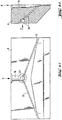
- the clips grip the edge area of the film so that essentially only the mixture of polymer B and simple recycled polymer A is stretched into a thin film (14) and the edges (12) of the polymer A remain unstretched and thick.
- a corresponding schematic representation shows FIG. 1 ,
- the temperatures at which the longitudinal and the transverse extension are carried out can vary within a wide range and depend on the particular composition of the layers and on the desired properties of the film. In general, the longitudinal stretching at 80 to 160 ° C, preferably 100 to 160 ° C, and the transverse extension at 120 to 170 ° C, preferably 130 to 160 ° C, carried out.
- the biaxial stretching of the film is followed by its heat-setting (heat treatment), the film being kept at a temperature of 100 to 160 ° C., preferably 110 to 130 ° C., for about 0.1 to 10 seconds.
- one or both surfaces of the film will be corona or flame or plasma treated by one of the known methods.
- the treatment intensities are within the usual limits, with 35 to 50 mN / m, preferably 36 to 45 mN / m.
- the film is passed between two conductor elements serving as electrodes, whereby such high voltage, usually alternating voltage (approximately 10,000 V and 10,000 Hz), is applied between the electrodes so that spray or corona discharges can take place.
- high voltage usually alternating voltage (approximately 10,000 V and 10,000 Hz)
- alternating voltage approximately 10,000 V and 10,000 Hz
- the film is lined with conventional cutting devices, and the film itself is wound up with a take-up device known per se.
- the width of the two edges to be lined is up to 300 mm, preferably 100 to 200 mm, and consists of at least 90 wt .-%, preferably from 95 to 100 wt .-%, in particular 99 to 100 wt .-% of the propylene polymer A.
- the width of the hemmed edge should advantageously be chosen so that as far as possible the entire material separated as edge strip material to nearly 100 wt .-%, ie only consists of the virgin polymer A.
- the advantage of the method according to the invention lies in the fact that it is not necessary to separate the edge strip so broad that the film does not even more edge polymer A more, since the polymer A now has sufficient film quality and no Areas with impaired quality forms.
- it is in the process after EP 0 740 993 It is absolutely necessary to cut off the edge strip so far that everything on polymer A is cut away and the film no longer contains polymer A. This then results in a trim strip blend which is a blend of polymer A and minor amounts of polymer B.
- the procedure requires EP 0 740 993 to seam a comparatively wide edge strip, whereas according to the present inventive method, the width of the edge strip to be seamed can be kept narrow.
- this applies in particular if identical raw materials are used as polymer A and B, as is the case in a preferred embodiment.
- the film edge has a thickness of up to 200 ⁇ m, generally from 20 to 100 ⁇ m, preferably from 20 to 50 ⁇ m. Depending on the circumstances, edge thicknesses above or below may also be suitable.
- the cut-off (hemmed) edge regions are chopped, optionally once granulated, mixed with the polymer B and thus reused as recyclate in the film.
- the process according to the invention ensures that the propylene polymer A in the finished film has passed through the extrusion process a maximum of three times, preferably only twice, first as a marginal strip material and then as an admixture with the actual film raw material.
- a third extrusion step may be added if regranulation of the cut edge trim material occurs prior to blending with polymer B. Since the marginal strip of the film is driven continuously and completely from virgin polymer in the manufacturing process, no material can be produced which is multiply, i. more than two or three times through an extrusion process. Surprisingly, neither the electrical nor other properties of the film are adversely affected by the proportion of once recycled polymers.
- the film produced by this process according to the invention is therefore outstandingly suitable for use as a dielectric in capacitors.
- the film may be previously known from those known in the art Method to be metallized. It has been found that the recylate contents affect the performance characteristics of the capacitors only insignificantly or not at all. Thus, significant cost advantages without sacrificing quality are possible.
- the melt flow index was measured on the basis of DIN 53 735 at 21.6 N load and 230 ° C.
- the modulus of elasticity is determined at the earliest 10 days after production in accordance with EN ISO 521-1 on a sample of size 15 * 100 mm 2 .
- the longitudinal and transverse shrinkage values relate to the respective longitudinal extent of the film (longitudinal L 0 and transverse Q 0 ) before the shrinking process.
- the longitudinal direction is the machine direction, as the transverse direction is defined according to the direction transverse to the machine.
- the test piece of 10 * 10cm 2 is shrunk in a convection oven at the respective temperature (from 100 to 140 ° C) over a period of 15 minutes. Subsequently, the remaining length expansions of the specimen are determined longitudinally and transversely again (L 1 and Q 1 ). The difference between the determined length expansions in relation to the original length L 0 and Q 0 times 100 is then given as shrinkage in%.
- the samples are placed in a drying cabinet.
- the lower electrode plate is made of brass.
- the upper electrode is cylindrical and also made of brass.
- the test voltage is 1V. The measurement takes place at three frequencies of 0.1 KHz, 1 KHz and 10 KHz.
- Residual ash content
- the proportion of non-combustible mineral fillers is determined quantitatively.
- the residual ash content (loss on ignition) is calculated from the starting weight of the sample and the ignition residue. The measurement result is given in ppm. From the material to be tested (granulate, regenerated, etc.) a representative sample of approx. 1 kg is taken. The material must be clean and completely dry; possibly a predrying at about 80 ° C in the circulating air cabinet is required. Three empty porcelain crucibles will be annealed for at least 1 h at a temperature of 650 ° C in a crucible and weighed after cooling in a desiccator to room temperature to 0.1 mg accuracy.
- the chlorine content in polyolefins is measured quantitatively by means of X-ray fluorescence analysis (RFA) according to DIN 51 001, Part 1. It is pressed a tablet of granules / powder, which is measured with the RFA against a calibration curve. The calibration curve was established with the help of 10 calibration samples, in which the chlorine content was determined by an independent method (nasstechnisch).
- RFA X-ray fluorescence analysis
- a transparent film with a thickness of 6 ⁇ m and an untwisted width of 4940 mm was produced by extrusion and subsequent stepwise orientation in the longitudinal and transverse direction.
- the produced film was single-layered.
- the adjacent melts "Säumstsammlung-Folie-Säumst Shape" were run from the same raw material.
- the adapter technique was used, which was rotated by 90 ° with respect to the usual arrangement in a multilayer coextrusion
- the indicated transverse stretch ratio is an effective value. This RMS value is calculated from the final film width, reduced by the double seam strip width divided by the width of the elongated film which is also reduced by twice the seam strip width.
- Example 1 Compared to Example 1, the film shreds were processed in a separate processing step by re-melting and cooling to regranulate. This regranulate was then used in an analogous way together with the Film raw material B processed. In this way, further films were produced containing 5%, 10%, 30% of simply recycled raw material.
- Example 1 Compared to Example 1, the edge region was not driven with a separate melt stream, but film and edge region from an extruder. As described in Example 1, the edge region was hemmed, chopped and reused in film production. In this way, a film was produced, which contained about 22% multi-recylated raw material.
- Example 1 Compared to Example 1, the edge region was not driven with a separate melt stream, but film and edge region from an extruder. The border area was lined and discarded, i. The film production took place only with original raw material and contained neither simple nor multiply recycled raw material.
- a film was produced as described in Example 1.
- a three-layered film was coextruded, which had a cover layer on both surfaces of the base layer.
- the base layer corresponded to the film from Example 1.
- the two additional cover layers were composed of 100% by weight of the propylene polymer B according to Example 1.
- the thickness of the base layer was about 5 ⁇ m.
- the thickness of each cover layer was about 0.5 .mu.m, so that the total thickness of the film was 6 .mu.m as in example 1.
- the remaining composition, as well as the process conditions were not changed compared to Example 1. In this way, a three-layered film was produced, which contained about 26 wt .-% once recycled polymer in the base layer (corresponding to 22 wt .-% based on the film).
- Example 2b A film was produced as described in Example 2b. In contrast to Example 2b, a three-layered film was coextruded, which on both
- the base layer corresponded to the film of Example 2b.
- the two additional cover layers were composed of 100% by weight of the propylene polymer B according to Example 2b.
- the thickness of the base layer was about 5 ⁇ m.
- the thickness of each cover layer was about 0.5 .mu.m, so that the total thickness of the film was 6 .mu.m as in example 2b.
- the remaining composition and the process conditions were not changed compared to Example 2b. In this way, a three-layer film was produced, which contained about 12 wt .-% once recycled polymer in the base layer (corresponding to 10 wt .-% based on the film).
Landscapes
- Engineering & Computer Science (AREA)
- Mechanical Engineering (AREA)
- Manufacturing & Machinery (AREA)
- Chemical & Material Sciences (AREA)
- Power Engineering (AREA)
- Health & Medical Sciences (AREA)
- Medicinal Chemistry (AREA)
- Environmental & Geological Engineering (AREA)
- Physics & Mathematics (AREA)
- Materials Engineering (AREA)
- Microelectronics & Electronic Packaging (AREA)
- Chemical Kinetics & Catalysis (AREA)
- Spectroscopy & Molecular Physics (AREA)
- Polymers & Plastics (AREA)
- Organic Chemistry (AREA)
- Extrusion Moulding Of Plastics Or The Like (AREA)
- Laminated Bodies (AREA)
- Shaping By String And By Release Of Stress In Plastics And The Like (AREA)
- Separation, Recovery Or Treatment Of Waste Materials Containing Plastics (AREA)
- Compositions Of Macromolecular Compounds (AREA)
- Fixed Capacitors And Capacitor Manufacturing Machines (AREA)
Applications Claiming Priority (2)
| Application Number | Priority Date | Filing Date | Title |
|---|---|---|---|
| DE102008061504 | 2008-12-10 | ||
| PCT/EP2009/008746 WO2010066398A1 (de) | 2008-12-10 | 2009-12-08 | Verfahren zur herstellung von polypropylenfolien |
Publications (2)
| Publication Number | Publication Date |
|---|---|
| EP2376265A1 EP2376265A1 (de) | 2011-10-19 |
| EP2376265B1 true EP2376265B1 (de) | 2018-10-03 |
Family
ID=41820385
Family Applications (1)
| Application Number | Title | Priority Date | Filing Date |
|---|---|---|---|
| EP09771510.6A Not-in-force EP2376265B1 (de) | 2008-12-10 | 2009-12-08 | Verfahren zur herstellung von polypropylenfolien, biaxial orientierte polypropylenfolie |
Country Status (9)
| Country | Link |
|---|---|
| US (2) | US8980144B2 (enExample) |
| EP (1) | EP2376265B1 (enExample) |
| JP (2) | JP5726746B2 (enExample) |
| KR (1) | KR101807191B1 (enExample) |
| CN (1) | CN102245363B (enExample) |
| BR (1) | BRPI0922267B1 (enExample) |
| MX (1) | MX2011005987A (enExample) |
| RU (1) | RU2480330C2 (enExample) |
| WO (1) | WO2010066398A1 (enExample) |
Families Citing this family (17)
| Publication number | Priority date | Publication date | Assignee | Title |
|---|---|---|---|---|
| JP5333746B2 (ja) * | 2009-02-20 | 2013-11-06 | 株式会社村田製作所 | フィルムコンデンサ |
| FI125678B (fi) * | 2011-08-26 | 2016-01-15 | Bioretec Oy | Bioabsorboituva, orientoitu, muotoiltava kiinnitysmateriaali ja -levy |
| DE102012215133A1 (de) | 2012-08-24 | 2014-02-27 | Tesa Se | Strapping-Klebeband |
| JP6255258B2 (ja) * | 2013-03-05 | 2017-12-27 | 昭和電工パッケージング株式会社 | 成形用包装材及び成形ケース |
| JP6338866B2 (ja) * | 2014-01-17 | 2018-06-06 | 東洋鋼鈑株式会社 | 延伸フィルムの製造方法 |
| JP6338864B2 (ja) * | 2014-01-17 | 2018-06-06 | 東洋鋼鈑株式会社 | 延伸フィルムの製造方法 |
| CN104802417B (zh) * | 2015-05-05 | 2017-01-25 | 烟台天塑包装材料有限公司 | 一种渔竿膜的生产方法 |
| JP6379337B2 (ja) * | 2015-06-26 | 2018-08-29 | グリーンプラ株式会社 | フレキシブルコンテナより製造された梱包用バンド |
| CN108431914A (zh) | 2015-09-14 | 2018-08-21 | 波利美普拉斯有限责任公司 | 多组分层状介电膜及其用途 |
| JP2018141122A (ja) * | 2017-02-28 | 2018-09-13 | 東洋紡株式会社 | 二軸配向ポリプロピレンフィルム |
| PL129432U1 (pl) * | 2018-01-17 | 2021-09-20 | Cherniavskyi Valentyn Feodosevych | Blok pontonowy o dużych wymiarach |
| EP4017918B1 (en) * | 2019-08-19 | 2024-07-24 | Borealis AG | Polypropylene - polyethylene blends with improved properties |
| US12047016B2 (en) | 2020-07-17 | 2024-07-23 | Toyota Motor Engineering & Manufacturing North America, Inc. | Artificial muscle actuators comprising electrodes with an insulation bilayer |
| EP3944942B1 (en) * | 2020-07-31 | 2025-10-08 | The Procter & Gamble Company | Use of post-industrial recycled material in flexible packages |
| JP7644786B2 (ja) * | 2023-02-17 | 2025-03-12 | 日東電工株式会社 | 延伸フィルムの製造方法 |
| AT527158B1 (de) * | 2023-05-03 | 2026-04-15 | Teufelberger Gmbh | Verfahren zur Herstellung von Kunststoff-Umreifungsbändern |
| AT527157A1 (de) * | 2023-05-03 | 2024-11-15 | Teufelberger Gmbh | Verfahren zur Herstellung von mehrschichtigen Kunststoff-Umreifungsbändern sowie mehrschichtiges Kunststoff-Umreifungsband |
Family Cites Families (16)
| Publication number | Priority date | Publication date | Assignee | Title |
|---|---|---|---|---|
| US3223764A (en) * | 1961-11-28 | 1965-12-14 | Nat Distillers Chem Corp | Process for production of biaxially oriented polypropylene film |
| DE3740449A1 (de) * | 1987-11-28 | 1989-06-08 | Hoechst Ag | Coextrudierte, biaxial orientierte mehrschichtfolie |
| US5128212A (en) * | 1990-05-18 | 1992-07-07 | E. I. Du Pont De Nemours And Company | Multilayer heat shrinkable polymeric film containing recycle polymer |
| DE4101650A1 (de) * | 1991-01-22 | 1992-07-23 | Hoechst Ag | Biaxial gestreckte polypropylenmonofolie |
| EP0679487A1 (en) * | 1994-04-28 | 1995-11-02 | W.R. Grace & Co.-Conn. | Multi-layer polyolefin film containing recycle polymer from cross-linked films |
| US6534189B1 (en) * | 1994-07-15 | 2003-03-18 | Exxonmobil Oil Corporation | Uniaxially shrinkable biaxially oriented polypropylene film and method for use as tobacco pack overwrap |
| JPH08207119A (ja) * | 1994-10-19 | 1996-08-13 | Diafoil Co Ltd | 熱可塑性樹脂シート又はフイルムの製造方法 |
| DE19515599A1 (de) * | 1995-05-02 | 1996-11-07 | Hoechst Ag | Verfahren zur Herstellung von Polypropylenfolien und deren Verwendung |
| JP2001072778A (ja) * | 1999-07-08 | 2001-03-21 | Toray Ind Inc | 二軸配向ポリプロピレンフィルム |
| US7098277B2 (en) * | 2000-08-22 | 2006-08-29 | Exxonmobil Chemical Patents Inc. | Polypropylene films |
| DE10124209A1 (de) * | 2001-05-18 | 2002-11-21 | Wolff Walsrode Ag | Polyolefinfolie mit peelfähiger Deckschicht |
| JP3944846B2 (ja) * | 2002-12-03 | 2007-07-18 | 富士フイルム株式会社 | 樹脂膜の形成方法及び装置 |
| US20080233413A1 (en) * | 2005-10-18 | 2008-09-25 | Applied Extrusion Technologies, Inc. | Polypropylene films employing recycled commercially used polypropylene based films and labels |
| US7666518B2 (en) * | 2006-07-12 | 2010-02-23 | Toray Plastics (America), Inc. | Reprocessed polyhydroxy amino ether coated polypropylene film |
| ES2385999T3 (es) * | 2006-08-31 | 2012-08-07 | Treofan Germany Gmbh & Co. Kg | Película aislante eléctrica orientada biaxialmente. |
| US8460588B2 (en) * | 2007-07-30 | 2013-06-11 | Kimberly-Clark Worldwide, Inc. | Cross directional zoned bicomponent films, film laminates, and systems and methods for manufacture of the same |
-
2009
- 2009-12-08 MX MX2011005987A patent/MX2011005987A/es active IP Right Grant
- 2009-12-08 US US13/132,966 patent/US8980144B2/en not_active Expired - Fee Related
- 2009-12-08 RU RU2011128394/05A patent/RU2480330C2/ru not_active IP Right Cessation
- 2009-12-08 JP JP2011539943A patent/JP5726746B2/ja active Active
- 2009-12-08 EP EP09771510.6A patent/EP2376265B1/de not_active Not-in-force
- 2009-12-08 BR BRPI0922267-7A patent/BRPI0922267B1/pt not_active IP Right Cessation
- 2009-12-08 CN CN200980149222.7A patent/CN102245363B/zh not_active Expired - Fee Related
- 2009-12-08 KR KR1020117011323A patent/KR101807191B1/ko not_active Expired - Fee Related
- 2009-12-08 WO PCT/EP2009/008746 patent/WO2010066398A1/de not_active Ceased
-
2014
- 2014-09-04 US US14/477,345 patent/US20140370312A1/en not_active Abandoned
-
2015
- 2015-03-30 JP JP2015069700A patent/JP6348864B2/ja not_active Expired - Fee Related
Non-Patent Citations (1)
| Title |
|---|
| None * |
Also Published As
| Publication number | Publication date |
|---|---|
| JP2012511446A (ja) | 2012-05-24 |
| BRPI0922267B1 (pt) | 2019-10-15 |
| RU2011128394A (ru) | 2013-01-20 |
| RU2480330C2 (ru) | 2013-04-27 |
| CN102245363A (zh) | 2011-11-16 |
| US20110236702A1 (en) | 2011-09-29 |
| JP5726746B2 (ja) | 2015-06-03 |
| JP6348864B2 (ja) | 2018-06-27 |
| MX2011005987A (es) | 2011-09-15 |
| EP2376265A1 (de) | 2011-10-19 |
| KR101807191B1 (ko) | 2017-12-08 |
| BRPI0922267A2 (pt) | 2016-08-02 |
| CN102245363B (zh) | 2015-05-06 |
| US8980144B2 (en) | 2015-03-17 |
| KR20110128783A (ko) | 2011-11-30 |
| US20140370312A1 (en) | 2014-12-18 |
| WO2010066398A1 (de) | 2010-06-17 |
| JP2015143029A (ja) | 2015-08-06 |
Similar Documents
| Publication | Publication Date | Title |
|---|---|---|
| EP2376265A1 (de) | Verfahren zur herstellung von polypropylenfolien | |
| EP0740993B1 (de) | Verfahren zur Herstellung von Polypropylenfolien | |
| EP1141982B2 (de) | Biaxial orientierte elektroisolierfolie mit verbessertem schrumpf bei erhöhten temperaturen | |
| DE69714022T2 (de) | Polypropylenfolie und kondensator hergestellt durch verwendung derselben als dielektrikum | |
| EP0755779B1 (de) | Biaxial orientierte Polypropylenfolie mit erhöhter Dimensionsstabilität | |
| DE102020006588A1 (de) | Kondensator enthaltend biaxial verstreckte Polypropylen-Cycloolefinpolymer-Folie als Dielektrikum und Verwendung dieser Folie | |
| EP2563852B1 (de) | Hochporöse separator-folie | |
| EP2842990B1 (de) | Mikroporöse Folie für Doppelschichtkondensatoren | |
| EP0622186B1 (de) | Matte, siegelbare, schrumpffähige, biaxial orientierte Polypropylen-Mehrschichtfolie, Verfahren zu ihrer Herstellung und ihre Verwendung | |
| WO2008025796A1 (de) | Biaxial orientierte elektroisolierfolie | |
| DE69017503T2 (de) | Film zum Laminieren von Klichees. | |
| EP0745637A1 (de) | Biaxial orientierte Polypropylenfolie mit hohem Flächenmodul | |
| DE4101650A1 (de) | Biaxial gestreckte polypropylenmonofolie | |
| WO2008034694A1 (de) | Biaxial orientierte elektroisolierfolie | |
| EP2510565A1 (de) | Mikroporöse folie für batterien mit abschaltfunktion | |
| DE102008061746A1 (de) | Einschichtige mikroporöse Folie für Batterien mit Abschaltfunktion | |
| DE4306153A1 (de) | Siegelfähige orientierte Polyolefin-Mehrschichtfolie, Verfahren zu ihrer Herstellung und ihre Verwendung | |
| EP0361280A2 (de) | Biaxial orientierte Polypropylenfolie für die Metallisieranwendung | |
| EP2274168A2 (de) | Mikroporöse mehrschicht-membranfolie auf polypropylenbasis für batterien mit abschaltfunktion | |
| DE10022306A1 (de) | Transparente biaxial orientierte Polyolefinfolie mit verbesserten Hafteigenschaften | |
| EP0318779B1 (de) | Coextrudierte, biaxial orientierte Mehrschichtfolie | |
| EP0362563A2 (de) | Hochleistungsdielektrikumsfolie mit verbesserter Thermostabilität | |
| EP0779144A2 (de) | Verfahren zur Längsstreckung bei der Herstellung orientierter Polypropylenfolien | |
| EP2491074B1 (de) | Verwendung einer porösen polypropylenfolie als innenumhüllung einer zigarettenverpackung | |
| EP1781468B1 (de) | Metallisierte folie mit guten barriereeigenschaften |
Legal Events
| Date | Code | Title | Description |
|---|---|---|---|
| PUAI | Public reference made under article 153(3) epc to a published international application that has entered the european phase |
Free format text: ORIGINAL CODE: 0009012 |
|
| 17P | Request for examination filed |
Effective date: 20110711 |
|
| AK | Designated contracting states |
Kind code of ref document: A1 Designated state(s): AT BE BG CH CY CZ DE DK EE ES FI FR GB GR HR HU IE IS IT LI LT LU LV MC MK MT NL NO PL PT RO SE SI SK SM TR |
|
| RIN1 | Information on inventor provided before grant (corrected) |
Inventor name: BUSCH, DETLEF Inventor name: SCHAAN, JOSEF Inventor name: EIDEN, HARALD Inventor name: PETERS, CHRISTIAN |
|
| DAX | Request for extension of the european patent (deleted) | ||
| 17Q | First examination report despatched |
Effective date: 20151112 |
|
| GRAP | Despatch of communication of intention to grant a patent |
Free format text: ORIGINAL CODE: EPIDOSNIGR1 |
|
| INTG | Intention to grant announced |
Effective date: 20180606 |
|
| GRAS | Grant fee paid |
Free format text: ORIGINAL CODE: EPIDOSNIGR3 |
|
| GRAA | (expected) grant |
Free format text: ORIGINAL CODE: 0009210 |
|
| AK | Designated contracting states |
Kind code of ref document: B1 Designated state(s): AT BE BG CH CY CZ DE DK EE ES FI FR GB GR HR HU IE IS IT LI LT LU LV MC MK MT NL NO PL PT RO SE SI SK SM TR |
|
| REG | Reference to a national code |
Ref country code: GB Ref legal event code: FG4D Free format text: NOT ENGLISH |
|
| REG | Reference to a national code |
Ref country code: CH Ref legal event code: EP Ref country code: AT Ref legal event code: REF Ref document number: 1048121 Country of ref document: AT Kind code of ref document: T Effective date: 20181015 |
|
| REG | Reference to a national code |
Ref country code: IE Ref legal event code: FG4D Free format text: LANGUAGE OF EP DOCUMENT: GERMAN Ref country code: DE Ref legal event code: R096 Ref document number: 502009015344 Country of ref document: DE |
|
| PGFP | Annual fee paid to national office [announced via postgrant information from national office to epo] |
Ref country code: FI Payment date: 20181213 Year of fee payment: 10 |
|
| REG | Reference to a national code |
Ref country code: NL Ref legal event code: MP Effective date: 20181003 |
|
| REG | Reference to a national code |
Ref country code: LT Ref legal event code: MG4D |
|
| PGFP | Annual fee paid to national office [announced via postgrant information from national office to epo] |
Ref country code: FR Payment date: 20181218 Year of fee payment: 10 |
|
| PG25 | Lapsed in a contracting state [announced via postgrant information from national office to epo] |
Ref country code: NL Free format text: LAPSE BECAUSE OF FAILURE TO SUBMIT A TRANSLATION OF THE DESCRIPTION OR TO PAY THE FEE WITHIN THE PRESCRIBED TIME-LIMIT Effective date: 20181003 |
|
| PG25 | Lapsed in a contracting state [announced via postgrant information from national office to epo] |
Ref country code: CZ Free format text: LAPSE BECAUSE OF FAILURE TO SUBMIT A TRANSLATION OF THE DESCRIPTION OR TO PAY THE FEE WITHIN THE PRESCRIBED TIME-LIMIT Effective date: 20181003 Ref country code: IS Free format text: LAPSE BECAUSE OF FAILURE TO SUBMIT A TRANSLATION OF THE DESCRIPTION OR TO PAY THE FEE WITHIN THE PRESCRIBED TIME-LIMIT Effective date: 20190203 Ref country code: BG Free format text: LAPSE BECAUSE OF FAILURE TO SUBMIT A TRANSLATION OF THE DESCRIPTION OR TO PAY THE FEE WITHIN THE PRESCRIBED TIME-LIMIT Effective date: 20190103 Ref country code: PL Free format text: LAPSE BECAUSE OF FAILURE TO SUBMIT A TRANSLATION OF THE DESCRIPTION OR TO PAY THE FEE WITHIN THE PRESCRIBED TIME-LIMIT Effective date: 20181003 Ref country code: ES Free format text: LAPSE BECAUSE OF FAILURE TO SUBMIT A TRANSLATION OF THE DESCRIPTION OR TO PAY THE FEE WITHIN THE PRESCRIBED TIME-LIMIT Effective date: 20181003 Ref country code: LT Free format text: LAPSE BECAUSE OF FAILURE TO SUBMIT A TRANSLATION OF THE DESCRIPTION OR TO PAY THE FEE WITHIN THE PRESCRIBED TIME-LIMIT Effective date: 20181003 Ref country code: LV Free format text: LAPSE BECAUSE OF FAILURE TO SUBMIT A TRANSLATION OF THE DESCRIPTION OR TO PAY THE FEE WITHIN THE PRESCRIBED TIME-LIMIT Effective date: 20181003 Ref country code: HR Free format text: LAPSE BECAUSE OF FAILURE TO SUBMIT A TRANSLATION OF THE DESCRIPTION OR TO PAY THE FEE WITHIN THE PRESCRIBED TIME-LIMIT Effective date: 20181003 Ref country code: NO Free format text: LAPSE BECAUSE OF FAILURE TO SUBMIT A TRANSLATION OF THE DESCRIPTION OR TO PAY THE FEE WITHIN THE PRESCRIBED TIME-LIMIT Effective date: 20190103 |
|
| PGFP | Annual fee paid to national office [announced via postgrant information from national office to epo] |
Ref country code: DE Payment date: 20181227 Year of fee payment: 10 |
|
| PG25 | Lapsed in a contracting state [announced via postgrant information from national office to epo] |
Ref country code: PT Free format text: LAPSE BECAUSE OF FAILURE TO SUBMIT A TRANSLATION OF THE DESCRIPTION OR TO PAY THE FEE WITHIN THE PRESCRIBED TIME-LIMIT Effective date: 20190203 Ref country code: SE Free format text: LAPSE BECAUSE OF FAILURE TO SUBMIT A TRANSLATION OF THE DESCRIPTION OR TO PAY THE FEE WITHIN THE PRESCRIBED TIME-LIMIT Effective date: 20181003 Ref country code: GR Free format text: LAPSE BECAUSE OF FAILURE TO SUBMIT A TRANSLATION OF THE DESCRIPTION OR TO PAY THE FEE WITHIN THE PRESCRIBED TIME-LIMIT Effective date: 20190104 |
|
| PGFP | Annual fee paid to national office [announced via postgrant information from national office to epo] |
Ref country code: SK Payment date: 20181203 Year of fee payment: 10 |
|
| REG | Reference to a national code |
Ref country code: DE Ref legal event code: R097 Ref document number: 502009015344 Country of ref document: DE |
|
| PG25 | Lapsed in a contracting state [announced via postgrant information from national office to epo] |
Ref country code: IT Free format text: LAPSE BECAUSE OF FAILURE TO SUBMIT A TRANSLATION OF THE DESCRIPTION OR TO PAY THE FEE WITHIN THE PRESCRIBED TIME-LIMIT Effective date: 20181003 Ref country code: DK Free format text: LAPSE BECAUSE OF FAILURE TO SUBMIT A TRANSLATION OF THE DESCRIPTION OR TO PAY THE FEE WITHIN THE PRESCRIBED TIME-LIMIT Effective date: 20181003 |
|
| REG | Reference to a national code |
Ref country code: CH Ref legal event code: PL |
|
| PLBE | No opposition filed within time limit |
Free format text: ORIGINAL CODE: 0009261 |
|
| STAA | Information on the status of an ep patent application or granted ep patent |
Free format text: STATUS: NO OPPOSITION FILED WITHIN TIME LIMIT |
|
| PG25 | Lapsed in a contracting state [announced via postgrant information from national office to epo] |
Ref country code: EE Free format text: LAPSE BECAUSE OF FAILURE TO SUBMIT A TRANSLATION OF THE DESCRIPTION OR TO PAY THE FEE WITHIN THE PRESCRIBED TIME-LIMIT Effective date: 20181003 Ref country code: LU Free format text: LAPSE BECAUSE OF NON-PAYMENT OF DUE FEES Effective date: 20181208 Ref country code: RO Free format text: LAPSE BECAUSE OF FAILURE TO SUBMIT A TRANSLATION OF THE DESCRIPTION OR TO PAY THE FEE WITHIN THE PRESCRIBED TIME-LIMIT Effective date: 20181003 Ref country code: MC Free format text: LAPSE BECAUSE OF FAILURE TO SUBMIT A TRANSLATION OF THE DESCRIPTION OR TO PAY THE FEE WITHIN THE PRESCRIBED TIME-LIMIT Effective date: 20181003 Ref country code: SM Free format text: LAPSE BECAUSE OF FAILURE TO SUBMIT A TRANSLATION OF THE DESCRIPTION OR TO PAY THE FEE WITHIN THE PRESCRIBED TIME-LIMIT Effective date: 20181003 |
|
| 26N | No opposition filed |
Effective date: 20190704 |
|
| REG | Reference to a national code |
Ref country code: IE Ref legal event code: MM4A |
|
| GBPC | Gb: european patent ceased through non-payment of renewal fee |
Effective date: 20190103 |
|
| REG | Reference to a national code |
Ref country code: BE Ref legal event code: MM Effective date: 20181231 |
|
| PG25 | Lapsed in a contracting state [announced via postgrant information from national office to epo] |
Ref country code: SI Free format text: LAPSE BECAUSE OF FAILURE TO SUBMIT A TRANSLATION OF THE DESCRIPTION OR TO PAY THE FEE WITHIN THE PRESCRIBED TIME-LIMIT Effective date: 20181003 Ref country code: IE Free format text: LAPSE BECAUSE OF NON-PAYMENT OF DUE FEES Effective date: 20181208 |
|
| PG25 | Lapsed in a contracting state [announced via postgrant information from national office to epo] |
Ref country code: BE Free format text: LAPSE BECAUSE OF NON-PAYMENT OF DUE FEES Effective date: 20181231 |
|
| PG25 | Lapsed in a contracting state [announced via postgrant information from national office to epo] |
Ref country code: GB Free format text: LAPSE BECAUSE OF NON-PAYMENT OF DUE FEES Effective date: 20190103 Ref country code: LI Free format text: LAPSE BECAUSE OF NON-PAYMENT OF DUE FEES Effective date: 20181231 Ref country code: CH Free format text: LAPSE BECAUSE OF NON-PAYMENT OF DUE FEES Effective date: 20181231 |
|
| PG25 | Lapsed in a contracting state [announced via postgrant information from national office to epo] |
Ref country code: MT Free format text: LAPSE BECAUSE OF FAILURE TO SUBMIT A TRANSLATION OF THE DESCRIPTION OR TO PAY THE FEE WITHIN THE PRESCRIBED TIME-LIMIT Effective date: 20181003 |
|
| REG | Reference to a national code |
Ref country code: AT Ref legal event code: MM01 Ref document number: 1048121 Country of ref document: AT Kind code of ref document: T Effective date: 20181208 |
|
| PG25 | Lapsed in a contracting state [announced via postgrant information from national office to epo] |
Ref country code: TR Free format text: LAPSE BECAUSE OF FAILURE TO SUBMIT A TRANSLATION OF THE DESCRIPTION OR TO PAY THE FEE WITHIN THE PRESCRIBED TIME-LIMIT Effective date: 20181003 |
|
| PG25 | Lapsed in a contracting state [announced via postgrant information from national office to epo] |
Ref country code: AT Free format text: LAPSE BECAUSE OF NON-PAYMENT OF DUE FEES Effective date: 20181208 |
|
| PG25 | Lapsed in a contracting state [announced via postgrant information from national office to epo] |
Ref country code: CY Free format text: LAPSE BECAUSE OF FAILURE TO SUBMIT A TRANSLATION OF THE DESCRIPTION OR TO PAY THE FEE WITHIN THE PRESCRIBED TIME-LIMIT Effective date: 20181003 Ref country code: HU Free format text: LAPSE BECAUSE OF FAILURE TO SUBMIT A TRANSLATION OF THE DESCRIPTION OR TO PAY THE FEE WITHIN THE PRESCRIBED TIME-LIMIT; INVALID AB INITIO Effective date: 20091208 Ref country code: MK Free format text: LAPSE BECAUSE OF NON-PAYMENT OF DUE FEES Effective date: 20181003 |
|
| REG | Reference to a national code |
Ref country code: DE Ref legal event code: R119 Ref document number: 502009015344 Country of ref document: DE |
|
| REG | Reference to a national code |
Ref country code: FI Ref legal event code: MAE |
|
| PG25 | Lapsed in a contracting state [announced via postgrant information from national office to epo] |
Ref country code: FI Free format text: LAPSE BECAUSE OF NON-PAYMENT OF DUE FEES Effective date: 20191208 |
|
| REG | Reference to a national code |
Ref country code: SK Ref legal event code: MM4A Ref document number: E 29700 Country of ref document: SK Effective date: 20191208 |
|
| PG25 | Lapsed in a contracting state [announced via postgrant information from national office to epo] |
Ref country code: FR Free format text: LAPSE BECAUSE OF NON-PAYMENT OF DUE FEES Effective date: 20191231 Ref country code: DE Free format text: LAPSE BECAUSE OF NON-PAYMENT OF DUE FEES Effective date: 20200701 Ref country code: SK Free format text: LAPSE BECAUSE OF NON-PAYMENT OF DUE FEES Effective date: 20191208 |