EP2323987B1 - N-myristoyl transferase inhibitoren - Google Patents
N-myristoyl transferase inhibitoren Download PDFInfo
- Publication number
- EP2323987B1 EP2323987B1 EP09785018.4A EP09785018A EP2323987B1 EP 2323987 B1 EP2323987 B1 EP 2323987B1 EP 09785018 A EP09785018 A EP 09785018A EP 2323987 B1 EP2323987 B1 EP 2323987B1
- Authority
- EP
- European Patent Office
- Prior art keywords
- optionally substituted
- compound
- independently selected
- ring
- formula
- Prior art date
- Legal status (The legal status is an assumption and is not a legal conclusion. Google has not performed a legal analysis and makes no representation as to the accuracy of the status listed.)
- Active
Links
- 0 C*(CC1=CC(C)(*)NN=C1)N(*)S(c1c(*)c(C)c(**N(*)*)c(*)c1*)(=O)=O Chemical compound C*(CC1=CC(C)(*)NN=C1)N(*)S(c1c(*)c(C)c(**N(*)*)c(*)c1*)(=O)=O 0.000 description 5
- BWTVIKDFNCJEHI-ZIOPAAQOSA-M CC(/C=C(\C=C(/CS(Nc1c(C)[n](C)nc1C)([O-])=O)\Cl)/c1cc(N2CCNCC2)ccc1)Cl Chemical compound CC(/C=C(\C=C(/CS(Nc1c(C)[n](C)nc1C)([O-])=O)\Cl)/c1cc(N2CCNCC2)ccc1)Cl BWTVIKDFNCJEHI-ZIOPAAQOSA-M 0.000 description 1
- VLBFCTXRULRITC-UHFFFAOYSA-M CC(C)(C)c(cc1)ccc1SCc(cc1)ccc1S(Nc1c(C)[n](C)nc1C)([O-])=O Chemical compound CC(C)(C)c(cc1)ccc1SCc(cc1)ccc1S(Nc1c(C)[n](C)nc1C)([O-])=O VLBFCTXRULRITC-UHFFFAOYSA-M 0.000 description 1
- NJTISSYDMYOXNE-UHFFFAOYSA-M CC(C)Cc1n[n](C)c(C)c1NS(c(cc1)ccc1-c1cc(CNCCC2)c2cc1)([O-])=O Chemical compound CC(C)Cc1n[n](C)c(C)c1NS(c(cc1)ccc1-c1cc(CNCCC2)c2cc1)([O-])=O NJTISSYDMYOXNE-UHFFFAOYSA-M 0.000 description 1
- VMPZEHJAGDOEPY-UHFFFAOYSA-N CC(C)Cc1n[n](C)c(C)c1NS(c(cc1)ccc1-c1cccc(CNCc2ccccc2)c1)(O)=O Chemical compound CC(C)Cc1n[n](C)c(C)c1NS(c(cc1)ccc1-c1cccc(CNCc2ccccc2)c1)(O)=O VMPZEHJAGDOEPY-UHFFFAOYSA-N 0.000 description 1
- POTVFFXGRINLJD-UHFFFAOYSA-O CC(C)Cc1n[n](C)c(C)c1N[S+](c(cc1)ccc1-c1cc(CNCC2)c2cc1)(O)=O Chemical compound CC(C)Cc1n[n](C)c(C)c1N[S+](c(cc1)ccc1-c1cc(CNCC2)c2cc1)(O)=O POTVFFXGRINLJD-UHFFFAOYSA-O 0.000 description 1
- MKNZGBULAXXHKI-UHFFFAOYSA-O CC(C)Cc1n[n](C)c(C)c1N[S+](c1ccc(CCCOC2=CCN(C)CC2)cc1)(O)=O Chemical compound CC(C)Cc1n[n](C)c(C)c1N[S+](c1ccc(CCCOC2=CCN(C)CC2)cc1)(O)=O MKNZGBULAXXHKI-UHFFFAOYSA-O 0.000 description 1
- NDTSAFMUMIDDOI-UHFFFAOYSA-N CC(C)Oc1cc(CN2CCN(C)CC2)cc(-c(cc2)ccc2[S+](Nc2c(C)[n](C)nc2C)([O-])=O)c1 Chemical compound CC(C)Oc1cc(CN2CCN(C)CC2)cc(-c(cc2)ccc2[S+](Nc2c(C)[n](C)nc2C)([O-])=O)c1 NDTSAFMUMIDDOI-UHFFFAOYSA-N 0.000 description 1
- WSUMDJISGNULJO-UHFFFAOYSA-N CCN(CC)Cc1cc(-c(cc2)ccc2[S+](N(C)c2c(C)[n](C)nc2C)(OC)=O)ccc1 Chemical compound CCN(CC)Cc1cc(-c(cc2)ccc2[S+](N(C)c2c(C)[n](C)nc2C)(OC)=O)ccc1 WSUMDJISGNULJO-UHFFFAOYSA-N 0.000 description 1
- DIGCMKXRHMACKS-UHFFFAOYSA-O CCN(c1c(C)[n](C)nc1C)[S+](c(c(Cl)cc(Br)c1)c1Cl)(O)=O Chemical compound CCN(c1c(C)[n](C)nc1C)[S+](c(c(Cl)cc(Br)c1)c1Cl)(O)=O DIGCMKXRHMACKS-UHFFFAOYSA-O 0.000 description 1
- ZBQTYTHNMAJOHU-UHFFFAOYSA-O Cc([n](C)nc1)c1N[S+](c(c(Cl)c1)c(C)cc1Br)(O)=O Chemical compound Cc([n](C)nc1)c1N[S+](c(c(Cl)c1)c(C)cc1Br)(O)=O ZBQTYTHNMAJOHU-UHFFFAOYSA-O 0.000 description 1
- NQRSNSZFCPRECC-UHFFFAOYSA-M Cc([n](C)nc1C)c1N(C(F)F)S(c(c(Cl)cc(CCCCCC[n]1c(C)ncc1)c1)c1Cl)([O-])=O Chemical compound Cc([n](C)nc1C)c1N(C(F)F)S(c(c(Cl)cc(CCCCCC[n]1c(C)ncc1)c1)c1Cl)([O-])=O NQRSNSZFCPRECC-UHFFFAOYSA-M 0.000 description 1
- AHVKPLCBMVKWCB-UHFFFAOYSA-M Cc([n](C)nc1C)c1N(C)S(C)(c(c(Cl)cc(-c1cc(N2CCNCC2)ncc1)c1)c1Cl)([O-])=O Chemical compound Cc([n](C)nc1C)c1N(C)S(C)(c(c(Cl)cc(-c1cc(N2CCNCC2)ncc1)c1)c1Cl)([O-])=O AHVKPLCBMVKWCB-UHFFFAOYSA-M 0.000 description 1
- LCVYILYRRADDIF-UHFFFAOYSA-M Cc([n](C)nc1C)c1N(C)S(C)(c1ccc(CCCCCCC[n]2cncc2)cc1)([O-])=O Chemical compound Cc([n](C)nc1C)c1N(C)S(C)(c1ccc(CCCCCCC[n]2cncc2)cc1)([O-])=O LCVYILYRRADDIF-UHFFFAOYSA-M 0.000 description 1
- OOKVBTGWDIFJKM-UHFFFAOYSA-M Cc([n](C)nc1C)c1N(C)S(c(c(Cl)cc(CCCCCC[n]1cncc1)c1)c1Cl)([O-])=O Chemical compound Cc([n](C)nc1C)c1N(C)S(c(c(Cl)cc(CCCCCC[n]1cncc1)c1)c1Cl)([O-])=O OOKVBTGWDIFJKM-UHFFFAOYSA-M 0.000 description 1
- ROFKTGCLHLBYDV-UHFFFAOYSA-N Cc([n](C)nc1C)c1N(C)S(c(cn1)ccc1Cl)(O)=O Chemical compound Cc([n](C)nc1C)c1N(C)S(c(cn1)ccc1Cl)(O)=O ROFKTGCLHLBYDV-UHFFFAOYSA-N 0.000 description 1
- VXNRXMGFBZVSJE-UHFFFAOYSA-O Cc([n](C)nc1C)c1N(C)[S+](c(c(Cl)cc(CCCCC[n]1cncc1)c1)c1Cl)(O)=O Chemical compound Cc([n](C)nc1C)c1N(C)[S+](c(c(Cl)cc(CCCCC[n]1cncc1)c1)c1Cl)(O)=O VXNRXMGFBZVSJE-UHFFFAOYSA-O 0.000 description 1
- YMLFRSAHQNBEFS-UHFFFAOYSA-O Cc([n](C)nc1C)c1N(C)[S+](c(c(Cl)cc(CCCN1CCNCC1)c1)c1Cl)(O)=O Chemical compound Cc([n](C)nc1C)c1N(C)[S+](c(c(Cl)cc(CCCN1CCNCC1)c1)c1Cl)(O)=O YMLFRSAHQNBEFS-UHFFFAOYSA-O 0.000 description 1
- FGXSOXXSWXJIQM-UHFFFAOYSA-N Cc([n](C)nc1C)c1N(C)[S+](c(cc1)ccc1-c1ccnc(N2CCNCC2)c1)([O-])=O Chemical compound Cc([n](C)nc1C)c1N(C)[S+](c(cc1)ccc1-c1ccnc(N2CCNCC2)c1)([O-])=O FGXSOXXSWXJIQM-UHFFFAOYSA-N 0.000 description 1
- RFTOGCUSAJVDAP-UHFFFAOYSA-N Cc([n](C)nc1C)c1N(CCCO)S(c(cc1)ccc1-c1ccnc(N2CCNCC2)c1)=O Chemical compound Cc([n](C)nc1C)c1N(CCCO)S(c(cc1)ccc1-c1ccnc(N2CCNCC2)c1)=O RFTOGCUSAJVDAP-UHFFFAOYSA-N 0.000 description 1
- PXVPCTACBMQFSQ-UHFFFAOYSA-M Cc([n](C)nc1C)c1NS(c(cc1)ccc1-c1ccccc1)([O-])=O Chemical compound Cc([n](C)nc1C)c1NS(c(cc1)ccc1-c1ccccc1)([O-])=O PXVPCTACBMQFSQ-UHFFFAOYSA-M 0.000 description 1
- CNIBPLQITHNABV-UHFFFAOYSA-O Cc([n](C)nc1C)c1N[S+](c(c(C)c1C)c(C)cc1OC)(O)=O Chemical compound Cc([n](C)nc1C)c1N[S+](c(c(C)c1C)c(C)cc1OC)(O)=O CNIBPLQITHNABV-UHFFFAOYSA-O 0.000 description 1
- NPUVIXZEWWHJHL-UHFFFAOYSA-O Cc([n](C)nc1C)c1N[S+](c(c(Cl)cc(-c1ccc[o]1)c1)c1Cl)(O)=O Chemical compound Cc([n](C)nc1C)c1N[S+](c(c(Cl)cc(-c1ccc[o]1)c1)c1Cl)(O)=O NPUVIXZEWWHJHL-UHFFFAOYSA-O 0.000 description 1
- RSJADYGJFBJVKA-UHFFFAOYSA-O Cc([n](C)nc1C)c1N[S+](c(cc1)ccc1-c1cccc(CC2CCN(C)CC2)c1)(O)=O Chemical compound Cc([n](C)nc1C)c1N[S+](c(cc1)ccc1-c1cccc(CC2CCN(C)CC2)c1)(O)=O RSJADYGJFBJVKA-UHFFFAOYSA-O 0.000 description 1
- MAHHIALLTZZWKU-UHFFFAOYSA-N Cc([n](C)nc1C)c1N[S+](c(cc1)ccc1-c1cccc(CNCCN(C)C)c1)([O-])=O Chemical compound Cc([n](C)nc1C)c1N[S+](c(cc1)ccc1-c1cccc(CNCCN(C)C)c1)([O-])=O MAHHIALLTZZWKU-UHFFFAOYSA-N 0.000 description 1
- HANKKXUMDROSIM-UHFFFAOYSA-N Cc([n](C)nc1C)c1N[S+](c(cc1)ccc1OC(F)(F)F)(OC)=O Chemical compound Cc([n](C)nc1C)c1N[S+](c(cc1)ccc1OC(F)(F)F)(OC)=O HANKKXUMDROSIM-UHFFFAOYSA-N 0.000 description 1
- VYBFMIBGMWDCTE-UHFFFAOYSA-O Cc([n](C)nc1C)c1N[S+](c1c(C)c(C)c(C)c(C)c1C)(O)=O Chemical compound Cc([n](C)nc1C)c1N[S+](c1c(C)c(C)c(C)c(C)c1C)(O)=O VYBFMIBGMWDCTE-UHFFFAOYSA-O 0.000 description 1
- AOXKKNJBGCHXBV-UHFFFAOYSA-N Cc([n](C)nc1C)c1N[S+](c1ccc(CSCc2ccccc2)cc1)([O-])=O Chemical compound Cc([n](C)nc1C)c1N[S+](c1ccc(CSCc2ccccc2)cc1)([O-])=O AOXKKNJBGCHXBV-UHFFFAOYSA-N 0.000 description 1
- STTHWQAVWCZWTI-UHFFFAOYSA-O Cc([n](C)nc1C)c1N[S+](c1ccc(C[n]2cnc(-c3ccccc3)c2)cc1)(O)=O Chemical compound Cc([n](C)nc1C)c1N[S+](c1ccc(C[n]2cnc(-c3ccccc3)c2)cc1)(O)=O STTHWQAVWCZWTI-UHFFFAOYSA-O 0.000 description 1
- NTIJQBYXKCUKEB-UHFFFAOYSA-N Cc(cc1C)cc(C)c1N[S+](c(c(C)c1C)c(C)cc1OC)(OC)=O Chemical compound Cc(cc1C)cc(C)c1N[S+](c(c(C)c1C)c(C)cc1OC)(OC)=O NTIJQBYXKCUKEB-UHFFFAOYSA-N 0.000 description 1
- ZWDOBAUISLXPBB-UHFFFAOYSA-O Cc1n[n](C)c([ClH]c2cc(-c3ccc(CN(C)Cc4ccccc4)cc3)cc(Cl)c22)c1N[S+]2(O)=O Chemical compound Cc1n[n](C)c([ClH]c2cc(-c3ccc(CN(C)Cc4ccccc4)cc3)cc(Cl)c22)c1N[S+]2(O)=O ZWDOBAUISLXPBB-UHFFFAOYSA-O 0.000 description 1
Images
Classifications
-
- C—CHEMISTRY; METALLURGY
- C07—ORGANIC CHEMISTRY
- C07D—HETEROCYCLIC COMPOUNDS
- C07D231/00—Heterocyclic compounds containing 1,2-diazole or hydrogenated 1,2-diazole rings
- C07D231/02—Heterocyclic compounds containing 1,2-diazole or hydrogenated 1,2-diazole rings not condensed with other rings
- C07D231/10—Heterocyclic compounds containing 1,2-diazole or hydrogenated 1,2-diazole rings not condensed with other rings having two or three double bonds between ring members or between ring members and non-ring members
- C07D231/14—Heterocyclic compounds containing 1,2-diazole or hydrogenated 1,2-diazole rings not condensed with other rings having two or three double bonds between ring members or between ring members and non-ring members with hetero atoms or with carbon atoms having three bonds to hetero atoms with at the most one bond to halogen, e.g. ester or nitrile radicals, directly attached to ring carbon atoms
- C07D231/38—Nitrogen atoms
- C07D231/42—Benzene-sulfonamido pyrazoles
-
- A—HUMAN NECESSITIES
- A61—MEDICAL OR VETERINARY SCIENCE; HYGIENE
- A61K—PREPARATIONS FOR MEDICAL, DENTAL OR TOILETRY PURPOSES
- A61K31/00—Medicinal preparations containing organic active ingredients
- A61K31/33—Heterocyclic compounds
- A61K31/395—Heterocyclic compounds having nitrogen as a ring hetero atom, e.g. guanethidine or rifamycins
- A61K31/41—Heterocyclic compounds having nitrogen as a ring hetero atom, e.g. guanethidine or rifamycins having five-membered rings with two or more ring hetero atoms, at least one of which being nitrogen, e.g. tetrazole
- A61K31/415—1,2-Diazoles
-
- A—HUMAN NECESSITIES
- A61—MEDICAL OR VETERINARY SCIENCE; HYGIENE
- A61P—SPECIFIC THERAPEUTIC ACTIVITY OF CHEMICAL COMPOUNDS OR MEDICINAL PREPARATIONS
- A61P25/00—Drugs for disorders of the nervous system
-
- A—HUMAN NECESSITIES
- A61—MEDICAL OR VETERINARY SCIENCE; HYGIENE
- A61P—SPECIFIC THERAPEUTIC ACTIVITY OF CHEMICAL COMPOUNDS OR MEDICINAL PREPARATIONS
- A61P3/00—Drugs for disorders of the metabolism
- A61P3/08—Drugs for disorders of the metabolism for glucose homeostasis
- A61P3/10—Drugs for disorders of the metabolism for glucose homeostasis for hyperglycaemia, e.g. antidiabetics
-
- A—HUMAN NECESSITIES
- A61—MEDICAL OR VETERINARY SCIENCE; HYGIENE
- A61P—SPECIFIC THERAPEUTIC ACTIVITY OF CHEMICAL COMPOUNDS OR MEDICINAL PREPARATIONS
- A61P31/00—Antiinfectives, i.e. antibiotics, antiseptics, chemotherapeutics
-
- A—HUMAN NECESSITIES
- A61—MEDICAL OR VETERINARY SCIENCE; HYGIENE
- A61P—SPECIFIC THERAPEUTIC ACTIVITY OF CHEMICAL COMPOUNDS OR MEDICINAL PREPARATIONS
- A61P31/00—Antiinfectives, i.e. antibiotics, antiseptics, chemotherapeutics
- A61P31/10—Antimycotics
-
- A—HUMAN NECESSITIES
- A61—MEDICAL OR VETERINARY SCIENCE; HYGIENE
- A61P—SPECIFIC THERAPEUTIC ACTIVITY OF CHEMICAL COMPOUNDS OR MEDICINAL PREPARATIONS
- A61P31/00—Antiinfectives, i.e. antibiotics, antiseptics, chemotherapeutics
- A61P31/12—Antivirals
-
- A—HUMAN NECESSITIES
- A61—MEDICAL OR VETERINARY SCIENCE; HYGIENE
- A61P—SPECIFIC THERAPEUTIC ACTIVITY OF CHEMICAL COMPOUNDS OR MEDICINAL PREPARATIONS
- A61P33/00—Antiparasitic agents
-
- A—HUMAN NECESSITIES
- A61—MEDICAL OR VETERINARY SCIENCE; HYGIENE
- A61P—SPECIFIC THERAPEUTIC ACTIVITY OF CHEMICAL COMPOUNDS OR MEDICINAL PREPARATIONS
- A61P35/00—Antineoplastic agents
-
- C—CHEMISTRY; METALLURGY
- C07—ORGANIC CHEMISTRY
- C07D—HETEROCYCLIC COMPOUNDS
- C07D213/00—Heterocyclic compounds containing six-membered rings, not condensed with other rings, with one nitrogen atom as the only ring hetero atom and three or more double bonds between ring members or between ring members and non-ring members
- C07D213/02—Heterocyclic compounds containing six-membered rings, not condensed with other rings, with one nitrogen atom as the only ring hetero atom and three or more double bonds between ring members or between ring members and non-ring members having three double bonds between ring members or between ring members and non-ring members
- C07D213/04—Heterocyclic compounds containing six-membered rings, not condensed with other rings, with one nitrogen atom as the only ring hetero atom and three or more double bonds between ring members or between ring members and non-ring members having three double bonds between ring members or between ring members and non-ring members having no bond between the ring nitrogen atom and a non-ring member or having only hydrogen or carbon atoms directly attached to the ring nitrogen atom
- C07D213/60—Heterocyclic compounds containing six-membered rings, not condensed with other rings, with one nitrogen atom as the only ring hetero atom and three or more double bonds between ring members or between ring members and non-ring members having three double bonds between ring members or between ring members and non-ring members having no bond between the ring nitrogen atom and a non-ring member or having only hydrogen or carbon atoms directly attached to the ring nitrogen atom with hetero atoms or with carbon atoms having three bonds to hetero atoms with at the most one bond to halogen, e.g. ester or nitrile radicals, directly attached to ring carbon atoms
- C07D213/72—Nitrogen atoms
- C07D213/75—Amino or imino radicals, acylated by carboxylic or carbonic acids, or by sulfur or nitrogen analogues thereof, e.g. carbamates
-
- C—CHEMISTRY; METALLURGY
- C07—ORGANIC CHEMISTRY
- C07D—HETEROCYCLIC COMPOUNDS
- C07D239/00—Heterocyclic compounds containing 1,3-diazine or hydrogenated 1,3-diazine rings
- C07D239/02—Heterocyclic compounds containing 1,3-diazine or hydrogenated 1,3-diazine rings not condensed with other rings
- C07D239/24—Heterocyclic compounds containing 1,3-diazine or hydrogenated 1,3-diazine rings not condensed with other rings having three or more double bonds between ring members or between ring members and non-ring members
- C07D239/28—Heterocyclic compounds containing 1,3-diazine or hydrogenated 1,3-diazine rings not condensed with other rings having three or more double bonds between ring members or between ring members and non-ring members with hetero atoms or with carbon atoms having three bonds to hetero atoms with at the most one bond to halogen, directly attached to ring carbon atoms
- C07D239/69—Benzenesulfonamido-pyrimidines
-
- C—CHEMISTRY; METALLURGY
- C07—ORGANIC CHEMISTRY
- C07D—HETEROCYCLIC COMPOUNDS
- C07D263/00—Heterocyclic compounds containing 1,3-oxazole or hydrogenated 1,3-oxazole rings
- C07D263/02—Heterocyclic compounds containing 1,3-oxazole or hydrogenated 1,3-oxazole rings not condensed with other rings
- C07D263/30—Heterocyclic compounds containing 1,3-oxazole or hydrogenated 1,3-oxazole rings not condensed with other rings having two or three double bonds between ring members or between ring members and non-ring members
- C07D263/34—Heterocyclic compounds containing 1,3-oxazole or hydrogenated 1,3-oxazole rings not condensed with other rings having two or three double bonds between ring members or between ring members and non-ring members with hetero atoms or with carbon atoms having three bonds to hetero atoms with at the most one bond to halogen, e.g. ester or nitrile radicals, directly attached to ring carbon atoms
- C07D263/48—Nitrogen atoms not forming part of a nitro radical
- C07D263/50—Benzene-sulfonamido oxazoles
-
- C—CHEMISTRY; METALLURGY
- C07—ORGANIC CHEMISTRY
- C07D—HETEROCYCLIC COMPOUNDS
- C07D401/00—Heterocyclic compounds containing two or more hetero rings, having nitrogen atoms as the only ring hetero atoms, at least one ring being a six-membered ring with only one nitrogen atom
- C07D401/02—Heterocyclic compounds containing two or more hetero rings, having nitrogen atoms as the only ring hetero atoms, at least one ring being a six-membered ring with only one nitrogen atom containing two hetero rings
- C07D401/04—Heterocyclic compounds containing two or more hetero rings, having nitrogen atoms as the only ring hetero atoms, at least one ring being a six-membered ring with only one nitrogen atom containing two hetero rings directly linked by a ring-member-to-ring-member bond
-
- C—CHEMISTRY; METALLURGY
- C07—ORGANIC CHEMISTRY
- C07D—HETEROCYCLIC COMPOUNDS
- C07D401/00—Heterocyclic compounds containing two or more hetero rings, having nitrogen atoms as the only ring hetero atoms, at least one ring being a six-membered ring with only one nitrogen atom
- C07D401/02—Heterocyclic compounds containing two or more hetero rings, having nitrogen atoms as the only ring hetero atoms, at least one ring being a six-membered ring with only one nitrogen atom containing two hetero rings
- C07D401/12—Heterocyclic compounds containing two or more hetero rings, having nitrogen atoms as the only ring hetero atoms, at least one ring being a six-membered ring with only one nitrogen atom containing two hetero rings linked by a chain containing hetero atoms as chain links
-
- C—CHEMISTRY; METALLURGY
- C07—ORGANIC CHEMISTRY
- C07D—HETEROCYCLIC COMPOUNDS
- C07D401/00—Heterocyclic compounds containing two or more hetero rings, having nitrogen atoms as the only ring hetero atoms, at least one ring being a six-membered ring with only one nitrogen atom
- C07D401/14—Heterocyclic compounds containing two or more hetero rings, having nitrogen atoms as the only ring hetero atoms, at least one ring being a six-membered ring with only one nitrogen atom containing three or more hetero rings
-
- C—CHEMISTRY; METALLURGY
- C07—ORGANIC CHEMISTRY
- C07D—HETEROCYCLIC COMPOUNDS
- C07D403/00—Heterocyclic compounds containing two or more hetero rings, having nitrogen atoms as the only ring hetero atoms, not provided for by group C07D401/00
- C07D403/02—Heterocyclic compounds containing two or more hetero rings, having nitrogen atoms as the only ring hetero atoms, not provided for by group C07D401/00 containing two hetero rings
- C07D403/12—Heterocyclic compounds containing two or more hetero rings, having nitrogen atoms as the only ring hetero atoms, not provided for by group C07D401/00 containing two hetero rings linked by a chain containing hetero atoms as chain links
-
- C—CHEMISTRY; METALLURGY
- C07—ORGANIC CHEMISTRY
- C07D—HETEROCYCLIC COMPOUNDS
- C07D407/00—Heterocyclic compounds containing two or more hetero rings, at least one ring having oxygen atoms as the only ring hetero atoms, not provided for by group C07D405/00
- C07D407/02—Heterocyclic compounds containing two or more hetero rings, at least one ring having oxygen atoms as the only ring hetero atoms, not provided for by group C07D405/00 containing two hetero rings
- C07D407/12—Heterocyclic compounds containing two or more hetero rings, at least one ring having oxygen atoms as the only ring hetero atoms, not provided for by group C07D405/00 containing two hetero rings linked by a chain containing hetero atoms as chain links
-
- C—CHEMISTRY; METALLURGY
- C07—ORGANIC CHEMISTRY
- C07D—HETEROCYCLIC COMPOUNDS
- C07D409/00—Heterocyclic compounds containing two or more hetero rings, at least one ring having sulfur atoms as the only ring hetero atoms
- C07D409/02—Heterocyclic compounds containing two or more hetero rings, at least one ring having sulfur atoms as the only ring hetero atoms containing two hetero rings
- C07D409/12—Heterocyclic compounds containing two or more hetero rings, at least one ring having sulfur atoms as the only ring hetero atoms containing two hetero rings linked by a chain containing hetero atoms as chain links
-
- C—CHEMISTRY; METALLURGY
- C07—ORGANIC CHEMISTRY
- C07D—HETEROCYCLIC COMPOUNDS
- C07D413/00—Heterocyclic compounds containing two or more hetero rings, at least one ring having nitrogen and oxygen atoms as the only ring hetero atoms
- C07D413/02—Heterocyclic compounds containing two or more hetero rings, at least one ring having nitrogen and oxygen atoms as the only ring hetero atoms containing two hetero rings
- C07D413/12—Heterocyclic compounds containing two or more hetero rings, at least one ring having nitrogen and oxygen atoms as the only ring hetero atoms containing two hetero rings linked by a chain containing hetero atoms as chain links
-
- C—CHEMISTRY; METALLURGY
- C07—ORGANIC CHEMISTRY
- C07D—HETEROCYCLIC COMPOUNDS
- C07D413/00—Heterocyclic compounds containing two or more hetero rings, at least one ring having nitrogen and oxygen atoms as the only ring hetero atoms
- C07D413/14—Heterocyclic compounds containing two or more hetero rings, at least one ring having nitrogen and oxygen atoms as the only ring hetero atoms containing three or more hetero rings
-
- C—CHEMISTRY; METALLURGY
- C07—ORGANIC CHEMISTRY
- C07D—HETEROCYCLIC COMPOUNDS
- C07D417/00—Heterocyclic compounds containing two or more hetero rings, at least one ring having nitrogen and sulfur atoms as the only ring hetero atoms, not provided for by group C07D415/00
- C07D417/02—Heterocyclic compounds containing two or more hetero rings, at least one ring having nitrogen and sulfur atoms as the only ring hetero atoms, not provided for by group C07D415/00 containing two hetero rings
- C07D417/12—Heterocyclic compounds containing two or more hetero rings, at least one ring having nitrogen and sulfur atoms as the only ring hetero atoms, not provided for by group C07D415/00 containing two hetero rings linked by a chain containing hetero atoms as chain links
-
- C—CHEMISTRY; METALLURGY
- C07—ORGANIC CHEMISTRY
- C07D—HETEROCYCLIC COMPOUNDS
- C07D471/00—Heterocyclic compounds containing nitrogen atoms as the only ring hetero atoms in the condensed system, at least one ring being a six-membered ring with one nitrogen atom, not provided for by groups C07D451/00 - C07D463/00
- C07D471/02—Heterocyclic compounds containing nitrogen atoms as the only ring hetero atoms in the condensed system, at least one ring being a six-membered ring with one nitrogen atom, not provided for by groups C07D451/00 - C07D463/00 in which the condensed system contains two hetero rings
- C07D471/04—Ortho-condensed systems
-
- C—CHEMISTRY; METALLURGY
- C07—ORGANIC CHEMISTRY
- C07D—HETEROCYCLIC COMPOUNDS
- C07D487/00—Heterocyclic compounds containing nitrogen atoms as the only ring hetero atoms in the condensed system, not provided for by groups C07D451/00 - C07D477/00
- C07D487/02—Heterocyclic compounds containing nitrogen atoms as the only ring hetero atoms in the condensed system, not provided for by groups C07D451/00 - C07D477/00 in which the condensed system contains two hetero rings
- C07D487/04—Ortho-condensed systems
Definitions
- the present invention relates to compounds for use as N-myristoyl transferase inhibitors.
- the modification of proteins by myristoylation is required for the subcellular targeting, protein conformation and biological activity of many important proteins in eukaryotic cells, including those required for signal transduction and regulatory functions important in cell growth ( Towler et al. J Biol Chem 1987; 262:1030 - 6 . 20: Wolven et al. Mol Biol Cell 1997; 8:1159 - 73 .).
- the myristoylation reaction the transfer of myristic acid from myristoyl-coenzyme A (CoA) to the amino groups of terminal glycine residues, is catalysed by the ubiquitously distributed enzyme N-myristoyl-CoA:protein, N-myristoyl transferase (NMT).
- the reaction requires only myristoyl-CoA and a protein containing a suitable peptide sequence, and occurs through an ordered Bi Bi mechanism.
- This modification occurs primarily as a cotranslational process ( Wilcox et al. Science 1987, 238:1275 - 8 . 22; Deichaite et al. Mol Cell Biol 1988; 8:4295 - 301 ), although myristoylation can also occur post-translationally ( Pillai et al. Proc Natl Acad Sci USA 1987; 84:7654 - 8 . 24: King et al. J Biol Chem 1989; 264:7772- 5 .).
- NMT N-myristoyltransferase
- Plasmodium falciparum NMT Screening of recombinant Plasmodium falciparum NMT has identified a series of benzothiazole analogues with IC 50 values ⁇ 50 ⁇ M, with selectivity over human NMT1. Two of compounds of the series when tested at a concentration of 10 ⁇ M against cultured parasites in vitro reduced parasitemia by >80%. ( Bowyer et al., Biochemical Journal (2007), 408(2), 173-180 .)
- NMT1 and NMT2 Two isozymes of the mammalian NMT enzymes, NMT1 and NMT2, have been cloned and share ⁇ 77% identity ( Giang DK, Cravatt BF. A second mammalian N-myristoyltransferase. J Biol Chem 1998; 273:6595 - 8 .) with the majority of divergence occurring in the amino-terminal domains. Splice variants of NMT1 have also been observed in some cells. Possibly these amino-terminal variations allow differential cellular localization of the isozymes, thereby allowing either cotranslational ribosome-based or post-translational cytosol-based protein myristoylation.
- NMT1 and NMT2 have similar, but distinguishable, relative selectivity, as shown by an in vitro comparison of the activity of the isozymes on a limited panel of substrate peptides. ( Giang and Cravatt, J Biol Chem 1998; 273:6595 - 8. 27 ; Aitken A, Biochem Soc Trans 1989; 17:871- 5 .).
- myristoylation is still being elucidated; however evidence of its involvement in many disease states, such as cancer ( Selvakumar, P. et al., Progress in Lipid Res., 2006, (46), 1-36 ), epilepsy ( Selvakhumar, P. et al., Biochem. Biophys Res. Comm. 2005, (335), 1132-1139 ), Alzheimer's disease, ischemia, diabetes, HIV ( Shoji, S. et al., JP2006223173 ) and osteoporosis is growing. Cellular myristoylated proteins have diverse biological functions in oncogenesis and signal transduction.
- Examples include the catalytic subunit of cAMP4-dependent protein kinase, various tyrosine kinases (pp60src, pp60yes, pp56lck, pp59fyn/syn, and c-Abl), the ⁇ -subunit of calcineurin ( Lakshmikuttyamma, A et al., Progress in Neurobiol. 2008, 84 (1), 77-84 ) the myristoylated alanine-rich C kinase substrate, and the ⁇ -subunit of several guanine nucleotide binding proteins and ADP ribosylation factors.
- NMT activity and expression has been shown in a number of tumour types, suggesting inhibitors of NMT would be potential anti-cancer agents.
- Src family of tyrosine kinases e.g., c-Src, Yes, and Fyn
- c-Src, Yes, and Fyn are oncogenic proteins which require myristoylation in order for them to function in cells.
- Viruses and bacteria usually lack N-myristoyltransferases so consequently their proteins are processed by NMTs of their eukaryotic hosts.
- NMTs human N-myristoyltransferase
- hNMT human N-myristoyltransferase catalyzes N-myristoylation of several HIV-1 proteins, including Pr160gag-pol, Pr55gag, the capsid protein p17 derived from proteolytic processing of gag, and neg. factor (nef).
- N-myristoylation of Pr160gag-pol and Pr55gag is required for viral replication.
- Myristic acid analogues designed as alternative substrates for NMT have shown to inhibit the proliferation of HIV-1 ( Bryant et al., Perspectives in Drug Discovery and Design (1993), 1(1), 193-209 .; Devadas et al., Bioorganic & Medicinal Chemistry Letters (1993), 3(4), 779-84 .) and Hepatitis B ( Parang et al., Antiviral Research (1997), 34(3), 75-90 .)
- myristic acid analogues have been shown to inhibit HIV-1 ( Adams et al.,Eur. Pat. Appl. (1992), 20 pp. EP 480901 A1 ) and Varicella Zoster virus replication ( Gilbert et al., Antiviral Chemistry & Chemotherapy (1994), 5(3), 182-6 .).
- NMT has been shown genetically to be essential for a number of fungal strains, such as Candida albicans ( Weinberg at al., Molecular Microbiology (1995), 16(2), 241-50 .), Saccharomyces cerevisiae, Cryptococcus neoformans ( Lodge et al., PNAS USA (1994), 91(25), 12008-12 .) and Aspergillus fumigatus ( Cook, WE et al., US Patent 20020025524 (2002 ), both in culture and animal models of infection.
- Candida albicans Weinberg at al., Molecular Microbiology (1995), 16(2), 241-50 .
- Saccharomyces cerevisiae Saccharomyces cerevisiae
- Cryptococcus neoformans Lodge et al., PNAS USA (1994), 91(25), 12008-12 .
- Aspergillus fumigatus Cook, WE et al., US Patent 20020025524 (2002 ), both in
- the present inventors have provided sulphonamide compounds which are inhibitors of N-myristoyl transferases.
- the present invention relates to a class of N-heterocyclic sulphonamides for use in the treatment or prevention of a NMT related disease or disorder. More particularly, the invention provides a family of N-heteroarylsulphonamides which are substituted [in the meta- or para- position] by an optionally substituted amine-bearing moiety for use in the treatment or prevention of a NMT related disease or disorder.
- a sulphonamide derivative comprising a sulphonamide group linking a N-heterocyclic head group and tail group via an aryl or heteroaryl linker attached to the tail wherein the tail includes a protonatable moiety such as a primary, secondary or tertiary alkylamine (or a protonatable heterocycle such as imidazole) for use in the treatment or prevention of a NMT related disease or disorder.
- a protonatable moiety such as a primary, secondary or tertiary alkylamine (or a protonatable heterocycle such as imidazole) for use in the treatment or prevention of a NMT related disease or disorder.
- a compound of formula (I) for use in the treatment or prevention of a NMT related disease or disorder.
- n is 0,1, 2, 3, 4, 5 or 6;
- ring A herein referred to as a "head” group, is an optionally substituted nitrogen containing aryl group wherein each substitutable carbon or nitrogen in Ring A is optionally and independently substituted by one or more R 5 and wherein if Ring A contains an -NH- moiety that nitrogen may be optionally substituted by C 1-6 alkyl (e.g. methyl); and wherein R 4 and ring A together with the atoms to which they are attached may form a cyclic group.
- ring B is an optionally substituted aryl or heteroaryl group wherein each substitutable carbon or heteroatom in Ring B is optionally and independently substituted by one or more R 3 ;
- W is selected from a hydrocarbyl optionally substituted with R 11 , an optionally substituted aryl or heteroaryl group and a carbocyclyl optionally substituted with one or more of halogen, cyano, amino, hydroxy, C 1-6 alkyl and C 1-6 alkoxy groups;
- X is selected from a hydrocarbyl optionally substituted with R 11 and a carbocyclyl optionally substituted with one or more of halogen, cyano, amino, hydroxy, C 1-6 alkyl and C 1-6 alkoxy groups; wherein one of W and X may be absent;
- R 1 , R 2 , R 3 , R 4 and R 5 are independently selected from hydrogen, R 12 , hydrocarbyl (e.g.C 1-6 alkyl, alkenyl, alkyny
- each R 15 is optionally and independently substituted with one or more of halogen, cyano, amino, hydroxy, C 1-6 alkyl or cycloalkyl and C 1-6 alkoxy; m is 0, 1, 2, 3, 4, 5 or 6; p is 0, 1, 2, 3 or 4; wherein the values of R 4 may be the same or different; q is 0, 1, 2, 3 or 4; wherein the values of R 5 may be the same or different; or a pharmaceutically acceptable salt or pro-drug thereof.
- a sulphonamide derivative comprising a sulphonamide group linking a heteroaryl head group and an aryl or heteroaryl central group for use for use in the treatment or prevention of a NMT related disease or disorder.
- a compound of formula (II) for use for use in the treatment or prevention of a NMT related disease or disorder.
- n, ring A, ring B, R 3 , R 4 , R 5 , p and q are as defined herein;
- Y is absent and Z is halogen e.g. Br or Cl.
- ring B is aryl e.g. a 6-membered aromatic ring including benzene.
- n may be 0 or 1. Preferably n is 0.
- the compounds of the invention can exist in different forms, such as free acids, free bases, esters and other prodrugs, salts and tautomers, for example, and the invention includes all variant forms of the compounds.
- hydrocarbyl as used herein includes reference to moieties consisting exclusively of hydrogen and carbon atoms; such a moiety may comprise an aliphatic and/or an aromatic moiety. The moiety may comprise 1, 2, 3, 4, 5, 6, 7, 8, 9, 10, 11, 12, 13, 14, 15, 16, 17, 18, 19 or 20 carbon atoms.
- hydrocarbyl groups include C 1-6 alkyl (e.g. C 1 , C 2 , C 3 or C 4 alkyl, for example methyl, ethyl, propyl, isopropyl, n-butyl, sec-butyl or tert-butyl); C 1-6 alkyl substituted by aryl (e.g.
- benzyl or by cycloalkyl (e.g cyclopropylmethyl); cycloalkyl (e.g. cyclopropyl, cyclobutyl, cyclopentyl or cyclohexyl); alkenyl (e.g. 2-butenyl); alkynyl (e.g. 2-butynyl); aryl (e.g. phenyl, benzyl, naphthyl or fluorenyl) and the like.
- cycloalkyl e.g cyclopropylmethyl
- cycloalkyl e.g. cyclopropyl, cyclobutyl, cyclopentyl or cyclohexyl
- alkenyl e.g. 2-butenyl
- alkynyl e.g. 2-butynyl
- aryl e.g. phenyl, benzyl, naphthyl or fluoreny
- alkyl and C 1-6 alkyl as used herein can be used interchangeably and include reference to a straight or branched chain alkyl moiety having 1, 2, 3, 4, 5 or 6 carbon atoms. This term includes reference to groups such as methyl, ethyl, propyl (n-propyl or isopropyl), butyl (n-butyl, iso-butyl, sec-butyl or tert-butyl), pentyl, hexyl and the like. In particular, alkyl may have 1, 2, 3 or 4 carbon atoms.
- Haloalkyl relates to an alkyl radical preferably having 1 to 8 carbon atoms, preferably 1 to 4 carbon atoms, substituted with one or more halide atoms for example CH 2 CH 2 Br, CF 3 or CCl 3 .
- alkenyl and C 2-6 alkenyl as used herein can be used interchangeably and include reference to a straight or branched chain alkyl moiety having 2, 3, 4, 5 or 6 carbon atoms and having, in addition, at least one double bond, of either E or Z stereochemistry where applicable. This term includes reference to groups such as ethenyl, 2-propenyl, 1-butenyl, 2-butenyl, 3-butenyl, 1-pentenyl, 2-pentenyl, 3-pentenyl, 1-hexenyl, 2-hexenyl and 3-hexenyl and the like.
- alkynyl and C 2-6 alkynyl as used herein can be used interchangeably and include reference to a straight or branched chain alkyl moiety having 2, 3, 4, 5 or 6 carbon atoms and having, in addition, at least one triple bond. This term includes reference to groups such as ethynyl, 1-propynyl, 2-propynyl, 1-butynyl, 2-butynyl, 3-butynyl, 1-pentynyl, 2-pentynyl, 3-pentynyl, 1-hexynyl, 2-hexynyl and 3-hexynyl and the like.
- alkoxy and C 1-6 alkoxy can be used interchangeably and include reference to -O-alkyl, wherein alkyl is straight or branched chain and comprises 1, 2, 3, 4, 5 or 6 carbon atoms. In one class of embodiments, alkoxy has 1, 2, 3 or 4 carbon atoms. This term includes reference to groups such as methoxy, ethoxy, propoxy, isopropoxy, butoxy, tert-butoxy, pentoxy, hexoxy and the like.
- cycloalkyl as used herein includes reference to an alicyclic moiety having 3, 4, 5, 6, 7 or 8 carbon atoms.
- the group may be a bridged or polycyclic ring system. More often cycloalkyl groups are monocyclic. This term includes reference to groups such as cyclopropyl, cyclobutyl, cyclopentyl, cyclohexyl, norbornyl, bicyclo[2.2.2]octyl and the like.
- aryl as used herein includes reference to an aromatic ring system comprising 6, 7, 8, 9, 10, 11, 12, 13, 14, 15 or 16 ring carbon atoms.
- Aryl is often phenyl but may be a polycyclic ring system, having two or more rings, at least one of which is aromatic. This term includes reference to groups such as phenyl, naphthyl, fluorenyl, azulenyl, indenyl, anthryl and the like.
- carbocyclyl as used herein includes reference to a saturated (e.g. cycloalkyl) or unsaturated (e.g. aryl) ring moiety having 3, 4, 5, 6, 7, 8, 9, 10, 11, 12, 13, 14, 15 or 16 carbon ring atoms.
- carbocyclyl includes a 3- to 10-membered ring or ring system and, in particular, a 5- or 6-membered ring, which may be saturated or unsaturated.
- a carbocyclic moiety is, for example, selected from cyclopropyl, cyclobutyl, cyclopentyl, cyclohexyl, norbornyl, bicyclo[2.2.2]octyl, phenyl, benzyl, naphthyl, fluorenyl, azulenyl, indenyl, anthryl and the like.
- heterocyclyl as used herein includes reference to a saturated (e.g. heterocycloalkyl) or unsaturated (e.g. heteroaryl) heterocyclic ring moiety having from 3, 4, 5, 6, 7, 8, 9, 10, 11, 12, 13, 14, 15 or 16 ring atoms, at least one of which is selected from nitrogen, oxygen, phosphorus, silicon and sulphur.
- heterocyclyl includes a 3- to 10-membered ring or ring system and more particularly a 5- or 6-or 7-membered ring, which may be saturated or unsaturated.
- a heterocyclic moiety is, for example, selected from oxiranyl, azirinyl, 1,2-oxathiolanyl, imidazolyl, thienyl, furyl, tetrahydrofuryl, pyranyl, thiopyranyl, thianthrenyl, isobenzofuranyl, benzofuranyl, chromenyl, 2H-pyrrolyl, pyrrolyl, pyrrolinyl, pyrrolidinyl, imidazolyl, imidazolidinyl, benzimidazolyl, pyrazolyl, pyrazinyl, pyrazolidinyl, thiazolyl, isothiazolyl, dithiazolyl, oxazolyl, isoxazolyl, pyridyl, pyrazinyl, pyrimidinyl, piperidyl, piperazinyl, pyridazinyl, morpholinyl, thiomorph
- heterocycloalkyl as used herein includes reference to a saturated heterocyclic moiety having 3, 4, 5, 6 or 7 ring carbon atoms and 1, 2, 3, 4 or 5 ring heteroatoms selected from nitrogen, oxygen, phosphorus and sulphur.
- the group may be a polycyclic ring system but more often is monocyclic.
- This term includes reference to groups such as azetidinyl, pyrrolidinyl, tetrahydrofuranyl, piperidinyl, oxiranyl, pyrazolidinyl, imidazolyl, indolizidinyl, piperazinyl, thiazolidinyl, morpholinyl, thiomorpholinyl, quinolinidinyl and the like.
- heteroaryl as used herein includes reference to an aromatic heterocyclic ring system having 5, 6, 7, 8, 9, 10, 11, 12, 13, 14, 15 or 16 ring atoms, at least one of which is selected from nitrogen, oxygen and sulphur.
- the group may be a polycyclic ring system, having two or more rings, at least one of which is aromatic, but is more often monocyclic.
- This term includes reference to groups such as pyrimidinyl, furanyl, benzo[b]thiophenyl, thiophenyl, pyrrolyl, imidazolyl, pyrrolidinyl, pyridinyl, benzo[b]furanyl, pyrazinyl, purinyl, indolyl, benzimidazolyl, quinolinyl, phenothiazinyl, triazinyl, phthalazinyl, 2H-chromenyl, oxazolyl, isoxazolyl, thiazolyl, isoindolyl, indazolyl, purinyl, isoquinolinyl, quinazolinyl, pteridinyl and the like.
- halogen as used herein includes reference to F, Cl, Br or I. In particular, halogen may be F or Cl.
- substituted as used herein in reference to a moiety means that one or more, especially up to 5, more especially 1, 2 or 3, of the hydrogen atoms in said moiety are replaced independently of each other by the corresponding number of the described substituents.
- optionally substituted as used herein means substituted or unsubstituted.
- substituents are only at positions where they are chemically possible, the person skilled in the art being able to decide (either experimentally or theoretically) without inappropriate effort whether a particular substitution is possible.
- amino or hydroxy groups with free hydrogen may be unstable if bound to carbon atoms with unsaturated (e.g. olefinic) bonds.
- substituents described herein may themselves be substituted by any substituent, subject to the aforementioned restriction to appropriate substitutions as recognised by the skilled man.
- Ring A is preferably an optionally substituted 5 or 6 membered nitrogen containing heteroaryl.
- ring A may be an optionally substituted 5 membered nitrogen-containing heteroaryl including, but not limited to, optionally substituted pyrazole, imidazole, imidazoline, triazole or tetrazole.
- ring A may be an optionally substituted 6 membered nitrogen-containing heteroaryl including, but not limited to, optionally substituted pyridine, 3 amino pyridine, 4 amino pyridine, pyridazine, pyrimidine, pyrazine, triazine and tetrazine.
- Ring A may be comprise other ring heteroatoms in addition to N for example O or S.
- ring A may be optionally substituted isoxazole.
- ring A is selected from optionally substituted pyrazole, pyridine or isoxazole.
- ring A is optionally substituted pyrazole.
- a compound of formula (III) for use in the treatment or prevention of a NMT related disease or disorder wherein n, ring B, W, X, R 1 , R 2 , R 3 , R 4 , R 5 , p and q are as defined herein.
- a compound of formula (III)(i) for use in the treatment or prevention of a NMT related disease or disorder.
- R 5a , R 5b and R 5c are independently selected from hydrogen, R 12 , hydrocarbyl (e.g.C 1-6 alkyl, alkenyl, alkynyl,or haloalkyl) optionally substituted with R 12 , and -(CH 2 ) r -heterocyclyl optionally substituted with R 12 .
- ring B is an optionally substituted 5 or 6 membered aryl (e.g.benzene) or heteroaryl wherein each substitutable carbon or heteroatom in ring B may be optionally and independently substituted by halogen for example selected from one or more of F, Cl and Br.
- Ring B may be a 5 membered aryl containing one or more heteroatoms selected from N, S and O.
- ring B may be thiophene.
- ring B may be a 6 membered aryl containing one or more heteratoms selected from N, S and O.
- ring B may be a 6 membered nitrogen containing heteroaryl, for example pyridine.
- n, ring A, W, X, R 1 , R 2 , R 3 , R 4 , R 6 , p and q are as defined herein; and E is independently selected from C and N.
- the invention provides a compound of formula (IV) for use in the treatment or prevention of a NMT related disease or disorder wherein E is N.
- the invention provides a compound of formula (IV) wherein E is C for use in the treatment or prevention of a NMT related disease or disorder.
- a compound of formula (IV)(i) for use in the treatment or prevention of a NMT related disease or disorder wherein n, W, X, R 1 , R 2 , R 3 , R 4 , R 5 , p and q are as defined herein; and E is independently selected from C and N.
- a compound of formula (IV)(ii) for use in the treatment or prevention of a NMT related disease or disorder wherein n, W, X, R 1 , R 2 , R 4 , R 5 , p and q are as defined herein; and wherein R 3a , R 3b , R 3c and R 3d are independently selected from hydrogen, R 12 , hydrocarbyl (e.g.C 1-6 alkyl, alkenyl, alkynyl,or haloalkyl) optionally substituted with R 12 , and - (CH 2 ) l -heterocyclyl optionally substituted with R 12 .
- hydrocarbyl e.g.C 1-6 alkyl, alkenyl, alkynyl,or haloalkyl
- R 3a , R 3b , R 3c and R 3d are independently selected from hydrogen, halogen (e.g. Cl or F) and C 1-6 alkyl or haloalkyl.
- R 3a and/or R 3b is halogen for example Cl or F.
- W is absent and X is carbocyclyl e.g. heterocyclyl optionally substituted with R 11 .
- X is aryl, for example heteroaryl, or heterocyclyl optionally substituted with R 11 .
- W is aryl optionally substituted with R 11 and X is C 1-6 alkyl, e.g. CH 2 .
- R 1 and R 2 are joined with N to form a saturated five to seven membered protonatable N-containing heterocycle, for example piperidine, azepane or azocane, optionally substituted with one or more R 12 .
- a saturated five to seven membered protonatable N-containing heterocycle for example piperidine, azepane or azocane, optionally substituted with one or more R 12 .
- R 1 or R 2 is an amine.
- R 1 and R 2 wherein one of R 1 or R 2 is an amine, are joined with N to form a protonatable N containing heterocycle for example piperazine, optionally substituted with one or more R 12 .
- R 4 is selected from hydrogen or C 1-6 alkyl optionally substituted with halogen, cyano, amino, hydroxy, C 1-6 alkyl and C 1-6 alkoxy or carbocyclyl, for example cycloalkyl or aryl.
- substitution of the sulphonamide nitrogen atom enhances penetration of the compounds into the mouse CNS.
- R 4 is C 1-6 alkyl e.g. methyl or C 1-6 alkyl substituted with fluoro e.g. monofluoroalkyl, difluoroalkyl or trifluoroalkyl.
- R 5 is selected from hydrogen and C 1-6 alkyl e.g. methyl.
- the invention further provides a compound of formula V for use in the treatment or prevention of a NMT related disease or disorder wherein n, ring A, W, ring B, R 3 , R 4 , R 5 , p and q are as defined herein; t is 0, 1, 2, 3, 4, 5 or 6; ring D is an optionally substituted nitrogen containing 6 or 7 membered heterocycle, for example piperidine, wherein each substitutable carbon or nitrogen in Ring D is optionally and independently substituted by one or more R 7 ; R 7 is independently selected from hydrogen, R 20 , hydrocarbyl (e.g.C 1-6 alkyl, alkenyl, alkynyl,or haloalkyl) optionally substituted with R 20 , and -(CH 2 ) v -heterocyclyl optionally substituted with R 20 ; v is 0, 1, 2, 3, 4, 5 or 6; wherein each R 20 is independently selected from halogen, trifluoromethyl, cyano, thio, nitro,
- R 8 is selected from the list of optional substituents represented by the group R 4
- R 8 is hydrogen or methyl.
- R 8 is methyl.
- W is alkyl, in particular C 1-6 alkyl, optionally substituted with oxo.
- a compound of formula (V)(i) for use in the treatment or prevention of a NMT related disease or disorder wherein ring D, E, n, R 3 , R 4 , R 5 , R 7 , R 8 , p, q and t are as defined herein; n' is 0,1, 2, 3,4, 5, 6, 7 or 8.
- E is C.
- the invention further provides a compound of formula VI for use in the treatment or prevention of a NMT related disease or disorder wherein n, ring A, W, ring B, R 3 , R 4 , R 5 , R 7 , R 8 , p, q and t are as defined herein; ring D is an optionally substituted nitrogen containing 6 or 7 membered heterocycle, for example 1,4-piperazine, wherein each substitutable carbon or nitrogen in Ring D is optionally and independently substituted by one or more R 7 .
- the invention provides a compound of formula (VI) for use in the treatment or prevention of a NMT related disease or disorder wherein W is cycloalkyl, for example heterocycloalkyl such as piperidinyl.
- a compound of formula VI for use in the treatment or prevention of a NMT related disease or disorder wherein W is C 1-6 alkyl for example propyl.
- ring B is a benzene ring or pyridinyl.
- the invention provides a compound of formula (VI)(i) for use in the treatment or prevention of a NMT related disease or disorder wherein n, n', ring D, E, R 3 , R 4 , R 5 , R 7 , R 8 , p, q and t are as defined herein.
- E is C.
- W is an optionally substituted aryl or heteroaryl group.
- a compound of formula VII for use in the treatment or prevention of a NMT related disease or disorder wherein n, ring A, ring B, ring D, R 3 , R 4 , R 5 , R 7 , R 8 , p, q and t are as defined herein; u is 0, 1, 2, 3, 4, 5 or 6; ring C is an optionally substituted cyclic group wherein each substitutable carbon or heteroatom in Ring C is optionally and independently substituted by one or more R 6 ; R 6 is independently selected from hydrogen, R 20 , hydrocarbyl (e.g.C 1-6 alkyl, alkenyl, alkynyl, or haloalkyl) optionally substituted with R 20 , and -(CH 2 ) v -heterocyclyl optionally substituted with R 20 ; v is 0, 1, 2, 3, 4, 5 or
- the invention provides a compound of formula VII(i) for use in the treatment or prevention of a NMT related disease or disorder wherein n, n', ring C, ring D, E, R 3 , R 4 , R 5 , R 6 , R 7 , R 8 , p, q, t and u are as defined herein.
- E is C.
- Ring C may be a carbocycle, for example aryl.
- ring C may be a heterocycle for example heterocycloalkyl (e.g. piperidinyl) or heteroaryl.
- ring C is aryl (e.g. phenyl) or heteroaryl (pyridinyl).
- ring D is 6 or 7 membered heterocycle, for example, a 6 membered heterocycle.
- ring D is a saturated heterocycle.
- ring D may be an optionally substituted pyrrolidine, pyrazolidine, imidazolidine, piperidine or piperazine (e.g. 1,4-piperazine).
- ring D may be an unsaturated heterocycle for example an optionally substituted pyyrole, pyrazole, imidazole, imidazoline, pyridine, pyrazine, pyrimidine or triazine.
- ring D is an optionally substituted imidazole.
- a compound of formula VIII for use in the treatment or prevention of a NMT related disease or disorder wherein n, n', ring A, ring B, ring D, R 3 , R 4 , R 5 , R 7 , R 8 , p, q and t are as defined herein; G is independently selected from C and N.
- a compound of formula VIII wherein G is C for use in the treatment or prevention of a NMT related disease or disorder.
- a compound of formula VIII wherein G is N for use in the treatment or prevention of a NMT related disease or disorder.
- ring D is selected from piperidin-4-yl, 1-methyl piperidin-4-yl, piperidin-3-yl, 1-methyl piperidin-3-yl, piperidin-2-yl, 1-methyl piperidin-2-yl, piperazine-4-yl, 1-methyl piperazine-4-yl, 1,4-homopiperazine-4-yl, 1-methy-1,4-homopiperazin-4-yl, 1-methyl pyrolidin-3-yl, 1-methyl pyrolidin-2-yl, imidazol-1-yl, imidazol-2-yl, quinuclidin-3-yl, quinuclidin-4-yl.
- the invention further provides a compound of formula IX(a) for use in the treatment or prevention of a NMT related disease or disorder wherein n, n', E, X, R 3 , R 4 , R 5 , p and q are as defined herein and wherein J is independently a nitrogen containing heterocycle, for example heteroaryl, or an amine.
- E is C.
- J may be selected from piperidin-4-yl, 1-methyl piperidin-4--yl, piperidin-3-yl, 1-methyl piperidin-3-yl, piperidin-2-yl, 1-methyl piperidin-2-yl, piperazine-4-yl, 1-methyl piperazine-4-yl, 1,4-homopiperazine-4-yl, 1-methy-1,4-homopiperazin-4-yl, 1-methyl pyrolidin-3-yl, 1-methyl pyrolidin-2-yl, imidazol-1-yl, imidazol-2-yl, quinuclidin-3-yl, quinuclidin-4-yl.
- Alternatively J may be selected from -NH 2 , a secondary amine of formula -NHR and a tertiary amine of formula -NRR', where R and R' are independently C 1-6 alkyl optionally substituted with halogen, cyano, amino, hydroxy, C 1-6 alkyl and C 1-6 alkoxy or carbocyclyl, for example cycloalkyl or aryl
- R 4 is C 1-6 alkyl optionally substituted with halogen, cyano, amino, hydroxy, C 1-6 alkyl and C 1-6 alkoxy or carbocyclyl, for example cycloalkyl or aryl.
- R 3 is chloro, fluoro or methyl.
- n' is 0, 1 or 2.
- X is oxygen or C 1-6 alkyl e.g. CH 2 .
- the present invention further provides a compound according to the invention for use in the treatment or prevention of a NMT related disease or disorder which comprises the racemate, the S or the R enantiomer or a mixture thereof, of a compound according to the invention.
- the compound is the S-enantiomer or the R-enantiomer for use in the treatment or prevention of a NMT related disease or disorder.
- Preferred examples of compounds of the invention include DDD85646, DDD86481, DD99742, DDD99837, DDD100097, DDD100144, DDD100153, DDD100156, DDD100159, DDD100160, DDD100161 and DDD100868 as shown in Table 1.
- compositions of the invention include DD99742, DDD100097, DDD100144, DDD100153 as shown in Table 1.
- An alternative preferred example of a compound of the invention is DDD85646.
- Any mixtures of final products or intermediates obtained can be separated on the basis of the physico-chemical differences of the constituents, in a known manner, into the pure final products or intermediates, for example by chromatography, distillation, fractional crystallisation, or by the formation of a salt if appropriate or possible under the circumstances.
- compositions of the invention for use in the treatment or prevention of a NMT related disease or disorder may be in the form of salts.
- the salts may be pharmaceutically acceptable salts.
- the pharmaceutically acceptable salts of the present disclosure can be synthesized from the parent compound which contains a basic or acidic moiety by conventional chemical methods. Generally, such salts can be prepared by reacting the free acid or base forms of these compounds with a stoichiometric amount of the appropriate base or acid in water or in an organic solvent, or in a mixture of the two; generally, nonaqueous media like ether, ethyl acetate, ethanol, isopropanol, or acetonitrile are preferred.
- the disclosure thus includes pharmaceutically-acceptable salts of the disclosed compounds for use in the treatment or prevention of a NMT related disease or disorder wherein the parent compound is modified by making acid or base salts thereof.
- the conventional non-toxic salts or the quaternary ammonium salts which are formed, e.g. from inorganic or organic acids or bases.
- acid addition salts include acetate, adipate, alginate, aspartate, benzoate, benzenesulfonate, bisulfate, butyrate, citrate, camphorate, camphorsulfonate, cyclopentanepropionate, digluconate, dodecylsulfate, ethanesulfonate, fumarate, glucoheptanoate, glycerophosphate, hemisulfate, heptanoate, hexanoate, hydrochloride, hydrobromide, hydroiodide, 2-hydroxyethanesulfonate, lactate, maleate, methanesulfonate, 2-naphthalenesulfonate, nicotinate, oxalate, pamoate, pectinate, persulfate, 3-phenylpropionate, picrate, pivalate, propionate, succinate, tartrate, tosylate, and undecan
- Base salts include ammonium salts, alkali metal salts such as sodium and potassium salts, alkaline earth metal salts such as calcium and magnesium salts, salts with organic bases such as dicyclohexylamine salts, N-methyl-D-glucamine, and salts with amino acids such as arginine, lysine, and so forth.
- the basic nitrogen-containing groups may be quatemized with such agents as lower alkyl halides, such as methyl, ethyl, propyl, and butyl chloride, bromides and iodides; dialkyl sulfates like dimethyl, diethyl, dibutyl; and diamyl sulfates, long chain halides such as decyl, lauryl, myristyl and stearyl chlorides, bromides and iodides, aralkyl halides like benzyl and phenethyl bromides and others.
- lower alkyl halides such as methyl, ethyl, propyl, and butyl chloride, bromides and iodides
- dialkyl sulfates like dimethyl, diethyl, dibutyl
- diamyl sulfates long chain halides
- the invention includes prodrugs for the active pharmaceutical species of the invention for use in the treatment or prevention of a NMT related disease or disorder for example in which one or more functional groups are protected or derivatised but can be converted in vivo to the functional group, as in the case of esters of carboxylic acids convertible in vivo to the free acid, or in the case of protected amines, to the free amino group.
- prodrug represents in particular compounds which are rapidly transformed in vivo to the parent compound, for example, by hydrolysis in blood.
- metabolic activations of prodrugs are nucleotide activation, phosphorylation activation and decarboxylation activation.
- the compounds of the invention for use in the treatment or prevention of a NMT related disease or disorder may also contain one or more asymmetric carbon atoms and may therefore exhibit optical and/or diastereoisomerism. All diastereoisomers may be separated using conventional techniques, e.g. chromatography or fractional crystallisation. The various stereoisomers may be isolated by separation of a racemic or other mixture of the compounds using conventional, e.g. fractional crystallisation or HPLC, techniques. Alternatively the desired optical isomers may be made by reaction of the appropriate optically active starting materials under conditions which will not cause racemisation or epimerisation, or by derivatisation, for example with a homochiral acid followed by separation of the diastereomeric derivatives by conventional means (e.g.
- Geometric isomers may also exist in the compounds of the present disclosure.
- the present disclosure contemplates the various geometric isomers and mixtures thereof resulting from the arrangement of substituents around a carbon-carbon double bond and designates such isomers as of the Z or E configuration, wherein the term "Z” represents substituents on the same side of the carbon--carbon double bond and the term “E” represents substituents on opposite sides of the carbon--carbon double bond.
- the disclosure therefore includes all variant forms of the defined compounds for use in the treatment or prevention of a NMT related disease or disorder, for example any tautomer or any pharmaceutical acceptable salt, ester, acid or other variant of the defined compounds and their tautomers as well as substances which, upon administration, are capable of providing directly or indirectly a compound as defined above or providing a species which is capable of existing in equilibrium with such a compound.
- the compounds of the invention in free form or in pharmaceutically acceptable salt form possess pharmacological activity. They are therefore intended for use as a pharmaceutical. In particular they inhibit N-myristoyl transferase activity.
- the compounds of the invention will normally be administered orally, intravenously, subcutaneously, buccally, rectally, dermally, nasally, tracheally, bronchially, by any other parenteral route, as an oral or nasal spray or via inhalation
- the compounds may be administered in the form of pharmaceutical preparations comprising prodrug or active compound either as a free compound or, for example, a pharmaceutically acceptable non-toxic organic or inorganic acid or base addition salt, in a pharmaceutically acceptable dosage form.
- the compositions may be administered at varying doses.
- the pharmaceutical compounds of the invention may be administered orally or parenterally ("parenterally” as used herein, refers to modes of administration which include intravenous, intramuscular, intraperitoneal, intrasternal, subcutaneous and intraarticular injection and infusion) to a host to obtain an inhibitory effect.
- parenterally refers to modes of administration which include intravenous, intramuscular, intraperitoneal, intrasternal, subcutaneous and intraarticular injection and infusion
- parenterally refers to modes of administration which include intravenous, intramuscular, intraperitoneal, intrasternal, subcutaneous and intraarticular injection and infusion
- parenterally refers to modes of administration which include intravenous, intramuscular, intraperitoneal, intrasternal, subcutaneous and intraarticular injection and infusion
- the compounds may be administered alone or as compositions in combination with pharmaceutically acceptable diluents, excipients or carriers.
- Actual dosage levels of active ingredients in the pharmaceutical compositions of this invention may be varied so as to obtain an amount of the active compound(s) that is effective to achieve the desired therapeutic response for a particular patient, compositions, and mode of administration.
- the selected dosage level will depend upon the activity of the particular compound, the route of administration, the severity of the condition being treated and the condition and prior medical history of the patient being treated. However, it is within the skill of the art to start doses of the compound at levels lower than required for to achieve the desired therapeutic effect and to gradually increase the dosage until the desired effect is achieved.
- an appropriate dosage level will generally be about 0.01 to 500 mg per kg patient body weight per day which can be administered in single or multiple doses.
- the dosage level will be about 0.1 to about 250 mg/kg per day; more preferably about 0.5 to about 100 mg/kg per day.
- a suitable dosage level may be about 0.01 to 250 mg/kg per day, about 0.05 to 100 mg/kg per day, or about 0.1 to 50 mg/kg per day. Within this range the dosage may be 0.05 to 0.5, 0.5 to 5 or 5 to 50 mg/kg per day.
- compositions are preferably provided in the form of tablets containing 1.0 to 1000 milligrams of the active ingredient, particularly 1.0, 5.0, 10.0, 15.0, 20.0, 25.0, 50.0, 75.0, 100.0, 150.0, 200.0, 250.0, 300.0, 400.0, 500.0, 600.0, 750.0, 800.0, 900.0 and 1000.0 milligrams of the active ingredient for the symptomatic adjustment of the dosage to the patient to be treated.
- the compounds may be administered on a regimen of 1 to 4 times per day, preferably once or twice per day. The dosage regimen may be adjusted to provide the optimal therapeutic response.
- compositions for use in the treatment or prevention of a NMT related disease or disorder including a compound of the invention, in admixture with a pharmaceutically acceptable adjuvant, diluent or carrier.
- compositions of this invention for use in the treatment or prevention of a NMT related disease or disorder via parenteral injection suitably comprise pharmaceutically acceptable sterile aqueous or nonaqueous solutions, dispersions, suspensions or emulsions as well as sterile powders for reconstitution into sterile injectable solutions or dispersions just prior to use.
- suitable aqueous and nonaqueous carriers, diluents, solvents or vehicles include water, ethanol, polyols (such as glycerol, propylene glycol, polyethylene glycol and the like), and suitable mixtures thereof, vegetable oils (such as olive oil) and injectable organic esters such as ethyl oleate.
- Proper fluidity can be maintained, for example, by the use of coating materials such as lecithin, by the maintenance of the required particle size in the case of dispersions and by the use of surfactants.
- compositions may also contain adjuvants such as preservative, wetting agents, emulsifying agents and dispersing agents. Prevention of the action of microorganisms may be ensured by the inclusion of various antibacterial and antifungal agents, for example, paraben, chlorobutanol or phenol sorbic acid. It may also be desirable to include isotonic agents such as sugars or sodium chloride, for example. Prolonged absorption of the injectable pharmaceutical form may be brought about by the inclusion of agents (for example aluminum monostearate and gelatin) which delay absorption.
- adjuvants such as preservative, wetting agents, emulsifying agents and dispersing agents.
- the absorption of the drug in order to prolong the effect of the drug, it is desirable to slow the absorption of the drug from subcutaneous or intramuscular injection. This may be accomplished by the use of a liquid suspension of crystalline or amorphous material with poor water solubility. The rate of absorption of the drug then depends upon its rate of dissolution which, in turn, may depend upon crystal size and crystalline form. Alternatively, delayed absorption of a parenterally administered drug form is accomplished by dissolving or suspending the drug in an oil vehicle.
- Injectable depot forms are suitably made by forming microencapsule matrices of the drug in biodegradable polymers, for example polylactide-polyglycolide. Depending upon the ratio of drug to polymer and the nature of the particular polymer employed, the rate of drug release can be controlled. Examples of other biodegradable polymers include poly(orthoesters) and poly(anhydrides). Depot injectable formulations may also prepared by entrapping the drug in liposomes or microemulsions which are compatible with body tissues.
- the injectable formulations can be sterilized, for example, by filtration through a bacterial-retaining filter or by incorporating sterilizing agents in the form of sterile solid compositions which can be dissolved or dispersed in sterile water or other sterile injectable media just prior to use.
- Solid dosage forms for oral administration include capsules, tablets, pills, powders and granules.
- the active compound is typically mixed with at least one inert, pharmaceutically acceptable excipient or carrier such as sodium citrate or dicalcium phosphate and/or one or more: a) fillers or extenders such as starches, lactose, sucrose, glucose, mannitol and silicic acid; b) binders such as carboxymethylcellulose, alginates, gelatin, polyvinylpyrrolidone, sucrose and acacia; c) humectants such as glycerol; d) disintegrating agents such as agar-agar, calcium carbonate, potato or tapioca starch, alginic acid, certain silicates and sodium carbonate; e) solution retarding agents such as paraffin; f) absorption accelerators such as quaternary ammonium compounds; g) wetting agents such as cetyl alcohol and glycerol monostearate;
- the dosage form may also comprise buffering agents.
- Solid compositions of a similar type may also be employed as fillers in soft and hard-filled gelatin capsules using such excipients as lactose or milk sugar as well as high molecular weight polyethylene glycol, for example.
- oral formulations contain a dissolution aid.
- the dissolution aid is not limited as to its identity so long as it is pharmaceutically acceptable. Examples include nonionic surface active agents, such as sucrose fatty acid esters, glycerol fatty acid esters, sorbitan fatty acid esters (e.g.
- sorbitan trioleate polyethylene glycol, polyoxyethylene hydrogenated castor oil, polyoxyethylene sorbitan fatty acid esters, polyoxyethylene alkyl ethers, methoxypolyoxyethylene alkyl ethers, polyoxyethylene alkylphenyl ethers, polyethylene glycol fatty acid esters, polyoxyethylene alkylamines, polyoxyethylene alkyl thioethers, polyoxyethylene polyoxypropylene copolymers, polyoxyethylene glycerol fatty acid esters, pentaerythritol fatty acid esters, propylene glycol monofatty acid esters, polyoxyethylene propylene glycol monofatty acid esters, polyoxyethylene sorbitol fatty acid esters, fatty acid alkylolamides, and alkylamine oxides; bile acid and salts thereof (e.g.,
- ionic surface active agents such as sodium laurylsulfate, fatty acid soaps, alkylsulfonates, alkylphosphates, ether phosphates, fatty acid salts of basic amino acids; triethanolamine soap, and alkyl quaternary ammonium salts; and amphoteric surface active agents, such as betaines and aminocarboxylic acid salts.
- the solid dosage forms of tablets, dragees, capsules, pills, and granules can be prepared with coatings and shells such as enteric coatings and other coatings well known in the pharmaceutical formulating art. They may optionally contain opacifying agents and may also be of a composition such that they release the active ingredient(s) only, or preferentially, in a certain part of the intestinal tract, and/or in delayed fashion. Examples of embedding compositions include polymeric substances and waxes.
- the active compounds may also be in micro-encapsulated form, if appropriate, with one or more of the above-mentioned excipients.
- the active compounds may be in finely divided form, for example it may be micronised.
- Liquid dosage forms for oral administration include pharmaceutically acceptable emulsions, solutions, suspensions, syrups and elixirs.
- the liquid dosage forms may contain inert diluents commonly used in the art such as water or other solvents, solubilizing agents and emulsifiers such as ethyl alcohol, isopropyl alcohol, ethyl carbonate, ethyl acetate, benzyl alcohol, benzyl benzoate, propylene glycol, 1,3-butylene glycol, dimethyl formamide, oils (in particular, cottonseed, groundnut, corn, germ, olive, castor, and sesame oils), glycerol, tetrahydrofurfuryl alcohol, polyethylene glycols and fatty acid esters of sorbitan and mixtures thereof.
- inert diluents commonly used in the art such as water or other solvents, solubilizing agents and emulsifiers such as ethyl alcohol, is
- the oral compositions may also include adjuvants such as wetting agents, emulsifying and suspending agents, sweetening, flavoring and perfuming agents.
- Suspensions in addition to the active compounds, may contain suspending agents such as ethoxylated isostearyl alcohols, polyoxyethylene sorbitol and sorbitan esters, microcrystalline cellulose, aluminum metahydroxide, bentonite, agar-agar, and tragacanth and mixtures thereof.
- compositions for rectal or vaginal administration are preferably suppositories which can be prepared by mixing the compounds of this invention with suitable non-irritating excipients or carriers such as cocoa butter, polyethylene glycol or a suppository wax which are solid at room temperature but liquid at body temperature and therefore melt in the rectum or vaginal cavity and release the active compound.
- suitable non-irritating excipients or carriers such as cocoa butter, polyethylene glycol or a suppository wax which are solid at room temperature but liquid at body temperature and therefore melt in the rectum or vaginal cavity and release the active compound.
- Liposomes are generally derived from phospholipids or other lipid substances. Liposomes are formed by mono- or multi-lamellar hydrated liquid crystals which are dispersed in an aqueous medium. Any non-toxic, physiologically acceptable and metabolisable lipid capable of forming liposomes can be used.
- the present compositions for use in the treatment or prevention of a NMT related disease or disorder in liposome form can contain, in addition to a compound of the present invention, stabilisers, preservatives, excipients and the like.
- the preferred lipids are the phospholipids and the phosphatidyl cholines (lecithins), both natural and synthetic.
- Methods to form liposomes are known in the art, for example, Prescott, Ed., Methods in Cell Biology, Volume XIV, Academic Press, New York, N.Y. (1976), p 33 et seq.
- Dosage forms for topical administration of a compound of this invention include powders, sprays, ointments and inhalants.
- the active compound is mixed under sterile conditions with a pharmaceutical acceptable carrier and any needed preservatives, buffers or propellants which may be required.
- Ophthalmic formulations, eye ointments, powders and solutions are also contemplated as being within the scope of this invention.
- the compounds of the invention for use in the treatment or prevention of a NMT related disease or disorder may be orally active, have rapid onset of activity and low toxicity.
- the compounds of the invention for use in the treatment or prevention of a NMT related disease or disorder may have the advantage that they are more efficacious, less toxic, longer acting, have a broader range of activity, more potent, produce fewer side effects, more easily absorbed than, or have other useful pharmacological properties over, compounds known in the prior art.
- NMT related diseases may be useful in the therapy of a variety of NMT related diseases and conditions.
- Compounds of the invention are useful in the treatment or prevention of diseases or disorders which can be prevented, alleviated or treated by modulation/inhibition of N-myristoyl transferase (NMT) activity (referred to herein as NMT related diseases or disorders).
- NMT related diseases or disorders include but are not limited to hyperproliferative disorders, for example cancer, microbial infections, neurological diseases/disorders and diabetes and associated conditions.
- cancer refers to cells having the capacity for autonomous growth, i.e., an abnormal state or condition characterized by rapidly proliferating cell growth.
- the term is meant to include all types of cancerous growths or oncogenic processes, metastatic tissues or malignantly transformed cells, tissues, or organs, irrespective of histopathologic type or stage of invasiveness.
- cancer includes malignancies of the various organ systems, such as those affecting, for example, lung, breast, thyroid, lymphoid, gastrointestinal, and genito-urinary tract, as well as adenocarcinomas which include malignancies such as most colon cancers, renal-cell carcinoma, prostate cancer and/or testicular tumours, non-small cell carcinoma of the lung, cancer of the small intestine and cancer of the esophagus.
- carcinoma is art recognized and refers to malignancies of epithelial or endocrine tissues including respiratory system carcinomas, gastrointestinal system carcinomas, genitourinary system carcinomas, testicular carcinomas, breast carcinomas, prostatic carcinomas, endocrine system carcinomas, and melanomas.
- exemplary carcinomas include those forming from tissue of the cervix, lung, prostate, breast, head and neck, colon and ovary.
- carcinosarcoma also includes carcinosarcomas, e.g., which include malignant tumours composed of carcinomatous and sarcomatous tissues.
- An "adenocarcinoma” refers to a carcinoma derived from glandular tissue or in which the tumor cells form recognizable glandular structures.
- the term “sarcoma” is art recognized and refers to malignant tumors of mesenchymal derivation. Further types of cancer include leukaemia, skin, intracranial and brain cancer.
- microbial infection is meant an infection caused by a bacterium, parasite, protozoa, virus or fungus including yeast.
- a “pathogen” is generally defined as any disease-causing organism.
- a parasitic pathogen may be derived from a parasite selected from, but not limited to, the group consisting of Trypanosoma spp. (e.g. T. cruzi, T. brucei, T. congolense), Leishmania spp. (e.g. L. major, L. donovani, L. braziliensis), Giardia spp., Trichomonas spp. (e.g. Tr. vaginalis), Entamoeba spp. (e.g. E . histolytica), Naegleria spp., Acanthamoeba spp. (e.g. A. castelleni ), Schistosoma spp. (e.g. S.
- Trypanosoma spp. e.g. T. cruzi, T. brucei, T. congolense
- Leishmania spp. e.g. L. major, L. donovani, L. braziliensis
- Plasmodium spp. e.g. P. falciparum
- Crytosporidium spp. Isospora spp.
- Balantidium spp. Loa Loa
- Ascaris lumbricoides Dirofilaria immitis
- Toxoplasma ssp. e.g To. gondii
- Onchocerca spp. e.g. O. volualno ).
- a viral pathogen may be derived from a virus selected from, but not limited to, the group consisting of: Human Immunodeficiency Virus (HIV1 & 2); Human T Cell Leukaemia Virus (HTLV 1 & 2); Ebola virus; human papilloma virus (e.g. HPV-2, HPV-5, HPV-8 HPV-16, HPV-18, HPV-31, HPV-33, HPV-52, HPV-54 and HPV-56); papovavirus; rhinovirus; poliovirus; herpesvirus; adenovirus; Epstein Barr virus; influenza virus, hepatitis B and C viruses, Variola virus, rotavirus or SARS coronavirus.
- HCV1 & 2 Human Immunodeficiency Virus
- HTLV 1 & 2 Human T Cell Leukaemia Virus
- Ebola virus human papilloma virus (e.g. HPV-2, HPV-5, HPV-8 HPV-16, HPV-18, HP
- a fungal pathogen may be derived from a fungus (including yeast) selected from, but not limited to, the genera Candida spp., (e.g. C.albicans, C. tropicalis), Aspergillus spp. (e.g. A. fumigatus), Cryptococcus spp. (e.g. Cryptococcus neoformans), and Saccharomyces spp. (e.g. Saccharomyces cerevisiae), Pneumocystis spp. (e.g. Pneumocystis carinii).
- Candida spp. e.g. C.albicans, C. tropicalis
- Aspergillus spp. e.g. A. fumigatus
- Cryptococcus spp. e.g. Cryptococcus neoformans
- Saccharomyces spp. e.g. Saccharomyces cerevisiae
- neuropsychiatric disorders including Parkinson's Disease, Attention Deficit Hyperactivity Disorder (ADHD), depression (bipolar disorder) and schizophrenia and addiction
- neurodegenerative disorders e.g. Alzheimer's disease, Tourette Syndrome, Parkinson's disease, Huntington's disease, Amyotrophic Lateral Sclerosis, senile chorea, Sydenham's chorea, autism, head and spinal cord trauma, acute and chromic pain, epilepsy and seizures, dementia, distonia, tremor, autism, cerebral ischemia and neuronal cell death) and disorders linked to apoptosis (particularly neuronal apoptosis).
- ADHD Attention Deficit Hyperactivity Disorder
- depression depression
- schizophrenia and addiction neurodegenerative disorders
- Alzheimer's disease e.g. Alzheimer's disease, Tourette Syndrome, Parkinson's disease, Huntington's disease, Amyotrophic Lateral Sclerosis, senile chorea, Sydenham's chorea, autism, head and spinal cord trauma, acute and chromic pain, epilepsy and seizures
- the invention provides the use of a compound of the invention, or pharmaceutically acceptable salt thereof, in the manufacture of a medicament for the treatment or prevention of a NMT related disease or disorder.
- the NMT related disease or disorder is cancer.
- the compounds of the invention may be useful in the therapy of a variety of cancer including, but not limited to, prostate, breast, brain (e.g. glioma), gallbladder, colon, ovarian and oral (e.g. squamous cell) cancer or leukaemia.
- the NMT related disease or disorder is a microbial infection for example a parasite, viral or fungal infection.
- the parasite infection may be caused by Trypanosoma spp. (e.g.Trypanosoma cruzi, Trypansosoma brucei) or Leishmania spp. (e.g. L. major, L. donovani) or Plasmodium spp. (e.g. P. falciparum ).
- the viral infection may be caused by HIV e.g. HIV1 or HIV2 or hepatitis B.
- the fungal infection may be caused by a fungus selected from the group consisting of Candida albicans, Aspergillus Fumigatus, Pnemocystis carinii and Cryptococcus neoformans.
- the microbial infection may include Leishmaniasis, Trypanosomiasis, Malaria, (Invasive) Aspergillosis, Candidiasis, Pneumocystis pneumonia and Cryptococcosis.
- the NMT related disease or disorder is a neurological disease or disorder for example epilepsy or Alzheimer's disease.
- the NMT related disease or disorder is diabetes, ischemia or osteoporosis.
- the invention further provides the compounds or compositions disclosed herein for use in the treatment of a NMT related disease or disorder in a subject including administering to said subject a therapeutically effective amount of a compound, or pharmaceutically acceptable salt thereof, or composition of the invention.
- a compound, or pharmaceutically acceptable salt thereof, or composition of the invention is administered to said subject a therapeutically effective amount of a compound, or pharmaceutically acceptable salt thereof, or composition of the invention.
- the subject is a mammal for example a human.
- the compounds of the invention, or pharmaceutically acceptable salts thereof, may be administered in combination with a chemotherapeutic agent.
- the invention provides a method of increasing the efficacy of a chemotherapeutic agent in a mammal having cancer, said method comprising administering to said mammal an effective amount of a compound of the invention or pharmaceutically acceptable salt thereof.
- the invention provides a method of inhibiting the activity of one or more NMT (NMT1 and NMT2), said method comprising contacting one or more NMT with an effective amount of the compound of the invention in vitro.
- treatment refers to clinical intervention in an attempt to alter the natural course of the individual or cell being treated, and may be performed either for prophylaxis or during the course of clinical pathology. Desirable effects include preventing occurrence or recurrence of disease, alleviation of symptoms, diminishment of any direct or indirect pathological consequences of the disease, lowering the rate of disease progression, amelioration or palliation of the disease state, and remission or improved prognosis.
- treatment as used herein is intended to include the treatment and prevention of the indicated conditions/disorders
- the package defined herein may comprise more than one dosage unit, in order to provide for repeat dosing. If more than one dosage unit is present, such units may be the same, or may be different in terms of the dose of active agent composition and/or physical form.
- a compound of formula (XIII) to a compound of formula (XVII) can also be effected via a five step process which comprises (i) reaction of intermediate (XII) with a suitably protected alcohol-bearing alkyne, for example tetrahydro-2-(2-propynyloxy)-2H-pyran; (ii) catalytic reduction of the alkyne with a suitable reducing agent; (iii) deprotection of the alcohol by treatment with HCl in a suitable protic solvent, such as methanol; (iv) conversion of the alcohol to a suitably reactive leaving group such as halo, e.g.
- a suitably reactive leaving group such as halo, e.g.
- a strong base typically sodium hydride
- a base such as sodium carbonate, potassium carbonate or caesium carbonate may be used, in which case the reaction may be performed in DMF at elevated temperature.
- a base typically potassium carbonate
- a reducing agent such as sodium cyanoboro
- a compound of formula (XIII) wherein (R 6 ) u represents a hydroxyl group in the ortho -, meta-, or para- position may be converted to the corresponding compound wherein (R 6 ) u represents an imidazole or substituted imidazole, e.g.
- 1 H-imidazol-2-yl, 1H-imidazol-4-yl, 1-methyl-imidazol-2-yl, 1-methyl-imidazol-4-yl and 1-methyl-imidazol-5-yl via a two step process which comprises; (i) conversion of the phenol to a trifluoromethanesulfonate by reaction with trifluoromethanesulphonic acid anhydride and triethylamine, in DCM at 0degC, followed by (ii) Suzuki reaction of the intermediate thereof obtained with an appropriately substituted bromo- or iodo- imidazole e.g. 1-methyl-2-bromoimidazole under conditions previously described herein.
- a compound of formula (XVIII) may be converted to a compound of formula (XIX), by treatment with a primary or secondary cyclic or acyclic amine in a solvent such as ethanol at elevated temperature, such as 150°C.
- a primary or secondary cyclic or acyclic amine in a solvent such as ethanol at elevated temperature, such as 150°C.
- the transformation can be effected by reaction of an amine in the presence of a transition metal catalyst, e.g. palladium, and a strong base according to the methods described by Buchwald et al . ( Wolf, J.P.; Buchwald, S.L.i J. Org. Chem., 2000, 65, 1158 ).
- a compound of formula (XX) may be converted to a compound of the invention, under analogous conditions.
- a compound of formula (XXI), wherein RX' represents a suitable leaving group, such as chloro or bromo or methanesulphonyl or para-toluenesulphonyl, may be converted to a compound of formula (XXI), wherein RX' represents - NRaRb, by treatment with an amine of formula HNRaRb under conditions which employ a solvent e.g. DMF, DMSO or ethanol, and an inorganic or organic base e.g. NEt 3 , DIPEA, potassium carbonate or sodium carbonate, as examples, at a temperature in the range of 0 to 170°C.
- a solvent e.g. DMF, DMSO or ethanol
- an inorganic or organic base e.g. NEt 3 , DIPEA, potassium carbonate or sodium carbonate
- a compound of formula (XXI), wherein RX' represents a suitable leaving group, such as chloro or bromo or methanesulphonyl or para- toluenesulphonyl may be converted to a compound of formula (XXI), wherein RX' represents -SRa, by treatment with a thiol-bearing compound of formula HSRa under analogous conditions as described.
- a compound of formula (XXI), wherein RX' represents a suitable leaving group, such as chloro or bromo or methanesulphonyl or para- toluenesulphonyl may be converted to a compound of formula (XXI), wherein RX' represents -ORa, by treatment with an alcohol-bearing compound of formula HORa under analogous conditions as described.
- a compound of formula (XXI), wherein RX' represents a suitable leaving group, such as chloro or bromo or methanesulphonyl or para-toluenesulphonyl may be converted to a compound of formula (XXI), wherein RX' represents -C'HRaRb, by treatment with a compound of formula H 2 C'RaRb, where Ra and/or Rb are functional groups capable of rendering the compound represented by H 2 C'RaRb as a carbon-based nucleophile following deprotonation under basic conditions.
- Such compounds represented by H 2 C'RaRb include, but are not limited to, dialkylmalonate and thiazolidine-1,3-dione, for example.
- the compounds in accordance with this invention potently inhibit the activity of human, fungal and parasite NMT-1 and/or NMT-2.
- NMT-1 and/or NMT-2 enzyme isoforms of human, trypanosome ( T.brucei ), leishmanial (L. major) and fungal ( A. fumigatus) species was performed using a modification of the scintillation proximity assay platform described previously by Georgopapadakou, N. H. et al. (22nd International Congress on Chemotherapy, 2001, Abstract P16.001 ), as follows; N-myristoyl transferase is an enzyme that catalyses the addition of myristic acid from myristoyl coenzyme A to the N-terminal glycine residue of numerous substrate proteins and peptides with the subsequent release of coenzyme A.
- 3 H-labelled myristoyl coenzyme A (GE Healthcare) can be used in the reaction to transfer 3 H-myristic acid to a biotinylated substrate peptide (GCGGSKVKPQPPQAK(Biotin)-Amide, Pepceuticals Inc).
- the reaction can be measured by the subsequent binding of the labelled peptide to streptavidin-coated scintillation proximity assay (SPA) beads (GE Healthcare) and monitoring of ⁇ -article excitation of the embedded scintillant.
- SPA streptavidin-coated scintillation proximity assay
- Compounds were solubilised in DMSO at a top concentration of 10mM and serially diluted in half log steps to achieve a range of final assay concentrations of 100 ⁇ M to 1nM.
- SPA beads suspended to 1 mg/ml in a stop solution (200mM Phosphoric Acid/NaOH pH 4, 750mM MgCl 2 ), were added in a volume of 40ml. Plates were then read on a TopCount microplate luminometer and data analysed by calculating the percentage inhibition compared to the maximum and minimum assay controls. Concentration effect curves were fitted using non linear regression using XLFit 4.2 and IC 50 values determined.
- Compounds were solubilised in DMSO at a top concentration of 10mM and serially diluted in half log steps to achieve a range of final assay concentrations of 50 ⁇ M to 0.5nM. Compound at each concentration (200-fold final) was added to clear 96 well tissue culture plates in a volume of 1 ⁇ l. 2000 cells per well in relevant growth media (HMI-9 for T.brucei as described by Hurumi, H. et al. J. Parasitol. 75(6):985-989, 1989 ; MEM with 10% FBS for MRC5) were then added to columns 1 to 11 of the plates in a volume of 199 ⁇ l. To column 12, 200 ⁇ l media was added to provide a no cells control.
- relevant growth media HMI-9 for T.brucei as described by Hurumi, H. et al. J. Parasitol. 75(6):985-989, 1989 ; MEM with 10% FBS for MRC5
- test compounds were prepared from 10mM DMSO stocks to give a final concentration range of 100 ⁇ M, 30 ⁇ M, 10 ⁇ M, 3 ⁇ M, 1 ⁇ M, 0.3 ⁇ M, 0.1 ⁇ M, 0.03 ⁇ M and 0.01 ⁇ M, with DMSO content constant at 1%.
- Test compounds were incubated with the cells for 72h at 37°C, 5% CO 2 in a humidified atmosphere.
- METHOD 2 Alternatively this compound could be prepared by Suzuki reaction of the sulphonamide of intermediate 1 (500mg, 1.68mmol), 2-(1-piperazinyl)pyridine-4-boronic acid pinacol ester (581 mg, 2.0mmol), tribasic potassium phosphate (427mg, 2.0mmol), and Pd(dppf)Cl 2 .DCM (50mg, 0.06mmol) in DMF (3.0ml) and water (0.75ml), according to the method of intermediate 11, to give the title compound as an off-white powder (381 mg, 0.89mmol, 53%).
- the resulting solution was then transferred via cannula into a stirred mixture of the compound of intermediate 40 (300mg, 0.645mmol) and potassium phosphate (272mg, 1.28mmol) in DMF (2.5ml) and water (0.75ml) under argon. After bubbling argon through the reaction for 5min at rt Pd(PPh 3 ) 4 (20mg) was added, the reaction vessel sealed and then heated in a microwave at 60°C for 30min. The reaction mixture was then concentrated in vacuo, diluted with DCM (50ml) and aqueous ammonia solution (50ml), the organic phase separated, washed with brine (2 x 25ml), dried (MgSO 4 ) and concentrated in vacuo.
- Example DDD100798 The amine of Example DDD100798 (150mg, 0.31 mmol) was taken up in formic acid (10ml) and paraformaldehyde (92mg, 3.10mmol) added. The reaction mixture was heated at 85°C for 18h then allowed to cool and concentrated to dryness. The residue was basified with aqueous ammonia solution (20ml), extracted with DCM (20ml) and the organics concentrated in vacuo to give a gum which was subjected to chromatography (SiO 2 , 94:5:1 DCM: MeOH: saturated aqueous ammonia solution).
- Enzyme and Cellular Activity of N-Myristoyltransferase Inhibitors Enzyme activities are for T. brucei NMT. Where present, Human ( Hu NMT-1), Aspergillus fumigatus ( Af NMT) and Leishmania major (LmNMT) enzyme inhibition data are given in parentheses. Cellular activitites are for inhibition of T. brucei brucei (blood stream form, variant 221). Reference Number STRUCTURE IC 50 ( ⁇ M) NMT Enzyme ED 50 ( ⁇ M) T.
Landscapes
- Chemical & Material Sciences (AREA)
- Organic Chemistry (AREA)
- Health & Medical Sciences (AREA)
- Life Sciences & Earth Sciences (AREA)
- Veterinary Medicine (AREA)
- Medicinal Chemistry (AREA)
- Public Health (AREA)
- General Health & Medical Sciences (AREA)
- Animal Behavior & Ethology (AREA)
- Pharmacology & Pharmacy (AREA)
- Nuclear Medicine, Radiotherapy & Molecular Imaging (AREA)
- General Chemical & Material Sciences (AREA)
- Chemical Kinetics & Catalysis (AREA)
- Communicable Diseases (AREA)
- Oncology (AREA)
- Diabetes (AREA)
- Epidemiology (AREA)
- Bioinformatics & Cheminformatics (AREA)
- Engineering & Computer Science (AREA)
- Obesity (AREA)
- Tropical Medicine & Parasitology (AREA)
- Biomedical Technology (AREA)
- Neurology (AREA)
- Neurosurgery (AREA)
- Virology (AREA)
- Hematology (AREA)
- Endocrinology (AREA)
- Emergency Medicine (AREA)
- Pharmaceuticals Containing Other Organic And Inorganic Compounds (AREA)
Claims (15)
- Die Verwendung einer Verbindung der Formel (I) oder Formel (II) bei der Herstellung eines Medikaments für die Behandlung oder Vorbeugung einer mit N-Myristoyltransferase (NMT) verbundenen Krankheit oder Störung:

 n 0,1, 2, 3, 4, 5 oder 6 ist;Ring A, hierin als eine "Kopf"-Gruppe bezeichnet, eine optional substituierte Stickstoff enthaltende Arylgruppe ist, wobei jeder substituierbare Kohlenstoff oder Stickstoff in Ring A optional und unabhängig durch einen oder mehrere R5 substituiert ist, und wobei, wenn Ring A einen -NH-Teil enthält, der Stickstoff optional durch C1-6-Alkyl (z. B. Methyl) substituiert sein kann; und wobei R4 und Ring A zusammen mit den Atomen, an denen sie befestigt sind, eine cyclische Gruppe bilden können;Ring B eine optional substituierte Aryl- oder Heteroarylgruppe ist, wobei jeder substituierbare Kohlenstoff oder jedes substituierbare Heteroatom in Ring B optional und unabhängig durch einen oder mehrere R3 substituiert ist;W ausgewählt ist aus einem Hydrocarbyl, optional substituiert mit R11, einer optional substituierten Aryl- oder Heteroarylgruppe und einem Carbocyclyl, optional substituiert mit einem oder mehreren von Halogen, Cyano, Amino, Hydroxy, C1-6-Alkyl und C1-6-Alkoxygruppen;X ausgewählt ist aus einem Hydrocarbyl, optional substituiert mit R11, und einem Carbocyclyl, optional substituiert mit einer oder mehreren von Halogen-, Cyano-, Amino-, Hydroxy-, C1-6-Alkyl- und C1-6-Alkoxygruppen;wobei eines von W und X abwesend sein kann;R1, R2, R3, R4 und R5 unabhängig ausgewählt sind aus Wasserstoff, R12, Hydrocarbyl, optional substituiert mit R12 und -(CH2)l-Heterocyclyl, optional substituiert mit R12; wobei R1 und R2 zusammen genommen mit den Atomen, an denen sie befestigt sind, einen Heterocyclus, optional substituiert mit einem oder mehreren R12, bilden können; wobei R1 und/oder R2 zusammen genommen mit W oder X einen Heterocyclus, optional substituiert mit einem oder mehreren R12, bilden können; und wobei einer oder mehrere von R3 und R5 zusammen genommen mit den Atomen, an denen sie befestigt sind, einen Carbocyclus bilden können, beispielsweise Heterocyclyl, optional substituiert mit R12; l 0, 1, 2, 3, 4, 5 oder 6 ist;wobei jeder R11 und R12 unabhängig ausgewählt ist aus Halogen, Trifluoromethyl, Cyano, Thio, Nitro, Oxo, =NR13, -OR13, -SR13, -C(O)R13, -C(O)OR13, -OC(O)R13, -NR13COR14, -NR13CONR13 2, -NR13COR14, -NR13CO2R14, -S(O)R13, -S(O)2R13, -SONR13 2, -NR13S(O)2R14; -CSR13, -N(R13)R14, -C(O)N(R13)R14 -SO2N(R13)R14 und R15;wobei R13 und R14 jeweils unabhängig ausgewählt sind aus Wasserstoff oder R15;wobei R15 ausgewählt ist aus Hydrocarbyl, Carbocyclyl und -(CH2)m-Heterocyclyl, und jeder R15 optional und unabhängig substituiert ist mit einem oder mehreren von Halogen, Cyano, Amino, Hydroxy, C1-6-Alkyl und C1-6-Alkoxy;m 0, 1, 2, 3, 4, 5 oder 6 ist;p 0, 1, 2, 3 oder 4 ist; wobei die Werte von R4 gleich oder unterschiedlich sein können;q 0, 1, 2, 3 oder 4 ist; wobei die Werte von R5 gleich oder unterschiedlich sein können;Y und Z, wovon eines oder beide abwesend sein können, unabhängig ausgewählt sind aus Wasserstoff, R16, Hydrocarbyl, optional substituiert mit R16, und -(CH2)r-Heterocyclyl, optional substituiert mit R16, wobei jeder R16 unabhängig ausgewählt ist aus Halogen, Trifluoromethyl, Cyano, Thio, Nitro, Oxo, =NR17, -OR17, -SR17, -C(O)R17, -C(O)OR17, -OC(O)R17, -NR17COR18, -NR17CONR18 2, -NR17COR18, -NR17CO2R18, -S(O)R17, -S(O)2R17, -SONR17 2, -NR17S(O)2R18; -CSR17, -N(R17)R18, -C(O)N(R17)R18, -SO2N(R17)R18 und R19; r 0, 1, 2, 3, 4, 5 oder 6 ist;wobei R17 und R18 jeweils unabhängig ausgewählt sind aus Wasserstoff oder R19;wobei R19 ausgewählt ist aus Hydrocarbyl, Carbocyclyl und -(CH2)s-Heterocyclyl, und jeder R19 optional und unabhängig substituiert ist mit einem oder mehreren von Halogen, Cyano, Amino, Hydroxy, C1-6-Alkyl und C1-6-Alkoxy;s 0, 1, 2, 3, 4, 5 oder 6 ist;oder einem pharmazeutisch akzeptablen Salz davon.
 - Verwendung gemäß Anspruch 1, wobei Ring A 5- oder 6-gliedriges Stickstoff enthaltendes Heteroaryl ist.
- Verwendung gemäß einem der Ansprüche 1 und 2, wobei die Verbindung die folgende Formel (III) aufweist:

- Verwendung gemäß einem der vorhergehenden Ansprüche, wobei Ring B ein 5- oder 6-gliedriges Aryl oder Heteroaryl ist, das ein oder mehrere Heteroatome, ausgewählt aus N, S und O, enthält.
- Verwendung gemäß einem der vorhergehenden Ansprüche, wobei die Verbindung die folgende Formel (IV) aufweist:

- Verwendung gemäß Anspruch 5, wobei die Verbindung Formel (IV)(ii) aufweist:

- Verwendung gemäß Anspruch 6, wobei die Verbindung die Formel (IV)(iii) aufweist:
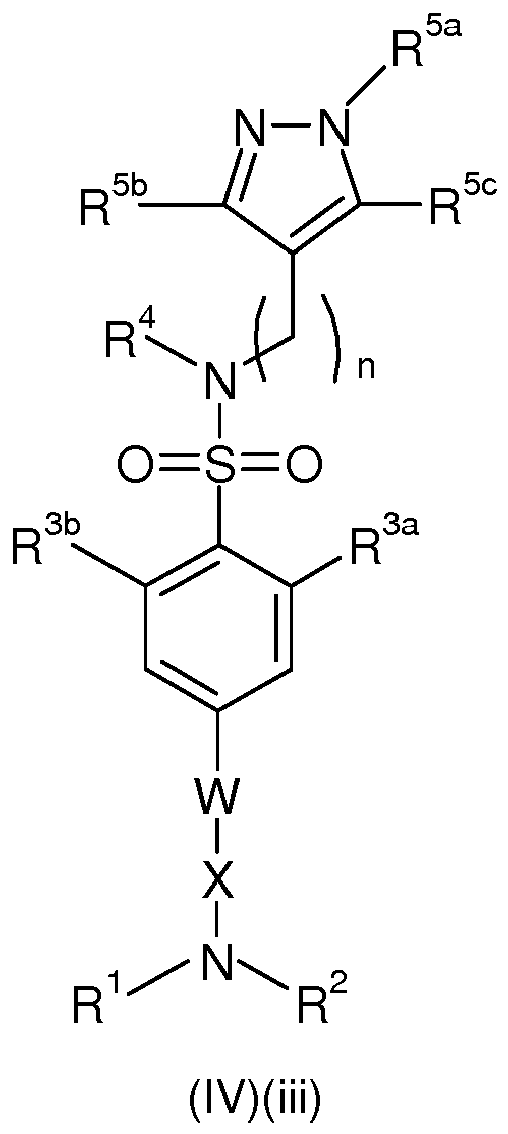
R5a, R5b und R5c unabhängig ausgewählt sind aus Wasserstoff, R12, Hydrocarbyl, optional substituiert mit R12, und -(CH2)l-Heterocyclyl, optional substituiert mit R12. - Verwendung gemäß einem der vorhergehenden Ansprüche, wobei:W abwesend ist und X ein Carbocyclyl ist, optional substituiert mit einer oder mehreren Halogen-, Cyano-, Amino-, Hydroxy-, C1-6-Alkyl- und C1-6-Alkoxygruppen;R1 und R2 zusammengefügt sind mit dem N von -NR1R2, um einen gesättigten fünf- bis siebengliedrigen protonierbaren N-enthaltenden Heterocyclus, optional substituiert mit einem oder mehreren von R12, zu bilden; und/oderR4 ausgewählt ist aus Wasserstoff und C1-6-Alkyl, optional substituiert mit Halogen, Cyano, Amino, Hydroxy, C1-6-Alkyl und C1-6-Alkoxy oder Carbocyclyl.
- Verwendung gemäß Anspruch 8, wobei X ausgewählt ist aus der Gruppe, bestehend aus Aryl oder Heterocyclyl, optional substituiert mit einem oder mehreren R12.
- Verwendung gemäß einem der Ansprüche 1 bis 3, 8 oder 9, wobei die Verbindung die Formel (V) aufweist:

Ring D ein optional substituierter Stickstoff ist, der einen 6- oder 7-gliedrigen Heterocyclus enthält, wobei jeder substituierbare Kohlenstoff oder Stickstoff in Ring D optional und unabhängig substituiert ist durch einen oder mehrere R7;
R7 unabhängig ausgewählt ist aus Wasserstoff, R20, Hydrocarbyl, optional substituiert mit R20, und -(CH2)v-Heterocyclyl, optional substituiert mit R20; v 0, 1, 2, 3, 4, 5 oder 6 ist;
wobei jeder R20 unabhängig ausgewählt ist aus Halogen, Trifluoromethyl, Cyano, Thio, Nitro, Oxo, =NR21, -OR21, -SR21, -C(O)R21, -C(O)OR21, -OC(O)R21, -NR21COR22, -NR21CONR22 2, -NR21COR22, -NR21CO2R22, -S(O)R21, -S(O)2R21, -SONR21 2, -NR21S(O)2R22; -CSR21, -N(R21)R22, -C(O)N(R21)R22, -SO2N(R21)R22 und R23;
wobei R21 und R22 jeweils unabhängig ausgewählt sind aus Wasserstoff oder R23;
wobei R23 ausgewählt ist aus Hydrocarbyl, Carbocyclyl und -(CH2)w-Heterocyclyl, und jeder R23 optional und unabhängig substituiert ist mit einem oder mehreren von Halogen, Cyano, Amino, Hydroxy, C1-6-Alkyl und C1-6-Alkoxy;
w 0, 1, 2, 3, 4, 5 oder 6 ist; und
R8 ausgewählt ist aus der Liste von Substituenten, die durch die Gruppe R4 dargestellt sind. - Verwendung gemäß einem der Ansprüche 1 bis 3, 8 oder 9, wobei die Verbindung die Formel (VI)(i) aufweist:
 n' 0, 1, 2, 3, 4, 5, 6, 7 oder 8 ist;Ring D ein optional substituierter Stickstoff ist, der einen 6- oder 7-gliedrigen Heterocyclus enthält, wobei jeder substituierbare Kohlenstoff oder Stickstoff in Ring D optional und unabhängig substituiert ist durch einen oder mehrere R7;R7 unabhängig ausgewählt ist aus Wasserstoff, R20, Hydrocarbyl, optional substituiert mit R20, und -(CH2)v-Heterocyclyl, optional substituiert mit R20; v 0, 1, 2, 3, 4, 5 oder 6 ist;wobei jeder R20 unabhängig ausgewählt ist aus Halogen, Trifluoromethyl, Cyano, Thio, Nitro, Oxo, =NR21, -OR21, -SR21, -C(O)R21, -C(O)OR21, -OC(O)R21, -NR21COR22, -NR21CONR22 2, -NR21COR22, -NR21CO2R22, -S(O)R21, -S(O)2R21, -SONR21 2, -NR21S(O)2R22; -CSR21, -N(R21)R22, -C(O)N(R21)R22, -SO2N(R21)R22 und R23;wobei R21 und R22 unabhängig ausgewählt sind aus Wasserstoff oder R23;wobei R23 jeweils ausgewählt ist aus Hydrocarbyl, Carbocyclyl und -(CH2)w-Heterocyclyl, und jeder R23 optional und unabhängig substituiert ist mit einem oder mehreren von Halogen, Cyano, Amino, Hydroxy, C1-6-Alkyl und C1-6-Alkoxy;w 0, 1, 2, 3, 4, 5 oder 6 ist;t 0, 1, 2, 3, 4, 5 oder 6 ist; undR8 ausgewählt ist aus der Liste von Substituenten, die durch die Gruppe R4 dargestellt sind.
 - Verwendung gemäß einem der Ansprüche 1 bis 3, 8 bis 11, wobei die Verbindung die Formel (VII) oder die Formel (VIII) aufweist:


Ring C eine optional substituierte cyclische Gruppe ist, wobei jeder substituierbare Kohlenstoff oder jedes substituierbare Heteroatom in Ring C optional und unabhängig substituiert ist durch einen oder mehrere R6;
R6 unabhängig ausgewählt ist aus Wasserstoff, R20, Hydrocarbyl, optional substituiert mit R20, und -(CH2)v-Heterocyclyl, optional substituiert mit R20; v 0, 1, 2, 3, 4, 5 oder 6 ist;
wobei jeder R20 unabhängig ausgewählt ist aus Halogen, Trifluoromethyl, Cyano, Thio, Nitro, Oxo, =NR21, -OR21, -SR21, -C(O)R21, -C(O)OR21, -OC(O)R21, -S(O)R21, -S(O)2R21, -N(R21)R22, -C(O)N(R21)R22, -SO2N(R21)R22 und R23;
wobei R21 und R22 jeweils unabhängig ausgewählt sind aus Wasserstoff oder R23;
wobei R23 ausgewählt ist aus Hydrocarbyl, Carbocyclyl und -(CH2)w-Heterocyclyl, und jeder R23 optional und unabhängig substituiert ist mit einem oder mehreren von Halogen, Cyano, Amino, Hydroxy, C1-6-Alkyl und C1-6-Alkoxy;
w 0, 1, 2, 3, 4, 5 oder 6 ist; und
wobei G unabhängig ausgewählt ist aus C und N. - Die Verwendung einer Verbindung der Formel (IX) bei der Herstellung eines Medikaments zur Behandlung oder Vorbeugung einer mit N-Myristoyltransferase (NMT) verbundenen Krankheit oder Störung:

n 0,1, 2, 3, 4, 5 oder 6 ist;
n' 0, 1, 2, 3, 4, 5, 6, 7 oder 8 ist;
E ausgewählt ist aus C und N;
X ausgewählt ist aus einem Hydrocarbyl, optional substituiert mit R11, und einem Carbocyclyl, optional substituiert mit einer oder mehreren von Halogen-, Cyano-, Amino-, Hydroxy-, C1-6-Alkyl- und C1-6-Alkoxygruppen, oder X abwesend sein kann;
R3, R4 und R5 unabhängig ausgewählt sind aus Wasserstoff, R12, Hydrocarbyl, optional substituiert mit R12, und -(CH2)l-Heterocyclyl, optional substituiert mit R12 ; und wobei einer oder mehrere von R3 und R5 zusammen genommen mit den Atomen, an denen sie befestigt sind, einen Carbocyclus bilden können, zum Beispiel Heterocyclyl, optional substituiert mit R12; l 0, 1, 2, 3, 4, 5 oder 6 ist;
wobei jeder R11 und R12 unabhängig ausgewählt ist aus Halogen, Trifluoromethyl, Cyano, Thio, Nitro, Oxo, =NR13, -OR13, -SR13, -C(O)R13, -C(O)OR13, -OC(O)R13, -NR13COR14, -NR13CONR13 2, -NR13COR14, -NR13CO2R14, -S(O)R13, -S(O)2R13, -SONR13 2, -NR13S(O)2R14; -CSR13, -N(R13)R14, -C(O)N(R13)R14, -SO2N(R13)R14 und R15;
wobei R13 und R14 jeweils unabhängig ausgewählt sind aus Wasserstoff oder R15.
wobei R15 ausgewählt ist aus Hydrocarbyl, Carbocyclyl und -(CH2)m-Heterocyclyl, und jeder R15 optional und unabhängig substituiert ist mit einem oder mehreren von Halogen, Cyano, Amino, Hydroxy, C1-6-Alkyl und C1-6-Alkoxy;
p 0, 1, 2, 3, 4, 5 oder 6 ist;
q 0, 1, 2, 3 oder 4 ist;
m 0, 1, 2, 3, 4, 5 oder 6 ist;
J unabhängig ein Stickstoff enthaltender Heterocyclus oder ein Amin ist. - Verwendung gemäß einem der vorhergehenden Ansprüche, wobei die mit NMT verbundene Krankheit oder Störung ausgewählt ist aus der Gruppe, bestehend aus Krebs; mikrobiellen Infektionen, neurologischen Krankheiten/Störungen und Diabetes.
- Ein Verfahren zur Hemmung der Aktivität von einer oder mehreren NMT, wobei das Verfahren das In-Kontakt-Bringen von einer oder mehreren NMT mit einer wirksamen Menge von einer Verbindung der Formel (I), Formel (II) oder Formel (IX) in vitro beinhaltet.
Priority Applications (1)
| Application Number | Priority Date | Filing Date | Title |
|---|---|---|---|
| EP15156565.2A EP2980076B1 (de) | 2008-09-02 | 2009-08-29 | Pyrazolylderivate |
Applications Claiming Priority (2)
| Application Number | Priority Date | Filing Date | Title |
|---|---|---|---|
| GBGB0815947.7A GB0815947D0 (en) | 2008-09-02 | 2008-09-02 | Compounds |
| PCT/GB2009/002084 WO2010026365A1 (en) | 2008-09-02 | 2009-08-29 | N-myristoyl transferase inhibitors |
Related Child Applications (2)
| Application Number | Title | Priority Date | Filing Date |
|---|---|---|---|
| EP15156565.2A Division EP2980076B1 (de) | 2008-09-02 | 2009-08-29 | Pyrazolylderivate |
| EP15156565.2A Division-Into EP2980076B1 (de) | 2008-09-02 | 2009-08-29 | Pyrazolylderivate |
Publications (2)
| Publication Number | Publication Date |
|---|---|
| EP2323987A1 EP2323987A1 (de) | 2011-05-25 |
| EP2323987B1 true EP2323987B1 (de) | 2015-06-24 |
Family
ID=39866103
Family Applications (2)
| Application Number | Title | Priority Date | Filing Date |
|---|---|---|---|
| EP15156565.2A Active EP2980076B1 (de) | 2008-09-02 | 2009-08-29 | Pyrazolylderivate |
| EP09785018.4A Active EP2323987B1 (de) | 2008-09-02 | 2009-08-29 | N-myristoyl transferase inhibitoren |
Family Applications Before (1)
| Application Number | Title | Priority Date | Filing Date |
|---|---|---|---|
| EP15156565.2A Active EP2980076B1 (de) | 2008-09-02 | 2009-08-29 | Pyrazolylderivate |
Country Status (5)
| Country | Link |
|---|---|
| US (2) | US9156811B2 (de) |
| EP (2) | EP2980076B1 (de) |
| ES (2) | ES2631227T3 (de) |
| GB (1) | GB0815947D0 (de) |
| WO (1) | WO2010026365A1 (de) |
Families Citing this family (29)
| Publication number | Priority date | Publication date | Assignee | Title |
|---|---|---|---|---|
| UA103319C2 (en) | 2008-05-06 | 2013-10-10 | Глаксосмитклайн Ллк | Thiazole- and oxazole-benzene sulfonamide compounds |
| GB201005511D0 (en) | 2010-03-31 | 2010-05-19 | Takeda Pharmaceutical | Compounds and their use |
| WO2011137089A1 (en) * | 2010-04-29 | 2011-11-03 | The United States Of America, As Represented By The Secretary, Department Of Health And Human Services | Activators of human pyruvate kinase |
| KR102164964B1 (ko) * | 2011-07-22 | 2020-10-14 | 페이실렉스 파마슈티컬스 인코포레이티드 | 암의 합성치사 및 치료 |
| GB201120993D0 (en) | 2011-12-06 | 2012-01-18 | Imp Innovations Ltd | Novel compounds and their use in therapy |
| US9346798B2 (en) | 2012-02-13 | 2016-05-24 | Amgen Inc. | Dihydrobenzoxazine and tetrahydroquinoxaline sodium channel inhibitors |
| WO2013134518A1 (en) | 2012-03-09 | 2013-09-12 | Amgen Inc. | Sulfamide sodium channel inhibitors |
| AU2013337569A1 (en) * | 2012-10-30 | 2015-05-07 | Pacylex Pharmaceuticals Inc. | Synthetic lethality and the treatment of cancer |
| WO2016054642A1 (en) | 2014-10-03 | 2016-04-07 | The Arizona Board Of Regents On Behalf Of The University Of Arizona | Inhibitors of grb2-associated binding protein 1 (gab1) and methods of treating cancer using the same |
| GB201511382D0 (en) | 2015-06-29 | 2015-08-12 | Imp Innovations Ltd | Novel compounds and their use in therapy |
| PL3325662T3 (pl) | 2015-07-17 | 2024-02-26 | Pacylex Pharmaceuticals Inc. | Wyciszenie epigenetyczne nmt2 |
| BR112020015712A2 (pt) | 2018-02-05 | 2020-12-08 | Alkermes, Inc. | Compostos para tratamento de dor |
| CA3104913A1 (en) * | 2018-08-31 | 2020-03-05 | Xenon Pharmaceuticals Inc. | Heteroaryl-substituted sulfonamide compounds and their use as sodium channel inhibitors |
| IL279810B2 (en) | 2018-08-31 | 2025-03-01 | Xenon Pharmaceuticals Inc | Heteroaryl-modified sulfonamide compounds and their use as medicinal agents |
| EP3886854A4 (de) | 2018-11-30 | 2022-07-06 | Nuvation Bio Inc. | Pyrrol- und pyrazolverbindungen und verfahren zu deren verwendung |
| GB201820660D0 (en) | 2018-12-19 | 2019-01-30 | Imperial Innovations Ltd | Cancer treatments |
| GB201820659D0 (en) | 2018-12-19 | 2019-01-30 | Imperial Innovations Ltd | Novel compostions and their use in therapy |
| CN114174283B (zh) * | 2019-07-18 | 2023-05-12 | 石药集团中奇制药技术(石家庄)有限公司 | 作为nmt抑制剂的化合物及其应用 |
| WO2021021951A1 (en) | 2019-07-29 | 2021-02-04 | Vanderbilt University | Wdr5-myc inhibitors |
| US12545649B2 (en) | 2019-11-18 | 2026-02-10 | Vanderbilt University | WDR5-MYC inhibitors |
| GB202014736D0 (en) | 2020-09-18 | 2020-11-04 | Imperial College Innovations Ltd | Novel compounds and their use in therapy |
| CN116234547A (zh) * | 2020-10-20 | 2023-06-06 | 厄尔莱克斯制药公司 | N-豆蔻酰基转移酶(nmt)抑制剂在治疗癌症、自身免疫性病症和炎症性病症中的用途 |
| GB202017367D0 (en) | 2020-11-02 | 2020-12-16 | Imperial College Innovations Ltd | Novel use |
| CN113318107B (zh) * | 2021-07-08 | 2022-07-12 | 中国科学院微生物研究所 | 一种含氮化合物在制备抗真菌药物中的应用 |
| WO2024052684A1 (en) | 2022-09-09 | 2024-03-14 | MyricX Pharma Limited | Antibody drug conjugate comprising nmt inhibitor and its use |
| WO2024145273A2 (en) * | 2022-12-28 | 2024-07-04 | Seattle Children's Hospital (D/B/A Seattle Children's Research Institute) | N-myristoyltransferase inhibitors and methods of use |
| CN120457117A (zh) * | 2023-01-06 | 2025-08-08 | 厄尔莱克斯制药公司 | N-杂芳基磺酰胺的晶型、其组合物及制备方法 |
| AU2024371386A1 (en) * | 2023-10-31 | 2026-05-07 | Xenon Pharmaceuticals Inc. | Substituted aryl sulfonamides for use as sodium channel inhibitors |
| GB202403391D0 (en) | 2024-03-08 | 2024-04-24 | Myricx Pharma Ltd | Novel compounds and their use in therapy |
Family Cites Families (10)
| Publication number | Priority date | Publication date | Assignee | Title |
|---|---|---|---|---|
| FR2672598A1 (fr) | 1991-02-11 | 1992-08-14 | Adir | Nouveaux inhibiteurs de n-myristoyltransferase, leur procede de preparation et les compositions pharmaceutiques qui les contiennent. |
| WO2000037464A2 (en) * | 1998-12-18 | 2000-06-29 | Basilea Pharmaceutica Ag | 4-(aminoalkoxy)benzofurans as n-myristoyltransferase inhibitors |
| EP1741713A3 (de) * | 1999-12-15 | 2009-09-09 | Bristol-Myers Squibb Company | Biphenyl Sulfonamide als zweierlei Angiotensin Endothelin Rezeptor Antagonisten |
| CN100361992C (zh) * | 2003-02-19 | 2008-01-16 | 霍夫曼-拉罗奇有限公司 | 用作pepck抑制剂的磺酰胺取代的黄嘌呤 |
| JP2006070014A (ja) * | 2004-08-04 | 2006-03-16 | Hisamitsu Medical Kk | 2−アミノベンゾチアゾール誘導体 |
| WO2007076055A2 (en) * | 2005-12-22 | 2007-07-05 | Entremed, Inc. | Compositions and methods comprising proteinase activated receptor antagonists |
| CA2658725A1 (en) * | 2006-08-16 | 2008-02-21 | Exelixis, Inc. | Using pi3k and mek modulators in treatments of cancer |
| ATE461177T1 (de) * | 2007-03-23 | 2010-04-15 | Icagen Inc | Ionenkanal-hemmer |
| AU2008278966B2 (en) * | 2007-07-26 | 2012-02-23 | Novartis Ag | Pyrimidine derivatives useful for the treatment of inflammatory or allergic conditions |
| US8642660B2 (en) * | 2007-12-21 | 2014-02-04 | The University Of Rochester | Method for altering the lifespan of eukaryotic organisms |
-
2008
- 2008-09-02 GB GBGB0815947.7A patent/GB0815947D0/en not_active Ceased
-
2009
- 2009-08-29 WO PCT/GB2009/002084 patent/WO2010026365A1/en not_active Ceased
- 2009-08-29 ES ES15156565.2T patent/ES2631227T3/es active Active
- 2009-08-29 EP EP15156565.2A patent/EP2980076B1/de active Active
- 2009-08-29 EP EP09785018.4A patent/EP2323987B1/de active Active
- 2009-08-29 US US13/061,811 patent/US9156811B2/en active Active
- 2009-08-29 ES ES09785018.4T patent/ES2546865T3/es active Active
-
2015
- 2015-08-31 US US14/840,660 patent/US9828346B2/en active Active
Also Published As
| Publication number | Publication date |
|---|---|
| EP2980076A1 (de) | 2016-02-03 |
| US9828346B2 (en) | 2017-11-28 |
| EP2323987A1 (de) | 2011-05-25 |
| US20160060224A1 (en) | 2016-03-03 |
| WO2010026365A1 (en) | 2010-03-11 |
| ES2631227T3 (es) | 2017-08-29 |
| ES2546865T3 (es) | 2015-09-29 |
| EP2980076B1 (de) | 2017-05-31 |
| US20110312921A1 (en) | 2011-12-22 |
| US9156811B2 (en) | 2015-10-13 |
| GB0815947D0 (en) | 2008-10-08 |
Similar Documents
| Publication | Publication Date | Title |
|---|---|---|
| EP2980076B1 (de) | Pyrazolylderivate | |
| EP0844877B1 (de) | Verwendung von oxidosqualencyclasehemmer zur senkung des cholesterinblutspiegels | |
| EP0925286B1 (de) | Substituierte pyrimidinderivate und ihre pharmazeutische anwendung | |
| JP4778657B2 (ja) | GSK3.β阻害剤としての2−アミノ−3−(アルキル)−ピリミドン誘導体 | |
| CN100360505C (zh) | 中间体化合物、它们在制备喹唑啉衍生物中的用途以及它们的制备方法 | |
| KR100736012B1 (ko) | 벤즈아졸 유도체 및 이의 jnk 조절자로의 용도 | |
| US7566720B2 (en) | 2-pyridinyl-6,7,8,9-tetrahydropyrimido[1,2-a] pyrimidin-4-one and 7-pyridinyl-2,3-dihydroimidazo[1,2-a] pyrimidin-5(1H)one derivatives | |
| CN109988109A (zh) | 抑制ssao/vap-1的胺类化合物及其用途 | |
| TW201326138A (zh) | 犬尿胺酸-3-單氧化酶抑制劑、其醫藥組成物及其使用方法 | |
| MXPA03008888A (es) | Inhibidores de n-terminal c-jun cinasas (jnk) y otras proteinas cinasas. | |
| CN101921236A (zh) | 可用于治疗赘生性疾病、炎性和免疫系统病症的2,4-二(苯氨基)嘧啶 | |
| CA2534866A1 (en) | Piperazine derivatives for the treatment of hiv infections | |
| WO2008076779A2 (en) | 2-(piperidin-4-yl0xy)pyrimidin-4-amine derivatives as deoxycytidine kinase inhibitors for the treatment of cancer | |
| WO2009123221A1 (ja) | 細胞保護作用を有するピリミジン誘導体およびその用途 | |
| JP4564713B2 (ja) | 窒素性複素環式化合物、ならびに窒素性複素環式化合物およびその中間体を作製するための方法 | |
| JP4832706B2 (ja) | 新規なアリールエテン−スルフォンアミド類 | |
| JP4958379B2 (ja) | 1−[アルキル],1−[(ヘテロアリール)アルキル]および1−[(アリール)アルキル]−7−ピリジニル−イミダゾ[1,2−a]ピリミジン−5(1H)−オン誘導体 | |
| WO2001070725A1 (en) | 2-[indanylamino]pyrimidone and 2-[tetrahydronaphthalenylamino]pyrimidone derivatives | |
| WO2022228549A1 (en) | Phenyl -o-quinoline, quinazoline, thienopyridine, thienopyrimidine, pyrrolopyridine, pyrrolopyrimidine compounds having anticancer activity | |
| MX2007006598A (es) | Compuestos de triazol adecuados para tratar trastornos que responden a la modulacion del receptor de dopamina d3. | |
| WO2024078513A1 (en) | Condensed azines for treating cancer | |
| CN105998016B (zh) | 吡非尼酮衍生物在制药中的应用 | |
| JPH107658A (ja) | スルホニルウレイドピラゾール誘導体 | |
| JP2002541256A (ja) | 新規エンドセリン転換酵素阻害剤、その製造および使用 | |
| HK1061029B (en) | Rho-kinase inhibitors |
Legal Events
| Date | Code | Title | Description |
|---|---|---|---|
| PUAI | Public reference made under article 153(3) epc to a published international application that has entered the european phase |
Free format text: ORIGINAL CODE: 0009012 |
|
| 17P | Request for examination filed |
Effective date: 20110307 |
|
| AK | Designated contracting states |
Kind code of ref document: A1 Designated state(s): AT BE BG CH CY CZ DE DK EE ES FI FR GB GR HR HU IE IS IT LI LT LU LV MC MK MT NL NO PL PT RO SE SI SK SM TR |
|
| AX | Request for extension of the european patent |
Extension state: AL BA RS |
|
| DAX | Request for extension of the european patent (deleted) | ||
| 17Q | First examination report despatched |
Effective date: 20130819 |
|
| GRAP | Despatch of communication of intention to grant a patent |
Free format text: ORIGINAL CODE: EPIDOSNIGR1 |
|
| INTG | Intention to grant announced |
Effective date: 20141008 |
|
| GRAS | Grant fee paid |
Free format text: ORIGINAL CODE: EPIDOSNIGR3 |
|
| GRAA | (expected) grant |
Free format text: ORIGINAL CODE: 0009210 |
|
| AK | Designated contracting states |
Kind code of ref document: B1 Designated state(s): AT BE BG CH CY CZ DE DK EE ES FI FR GB GR HR HU IE IS IT LI LT LU LV MC MK MT NL NO PL PT RO SE SI SK SM TR |
|
| REG | Reference to a national code |
Ref country code: GB Ref legal event code: FG4D |
|
| REG | Reference to a national code |
Ref country code: CH Ref legal event code: EP |
|
| REG | Reference to a national code |
Ref country code: AT Ref legal event code: REF Ref document number: 732820 Country of ref document: AT Kind code of ref document: T Effective date: 20150715 |
|
| REG | Reference to a national code |
Ref country code: IE Ref legal event code: FG4D |
|
| REG | Reference to a national code |
Ref country code: DE Ref legal event code: R096 Ref document number: 602009031870 Country of ref document: DE |
|
| REG | Reference to a national code |
Ref country code: ES Ref legal event code: FG2A Ref document number: 2546865 Country of ref document: ES Kind code of ref document: T3 Effective date: 20150929 |
|
| REG | Reference to a national code |
Ref country code: CH Ref legal event code: NV Representative=s name: MICHELI AND CIE SA, CH |
|
| PG25 | Lapsed in a contracting state [announced via postgrant information from national office to epo] |
Ref country code: HR Free format text: LAPSE BECAUSE OF FAILURE TO SUBMIT A TRANSLATION OF THE DESCRIPTION OR TO PAY THE FEE WITHIN THE PRESCRIBED TIME-LIMIT Effective date: 20150624 Ref country code: LT Free format text: LAPSE BECAUSE OF FAILURE TO SUBMIT A TRANSLATION OF THE DESCRIPTION OR TO PAY THE FEE WITHIN THE PRESCRIBED TIME-LIMIT Effective date: 20150624 Ref country code: NO Free format text: LAPSE BECAUSE OF FAILURE TO SUBMIT A TRANSLATION OF THE DESCRIPTION OR TO PAY THE FEE WITHIN THE PRESCRIBED TIME-LIMIT Effective date: 20150924 Ref country code: FI Free format text: LAPSE BECAUSE OF FAILURE TO SUBMIT A TRANSLATION OF THE DESCRIPTION OR TO PAY THE FEE WITHIN THE PRESCRIBED TIME-LIMIT Effective date: 20150624 |
|
| REG | Reference to a national code |
Ref country code: AT Ref legal event code: MK05 Ref document number: 732820 Country of ref document: AT Kind code of ref document: T Effective date: 20150624 |
|
| REG | Reference to a national code |
Ref country code: LT Ref legal event code: MG4D |
|
| PG25 | Lapsed in a contracting state [announced via postgrant information from national office to epo] |
Ref country code: BG Free format text: LAPSE BECAUSE OF FAILURE TO SUBMIT A TRANSLATION OF THE DESCRIPTION OR TO PAY THE FEE WITHIN THE PRESCRIBED TIME-LIMIT Effective date: 20150924 Ref country code: LV Free format text: LAPSE BECAUSE OF FAILURE TO SUBMIT A TRANSLATION OF THE DESCRIPTION OR TO PAY THE FEE WITHIN THE PRESCRIBED TIME-LIMIT Effective date: 20150624 Ref country code: GR Free format text: LAPSE BECAUSE OF FAILURE TO SUBMIT A TRANSLATION OF THE DESCRIPTION OR TO PAY THE FEE WITHIN THE PRESCRIBED TIME-LIMIT Effective date: 20150925 |
|
| REG | Reference to a national code |
Ref country code: NL Ref legal event code: MP Effective date: 20150624 |
|
| PG25 | Lapsed in a contracting state [announced via postgrant information from national office to epo] |
Ref country code: EE Free format text: LAPSE BECAUSE OF FAILURE TO SUBMIT A TRANSLATION OF THE DESCRIPTION OR TO PAY THE FEE WITHIN THE PRESCRIBED TIME-LIMIT Effective date: 20150624 |
|
| PG25 | Lapsed in a contracting state [announced via postgrant information from national office to epo] |
Ref country code: AT Free format text: LAPSE BECAUSE OF FAILURE TO SUBMIT A TRANSLATION OF THE DESCRIPTION OR TO PAY THE FEE WITHIN THE PRESCRIBED TIME-LIMIT Effective date: 20150624 Ref country code: CZ Free format text: LAPSE BECAUSE OF FAILURE TO SUBMIT A TRANSLATION OF THE DESCRIPTION OR TO PAY THE FEE WITHIN THE PRESCRIBED TIME-LIMIT Effective date: 20150624 Ref country code: PL Free format text: LAPSE BECAUSE OF FAILURE TO SUBMIT A TRANSLATION OF THE DESCRIPTION OR TO PAY THE FEE WITHIN THE PRESCRIBED TIME-LIMIT Effective date: 20150624 Ref country code: RO Free format text: LAPSE BECAUSE OF NON-PAYMENT OF DUE FEES Effective date: 20150624 Ref country code: SK Free format text: LAPSE BECAUSE OF FAILURE TO SUBMIT A TRANSLATION OF THE DESCRIPTION OR TO PAY THE FEE WITHIN THE PRESCRIBED TIME-LIMIT Effective date: 20150624 Ref country code: IS Free format text: LAPSE BECAUSE OF FAILURE TO SUBMIT A TRANSLATION OF THE DESCRIPTION OR TO PAY THE FEE WITHIN THE PRESCRIBED TIME-LIMIT Effective date: 20151024 Ref country code: PT Free format text: LAPSE BECAUSE OF FAILURE TO SUBMIT A TRANSLATION OF THE DESCRIPTION OR TO PAY THE FEE WITHIN THE PRESCRIBED TIME-LIMIT Effective date: 20151026 |
|
| REG | Reference to a national code |
Ref country code: DE Ref legal event code: R097 Ref document number: 602009031870 Country of ref document: DE |
|
| PG25 | Lapsed in a contracting state [announced via postgrant information from national office to epo] |
Ref country code: MC Free format text: LAPSE BECAUSE OF FAILURE TO SUBMIT A TRANSLATION OF THE DESCRIPTION OR TO PAY THE FEE WITHIN THE PRESCRIBED TIME-LIMIT Effective date: 20150624 Ref country code: LU Free format text: LAPSE BECAUSE OF FAILURE TO SUBMIT A TRANSLATION OF THE DESCRIPTION OR TO PAY THE FEE WITHIN THE PRESCRIBED TIME-LIMIT Effective date: 20150829 |
|
| PG25 | Lapsed in a contracting state [announced via postgrant information from national office to epo] |
Ref country code: DK Free format text: LAPSE BECAUSE OF FAILURE TO SUBMIT A TRANSLATION OF THE DESCRIPTION OR TO PAY THE FEE WITHIN THE PRESCRIBED TIME-LIMIT Effective date: 20150624 |
|
| PLBE | No opposition filed within time limit |
Free format text: ORIGINAL CODE: 0009261 |
|
| STAA | Information on the status of an ep patent application or granted ep patent |
Free format text: STATUS: NO OPPOSITION FILED WITHIN TIME LIMIT |
|
| REG | Reference to a national code |
Ref country code: DE Ref legal event code: R082 Ref document number: 602009031870 Country of ref document: DE Representative=s name: HERNANDEZ, YORCK, DIPL.-ING., DE |
|
| 26N | No opposition filed |
Effective date: 20160329 |
|
| REG | Reference to a national code |
Ref country code: FR Ref legal event code: PLFP Year of fee payment: 8 |
|
| PG25 | Lapsed in a contracting state [announced via postgrant information from national office to epo] |
Ref country code: SI Free format text: LAPSE BECAUSE OF FAILURE TO SUBMIT A TRANSLATION OF THE DESCRIPTION OR TO PAY THE FEE WITHIN THE PRESCRIBED TIME-LIMIT Effective date: 20150624 |
|
| PG25 | Lapsed in a contracting state [announced via postgrant information from national office to epo] |
Ref country code: BE Free format text: LAPSE BECAUSE OF FAILURE TO SUBMIT A TRANSLATION OF THE DESCRIPTION OR TO PAY THE FEE WITHIN THE PRESCRIBED TIME-LIMIT Effective date: 20150624 |
|
| PG25 | Lapsed in a contracting state [announced via postgrant information from national office to epo] |
Ref country code: MT Free format text: LAPSE BECAUSE OF FAILURE TO SUBMIT A TRANSLATION OF THE DESCRIPTION OR TO PAY THE FEE WITHIN THE PRESCRIBED TIME-LIMIT Effective date: 20150624 |
|
| PG25 | Lapsed in a contracting state [announced via postgrant information from national office to epo] |
Ref country code: HU Free format text: LAPSE BECAUSE OF FAILURE TO SUBMIT A TRANSLATION OF THE DESCRIPTION OR TO PAY THE FEE WITHIN THE PRESCRIBED TIME-LIMIT; INVALID AB INITIO Effective date: 20090829 Ref country code: SM Free format text: LAPSE BECAUSE OF FAILURE TO SUBMIT A TRANSLATION OF THE DESCRIPTION OR TO PAY THE FEE WITHIN THE PRESCRIBED TIME-LIMIT Effective date: 20150624 |
|
| PG25 | Lapsed in a contracting state [announced via postgrant information from national office to epo] |
Ref country code: NL Free format text: LAPSE BECAUSE OF FAILURE TO SUBMIT A TRANSLATION OF THE DESCRIPTION OR TO PAY THE FEE WITHIN THE PRESCRIBED TIME-LIMIT Effective date: 20150624 Ref country code: CY Free format text: LAPSE BECAUSE OF FAILURE TO SUBMIT A TRANSLATION OF THE DESCRIPTION OR TO PAY THE FEE WITHIN THE PRESCRIBED TIME-LIMIT Effective date: 20150624 Ref country code: SE Free format text: LAPSE BECAUSE OF FAILURE TO SUBMIT A TRANSLATION OF THE DESCRIPTION OR TO PAY THE FEE WITHIN THE PRESCRIBED TIME-LIMIT Effective date: 20150624 |
|
| REG | Reference to a national code |
Ref country code: FR Ref legal event code: PLFP Year of fee payment: 9 |
|
| PG25 | Lapsed in a contracting state [announced via postgrant information from national office to epo] |
Ref country code: TR Free format text: LAPSE BECAUSE OF FAILURE TO SUBMIT A TRANSLATION OF THE DESCRIPTION OR TO PAY THE FEE WITHIN THE PRESCRIBED TIME-LIMIT Effective date: 20150624 |
|
| PG25 | Lapsed in a contracting state [announced via postgrant information from national office to epo] |
Ref country code: MK Free format text: LAPSE BECAUSE OF FAILURE TO SUBMIT A TRANSLATION OF THE DESCRIPTION OR TO PAY THE FEE WITHIN THE PRESCRIBED TIME-LIMIT Effective date: 20150624 |
|
| REG | Reference to a national code |
Ref country code: FR Ref legal event code: PLFP Year of fee payment: 10 |
|
| P01 | Opt-out of the competence of the unified patent court (upc) registered |
Effective date: 20230502 |
|
| PGFP | Annual fee paid to national office [announced via postgrant information from national office to epo] |
Ref country code: ES Payment date: 20250904 Year of fee payment: 17 |
|
| PGFP | Annual fee paid to national office [announced via postgrant information from national office to epo] |
Ref country code: DE Payment date: 20250806 Year of fee payment: 17 |
|
| PGFP | Annual fee paid to national office [announced via postgrant information from national office to epo] |
Ref country code: IT Payment date: 20250804 Year of fee payment: 17 |
|
| PGFP | Annual fee paid to national office [announced via postgrant information from national office to epo] |
Ref country code: GB Payment date: 20250730 Year of fee payment: 17 |
|
| PGFP | Annual fee paid to national office [announced via postgrant information from national office to epo] |
Ref country code: FR Payment date: 20250808 Year of fee payment: 17 |
|
| PGFP | Annual fee paid to national office [announced via postgrant information from national office to epo] |
Ref country code: CH Payment date: 20250902 Year of fee payment: 17 |
|
| PGFP | Annual fee paid to national office [announced via postgrant information from national office to epo] |
Ref country code: IE Payment date: 20250813 Year of fee payment: 17 |