EP2318059B1 - Medical devices and methods including blends of biodegradable polymers - Google Patents
Medical devices and methods including blends of biodegradable polymers Download PDFInfo
- Publication number
- EP2318059B1 EP2318059B1 EP09791121.8A EP09791121A EP2318059B1 EP 2318059 B1 EP2318059 B1 EP 2318059B1 EP 09791121 A EP09791121 A EP 09791121A EP 2318059 B1 EP2318059 B1 EP 2318059B1
- Authority
- EP
- European Patent Office
- Prior art keywords
- stretching
- axis
- polymer blend
- phase
- polymer
- Prior art date
- Legal status (The legal status is an assumption and is not a legal conclusion. Google has not performed a legal analysis and makes no representation as to the accuracy of the status listed.)
- Active
Links
Images

















Classifications
-
- A—HUMAN NECESSITIES
- A61—MEDICAL OR VETERINARY SCIENCE; HYGIENE
- A61L—METHODS OR APPARATUS FOR STERILISING MATERIALS OR OBJECTS IN GENERAL; DISINFECTION, STERILISATION OR DEODORISATION OF AIR; CHEMICAL ASPECTS OF BANDAGES, DRESSINGS, ABSORBENT PADS OR SURGICAL ARTICLES; MATERIALS FOR BANDAGES, DRESSINGS, ABSORBENT PADS OR SURGICAL ARTICLES
- A61L31/00—Materials for other surgical articles, e.g. stents, stent-grafts, shunts, surgical drapes, guide wires, materials for adhesion prevention, occluding devices, surgical gloves, tissue fixation devices
- A61L31/14—Materials characterised by their function or physical properties, e.g. injectable or lubricating compositions, shape-memory materials, surface modified materials
- A61L31/148—Materials at least partially resorbable by the body
-
- A—HUMAN NECESSITIES
- A61—MEDICAL OR VETERINARY SCIENCE; HYGIENE
- A61L—METHODS OR APPARATUS FOR STERILISING MATERIALS OR OBJECTS IN GENERAL; DISINFECTION, STERILISATION OR DEODORISATION OF AIR; CHEMICAL ASPECTS OF BANDAGES, DRESSINGS, ABSORBENT PADS OR SURGICAL ARTICLES; MATERIALS FOR BANDAGES, DRESSINGS, ABSORBENT PADS OR SURGICAL ARTICLES
- A61L27/00—Materials for grafts or prostheses or for coating grafts or prostheses
- A61L27/14—Macromolecular materials
- A61L27/26—Mixtures of macromolecular compounds
-
- A—HUMAN NECESSITIES
- A61—MEDICAL OR VETERINARY SCIENCE; HYGIENE
- A61L—METHODS OR APPARATUS FOR STERILISING MATERIALS OR OBJECTS IN GENERAL; DISINFECTION, STERILISATION OR DEODORISATION OF AIR; CHEMICAL ASPECTS OF BANDAGES, DRESSINGS, ABSORBENT PADS OR SURGICAL ARTICLES; MATERIALS FOR BANDAGES, DRESSINGS, ABSORBENT PADS OR SURGICAL ARTICLES
- A61L27/00—Materials for grafts or prostheses or for coating grafts or prostheses
- A61L27/50—Materials characterised by their function or physical properties, e.g. injectable or lubricating compositions, shape-memory materials, surface modified materials
- A61L27/58—Materials at least partially resorbable by the body
-
- A—HUMAN NECESSITIES
- A61—MEDICAL OR VETERINARY SCIENCE; HYGIENE
- A61L—METHODS OR APPARATUS FOR STERILISING MATERIALS OR OBJECTS IN GENERAL; DISINFECTION, STERILISATION OR DEODORISATION OF AIR; CHEMICAL ASPECTS OF BANDAGES, DRESSINGS, ABSORBENT PADS OR SURGICAL ARTICLES; MATERIALS FOR BANDAGES, DRESSINGS, ABSORBENT PADS OR SURGICAL ARTICLES
- A61L31/00—Materials for other surgical articles, e.g. stents, stent-grafts, shunts, surgical drapes, guide wires, materials for adhesion prevention, occluding devices, surgical gloves, tissue fixation devices
- A61L31/04—Macromolecular materials
- A61L31/041—Mixtures of macromolecular compounds
Definitions
- Biodegradable polymers have found use in a wide variety of applications ranging from trash bags that decompose in landfills to implantable medical devices that biodegrade in the body. Most of these applications require that such polymers have adequate physical properties and stability to provide for suitable handling and utility prior to being subjected to end use conditions that promote biodegradation. Further, it is often preferable that these same polymers rapidly or controllably biodegrade once subjected to such end use conditions. In addition, it is often desired that biodegradable polymers used for implantable medical devices be converted under physiological conditions to materials that do not irritate or harm the surrounding tissue. Many biodegradable polymers known in the art lack the combination of physical and/or chemical properties desired to meet the needs for specific applications.
- polylactide homopolymers e.g., poly-L-lactide; PLA
- copolymers e.g., poly(L-lactide- co -glycolide; PLGA
- PLGA poly(L-lactide- co -glycolide
- EP 1 837 042 A2 describes an implantable device formed from polymer blends having modified molecular structures.
- WO 2007/020432 A2 relates to an oriented implantable, biodegradable device.
- WO 00/01426 relates to a blend of bioresorbable polymers.
- WO 2007/092417 relates to toughened polylactic acid polymers and copolymers.
- WO 2007/134222 relates to intraluminal stents formed from polymer blends.
- Brittle polymers can sometimes be blended with polymers that are softer at the temperature of use to reduce the brittleness.
- polylactide homopolymers e.g., poly-L-lactide; PLA
- copolymers e.g., poly(L-lactide-co-glycolide; PLGA
- PTMC poly(trimethylene carbonate)
- PCL polycaprolactone
- PCL polyhydroxybutyrate
- the present disclosure provides an implantable medical device that includes a polymer blend.
- the polymer blend includes: a first phase that is continuous and a second phase that is phase-separated from the first continuous phase.
- the first continuous phase has a glass transition temperature of at least 40°C and includes a first biodegradable polymer having chains (e.g., a polylactide homopolymer or copolymer). The chains of the first biodegradable polymer are oriented along an axis.
- the second phase has a glass transition temperature of 15°C or less and includes a second biodegradable polymer (e.g., a polymer selected from the group consisting of poly(trimethylene carbonate) (PTMC), polycaprolactone (PCL), polyhydroxybutyrate, and combinations thereof).
- a second biodegradable polymer e.g., a polymer selected from the group consisting of poly(trimethylene carbonate) (PTMC), polycaprolactone (PCL), polyhydroxybutyrate, and combinations thereof.
- the modulus of the polymer blend parallel to the axis of orientation is at least 100% of the modulus of the first biodegradable polymer; and the strain at break of the polymer blend parallel to the axis of orientation is at least 120% of the strain at break of the first biodegradable polymer.
- the modulus of the polymer blend parallel to the axis of orientation is at least 90% of the modulus of the first biodegradable polymer; the strain at break of the polymer blend parallel to the axis of orientation is at least 120% of the strain at break of the first biodegradable polymer; and the polymer blend includes at least 5% by weight of the second phase, based on the total weight of the polymer blend.
- the modulus of the polymer blend parallel to the axis of orientation is at least 80% of the modulus of the first biodegradable polymer; the strain at break of the polymer blend parallel to the axis of orientation is at least 120% of the strain at break of the first biodegradable polymer; and the polymer blend includes at least 20% by weight of the second phase, based on the total weight of the polymer blend.
- the present disclosure provides a method of preparing an implantable medical device.
- the method includes: blending (e.g., melt blending) components including a first biodegradable polymer having chains and a second biodegradable polymer under conditions effective to form a polymer blend.
- the polymer blend includes: a first phase that is continuous and a second phase that is phase-separated from the first continuous phase.
- the first continuous phase has a glass transition temperature of at least 40°C and includes the first biodegradable polymer.
- the second phase has a glass transition temperature of 15°C or less and includes the second biodegradable polymer.
- the method further includes stretching (e.g., melt stretching) the polymer blend under conditions effective to orient the chains of the first biodegradable polymer along the axis of stretching; optionally quenching the stretched polymer blend; and forming a medical device from the stretched and optionally quenched polymer blend.
- stretching e.g., melt stretching
- the modulus of the stretched and optionally quenched polymer blend parallel to the axis of stretching is at least 100% of the modulus of the first biodegradable polymer; and the strain at break of the stretched and optionally quenched polymer blend parallel to the axis of stretching is at least 120% of the strain at break of the first biodegradable polymer.
- the modulus of the stretched and optionally quenched polymer blend parallel to the axis of stretching is at least 90% of the modulus of the first biodegradable polymer; the strain at break of the stretched and optionally quenched polymer blend parallel to the axis of stretching is at least 120% of the strain at break of the first biodegradable polymer; and the polymer blend includes at least 5% by weight of the second phase, based on the total weight of the polymer blend.
- the modulus of the stretched and optionally quenched polymer blend parallel to the axis of stretching is at least 80% of the modulus of the first biodegradable polymer; the strain at break of the stretched and optionally quenched polymer blend parallel to the axis of stretching is at least 120% of the strain at break of the first biodegradable polymer; and the polymer blend includes at least 20% by weight of the second phase, based on the total weight of the polymer blend.
- phases of a polymer blend are intended to refer to domains that include materials (e.g., homopolymers, copolymers, and/or miscible mixtures of polymers) that are substantially homogeneous, and preferably homogeneous, on a microscopic level. More specifically, the term "continuous phase” is intended to refer to a phase in which any point within the phase can be reached by travelling from any other point within the phase without exiting the phase (i.e., the path travelled between the points is entirely within the phase).
- the phase-separated phase can be anisotropic and oriented along one axis (i.e., uniaxially oriented) to result in domains having an aspect ratio (i.e., the maximum dimension of the phase divided by the minimum dimension of the phase) of at least 1.1.
- the phase-separated phase can be oriented in two directions.
- the first continuous phase includes a first biodegradable polymer (e.g., a polylactide homopolymer or copolymer).
- a first biodegradable polymer e.g., a polylactide homopolymer or copolymer.
- biodegradable and bioerodible are used interchangeably and are intended to broadly encompass materials including, for example, those that tend to break down upon exposure to physiological environments.
- one or both of the first and second polymers are biodegradable polymers that can optionally biodegrade at sufficiently high rates to enable them to be considered for use in specific medical device applications.
- the continuous phase that includes the first biodegradable polymer typically is capable of contributing to the mechanical stability of the device, especially at the upper temperature range at which the device may be made, implanted, and/or used (e.g., 37°C and above).
- the continuous phase has a glass transition temperature of at least 40°C, and in certain embodiments at least 41°C, 42°C, 43°C, 44°C, 45°C, 46°C, 47°C, 48°C, 49°C, 50°C, 55°C, or 60°C.
- the first biodegradable polymer having chains included in the continuous phase can, for example, be an amorphous glassy material, which may be rigid and brittle below its glass transition temperature.
- amorphous glassy material which may be rigid and brittle below its glass transition temperature.
- rigid means that the material has a modulus (E) of greater than 0.5 GPa at the temperature of interest.
- brittle means that the material has a strain at break (epsilon) of less than 10%.
- exemplary polymers include, but are not limited to, polylactides (e.g., homopolymers and/or copolymers).
- Polylactide homopolymers and copolymers include, for example, poly(L-lactide) (PLLA), poly(D,L-lactide) (PDLLA), poly(L-lactide- co -D,L-lactide) (PLDLLA), poly(L-lactide- co -glycolide) (PLGA), poly(D,L-lactide- co -glycolide) (PDLGA), poly(lactide-co-caprolactone), poly(lactide-co-trimethylene carbonate), poly(lactide-co-hydroxybutyrate), poly(lactide- co -dioxane), and combinations thereof.
- PLLA poly(L-lactide)
- PLLA poly(D,L-lactide)
- PLDLLA poly(L-lactide- co -D
- the chains of the first biodegradable polymer are oriented along an axis.
- "oriented” is intended to refer to a non-isotropic chain orientation in which at least one of the assembly average chain projections at the X, Y, and/or Z directions is different than the remaining projection or projections.
- the second phase of the polymer blend is phase-separated from the first continuous phase and is typically more flexible than the first continuous phase, especially at the lower temperature range at which the device may be made, implanted, and/or used (e.g., 25°C and below).
- the phase-separated phase has a glass transition temperature of 15°C or less, and in certain embodiments 14°C or less, 13°C or less, 12°C or less, 11°C or less, 10°C or less, 5°C or less, 0°C or less, -5°C or less, or -10°C or less.
- the second biodegradable polymer included in the second phase-separated phase can, for example, be an amorphous polymer that is rubbery above its glass transition temperature.
- rubbery means that the material has a modulus (E) of less than 0.5 GPa at the temperature of interest.
- the second biodegradable polymer can, for example, be a rubbery material at room temperature.
- exemplary polymers include, but are not limited to, poly(trimethylene carbonate) (PTMC), polycaprolactone (PCL), polyhydroxybutyrate, polydioxane, and combinations thereof.
- the modulus of the polymer blend parallel to the axis of orientation is at least 100% of the modulus of the first biodegradable polymer; and the strain at break of the polymer blend parallel to the axis of orientation is at least 120% of the strain at break of the first biodegradable polymer.
- the modulus of the polymer blend parallel to the axis of orientation is at least 90% of the modulus of the first biodegradable polymer; the strain at break of the polymer blend parallel to the axis of orientation is at least 120% of the strain at break of the first biodegradable polymer; and the polymer blend includes at least 5% by weight of the second phase, based on the total weight of the polymer blend.
- the modulus of the polymer blend parallel to the axis of orientation is at least 80% of the modulus of the first biodegradable polymer; the strain at break of the polymer blend parallel to the axis of orientation is at least 120% of the strain at break of the first biodegradable polymer; and the polymer blend includes at least 20% by weight of the second phase, based on the total weight of the polymer blend.
- the modulus and strain at break of the first biodegradable polymer can be determined by the following method.
- the well dried biodegradable polymer can be press molded at a suitable temperature for a time effective to form a film.
- the thickness of the film is 0.5 mm to 1 mm.
- a suitable temperature is a temperature that is high enough to allow the polymer to flow, but not so high as to cause substantial degradation of the polymer over the molding time.
- Microtensile bars ASTM D1708
- ASTM D1708 can be cut from the film with a die cutter and tensile-tested.
- the modulus and strain at break parallel to the axis of orientation of a polymer blend film that has been stretched, and in certain embodiments quenched, can be determined by the following method.
- the thickness of the film is 0.5 mm to 1 mm.
- Microtensile bars (ASTM D1708) can be cut from the polymer blend film with a die cutter with the long axis of the microtensile bars being aligned parallel to the direction of stretching. The microtensile bars can then be tested according to ASTM D1708.
- the modulus of the polymer blend parallel to the axis of orientation is typically at least 80%, 90%, 100%, 110%, or 125% of the modulus of the first biodegradable polymer.
- the strain at break of the polymer blend parallel to the axis of orientation is typically at least 120%, 130%, 140%, 150%, 200%, 300%, 500%, 1000%, or 2000% of the strain at break of the first biodegradable polymer.
- the modulus and strain at break of the polymer blend in a direction perpendicular to the axis of orientation can be different than the modulus and strain at break of the polymer blend parallel to the axis of orientation (i.e., the polymer blend exhibits anisotropic properties).
- the modulus and strain at break of the polymer blend in at least one direction perpendicular to the axis of orientation can be sufficient for use in an implantable medical device.
- the modulus and strain at break perpendicular to the axis of orientation of a polymer blend film that has been stretched, and in certain embodiments quenched, can be determined by the following method. Typically, the thickness of the film is 0.5 mm to 1 mm.
- Microtensile bars (ASTM D1708) can be cut from the polymer blend film with a die cutter with the long axis of the microtensile bars being aligned perpendicular to the direction of stretching. The microtensile bars can then be tested according to ASTM D1708.
- the modulus of the polymer blend in a direction perpendicular to the axis of orientation is typically at least 75%, 80%, 85%, 90%, 95%, or 100% of the modulus of the first biodegradable polymer.
- the strain at break of the polymer blend in a direction perpendicular to the axis of orientation is typically at least 100%, 200%, 300%, 500%, 1000%, or 2000% of the strain at break of the first biodegradable polymer.
- polymer blends as described herein can include other additional components including, but not limited to, compatibilizers (e.g., copolymers), plasticizers, bonding promoters, and combinations thereof.
- compatibilizers e.g., copolymers
- plasticizers e.g., plasticizers, bonding promoters, and combinations thereof.
- the present disclosure provides a method of preparing an implantable medical device.
- the method includes: blending (e.g., melt blending) components including a first biodegradable polymer having chains and a second biodegradable polymer under conditions effective to form a polymer blend.
- the polymer blend includes: a first phase that is continuous and a second phase that is phase-separated from the first continuous phase.
- the first continuous phase has a glass transition temperature of at least 40°C and includes the first biodegradable polymer.
- the second phase has a glass transition temperature of 15°C or less and includes the second biodegradable polymer.
- the method further includes stretching (e.g., melt stretching) the polymer blend under conditions effective to orient the chains of the first biodegradable polymer along the axis of stretching; optionally quenching the stretched polymer blend; and forming a medical device from the stretched and optionally quenched polymer blend.
- stretching e.g., melt stretching
- the modulus of the stretched and optionally quenched polymer blend parallel to the axis of stretching is at least 100% of the modulus of the first biodegradable polymer; and the strain at break of the stretched and optionally quenched polymer blend parallel to the axis of stretching is at least 120% of the strain at break of the first biodegradable polymer.
- the modulus of the stretched and optionally quenched polymer blend parallel to the axis of stretching is at least 90% of the modulus of the first biodegradable polymer; the strain at break of the stretched and optionally quenched polymer blend parallel to the axis of stretching is at least 120% of the strain at break of the first biodegradable polymer; and the polymer blend includes at least 5% by weight of the second phase, based on the total weight of the polymer blend.
- the modulus of the stretched and optionally quenched polymer blend parallel to the axis of stretching is at least 80% of the modulus of the first biodegradable polymer; the strain at break of the stretched and optionally quenched polymer blend parallel to the axis of stretching is at least 120% of the strain at break of the first biodegradable polymer; and the polymer blend includes at least 20% by weight of the second phase, based on the total weight of the polymer blend.
- one or more of the components that are melt blended can include, for example, one or more of a wide variety of additives, and particularly particulate additives, such as, for example, fillers (e.g., including particulate, fiber, and/or platelet material), other polymers (e.g., polymer particulate materials such as polytetrafluoroethylene can result in higher modulus), imaging particulate materials (e.g., barium sulfate for visualizing material placement using, for example, fluoroscopy), biologically derived materials (e.g., bone particles, cartilage, demineralized bone matrix, platelet gel, and combinations thereof), and combinations thereof.
- particulate additives such as, for example, fillers (e.g., including particulate, fiber, and/or platelet material), other polymers (e.g., polymer particulate materials such as polytetrafluoroethylene can result in higher modulus), imaging particulate materials (e.g., barium sulfate for visualizing material
- additives include, but are not limited to, biologically active agents, wetting agents for improving wettability to hydrophobic surfaces, antioxidants to improve oxidative stability, dyes or pigments to impart color or radiopacity, plasticizers, solvents, stabilizers, compatibilizers (e.g., copolymers), and bonding promoters.
- Additives can be dissolved, suspended, and/or dispersed within the blend. For particulate additives, the additive is typically dispersed within the blend.
- the components including the first biodegradable polymer and the second biodegradable polymer are blended under conditions effective to form a continuous phase including the first biodegradable polymer and a phase-separated-phase including the second biodegradable polymer.
- a wide variety of blending methods can be used including, for example, melt blending, solvent blending, dry powder mixing, solid state shear pulverization, and/or blending in supercritical carbon dioxide.
- melt blending is meant to include mixing at temperatures at which at least one component is melted and can flow under stress.
- Melt blending can be carried out using a wide variety of methods including, for example, dispersing and/or distributing. Mixing can be carried out using, for example, a simple shear machine, a Banbury mixer, a single or twin screw extruder, a helicone mixer, a multidirectional rotation mixer, or combinations thereof.
- melt blending conditions effective to form a continuous phase including the first biodegradable polymer and a phase-separated-phase including the second biodegradable polymer will vary depending on the specific combination of biodegradable polymers selected for blending.
- effective melt blending conditions will be apparent to one of skill in the art in view of the description and examples included in the present disclosure, in addition to melt blending conditions known in the art. See, for example, Polymer Alloys and Blends: Thermodynanics and Rheology; Utracki, Ed., Hanser Publishers, New York (1990 ).
- the first component includes one or more polylactide homopolymers and/or copolymers
- the second component includes one or more of poly(trimethylene carbonate) (PTMC), polycaprolactone (PCL), polyhydroxybutyrate, and polydioxane.
- melt blending conditions effective to form a continuous phase including the one or more polylactide homopolymers and/or copolymers, and a phase-separated phase including the one or more of poly(trimethylene carbonate) (PTMC), polycaprolactone (PCL), polyhydroxybutyrate, and polydioxane typically include a temperature of 60°C to 250°C (and in certain embodiments 60°C to 230°C), a mixing rate of 10 revolutions per minute (rpm) to 300 rpm (depending on the mixing device), for a time of 1 minute to 1 hour.
- the conditions used for melt blending the first biodegradable polymer and the second biodegradable polymer can be effective to result in reactive blending.
- reactive blending is used to refer to a method in which one or more new components are generated during mixing. For example, reactive blending of poly(methyl methacrylate) and bisphenol A polycarbonate can result in the formation of copolymers.
- the conditions used for melt blending PLGA and PTMC can be effective to result in a trans-esterification reaction that results in chain segment exchange between ester groups of the PLGA and carbonate groups of the PTMC.
- Chain segment exchange can result in the formation of block copolymers PLGA:PTMC. Because the reaction may occur randomly within chains, the resulting copolymers may be random multiple block copolymers.
- the in situ formation of such copolymers can be advantageous in that potentially difficult and/or expensive methods of separately preparing such copolymers (e.g., as compatibilizers) can potentially be avoided.
- the copolymer can have a preference for location at an interface between the domain including the first polymer and the domain including the second polymer. Because such copolymers can have a preference for location at an interface between domains, the copolymer can act in a manner similar to a surfactant, for example, to increase interfacial bond strength between domains and/or to reduce dispersed domain size, effects which can improve toughness of the blend.
- the components including the first biodegradable polymer and the second biodegradable polymer can also be blended by solvent blending.
- Solvent blending typically includes dissolving or dispersing each polymer in a solvent, then removing the solvent from the solution or dispersion of the polymers.
- the same solvent is used to dissolve or disperse each polymer to be blended.
- different solvents may be used to dissolve or disperse each polymer.
- each solvent is at least partially soluble in the other solvent.
- solutions or dispersions include 0.1% to 99.9% by weight of each polymer.
- a wide variety of solvents can be used including, for example, tetrahydrofuran (THF), chloroform, methylene chloride, and combinations thereof.
- THF tetrahydrofuran
- chloroform chloroform
- methylene chloride and combinations thereof.
- the solvents have sufficient volatility to allow for removal under reduced pressure.
- the components including the first biodegradable polymer and the second biodegradable polymer (as described herein) can also be blended using supercritical carbon dioxide.
- the polymer blend having a continuous phase and a phase-separated phase can be stretched under conditions effective to orient the chains of the first biodegradable polymer along the axis of stretching.
- Stretching can include one or more of melt stretching, cold stretching, and combinations thereof.
- melt stretching is meant to include stretching a material at a temperature at or above the Tg of the material.
- cold stretching is meant to include stretching a material at a temperature lower than the Tg of the material. Stretching can be simultaneous with and/or subsequent to blending.
- Stretching can be carried out using a wide variety of methods including, for example, uniaxial drawing, biaxial drawing, extrusion, injection molding, blow molding, blowing film, and combinations thereof.
- Stretching conditions effective to orient the chains of the first biodegradable polymer along the axis of stretching typically include a stretching ratio of greater than 1 to 100, wherein the stretching ratio is defined as the length along an axis of stretching after stretching divided by the length along the same axis before stretching. Stretching can conveniently be reported as stretching (%), which is equal to 100 times the (stretching ratio - 1). Stretching is carried out at a rate selected to avoid breaking the sample.
- the stretching rate is at most 20 per minute, in some embodiments at most 10 per minute, and in certain embodiments at most 5 per minute.
- the stretching is carried out at a temperature that is at or above the Tg of at least one of the biodegradable polymers.
- stretching is carried out at a temperature of room temperature (e.g., 25°C) or above.
- stretching is carried out at a temperature of no greater than 180°C, in certain embodiments at a temperature of no greater than 150°C, and in some embodiments at a temperature of no greater than 100°C.
- the stretched polymer blend can be quenched.
- quenching is meant to include cooling the sample to a temperature at which chain orientation becomes locked or frozen.
- quenching can assist in retention of the orientation along the axis of stretching of the chains of the first biodegradable polymer. Quenching can be carried out using a wide variety of methods including, for example, contact with fluids (gases or liquids), contact with solids, immersion in liquids, and combinations thereof.
- Quenching conditions effective to retain the orientation along the axis of stretching of the chains of the first biodegradable polymer typically include a cooling rate high enough such that the degree of chain orientation does not substantially decrease due to relaxation.
- Typical cooling rates include rates of 50°C/minute to 100°C/second.
- the first component includes one or more polylactide homopolymers and/or copolymers
- the second component includes one or more of poly(trimethylene carbonate) (PTMC), polycaprolactone (PCL), polyhydroxybutyrate, and polydioxane.
- melt stretching conditions effective to orient the discrete phase along the axis of stretching typically include a stretching ratio of 1.5 to 5, wherein the stretching ratio is defined as the length along an axis of stretching after stretching divided by the length along the same axis before stretching. Stretching can conveniently be reported as stretching (%), which is equal to 100 times the (stretching ratio - 1). Stretching is carried out at a rate selected to avoid breaking the sample.
- the stretching rate is 1.1 per minute to 10 per minute.
- the stretching is carried out at a temperature that is at or above the Tg of at least one of the biodegradable polymers.
- stretching is carried out at a temperature of 60°C to 100°C.
- quenching conditions effective to retain at least a portion of the orientation of the discrete phase typically include cooling rates of 10°C/second to 100°C/second.
- stretched and optionally quenched polymer blends can form a medical device without further processing.
- the stretched and optionally quenched polymer blends, as prepared can be in the form of a stent.
- additional processing steps may optionally be used to form a medical device.
- the stretched and optionally quenched polymer blend can be extruded or blow molded to form medical devices such as, for example, stents.
- the stretched and optionally quenched polymer blends can be shaped to form a medical device, preferably a biodegradable medical device.
- the stretched and optionally quenched polymer blends can be shaped by methods known in the art including compression molding, injection molding, casting, extruding, milling, blow molding, or combinations thereof.
- a "medical device” includes devices that have surfaces that contact tissue, bone, blood, or other bodily fluids in the course of their operation, which fluids are subsequently used in patients. This can include, for example, extracorporeal devices for use in surgery such as blood oxygenators, blood pumps, blood sensors, tubing used to carry blood, and the like which contact blood which is then returned to the patient.
- endoprostheses implanted in blood contact in a human or animal body
- vascular grafts vascular grafts, stents, pacemaker leads, heart valves, and the like
- stretched and optionally quenched polymer blends have physical properties (e.g., mechanical properties) that are useful for certain medical devices.
- MATERIALS All parts, percentages, ratios, and the like in the examples are by weight, unless noted otherwise. M n represents number average molecular weight, and M w represents weight average molecular weight. Unless otherwise noted, all solvents and reagents were or can be obtained from Sigma-Aldrich Corp., St. Louis, MO. Poly(L-lactide- co -glycolide) (PLGA; lactic acid:glycolic acid molar ratio of 85:15; intrinsic viscosity of 5 to 7) was obtained from Boehringer Ingelheim (Ingelheim, Germany) under the trade designation RESOMER LG 857.
- Poly(L-lactide-co-D,L-lactide) (PLDLLA; L-lactide:D,L-lactide molar ratio of 70:30; intrinsic viscosity of 5.5 to 6.5) was obtained from Boehringer Ingelheim (Ingelheim, Germany) under the trade designation RESOMER LR 708.
- Poly(L-lactide- co - ⁇ -caprolactone) (PLC; L-lactide: ⁇ -caprolactone molar ratio of 70:30; intrinsic viscosity of 1.2 to 1.8) was obtained from Boehringer Ingelheim (Ingelheim, Germany) under the trade designation RESOMER LC 703.
- Polycaprolactone (PCL; CAS Number 24980-41-4 ; Average M n of 80,000) was obtained from Sigma-Aldrich (St. Louis, MO) as Product No. 440744.
- Poly(trimethylene carbonate) (PTMC; Average M w of 200-300; polydispersity index (PDI) of 1.5) was prepared by methods similar to those disclosed in Zhang et al., Biomaterials, 26:2089-2094 (2005 ).
- PLGA:PTMC blends greater than 3 Kg were made with a Haake PolyLab twin screw extruder available from Thermo Scientific (Walther, MA) under the trade designation RHEOMEX PTW 25.
- the screw diameter (D) was 25 mm and the screw length/barrel diameter (L/D ratio) was 40.
- TEST PROCEDURES The blend samples were compressed into sheets using a hot press (Wabasa, USA). Samples (20 grams) were placed between two polytetrafluoroethylene films on a square metal frame (15 cm x 15 cm x 0.1 cm) and transferred to a preheated hot press (225°C) and warmed for 2 minutes. A compression force (equivalent to 7 MPa pressure) was then applied for 2 more minutes, the force was released, and the samples were quenched to room temperature with a press to provide sheets.
- a hot press Wibasa, USA.
- the sheets were cut into rectangular pieces (5 cm x 3.8 cm). Some samples were used directly for mechanical testing of unstretched samples. Other samples were loaded in a tensile testing instrument (MTS, MN). The grips and samples were housed with a heating chamber and heated for 10 minutes to reach equilibrium at 75°C. The gage length between the two grips was set at 2.5 cm and loaded samples were stretched at a rate of 25.4 cm/min to the desired stretching ratio. The samples were then immediately quenched by immersion in water or by contact with water soaked paper to provide the stretched and quenched samples.
- MTS tensile testing instrument
- Micro-tensile bars (ASTM D1708) were cut from the stretched and quenched sheets with a die cutter at directions both parallel and perpendicular to the stretching direction. Tensile tests were performed at room temperature at a cross head rate of 2.54 cm/min with an MTS tensile instrument. Yielding points were determined as 2% strain after the maximum modulus.
- Morphologies of microstructures of blend samples were evaluated with both scanning electron microscopy (SEM, Jeol 5900) and transmission electron microscopy (TEM, Jeol 1210).
- SEM scanning electron microscopy
- TEM transmission electron microscopy
- morphologies were determined from fracture surfaces of samples. Fracturing was conducted in liquid nitrogen to prevent shear deformation. The sample surface was coated with a 5 nm layer of gold to prevent static.
- transmission electron microscopy samples were microtomed into 50 nm thick slices (Leica). The slices were stained with RuO 4 vapor by hanging the slices above a 0.5 wt% RuO 4 aqueous solution in a closed bottle for 20 minutes.
- Chain orientation was evaluated with X-ray scattering tests.
- DSC differential scanning calorimetry
- TESTING RESULTS The mechanical properties of unstretched samples with PTMC content varying between 0 wt% and 40 wt% were measured, and Young's modulus for each sample was calculated.
- Figure 1 shows Young's modulus (GPa; left y-axis, solid squares) and strain at break (%; right y-axis, open squares) for PLGA and each PLGA:PTMC blend as a function of the weight fraction PTMC (x-axis).
- the error bars represent standard deviation calculated from 3 replicate measurements.
- the increase in strain at break from 5% for PLGA to near 250% with increasing PTMC loading indicates a substantial increase in toughness for the blends. However, as toughness increased, a corresponding decrease in Young's modulus was observed.
- Blends were compressed into sheets and stretched with MTS tensile instrument at a rate of 25.4 cm/min and 75°C. After stretching, the samples were quenched to room temperature immediately with ice water (using wet paper soaked with ice water). Mechanical properties were evaluated by tensile testing at directions both parallel and perpendicular to the stretching directions.
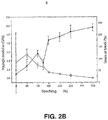
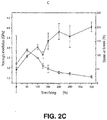
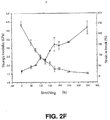
- Figure 2 includes graphical representations of Young's modulus (GPa; left y-axis, solid squares) and strain at break (%; right y-axis, open squares) for PLGA and PLGA:PTMC blends at various stretching (%) values parallel to stretching direction.
- Figure 2A is for PLGA.
- Figures 2B-2H are for PLGA:PTMC blends having PTMC contents of 5 wt%, 10 wt%, 15 wt%, 20 wt%, 25 wt%, 30 wt%, and 40 wt%, respectively.
- the error bars represent standard deviation calculated from 3 replicate measurements. All the blends became increasingly rigid at the stretching direction as the stretching (%) was increased. Further, as the stretching (%) was increased, strain at break decreased. However, there is a broad range of PTMC contents and stretching (%) values in which both the modulus and strain at break parallel to the stretching direction were much higher than that of the unstretched pure PLGA (2.3 GPa modulus and 5% strain at break).
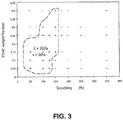
- Figure 3 is a graphical representation mapping toughening and reinforcement observed for PLGA:PTMC blends with various weight fractions PTMC (y-axis) at various stretching (%) values (x-axis).
- the area enclosed within the loop represents blends that have Young's modulus greater than 2 GPa and strain at break greater than 50% parallel to stretching direction.
- Figure 3 illustrates that PLGA can be toughened and reinforced at the same time by combining blending and stretching.
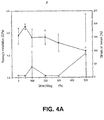
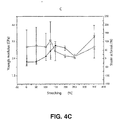
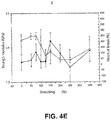
- Figure 4 includes graphical representations of Young's modulus (GPa; left y-axis, solid squares) and strain at break (%, right y-axis, open squares) for PLGA and PLGA:PTMC blends at various stretching (%) values perpendicular to stretching direction.
- Figure 4A is for PLGA.
- Figures 4B-4H are for PLGA:PTMC blends having PTMC contents of 5 wt%, 10 wt%, 15 wt%, 20 wt%, 25 wt%, 30 wt%, and 40 wt%, respectively.
- the error bars represent standard deviation calculated from 3 replicate measurements.
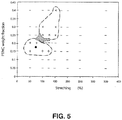
- Figure 5 is a graphical representation mapping toughening and reinforcement observed for PLGA:PTMC blends with various weight fractions PTMC (y-axis) at various stretching (%) values (x-axis).
- the area enclosed within the upper loop represents blends that have Young's modulus greater than 2 GPa at the direction parallel to stretching, Young's modulus less than 1.7 GPa at a direction perpendicular to stretching, and strain at break greater than 50% in both directions.
- the area enclosed within the lower loop represents blends that have Young's modulus greater than 2 GPa parallel to stretching direction, Young's modulus greater than 1.7 GPa perpendicular to stretching direction, and strain at break greater than 50% in both directions.
- the dot in the lower loop represents a blend having a Young's modulus of 2.2 GPa and a strain at break of 128% parallel to stretching direction; and a Young's modulus of 1.8 GPa and a strain at break of 247% perpendicular to stretching direction.
- the map illustrates that PLGA can be toughened and reinforced at the same time by combined blending and stretching.
- Figure 6 A number of processing parameters were changed to determine how sensitive the properties of the blends were to changing processing conditions. For certain embodiments, an insensitive response or robustness can be preferred for quality and processing control. Results are illustrated in Figure 6 .
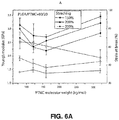
- Figures 6A and 6B include graphical representations of Young's modulus (GPa; solid symbols; left y-axis) and strain at break (%; open symbols, right y-axis) for various stretching (%) values parallel to stretching direction for 80:20 (wt:wt) PLGA:PTMC blends.
- Figure 6A shows various PTMC molecular weights (kg/mole; x-axis)
- Figure 6B shows various mixing times (minutes; x-axis).
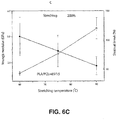
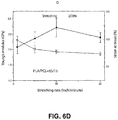
- Figures 6C and 6D include graphical representations of Young's modulus (GPa; left y-axis, solid squares) and strain at break (%; right y-axis, open squares) at a stretching (%) value of 200% parallel to stretching direction for 85:15 (wt:wt) PLDLLA:PCL blends.
- Figure 6C shows various stretching temperatures (°C; x-axis)
- Figure 6D shows various stretching rates (inches/minute; x-axis).
- the error bars represent standard deviation calculated from 3 replicate measurements. Except for cooling rate, the properties of blends were not very sensitive to the processing parameters studied. Rapid cooling appears to favor higher modulus (rigidity).
- a PLDLLA:PCL blend stretched for 200% had a 3.1 GPa modulus if cooled with water (rapid cooling). If cooled with air (slower cooling), the modulus was 1.8 GPa.
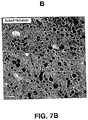
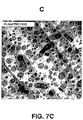
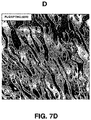
- Figure 7 illustrates transmission electron micrographs showing microstructures of unstretched PLGA:PTMC blends for various PTMC contents. Samples were stained with RuO 4 to show PTMC domains as dark areas. Figures 7A-7D are for 10 wt%, 20 wt%, 30 wt%, and 40 wt% PTMC, respectively. At low PTMC contents (e.g., 10 wt%), the PTMC domain was present as a discrete phase. At higher PTMC contents (e.g., 40 wt%), the PTMC phase and the PLGA phase approached co-continuity.
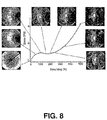
- Figure 8 illustrates a plot of wide angle X-ray scattering for an 80:20 (wt:wt) PLGA:PTMC blend for various stretching (%) values.
- the X-ray beam is perpendicular to the stretching direction.
- An amorphous blend (before stretching) has a dispersive scattering ring.
- the stretching (%) increased, a few scattering spots appeared.
- the white spots for stretching (%) greater than 100% indicated chain orientation.
- the intensity of the scattering spots was increased with stretching (%), indicating stretching induced chain orientation within the blends.
- Chain orientation is one dimensional ordered structure. X-ray radiation is scattered at preferred directions leading to the appearance of white spots.
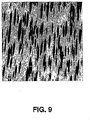
- FIG. 9 illustrates transmission electron micrographs showing morphology for an 80:20 (wt:wt) PLGA:PTMC blend after being stretched vertically with a stretching (%) value of 500%.
- the PTMC domains in a PLGA:PTMC (80:20) blend were discrete round particles dispersed in a PLGA continuous phase as illustrated in Figure 7B .
- the PTMC domains in a PLGA:PTMC (80:20) blend were stretched to shapes elongated in the stretching direction. This domain stretching increased the aspect ratio of the PTMC phase. Dispersed phases with higher aspect ratios can lead to toughening effects.
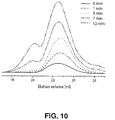
- a fluorescent active compound (9-anthracenemethanol) was used to initiate a low molecular weight (approximately 12 kg/mole) PTMC sample to give a labeled PTMC that can be detected by a fluorescent detector used with high pressure liquid chromatography (HPLC).
- HPLC high pressure liquid chromatography
- the labeled PTMC was blended with a PLGA sample (LG857, B1, approximately 600 kg/mole) in a ratio of PLGA:PTMC of 80:20 (wt:wt).
- the blend was analyzed with gel permeation chromatography (GPC).
- Figure 10 shows gel permeation chromatography (GPC) elution volume curves of fluorescent labeled PTMC:PLGA blends mixed for various times.
- the eluting curve for pure fluorescent labeled PTMC was labeled as 0 minutes mixing time.
- a second peak at lower elution volume, higher molecular weight was observed and increased as mixing time increased.
- new materials e.g., PTMC:PLGA copolymers
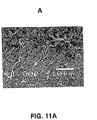
- FIG. 11 illustrates scanning electron micrographs for cross-sections of an 80:20 (wt:wt) PLGA:PTMC blend that were (A) solvent blended, and (B) melt blended at 215°C. Voids were evident in the solvent blended sample but not in melt blended sample, which is consistent with higher bond strength between the PTMC and PLGA phases in blends that were melt-mixed.
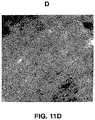
- Figures 11C and 11D illustrate transmission electron micrographs of an 82.5:17.5 (wt:wt) PLGA:PTMC blend that was (C) cross-sectioned parallel to stretching, and (D) cross-sectioned perpendicular to stretching.
- Higher bond strength between phases in the melt blended sample could be attributed, for example, to the formation of new materials (e.g., PTMC:PLGA copolymers) through trans-esterification reactions, for example.
- trans-esterification reactions would not be expected to readily occur in samples that were solvent blended at low temperatures.
- Disc samples were placed in PBS solution (pH7.4) and incubated at 37°C for various times. The degradation media was refreshed as needed to keep the pH unchanged. All the discs were initially weighed; weighed after testing for various times with surface water being removed by absorbing with a paper towel; and weighed after drying in a vacuum oven at 55°C for 24 hours. Unstretched blend samples were also incubated at 55°C, 70°C, and 85°C for accelerated aging studies.
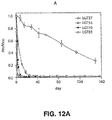
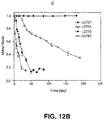
- Figure 12 Degradation of unstretched blends at various temperatures was shown in Figure 12 .
- Figure 12A is a graphical representation of molecular weight normalized to the initial molecular weight (y-axis) for an 82.5:17.5 (wt:wt) PLGA:PTMC blend as a function of degradation time (days; x-axis) at various testing temperatures.
- Figure 12B is a graphical representation of mass normalized to the initial values (y-axis) for an 82.5:17.5 (wt:wt) PLGA:PTMC blend as function of degradation time (days; x-axis) at various testing temperatures. Testing temperatures were 37°C (LGT37), 55°C (LGT55), 70°C (LGT70), and 85°C (LGT85). Degradation at higher temperatures was faster as indicated by the faster changes in measure M n and mass.
- Figure 13A is a graphical illustration of a master degradation curve constructed by shifting degradation data (e.g., Figure 12A ) obtained at various temperatures.
- shifting degradation data e.g., Figure 12A
- aT logarithm of the shifting factors
- Figure 14A is a graphical representation of molecular weight normalized to the initial molecular weight (y-axis) for a 100% stretched 82.5:17.5 (wt:wt) PLGA:PTMC blend as function of degradation time (days; x-axis) at various testing temperatures.
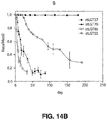
- Figure 14B is a graphical representation of mass normalized to the initial values (y-axis) for a 100% stretched 82.5:17.5 (wt:wt) PLGA:PTMC blend as a function of degradation time (days; x-axis) at various testing temperatures. Testing temperatures were 37°C (stLGT37), 55°C (stLGT55), 70°C (stLGT70), and 85°C (stLGT85).
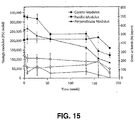
- FIG. 15 is a graphical illustration showing mechanical properties (y-axes) after various degradation times (weeks; x-axis) for an unstretched PLGA:PTMC blend (circle) and a stretched PLGA:PTMC blend (square for parallel direction and triangle for perpendicular direction). Solid symbols indicate tensile modulus (pounds per square inch, PSI; left y-axis) and open symbols indicate strain at break (%; right y-axis).
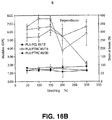
- FIG. 16 shows the modulus (GPa; solid symbols, left y-axis) and strain at break (%; open symbols, right y-axis) (A) parallel to the stretching direction, and (B) perpendicular to the stretching direction, both as a function of stretching (%).
- the results were similar to those for PLGA:PTMC blends.
Landscapes
- Health & Medical Sciences (AREA)
- Life Sciences & Earth Sciences (AREA)
- Veterinary Medicine (AREA)
- Public Health (AREA)
- General Health & Medical Sciences (AREA)
- Animal Behavior & Ethology (AREA)
- Epidemiology (AREA)
- Oral & Maxillofacial Surgery (AREA)
- Transplantation (AREA)
- Medicinal Chemistry (AREA)
- Dermatology (AREA)
- Chemical & Material Sciences (AREA)
- Heart & Thoracic Surgery (AREA)
- Surgery (AREA)
- Vascular Medicine (AREA)
- Materials For Medical Uses (AREA)
- Biological Depolymerization Polymers (AREA)
- Compositions Of Macromolecular Compounds (AREA)
- Prostheses (AREA)
Applications Claiming Priority (3)
| Application Number | Priority Date | Filing Date | Title |
|---|---|---|---|
| US8670708P | 2008-08-06 | 2008-08-06 | |
| US12/534,264 US8129477B1 (en) | 2008-08-06 | 2009-08-03 | Medical devices and methods including blends of biodegradable polymers |
| PCT/US2009/052626 WO2010017153A2 (en) | 2008-08-06 | 2009-08-04 | Medical devices and methods including blends of biodegradable polymers |
Publications (2)
| Publication Number | Publication Date |
|---|---|
| EP2318059A2 EP2318059A2 (en) | 2011-05-11 |
| EP2318059B1 true EP2318059B1 (en) | 2018-10-03 |
Family
ID=41340992
Family Applications (1)
| Application Number | Title | Priority Date | Filing Date |
|---|---|---|---|
| EP09791121.8A Active EP2318059B1 (en) | 2008-08-06 | 2009-08-04 | Medical devices and methods including blends of biodegradable polymers |
Country Status (6)
| Country | Link |
|---|---|
| US (1) | US8129477B1 (enExample) |
| EP (1) | EP2318059B1 (enExample) |
| JP (1) | JP2011530331A (enExample) |
| CN (1) | CN102143766B (enExample) |
| ES (1) | ES2704014T3 (enExample) |
| WO (1) | WO2010017153A2 (enExample) |
Families Citing this family (6)
| Publication number | Priority date | Publication date | Assignee | Title |
|---|---|---|---|---|
| US8496865B2 (en) * | 2010-10-15 | 2013-07-30 | Abbott Cardiovascular Systems Inc. | Method to minimize chain scission and monomer generation in processing of poly(L-lactide) stent |
| EP3281608B1 (en) | 2012-02-10 | 2020-09-16 | CVDevices, LLC | Medical product comprising a frame and visceral pleura |
| AU2014214700B2 (en) | 2013-02-11 | 2018-01-18 | Cook Medical Technologies Llc | Expandable support frame and medical device |
| WO2015034889A2 (en) | 2013-09-04 | 2015-03-12 | Zzyzx Polymers LLC | Methods for increasing throughput rates of solid-state extrusion devices |
| WO2015054595A1 (en) * | 2013-10-12 | 2015-04-16 | Zzyzx Polymers LLC | Fabricating drug delivery systems |
| JP7803133B2 (ja) * | 2020-10-30 | 2026-01-21 | 東レ株式会社 | ポリマー組成物および成形体 |
Family Cites Families (29)
| Publication number | Priority date | Publication date | Assignee | Title |
|---|---|---|---|---|
| US4844854A (en) | 1987-09-22 | 1989-07-04 | United States Surgical Corporation | Process for making a surgical device using two-phase compositions |
| US5252642A (en) | 1989-03-01 | 1993-10-12 | Biopak Technology, Ltd. | Degradable impact modified polyactic acid |
| US5641501A (en) | 1994-10-11 | 1997-06-24 | Ethicon, Inc. | Absorbable polymer blends |
| US5871468A (en) | 1996-04-24 | 1999-02-16 | Medtronic, Inc. | Medical catheter with a high pressure/low compliant balloon |
| US5756651A (en) * | 1996-07-17 | 1998-05-26 | Chronopol, Inc. | Impact modified polylactide |
| US6150493A (en) | 1997-06-12 | 2000-11-21 | General Electric Company | Process for the preparation of poly(ester-carbonate)s |
| DE19755966B4 (de) * | 1997-12-16 | 2004-08-05 | Urs J. Dr. Hänggi | Verwendung von Formulierungen von wasserfesten, biologisch abbaubaren Polymeren aus nachwachsenden Rohstoffen mit erhöhter Bindungsaffinität zur Herstellung von Trägern für Analysensysteme und Testsysteme aus diesen Formulierungen |
| GB9814609D0 (en) * | 1998-07-07 | 1998-09-02 | Smith & Nephew | Polymers |
| US6400992B1 (en) | 1999-03-18 | 2002-06-04 | Medtronic, Inc. | Co-extruded, multi-lumen medical lead |
| US6573340B1 (en) * | 2000-08-23 | 2003-06-03 | Biotec Biologische Naturverpackungen Gmbh & Co. Kg | Biodegradable polymer films and sheets suitable for use as laminate coatings as well as wraps and other packaging materials |
| US6607548B2 (en) | 2001-05-17 | 2003-08-19 | Inion Ltd. | Resorbable polymer compositions |
| US20030105530A1 (en) | 2001-12-04 | 2003-06-05 | Inion Ltd. | Biodegradable implant and method for manufacturing one |
| US6926903B2 (en) | 2001-12-04 | 2005-08-09 | Inion Ltd. | Resorbable polymer composition, implant and method of making implant |
| GB0202233D0 (en) | 2002-01-31 | 2002-03-20 | Smith & Nephew | Bioresorbable polymers |
| GB0317192D0 (en) | 2003-07-19 | 2003-08-27 | Smith & Nephew | High strength bioresorbable co-polymers |
| US20050137360A1 (en) | 2003-12-19 | 2005-06-23 | General Electric Company | Clear polycarbonate polyester blend |
| US8747878B2 (en) | 2006-04-28 | 2014-06-10 | Advanced Cardiovascular Systems, Inc. | Method of fabricating an implantable medical device by controlling crystalline structure |
| US20060041102A1 (en) | 2004-08-23 | 2006-02-23 | Advanced Cardiovascular Systems, Inc. | Implantable devices comprising biologically absorbable polymers having constant rate of degradation and methods for fabricating the same |
| AU2006281246A1 (en) | 2005-08-18 | 2007-02-22 | Smith & Nephew, Plc | Multimodal high strength devices and composites |
| JP2009504929A (ja) | 2005-08-18 | 2009-02-05 | スミス アンド ネフュー ピーエルシー | 高強度デバイス及び複合材料 |
| DE112005003756T5 (de) | 2005-12-09 | 2008-11-27 | Council Of Scientific & Industrial Research | Ein Schmelz-Transurethanverfahren zur Herstellung von Polyurethanen |
| ES2395076T3 (es) * | 2006-02-07 | 2013-02-08 | Tepha, Inc. | Stents y revestimientos degradables poliméricos liberadores de fármacos |
| US20070203569A1 (en) | 2006-02-24 | 2007-08-30 | Robert Burgermeister | Implantable device formed from polymer blends having modified molecular structures |
| GB0605885D0 (en) | 2006-03-24 | 2006-05-03 | Smith & Nephew | Composite Material |
| US7964210B2 (en) | 2006-03-31 | 2011-06-21 | Abbott Cardiovascular Systems Inc. | Degradable polymeric implantable medical devices with a continuous phase and discrete phase |
| AU2007249300B2 (en) | 2006-05-12 | 2013-01-31 | Cardinal Health 529, Llc | Baloon expandable bioabsorbable drug eluting stent |
| US20080033540A1 (en) | 2006-08-01 | 2008-02-07 | Yunbing Wang | Methods to prepare polymer blend implantable medical devices |
| US7923022B2 (en) | 2006-09-13 | 2011-04-12 | Advanced Cardiovascular Systems, Inc. | Degradable polymeric implantable medical devices with continuous phase and discrete phase |
| CN101205356A (zh) * | 2006-12-22 | 2008-06-25 | 深圳市奥贝尔科技有限公司 | 聚羟基烷酸酯及其共聚物与聚乳酸的共混改性 |
-
2009
- 2009-08-03 US US12/534,264 patent/US8129477B1/en active Active
- 2009-08-04 EP EP09791121.8A patent/EP2318059B1/en active Active
- 2009-08-04 JP JP2011522153A patent/JP2011530331A/ja active Pending
- 2009-08-04 ES ES09791121T patent/ES2704014T3/es active Active
- 2009-08-04 WO PCT/US2009/052626 patent/WO2010017153A2/en not_active Ceased
- 2009-08-04 CN CN200980135834.0A patent/CN102143766B/zh active Active
Non-Patent Citations (1)
| Title |
|---|
| None * |
Also Published As
| Publication number | Publication date |
|---|---|
| WO2010017153A3 (en) | 2011-03-31 |
| CN102143766A (zh) | 2011-08-03 |
| ES2704014T3 (es) | 2019-03-13 |
| CN102143766B (zh) | 2014-04-23 |
| US8129477B1 (en) | 2012-03-06 |
| JP2011530331A (ja) | 2011-12-22 |
| WO2010017153A2 (en) | 2010-02-11 |
| EP2318059A2 (en) | 2011-05-11 |
Similar Documents
| Publication | Publication Date | Title |
|---|---|---|
| Bartczak et al. | Tough blends of poly (lactide) and amorphous poly ([R, S]-3-hydroxy butyrate)–morphology and properties | |
| Woodard et al. | Hydrolytic degradation of PCL–PLLA semi-IPNs exhibiting rapid, tunable degradation | |
| Chen et al. | Preparation and characterization of biodegradable PLA polymeric blends | |
| EP2582866B1 (en) | Medical devices containing dry spun non-wovens of poly-4-hydroxybutyrate and copolymers | |
| Yao et al. | Modification of poly (lactic acid)/poly (propylene carbonate) blends through melt compounding with maleic anhydride | |
| Boland et al. | Electrospinning polydioxanone for biomedical applications | |
| AU2006271727B2 (en) | Resorbable polyether esters for producing medical implants | |
| Yasin et al. | Polymers for biodegradable medical devices: VIII. Hydroxybutyrate-hydroxyvalerate copolymers: physical and degradative properties of blends with polycaprolactone | |
| EP1993621B1 (en) | Toughened polylactic acid polymers and copolymers | |
| Davachi et al. | Investigating thermal, mechanical and rheological properties of novel antibacterial hybrid nanocomposites based on PLLA/triclosan/nano-hydroxyapatite | |
| Visco et al. | Effect of Ethyl Ester L-Lysine Triisocyanate addition to produce reactive PLA/PCL bio-polyester blends for biomedical applications | |
| US8129477B1 (en) | Medical devices and methods including blends of biodegradable polymers | |
| Davachi et al. | Investigating composite systems based on poly l-lactide and poly l-lactide/triclosan nanoparticles for tissue engineering and medical applications | |
| JPH03103429A (ja) | 分解吸収性成型体および該成型体の製造方法 | |
| Culbreath et al. | Effect of infill on resulting mechanical properties of additive manufactured bioresorbable polymers for medical devices | |
| Oosterbeek et al. | Tuning structural relaxations, mechanical properties, and degradation timescale of PLLA during hydrolytic degradation by blending with PLCL-PEG | |
| Ugartemendia et al. | Tougher biodegradable polylactide system for bone fracture fixations: Miscibility study, phase morphology and mechanical properties | |
| AU2014355033A1 (en) | Absorbable polymeric blend compositions with precisely controllable absorption rates, processing methods, and dimensionally stable medical devices therefrom | |
| Nagahama et al. | Impacts of stereoregularity and stereocomplex formation on physicochemical, protein adsorption and cell adhesion behaviors of star-shaped 8-arms poly (ethylene glycol)–poly (lactide) block copolymer films | |
| Staffa et al. | Effect of molecular structure of PEG/PCL multiblock copolymers on the morphology and interfacial properties of PLA/PCL blends | |
| Sikorska et al. | Forensic engineering of advanced polymeric materials–Part II: The effect of the solvent-free non-woven fabrics formation method on the release rate of lactic and glycolic acids from the tin-free poly (lactide-co-glycolide) nonwovens | |
| Cai et al. | In vitro study on the drug release behavior from Polylactide‐based blend matrices | |
| Saeheng et al. | Microstructure, thermal and rheological properties of poly (L‐lactide‐co‐ε‐caprolactone) tapered block copolymer for potential use in biomedical applications | |
| Mobedi | Studying the degradation of poly (L-lactide) in presence of magnesium hydroxide | |
| Bai et al. | In vitro hydrolytic degradation of poly (para-dioxanone) with high molecular weight |
Legal Events
| Date | Code | Title | Description |
|---|---|---|---|
| PUAI | Public reference made under article 153(3) epc to a published international application that has entered the european phase |
Free format text: ORIGINAL CODE: 0009012 |
|
| 17P | Request for examination filed |
Effective date: 20110223 |
|
| AK | Designated contracting states |
Kind code of ref document: A2 Designated state(s): AT BE BG CH CY CZ DE DK EE ES FI FR GB GR HR HU IE IS IT LI LT LU LV MC MK MT NL NO PL PT RO SE SI SK SM TR |
|
| AX | Request for extension of the european patent |
Extension state: AL BA RS |
|
| RIN1 | Information on inventor provided before grant (corrected) |
Inventor name: SCHLEY, JAMES, L. Inventor name: ZHANG, JIANBIN Inventor name: LYU, SUPING |
|
| DAX | Request for extension of the european patent (deleted) | ||
| 17Q | First examination report despatched |
Effective date: 20150123 |
|
| STAA | Information on the status of an ep patent application or granted ep patent |
Free format text: STATUS: EXAMINATION IS IN PROGRESS |
|
| GRAP | Despatch of communication of intention to grant a patent |
Free format text: ORIGINAL CODE: EPIDOSNIGR1 |
|
| STAA | Information on the status of an ep patent application or granted ep patent |
Free format text: STATUS: GRANT OF PATENT IS INTENDED |
|
| INTG | Intention to grant announced |
Effective date: 20171213 |
|
| GRAJ | Information related to disapproval of communication of intention to grant by the applicant or resumption of examination proceedings by the epo deleted |
Free format text: ORIGINAL CODE: EPIDOSDIGR1 |
|
| STAA | Information on the status of an ep patent application or granted ep patent |
Free format text: STATUS: EXAMINATION IS IN PROGRESS |
|
| GRAP | Despatch of communication of intention to grant a patent |
Free format text: ORIGINAL CODE: EPIDOSNIGR1 |
|
| STAA | Information on the status of an ep patent application or granted ep patent |
Free format text: STATUS: GRANT OF PATENT IS INTENDED |
|
| INTC | Intention to grant announced (deleted) | ||
| INTG | Intention to grant announced |
Effective date: 20180416 |
|
| GRAS | Grant fee paid |
Free format text: ORIGINAL CODE: EPIDOSNIGR3 |
|
| GRAA | (expected) grant |
Free format text: ORIGINAL CODE: 0009210 |
|
| STAA | Information on the status of an ep patent application or granted ep patent |
Free format text: STATUS: THE PATENT HAS BEEN GRANTED |
|
| AK | Designated contracting states |
Kind code of ref document: B1 Designated state(s): AT BE BG CH CY CZ DE DK EE ES FI FR GB GR HR HU IE IS IT LI LT LU LV MC MK MT NL NO PL PT RO SE SI SK SM TR |
|
| REG | Reference to a national code |
Ref country code: GB Ref legal event code: FG4D |
|
| REG | Reference to a national code |
Ref country code: CH Ref legal event code: EP Ref country code: AT Ref legal event code: REF Ref document number: 1047932 Country of ref document: AT Kind code of ref document: T Effective date: 20181015 |
|
| REG | Reference to a national code |
Ref country code: DE Ref legal event code: R096 Ref document number: 602009054881 Country of ref document: DE Ref country code: IE Ref legal event code: FG4D |
|
| REG | Reference to a national code |
Ref country code: NL Ref legal event code: FP |
|
| REG | Reference to a national code |
Ref country code: LT Ref legal event code: MG4D |
|
| REG | Reference to a national code |
Ref country code: ES Ref legal event code: FG2A Ref document number: 2704014 Country of ref document: ES Kind code of ref document: T3 Effective date: 20190313 |
|
| REG | Reference to a national code |
Ref country code: AT Ref legal event code: MK05 Ref document number: 1047932 Country of ref document: AT Kind code of ref document: T Effective date: 20181003 |
|
| PG25 | Lapsed in a contracting state [announced via postgrant information from national office to epo] |
Ref country code: FI Free format text: LAPSE BECAUSE OF FAILURE TO SUBMIT A TRANSLATION OF THE DESCRIPTION OR TO PAY THE FEE WITHIN THE PRESCRIBED TIME-LIMIT Effective date: 20181003 Ref country code: IS Free format text: LAPSE BECAUSE OF FAILURE TO SUBMIT A TRANSLATION OF THE DESCRIPTION OR TO PAY THE FEE WITHIN THE PRESCRIBED TIME-LIMIT Effective date: 20190203 Ref country code: BG Free format text: LAPSE BECAUSE OF FAILURE TO SUBMIT A TRANSLATION OF THE DESCRIPTION OR TO PAY THE FEE WITHIN THE PRESCRIBED TIME-LIMIT Effective date: 20190103 Ref country code: PL Free format text: LAPSE BECAUSE OF FAILURE TO SUBMIT A TRANSLATION OF THE DESCRIPTION OR TO PAY THE FEE WITHIN THE PRESCRIBED TIME-LIMIT Effective date: 20181003 Ref country code: HR Free format text: LAPSE BECAUSE OF FAILURE TO SUBMIT A TRANSLATION OF THE DESCRIPTION OR TO PAY THE FEE WITHIN THE PRESCRIBED TIME-LIMIT Effective date: 20181003 Ref country code: LV Free format text: LAPSE BECAUSE OF FAILURE TO SUBMIT A TRANSLATION OF THE DESCRIPTION OR TO PAY THE FEE WITHIN THE PRESCRIBED TIME-LIMIT Effective date: 20181003 Ref country code: AT Free format text: LAPSE BECAUSE OF FAILURE TO SUBMIT A TRANSLATION OF THE DESCRIPTION OR TO PAY THE FEE WITHIN THE PRESCRIBED TIME-LIMIT Effective date: 20181003 Ref country code: LT Free format text: LAPSE BECAUSE OF FAILURE TO SUBMIT A TRANSLATION OF THE DESCRIPTION OR TO PAY THE FEE WITHIN THE PRESCRIBED TIME-LIMIT Effective date: 20181003 Ref country code: NO Free format text: LAPSE BECAUSE OF FAILURE TO SUBMIT A TRANSLATION OF THE DESCRIPTION OR TO PAY THE FEE WITHIN THE PRESCRIBED TIME-LIMIT Effective date: 20190103 Ref country code: CZ Free format text: LAPSE BECAUSE OF FAILURE TO SUBMIT A TRANSLATION OF THE DESCRIPTION OR TO PAY THE FEE WITHIN THE PRESCRIBED TIME-LIMIT Effective date: 20181003 |
|
| PG25 | Lapsed in a contracting state [announced via postgrant information from national office to epo] |
Ref country code: PT Free format text: LAPSE BECAUSE OF FAILURE TO SUBMIT A TRANSLATION OF THE DESCRIPTION OR TO PAY THE FEE WITHIN THE PRESCRIBED TIME-LIMIT Effective date: 20190203 Ref country code: GR Free format text: LAPSE BECAUSE OF FAILURE TO SUBMIT A TRANSLATION OF THE DESCRIPTION OR TO PAY THE FEE WITHIN THE PRESCRIBED TIME-LIMIT Effective date: 20190104 Ref country code: SE Free format text: LAPSE BECAUSE OF FAILURE TO SUBMIT A TRANSLATION OF THE DESCRIPTION OR TO PAY THE FEE WITHIN THE PRESCRIBED TIME-LIMIT Effective date: 20181003 |
|
| REG | Reference to a national code |
Ref country code: DE Ref legal event code: R097 Ref document number: 602009054881 Country of ref document: DE |
|
| PG25 | Lapsed in a contracting state [announced via postgrant information from national office to epo] |
Ref country code: DK Free format text: LAPSE BECAUSE OF FAILURE TO SUBMIT A TRANSLATION OF THE DESCRIPTION OR TO PAY THE FEE WITHIN THE PRESCRIBED TIME-LIMIT Effective date: 20181003 |
|
| PLBE | No opposition filed within time limit |
Free format text: ORIGINAL CODE: 0009261 |
|
| STAA | Information on the status of an ep patent application or granted ep patent |
Free format text: STATUS: NO OPPOSITION FILED WITHIN TIME LIMIT |
|
| PG25 | Lapsed in a contracting state [announced via postgrant information from national office to epo] |
Ref country code: EE Free format text: LAPSE BECAUSE OF FAILURE TO SUBMIT A TRANSLATION OF THE DESCRIPTION OR TO PAY THE FEE WITHIN THE PRESCRIBED TIME-LIMIT Effective date: 20181003 Ref country code: SM Free format text: LAPSE BECAUSE OF FAILURE TO SUBMIT A TRANSLATION OF THE DESCRIPTION OR TO PAY THE FEE WITHIN THE PRESCRIBED TIME-LIMIT Effective date: 20181003 Ref country code: RO Free format text: LAPSE BECAUSE OF FAILURE TO SUBMIT A TRANSLATION OF THE DESCRIPTION OR TO PAY THE FEE WITHIN THE PRESCRIBED TIME-LIMIT Effective date: 20181003 Ref country code: SK Free format text: LAPSE BECAUSE OF FAILURE TO SUBMIT A TRANSLATION OF THE DESCRIPTION OR TO PAY THE FEE WITHIN THE PRESCRIBED TIME-LIMIT Effective date: 20181003 |
|
| 26N | No opposition filed |
Effective date: 20190704 |
|
| PG25 | Lapsed in a contracting state [announced via postgrant information from national office to epo] |
Ref country code: SI Free format text: LAPSE BECAUSE OF FAILURE TO SUBMIT A TRANSLATION OF THE DESCRIPTION OR TO PAY THE FEE WITHIN THE PRESCRIBED TIME-LIMIT Effective date: 20181003 |
|
| PG25 | Lapsed in a contracting state [announced via postgrant information from national office to epo] |
Ref country code: TR Free format text: LAPSE BECAUSE OF FAILURE TO SUBMIT A TRANSLATION OF THE DESCRIPTION OR TO PAY THE FEE WITHIN THE PRESCRIBED TIME-LIMIT Effective date: 20181003 |
|
| PG25 | Lapsed in a contracting state [announced via postgrant information from national office to epo] |
Ref country code: LU Free format text: LAPSE BECAUSE OF NON-PAYMENT OF DUE FEES Effective date: 20190804 Ref country code: CH Free format text: LAPSE BECAUSE OF NON-PAYMENT OF DUE FEES Effective date: 20190831 Ref country code: LI Free format text: LAPSE BECAUSE OF NON-PAYMENT OF DUE FEES Effective date: 20190831 Ref country code: MC Free format text: LAPSE BECAUSE OF FAILURE TO SUBMIT A TRANSLATION OF THE DESCRIPTION OR TO PAY THE FEE WITHIN THE PRESCRIBED TIME-LIMIT Effective date: 20181003 |
|
| REG | Reference to a national code |
Ref country code: BE Ref legal event code: MM Effective date: 20190831 |
|
| PG25 | Lapsed in a contracting state [announced via postgrant information from national office to epo] |
Ref country code: BE Free format text: LAPSE BECAUSE OF NON-PAYMENT OF DUE FEES Effective date: 20190831 |
|
| PGFP | Annual fee paid to national office [announced via postgrant information from national office to epo] |
Ref country code: NL Payment date: 20200727 Year of fee payment: 12 |
|
| PGFP | Annual fee paid to national office [announced via postgrant information from national office to epo] |
Ref country code: GB Payment date: 20200722 Year of fee payment: 12 |
|
| PGFP | Annual fee paid to national office [announced via postgrant information from national office to epo] |
Ref country code: IT Payment date: 20200721 Year of fee payment: 12 |
|
| PG25 | Lapsed in a contracting state [announced via postgrant information from national office to epo] |
Ref country code: CY Free format text: LAPSE BECAUSE OF FAILURE TO SUBMIT A TRANSLATION OF THE DESCRIPTION OR TO PAY THE FEE WITHIN THE PRESCRIBED TIME-LIMIT Effective date: 20181003 |
|
| PG25 | Lapsed in a contracting state [announced via postgrant information from national office to epo] |
Ref country code: MT Free format text: LAPSE BECAUSE OF FAILURE TO SUBMIT A TRANSLATION OF THE DESCRIPTION OR TO PAY THE FEE WITHIN THE PRESCRIBED TIME-LIMIT Effective date: 20181003 Ref country code: HU Free format text: LAPSE BECAUSE OF FAILURE TO SUBMIT A TRANSLATION OF THE DESCRIPTION OR TO PAY THE FEE WITHIN THE PRESCRIBED TIME-LIMIT; INVALID AB INITIO Effective date: 20090804 |
|
| REG | Reference to a national code |
Ref country code: NL Ref legal event code: MM Effective date: 20210901 |
|
| GBPC | Gb: european patent ceased through non-payment of renewal fee |
Effective date: 20210804 |
|
| PG25 | Lapsed in a contracting state [announced via postgrant information from national office to epo] |
Ref country code: NL Free format text: LAPSE BECAUSE OF NON-PAYMENT OF DUE FEES Effective date: 20210901 Ref country code: MK Free format text: LAPSE BECAUSE OF FAILURE TO SUBMIT A TRANSLATION OF THE DESCRIPTION OR TO PAY THE FEE WITHIN THE PRESCRIBED TIME-LIMIT Effective date: 20181003 |
|
| PG25 | Lapsed in a contracting state [announced via postgrant information from national office to epo] |
Ref country code: IT Free format text: LAPSE BECAUSE OF NON-PAYMENT OF DUE FEES Effective date: 20210804 Ref country code: GB Free format text: LAPSE BECAUSE OF NON-PAYMENT OF DUE FEES Effective date: 20210804 |
|
| PGFP | Annual fee paid to national office [announced via postgrant information from national office to epo] |
Ref country code: ES Payment date: 20250901 Year of fee payment: 17 |
|
| PGFP | Annual fee paid to national office [announced via postgrant information from national office to epo] |
Ref country code: DE Payment date: 20250724 Year of fee payment: 17 |
|
| PGFP | Annual fee paid to national office [announced via postgrant information from national office to epo] |
Ref country code: FR Payment date: 20250725 Year of fee payment: 17 |
|
| PGFP | Annual fee paid to national office [announced via postgrant information from national office to epo] |
Ref country code: IE Payment date: 20250725 Year of fee payment: 17 |