EP2314359B1 - Golf ball having an aerodynamic coating - Google Patents
Golf ball having an aerodynamic coating Download PDFInfo
- Publication number
- EP2314359B1 EP2314359B1 EP10172697.4A EP10172697A EP2314359B1 EP 2314359 B1 EP2314359 B1 EP 2314359B1 EP 10172697 A EP10172697 A EP 10172697A EP 2314359 B1 EP2314359 B1 EP 2314359B1
- Authority
- EP
- European Patent Office
- Prior art keywords
- golf ball
- particles
- resin
- coating
- microns
- Prior art date
- Legal status (The legal status is an assumption and is not a legal conclusion. Google has not performed a legal analysis and makes no representation as to the accuracy of the status listed.)
- Not-in-force
Links
- 238000000576 coating method Methods 0.000 title claims description 66
- 239000011248 coating agent Substances 0.000 title claims description 62
- 229920005989 resin Polymers 0.000 claims description 80
- 239000011347 resin Substances 0.000 claims description 80
- 239000002245 particle Substances 0.000 claims description 74
- 239000000463 material Substances 0.000 claims description 46
- 229920000554 ionomer Polymers 0.000 claims description 30
- 238000000034 method Methods 0.000 claims description 22
- 229920002635 polyurethane Polymers 0.000 claims description 21
- 239000004814 polyurethane Substances 0.000 claims description 21
- 229920001169 thermoplastic Polymers 0.000 claims description 18
- 239000004416 thermosoftening plastic Substances 0.000 claims description 18
- 239000002253 acid Substances 0.000 claims description 16
- 239000000654 additive Substances 0.000 claims description 16
- -1 polyethylene Polymers 0.000 claims description 15
- VYPSYNLAJGMNEJ-UHFFFAOYSA-N Silicium dioxide Chemical compound O=[Si]=O VYPSYNLAJGMNEJ-UHFFFAOYSA-N 0.000 claims description 14
- 229920002725 thermoplastic elastomer Polymers 0.000 claims description 9
- MCMNRKCIXSYSNV-UHFFFAOYSA-N Zirconium dioxide Chemical compound O=[Zr]=O MCMNRKCIXSYSNV-UHFFFAOYSA-N 0.000 claims description 8
- 229920000728 polyester Polymers 0.000 claims description 8
- GWEVSGVZZGPLCZ-UHFFFAOYSA-N Titan oxide Chemical compound O=[Ti]=O GWEVSGVZZGPLCZ-UHFFFAOYSA-N 0.000 claims description 5
- PNEYBMLMFCGWSK-UHFFFAOYSA-N aluminium oxide Inorganic materials [O-2].[O-2].[O-2].[Al+3].[Al+3] PNEYBMLMFCGWSK-UHFFFAOYSA-N 0.000 claims description 5
- 238000004132 cross linking Methods 0.000 claims description 4
- 239000004593 Epoxy Substances 0.000 claims description 3
- 239000006096 absorbing agent Substances 0.000 claims description 3
- 229920006397 acrylic thermoplastic Polymers 0.000 claims description 3
- 239000002318 adhesion promoter Substances 0.000 claims description 3
- 239000003638 chemical reducing agent Substances 0.000 claims description 3
- 239000012948 isocyanate Substances 0.000 claims description 3
- 150000002513 isocyanates Chemical class 0.000 claims description 3
- 230000003287 optical effect Effects 0.000 claims description 3
- 229920003229 poly(methyl methacrylate) Polymers 0.000 claims description 3
- 229920001707 polybutylene terephthalate Polymers 0.000 claims description 3
- ISXSCDLOGDJUNJ-UHFFFAOYSA-N tert-butyl prop-2-enoate Chemical compound CC(C)(C)OC(=O)C=C ISXSCDLOGDJUNJ-UHFFFAOYSA-N 0.000 claims description 3
- 239000002562 thickening agent Substances 0.000 claims description 3
- OGIDPMRJRNCKJF-UHFFFAOYSA-N titanium oxide Inorganic materials [Ti]=O OGIDPMRJRNCKJF-UHFFFAOYSA-N 0.000 claims description 3
- BVKZGUZCCUSVTD-UHFFFAOYSA-L Carbonate Chemical compound [O-]C([O-])=O BVKZGUZCCUSVTD-UHFFFAOYSA-L 0.000 claims description 2
- 229920003180 amino resin Polymers 0.000 claims description 2
- KOPBYBDAPCDYFK-UHFFFAOYSA-N caesium oxide Chemical compound [O-2].[Cs+].[Cs+] KOPBYBDAPCDYFK-UHFFFAOYSA-N 0.000 claims description 2
- 229910001942 caesium oxide Inorganic materials 0.000 claims description 2
- 239000008119 colloidal silica Substances 0.000 claims description 2
- 239000011246 composite particle Substances 0.000 claims description 2
- PMHQVHHXPFUNSP-UHFFFAOYSA-M copper(1+);methylsulfanylmethane;bromide Chemical compound Br[Cu].CSC PMHQVHHXPFUNSP-UHFFFAOYSA-M 0.000 claims description 2
- 229910021485 fumed silica Inorganic materials 0.000 claims description 2
- SIWVEOZUMHYXCS-UHFFFAOYSA-N oxo(oxoyttriooxy)yttrium Chemical compound O=[Y]O[Y]=O SIWVEOZUMHYXCS-UHFFFAOYSA-N 0.000 claims description 2
- 229920003207 poly(ethylene-2,6-naphthalate) Polymers 0.000 claims description 2
- 239000011112 polyethylene naphthalate Substances 0.000 claims description 2
- 235000013824 polyphenols Nutrition 0.000 claims description 2
- HBMJWWWQQXIZIP-UHFFFAOYSA-N silicon carbide Chemical compound [Si+]#[C-] HBMJWWWQQXIZIP-UHFFFAOYSA-N 0.000 claims description 2
- 229910010271 silicon carbide Inorganic materials 0.000 claims description 2
- 239000000377 silicon dioxide Substances 0.000 claims description 2
- 229920001567 vinyl ester resin Polymers 0.000 claims description 2
- 125000000391 vinyl group Chemical group [H]C([*])=C([H])[H] 0.000 claims description 2
- RUDFQVOCFDJEEF-UHFFFAOYSA-N yttrium(III) oxide Inorganic materials [O-2].[O-2].[O-2].[Y+3].[Y+3] RUDFQVOCFDJEEF-UHFFFAOYSA-N 0.000 claims description 2
- 239000004698 Polyethylene Substances 0.000 claims 1
- 229920000573 polyethylene Polymers 0.000 claims 1
- 238000005507 spraying Methods 0.000 claims 1
- 239000010410 layer Substances 0.000 description 87
- 239000011162 core material Substances 0.000 description 32
- 239000000203 mixture Substances 0.000 description 25
- VGGSQFUCUMXWEO-UHFFFAOYSA-N Ethene Chemical group C=C VGGSQFUCUMXWEO-UHFFFAOYSA-N 0.000 description 20
- 239000005977 Ethylene Substances 0.000 description 20
- CERQOIWHTDAKMF-UHFFFAOYSA-N Methacrylic acid Chemical compound CC(=C)C(O)=O CERQOIWHTDAKMF-UHFFFAOYSA-N 0.000 description 19
- IJGRMHOSHXDMSA-UHFFFAOYSA-N Atomic nitrogen Chemical compound N#N IJGRMHOSHXDMSA-UHFFFAOYSA-N 0.000 description 17
- 229920000642 polymer Polymers 0.000 description 17
- 229920001187 thermosetting polymer Polymers 0.000 description 17
- QHZOMAXECYYXGP-UHFFFAOYSA-N ethene;prop-2-enoic acid Chemical compound C=C.OC(=O)C=C QHZOMAXECYYXGP-UHFFFAOYSA-N 0.000 description 16
- BAPJBEWLBFYGME-UHFFFAOYSA-N Methyl acrylate Chemical compound COC(=O)C=C BAPJBEWLBFYGME-UHFFFAOYSA-N 0.000 description 14
- 238000010276 construction Methods 0.000 description 14
- 239000007921 spray Substances 0.000 description 13
- SOGAXMICEFXMKE-UHFFFAOYSA-N Butylmethacrylate Chemical compound CCCCOC(=O)C(C)=C SOGAXMICEFXMKE-UHFFFAOYSA-N 0.000 description 10
- 230000006835 compression Effects 0.000 description 9
- 238000007906 compression Methods 0.000 description 9
- 229920001971 elastomer Polymers 0.000 description 9
- 229920003048 styrene butadiene rubber Polymers 0.000 description 9
- 230000005484 gravity Effects 0.000 description 8
- 229910052757 nitrogen Inorganic materials 0.000 description 8
- CFVWNXQPGQOHRJ-UHFFFAOYSA-N 2-methylpropyl prop-2-enoate Chemical compound CC(C)COC(=O)C=C CFVWNXQPGQOHRJ-UHFFFAOYSA-N 0.000 description 7
- XLOMVQKBTHCTTD-UHFFFAOYSA-N Zinc monoxide Chemical compound [Zn]=O XLOMVQKBTHCTTD-UHFFFAOYSA-N 0.000 description 7
- 238000005299 abrasion Methods 0.000 description 7
- CQEYYJKEWSMYFG-UHFFFAOYSA-N butyl acrylate Chemical compound CCCCOC(=O)C=C CQEYYJKEWSMYFG-UHFFFAOYSA-N 0.000 description 7
- 239000000806 elastomer Substances 0.000 description 7
- 229920001038 ethylene copolymer Polymers 0.000 description 7
- 239000012530 fluid Substances 0.000 description 7
- 239000007788 liquid Substances 0.000 description 7
- 229920002857 polybutadiene Polymers 0.000 description 7
- 238000012360 testing method Methods 0.000 description 7
- LYCAIKOWRPUZTN-UHFFFAOYSA-N Ethylene glycol Chemical compound OCCO LYCAIKOWRPUZTN-UHFFFAOYSA-N 0.000 description 6
- 239000005062 Polybutadiene Substances 0.000 description 6
- TZCXTZWJZNENPQ-UHFFFAOYSA-L barium sulfate Chemical compound [Ba+2].[O-]S([O-])(=O)=O TZCXTZWJZNENPQ-UHFFFAOYSA-L 0.000 description 6
- 239000000945 filler Substances 0.000 description 6
- 229910052751 metal Inorganic materials 0.000 description 6
- 239000002184 metal Substances 0.000 description 6
- 229920005862 polyol Polymers 0.000 description 6
- 150000003077 polyols Chemical class 0.000 description 6
- 239000007787 solid Substances 0.000 description 6
- 229920002803 thermoplastic polyurethane Polymers 0.000 description 6
- CERQOIWHTDAKMF-UHFFFAOYSA-M Methacrylate Chemical compound CC(=C)C([O-])=O CERQOIWHTDAKMF-UHFFFAOYSA-M 0.000 description 5
- VVQNEPGJFQJSBK-UHFFFAOYSA-N Methyl methacrylate Chemical compound COC(=O)C(C)=C VVQNEPGJFQJSBK-UHFFFAOYSA-N 0.000 description 5
- HCHKCACWOHOZIP-UHFFFAOYSA-N Zinc Chemical compound [Zn] HCHKCACWOHOZIP-UHFFFAOYSA-N 0.000 description 5
- 239000003795 chemical substances by application Substances 0.000 description 5
- 238000001035 drying Methods 0.000 description 5
- 238000005516 engineering process Methods 0.000 description 5
- 238000002156 mixing Methods 0.000 description 5
- 230000008569 process Effects 0.000 description 5
- 229910052725 zinc Inorganic materials 0.000 description 5
- 239000011701 zinc Substances 0.000 description 5
- KAKZBPTYRLMSJV-UHFFFAOYSA-N Butadiene Chemical compound C=CC=C KAKZBPTYRLMSJV-UHFFFAOYSA-N 0.000 description 4
- DGAQECJNVWCQMB-PUAWFVPOSA-M Ilexoside XXIX Chemical compound C[C@@H]1CC[C@@]2(CC[C@@]3(C(=CC[C@H]4[C@]3(CC[C@@H]5[C@@]4(CC[C@@H](C5(C)C)OS(=O)(=O)[O-])C)C)[C@@H]2[C@]1(C)O)C)C(=O)O[C@H]6[C@@H]([C@H]([C@@H]([C@H](O6)CO)O)O)O.[Na+] DGAQECJNVWCQMB-PUAWFVPOSA-M 0.000 description 4
- XEEYBQQBJWHFJM-UHFFFAOYSA-N Iron Chemical compound [Fe] XEEYBQQBJWHFJM-UHFFFAOYSA-N 0.000 description 4
- WHXSMMKQMYFTQS-UHFFFAOYSA-N Lithium Chemical compound [Li] WHXSMMKQMYFTQS-UHFFFAOYSA-N 0.000 description 4
- 239000005035 Surlyn® Substances 0.000 description 4
- 239000000853 adhesive Substances 0.000 description 4
- 230000001070 adhesive effect Effects 0.000 description 4
- 150000001768 cations Chemical class 0.000 description 4
- 229920001577 copolymer Polymers 0.000 description 4
- 230000000694 effects Effects 0.000 description 4
- 150000002148 esters Chemical class 0.000 description 4
- 235000021384 green leafy vegetables Nutrition 0.000 description 4
- 230000006872 improvement Effects 0.000 description 4
- 239000003999 initiator Substances 0.000 description 4
- 230000001788 irregular Effects 0.000 description 4
- 229910052744 lithium Inorganic materials 0.000 description 4
- 238000004519 manufacturing process Methods 0.000 description 4
- 239000003973 paint Substances 0.000 description 4
- 229920001228 polyisocyanate Polymers 0.000 description 4
- 239000005056 polyisocyanate Substances 0.000 description 4
- 229910052708 sodium Inorganic materials 0.000 description 4
- 239000011734 sodium Substances 0.000 description 4
- 239000012815 thermoplastic material Substances 0.000 description 4
- NIXOWILDQLNWCW-UHFFFAOYSA-M Acrylate Chemical compound [O-]C(=O)C=C NIXOWILDQLNWCW-UHFFFAOYSA-M 0.000 description 3
- 229920002126 Acrylic acid copolymer Polymers 0.000 description 3
- OYPRJOBELJOOCE-UHFFFAOYSA-N Calcium Chemical compound [Ca] OYPRJOBELJOOCE-UHFFFAOYSA-N 0.000 description 3
- 244000043261 Hevea brasiliensis Species 0.000 description 3
- FYYHWMGAXLPEAU-UHFFFAOYSA-N Magnesium Chemical compound [Mg] FYYHWMGAXLPEAU-UHFFFAOYSA-N 0.000 description 3
- 229920001730 Moisture cure polyurethane Polymers 0.000 description 3
- 229920002614 Polyether block amide Polymers 0.000 description 3
- 239000004433 Thermoplastic polyurethane Substances 0.000 description 3
- 229910052782 aluminium Inorganic materials 0.000 description 3
- XAGFODPZIPBFFR-UHFFFAOYSA-N aluminium Chemical compound [Al] XAGFODPZIPBFFR-UHFFFAOYSA-N 0.000 description 3
- 229920001400 block copolymer Polymers 0.000 description 3
- 229910052791 calcium Inorganic materials 0.000 description 3
- 239000011575 calcium Substances 0.000 description 3
- 238000013461 design Methods 0.000 description 3
- 229920005648 ethylene methacrylic acid copolymer Polymers 0.000 description 3
- WGCNASOHLSPBMP-UHFFFAOYSA-N hydroxyacetaldehyde Natural products OCC=O WGCNASOHLSPBMP-UHFFFAOYSA-N 0.000 description 3
- 229910052749 magnesium Inorganic materials 0.000 description 3
- 239000011777 magnesium Substances 0.000 description 3
- 229920003052 natural elastomer Polymers 0.000 description 3
- 229920001194 natural rubber Polymers 0.000 description 3
- 239000000049 pigment Substances 0.000 description 3
- 239000000047 product Substances 0.000 description 3
- 238000005096 rolling process Methods 0.000 description 3
- 239000002904 solvent Substances 0.000 description 3
- 239000011787 zinc oxide Substances 0.000 description 3
- PSGCQDPCAWOCSH-UHFFFAOYSA-N (4,7,7-trimethyl-3-bicyclo[2.2.1]heptanyl) prop-2-enoate Chemical compound C1CC2(C)C(OC(=O)C=C)CC1C2(C)C PSGCQDPCAWOCSH-UHFFFAOYSA-N 0.000 description 2
- ALQLPWJFHRMHIU-UHFFFAOYSA-N 1,4-diisocyanatobenzene Chemical compound O=C=NC1=CC=C(N=C=O)C=C1 ALQLPWJFHRMHIU-UHFFFAOYSA-N 0.000 description 2
- YBRVSVVVWCFQMG-UHFFFAOYSA-N 4,4'-diaminodiphenylmethane Chemical compound C1=CC(N)=CC=C1CC1=CC=C(N)C=C1 YBRVSVVVWCFQMG-UHFFFAOYSA-N 0.000 description 2
- LSNNMFCWUKXFEE-UHFFFAOYSA-M Bisulfite Chemical group OS([O-])=O LSNNMFCWUKXFEE-UHFFFAOYSA-M 0.000 description 2
- JOYRKODLDBILNP-UHFFFAOYSA-N Ethyl urethane Chemical compound CCOC(N)=O JOYRKODLDBILNP-UHFFFAOYSA-N 0.000 description 2
- RRHGJUQNOFWUDK-UHFFFAOYSA-N Isoprene Chemical compound CC(=C)C=C RRHGJUQNOFWUDK-UHFFFAOYSA-N 0.000 description 2
- 240000002636 Manilkara bidentata Species 0.000 description 2
- PXHVJJICTQNCMI-UHFFFAOYSA-N Nickel Chemical compound [Ni] PXHVJJICTQNCMI-UHFFFAOYSA-N 0.000 description 2
- ZLMJMSJWJFRBEC-UHFFFAOYSA-N Potassium Chemical compound [K] ZLMJMSJWJFRBEC-UHFFFAOYSA-N 0.000 description 2
- 239000002174 Styrene-butadiene Substances 0.000 description 2
- ATJFFYVFTNAWJD-UHFFFAOYSA-N Tin Chemical compound [Sn] ATJFFYVFTNAWJD-UHFFFAOYSA-N 0.000 description 2
- NIXOWILDQLNWCW-UHFFFAOYSA-N acrylic acid group Chemical group C(C=C)(=O)O NIXOWILDQLNWCW-UHFFFAOYSA-N 0.000 description 2
- XECAHXYUAAWDEL-UHFFFAOYSA-N acrylonitrile butadiene styrene Chemical compound C=CC=C.C=CC#N.C=CC1=CC=CC=C1 XECAHXYUAAWDEL-UHFFFAOYSA-N 0.000 description 2
- 229920000122 acrylonitrile butadiene styrene Polymers 0.000 description 2
- 239000004676 acrylonitrile butadiene styrene Substances 0.000 description 2
- 238000000889 atomisation Methods 0.000 description 2
- 235000016302 balata Nutrition 0.000 description 2
- 229910052788 barium Inorganic materials 0.000 description 2
- DSAJWYNOEDNPEQ-UHFFFAOYSA-N barium atom Chemical compound [Ba] DSAJWYNOEDNPEQ-UHFFFAOYSA-N 0.000 description 2
- MTAZNLWOLGHBHU-UHFFFAOYSA-N butadiene-styrene rubber Chemical compound C=CC=C.C=CC1=CC=CC=C1 MTAZNLWOLGHBHU-UHFFFAOYSA-N 0.000 description 2
- 125000004432 carbon atom Chemical group C* 0.000 description 2
- 238000000748 compression moulding Methods 0.000 description 2
- KORSJDCBLAPZEQ-UHFFFAOYSA-N dicyclohexylmethane-4,4'-diisocyanate Chemical compound C1CC(N=C=O)CCC1CC1CCC(N=C=O)CC1 KORSJDCBLAPZEQ-UHFFFAOYSA-N 0.000 description 2
- 125000005442 diisocyanate group Chemical group 0.000 description 2
- 230000009977 dual effect Effects 0.000 description 2
- 238000007730 finishing process Methods 0.000 description 2
- 125000000524 functional group Chemical group 0.000 description 2
- 239000004615 ingredient Substances 0.000 description 2
- 229910052742 iron Inorganic materials 0.000 description 2
- 229940119545 isobornyl methacrylate Drugs 0.000 description 2
- FPYJFEHAWHCUMM-UHFFFAOYSA-N maleic anhydride Chemical group O=C1OC(=O)C=C1 FPYJFEHAWHCUMM-UHFFFAOYSA-N 0.000 description 2
- 239000011159 matrix material Substances 0.000 description 2
- 238000005259 measurement Methods 0.000 description 2
- 239000000155 melt Substances 0.000 description 2
- 229910044991 metal oxide Inorganic materials 0.000 description 2
- 150000004706 metal oxides Chemical class 0.000 description 2
- 238000012986 modification Methods 0.000 description 2
- 230000004048 modification Effects 0.000 description 2
- 150000005673 monoalkenes Chemical class 0.000 description 2
- 238000000465 moulding Methods 0.000 description 2
- 238000010422 painting Methods 0.000 description 2
- 229920000647 polyepoxide Polymers 0.000 description 2
- 229910052700 potassium Inorganic materials 0.000 description 2
- 239000011591 potassium Substances 0.000 description 2
- 239000000843 powder Substances 0.000 description 2
- 238000012545 processing Methods 0.000 description 2
- 150000003254 radicals Chemical class 0.000 description 2
- 239000005060 rubber Substances 0.000 description 2
- 239000004576 sand Substances 0.000 description 2
- 230000003068 static effect Effects 0.000 description 2
- 239000011115 styrene butadiene Substances 0.000 description 2
- 229910052718 tin Inorganic materials 0.000 description 2
- 150000003673 urethanes Chemical class 0.000 description 2
- XKMZOFXGLBYJLS-UHFFFAOYSA-L zinc;prop-2-enoate Chemical compound [Zn+2].[O-]C(=O)C=C.[O-]C(=O)C=C XKMZOFXGLBYJLS-UHFFFAOYSA-L 0.000 description 2
- NALFRYPTRXKZPN-UHFFFAOYSA-N 1,1-bis(tert-butylperoxy)-3,3,5-trimethylcyclohexane Chemical compound CC1CC(C)(C)CC(OOC(C)(C)C)(OOC(C)(C)C)C1 NALFRYPTRXKZPN-UHFFFAOYSA-N 0.000 description 1
- FPAZNLSVMWRGQB-UHFFFAOYSA-N 1,2-bis(tert-butylperoxy)-3,4-di(propan-2-yl)benzene Chemical compound CC(C)C1=CC=C(OOC(C)(C)C)C(OOC(C)(C)C)=C1C(C)C FPAZNLSVMWRGQB-UHFFFAOYSA-N 0.000 description 1
- DMWVYCCGCQPJEA-UHFFFAOYSA-N 2,5-bis(tert-butylperoxy)-2,5-dimethylhexane Chemical compound CC(C)(C)OOC(C)(C)CCC(C)(C)OOC(C)(C)C DMWVYCCGCQPJEA-UHFFFAOYSA-N 0.000 description 1
- SMZOUWXMTYCWNB-UHFFFAOYSA-N 2-(2-methoxy-5-methylphenyl)ethanamine Chemical compound COC1=CC=C(C)C=C1CCN SMZOUWXMTYCWNB-UHFFFAOYSA-N 0.000 description 1
- XMNIXWIUMCBBBL-UHFFFAOYSA-N 2-(2-phenylpropan-2-ylperoxy)propan-2-ylbenzene Chemical compound C=1C=CC=CC=1C(C)(C)OOC(C)(C)C1=CC=CC=C1 XMNIXWIUMCBBBL-UHFFFAOYSA-N 0.000 description 1
- 229920002943 EPDM rubber Polymers 0.000 description 1
- PIICEJLVQHRZGT-UHFFFAOYSA-N Ethylenediamine Chemical compound NCCN PIICEJLVQHRZGT-UHFFFAOYSA-N 0.000 description 1
- 229920002633 Kraton (polymer) Polymers 0.000 description 1
- JLVVSXFLKOJNIY-UHFFFAOYSA-N Magnesium ion Chemical compound [Mg+2] JLVVSXFLKOJNIY-UHFFFAOYSA-N 0.000 description 1
- KWYHDKDOAIKMQN-UHFFFAOYSA-N N,N,N',N'-tetramethylethylenediamine Chemical compound CN(C)CCN(C)C KWYHDKDOAIKMQN-UHFFFAOYSA-N 0.000 description 1
- 239000006057 Non-nutritive feed additive Substances 0.000 description 1
- 229920003298 Nucrel® Polymers 0.000 description 1
- 239000004952 Polyamide Substances 0.000 description 1
- 239000004721 Polyphenylene oxide Substances 0.000 description 1
- 239000004902 Softening Agent Substances 0.000 description 1
- 229910000831 Steel Inorganic materials 0.000 description 1
- 241001455273 Tetrapoda Species 0.000 description 1
- ZJCCRDAZUWHFQH-UHFFFAOYSA-N Trimethylolpropane Chemical compound CCC(CO)(CO)CO ZJCCRDAZUWHFQH-UHFFFAOYSA-N 0.000 description 1
- 239000012790 adhesive layer Substances 0.000 description 1
- 239000003963 antioxidant agent Substances 0.000 description 1
- VQLYBLABXAHUDN-UHFFFAOYSA-N bis(4-fluorophenyl)-methyl-(1,2,4-triazol-1-ylmethyl)silane;methyl n-(1h-benzimidazol-2-yl)carbamate Chemical compound C1=CC=C2NC(NC(=O)OC)=NC2=C1.C=1C=C(F)C=CC=1[Si](C=1C=CC(F)=CC=1)(C)CN1C=NC=N1 VQLYBLABXAHUDN-UHFFFAOYSA-N 0.000 description 1
- 239000003054 catalyst Substances 0.000 description 1
- 239000007795 chemical reaction product Substances 0.000 description 1
- 239000008199 coating composition Substances 0.000 description 1
- 239000011247 coating layer Substances 0.000 description 1
- 230000000052 comparative effect Effects 0.000 description 1
- 230000000295 complement effect Effects 0.000 description 1
- 239000002131 composite material Substances 0.000 description 1
- 239000000470 constituent Substances 0.000 description 1
- 239000012792 core layer Substances 0.000 description 1
- 239000003431 cross linking reagent Substances 0.000 description 1
- 230000003247 decreasing effect Effects 0.000 description 1
- LSXWFXONGKSEMY-UHFFFAOYSA-N di-tert-butyl peroxide Chemical compound CC(C)(C)OOC(C)(C)C LSXWFXONGKSEMY-UHFFFAOYSA-N 0.000 description 1
- 150000004985 diamines Chemical class 0.000 description 1
- 229920003244 diene elastomer Polymers 0.000 description 1
- 229910001873 dinitrogen Inorganic materials 0.000 description 1
- 239000000975 dye Substances 0.000 description 1
- 239000013536 elastomeric material Substances 0.000 description 1
- 230000005611 electricity Effects 0.000 description 1
- 238000007610 electrostatic coating method Methods 0.000 description 1
- 239000003822 epoxy resin Substances 0.000 description 1
- 238000001125 extrusion Methods 0.000 description 1
- 238000010304 firing Methods 0.000 description 1
- 230000010006 flight Effects 0.000 description 1
- 239000007789 gas Substances 0.000 description 1
- 238000010438 heat treatment Methods 0.000 description 1
- 239000012510 hollow fiber Substances 0.000 description 1
- 238000002347 injection Methods 0.000 description 1
- 239000007924 injection Substances 0.000 description 1
- 238000001746 injection moulding Methods 0.000 description 1
- 235000000396 iron Nutrition 0.000 description 1
- UQSXHKLRYXJYBZ-UHFFFAOYSA-N iron oxide Inorganic materials [Fe]=O UQSXHKLRYXJYBZ-UHFFFAOYSA-N 0.000 description 1
- 235000013980 iron oxide Nutrition 0.000 description 1
- VBMVTYDPPZVILR-UHFFFAOYSA-N iron(2+);oxygen(2-) Chemical class [O-2].[Fe+2] VBMVTYDPPZVILR-UHFFFAOYSA-N 0.000 description 1
- 239000011344 liquid material Substances 0.000 description 1
- 230000033001 locomotion Effects 0.000 description 1
- 229940096405 magnesium cation Drugs 0.000 description 1
- 239000012528 membrane Substances 0.000 description 1
- 239000012968 metallocene catalyst Substances 0.000 description 1
- 150000002739 metals Chemical class 0.000 description 1
- 229910052759 nickel Inorganic materials 0.000 description 1
- QJGQUHMNIGDVPM-UHFFFAOYSA-N nitrogen group Chemical group [N] QJGQUHMNIGDVPM-UHFFFAOYSA-N 0.000 description 1
- 229920001778 nylon Polymers 0.000 description 1
- 239000003921 oil Substances 0.000 description 1
- 229920003023 plastic Polymers 0.000 description 1
- 239000004033 plastic Substances 0.000 description 1
- 239000004014 plasticizer Substances 0.000 description 1
- 229920002647 polyamide Polymers 0.000 description 1
- 229920000768 polyamine Polymers 0.000 description 1
- 229920000570 polyether Polymers 0.000 description 1
- 229920006146 polyetheresteramide block copolymer Polymers 0.000 description 1
- 229920000139 polyethylene terephthalate Polymers 0.000 description 1
- 239000005020 polyethylene terephthalate Substances 0.000 description 1
- 229920001195 polyisoprene Polymers 0.000 description 1
- 238000010926 purge Methods 0.000 description 1
- 238000011160 research Methods 0.000 description 1
- 239000012858 resilient material Substances 0.000 description 1
- 229920003031 santoprene Polymers 0.000 description 1
- 229920006395 saturated elastomer Polymers 0.000 description 1
- 238000000926 separation method Methods 0.000 description 1
- 239000002356 single layer Substances 0.000 description 1
- 239000007779 soft material Substances 0.000 description 1
- 239000000243 solution Substances 0.000 description 1
- 239000010959 steel Substances 0.000 description 1
- 230000003746 surface roughness Effects 0.000 description 1
- KUAZQDVKQLNFPE-UHFFFAOYSA-N thiram Chemical compound CN(C)C(=S)SSC(=S)N(C)C KUAZQDVKQLNFPE-UHFFFAOYSA-N 0.000 description 1
- 239000004408 titanium dioxide Substances 0.000 description 1
- DVKJHBMWWAPEIU-UHFFFAOYSA-N toluene 2,4-diisocyanate Chemical compound CC1=CC=C(N=C=O)C=C1N=C=O DVKJHBMWWAPEIU-UHFFFAOYSA-N 0.000 description 1
- 238000004383 yellowing Methods 0.000 description 1
- 150000007934 α,β-unsaturated carboxylic acids Chemical class 0.000 description 1
- 239000004711 α-olefin Substances 0.000 description 1
Images


Classifications
-
- A—HUMAN NECESSITIES
- A63—SPORTS; GAMES; AMUSEMENTS
- A63B—APPARATUS FOR PHYSICAL TRAINING, GYMNASTICS, SWIMMING, CLIMBING, OR FENCING; BALL GAMES; TRAINING EQUIPMENT
- A63B45/00—Apparatus or methods for manufacturing balls
-
- A—HUMAN NECESSITIES
- A63—SPORTS; GAMES; AMUSEMENTS
- A63B—APPARATUS FOR PHYSICAL TRAINING, GYMNASTICS, SWIMMING, CLIMBING, OR FENCING; BALL GAMES; TRAINING EQUIPMENT
- A63B37/00—Solid balls; Rigid hollow balls; Marbles
- A63B37/0003—Golf balls
- A63B37/0022—Coatings, e.g. paint films; Markings
- A63B37/00221—Coatings, e.g. paint films; Markings characterised by the material
-
- A—HUMAN NECESSITIES
- A63—SPORTS; GAMES; AMUSEMENTS
- A63B—APPARATUS FOR PHYSICAL TRAINING, GYMNASTICS, SWIMMING, CLIMBING, OR FENCING; BALL GAMES; TRAINING EQUIPMENT
- A63B37/00—Solid balls; Rigid hollow balls; Marbles
- A63B37/0003—Golf balls
- A63B37/0022—Coatings, e.g. paint films; Markings
- A63B37/00222—Physical properties, e.g. hardness
-
- A—HUMAN NECESSITIES
- A63—SPORTS; GAMES; AMUSEMENTS
- A63B—APPARATUS FOR PHYSICAL TRAINING, GYMNASTICS, SWIMMING, CLIMBING, OR FENCING; BALL GAMES; TRAINING EQUIPMENT
- A63B37/00—Solid balls; Rigid hollow balls; Marbles
- A63B37/0003—Golf balls
- A63B37/007—Characteristics of the ball as a whole
- A63B37/0072—Characteristics of the ball as a whole with a specified number of layers
- A63B37/0075—Three piece balls, i.e. cover, intermediate layer and core
-
- A—HUMAN NECESSITIES
- A63—SPORTS; GAMES; AMUSEMENTS
- A63B—APPARATUS FOR PHYSICAL TRAINING, GYMNASTICS, SWIMMING, CLIMBING, OR FENCING; BALL GAMES; TRAINING EQUIPMENT
- A63B37/00—Solid balls; Rigid hollow balls; Marbles
- A63B37/12—Special coverings, i.e. outer layer material
Definitions
- the present invention relates to golf balls.
- Particular example aspects of this invention relate to golf balls having a coating that improves the aerodynamic performance of the ball.
- Golf is enjoyed by a wide variety of players - players of different genders and dramatically different ages and/or skill levels. Golf is somewhat unique in the sporting world in that such diverse collections of players can play together in golf events, even in direct competition with one another (e.g., using handicapped scoring, different tee boxes, in team formats, etc.), and still enjoy the golf outing or competition.
- These factors together with the increased availability of golf programming on television (e.g., golf tournaments, golf news, golf history, and/or other golf programming) and the rise of well known golf listings, at least in part, have increased golfs popularity in recent years, both in the United States and across the world.
- golf clubs Being the sole instrument that sets a golf ball in motion during play, golf clubs also have been the subject of much technological research and advancement in recent years. For example, the market has seen dramatic changes and improvements in putter designs, golf club head designs, shafts, and grips in recent years. Additionally, other technological advancements have been made in an effort to better match the various elements and/or characteristics of the golf club and characteristics of a golf ball to a particular user's swing features or characteristics (e.g., club fitting technology, ball launch angle measurement technology, ball spin rate measurement technology, ball fitting technology, etc.).
- club fitting technology e.g., ball launch angle measurement technology, ball spin rate measurement technology, ball fitting technology, etc.
- Modern golf balls generally comprise either a one-piece construction or several layers including an outer cover surrounding a core.
- one or more layers of paint and/or other coatings are applied to the outer surface of the golf ball.
- the outer surface of the golf ball is first painted with at least one clear or pigmented basecoat primer followed by at least one application of a clear coating or topcoat.
- the clear coating may serve a variety of functions, such as protecting the cover material (e.g., improving abrasion resistance or durability), improving aerodynamics of ball flight, preventing yellowing, and/or improving aesthetics of the ball.
- One common coating utilizes a solvent borne two-component polyurethane, which is applied to the exterior of a golf ball.
- the coating may be applied, for example, by using compressed air to deliver and spray the coating materials.
- Dimples were added to golf balls to improve the aerodynamics over smooth balls. Variations of the dimples have been introduced over the years relating to their size, shape, depth, and pattern. Other concepts have included the inclusion of small dimples within dimples to provide different aerodynamic performance. Such small dimples would often be filled up during application of a top coat to the outer surface of the ball thus destroying the intended effect of the balls.
- US 2009/0111614 A1 (Takashi Ohira ) describes a golf ball with an improved appearance by virtue of it being bright, having a colour saturated effect and a high quality feel. This is achieved by applying a paint film over a surface of the golf ball cover, the paint film including a lustre pigment of metal oxide-coated alumina flakes.
- US 2003/0148828 also describes a golf ball of improved appearance, this golf ball having markings that are superior in lustreness, durability and weather resistance. This is achieved by dispersing a resin coated metal powder in an ink composition prior to application to the golf ball.
- US 2007/0015602 A1 (Hideo Watanabe ) describes a ladies' golf ball with distinctive appearance and an excellence scuff resistance, the appearance and scuff resistance are achieved through the provision of an outer cover layer which is transparent or translucent and made of a resin material, including an interference pigment.
- aspects of this invention are directed to a coating comprising a resin and particles applied to a surface of a golf ball, as well as to golf balls including such coatings.
- aspects of this invention are directed to methods for applying a coating comprising a resin and particles to a surface of a golf ball.
- FIG. 1 schematically illustrates a golf ball having dimples.
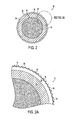
- FIGS. 2 and 2A schematically illustrate a cross-sectional view of a golf ball in accordance with FIG. 1 having a coating thereon.
- FIG. 3 schematically illustrates a cross-sectional view of a portion of a golf ball having a cover layer and coating in accordance with FIG. 1 having particles contained within a resin.
- FIG. 4 schematically illustrates a cross-sectional view of a portion of a golf ball having a cover layer and coating in accordance with FIG. 1 having particles applied onto the surface of a resin.
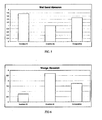
- FIG. 5 depicts test results for Wet Sand Abrasion.
- FIG. 6 depicts test results for Wedge Abrasion.
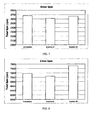
- FIG. 7 depicts spin results of golf balls with a driver.
- FIG. 8 depicts spin results of golf balls with a 6 iron.
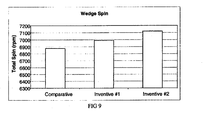
- FIG. 9 depicts spin results of golf balls with a wedge.
- Golf balls may be of varied construction, e.g., one-piece balls, two-piece balls, three-piece balls (including wound balls), four-piece balls, five-piece balls, etc. The difference in play characteristics resulting from these different types of constructions can be quite significant. Generally, golf balls may be classified as solid or wound balls. Solid balls that have a two-piece construction, typically a cross-linked rubber core, e.g., polybutadiene cross-linked with zinc diacrylate and/or similar cross-linking agents, encased by a blended cover, e.g., ionomer resins, are popular with many average recreational golfers.
- a cross-linked rubber core e.g., polybutadiene cross-linked with zinc diacrylate and/or similar cross-linking agents
- a blended cover e.g., ionomer resins
- the combination of the core and cover materials provide a relatively "hard” ball that is virtually indestructible by golfers and one that imparts a high initial velocity to the ball, resulting in improved distance. Because the materials from which the ball is formed are very rigid, two-piece balls tend to have a hard "feel" when struck with a club. Likewise, due to their hardness, these balls have a relatively low spin rate, which also helps provide greater distance.
- Wound balls are generally constructed from a liquid or solid center surrounded by tensioned elastomeric material and covered with a durable cover material, e.g., ionomer resin, or a softer cover material, e.g., balata or polyurethane.
- a durable cover material e.g., ionomer resin
- a softer cover material e.g., balata or polyurethane.
- Wound balls are generally thought of as performance golf balls and have good resiliency, desirable spin characteristics, and good "feel" when struck by a golf club.
- wound balls are generally difficult to manufacture as compared to solid golf balls.
- Such balls typically include a core (optionally a multipart core, such as an inner core and an outer core), one or more mantle or intermediate layers (also called “inner cover” layers), and an outer cover layer.
- a core optionally a multipart core, such as an inner core and an outer core
- mantle or intermediate layers also called “inner cover” layers
- outer cover layer an outer cover layer
- a variety of golf balls have been designed to provide particular playing characteristics. These characteristics generally include the initial velocity and spin of the golf ball, which can be optimized for various types of players. For instance, certain players prefer a ball that has a high spin rate in order to control and stop the golf ball around the greens. Other players prefer a ball that has a low spin rate and high resiliency to maximize distance. Generally, a golf ball having a hard core and a soft cover will have a high spin rate. Conversely, a golf ball having a hard cover and a soft core will have a low spin rate. Golf balls having a hard core and a hard cover generally have very high resiliency for distance, but they may "feel" hard and be difficult to control around the greens.
- FIG. 1 shows an example of a golf ball 10 that includes a plurality of dimples 18 formed on its outer surface.
- FIGS. 2 and 2A show an example of a golf ball 10, which has a core 12, an intermediate layer 14, a cover 16 having a plurality of dimples 18 formed therein, and a coating 20 applied over the exterior surface of the golf ball 10.
- the golf ball 10 alternatively may be only one piece such that the core 12 represents the entirety of the golf ball 10, and the plurality of dimples are formed on the core 12.
- the ball 10 also may have any other desired construction, including conventional constructions and the various example constructions described herein.
- the thickness of the coating 20 typically is significantly less than that of the cover 16 or the intermediate layer 14, and by way of example may range from about 8 to about 50 ⁇ m.
- the coating 20 should be substantially uniformly applied to the exterior of the ball (e.g., a substantially uniform thickness) and should have a minimal effect on the depth and volume of the dimples 18.
- An optional primer or basecoat may be applied to the exterior surface of the cover 16 of the golf ball 10 prior to application of the coating layer 20.
- a golf ball may be formed, for example, with a center having a low compression, but still exhibit a finished ball COR and initial velocity approaching that of conventional two-piece distance balls.
- the center may have, for example, a compression of about 60 or less.
- the finished balls made with such centers have a COR, measured at an inbound speed of 38,1 m/s (125 ft./s.), of about 0.795 to about 0.815.
- COR refers to Coefficient of Restitution, which is obtained by dividing a ball's rebound velocity by its initial (i.e., incoming) velocity.
- This test is performed by firing the samples out of an air cannon at a vertical steel plate over a range of test velocities (e.g., from 22,9 m/s (75 ft/s to 45,7 m/s (150 ft/s))).
- a golf ball having a high COR dissipates a smaller fraction of its total energy when colliding with the plate and rebounding therefrom than does a ball with a lower COR.
- points and “compression points” refer to the compression scale or the compression scale based on the ATTI Engineering Compression Tester. This scale, which is well known to persons skilled in the art, is used in determining the relative compression of a center or ball.
- the center may have, for example, a Shore C hardness of about 40 to about 80.
- the center may have a diameter of about 1,9 cm (0.75 inches) to about 4.27 cm (1.68 inches).
- the base composition for forming the center may include, for example, polybutadiene and about 20 to 50 parts of a metal salt diacrylate, dimethacrylate, or monomethacrylate. If desired, the polybutadiene can also be mixed with other elastomers known in the art, such as natural rubber, styrene butadiene, and/or isoprene, in order to further modify the properties of the center.
- the amounts of other constituents in the center composition are usually based on 100 parts by weight of the total elastomer mixture.
- the center (or core) may be made from resin materials, such as HPF resins (optionally with barium sulfate included therein), which are commercially available from E.I. DuPont de Nemours and Company of Wilmington, Delaware.
- Metal salt diacrylates, dimethacrylates, and monomethacrylates include without limitation those wherein the metal is magnesium, calcium, zinc, aluminum, sodium, lithium or nickel.
- Zinc diacrylate for example, provides golf balls with a high initial velocity in the United States Golf Association (“USGA”) test.
- Free radical initiators often are used to promote cross-linking of the metal salt diacrylate, dimethacrylate, or monomethacrylate and the polybutadiene.
- Suitable free radical initiators include, but are not limited to peroxide compounds, such as dicumyl peroxide; 1,1-di(t-butylperoxy) 3,3,5-trimethyl cyclohexane; bis (t-butylperoxy) diisopropylbenzene; 2,5-dimethyl-2,5 di (t-butylperoxy) hexane; or di-t-butyl peroxide; and mixtures thereof.
- the initiator(s) at 100 percent activity may be added in an amount ranging from about 0.05 to about 2.5 pph based upon 100 parts of butadiene, or butadiene mixed with one or more other elastomers. Often the amount of initiator added ranges from about 0.15 to about 2 pph, and more often from about 0.25 to about 1.5 pph.
- the golf ball centers may incorporate 5 to 50 pph of zinc oxide (ZnO) in a zinc diacrylate-peroxide cure system that cross-links polybutadiene during the core molding process.
- the center compositions may also include fillers, added to the elastomeric (or other) composition to adjust the density and/or specific gravity of the center.
- fillers include zinc oxide, barium sulfate, and regrind, e.g., recycled core molding matrix ground to about 30 mesh particle size.
- the amount and type of filler utilized is governed by the amount and weight of other ingredients in the composition, bearing in mind a maximum golf ball weight of 45,9 grs (1.620 oz) has been established by the USGA. Fillers usually range in specific gravity from about 2.0 to about 5.6. The amount of filler in the center may be lower such that the specific gravity of the center is decreased.
- the specific gravity of the center may range, for example, from about 0.8 to about 1.3, depending upon such factors as the size of the center, cover, intermediate layer and finished ball, as well as the specific gravity of the cover and intermediate layer.
- Other components such as accelerators, e.g., tetra methylthiuram, processing aids, processing oils, plasticizers, dyes and pigments, antioxidants, as well as other additives well known to the skilled artisan may also be used in amounts sufficient to achieve the purpose for which they are typically used.
- the golf ball also may have one or more intermediate layers formed, for example, from dynamically vulcanized thermoplastic elastomers, functionalized styrene-butadiene elastomers, thermoplastic rubbers, polybutadiene rubbers, natural rubbers, thermoset elastomers, thermoplastic urethanes, metallocene polymers, thermoset urethanes, ionomer resins, or blends thereof.
- an intermediate layer may include a thermoplastic or thermoset polyurethane.
- Non-limiting of commercially available dynamically vulcanized thermoplastic elastomers include SANTOPRENE ® , SARLINK ® , VYRAM ® , DYTRON ® , and VISTAFLEX ® SANTOPRENENR ® is a dynamically vulcanized PP/EPDM.
- Examples of functionalized styrene-butadiene elastomers, i.e., styrene-butadiene elastomers with functional groups such as maleic anhydride or sulfonic acid, include KRATON FG-1901x and FG-1921x, which are available from the Shell Corporation of Houston, Tex.
- thermoplastic polyurethanes examples include ESTANE ® 58133, ESTANE ® 58134 and ESTANE ® 58144, which are commercially available from the B. F. Goodrich Company of Cleveland, Ohio.
- metallocene polymers i.e., polymers formed with a metallocene catalyst
- Suitable thermoplastic polyesters include polybutylene terephthalate.
- Thermoplastic ionomer resins may be obtained by providing a cross metallic bond to polymers of monoolefin with at least one member selected from the group consisting of unsaturated mono- or di-carboxylic acids having 3 to 12 carbon atoms and esters thereof (the polymer contains 1 to 50 percent by weight of the unsaturated mono- or di-carboxylic acid and/or ester thereof).
- low modulus ionomers such as acid-containing ethylene copolymer ionomers
- low modulus ionomers include E/X/Y copolymers where E is ethylene, X is a softening comonomer such as acrylate or methacrylate.
- ionomer resins include SURLYN ® and IOTEK®, which are commercially available from DuPont and Exxon, respectively.
- the intermediate layer(s) may be a blend of a first and a second component wherein the first component is a dynamically vulcanized thermoplastic elastomer, a functionalized styrene-butadiene elastomer, a thermoplastic or thermoset polyurethane or a metallocene polymer and the second component is a material such as a thermoplastic or thermoset polyurethane, a thermoplastic polyetherester or polyetheramide, a thermoplastic ionomer resin, a thermoplastic polyester, another dynamically vulcanized elastomer, another a functionalized styrene-butadiene elastomer, another a metallocene polymer or blends thereof. At least one of the first and second components may include a thermoplastic or thermoset polyurethane.
- One or more intermediate layers also may be formed from a blend containing an ethylene methacrylic/acrylic acid copolymer.
- acid-containing ethylene copolymers include ethylene/acrylic acid; ethylene/methacrylic acid; ethylene/acrylic acid/n- or isobutyl acrylate; ethylene/methacrylic acid/n- or iso-butyl acrylate; ethylene/acrylic acid/methyl acrylate; ethylene/methacrylic acid/methyl acrylate; ethylene/acrylic acid/isobornyl acrylate or methacrylate and ethylene/methacrylic acid/isobornyl acrylate or methacrylate.
- Examples of commercially available ethylene methacrylic/acrylic acid copolymers include NUCREL ® polymers, available from DuPont.
- the intermediate layer(s) may be formed from a blend which includes an ethylene methacrylic/acrylic acid copolymer and a second component which includes a thermoplastic material.
- Suitable thermoplastic materials for use in the intermediate blend include, but are not limited to, polyesterester block copolymers, polyetherester block copolymers, polyetheramide block copolymers, ionomer resins, dynamically vulcanized thermoplastic elastomers, styrene-butadiene elastomers with functional groups such as maleic anhydride or sulfonic acid attached, thermoplastic polyurethanes, thermoplastic polyesters, metallocene polymers, and/or blends thereof.
- An intermediate layer often has a specific gravity of about 0.8 or more.
- the intermediate layer has a specific gravity greater than 1.0, e.g., ranging from about 1.02 to about 1.3.
- Specific gravity of the intermediate layer may be adjusted, for example, by adding a filler such as barium sulfate, zinc oxide, titanium dioxide and combinations thereof.
- the intermediate layer blend may have a flexural modulus of less than about 69 MPa (10,000 psi), often from about 34,4 MPa (5,000 psi) to about 55,1 MPa (8,000 psi).
- the intermediate layers often have a Shore D hardness of about 35 to 70.
- the intermediate layer and core construction together may have a compression of less than about 65, often from about 50 to about 65.
- the intermediate layer has a thickness from about 0,51 mm (0.020 inches) to about 5,1 mm (0.2 inches).
- the golf balls may include a single intermediate layer or a plurality of intermediate layers.
- a first intermediate layer outside the core may include, for example, a thermoplastic material or a rubber material (synthetic or natural) having a hardness greater than that of the core.
- a second intermediate layer may be disposed around the first intermediate layer and may have a greater hardness than that of the first intermediate layer.
- the second intermediate layer may be formed of materials such as polyether or polyester thermoplastic urethanes, thermoset urethanes, and ionomers such as acid-containing ethylene copolymer ionomers.
- a third intermediate layer (or even more layers) may be disposed in between the first and second intermediate layers.
- the third intermediate layer may be formed of the variety of materials as discussed above.
- the third intermediate layer may have a hardness greater than that of the first intermediate layer.
- a golf ball also typically has a cover layer that includes one or more layers of a thermoplastic or thermosetting material.
- a cover layer that includes one or more layers of a thermoplastic or thermosetting material.
- materials may be used such as ionomer resins, thermoplastic polyurethanes, balata and blends thereof.
- the cover may be formed of a composition including very low modulus ionomers (VLMIs).
- VLMIs very low modulus ionomers
- the term "very low modulus ionomers,” or the acronym “VLMIs,” are those ionomer resins further including a softening comonomer X, commonly a (meth)acrylate ester, present from about 10 weight percent to about 50 weight percent in the polymer.
- VLMIs are copolymers of an ⁇ -olefin, such as ethylene, a softening agent, such as n-butyl-acrylate or isobutyl-acrylate, and an ⁇ , ⁇ -unsaturated carboxylic acid, such as acrylic or methacrylic acid, where at least part of the acid groups are neutralized by a magnesium cation.
- softening comonomers include n-butyl methacrylate, methyl acrylate, and methyl methacrylate.
- a VLMI has a flexural modulus from about 13.8 MPa (2,000 psi) to about 69 MPa (10,000 psi). VLMIs are sometimes referred to as "soft" ionomers.
- Ionomers such as acid-containing ethylene copolymer ionomers
- E/X/Y copolymers where E is ethylene, X is a softening comonomer such as acrylate or methacrylate present in 0 to 50 weight percent of the polymer, and Y is acrylic or methacrylic acid present in 5 to 35 (often 10 to 20) weight percent of the polymer, wherein the acid moiety is neutralized 1 to 90 percent (usually at least 40 percent) to form an ionomer by a cation such as lithium, sodium, potassium, magnesium, calcium, barium, lead, tin, zinc or aluminum, or a combination of such cations, lithium, sodium and zinc being the most preferred.
- a cation such as lithium, sodium, potassium, magnesium, calcium, barium, lead, tin, zinc or aluminum, or a combination of such cations, lithium, sodium and zinc being the most preferred.
- Specific acid-containing ethylene copolymers include ethylene/acrylic acid, ethylene/methacrylic acid, ethylene/acrylic acid/n-butyl acrylate, ethylene/methacrylic acid/n-butyl acrylate, ethylene/methacrylic acid/iso-butyl acrylate, ethylene/acrylic acid/iso-butyl acrylate, ethylene/methacrylic acid/n-butyl methacrylate, ethylene/acrylic acid/methyl methacrylate, ethylene/acrylic acid/methyl acrylate, ethylene/methacrylic acid/methyl acrylate, ethylene/methacrylic acid/methyl methacrylate, and ethylene/acrylic acid/n-butyl methacrylate.
- ionomer resins may be blended in order to obtain a cover having desired characteristics.
- the cover may be formed from a blend of two or more ionomer resins.
- the blend may include, for example, a very soft material and a harder material.
- Ionomer resins with different melt flow indexes are often employed to obtain the desired characteristics of the cover stock.
- SURLYN ® 8118, 7930 and 7940 have melt flow indices of about 1.4, 1.8, and 2.6 g/10 min., respectively.
- SURLYN ® 8269 and SURLYN ® 8265 each have a melt flow index of about 0.9 g/10 min.
- a blend of ionomer resins may be used to form a cover having a melt flow index, for example, of from about 1 to about 3 g/10 min.
- the cover layer may have a Shore D hardness, for example, ranging from about 45 to about 80.
- the cover also may include thermoplastic and/or thermoset materials.
- the cover may include a thermoplastic material such as urethane or polyurethane.
- Polyurethane is a product of a reaction between a polyurethane prepolymer and a curing agent.
- the polyurethane prepolymer is a product formed by a reaction between a polyol and a diisocyanate.
- a catalyst is employed to promote the reaction between the curing agent and the polyurethane prepolymer.
- the curing agent is typically either a diamine or glycol.
- thermoset cast polyurethane may be used.
- Thermoset cast polyurethanes are generally prepared using a diisocyanate, such as 2,4-toluene diisocyanate (TDI), methylenebis-(4-cyclohexyl isocyanate) (HMDI), or paraphenylene diisocyanate (“PPDI”) and a polyol which is cured with a polyamine, such as methylenedianiline (MDA), or a trifunctional glycol, such as trimethylol propane, or tetrafunctional glycol, such as N,N,N',N'-tetrakis(2-hydroxpropyl)ethylenediamine.
- TDI 2,4-toluene diisocyanate
- HMDI methylenebis-(4-cyclohexyl isocyanate)
- PPDI paraphenylene diisocyanate
- MDA methylenedianiline
- trifunctional glycol such as trimethyl
- thermoset materials include, but are not limited to, thermoset urethane ionomers and thermoset urethane epoxies.
- thermoset materials include polybutadiene, natural rubber, polyisoprene, styrene-butadiene, and styrene-propylene-diene rubber.
- an inner cover layer may surround the intermediate layer with an outer cover layer disposed thereon or an inner cover layer may surround a plurality of intermediate layers.
- the outer cover layer material may be a thermoset material that includes at least one of a castable reactive liquid material and reaction products thereof, as described above, and may have a hardness from about 30 Shore D to about 60 Shore D.
- the inner cover layer may be formed from a wide variety of hard (e.g., about 50 Shore D or greater), high flexural modulus resilient materials, which are compatible with the other materials used in the adjacent layers of the golf ball.
- the inner cover layer material may have a flexural modulus of about 45 MPa (65,000 psi) or greater.
- Suitable inner cover layer materials include the hard, high flexural modulus ionomer resins and blends thereof, which may be obtained by providing a cross metallic bond to polymers of monoolefin with at least one member selected from the group consisting of unsaturated mono- or di-carboxylic acids having 3 to 12 carbon atoms and esters thereof (the polymer contains 1 to 50 percent by weight of the unsaturated mono- or di-carboxylic acid and/or ester thereof).
- such acid-containing ethylene copolymer ionomer component includes E/X/Y copolymers where E is ethylene, X is a softening comonomer such as acrylate or methacrylate present in 0-50 weight percent of the polymer, and Y is acrylic or methacrylic acid present in 5-35 weight percent of the polymer, wherein the acid moiety is neutralized about 1-90 percent to form an ionomer by a cation such as lithium, sodium, potassium, magnesium, calcium, barium, lead, tin, zinc, or aluminum, or a combination of such cations.
- a cation such as lithium, sodium, potassium, magnesium, calcium, barium, lead, tin, zinc, or aluminum, or a combination of such cations.
- acid-containing ethylene copolymers include ethylene/acrylic acid, ethylene/methacrylic acid, ethylene/acrylic acid/n-butyl acrylate, ethylene/methacrylic acid/n-butyl acrylate, ethylene/methacrylic acid/iso-butyl acrylate, ethylene/acrylic acid/iso-butyl acrylate, ethylene/methacrylic acid/n-butyl methacrylate, ethylene/acrylic acid/methyl methacrylate, ethylene/acrylic acid/methyl acrylate, ethylene/methacrylic acid/methyl acrylate, ethylene/methacrylic acid/methyl methacrylate, and ethylene/acrylic acid/n-butyl methacrylate.
- suitable inner cover materials include thermoplastic or thermoset polyurethanes, polyetheresters, polyetheramides, or polyesters, dynamically vulcanized elastomers, functionalized styrene-butadiene elastomers, metallocene polymers, polyamides such as nylons, acrylonitrile butadiene-styrene copolymers (ABS), or blends thereof.
- a laminate process In order to form multiple layers around the center, a laminate is first formed.
- the laminate includes at least two layers and sometimes includes three layers.
- the laminate may be formed by mixing uncured core material to be used for each layer and calendar rolling the material into thin sheets.
- the laminate may be formed by mixing uncured intermediate layer material and rolling the material into sheets.
- the laminate sheets may be stacked together to form a laminate having three layers, using calender rolling mills. Alternatively, the sheets may be formed by extrusion.
- a laminate also may be formed using an adhesive between each layer of material.
- an epoxy resin may be used as adhesive.
- the adhesive should have good shear and tensile strength, for example, a tensile strength over about 10,3 MPa (1500 psi).
- the adhesive often has a Shore D hardness of less than about 60 when cured.
- the adhesive layer applied to the sheets should be very thin, e.g., less than about 4 mm (0.004 inches) thick.
- each laminate sheet is formed to a thickness that is slightly larger than the thickness of the layers in the finished golf ball.
- Each of these thicknesses can be varied, but all have a thickness of preferably less than about 25 mm (0.1 inches).
- the sheets should have very uniform thicknesses.
- the next step in the method is to form multiple layers around the center. This may be accomplished by placing two laminates between a top mold and a bottom mold. The laminates may be formed to the cavities in the mold halves. The laminates then may be cut into patterns that, when joined, form a laminated layer around the center. For example, the laminates may be cut into figure 8 -shaped or barbell-like patterns, similar to a baseball or a tennis ball cover. Other patterns may be used, such as curved triangles, hemispherical cups, ovals, or other patterns that may be joined together to form a laminated layer around the center. The patterns may then be placed between molds and formed to the cavities in the mold halves. A vacuum source often is used to form the laminates to the mold cavities so that uniformity in layer thickness is maintained.
- the centers are then inserted between the laminates.
- the laminates are then compression molded about the center under conditions of temperature and pressure that are well known in the art.
- the mold halves usually have vents to allow flowing of excess layer material from the laminates during the compression molding process.
- the core and/or intermediate layer(s) may be formed by injection molding or other suitable technique.
- the next step involves forming a cover around the golf ball core.
- the core including the center and any intermediate layers, may be supported within a pair of cover mold-halves by a plurality of retractable pins.
- the retractable pins may be actuated by conventional means known to those of ordinary skill in the art.
- the cover material is injected into the mold in a liquid state through a plurality of injection ports or gates, such as edge gates or sub-gates.
- edge gates With edge gates, the resultant golf balls are all interconnected and may be removed from the mold halves together in a large matrix. Sub-gating automatically separates the mold runner from the golf balls during the ejection of the golf balls from mold halves.
- the retractable pins may be retracted after a predetermined amount of cover material has been injected into the mold halves to substantially surround the core.
- the liquid cover material is allowed to flow and substantially fill the cavity between the core and the mold halves, while maintaining concentricity between the core and the mold halves.
- the cover material is then allowed to solidify around the core, and the golf balls are ejected from the mold halves and subjected to finishing processes, including coating, painting, and/or other finishing processes, including processes in accordance with examples of this invention, as will be described in more detail below.
- the coating comprises a resin and a plurality of particles.
- the resin may be any suitable resin, non-limiting examples of which include thermoplastics, thermoplastic elastomers, such as polyurethanes, polyesters, acrylics, low acid thermoplastic ionomers, e.g., containing up to about 15% acid, and UV curable systems.
- the coating may comprise additional additives incorporated into the resin, such as flow additives, mar/slip additives, adhesion promoters, thickeners, gloss reducers, flexibilizers, cross-linking additives, isocyanates or other agents for toughening or creating scratch resistance, optical brighteners, UV absorbers, and the like.
- additional additives incorporated into the resin such as flow additives, mar/slip additives, adhesion promoters, thickeners, gloss reducers, flexibilizers, cross-linking additives, isocyanates or other agents for toughening or creating scratch resistance, optical brighteners, UV absorbers, and the like.
- the amount of such additives usually ranges from 0 to about 5 wt%, often from 0 to about 1.5 wt%, based on total weight of the coating.
- solid particles may be contained within the resin or adhered to and/or embedded into the surface of resin as described in more detail below.
- the coating materials may be delivered by spray guns (either fixed or articulating types). Examples of devices that may be used include heated spray equipment and electrostatic and high volume-low pressure (HVLP) devices.
- the golf balls are typically placed on work holders, where they rotate and pass through a spray zone in a specified time to obtain full coverage of their exterior surfaces. Additionally or alternatively, if desired, the spray heads that apply the coating material may be movable with respect to the balls and/or articulated to assist in applying a uniform coating to the entire ball structure.
- Suitable coating systems and methods for use in this invention may include conventional coating systems as are known and used in the art.
- a carrier fluid comprising nitrogen gas or nitrogen-enriched air may be used to deliver the coating material to the exterior surface of the golf ball.
- Nitrogen is clean, dry (anhydrous) in its elemental gas state. Nitrogen can be ionized to eliminate problems associated with moisture and static electricity.
- Suitable equipment for applying coatings using nitrogen-enriched air is described, for example, in U.S. Patent 6,821,315 .
- Such devices are commercially available from N2 Spray Solutions. In general, such devices operate by mixing a carrier fluid under pressure and the coating material.
- the carrier fluid comprises nitrogen-enriched air, which typically contains about 90-99.5% nitrogen by volume.
- Nitrogen-enriched air may be produced, for example, by passing air through hollow-fiber membranes as described in the '315 patent.
- the temperature of the carrier fluid may be adjusted to optimize coating properties. In general, heating the carrier fluid reduces viscosity and reduces the need for solvents. Reducing viscosity improves flow, aides in atomization, and purges the solvent, resulting in a finer spray with a higher solids content.
- the carrier fluid may be heated, for example, to a temperature of about 100 to about 38 to 76.6 °C (170 °F) , often from about 150 to about 65.6 to 76.6 °C (170°F).
- Other parameters, such as pressure also may be suitably adjusted to achieve improved drying characteristics and/or other efficiencies. For example, atomization air pressure of about 275.8 kPa (40 psi) may be employed.
- U.S. Patent Appln. No. 12/470,820 filed May 22, 2009 and entitled "Method of Applying Topcoat to Exterior Surface of Golf Ball" describes systems and methods utilizing nitrogen-containing or nitrogen-enriched delivery fluids to apply coating materials to golf balls.
- golf ball body means a golf ball before applying the top coat (e.g., core, intermediate layers, cover layer with dimples).
- top coat e.g., core, intermediate layers, cover layer with dimples.
- coating often will be used to identify the top coat or last layer applied to the golf ball, but, as also described below, if desired, another coating may be applied over the roughened coating material, if desired, provided that an overall roughened surface is still provided.
- paint or “painting” are used synonymously with a “coating” or “coating” process.
- aspects of this invention relate to golf balls having a top coat or other coating over the cover layer, wherein this coating comprises a resin having particles contained therein or applied thereon.
- the particles provide a golf ball surface having a slightly roughened surface, as will be described in more detail below.
- the particles protrude beyond an average thickness of the resin.
- the average size of the particles is greater than the average thickness of the resin.
- the particles 22 protrude from the surface such that a thin portion of the resin 20 still covers the particles. The surface of the ball will therefore be roughened somewhat, as shown in FIG. 3 .
- particles 22 are applied to the surface of resin 20.
- the particles allow for fine tuning of and improvement on the aerodynamic performance of golf balls in flight, e.g., to enable longer flights of the golf ball.
- the particles cause the finish of the coating to be rougher and on a micro-scale act as small dimples, which increase the turbulence in the air flow around the ball and reduce flow separation on the golf ball, reducing pressure drag.
- the durability of the golf ball may be improved both in cut resistance and abrasion resistance, e.g., depending on the properties of and/or materials used in the coating.
- FIG. 3 and FIG. 4 demonstrate aspects of the invention related to golf balls having a top coat or other coating comprising resin and particles contained within the resin or applied and/or embedded thereon, respectively.
- the particles may be of any shape and may be regular, irregular, uniform, nonuniform, or mixtures thereof.
- the particles may be any polygon or geometric shape, including regular shapes, such as spheres or cubes.
- the spheres may have a round cross-section or may be flattened to provide an elongated or oval cross-section.
- the cubes may be of square or rectangular cross-section. Irregular shapes may be defined by an irregular surface, an irregular perimeter, protrusions, or extensions.
- the particles may be rounded, elongated, smooth, rough, or have edges. Combinations of different shapes of particles may be used. Crystalline or regular particles such as tetrapods may also be used.
- Particles may be made from any material known in the art, such as organic or inorganic, plastics, composite materials, and metals. Suitable particles include, but are not limited to amorphous particles such as silicas and crystalline particles such as metal oxides, e.g., zinc oxide, iron oxides, or titanium oxide.
- particles may comprise fumed silica, amorphous silica, colloidal silica, alumina, colloidal alumina, titanium oxide, cesium oxide, yttrium oxide, colloidal yttria, zirconia, colloidal zirconia, polyethylene terephthalate, polybutylene terephthalate, polyethylene naphthalate, vinyl esters, epoxy materials, phenolics, aminoplasts, polyurethanes and composite particles of silicon carbide or aluminum nitride coated with silica or carbonate.
- the particles may be selected to fine-tune the roughness of the golf ball to achieve the desired aerodynamic qualities of the golf ball as well as to improve abrasion resistance.
- the particles may by of any suitable hardness and durability. Softer particles tend to affect spin, for example.
- the average size of the particles depends on the material selected for the particles. Generally, the particle sizes will range from 400 nm to 40 microns, and in some example constructions, from 5 to 20 microns. In one particular example, the particle sizes range from 8 to 12 microns. The particles may be approximately the same size or may be different sizes within the defined ranges. If the particles are applied to the surface of the resin, they would generally be smaller than if they were contained within the coating.
- thermoplastics thermoplastic elastomers such as polyurethanes, polyesters, acrylics, low acid thermoplastic ionomers, e.g., containing up to about 15% acid, and UV curable systems.
- thermoplastics thermoplastic elastomers such as polyurethanes, polyesters, acrylics, low acid thermoplastic ionomers, e.g., containing up to about 15% acid, and UV curable systems.
- thermoplastics such as polyurethanes, polyesters, acrylics, low acid thermoplastic ionomers, e.g., containing up to about 15% acid, and UV curable systems.
- thermoplastic elastomers such as polyurethanes, polyesters, acrylics, low acid thermoplastic ionomers, e.g., containing up to about 15% acid, and UV curable systems.
- Specific examples include AKZO NOBEL 7000A103.
- Additional additives optionally may be incorporated into the resin, such as flow additives, mar/slip additives, adhesion promoters, thickeners, gloss reducers, flexibilizers, cross-linking additives, isocyanates or other agents for toughening or creating scratch resistance, optical brighteners, UV absorbers, and the like.
- the amount of such additives usually ranges from 0 to about 5 wt%, often from 0 to about 1.5 wt%.
- the viscosity of the resin prior to application to the golf ball body is generally 16 to 24 seconds as measured by #2 Zahn cup.
- the resin is thin enough to easily spray the coating onto the golf ball body, but thick enough to prevent the resin from substantially running after application to the golf ball body.
- the thickness of the applied resin typically ranges from of about 8 to about 50 ⁇ m, and in some examples, from about 10 to about 15 ⁇ m.
- the thickness of the resin is less than the particle size in order to allow the particles to protrude from the resin.
- the coating contains a plurality of particles, generally, 0.1 to 30 wt% particles based on total coating weight, for example, 3 to 10 wt%.
- the coating may be clear or opaque and may be white or have a tint or hue.
- the particles may be of any color. Generally application of the coating and particles to the outside of the golf ball will give the ball somewhat of a dull or matte finish, as compared to the brighter or shinier finish of many conventional golf balls. The particles tend to diffuse some of the light in a clear coat for example.
- a coating is formed by applying and drying a resin on the surface of the golf ball body.
- the method of applying the resin is not limited.
- a two-component curing type resin such as a polyurethane may be applied by an electrostatic coating method, or spray method using a spray gun, for example after mixing an aqueous polyol liquid with a polyisocyanate.
- the aqueous polyol liquid and the polyisocyanate may be mixed bit by bit, or the aqueous polyol liquid and the polyisocyanate are fed with the respective pumps and continuously mixed in a constant ratio through the static mixer located in the stream line just before the spray gun.
- the aqueous polyol liquid and the polyisocyanate can be air-sprayed respectively with the spray gun having the device for controlling the mixing ratio thereof. Subsequently, the two-component curing type urethane resin on the surface of the golf ball body is dried.
- the coating comprises resin (with any additives) and particles mixed therein.
- the coating is applied to the golf ball body such as described above.
- the particles Prior to application to the golf ball body, the particles may be added to the resin as a separate ingredient, or may be pre-mixed with one of the components in a two-component coating composition.
- a resin layer (with any additives) is applied to the golf ball body such as described above.
- particles Prior to drying, particles are applied to the top of the wet resin layer using a media blaster, sand blaster, powder coating device, or other suitable device. The particles may adhere to the surface and/or be embedded into the surface of the resin layer.
- a very thin resin layer may be applied on top of the particles to hold the particles in place.
- this resin layer is composed of the same resin layer initially applied, but may have a thinner viscosity.
- This additional thin layer of resin may be provided, if necessary or desired, to fine tune or somewhat reduce the exterior surface roughness of the ball.
- the spin graphs show the inventive coating can increase spin off of irons and wedges without increasing driver spin. This is advantageous for more distance off the drive (lower spin) and more control around the green (higher spin).
- the golf ball body of the present invention has no limitation on its structure and includes a one-piece golf ball, a two-piece golf ball, a multi-piece golf ball comprising at least three layers, and a wound-core golf ball.
- the present invention can be applied for all types of the golf ball.
Landscapes
- Health & Medical Sciences (AREA)
- General Health & Medical Sciences (AREA)
- Physical Education & Sports Medicine (AREA)
- Compositions Of Macromolecular Compounds (AREA)
Applications Claiming Priority (1)
| Application Number | Priority Date | Filing Date | Title |
|---|---|---|---|
| US12/569,955 US20110077106A1 (en) | 2009-09-30 | 2009-09-30 | Golf Ball Having An Aerodynamic Coating |
Publications (2)
| Publication Number | Publication Date |
|---|---|
| EP2314359A1 EP2314359A1 (en) | 2011-04-27 |
| EP2314359B1 true EP2314359B1 (en) | 2013-10-02 |
Family
ID=43494849
Family Applications (1)
| Application Number | Title | Priority Date | Filing Date |
|---|---|---|---|
| EP10172697.4A Not-in-force EP2314359B1 (en) | 2009-09-30 | 2010-08-12 | Golf ball having an aerodynamic coating |
Country Status (4)
| Country | Link |
|---|---|
| US (1) | US20110077106A1 (enExample) |
| EP (1) | EP2314359B1 (enExample) |
| JP (2) | JP5071994B2 (enExample) |
| CN (1) | CN102029052A (enExample) |
Families Citing this family (37)
| Publication number | Priority date | Publication date | Assignee | Title |
|---|---|---|---|---|
| US9186557B2 (en) | 2009-09-30 | 2015-11-17 | Nike, Inc. | Golf ball having an aerodynamic coating including micro surface roughness |
| US9259623B2 (en) | 2009-09-30 | 2016-02-16 | Nike International, Ltd. | Golf ball having an aerodynamic coating including micro surface roughness |
| US9033826B2 (en) | 2009-09-30 | 2015-05-19 | Nike, Inc. | Golf ball having an aerodynamic coating including micro surface roughness |
| US9108085B2 (en) | 2009-09-30 | 2015-08-18 | Nike, Inc. | Golf ball having an aerodynamic coating including micro surface roughness |
| US9381404B2 (en) * | 2009-09-30 | 2016-07-05 | Nike, Inc. | Golf ball having an increased moment of inertia |
| US9186558B2 (en) * | 2009-09-30 | 2015-11-17 | Nike, Inc. | Golf ball having an aerodynamic coating including micro surface roughness |
| US9409064B2 (en) * | 2009-09-30 | 2016-08-09 | Nike, Inc. | Golf ball having an aerodynamic coating including micro surface roughness |
| US9033825B2 (en) * | 2009-09-30 | 2015-05-19 | Nike, Inc. | Golf ball having an aerodynamic coating including micro surface roughness |
| US9199133B2 (en) * | 2009-09-30 | 2015-12-01 | Nike, Inc. | Golf ball having an aerodynamic coating including micro surface roughness |
| JP2014520654A (ja) * | 2011-07-15 | 2014-08-25 | ナイキ インターナショナル リミテッド | ミクロ表面粗さを含む空気力学的コーティングを有するゴルフボール |
| US20130324313A1 (en) * | 2012-05-29 | 2013-12-05 | Dunlop Sports Co. Ltd. | Golf ball |
| US9283438B2 (en) * | 2012-06-20 | 2016-03-15 | Acushnet Company | Golf balls with oxygen and moisture blocking protective paint layer |
| US9227109B2 (en) * | 2012-09-13 | 2016-01-05 | Acushnet Company | Golf ball compositions |
| US20140256468A1 (en) * | 2013-03-05 | 2014-09-11 | Nike, Inc. | Method for dyeing golf balls and dyed golf balls |
| US9446289B2 (en) * | 2013-05-31 | 2016-09-20 | Nike, Inc. | Thermoplastic multi-layer golf ball |
| JP2015142600A (ja) * | 2013-12-27 | 2015-08-06 | ダンロップスポーツ株式会社 | ゴルフボール及びその製造方法 |
| JP2018158191A (ja) * | 2013-12-27 | 2018-10-11 | 住友ゴム工業株式会社 | ゴルフボール及びその製造方法 |
| JP6533364B2 (ja) * | 2013-12-27 | 2019-06-19 | 住友ゴム工業株式会社 | ゴルフボール及びその製造方法 |
| JP6478628B2 (ja) | 2014-12-26 | 2019-03-06 | 住友ゴム工業株式会社 | ゴルフボール及びその製造方法。 |
| JP6478629B2 (ja) | 2014-12-26 | 2019-03-06 | 住友ゴム工業株式会社 | ゴルフボール及びその製造方法。 |
| KR101761351B1 (ko) | 2015-12-09 | 2017-07-26 | 주식회사 볼빅 | 골프공 커버 코팅용 조성물 및 이를 사용한 골프공 |
| KR101748837B1 (ko) * | 2017-01-26 | 2017-06-20 | 주식회사 볼빅 | 시인성이 향상된 무광 표면을 갖는 골프공 |
| US10207158B2 (en) * | 2017-02-28 | 2019-02-19 | Nike, Inc. | Sports ball |
| USD831138S1 (en) * | 2017-03-21 | 2018-10-16 | Foremost Golf Mfg., Ltd. | Golf ball |
| USD868912S1 (en) * | 2017-05-09 | 2019-12-03 | Volvik, Inc. | Golf ball |
| USD823956S1 (en) * | 2017-05-19 | 2018-07-24 | Nexen Corporation | Golf ball |
| JP7087377B2 (ja) | 2017-12-22 | 2022-06-21 | 住友ゴム工業株式会社 | ゴルフボール |
| CN108198655B (zh) * | 2017-12-28 | 2023-09-05 | 扬州曙光电缆股份有限公司 | 一种阻燃耐火海工本安仪表电缆 |
| JP7180080B2 (ja) | 2018-03-01 | 2022-11-30 | 住友ゴム工業株式会社 | ゴルフボール |
| JP7183547B2 (ja) | 2018-03-01 | 2022-12-06 | 住友ゴム工業株式会社 | ゴルフボール |
| JP7192456B2 (ja) | 2018-03-01 | 2022-12-20 | 住友ゴム工業株式会社 | ゴルフボール |
| EP3533500B1 (en) | 2018-03-01 | 2020-05-13 | Sumitomo Rubber Industries, Ltd. | Golf ball |
| JP7099076B2 (ja) * | 2018-06-22 | 2022-07-12 | ブリヂストンスポーツ株式会社 | ゴルフボール |
| JP7234565B2 (ja) * | 2018-10-16 | 2023-03-08 | 住友ゴム工業株式会社 | ゴルフボール |
| JP7363506B2 (ja) * | 2019-02-22 | 2023-10-18 | 住友ゴム工業株式会社 | ゴルフボール |
| JP7275634B2 (ja) * | 2019-02-22 | 2023-05-18 | 住友ゴム工業株式会社 | ゴルフボール |
| JP7509600B2 (ja) * | 2019-09-27 | 2024-07-02 | ブリヂストンスポーツ株式会社 | ゴルフボール |
Family Cites Families (36)
| Publication number | Priority date | Publication date | Assignee | Title |
|---|---|---|---|---|
| JP3373277B2 (ja) * | 1993-12-28 | 2003-02-04 | 住友ゴム工業株式会社 | 塗装ゴルフボール |
| JP3712010B2 (ja) * | 1995-05-15 | 2005-11-02 | ブリヂストンスポーツ株式会社 | ゴルフボールの塗装方法 |
| US5830077A (en) * | 1997-06-13 | 1998-11-03 | Yavitz; Edward Q. | Impact detector for use with a golf club |
| US6729976B2 (en) * | 1997-09-03 | 2004-05-04 | Acushnet Company | Golf ball with improved flight performance |
| US6193617B1 (en) * | 1999-03-10 | 2001-02-27 | Purespin Golf Company, Inc. | Golf ball and method of making same |
| US6146288A (en) * | 1999-05-12 | 2000-11-14 | Crast; Steven C. | UV-curable clear coat for golf balls |
| JP3629420B2 (ja) * | 2000-08-24 | 2005-03-16 | 住友ゴム工業株式会社 | ゴルフボール |
| US6475106B1 (en) * | 2000-10-31 | 2002-11-05 | Spalding Sports Worldwide, Inc. | Golf ball with grooved dimples |
| US20020077195A1 (en) * | 2000-12-15 | 2002-06-20 | Rick Carr | Golf club head |
| US6596837B2 (en) * | 2001-03-27 | 2003-07-22 | Acushnet Company | Abrasion resistant coated golf equipment |
| US6569038B2 (en) * | 2001-05-02 | 2003-05-27 | Acushnet Company | Golf ball dimples |
| US6866802B2 (en) * | 2001-12-04 | 2005-03-15 | Acushnet Company | Method of forming golf balls from surface-roughened molds |
| US7281997B2 (en) * | 2001-12-04 | 2007-10-16 | Callaway Golf Company | Golf ball with deep depressions |
| JP2003180872A (ja) * | 2001-12-17 | 2003-07-02 | Bridgestone Sports Co Ltd | マルチピースゴルフボール |
| US6919395B2 (en) * | 2002-01-04 | 2005-07-19 | Acushnet Company | Golf ball compositions comprising nanoparticulates |
| DE60214125T2 (de) | 2002-01-25 | 2007-02-22 | Eurosider S.A.S. Di Milli Ottavio & C. | Membranvorrichtung zur Behandlung eines Zuluftstroms für eine Spritzlackiereinrichtung |
| JP2003210617A (ja) * | 2002-01-25 | 2003-07-29 | Sumitomo Rubber Ind Ltd | ゴルフボール |
| US7588505B2 (en) * | 2005-01-03 | 2009-09-15 | Acushnet Company | Golf ball surface textures |
| JP4129624B2 (ja) * | 2002-09-18 | 2008-08-06 | ブリヂストンスポーツ株式会社 | ゴルフボール表面の塗装方法 |
| JP3985162B2 (ja) * | 2002-09-18 | 2007-10-03 | ブリヂストンスポーツ株式会社 | ゴルフボールの製造方法及びゴルフボール |
| US7524539B2 (en) * | 2002-09-18 | 2009-04-28 | Bridgestone Sports Co., Ltd. | Golf ball preparation method and golf ball |
| JP4149236B2 (ja) * | 2002-10-30 | 2008-09-10 | Sriスポーツ株式会社 | ゴルフボール及びゴルフボール製造方法 |
| JP4194441B2 (ja) * | 2003-07-28 | 2008-12-10 | Sriスポーツ株式会社 | ゴルフボール |
| US7654918B2 (en) * | 2004-01-12 | 2010-02-02 | Acushnet Company | Multi-layer core golf ball having thermoset rubber cover |
| JP4096198B2 (ja) * | 2004-06-09 | 2008-06-04 | 美津濃株式会社 | ゴルフボール形成用組成物及びマルチピースゴルフボール |
| US7115050B2 (en) * | 2004-08-04 | 2006-10-03 | Acushnet Company | Scratch resistant coating compositions for golf equipment |
| US7166043B2 (en) * | 2004-08-09 | 2007-01-23 | Bridgestone Sports Co., Ltd. | Golf ball |
| JP4398822B2 (ja) * | 2004-09-07 | 2010-01-13 | Sriスポーツ株式会社 | ゴルフボール |
| EP1863908B1 (de) * | 2005-04-01 | 2010-11-17 | Qiagen GmbH | Reverse transkription und amplifikation von rna bei simultaner degradierung von dna |
| US7192368B2 (en) * | 2005-06-07 | 2007-03-20 | Callaway Golf Company | Golf ball covers and mantles comprising glass particles |
| US7291076B2 (en) * | 2005-07-14 | 2007-11-06 | Bridgestone Sports Co., Ltd | Golf ball |
| US20070213143A1 (en) * | 2006-03-07 | 2007-09-13 | Chinn Jeffrey D | Exterior coatings for golf balls |
| JP2008161375A (ja) * | 2006-12-27 | 2008-07-17 | Sri Sports Ltd | ゴルフボール |
| CN201058208Y (zh) * | 2007-06-22 | 2008-05-14 | 黄丽英 | 新型高尔夫球 |
| US7806784B2 (en) * | 2007-10-29 | 2010-10-05 | Bridgestone Sports Co., Ltd. | Golf ball |
| JP5175827B2 (ja) * | 2009-12-08 | 2013-04-03 | ダンロップスポーツ株式会社 | ゴルフボール |
-
2009
- 2009-09-30 US US12/569,955 patent/US20110077106A1/en not_active Abandoned
-
2010
- 2010-08-12 EP EP10172697.4A patent/EP2314359B1/en not_active Not-in-force
- 2010-08-12 JP JP2010180877A patent/JP5071994B2/ja not_active Expired - Fee Related
- 2010-09-29 CN CN2010102955061A patent/CN102029052A/zh active Pending
-
2011
- 2011-07-15 JP JP2011156290A patent/JP2011251135A/ja active Pending
Also Published As
| Publication number | Publication date |
|---|---|
| JP2011072776A (ja) | 2011-04-14 |
| JP2011251135A (ja) | 2011-12-15 |
| US20110077106A1 (en) | 2011-03-31 |
| CN102029052A (zh) | 2011-04-27 |
| JP5071994B2 (ja) | 2012-11-14 |
| EP2314359A1 (en) | 2011-04-27 |
Similar Documents
| Publication | Publication Date | Title |
|---|---|---|
| EP2314359B1 (en) | Golf ball having an aerodynamic coating | |
| US9409064B2 (en) | Golf ball having an aerodynamic coating including micro surface roughness | |
| US8298619B2 (en) | Method and apparatus for applying a topcoat to a golf ball surface | |
| EP2544774B1 (en) | Golf ball having a protective coating | |
| JP4188247B2 (ja) | ゴルフボール | |
| EP2298421B1 (en) | Method of post-mold crosslinking thermoplastic polyurethane golf ball cover compositions | |
| US8598275B2 (en) | Hydrophobic thermoplastic polyurethane as a compatilizer for polymer blends for golf balls | |
| WO2011112481A1 (en) | Golf ball having moisture resistant adhesive layer | |
| EP2544778A1 (en) | Golf ball having moisture resistant layer | |
| JP4206341B2 (ja) | ゴルフボール | |
| US20130310195A1 (en) | Method Apparatus for Producing a Golf Ball | |
| JP4188246B2 (ja) | ゴルフボール |
Legal Events
| Date | Code | Title | Description |
|---|---|---|---|
| PUAI | Public reference made under article 153(3) epc to a published international application that has entered the european phase |
Free format text: ORIGINAL CODE: 0009012 |
|
| AK | Designated contracting states |
Kind code of ref document: A1 Designated state(s): AL AT BE BG CH CY CZ DE DK EE ES FI FR GB GR HR HU IE IS IT LI LT LU LV MC MK MT NL NO PL PT RO SE SI SK SM TR |
|
| AX | Request for extension of the european patent |
Extension state: BA ME RS |
|
| 17P | Request for examination filed |
Effective date: 20111025 |
|
| 17Q | First examination report despatched |
Effective date: 20120312 |
|
| GRAP | Despatch of communication of intention to grant a patent |
Free format text: ORIGINAL CODE: EPIDOSNIGR1 |
|
| INTG | Intention to grant announced |
Effective date: 20130513 |
|
| GRAS | Grant fee paid |
Free format text: ORIGINAL CODE: EPIDOSNIGR3 |
|
| GRAA | (expected) grant |
Free format text: ORIGINAL CODE: 0009210 |
|
| AK | Designated contracting states |
Kind code of ref document: B1 Designated state(s): AL AT BE BG CH CY CZ DE DK EE ES FI FR GB GR HR HU IE IS IT LI LT LU LV MC MK MT NL NO PL PT RO SE SI SK SM TR |
|
| REG | Reference to a national code |
Ref country code: GB Ref legal event code: FG4D |
|
| REG | Reference to a national code |
Ref country code: CH Ref legal event code: EP Ref country code: AT Ref legal event code: REF Ref document number: 634304 Country of ref document: AT Kind code of ref document: T Effective date: 20131015 |
|
| REG | Reference to a national code |
Ref country code: IE Ref legal event code: FG4D |
|
| REG | Reference to a national code |
Ref country code: DE Ref legal event code: R096 Ref document number: 602010010632 Country of ref document: DE Effective date: 20131128 |
|
| REG | Reference to a national code |
Ref country code: SE Ref legal event code: TRGR |
|
| REG | Reference to a national code |
Ref country code: AT Ref legal event code: MK05 Ref document number: 634304 Country of ref document: AT Kind code of ref document: T Effective date: 20131002 |
|
| REG | Reference to a national code |
Ref country code: NL Ref legal event code: VDEP Effective date: 20131002 |
|
| PG25 | Lapsed in a contracting state [announced via postgrant information from national office to epo] |
Ref country code: SI Free format text: LAPSE BECAUSE OF FAILURE TO SUBMIT A TRANSLATION OF THE DESCRIPTION OR TO PAY THE FEE WITHIN THE PRESCRIBED TIME-LIMIT Effective date: 20131002 |
|
| REG | Reference to a national code |
Ref country code: LT Ref legal event code: MG4D |
|
| PG25 | Lapsed in a contracting state [announced via postgrant information from national office to epo] |
Ref country code: BE Free format text: LAPSE BECAUSE OF FAILURE TO SUBMIT A TRANSLATION OF THE DESCRIPTION OR TO PAY THE FEE WITHIN THE PRESCRIBED TIME-LIMIT Effective date: 20131002 Ref country code: FI Free format text: LAPSE BECAUSE OF FAILURE TO SUBMIT A TRANSLATION OF THE DESCRIPTION OR TO PAY THE FEE WITHIN THE PRESCRIBED TIME-LIMIT Effective date: 20131002 Ref country code: IS Free format text: LAPSE BECAUSE OF FAILURE TO SUBMIT A TRANSLATION OF THE DESCRIPTION OR TO PAY THE FEE WITHIN THE PRESCRIBED TIME-LIMIT Effective date: 20140202 Ref country code: LT Free format text: LAPSE BECAUSE OF FAILURE TO SUBMIT A TRANSLATION OF THE DESCRIPTION OR TO PAY THE FEE WITHIN THE PRESCRIBED TIME-LIMIT Effective date: 20131002 Ref country code: CZ Free format text: LAPSE BECAUSE OF FAILURE TO SUBMIT A TRANSLATION OF THE DESCRIPTION OR TO PAY THE FEE WITHIN THE PRESCRIBED TIME-LIMIT Effective date: 20131002 Ref country code: HR Free format text: LAPSE BECAUSE OF FAILURE TO SUBMIT A TRANSLATION OF THE DESCRIPTION OR TO PAY THE FEE WITHIN THE PRESCRIBED TIME-LIMIT Effective date: 20131002 Ref country code: NL Free format text: LAPSE BECAUSE OF FAILURE TO SUBMIT A TRANSLATION OF THE DESCRIPTION OR TO PAY THE FEE WITHIN THE PRESCRIBED TIME-LIMIT Effective date: 20131002 Ref country code: NO Free format text: LAPSE BECAUSE OF FAILURE TO SUBMIT A TRANSLATION OF THE DESCRIPTION OR TO PAY THE FEE WITHIN THE PRESCRIBED TIME-LIMIT Effective date: 20140102 |
|
| PG25 | Lapsed in a contracting state [announced via postgrant information from national office to epo] |
Ref country code: ES Free format text: LAPSE BECAUSE OF FAILURE TO SUBMIT A TRANSLATION OF THE DESCRIPTION OR TO PAY THE FEE WITHIN THE PRESCRIBED TIME-LIMIT Effective date: 20131002 Ref country code: PL Free format text: LAPSE BECAUSE OF FAILURE TO SUBMIT A TRANSLATION OF THE DESCRIPTION OR TO PAY THE FEE WITHIN THE PRESCRIBED TIME-LIMIT Effective date: 20131002 Ref country code: AT Free format text: LAPSE BECAUSE OF FAILURE TO SUBMIT A TRANSLATION OF THE DESCRIPTION OR TO PAY THE FEE WITHIN THE PRESCRIBED TIME-LIMIT Effective date: 20131002 Ref country code: CY Free format text: LAPSE BECAUSE OF FAILURE TO SUBMIT A TRANSLATION OF THE DESCRIPTION OR TO PAY THE FEE WITHIN THE PRESCRIBED TIME-LIMIT Effective date: 20131002 Ref country code: LV Free format text: LAPSE BECAUSE OF FAILURE TO SUBMIT A TRANSLATION OF THE DESCRIPTION OR TO PAY THE FEE WITHIN THE PRESCRIBED TIME-LIMIT Effective date: 20131002 |
|
| PG25 | Lapsed in a contracting state [announced via postgrant information from national office to epo] |
Ref country code: PT Free format text: LAPSE BECAUSE OF FAILURE TO SUBMIT A TRANSLATION OF THE DESCRIPTION OR TO PAY THE FEE WITHIN THE PRESCRIBED TIME-LIMIT Effective date: 20140203 |
|
| REG | Reference to a national code |
Ref country code: DE Ref legal event code: R097 Ref document number: 602010010632 Country of ref document: DE |
|
| REG | Reference to a national code |
Ref country code: GB Ref legal event code: 732E Free format text: REGISTERED BETWEEN 20140626 AND 20140702 |
|
| PG25 | Lapsed in a contracting state [announced via postgrant information from national office to epo] |
Ref country code: EE Free format text: LAPSE BECAUSE OF FAILURE TO SUBMIT A TRANSLATION OF THE DESCRIPTION OR TO PAY THE FEE WITHIN THE PRESCRIBED TIME-LIMIT Effective date: 20131002 |
|
| PLBE | No opposition filed within time limit |
Free format text: ORIGINAL CODE: 0009261 |
|
| STAA | Information on the status of an ep patent application or granted ep patent |
Free format text: STATUS: NO OPPOSITION FILED WITHIN TIME LIMIT |
|
| PG25 | Lapsed in a contracting state [announced via postgrant information from national office to epo] |
Ref country code: SK Free format text: LAPSE BECAUSE OF FAILURE TO SUBMIT A TRANSLATION OF THE DESCRIPTION OR TO PAY THE FEE WITHIN THE PRESCRIBED TIME-LIMIT Effective date: 20131002 Ref country code: IT Free format text: LAPSE BECAUSE OF FAILURE TO SUBMIT A TRANSLATION OF THE DESCRIPTION OR TO PAY THE FEE WITHIN THE PRESCRIBED TIME-LIMIT Effective date: 20131002 Ref country code: RO Free format text: LAPSE BECAUSE OF FAILURE TO SUBMIT A TRANSLATION OF THE DESCRIPTION OR TO PAY THE FEE WITHIN THE PRESCRIBED TIME-LIMIT Effective date: 20131002 |
|
| 26N | No opposition filed |
Effective date: 20140703 |
|
| PG25 | Lapsed in a contracting state [announced via postgrant information from national office to epo] |
Ref country code: DK Free format text: LAPSE BECAUSE OF FAILURE TO SUBMIT A TRANSLATION OF THE DESCRIPTION OR TO PAY THE FEE WITHIN THE PRESCRIBED TIME-LIMIT Effective date: 20131002 |
|
| REG | Reference to a national code |
Ref country code: DE Ref legal event code: R097 Ref document number: 602010010632 Country of ref document: DE Effective date: 20140703 |
|
| PG25 | Lapsed in a contracting state [announced via postgrant information from national office to epo] |
Ref country code: LU Free format text: LAPSE BECAUSE OF FAILURE TO SUBMIT A TRANSLATION OF THE DESCRIPTION OR TO PAY THE FEE WITHIN THE PRESCRIBED TIME-LIMIT Effective date: 20140812 Ref country code: MC Free format text: LAPSE BECAUSE OF FAILURE TO SUBMIT A TRANSLATION OF THE DESCRIPTION OR TO PAY THE FEE WITHIN THE PRESCRIBED TIME-LIMIT Effective date: 20131002 |
|
| REG | Reference to a national code |
Ref country code: CH Ref legal event code: PL |
|
| REG | Reference to a national code |
Ref country code: DE Ref legal event code: R082 Ref document number: 602010010632 Country of ref document: DE Representative=s name: KOTITSCHKE & HEURUNG PARTNERSCHAFT MBB PATENT-, DE |
|
| PG25 | Lapsed in a contracting state [announced via postgrant information from national office to epo] |
Ref country code: CH Free format text: LAPSE BECAUSE OF NON-PAYMENT OF DUE FEES Effective date: 20140831 Ref country code: LI Free format text: LAPSE BECAUSE OF NON-PAYMENT OF DUE FEES Effective date: 20140831 |
|
| REG | Reference to a national code |
Ref country code: DE Ref legal event code: R081 Ref document number: 602010010632 Country of ref document: DE Owner name: NIKE INNOVATE C.V. (KOMMANDITGESELLSCHAFT NIED, US Free format text: FORMER OWNER: NIKE INTERNATIONAL LTD., BEAVERTON, OREG., US Effective date: 20150401 Ref country code: DE Ref legal event code: R082 Ref document number: 602010010632 Country of ref document: DE Representative=s name: KOTITSCHKE & HEURUNG PARTNERSCHAFT MBB PATENT-, DE Effective date: 20150401 Ref country code: DE Ref legal event code: R082 Ref document number: 602010010632 Country of ref document: DE Representative=s name: KOTITSCHKE & HEURUNG PARTNERSCHAFT MBB, DE Effective date: 20150401 Ref country code: DE Ref legal event code: R082 Ref document number: 602010010632 Country of ref document: DE Representative=s name: DR. RALF KOTITSCHKE, DE Effective date: 20150401 |
|
| REG | Reference to a national code |
Ref country code: IE Ref legal event code: MM4A |
|
| REG | Reference to a national code |
Ref country code: FR Ref legal event code: TP Owner name: NIKE INNOVATE C.V., US Effective date: 20150420 |
|
| PG25 | Lapsed in a contracting state [announced via postgrant information from national office to epo] |
Ref country code: IE Free format text: LAPSE BECAUSE OF NON-PAYMENT OF DUE FEES Effective date: 20140812 |
|
| PG25 | Lapsed in a contracting state [announced via postgrant information from national office to epo] |
Ref country code: SM Free format text: LAPSE BECAUSE OF FAILURE TO SUBMIT A TRANSLATION OF THE DESCRIPTION OR TO PAY THE FEE WITHIN THE PRESCRIBED TIME-LIMIT Effective date: 20131002 Ref country code: NO Free format text: LAPSE BECAUSE OF FAILURE TO SUBMIT A TRANSLATION OF THE DESCRIPTION OR TO PAY THE FEE WITHIN THE PRESCRIBED TIME-LIMIT Effective date: 20140101 |
|
| PG25 | Lapsed in a contracting state [announced via postgrant information from national office to epo] |
Ref country code: MT Free format text: LAPSE BECAUSE OF FAILURE TO SUBMIT A TRANSLATION OF THE DESCRIPTION OR TO PAY THE FEE WITHIN THE PRESCRIBED TIME-LIMIT Effective date: 20131002 Ref country code: BG Free format text: LAPSE BECAUSE OF FAILURE TO SUBMIT A TRANSLATION OF THE DESCRIPTION OR TO PAY THE FEE WITHIN THE PRESCRIBED TIME-LIMIT Effective date: 20131002 Ref country code: GR Free format text: LAPSE BECAUSE OF FAILURE TO SUBMIT A TRANSLATION OF THE DESCRIPTION OR TO PAY THE FEE WITHIN THE PRESCRIBED TIME-LIMIT Effective date: 20140103 |
|
| REG | Reference to a national code |
Ref country code: FR Ref legal event code: PLFP Year of fee payment: 7 |
|
| PG25 | Lapsed in a contracting state [announced via postgrant information from national office to epo] |
Ref country code: HU Free format text: LAPSE BECAUSE OF FAILURE TO SUBMIT A TRANSLATION OF THE DESCRIPTION OR TO PAY THE FEE WITHIN THE PRESCRIBED TIME-LIMIT; INVALID AB INITIO Effective date: 20100812 Ref country code: TR Free format text: LAPSE BECAUSE OF FAILURE TO SUBMIT A TRANSLATION OF THE DESCRIPTION OR TO PAY THE FEE WITHIN THE PRESCRIBED TIME-LIMIT Effective date: 20131002 |
|
| PGFP | Annual fee paid to national office [announced via postgrant information from national office to epo] |
Ref country code: GB Payment date: 20160810 Year of fee payment: 7 Ref country code: DE Payment date: 20160809 Year of fee payment: 7 |
|
| PGFP | Annual fee paid to national office [announced via postgrant information from national office to epo] |
Ref country code: FR Payment date: 20160712 Year of fee payment: 7 Ref country code: SE Payment date: 20160811 Year of fee payment: 7 |
|
| REG | Reference to a national code |
Ref country code: DE Ref legal event code: R119 Ref document number: 602010010632 Country of ref document: DE |
|
| GBPC | Gb: european patent ceased through non-payment of renewal fee |
Effective date: 20170812 |
|
| PG25 | Lapsed in a contracting state [announced via postgrant information from national office to epo] |
Ref country code: SE Free format text: LAPSE BECAUSE OF NON-PAYMENT OF DUE FEES Effective date: 20170813 |
|
| REG | Reference to a national code |
Ref country code: FR Ref legal event code: ST Effective date: 20180430 |
|
| PG25 | Lapsed in a contracting state [announced via postgrant information from national office to epo] |
Ref country code: MK Free format text: LAPSE BECAUSE OF FAILURE TO SUBMIT A TRANSLATION OF THE DESCRIPTION OR TO PAY THE FEE WITHIN THE PRESCRIBED TIME-LIMIT Effective date: 20131002 |
|
| PG25 | Lapsed in a contracting state [announced via postgrant information from national office to epo] |
Ref country code: DE Free format text: LAPSE BECAUSE OF NON-PAYMENT OF DUE FEES Effective date: 20180301 Ref country code: GB Free format text: LAPSE BECAUSE OF NON-PAYMENT OF DUE FEES Effective date: 20170812 |
|
| PG25 | Lapsed in a contracting state [announced via postgrant information from national office to epo] |
Ref country code: FR Free format text: LAPSE BECAUSE OF NON-PAYMENT OF DUE FEES Effective date: 20170831 |
|
| PG25 | Lapsed in a contracting state [announced via postgrant information from national office to epo] |
Ref country code: AL Free format text: LAPSE BECAUSE OF FAILURE TO SUBMIT A TRANSLATION OF THE DESCRIPTION OR TO PAY THE FEE WITHIN THE PRESCRIBED TIME-LIMIT Effective date: 20131002 |