EP2309335A1 - Image forming apparatus - Google Patents
Image forming apparatus Download PDFInfo
- Publication number
- EP2309335A1 EP2309335A1 EP10183184A EP10183184A EP2309335A1 EP 2309335 A1 EP2309335 A1 EP 2309335A1 EP 10183184 A EP10183184 A EP 10183184A EP 10183184 A EP10183184 A EP 10183184A EP 2309335 A1 EP2309335 A1 EP 2309335A1
- Authority
- EP
- European Patent Office
- Prior art keywords
- developer
- remaining
- supplying
- toner
- amount
- Prior art date
- Legal status (The legal status is an assumption and is not a legal conclusion. Google has not performed a legal analysis and makes no representation as to the accuracy of the status listed.)
- Withdrawn
Links
Images





Classifications
-
- G—PHYSICS
- G03—PHOTOGRAPHY; CINEMATOGRAPHY; ANALOGOUS TECHNIQUES USING WAVES OTHER THAN OPTICAL WAVES; ELECTROGRAPHY; HOLOGRAPHY
- G03G—ELECTROGRAPHY; ELECTROPHOTOGRAPHY; MAGNETOGRAPHY
- G03G15/00—Apparatus for electrographic processes using a charge pattern
- G03G15/55—Self-diagnostics; Malfunction or lifetime display
- G03G15/553—Monitoring or warning means for exhaustion or lifetime end of consumables, e.g. indication of insufficient copy sheet quantity for a job
- G03G15/556—Monitoring or warning means for exhaustion or lifetime end of consumables, e.g. indication of insufficient copy sheet quantity for a job for toner consumption, e.g. pixel counting, toner coverage detection or toner density measurement
-
- G—PHYSICS
- G03—PHOTOGRAPHY; CINEMATOGRAPHY; ANALOGOUS TECHNIQUES USING WAVES OTHER THAN OPTICAL WAVES; ELECTROGRAPHY; HOLOGRAPHY
- G03G—ELECTROGRAPHY; ELECTROPHOTOGRAPHY; MAGNETOGRAPHY
- G03G15/00—Apparatus for electrographic processes using a charge pattern
- G03G15/06—Apparatus for electrographic processes using a charge pattern for developing
- G03G15/08—Apparatus for electrographic processes using a charge pattern for developing using a solid developer, e.g. powder developer
- G03G15/0806—Apparatus for electrographic processes using a charge pattern for developing using a solid developer, e.g. powder developer on a donor element, e.g. belt, roller
- G03G15/0808—Apparatus for electrographic processes using a charge pattern for developing using a solid developer, e.g. powder developer on a donor element, e.g. belt, roller characterised by the developer supplying means, e.g. structure of developer supply roller
-
- G—PHYSICS
- G03—PHOTOGRAPHY; CINEMATOGRAPHY; ANALOGOUS TECHNIQUES USING WAVES OTHER THAN OPTICAL WAVES; ELECTROGRAPHY; HOLOGRAPHY
- G03G—ELECTROGRAPHY; ELECTROPHOTOGRAPHY; MAGNETOGRAPHY
- G03G15/00—Apparatus for electrographic processes using a charge pattern
- G03G15/06—Apparatus for electrographic processes using a charge pattern for developing
- G03G15/08—Apparatus for electrographic processes using a charge pattern for developing using a solid developer, e.g. powder developer
- G03G15/0822—Arrangements for preparing, mixing, supplying or dispensing developer
- G03G15/0848—Arrangements for testing or measuring developer properties or quality, e.g. charge, size, flowability
- G03G15/0856—Detection or control means for the developer level
-
- G—PHYSICS
- G03—PHOTOGRAPHY; CINEMATOGRAPHY; ANALOGOUS TECHNIQUES USING WAVES OTHER THAN OPTICAL WAVES; ELECTROGRAPHY; HOLOGRAPHY
- G03G—ELECTROGRAPHY; ELECTROPHOTOGRAPHY; MAGNETOGRAPHY
- G03G15/00—Apparatus for electrographic processes using a charge pattern
- G03G15/06—Apparatus for electrographic processes using a charge pattern for developing
- G03G15/08—Apparatus for electrographic processes using a charge pattern for developing using a solid developer, e.g. powder developer
- G03G15/0822—Arrangements for preparing, mixing, supplying or dispensing developer
- G03G15/0848—Arrangements for testing or measuring developer properties or quality, e.g. charge, size, flowability
- G03G15/0856—Detection or control means for the developer level
- G03G15/086—Detection or control means for the developer level the level being measured by electro-magnetic means
-
- G—PHYSICS
- G03—PHOTOGRAPHY; CINEMATOGRAPHY; ANALOGOUS TECHNIQUES USING WAVES OTHER THAN OPTICAL WAVES; ELECTROGRAPHY; HOLOGRAPHY
- G03G—ELECTROGRAPHY; ELECTROPHOTOGRAPHY; MAGNETOGRAPHY
- G03G15/00—Apparatus for electrographic processes using a charge pattern
- G03G15/06—Apparatus for electrographic processes using a charge pattern for developing
- G03G15/08—Apparatus for electrographic processes using a charge pattern for developing using a solid developer, e.g. powder developer
- G03G15/0822—Arrangements for preparing, mixing, supplying or dispensing developer
- G03G15/0877—Arrangements for metering and dispensing developer from a developer cartridge into the development unit
-
- G—PHYSICS
- G03—PHOTOGRAPHY; CINEMATOGRAPHY; ANALOGOUS TECHNIQUES USING WAVES OTHER THAN OPTICAL WAVES; ELECTROGRAPHY; HOLOGRAPHY
- G03G—ELECTROGRAPHY; ELECTROPHOTOGRAPHY; MAGNETOGRAPHY
- G03G15/00—Apparatus for electrographic processes using a charge pattern
- G03G15/55—Self-diagnostics; Malfunction or lifetime display
- G03G15/553—Monitoring or warning means for exhaustion or lifetime end of consumables, e.g. indication of insufficient copy sheet quantity for a job
Definitions
- the present invention relates to an image forming apparatus including a measuring device for measuring electrostatic capacity between a developer carrying member for carrying a developer and a developer supplying member for supplying the developer to the developer carrying member to obtain information on a remaining developer amount.
- This image forming apparatus may preferably be used as an electrophotographic apparatus such as a printer or a copying machine.
- a developing device used in the image forming apparatus such as the electrophotographic apparatus
- a device for detecting a removing amount of the developer also referred to as toner
- an antenna type has been known.
- an antenna consisting of a metal rod of a stainless steel or the like is provided in parallel to the developer carrying member, such as a developing sleeve, for carrying the toner and supplying the toner to an image bearing member such as an electrophotographic photosensitive member.
- a developing bias in the form of a DC voltage biased with an AC voltage is applied to the developer carrying member, a voltage depending on the electrostatic capacity between the developer carrying member and the antenna is induced in the antenna.
- the electrostatic capacity the antenna and the developer carrying member is different between in a state in which the toner is sufficiently present in the developing device and a gap between the antenna and the developer carrying member is filled with the toner and in a state in which the toner in the developing device is consumed and the gap between the antenna and the developer carrying member is not filled with the toner.
- the voltage induced in the antenna is also different.
- the voltage induced in the antenna is detected by a detector. Then, in a control portion, on the basis of a detected voltage value (depending on the electrostatic capacity), a remaining toner amount in the developing device is computed.
- the developer supplying member for supplying the toner to the developer carrying member is generally provided in a developing chamber.
- the above-described remaining toner amount detecting method utilizing the change in electrostatic capacity is applied to the developing device, due to the presence of the supplying member, there arises a problem such that a space in which the antenna is to be provided is narrow and therefore feeding of the toner is hindered.
- a method of detecting the remaining toner amount by utilizing the supplying member for supplying the toner to the developer carrying member has been known.
- the supplying member is constituted by providing urethane sponge around an electroconductive metal support (electroconductive support).
- JP-A Japanese Laid-Open Patent Application
- JPA Hei 4-234777 a method in which a voltage depending on the toner amount is induced in the metal support of the supplying member and then the remaining toner amount is detected by the induced voltage has been proposed. According to the method of JPA Hei 4-234777 , there is no need to use a dedicated antenna and thus the method is advantageous in terms of the space and the cost.
- JP-A Hei 11-288161 As a structure of a foam layer of the supplying member, as described in JP-A Hei 11-288161 , there is a structure of the foam layer of the supplying member in which an amount of air flow of the foam layer is set at 10 to 400 cc/cm 2 /sec to prevent toner deterioration and thus a good image quality can be obtained. Incidentally, in JP-A Hei 11-288161 , there is no description as to the detection of the remaining toner amount in the developing device.
- the present invention has further developed the above-described conventional constitutions.
- a principal object of the present invention is to provide an image forming apparatus capable of detecting an image formable amount of a developer in a developer container with high accuracy even in various use statuses by enabling image formation even in a smaller remaining developer amount.
- an image forming apparatus comprising:
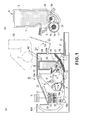
- FIG. 1(a) is a schematic structural view of an image forming apparatus 10 in this embodiment.
- This image forming apparatus 10 is a laser beam printer, utilizing a transfer type electrophotographic process, of the type in which a process cartridge is mountable and demountable.
- the image forming apparatus 10 effects image formation on a sheet-like recording material as a recording medium (recording media) on the basis of an electric image signal input from an external host device 51 such as a personal computer or an image reader into a controller portion (control portion) 52 on the image forming apparatus side.
- the controller portion 52 includes a CPU (computing portion) 53 an ROM (storing portion) 54, and the like and transfers various pieces of electrical image information between itself and the host device 51 or an operation portion (not shown) or the image forming apparatus 10.
- the controller portion 52 effects centralized control of an image forming operation of the image forming apparatus 100 in accordance with a predetermined control program or a predetermined reference table.
- the image forming apparatus 10 includes a rotatable drum type electrophotographic photosensitive drum 11 as an image bearing member for bearing an electrostatic latent image on its surface (hereinafter referred to as a drum).
- the image forming apparatus 10 also includes, as process means acting on the drum 11, a charging means 12, an image exposure means (device) 13, a developing means (device) 4, a transfer means 14, and a cleaning means 17.
- the drum 11 is rotationally driven at a predetermined speed in a clockwise direction indicated by an arrow E by a driving device (not shown) on the basis of an image formation start signal.
- the charging means 12 electrically charges the surface of the drum 11 to a predetermined polarity and a predetermined potential and as the charging means 12, a charging roller is used in this embodiment.
- the charging roller 12 is an electroconductive elastic roller and is disposed substantially in parallel to the drum 11. Further, the charging roller 12 contacts the drum 11 with a predetermined urging force and is rotated by the rotation of the drum 11.
- a DC voltage of -1000 V is applied to the charging roller 12, so that the drum surface is charged to about -500 V. This charge potential is referred to as a dark portion potential Vd.
- the image exposure device 13 is a means for forming an electrostatic latent image on the surface of the drum 11.
- a laser optical device laser scanner unit
- the optical device 13 subjects the charged surface of the drum 11 to scanning exposure to laser light L, which has been modulated corresponding to the electrical image information input from the host device 51 into the controller portion 52, output therefrom to the charged drum surface through a reflection mirror 13a.
- the scanning exposure of the drum 11 by the optical device 13 is performed after the dark portion potential Vd of the drum 11 charged by the charging roller 12 is stabilized.
- the surface potential of the drum 11 at an exposed portion is attenuated by a photoconductive characteristic of the photosensitive member, thus being changed to about -100 V.
- the thus attenuated potential is referred to as a light portion potential Vl.
- an electrostatic latent image forming method is of an image exposure type in which the charged drum surface is exposed to light correspondingly to the image information portion.
- the developing device 4 visualizes (develops) the electrostatic latent image formed on the drum surface as a developer image (toner image).
- the developing means 4 is a reverse-developing device using a non-magnetic one component toner as the developer. The toner is deposited on the exposed portion of the drum 11, so that the electrostatic latent image is reversely developed.
- the developing device (means) 4 prepares for a developing step of the electrostatic latent image after a developing roller 1 and a supplying roller 2 are rotationally driven by a driving device 56 ( Figures 4(a) and 4(b) ) provided in the image forming apparatus 10 with predetermined control timing.
- the developing device 4 will be described later in (4) more specifically.
- the transfer means 14 transfers the toner image formed on the drum surface onto a recording material P and in this embodiment, a transfer roller is used as the transfer means 14.
- the transfer roller 14 is an electroconductive elastic roller and is disposed substantially in parallel to the drum 11.
- the transfer roller 14 contacts the drum 11 with a predetermined urging force and is rotated by the rotation of the drum 11 or is rotationally driven at the substantially same speed as the speed of the drum 11 in a direction codirectionally with the rotation of the drum 11.
- one of sheets of the recording material P stacked and accommodated in a cassette 15 is separated and fed by driving a feeding roller 18 with predetermined control timing and is introduced into a transfer nip, which is a press-contact portion between the drum 11 and the transfer roller 14, in which the recording material P is nip-conveyed.
- a transfer bias which has an opposite polarity (positive in this embodiment) to the charge polarity of the toner and has a predetermined potential is applied.
- the toner image on the drum 11 is electrostatically transferred successively onto the surface of the recording material P.
- the recording material P is separated from the surface of the drum 11 after passing through the transfer nip and is introduced into a fixing device 16 in which the recording material P is nip-conveyed in a fixing nip which is a press-contact portion between a fixing roller (heating roller) 16a which is a fixing member and a pressing roller 16b which is a pressing member.
- the recording material P is heated and pressed in a process in which the recording material P is nip-conveyed in the transfer nip, so that an unfixed toner image is fixed on the recording material P as a fixed image.
- the recording material P which has come out of the fixing device 16 passes through a discharging conveyance path 19 and is discharged onto a discharging tray 22 as an image-formed product.
- the drum surface after the recording material P is separated therefrom at the transfer nip is cleaned by removing a residual deposition product such as a transfer residual toner by using the cleaning means 17, thus being repeatedly subjected to the image formation.
- the cleaning means 17 includes a cleaning blade 17a as a cleaning member. The residual deposition product on the drum surface is removed and collected by the cleaning blade 17a and is contained in a residual toner container 17b.
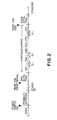
- Figure 2 shows an operation process chart of the above-described image forming apparatus.
- This step is performed in a predetermined start (actuation) operation period (warm-up period) of the image forming apparatus.
- actuation operation period
- a main power switch of the image forming apparatus is turned on to actuate a main motor (not shown) of the image forming apparatus, so that a preparatory rising operation of necessary process equipment is performed.
- the drive of the main motor is stopped and the image forming apparatus is kept in a stand-by state until a print job start signal is input.
- the main motor is driven again on the basis of the input of the print job start signal to perform a print job pre-operation of necessary process equipment.
- the image forming apparatus receives the print job start signal, (b) an image is decompressed by a formatter (a decompression time varies depending on an amount of image data or a processing speed of the formatter, and then (c) the pre-rotation step is started.
- the operation goes to this pre-rotation step 3) with no stand-by 2).
- the above described image forming process is executed, so that a recording material P on which the image has been formed is output.
- the image forming process is repeated, a predetermined number of image-formed sheets of the recording material P are output.
- This step is a step of an interval between a trailing end of the recording material P and a leading end of a subsequent recording material P in the case of the successive print job.
- a period for this step corresponds to a non-sheet passing state period at the transfer portion or in the fixing device.
- the main motor is continuously driven after the image-formed recording material P is output (after the completion of the print job) to execute a print job post-operation of necessary process equipment.
- the main motor is continuously driven after a final image-formed recording material P is output (after the completion of the successive print job) to execute the print job post-operation of necessary process equipment.
- the drive of the main motor is stopped and the image forming apparatus is kept in a stand-by state until a subsequent print job start signal is input.
- the above-described drum 11 and the process means, acting on the drum 11, including the charging roller 12, the developing device 4 and the cleaning device 17 are integrally assembled into a cartridge, i.e., a process cartridge 20.
- This cartridge 20 is mountable to and demountable from an image forming apparatus main assembly (an image forming apparatus portion except the process cartridge) 10A.
- the mounting and demounting of the cartridge 20 with respect to the apparatus main assembly 10A are performed in a state in which a door 23 provided on the apparatus main assembly 10A to expose an upper surface-side opening 24 of the apparatus main assembly 10A.
- the door 23 is rotatable about a hinge portion 23a between a state in which the door 23 is closed to cover the opening 24 of the apparatus main assembly as indicated by a solid line and a state in which the door 23 is opened to uncover the opening 24 as indicated by a chain double-dashed line.
- the front side of the image forming apparatus 10 is a side where the hinge portion 23a is provided.
- a reference symbol G1 represents a rotational direction of the door 23 for closing the door 23, and a reference symbol G2 represents a rotational direction of the door 23 for opening the door 23.
- a lower surface of the drum 11 contacts the transfer roller 14 at a predetermined position, so that the transfer nip is created.
- the cover is opened and moved in a process in which the cartridge 20 is mounted and moved.
- the cartridge 20 is placed in a state in which the cartridge 20 is mechanically and electrically connected to the apparatus main assembly 10A. That is, the drum 11, and the developing roller 1 and the supplying roller 2 of the developing device 4 can be driven by the apparatus main assembly-side driving device 56. Further, by an apparatus main assembly-side electric energy supplying means (not shown), it becomes possible to apply the charging bias to the charging roller 12 and to apply the developing bias to the developing roller 1.
- an electrical sensor on the cartridge 20 side and the controller portion 52 on the apparatus main assembly side are placed in an electrically connected state.
- the demounting of the cartridge 20 from the apparatus main assembly 10A is the reverse of the mounting described above. That is, referring to Figure 1(a) , when the door 23 is opened to expose the opening 24 and then the cartridge 20 is pulled out upward and rightward in a direction indicated by an arrow H2 as indicated by the chain double-dashed line, the cartridge 20 is guided by the guides 21 to come out of the apparatus main assembly 10A. In the case where the drum cover is provided, the cover is closed in a process in which the cartridge 20 is moved and pulled out.
- FIG 1(b) is an enlarged view of the developing device 4 portion of the image forming apparatus 10 shown in Figure 1(a) .
- This developing device 4 is a reverse developing device using a negatively chargeable non-magnetic one component toner as the developer and includes the developer container 3 for containing the toner T.
- the developing device 4 further includes the developing roller 1 which is the developer carrying member, the supplying roller 2 which is to be rotated in contact with the developing roller 1 and is used as a developer feeding member for feeding the toner T to the developing roller 1, and a developer regulating member 5 for regulating a layer of the toner T supplied to the developing roller 1 in a small thickness.
- the developing roller 1 is provided at opening 31 which is provided on a drum opposite side of the developer container 3 and is rotatably supported by the developer container 3.
- the developing roller 1 is substantially in parallel to the drum 11.
- the supplying roller 2 is disposed inside the developer container 3 on a side opposite from the drum opposite side of the developing roller 1 and is rotatably supported by the developer container 3 substantially in parallel to the developing roller 1 and in contact with the developing roller 1.
- the regulating member 5 is fixed on the developer container 3 at its one end portion (base portion) and is disposed in contact with the developing roller 1 at the other end portion, so that the regulating member 5 regulates the layer of the toner T supplied to the developing roller 1 in the small thickness.
- the regulating member 5 contacts the developing roller 1 counterdirectionally with respect to the rotational direction of the developing roller 1.
- the supplying roller 2 as the developer feeding member also functions as a detecting member for detecting a remaining toner amount (remaining developer amount) in the developer container 3 (as a remaining developer amount detecting member) as described later.
- the developing device 4 includes the opening 31 at a lower portion of the developer container 3 so that the self weight of the toner T is applied onto the developing roller 1 and the supplying roller 2 which has been provided at the opening. Such an arrangement is preferable from the viewpoints that the toner is liable to enter the supplying roller 2 and that the remaining toner amount in the developer container 3 is detected with high accuracy.
- the toner used for developing the electrostatic latent image in this embodiment, the toner having the negative charge polarity as a normal charge polarity which is the charge polarity possessed by most of the toner. Further, cohesion (agglomeration degree) of the toner in this embodiment is 15 %.
- the toner cohesion was measured in the following manner. As a measuring device, a power tester (mfd. by Hosokawa Micron Group) including a digital vibration meter ("Model 1332", mfd. by Showa Sokki Corp.) was used.
- a 390-mesh sieve, a 200-mesh sieve, and a 100-mesh sieve were superposed and set in the order of narrow aperture, i.e., in the order of the 390-mesh sieve, the 200-mesh sieve, and the 100-mesh sieve from the bottom so that the 100-mesh sieve is located at an uppermost position.
- 5 g of a sample (toner) which had been accurately weighed was added and then a value of displacement of the digital vibration meter was adjusted at 0.60 mm (peak-to-peak), followed by vibration application for 15 seconds.
- the developing roller 1 is prepared by providing a semiconductive elastic rubber layer 1b, in which an electroconductive agent is contained, around an electroconductive support 1a, and is constituted so that the developing roller 1 is rotated in a direction indicated by an arrow A in Figure 1(b) (i.e., in the same (codirectional) direction with respect to the rotational direction E of the drum 11 at the contact portion between the developing roller 1 and the drum 11 shown in Figure 1(a) ).
- the developing roller 1 includes a core electrode 1a (first electrode member) which is the electroconductive support and has an outer diameter of 6 mm, and includes a semiconductive silicone rubber layer 1b which is provided around the core electrode 1a and contains therein the electroconductive agent.
- a resistance of the developing roller 1 is 1x10 6 ohm.
- the developing roller 1 is caused to contact an aluminum sleeve of 30 mm in diameter with a contact load of 9.8N. By rotating this aluminum sleeve, the developing roller 1 is rotated at 60 rpm. Then, a DC voltage of -50 V is applied to the developing roller 1.
- a resistance of 10 k ⁇ is provided on a ground side, and a voltage at both ends is measured to calculate a current, so that the resistance of the developing roller 1 is calculated.
- the resistance of the developing roller 1 may preferably be not more than 1x10 9 ohm.
- the supplying roller 2 which is the rotatable developer feeding member for feeding the developer to the developing roller 1 and is used as the remaining developer amount detecting member includes a foam layer at its surface. That is, the supplying roller 2 includes the electroconductive support 2a and the foam layer 2b supported by the electroconductive support 2a. Specifically, around the core electrode 2a (second electrode member) which is the electroconductive support and has an outer diameter of o5 mm, the urethane foam layer 2b which is the foam layer constituted by an open-cell foam (interconnected cell) in which air bubbles are connected to each other is provided.
- the supplying roller 2 is constituted so as to be rotated in a direction indicated by an arrow B in Figure 1(b) (i.e., in the counter direction with respect to the rotational direction A at the contact portion between the supplying roller 2 and the developing roller 1.
- the outer diameter of the entire supplying roller 2 including the urethane foam layer 2b is 13 mm.
- the supplying roller 2 is caused to contact the aluminum sleeve of 30 mm in diameter so that an entering amount described later is 1.5 mm. By rotating this aluminum sleeve, the supplying roller 2 is rotated at 30 rpm. Then, to the developing roller 1, the DC voltage of -50 V is applied. At that time, a resistance of 10 k ⁇ is provided on the ground side and the voltage at both ends is measured to calculate the current, so that the resistance of the supplying roller 2 is calculated.
- a surface cell diameter of the supplying roller 2 was 50 ⁇ m to 1000 ⁇ m.
- the cell diameter means an average diameter of the foam cell at an arbitrary cross section.
- a maximum area of the foam cell is measured from an enlarged image at the arbitrary cross section and is converted into an equivalent perfect circle diameter to obtain the maximum cell diameter.
- a portion of the foam cell which is 1/2 or less of the maximum cell diameter is deleted as noise and thereafter individual cell diameters are obtained by converting individual cell areas of a remaining portion of the foam cell, so that the cell diameter is obtained as an average of the individual cell diameters.
- the supplying roller 2 used had a surface air flow amount of 1.8 liters/minute or more.
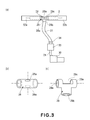
- FIG. 3(a) is a schematic view for illustrating the measuring method of the surface air flow amount.
- the supplying roller 2 in this embodiment is inserted into a measuring jig 28 as shown in Figure 3(b) .
- the measuring jig 28 is prepared by providing a through hole 28a of 10 mm in diameter which penetrates through a side surface of a hollow cylindrical member so that a center axis of the through hole 28a and an axis of the cylinder are perpendicular to each other.
- An inner diameter of the hollow cylindrical member used is 1 mm smaller than the outer diameter of the supplying roller 2 to be measured.
- the supplying roller 2 in this embodiment has the outer diameter of 13 mm and therefore the inner diameter of the measuring jig 28 is 12 mm.
- the measuring jig 28 in which the supplying roller 2 has been inserted is attached to a ventilation holder 29 as shown in Figure 3(c) .
- the ventilation holder 29 has a T shape such that a hollow cylindrical member 29a is connected at its side surface to a connecting pipe 29b to which a ventilation pipe 31 communicating with a pressure reducing pump 30 is to be attached, and has such a shape that a portion 29 opposite from the connected portion of the connecting pipe 29b has been considerably cut away.
- the inner diameter of the connecting pipe 29b is set so as to be larger than the diameter of the through hole 28a.
- the inner diameter of the connecting pipe 29b was set at 12 mm.
- the inner diameter of the hollow cylindrical member 29a of the ventilation holder 29 has the substantially same dimension as the outer diameter of the measuring jig 29, so that the measuring jig 28 can be inserted into the hollow cylindrical member 29a.
- one end of the through hole 29a is entirely exposed to the cut-away portion 29c of the hollow cylindrical member 29a, and the other end of the through hole 28a is provided substantially opposed to the inner diameter portion of the connecting pipe 29b.
- acrylic pipes 32a and 32b each of which is connected to the hollow cylindrical member 29a at one end and is stopped up at the other end are provided.
- the supplying roller portions extending from left and right ends of the measuring jig 28 are accommodated in the acrylic pipes 32a and 32b.
- a flowmeter 33 ("KZ Type Air Permeability Tester", mfd. by Daiei Kagaku Seiki Mfg. Co., Ltd.) and a different pressure control valve 34 are provided.
- the inside air of the ventilation pipe 31 is evacuated by the pressure reducing pump 30, the ambient air is prevented from entering the inside of the ventilation pipe 31 through a portion except the through hole 28a of the exposed measuring jig 28. That is, connecting portions of the measuring jig 28, the ventilation holder 29, the ventilation pipe 31 and the acrylic pipes 32a and 32b are sealed with a tape or grease.
- the surface air flow amount is mounted in the following manner.
- the pressure reducing pump 30 is actuated and the pressure is adjusted by the differential pressure control valve 34 so that a measured value of the flowmeter 33 is stable and is 10.8 liters/min. Thereafter, the supplying roller 2 which is an object to be measured is disposed and is carefully sealed as described above, and then the measured value of the flowmeter 33 under the same evacuation condition as that described above is taken as the surface air flow amount. The surface air flow amount is taken as a value at the time when the measured value of the flowmeter 33 is sufficiently stabilized.
- the air flow which will pass through the supplying roller 2 enters the urethane foam layer 2b, located at the through hole 28a when the measuring jig 28 is exposed, from the surface of the urethane foam layer 2b and passes through the inside of the urethane foam layer 2b and then comes outs of the surface of the urethane foam layer 2b located at the other-side through hole 28a of the measuring jig 28.
- the surface of the urethane foam layer 2b of the supplying roller 2 in general is different from the inside of the urethane foam layer 2b in many cases. For example, in the case where the supplying roller 2 is formed by in-mold foaming, a skin layer different in surface cell aperture ratio from the inside can appear at the surface.
- the urethane foam layer which has the surface which has not been formed simply as a cylindrical surface but has been intentionally provided with projections and recesses is also present.
- the toner powder fluid which enters and comes out of the inside of the urethane foam layer 2b can be influenced by the above-described surface state, so that behavior thereof cannot be grasped only by measurement of bulk air flow amount as defined in JIS-L 1096. Therefore, in this embodiment, the air flow amount measuring method for measuring the air flow which enters and comes out of the surface of the urethane foam layer 2b as described above is employed and the measured air flow amount is used as a principal parameter for creating an equilibrium state of the above-described toner powder fluid (or a state close thereto).
- the developing roller 1 is rotated in the direction indicated by the arrow A in Figure 1(b) and the supplying roller 2 is rotated in the direction indicated by the arrow B in Figure 1(b) , and a distance between rotation axes of the rollers 1 and 2 is set at 11 mm.
- the urethane foam layer 2b of the supplying roller 2 is sufficiently softer than the silicone rubber layer 1b and the acrylic urethane rubber layer 1c of the developing roller 1. For that reason, the surface of the developing roller 1 contacts the supplying roller 2 in a state in which the urethane foam layer 2b is deformed by 1.5 mm at the maximum.
- the maximum deformation amount is a maximum distance between a position of the surface of the urethane foam layer 2b when the developing roller 1 is not brought into contact with the urethane foam layer 2b and a position of the surface of the urethane foam layer 2b when the developing roller 1 is brought into contact with the urethane foam layer 2b during normal operation.
- This maximum deformation amount is referred to as the entering amount of the developing roller 2 with respect to the supplying roller 2.
- the rotational speed of the developing roller 1 is 130 rpm and the rotational speed of the supplying roller 2 is 100 rpm.
- the driving device 56 ( Figures 4(a) and 4(b) ) is controlled by the controller portion 52 through a driver 57.
- a driving force of the driving device 56 is transmitted to the developing device 4 through a drive transmitting means (not shown), so that the developing roller 1, the supplying roller 2, a stirring member 6 ( Figure 11 ) and the like are driven in a predetermined directions at predetermined rotational speeds.
- the urethane foam layer 2b of the supplying roller 2 is deformed by the developing roller 1 at the contact portion therebetween.
- the toner T held in the surface layer of or inside the urethane foam layer 2b of the supplying roller 2 is discharged from the surface layer of the urethane foam layer 2b and a part thereof is transferred onto the surface of the developing roller 1.
- the toner which is transferred on the surface of the developing roller 1 is uniformly regulated on the developing roller 1 by a regulating blade 5 which is a developer regulating member and is provided downstream of the contact portion with respect to the rotational direction of the developing roller 1 while contacting the developing roller 1.
- the toner T is rubbed at the contact position between the developing roller 1 and the developing roller 2 or at a regulation portion between the developing roller 1 and the regulating blade 5, thus obtaining desired triboelectric charges (negative charges in this embodiment).
- the developing roller 1 and the supplying roller 2 are rotated in the opposite directions at their contact portion, so that the development residual toner on the developing roller 1 is removed by the supplying roller 2.
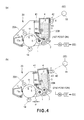
- the cartridge 20 has a constitution, as shown in Figures 4(a) and 4(b) , in which the developing device 4 is connected, swingably about a supporting shaft portion 40 as a developing unit 20B, to a drum unit 20A including the drum 11, the charging roller 12 and the cleaning device 17. Between the drum unit 20A and the developing unit 20B, an urging spring 41 is provided.
- the developing unit 20B is, in a free state, rotationally urged about the supporting shaft portion 40 in a direction in which the developing roller 1 of the developing device 4 contacts the drum 11 by an expansion (stretching) force of the spring 41. As a result, the developing roller 1 is held in a state in which the developing roller 1 contacts the drum 11 with a predetermined urging force.
- the drum unit 20A is positioned and held at an apparatus main assembly-side positioning portion in a state in which the cartridge 20 is mounted in a mounting portion 25 in a predetermined manner.
- the developing unit 20B is swingable about the supporting shaft portion 40 with respect to the drum unit 20A.
- a force receiving portion 43 is provided at a rear surface of the developing unit 20B.
- An apparatus main assembly-side spacing cam 42 is constituted so as to be positioned correspondingly to the force receiving portion 43.
- the spacing cam 42 is subjected to 90-degree intermittent rotation control by a driving device 55 controlled by the controller portion 52, so that the attitude of the spacing cam 42 is switched between a vertical rotation angle attitude X as shown in Figure 4(a) and a horizontal rotation angle attitude Y as shown in Figure 4(b) .
- the spacing cam 42 in a state in which the spacing cam 42 is switched into the vertical rotation angle attitude X, the spacing cam 42 is in non-contact with the force receiving portion 43.
- the developing unit 20B is in the free state, in which the developing roller 1 is rotationally urged about the supporting shaft portion 40 in the direction in which the developing roller 1 contacts the drum 11 by the expansion force of the spring 41.
- a contact position of the developing device 4 in which the developing roller 1 is placed in the contact state with the drum 11 is referred to as a first position (developing position).
- a cam surface of the cam 42 pushes the force receiving portion 43 located at the rear surface of the developing roller 4.
- the developing roller 1 is rotated about the supporting shaft portion 40 in a direction in which the developing roller 1 is spaced from the drum 11 by a distance ⁇ .
- a spacing drum of the developing device 4 in which the developing roller 1 is placed in the state in which the developing roller 1 is spaced from the drum 11 by the distance ⁇ is referred to as a second position (non-developing position). At this position, a developing operation is not performed.
- the force receiving portion 43 has performances such as a surface sliding performance necessary during the contact rotation with the spacing cam 42 and a hardness such that the force receiving portion 43 is not deformed in the spacing state which is a state in which a maximum force is applied to the force receiving portion 43 in this embodiment.
- the drive of the developing roller 1, the supplying roller 2, the stirring member ( Figure 11 ) and the like by the driving device 56 is constituted so that the drive can be effected also in the state in which the developing device 4 has been moved to the second position (non-developing position).
- the developing device 4 of the cartridge 20 in the state in which the cartridge 20 is mounted in the apparatus main assembly 10A is held at the above-described second position during the normal operation.
- the controller portion 52 controls the driving device 55 so that the position of the developing device 4 is switched from the second position to the first position with predetermined control timing after the print start signal is input.
- a DC voltage of -300 V is applied as the developing bias from a power source portion with predetermined timing.
- the developing roller 1 and the photosensitive drum 11 contact each other and the electrostatic latent image formed on the drum 11 is developed.
- the controller portion 52 controls the driving device 55 so that the position of the developing device 4 is switched from the first position to the second position. At the same position, the controller portion 52 stops the rotational drive of the developing roller 1 and the supplying roller 2 and also stops the application of the developing bias to the developing roller 1.
- the remaining toner amount in the developer container 3 is measured by detecting the electrostatic capacity between the developing roller 1 and the supplying roller 2 by a remaining developer amount measuring device (remaining toner amount measuring device). That is, the detection of the remaining toner amount in the developing device 4 is performed.
- a remaining toner amount detecting method utilizing a change in electrostatic capacity in this embodiment will be described with reference to Figures 5 (a) and 5 (b).
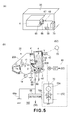
- Figure 5(a) is a schematic view showing a state in which the developing device 4 in this embodiment is disposed in the image forming apparatus 10.
- Figure 5(b) is a block circuit diagram of a remaining toner amount detecting system.
- a contact electrode 65 attached to the developing device 4 is electrically connected to the core metal electrode 1a of the developing roller 1.
- a contact electrode 66 is provided on the apparatus main assembly side of the image forming apparatus 10.
- the electrode 66 is connected to an electrostatic capacity detecting device (detector) 69 inside the apparatus main assembly of the image forming apparatus 10 and is connected to a DC bias voltage source (developer carrying member voltage applying means) 69a for the developing roller 1.
- a contact electrode 67 which is attached to the developing device 4 and is electrically connected to the core electrode 2a of the supplying roller 2, and a corresponding contact electrode 68 on the apparatus main assembly side of the image forming apparatus 10 are provided.
- the electrode 68 is connected to a power source (developer carrying member voltage applying means) 70 for detection provided inside the apparatus main assembly of the image forming apparatus 10.
- the power source 70 includes an AC bias voltage source 70a for detection and a DC bias voltage source 70b for the supplying roller 2.
- the voltage source 70b is a power source capable of applying both of positive and negative biases.
- the developing device 4 is located at the first position and the developing bias (DC voltage) of -300 V is applied from a power source 69a to the electrode 65 through the electrode 66. That is, to the developing roller 1, the developing bias of -300 V is applied.
- the AC bias voltage source 70a for detection is controlled to be turned off and the DC bias voltage source 70b for the supplying roller 2 is controlled to be turned on, so that the DC voltage of -300 V which is equal to the developing bias is applied to the electrode 67 through the electrode 68. That is, the DC voltage of -300 V which is equal to the developing bias is applied to the supplying roller 2.
- the electrode 65 and the electrode 67 has the same potential, so that the electric field is not created between the developing roller 1 and the supplying roller 2.
- the developing device 5 is located at the second position.
- the remaining toner amount in the developing device 4 is detected by applying a remaining toner amount detecting bias (remaining developer amount detecting voltage) from the voltage source 70a to the electroconductive core metal 2a of the supplying roller 2.
- a remaining toner amount detecting bias an AC bias of 50 kHz in frequency and 200 V in peak-to-peak voltage (Vpp).
- Vpp peak-to-peak voltage
- a voltage is induced by the remaining toner amount detecting bias applied to the supplying roller 2 and is detected by the detector 69. That is, the detector 69 detects the electrostatic capacity between the developing roller 1 and the supplying roller 2 on the basis of the detected voltage. Then, electrical information on the detected electrostatic capacity value is input into the controller portion 52.
- the controller portion 52 computes and determines the remaining developer amount in the developing device 4 from the electrical information, on the detected electrostatic capacity value input from the detector 69, and from a correlation table data between electrostatic capacity values and remaining toner amounts which have been measured and stored in advance. In the above, the detector 69 and the controller portion 52 constitute a remaining developer amount measuring device 100.
- the remaining developer amount measuring device 100 is capable of measuring the remaining toner amount in the developer container 3 by detecting the electrostatic capacity between the developing roller 1 and the supplying roller 2 under application of the voltage from the power source 70 to the supplying roller 2 during the non-image formation.
- the developing device 4 is in a non-developing operation period.
- a period can be realized, e.g., at a sheet interval in which the image formation is not effected.
- the period can be realized during a preparatory operation before start of the image formation.
- the period can be realized in an apparatus operation from completion of an image forming process to discharge of the recording material P from the image forming apparatus to the outside of the image forming apparatus (a so-called post-rotation), or the like.
- the drum 11 and the developing roller 1 are spaced from each other with the distance ⁇ . For that reason, even when the AC bias is applied to the supplying roller 2 as the remaining toner amount detecting bias, there is no occurrence of white background contamination which is called fog. Further, there is also no occurrence of unpleasant impact noise when the developing roller 1 and the supplying roller 2 impact each other during contact thereof to cause vibration.
- the developing roller 1 is used as an antenna for electrostatic capacity detection by applying an AC bias, for the purpose of detecting the remaining toner amount, to the electroconductive core metal 2a of the supplying roller 2, so that it is possible to prevent toner feeding inhibition which occurs in a constitution in which a separate antenna is provided in a developing chamber.
- the attitude of the developing device 4 is changed and correspondingly the toner is moved.
- the voltage source 70a applies the AC bias for the remaining toner amount detection to the supplying roller 2 and the developing roller 1 is used as the antenna for the electrostatic capacity detection, so that a change in electrostatic capacity of the toner contained in the supplying roller 2. Therefore, the amount of the toner contained in the supplying roller 2 is not changed by the change in attitude of the developing device 4 and the movement of the toner T accompanying the contact and separation operation.
- the supplying roller 2 includes the foam layer which permits entry of the toner into the inside of the foam layer and thus the toner in the foam layer is less liable to move even when the attitude of the developing device 4 is changed, so that the output of the voltage is not changed.
- the remaining toner amount detection utilizing the electrostatic capacity i.e., in the state in which the developing roller 1 and the drum 11 are spaced from each other with the distance ⁇ , the drive of the developing roller 1 and the supplying roller 2 is stopped.
- the toner feeding to the developing roller 1 and the removal of the toner which has not been subjected to the development are interrupted and thus the amount of the toner contained in the supplying roller 2 is constant during the remaining toner amount detection, so that accuracy of the remaining toner amount detection can be enhanced.
- FIG. 6 shows a flow chart of the remaining toner amount detection in this embodiment.
- a spacing operation between the photosensitive drum 11 and the developing roller 1 is performed by moving the developing device 4 from the first position to the second position (step S2).
- the drive of the developing roller 1 and the supplying roller 2 is stopped (step S3).
- the remaining toner amount detecting bias is applied to the supplying roller 2 (step S4), so that the remaining toner amount detection is performed (step S5).
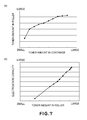
- Figure 7(a) is a plot of a remaining amount of the toner T in the developing device 4 (in the developer container) and an amount of the toner contained in the supplying roller 2 at that time in Embodiment 1.
- the toner T was filled in the developing device 4 in this embodiment and was gradually consumed and then the electrostatic capacity was measured at each of different remaining toner amounts. Thereafter, the supplying roller 2 was taken out and the amount of the toner T contained in the supplying roller 2 was measured. That is, a difference in weight between the supplying roller 2 before use and the supplying roller 2 after use was taken.
- the air flow amount may preferably be 5 liters/min. or less.
- the range of the air flow amount in the supplying roller 2 may preferably be from 1.8 liters/min. to 5 liters/min.
- the toner in the supplying roller 2 is partly discharged when the supplying roller 2 is started to be deformed at the time of start of the contact of the supplying roller 2 with the developing roller 1 and is partly inhaled when the deformation of the supplying roller 2 is eliminated (i.e., the deformed shape of the supplying roller 2 is returned to the original shape) at the time of end of the contact of the supplying roller 2 with the developing roller 1.
- the toner T enters and comes out of the supplying roller 2 but the amount of the toner in the supplying roller is generally kept in the equilibrium state unless the remaining toner amount in the developer container is changed.
- the output value may preferably be measured after the rotation of the supplying roller 2 is stopped so as not to cause the entry of the toner into the supplying roller and the exit of the toner from the supplying roller.
- the correlation between the remaining toner amount in the developing device and the amount of the toner contained in the supplying roller shown in Figure 7(a) depends on the cohesion (agglomeration degree) of the toner T. With a lower cohesion, the entry and exit of the toner with respect to the supplying roller become easy, so that it is considered that the correlation between the remaining toner amount in the developing device and the amount of the toner contained in the supplying roller becomes good.
- the cohesion was 30 %.
- the cohesion of the toner T is made higher, so that the cohesion of the toner T in the developing device before the image forming operation is performed can be estimated that it is lower than 30 %.
- the toner can be used with no problem for creating the state, which is the feature of the present invention, in which the entry of the toner into the supplying roller and the exit of the toner from the supplying roller are in the equilibrium state.
- the amount of the toner contained in the supplying roller shows a correlation with the remaining toner amount in the toner container. Therefore, as the self weight of the toner in the toner container is exerted on the supplying roller as it is, the correlation between the remaining toner amount in the developing device and the amount of the toner contained in the supplying roller as shown in Figure 7(a) becomes high. For that reason, as in this embodiment, by employing the constitution in which the supplying roller is disposed at the opening in the toner container, the accuracy of the remaining toner amount detection can be improved.
- the constitution in which the detector 69 for detecting the voltage induced in the developing roller 1 by applying the remaining toner amount detecting bias from the voltage source 70a to the supplying roller 2 was disposed was employed.
- a similar effect can be obtained even in a constitution in which a detector for detecting the voltage is induced in the supplying roller 2 by applying the remaining toner amount detecting bias to the developing roller 1 is disposed.
- the amount of the toner contained in the supplying roller formed with the urethane sponge is abruptly decreased temporarily when the print is effected with a high print ratio or due to other factors although the toner is sufficiently present in the developer container.
- the remaining developer amount measuring device erroneously detects no toner.
- the amount of the toner in the developer container was decreased, there was possibility that a frequency of an occurrence of the erroneous detection became high.
- the supplying roller 2 is rotated while applying the DC bias between the core metal electrode 1a and the core metal electrode 2a so that a value obtained by subtracting the potential of the core metal electrode 2a of the supplying roller 2 from the potential of the core metal electrode 1a of the developing roller 1 has the same polarity as the normal charge polarity of the toner.
- the toner is replenished by an electrostatic attraction action. That is, the toner replenishing operation for replenishing the toner into the supplying roller.
- the toner amount in the supplying roller is stabilized, so that the presence or absence of the toner, in the developer container, usable for the image formation can be detected with high accuracy.
- the remaining developer amount measuring device in the case where the toner replenishing operation is performed during the image formation, there is a possibility of inhibition of image stability such as a decrease in image density, so that the remaining developer amount measuring device is operated during a period other than that for the image formation.
- the remaining developer amount measuring device can be operated during the pre-rotation and the post-rotation before and after the image formation.
- the developing device 4 is moved to the second position (spacing position) and the above-described DC bias is applied from the voltage source 70a to the core metal electrode 2a of the supplying roller 2 and then the supplying roller 2 and the developing roller 1 are rotated.
- whether or not the above-described toner replenishing operation is performed is determined depending on a measurement result of the remaining developer amount measuring device.
- the above-described toner replenishing operation is executed in the following manner. That is, in the state in which the drum 11 and the developing roller 1 are spaced from each other, the voltage of 0 V is applied from the voltage source 69a to the developing roller 1 and the voltage of +500 V is applied from the voltage source 70a to the developing roller 2. Then, similarly as during the image formation, the developing roller 1 is rotationally driven at the rotational speed of 130 rpm and the supplying roller 2 is rotationally driven at the rotational speed of 100 rpm. This rotational drive is performed for 10 seconds and then the drive of the developing roller 1 and the supplying roller 2 is stopped. Further, the bias application from the voltages sources 69a and 70a to the developing roller 1 and the supplying roller 2, respectively, is stopped, so that the toner replenishing operation is completed.
- the driving device 56 for the developing roller 1 and the supplying roller 2, the power source 70, and the controller portion 52 for controlling the driving device 56 and the power source 70 constitute a replenishing device 80 for replenishing the toner into the supplying roller 2. That is, the replenishing device 80 replenishes the supplying roller 2 with the toner by rotating the supplying roller 2 while applying the DC bias between the core metal electrodes 1a and 2a so that the value obtained by subtracting the potential of the core metal electrode 2a of the supplying roller 2 from the potential of the core metal electrode 1a of the developing roller 1 has the same polarity as the normal charge polarity of the toner.
- Figure 8 is the flow chart of the operation of the image forming apparatus shown in Figure 1(a) .
- the controller portion 52 executes the following control when a measured value of the remaining developer amount by the remaining developer amount measuring device 100 reaches a predetermined value. That is, the DC bias is applied between the developing roller 1 and the supplying roller 2 by the voltage applying means 70 so that the value obtained by subtracting the potential of the core metal electrode 2a of the supplying roller 2 from the potential of the core metal electrode 1a of the developing roller 1 has the same polarity as the normal charge polarity of the toner.
- the operation for rotating the supplying roller 2 (the toner replenishing operation) is executed while applying the DC bias.
- This embodiment is characterized in that a control mode in which the remaining developer amount is measured again by the remaining developer amount measuring device 100 is executed after this operation.
- the ROM (storing portion) 54 of the controller portion 52 can count and store the number m of executions of the toner replenishing operation by the image forming apparatus. By performing the toner replenishing operation until the number m reaches a certain value, it becomes possible to properly notify the user that there is no toner in the developer container when the toner usable in the developer container is actually used up entirely.
- a print signal is input (S2). Based on this signal input, the image forming apparatus 10 starts the image forming operation and effects the rotation of the developing roller 1 and the formation of the electrostatic latent image on the drum 11 with appropriate timing (S3).
- the developing device 4 is moved from the first position to the second position and then the remaining toner amount detection by the remaining developer amount measuring device 100 is performed.
- a remaining toner amount W is updated to a measured result w1 (S4), the resultant remaining toner amount W is compared with the threshold Ew for judging that there is no toner in the developer container (S5).
- the remaining toner amount W is larger than the threshold Ew (NO of S5), the printing is completed and the operation goes to the stand-by state (S1).
- the toner replenishing operation is performed in the state in which the developing device 4 is kept at the second position (S6). That is, the voltage of 0 V is applied from the voltage source 69a to the developing roller 1 and the voltage of +500 V is applied from the voltage source 70a to the developing roller 2.
- the developing roller 1 is rotationally driven at the rotational speed of 130 rpm and the supplying roller 2 is rotationally driven at the rotational speed of 100 rpm.
- This rotational drive is performed for 10 seconds and then the drive of the developing roller 1 and the supplying roller 2 is stopped. Further, the bias application from the voltages sources 69a and 70a to the developing roller 1 and the supplying roller 2, respectively, is stopped, so that the toner replenishing operation is completed. Next, the number m of executions of the toner replenishing operation is compared with a threshold a (S7).
- the remaining toner amount detection is performed again and the remaining toner amount W is updated to a measured result w2 (S8) and then the resultant remaining toner amount W is compared with the threshold Ew for judging that there is no toner in the developer container (S5).
- the remaining toner amount W is larger than the threshold Ew (NO of S5), the printing is completed and the operation goes to the stand-by state (S1).
- the toner replenishing operation is executed (S6).
- the above cycle is repeated and in the case where the number m is not less than the threshold a, in a display device (not shown) which is a display portion or the like of the image forming apparatus 10 or the host device 51, the user is notified and warned that there is no toner in the developer container (S10).
- the number m is 3.
- the DC bias to be applied from the voltage source 70b to the supplying roller 2 during the toner replenishing operation can also be changed depending on an operation environment (temperature and humidity). Further, the rotational speeds and rotation times of the developing roller 1 and the supplying roller 2 can be set arbitrarily. Further, the toner replenishing operation is performed when the developing device 4 is located at the second position but may also be performed when the developing device 4 is located at the first position.
- the toner replenishing operation is required to be performed with timing other than the period of the image formation.
- the remaining toner amount is measured from the electrostatic capacity as described above and then the toner replenishing operation is executed on the basis of the remaining toner amount but the measurement of the remaining toner amount itself is not essential. That is, the remaining toner amount can be measured by detecting the electrostatic capacity, so that the execution of the toner replenishing operation using the electrostatic capacity itself as a parameter is also embraced in the present invention.
- the contact development is employed but the present invention is not limited thereto and is also effective in the image forming apparatus using a non-magnetic jumping developing type or the like in which the toner supplying roller is used. Further, the present invention is similarly effective also with respect to the image forming apparatus which is configured to obtain a full-color image by arranging a plurality of process cartridges similarly as in this embodiment.
- Embodiment 2 (Second Embodiment) of the image forming apparatus according to the present invention will be described. In the following description, portions similar to those in Embodiment 1 described above will be omitted from description.
- a storing means for storing a result of preceding measurement by the remaining developer amount measuring device 100 is included in the image forming apparatus.
- the ROM 54 of the controller portion 52 is the storing means. BY this storing means 54, the preceding measurement result and a current measurement result can be compared with each other. As a result, it becomes possible to meet the case where the current measurement result is abruptly changed although the remaining toner amount is large in the preceding measurement.
- the measurement result by the remaining developer amount measuring device indicates the remaining toner amount which is smaller than an actual value since the amount of the toner in the supplying roller is abruptly decreased although the toner remains in the developer container. Therefore, by replenishing the supplying roller with the toner, it becomes possible to accurately measure the presence or absence of the amount of the toner actually remaining in the developer container by the remaining developer amount measuring device.
- Figure 9 is the flow chart of the operation of the image forming apparatus shown in Figure 1 (a) . That is, the above-described toner replenishing operation is executed in the case where a value obtained by subtracting a measured value of the remaining developer amount in the current measurement from a measured of the remaining developer amount in the present measurement exceeds a predetermined value.
- This embodiment is characterized in that a control mode in which the remaining developer amount is measured again by the remaining developer amount measuring device 100 is executed after this operation.
- a print signal is input (S2) .
- the image forming apparatus 10 starts the image forming operation and effects the rotation of the developing roller 1 and the formation of the electrostatic latent image on the drum 11 with appropriate timing (S3).
- the developing device 4 is moved from the first position to the second position and then the remaining toner amount detection by the remaining developer amount measuring device 100 is performed.
- a remaining toner amount W is updated to a measured result w1 (S4), and the remaining toner amount in the preceding measurement is updated to w 0
- a toner change amount W-W0 is compared with a threshold Er for judging whether or not the remaining toner amount in the supplying roller is abruptly changed.
- the toner change amount W-W0 is not more than the threshold Er (YES of S5)
- the updated remaining toner amount W is compared with the threshold Ew for judging that there is no toner in the developer container (S6).
- the remaining toner amount W is larger than the threshold Ew (NO of S6), the printing is completed and the operation goes to the stand-by state (S1).
- the toner replenishing operation is performed in the state in which the developing device 4 is kept at the second position by a method similar to that in Embodiment 1 (S7). Then, the remaining toner amount detection is performed again and the remaining toner amount W is updated to a measured result w2 (S8) and then the resultant remaining toner amount W is compared with the threshold Ew for judging that there is no toner in the developer container (S9). In the case where the remaining toner amount W is larger than the threshold Ew (NO of S9), the printing is completed and the operation goes to the stand-by state (S1).
- the remaining toner amount W is not more than the threshold Ew (YES of S9)
- the user is warned that there is no toner in the developer container (S10).
- the toner change amount W-W0 is larger than the threshold Er (NO of S5)
- the above-described toner replenishing operation is executed (S7).
- the remaining toner amount detection is performed again and the remaining toner amount W is updated to a measured result w2 (S8).
- the updated remaining toner amount W is compared with the threshold Ew for judging that there is no toner in the developer container (S9).
- the remaining toner amount W is larger than the threshold Ew (NO of S9), the printing is completed and the operation goes to the stand-by state (S1). Further, in the case where the remaining toner amount W is not more than the threshold Ew (YES of S9), the user is warned that there is no toner in the developer container (S10).
- the remaining toner amount is measured from the electrostatic capacity as described above and then the toner replenishing operation is executed on the basis of the remaining toner amount but the measurement of the remaining toner amount itself is not essential. That is, the remaining toner amount can be measured by detecting the electrostatic capacity, so that the execution of the toner replenishing operation using the electrostatic capacity itself as a parameter is also embraced in the present invention.
- the contact development is employed but the present invention is not limited thereto and is also effective in the image forming apparatus using a non-magnetic jumping developing type or the like in which the toner supplying roller is used.
- the storing means for storing the result during the preceding measurement by the remaining developer amount measuring device is included in the image forming apparatus but may also be included in a process cartridge which at least contains the developing device and which is detachably mountable to the image forming apparatus. By providing this storing means, it is possible to notify the user of the remaining toner amount.
- the present invention is similarly effective also with respect to the image forming apparatus which is configured to obtain a full-color image by arranging a plurality of process cartridges similarly as in this embodiment.
- Embodiment 2 (Third Embodiment) of the image forming apparatus according to the present invention will be described. In the following description, portions similar to those in Embodiment 1 described above will be omitted from description.
- the warning of the remaining toner amount is given stepwisely.
- a remaining toner amount level 1 as a reference level at which the warning is given, there is a possibility that a printed character looks patchy but the possibility is eliminated by performing the toner replenishing operation in the present invention.
- the printed character looks patchy even when the toner replenishing operation is performed and therefore the image formation cannot be continued with the remaining toner amount (i.e., the remaining toner amount is judged as being on toner).
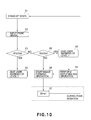
- Figure 10 is the flow chart of the operation of the image forming apparatus shown in Figure 1(a) .
- a print signal is input (S2).
- the current remaining toner amount W is compared with a threshold Ew2 for judging the remaining toner amount level 2 of the remaining toner amount in the developer container (S3).
- the remaining toner amount W is not more than the threshold Ew2 (YES of S3)
- the warning of the remaining toner amount level 2 of the remaining toner amount in the developer container is given to the user (S4).
- the remaining toner amount W is compared with a threshold Ew1 for judging the remaining toner amount level 1 of the remaining toner amount in the developer container (S5)>
- the image forming apparatus 10 starts the image forming operation and effects the rotation of the developing roller 1 and the formation of the electrostatic latent image on the drum 11 with appropriate timing (S6).
- the developing device 4 is moved from the first position to the second position after the completion of the image formation, and the remaining toner amount detection is performed and the remaining toner amount W is updated to the measured result w1 (S7). Then, the operation goes to the stand-by state (S1). In the case where the remaining toner amount W is not more than the threshold Ew1 (YES of S5), the warning of the remaining toner amount level 1 of the remaining toner amount in the developer container is given to the user (S8) and then the toner replenishing operation is performed (S9). Thereafter, the image forming apparatus 10 starts the image forming operation and effects the rotation of the developing roller 1 and the formation of the electrostatic latent image on the photosensitive drum 11 with appropriate timing.
- the post-rotation is performed after the completion of the image formation, and the remaining toner amount detection is performed and the remaining toner amount W is updated to the measured result w1 (S7).
- the operation goes to the stand-by state (S1).
- the remaining toner amount is measured from the electrostatic capacity as described above and then the toner replenishing operation is executed on the basis of the remaining toner amount but the measurement of the remaining toner amount itself is not essential. That is, the remaining toner amount can be measured by detecting the electrostatic capacity, so that the execution of the toner replenishing operation using the electrostatic capacity itself as a parameter is also embraced in the present invention.
- the contact development is employed but the present invention is not limited thereto and is also effective in the image forming apparatus using a non-magnetic jumping developing type or the like in which the toner supplying roller is used. Further, the present invention is similarly effective also with respect to the image forming apparatus which is configured to obtain a full-color image by arranging a plurality of process cartridges similarly as in this embodiment.
- the image forming apparatus includes a first remaining developer amount measuring device as a first measuring means and a second remaining developer amount measuring device as a second measuring means.
- the developing device 4 includes an optical remaining developer amount measuring device as a first remaining developer amount measuring device 101.
- This optical remaining developer amount measuring device 101 measures the remaining toner amount by measuring an amount of light passing through the toner T which has been irradiated with laser light when the toner T in the developer container 3 is stirred by a stirring member 6.
- the image forming apparatus includes, as the second remaining developer amount measuring device, a remaining developer amount measuring device 100 which utilizes the change in electrostatic capacity and which has the same constitution as that in Embodiment 1. Further, in this embodiment, in the case where a measured value of the remaining developer amount by the first remaining developer amount measuring device 101 is not more than a threshold, the toner replenishing operation is executed. This embodiment is characterized by a control mode in which remaining developer amount measurement by the second remaining developer amount measuring device 100 is carried out after the execution of the toner replenishing operation.
- a print signal is input (S2). Based on this signal input, the image forming apparatus 10 stars the image forming operation and effects the rotation of the developing roller 1 and the formation of the electrostatic latent image on the drum 11 with appropriate timing (S3).
- the first remaining developer amount measuring device 101 is operated and a remaining toner amount W1 in a first remaining developer amount starting means (not shown), for storing a measured result of the remaining developer amount by the first remaining developer amount measuring device, included in the image forming apparatus is updated to the measured result w1 (S4). Then, updated remaining developer amount W1 is compared with a threshold Ew1 for judging that the toner in the developer container is small (S5). In the case where the remaining toner amount W1 is larger than the threshold Ew1 (YES Of S5), the printing is completed and the operation goes to the stand-by state (S1).
- the toner replenishing operation is performed 8S6).
- the second remaining developer amount measuring device 100 utilizing the electrostatic capacity is operated and a remaining toner amount W2 in a second remaining developer amount storing means (not shown) included in the image forming apparatus is updated to a measured result w2 (S7).
- the second remaining developer amount storing means stores a measured result of the remaining developer amount by the second remaining developer amount measuring device.
- a resultant remaining toner amount W2 is compared with the threshold Ew for judging that there is no toner in the developer container (S8).
- the no toner state in the developer container can be accurately detected.
- the optical remaining developer amount measuring device 101 the optical remaining developer amount measuring device for measuring the remaining toner amount by measuring the amount of light passing through the toner which had been irradiated with laser light during the stirring of the toner was described.
- the first remaining developer amount measuring device 101 is not limited to the optical remaining developer amount measuring device.
- an image dot type remaining developer amount measuring device the remaining developer amount measuring device using the number of image dots for measuring the remaining toner amount by counting the number of image dots formed on the drum can be used.
- an antenna type remaining developer amount measuring device (an electrostatic capacity measuring device using the antenna) for measuring the remaining toner amount by providing a metal antenna in the developer container and then by measuring the electrostatic capacity can be used. Also in other methods, it becomes possible to accurately notify the user of the no toner state in the developer container when a threshold can be set for the remaining developer amount measuring means and then the toner replenishing operation can be performed.
- the first and second remaining developer amount storing means are provided in the image forming apparatus but these storing means may also be provided in the process cartridge which at least contains the developing device and which is detachably mountable to the image forming apparatus.
- the remaining toner amount is measured from the electrostatic capacity as described above and then the toner replenishing operation is executed on the basis of the remaining toner amount but the measurement of the remaining toner amount itself is not essential. That is, the remaining toner amount can be measured by detecting the electrostatic capacity, so that the execution of the toner replenishing operation using the electrostatic capacity itself as a parameter is also embraced in the present invention.
- the contact development is employed but the present invention is not limited thereto and is also effective in the image forming apparatus using a non-magnetic jumping developing type or the like in which the toner supplying roller is used. Further, the present invention is similarly effective also with respect to the image forming apparatus which is configured to obtain a full-color image by arranging a plurality of process cartridges similarly as in this embodiment.
- the image forming apparatus of the present invention is not limited to those of the process cartridge mounting and demounting type in Embodiments 1 to 4.
- the image forming apparatus 10 in which the developing device 4 is used as a developing cartridge and is configured so as to be detachably and replaceable mountable to the apparatus main assembly 10A may also be employed.
- the developing device swing constitution and the remaining developer amount measuring device constitution similarly as in the image forming apparatuses in Embodiments 1 to 4 it is possible to detect the remaining developer amount in the developing device 4 and the presence or absence of the developer with high accuracy.
- An image forming apparatus includes an image bearing member on which an electrostatic latent image is to be formed; and a developing device for developing the electrostatic latent image by supplying a developer to the image bearing member.
- the developing device includes a developer container for containing the developer; a rotatable developer carrying member, including a first electrode member, for carrying and supplying the developer to the image bearing member; and a developer supplying member, which is provided in contact with the developer carrying member and includes a surface foam layer and a second electrode member for rotatably supporting the developer supplying member, for supplying the developer to the developer carrying member.
- the apparatus further includes a measuring device capable of measuring a remaining developer amount in the developer container by detecting electrostatic capacity between the first electrode member and the second electrode member; and a replenishing device for performing a replenishing operation for replenishing the developer supplying roller with the developer by rotating the developer supplying member while applying a DC bias between the first electrode member and the second electrode member so that a value obtained by subtracting an electric potential of the second electrode member from an electric potential of the first electrode member has an identical polarity to a normal charge polarity of the developer.
- the replenishing operation is performed by the replenishing device and thereafter the remaining developer amount is measured again by the measuring device.
Landscapes
- Physics & Mathematics (AREA)
- General Physics & Mathematics (AREA)
- Dry Development In Electrophotography (AREA)
- Control Or Security For Electrophotography (AREA)
Applications Claiming Priority (1)
| Application Number | Priority Date | Filing Date | Title |
|---|---|---|---|
| JP2009234005A JP5550300B2 (ja) | 2009-10-08 | 2009-10-08 | 画像形成装置 |
Publications (1)
| Publication Number | Publication Date |
|---|---|
| EP2309335A1 true EP2309335A1 (en) | 2011-04-13 |
Family
ID=43568153
Family Applications (1)
| Application Number | Title | Priority Date | Filing Date |
|---|---|---|---|
| EP10183184A Withdrawn EP2309335A1 (en) | 2009-10-08 | 2010-09-30 | Image forming apparatus |
Country Status (4)
| Country | Link |
|---|---|
| US (1) | US8478140B2 (enExample) |
| EP (1) | EP2309335A1 (enExample) |
| JP (1) | JP5550300B2 (enExample) |
| CN (1) | CN102033467B (enExample) |
Cited By (1)
| Publication number | Priority date | Publication date | Assignee | Title |
|---|---|---|---|---|
| WO2020184595A3 (en) * | 2019-03-11 | 2020-10-22 | Canon Kabushiki Kaisha | Image forming apparatus |
Families Citing this family (15)
| Publication number | Priority date | Publication date | Assignee | Title |
|---|---|---|---|---|
| JP5637870B2 (ja) * | 2011-01-12 | 2014-12-10 | キヤノン株式会社 | 画像形成装置 |
| JP5721542B2 (ja) * | 2011-06-02 | 2015-05-20 | キヤノン株式会社 | 画像形成装置 |
| JP5950550B2 (ja) * | 2011-11-30 | 2016-07-13 | キヤノン株式会社 | 画像形成装置 |
| US8718496B2 (en) * | 2011-12-30 | 2014-05-06 | Lexmark International, Inc. | Capacitive toner level sensor |
| JP5635557B2 (ja) | 2012-05-09 | 2014-12-03 | 京セラドキュメントソリューションズ株式会社 | 画像形成装置 |
| JP5362086B1 (ja) * | 2012-09-11 | 2013-12-11 | キヤノン株式会社 | プロセスカートリッジおよび画像形成装置 |
| JP5864696B2 (ja) * | 2014-10-16 | 2016-02-17 | 京セラドキュメントソリューションズ株式会社 | 画像形成装置 |
| JP5973641B2 (ja) * | 2015-10-05 | 2016-08-23 | 京セラドキュメントソリューションズ株式会社 | 画像形成装置 |
| JP5973642B2 (ja) * | 2015-10-05 | 2016-08-23 | 京セラドキュメントソリューションズ株式会社 | 画像形成装置 |
| JP5973640B2 (ja) * | 2015-10-05 | 2016-08-23 | 京セラドキュメントソリューションズ株式会社 | 画像形成装置 |
| JP5973643B2 (ja) * | 2015-10-05 | 2016-08-23 | 京セラドキュメントソリューションズ株式会社 | 画像形成装置 |
| JP7625366B2 (ja) * | 2019-03-15 | 2025-02-03 | キヤノン株式会社 | 画像形成装置及び画像形成システム |
| EP3940459A4 (en) | 2019-03-15 | 2022-12-14 | Canon Kabushiki Kaisha | Image forming device and image forming system |
| JP7233990B2 (ja) * | 2019-03-15 | 2023-03-07 | キヤノン株式会社 | 画像形成装置 |
| CN113589666B (zh) * | 2020-07-28 | 2024-01-05 | 极海微电子股份有限公司 | 一种碳粉盒 |
Citations (7)
| Publication number | Priority date | Publication date | Assignee | Title |
|---|---|---|---|---|
| US4230070A (en) * | 1977-08-24 | 1980-10-28 | Minolta Camera Kabushiki Kaisha | Device for automatically replenishing toner to dry-type developing apparatus for electrophotography |
| JPH04234777A (ja) | 1991-01-07 | 1992-08-24 | Canon Inc | 現像剤の残量検出方法及び検出装置 |
| JPH09171295A (ja) * | 1997-01-13 | 1997-06-30 | Ricoh Co Ltd | 現像装置 |
| JPH11288161A (ja) | 1998-03-31 | 1999-10-19 | Canon Inc | 現像装置 |
| US20080212985A1 (en) * | 2007-03-02 | 2008-09-04 | Seiko Epson Corporation | Image Formation Apparatus and Image Formation System |
| US20080317482A1 (en) * | 2007-06-25 | 2008-12-25 | Oki Data Corporation | Image forming apparatus |
| EP2009513A2 (en) * | 2007-06-29 | 2008-12-31 | Canon Kabushiki Kaisha | Developing apparatus and image forming apparatus including the same |
Family Cites Families (12)
| Publication number | Priority date | Publication date | Assignee | Title |
|---|---|---|---|---|
| US4489239A (en) * | 1982-09-24 | 1984-12-18 | The United States Of America As Represented By The Administrator Of The National Aeronautics And Space Administration | Portable remote laser sensor for methane leak detection |
| US4924095A (en) * | 1987-06-02 | 1990-05-08 | West Lodge Research | Remote gas analyzer for motor vehicle exhaust emissions surveillance |
| US5401967A (en) * | 1990-12-26 | 1995-03-28 | Colorado Seminary Dba University Of Denver | Apparatus for remote analysis of vehicle emissions |
| US5210702A (en) * | 1990-12-26 | 1993-05-11 | Colorado Seminary | Apparatus for remote analysis of vehicle emissions |
| JPH0830102A (ja) * | 1994-07-12 | 1996-02-02 | Canon Inc | 画像形成装置 |
| JPH11344855A (ja) * | 1998-05-29 | 1999-12-14 | Ricoh Co Ltd | 画像形成装置 |
| BR9914211A (pt) * | 1998-10-30 | 2001-07-03 | Enviromental Systems Products | Detector para a detecção remota de várias pistas |
| JP2001117346A (ja) * | 1999-10-20 | 2001-04-27 | Canon Inc | 画像形成装置及び現像剤量検出装置 |
| JP4402137B2 (ja) * | 2007-06-29 | 2010-01-20 | キヤノン株式会社 | 画像形成装置、現像装置及びカートリッジ |
| JP5153306B2 (ja) * | 2007-11-21 | 2013-02-27 | キヤノン株式会社 | 画像形成装置 |
| JP2011085897A (ja) * | 2009-09-18 | 2011-04-28 | Canon Inc | 画像形成装置 |
| JP5550299B2 (ja) * | 2009-10-08 | 2014-07-16 | キヤノン株式会社 | 画像形成装置 |
-
2009
- 2009-10-08 JP JP2009234005A patent/JP5550300B2/ja not_active Expired - Fee Related
-
2010
- 2010-09-16 US US12/883,497 patent/US8478140B2/en not_active Expired - Fee Related
- 2010-09-30 EP EP10183184A patent/EP2309335A1/en not_active Withdrawn
- 2010-10-08 CN CN201010510857.XA patent/CN102033467B/zh not_active Expired - Fee Related
Patent Citations (7)
| Publication number | Priority date | Publication date | Assignee | Title |
|---|---|---|---|---|
| US4230070A (en) * | 1977-08-24 | 1980-10-28 | Minolta Camera Kabushiki Kaisha | Device for automatically replenishing toner to dry-type developing apparatus for electrophotography |
| JPH04234777A (ja) | 1991-01-07 | 1992-08-24 | Canon Inc | 現像剤の残量検出方法及び検出装置 |
| JPH09171295A (ja) * | 1997-01-13 | 1997-06-30 | Ricoh Co Ltd | 現像装置 |
| JPH11288161A (ja) | 1998-03-31 | 1999-10-19 | Canon Inc | 現像装置 |
| US20080212985A1 (en) * | 2007-03-02 | 2008-09-04 | Seiko Epson Corporation | Image Formation Apparatus and Image Formation System |
| US20080317482A1 (en) * | 2007-06-25 | 2008-12-25 | Oki Data Corporation | Image forming apparatus |
| EP2009513A2 (en) * | 2007-06-29 | 2008-12-31 | Canon Kabushiki Kaisha | Developing apparatus and image forming apparatus including the same |
Cited By (2)
| Publication number | Priority date | Publication date | Assignee | Title |
|---|---|---|---|---|
| WO2020184595A3 (en) * | 2019-03-11 | 2020-10-22 | Canon Kabushiki Kaisha | Image forming apparatus |
| US12147170B2 (en) | 2019-03-11 | 2024-11-19 | Canon Kabushiki Kaisha | Image forming apparatus having toner charging |
Also Published As
| Publication number | Publication date |
|---|---|
| US20110085808A1 (en) | 2011-04-14 |
| JP2011081222A (ja) | 2011-04-21 |
| US8478140B2 (en) | 2013-07-02 |
| CN102033467B (zh) | 2014-03-05 |
| CN102033467A (zh) | 2011-04-27 |
| JP5550300B2 (ja) | 2014-07-16 |
Similar Documents
| Publication | Publication Date | Title |
|---|---|---|
| US8478140B2 (en) | Image forming apparatus featuring a developer replenishing device | |
| EP2009512B1 (en) | Developing apparatus including a supplying member as developer amount detecting member | |
| EP2009513B1 (en) | Developing apparatus and image forming apparatus including the same | |
| US8559833B2 (en) | Image forming apparatus including replenishing operation for developer supply member | |
| US9280086B2 (en) | Image forming apparatus having developer supplying operation | |
| JP5153306B2 (ja) | 画像形成装置 | |
| JP4781463B2 (ja) | 画像形成装置及びカートリッジ | |
| EP1770448B1 (en) | Correction of developing denisty control using the total number of printed pages and the duration of a suspension time in an image forming apparatus | |
| JP2020187192A (ja) | 画像形成装置 | |
| JP7520650B2 (ja) | 画像形成装置 | |
| JP2011095535A (ja) | 画像形成装置 | |
| JP4795132B2 (ja) | 現像装置、及び、プロセスカートリッジ | |
| US20130230331A1 (en) | Image forming apparatus | |
| JP2023075866A (ja) | 画像形成装置 | |
| JP2008151939A (ja) | 現像装置 | |
| JP2000112217A (ja) | 現像装置 | |
| JP2006337869A (ja) | 現像装置、及び画像形成装置 |
Legal Events
| Date | Code | Title | Description |
|---|---|---|---|
| PUAI | Public reference made under article 153(3) epc to a published international application that has entered the european phase |
Free format text: ORIGINAL CODE: 0009012 |
|
| AK | Designated contracting states |
Kind code of ref document: A1 Designated state(s): AL AT BE BG CH CY CZ DE DK EE ES FI FR GB GR HR HU IE IS IT LI LT LU LV MC MK MT NL NO PL PT RO SE SI SK SM TR |
|
| AX | Request for extension of the european patent |
Extension state: BA ME RS |
|
| 17P | Request for examination filed |
Effective date: 20111013 |
|
| STAA | Information on the status of an ep patent application or granted ep patent |
Free format text: STATUS: THE APPLICATION HAS BEEN WITHDRAWN |
|
| 18W | Application withdrawn |
Effective date: 20121025 |