EP2301854B1 - Behälter mit Fixierungsmitteln für den Inhalt - Google Patents
Behälter mit Fixierungsmitteln für den Inhalt Download PDFInfo
- Publication number
- EP2301854B1 EP2301854B1 EP10175395A EP10175395A EP2301854B1 EP 2301854 B1 EP2301854 B1 EP 2301854B1 EP 10175395 A EP10175395 A EP 10175395A EP 10175395 A EP10175395 A EP 10175395A EP 2301854 B1 EP2301854 B1 EP 2301854B1
- Authority
- EP
- European Patent Office
- Prior art keywords
- container
- flaps
- container according
- base part
- closed position
- Prior art date
- Legal status (The legal status is an assumption and is not a legal conclusion. Google has not performed a legal analysis and makes no representation as to the accuracy of the status listed.)
- Not-in-force
Links
Images


Classifications
-
- A—HUMAN NECESSITIES
- A47—FURNITURE; DOMESTIC ARTICLES OR APPLIANCES; COFFEE MILLS; SPICE MILLS; SUCTION CLEANERS IN GENERAL
- A47G—HOUSEHOLD OR TABLE EQUIPMENT
- A47G21/00—Table-ware
- A47G21/001—Holders or wrappers as eating aids for fast food, e.g. hamburgers
-
- B—PERFORMING OPERATIONS; TRANSPORTING
- B65—CONVEYING; PACKING; STORING; HANDLING THIN OR FILAMENTARY MATERIAL
- B65D—CONTAINERS FOR STORAGE OR TRANSPORT OF ARTICLES OR MATERIALS, e.g. BAGS, BARRELS, BOTTLES, BOXES, CANS, CARTONS, CRATES, DRUMS, JARS, TANKS, HOPPERS, FORWARDING CONTAINERS; ACCESSORIES, CLOSURES, OR FITTINGS THEREFOR; PACKAGING ELEMENTS; PACKAGES
- B65D15/00—Containers having bodies formed by interconnecting or uniting two or more rigid, or substantially rigid, sections made of different materials
- B65D15/22—Containers having bodies formed by interconnecting or uniting two or more rigid, or substantially rigid, sections made of different materials of polygonal cross-section
Definitions
- the present invention relates to a container, in particular for foodstuffs, with a bowl-shaped bottom part, on which two pivotable flaps for opening and closing the container are mounted, and the bottom part and the flaps in the closed position surround an interior of a container, according to the preamble of Claim 1.
- a transport container for pipettes which consists of a cup-shaped bottom part, are mounted on the two pivotable flaps for opening and closing the container.
- the bottom part of the container has elastic receptacles into which the pipette can be clamped.
- the elastic clamping area is deformable from the inside -also after opening the flaps.
- the elastic elements have a circular, pin-shaped geometry, wherein the elastic elements, starting from the bottom of the container, extend vertically upwards into the space defined by the container.
- a food holder In AU-B-12641/97, a food holder is presented which allows food to be gripped and then consumed without touching it directly by hand.
- the elasticity of the side portions of the holder is achieved by the special geometry of the side portions which are folded in the form of an accordion.
- the two pivotable flaps can be opened, so that then the interior of the container is accessible.
- the user can engage the bottom part at the at least one elastic region to clampingly fix an object arranged in the container.
- a food such as a bread or a piece of cake
- the user no longer has to grasp the food directly, but can fix and eat the food via the elastic region on the bottom part. Only the last part of the food, which is clamped in the bottom part, then has to be grasped at the end or eaten directly from the bottom part. In this respect, contact of the hands with the food is largely avoided, which is advantageous both in terms of hygiene and on a possible contamination of the hands.
- a wall section of a different material is formed on the at least one elastic region than a material of a region surrounding the wall section.
- the bottom part is thus formed from at least two different materials, namely on the one hand the material of the elastic region, for example rubber, silicone or an elastic plastic, while the remaining region of the bottom part to maintain the dimensional stability of a stiffer material is formed, in particular plastic.
- the material of the elastic region is stretchable by more than 20%, preferably more than 40%. This ensures that the material of the elastic region can be pressed far enough into the bottom part to clamp an object.
- an elastic region may be provided on opposite sides of the bottom part, so that an object is clamped between the material of two spaced elastic regions.
- the container is preferably formed substantially cuboid, wherein the flaps are pivotally mounted on opposite side walls in a central region of the side walls.
- each flap can be pivotally mounted on the bottom part via a film hinge, so that the container is integrally formed and thus easy to handle.
- the flaps In the closed position, the flaps abut each other with U-shaped edges which form a central parting plane. This ensures that when the container is opened an object protrudes from the bottom part and the flaps are sufficiently far away that the object can be guided well to the mouth.
- the flaps extend for this purpose over the entire length of the container.
- the flaps preferably extend over more than 40%, in particular more than 50%, of the width of a side wall of the container. This ensures that the interior of the container after opening the flap by more than 40%, in particular more than 50%, is released and accessible on all sides.
- the flaps are secured in the closed position, preferably via a closure device, which may have, for example, corresponding latching or clamping means.
- a substantially cuboidal container 1 comprises a cup-shaped bottom part 2, on which a first flap 3 and a second flap 4 are pivotable are stored.
- the flaps 3 and 4 are fixed in a closed position by a closure device 5 to each other.
- Formed on the bottom part 2 is an elastic region 6 which extends over a region of a side wall of the container 1 and is made of a different material than the non-boiling material of the bottom part 2.
- the elastic region is connected at an edge 7 with a surrounding material 8, wherein the surrounding material 8 may be formed of the same material as the flaps 3 and 4, for example plastic.
- the elastic region 6 is formed of a material which is stretchable, preferably more than 20%.
- the material of the elastic region may include, for example, rubber, silicone or an elastic plastic.
- FIG. 3 the container 1 is shown in an open position.
- a protruding edge 10 is formed, while on the flap 4, a protruding edge 11 is formed.
- the respective U-shaped edges 10 and 11 are in the closed position against each other can be applied.
- the flaps 3 and 4 form a receptacle with side edges, so that when eating food crumbs can be collected.
- projections 12 are formed, which engage in corresponding receptacles on the edges 10 and 11 of the flaps 3 and 4 in the closed position, so that an interior 9 of the container 1 in the closed position on all sides of the bottom part and the flaps 3 and 4 is surrounded.
- the flap 3 is connected via a film hinge 15 with the bottom part 2, while the flap 4 is connected via a film hinge 16 with the bottom part 2.
- the film hinges 15 and 16 may be formed by a thinning of material or a hinge of an elastic material, wherein a stop may be provided to limit the opening movement of the flaps 3 and 4 in a range of about 90 °. This ensures that the flaps 3 and 4 do not complicate the attack on the bottom part 2 and also form a tray-like receptacle for food particles.
- the closure device 5 comprises a tab projecting from the flap 4, on which a latching projection 13 is formed.
- the latching projection 13 can be inserted into a latching receptacle 14 on the flap 3.
- a food can be stored and eaten in a hygienic way.
- the flaps 3 and 4 are opened so that the in FIG. 3 shown position is reached.
- the user can compress the elastic portion 6 to fix the food in the bottom portion 2.
- the film hinges 15 and 16 of the flaps 3 and 4 are arranged in a central region of a side wall, so that about half of the interior 9 of the container 1 when opening the flaps 3 and 4 is released. Thereby, a food placed in the container protrudes upward from the bottom part 2 and can now be eaten.
- the elastic portion 6 may be formed so as to be pushed out upwardly from the bottom part. This allows the food from the bottom part 2 out to the mouth.
- the elastic region is formed by a U-shaped material portion which is embedded in the bottom part 2.
- the elastic region 6 extends over more than 70%, in particular more than 80%, of the length of the bottom part 2, so that an object arranged in the bottom part 2 can be easily gripped.
Landscapes
- Engineering & Computer Science (AREA)
- Food Science & Technology (AREA)
- Mechanical Engineering (AREA)
- Packages (AREA)
- Packging For Living Organisms, Food Or Medicinal Products That Are Sensitive To Environmental Conditiond (AREA)
- Cartons (AREA)
Description
- Die vorliegende Erfindung betrifft einen Behälter, insbesondere für Lebensmittel, mit einem schalenförmigen Bodenteil, an dem zwei verschwenkbare Klappen zum Öffnen und Schließen des Behälters gelagert sind, und das Bodenteil und die Klappen in der geschlossenen Position einen Innenraum eines Behälters umgeben, nach dem Oberbegriff des Anspruches 1.
- Es gibt Behälter für Lebensmittel, bei denen an einem Bodenteil eine verschwenkbare Klappe angeordnet ist, damit die innen liegenden Lebensmittel entnommen werden können. Die Lebensmittel kommen dadurch in Kontakt mit den Händen und können verunreinigt werden, gerade wenn es keine Möglichkeit zur Reinigung der Hände gibt. Dann werden die kontaminierten Lebensmittel gegessen. Zudem werden beim Kontakt der Lebensmittel die Hände verschmutzt, was zusätzliche Maßnahmen erforderlich macht, um ein Verschmutzen der Kleidung zu vermeiden.
- In der
WO 2006/014882 ist ein Transportbehältnis für Pipetten gezeigt, das aus einem schalenförmigen Bodenteil besteht, an dem zwei schwenkbare Klappen zum Öffnen und Schließen des Behälters gelagert sind. Der Bodenteil des Behälters weist dabei elastische Aufnahmen auf, in die die Pipette klemmend fixierbar ist. Der elastische Klemmbereich ist dabei von innen -also nach Öffnung der Klappen- verformbar. Die elastischen Elemente weisen eine kreisrunde, stiftförmige Geometrie auf, wobei sich die elastischen Elemente ausgehend vom Boden des Behälters senkrecht nach oben in den durch den Behälter definierten Raum erstrecken. - In der
US 2 979 246 wird ein Verpackungsbehälter aus Pappe beschrieben, der innen Schaumstoffkissen aufweist. Die Schaumstoffkissen dienen dem Schutz der verpackten Gegenstände aus zerbrechlichen Werkstoffen durch die Bereitstellung von Dämpfungszonen, die auf die Verpackung wirkende Stöße dämpfen, die sonst zur Zerstörung der verpackten Gegenstände führen könnten. - In der
US 2005/0167475 A1 wird ein sechseckiger Behälter für Lebensmittel aus Pappe oder geschäumten Polystyrol vorgestellt, der dazu geeignet ist, Lebensmittel zu verpacken und ohne diese zu direkt zu berühren, zum Verzehr bzw. während des Verzehrs festzuklemmen. - In der AU-B-12641 / 97 wird ein Halter für Lebensmittel vorgestellt, der es ermöglicht, Lebensmittel zu greifen und dann zu verzehren, ohne sie direkt mit der Hand zu berühren. Die Elastizität der Seitenbereiche des Halters wird durch die speziellen Geometrie der Seitenbereiche erreicht, die in Form einer Ziehharmonika gefaltet sind.
- Es ist daher Aufgabe der vorliegenden Erfindung, einen Behälter für Lebensmittel zu schaffen, der eine hygienische Nahrungsaufnahme gestattet und eine Verschmutzung der Hände möglichst vermeidet.
- Diese Aufgabe wird mit einem Behälter mit den Merkmalen des Anspruchs 1 gelöst.
- Bei dem erfindungsgemäßen Behälter können die zwei schwenkbaren Klappen geöffnet werden, so dass dann der Innenraum des Behälters zugänglich ist. Der Benutzer kann an dem Bodenteil an dem mindestens einen elastischen Bereich angreifen, um einen in dem Behälter angeordneten Gegenstand klemmend zu fixieren. Dadurch muss der Benutzer beim Verzehr eines Nahrungsmittels, beispielsweise eines Brotes oder eines Kuchenstückes, das Lebensmittel nicht mehr direkt greifen, sondern kann über den elastischen Bereich an dem Bodenteil das Lebensmittel fixieren und verspeisen. Nur der letzte Teil des Lebensmittels, der in dem Bodenteil festgeklemmt ist, muss dann am Ende wahlweise gegriffen oder direkt aus dem Bodenteil heraus verspeist werden. Insofern wird ein Kontakt der Hände mit dem Lebensmittel weitgehend vermieden, was sowohl im Hinblick auf die Hygiene als auch auf eine möglicher Verschmutzung der Hände vorteilhaft ist.
- Erfindungsgemäß ist an dem mindestens einen elastischen Bereich ein Wandabschnitt aus einem anderen Material gebildet als ein Material eines den Wandabschnitt umgebenden Bereiches. Das Bodenteil ist somit aus mindestens zwei unterschiedlichen Materialien gebildet, nämlich einerseits dem Material des elastischen Bereiches, beispielsweise Gummi, Silikon oder ein elastischer Kunststoff, während der übrige Bereich des Bodenteils zur Erhaltung der Formstabilität aus einem steiferen Material gebildet ist, insbesondere Kunststoff. Es ist natürlich auch möglich, die elastischen Bereiche durch eine geringere Wandstärke auszubilden als andere Bereiche, so dass dadurch die Elastizität erhöht wird. Vorzugsweise ist das Material des elastischen Bereichs um mehr als 20 %, vorzugsweise mehr als 40 %, dehnbar. Dadurch ist gewährleistet, dass das Material des elastischen Bereiches weit genug in das Bodenteil hineingedrückt werden kann, um einen Gegenstand festzuklemmen. Dabei kann an gegenüberliegenden Seiten des Bodenteils jeweils ein elastischer Bereich vorgesehen sein, so dass ein Gegenstand zwischen dem Material zweier beabstandeter elastischer Bereiche festgeklemmt wird.
- Der Behälter ist vorzugsweise im Wesentlichen quaderförmig ausgebildet, wobei die Klappen an gegenüberliegenden Seitenwänden in einem mittleren Bereich der Seitenwände verschwenkbar gelagert sind. Dabei kann jede Klappe über ein Filmscharnier an dem Bodenteil verschwenkbar gelagert sein, so dass der Behälter einstückig ausgebildet ist und somit einfach in der Handhabung ist.
- In der geschlossenen Position liegen die Klappen mit U-förmigen Rändern aneinander an, die eine mittlere Trennebene ausbilden. Dadurch ist gewährleistet, dass beim Öffnen des Behälters ein Gegenstand von dem Bodenteil hervorsteht und die Klappen ausreichend weit entfernt sind, dass der Gegenstand gut zum Mund geführt werden kann. Die Klappen erstrecken sich hierfür über die gesamte Länge des Behälters. Ferner erstrecken sich die Klappen vorzugsweise über mehr als 40 %, insbesondere mehr als 50 %, der Breite einer Seitenwand des Behälters. Dadurch ist gewährleistet, dass der Innenraum des Behälters nach dem Öffnen der Klappe um mehr als 40 %, insbesondere mehr als 50 %, freigegeben ist und allseitig zugänglich ist.
- Die Klappen sind in der geschlossenen Position vorzugsweise über eine Verschlusseinrichtung gesichert, die beispielsweise entsprechende Rast- oder Klemmmittel aufweisen kann.
- Die Erfindung wird nachfolgend anhand eines Ausführungsbeispiels mit Bezug auf die beigefügten Zeichnungen näher erläutert. Es zeigen:
- Figur 1
- eine perspektivische Ansicht eines erfindungsgemäßen Behäl- ters in der geschlossenen Position;
- Figur 2
- eine perspektivische Ansicht des Behälters der
Figur 1 mit geöff- neter Verschlusseinrichtung; - Figur 3
- eine perspektivische Ansicht der Behälters der
Figur 1 in einer geöffneten Position; - Figur 4
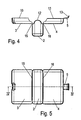
- eine geschnittene Seitenansicht des Behälters der
Figur 3 ; - Figur 5
- eine Unteransicht des Behälters der
Figur 3 ; - Figuren 6 bis 8
- mehrere Ansichten des Behälters der
Figur 1 in der geschlosse- nen Position. - Ein im Wesentlichen quaderförmiger Behälter 1 umfasst ein schalenförmiges Bodenteil 2, an dem eine erste Klappe 3 und eine zweite Klappe 4 verschwenkbar gelagert sind. Die Klappen 3 und 4 sind in einer geschlossenen Position durch eine Verschlusseinrichtung 5 aneinander fixiert. An dem Bodenteil 2 ist ein elastischer Bereich 6 ausgebildet, der sich über einen Bereich einer Seitenwand des Behälters 1 erstreckt und aus einem anderen Material besteht als das ungebende Material des Bodenteils 2.
- Der elastische Bereich ist an einem Rand 7 mit einem umgebenden Material 8 verbunden, wobei das umgebende Material 8 aus dem gleichen Material wie die Klappen 3 und 4 gebildet sein kann, beispielsweise Kunststoff. Der elastische Bereich 6 ist aus einem Material gebildet, das dehnbar ist, vorzugsweise um mehr als 20 %. Das Material des elastischen Bereichs kann beispielsweise Gummi, Silikon oder einen elastischen Kunststoffenthalten.
- In
Figur 3 ist der Behälter 1 in einer geöffneten Position gezeigt. An der Klappe 3 ist ein hervorstehender Rand 10 ausgebildet, während an der Klappe 4 ein hervorstehender Rand 11 ausgebildet ist. Die jeweils U-förmig ausgebildeten Ränder 10 und 11 sind in der geschlossenen Position aneinander anlegbar. In der geöffneten Position bilden die Klappen 3 und 4 eine Aufnahme mit Seitenrändern aus, so dass beim Verzehr von Nahrungsmitteln Krümel gesammelt werden können. - An gegenüberliegenden Stirnseiten des schalenförmigen Bodenteils 2 sind Vorsprünge 12 ausgebildet, die in entsprechende Aufnahmen an den Rändern 10 und 11 der Klappen 3 und 4 in der geschlossenen Position eingreifen, so dass ein Innenraum 9 des Behälters 1 in der geschlossenen Position allseitig von dem Bodenteil 2 und den Klappen 3 und 4 umgeben ist.
- Die Klappe 3 ist über ein Filmscharnier 15 mit dem Bodenteil 2 verbunden, während die Klappe 4 über ein Filmscharnier 16 mit dem Bodenteil 2 verbunden ist. Die Filmscharniere 15 und 16 können durch eine Materialverdünnung oder ein Scharniergelenk aus einem elastischen Material gebildet sein, wobei ein Anschlag vorgesehen sein kann, um die Öffnungsbewegung der Klappen 3 und 4 in einem Bereich von etwa 90° zu begrenzen. Dadurch ist gewährleistet, dass die Klappen 3 und 4 nicht das Angreifen an dem Bodenteil 2 erschweren und zudem eine tablettartige Aufnahme für Speisereste bilden.
- Die Verschlusseinrichtung 5 umfasst eine von der Klappe 4 hervorstehende Lasche, an der ein Rastvorsprung 13 ausgebildet ist. Der Rastvorsprung 13 kann in eine Rastaufnahme 14 an der Klappe 3 eingefügt werden.
- Mit dem Behälter 1 kann ein Lebensmittel aufbewahrt werden und auf hygienische Art verspeist werden. Hierfür werden die Klappen 3 und 4 geöffnet, so dass die in
Figur 3 gezeigte Position erreicht ist. Der Benutzer kann den elastischen Bereich 6 zusammendrücken, um das Lebensmittel in dem Bodenteil 2 zu fixieren. Die Filmscharniere 15 und 16 der Klappen 3 und 4 sind in einem mittleren Bereich einer Seitenwand angeordnet, so dass etwa die Hälfte des Innenraums 9 des Behälters 1 beim Öffnen der Klappen 3 und 4 freigegeben wird. Dadurch steht ein in dem Behälter angeordnetes Lebensmittel von dem Bodenteil 2 nach oben hervor und kann nun verspeist werden. - Um auch den Abschnitt des Lebensmittels zu verspeisen, der in dem Bodenteil 2 angeordnet ist, kann der elastische Bereich 6 so ausgebildet sein, dass er aus dem Bodenteil nach oben herausstülpbar ist. Dadurch kann das Lebensmittel aus dem Bodenteil 2 heraus zum Mund geführt werden.
- In dem gezeigten Ausführungsbeispiel ist der elastische Bereich durch einen U-förmigen Materialabschnitt gebildet, der in das Bodenteil 2 eingebettet ist. Der elastische Bereich 6 erstreckt sich dabei über mehr als 70 %, insbesondere mehr als 80 %, der Länge des Bodenteils 2, so dass ein in dem Bodenteil 2 angeordneter Gegenstand einfach gegriffen werden kann. Natürlich ist es möglich, den elastischen Bereich 6 auch anders auszugestalten, beispielsweise können mehrere einzelne elastische Griffabschnitte an dem Bodenteil 2 ausgebildet sein.
Claims (10)
- Behälter (1), insbesondere für Lebensmittel, mit einem schalenförmigen Bodenteil (2), an dem zwei verschwenkbare Klappen (3, 4) zum Öffnen und Schließen des Behälters (1) gelagert sind, und das Bodenteil (2) und die Klappen (3, 4) in der geschlossenen Position einen Innenraum (9) des Behälters (1) umgeben, wobei an dem Bodenteil (2) mindestens ein elastischer Bereich (6) ausgebildet ist, mittels dem ein in dem Behälter (1) angeordneter Gegenstand an dem Bodenteil (2) klemmend fixierbar ist, dadurch gekennzeichnet, dass an dem mindestens einen elastischen Bereich (6) ein Wandabschnitt aus einem anderen Material als ein den Wandabschnitt umgebendes Material gebildet ist.
- Behälter nach Anspruch 1, dadurch gekennzeichnet, dass das Material des elastischen Bereichs (6) mehr als 20 %, vorzugsweise mehr als 40 % dehnbar ist.
- Behälter nach Anspruch 1 oder 2, dadurch gekennzeichnet, dass an gegenüberliegenden Seiten des Bodenteils (2) jeweils ein elastischer Bereich (6) vorgesehen ist.
- Behälter nach einem der Ansprüche 1 bis 3, dadurch gekennzeichnet, dass der Behälter (1) im Wesentlichen quaderförmig ausgebildet ist und die Klappen (3, 4) an gegenüberliegenden Seitenwänden in einem mittleren Bereich der Seitenwände verschwenkbar gelagert sind.
- Behälter nach einem der Ansprüche 1 bis 4, dadurch gekennzeichnet, dass jede Klappe (3, 4) über ein Filmscharnier (15, 16) an dem Bodenteil (2) verschwenkbar gelagert ist.
- Behälter nach einem der Ansprüche 1 bis 5, dadurch gekennzeichnet, dass die Klappen (3, 4) von der geschlossenen Position bis zu einem Anschlag in eine geöffnete Position um 80° bis 150°, vorzugsweise um 90° bis 110° verschwenkbar sind.
- Behälter nach einem der Ansprüche 1 bis 6, dadurch gekennzeichnet, dass die Klappen (3, 4) in einer geschlossenen Position mit U-förmigen Rändern (10, 11) aneinander anliegen, die eine mittlere Trennebene ausbilden.
- Behälter nach einem der Ansprüche 1 bis 7, dadurch gekennzeichnet, dass die Klappen (3, 4) auf der zur Schwenkachse abgewandten Seite eine Verschlusseinrichtung (13, 14) aufweisen.
- Behälter nach einem der Ansprüche 1 bis 8, dadurch gekennzeichnet, dass die Klappen (3, 4) sich über die gesamte Länge des Behälters (1) erstrecken.
- Behälter nach einem der Ansprüche 1 bis 9, dadurch gekennzeichnet, dass die Klappen (3, 4) sich über mehr als 40 %, vorzugsweise mehr als 50 %, der Breite einer Seitenwand des Behälters (1) erstrecken.
Applications Claiming Priority (1)
| Application Number | Priority Date | Filing Date | Title |
|---|---|---|---|
| DE202009011049U DE202009011049U1 (de) | 2009-09-24 | 2009-09-24 | Behälter |
Publications (2)
| Publication Number | Publication Date |
|---|---|
| EP2301854A1 EP2301854A1 (de) | 2011-03-30 |
| EP2301854B1 true EP2301854B1 (de) | 2012-01-18 |
Family
ID=41462061
Family Applications (1)
| Application Number | Title | Priority Date | Filing Date |
|---|---|---|---|
| EP10175395A Not-in-force EP2301854B1 (de) | 2009-09-24 | 2010-09-06 | Behälter mit Fixierungsmitteln für den Inhalt |
Country Status (3)
| Country | Link |
|---|---|
| EP (1) | EP2301854B1 (de) |
| AT (1) | ATE541792T1 (de) |
| DE (1) | DE202009011049U1 (de) |
Families Citing this family (3)
| Publication number | Priority date | Publication date | Assignee | Title |
|---|---|---|---|---|
| EP2805647A1 (de) * | 2013-05-22 | 2014-11-26 | Sonny Petersen | Transportbox |
| CA2912976A1 (en) | 2013-05-22 | 2014-11-27 | Tablebox Aps | A transport box |
| JP6920881B2 (ja) * | 2017-05-17 | 2021-08-18 | 凸版印刷株式会社 | 包装箱 |
Family Cites Families (6)
| Publication number | Priority date | Publication date | Assignee | Title |
|---|---|---|---|---|
| US2979246A (en) * | 1956-05-07 | 1961-04-11 | Lord Baltimore Press Inc | Foam plastic coated carton |
| FR1356549A (fr) * | 1963-04-26 | 1964-03-27 | Récipient pour la consommation d'un contenu à consistance crémeuse | |
| US5435449A (en) * | 1993-10-12 | 1995-07-25 | Microplas, Inc. | Recording medium storage container |
| AU681332B3 (en) * | 1997-02-12 | 1997-08-21 | David Lionel Lloyd | Sandwich holding apparatus |
| US20050167475A1 (en) * | 2003-01-30 | 2005-08-04 | Graham Wayne B. | Food container apparatus |
| US7770730B2 (en) * | 2004-07-29 | 2010-08-10 | Cook Vascular Incorporated | Micropipette holder |
-
2009
- 2009-09-24 DE DE202009011049U patent/DE202009011049U1/de not_active Expired - Lifetime
-
2010
- 2010-09-06 EP EP10175395A patent/EP2301854B1/de not_active Not-in-force
- 2010-09-06 AT AT10175395T patent/ATE541792T1/de active
Also Published As
| Publication number | Publication date |
|---|---|
| EP2301854A1 (de) | 2011-03-30 |
| DE202009011049U1 (de) | 2009-12-31 |
| ATE541792T1 (de) | 2012-02-15 |
Similar Documents
| Publication | Publication Date | Title |
|---|---|---|
| DE3888889T2 (de) | Behälter für Getränke. | |
| EP2945876B1 (de) | Behälter mit verschlussvorrichtung | |
| DE3686273T2 (de) | Ausgiesser fuer einen verschlossenen fluessigkeitsbehaelter. | |
| EP1783058B1 (de) | Kindersicherer Verpackungsbehälter | |
| US8960494B1 (en) | Disposable anti-viral tissue dispenser and disposal structure | |
| EP2848552B1 (de) | Gewürzstreuer | |
| DE2009628A1 (de) | Butterdose oder dergleichen Behälter für Eßwaren | |
| DE1806287A1 (de) | Spendevorrichtung | |
| EP2301854A1 (de) | Behälter mit Fixierungsmitteln für den Inhalt | |
| DE69510917T2 (de) | Spenderverpackung für feuchte Tücher | |
| CN1076698C (zh) | 手巾分发容器的封口装置 | |
| EP2631189B1 (de) | Faltschachtel | |
| DE102016222205A1 (de) | Verschlussvorrichtung und Behälter mit einer solchen Verschlussvorrichtung | |
| DE102017123936B3 (de) | Behälter mit Deckel und Abstreifkante und Herstellverfahren eines solchen Behälters | |
| HUE029663T2 (en) | Packaging for tobacco products or tobacco-related goods or smoking appliances and use thereof | |
| EP3398874B1 (de) | Behälter mit eingelegtem messlöffel | |
| EP0752955A1 (de) | Behältnis für speisen, insbesondere zum servieren, aufbewahren und transportieren, und dazugehöriger verbindungskörper | |
| DE202010001225U1 (de) | Kunststoffbehälter zum sicheren Transport von Joghurt-Portionsbechern u.dgl. | |
| DE202006006807U1 (de) | Deckel zum dichten Verschließen von Prozellanschalen und/oder -schüsseln | |
| DE29702300U1 (de) | Halter mit Schließer | |
| DE19913340A1 (de) | Deckel für einen Lebensmittelbehälter | |
| WO1998019936A1 (de) | Zigarettenschachtel | |
| US20170057731A1 (en) | Disposable glove dispensing system | |
| DE202008017322U1 (de) | Behälter für verzehrfähige Speisen | |
| DE29516823U1 (de) | Halter mit Schließer für quaderförmige Getränkekartons |
Legal Events
| Date | Code | Title | Description |
|---|---|---|---|
| PUAI | Public reference made under article 153(3) epc to a published international application that has entered the european phase |
Free format text: ORIGINAL CODE: 0009012 |
|
| AK | Designated contracting states |
Kind code of ref document: A1 Designated state(s): AL AT BE BG CH CY CZ DE DK EE ES FI FR GB GR HR HU IE IS IT LI LT LU LV MC MK MT NL NO PL PT RO SE SI SK SM TR |
|
| AX | Request for extension of the european patent |
Extension state: BA ME RS |
|
| 17P | Request for examination filed |
Effective date: 20110506 |
|
| RIC1 | Information provided on ipc code assigned before grant |
Ipc: A47G 21/00 20060101ALI20110609BHEP Ipc: B65D 6/00 20060101AFI20110609BHEP |
|
| GRAP | Despatch of communication of intention to grant a patent |
Free format text: ORIGINAL CODE: EPIDOSNIGR1 |
|
| GRAS | Grant fee paid |
Free format text: ORIGINAL CODE: EPIDOSNIGR3 |
|
| GRAA | (expected) grant |
Free format text: ORIGINAL CODE: 0009210 |
|
| AK | Designated contracting states |
Kind code of ref document: B1 Designated state(s): AL AT BE BG CH CY CZ DE DK EE ES FI FR GB GR HR HU IE IS IT LI LT LU LV MC MK MT NL NO PL PT RO SE SI SK SM TR |
|
| REG | Reference to a national code |
Ref country code: GB Ref legal event code: FG4D Free format text: NOT ENGLISH |
|
| REG | Reference to a national code |
Ref country code: CH Ref legal event code: EP |
|
| REG | Reference to a national code |
Ref country code: AT Ref legal event code: REF Ref document number: 541792 Country of ref document: AT Kind code of ref document: T Effective date: 20120215 Ref country code: IE Ref legal event code: FG4D Free format text: LANGUAGE OF EP DOCUMENT: GERMAN |
|
| REG | Reference to a national code |
Ref country code: DE Ref legal event code: R096 Ref document number: 502010000360 Country of ref document: DE Effective date: 20120315 |
|
| REG | Reference to a national code |
Ref country code: NL Ref legal event code: VDEP Effective date: 20120118 |
|
| LTIE | Lt: invalidation of european patent or patent extension |
Effective date: 20120118 |
|
| PG25 | Lapsed in a contracting state [announced via postgrant information from national office to epo] |
Ref country code: LT Free format text: LAPSE BECAUSE OF FAILURE TO SUBMIT A TRANSLATION OF THE DESCRIPTION OR TO PAY THE FEE WITHIN THE PRESCRIBED TIME-LIMIT Effective date: 20120118 Ref country code: NL Free format text: LAPSE BECAUSE OF FAILURE TO SUBMIT A TRANSLATION OF THE DESCRIPTION OR TO PAY THE FEE WITHIN THE PRESCRIBED TIME-LIMIT Effective date: 20120118 Ref country code: NO Free format text: LAPSE BECAUSE OF FAILURE TO SUBMIT A TRANSLATION OF THE DESCRIPTION OR TO PAY THE FEE WITHIN THE PRESCRIBED TIME-LIMIT Effective date: 20120418 Ref country code: IS Free format text: LAPSE BECAUSE OF FAILURE TO SUBMIT A TRANSLATION OF THE DESCRIPTION OR TO PAY THE FEE WITHIN THE PRESCRIBED TIME-LIMIT Effective date: 20120518 Ref country code: BG Free format text: LAPSE BECAUSE OF FAILURE TO SUBMIT A TRANSLATION OF THE DESCRIPTION OR TO PAY THE FEE WITHIN THE PRESCRIBED TIME-LIMIT Effective date: 20120418 Ref country code: HR Free format text: LAPSE BECAUSE OF FAILURE TO SUBMIT A TRANSLATION OF THE DESCRIPTION OR TO PAY THE FEE WITHIN THE PRESCRIBED TIME-LIMIT Effective date: 20120118 |
|
| REG | Reference to a national code |
Ref country code: IE Ref legal event code: FD4D |
|
| PG25 | Lapsed in a contracting state [announced via postgrant information from national office to epo] |
Ref country code: LV Free format text: LAPSE BECAUSE OF FAILURE TO SUBMIT A TRANSLATION OF THE DESCRIPTION OR TO PAY THE FEE WITHIN THE PRESCRIBED TIME-LIMIT Effective date: 20120118 Ref country code: FI Free format text: LAPSE BECAUSE OF FAILURE TO SUBMIT A TRANSLATION OF THE DESCRIPTION OR TO PAY THE FEE WITHIN THE PRESCRIBED TIME-LIMIT Effective date: 20120118 Ref country code: PT Free format text: LAPSE BECAUSE OF FAILURE TO SUBMIT A TRANSLATION OF THE DESCRIPTION OR TO PAY THE FEE WITHIN THE PRESCRIBED TIME-LIMIT Effective date: 20120518 Ref country code: PL Free format text: LAPSE BECAUSE OF FAILURE TO SUBMIT A TRANSLATION OF THE DESCRIPTION OR TO PAY THE FEE WITHIN THE PRESCRIBED TIME-LIMIT Effective date: 20120118 Ref country code: GR Free format text: LAPSE BECAUSE OF FAILURE TO SUBMIT A TRANSLATION OF THE DESCRIPTION OR TO PAY THE FEE WITHIN THE PRESCRIBED TIME-LIMIT Effective date: 20120419 |
|
| PG25 | Lapsed in a contracting state [announced via postgrant information from national office to epo] |
Ref country code: CY Free format text: LAPSE BECAUSE OF FAILURE TO SUBMIT A TRANSLATION OF THE DESCRIPTION OR TO PAY THE FEE WITHIN THE PRESCRIBED TIME-LIMIT Effective date: 20120118 |
|
| PG25 | Lapsed in a contracting state [announced via postgrant information from national office to epo] |
Ref country code: IE Free format text: LAPSE BECAUSE OF FAILURE TO SUBMIT A TRANSLATION OF THE DESCRIPTION OR TO PAY THE FEE WITHIN THE PRESCRIBED TIME-LIMIT Effective date: 20120118 Ref country code: CZ Free format text: LAPSE BECAUSE OF FAILURE TO SUBMIT A TRANSLATION OF THE DESCRIPTION OR TO PAY THE FEE WITHIN THE PRESCRIBED TIME-LIMIT Effective date: 20120118 Ref country code: EE Free format text: LAPSE BECAUSE OF FAILURE TO SUBMIT A TRANSLATION OF THE DESCRIPTION OR TO PAY THE FEE WITHIN THE PRESCRIBED TIME-LIMIT Effective date: 20120118 Ref country code: DK Free format text: LAPSE BECAUSE OF FAILURE TO SUBMIT A TRANSLATION OF THE DESCRIPTION OR TO PAY THE FEE WITHIN THE PRESCRIBED TIME-LIMIT Effective date: 20120118 Ref country code: SE Free format text: LAPSE BECAUSE OF FAILURE TO SUBMIT A TRANSLATION OF THE DESCRIPTION OR TO PAY THE FEE WITHIN THE PRESCRIBED TIME-LIMIT Effective date: 20120118 Ref country code: RO Free format text: LAPSE BECAUSE OF FAILURE TO SUBMIT A TRANSLATION OF THE DESCRIPTION OR TO PAY THE FEE WITHIN THE PRESCRIBED TIME-LIMIT Effective date: 20120118 Ref country code: SI Free format text: LAPSE BECAUSE OF FAILURE TO SUBMIT A TRANSLATION OF THE DESCRIPTION OR TO PAY THE FEE WITHIN THE PRESCRIBED TIME-LIMIT Effective date: 20120118 |
|
| PLBE | No opposition filed within time limit |
Free format text: ORIGINAL CODE: 0009261 |
|
| STAA | Information on the status of an ep patent application or granted ep patent |
Free format text: STATUS: NO OPPOSITION FILED WITHIN TIME LIMIT |
|
| PG25 | Lapsed in a contracting state [announced via postgrant information from national office to epo] |
Ref country code: IT Free format text: LAPSE BECAUSE OF FAILURE TO SUBMIT A TRANSLATION OF THE DESCRIPTION OR TO PAY THE FEE WITHIN THE PRESCRIBED TIME-LIMIT Effective date: 20120118 Ref country code: SK Free format text: LAPSE BECAUSE OF FAILURE TO SUBMIT A TRANSLATION OF THE DESCRIPTION OR TO PAY THE FEE WITHIN THE PRESCRIBED TIME-LIMIT Effective date: 20120118 |
|
| 26N | No opposition filed |
Effective date: 20121019 |
|
| REG | Reference to a national code |
Ref country code: DE Ref legal event code: R097 Ref document number: 502010000360 Country of ref document: DE Effective date: 20121019 |
|
| BERE | Be: lapsed |
Owner name: COFRESCO FRISCHHALTEPRODUKTE G.M.B.H. & CO. KG Effective date: 20120930 |
|
| PG25 | Lapsed in a contracting state [announced via postgrant information from national office to epo] |
Ref country code: MC Free format text: LAPSE BECAUSE OF NON-PAYMENT OF DUE FEES Effective date: 20120930 Ref country code: ES Free format text: LAPSE BECAUSE OF FAILURE TO SUBMIT A TRANSLATION OF THE DESCRIPTION OR TO PAY THE FEE WITHIN THE PRESCRIBED TIME-LIMIT Effective date: 20120429 |
|
| REG | Reference to a national code |
Ref country code: FR Ref legal event code: ST Effective date: 20130531 |
|
| PG25 | Lapsed in a contracting state [announced via postgrant information from national office to epo] |
Ref country code: DE Free format text: LAPSE BECAUSE OF NON-PAYMENT OF DUE FEES Effective date: 20130403 Ref country code: BE Free format text: LAPSE BECAUSE OF NON-PAYMENT OF DUE FEES Effective date: 20120930 |
|
| PG25 | Lapsed in a contracting state [announced via postgrant information from national office to epo] |
Ref country code: FR Free format text: LAPSE BECAUSE OF NON-PAYMENT OF DUE FEES Effective date: 20121001 |
|
| REG | Reference to a national code |
Ref country code: DE Ref legal event code: R119 Ref document number: 502010000360 Country of ref document: DE Effective date: 20130403 |
|
| PG25 | Lapsed in a contracting state [announced via postgrant information from national office to epo] |
Ref country code: MT Free format text: LAPSE BECAUSE OF FAILURE TO SUBMIT A TRANSLATION OF THE DESCRIPTION OR TO PAY THE FEE WITHIN THE PRESCRIBED TIME-LIMIT Effective date: 20120118 Ref country code: AL Free format text: LAPSE BECAUSE OF FAILURE TO SUBMIT A TRANSLATION OF THE DESCRIPTION OR TO PAY THE FEE WITHIN THE PRESCRIBED TIME-LIMIT Effective date: 20120118 |
|
| PG25 | Lapsed in a contracting state [announced via postgrant information from national office to epo] |
Ref country code: TR Free format text: LAPSE BECAUSE OF FAILURE TO SUBMIT A TRANSLATION OF THE DESCRIPTION OR TO PAY THE FEE WITHIN THE PRESCRIBED TIME-LIMIT Effective date: 20120118 |
|
| PG25 | Lapsed in a contracting state [announced via postgrant information from national office to epo] |
Ref country code: LU Free format text: LAPSE BECAUSE OF NON-PAYMENT OF DUE FEES Effective date: 20120906 Ref country code: SM Free format text: LAPSE BECAUSE OF FAILURE TO SUBMIT A TRANSLATION OF THE DESCRIPTION OR TO PAY THE FEE WITHIN THE PRESCRIBED TIME-LIMIT Effective date: 20120118 |
|
| PG25 | Lapsed in a contracting state [announced via postgrant information from national office to epo] |
Ref country code: HU Free format text: LAPSE BECAUSE OF FAILURE TO SUBMIT A TRANSLATION OF THE DESCRIPTION OR TO PAY THE FEE WITHIN THE PRESCRIBED TIME-LIMIT Effective date: 20100906 |
|
| REG | Reference to a national code |
Ref country code: CH Ref legal event code: PL |
|
| GBPC | Gb: european patent ceased through non-payment of renewal fee |
Effective date: 20140906 |
|
| PG25 | Lapsed in a contracting state [announced via postgrant information from national office to epo] |
Ref country code: GB Free format text: LAPSE BECAUSE OF NON-PAYMENT OF DUE FEES Effective date: 20140906 Ref country code: MK Free format text: LAPSE BECAUSE OF FAILURE TO SUBMIT A TRANSLATION OF THE DESCRIPTION OR TO PAY THE FEE WITHIN THE PRESCRIBED TIME-LIMIT Effective date: 20120118 Ref country code: CH Free format text: LAPSE BECAUSE OF NON-PAYMENT OF DUE FEES Effective date: 20140930 Ref country code: LI Free format text: LAPSE BECAUSE OF NON-PAYMENT OF DUE FEES Effective date: 20140930 |
|
| REG | Reference to a national code |
Ref country code: AT Ref legal event code: MM01 Ref document number: 541792 Country of ref document: AT Kind code of ref document: T Effective date: 20150906 |
|
| PG25 | Lapsed in a contracting state [announced via postgrant information from national office to epo] |
Ref country code: AT Free format text: LAPSE BECAUSE OF NON-PAYMENT OF DUE FEES Effective date: 20150906 |