EP2281622A1 - Filtering device incorporating nanoparticles - Google Patents
Filtering device incorporating nanoparticles Download PDFInfo
- Publication number
- EP2281622A1 EP2281622A1 EP10011432A EP10011432A EP2281622A1 EP 2281622 A1 EP2281622 A1 EP 2281622A1 EP 10011432 A EP10011432 A EP 10011432A EP 10011432 A EP10011432 A EP 10011432A EP 2281622 A1 EP2281622 A1 EP 2281622A1
- Authority
- EP
- European Patent Office
- Prior art keywords
- nanoparticles
- filters
- filter
- filtering device
- device incorporating
- Prior art date
- Legal status (The legal status is an assumption and is not a legal conclusion. Google has not performed a legal analysis and makes no representation as to the accuracy of the status listed.)
- Withdrawn
Links
Images

Classifications
-
- A—HUMAN NECESSITIES
- A61—MEDICAL OR VETERINARY SCIENCE; HYGIENE
- A61L—METHODS OR APPARATUS FOR STERILISING MATERIALS OR OBJECTS IN GENERAL; DISINFECTION, STERILISATION OR DEODORISATION OF AIR; CHEMICAL ASPECTS OF BANDAGES, DRESSINGS, ABSORBENT PADS OR SURGICAL ARTICLES; MATERIALS FOR BANDAGES, DRESSINGS, ABSORBENT PADS OR SURGICAL ARTICLES
- A61L2/00—Methods or apparatus for disinfecting or sterilising materials or objects other than foodstuffs or contact lenses; Accessories therefor
- A61L2/0005—Methods or apparatus for disinfecting or sterilising materials or objects other than foodstuffs or contact lenses; Accessories therefor for pharmaceuticals, biologicals or living parts
- A61L2/0082—Methods or apparatus for disinfecting or sterilising materials or objects other than foodstuffs or contact lenses; Accessories therefor for pharmaceuticals, biologicals or living parts using chemical substances
-
- B—PERFORMING OPERATIONS; TRANSPORTING
- B01—PHYSICAL OR CHEMICAL PROCESSES OR APPARATUS IN GENERAL
- B01D—SEPARATION
- B01D53/00—Separation of gases or vapours; Recovering vapours of volatile solvents from gases; Chemical or biological purification of waste gases, e.g. engine exhaust gases, smoke, fumes, flue gases, aerosols
- B01D53/22—Separation of gases or vapours; Recovering vapours of volatile solvents from gases; Chemical or biological purification of waste gases, e.g. engine exhaust gases, smoke, fumes, flue gases, aerosols by diffusion
-
- A—HUMAN NECESSITIES
- A61—MEDICAL OR VETERINARY SCIENCE; HYGIENE
- A61L—METHODS OR APPARATUS FOR STERILISING MATERIALS OR OBJECTS IN GENERAL; DISINFECTION, STERILISATION OR DEODORISATION OF AIR; CHEMICAL ASPECTS OF BANDAGES, DRESSINGS, ABSORBENT PADS OR SURGICAL ARTICLES; MATERIALS FOR BANDAGES, DRESSINGS, ABSORBENT PADS OR SURGICAL ARTICLES
- A61L2/00—Methods or apparatus for disinfecting or sterilising materials or objects other than foodstuffs or contact lenses; Accessories therefor
- A61L2/0005—Methods or apparatus for disinfecting or sterilising materials or objects other than foodstuffs or contact lenses; Accessories therefor for pharmaceuticals, biologicals or living parts
- A61L2/0011—Methods or apparatus for disinfecting or sterilising materials or objects other than foodstuffs or contact lenses; Accessories therefor for pharmaceuticals, biologicals or living parts using physical methods
- A61L2/0017—Filtration
-
- B—PERFORMING OPERATIONS; TRANSPORTING
- B01—PHYSICAL OR CHEMICAL PROCESSES OR APPARATUS IN GENERAL
- B01D—SEPARATION
- B01D53/00—Separation of gases or vapours; Recovering vapours of volatile solvents from gases; Chemical or biological purification of waste gases, e.g. engine exhaust gases, smoke, fumes, flue gases, aerosols
- B01D53/34—Chemical or biological purification of waste gases
- B01D53/74—General processes for purification of waste gases; Apparatus or devices specially adapted therefor
- B01D53/86—Catalytic processes
- B01D53/88—Handling or mounting catalysts
-
- B—PERFORMING OPERATIONS; TRANSPORTING
- B01—PHYSICAL OR CHEMICAL PROCESSES OR APPARATUS IN GENERAL
- B01D—SEPARATION
- B01D61/00—Processes of separation using semi-permeable membranes, e.g. dialysis, osmosis or ultrafiltration; Apparatus, accessories or auxiliary operations specially adapted therefor
- B01D61/14—Ultrafiltration; Microfiltration
- B01D61/18—Apparatus therefor
-
- B—PERFORMING OPERATIONS; TRANSPORTING
- B01—PHYSICAL OR CHEMICAL PROCESSES OR APPARATUS IN GENERAL
- B01J—CHEMICAL OR PHYSICAL PROCESSES, e.g. CATALYSIS OR COLLOID CHEMISTRY; THEIR RELEVANT APPARATUS
- B01J20/00—Solid sorbent compositions or filter aid compositions; Sorbents for chromatography; Processes for preparing, regenerating or reactivating thereof
- B01J20/02—Solid sorbent compositions or filter aid compositions; Sorbents for chromatography; Processes for preparing, regenerating or reactivating thereof comprising inorganic material
-
- B—PERFORMING OPERATIONS; TRANSPORTING
- B82—NANOTECHNOLOGY
- B82Y—SPECIFIC USES OR APPLICATIONS OF NANOSTRUCTURES; MEASUREMENT OR ANALYSIS OF NANOSTRUCTURES; MANUFACTURE OR TREATMENT OF NANOSTRUCTURES
- B82Y30/00—Nanotechnology for materials or surface science, e.g. nanocomposites
Definitions
- This invention relates to a filtering device for removing biological contaminants such as bacteria, fungi, viruses, and toxins from nonaqueous fluids.
- United States patent application 20020035032 published on March 21, 2002 , discloses metal oxide and metal hydroxide nanocrystals (also termed “nanoparticles”) which can be used in the form of powder or pellets for destroying bacteria, fungi, viruses, and toxins.
- preferred metal oxides and hydroxides include MgO, CeO 2 , AgO, SrO, BaO, CaO, TiO 2 , ZrO 2 , FeO, V 2 O 3 , V 2 O 5 , Mn 2 O 3 , Fe 2 O 3 , NiO, CuO, Al 2 O 3 , SiO 2 , ZnO, Ag 2 O, Mg(OH) 2 , Ca(OH) 2 , Al(OH) 3 , Sr(OH) 2 , Ba(OH) 2 , Fe(OH) 3 , Cu(OH) 3 , Ni(OH) 2 , Co(OH) 2 , Zn(OH) 2 , Ag(OH), and mixtures thereof.
- the nanoparticles can be used alone or can have at least a portion of their surfaces coated with either (a) a second metal oxide different from the first metal oxide and selected from oxides of metals selected from the group consisting of Ti, V, Fe, Cu, Ni, Co, Mn, Zn, Al, Ce, Sr, Ba, and mixtures thereof or (b) metal nitrates such as those selected from the group consisting of Cu(NO 3 ) 2 , Ce(NO 3 ) 3 , AgNO 3 , and mixtures thereof.
- TiO 2 is coated with a mixture of cerium nitrate and copper nitrate to form [Ce(NO 3 ) 3 --Cu(NO 3 ) 2 ]TiO 2 .
- Another embodiment of that application has reactive atoms stabilized on the surfaces of particulate metal oxides; such reactive atoms are different from the atoms forming the metal oxide.
- the oxides are selected from the group consisting of MgO, CeO 2 , AgO, SrO, BaO, CaO, TiO 2 , ZrO 2 , FeO, V 2 O 3 , V 2 O 5 , Mn 2 O 3 , Fe 2 O 3 , NiO, CuO, Al 2 O 3 , SiO 2 , ZnO, Ag 2 O, and mixtures thereof.
- the reactive atoms are selected from the group consisting of halogens and Group I metals.
- the atoms can be atoms of the same halogen, e.g., only chlorine atoms, or mixtures of atoms of different halogens, e.g., chlorine and bromine atoms.
- a final embodiment of that application has particulate metal oxides having species different from the metal oxide adsorbed on the surfaces of the metal oxide.
- the oxides are selected from the group consisting of MgO, CeO 2 , AgO, SrO, BaO, CaO, TiO 2 , ZrO 2 , FeO, V 2 O 3 , V 2 O 5 , Mn 2 O 3 , Fe 2 O 3 , NiO, CuO, Al 2 O 3 , SiO 2 , ZnO, Ag 2 O, and mixtures thereof.
- the adsorbed species are selected from the group consisting of oxides of Group V elements, oxides of Group VI elements, and ozone.
- Preferred oxides of Group V and VI elements are NO 2 and SO 2 , respectively.
- United States patent application 20020070172 published on June 13, 2002 , discloses the use of particle, pellets, and granules of fine-particle or nanoparticle iron oxides and/or iron oxyhydroxides to remove pollutants in a unit through which a fluid flows.
- water purification the material is used in horizontal- or vertical-flow filters or adsorber columns or added to the water.
- gas purification it is used in adsorbers for binding undesirable components such as hydrogen sulfide, mercaptans, and hydrogen cyanaide as well as other phosphorus, arsenic, antimony, sufur, selenium, tellurium, cyano, and heavy metal compounds in waste gases. Gases such as HF, HCl, H 2 s, SO x , and NO x can also be adsorbed.
- “Gas mask filters used in nuclear, biological, and chemical (NBC) applications remove toxic chemicals by a process that remains essentially a military technology.
- the material responsible for chemical vapor/gas removal is an activated carbon impregnated using a Whetlerite method that impregnates metal oxides, such as, copper, zinc, molybdenum, and silver, into the larger pores of the carbon.
- metal oxides such as, copper, zinc, molybdenum, and silver
- activated carbon is replete with nanopores ranging from about 0.5 nm to 500 nm.
- Nanoscience can provide new opportunities for high surface area adsorbents and can further provide new molecular templating techniques that can augment the bonding strength. Optimized in another way, nanoporous materials can assist in the separation technologies necessary to geometrically block the migration of agents through use of a membrane.
- HEPA filters can be effective against particulates; even the biological toxins that might be dispersed as aerosols could be filtered out by HEPA.
- the use of nanotubes, nanofilaments, and nanoporous membranes might make these filters even more effective, and might include catalytic degraders as well.”
- the present invention in a first embodiment, combines any type of nanoparticle that is known to be capable of destroying bacteria, fungi, viruses, or toxins with one or more hydrophobic or hydrophilic filters.
- the nanoparticles can be in the form of either a powder or a pellet.
- the hydrophobic or hydrophilic filter is, using any technique that is known in the art, either coated or impregnated with the powder.
- the hydrophobic or hydrophilic filter carries an electrostatic charge of a given polarity; and the nanoparticles are, using any technique that is well known in the art, given a charge of opposite polarity, either in the creation of the nanoparticle or through electrical induction.
- pellets When pellets are utilized, such pellets are placed adjacent to a hydrophobic or hydrophilic filter and, together with the filter, are contained within an encasement having an inlet and an outlet.
- one or more hydrophobic filters are utilized in serial fluid communication with one or more hydrophilic filters.
- the nanoparticle coating or the pellets of nanoparticles can be placed on either the upstream or the downstream side of any one or more hydrophobic or hydrophilic filters.
- the filters are contained within an encasement having an inlet and an outlet, whether one or more filters is coated or has pellets adjacent to such filter or filters.
- pellets are placed on a side of a filter which has no other filter facing it, some means for containing the pellets is necessary.
- a containment means is merely preferable.
- the inlet or the outlet (depending upon which is closer to the nanoparticles) of the encasement consist of one or more apertures having a maximum dimension that is less than the minimum dimension of the pellets.
- Such a membrane may similarly be used when the hydrophobic or hydrophilic filter is impregnated with nanoparticles, although this is not generally done.
- the present invention utilizes, in place of the hydrophobic or hydrophilic filter, a filter of any type of known filter material except, in the case of impregnation with nanoparticles, carbon.
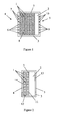
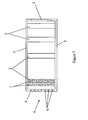
- nanoparticles (1) are known to be capable of destroying bacteria, fungi, viruses, or toxins.
- the present invention combines any type of such nanoparticles (1) with one or more filters (2).
- any type of nanoparticle pellets (1) that are known to be capable of destroying bacteria, fungi, viruses, or toxins are adjacent to a filter (2) within an encasement (3) having an inlet (4) and an outlet (5).
- the nanoparticle pellets (1) are between the inlet (4) and the filter (2), some means must exist to contain the nanoparticle pellets (1). Any such means known in the art may be employed.
- the one or more apertures (6) which comprise the inlet (4) each have a maximum cross-sectional dimension (7) that is less than the minimum dimension (8) of the nanoparticle pellets (1).
- the nanoparticle pellets (1) are between the outlet (5) and the filter (2), there must be a containment means, which preferably comprises having the one or more apertures (9) which comprise the outlet (5) each have a maximum dimension (10) that is less than the minimum dimension (8) of the nanoparticle pellets (1).
- the nanoparticle pellets (1) are between the inlet (4) and the filter (2).
- the filter (2) has an electrical charge that is the same as the electrical charge of at least one target particle, wherein the term "target particle,” as used herein, means the basic unit of any entity which the filter (2) is intended to exclude, such as a bacterium.
- the filter (2) is hydrophobic. In another optional embodiment, the filter (2) is hydrophilic.
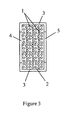
- a second principal embodiment, portrayed in FIG. 2 comprises a filter (2) coated on at least a first side (11) with a powder (12) of any type of nanoparticles (1) that are known to be capable of destroying bacteria, fungi, viruses, or toxins.
- coating is accomplished by having the filter (2) carry an electrical charge that is opposite to an electrical charge carried by the nanoparticles (1) in the powder (12). Also preferably, the filter (2) has an electrical charge that is the same as the electrical charge of at least one target particle.
- an electrical charge on the filter (2) is both opposite to an electrical charge carried by the nanoparticles (1) in the powder (12) and the same as the electrical charge of at least one target particle.
- the nanoparticle (1) can be AP-MgO/Br 2 , AP-MgO/Cl 2 , or AP-MgO, all of which are, as indicated above, positively charged.
- the filter (2) is then selected to have a negative electrical charge, which attracts the positively charged nanoparticles (1). Since, according to pages 6681 through 6682 in the Langmuir article quoted above, "... it is a well-established fact in the literature [citing Busscher, H. J.; Bos, R.; van der Mei, H. C.; Handley, P.
- the filter (2) can be hydrophobic; and, optionally, it can be hydrophilic.
- An example of a commercially available hydrophobic filter is that sold under the trademarked name FILTRETE by the 3M company of St. Paul, Minnesota.
- An example of a commercially available hydrophilic filter is that sold under the name Heat and Moisture Exchange Media also by the 3M company of St. Paul, Minnesota.
- the filter (2) is contained within an encasement (3) having an inlet (4) and an outlet (5).
- the first side (11) of the filter (2) is directed toward the inlet (4) and a second side (13) of the filter (2) is directed toward the outlet (5).
- a coated side (11), (13) of the filter (2) is directed toward the inlet (4), such inlet (4) is covered by a membrane (14) having a pore size smaller than the nanoparticles (1) but large enough not to impede the flow of a gas substantially, preferably a pore size at least as large as the pore size of the filter (2).
- a coated side (11), (13) of the filter (2) is directed toward the outlet (5), such outlet (5) is covered by a membrane (14) having a pore size smaller than the nanoparticles (1) but large enough not to impede the flow of a gas substantially, preferably a pore size at least as large as the pore size of the filter (2).
- Suitable membranes (14) are termed "webbing" and are, for example, commercially available from either the 3M company of St. Paul, Minnesota, or the Versal company of Los Angeles, California.
- This principal embodiment was used to test the effectiveness of the nanoparticles (1) in destroying a bacterium when placed upon a hydrophobic filter (2).
- a portion of a top surface of each of six horizontally oriented negatively charged hydrophobic FILTRETE filters was coated with positively charged AP-MgO/Cl 2 . Also on top of the filters but not necessarily just in the location of the nanoparticles were placed an average of 226,000 colony-forming units of bacterium thuringiensis. There was no flow of air through the filter.
- the number of colony forming units on the uncoated filters had increased by an average of more than 6507 percent while the number of colony forming units on the coated filters had decreased by an average of 21.7 percent.
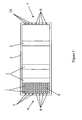
- a filter (2) is, using any technique that is known in the art, impregnated with any type of nanoparticles (1) that are known to be capable of destroying bacteria, fungi, viruses, or toxins.
- the filter (2) carries an electrical charge that is opposite to an electrical charge carried by the nanoparticles (1). Also preferably, the filter (2) has an electrical charge that is the same as the electrical charge of at least one target particle.
- an electrical charge on the filter (2) is both opposite to an electrical charge carried by the nanoparticles (1) and the same as the electrical charge of at least one target particle.
- the filter (2) can be hydrophobic; and, optionally, it can be hydrophilic.
- the filter (2) is contained within an encasement (3) having an inlet (4) and an outlet (5).
- the final four principal embodiments all employ an encasement (3) having an inlet (4) and an outlet (5) and containing two or more filters (2) in serial fluid communication with each other.
- at least one of the filters (2) is hydrophobic; and, also optionally, at least one of the filters (2) is hydrophilic.
- at least one of the filters (2) has an electrical charge that is the same as an electrical charge of at least one target particle; and, preferably, the filter (2) nearest the inlet (4) is hydrophobic.
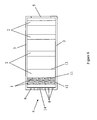
- the fourth principal embodiment, illustrated in FIG. 4 has adjacent to and between at least two consecutive filters (2) any type of nanoparticle pellets (1) that are known to be capable of destroying bacteria, fungi, viruses, or toxins.
- any type of nanoparticle pellets (1) that are known to be capable of destroying bacteria, fungi, viruses, or toxins are at least adjacent to a filter (2) that has no other filter (2) between such filter (2) and an external passageway (4), (5).
- the term "external passageway" shall include both an inlet (4) and an outlet (5) and, when used in the singular, shall designate either an inlet (4) or an outlet (5).
- the nanoparticle pellets are between such filter (2) and the external passageway (4), (5) which is nearer to the filter (2).
- such external passageway (4), (5) is the inlet (4) of the encasement (3).
- the nanoparticle pellets (1) there are some means must exist to contain the nanoparticle pellets (1). Any such means known in the art may be employed. Preferably, however, when the nanoparticle pellets (1) are between the filter (2) and the inlet (4), the one or more apertures (6) which comprise the inlet (4) each have a maximum dimension (7) that is less than the minimum dimension (8) of the nanoparticle pellets (1). Similarly, when the nanoparticle pellets (1) are between the outlet (5) and the filter (2), the containment means preferably comprises having the one or more apertures (9) which comprise the outlet (5) each have a maximum dimension (10) that is less than the minimum dimension (8) of the nanoparticle pellets (1).
- a first side (11) of at least one filter (2) is coated with a powder (12) of any type of nanoparticles (1) that are known to be capable of destroying bacteria, fungi, viruses, or toxins.
- coating is accomplished by having the filter (2) carry an electrical charge that is opposite to an electrical charge carried by the nanoparticles (1) in the powder (12).
- an electrical charge on the filter (2) is both opposite to an electrical charge carried by the nanoparticles (1) and the same as the electrical charge of at least one target particle.
- At least one such coated filter (2) has no other filter (2) between such filter (2) and the inlet (4) of the encasement (3); and most preferably the first side (11) of such filter (2) is directed toward the inlet (4).
- a coated side (11), (13) of a filter (2) is directed toward an external passageway (4), (5) and no other filter (2) is between such coated filter (2) and the external passageway (4), (5), such external passageway is preferably covered by a membrane (14) having a pore size smaller than the nanoparticles (1) but large enough not to impede the flow of a gas substantially, preferably a pore size at least as large as the pore size of the filter (2) which has the smallest pore size.
- At least one filter (2) which is, preferably, the filter (2) closest to the inlet (4) of the encasement (3), is, using any technique that is known in the art, impregnated with any type of nanoparticles (1) that are known to be capable of destroying bacteria, fungi, viruses, or toxins.
- the impregnated filter (2) carries an electrical charge that is opposite to an electrical charge carried by the nanoparticles (1).
- an electrical charge on the impregnated filter (2) is both opposite to an electrical charge carried by the nanoparticles (1) and the same as the electrical charge of at least one target particle.
- the term "preferable” or “preferably” means that a specified element or technique is more acceptable than another but not that such specified element or technique is a necessity.
Landscapes
- Chemical & Material Sciences (AREA)
- Health & Medical Sciences (AREA)
- Engineering & Computer Science (AREA)
- Life Sciences & Earth Sciences (AREA)
- Chemical Kinetics & Catalysis (AREA)
- Biomedical Technology (AREA)
- Veterinary Medicine (AREA)
- Water Supply & Treatment (AREA)
- Public Health (AREA)
- General Health & Medical Sciences (AREA)
- Animal Behavior & Ethology (AREA)
- Epidemiology (AREA)
- Medicinal Chemistry (AREA)
- Molecular Biology (AREA)
- Analytical Chemistry (AREA)
- Oil, Petroleum & Natural Gas (AREA)
- General Chemical & Material Sciences (AREA)
- Environmental & Geological Engineering (AREA)
- Organic Chemistry (AREA)
- Inorganic Chemistry (AREA)
- Filtering Materials (AREA)
- Separation Using Semi-Permeable Membranes (AREA)
- Disinfection, Sterilisation Or Deodorisation Of Air (AREA)
- Medicines Containing Material From Animals Or Micro-Organisms (AREA)
- Inorganic Compounds Of Heavy Metals (AREA)
- Electrostatic Separation (AREA)
Applications Claiming Priority (2)
| Application Number | Priority Date | Filing Date | Title |
|---|---|---|---|
| US10/387,854 US20040178135A1 (en) | 2003-03-13 | 2003-03-13 | Filtering device incorporating nanoparticles |
| EP04749379A EP1606042B1 (en) | 2003-03-13 | 2004-03-12 | Filtering device incorporating nanoparticles |
Related Parent Applications (1)
| Application Number | Title | Priority Date | Filing Date |
|---|---|---|---|
| EP04749379.6 Division | 2004-03-12 |
Publications (1)
| Publication Number | Publication Date |
|---|---|
| EP2281622A1 true EP2281622A1 (en) | 2011-02-09 |
Family
ID=32961994
Family Applications (4)
| Application Number | Title | Priority Date | Filing Date |
|---|---|---|---|
| EP10011432A Withdrawn EP2281622A1 (en) | 2003-03-13 | 2004-03-12 | Filtering device incorporating nanoparticles |
| EP10011430A Withdrawn EP2281620A1 (en) | 2003-03-13 | 2004-03-12 | Filtering device incorporating nanoparticles |
| EP04749379A Expired - Lifetime EP1606042B1 (en) | 2003-03-13 | 2004-03-12 | Filtering device incorporating nanoparticles |
| EP10011431A Withdrawn EP2281621A1 (en) | 2003-03-13 | 2004-03-12 | Filtering device incorporating nanoparticles |
Family Applications After (3)
| Application Number | Title | Priority Date | Filing Date |
|---|---|---|---|
| EP10011430A Withdrawn EP2281620A1 (en) | 2003-03-13 | 2004-03-12 | Filtering device incorporating nanoparticles |
| EP04749379A Expired - Lifetime EP1606042B1 (en) | 2003-03-13 | 2004-03-12 | Filtering device incorporating nanoparticles |
| EP10011431A Withdrawn EP2281621A1 (en) | 2003-03-13 | 2004-03-12 | Filtering device incorporating nanoparticles |
Country Status (16)
| Country | Link |
|---|---|
| US (2) | US20040178135A1 (enExample) |
| EP (4) | EP2281622A1 (enExample) |
| JP (4) | JP2006520268A (enExample) |
| KR (1) | KR20050106522A (enExample) |
| CN (1) | CN1758950A (enExample) |
| AT (1) | ATE492332T1 (enExample) |
| AU (1) | AU2004237571B2 (enExample) |
| BR (1) | BRPI0408736B1 (enExample) |
| CA (1) | CA2518720A1 (enExample) |
| DE (1) | DE602004030667D1 (enExample) |
| MX (1) | MXPA05009745A (enExample) |
| NO (1) | NO20054661L (enExample) |
| NZ (1) | NZ542238A (enExample) |
| RU (1) | RU2336933C2 (enExample) |
| TW (1) | TWI239263B (enExample) |
| WO (1) | WO2004098753A2 (enExample) |
Families Citing this family (34)
| Publication number | Priority date | Publication date | Assignee | Title |
|---|---|---|---|---|
| US6860924B2 (en) * | 2002-06-07 | 2005-03-01 | Nanoscale Materials, Inc. | Air-stable metal oxide nanoparticles |
| US7419601B2 (en) * | 2003-03-07 | 2008-09-02 | Seldon Technologies, Llc | Nanomesh article and method of using the same for purifying fluids |
| US20100098877A1 (en) * | 2003-03-07 | 2010-04-22 | Cooper Christopher H | Large scale manufacturing of nanostructured material |
| ATE368505T1 (de) * | 2003-03-07 | 2007-08-15 | Seldon Technologies Llc | Reinigung von fluiden medien mit nanomaterialien |
| JP2008535648A (ja) * | 2005-03-09 | 2008-09-04 | ザ リージェンツ オブ ザ ユニバーシティ オブ カリフォルニア | ナノ複合膜ならびにそれを作製および使用する方法 |
| US20070151921A1 (en) * | 2006-01-03 | 2007-07-05 | Ceo Espinex Inc. | Self-cleaning filtration nanofiber membrane |
| GB0603138D0 (en) * | 2006-02-16 | 2006-03-29 | Queen Mary & Westfield College | Virucidal materials |
| TW200743504A (en) * | 2006-05-19 | 2007-12-01 | Nano Ind Pte Ltd I | Secure-nano mask |
| US20080027401A1 (en) * | 2006-07-28 | 2008-01-31 | Becton, Dickinson And Company | Vascular access device filtration |
| CA2667579A1 (en) * | 2006-10-27 | 2008-05-15 | The Regents Of The University Of California | Micro-and nanocomposite support structures for reverse osmosis thin film membranes |
| US20100224555A1 (en) * | 2007-09-21 | 2010-09-09 | Hoek Eric M V | Nanocomposite membranes and methods of making and using same |
| US8177978B2 (en) | 2008-04-15 | 2012-05-15 | Nanoh20, Inc. | Reverse osmosis membranes |
| WO2010002773A2 (en) * | 2008-06-30 | 2010-01-07 | 3M Innovative Properties Company | Method for in situ formation of metal nanoclusters within a porous substrate field |
| US20100122515A1 (en) * | 2008-11-18 | 2010-05-20 | Han-Wen Kuo | Poison-filter material and production method thereof |
| US20150114397A1 (en) * | 2009-04-09 | 2015-04-30 | Jeffery C. Litz | Chemical and biological protection mask |
| JP5745512B2 (ja) | 2009-06-29 | 2015-07-08 | ナノエイチツーオー・インコーポレーテッド | 窒素添加剤を含む改良された混成tfcro膜 |
| US8307994B2 (en) * | 2009-10-28 | 2012-11-13 | International Business Machines Corporation | Surface charge enabled nanoporous semi-permeable membrane for desalination |
| EP2578243B1 (en) * | 2010-06-02 | 2017-09-06 | Mitsubishi Electric Corporation | Device for microbe and virus capture and inactivation |
| EA026286B1 (ru) * | 2010-10-15 | 2017-03-31 | СЕЛАНИЗ ЭСИТЕЙТ ЭлЭлСи | Установки, системы и связанные с ними способы получения пористых масс для фильтра табачного дыма |
| CA2817570C (en) | 2010-11-10 | 2018-03-06 | Nanoh2O, Inc. | Improved hybrid tfc ro membranes with additives |
| CN102614975A (zh) * | 2012-04-06 | 2012-08-01 | 东南大学 | 一种用于水溶性纳米粒子选择性分离的方法 |
| EP3099337B1 (en) * | 2014-01-29 | 2022-04-06 | Norwegian Water Purification AS | Treatment device and method for destructing micro-organisms in gaseous or liquid media |
| WO2016018797A1 (en) * | 2014-07-31 | 2016-02-04 | Munster Jason | Personal air filtration device |
| US9861940B2 (en) | 2015-08-31 | 2018-01-09 | Lg Baboh2O, Inc. | Additives for salt rejection enhancement of a membrane |
| US9737859B2 (en) | 2016-01-11 | 2017-08-22 | Lg Nanoh2O, Inc. | Process for improved water flux through a TFC membrane |
| US10155203B2 (en) | 2016-03-03 | 2018-12-18 | Lg Nanoh2O, Inc. | Methods of enhancing water flux of a TFC membrane using oxidizing and reducing agents |
| WO2018051165A1 (en) * | 2016-09-14 | 2018-03-22 | Sorin Group Italia Srl | Systems for eliminating and/or reducing aerosol emissions from a heater/cooler |
| EP3768955A4 (en) | 2018-03-19 | 2021-11-03 | RPM Industries, LLC | SYSTEM WITH REUSABLE OIL FILTER |
| WO2020106565A1 (en) | 2018-11-21 | 2020-05-28 | Mar Cor Purification, Inc. | Nanoparticles for use in membranes |
| CA3149448A1 (en) | 2019-08-28 | 2021-03-04 | Steve Michael Beguin | Fluid check valve and fluidic systems for gas venting |
| US11930867B2 (en) * | 2020-07-30 | 2024-03-19 | Fxi Inc. Limited | Coated substrates and articles with anti-viral properties, and fabrication processes |
| WO2023196630A1 (en) * | 2022-04-08 | 2023-10-12 | Delstar Technologies, Inc. | Filtration media and filters |
| CN119278083A (zh) * | 2022-04-08 | 2025-01-07 | 马蒂夫卢森堡公司 | 机械和静电过滤介质 |
| CA3248968A1 (en) | 2022-04-08 | 2023-10-12 | Mativ Luxembourg | POLYMER SHEETS WITH OPENINGS CONTAINING NANOPARTICLES |
Citations (4)
| Publication number | Priority date | Publication date | Assignee | Title |
|---|---|---|---|---|
| US6197193B1 (en) * | 1999-10-21 | 2001-03-06 | Virgil L. Archer | Drinking water filter |
| US20020035032A1 (en) | 1998-09-15 | 2002-03-21 | Olga Koper | Reactive nanoparticles as destructive adsorbents for biological and chemical contamination |
| US6375854B2 (en) | 1996-11-18 | 2002-04-23 | Douglas K. Beplate | Combined hydrophobic-hydrophilic filter for fluids |
| US20020070172A1 (en) | 2000-09-26 | 2002-06-13 | Andreas Schlegel | Contact and adsorbent granules |
Family Cites Families (35)
| Publication number | Priority date | Publication date | Assignee | Title |
|---|---|---|---|---|
| US3252270A (en) * | 1962-10-01 | 1966-05-24 | Pall Corp | Apparatus and method for removal of oil entrained in air |
| US3891417A (en) * | 1974-01-28 | 1975-06-24 | King Eng Corp | Filter and sorbent cartridge |
| DE2510467A1 (de) * | 1975-03-11 | 1976-09-23 | Schenk Filterbau Gmbh | Filterwerkstoff |
| US4578150A (en) * | 1982-07-23 | 1986-03-25 | Amf Inc. | Fibrous media containing millimicron-sized particulates |
| CA2027687C (en) * | 1989-11-14 | 2002-12-31 | Douglas C. Sundet | Filtration media and method of manufacture |
| JP3197126B2 (ja) * | 1993-10-08 | 2001-08-13 | 触媒化成工業株式会社 | 抗菌性繊維 |
| CA2136455C (en) * | 1993-11-18 | 1999-06-29 | Robert Edward Burrell | Process for producing anti-microbial effect with complex silver ions |
| RU2048856C1 (ru) * | 1994-05-11 | 1995-11-27 | Акционерное общество закрытого типа Фирма "Меттэм-технологии" | Фильтровальный патрон |
| RU2060779C1 (ru) * | 1994-06-22 | 1996-05-27 | Дзержинское производственное объединение "Заря" | Устройство для очистки питьевой воды в домашних условиях |
| US5531892A (en) * | 1995-09-15 | 1996-07-02 | Minnesota Mining And Manufacturing Company | Zigzag filter media and frame having triangular pleat stabilizing elements |
| JPH09108656A (ja) * | 1995-10-19 | 1997-04-28 | Nippon Gijutsu Kaihatsu Center:Kk | 水の浄化装置 |
| JPH09299724A (ja) * | 1996-05-09 | 1997-11-25 | Mitsui Mining & Smelting Co Ltd | 抗菌性フィルター |
| JPH09308813A (ja) * | 1996-05-21 | 1997-12-02 | Laser Matsushita:Kk | カセット式空気浄化フィルタ及び脱臭装置 |
| US6689278B2 (en) * | 1996-11-18 | 2004-02-10 | Douglas K. Beplate | Combined hydrophobic-hydrophilic filter for fluids |
| US5972808A (en) * | 1997-01-30 | 1999-10-26 | Aqf Technologies Llc | Fibrous structures with fine particles |
| US6662956B2 (en) * | 1997-03-18 | 2003-12-16 | Selecto, Inc. | Nanocrystal-containing filtration media |
| JPH1190139A (ja) * | 1997-09-16 | 1999-04-06 | Nobuhide Maeda | エアフィルタ装置 |
| DE19741498B4 (de) * | 1997-09-20 | 2008-07-03 | Evonik Degussa Gmbh | Herstellung eines Keramik-Edelstahlgewebe-Verbundes |
| JPH11241107A (ja) * | 1997-10-23 | 1999-09-07 | Shizuko Sato | 金属超微粒子及びその製法 |
| JPH11267236A (ja) * | 1998-03-19 | 1999-10-05 | Japan Vilene Co Ltd | 抗菌性帯電フィルター |
| CA2326456C (en) * | 1998-03-30 | 2008-12-23 | Rtp Pharma Inc. | Composition and method of preparing microparticles of water-insoluble substances |
| JPH11342310A (ja) * | 1998-03-31 | 1999-12-14 | Mitsubishi Paper Mills Ltd | 機能性エレクトレットフィルタ―およびその製造方法、並びに空気清浄化装置 |
| RU2135262C1 (ru) * | 1998-07-30 | 1999-08-27 | Ревина Александра Анатольевна | Способ модифицирования фильтровального элемента |
| JP4113621B2 (ja) * | 1998-08-18 | 2008-07-09 | 東京濾器株式会社 | プレフィルタ付きフィルタエレメント |
| US6417423B1 (en) * | 1998-09-15 | 2002-07-09 | Nanoscale Materials, Inc. | Reactive nanoparticles as destructive adsorbents for biological and chemical contamination |
| US6057488A (en) * | 1998-09-15 | 2000-05-02 | Nantek, Inc. | Nanoparticles for the destructive sorption of biological and chemical contaminants |
| US6428814B1 (en) * | 1999-10-08 | 2002-08-06 | Elan Pharma International Ltd. | Bioadhesive nanoparticulate compositions having cationic surface stabilizers |
| RU13949U1 (ru) * | 2000-02-08 | 2000-06-20 | Закрытое акционерное общество "Живой родник" | Фильтровальный материал для очистки жидких и газообразных веществ |
| FR2812825B1 (fr) * | 2000-08-14 | 2003-04-18 | Ahlstrom Paper Group Res And C | Media filtrant a base d'agent photocatalyseurs et de charbon actif |
| AU2001289904A1 (en) * | 2000-09-26 | 2002-04-08 | Bayer Aktiengesellschaft | Adsorption container and iron oxide adsorber |
| JP2003047649A (ja) * | 2001-05-29 | 2003-02-18 | Sanei Service Kk | 脱臭フィルター |
| DE60211339D1 (de) * | 2001-06-22 | 2006-06-14 | Argonide Corp | Submikron filter |
| JP2003001028A (ja) * | 2001-06-22 | 2003-01-07 | Bridgestone Corp | フィルター材 |
| WO2004039187A2 (en) * | 2002-02-25 | 2004-05-13 | Gentex Corporation | Multu-functional protective textiles and methods for decontamination |
| US7017202B1 (en) | 2004-05-17 | 2006-03-28 | Chisholm Seth J | Bunk bed panel |
-
2003
- 2003-03-13 US US10/387,854 patent/US20040178135A1/en not_active Abandoned
-
2004
- 2004-03-12 TW TW093106733A patent/TWI239263B/zh not_active IP Right Cessation
- 2004-03-12 AT AT04749379T patent/ATE492332T1/de not_active IP Right Cessation
- 2004-03-12 EP EP10011432A patent/EP2281622A1/en not_active Withdrawn
- 2004-03-12 CA CA002518720A patent/CA2518720A1/en not_active Abandoned
- 2004-03-12 WO PCT/US2004/007822 patent/WO2004098753A2/en not_active Ceased
- 2004-03-12 EP EP10011430A patent/EP2281620A1/en not_active Withdrawn
- 2004-03-12 NZ NZ542238A patent/NZ542238A/en not_active IP Right Cessation
- 2004-03-12 RU RU2005131318/15A patent/RU2336933C2/ru active
- 2004-03-12 CN CNA2004800067665A patent/CN1758950A/zh active Pending
- 2004-03-12 EP EP04749379A patent/EP1606042B1/en not_active Expired - Lifetime
- 2004-03-12 EP EP10011431A patent/EP2281621A1/en not_active Withdrawn
- 2004-03-12 MX MXPA05009745A patent/MXPA05009745A/es active IP Right Grant
- 2004-03-12 KR KR1020057017156A patent/KR20050106522A/ko not_active Ceased
- 2004-03-12 AU AU2004237571A patent/AU2004237571B2/en not_active Expired
- 2004-03-12 JP JP2006507188A patent/JP2006520268A/ja active Pending
- 2004-03-12 DE DE602004030667T patent/DE602004030667D1/de not_active Expired - Lifetime
- 2004-03-12 BR BRPI0408736A patent/BRPI0408736B1/pt not_active IP Right Cessation
-
2005
- 2005-10-11 NO NO20054661A patent/NO20054661L/no not_active Application Discontinuation
-
2007
- 2007-03-08 JP JP2007058846A patent/JP2007144212A/ja active Pending
- 2007-03-08 JP JP2007058806A patent/JP2007209769A/ja active Pending
- 2007-03-08 JP JP2007058821A patent/JP2007195996A/ja active Pending
-
2012
- 2012-04-20 US US13/452,792 patent/US20120199528A1/en not_active Abandoned
Patent Citations (4)
| Publication number | Priority date | Publication date | Assignee | Title |
|---|---|---|---|---|
| US6375854B2 (en) | 1996-11-18 | 2002-04-23 | Douglas K. Beplate | Combined hydrophobic-hydrophilic filter for fluids |
| US20020035032A1 (en) | 1998-09-15 | 2002-03-21 | Olga Koper | Reactive nanoparticles as destructive adsorbents for biological and chemical contamination |
| US6197193B1 (en) * | 1999-10-21 | 2001-03-06 | Virgil L. Archer | Drinking water filter |
| US20020070172A1 (en) | 2000-09-26 | 2002-06-13 | Andreas Schlegel | Contact and adsorbent granules |
Non-Patent Citations (2)
| Title |
|---|
| BUSSCHER, H. J.; BOS, R.; VAN DER MEI, H. C.; HANDLEY, P. S.: "Physical Chemistry of Biological Interfaces", 2000, MARCEL DEKKER |
| PETER K. STOIMENOV; ROSALYN L. KLINGER; GEORGE L. MARCHIN; KENNETH J. KLABUNDE: "Langmuir", vol. 18, 2002, AMERICAN CHEMICAL SOCIETY, article "Metal Oxide Nanoparticles as Bactericidal Agents", pages: 6679 - 6686 |
Also Published As
| Publication number | Publication date |
|---|---|
| EP2281620A1 (en) | 2011-02-09 |
| WO2004098753A2 (en) | 2004-11-18 |
| MXPA05009745A (es) | 2006-03-08 |
| KR20050106522A (ko) | 2005-11-09 |
| JP2006520268A (ja) | 2006-09-07 |
| RU2005131318A (ru) | 2006-05-10 |
| CN1758950A (zh) | 2006-04-12 |
| TW200505555A (en) | 2005-02-16 |
| ATE492332T1 (de) | 2011-01-15 |
| EP2281621A1 (en) | 2011-02-09 |
| BRPI0408736B1 (pt) | 2016-08-23 |
| EP1606042A2 (en) | 2005-12-21 |
| WO2004098753A3 (en) | 2004-12-29 |
| JP2007144212A (ja) | 2007-06-14 |
| RU2336933C2 (ru) | 2008-10-27 |
| TWI239263B (en) | 2005-09-11 |
| JP2007209769A (ja) | 2007-08-23 |
| AU2004237571A1 (en) | 2004-11-18 |
| AU2004237571B2 (en) | 2008-04-17 |
| NO20054661L (no) | 2005-10-11 |
| EP1606042B1 (en) | 2010-12-22 |
| US20120199528A1 (en) | 2012-08-09 |
| DE602004030667D1 (de) | 2011-02-03 |
| JP2007195996A (ja) | 2007-08-09 |
| US20040178135A1 (en) | 2004-09-16 |
| CA2518720A1 (en) | 2004-11-18 |
| NZ542238A (en) | 2008-01-31 |
| BRPI0408736A (pt) | 2006-03-07 |
Similar Documents
| Publication | Publication Date | Title |
|---|---|---|
| EP1606042B1 (en) | Filtering device incorporating nanoparticles | |
| US7390343B2 (en) | Drinking water filtration device | |
| US7311752B2 (en) | Electrostatic air filter | |
| CA2646192C (en) | Non-woven media incorporating ultrafine or nanosize powders | |
| JP5718309B2 (ja) | 超微細粉末又はナノサイズ粉末を組み込んだ不織媒体 | |
| US20080026041A1 (en) | Non-woven media incorporating ultrafine or nanosize powders | |
| JP2006502322A (ja) | 多機能性防護織物および汚染除去方法(関連出願の相互参照)この特許出願は、2002年2月25日出願の米国特許仮出願60/360,050の優先日の利益を主張する。 | |
| CA2513469A1 (en) | Bioagent air filtration systems | |
| US20100307978A1 (en) | Apparatus and method for contaminant removal from aqueous solution | |
| CN105658321A (zh) | 分层或混合吸附剂床防护过滤装置 | |
| JP2016533885A (ja) | 積層型又は混合型の吸着床の保護濾過装置 | |
| HK1090320A (en) | Filtering device incorporating nanoparticles | |
| KR102161255B1 (ko) | 정전기식 공기 여과 유닛 |
Legal Events
| Date | Code | Title | Description |
|---|---|---|---|
| PUAI | Public reference made under article 153(3) epc to a published international application that has entered the european phase |
Free format text: ORIGINAL CODE: 0009012 |
|
| AC | Divisional application: reference to earlier application |
Ref document number: 1606042 Country of ref document: EP Kind code of ref document: P |
|
| AK | Designated contracting states |
Kind code of ref document: A1 Designated state(s): AT BE BG CH CY CZ DE DK EE ES FI FR GB GR HU IE IT LI LU MC NL PL PT RO SE SI SK TR |
|
| RIN1 | Information on inventor provided before grant (corrected) |
Inventor name: BEPLATE, DOUGLAS, K. |
|
| STAA | Information on the status of an ep patent application or granted ep patent |
Free format text: STATUS: THE APPLICATION IS DEEMED TO BE WITHDRAWN |
|
| 18D | Application deemed to be withdrawn |
Effective date: 20110810 |