EP2249962B1 - Nouveau materiau hybride organique-inorganique im-19 et son procede de preparation - Google Patents
Nouveau materiau hybride organique-inorganique im-19 et son procede de preparation Download PDFInfo
- Publication number
- EP2249962B1 EP2249962B1 EP09721476A EP09721476A EP2249962B1 EP 2249962 B1 EP2249962 B1 EP 2249962B1 EP 09721476 A EP09721476 A EP 09721476A EP 09721476 A EP09721476 A EP 09721476A EP 2249962 B1 EP2249962 B1 EP 2249962B1
- Authority
- EP
- European Patent Office
- Prior art keywords
- stage
- solid
- gallium
- crystallized
- ray diffraction
- Prior art date
- Legal status (The legal status is an assumption and is not a legal conclusion. Google has not performed a legal analysis and makes no representation as to the accuracy of the status listed.)
- Not-in-force
Links
- 0 C*C(c1ccc(C(C)(c2ccc(C([O-])O)cc2)N)cc1)OC Chemical compound C*C(c1ccc(C(C)(c2ccc(C([O-])O)cc2)N)cc1)OC 0.000 description 1
Images


Classifications
-
- B—PERFORMING OPERATIONS; TRANSPORTING
- B01—PHYSICAL OR CHEMICAL PROCESSES OR APPARATUS IN GENERAL
- B01J—CHEMICAL OR PHYSICAL PROCESSES, e.g. CATALYSIS OR COLLOID CHEMISTRY; THEIR RELEVANT APPARATUS
- B01J20/00—Solid sorbent compositions or filter aid compositions; Sorbents for chromatography; Processes for preparing, regenerating or reactivating thereof
- B01J20/22—Solid sorbent compositions or filter aid compositions; Sorbents for chromatography; Processes for preparing, regenerating or reactivating thereof comprising organic material
- B01J20/223—Solid sorbent compositions or filter aid compositions; Sorbents for chromatography; Processes for preparing, regenerating or reactivating thereof comprising organic material containing metals, e.g. organo-metallic compounds, coordination complexes
- B01J20/226—Coordination polymers, e.g. metal-organic frameworks [MOF], zeolitic imidazolate frameworks [ZIF]
-
- B—PERFORMING OPERATIONS; TRANSPORTING
- B01—PHYSICAL OR CHEMICAL PROCESSES OR APPARATUS IN GENERAL
- B01J—CHEMICAL OR PHYSICAL PROCESSES, e.g. CATALYSIS OR COLLOID CHEMISTRY; THEIR RELEVANT APPARATUS
- B01J31/00—Catalysts comprising hydrides, coordination complexes or organic compounds
- B01J31/02—Catalysts comprising hydrides, coordination complexes or organic compounds containing organic compounds or metal hydrides
- B01J31/06—Catalysts comprising hydrides, coordination complexes or organic compounds containing organic compounds or metal hydrides containing polymers
- B01J31/069—Hybrid organic-inorganic polymers, e.g. silica derivatized with organic groups
-
- B—PERFORMING OPERATIONS; TRANSPORTING
- B01—PHYSICAL OR CHEMICAL PROCESSES OR APPARATUS IN GENERAL
- B01J—CHEMICAL OR PHYSICAL PROCESSES, e.g. CATALYSIS OR COLLOID CHEMISTRY; THEIR RELEVANT APPARATUS
- B01J31/00—Catalysts comprising hydrides, coordination complexes or organic compounds
- B01J31/16—Catalysts comprising hydrides, coordination complexes or organic compounds containing coordination complexes
- B01J31/1691—Coordination polymers, e.g. metal-organic frameworks [MOF]
-
- B—PERFORMING OPERATIONS; TRANSPORTING
- B01—PHYSICAL OR CHEMICAL PROCESSES OR APPARATUS IN GENERAL
- B01J—CHEMICAL OR PHYSICAL PROCESSES, e.g. CATALYSIS OR COLLOID CHEMISTRY; THEIR RELEVANT APPARATUS
- B01J31/00—Catalysts comprising hydrides, coordination complexes or organic compounds
- B01J31/16—Catalysts comprising hydrides, coordination complexes or organic compounds containing coordination complexes
- B01J31/22—Organic complexes
- B01J31/2204—Organic complexes the ligands containing oxygen or sulfur as complexing atoms
- B01J31/2208—Oxygen, e.g. acetylacetonates
- B01J31/2226—Anionic ligands, i.e. the overall ligand carries at least one formal negative charge
- B01J31/223—At least two oxygen atoms present in one at least bidentate or bridging ligand
- B01J31/2239—Bridging ligands, e.g. OAc in Cr2(OAc)4, Pt4(OAc)8 or dicarboxylate ligands
-
- B—PERFORMING OPERATIONS; TRANSPORTING
- B01—PHYSICAL OR CHEMICAL PROCESSES OR APPARATUS IN GENERAL
- B01J—CHEMICAL OR PHYSICAL PROCESSES, e.g. CATALYSIS OR COLLOID CHEMISTRY; THEIR RELEVANT APPARATUS
- B01J35/00—Catalysts, in general, characterised by their form or physical properties
- B01J35/70—Catalysts, in general, characterised by their form or physical properties characterised by their crystalline properties, e.g. semi-crystalline
-
- C—CHEMISTRY; METALLURGY
- C07—ORGANIC CHEMISTRY
- C07F—ACYCLIC, CARBOCYCLIC OR HETEROCYCLIC COMPOUNDS CONTAINING ELEMENTS OTHER THAN CARBON, HYDROGEN, HALOGEN, OXYGEN, NITROGEN, SULFUR, SELENIUM OR TELLURIUM
- C07F5/00—Compounds containing elements of Groups 3 or 13 of the Periodic Table
- C07F5/003—Compounds containing elements of Groups 3 or 13 of the Periodic Table without C-Metal linkages
-
- B—PERFORMING OPERATIONS; TRANSPORTING
- B01—PHYSICAL OR CHEMICAL PROCESSES OR APPARATUS IN GENERAL
- B01J—CHEMICAL OR PHYSICAL PROCESSES, e.g. CATALYSIS OR COLLOID CHEMISTRY; THEIR RELEVANT APPARATUS
- B01J2235/00—Indexing scheme associated with group B01J35/00, related to the analysis techniques used to determine the catalysts form or properties
- B01J2235/15—X-ray diffraction
-
- B—PERFORMING OPERATIONS; TRANSPORTING
- B01—PHYSICAL OR CHEMICAL PROCESSES OR APPARATUS IN GENERAL
- B01J—CHEMICAL OR PHYSICAL PROCESSES, e.g. CATALYSIS OR COLLOID CHEMISTRY; THEIR RELEVANT APPARATUS
- B01J2531/00—Additional information regarding catalytic systems classified in B01J31/00
- B01J2531/30—Complexes comprising metals of Group III (IIIA or IIIB) as the central metal
- B01J2531/32—Gallium
-
- B—PERFORMING OPERATIONS; TRANSPORTING
- B01—PHYSICAL OR CHEMICAL PROCESSES OR APPARATUS IN GENERAL
- B01J—CHEMICAL OR PHYSICAL PROCESSES, e.g. CATALYSIS OR COLLOID CHEMISTRY; THEIR RELEVANT APPARATUS
- B01J37/00—Processes, in general, for preparing catalysts; Processes, in general, for activation of catalysts
- B01J37/0009—Use of binding agents; Moulding; Pressing; Powdering; Granulating; Addition of materials ameliorating the mechanical properties of the product catalyst
Definitions
- the invention relates to a novel crystalline organic-inorganic mixed matrix hybrid material, hereinafter referred to as IM-19, to its preparation process and to its use as a catalyst or adsorbent.
- Inorganic porous solids have been extensively studied to increase the opening of their structures so as to facilitate reagent access to the active site or the exit of products from this active site.
- hybrid porous mixed organic-inorganic matrix solids are quite similar to inorganic backbone porous solids.
- the coordination polymers consist of two elements called connectors and ligands whose orientation and the number of binding sites are determining in the structure of the hybrid material.
- the diversity of these ligands and connectors is born, as already mentioned, an immense variety of hybrid materials.
- Other additional auxiliary compounds also enter the synthesis: they are blockers, counter-ions, for example.
- the inorganic entity acting as a connector is, for its part, a cation alone, a dimer, trimer or tetramer, or a chain, a plane, or even a three-dimensional network.
- Yaghi et al. describe a series of boron structures in the patent US2006 / 0154807 and indicate their interest in the field of gas storage.
- the patent U.S. 7,202,385 to Mueller et al. offers a particularly comprehensive summary of the structures described in the literature and perfectly illustrates the multitude of materials already existing to date.
- T. Loiseau et al. discloses a MIL-53 phase based on aluminum atoms and the bdc ligand (benzene-1,4-dicarboxylate).
- Each aluminum atom is hexacoordinated, two oxygen atoms of the hydroxyl groups being in apical position and four oxygen atoms from four terephthalic connectors locating in the equatorial position.
- an organic ligand is connected to four aluminum atoms (two pairs of neighboring aluminum atoms).
- H 2 bdc HO 2 CC 6 H 4 -CO 2 H
- the subject of the present invention is a new hybrid crystallized material, called IM-19 with an organic-inorganic mixed matrix, containing an inorganic network of metal centers based on the gallium element connected together by organic ligands of the terephthalate (or bdc) type. ) and isostructural of MIL-53 materials.
- the hybrid material IM-19 according to the present invention has an X-ray diffraction pattern including at least the lines listed in Table 1.
- This diffraction pattern is obtained by radiocrystallographic analysis using the conventional powder method using a STOE STADI-P diffractometer equipped with a Ge (111) front monochromator and a PSD detector.
- the material analyzes were recorded in Debye-Scherrer mode from 5 to 50 ° (2 ⁇ ) with a resolution of 0.01 ° (2 ⁇ ) and a step of 0.1 ° for 85 seconds.
- the X-ray diffraction pattern of the hybrid material IM-19 comprises at least the lines with the values of d hkl given in table 1.
- the intensity I / I 0 is given in relation to a scale of relative intensity where it is assigned a value of 100 to the most intense line of the X-ray diffraction pattern: ff ⁇ 15; 15 ⁇ f ⁇ 30; 30 ⁇ mf ⁇ 50; 50 ⁇ m ⁇ 65; 65 F F ⁇ 85; FF ⁇ 85.
- the Figure 1 corresponds to the X-ray diffractogram of the hybrid solid IM-19.
- the present invention also relates to a hybrid material crystallized in its crude synthetic form obtained as an intermediate during the preparation of hybrid material IM-19.
- This crystallized hybrid material in its raw form of synthesis is a hybrid material with mixed organic-inorganic matrix containing a network of gallium-based metal centers connected together by organic ligands of terephthalate type. It has an X-ray diffraction pattern including at least the lines listed in Table 2.
- the intensity I / I 0 is given in relation to a scale of relative intensity where it is assigned a value of 100 to the most intense line of the X-ray diffraction pattern: ff ⁇ 15; 15 ⁇ f ⁇ 30; 30 ⁇ mf ⁇ 50; 50 ⁇ m ⁇ 65; 65 F F ⁇ 85; FF ⁇ 85.
- the Figure 2 corresponds to the X-ray diffractogram of the crystallized intermediate solid in its crude synthesis form obtained during the preparation of the hybrid material IM-19.
- the gallium precursor is chosen from gallium (III) salts such as chlorides, sulphates, acetates or gallium nitrates. Very preferably, the precursor used is a gallium nitrate.
- the molar composition of the mixture obtained during the preparation of the hybrid material IM-19 may vary as follows: 1 mole of gallium precursor: 0.5 to 3 moles of terephthalic acid: 0 to 1 mole of hydrofluoric acid: 100 moles of water.
- step iii) The mixture obtained at the end of step iii) is subjected to a hydrothermal treatment until crystallization of the intermediate solid is obtained.
- the crystallization step iv) is carried out at a temperature between room temperature and 260 ° C., preferably between 150 and 230 ° C. for 12 to 72 hours, under autogenous reaction pressure conditions.
- Drying according to step v) of the process for preparing material IM-19 is carried out between 20 ° C and up to a temperature of 200 ° C. Most often, the drying is carried out between 20 and 100 ° C, preferably between 20 and 80 ° C, for a period of between 1 and 24 hours, most often between 4 and 10 hours.
- the solid obtained at the end of the drying step according to step v) is washed, advantageously with water, with a hot solution of dimethylformamide (DMF), then with ethanol.
- DMF dimethylformamide
- the crystalline intermediate solid is obtained in its crude synthesis form in which the terephthalic acid is present.
- the X-ray diffraction pattern of this solid is that shown on the figure 2 and corresponding to the mean values of the relative measured dhkl and relative intensities given in Table 2.
- Said crystallized intermediate solid is then activated according to step vi) so as to release its porosity of terephthalic acid and obtain the material IM-19 first in a dehydrated form at the end of step c) d activation then in a hydrated form at the end of step vii).
- the first step a) of the activation treatment is carried out using the crystallized solid in its crude synthesis form which is introduced into an autoclave and is placed in the presence of a polar solvent chosen from dimethylsulfoxide (DMSO) and dimethylformamide (DMF), preferentially DMF, the weight ratio of polar solvent / crude crystallized solid synthesis, preferably the mass ratio DMF / crude synthetic solid is between 20 and 200, preferably between 50 and 150.
- Said step a) is advantageously carried out at a temperature of between 150 and 180 ° C. It is advantageously conducted for a period of between 1 and 10 days, very advantageously between 2 and 10 days and even more preferably between 4 and 10 days.
- Said step a) is preferably followed by cooling to a temperature between room temperature and 50 ° C, followed by filtration and drying of the suspension resulting from said step a).
- the drying is preferably carried out at a temperature of between 20 and 50 ° C.
- a crystallized solid is obtained comprising occluded polar solvent molecules.
- the second step b) of the activation treatment consists in exchanging the polar solvent, preferentially DMF, present in the porosity of the solid resulting from said first step a) of the activation treatment, with an alcoholic solvent preferably chosen from methanol, ethanol and isopropanol.
- said alcoholic solvent is ethanol.
- Said second step generally consists in immersing the solid resulting from said step a) in said alcoholic solvent, preferably in ethanol, in a mass ratio alcoholic solvent / solid, preferably ethanol / solid, between 200 and 1000, preferably between 350 and 800.
- said second step is performed without agitation. It is carried out at a temperature between room temperature and 75 ° C, preferably at room temperature.
- a suspension is obtained after said step b) of the activation treatment, said suspension being preferentially filtered and then dried so as to obtain a powder.
- the drying is carried out at a temperature between room temperature and 70 ° C, preferably at room temperature for a period of between 2 and 12 hours.
- the third step c) of the activation treatment consists in heating the solid resulting from said step b) to a temperature of between 150 and 280 ° C., preferably for a duration of between 8 hours and 3 days: the material resulting from said third step c) is dehydrated and is devoid of any solvent.
- the IM-19 material is finally obtained by cooling the activated solid according to said step vi), preferably in air. It comes in a hydrated form.
- This cooling step may optionally be followed by a step of heating in air at a temperature between at least 300 and 400 ° C, preferably for a period of 1 day.
- the material obtained at the end of this step is dehydrated, devoid of any solvent and porous. It is a crystallized hybrid material having an X-ray diffraction pattern including at least the lines listed in Table 3.
- This X-ray diffraction pattern is obtained by radiocrystallography using the conventional powder method using a PANALYTICAL X'PERT PRO MPD diffractometer equipped with a Ge (111) front, symmetrical and curved monochromator for copper and a X'Celerator PSD detector with an active length of 2.122 mm.
- the recording was made in Bragg-Brentano geometry for an angular range of 5.5000 to 50.0021 ° at 2 ⁇ for a total duration of 36 minutes and 39 seconds.
- Table 3 Mean ⁇ i> d ⁇ sub> hkl ⁇ / sub> ⁇ /i> values and relative intensities measured on an X-ray diffraction pattern of the material obtained at the end of the third step of the activation treatment 2
- the intensity I / I 0 is given in relation to a scale of relative intensity where it is assigned a value of 100 to the most intense line of the X-ray diffraction pattern: ff ⁇ 15; 15 ⁇ f ⁇ 30; 30 ⁇ mf ⁇ 50; 50 ⁇ m ⁇ 65; 65 F F ⁇ 85; FF ⁇ 85.
- This porous material may optionally be obtained by heating at 150 ° to 350 ° C. the solid obtained at the end of step a) of the treatment of activation.
- the present invention also relates to the use of hybrid material IM-19 as an adsorbent or as a catalyst.
- the PTFE container is then transferred to an autoclave and then heated without stirring at 220 ° C for 3 days. After cooling, the crystallized solid obtained is washed with water, with a hot solution of DMF and then with ethanol. After drying under air at 25 ° C. for about 6 hours, a crystalline intermediate solid is obtained in the form of a crystalline powder corresponding to the solid in its crude synthetic form having an X-ray diffraction pattern including at least the lines listed in FIG. Table 2.
- the powder obtained is, in a third step, heated under air at 220 ° C. for 24 hours. After cooling in air, a solid product in powder form is obtained, which is analyzed by X-ray diffraction and identified as consisting of IM-19 solid crystals having an X-ray diffraction pattern including at least the recorded lines. in table 1.
- a crystalline intermediate solid is obtained in the form of a crystalline powder corresponding to the solid in its crude synthetic form having an X-ray diffraction pattern including at least the lines listed in the table. 2.
- the powder obtained is, in a third step, heated under air at 220 ° C. for 24 hours. After cooling in air, a solid product in powder form is obtained, which is analyzed by X-ray diffraction and identified as consisting of IM-19 solid crystals having an X-ray diffraction pattern including at least the recorded lines. in table 1.
- Examples 1 (syntheses ae) and 2 (syntheses fh) are reproduced, by varying the molar composition of the mixture and / or the reaction temperatures, the other operating conditions remaining identical. These different parameters are described in the following table: Synthesis number Gallium nitrate hydrate (mole) Terephthalic acid (mole) Hydrofluoric acid (mole) Water (mole) Temperature (° C) at 1 0.5 0.5 100 180 b 1 0.5 1.0 100 180 vs 1 1.0 1.0 100 180 d 1 1.0 1.0 100 200 e 1 2.0 1.0 100 220 f 1 1 - 100 160 boy Wut 1 2 - 100 160 h 1 3 - 100 160
Landscapes
- Chemical & Material Sciences (AREA)
- Organic Chemistry (AREA)
- Chemical Kinetics & Catalysis (AREA)
- Engineering & Computer Science (AREA)
- Materials Engineering (AREA)
- Inorganic Chemistry (AREA)
- Analytical Chemistry (AREA)
- Organic Low-Molecular-Weight Compounds And Preparation Thereof (AREA)
- Catalysts (AREA)
- Solid-Sorbent Or Filter-Aiding Compositions (AREA)
- Polymers With Sulfur, Phosphorus Or Metals In The Main Chain (AREA)
- Macromolecular Compounds Obtained By Forming Nitrogen-Containing Linkages In General (AREA)
- Nitrogen And Oxygen Or Sulfur-Condensed Heterocyclic Ring Systems (AREA)
Description
- L'invention concerne un nouveau matériau hydride à matrice mixte organique-inorganique cristallisé appelé ci-après IM-19, à son procédé de préparation, ainsi qu'à son utilisation comme catalyseur ou adsorbant.
- La famille des solides poreux, d'une importance incontestable autant dans des applications de la vie courante qu'industrielles, suscite encore et toujours un intérêt majeur dans les travaux de recherche réalisés dans le domaine des matériaux.
- Les solides poreux inorganiques ont largement été étudiés afin d'accroître l'ouverture de leurs structures de façon à faciliter l'accès des réactifs vers le site actif ou le départ des produits depuis ce site actif.
- Depuis les années 1990, un intérêt particulier s'est manifesté pour des composés hybrides à matrice mixte organique-inorganique, portant ainsi le nombre de groupes distinguant les types de matériaux poreux à 3 : les matériaux inorganiques, les matériaux carbonés et les matériaux hybrides aussi appelés polymères de coordination.
- Ces polymères de coordination, dont les premiers ont été décrits dans les années 1960, font l'objet d'un nombre croissant de publications. En effet, l'effervescence autour de ces matériaux a permis d'atteindre une diversité structurale déjà avancée en peu de temps (Férey G., l'actualité chimique, janvier 2007, n°304).
- Conceptuellement, les solides hybrides poreux à matrice mixte organique-inorganique sont assez semblables aux solides poreux à squelette inorganique.
- Comme ces derniers, ils associent des entités chimiques en donnant naissance à une porosité. La principale différence réside dans la nature de ces entités. Cette différence est particulièrement avantageuse et donne toute leur versatilité à cette catégorie de solides. En effet, la taille des pores devient, par l'utilisation de ligands organiques, ajustable par le biais de la longueur de la chaîne carbonée. La charpente, qui dans le cas des matériaux poreux inorganiques, ne pouvait accepter que quelques éléments (Si, Al, Ge, Ga, éventuellement Zn) peut, dans ce cas, utiliser tous les cations (sauf les alcalins). Pour ces matériaux, aucun agent structurant spécifique n'est requis, le solvant joue cet effet à lui seul.
- Il apparaît donc clairement que cette classe de matériaux permet une multiplicité de structures et par conséquent des solides finement adaptés aux applications qu'on leur destine.
- Les polymères de coordination sont constitués de deux éléments appelés connecteurs et ligands dont l'orientation et le nombre des sites de liaisons sont déterminants dans la structure du matériau hybride. De la diversité de ces ligands et connecteurs naît, comme on l'a déjà précisé, une immense variété de matériaux hybrides. D'autres composés additionnels auxiliaires entrent également dans la synthèse : il s'agit des bloquants, contre-ions, par exemple.
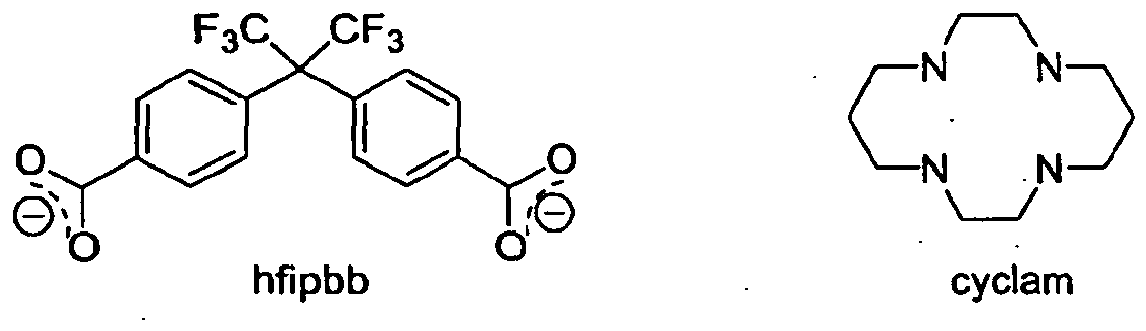
- Par ligand, on désigne la partie organique du matériau hybride. Ces ligands sont, le plus souvent, des di- ou tri-carboxylates ou des dérivés de la pyridine. Quelques ligands organiques fréquemment rencontrés sont représentés ci-après : bdc = benzene-1,4-dicarboxylate, btc = benzene-1,3,5-tricarboxylate, ndc = naphtalene-2,6-dicarboxylate, bpy = 4,4'-bipyridine, hfipbb = 4,4'-(hexafluororisopropylidene)-bisbenzoate, cyclam = 1,4,8,11-tetraazacyclotetradecane.

- L'entité inorganique jouant le rôle de connecteur est, quant à elle, un cation seul, un dimère, trimère ou tétramère ou encore une chaîne, un plan, voire un réseau tridimensionnel.
- Les équipes de Yaghi et Férey ont ainsi décrit un nombre important de nouveaux matériaux (série.des MOF et série des MIL, respectivement). De nombreuses autres équipes ont suivi cette voie et aujourd'hui le nombre de nouveaux matériaux décrits est en pleine expansion. Le plus souvent, les études visent à mettre au point des structures ordonnées, présentant des volumes poreux extrêmement importants, une bonne stabilité thermique et des fonctionnalités chimiques ajustables.
- Par exemple, Yaghi et al. décrivent une série de structures à base de bore dans le brevet
US2006/0154807 et indiquent leur intérêt dans le domaine du stockage des gaz. Le brevetUS-7,202,385 de Mueller et al. propose un récapitulatif particulièrement complet des structures décrites dans la littérature et illustre parfaitement la multitude de matériaux existant déjà à ce jour. - T. Loiseau et al. (Chem. Eur. J. 2004, 10, 1373-1382) décrit une phase MIL-53 à base d'atomes d'aluminium et du ligand bdc (benzène-1,4-dicarboxylate). Ce composé présente une structure tridimensionnelle dans laquelle les chaînes inorganiques unidimensionnelles à motif -Al-O(H)- sont liées entre elles par les connecteurs téréphtaliques déprotonnés (bdc = O2C-C6H4-CO2). Chaque atome d'aluminium est hexacoordiné, deux atomes d'oxygène des groupements hydroxyles se situant en position apicale et quatre atomes d'oxygène issus de quatre connecteurs téréphtaliques se localisant en position équatoriale. De plus, un ligand organique est relié à quatre atomes d'aluminium (deux couples d'atomes d'aluminium voisins). Des molécules d'acide téréphtalique libres (H2bdc = HO2C-C6H4-CO2H) occupent « l'espace laissé vacant par la charpente » avec un ratio H2bdc/Al de 0,7.
- En mettant au point un mode de synthèse utilisant un autre type de précurseur métallique, à base de l'élément gallium, nous avons obtenu un nouveau matériau hybride à matrice mixte organique-inorganique.
- La présente invention a pour objet un nouveau matériau cristallisé hybride, appelé IM-19 à matrice mixte organique-inorganique, contenant un réseau inorganique de centres métalliques à base de l'élément gallium connectés entre eux par des ligands organiques de type téréphtalate (ou bdc) et isostructural des matériaux MIL-53.
- Le matériau hybride IM-19 selon la présente invention présente un diagramme de diffraction de rayons X incluant au moins les raies inscrites dans le tableau 1. Ce diagramme de diffraction est obtenu par analyse radiocristallographique en utilisant la méthode classique des poudres au moyen d'un diffractomètre STOE STADI-P équipé d'un monochromateur avant Ge (111) et d'un détecteur PSD. Les analyses du matériau ont été enregistrées en mode Debye-Scherrer de 5 à 50° (2θ) avec une résolution de 0.01° (2θ) et un pas de 0,1° pendant 85 secondes.
- A partir de la position des pics de diffraction représentée par l'angle 2θ, on calcule, en appliquant la relation de Bragg, les distances réticulaires dhkl caractéristiques de l'échantillon. L'erreur de mesure Δ(dhkl ) sur dhkl est calculée en fonction de l'erreur absolue Δ(2θ) affectée à la mesure de 2θ. Une erreur absolue de Δ(2θ) égale à ±0,02° est communément admise. L'intensité relative I/I0 affectée à chaque valeur de dhkl est mesurée d'après la hauteur du pic de diffraction correspondant. Le diagramme de diffraction de rayons X du matériau hybride IM-19 selon l'invention comporte au moins les raies aux valeurs de dhkl données dans le tableau 1. Dans la colonne des dhkl , on a indiqué les valeurs moyennes des distances inter-réticulaires en Angströms (Å). Chacune de ces valeurs doit être affectée de l'erreur de mesure Δ(dhkl ) comprise entre ±0.3 Å et ±0,01 Å.
Tableau 1 : Valeurs moyennes des dhkl et intensités relatives mesurées sur un diagramme de diffraction de rayons X du matériau hybride IM-19 2 Thêta (°) dhkl (Å) I/I0 2 Thêta (°) dhkl (Å) I/I0 9,24 9,56 F 31,33 2,85 ff 12,47 7,10 FF 32,11 2,79 ff 17,68 5,01 f 33,78 2,65 ff 18,12 4,89 ff 34,42 2,60 ff 18,56 4,78 f 34,91 2,57 ff 19,34 4,59 ff 35,92 2,50 ff 20,62 4,30 ff 36,36 2,47 ff 23,29 3,82 ff 36,75 2,44 ff 24,73 3,60 ff 37,83 2,38 ff 25,10 3,54 f 40,56 2,22 ff 26,06 3,42 ff 41,82 2,16 ff 26,83 3,32 ff 42,34 2,13 ff 27,09 3,29 ff 42,65 2,12 ff 27,50 3,24 ff 44,27 2,04 ff 28,00 3,18 ff 44,78 2,02 ff 29,25 3,05 ff 47,59 1,91 ff 29,97 2,98 ff 47,90 1,90 ff 30,11 2,97 ff 48,92 1,86 ff 31,19 2,87 ff - La
Figure 1 correspond au diffractogramme de rayons X du solide hybride IM-19. - Le matériau hybride IM-19 s'indexe en système monoclinique, avec comme paramètres de maille a=19,187(3) Å; b=7,628(2) Å, c=6,669(1) Å et angles : α=γ=90°, β=95,86(1)°.
- La présente invention porte également sur un matériau hybride cristallisé sous sa forme brute de synthèse obtenu comme intermédiaire lors de la préparation du matériau hybride IM-19. Ce matériau hybride cristallisé se présentant sous sa forme brute de synthèse est un matériau hybride à matrice mixte organique-inorganique contenant un réseau de centres métalliques à base de gallium, connectés entre eux par des ligands organiques de type téréphtalate. Il présente un diagramme de diffraction de rayons X incluant au moins les raies inscrites dans le tableau 2.
- Ce diagramme a été obtenu dans les mêmes conditions que celles décrites précédemment pour le Tableau 1.
Tableau 2 : Valeurs moyennes des dhkl et intensités relatives mesurées sur un diagramme de diffraction de rayons X du matériau hybride intermédiaire sous sa forme brute de synthèse 2 Thêta (°) dhkl (Å) I/I0 2 Thêta (°) dhkl (Å) I/I0 8.88 9,95 FF 32,45 2,76 ff 10,15 8,71 FF 32,99 2,71 ff 12,50 7,08 ff 33,61 2,66 ff 14,58 6,07 f 33,93 2,64 ff 15,03 5,89 mf 34,21 2,62 ff 16,92 5,24 mf 35,02 2,56 ff 17,80 4,98 FF 36,04 2,49 ff 18,17 4,88 ff 39,95 2,25 ff 20,32 4,37 ff 40,48 2,23 ff 21,16 4,20 f 41,34 2,18 ff 21,66 4,10 ff 41,43 2,18 ff 22,54 3,94 ff 42,60 2,12 ff 24,23 3,67 f 43,08 2,10 ff 24,99 3,56 ff 43,52 2,08 ff 26,45 3,37 ff 43,74 2,07 ff 26,60 3,35 ff 44,16 2,05 ff 26,83 3,32 m 45,24 2,00 ff 27,95 3,19 ff 45,49 1,99 ff 28,39 3,14 ff 47,43 1,92 ff 30,32 2,95 ff 47,55 1,91 ff 31,56 2,83 ff 48,76 1,87 ff 32,07 2,79 f - La
Figure 2 correspond au diffractogramme de rayons X du solide intermédiaire cristallisé sous sa forme brute de synthèse obtenu lors de la préparation du matériau hybride IM-19. - Le matériau intermédiaire cristallisé sous sa forme brute de synthèse s'indexe en système orthorhombique, avec comme paramètres de maille a=17,422(2) Å; b=12,146(2) Å, c=6,737(1) Å et angles : α=β=γ=90°.
- La présente invention décrit également le procédé de préparation du matériau hybride cristallisé IM-19 à matrice mixte organique-inorganique. Ce procédé comprend au moins les étapes suivantes :
- i) la dissolution d'au moins un précurseur de gallium dans l'eau,
- ii) l'ajout de l'acide téréphtalique (H2bdc),
- iii) éventuellement, l'ajout d'acide fluorhydrique,
- iv) la cristallisation,
- v) la filtration, le lavage, le séchage pour obtenir un solide intermédiaire cristallisé sous sa forme brute de synthèse,
- vi) l'activation dudit solide intermédiaire cristallisé sous sa forme brute de synthèse comprenant successivement une première étape a) réalisée par voie solvothermale, à une température comprise entre 120 et 220°C, en présence d'un solvant polaire choisi parmi le diméthylsulfoxyde (DMSO) et le diméthylformamide (DMF), une deuxième étape b) d'échange en présence d'un solvant alcoolique et une troisième étape c) consistant à chauffer à une température comprise entre 150 et 280°C le solide issu de ladite étape b) et
- vii) le refroidissement du solide activé pour obtenir ledit matériau IM-19 et,
- viii) éventuellement, le chauffage du matériau IM-19 obtenu à une température comprise entre 300 et 400°C pour obtenir un matériau déshydraté, poreux et dépourvu de tout solvant.
- Le précurseur de gallium est choisi parmi les sels de gallium (III) tels que les chlorures, sulfates, acétates ou nitrates de gallium. Très préférentiellement, le précurseur utilisé est un nitrate de gallium.
- La composition molaire du mélange obtenu lors de la préparation du matériau hybride IM-19 (étapes i) à iii)) peut varier de la façon suivante : 1 mole de précurseur de gallium : 0,5 à 3 moles d'acide téréphtalique : 0 à 1 mole d'acide fluorhydrique : 100 moles d'eau.
- Le mélange obtenu à l'issue de l'étape iii) est soumis à un traitement hydrothermal jusqu'à ce que l'on obtienne la cristallisation du solide intermédiaire.
- L'étape de cristallisation iv) se fait à une température comprise entre la température ambiante et 260°C, préférentiellement entre 150 et 230°C pendant 12 à 72 heures, dans des conditions de pression de réaction autogène.
- Le séchage selon l'étape v) du procédé de préparation du matériau IM-19 est réalisé entre 20°C et jusqu'à une température de 200°C. Le plus souvent, le séchage est réalisé entre 20 et 100°C, de préférence entre 20 et 80°C, pendant une durée variant entre 1 et 24 heures, le plus souvent entre 4 et 10 heures.
- De manière avantageuse, le solide obtenu à l'issue de l'étape du séchage selon l'étape v) est lavé, avantageusement à l'eau, avec une solution à chaud de diméthylformamide (DMF), puis avec de l'éthanol.
- À l'issue de ladite étape v) du procédé de préparation du matériau IM-19, on obtient le solide intermédiaire cristallisé sous sa forme brute de synthèse dans lequel l'acide téréphtalique est présent. Le diagramme de diffraction de rayons X de ce solide est celui représenté sur la
figure 2 et correspondant aux valeurs moyennes des dhkl et intensités relatives mesurées données dans le tableau 2. - Ledit solide intermédiaire cristallisé est ensuite activé conformément à l'étape vi) de manière à libérer sa porosité de l'acide téréphtalique et obtenir le matériau IM-19 d'abord sous une forme déshydratée à l'issue de l'étape c) d'activation puis sous une forme hydratée à l'issue de l'étape vii).
- La première étape a) du traitement d'activation est mise en oeuvre en utilisant le solide cristallisé sous sa forme brute de synthèse lequel est introduit dans un autoclave et est mis en présence d'un solvant polaire choisi parmi le diméthylsulfoxide (DMSO) et le diméthylformamide (DMF), préférentiellement le DMF, le rapport massique solvant polaire/solide cristallisé brut de synthèse, préférentiellement le rapport massique DMF/solide brut de synthèse est compris entre 20 et 200, préférentiellement entre 50 et 150. Ladite étape a) est avantageusement réalisée à une température comprise entre 150 et 180°C. Elle est avantageusement conduite pendant une durée comprise entre 1 et 10 jours, très avantageusement comprise entre 2 et 10 jours et de manière encore plus préférée entre 4 et 10 jours.
- Ladite étape a) est préférentiellement suivie d'un refroidissement à une température comprise entre la température ambiante et 50°C, puis d'une filtration et d'un séchage de la suspension issue de ladite étape a). Le séchage est réalisé préférentiellement à une température comprise entre 20 et 50°C.
- Il est avantageusement mené pendant une durée comprise entre 8 et 24 heures. On obtient un solide cristallisé comprenant des molécules de solvant polaire occluses.
- La deuxième étape b) du traitement d'activation consiste à échanger le solvant polaire, préférentiellement le DMF, présent dans la porosité du solide issu de ladite première étape a) du traitement d'activation, par un solvant alcoolique préférentiellement choisi parmi le méthanol, l'éthanol et l'isopropanol. De manière très préférée, ledit solvant alcoolique est l'éthanol. Ladite deuxième étape consiste généralement à plonger le solide issu de ladite étape a) dans ledit solvant alcoolique, préférentiellement dans l'éthanol, selon un rapport massique solvant alcoolique/solide, préférentiellement éthanol/solide, compris entre 200 et 1000, de préférence entre 350 et 800. De manière très préférée, ladite deuxième étape est réalisée sans agitation. Elle est effectuée à une température comprise entre la température ambiante et 75°C, de préférence à température ambiante.
- Il est obtenu une suspension à l'issue de ladite étape b) du traitement d'activation, ladite suspension étant préférentiellement filtrée puis séchée de manière à obtenir une poudre. Le séchage est opéré à une température comprise entre la température ambiante et 70°C, de préférence à température ambiante, pendant une durée comprise entre 2 et 12 heures.
- La troisième étape c) du traitement d'activation consiste à chauffer le solide issu de ladite étape b) à une température comprise entre 150 et 280°C, préférentiellement pendant une durée comprise entre 8 heures et 3 jours: Le matériau issu de ladite troisième étape c) est déshydraté et est dépourvu de tout solvant.
- Le matériau IM-19 est finalement obtenu par refroidissement du solide activé conformément à ladite étape vi), préférentiellement sous air. Il se présente sous une forme hydratée.
- Cette étape de refroidissement peut éventuellement être suivie par une étape de chauffage sous air à une température comprise entre au moins 300 et 400°C, préférentiellement pendant une durée de 1 jour. Le matériau obtenu à l'issue de cette étape est déshydraté, dépourvu de tout solvant et poreux. Il s'agit d'un matériau hybride cristallisé présentant un diagramme de diffraction de rayons X incluant au moins les raies inscrites dans le tableau 3.
- Ce diagramme de diffraction des rayons X est obtenu par radiocristallographie en utilisant la méthode classique des poudres au moyen d'un diffractomètre PANALYTICAL X'PERT PRO MPD équipé d'un monochromateur avant, symétrique et courbe Ge (111) pour cuivre et d'un détecteur PSD X'Celerator avec une longueur active de 2,122 mm. L'enregistrement a été réalisé en géométrie Bragg-Brentano pour un domaine angulaire de 5,5000 à 50,0021° en 2θ pendant une durée totale de 36 minutes et 39 secondes.
Tableau 3 : Valeurs moyennes des dhkl et intensités relatives mesurées sur un diagramme de diffraction de rayons X du matériau obtenu à l'issue de la troisième étape du traitement d'activation 2 Thêta (°) dhkl (Å) I/I0 8,67 10,19 FF 10,78 8,20 ff 13,47 6,57 ff 14,89 5,94 ff 17,21 5,15 f 17,44 5,08 ff 18,35 4,83 ff 19,64 4,52 ff 20,87 4,25 ff 24,85 3,58 ff 25,84 3,44 ff 27,99 3,19 ff 31,79 2,81 ff 32,47 2,76 ff 33,78 2,65 ff 33,98 2,64 ff 34,63 2,59 ff 40,71 2,21 ff 42,53 2,12 ff 43,62 2,07 ff 46,53 1,95 ff - Ce matériau poreux s'indexe en système orthorhombique, avec comme paramètres de maille a=16,734(3) Å; b=13,282(3) Å, c=6,741(2) Å et angles : α=β=γ=90°.
- Ce matériau poreux dont le diagramme de diffraction de rayons X comprend au moins les raies inscrites dans le tableau 3 peut éventuellement être obtenu en chauffant entre 150 et 350°C le solide obtenu à l'issue de l'étape a) du traitement d'activation.
- La présente invention concerne également l'utilisation du matériau hybride IM-19 comme adsorbant ou comme catalyseur.
- L'invention est illustrée par les exemples suivants qui ne présentent, en aucun cas, un caractère limitatif.
- 18,33 g d'eau distillée sont placés dans un récipient en PTFE de 40 mL de volume intérieur. 2,66 g de nitrate de gallium hydraté (Alfa Aesar) sont ajoutés. Le mélange est agité pendant 5 minutes à l'aide d'un agitateur magnétique. Après homogénéisation, 0,52 g d'une solution aqueuse d'acide fluorhydrique (40% massique, Riedel de Haën) est ajouté. La solution est agitée pendant 5 minutes. 1,74 g d'acide téréphtalique (Fluka) est alors ajouté. Le mélange est agité pendant 5 minutes. La composition molaire du mélange obtenu est : 1 nitrate de gallium : 1 acide téréphtalique : 1 HF : 100 H2O. Le récipient en PTFE est alors transvasé dans un autoclave puis chauffé sans agitation à 220°C pendant 3 jours. Après refroidissement, le solide cristallisé obtenu est lavé à l'eau, avec une solution à chaud de DMF et ensuite à l'éthanol. Après séchage sous l'air à 25°C pendant environ 6 heures, on obtient un solide intermédiaire cristallisé sous forme de poudre cristalline correspondant au solide sous sa forme brute de synthèse présentant un diagramme de diffraction de rayons X incluant au moins les raies inscrites dans le tableau 2.
- L'activation du solide cristallisé est réalisée tout d'abord en chauffant par voie solvothermale le solide cristallisé sous sa forme brute de synthèse dans une solution de DMF (taux de remplissage de l'autoclave : 50% ; rapport massique DMF/solide cristallisé = 75) à 160°C pendant 7 jours (agitation manuelle de l'autoclave 1 fois par jour). Après refroidissement, la suspension obtenue est filtrée et séchée à 25°C pendant 12 heures. On obtient un solide contenant le DMF au sein de sa porosité. Il est plongé dans une solution d'éthanol absolu pendant 24 heures sans agitation pour la mise en oeuvre de la seconde phase d'activation (rapport massique EtOH/solide= 500). Après filtration et séchage à 25°C pendant 6 heures, la poudre obtenue est, dans une troisième étape, chauffée sous air à 220°C pendant 24 heures. Après refroidissement à l'air, on obtient un produit solide sous forme de poudre lequel est analysé par diffraction de rayons X et identifié comme étant constitué de cristaux de solide IM-19 présentant un diagramme de diffraction de rayons X incluant au moins les raies inscrites dans le tableau 1.
- 6,61 g d'eau distillée sont placés dans un récipient en PTFE de 20 mL de volume intérieur. 0,96 g de nitrate de gallium hydraté (Alfa Aesar) est ajouté. Le mélange est agité pendant 5 minutes à l'aide d'un agitateur magnétique. 0,61 g d'acide téréphtalique (Fluka) est alors ajouté. Le mélange est agité pendant 5 minutes. La composition molaire du mélange obtenu est : 1 nitrate de gallium : 1 acide téréphtalique : 100 H2O. Le récipient en PTFE est alors transvasé dans un autoclave puis chauffé sans agitation à 160°C pendant 1 jour. Après refroidissement, le solide cristallisé obtenu est filtré, lavé à l'eau, puis avec une solution à chaud de DMF et ensuite à l'éthanol. Après séchage sous air à 25°C pendant environ 6 heures, on obtient un solide intermédiaire cristallisé sous forme de poudre cristalline correspondant au solide sous sa forme brute de synthèse présentant un diagramme de diffraction de rayons X incluant au moins les raies inscrites dans le tableau 2.
- L'activation du solide cristallisé est réalisée tout d'abord en chauffant par voie solvothermale le solide cristallisé sous sa forme brute de synthèse dans une solution de DMF (taux de remplissage de l'autoclave : 50% ; rapport massique DMF/solide cristallisé = 75) à 160°C pendant 7 jours (agitation manuelle de l'autoclave 1 fois par jour). Après refroidissement, la suspension obtenue est filtrée et séchée à 25°C pendant 12 heures. On obtient un solide contenant le DMF au sein de sa porosité. Il est plongé dans une solution d'éthanol absolu pendant 24 heures sans agitation pour la mise en oeuvre de la seconde phase d'activation (rapport massique EtOH/solide= 500). Après filtration et séchage à 25°C pendant 6 heures, la poudre obtenue est, dans une troisième étape, chauffée sous air à 220°C pendant 24 heures. Après refroidissement à l'air, on obtient un produit solide sous forme de poudre lequel est analysé par diffraction de rayons X et identifié comme étant constitué de cristaux de solide IM-19 présentant un diagramme de diffraction de rayons X incluant au moins les raies inscrites dans le tableau 1.
- Les exemples 1 (synthèses a-e) et 2 (synthèses f-h) sont reproduits, en faisant varier la composition molaire du mélange et/ou les températures de réaction, les autres conditions opératoires restant identiques. Ces différents paramètres sont décrits dans le tableau suivant :
N° de synthèse Nitrate de gallium hydraté (mole) Acide téréphtalique (mole) Acide fluorhydrique (mole) Eau (mole) Température (°C) a 1 0,5 0,5 100 180 b 1 0,5 1,0 100 180 c 1 1,0 1,0 100 180 d 1 1,0 1,0 100 200 e 1 2,0 1,0 100 220 f 1 1 - 100 160 g 1 2 - 100 160 h 1 3 - 100 160 - Ces solides sont synthétisés en reproduisant les protocoles expérimentaux décrits dans les exemples 1 et 2 respectivement
- A l'issue de l'étape d'activation et de refroidissement du solide activé, on obtient une poudre cristallisée constituée de cristaux de IM-19.
Claims (15)
- Matériau hybride cristallisé IM-19 à matrice mixte organique-inorganique contenant un réseau inorganique de centres métalliques à base de l'élément gallium, connectés entre eux par des ligands organiques de type téréphtalate, présentant un diagramme de diffraction de rayons X incluant au moins les raies inscrites dans le tableau ci-dessous :
2 Thêta (°) dhkl (Å) I/I0 2 Thêta (°) d hk/ (Å) I/I0 9,24 9,56 F 31,33 2,85 ff 12,47 7,10 FF 32,11 2,79 ff 17,68 5,01 f 33,78 2,65 ff 18,12 4,89 ff 34,42 2,60 ff 18,56 4,78 f 34,91 2,57 ff 19,34 4,59 ff 35,92 2,50 ff 20,62 4,30 ff 36,36 2,47 ff 23,29 3,82 ff 36,75 2,44 ff 24,73 3,60 ff 37,83 2,38 ff 25,10 3,54 f 40,56 2,22 ff 26,06 3,42 ff 41,82 2,16 ff 26,83 3,32 ff 42,34 2,13 ff 27,09 3,29 ff 42,65 2,12 ff 27,50 3,24 ff 44,27 2,04 ff 28,00 3,18 ff 44,78 2,02 ff 29,25 3,05 ff 47,59 1,91 ff 29,97 2,98 ff 47,90 1,90 ff 30,11 2,97 ff 48,92 1,86 ff 31.19 2.87 ff - Matériau selon la revendication 1 caractérisé en ce qu'il s'indexe en système en système monoclinique, avec comme paramètres de maille a=19,187(3) Å; b=7,628(2) Å, c=6,669(1) Å et angles : α=γ=90°, β=95,86(1)°.
- Matériau hybride cristallisé, se présentant sous sa forme brute de synthèse, à matrice mixte organique-inorganique contenant un réseau de centres métalliques à base de gallium, connectés entre eux par des ligands organiques de type téréphtalate, présentant un diagramme de diffraction de rayons X incluant au moins les raies inscrites dans le tableau ci-dessous :
2 Thêta (°) dhkl (Å) I/I0 2 Thêta (°) dhkl (Å) I/I0 8,88 9,95 FF 32,45 2,76 ff 10,15 8,71 FF 32,99 2,71 ff 12,50 7,08 ff 33,61 2,66 ff 14,58 6,07 f 33,93 2,64 ff 15,03 5,89 mf 34,21 2,62 ff 16,92 5,24 mf 35,02 2,56 ff 17,80 4,98 FF 36,04 2,49 ff 18,17 4,88 ff 39,95 2,25 ff 20,32 4,37 ff 40,48 2,23 ff 21,16 4,20 f 41,34 2,18 ff 21,66 4,10 ff 41,43 2,18 ff 22,54 3,94 ff 42,60 2,12 ff 24,23 3,67 f 43,08 2,10 ff 24,99 3,56 ff 43,52 2,08 ff 26,45 3,37 ff 43,74 2,07 ff 26,60 3,35 ff 44,16 2,05 ff 26,83 3,32 m 45,24 2,00 ff 27,95 3,19 ff 45,49 1,99 ff 28,39 3,14 ff 47,43 1,92 ff 30,32 2,95 ff 47,55 1,91 ff 31,56 2,83 ff 48,76 1,87 ff 32,07 2,79 f 48,76 1,87 ff - Matériau hybride cristallisé se présentant sous sa forme brute de synthèse selon la revendication 3 caractérisé en ce qu'il s'indexe en système orthorhombique, avec comme paramètres de maille a=17,422(2) Å; b=12,146(2) Å, c=6,737(1) Å et angles : α=β=γ=90°
- Procédé de préparation d'un matériau hybride cristallisé à matrice mixte organique-inorganique selon l'une des revendications 1 ou 2 comprenant au moins les étapes suivantes :i) la dissolution d'au moins un précurseur de gallium dans l'eau,ii) l'ajout de l'acide téréphtalique (H2bdc),iii) éventuellement, l'ajout d'acide fluorhydrique,iv) la cristallisation,v) la filtration, le lavage, le séchage pour obtenir un solide intermédiaire cristallisé sous sa forme brute de synthèse défini dans la revendication 3,vi) l'activation dudit solide sous sa forme brute de synthèse comprenant successivement une première étape a) réalisée par voie solvothermale, à une température comprise entre 120 et 220°C, en présence d'un solvant polaire choisi parmi le diméthylsulfoxyde (DMSO) et le diméthylformamide (DMF), une deuxième étape b) d'échange en présence d'un solvant alcoolique et une troisième étape c) consistant à chauffer à une température comprise entre 150 et 280°C le solide issu de ladite étape b) etvii) le refroidissement du solide activé pour obtenir ledit matériau IM-19 et,viii) éventuellement, le chauffage du matériau obtenu IM-19 à une température comprise entre 300 et 400°C pour obtenir un matériau déshydraté, poreux et dépourvu de tout solvant.
- Procédé selon la revendication 5 dans lequel le précurseur de gallium est choisi parmi les sels de gallium (III).
- Procédé selon la revendication 6 dans lequel le précurseur de gallium est le nitrate de gallium.
- Procédé selon l'une des revendications 5 à 7 dans lequel la composition molaire du mélange obtenu lors des étapes i) à iii) varie de la façon suivante : 1 mole de précurseur de gallium : 0,5 à 3 moles d'acide téréphtalique : 0 à 1 moles d'acide fluorhydrique : 100 moles d'eau.
- Procédé selon l'une des revendications 5 à 8 dans lequel le mélange obtenu à l'issue de l'étape iii) est soumis un traitement hydrothermal jusqu'à ce qu'on obtienne la cristallisation du solide intermédiaire l'étape de cristallisation se faisant entre température ambiante et 260°C pendant 12 à 72 heures, dans des conditions de pression de réaction autogène.
- Procédé selon l'une des revendications 5 à 9 dans lequel le séchage selon l'étape v) est réalisé entre 20 et 200°C, pendant une durée variant de 1 à 24 heures.
- Procédé selon l'une des revendications 5 à 10 dans lequel le rapport massique solvant polaire et le solide cristallisé brut de synthèse mis en jeu lors de la première étape a) du traitement d'activation est compris entre 20 et 200.
- Procédé selon l'une des revendications 5 à 11 dans lequel l'étape a) est suivie d'un refroidissement à une température comprise entre la température ambiante et 50°C, puis d'une filtration et d'un séchage de la suspension issue de ladite étape a), le séchage étant réalisé préférentiellement à une température comprise entre 20 et 50°C.
- Procédé selon l'une des revendications 5 à 12 dans lequel le rapport massique entre solvant alcoolique et le solide mis en jeu lors de l'étape b) du traitement d'activation est compris entre 200 et 1000.
- Procédé selon l'une des revendications 5 à 13 dans lequel à l'issue de l'étape b) du traitement d'activation on obtient une suspension, qui est ensuite filtrée et séchée à une température comprise entre la température ambiante et 70°C.
- Utilisation du matériau hybride selon l'une des revendications 1 ou 2 obtenu par le procédé selon l'une des revendications 5 à 14 comme adsorbant ou comme catalyseur.
Applications Claiming Priority (3)
| Application Number | Priority Date | Filing Date | Title |
|---|---|---|---|
| FR0801089A FR2927911A1 (fr) | 2008-02-27 | 2008-02-27 | Nouveau materiau hybride organique-inorganique im-19 et son procede de preparation. |
| FR0805540A FR2927912B1 (fr) | 2008-02-27 | 2008-10-07 | Nouveau materiau hybride organique-inorganique im-19 et son procede de preparation |
| PCT/FR2009/000177 WO2009115683A1 (fr) | 2008-02-27 | 2009-02-17 | Nouveau materiau hybride organique-inorganique im-19 et son procede de preparation |
Publications (2)
| Publication Number | Publication Date |
|---|---|
| EP2249962A1 EP2249962A1 (fr) | 2010-11-17 |
| EP2249962B1 true EP2249962B1 (fr) | 2012-04-25 |
Family
ID=39743040
Family Applications (1)
| Application Number | Title | Priority Date | Filing Date |
|---|---|---|---|
| EP09721476A Not-in-force EP2249962B1 (fr) | 2008-02-27 | 2009-02-17 | Nouveau materiau hybride organique-inorganique im-19 et son procede de preparation |
Country Status (12)
| Country | Link |
|---|---|
| US (1) | US8637690B2 (fr) |
| EP (1) | EP2249962B1 (fr) |
| JP (1) | JP2011517661A (fr) |
| KR (1) | KR101636088B1 (fr) |
| CN (1) | CN101959596B (fr) |
| AT (1) | ATE554854T1 (fr) |
| BR (1) | BRPI0907600B1 (fr) |
| DK (1) | DK2249962T3 (fr) |
| FR (2) | FR2927911A1 (fr) |
| RU (1) | RU2490059C2 (fr) |
| WO (1) | WO2009115683A1 (fr) |
| ZA (1) | ZA201004790B (fr) |
Families Citing this family (5)
| Publication number | Priority date | Publication date | Assignee | Title |
|---|---|---|---|---|
| WO2012165911A2 (fr) * | 2011-06-01 | 2012-12-06 | 한국화학연구원 | Procédé de préparation de matériaux hybrides organiques-inorganiques poreux |
| GB201205365D0 (en) * | 2012-03-27 | 2012-05-09 | Univ Nottingham | Frameworks |
| CN103509040A (zh) * | 2012-06-26 | 2014-01-15 | 宁波大学 | 一种具有高热稳定性与荧光性能的配位聚合物及其制备方法 |
| CN110639616A (zh) * | 2019-09-20 | 2020-01-03 | 长安大学 | 氨基修饰的MIL-68(Ga)新型光催化剂的制备及其用于还原Cr(VI)的方法 |
| US20260163018A1 (en) * | 2021-10-29 | 2026-06-11 | Panasonic Intellectual Property Management Co., Ltd. | Alkaline battery |
Family Cites Families (11)
| Publication number | Priority date | Publication date | Assignee | Title |
|---|---|---|---|---|
| DE4120847A1 (de) * | 1991-06-25 | 1993-01-14 | Vaw Ver Aluminium Werke Ag | Kristallines, zeolithanaloges gallosilicat und verfahren zu dessen herstellung |
| US7105360B2 (en) * | 2002-03-08 | 2006-09-12 | International Business Machines Corporation | Low temperature melt-processing of organic-inorganic hybrid |
| WO2004085543A1 (fr) * | 2003-03-26 | 2004-10-07 | Semiconductor Energy Laboratory Co. Ltd. | Materiau hybride organique/inorganique, composition permettant de synthetiser ce materiau et processus de production de ce materiau hybride |
| US20050004404A1 (en) * | 2003-07-03 | 2005-01-06 | Basf Akiengesellschaft | Process for the alkoxylation of monools in the presence of metallo-organic framework materials |
| RU2235591C1 (ru) * | 2003-07-17 | 2004-09-10 | Институт катализа им. Г.К. Борескова СО РАН | Катализатор для получения моторных топлив (варианты) и способ его приготовления (варианты) |
| DE102004061238A1 (de) * | 2004-12-20 | 2006-06-22 | Basf Ag | Adsorptive Anreicherung von Methan in Methan-haltigen Gasgemischen |
| JP4863647B2 (ja) * | 2005-05-26 | 2012-01-25 | 株式会社リコー | 有機−無機ハイブリッド材料とその製造方法 |
| DE102005039623A1 (de) * | 2005-08-22 | 2007-03-01 | Basf Ag | Verfahren zur Herstellung von metallorganischen Gerüstmaterialien Hauptgruppen Metallionen enthaltend |
| JP2007242524A (ja) * | 2006-03-10 | 2007-09-20 | Toyota Motor Corp | 有機無機ハイブリッド電解質膜、その製造方法、及び燃料電池 |
| CN100384860C (zh) * | 2006-07-04 | 2008-04-30 | 首都师范大学 | 具有多孔道结构特征的钨配合物晶体的制备方法 |
| CN100509828C (zh) * | 2007-06-12 | 2009-07-08 | 南开大学 | 异金属储氢孔材料和制备方法及其应用 |
-
2008
- 2008-02-27 FR FR0801089A patent/FR2927911A1/fr active Pending
- 2008-10-07 FR FR0805540A patent/FR2927912B1/fr not_active Expired - Fee Related
-
2009
- 2009-02-17 DK DK09721476.1T patent/DK2249962T3/da active
- 2009-02-17 CN CN200980106748.7A patent/CN101959596B/zh not_active Expired - Fee Related
- 2009-02-17 US US12/919,511 patent/US8637690B2/en not_active Expired - Fee Related
- 2009-02-17 BR BRPI0907600A patent/BRPI0907600B1/pt not_active IP Right Cessation
- 2009-02-17 EP EP09721476A patent/EP2249962B1/fr not_active Not-in-force
- 2009-02-17 JP JP2010548139A patent/JP2011517661A/ja active Pending
- 2009-02-17 AT AT09721476T patent/ATE554854T1/de active
- 2009-02-17 RU RU2010139410/05A patent/RU2490059C2/ru not_active IP Right Cessation
- 2009-02-17 KR KR1020107019097A patent/KR101636088B1/ko not_active Expired - Fee Related
- 2009-02-17 WO PCT/FR2009/000177 patent/WO2009115683A1/fr not_active Ceased
-
2010
- 2010-07-07 ZA ZA2010/04790A patent/ZA201004790B/en unknown
Also Published As
| Publication number | Publication date |
|---|---|
| CN101959596B (zh) | 2014-08-20 |
| ATE554854T1 (de) | 2012-05-15 |
| FR2927912B1 (fr) | 2010-03-19 |
| EP2249962A1 (fr) | 2010-11-17 |
| KR101636088B1 (ko) | 2016-07-04 |
| BRPI0907600A2 (pt) | 2015-07-21 |
| JP2011517661A (ja) | 2011-06-16 |
| BRPI0907600B1 (pt) | 2017-06-06 |
| FR2927912A1 (fr) | 2009-08-28 |
| KR20100125269A (ko) | 2010-11-30 |
| CN101959596A (zh) | 2011-01-26 |
| US20110028748A1 (en) | 2011-02-03 |
| WO2009115683A1 (fr) | 2009-09-24 |
| RU2490059C2 (ru) | 2013-08-20 |
| ZA201004790B (en) | 2011-03-30 |
| RU2010139410A (ru) | 2012-04-10 |
| US8637690B2 (en) | 2014-01-28 |
| FR2927911A1 (fr) | 2009-08-28 |
| DK2249962T3 (da) | 2012-08-06 |
Similar Documents
| Publication | Publication Date | Title |
|---|---|---|
| ES2550054T3 (es) | Método de preparación de sólidos funcionalizados de matriz orgánica-inorgánica que portan ciclo de triazol | |
| EP2491047B1 (fr) | Nouveau materiau hybride organique-inorganique ihm-2 et procedes de preparation | |
| EP3801895B1 (fr) | Procédé de synthèse d'un matériau composite composé d'un mélange de zéolithes de type structural afx et de type structural bea en présence d'un structurant organique azoté | |
| WO2009115683A1 (fr) | Nouveau materiau hybride organique-inorganique im-19 et son procede de preparation | |
| FR3081344A1 (fr) | Procede de synthese d'une zeolithe de type structural afx a partir d'un melange de zeolithes fau en presence d'un structurant organique azote | |
| EP2491048B1 (fr) | Nouveau solide hybride organique-inorganique mil-53-al-n3 pourvu d'une fonction azoture et son procede de préparation | |
| EP2501708B1 (fr) | Nouveau solide hybride organique-inorganique ihm-2-n3 pourvu d'une fonction azoture et son procede de preparation | |
| FR2958945A1 (fr) | Nouveau solide hybride organique-inorganique mil-101-fe-n3 pourvu d'une fonction azoture et son procede de preparation | |
| EP3990390A1 (fr) | Solide cristallise izm-5 et son procede de preparation | |
| FR3095199A1 (fr) | Procédé de synthèse rapide d'une zeolithe de type structural AFX avec une source de faujasite | |
| FR2950346A1 (fr) | Materiau organique-inorganique zeolithique a base d'imizolates fonctionnalises, procede de preparation et applications | |
| EP2477995B1 (fr) | Nouveau solide hybride organique-inorganique dmof-1-n3 pourvu d'une fonction azoture et son procede de preparation | |
| WO2011048282A1 (fr) | Nouveau solide hybride organique-inorganique cau-1-n3 pourvu d'une fonction azoture et son procede de preparation | |
| EP4037828B1 (fr) | Synthese a basse temperature de zeolithe afx de haute purete | |
| EP2643085A1 (fr) | Nouveau solide hybride organique-inorganique im-21 et son procédé de préparation | |
| FR3123644A1 (fr) | Solide cristallise itq-76 et son procede de preparation | |
| FR3123645A1 (fr) | Solide cristallise itq-75 et son procede de preparation | |
| FR2936797A1 (fr) | Procede de production de composes aromatiques substitues en presence d'un catalyseur a base du solide im-19 | |
| FR2921674A1 (fr) | Nouveau materiau hybride organique-inorganique |
Legal Events
| Date | Code | Title | Description |
|---|---|---|---|
| PUAI | Public reference made under article 153(3) epc to a published international application that has entered the european phase |
Free format text: ORIGINAL CODE: 0009012 |
|
| 17P | Request for examination filed |
Effective date: 20100927 |
|
| AK | Designated contracting states |
Kind code of ref document: A1 Designated state(s): AT BE BG CH CY CZ DE DK EE ES FI FR GB GR HR HU IE IS IT LI LT LU LV MC MK MT NL NO PL PT RO SE SI SK TR |
|
| AX | Request for extension of the european patent |
Extension state: AL BA RS |
|
| DAX | Request for extension of the european patent (deleted) | ||
| GRAP | Despatch of communication of intention to grant a patent |
Free format text: ORIGINAL CODE: EPIDOSNIGR1 |
|
| GRAS | Grant fee paid |
Free format text: ORIGINAL CODE: EPIDOSNIGR3 |
|
| GRAA | (expected) grant |
Free format text: ORIGINAL CODE: 0009210 |
|
| AK | Designated contracting states |
Kind code of ref document: B1 Designated state(s): AT BE BG CH CY CZ DE DK EE ES FI FR GB GR HR HU IE IS IT LI LT LU LV MC MK MT NL NO PL PT RO SE SI SK TR |
|
| REG | Reference to a national code |
Ref country code: GB Ref legal event code: FG4D Free format text: NOT ENGLISH |
|
| REG | Reference to a national code |
Ref country code: CH Ref legal event code: EP |
|
| REG | Reference to a national code |
Ref country code: AT Ref legal event code: REF Ref document number: 554854 Country of ref document: AT Kind code of ref document: T Effective date: 20120515 |
|
| REG | Reference to a national code |
Ref country code: IE Ref legal event code: FG4D Free format text: LANGUAGE OF EP DOCUMENT: FRENCH |
|
| REG | Reference to a national code |
Ref country code: DE Ref legal event code: R096 Ref document number: 602009006589 Country of ref document: DE Effective date: 20120621 |
|
| REG | Reference to a national code |
Ref country code: NL Ref legal event code: T3 |
|
| REG | Reference to a national code |
Ref country code: DK Ref legal event code: T3 |
|
| REG | Reference to a national code |
Ref country code: AT Ref legal event code: MK05 Ref document number: 554854 Country of ref document: AT Kind code of ref document: T Effective date: 20120425 |
|
| LTIE | Lt: invalidation of european patent or patent extension |
Effective date: 20120425 |
|
| PG25 | Lapsed in a contracting state [announced via postgrant information from national office to epo] |
Ref country code: CY Free format text: LAPSE BECAUSE OF FAILURE TO SUBMIT A TRANSLATION OF THE DESCRIPTION OR TO PAY THE FEE WITHIN THE PRESCRIBED TIME-LIMIT Effective date: 20120425 Ref country code: FI Free format text: LAPSE BECAUSE OF FAILURE TO SUBMIT A TRANSLATION OF THE DESCRIPTION OR TO PAY THE FEE WITHIN THE PRESCRIBED TIME-LIMIT Effective date: 20120425 Ref country code: PL Free format text: LAPSE BECAUSE OF FAILURE TO SUBMIT A TRANSLATION OF THE DESCRIPTION OR TO PAY THE FEE WITHIN THE PRESCRIBED TIME-LIMIT Effective date: 20120425 Ref country code: LT Free format text: LAPSE BECAUSE OF FAILURE TO SUBMIT A TRANSLATION OF THE DESCRIPTION OR TO PAY THE FEE WITHIN THE PRESCRIBED TIME-LIMIT Effective date: 20120425 Ref country code: NO Free format text: LAPSE BECAUSE OF FAILURE TO SUBMIT A TRANSLATION OF THE DESCRIPTION OR TO PAY THE FEE WITHIN THE PRESCRIBED TIME-LIMIT Effective date: 20120725 Ref country code: SE Free format text: LAPSE BECAUSE OF FAILURE TO SUBMIT A TRANSLATION OF THE DESCRIPTION OR TO PAY THE FEE WITHIN THE PRESCRIBED TIME-LIMIT Effective date: 20120425 Ref country code: IS Free format text: LAPSE BECAUSE OF FAILURE TO SUBMIT A TRANSLATION OF THE DESCRIPTION OR TO PAY THE FEE WITHIN THE PRESCRIBED TIME-LIMIT Effective date: 20120825 |
|
| PG25 | Lapsed in a contracting state [announced via postgrant information from national office to epo] |
Ref country code: SI Free format text: LAPSE BECAUSE OF FAILURE TO SUBMIT A TRANSLATION OF THE DESCRIPTION OR TO PAY THE FEE WITHIN THE PRESCRIBED TIME-LIMIT Effective date: 20120425 Ref country code: LV Free format text: LAPSE BECAUSE OF FAILURE TO SUBMIT A TRANSLATION OF THE DESCRIPTION OR TO PAY THE FEE WITHIN THE PRESCRIBED TIME-LIMIT Effective date: 20120425 Ref country code: HR Free format text: LAPSE BECAUSE OF FAILURE TO SUBMIT A TRANSLATION OF THE DESCRIPTION OR TO PAY THE FEE WITHIN THE PRESCRIBED TIME-LIMIT Effective date: 20120425 Ref country code: GR Free format text: LAPSE BECAUSE OF FAILURE TO SUBMIT A TRANSLATION OF THE DESCRIPTION OR TO PAY THE FEE WITHIN THE PRESCRIBED TIME-LIMIT Effective date: 20120726 Ref country code: PT Free format text: LAPSE BECAUSE OF FAILURE TO SUBMIT A TRANSLATION OF THE DESCRIPTION OR TO PAY THE FEE WITHIN THE PRESCRIBED TIME-LIMIT Effective date: 20120827 |
|
| PG25 | Lapsed in a contracting state [announced via postgrant information from national office to epo] |
Ref country code: AT Free format text: LAPSE BECAUSE OF FAILURE TO SUBMIT A TRANSLATION OF THE DESCRIPTION OR TO PAY THE FEE WITHIN THE PRESCRIBED TIME-LIMIT Effective date: 20120425 Ref country code: RO Free format text: LAPSE BECAUSE OF FAILURE TO SUBMIT A TRANSLATION OF THE DESCRIPTION OR TO PAY THE FEE WITHIN THE PRESCRIBED TIME-LIMIT Effective date: 20120425 Ref country code: EE Free format text: LAPSE BECAUSE OF FAILURE TO SUBMIT A TRANSLATION OF THE DESCRIPTION OR TO PAY THE FEE WITHIN THE PRESCRIBED TIME-LIMIT Effective date: 20120425 Ref country code: CZ Free format text: LAPSE BECAUSE OF FAILURE TO SUBMIT A TRANSLATION OF THE DESCRIPTION OR TO PAY THE FEE WITHIN THE PRESCRIBED TIME-LIMIT Effective date: 20120425 Ref country code: SK Free format text: LAPSE BECAUSE OF FAILURE TO SUBMIT A TRANSLATION OF THE DESCRIPTION OR TO PAY THE FEE WITHIN THE PRESCRIBED TIME-LIMIT Effective date: 20120425 |
|
| PG25 | Lapsed in a contracting state [announced via postgrant information from national office to epo] |
Ref country code: IT Free format text: LAPSE BECAUSE OF FAILURE TO SUBMIT A TRANSLATION OF THE DESCRIPTION OR TO PAY THE FEE WITHIN THE PRESCRIBED TIME-LIMIT Effective date: 20120425 |
|
| PLBE | No opposition filed within time limit |
Free format text: ORIGINAL CODE: 0009261 |
|
| STAA | Information on the status of an ep patent application or granted ep patent |
Free format text: STATUS: NO OPPOSITION FILED WITHIN TIME LIMIT |
|
| 26N | No opposition filed |
Effective date: 20130128 |
|
| PG25 | Lapsed in a contracting state [announced via postgrant information from national office to epo] |
Ref country code: ES Free format text: LAPSE BECAUSE OF FAILURE TO SUBMIT A TRANSLATION OF THE DESCRIPTION OR TO PAY THE FEE WITHIN THE PRESCRIBED TIME-LIMIT Effective date: 20120805 |
|
| REG | Reference to a national code |
Ref country code: DE Ref legal event code: R097 Ref document number: 602009006589 Country of ref document: DE Effective date: 20130128 |
|
| PG25 | Lapsed in a contracting state [announced via postgrant information from national office to epo] |
Ref country code: BG Free format text: LAPSE BECAUSE OF FAILURE TO SUBMIT A TRANSLATION OF THE DESCRIPTION OR TO PAY THE FEE WITHIN THE PRESCRIBED TIME-LIMIT Effective date: 20120725 |
|
| PG25 | Lapsed in a contracting state [announced via postgrant information from national office to epo] |
Ref country code: MC Free format text: LAPSE BECAUSE OF NON-PAYMENT OF DUE FEES Effective date: 20130228 |
|
| REG | Reference to a national code |
Ref country code: CH Ref legal event code: PL |
|
| PG25 | Lapsed in a contracting state [announced via postgrant information from national office to epo] |
Ref country code: CH Free format text: LAPSE BECAUSE OF NON-PAYMENT OF DUE FEES Effective date: 20130228 Ref country code: LI Free format text: LAPSE BECAUSE OF NON-PAYMENT OF DUE FEES Effective date: 20130228 |
|
| REG | Reference to a national code |
Ref country code: IE Ref legal event code: MM4A |
|
| PG25 | Lapsed in a contracting state [announced via postgrant information from national office to epo] |
Ref country code: IE Free format text: LAPSE BECAUSE OF NON-PAYMENT OF DUE FEES Effective date: 20130217 |
|
| PG25 | Lapsed in a contracting state [announced via postgrant information from national office to epo] |
Ref country code: MT Free format text: LAPSE BECAUSE OF FAILURE TO SUBMIT A TRANSLATION OF THE DESCRIPTION OR TO PAY THE FEE WITHIN THE PRESCRIBED TIME-LIMIT Effective date: 20120425 |
|
| PG25 | Lapsed in a contracting state [announced via postgrant information from national office to epo] |
Ref country code: TR Free format text: LAPSE BECAUSE OF FAILURE TO SUBMIT A TRANSLATION OF THE DESCRIPTION OR TO PAY THE FEE WITHIN THE PRESCRIBED TIME-LIMIT Effective date: 20120425 |
|
| PG25 | Lapsed in a contracting state [announced via postgrant information from national office to epo] |
Ref country code: MK Free format text: LAPSE BECAUSE OF FAILURE TO SUBMIT A TRANSLATION OF THE DESCRIPTION OR TO PAY THE FEE WITHIN THE PRESCRIBED TIME-LIMIT Effective date: 20120425 Ref country code: HU Free format text: LAPSE BECAUSE OF FAILURE TO SUBMIT A TRANSLATION OF THE DESCRIPTION OR TO PAY THE FEE WITHIN THE PRESCRIBED TIME-LIMIT; INVALID AB INITIO Effective date: 20090217 Ref country code: LU Free format text: LAPSE BECAUSE OF NON-PAYMENT OF DUE FEES Effective date: 20130217 |
|
| REG | Reference to a national code |
Ref country code: FR Ref legal event code: PLFP Year of fee payment: 8 |
|
| REG | Reference to a national code |
Ref country code: FR Ref legal event code: PLFP Year of fee payment: 9 |
|
| REG | Reference to a national code |
Ref country code: FR Ref legal event code: PLFP Year of fee payment: 10 |
|
| PGFP | Annual fee paid to national office [announced via postgrant information from national office to epo] |
Ref country code: NL Payment date: 20180227 Year of fee payment: 10 |
|
| PGFP | Annual fee paid to national office [announced via postgrant information from national office to epo] |
Ref country code: DE Payment date: 20180301 Year of fee payment: 10 Ref country code: DK Payment date: 20180224 Year of fee payment: 10 Ref country code: GB Payment date: 20180226 Year of fee payment: 10 |
|
| PGFP | Annual fee paid to national office [announced via postgrant information from national office to epo] |
Ref country code: BE Payment date: 20180222 Year of fee payment: 10 Ref country code: FR Payment date: 20180222 Year of fee payment: 10 |
|
| REG | Reference to a national code |
Ref country code: DE Ref legal event code: R119 Ref document number: 602009006589 Country of ref document: DE |
|
| REG | Reference to a national code |
Ref country code: DK Ref legal event code: EBP Effective date: 20190228 |
|
| REG | Reference to a national code |
Ref country code: NL Ref legal event code: MM Effective date: 20190301 |
|
| GBPC | Gb: european patent ceased through non-payment of renewal fee |
Effective date: 20190217 |
|
| REG | Reference to a national code |
Ref country code: BE Ref legal event code: MM Effective date: 20190228 |
|
| PG25 | Lapsed in a contracting state [announced via postgrant information from national office to epo] |
Ref country code: DK Free format text: LAPSE BECAUSE OF NON-PAYMENT OF DUE FEES Effective date: 20190228 Ref country code: NL Free format text: LAPSE BECAUSE OF NON-PAYMENT OF DUE FEES Effective date: 20190301 Ref country code: DE Free format text: LAPSE BECAUSE OF NON-PAYMENT OF DUE FEES Effective date: 20190903 Ref country code: GB Free format text: LAPSE BECAUSE OF NON-PAYMENT OF DUE FEES Effective date: 20190217 |
|
| PG25 | Lapsed in a contracting state [announced via postgrant information from national office to epo] |
Ref country code: BE Free format text: LAPSE BECAUSE OF NON-PAYMENT OF DUE FEES Effective date: 20190228 Ref country code: FR Free format text: LAPSE BECAUSE OF NON-PAYMENT OF DUE FEES Effective date: 20190228 |